MODE
Fall 2025
Table of Contents 18... 20... 22... 24... 25... 26... 28... 30... 32... 38... 39... 40... 42... 44... 45... 46... 48... 50... 51... 52... 54... 55... 56... 58...
4... 5... 6... 8...
Letter from the Editor-in-Chief Letter from the Photo Editor Letter from the Creative Directors A Nightmare in Technicolor: The Colors of Suspiria 10... The Ancestral Plane 12... Lana Del Rey, the Lolita Aesthetic and the Constant Blaming of Women: A Defense of Miss Rey 13... Photo Page 14... Medieval Hair, Modern Trend? 16... We Were All Goth at 15: Beauty as Becoming Photo Page Dressing for Dreams Bejeweled Dreams Fashion as Collective Aspiration The Dream of Your Dream Wardrobe A Legacy of Fashion Freedom: Stevie Nicks The Subconscious Power of Your Grandma’s Style Closer Than You Think: Drag, Showgirls, and Burlesque A Roadmap to Dreamscapes “Life Could be a Dream, or Could it?” Chase Your Dreams! No, Literally. Celestial Consumption : How this Year’s Eclipse Season Shaped Shopping Habits The Whimsy of Autumn: A Dreamscape of Nostalgia Is Everything Romantic? (Not) Freak The Freak-Out From Print to WitchTok: How Tarot Has Become Pop Culture Junk Journaling and the Magic of Physical Memories Childhood Trinkets Photo Page The Power of the Stars: Have We Let Zodiac Signs Impact Our Relationships Love, Actually...... Looks Better in Bollywood, Dreaming in Technicolour Dream Relationship, or Just a Dream When You Know You Know; Is it Really True Love? The Escape into Romantasy
Credits
Executive Board
Editor-in-Chief: Caroline Abella Creative Directors: Kamalani Soriano and Kenya Edwards Photo Editor: Niamh Cogley Treasurer: Tara Castano Secretary: Kailey Sigoda Social Media: Gianna Fernandez Fundraising: Allie Vasquez Editors Arts & Entertainment: Lainey Nguyen Fashion: Brooke Swenson Lifestyle: Ella Keddy Beauty: Melanie Ballard Love & Relationships: Kennedy Pounder
Authors Melanie Ballard Mia Barth Griffin Bilello Noah Bury Gianna Fernandez Jacquelyn Harris
Audrey Hoffman Advika Karthik Iyer Elan Jenkins Zuri Jupiter-Jones Ella Keddy Ava Kokoros
Elaine Linehan Stephania Lopez Megan McCann Maeve McCurdy Emily McRae Makena Monaco
Emma Owen Alexa Reid Polina Romanents Emily Sauget Kailey Sigoda Hannah Sullivan
Photographers Anna Brown Meghan Cattani Niamh Cogley Lucy Gile Lorraine Grappotte Kennedy Klein
Elaine Linehan Emily McRae Lainey Nguyen Mia Ortega Polina Romanets Anna Stroh
Leah Stuart Chrissy Thebuwanage
Illustrators Caroline Abella Sophia Gayoso-Nordling Elaine Linehan
Stylists
Models Caroline Abella Zariyat Ahmed Brett Arthur Melanie Ballard Campbell Brown Anna Brown Tara Castano Niamh Cogley Margaret Craney Fiona Dunphy Gianna Fernandez Mia Garcia
Brooke Swenson Noelle Wilkes
Lucy Gile Massimo Mendoza Daniella Grono Maia Munich Rita Hagerty Lainey Nguyen Warda Hassan Mia Ortega Audrey Hoffman River Pann Layla Hughes Victoria Pérez-Huerta Advika Karthik Iyer Polina Romanets Katharina Jäger Mia Scarpa Kennedy Klein Caroline Stetson Ava Kokoros Hannah Sullivan Lizzy Luegger Haniyyah Usmani Mona Marukawa Cailean Walker
Melanie Ballard Kate Dowd Kimberly Fernandes Elene Gorgadze Warda Hassan
Chloe Hebert Layla Hughes Sofia Lakdawalla Brooke Swenson
Makeup Artists Kimberly Fernandes Mia Garcia Chloe Herbert Audrey Hoffman
Layla Hughes Kim Lazzara Mona Marukawa
Lucia Marino Emily McRae Nina Skelly Madeline Smith
Kamalani Soriano Hannah Sullivan
Layout Caroline Abella Isabella Arno Grace Biesterfeld Anna Brown
Meghan Cattani Niamh Cogley Sarah Davidsen Kate Dowd
Kenya Edwards Zuri Jupiter-Jones Isabella Le Cindy Liu
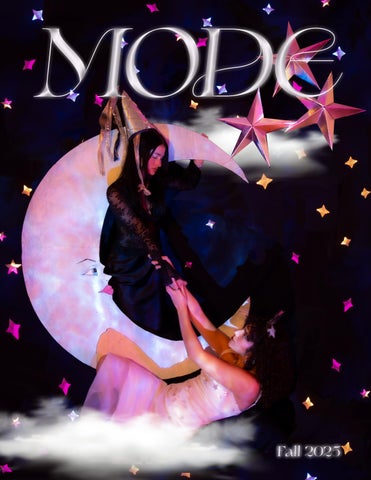
Cover Photographer: Niamh Cogley Models: Margaret Craney, Maia Munich Stylist: Aurora Marcianti
A Letter from the
Editor-in-Chief
Dear MODE readers,
I am so proud to be able to say that Dreamscapes is my firstever MODE issue as EditorinChief! So super crazy! I’ve been in MODE since the first semester of my freshman year, and the idea of being EditorinChief seemed like a faroff dream that I wasn’t sure would ever be possible. And now here I am! It doesn’t even feel like that much time has passed since then, yet so much has changed– it’s strange to think about where I am now sometimes. The theme of this semester’s issue ties into this; I was considering the past, present, and future in a thematic sense. The feeling of suddenly stopping to look around and see how far you’ve come. To see what has been made possible and a reality, what once was a dream. It’s interesting the way in which things can fall into place! When I think about the past and the future, I think about the way that my dreams have shifted over time. When I came up with the idea of Dreamscapes this summer, I was thinking a lot about whimsical and dreamlike imagery— what it means to be dreamy and how this concept can reach so broadly into various ideas and topics. I was mostly excited to see what everyone in MODE would come up with and what might inspire them. I think that it’s a good thing to be dreamy, even if it isn’t the most “realistic”. Allowing yourself the freedom to be dreamy, whimsical, and have fun is something that can make life feel a lot better. MODE feels like the best environment to explore ideas surrounding Dreamscapes. Everyone in this club is so extremely creative and always pulls off such an incredible number of things every single semester. Every year, I love watching everyone’s work start to roll in and progress. Now, being in the position of EditorinChief, it makes me even happier to see the collaboration and progression of ideas develop into this final product. To watch authors find inspiration and work through ideas, to see photoshoots develop, and for everything to come together in the layout process. I thank everyone in MODE for their incredible work, passion and creativity. I think that it really pays off, and I appreciate it immensely, especially as creative practices are devalued with the increasing popularity of AI and generative artificial intelligence in creative fields. I am proud that MODE can exist despite this and continue to showcase the hard work, effort, dedication, and human touch that is necessary in creativity. Especially since it is a physical print product that can be held at the end of each semester. I love MODE as a collaborative and accessible space where people can express themselves and try new things. I don’t even know what I would think my first semester freshman year if I could see how I’m able to use InDesign now, and I’m proud to say that all of my skills and knowledge in the software have developed solely because of MODE. I owe so much to this club, and I am so grateful to be able to be your EditorinChief! To the wonderful Creative Directors, Kamalani and Kenya, and Photo Editor, Niamh, thank you so much for all of your work and support. This seriously could not happen without you!!! May next semester be even better! Working with everyone in MODE has been fantastic, and I can’t wait to do it all again next semester!
4
Fondly,
Caroline Abella
A Letter from the Dear dreamers,
Photo Editor
Becoming Photo Editor for MODE feels a little like stepping into a dream I’ve been quietly carrying since my first semester. At my first club day, I was drawn to the MODE table by the cover, sleek, polished, and intimidating in the best way. The model looked impossibly cool, the design felt so confident, and it lit something up in me. There was a small realization that I could learn to make something like that someday, and now I’m so grateful to be here. My first photoshoot as a freshman was a blur of nerves and secondguessing, but each time I picked up my camera and tried again, something grew. I learned by doing, as I experimented, adjusted, and figured out what made an image feel like my own. MODE provides so much space to explore and evolve, and it means the world to be creating this issue alongside people I’ve worked with since our first year. We’ve all grown up inside this magazine together, and having the opportunity to lead our photography during my senior year feels incredibly special. My favourite MODE moments are when I can feel a vision clicking into place— sending inspiration photos around, exchanging ideas in text threads, and laughing with my team between shots. I love talking with the people I photograph as we create an environment where they feel confident and collaborative. Those moments, when ideas are bouncing around and everyone is in the same imaginative headspace, feel like the heart of MODE to me. When I have my camera in my hands and we’re creative together, it feels like its own tiny creative universe. I wanted to capture that MODE magic for this Dreamscapes issue, creating a little universe to guide you through the magazine. I kept thinking about vintage moon portraits and their quiet enchantment, and once that image settled into my mind, the cover took shape naturally. I built a moon out of foam board and attempted to spray paint it (before the rain decided to help), handpainted craters, crafted paper stars, and slowly shaped a world by hand. Inside it, a moonwoman glows as she welcomes a princess to escape into the sky with her, the two of them wandering through paper stars like characters from a fairytale.
Thank you to everyone who helped bring this set to life, and a special thank you to Caroline, whose energy and kindness make dreaming feel easy. I’m so proud of what we all created this semester. I hope that when you open this edition, you feel the same pull I felt years ago, an invitation to step into something imagined, something a little magical.
With love from our little universe,
Niamh Cogley
5
A Letter From the
Creat Crea t ive Directt or Direc
To my lovely MODE readers,,
What a dream it has been to be a Creative Director this semester! I first wanted to express my gratitude to everyone who contributed to our Fall//Winter 2025 issue. It has been such a pleasure to work with you all! While writing this,, I am simultaneously looking over the final layout drafts. I am in complete awe of the artistry and creative work that the MODE team has accomplished. You all are visionaries who brought our Dreamscapes theme to life through alluring colors,, settings,, outfits and fonts. It takes massive amounts of energy to coordinate written articles with editing,, photography,, modelling,, styling,, makeup and layout. I seriously appreciate all the hours that the MODE team has put in. I also wanted to give extra applause to Caroline for being the driving force behind the entire team,, especially as this is her first season as Editor--in--Chief. To Kenya,, I love being a Creative Director alongside you! Your warm personality makes my extra late nights much more tolerable. To the rest of E-Board… … we did it! Another issue in the books! I am so,, so proud and incredibly excited for the semesters to come with all of you. I have been on MODE since I was a freshman,, and I remember it being the first club that I really wanted to join. During my college search in high school,, I saw MODE as a club on the Fordham website. I knew I had to give it a shot. Two and a half years later,, and (I still cannot believe) I am a Creative Director. I adore MODE so much that even though I am currently studying abroad in London,, I have been staying up (after six hours of back--to--back classes) until 4:00 AM to attend the Monday night meetings. It is an honor and a privilege to serve in this role. In a world where AI is gradually creeping into creative spaces,, MODE Magazine showcases how the artistic talent and ideas of people are incomparable to learning models that only regurgitate what human imagination has already produced. The extraordinary layouts in this magazine cannot be replicated by AI,, because each one has an individual story. It could never replace the joy I feel when chatting with my team members during meetings. It will never replace a fun day out in NYC,, shooting film with people you’ve never met. It simply cannot replace the uniqueness of human insight and thought–– something critical to MODE. To me, me, MODE is a constant reminder that in order to achieve true satisfaction from the outcome, outcome, the process cannot be ignored. The journey ultimately gives meaning to the end result. Thank you for reading MODE Magazine. I hope you thoroughly enjoy our Fall//Winter 2025 issue. With so much love,,
6
Kamalani Soriano
A Letter From the
Creative Director Dear Readers, I’m so excited to step into the role of Co–Creative Director this semester. After spending the last two semesters working on layout, modeling, writing, and photography, having the opportunity to help lead this issue has truly been a dream for me. I want to give a special thank you to our Editor-in-Chief, Caroline, and my Co–Creative Director, Kamalani. I’ve gotten to know both of them so much more this year, and they’re truly just as amazing as I always thought. Working closely alongside them has shown me their dedication, creativity, and the hard work they pour into everything we create. I’m also so grateful for our entire Mode creative community. The passion, talent, and commitment everyone brings to this magazine is inspiring, and it’s an honor to be part of a team that cares so deeply about our work.
Here’s to another beautiful issue,
XOXO
Kenya Edwards
7
By Audrey Hoffman
8
In the opening scene of Dario Argento’s 1977 Suspiria, the viewer is immediately struck by bright, unnatural colors that distance the film from everyday life. As Suzy steps off the plane, her face is bathed in hues of red, yellow, and blue. Primary colors and deep blacks dominate every frame: the façade of the dance academy is garish red, the walls inside a saturated blue. In the apartment where a dancer is murdered, bold art deco patterns in crimson and fantastical blue lighting heighten the sense of unreality. Even the film’s infamous gore is fantastically stylized. The blood, a cartoonish cherry red, looks almost painted on, reinforcing the artificial tone. Cinematographer Luciano Tovoli explained in a 2010 interview that his goal was to make Suspiria “a total abstraction from what we call ‘everyday reality,’” using pure
primary colors to feel violent and provocative. The effect was achieved through various techniques. Lights were covered with colored screens and placed close to the actors’ faces, while mirrors altered the quality of the glow. Though reminiscent of and inspired by the colors of early Technicolor films, Suspiria was not shot in that format. Instead, it was filmed on standard stock and printed using the Technicolor IB process, which intensified saturation. Argento and Tovoli’s hypersaturated palette transforms the setting into a nightmare, pushing the viewer into a surreal space that feels detached from our world. The deliberate use of color both makes Suspiria a one of a kind film and shapes its uncanny, dreamlike atmosphere.
Photography by Niamh Cogley, Modeled by Caroline Abella, Audrey Hoffman, Rita Hagerty, Layout by Niamh Cogley
9
La yo u
Illu
10
t
ophia Gayo so-Nordling strated by S
wd Do t e a K y b
The Ancestral Plane
W
Fictional films have shown ancestral connections through symbolic visuals and dream-like, surrealist encounters, both direct and indirect, to help the protagonist gain insight about how to work through obstacles. The idea of the ancestral plane can be seen in culturally resonant films with advice given from past kings to their sons in The Lion King and Black Panther, discoveries in familial history in Moana, and reaffirmations of one’s passion in Coco and Sinners. In The Lion King and Black Panther, new patriarchal kings seek guidance from their deceased fathers under beautiful sunsets of deep purples and blues, offset by exciting oranges and pinks. These essential scenes occurred when protagonists, Simba and T’Challa, were in need of familial connection with them speaking directly to the person they looked up to most: their father and past king. Tied to various African traditions, the scene of Mufasa’s ghost saying “remember who you are” represents a spiritual reminder that regardless of how far you go, your ancestors will always be with you, reminding Simba that he is always worthy. This moment of sharing wisdom between father and son is explored with Black Panther as T’Challa enters the Ancestral Plane of Wakandan ancestors, a pathway of liberation eternally tying Wakanda to their homeland, untouched by the outside world and its complications. Like Mufasa, T’Chaka tells his son T’Challa to “stand up. You are a king,” strengthening this understanding of ancestral guidance pushing such protagonists to their best potential and sense of self. In a dreamscape revelation, Moana, searching for clarity on her purpose, finally comes to realize why she feels so called to the ocean and leaving the island. Unearthing that her ancestors were voyagers, this magical sight of her lineage traveling through great waters shows that knowing where you came from can help you understand who you truly are. Like the kings talking to their sons, Moana’s recently deceased grandmother visits her, in the spirit of the manta ray, reminding her that her entire family lineage can inform her about her Polynesian culture and personal calling. That voice deep down in her soul constantly calling her to the ocean is a function of this ancestral plane pulling her to her destiny. Coco became a booming success following the popularity of the song “Remember Me/Recuérdame,” as a key plot device that eventually healed old wounds of family miscommunication. During Miguel’s time in the surrealist “Land of the Dead” with his ancestors, Miguel uncovers an ultimate truth, propelled by “Recuérdame,” to reunite the living and honored family back together. Sinners holds a similar stance on music connecting family, focusing on the retainment of culture in postcolonial contexts. In the juke joint, Sammie’s song “I Lied to You,” actively invites the spirits of African and African diasporic music and dance. Showing the evolution of their histories and cultures, this scene shows how elements of the past and present inform each other to create new futures. The stories, emotions, and experiences shared through music for centuries can be seen as Sammie’s gift provides a portal to seeing it all. The inclusion of Hip Hop, African tribal dance (including Zaouli Spirit), modern ue ballet, Chinese Opera (as the ritten by Jacq lyn Harris Monkey King), and many others are a lively cultural representation of ancestry promoting passion.
11
Lana Del Rey
The
Lolita Aesthetic Lolia Aesthetic
the Constant Constant Blaming Blaming of of Women Women && the Written by By:Polina PolinaRomanents Rominav Coquette, nymphet, lolita… the endless parade of labels and fleeting microtrends that dominate the woman imaginary. Behind them lies the same allure– the fragile, sexual, dangerous good girl who dared to turn wicked. At the heart of this aesthetic sits Nabokov’s Lolita, a masterpiece and a scandal. It tells the story of Dolores Haze, a 12-year-old preyed on by 40-yearold Humbert Humbert, who romanticizes their abuse with lyrical prose. As an unreliable narrator, his perception elevates the relationship to a mythical level, embroidered with ethereal imagery. And yet, the age gap alone should draw disgust; as no pretty language can disguise a pedophilic relationship. So how did we go from a horror story to dresses paired with red lipstick and a romanticization of Lolita’s experience? Wrapped in nostalgia and tinged with fatalism, this aesthetic has stitched the female cultural zeitgeist–and few have worn it as provocatively as Lana Del Rey. The accusations come easily. Cloaked in melancholia and toxic relationships, Del Rey is an easy target. But for goodness sake, why are we expecting every artist to be a role model? Singing about traumatic, toxic relationships in a beautiful, poetic way does not equate to excusing sexual violence. As a victim herself, why are we judging how one deals with trauma? Women artists do
12
not need to be unproblematic, presenting experiences in a polished, sterile manner. Lana Del Rey is not responsible for raising teen girls around the world (although she did raise me), their parents are. She is not obligated to present a sanitized, healthy version of herself. She is an artist, a storyteller, which implies a certain romanticization, especially given her Americana, vintage style. Her work often presents troubling relationships that still feel beautiful as a way of survival–because human relationships are never perfect, and that does not mean we cannot romanticize them as a way to live. Blaming Nabokov and Lana Del Rey because people misunderstand their work shows a lack of critical thinking in our society. The real question is not why Lana isn’t a better role model but why society demands female artists be everything for everyone. Male artists’ flaws and darkness are celebrated as genius; women must clean up their trauma. Lana with her honesty, Hollywood diva, powerful yet vulnerable approach to love catches the beauty and chaos of relationships, stepping away from the superficiality often found in pop music and trying to reach the human core. And in a world that constantly screws you up, maybe romanticizing the painful and vulnerable is the only way to live.
Illustrated by Caroline Abella
Layout by Meghan Cattani
13
Medieval Hair, Modern Trend? T
he 2018 “Heavenly Bodies” Met Gala is arguably the most revered the museum has held in history, its pink carpet littered with references to medieval styles of dress and hair. Madonna’s braided crown, Jasmine Sanders’s floral plaits, and the elaborate updos of Emilia Clarke and Kate Upton all hearken back to a time when flatirons weren’t invented. But that night was not simply a fleeting spectacle, as seven years later, the collective awe we experienced is transforming into a new vintage nostalgia.
14
By Melanie Ballard W
hile searching for a Renaissance fair look, I stumbled across a tutorial for “weeping rose braids”: two templeside plaits twisted into roses, accented with drooping strands and a forehead braid looping into the design. At first, I thought this was a oneoff viral video, but a deeper investigation revealed that perhaps colloquial
notions of vintage weren’t vintage enough, and that people are beginning to yearn for beauty inspiration across centuries, rather than decades.
O
n the red carpet at the 2024 VMAs, Chappell Roan leaned into the medieval warrior aesthetic with her braided hair, an intricate plait worthy of a Tudor princess. On screen, Elle Fanning as Catherine the Great sports voluminous ceremonial braids that make fishtails and French braids feel quaint. Suddenly, ramshorn headpieces adorned with roses don’t seem like costumes, but the next stage in fashion’s endless recycling. Medieval nostalgia isn’t only about pageantry; it’s proof that beauty trends are no longer bound by decades, but by imagination that dares to be outofdate by 700 years.
Photography by Anna Stroh Modeled and Styled by Caroline Abella and Melanie Ballard Layout by Niamh Cogley
15