Footwearists report
Should ZOA be a leather alternative? Last month Modern Meadow presented its ‘lab grown leather’ called ZOA to the general public for the first time with a pop-up store in Soho, New York. Having waited for this moment for several years, we immediately jumped on a plane not to miss this historic happening. Making the report of it took us a while though, since we had to think about how to convey the right message about what we saw. Do we think that ZOA is a material that could positively disrupt the fashion and footwear industry? Absolutely! Do we think it is an alternative for leather like Modern Meadow claims? No we don’t… at least not in its current state… and if the company continues on its current path it might never be a leather alternative in the eyes of the consumer. Is that bad though or is the comparison with leather unnecessarily limiting the appeal of biofabricated, protein-based materials? Read through the descriptions with the next images to get the full story.
The ZOA pop-up store almost looked like a graphic design exhibition: all in black and white, mainly repeating the geometric elements of the ZOA logo – square, circle, triangle – on several pieces of fabric that were all displayed in glass cases; the audience was not able to touch any samples. Only these graphics were made with ZOA, looking similar to applique or to screen-printed patterns. The main purpose of the exhibition was to test how consumers might feel about lab-grown materials. Even though the colours were all black and white, our opinion about the material is not, so bear with us and read through the captions of the next images. (Image: Modern Meadow)
ZOA is a liquid, so therefore it is not surprising that it actually looks more like a coating and was mostly applied as such. The only sample that was not applied on a textile backing was this one: a very thin and open lace-like structure. Intriguing for sure, especially since we were told it grows into this shape, but not something people would generally describe as, nor associate with, leather. It is also not suitable to use without a backing, at least not for shoes or bags.
We had a wonderful conversation at the venue with Amy Congdon, senior designer for Modern Meadow, who was kind enough to take the time to go over as much info with us as she was able to share; obviously our questions were a lot more in-depth than those of the average visitor… The full process of how to make ZOA is under NDA, so she was not able to explain in detail how the material grows. As revealed on their website, they genetically engineer yeast cells to produce collagen and other proteins, although it is unclear which other ones. The amino acids in the collagen form a triple helix; this structure then forms into fibrils – nanofibres – that then join together into bigger bundles of collagen fibres.
This technology is not new, it is also used in the cosmetics industry, for instance, and so we assume that this part of the process is not proprietary to Modern Meadow. Their trade secrets lie in what happens after that. Modern Meadow talks about a ‘secret sauce’ that further processes the fibres into an actual material. The cells proliferate in a liquid, perhaps similar to how Modern Meadow’s creative director Suzanne Lee used to grow bacteria in tea to make skin-like materials for her brand Biocouture. Since ZOA starts as a liquid, you could probably take the word ‘sauce’ quite literally: it is like a ‘collagen fibre sauce’. And as we all know sauce is meant to enrich another dish, never as the main component of a meal… (image: Modern Meadow website)
According to Wikipedia collagen makes up for 25% to 35% of the whole-body protein content of all animal bodies. It is the most abundant protein in mammals - including humans - and it is mostly found in fibrous tissues such as tendons, ligaments and skin. That means that even though collagen is an essential building block for skin, it is certainly not the only one. In other words, with making just collagen, you cannot fully replicate skin or all of its properties. That is the main issue that we have with claiming that ZOA is exactly like leather, but without killing any animals. This screenshot from a recent video about ZOA by “Interesting Shit� has us confused: (https://www. youtube.com/watch?v=EwU8DmMhRZ8&sns=fb). The leather that is being sewn in this video does not look like the material we saw in New York at all. If it is already possible to biofabricate ZOA as sheets that really look, feel and behave like leather, then why were these not on display at the launch in New York? Or is this just to show what they hope the material will be?
The most interesting material application on display in New York was this t-shirt, which is also part of the MOMA exhibition “Is Fashion Modern?” Here ZOA is used to connect various kinds of fabric together without any stitching, like a biofabricated adhesive foil. The black t-shirt was the only piece that was not behind glass at the Soho pop-up exhibition, so we touched it, even though you were not supposed to…. The ZOA part felt rather cold and stiff, like a PUbased fake leather or a vinyl, but not like leather and certainly not high-quality leather. Yet we feel awkward mentioning this, because we are great supporters of Modern Meadow’s work and totally believe in the future potential of biotech.
However, the chosen comparison with leather might turn out to stand in ZOA’s way, at least in its current form. The technology is much more expensive than making regular leather. Even though ZOA is not commercially available until 2018, the price will be higher than leather, especially if you compare it to bovine leather. However, none of the samples looked rich or particularly resembled real leather, in our opinion. There are PU leathers (‘pleathers’) that are way more polluting, because they are petroleum based, yet do a much better job of looking and feeling like actual leather.
If a professional from the leather industry or a consumer would look at it now, they would probably comment that it looks and feels inferior to leather, especially since there were no leather-like samples without a backing. It is comparable to the situation with vegetarian meat alternatives; instead of being a plant-based source of protein that is attractive and tasty in its own right, it is made to resemble meat, so when people judge it, they do this by comparing it to ‘the real thing’. ‘Vegetarian chicken’ might actually taste really good, yet if it does not completely resemble chicken, it will still be seen as an inferior alternative.
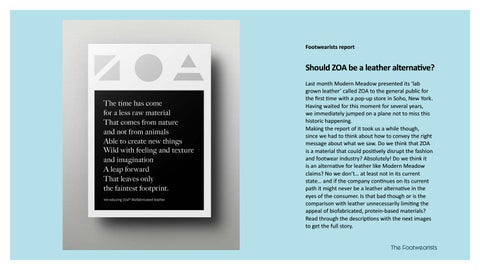
ZOA might not closely resemble leather, yet the fact that it is lab grown and liquid creates so many other possibilities that leather could never have though, exactly like this text on the wall explained! We sincerely hope that the company starts exploring and promoting these much more, rather than mainly trying to replicate leather. We do understand that they feel this is a good marketing strategy, because more and more people consider leather to be polluting and related to animal cruelty and want to find an alternative, but what if the general public overlooks its larger potential, simply because it does not replicate leather as well as existing synthetic leather varieties?
Looking at the exhibition through the eyes of footwear professionals, we could also see short-term applications that combine ZOA with leather. Since ZOA can be used as an adhesive, we could imagine applying it to laminate leather parts together. Speed manufacturing is a key development in footwear and it has resulted in textile uppers that are not stitched together but laminated in one go, using a technique called high frequency welding. This requires plastics though and is not easy to use on leather, since leather will not melt and therefore it is hard to make the plastic parts stick to it. This is one of the reasons we are seeing fewer leather uppers in sneakers, for instance. Since ZOA is collagen based, like leather, it might stick much better to it and would be a much more sustainable option than the thermoplastics that are used now. (Image: www.work-order.co; they designed the ZOA branding)
However, Modern Meadow has chosen to position ZOA as an ‘anti-leather’, emphasizing that no animals have been killed for it. That is why combining it with regular leather would probably make no sense to them. In the past months their ‘no animals were killed for this’ message has been less on the forefront though, possibly because ZOA still needs to be tanned to stop it from decaying, so Modern Meadow is collaborating with parties that also supply chemicals for regular leather tanning and they might not appreciate their ‘leather is animal cruelty’ message. Furthermore, Modern Meadow aims for ZOA to look like bovine (cow) leather and as many people have already commented, no animals are killed directly for this kind of leather anyway. Cows are killed for their meat and the skin is a by-product. It might have made more sense to replicate skins of exotic animals that are in fact killed for their skin. We would personally love to see all leather replaced by much more sustainable biofabricated alternatives, but even if that does indeed happen, there will be a very long transition period of at least several decades during which both will coexist, so why not combine them?
Their ‘no kill leather’ proposition is also one of the reasons why they have chosen their current method, which indeed does not involve animals at all, yet it also does not fully replicate animal skin. For instance, ZOA can breathe, but its breathability depends on how dense the collagen fibres have grown: the more porous, the more breathable the material is. But that is more like how textile behaves: a mesh is more breathable than a dense fabric. ZOA does not have the same fine pore structure as (bovine) leather that allows it to take in moisture from the foot and to slowly evaporate that.
It is technically possible to fully replicate animal skin with pores in a lab though - this is called tissue engineering - and as far as we know that is also how Modern Meadow started originally. However, this method is very costly and slow, as it requires various kinds of cells and tissue to be cultured in-vitro. More importantly, in order for these cells and tissues to grow and proliferate, a source of nutrients, namely hormones and growth factors, must be added. The usual supplement is Fetal Bovine Serum (FBS) - a product that is derived from the fetuses of cows found pregnant at slaughter. So when applying this method to replicate leather, one cannot claim that no animals were killed for it and this is probably one of the reasons why Modern Meadow has stopped using it. To our knowledge no plant-based or synthesized replacement for Fetal Bovine Serum has been found yet. There are a few other companies that are researching tissue engineering to fully replicate animal skin though, like Vitrolabs (http://www.vitrolabsinc.com/) and Qorium, co-founded by Professor Mark Post of Maastricht University who also produced the first labgrown hamburger in 2013. Neither of these is close to market, as far as we know.
Lets end this report on a positive note, because the potential of ZOA beyond being a leather replacement is huge and so is our enthusiasm. For instance, we were told this pattern was not embossed into the material; it actually grew into this shape. If that is the case, then hopefully we can eventually grow it into 3D shapes as well, creating entirely new functions and aesthetics by actually growing a full shoe. The colours were also not applied with a dye after the material has finished growing, but during the growth process, allowing for marbled looks like this to be through and through. Even though the exhibition showed only black and white for design reasons, they said any colour is possible. So lets broaden the range of options and use biotech to its full potential, without being restricted by current notions of what a material should do or look like!