COMPANION
/
They
Moved Me / Anonymous
Some people came like weather— enveloping, climactic.
They changed the air. Shifted my direction. Then moved on.
Others arrived quietly and never tried to lead. They stayed long enough to make the road feel possible.

COMPANION
Footsteps Zine Issue 4
Spring 2026
Editors:
Yechezkel Zach Greenberger
Tehilla Muller
Rayne Lunger
Aliyah Blattner
Rachel Szachara
Content warning: Some pieces contain references to personal trauma. We encourage you to practice self-care in whatever ways feel right for you as you read this zine.
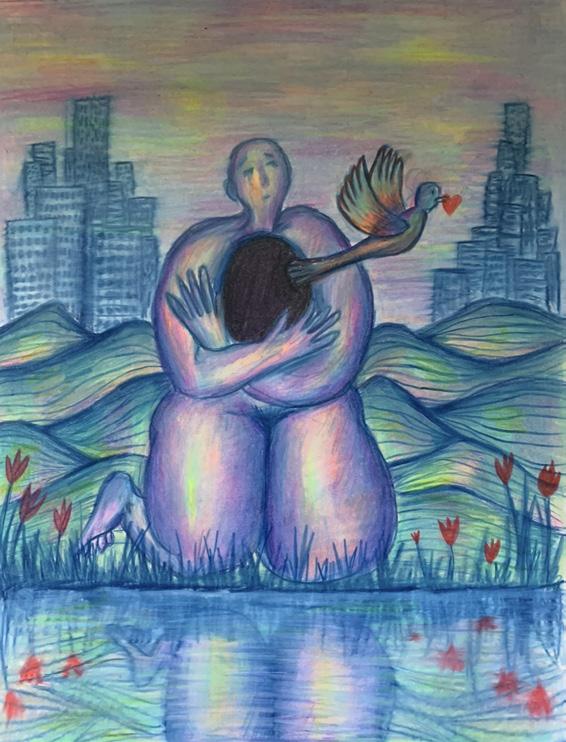
Letting Go of a Lover
Doe Lowinger Cover Art
This piece was created with colored pencils on paper. I created it while feeling loss and grief for someone I loved, yet knowing that it’s time to let them go. The bird holding the heart is a metaphor to how the love and lessons people teach us-whether they’re still in our life or not-will continue living on in different places.
Rayne Lunger
Shaping this issue around “Companion,” in collaboration with Aliyah, Zach, Tehilla, and Rachel has been especially meaningful because the process itself echoed the theme we were exploring. The care and attention with which they approached every single submission was beautiful to witness, and truly worthy of the trust members place in us when they share their art.
In the compellingly personal and creative works in this zine, companionship takes many forms. It is sometimes deliberate and chosen, sometimes unexpected. It is fragile, sustaining, complicated, and ever evolving, living in our relationships with others, in our memories, in our creative practices, and in our search for identity. It is an inquiry that feels both intimate and expansive, asking the question: what does it mean to not be alone even in moments of uncertainty, distance, or transition?
You’re
not allowed to write about yourself. Yechezkel Zach
Greenberger
“If you’re going to write,” they say — and you shouldn’t, unless what you’re writing is rabbinical or for the purpose of sales — “but if you’re going to, for some reason, choose to write, you should never write about yourself.”
And when you hear this, you’re going to believe it. Live by it. Not with your ears, but your nervous system; hear and see and feel. The mass implication. The adults all zipped up. You won’t be able to speak it in words — such insidious truths are rarely so accessible — but you will know it, like you know to hold your breath under water.
The first short story you’ll ever write will be fanfiction about two sleuthing teenagers named Frank and Joe. Heard of em? They’re also known as the Hardy boys and are the lead characters in your fourth grade rebbe’s favorite mystery series. “Now that was a book, that was a bissel kosher entertainment!” he’ll say.
(He’ll be, for similar reasons, a fan of The Three Stooges. It must be a fluke then — a perversion — when you develop a spectacular pre-pubescent crush on Christine Mcintyre, one of the Stooge’s main recurring blondes. Perhaps your rebbe would’ve retracted his hechsher, had he known.)
The great thing about writing Hardy boys fanfic is that you already know exactly how to do it. You end each chapter with the boys getting knocked out and begin the following chapter with them coming to. This was their way, Frank and Joe (one wonders how they survived from book to book without developing CTE). But after a few weeks, you will feel ashamed of your plagiarism, bored by it, and will give up writing for a while.
The next time you write, you’ll do so under the impression that real writers,
original writers, don’t use names from real life. You will name characters Hormnel and Kodfin and Renlip; names no one has ever heard of. And, like a dispassionate God, you will stop caring for them soon after you give them life.
The first time you write about yourself, you will write about a Christian. A Christian man who leaves his Christian town and religion behind. It’s the most personal writing you’ve ever done. It has almost nothing to do with you.
When you finish writing about this OTD Christian, you’ll ask yourself why you didn’t write about an OTD Jew. You’ll say it’s because you’re curious about Christianity; what is their perspective on someone who leaves? You’ll also notice, for the first time, some shame around the prospect of writing directly about your world.
You will be 21 when you first learn of Philip Roth. Your therapist — a baal teshuva Cornell grad — will ask you if you’ve ever heard of him, “one of the most significant Jewish writers of the 20th century.” You will say no. He will be more shocked by this than by any of your darkest confessions.
“Which book should I start with?” you will ask. His suggestion: Portnoy’s Complaint. He won’t warn you of its vulgarity, its psycho-sexual content, its fullthroated lament of neurosis and Jewishness. You will go in blind. It will change your life.
Never had you read something so disgusting, so funny, so unflinchingly and nakedly itself.
Soon after reading Portnoy’s, you will start writing a new story. It will be about a yeshiva boy. You will name him Ezra Fine.
You’re not allowed to write about yourself. No one is allowed to write about themselves. Still, you do.
Thank you everyone who submitted for writing, painting, photographing, sculpting so thoughtfully, viscerally, vulnerably, truthfully. It was an honor to experience your work. Thank you Rayne, Aliyah, Tehilla, and Rachel for a beautiful collaboration in shaping this year’s zine.
Cultivating Kinship for the Self at Odds
Aliyah Blattner
I remember arranging dried baby’s breath in a marinara jar beside the landline as the damp ends of my hair curled around my ears. I washed the dishes in mismatched socks, spritzed a diluted bottle of Mrs. Meyer’s across the counters before scrubbing them clean. Sleater-Kinney crooned from a wireless speaker, the air purifier whirring, like waves lipping against the shore. And I left for the
laundromat, bypassing my neighbor’s squash blossoms which rotted in the garden bed beneath a ruthless, August sun. In a metal folding chair, I gummed a saltine, watching the timer on the spin cycle tick down to zero. A harried mother corrected her son’s haphazard folding of a fitted sheet while I counted out quarters, dreaming of the tarmac. With my laundry basket propped against my hip, I rode the bus home alone.
My first year in New York, I lived communally with fourteen other people. Sometimes, I still miss the constant noise. I miss coming home from work to eight different people I love crammed around the kitchen table—painting nails, mincing garlic, playing Bananagrams. I miss cleaning out the sink catcher and setting up the projector for movie nights, even when we could never remember where we last put the right cord. I miss braiding my roommates’ hair on the stoop while our neighbors played basketball in the street, yelling for someone to toss down an extra hair tie through our third story window.
When I moved, I had to relearn how to cultivate new relationships without the safety net of proximity; I had to relearn how to be alone with myself without feeling lonely. I started small: learning the names of my downstairs neighbors and how to best angle my fingers when scratching behind my local bodega cat’s ears. I began to remember the cross streets for my favorite coffee shop and at which end of the train to board to be closest to my desired exit. I discovered what it meant to intentionally spend time with myself in ways that nourished me–long runs along the Hudson River, solo trips to art museums, annotating poems on a park bench beneath the cherry blossoms. And between movie nights, picnic dinners, book clubs, and song circles, I slowly found my people, rooted in community.
Companionship is a radical model for care and connection in a world where hyper-individualism siloes us, inhibiting possibilities for kinship. As Black feminist writer and activist bell hooks reflects, companionship empowers us to access “the self that is at odds with everything around it and has to invent and create and find a place to speak and to thrive and to live.”
Every contributor to Companion experiments with a variety of entry points into this project, excavating relationships within which they can be their whole selves. Romantic partnerships blossom and wither. Parents dance with their children and big brothers cradle their baby sisters. Hustling artists pack snacks, cosmic bodies coalesce, and lonely spirits open themselves to possibilities for connection and community. As a dialogic project, Companion invites readers to not only experience the isolation and grief that often accompanies periods of transition and self-discovery, but also couples that pain with the wonder and joy that comes from finding true companionship with others and with yourself.
I am tremendously grateful for the creative companions without whom this zine would have not been possible–Zach Greenberger, Tehilla Muller, Rayne Lunger, and Rachel Szachara–and for the indelible privilege to celebrate Footsteppers’ stories. May the art and writing included in this zine be a companion to you too.
What is Art?
Tehilla Muller
“The essence of all beautiful art, all great art, is gratitude.”
-Friedrich Nietzsche
What is the difference between communication and art? In truth, I’m not entirely sure that I know.
My best guess is that it is; an expression of self, aiming to tell a story through a creative medium.
Have you ever looked at a work of art in a museum and felt nothing? Admired the fine lines and impeccable workmanship, but nothing came alive within you?
And have you ever felt completely seen by a poem that whispers in the dark and a painting that evokes emotions you can’t quite understand?
Every piece of art is a conversation; an opportunity to listen to what is not said and to see what cannot be looked at; a window into what exists inside of ourselves that we don’t always share when we speak.
There are so many questions about everything in life, what matters most is which ones we choose to focus on.
The one I want to focus on is: How can I fully appreciate the remarkable stories and lives that each one of you have lived and shared through your pieces?
We devoted our attention to every single piece that was submitted. Learning each word and brushstroke, piece composition, and letter. But more than that, every single piece allowed us to feel, and that is what makes your art so special.
Thank you for allowing us to be a part of this wonderful conversation.
I’d like to personally thank every single one of you who put yourselves out there and shared a little bit of your story and your art with us.
It’s vulnerable and it’s risky. It’s hard to share something that is a piece of us with an unknown world.
Some of us, perhaps, have been told that our art isn’t good enough.
But the only bad artist is the one who stops creating.
I am humbled by the gift of participating in the zine this year and I hope that each of you continues to prioritize making space for your wonderful stories.
Each story we choose to tell ourselves and others are the ones that make a difference.
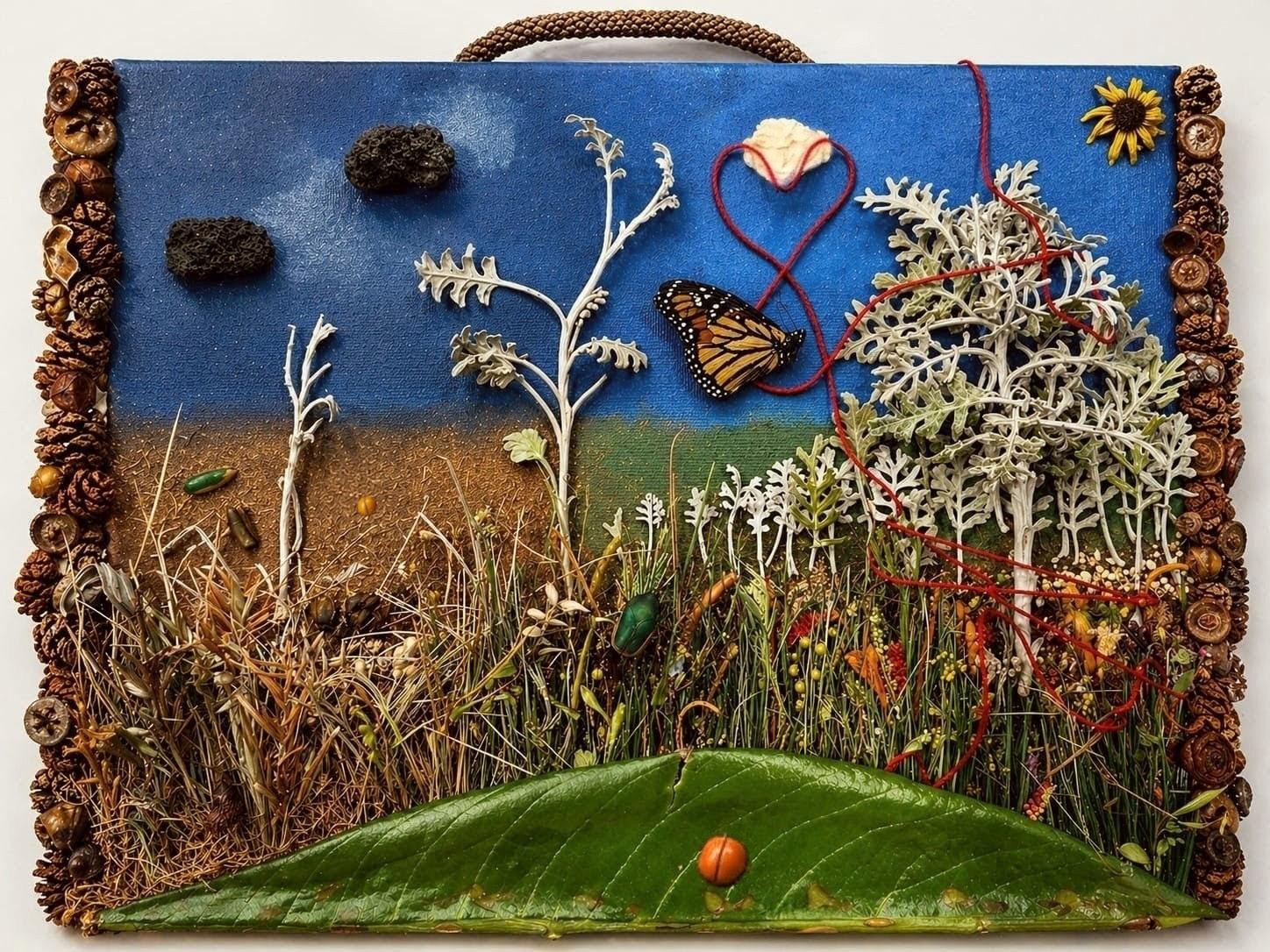
The Weight of the Woods
Anonymous
Paint, foraged natural materials, and preserved insects on canvas
This piece explores the journey of learning to be seen, loved, and chosen after a lifetime of fear and isolation. Inspired by a profound, healing bond with a fragile rescue dog, it reflects the delicate rebuilding of trust, the devastating weight of grief, and the quiet persistence of hope. Even in his absence, the connection leaves its mark, teaching resilience and the courage to stay present in the living world. The briefcase serves as a visual metaphor for the weight we all carry: our memories, our pain, our love, and the ongoing journey of moving through the world with them.
Too Old for the Baby
Nico Weisberger
Twin poles running diagonally downward - an inventive new slide! I always did prefer it. It was only for those who fit their torso between - slide their armpits around the metal
and I was a girl far too big for the baby swings, still I lifted myself up into them
I was a girl far too big for the baby swings and I brought my little sisters to the park on shabbos
I wasn’t the oldest, but old enough to bring them around the corner and across two streets, hold their hands and step carefully on the white stripes sloshing with day old rains
and I brought them with me lifted them into the shaky little seats holding tight I was a girl
far too big for the baby swings. So were they, still we swung
Fraidy might be there, at Avenue F Park
This was before she moved – I could see her! And we could push one another and race just like we would at recess and Kaila and Sarala they knew her too, from school, and we could all play King of the Mountain
And we could slide between the spate slick metal bars and I could go underneath catch Sarala as she slid in case she fell through
We could push them on the baby swings
and then take them home when they started to cry about darkening skies or when they whined about thirst and heat and cold and ripped tights
and their knees scraped with round little marks of rubber playground matting under the swings
And when I dropped them off at home I was free but I was too far, and I was too old and I want to feel the pain the clouds have made for me Too old for the baby
Swing and Still
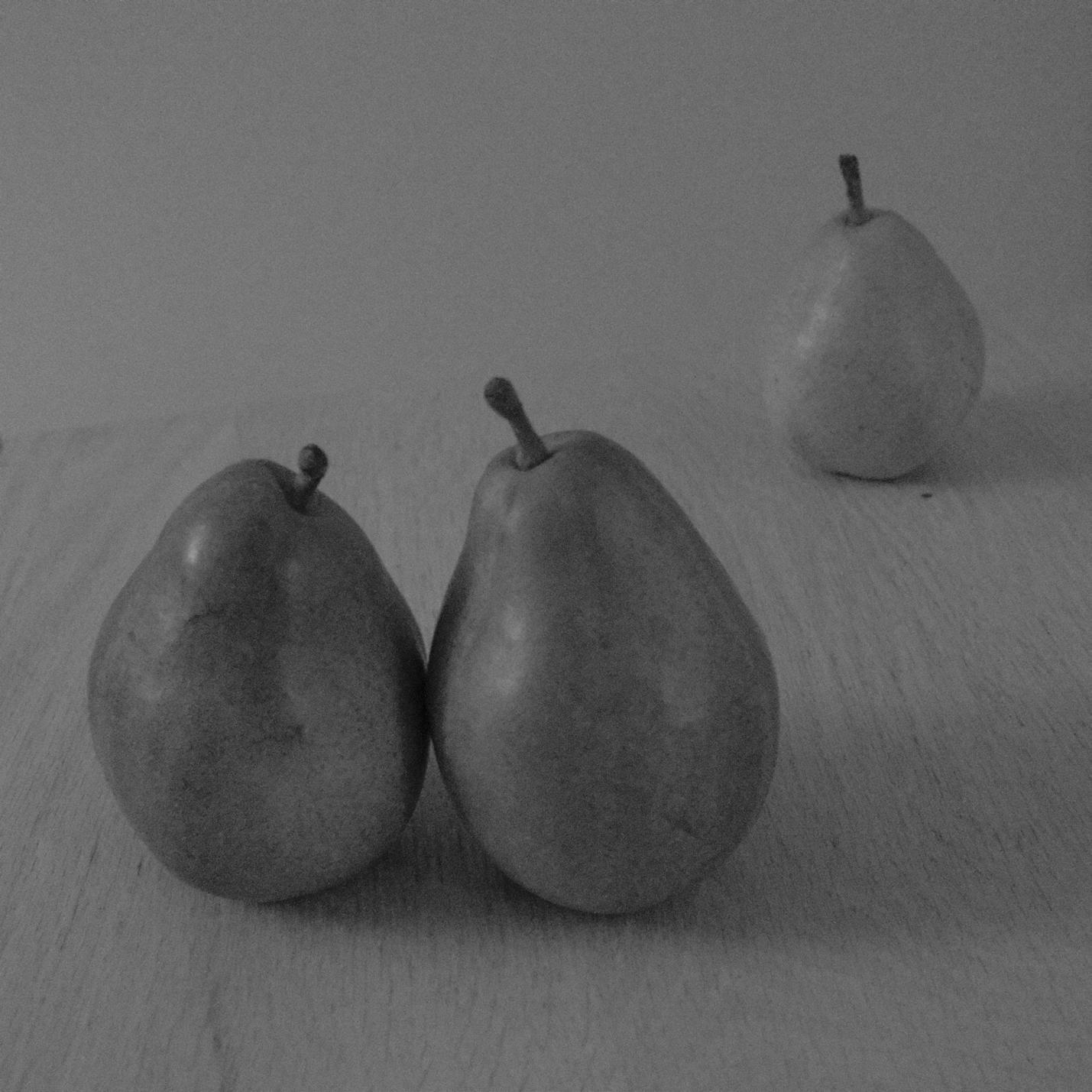
How I Found Them Living and Loving In This Still Life
Rivkah L.
I was moved by the pears and the shapes of their bodies and their relationship to one another as I set them down for a still life photo. They felt so intimate and connected. I couldn’t figure out which pear was I.
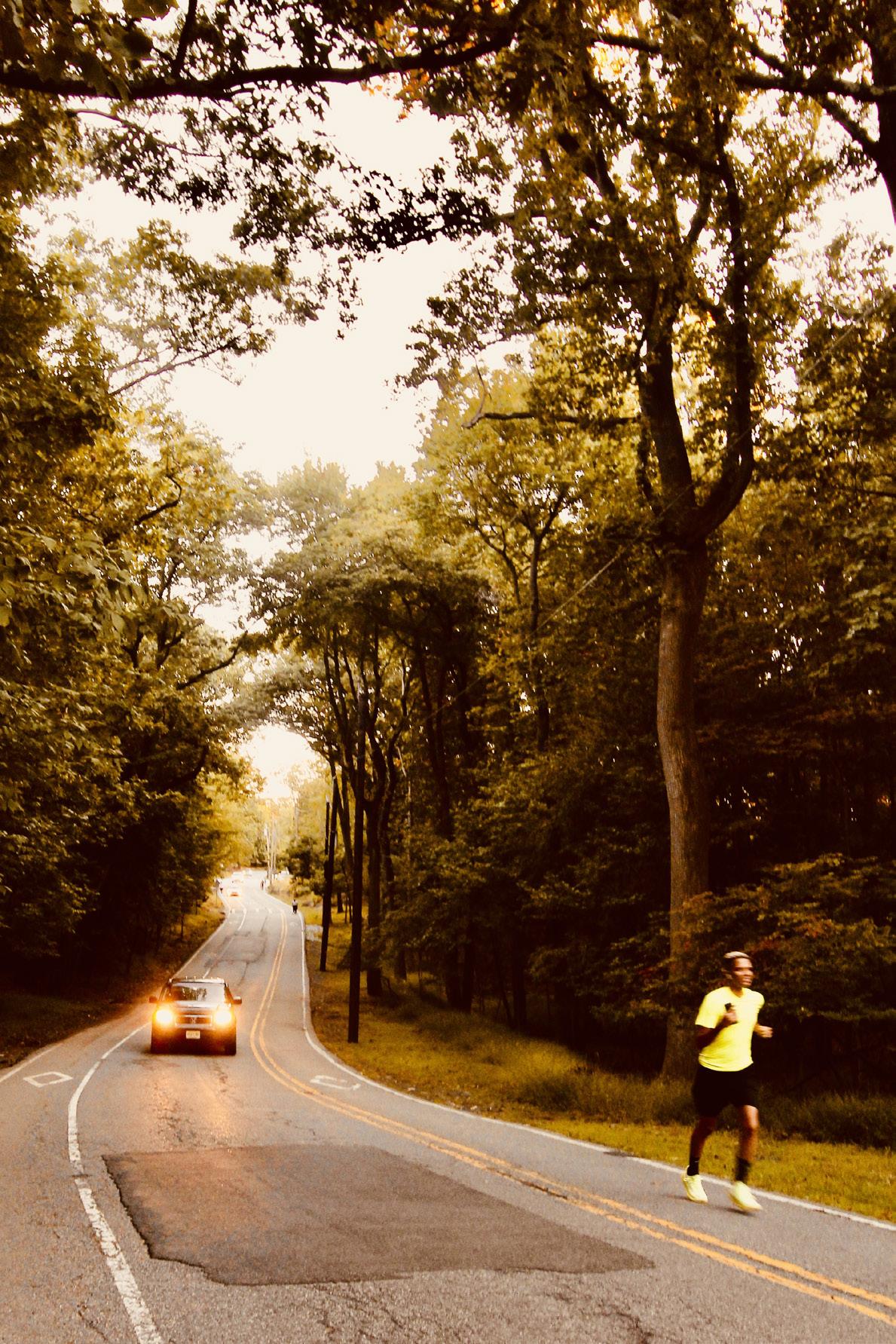
Lonesome Road
Yehuda Goldman
Photograph
This picture was taken in Fall 2021, at Garret Mountain Reservation, in Woodland Park, NJ.
Every time I look at this capture it makes me think. It often brings feelings of hope for the future and the underlying sadness that comes with the uncertainty of what lies ahead.
People Without Faces
Shneur Ribner
Wherever he goes, he sees people without faces. There are men without faces, there are women without faces. Men without faces have eyes for the faceless women, women without faces have eyes for faceless men. The man with a face observes them, but they do not see him, for the men and women without faces have no eyes for a man with a face.
The men and the women, they walk together, side by side. They do not face each other, for they have no faces. Sometimes they hold hands. Other times the man or the woman wish they held hands. Sometimes they are in groups of men and women, the men ogling the women’s bare legs. Sometimes they are groups of just men, and the men talk about the women’s bare legs. Sometimes they are in groups of just women, and the women complain about the men ogling the women’s legs, but they never speak of not exposing legs.
Always, they talk. They talk endlessly. They talk with one voice, they talk over each other, louder than one another. They say things like, “I’m well, how are you?” “I’m sorry I missed your party.” “I’m so tired.” “What are you doing after graduation?” “Let’s get coffee sometime.” “Isn’t he cute? I think he might be gay.”
Thus, they spend their days. The men and the women, the men and the men, the women and the women. They do not see each other’s faces, for they are men and women without faces.
Thus, he spends his days. He observes men and women without faces. He observes them on the beach, in the cafe, on the campus lawn, in the park, and outside his window, on the street. He cannot distinguish between them, but he observes that they can. He wonders. He asks himself how they can tell. He wonders why they speak so. They walk their dogs and the dogs can tell. The dogs can tell because they are dogs without faces. But the man with a face cannot. He wonders why they have dogs.
In his heart, he wishes to speak with them. When the darkness sets on moonless nights, when he believes he can hide his face, he wonders if he can pretend to be a man without a face, but he knows he cannot for he has no mouth. Perhaps he can trade a mouth for his face? He wonders if there might be men and women without faces who would like to have a face. Can one have both a face and a mouth? He wonders because he doesn’t know. All the man with a face knows is that he cannot pretend, for he has no mouth.
The Ick of Return
Rae Rochel Lipkind
Right along the back of my shoulder
Down to the right pinky finger
Blood stands alert.
You can’t possibly go back. It used to be so...
יבענ
The girls who spoke yiddish were uncomfortable, They were filled with חור
הנומא unwavering, embarrassing nerds.
ךעבענ
Unbothered if they were being shushed when caught singing in the street, Seemingly unburdened by the enforcement of their silence
At the תבש table, while the men sang the only songs our people knew.
שיבענ
You can’t possibly go back. So you don’t.
Instead (AND I MEAN THIS QUITE LITERALLY)
You reach for the air behind you With both hands
Open palms
Become laden
The air is thick
Move it forward
Notice, Your mouth becoming wide as a whisper Notice Your throat arched like a waxing moon
Heat from your body
Brings a song to your lips
And you realize what they said was true: Your voice could easily corrupt a man.
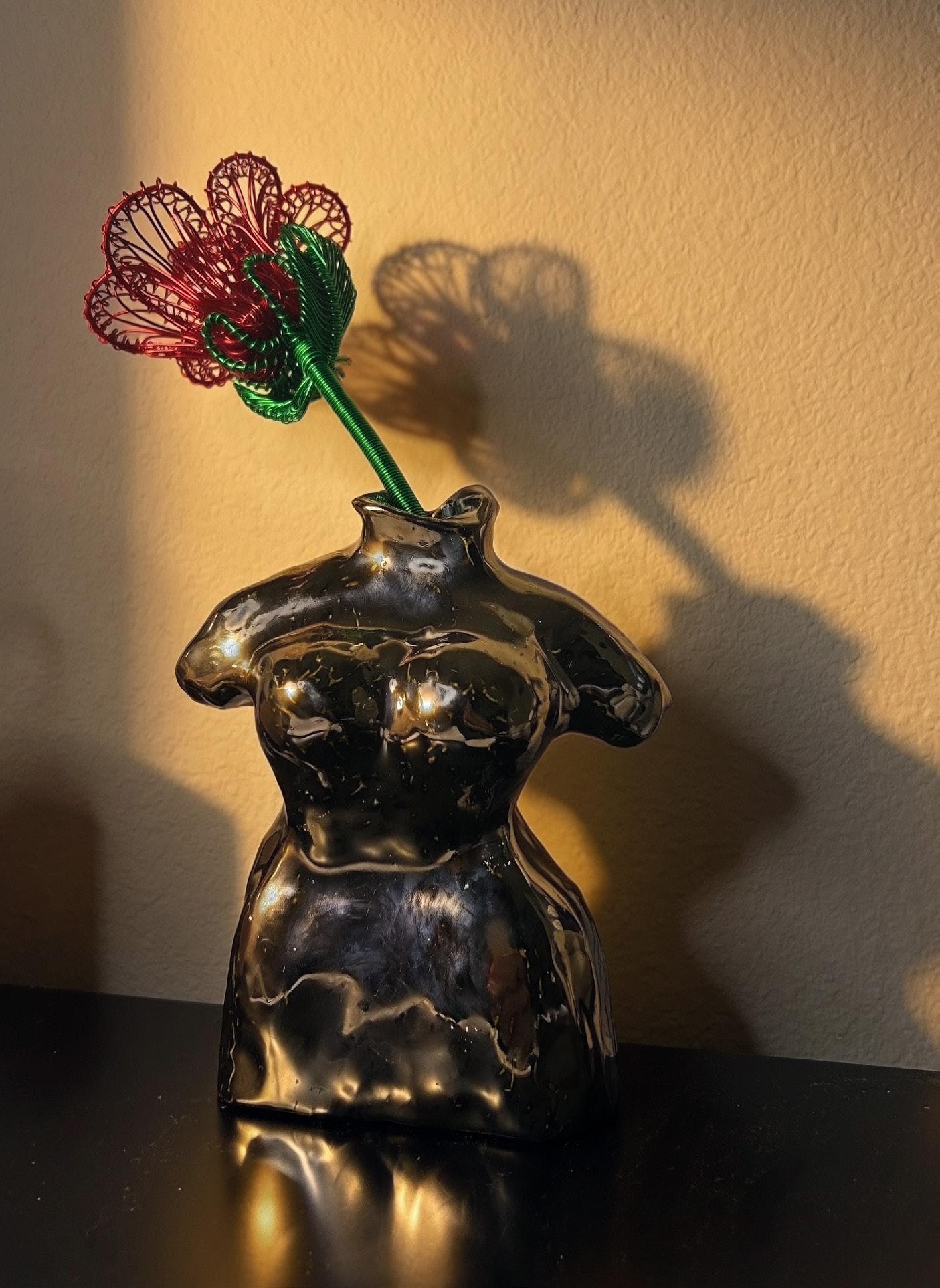
Master of Mirrors
Tehilla Muller
Ceramics, glaze, and wire
Master of Mirrors is about the journey to self love. It’s hard to stare into your reflection every day and find joy in what you see. But who is our ultimate companion? Who is with us day in and day out? That face in the mirror.
Day in the Life
Dov Last Name Withheld
Hachana
Imagine my surprise, sitting in 3rd grade learning for the first time that there was a second Torah of the Oral variety.
Not very likely, Doubt said. Not likely. Why was I learning of this new Torah only now?
They’re making up new traditions all the time! I was immediately suspicious.
After all, what is an Oral Tradition, but: Trust Me, Bro.
Should we, Dov?
A Ass Pocket of Pilpul
Dear Rabbi Maggid Shiur, You’re telling me that being a good Yid equals dressing like a penguin? Have I got that clear?
Is this like, a sex thing? Doubt mused. Yeah, is it? I’m confused. Did Rav mean a birthday suit?
If dressing like a penguin is next to Godliness, was Moshe Rabbeinu dirty? Do we “hold” of Moshe, even though he didn’t dress like a ben torah? I mean, my guy Moshe wore a robe; dude really dressed like The Dude! He dressed like a bum! shouted Doubt. An oysvorf. Nu nu rebbi, answer my kashe, nu!
Night Seder
You’ve been ignoring me all day.
I’m starting to wonder how I ever ignored you. They’ll say you left because of how you felt. I left because of how you made me feel. They’ll doubt your belief in me, yes.
But even you can’t deny, I kept you safe. You destroyed my safety. We’re buddies!
I hate you. You need me.
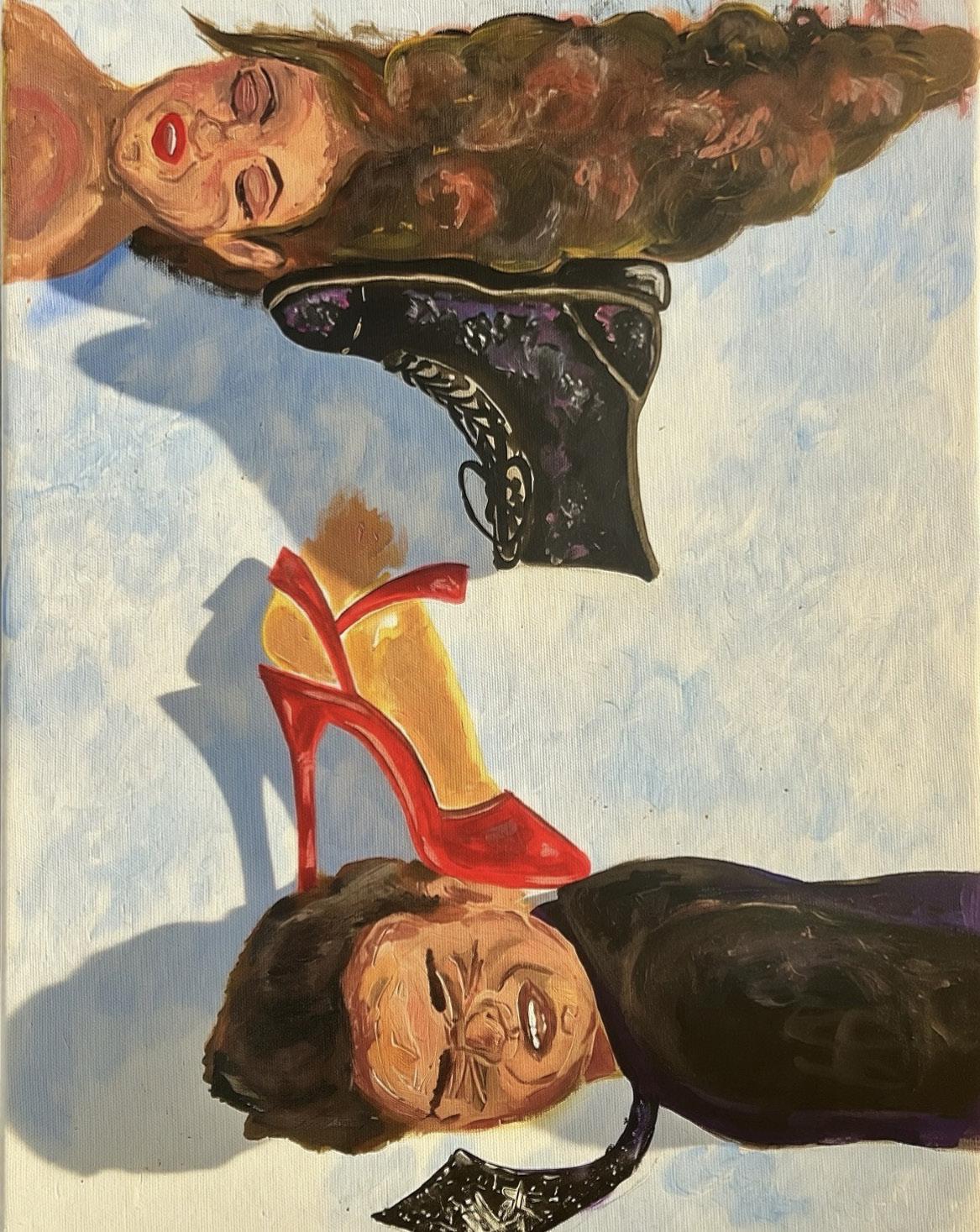
The Reaction of Parts Anonymous
Acrylic on canvas
“Every action has an equal and opposite reaction.”
Female oppression has become so normalized in our society. Women don’t even always recognize when the boot of patriarchy is on their head due to the overwhelming amount of societal conditioning and normalization. However, when the pendulum swings and men are subservient to a woman, the outrage that ensues is unparalleled.
We are privileged to be in a time where a lot of our efforts are focused on equality. Equality in many different areas. However while we have made many large steps in this direction, most of our society is predicated on the foundation of oppression. Any work we can do to bring ourselves together, towards each other, and find how our differences are really what makes us better companions for each other.
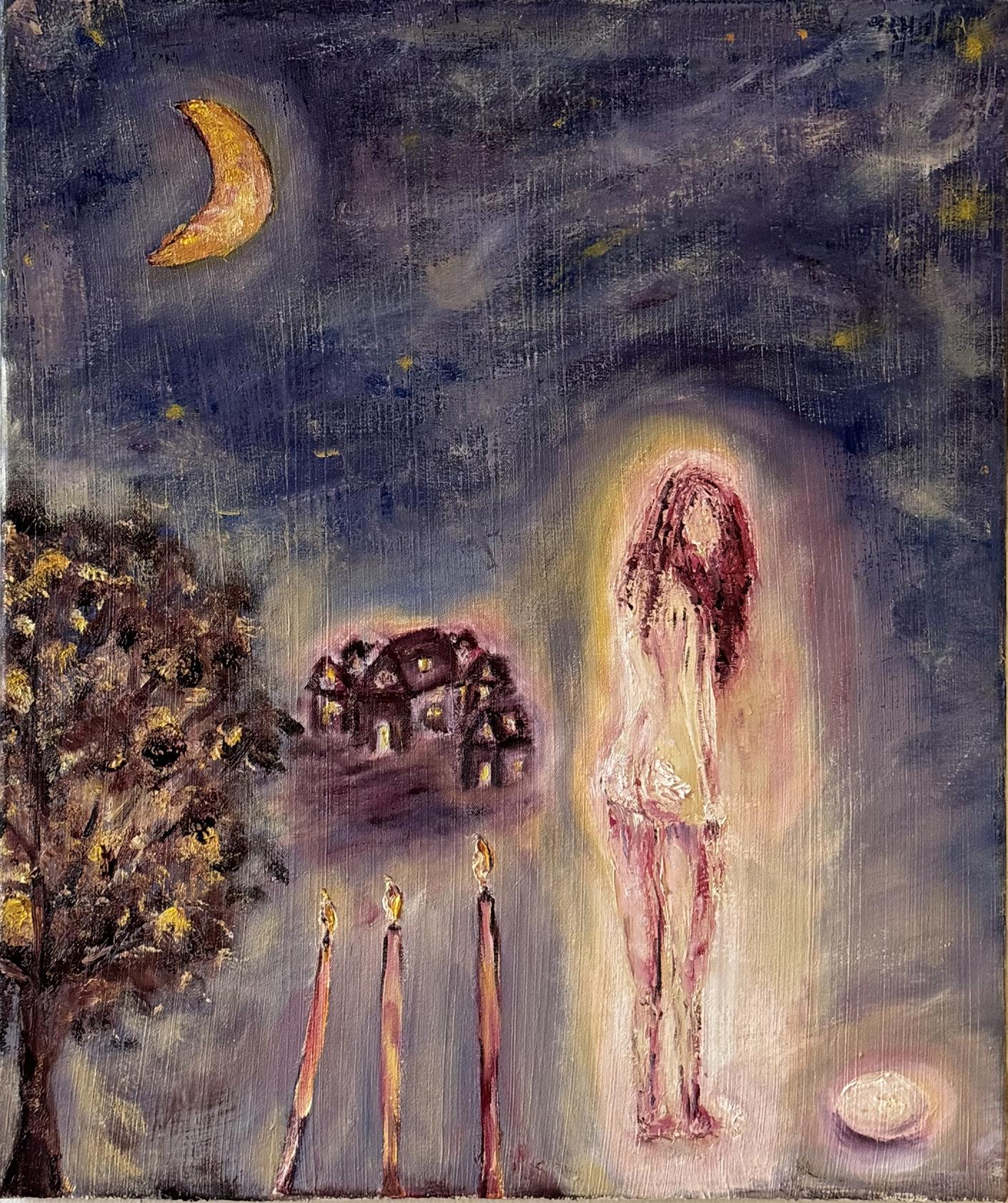
Siren and the Village
Siren and the Village is the unfolding story of a girl and a home, a family, a past, a self, a new world, and the birth of a future that sits beside her.
Rivkah L. Oil on canvas
Soup, snow, and other reasons to stay alive.
Abes Abrahamson
What is poetry? To sit on the floor across from yourself, and meet your own eyes in the mirror, staring just long enough to fall through them, into the depths within yourself, the places you once hid as a child: the closet in your grandparents’ house in Brooklyn, with a good book, the hollow beneath the floorboards in your childhood bedroom, where you stashed your weed, in the bathroom during Hurricane Sandy, with a cozy blanket and a flashlight, where questions raged inside your head with the furious winds howling outside. Righteous anger and feminine rage, the screams of a mother sentenced to death by her own children, her wails and laments tearing at the very fabric of our reality in downed trees, flooded streets, and power outages. The kind of trembling that jolts loose your shame, holds it up to the light, and forces you to watch as the softest parts of you answer: because the moon, because how quiet the whole world gets when the snow falls at night, because friends make you soup and bread and cookies and call it nothing, because a song can be a prayer and fire a refuge when cold is more than weather, because birthday blues come and go and you are still alive, because the earth—even under the frost, beneath winters brutality—glows with autumns last colors, and somewhere under the ice, beneath the blanket of leaves that tucked her in tight, she is still warm.
Real First Flights
L.
On my real first flight, I walked to the supermarket on the edge of town. I tasted in secret an unfamiliar fruit. It was out of season. It was a confused fruit. A mechanical intimacy had brought it on a truck. At home I examined, tasted, refused. This was the closest I felt to an answer. In a world devoted to light. Where the home springs up uncalled. Because homes do that, they spring up where they are planted. From the seeds of unfamiliar fruit. With seeds tossed plainly. From sticky searching hands. I was flying out for the first time. I wore my home on my back. It only wanted to join.
My home insisted on coming with me on my real first flight. I fed it the seeds of the things I ate on the way. My prayers were swollen and happy.
This is where you are being made, my home said to me. It wore itself over me like a mother.
This is where you are being made, it kept saying to me. Eat the fruits, it said to me.
The world couldn’t stop lighting up around me. Eat the fruits, it said to me.
Don’t stop searching for that I took from you, it said to me. I rode on trucks. I could take the fruit by reaching into its back. Eat the fruits. Eat the fruits. My home was happy. My mother was happy.
On my back on my real first flights I wore my home. It stretched over me like a warm skin. It knew me.
The world keeps lighting up. My home keeps me safe and silent. Here I sit in the back of the truck.
Which is carrying strange fruit from one end of the country to the other. I reach into its back and eat the flesh.
The seeds. Keep feeding me, my home says to me. One day it will be time for you to labor. One day you will be born. I am stretched out in the back of a truck, headed somewhere, bathed in unfamiliar fruit.
I am calm and loved.
My mother is happy in the home, singing, cooking, dreaming.
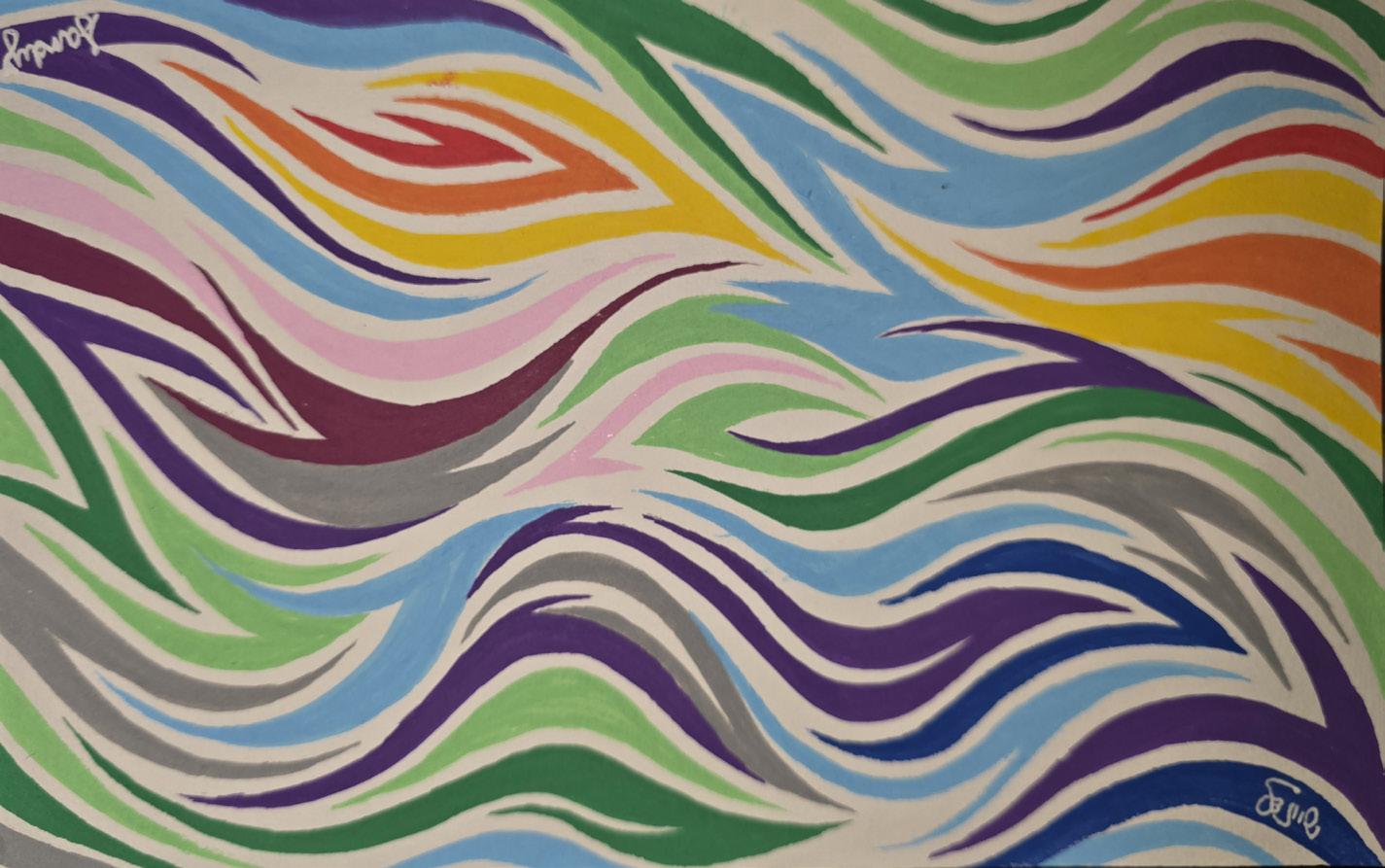
Journeys of the Soul
Anonymous
In my journey through the cosmos, I am never alone. You are always with me.
Michla Chaya
This winter, when my heart, an instrument brittled-white, barren for its song.
For a deathly gale praw it from the tender soft.
I lift her to my lips, parched grain on bloody chap, kiss a wind into choked tone holes.
Yet she lie cold, unyielding.
I want to be a song. Please.
Let me be a song.
Whoosh! I look up. Here she come, my feathered friend. We fly together, Dream and I. and Ifluffy down clenched, swaddled in silver, seeking, seeking, seeking, always seeking.
There! There she is, my song! free-flutter flittering amongst the variegation. Found her. Got it! Joy fills me.
Careful, stealthful, I cast my net. then-
flick!
I’m a droplet flung mutters God, you’re a bore. and Ion ice bruised, silenced.
Mother, Great Mother Can’t I be your song? Teachers, oh Tree-chers of the light and the dark, Will you give me a song?
Precious, no. Can the infinite be songed? Come, Follow. (I follow).
Cozy into my ache, a vast theatre.
Come, Listen. (I listen).
Curtains part. Enya and Einaudi. Orgasmic waves fill the hall. I relax. This. This I can song.
ThenYungblud and Eminem, and Kendrick Lamar.
Of frothy funky frisk Flaming fury hiss.
Then-
Britney Spears Of glitter and tears (I strain to hear). then-
The FUCK. Moshe Goldman? Waltzes onto the stage like he owns the place, like a rebbe beim tish, vie a choson b’reishis. Yaamod! Pops a cassette. K’nesher! Off my stage! Fuck off! But the nerve, the chutzpah, just smirks and mops up some galla.
and Isilent. I leave.
My feet find me at the waters.
Mother, this? this cacophony? this is my song?
Precious, no. haven’t you learned? you cannot be songed.
butcan you ride it? tune the sound knobs this bit up, now this down, you’ll soon learn, I know it.
and Isoon, I pray cozy into my ache, an instrument a maestro of song.
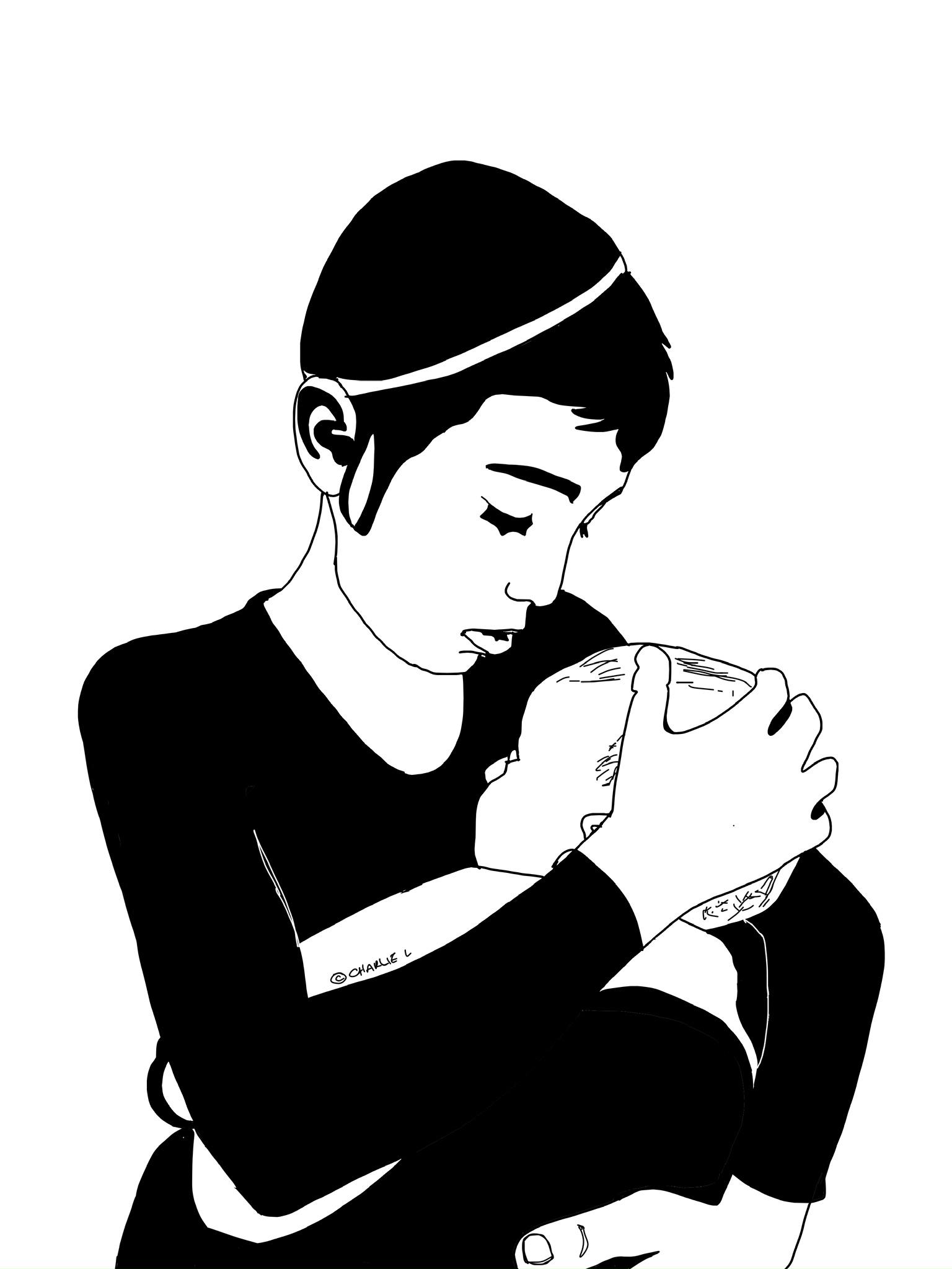
My Big Brother
Charlie Lewin
Digital
Drawing
I look after children and I see the strong bond that siblings have with each other. It inspired the drawing I did of a child holding his baby sister and I wonder what is running through his head at the time. I like drawing in black and white and with lines because it doesn’t distract from the main characters.
My Best Friend
Charlie Lewin
Digital Drawing
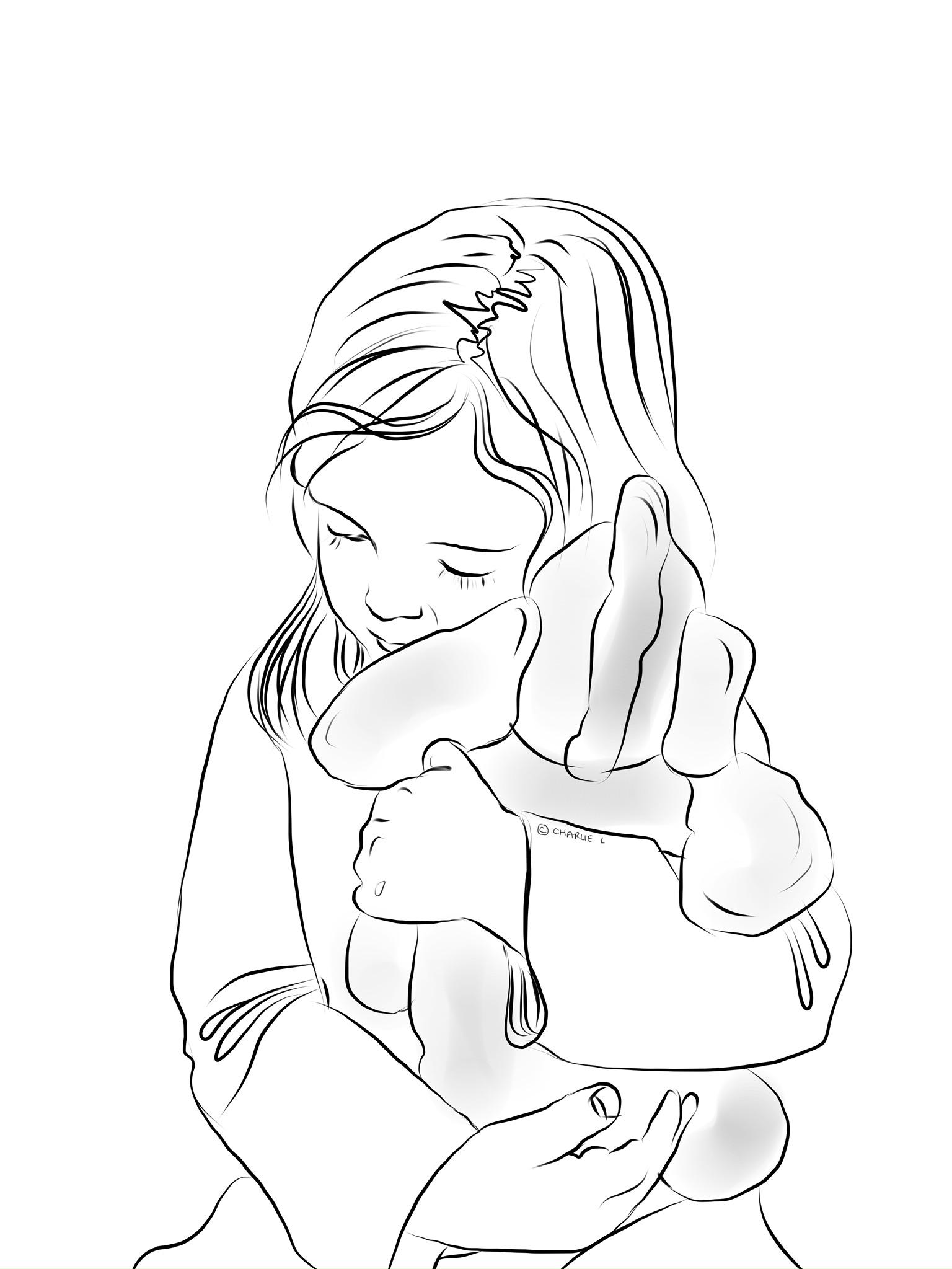
Sometimes all I need is a cuddle with my best friend. She never tells me off or answers back. She just loves me and I love her.
The Little Girl and The Tree
Leah Wolin
Poetry
Curled in a corner, Rolled so tightly As if bound By thick black rope.
Head buried, Eyes shut tight, Little arms shielding Her thin body As she rocks.
Covered in mud, Steeped in shame, Buried deep In blackened ash— She weeps.
For nights of terror, One eye open, Praying the monster sleeps.
For years lost, For joy hidden, For dreams shattered Before they began.
For being a child Who had to become A mother, Hungry for love.
For the weight of secrets, For shame never hers, For a body taken And a voice silenced.
For the conditioning That she must obey. She weeps.
Until her tears— Sacred tears— Soak through the mud And reach the soil.
They water a seed.
And slowly, A tree begins to grow— Big, Tall, Strong.
Roots from pain, A trunk of quiet wisdom, Branches reaching wide.
Then they bend— Reaching down To the little girl, Wrapping around her trembling body.
“I got you,” they whisper. “I see you.”
She trembles, Then dares to believe.
“You can say no. You can trust your gut. You can use your voice.”
She begins to uncurl.
“You are strong. You are lovable. It was not your fault.”
She shakes— And the mud Begins to fall away. With every tear, She rises— The little girl And the tree Becoming one. No longer separate.
“I will never leave you,”
The tree whispers. “You are me.”
She knows— She is not alone.
A warrior. A lotus from the mud. A tree with deep roots And branches reaching skyward.
A little girl, Held and whole, Standing proud.
Dance Party
Rivkah Gorelick
Photograph
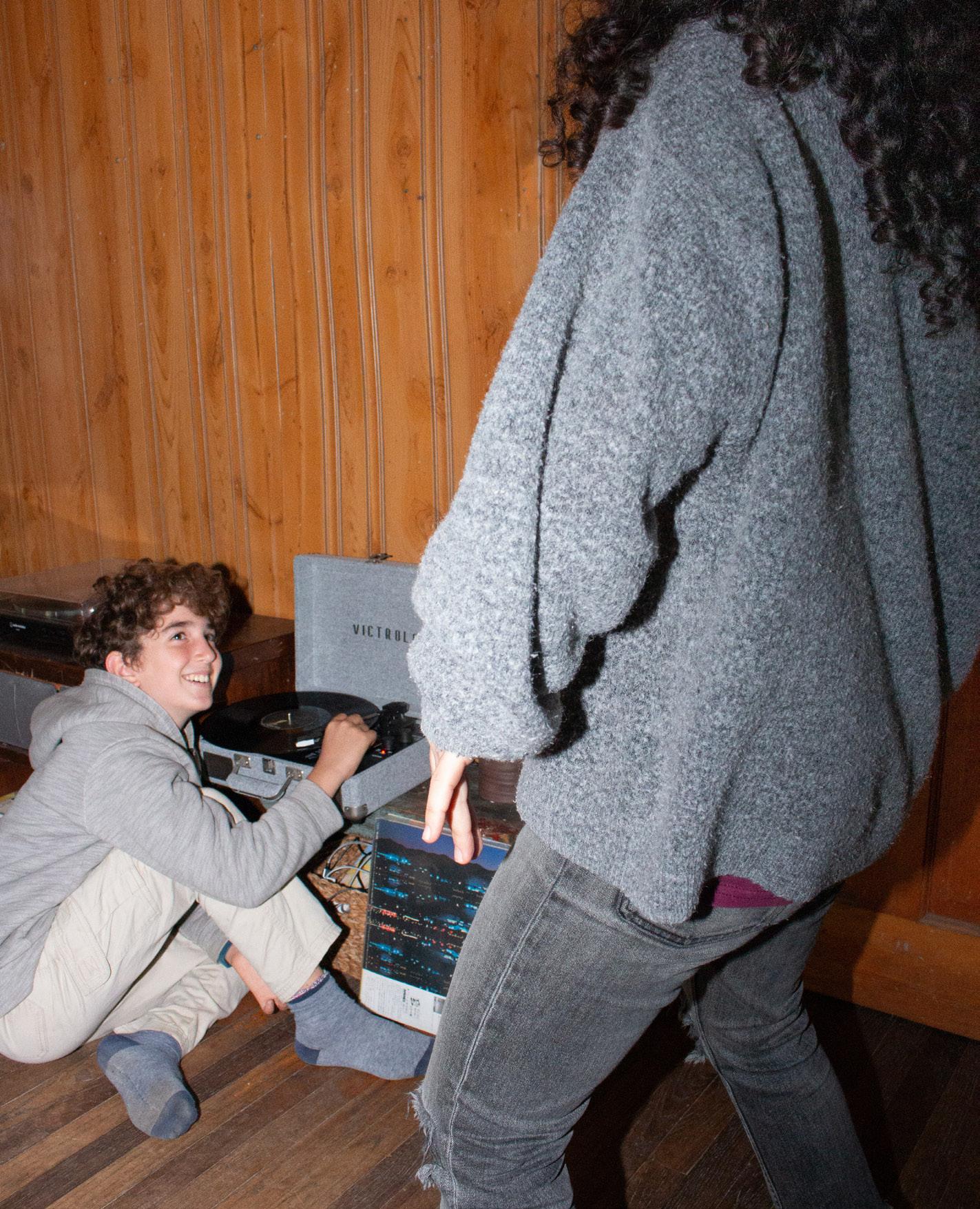
In becoming a single parent after leaving ultra-Orthodoxy, my son has become a de facto companion of mine. Mirrored in our day-to-day routines, we also move in parallel processes of self-discovery. Here, in this simple moment of playing music and dancing, not pictured is the hard-won freedom to be in one’s body, to explore widely, to choose connection with agency. Neither are the legal hurdles, the losses, the closed doors. We choose to find the music in all of it and to dance.
Anonymous Poetry
Alone with my thoughts I walk to the water’s edge And take a deep breath.
A deep, calming breath; Grateful to be alone here, Grateful to be free.
Waves ripple calmly. A gentle breeze lifts my hair As a swan glides by.
Mother’s Cradle
Nate Orgel Photograph
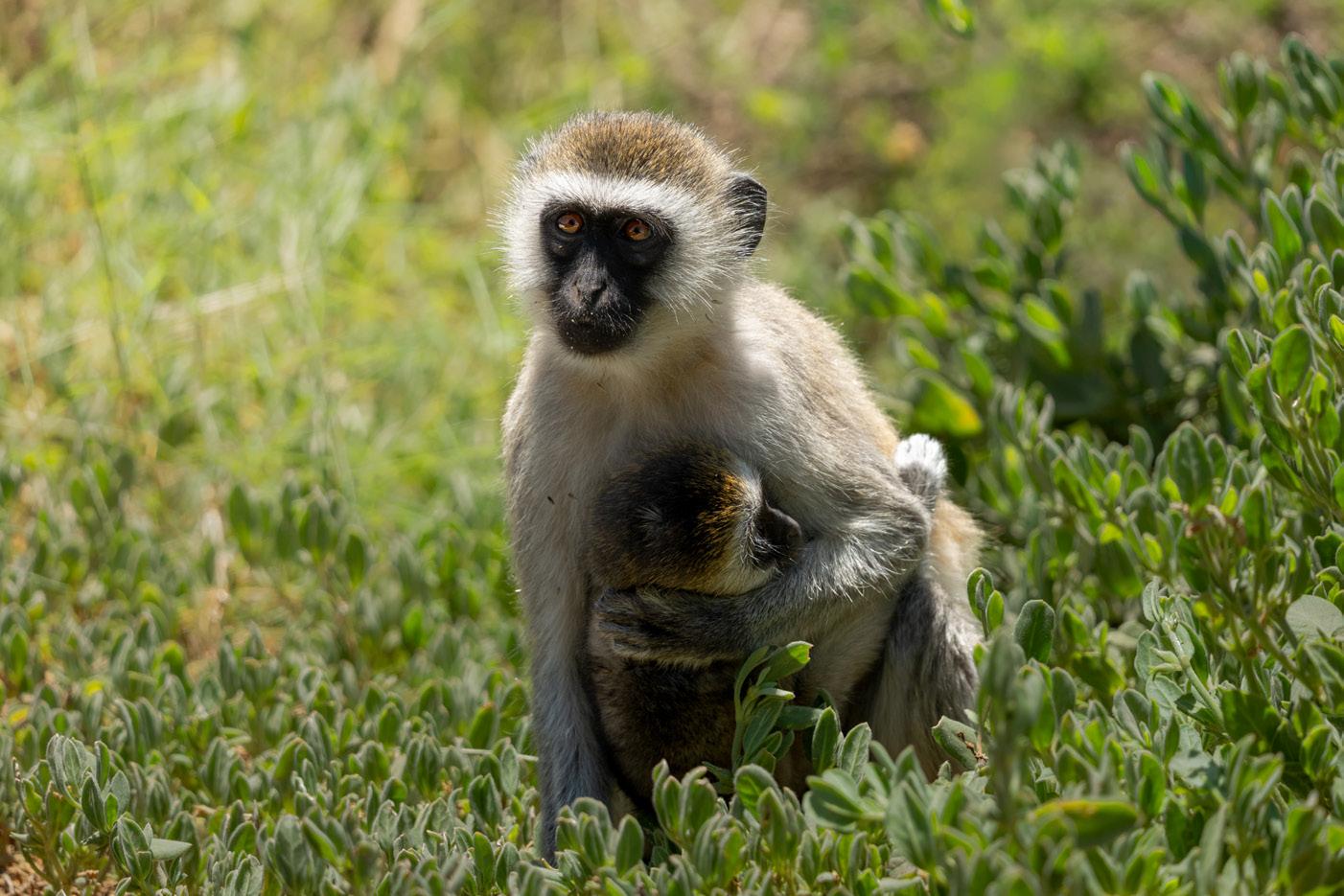
This photo was taken in Nairobi, Kenya. I was on a job for a fundraiser taking photos, and these monkeys were on the side of the road. It reminds me of the love and the nurturing side that mothers have. That they will do everything to protect their child.
Very Different Companions
Sharon Ross
I have lived with two very close but different companions over the years.
After multiple experiences of severe abuse, a “kiruv rabbi” told me that if I did just as he said, then I would never have to be afraid again. Hashem would always be with me and would take care of me. I would never be alone. I guess you could say Hashem would be my constant protective companion. I bought what this “rabbi” was selling and became very frum (Lakewood Yeshivish) for almost 20 years.
And indeed, Hashem became my friend and my companion and I felt it personally. I would sing the song “kol ha’alom kulo gesher tzar me’od v’haikar lo lephached klal” over and over and squeeze my eyes tight and let tears roll down my cheeks. I felt the nearness of my companion, Hashem, protecting me and my children from all harm.
Well actually, harm did happen. But I had two mini-companions, Emunah and Bitachon. Since I knew everything came from Hashem and He was in control and loved me, then it wasn’t really harm at all. It was really good . . . I just couldn’t understand how. Yet. And my friend, Hashem, would never let my children be harmed. Well, it might look to me like they were being harmed, but I could trust that it was what was best for them because Hashem was in control. And the main thing, as the song I constantly repeated said, was that I should never be afraid.
So I had faith in my companion, Hashem, and I committed myself to the close, loving, pious community of people who gathered in Lakewood to worship and serve him. To learn and pray and do chesed. I guess you could say I thought of these people as my friends, my trusted companions.
Until they weren’t. I realized that they were not my friends at all. And that they could not be trusted and that the fairy godmother, who was all good and loving, and protective of me and my children, my companion, this loving Hashem did not exist at all. The fantasy I had desperately chosen to embrace, which actually brought me some measure of relief for a few years, fell apart. I realized it was just a fairy tale. Hashem wasn’t real, the kehilla wasn’t pious and the people were (as a group, there were a very few notable exceptions) vile. Repulsive, arrogant, abusive, and vile.
Now I have a new companion. It called CPTSD. Complex Post-Traumatic Stress Disorder. Now this companion lives with me day in and day out. It sleeps with me every night and causes almost unbearable nightmares. It lives in my brain and in my body and it has broken me. It won’t let me forget what happened to me when I chose my old friend, Hashem, and his fan club in Lakewood. I relive the worst of it, day in and day out. It has taught me that there is nobody to trust, not even myself because I fell for the Ba’al T’shuva scam.
But I have also learned to accept my reality. For many years I tried to defeat this horrible companion of mine. I was on my “healing journey” and trying to feel hopeful. But now I am resigned. I am trying to strengthen my acceptance of this unpleasant companion. I am trying to really believe that, even with CPTSD and the disturbing symptoms it brings, I am worthy of kindness, I have value, and that I do deserve to take up space in the world.
The MOVE: Saying Good Bye
Sara Klar
Hand drawing, photography, digital markings
(From The Notebook Series) 2022-2026
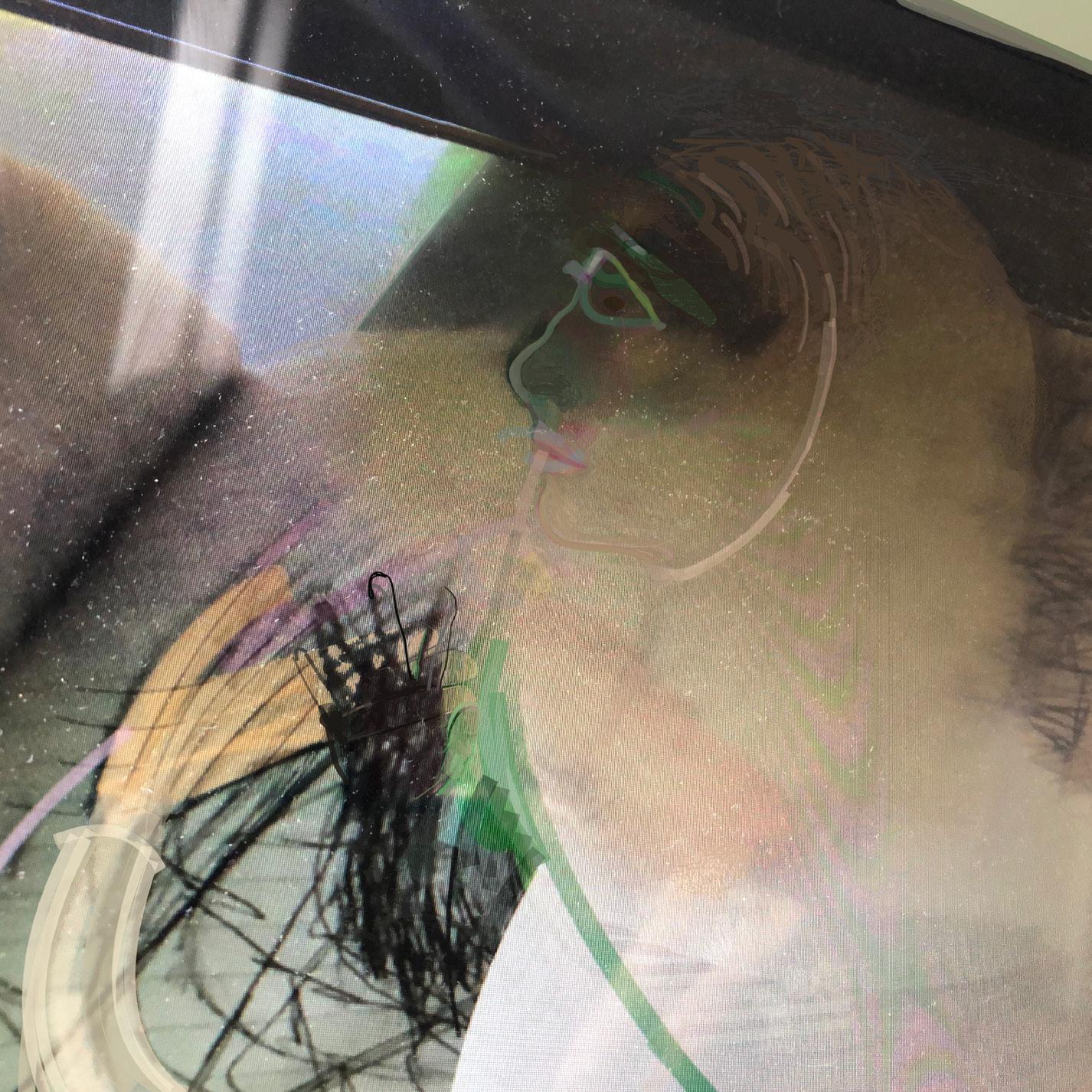
How does one move past the power of aesthetics that seduces, delights and offers respite and bring forth instead an image that one wishes to be seen for its beauty also, but a beauty of courage, existing because it shows what is real and what this artist was taught never to reveal - the awkwardness, the shame, the constriction, the dejection, the loneliness. The quest is vulnerability, I hope to get to joy.
The path to get here? It begins with emotions that must find their way onto lined notebook paper, a private non-judgmental space; that must be exposed to the light of the sun animated, photographed, transformed; that must be turned into flickers of 1’s and 0’s, reduced to the structure of code. From these languages of materiality and immateriality, I build up my image and learn to differentiate between what I perceive and what is real for often, what appears real are shadows of the past fogging my present. Observing these shadows they will dissipate and I have become patient watching what unfolds beyond this veil. Here, not only can I see more clearly but I also clearly hear the interior voices that say I have no right to take the time I do for knowing myself deeper, my artmaking, and then the interior voice beyond those interior voices that says, “welcome, take your time.”
From the Retreat - An Excerpt
Sara Klar
Wanting some pleasure it had felt so long....., no, this was not true. These had been a lovely two days. When else? Biting into the sweet, buttered, salted corn on the cob at the Buddhist retreat, a perfect medley of flavors and crunch sending taste buds into heavenly rapture, and of course the state of, “will democracy hold” dialogue, with the stranger in transit. And the other encounter, the Muslim woman, in a grey wool coat though it was August, odd this seemed, her solid peach hijab a clear signaling,”this is to whom, to where I belong.”
The exchange between them beginning on the Air Train from JFK on the return from Florida visiting Mom frail yet safe cared for within her community’s insularity, their conversation continuing onto the subway growing intense then intenser with the echoes so unexpected in the rhythm of their a cappella.
She on her way in to Manhattan’s City Center visiting from Scotland, born in Vienna, could I help her find her way?
“Sure, is it to midtown you are going? We don’t have exactly what we call a City Center, but if it is midtown, best to take the LIRR.”
She handing me her phone with the google take the E to Chelsea bouncing blue ball follow me, directing.
“I’m going on the E come with me, I’ll guide you there.”
They navigate the steps the crowds down the narrow escalator at Jamaica, Queens. “I’m Clara.” “I’m Norda,” “Hi.”
Norda takes Clara’s second bag to help her. On the train Clara shows Norda how to read the map, tells her if someone is making her nervous change her subway car, when her stop will be, then the usual, “what brings you to NY, what is Glasgow like, have you been there long,” “what type of work are you involved with?”
She, Norda, “I’m a therapist.” She, Clara, “I’m an artist.”
She, Norda, “I’m an art therapist.” She, Clara, “ My niece is a therapist and religious, I think it could be tricky.”
She Norda, “I am religious, but I’m easy.”
She, Clara, “But being religious and a therapist, what if a client needs something your religion can’t allow?”
She, Norda, “That’s why I’m here, for a two week course in California for Muslims where we study exactly these type of matters.”
Clara silent, hesitating.
Clara, “I bring this up because this was me.”
Nora’s face intent, still, full focus.
Clara continuing, “I’m secular, I was raised religious, I used my art to work
through my relationship to my Orthodox Judaism, I gave myself the right to rip holy writings, to destroy to reclaim, define for myself what being Jewish could mean. I presented my art at a DC forum, When Rights and Religion Collide.”
She, Norda, silent.
She, Clara, wondering, “is it because I told her I was Jewish? Or is it because of what I dared, she in respect of sacred texts, for her was this too far?”
She, Clara, “My stop is coming soon, I’ll be getting off, would you like to exchange numbers?”
Norda, nodding an emphatic yes, takes out her phone enters Clara’s number, enters Clara’s website, attempting, failing to send a hello text, “I’m a foreign telephone subscriber, what is the US country code?”
She Clara, “I don’t know,” she, Norda, “when I get above ground I’ll find out and send back my number.”
Quiet now Norda and Clara, Clara and Norda. Quietly seated on the subway bench side by side, in this moment fellow travelers, kindred seekers, the rhythm of the swaying train as if their prayer, this holy space, their mosque their shul, in just a few the train will stop “so long take care stay safe so good to meet you” before retreating back to strangers, her inhabited by her hijab, her defined by her six pointed star, chance very slim they will be meeting in the future. She, breaking the silence, I, bend to hear her, all nerve endings lit up fire.
Norda, her eyes glistening, softly looking into my eyes, I hear her saying, “how special it is for this conversation to be happening between us especially right now.” A catch in my throat, from the warmth of her voice, the kindness of her expression, grateful, for this was what I too, too shy, scared to say was thinking, nodding, agreeing. Quiet. She Muslim me Jewish, sisters on separate journeys, sharing, both of us knowing, in our silence our saying, “while our nations, sworn enemies wage horrible warfare upon each other.” The tears we both then cried.
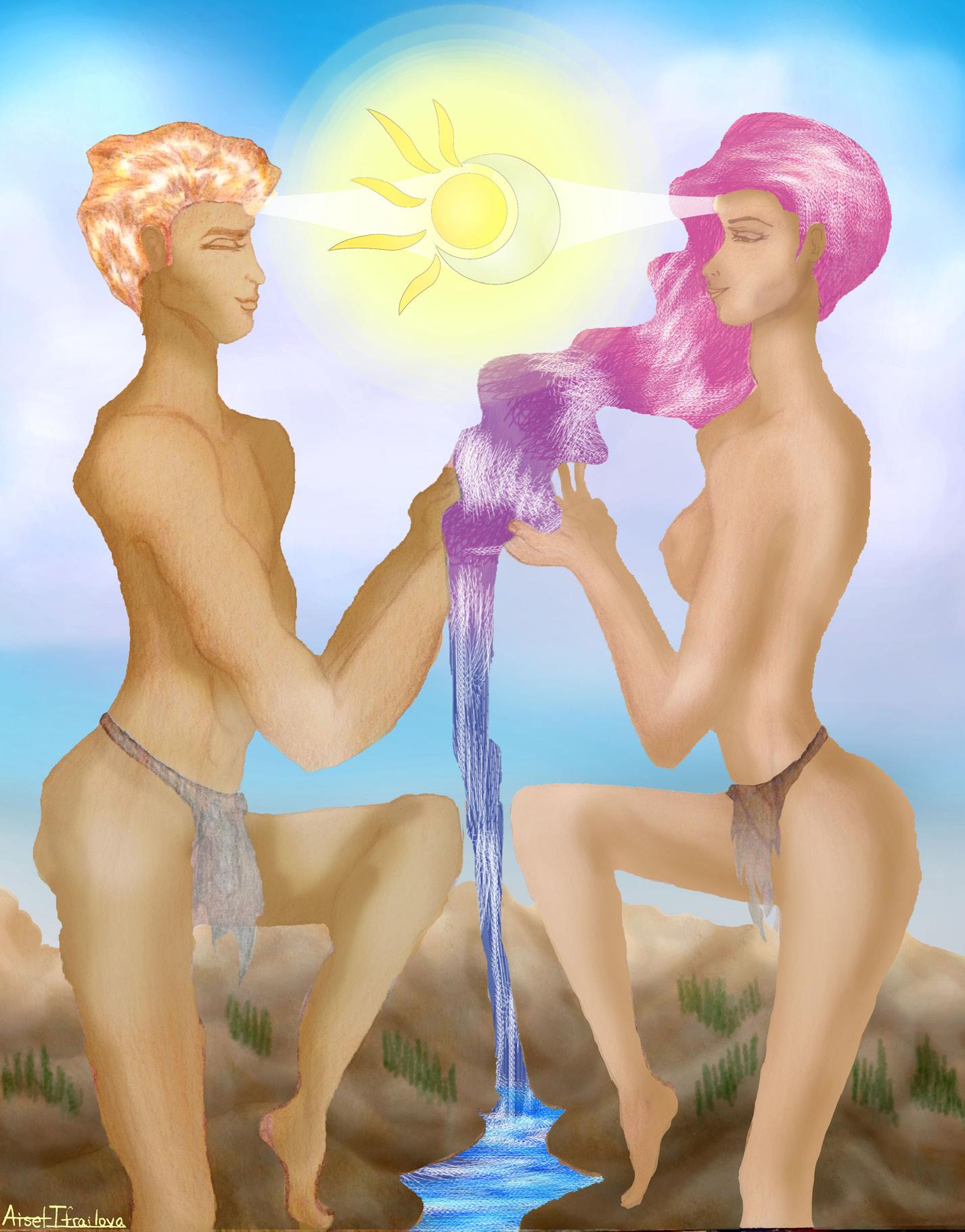
Convergence
Alice Thakur
Digital Drawing
Convergence is a piece that questions dichotomies. It represents male, female, converged in the creation of time. Eve’s flowing hair into the waters of life. Adam’s sun reflected by Eve’s moon. This piece speaks about the origins of companionship. Mutual mirroring is what creates universes.
Companion-less Nataly Antar
Why does loneliness always show up at 3am?
When the house is dark and quiet, and it’s just you, staring at the ceiling, questioning your life choices.
I grew up in a house full of noise, as most religious people do. I didn’t even have my own room until I was 19.
There was never a dull moment.
There was always something going on.
There was structure to the day.
You woke up, did negel vaser, said Modei Ani, and your day was mostly planned out.
There was always someone around, and you never felt alone, even if you felt lonely inside.
Going off the derech was loud at first, but over time, it became quiet.
I never got used to coming home to an empty house.
The silence wasn’t just at home.
It came with losing my support system and my childhood friends. I made new friends, but it was never the same.
These friendships came with silence too.
Whenever I tried to talk about my problems, the conversation would inevitably shift to theirs.
I thought a partner, a lover, a boyfriend or girlfriend, would fill the silence. I was just as unlucky there.
Eventually I stopped confiding in people and started oversharing on social media.
Talking to the void felt easier.
The void wouldn’t wait for me to finish just to talk about itself.
One day, someone commented, “this is something you should be talking to your therapist about,” so I started therapy.
If you’ve ever seen a crappy Medicaid therapist, you know the shelf life is about 3 months.
It’s predictable.
You tell your life story, go through intake and self harm assessments, spend a couple sessions there, finally start the work, and just as you’re close to a breakthrough, they leave the practice.
Like clockwork.
Eventually I got burnt out from the revolving door and stopped going. The oversharing came back.
At one point I was spending up to 12 hours a day on social media. I had a problem.
I started going to IAA - Internet Addicts Anonymous, and deleted the apps. I did well for a while, but the silence came back with a vengeance.
(continued)
Without an outlet, it was unbearable. I was out of ideas.
One night, awake at 3am again, staring at the ceiling, I thought about Joyce Vincent, whose body wasn’t found for 3 years.
She died suddenly one night, watching TV and wrapping Christmas presents. She was only found after her bank account ran dry, and the auto-paid bills stopped being paid.
She was still surrounded by presents, addressed to people who never wondered where she was.
The thought unsettled me.
With the way my life was going, I could end up the same way. I shook my head, squeezed my eyes shut, trying to snap out of it. I turned over and pulled the covers over my head, scared I was somehow manifesting it.
Sleep came eventually, but it wasn’t satisfying. I woke up exhausted, wondering if anything would change, or if the silence would eventually consume me.
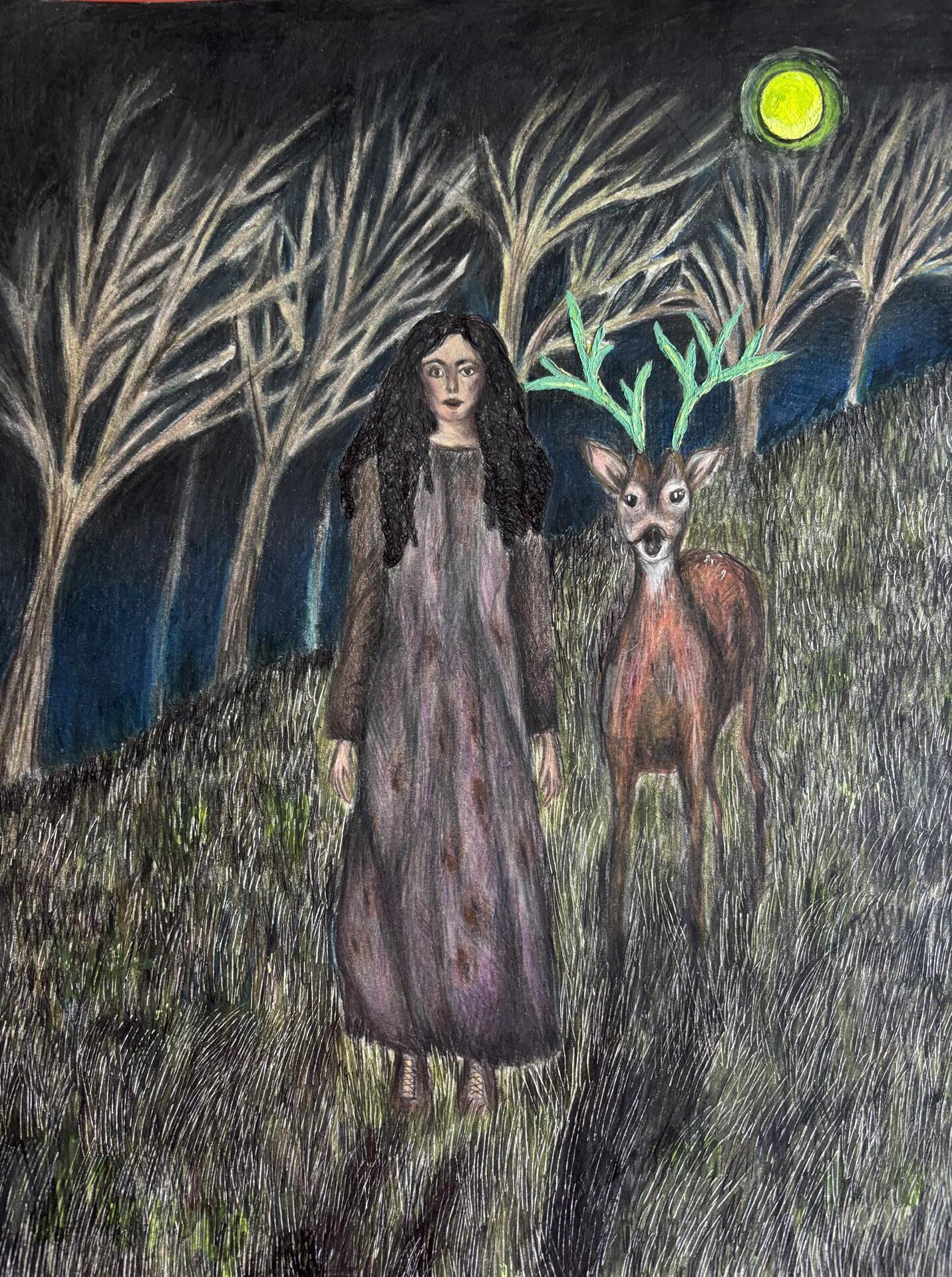
Kinship in the Night
Doe Lowinger
Colored pencils on paper
This piece is about me and my deer friend to symbolize our friendship throughout the years.
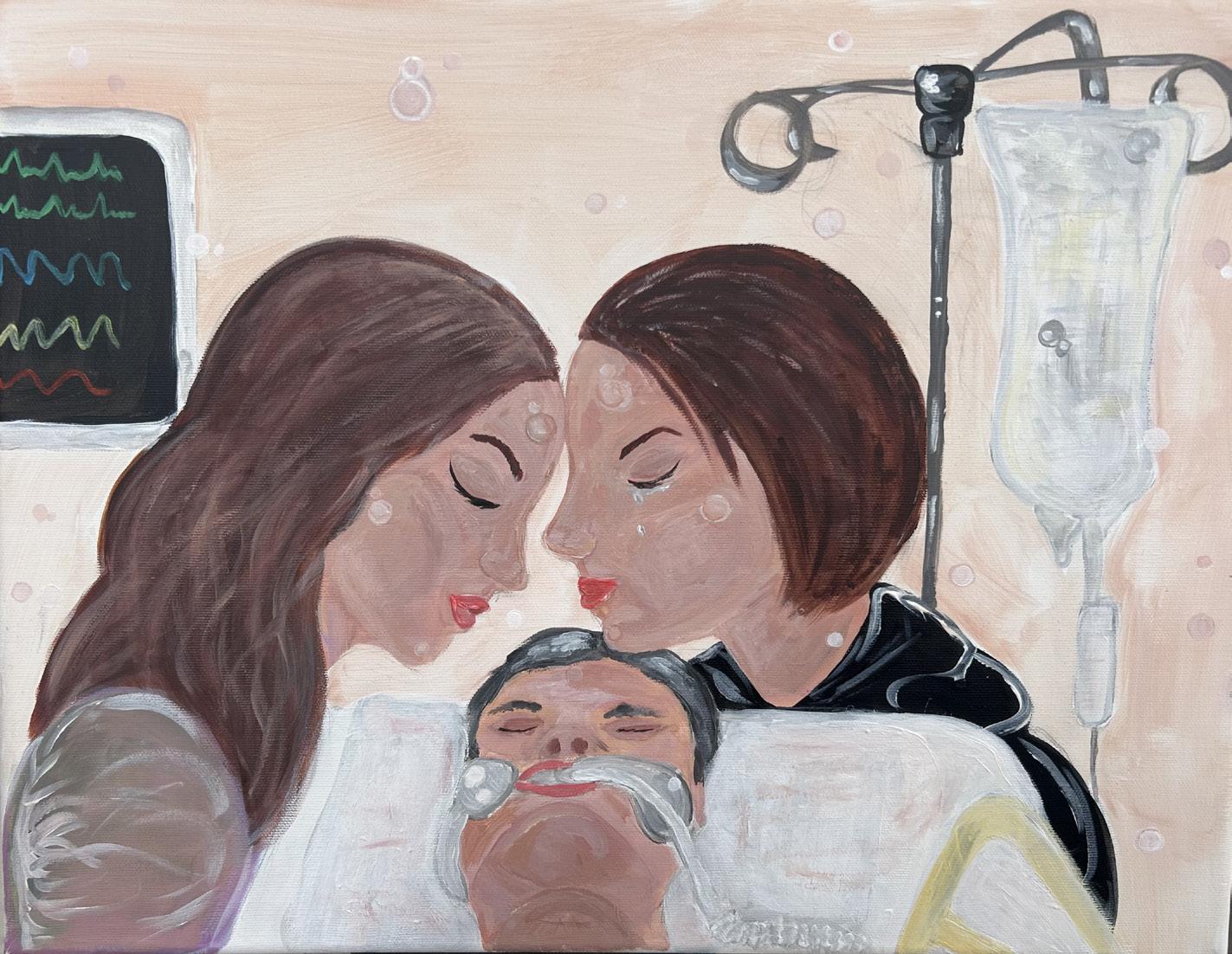
Lasting Love
Tehilla Muller
Acrylic on canvas
As a hospital chaplain, I have the honor of being present with people during the hardest moments of their lives. I have the privilege of bearing witness to what true companionship really is. It is looking beyond our fears, beyond that which holds us back, and meeting each other in the spaces between. True love is what is displayed here. These two daughters crying over their dying father’s head, angry, scared, in anguish, after he had shot himself.
And still, the words I heard from their battered lips were “I love you so much, Daddy.”
This is lasting love.
North Star Companion
Lilac C.
Help me Turn Pain into Power Fear into Fuel Mourning into Monuments
Help me
To find the North star In my inner dark dark sky And follow its Light To my Spacious Heart
My true Healing Haven, My Home.
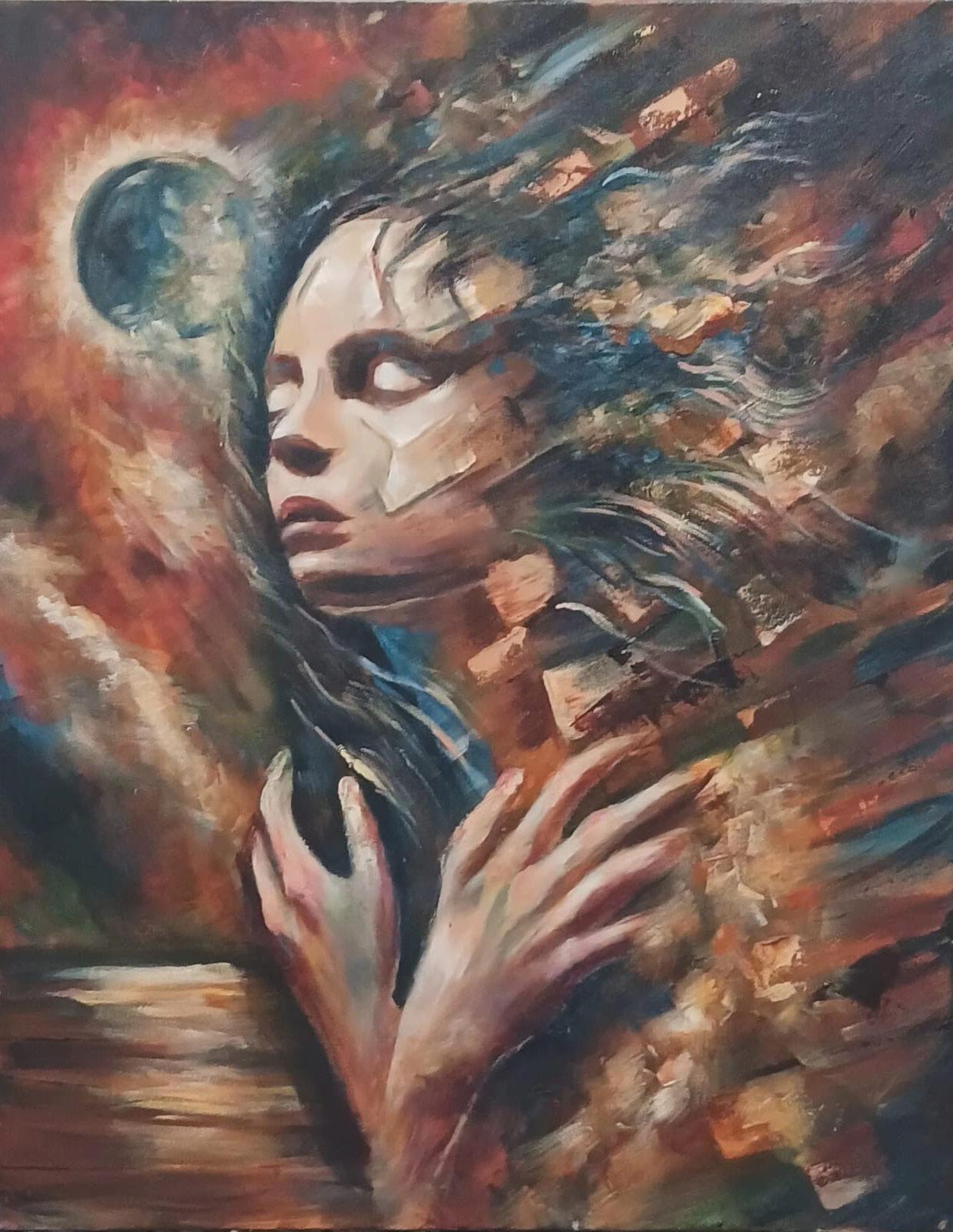
Selfhood
Sara Farkas
This work emerges from a period of disintegration and surrender during illness and psychedelic experience, when my sense of self felt both fragile and vast. The figure dissolves without fully disappearing, holding grief and acceptance at once. What remains is a quiet presence: The part of the self that stays even as everything else falls away.
Acrylic on canvas
Alone, But Not Lonely
Miriam Blau
I lived with my ex for 16 years. He was my companion, friend, and confidant. We spent so much time together. We enjoyed each other’s company. We had kids together. Unfortunately, there were a lot of issues in the relationship. My ex couldn’t accept me for who I was. He also developed an addiction early in our marriage. Although he was my companion, in many ways he wasn’t there for me. I always had someone by my side, but sometimes I felt really alone.
I live by myself now. I have myself as my companion. It’s different from living with someone else. There is no one inside the house to talk to. There is no one to call when I need help. At first I hated it. I missed being with my ex and my kids despite the issues in the relationship, I felt so alone and lonely. And then I realized that I don’t need a companion to be with me all the time. I have myself and that is enough.
I have a lot of new friends that I made after I left my ex and the community. I see my kids often so I am not entirely alone. Living alone has helped me learn to be comfortable in my own company. A companion is nice, but not necessary.
For so many years, I thought I needed people. I hated the idea of being alone or lonely. Being alone meant feeling the feelings that I didn’t want to feel. But now I do just that. I have time to think and reflect and be with myself, I am now my own best companion.
Being my favorite companion doesn’t mean that I don’t need others. It just means that I am comfortable enough within myself to be OK being alone. Being OK being alone makes me a better person to connect to others.
One day, I might meet someone and I won’t be alone anymore. But the lessons I’ve learned from being alone will carry with me for the rest of my life. I am alone, and I am not lonely.
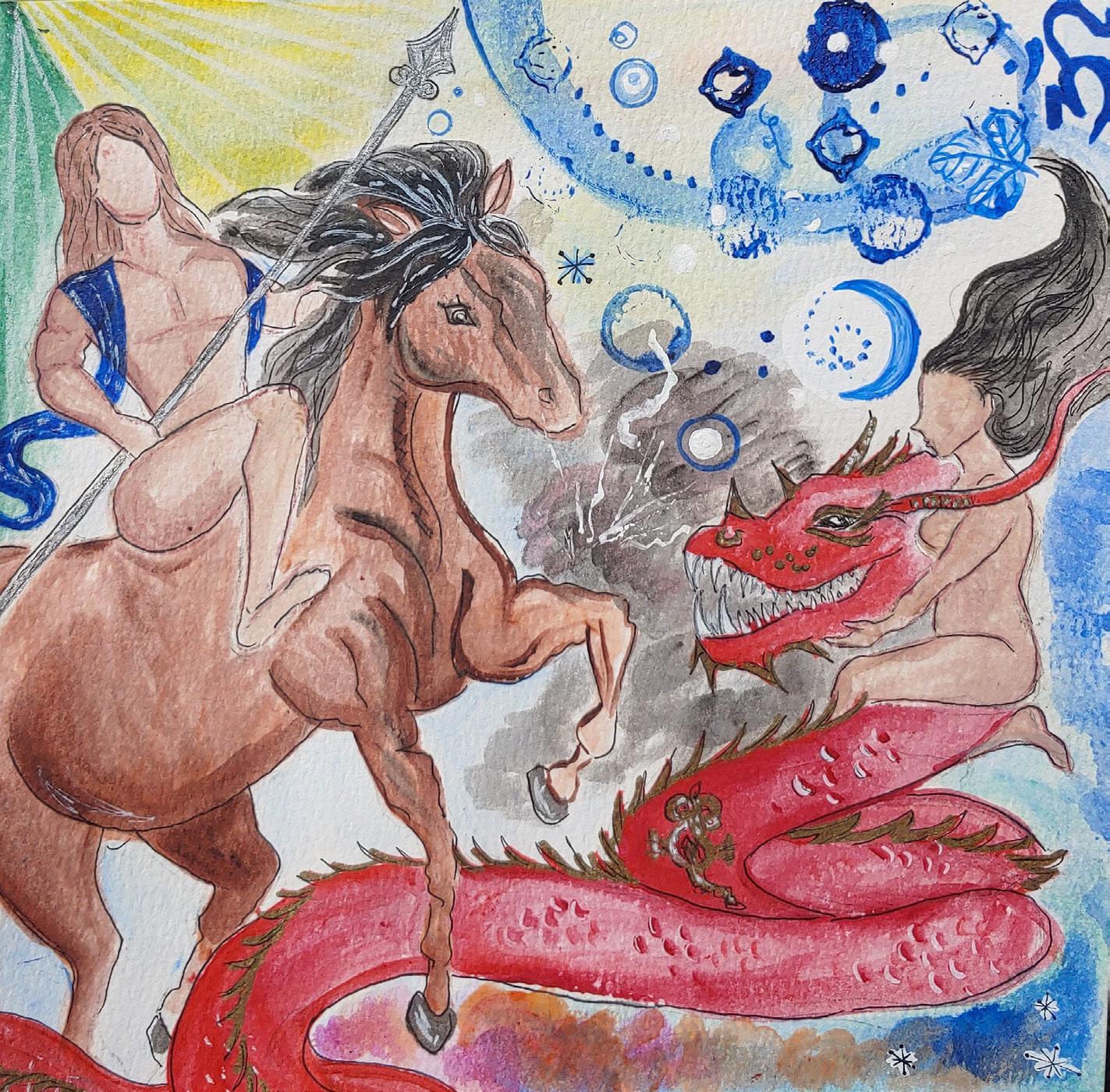
Dichotomy
Tehilla Muller
Drawing
Making friends with our shadows. Finding companionship in the fight, in the opposition, in the differences within ourselves and others.
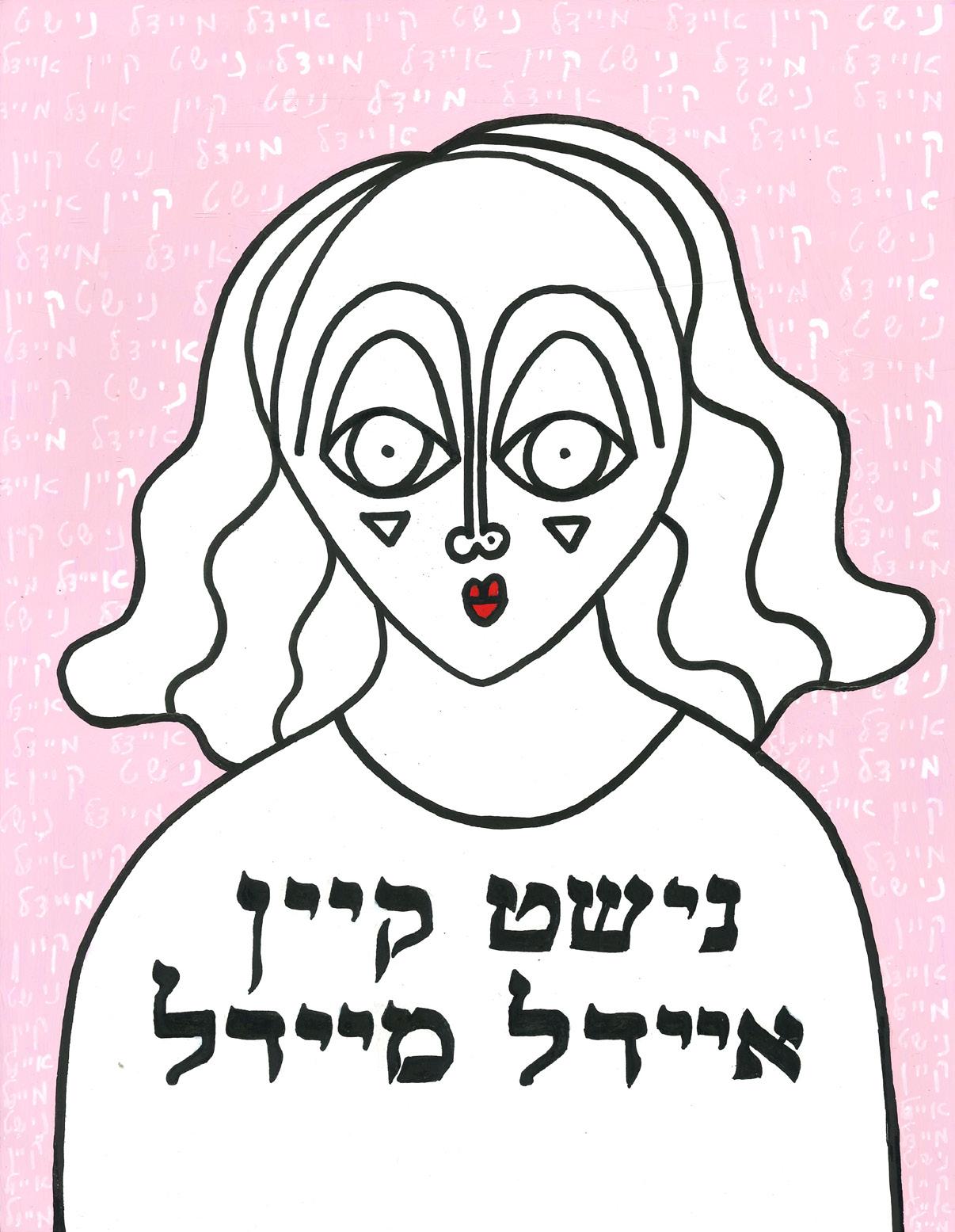
Not an Eydl Meydl, 2025
Sara Erenthal
Painting
Yiddish was my first language. When I escaped the community, I didn’t take Yiddish with me because I associated it with trauma and repression. Art has been a constant companion in my healing journey. As making art became a regular practice in my life, my progressive values and social circles began to expand. Part of that was my discovery that there was a whole world of Yiddish that wasn’t restrictive, where Yiddish could be feminist, secular, and liberating. I made this piece, my first Yiddish limited edition print, in late 2025 — “Not an Eydl Meydl” (Eydl is a hard word to translate. It refers to the way Jewish women are supposed to behave: Modest and submissive)
Website: SaraErenthal.com
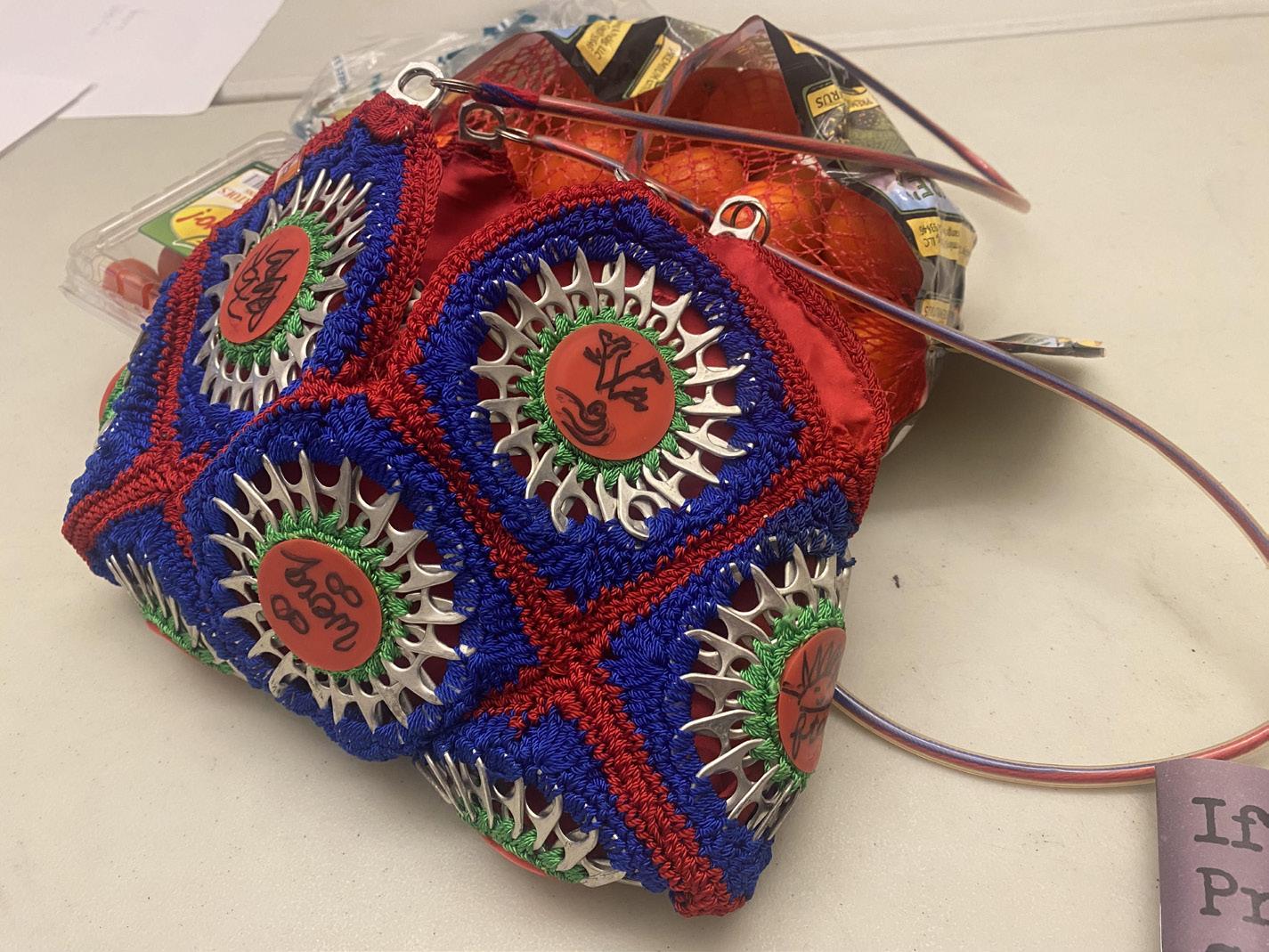
femme on the go
Jejae CleoPatra Mizrahi
Thread, milk carton and soda can tabs
With a healthy snack on the go, I affirm my creativity, my femininity, and ability to succeed on my own, like a craft as my companion.
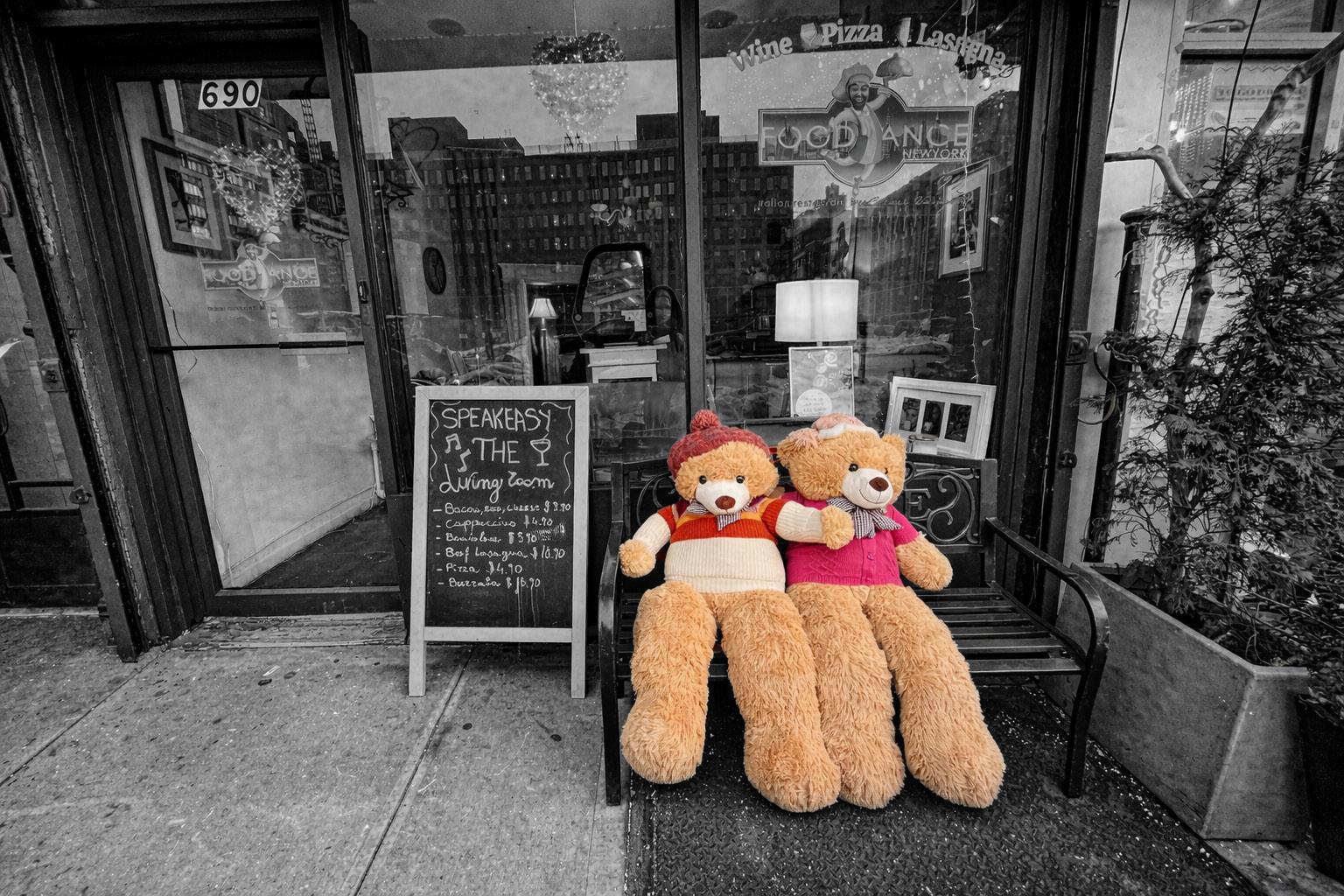
Just another day in NY
Lilac C.
Photograph
Just another day in NY is my whimsical representation of companion in NY. The word companion can have so many nuanced meanings. Are the bears keeping each other company? Are they keeping the bench warm so it’s not left alone? Are they tired from a stroll around the city?
As a photographer, I love noticing, seeing, and appreciating. This was shot in color but I made the background black and white for a nostalgic feeling of NY years ago, as well as artistic expression.
Besties
Anonymous
Joined Footsteps One group After losing all my friends. Found my new bestie.
/ The Shabbos Bubble /
Anonymous
Shabbos was over For me In New Zealand.
The day released its grip. I reached for my phone The way you do When a moment ends And you rejoin the world.
But no one was online.
It was still Shabbos For everyone I knew. They were sealed inside time. Candles burning, Tables set, Voices layered and vivid A world thick with presence Without me.
That kind of alone Is not just absence. It’s misalignment. Like stepping off a curb And realizing The street has shifted.
When I stopped keeping Shabbos That feeling resurfaced. Sometimes it scared me. Sometimes I panicked. Often, I got into my car And drove Just to be near the people Held inside that world.
Shabbos has a gravity. Once you’re inside, The edges turn opaque. The outside dims. I forget That I can do anything I choose.
Even now, When Shabbos comes And phones go dark, Sometimes I feel it again. That familiar ache Of knowing how easy it is To disappear Into belonging.
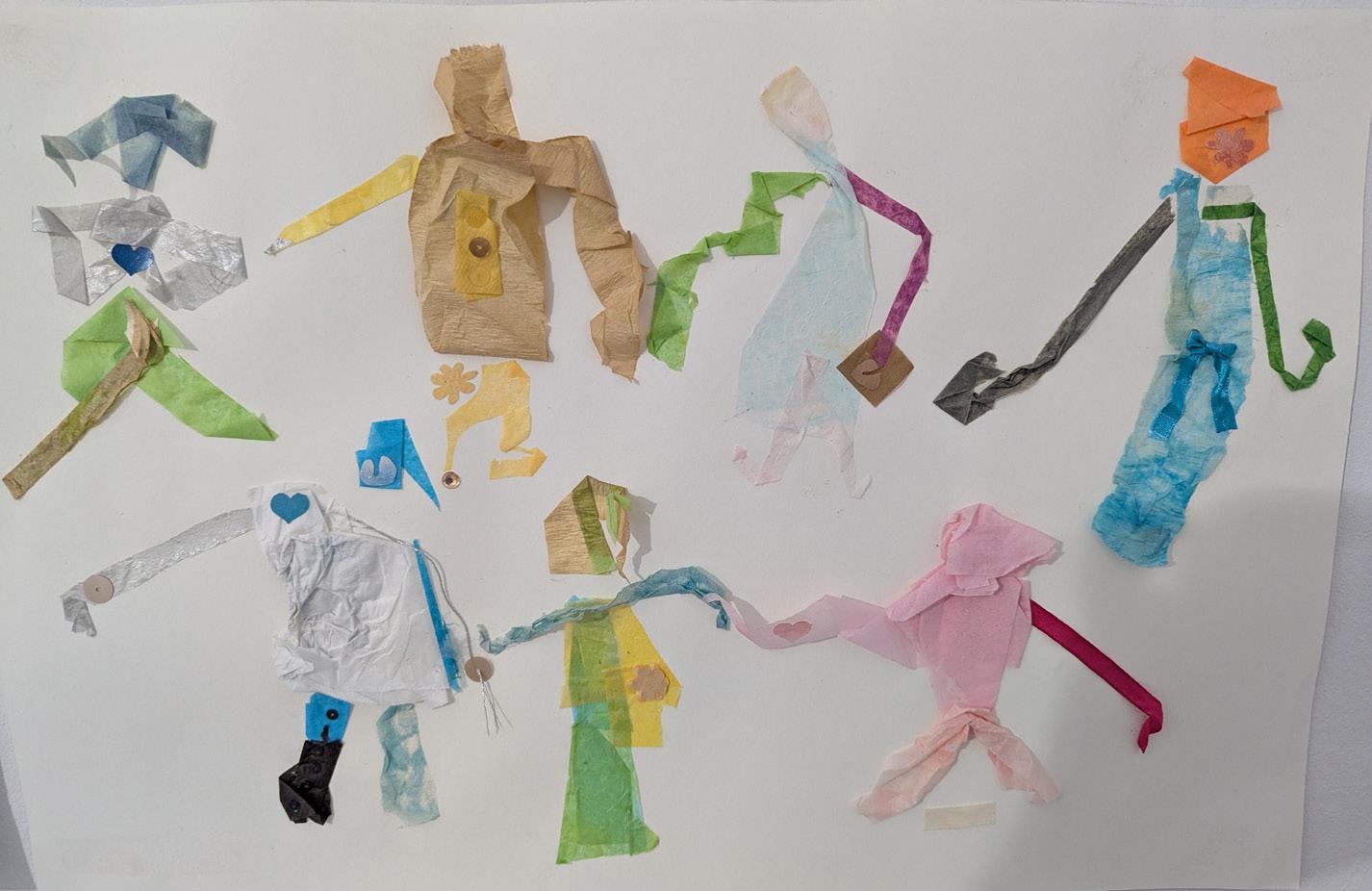
Scrappy D
Collage
Though the colors have faded since its/my inception, these are all versions of myself in different capacities; and if I am not ultimately my own companion, who is? I may not be there yet, but I am learning to hold my own hand.
Breathing Through The Trees
Anonymous
Deep in the woods, far from the noise of the world beyond trees, a lost soul wandered.
Her heart ached for connection, for warmth, not rescue. Something that would stay long enough to soften the hollow places she had boarded shut.
Places that never held tenderness for long. Places that felt cold, no matter the season. The trees stood around her. Their stillness pressed against her until even the air felt heavy. The forest itself seemed to hold its breath. She spoke to the air just to hear proof she still existed. Her voice startled her. It sounded thin.
Sometimes the wind stirred, and she almost believed it whispered back. The sound always faded, swallowed by the quiet that bled through her chest. The loneliness did not just surround her. It settled in her ribs and made a home there. She walked without direction. She tripped over roots, scraped herself on branches that clawed her worn frame. She searched for anything that might see her and know she existed, to remind herself she was not a ghost, drifting through the living world. The world kept its distance. She feared she would drift forever, a shadow moving through trees, without leaving a trace. Then he appeared. Small.
Sick.
Fragile.
A body shaped by hunger and survival. Ribs sharp beneath thinning fur. Eyes too old for something so tiny. He carried his history in every muscle, shrinking before movement, stiffening before touch, bracing for pain from a world that had already taught him too much. He startled at kindness. Even the crackle of dry leaves beneath his paws made him jump, as if the earth itself could strike him. He paused, uncertain, and the forest seemed to hold its breath in recognition. The forest shifted. It exhaled.
Branches loosened, bending slightly. Light slipped through leaves that had felt sealed shut. Something fragile had entered the space.
Even the trees seemed to understand not to break it.
Two wounded creatures. Still alive.
She did not reach for him at first.
She did not rush him.
She simply waited, letting the space between them breathe. She learned him.
She learned the rhythm of his fear.
The sharp, panicked cries that escaped him from dreams he could not outrun. The desperate search in his eyes whenever she moved too far, needing to make sure she had not vanished. She sat so still, her legs went numb.
She moved slowly, until her own breathing felt unnatural. She softened herself and stayed. Loving him was not gentle at first.
It split her open. It was slow, sometimes heavy, painful.
It cracked her in places sealed by years of careful distance. They explored the woods together.
He still startled at leaves, hesitated at unfamiliar ground, but stepped forward anyway.
He sniffed the ground constantly, nose buried in fallen leaves, searching for something edible, guided by an instinct that still remembered hunger and did not trust there would be food, as if the earth might quietly offer what the world once withheld. He lifted his leg against logs and roots, marking pieces of the forest as his own, claiming space in a world that had tried to break him.
The first time he leaned against her without flinching, she felt something inside her break and mend at the same time. When he looked at her, he did not look past her.
He did not see a shadow, a ghost.
He saw her. And he chose her. Again and again. He needed her.
He trusted her with his shaking body. In that trust, something inside her began to breathe. Through him, the woods changed. Or perhaps she did.
The trees no longer felt like witnesses to her isolation, but guardians of something fragile and growing.
She lifted her gaze, and saw the world beyond the twigs. She noticed light slipping through branches, the sound of birds singing, the smell of rain, the pulse of life moving all around her. Small victories felt enormous. They were starting to bloom like wildflowers. A tail wagged without hesitation. A body leaned into her for a heartbeat longer than before. A soft sigh settled between them both. The hollow places inside her remained, yet warmth seeped in. He filled them with breath and heartbeat, the steady reminder that she could be chosen. He gave her a reason to return to the world, showed her how to see beauty in ordinary moments. Even when darkness lingers, light finds its way through the trees. He showed her that connection was possible, that softness could reach the parts of her she believed were unlovable. Strangers paused to smile, caught by his presence in a world that rarely slows. She was no longer drifting alone. There was someone she could love without pretending, someone who held her pain simply by staying. Love did not erase the wilderness. It transformed it. The shadows remained. The thorns remained. But there were paths now. The forest had once watched her ache. Now it watched them live. Then he was gone. Not gradually. Not gently. Gone.
The woods hum with hollow silence that pierces her chest. The air is thick, heavy, unrelenting. Grief does not arrive gently. It strikes, sudden, violent.
Drops her to her knees and leaves her gasping into dirt that still remembers his trail of paw prints. She cannot breathe. She cannot stand.
She cannot understand how anything continues while he does not. Leaves fall. Light moves. The world dares to keep living while her heart fractures.
The warmth he left remains buried in her bones. It burns. It aches.
It lives in the way she moves softly through the world, noticing every small trembling thing, staying present when it would be easier to vanish. Feeling too much, barely enough.
Some days she resents the sun for rising. Resents the birds for singing.
Resents the trees for standing.
Resents her own lungs for breathing. The love has nowhere to go. It pools inside her, pressing against her ribs like a storm. He did not take her back into the void. He left her raw, exposed, vulnerable.
Some days she believes he saved her. Some days she is not so sure. She steps out of the woods, sometimes steps back in.
The paths are no longer clear. The light does not always feel like comfort. Some mornings she cannot move. Some nights she wish she had never learned what it meant to be chosen.
Love transformed her. That much is true.
She steps out of the woods not because the ache is gone, but because he taught her to stay. And still she moves. Bleeding. Stumbling. Laughing when she can.
Crying when she cannot hold it back. Because love, once given bravely, does not fade when the body does. What remains is the quiet companion of memory. Love and loss entwined, walking beside her as she steps into the open world. An invisible red string still binds them, tangled in the forest, unbroken by time, a quiet thread of connection and love, holding hope alive even through absence.
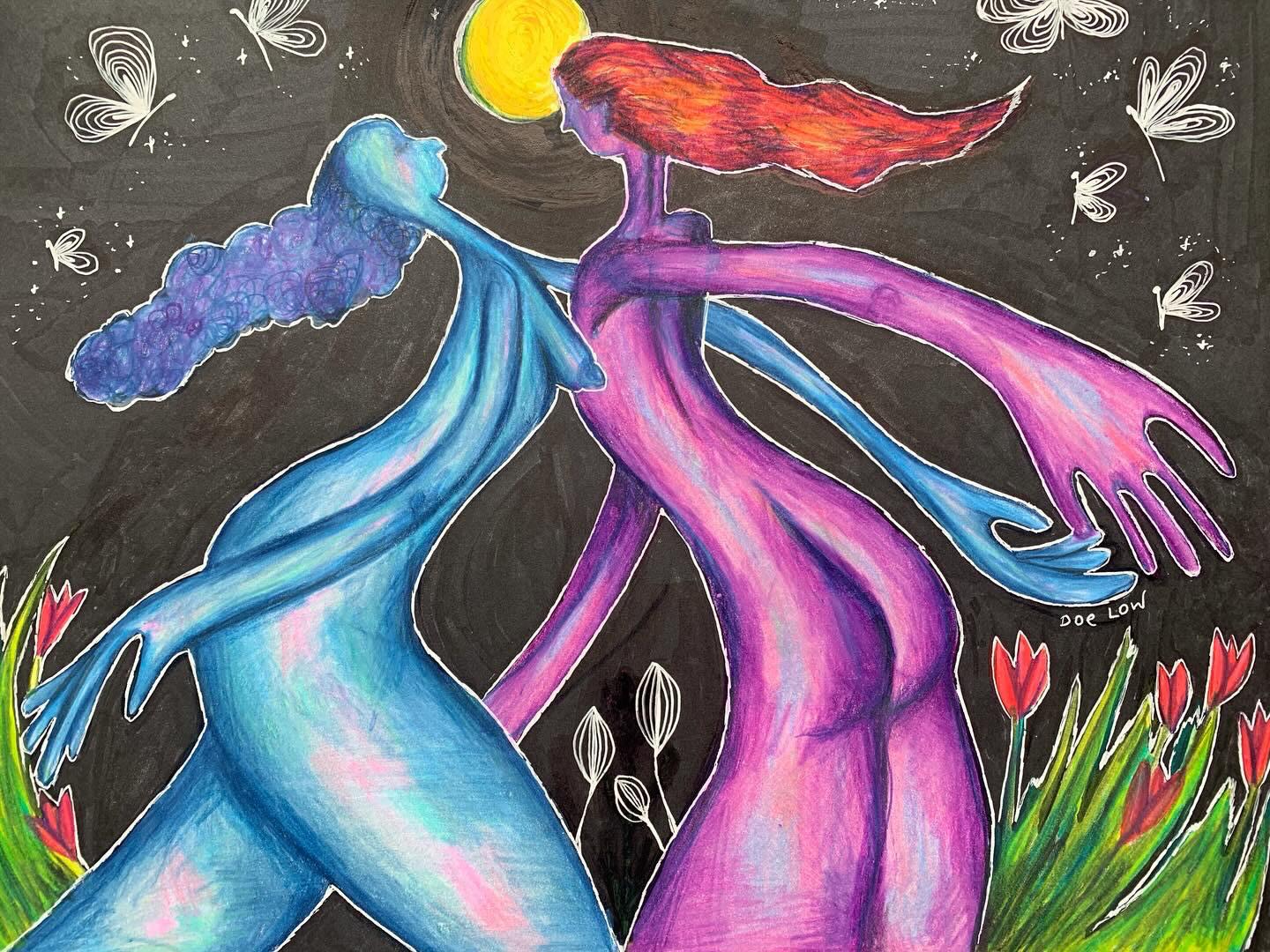
Dancing Under The Moon
Doe Lowinger
Drawing
This piece was created with colored pencils and markers on paper in 2024. At the time of creating it, I discovered my love for dancing and thought of the way we always dance in relationships- sometimes physically but mostly energetically.
If We Lose Love
Akiva Rube
If we lose love
To death
We have thousand year-old rules governing our conduct And The conduct of those around us
If we lose love
The other way
Nothing
I found the end Of a two year relationship
No less destabilizing Than the death of my father
A man I knew for 27 years
Shouldn’t I have torn my shirt when after our last kiss she got into her car drove away and that was it
I was in a very positive and affirming relationship with someone for 2 years. A few months ago we ended things for practical reasons and on good terms. Nonetheless, I found the experience unexpectedly painful. I began to reflect on the different contexts and ways in which we grieve. To me, If We Lose Love captures some of how I felt as I was navigating that new experience.
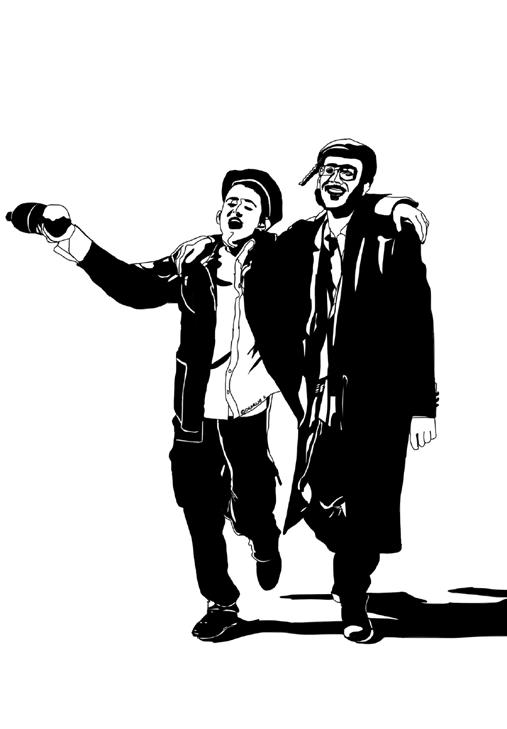
Joy
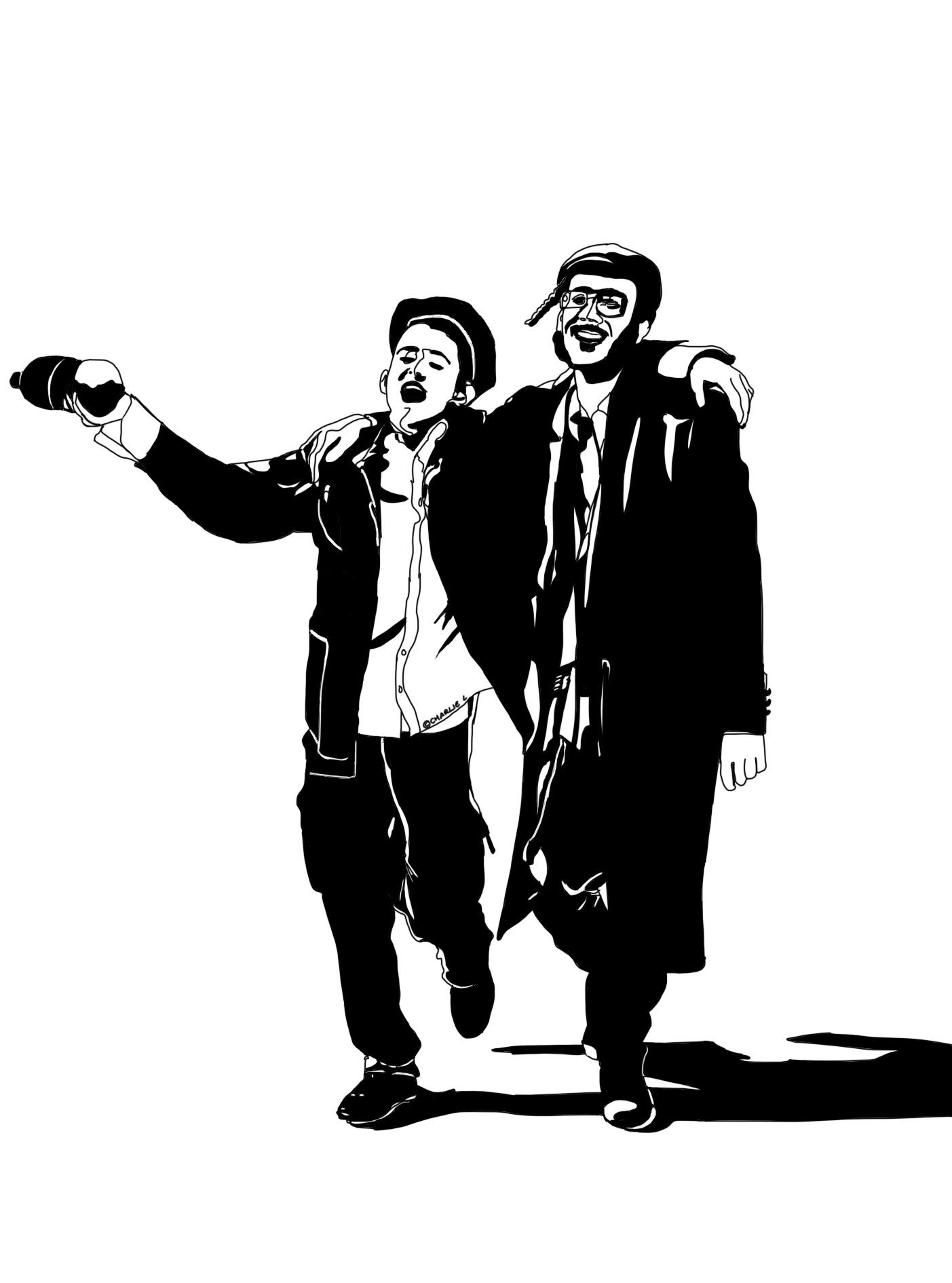
Charlie Lewin
Digital Art - Back Cover Art
I document the community I left as a way of processing the trauma I went through but I also think that documenting the joy in the community is just as important. This artwork was inspired by Purim.