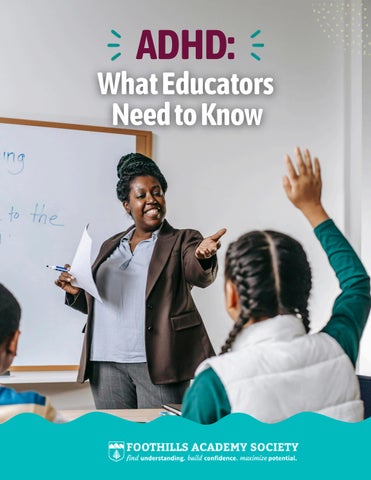
ADHD:
What Educators Need to Know
ADHD: What Educators Need to Know ADHD stands for Attention Deficit Hyperactivity Disorder and it is a neurodevelopmental disorder that impacts a person’s thinking, feelings, and behaviour. ADHD affects 5% of young people around the world.
ADHD has three types:
1 ‘Inattentive’: It may seem like the
Inattentive
Hyperactive
Combined
young person does not hear instructions, they have difficulty staying focused on some tasks, they tend to lose things, and they have struggles staying organized.
2 ‘Hyperactive-Impulsive’: These individuals are easier to spot because they are often moving or fidgetting and find it difficult to stay seated. They may also be very talkative and tend to interrupt others.
3 ‘Combined’: These individuals have both the ‘Inattentive’ and the ‘Hyperactive-Impulsive’ characteristics.
All children have some of these symptoms from time to time, but children with ADHD have many symptoms most of the time. Medical professionals have identified ADHD for more than one hundred years by a variety of terms and it has been studied extensively for over five decades. We can see some difference between brains with, and without, ADHD through neuroimaging. When we look at pictures of an ADHD brain we can see differences in size and activity in certain areas, compared to a brain without ADHD. ADHD is a highly genetic disorder that runs in families. Other factors that may play a role in the development of ADHD, are early injuries to the developing brain or exposure to toxins. ADHD is not caused by poor parenting, too much sugar, too much television, not enough exercise, or playing video games. There may be regions in which ADHD is overdiagnosed due to poor diagnostic practices. However, there are many young people with ADHD who do not get identified and, most importantly do not receive treatment.
To diagnose ADHD, a thorough investigation is necessary. This may include an examination by a medical doctor, the completion of rating scales by parents and teachers, and/or a psycho educational assessment by a psychologist. ADHD does not equate to intelligence; individuals with ADHD may be in the gifted range, in the average range, or lower range of intellectual functioning. However, students diagnosed with ADHD do have an increased chance of also being diagnosed with other disorders, such as: learning disabilities, anxiety, and depression.
HOW IS ADHD TREATED? There is no way to “cure” ADHD. There are a few lifestyle factors which have been proven to help to decrease ADHD symptoms, such as: sufficient sleep; a healthy diet; and aerobic exercise.
Decades of research has shown that there are two forms of treatment that are the most effective are: behavioural interventions and medication.
BEHAVIOURAL INTERVENTIONS ‘Behavioural interventions’ can be very helpful for young people to manage their ADHD. Adults set up the child’s environment to help them overcome their challenges (at home; school; extracurricular activities; etc…) and make the rewards and consequences of the young person’s behaviour more clear to them. The goal is to have them engage in strategies that can help them regulate their thoughts, behaviour, and emotions. In schools, teachers need to identify realistic expectations and provide clear, consistent, and predictable guidelines for student behaviour.
MEDICATION Medication is a personal decision made by families with their prescribing doctor. Many young people with ADHD benefit from medication, but finding the right medication and dose can take time. Medication does not “fix” ADHD. Instead, it can help young people slow down, manage impulses, focus, and be more receptive to information, making it easier to use the skills and strategies they are learning. Teachers can help by sharing observations about what they notice at school.
HOW DOES HAVING ADHD IMPACT A STUDENT IN MY CLASSROOM? ADHD is a “brain boss” problem. It is primarily a disorder of self-regulation, affecting behaviour, thinking, and emotions. Young people with ADHD often appear less mature than their peers because they have more difficulty controlling impulses, emotions, and attention.
ADHD is a selfregulation challenge, not a measure of intelligence.
ADHD makes it more difficult for young people to do what is expected of them at home, in school, and in the community.
One of the hallmarks of ADHD is that the individuals are ‘consistently inconsistent’. A young person with ADHD may have the ability to do a certain task, but their performance on that task varies from day-to-day or even moment-to-moment. Their performance depends on their interest in the task, how fatigued their brain is, and factors in their environment (such as the amount of structure, the distractions, and the rewards). We see the young people struggle with staying focused on a task, especially one that is difficult for them or one that they think is boring. On the other hand, sometimes we see them focus (or ‘hyper-focus’) for hours on something that is particularly interesting or rewarding to them, such as video games. The difficulty is in regulating, or shifting, their attention.
Students with ADHD, particularly those who are not receiving treatment, face daily struggles, and even failures, in many areas of their life; impact the way they feel about themselves. They may have difficulty getting along with others their age because of their impulsivity and immaturity, and as a result = they feel rejected and lonely. Because students with ADHD are ‘consistently inconsistent’ in terms of their performance it can be frustrating to teachers and it can be easy to incorrectly assume that the student is being lazy, oppositional, or manipulative.
HOW CAN I SUPPORT STUDENTS WITH ADHD IN MY CLASSROOM?
No two students with ADHD are exactly the same, so teachers will need to experiment with the strategies that are best for each student. Below are eight key principles to keep in mind when working with students with ADHD, along with associated recommendations to try in the classroom.
Keep Tasks Manageable, Interesting, and Rewarding Allow students to set their own pace for task completion Keep instructions short, specific, and direct Make academic assignments brief, or, chunk larger projects into phases.
Provide opportunities for active involvement with lessons Reduce tempting distractions Engage in direct instruction (teacher directed activities) to improve on-task behaviours. Schedule academic instruction in the mornings.
We can also help students by making the information more captivating and easier to remember such as using a visual chart/list, a joke, a rhyme, or song. Young people with ADHD will learn best by doing, rather than discussing strategies at length.
Fuel their Tanks It is cognitively taxing for a student with ADHD to get through a school day. Dr. Russell Barkley refers to this temporary depletion as an individual’s limited ‘resource pool of effort’. We can help replenish their tanks by:
Regularly provide opportunities for physical movement and allow food and drinks in the classroom Recognize that at times you will need to repeat directions and/or give reminders
Give the whole class opportunities for regulation breaks. Recess is necessary! Create a subtle communication system to identify the need of an extra regulation break. Find ways for students to regularly experience success, e.g., engage in activities they are good at; share items they are proud of; or feel a sense of connection with other students. Try: Flexible seating (wobble cushion, swivel chair, exercise ball) Quiet hand fidgets or a resistance band on the chair Doodling while listening Background music or noise Opportunities to move around Flexible work locations Chewing gum, when appropriate
Let Them Fidget! Movement can help students with ADHD focus. Fidgeting provides extra sensory input that can increase alertness and support attention and working memory, especially during more challenging tasks.
Make Time More Relevant Students with ADHD may experience “time blindness,” making it harder to sense how much time has passed or feel urgency about what’s coming next. They may be focused on the “now,” which can make transitions, deadlines, and preparation more challenging.
Give warnings before transitions Use visual timers or countdowns Use alarms or reminders for transitions Focus more on clear, timely feedback and encouragement. Help students experiment with different tools to find what works best for them.
Be Proactive Not Reactive Young people with ADHD can often become distracted or sidetracked. If we are giving the young person instructions, we want to:
Have realistic expectations and set standards of success that are achievable for the student. Have consistent expectations and routines that are clearly set out and visible (such as a schedule on the wall, or checklists for various times in the day) Make sure that you truly have their attention before you start speaking
Be a coach! Predict the most difficult parts of a task (e.g., transitions or unstructured social time) and be there to provide in-the-moment coaching to support their success
Young people with ADHD will learn best by doing (and experiencing natural consequences or rewards), rather than discussing strategies at length.
Use Reinforcement Programs Wisely Students with ADHD, are far more likely to respond to rewards (such as earning stickers toward a preferred reward) and consequences (such as, the loss of a privilege) if these things are something that is really important to them and they are used frequently, consistently, and immediately after the behaviour. Periodically re-assess the plans you are implementing. Behavioural interventions need to evolve as the student grows, new challenges appear, or the novelty of a plan fades.
Be A Positive Connection Students with ADHD may receive a lot of negative feedback throughout the day. A caring, supportive relationship with a teacher can help them feel valued, understood, and capable and makes them more open to feedback and support.
Notice and celebrate their strengths, interests, and accomplishments. Find something you connect over Give specific, genuine praise often Give them meaningful responsibilities in the classroom. Aim for a 3:1 ratio of positive to negative feedback.
Teach Them About Their Brains Helping students understand how their ADHD brain works can reduce shame and help them recognize that their challenges are not a reflection of their abilities or worth. When students understand themselves, they are better able to advocate for what they need and use strategies that work for them.
Teach age-appropriate information about ADHD and the brain. Create a “menu” of strategies they can try. Work together to identify what works best for them. Build self-advocacy skills over time. Help them recognize and celebrate their strengths
The challenges of ADHD will not be completely eliminated for students. However, with proper classroom supports over time, students will be able to feel successful and take increasing ownership for their learning as they develop new skills. FOR FURTHER INFORMATION: Foothills Academy Society http://foothillsacademy.org/community Centre for ADHD Awareness Canada (CADDAC) http://caddac.ca/adhd/ Canadian ADHD Resource Alliance (CADDRA) https://www.caddra.ca/
CADDAC
CENTRE FOR ADHD AWARENESS, CANADA
CADDRA
CANADIAN ADHD RESOURCE ALLIANCE
Understood https://www.understood.org
Understood
This information was prepared by Dr. Karen MacMillan (Registered Psychologist), Executive Co-Director and Uma Vandekerkhove (Registered Psychologist), Staff Psychologist of Foothills Academy, a full-time School and Community Services. Community Services at Foothills Academy assists individuals of all ages with Learning Disabilities and/ or ADHD in the Calgary community and well beyond. We are open year-round and have a wide-range of financially accessible services and programs. Our goal in Community Services is to offer wrap-around support to individuals and families (whether they are in our School or not) in order to help them thrive in the face of LD and ADHD!
745, 37 Street NW, Calgary, AB T2N 4T1 www.foothillsacademy.org Phone: 403.270.9400
Email: info@foothillsacademy.org