NO.1 PA PE R, PAC KAG I N G & RECYCLING INDUSTRY M AGA ZIN E
Packag ng SUSTAINABLE
MIDDLE EAST & AFRICA
PACK MATERIAL: PAPER IN FOOD
TECH FOCUS:
DIGITAL PRINTING
SUSTAINABILITY: UAE BEYOND rPET TOPICAL FOCUS:
STARTUPS TO WATCH IN 2026
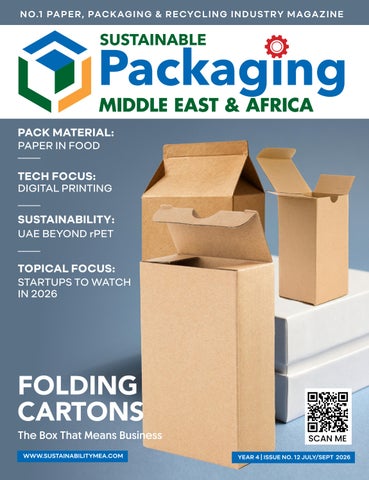
FOLDING CARTONS
The Box That Means Business WWW.SUSTAINABILITYMEA.COM
SCAN ME YEAR 4 | ISSUE NO. 12 JULY/SEPT 2026
SCAN ME
MARCH 23-25, 2027 DAR ES SALAAM, TANZANIA
APRIL 27-30, 2027 NAIROBI, KENYA
MAY 3-6, 2027 LAGOS, NIGERIA
OCTOBER 6-8 2027
LUSAKA, ZAMBIA
No.1 International Trade Shows for Packaging Materials, Processing & Packaging Technologies in Africa
SIGN UP TO ATTEND , SPONSOR & EXHIBIT
www.afripackexpo.com
info@fwbrandsmea.com +254 725 343932
EDITORIAL
EDITORIAL
The System Behind the Package Why MEA's Next Chapter Is Being Built, Not Just Printed
F
or decades, the packaging conversation in Africa and the Middle East has been framed around a single question: what material should we use? Paper or plastic, virgin or recycled. But it is no longer the whole story. Across the region, a quieter shift is underway. The industry is asking a harder question: how do we build systems that work? Systems that collect, sort, trace, recycle and regenerate. Systems that connect farmers to factories, converters to brands, and consumers to circularity. This edition of Sustainable Packaging Middle East and Africa Magazine explores that shift from every angle. We begin with paper, which is taking centre stage in foodservice packaging. From Nairobi cafés to Gulf quickservice restaurants, fibre-based formats are moving deeper into the mix. Yet paper's future depends less on whether it can replace plastic and more on whether the entire system around it, collection, sorting, recycling, can keep pace. The UAE's recycled plastics breakthrough tells a similar story. A 2026 regulatory shift has opened the door beyond rPET to recycled PE, PP and PS in food-contact applications. But policy alone cannot create circularity. The real test lies in infrastructure, quality control and the economics of scale. That systems lens runs through our spotlight on packaging startups, where innovators across MEA are turning agricultural waste into packaging, converting hard-to-recycle plastics into building materials, and building digital platforms
to trace recyclables through fragmented recovery chains. Scaling requires more than a good idea. It requires feedstock, finance, regulation and customers. In tags and labels, the humble barcode is becoming something far more ambitious — a data carrier that can track a package from production line to recycling bin, enabling verification, sorting and accountability in ways that were impossible before. Meanwhile, the digital printing revolution is finally making economic sense for MEA converters. And folding cartons, long the quiet workhorse of packaging, are stepping into the spotlight as urbanisation, e-commerce, plastic bans and healthcare investment reshape demand. These stories are connected by a common thread: sustainable packaging is not a material choice alone. It is a system, of design, production, collection, recovery and reinvention. And across Africa and the Middle East, that system is being built. We invite you to explore these stories with curiosity and optimism. They offer a glimpse of where the industry is heading, and why it matters. Happy reading.
WWW.SUSTAINABILITYMEA.COM
JULY - SEPT 2026 | SUSTAINABLE PACKAGING MIDDLE EAST & AFRICA
Victor Atsali Editorial Lead Sustainable Packaging MEA 3
C
ontents
MATERIAL - PAPER 26 PACK IN FOOD SERVICE Paper takes centre stage as foodservice seeks a smarter packaging future
YEAR 4 | ISSUE 12 | JULY - SEPT 2026
FOCUS - FROM TRENDS - RISE 32 PACKAGING 36 LABEL BARCODE TO BACKBONE OF FOLDING CARTONS How Tags and Labels Are Rewiring the Packaging Value Chain
Why Folding Cartons Are Taking Centre Stage in MEA Packaging
38
38
TECH FOCUS - DIGITAL PRINTING IN MEA Why MEA Printers are Finally Making the Switch
42
SUSTAINABILITY - UAE BEYOND RPET The UAE'S Recycling plastics Breakthrough
FEATURE 46 TOPICAL RISING START-UPS IN 2026
46
The Innovation Ecosystem Redefining Sustainable Packaging Across MEA
In Every Issue 3
Editorial
10
News Updates
22 Appointment Updates 24 New Products JULY - SEPT 2026 | SUSTAINABLE PACKAGING MIDDLE EAST & AFRICA
4
WWW.SUSTAINABILITYMEA.COM
EVENTS CALENDAR SIAL Paris October 17 – 21, 2026 Paris Nord Villepinte, France www.sialparis.com/en
PackMach Asia Expo October 28 – 30, 2026 Bombay Exhibition Centre, Mumbai, India www.packmachasiaexpo.com
ADVERTISE IN THE NO.1 PUBLICATION AND WEBSITE ON SUSTAINABLE BUSINESS IN AFRICA AND THE MIDDLE EAST
Interpack China November 16 - 18, 2026 Shanghai New International Expo Centre, China www.interpack-cn.com/en
Anuga FoodTec February 23 –26, 2027 Exhibition Centre Cologne, Cologne, Germany www.anugafoodtec.com
Sino-Pack 2027 March 4 – 6, 2027 China Import & Export Fair Complex, China www.chinasinopack.com/GPAC/idx/eng
AFRIPACK Expo Tanzania March 23 – 25, 2027 Diamond Jubilee Hall, Dar es salaam Tanzania www.afripackexpo.com/tz
AFRIPACK Expo Kenya & Eastern Africa Edition April 27 – 30, 2027 Sarit Expo Centre, Kenya www.afripackexpo.com/east
AFRIPACK EXPO NIGERIA & WESTERN AFRICA May 3-6, 2027 Landmark Centre, Victoria Island, Lagos, Nigeria www.afripackexpo.com/west
AFRIPACK EXPO ZAMBIA & SOUTHERN AFRICA October 6-8, 2027 | Mulungushi International Conference Centre, Lusaka, Zambia www.afripackexpo.com/south
AVAILABLE IN PRINT & FOR FREE ONLINE AT:
JULY - SEPT 2026 | SUSTAINABLE PACKAGING MIDDLE EAST & AFRICA WWW.SUSTAINABILITYMEA.COM
Packag ng SUSTAINABLE
MIDDLE EAST & AFRICA
Year 4 | Issue No.12 | July - Sept 2026
FOUNDER & PUBLISHER Francis Juma
OUR MAGAZINES We publish some of the most influential magazines and websites in Africa & the Middle East regions. Please visit the websites below for more information about our publications.
SENIOR EDITOR Alphonse Okoth EDITOR Victor Atsali Leah Murungu BUSINESS DEVELOPMENT DIRECTOR Virginia Nyoro BUSINESS DEVELOPMENT ASSOCIATE Johna Sambai HEAD OF DESIGN Clare Ngode
FoodBusiness Middle East & Africa
www.foodbusinessmea.com
HORECA
MIDDLE EAST & AFRICA www.horecamea.com
MILLING MIDDLE EAST & AFRICA
www.millingmea.com
Dairy Business MIDDLE EAST & AFRICA
www.dairybusinessmea.com
ASSOCIATE DESIGNER Emmaculate Ouma ACCOUNTS Anita Kinyua Published By: FW Brands MEA P.O. Box 1874-00621, Nairobi Kenya Tel: +254725 343932 Email: info@fwbrandsmea.com Website: www.fwbrandsmea.com
Sustainable Packaging Middle East & Africa is published 4 times a year by FW Africa. Reproduction of the whole or any part of the contents without written permission from the editor is prohibited. All information is published in good faith. While care is taken to prevent inaccuracies, the publishers accept no liability for any errors or omissions or for the consequences of any action taken on the basis of information published.
FEE BUSINESS
MIDDLE EAST & AFRICA
Packag ng SUSTAINABLE
MIDDLE EAST & AFRICA
www.feedbusinessmea.com
www.sustainabilitymea.com
www.healthcaremea.com
www.hpcmagmea.com
AGRITECH
MIDDLE EAST & AFRICA www.agritechmea.com
JULY - SEPT 2026 | SUSTAINABLE PACKAGING MIDDLE EAST & AFRICA
7
MARCH 23-25, 2027
APRIL 27-30, 2027
MAY 3-6, 2027
OCTOBER 6-8 2027
DAR ES SALAAM, TANZANIA
LAGOS, NIGERIA
NAIROBI, KENYA
LUSAKA, ZAMBIA
No.1 International Trade Shows & Conferences for: Food Ingredients & Formulation Solutions • Processing & Packaging • Logistics • Lab & Food Safety • Hospitality Solutions info@fwbrandsmea.com
www.afmass.com +254 725 343932
SCAN ME
SIGN UP TO ATTEND, SPONSOR & EXHIBIT
CONSTITUENT EVENTS
NEWS UPDATES
FMCG giants form consortium to replace flexible plastics GLOBAL – Unilever, Nestlé, PepsiCo, Procter & Gamble, Colgate-Palmolive and Mars have joined the PaperFlex Consortium to accelerate paper-based alternatives to flexible plastic packaging. Supported by France-based (Re)Set and the Ellen MacArthur Foundation, the initiative will develop paper packaging, bio-based coatings and recycling solutions to reduce plastic waste. Members will fund trials while improving collection and recycling systems. The consortium aims to address gaps in paper packaging performance, cost and scalability, particularly for food applications requiring strong moisture and oxygen barriers, seal integrity and shelflife protection. Flexible plastics, including pouches, wrappers and sachets, remain widely used but increasingly face regulatory and environmental pressures. Unilever said the initiative will combine investment, expertise and shared learning to accelerate commercially viable paper-based packaging solutions.
Johannesburg strengthens recycling with new sorting facility SOUTH AFRICA – The City of Johannesburg has launched a recycling sorting facility at the Robinson Deep Landfill Site, operated by Pikitup, to reduce landfill pressure and strengthen the circular economy. Cooperatives will manage recovery and sorting operations, diverting recyclable materials from disposal and returning them to the recycling value chain. The facility also provides waste pickers with improved amenities, including showers and ablution facilities, supporting safer and more dignified working conditions. Pikitup unveiled nine new compactor trucks to strengthen collection services. Polyco has pledged machinery to improve cooperative productivity and help develop the site into a fully fledged recycling hub. 10
Alcoa agrees to US$5.6B acquisition of South32’s aluminium assets SOUTH AFRICA – Alcoa has agreed to acquire South32’s aluminium assets in a US$5.6 billion transaction that includes the Hillside smelter in Richards Bay. Hillside, Africa’s largest aluminium smelter and the Southern Hemisphere’s largest, produced 718,000 tonnes of aluminium in fiscal 2025. The acquisition gives Alcoa control of South Africa’s only primary aluminium smelter and is expected to strengthen supplies to downstream manufacturers, including Hulamin and Wispeco. Deliveries of liquid metal are being increased towards a target of 240,000 tonnes annually for value-added production. Under the agreement, Alcoa will pay US$3.1 billion in cash and US$1 billion in shares, assume US$750 million in debt and make potential contingent payments of up to US$750 million linked to future aluminium prices. The transaction also includes aluminium assets in Australia and Brazil but excludes South32’s
JULY - SEPT 2026 | SUSTAINABLE PACKAGING MIDDLE EAST & AFRICA
Mozal smelter in Mozambique. Hillside employs more than 2,500 people directly and supports an estimated 29,000 indirect jobs. The acquisition also has implications for South Africa’s growing metal packaging industry, particularly beverage cans. The country’s metal packaging market is projected to increase from US$1.06 billion in 2026 to US$1.27 billion by 2031, creating additional demand for aluminium. The transaction supports South Africa’s ambitions to become a regional beneficiation hub under the AfCFTA, supplying semi-fabricated aluminium for packaging, automotive and construction applications across neighbouring markets. For Alcoa, the deal is expected to add approximately 3.2 million tonnes of aluminium and 14.8 million tonnes of alumina to its annual production capacity, reinforcing its global supply position. WWW.SUSTAINABILITYMEA.COM
What will tomorrow’s food look like ? Hard to picture ? Come and experience it at SIAL Paris 2026
Visit the world’s largest food innovation exhibition from 17 to 21 October at Paris Nord Villepinte More information : Wangari Kamau - Wangari.kamau@fwbrandsmea.com
AFRIPACK Expo Driving the Future of Packaging & Processing in Africa
P
ackaging & processing today sits at the heart of manufacturing strategy, helping businesses improve product quality, strengthen brand identity, reduce operational costs, enhance supply chain efficiency, and meet growing sustainability expectations. As Africa's manufacturing sector continues to expand, packaging & processing has become a critical enabler of competitiveness across industries ranging from food and beverages to pharmaceuticals, personal care, and consumer goods. Driven by rapid urbanization, expanding retail networks, growing exports, and changing consumer lifestyles, demand for smarter, safer, and more sustainable packaging solutions is accelerating across the continent. AFRIPACK Expo has positioned itself at the centre of this transformation, serving as one of Africa's leading platforms where manufacturers, packaging specialists, technology providers, investors, policymakers, and industry leaders come together to explore the innovations shaping the future of packaging. As a constituent event of the AFMASS Food & Bevtech Expo, AFRIPACK Expo provides a unique platform that connects every link in the packaging value chain, from raw material suppliers and machinery manufacturers to processors, brand owners, retailers, and consumers. According to Francis Juma, CEO of FW Brands MEA, the organisers of AFRIPACK Expo, packaging remains one of the most critical components in modern manufacturing because it safeguards product integrity while influencing market success. "Packaging is no longer just about protecting a product. It connects the entire manufacturing value chain—from processors and manufacturers to retailers and consumers. It plays a critical role in ensuring product integrity, improving operational efficiency, supporting sustainability, and enhancing brand competitiveness," says Juma. A ONE-STOP MARKETPLACE FOR PACKAGING INNOVATION AFRIPACK Expo offers manufacturers a comprehensive marketplace where they can discover the latest packaging technologies and practical business solutions under one roof. From packaging materials and converting technologies to automation and recycling systems, the exhibition showcases 12
JULY - SEPT 2026 | SUSTAINABLE PACKAGING MIDDLE EAST & AFRICA
innovations designed to help manufacturers improve productivity while meeting evolving consumer and regulatory expectations. Visitors have the opportunity to explore solutions spanning flexible and rigid packaging, carton and corrugated packaging, glass and metal containers, paper-based and biodegradable materials, printing, coding and labelling technologies, packaging machinery, robotics, warehouse automation, quality inspection systems, and circular economy solutions. What sets the exhibition apart is its focus on practical application. Rather than simply displaying equipment, exhibitors demonstrate technologies in action, allowing visitors to compare solutions, engage directly with technical experts, and evaluate systems capable of improving efficiency, reducing waste, lowering production costs, and enhancing product quality. RESPONDING TO AFRICA’S MANUFACTURING BOOM Africa's manufacturing landscape is undergoing rapid transformation. Growing populations, an expanding middle class, stronger regional trade under the African Continental Free Trade Area (AfCFTA) and increasing food safety requirements are driving unprecedented demand for packaged products that are attractive, durable, traceable, and environmentally responsible. At the same time, manufacturers are under increasing pressure to optimise production, comply with evolving regulations, improve resource efficiency, and reduce their environmental footprint without compromising profitability. AFRIPACK Expo addresses these challenges by connecting businesses with cutting-edge technologies that WWW.SUSTAINABILITYMEA.COM
improve productivity, minimise material usage, optimise energy consumption, strengthen product safety, and build more resilient supply chains capable of competing in both regional and global markets. SUSTAINABILITY TAKES CENTRE STAGE Sustainability has become one of the defining themes of the modern packaging industry, and AFRIPACK Expo reflects this growing priority. Across Africa and internationally, governments, retailers, and consumers are demanding packaging solutions that minimise environmental impact while maintaining product protection and performance. In response, manufacturers are increasingly investing in recyclable materials, compostable packaging, lightweight designs, reusable systems, renewable raw materials, and advanced recycling technologies. The exhibition highlights commercially viable innovations that enable businesses to transition towards circular manufacturing while remaining competitive. Instead of viewing sustainability as merely a regulatory requirement, exhibitors demonstrate how environmentally responsible packaging can drive innovation, operational efficiency, cost savings, and long-term business growth. MORE THAN AN EXHIBITION Beyond the exhibition floor, AFRIPACK Expo delivers valuable industry knowledge through an extensive conference programme featuring leading experts, technology innovators, researchers, policymakers, and business executives. The conference explores key topics including packaging design and innovation, sustainable manufacturing, food safety and regulatory compliance, digital transformation, automation, circular economy strategies, investment opportunities, and emerging market trends. These sessions provide delegates with practical insights and actionable strategies that can be implemented within their own operations, helping businesses remain competitive in an increasingly dynamic manufacturing environment. The event also plays a vital role in strengthening Africa's industrial ecosystem. By bringing together packaging manufacturers, converters, machinery suppliers, logistics companies, recyclers, retailers, brand owners, and end-user industries, AFRIPACK Expo promotes local sourcing, technology transfer, skills development, and strategic partnerships that contribute to stronger regional value chains and greater manufacturing resilience.
to qualified buyers, procurement professionals, factory managers, distributors, and decision-makers from across Eastern, Southern, and Western Africa. Companies leverage the platform to launch new products, demonstrate advanced technologies, identify distribution partners, generate qualified sales leads, and expand into new regional markets. The face-to-face interactions fostered during the event continue to be one of its greatest strengths, creating business relationships that often evolve into longterm commercial partnerships and investment opportunities. BUILDING ON THE SUCCESS OF 2026 The Kenya & Eastern Africa edition of AFRIPACK Expo concluded successfully on 17 July 2026 at the Sarit Expo Centre in Nairobi after three days of exhibitions, live equipment demonstrations, technical conferences, networking sessions, and high-level business meetings. The event attracted packaging professionals, manufacturers, technology suppliers, investors, and industry stakeholders from across Africa and beyond, further cementing its reputation as one of the continent's premier packaging and processing technology events. The strong turnout and positive business outcomes underscored the growing demand for innovative packaging technologies that can support Africa's industrialisation agenda while addressing sustainability and operational efficiency.
CREATING BUSINESS OPPORTUNITIES For exhibitors, AFRIPACK Expo represents far more than a traditional trade exhibition. It provides direct access
LOOKING AHEAD Building on the momentum of the 2026 edition, AFRIPACK Expo returns in 2027 with an expanded calendar that will bring world-class packaging technologies and industry expertise closer to key manufacturing markets across the continent. The upcoming editions will be hosted in Tanzania (March), Kenya (April), Nigeria (May), and Zambia (October), providing even greater opportunities for businesses to engage with emerging markets and forge new commercial partnerships. Whether you are looking to launch innovative products, demonstrate cutting-edge machinery, expand your distribution network, source advanced packaging solutions, or connect with decision-makers shaping Africa's manufacturing future, AFRIPACK Expo offers the ideal platform to achieve your business objectives. “Every edition of AFRIPACK Expo is built around one goal, to create meaningful business connections that accelerate industrial growth across Africa," concludes Juma. "As packaging becomes increasingly central to product quality, sustainability, and global competitiveness, we invite businesses from across the value chain to exhibit, attend, and be part of the conversations and partnerships that will define the future of manufacturing on the continent."
WWW.SUSTAINABILITYMEA.COM
JULY - SEPT 2026 | SUSTAINABLE PACKAGING MIDDLE EAST & AFRICA
13
NEWS NEWSUPDATES UPDATES
Durst to acquire Dutch label printer MPS NETHERLANDS – Durst Group has agreed to acquire MPS Printing, a Dutch manufacturer of flexographic printing systems for labels and flexible packaging, with completion expected on 1 January 2027. MPS will operate as MPS – A Durst Group Company, retaining its management team and current product range. The acquisition strengthens Durst’s strategy of combining digital printing, flexography, software, automation and hybrid production. MPS brings additional flexographic engineering and application expertise, supporting development of integrated systems for shorter runs, variable data and premium finishing. Financial terms were not disclosed, and the deal remains subject to regulatory approvals. MPS CEO Michiel Borst will continue leading the business as managing director. Its European sales network will remain unchanged, while Durst US will handle sales and service in America.
Ethiopia backs Dede Bottle Factory to reduce glass imports ETHIOPIA – The Development Bank of Ethiopia has financed the Dede Bottle Factory in Debre Birhan, supporting domestic glass production and reducing reliance on imports. The factory will produce 450,000 bottles daily, sourcing 86% of raw materials locally, and has created 300 permanent and 100 temporary jobs. The bank provided 70% of project financing. Ethiopia’s annual glass bottle demand is estimated at 265 million units, while the country imported US$69.2 million worth of glass and glassware in 2023. Dede’s plant is currently testing machinery and is expected to begin production soon, supplying food, beverage and pharmaceutical manufacturers while supporting import substitution and local value addition. 14
Skanem Africa installs East Africa’s first Durst digital inkjet press
KENYA – Skanem Africa has installed a Durst Tau RSCi 420 digital inkjet press at its Nairobi facility, marking the company’s entry into digital printing and the first Durst installation in East Africa. The investment strengthens Skanem’s production capabilities as demand for shorter print runs, faster turnaround times and greater SKU flexibility reshapes the regional labels market. The company operates four Bobst conventional flexo presses, with the new digital press enabling a hybrid production model that combines digital and flexographic technologies. Managing Director Sachen Gudka said brand owners increasingly require faster product launches, greater flexibility across product variants and lower inventory risks. The digital investment will allow Skanem to handle a wider range of job lengths, from short to long runs, while complementing its existing flexo capabilities. Skanem selected Durst following an evaluation of several
JULY - SEPT 2026 | SUSTAINABLE PACKAGING MIDDLE EAST & AFRICA
options, with Gudka citing the supplier’s support, responsiveness and engagement. The company has also installed an AB Graphic Digicon Series 3 offline finishing system to support the new digital production line. The move comes as label converters across Africa respond to changing brand-owner requirements while managing supply-chain pressures. Recent disruptions in the Middle East have affected the availability of BOPP films, creating challenges for Skanem’s material sourcing. The company secured shipments ahead of the escalation and built buffer stocks, but replenishment has become increasingly difficult. In response, Skanem is diversifying its supply base, receiving support from suppliers in Egypt while exploring alternative sourcing routes through India and China. Gudka said these alternatives could result in longer lead times and higher costs, while disrupted shipping networks could take at least six months to stabilise. WWW.SUSTAINABILITYMEA.COM
Tetra Pak invests US$1.18M in Johannesburg carton recycling SOUTH AFRICA – Tetra Pak has invested R19 million (US$1.18 million) in a new carton recycling machine in Johannesburg, supporting South Africa’s circular packaging economy and increasing the recovery of used food and beverage cartons. The machine, operated by manufacturing partner Unique Timber Plastics at its Heriotdale facility, separates plastic and aluminium layers from used cartons and converts them into pellets for use in industrial products, including roof tiles, pipes and furniture. Beverage cartons typically contain about 70% paperboard, 25% polyethylene plastic and 5% aluminium, with the layered structure designed to protect food and extend shelf life. The facility is expected to create 24 jobs while supporting thousands of waste pickers involved in collecting and aggregating recyclable materials. The investment forms part of Tetra Pak’s goal of increasing
carton recycling in South Africa to 40% within two years. South Africa’s carton recycling rate has already increased significantly, rising from 8% in 2023 to 33% currently. Tetra Pak’s Southern Africa sustainability head, Masele Manoko, said the recycled pellets could provide a lower-cost, more sustainable alternative to high-density polyethylene pipes and potentially compete with concrete roof tiles. The paperboard recovered from cartons will be processed separately by Mpact, South Africa’s leading paper recycler. According to Mpact CEO Bruce Strong, recovered paperboard fibres can be recycled up to seven times, highlighting the potential for greater material recovery. The initiative also builds on collaboration with Petco, waste pickers, aggregators and municipalities. Petco CEO Telly Chauke said these partnerships are helping divert packaging waste from the environment while creating economic opportunities for marginalised communities.
Hotpack validates 96% of portfolio as environmentally friendly UAE – Hotpack has validated 96% of its packaging portfolio as environmentally friendly and recyclable, while achieving an EcoVadis Gold Medal with a score of 80 out of 100 in its 2025 sustainability assessment. The score places Hotpack among the top 5% of companies assessed globally by EcoVadis, ranking in the 97th percentile across environmental performance, labour and human rights, ethics and sustainable procurement. Founder, Managing Director and Group CEO Abdul Jebbar PB said sustainability was increasingly embedded across the company’s product development, manufacturing, supply chain and community activities. Hotpack has expanded its sustainable packaging portfolio through recycled-content materials, plant-based packaging, biodegradable plastics and circular design solutions. Its r-PET range is reported to deliver a 30–40% reduction in carbon dioxide emissions compared with virgin PET, while its Eco Store provides customers with access to more sustainable packaging alternatives. According to Group Chief Technology Officer and Executive Director Anwar PB, the 2025 sustainability report was prepared according to Global Reporting Initiative Standards, covering product innovation, resource efficiency, responsible sourcing, workplace practices, governance and community engagement. Workforce development also featured prominently in the WWW.SUSTAINABILITYMEA.COM
report. Hotpack employs more than 4,500 people representing over 33 nationalities and recorded zero workplace fatalities in 2025. The company also highlighted its wider social and environmental initiatives. During Ramadan, more than 200 volunteers supported programmes that distributed 60,000 Iftar meals and over 100,000 food packages through 12 partner organisations. As Hotpack marks three decades in the packaging industry, the company said it continues to expand its manufacturing and distribution network while investing in sustainable product development, resource efficiency and operational improvements.
JULY - SEPT 2026 | SUSTAINABLE PACKAGING MIDDLE EAST & AFRICA
15
NEWS UPDATES
Epson expands Nairobi office to strengthen East Africa printing support KENYA – Epson has invested KES19.4 million (US$155,000) to expand its Nairobi office by 50%, adding a showroom, training facilities and servicing capacity as it strengthens its presence in East Africa’s growing printing and packaging markets. The expanded facility, announced in September 2026, will serve as a regional hub for Epson’s East African printing operations and support the company’s wider activities across the Middle East, Türkiye, Africa and Central & West Asia. The new showroom allows customers and partners to test Epson’s printing and projection technologies, while expanded training and technical services are designed to improve local support and reduce equipment downtime. According to Epson Regional Head for East and West Africa Mukesh Bector, the facility will provide customers and partners with direct access to technology and local expertise. It will also operate as a training centre covering the company’s latest printing systems, including industrial and
commercial solutions for the expanding packaging and labelling sector. The investment coincides with Epson’s continued focus on energy efficiency. The company has extended its use of renewable energy certificates to 10 sites across the region, purchasing 416 MWh of certificates between March 2025 and April 2026 to match electricity consumption at those locations. Epson’s EcoTank printers, powered by Micro Piezo HeatFree technology, use up to 96% less energy than traditional thermal inkjet systems, according to the company. The Nairobi expansion comes as demand for business printing, visual communications, packaging and labelling technologies grows across East Africa. Manufacturers and FMCG companies are increasingly seeking local technical support, training and faster servicing, rather than relying on support from overseas offices.
India’s FSSAI bans plastic packaging for pan masala
INDIA – The Food Safety and Standards Authority of India (FSSAI) has banned plastic, synthetic and aluminium-based packaging for pan masala, requiring manufacturers to shift to tin, glass, paper, paperboard, cellulose or other naturally derived plastic-free materials. The amendment to the Food Safety and Standards (Packaging) Regulations, 2018, notified on 7 August 2026, aligns with India’s Plastic Waste Management Rules and prohibits packaging containing polyethylene, polypropylene, polyester, PVC, synthetic polymers, copolymers, laminates, aluminium foil or metallised layers. The regulation represents a significant change for an industry that has traditionally relied heavily on small, lightweight plastic sachets for single-use portions. 16
JULY - SEPT 2026 | SUSTAINABLE PACKAGING MIDDLE EAST & AFRICA
Under the new rules, manufacturers can use tin or glass containers, while paper, paperboard and cellulose-based materials are permitted provided they are completely free of plastic. For paper and paperboard formats, manufacturers will need to ensure adequate barrier properties to protect pan masala from moisture and air exposure, which can affect freshness, flavour and product quality. The amendment follows a draft notification issued in April 2026, which sought feedback from industry stakeholders on the proposed packaging changes. FSSAI said the measures are intended to encourage safer, more sustainable and environmentally friendly packaging while considering technological feasibility and industry requirements. The new requirements are expected to prompt pan masala producers to redesign packaging formats, identify compliant suppliers and modify production and distribution processes. Companies may also face changes in packaging, manufacturing and transportation costs as they test and adopt alternative materials. The transition could require investments in new filling, sealing and handling systems because tin, glass and paperbased formats operate differently from plastic sachets. WWW.SUSTAINABILITYMEA.COM
AFRICA
LOGISTICS EXPO
MARCH 23-25, 2027 DAR ES SALAAM, TANZANIA
APRIL 27-30, 2027 NAIROBI, KENYA
MAY 3-6, 2027 LAGOS, NIGERIA
OCTOBER 6-8, 2027 LUSAKA, ZAMBIA
No.1 International Logistics, Mobility & Supply Chain Industry Event in Africa
CONTACT US:
+254 725 343932 info@fwbrandsmea.com www.africalogisticsexpo.com
NEWS UPDATES
South Africa mandates 100% recycled content in plastic bags SOUTH AFRICA – From 1 January 2027, all plastic carrier and flat bags sold in South Africa must contain 100% post-consumer recyclate, completing a phased increase from 50% in 2023 to 75% in 2025. The requirement applies to locally produced and imported bags, requiring manufacturers, importers, retailers and distributors to verify compliance. Some retailers, including TFG and Boxer Retail, have already adopted 100% post-consumer recycled bags. The regulation is intended to strengthen plastic recycling and the circular economy, while businesses can also consider reusable or alternative packaging. Paper packaging advocates highlight the importance of recyclable, economically viable and locally appropriate alternatives.
TotalEnergies takes full ownership of French chemical recycling plant FRANCE – TotalEnergies has taken full ownership of the TEPEAR chemical recycling facility in Grandpuits after Plastic Energy transferred its stake in the joint venture. The facility will continue operating at industrial scale using Plastic Energy’s TAC technology under licence, which converts difficult-to-recycle plastic waste into recycled polymer feedstocks. The technology targets mixed and contaminated plastics that are often unsuitable for conventional mechanical recycling. Plastic Energy will focus on its Spanish plants in Almeria and Seville, technology licensing and partnerships. Its Tacoil pyrolysis oil can replace conventional naphtha to produce materials for applications including food-contact packaging and medical-grade plastics. The ownership change comes as Europe’s chemical recycling sector faces challenges around scalability, energy use, costs and competition with virgin polymers. 18
Morocco advances US$1.5B Casablanca waste-to-energy project MOROCCO – A consortium led by Kanadevia Inova has signed a 33.5-year concession agreement for Morocco’s first integrated waste-to-energy (WtE) project in Casablanca. According to the consortium, a US$1.5 billion facility has been designed to process 1.5 million tonnes of municipal waste annually and generate 115 MW of electricity. The project, located near the Mediouna landfill, will combine a 115 MW waste-incineration plant with a 50 MW solar facility and 4 MW biogas unit using methane from landfill sites. Moroccan contractor Somagec will construct the facility, with building work expected to take around 3.5 years and full operations targeted for mid-2030. The system could supply electricity equivalent to the annual needs of approximately 1 million people. The consortium includes Morocco’s Nareva and Japan’s Itochu, with power purchase agreements secured with state utility ONEE and regional services company SRM
JULY - SEPT 2026 | SUSTAINABLE PACKAGING MIDDLE EAST & AFRICA
Casablanca-Settat. Financing will combine consortium equity with debt from Moroccan banks, with construction expected to begin after the financing package is completed in late 2026. The project aims to address environmental problems associated with the Mediouna landfill, including odours, methane emissions and contamination affecting surrounding farmland. The partners estimate the project could avoid up to 128 million tonnes of CO₂ emissions over the concession period by reducing landfill use and capturing methane. However, the development also raises concerns around incinerator emissions, ash disposal and potential impacts on recycling. Effective airquality monitoring and safe management of bottom and fly ash will be critical. To prevent WtE operations from competing with recycling, Casablanca will need systems to separate reusable and recyclable materials before residual waste is incinerated. WWW.SUSTAINABILITYMEA.COM
Mondelēz cuts virgin plastic with FSC paper cookie trays EUROPE – Mondelēz International has replaced rigid PET trays with FSC-certified paper trays across more than 115 cookie products spanning eight brands in 25 European markets. The switch will eliminate 2,200 tonnes of virgin plastic annually, representing an 80% reduction in plastic packaging for around 28,000 tonnes of cookies produced each year. The recyclable paper trays support existing paper recycling streams and help prepare the company for stricter Packaging and Packaging Waste Regulation requirements. Extensive testing confirmed the trays can protect products and maintain shelf life during transport and retail display. The initiative is Mondelēz’s largest European bakery packaging sustainability project.
Tanzania targets SADC pharmaceutical packaging hub TANZANIA/USA – Tanzania and the United States are strengthening health-sector cooperation as Tanzania positions itself as a pharmaceutical manufacturing and distribution hub serving the SADC market of more than 300 million people. Tanzania will host SADC’s Pooled Procurement Services, creating opportunities for manufacturers to supply medicines and health products across the region. The government is developing a pharmaceutical special economic zone at Mloganzila near Dar es Salaam. Health Minister Mohamed Omary Mchengerwa said Tanzania is aligning tax and tariff rules for pharmaceutical raw materials and packaging with EAC and SADC standards to improve manufacturing competitiveness. The government has also established a pharmaceutical investment taskforce and is advancing plans for vaccine and biological-products manufacturing. WWW.SUSTAINABILITYMEA.COM
Texplast secures US$15M to expand aseptic packaging production
KENYA Nairobi-based packaging manufacturer Texplast Industries has secured a US$15 million investment from Norfund as part of a US$30 million project to establish an aseptic packaging production facility in Kenya. Scheduled for commercial commissioning by late 2026, the plant will manufacture packaging materials for the UHT dairy, juice and liquid food industries, strengthening local and regional supply while reducing reliance on imports. Equipped with advanced aseptic packaging technology, the facility will introduce local production of a critical input for East Africa’s growing foodprocessing sector. Aseptic packaging allows products to be safely stored and distributed without refrigeration, extending shelf life and improving market access, particularly in areas where coldchain infrastructure remains limited. Norfund Senior Investment Manager Donald Muchiri Kariuki said increased domestic production would strengthen supply-chain resilience and
support the expansion of East Africa’s food-processing industry. Founded in 1971, Texplast supplies packaging products to customers across the food, beverage, agriculture, construction and consumer goods sectors in East and Central Africa. It also supplies around 500,000 reusable bags each month to Carrefour stores in Kenya and Uganda, using a closed-loop approach that converts worn shopping bags into material for new reusable bags. The investment is also expected to create direct and indirect employment across manufacturing, raw-material procurement, logistics and distribution, supporting Kenya’s industrial development and local value addition. The project comes as East Africa’s packaging demand continues to rise. The regional packaging market is projected to expand from approximately US$45 billion in 2025 to nearly US$58.5 billion by 2031, with Kenya identified as one of the region’s faster-growing markets.
JULY - SEPT 2026 | SUSTAINABLE PACKAGING MIDDLE EAST & AFRICA
19
NEWS UPDATES
interpack CHINA 2026
Sustainable Food Packaging, Automation and Export Compliance for Middle East and African Markets SHANGHAI, CHINA — Food and beverage manufacturers across the Middle East and Africa are seeking packaging solutions that protect product quality while reducing material risk, labour dependency and compliance exposure. interpack China 2026 will bring sustainable packaging materials, intelligent packaging equipment and export-compliance expertise together in Shanghai from 16–18 November 2026, giving processors, brand owners and converters a focused route to source practical, scalable answers. Held at the Shanghai New International Expo Centre, the exhibition is expected to present innovations from approximately 970+ global enterprises across more than 70,000 square metres, with more than 47,000 professional visitors expected. Its scope spans food packaging machinery, materials, automation, digitalisation and compliance services across the value chain. SUSTAINABLE FOOD PACKAGING AND RESILIENT MATERIAL SUPPLY Raw-material and energy-market volatility has made diversified packaging material supply a commercial priority. Xinhai (Booth W2B31) will present its SH-600 home-compostable biodegradable material, which upgrades conventional PBAT+PLA to PBAT+CO₂. The material reduces dependence on fossil feedstocks and holds GUA HomeCompost and EU EN 13432 certifications, illustrating how sustainable packaging materials can support environmental objectives and supply-chain resilience.
(Booth W5B21) will showcase a dual-feed premade pouch packaging machine designed for high-speed stability and reduced defect rates. The organiser states that the upgraded machine doubles production capacity versus conventional models, while its 10 synchronised workstations simplify setup and format adjustments. RAPID CHANGEOVER FOR HIGH-MIX BEVERAGE AND FOOD PRODUCTION Smaller orders and proliferating SKUs require flexible production systems. Longer Machinery (Booth W5G51) will demonstrate a blowing machine with a stated 15-minute mould changeover, fully automated energy use of 28 kW, and output of 14,000 bottles per hour. These capabilities address practical priorities for food and beverage packaging: rapid changeover, bottle-production efficiency and lower energy consumption. AUTOMATION AND EXPORT-READY PACKAGING COMPLIANCE Labour shortages remain a capacity constraint. Xingfeng Machinery (Booth W5K21) will present a food-container production system operating at 40–60 cycles per minute and reducing tool-change and calibration time to 15 minutes. For businesses serving Middle East and African markets, export readiness is equally important. The GCC Guide for Control on Imported Foods states that imported shipments must meet relevant GCC requirements and treats labelling among the legitimate food-suitability considerations. Across Africa, food-contact standards, producer-responsibility schemes and packaging-labelling rules are evolving by country and trading bloc; recent developments include East African Community standards notifications and Kenya’s packaging obligations. interpack China 2026 will therefore offer an Overseas Compliance – Expert Consultation Room, providing one-to-one advice on global market access. Packaging decision-makers can pre-register at https:// www.interpack-cn.com/links?id=3878 to compare sustainable packaging, automation and compliance solutions for the next phase of regional growth.
FOOD PACKAGING AUTOMATION THAT PROTECTS QUALITY For producers facing cost pressure, the priority is packaging line efficiency without quality compromise. Echo Machinery 20
JULY - SEPT 2026 | SUSTAINABLE PACKAGING MIDDLE EAST & AFRICA
WWW.SUSTAINABILITYMEA.COM
Smurfit Westrock study highlights strong Bag-in-Box recycling behaviour EUROPE – A new study by Smurfit Westrock Bag-in-Box has found that consumers across Belgium, France, Germany and Sweden are actively separating Bag-in-Box packaging components, with separation rates reaching up to 97%. The findings indicate strong consumer readiness to participate in circular packaging systems when packaging is intuitive and easy to sort. The research examined whether consumers separate the plastic bag from the cardboard box after use, an important step in directing each material into the appropriate recycling stream. While separation practices varied between countries, the majority of consumers across all four markets reported following proper recycling practices. Differences were linked to variations in waste collection infrastructure, recycling policies, consumer education and local sorting guidance. The findings come as Europe implements the Packaging and Packaging Waste Regulation (PPWR), which took effect on August 12, 2026. The regulation establishes common rules covering packaging design, production, collection, recycling and reuse, with requirements becoming more stringent from 2030 and 2035. It also requires packaging placed on the EU market to be economically recyclable. Massimiliano Bianchi, CEO of Smurfit Westrock Bagin-Box, said understanding consumer behaviour after use is essential to improving packaging circularity.
The study suggests that clearer recycling instructions and packaging designed for simple component separation can further improve recovery rates. The results also underline the role of consumer participation alongside packaging design and recycling infrastructure. As the industry prepares for stricter PPWR requirements, including a 10% minimum recycled content target for contactsensitive plastic food packaging by 2030, intuitive packaging and effective consumer communication could support higher recycling rates across Europe. Meanwhile, the company has agreed to acquire Empresas CMPC’s containerboard and corrugated operations in Chile for US$420 million, a transaction due to complete in the first half of 2027 subject to regulatory approvals. The purchase price equates to a post-synergy multiple of below six times adjusted EBITDA, according to the company. The assets are positioned near Chile’s main fishing and agricultural areas, giving the acquired operations proximity to customer segments that rely heavily on corrugated packaging for fresh produce, seafood and processed food exports. The deal includes a paper mill in Santiago with annual production of 250,000 tonnes. Smurfit Westrock said the mill will support its regional paper operations by supplying recycled paper to facilities in Argentina, Peru and Ecuador. Kraftliner from Brazil and North America will also be available for the acquired corrugated operations in Chile.
WWW.SUSTAINABILITYMEA.COM
JULY - SEPT 2026 | SUSTAINABLE PACKAGING MIDDLE EAST & AFRICA
APPOINTMENT NEWS
Paul Curnow appointed chairman of South Africa's Glass Recycling Company SOUTH AFRICA – Ardagh Glass Packaging-Africa CEO Paul Curnow has been appointed chairman of The Glass Recycling Company, South Africa's leading glass recycling organisation, as the industry seeks to increase glass recovery rates and build on a 49 percent recycled content rate achieved in 2023. Curnow succeeds Mike Arnold in the role. Ardagh was a founding member of TGRC and has worked with industry partners and local communities to support glass recycling and circular economy initiatives. The leadership role directly supports Ardagh's global Clearly Ardagh transformation initiative, which focuses on reducing waste and improving resource efficiency. Increasing the use of recycled glass, or cullet, remains central to these efforts. Curnow said he is passionate about working with customers and industry partners to increase glass recovery rates, promote greater consumer awareness and unlock the full potential of a circular economy.
Kiakiaprint appoints Henry DomoSpiff as new CEO NIGERIA – Kiakiaprint has appointed Henry A. Domo-Spiff as its new Chief Executive Officer, succeeding founder Tunde Ademuyiwa, as the Nigerian online printing and branding company expands into promotional merchandise and strengthens its position as a complete branding partner. The transition positions Kiakiaprint for growth focused on three strategic pillars: protecting core paper-based print solutions, expanding into promotional merchandise with in-house Laser Branding, Direct-to-Film and UV printing technologies, and growing across Africa and international markets. The new Promotional Merchandise division enables clients to source premium print products and branded merchandise from a single trusted partner, simplifying procurement and ensuring consistent quality. Founder Tunde Ademuyiwa expressed confidence in the new leadership, stating that the company is built to endure and grow beyond its beginnings.
22
JULY - SEPT 2026 | SUSTAINABLE PACKAGING MIDDLE EAST & AFRICA
WWW.SUSTAINABILITYMEA.COM
Beta Glass appoints Boye Olusanya as Chairman following strong Q1 2026 results NIGERIA – Beta Glass Plc has appointed industrial titan Boye Olusanya as Chairman following Q1 2026 revenue of ₦37.54 billion (US$24.0 million), as the manufacturer strengthens leadership to sustain growth. Olusanya brings extensive experience across Nigeria's industrial sector, having held leadership roles at multinational corporations. Q1 revenue reflects strong demand across beverage, pharmaceutical and food sectors, where Beta Glass dominates. The appointment follows major capital investment in modernization and capacity expansion. Olusanya's appointment signals focus on operational excellence and export growth across West Africa, with the board expressing confidence in his leadership.
KAM appoints Hitesh Mediratta as new Board Chair KENYA – The Kenya Association of Manufacturers (KAM) has appointed Hitesh Mediratta, Managing Director of PG Bison Kenya Ltd, as the new Chairperson of its Board, succeeding Jane Karuku. The leadership transition comes as Kenya's manufacturing sector seeks to enhance its competitiveness, accelerate value addition and strengthen its contribution to the country's industrialization agenda. In his inaugural address, Mediratta pledged to build on KAM's advocacy efforts by creating a more competitive operating environment for manufacturers while addressing policy and taxation challenges affecting the sector. He has served on the KAM Board since June 2020 and as Vice Chair over the last two years. Outgoing Chairperson Jane Karuku, Group Managing Director of East African Breweries PLC, will remain an Ex-Officio member of the KAM Board, providing strategic guidance to the Association. WWW.SUSTAINABILITYMEA.COM
JULY - SEPT 2026 | SUSTAINABLE PACKAGING MIDDLE EAST & AFRICA
23
NEW PRODUCTS
INDORAMA VENTURES & REBHAN
Luxyclear Ebm Pet 5508
Indorama Ventures and REBHAN have launched LUXYCLEAR EBM PET 5508, a specialty PET grade delivering glass-like clarity and thick-wall aesthetics with PET's lightweight, shatter-resistant durability for premium beauty and personal care packaging. Designed for extrusion blow molding, the grade is commercially available with up to 100 percent chemically recycled or mass-balanced renewable feedstock, giving brands a practical route to distinctive, sustainable packaging without compromising premium performance or transparency.
SALZBURGMILCH
Sig Domemini Carton Bottle SalzburgMilch has become Europe's first company to commercially launch SIG's DomeMini on-the-go carton bottle, debuting Alex chocolate milk and Lisa vanilla milk in Austria while reducing plastic by more than 80 percent compared to traditional plastic bottles. The FSC-certified paperboard pack combines carton protection with bottle convenience, featuring a large resealable central closure, and is filled on a SIG DomeMini 12 Aseptic line running 12,000 packs per hour across seven sizes from 180ml to 350ml.
SMARTSOLVE
PureNil 0 bio-based pouch film SmartSolve has launched PureNil 0, a plastic-free, bio-based pouching material that disperses in water without leaving microplastic residue, offering a viable alternative to polyvinyl alcohol films for household cleaning products. Printable and built on zero-waste principles, the film serves dishwasher pouches, laundry sachets, single-dose cleaning sticks, toilet cleaner sachets, drain treatments and refill pouches, remaining intact during use while enabling measured dosing that limits excess waste. 24
JULY - SEPT 2026 | SUSTAINABLE PACKAGING MIDDLE EAST & AFRICA
WWW.SUSTAINABILITYMEA.COM
KENYA WINE AGENCIES LIMITED (KWAL) Caprice Wine 750ml glass bottle
KWAL has launched a premium 750ml glass bottle for its heritage Caprice Wine brand, delivering an elegant, contemporary presentation that elevates the product's sophistication while preserving its signature quality and taste. The new format complements the existing 1-litre Tetra Pak offering, expanding consumer choice across retail, hospitality and gifting occasions while strengthening Caprice's premium positioning in Kenya's competitive wine market.
COSMO FILMS Biodegradable BOPP film for fresh food packaging Cosmo Films has launched a transparent biodegradable BOPP film for fresh food packaging, combining antifog performance, heat-sealability, high ink adhesion and oxobiodegradable properties that break down within two to two-and-a-half years under suitable conditions. Engineered for fresh-cut vegetables, salads, meat and floral wrapping, the co-extruded film delivers exceptional optical clarity, machinability, hot-tack strength and a low seal initiation temperature, improving line efficiency while preserving product visibility and shelf appeal.
MONDI
Laser-marked flexible packaging Mondi has introduced a laser-marked flexible packaging format that eliminates standard decorative printing and printing plates, enabling rapid artwork changes while advancing circularity through simplified material structures for e-commerce and bag-in-box applications. Artwork is applied directly during converting via laser marking across reels, pre-made pouches and larger bags, with optional bio-based or post-consumer recycled content, cutting lead times, streamlining supply chains and giving customers greater design flexibility without compromising recyclability WWW.SUSTAINABILITYMEA.COM
JULY - SEPT 2026 | SUSTAINABLE PACKAGING MIDDLE EAST & AFRICA
25
PAPER
TAKES CENTRE STAGE AS FOODSERVICE SEEKS A Smarter Packaging Future BY ALPHONSE OKOTH
F
rom takeaway boxes and coffee cups to bags and moulded-fibre formats, paper is moving deeper into Africa and the Middle East’s foodservice packaging mix, driven by regulation, consumer expectations, investment and a need for packaging that simply works. The shift is easy to spot. Walk into a modern café in Nairobi, Dubai, Johannesburg or Riyadh and there is a good chance that the takeaway cup, breakfast bag or lunch box has one thing in common: fibre. Paper has become one of the most visible materials in the foodservice packaging conversation. But its rise is not simply about replacing plastic with something that looks more sustainable. For restaurants and foodservice operators, the attraction is practical. Paper can be printed, folded, coated, shaped
WWW.SUSTAINABILITYMEA.COM
and engineered for different applications. It can protect food while carrying a brand’s identity, and advances in barrier technology are allowing paperboard to perform in applications once dominated by plastic. That combination is becoming increasingly valuable as Africa and the Middle East’s foodservice sectors expand. The broader Middle East and Africa paper packaging market is estimated at US$26.83 billion in 2026 and projected to reach US$35.13 billion by 2031, growing at a CAGR of 5.54%, according to Mordor Intelligence. Food accounted for 33.05% of the regional market in 2025, while paperboard is forecast to grow at 7.32% annually through 2031. The figures suggest that fibre is moving beyond a packaging trend and becoming embedded in the region’s changing food economy.
JULY - SEPT 2026 | SUSTAINABLE PACKAGING MIDDLE EAST & AFRICA
27 27
TRENDS: REFILLABLE PACKAGING
PAPERBOARD CAN NOW BE ENGINEERED TO PERFORM LIKE PLASTIC WHILE CONTAINING LESS THAN 5% OF IT, MEANING IT IS NO LONGER WHETHER PAPER REPLACES PLASTIC FOODSERVICE NEEDS MORE THAN A SUSTAINABLE STORY Environmental concerns are clearly part of paper’s appeal, but they do not tell the whole story. Foodservice packaging has to survive busy kitchens, protect food during transport, withstand heat and grease, look good when handed to a customer and remain affordable when thousands of units are ordered. Paperboard increasingly meets those requirements. For operators, that makes fibre more than a material choice; it becomes part of a strategy for cost, performance, compliance, visibility and waste reduction. The technology behind it has changed too. Modern boards can incorporate barriers that resist grease, moisture and liquids, helping manufacturers reduce conventional plastic
28
JULY - SEPT 2026 | SUSTAINABLE PACKAGING MIDDLE EAST & AFRICA
coatings while maintaining performance. Stora Enso, for example, has developed foodservice boards with reduced-plastic and dispersion-based barrier technologies. Its UltraThinPE technology can reduce the plastic coating in some foodservice board applications to below 5%, while its Performa Natura Aqua board uses a dispersion coating to provide grease resistance for foodservice and bakery packaging. That evolution matters because paper cannot be judged simply by whether it is “natural”. A container that becomes soggy, leaks or fails during delivery is not a sustainable solution if the food inside is wasted. The question is therefore no longer simply whether paper can replace plastic. It is how far paper can be engineered to do the job while retaining the environmental advantages that made it attractive. Companies across the packaging value chain are investing around that question. AFRICA’S OPPORTUNITY IS INCREASINGLY LOCAL For Africa, the paper packaging story is also a manufacturing story. The continent’s growing restaurant, café and takeaway sectors are creating demand, while local efforts to build manufacturing capacity are increasingly responding to that opportunity. In South Africa, Huhtamaki has established a sizeable foodservice packaging presence, supplying paper cups, plates, wraps, bowls and other food-to-go formats. Its South African operation serves QSRs, fast-casual restaurants, cafés, cafeterias, retailers and vending operators. The significance extends beyond individual products.
WWW.SUSTAINABILITYMEA.COM
Huhtamaki’s broader Foodservice Packaging segment has manufacturing operations spanning Africa and the Middle East, reflecting the increasingly regional nature of the supply chain. The company recorded US$1.09 billion in Foodservice Packaging sales in 2025, while identifying footprint expansion, portfolio development and sustainability innovation among its priorities. Egypt provides another illustration. Amira Hussein Co., a paper-cup manufacturer in Sharqia Governorate, invested US$121,149 in four paper cup manufacturing machines with support from the European Bank for Reconstruction and Development’s SME Green Value Chain programme. The investment is designed to increase production capacity, improve energy efficiency and respond to domestic demand from cafés, restaurants and food manufacturers. It illustrates an important point: the paper transition is creating opportunities for local converters and SMEs rather than being driven exclusively by multinational packaging groups. For Africa, this local manufacturing dimension could prove particularly important. Producing more packaging closer to the point of WWW.SUSTAINABILITYMEA.COM
consumption can reduce dependence on imports, shorten supply chains and create opportunities for local paper collection, conversion and recycling businesses. THE GULF IS PUTTING SERIOUS MONEY BEHIND FIBRE If Africa demonstrates the emerging opportunity, the Middle East increasingly demonstrates the scale of investment behind it. Saudi Arabia has become a particularly important market. According to Mordor Intelligence, the country accounted for 24.73% of the Middle East and Africa paper-cup market in 2025. The research points to large-scale investment in regional paper and packaging capacity, including Middle East Paper Company’s US$1.78 billion Paper Machine 5 project, planned to add 450,000 tonnes of annual containerboard capacity when completed in 2027. MEPCO describes the project as a SAR1.7 billion (US$452.99m) investment designed to double its containerboard production capacity. Importantly, the new machine is intended to rely primarily on recovered paper, linking new packaging capacity with the development of a
IN NUMBERS
US$ 35.13B PROJECTED PAPER PACKAGING MARKET BY 2031
JULY - SEPT 2026 | SUSTAINABLE PACKAGING MIDDLE EAST & AFRICA
29
TRENDS: REFILLABLE PACKAGING
more circular fibre economy. That distinction matters. The future of paper packaging will not be determined simply by how much virgin fibre can be produced. It will increasingly depend on whether paper products can be collected, sorted, recycled and returned to the manufacturing system. Saudi Arabia is therefore investing not only in paper production but also in the infrastructure around it. MEPCO’s WASCO subsidiary collects and recycles paper and other materials, supporting the development of a circular-economy model in the Kingdom. The UAE is taking a similarly active approach at the converting and foodservice end of the value chain. Hotpack Global recently partnered with Malaysia’s HZ Corporation to establish HZP Eco Packaging, a joint venture focused on paper-based foodservice packaging. The partnership targets QSRs, coffee brands, airlines, catering companies and fooddelivery platforms, with an initial portfolio including paper cups, folding cartons and paper bags. Hotpack’s broader portfolio also includes kraft bowls, salad boxes and takeaway containers designed for hot and cold food applications. Meanwhile, Green Rock Manufacturing Group expanded its UAE operations with a production facility in Ras Al Khaimah focused on plastic-free and PFAS-free paperboard cups, lids and straws. Launched in 2024, the facility was developed as demand increased for alternatives to conventional plastic-lined food and beverage packaging across the UAE and wider GCC. The direction of travel is clear: manufacturers increasingly want to produce packaging closer to the customer. PAPER’S BIGGEST ADVANTAGE MAY BE ITS FAMILIARITY There is another reason paper has an advantage in foodservice: consumers already understand it. A paper bag does not require much explanation. Neither does a cardboard takeaway box. That familiarity gives brands an opportunity to communicate sustainability without dramatically changing the customer’s experience. For foodservice operators, packaging can become part of the brand. A coffee cup travels from the café to the office. A takeaway bag moves through a shopping district. A branded meal box appears in social-media photographs. Packaging is no longer simply something that protects the food; it is part of the customer interaction. BUT PAPER CANNOT ESCAPE ITS OWN SUSTAINABILITY TEST Paper should not be presented as a perfect replacement for 30
JULY - SEPT 2026 | SUSTAINABLE PACKAGING MIDDLE EAST & AFRICA
plastic. A paper cup or takeaway box may contain coatings, adhesives or other components that complicate recycling. In many African markets, collection and recycling infrastructure remains fragmented, meaning technically recyclable packaging may still end up in landfill. This is why the next stage of the paper-packaging transition will be less about simply changing the material and more about improving the entire system. The industry is already moving in that direction. Stora Enso, for example, is exploring partnerships to collect and sort used paper cups so their fibre can be recovered and given a second life. THE REAL OPPORTUNITY IS CIRCULAR Ultimately, paper’s future in foodservice will not be determined by whether restaurants can replace plastic cups with paper cups. It will be determined by what happens after the customer finishes the meal. If packaging can be designed for the application, manufactured efficiently, collected after use and returned into the fibre stream, the material offers something more valuable than a simple alternative to plastic: a pathway towards a circular packaging system. That is particularly important for Africa and the Middle East, where rapidly growing foodservice markets are creating packaging demand while governments and businesses search for practical solutions to waste. SPMEA
WWW.SUSTAINABILITYMEA.COM
4-6,
DECEMBER 2026
’S BIGGEST A Y N E K
IMPALA CLUB, NGONG’ ROAD, NAIROBI, KENYA
& D R D I O N O K F INARY & C UL , G N I PP O H S
LIFEST YLE
G A A V N A R Z T A X E
SHOP
TASTE
PLAY
IC ENJOY MUS
LEARN AT THE MASTERCLASS
OKING WATCH CO IONS COMPETIT
DIAL *826*326# TO GET YOUR TICKETS SPONSORED BY:
SCAN TO GET YOUR TICKETS
CO-LOCATED WITH:
Call us at: +254 725 343932
info@fwbrandsmea.com
www.festival.afmass.com
The
BOX That Means BUSINESS Why Folding Cartons Are Taking Centre Stage in MEA Packaging BY VICTOR ATSALI
L
et us be honest. For years, the humble folding carton has been the quiet workhorse of the packaging world. It sits on supermarket shelves, carrying everything from breakfast cereal to prescription medicine, doing its job without fanfare or fuss. It is the reliable character actor in a blockbuster movie, essential, but never getting top billing. Not anymore. Across the globe, the folding carton is stepping into the spotlight. The global folding cartons market is expected to grow from US$125.17 billion in 2025 to US$156.11 billion in 2030, surging ahead at a steady 4.52% compound annual growth rate, according to Research and Markets. This growth is driven by three unstoppable forces: rapid urbanisation across Africa, aggressive plastic reduction policies across the Gulf Cooperation Council, and 0expanding pharmaceutical cold chains fuelled by unprecedented regional 32
JULY - SEPT 2026 | SUSTAINABLE PACKAGING MIDDLE EAST & AFRICA
healthcare investments. The result is a market in flux. A clear bifurcation is emerging between premium Solid Bleached Sulfate (SBS) demand from high-end brands and cost-effective recycled grades favoured by volume-driven consumer goods. Yet many converters across the region are simply unprepared for this substrate shift. The gap between what brands want and what converters can deliver is widening, and those who fail to adapt risk being left behind. THE PERFECT STORM: WHY FOLDING CARTONS ARE SUDDENLY THE STAR OF THE SHOW To understand why folding cartons are having their moment, one must look at the forces reshaping the region's consumer landscape. Urbanisation is rewriting the retail rulebook. Across WWW.SUSTAINABILITYMEA.COM
Nigeria, Egypt, and Kenya, modern supermarkets are replacing open-air markets. These retailers demand packaging that stacks neatly, carries bold branding, and withstands humid distribution corridors. Folding cartons deliver on all three counts. E-commerce is turbocharging demand. Platforms like Noon, Jumia, and Amazon are scaling fulfilment networks across Riyadh, Dubai, Lagos, and Nairobi. Brand owners are choosing folding cartons over heavier corrugated boxes for cosmetics, electronics accessories, and over-the-counter medicines. The reason is simple: folding cartons offer structural rigidity while optimising dimensional-weight tariffs for lower last-mile costs. Plastic bans are creating a paper runway. The UAE's 'SingleUse Plastics Ban' implemented in 2024 has accelerated the WWW.SUSTAINABILITYMEA.COM
THE GLOBAL FOLDING CARTONS MARKET IS SPLITTING INTO TWO ECONOMIES EVEN AS IT GROWS FROM US$125.17`BILLION TO US$156.11 BILLION BY 2030 JULY - SEPT 2026 | SUSTAINABLE PACKAGING MIDDLE EAST & AFRICA
33
PACKAGING TRENDS: RISE OF FOLDING CARTON
SOURCE: RESEARCH & MARKETS
34
JULY - SEPT 2026 | SUSTAINABLE PACKAGING MIDDLE EAST & AFRICA
adoption of paperboard-based packaging formats, particularly among foodservice operators and FMCG companies. Pharmaceutical cold-chain expansion is adding another layer. As regional healthcare investments surge, pharmaceutical blisters and nutraceutical sachets are migrating from PVC wallets to SBS cartons that pass accelerated-aging tests. This is reinforcing premium substrate adoption in a sector where packaging integrity is non-negotiable. The Bifurcation: Two Markets, Two Strategies, One Opportunity Here is where the story gets interesting. The folding carton market is not a single river. It is a delta splitting into two distinct streams. On one side sits premium SBS demand. Solid Bleached Sulfate is the gold standard for folding cartons. It offers brightness, odour neutrality, and compatibility with aqueous dispersion barriers. Multinational confectionery and skincare brands prefer it. Gulf cosmetics marketers pay premiums for FSC-certified SBS paired with tactile varnishes. Research and Markets projects the global SBS board market to grow steadily from US$8.92 billion in 2025 to US$10.82 billion in 2030, at a CAGR of 3.8%. This is the high-margin, high-expectation tier where brand owners demand perfection. On the other side sits cost-effective recycled grades. Whitelined chipboard and recycled paperboard dominate dry food products like cereal, pasta, and biscuits, as well as soaps, detergents, and office products. Cost-sensitive household detergent packs in Egypt retain these grades because the margins simply do not justify premium substrates. WWW.SUSTAINABILITYMEA.COM
The tension between these tiers creates both a challenge and an opportunity. Converters that can source both low-cost mixed-waste boards and high-performance virgin fibre will sustain service breadth across diverse customer tiers. Those that specialise in only one risk being trapped when the market shifts. THE PULP REALITY: WHY VOLATILITY IS THE NEW NORMAL Now for the uncomfortable part. The same growth driving the folding carton market is exposing its most critical vulnerability: pulp price volatility. Northern Bleached Softwood Kraft prices climbed to US$1,710 per tonne in early 2026 after energy-cost spikes and Scandinavian supply constraints. Folding-carton converters, many reliant on imported virgin fibre, endure 60-90-day lags before contract price adjustments can be passed on to customers. This erodes working-capital buffers. Currency depreciation in Nigeria and Egypt amplifies landed-cost inflation. Smaller converters lacking hedging facilities face rapid margin compression. Even domestic production is not a guaranteed solution. While Saudi Arabia's MEPCO is doubling capacity, the mill targets tissue and specialty grades rather than the coated boxboard essential for high-graphics food cartons. THE REAL PLAYERS: WHO IS ALREADY WINNING THE SUBSTRATE GAME Across the region, forward-thinking converters are already adapting. In Saudi Arabia, the Obeikan Investment Group produces strong and attractive structural packaging for hundreds of local and multinational brands. The company has an annual production capacity of 50,000 tonnes and is one of the largest folding carton converters in the Kingdom. The Gulf Carton Factory Company and Eastern Pak Limited are similarly augmenting market growth, investing in new capacity and capabilities to meet rising demand. In South Africa, RDM's Vincicoat PLUS exemplifies the performance gains achievable with recycled grades. The product delivers 15-20% higher tensile strength, enabling brand owners to claim recycled content without downgrading graphics.
SOURCE: RESEARCH & MARKETS
source both low-cost recycled boards for volume-driven customers and high-performance SBS for premium brands will capture the broadest market. Second, invest in digital capabilities. Variable-data digital presses reduce makeready waste and allow converters to print order-specific graphics without inventory obsolescence. Third, hedge against currency volatility. This means shorter quotation validity periods, regular price reviews, and clear communication with customers about the reasons behind price adjustments. Fourth, explore lightweighting and value engineering. The most successful converters will help brand owners achieve their performance and sustainability goals with less material.
THE CONVERTER'S COMPASS: STRATEGIC GUIDANCE FOR A TWO-TIER MARKET How does a converter navigate this complex landscape? The answer lies in strategic positioning across four dimensions. First, build substrate versatility. The converter that can
THE LAST FOLD: WHAT COMES NEXT FOR MEA CONVERTERS Looking ahead, the direction is unmistakable. The global folding carton market is on a steady growth trajectory from US$125 billion to US$156 billion by 2030. The SBS board segment alone will reach nearly US$11 billion. Urbanisation, e-commerce, plastic bans, and healthcare expansion are structural trends, not passing fads. The converters that will thrive are those that understand the bifurcation, embrace substrate versatility, invest in digital capabilities, and build resilience against currency volatility. The worst strategy is to wait and see.
WWW.SUSTAINABILITYMEA.COM
JULY - SEPT 2026 | SUSTAINABLE PACKAGING MIDDLE EAST & AFRICA
SPMEA
35
LABEL FOCUS : FROM BARCODE TO BACKBONE
FROM
TO BARCODE
BACKBONE
How Tags and Labels Are Rewiring the Packaging Value Chain BY MARKETS AND MARKETS
F
or decades, a label's job was simple: identify a product, price it, and get it through checkout. That era is ending. As regulators, brands, and recyclers push for a genuinely circular economy, the humble tag or label is being asked to do something far more ambitious — carry the data that lets a piece of packaging be tracked, sorted, verified, and accounted for across its entire life, from production line to recycling bin and back again. THE REGULATORY TRIGGER The clearest catalyst is Europe's Ecodesign for Sustainable Products Regulation (ESPR), which underpins the EU's Digital Product Passport (DPP) initiative. The regulation requires that a data carrier — typically a QR code — be physically present on a product or its packaging, use open and interoperable formats rather than proprietary lockin, and be scannable with a standard phone camera rather than a dedicated app. Crucially, the code must resolve to a destination that can be kept current, since a static code baked into a printed label can't accommodate a changed supplier, an updated certification, or new compliance data without a full reprint. That single requirement — updatability — is quietly forcing packaging teams to rethink labeling as live infrastructure rather than a one-time print job. The EU's Central DPP Registry became operational in mid-2026, and while packaging itself 36
JULY - SEPT 2026 | SUSTAINABLE PACKAGING MIDDLE EAST & AFRICA
isn't yet a mandatory DPP category, batteries, textiles, and other sectors are already working through phased deadlines that stretch out through 2030. Brands that wait for packaging to become mandatory risk building compliance systems under deadline pressure rather than as a considered strategy. GS1 DIGITAL LINK: A COMMON LANGUAGE FOR PHYSICAL GOODS Much of this is converging on a single standard: GS1 Digital Link, a QR code format that carries a product's identifying data through a URL structure rather than a flat, unreadable string. The appeal is that one code can serve multiple audiences at once — a shopper's phone resolves it to a product page or sustainability information, while a warehouse scanner or recycling facility reads the same code as a structured data key. Industry guidance increasingly treats Digital Link, built on ISO/IEC 15459 identification standards, as the practical foundation for passport-style data carriers, precisely because it avoids the vendor lock-in that a proprietary QR format would WWW.SUSTAINABILITYMEA.COM
create. The shift from conventional retail barcodes to GS1compliant QR codes is also being framed by industry figures as more than a compliance exercise — brands are exploring how the same code can support supply-chain optimization and direct consumer engagement simultaneously, turning a cost center into a two-way channel. MAKING RECYCLING VISIBLE: THE RISE OF INVISIBLE TAGGING Perhaps the most striking innovation isn't visible at all. UVtagging technology — an invisible marker embedded in or printed onto packaging and read by detection units installed at material recovery facilities — is being used to answer a question the recycling industry has struggled with for years: what happens to a package after it leaves the shelf? UK supermarket chain Aldi and dairy cooperative Arla have expanded a pilot with recycling-data platform Polytag that uses UV tags to follow milk bottles through the recycling stream, aiming to gain deeper insight into the lifecycle of packaging materials and support decisions about future packaging design. Kraft Heinz has joined a similar program built around UV tag data on single-use plastic packaging, and Polytag has extended the approach into in-mold labeling through a partnership with MCC Global — meaning packaging formats that couldn't previously carry a durable printed code, such as frozen food containers, can now be tagged too. According to the companies involved, the goal is to extend traceability capabilities to a broader range of applications, including products where conventional labels aren't durable enough to survive their use case. The value of this data flows in two directions. Recovery facilities gain the ability to identify material composition and recycled content at the point of sorting — information that plain images or optical scanning alone can't reliably determine. Brands, in turn, get verified evidence of what recycling actually happens to their packaging, rather than relying on modeled or self-reported estimates — a distinction that matters increasingly under extended producer responsibility (EPR) schemes, where funding and reporting obligations are starting to hinge on demonstrable, rather than assumed, recycling outcomes.
different companies, countries, and recovery facilities can't function on closed formats. That's why much of the industry conversation keeps returning to open, global standards as a prerequisite for circularity at scale, rather than a nice-to-have. This also explains why traceability keeps surfacing as a barrier to sustainable material adoption, not just a nice add-on. A brand considering new recycled or bio-based material often can't get comfortable with the switch until it has confidence that the material's end-of-life outcome can be tracked and verified — which means the tagging and data infrastructure sometimes has to arrive before the material innovation can follow. WHAT DOES THIS MEAN ACROSS THE VALUE CHAIN Put together, the shift plays out differently at each stage of the packaging lifecycle: • Manufacturing and filling: Tags shift from being added at the end of the line to being engineered into the packaging format itself, whether through in-mold labeling or embedded markers, so that traceability data survives handling, refrigeration, or freezing. • Distribution and retail: A single GS1 Digital Link code increasingly replaces separate barcodes, promotional QR codes, and compliance labels, reducing packaging complexity while expanding the data available at point of sale. • Consumer use: Shoppers scanning the same code brands once used only for pricing can now access origin, material composition, and recyclability information — turning packaging into a transparency tool rather than just a marketing surface. • Recovery and recycling: Detection technology at material recovery facilities reads tags that images alone can't interpret, improving sorting accuracy and giving recyclers — and the brands funding EPR schemes — verified data instead of estimates.
WHY STANDARDS, NOT JUST SENSORS, ARE THE REAL STORY It would be easy to read all of this as a story about clever hardware — invisible inks, RFID chips, and NFC tags. But the people building these systems tend to emphasize something less flashy: interoperability. Proprietary tagging systems that only one brand or one recycler can read don't scale, and a circular economy that depends on materials moving between many
THE ROAD AHEAD None of this is fully settled. Dynamic QR infrastructure, invisible tagging, and passport registries all still need to prove they can operate at the scale and cost that mass-market packaging demands, and standards bodies, regulators, and brands are still negotiating exactly what data must travel with a product versus what can live in a central registry. But the direction is clear: tags and labels are moving from static identifiers to active data carriers, and that shift is becoming one of the more consequential — if least visible — pieces of infrastructure behind the push for a genuinely circular packaging economy.
WWW.SUSTAINABILITYMEA.COM
JULY - SEPT 2026 | SUSTAINABLE PACKAGING MIDDLE EAST & AFRICA
SPMEA
37
THE DIGITAL Difference Why MEA Printers are Finally Making the Switch BY VICTOR ATSALI
H
ere is a confession that might raise eyebrows in a boardroom: for the longest time, digital printing in the Middle East and Africa was treated like a shiny toy. Everyone admired the glossy brochures at trade shows. Everyone nodded at the promise of personalisation and speed. But when it came to signing the cheque, most converters quietly walked back to their trusty flexo and offset presses. The maths simply did not add up. THAT WAS THEN. THIS IS NOW. According to Mordor Intelligence’s latest report, the GCC Digital Printing Market is expected to grow from US$0.82 billion in 2025 to US$1.36 billion by 2031, galloping ahead at an 8.78% compound annual growth rate. Something has shifted. The question is: what changed? WHAT EXACTLY IS DIGITAL PRINTING ANYWAY? Before we dive into the market numbers, let us get the basics straight. Digital printing is fundamentally different from the traditional methods that have dominated the industry for decades. Think of traditional printing, offset or flexo, like stamping a thousand
38
WWW.SUSTAINABILITYMEA.COM
copies of the same photograph with a single rubber stamp. You carve the stamp once. You ink it. You press it a thousand times. Each copy is identical. The quality is excellent. But if you decide you want a different picture halfway through, you have to carve a whole new stamp. That takes time. That takes money. That creates waste. Digital printing, on the other hand, is like a high-speed inkjet printer in your office, just scaled up to industrial size. There is no stamp. There is no plate. There is just a digital file sent directly to the press. The press reads the file and prints each copy individually. If you want to change the design after a hundred copies, you simply send a new file. No plates to change. No wasted materials. No hours of setup time. The two dominant digital technologies are inkjet and electrophotography. Inkjet sprays microscopic droplets of ink directly onto the substrate, paper, board, or film. It handles almost any surface and produces stunning detail. Electrophotography, the older cousin, uses toner and static electricity, similar to a laser printer. It is reliable and consistent,
but slower and less flexible. This may sound like a small difference. It is not. It is the difference between a printing press that treats every job the same and one that treats every job as unique. Digital printing enables variable data, every single package can have a different name, a different barcode, a different QR code, even a different image. This unlocks mass customisation at a scale that traditional printing cannot touch. It also enables print-on-demand. Instead of printing ten thousand boxes and hoping they sell, you can print one thousand now and nine thousand later when orders actually come in. No warehouse full of obsolete stock. No writing off inventory when a label changes. No 30% waste rate, a figure FINAT estimates for traditionally printed labels that end up discarded due to legislative or ingredient changes.
WWW.SUSTAINABILITYMEA.COM
JULY - SEPT 2026 | SUSTAINABLE PACKAGING MIDDLE EAST & AFRICA
THE HIDDEN COST OF STICKING WITH THE OLD WAY Now let us talk about why this technology shift matters for 39
TECH FOCUS: DIGITAL PRINTING IN MEA
your bottom line. In the old world, printing was a game of huge minimums and long lead times. You placed an order for fifty thousand labels. You waited a week for plates to be made. You ran the press for a day. You stored the extras in a warehouse. Then the brand owner changed the packaging design, and half your stock became landfill. That was just the cost of doing business. In the new world, that is a competitive disadvantage. Digital printing allows converters to produce exactly what is needed, exactly when it is needed. A custom packaging design that once took three to five days can now be on a delivery truck in 24 to 48 hours. The "waiting waste" simply evaporates. For MEA converters navigating the chaos of the Red Sea shipping crisis, currency volatility, and port congestion, this agility is not a luxury. It is oxygen. And the brands are noticing. WHO IS ALREADY CASHING IN Across the region, early adopters are proving that digital printing delivers real returns. Digital Ink, based in Ras Al Khaimah, has partnered with Durst Software to bring what they call an "Amazon-forPrint" model to the GCC. Chris Minn, the founder, puts it simply: "The region is expanding and growing at a fast rate. There is such excitement around digital signage, AI, software automation, and robotics. Bringing lightning-fast, streamlined 40
JULY - SEPT 2026 | SUSTAINABLE PACKAGING MIDDLE EAST & AFRICA
print purchasing processes with minimal touchpoints to the territory is exactly where we see the opportunity." In South Africa, Skanem Africa is taking a hybrid approach. Managing Director Sachen Gudka explains that "clients are placing increasing emphasis on urgent delivery, short-run production, and consistent quality, which is driving the integration of digital processes with flexographic printing." The hybrid model, using flexo for long runs and digital for the unpredictable stuff, is becoming the industry standard. Ricoh is embedding sustainability into its hardware. Dennis Moll, Commercial Director EMEA at Ricoh International, notes: "Sustainability is not an add-on for Ricoh; it is embedded in how we design, manufacture, and support our production printing technologies." That translates into systems that reduce waste, lower energy consumption, and support on-demand production. In the UAE, Sigma Middle East Label Industries has embraced digital to serve a flood of new private-label products. Managing Director Jagannath Wagle observes: "With the continuous emergence of new private-label products in the market, there is a surge in demand for small-batch orders, which is accelerating the pace of digital transformation." Even the manufacturers are localising. HP has announced plans for a Riyadh manufacturing facility by 2027. The Gulf states are not just buying digital printing. They are building it.
WWW.SUSTAINABILITYMEA.COM
INKJET VS. TONER: WHICH ONE WINS Not all digital printing is the same. Understanding the landscape is essential. Inkjet is the undisputed heavyweight. It captured 60.05% of GCC digital printing for packaging in 2025, and its 9.12% CAGR is fuelled by UV-LED curing that slashes energy use by 40% compared to old-school mercury lamps. Inkjet handles coated, uncoated, and heat-sensitive substrates without primer layers, a flexibility that flexo simply cannot match. And with food-safe, low-migration inks now available, it is penetrating pharmaceutical and personal care applications where fine-text resolution is non-negotiable. The trend is clear: inkjet's dominance will only grow, maintaining a market share above 60% through the forecast horizon. The ability to integrate inkjet bars into existing flexo lines allows converters to toggle between analogue and digital within a single shift. It is like having two factories in one. THE INVESTMENT PUZZLE: WHY THE MATHS FINALLY WORKS Many converters believe digital printing is too expensive. They look at the initial price tag, upwards of US$2 million for a full-production press, and their eyes glaze over. But they are looking at the wrong numbers. Labour is the hidden dragon. Labour can account for the
A CUSTOM PACKAGING DESIGN THAT ONCE TOOK THREE TO FIVE DAYS CAN NOW BE ON A DELIVERY TRUCK IN 24 TO 48 HOURS most significant proportion of a converter's total operating costs. Recent wage pressures made this the top business concern for 71% of printing service providers. By comparison, recruiting operatives to run digital equipment is simpler. Digital presses are easier to operate. Technologically savvy candidates adapt with minimal training. Downtime is the silent killer. Flexo press set-up is timeconsuming. Each job changeover involves mechanical set-up and print testing, consuming both time and materials. Digital presses require less downtime between print runs, with no plate creation and minimal mechanical set-up. The hidden ROI lies in freeing up flexo capacity to focus on longer, more profitable runs while digital handles short-run and variable-data work. This complementary hybrid approach is where the real business case lives. Converters can justify a higher price per label for the agility they deliver, negating the direct cost comparison with traditional technologies. THE FINAL WORD: WHAT COMES NEXT The trajectory is unmistakable. The global digital printing in packaging market is growing at roughly 6-9% annually across Europe, with MEA tracking at the higher end due to lower baseline penetration and stronger growth drivers. Saudi Arabia is leading regional value, driven by Vision 2030 and expanding non-oil GDP. The UAE follows closely. African markets, particularly South Africa, Kenya, and Nigeria, are showing strong growth, driven by rising urbanisation and the emergence of new local brands demanding smaller, more frequent print runs. The technology is not waiting. HP's planned Riyadh facility will bring local manufacturing. Digital Ink and Durst are driving software innovation. Ricoh is embedding sustainability into production printing. The infrastructure is being built. SPMEA
WWW.SUSTAINABILITYMEA.COM
JULY - SEPT 2026 | SUSTAINABLE PACKAGING MIDDLE EAST & AFRICA
41
THE UAE’S Recycled Plastics BREAKTHROUGH BY VICTOR ATSALI
Beyond rPET
T
he UAE’s plastics story is entering a new phase. For years, recycled polyethylene terephthalate (rPET) has been the clearest route into food and beverage packaging, particularly bottles. But a 2026 regulatory shift is widening the opportunity. By opening a pathway for recycled polyethylene (PE), polypropylene (PP) and polystyrene (PS) in food-contact applications, subject to safety and conformity requirements, the UAE is moving from a bottle-led recycling model towards a broader circular plastics economy. PE and PP sit at the centre of modern packaging: caps, closures, tubs, trays, films, pouches and containers. If collected and recycled into reliable secondary raw materials, they could extend the UAE’s circular system far beyond PET bottles. Research published in 2025 estimated that the UAE generated around 3.2 million tonnes of plastic waste in 2021, with only 7% recycled and about 90% sent to landfill. The gap explains why bottle-to-bottle recycling alone is not enough: more polymers must be recovered and kept in productive use. REGULATION OPENS THE DOOR The UAE’s Ministry of Industry and Advanced Technology issued Ministerial Decision No. 21 of 2026, expanding the framework for recycled plastics intended for food contact beyond rPET. The decision covers recycled PE, PP, PS and other recycled plastic materials, with products required to meet applicable safety and quality requirements. This creates a clearer pathway for recyclers, packaging converters and food manufacturers investing in recycled content. The UAE had already established a regulatory route for rPET in bottled water in 2023, requiring approved facilities, conformity certification, laboratory and migration testing, quality systems and
42
JULY - SEPT 2026 | SUSTAINABLE PACKAGING MIDDLE EAST & AFRICA
WWW.SUSTAINABILITYMEA.COM
risk assessments. That framework showed that circular packaging and food safety can advance together. The new policy extends that logic across a wider material base. It also arrives as the UAE’s broader circular economy agenda is moving from ambition to implementation, with sustainability increasingly linked to industrial competitiveness, resource efficiency and domestic value creation. A larger range of recycled polymers can become feedstock for higher-value applications rather than lower-value products, across packaging and consumer goods. FROM RPET TO A MULTI-POLYMER ECONOMY The commercial case becomes clearer when the different polymers are considered. PET has been the natural starting point because beverage bottles offer a relatively identifiable and valuable waste stream. But PP and PE are everywhere. PP is widely used in yoghurt pots, margarine tubs, food containers, caps and closures. HDPE is common in milk and juice bottles, household containers and personal-care packaging, while LDPE and related polyethylene grades are widely used in films and flexible packaging. The new framework could shift the industry from a singlematerial success story towards a multi-polymer recycling ecosystem, particularly relevant to foodservice and fast-moving consumer goods. The market opportunity is already being reflected in forecasts. One market estimate puts the UAE recycled plastics market at about 1.09 million tonnes in 2025, rising to 2.20 million tonnes by 2034, representing an 8.09% compound annual growth rate. Another forecast estimates the UAE plastic recycling market will increase from 1.034 million tonnes in 2024 to 1.896 million tonnes by 2035, a 5.67% CAGR. Forecasts vary by methodology, but the direction is consistent: recycled plastics are becoming a growth market supported by regulation and rising packaging demand. The wider regional picture reinforces that case. The Middle East and Africa recycled plastics market was valued at an estimated US$3.93 billion in 2024 and is projected to reach US$6.56 billion by 2032, equivalent to a 6.60% CAGR. Packaging is expected to remain one of the principal demand centres. INFRASTRUCTURE IS THE REAL TEST Policy, however, cannot create circularity on its own. The harder challenge is building the collection, sorting, washing, processing and quality-control infrastructure needed to turn mixed waste into dependable feedstock. The UAE already has important pieces of this system. BEEAH Recycling’s commercial and industrial facility in Sharjah uses artificial intelligence and robotics to identify and separate multiple waste streams, including HDPE, PET, PP containers and sacks, WWW.SUSTAINABILITYMEA.COM
JULY - SEPT 2026 | SUSTAINABLE PACKAGING MIDDLE EAST & AFRICA
43
SUSTANABILITY: UAE BEYOND rPET
IN NUMBERS
75% PRINTED LABELS DISCARDED IN GCC
44
mixed film and other materials. At full capacity, the facility is designed to process about 156,000 tonnes of mixed recyclables annually. BEEAH’s model illustrates an important shift in thinking: recycling is no longer simply about collecting bottles. It is about recovering materials from complex waste streams and preparing them for reintegration into the economy. The UAE also has an industrial advantage. Its petrochemical and plastics base connects recyclers with converters and packaging producers. Borouge, for example, has incorporated recycled polyolefins into its portfolio, showing that recycled PE and PP can become part of a broader materials proposition. FOOD AND BEVERAGE IS LIKELY TO BE AN EARLY BENEFICIARY Food and beverage packaging is a visible opportunity. Agthia’s Al Ain Water launched a locally produced 100% rPET bottle, showing how recycled content can move into mainstream beverage packaging. The company has also worked with Veolia to increase PET bottle recycling and assess recycled PET use.
JULY - SEPT 2026 | SUSTAINABLE PACKAGING MIDDLE EAST & AFRICA
The next step is broader. Yogurt containers, dairy packaging, closures, trays, tubs and other PP or PE formats could increasingly become part of the circular packaging conversation as regulatory approval, processing capability and supply availability develop. That does not mean every recycled polymer will immediately become foodcontact packaging. The regulatory framework deliberately sets a high bar. Recyclers and manufacturers must demonstrate safety, quality, traceability and process control. This is essential because recycled plastics can carry contaminants or legacy substances if collection and processing systems are poorly controlled. In that respect, regulation can become an enabler rather than a barrier. Clear standards give brand owners and converters greater confidence to sign long-term supply agreements and invest in equipment designed around recycled feedstocks. CONSUMER PRESSURE IS ALSO BUILDING The demand side is strengthening. A 2025 GlobalData consumer survey cited by the WWW.SUSTAINABILITYMEA.COM
packaging industry found that nearly 30% of consumers in the Middle East and Africa considered recyclable packaging an essential product feature when making a purchase. Globally, GlobalData reports that 75% of consumers indicate a preference for environmentally friendly packaging. McKinsey’s 2025 global packaging survey similarly found that recyclability remains one of the strongest sustainability signals for consumers, while recycled content, compostability, reusability and material reduction also rank highly. The message for brands is increasingly clear: consumers may not understand every polymer or recycling technology, but they increasingly expect packaging to have a credible endof-life pathway. THE ECONOMICS WILL DECIDE THE WINNERS Yet the UAE’s recycled plastics breakthrough should not be mistaken for an easy transition. Virgin resin remains highly competitive, particularly when oil and gas prices are favourable. Recycled resin can face higher collection, sorting, washing and quality-control costs, while inconsistent waste streams can make supply difficult to guarantee. This is why scale matters. A larger domestic market for recycled PP and PE could improve plant utilisation, strengthen collection economics and give converters a more dependable supply base. Producer responsibility systems, procurement commitments and recycled-content targets can reinforce that demand. There is also a strategic dimension. Recent volatility in petrochemical markets has exposed the vulnerability of packaging supply chains to energy and feedstock shocks. Reuters reported in July 2026 that disruptions around the Strait of Hormuz had contributed to a sharp rise in plastic prices, underlining how closely packaging economics remain
UAE GENERATES ROUGHLY 3.2 MILLION TONNES OF PLASTIC WASTE — AND RECYCLED JUST 7% OF IT, SENDING ABOUT 90% TO LANDFILL. tied to fossil-fuel markets. A stronger domestic recycling industry offers a degree of insulation. It does not eliminate the need for virgin resin, but it can diversify feedstock, retain material value locally and reduce dependence on imported secondary materials. BEYOND RECYCLING The most important point is that the UAE’s breakthrough is not really about replacing virgin plastic with recycled plastic. It is about changing the role plastic plays in the economy. A genuinely circular system will require better package design, higher collection rates, more sophisticated sorting, recycled-content demand, reuse where practical and recycling technologies suited to different polymers. Mechanical recycling will remain central, particularly for clean, well-separated PE, PP and PET streams. Advanced recycling may have a role for harder-to-recycle materials, but it must demonstrate credible environmental and economic performance. The UAE has an opportunity to build this system as regulation, consumer expectations and industrial capabilities converge. The 2026 move beyond rPET gives the market a broader foundation; the next challenge is execution. If recyclers can reliably supply food-grade and highquality recycled PE and PP, if converters redesign packaging around circular materials, and if brands commit to buying those materials at scale, the UAE could move from being a consumer of recycled plastics to becoming a regional hub for circular polymer production. That is why the significance of the new policy extends beyond one regulation. rPET proved that recycled plastic could enter the UAE’s food and beverage mainstream. The next chapter is to prove that the same principle can work across the wider plastics economy. SPMEA
WWW.SUSTAINABILITYMEA.COM
JULY - SEPT 2026 | SUSTAINABLE PACKAGING MIDDLE EAST & AFRICA
45
PACKAGING
Startups to
WATCH
The Innovation Ecosystem Redefining Sustainable Packaging Across MEA
BY LEAH MURUNGU
F
or years, the packaging sustainability conversation in the Middle East and Africa has largely centred on what established manufacturers, governments and multinational brands should do differently. But a quieter transformation is taking place beneath the
headlines. Across the region, startups are beginning to challenge the assumptions behind how packaging is produced, used and recovered, replacing virgin materials with agricultural waste, developing digital systems to track recyclable materials, converting difficult-to-recycle plastics into new products and building the infrastructure needed to make circularity commercially viable. The opportunity is substantial. Africa's packaging market is estimated at US$47.14 billion in 2026 and is projected to reach US$58.46 billion by 2031, growing at a compound annual growth rate of 4.4%, according to Mordor Intelligence. Plastic accounted for 48.19% of the market in 2025, while biodegradable substrates are projected to grow at 4.91% annually through 2031. Here are the innovators worth watching:
46
JULY - SEPT 2026 | SUSTAINABLE PACKAGING MIDDLE EAST & AFRICA
WWW.SUSTAINABILITYMEA.COM
POLYMERON: DATE-PALM WASTE AS A FEEDSTOCK FOR “GREEN” PLASTICS
HYAPAK: TURNING AN INVASIVE WEED INTO PACKAGING Founded in 2022 by climate-tech engineer Joseph Nguthiru, HyaPak harvests invasive water hyacinth from Lake Naivasha and Lake Victoria and converts it into biodegradable seedling bags, parcel packaging, carton liners, plates, tumblers and films that decompose in 3–12 months. The startup’s value proposition is double-sided: it tackles plastic pollution and hyacinth infestation while creating green jobs for lakeside communities, a model that earned Nguthiru a 2025 UNEP Young Champion of the Earth award, unlocking US$20,000 in seed funding, mentorship and access to a US$100,000 growth grant and potential US$1 million seed via Planet A’s pitch competition. HyaPak’s funding journey has been typical of early-stage African climate-tech: early support from Egerton University (lab space and USD 6,178 in seed capital), grants from the Kenya Climate Innovation Centre, the Gates Foundation and Google’s Circular Economy Fund, and a US$700,000 scale-up completed in April 2025. The company remains privately held and raises directly from mission-aligned climate and impact funds, family offices and strategic partners, but scaling is not straightforward. WWW.SUSTAINABILITYMEA.COM
In Saudi Arabia, Polymeron is pursuing a similar circular logic with a different feedstock. The kingdom is home to about 37 million date palms, and after the fruit is harvested, vast quantities of fronds, trunks and fibres remain. Polymeron, a King Abdullah University of Science and Technology (KAUST)-born startup, is turning that residue into highperformance biodegradable plastics. The company converts date-palm residues and poultry bedding into biodegradable plastic pellets and plastic articles used for cutlery, shopping bags, agricultural mulches and other single-use items, aligning directly with Saudi national sustainability priorities and turning a massive local waste stream into bio-based materials that can substitute for conventional polymers. Polymeron employs controlled thermochemical conversion and precision polymer blending, with processes typically monitored using analytical tools. This rigorous R&D approach guarantees that our materials not only perform reliably in conventional processing methods (e.g., 3D printing, injection moulding, film blowing, thermoforming) but also biodegrade safely in environmental and composting conditions, leaving no harmful microplastics behind. The company won the TAQADAM Startup Accelerator Program in 2021. In 2022, won the US$1 million Omnipreneurship Award for innovation and sustainability from food company Tanmiah, then secured non-dilutive funding from the National Technology Development Program
JULY - SEPT 2026 | SUSTAINABLE PACKAGING MIDDLE EAST & AFRICA
47
TOPICAL FOCUS: RISING START-UPS IN 2026 TOPICAL FOCUS: RISING START-UPS IN 2026
EMIRATES BIOTECH: LOCAL PLA PRODUCTION IN THE UAE While many bioplastics used in the region are imported, Emirates Biotech, formerly known as Gulf Biopolymers Industrie, is building domestic capacity in the UAE. In November 2025, the company launched its Embio range of polylactic acid (PLA) biopolymers produced in the UAE, offering converters a local source of bioplastic resin for packaging, 3D printing and food-and-beverage applications. The launch aligns with the UAE’s sustainability goals, including its national commitment to Net Zero 2050, and the development of a circular economy. Embio positions the UAE as a regional hub for bio-based materials, complementing the GCC’s shift toward certified compostable and PFAS-free packaging; for brands, a local PLA source reduces supply-chain risk and shortens lead times compared with importing resin from Europe or Asia. Emirates Biotech selected Sulzer as the technology provider for its upcoming Polylactic Acid (PLA) production plant in the United Arab Emirates. The facility was built in two phases, each with an annual capacity of 80,000 tonnes, for a total production capacity of 160,000 tonnes per annum. 48
JULY - SEPT 2026 | SUSTAINABLE PACKAGING MIDDLE EAST & AFRICA
Supporting regional and global efforts to combat plastic pollution and climate change, this volume of bioplastic material is enough to replace approximately 3.2 billion plastic bottles and will reduce CO2 emissions by over 300,000 ton annually. To improve innovation, Emirates Biotech partnered with the United Arab Emirates University (UAEU) in Al Ain to conduct collaborative research on novel Polylactic Acid (PLA) applications and end-of-life solutions. This initiative aims to strengthen the sustainability profile and functional performance of PLA, a bio-based and biodegradable polymer. Earlier this week, Emirates Biotech joined the CIRCLE consortium, a USD 29.4 million, four-year EU Horizon Europe project with 17 partners to convert food waste into bio-based chemicals including PLA. The company will produce high-purity PLA from food-waste-derived lactic acid for automotive, cosmetics and packaging applications, supporting its planned 80,000-tonne-per-annum PLA plant by 2028. WWW.SUSTAINABILITYMEA.COM
ECOPACK: GIVING SUGARCANE WASTE A SECOND LIFE EcoPack, developed by a team from Menoufia University, is transforming sugarcane bagasse into biodegradable packaging alternatives, including bags and tableware. The startup estimates that around two million tonnes of bagasse are burned annually in Egypt, creating an environmental challenge as well as an untapped source of raw material. The startup reports recycling more than 32 tonnes of bagasse and selling more than 400,000 units during its first year. It has also partnered with the Egyptian Food Bank, combining its packaging proposition with a social-impact application. The company aims to repurpose 1,200 tons of sugarcane bagasse by 2030, saving 500,000 tons of CO₂ emissions through its production.
ZAFREE: TURNING BANANA WASTE INTO PACKAGING Founded in 2018, the Addis Ababa-based company transforms banana farm waste and other agricultural residues into tree-free pulp, paper and packaging. Its model addresses two challenges simultaneously: agricultural waste and the environmental footprint associated with conventional paper production. Zafree has partnered with local farmers to source banana stems and has moved from experimentation to commercial packaging applications. The company has worked with more than 20,000 farmers and has developed products including kraft paper, corrugated cartons, shopping bags and other paperbased solutions. Its work with AB InBev's 100+ Accelerator has been particularly significant. The partnership helped Zafree establish a pilot factory, begin production, and test its material against international requirements, including developing corrugated beer packaging. The company tested 500 pilot trays in Belgium and had 25,000 more in production.
WWW.SUSTAINABILITYMEA.COM
KUBIK: WHEN PLASTIC WASTE BECOMES A BUILDING MATERIAL The company converts difficult-to-recycle plastic waste into low-carbon building materials, including interlocking bricks, columns, beams and other construction products. Founded in 2021, Kubik has positioned its technology at the intersection of two major African challenges: plastic pollution and the demand for affordable housing. In 2024, Kubik raised US$5.2 million in seed funding from African Renaissance Partners, Endgame Capital and King Philanthropies. The funding was intended to support production, technology development, environmental-impact tracking and the company's wider African expansion strategy. Kubik's model matters because it shows that circularity does not necessarily mean recycling a package back into another package. Instead, waste materials can move between industries and become valuable inputs elsewhere. The company has also developed partnerships for sourcing plastic waste at scale, illustrating another important lesson for circulareconomy startups: technology alone is insufficient. Reliable feedstock, manufacturing capacity, quality assurance and customers are all essential to scaling JULY - SEPT 2026 | SUSTAINABLE PACKAGING MIDDLE EAST & AFRICA
49
TOPICAL FOCUS: RISING START-UPS IN 2026
M-TAKA: BUILDING THE DIGITAL INFRASTRUCTURE FOR CIRCULAR PACKAGING The startup connects households, waste collectors, recyclers and brands through a digital platform designed to bring greater traceability and efficiency to the fragmented waste recovery system. Its technology incorporates AI, IoT and blockchain to support collection, material identification, payments and tracking across the recycling value chain. Through its M-Taka App, an innovative platform, the company is shaping how people sort trash, schedule pickups, get paid for recyclables through mobile money or points, and turn waste into useful
resources. In July 2026, M-taka was selected as a finalist for the MassChallenge Switzerland & UK 2026 Accelerator Programme from 1,961 applicants. The company reported recovering more than 1.2 million kilograms of recyclable waste and training 300 agents, predominantly women. Its proposition is particularly relevant as Extended Producer Responsibility frameworks develop across African markets.
THE MEA SCALING PUZZLE: REGULATION, FEEDSTOCK, FINANCE These startups differ in technology and geography, but they face overlapping hurdles when scaling across MEA. Regulation is fragmented: GCC countries are moving quickly on singleuse plastics and compostability certification, while many African markets are still developing clear extended producer responsibility and biodegradability standards, creating uneven demand signals. Feedstock logistics are demanding: whether it is water hyacinth in Kenya or date-palm residues in Saudi Arabia, securing consistent, quality-controlled biomass at scale is capital- and operations-intensive. Cost parity remains elusive: biopolymers and compostable materials often still carry a premium versus conventional plastics, requiring strong brand commitments, regulatory mandates or carbon/impact financing to close the gap. 50
JULY - SEPT 2026 | SUSTAINABLE PACKAGING MIDDLE EAST & AFRICA
Infrastructure gaps complicate end-of-life claims: limited industrial composting, sorting and recycling infrastructure in many MEA markets can slow adoption by risk-averse corporates. Access to growth capital is constrained: early grants and awards from bodies such as UNEP, university spinout programmes and national technology funds are common, but Series A/B-scale funding for circular packaging remains scarce relative to global peers. Meanwhile, in March 2026, the African Development Bank approved a US$15 million equity investment in SPE Capital Private Equity Fund III, a fund focused primarily on North Africa with selected exposure to sub-Saharan Africa. One of its investment pillars specifically includes manufacturing and processing, including FMCG, packaging and food processing. SPMEA
WWW.SUSTAINABILITYMEA.COM
Subscribe
Get your own personal copies
Keep up to date with the new technologies, trends and investments in the packaging, printing, plastics & recycling
Subscription form KENYA
REST OF AFRICA
REST OF WORLD
1 year
KSh 5,900
USD 120.00
USD 200.00
2 years
KSh 11,500
USD 220.00
USD 380.00
* Sustainable Packaging MEA is published 4 times a year. Prices inclusive of airmail where applicable
DETAILS OF SUBSCRIPTION Number of copies Number of years Name: Company: P.O. Box:
Post code:
Town: Physical Location: Country: NOTE: An invoice will be generated once we receive this form Would you like us to have a feature on your company? Yes
Please complete the following details Start-ups and young businesses Telephone: Email:
in sub-Saharan Africa face a Website: myriad of challenges, including lack of access to technology, expertise and networks to grow.
What best describes your main business activity (e.g. packaging, recycling, printing)
At The Nest Africa, we are creating a collaborative facility What best describes your job:new product development with labs, production and packaging Chairman, CEO, Director General Management kitchens and office space for Sales/Marketing Purchasing/Supply use by start-ups and young chain companies to facilitate their QA/R&D Process Management innovations and growth towards becoming the next big thing. Others (specify) AND WE BELIEVE THAT THEM TO BIG Applicant’s Signature &CONNECTING Stamp: CORPORATES AND FUNDERS IS Date: KEY TO THEIR SUCCESS Visit the website and sign up to
FW BRANDS MEA partner with us today PO BOX 1874 - 00621 Nairobi, KENYA | Cell: +254 725 343932 Email: info@fwbrandsmea.com JULY - SEPT 2026 | SUSTAINABLE PACKAGING MIDDLE EAST & AFRICA Corporate Website: www.fwbrandsmea.com
Real, Raw Conversations
BROUGHT TO YOU BY:
Join us in
REAL CONVERSATIONS With Business Leaders, Innovators & Changemakers in Africa & Middle East +254 725 343932
studios@fwbrandsmea.com
OUR SHOWS CEO Voices: Business Leadership Show Transforming Africa Show The Founders Show
www.fwbusinesstv.com