The Pastor's Message
Dear FMC Family, peace be with you.
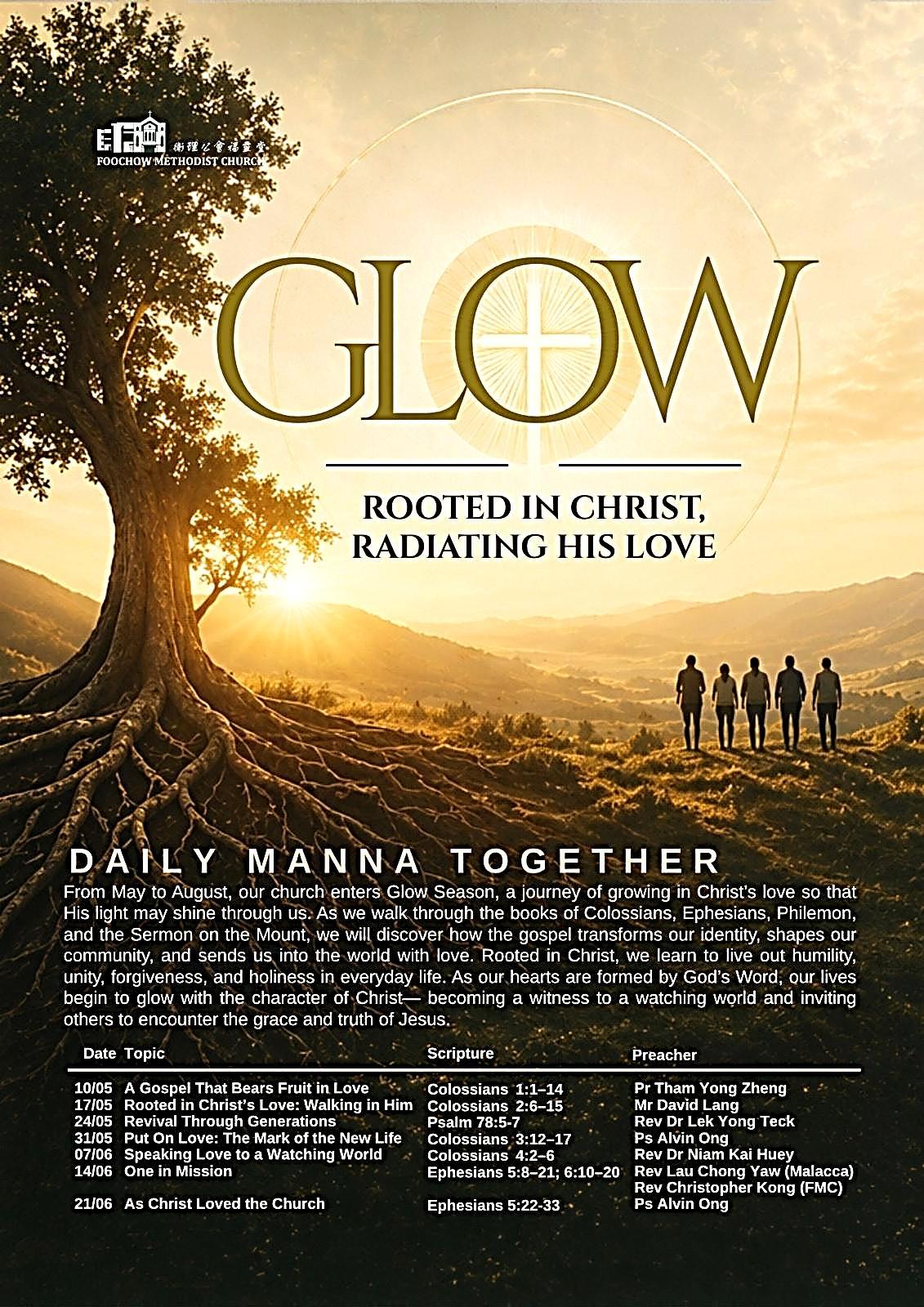
In these coming months, as we journey together through <Daily Manna Together>, Foochow Methodist Church will reflect on Colossians, Ephesians, Philemon, and the Sermon on the Mount in Matthew 5–7. These passages remind us that the church is not merely a place we gather, but A People renewed in Christ, called by Him, and sent out for His purposes.
The vision of FMC is “One Family in Christ” . Our mission is: Growing in Christ, Glowing in Love for Others, and Going Out to Make Disciples for Christ. In this season, we especially focus on “Glowing in Love for Others.” True love is not merely emotion, but the overflow of Christ’s life within us. The more we know Christ and understand our identity in Him, the more we are able to love those around us.
Ephesians reminds us that we are saved by grace and united as one family in Christ. Colossians calls us to place Christ above all things and clothe ourselves with compassion, kindness, humility, gentleness, and patience. Philemon shows how the gospel transforms relationships, while the Sermon on the Mount challenges us to live as the salt and light of the world.
Though our church has a long history, may our love not remain only in memories of the past. Instead, may it continue to grow and bear fruit today. Like a tree planted by living waters that still bears fruit in old age, a church rooted in Christ’s love will continue to reflect His beauty and grace.
May daily devotion, prayer, and obedience allow Christ’s love to fill us first. Only when we are deeply loved by Christ can we truly love others. May FMC continue to grow in Christ and glow in love for others, becoming a spiritual family that brings glory to Him.
Growing together with you, FMC Pastoral Team
Introduction to Colossians and Ephesians
The Prison Epistles
Ephesians, Philippians, Colossians, and Philemon are collectively known as the "Prison Epistles" because they were all written by the Apostle Paul during his imprisonment in Rome (Eph 3:1; Phil 1:7; Col 4:10; Phm 9).
The degree and length of similarities between Ephesians and Colossians are unique among the New Testament books. Statistics show that out of the 155 verses in Ephesians, 75 appear in Colossians with varying degrees of similarity. Both letters were written during Paul's first imprisonment in Rome (approx. AD 60–62). While they share similar content, structures, and theological themes, their primary focuses differ.
Colossians: Christ as the Head of the Church
At that time, the church was threatened by heretical ideas a "Colossian Heresy" that blended Jewish legalism, Greek philosophy, asceticism, and mysticism. This teaching undermined the uniqueness and sufficiency of Christ. Paul wrote this letter to defend the supremacy of Christ and to remind believers that they already possess all fullness in Him.
Key Verse: "For in Christ all the fullness of the Deity lives in bodily form, and in Christ you have been brought to fullness. He is the head over every power and authority." (2:9-10)
Structure of Colossians
Chapters Content Theme
1:1–2:5 Doctrinal The supremacy of Christ and the truths of redemption.
2:6–23 Warning Guarding against false philosophy and legalism.
3:1–4:6 Practical Living the new life in Christ (family, society, church).
4:7–18 Conclusion Paul's greetings and list of co-workers.
Introduction to Colossians and Ephesians
Ephesians: The Church as the Body of Christ
Ephesians explains that the church is the Body of Christ while continually emphasising the theme of “Love. ” Paul did not write this letter to combat specific heresies or church problems, but rather to strengthen the believers' faith. Having served the Ephesian church personally, Paul shared a close relationship with them (Acts 20:17-30). This letter was likely a circular letter intended for Ephesus and the surrounding churches in Asia Minor to encourage believers to recognise their spiritual identity in Christ and live accordingly.
Key Verse: There is one body and one Spirit, just as you were called to one hope when you were called; one Lord, one faith, one baptism; one God and Father of all, who is over all and through all and in all. (Eph 4:4-6)
Structure of Ephesians
Chapters Content Theme
1–3 Doctrinal The believer's position and blessings in Christ. 4–6 Practical The believer's life and responsibilities in Christ.
How To Practice Daily Devotions
God is a personal Spirit, and “Heavenly Father” is more than just a title—it reflects the deep reality that He is our loving and caring Father. Through the spiritual discipline of daily devotions, we come to know, communicate, and walk closely with Him.
Daily devotions involve setting aside specific times to draw near to God, to know Him, and to align with His will. Through reading the Bible, we come to understand His intentions, and we can respond to God in prayer and reflection. By dedicating time each day to read the Bible, pray, and meditate on God’s word, we allow God’s presence into our lives to guide us. Jesus often withdrew from the crowd and His disciples to commune with the Father in solitude, gaining strength and direction to fulfil His mission.
1. The Purpose of Daily Devotions
a. To draw closer to God and communicate with Him. In these end times, God calls us to be awake and alert, using His Word to sustain us.
“I rise before dawn and cry for help; I have put my hope in your word. My eyes stay open through the watches of the night, that I may meditate on your promises.” (Psalm 119:147-148, NIV)
b. To receive guidance and light for our lives.“Your word is a lamp to my feet and a light for my path.” (Psalm 119:105, NIV)
c. To renew our minds to live out our new life in Christ. By studying the scriptures, God’s servants are thoroughly equipped for every good work and taught to live righteously.
“All Scripture is God-breathed and is useful for teaching, rebuking, correcting, and training in righteousness, so that the servant of God may be thoroughly equipped for every good work.”
(2 Timothy 3:16-17, NIV)
2. Preparation for Daily Devotions
• Time: Select a time when you can be undisturbed and alone, whether in the morning or in the evening for reflection.
• Place: Find a quiet, distraction-free space where you can focus.
• Materials: Have your Bible, a notebook for recording reflections, and a pen ready.
• Mindset: Approach God with a calm and open heart, prepared to hear from Him and encounter Him.
3. Spiritual Discipline
Daily devotions as a spiritual discipline is not meant to be rigid or legalistic, just as our relationships with family members are not meant to feel burdensome. Time spent with our Heavenly Father should feel genuine and heartfelt. For those starting out, simple and practical methods can help cultivate meaningful spiritual habits and deepen our relationship with our Heavenly Father.
Daily Scripture Readings
4/5 Colossians 1:1–2 1/6 Colossians 4:2-6
5/5 Colossians 1:3–8 2/6 Colossians 4:7-18
6/5 Colossians 1:9-14 3/6 Ephesians 1:1-2
7/5 Colossians 1:15-20 4/6 Ephesians 1:3-14
8/5 Colossians 1:21-23 5/6 Ephesians 1:15-23
9/5 Weekly Reflection 6/6 Weekly Reflection
10/5 Sermon-Colossians 1:1–14 7/6 Sermon-Colossians 4:2–6 11/5 Colossians 1:24-29 8/6 Ephesians 2:1-10
12/5 Colossians 2:1-5 9/6 Ephesians 2:11-22
13/5 Colossians 2:6-7 10/6 Ephesians 3:1-13
14/5 Colossians 2:8-12 11/6 Ephesians 3:14-21
15/5 Colossians 2:13-15 12/6 Ephesians 4:1-16
16/5 Weekly Reflection 13/6 Ephesians 4:17-5:4
17/5 Sermon-Colossians 2:6–15 14/6 Sermon-Eph 5:8–21; 6:10–20
18/5 Colossians 2:16-17 15/6 Ephesians 5:5-20
19/5 Colossians 2:18-19 16/6 Ephesians 5:21-33
20/5 Colossians 2:20-23 17/6 Ephesians 6:1-9
21/5 Colossians 3:1-4 18/6 Ephesians 6:10-20
22/5 Colossians 3:5-8 19/6 Ephesians 6:21-24
23/5 Weekly Reflection 20/6 Weekly Reflection
24/5 Sermon-Psalm 78:5-7 21/6 Sermon-Eph 5:22-33
25/5 Colossians 3:9-11
26/5 Colossians 3:12-13
27/5 Colossians 3:14-17
28/5 Colossians 3:18-21
29/5 Colossians 3:22-4:1
30/5 Weekly Reflection

31/5 Sermon- Colossians 3:12–17
Reflection
Colossians 1:1–2
Verses 1-2 are the letter's greeting. Here, Paul first identifies himself and the recipients a relationship that exists through Christ, despite them having never met personally. The words "grace and peace" in the greeting (v. 2) combine the Greek "grace" with the Hebrew "peace." These two terms carry a wealth of meaning, specifically referring to spiritual flourishing.
Reflection:
When we say "Shalom" (Peace), do we truly understand its meaning? What are our expectations for "peace" today?
Application & Prayer
Reflection
Colossians 1:3–8
Paul learned from Epaphras that the Colossian church was facing challenges from false teachers. He reminds the believers that they have already heard the fullness of the Gospel and do not need to add any "new theology." He emphasizes that the foundation of faith and love is the "hope stored up in heaven" that is, the glory that Christ has already accomplished for them.
Reflection: Is our faith facing similar challenges today? What are they? How can we stand firm in the Gospel?
Application & Prayer
(Wed)
Reflection
Colossians 1:9-14
This passage details Paul’s prayer for the Colossian church, where he desires for the believers to understand God’s will. It is not merely about head knowledge, but about exercising “all spiritual wisdom and understanding” to make the right choices in every aspect of practical life, so they would not be enticed to seek paths of godliness outside of Christ.
Reflection:
In the Apostle’s prayer for the Colossian believers, what are the specific areas of growth in Christ that he asks God for? Which of these do I also urgently desire for myself?"
Application & Prayer
Reflection
Colossians 1:15-20
This passage stands as a supreme 'Christology,' even though the name of Christ does not explicitly appear. It systematically unveils His divine attributes, emphasising His absolute pre-eminence in both creation and redemption.
Reflection:
What is the relationship between Jesus Christ and God, the creation, and the Church? What practical impact does this revelation have on our faith and our daily lives as Christians?
Application & Prayer
Reflection
Colossians 1:21-23
Verses 21–23 form a vital theological passage where Paul employs the 'Once... Now... ', a framework to describe the transition of humanity from being enemies of God to being reconciled with Him. A truly born-again person will continue to grow in their faith, remaining unshaken by heresy or secularism, and living steadfastly in the hope of the Gospel.
Reflection:
What is the difference between my 'once' and my 'now'? How was this transformation accomplished? Am I truly living out this new life of reconciliation? In what areas is this change most visible?
Application & Prayer
Reflection
Application & Prayer 9/5 (Sat)
10/5 (Sun)
Notes
Sunday Service:Colossians 1:1–14
Sermon Topic: A Gospel That Bears Fruit in Love “Be still, listen, and respond to God.”
Application & Prayer
Reflection
Colossians 1:24-29
This passage discusses Paul’s mission in ministry, the significance of suffering, the mystery of the Gospel, and the maturity of believers in Christ. Because Paul viewed himself as a servant of Christ, he was entrusted by God to proclaim the mystery that had been hidden for ages but is now revealed in Christ. Even when suffering and imprisoned for the Gospel situations the world considers painful he found joy instead. This is because he knew he was suffering for Christ, and the goal of his preaching was to present everyone mature and complete in Christ.
Reflection:
Why was Paul able to find joy in the midst of suffering?
How do we view the significance of suffering for our faith today?
Application & Prayer
Reflection
Colossians 2:1-5
Paul expresses his deep spiritual concern for the believers in Colossae and Laodicea. Although he did not personally plant these two churches, his heart was fully with them (v. 4).
He writes to remind them to be rooted in Christ and to hold fast to the truth, so they do not fall for false teachings. Paul points out that the "mystery of God“ is Christ Himself. True wisdom and knowledge are not found in human philosophy, traditions, or mystical experiences, but are hidden in Christ alone.
Reflection:
Paul’s reminder remains timeless. Are we satisfied with Christ today, or are we still searching for other paths to "wisdom and knowledge"? If so, what are those paths?
Application & Prayer
Reflection
Colossians 2:6-7
Paul reminds believers that their faith is not built on philosophy, legalism, or human tradition, but began the very moment they received Jesus Christ as Lord. Having received Christ, we are to walk in Him daily, becoming rooted and built up in Him. As our faith becomes more steadfast and mature, we will not be shaken by heresy or secular ideologies, but will bear witness to Christ with a heart full of thanksgiving.
Reflection:
Has my faith remained only at the stage of "receiving Christ,“ or am I pursuing daily growth in Him? Am I firmly rooted in the truth, or am I easily shaken by my circumstances?
Application & Prayer
Reflection
Colossians 2:8-12
Paul warns us to be on guard against doctrines that appear wise but are actually false. The foundation of our faith must be built upon the truth of Christ, not on worldly philosophies.
In Christ, there is an abundance of grace. He is fully God, not merely a "part“ of the divine nature. Therefore, to attain spiritual fullness, believers do not need to rely on anyone or anything outside of Christ.
Reflection:
Modern society is flooded with all kinds of theories and ideologies. As Christians, how do we discern between them? How am I learning the lesson of finding total satisfaction in Christ?"
Application & Prayer
Reflection
Colossians 2:13-15
The profound difference in a Christian’s life before and after knowing the Lord is entirely due to Christ’s redemption.
The 'handwriting of requirements' that once accused us, along with the sin-debts we could never repay, have been completely wiped away by Christ, who 'nailed them to the cross. ' From now on, we can triumph through the cross.
Reflection:
Am I still living in the mindset of the 'old self' or bound by sin today, forgetting that I have already 'been made alive together with Christ’.
How can I demonstrate a life that is 'forgiven and renewed' in my daily routine?
Application & Prayer
Reflection
Application & Prayer 16/5 (Sat)
17/5 (Sun)
Notes
Sunday Service:Colossians 2:6–15
Sermon Topic: Rooted in Christ’s Love:Walking in Him “Be still, listen, and respond to God.”
Application & Prayer
Reflection
Colossians 2:16-17
The Apostle exhorts the Colossian believers not to be enslaved by legalism or man-made religious regulations. Rituals of the Old Testament such as rules regarding 'food and drink, festivals, New Moons, or Sabbaths' cannot save us. These are merely 'a shadow of the things to come, but the substance belongs to Christ' (v. 16–17). We must not focus on the trivial at the expense of the essential, nor should we allow others to judge us in a way that makes us doubt the completeness of our salvation.
Reflection:
Am I drawn to outward religious forms while neglecting a genuine relationship with Christ?
In my worship, service, and giving, is Christ truly the centre, or am I merely trying to satisfy human standards?
Application & Prayer
Reflection
Colossians 2:18-19
Paul warns the Colossian church to beware of the heresies of false humility and the worship of angels. These people claim to have 'spiritual visions' or 'higher revelations,' but in reality, they have detached themselves from Christ, who is the Head.
Reflection:
Have I ever used 'spiritual experiences' or 'special revelations' to measure a sense of superiority in my faith? What criteria do I use to measure whether my own spiritual life is truly growing?
Application & Prayer
Reflection
Colossians 2:20-23
Paul reminds the Colossian believers: since you have died with Christ, you should no longer be enslaved by the regulations of this world. Once these rules become the goal themselves, or are treated as a means to gain spiritual power, they become stumbling blocks to our spiritual life; they are "of no value against the indulgence of the flesh" (v. 23).
Reflection:
Have I turned certain spiritual habits (such as prayer, fasting, or attending church) into "rules that must be kept," while losing a genuine relationship with the Lord?
How can I live out a life of "union with Christ" more authentically, rather than relying on outward performance?
Application & Prayer
Reflection
Colossians 3:1-4
This passage calls us to focus on eternity and live a life that glorifies the Lord. Since believers have spiritually risen with Christ, they no longer belong to their old life but have entered a new spiritual reality. This requires us to live out our 'heavenly identity' in daily life no longer living for earthly things, but for the glory of the Lord.
Reflection:
What does a life 'risen with Christ' actually look like? What are the specific ways it manifests in our lives?
Application & Prayer
Reflection
Colossians 3:5-8
Continuing from the earlier encouragement, because believers are now risen with Christ, we are called to "put to death" the worldly, sinful impulses of our old selves. To refuse to "put to death" or "renounce“ these things is to live in a way that contradicts our new identity and fails to honour God’s glory.
Reflection:
To "put to death" and "renounce" are intense commands; they mean choosing a total and final break from sin. Is there a part of my life today that I am holding back from God? Let's ask the Lord to shine His light on us today and give us the strength to return to Him.
Application & Prayer
Reflection
Application & Prayer 23/5 (Sat)
24/5 (Sun)
Notes
Sunday Service:Psalm 78:5-7
Sermon Topic: Revival Through Generations “Be still, listen, and respond to God.”
Application & Prayer
Reflection
Colossians 3:9-11
Paul moves from shedding old habits to embracing a communal transformation.We must stop lying because we have "taken off" the old self and "put on" a new nature, daily renewed in our Creator's image. In this life, Christ collapses all ethnic and social walls. Since "Christ is all and in all," our identity is no longer found in our background, but in our shared life in Him.
Reflection:
The "new self" is a work in progress. Are there old prejudices or dishonest habits I still cling to? Today, let's ask the Lord to help us see others through His eyes and live authentically in the unity He has created.
Application & Prayer
Reflection
Colossians 3:12-13
As God’s chosen and dearly loved people, we are called to "clothe" ourselves with compassion, kindness, humility, gentleness, and patience. These virtues are not optional; they are the uniform of our new identity. Crucially, we must bear with one another and forgive any grievances, extending the same radical grace that Christ first extended to us.
Reflection:
Forgiveness is often difficult, yet Paul grounds it in the reality of how much we have been forgiven. Is there someone I am struggling to show "gentleness" or "patience" toward today? Let’s ask the Lord for the strength to let go of resentment and to dress our hearts in His likeness."
Application & Prayer
Reflection
Colossians 3:14-17
Above all these virtues, we are told to put on love, which binds everything together in perfect unity. We are called to let Christ’s peace rule our hearts and his Word dwell in us richly through worship and gratitude. Whatever we do whether in speech or action should be done in the name of the Lord Jesus, giving thanks to God the Father through him.
Reflection:
Love is the "belt" that holds our spiritual wardrobe together. Am I letting the peace of Christ act as the umpire in my heart’s decisions today? Let’s ask the Lord to fill our hearts with songs of thankfulness and to align our every word and deed with his character.
Application & Prayer
Reflection
Colossians 3:18-21
Paul now applies the "new self" to our most intimate relationships. Wives and husbands are called to mutual respect and sacrificial love, mirroring the order and grace of Christ. Children are encouraged to obey their parents as a way of pleasing the Lord, while fathers (and parents) are warned not to embitter their children, avoiding harshness that might discourage their young hearts.
Reflection:
Our faith is most visible at home. Am I treating those closest to me with the same "kindness and patience" discussed in earlier verses? Let’s ask the Lord for the grace to lead and respond with love, ensuring our homes are places of encouragement rather than frustration.
Application & Prayer
Reflection
Colossians 3:22-4:1
Paul shifts focus to the workplace, teaching that our daily tasks are acts of worship. Whether serving others or leading them, we are to work with "sincerity of heart" rather than just for human approval. Since our true inheritance comes from the Lord, we ultimately serve Christ. Conversely, those in authority must treat others with justice and fairness, remembering they also answer to a Master in heaven.
Reflection:
Do I view my work even the mundane parts as service to Jesus? It’s easy to work harder only when being watched, but God sees our hearts. Today, let’s ask the Lord for a spirit of excellence and integrity, doing everything as if we are doing it directly for Him.
Application & Prayer
(Sat)
Reflection
Application & Prayer
31/5 (Sun)
Notes
Sunday Service:Colossians 3:12–17
Sermon Topic: Put On Love:The Mark of the New Life “Be still, listen, and respond to God.”
Application & Prayer
Reflection
Colossians 4:2-6
Paul concludes with a call to persistent prayer, staying watchful and thankful. He asks for prayer that doors would open for the message of Christ, even while he is in chains. We are also urged to act wisely toward outsiders, making the most of every opportunity. Our conversation should always be "full of grace“ and "seasoned with salt," ensuring we know how to respond to everyone with kindness and purpose.
Reflection:
Do my prayers reflect a concern for the Gospel, or just my own needs? Our words to others are powerful tools for God’s kingdom. Today, let's ask the Lord to season our speech with grace and open our eyes to the opportunities He provides for us to share His love.
Application & Prayer
Reflection
Colossians 4:7-18
Paul closes by naming faithful friends, proving ministry is a team effort. From Tychicus to Luke, these individuals show every believer has a vital role. Paul also urges the church to support one another and encourages Archippus to finish his task. Despite his chains, Paul’s focus remains on the community’s strength and their shared faith.
Reflection:
Paul never walked alone; he relied on a diverse circle of partners. Am I trying to live my faith in isolation? Today, let’s thank God for our community and ask for the perseverance to complete the work He has given us.
Application & Prayer
Reflection
Ephesians 1:1-2
Paul opens his letter by addressing the believers in Ephesus as "saints" those set apart by God and the "faithful" in Christ Jesus. He reminds them that his authority as an apostle comes by the will of God, not human choice. He greets them with grace and peace, two foundational gifts that flow directly from God our Father and the Lord Jesus Christ, establishing their identity in divine favor.
Reflection:
Do I see myself as a "saint, " or do I only focus on my flaws? Our standing with God is based on His will and grace, not our own effort. Today, let’s rest in the peace Christ provides and ask the Lord to help us live faithfully in the identity He has given us.
Application & Prayer
Reflection
Ephesians 1:3-14
Paul erupts in praise for the spiritual blessings we have in Christ. Before the world began, God chose us to be holy and adopted us into His family. Through Christ’s blood, we are redeemed and forgiven, uncovering the mystery of His plan to bring all things under Jesus. This inheritance is guaranteed by the Holy Spirit, who seals us as a deposit, ensuring we belong to Him until our full redemption.
Reflection:
These blessings aren’t earned; they are gifts of grace meant for God’s glory. Do I live like someone who is chosen, redeemed, and sealed? Today, let’s praise God for His overwhelming generosity and find security in the fact that our future is held firmly by the Holy Spirit.
Application & Prayer
Reflection
Ephesians 1:15-23
Moved by the Ephesians' faith, Paul prays for them to receive a "Spirit of wisdom and revelation" to know God better. He asks that their hearts be enlightened to grasp the hope of their calling, the riches of their inheritance, and God’s incomparably great power. This is the same power that raised Christ from the dead, seating Him far above every authority and making Him the supreme head over the church, which is His body.
Reflection:
Do I truly realize the magnitude of the power available to me through Christ? Often we feel weak, yet the same power that conquered the grave is at work in us. Today, let's ask the Lord to open our spiritual eyes to the greatness of His authority and the hope He has placed within us.
Application & Prayer
Reflection
Application & Prayer 6/6 (Sat)
7/6 (Sun)
Notes
Sunday Service:Colossians 4:2–6
Sermon Topic: Speaking Love to a Watching World “Be still, listen, and respond to God.”
Application & Prayer
Reflection
Ephesians 2:1-10
Paul vividly describes our journey from death to life. Once "dead in transgressions," we lived according to the world’s ways, but God, in His great love and mercy, made us alive with Christ. We are saved by grace through faith—not by our own works—so that no one can boast. We are now God’s "handiwork," created in Christ Jesus to do good works which He prepared in advance for us to walk in.
Reflection:
Grace means receiving life we didn’t earn. Do I try to win God’s favour through effort, or do I rest in His finished work? Today, let’s thank God for His mercy and ask Him to guide us into the "good works" He has uniquely designed for us to do.
Application & Prayer
Reflection
Ephesians 2:11-22
Paul reminds us that we were once "foreigners" to God’s promises, separated from Christ and without hope. But now, through Christ’s blood, those who were far away have been brought near. Jesus has destroyed the "barrier," the wall of hostility, creating one new humanity out of two and reconciling us all to God through the cross. We are no longer strangers, but fellow citizens and members of God’s household, built together into a holy temple where God lives by His Spirit.
Reflection:
Christ didn't just reconcile us to God; He reconciled us to each other. Are there walls of prejudice or "hostility" I still hold against others? Today, let’s celebrate our shared identity in God’s family and ask the Lord to help us build peace where there is division.
Application & Prayer
Reflection
Ephesians 3:1-13
Paul calls himself a "prisoner of Christ," entrusted with the mystery that all nations are now equal heirs through the Gospel. This was God’s eternal plan, not a human invention. Though Paul felt "less than the least", he was chosen to preach Christ’s boundless riches. Through the church, God’s manifold wisdom is revealed even to heavenly powers, granting us freedom to approach Him with total confidence through faith.
Reflection:
Do I appreciate the "boundless riches" I have in Christ? We may feel insignificant, yet God uses us to display His wisdom to the universe. Today, let’s take heart in our direct access to God and ask for courage to play our part in His unfolding story.
Application & Prayer
Reflection
Ephesians 3:14-21
Paul kneels before the Father, praying that believers would be strengthened with power through the Spirit in their inner being. He asks that Christ may dwell in our hearts through faith and that we, being rooted in love, may grasp the vast dimensions of Christ’s love—a love that surpasses knowledge. He concludes with a powerful doxology: God is able to do immeasurably more than all we ask or imagine according to His power at work within us.
Reflection:
Is my life "rooted and established" in God's love, or in my own circumstances? We often limit God by our own expectations, but His power is far greater. Today, let’s ask the Lord to fill us to the measure of His fullness and trust Him to do the "immeasurably more" in our lives.
Application & Prayer
Reflection
Ephesians 4:1-16
Paul urges us to live lives worthy of our calling by being humble, gentle, and patient. We must make every effort to keep the unity of the Spirit through the bond of peace, recognizing we are one body with one Lord. Christ has given unique gifts to each person— apostles, prophets, evangelists, pastors, and teachers—to equip the saints for works of service. This collective effort builds up the body of Christ until we all reach maturity and stability in Him.
Reflection:
Unity isn't a suggestion; it’s a calling that requires intentional effort. Am I using my unique spiritual gifts to build up others, or am I standing on the sidelines? Today, let’s ask the Lord to show us how we can contribute to the growth and maturity of our church community.
Application & Prayer
Reflection
Ephesians 4:17-5:4
Paul contrasts our former way of life with our new identity in Christ. We are to "put off" the old self hardened, darkened, and driven by deceitful desires—and "put on" the new self, created to be like God in true righteousness. This transformation is practical: trading lies for truth, anger for peace, and theft for generosity. As God's dearly loved children, we must walk in love, ridding ourselves of bitterness, coarse talk, and greed, following Christ’s example of sacrificial love.
Reflection:
Transformation happens when we change our "mental attitude" and align our speech with God’s grace. Are there "old self" habits like anger or unwholesome talk still lingering in my life? Today, let’s ask the Holy Spirit to renew our minds and help us mimic the kindness and forgiveness of our Heavenly Father.
Application & Prayer
Sermon Topic: One in Mission
“Be still, listen, and respond to God.”
Notes Application & Prayer
Reflection
Ephesians 5:5-20
Paul warns that those living in immorality or greed have no inheritance in Christ’s kingdom. We were once darkness, but now we are "light in the Lord" and must live accordingly, producing fruit like goodness and truth. We are called to be careful how we live— not as unwise, but making the most of every opportunity because the days are evil. Instead of being controlled by wine, we should be filled with the Spirit, encouraging one another through worship and always giving thanks to God.
Reflection:
Living as "children of light" means exposing the darkness in our own hearts and the world. Am I being intentional with my time, or just drifting? Today, let’s ask the Lord to fill us with His Spirit so that our lives overflow with gratitude and songs of praise rather than worldly distractions.
Application & Prayer
Reflection
Ephesians 5:21-33
Paul introduces a radical lifestyle of "submitting to one another out of reverence for Christ." He applies this to marriage, calling wives to respect their husbands and husbands to love their wives sacrificially, just as Christ loved the church and gave Himself up for her. This relationship is a "profound mystery" because it mirrors the union between Christ and His people. Marriage is transformed from a social contract into a living picture of God’s devotion and grace.
Reflection:
Do my closest relationships reflect the sacrificial love of Jesus? Submission and love are not about power, but about putting another’s needs above our own. Today, let’s ask the Lord for the humility to serve those we love and for our relationships to point others toward the beauty of Christ’s love for us.
Application & Prayer
Reflection
Ephesians 6:1-9
Paul extends the theme of mutual submission to children, parents, and the workplace. Children are called to obey and honour their parents, a command paired with the promise of a blessed life. Parents, in turn, are cautioned not to provoke their children to anger but to nurture them in the Lord. Similarly, workers are urged to serve with "sincerity of heart" as if serving Christ Himself, while masters must lead with fairness, remembering they share the same Master in heaven.
Reflection:
Our faith should be most evident in our daily roles and how we treat those under our care or authority. Am I performing my tasks or leading others with Christ in mind? Today, let’s ask the Lord for the grace to honour Him through our obedience, our parenting, and our professional integrity.
Application & Prayer
Reflection
Ephesians 6:10-20
Paul concludes by calling us to be strong in the Lord’s power, not our own. We are in a spiritual battle against "dark powers," requiring the full armour of God: truth, righteousness, peace, faith, salvation, and the Spirit’s sword—His Word. Above all, we must pray "on all occasions" for all believers. Even in chains, Paul asks for prayer to boldly declare the Gospel, reminding us that our ultimate victory and courage come through persistent prayer and God’s strength.
Reflection:
Am I trying to fight life's battles in my own strength? We often forget the spiritual reality behind our struggles. Today, let’s intentionally "put on" God’s armour and ask for the boldness to share His truth, trusting that His power is far greater than any opposition we face.
Application & Prayer
Reflection
Ephesians 6:21-24
Paul concludes his letter by commending Tychicus, a "dear brother and faithful servant," who will provide a personal update to encourage the believers' hearts. He ends with a triple blessing of peace, love, and faith from God the Father and the Lord Jesus Christ. His final words extend grace to all who love Jesus with an undying love, emphasising that the Christian life is sustained by divine favour and communal support.
Reflection:
Even the great apostle Paul relied on faithful friends to carry his message and encourage the church. Do I have a "Tychicus" in my life, or am I being that source of encouragement for someone else? Today, let’s thank God for our brothers and sisters in faith and ask for a heart that loves Christ with "undying" devotion.
Application & Prayer
(Sat)
Reflection
Application & Prayer
21/6 (Sun)
Notes
Sunday Service: Eph 5:22-33
Sermon Topic: As Christ Loved the Church “Be still, listen, and respond to God.”
Application & Prayer