Good News
Habilitas Foundation Impact Report FALL 2026
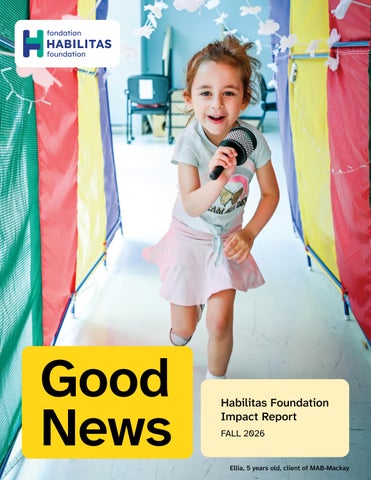
Ellia, 5 years old, client of MAB-Mackay
Table of Contents Message from the Executive Director and Board Chair
3
Our Mission and Values
4
Habilitas by the Numbers
5
Greatest Needs Fund
5
Action Centre — Mamadou
6
Constance-Lethbridge — Katherine
8
MAB-Mackay — Ellia
10
MAB-Mackay — Jade
12
MAB-Mackay — Robin
14
Camp Massawippi
16
QFB — 100th Anniversary
18
Legacy Giving
19
10 Great Things You Make Possible
20
This report is set in Atkinson Hyperlegible, a typeface developed with the Braille Institute to improve readability for people with vision loss — including its distinctive zero. We chose it to reflect the communities and clients our organizations serve every day.
How to reach us Habilitas Foundation 7010 Sherbrooke Street West Montréal, QC H4B 1R3 514-488-0043 info@habilitas.ca @habilitas.fondation @habilitas.fondation fondation-habilitas-foundation @habilitas4037
2
Impact Report Fall 2026
Learn more about our work at:
habilitas.ca
Message from the Executive Director Every fall, when I sit down to write this letter, I find myself reflecting on those we serve rather than the numbers or statistics. It comes from a place of profound humanity.
This report is full of quiet acts of care and a testament to the strength of the human spirit! Thank you for being part of our collective journey! And for making a difference in people’s lives.
I think about Jade, who literally sees the world in black and white but is building a life in full colour, training clients in massage therapy while she works toward her own certification. I think about Robin, learning to listen again after his cochlear implant, with his wife Dale always by his side. I think about Katherine, who will tell you that the Wheelchair Program elevates her incredible zest for life and love of movement.
Each year, needs grow, reminding me how deeply our work depends on people who share the belief in what we do. Thank you for believing!
There is Ellia, young enough still that her mother Dana holds her hand at every visit, and the care team who found her a seat at the table when eating had become something to fear instead of something to enjoy. And I think about Mamadou and the young adults at the Action Centre’s club, redefining what adulthood gets to look like when the world assumes less of you than it should.
You have helped make these very real stories come alive and for choosing to stand behind people you may never meet, but who are living fuller lives because you did. I hope reading this brings you the same warmth and hope that it brought me. With gratitude,
Theodora Brinckman
Message from the Chair of the Board I’ll admit, as an accountant, I tend to read reports like this one from the back forward, looking for the numbers first. But every year, it’s a moment on the ground that stays with me longer than any figure does. I once watched a group of young people at Camp Massawippi try adapted water-skiing for the first time. I have kids of my own, and there’s a particular kind of joy on a child’s face the first time they do something they weren’t sure they could. Watching that same joy show up here, on a hill built specifically so it could, reminded me why this work matters. Every child, and every adult, deaf, blind, or living with a physical disability, deserves that feeling and a real chance at a full, good life. Habilitas Foundation is proud to be the official foundation supporting the organizations that make moments like that possible: MAB-Mackay, ConstanceLethbridge, Camp Massawippi, Action Centre, QFB
and the Mackay Centre and Philip E. Layton schools. This year we’re especially mindful of longevity: MAB with the Quebec Federation of the Blind both mark 100 years of service, and Camp Massawippi celebrates 75 summers. That kind of staying power doesn’t happen by accident. It’s built by people who keep showing up, year after year, and by donors who keep believing the work is worth funding. None of it runs on good intentions alone. It runs on your gifts, tracked, stewarded, and put to work responsibly, year after year. On behalf of the Board, thank you for making that possible. Yours truly,
Matthew Chausse
Impact Report Fall 2026
3
Our Mission and Values Mission Habilitas Foundation is the official foundation of some of Montreal’s most trusted organizations dedicated to transforming the lives of people who are blind, deaf, or living with physical or mobility disabilities — with services reaching communities across Québec.
Values Commit to Impact: We measure our work by the real difference it makes in the lives of the people we serve.
Take action with Love: Every decision we make is guided by respect and care for the people we support.
Steward with Integrity: We manage every dollar with rigour and transparency.
Foster authentic Relationships: We build lasting, trusted relationships with donors, our member organizations, and our communities.
4
Impact Report Fall 2026
Habilitas by the Numbers 59% MAB-Mackay
24% Camp Massawippi
9% Action Centre 5% Research 1% Mackay Centre & Philip E. Layton schools
1% Constance-Lethbridge <1% Quebec Federation of the Blind
Habilitas Foundation’s Greatest Needs Fund Some needs can’t wait. A grant that helps an urgent program get off the ground or be sustained. A research project that can enhance services. A new approach to care that hasn’t been tried yet, but could change lives once it is. That’s why Habilitas Foundation created the Greatest Needs Fund in recent years: to move quickly and fund what’s most urgent the moment it arises, through grants, research, and innovation across our network. It’s how meaningful support reaches people who are deaf, blind, or living with a physical disability, across Montreal and the province of Quebec, exactly when and where they need it most.
Impact Report Fall 2026
5
Redefining Young Adulthood 21 families supported through the caregiver respite program This Year: 169 members served 20% membership growth
51 volunteers contributed 2,180 hours 29 community excursions across Montreal and beyond
Mamadou, Action Centre
The summer after Mamadou finished high school, everything changed abruptly for Mamadou. Attending a specialized school that was adapted to his disability, he was well surrounded and supported. His days were busy and filled with stimulation. Graduation was a day of excitement and hope. When September rolled around, he discovered how much things would change for him. For many young adults with disabilities, the step following school can mean losing more than a daily routine. It can mean losing friendships and the everyday chances to take part in community life. The Action Centre’s new Young Adult Club was created to rewrite that story.
6
Impact Report Fall 2026
The Action Centre is a true home away from home for hundreds of adults living with physical disabilities in Montreal. Founded in 1998, it has built rich, accessible programming that opens doors to social connection, self-expression, and personal and professional growth, helping people live fuller, more connected lives. That vision has grown to include young adults as well, filling an important gap for a population that has too often been underserved. The new Young Adult Club is built on a simple idea: young adults shouldn’t just take part in programs, they should help build them. Members shape every activity themselves, developing leadership, communication, and self-advocacy skills through real volunteer roles and hands-on responsibility, not just
participation. It’s a model designed to turn members into leaders, contributors, and role models, one that the Action Centre hopes will inspire the next generation of inclusive programming. One of the Club’s newest chapters is Mamadou’s own: a published author and longtime disabilityrights advocate who turned a simple suggestion into an eight-week creative writing workshop. Mamadou first came to Action Centre last year, drawn by an open house hosted through his community organization. “I really like coming here. It’s spacious, it’s accessible. When you come here, you truly feel safe,” he recalls.
“At the beginning, people carry the weight of social judgment: the prejudices and labels placed on us as people with disabilities. That weight can turn into isolation,” Mamadou says. “But through the workshops, I’ve seen emotional safety take hold. People find their voice. A real solidarity forms in the group, and with it, self-confidence.” As a published author, Mamadou suggested starting a creative writing workshop for his peer group. It now runs every two weeks and was the seed for this past
summer’s eight-week Young Adult Club program, open to members under 30. The sessions focus on self-esteem, moving past the labels society assigns, and recognizing each person’s potential: personal development, built by and for young adults. “They start to realize that their worth doesn’t depend on how others see them, or what others think of them,” Mamadou explains, “but on what they choose to embody and to share.” Mamadou is especially drawn to working with young adults like him, a group he sees slipping through the cracks. “There are resources, there are schools, for children living with a disability,” he says. “But for young adults, there’s almost nothing left. No space to gather, to talk, to figure out who they’re going to become as adults.” Through workshops like Mamadou’s, and the broader mission it’s a part of, the Action Centre is proving that young adults with physical disabilities don’t need to disappear from the picture once school ends. They need a place to keep building, leading, and belonging. Every workshop, every friendship, and every moment of belonging at the Action Centre begins with donor support. As the Centre’s official foundation, the Habilitas Foundation ensures that this generosity is translated into dynamic programming, inclusive spaces, and life-enhancing opportunities.
To learn more about the Action Centre and its work, visit centreaction.org.
Impact Report Fall 2026
7
“Sitting Still Is Not My Thing” Katherine, Constance-Lethbridge
Katherine has built a 30-foot deck in her backyard. She’s painted her house inside and out, hung curtains, laid floors, and cleared snow off the ramps every winter. She grooms the family dogs, cuts her husband André’s hair, and accompanies her grandchildren on their school outings. She is 67 years old, and she lives with above-the-knee limb loss in both legs. “I never saw obstacles,” Katherine says, of the moment she first sat in a wheelchair, decades ago. “I saw mobility and freedom.” Katherine’s mobility journey started as a teenager, with a series of knee surgeries related to lupus. She first came to the Constance-Lethbridge Centre in the 1990s, as her needs began to change. Then, following cancer surgery and treatment in the mid2000s, four separate amputations cost her both lower limbs above the knee. Through it all, the team at Constance-Lethbridge has remained by her side. “From the very beginning, they welcomed me with expertise, respect, and compassion,” she says. “They adapt as my needs changed. At one point, I had legs. For a while, I was in a full body brace. Always a different set of needs, and they always found solutions for me.” Today, that relationship is rooted in the Wheelchair Department, and in Katherine’s current chair, which
8
Impact Report Fall 2026
she received in 2021. It can extend up to four feet higher with the click of a button, letting her reach everything from the floor to the top shelf, safely and on her own. She has logged nearly 10,000 kilometres in her chair, and makes sure to bring it in for regular maintenance and system upgrades. Building a chair around a life like Katherine’s takes more than a standard fitting. “No two wheelchairs are the same,” explains Jay, a mechanic for four years in the workshop. “They’re not interchangeable. It’s important for us to get an understanding of each individual and what they do throughout the day. This way, we can make sure they can live the life they want, regardless of injury or condition. We really go above and beyond to make sure of that. This is what I find so interesting and rewarding about my work.”
“I can absolutely do anything in this wheelchair. I garden. I cook. I cut grass. I shop. I walk the dog. I do anything my girlfriends do. And when I want a break from my day-to-day, the wheelchair takes me to the skate park, lowers me to the ground, and I take off on my skateboard.” “I never really think that I’m in a wheelchair, that’s how seamless it is. I don’t wake up thinking about what I can’t do. I think about all that I want to accomplish today. It’s my independence, my safety, my freedom, and my life. It’s Constance-Lethbridge that made all of this happen for me.” Last year, more than 6,000 wheelchairs were custom-designed or repaired at ConstanceLethbridge, the largest number in the province, and that demand keeps growing. That’s why the Habilitas Foundation is launching a $1.5 million campaign to renovate and expand the department, improving workflow, creating more space for parts and deliveries, and increasing capacity. The result will be shorter wait times and faster access to essential equipment. But what it really means is simpler: independence, delivered sooner. Because when someone receives the right wheelchair sooner, they get their life back sooner. When she told her occupational therapist, Melissa, that she’d been climbing onto kitchen counters to reach cabinets and dropping from the ground back into her chair after skateboarding, Melissa went straight to work with the production team. “Their expertise and advocacy were extraordinary,” Katherine says. “When the chair finally arrived, it exceeded anything I could have imagined.” That same chair is kept running by a dedicated team of mechanics and technicians, including electronic technician Luciano. “It’s very gratifying when someone gets exactly what they need,” he says. “We troubleshoot, we build structures in a space that’s very tight, but you see their reaction.” Katherine’s journey, and the effort dedicated to customizing her wheelchair, are a testament to the importance of this project and the difference
between merely existing and truly living for the clients. “The right wheelchair is not just a piece of equipment,” she says. “It is independence, dignity, safety, and quality of life.”
“I couldn’t be the coolest grandmother that I am without it,” Katherine says. “None of my grandchildren ever saw me as having a disability. They all just say, ‘here comes Nanny!’” Thanks to donors from the Habilitas Foundation, clients at Constance-Lethbridge receive equipment built around their whole lives, not just their diagnosis, and a team that keeps showing up, chair after chair, decade after decade.
Impact Report Fall 2026
9
A Seat at the Table NEURO-MOTOR PROGRAMS & SERVICES
This year: 863 children supported 252 clinical visits
Ellia and her mother Dana, MAB-Mackay Mealtime is one of the most essential moments in family life and in raising a child. It’s when a parent feeds and nourishes their child, an act of love, care, and survival that shapes their health, growth, and lifelong habits. But for parents raising a child with a feeding disorder like Ellia, this ritual can bring stress and worry instead of warmth and connection. “It’s a moment I won’t forget. It was two days after Ellia was born, and we’d just been discharged from the hospital,” remembers Dana, Ellia’s mother. “As we were leaving, she started to turn blue in my arms. We immediately turned around and brought her back to the doctors. They told us she’d had a stroke. They stabilized her, but we had no way of knowing what the future would hold for little Ellia.” Among the earliest and most urgent challenges was feeding. Ellia had developed a food aversion, and she couldn’t swallow or keep down any food or her essential medication, resulting in weight loss, weak muscle tone, and a failure to thrive.
10
Impact Report Fall 2026
Fortunately, they were referred to the MAB-Mackay’s Dysphagia and Feeding Disorders Clinic. “The team was incredible,” says Dana. “We worked with an occupational therapist, a nutritionist, a psychologist, and a pediatrician, all focused on Ellia’s basic needs. They really cared, brought different solutions, and were always there with support.” Without sufficient energy, a young child’s muscles can become weak and underdeveloped, making it harder for them to build the strength needed to reach the milestones that parents cherish: lifting their head, rolling over, crawling, taking those first steps. In many cases, social isolation follows. Birthday parties, school lunches, family gatherings all become complicated. Parents feel alone, overwhelmed, and helpless. The vision of this specialized clinic is to create a positive feeding experience, essential for a child’s nutrition and growth, both physical and emotional. Their therapies touched every part of Ellia’s daily routine, from her diet to her medication, to simple strategies that made mealtimes feel safe again.
The journey started by focusing on her absorption and choking, and as Ellia gained weight, they introduced strategies to ease the transition from formula to solids. Next came working through Ellia’s pickiness with different foods and textures, along with abdominal issues and behaviours around sitting at the table, followed by techniques for self-feeding. Through it all, Ellia’s parents were supported as they faced their own fears and concerns. One strategy in particular changed everything: bringing Ellia’s food to the table before it was prepared, so she could see it, touch it, smell it, and engage all five senses before a single bite. “It took the stress out of the meal, and made it fun,” says Dana. “She wasn’t just someone I cooked for and handed a plate to. She became part of the decision, part of what she wanted to eat.” Ellia’s improvement around food and eating has been dramatic. Now five years old, she’s gone from a weight far below what’s healthy for her age to right on track with other children her age.
Ellia’s mother is proud to say that she now loves to eat and try different meals and food groups.
“Without the MAB-Mackay, none of this would have been possible,” says Dana. “They’re not just helping the child affected by the condition. The parent who can go back to work because they feel supported. The sibling whose life was turned upside down...it trickles down to everyone. They’re helping the whole family unit. We are so grateful for the difference they made in our lives.” Specialized clinics like this one do not exist by government funding alone. The complexity of the care, the depth of the team, the time invested in each child and family: these go well beyond what public resources can support. The Habilitas Foundation helps to ensure that innovative programs, advanced technologies, and cutting-edge equipment remain accessible to families who rely on the MAB-Mackay. Thanks to this commitment, young children with complex needs are given the opportunity to thrive, grow, learn, and move toward a brighter future.
Impact Report Fall 2026
11
A Full Life, In Black and White Jade, MAB-Mackay
VISION PROGRAMS & SERVICES
1,214 people equipped with assistive vision technology
This year:
3 accessible clinics for clients
1,343 clients served 1,073 low vision clinic visits
Served clients from infancy to 100+ years old
Jade has never seen colour. She sees the world in shades of grey, and has built a full, independent life within it. Jade was diagnosed with achromatopsia, a rare inherited condition that causes colour blindness, extreme light sensitivity, and blurry vision in bright light, before she was even a year old. “My mother noticed I squinted in the sun, but at night my eyes were wide open,” Jade recalls. “That’s what made her wonder.” Shortly after her first birthday, testing confirmed the diagnosis, and Jade’s family was connected to the MAB-Mackay soon after.
Growing up, that meant more than tools. It meant ongoing support to make sure her development wasn’t held back by her condition: evaluations, a video magnifier for reading, a small telescope for distance, and special glasses to block out the sun. She chose to attend a mainstream school rather than a specialized one, a decision she’s glad she made. “I had to work about twice as hard to adapt,” she says. “Even sitting at the front of the class, I couldn’t see the board.” The MAB-Mackay helped out, adjusting her tools and her support every step of the way to so she could succeed in school.
12
Impact Report Fall 2026
Jade, 10 years old, with her customized glasses from the MAB-Mackay
The Centre’s in-house optician, Bernard, was there with Jade through all of it.
“We work hard to find solutions that are unavailable anywhere else,” explains Bernard. “For Jade, we sourced very rare contact lenses and glasses that are red, which give her the ability to see better outside during the day or in a bright environment. It’s the challenge of finding creative and innovative solutions that I find so rewarding, giving people with visual impairments every chance to succeed and participate in their community.” What never changed was Jade’s relationship with her team of vision therapists from the MAB-Mackay, who followed her every year since childhood. “They’ve grown up alongside me. They know me and my needs well,” she says of her annual visits, where her fields of vision are tested and new tools or resources are offered as her life changes.
“To me, being independent means I can get around on my own and do all the things I want to do, without feeling like anything is missing,” Jade says. “With time, everything, even matching my clothes by shades of grey, just becomes second nature.” Last year, more than 1,300 people of all ages with visual impairments or blindness found care and hope at the MAB-Mackay. It’s thanks to the generosity of donors to the Habilitas Foundation that essential services such as the low vision clinic, optician care, white cane instruction, and training in everyday adaptive strategies are possible. Jade now splits her time between the gym and her studies, working toward certification in massage therapy and a future in sports rehabilitation. “It feels good to know that the MAB-Mackay has been at my side, and will be there for me in the future,” Jade says. Jade’s story is, in her own telling, an unremarkable one: school, gym, work, family, cats. That ordinariness is the point. It’s what more than a decade of annual appointments, tools, and a team that grew up alongside her helped her become: independent, confident, and never held back by how she sees the world. Thanks to donors to the Habilitas Foundation, young people like Jade get exactly that chance.
Impact Report Fall 2026
13
Learning to Listen Again HEARING PROGRAMS & SERVICES This year:
1,711 people equipped with assistive hearing technology 415 hearing-related clinic visits
1,308 clients served
Robin, MAB-Mackay
For years, Robin began every morning the same way. He would reach behind him and tap the wall behind his bed with his knuckle. This was his routine for checking on how his hearing was that day. Some days were better than others. Then one morning, he tapped the wall…and heard nothing at all. Robin spent his career listening for a living. As a journalist with Canada’s national news agency, he covered the FLQ crisis. He went on to lead public affairs for a major energy company, then ran his own crisis management firm. For decades, he was the person leaders called when a hospital was closing, a city was merging, or something had gone terribly wrong. “Listening,” he says, “was the job,” So when his hearing began to fail, it didn’t just take away sound. It took the tool his whole working life had been built on.
14
Impact Report Fall 2026
His hearing loss came in stages. It began with total loss in one ear in 2000, then a slow decline in the other over the next fifteen years. Then, in September 2021, he woke one morning to total silence. That was when he turned to the MABMackay for support. For about eighteen months, Robin was functionally deaf. He couldn’t answer his own phone and had to rely on transcription software to follow conversations, which often didn’t function fast enough and wasn’t always accurate. He stepped back from the career he had proudly built his life around. “My wife Dale became my ears,” Robin says. “I couldn’t go to a doctor’s appointment, talk to a supplier, or get the car fixed, without her.” “One of the most difficult times for me was around a family dinner table,” remembers Robin. “Because of the speed of the conversation and
the acoustics, I had a lot of trouble following. At first, I felt less confident. Then I felt stupid, like a kid in class who didn’t get it. Friends began calling me grumpy. I started to feel alone and senile.” So when his audiologist at the MAB-Mackay first discussed a cochlear implant with him, the decision was, in his words, the easiest one he ever made. Robin had his surgery just before Christmas at the MUHC. But the steps that followed are what Robin calls the real turning point: eight weeks, three days a week, three hours a day, of relearning how to hear at the MAB-Mackay. “The first sounds were just noise,” Robin recalls of those early sessions. “But with my audiologist and speech pathologist working with me constantly, I learned to go from missing sentences to catching almost everything. They taught me how to adjust my cochlear implant in noisy restaurants or quiet rooms using a smartphone app. It was really hard work, but the team was thorough and diligent. They are amazing at what they do, and they were also there for my wife, as she had a role to play in this journey too.” Robin has since learned that Quebec is the only place on the continent offering auditory rehabilitation this extensive. He’s met people elsewhere who deeply regret their implants, not because the technology failed them, but because no one taught
them how to use it. That difference is what changed everything for Robin.
“The cochlear implant by itself is amazing technology,” he says, “but if you don’t learn how to use it, it doesn’t work. Now, I no longer feel out of place in social situations. I can work again, or enjoy going to a movie. It gave me my life back. Happy doesn’t begin to cover how I feel.” Today, that ordinary noise, the one Robin spent two years relearning to understand, is exactly what lets Dale have her husband back at the table, in on the joke, and part of the conversation again. Thanks to the generosity of donors to the Habilitas Foundation, the cochlear implant program at MABMackay can keep pace with the growing demand for this life-changing technology. From people of all ages facing deafness. In fact, the centre recently supported the youngest child in Quebec ever to receive a cochlear implant, at just nine months old. That generosity is what lets people like Robin hear again, turning silence into sound, sound into meaning, and quiet rooms into conversation and cherished memories.
Impact Report Fall 2026
15
Seventy-Five Summers This year, Camp Massawippi turned 75. Three-quarters of a century of campfires, cabins, and kids finding out what they’re capable of, on a lake that hasn’t stopped welcoming them since 1951.
Anand’s first stay at camp lasted five days, but it meant so much to him that he’s returned for a little longer every summer since. He counts down the days until camp begins again, the way some people count down to a holiday. What keeps him coming back isn’t any single activity. It’s the counsellors who learn his routine, the friends who feel more like family, and a kind of freedom that’s hard to find anywhere else.
“The moment I’m at Camp, my wheelchair simply fades away. I’m no longer defined by it, I’m just me: a camper, a person, feeling the same freedom and joy as anyone else.” — Anand, camper
16
Impact Report Fall 2026
Then there’s Christopher, whose grandparents wrote to say thank you after his second summer at camp. Christopher lives with cerebral palsy and has been through more surgeries than any child should have to face, but he meets each one, his grandparents say, with real courage. At camp, he made memories his family shares are among the best of his life.
“Seeing him happy is the most beautiful gift grandparents could hope for.” — Christopher’s grandparents
This year: 164 campers attended 75th anniversary was celebrated with alumni and campers 24/7 nursing care was provided to campers
27% of Camp funding came from Habilitas Foundation donors 64% of campers were subsidized (including through the Massawippi Magic Fund)
Three campers, three very different starting points, one common thread: a place that was built, and has been rebuilt, generation after generation, so kids and adults with physical disabilities can have exactly the same shot at a joyful, memory-filled summer as anyone else.
For other families who are newer to camp, it’s no less life-changing. David is a young boy living with a disability whose parents describe watching him leave for his first session with equal parts hope and nerves. What they wanted for him was ordinary, in the best sense: a chance to make friends, try new things, and be around people who understand his needs without having to explain them first.
“David’s time at Camp is a door that opens, a chance to see him smile, grow, and live moments that will stay with him, and with us, forever.”
None of it happens on its own. Camp Massawippi delivers the programming, accessible cabins, trained counsellors, and yurts, canoes, and campfires that make the magic real. Thanks to donors to the Habilitas Foundation, the camp can keep doing that work at no cost to families, and keep saying yes to more campers like Anand, David, and Christopher every year.
Seventy-five years in, the campfire is still lit every night. The gate still opens onto a different world. And thanks to your support, it will keep opening for a very long time to come.
— David’s parents What they got back was a son who came home glowing, and a family who finally exhaled. For them, the gift wasn’t really the camp session itself. It was the relief of knowing their child gets to have the same joyful, ordinary childhood moments every parent wants for their kid.
Impact Report Fall 2026
17
Quebec Federation of the Blind
A Century of Service In 1908, Philip E. Layton arrived in Montreal and found nothing built for people with vision loss, so he built it himself. First the MAB, then, in 1926, the Quebec Federation of the Blind (QFB), founded to bring the community together and make sure no one faced vision loss alone. One hundred years later, that same spirit is still being kept, in bursaries, in the Cheerio Club, in a community that still shows up for each other.
Kaitlyn receives a bursary from the QFB to help fund her university studies.
“The QFB should take great satisfaction in all it has accomplished over the years. Mr. Layton would be so very proud.” — Paul Gareau, former Executive Director, MAB
This rich history was made possible because people chose, generation after generation, to fund it. You are part of that same line now, the reason Philip Layton’s vision is still alive a century later, and the reason it will still be here for the next hundred years.
Happy 100th, QFB!
18
Impact Report Fall 2026
Legacy Planning
A Legacy Rooted in Family Gail was still a child when she learned what it meant to watch someone you love navigate a world that wasn’t built for them. Her older brother, Michael, was facing challenges with losing his vision due to Familiar Dysautonomia, a rare condition so obscure that even their father, an optometrist, had never witnessed a case of it. What followed was a decades-long relationship with MAB-Mackay, the people who walked alongside Michael and taught him strategies to make his life easier as his vision became more difficult, even as his illness made everything else so much harder. Their patience and care made all the difference. Michael passed away in 2012 at the age of fifty-two. However, the bond his family built with MAB-Mackay didn’t end there. They created a fund in Michael’s name at the foundation in order to help others with visual impairments. The fund grew through decades of quiet and steady support from Gail and her parents. They even maintained contact with the specialists who cared for Michael. Yet still, for Gail, she felt that something was missing.
“I decided to leave something more memorable than just sending in a donation each year. Leaving a bequest to the foundation in my Will is my way of honouring my brother’s memory, and ensuring that this facility that meant so much to our family keeps changing lives for others.”
Today’s planning. Tomorrow’s impact.
Every legacy gift, like Gail’s, will become part of someone else’s story for decades to come. If you’re interested in learning how you can leave a gift of lasting impact in your will, please reach out to Sean Zikman, Director of Philanthropy, for a confidential conversation at: (514) 488-0043 ext. 51410 or sean.zikman@habilitas.ca.
— Gail, Legacy Donor Impact Report Fall 2026
19
10
GREAT THINGS you make possible
Help people who are blind learn to cross the street, take the bus, and find their way in the community safely with white cane skills Provide custom-designed wheelchairs, walkers and adapted strollers to babies and children with disabilities Offer a unique summer camp experience to youth with physical disabilities in a safe and empowering environment Empower adults with physical disabilities to overcome social isolation, learn, build connections, embrace life, and truly thrive Make the dream of driving a car or motorcycle a reality for people living with physical disabilities Loan specially-adapted therapeutic toys to babies with multiple disabilities to promote motor development at home Help people with cochlear implants train their brains to understand and interpret sound
Offer training in adapted computer software to people who are blind Help preschool-aged children with communication disorders gain essential language skills Empower children with disabilities through access to adapted sports such as wheelchair basketball, sailing, and downhill skiing
Habilitas Foundation supports the needs of individuals living with physical, vision, and hearing disabilities as the official foundation of:
20
Impact Report Fall 2026