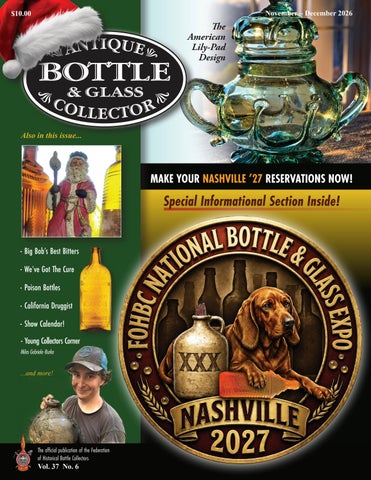
November – December 2026
$10.00
The American Lily-Pad Design
Also in this issue...
MAKE YOUR NASHVILLE ’27 RESERVATIONS NOW!
Special Informational Section Inside! - Big Bob’s Best Bitters - We’ve Got The Cure - Poison Bottles - California Druggist - Show Calendar! - Young Collectors Corner Miles Gabriele-Burke ...and more!
The official publication of the Federation of Historical Bottle Collectors
Vol. 37 No. 6
Vol. 37 No. 6
November – December 2026
No. 188
So you don’t miss an issue of Antique Bottle & Glass Collector, please check your labels for expiration information.
TABLE OF CONTENTS
To Advertise, Subscribe or Renew a subscription, see pages 71 and 72 for details.
FOHBC Officers | 2026–2028 ...................................................................................... 2
To submit an article, send a letter, or share comments, contact:
FOHBC President’s Message ............................................................................................ 3
Alice Seeliger, Editor N8211 Smith Road Brooklyn, WI 53521 phone: 608.575.1128 email: FOHBCmembers@gmail.com
FOHBC News–From & For Our Members .......................................................................... 4 FOHBC Regional News .................................................................................................... 6 American Poison Bottles by Vern Huffstetler, Joan Cabaniss and Tim Adams .................................. 10 The Progress by Frank Chance ......................................................................................... 14 We've Got The Cure! by Sue Louis .................................................................................. 18
10
Young Collectors Corner by Alice Seeliger .......................................................................... 24 Nashville 2027 Informational Guide & Schedule of Events ......................................... 26 David Burton’s Antique Sealed Bottles by Ralph Finch ..................................................... 34 The American Lily-Pad Design by Michael George ............................................................. 36 Isaac P. Allen - Sacramento Druggist by Eric McGuire .......................................................... 44 Big Bob’s Best Bitters by Bob Strickhart .............................................................................. 54
14
Lost & Found ............................................................................................................... 60 Member Photos ............................................................................................................ 64 Classified Ads ............................................................................................................... 67 FOHBC Sho-Biz–Calendar of Shows ............................................................................... 68 Membership Benefits & Display Advertising Rates ........................................................... 71 Membership Application, Affiliated Clubs Membership & Show Advertising Rates ............. 72
18
Young Collectors Corner! Miles Gabriele-Burke
November – December 2026
Antique Bottle & Glass Collector (ISSN 1050-5598), Copyright © 2026 by the Federation of Historical Bottle Collectors, Inc., is published bi-monthly (6 issues per year) by the Federation of Historical Bottle Collectors, N8211 Smith Road, Brooklyn, WI 53521. Business and Editorial Offices: N8211 Smith Road, Brooklyn, WI 53521. Accounting and Circulation Offices: the Federation of Historical Bottle Collectors, Inc., N8211 Smith Road, Brooklyn, WI 53521. Call (608) 575-2922 to subscribe. Non-profit periodicals postage is paid at Stoughton, Wisconsin 53589, and additional mailing offices. Pub # 005062 Postmaster: Send address changes to Federation of Historical Bottle Collectors, c/o Michael Seeliger, N8211 Smith Road, Brooklyn, WI 53521. Phone 608-5752922; email: fohbcmembers@gmail.com. Annual subscription rate is: $60 for Standard Mail or $95 for First Class (U.S. only). $40 for Digital Membership (in U.S. funds). Canada and Foreign Countries $40 Digital Membership only. Life Membership: Level 1: $3,000, Level 2: $1500. The Federation of Historical Bottle Collectors, Inc. (FOHBC) assumes no responsibility for products and services advertised in this publication.
36
24
Fair use notice: Some material in Antique Bottle & Glass Collector has been submitted for publication in this magazine and/or was originally published by the authors and is copyrighted. The Federation of Historical Bottle Collectors, Inc., a non-profit 501 (c)(3) educational organization, offers it here as an educational tool to increase further understanding and discussion of bottle collecting and related history. We believe this constitutes “fair use” of the copyrighted material as provided for in Section 107 of the U.S. Copyright Law. If you wish to use this material for purposes of your own that go beyond “fair use,” you must obtain permission from the copyright owner(s).
54
The names Federation of Historical Bottle Collectors Inc. (FOHBC), and Antique Bottle & Glass Collector ©, are registered ® names of the Federation of Historical Bottle Collectors Inc., and no use of either, other than as references, is permitted without expressed written consent from the Federation of Historical Bottle Collectors Inc. Certain material contained in this publication is copyrighted by, and remains the sole property of, the Federation of Historical Bottle Collectors Inc. while others remain property of the submitting authors. Printed by American Printing, Madison, Wisconsin. Visit us at: FOHBC.org & Facebook
1
FOHBC Board of Directors Director-at-Large: Richard Siri, PO Box 3818, Santa Rosa, California 95402, phone: 707.542.6438, email: rtsiri@sbcglobal.net Northeast Region Director: Charles Martin Jr., 5 John Hall Cartway, Yarmouth Port, Massachusetts 02675, phone: 781.248.8620, email: cemartinjr@comcast.net
Federation of Historical Bottle Collectors
The Federation of Historical Bottle Collectors is a non-profit organization, founded in 1969, for collectors of historical bottles, glass and related collectible items. Our primary goal is educational as it relates to the history and manufacture of historical bottles and related artifacts.
FOHBC Officers 2026–2028 President: Michael Seeliger, N8211 Smith Road, Brooklyn, Wisconsin 53521, phone: 608.575.2922, email: mwseeliger@gmail.com Vice-President: Position Open Secretary: Alice Seeliger, N8211 Smith Road, Brooklyn, Wisconsin 53521, phone: 608.575.1128, email: AliceSecretaryFOHBC@gmail.com Treasurer: Kathie Craig, 1037 Hazelwood Avenue, Campbell, California 95008, phone: 408.591.6511, email: kathie.fohbc@gmail.com
Midwest Region Director: Henry Hecker, W298 S10655 Phantom Woods Road, Mukwonago, Wisconsin 53149, phone: 262.844.5751, email: phantomhah@gmail.com Southern Region Director: Richard Paananen, 243 Bridle Path Road, North Augusta, South Carolina, 29860, phone: 803.967.6773, email: bottman101@aol.com Western Region Director: Eric McGuire, 1732 Inverness Drive, Petaluma, California 94954, phone: 707.481.9145, email: etmcguire@comcast.net
FOHBC Website:
FOHBC.org
FOHBC Virtual Museum:
FOHBCVirtualMuseum.org
Auction Price Report:
Requires FOHBC membership, access through FOHBC.org
Facebook:
Federation of Historical Bottle Collectors
Antique Bottle & Glass Collector, the Official Publication
Business Manager: Position Open
of the Federation of Historical Bottle Collectors.
Membership Director: Position Open. (Interim) Michael Seeliger, N8211 Smith Road, Brooklyn, Wisconsin 53521, phone: 608-575-2922, email: mwseeliger@gmail.com
Publisher: The Federation of Historical Bottle Collectors, Inc.
Marketing Director: Craig Cassetta, 12 Marlin Court, Chico, California 95973, phone: 530.680.5226, email: ccassettafohbc@gmail.com Special Projects Director/Webmaster: Doug Simms, 1317 Tullahoma Drive, Prattville, Alabama 36066, phone: 334.318.1965, email: dsimms@fohbc.org Director-at-Large: Matt Lacy, 3836 State Route 307 Austinburg, Ohio 44010, phone: 440-228-1873, email: mlacy28@yahoo.com Director-at-Large: John O’Neill, 1805 Ralston Avenue, Belmont, California 94002, phone: 650.619.8209, email: John.ONeill@bbrown.com
Editor: Alice J. Seeliger, alicesecretaryFOHBC@gmail.com Design / Layout: Michael George, earlyglass@gmail.com Sales Manager: Alice J. Seeliger, alicesecretaryFOHBC@gmail.com Digital Director/Webmaster: Doug Simms, dsimms@FOHBC.org Social Media: Craig Cassetta, ccassettaFOHBC@gmail.com Featured Writers: Michael George, Vern Huffstetler, Joan Cabaniss, Tim Adams, Bob Strickhart, Sue Louis, Ralph Finch, Frank Chance and Eric McGuire.
FOHBC (Federation of Historical Bottle Collectors) N8211 Smith Road Brooklyn, Wisconsin 53521-9789 General Contact: FOHBCmembers@gmail.com
2
Antique Bottle & Glass Collector
President’s Message Michael Seeliger President Federation of Historical Bottle Collectors
N8211 Smith Road, Brooklyn, Wisconsin 53521 • 608.575.2922 • mwseeliger@gmail.com
S
eems Lebanons are my destinations lately as I attended the Circle City Bottle Show in Lebanon, Indiana in September and next up is the Tennessee Bottle Club Show in Lebanon, Tennessee in late October. That’s already sold out of dealer tables (over 200) so you can imagine how much there will be to buy there. Always check out the FOHBC.org Show Calendar to keep up with upcoming shows so you don’t miss any. Greg, Elise and Wyatt Eaton, along with Stanley Word, have really been generating enthusiasm for the FOHBC Nashville ‘27 National Expo to be held in Lebanon, Tennessee next July. It will be quite an event and one you won’t want to miss. Now is the time to make reservations for overnight accommodations as you can cancel but you may be out of luck if a large event gets scheduled in Nashville around that time. Take a good look at the Nashville ’27 section in this issue.
We have lots of people working on lots of activities … probably not as quickly as some of you would like, but as volunteers we only have so much time to devote. Thankfully, a few people have stepped in to help recently. A big thank you to Tom Pettit and Richard Paananen for helping with event flyer production and website posting. Tom will also be helping Doug Simms and Lisa Conners with the Virtual Museum. Newly added items need descriptions and there is a request for contributions to the information. Please check out the list and share your knowledge. Photos of labels, signs, variations in colors, etc. are also welcome. This will be the last call to purchase the white swirl Drake’s Plantation Bitters bottle and raffle tickets for the Red/White/Blue Swirl Drake’s (see inside back cover of this issue). We have just a few white swirl Drake’s to sell and will only take orders and sell raffle tickets until December 31, 2026. Though we had a few glitches in the on-line automatic membership renewals with the rate increase, we certainly appreciate those who have renewed at the new rates. Slowly, our membership income will be more in line with our operating costs. Support your local clubs and area shows, and remember… Together, we are building a Stronger Federation. Michael
November – December 2026
3
FOHBC News
From & For Our Members
250th Anniversary of the Signing of the Declaration of Independence “A Semiquincentennial Celebration” The Federation of Historical Bottle Collectors has commissioned glassblowers Treg Silkwood and Michael Craig to produce a limited quantity of white swirl Drake’s Plantation Bitters bottles to complete the blue, red, and white run of this commemorative bottle. Without a National Show in 2026, they will be produced to fill prepaid orders. Distribution began at the St. Louis 56th Annual Antique Bottle & Jar Show which is also the 50th Anniversary of the Federation’s first national event, the 1976 Bicentennial Expo. Labels commemorating the USA’s 250th Anniversary (Semiquincentennial) and the Federation’s 50th Anniversary of its first Expo are included with each bottle. Those who purchased a blue or red Drake’s should have already received an invitation to add this commemorative bottle to their collection. The price remains the same at $250 for on-site pick up or $275 with shipping. We anticipate a run of approximately 70 bottles with prepaid orders accepted through 2026.
Seeking a Host for the 2028 FOHBC National Antique Bottle & Glass Exposition The Federation of Historical Bottle Collectors (FOHBC) welcomes Regional Antique Bottle and Glass Clubs, Shows, Institutions, and Consortium Teams to submit proposals to host a future FOHBC National Antique Bottle & Glass Exposition in their region. The Expo is a collaborative effort between the Host and FOHBC, with FOHBC supporting overall coordination, marketing, advertising, and providing financial support. The Host helps shape the Expo by selecting the event theme and organizing the centerpiece Antique Bottle and Glass Show & Sale. Hosts may also suggest a convention logo, banquet speaker, seminar presenters, displays, optional activities, and a photographer. Host volunteers play a vital role in the Expo’s success and will be offered incentives in recognition of their efforts. In accordance with FOHBC Bylaws, the Expo is a multi-day event and must be held during the last ten days of July or the first ten days of August. The Host Team is responsible for securing appropriate convention space, including a primary host hotel and a backup hotel. The Antique Bottle and Glass Show & Sale typically opens with early admission on Friday afternoon and General Admission on Saturday. The number of show days and the overall schedule are flexible, and the Host Team’s proposal should reflect regional preferences. Letters of interest and questions may be submitted by November 1, 2026. Formal proposals are due by February 1, 2027 and should be addressed to FOHBC Board Member Craig Cassetta (ccassettafohbc@gmail.com). FOHBC reserves the right to accept or decline any proposal. We look forward to hearing from you and exploring the possibilities together.
To place your order, contact Michael Seeliger at President@FOHBC.org or call 608.575.2922.
4
Antique Bottle & Glass Collector
The Making of a National Expo
Theme Capitalize on what is already being promoted
Since we are looking for a partner for the next National Expo, let’s take a look at what it takes to bring this kind of event together. We hope it will inspire you to consider hosting the next National Event.
Features Banquet, seminars, auction, bottle compe-
What It Takes Standards and guidelines with an application process have been established to ensure a successful event. Each national event varies in details and execution with the event host and the Federation sharing activities and costs. But here’s a little of what it takes…
Enthusiasm A core team of 4 or 5 people, preferably
with experience in producing local bottle shows. Club members to help during the actual event … setting up and covering tables, security, and photography/videography, for example.
Location/Venue A venue in smaller towns near a
bigger city can bring the cost down considerably. Proximity to hotels, other activities, airports and interstate highways are “must haves.” Good lighting, easy in, easy out, and ample parking encourage dealers and attendees. Know your audience – are prospective vendors and show attendees seeking high-end facilities in big cities or do they prefer to spend their money on their collections.
Budget Previous shows can help you formulate a
budget adapted to your local area. Remember that the Federation contributes financially to the event. November – December 2026
in the area and incorporate that into your theme.
tition, raffle, a commemorative piece, etc. enhance the actual bottle show and sale. Decide what you want to include. Set up an agenda for the complete event and work on each individual piece.
Resources The FOHBC Nashville 2027 National
Antique Bottle & Glass Expo is a great example of how to do it right. Greg, Elise and Wyatt Eaton, and Stanley Word are spearheading the whole shebang and will be very willing to share their expertise. From the Nashville 27 Team: “The success of our annual Tennessee show convinced me we knew how to put on a National – my dream since our first local show in 2018. With time and help from our club and neighboring clubs, Nashville 27 will be really special.” Greg Eaton
“Getting the right people together is key. Start with three key people and then add to the team. Delegate. Pick a location with connections to interstate highways and a venue sized for at least 250 tables. Use information from previous successful Nationals and your local connections for service providers.” Stanley Word “I’m kind of the glue that holds it all together or the calm voice when there’s chaos. Having a detail-oriented person like me with experience in event planning helps everything go a lot smoother.” Elise Eaton 5
FOHBC
Regional News Southern Region Report – Richard Paananen
T
hings are ramping up for the FOHBC Nashville 2027 National Antique Bottle & Glass Expo which will be at the Farm Bureau Expo Center in Lebanon, Tennessee outside of Nashville. Tables are selling fast, experts are being lined up for seminars and discussions, there will be an auction, a tour of the Jack Daniels Distillery, and displays to amaze! They have discounted rates for hotels in the area. Check out the agenda on the FOHBC website and in the Nashville ’27 section in this issue. Plus, if you’re planning an extended trip, Tennessee is loaded with the natural beauty of the Smoky Mountains, American history, entertainment for all interests, and great food. The Cheaha Bottle show in Munford, Alabama was on August 8. I didn’t get a chance to attend so I appreciate Tom Lines, Greg Eaton, and Jake Smith sending me their thoughts and experiences on the show. It was a great show and well attended — 75 sales tables with hundreds of shoppers through the door.
The Cheaha Bottle show
Here’s Tom’s input: “11th Annual Cheaha Bottle Show … Munford, Alabama. Jake Smith chaired his 11th annual bottle show at the Munford Community Center on Saturday, August 8. There were 75 tables with dealers coming from Alabama and surrounding states who offered a good variety of local items and a decent selection of flasks and bitters, plus insulators. Collectors from as far away as western Mississippi, northeast Florida and Nashville, Tennessee came with expectations of finding something to set on their shelves at home. The aisles were crowded with shoppers up through early afternoon. Many dealers reported booming sales. I try to engage folks who stop and peruse my table. One such person, a lady from Wetumpka, asked a number of questions about items that piqued her curiosity. When I asked what she collected, she replied, “a little 6
bit of everything.” She said she is an artist and liked various objects and thought a bottle show would be a good place to go prospecting. Although she didn’t buy anything from me, I did spy her buying a few things from other vendors. All Southern shows tend to include some alkaline-glazed stoneware, and this show was no exception. Several dealers had tables full of beautiful forms plus a number of dealers had random pieces. Notable heavyweight stoneware collectors were there hoping to add something to their collections including Rick Messer, Gary Price, Danny Maltbie, David Parker and Bill Garland.” Greg and Wyatt Eaton had a great visit to the show and the local area while promoting the FOHBC Nashville 2027 National Expo and enjoying talking to the dealers. They stopped at the museum in Attalla, Alabama, donating a Usry Farm Dairy Milk Bottle from Attalla which was new for the Museum. Certainly, this was a great example of bottle collectors’ generosity to enhance local history.
Greg and Wyatt Eaton Usry Milk Bottle – Now a valued museum piece!
Midwest Region Report – Henry Hecker
A
lot of bottle collectors also collect antique stoneware and earthenware either as a “go-with” or as a primary collection. The reasons are the same: the aesthetics, the history, and the fact that in many cases the manufacturers (whether it be liquor, bitters, medicines, mineral water or beer) used both mediums, glass and pottery, to market their products. Therefore, in the quest to assemble a “complete” collection of all the containers a particular company used, Antique Bottle & Glass Collector
The Four Regions of The Federation: Western, Midwest, Southern, and Northeast
collectors like myself have a variety of both glass and pottery vessels. Some of that has to do with the earlier use of pottery when glass was more expensive or, for instance, the locale lacked glass houses but had potters eager to serve the need. Besides economics, a manufacturer had to consider durability in choosing container material. In my collection, larger containers of the 19th century trended toward pottery on the western frontier of the 1830s through the 1870s, in part because pottery was stronger, but also shipping heavy, larger bottles and demijohns from Eastern glass houses was expensive. In Milwaukee, the first glass house did not arrive until 1880, so a respectable percentage of quart-size soda and beer bottles were pottery. I even own a stoneware “Bitters” jug made by one of the stoneware factories in Milwaukee at the time. There are other pragmatic reasons for selecting stoneware. Popular German immigrant favorites such as Weiss beer continue to self-carbonate after bottling. Glass of the time, often with imperfections such as bubbles and fissures, simply wouldn’t standup to the pressures that built up as the beer “bottle conditioned.”
The Ohio Bottle Club continues to publish its Ohio Swirl, and while not the “eye candy” version it once was, it continues to be very informative and celebrates the latest finds by club members. In the last issue, Alan DeMaison had a great article on Dr. Stewarts bitters from Columbus, Ohio. Every meeting includes contests for “Best Acquired Bottle and Stoneware,” “Best Acquired Anything But,” and “Best Dug Item” which, at the most recent meeting, happened to be a 1994 Hot Wheels Car. (Please tell me that the privies in Ohio have not gone dry!!!) On August 16, the Kalamazoo Club had their picnic … reportedly quite a raucous affair. (Just kidding, Vincent.) The Milwaukee club held their annual picnic, hosted by Peter and Julie Maas on August 3. I can personally attest that it was a sumptuous feast with catered barbecue festooned with some of the greatest potluck items brought by members in our 53year history. We also had a bottle auction which created some spirited bidding among friends (also the usual “buy-backs”).
Western Region Report – Eric McGuire
M
Not all Bitters are Glass!!
That was my long-winded intro to a recent event at an auction house in Park Falls, Illinois where the first segment of the famous Gary Williams stoneware collection was sold off, both online and in person on the final day. The auction was attended by many Midwest collectors and even some Eastern ones, because Gary also had some fine late 18th and early 19th century New York stoneware. Prices were fairly strong although the number of fine pieces brought to market at one time probably overwhelmed the collective buying power of the participants … I know it did for Wisconsin collectors. I did obtain a handsome 1850s jug from the Farrar & Sprague pottery from Portage, Wisconsin. November – December 2026
any of us in the Western Region, and even the other regions, have recently been faced with the new phenomenon of the “cyber world.” Internet sites related to bottle collecting have slowly blossomed in the last decade which has been an overall “plus” to the hobby. However, recently I am having an increasing concern over the rapid expansion of this type of activity. It undoubtedly adds to the overall body of information related to all aspects of collecting bottles but is there a point where there becomes too much information on too many bottle-related sites. Obviously, the prudent answer depends upon the individual and how he or she deals with the issue. After perusing many of the Facebook bottle sites, I question the value of the time spent trying to keep up with all of them. Every individual will have a different experience, but I can see no clear answer for the ever-increasing time that must be devoted to keeping up with bottle-related sites. It appears that a new age of bottle collecting has become a reality, and too much of a good thing must be appropriately balanced in each collector’s life. At least, from my perspective, the time spent attempting to view all these sites seldom provides appropriate rewards. Time is a limited resource and with the ever-increasing bottle-related sites, this collector predicts that too much of a good thing is beginning to have a negative effect. 7
FOHBC
Regional News With regard to the ever-changing world of bottle collecting, I found this note in the “STUMPTOWN REPORT,” the newsletter of the Oregon Bottle Collectors Association. The club members have assembled a list of all the Oregon bottles that sold on eBay for the months of July and August, with hammer prices. The highest-priced bottle sold during that period, pictured here, was a crown top ACL soda from Medford, Oregon, known as the A-1 Majorette bottle. It sold for US $1,850. The times they are “a changin.’” On a personal note, I tried another type of digging recently that put a different spin on the concept. I spent a week in the wilds of Montana digging up dinosaurs. It put a unique perspective on the search for buried items. I helped uncover the remains of an animal that lived some 170 million years ago. This left such a deep impression on me that I am still trying to process the experience of finding something with that much age. It makes digging pontiled bottles like finding something buried yesterday and redefines what “old” really means. All of humanity has existed but seconds on this earth compared with its previous life forms. I recommend the experience if one is willing to be challenged by the meaning of life on our planet.
Northeast Region Report – Charlie Martin, Jr.
I
f you are a regular reader of this column, you have already experienced the joy and pleasure of bottle shows that the Northeast Region offers every Fall. Historically, I have asked you to come and experience the wonders of the Fall foliage in New England and other parts of our region. I want each reader to know that the bottle clubs of our region work around the clock to organize and schedule antique bottle shows for fellow collectors. It goes without saying that I deeply appreciate the effort put forward by show chairs to 8
ensure that we, as collectors, have the very best opportunity to add to our growing collections. I especially want to thank our local and not-so-local dealers who work throughout the year to bring to these shows the best examples of antique glass and “go withs” the bottle companies produced to advertise and sell their products. Like many older collectors, I have had to downsize, ergo, I’ve sold off many of my bottle treasures and am now focusing on the ephemeral material produced by the manufacturers of these bottles. Specifically, I am concentrating my collecting on Bitters Ephemera. I share this information as I have heard from many senior collectors that they too are downsizing and are thinking about “what to do now” that they are no longer purchasing bottles to grow their collections. I inform them that I am having as much fun and pleasure looking for and finding the “go-withs” that were produced to market the bitters bottles that I treasured as a collector for over fifty five (55) years. Remember, many examples of labelled bottles are still being offered by dealers, and certainly through the various auction houses that advertise in our magazine. So, do not stop collecting because you need to downsize…just redirect your focus. I would deeply appreciate hearing from you, our readers, so that I can share your stories of how your collecting has evolved over the decades with fellow collectors. Please, reach out to me to let me know how you have redirected or refocused your interests. Finally, I want to remind you that the Federation’s magazine, Antique Bottle & Glass Collector, and its contents rest with the good nature and kind efforts of all of us as volunteers. So, as we enter this season of Thanksgiving and Christmas, I want to say “Thank You” to our Officers and Directors for the hard work and many hours of service you donate to our organization. For without your time and effort we would not be able to produce such a high-quality magazine which informs, educates and provides enjoyment for all of us. Happy Thanksgiving, Happy Hanukkah and Merry Christmas to all. Please make one of your New Year’s Resolutions to include becoming a volunteer in the Federation of Historical Bottle Collectors. We need new faces, ideas and voices to ensure we are doing the best work to serve your needs and interests! Let your voice be heard through your contribution and action as a Federation volunteer! Until next time, happy bottle collecting! Antique Bottle & Glass Collector
Glass Works Auctions proudly presents
Premier Catalog Auction #199
Selections from the Dick and Elma Watson Collection!
Coming in December!
A few choice selections from this auction! A full color catalog will be available for $15.00 For more information contact:
Glass Works Auctions, P.O. Box 180, East Greenville, PA 18041
PH: (215) 679-5849 - Email: glswrk@enter.net - Website: www.glassworksauctions.com November – December 2026
9
American Poison Bottles
KR-3 Poison Bottle Mystery By Vern Huffstetler, Joan Cabaniss and Tim Adams
T
he KR-3 is an attractive skull and cross bones poison bottle which is scarce in cobalt and rare in amber or clear. Some examples are base embossed, but all the examples in our collections were difficult to read. Recently, an example with crisp embossing became available on eBay. Although I paid too much, I had to have it. In our book, “American Poison Bottles,” we described the base embossing as M.C.C.CO. The latest example is clearly embossed M.C.G.CO. We consulted our always-helpful guides to glassmakers’ marks which described the mark as an unidentified glasshouse, likely in New Jersey. While searching through old pharmacy trade periodicals, we found that, in 1922 and 1923, T.C. Wheaton Co., “expert bottle blowers,” advertised these exact bottles with a red rubber stopper and camel hair pencil as the ideal packaging for dispensing iodine. A slam dunk for attribution, but what is the M.C.G.CO. base mark? Let’s dig a little deeper. From the colonial period onward, the availability of silica sand and fuel made Millville, New Jersey ideal for glass production. The area attracted two of the largest producers of pharmaceutical bottles, Whitall Tatum &
10
Co. and T.C. Wheaton, along with hundreds of smaller glasshouses through the years. Dr. Theadore Corson Wheaton (1852-1931) moved to Millville in 1883 to open a pharmacy and practice medicine. In 1888, two entrepreneurs, Shull and Goodwin, started construction of a glasshouse. However, a devastating east coast blizzard put them significantly behind schedule and short on capital. Since Dr. Wheaton was desirous of quality prescription bottles and apothecary glass, he loaned them $3,000 to complete the works. This sum
Clearly embossed “M.C.G.CO.” on the base. Antique Bottle & Glass Collector
Dr. T.C. Wheaton The original T.C. Wheaton & Co. in 1888.
Advertising in The Spatula May 1922 to November 1923
would be equivalent to $105,000 today. To protect his investment, Dr. Wheaton became increasingly involved in the operation until he was the major shareholder and changed the name to T.C. Wheaton & Co. By 1890, he had sold the pharmacy and left his medical practice to focus solely on the glasshouse. In 1901, the business was incorporated as T.C. Wheaton Co., focused on prescription bottles and vials along with apothecary wares. Seeking to expand production in 1906, T.C. Wheaton Co. rented the defunct Millville Crystal Glass Co. works and operated it in conjunction with their original factory which increased output by 30%. This could certainly explain the base mark M.C.G.CO. and why it has remained an unattributed mark. Dr. Wheaton’s youngest brother, W. Scott Wheaton (1863-1924), joined him in the glass business. By 1891, Scott had opened a branch office in Denver, Colorado and later he served as the head of the New York office. In 1903, W. Scott Wheaton and another executive, James E. Mitchel, left to open a competing company, Millville Bottle Works. Both companies successfully marketed glassware for the pharmaceutical trade. Regrettably, James Mitchel passed in 1920, and W. Scott Wheaton passed in 1924. By 1926, T.C. Wheaton Co. acquired Millville Bottle Works, more than doubling output. November – December 2026
In 1916, WWI was raging in Europe, and the T.C. Wheaton Company was running strong with all hands at work. They were producing prescription bottles as well as the highly sought and aptly named “IT” non-rolling baby nursing bottles. The war effort brought continued prosperity. T.C. Wheaton pridefully touted all bottles were “hand blown.” This allowed them to be more flexible to the market needs during the depression era. It also explains how bottles marketed in 1922 and 1923 were still hand blown. Amid the great depression, T.C. Wheaton passed in 1931. Control of the company went to his son Frank H. Wheaton Sr. (1881-1983) often referred to as “The Dean of the Glass Industry.” When prohibition was lifted in 1933, T.C. Wheaton Co. made beer bottles for the first time. It allowed them to re-hire large numbers of workers. Although the factory was 20 acres under roof with two pot furnaces and four continuous tanks. A though the factory utilized modern equipment including diesel air compressors, manual shops made it easy to change bottle styles and glass colors as needed. However, in 1937, Frank H. Wheaton Jr., “The New Idea Man,” tested out a Hartford-Empire Co. automatic bottle machine, and it was a hit. The factory was fully automated in 1938. This set the company up to be a top supplier for WWII. They received the Army-Navy “E” Award for their work. The award recognized excellence in production to the top five percent of the 85,000 suppliers. A pennant for the company and pins for the employees were awarded in a formal ceremony. 11
1937 photo of a glass shop just prior to automation at T.C. Wheaton Co.
Frank H. Wheaton Jr. (1913-1998) took control of the company in 1966 and built the business globally to include 41 domestic plants and 20 international subsidiaries. It was the largest family-owned glass producer in the world. The Wheaton family’s 108 years of control ended in 1996 with the sale of the company to a Swiss firm, Alusiusse-Lonza Holding, Ltd. However, the Wheaton family left a legacy. Frank Wheaton Jr. had the vision of founding the Wheaton Historical Association in 1968. This group provided research and funding to build Wheaton Village, a period rendition of the original 1888 glass works, complete with the Museum of American Glass. The museum opened in 1973 with one of the finest collections of American glass. In the early 1980s, Creative Glass Center of America worked with WheaSources: The T.C. Wheaton Companies by: Bill Lockhart, Beau Schriever, Bob Brown, Bill Lindsey, and Carol Serr. Corporations of New Jersey: Certificates Filed: 1903 p 131, 1908 p 172. Annual Report of the Bureau of Statistics of Labor: 1904 p 496, 1905 p 236, 1906 p 465. Documents of the Legislature of the State of New Jersey: 1906 p 236. Acts of the General Assembly of the State of New Jersey: 1907 p 767. Obsolete American Securities and Corporations Illustrated: 1911 p 653. The National Drug Clerk: January 1916 p 45. The Spatula: May 1922 p 315, November 1923 p 43. American Druggist: May 1923 p 77. The American Perfumer: September 1922 p 312, February 1924 p 649. Oil Engine Power: September 1928 p 620-624.
ton Village on a fellowship program to bring contemporary artists to work in the facility. In 2010, the facility was renamed WheatonArts. The 60-plus-acre campus now includes traditional craft studios, the Down Jersey Folklife Center, and public educational programs. I certainly have a new adventure to add to my bucket list. Your Poison Bottle Team Foreground: Vern Huffstetler is a mechanical engineer, collector, author, photographer, and artist. He contributed significantly to writing the American Poison Bottles book, magazine articles, and three webinars on poison bottles. Back Left: Joan Cabaniss is the “Queen of Poisons.” She served as the long-time president of the Antique Poison Bottle Collectors Association. The May 2005 issue of National Geographic featured Joan and her collection in “Pick Your Poison.” In 2014, Joan and her collection were featured in Virginia Living magazine. The FOHBC Virtual Museum includes her impressive poison bottle collection. Joan coauthored the Poison Bottle Workbook, American Poison Bottles, and our magazine articles. Back Right: Tim Adams’ knowledge of the bottle hobby is extensive. His memory of who has what rare poison is phenomenal. He volunteers his time often ministering and supporting his community with catered chicken charity events. Tim is coauthor of the Poison Bottle Workbook, American Poison Bottles, and multiple magazine articles. See display ad to purchase “American Poison Bottles.”
Find a Grave and other sources in the public domain.
12
Antique Bottle & Glass Collector
Christmas time is always a fun time of the year. You can make a whole collection of Merry Christmas bottles. Most are labeled only but there are many that are embossed. Have a great Christmas and Happy New Year. Remember to keep on collecting!
American Poison Bottles
The American Poison Bottles book is an in-depth study of American poison bottles in use from 1872 to 1944, the glass houses that manufactured these bottles and the companies that used them to distribute their products as well as the drug stores that ordered custom poison bottles. The book is an accumulation of 50 years of knowledge shared by collectors in the APBCA (Antique Poison Bottle Collectors Association) newsletters, bottle magazine articles, company histories and other sources in the public domain. It features 90 photo-quality pages of beautiful poison bottle images from top collections, 171 pages of history and fantastic images documenting the people and companies involved, as well as 25 pages of auction prices realized for these bottles. We used high-quality, acid-free paper and a photo-quality printer so the book will last a lifetime.
American Poison Bottles is a bargain at $75 Shipping: Media Mailer $10 or Priority Box $20 Contact Vern Huffstetler (615) 585-9827 americanpoisonbottles@gmail.com 108 Ridgecrest Road Midland Valley Subdivision Graniteville, SC 29829
We accept Cash, Check, and PayPal
November – December 2026
13
THE PROGRESS
A Souvenir Becomes a Trophy
By Frank Chance
T
was only two-and-one-half feet deep and a disappointment to the group. From this small outhouse of sparse contents, we recovered a few generic bottles, including an amber strap-sided flask and a two-tone ginger beer.
wo articles titled “A Dig of A Lifetime” were published in the May/June and July/August editions of this Antique Bottle & Glass Collector magazine. A bottle recovered from that dig prompted this article. In the summer of 2007, I secured digging rights and permission for a large parcel of historic property on the eastern edge of Savannah, Georgia. Six months later, Jim Poole and I also secured the adjoining “Trustee’s Garden” parcel. The first privy we dug produced several nice Savannah bottles, including a cobalt JAMES RAY GINGER ALE and a beautiful cobalt SOLOMON’S STRENGTHENING & INVIGORATING BITTERS. The next privy in a line of five that was exposed by backhoe trenching produced very little. The outhouse
14
Also recovered was a foreign aqua blob-top bottle which we had never seen before. In the oval slug plate was embossed: ENRIQUE ROIG – EL PROGRESO – PUERTO RICO. The base of the bottle has an embossed “M.” The group devoted two-and-one-half years to excavating this site, ultimately digging sixty privies and numerous trash pits. Once concluded, the bottles were divided. My fellow diggers and I favored bottles of local origin over this unknown bottle. As the selection process ended, and out of curiosity, I selected the Enrique Roig bottle. Antique Bottle & Glass Collector
Several unsuccessful attempts were made early on to locate information about the Enrique Roig bottle. While attending the Jacksonville, Florida; and Columbia, South Carolina bottle shows, I solicited information from anyone who might be familiar with it. Most collectors seemed surprised that such a bottle was dug in Savannah, Georgia, and were generally uninterested. I was referred to author and collector David Kyle Rakes, but he had neither seen nor heard of this bottle. Rakes suggested I contact Tod Von Mechow via his website on Soda and Beer Bottles of North America. This site referenced a vast array of information with listings of over 38,800 bottles! Mr. Von Mechow also had never seen or heard of the bottle but asked if he could list it on his website. Von Mechow was uncertain as to the “M” embossing on the base of the bottle but alluded to bottles from Texas, Mississippi, and Pennsylvania with the same “M.” Another researcher suggested the mark “could be” from Massillon Glass Works of Ohio (1881–1894). I also located a collector from San Juan with extensive knowledge of antique Puerto Rican bottles. In response to a Facebook inquiry, he noted he had no knowledge of blob-top bottles from San Juan but he took an immediate interest and called me. He was very surprised to learn that the bottle had been discovered in Savannah. All my research made me wonder if my bottle could possibly be the earliest embossed soda bottle from Puerto Rico.
(Above) Photo of the El Progreso bottle (Left) Bottom of the bottle (showing the embossed “M”)
November – December 2026
15
I discovered there is a Gravitating Stopper bottle from Mayagüez, a city at the western end of the island. The bottle is embossed EL PROGRESO – ROIG Y FARRABETTIC – MAYAGUEZ. (This may be a different Roig.) There is also a Hutchinson-style bottle embossed EL PROGRESO – CAGUAS – PTO RICO – Registered, from a city south of San Juan. My bottle makes this the third known Puerto Rican soda bottle with the name “EL PROGRESO.” Numerous other soda bottles are known to exist, most being Hutchinson type and some Codd bottles. All of these are highly prized and sought after, with some being “one of a kind.” When Christopher Columbus arrived on the island of Puerto Rico in 1493, it had long been home to the Taíno people. He claimed the island for Spain, and colonization began in 1508. The natives were forced into labor, and its population was eventually devastated by disease and conflict. Spain later imported enslaved Africans to work the thriving sugar, ginger, and coffee plantations that sprang up across the island. Following the abolition of slavery in 1873, the island had become embroiled in a quest for independence. Political uprisings were prevalent due to economic hardship. Poverty was rampant among the working class. Many of the outspoken were persecuted and imprisoned. The year 1887 would become known as “The Terrible Year.” The walled city of San Juan soon became a bustling hub for military, political, and commercial expansion. The Roig families began immigrating to the island in the early 1800s, primarily from the Catalonia region of Spain. Exact lineages are not conclusive, but the well-known Antonio Roig Torrellas, born in 1860 in Mayagüez, built an empire in the sugarcane industry on the island from west to east. Apparently unrelated, Enrique Roig had established himself early as a pioneer in the soda and mineral 16
Spanish and English version of The Progress advertisement or El Universo.
water business in San Juan. A basic internet search shows José Quinton and Enrique Roig operating together at Calle de la Fortaleza No. 51 as early as 1865. Competition soon increased as rival bottlers started up nearby in the heart of Old San Juan. I found ads for La Deliciosa and La Pequeña Atilla from the mid-1870s. I then found a reference for EL Progreso de M. Santiago & Co. at Calle de la Fortaleza No. 31 in 1879. The name EL Progreso likely represents the advanced bottling equipment and processes promoting better filtration, purity, and health over the other local bottled waters. This ad lists products including carbonated water, mineral water, and flavored syrups. Enrique Roig assumed operations at this location around 1880. Advertisements in 1883 begin showing Quinton and Roig distributing natural mineral water from the Baños de Coamo, the only natural hot springs on the island. Promoted for health, the water was rich in minerals including sulfur, magnesium, and calcium. The business bottled, transported, and distributed the much-sought-after medicinal mineral water from Coamo to local and urban residents, cafés, businesses, and visiting passengers. Baños de Coamo was used by the indigenous people for hundreds of years prior to the property being developed by Andrés G. Luhring in 1847. He built a guest house Antique Bottle & Glass Collector
AI-generated color image of the hotel & factory
and privacy fences around the pools for bathers. Ten years later, José Usera acquired the property and built a luxury resort and spa featuring a 20-room brick hotel. One source shows that Quinton and Roig dissolved their partnership in November 1883. By 1885, Roig had relocated his factory to Calle Tetuán No. 51, keeping the same name EL Progreso. In the Boletín Mercantil, my son found the first reference to the new location and recreated the English version shown here. This ad appeared regularly through June 1886. Both bottling businesses were near the waterfront in the heart of the city. Roig’s factory was adjacent to the Hotel del Universo. Being directly against the old city wall, the hotel had a commanding view of the bay, docks, and Customs House. The hotel underwent substantial renovation in 1869 to optimize its guest rooms and cater to more elite travelers arriving by steamship. A traveler in 1870 described the hotel as “the best hotel in town and the best situated.” The comforts and amenities of Hotel del Universo included a café, dining room, and simulated rain baths. The dining room was staffed by local Afro-Puerto Ricans and featured Creole and Spanish cuisine with local world-renowned coffee. An advertisement from 1873 further described the hotel as being “comfortable and elegant.” The hotel closed its doors around 1898 when the United States acquired Puerto Rico following the Spanish-American War. November – December 2026
The mystery bottle that I picked at the very end of the selection process has stirred my curiosity and imagination about how it came to be discarded in a small, shallow privy in Savannah, Georgia. Perhaps it was brought to Savannah on a steamship or a sailing vessel as a souvenir by a local traveler or a sailor who visited Puerto Rico before arriving here. Aside from such speculation, the bottle that no one else wanted has become a great conversation piece with other collectors. This bottle is now a genuine “trophy” in my bottle collection. As a disclaimer, the findings contained in this article are derived from newspaper articles, advertisements, and internet queries. Partnerships and dates of operation are subject to further investigation. The author would welcome any new material. Please email: fchance61@gmail.com Frank Chance is a native of Savannah, Georgia. He has been a passionate history buff and has metal detected artifacts since the age of twelve. Later, as a scuba diver, he recovered shipwreck artifacts, fossils, and bottles. In the 1970s, Frank began digging for old bottles and through the years amassed an impressive collection of Savannah soda bottles. Frank is an author and a senior machinist at one of the premier yacht facilities in Savannah. 17
COLLECTING WARNER’S
LOOK-ALIKES By Sue Louis
T
he well-known Warner’s Safe Cure bottles are a full and interesting category of collectables with the infamous safe embossed on the front panel. Because Warner’s bottles are so popular, some collectors have tried to acquire the Warner look-alike cures also. The famous 9” tall, oval amber bottle was very successful for the Warner company, but the copycat medicines were less successful. Two of the companies represented here, Craig’s and Sparks, met their demise due to patent infringement challenges by the Warner company.
BAKER’S / VEGETABLE / BLOOD & LIVER / CURE / SPENCER / MEDICINE CO / MANUFACTURERS / & / PROPRIETORS / GREENVILLE / TENN. The Spencer company is listed in a Greenville business directory in 1891.
In our review of these amber treasures, we learned how challenging the collection of Warner look-alike bottles are to acquire due to their rarity. Here we will limit the lookalike variants to the oval, 9” or pint-size versions, excluding any sample-size comparisons.
BAKER # 92 through # 96 (Louis, 2026).
The Bakers grouping comes in five different variants. All examples are pint sized and come in shades of amber. Three different applied-lip applications exist in the first examples produced by the Spencer Medicine Company of Greenville, Tennessee. The lip variations are applied tapered lip, applied square-band lip, and applied double-ring lip. These three variants have hinged-mold construction, with a smooth base which are considered rare and very desirable. The yellow with a square-band lip is considered highly desirable. The front of the bottles are embossed with
18
Two very different Baker’s bottles Antique Bottle & Glass Collector
The company changed hands, and so did the bottle, creating these next two variants. The Lookout Mountain Medicine Company advertised Dr. Baker’s great vegetable blood & liver cure in 1897, obviously acquiring the business in the years between 1891 and 1897. (The Gazette, Raleigh, North Carolina, Oct 23, 1897, p. 4) The bottles are witness to the change of hands. Early in business, Spencer in the embossing was replaced by a slug plate addition of Lookout Mountain; the second and later variant has Lookout Mountain incorporated into the mold’s embossing. Dann has never seen another of the later variant of Lookout Mountain, but they have to be out there somewhere. Both examples have a smooth base and double-ring lip. The slug plate example is easily obtained though it is scarce and very desirable. The front of the bottles are embossed BAKER’S / VEGETABLE / BLOOD & LIVER / CURE / LOOKOUT / MOUNTAIN / MEDICINE CO. / MANUFACTURERS / & / PROPRIETORS / GREENVILLE / TENN. Trade Card from author’s personal collection
Advertisement for Dr. Baker’s Blood & Liver Cure
CRAIG # 454, # 455, # 458 (Louis, 2026)
The following is an abbreviated excerpt from Seeliger (2022). Early in the 1870s, the recipe for Craig’s Kidney Cure had come to Dr. Craig while he was suffering from Brights Disease, a kidney condition accompanied by edema, or swelling, from retained fluids and high blood pressure. Surprisingly, Craig recovered after using this weak vegetable concoction. Over time, Craig added other herbal ingredients to improve the efficacy of the cure. Many people were said to be helped by using Craig’s cure and it seemed a revelation in medicine had occurred. Dr. Craig formulated a Diabetes Cure as well as his Kidney Cure. To date, no bottle embossed with Craig’s Diabetes Cure has been found.
November – December 2026
Three different Craig’s bottles
Dr. Craig, having limited resources, partnered with H. H. Warner and, in the spring of 1879, they marketed the Original Dr. Craig’s Kidney Cure which was produced by H. H. Warner of Rochester, N.Y. In the summer of that same year, having purchased rights to the recipe, Warner began marketing Warner’s Safe Kidney and Liver Cure. Craig noted the financial success Warner had achieved with the Craig recipe and decided to sell his preparation again in 1882. With his son, he marketed the original formula at a lesser price than Warner was selling the preparation. That year Craig was marketing his concoction as Craig’s Kidney and Liver Cure which was in violation of Warner’s patent rights. Craig, to get around the infringement matter, then slug plated the word liver out of the embossing. During this time, in addition to the Kidney and Liver Cure, Craig also produced other cures in bottles not Warner shaped. Warner brought a suit against the Craig company, ultimately resulting in the bankruptcy of Craig and his son by 1883. The specific Craig variants that are Warner’s lookalikes include three pint-sized amber bottles, all with smooth base, and double-ring lips. The first is embossed CRAIG’S KIDNEY / & / LIVER / CURE / COMPANY. Easily obtained, though scarce and desirable, it was produced in Rochester, New York. 19
Secondly, the slug plate version is embossed CRAIGS KIDNEY / CURE / COMPANY (slug plated to remove “& LIVER” as in the first Craig’s). It was also produced in Rochester, New York. This version is harder to find and is considered rare and very desirable. Finally, the favorite version is embossed DR CRAIGS (Embossed Kidneys) / KIDNEY / CURE. This variant is very rare and highly desirable due to the strong kidney picture; it is much harder to obtain than the previous two variants. A labeled example notes this Craig’s cure was produced in Boston, making it very different from all other Craig’s.
There are three Tallcot’s bottles, all housed in private collections, so to our knowledge it would be a rarity to find one for sale. Its embossing reads, TALLCOT’S / MAGIC CURE / FOR / MALARIA / AND / ALL FEVERS / NEW YORK. Both the Garden Queens and the Tallcot’s bottles are pint sized with smooth base and double-ring lips and are very rare and highly desirable. It is believed that Tallcot maintained ownership of both patent medicines. George Tallcot retired in 1887, perhaps due to his wife’s health; Mrs. Tallcot was an invalid and had a full-time, live-in nurse. The Garden Queen was heavily advertised from 1881 to 1890. Our searches did not reveal any Tallcot’s advertising. Advertisement: Orleans County Monitor. Barton, Vermont. August 27, 1883, p. 1
The very rare Garden Queen & Talcott’s bottles
THE GARDEN QUEEN & TALLCOT’S
# 742, # 1990 (Louis, 2026) Carl Sturm had the only Garden Queen bottle known for many years which he had purchased at the York show in 1981. Then two were dug in 1995 in Muskegon, Michigan along with a Tallcot’s. There are three Garden Queens known to exist in collections…finding one for sale would be quite a feat! The embossing on the front reads, THE / GARDEN QUEEN / BEST / KIDNEY & LIVER / CURE / GEO TALLCOT / NEW YORK. 20
JOHNSONS # 1072 (Louis, 2026) Johnsons Fast Cure was originally found in Missouri by John Wolf. A packaged medicine for Johnsons Fast Cure is from Pittsburg, Kansas, the M. E. Johnson Company. Monroe Elliot Johnson practiced medicine in Pittsburg, Kansas from 1879-1920. It is likely the cure can be attributed to him. For additional information, see Louis (2026) We’ve Got the Cure, Antique Bottle & Glass Collector 37 (4) p. 20. The embossing reads JOHNSONS / FAST / KIDNEY & BLOOD / CURE with a terrific, embossed steaming locomotive. It is light amber with a blob top and smooth base. To date it is the only known example. Likely from Pittsburg, Kansas, it is very rare and highly desirable. The unique Johnsons bottle Antique Bottle & Glass Collector
LONG’S # 1313 (Louis,
Long’s Malaria Cure Bottle
2026) Another choice example is LONG’S / STANDARD / MALARIA / CURE CO / ROCHESTER / N. Y. This amber bottle has a smooth base, an applied double-ring lip. There are two known examples, both currently housed in private collections, so it is very rare and highly desirable. In 2015, one of these two known was auctioned on consignment with the Heckler auction. Predicted to sell for $400-$800, it surpassed that expectation, bringing a surprising $2,574. The only advertising found for Long’s Standard Malaria cure was in the years 18841885; the short marketing campaign likely contributes to the rarity of the item.
SPARKS # 1919 (Louis, 2026)
Production of this proprietary medicine began in 1885 and by 1890 the manufacturer was listed at 105 Market Street, Camden, New Jersey, with William Sparks as president. Advertisements were only found from 1886 to 1890 (Newspaper.com). Shortly after his start, William Sparks was accused of trademark infringement by the Warner company – the name and packaging closely mimicked Warner’s. A settlement with Warner was reached out of court and the Sparks company faded into obscurity after 1889. After 1890, William Sparks is listed as an employee of the Collings Carriage Company. The bottle is embossed SPARKS / KIDNEY & LIVER / CURE / TRADEMARK / (embossed face and bust of a man) / PERFECT HEALTH / CAMDEN, N. J. It has a smooth base, an applied blob top. It is scarce and highly desirable, so if you see one for sale you better buy it. It could be a long time before another becomes available. November - December 2026
A pair of Spark’s Kidney & Liver Cure Bottles
References: Seeliger, M., (2022) H. H. Warner His Company & His Bottles 2.0. Electronic publication Louis, D. & S., (2026) A Guide to Collecting Cures. Published by D. & S. Louis
Dann and Sue Louis reside
in Michigan and have been collecting cures for nearly 50 years. Their collection totals over 2000 different examples. Their close friendship with the late John Wolf left them with extensive notes from his years of compiling information for a projected book project. Using these notes and their own knowledge, they have completed the first book of cures available since the Bill Agee books were published in 1969 and 1973. 21
Looking to acquire top specimens. Early American Blown Glass Historical Flasks Rare Colored Bottles Michael George 603.765.8079 earlyglass@gmail.com
A GUIDE TO COLLECTING CURES
©
By Dann and Sue Louis
A descriptive listing of over 2300 different cures with their origin, rarity, and desirability. This book is intended to guide both novice and experienced collectors in their search for embossed cure bottles from 1850-1920. It has 312 pages that include color pictures, advertisements and interesting stories about the manufacturers of these patent medicines. Price $85.00
plus $10.00 shipping
To order your copy, visit our website.
https://collectingcures.carrd.co/ 22
Jar Doctor™ Dedicated to Robert “Wayne” Lowry, THE Jar Doctor, May 19, 1951 - July 25, 2024 and to all the years he spent perfecting the process so the hobby would have a better way to clean items then when he started
Your complete source for bottle, jar, insulator, and glass cleaning equipment and supplies CLEANING CANISTERS
Designed to safely and professionally clean the entire bottle Available in white and clear PVC (3” through 7” ID) Prices ranging from $120 to $330
CLEANING MACHINES
Units available, starting at $125 for small one-canister economy
MOTOR PACKAGES
One-speed (round items only) $250 Two-speed (all shapes) $365
OXIDES
Polishing - Aluminum at $12 per pound Cutting - Various grits of brown fused aluminum ranging from $12 to $16.50 per pound
TUMBLING COPPER
New chisel point in 3 sizes - $18.00 per pound
We accept: Paypal & For further information and/or other pricing, contact: June Lowry 401 Johnston Ct Raymore, MO 64083 (816) 318-0161 JarDoctor@aol.com www.JarDoctor.com
Antique Bottle & Glass Collector
November – December 2026
23
Young Collectors
CORNER
Miles Gabriele-Burke Getting Down & Dirty!
He is in the process of writing a date book for Louisville medicine bottles. Though research is often looking for a needle in a haystack, Miles finds it incredibly fulfilling when he is able to determine the origin of a bottle even when it doesn’t have an embossed town.
Interviews with Alice Seeliger
Other collecting interests are any glass blown in Louisville, Louisville food bottles (not easy to find), and Louisville oddities (lucky for Miles, Louisville has a few of these). Harder to find are bottles from his college town of Biddefore, Maine and neighboring Saco. Neither town have a large variety of bottles, mostly druggist or crown top sodas. Until earlier this year, Miles’ family lived in Louisville but they have now moved to Maine. Miles is a senior at the University of New England, pursuing a degree in History with a minor in Anthropology. He is the first bottle collector in his family and is a member of the Mid-Maine Antique Bottle Club. He has set up at their shows for the past couple of years. He also goes to the Chelmsford and Keene Bottle Shows and will be setting up at the FOHBC Nashville ’27 National.
Miles enjoys digging up the past!
We finally got Miles to come up out of the dumps long enough to be interviewed. He’s been pictured in a past issue of AB&GC with his dug eagle jug, but he’s a hard guy to track down. Dalton Skirvin pointed us in Miles’ direction and we finally got him to sit long enough to tell us about himself. Miles began as a metal detectorist, but at 15 he found a small bottle dump on his property. His art teacher was a bottle digger and that’s all it took to hook him. As a senior, he met Jerry Moffitt who became his mentor. Miles loves digging, beginning with staring at the ground or walking creeks at low tide to discover new digging sites. At 22, the vast majority of his collection consists of bottles from Louisville, Kentucky. He has a little bit of everything, but he especially likes medicine bottles and has over 150 different druggist bottles from Louisville. 24
On his bucket list for years, in February Miles was finally able to pick up a teal Newhouse’s Retail Department Druggist bottle from Louisville and it is now his favorite bottle. He also has several extremely hard-to-find Louisville medicines including a Dr. Hulcee’s Bowel Regulator, Taylor’s Ague Remedy Edwin Morris & Co, and a Dr. Graves and Son’s Soothing Syrup. The collections in his large glass display cases are spilling over into other parts of his home and his mother isn’t too happy about that. So he’s on the lookout for another display cabinet.
The display case!
Antique Bottle & Glass Collector
Miles’ favorite digging stories include finding that eagle jug, and an M. Keane XXX ALE. He was dumbfounded when his shovel hit a rock which he pulled out, brushed the dirt off, and then spied a large X. He knew exactly what he had. He was FaceTiming with a friend as a witness while he exposed the XXX and the intact top. Then he went speechless!
Miles would like to see more websites that catalog known bottles which would help in his, and everyone else’s, research. He’d also like to see more young people get out from behind their screens and get into digging to find relics before they are lost or destroyed. And with the interview completed, Miles is back down in the dumps!
Miles proudly displays a very rare intact jug that he dug!
One of the first dumps he worked was a small shallow one from a local church. After digging for over a year his best finds were a few local pharmacies. The dump was littered with slick, square aqua shoe polish bottles. One day, he thought he was exposing just another shoe polish bottle when he unearthed a bottle with full embossing: Joseph Goldback Porpoise Oil Dressing, Louisville, Ky, and a large embossed fish. And all the Ss were backwards! The base is embossed F.C.G.C. indicating it was blown at the Falls City Glass Co in Louisville. Their glass blowing business lasted from 1884 to 1892. This shoe polish bottle is extremely crude and resembles a bottle much older than it is. Another favorite is a rare pontil C. B. Smith Apothecary from Portland, ME with only four examples known. November – December 2026
25
2027
26
Antique Bottle & Glass Collector
Schedule of Events Wednesday, July 28 ● Tour Jack Daniels Distillery (All Day)
Thursday, July 29 ● 12:00 PM – 5:00 PM Dealer Registration & Display Set Up ● 12:00 PM – 5:00 PM FOHBC Board Meeting ● 1:00 PM – 5:00 PM Educational Seminars ● 5:00 PM – 6:00 PM PSBCA (ACL) Annual meeting -everyone welcome!
Contact & Information Greg Eaton: 865-548-3176 Stanley Word: 615-708-6634 Email: fohbc.Nashville27@gmail.com Address: Wilson Co Fairgrounds, 945 E. Baddour Pkwy, Lebanon, TN 37087
Important Show Rules Table Rule: No wares allowed on top of tables until 12:00 PM Friday.
● 5:00 PM – 7:00 PM Welcome Reception/Cocktails ● 6:00 PM – 7:00 PM PSBCA Bottle Competition (members only) ● 7:00 PM –11:00 PM Auction
Friday, July 30 ● 7:30 AM – 9:00 AM Membership Meeting Breakfast ● 9:00 AM – 11:00 AM Dealer & Early Buyer Registration ($75) ● 9:00 AM – 11:00 AM Educational Seminars ● 12:00 PM Dealer Table Set Up (No wares on tables before noon) ● 12:30 PM Early Buyer Admission ($75) ● 5:00 PM Show Closes
Keep items stored under tables after registration.
● 5:30 PM – 9:00 PM FOHBC Cocktail Hour & Banquet
Security: 24-hour security is provided starting Thursday.
Saturday, July 31
Sunday: Please note there are no Sunday events.
● 3:00 PM Display Award Presentation
Keep this page for your reference. November – December 2026
● 8:00 AM – 4:00 PM General Admission ($10 Person / $20 Family)
● 4:00 PM Convention Closes 27
TENNESSEE
FOHBC Nashville Expo 2027 Dealer Tables 252 - 8ft Tables in Main Hall with 38 - 8ft Tables Along the Walls
136 - 6ft Tables in Main Hall
n a l P r l o l o l a F H w ain o Sh M
13 - 10ft x 10ft Area Display Tables
Farm Bureau Expo Center Registered dealers as of September 1st: Ronnie Adams, Tim Adams, Butch Alley, Steve & Steven Bates, Tim & Missi Boyd, Tony & Ginger Boyette, Shannon Breland, John Brezko, Mike Burdette, Don & Diane Cauwels, Chad & Sally Childers, Tim Clark, Rick Cogdill, Alan & Shannon Conner, Jeff & Jackie Cress, Bess Carruthers, Crowded House Auctions, William & Mary DePeel, Perry & Pat Driver, Greg & Elise Eaton, Wyatt & Trent Eaton, Juliette Frey, John & Kelli Gill, John Gillespie, Aaron Gilpin, Bill Granger, Carol Ann Guthrie, James Hagenbuch, Stan Hendershot, Jason & Natalie Herron, Jim & Jack Hewitt, Wayne Hill, Robert Jr Hinley, Steve Holland, Lou & Natasha Holis, Brandon Horne, Mark Hulse, Darrell & Colette Itrich, Ronnie Jackson, Molly Jumper, Steve Ketcham, Jay & Joe Kirby, Matthew Franklin KY Creekers, Buddy & Felicia Lasater, Rome & Leslie Lawson, Tom Lines, Charlie & Craig Livingston, June Lowry, Michael & Lori Maystrovich,David Meinz, Ronnie & Carolyn McCormick, Robbie McDowell, Jim Mills, Bruce Mobley, Mike & Beth Northcutt, Richard & Sandra Pannanen, Charles & Nicolle Perniciaro, Tim & Michele Peters, Thomas & Lori Pettit, Shea Phillips, Bob & Sarah Poole, Russel Price, Keith Quinn, Chris Rice, Larry & Kathy Rivera, Christine Sadar, Michael & Alice Seeliger, Dalton Skirvin, Whitey Snow, Irv & Kathy Sterling, Ryan Tietz, Martin Van Zant, Marty & C. Vollmer, Chris & Catherine Weide, Stanley & Brodie Word, Bill & Jane Wrenn, Burt & Jen Wrenn, Chris Wright
Registration
28
Payment
Antique Bottle & Glass Collector
Ya’ll Come! FOHBC Nashville 2027 National Antique Bottle and Glass Expo, July 29-31, 2027 EVENT RESERVATIONS AND DISPLAY INFORMATION Greg Eaton 865-548-3176 or Stanley Word 615-708-6634 Email: fohbc.Nashville27@gmail.com
400 Sales Tables, 200 Dealers, Displays, Tours, Raffles, Seminars, BBQ, Banquet, Auction, Bottle Competition, Kids Booth
GUEST HOTELS
When calling any of these hotels, note that you are with the National Bottle Show 2027. Rates shown without tax. Deadline June 1st, 2027! AVID Hotel - 120 Willard Hagen Dr., Lebanon TN 37090 $119/night Call 615-307-6200 Candlewood Suites - 110 Willard Hagen Dr., Lebanon TN 37090 $119/night Call 615-795-0300
The Farm Bureau Expo Center at Wilson County Fairgrounds, Lebanon, TN is a newly remodeled 45,000 sf event space in a 79,000 sf building! • • • •
Great LED lighting Free Parking, One Level Easy Access to Event Space Easy access off Interstate, abundant, free parking Close to the Highway 127 Yardsale (690 miles long) held August 5-8, 2027 25 minutes from Nashville Airport 35 minutes to downtown Nashville
Home 2 Suites - 80 Aviation Way, Lebanon TN 37090 $119/night (King) or $135/night (Two Queen w/pull out sofa), good for July 27-August 2. Call 615-449-0000
• •
Holiday Inn - 826 South Cumberland St., Lebanon, TN 37087 $119/night, good for July 29-Aug 1 Call 615-994-3225
Make it a Family Vacation Nashville and Nearby
Comfort Suites - 904 Murfreesboro Rd., Lebanon, TN 37090 $110/night, good for July 29-Aug. 1. Deadline: July 7, 2027 Call 615-443-0027 La Quinta Inn & Suites - 140 Dixie Ave., Lebanon, TN 37090 $104/night, good for July 29-Aug. 1. Deadline: July 7, 2027 Call 615-470-1001 Fairfield/Marriott - 1145 Franklin Rd., Lebanon, TN 37090 $144/night, good for July 29-31. 72 Hour Cancellation Required. Call 615-470-2224 RV Camp sites are also available at the Expo Center. Contact Donna at 615-449-9077 These hotels can fill up quickly if a big event comes to Nashville. Cancellations must be done 48 Hours in Advance of stay to receive a full refund. Most of these hotels will extend your stay a few days before or a few days after, just ask when calling to book. All hotels are within a 10 minute drive from the show venue and within 20 minutes of the Nashville airport. November – December 2026
• • • • • • • • • • • •
2 1/2 hours from the foothills of the Smokie Mountains and Dollywood Grand Ole Opry Country Music Hall of Fame Replica of the Parthenon Roberts Western World Tennessee State Capitol The Hermitage Stones River Battlefield Civil War historical sites Cheekwood Botanical Garden & Art Museum Belle Meade Mansion Historic Franklin and Leiper’s Fork
Sure to be the BIGGEST National Show ever! Make your hotel reservations now! 29
July 29, 7pm Consignment Contact Wyatt Eaton 865.548.3176 30
Antique Bottle & Glass Collector
This event is specifically for current FOHBC members. We encourage you to come and be a part of the Federation by participating in this annual General Membership meeting. You will hear a report on the state of the Federation and our hobby. You will be able to join or renew your membership in FOHBC prior to the breakfast. Event hosted by FOHBC president, Michael Seeliger.
November – December 2026
Reservations required. $55 per person. FOHBC membership not required. Make reservations by J uly 1, 2027. Reservations accepted at event if space allows, but not guaranteed. For more i nformation: https://FOHBC.org/Nashville-2027/
31
32
Antique Bottle & Glass Collector
November – December 2026
33
Ralph Finch “Blind Luck”
R
alph has been submitting articles for Antique Bottle & Glass Collector, and its predecessors, for more years than we can count. He has brought his unique style of writing and subject matter to our readers and shed light on some collectibles many of us might never have thought of (OK, how can I NOT mention his toilet paper collection). Wishing to spend more time sitting on the porch, holding Janet’s hand, and watching the birds, Ralph has let me know that he’s retiring from this long-held post, so here is his final installment. We appreciate his contributions to the hobby and, even though he has sold some of his treasures—including his ketchup collectibles—he hasn’t stopped buying, so you may still be competing with him in some on-line auctions. There’s an effort forming among his close friends to make sure he and Janet make it to the FOHBC Nashville 2027 National Antique Bottle & Glass Expo in July. We hope that’s successful. Wouldn’t be the same without him and Janet stopping here and there for a chat about his latest acquisition.
Antique Sealed Bottles written by David Burton David Burton compiled his weighty three-volume books that can’t be described with just one word ... but you can start with “astonishing.” Also, it is a perfect example of when “history meets hernia.” Last year, John Ault, a friend and major glass collector in England, sent me this note: “Very sad to hear the news that antique wine bottle expert and author David Burton has passed away. His assistance was invalu34
able when researching my Jane Whorwood circa 1685 bottle when it was excavated near the site of her house in London. David made us feel so welcome when we visited his lovely home. He will be immortalized in his lifetime’s labour of love by co-authoring his incredible three-volume book set.” David Burton compiled Antique Sealed Bottles 16401900: And the Families that Owned Them in 2015. And if you have never seen one of the three volumes, you have missed something important. Sure, it is about English glass — many hundreds of pages of museum-quality glass — but even if you collect U.S. cures, or U.S. flasks, or … even ketchup bottles, you cannot help but be impressed by every aspect of Burton’s three-volume work. With full-color photos and over 1,740 pages, Burton examines the evolution of more than 5,000 sealed bottles from the 1640s to the late 1800s, and provides detailed descriptions plus the number of examples known, their condition, and the collections where the bottles and detached seals are held. The New York Times review said of Burton’s five-star creation: “It is a work that touches on many aspects of glassmaking history and glass use, and I predict that it will have widespread interest and value … I will call the publication a book hereafter, but that is a gross underestimation of a work that is so monumental in scale and importance.” Antique Bottle & Glass Collector
Another reviewer said: “The breadth of the research detailed is astonishing.” The bad news for some U.S. collectors who are, say, only interested in local farm milk bottles is that there are no milk bottles here. But the good news, even the great news, is that one can’t help but be impressed, even awed, by the depth and quality of Burton’s work. But a warning: These volumes are expensive — at first, around $600, but try to find them cheaper on eBay. (I just found one set for $32, plus $60 for shipping. What a seal — I mean, steal.) And they are heavy: 28 pounds plus wrapping. My three volumes are on a table next to my desk, and my worry has always been that if the table collapses and the volumes fall in my direction, I’m liable to have my legs broken. No kidding. When the books I purchased were shipped to my door and being held by a very strong delivery man, I stepped back and asked the man to please carry them into my home. (Delivery people seem to have a law of not entering a home.) Unable to refuse a gentleman in his 80s, he set them on the floor. Then, I carried them downstairs to my office one volume at a time. I’m old, but not a fool. Trust me: Even if you have no interest in black-glass seal bottles, you will after you peruse these incredible books. November – December 2026
Ralph Finch, Now 86, Ralph claims an interesting life of traveling to a variety of countries, living in Japan, seeing the Phantom of the Opera at least 60 times in four different countries, receiving awards and recognition from FOHBC, and more than his share of happiness. His diary “Blind Luck” chronicles his travels around the world, rarely knowing where he was going just like the Cheshire Cat in Alice in Wonderland, “If you don’t know where you are going, any road will get you there.” All this without a map! Indeed, Ralph feels very lucky. Comments, questions, and offers can be sent to Ralph at rfinch@twmi.rr.com 35
The American
Lily~Pad Design By Michael George
36
Antique Bottle & Glass Collector
The lily-pad design is a distinct 19th-century American glass decoration. It features an extra layer of hot glass added to the base of a vessel and pulled upward into wavy, rounded projections. With very few European prototypes, it stands out as a true original of early American blown glassware.
T
his is “Antique Bottle & GLASS Collector” magazine, so I found it appropriate to have an article about a true “original” in Early American Glass, the lily-pad decoration.
The lily-pad design is one of the more distinctive and recognizable decorative motifs found on early American glass. Characterized by a series of rounded, overlapping forms resembling the leaves of water lilies, the pattern can give a bottle or vessel a wonderfully organic appearance. Rather than relying on elaborate pictorial decoration, the design derives its appeal from repetition, symmetry, and the graceful arrangement of the individual “pads” across the surface of the glass.
Today, lily-pad examples are especially appreciated for their combination of simplicity and visual impact. A well-defined example, particularly one displaying strong color, attractive glass character, and a creative patterned design, can be a striking addition to any glass collection. This creative process also provides an excellent reminder that some of the most memorable decorations in early American glass were not elaborate mold designs, but rather the refined execution of a master glass gaffer.
Lily-pad decoration is particularly interesting to collectors because it reflects the creativity of early American glassmakers in producing visually appealing wares with relatively simple molds and techniques. The raised applied elements catch the light differently as the vessel is turned, creating highlights and shadows that can make the surface appear almost three-dimensional. Variations in the size, shape, arrangement, and definition of the individual pads can also be useful in distinguishing different examples, regions, and even particular gaffers. As with many early American glass patterns, the lily-pad motif was not merely ornamental. This decoration provided an efficient means of giving a relatively simple glass vessel a distinctive character and greater visual appeal. During a time when American glasshouses were producing an increasingly diverse range of bottles and containers, decorative patterns such as the lily pad helped distinguish particular forms and demonstrate the skill and imagination of their makers. November - December 2026
37
Types and Classification
G
eorge and Helen McKearin devised three broad types specifically as a way of comparing lily-pad decorations and using its characteristics to help determine the regional tradition or probable origin of a piece. This type system is quite generalized, but helpful. The important point is that the types refer to the construction and appearance of the lily-pad decoration, not simply to the shape of the vessel. Although there can be many variations of each type, this general guide can help the collector or enthusiast with classification, and understanding of the process. Some Type I examples can be documented into the late 18th-century, primarily from the New Jersey area. Most other lily-pad applications (Types II & III) occurred during the 1830s through the 1860s, and these were much more dramatic in style. Since the lily-pad style was produced into the 20th century, often as recreations or reproductions for museums, it is important for new collectors to consult with advanced collectors before making a substantial purchase. As usual, handling and studying the glass over a long period of time will help you determine authenticity.
Two important lily-pad pitchers, attributed to Matthew Johnson, New Hampshire, 1850-60s. Amber pitcher with a Type III application. Green pitcher with a Type III application, interrupted by a Type II or swag. (Michael George Collection) 38
Antique Bottle & Glass Collector
McKearin Type I
Type I is generally the most straightforward form of lily-pad decoration. The applied glass is pulled upward from the body in relatively short, distinct projections, with the ends forming recognizable rounded “pads.” The individual elements tend to remain fairly separate and controlled. Type I is strongly associated with the South Jersey tradition. A number of classic South Jersey pitchers, bowls, and creamers exhibit this treatment. The Type I (in many instances) can be considered the earliest type of lily-pad application in America.
Type I
McKearin Type II
Type II is more elaborate and fluid. The applied glass is drawn into longer, more sweeping strands or projections, often producing a pronounced sense of movement around the vessel. The pads can be more integrated into the surrounding decoration rather than appearing as isolated elements. Type II examples are particularly associated with New York State glass, although the classification should not be treated as an absolute attribution. Many circa-1840s objects attributed to the Redford Glass Works (and surrounding factories), for example, are described as having superimposed Type II lily-pad decoration.
Type II
McKearin Type III
Type III is generally the most dramatic and sculptural of the three. The glass is pulled into long, irregular, often tentacle-like projections that can extend a considerable distance up the body of the vessel. Large pads or blobs terminate the projections, producing an especially bold and three-dimensional effect. A Toledo Museum bowl provides an excellent description of Type III: its applied glass forms irregular peaks and “tentacles” that extend nearly to the rim. The museum specifically cites the McKearins’ American Glass, 1948, page 174 and Plate 64, No. 1. A Redwood Glass Company compote in the Corning Museum is likewise identified as having superimposed Type III lily-pad decoration and cites McKearin, American Glass, 1948, page 27.
Type III
An important complication
The really fascinating part is that Types II and III can occur together on the same vessel. This is not simply a theoretical distinction. A rare New York pitcher and a Redford-attributed compote have both been described as having Type II and Type III decoration on the same piece. Other objects from Stoddard NH have similar combinations. This is the work of a master gaffer specializing in lily-pad design, such as Matthew Johnson. 2026 November –- December December 2026 March – April 2026
Type III & II 39
The Legend of “Mighty Matt” Johnson mong the early American glassmakers associA ated with the development of lily-pad glass, Matthew Johnson stands out as one of the most
intriguing and prominent figures. Johnson was an English-born glassblower who worked in the United States during the great period of American freeblown glassmaking during the mid-nineteenth century. His name is particularly closely associated with the distinctive lily-pad form, and his creative wares are highly regarded by collectors. Matthew (Matt) Johnson was christened in Wrawby, England in 1812. It is unclear of his specific work history in England, but he must have apprenticed in the trade at a young age. He immigrated to the United States in 1831 (aged 19) into Boston. Records show his occupation listed as a “Glass Blower.” Matt worked among established Boston-area glass factories (probably South Boston Glass Company) and met fellow glassworker John Foster. Their professional relationship shaped the next stage of Johnson’s journey. John Foster became operator/ foreman of the Redford Glass Factory in Clinton County, New York. Matt followed Foster west, beginning his American glasshouse movement through northern New York. Foster went on to start his own glass factory, the Redwood Glass Factory in nearby Jefferson County, but he passed away shortly after. Matt continued working at the Redford factory, where he quickly gained a reputation as a master glass gaffer, and began his creative lily-pad designs and offhand work. Although Redford and Redwood were known for making glass for windows, these factories are best remembered by avid collectors for the fancy and rare decorative pieces, many attributed to the talents of “Mighty Matt” Johnson. By 1839, hearing rumors that a 20-year-old Canadian entrepreneur, Amasa Mallory, was keen to finance a new glass operation in Mallorytown, Ontario, Johnson headed there to become the first, and ultimately only, glassblower for the new Canadian glass works. His work included some exquisite
40
An exquisite Matthew Johnson creamer with a Type III application. Stoddard, NH, 1850-60s. (Courtesy of the Historical Society of Cheshire County)
aquamarine tableware and early lily-pad forms. However, despite his artistry, Johnson struggled severely with alcoholism. He frequently missed work, ruined production cycles, and left raw materials to burn up in the furnaces, forcing the operations to shut down in 1841. Enter Harrisburg and John Rice. While no one quite knows how their introduction came about, Rice’s granddaughter, Mrs. Della Curtis, would some years later write the following: “In the year of 1841 my grandfather, John Rice, who lived in Harrisburg (Cobb District), became acquainted with a man by the name of Johnson, a skilled glass blower by trade. They agreed to start a glass factory, Mr. Rice to furnish the capital, Mr. Johnson to do the work. Early that fall Mr. Rice built a log factory a short distance west of his home. A brick oven was constructed in the glass house. The sand was drawn from Dexter, a distance of about 30 miles. Mr. Rice took Mr. Johnson and his Antique Bottle Bottle & & Glass Glass Collector Collector Antique
family, consisting of his wife and two children, into his home and boarded them, as he did also one, and sometimes two, hired to work in the factory.” And so it began. Johnson was left to create glassware for sale as he saw fit, blowing the pieces he loved: pitchers, sugar bowls, jugs, sauce dishes, and similar tableware. These were of the bluish aquamarine color he had become known for, often resplendent with Lily-pads and other decorative flourishes. Occasionally, he would place a three-cent piece in the knobs of some of his sugar bowls. All of this glassware was made for local sale, and a good share of it was easily disposed of by Mr. Rice in his travels to Watertown, Dexter and Lowville. And, as Johnson’s work quickly developed a growing reputation, many a visitor made their way to the Widener Road. factory to purchase his glassware directly. But then, once again “due to irregular habits” of the master glassblower, fortunes began to change. Mrs. Rice would plead that Johnson be given another chance for the sake of his wife and children, and Johnson would promise to do better. And with each reprieve, Johnson would briefly perform better, only to later slip away to some local watering hole, where he’d pay for his liquor with pieces of glass. After several such trials, the Harrisburg Glass Factory came to an end. Johnson’s story becomes even more fascinating after the Harrisburg glasshouse closed. After a few more “productive” years at the Redford Glass Works, Johnson subsequently moved to Stoddard, New Hampshire, where he continued to create lily-pad
glassware. This suggests that Johnson was not merely a glassblower who happened to produce a few examples of the pattern, but a particularly skilled practitioner whose work became closely identified with the technique. By this time, Matthew and wife, Margaret, were traveling with six children, some of whom were already working in the trade. (Stoddard, NH census, 1850) The Stoddard works was primarily a “bottle glass” house, with production limited to olive and amber colored glass, and somewhat unrefined batches. This must have posed an incredible challenge to Johnson, who was used to the clean brilliance of window glass. However, some of his most noted work was produced here. With a growing family, Johnson made his roots in New Hampshire, and over the next ten years, he bounced around between Keene and Stoddard. As this is very rugged countryside, I’m sure life was not easy. Johnson was also training his young sons to be glassblowers. They continued the trade, but never really reached the status of “Mighty Matt.” The journal entries of George Foster (superintendant of the New Granite Glass Works) find Johnson at the factory in 1856. On numerous occasions mentioning that he “set Matt Johnson’s pot” and that Johnson had a “sore hand.” In one entry, he mentions that “Matt raised his flag in Keene,” and would need bail. Matt’s abilities propelled him to a high status with the other glassblowers, who enjoyed watching him create. He was also considered a bit of a strong, reckless character, who continued to have an obvious drinking problem.
Group of lily-pad pitchers. likely NY or NH, 1840-50s. (Michael George Collection) November –- December December 2026 2026
41
Johnson (age 49) is listed in the 1860 Stoddard NH census, with three more young children. Johnson’s eldest son, James Johnson, was also a talented lily pad artisan. Historical accounts indicate father and son worked together in the early 1860s in Stoddard, continuing the family’s glassblowing legacy. Four of Matt’s sons went on to be glassblowers at other factories in Poughkeepsie and Brooklyn, New York, Philadelphia, Pennsylvania as well as continued to work in Stoddard and Lyndeborough New Hampshire. Matt (age 57) is also listed in the 1870 Stoddard census, however, it is uclear where he went from there. I am still searching geneology records, to find where and when he passed. It is believed that Johnson died in 1871 at the age of 59, but this is unconfirmed. In Johnson’s hands, molten glass was transformed into an almost botanical form—part vessel, part sculpture—and the individuality of the craftsman became an essential part of the finished object. His association with Harrisburg and later Stoddard places him among the most interesting figures in the history of this uniquely American form of glassmaking.
Today’s Values & Availability Lily-pad decorated objects have been desired by collectors and institutions since the late 19th century, and have always been highly regarded. This is especially so for objects attributed to a specific artist or glass factory. While objects can still show up “in the wild,” it is more likely that a collector would have to buy such items through private collections or through a glass auction. These objects have been heavily reproduced, so the proper provenance and expert consultation are very important when making a purchase. This may be the reason for a disconnect between bottle collectors and glass collectors over the past couple decades. Blown glass requires expert-level assessment which can only be acquired over a long period of time, and extensive handling.
Despite his tumultuous career, pieces attributed to Matthew Johnson are highly sought after by collectors of early North American glass. Matthew “Matt” Johnson remains one of the most significant makers of lily pad glass in North America. His work across Boston, New York, Canada, and New Hampshire reflects the movement of 19th-century master glass gaffers. His lily pad objects are now considered museum-quality artifacts.
Courtesy of American Glass Gallery
Recently, this exquisite freeblown lily-pad pitcher sold for a whopping $148,000 with buyer’s premium. It is most definitely a Matthew Johnson object, made at a Stoddard glass factory. It is an exceptional pitcher, likely a “finest possible example,” and represents Johnson’s work at the peak of his career. 42 42
Antique Antique Bottle Bottle & & Glass Glass Collector Collector
A good lily-pad object can cost many thousands of dollars. Each piece is unique, so you are basically buying a piece of glass art, an estate heirloom. So consult with your local glass expert! As if there were such a thing! But there are many people who have handled the glass, and can identify the style, and confirm authenticity.
An extremely rare lily-pad sugar bowl with matching lily-pad lid and chicken finial. Probably Matthew Johnson, Mallorytown, 1840. (Michael George collection)
Any decorated object should be considered rare, but the easiest form to obtain would be a pitcher, followed by a bowl or pan. Other objects such as sugars, compotes, decanters, etc. are extremely difficult to acquire. The most recent sale of a Matthew Johnson lily-pad pitcher is an example of how the best objects can bring the most money. Considered magnificent when it sold for $600 roughly 80 years ago, the classic Stoddard Matt Johnson pitcher recently sold for $126,000 plus the premium. In the same sale, a well-made blue lilypad pitcher sold for $52,000 hammer price, and a rather “plain” aqua lily-pad creamer sold for $2300 hammer price. So, even in the world of lily-pad objects, the best examples will always bring the most money. Who or where was it made? How well is the object executed? Is it perfect? Is there provenance? These are all questions that need to be answered to determine values.
Resources Special thanks to John DeCaro for his contributions to this article with research and analysis. Special thanks to Alan Rumrill and the Cheshire County Historical Society for research and documentation. https://www.newyorkalmanack.com/2026/05/redford-crown-glass-glass-making/ https://historicallylewis.org/people/due-to-irregularhabits-an-all-to-short-story-of-the-harrisburg-glassfactory/
November –- December December 2026 2026
Michael George is a wellknown collector, contributor, and a premier antique bottle and glass dealer. With decades of experience writing articles, attending and coordinating shows, and performing lectures, Michael is always willing to share his knowledge, while coaching new collectors in the hobby. Michael also has a Bachelor’s Degree in Marketing from Notre Dame College. He lives in the Lakes Region of New Hampshire with his wife, where they operate a seasonal inn. Michael can be contacted at earlyglass@gmail.com. 43
By Eric McGuire
S
everal years ago I published an article about some newly discovered information relating to a rarely seen extract of Jamaica ginger bottle. Several companies produced this popular product throughout the United States, especially in the West. The origin of the Allen’s Extract of Jamaica Ginger had not been traceable but I happened upon information that documented its existence. I have since found more information about its proprietor as well and one more closely associated medicinal bottle. This article offers more complete data as well as much of the earlier printed information on this “Jake” bottle. Years ago the Governor’s mansion in Sacramento, California was in such dire need of renovation that no head of state wanted to reside there. Eventually, funds were allocated to fix up the grand old structure. I stopped by one day to check out the progress, not knowing if they would accept my impromptu visit. To my surprise, the workers–which included a few staff members from the Office of Historic Preservation–gave me a tour of the very meticulous restoration process. I just happened to question if they had discovered any old bottles in the process of their work. Several had been found and I followed one of the staff members to a room where a variety of historical items had been collected.
44
The few bottles were not very interesting except for one that had been located within a wall. It was a typical Jamaica ginger style with a paper label. The label was less than attractive, and I turned the bottle over expecting to find no embossing. To my surprise it was embossed “ALLEN’S ESSENCE OF JAMAICA GINGER.” The origin of this bottle had been a bit of a mystery since all the specimens I had seen were not characteristic of western glass. I searched the label for the identity of the person or company who would have ordered the bottles. To my surprise, at the bottom of the lengthy directions for its use, was the wording, “Prepared and sold by ISAAC P. ALLEN & CO., WHOLESALE DRUGGISTS AND CHEMISTS. 139 J street, Sacramento.” Antique Bottle & Glass Collector
What an unexpected surprise! This bottle had not strayed very far from its origin. That label solved a mystery that, to my knowledge, had not been verified by any other source. Needless to say, I photographed the label as documentation, for fear that the bottle may never surface again. I have no idea where it may be today, but I do hope it safely resides in the public domain.
travel back East to marry Lizzie Cram Fuller on June 3, 1869, at Hancock, New Hampshire. He left Heathfield, Bogel & Co. on November 15, 1869, opening his own Sacramento, California drug store on January 1, 1870, at age 23, where he succeeded R. H McDonald. McDonald then focused entirely on his San Francisco store which he had opened in 1865.
Isaac P. Allen assumed the drug business of R. H. McDonald in Sacramento, as documented in this newspaper notification. (Sacramento Daily Union, September 16, 1871)
A photograph of the Allen’s Jamaica Ginger label that was discovered during the renovation process of the old California State Governor’s mansion in Sacramento, California.
Isaac Patten Allen was born November 2, 1847, in Manchester, Essex, Massachusetts. He was the oldest of two children born to Isaac Smith Allen and Elizabeth Fuller. The family had moved to Melrose, Massachusetts, as noted in the 1850 census record, where his father was listed as a “Trader.” The 1855 Massachusetts census notes the Allen family in Boston, Massachusetts, where his father was also listed as a “Trader.” By 1856 the family had arrived in California, by way of the “Isthmus.” This was the preferred method instead of the time-consuming sail all the way around South America. Allen is first noted in the San Francisco city directory from 1865 to 1868 as working for the drug firm of Redington & Co. and then for druggists Heathfield, Bogel & Co. of San Francisco, taking some time off to November – December 2026
ALLEN’S ESSENCE OF JAMAICA GINGER, 1870-1871. This bottle can be confirmed as the product of Isaac P. Allen of Sacramento, California. It is still not documented where the bottle was manufactured. The fabric of the glass is not typical of San Francisco manufacture; however, exceptions are rampant. With the establishment of his drug business at 139 J Street on January 1, 1870, the same address as the label on his Jamaica Ginger bottle, pictured here, and the move of his drug store to 172 J Street by March 16, 1871, this would strongly imply that the bottle would have been produced within that same thirteen-and-onehalf-month period. 45
.
Allen’s first advertisement for his new store emphasized Walker’s Vinegar Bitters and Allen’s Pectoral Balsam. In an obvious deal with R. H. McDonald, the previous owner of his drug store, and one-half owner of Walker’s Vinegar Bitters since 1868, Allen became sole agent for the Bitters, probably just for the City of Sacramento. Allen’s potential “flagship” product, the Pectoral Balsam, was a new item that had never been exposed to the public until then. As noted below it was actually not treated as his own product but a medicine with origins in San Francisco. The reason for this trickery was not fully uncovered. (Sacramento Daily Union, January 1, 1870.)
A single sheet advertising circular, as mentioned in the ad above, is known to exist for Allen’s Pectoral Balsam with its Principal Depot as No. 10 Webb St., San Francisco, undersigned with the signature of Isaac P. Allen. This address is the same as the San Francisco Benevolent Association. Isaac’s father, Isaac Smith Allen, general manager for the Association, was using this address for the Pectoral Balsam as well. Apparently, no one caught this infraction at the time, or, no one cared. Both father and son were undoubtedly behind the sale of this new patent medicine. His father, Isaac Smith Allen, is documented as residing in Sacramento at least by 1859, prior to moving to San Francisco. His early interests appear to have been investing in mining. He won a significant legal case against the Coso Silver Mining Company in 1864 that brought him $18,000. (Martinez News Gazette, August 46
13, 1864) The 1864 San Francisco Directory defined him as a stock and exchange broker. In 1868 he became a director of the Noe Garden Homestead Union, a real estate corporation. (San Francisco Examiner, January 28, 1868) And, then there was The California Land Exchange in 1869, where he was a director. (The San Francisco Examiner, April 9, 1869) It became clear that his primary interests were mining and real estate. Along with his wealth, the senior Patten became the secretary and eventual manager of the San Francisco Benevolent Association, which consisted of a group of wealthy individuals whose mission was to help people in need, with its office at 10 Webb Street in San Francisco. The senior Allen was eventually caught up in the spell of a pretty, young destitute girl and scandal ensued, heavily besmirching his reputation in a story that rocked the City of San Francisco. This is an interesting story in itself but beyond the scope of the subject at hand. It is not clear whether Isaac Smith Allen was operating as a “front” for his son for the Pectoral Balsam, or if druggist, Isaac P Allen was actually producing the nostrum. It is nearly a moot point. Clearly, in some way, father and son were in collusion with the product, certainly with the aim of helping his son become a successful druggist. Within eight months of operation, a significant fire burned the Allen drug store on August 2, 1870. After the fire, Allen posted a newspaper advertisement selling “damaged goods at half prices.” (The Sacramento Bee, August 22, 1870) This must have been a difficult financial and emotional burden for Allen. For unexplained reasons, Allen moved his drug store to a second location, within the same block in Sacramento.
This newspaper notice documents the removal of Isaac P. Allen’s drug store from 139 J Street to 172 J Street in Sacramento. (Sacramento Daily Union, March 29, 1871) Antique Bottle & Glass Collector
The Cincinnati, Ohio company of J. N. Harris & Co. were proprietors of a nostrum called Allen’s Lung Balsam. It was an extremely popular patent medicine with a national audience. Its western agent was Redington, Hostetter & Co, of San Francisco, who often advertised the Lung Balsam in the western states. The upstart Pectoral Balsam advertisements so concerned Redington, Hostetter & Co. that it included a statement in its advertising of the Allen’s Lung Balsam denigrating Allen’s Pectoral Balsam as a cheap and worthless product. As an addendum to its advertisements for the Lung Balsam, they felt the necessity to include an opposing statement in its California advertisements. “Do not be deceived by unprincipled dealers who may offer you a remedy called Allen’s Pectoral Balsam, which is offered for sale on the great merits of Allen’s Lung Balsam. Call for and be sure you receive Allen’s Lung Balsam – all others are infringements.” This addendum to the Allen’s Lung Balsam advertisements began on October 6, 1870, and the last mention of their caution against Allen’s Pectoral Balsam was March 23, 1872.
Since the fire at his first store on August 2, 1870, it became clear that Allen may have been struggling with financial issues. His father may have been supporting the drug store as well and he may have been the silent partner that was never revealed (& Co ?), but the drug store was clearly not a successful business. (The Sacramento Bee, May 23, 1872)
Isaac P. Allen put the profession of druggist behind him and moved to San Francisco, where, probably with some direction and help from his father, he entered the world of finance and banking and became quite successful. Mining ventures appear to have been a favorite pastime as well. Articles of incorporation of the Chicago Quicksilver Mining Company were filed for the purpose of working Cinnabar (mercury ore) in California, Nevada, Utah and Colorado, and Isaac P. Allen was a stockholder. (Appeal-Democrat, Marysville, California, March 24, 1874) Along with the cautionary statement that was added to the Allen’s Lung Balsam advertisements by Redington, Hostetter & Co., separate ads also peppered western newspapers cautioning readers to stay clear of this obviously imposter product called Allen’s Pectoral Balsam. One must wonder if this type of “negative” advertising actually had a hand in Allen discontinuing the sale of his Pectoral Balsam. (San Luis Obispo Tribune (Weekly), 22 October 22, 1870)
The last newspaper advertisement noted for “Allen’s Pectoral Balsam” was on May 20, 1870, with one exception being the border edges of pages in the 1871 Sacramento City Directory. This later advertisement could be explained by the timing of securing advertisements for the directory, which was very likely in 1870. November – December 2026
Allen and his family moved across the San Francisco Bay from San Francisco to Alameda in 1883. At that time, he was noted as an exchange and bullion clerk of the Bank of California. (The Daily Encinal, Alameda, California, September 5, 1883) Following is a portion of Isaac P. Allen’s biographical sketch that focuses on his life after his drugstore history. In 1871 Allen became connected with the Bank of California, thus beginning a financial career which has brought him prosperity and distinction and which has contributed substantially to general banking develop47
ment. Acting in various capacities, he remained with the Bank of California until September 1887, when sickness again compelled his retirement, his enforced inactivity lasting for about five years. After his recovery he acted as auditor for several eastern concerns, engaging in this line of work for about four years. In 1902 he accepted the agency for the Russo-Chinese Bank and established a branch of this institution in San Francisco, this marking the first appearance of the concern in America. With ability, keen discrimination and enterprise, Mr. Allen directed its affairs, keeping it on a solid financial basis and developing it along modern and progressive lines until after the earthquake in 1906. He severed his connection with the Russo-Chinese Bank in March of the following year, after having done able work in its interests and in the interests of the city of San Francisco by aiding in forcing the German and Austrian insurance companies to pay to the extent of their ability losses incurred in the earthquake and fire.
Allen had extensive real estate interests throughout California. One of his most aggressive projects included Frank H McCormick as a partner, with a plan to create a new town, to be named Fruitland, near Los Angeles. (Alameda Times Star, February 22, 1888) He had retired from the Bank of California by this time, and the prospective project never materialized. Between 1911 and 1922 Allen made several trips to the Orient, some lasting as long as six months, with a goal of establishing viable banking interests, mostly with Hong Kong, China and Japan. Allen’s Wife Lizzie Cram (Fuller) Patten, died August 11, 1920. He married his second wife, Lyda Saunders, widow of Joseph Jones, on January 4, 1922, in Hong Kong. She was 29 years younger than Allen and died July 30, 1940, in Corona, Riverside, California.
On the 5th of October 1907, Mr. Allen opened the Canton Bank of San Francisco with four hundred and forty stockholders, located all over the world. He has been manager of this institution since that time, and in this position his excellent business and executive ability has been called forth, the credit for the remarkable growth and development of the enterprise being largely due to him. (Past and Present of Alameda County California, Vol. II, Published in Chicago by The S. J. Clarke Publishing Company, 1914, pgs 400 – 402) People often develop unexpected interests. Allen turned to a specialty of growing chrysanthemums in his large Alameda garden. It was conceded that he was the most extensive grower of chrysanthemums in the State of California. One newspaper article on the subject focused on his numerous varieties to an extent that it overwhelms even a passionate gardener. (The San Francisco Chronicle, November 21, 1886)
48
Isaac Patten Allen died February 19, 1925, in Alameda, California. Only his first wife is recognized on his stone. His second wife died July 13, 1940, in Corona, Riverside County, California. She never remarried. He is buried along with his first wife, his parents and other family members at Mountain View Cemetery, Oakland, Alameda County, California.
Antique Bottle & Glass Collector
Two views of ALLEN’S PECTORAL BALSAM. 7-1/4 inches high, applied top, smooth base. Allen was advertising the Pectoral Balsam at the inception of his store on January 1, 1870. While the glass and mold have similarities consistent with bottles blown in San Francisco, it is difficult to determine which of the two possible factories may be the source. It is probable the bottles were blown at the Pacific Glass Works. The San Francisco Glass Works had suffered a major fire in 1868 which closed the factory until September 1870. That doesn’t completely discount the SFGW from blowing the bottles, but it is unlikely.
Eric McGuire, pictured with granddaughter, Stevie Joy Larkins, is a senior member of the bottle collecting world, a former digger, long-time member of the FOHBC Board, and seasoned researcher and writer. He is holding the largest intact bottle he unearthed from a Poughkeepsie, NY privy. Eric enjoys sharing his passion for preserving and sharing the past through “ancient” glass containers. November – December 2026
49
50
Antique Bottle & Glass Collector
Crowdedhouse.net Martin - 812.841.9495 or Balsam Bill - 317.517.5895
Thinking of selling? Consign your bottles with us! We’ll handle the rest! Buy. Sell. Collect. Crowded House Auctions
November – December 2026
51
American Glass Gallery
TM
COMING – NOVEMBER, 2026 THE Jeff Burkhardt
Collection, Part 1
This incredible collection is renowned for Jeff’s ‘hand-picked’ Rare and Colorful Bitters. However, it also encompasses outstanding examples in numerous other categories that Jeff collected including; U.S.A Hospital Bottles, Cylinder Whiskey Bottles, Sodas, Beers, Demijohns, Fire Grenades, Misc. Medicines, and more! Watch our website, facebook postings, and upcoming ads for further information.
American Glass Gallery • John R. Pastor • P.O. Box 227, New Hudson, Michigan 48165 phone: 248.486.0530 • americanglassgallery.com • email: jpastor@americanglassgallery.com 52
Antique Bottle & Glass Collector
November – December 2026
53
Dedicated to Bitters Collectors and the Pioneer Giants of our Great Hobby By Bob Strickhart
Merry Christmas and Happy Holidays to you all! Health and happiness in the New Year for you and yours as well!
C
hristmas has always been a special time here in the Strickhart house. It is an excellent opportunity to take stock and reflect on another year in the books full of memories and remembrances of this year and years past. You can get a little down around the holidays if you’re not careful so I hope you will choose as I do, to accent the positives, count your many blessings and be thankful and happy. Some Christmas traditions have gone as the years have marched on, our children are grown now and have children of their own. So I decided a few years back to start a new tradition to keep that wonder of Christmas alive, that wonder that only children (and in this case Grandchildren) can bring. It always starts like this. A text, with one small picture is sent to my Daughter in Law. It is always around Thanksgiving Day, perhaps a day after or so. She knows to share it with my two youngest Grandchildren Amelia and Francesca, aka Mellie and Frankie. The caption with the picture is always the same, it simply reads, “They’re back!” Then the conversations begin.
“Pop Pop, when did they appear? Did you hear anything? Are you sure they’re there? How many this year?” 54
Antique Bottle & Glass Collector
It seems that around Thanksgiving, the bottle cabinets at Pop Pop’s are invaded by miniature Santa Clauses. I’ve shown the girls the St. Nicholas’ Bitters bottles and told them about old St. Nick. We’re pretty sure that is the source of all of the Santas which magically appear and then migrate all throughout the bottle room! It is absolutely astonishing! And each year, the number grows! Furthermore, these are some really slick Santas…… they have taken to hiding and appearing in the most unlikely spots. Why, one year three skinny Santas even appeared with their heads stuck out of the top of the Red White and Blue Barber bottles! There are all kinds of Santas, and quite strangely, some of them look just like the ones Pop Pop’s mom used to have all round the house when Pop Pop was a little boy! Ah, those traditions! When the girls get to the house after Thanksgiving, they head for the bottle room and the counting begins. We’re not sure, but we think there are more each year. We are sure, however, that it really is Christmas magic that brings them here each year. The Santas hang around for some time to the delight of all. They are very polite and never say much, but we know what they’re all about. They bring a feeling of happiness to all who seek them out amongst the bottles on the shelves. I still believe it’s a good idea to November – December 2026
55
56
Antique Bottle & Glass Collector
keep a lookout for Santa … we all know he’s watching and we need to be on our best behavior so that he continues to return year after year. If we could just keep that Christmas feeling all year, wouldn’t this world be a better place? Sometime after New Years Day, just as mysteriously as they appeared, the Santas simply vanish. While it is a little sad, we know they’ll be back next year for sure. Oh, and by the way, we have found that one or two inevitably escape and seem to linger behind and are found weeks after the holidays! From the Strickhart house to yours, we hope the magic of Christmas will live in your heart today and all year long.
Merry Christmas! Bob Strickhart is a retired
Earth & Environmental Sciences teacher and paint and wallpaper contractor from New Jersey. Along with uncountable interests and hobbies, his passion for bottles and glass are only surpassed by his love for his family. His wife, Marianne, three wonderful children, three spectacular grandchildren, Missy the wonder dog, his friends and his bottle family are his most treasured gifts. Bob is a long-time member of the FOHBC.
November – December 2026
57
Midwest Antique Fruit Jar and Bottle Club
WWW.FRUITJAR.ORG
2027 Convention
January 14th, 15th, and 16th Join us for three-days of fun, friends, and educational activities during the 2027 MAFJ&BC Annual Convention and Show.
Dealer Information First Table: $45 Second Table: $40 Contact Show Chairman Monty Foust MontyFoust@comcast.net (765) 635-4626 58
Thursday: Room Hopping, Workshops, Social Networking Friday: Room Hopping, Club Meeting, Show-N-Tell, Auction Saturday: Annual Show Hotel Information Courtyard Muncie at Horizon Convention Center 601 S High St, Muncie, IN 47305 (765) 287-8550 Nightly Rate: $139.00 Antique Bottle & Glass Collector
FOHBC Affiliated Clubs ~ Remember to request your Certificate of Insurance at least a month before your show by emailing John O’Neill at Joneill@risk-strategies.com. ~ Request display award ribbons at least one month before your show at FOHBCmembers@gmail.com. ~ Send your club news to your regional director who provides their reports for each issue. They are here to help clubs in their region, so take advantage of their expertise. Add them to your newsletter mailing or email list. ~ Send your show flyer to FOHBCmembers@gmail.com as soon as it is produced so it can be included in show listings in AB&GC, on the FOHBC.org Show Calendar, and posted on Facebook. ~ Add FOHBC to your newsletter mailing or electronic distribution at N8211 Smith Road, Brooklyn, WI 53521 or FOHBCmembers@gmail.com. ~ Participate in a fundraiser for your club with Exposition books for door prizes, raffles, or awards. Find out about the program by emailing FOHBCmembers@gmail.com.
Affiliated Club renewals are due by May 1, annually. See page 72.
November – December 2026
59
Hidden Tunnels Dating Back to Henry VIII’s Reign Were Discovered at This English Boarding School, Where the King Once Lived On the grounds of a storied English boarding school, workers discovered entrances to brickwork tunnels, as well as a cache of centuries-old artifacts. They date back to the Tudor era—when the schoolgrounds hosted a country estate of Henry VIII. Recently, maintenance workers were repairing the estate’s historic ha-ha—a sort of sunken fencewall that divided the grounds into grazing fields for livestock. While working, they discovered arched entrances to what look like tunnels, embedded in the wall, as well as pottery, bones, glass bottles and lead fragments. Garside tells BBC News that the condition of the pottery indicates it’s from the Tudor era. “The uncovering of these tunnels brings history to life in a way few sites can offer,” says New Hall School principal Katherine Jeffrey in the statement. “The artifacts hint at the richness of what may lie beneath, and we are excited to continue exploring and sharing these findings.” - Smithsonian Magazine, June 17, 2026
Thomas Askjem’s book, Excavations At Fort Pembina, is now available. In 2020 I made a discovery that many have said was the find of a lifetime. I excavated the site of Fort Pembina in Northeast North Dakota. Fort Pembina was an active military fort from 1870 until it burned in 1895. Over 1,000 artifacts were recovered, including bottles, folk art, and soldiers’ uniforms from the fort’s active years, some nearly 14 feet in the ground. Soil conditions at lower depths preserved the leather, wood, and cloth items perfectly. I documented the excavations and compiled all my notes in this coffee-table-style history book, which identifies nearly every artifact, tells the full excavation story, and provides a comprehensive history of the fort. The book is an 11x8.5 hardcover in landscape format, 333 pages with 563 figures and over 60 original illustrations. -Tom Askjem
60 60
Antique Bottle & Glass Collector
visit
November – December 2026
61
The FOHBC Virtual Museum was established to display, inform, educate, and enhance the enjoyment of historical bottle and glass collecting by providing an online virtual museum experience for significant historical bottles and other items related to early glass.
Virtual Museum News By Richard T. Siri, Santa Rosa, California
LET’S GO!!!
PHASE 5 “Dr. Wonser’s Indian Root Bitters!”
Spread the word about the Virtual Museum!
$30k
My son, Rick, and I recently opened an antique store in Virginia City, Nevada. We have hundreds of antique and collectible bottles. They draw a lot of interest from visitors who ask many questions about the age of a particular bottle, what makes the different colors, and why some are expensive and others not.
Phase 1 Flask Filled 12/18
$25k
Phase 2 Jar Filled 12/21
$20k
We always direct them to the FOHBC website, FOHBC.org, and the Virtual Museum and provide promotional material to explain the benefits of membership. Several people have remarked on return visits that they looked at the Virtual Museum and found it fascinating, interesting, and educational. We always hope they join FOHBC to take advantage of all it has to offer its members.
$15k
$10k
We’d like you to help us spread the word since you all know how great the Virtual Museum is as well as the FOHBC. Let other bottle collectors know they should check it out. No doubt once they look, they’ll want to join FOHBC. This is a great way you can help to grow the hobby and FOHBC.
Phase 3 Barrel Filled 12/22
$5k
Phase 4 Cordial Filled 12/25
We are now in Phase 5 of the ongoing fundraising campaign for the FOHBC Virtual Museum, a project of The Federation of Historical Bottle Collectors, a non-profit 501(c)(3) educational organization. Phase 5 presents a challenge to fill the Dr. Wonser’s Indian Root Bitters. With a $10,000 start from the matched grant, we’re well on our way.
$
Thanks to Richard Siri’s $5,000 donation, the VM was awarded the $5,000 matching grant pledged by an anonymous donor!
$
Now on a dedicated high-speed server, with minimal maintenance costs, there are no paid technicians. All donated funds are used for additions to the Museum. To participate in the Virtual Museum project, contact Doug Simms, Webmaster, at dsimms@FOHBC.org. F
HI
ST O R I C AL
BO
T
O
E FE
O LLEC T O
D E R AT
EC
IO
N
TL
TH
RS
VI
RT
U A L M U SE U
FOHBC VIRTUAL MUSEUM OF HISTORICAL BOTTLES AND GLASS
M
FO H B C Vi r t u alMuse um. org
For gift information: Alan DeMaison, FOHBC Virtual Museum Treasurer, 1605 Clipper Cove, Painesville, Ohio 44077, a.demaison@sbcglobal.net 62
Antique Bottle & Glass Collector
THE AUSTRALIAN
BOTTLE & COLLECTABLES REVIEW
For all the latest THE AUSTRALIAN BOTTLE & Australian news! COLLECTABLES REVIEW
Quarterly publication of 36 pages. Many of the consumable goods in 19th century Australia were supplied by both England and the United States, resulting in some nice bottles of U. S. origin having been found in Australia.
start planning NOW! the UK’s ONLY 2 DAY Bottle Fair
Worldwide visitors
January-March, 2023
$65 per year.
PayPal: abcr@bigpond.com
Email: travisdunn@bigpond.com
ABCR Auctions often offers items of U. S. interest, such as these upcoming items to the left. Also operated by Travis Dunn, this auction can be found at: Untitled-1 1
9/01/2023 9:28:54 PM
www.abcrauctions.com
Auctions run every three months. Email: info@abcrauctions.com Free to register. Low commissions. Reliable condition assessments. FOHBC Advert.indd 1
23/03/2023 4:49:55 PM
July 3 & 4 2027
BBR, Elsecar Heritage Centre, Nr Barnsley, S Yorks., S74 8HJ t: 01226 745156
e: alan@onlinebbr.com
Superior Northern California Bottle Club's 50thANNUAL
ANJTIQU£ BOTTLE & COLL_liCTIBU!_S SHOW&SALE At The Shasta District Fairgrounds Fusaro Hall ANDERSON, CAL.
Saturday, January 23, 2027 9:00 am to 4:00 pm SALE_S & INFORsMATION Ralph Hollibaugh (530) 306-5872 Loren Engle (530) 472-3049 Friday Dealer Setup 10:00 am to 6:00 pm Friday Early Lookers $10, 10:00am to 6:00 pm
November – December 2026
63
A collection of Diehl & Lord bottles from Nashville Tennessee- Greg Eaton
Some criers all out of the same privy! - Cliff Kennedy
In memory of a good friend, Dr. Curtis Morse. - Paul McClure 64
Antique Bottle & Glass Collector
A collection of spectacular and inspiring photographs from around the world and around the web. Please feel free to submit your images for consideration.
A few slicks I’ve got laying around! - Ben Corriveau
A group of glowing cathedral pickles. - Michael George
A little yellow for Teakettle Tuesday. - Sean Flynn
Is it just the eyebrows that make this dug doll head creepy?? November – December 2026
A nice group of Shriver’s Oyster Ketchup, from the Darryl Dunlevy collection. 65
(609) 714-2595 contact@historicalglassinternational.com 66
Antique Bottle & Glass Collector
Classified Ads FREE AD FOR NEW / RENEWAL MEMBERSHIP One free “WANTED” or “FOR SALE” ad. See Page 72 for details. PAID AD rates on page 71. Send ads to FOHBCmembers@gmail.com.
FOR SALE FOR SALE: Quality bottles largely from the US, meticulously described and well-priced. Listings with images available on my High Desert Historic Bottle Website at the following url: http://www.historicbottles.com. My email for contact noted on the website. Bill Lindsey, Chiloquin, Oregon. (11/26)
WANTED WANTED: MONTANA bottles. We are paying top dollar for any Montana bottles that we do not have. We are especially interested in purchasing these bottles: MARSDEN’S / MOUNTAIN CITY COUGH CURE / KALISPELL MONT. and DAVID DRUG Co / BARB WIRE REMEDY / MOORE MONT. Marc Lutsko / Unit 6922 / 2300 N. Harris Street / Helena, MT 59604-7347. 406.291.0861, letsgo@montanasky.net (1/27)
WANTED: Fine sodas, bitters, pontiled medicines and flasks. Jim Hall (847) 337.7474; FREE APPRAISALS WANTED: Harley bottles of West Chester, Pa. and Philadelphia, Pa. The West Chester bottles (four) display either J. Harley, James Harley, Jas. Harley or E.M. Harley. The Phila. bottles (four) display Edwd. Harley, Schul (Schuylkill) 4th & Market St., Philada. or E. Harley, 802 Market St. or E. Harley, West Market St. or Edw. Harley, 1838 Market St., Phila. Bob Harley, Phone: 610.790.5520, rwh220@Yahoo.com (11/28) STOLEN: 25 top eastern cobalt sodas. Stolen from an 85 yr. old man’s father’s collection within the last year: 5 with EAGLE; 10 New York -some with multi-sided tops & sides; 1 EX Rare L & V cobalt from Stockton. All are pontilled. Any fancy, high-end, colored sodas coming out of the Sacramento-Stockton, CA area are most likely STOLEN. Contact Dennis Fox, mummysisters@aol.com. Thank you! (11/26)
Get your FREE listing here with your annual membership, reaching a large audience with your “FOR SALE” or “WANTED” listing! It is just another added benefit to being a member!
WANTED: Looking to buy Western sodas, whiskeys and Nevada bottles. Bottle store in Virginia City, Nevada, Siri’s Trading Post, open Thursdays through Sundays. RickSiri1959@gmail.com, 707.369.9900 WANTED: Looking to buy large-size pontiled medicine bottles in excellent condition, and unusual early utility-type bottles. Also looking for 17th and 18th century seal bottles, and Colonial-era glassware. Michael George earlyglass@gmail.com, 603.765.8079 WANTED: Old railroad items and porcelain signs. Have nice rare bottles for trade or will purchase your items. Richard, 916.207.2463 (1/28) WANTED: Laurens Bottling Works, Laurens SC Hutchinson Soda Bottle. No damage. Contact Joe 850.532.2505. (11/26) WANTED: Hobble skirt embossed Coca-Cola bottles: 1915s, 1923s, D-Patent’s 6 oz and 6 1/2 oz. Collector will buy or trade. Jim Georges, georges77@twcny.rr.com or 315.662.7729. (11/27) WANTED: Disney, Milk and WW2 collections, Also, A Mitchells Sarsaparilla from Perry, NY. Jim Burns, 69E 6th St., Oneida, NY 13421; 315.527.3269; thorlaw@hotmail.com. (11/28) WANTED: Milwaukee Pre-Prohibition back bar bottles and shot glasses. Greg Markovic, 262.408.3616, gcmarko@sbcglobal.net (11/26) WANTED: PERMANENT WANT: OWL DRUG bottles, tins, boxes, paper, anything from The Owl Drug Company. Marc Lutsko, Unit 6922, 2300 N. Harris Street, Helena, Montana 59604-7347, letsgo@montanasky. net, 406.291.0861. TOP DOLLAR paid. (1/28) WANTED: Poison Bottles, KR 6 (cobalt and amber) and KR 6B (cobalt) H.K. MULFORD CO. CHEMISTS PHILADELPHIA, KT 4 in amber (both sizes) Contact Wyman Maner at 803-942-2499 and wymanmaner@gmail.com
November – December 2026
67
Sho-Biz is published in the interest of the hobby. Federation-affiliated Sho-Biz Calendar of Shows FOHBC clubs are indicated in red. Information on upcoming collecting events is welcome, but space is limited. Please send at least three months in advance, including telephone number to: FOHBC Sho-Biz, c/o Alice Seeliger, Advertising Coordinator, N8211 Smith Road, Brooklyn, Wisconsin 53521-9789; email: fohbcmembers@gmail.com; phone: 608.575.1128. Request event insurance and show ribbons two months in advance. Show schedules are subject to change. Please call before traveling long distances. All listings published here will also be published on the FOHBC.org website.
November 7, 2026 – Royal Oak, Michigan Metropolitan Detroit Antique Bottle Club’s 43rd Annual Antique Bottle Show & Sale. Royal Oak Elks Lodge #1523, 2401 E. Fourth St., Royal Oak, MI. 9:30 am to 2:30 pm. Admission $3. Early Admission 8 am: $25. Contact Mike Brodzik, 586.219.9980, bottlemike@outlook.com. FOHBC Member Club November 8, 2026 – Belle Vernon, Pennsylvania Pittsburgh Antique Bottle Club, 56th Annual Show and Sale, WTVFC Social Hall, 1314 Axton St., Belle Vernon, PA 15012. 9 am to 2 pm. $5 general admission. Early Admission 7 am to 9 am $30. Contact Bob DeCroo, 724.326.8741, Jay Hawkins 724.875.6846, PittsburghAntiqueBottleClub.org. FOHBC Member Club November 8, 2026 – Pompton Lakes, New Jersey 56th Annual North Jersey Antique Bottle Show and Sale presented by the North Jersey Antique Bottle Collectors Assn., Pompton Lakes Elks Lodge No. 1895, 1 Perrin Ave., Pompton Lakes, NJ. 9 am to 2 pm Free Admission. Early Admission at 8 am: $15. Call Ed 201.493.7172, Metropetro222@gmail.com. FOHBC Member Club November 8, 2026 – Elkton, Maryland Tri-State Bottle Collectors and Diggers Club 53rd Annual Antique Bottle & Collectibles Show and Sale. (Note New Location) Cecil County Fairgrounds Fair Hill, E.L. Walls Bldg, 4640 Telegraph Rd (Route 273), Elkton, MD 21921. 9 am to 2 pm FREE ADMISSION. Contact: Dave Porter 717.779.8324, daveelle@msn.com. FOHBC Member Club November 13-14, 2026 – Auburn, California ‘49er Historical Bottle Association presents Best in the West Antique Bottle & Collectibles Show AND Golden Gate Auctions presents the Jeff Wichmann COLLECTION (Friday Evening). Gold Country Fairgrounds & Event Center, 1273 High St., Auburn, CA. Friday 11am to 4 pm Early Admission: $20; General Admission Saturday 9 am to 2 pm FREE. Contact: Dan Bell 530.305.8794 or Mike Lake 530.333.5696. FOHBC Member Club November 14, 2026 – Belleville, Illinois Eastside Spectacular #19 combined Brewery Collectibles Show & Antique Bottle and Jar Show. Belleclair Fairgrounds, 200 S. Belt East, Belleville, IL (15 minutes from St. Louis). Early Bird Admission 7 am: $20. General Admission 9 am: $2. Large Raffle, Free Parking. Info: Kevin Klous 618.346.2634, whoisthealeman@aol.com. November 21, 2026 – Maple Valley, Washington Washington Bottle & Collectors Association (WBCA) antiques, Bottle & Collectibles Show & Sale. Cedar Grange #534, 22531 SE 218th St, Maple Valley, WA 98038. 9 am to 3 pm Free Admission. WABOTTLECLUB.ORG, Pete@shannoncora@msn.com; Mark@ collnw@Yahoo.com. FOHBC Member Club November 29, 2026 – Northampton, Pennsylvania Forks of the Delaware Bottle Collectors Association 51st Annual Bottle & Antique Show & Sale, Northampton Banquet and Event Cen-
68
ter, 1601 Laubach Avenue, Northampton, PA. 9 am to 2 pm $3 Admission. Early shopper admission at 7:30: $20. Info: Ray Buch, forksofthedelawarebottles@hotmail.com, PO Box 3013, Easton, PA 18043-3013. FOHBC Member Club January 14, 15, 16, 2027 - Muncie, Indiana Midwest Antique Fruit Jar and Bottle Club presents their 2027 Annual Convention and Show.at the Horizon Convention Center, 601 S. High St., Muncie, IN 47305. 3 days of fun, friends, and educational activities. Info: Monty Foust 765.635.4626, MontyFoust@comcast.net. January 16, 2027 – Jackson, Mississippi 42nd Annual Mississippi Antique Bottle Club’s Antique Bottle, Advertising & Collectible Show. Trade Mart Building, Mississippi Fairgrounds,1200 Mississippi St., Jackson, MS. 9 am to 3 pm $5 admission. Contact: Cheryl Comans, 1211 S. Fifth Ave, Cleveland, MS 38732, cell 601.218.3505, email: cherylcomans@gmail.com. FOHBC Member Club January 23, 2027 – Anderson, California 50th Annual Antique Bottle & Collectibles Show & Sale presented by the Superior Northern California Bottle Club. The Shasta District Fairgrounds, Fusaro Hall, Anderson, CA. Saturday 9 am to 4 pm Free Admission. Dealer set up Friday 10 am to 6 pm. Friday Early Lookers 10 am to 6 pm $10. Info: Ralph Hollibaugh 530.306.5872; Mike Rouse 530.249.1708. FOHBC Member Club February 6, 2027 – Mooresville, North Carolina Mooresville Antique Bottle & Collectibles Show. The Charles Mack Citizen Center, 215 N. Main St., Mooresville, NC 28115. Dealer Set up 7:30 to 8:30 am. Early Bird $20 I to 9 am. General Admission 9 am to 3 pm. Info: Johnny McAulay 704.439.7634, Mcaulaytime@aol.com February 7, 2027 – Waukesha, Wisconsin The 54th Annual Milwaukee Antique Bottle and Advertising Show. Waukesha County Expo Center, 1000 Northview Road, Waukesha, WI. 9 am to 2 pm $6 admission. Early admission 8 am: $20. Info: mabacshow@yahoo.com. FOHBC Member Club February 12 & 13, 2027 – Tampa, Florida Suncoast Antique Bottle Collectors Show and Sale. Sons of Italy Hall, 3315 W. Lemon St., Tampa, FL 33609. February 12: Set up and Early Buyers, 1 to 6 pm, Early Buyers: $20; February 13 General Admission 9 am to 2 pm $5. Info: George Dueben 727.393.8189 (home); 727.804.5957 (cell); Charlie Livingston 813.244.6898 (cell), mudfishy@aol.com. FOHBC Member Club February 20, 2027 – Hilliard, Ohio Central Ohio Bottle Club’s 56th Annual Columbus Bottle Show. Franklin County Fairgrounds, Edwards Building, 5035 Northwest Parkway, Hilliard, OH. NEW DAY SATURDAY. 9 am to 2 pm. Admission $5, [Early Admission 8 to 9 am $20 Note time change]. Contact: Roger Moody 740.703.4913, rojermoody50@gmail.com; Brad Funk 614.264.2746, bradfunk@yahoo.com; Sue O’Keeffe, 614.263.0573, suebo1058@gmail. com. FOHBC Member Club
March 20, 2027 – Daphne, Alabama 54th Annual Antique Bottle & Collectibles Show & Sale presented by the Mobile Bottle Collectors Club. Daphne Civic Center, 2603 US Hwy 98, Daphne, AL 36526. Saturday 9 am to 3 pm Free Admission. Dealer Set up: Friday, March 19 from 2 to 6 pm and Saturday, March 20 from 7 to 9 am. Info. Rod Vining 251.957.6725; email vinewood@mchsi. com. Facebook: Mobile Bottle Collector’s Club Show & Sale. FOHBC Member Club April 9 & 10, 2027 – Antioch, California 59th Annual Golden Gate Historical Bottle Society Bottles, Insulators, Antiques & Collectibles Show & Sale. Contra Costa Event Park (Fairgrounds) Bldg 1, Antioch, CA. Friday, April 9 from 12 to 5 pm $10. Saturday, April 10 from 9 am to 3 pm FREE. Dealer set up Friday, April 9 from 11 am to noon. Info Gary or Darla Antone 925.373.6758, Cell: 925.961.7120; email PACKRAT49ER@Netscape.net or www.gghbs.org. FOHBC Member Club April 10, 2027 – Reddock, Florida Deland Antique Bottle Show at Turkey Creek. Turkey Creek Auction Building, 15323 NW Gainesville Road, Reddick, FL. 9 am to 2 pm. Free Admission. Early Bird: Friday 1 to 5 pm $20. $45/table. Info: Ronnie McCormick, 352.262.8672, oldflabottles@gmail.com; Louise O’Quinn, 386.943.2766, edlouise210@gmail.com. FOHBC Member Club April 24, 2027 – Columbia, South Carolina 54th Annual Columbia, South Carolina Bottle Club Show & Sale. Jamil Shrine Temple, 206 Jamil Rd., Columbia, SC 29210. 9 am to 3 pm. Dealer Set up 7 am to 9 am. By Donation. Info: Will Simmons, 803.634.1753/Will.Simmons63@gmail.com; Marty Vollmer, 803.629.8553 /MartyVollmer@aol.com; Eric Warren, 803.960.7814 /SCbottles@aol.com; Art Gose, 803.840.1539 /SCBottleHunters@gmail.com. FOHBC Member Club May 8, 2027 – Gardendale, Alabama 7th Annual Alabama Bottle & Advertising Show presented by the Alabama Bottle Collectors’ Society, Gardendale Civic Center, 857 Main Street, Gardendale, AL 35071. Dealer Set up 7 am; Early Buyers 8 am: $20. FREE General Admission 9 am to 3:30 pm. Contact Keith Quinn, 205.365.1983; email: klq1812@gmail.com or Steve Holland, 205.492.6864. Facebook: Alabama Bottle Collectors’ Society. FOHBC Member Club
May 15, 2027 – Kalamazoo, Michigan EARLY NOTICE OF DATE CHANGE Kalamazoo Antique Bottle Club’s 46th Annual Kalamazoo Bottle & Glass Show, hosted by the Kalamazoo Antique Bottle Club, Kalamazoo County Expo Center, 2900 Lake Street, Kalamazoo, MI. Early Bird 8-9:30 am: $30, Free General Admission 9:30 am to 2:30 pm. Contact: Kzooantiquebottleclub@gmail.com. Facebook: KzooAntiqueBottleClub. FOHBC Member Club
Antique Bottle & Glass Collector
Please visit the FOHBC.org Show Calendar for more details.
July 29-31, 2027 – Lebanon, Tennessee FOHBC Nashville 2027 National Antique Bottle & Glass Exposition, “Down in the Holler” Wilson County Fairgrounds Expo Building, 945 E. Baddour Parkway, Lebanon, TN. (28 miles east of Downtown Nashville). 400 tables available. Many hotels in area. RV parking on site. Greg Eaton and Stanley Word, Co-chairmen. fohbc.nashville27@gmail.com. See https://fohbc. org/nashville-2027/ (also under Shows tab on FOHBC.org home page) for more details. Dealer Contracts Now Available! ALSO SEE MORE INFORMATION on pages 26-33 in this issue. FOHBC National Event
The Federation of Historical Bottle Collectors Board of Directors, and AB&GC team wish you all a Merry Christmas and Happy New Year and hope you find that special bottle you have always WANTED under your Christmas tree.
July 29, 2027 – Lebanon, Tennessee Painted Soda Bottle Collector’s Association (PSBCA) Annual Meeting and Special Presentation. Held in conjunction with the FOHBC Nashville 2027 National Antique Bottle & Glass Expo. South Hall-Farm Bureau Expo Center, 945 E. Baddour Parkway, Lebanon, TN 37087. David Meinz Special Presentation 4 - 5 pm, PSBCA Annual Meeting 5 – 6 pm, Bottle Competition 6 – 7 pm. Info: David Meinz 407.854.8108. FOHBC Member Club
July 29-31, 2027 Lebanon, Tennessee
FOHBC Nashville 2027 National Antique Bottle & Glass Exposition “Down in the Holler” Wilson County Fairgrounds Expo Building, 945 E. Baddour Parkway, Lebanon, TN. (28 miles east of Downtown Nashville). 400 tables available. Many hotels in area. RV parking on site. Greg Eaton and Stanley Word, Co-chairmen, fohbc.nashville27@gmail.com.
MAKE YOUR HOTEL RESERVATIONS NOW!
2027 Scan the code, or visit FOHBC.org for more details.
Dealer Contracts Now Available! FOHBC NATIONAL EVENT November – December 2026
69
70
Antique Bottle & Glass Collector
Membership Benefits & Display Advertising Rates The Federation of Historical Bottle Collectors (FOHBC) is a non-profit organization supporting antique bottle and glass collecting and collectors in the study, preservation, display and sale of historical bottles and related artifacts. Membership is open to individuals, clubs, or institutions interested in this hobby. Membership benefits include: –Antique Bottle & Glass Collector (AB&GC), the official publication of FOHBC. Annual membership in FOHBC includes a subscription for 6 issues (bi-monthly). (Digital memberships also available.) [Digital only available to those outside of the US.] –Free classified advertising in AB&GC. One ad For Sale, Wanted, or For Trade up to 60 words with new memberships or renewals. (Restrictions apply; limited to the first received for available space.) [Paid classified ads also available.] –FOHBC.org, a comprehensive website dedicated to the organization and hobby featuring a bottle show calendar with posters, historical information, research material, and the latest news in the collecting world. The Member Portal provides access to the Membership Directory with searchable collecting interests, archived magazine issues with indexed articles, the Auction Price Report and Federation meeting minutes and announcements.. –Virtual Museum of Historical Bottles and Glass, the most comprehensive antique bottle and glass experience on the Internet. Spinning images of museum-quality examples of antique bottles and glass, including well-researched history of each item. –Auction Price Report, an online resource which includes the sale price and description of items auctioned by the top antique bottle and glass auction houses. Continually updated. (Password protected for Member Use Only.) –National Shows and Conventions, featuring displays, educational seminars, membership meetings, social events, banquet, and a first-class bottle and glass show and sale. Members are eligible for discounts on “Early Admission” and table rental. –News Blasts, periodic notices to keep FOHBC members up to date on current issues affecting the Federation and the hobby. –Social Media Presence with frequent postings encouraging engagement in discussions. –Virtual Educational Presentations on bottle and glass-related collections, collectors, and topics with audience participation encouraged. Posted at FOHBC.org for later viewing. Affiliated Bottle Club Membership brings these benefits to your antique bottle and glass collecting group: –Federation-sponsored Insurance Program for your show and any other club-sponsored activities. (Application required for each event.) Value of this is many times more than the cost of club membership. Request Certificate of Insurance at fohbcmembers@gmail.com. –Club Display Ad in AB&GC at discount of 30% for print-ready copy. –Free Club Show Flyer posting on the Show Calendar at FOHBC.org and Social Media. –Free Federation Ribbons for Best in Show and Most Educational display at your show. Please order two months in advance of event at FOHBCmembers@gmail.com. –Regional Directors available for assistance and attendance at regional shows. For more information, questions, or to join the FOHBC, please contact: Michael Seeliger, President and Interim Membership Director, N8211 Smith Road, Brooklyn, WI 53521-9789; phone 608.575.2922 or email: fohbcmembers@gmail.com Visit us at FOHBC.org November – December 2026
AB&GC Submission Requirements: ARTICLES: We welcome the submission of articles and related images pertaining to antique bottle and glass collecting, digging, diving, finding, displaying and other interesting topics related to the hobby. Articles or material should be submitted electronically. Text files should be in Microsoft Word or similar software. Image files should be in JPEG, PNG, TIFF or EPS format. Minimal resolution of 300 dpi at publication size preferred but 150 dpi (at double publication size) is acceptable. Please send proposed articles and images to Alice Seeliger at: alicesecretaryFOHBC@gmail.com. PAID CLASSIFIED ADS: Send typewritten or legibly printed copy to FOHBC or by email at addresses shown above. FOHBC will not be responsible for errors in ads due to illegible copy. We reserve the right to refuse any advertising. 71
Membership Application, Affiliated Clubs Membership & Special Show Advertising Rates FOHBC Individual Membership Application or Renewal (Circle One) * Mail completed application and payment or sign up at FOHBC.org (card service fees apply) (Please Print)
Name_________________________________ Address________________________________ City ______________ State_______________ Zip ___________ Country _________________ Telephone_______________________________ Email Address_____________________________ Collecting Interests ________________________ ____________________________________ Additional Comments _______________________
Do you wish to be listed in the online membership directory?(name, address, phone number, email address and what you collect) { } Yes { } No Volunteer interests (circle): – Serve as Board member. – Write articles for AB&GC. – Help on FOHBC projects Areas of expertise ________ ___________________ ___________________ ___________________
Free Advertising in AB&GC for Members * Each Individual Membership or Renewal is eligible for one free classified ad each year. Email ad copy to FOHBCmembers@gmail.com. Mail ad copy using this form. Print clearly and legibly (or use typewritten copy) and send to Alice Seeliger, FOHBC Advertising Coordinator, N8211 Smith Road, Brooklyn, WI 53521. For questions, call Alice at 608.575.1128. NOTE AD DEADLINES ON PREVIOUS PAGE. FOHBC is not responsible for errors in ads due to illegible copy. FOHBC reserves the right to refuse any advertising submittals.
Membership/Subscription rates effective September 1, 2026. Each year includes 6 issues. (Circle One) United States ONLY
Standard Mail Delivery (Periodicals Rate) Individual - 1 year $60 Individual - 1 year w/Associate* $70 Individual - 3 years $180 Individual - 3 years w/Associate* $210
First Class (Protected Mailer) Individual - 1 year $95 Individual - 1 year w/Associate* $105 Individual - 3 years $285 Individual - 3 years w/Associate* $315
Digital Subscription Membership (required for non-US mail deliveries) $40/year Life Memberships:
- Level 1: $3,000 includes all benefits of Individual Membership with Standard
Mailing of AB&GC. (Printed magazine for life not promised.) - Level 2: $1,500 includes all benefits of Individual Membership with a Digital Subscription only. *Associate Membership ($10/year for each) is available to members of the immediate family of any adult with an Individual Membership. Family members age 21 or older must have their own Individual Membership. Associate Members enjoy all of the rights and privileges of Individual Membership. If adding Associate(s), Name(s) ____________________________________
Signature _______________________________ Date __________________ Please make checks or money orders payable to FOHBC and mail to: FOHBC Membership, Michael Seeliger, President and interim Membership Director, N8211 Smith Road, Brooklyn, Wisconsin 53521. To pay by phone, call Michael Seeliger at 608.575.2922. By Paypal: FOHBCmembers@gmail.com. Register and pay on line at FOHBC.org. Paypal and charge card fees applied.
Affiliated Club Membership applications are available at FOHBC.org. Annual memberships are June 1 to May 31. Payment is due by May 1. (Late payments incur a $25 late fee.) Membership with Liability Insurance Coverage for all club-sponsored events: $130. Club Membership WITHOUT Liability Insurance coverage: $80. Membership includes 30% discount with camera-ready art for show flyers published in AB&GC. Affiliated Clubs do not receive a magazine. We encourage Individual Memberships for all club members. Payment process is same as above. Clubs should request Certificate of Insurance two months before event at FOHBCmembers@gmail.com. See SHOW Advertising next column. 72
Affiliated Club Special Advertising Rates in AB&GC Show flyers and club announcements receive a 30% discount if print ready art is provided. (No changes required.) Full ad price for previously submitted ads requiring changes (new dates, locations, etc.) Request a design quote for new flyers. Minimum resolution required to include in AB&GC is 300 dpi (or 150 dpi at double publication size). Ads submitted at lower quality will need to be recreated. Show chairmen should be sure to get flyers to FOHBCmembers@gmail.com as soon as they are ready so that they can be posted on the FOHBC.org Show Calendar and listed in the AB&GC Sho-Biz Calendar. Schedule ads in AB&GC with Alice Seeliger at the same email address or call to make arrangements at 608-575-1128. Note ad sizes and deadlines on the previous page (71). AB&GC staff are here to help showcase your event. Please call with any questions or for advertising assistance. Antique Bottle & Glass Collector
c/o Michael Seeliger N8211 Smith Road Brooklyn, WI 53521-9789
FOHBC
FOHBC Members. Please check your mailing address and notify us of changes. Note expiration date and renew promptly.
Don’t miss one issue of AB&GC. Keep your FOHBC membership up to date! Visit us at FOHBC.org