$7.00
January – February 2026
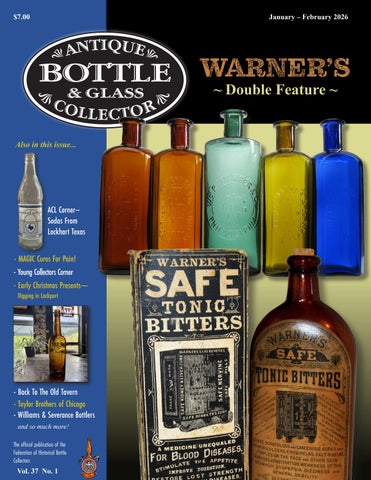
WARNER’S ~ Double Feature ~
Also in this issue...
ACL Corner– Sodas From Lockhart Texas - MAGIC Cures For Pain! - Young Collectors Corner - Early Christmas Presents— Digging in Lockport
- Back To The Old Tavern - Taylor Brothers of Chicago - Williams & Severance Bottlers and so much more! The official publication of the Federation of Historical Bottle Collectors
Vol. 37 No. 1
The FOHBC Virtual Museum was established to display, inform, educate, and enhance the enjoyment of historical bottle and glass collecting by providing an online virtual museum experience for significant historical bottles and other items related to early glass.
Virtual Museum News By Richard T. Siri, Santa Rosa, California
PHASE 4 “Wishart’s Pine Tree Tar Cordial” bottle has been filled. Thank You!
LET’S GO!!! PHASE 5 “Dr. Wonser’s Indian Root Bitters!”
An important update for FOHBC members.
$30k
The Virtual Museum is ready to kick off the project of adding over 700 images to the various galleries, and some new ones. Alan and Elaine DeMaison, assisted by Terry Crislip, imaged all of the “Masterpieces” and “Barber Bottles” collection on exhibit at the Houston Museum of Natural Science at the FOHBC National Expo in 2024. Several other personal collections are also included in this group.
Phase 1 Flask Filled 12/18
$25k
$20k
After preparing 36 photographs of each item, they are ready to be placed into the software program that produces the “spinners.” Descriptions are added and then they go live for everyone to see and enjoy.
Phase 2 Jar Filled 12/21
$15k
$10k
Training several new volunteers for this phase of the project will take place soon and you will begin seeing new entries in early 2026. To participate in this project and share your expertise, contact: Doug Simms, Webmaster, at dsimms@FOHBC.org.
Phase 3 Barrel Filled 12/22
$5k
Phase 4 Cordial Filled 12/25
Thank you to all who have contributed to the Phase 4 capital campaign to continue development of the FOHBC Virtual Museum, a project of The Federation of Historical Bottle Collectors, a non-profit 501(c)(3) educational organization. Phase 5 presents a challenge to fill the Dr. Wonser’s Indian Root Bitters. With a $10,000 start from the matched grant, we’re well on our way.
$
Thanks to Richard Siri’s $5,000 donation, the VM was awarded the $5,000 matching grant pledged by an anonymous donor!
$
Now on a dedicated high-speed server, with minimal maintenance costs, there are no salaried technicians. All donated funds are used for additions to the Museum.
F
HI
ST O R I C AL
BO
T
O
E FE
O LLEC T O
D E R AT
EC
IO
N
TL
TH
RS
VI
RT
U A L M U SE U
FOHBC VIRTUAL MUSEUM OF HISTORICAL BOTTLES AND GLASS
M
FO H B C Vi r t u alMuse um. org For gift information: Alan DeMaison, FOHBC Virtual Museum Treasurer, 1605 Clipper Cove, Painesville, Ohio 44077, a.demaison@sbcglobal.net
Vol. 37 No. 1
January – February 2026
No. 83
TABLE OF CONTENTS
To Advertise, Subscribe or Renew a subscription, see pages 71 and 72 for details.
FOHBC Officers | 2024–2026 ...................................................................................... 2
To submit an article, send a letter, or share comments, contact:
FOHBC President’s Message ............................................................................................ 3 FOHBC News–From & For Our Members .......................................................................... 4
Alice Seeliger, Editor N8211 Smith Road Brooklyn, WI 53521 phone: 608.575.1128 email: FOHBCmembers@gmail.com
FOHBC Regional News ................................................................................................... 6 American Poison Bottles by Vern Huffstetler, Joan Cabaniss and Tim Adams ........................... 10 ACL Corner #20 – Lockhart Texas by Mike Dickman .......................................................... 12 Magic Cures For A Painful World by Andrew Rapoza ............................................................ 16
12
Young Collectors Corner by Alice Seeliger ........................................................................ 22 The History of H. H. Warner’s Safe Bitters by Michael Seeliger ....................................... 26 William R. Warner Bottles 1856-1908 by Brian Bingham .................................................. 30 Early Christmas Presents, Part 2 by Peter Jablonski ........................................................ 34 Williams & Severance, California Gold Rush Soda Water Bottlers by Eric McGuire ............ 38 Back To The Tavern: A Whiskey Bottle Comes Home by Craig Cassetta .............................. 48
16
Taylor Brothers Of Milwaukee & Chicago by Peter Maas .................................................. 54 Lost & Found ................................................................................................................ 60 Member Photos ............................................................................................................ 64 Classified Ads ............................................................................................................... 67 FOHBC Sho-Biz–Calendar of Shows ............................................................................... 68 Membership Benefits, Display Ad Rates, Donations to the FOHBC .................................... 71 Membership Application, Classified Advertising & Article Submission ............................... 72
So you don’t miss an issue of Antique Bottle & Glass Collector, please check your labels for expiration information.
26
Fair use notice: Some material in Antique Bottle & Glass Collector has been submitted for publication in this magazine and/or was originally published by the authors and is copyrighted. The Federation of Historical Bottle Collectors, Inc., a non-profit 501 (c)(3) educational organization, offers it here as an educational tool to increase further understanding and discussion of bottle collecting and related history. We believe this constitutes “fair use” of the copyrighted material as provided for in Section 107 of the U.S. Copyright Law. If you wish to use this material for purposes of your own that go beyond “fair use,” you must obtain permission from the copyright owner(s). Antique Bottle & Glass Collector (ISSN 1050-5598), Copyright © 2025 by the Federation of Historical Bottle Collectors, Inc., is published bi-monthly (6 issues per year) by the Federation of Historical Bottle Collectors, N8211 Smith Road, Brooklyn, WI 53521. Business and Editorial Offices: N8211 Smith Road, Brooklyn, WI 53521. Accounting and Circulation Offices: the Federation of Historical Bottle Collectors, Inc., N8211 Smith Road, Brooklyn, WI 53521. Call (608) 575-2922 to subscribe. Periodicals postage is paid at Stoughton, Wisconsin 53589, and additional mailing offices. Pub # 005062 Postmaster: Send address changes to Federation of Historical Bottle Collectors, c/o Michael Seeliger, N8211 Smith Road, Brooklyn, WI 53521. Phone 608-5752922; email: fohbcmembers@gmail.com. Annual subscription rate is: $40 for Standard Mail or $65 for First Class, $85 to Canada, $120 other countries, $25 Digital Membership [in U.S. funds]. Life Membership: Level 1: $1,000, Level 2: $500. The Federation of Historical Bottle Collectors, Inc. (FOHBC) assumes no responsibility for products and services advertised in this publication. See page 72 for details.
38
The names Federation of Historical Bottle Collectors Inc. (FOHBC), and Antique Bottle & Glass Collector ©, are registered ® names of the Federation of Historical Bottle Collectors Inc., and no use of either, other than as references, is permitted without expressed written consent from the Federation of Historical Bottle Collectors Inc. Certain material contained in this publication is copyrighted by, and remains the sole property of, the Federation of Historical Bottle Collectors Inc. while others remain property of the submitting authors. Printed by Modern Litho, Jefferson City, Missouri.
48
January – February 2026
54
Visit us at: FOHBC.org & Facebook
1
FOHBC Board of Directors Director-at-Large: Richard Siri, PO Box 3818, Santa Rosa, California 95402, phone: 707.542.6438, email: rtsiri@sbcglobal.net Northeast Region Director: Charles Martin Jr., 5 John Hall Cartway, Yarmouth Port, Massachusetts 02675, phone: 781.248.8620, email: cemartinjr@comcast.net
Federation of Historical Bottle Collectors
The Federation of Historical Bottle Collectors is a non-profit organization, founded in 1969, for collectors of historical bottles, glass and related collectible items. Our primary goal is educational as it relates to the history and manufacture of historical bottles and related artifacts.
Midwest Region Director: Henry Hecker, W298 S10655 Phantom Woods Road, Mukwonago, Wisconsin 53149, phone: 262.844.5751, email: phantomhah@gmail.com Southern Region Director: Tom Lines, 1647 Olivia Way, Auburn, Alabama 36830, phone: 205.410.2191, email: Bluecrab1949@hotmail.com Western Region Director: Eric McGuire, 1732 Inverness Drive, Petaluma, California 94954, phone: 707.481.9145, email: etmcguire@comcast.net
FOHBC Officers 2024–2026 FOHBC Virtual Museum:
President: Michael Seeliger, N8211 Smith Road, Brooklyn, Wisconsin 53521, phone: 608.575.2922, email: mwseeliger@gmail.com
FOHBCVirtualMuseum.org
Vice-President: Position Open
Requires FOHBC membership, access through FOHBC.org
Secretary: Alice Seeliger, N8211 Smith Road, Brooklyn, Wisconsin 53521, phone: 608.575.1128, email: AliceSecretaryFOHBC@gmail.com
Auction Price Report: Facebook:
Federation of Historical Bottle Collectors
Treasurer: Kathie Craig, 1037 Hazelwood Avenue, Campbell, California 95008, phone: 408.591.6511, email: kathie.fohbc@gmail.com
Antique Bottle & Glass Collector, the Official Publication of the Federation of Historical Bottle Collectors.
Business Manager: Position Open
Publisher: The Federation of Historical Bottle Collectors, Inc.
Membership Director: Position Open. (Interim) Michael Seeliger, N8211 Smith Road, Brooklyn, Wisconsin 53521, phone: 608-575-2922, email: mwseeliger@gmail.com
Editor: Alice J. Seeliger, alicesecretaryFOHBC@gmail.com
Marketing Director: Craig Cassetta, 12 Marlin Court, Chico, California 95973, phone: 530.680.5226, email: ccassettafohbc@gmail.com
Digital Director/Webmaster: Doug Simms, dsimms@FOHBC.org
Special Projects Director/Webmaster: Doug Simms, 1317 Tullahoma Drive, Prattville, Alabama 36066, phone: 334.318.1965, email: dsimms@fohbc.org Director-at-Large: Matt Lacy, 3836 State Route 307 Austinburg Ohio 44010, phone: 440-228-1873, email: mlacy28@yahoo.com Director-at-Large: John O’Neill, 1805 Ralston Avenue, Belmont, California 94002, phone: 650.619.8209, email: Joneill@risk-strategies.com
2
Design / Layout: Michael George, earlyglass@gmail.com Sales Manager: Alice J. Seeliger, alicesecretaryFOHBC@gmail.com Social Media: Craig Cassetta, ccassettaFOHBC@gmail.com Featured Writers: Mike Dickman, Andy Rapoza, Vern Huffstetler, Joan Cabaniss, Tim Adams, and Eric McGuire.
FOHBC (Federation of Historical Bottle Collectors) N8211 Smith Road Brooklyn, Wisconsin 53521-9789 General Contact: FOHBCmembers@gmail.com
Antique Bottle & Glass Collector
President’s Message Michael Seeliger President Federation of Historical Bottle Collectors
N8211 Smith Road, Brooklyn, Wisconsin 53521 • 608.575.2922 • mwseeliger@gmail.com
W
elcome to 2026! As we start off a new year, I’m sure we all look forward to exciting bottle shows and increased activity in our hobby…and in a few more months in our thawed out frozen tundra…digging. There are four shows in January that, unfortunately, I could not attend—I hope lots of you in those areas were able to do so. Keep an eye on the FOHBC.org Shows page to plan your show schedule this year.
I always look forward to the Milwaukee Antique Bottle and Advertising Show, this year on February 1st. This kicks off the show season for me as it is close, and we just hope there isn’t an ice storm...anything else and we get ourselves there. Again this year, we will attend as many shows as we can, representing the Federation, and we appreciate the warm welcome we always get from those who host the shows. We are receiving welcome feedback and use that to decide the direction in which to lead the Federation. I hope you enjoyed the first AB&GC issue produced by Michael George and Alice Seeliger. I think they did a fantastic job, and this issue promises to be a repeat. Both Michael and Alice have stepped up in a big way to bring this magazine to you. And a big thank you to everyone else who answered the call and submitted articles, photos, news, and show advertising. Keep those coming! We are very grateful to our major advertisers who offset a portion of the cost of the magazine. We welcome more advertisers—auction houses especially; and have set up a new section on FOHBC.org “AUCTIONS” to enable everyone to get to those auctions quickly. This issue features two of my favorite subjects: H.H. Warner and Wm R. Warner—both medicine giants. Eric McGuire proves that Williams & Severance were much more than just “soda water bottlers,” and Peter Jablonski aka Buffalo Boyz aka Privy Meisters, gets down and dirty again. And there’s much more to enjoy including how a western whiskey found its way home. The Young Collectors Corner is really a fun read…and the photos tell such a wonderful story. Most of us can remember being in the dirt, getting an itch on our nose, and ending up with a very dirty face. Young collectors are loving it! We have many young collectors to feature in future issues and welcome more submissions. Someone told me years ago that there are more bottles in the ground waiting to be found than all the bottles in our collections. These young people have embraced the pick and shovel (note these on the FOHBC logo) and are proving this to be true. They are also proving that there are young collectors out there and bottle collecting is enjoying a resurgence of interest. I urge you to mentor and encourage these young collectors. Many may not know about Sanborn maps, how to gain permission, and the correct and safe way to dig (subject of a future article). Encourage them to research companies that produced the bottles they find, the businesses set up to sell the contents, and how bottles reflect the history of this country. Share your vast amount of knowledge about business enterprises including glass houses, producers of products, and the marketers who were very creative in getting these distributed. Maybe this 250th Anniversary of the United States (and the 50th Anniversary of FOHBC’s first show in St. Louis) is the perfect time to step forward as the historians and preservationists we have proven to be. This is the legacy you are leaving for the next generation. January – February 2026
3
FOHBC News
From & For Our Members New Reference Book Release By Thomas Haunton! Announcing the release of Last Links to the Past 20th Century South Jersey Glass Volume 2 - Brotherhood in the Pine Barrens. Last Links to the Past Volume 2 is a combination of history book, picture book, and detailed production catalog of one of New Jersey’s best-known but rapidly disappearing products, hand-blown glass. Using information gathered by the author over a period of forty years, the book tells the stories of more than forty glassblowing shops that operated in, or immediately adjacent to the New Jersey Pine Barrens between 1899 and 2025. Sources include over a hundred interviews with South Jersey glassblowers and their families, private manuscript collections, catalogs, trade journals and other publications, as well as hundreds of newspaper articles and advertisements. Readers will find photographs of glassblowers, molds, tools, formulas, catalogs and newspaper articles. Many of these photographs have never been published or not seen the light of day for decades. And, of course, you will see the glass! Hundreds of color photographs of documented pieces of hand-blown glass, paperweights, whimsies and pressed glass produced by these companies and artisans. These include Ralph Barber Millville Roses; the little known backyard shop glass by Emil Larson; glass from the New Jersey WPA Arts and Crafts Project; two unknown patterns of depression glass by Dell; art glass by Durand, Iorio Furnaces, Liberty Village, and Vandermark-Merritt; unknown pieces by the Bohemian Art Glass Works made on the Boardwalk in Atlantic City; and the newest South Jersey Glass now being made in Millville and Clayton.
A Sunday Dig! November 23, 2025 with Mark Wiseman, Charlie the Pup, and Tyler Johnston. I had dug many pits along the north side of this alley years ago, but the south side of the alley had previously been lined with trees. As the houses are being removed along the south side of this block and the alley trees removed, opportunities to dig have presented themselves. The pit we dug was almost six feet deep, about three feet by three feet wide. It was full of coal ashes to the bottom clay layer with roots across the top that required cutting. All of the glass we found was along the alley side. Tyler is holding the Warner’s Safe Tonic bottle which will need a tumble to clean up. I have never seen one before. Also found were a cobalt “Nutmeg” lamp, a seam-based “Dr. Kennedy’s Medical Discovery, Roxbury, Mass.” with “6” on base, an amber short, thick chemical bottle embossed on the shoulder “H.T. & Co.” very heavy glass, a “Dr. Price’s Delicious Flavoring Extracts” bottle, a slick square drugstore bottle, slick clear medicines and two broken ironstone platters, one a gluer, base stenciled “Stone China James Edwards & Son, DALEHALL” also stamped below the glaze “Jas Edwards & Son, DALEHALL.”
Last Links to the Past - 20th Century South Jersey Glass Volume 2 Brotherhood in the Pine Barrens. 8½ by 11 inch softbound book. 614 pages, over 1200 photographs. $125 media mail postpaid for early buyers. Retail $150.00 media mail postpaid. Discount available for institutions. Payment by check, money order, or PayPal. For purchase and/or questions, use Instant Messager or contact: tchaunton@comcast.net 4
Antique Bottle & Glass Collector
Diving Revives New Interest For Collector!
Hi Alice, I want to thank you for reaching out to me this morning. I’ll give you a brief history on my collecting. I was born and raised in Wells, Maine and I started collecting 32 years ago at the age of 10, influenced as a child by my grandmother and by an older man in my neighborhood, both who were bottle diggers. My first collection started with Coca-Cola bottles and soon shifted to rare Maine bottles with a passion for pontiled pieces. At the age of 20, I sold my entire collection to start a handyman business and within a couple of years with a successful business, I started to build another collection. The collection that I have now is mostly comprised of rare Maine bottles with most being pontiled, New England made colored pontiled medicines, utilities and inks. As mentioned before, Richard Carney got me into bottle diving during 2020 when Covid hit and my business slowed down. I started my Facebook page, Maine Bottle Hunter about that time as well to not only display my finds but also to educate others on this wonderful hobby of ours. I have received wonderful feedback from the page and The Honorable Richard Carney it is a pleasure to interact with so many collectors. I am bigger into bottles now than I have ever been, giving educational talks at the local historical society and traveling to most of the shows in the Northeast.
Bottle Club Festivities!
One of the oldest bottle clubs is the San Jose, California club which began in 1962 by Del & Vi Kenyon. Well-known Warner bottle collector, Jack Craig, (deceased) was a longtime member and passed his love for collections on to his son, Mike Craig and his wife, Kathie. Mike and Kathie often host club meetings, but this one topped them all. Michael and I were lucky enough to be invited – all the way from Wisconsin. It was wonderful to be among this great group of over 50 collectors. The “Macarthur Avenue” house was filled with guests who enjoyed a beautiful charcuterie table, desserts to die for, handblown vases (Mike Craig) filled with exquisite flower arrangements...and collections that would rival any. A room full of beautifully displayed woodworker tools greeted visitors on the way to “the bottle room” where Mike had just finished rebuilding 15 new showcases to add to the already-existing 150 showcases housing more Warners than you could count, Owl Drug Store bottles, Cures, inks and car vases in every imaginable color. Other rooms showcased Stone Ginger Beers, Winchester products (not guns), sodas and a wide variety of lovingly cared for treasures from the past. I hope you enjoy these photos from the event. Our thanks to Mike and Kathie for including us in this celebration. ~ The Seeligers
-Justin Petelle AKA Maine Bottle Hunter January – February 2026
5
FOHBC
Regional News Southern Region Report – Tom Lines
A
s we’re recuperating from the holiday season with all its activities with family and friends, we start thinking about the new year including which shows we’ll make…stick with the 5-6 usual shows or expand out to catch a new one??... maybe even a show out of your region?? Try it sometime! As for me, in the short term, my first show of the year will be in Jackson, MS on January 17th…year in and year out, it’s always been a favorite of mine. Seldom do I leave there without making a collection purchase. (Check the FOHBC. org Show Calendar for details.)
Southern Collector Spotlight This month’s collector profile is on Raleigh, North Carolina’s David Tingen. I first met David back in 1977 or 1978 at a meeting of the North Carolina Bottle Collectors Club in Raleigh. By that time, he had already been collecting for over 20 years! When I contacted him, he told me of an article a local magazine had published on his collecting interests. After getting that article, I gleaned lots of info on him. David collected and still collects blob beers and at one time had the preeminent collection of them. But, hey, let’s get a look at his beginnings… David’s roots go back to 1955 when he discovered several old bottles in a creek bank when he was creating a makeshift dam to float his model boat. The first thing to roll out was a small size Bromo Seltzer. The cobalt color intrigued him and the hook was set. Seventy years later, he’s still at it! During this time, he was a member of the NCBCC for 50 years, serving a president for 20 years. He has also authored four “small-run” collector’s guides. He is considered the “go to” person on bottling histories in the state, as well. The hobby has given David a large network of friends, but to him, the biggest thrill is finding and holding a new treasure in his hands. As a youngster, his focus was on finding new bottles whether digging them or scrounging for them around Raleigh. But like many of us, the hobby slowed down in early adulthood by a stint in the Navy (Thanks for your service David!) and then starting a family. Once he got reenergized, he pursued the histories of the bottles he had found. This 6
ultimately led to his interest in pre-pro blob beers. His collection grew to over 1,000 examples! He has since downsized to about 350 by selling many plus giving away others. Another NC collector, Randy Cobb, who met David at the Greensboro Bottle Show, describes him as a “walking encyclopedia” on NC bottle histories. Cobb further said that David stands out for his authentic interest in each bottle. Looking back, David says “I’ve always believed that you succeed by being a student of whatever you pursue and it’s been fun for me.” And, by the way, remember his first find, that small Bromo? Well he mounted it in a frame and it hangs on his wall! Thank you David for all your contributions to our great hobby! I feel honored to call you a friend.
Midwest Region Report – Henry Hecker
A
s of this writing, the Midwest region is largely buried under a November blizzard and in the throes of a brutal cold snap… a hard stop for digging, diving, and virtually any other outdoor venue for bottle hunting. Our hunger for antique glass and pottery must be satisfied via estate sales, auctions, and commerce within the collector set. Bring on the winter shows! Speaking of auctions, this 1850’s Maxfield, Milwaukee churn recently sold for $7250 plus buyer’s premium. Obviously, the decorator did not possess the artistic skills of the “Eastern” potters (that’s a cluster of grapes). Courtesy of Cedarburg Auction Company Antique Bottle & Glass Collector
The Four Regions of The Federation: Western, Midwest, Southern, and Northeast
The 1854 date was significant as the first year of operation for John and Amos Maxfield of the Milwaukee Stoneware Factory.
The November newsletter of the North Star Historical Bottle Association included a photo of this great cure trade card. The Kalamazoo Club held club digs and metal detecting (along with cookouts) at two Civil War period homes in Michigan on November 22nd and 23rd. What a great way to enjoy our hobby. You can visit the club’s Facebook page to see the results. Michael Seeliger and I attended the bottle show in Portage, Wisconsin on November 1st. This show has been going on for several years now and attracts about twenty dealers with some fresh-to-market merchandise. While this is not a venue to search for figural bitters or other “high end,” nationally important bottles, it has the potential for that “sleeper.” In fact, we each found a couple in that category. The show promoter has added a second show in March as well. Complimentary Federation magazines were handed out to some new faces, at least for me. Last issue, I discussed the challenge of issuing club newsletters (hard copies) against rising printing and mailing costs, inconsistent postal delivery, and the scarcity of volunteers for editorial duties. The latest issue of the Ohio Swirl was visibly scaled back temporarily but the Club is diligently working to find a solution to the cost pressures. I wonder, since this is an almost-universal challenge, whether the power in numbers rule may apply here. Could various clubs and related hobby organizations pool their publications in a sort of co-operative arrangement, for better economies of scale? I understand our AB&GC Editor, Alice Seeliger, is exploring some possibilities. January – February 2026
Western Region Report – Eric McGuire
2
025 has entered into the abyss of an unknown realm we call the past. Along with that year has gone a number of our own bottle-collecting group. I hesitate to name them for the obvious sake of unrealized omissions. I do want to note one Western Region individual, mostly because I was just thinking about him, even though he passed last February. Vince Harbick was a lifetime collector who collected nearly as long as I have, but he was a decade older at 91 years. He was one of the early collectors associated with the Northwestern U.S. Vince favored collecting early Oregon and California bottles and we spent long hours discussing the subject. He is greatly missed by those who knew him, and especially the members of the Oregon Bottle Collectors Association. As one of the “old timers,” I often reminisce about the past, even though the thoughts often don’t come on demand. As a result, I am just glad to take them as they come. One recent thought was what we diggers call the “probe.” As a bottle digging tool, it was popularized--maybe even invented--by the early western diggers. I will probably get some negative feedback on that statement; but back in the mid-1960s, if one were to find old privies, it was an absolute necessity. They were initially a little more rudimentary than the current version. It was even difficult to find a piece of spring steel to make the rod. It was common to seek out old auto junkyards for the prized tension springs that operated trunk hoods. The best were mostly located on Cadillacs and Lincolns because the rods were a little longer than on most other cars. To own a six-foot, spring-steel probe was a big deal. But the next “technological advance” for the probe soon followed. About 1965, someone came up with the idea of welding a tip on the probe that was slightly larger than the diameter of the rod. This addition considerably reduced the friction caused by dirt and rocks rubbing against the probe when shoving it into the ground. Some minor improvements were made with on the handle, but the probe hasn’t changed much since. Eastern diggers finally picked up the idea but in digging Eastern towns in the mid-1970’s it was exceptional to see someone use the probe.
7
FOHBC
Regional News Northeast Region Report – Charlie Martin, Jr.
N
ew Year’s Greetings. I expect that all of our readers are well rested and well fed after the Holiday Season. Comfort foods are the soul of home cooking at this time of year. I want to wish all our Federation Family members a very Happy, Healthy and Prosperous New Year. May this be your year for finding that special bottle to add to your collection. Before I review the bottle shows recently concluded in the late Fall of 2025, I would like to ask you to email me (cemartinjr@comcast.net) to let me know: What was the “it bottle” that hooked you on collecting bottles or glass. I believe I’ve mentioned earlier that for me it was a $1.00 Atwood Bitters that I found at a local flea market back in the late 1960’s. I am always curious to learn how and why collectors of antique glass came to the hobby…won’t you please humor an old codger with your reply? Thank you in advance for your kindness. Now on with our report… Tom Karapantso, show co-chair, submitted the Greater Buffalo Bottle Collector’s 26th Annual Show review, held on September 21, 2025. “Paid attendance was 170 plus. Adding 57 dealers and 12 free admissions, our total came to 239 people. There was aggressive advertising this year spearheaded by Co-Chairman and club President Peter Jablonski. The club invested money in purchasing more lawn signage and large vinyl banners for placement with permission at antique co-ops and flea markets,(100 miles from Buffalo, NY to NY State line and 100 miles from Buffalo into Pennsylvania) plus ads in printed publications and free Polish Radio Station commercials. We loved seeing the increased participation from collectors and dealers from the Ohio Bottle Club. We had a slight increase in dealers from the GVBCA, Rochester NY club. The attendance was steady throughout the day. Because the show was so busy, I did not get to ask all the dealers until packing up time, but the few people that I spoke with are returning in 2026.” Paul McClure, Show Chairman for the Mid-Maine Antique Bottle Club, submitted his report of their 5th Annual Show held on September 28th at the Topsham Fairground Exhibition Hall. It was a great Fall day where dealers were set 8
up both outside and inside where the seventy (70) tables represented a sold-out show. “A special item on display was a handmade bottle quilt that was graciously donated to the club by Curt Morse’s sister, Sally, after Curt’s passing earlier this year. Made by Curt and his wife, Jean, in 1986-87, the quilt features 36 well-known collectable bottles hand-stitched on one side and a large depiction of the “American System” flask on the reverse. An educational display of Maine ACL sodas with regional or national distribution was presented by club members Sam Fuller and Mike Massey. Special guests from the Poland Springs House Museum and the Moxie Museum were set up as well. The club presented Rick Ciralli a special trophy ’2025 Dealer of the Year’ to thank him for his commitment and contributions to our club, our show, and the hobby!” Paul further provided many photos taken by Dan Lakatos, Tom Ostrowski and Paul McClure. These photos should be up on our Federation web page (FOHBC. org) and/or Facebook page by the time you are reading this article. My final report for this edition of the magazine comes from the Yankee Bottle Club. The 56th Annual Keene Show and Sale was held on Sunday, October 12th. It was a spectacular show. The day was overcast and mild with promises of rain as southern New England was preparing for the impact of its first of the season Nor’easter. No matter. Weather could not put a damper on this fine show! The dealer spaces were completely sold out; attendance was quite high. While I was there shopping for the next “special item” to add to my collection, I noticed many, many buyers wrapping up their next “special piece” as well. The Keene Show (as it is affectionately called) is still, in my humble opinion, the best show in New England. The dealers I spoke with were quite happy with the brisk buyer activity. “Art” Gueguen, a wellknown and highly respected local dealer, told me that he has set up at Keene more than 50 times over the past six decades. “WOW !” I wanted also to mention two dealers, Sam Fuller and Guy Kelley, both from Maine. They have been so responsive and cooperative in helping me add new material to my own collection. Thank you, guys. Until next time, happy bottle collecting! Antique Bottle & Glass Collector
$1,000 June 2021 Glass Works Auctions #167 Lot 141: June 2021 · Glass Works Auctions “ST / DRAKE’S / 1860 / PLANTATION / X / BITTERS - PATENTED / 1862”, (Ring/Ham, D-108), New York, ca. 1862 - 1875, black olive amber color 6-log cabin, 10”h, smooth base, applied tapered collar mouth. Perfect condition, extremely bold impression, no wear or scratches. A very rare color and as dark as any we’ve sold! Also four heavy ‘beads’ are embossed on the base, something we have not seen in any other Drake’s! Dan Catherino Collection.
$180 May 2012 American Glass Gallery #8 “ST / DRAKE’S / 1860 / PLANTATION / X / BITTERS - PATENTED / 1862”, (Ring/ Ham, D-105), New York, ca. 1862 - 1875, medium salmon pinkish puce 6-log cabin, 10”h, smooth base, applied tapered collar mouth. A 1/2” in diameter in-making chip extends from beneath the applied collar down into the neck. Pure puce color that looks great in any lightning.
$2,400 November 2020 American Glass Gallery #121 Lot 185: ““S T / DRAKE’S / 1860 / PLANTATION / X / BITTERS - PATENTED / 1862”, 1862 - 1880. Medium-to-deep pinkish raspberry, cabin form with 6 logs above the label panel, applied sloping collar - smooth base, ht. 9 7/8”, near mint; (just the slightest trace of minor wear, and the embossing is a little weak in the upper shoulders as is not uncommon with this mold, otherwise perfect). R/H #D106. A gorgeous, rare, eye-appealing color that passes plenty of light, and having plenty of pink!
$15,690 September 2020 Glass Works Auctions #121 251: “General Washington” And Bust – “E Pluribus Unum / T.W.D.” And Eagle Portrait Flask, Kensington Glass Works, Philadelphia Pennsylvania, 1820-1830. “Firecracker” Medium amber with a strong olive tone, sheared mouth – pontil scar, pint; (light exterior high point wear). GI-14. Tremont Labeth collection.
$14,000 September 2020 Glass Works Auctions Lot 172: “ST / DRAKE’S / 1860 / PLANTATION / X / BITTERS - PATENTED / 1862”, (Ring/Ham, D-105), New York, ca. 1862 - 1875, medium moss green cabin, 9 7/8”h, smooth base, applied tapered collar mouth. Recently ‘picked’ at the ‘Elephant Trunk’ flea market in Connecticut (a favored venue of the ‘Flea Market Flip’ reality television show), and possibly only the second known example in this very unusual moss green color. In 1993 we auctioned the collection of Elmer Smith of Shelton, Washington. Lot 20 in that collection was at that time the only moss green Drake’s Plantation Bitters known to exist, it sold for $10,000!
Drake’s Plantation Bitters
Available to FOHBC Members Only! Online Auction Price Report. Search on your smartphone, tablet or desktop computer. Includes 10 years of results from American Bottle Auctions, American Glass Gallery, Glass Works Auctions and Heckler in Phase 1. The Auction Price Report is only available to FOHBC members. Being a FOHBC member will give you 24/7/365 access. What a great tool this is for the collectors, diggers, pickers, researchers and the generally curious! Phase 2 updates will include images! Visit the FOHBC.org Members Portal for instructions. January – February 2026
9
American Poison Bottles Tablet Shapes and Color Added Further Protection By Vern Huffstetler, Joan Cabaniss and Tim Adams
D
octors of the nineteenth-century traveled by horse and buggy and did most of their work from a medical bag. Tablets of mercury bichloride were of great benefit to these traveling doctors. A tablet could be quickly dissolved into a pint of water in a bowl or basin to prepare an antiseptic solution for a surgical scrub, sanitizing tools or treating lesions. However, when these poisonous dispensing tablets were confused with oral medications the result was often fatal. In 1871, the American Pharmaceutical Association recommended dispensing tablets should be packaged in bottles of distinctive shape and color easily identifiable in the dark or light. Labeling laws soon followed requiring red labels bearing the word POISON. Many of the labels also incorporated the skull and crossbones as a warning. Although some companies only used the labels as a warning, the leading pharmaceutical companies went even further than bottles. They molded the tablets in distinctive shapes and colors for another level of caution. Henry K Wampole & Co. molded their antiseptic tablets into six-pointed stars as added protection to their KU-14 poison bottle.
In 1906 John Wyeth & Brothers utilized cylindrical tablets in a red labeled cobalt blue cylindrical bottle.
John Wyeth & Brothers also used blue disks with a skull and crossbones for their antiseptic tablets.
10
Eli Lilly & Co. shaped their tablets like diamonds and packaged them in their patented KV-1 poison bottles. Eli Lilly & Co. diamond antiseptics captured in an epoxy resin.
William R. Warner & Co. molded their antiseptic tablets known as “Triloids” into blue triangles and sold them in matching triangle shaped bottles. The KT-9 poison bottle held twenty-five tablets while the smaller KT-15 held six tablets. “Trilets” were smaller triangle-shaped that were mixed with four ounces of water instead of a pint.
Brewer & Co. also used triangular tablets in the KT-10 poison bottle for their Corrosive Sublimate, which is another designation for Mercury Bichloride.
Antique Bottle & Glass Collector
Post 1906 the JNO. T. Milliken used triangular tablets in the KT-5 poison bottle. However, after 1929 Abbott used the same bottle with coffinshaped tablets.
The United Drug Company, supplier for Rexall stores, supplied antiseptic tablets in both KT-2 and KT-4 triangular poison bottles. We are unsure if they were originally contained triangular pills. However, likely after 1913, tablets were coffin shaped as shown.
Sharp and Dohme initially addressed the tablet shape with an interesting idea. They molded their tablets into dark blue clovers, stamped POISON, and attached them with a thread.
A multitude of companies utilized the KS-2 and KS-8 poison bottles to distribute coffin-shaped antiseptic tablets. Research for this article revealed that several of the same companies used both bottles with nearly identical labels. KS-2 held twenty-five tablets, and the smaller KS-8 held six tablets.
Norwich Pharmacal utilized coffin-shaped bottles and coffin-shaped tablets for added protection. Each tablet had a skull and crossbones on one side and POISON on the other. Norwich originally applied for a patent in 1913 but subsequently donated the design to the American Pharmaceutical Association to be used as a standard for their members.
These cylindrical, triangular, diamond, star and coffin-shaped tablets in odd colors added another layer of protection to prevent accidental poisoning from mercury bichloride. As better alternatives with less side effects became available, the use of these tablets faded into history. They are now a reminder of the dangers that once lurked in nineteenth-century medicine cabinets.
Your Poison Bottle Team Foreground: Vern Huffstetler is a mechanical engineer, collector, author, photographer, and artist. He contributed significantly to writing the American Poison Bottles book, magazine articles, and three webinars on poison bottles. Research continues as he generously shares new discoveries.
During this period, there was extensive discussion on standardization for supplying troops during WWI. Norwich Pharmacal coffin tablets captured in an epoxy resin.
As shown here on the KR-50, KO-5 and KT-8 poison bottles, the leading pharmaceutical companies Sharp & Dohme of Baltimore, MD and Parke, Davis & Co. of Detroit, MI. adopted coffin shaped tablets as a standard for antiseptic pills.
January – February 2026
Back Left: Joan Cabaniss is the “Queen of Poisons.” She served as the long-time president of the Antique Poison Bottle Collectors Association. The May 2005 issue of National Geographic featured Joan and her collection in “Pick Your Poison.” In 2014, Joan and her collection were featured in Virginia Living magazine. The FOHBC Virtual Museum includes her impressive poison bottle collection. Joan coauthored the Poison Bottle Workbook, American Poison Bottles, and our magazine articles. Back Right: Tim Adams’ knowledge of the bottle hobby is extensive. His memory of who has what rare poison is phenomenal. He volunteers his time often ministering and supporting his community with catered chicken charity events. Tim is coauthor of the Poison Bottle Workbook, American Poison Bottles, and multiple magazine articles. 11
ACL CORNER #20
Lockhart Texas
[Mike Dickman]
D
uring the Golden Age of applied color label (ACL) soda bottles from 1934 to 1984, many brands served tiny markets. A market in those days might consist of just a few thousand people living within a few square miles. The bottlers often used local imagery on their labels, which would have been instantly recognizable to their customers but to hardly anybody else. Sometimes their bottles exuded pure “localness.” Let’s look at one such bottle and the city in which it was made. Lockhart, Texas lies seventy miles northeast of San Antonio and thirty miles south of Austin, the state capital. The city is named after Byrd Lockhart, a surveyor who was the first Anglo to set foot in the area. Lockhart did his surveys in 1840, four years after the Republic of Texas had won its independence from Mexico, and the city was founded a few years later. Lockhart sat alongside the Old Chrisholm Trail, used to drive cattle from ranches in the south to the rail-
heads in Kansas, an arduous journey that took up to two months. Agriculture in the area included cotton and grain sorghum, also called “milo” and typically fed to cattle (although apparently it can be popped and eaten by humans, like popcorn). The railroad arrived in Lockhart in the 1890s, and by 1900 the population had quadrupled from about 500 people to over two thousand. Lockhart is still a relatively small city. Although the population has grown to 14,000+ today, the city had only 4,360 people in 1930 and 5,570 in 1950, the era during which our featured bottles were made. Apart from the annual Chrisholm Trail Roundup festival, Lockhart is known for its barbecue and in fact is called “The Barbecue Capital of Texas.” And that’s not mere hometown bragging: the Texas legislature formally bestowed the nickname on the city in 1999. Little Lockhart has six well-known barbecue restaurants including the venerable Kreuz Market, which opened its doors in 1900. [FIG. 1]
FIG. 1 Street mural in downtown Lockhart. The newest entrant to the city’s barbecue scene is Barb’s-B-Q, which opened in 2024 and was a James Beard nominee for Best New Restaurant in the USA.
12
Antique Bottle & Glass Collector
FIG. 2 A Supergrade Beverage, Lockhart, Texas, 12 ounces, 1939
A Supergrade Beverage, Lockhart was put up in 1939 by the Coca Cola Bottling Company of Lockhart. [FIG. 2] The bottle held 12 ounces of soda pop and came in several flavors including a popular cream soda. Back in the day, the Coca Cola Company of Atlanta, Geogia supplied its syrup and concentrate to local franchise bottlers, who then made, bottled and distributed the product within the territorial boundaries defined by their franchise agreements. The local bottlers were permitted to have “home brands” as long as they were not cola-flavored and did not compete with a Coke-owned flavor such as Fanta or Sprite. Initially named the Lockhart Bottling Works, the company was started in 1898 by Gus J. Winkler. His brother Joe C. Winkler soon joined him as the manager. They started bottling Coca Cola in 1909 under a contract with the franchise bottler in San Marcos, Texas. In 1937, the Winklers purchased the Lockhart territory from the San Marcos franchisee and became the Coca Cola Bottling Company of Lockhart. When Gus Winkler died in May of 1945, his brother retired and Gus’s son and two daughters took over the company. In 1952, they put out an 8-ounce version of A Supergrade Beverage but their home brand didn’t last much longer. [FIG. 3] Today, the 12-ounce bottles are fairly hard to find and typically have worn labels and lots of scratches and wear, attesting to their FIG. 3 The eight ounce version (left) came out in 1952, a few years before the brand was terminated.
January – February 2026
long use. But they are not hugely pricey, and a near mint example recently sold for $125. The 8-ounce bottles are more rare, but I bought a mint one on eBay this year for just $17.38 plus shipping. A bargain! Both bottles have identical ACLs. The larger bottle, however, has an embossed neck (the sign of a bottle produced during the early days of ACLs, when they transitioned from embossed bottles with paper labels), while the 8-ounce bottle has a white ACL on its neck. Both necks depict an iconic Lockhart landmark: the top of the Caldwell County Courthouse on Main Street. Built in 1894 in Second Empire style, the building is listed on the National Register of Historic Places and is a truly magnificent structure. [FIGS. 4 and 5] In all likelihood, though, nobody from outside the area would have had a clue about what was being portrayed on the neck label.
FIG. 4 Caldwell County Courthouse in Lockhart, Texas, erected in 1894 and built with cream-colored limestone and red sandstone. FIG. 5 Close up of the embossed neck depicting the top of the local courthouse.
13
FIG. 6 Grain and flowers of the milo plant depicted on the ACL.
FIG. 7 Milo is an ancient, drought-tolerant and gluten-free grain that is widely used today to make ethanol.
The blue-and-white main ACL on both bottles uses rebuses, which are pictorial representations of words. There is a small heart inside a giant lock, and within the heart is the outline of a map of the state; thus, Lockhart, Texas. Although it’s a bit subtle, I suppose many people would have figured out the meaning. But the blue border surrounding the lock depicts grains and flowers that are truly obscure. It turns out that they are milo. [FIGS. 6 and 7] Like the bottle’s neck showing the courthouse, the representations of milo would have been mystifying to any non-local purchaser of the product. Finally, the backs of both sizes of the bottle make a claim about the sugary soft drink inside that might raise eyebrows in today’s world: “Good and Good for You!” Not exactly truth in advertising. [FIG. 8] A final thought involves the beverage’s name. The word “super” (meaning extraordinary or more than normal in quality, quantity or degree) is frequently used today, but it came into popular use in 14
the 1930s. The term “supermarket” first appeared around 1930, the first “Superman” comic book was published in 1938, and as we’ve seen, A Supergrade Beverage was first bottled in 1939. While I cannot opine about the quality of the beverage it once contained, I think the glass bottle is super nice! Local brands put up in ACL bottles once existed in most nooks and crannies of our great country. They have long since disappeared from commerce, but a few of their now-empty bottles still survive for us to collect, study, and enjoy. The author welcomes comments, questions and suggestions at mikedickman@yahoo.com
FIG. 8 Back of the bottle. Although sweet and delicious, is sugar really “Good for You”?
Antique Bottle & Glass Collector
Post card showing Lockhart, Texas in earlier times. The Lockhart National Bank can be seen in the background.
$100 National Currency Note, Series of 1882, issued by the Lockhart National Bank on May 10, 1900. The pictured note is the only one known to exist and sold for $17,250 in 2005. Photo courtesy of Heritage Auctions The beautiful Dr. Eugene Clark Library in Lockhart, erected in 1899 near the courthouse and said to be the earliest public library in Texas that still operates.
BIBLIOGRAPHY: Article, Lockhart Post Register, December 9, 1971 The Painted Soda Bottle Collectors Association website contains a wealth of information about ACL soda bottles including hundreds of photos, recent prices and an archive of all ACL Corner articles. www.PSBCA.org Sweeney, Rick, “Collecting Applied Color Label Soda Bottles” (3d ed. 2002, PSBCA) VintageSodaCollector.com by FOHBC member Tom Pettit, a great resource containing hundreds of color photographs as well as interesting, useful articles about all things ACL “Weide’s Soda Page” (ca-yd.com), by FOHBC members Chris and Catherine Weide, is another outstanding, useful resource for ACL soda bottles Wikipedia.com January – February 2026
Mike Dickman lives in Santa Fe, NM where he has collected bottles for thirty years. He’s been a member of the FOHBC since 1997. His collection includes figural bitters, poisons, blob-top sodas and colognes. About five years ago, Mike’s passion unexpectedly turned to ACL sodas and he wrote “The Joy of Collecting ACL Soda Bottles” for the September-October 2022 issue of AB&GC. His “ACL Corner” column started running in the following issue. He welcomes comments, questions and suggestions at mikedickman@yahoo.com. 15
Pain Attacks.
This is the first of a two-part “before-and-after” advertisement for Wolcott’s Instant Pain Annihilator aka Wolcott’s Pain Paint. Created by: W. Endicott & Co., about 1863. Library of Congress; Museum No. LC-USZC2-36.
By Andrew Rapoza
P
AIN. Throbbing, stabbing, aching, distracting, excruciating, agonizing, unbearable PAIN.
Hannibal Lecter and S&M enthusiasts aside, most people don’t like pain. We’ll do just about anything we can to avoid it and when it does happen to us, we’ll do everything we can think of to get rid of it, as quickly as possible. A toothache, a hangnail, a sprained ankle, a leg cramp, a migraine headache – every pain is one we want to have go away. You, me, and every one of our ancestors have tried almost everything to get rid of pain quickly. Sometimes what we try defies logic – and almost certainly flies in the face of science – but for thousands of years, in moments of excruciating pain, we have turned to methods and cures that win our praise if the pain goes away. That has often been the sole measure, whether it’s with two Advil pills today or a teaspoon of Wolcott’s Pain Paint over a century ago. When pain hits, our animal instinct just wants it to stop and the method, be it scientific or magical, really doesn’t matter. Be honest with yourself – you probably couldn’t explain the chemistry and active ingredients of Tylenol any better than your Victorian forebears could with Dr. William’s Pink Pills for Pale People. 16
The image above shows a Victorian-era man plagued by a legion of demons in full attack mode, causing his headaches, sinus pain, toothaches, neuralgia, and more. To his right, the Grim Reaper emerges from his fog-shrouded netherworld, looking pleased at the pain being inflicted by his minions. In the same primal way that such imagery symbolically described their pain, Victorians also wrapped their aching heads around the idea that pain could be cured by magic. Such a belief was likely passed down to them by old-timers in their lives who insisted that a special home-made medicine had to be swallowed during the waning of the moon or who still hung a horseshoe on their door. My own grandmother winced as she told me how her grandfather made his own medicinal tea from rat droppings because he distrusted doctors so much; he may have thought it was a magical brew but my grandmother thought he was just full of crap, as a career at that point. America has a long history of reliance on magic and superstition to influence our behavior. Here are just a few examples for you to steep in your cauldron of possibilities for the next time your body screams at you, “I’M IN PAIN!” Antique Bottle & Glass Collector
Magic Cures for a Painful World Victorian Magic Two hundred years after the Salem witch trials, well after the colonies had merged into the United States of America, the country had survived its Civil War and two wars with England, and it leapfrogged into an era of electricity, telephones, x-rays, anesthesia, vaccines, blood transfusions, and the discovery that germs cause disease. Amid all this growth, modernization, and sophistication, it might seem like there was no longer a need for superstition and magic. If that’s what you’d choose to believe, you have chosen … poorly.
Bartmann Bottle, about 1650. At its base is a modern recreation of typical “witch bottle” contents: nails, a fabric heart pierced by bent pins, and human hair with fingernail clippings. Rapoza collection.
Colonial Magic As I shared with you in my post, “Weaponized Witch Bottles” (10 AUG 2024), colonists in North America relied on biblical passages that warned against the evils of witchcraft. They turned their empty wine and beer jugs into weapons to protect against the attacks of witches and their familiars, especially to protect the sick in their families. They further strengthened their defenses by hanging a horseshoe outside their door and making ritual protection marks around their doors, windows, and fireplaces – all the possible entry points for evil spirits to enter the home. Even biblically-inspired numerology was taken seriously: a braid of 12 garlic bulbs (symbolic of the 12 apostles) hanging behind the door was believed to prevent witches from entering the house; just 11 bulbs was nothing more than a bunch of smelly vegetables hanging on the door. It was a time when magic was medicine and superstition dominated in the absence of science. January – February 2026
Magical Medicine from the Mystical Kingdom. The Egyptian theme of Colwell’s medicine tied in perfectly with its promise of magic. The eye-catching trademark featured the bizarre Sphinx above and baffling Egyptian heiroglyphics flanking the word MAGIC. The Egyptian-inspired trademark hinted at the mysterious origins of the magical cure. There was absolutely no effort to ensure scientific efficacy. (Library of Congress: Trade Mark No. 10,302, registered 22 MAY 1883)
Pain and disease had not been eliminated and science and medicine still had a long way to go. People were still having headaches and toothaches, rheumatism and sprains, and a bottle or box of medicine still offered low-cost, high-promise alternatives to doctors and dentists. 17
The absence of regulation in the medical marketplace meant medicine makers didn’t have to reveal the contents of their products and it’s fascinating how often they chose to claim their cure was MAGIC – far too many to list them all here, but a few examples were: • • • •
• • •
Bennet’s Magic Cure Dr. Colwell’s Magic Egyptian Oil Fink’s Magic Oil Van’s Magic Oil – None other than a customer named Mrs. A. Pain wrote to the manufacturer, “We will never employ a doctor for cold or diphtheria while we can get your Magic Oil.” Dr. Horbson’s Magic Oil Dalley’s Magical Pain Extractor Dr. Hardy’s Magical Pain Destroyer
Renne’s Pain Killing Magic Oil (bottle & poster, about 1885). Bottle courtesy of Library of Congress. Poster courtesy of Wm Morford Antiques, AntiqueAdvertising.com
One look above at the Victorian poster for Renne’s Pain Killing Magic Oil vividly reminds us of how much we hate to hurt. His puffy eyes are almost squeezed shut; a large tear streams out of the corner; his lips look aquiver in misery. The head bandage under his jaw was usually a symbol of tooth pain, but this pathetic soul is also holding his stomach, apparently yet another locus of pain. We empathize with our young friend – we feel his pain.
Dr. Hardy’s Magical Pain Destroyer (box & bottle), about 1885. It’s hard to believe that Dr. Hardy’s brooding face could encourage any confidence in the success of his medicine. It was likely a rendering from some early form of photography that required expressionless faces so the result of the slow shutter speed would not be fuzzy. But come on, Dr. Hardy - crack a smile! It’s not magic! Courtesy of Sheaff-Ephemera.com 18
Miserable in pain and apparent low on funds with a patched and tattered jacket, the young chap stands dumfounded in front of a drug store full of Renne’s Pain Killing Magic Oil; it’s frankly hard to tell if we are supposed to be witnessing that magical moment when he realized he had just found the cure for his woes or if his tear is because he couldn’t afford to buy the magical painkiller. Either way, he clearly wants some magic in his hard-luck life.
Dr. Hardy’s Magical Pain Destroyer (label on interior counter display box lid), about 1885. Courtesy of Sheaff-Ephemera.com Antique Bottle & Glass Collector
Notice that on the bottle, above the picture of Mr. Renne, was the magical medicine’s slogan, “IT WORKS LIKE A CHARM”; some newspaper ads assured that its effect was “very magical.” It was, of course, a great word to hide behind, since the public was not invited to know the ingredients and proportions being used in the medicine. Medicines not promising magical results hid behind other fanciful names, such as Dr. Kilmer’s Swamp Root Kidney, Liver, & Bladder Cure, Pocahontas Barrel Bitters, and Smith’s Bile Beans. But “Magic” was more than just a camouflage; it was also a promise of potency and results even though sick customers had no idea why it would work for them. Subconsciously, people who enjoy magic shows want to be deceived. It fills us with wonder and awe and lets us believe that the world is full of unexplainable things. Magic gives us hope there are answers for problems and pains we could not solve ourselves. Anyone who collects antique medicines knows that patent medicines had all sorts of names; those promising to stop pain weren’t limited to names implying magical ingredients. Perhaps the biggest selling pain cure of the century was the magic-free Perry Davis’ Pain Killer. Another example is from my own collection, Thurston’s XXX Death to Pain. Not only did its name promise to be the death of pain, but the triple “X” meant triple-strength – no indication of what, but it certainly sounded powerful!
Thurston’s XXX Death to Pain (box & bottle, about 1890). Rapoza collection.
Note that the bottle label explains that the Mystic Cure should only be used in combination with the Mystic Life Renewer. Mrs. Wilson’s Mystic Pills from Toronto, Canada, was the perfect name for a medicine designed for the many diseases and disfunctions of the mysterious female reproductive system. The title implied secrecy, the dark closet in which many high-strung Victorians wanted to have the subject hidden. The trademark shows the female angel holding a box of the medicine in her right hand and her left hand pointing to the banner that displayed the “Mystic Pills” part of the name.
Detchon’s Mystic Cure (box & bottle, about 1885). Rapoza collection.
Similar to the magic cures was a smaller subset of medicines called “mystic”. The name of Dr. I. A. Detchon’s Mystic Cure made it clear that the contents transcended human understanding and were somehow connected to ancient and perhaps occult mysteries. One of its ads explained that “Its action upon the system is remarkable and mysterious.” - take it, just don’t try to understand it. January – February 2026
19
Medicines made in the name of “Magic” were another clear evidence of a portion of the population still hanging on to remedies emanating from the occult universe. In fact, even as the new Food and Drug Administration clamped down on specious patent medicines, magic oils and the like lingered, defiantly, deep into the 20th century.
Digital Magic So now, dear readers, we sit in front of the screens of our cell phones and computers, reflecting a little smugly at the centuries of Americans who have believed in and resorted to magic, luck, and the mystical. But while our country may have continued its forward march in medicine, science, and technology, we are clearly far from giving up our superstitions and symbolic acts for warding off evil, eliminating physical and emotional pain, and encouraging good “mojo.” Newspaper advertisement for Mrs. Wilson’s Mystic Pills by the Gray Medicine Co., Toronto, Canada. The Daily Expositor (Brantford, Ontario), 2 OCT 1880.
An enlargement of the knuckles actually suggests the angel may be using the middle finger, but let’s just say it’s the index finger! For at least some of the many late-19th century remedies, the evocative words “Magic,” “Magical,” “Mystic,” or “Mystical,” in their name were used as more than just convenient marketing adjectives; they were designed to attract those customers who continued to harbor the centuries-old beliefs in magical potions, hoodoo, astrology, charms, and promises of good luck and fortune. Of course each era has also had its critics. Just like there were colonists who insisted there was no such thing as witchcraft, magic and mysticism had its detractors in the Victoria era. In 1900, Missouri’s Joplin News-Herald complained bitterly that “Americans are still believers in magic …” The newspaper pointed to a single factory of “magical devices” and found that it produced crystal balls and “not less than 5,000 divining rods and many other similar contrivances which are supposed to have the virtue of locating gold mines or hidden treasure.” – and the newspaper was disgusted that gullible fools would spend their money on things supposedly imbued with magic: For one of these treasure indicators a farmer will pay from $15 to $35, and then, neglecting his toil, firm in the conviction that he has a truly magical device that will bring him untold wealth, he will tramp for days and even weeks over the old fields he had farmed since boyhood, seeking the gold mines and buried treasure the “magician” has assured him is there. 20
Many doctors still administer placebos and patients often believe those harmless pills have made them feel better. Copper bracelets have never been proven to improve health, but many swear by them, nonetheless. (No offense intended to the placebo or copper bracelet manufacturers.) Family, friends, co-workers, and sometimes even strangers will say “bless you” after you sneeze, to ward off illness. And lots of Americans still act out in similarly irrational behavior today to improve, protect, and bring comfort to other areas of their lives in the midst of an often harsh and painful world: •
Since 1952, fans of the NHL hockey team, the Detroit Red Wings, have thrown a dead octopus on the ice for “good luck” in the playoffs, despite the fact that the team has won only 7 Stanley Cups in the 73 years that octopi carcasses have slid across the Detroit ice. Oh, and catfish are similarly tossed onto the ice to invoke good luck for the Nashville team, and plastic rats keep getting flung into a hockey rink just north of Miami after a player killed a rat in the locker room with his hockey stick before the game and then scored two goals with that stick.
•
After you eat your Chinese food, do you throw away the fortune cookie or do you open it to see what the fortune says? (… And does the rare fortune that promises, “Great wealth is coming your way,” get quietly tucked into your pocket?
•
Do you save the turkey wishbone to engage in a little post-Thanksgiving tugging match for luck?
•
Have you noticed that tall buildings usually have no 13th floor selection in the elevator? The architects and engineers didn’t forget how to count. Antique Bottle & Glass Collector
•
For the last 51 years, Lucky Charms cereal has featured marshmallow bits in the shape of such luck-laden symbols as blue moons, four-leaf clovers, and horseshoes. (My guess is that witches can’t eat that cereal.)
We may not have been comfortable living in Colonial or Victorian America, but they would probably feel right at home here. Our modern world might be full of advanced knowledge but pain still haunts us all and hope for magical improvements still ripple through our souls.
Pain Vanquished. This is the second of a two-part “be-
fore-and-after” advertisement for Wolcott’s Instant Pain Annihilator aka Wolcott’s Pain Paint. Created by: W. Endicott & Co., about 1863. Courtesy Library of Congress; Museum No. LC-USZC2-36.
January - February 2026
Andy Rapoza a past secre-
tary of FOHBC, is a lifelong medical bottle and ephemera collector, lecturer, and writer, focused on the social history of health. He is the author of Promising Cures, a four-volume history of Lynn, Massachusetts from 16291929. In 2024 it earned the national book award of the American Association for State and Local history (AASLH). Andy’s blog is PromisingCures.com, A History of Endurance through Sickness, Accidents, Science & Quackery. Contact Andy at rapoza.2025@gmail.
21
Young Collectors
CORNER
Jake Kibert, Young Collector, With 25 Years Experience!
Jake also collects other things like slag glass, uranium glass, and West Virginia ephemera. And in a totally different category – butterflies and moths. He attributes this to the fact that when he was young he wanted to be either an entomologist or an archaeologist. He didn’t become either, but his collecting interests closely relate to both professions.
Interviews with Alice Seeliger
Jake was born in Morgantown, West Virginia, and moved to an area between Morgantown and Kingwood during his youth. He has also lived on the east coast – New York, Pennsylania, and Florida for short periods of time. Currently he supervises a grounds crew at a government facility. Jake used to attend local bottle club meetings. Now he and his mom sell at local bottle shows within a few hours of where he lives, including the Pittsburgh, Morgantown, and Washington, PA bottle shows. In 2026 they’re hoping to sell at the Baltimore bottle show. He has even inspired his aunt to get into bottle collecting. She collects a wide range of bottles including medicines, beers and sodas.
J
ake started in this hobby when he was just 5 years old. He’s now 30 and has a lot of digging stories and bottles to show for his efforts. Jake lived up on a hill in an old mining camp area with an old dump near his pap’s property. They would walk there and pick through the old bottles. The first bottle he ever found was a sample-size Vick’s. They would also go down to the local spot down river from a glass factory and collect chunks of glass that had been dumped there. After studying Sanborn maps of old towns and doing a lot of other research, he heads out to dig in old dump sites and privies. He collects anything from West Virginia…and anything else that catches his eye. He especially likes to collect bottles with lots of embossing, especially if it’s crude/bold. He started out collecting crown top sodas which eventually evolved into Hutchinson-style bottles and blob tops.
22
An extremely rare aqua blob top bottle from the Fairmont, West Virginia Connellsville Brewing Company branch, T. O’Hara, agent, is his favorite bottle. He also favors a rare aqua “Eclipse Jar” from the 1880’s that he ironically dug in 2024 the day before the Solar Eclipse. Jake’s treasures are displayed in a spare bedroom in lighted display cases that were custom made for a nearby house and being sold when the owner put his house up for sale. Jake snatched those display cases up in a heartbeat. Jake admits he spends hours, days, and weeks doing research and gathering information on bottles, the town, and the companies they came from using Google, books, magazines, old maps and other collectors and friends. He advises other collectors to do the same. He cautions new collectors that “there will be days when you dig/hunt for hours and don’t find a single bottle. Other days an hour’s worth of digging can net a couple backpacks full of bottles. Stay determined Antique Bottle & Glass Collector
and don’t give up. Go out and explore to find digging spots. Ask questions. Find the people out there who are willing to give advice…and maybe even take you along on a dig. Love for the hobby is what matters most, so enjoy your own finds without comparing yourself to other diggers or collections.”
Asher Ray, Young Collector With A Passion For History!
Jake would really like to see the Hutch book make a comeback. He used it daily as it was a great resource. Bottle price guides for each state noting rarity would be a real help in this hobby also. Jake reads AB&GC and visits FOHBC.org regularly and uses both as another research tool. He’s pretty thrilled to be considered a “Young Collector” at 30 years old. He’s certainly helping to bring the “average age” down a bit which is what this “Young Collectors Corner” is all about.
Jake has an amazing collection, displayed in well-lit cabinets.
L
ucky for Asher Ray, his family moved to Tennessee in 2021 when he was 10 years old near a friend whose family OWNED a dump from the ‘50s…in the woods! Now 14, and seeking older items, Asher doesn’t do much digging in that dump. He mainly goes to estate and yard sales, flea markets, and anywhere antiques can be found. He loves to collect local druggist and medicine bottles, especially cork-top, old-stock medicines. He also collects postcards, antique signs, vinyl, and vintage Christmas decorations. Sounds familiar! Asher is the only bottle collector in the family, but he is not the only collector. His dad collects as well, and that’s where Asher caught the bug. For the past 14 years, his dad has instilled the thrill and “bug” of collecting, taking him to many historical sites all over our country.
January - February 2026
23
Asher attends local bottle shows and clubs, funded by doing local odd jobs. He has a private collection at home and has been featured at a local state museum: Chester Inn State historic site, with his display on local druggists from 1799 to present. The display was also featured in the local newspaper.
Lane started early…5 years old. He is now a seasoned digger at 6! He loves to dig and finds likely sites by looking in the woods near his home in Waverly, Virginia, accompanied by either his mother, father…or both who also take photos of everything he finds and help with doing internet research.
Asher has both a favorite bottle and a favorite collectible. The bottle is a Lax-ana Alligator laxative from the Tri-Tone Medicine Co, Memphis TN, from 1900 - 1910. His favorite collectible is an X-RAY headache cure sign.
Lane is a member of the Richmond Area Bottle Collectors Association and is just now being introduced to AB&GC! He has some advice for new collectors “Just go out and look through the woods where old houses used to be and start digging. Once you find one you’ll want to keep looking every day for more.” He would sure like to find a map of old bottle dumps and clues to the best places to search and dig. Welcome to the club, Lane!
Asher researches everything he finds, especially for his museum display. He’s happy to share that research with anyone who shown an interest. And he’d like to share his advice for other young people: “Pursue your love of history. You are preserving an era of American history that was impactful. Record and research everything!”
Most of the bottles Lane finds are old medicines and soda bottles, but he likes to collect anything that is vintage or antique. He just can’t pick a favorite because he likes them all which he proudly displays on a table and cabinet in the den.
Asher reads AB&GC and visits FOHBC.org so he’s already “one of us.”
Lane Kuehn, On The Hunt At Six Years Old!
24
Antique Bottle & Glass Collector
January – February 2026
25
The History of H. H. Warner’s Safe Bitters By Michael Seeliger
W
arner started his now-famous patent medicine empire in 1879 with Dr. Craig after acquiring all the necessary rights to the formula. At the same time, Warner acquired the formula for a Tonic, a Bitters, a Nervine, and his Safe Pills from a Canadian source…or old family recipes, depending on which story Warner was using at any given time. In March of 1879, Warner began manufacturing and selling Dr Craig’s Kidney Cure. The
bottle he used was embossed with Dr. Craig’s Original Kidney Cure which was remarkedly close in appearance to the strap-sided bottle Dr. Craig was using before they began their partnership. Only the label, indicating that it was produced by Hulbert Warner, reveals a clue that indeed it was produced and sold by Warner. When Warner changed to his now well-known safe-embossed bottle, he also changed the name to Kidney and Liver Cure by adding the word liver. Within three months – June 1879 – the demand for his cure was well established.
All sizes possible, labels. Photo shows both sizes of the Tonic, Bitters, and 3 Tonic Bitters bottles 26
Antique Bottle & Glass Collector
By September, the Warner product line has expanded to include a Diabetes Cure which was originally only a reformulated Kidney & Liver Cure specially ordered from H. H. Warner & Co. In December 1879, the Diabetes Cure was being distributed in its own bottle. We assume this formula was also acquired from Dr. Craig because Craig refers to his Diabetes Cure many times before he joins the Warner company. It is also the same reformulated Kidney Cure that he had been selling under the Dr. Craig name. January – February 2026
Also in September of 1879, Warner began selling two new products, a Safe Bitters and the Nervine, in two sizes, the standard size, and a smaller eight ounce ”trial” size. These bottles were all slug-plate bottles made by A&DH Chambers. The small bottles have a small, tapered, square-band lip, and the larger bottles carry the double collar top. Both are great bottles for any collector. In late December, Warner added the Tonic to his patent medicine arsenal. The Tonic is just a milder version of the Bitters, (less alcohol) for “weaker dispositions.” It is recommended for invalids who 27
Tippecanoe Tonic Bitters advertisement – Terry McMurray, McMurray Auctions
have a need to be nourished while taking the Kidney and Liver Cure regimen. At the same time, he began producing the Diabetes Cure in its own slug-plate bottle. Warner produced the Tonic and Bitters as two separate remedies until June of 1881. Then, he combined the two products into the Tonic Bitters. He discontinued production of the Bitters and Tonic to concentrate on selling only the Tonic Bitters with its own signature slug-plate bottle produced by A&DH Chambers in two sizes. The small size sports a double collar top like the larger sizes without the square band lip that is found in the Bitters and Tonic. Most of the small-size Tonic Bitters were produced without the slug plate mold. It is very rare to find the small size in a slug plate. Since Warner had a supply of Bitters bottles and Tonic bottles, he produced the Tonic Bitters and labeled both of the bottles with the Tonic Bitters
Tippecanoe Tonic Bitters bottles in a nice range of colors– Jeff Burkhardt Collection 28
Antique Bottle & Glass Collector
labels. Many of these examples exist. It is very rare, however, to find a Tonic bottle or Bitters bottle with its own label so this is a worthy challenge for every Bitters or Warner’s collector. In September 1883 the tonic bitters product needed another overhaul. They become the two strengths of the Tippecanoe (tonic or bitters) packaged in an entirely new bottle which was produced well into the 1910s. Those produced in the late 1910s can be found in green. Assembling a collection of Warner’s Bitters products requires including both sizes of the Tonic, two sizes of the Bitters, two sizes of Tonic Bitters (all in slug plate editions), and the small Tonic Bitters without the slug plate, a total of seven bottles. Throwing in both sizes of the Tonic and Bitters bottles labeled “Tonic Bitters” brings the total to 11 bottles…quite an impressive collection. January – February 2026
Michael Seeliger ... Michael be-
gan collecting Warner bottles in 1970. He wrote “H.H. Warner: His Company and His Bottles” in 1974 using cardboard cutouts to trace shapes and drawing on the appropriate embossing. Although Michael has branched out into all sorts of bottles, he still has a great love for Warner bottles and advertising. Michael and Alice have joined forces with Michael and Kathie Craig of San Jose to assemble the Craig’s most complete Warner collection. Michael’s second book is digital with over 600 pages on Warner, Dr. Craig, and the companies they owned. He gives out more digital copies than he sells! Contact Michael at mwseeliger@gmail.com.
29
William R. Warner Bottles 1856 - 1908 By Brian Bingham
W
illiam R. Warner was born on the 25th of December 1836 in Caroline County, Maryland. Nothing is known about his parents but we do know that in 1856 at age 19 he opened a retail drug store in Philadelphia, Pennsylvania. The following year he was listed in McElroy’s Philadelphia city directory as a druggist at the corner of 2d & Franklin Avenue, Philadelphia. In about 1858, at age 20, William R. Warner married Frances A Dulin (or Doolan). She was born in 1838 in Talbot County, Maryland. Their first son William R. Warner, Jr., was born on the second of November 1859 in Philadelphia, Pennsylvania. In the 1860 US Census for Philadelphia, William R. Warner is listed with his wife Frances and son William Jr. His occupation is listed was “Chemist”.
On the 23rd of September 1861 William R. Warner and his wife Frances gave birth to a second son, George P. Warner, in Philadelphia. George suffered from “hip disease” and he died sometime after 1880. On the 1st of July 1863 William R. Warner and his wife Frances gave birth to a third son, Charles S. Warner, in Philadelphia. Charles S. Warner died on the 13th of April 1926 in Philadelphia. Like every great entrepreneur, William R. Warner saw a problem and solved it with great success. In this case he solved three problems plaguing the pharmaceuticals industry at the time. First, he had to solve the foul taste of the extracts and elixirs dispensed as medications. To solve this he developed a process to sugar coat his pills by using a coating pan.
“This coating pan was used by William R. Warner in making the first sugar-coated pills in the U.S.A. 1856”
30
Antique Bottle & Glass Collector
Secondly, by delivering medications in the form of pills he could control the size of each dosage. And thirdly, he provided these new pills to pharmacists and doctors in convenient cabinets, cases and bottles. In 1867 William R. Warner goes into business as “Warner William R. & Co.” wholesale druggists, and after ten years at the corner of 2d & Franklin avenue Philadelphia he moved to 154 N 3d, Philadelphia In the 1870 US Census for Philadelphia William R. Warner is listed with his wife Frances and his three sons William Jr., George P. and Charles S. His occupation was listed as “Druggist.” In 1876 after nine years in business at 154 N 3d Philadelphia William R. Warner moved the business to “Warner Hall” 1228 Market street Philadelphia where it remained until at least 1900. January – February 2026
31
Wm. R. Warner & Co. Philadelphia cylinder prescription bottle, Teal Green, 7 5/8”, 16 ounce. Blown in mold with tooled lip.
Wm. R. Warner & Co. Philadelphia French square prescription bottle, Yellow Amber, 7 1/8”, 12 ounce. Blown in mold with tooled lip.
Wm. R. Warner & Co. Philadelphia French square prescription bottle, Cobalt Blue, 7 1/8”, 12 ounce. Blown in mold with tooled lip.
In the 1880 US Census for Philadelphia William R. Warner was listed with his wife Frances and his three sons William Jr., George P. and Charles S. He and his son, William Jr., both have occupations listed as “Druggist”. At 21, William Warner Jr. joined the firm as a “cashier”. He stayed with the firm until at least 1895. In 1882 Warner William R. & Co. opened a New York City office at 49 Cedar NYC. In 1885 the NYC office moves to 22 Liberty and in 1890 to 18 Liberty. The NYC office remained at 18 Liberty for five years and then moved to 52 Maiden, New York City in 1896. 32
Antique Bottle & Glass Collector
Wm. R. Warner & Co. Philadelphia St. Louis French square prescription bottle, Amber 7 1/8”, 12 ounce. Blown in mold with tooled lip.
In 1888 William R. Warner publishes “Wm. R. Warner’s Therapeutic Handy Reference Book for Physicians” in which he standardizes dosages using a “Posological Table”. The book also describes every medical formulary then known and conveniently provided by Warner William R. & Co. in the form of premeasured parvules or pills. In addition it advertised Warner William R. & Co. medications such as “Pil: Chalybeate,” “Pil: Chalybeate Compound,” “Pil: Digestiva,” “Ingluvin,” “Syrup Phytolacca Compound,” “Salicylic Acid Compound,” “Fluid Extract of Ergot,” “Quinine Tablets,” “Bromo Soda, Bromo Potash,” and “Granulated effervescent Salts.” William R. Warner dies on the 3rd of April 1901 in Philadelphia. His son William R. Warner, Jr. carried on for a few more years operating under the estate. The estate is eventually merged with Pfeiffer Chemical of St. Louis in 1908 and relocated to New York.
Wm. R. Warner & Co. New York St. Louis French square prescription bottle, Red Amber, 7 1/8”, 12 ounce. Blown in mold with tooled lip.
Brian Bingham was born and
raised in Washington, DC to a military family. He began collecting 50+ years ago with his Navy father. He is a proud father of two beautiful daughters. Brian is currently a member of both the San Diego and Los Angeles Bottle Clubs. Specializing in medicine and druggist bottles but interested in all forms of early glass.
January – February 2026
33
Early Christmas Presents Part 2
By Peter Jablonski
W
hen mother nature starts dropping the mercury and the snow starts to fly, most diggers hang up their shovels for the season. What do the Buffalo Boyz aka Privy Meisters do? They try to get as much digging in before the ground is frozen for months. Nearly 15 years ago I wrote an article entitled Early Christmas Presents about a rare Mosher Magnetic Springs Eaton Rapids Michigan mineral water and some others including a Saratoga Star Spring mineral water and some large-sized Lockport Gargling Oil bottles Dave Potter and I dug before Christmas. Yesterday I bought some books from Facebook Marketplace in Lockport NY. When I went to pick them up, I inquired as to the age of the seller’s house. When she replied 1860, I told her about my passion for digging privies and the oddities they contain and asked for permission to dig on her property. I never leave home without a probe, so I was glad when she said yes. I didn’t think I would locate the privy as the yard was small and the likely site was along the back fence line which was now a concrete driveway.
34
I began probing along the side fence line and, to my surprise, after a few hits with rocks I found some ash on the tip of my probe. I couldn’t get the textbook four-foot-by-four-foot repeatable plunge but, because I was hitting rocks, I thought there was a very good chance this could be a privy. The next day I cut out a small square of sod and began a test hole. It was a clay cap followed by softer soil yielding a few shards of yellow ware and some buttons, but not much else. I did find a stone wall to my right and towards the fence line so it looked like the privy site. Lockport is located along the Erie Canal. It is called the “Lock City” due to its significant role in the construction and operation of the Erie Canal. The city was named after the Erie Canal locks (Lock Numbers 34 and 35) that were built to allow canal barges to navigate the 60-foot natural drop of the Niagara Escarpment. These locks were crucial for the canal’s development and became a landmark attraction, reflecting the city’s historical importance in transportation and trade. The Erie Canal’s construction began in 1816 and was completed in 1824, leading to Lockport’s rapid growth and prosperity as a trade center. The locks Antique Bottle & Glass Collector
remain operational today, showcasing Lockport’s rich history and its connection to the Erie Canal system. The western end of the canal presented two of the greatest challenges to the canal’s engineers: • the 60-foot escarpment at Lockport and • a section several miles long of hard rock between Lockport and Pendleton through which a deep cut would have to be made. To minimize the depth of the cut, this westernmost “level” of water was designed to equal Lake Erie’s water level from Buffalo to the Lockport escarpment. A one-inch-per-mile gradient eastward was designed to maintain a flow of fresh water from Lake Erie to supply the canal from Buffalo to Rochester. The canal was dug alongside the Niagara River as far as Tonawanda; it then used Tonawanda Creek as far as Pendleton at which point a channel was cut through the rock to Lockport. A double set of five locks was planned to lower the canal to the “upper long level,” as the 60-mile distance from Lockport to Rochester was called. Due to the cut that had to be made to build the canal, it seems there is an abundance of rocks available in Lockport to be used for construction purposes – such as privy vaults. I cut out more sod and then removed the clay and ash mixture. Dave arrived and asked if I wanted him to jump in. Naturally I replied “yes” followed by a quick “take us to the nectar.” It wasn’t long before he hit a nice trash layer with shards of ironstone chamber pots, coin-dot cranberry glasses, clay pipe bowls,
January – February 2026
35
stemware and pressed glass. Deb, the owner, came out to see what we were finding but didn’t stay long as the mercury was hovering around 28 degrees. No sooner had she gone inside than Dave held two blob beers in his hands – a Lockport Brewing and an LB Co, which is the abbreviation for the same. I put the bottles in a box in my truck after removing the groundwater to prevent freezing and cracking the bottles. Returning to Dave, he had found three more beers – a J.B. Naismith, Lockport Brewing Company, and another LB Co. Lockport brewed from 1885-1896; Naismith brewed from 1874-1876 at 17 Elmwood Avenue. When I got into the hole I found a Lockport Brewing with a monogram and a rare Wendel Brothers hutch soda, Lockport. The blob beers were one on top of the other and most were intact. Dave pulled out one we had never heard of: Mosier & Myers, and we had been digging in Lockport since the early 1990’s. According to brewery historian, David Mik, Mosier and Meyers were bottlers, not brewers. Unfortunately, this one had a crack. Next Dave unearthed a broken mocha seaweed pattern yellowware chamber pot and a doll head. My turn in and I found a rare Myers & Crandell Extra Ginger Ale Hutch Soda and a more common Richardson hutch soda.
The hole got deeper and we had to use a bucket to remove dirt. We needed to finish up so I was just handing the bottles to Dave for him to read the names to me: a Shiloh’s Consumption Cure, a nice Lockport green Merchants Gargling Oil, and a different rare blob Anton Ulrich. Anton Ulrich, a native of Alsace France, came to the US in 1858 and moved to Lockport in 1863 engaging in the brewing business on a small scale at 198 Chestnut Street with capital of $3000, manufacturing 200 to 300 barrels of lager. The business was gradually expanded until he employed eight men and manufactured 4,000 barrels at an annual income of $32,000. Family records claimed Anton and his wife Cecilia had 14 children, of which only nine lived. He sold the brewery in 1885, and it became the Lockport Brewing Co. Finally, Dave finished up the hole, pulling out a Weaver Pharmacy and Van Horn Pharmacy Lockport and a small Rochester NY perfume. The pit was six foot deep and only three and one-half feet by four feet wide. Normally, if you get a few hutches or beers, you call it a good day in the privy. Three dozen beers and a half dozen hutch sodas was beyond our expectations and sure made for some early Christmas presents.
36 36
Antique Bottle & Glass Collector
Total bottle count: Lockport Brewing – 14 LB Co – 11 Lockport Brewing Monogram – 3 Anton Ulrich – 1 Naismith – 1 Crandell & Mayer Extra Ginger Ale – 4 Richardson Hutch soda – 2 Lockport Bottling Works Hutch Soda – 2 Wendell Co hutch – 1 Weaver Pharmacy – 2 Van Horn Pharmacy – 1 Miscellaneous meds
Peter Jablonski, a retired science teacher, is married, has five children and lives in Akron NY. He is President of the Greater Buffalo Bottle Collectors Association and is a member of both the Genesee Valley Bottle Collectors Association and NY State Archaeological Association. Besides digging privies, he likes to metal detect. In addition to bottles, he enjoys looking for arrowheads and collects decorated stoneware and Buffalo Breweriana. His articles have appeared in Western & Eastern Treasures, Treasure Hunter & WNY Heritage.
January – February 2026
37
WILLIAMS & SEVERANCE, CALIFORNIA GOLD RUSH SODA WATER BOTTLERS By Eric McGuire
T
his article focuses on the lives and times of two men whose legacies are perhaps best known for producing glass soda water bottles for use in gold rush California. While collectors of early California bottles are familiar with their names, in reality, the soda water business was such a small part of their illustrious lives, that it is hardly given mention in historical sources. It is hoped this sketch will be properly appended to their legacies. Our subject, Lewellyn Williams, was born October 23, 1825, in Augusta, Maine, to Charles Williams (1782-1836), and his wife, Sarah (1790-1844). The children of Charles and Sarah included: Charles Williams (1816-1841) Lucy Williams (1818-1878) Mary Sawtelle Williams (1819-1849) Sarah Lathrop Williams (1821-1863) Jarvis Williams (1823-1870) Lewellyn Williams (1825-1891) Edward Church Williams (1828-1877) Abbey Williams (1830-1830) James Williams (1833-1866) All of the Williams children were born in Augusta, Maine. Lewellyn Williams’ ancestors can be traced back to the New England immigrant Richard Williams (1606-1688), who died in Taunton, Bristol, Connecticut. Lewellyn’s father, Charles Williams, was a merchant in Augusta, who owned his own ship for the management of merchandise in his mercantile business. An accounting of the estate of Charles Williams at his death determined that he was insolvent, and the administrators needed to sell everything in order to help satisfy a payment of $35,000 to the creditors.
38 38
Antique Bottle & Glass Collector
When Lewellyn’s father, Charles Williams, died intestate, his mother deferred to Reuel Willams and William A. Brooks to administer his estate. Reuel Williams, a close family relative, practiced law, and was an individual of importance in the establishment of the city of Augusta, Maine, including being a U.S. Senator. Reuel’s only son, Joseph H. Williams, became Governor of Maine in 1857-1858. Lewellyn Williams is noted in the 1850 (July 21) Augusta, Maine U.S. census. He was then 24 yrs old, and noted as a “Trader” with $2500 in real estate. He is listed as living with his wife, Mary (Greene) Williams, age 19, and Sarah L. Williams, age 28, who was his sister. It is likely that he was listed “in absentia,” which was a common practice in documenting men who joined the rush to California, with the assumption that they will soon be returning home. Lewellyn first married Mary W. Greene, born March 5, 1831, in Norridgewock, Somerset, Maine. She died on August 8, 1851 in Athens, Somerset, Maine, at the age of 20 years. Mary was the daughter of Hon. Charles Greene of Athens, Maine. An L. Williams arrived in San Francisco on the Steamship Tennessee, on June 20, 1850. (Daily Alta California, San Francisco, June 21, 1850). The Steamship Golden Gate, from Panama, also carried an L. Williams to San Francisco, arriving in January 1852 (Daily Alta California, January 10. 1852). It is virtually impossible to determine if this was Lewellyn Williams, but it could be our subject. As with nearly every able-bodied male who arrived in San Francisco during the gold rush, he would have tried his luck with the rest. His success has gone undocumented, however; it is clear that Williams returned to San Francisco relatively quickly and entered into a partnership with Henry Weld Severance in the sale of soda water. In September 1853 Lewellyn Williams received a shipment of 58 boxes of items from his brother, Jarvis Williams who was living in Maine. It has not been determined what the boxes contained but it must have represented a considerable amount of items. (Daily Alta California, September 18, 1853) About one month later, Williams & Severance ended the partnership in their sales of soda water. January –- February 2026 January
The earliest record found for the Williams & Severance soda water business was located in Parker’s 1852-53 Directory, which was published in late 1852.
After the termination of his partnership with H. W. Severance, Williams immediately moved to Sacramento, where he entered the milling business with Augusta, Maine native, Orville D. Lambard, a wealthy capitalist, and Alfred Redington, former Adjutant General of the State of Maine, and the first mayor of the city of Augusta. He was certainly a close friend of Williams “back home.” Alfred Redington died in Sacramento on May 22, 1875.
Judging from the wording of the partnership dissolution notice, it was Williams who preferred to leave the business. The merchandise he received from Jarvis Williams may have consisted of goods for William’s next venture. This notice serves as a good benchmark for the terminal date of their soda water business and the last possible date for the manufacture of the Williams & Severance soda water bottles. 39
Lambard is noted in The Sacramento Bee of April 7,1869, when he married “in the East” to Mrs. Judah, widow of the late Theodore D. Judah, Chief Engineer of the Central Pacific Railroad. This was later noted in the paper as being incorrect, however; it did define his status.
Llewellyn’s wife, Lucy Williams, was one of sixty women, primarily “upper crust” of California society, who sat on a floral committee for a reception held for General U. S. Grant during his tour of California, at the State Capitol in Sacramento. (Sacramento Daily Union, Sept 24, 1879)
On November 4, 1857, Williams married the widow, Lucy C. Reynolds, about 33 years old, in Brooklyn, New York. (per will data)
Lewellyn Williams unexpectedly died from a heart attack on May 7, 1891, at his home. Soon after his death, his old business partner, Halsey G. Smith, purchased the luxurious Williams residence.
In December 1860, Williams was back in California and working under the partnership styled as L. Crosby & Co., of Red Bluff, California, which consisted of Lewis Crosby, Alfred Redington, and Lewellyn Williams. On December 4, 1860, the partnership was dissolved with Crosby leaving. In 1861 Lewellyn Williams entered into a partnership with Alfred Redington under the style and name of the Red Bluff Flouring Mill. Their business continued until July 1873 when Williams left.
It is interesting to note that Williams’ soda water partnership with Severance was not included in his obituary. It was such a small interlude in his life that it was probably not considered important. (The Sacramento Union, May 8, 1891)
(Shasta Courier, Shasta, California, April 20, 1861) In March 1875 Williams partnered with Halsey G. Smith in the flour and grain business in Sacramento, known as the Pioneer Flour Mills.
After his death in 1891, Williams’ estate was appraised at $314,645. His wife, Lucy Williams, had died earlier, on July 23, 1887, and his will was embroiled in a nasty contestation which wasn’t settled until about 1909. Lewellyn is buried in the Masonic Lawn Cemetery at Sacramento California, next to his wife and his sister, Sarah Williams, who also died in Sacramento, on October 8, 1863.
With a lucrative milling business and investment acumen, Williams prospered. The Sacramento Daily Union noted, “The elegant residence of Llewellyn Williams, on the northwest corner of Tenth and H streets, is not yet completed. Mr. Williams is now in the East, but is expected home soon. Until he returns no more work will be done, as the contractors have gone as far as ordered. When the building is completed it will be one of the handsomest and best appointed residences in Sacramento.” (Sacramento Daily Union, February 28, 1883)
40
Antique Bottle & Glass Collector
A current photo of the Williams mansion in Sacramento. It is presently a hostel and available for booking.
HENRY W. SEVERANCE The role that Henry Weld Severance played in his San Francisco soda water activity should begin with his father, Luther Severance, who was born on October 26, 1797, in Montague, Franklin County, Massachusetts. A product of the common schools, Henry learned the printer’s trade and subsequently worked at newspapers in Philadelphia and Washington, D.C. His literary style gained him strong respect as a journalist. By 1825 he established himself as the editor of the Kennebec Journal newspaper at Augusta, Maine. In 1829 Luther Severance began his political career by winning the Republican seat to represent Augusta, Maine, in the Legislature. By 1839 he was elected to the U.S. House of Representatives, and by 1843 he was elected to Congress. He was important in championing General Zachary Taylor for U.S. president in 1849. Suffering from ill health, Severance lobbied for the position of U.S. Commissioner to the Sandwich Islands with the potentially healing effects of its climate. He gained the position and arrived in Honolulu with his family in August 1850, undoubtedly with the help of President Taylor. His only family member who did not make the trip to Hawaii was his oldest son, Henry W. Severance, the partner in the soda water firm of Williams & Severance. Henry would have been 22 years old in 1850, and making a life for himself. It is highly likely Henry W. Severance went west in 1850 as well as immediate family who went to Hawaii, but Henry went no farther than San Francisco, which we shall explore a little later. Luther Severance gained high esteem with Hawaiian King Kamehameha as well as the people of the Islands, but his health continued to degrade. After almost three years as U.S. Commissioner of the Sandwich Islands, he reluctantly January January –- February 2026
left his position and returned to Augusta, Maine, in April 1854. Luther’s health continued to degrade and he passed to the great unknown in January 1855. As a eulogy from W. A. Drew, a long-time friend of Luther Severance, he submitted these words to the National Intelligencer upon Luther’s death “Retiring from Congress to his editorial post of the Kennebec Journal, his health began to fail him, and President Taylor offered him an appointment as Commissioner of the United States to the Sandwich Islands, He was there four years and returned last summer, with a cancer upon his under lip, which has now eaten out the whole lower portion of his face and into his throat, and has destroyed the power of speaking and masticating food; and yet, true to his ‘ruling passion,’ he contrives to write articles every week for his old paper, the Kennebec Journal, and one for us above.” From the last number of the Rural Intelligencer we copy the close of a touching obituary notice of Mr. Severance: “He could communicate with his family only by writing; and the last words he ever wrote, were on his dying bed, under circumstances which showed the preparedness of his soul for its ascent to the spirit-land. Beckoning his daughter to his side, with a faint hand tracing the request upon a slate, he signified his desire that she would sing. The request was affecting; and she asked what, if anything in particular, he most desired her to sing? He seized the pencil, and with a trembling, dying grasp, wrote: ‘I would not live always. I ask not to stay.’” This lamenting tribute, at least partially describes the historical setting for the second partner in the brief business that produced the bottle that is the subject of this sketch, and his later connection with the Sandwich Islands (Hawaii). Three children were born to Luther and Hannah Hamlin Severance, 41
Henry Weld Severance, the oldest, and the individual involved with the soda water works of Williams & Severance, was born July 12, 1828, in Augusta, Kennebec, Maine. Their second child was Anna Severance, born April 12, 1831, in Augusta, Maine. Their third child was Luther Severance, Jr., who was born on June 1, 1836, in Augusta, Maine. Of his early career, it is documented that Henry W. Severance served an apprenticeship with Augusta, Maine, druggist Ebenezer Fuller. (The History of Augusta from the Earliest Settlement to the Present Time, by James W. North, Augusta, Maine, 1870.) It is also interesting to note that Luther, Jr. sat on the same Hawaiian jury panel as Wm. Kinney, who for a short time operated a soda works in Honolulu, beginning in 1857. (The Pacific Commercial Advertiser, Honolulu, December 10, 1857.) When Kinney liquidated his property in Hawaii in 1860 he sold his soda works apparatus to George C. McLean who proceeded to have his name embossed on his rare Hawaii soda water bottles.
his absence was noted there through listings of his name in the newspapers list of uncollected letters at the Coloma Post Office. (see the Empire County Argus, Coloma, California, beginning October 14, 1854.) Severance affiliated with George H. Cushing in Sacramento in a partnership styled as Cushing & Severance, in April 1856. The business, located at 49 K Street, between Second & Third, in Sacramento, focused on wholesale wines and liquors. By December 8, 1856, Severance left the partnership (Sacramento Daily Union, December 13, 1856). Cushing was a “G.M.” (Grand Musician) member of E Clampus Vitus in Weaverville, California, by 1855. (Weekly Trinity Journal, Weaverville, California, June 9, 1855)
As noted earlier, with the dissolution of the soda works partnership in San Francisco, this left the operation to Severance, “who will continue the business in his own name.” It appears that Severance may have had a change of plans according to his advertisement of a few months later wherein he was selling bottles and equipment used in his soda water business.
A September 1854 advertisement indicating Severance may have begun his attempt at liquidating the soda water business. (Sacramento Daily Union, September 9, 1854)
Another advertisement alludes to Severance attempting to sell his bottling machinery in early 1855. He had most assuredly moved to Sacramento by this date with the equipment stored at the drug business of Story, Redington & Co., in San Francisco. (Daily Alta California, February 20, 1855)
There is no further reference that Severance stayed in the soda water business and he likely headed for Coloma, California, after his soda works was closed. By October 1854 42 42
Another advertisement alludes to Severance attempting to sell his bottling machinery in early 1855. He had most assuredly moved to Sacramento by this date with the equipment stored at the drug business of Story, Redington & Co., in San Francisco. (Daily Alta California, February 20, 1855)
The business was short-lived. Severance moved to Hawaii in 1857 and partnered with Charles L. Richards in ship chandlery and a general store at Honolulu, “in the building at the head of Charlton wharf,” under the name of C. L. Richards & Co. (The Pacific Commercial Advertiser, Honolulu, Hawaii, October 1, 1857) By the Spring of 1859 Severance and Richards separated their business and Severance began operating the same style of business under his own name. In summary he would purchase items from incoming ships or buy supplies from local auction houses and sell them at his store. Antique Bottle & Glass Collector
Henry W. Severance served an apprenticeship with Augusta, Maine, druggist Ebenezer Fuller. (The History of Augusta from the Earliest Settlement to the Present Time, by James W. North, Augusta, Maine, 1870.)
Businesses such as this, which were primarily operated by “foreigners,” flourished in Hawaii if they followed the precepts of the King. Each business was obligated to purchase a yearly business license from King Kamehameha, which enhanced the royal coffers. (Note, Richards’ chandlery business continued until January 1871. He then returned to his hometown of Norwich, CT, and died there on October 21, 1883.)
In 1862 Severance opened his own auction house which was a fine source of revenue in Honolulu. It catered to the sale of goods and property that was ordered to be sold by the court system and by parties wishing to liquidate their property. In 1868 Severance opened a San Francisco office as an extension of his Hawaiian business. He enlisted Charles K. Clark, an Oakland resident, whose primary business was the San Francisco Percussion Match Co., to handle the stateside activities. This is the first indication that Severance was possibly planning on returning to San Francisco for his primary residence. (Hawaiian Gazette, Honolulu, April 22, 1868.) King Kalakaua chose Severance to become the “Consul” for the port of San Francisco on June 9, 1868. As near as can be determined this position amounted to the Kingdom’s official representative for certain named foreign ports that conducted a large business with the Islands. Approximately 45 such representatives were scattered throughout the world, with San Francisco being Hawaii’s most important foreign port. January –- February 2026
The change in the seat of the Consulate was quite a surprise to many, and it should be remembered that, while much of the business of the Hawaiian hierarchy was conducted diplomatically, it was still a kingdom. This surprise was reflected in the local newspaper. “The appointment of Mr. H. W. Severance to this office, for so long a time occupied by Mr. Charles E. Hitchcock, - a change not anticipated, - was quite a surprise to the community. From his recent residence at the Islands, Mr. Severance is fully informed upon current events, and will, without doubt, prove a popular and satisfactory official. The many friends of the new Consul will heartily congratulate him upon this honor, so appropriately conferred.” “Rumor has it that the ex Consul’s dismissal was accompanied with an appointment as member of the Order of Kamehameha, and he is henceforth to be known as SIR CHARLES. This, however, is hardly an offset to his indignation at the unceremonious removal, as he is a genuine Yankee, and values the fees of office more than the empty honors of a knighthood. The office is understood now to be quite lucrative.” (The Pacific Commercial Advertiser, Honolulu, June 13, 1868) Perhaps Henry Severance’s shining moment in his residence at Hawaii, was his inclusion as part of the Hawaiian / United States Reciprocity Agreement. In 1874 a contingent of Hawaiian dignitaries left Honolulu, landed in San Francisco, and made celebratory stops along the railway line as far as Washington, DC, then met with U.S. dignitaries in developing the proposed agreement to the satisfaction of each party. The essence of this envoy was to secure a free-trade pact between the United States and the Kingdom of Hawaii that ensured a duty-free market for Hawaiian sugar in return for exclusive economic benefits for the United States that were not granted to other nations. The convention was concluded in Washington, DC, on January 30, 1875. In short, it proclaimed that goods moving between the two countries would arrive duty free. The agreement was finalized on June 3, 1875. This pivotal event is considered to be the first in a series that led to Hawaii becoming a territory and eventual 43
After spending about five years in San Francisco, from 1886 to 1889, as a commission merchant, insurance representative, and agent for several other companies, and with considerable lobbying on his part, President Harrison appointed Severance to be U.S. Consul General at Honolulu. (San Francisco Examiner, May 17, 1889) He took the place of John H. Putnam, former editor of the Columbus Times, who was initially appointed on July 1, 1885, by Grover Cleveland.
King Kalakaua and the Reciprocity Commission in San Francisco, 1874. Seated from left to right: John O. Dominis, Governor of Oahu, David Lalakaua, King of Hawaii, John M. Kapena, Governor of Maui Standing left to right: Henry A. Peirce, United States Resident Minister to Hawaii Henry W. Severance, Hawaiian Consul for San Francisco Photo taken at the gallery of Bradley & Rulofson, San Francisco on November 30, 1874 (State Archive of Hawaii)
state of the United States of America on August 21, 1959. Caution – historical facts often become twisted. While it is well documented that Henry Weld Severance is, indeed, the person pictured in the photograph above, his likeness is sometimes attributed to Henry’s younger brother Luther Severance, Jr, (1836-1917). The King’s visit made him the first reigning monarch of any nation to set foot in the United States, and accompanied by H.W. Severance, and others, President Ulysses S. Grant honored him at the first White House State dinner. Politics is a strange animal, as we all know. After nearly 17 years as the Hawaiian Consul for the port of San Francisco, President Grover Cleveland announced that he was replacing Severance with one David Allison McKinley, without cause. “Mr. Severance has held the office nearly seventeen years, and the appointment of his successor was a surprise to him. It is said that during his Consulate at Honolulu Mr. McKinley was a very popular official; so much so, in fact that when it was known that he would not be reappointed a petition was sent to President Cleveland asking that Mr. McKinley be retained at the Consulate in Honolulu.” (Daily Alta California, July 9, 1885) Of important note, D. A. McKinley was the oldest brother of U.S. President William J. McKinley. 44
Just a little taste of political jousting involved with the new position granted Severance can be discovered in newspapers across the U.S. This is just one. “King Kalakaua is said to be very indignant at the appointment of Mr. H. W. Severance as Consul-General to Hawaii, and he appears to have very good grounds for his disgust. Mr. Severance formerly occupied the position of agent of the King in San Francisco, and his conduct of affairs there led to his dismissal by Kalakaua. It is, to speak within terms, somewhat discourteous to appoint to this, or any other, diplomatic post a man personally offensive to the ruler of the country to which he is accredited. If the appointment were of a higher grade, as Minister or Envoy, the King would be entitled, by international usage, to send Mr. Severance home; but a consular agent is a purely commercial official, and Kalakaua has no recourse but to pocket the affront. The appointment is said to be due to the personal friendship which the ladies of the Blaine family have for the Severances. The Plumed Knight himself made his debut as a reporter and editor in the office of a journal controlled by the Severances.” (Los Angeles Herald, June 22, 1889) Severance denied there was any friction between the King and himself. He noted “This story is untrue from beginning to end.” (Honolulu Star-Bulletin, June 3, 1889) The same newspaper also stated, “Mr. H. W. Severance, Consul-General of the United States, was cordially received here by the King and the inhabitants generally. Reports to the contrary in San Francisco papers, we are desired to state, are without any foundation.” (Honolulu Star-Bulletin, August 24, 1889) Again, it is clear that politics was playing its ugly hand, and if one reads between the lines, one of the instigators was Claus Spreckles, who had a huge investment in the Islands, in the form of sugar cane. With the overthrow of the Hawaiian Kingdom on January 17, 1893, Severance was effectively out of a job. President Grover Cleveland appointed Ellis Mills to succeed Severance the following October. (San Francisco Call and Post, October 11, 1893) He and his wife left the Hawaiian Islands on the Momowai, on October 19, 1893, and arrived in San Francisco aboard the Occidental on November 18, 1893. While living in San Francisco, Severance made yet another attempt to gain a governmental position to the Hawaiian Islands, but lost to Harold Sewall of Bath, Maine. (Sun-Journal, Lewiston, Maine, April 26, 1897) Antique Bottle & Glass Collector
The 1900 U.S. census for Dover, Stafford County, New Hampshire, notes that Henry W. Severance and his wife, Hannah, were living with their daughter, Gertrude and her husband, Charles Sawyer, at that time. Henry Weld Severance died in Dover, New Hampshire, on February 11, 1908.
There are two distinct versions of soda water bottles produced by Williams and Severance. Which was first produced is debatable, and both were produced in blue and green glass.
Henry W. Severance is buried in Augusta, Maine, at the Forest Grove Cemetery.
One is embossed WILLIAMS, in an arch, over an ampersand, and SEVERANCE in a straight line centered below. All embossed horizontally on the face. No other embossing exists. For lack of any other description, it can be called Variant One. The remaining variant (Two) is embossed on two sides. One side is horizontally embossed in four separate centered straight lines, WILLIAMS / SEVERANCE / SAN FRANCISCO / CAL. The opposite side is horizontally embossed, SODA / MINERAL / WATERS on three lines. Both variants were produced at an eastern U.S. glassworks.
Eric McGuire, pictured with granddaughter, Stevie Joy Larkins, is a senior member of the bottle collecting world, a former digger, long-time member of the FOHBC Board, and seasoned researcher and writer. He is holding the largest intact bottle he unearthed from a Poughkeepsie, NY privy. Eric enjoys sharing his passion for preserving and sharing the past through “ancient” glass containers. January –- February 2026
45
46
Antique Bottle & Glass Collector
THE AUSTRALIAN
BOTTLE & COLLECTABLES REVIEW
For all the latest THE AUSTRALIAN BOTTLE & Australian news! COLLECTABLES REVIEW
Quarterly publication of 36 pages. Many of the consumable goods in 19th century Australia were supplied by both England and the United States, resulting in some nice bottles of U. S. origin having been found in Australia.
January-March, 2023
$65 per year.
PayPal: abcr@bigpond.com
Email: travisdunn@bigpond.com
ABCR Auctions often offers items of U. S. interest, such as these upcoming items to the left. Also operated by Travis Dunn, this auction can be found at: Untitled-1 1
9/01/2023 9:28:54 PM
www.abcrauctions.com
Auctions run every three months. Email: info@abcrauctions.com Free to register. Low commissions. Reliable condition assessments. FOHBC Advert.indd 1
January – February 2026
23/03/2023 4:49:55 PM
47
Back to the Tavern:
A Whiskey Bottle Comes Home
S
ome bottles carry a little extra history with them. In May 2025, a J. Moore Old Bourbon E. Chielovich bottle that was dug in Allegheny, California, found its way into my hands. The man who unearthed it, Greg Pope, had first dug it “in 1963 or 1964” as a teenager. Greg now lives in Show Low, Arizona. When Greg decided it was time to pass it along, we met for breakfast. Over coffee, he shared stories of the Gold Rush town of Alleghany, named after the river in Pennsylvania by miners from Pennsylvania who settled in Allegheny in 1851. Greg reminisced about the treasures he discovered while digging as a kid and later working as an adult at the Sixteen to One Mine — the oldest continuously operated gold mine in the United States. He described the thrill on the day he found the J. Moore: how he pulled it from the ground on
48
Antique Bottle & Glass Collector
a hillside below a tavern originally built in the 1870s. The building later became known as Casey’s Place, named after its owner, David H. Casey — a lightweight boxing champion in his day. When I asked Greg if he would be willing to write down his recollection of the find, he obliged. I told him I intended to share his story and display the bottle at the 2025 FOHBC National Convention in Reno later that summer. January – February 2026
49
50
Antique Bottle & Glass Collector
imagined what it must have looked like 150 years ago. Maybe it once sat on that same bar. Maybe someone raised a glass, laughed, and set it down before it disappeared into the earth for nearly a century. Standing outside the old tavern with my son beside me, I felt the years fold together—past and present meeting in a single moment. Nicolas and I had honored the story and I was able to share a piece of history with the next generation. A few weeks before the convention, on a quiet Sunday morning, my 16-year-old son Nicolas and I decided to return to where Greg’s story began. We packed our fishing poles, loaded the car, and drove three hours into the Sierra foothills. We weren’t sure what to expect when we pulled into Alleghany that afternoon. To our surprise, the 1870s tavern where the bottle had once been tossed aside was not only still standing — it was open. Inside, with Greg’s bottle in hand, we visited with the owner and shared its history. I ordered a glass of whiskey. It was good. As the bottle sat on the bar, the late-afternoon light touched the glass just right, and I January – February 2026
Craig Cassetta is a California-based antique bottle enthusiast with a passion for preserving Western history. He is a board member of the Federation of Historical Bottle Collectors and contributes articles to Antique Bottle & Glass Collector magazine. Craig enjoys uncovering the stories behind rare Gold Rush–era bottles and sharing them with new generations of collectors. 51
52
Antique Bottle & Glass Collector
visit
January – February 2026
53
Taylor Brothers of Milwaukee and Chicago
By Peter Maas
F
or collectors of early Midwestern bottles, few names spark as much curiosity as the Taylor Brothers. Bottles without a city name turn up in Wisconsin and Illinois – in Milwaukee, small Wisconsin towns, farm fields, plus Chicago and surrounding areas – leaving diggers and historians to puzzle over their origins. The trail the Taylors left behind is written as much in glass as it is in the historical record. The Taylor Brothers began their bottling venture in Milwaukee before eventually moving to Chicago. Some of their bottles bear the word “CHICAGO,” while others do not. The mystery deepens because bottles without a city name have been found in both areas – suggesting that the Taylors’ operation straddled the two cities during the 1850’s.
54
This TAYLOR & BROTHER’S CELEBRATED MINERAL WATER sided bottle with iron pontil mark was found in a privy in downtown Milwaukee.
In the early 1970’s, a young collector stirred excitement at a Milwaukee Bottle Club meeting and bottle show when he brought a cobalt 8-sided Taylor & Brothers soda bottle he’d discovered in a farm rock pile near Hartford, about 36 miles northwest of Milwaukee. Both stoneware and cobalt Taylor & Brothers bottles have turned up in Wisconsin — in places like Baraboo and Portage — and in and around Chicago. Antique Bottle & Glass Collector
Small Beer was traditionally put up in stoneware bottles. These pint and quart Merrill Patent 12-sided bottles were probably made at the Milwaukee Stone Ware Factory, which advertised “pressed bottles” in an 1849 Milwaukee Sentinel newspaper ad.
The Taylor Brothers rented space at the Lake Brewery. This ad appeared in the 1851 Milwaukee City Directory.
Irish Beginnings and Milwaukee Roots John and Joseph Taylor were born in Ireland and immigrated to New York in 1842. By 1849, John had filed his intent for U.S. citizenship in Milwaukee. The brothers soon set up a small beer business in space rented from Richard G. Owens at the Lake Brewery, located at the northeast corner of Huron and Cass Streets. “Small beer” was a mildly fermented, low- or nonalcoholic beverage — like root beer, lemon beer, or sarsaparilla. Some small beers were made from the “second runnings” of a beer mash, producing a lighter drink. That connection likely explains why the Taylors brewed within an existing brewery. According to the 1850 Milwaukee Census Products of Industry, the Taylors sold 33,333 bottles of small beer during the year ending June 30, 1850 — at an average price of 3.3 cents each. That suggests they were already well-established by the summer of 1849. Bottles were sold with a deposit and reused, a common practice of the time. Their operation had $800 in January – February 2026
This ad is from the June 3, 1851 Waukesha Democrat newspaper. It lists Taylor’s Celebrated Mineral Water as a featured product at Michael Moore’s Fruit, Confectionary and Oyster Saloon.
capital and earned about $1,000 in revenue that year — not bad for two young Irish immigrants building a business from scratch. The 1850 population census lists John (age 30) and Joseph (25) living together in Milwaukee’s Third Ward, both recorded with the occupation “Small Beer.” Neither had a family, and their absence from early city directories may simply reflect the census taker missing them — not unusual for renters or newcomers. 55
A Railroad Connection By 1851, the Taylors’ reputation had grown. A Waukesha newspaper advertisement that June promoted “Taylor’s Celebrated Mineral Water,” available at Michael Moore’s Oyster Saloon. Only months earlier, the new 20-mile railroad line connecting Milwaukee and Waukesha had opened — offering an easy route for bottlers to distribute their products westward. That new rail access likely explains why Taylor bottles have been found well beyond the Milwaukee city limits.
This half-pint TAYLOR & BROTHERS bottle looks strikingly like the CHARLES BEST. Both appear to be from the same glass factory. The color and character of the glass, the diameter, height and lip finish are the same. Even the lettering size and font are identical. Both bottles have similar tool marks on one side near the base. In 1854 most glassworks were still using pontil rods to make bottles like these, but some were already using a snap-case or sabot tools. The similarity suggests that the Taylors and Charles Best ordered bottles from the same factory around the same time.
This half pint is embossed CHARLES BEST & CO. lager beer bottle. It can be dated to 1854 by an ad that ran for several months starting February 16, 1854. The bottle has a tool mark on one side near the base. A similar mark appears on an olive green smooth-based variety without “CHICAGO” embossed on it.
The Milwaukee and Waukesha Railroad Co. was founded in 1847 and renamed the Milwaukee and Mississippi Railroad. It connected Milwaukee and Waukesha by rail with the first running on February 25, 1851. Rail provided an economical way for bottlers to distribute products to frontier towns.
56
Antique Bottle & Glass Collector
Half-pint porter-style bottles with iron pontil marks.
A Clue in the Glass Exactly when the Taylors left Milwaukee remains uncertain, but another bottle provides a clue. A deep olive-green Taylor & Brother bottle with no city bears a remarkable resemblance to a Charles Best Milwaukee bottle from 1854. The similarities include glass character, size, form, embossing and even an unusual snap-case tool mark. Because Charles Best and the Taylor Brothers operated just blocks apart, it’s reasonable to believe they ordered from the same glassworks. This suggests the Taylors were still in Milwaukee in 1854
Three-part mold quart ale with iron pontil mark with “CHICAGO.”
The Move to Chicago The brothers’ next chapter unfolded in Chicago. By 1856, the Chicago City Directory listed Taylor & Bro. as “ale and porter bottlers” at 18 LaSalle Street, with their home nearby at 22 LaSalle. They were missing from the 1857 directory but reappeared in 1858. By 1859, they had moved both their residence and business to what is now Wolcott Street near Division Street — just a short distance from Captain John Huck’s Eagle Brewery, which was producing 50 barrels of ale a day by 1855. It seems quite likely that the Taylors were bottling ale and porter made by the Huck Brewery — a practical partnership that benefited both businesses. January – February 2026
57
and moved to Chicago between 1854 and 1856. They likely brought their existing stock of bottles with them and began ordering new ones embossed with “CHICAGO” once established there. The Final Years After a few successful years in Chicago, the partnership appears to have ended. By 1860, John Taylor had likely left the business. The 1860 Illinois State Directory and 1861 Chicago City Directory list only Joseph Taylor as an ale and porter bottler at the Wolcott Street address. After that, both brothers disappear from local business listings — marking the end of the Taylor Brothers’ known bottling ventures.
Pint ale with iron pontil mark.
Smooth-based quart from about 1860.
Sources: •Bottled in Illinois: Embossed Bottles and Bottled Products of Early Illinois Merchants from Chicago to Cairo – Ken Farnsworth, pp. 436–438 •Badger Breweries: Past & Present – Wayne Kroll •Beer Barons of Forest Home Cemetery – Len Jurgensen •US Census, 1850 •Waukesha Democrat, June 3, 1851
Peter Maas is a life-long collector of early antique bottles and stoneware from Wisconsin and member of the Milwaukee Antique Bottle Club. He is a bottle digger and scuba diver and enjoys researching bottling companies and glassworks. Most recently, he launched www. madefromclay.org, a free website exploring the stories of early Wisconsin pottery makers. 58
Antique Bottle & Glass Collector
Glass Works Auctions proudly presents
Coming February 2026 Premier Catalog Auction #190
Consignments are still being accepted for this important auction! A full color catalog will be available for $15.00! For more information contact:
Glass Works Auctions, P.O. Box 180, East Greenville, PA 18041
PH: (215) 679-5849 - Email: glswrk@enter.net - Website: www.glassworksauctions.com January – February 2026
59
Group of friends with metal detectors accidentally stumble upon ‘incredible’ ancient treasures! A group of metal detectorists recently went on an epic summerlong adventure in the European countryside – and discovered a jackpot of ancient riches. In the central Polish city of Kalisz, the metal detecting group Denar Kalisz recently uncovered pots filled with coins and hundreds of grams of gold – all worth a fortune. Przemysław Kurowiak, president of the organization, said the group had been searching for treasure for over two decades before their recent successes. “Our association is a group of friends who love uncovering history,” he said. “We do it as a hobby.” The first find, discovered by group member Hubert Piasecki on June 7, was a clay pot filled with treasure. “[The pot was] filled with coins, ornaments and silver ingots from the early Middle Ages, containing 631 artifacts,” Kurowiak said. “These included cross denarii, foreign coins such as English ones (including from King Harold I of England), as well as German, Hungarian, Czech coins and others.” Kurowiak said the group has an international following, including some American fans. “We’re very proud of this, and it gives us even greater confidence that what we’re doing is important,” said Kurowiak. (Andrea Margolis, Fox News)
While excavating Washington’s cellar during the Mansion Revitalization Project, Mount Vernon’s archaeologists unearthed 35 glass bottles, mostly containing preserved cherries. As part of Mount Vernon’s three-year Mansion Revitalization Project, archaeologists working in the cellar of the Mansion have unearthed an astounding 35 glass bottles from the 18th century in five storage pits. Of the 35 bottles, 29 are intact and contain perfectly preserved cherries and berries, likely gooseberries or currants. The contents of each bottle have been carefully extracted, are under refrigeration at Mount Vernon, and will undergo scientific analysis. The bottles are slowly drying in the Mount Vernon archaeology lab and will be sent off-site for conservation. The bottle shapes are characteristic of styles from the 1740s – 1750s and were recovered from five pits where they may have been forgotten. This discovery follows a recent find in the cellar of two intact European-manufactured 18th-century glass bottles containing liquid, cherries, and pits. (www.mountvernon.org)
Many of you have already heard about this jar, but it is worthy of another look! From Greg Spurgon: An Iconic Fruit Jar Discovered in Color The fruit jar collecting hobby has been active and thriving for the past 60 years or longer. Over those decades, this amazing jar sat quietly in a Pennsylvania closet, awaiting discovery.
Extremely Rare Flask Tucked Away For Over 100 Years Sees The Light! “In a remarkable state of preservation. A new discovery from rural Tennessee passed down through four generations of the family. Stored indoors in a grocery bag inside a chest of drawers, undisturbed for 100 years before emerging coated with layers of dust and grime. It was kept tucked away purposely by several generations to resist the temptation to wash it.” (Heckler Auction)
Blown at the East Stroudsburg (PA) Glass Works in the 1880’s, this quart jar was likely created by an employee in this special color as a takehome piece. The production jars were typically made in common “green glass” (aquamarine). It is probable that a glass gaffer employee may have taken advantage of a day pot of glass being used to run cobalt blue bottle production, in order to create this beauty. While all known examples of this jar are a standard aquamarine color, the slightly taller “Van Vliet Improved” version has been found in shades of amber. No blue example in any embossing version or size of “Van Vliet” jar had ever been found. Additional details will be provided later, but we can announce that this fantastic piece will be offered in a future auction at North American Glass. 60
Antique Bottle & Glass Collector
BALTIMORE ANTIQUE BOTTLE CLUB 45th Annual Show & Sale Sunday, March 29, 2026 HOWARD COUNTY FAIRGROUNDS -MAIN EXHIBITION HALL-
2210 Fairgrounds Rd. West Friendship, MD 21794 Exit 80 on Interstate 70
Doors Open 9:00 a.m. until 3:00 p.m. *Food Vendors on site
Bottles, Jars, Insulators, Stoneware, Advertising, Breweriana, Small Antiques, Etc. The Largest one-day Bottle show in the world! — over 300 tables
Donation $5 - Children Under 12 Free
NO DOGS PERMITTED IN BUILDING For Information Contact:
Shawn Peters - Show Director
Telephone: (240)508-1032 Email:: baltimorebottleshow.babc@gmail.com
For Contracts: Micah Dolina
Email:: mdolina@hotmail.com @baltimorebottleshow.babc For More Information see:
www.baltimorebottleclub.org January – February 2026
61
62
Antique Bottle & Glass Collector
January – February 2026
63
Read and see more in the FOHBC Virtual Museum.
“Photos taken at a recent visit with John Shroyer and his wide-ranging collections.” – Michael Seeliger, Alice Seeliger, Mike Craig, Kathie Craig
John O’Neill Collection
Sampling of the Darrell Dunlavy Collection 64
Antique Bottle & Glass Collector
A collection of spectacular and inspiring photographs from around the world and around the web. Please feel free to submit your images for consideration. Here’s a beautiful GI-17 Baltimore Glassworks George Washington - George Armistead flask in a deep claret color I recently added to the collection. – Chris Rowell
One of our cats named Panzer in a glass urn in a sea of cut glass. – Rod Vining
Mornin’ Shine! –Michael George
An extra special miniature Shaft & Globe bottle – Jeff Noordsy
January – February 2026
65
19th annual
Bottle, Insulator & Post Card FOHBC
SHOW & SALE
Sunday, March 29th 2026 from 9am to 2pm Kansas State Fairgrounds, Pride of Kansas Building, 2000 N. Poplar St, Hutchinson, Kansas
For Further Information Contact: Stan Hendershot - 620-388-0501 Email: Stanh1907@outlook.com Mike McJunkin - 620-728-8304 Email: mcjunkinmike@gmail.com Mark Law - 785-224-4836 Email: kansasbottles@gmail.com Sponsored by: Kansas Territory Bottle & Post Card Club (Member: FOHBC)
66
Antique Bottle & Glass Collector
Classified Ads FREE AD FOR NEW / RENEWAL MEMBERSHIP One free “WANTED” or “FOR SALE” ad. See Page 72 for details. PAID AD rates also on page 72. Send ads to AliceSecretaryFOHBC@gmail.com.
FOR SALE FOR SALE: Quality bottles largely from the US, meticulously described and well-priced. Listings with images available on my High Desert Historic Bottle website at http://www.historicbottles.com. My email is on the website. Bill Lindsey, Chiloquin, Oregon. (11/26) FOR SALE: “A History of the Des Moines Potteries,” 214 pages, 65 color, Cost $23 plus shipping, Media Mail add $4.50. Mail to Mark C. Wiseman, 3505 Sheridan Avenue, Des Moines, Iowa 50310. Call 515.344.8333 (1/26)
WANTED WANTED: All Dandelion Bitters. (Except Lyman’s L-138). All sizes, shapes and unusual colors. Beggs Dandelion Bitters (B-51, B-52 and B-53). Need B-51, flash shape w/bevels. D-14: XXX/Dandelion Bitters, square from Chicago. M-52: Dr. J.R.B. M Clintocks Dandelion Bitters w/Monogram. Perfect only, email hawkeye751@outlook.com. Or, call 415.518.4124 and leave a message. “Call now, so you’re not sorry later.” (09/26)
WANTED: All Dr. Von Hapf’s Curaco Bitters (V-27) square, (V-28)flask, V-29 square, O & C variant from Marion/Iowa. Plus, (V-27.4) O & C variant, rectangular, strap sided flask. Perfect only, email hawkeye751@outlook.com. Or, call 415.518.4124, leave message. “Call now, so you’re not sorry later.” (09/26) WANTED: Hobble skirt embossed Coca-Cola bottles: 1915s, 1923s, D-Patent’s 6 oz and 6 1/2 oz. Collector will buy or trade. Jim Georges, georges77@twcny.rr.com or 315.662.7729. (11/27) WANTED: OWL DRUG bottles, tins, boxes, paper, anything from The Owl Drug Company. Marc Lutsko, Unit 6922, 2300 N. Harris Street, Helena, Montana 59604-7347, letsgo@montanasky.net, 406.291.0861, Box 97, Libby, Montana 59923 TOP DOLLAR paid (01/26) WANTED: Harley bottles of West Chester, Pa. and Philadelphia, Pa. The West Chester bottles (four) display either J. Harley, James Harley, Jas. Harley or E.M. Harley. The Phila. bottles (four) display Edwd. Harley, Schul (Schuylkill) 4th & Market St., Philada. or E. Harley, 802 Market St. or E. Harley, West Market St. or Edw. Harley, 1838 Market St., Phila. Bob Harley, Phone: 610.790.5520, rwh220@Yahoo.com (11/26) WANTED: Milwaukee Pre-Prohibition back bar bottles and shot glasses. Greg Markovic, 262.408.3616, gcmarko@sbcglobal.net (11/26) WANTED: Laurens Bottling Works, Laurens SC Hutchinson Soda Bottle. No damage. Contact Joe 850.532.2505 (1/26) (11/26)
8
STOLEN: 25 top eastern cobalt sodas. Stolen from an 85 yr. old man’s father’s collection within the last year: 5 with EAGLE; 10 New York -some with multi-sided tops & sides; 1 EX Rare L & V cobalt from Stockton. All are pontilled. Any fancy, high-end, colored sodas coming out of the Sacramento-Stockton, CA area are most likely STOLEN. Contact Dennis Fox, mummysisters@aol.com. Thank you!
January – February 2026
67
Sho-Biz is published in the interest of the hobby. Federation-affiliated clubs Sho-Biz Calendar of Shows FOHBC are indicated in red. Information on upcoming collecting events is welcome, but
space is limited. Please send at least three months in advance, including telephone number to: FOHBC Sho-Biz, c/o Alice Seeliger, Advertising Coordinator, N8211 Smith Road, Brooklyn, Wisconsin 53521-9789; email: fohbcmembers@gmail.com; phone: 608.575.1128. Request event insurance and show ribbons two months in advance. Show schedules are subject to change. Please call before traveling long distances. All listings published here will also be published on the FOHBC.org website.
January 15-17, 2026 – Muncie, Indiana Midwest Fruit Jar and Bottle Club’s 2026 Convention & Show, Horizon Convention Center/Marriott Courtyard, 401 High Street, Muncie, IN 47305. Thursday: Room Hopping, Workshops, Social Networking; Friday: Room Hopping, Club Meeting, Show-N-Tell, Auction; Saturday: Annual Show. $5 Admission. Contact Show Chairman Monty Foust, 765.635.4626. MontyFoust@comcast.net, FOHBC Member Club January 17, 2026 – Jackson, Mississippi The Mississippi Antique Bottle Club presents the 41st Annual Antique Bottle Advertising & Collectible Show, Trade Mart Building, Mississippi Fairgrounds, Jackson, MS, Saturday 9:00 am to 3:00 pm. For details contact: Cheryl Comans, 1211 S. Fifth Ave., Cleveland, MS 38732; Cell 601.218.3505, cherylcomans@gmail.com, FOHBC Member Club January 17, 2026 – Mooresville, North Carolina 4th Annual Carolinas Antique Bottle & Collectibles Show, The Charles Mack Citizen Center, 215 N. Main St., Mooresville, NC 28115. Dealer set up 7:30 to 8:30 am; Early Bird 8 to 9:00 am $20; General Admission 9:00 am to 3:00 pm. Contact Johnny McAulay 704.439.7634, mcaulaytime@aol.com. 18 January 2026 – Somers, Connecticut 2nd Annual Connecticut Antique Bottle Show & Sale, Joanna’s Restaurant Banquet Room, 145 Main Street Route 190, Somers, CT, Sunday 8 am to 1 pm. 1st New England Bottle Show of the year. No early buyers. Admission $5. Hosted by Rick & Vicki Ciralli, RCGLASS, LLC. Contact cirallir@gmail.com 23 & 24 January 2026 – Anderson, California Superior Northern California Bottle Club’s 49th Annual Antique Bottle & Collectibles Show & Sale, Shasta District Fairgrounds, Fusaro Hall, Anderson, CA, Friday Early Lookers 10 am to 6 pm. Admission $10. Saturday 9 am to 4 pm, Free Admission. Contact Ralph Hollibaugh 530.306.5872 or Mike Rouse 503.249.1708. FOHBC Member Club February 1, 2026 – Waukesha, WI. Milwaukee Antique Bottle and Advertising Show Waukesha County Expo Center 1000 Northview Road, Waukesha, WI. Early Admission 8 am - $20. General Admission 9 am to 2 pm -$6. Contact: mabacshow@yahoo.com. FOHBC Member Club February 1, 2026 – East Windsor, New Jersey New Jersey Antique Bottle Club is Hosting its 1st Annual Antique Bottle Show and Sale, VFW of Manville, New Jersey, 600 Washington Avenue, Manville, NJ 08835. 9 am to 2 pm. Admission $3. Contact Kevin Kyle 609.209.4034 or bottlediggerkev@aol.com. FOHBC Member Club February 13-14, 2026 – Phoenix, AZ Phoenix Antiques, Bottles & Collectibles Club’s 2026 Antique Show & Sale New Location and Dates! El Zaribah Shriner Auditorium, 552 N. 40 th St., Phoenix, AZ 85008. February 13: Early Bird 12 to 2 $15; General Admission 2-4 $5. February 14: General Admission 9 to 4 $5. Contact Betty Hartnett 602.317.4438, bettchem@cox.net. Visit: www.phoenixantiquesclub.org. FOHBC Member Club
68
February 13, 2026 – Tampa, Florida Suncoast Antique Bottle Collectors Show & Sale, Sons of Italy Hall, 3315 W. Lemon St., Tampa, FL. Feb 13 Set Up & Early Buyers 1 pm to 6 pm. $20 Admission; Feb 14 General Public 9 am to 2 pm $4 Admission. Contact George Dueben 727.393.8189 (h), 727.804.5957 (cell) or Charlie Livingston 813.244.6898, mudfishy@aol.com. FOHBC Member Club February 27 & 28, 2026 – Kent, Washington Washington Bottle & Collectors Association (WBCA) 2 Day Show & Sale, Kent Commons, 525 4th Avenue N, Kent, WA, Friday 12 to 4 pm $10 Admission; Saturday 9 am to 3 pm Free Admission. Contact WABOTTLECLUB.ORG, Facebook: Washington Bottle & Collectors Association (WBCA). Show Chairs: Pete at shannoncora@msn.com or Mark at collnw@Yahoo.com. FOHBC Member Club February 28, 2026 – Round Rock, TX. Central Texas Bottle, Jar, Insulator, Pottery/Stoneware, Breweriana, Advertising and Collectibles 9th Annual Show Old Settlers Park Events Center 3300 E. Palm Valley Blvd (E. US 79), Round Rock, TX. Early Bird, February 27 @ 3 pm, $10; February 28 Free Admission, Free Appraisals. Contact Brad Weber, 512-909-8551, webe992@gmail.com February 28, 2026 – Grand Rapids, MI. West Michigan Antique Bottle Club’s 35th Annual Antique Bottle Show & Sale Fonger American Legion Post, 2327 Wilson, S.W., Grand Rapids, MI. Free Admission. No early admission. Dealer set up: 8 – 9:30 am. Contact Elmer L. Ogg, Oggelmer@gmail.com (preferred); 231.557.7526. FOHBC Member Club March 1, 2026 – Hilliard, Ohio 55th Annual Columbus Bottle Show sponsored by the Central Ohio Bottle Club, NEW LOCATION! Franklin County Fairgrounds, Edwards Building, 5035 Northwest Parkway, Hilliard, OH; Early Admission 7 to 9 am: $20; General Admission 9 am to 2 pm: $5. Contact Rojer Moody (General Info) 740.703.4913, rojermoody50@gmail.com; Brad Funk (Contracts & Info) 614.264.7846, bradfunk@yahoo.com; Sue O’Keeffe (Show Treasurer) 614.263.0573, suebo1058@gmail.com. FOHBC Member Club March 14, 2026 – Duarte, California The San Gabriel Valley Vintage Market & Bottle Show, Duarte Elk’s Lodge, 2436 Huntington Drive, Duarte, CA, 8 am to 3 pm. No Admission; Free Parking. Contact Don Wippert, donwippert1@ gmail.com, 818-610-9332 or Dave Hall, dcorridor@sbcglobal.net, 310-834-6368 March 20-21, 2026 – Aurora, OR Oregon Bottle Collectors Association’s Bottle, Antique & Collectibles Show & Sale American Legion Hall, 21510 Main St NE, Aurora, OR. Friday, March 20, 12 - 5 set up; $5 Early Bird Admission. Dealers drop off at 11 am. Saturday, March 21, 9 - 3 by Donation. Contact Wayne Herring 503.864.2009 or Bill Bogynska 503.657.1726 or email: billbogy7@gmail.com. FOHBC Member Club March 21, 2026 – Daphne, AL Mobile Bottle Collectors Club’s 53rd Annual Antique Bottle & Collectibles Show & Sale Daphne Civic Center, 2603 US Hwy 98, Daphne, AL 36526. Dealer
setup: March 20, 2 pm to 6 pm; March 21, 7 to 9 am. Free Admission. Contact Rod Vining, 251.957.6725, email vinewood@mchsi.com. Visit Facebook: Mobile Bottle Collector’s Club Show & Sale. FOHBC Member Club March 22, 2026 – Flint, MI Flint Bottle & Collectibles Club’s 56th Annual Show & Sale Dom Polski Hall, 3415 N. Linden Road, Flint, MI. 9 am-2:30 pm. Admission $3. Contact Jeff Scharnowske 989.494.3182. FOHBC Member Club March 29, 2026 – Baltimore, MD Baltimore Antique Bottle Club’s 45th Annual Show & Sale Howard County Fairgrounds Main Exhibition Hall, 2210 Fairgrounds Road, West Friendship, MD, 9 am to 3 pm. Donation $5. Shawn Peters, 240.508.1032, baltimorebottleshow.babc@gmail.com. Contracts: Micah Dolina, mdolina@hotmail.com. For Info: www.baltimorebottleclub.org. April 4, 2026 – Kalamazoo, Michigan The Kalamazoo Antique Bottle Club’s 45th Annual Antique Bottle & Glass Show at Kalamazoo County Fairgrounds, 2900 Lake Street, Kalamazoo, Michigan 49048. General Admission: 9:30 am to 2:30 pm, $3, Early Bird Admission: 8 am to 9:30 am, $30. For more information, email kzooantiquebottleclub@gmail.com. Visit Facebook Page. FOHBC Member Club April 10 - 11, 2026 – Reddick, Florida Deland Antique Bottle Show at Turkey Creek Turkey Creek Auction Building, 15323 NW Gainesville Rd, Reddick, FL. Friday, Early Bird 1-6 $20; Saturday 9 am-2pm. Contact Ronnie McCormick 352.262.8672, oldflabottles@gmail.com; Louise O’Quinn, 386.943.2766,edlouise210@gmail.com. FOHBC Member Club April 10 - 11, 2026 – Antioch, California Golden Gate Historical Bottle Society’s 58th Annual Bottles, Insulators, Antiques & Collectibles Show & Sale Contra Costa Event Park (Fairgrounds) Sunset Hall, 1201 West 10th St, Antioch, CA. Friday, April 10, 12 – 5 pm $10, Saturday, April 11, 9 am – 3 pm Free. Dealer set up Friday 11-noon. Contact Gary or Darla Antone 925.373.6758, packrat49er@netscape.net or www.gghbs.org. FOHBC Member Club April 12, 2026 – Cicero, New York Empire State Bottle Collectors Assn 54th Annual Antiques & Bottle Show, Cicero American Legion, 5575 Legionnaire Drive, Cicero, NY, 9 am to 2 pm. Admission $5 donation. Parking & children free. Handicap accessible. Contact Mark Yates 315.560-2560, mlyates@twcny.rr.com, or Gary Schaap 315.374.8105, garysequipment@ gmail.com. Dealers Contact: Dave Tuxill 315.469.0629, DtuxiLL1@ twcny.rr.com. FOHBC Member Club April 12, 2026 – Tylersport, Pennsylvania 29th Annual Bucks-Mont Bottle Show, Tylersport Fire Co., 125 Ridge Road, Tylersport, PA 18971 (Route 563 near Allentown Road) (Use Telford 18969 for GPS). Early Buyers 8 am: $10; Regular Admission 9 am to 2 pm: $3. Contact: David Long 215.892.2813 caklong@ verizon.net or Greg Gifford 215.699.5216.
Antique Bottle & Glass Collector
April 12, 2026 – Taunton, Massachusetts Little Rhody Bottle Club Antique Bottle Show, Taunton Conference Center, 700 Myles Standish Blvd, Taunton, MA. Early admission 8 am; General Admission 9 am to 2 pm. Contact Bill or Linda Rose, sierramadre@comcast.net, 508.880.4929. FOHBC Member Club April 12, 2026 – Bloomington, Minnesota North Star Historical Bottle Association presents its 54th Annual Antique Bottle, Advertising, and Stoneware Show and Sale. Knights of Columbus Event Center, 1114 American Blvd. W, Bloomington, MN 55420. 9:30 am to 2:30 pm. Admission $5. Info: AKonitzer1@gmail. com, 651.271.3423 or steve@antiquebottledepot. com, 952.221.0915. FOHBC Member Club April 18, 2026 – Dover, Pennsylvania Pennsylvania Bottle Collectors Association’s 2nd Annual Bottle Show & Sale Dover Township Community Center, 3700 Davidsburg Road, Dover, PA. 8 am – 2 pm. Free Appraisals. $2 admission. For info Gregory Druck 717.792-9050; 717.495.2734 (cell). email gdruck3141@comcast.net. FOHBC Member Club
April 19, 2026 – St Louis, Missouri St. Louis 56th Annual Antique Bottle & Jar Show, hosted by the St. Louis Antique Bottle Collectors Association, Orlando Gardens, 4300 Hoffmeister Ave, St. Louis, MO. 9 am to 2 pm. Adult Admission $3; Children Free. Contact: Pat Jett, 71 Outlook Dr., Hillsboro, MO, 314.570.6917; patsy_jett@yahoo.com. FOHBC Member Club April 25, 2026 – Columbia, South Carolina South Carolina Bottle Club presents their 53rd Annual Bottle Club Show & Sale, Jamil Shrine Temple, 206 Jamil Road, Columbia, SC 29210, Saturday 9:00 am to 3:00 pm; Dealer set-up Saturday 7 to 9:00 am. Contact Marty Vollmer 803.629.8553 or martyvollmer@aol.com or Eric Warren 803.960.7814 or scbottles@aol.com. FOHBC Member Club May 2, 2026 – Gray, Tennessee State of Franklin Antique Bottles & Collectibles Association’s 28th Annual Show & Sale Appalachian Fairground, 100 Lakeview St., Gray, Tennessee. Early buyers 7-9 am $10; General Admission 9 am – 2 pm. Sfabc.com. Contact Brandon Horne 413.534.3733. FOHBC Member Club
St. Louis 56th Annual Antique
April 19, 2026
January – February 2026
69
The Phoenix Antiques, Bottles & Collectibles Club
43rd Annual Antique Show New Location and Dates! El Zaribah Shriner Auditorium 552 N. 40th Street, Phoenix, AZ 85008 February 13, 2026 Early Bird from 12 p.m. to 2 p.m., $15 General Admission 2 p.m. to 4 p.m. is $5 February 14, 2026 9:00 a.m.-4:00 p.m. General Admission $5 DEALERS WANTED CONTACT: Betty Hartnett at 602-317-4438 or bettchem@cox.net Visit us at: www.phoenixantiquesclub.org 70
Antique Bottle & Glass Collector
Membership Benefits & Display Advertising Rates The Federation of Historical Bottle Collectors (FOHBC) is a non-profit organization supporting antique bottle and glass collecting. The goal of the FOHBC is to promote the collection, study, preservation and display of historical bottles and related artifacts and to share this information with other collectors and individuals. Membership is open to any individual, club or institution interested in the enjoyment and study of antique bottles and glass. Membership benefits include: –Antique Bottle & Glass Collector (AB&GC), the official publication of FOHBC and the leading publication for those interested in antique bottle and glass collecting and all associated ephemera. Annual subscription includes 6 issues (bi-monthly) of this all-color, 72-page plus covers publication. (Digital memberships also available.) –Free classified advertising in AB&GC. Ads may be up to 100 words for items of $25 or greater value; and one free ad of 60 words each year For Sale, Wanted, or For Trade. (Restrictions apply and free ads are limited to the first received for available space.) Ads appear on the FOHBC website also. See page 67. –FOHBC.org, a comprehensive website dedicated to the organization and hobby, providing access through the Members Portal to the latest news in the collecting world, Membership Directory, archived magazine issues, indexed articles, Federation meeting minutes and announcements, and a vast assortment of research material. –Virtual Museum of Historical Bottles and Glass, the most comprehensive antique bottle and glass experience on the Internet. Spinning images of museum-quality examples of antique bottles and glass, including well-researched history of the manufacture, distribution, and use of each item. –Auction Price Report, an online resource which includes the sale price and description of anything auctioned by the top antique bottle and glass auction houses in the past decade. Easy to use. Updates planned. (Password protected) –National Shows and Conventions, featuring displays, educational seminars, membership meetings, social events, and banquet with interesting speakers, all centered around a firstclass sale event. Members are eligible for discounts on “Early Admission” or table rental. –Newsletter, digital presentation of periodic postings to keep FOHBC members up to date on current issues affecting the hobby. –Webinars, monthly on topics of interest to our members. Register on-line at FOHBC.org for an invitation or copy the link. Webinars recorded and posted within a week. Affiliated Bottle Club Membership brings these additional benefits to your antique bottle and glass collecting group: –Federation-sponsored Insurance Program for your show and any other club-sponsored activities. (Application required for each event.) Value of this is many times more than the cost of club membership. –Club Display Ad in AB&GC at discount of 50%. –Free Club Show Ad on the Federation website to increase your show’s exposure. –Free Links to Club Website; Social Media (Facebook) exposure. –Free Federation Ribbons for Best in Show and Most Educational display at your show. Please order two months in advance of event. For more information, questions, or to join the FOHBC, please contact: Michael Seeliger, President and Interim Membership Director, N8211 Smith Road, Brooklyn, WI 53521-9789; phone 608.575.2922 or email: fohbcmembers@gmail.com Visit us at FOHBC.org January – February 2026
Where there’s a will there’s a way to leave Donations to the FOHBC Did you know the FOHBC is a 501(c)(3) charitable organization? How does that affect you? It allows tax deductions for any and all donations to the FOHBC. You might also consider a bequest in your will to the FOHBC. This could be a certain amount of money or part or all of your bottle collection. The appraised value of your collection would be able to be deducted from your taxes. (This is not legal advice, please consult an attorney.) The same-type wording could be used for bequeathing your collection or part of it; however, before donating your collection (or part of it), you would need the collection appraised by a professional appraiser with knowledge of bottles and their market values. This is the amount that would be tax deductible. Thank you for considering the FOHBC in your donation plans. 71
Membership Application, Classified Advertising & Article Submission FOHBC Individual Membership Application or Renewal (Circle One)
AB&GC Free Advertising
Please complete the following application or sign up at FOHBC.org (Please Print)
Classified Ads: Preferably ad copy should be sent via email to alicesecretaryFOHBC@gmail.com. If mailing, send clearly and legibly written or typewritten copy to Alice Seeliger at address shown below. The FOHBC is not responsible for errors in ads due to poor quality, illegible copy. FOHBC reserves the right to refuse any advertising submittals. Send Free or Classified Ads to:
Name_________________________________ Address________________________________ City ______________ State_______________ Zip ___________ Country _________________ Telephone_______________________________ Email Address_____________________________ Collecting Interests ________________________ ____________________________________
Do you wish to be listed in the online membership directory?(name, address, phone number, email address and what you collect) { } Yes { } No Would you be interested in serving as an officer? { } Yes { } No Would you be interested in contributing your bottle knowledge by writing articles for our magazine? { } Yes { } No
Mail: FOHBC Advertising, c/o Alice Seeliger, N8211 Smith Road, Brooklyn, Wisconsin 53521 Email: FOHBCmembers@gmail.com Provide address for invoicing. For questions, call Alice at 608.575.1128. NOTE AD DEADLINES ON PREVIOUS PAGE.
Would you be interested in volunteering
Additional Comments _______________________ to help on any FOHBC projects? { } Yes ____________________________________ { } No Membership/Subscription rates for one year (6 issues) (Circle One) (All First Class sent in a protected mailer)
United States
- Standard Mail - Standard Mail w/Associate* - Standard Mail 3 years - Standard Mail 3 years w/Associate* Digital Membership (electronic files only)
$40 $45 $110 $125 $25
1st Class $65 1st Class w/Associate $70 1st Class 3 years $175 1st Class 3 yrs w/Assoc. $190
Canada – First Class $85 Other countries – First Class $120
SUBMISSION POLICY – Articles:
Life Memberships:
We welcome the submission of articles and related images pertaining to antique bottle and glass collecting, digging, diving, finding, displaying and other interesting topics related to the hobby.
- Level 1: $1,000, includes all benefits of a First Class Mail Individual
Membership. No promise of a printed magazine for life. - Level 2: $500, includes all benefits of a Individual Membership with a digital subscription. No printed magazine.
*Add an Associate Membership to any of the above at $5 for each Associate for each year. Associate Membership is available to members of the immediate family of any adult holding an Individual Membership. Family members age 21 or older must have their own Individual Membership. Associate Members enjoy all of the rights and privileges of an Individual Membership. Associate Member Name(s) __________________________________
Signature _____________________________ Date __________________ Please make checks or money orders payable to FOHBC and mail to: FOHBC Membership, Michael Seeliger, President and interim Membership Director, N8211 Smith Road, Brooklyn, Wisconsin 53521, 608.575.2922, mwseeliger@gmail. com. To pay by PAYPAL, FOHBCmembers@gmail.com (or register at FOHBC.org). To pay by charge card, call Michael Seeliger at 608.575.2922. Affiliated Club Membership applications are available at FOHBC.org. One year memberships are June 1 to May 31 and payment is due by May 1. $130 includes liability insurance coverage for all club-sponsored events. [Please request Certificate of Insurance two (2) months before show at FOHBCmembers@gmail.com.] $80 is membership only with no insurance coverage. (Payments after May 1 incur a $25 late fee.) Both Affiliated Club Memberships include a 50% discount on advertising in Antique Bottle & Glass Collector. Payment process is same as above.
72
AB&GC Submission Requirements:
All Antique Bottle & Glass Collector articles or material should be submitted via File Transfer Protocol (FTP) or email depending on size. Text files should be submitted electronically in Microsoft Word or similar software. Electronic image files should be in a JPEG, PNG, TIFF or EPS format. Minimal resolution of 300 dpi at actual publication size is preferred but as low as 150 dpi (at double publication size) is acceptable. Please send proposed articles and images to Alice Seeliger at: alicesecretaryFOHBC@gmail.com or mail (if necessary) to Alice Seeliger, FOHBC, N8211 Smith Road, Brooklyn, WI 535219789. For questions, call 608.575.1128.
SUBMISSION POLICY – Classified Ads: All copy should be typewritten, or clearly and legibly printed, or sent via email. The FOHBC will not be responsible for errors in an ad due to poor quality or illegible copy. The FOHBC reserves the right to refuse any advertising. Please send Classified Ads to Alice Seeliger, FOHBC Advertising Coordinator, N8211 Smith Road, Brooklyn, Wisconsin 53521, 608.575.1128, alicesecretaryFOHBC@gmail.com Antique Bottle & Glass Collector
January – February 2026
73
c/o Michael Seeliger N8211 Smith Road Brooklyn, WI 53521-9789
FOHBC
FOHBC Members. Please check your mailing address and notify us of changes. Note expiration date and renew promptly.
Don’t miss one issue of AB&GC. Keep your FOHBC membership up to date! Visit us at FOHBC.org FOHBC membership with a subscription to Antique Bottle & Glass Collector makes a great gift!
Valentine’s Day Gift Ideas!
US Shipping Included! Contact:
Exhibition Books $
74
50 each!
Commemorative
FOHBCmembers@gmail.com or
275
608-575-2922
Drake’s $
to place your orders! Antique Bottle & Glass Collector