(6 issues per year) by the Federation of Historical Bottle Collectors, N8211 Smith Road, Brooklyn, WI 53521. Business and Editorial Offices: N8211 Smith Road, Brooklyn, WI 53521. Accounting and Circulation Offices: the Federation of Historical Bottle Collectors, Inc., N8211 Smith Road, Brooklyn, WI 53521. Call (608) 575-2922 to subscribe. Non-profit periodicals postage is paid at Stoughton, Wisconsin 53589, and additional mailing offices. Pub # 005062
Postmaster: Send address changes to Federation of Historical Bottle Collectors, c/o Michael Seeliger, N8211 Smith Road, Brooklyn, WI 53521. Phone 608-5752922; email: fohbcmembers@gmail.com
Annual subscription rate is: $40 for Standard Mail or $65 for First Class (U.S. only). $25 for Digital Membership (in U.S. funds). Canada and Foreign Countries $25 Digital Membership only. Life Membership: Level 1: $1,000, Level 2: $500. The Federation of Historical Bottle Collectors, Inc. (FOHBC) assumes no responsibility for products and services advertised in this publication. See page 72 for details.
Printed by American Printing, Madison, Wisconsin. Visit us at: FOHBC.org & Facebook
FOHBC Board of Directors
The Federation of Historical Bottle Collectors is a non-profit organization, founded in 1969, for collectors of historical bottles, glass and related collectible items. Our primary goal is educational as it relates to the history and manufacture of historical bottles and related artifacts.
FOHBC Officers 2024–2026
President: Michael Seeliger, N8211 Smith Road, Brooklyn, Wisconsin 53521, phone: 608.575.2922, email: mwseeliger@gmail.com
Vice-President: Position Open
Secretary: Alice Seeliger, N8211 Smith Road, Brooklyn, Wisconsin 53521, phone: 608.575.1128, email: AliceSecretaryFOHBC@gmail.com
Director-at-Large: Matt Lacy, 3836 State Route 307 Austinburg, Ohio 44010, phone: 440-228-1873, email: mlacy28@yahoo.com
Director-at-Large: John O’Neill, 1805 Ralston Avenue, Belmont, California 94002, phone: 650.619.8209, email: John.ONeill@bbrown.com
Director-at-Large: Richard Siri, PO Box 3818, Santa Rosa, California 95402, phone: 707.542.6438, email: rtsiri@sbcglobal.net
Northeast Region Director: Charles Martin Jr., 5 John Hall Cartway, Yarmouth Port, Massachusetts 02675, phone: 781.248.8620, email: cemartinjr@comcast.net
Midwest Region Director: Henry Hecker, W298 S10655 Phantom Woods Road, Mukwonago, Wisconsin 53149, phone: 262.844.5751, email: phantomhah@gmail.com
Southern Region Director: Tom Lines, 1647 Olivia Way, Auburn, Alabama 36830, phone: 205.410.2191, email: Bluecrab1949@hotmail.com
Western Region Director: Eric McGuire, 1732 Inverness Drive, Petaluma, California 94954, phone: 707.481.9145, email: etmcguire@comcast.net
FOHBC Website: FOHBC.org
FOHBC Virtual Museum: FOHBCVirtualMuseum.org
Auction Price Report: Requires FOHBC membership, access through FOHBC.org
Facebook:
Federation of Historical Bottle Collectors
Antique Bottle & Glass Collector, the Official Publication of the Federation of Historical Bottle Collectors.
Publisher: The Federation of Historical Bottle Collectors, Inc.
Editor: Alice J. Seeliger, alicesecretaryFOHBC@gmail.com
Design / Layout: Michael George, earlyglass@gmail.com
Sales Manager: Alice J. Seeliger, alicesecretaryFOHBC@gmail.com
Digital Director/Webmaster: Doug Simms, dsimms@FOHBC.org
Social Media: Craig Cassetta, ccassettaFOHBC@gmail.com
Featured Writers: Mike Dickman, Vern Huffstetler, Joan Cabaniss, Tim Adams, Eric McGuire, Michael George, Bob Strickhart, Jim Poole, Sue Louis, Ralph Finch and Harry Eichman.
President’s Message
Michael Seeliger
President Federation of Historical Bottle Collectors N8211 Smith Road, Brooklyn, Wisconsin 53521 • 608.575.2922 • mwseeliger@gmail.com
I just returned from a great set of bottle shows. Baltimore, Kalamazoo, St. Louis, Rochester, and Mansfield. In between I stopped at Corning Museum of Glass to see if we could possibly have a National Show there. They are considering it and looking at an outside venue large enough to accommodate our needs. A banquet in the Museum would be great. To include them in the running to host, we would need a solid commitment to
FOHBC (Federation of Historical Bottle Collectors) N8211 Smith Road Brooklyn, Wisconsin 53521-9789
General Contact: FOHBCmembers@gmail.com
Federation of Historical Bottle Collectors
From & For Our Members
250th Anniversary of the Signing of the Declaration of Independence “A Semiquincentennial Celebration”
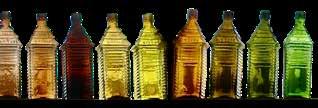
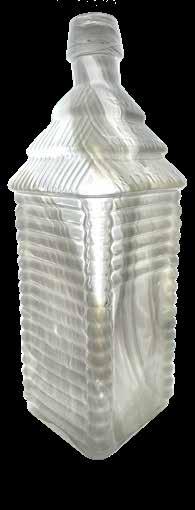
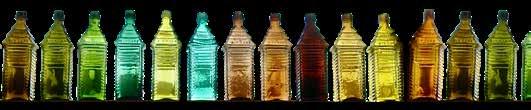
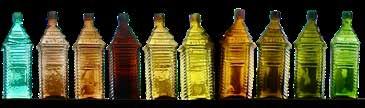
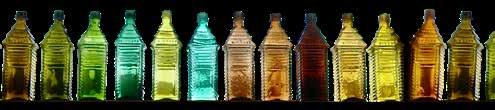
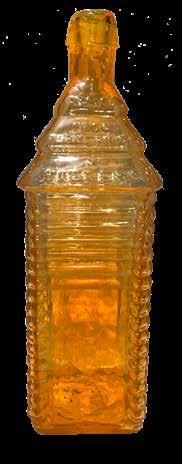
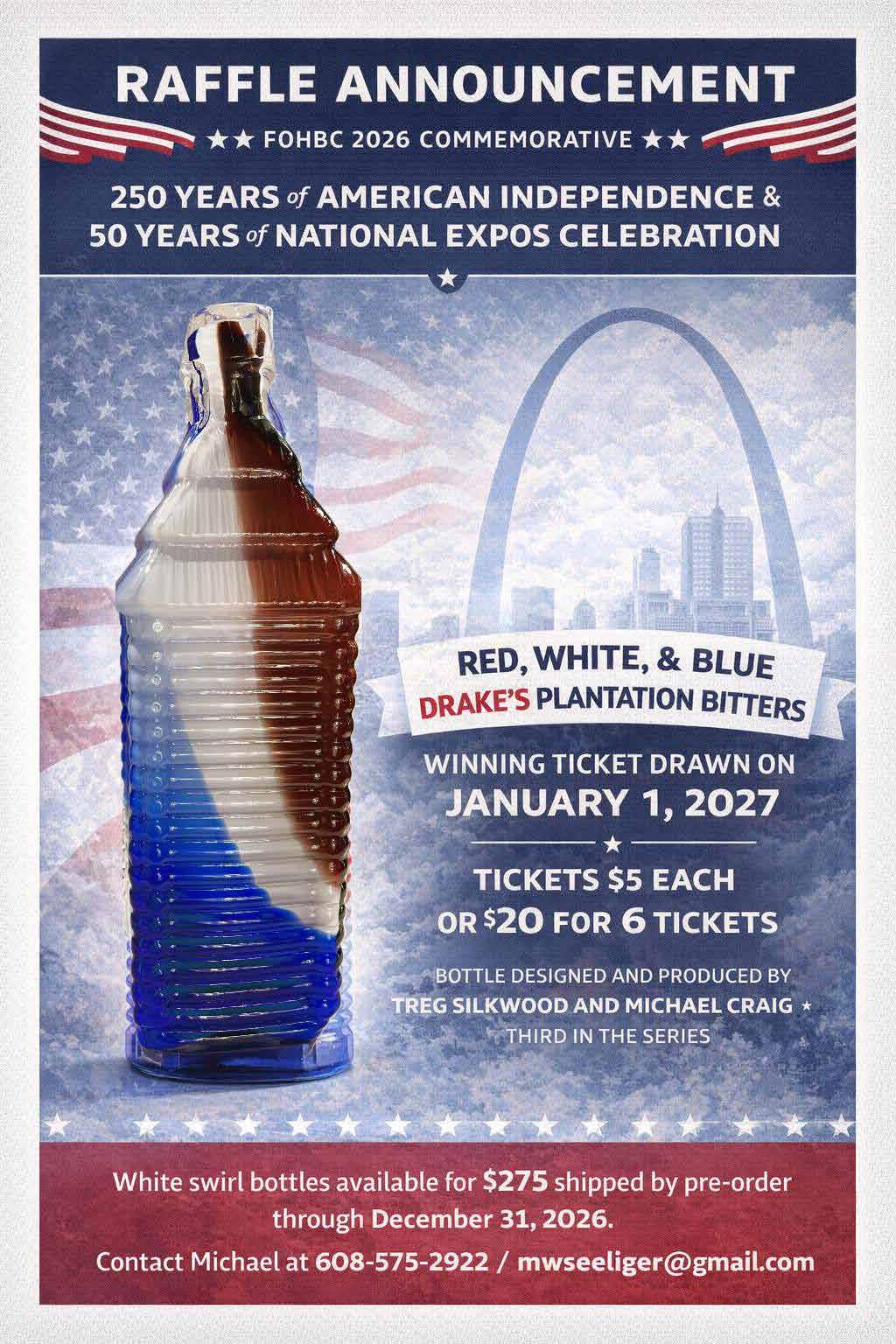
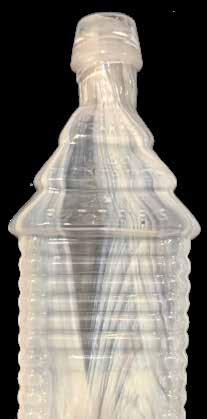
The Federation of Historical Bottle Collectors has commissioned glassblowers Treg Silkwood and Michael Craig to produce a limited quantity of white Drake’s Plantation Bitters bottles to complete the blue, red, and white run of this commemorative bottle.
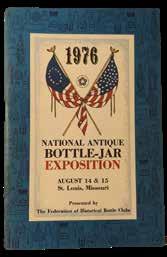
Without a National Show in 2026, they will be produced to fill prepaid orders to be distributed beginning at the St. Louis 56th Annual Antique Bottle & Jar Show which is also the 50th Anniversary of the Federation’s first national event, the 1976 Bicentennial Expo. Labels commemorating the USA’s 250th Anniversary (Semiquincentennial) and the Federation’s 50th Anniversary of its first Expo are being designed and will be included with each bottle.
Those who purchased a blue or red Drake’s should have already received an invitation to add this commemorative bottle to their collection. The price remains the same at $250 for on-site pick up or $275 with shipping. We anticipate a run of approximately 70 bottles with prepaid orders accepted through 2026.
To place your order, contact Michael Seeliger at President@FOHBC.org or call 608.575.2922.
Federation Virtual Annual Meeting, Tuesday, July 28, 2026
Since there is no National Event this year, general membership actions will be undertaken during a virtual meeting on Tuesday, July 28, 2026. Actions include the presentation and acceptance of the 2026-2028 Board of Directors; and a Bylaws change. Attendance information will be sent to all members via an email notice in mid July.
Agenda
President Seeliger/Treasurer Craig: State of the Federation, financial status, membership statistics, fiscal year 20262027 Budget, current projects, staffing needs.
Richard Siri/Craig Cassetta, Co-Chairs: 2025 FOHBC Reno National Event Recap
Doug Simms, Special Projects Director: APR, VM, Website
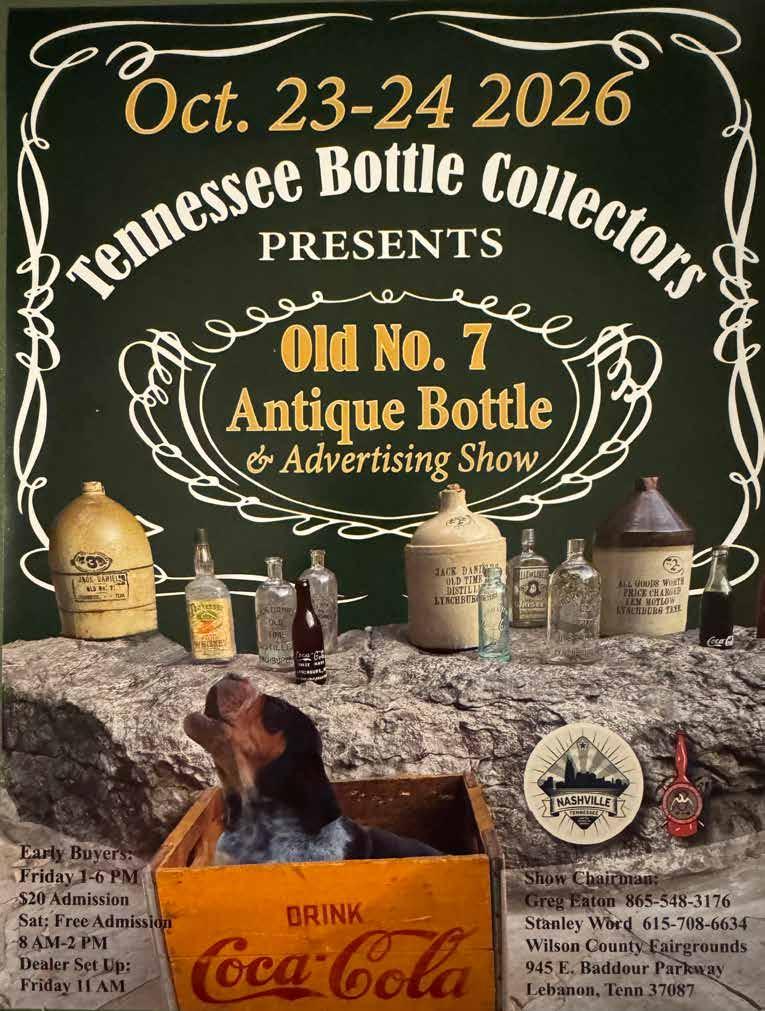
Greg Eaton/Stanley Word, Co Chairs: 2027 FOHBC National Nashville Expo
Seeliger/Cassetta: Prospects for 2028 National Event
Cassetta: Social Media
Alice Seeliger: Affiliated Clubs, AB&GC
Regional Directors: Region Reports
Other Items as Appropriate
- The slate of officers for the 2026-2028 term has no contested positions. Therefore, Secretary Alice Seeliger will cast a vote to accept the slate as outlined in the Federation ByLaws.
- A ByLaws change will be presented for Article IV #8d (Duties of the) Special Projects Director to rename the Virtual Museum Board of Directors to the Virtual Museum Ad Hoc Committee of the FOHBC Board. This amendment may be affirmed or denied by a majority vote of eligible voters in attendance.
If you have other items to add to the agenda, please contact Michael Seeliger at mwseeliger@gmail.com. Please plan to attend.
The 2027 FOHBC Nashville National Antique Bottle & Glass Expo is heating up!
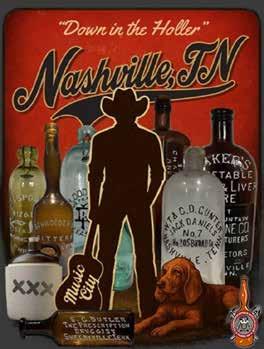
Ya’ll are cordially invited to join us for a true celebration of American history, Southern style. The Tennessee Bottle club is thrilled to welcome you to our FOHBC 2027 Nashville National Antique Bottle & Glass Expo July 29-31, 2027 at the beautiful Wilson County Fairgrounds in Lebanon, Tennessee. Our number one goal is simple: to treat you to a memorable show packed with genuine hospitality and fantastic fellowship among folks who love glass just as much as you do. We are dedicating ourselves to ensuring you feel right at home from the moment you walk through the doors.
We have space for 400 show tables in 49,000 square feet of showroom space. We are also honored to have the Painted Soda Bottle Collectors Association’s annual meeting and highly anticipated auction in an adjacent building; a Tour of the Jack Daniels Distillery in Lynchburg, Tennessee; and The World’s Longest Yard Sale beginning the week after the Expo spanning 690 miles from Michigan to Alabama.
Tennessee is the perfect place for the whole family to vacation, offering rich historical sites, beautiful outdoor adventures, and plenty of other entertainment.
A MailChimp mass email notice with hotel contact information will be sent on or around August 1, 2026 to all FOHBC members. Make your reservations early!
Pack your bags, bring your passion for history, and come to the FOHBC 2027 Nashville National Antique Bottle & Glass Expo to experience a gathering where the glass is historic and the hospitality is legendary. We can't wait to see y'all there!
Greg Eaton & Stanley Word Co-Chairmen, Contact info on Show Calendar
Seeking a Host
for the 2028 FOHBC National Antique Bottle & Glass Exposition
The Federation of Historical Bottle Collectors (FOHBC) welcomes Regional Antique Bottle and Glass Clubs, Shows, Institutions, and Consortium Teams to submit proposals to host a future FOHBC National Antique Bottle Exposition in their region. The Expo is a collaborative effort between the Host and FOHBC, with FOHBC providing overall coordination, marketing, advertising, and financial support.
The Host helps shape the Expo by selecting the event theme and organizing the centerpiece Antique Bottle and Glass Show & Sale. Hosts may also suggest a convention logo, banquet speaker, seminar presenters, displays, optional activities, and a photographer. Host volunteers play a vital role in the Expo’s success and will be offered incentives in recognition of their efforts. In accordance with FOHBC Bylaws, the Expo is a multi-day event and must be held during the last ten days of July or the first ten days of August.
The Host Team is responsible for securing appropriate convention space, including a primary host hotel and a backup hotel. The Antique Bottle and Glass Show & Sale typically opens with early admission on Friday afternoon and General Admission on Saturday. The number of show days and the overall schedule are flexible, and the Host Team’s proposal should reflect regional preferences.
Letters of interest and questions may be submitted by November 1, 2026. Formal proposals are due by February 1, 2027 and should be addressed to FOHBC Board Member Craig Cassetta (ccassettafohbc@gmail.com). FOHBC reserves the right to accept or decline any proposal. We look forward to hearing from you and exploring the possibilities together.
Southern Region Report –Tom Lines
High School Math and Chemistry Teacher, Indian Artifact Collector, Colorado Mining Memorabilia Collector, Brass Hotel Fob Collector, Round Oak Wood Stove Collector, and Antique Bottle Collector…That pretty much describes our collector profile for Oklahoma’s Larry Shope. But we’ll focus just on his bottle collecting experiences over the past 52 years!
Larry got started back in 1974 kind of by accident when he was traveling back home from an Oklahoma motorcycle race (yes, Larry raced motorcycles!). He stopped by his brother’s home to catch up, plus to collect $20 Larry had spotted him a month or two before. Being a newlywed, his brother didn’t have the money, but he persuaded Larry to take a box of old fruit jars he had gotten from the cellar of an old nearby house. After returning home, he had every intention of chucking them in the trash, but his wife suggested they keep them in the barn. Later, Larry saw an ad for an upcoming bottle show in Tulsa, and so he went…and he won a door prize! And the hobby won a great collector!
From that start, he began buying bottles in his local area and admittedly said he really didn’t know what he was doing. He paid 10 cents each for slicks and 25 cents each if one had embossing. He also started digging eastern Oklahoma hoping to find territorial bottles, either Indian Territory or Oklahoma Territory. In digging in the small town of Sapulpa, he found local druggists bottles plus an amber beer marked I.T., thought to be only one of a few known at the time.
In addition to Oklahoma, he’s done a bit of digging in old Colorado mining towns. When I asked why Colorado, he said he and his wife drove through the old mining towns way back in the 1970s and thought the area was beautiful. Most of the old mining towns had old structures still standing so it seemed to be a great place to try digging…so he did. (I first visited the same areas in 1978 and the old buildings were plentiful and quite picturesque with their weathered siding.)
After seeing a number of “better, more colorful bottles” at the Tulsa Show, Larry vowed that he was going to collect them. (He and I tracked along the same path of collecting because I made the same commitment to collect the earlier colorful pieces after my first Birmingham show in 1976.) When he set up at regional shows early on, many (many) people would
ask how he cleaned his bottles to make them so shiney (déjà vu for me again!). He would explain that they had never been buried so never got stained and etched.
In 1976, he attended the epic, and first, FOHBC St. Louis National Bottle Expo...and has been attending the St. Louis show ever since. Plus, he’s a regular at the annual Jackson, Mississippi show. He’s even been spotted at the Daphne, Alabama show too!
As we wrapped things up, Larry added this bit of wisdom: “Collecting is about the people you meet and the friends you make. It’s not all about the items you collect.” Truer words have never been spoken! Thanks, Larry, for agreeing to be interviewed and for the hour of your time!
This will wrap up my “Collector Profile Series.” I have interviewed and presented a prominent collector from each of the 11 Southern Region states. It has been a fun and interesting project. I am always fascinated hearing how people got into the hobby.
This will also wrap up my term as the Federation’s Southern Region Director and a member of the Federation’s Board of Directors. Though the Federation has weathered some tumultuous waters over the past four years, we survived much to the credit of our president Michael Seeliger and his wife, Alice. I extend my heartfelt thanks and appreciation for their dedication and leadership! And I challenge you all to get involved with the FOHBC. Happy Collecting my friends!
[Editor’s Note: The entire Federation Board thanks Tom for his dedication to the organization. We are sorry to see him leave the board but know he will continue to contribute in various ways. Personally, much of what we were able to accomplish was due to his encouragement and support, so many thanks, Tom. Alice]
Midwest Region Report –
Henry Hecker
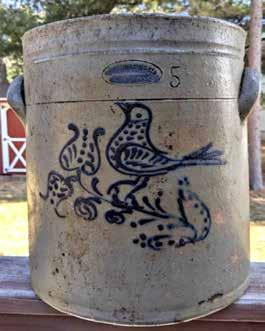
Summer has come early to the Midwest Region with flea markets, estate and garage sales, and auctions in full swing. New discoveries again emerge from the soil and from the watery depths. Mark Youngblood wins the contest for best (and worst) stoneware dug this spring. Found in Menomonie, Wisconsin, it is a six-gallon crock decorated with what is intended to be a chicken apparently, but the decorator, who remains anonymous,
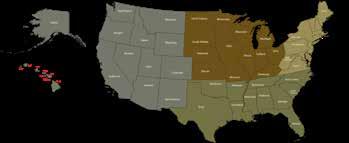
The Four Regions of The Federation: Western, Midwest, Southern, and Northeast
must have flunked out of art class. This may be why this crock was interred in the first place. Maybe Mark will eventually share a better photo of this piece, it deserves a place in a future magazine. Another bird crock, made by C. Hermann, appeared on Facebook marketplace recently for $25 and this decorator was more accomplished:
No hoax, it sold rather quickly.
Another discovery, hiding in an excavator’s cache of bottles for several decades, is a previously unknown bitters bottle from Milwaukee, “Hoyt’s American Stomach Bitters.” A crude amber square, subsequent newspaper research traces this bottle to Ebeneezer Hoyt operating on West Water Street in Milwaukee after the Civil War. Today, it is much less common to obtain bottles from construction workers. Liability issues and tight project deadlines make it more difficult for site workers to retrieve bottles. Sigh.
After fifty-six years of bottle collecting, yours truly sometimes thinks he has seen everything, from the great to the very bad. But a bottle I will forever refer to as “The Painter” provided an especially disappointing experience.
Michael Seeliger and I had just left my driveway to attend the Kalamazoo Bottle Club Show when my son, John, called me about an auction coming up the next day. “There’s a ‘fish’ sticking out of one of the boxes.” Photos proved it was a lowly cod liver oil, but some other photos seemed more promis-
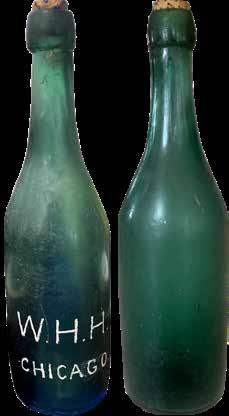
ing. I convinced John and my wife Diane (quite reluctantly*) to report back to me from the auction. There were medicines, blob sodas, pottery ales, bitters, even fruit jars, but one bottle blew my socks off…a nicely embossed, tapered teal W. H. Hutchinson quart, probably a champagne cider or mineral water. John and Diane successfully won the bid.
Finally, Michael and I arrived back at my house, and we rushed in to examine the trophy bottle. No one else was home, but eventually we found the bottle, along with several other box lots. Examining the W.H.H., at first and second glance the bottle looked good. The paint had been expertly applied…but wait a minute!!! While the paint was thick, creating the illusion of embossing, something was amiss. OMG!!! No…maybe the embossing was just light. A quick scrub on a couple letters revealed the worst. The owner had been so adept at painting bottles that he had made his own fantasy piece (and several more in the box lots).
When Diane and John had returned home from the auction, they also noticed the mistake. In better light, while difficult to see, they discovered the prior owner’s handiwork also. All we could do was laugh about it. Now I have another bottle story to tell, unlike any other and a quite humbling one at that… especially in the company of the FOHBC President.
Western Region Report –
Eric McGuire
Iwouldlike to focus on the most recent Golden Gate Bottle Auction which ended May 17. It is currently the most active auction representing Western Region collectible bottles and we need to pay attention to prices realized. While values don’t necessarily dictate the overall importance of bottle collecting, they are an essential element if one cares about buying and selling. The auction contained nearly 200 lots of predominantly Western bottles. The strongest selection was a grouping of about 28 “blob top” soda bottles of the 1850 to 1880 period. Prices were strong but not unreasonable, which shows a continuing heavy interest in this specialty.
About 16 of the early applied top liquor bottles, primarily of San Francisco origin, were also represented. Prices were about as expected with a C.W. Stuarts’ Kentucky Whiskey leading the pack at $4,400. There was nothing really unusual in the price of this grouping.
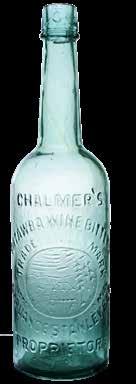
Perhaps the most exciting of the bottles was an exceptional example of the Chalmer’s Catawba Wine Bitters
This bottle is embossed with a likeness of Sutter’s Mill, the site of gold discovery in California. The hammer price was $15,000, the opening bid. I could have seen this item go for closer to $20,000, but such is the world of auctioneering.
Early western medicine bottles are seldom seen in auctions; however, there were two on the block. A very nice Unkweed Remedy Rheumatic Cure from Portland, Oregon, brought $1,800, and an early smooth-base Rowler’s Rheumatism Medicine from Sacramento, hammered at $1,700. Those two bottles are so rare it is difficult to know if those prices are “on the money.” Regardless, overall, the prices seemed to reflect a fairly strong demand for Western Region bottles.
Northeast Region Report –Charlie Martin, Jr.
The 55th Annual Genesee Valley Bottle Collector’s Association Bottle and Antique Sale took place on a new date (May 3, 2026). Show Chair, writing in the Club’s Newsletter, (Applied Seals) noted that “The 2026 version of the Rochester Show and Sale had some challenges, but all in all I am pleased with what we accomplished….We sold a total of 191 dealer tables with 94 dealers from 11 states. These (numbers) were a bit lower than our average, but still strong. This year’s admission was 436 paid and 14 free (college students and under 18 years old) for a total of 450 customers…Our Show and Sales Exhibits were great this year.” The awards were as follows:
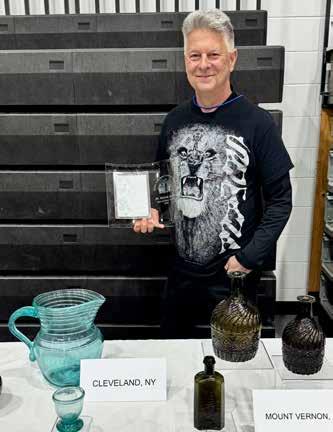
Most Educational and People’s Choice “Historical Druggist of Rochester” by Richard Campbell, Rochester, NY. and the Dr. Burton Spiller Best of Show: “New York State of Mind: Glass and Bottles from New York State” by Rick Ciralli, Bristol, CT. (picture below)
The Four Regions of The Federation: Western, Midwest, Southern, and Northeast
On April 12th, my wife Jane and I attended a much-loved local antique bottle show, hosted by the Little Rhody Bottle Club, in Taunton, Massachusetts. This annual event was held for many, many years in January. However, several years back bad winter weather forced the Club to reconsider that January date. They chose April and for the past several years they have enjoyed great success and fine weather. I always find something there to add to my collection, and this show was no different. Local dealer Leo Goudreau Jr. had a great selection of bitters ephemeral material for customers to peruse. I was fortunate to acquire about a dozen items from Leo with promises of more to come in September at my club’s show. Bill Rose, Club President and Show Chair, noted that the event got off to a “great start.” There were 36 dealers set up on 62 tables. Twenty collectors paid a premium for early shopping, while 116 paid general admission. Bill commented on what an outstanding job the Taunton Inn & Conference Center did with providing show tables which were set up for the dealers the prior evening. The hotel manager also provided a food concession at the show’s entrance. The Inn’s chef prepared wonderful food at reasonable prices for the dealers and the public. They hope that next year’s show, on April 11, 2027, has a similar arrangement. For those of you who might be in the southeast Massachusetts area in the coming months, try to attend one of the club’s outside shows. They are free. 2026 dates are: May 16, June 11, and September 5. All shows are from 8 am to 2 pm and are held at Leonard’s Antiques, 600 Taunton Avenue (Route 44) in Seekonk, Massachusetts. I would be remiss if I did not mention the passing of three Little Rhody Club members over the past year. Ron Tetrault, Mat King, and Ron Rainka are sorely missed and fondly remembered for their outstanding character and integrity. Rest in peace, my friends!
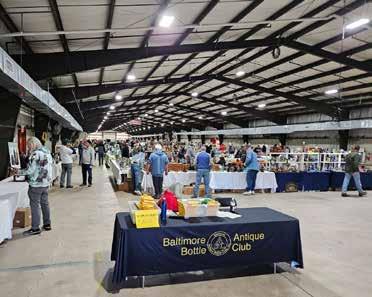
On March 29, 2026, The Baltimore Antique Bottle Club (BABC) held their 45th annual show and sale. Another banner year for the bottle club. Close to one thousand bottle collectors (if we are being accurate 981) paid admission to enter the 40,000 sq. ft. building to browse and purchase from the 210 dealers who were set up on 335 tables. Dealers came from 28 states as well as the District of Columbia. I will no longer implore you to put this show on your “bucket list.” If you never attend you are missing one of the greatest spectacles in our hobby. The May 2026 issue of the Baltimore Bottle Digger, the newsletter of the BABC, ran an excellent piece on the 10 commandments of bottle digging. With their permission I share them with you.
Question: Are there any general rules to follow on privy digging?
Answer:
1. Thou shalt not dig privies alone.
2. Thou shalt not desecrate sites of potentially historical and archaeological significance, such as the privies of former presidents.
3. Thou shalt not probe or dig without the owner’s permission.
4. Thou shalt not destroy artifacts by digging with savage and reckless abandon.
5. Thou shalt not covet thy digging partner’s bottles.
6. Thou shalt make immediate and proper restoration to the property.
7. Thou shalt put preservation over profit.
8. Thou shalt share finds with the property owner.
9. Thou shalt maintain records of each privy dug so that future generations might know of it.
10. Thou shalt retain a dignified demeanor at all times, even in the presence of broken pontiled Baltimore sodas. (Obviously you should put in your own local bottles)
Lastly, I would like to congratulate the Greater Buffalo Bottle Collectors Association and Craig R. Maefs, Newsletter Editor, on their First Place Award from the Federation for Best Newsletter, the “Travelers Companion” announced at the FOHBC 2025 Reno National Convention. Be sure to submit your club newsletters to FOHBCmembers@gmail.com for consideration in the Club/Member Recognition program (formerly Contest).
Until next time, happy bottle collecting!
American Poison Bottles
Treasure Found: Ortenberg and Finn
By Vern Huffstetler, Joan Cabaniss and Tim Adams
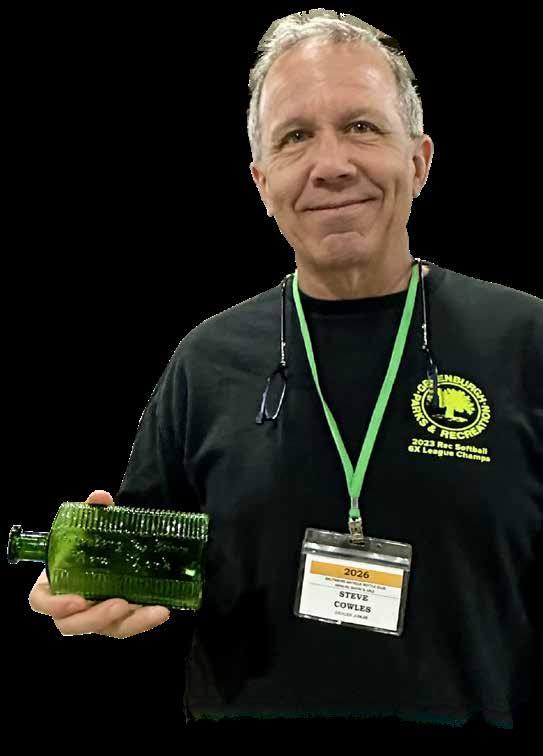
Two years ago, at the Baltimore Bottle Show, Steve Cowles visited our table. With eyes gleaming, he revealed to us he had dug a rare Ortenberg and Finn New York poison bottle. We talked at length, trading digging stories and marveling at his find. This year he brought the bottle to the show and agreed this story needed to be shared in an article.
In Westchester County, New York, young Steve was captivated by rows of old bottles that lined his best friend’s stairwell. He was fascinated by them, especially the Warner’s Safe Cures. The bottles belonged to his friend’s dad who was a game warden for a wealthy family and dug bottles in his off time. The bottles had been cleaned and displayed well.
As Steve came of age, his curiosity blossomed and he wanted to find bottle treasures of his own. He questioned his friend’s dad about how to find bottle dumps and found experienced diggers on You Tube who shared their adventures and tips. Armed with some basic knowledge, Steve began the search for a good digging spot.
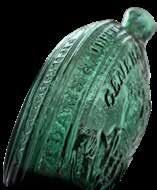
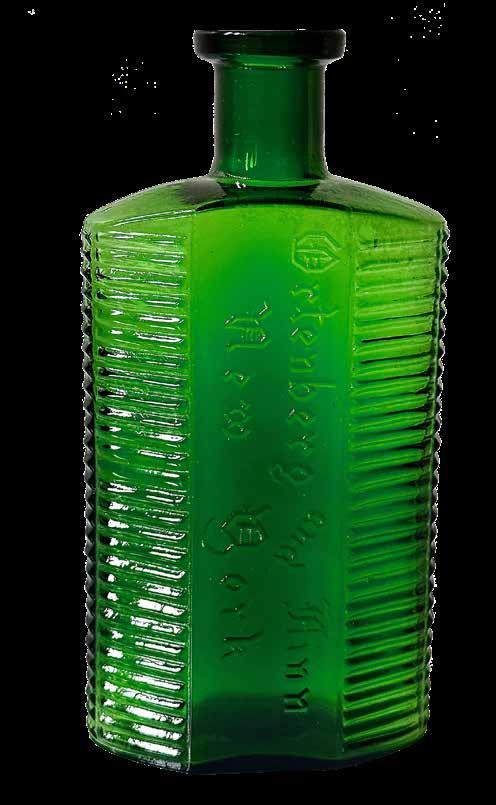
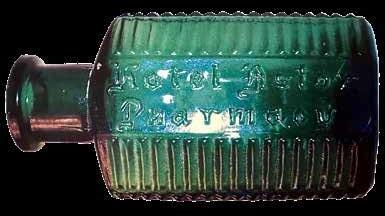
While driving on the outskirts of town, Steve spotted some glass and stoneware scattered down a hillside. It was on private property but, undeterred, he was able to get permission from the caretaker. The site was an old household dump. His heart raced with the thrill of discovery as he pulled out some turn-of-the-century beers, local medicines, and flasks. At three feet deep he hit an ash layer. It was there he pulled out the emerald green irregular hexagon KI-2 poison bottle. As he wiped away the dirt, he saw New York embossed on the bottle and his heart pounded. He suspected he had something special but was still unsure how special it really was.
Once Steve got the bottle home and cleaned up, he went to Digger Odell’s website to ask about the bottle. Digger told him he found treasure and offered him $650. Soon after, he was contacted by a
serious poison bottle collector, Wayne Hill, who made a substantially better offer. However, the treasured bottle remains in Steve’s collection which has grown through the years from more great digs. Thank you, Steve, for sharing this great digging story.
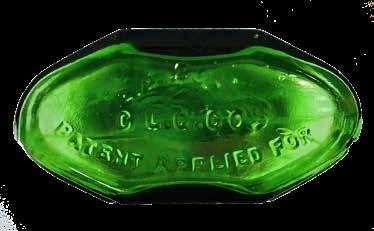
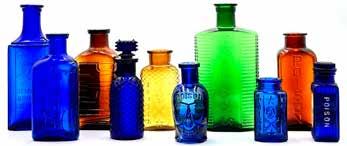
The KI-2 poison bottle was manufactured by the Carr-Lowrey Glass Company in Baltimore, MD. It is 8 ounces and 6 ¼” tall which is the largest known with this embossing. They produced these irregular hexagon poison bottles for more than 30 different drug stores. Our book “American Poison Bottles” lists all the known embossings, colors, sizes, rarity and auction price results. We continue to build the list as more become known. We assembled a collage of the different front panels and a bit of history on a couple of the drug stores with hopes of a future book on the companies who used these bottles. For now, we’ll share the history of this unlikely pair of co-owners.
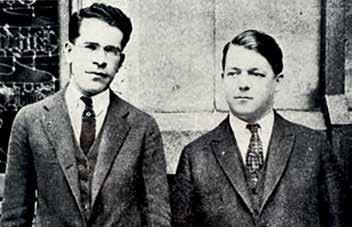
Frederick Ortenberg and William P. Finn
Both Frederick Ortenberg and William P. Finn obtained pharmacy degrees in New York and were registered pharmacists, but with widely different backgrounds. Fred Ortenberg was a Russian Jew who left his Bronx pharmacy to serve Uncle Sam during WWI. William Finn was of Irish descent and had worked in chain stores and spent four years on the road as a drug salesman before partnering with Ortenberg in 1919. Fred’s friends warned him against partnering with William Finn because they felt that two men of such different temperaments could never agree on business practices. However, those friends were wrong. The two men leveraged their diverse backgrounds to form sound business practices that made the 6th Avenue, Bryant Pharmacy a success.
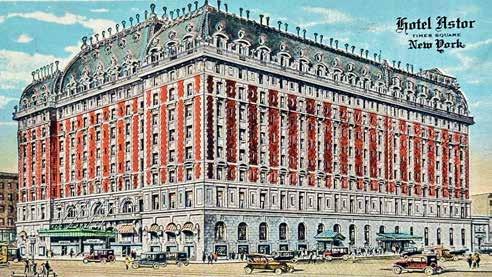
The partners continued to grow their business in 1921 by opening the Hotel Astor Pharmacy in the middle of New York’s Great White Way. With even less space, they followed their lessons learned. They only carried the best nationally advertised items, never ran sales or cut prices, and maintained the store in luxurious fashion. Their ornate window displays were changed weekly by a professional decorator and contained the finest items available. All the salesmen were registered
The KI-2 poison bottle was manufactured by the Carr-Lowrey Glass Company in Baltimore, MD.
pharmacist so they could answer questions on any item and fill a prescription if needed.
Prohibition helped propel soda fountains to new heights. To accommodate the theater crowds, they installed a very ornate thirty-foot-long Liquid Carbonic soda fountain which extended along one entire side of the store. To keep things moving, there were no chairs or tables as they considered “Broadwayites” as always in a hurry and not interested in sitting at a fountain. They also reversed the order of service by allowing customers to pay on the way out. It allowed them to serve more customers quickly. The profits of the soda fountain exceeded the sale of drugs.
In 1926, Ortenberg and Finn sold the Bryant Pharmacy on Sixth Avenue to focus their attention on the Hotel Astor Pharmacy. At that location, they utilized a similar poison bottle embossed Hotel Astor Pharmacy. Therefore, we believe the bottle found by Steve Cowles can be dated between 1919 and 1926. William P. Finn died in 1931, so it certainly predates his death.
We hope you find some poison bottle treasures too. If you do, please share. Happy hunting!
Sources:
“New York College of Pharmacy (April 30, 1908)”, Meyer Bros Druggist Entire Drug Trade, Vol XXIX, 1908, Page 191.
“Brooklyn College Graduates Large Class,” American Druggist Pharmaceutical Record, New York, May 1912, Page 71.
“Store to Open at Astor Hotel,” Drug Trade Weekly, August 13, 1921, Page 15.
“Tickling Broadway’s Palate,” The Soda Fountain, February 1922, Page 23.
“Doing Business on the Great White Way,” The Pharmaceutical Era, August 11, 1923, Page 157.
“Introducing Messrs. Finn and Ortenberg,” Toilet Goods, September 1923, Page 15.
Supreme Court Appellate Division – First Department, Christopher J. Dolan Vs. Frederick Ortenberg and William P. Finn, December 2, 1926.
“Finn” New York Times, Saturday, December 19, 1931.
The Hotel Astor was a 1,000-room luxury hotel in the heart of New York’s theater district. It featured large convention spaces, a grand ballroom, and an opulent roof-top garden. When prohibition began in 1920, they spent half a million dollars renovating the bottom floor to accommodate businesses like the Hotel Astor Pharmacy which opened in 1921. This image is from a 1926 postcard.
Your Poison Bottle Team
Foreground: Vern Huffstetler is a mechanical engineer, collector, author, photographer, and artist. He contributed significantly to writing the American Poison Bottles book, magazine articles, and three webinars on poison bottles.
Back Left: Joan Cabaniss is the “Queen of Poisons.” She served as the long-time president of the Antique Poison Bottle Collectors Association. The May 2005 issue of National Geographic featured Joan and her collection in “Pick Your Poison.” In 2014, Joan and her collection were featured in Virginia Living magazine. The FOHBC Virtual Museum includes her impressive poison bottle collection. Joan coauthored the Poison Bottle Workbook, American Poison Bottles, and our magazine articles.
Back Right: Tim Adams’ knowledge of the bottle hobby is extensive. His memory of who has what rare poison is phenomenal. He volunteers his time often ministering and supporting his community with catered chicken charity events. Tim is coauthor of the Poison Bottle Workbook, American Poison Bottles, and multiple magazine articles. See display ad to purchase “American Poison Bottles.”
The first bottles of Pepsi-Cola were bottled in 1898 by Caleb Bradham at his drug store in North Carolina. In 1902, bottling operations were moved to a larger location and officially renamed the Pepsi-Cola company. Before that, it was called Brad's Drink from 1893 to 1898.
By 1910, there were over 240 franchises in 24 states.The first bottles were of the Hutchinson soda type which are very rare.
American Poison Bottles
The American Poison Bottles book is an in-depth study of American poison bottles in use from 1872 to 1944, the glass houses that manufactured these bottles and the companies that used them to distribute their products as well as the drug stores that ordered custom poison bottles. The book is an accumulation of 50 years of knowledge shared by collectors in the APBCA (Antique Poison Bottle Collectors Association) newsletters, bottle magazine articles, company histories and other sources in the public domain. It features 90 photo-quality pages of beautiful poison bottle images from top collections, 171 pages of history and fantastic images documenting the people and companies involved, as well as 25 pages of auction prices realized for these bottles. We used high-quality, acid-free paper and a photo-quality printer so the book will last a lifetime.
American Poison Bottles is a bargain at $75 Shipping: Media Mailer $10 or Priority Box $20
108 Ridgecrest Road Midland Valley Subdivision Graniteville, SC 29829
We accept Cash, Check, and PayPal
KI-2 Hotel Astor Pharmacy poison bottle.
Pulitzer prize-winning author Frank McCourt famously wrote that, “Everyone has a story to tell.” So too with bottles, even seemingly nondescript ones. Every bottle has a story.
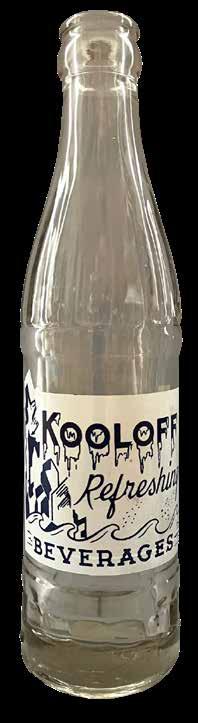
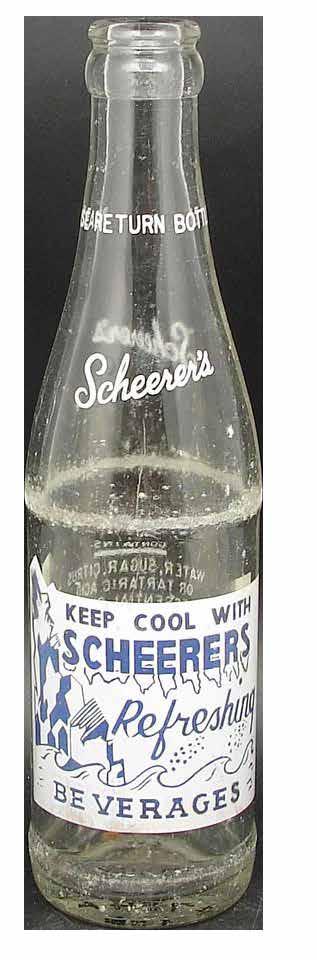
Although I try to stick to my want lists and be disciplined about adding new bottles to my collection, I sometimes buy one on impulse. Recently, I did that with the bottle featured in this article. I saw it sitting in a case at a local antiques mall along with a bunch of old Coke and Pepsi bottles. The bottle, called Kooloff Refreshing Beverages, was an applied color label (ACL) soda bottle that I hadn’t seen or heard of before. It was in nice, clean condition, priced at just $30, and it somehow spoke to me, so I decided to buy it. Then I took the bottle home to research its story. [FIGS 1 and 2]
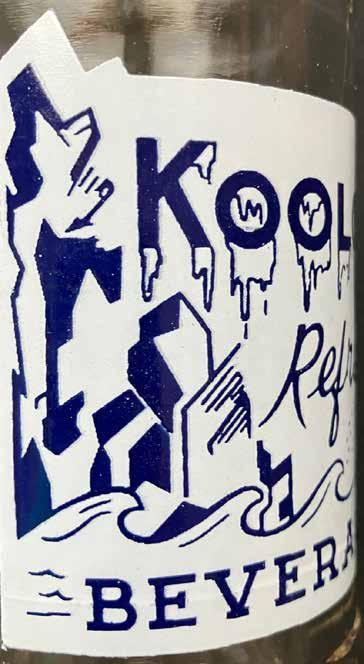
The embossing on the base showed that it was made by the Owens-Illinois Glass Company of Toledo, Ohio in 1947. The Scheerer Bottling Company of Wabash, Indiana was the bottler. The bottle held an odd quantity of liquid: 7-1/2 fluid ounces. Its ACL is dark blue and white and depicts icicles dripping off the brand name (a play on the phrase “cool off”) and what appear to be pillars of ice. The glass is molded with fourteen vertical panels above the label and fourteen squares below.
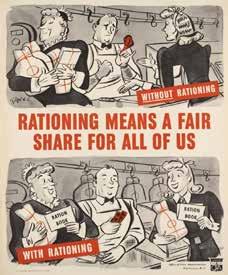
1947, the year the Kooloff bottle was made, was a significant year for soda pop. Sugar is the essential ingredient of soda and was the first commodity to be rationed during World War II, after the Japanese had conquered
the Philippines (a major source of sugar cane). In 1947, sugar was de-rationed, the last commodity to be set free. With millions of GIs returning to the civilian population and the start of a post-war economic boom, the repeal of sugar rationing triggered the creation of hundreds, if not thousands, of mom-and-pop soda brands across the United States.
Kooloff was one such brand. It was started by Carl Franklin Scheerer who, along with his brother, had owned a successful grocery store in Wabash since 1918 called Scheerer's Market. Carl married a local girl named Louise in 1935 and the couple bought a public swimming pool in Wabash, charging customers a small fee to swim. Towards the end of WW II, the entrepreneurial Carl decided to purchase the Wabash Bottling Works, which had made and bottled mineral water and soft drinks since its founding in 1909. He renamed the company the Scheerer Bottling Company. Carl concocted and bottled his beverages by hand at night and delivered the products to retail outlets on the following day. His brother managed the grocery store while his wife operated the swimming pool. Carl’s soft drinks used secret recipes which he never disclosed, including an unusual flavor called “orange-pineapple” that became quite popular.
Initially, Carl used the stock of plain glass bottles that had come with the business but he must have sensed opportunity with the repeal of sugar
The end of the ACL era foreshadowed the end of Carl’s bottling business. According to an interview given to a Wabash newspaper by his wife, Louise, aluminum cans were replacing glass bottles in the late 1970s but they needed to be purchased by the freight car load, and Carl decided that he didn’t want or couldn’t afford to go in that direction. Carl and Louise closed the bottling business and sold the building in 1981, and Carl died the following year at the age of 86.
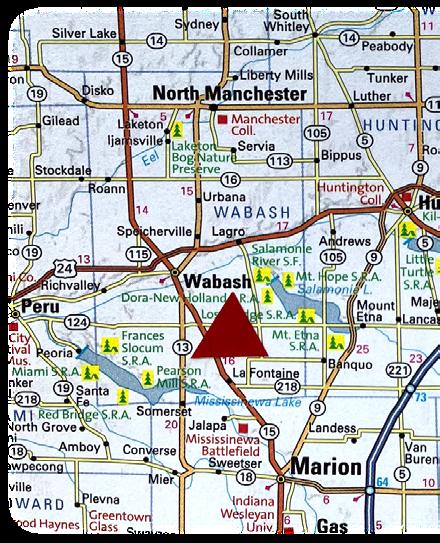
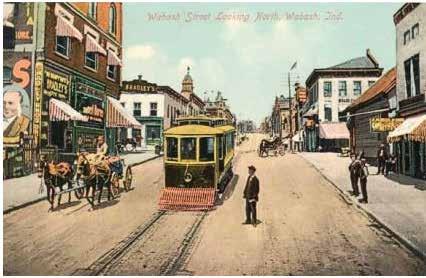
The city of Wabash, where Carl Scheerer was born, lived and died, is interesting in itself. Incorporated in 1834 as the County Seat of Wabash County, the small city in north-central Indiana has a remarkably stable
rationing in 1947. That year, he ordered a batch of proprietary Kooloff Refreshing Beverages ACL bottles. Soon, however, for reasons unknown, Carl replaced them with a new batch of bottles, using a similar ACL but adding the phrase “Keep Cool With” and changing the brand name to Scheerer Refreshing Beverages. [FIG. 3] Over time, Carl hired employees and invested in automated machinery, trucks and vending machines. His soft drinks became ubiquitous throughout Wabash and the surrounding areas including lakeside recreational spots. Although Kooloff bottles were short-lived and are not often seen today, the Scheerer Beverages bottles are fairly common and typically show case wear and other signs of long use.
Rationing poster, made by the U.S. Office of Price Administration, 1943.
Map of north-central Indiana showing the location of Wabash, founded in 1834.
FIG. 2: Close up of the Kooloff label.
FIG. 3:
Scheerers Refreshing Beverages, Wabash, Indiana, 1948. The heavy case wear, scuffs and scratches, caused by repeated washings and transport in wooden cases, attest to the bottle's long use.
(L) Post card depicting downtown Wabash, Indiana, 1910.
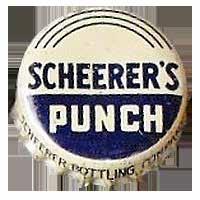
Crown cap for Scheerer's Punch, circa 1950. Using his own secret formulas, Carl Scheerer's beverages proved to be very popular throughout Wabash County.
Chris Weide.
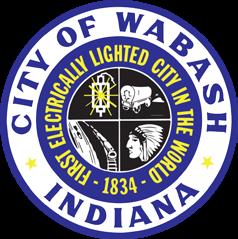
population base. The U.S. Census reported 10,620 people living there in 1950, a few years after Kooloff Beverages was made, and 10,440 people there seventy years later, in 2020. Wabash has beautiful, historic buildings but its claim to fame is its status as the first city in the entire world to be electrically lighted, in 1880. The city installed street lamps using a newly invented process called carbon-arc lighting to replace its municipal gaspowered lamps, resulting in
(R) Wabash's city seal, proudly proclaiming its claim to fame.
much brighter light and budgetary savings of $800 per year. When the city turned on the new lamps, the reaction of the Wabash residents was captured in florid terms by a contemporary newspaper reporter:
The people stood almost breathless, overwhelmed with awe, as if in the presence of the supernatural. The strange, weird light, exceeded in power only by the sun, rendered the square as light as midday. Men fell on their knees, groans were uttered at the sight, and many were dumb with amazement. It drove the darkness back and out of the entire city of Wabash so that now the people could see to read on nearly all of the city's streets by night.
From today’s perspective, when we take electricity and electric lights for granted, the reaction of the nineteenthcentury Wabashers seems extraordinary.
And it appears to be true that every person–and every bottle and city–has a story to tell.
Soda Page” (ca-yd.com), by FOHBC members Chris and Catherine Weide, is another outstanding, useful resource for ACL soda bottles. The Weide's collection contains 22,000+ ACLs, and Chris frequently provides information for these articles.
Mike Dickman lives in Santa Fe, NM where he has collected bottles for thirty years. He’s been a member of the FOHBC since 1997. His collection includes figural bitters, poisons, blob-top sodas and colognes. About five years ago, Mike’s passion unexpectedly turned to ACL sodas and he wrote “The Joy of Collecting ACL Soda Bottles” for the September-October 2022 issue of AB&GC. His “ACL Corner” column started running in the following issue. He welcomes comments, questions and suggestions at mikedickman@yahoo.com
Photo courtesy of
for
Full-color catalogs for this important, two-part sale will be available mid-July. Cost is only $15.00 (post-paid). Call, or visit our website to reserve your copy!
Call, or visit our website to reserve your copy!
Full-color catalogs for this important, two-part sale will be available mid-July. Cost is only $15.00 (post-paid). Call, or visit our website to reserve your copy!
American
Glass Gallery
American Glass Gallery
American Glass Gallery
Auction 44, July, 2026 • SESSION 1:
Auction 44, July, 2026 • SESSION 1:
Auction 44, July, 2026 • SESSION 2:
A multi-consignor sale filled with choice items in virtually every category!
A multi-consignor sale filled with choice items in virtually every category!
This Session will encompass Historical Flasks, Blown and Pattern Molded wares, Colognes, Inks, Spirits and Whiskey bottles, rare Bitters, Black Glass, and much more!
Features Part 1 of a very important, heretofore undiscovered collection of...
... Historical Flasks and Early Blown Glass curated in the 1930s, 40s, and early 50s with the assistance of George McKearin, Sam Laidacker and Herbert Delavan Mason. Watch our website, facebook postings and emails for further information.
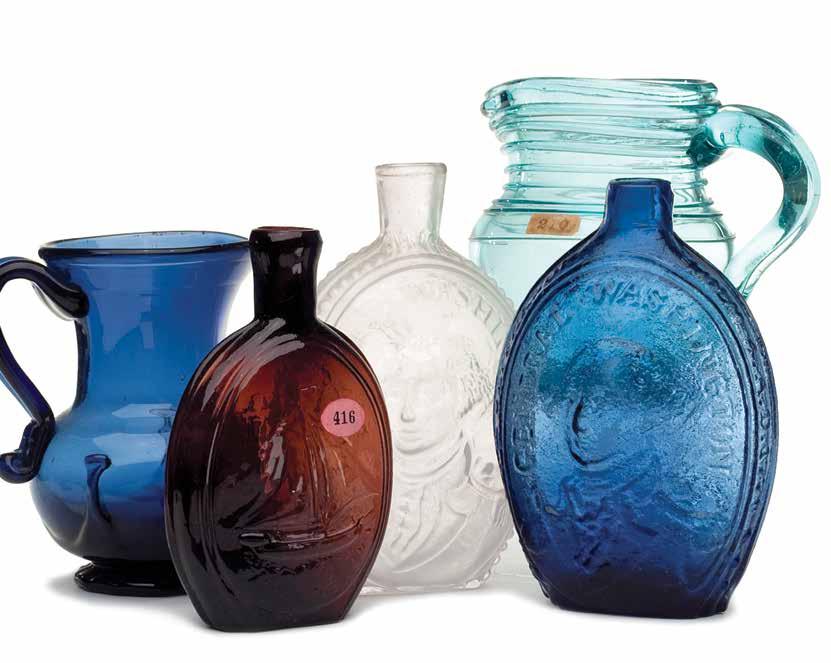
Red, White & Blue, and Aqua Too!
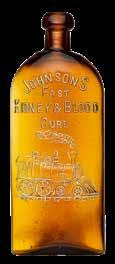
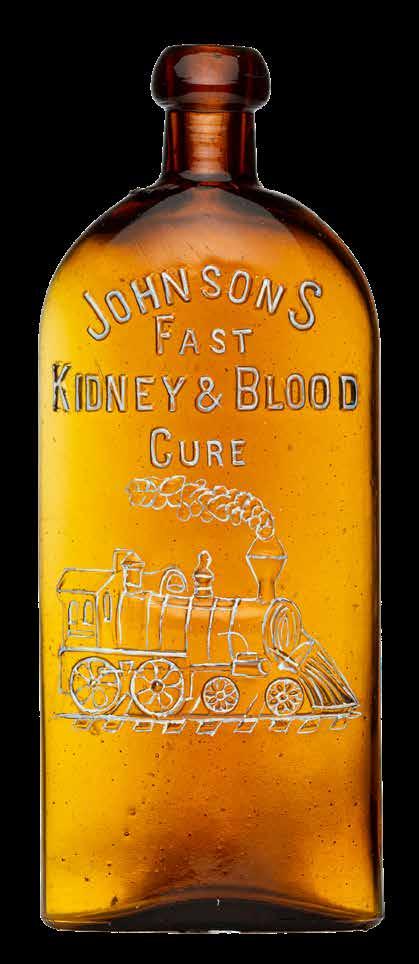
Very rare Johnson’s Fast Kidney & Blood Cure: At Home In Kansas
By Sue Louis
“No one needs a book anymore; everything is available on the internet.” This was a comment Dann and I overheard as we were unveiling our hot-off-the-press “Guide to Collecting Cures” book at a recent bottle show. What this young collector didn’t realize was that a human had to compile material and input facts into the internet to make that information available.
“Compiling data” is where Dann and I found ourselves for the past couple of years. We started with one of the most interesting and elusive smooth-based cures known to date, the one-of-a-kind JOHNSON’S FAST KIDNEY & BLOOD CURE. The Johnson’s Cure bottle was originally found in Missouri by John Wolf in the 1970s and was his motivation to begin collecting cures.
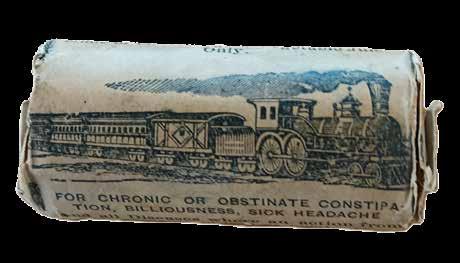
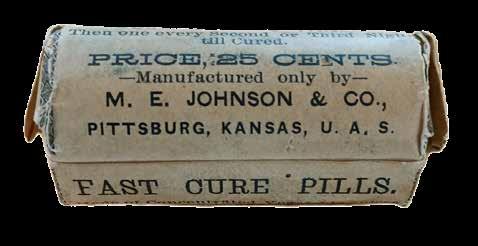
M.E. Johnson M.D. was from Pittsburg, Kansas. There are two patent medicines attributed to him, one being the famous bottled cure, a beautiful 9” Warner’s-shaped bottle with a smooth base and a blob top in yellow amber, and the other—a packaged medicine with his name and the city on the label—which helped with our search. Starting with the city of Pittsburg, Kansas, we were able to use Ancestry.com to discover that Monroe Elliot Johnson practiced medicine in
Pittsburg from 1879-1920. We contacted the Curator of Special Collections and University Archivist at the University of Pittsburg in Kansas and learned from archived business directories that his office address in 1880 was Dry & Crowell’s drug store, 405 N. Elm St., Pittsburg, Kansas. He was not listed in the 1890 directory. Johnson passed away at the age of 67 in January 1921.
Johnson did not advertise his medicines in newspapers. It is possible that he depended on word of mouth or printed flyers which have ceased to exist in among any artifacts found so far—this would contribute to the rarity of the bottle. Furthermore, no listing of the contents is found in archival records of the National Library of Medicine, suggesting that he did not sell his medicines after 1906 when the Pure Food and Drug Act was passed.
In the era of blown-in-mold bottles, bottles were ordered in fairly large quantities to make it practical to create a mold. They were shipped from the glass house to the patent medicine manufacturer for filling and distribution. We encourage motivated collectors to continue searching for the remainder of the bottles sent to Dr. Johnson during the late 19th century. They are out there somewhere.
My “after-the-fact” answer to the comment we overheard would be that the avid collector can either spend months researching the internet for information about cures or use our just-released book “A Guide to Collecting Cures” with content nicely compiled. The late John Wolf was the consummate cure collector and his collection is the impetus for this long-awaited reference book—truly a labor of love.
Special thanks to Sara DeCaro Curator of Special Collections and University Archivist 015 Axe Library
University of Pittsburg, Kansas sdecaro@pittstate.edu
Dann and Sue Louis reside in Michigan and have been collecting cures for nearly 50 years. Their collection totals over 2000 different examples. Their close friendship with the late John Wolf left them with extensive notes from his years of compiling information for a projected book project. Using these notes and their own knowledge, they have completed the first book of cures available since the Bill Agee books were published in 1969 and 1973.
Pill packaging for Johnson’s Fast Kidney & Blood Cure, with graphic locomotive.
THE DIG
OF A LIFETIME Part 2
The Pirates House Parking Lot
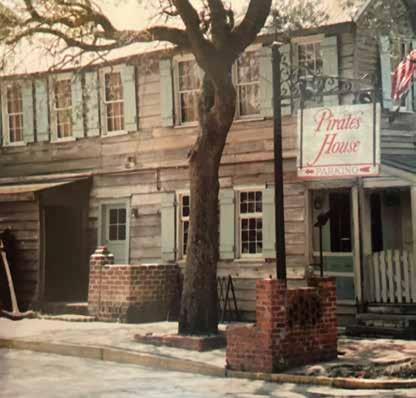
We arrived at the parking lot of the Pirates House before sunrise each Saturday. Each time we assembled, we enjoyed a box of Krispy Kreme doughnuts before embarking on what we knew would be an exciting day. The entire site was covered in asphalt.
The owner’s plan was to repave the parking lot and we had free rein to dig by hand and with equipment.
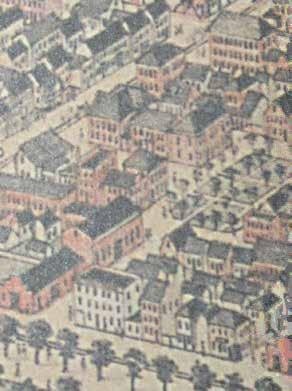
The owner’s general contractor generously made available a backhoe to transport bricks to a storage area. More importantly, it allowed us to expedite penetrating the asphalt and to excavate some of the deeper privies. In the mid to late 19th century, this site had been occupied by a shanty town of Irish ironworks employees, indentured servants and free blacks. The Sanborn maps illustrated rows of shanties.
Each weekend, as an array of orange and lavender colors spilled over the eastern horizon, we unloaded probes, shovels, sifters, coolers of water and folding
chairs. Sheds, privy houses, trash pits, root cellars and stables had once occupied this land. Under our feet countless mid-nineteenth century artifacts lay entombed and awaited the light of day.
Our practice was to dig each privy to the bottom, corner to corner as often as the bottles lay in the sump or
by the site to peruse our most recent finds.
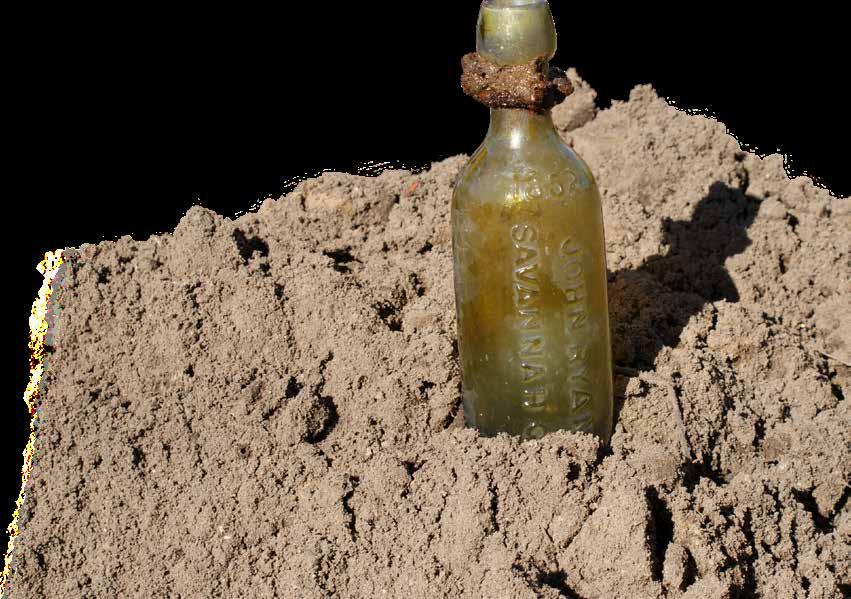
Over 45 privies were excavated on this site. Inside an orange brick privy, we found several nice soda bottles including an iron pontil Thomas Maher, several cobalt squat John Ryans and a variety of other colored soda bottles. Sifting, we recovered a beautiful 1812 infantry
Story by Jim Poole Photography by Frank Chance
The Side Lot
A vacant lot lay between the Pirates House and Mary Foley house. The Sanborn map indicated there were no privies, but we knew there was the possibility of trash pits. The surface was an old cement foundation from a previous structure. Using a masonry saw, we cut test holes into the cement, probing each in search of a ping or something crunchy.
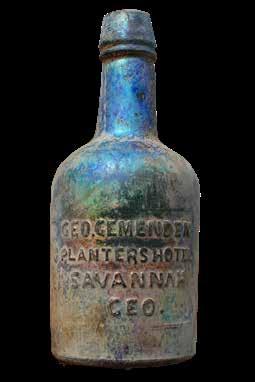
After several test holes, we identified one area offering promise. We continued to dig after nightfall and soon found ourselves the focal point of curious diners inside the Pirates House. In the trash pit, a rare James Ray XXX Ale and a blob top, Philip Young eagle were excavated. Two very choice Savannah bottles!
Trenching the Kehoe Foundry Lot
We next turned our attention to the ground overlooking the river south of the parking lot and north of the Kehoe foundry building. The forecast had been correct as the day brought ominous dark clouds, periods of pouring rain and a brisk cold breeze. We began trench ing the expanse of ground near the foundry building in search of trash pits, cisterns and privies.
The depths brought forth hundreds of beautiful cobble voyage to America. During colonial times, they were offloaded and used for a variety of architectural and
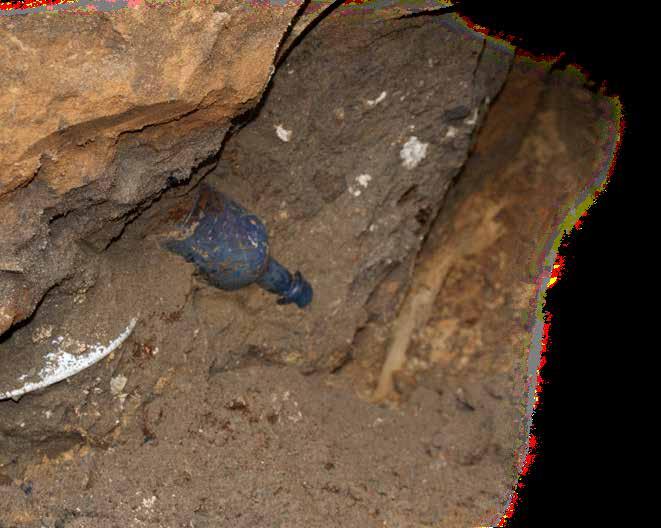
Suddenly, the damp air was pierced by the sound of hooting and hollering. Bottles started rolling out of the dirt and some were even found in the backhoe bucket. With childlike excitement, the high fives began when one extremely rare colored John Ryan soda bottle rolled onto the ground. The collared top had been missing from years earlier, but the red strawberry color
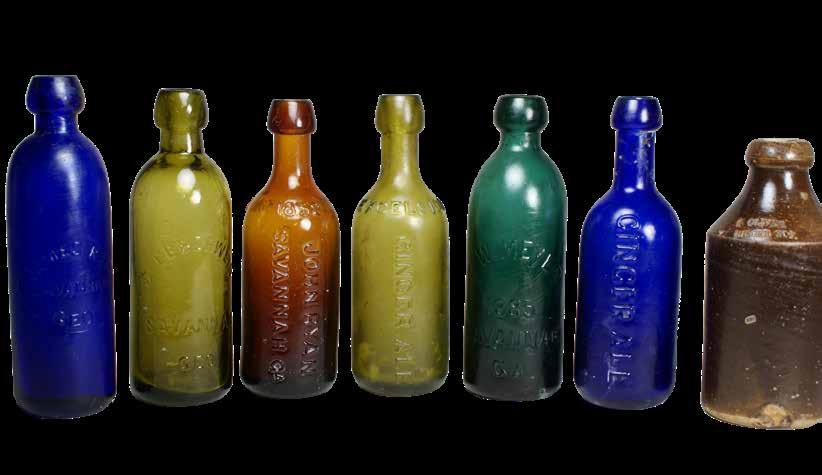
Like the colored lights on a Christmas tree, John Ryan founded the Excelsior Bottle Works in 1852 and produced a litany of colored soda bottles. The most common were cobalt blue and green. However, Ryan produced bottles in amber, yellow, lime green, aqua and the rarest are the red, pink and gray colored bottles. John Ryan’s soda bottles as well as many other local bottlers were common shelf items in grocery stores, boarding houses and saloons. We dug several John Ryan mineral water bottles embossed in an arch and dated 1859. These bottles are embossed on the reverse side “THIS BOTTLE IS NEVER SOLD.” Additionally,
we dug several John Ryan 1852 porter & ale bottles, lots of clay pipe bowls and several grape shots were found metal detecting.
On this site, the Savannah Gas Company operated from 1853 to 1953. In large tanks gas produced from coal was stored. This site was also occupied by Creek and Yamacraw settlements. Closer to the river, a large burial mound had once occupied part of the landscape but is said to have been claimed by years of erosion. Because the site had previously been used in coal and petroleum produc tion, we opted not to excavate the bluff near the old fort. In doing so, we knew that revolutionary cannon balls and other treasures lay lodged deep in the dirt. French frigates once fired into the city during the Siege of Savannah battle.
The Metal Building
Thos Maher without the Union Glass Works on the reverse side. A couple of years after our dig, construction workers dug considerably deeper and a large trash layer was discovered. It contained broken china shards and many early rum bottles, some broken some whole.
The Well
While trenching the northern quadrant, we located an old well. Excavations began with a regular backhoe but after an exhaustive and fruitless attempt to reach the bottom, we discovered the depth of the well to be deeper than the reach of the backhoe. We solicited the assistance of a close friend who owned a hy-hoe and agreed to include him in the split versus paying him for his time.
Adjoining the Kehoe Foundry was a huge metal building which had been constructed perhaps in the 1950’s. Inside the building, the floor was covered in un-mortared bricks. We were given permission to excavate inside the building which we did without the aid of a backhoe. After several weekends of digging, we discovered a dump and a couple of privies.
The sweltering heat and humidity made this job tough and after reaching depths of more than 30 feet with no finds, we soon found ourselves overcome with fatigue and disappointment. Later, a broken Spanish earthenware olive jar circa 1770-1800 was also excavated and later reconstructed.
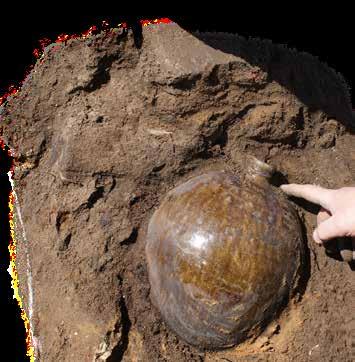
By the end of the day, we reached the bottom of the well. Close to the bottom, everyone began laughing with childlike excitement as the dirt fell away from a beautiful Edgefield jug. A short time later, several
The Savannah Gas lot
The small parcel of land at the corner of Bay and East Broad Streets had been owned by the Savannah Gas Light Co. since the mid 1800’s. On this lot were two historic structures surrounded by an old brick fence. After probing the area, we identified several areas of interest. On this site, five privies were located and dug.
The first privy was dug down on the outside wall to a depth of approximately eight feet. Entering the arched window at the base, we uncovered several beautiful John Ryan Mineral Water bottles dated 1859 and one 1852 lime green Ryan Ginger Ale. We also uncovered a Hilton Head, S.C. soda embossed Knectal and a chartreuse Hotchkiss Sons Congress & Empire Mineral Water.
Conclusion
Savannah has been the epicenter for bottle digging since the 1960’s. This dig will go down as the most historically significant site and perhaps the single longest dig with owner permission. Approximately sixty privies were identified and dug over a two-and-onehalf-year period. To show our appreciation, we provided each owner with large shadow boxes of artifacts and historical narratives of the property. For the owner of the garden, we presented a cannon ball excavated
near a 200-year-old oak tree. A member of our group was talented at woodworking. He handcrafted a pedestal for the display of the cannon ball.
A colonial outpost, a botanical garden, a garden keeper’s house, an iron foundry, a Seaman’s Inn, the back yards of two early sites, a very historic corner and a shanty town were all once part of the Trustee’s Garden. The volume of artifacts unearthed were too numerous to be counted or cataloged but hundreds of photographs are evidence of and a testament to the motherlode of household relics left behind by early occupants of this site.
A friend and the regional manager of a major hotel consortium generously provided a meeting room with tables and chairs at a hotel in the historic district. It took most of the morning to unload, unbox and display the hundreds of soda, medicine, bitters, ink and snuff bottles. Additionally, chamber pots, bone toothbrushes and dice, clay marbles, porcelain doll parts, musket balls, uniform buttons and buckles, grapeshot, jugs, crocks, forged axe heads, and saddle stirrups, cannon balls, union and confederate bullets, coins, clay pipe bowls and stems were laid out for viewing. We spent the afternoon flipping and dividing the finds.
Although the experimental Trustee’s Garden concept was short lived, our modern-day mission had proven
an epic success. The joys of discovery, the camaraderie, and the memories far outweighed the cuts, bruises, and time away from family in the sweltering heat, thunderstorms and the bitter cold.
After two and a half years, we successfully finished the now legendary Trustee’s Garden dig. On the heels of this dig, we had successfully negotiated another historic site just two blocks away and were eager to embark on yet another bottle digging adventure.
Today, the vision of the new owner has been fully realized, and the grounds are now meticulously landscaped and hardscaped. It is a site that will be enjoyed for generations to come. The cultural treasure known as the Trustee’s Garden lives on. Tourists from all over the world stop and read the historical marker.
The historical relics left behind by early Savannahians would have been otherwise lost forever if not for the cooperation of the owners and our passion for history. Now preserved in perpetuity, these precious relics will be occasionally exhibited for the enjoyment of all and foster an awareness of Savannah’s history.
Poole has been passionate about Savannah history since elementary school and a seasoned collector of antique Savannah soda water bottles and southern pottery since 1975. Over the years, Jim has negotiated and secured some of the most prominent excavation sites in Savannah and amassed an impressive collection of John Ryan and Savannah soda bottles. After fifty years of excavating Savannah, this two-part series entitled, “The Dig of a Lifetime” is Jim’s debut contribution to FOHBC and AB&GC.
Jim
Young Collectors
CORNER
Interviews with Alice Seeliger
Welcome Dalton Skirvin!
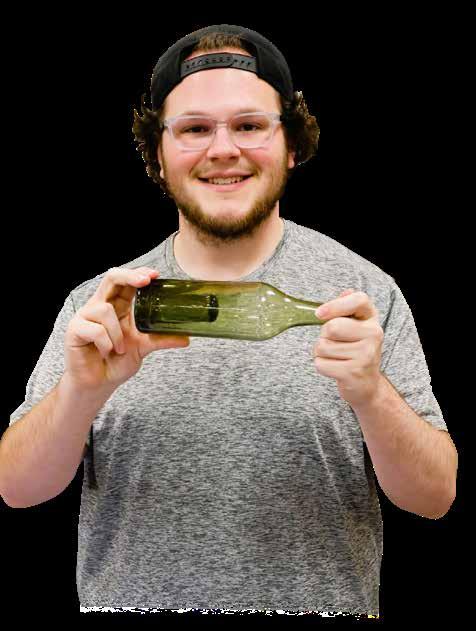
Miles Cox nominated Dalton for inclusion in our Young Collectors Corner. Dalton became interested in finding/collecting bottles pretty recently. Now 22, Dalton hasn’t done any digging, but he’s done plenty of mudlarking!
He started collecting pre-machine made bottles (earlier than 1910) with unique character such as misspelled words, backward letters, and pictorials, embossed druggist and milk bottles, and embossed dose glasses.
Now, Dalton is establishing a niche in collecting historical flasks and good-colored seam side flasks, specifically the half-pint size. He’ll gladly accept other sizes if they have good character, color, or if it’s a historical flask that doesn’t come in a half pint.
Dalton keeps busy attending meetings at his local State of Franklin Bottle Club and the recently established Tennessee Antique Bottle Collectors Club. He tries to attend every bottle show within a three-hour radius of his hometown of Kingsport, Tennessee, including the Gray, Tennessee show; Dalton, Georgia/Chattanooga show; Columbia and Pickens, South Carolina shows; the Lebanon, Tennessee show; and the Clemmons, North Carolina show. He set up as a dealer at the 1st Annual Hillsville Bottle Show as well as many others. In the fall he’ll be at the Lebanon, Tennessee Bottle Show. And he’s gearing up to attend the FOHBC Nashville 2027 National Antique Bottle & Glass Expo July 29-31, 2027. He’s definitely all in!
As a member of FOHBC, Dalton makes full use of the updated Auction Price Report to research his bottles. He, of course, reads each issue of this magazine, especially since we started the Young Collectors Corner, since he knows many of those who have been featured.
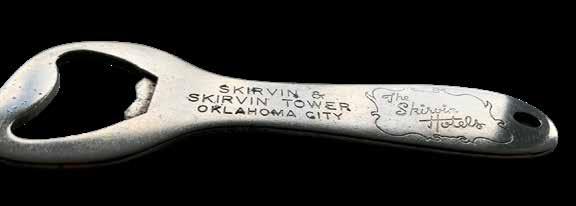
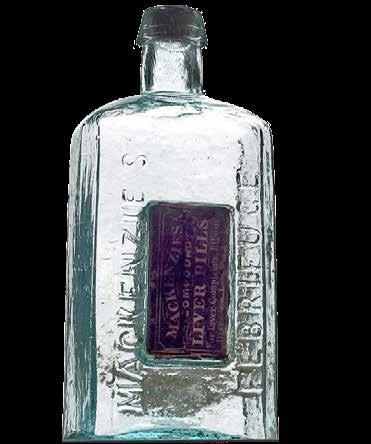
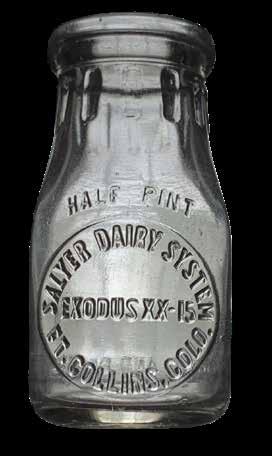
Dalton’s favorite bottle used to be an open pontil McKenzie’s Tonic Febrifuge with a recess for the included pill bottle. His favorite collectible is still a Skirvin Hotel bottle opener which is the closest thing to a bottle that displays his last name. But, again, recently, his favorite became the Half Pint Salyer Dairy System, Ft. Collins, Colo. bottle. It is the only bottle he has ever seen that references a bible verse: Exodus XX-15 (20:15), “Thou shalt not steal.”
Both of Dalton’s grandfathers (papaws) were bottle collectors. Papaw Curtis introduced him to mudlarking at just five years old. Papaw Tim collected local bottles he found on his land surveying job.
A "new favorite"
Dalton would like to see the return of the Hutchbook, an updated McKearin historical flask book, and the digitization of older bottle books and magazines, especially those that are out of print and unavailable.
Though Dalton hasn’t figured out his career path just yet, he is interested in archeology, history, and museums. His bottle collecting hobby will fit in just fine with all of those professions.
One of Dalton’s favorite bottles is an open pontil McKenzie’s Tonic Febrifuge bottle with a recess for the included pill box.
Dalton's favorite collectible is still a Skirvin Hotel bottle opener.
is this Half Pint Salyer Dairy System, from Ft. Collins, Colo.
The Goblet!
Ralph Finch makes the connection between a black-glass goblet, the first Sunderland bridge, a famous actress Mrs. Ann Borden, and William IV.
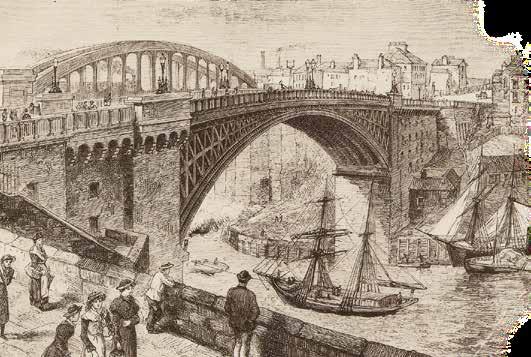
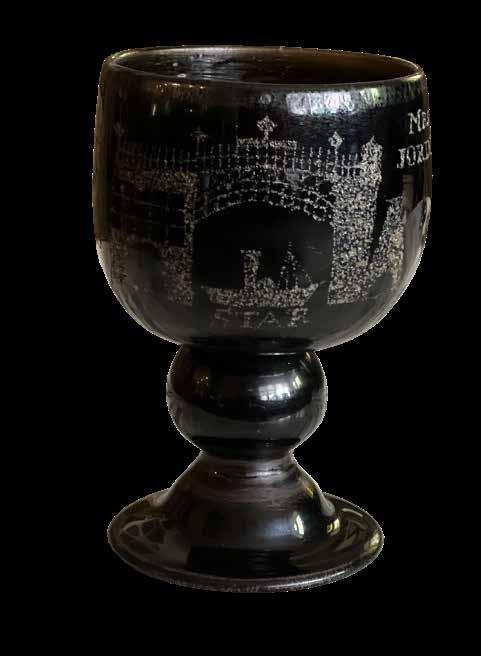
Goblets and trains? An odd combination! We can find on the Internet images of the train, the historic 1849 first iron Sunderland bridge it crossed, paintings of a royal mistress, and, here, a current photo of a pricey circa-1800 black-glass goblet. What does one have to do with the other?
more to the story. (Um, I took a train ride once, in America, and was cross — it was a terrible ride…but that’s another story.)
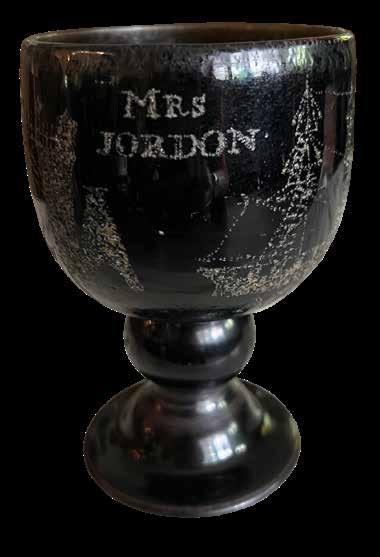
the name ‘Mrs Jordon’. The Sunderland bridge was built in 1796. Mrs. Jordon (actually, JordAn) was a famous actress who became the infamous mistress of William IV with 10 children. 5 3/4 inches high.” (The goblet, not the children…and, obviously, Mrs. Jordan was as fertile as a rabbit.)
England’s Mark Nightingale sold the goblet for £2,300 ($3,132.) WOW! As I was making that declaration in a recent article, I got a strange feeling, and a bell began to ring in my tiny brain. (If you remember typewriters you no doubt remember the bell…but the bell in my brain got louder and louder.) Eventually I went over to our cabinet of etched bottles…and there was the goblet!
“Janet,” I exclaimed, pointing, “When did we buy that?”
Go ahead. Laugh. (This was not the only time I was reminded that I am losing it. My memories are in black and white!)
The rarest stippled bottle gracing the Finch cabinet also features a train on a bridge with one car carrying pas sengers, the name “Robert Seath” and the date 1853. Maybe one of the passengers is Queen Victoria.
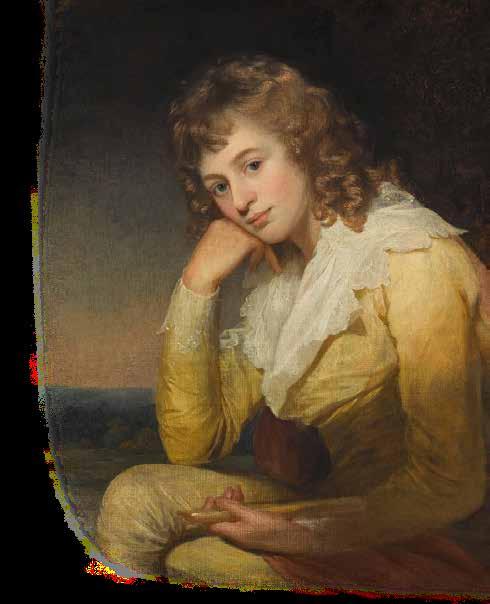
Mrs. Dorothea Jordan (1761–1816), born Dorothea Bland, was a celebrated English actress and the long-term mistress of Prince William, Duke of Clarence (later King William IV). They lived together for 20 years and had 10 children. “Dotty” was really a “Miss.” Dorothea Bland adopted the stage name Mrs. Jordan to imply respectability, as she never married. Paintings of her are in England’s Tate Gallery and the National Portrait Gallery.
Young actresses with lusty and royal dreams are cautioned though–the duo separated and Dorothea was forced to flee England because of financial debts and ultimately died in poverty in France.
Collector, and friend, John Ault of Gravesend, England, owned “a super rolling pin commemorating the building of Robert Stephenson’s High Level Bridge over the River Tyne, 1848-49. The road and railway bridge were officially opened by Queen Victoria in 1849, but this piece is dated 1848,” which is when a special train first chugged over the arch. The bridge indeed is a major topic in England’s history—and its glass.
Sold a few years ago (edited): “A free-blown blackglass goblet c1800, footed base with blown bulb stem … has a stippled representation of the first iron Sunderland bridge, underneath a paddle steamer named ‘STAR’. To the left a Masonic emblem within a banner, further left a fouled anchor, reverse side a large frigate, underneath named ‘ANN’, and to its left
Dorothea Jordan (née Bland), the actress and mistress of Prince William, Duke of Clarence (later King William IV from 1790 to 1811). William IV was king of the United Kingdom of Great Britain and Ireland and King of Hanover from June 26, 1830.
Ralph Finch, well-known to our readers, offers his special brand of collecting insight. As he begins to disburse yet another collection, Ralph is about to lose his title of “The Ketchup King.” Years ago, when he called his young nephews, they would answer and yell: “Mom, it’s Uncle Ketchup.”
Comments, questions, and offers can be sent to Ralph at rfinch@twmi.rr.com
HISTORICAL FLASK SERIES
Celebrating the 250th Anniversary of our Country’s Independence.
By Michael George
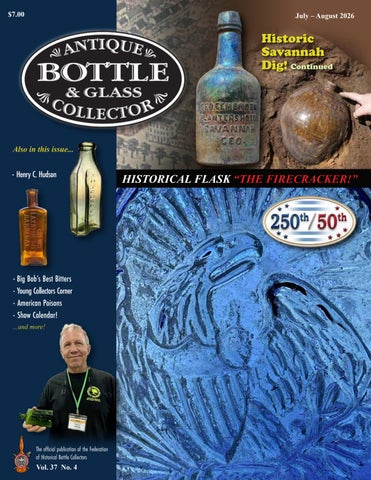
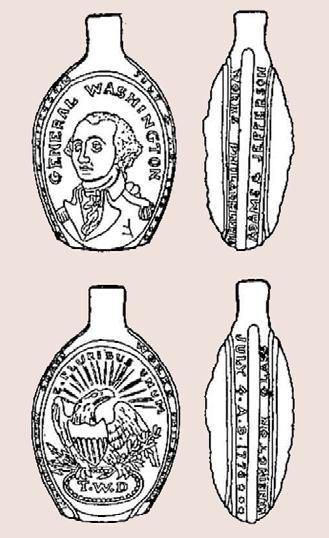
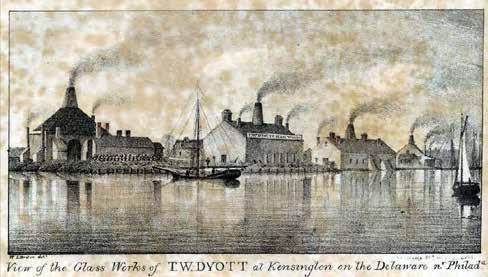
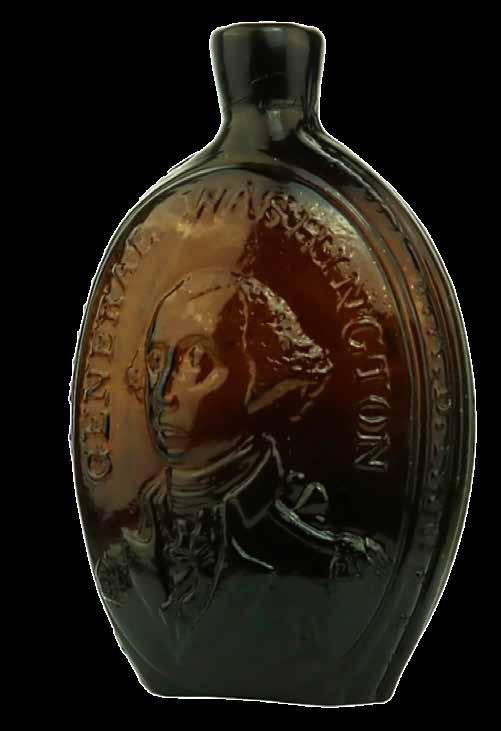
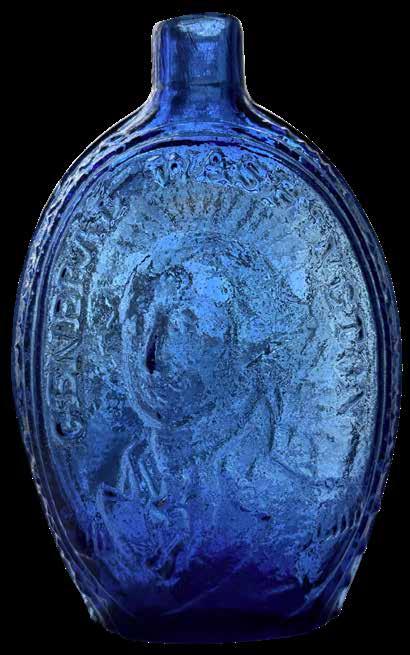
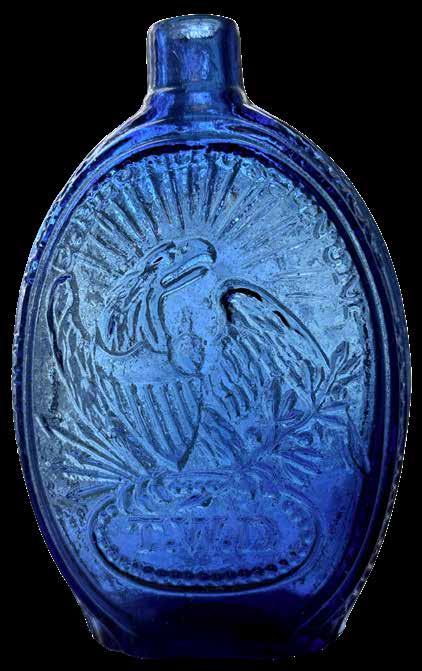
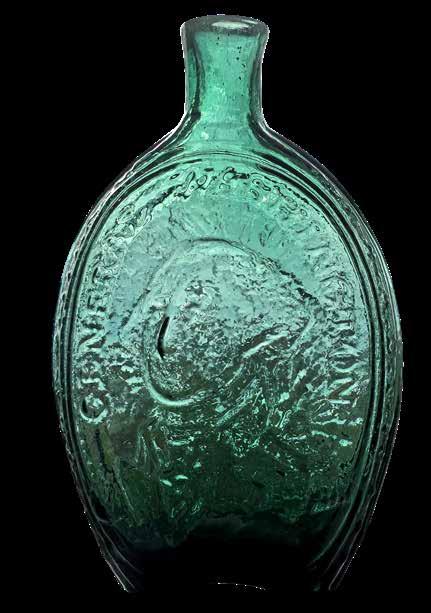
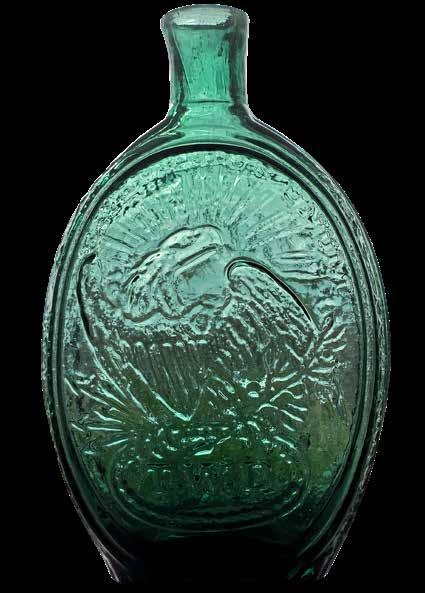
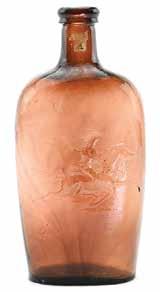
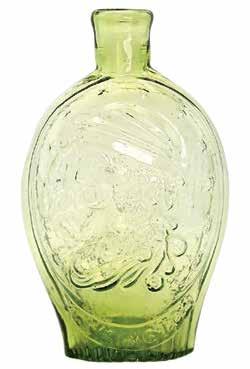
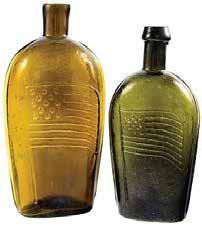
In the world of collectible flasks, one mold stands out as an extremely patriotic representation of an American historical event. This flask is listed in Helen McKearin's “American Bottles & Flasks, and Their Ancestry” as a GI-14. The GI-14 General Washington – Eagle pint is historically very significant and is affectionately called the “Firecracker.” The flask was blown, under the direction of Thomas W. Dyott, at the Kensington Glass Works in Philadelphia, Pennsylvania between 1826 and 1830.
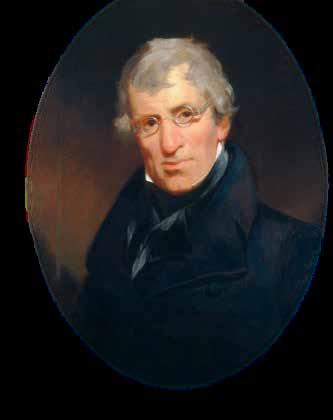
Thomas W. Dyott was a British-born American patent-medicine king, glassmaker, temperance advocate, and reformer. He was also the head of Kensington Glass Works, where the pontiled flasks were blown during the mid-1820s.
Why Is the “Firecracker” Flask Considered So Important?
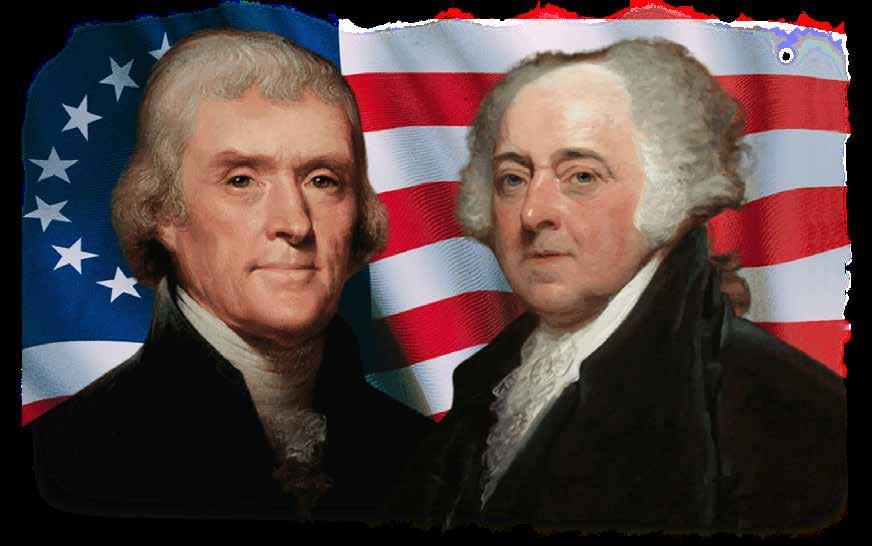
Dyott’s Washington flask demands particular attention. For many collectors, it stands as one of the most intriguing and attractive of all Washington flasks and, in several respects, among the most historical. It was created to commemorate a remarkable moment in 1826: on the Fourth of July that year, two of America’s greatest patriots—John Adams, the nation’s second president, and Thomas Jefferson, its third—both passed away. Their deaths coincided with the fiftieth anniversary of the adoption of the Declaration of Independence.
The impact of this coincidence did not fade quickly. Even a year later, at a public dinner, a toast honored “John Adams and Thomas Jefferson—embalmed in the hearts of 12,000,000 freemen—the temple erected to their memories will be more glorious than the pyramids, and as eternal as their own imperishable virtues.”
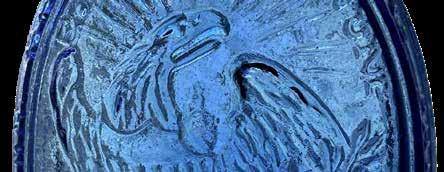
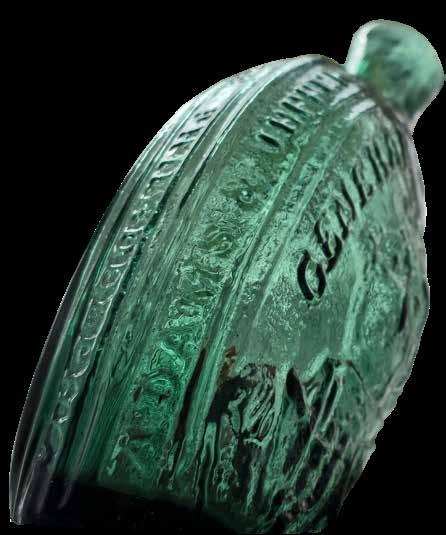
Thomas W. Dyott responded swiftly to this historic moment. Using the mold for his Washington-Eagle flask (GI-16), he added the inscription “E PLURIBUS UNUM” above the rays radiating from the eagle’s head, along with “ADAMS & JEFFERSON JULY 4 A.D. 1776” along the edge of the obverse. The reverse edge bore “KENSINGTON GLASS WORKS PHILADELPHIA.” Aside from these added inscriptions, the flask appears identical to related examples such as GI-14, with the new lettering carefully superimposed over the original design elements.
Flask! * * * * *
T.W. Dyott’s Glass Factory
The Kensington Glass Works was established in the early 19th century by Dr. Thomas W. Dyott in the Kensington district of Philadelphia, and became one of the most ambitious and controversial glassmaking enterprises in the United States. Dyott specialized in producing bottles and flasks—particularly patent medicine containers and historical flasks—at a time when demand for such goods was rapidly expanding. The factory operated on a large scale and was notable for its vertical integration, as Dyott controlled not only production but also the marketing and distribution of his products, often promoting his own medicines alongside the bottles that contained them.
Despite its industrial success, the Kensington Glass Works became infamous for Dyott’s strict labor practices. He created a highly controlled worker community, paying employees in company-issued currency redeemable only at his own stores, and enforced rigid moral and behavioral rules. This system, along with financial overreach, ultimately led to his downfall.
Today, Dyott’s Kensington Glass Works is remembered both for its significant contributions to early American glassmaking and as a cautionary example of unchecked industrial control during the nation’s formative years.
Line drawing from the historical flask chart in American Bottles & Flasks And Their Ancestry by Helen McKearin and Kenneth Wilson.
Amber is the rarest color for the GI-14 mold
Thomas Jefferson and John Adams passed on July 4, 1826, exactly 50 years to the day after both signed the Declaration of Independence!
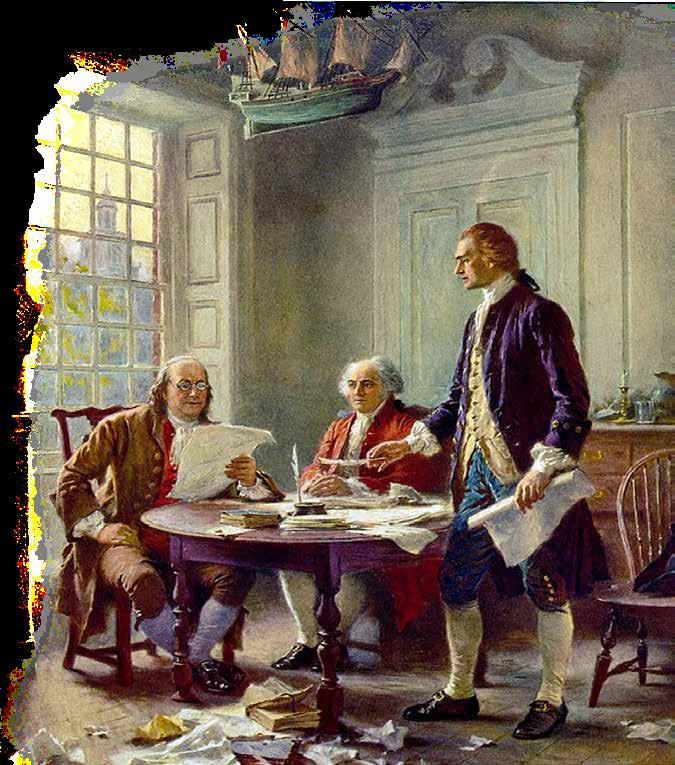
The relationship between John Adams and Thomas Jefferson is one of the most compelling in early American history—marked by deep collaboration, bitter rivalry, and ultimately reconciliation. During the American Revolution, they worked closely together, both serving on the committee that drafted the Declaration of Independence in 1776. Adams was a strong advocate for independence in the Continental Congress, while Jefferson, known for his eloquence, became the primary author of the document. Their shared commitment to the revolutionary cause forged an early bond of mutual respect.
However, their political paths diverged sharply in the 1790s. Adams became a leading figure of the Federal-
ist Party, favoring a strong central government, while Jefferson aligned with the Democratic-Republicans, advocating for states’ rights and a more agrarian vision of the nation. This ideological divide led to a fierce political rivalry, culminating in the contentious election of 1800, in which Jefferson defeated Adams. Their friendship fractured, and for over a decade they had no direct communication.
Their reconciliation, beginning in 1812, stands as one of the most remarkable renewals of friendship in American history. Encouraged by mutual acquaintances, Adams initiated correspondence with Jefferson, and the two resumed communication with surprising warmth. Over the next fourteen years, they exchanged
more than 150 letters. These were not merely polite notes; they were rich, reflective conversations about liberty, governance, aging, and the meaning of the Revolution they had helped lead. Freed from the pressures of politics, both men displayed a philosophical generosity that had been absent in their earlier rivalry. They acknowledged past misunderstandings, expressed admiration for one another’s contributions, and found common ground in their pride for the nation’s survival.
Their deaths on July 4, 1826—the 50th anniversary of the Declaration of Independence—have taken on an almost mythic significance. Jefferson, long in declining health, died in the early hours at Monticello. Adams, though frail, lingered through the day at his home in Massachusetts. His reported final words—“Thomas Jefferson survives”—capture both the depth of their connection and the poignancy of the moment, even if factually mistaken. The near-simultaneous passing of these two former rivals turned reconciled friends seemed to symbolize the closing of a revolutionary generation.
The coincidence resonated deeply with Americans at the time and has continued to do so ever since. It suggested, to many, a kind of providential symmetry: two architects of independence, once divided, reunited in spirit and departing together on the nation’s most sacred anniversary. Their intertwined lives—marked by collaboration, conflict, forgiveness, and shared legacy—offer a powerful example of how personal relationships can evolve alongside the broader currents of history.
Antique Bottle & Glass Collector May - June 2026
The Blue Firecracker is arguably the most beautiful and historical American Flask!
Colors and Rarity
Known glass colors of the GI-14 flask are aqua and light green which are common. Examples in these colors are available and are well within the means of the average collector. Clear medium green, clear emerald green, and emerald green are noted as rare. Deep green, blue-green, and deep green with yellow tone examples are considered very rare. Golden-yellow, dark amber, red amber, sapphire, and deep sapphire blue are extremely rare.
There is a grey example with a bluish cast that is probably the rarest color of all but not the most desirable color. The most desirable and most difficult to obtain colors would be amber followed by sapphire blue (some say cobalt blue). Both examples are represented in the FOHBC Virtual Museum.
Green shades range from aqua to deep emerald.
the bold
detailing the
Michael George is a wellknown collector, contributor, and a premier antique bottle and glass dealer. With decades of experience writing articles, attending and coordinating shows, and performing lectures, Michael is always willing to share his knowledge, while coaching new collectors in the hobby. Michael also has a Bachelor’s Degree in Marketing from Notre Dame College. He lives in the Lakes Region of New Hampshire with his wife, where they operate a seasonal inn. Michael can be contacted at earlyglass@gmail.com
A strong sapphire blue example. Hogan collection (Courtesy Jeff Noordsy)
Antique Bottle & Glass Collector
Note
embossing
"ADAMS & JEFFERSON" commemoration.
Our deeper emerald green colored example!
Hiding in Plain SigHt
The Acquisition and History of a Rare Fullerton Stopper Bottle
By Harry Eichman
As I write this, the ground in my area of Pennsylvania is frozen, so my bottle digging is paused affording me time to look through my collection of dug and purchased bottles. One of these was a bottle I purchased in my early bottle-col lecting days. It remains one of the rarest and most unique beer bottles in my collection. But I almost didn’t purchase it.
The story of this bottle began about 13 years ago when I first started collecting antique bottles. I had a few different types that I had found while metal detecting, but buying bottles was new for me. My knowledge about antique bottles was curso ry, at best; I knew the major categories but that was about it.
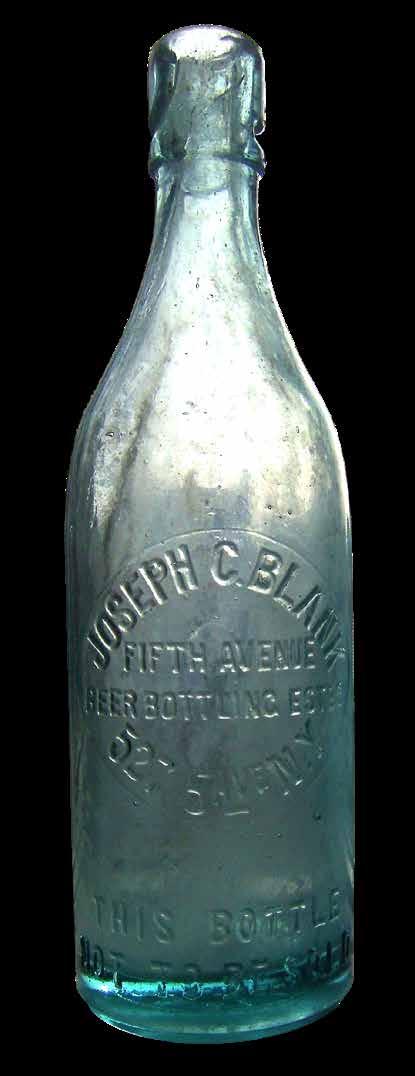
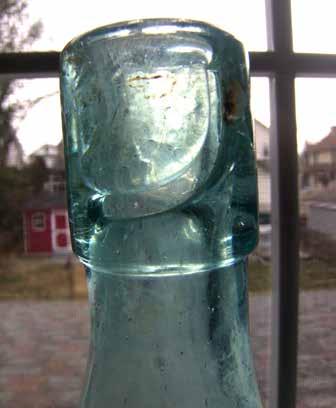
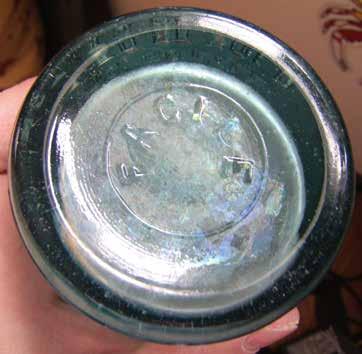
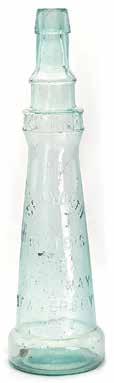
One day I was browsing in a large antique mall and noticed an aqua bottle embossed in a circular slug plate: Joseph C. Blank Fifth Avenue Beer Bottling ESTBS 527 5 Ave NY (Figures 1-3). The base had facile (Spanish for easy) em bossed in a circle. What differentiated this bottle from ones I had seen previously is that the bottle lip was cylindrical instead of blob-shaped and had two “L” shaped molded grooves. Moreover, it had an incomplete mold line in the lip as if the lip was blown separately and then applied. In other words, the blown in mold (BIM) bottle’s mold lines disappear before the lip but the cylindrical lip part contained mold lines. In my naivete, what struck me more than the odd cylindrical lip was that the bottle had a prestigious 5th Ave
business location, presumably in New York City. The dealer wanted $18.00, which I thought was too much given that it had a crack in one of the L-shaped grooves. I put the bottle back and that was that for the next two years.
Then, I found myself back at the same antique mall wondering if the bottle was still at the dealer’s booth. But, to my dismay, it wasn’t. Dejected, I regretted not purchasing it earlier. But then I happened to spot the odd bottle in a completely different section of the dealer’s booth. After some haggling, this time I purchased it—for $10.00.
When I got home, I started researching the internet for the embossing of Joseph C. Blank 5th Ave NYC but did not find anything. However, I did happen upon Tod von Mechow’s antique sodas and beers website. There were no Joseph C. Blank NYC bottles, but there was a section on bottle stoppers and there was a bottle with a “Fullerton stopper” that had a lip very similar to my bottle. The website listed four embossed variant bottles: two blank ones, a T.A. Banta Midland Park (NJ), and Pullman Palace Car Company. Intrigued, I emailed Tod and he confirmed that the Joesph C. Blank was the fifth known Fullerton stopper bottle variant.
George A. Fullerton of Boston seems to have been an itinerant inventor having patents for a boot burnishing machine, hitch pin for zither (musical instrument), and bottle stoppers among other things.
Figure 1: Front of the Joseph C. Blank NY Fullerton stopper bottle.
Figure 2: View of the applied lip of the Fullerton stopper bottle.
Figure 3: Base of the Fullerton stopper bottle embossed Facile.
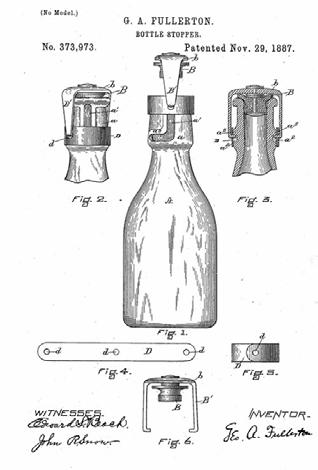
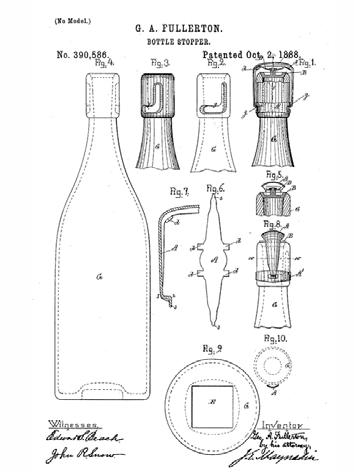
Figures 4 and 5 relate to George A. Fullerton’s patent of a bottle stopper and the bottle lip related to my Joseph C. Blank bottle. The invention involved a stopper made of sheet metal that could fit into the custom L-shaped slots in the bottle neck. The first patent was assigned to George A. Fullerton, but later patents were assigned to the “Facile Bottle Stopper Company of New York.”
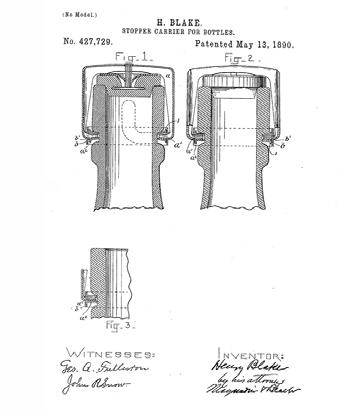
A later patent (Figure 6.) by Henry Blake (but interestingly witnessed by George A. Fullerton) is a further improvement to the bottle stopper for this type of grooved-lip bottle. This may explain the slight difference in the L-shaped grooves in the lips of known Fullerton stopper bottles as this patent mentions that the previous example’s stoppers put excessive pressure on the glass walls of the grooves, causing damage.
As to the molded lip on the BIM bottle part, this is answered by Fullerton’s patent Bottle Making Machine pat. US Pat 426,497 October 2, 1888. He described a machine for making a grooved bottle lip from the still-malleable glass of a previously blown bottle body. This patent was also assigned by Fullerton
to the Facile Bottle Stopper Co. This is probably why my example has Facile on the base instead of a square indentation as shown in the one patent.
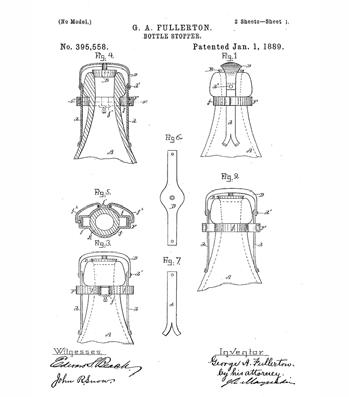
In addition to these patents, Fullerton seems to have been hedging his bets by being granted a patent for a bottle stopper meant for a conventional blob bottle lip (Figure 7); US Pat 395,558 January 1, 1889, and a patent for a metal and glass lamp attachment US Pat 426,497, Pat April 15th, 1890, to the Facile Bottle Stopper Co.
I cannot find any evidence of Joseph C. Blank being a bottler or of his Fifth Avenue beer-bottling establishment. Interestingly, the other embossed Fullerton stopper bottle, T. A. Banta Midland Park NJ, also has no other known bottles. I have to wonder if these were example bottles made to showcase Fullerton’s/ the Facile Bottle Stopper Co.’s invention.
The Fullerton stopper did not see much use, probably only in the 1889 to 1892 time period. In my opinion, the expense of having to buy a custom bottle fit for only a specific, untried stopper, and the Panic of 1893, probably doomed the stopper since an 1897 New York Tax Document lists unpaid taxes for the Facile Bottle Stopper Co.
An interesting epilogue is that the top to my battery toothbrush is based on a similar concept to Fullerton’s bottle stopper. The tip slides into grooves and then turns and locks in, nearly identical to Fullerton’s patent. Perhaps Fullerton’s ideas were not so niche after all!
Selected Sources
Joseph Blank bottle/photos taken from author’s collection.
Fullerton,
Fullerton,
Blake,
Duncan,
Graci, David; Soda and Beer Bottle Closures 1950-1910 (South Hadley, Privately Published).
Report. Schedule K p 412 New York Law Department, United States, n.p, 1898.
Harry Eichman is an amateur bottle digger/ researcher who lives in SE PA. In addition to the local bottles he digs up, he enjoys collecting and researching unusual Philadelphia-area bottles.
Figure 5: Bottle Stopper Pat October 2, 1888, US Pat # 390,586
Figure 6: Stopper Carrier for Bottles Pat May 13, 1890 US Pat 427,729.
Figure 7: Bottle Stopper Pat Jan 1 1889 US Pat 395,558
Fullerton, George A. Bottle stopper. US 373,973, United States Patent and Trademark Office, 29 November 1887.
Fullerton, George A. Bottle stopper. US 390, 586, United States Patent and Trademark Office, 2 October 1888.
George A. Bottle making machine. US 426,497, United States Patent and Trademark Office, 2 October 1888.
George A. Bottle stopper. US 395, 558, United States Patent and Trademark Office, 1 January 1889.
Henry. Stopper Carrier for Bottles. US 427729, United States Patent and Trademark Office, 1 January 1889.
William F. and Fullerton, George A. Lamp. US 425498 United States Patent and Trademark Office, 5 April 1890.
Von Mechow, Tod, Fullerton Stopper, 5 January, 2026.
PayPal: abcr@bigpond.com
Email: travisdunn@bigpond.com
By Eric McGuire
The story of H.C. Hudson should begin with his parents. He was the son of Henry D. Hudson and Phoebe Hale. Henry C. Hudson was born to them in Newark, New Jersey, in 1818 as their youngest child. The father was noted as a carpenter in most early records of Newark, but he switched occupations to a mustard manufacturer in 1837. The 1844 Newark city directory is the first date noted for our subject, Henry C. Hudson, who was also operating as a mustard manufacturer. Henry C. Hudson was the youngest child. He married Mary White in Essex County, New Jersey, on October 25, 1843. His mother died in 1839, and his father, who continued as a mustard merchant, died on August 10, 1846, in Newark, Essex, New Jersey.
Henry C. Hudson had been working for his father’s mustard factory, titled the Newark Mustard Factory, in Newark, NJ, from about 1844 when his father, retired and young Henry assumed the business, along
with partner, Smith E. Crane, in June 1846, which was called Henry C. Hudson & Co. (Newark Daily Advertiser, Newark, New Jersey, June 9, 1846)
News of gold discovery in California shook the world in 1849, and Henry C. Hudson, along with nine other men mostly from Newark, New Jersey, formed a “company”, with the title of “Boyden’s California Mining Co.” Pooling their expenses, this was a common method for California-bound miners to effectively arrive in the gold fields. In return, it was generally expected to also equally share their profits from the adventure.
The mining company left for California on February 1, 1849, from Newark, New Jersey, on the Steamer Falcon. (Newark Daily Advertiser, Newark, New Jersey, February 3, 1849) It is not known if Hudson was a successful “49er”. Hudson’s initial intent was to put his gold-seeking adventure behind him and go back to producing mustard in Newark, New Jersey.
Hudson proudly inserted a newspaper advertisement in a Newark, New Jersey, paper announcing his return from California, and his return to the mustard business. (Newark Daily Advertiser, Newark, New Jersey, January 16, 1850)
It soon became clear that his California adventure could not be put to rest in his mind. Perhaps it was the excitement presented by that “new world” and the potential of practicing his entrepreneurial spirit in a new and exciting economy. Such ideas must have played heavily on him and Hudson soon gave in to the temptation of going back to California as a mustard manufacturer.
By late 1850 Hudson was back in San Francisco and involved in the business he knew best, as noted above. Also, note Hudson’s purchase of a “wind-mill on the Heights.” (Daily Pacific News, San Francisco, October 15, 1850)
Hudson’s first partner in San Francisco was Henry B. Gleason who soon thereafter was elected one of seven vice-presidents at the first meeting of the San Francisco Vigilance Committee. (Daily Alta California, March 10, 1851). This was the somewhat notorious group that was determined to bring law and order to the lawless condition of early San Francisco. Gleason had arrived from Charleston, SC in May 1850. He later went into the buggy and carriage business.
The traditional history of Telegraph Hill is generally silent about the “windmill,” however, the conversation back in the day was peppered with interest about this strange object that appeared on the highest point of the city of San Francisco. (Daily Alta California, August 2, 1850)
THE WINDMILL – For some little time now, the dwellers in San Francisco have been observing with more or less surprise, the gyrations of a strange machine, situated on one of the heights to the north of the town; This turns out to be no more nor less than a windmill, though it is precisely like what Don Quixote, in the days of declining chivalry, mistook for a giant. (Daily Pacific News, San Francisco, October 2, 1850)
A couple of months later the secret of the windmill finally came to light. “A business visit to the Windmill on the hill, informed us, for the first time, what it really was. Through the courtesy of the superintendent, we were shown around the establishment, and were agreeably sur-
prised at the amount of business transacted. The concern, Messrs. Hudson & Co., are extensively engaged in the grinding and preparation of mustard, spice, and coffee. . . We are pleased to notice these enterprises in California.”
(Sacramento Transcript, November 22, 1850)
Hudson’s new mill was undoubtedly used as a necessary power source for the grinding of the raw products for Hudson’s business. The mention of the nearby “Observatory” is of great historical significance to the development of San Francisco. This location was used as a lookout for incoming ships in and around the bay and ocean. A “Marine Telegraph” was constructed at this location in April 1850, which could then “wire” important information about ships and shipping. Thus the site became known as Telegraph Hill. Hudson’s retail store was located at the corner of Front & Pine streets for many years.
The Louisiana House was a saloon/boarding house constructed on Portsmouth Square in San Francisco by mid 1850. It was photographed, as shown here, in a daguerreotype of the Square in late 1850 or early 1851. This is a small part of the original picture. Looming high above on top of the hill behind the Louisiana House can be seen Hudson’s windmill. This is the only photograph located that shows the mill.
In an unusual lithograph probably created about 1853 or 1854, it was sketched from a position on top of Telegraph Hill and looking down on San Francisco and its harbor. This partial view of the lithograph plainly depicts Hudson’s windmill. While well rendered it was developed from a drawing and likely has some fanciful additions. The windmill is probably a fairly accurate rendition. In the short time between the dates of the above-noted daguerreotype and the lithograph, the city of San Francisco had developed rapidly.
Hudson had moved his grinding operations to Potter’s Steam Mill on Market Street, San Francisco, by November 1854. The initial function of this mill was primarily used for cutting lumber, but was probably later modified for the necessary grinding of coffee and spices required by Hudson. Steam power would have been more reliable than the inconsistent wind power of his Telegraph Hill site.
One of Hudson’s early advertisements for his spice products. (California Farmer and Journal of Useful Sciences, September 12, 1856) As early as 1856 H.C.
Hudson was winning awards due to the excellent quality of his Golden California Mustard.
With a strong business acumen and a steady income stream from his coffee, and spice business, especially mustard, Hudson began investing in real estate. One early example is the Eureka Homestead Association, which was incorporated in 1862. (The Sacramento Bee, September 2, 1862) This was an incorporated business that bought large tracts of land and subdivided them into house lots.
Over the years Hudson had imported a huge number of glass bottles from eastern glass works for his successful business. To help lower the importation cost he became involved in establishing a glass works in San Francisco, and was one of the original members of the Board of Trustees for the Pacific Glass Works, incorporated on October, 2, 1862, with headquarters in San Francisco. (The Daily Appeal-Democrat, Marysville, California, October 3, 1862) There were no other glass manufacturers in the West and a local company could considerably reduce the shipping costs compared with eastern manufacturers. He was elected secretary of the company at least for the years of 1866, 1867 and 1868.
Hudson chose to expand his business into the adjacent state of Oregon beginning in January 1865. Instead of using his already established company name he chose OREGON MUSTARD AND SPICE MILLS. It appears that his reasoning was to create two separate entities in case the Oregon store failed. In fact, it was short-lived and evolved into the property of Williams & McBride, wholesale grocers in Portland, Oregon.
His business partner, C. H. Williams, left the San Francisco firm June 6, 1866, and Hudson continued under the name of H.C. Hudson & Co., being a single proprietor at the time. He then accepted a partnership with Clarence C. Burr on June 1, 1867. With business success in his favor, Hudson began making several trips to the East. The trips appear to be related to the next chapter in his life, where he longed to return to his ancestral homeland in New Jersey. Hudson initiated a search for an ideal piece of property upon which he could construct his retirement home. Best laid plans don’t always come to fruition. While on one of his trips Hudson’s future plans came to an end. “Mr. Henry C. Hudson, a wealthy Californian, formerly of Newark, who last year bought several fine pieces of property around Jefferson Park, on one of which he intended to build a fine residence next summer, returned from San Francisco week before last and on Wednesday night he was prostrated with congestion of the brain and died last evening. His wife and child are coming from California by steamer and cannot arrive for some ten days.” (Jersey Journal, Jersey City, New Jersey, December 8, 1871)
Upon Hudson’s death, his surviving partner, Clarence C. Burr, continued the business entity of H.C. Hudson & Co. until June 1, 1872, along with Hudson’s wife, Mary Hudson, as a partner. He then renamed the company C.C. Burr & Co. which still included Hudson’s widow as his partner. At least a part of the reasoning for this action is that Burr was named Executor in Hudson’s will and Mary Hudson was the primary beneficiary of her husband’s estate, thus providing for a smoother financial transition as well as maintaining a successful business.
(Daily Alta California, June 30, 1872)
The Hudson family was no stranger to internal familial issues which was the case with H.C. Hudson’s son, H.C. Hudson, Jr. Not privy to the issues it is clear that the son attempted to capitalize on the name of his deceased father’s business, much to the chagrin of his mother and C.C. Burr. The issue became so heated that Burr and Mrs. Hudson brought suit against H.C. Hudson, Jr., for unauthorized use of his father’s trademark, asking $10,000 in damages. (Daily Alta California, October 11, 1879) This familial strife appears to have continued, off and on, for another decade until Hudson, Jr. died a terrible death by being swept off the rocks near the Cliff House by ocean waves while gathering mussels. (Daily Alta California, February 27, 1888) His company was called the Hudson Mustard Manufacturing Co.
In 1876 the top of Telegraph Hill was purchase by benefactor, George Hearst, and given to the city, to be known as Pioneer Park. From a bequest funded by Lillie Hitchcock Coit, and completed in 1933, sits the 210 foot Art Deco concrete Coit Tower.
(Left) San Francisco companies that pro duced spice in embossed bottles also used bottles with no lettering, as in this example for H.C. Hudson & Co.
(Right) An example of the embossed Hud son spice bottle. Applied collar top and 6.5 inches in height. As with most ground spices produced in our western states, the bottles are of similar shape during the period of roughly 1863 to 1878. This terminal date is only approximate, and for the Hudson bottle it should be no later than his death year of 1871. The Hudson examples appear to have the same embossing – H. C. HUDSON & Co., running from top to base, on one of the two largest panels.
(Lower) The base of the Hudson spice bottle indicates a two-piece mold with a “keyed oval” to allow the pieces to properly align.
Eric McGuire, pictured with granddaughter, Stevie Joy Larkins, is a senior member of the bottle collecting world, a former digger, long-time member of the FOHBC Board, and seasoned researcher and writer. He is holding the largest intact bottle he unearthed from a Poughkeepsie, NY privy. Eric enjoys sharing his passion for preserving and sharing the past through “ancient” glass containers.
An advertisement for C.C. Burr & Co from the 1874 Oakland, California city directory, during the transitional period when Burr and the widow, Mary Hudson, operated the business of the departed H.C. Hudson.
Dedicated to Bitters Collectors and the Pioneer Giants of our Great Hobby
By Bob Strickhart
Ocean County N.J. is about an hour’s drive from my home. It is on the northern edge of what we in New Jersey call the “Pine Barrens.” To say the least, it is a unique and important ecosystem. This topographically flat area of very sandy, acidic soil is the result of the outwash plains from the last glaciers. Here, where it appeared that nothing much but scrub pines grew, the early settlers said the land was “barren,” believing this place was a poor choice for traditional farming or other financially profitable endeavors. However, it didn’t take long for the settlers to figure out how to make it work.
Extremely valuable white cedars were harvested for shipbuilding and Bog iron was found to be an important resource to manufacture iron products including the cannon and musket balls used in the war for independence. Early settlers saw an egret (they thought it was a crane) eating strange bitter red berries, and today we are one of only four states to grow cranberries which thrive in that sandy soil once considered barren.
That acidic soil also sustains our booming blueberry fields. And so, the Pine Barrens and the southern counties of New Jersey, like Ocean County, began to thrive.
When Henry Hudson cruised north along the coast of New Jersey in 1609, he came across a sizable inlet he called “Barende-gat,” a Dutch word meaning an inlet with breakers.You might remember that old Henry was an Englishman, but he cruised courtesy of the Dutch East India Company. As time went by, the Dutch “Barende-gat” morphed into Barnegat. As Barnegat grew, improvements followed including the development of roads and the introduction of the Tuckerton Railroad as well as the Central Railroad of New Jersey. These advancements helped to move goods from the Barnegat area north to markets in New York and west to Philadelphia. Agriculture, forestry, ship building and marine trades, bog iron, and of course, access to the Atlantic, provided a vibrant economy. More industry and growth meant more workers, and those workers needed health care and other support services. Enter John W. Chew.
The Chew family originally settled in New Jersey and parts of Pennsylvania as early as the 1600’s. John W. Chew was born in 1835 to Michael Chew and his wife, Sarah. In time, John W. Chew became a prominent citizen of Barnegat, at one point serving as Comptroller of the Township, and was well known as one of the few (if only) pharmacists in the area. So, if you were a bit under the weather, you went to see Chew, the pharmacist. In the early 1890’s, Chew formulated at least two patent medicines, most notably “Chews Cough and Consumption Remedy” and the subject of our investigation: “Chews Laxative Bitters.”
Southern New Jersey has many historic glass houses. The land believed to be barren and useless had the perfect sand to manufacture glass, as well as plentiful pine and other fuel woods to keep a glass factory cooking. I’ll bet you’ve probably heard of glasshouses like the Whitall Tatum Company from Millville, the Whitney brothers from Glassboro, and the Moore Brothers from Fislerville–now named Clayton–but
(Above) Colorized Image of the Barnegat Glassworks. (Courtesy Ol’ Tales of Barnegat NJ Website by Giovanni Rawley) (Below) 1878 Map of Barnegat NJ.
you may not know of Ocean County’s only glasshouse, the Barnegat Glass Factory in, you guessed it, Barnegat N.J.
This Barnegat glassworks, built in 1893 by Benjamin Chadwick, was originally incorporated as the Barnegat Druggist Hollow Ware Glass Company. The Chadwick family also had roots in the area going back to the 1700’s. Today, on the Barnegat peninsula, is the town of Chadwick Beach. The appearance of a glasshouse while Chew was formulating his bitters and other medicinals doesn’t just seem to be a coincidence. It appears to me that Dr. Chew needed a bottle for his goods. Where there is a need, there is a way to meet that need.
Built near the bay, by 1908, the Barnegat Glass house employed around 65 workers. The glassworks were originally known for making Dr. Chew’s bottles, but they were known as well for producing glass chains, canes, vases and other whimsies. The factory had a lot of ups and downs including work stoppages due to strikes by the workers, and was sold in 1897. In 1912, the glassworks was sold again in an attempt to revive the business; but by 1913, the end came and the furnaces went cold. In 1914, a fire destroyed much of the factory and in 1920 it was demolished. The land sat idle for years. It is now the site of an apartment complex. While I never experienced it myself, I am told
that before the apartments were built, you could easily find glass house slag and other debris on the former glass house site.
I do not believe Chews Laxative Bitters was manufactured for a very long period of time. Advertisements for Chew’s Laxative Bitters from the October 19,1893 edition of the “New Jersey Courier” and other sources are shown here with testimonials dated 1892 and 1893. The glass factory was sold in 1897 and didn’t survive past the early 1910’s. John W. Chew passed away in 1919.
Let’s look at this rare little bottle. It’s not very elaborate or ornate; in fact, it’s quite a simple container. Here’s how Dick and Elma Watson catalogued it.
Listed simply as specimen #410 in “Supplement to Bitters Bottles”
CHEWS LAXATIVE BITTERS
Marked on the face in three vertical lines: “CHEWS / LAXATIVE BITTERS / BARNEGAT, N.J.”
All sides indented. Ca. 1900.
Shape: Rectangular
Color: Amber
Mouth: NSC
Measurements: 7 x 2 1/2 x 1 3/4
Base: Smooth
Corners: Beveled
The 6-star rating indicated that the bottle, according to Dick, was Extremely Rare (1 - 5 specimens). NSC indicated that the lip finish was a Narrow Square Collar. Nothing much was added or deleted in the following bitters books except the bottle was designated as C-140.
I have to take a moment to remind you to appreciate Elma Watson’s line drawing. Remember there was no computer to lean on, no scanning…just some paper, a pencil and perhaps a ruler. The accuracy of Elma’s line drawing is amazing to me, more like a work of art.
When Dick Watson first produced his book “Bitters Bottles” in 1965, he didn’t even include an example of the Chews bitters. Even though he lived less than 40 miles from where the bottle was originally manufactured, Dick didn’t add the bottle for another few years, and I’m not sure if he ever actually owned one. When the Watsons produced their supplement in 1968, it was listed and rated as extremely rare. Later, Carlyn Ring concurred and rated the bottle as exceptional. Later still, in the Ring/Ham book, the bottle was still listed as extremely rare indicating that there are less than five known examples. I believe several of my fellow New Jersey collectors have examples, but I’ll bet there are less than 10 or so for sure. It took me over 25 years to finally track down an example for my collection, and I consider myself extremely fortunate to have it on my shelf.
Being a Jersey boy, I also searched for and was fortunate to add another bottle, an aqua example simply marked “J.W.Chew / Barnegat N.J.” to my collection. Most assuredly made at the Barnegat Glass Works, I
believe this might have been the bottle that was originally labeled and contained Chews Cough and Consumption Remedy. However, Chew was a pharmacist and small bottles such as this could have contained one of probably many of his concoctions.
I have no idea what value could be placed on this bottle. To my knowledge, it has never seen the auction block. Being close to the Atlantic, I venture to say that many were claimed by the sea. It’s a special acquisition for me, though, as a native of New Jersey.
As usual, questions and comments are always welcome at strickhartbob@aol.com
If you’d like to come and see the bottle in person, drop me a line. The bottle room is always open. For now, be well, support your local bottle shows, and good hunting!
Bob Strickhart is a retired Earth & Environmental Sciences teacher and paint and wallpaper contractor from New Jersey. Along with uncountable interests and hobbies, his passion for bottles and glass are only surpassed by his love for his family. His wife, Marianne, three wonderful children, three spectacular grandchildren, Missy the wonder dog, his friends and his bottle family are his most treasured gifts. Bob is a long-time member of the FOHBC.
Newspaper advertisements for Chews products
Line Drawing by Elma Watson
Lot 69. EAGLE“RAVENNA” / ANCHOR
A collection of spectacular and inspiring photographs from around the world and
How cool! Here is a Lochman Locomotive Inkwell with the original label sheet and advertising.– Michael George
A run of colorful barrel bitters! Posted by David Kirkland, Antique Bitters Bottles Facebook page
For all the upcoming summer birthdays!
"Some of our favorite bottles from our collection" - Jim & Skyler Edwards
Saving the Fizz Spiritschweppes from Hans-Jürgen Krackher
A very rare colored Washington flask on a wonderful Autumn background - Richard Tucker
A GUIDE TO COLLECTING CURES
By Dann and Sue Louis
A descriptive listing of over 2300 different cures with their origin, rarity, and desirability. This book is intended to guide both novice and experienced collectors in their search for embossed cure bottles from 1850-1920. It has 312 pages that include color pictures, advertisements and interesting stories about the manufacturers of these patent medicines.
To order your copy email Dann Louis at micures@att.net
Dedicated to Robert “Wayne” Lowry, THE Jar Doctor, May 19, 1951 - July 25, 2024 and to all the years he spent perfecting the process so the hobby would have a better way to clean items then when he started
CLEANING CANISTERS
Designed to safely and professionally clean the entire bottle
Available in white and clear PVC (3” through 7” ID)
Prices ranging from $120 to $330
CLEANING MACHINES
Units available, starting at $125 for small one-canister economy
MOTOR PACKAGES
One-speed (round items only) $250
Two-speed (all shapes) $365
OXIDES
Polishing - Aluminum at $12 per pound
Cutting - Various grits of brown fused aluminum ranging from $12 to $16.50 per pound
TUMBLING COPPER
New chisel point in 3 sizes - $18.00 per pound
We accept: Paypal &
For further information and/or other pricing, contact: June Lowry 401 Johnston Ct Raymore, MO 64083 (816) 318-0161
JarDoctor@aol.com www.JarDoctor.com
Classified Ads
FREE AD FOR NEW / RENEWAL MEMBERSHIP
One free “WANTED” or “FOR SALE” ad. See Page 72 for details. PAID AD rates also on page 72. Send ads to FOHBCmembers@gmail.com
FOR SALE
FOR SALE: Quality bottles largely from the US, meticulously described and well-priced. Listings with images available on my High Desert Historic Bottle website at http://www.historicbottles.com. My email is on the website. Bill Lindsey Chiloquin, Oregon. (11/26)
FOR SALE: Clearing out a 70 year collection of 1,000’s of bottles from the Civil War through 1950’s. I’m pushing 83 years old and this has to go. Whiskeys, medicines, masons, sodas, food and more. Some purple, some desert varnish. Many clean. 50 cents, $2, $5 and some expensive. Not cataloged or particularly sorted. 250 sq feet and stacked 3 feet high in my barn. It’s a treasure hunt. Serious buyers can go through and pick what you like. Bargain pricing on volume purchases. Bring your truck and trailer. 30 miles SE of Lubbock, TX. Larry Killian, killian@poka.com, 806.632.6906. (7/26)
FOR SALE: 1) I Pontil Myers Rock Rose New Haven, Aqua, Dug Condition $470. 2) Baker’s Vegetable Blood & Liver Cure, Amber, style of a Warner’s Safe $350 Greenville Tenn. 3) Warners Slug Safe Tonic, red amber $375. 4) Cottle Post & Co Soda, large eagle emb. Portland OGN $200. Great turquoise color. 5) Log Cabin Cough & Consumption, Dug $225. Reasonable offers accepted. Don 978-994-2629 (9/26)
WANTED
WANTED: All Dandelion Bitters. (Except Lyman’s L-138). All sizes, shapes and unusual colors. Beggs Dandelion Bitters (B-51, B-52 and B-53). Need B-51, flash shape w/bevels. D-14: XXX/Dandelion Bitters, square from Chicago. M-52: Dr. J.R.B. M Clintocks Dandelion Bitters w/Monogram. Perfect only, email hawkeye751@outlook.com. Or, call 415.518.4124 and leave a message. “Call now, so you’re not sorry later.” (09/26)
WANTED: All Dr. Von Hopf’s Curaco Bitters (V-27) square, (V-28)flask, V-29 square, O & C variant from Marion/Iowa. Plus, (V-27.4) O & C variant, rectangular, strap sided flask. Perfect only, email hawkeye751@outlook.com. Or, call 415.518.4124, leave message. “Call now, so you’re not sorry later.” (09/26)
WANTED: MONTANA bottles. We are paying top dollar for any Montana bottles that we do not have. We are especially interested in purchasing these bottles: MARSDEN’S / MOUNTAIN CITY COUGH CURE / KALISPELL MONT. and DAVID DRUG Co / BARB WIRE REMEDY / MOORE MONT. Marc Lutsko / Unit 6922 / 2300 N. Harris Street / Helena, MT 59604-7347. 406.291.0861, letsgo@montanasky.net (1/27)
WANTED: Old railroad items and porcelain signs. Have nice rare bottles for trade or will purchase your items. Richard 916.207.2463 (1/28)
WANTED: Laurens Bottling Works, Laurens SC Hutchinson Soda Bottle. No damage. Contact Joe 850.532.2505. (11/26)
WANTED: Hobble skirt embossed Coca-Cola bottles: 1915s, 1923s, D-Patent’s 6 oz and 6 1/2 oz. Collector will buy or trade. Jim Georges, georges77@twcny.rr.com or 315.662.7729. (11/27)
WANTED: BUYING COLLECTIONS or SINGLE PIECES. Historical Flasks, Bitters, Inks & Utilities, Colored Pontiled Medicines, Blown Three Mold, Good Early Blown Glass. I will purchase, or I can help you sell. Options available! Feel free to email or text with pictures and descriptions. Michael George, earlyglass@gmail.com or 603.765.8079. (11/28)
WANTED: Harley bottles of West Chester, Pa. and Philadelphia, Pa. The West Chester bottles (four) display either J. Harley, James Harley, Jas. Harley or E.M. Harley. The Phila. bottles (four) display Edwd. Harley, Schul (Schuylkill) 4th & Market St., Philada. or E. Harley, 802 Market St. or E. Harley, West Market St. or Edw. Harley, 1838 Market St., Phila. Bob Harley, Phone: 610.790.5520, rwh220@Yahoo.com (11/28)
WANTED: Disney, Milk and WW2 collections, Also, A Mitchells Sarsaparilla from Perry, NY. Jim Burns, 69E 6th St., Oneida, NY 13421; 315.527.3269; thorlaw@hotmail.com (11/28)
WANTED: Milwaukee Pre-Prohibition back bar bottles and shot glasses. Greg Markovic, 262.408.3616, gcmarko@sbcglobal.net (11/26)
WANTED: PERMANENT WANT: OWL DRUG bottles, tins, boxes, paper, anything from The Owl Drug Company. Marc Lutsko, Unit 6922, 2300 N. Harris Street, Helena, Montana 59604-7347, letsgo@montanasky. net, 406.291.0861. TOP DOLLAR paid. (1/28)
WANTED: Madison, WI – Cobalt Lindstrom, Stockton & CO, Dr. Bourbon’s Aromatic Forest Bitters or Pumonic Balsam; Dr. W. C. Abaly; J. & A L.; Adolph Wagner – John Rodermund, ACL Lake City Bottling works. Also Fond du Lac, WI Indian Blood Bitters. Dick Boosted 920-765-1082. (7/26)
WANTED: Houston and Galveston, Texas bottles. Triple XXX Root Beer, Cola, Ginger Ale, Julo and Javo bottles and Advertising. High Island, Texas bottles and advertising. Mexican Hot, Kinsloes ciders. Green and Green Muscadine Punch. Freeport and Velasco, Texas bottles. Earl McIntyre, 14214 Jaubert Ct., Sugarland, Texas 77498. 832.914.2477. Emcintyr@ comcast.net (7/26)
WANTED: Williamsport PA, Wanted: blue decorated crocks from Sipe, Moore, Nichols, Hobart, etc. pay top dollar for the best examples. Squats and Hutches from Williamsport and surrounding area Lock Haven, Jersey Shore, Lewisburg, Bloomsburg, Berwick, Danville, etc. Pay top dollar for rare or colored examples. All bottles from Dr. Porter Drug Store in Towanda, PA. Call Bob Kane at 570.220.5982. (7/26)
WANTED: Martin Neihardt always looking for rare or unusual medicinal tonics. 574.575.5297 or RoadRunner@centurylink.net. (7/26)
WANTED: Hutchinson bottle stoppers. $1.50 each for those I can use. Send to Zang Wood, 1612 Camino Rio, Farmington, NM 87401. Will mail you back the bad stoppers, if any, plus $1.50 for good ones, plus your postage to me. Cash deal. (7/26)
STOLEN: 25 top eastern cobalt sodas. Stolen from an 85 yr. old man’s father’s collection within the last year: 5 with EAGLE; 10 New York -some with multi-sided tops & sides; 1 EX Rare L & V cobalt from Stockton. All are pontilled. Any fancy, high-end, colored sodas coming out of the Sacramento-Stockton, CA area are most likely STOLEN. Contact Dennis Fox mummysisters@aol.com. Thank you! (11/26)
Sho-Biz Calendar of Shows
FOHBC Sho-Biz is published in the interest of the hobby. Federation-affiliated clubs are indicated in red. Information on upcoming collecting events is welcome, but space is limited. Please send at least three months in advance, including telephone number to: FOHBC Sho-Biz, c/o Alice Seeliger, Advertising Coordinator, N8211 Smith Road, Brooklyn, Wisconsin 53521-9789; email: fohbcmembers@gmail.com; phone: 608.575.1128. Request event insurance and show ribbons two months in advance. Show schedules are subject to change. Please call before traveling long distances. All listings published here will also be published on the FOHBC.org website.
July 17-19, 2026 – Reinholds, Adamstown Pennsylvania Shupp’s Grove Bottle Festival, Shupp’s Grove Shupp’s Grove, 607 Willow Street, Reinholds, PA 17569. Friday: Dealer entry & immediate set up 7 am. Early buyers 9 am – 3 pm: $20. Saturday/ Sunday – Dawn to dusk. General public FREE. Contact Steve Guion, 717.371.1259; william03301956@gmail.com
July 19, 2026 – Rotterdam Junction, New York Capital Region Antique Bottle Club Annual Show & Sale 9 am to 3 pm at the Mabee Farm Historic Site, 1100 Main Street, Rotterdam Junction NY. (Outdoor Vendor Show) Set Up: 7:30 am. Contact: Adam Stoddard, 518.256.7663; acstoddard63@gmail.com; Jeff Ullman, 518.925.9787; jullman@nycap.rr.com FOHBC Member Club
July 30-August 1, 2026 No FOHBC National Show this year. Order your White Swirl Commemorative Drake's at FOHBCmembers@gmail.com. See ad on outside back cover. Pre-Order, Pre-Pay production only through December 31, 2026. Distribution begins at the St. Louis Antique Bottle Club Show & Sale on April 19, 2026.
August 15, 2026 – Santa Ana, California
Los Angeles Historical Bottle Club 60th Anniversary
Antique Bottle Show Santa Ana Elks Lodge, 1751 Elks Ln., Santa Ana, CA. Free Admission 10 am to 3 pm. Early Bird 8 am $20. Club Members Free at 8 am. Contact Don Wippert, 818.610.9332 donwippert1@gmail.com or Dave Hall 310.710.8118. Facebook.com/ LAHBC. FOHBC Member Club
August 16, 2026 – Poughkeepsie, New York 39th Annual Mid-Hudson Bottle Show sponsored by the Hudson Valley Bottle Club, Poughkeepsie Elks Lodge 275, 29 Overocker Rd., Poughkeepsie, NY 12603. 9 am to 2:30 pm $2 Admission. Early Admission at 8 am $15. Contact Mike Stephano, 27 Rogers Road, Hyde Park, NY 12538; 845.233.4340; MJSAntique@aol.com FOHBC Member Club
September 5, 2026 – Seekonk, Massachusetts
Little Rhody Bottle Club Swap Meet Leonard’s Antiques, 600 Taunton Avenue, Seekonk, MA, 8 am to 2 pm (Setup at 6 am). No Admission. Contact Bill or Linda Rose, sierramadre@comcast.net
508.880.4929. FOHBC Member Club
September 12, 2026 - Castle Rock, Colorado
Antique Bottle Collectors of Colorado 60th Anniversary Show, Douglas County Fairgrounds at Multiple Purpose Building North, 500 Fairgrounds Dr., Castle Rock, CO 80104. Early Dealer Set up: September 11, 12 to 5 pm. Dealer Set up: September 12, 7 to 9 am. Early Bird Admission: September 12, 8 am. $10. General Admission: 9 am to 4 pm. FREE. Contact Fred Bjork,719.310.8388, manfredbjork@yahoo.com, www.antiquebottlecollectorsofcolorado.com.
FOHBC Member Club
September 13, 2026 – Pekin, Illinois
Pekin Bottle Collectors Association’s 56th Annual Antique & Collectibles Show & Sale, Moose Lodge, 2605 Broadway St., Pekin, IL 61554. Sunday, September 13: 8:30 am to 3 pm. Admission $2. FREE APPRAISALS. Info: Daryl Weseloh 309.264.9268, darylweseloh@gmail.com FOHBC Member Club
September 13, 2026 – Chelmsford, Maine
Merrimack Valley Antique Bottle Club’s 51st Annual Bottle Show & Sale Chelmsford Elks Lodge, 300 Littleton Road, Chelmsford, MA. General Admission $4 (9 am to 1 pm); Early Admission $20 (8 am); Children under 12 FREE. Three $20 door prizes / One for Early Buyers Only. See mvabc.org or contact Kevin Cantrell, kmcantrell86@gmail.com 978.551.6397. FOHBC Member Club
September 18-20, 2026 – Reinholds, Pennsylvania
Shupp’s Grove Bottle Festival, Shupp’s Grove 607 Willow Street, Reinholds, PA 17569. Dealer entry and set up 9 am (must be set up by 11 am). Early buyers 11 am – 3 pm: $20. Saturday/Sunday – Dawn to dusk. General Public FREE. Contact Steve Guion, 717.371.1259; william03301956@gmail.com
September 18-19, 2026 – Aurora, Oregon
Oregon Bottle Collectors Association Bottle, Antique & Collectibles Show & Sale American Legion Hall, 21510 Main Street NE, Aurora, OR. Friday, Dealer Drop off at 10 am; 11 am to 5 pm Early Bird $5. Saturday, 9 am to 3 pm Admission by donation. FREE APPRAISALS. Info and table reservations: Wayne Herring 503.864.2009 or Bill Bogynska 503.657.1726 or email billbogy7@gmail.com FOHBC Member Club
September 19, 2026 – Bloomingburg, New York 1st Annual Windy Knoll Farm Bottle & Insulator Show, 59 Lewis Lane, Bloomingburg, NY. 9 am-4pm. Free tables/admission/ appraisals. FCFS. Contact David Lewis, 845-857-8635, dlew4355@ gmail.com; or Cory Sabatini, 845.494.9115.
September 19, 2026 - Santa Rosa, California Northwestern Bottle Collectors Association's Antique, Bottle & Collectible Show, Santa Rosa Vet's Building, 1351 Maple Ave., Santa Rosa, CA. Dealer Set up: 8:30 am. Early Bird Entry: 9 - 11 am - $10. General Admission 11 am to 4 pm - FREE. Free Appraisals. Contact Richard Siri 707.481.5423, rtsiri@sbcglobal.net; John C. Burton 707.523.1611, Johncburton@msn.com. FOHBC Member Club
September 20, 2026 – Depew, New York
Greater Buffalo Bottle Collectors Association 27th Annual Show & Sale. Polish Falcons Hall, 445 Columbia Avenue, Depew, NY.
9 am to 2 pm. Admission $4 (Children under 12 Free) Free Appraisals. Set up Sunday 7 to 9 am. Contact: Tom Karapantso 716.969.2912, tomar@stny.rr.com; Peter Jablonski, 716.440.7985, pjablonski66@ gmail.com Joe Guerra, 716.207.9948, jguerra3@roadrunner.com FOHBC Member Club
September 20, 2026 – Ellendale, Delaware
Delmarva Antique Bottle Club Show and Sale, Ellendale Fire Hall, 302 Main Street, Ellendale, DE. 9 am to 2 pm. Admission $3 Donation. Contact: Keith Fleming 302.684.8138, email: moonderby327@gmail.com FOHBC Member Club
September 27, 2026 – Topsham, Maine
Mid-Maine Antique Bottle Club’s 6th Annual Antique Bottle Show & Sale Topsham Fairgrounds Exhibition Hall, 32 Community Way, Topsham, ME. Special Guests: The Poland Spring Museum and The Moxie Museum. Early Buyers 8 am $20; General Admission 9 am $5. Show closes 2 pm. Contact Paul McClure 207.832.1503, oldbottles@outlook.com, or Mark Dumond 207.607.0058, dumondmd55@gmail.com FOHBC Member Club
October 3, 2026 – Chesterfield, Virginia
54th Richmond Antique Bottle & Collectibles Show at the Chesterfield County Fairgrounds, 10300 Courthouse Rd., Chesterfield, VA 23832. 9 am to 3 pm General Admission $3. Early Admission $10 at 7:30 am. Contact Tony Townsend, 14302 Tunsberg Terrace, Midlothian, VA 23113, 804.379.0902, RichBottleClub@comcast.net FOHBC Member Club
October 10, 2026 – Fayette, Alabama
13th Annual Fayette Bottle & Antique Show presented by the Alabama Bottle & Antique Club, Boy Scouts of America Building, 100 3rd Avenue, Fayette, AL 35555. Dealer Set up: 7 am to 8:30 am. Free Admission & Appraisals 8:30 am to 2:30 pm. Info: Keith Quinn, 205.365.1983; Eddy Campbell. FOHBC Member Club
October 10, 2026 – Biloxi, Mississippi
9th Annual Mississippi Gulf Coast Bottle & Collectibles Show & Sale presented by the Olde Guys Digging Club. Joppa Shrine Temple, 13280 Shriners Blvd, Biloxi, MS 39532. Dealer Set Up Friday, October 9 at 12 to 5 pm and Saturday, October 10 at 8 am to 9 am. Saturday: Free Admission 9 am to 4 pm. Early Buyers Friday, October 9 during dealer set up 12 to 5 pm: $20. Info: Colin Sullivan, 13 Wickfield Dr., Covington, LA 70433; phone 985.264.6666; email: colinsullivan623@yahoo.com
October 11, 2026 – Keene, New Hampshire
The 57th Annual Keene Bottle Show & Sale sponsored by the Yankee Bottle Club, Keene High School, 43 Arch Street, Keene, NH. Early Buyers 8 am. General Admission 9 am to 2 pm. Info: Alan Rumrill, PO Box 782, Keene, NH 03431, phone 603.446.7447, email: alanrumrill57@gmail.com FOHBC Member Club
October 18, 2026 – Findlay, Ohio
The Findlay Antique Bottle Club’s 49th Annual Antique Bottle & Collectibles Show & Sale. Same New Location: Owens Community College, Education & Wellness Center, 3200 Bright Rd., Findlay, OH. 9 am to 2 pm. Admission $5, Under 12 Free. Early Admission 7 to 9 am: $20. Free Parking. Contact Fred Curtis 419.424.0486, finbotclub@gmail.com Website: finbotclub.blogspot.com FOHBC Member Club
October 23-24, 2026 – Lebanon, Tennessee Tennessee Bottle Collectors presents Old No. 7 Antique Bottle & Advertising Show Wilson County Fairgrounds, 945 E. Baddour Parkway, Lebanon, TN 37087. Early Buyers: Friday 1-6 pm. $20; Saturday 8 am to 2 pm Free Admission. Dealer Set Up: Friday 11 am. Contact Greg Eaton, 865-548-3176; Stanley Word, 615.708.6634. FOHBC Member Club
November 8, 2026 – Belle Vernon, Pennsylvania Pittsburgh Antique Bottle Club, 56th Annual Show and Sale WTVFC Social Hall, 1314 Axton St., Belle Vernon, PA 15012. 9 am to 2 pm. $5 general admission. Early Admission 7 am to 9 am $30. Contact Bob DeCroo, 724.326.8741, Jay Hawkins 724.875.6846, PittsburghAntiqueBottleClub.org FOHBC Member Club
November 8, 2026 – Pompton Lakes, New Jersey 56th Annual North Jersey Antique Bottle Show and Sale presented by the North Jersey Antique Bottle Collectors Assn., Pompton Lakes Elks Lodge No. 1895, 1 Perrin Ave., Pompton Lakes, NJ. 9 am to 2 pm Free Admission. Early Admission at 8 am: $15. Call Ed 201.493.7172, Metropetro222@gmail.com. FOHBC Member Club
November 8, 2026 – Elkton, Maryland Tri-State Bottle Collectors and Diggers Club 53rd Annual Antique Bottle & Collectibles
Please visit the FOHBC.org Show Calendar for more details.
Show and Sale (Note New Location) Cecil County Fairgrounds Fair Hill, E.L. Walls Bldg, 4640 Telegraph Rd (Route 273), Elkton, MD 21921. 9 am to 2 pm FREE ADMISSION. Contact: Dave Porter 717.779.8324, daveelle@msn.com FOHBC Member Club
November 14, 2026 – Belleville, Illinois Eastside Spectacular #19 combined Brewery Collectibles Show & Antique Bottle and Jar Show Belleclair Fairgrounds, 200 S. Belt East, Belleville, IL (15 minutes from St. Louis). Early Bird Admission 7 am: $20. General Admission 9 am: $2. Large Raffle, Free Parking. Info: Kevin Klous 618.346.2634, whoisthealeman@aol.com
November 29, 2026 – Northampton, Pennsylvania Forks of the Delaware Bottle Collectors Association 51st Annual Bottle & Antique Show & Sale Northampton Banquet and Event Center, 1601 Laubach Avenue, Northampton, PA. 9 am to 2 pm $3 Admission. Early shopper admission at 7:30: $20. Info: Ray Buch, forksofthedelawarebottles@hotmail.com PO Box 3013, Easton, PA 18043-3013. FOHBC Member Club
May 15, 2027 – Kalamazoo, Michigan
EARLY NOTICE OF DATE CHANGE Kalamazoo Antique Bottle Club’s 46th Annual Kalamazoo Bottle & Glass Show. Info kzooantiquebottleclub@gmail.com FOHBC Member Club
July 29-31, 2027 Lebanon, Tennessee
FOHBC Nashville 2027 National Antique Bottle & Glass Exposition
“Down in the Holler” Wilson County Fairgrounds Expo Building, 945 E. Baddour Parkway, Lebanon, TN. (28 miles east of Downtown Nashville). 400 tables
available. Many hotels in area. RV parking on site.
Greg Eaton and Stanley Word, Co-chairmen fohbc.nashville27@gmail.com
See FOHBC.org for more details. Dealer Contracts Now Available! FOHBC NATIONAL EVENT
Membership Benefits & Display Advertising Rates
The Federation of Historical Bottle Collectors (FOHBC) is a non-profit organization supporting antique bottle and glass collecting. The goal of the FOHBC is to promote the collection, study, preservation and display of historical bottles and related artifacts and to share this information with other collectors and individuals. Membership is open to any individual, club or institution interested in the enjoyment and study of antique bottles and glass. Membership benefits include
–Antique Bottle & Glass Collector (AB&GC), the official publication of FOHBC and the leading publication for those interested in antique bottle and glass collecting and all associated ephemera. Annual subscription includes 6 issues (bi-monthly) of this all-color, 72-page plus covers publication. (Digital memberships also available.)
–Free classified advertising in AB&GC. Ads may be up to 100 words for items of $25 or greater value; and one free ad of 60 words each year For Sale, Wanted, or For Trade. (Restrictions apply and free ads are limited to the first received for available space.) Ads appear on the FOHBC website also. See page 67
–FOHBC.org a comprehensive website dedicated to the organization and hobby, providing access through the Members Portal to the latest news in the collecting world, Membership Directory, archived magazine issues, indexed articles, Federation meeting minutes and announcements, and a vast assortment of research material.
–Virtual Museum of Historical Bottles and Glass the most comprehensive antique bottle and glass experience on the Internet. Spinning images of museum-quality examples of antique bottles and glass, including well-researched history of the manufacture, distribution, and use of each item.
–Auction Price Report an online resource which includes the sale price and description of items auctioned by the top antique bottle and glass auction houses. Easy to use. Periodic updates. (Password protected)
–Nationa Shows and Conventions, featuring displays, educational seminars, membership meetings, social events, and banquet with interesting speakers, all centered around a firstclass sale event. Members are eligible for discounts on “Early Admission” or table rental.
–Newsletter, digital presentation of periodic postings to keep FOHBC members up to date on current issues affecting the hobby.
–Webinars, monthly on topics of interest to our members. Register on-line at FOHBC.org for an invitation or copy the link. Webinars recorded and posted within a week.
Affiliated Bottle Club Membership brings these additional benefits to your antique bottle and glass collecting group:
–Federation-sponsored Insurance Program for your show and any other club-sponsored activities. (Application required for each event.) Value of this is many times more than the cost of club membership.
–Club Display Ad in AB&GC at discount of 50%.
–Free Club Show Ad on the Federation website to increase your show’s exposure.
–Free Links to Club Website Social Media (Facebook) exposure.
–Free Federation Ribbons for Best in Show and Most Educational display at your show. Please order two months in advance of event.
For more information, questions, or to join the FOHBC, please contact: Michael Seeliger President and Interim Membership Director, N8211 Smith Road, Brooklyn, WI 53521-9789; phone 608.575.2922 or email: fohbcmembers@gmail.com
Visit us at FOHBC.org Where there’s a will there’s a way to leave Donations to the FOHBC
Membership Application, Classified
AB&GC Free Advertising
Do you wish to be listed in the online membership directory?(name, address, phone number, email address and what you collect) { } Yes { } No
Would you be interested in serving as an officer? { } Yes { } No
Would you be interested in contributing your bottle knowledge by writing articles for our magazine? { } Yes { } No
Would you be interested in volunteering to help on any FOHBC projects? { } Yes { } No
Classified Ads: Preferably ad copy should be sent via email to alicesecretaryFOHBC@gmail.com If mailing, send clearly and legibly written or typewritten copy to Alice Seeliger at address shown below. The FOHBC is not responsible for errors in ads due to poor quality, illegible copy. FOHBC reserves the right to refuse any advertising submittals. Send Free or Classified Ads to:
Mail: FOHBC Advertising, c/o Alice Seeliger, N8211 Smith Road, Brooklyn, Wisconsin 53521
Email: FOHBCmembers@gmail.com
Provide address for invoicing. For questions, call Alice at 608.575.1128. NOTE AD DEADLINES ON PREVIOUS PAGE.
w/Assoc.
Digital Membership (electronic files only) $25
Canada and other countries: Digital Only $25 Life Memberships:
- Level 1: $1,000, includes all benefits of a First Class Mail Individual Membership. No promise of a printed magazine for life.
- Level 2: $500, includes all benefits of a Individual Membership with a digital subscription. No printed magazine.
*Add an Associate Membership to any of the above at $5 for each Associate for each year. Associate Membership is available to members of the immediate family of any adult holding an Individual Membership. Family members age 21 or older must have their own Individual Membership. Associate Members enjoy all of the rights and privileges of an Individual Membership.
Associate Member Name(s)
Signature Date
Please make checks or money orders payable to FOHBC and mail to: FOHBC Membership, Michael Seeliger, President and interim Membership Director, N8211 Smith Road, Brooklyn, Wisconsin 53521, 608.575.2922, mwseeliger@gmail. com. To pay by PAYPAL, FOHBCmembers@gmail.com (or register at FOHBC.org). To pay by charge card, call Michael Seeliger at 608.575.2922.
AB&GC Submission Requirements:
SUBMISSION POLICY – Articles:
We welcome the submission of articles and related images pertaining to antique bottle and glass collecting, digging, diving, finding, displaying and other interesting topics related to the hobby.
All Antique Bottle & Glass Collector articles or material should be submitted via File Transfer Protocol (FTP) or email depending on size. Text files should be submitted electronically in Microsoft Word or similar software. Electronic image files should be in a JPEG, PNG, TIFF or EPS format. Minimal resolution of 300 dpi at actual publication size is preferred but as low as 150 dpi (at double publication size) is acceptable.
Please send proposed articles and images to Alice Seeliger at: alicesecretaryFOHBC@gmail.com or mail (if necessary) to Alice Seeliger, FOHBC, N8211 Smith Road, Brooklyn, WI 535219789. For questions, call 608.575.1128.
SUBMISSION POLICY – Classified Ads:
All copy should be typewritten, or clearly and legibly printed, or sent via email. The FOHBC will not be responsible for errors in an ad due to poor quality or illegible copy. The FOHBC reserves the right to refuse any advertising.
Please send Classified Ads to Alice Seeliger, FOHBC Advertising Coordinator, N8211 Smith Road, Brooklyn, Wisconsin 53521, 608.575.1128, alicesecretaryFOHBC@gmail.com