This report covers the financial year from 1 July 2024 to 30 June 2025 and applies exclusively to HORN Bordplader A/S, which is now 100% owned by Acupanels International Holding ApS. During the reporting period, significant organisational changes have taken place, which are reflected in this report.
Recent amendments to the EU’s Corporate Sustainability Reporting Directive (CSRD) mean that small and medium-sized enterprises such as HORN Bordplader are now subject to more proportionate reporting requirements. This allows us to approach sustainability in a way that is grounded in our everyday operations and common sense, rather than through disproportionately complex processes.
The report demonstrates our continued commitment to sustainability, responsible business conduct, and social responsibility, as well as how ESG initiatives are implemented across the organisation.
“ …we cannot take responsibility for the world around us unless we first ensure that our own business is sustainable and financially sound.
CEO STATEMENT
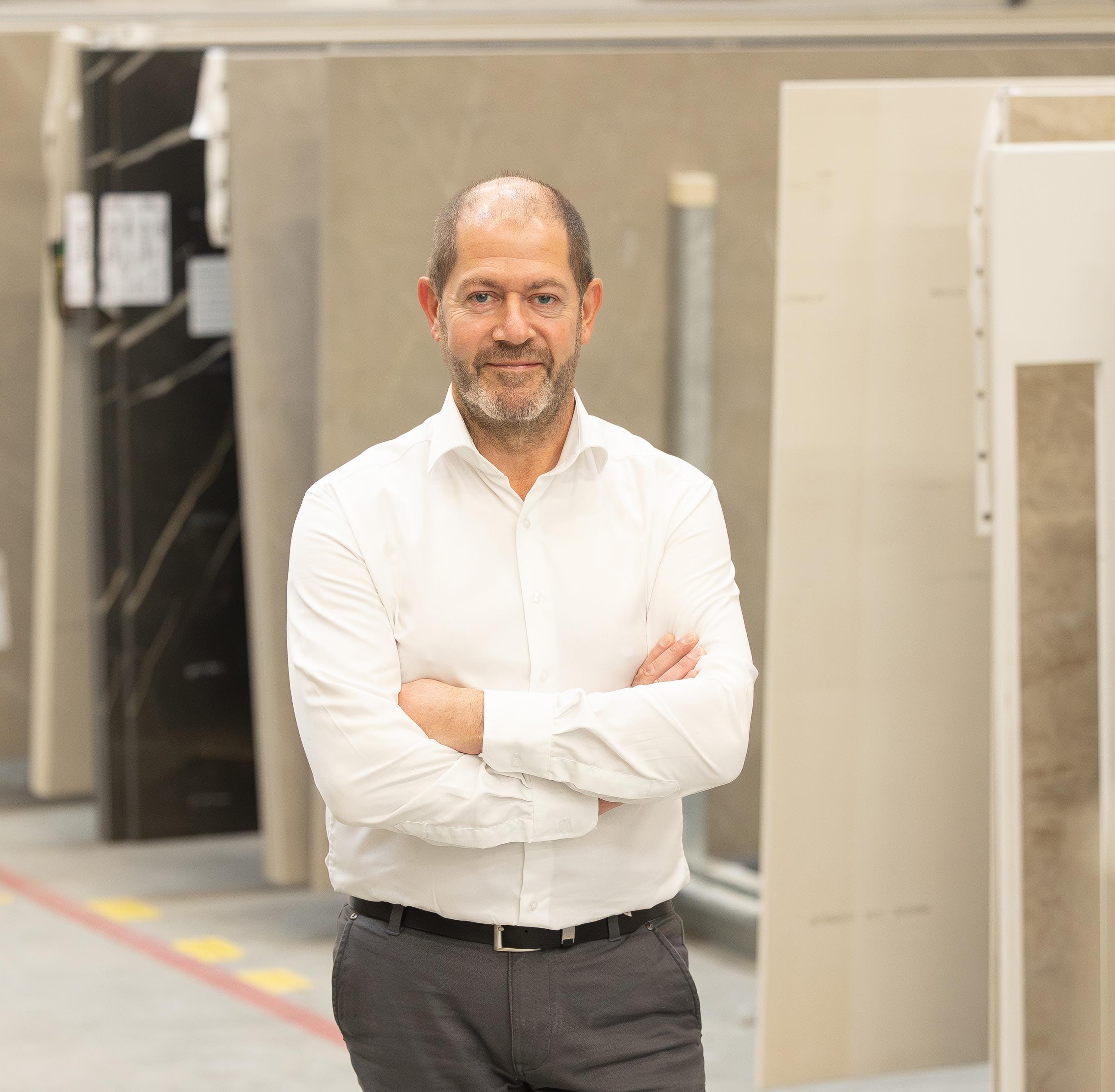
Ole Madsen, CEO – HORN Bordplader
“In today’s business environment, sustainability is not a choice — it is a necessity.
But to me, it is not only about meeting requirements. It is about taking a stand. About how we use our resources, how we operate, and how we do so in a way that also makes sense tomorrow.
ESG should not be a side project. It must be an integrated part of the business — something we do because it is meaningful, not just because it appears in a spreadsheet. And it must also be sustainable in another sense: financially. Because we cannot take responsibility for the world around us unless we first ensure that our own business remains viable and resilient.”
A Year of Transition
“In many ways, 2025 has been a year of adjustment. We have said goodbye to our B Corp certification — not because we have moved away from its principles, but because our focus has shifted. We continue to operate according to the same values, the same standards, and the same commitment to integrity. However, rather than investing energy in documenting this externally, we are now directing our efforts toward developing the business.
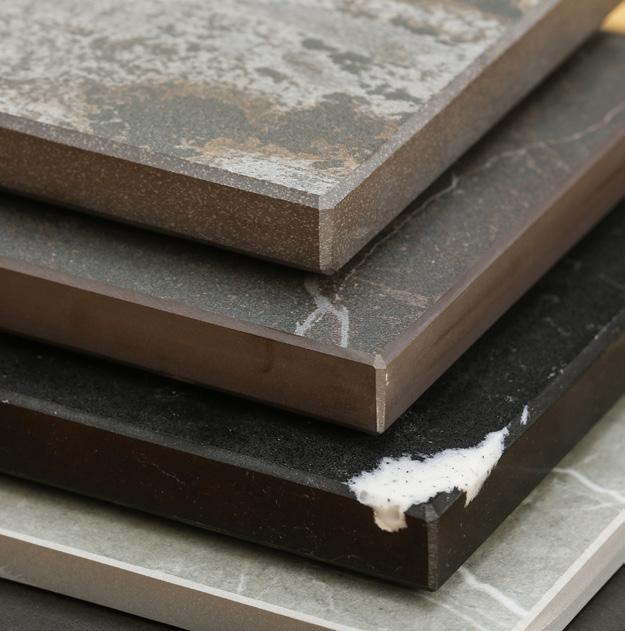
We have adapted to a market in which ceramic surfaces play an increasingly important role. This has required new machinery, new competencies, and a heightened awareness of our energy consumption. Ceramic production uses more electricity, but in return the material offers a significantly longer lifespan — and these are exactly the kinds of trade-offs we must understand and actively work with.
At the same time, we have strengthened our circular initiatives. Our refurbished concept has gained momentum,
and Denwood by HORN has grown — now also offering products made from surplus ceramic materials. This is a strong example of how we continuously strive to combine aesthetics with responsibility.”kombinere æstetik og ansvar.”
Sustainability in Practice
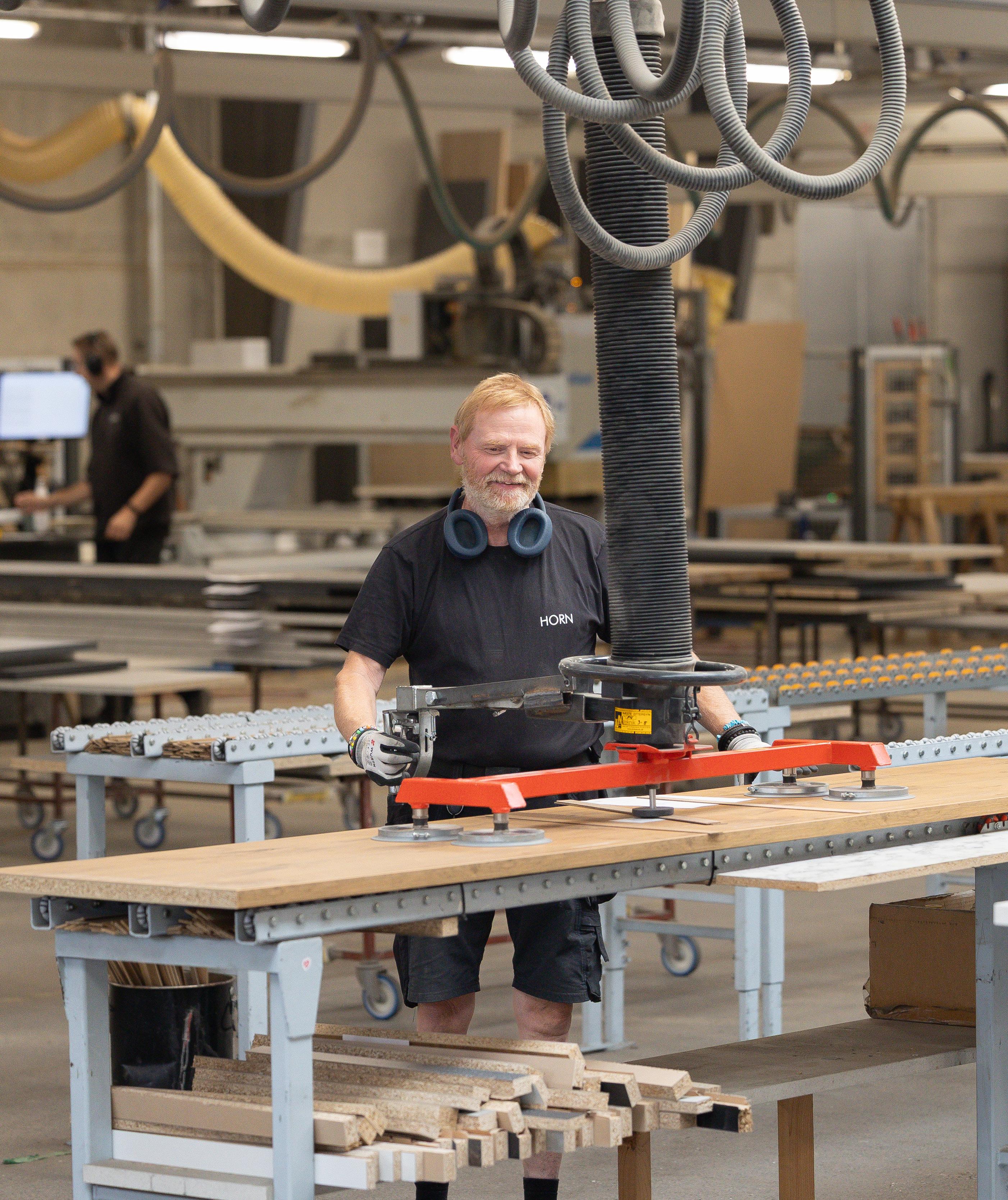
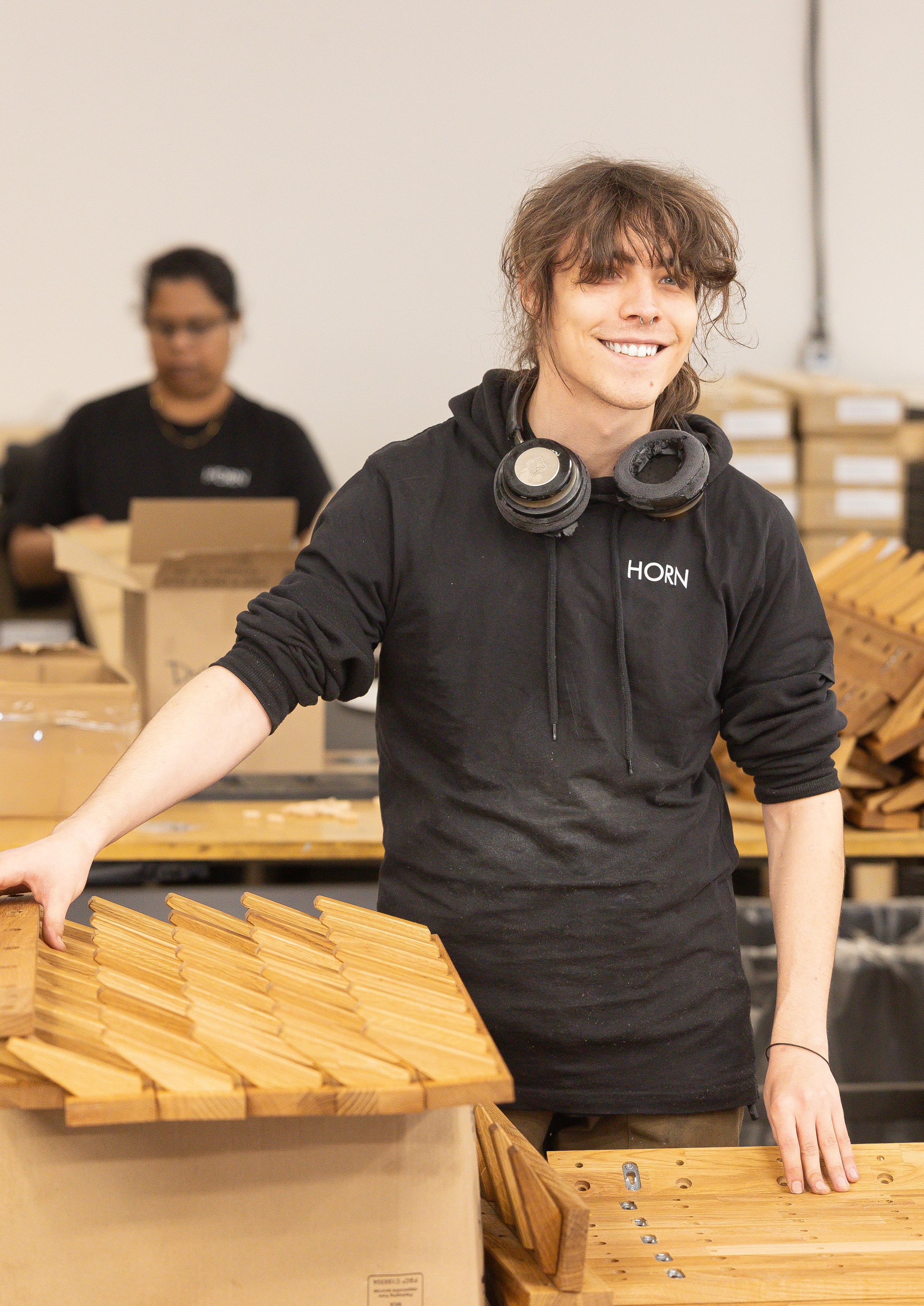
“For us, sustainability is not only about CO2 and numbers. It is also about people. Through initiatives such as Aulum Milen, we help young individuals enter the labour market. And in our production facilities, apprentices work side by side with colleagues who have been with us for 40 years. This fosters both professional excellence and a strong sense of community — and it is a key part of our social sustainability.
We are also becoming more data-driven. Not because data is the goal in itself, but because it helps us make better decisions — on everything from energy use and waste management to development and employee well-being.”
Looking Ahead
“The coming years will be about balance. Between ideals and business realities. Between progress and responsibility.
We will work even more systematically with our data, our energy consumption, and our waste streams. And we will continue to invest in people — because ultimately, they are the ones who make the difference.
Sustainability is not a destination. It is a process. We do not need to be perfect — we need to be conscious.
That is how we build a company that is both resilient and relevant. A company built on responsibility, long-term value, and integrity — in every sense.”
A Strategic Shift Focused on Collaboration and Synergy
The past year has marked an important transition for HORN. The company has stepped out of HORN Business Group and is now 100% owned by the family-owned group Acupanels International Holding ApS. This ownership provides stability, strategic direction, and new opportunities.
Acupanels Holding is also the owner of Fog & Venø — one of the world’s leading manufacturers of acoustic panels — with its main production facilities located just a few metres from our own factory in Aulum. This proximity not only shortens the distance, but also brings collaboration even closer within reach.
With the new ownership, the management structure has been adjusted so that key functions now operate across both companies. The CEO and CFO roles are shared between HORN and Fog & Venø, and joint corporate functions have been established within Finance, Marketing, Procurement, Business Development & ESG, and HR.
This strengthens synergies, enables faster knowledge-sharing, and creates a more unified strategic direction — without diluting the differences that make each company strong.
We are operating in a time where close partnerships are essential for development and competitiveness. With HORN and Fog & Venø within the same group, we have a unique opportunity to use this shared foundation as a lever — not to standardise, but to evolve.
Although we share an address and a strategic direction, we remain two very different companies, each with our own culture, competencies, and markets. This is precisely why the collaboration makes sense: because our differences create new opportunities when applied in the right areas.
As CEO Ole Madsen puts it:
“It is about learning from one another and creating synergy where it adds real value — without compromising the identities that make us HORN and Fog & Venø.”
This is exactly the approach that will define our shared journey going forward.
Practical Collaboration — Without Grand Gestures
The collaboration between HORN and Fog & Venø has already proven its value in everyday operations — particularly within production, where a close and well-considered partnership has taken shape.
Factory Director at HORN, Niels Kristensen, describes it as follows:
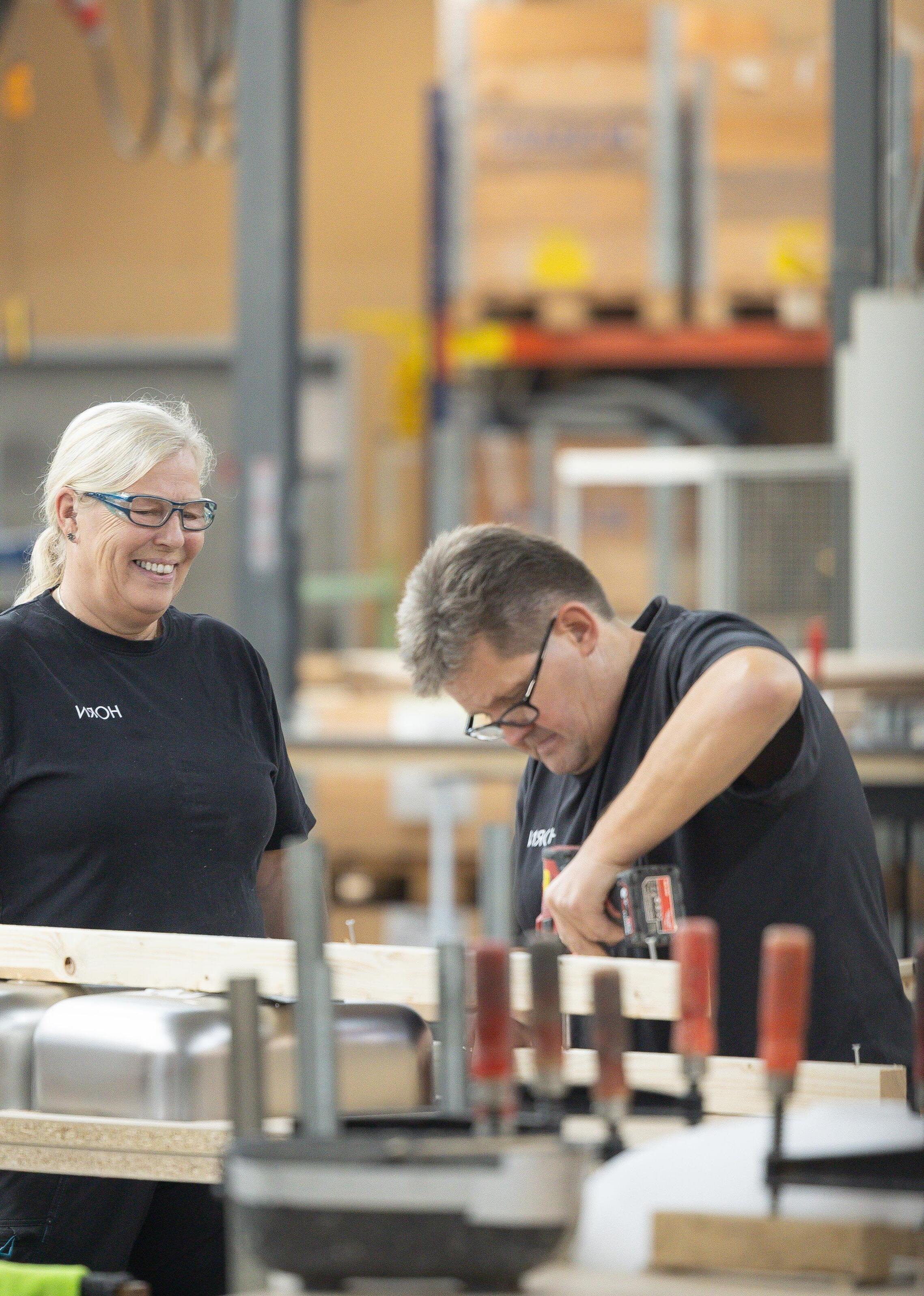
“We have already made great use of the synergies between the companies. There is a strong dialogue between the production managers, which means we can support each other quickly when needed. For example, during periods of lower activity at one factory, we have been able to second colleagues to the sister company when workloads were higher. This creates both flexibility and a sense of community — and ensures that we make the best possible use of our resources.”
This provides a concrete illustration of how a group structure can generate real value: not through big words, but through people working together, sharing knowledge, and taking joint responsibility for each other’s success.
BACKGROUND, DNA AND ROOTS
The Group’s History – with HORN as the Foundation
HORN represents the historical and cultural core of our group. This is where our craftsmanship tradition, understanding of materials, and approach to Danish manufacturing have their origins. For decades, HORN has developed worktops with a focus on quality, functionality, and responsible material selection. Over time, the company has become a recognised and central name within the Danish kitchen and construction sectors.
Building on this strong foundation, the group’s owners chose in 2019 to expand the business and establish Acupanels — today known as Fog & Venø. The new company continued the same passion for wood and natural materials, but with a distinct specialisation in acoustic panels. Through strong innovative capabilities and a consistent focus on design, Fog & Venø has since grown into one of the world’s leading manufacturers within its category.
Although HORN and Fog & Venø are today sister companies, HORN remains the historical engine of the group. It is where the culture originates, and where the first processes, quality principles, and workflows were established. Fog & Venø complements this foundation — representing a modern, scalable production business with global reach — yet still firmly rooted in the craftsmanship DNA that began with HORN.
Today, the companies work more closely together than ever before, always with respect for their differences in size, market focus, and culture. Shared ownership and cross-group executive leadership have made it possible to exchange experience and create selected synergies, without diminishing the unique characteristics that make each company strong.
Founders of HORN, from left: Ove Fog Jørgensen / Karl Frank down: Mulle
STRONG VALUES
TRUSTWORTHINESS
We are honest, loyal, data-driven, and stand firmly by what we believe in.
DEVELOPMENT
We actively work with sustainable and responsible development, as well as increased transparency in the market.
COMMITMENT
We are dedicated and continuously rethink the definition of quality every day.
RESPECT
We recognise and value every individual and respect their differences.
COLLABORATION
We work together to achieve our shared ambition of setting the standard in the market.
HORN’S STAKEHOLDER DESIGN
HORN works strategically with collaboration and dialogue with our most important stakeholders. Our stakeholder engagement model illustrates who we cooperate with and how we create shared value — from local communities and customers to educational institutions and the business sector.
Bæredygtig Herning
We are a member of Bæredygtig Herning, a local sustainability network, in order to share knowledge and strengthen sustainability efforts within the municipality.
Herning Municipality
We collaborate with the municipality through initiatives such as Sustainable Herning and Aulum Milen, as well as in efforts to support individuals outside the labour market in finding employment. This partnership enables social responsibility and inclusion in practice.
Aulum Milen
Through our local cluster collaboration in Aulum, we contribute to the well-being and opportunities of young people. The project ensures that no young individual is left outside the labour market or social community, and HORN plays an active role in the steering committee.
Local Business Community
We believe in strong local partnerships and work together with other companies in the area to strengthen the community and support shared development.
Educational Institutions
We collaborate with educational institutions on cases, student assignments, and projects, providing students with practical insight into our production and processes. We also employ student assistants and maintain an open dialogue to ensure meaningful, education-relevant work experience.
Customers
We develop in close dialogue with our customers. We listen, learn, and collaborate — with a focus on delivering solutions that are functional, sustainable, and tailored to specific needs.
Sustainability must be something that works in real life. And that is exactly the approach we are guided by. “
Katrine Trærup Nielsen
OUR APPROACH TO SUSTAINABILITY
STRATEGY AND DEFINITION
Sustainability continues to play an important role — both for our customers and within our own business. However, for us it is not about having “the most certifications” or pursuing the most complex system. It is about developing responsible solutions that are actually applied in practice.
Katrine Trærup Nielsen, Head of Business Development & ESG, explains:
“We have chosen to adapt our sustainability strategy to the market. This means working at a level where more stakeholders can participate — and where sustainable choices become accessible without compromising quality, aesthetics, or price.”
Our approach is simple, yet ambitious. It is built around three key areas, which together form the foundation of our ESG efforts.
“We combine high professional standards with practical applicability. Customers should not only receive a well-written report — they need solutions that support their own sustainability goals and create real impact in everyday operations,” Katrine adds.
From Certification to Business-Driven Sustainability
In 2025, we made the decision to step away from our B Corp certification. Not because we are changing direction — but because we are shifting our focus.
“The decision reflects that we still uphold the principles, but we choose to invest our time and resources where they create the greatest value — for our customers, our employees, and our business. We take responsibility, but we do so in a way that makes sense in practice,” Katrine emphasises.
Our approach is not theoretical. It is shaped by customer expectations, market developments, and what we know works in production. This also means that our sustainability work continues to evolve — from data maturity and energy improvements to stronger social initiatives and new collaborations across the group.
Katrine summarises:
“The most important thing for us is to make considered choices and remain aware of their consequences. Sustainability must be something that works in real life. And that is exactly the line we follow.”
Environmental (E)
Documented environmental impact, data-driven decision-making, and transparent material choices.
SOCIAL RESPONSIBILITY (S)
An integrated part of our business, where we are deliberately willing to go further — even when it is not the easiest financial choice. It is about people, apprentices, well-being, and community.
GOVERNANCE (G)
Compliance, responsible operations, and structures that ensure we do things properly — every time.
ESG FRAMEWORK
ENVIRONMENTAL
Documented Environmental Impact
We are committed to ensuring that sustainability can always be documented — both internally and for our customers. This is achieved through LCA reports, carbon footprint calculations, and certifications, which provide insight into the environmental impact of our products. At the same time, we develop beautiful upcycled products through our Denwood by HORN product range, combining aesthetics with circular economy principles.
SOCIAL
Social Sustainability
We work with people in a way that creates value for both employees and the business. At HORN, we act with integrity, promote well-being, and embrace diversity and inclusion, as we see differences as a strength that contributes to innovation, engagement, and a strong sense of community.
GOVERNANCE
Compliance and Responsible Operations
Integrity and decency are core values in everything we do. We ensure good working conditions, high quality, and responsible business conduct through due diligence statements, control processes, and continuous follow-up throughout the value chain. At the same time, we comply with legislation that promotes sustainability, legal compliance, and anti-corruption, ensuring that our actions always meet both internal standards and external requirements.
ENVIRONMENTAL
We are committed to ensuring that sustainability can always be documented — both internally and for our customers. This is achieved through LCA reports, CO2 calculations, and certifications, which provide insight into the environmental footprint of our products. At the same time, we develop beautifully upcycled products through our Denwood by HORN product range, combining aesthetics with circular economy principles.
ENVIRONMENTAL PERFORMANCE HIGHLIGHTS
7.457
Total CO₂e emissions (Scope 1, 2 and 3)
792 M3
More than 300 worktops
Total water consumption 36% Through our refurbishment project
Amount of waste sent for recycling 12%
Energy consumption
ENVIRONMENTAL CONSIDERATIONS
Over the past year, we have placed particular focus on resource consumption at our factory in Aulum. Production has grown significantly alongside the expansion of our stone business, and our CNC machines now account for the majority of our electricity usage. This has increased overall energy consumption, and as the factory roof is not suitable for solar panels, we are instead exploring opportunities to recover and reuse process heat from production. This could help reduce both energy use and our carbon footprint.
Gas is primarily used for heating, and consumption therefore depends largely on the external climate conditions.
At the same time, we have upgraded our vehicle fleet, with the majority of company cars now being electric. In parallel, we are assessing charging solutions that can support both employees and the surrounding local area.
From a logistics perspective, fuel consumption has increased this year. Trucks have transported fewer goods per trip in order to maintain delivery frequency, which has prompted a thorough review of our overall transport setup. We plan to outsource parts of our distribution to external partners with better capacity utilisation, while also exploring new methods to transport stone and worktops more efficiently.
In addition, we have worked systematically on process optimisation and reducing production errors. This strengthens product quality and reduces waste, contributing overall to lower resource use and improved environmental performance.
The year has therefore been characterised by concrete steps towards a reduced environmental footprint, more efficient energy and transport utilisation, and a continued focus on sustainable solutions that make sense in practice.
CIRCULAR ECONOMY
At its core, circularity is about making the most of the materials we already have — and keeping them in use for as long as possible.
At HORN, we work systematically to integrate circular economy principles into our products, processes, and decision-making. While the linear model is based on the principle of “take–use–dispose”, the circular approach focuses on keeping resources in circulation through design, production, use, recycling, and remanufacturing.
The EU’s increasing focus on circularity supports the direction we are already moving in. For us, this means working across several levels of the circular model:
• Designing products so materials can have a longer lifespan
• Producing with reduced material waste
• Giving end-of-life products new life
• Ensuring documentation and traceability, including LCA reports
Our ambition is clear: to minimise resource consumption, reduce waste, and create solutions that last longer — both aesthetically and environmentally.
The following sections provide insight into how we translate these principles into practice — from our Refurbished project and Denwood by HORN to our work with LCA and our overall approach to waste management.
DESIGN FOR DISASSEMBLY
At HORN, we apply design for disassembly principles, meaning that products are designed so they can be renewed, repaired, or disassembled once they have reached the end of their initial use phase. This makes it possible to give worktops a new life with updated surfaces, or to dismantle them so that materials can be more easily recycled.
Our refurbishment concept has been developed in close collaboration with project customers who place strong requirements on reducing CO2 emissions in construction projects. Through this partnership, we have established a setup that allows us to take worktops back from the market and apply a new surface with significantly lower resource consumption. The concept applies both to worktops originally produced by HORN and to worktops from other manufacturers.
Worktops with MDF as the core material are particularly well suited for refurbishment, although the process can also be applied to chipboard-based products. A new surface of laminate or linoleum is applied, allowing the product to appear as new and enter another use cycle.
To date, we have handled more than 300 worktops that have been refurbished and returned to the market with lower resource consumption compared to the production of entirely new worktops. This helps keep materials in the largest possible loops, in line with the principles of circular economy.
Preliminary calculations from a project customer indicate CO2 savings of up to 80% compared to the production of new worktops.
DENWOOD BY HORN
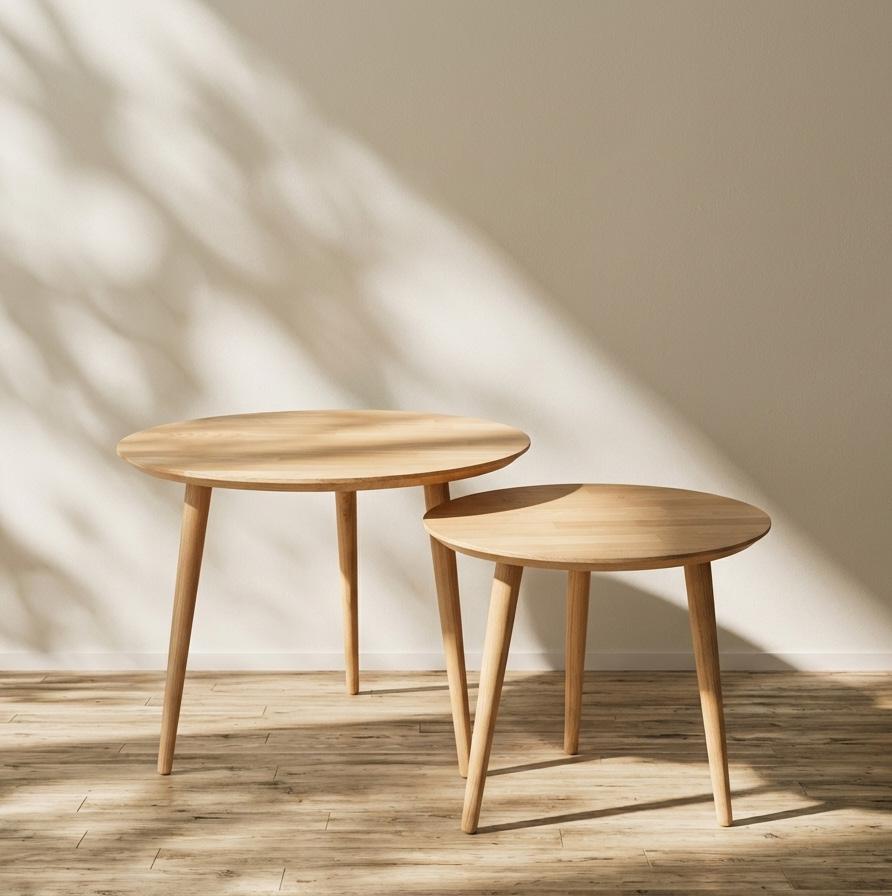
When working with natural materials, responsibility follows. Denwood by HORN is rooted in this very idea: to take care of the resources we already have — and give them a new purpose. Many of the products are created from residual and surplus materials from our worktop production, allowing wood and stone to continue their life in new designs.
However, true circularity is not only about aesthetics; it is also about practicality. The volume of residual materials depends on which worktops are produced in the largest quantities. As a result, we cannot always guarantee that every Denwood product is made exclusively from surplus materials. When demand increases, we occasionally supplement with carefully selected materials — always with respect for quality, resource efficiency, and circular principles. This makes Denwood a realistic, responsible, and long-term design line.
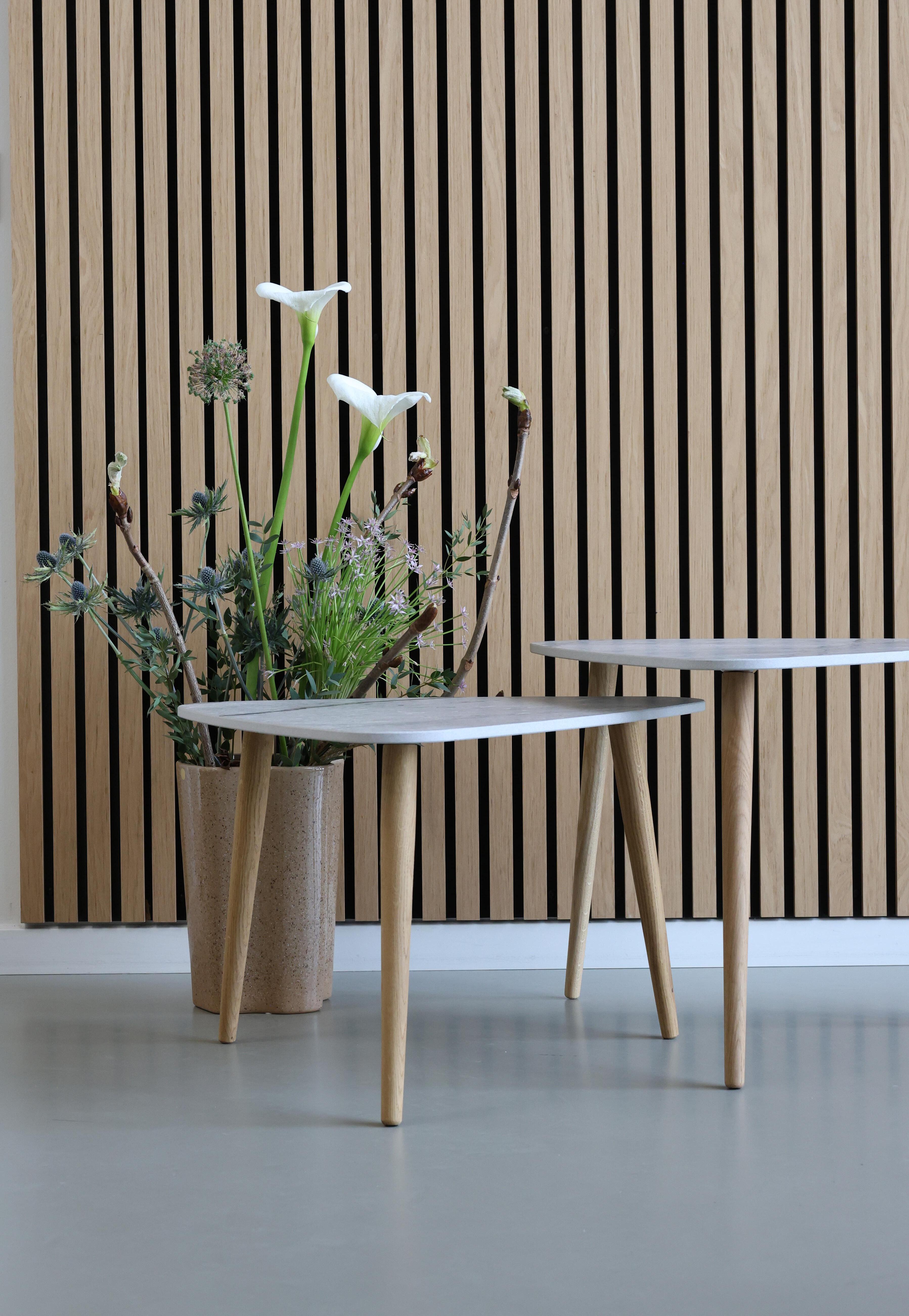
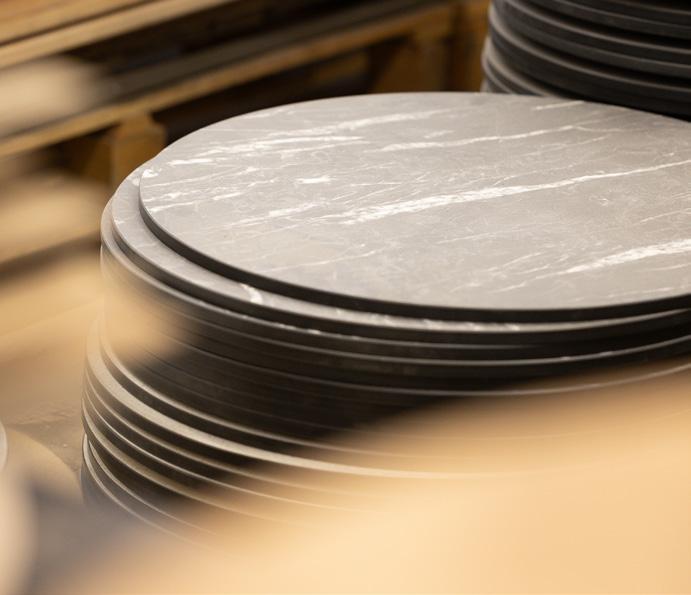
As the market has evolved, we have expanded the range to also include ceramic materials as part of the Denwood family. The growing demand for ceramic worktops means that we now generate more ceramic surplus materials in production — creating opportunities to produce small tables and accessories that would otherwise never have come into existence.
For us, Denwood is more than design. It represents a practical approach to circularity and a value-based way of working with materials — closely linked to our social responsibility. Through collaborations with municipalities and job centres, Denwood production has, since its inception, created meaningful employment opportunities for people with reduced work capacity. In this way, form, function, and community are brought together in a single concept, where both materials and people are given the opportunity to thrive again.
DOCUMENTED ENVIRONMENTAL IMPACT
A Life Cycle Assessment (LCA) is a documented calculation of a product’s total environmental impact throughout its entire life cycle — from raw material extraction and production to use, recycling, and end-of-life disposal.
At HORN, we develop LCA reports for our best-selling worktops for the professional market. The purpose is to create transparency around the environmental footprint of our products and provide both ourselves and our customers with a solid basis for making more sustainable choices in construction — while simultaneously promoting circular economy principles.
By understanding and documenting environmental impacts across the entire value chain, we can identify where to reduce resource consumption, extend product lifespans, and contribute to a more circular construction industry.
LCA is therefore not only a documentation requirement for developers and contractors — it is an active tool for product improvement, CO2 emissions reduction, and the development of more sustainable solutions in close collaboration with our customers.
WASTE AND RECYCLING
At HORN, we work actively with circular economy principles, focusing on minimising waste and maximising recycling. We closely monitor how much of our waste is sent for recycling compared to incineration and landfill, enabling us to continuously optimise our processes and reduce both environmental impact and resource consumption.
During the reporting period, 36% of our waste was sent for recycling, and we have a clear ambition to increase this share going forward, allowing more materials to be kept within circular loops.
Waste Reduction
Over the past year, we have reduced our total waste volume by approximately 245 tonnes. This reduction is the result of a combination of improved material management and optimised production processes.
We increasingly reuse stone and compact laminate for products within our Denwood by HORN product range, which includes, among other things, small tables. At the same time, stone waste has been reduced through adjusted processes and more efficient utilisation of materials. Improvements in product quality have also reduced errors and waste by approximately 3%.
In addition, a decline in overall turnover has contributed to the general reduction in waste volumes during the period.
As COO Niels Kristensen points out, process optimisation is not only about technology, but also about people:
“When we work closely with both machines and materials, it is about learning from each other and actively applying experience. This enables us to use materials more efficie
Practising Sustainability
Rather than choosing large national waste management providers, we have decided to strengthen our collaboration with a smaller local company. Together, we have developed a solution that supports our sustainability objectives while also creating value within the local community.
In practice, we have spent the past year mapping our waste streams and assessing recycling opportunities. Based on this work, we have established a correct and efficient sorting system that ensures better resource utilisation and a higher recycling rate.
Through close dialogue, we have supported our partner in strengthening their documentation practices and meeting the same environmental and quality standards as larger providers. At the same time, we have been able to optimise our own workflows and data foundation, making our waste management more efficient and transparent.
The close collaboration has also proven to deliver a commercial benefit, as the solution is more cost-effective than those offered by larger providers — without compromising on quality.
For us, this is a clear example of sustainability in practice: where partnerships, local anchoring, and responsible operations go hand in hand. We are proud of the result and of being able to contribute to strengthening a local partner.
Multiple Bottom Lines
The analysis of waste streams has also shown that there are significant cost differences in disposal depending on the material. This has enabled us to identify business potential by optimising waste sorting and collaborating with smaller, local waste management providers — without compromising on quality or documentation.
Towards the end of the reporting period, we implemented correct sorting of composite materials, granite, and ceramics. This not only improves recycling outcomes, but also makes our waste management more efficient and transparent.
At the same time, Niels highlights the learning aspect:
“It is about combining experience with new perspectives. Our younger colleagues gain insight into the entire process — from raw materials to finished products — and can contribute ideas for better utilisation and reduced waste. This is sustainability in practice, where people and materials go hand in hand.”
This is sustainability in practice, where people and materials go hand in hand.
By combining production optimisation, learning, and correct sorting, we reduce waste, increase resource efficiency, and simultaneously generate both economic and environmental benefits.
SOCIAL
We work with people in a way that creates value for both employees and the business. At HORN, we act with integrity, promote well-being, and embrace diversity and inclusion, as we see differences as a strength that contribute to innovation, engagement, and a strong sense of community.
SOCIAL PERFORMANCE HIGHLIGHTS
109
Total employees
4 Apprentices / trainees
5,5% Employees in flex jobs
1 Occupational accident
12,9%
Employee turnover 10% Production employees in training 47 år
Average age
IF YOU CAN, IF YOU WILL, AND IF YOU DARE
– The Next Generation of Craftsmanship at HORN
Craftsmanship with a Future
In an industry where the scent of wood and the sound of milling machines have remained the same for generations, sustainability is also about people. At HORN, we see it as our responsibility to preserve craftsmanship — and to develop it so it continues to have a future.
“Craftsmanship within industrial joinery is an established discipline — and precisely for that reason, it must be safeguarded,” says COO Niels Kristensen. “When an apprentice works side by side with a colleague who has 40 years of experience, something special happens. They do not just learn to mill and sand — they learn to take responsibility for quality.”
Generations Working Together
In recent years, HORN has placed particular focus on ensuring that traditional craftsmanship is not lost as new technologies and production methods advance and the most experienced generation approaches retirement. Although much of today’s production is digital and automated, joinery and furniture manufacturing remain precision crafts where quality, material understanding, and professional pride make a decisive difference.
For this reason, the production department works systematically to support an active generational transition through apprenticeship programmes and close collaboration with Herningsholm Vocational School. Here, students are introduced to real-life workshop environments — and to a profession where there is room for programming skills, curiosity, and classic craftsmanship alike.
Experience Meets Curiosity
In the solid wood department, three highly experienced cabinetmakers with an average age of nearly 65 bring
decades of expertise to their work. After more than half a century with tools and materials, craftsmanship is second nature — and it shows in the results.
These experienced employees act as mentors for younger apprentices, who learn the craft at the highest level. At the same time, the experienced professionals are challenged by the new generation, who question established practices and bring fresh perspectives to the table. This creates a culture of learning across age, experience, and expertise — where tradition and development go hand in hand.
From machine to people
In the laminate department, there is a similar focus on showcasing what the profession truly involves. While some may associate the work with traditional factory labour, tasks such as CNC milling, sanding, and programming require both technical insight and creative thinking.
10% Production employees in training
Through rotation between machines and processes, apprentices gain a broad understanding of production and build a professional foundation that can support their future careers — whether at HORN or elsewhere in the industry.
Ambition: 10% in Training
At least 10% of HORN’s production employees are to be engaged in training or education. This includes both apprentices and existing employees, all of whom are given opportunities to strengthen their skills and contribute to the continued development of the craft.
To support this ambition, HORN is working to expand collaboration with sister company Denlab, allowing apprentices to gain insight into additional production types and specialisations — and to experience how modern craftsmanship can take many different forms.
If you can, if you will, and if you dare – then we will find a path for you here.
“If you can, if you will, and if you dare — then we will find a path for you here,” says Niels Kristensen. “For us, social sustainability is about people. About passing on knowledge, developing talent, and creating a workplace where both experience and curiosity are allowed to grow.”
VALUE AND FUTURE AMBITIONS
Young people involved through Aulum Milen: 5
Permanently employed: 2
Aulum Milen
For HORN, Aulum Milen is not only about giving young people an opportunity — it is about taking active responsibility for the local community we are part of. To date, five young people have participated in the programme at HORN. Two of them are now permanently employed in flex jobs, while the remaining three have found employment with other companies. We are proud of this outcome, as it demonstrates that the initiative delivers real results.
“This is not a project we run to embellish a report,” says Bo. “It requires resources, structure, and genuine commitment. We have a dedicated contact person who follows the young people closely, and the entire production team is involved. This is not just an HR initiative — it is a culture.”
For Bo and the rest of the team, the success of Aulum Milen is no coincidence:
“What makes Aulum Milen so strong is that it is driven by the companies themselves. We do not want to lose this generation — but that requires us to listen, adapt, and dare to take responsibility. When we do, we gain employees who are extremely loyal, reliable, and full of motivation. That has a positive effect on the entire team.”
The young participants themselves highlight one key factor as the most important: having something to get up for each day. Being part of a community and having meaningful content in everyday life. As Bo explains:
“Several of them say that coming to work here gives them a sense of belonging — and that is ultimately what the entire project is about.”
As the project has matured, HORN has expanded its collaboration beyond Aulum to include the wider Herning Municipality. This is a natural next step — and clear evidence that local anchoring and social responsibility can grow side by side.
This is not a project we run to embellish a report.
“
Well-being is not only about safety and health — it is about meaning, motivation, and humanity.
WORK ENVIRONMENT AND WELL BEING
Well-being Is About More Than Safety
Well-being is not only about safety and health — it is about meaning, motivation, and humanity. At HORN, creating a working life that feels good to be part of is a fundamental part of our culture.
“We must remember that regardless of whether you are a leader, a manager, or a colleague, you have two ears and one mouth,” says HR Manager Thomas Klit. “We have to listen — always. We can quickly teach people how to operate a pallet truck or replace a printer cartridge, but making sure it feels good to be here is absolutely essential.”
Honesty as Part of the Culture
Well-being is continuously measured and experienced through our monthly pulse surveys. Employees respond anonymously to questions about how they are feeling and can add comments, which are shared openly on the company’s internal information platforms.
“We put the comments out in the open — both the positive and the critical ones,” Thomas explains. “I do not see that as courageous. I see it as honest. Why shouldn’t we be able to talk about it?”
Every Voice Matters
This approach ensures that everyone is heard — regardless of position. Feedback from the production floor carries the same weight as input from the office, serving as an important reminder that well-being is not measured by hierarchy, but by the experience of being seen and taken seriously.
Balancing Motivation and Competence
Across several parts of the organisation, we work deliberately to align skills and motivation within individual teams. Tasks are distributed and assessed based on both professional strengths and personal interests, creating a
balance between what people are good at and what they enjoy doing. The result is genuine job satisfaction and teams where well-being and performance go hand in hand.
Thomas Klit, Head of People & Culture
Well-being Is a Daily Choice
“I am proud of what we have built,” says Thomas Klit. “But we are not finished — and we probably never will be. Because well-being is not a destination. It is something you choose, every single day.”
GOVERNANCE
Integrity is a core value in everything we do. We ensure good working conditions, high quality, and responsible operations through due diligence statements, control processes, and continuous follow-up across the entire value chain. At the same time, we comply with legislation that promotes sustainability, legal compliance, and anti-corruption, ensuring that our actions always meet both internal standards and external requirements.
FROM COMPLIANCE TO RESILIENCE
At HORN, governance is about ensuring that our business is operated with integrity, transparency, and care — every time. It is not about titles or paperwork, but about establishing structures and processes that enable sound decision-making, accountability, and the ability to deliver on our commitments to employees, customers, and society.
Strengthened Governance in a Time of New Regulatory Requirements
The past year has been characterised by significant regulatory changes, requiring new workflows, increased structure, and a more defined governance approach at HORN. Two areas in particular have had a substantial impact: extended producer responsibility (EPR) and the upcoming requirements under EUDR (the EU Deforestation Regulation).
Extended producer responsibility for packaging introduces an entirely new level of documentation, reporting, and traceability, affecting large parts of our value chain — from procurement and design to waste management and data collection. This has required us to adapt internal workflows and organisational structures to ensure full compliance, while
also enabling a more strategic approach to the environmental profile of our packaging.
A key initiative has been the assignment of item numbers to all packaging materials, allowing each material to be identified and registered at the same level as a product.
As a result, our data systems are now able to calculate precisely how much packaging is used per square metre of worktop, and how this is distributed across product types, customers, and markets. At the same time, we can document which packaging volumes are exported to which countries — an essential element of EPR requirements, which vary from market to market.
In parallel, we have made extensive preparations for EUDR, which introduces significantly higher due diligence requirements than previously. Although HORN has worked with responsible supplier management for several years, EUDR requires much deeper documentation of material origins, traceability, and potential risks. This has led us to strengthen internal processes, update supplier requirements, and establish closer dialogue across the entire value chain.
Rather than merely collecting documentation, we have worked actively with our suppliers throughout the period to ensure that requirements are understood, embedded, and can be met in practice. This means that we do not simply request paperwork, but engage in dialogue about what is actually required to comply with legislation — and how we can work together to strengthen traceability without creating unnecessary complexity.
Our work with both extended producer responsibility and EUDR has made it clear that governance is not only about compliance — it is about resilience. As a result, we have strengthened our systematic approach, risk assessments, and internal coordination during the period, ensuring that we are well prepared for future requirements and able to maintain our ambition of integrity and transparency throughout all stages of production.
Data Discipline and Specialisation – A Necessary Step in a Data-Driven Industry
Developments in the industry mean that our customers now demand far more detailed data than in the past — particularly in relation to documentation, reporting, and sustainability-related requirements. As a result, the past year has also been characterised by a significant strengthening of our internal data discipline.
To create even greater value as a partner for our customers, we have invested substantial resources in improving data flows, standardising processes, and ensuring higher data quality across the organisation. This includes everything from product data and material history to CO2 calculations, LCA documentation, and traceability throughout the value chain.
DThis effort is crucial to our ability to respond quickly and agilely when larger customers request documentation — often with short deadlines and high requirements for accuracy. By optimising our data foundation and building a more
structured governance model, we are better equipped to meet both future legislation and rising market expectations.
This work will continue in the coming period, as we further develop our internal systems and competencies to ensure that HORN maintains its position as a specialised and transparent partner, with strong data as its foundation.
Whistleblower Scheme
At HORN, we want our business to be conducted responsibly and lawfully — every time. An important tool in this effort is our whistleblower scheme, which is publicly available on our website.
The scheme enables employees, members of the Board of Directors and Executive Management, auditors, lawyers, as well as employees of our suppliers, customers, agents, and distributors to report suspicions of potential irregularities or breaches of law encountered in connection with their work-related activities. Reports can be submitted anonymously online, ensuring that whistleblowers can come forward without fear of retaliation.
The purpose of the whistleblower scheme is twofold: 1. To protect integrity across our organisation and value chain
2. To ensure that HORN complies with applicable whistleblower protection legislation and other compliance requirements
Our ambition is to create a foundation where compliance is not merely about internal rules on paper — but about fostering a culture in which it is safe to speak up, and where law and ethics go hand in hand with day-to-day operations.
LEADERSHIP, STRATEGY AND SHARED DIRECTION
Leadership and Strategy
With the new ownership under Acupanels Holdings, we have established a leadership structure that promotes both collaboration and decisiveness. The CEO and CFO roles are shared between HORN and Fog & Venø, and joint corporate functions within Marketing, Business Development, ESG, and HR ensure that knowledge, resources, and experience are utilised optimally across the companies.
The Board and Executive Management work actively with both strategic and operational decision-making, and all key functions are linked to clear areas of responsibility and decision-making authority. This enables us to act quickly while maintaining a strong focus on sustainability, quality, and compliance.
Strategy Process and Anchoring
We have recently decided to initiate a strategic process facilitated by an external partner. All leadership functions will participate, with the objective of establishing a shared value base, common goals, and a unified language across the organisation.
Following this process, each department will be responsible for activating the strategy and ensuring that initiatives are embedded in daily operations — enabling HORN to continue moving forward as one organisation, respond swiftly to market developments, and strengthen cross-functional collaboration.
Engagement and Objectives
At HORN, governance is not only about rules and processes — it is about accountability, consistency, and ensuring that we live up to our commitments to employees, customers, and society. Our engagement is a natural extension of our business operations, where objectives, actions, and responsibility go hand in hand.
“ESG and governance are not side projects. They are part of how we run HORN every day. It is about making the right decisions, taking responsibility, and ensuring that our actions make sense — both today and tomorrow.”
Our Objectives Are Clear
• To build a robust, transparent, and responsible organisation, where all decisions are made with care and in full respect of applicable legislation and internal standards.
• To anchor values and strategy across the organisation, ensuring that all departments work towards shared, clearly understood goals and can respond quickly to market developments.
• To support a culture of openness and integrity, where employees and stakeholders can safely report concerns through our whistleblower scheme.
At the end of the year, we therefore initiated a strategic process facilitated by an external partner, involving all leadership functions. The objective is to develop shared values, common goals, and a consistent language across the organisation — enabling the strategy to be firmly anchored and translated into practice. As Ole explains:
“We do not need documents that sit in a drawer. We need shared direction, clear objectives, and a language that everyone at HORN can use to make well-informed decisions in their daily work.”
The alignment of leadership structure, clear areas of responsibility, and active reporting to the Board ensures that our engagement is translated into concrete actions that support sustainability, quality, and compliance.
Engagement itself is our foundation — ensuring that HORN not only meets its obligations, but continues to grow as a responsible, transparent, and future-oriented company.
ESG and governance are not side projects, but an integral part of how we operate HORN on a daily basis.
PERFORMANCE DATA
Integrity is a core value in everything we do. We ensure good working conditions, high quality, and responsible operations through due diligence statements, control processes, and continuous follow-up across the entire value chain. At the same time, we comply with legislation that promotes sustainability, legal compliance, and anti-corruption, ensuring that our actions always meet both internal standards and external requirements.
ENVIRONMENTAL
NOTE E1-1 // Transition plan for climate change mitigation
Gas: Target: All gas consumption is to be phased out and replaced with a CO2-neutral solution.
Status: Gas is used exclusively for heating, making climate considerations particularly important. We are
ploring solutions that enable the recovery and reuse of process heat from production, thereby reducing both energy consumption and CO2 emissions.
Passenger vehicles:
Target: All company cars are to transition to electric vehicles by the end of the 2025–26 period, based on the clear expectation that driving needs, charging infrastructure, and battery technology will be sufficient.
Status: he transition to electric vehicles began in 2023 through new vehicle acquisitions and is being implemented gradually as existing leasing agreements expire. The company policy is to lease only electric and diesel vehicles. Hybrid vehicles are not offered as an option.
Transport:
Target: External transport is to transition to CO2-reducing solutions during the 2026–27 period, with the expectation that our logistics partners share the same ambitions as HORN.
Status: We are in close dialogue with external transport providers regarding these objectives. An increasing share of our transport activities is being outsourced to improve overall efficiency.
Waste:
Target: We aim for 100% of our waste to be recyclable.
Status: 36% of our waste has been sent for recycling. The main challenge has been the expansion of stone production, where waste has historically been sent to landfill. We have initiated waste sorting, and going forward, waste will be separated into different fractions. The greatest impact has been achieved by using residual materials from production in the Denwood product range, significantly reducing overall waste volumes.
NOTE E1-2 // Policies related to climate adaptation and climate change mitigation
Gas:
The optimal transition solution is continuously monitored, with a clear preference for district heating should it become available in the production area. The rationale is that district heating would deliver an immediate reduction in emissions, as natural gas has a higher CO2 emission factor. According to Climate Status and Projection, 2023, CO2 emissions from district heating are expected to decrease by 99% by 2030.
In addition, district heating is expected to be a more cost-efficient solution due to the cooperative ownership model (a.m.b.a.), while also providing overall benefits to the local community.
Company car and truck policy:
Only electric and diesel vehicles are leased. Hybrid vehicles are not offered.
Transport of goods:
The most suitable technologies (electric, hydrogen, etc.) are being assessed ahead of the transition phase to ensure that driving requirements, infrastructure, and technology are aligned and can be implemented effectively.
NOTE
Gas:
E1-3 // Actions and resources related to climate initiatives
A significant part of the phase-out is being achieved through electrification of the heat supply via the installation of heat pumps.
In 2023, three new production halls were constructed (4,350 m², corresponding to an increase of more than 40% in total building area). These facilities are initially connected to the existing gas systems. Prior to the expansion, the expected savings from the connection of heat pumps were estimated at a 15% reduction in existing gas consumption. Energy use associated with the expansion will be closely monitored, and additional efficiency measures will be explored, such as power-to-gas (PtG) heat injection, to further improve heating system efficiency. A potential transition to district heating in the area is also anticipated. This option is monitored on an ongoing basis and is considered relevant both from an economic perspective and in relation to sustainable development.
Passenger vehicles:
No new fossil-fuel vehicles have been leased since the 2021/22 reporting year. All new leasing agreements are for electric vehicles.
SOCIALS
NOTE S1-1 // Employee Policies
Labour Rights Policy – in accordance with the UN Global Compact
We recognise freedom of association and the right to collective bargaining. Under Danish legislation, we are subject to the Danish Employers’ Association (DA). DA places strong emphasis on employment policy, occupational health and safety, and labour law, including particular focus on wages and workplace safety.
Our ambition is to set new standards and continuously improve working conditions for our employees.
We actively work to eliminate forced labour, compulsory labour, child labour, and discriminatory practices. As part of our ongoing supplier assessments, we are developing enhanced monitoring processes to ensure that, should any conditions fail to meet requirements, the severity can be assessed and active risk management applied.
NOTE S1-10 // Adequate Wages
Parental leave benefits
HORN complies with Danish employer legislation, which ensures that all employees receive wages above the statutory minimum level.
NOTE S1-15 // Work-Life Balance Indicators
HORN ensures that all employees receive an adequate wage in accordance with applicable legislation and relevant collective agreements to which the company is subject. We also comply with applicable parental leave regulations, including both maternity and paternity leave, in order to support employee well-being and rights.
NOTE S2 // Policies Related to Workers in the Value Chain
HORN supports and respects the protection of internationally recognised human rights and has adopted these principles as a committed element of our Business Partner Code of Conduct.
It is our ambition to strengthen risk management and increase value chain oversight in order to ensure continuous improvements in this area.
GOVERNANCE
G1 Governance and Responsibility for Sustainability
G1-1 Corporate Culture and Policies
Reporting
G1-2 Management of Supplier Relationships
G1-3 & G1-4 Prevention and Detection of Corruption and Bribery
NOTE G1 // Organisation and Leadership
From an organisational perspective, our work with sustainable development and the strategic responsibility for sustainability are anchored in the role of Head of Business Development & ESG, who reports directly to the CEO to ensure continuous implementation of initiatives.
This function is also responsible for embedding strategic initiatives across the entire organisation. All functions within the company play a role in sustainability, and it is a shared responsibility to ensure both progress and successful outcomes.
NOTE G1-1 // Corporate Culture
We have been a member of the UN Global Compact since 2016, which also marked the initiation of our overall sustainability strategy and our work towards achieving various product certifications.
In 2025, we strengthened senior management, and sustainability has been further embedded in decision-making at management level. At the same time, we have sharpened our focus by adapting our sustainability strategy to market developments and strengthening communication between management and the rest of the organisation.
NOTE G1-2 // Management of Supplier Relationships
Our Business Partner Code of Conduct was reviewed in 2025. As part of our sustainability strategy, increased due diligence has been incorporated in response to regulatory developments — in particular the EUDR.
We are now working in closer collaboration with our suppliers, strengthening dialogue and cooperation across the value chain. Our strategy helps ensure that we adhere to our ethical standards and certification requirements when selecting suppliers and sourcing raw materials.
NOTE G1-3, G1-4 // Prevention and Detection of Corruption and Bribery
Our customers and business partners must be able to place full trust in our integrity. For this reason, we apply a zero-tolerance approach to bribery and corruption throughout the entire value chain.
We source materials from suppliers based in Europe, many of whom are controlled through Danish companies. Overall, the risk of corruption and bribery is assessed as low; however, ongoing monitoring will continue to be necessary.
In the event of suspected corruption or bribery, our whistleblower system ensures that cases can be brought to light. Since its implementation in 2022, no cases have been recorded. As of 2025, our whistleblower system has been made available online, enabling all stakeholders to report suspected unethical or unlawful behaviour as well as serious concerns.
Anti-Corruption Principle – in accordance with the UN Global Compact
HORN applies a zero-tolerance approach to corruption, extortion, and bribery in any form. This principle applies both now and going forward.
Through our Code of Conduct, we emphasise that education and collaboration are key to success. As our customer and supplier network continues to expand, the focus on anti-corruption and sustainable business practices becomes increasingly important, and we remain committed to staying up to date in this area.
NOTE G1-5 // Political Influence and Lobbying Activities
HORN does not engage in lobbying activities and does not make financial contributions to political parties or political causes. Political representatives are regularly invited to visit our production facilities, without political preference or prioritisation.
Through Danish Industry (DI) and various sector collaborations, we seek to contribute to sustainable development within the furniture industry and act as a dialogue partner on general matters related to production conditions.
In the event of suspected corruption or bribery, our whistleblower system ensures that such cases can be brought to light.
NOTE G1-6 // Payment Practices and
Tax Matters
We place strong emphasis on maintaining a sound tax policy and handle all tax-related matters in accordance with applicable legislation. We comply with current transfer pricing regulations, and tax evasion is not permitted.