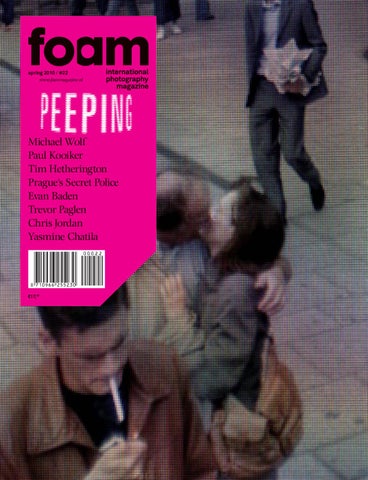
spring 2010 / #22 www.foammagazine.nl
Michael Wolf Paul Kooiker Tim Hetherington Prague’s Secret Police Evan Baden Trevor Paglen Chris Jordan Yasmine Chatila
€17,50
foam magazine #22 / peeping upcoming talent issue
Talent Call Now Open!
Visit www. foammagazine .nl/talent
Are you the world’s next photography talent? Show us your work and it might get published d in the 2010 Talent issue of Foam Magazine! Don’t let this chance pass you by. Go to www.foammagazine.nl /talent for submission requirements.
foam magazine #22 / peeping editorial
Editorial Marloes Krijnen, director Foam_Fotografiemuseum Amsterdam
In compiling Foam Magazine, our entire editorial team suffers from a healthy form of scopophilia. Scopophilia is not a term in common use. It literally means something akin to a passion for viewing, and viewing pleasure is nowhere more appropriate than in the world of the visual arts. Where else is the act of looking so important? Freud used the word Schaulust in his analysis of the part played by visual enjoyment in the development of sexuality. The perverse form of such enjoyment is known as voyeurism, but that is not what afflicts us as editors. Nothing we do is furtive or surreptitious and we do not keep to ourselves the photography that arouses our passion for looking. In fact we try to share it with as many people as possible. In this spring issue of Foam Magazine we present portfolios by eight photographers each of whom clearly has a very particular way of looking. Peeking, secretly watching a subject that is not really supposed to be seen, or is at least unaware of being watched, is a central concern of the portfolios included here. Of course this does not mean we avoid classic forms of voyeurism, in the sense of deliberately and covertly watching unsuspecting persons for the explicit purpose of sexual stimulation, the kind of activity whose stereotypes are the dirty old man in the bushes or the neighbour behind the curtains with a pair of binoculars. But in a society in which the distinction between public and private domains is increasingly diffuse, and where under the pretext of security countless hidden cameras spy on society, the voyeur has been to a great degree institutionalized. Big Brother is watching you! The portfolios in this issue give expression to the theme of ‘peeping’ in extremely varied and unexpected ways. Together they do justice, we hope, to the heightened importance of the secret observer in a time when technological advances mean an anonymous someone is always able to peep over your shoulder and become an unwelcome part of your private life. By more archaic but certainly no less effective means, this is what went on in the totalitarian regimes of the former Eastern Bloc. The portfolio Prague through the Lens of the Secret Police consists of disquieting images made by the Czechoslovak secret service and now held by the Institute for the Study of Totalitarian Regimes in Prague. Today, people are still relentlessly watched and photographed, no longer only by governments but increasingly by commercial companies. Michael Wolf takes a remarkably innovative look at the way Google Street View has laid claim to public space. The internet and the digitalization of the media are whetting the appetite of more and more people for sharing often very personal information. Peeking is safe from behind a screen, after all, because anonymous. And if there are people who want to watch, then there are also those who want to show. The often erotically-charged interaction that results is revealed with great immediacy in the work of the young artist Evan Baden. By comparison, the series Stolen Moments by Yasmina Chatila uses a far more traditional voyeuristic setting: the lighted window on the far side of the street. With all kinds of references to classic films, she captures precisely those moments that are alive with suggestion, causing us to fantasize about what exactly it is that we are seeing. In the work of Paul Kooiker too, what we are looking at remains shadowy. His series is made up of indistinct, impressionistic shots of woods in which we can make out crouching figures, partially hidden and 13
at a safe distance. Of a different order altogether are the photos that Tim Hetherington made in Afghanistan of sleeping American servicemen. Soldiers are normally wide awake, watchful and alert. When asleep their natural cover falls away and they become innocent and vulnerable, to our eyes at least. The US Army also features in the work of Trevor Paglen. Using advanced telescopes he has not only found a highly suggestive way of capturing army bases and airfields, he also directs his lens at the many satellites that continually monitor us from a great height. Finally, Chris Jordan points his camera at the ground. His photos of the rotting corpses of albatrosses are shocking, their stomachs stuffed with an astounding amount of plastic waste now exposed by the process of decomposition. In our regular features we present an extensive interview with Olga Sviblova, director of the Moscow House of Photography, fascinating and unexpected images in On My Mind..., book reviews and of course Foam’s programme of exhibitions over the coming months. +
foam magazine #22 / peeping contents
Contents On My Mind... images selected by Fiona Tan ~ Kelli Conell ~ Jim Linderman ~ James Danziger ~ Anne-Marie Beckmann ~ Julia Dippelhofer Pages 16 – 21
Interview with Olga Sviblova by Anne-Celine Jaeger On Rebuilding a National Identity Pages 22 – 26
~
Michael Wolf ~ Paris Street View
35 – 54
Michael Wolf has with great precision isolated scenes of daily life in Paris from the enormous image archive of Google Street View.
Peeping: Theme introduction The Hidden Viewer by Marcel Feil Pages 27 – 34
Portfolio Overview: Michael Wolff ~ Paris Street View Text by Marc Feustel Pages 35 – 54
Paul Kooiker ~ Untitled 1996 (Peeing Women in Forest) Text by Hans den Hartog Jager Pages 55 – 74
Tim Hetherington ~ Sleeping Soldiers Text by Max Houghton
Paul Kooiker ~ Untitled 1996 (Peeing Women in Forest)
55 – 74
Pages 75 – 94
Prague’s Secret Police Prague through the Lens of the Secret Police Text by Miroslav Vojt echovský ˇ Pages 95 – 114
In his work Paul Kooiker explores various aspects of the theme of looking: voyeurism, shame and distance.
Evan Baden ~ Technically Intimate Text by Christina Schmid Pages 115 – 134
Trevor Paglen n ~ Invisible Text by Aaron Schuman Pages 135 – 154
Chris Jordan ~ Midway ~ Message from the Gyre Text by Kees Moeliker Pages 155 – 174
Yasmine Chatila ~ Stolen Moments Text by Jörg Colberg Pages 175 – 194
~
Photobooks by Sebastian Hau Pages 196 – 199
Foam_Fotografiemuseum Amsterdam Exhibition Programme Paul Graham ~ a shimmer of possibility Pages 203 – 216
14
Tim Hetherington ~ Sleeping Soldiers
75 – 94
Tim Hetherintgon has photographed soldiers during their sleep; the result is astonishingly intimate and vulnerable.
Prague’s Secret Police ~ Prague through the Lens of the Secret Police
95 – 114
These black and white photographs reveals the State Secret Police surveillance, taken during the era of hard-line socialist entrenchment after the 1968 Soviet-led occupation of Czechoslovakia.
Evan Baden ~ Technically Intimate
115 – 134
Evan Baden have found images posted on the Internet that young girls have taken of themselves, and re-staged the moment of the shoot.
Trevor Paglen ~ Invisible
135 – 154
Trevor Paglen is an artist, writer and experimental geographer whose work deliberately blurs lines between social science, contemporary art, journalism and other disciplines to construct unfamiliar ways of seeing the world around us.
15
Chris Jordan ~ Midway ~ Message from the Gyre
155 – 174
Chris Jordan explores the frightening waste of our mass culture. By showing us the usually unseen, Chris Jordan forces us to face the consequences of our contemporary way of life.
Yasmine Chatila ~ Stolen Moments
175 – 194
Like a classical voyeur, Yasmine Chatila has observed and captured private moments in apartments in New York.
foam magazine #22 / peeping Six well-known figures from the cultural world selected an image that has recently been on their minds...
ON MY MIND...
Photographer unknown from Vox Populi, Norway, Fiona Tan 2004 © Fiona Tan, courtesy Frith Street Gallery, London
Fiona Tan Can I possibly explain why I love this particular photo so much? The child, still a baby almost, is isolated and alone. The linoleum floor would be cool and smooth, maybe even a little cold. The child is wearing stockings. Whether it is a boy or a girl I cannot tell and need not know, but here I will call her a girl. Possibly she cannot yet walk, otherwise she would surely slip over on that shiny surface in her stockinged feet. This is not a home environment but the wide open interior of somewhere else, perhaps a school, perhaps an office. The composition is instinctively right, with the main figure positioned in the lower half and the background out of focus. This little human figure is a warm and delicate bundle of total unselfconsciousness. Looking again and again at this image, it feels very private. I am privy and sense a tremendous privilege, a lovely gift. I am sure that the photographer is the parent, or at least feels like a parent at the moment of taking this photo. All of a sudden came the precious chance to take 16
this picture; the child is still, for however long. It is an moment begging to be captured in an image. For me the punctum is the child’s small and chubby left hand. Her little finger is slightly, unintentionally folded under. The battery simply conked out on that spot in the middle of the floor. And, bending double, she fell asleep. + Fiona Tan was born in Indonesia, grew up in Australia and lives and works in Amsterdam. Her film and video installations and photographic works have over the past ten years gained international acclaim and have been exhibited all over the world. In 2009 she represented The Netherlands at the Venice Bienniale. Presentations of her work have included Documenta 11, the Yokohama Triennale, the Berlin Biennale and also at the Istanbul Biennial and the Sydney Biennial. Her next solo exhibition in the Netherlands Disorient and other works will open in the Museum voor Moderne Kunst in Arnhem 28 March 2010.
foam magazine #22 / peeping On My Mind...
Sleep, 2002 © Sam Taylor-Wood, courtesy Matthew Marks Gallery, New York and White Cube, London.
Kelli Conell A few weeks before I moved to Youngstown, Ohio, a friend gave me an exhibition poster featuring Sam Taylor-Wood’s Sleep as a farewell gift. For the four years I lived in Ohio, this image hovered above my desk on a bare white wall across from the floor to ceiling windows that framed the pine trees outside and my quiet neighbourhood below. While I knew little about Taylor-Wood’s original piece, I developed a special connection to its reproduction. Often I would sit and stare, contemplating this beautiful sleeping man. He lay in a white room on a white bed with everything still, except for a slight blur above his chest: his aliveness evidenced only by his subtle breathing during the long exposure needed for the image. I wondered who he was and if Taylor-Wood had known him long or simply found him to pose for the picture. Was he asleep after sex? Where were the sheets? Was he this strikingly androgynous when awake? The fairness of his skin and his long, red, wild hair enhanced his feminine physique. 17
Sleep came to mirror my experience in Ohio, silent and still and white. It evokes quiet memories of watching my boyish girlfriend curled up asleep, with the snow on the ground below the windows of my bedroom. Based on Hans Holbein’s The Dead Body of Christ in the Tomb, it inspires both awe and wonder while raising questions about religion, gender, and sexuality. After spending time with Sleep what we are left with is the unknown – the cocooned possibility of it all. + Kelli Conell is an American photographer. Her body of work entitled Double Life has been widely received and included in numerous national and international exhibitions. Recent publications of her work include Photo Art: The New World of Photography published by Aperture; Vitamin Ph: New Perspectives in Photography published by Phaidon; and MP3: Midwest Photographers’ Publication Project co-published by Aperture and The Museum of Contemporary Photography.
foam magazine #22 / peeping On My Mind...
The End of Gen Arnulfo Gomez, Anonymous Press Photograph, Embellished by Hand, 1927 © Collection Jim Linderman
Jim Linderman Newspapers and magazines were touching up photographic images for publication long before the fashion industry started slimming down models with an airbrush, but seldom has a picture been so heavily embellished. The End of Arnulfo Gomez is an original 1927 press photograph capturing a firing squad precisely at the moment of death. Gomez is reported to have had one final request – that he not hear the command to fire. Granting his dying wish, Col Manuel Limon, at right, silently drops his hat to signal his gunmen. A striking example of documentary photography and at the same time a dramatic example of extreme re-touching. + 18
Jim Linderman is a collector, writer and iconoclast. Photographs from his collection were used in the Grammy nominated compilation Take Me to the Water: Immersion Baptism in Vintage Music and Photography last year and he publishes limited edition art and photography books under the umbrella known as Dull Tool Dim Bulb. He maintains a network of art and photography blogs all connected by a thread of authenticity. Biographical material and a list of his sites is found at www.dulltooldimbulb.com.
foam magazine #22 / peeping theme introduction
27
foam magazine #22 / peeping theme introduction
MT inv. no. 4-001, unique gelatine silver print, handmade frame by the artist unnamed, undated © Miroslav Tichý, courtesy Fondation Tichý Ocean.
28
foam magazine #22 / peeping theme introduction
by Marcel Feil ~ curator Foam_Fotografiemuseum Amsterdam Transatlantic journeys, especially since the events of 9/11, have become an increasingly time-consuming and exhausting affair. Aside from the crossing, which itself takes many hours, travel time is determined to an important extent by the requirement that passengers arrive at the airport well in advance of departure, so that they can be subjected to a long series of checks. The body-searching of passengers for weapons, explosives and other banned objects takes a great deal of time, sometimes creating queues so long as to be extremely unpleasant. Schiphol Airport in the Netherlands believes it has found a way not only to reduce waiting times for travellers but to improve security in the process, by using a machine called a body scanner. The passenger steps into something resembling a cylindrical shower cubical and has only to stand still for three seconds, arms slightly spread. This is enough to produce an image of his or her body that immediately makes clear whether the passenger is carrying any concealed weapons. It’s quick and efficient. The announcement that body scanners were being introduced caused a considerable stir. There were questions as to whether use of the scanner could be damaging to health (it uses electromagnetic waves or a special kind of infra-red light), but it was above all the alleged encroachment on the private sphere that prompted widespread criticism. The use of the scanner was described as an infringement of personal and physical integrity and an invasion of privacy. The body is a person’s most intimate possession, not something to be displayed at will and shared with everyone. An important function of clothing is the covering up of the body to protect it from direct scrutiny and the judgment of others, but suddenly, if you wanted to travel to the United States, you would have to pass through a machine that could literally look through your clothes, in effect stripping you naked. Complaints poured in and the Dutch government went some way towards meeting people’s objections, deciding that the security staff examining the scans on a monitor would not be in a position to make eye contact with the passenger concerned. Eventually a computer alone will scrutinize the images. The scans were said to be impossible to reproduce and they would be deleted immediately. Although the European Union is far from reassured and is still blocking the widespread introduction of the body scanner, Schiphol is continuing with its full-scale experiment. In the Netherlands the storm of criticism has already begun to subside. Many of the objections seemed to have 29
less to do with a fundamental intrusion than the thought that the person studying the scan could then look past his screen and examine the passenger in the flesh. The problem, in other words, was not the requirement to be scanned but the danger of crude voyeurism. As soon as the security staff disappeared behind a partition, much of the criticism fell silent. This is yet another example of how unbearable many people find the thought that someone is secretly watching them, able to see the most intimate and best protected parts of their body. Physicality and nudity are closely bound up with a person’s self-image and self-respect, and often surrounded with precepts and prohibitions of a religious and cultural nature. Only under clearly defined circumstances do we reveal or display our bodies. These include safe and familiar surroundings, the absence of company other than our most intimate acquaintances, and the assurance that we are shielded from unwanted looks. Doors are locked and curtains drawn before people remove their clothes. There is generally little sympathy or empathy, therefore, for the voyeur, the Peeping Tom. Many people still have a stereotypical image of a dirty old man in a grimy raincoat standing in the park undergrowth, sexually aroused by the sight of young, scantily clad girls. We picture a rather sad, pathetic figure, lonely and socially inadequate. This image required some adjustment after viewing the now famous photos made by Kohei Yoshiyuki in various parks in Tokyo in 1973. His nocturnal shots show not only couples having sex in the bushes but the men who watch them from close proximity to optimize their view of the sexual act. No dirty old men here; these are neatly dressed gentlemen, seemingly respectable members of the Japanese middle class. They certainly aren’t all hiding alone in the shrubbery, either. Sometimes they bunch up together to get the best view. ‘The couples were not aware of the voyeurs in most cases,’ Yoshiyuki wrote. ‘The voyeurs try to look at the couple from a distance in the beginning, then slowly approach toward the couple behind the bushes, and from the blind spots of the couple they try to come as close as possible, and finally peep from a very short distance. But sometimes there are the voyeurs who try to touch the woman, and gradually escalating – then trouble would happen.’ So as to be able to photograph the voyeurs from close up, Yoshiyuki first visited the parks repeatedly without taking any pictures. He made contact with the voyeurs and pretended to be one of them, gradually
foam magazine #22 / peeping theme introduction
from the series The Park, 1973 Š Kohei Yoshiyuki, courtesy Yossi Milo Gallery
30
foam magazine #22 / peeping theme introduction
from the series The Park, 1973 Š Kohei Yoshiyuki, courtesy Yossi Milo Gallery
31
foam magazine #22 / peeping theme introduction
MT inv. no. 3-8-15, unique gelatine silver print, handmade frame by the artist unnamed, undated © Miroslav Tichý, courtesy fondation Tichý Ocean.
32
foam magazine #22 / peeping theme introduction
winning their trust. Then at last he ventured to take his first nocturnal pictures, using a small camera with an infra-red flash. This produced some extremely unusual images. Since Yoshiyuki literally mixed with the voyeurs, taking his pictures from their perspective, the viewer is presented with an image of something that was not supposed to be seen and indeed would not be seen under normal circumstances. Yoshiyuki became a spy, an infiltrator with an agenda of his own, yet he was fulfilling an urge that coincided with that of the real voyeurs: to watch and even record an act that we are forbidden to see. The photos were first shown in 1979 in the Komai Gallery in Tokyo, on that occasion as life-sized prints hung in a darkened gallery. Visitors were given a torch so that they could illuminate and study the works bit by bit. It was impossible to see the entire image at once; the full picture had to be construed from snippets and indistinct fragments. The photographer’s experience became the visitor’s. First the photographer and then the viewer of the photos became a voyeur. Voyeurism is a specific, perverse form of the urge to look, an instinct that is common in its mainstream manifestation. Many people take especial pleasure in the act of looking. Freud used the term Schaulust and suggested it was a passion derived from the need to touch. This makes all the more interesting Yoshiyuki’s remark that the voyeurs in the park often felt compelled to get closer and closer to the couples, sometimes even to touch them, thereby consciously risking discovery. Where did this irresistible urge come from? Was it a veiled attempt to take part in the act? Was some kind of appropriation going on? The voyeur is fundamentally different from someone who simply enjoys seeing people naked or watching them have sex. He finds it is essential that the other person is unaware of being watched, so he has to remain invisible and reduce the chances of discovery as far as possible, usually taking cover and keeping at a safe distance from the people he is watching. This makes the voyeur an outsider by definition, excluded from the acts he observes, which arouse him sexually. There is a tension here. The voyeur is excluded and in essence merely a spectator. At the same time, the act of looking means he is directly and powerfully linked to the performance. Yet no one knows, no one can tell he is looking, no one else sees what he sees. His perspective is reserved purely for him, his view exclusively his. The voyeur knows, sees and thinks things that cannot be shared with anyone else. Through his eyes he takes possession, absorbing things into his own imagination. This fundamental inequality puts the voyeur in a position of power. As long as he remains a semi-passive outsider, he can be king in the depths of his mind. But what use is power if it cannot be deployed? What does it mean to be unable to make yourself known, never to be in a position to reveal that you are in possession of extremely personal, intimate information? How great is the temptation to defy fate and step beyond the role of outsider to become part of the action? Does the tension between concealment and revelation, between anonymity and openness, between being an outsider and becoming a participant lie at the root of the increasing risks taken by Yoshiyuki’s voyeurs? For many voyeurs, surreptitious peeking is not enough, and some may feel a desire to record what they see. By filming or photographing certain activities, the act of looking and the enjoyment attached to it can be experienced at any time, and the materialization of the fantasy, the transformation of a view into a physical, concrete object, intensifies the power they possess. The image no longer exists purely on the retina and in the mind’s eye of the voyeur; now, as a photo, it is tangible proof of 33
looking and seeing – observation in a material form that can be examined at will, reproduced and shared. The uniqueness of the act of looking, bound to a specific here and now, has made way for an experience that can in theory be recalled endlessly. People in often extremely intimate situations have, without knowing it, become the concrete possessions of an unknown party. This is a form of appropriation as perverse as it is disturbing. At around the same time as a reprint of Kohei Yoshiyuki’s book The Park was selling well, the world was introduced to the unique and thoroughly idiosyncratic work of Czech photographer Miroslav Tichý. At first sight Tichý is the ultimate personification of the voyeur: a Catweazle-like presence with a long grey beard and grubby, home-made clothing who has made thousands of photos of women over the years. Ideally he would photograph women in bikinis, even topless, at the local swimming pool. Should this prove impossible he would satisfy himself with fully clothed women, irrespective of age or posture, or simply with shots of parts of the female body. Tichý used cameras he made out of toilet rolls, bits of tin, string, elastic and mirrors, equipment that was ultimate proof of Tichý’s irrepressible, obsessive urge to record images of women. But the most unorthodox part of their creation took place after the development and printing of the pictures. The photos were subjected to an elaborate and highly specific post-production process. Certain body parts were emphasized with a pen, women were cut out of their surroundings and the prints became functional objects of various kinds, from beer mats to bookmarks. Using a wide variety of materials including pieces of painted cardboard and garbage bags, Tichý framed the pictures with great deliberation. Everything unimportant was cut away or concealed behind the frame. The countless photos produced in this way are not only tangible evidence of the obsessive gaze of a monomaniac, they also confirm the position of the voyeur as an outsider. ‘Even when Tichý’s wonky telephoto enables him to snuggle up deceptively close,’ writes Geoff Dyer in discussing his work, ‘his pictures gaze longingly on a world from which he is excluded. Whether the women look at him, berate him or remain oblivious to his approaches, they are absolutely beyond reach. This is formally enhanced by the fence that so often comes between the photographer and the women in the frame. It’s just the fence at the local pool, but it imparts to the pictures the intensity of a prisoner peering through the bars of a cell.’ These shots of a world to which he did not have access went into the cell with Tichý and became part of his world. Many writers have pointed out the similarity between hunting and taking photographs. Sometimes even the vocabulary coincides, from aiming to shooting. In the genre of street photography especially, many analogies have been made with the hunt: photographers comb the streets like hungry huntsmen in search of prey, then creep up on it, take aim and shoot without hesitation, ideally before the prey gets wind of them. In both traditions people endlessly lurk, peek and spy. There is one essential difference, however, between the gaze of a street photographer and that of a voyeur; the explicit sexual motif is missing in the former case and the subjects that interest the photographer are more varied and often settled upon at the last minute. Looking is more like scanning. When something interesting turns up, the photographer reacts quickly and then goes on his way. The most important thing the two have in common is that they prefer not to make it obvious that they are looking and, in the photographer’s case, recording. Both are ‘unseen viewers’, confident that their subjects are not conscious of being seen. If there is any invasion of privacy, then it is mostly limited and innocent. Photography of the past is full of pictures of people who had no idea they were being photographed. It’s a different matter when the photographer deliberately lures people into a trap or uses hidden cameras. Classic examples are the pictures
foam magazine #22 / peeping theme introduction
Weegee took with infra-red film of couples having sex in a New York cinema, or the famous Subway Portraits by Walker Evans. Between 1938 and 1941, Evans made a series of portraits of anonymous passengers in the New York subway, using a miniature camera hidden in his coat and a cable release he could operate from his coat pocket. In neither case are the people photographed known to have objected. But times are changing. In 2005 retired diamond merchant Erno Nussenzweig took Philip-Lorca diCorcia to court for violating his privacy and exploiting his portrait for commercial ends without his permission. The portrait of Nussenzweig had been taken by diCorcia in the streets near Times Square in Manhattan. Across two years, diCorcia created a series of portraits for which he made use of a flash mounted on scaffolding and a camera with a telephoto lens. Both the flash and the camera were aimed at a fixed point and could be operated from a distance as soon as a passer-by reached a certain spot. When this happened to Nussen-zweig he objected. The court, however, decided that the use of his portrait should be seen as an example of artistic expression, protected by the first amendment, and found in diCorcia’s favour on all counts. Innumerable photographers, collectors, gallery owners and curators heaved a sigh of relief. This legal decision means the street is still a place where photographers can work freely, but they are certainly not alone in being allowed to use hidden cameras in public space. The number of security cameras in streets and squares, in government buildings, in shops, buses and even taxis has increased exponentially over the past decade. The incredible number of often well-concealed cameras in most European city centres means you can take a random route and be visible on a monitor throughout. Most CCTV systems make it possible in theory to follow any individual citizen continually, from camera to camera, monitor to monitor. Yet the public does not know exactly where the cameras are, whether a given camera is actually functioning, or whether a more advanced system is being used, such as DVR, digital video recording, which means the images can be kept for months. Nor is there any way of knowing whether or not the image is visible somewhere on a screen, whether anyone is in fact watching and, if so, who that person is and what they are likely to do, or think. Most disturbing of all is the linking of high-definition CCTV images to software capable of facial recognition. This makes it possible to determine people’s identities and store that information away without their knowledge. By coupling it to other systems, such as those that trace telephone calls or debit card payments, a reasonably accurate record of a person’s behaviour during a specific period can be retrieved in seconds. It’s not only governments that – in their case under the pretext of security and the public interest – keep a close watch on the streets. Commercial companies have a great deal to gain from the monitoring of specific behaviours by their clients or potential clients. Large numbers of people unquestioningly, and often without realizing it, give private details to companies such as Google. The search results entered into Google can then be made increasingly personal and location-specific. When you search for shoes, Google determines where you are, who you are, where you’ve looked before, then makes a comparison with the search behaviour of other users before giving you a list of results. But change seems to be on the way. More and more people are realizing that while we don’t pay for Google, Google sells us and our data to advertisers and that therefore we should, or perhaps must, be more critical. There are rising protests against the claim Google is making on public space with Street View, a programme that enables us to look at 34
cities at street level on our computers. There was uproar in Britain, the German government objected, the Greek government introduced a ban and the Swiss government filed a complaint against Google. Media expert Siva Vaidhyanathan applauds the protests: ‘One of the best things that could happen would be not that people stop using Google but that they go to their governments and say: why don’t you draft a law that forbids this? In the case of Street View I can well imagine them doing so. Why is Google not obliged to examine every photo to check there’s nothing objectionable about it? Men visiting prostitutes, for example. Yes, that’s a huge task, but Google’s the one earning money here! I think we should demand that our governments regulate Google as far as possible.’ Vaidhyanathan was closely supported by German minister Ilse Aigner, who in a recent interview stated frankly that the elaborate photooffensive was a sustained violation of the private sphere. ‘I reject this form of exposure. There is not a secret service in existence that would collect photos so unabashedly,’ Aigner said. ‘I would like to see a reversal of the present system. Citizens shouldn’t have to take action to prevent the publication of their private data. Rather, Google should be required to obtain the consent of citizens when they want to publish a photo of a private home.’ But the internet, that complex, all-embracing system of interconnected computers and computer programmes, has given a whole new twist to the concept of peeping. The rapidly increasing number of social networking sites gives a new meaning to words like friend, authentic, false, private and public. It’s astonishing to see the degree to which people expose themselves, in the most literal sense of the word, and how much they share with others the moment they think they are among friends. Cell phones, webcams and digital cameras make it easy to film and take photographs virtually everywhere, then immediately to throw them into the public world of the net. Look for example at the portfolio by Evan Baden in this issue, which is intriguing and disturbing in equal measure. As the accompanying text rightly comments, the theatrical and selfassured poses of the naked young girls challenge us to revise our ideas about the conditions, circumstances and ethics of looking. In the twentyfirst century, peeping is not what it used to be.
Kohei Yoshiyuki y i (1946) is a Japanese photographer who attracted much attention in 1979 with his exhibition Koen ¯ (Park) at the Komai Gallery, Tokyo, with photographs of people in sexual activities in Shinjuku and Yoyogi parks, mostly with unknown spectators around them. The photographs were taken with a 35 millimetre camera and infrared flashbulbs. Yoshiyuki’s works are in the collections of the Museum of Modern Art (New York), San Francisco Museum of Modern Art, Museum of Contemporary Photography (Chicago), Museum of Fine Arts (Houston), and North Carolina Museum of Art (Raleigh). The Park and Love Hotel will be on view at M+B, Los Angeles, between 13 March – 17 April 2010. After studying at the Academy of Arts in Prague, Miroslav Tichýý (1926) withdrew to a life in isolation in his hometown of Kyjov, Moravia, Czech Republic . In the late 1950s he quit painting. From the end of the 1960s he began to take photographs mainly of local women, in part with cameras he made by hand. He later mounted them on hand-made frames, added finishing touches in pencil, and thus moved them from photography in the direction of drawing. The result is works of strikingly unusual formal qualities, which disregard the rules of conventional photography. They constitute a large oeuvre of poetic, dreamlike views of feminine beauty in a small town under the Czechoslovak Communist régime. Miroslav Tichý has for the last couple of years gained international reputation, and is currently on view at the International Centre of Photography in New York, until 9 May 2010.
foam magazine #22 / peeping
portfolio
Michael Wolf Paris Street View
foam magazine #22 / peeping portfolio text
Michael Wolf
All images © Michael Wolf, courtesy Wouter van Leeuwen Gallery, Amsterdam; Bruce Silverstein Gallery, New York; Robert Koch Gallery, San Francisco; Gallery 51 Fine Art, Antwerp; Gallery La Particulaire, Paris; M97 Gallery, Shanghai.
Michael Wolff was born in Munich in 1954. He grew up in the United States, Europe and Canada, and studied at UC Berkeley and at the Folkwang School in Essen, Germany. He moved to Hong Kong in 1995 for a period of intensive study of Chinese cultural identity and the complexities of Chinese urban architecture. He has published five photobooks on China: China im Wandel (Frederking und Thaler, 2001), Sitting in China (Steidl, 2002), Chinese Propaganda Posters (Taschen, 2003), Hong Kong Front Door Back Door (2005), and Hong Kong Inside Outside (Peperoni Press/Asia One Publishing, 2009). Wolf’s work has been exhibited extensively in galleries and at art fairs throughout the world since 2005, including shows at the Museum of Contemporary Photography in Chicago in 2006, at the Museum Centre Vapriikki in Tampere, Finland, in 2007 and most recently at the Aperture Gallery in New York in January 2010. Michael Wolf won a first prize in the World Press Photo Award Competition in 2005 (Contemporary Issues Series) and in 2010 (Daily Life Single), on both occasions with topics photographed in Asia. Michael Wolf has long been interested in the city and its architectural structures. He photographed Hong Kong’s strikingly formalistic and severe buildings and the result, as seen in Hong Kong Inside Outside verged on the abstract. His professional interest in people and human interaction began when he accidently blew up a detail from glazed buildings he had been photographing in Chicago. Transparent City (Aperture 2008) juxtaposes images from the buildings and pixellated details with blown-up details of the life within. Wolf’s curiosity about accidentally captured human situations led to work with the immense 51
image archive of Google Street Views. With great precision he isolates scenes from the streets of Paris. By framing and directing our gaze, Michael Wolf helps us discover small details. The images capture both the humour, beauty and absurdity of daily life and raise questions about the constant surveillance of public spaces. Paris Street View w will be exhibited at the Goethe Institute in Hong Kong between 3 March and 23 March 2010 and in an outdoor exhibition on the Zuidas, the Amsterdam business district, from 12 March till 11 April. Michael Wolf is represented by Wouter van Leeuwen Gallery, Amsterdam; Bruce Silverstein Gallery, New York; Robert Koch Gallery, San Francisco; Gallery 51 Fine Art, Antwerp; Gallery La Particulaire, Paris and M97 Gallery, Shanghai. For more information, see www.photomichaelwolf.com.
Marc Feustel Marc Feustel is an independent curator, writer and blogger based in Paris. A specialist in Japanese photography, he is the author of Japan: a self-portrait, photographs 1945-1964 (Flammarion, 2004) and has curated several exhibitions as creative director of Studio Equis (www.studioequis.net) including Tokyo Stories (6 March – 2 May 2010, Kulturhuset, Stockholm) and Eikoh Hosoe: Theatre of Memory (19 March – 22 May 2010, Japanisches Kulturinstitut, Cologne). He blogs at www.eyecurious.com
foam magazine #22 / peeping portfolio text
Towards a New Street Photography Marc Feustel
In his collection of prose poems on the city, Italo Calvino writes the following about the imaginary city of Tamara: ‘You penetrate it along streets thick with signboards jutting from the walls. The eye does not see things but images of things that mean other things: pincers point out the toothdrawer’s house; a tankard, the tavern. (…) If a building has no signboard or figure, its very form and the position it occupies in the city’s order suffice to indicate its function: the palace, the prison, the mint, the Pythagorean school, the brothel. Your gaze scans the streets as if they were written pages: the city says everything you must think, makes you repeat her discourse, and while you believe that you are visiting Tamara you are only recording the names with which she defines herself and all her parts.’ Paris has become a photographic Tamara, a city where every street seems to evoke an old photograph. Its architecture has remained largely unchanged since Haussmann’s nineteenth-century restructuring of the
city. Over the decades this architecture has become the subject or the backdrop of a quasi-universal photographic iconography which developed as the medium of photography flourished in the French capital. This rich heritage has become an obstacle for contemporary photographers shooting in Paris. How can you photograph the now of a city where every street corner, every café terrace, every doorway has been immortalized by the likes of Eugène Atget, Henri Cartier-Bresson, Robert Doisneau and Willy Ronis? Their photographs are the elephant in the room, so universally recognizable that they have become visual clichés, best avoided, and yet they are also part of the very essence of the city and therefore cannot be ignored. This is the conundrum that faced Michael Wolf when he partially relocated to Paris in 2008. Wolf is known for his large-format photographs of the density and monumentality of Hong Kong’s architecture. In the series Architecture of Density, Wolf used Hong Kong’s tower blocks to great effect, turning their facades into abstractions, never-ending repetitions of architectural patterns, with only the odd piece of dangling laundry to remind us of the thousands of people within. Hong Kong and China, where Wolf has shot several series, are places of flux: the architecture and structure of their cities is constantly being reinvented and there is little sentimentality about the preservation of traditional architecture. The buildings in these cities are replete with fascinating details as they wear the signs of their inner life on their surfaces: pipes emerge from walls at random, telephone wires are tied in inextricable knots and balconies are transformed into overflowing outdoor storage units. Arriving in Paris after 15 years spent living and working in Hong Kong, Wolf was
The Transparent City, 2008 © Michael Wolf
52
foam magazine #22 / peeping portfolio text
faced with a restrained city that shows few signs of contemporary life on its surface. The city’s static form and the weight of its photographic past convinced him of the need to find a new approach. The result is his latest series, Paris Street View. Paris Street View is made up entirely of images taken using Google’s Street View technology, which allows users to navigate a photographic map of any given city. Street View’s images are taken at regular intervals by automated scanners placed on top of vehicles which drive through the locations to be mapped. In some ways it seems that the scale and significance of this endeavour has been overlooked by the photographic community. The idea of creating a photographic map of the world is ground-breaking: in scale it dwarfs even the most expansive previous efforts, such as Eugène Atget’s rigorous documentation of Paris. In creating Street View, Google is doing more than assembling a series of photographs. Each of its images contains a discrete slice of space and time. In order to assemble its photographic maps, Google is stitching together slices of space and time to form a seamless photographic tapestry of our world. Interestingly, Google Street View explodes one of Cartier-Bresson’s fundamental concepts: the decisive moment. The French master coined this famous term in reference to the ability of a photographer to see, and capture on film, a moment where the significance of an event combines
The Transparent City, 2008 © Michael Wolf
53
with the organization of forms. By removing the photographer from the equation, Street View is creating a different kind of decisive moment, one that does not depend on the photographer, but that is instead governed purely by chance. Since its launch a number of people have combed through this tool to uncover some of the more extraordinary moments that Google’s cameras have captured. Wolf’s approach is different. Rather than simply trying to find an interesting scene, he uses Street View as the raw material from which to shoot his own photographs. By embracing this alternative photographic world Wolf is challenging another Cartier-Bresson maxim. Whereas Cartier-Bresson famously (almost) never cropped his photographs, for Wolf’s Street View work the crop is everything. This approach is an extension of street photography, but one in which the crop and the choice of angle have replaced the camera. Wolf refers to the process of making these images as shooting and his online journeys through the streets of Paris, searching for moments to be photographed, are analogous with those of a street photographer pacing the streets of a city. The world of Street View may be more limited than our reality, but it still offers an infinite set of visual possibilities for a photographer to explore. With Paris Street View, Wolf may have become the first street photographer of the online world. These images recognize and even intentionally quote the classics of street photography from Robert Doisneau to Robert Frank, by making use of its tropes. A couple’s embrace on a busy Paris street is a playful reference to Doisneau’s ubiquitous Kiss by the Hotel de Ville. These are photographs of photographs that recognize and engage with the weight of their photographic heritage.
foam magazine #22 / peeping portfolio text
For a photographer best known for the work that he shot on a large format camera with extraordinarily detailed results, these super-pixellated street shots may come as a bit of a surprise. But Wolf is not so much a photographer of architecture as of the city in all its forms and his Paris Street View series represents a logical progression from his previous work. With his series Transparent City, the dense, claustrophobic concrete of Hong Kong’s high-rises gave way to a sleeker, more statuesque Chicago. These later photographs extend Wolf’s study of the skin of the city, but Chicago’s glass skyscrapers reveal far more of the life within them. During the editing process for the series, Wolf became fascinated by the little glimpses into people’s lives that were visible through the windows of the buildings he had photographed. He painstakingly scoured every inch of the images to find human details to pair with his architectural images. He then blew up these details into highly pixellated large-scale tableaux. In the process, his work acquired a certain voyeuristic edge, which he acknowledged with a dramatic image containing a clin d’oeil to Hitchcock’s Rear Window. Paris Street View extends this use of pixellation and digital noise even further. As Wolf blows up details from Street View, his images begin to echo the textures of Roy Lichtenstein’s newsprint or of Warhol’s silkscreen prints, influences which he acknowledges and actively cultivates. In addition to embracing this aesthetic of digital noise, Wolf also uses Google’s language of symbols to anchor the images in the digital age. By making use of Google’s pixels, superimposed lines, arrows and geometric shapes, he forces the city’s Haussmannian architecture into the present day, if not into the future. Just like Italo Calvino’s imaginary Tamara, Paris is a city where everything is invested with some symbolic reference to the past, and by adding a layer of contemporary symbols to the city’s old ones, Wolf is suggesting a new way of reading the city.
54
A circle hovers over the blurred face of a young girl, three directional arrows seeming to taunt her with infinite possibility. An image of an ordinary intersection takes on an entirely different meaning when layered with its street names, rue de Paradis and rue de la Fidélité. The language of symbols of the Street View interface is designed to be universal. By making use of these symbols, Wolf’s images become imbued with a sense of the increasing globalization and homogenization of our world. He has already begun shooting Street View images in other cities and it will be interesting to see how these images from different locations combine and resonate with each other. There is a great irony at play with Street View. As anti-terror and privacy laws proliferate it has become increasingly difficult to photograph major cities like Paris. In January 2010 over 2,000 photographers assembled in London’s Trafalgar Square to demonstrate against police use of terrorism laws to prevent photography in public places. And yet Google has been photographing cities more extensively than any photographer ever could. This is made possible in part by the algorithm that Google Street View uses, which automatically blurs human faces, thereby protecting the privacy of the people in the images. This technology is far from foolproof however, and Wolf has exploited its failures in several recent images which reveal the faces that fell through the gaps in Google’s algorithm. Is this voyeurism that infringes on the privacy of innocent passers-by caught in the photographic crossfire? If so, who is the voyeur: Google for making these images so easily accessible to anyone with an internet connection, or Wolf who has used Google’s Street View imagery to draw attention to its loopholes and the double standards associated with them? Paris Street View highlights the absurdity of current attempts to control photographic practice just as digital photography has made photography more accessible than ever before. By cropping, manipulating and even making high quality prints of images derived from Street View, Wolf is reasserting the role of the photographer and opening up new avenues for photography to explore. I wonder what Google will think. +
foam magazine #22 / peeping portfolio
Paul Kooiker Untitled 1996 (Peeing Women in Forest)
foam magazine #22 / peeping portfolio text
Paul Kooiker
All images © Paul Kooiker, courtesy Van Zoetendaal Collections
Paul Kooiker (1964) was born in Rotterdam but lives and works in Amsterdam. He studied at the Royal Academy of Arts in The Hague and at the Rijksakademie van Beeldende Kunsten in Amsterdam. Since 1995 he has been teaching at the Gerrit Rietveld Academy in Amsterdam. In 1996 he won the Prix de Rome and in 2009 he was awarded the A. Roland Holst Prize for his oeuvre. Paul Kooiker’s work has been exhibited widely. Among his group shows since 1996 have been those held at Maison Européene de la photographie, Paris; Fotohof, Salzburg; Kumho Art Museum, Seoul; Arsenale Novissimo, Venice; Zabludowicz Collection, London. Solo exhibitions since 1996 include those held at Kunsthal, Rotterdam; Vleeshal, Middelburg; James Cohan Gallery, New York; Fries Museum, Leeuwarden, Foam Fotografiemuseum, Amsterdam; Gemeentemuseum, The Hague; Museum Boijmans van Beuningen, Rotterdam. Paul Kooiker has published six books:Utrecht Goitre (1999), Hunting and Fishing g (1999), Showground (2004), Seminarr (2006) Room Service (2008) and Crush (2009). Between 2007 and 2009 he published fourteen issues of Archivo, a bi-monthly photo journal curated by himself and gallerist Willem van Zoetendaal. 71
In his work Paul Kooiker explores various aspects of the theme of looking: voyeurism, shame and distance. His work can be seen as a continuation of an old tradition focusing on the relationship between the artist and the model, the observer and the observed. Kooiker’s obsessive collections of images confuse, humiliate and unnerve. They raise questions about a photographer’s reason for looking at things and the motivation behind photographing something. The artist plays a game with the viewer, who is confronted with his or her own gaze. For more information, see www.paulkooiker.com Hans den Hartog Jager (1968) is art critic and author. He writes for publications including NRC Handelsblad, Hollands Diep and Oog. Den Hartog Jager has written two novels, Zelf God worden (2003) and Maltus (2006) plus a number of books on art, including Verff (2004), a collection of interviews with Dutch painters; Haai op sterk water (2008), essays on visual art; and Dit is Nederland d (2008), on Dutch painting. Since 2009, Den Hartog Jager has appeared as an expert on the TV show 4Art, in which contemporary artists are discussed.
foam magazine #22 / peeping portfolio text
The Constant Uncertainty By Hans den Hartog Jager
Paul Kooiker is often regarded as a voyeur. Just look at his photos, they say. The Room Service series, for instance: undressed women standing before a bookcase. Hunting and Fishing g (1999): women running through the countryside. Showground (2004): overweight women in an artist’s studio. Untitled 1996 (Peeing Women in Forest): women urinating in a forest. Most of these women are naked; some are in the act of removing a cheap pair of panties or a bra. The technical quality of the photos is mediocre, as if an unskilled amateur, blinded by lust, snapped them too quickly. But even more important: Kooiker’s women have no faces. Never. They are set before us as bodies only fit to be used for specific purposes, and furthermore, we have no idea what they are thinking. Do they think of themselves as seductive? Are they self-aware? Or are they vulnerable? As a viewer you have no idea. And that’s where the feeling of voyeurism comes in: you know, you feel, that you have power over these women. You can study them unabashedly, you can make judgements, because after all, they’re not looking back at you. And while this invokes uneasiness and embarrassment in people who have a more or less healthy sense of balanced relationships, the voyeur revels in that power.
From the series Crush, 2009 © Paul Kooiker, courtesy Van Zoetendaal Collections
72
But is Kooiker doing that too? Of course, it can’t be totally ruled out that in his spare time Kooiker dresses in a trench coat and lurks in parks and car parks, but anyone who thinks that can be read from his photos is not looking carefully. Or to be more precise: this viewer has become so lost in the reality Kooiker creates that unmistakeable signs of fiction are overlooked. The way this mechanism works can be seen clearly in Kooiker’s Untitled 1996 (Peeing Women in Forest), one of the first series he made this way and with which he won the Amsterdamse Rijksakademie’s Prix de Rome in 1996. At first glance, the concept is perfectly clear: forty photos of a forest on a bright, sunny day, presented as a unit. There is much green and brown, the light shimmers. Because none of the photos are sharply focused, they seem to be made in haste, sloppily, casually – and it is difficult to see exactly what is going on. The viewer has to look further, make an effort, and thus some give up and walk on. Others, the persistent ones, read the label or look more deeply. That is the turning point: as observer, you go deeper into the forest than the camera dared and you see, unmistakeably, a woman squatting behind a bush, peeing. And another one. And another. And then Kooiker has got you: you keep looking for more women, and no matter how difficult it is to see through the leaves, the forest and the lack of sharp focus, you find them. You want to know how many there are. And whether Kooiker really just happened to come across them there. And whether he was caught in the act. These projections are so automatic, so strong, that you forget that such a situation would be practically impossible in reality. Just look at the light: it’s very nearly identical in every photo. The vegetation is also remarkably uniform. And if Kooiker was really such a dedicated voyeur, wouldn’t he have managed to
foam magazine #22 / peeping portfolio text
get closer to the lady concerned in at least one picture, or to focus his camera? But this is also the strength of the series: with the aid of photography, Kooiker has succeeded in creating a convincing piece of fiction. It is precisely at this point that things get interesting. By employing photography as a fiction suggesting an objective reality, Kooiker approaches the domain of writers and, to a lesser degree, of filmmakers. It has long been widely accepted in literature that writers cannot be judged by the thoughts and pronouncements of their personages – everyone knows, realizes, that Holden Caulfield in Salinger’s Catcher in the Rye did not necessarily exist, let alone that his opinions about teachers and women represent those of the author, just as most readers do not assume on the basis of Portnoy’s Complaintt that Philip Roth pursued sexual adventures with liver. This is a major convention of the genre, even a necessity, to guarantee liberty and fantasy. Anyone who doesn’t know this or understand it (didn’t Bret Easton Ellis actually murder all those people then?) is disqualified as a serious reader – or even as a person to be taken seriously. This convention is far less apparent in photography. Or, to be more precise: the conventions are more varied. The timehonoured premise of photography is that in a photo we, as observers, view an image that the photographer actually observed in reality – the photographer functions as an intermediary for images that existed in another time and place. In recent years, that idea has been gradually revised: viewers are becoming
increasingly aware that photographers are able to manipulate their images. In response, a fairly strict categorization has come to exist in the field of photography to distinguish various realities from one another: news photos (in which no significant manipulation is permitted), documentary photos (the same, even though the photographer often spends more time with the subject) and art photos – the genre in which, theoretically, freedom reigns. If there is any obligatory convention within this classification, it is that photographers must play by the rules of their own genre: no Photoshopping news photos, no manipulating documentaries, no whining if the viewer doesn’t believe the authenticity of your art photos. This way the relationship between photographer, reality and the observer remains clear. With that system of conventions in mind, what Kooiker is doing becomes obvious: he’s deliberately manoeuvring himself into the grey area between art and documentary photography. But he isn’t lacking in engagement. Kooiker raises the stakes by continually creating new, fictional, photographed personages who bear a suspicious resemblance to him. For Kooiker, such a personage, a narrative voice, is in theory comprised purely of technical choices – for him, photographic technique is principally a means of creating a fiction that is realistic enough to pass for reality. Anyone who can see this realizes that each of Kooiker’s series has a different narrator: behind Hunting and Fishing g for example, in which dozens of naked women run through the dunes, their hair blowing in the wind like nude forest nymphs, the viewer can imagine a hairy photographer, an anything-goes type who uses his camera as an alibi to satisfy his overactive hormones. Crush, in contrast, was made by a cold, scientific, analytical man: he is fascinated by overweight women, in a nearly obsessive way,
From the series Hunting and Fishing, 1999 © Paul Kooiker, courtesy Van Zoetendaal Collections
73
foam magazine #22 / peeping portfolio text
but whether they appeal to him sexually is left unresolved. In Model Studies the personage is not a photographer but a man who collects as many women as he can from websites offering Eastern European mail-order brides – without ever daring to send an email of his own. Thus considered, Untitled 1996 (Peeing Women in Forest), t is for me Kooiker’s most powerful work and one in which his fictional personage is most convincingly present. You can envision the maker: a simple man in nondescript clothing who has apparently been leisurely wandering through the forest for days in the hope of catching a peeing woman. He doesn’t dare get too close, although he wants to, and he doesn’t want to be seen, perhaps because he fears he may no longer be able to control himself. But at the same time the viewer realizes that this working method suspiciously resembles that of normal photographers – which makes identifying this personage with Kooiker himself even more tempting. And not only with Kooiker himself. If you step out of the fiction for a moment and view Kooiker’s work on a meta-level, you can see that this work contains much criticism of the old, worn-out mechanisms of photography, criticism of the tendency of many photographers to hunt primarily for beautiful, immediately appealing images, of the nearly unshakable trust of both viewers and photographers in the direct line connecting reality, photographer and observer, and of the faulty, sophisticated tendency of many observers to view photography as a medium with as much
74
clever and devious manipulation as any other form of recording or art. Last but not least, it contains criticism of the so-called neutral role of the photographer. The viewer of Kooiker’s work realizes better than ever before to what degree photographers, simply by being present, by working with their cameras, influence the reality that they apparently desire to neutrally record. In that sense there is no escaping the fact that all photographers are voyeurs, however noble their objectives, simply because, through the use of the camera, they place themselves in a position that is not equal to that of the subject. The camera grants power, since it always permits the photographer to have some degree of control over the reality depicted. The photographer will never know, nor will observers, how reality would have looked if he or she hadn’t been there. All well and good, but formulated in that way, it almost seems as if Kooiker’s main intention is institutional criticism. That would be overstating the case; those who view Kooiker’s work in depth also see that he is mainly pursuing the pleasure of creating, of looking, of playing with meaning. But the question remains of why Kooiker always pursues that creating, playing and inciting by means of nude women. Is it because he thinks that photographs of nude women are the archetypes of voyeuristic photography? Or does he really do it mainly because he finds it so, well... pleasurable? That doubt, that constant uncertainty, is the power of Kooiker’s oeuvre: you know that photographers and the personages they create are separate, but Kooiker allows them to get so close to each other that you continually ask yourself what it is you are seeing. It remains sharp, just as it ought to be. +
foam magazine #22 / peeping portfolio
Tim Hetherington Sleeping Soldiers
foam magazine #22 / peeping portfolio text
Tim Hetherington
All images © Tim Hetherington
Tim Hetherington (1970) was born in Liverpool, UK. He studied English literature at Oxford University and later returned to college to study photojournalism. He is based in New York and is a contributing photographer for Vanity Fairr magazine. His interest lies in creating diverse forms of visual communication from long-term projects, and his work has ranged from digital projections at the Institute of Contemporary Art in London and fly-poster exhibitions in Lagos to handheld-device downloads. His project Healing Sportt was published by Thames and Hudson as part of group project Tales of a Globalizing World (2003). Long Story Bit By Bit: Liberia Retold (Umbrage Editions in 2009) narrates recent Liberian history by drawing on images and interviews made over a five year period. A new book, Infidel, about a group of US soldiers in Afghanistan continues an examination of young men and conflict, and will be published by Chris Boot later this year. Hetherington has received numerous awards including a Fellowship 91
from the National Endowment for Science, Technology and the Arts (2000-2004), a Hasselblad Foundation grant (2002), World Press Photo of the Year 2007, the Rory Peck Award for Features (2008) and the Alfred I. duPont Award (2009). Since 2003 he has worked as a cameraman, filmmaker and director/ producer. Recent work includes credits on Liberia: an Uncivil Warr (2004) and The Devil Came on Horseback k (2007). His new film about a platoon of soldiers in Afghanistan, entitled Restrepo, was awarded the Grand Jury Prize at the 2010 Sundance Film Festival. For more information, see www.timhetherington.com.
Max Houghton is editor of 8 magazine and course leader of the MA in Photojournalism at Westminster University. She is based in Brighton, UK, and writes about photography and the media for a variety of international publications.
foam magazine #22 / peeping portfolio text
Still Faces of War by Max Houghton
To watch someone sleep is that most intimate of acts. The gaze of the observer would more usually belong to a mother or a lover, implying an intimacy either familial or sexual, but here the tender act of looking is performed by the photographer. This intensely private experience becomes visible, though remains inscrutable. The gaze of neither the photographer nor the observer is met; the sleeping eyes are, of course, shut. This foreclosure is unsettling, and is an immediate acknowledgement by the photographer of the unknowability of experience, of the difficulty in comprehending the vicissitudes of another’s sleeping or dreaming world. The sleeping bodies in these photographs by Tim Hetherington are men, young men. Can we tell at first glance that they are soldiers? The camouflage design adorning several of the bed sheets could provide a clue; the otherwise spartan mattresses hint at some form of institutionalization, and the heavy-duty watches and other wrist and neck attire may well read army issue. The cropped hair, the muscular build, the tattoos… Is there such a thing as the physiognomy of a soldier, or faces shaped by chosen careers? To be sure, this is the look of American youth, just as frequently witnessed in a bar, rooting for a team in a baseball game. Yet those square, set jaws and full, well-defined lips seem to follow a
direct lineage from the GIs of WWII, or the contours and planes of each smooth-skinned cheek, a transgenerational inheritance from a Vietnam Vet. The question arises as to whether it is the faces or the photographs that possess an uncanny similarity. In his forthcoming book Dissident Desires, Bruno Ceschel observes in Edward Steichen’s photographs of the US Navy a similar gentle fellowship in the exchange between photographer and subject as he perceives in Hetherington’s work – a certain homoeroticism free of any implied sexual relationship. Because the work is a series it is evident that the soldiers have given the photographer permission to capture their sleeping and dreaming states. Coincidentally, Steichen, like Hetherington, worked for Vanity Fairr magazine, which was, and remains, an upmarket magazine that swings smoothly between politics and fashion. In its pages, the iconography of war attains a peculiar kind of cachet, a disaffected beauty that serves to expose war photographs and by extension war itself as following the same movement as capitalism. To take the example of the some of the most memorable images of soldiers from Vietnam, Don McCullin’s close-ups of faces possess a different quality; the men he photographed have a haunted, fractured look, encapsulating the dehumanizing effects of war. In this body of work Hetherington has employed the opposite strategy. He has rehumanized these young faces of conflict, by focusing on them, and them alone, in their most vulnerable state, bestowing on them a quiet dignity. The first and last images in this portfolio are crops from a single photograph, which confers a different quality on the other, more typological images. These images are somehow edgier, less romantic, more disturbing. They remind us that we are not viewing an art installation, in which these sleeping angels could occupy the same gallery space as Tilda Swinton asleep in the glass box created by Cornelia Parker, or David Beckham in
Specialist Brandon Olson, Outpost Restrepo, Korengal Valley, Afghanistan, 2007 © Tim Hetherington
92
foam magazine #22 / peeping portfolio text
repose, courtesy of an hour-long film by Sam Taylor Wood. They point us to the documentary mode of photography, with its concomitant associations with the real. The final image in this sequence in particular offers little solace; the wrinkled clothing suggests a fitful sleep, a long night. Yet, in another bunk, one arm behind his head, another flung across his naked chest, a wedding ring on his third finger, the physical perfection of this soldier disarms the viewer, who is temporarily blinded by beauty’s excess. The viewing experience is rendered less uncomfortable because of the fluid exchange between the real and the aestheticized image. A decision to photograph any aspect of war is necessarily political. In choosing to direct the observer’s eyes to these predominantly peaceful sleeping faces, the photographer is making a moral choice as to how an aspect of the war is viewed. Hetherington chose to be embedded with the troops, and he opted to reveal these intimate moments of soldiers asleep in their cots. After nine years of Operation Enduring Freedom – which along with Operation Iraqi Freedom has been one of the cornerstones of the unwinnable War on Terror – it is difficult for those who question or object to American and indeed UK foreign policy to meet the silent request these images emanate: for a kind of empathy. If we feel sympathy or tenderness or compassion for these boys, do we become somehow complicit in a thousand acts of military aggression? Hetherington’s still photographs are part of a wider project. A threescreen film installation, which premiered at the New York Photo Festival in May 2009, incorporated Sleeping Soldiers, as well as disturbing footage of the 2nd Platoon battle company, 173rd Airborne engaged in a
combat operation in the Korengal Valley, that was sparked by Taliban soldiers overrunning American lines. A 25-year-old, Staff Sergeant Larry Rougle from Utah, was killed in the battle, and Hetherington’s splitscreen film shows the emotional reaction of his fellow servicemen to his death. People walked out of the Brooklyn screening in distress; presumably a case of too much reality. His first feature-length documentary film, Restrepo, a collaborative enterprise with writer Sebastian Junger, was made in the same place with the same platoon. The film, which won the coveted Best Documentary award at Sundance 2010, has the same very tightly controlled focus: the experience of young American men in voluntary exile, fighting on foreign soil. Global broadcast rights have been bought by National Geographic and it’s easy to predict the film will be a huge success in the US. Looking to his wider oeuvre, Hetherington’s 2009 book, Long Story Bit by Bit: Liberia Retold, can also be interpreted as a study of young men, their encounter with the violence of war and their relationship to power. Hetherington returned to Liberia over a period of ten years, living for months at a time in an apartment in Monrovia. Much of his work drew on the experience of being the only foreign photographer – along with friend and fellow film-maker James Brabazon – reporting from behind rebel lines. The success of the book lies in its first-hand testimony, revealing the extraordinary-to-the-point-of-unbelievable stories of killings and trophy-cannibalism, and in its nonlinear trajectory. Unusually, the book has jump-to references at the bottom of many pages, allowing readers to navigate their own journeys through this unchartered and often surreal territory. This is typical of Hetherington’s approach to his work. He has always adapted his strategy to better apprehend the subject matter. He describes his approach as being similar to looking at a piece of sculpture in an art gallery – he doesn’t look at it from one static perspective, but moves around the object, unfolding a new plane, or subject for contemplation. >
Grenades, Outpost Restrepo, Korengal Valley, Afghanistan, 2007 © Tim Hetherington
93
foam magazine #22 / peeping portfolio text
There is a sense then, in which publishing Sleeping Soldiers across sixteen pages of an exquisitely-produced art magazine permits a simplistic interpretation of soldiers as either innocents or heroes; that it isn’t a critical commentary on a US-led invasion that has left 6,584 Afghan civilians dead since 2006, as well 4,800 members of the Afghan military and police. Hetherington has worked closely with the US military since 2007, when he first gained access to the 173rd Airborne. Despite, or more likely because of, the 800 press officers attached to the British military alone, press access to operations in Afghanistan is severely limited, with the option of being embedded increasingly seen as a privilege. With Sleeping Soldiers, Hetherington has embedded himself almost literally. The euphemistic use of the phrase ‘to be in bed with’ means that someone is too close to another person or subject for any critical distance to be retained. Could this charge be levelled at Hetherington? He knows photography too well for such an imputation to stick. He is aware that his work isn’t expected to stand as an answer to questions about the propriety or otherwise of nine years of Operation Enduring Freedom. He knows too that his work is a tiny contribution to allowing its audience a glimpse of something that isn’t usually visible. And he would balk at the idea of his work being judged by one series of pictures alone. None of his work exists in isolation. In the remote Korengal Valley he produced a World Press Photo winner, a picture that was never intended to be viewed as a single image. Its subsequent iconic status meant that it was viewed as exactly that and attracted as much criticism as praise for its perceived perpetuation of the Vietnam aesthetic, as though neither photography nor the nature of war had progressed in the intervening forty years. Interestingly, the character of Willard in Apocalypse Now w was
94
fictionally assigned to 173rd Airborne. The character of Willard is used by Coppola in part to question whether there can be a way back to any kind of sanity after succumbing to the horror, the darkness at the heart of war. After he fulfils his mission and kills Kurtz, there is a sense that while only death can liberate the latter, Willard still has some control over his own destiny. Kurtz’ amorality is juxtaposed with Willard’s struggle to come to terms with the amorality of war. Tim Hetherington’s photographs of sleeping soldiers take possession of their subjects. The young men are suspended in their sleeping states; their sleep masks obscure their wakeful experience, their closed eyes hide what they have seen, sealing and concealing the horrors of the battlefield. We cannot look at sleep in this context without thinking of its darker twin, death; Hypnos and Thanatos as they are known in Homeric myth. Since 2006, 658 US soldiers have been killed in Afghanistan. And 256 British troops to date. The phrase ‘their families have been informed’ haunts the airwaves. In the English market town of Wootton Bassett, through which the repatriated bodies of soldiers must pass in caskets between the RAF airbase and the receiving Oxford coroner, the lining of either side of the road by locals has become an all-too-frequent ritual. In the US the Pentagon has been notoriously twitchy about the media showing dead American soldiers. Perhaps these still faces of war are close enough. +
foam magazine #22 / peeping portfolio
Prague through the Lens of the Secret Police
foam magazine #22 / peeping portfolio text
Prague’s Secret Police
Prague’s Institute for the Study of Totalitarian Regimes and its Security Services Archive opened their doors in February 2008, with a government mandate to study and evaluate the period of Nazi occupation and Communist rule and to make public documents and archival materials from the security services of the former totalitarian regimes in Czechoslovakia. The book Prague through the Lens of the Secret Police reveals state secret police surveillance photographs taken during the era of hard-line socialist entrenchment after the 1968 Soviet-led occupation of Czechoslovakia. Far from being random snapshots, these images are the result of precisely planned operations staged by the Surveillance Directorate of the Communist State Security Service. The goal of the ‘tailing-unit’ policemen was to shadow persons of interest and to obtain documentary material for use as incriminating evidence against opponents of the regime. The resulting photographs now serve as chilling evidence of the state-prescribed ‘struggle against the internal adversary,’ which had agent operatives using variously disguised miniature cameras – concealed in briefcases, a playing transistor radio, 111
lighter, inkstand, and even a baby carriage – to monitor Czechoslovak citizens, emigrés and foreigners. For more information, see www.ustrcr.cz Miroslav Vojteˇ chovský ý is a professor of photography, an author and independent curator. He studied photography at Prague’s FAMU and two years after graduating in 1978 he returned to that school as an adjunct teacher of Studio Photography and Design and Syntax of the Photographic Image. In 1990 he was selected to head its Photography Department. Vojteˇ chovský is a theoretician and curator of art exhibitions and organizes workshops on studio photography and historic photographic processes. From 1999 to 2003 he was a visiting professor at American University’s School of Communication in Washington DC. Currently, in addition to maintaining his own studio at the Faculty of Art and Design in Ústí nad Labem and teaching at Prague’s Orange Factory School of Art and Advertising, he deals intensively with the topic of visual culture, which he teaches at the Faculty at the Arts of Charles University in Prague.
foam magazine #22 / peeping portfolio text
Prague g from the Perspective of the Pathological Powerful By Miroslav Vojt echovský ˇ
In one of her most well-known images, Surveillance is your busywork, Barbara Kruger criticizes the practices of tabloid photographers and picture editors. Armed with a loupe to review negatives, the picture editor embodies in Kruger’s picture a world of twisted morality, in which the ordinary human desire to see the intimacies of the known and famous becomes the subject of dirty business. To us, that editor is rather a symbol of the world of the paparazzi. Anyone who has used photography as a medium of self-expression feels abased if, camera around his neck, he is considered a kind of spy, invading the private world of his victim, not leaving him in peace even for a moment. In defense of this kind of dishonest activity, we sometimes hear excuses that the public has a right to be familiar to the last detail with the lives of the famous, especially when it comes to politicians. Still, we cannot consider the repugnant snooping of the paparazzi to be voyeurism. Voyeurism can take many forms, to be sure, starting with young boys secretly following an enamored couple to catch a glimpse of what adults
Zdeneˇk NEUBAUER, Prague 1984
112
refuse to talk about with them. Yet this more or less innocent childish curiosity can of course develop into something much more dangerous if it becomes the manifestation of an abnormal lack of real, true love, and becomes criminal if it follows an order that contradicts the fundamental ethical values of humankind. Voyeurism is usually defined as a sexual deviation, subsisting in the perverse attempt to see various intimacies, especially the sexual organs, of other people and their activity, and is thus a kind of fatal attempt to substitute (confuse) affectionate manifestations of loving cohabitation with a physical sexual act – erotic athletics. Not at all a true experience, or even a fantasy, it is rather an envious gawking at the sexual act, the deriving of satisfaction from observing other people’s genitals, etc. If the paparazzi is not a voyeur in this sense, but rather a day-laborer, serving for filthy lucre the perverse need of a warped society, then the author – or authors, in the case of the photographs we have in front of us – are that much less so. This collection of photographs, selected from the publication Prague through the Lens of the Secret Police, and released by the Prague-based Institute for the Study of Totalitarian Regimes, was created on the basis of a work assignment. Secretly, with a hidden camera and using various tricks and technical aids, the professionals of the Czechoslovak secret police (Státní bezpecnost, or StB – literally State Security Service) used ˇ a camouflaged still or film camera to shadow individuals‚ suspected of ‘anti-state activity’; that is, free-thinking people who demonstrated that they did not agree with the communist regime. The surveillance unit of the communist political police was created on 1 March 1948, a few days after the victorious communist putsch with which the ‘working class’ took over the government in post-war Czechoslovakia for a long forty years, as institute director Pavel Žácˇ ek indicates in his introduction to the book, ‘Why did they do it?’ Looking through this
foam magazine #22 / peeping portfolio text
multitude of photographs, taken by policemen-tails of the Czechoslovak secret police with the assistance of various artifices and contrivances, we can’t help but agree with Dr. Žác ˇ ek in the contention that the answer to such a question will help us grasp, to a full extent, the absurdity and criminality conceived by the police. An ancient Czech wisdom says: ‘One can govern with bayonets, but cannot sit on them…’ This curious saying comes from historical experience, but also from faith that no even supposedly irreversible regime can be maintained ad infinitum. The more force is required to keep a regime in power, the more it is internally vulnerable in its disparateness. Anything can put it in danger; everything is suspicious. A totalitarian regime senses danger behind every corner. Why was it necessary to tail and secretly photograph the wellknown philosopher and natural scientist, Zdeneˇ k Neubauer, practically at his every step? During his walks around Prague, on the way to the grocery store – simply everywhere, absolutely everywhere? Because within the scope of his research, Neubauer stated that science alone cannot answer all the questions of existence, and that, like religion, it must raise objection to dogmas of an axiomatic nature. Certainly such free expression on the part of an educated person, and moreover a scientist of indisputable quality in his field, must have made the totalitarian regime very nervous. He was dangerous in every respect. With his ability to formulate his own truth, his willingness to participate in and hold private seminars on themes of free thought that were dangerous to the regime, over which only with difficulty could the StB gain control and into which it succeeded in smuggling its informant only with the greatest
Zdeneˇk NEUBAUER, Prague 1984
113
effort. This ‘subject’ of observation was suspicious due to his articulated unwillingness to acquiesce to the regime, but even those with whom he came into contact by chance became suspicious. Incriminating materials were necessary, and in this sense, photography became a valuable aid. Disclosing the documents in the archive of the Institute for the Study of Totalitarian Regimes brings to mind the opening of Pandora’s box. It can be highly risky, and we are afraid of it, because we are afraid of what all will jump out at us, what we will have to grapple with. But to open Pandora’s box with courage and pure intentions, in an attempt to transform the negative – which we have to face – into something positive is almost a categorical imperative for a society which wants to come to terms with any kind of totalitarian regime through which it has passed. It is an edict grounded on the necessity to heal a sick society, pointing out what always accompanies the past for us, and of which we must be reminded. Whether we are Christians or simply and ‘only’ sensitive beings, we desire to forgive human mistakes and transgressions, but this doesn’t mean that we should allow ourselves the luxury of forgetting. We must be able to warn off future leaders from taking calamitous steps. Looking through the photographs from the secret police archives, the world of the past comes alive before us, but the photographs lack for us the magic of old, ‘golden’, bygone days. Only with difficulty can we take in the picturesqueness of Prague, which even in those sinister times had not lost the atmosphere of a magic city. Rather than the monumentality of the city, we see pictures of malice, enmity – pictures with a warped perspective. In these photographs there is nothing of the poetic cityscapes of Josef Sudek, not a trace of the humor of the hidden camera that we perceive with delight in the pictures of Robert Doisneau. Sudek knew how to play on the poetic or lyrical string, but dozens more
foam magazine #22 / peeping portfolio text
magnificent authors also tell of the Prague of bygone times, while the camera of Robert Doisneau, hidden in the shop window of Mrs. Doisneau, knew how to amuse, and gently warn of human pettiness, at the same time lovingly pointing out the comical foolishness of human doings. In contrast to Jacob Riis, Lewis W. Hine, Margaret Bourke-White, William Eugene Smith and a long line of other humanistic photographers who made public the squalor of the world in an attempt to help the people in their pictures, the photographers of the Czechoslovak state secret police turned their hidden cameras, their technical skill, and their professional dexterity against the very people in their photographs. The medium simply does not have a conscience. A conscience either possesses, or does not possess, the human being holding the camera in his hand, and all else depends on that person’s decision, to what end the camera will serve. Keeping track of the technical gimmicks used by StB employees to achieve their heinous aims can, in its own way, amuse us. A film camera placed in a child’s baby carriage could became part of some kind of memorial dishonoring the totalitarian regime, in the style of Ed Kienholz’s Portable War Memorial from 1968; so, too, could an office-worker’s briefcase artfully hiding a camera. Both of these ‘ready-made’ objects would serve above all as a lasting memento to the sad statement that human skillfulness and the human heart, as well as the innocent medium created by a person for the taking of a precise picture of reality, can be used against a defenseless person who ‘committed an offense’
p.1 Person surveilled: ADAM. A cover name for the training of new State Security Service officers. Those surveilled were always simply identified as ADAM. Prague, 1988, ADAM (man in the waistcoat with a bag under his left arm). p.2 Left: Person surveilled: Stephane Rene Yves COCHET, born 1960. Developed
only by what differentiates the human being from other animate beings; that is, free thinking. In his work Towards a Philosophy of Photography, the provocative philosopher and well-known theoretician of interpersonal communication, Vilém Flusser, uses creative photography as an example of the search for freedom in the automated post-industrial world. The philosopher – who was by coincidence born in Prague, but who, like a nomad, sought out new sanctuaries in the face of the threat of totalitarian regimes his entire life only to paradoxically die in an automobile accident in the 1990s near ‘free’ Prague – discerns in the ability of a photographer to win over the pre-programmed photographic apparatus a symbol of ‘the last form of revolution which is still accessible for us… to give meaning to human life in the face of the accidental necessity of death…’ in a world governed by the apparatus of the powerful. No doubt. That very photography of Flusser’s, in the pictures of StB servicemen, turns against its own potential; and thus, above all, against the human being. It becomes a symbol and reminder of the possible abuse of any kind of apparatus. This is what we should remember when looking through the photographs from the publication Prague through the Lens of the Secret Police, which represent a small fraction of the thousands of photographs in the one-time secret archives whose contents served the political establishment of the day. We would be wise to view these photographs with heed, so that never and nowhere do we again permit in this world the misuse of any kind of apparatus against an innocent person. +
Prague, 1987, beside the statue of St. Wenceslas on Wenceslas Square, the contact EMA (not identified). p.6 Person surveilled: Veˇra VRÁNOVÁ, born 1931. Developed and registered in the years 1972-74, 1974-76, 1977-88 by the Prague StB Directorate. Left: Prague, in the U Tunelu wine bar on Koneˇvova Street, the contact
by the Counterintelligence Directorate for the Struggle against the Internal
LACO (identified as Ladislav Vagner).
Adversary in the years 1985-86. Prague, 1985.
Right: from left: Veˇra Vránová (with her back to the camera in a chequered
Right: Person surveilled: Jirˇí NÁPRAVNÍK. Developed and registered
jacket), the contact LACO and a waitress.
by the Prague StB Directorate in the years 1974-75 and 1975-84. Prague,
p.7 Left and right: Kitty HAWLEY, born 1943. Developed and registered by the
1979, possibly Wenceslas Square, Jirˇí Nápravník (in white sweater and dark
Counterintelligence Directorate for the Struggle against the International
glasses) and an unidentified man.
Adversary, among others, in the years 1974-87. Prague, 1976, in the hall of
p.3 Left and right: Person surveilled: Jirˇí NÁPRAVNÍK, born 1941. Developed and registered by the Prague StB Directorate in the years 1974-75 and 1975-84.
Prague-Ruzyne Airport, from left: Kitty Hawley, with a buggy and a contact (the man standing behind her, not identified in the file) p.8 Person surveilled: Oto MÁDR, born 1917. Developed by the Prague StB
Prague, 1979, the square called Námeˇstí bratrˇí Synku˚, from left: Jirˇí
Directorate and the Counterintelligence Directorate for the Struggle against
Nápravník and the contact KAREL (identified as Miloš Tipek).
the Internal Adversary, among others, in the years 1973-1989. Left: Prague,
p.4 Person surveilled: Cardinal František TOMÁŠEK (1899-1992). Registered
1981, a small park in front of the bridge called Jirásku˚v most on the Smíchov-
and developed by the political counterintelligence department of the Ministry
district side of the Vltava River (view of the Janackovo nábrˇezí embank-
of the Interior, among others, in the years 1954, 1960-65 and 1974-89.
ment). photos 2, 3 from left: the contact EDA (identified as Jan Altrichter)
Left: Prague, 1988, the square called Loretánské námeˇstí, from right:
and Oto Mádr.
Cardinal František Tomášek and his driver.
Right: same date and location, Oto Mádr.
Right: Prague, Lorétanské námeˇstí, nuns leaving the Church of Our Lady of Angels. p.5. Left: Person surveilled: Kitty HAWLEY, born 1943. Developed and registered by the Counterintelligence Directorate for the Struggle against
p.9 Person surveilled: Zdeneˇk NEUBAUER, born 1942. Developed by the Counterintelligence Directorate for the Struggle against the Internal Adversary, among others, in the years 1975-79 and 1980-88. Prague, 1984, Podolská Street, Zdeneˇk Neubauer.
the International Adversary, among others, in the years 1974-87. Prague, Wenceslas Square, from left, two random pedestrians, the contact HUGO (identified as John Earl) and Kitty Hawley.
All images © The Institute for the Study of Totalitarian Regimes and the
Right: Person surveilled: Alena HROMÁDKOVÁ, born 1943. Developed by
Security Services Archive, Prague.
the Prague State Security Directorate, among others, in the years 1977-89.
114
foam magazine #22 / peeping portfolio
Evan Baden Technically Intimate
foam magazine #22 / peeping portfolio text
Evan Baden
Works in order of appearance: Jenna, 2009 Sady, 2009 Helen, 2010 Heidi and John, 2009 Lexi, 2009 Bethany, 2009 Megan, 2009 All images © Evan Baden
Evan Baden was born in Saudi Arabia in 1985. He attended the College of Visual Arts in St Paul, Minnesota, and graduated with a BFA in photography in 2007. He lives and works in St Paul, Minnesota. His photographs have been exhibited the US, Canada and Europe, and added to the collections of the Walker Art Center, Milwaukee Art Museum and the Museum of Contemporary Photography in Chicago. In 2008 he received the Jerome Fellowship for Emerging Artists. In 2009 Baden was nominated for the Baum Award for Emerging American Photographers. His series The Illuminatii (2007-08) attracted a great deal of attention. With great sensibility Evan Baden portrayed young people’s faces illuminated only by their computers, cell phones or other electronic devices. The series has recently been shown in Paris at Paris Photo and Galerie du jour Agnès B. 131
For Technically Intimate, Baden finds images posted to the Internet that young girls have taken of themselves. He re-stages the moment of the shoot, and the clash between the sexually explicit images and the girly teenage rooms emphasizes the subjects’ vulnerability and the absurdity of the situation. For more information, please see www.evanbaden.com Christina Schmid is an Assistant Professor at the College of Visual Arts in St. Paul, Minnesota. Her writing has been anthologized and published both nationally and internationally. She co-founded and still manages quodlibetica.com, an online journal devoted to arts, writing and criticism.
foam magazine #22 / peeping portfolio text
The Art of the Double-Take: Evan Baden’s Technically Intimate by Christina Schmid
‘These are really hard to look at,’ the woman next to me murmurs before turning her back on Evan Baden’s Technically Intimate, a series whose bright bubblegum colours pop off the white gallery walls. Displayed for the first time in the fall of 2009 at the Minneapolis College of Art and Design as part of the annual Jerome Foundation Fellows exhibit, Baden’s photographs of young mostly naked women interacting with technological devices – cell phones, web cams, digital cameras – were expected to scandalize. The College, anticipating concerned parents, posted a sign on the door that alerted those entering to the controversial subject matter: ‘Please be advised that the exhibit in our gallery includes photographic work showing nude models.’ This disclaimer was followed by a statement of the College’s support for artists’ freedom of expression and concluded with the words of Supreme Court Justice John Marshall Harlan II: ‘One man’s vulgarity is another’s lyric.’ 1
Alice and Ryan, 2008 © Evan Baden
132
The photographs, as it turned out, failed to cause uproar in Minneapolis or elsewhere, but the discomfort of looking, voiced by more than one spectator on opening night, kept coming up in the public conversations and panel discussions that followed. For Evan Baden, the unease Technically Intimate inspires is precisely the point. Rather than simply granting his audience license to look at the self-conscious and at times theatrical poses his models strike, his work invites a far-reaching examination of the conditions, circumstances, and indeed politics of looking: while seductive fashionspreads habitually invite voyeuristic engagement, the girl-next-door quality of Baden’s models ushers in a certain reservation, tinged with protectiveness and concerns about the youth of these ‘girls’ and their motivations for exposing themselves in this way. Should we be looking at them? Do they willingly, playfully succumb to the objectification of women as something expected of them? Are they misguided or simply part of a new generation whose rules of exposure deviate from previously-held standards? Contemplating these questions can indeed make looking at Baden’s latest work ‘really hard’ – but the complications do not end there. Technically Intimate is difficult to look at because the photographs allow for such a wide spectrum of visual engagement. Consider, for instance, a spectator not caught up in concerns about the discipline and propriety of looking, someone quite happy to have stumbled upon such enticing imagery in a bland art gallery. Baden’s work so convincingly conjures up a spectator of this ilk that virtually any other act of looking has to reckon with the exploitative gaze the photographs imply. The fact that Technically Intimate caters to both the critically
foam magazine #22 / peeping portfolio text
concerned and the licentious onlooker only heightens the duplicitous appeal of the photographs. Because of their complicity in the visual discourse that they ostensibly critique, they resist conventional critical vocabularies. The work tempts us to read it as quasi-didactic critique or as indulgent exercise in visual pleasure, but then casually interrupts and subverts any putatively correct and proper approach by demanding yet another mode of engagement. Art historian and critic Johanna Drucker paraphrases the kind of double-take this vein of contemporary artwork invites: ‘See this? Look at that! Take note and rethink what you think you know – again. And again.’ 2 Yet Baden’s work is art of the double-take in a more literal sense as well: each of Baden’s photographs is carefully staged to re-create an image gleaned from the world of the web. But rather than simply re-enact, Baden creates a fictional story about the source image in the making. Thus his carefully considered, staged scenes could not be further removed from the casual ubiquity of amateur digital photography or online video streams. Nonetheless, he considers his work documentary, in the sense that his images show a burgeoning cultural phenomenon: the world of ‘sexting’, sex per video chat, and virtual self-promotion through sexually suggestive costumes and poses. Wresting this imagery out of teenage cell phones, away from social networking sites and into the domain of fine art, Baden’s photographs ask us to look at the cultural context that invites these practices of borderline pornographic
Nicole, 2010 © Evan Baden
133
self-promotion. So focusing exclusively on the youth and nudity of the models means missing the point of Technically Intimate: the innocuous presence of technical devices typically used to create the source imagery for Baden’s photographs. 3 Historically speaking, the anxiety surrounding the intersection of technology and sexuality is not new,4 but the possibilities afforded by the Internet – the speed and accessibility of information, the degree of explicitness where sexual imagery is concerned – have irrevocably altered the conversation, which, in its present incarnation, has already reached Oprah’s television studio and the national best seller lists with Laura Sessions Stepp’s Unhooked: how young women pursue sex, delay love, and lose at both. The book chronicles the shift from the dating culture of old – exclusive and romantic – to the contemporary culture of ‘hooking-up’: open-ended and noncommittal. This new culture, devoid of true intimacy, ends up harming young women psychologically, argues Stepp.5 Without taking an explicit stance on the issue, Baden is concerned precisely with this nexus of technology and adolescent sexuality, and its consequences for a generation of digital natives. The question at the core of Baden’s photographs is whether the cultural phenomenon that Technically Intimate captures simply reveals the changing terrain of intimacy, or does it represent a potentially dangerous slide of young, impressionable minds, ill-equipped to distinguish fact from fantasy, into a pornographic imagination? By re-enacting porn star poses, the young women are in fact imitating and thus learning a specific way to perform gender. Hence the similarity of the models’ poses vis-à-vis computer screens and camera phones is not coincidental. The point here is not an assertion of individuality or difference but an iteration of sameness: repetition as a route to
foam magazine #22 / peeping portfolio text
mastery. This brand of femininity flirts with a token rebelliousness yet overlooks the ironic uniformity of its transgressions, complete with a lexicon of alluring looks and gestures. Lexii epitomizes this sad irony with a window sign that says ‘Life isn’t about finding yourself. Life is about creating yourself,’ a message very much at odds with the young woman’s generic pose. Even occasional theatrical flourishes, as in Bethany, cannot break the gridlock of denying, rather than enabling, the design of creative individuality. This compulsory, pervasive sameness also complicates the idea that Baden’s source imagery, could be called original in any sense of the word. The putative original is an already made-up construct of formulaic repetition and performance, not unlike gender identity itself, as Judith Butler has argued compellingly. Thus Technically Intimate reminds us that what may look like juvenile theatrics draws on a repertoire of poses and conventions that is different but no more or less artificial than normative gender assumptions. Baden’s photographs invariably show his subjects in rooms with appropriately gender-specific decor that speaks volumes about the privacy granted by a sheltered middle-class home. These are young women who can afford to indulge in narcissism, in rooms of their own, with expensive technological devices at their disposal. The settings, whose every detail Baden carefully considered, speak of parental homes or, in Alice and Ryan, of dorm rooms. Stuffed animals and images of teenage celebrities crowd these brightly painted spaces, suggesting not only girl-next-door but, more problematically, someone’s little girl playing naughty. Baden’s portrayal of adolescent sexuality, poised uneasily between childlike pretence and adult sex appeal, echoes with the hypocrisies and duplicities Richard Prince brilliantly captured in Spiritual America, his controversial portrait of a prepubescent, heavily made-up Brooke Shields in 1983. In the United States, a culture whose publicly professed sexual mores could not be more at odds with the casual sexualization of teenage celebrities and the relentless equation of girls’ popularity with sexual availability, the subject of adolescent sexuality can only be broached in the ‘solemn discourse’ that, as Michel Foucault observed, effectively replaced the ‘boisterous laughter that had accompanied the precocious sexuality of children for so long – and in all social classes.’ 6 We don’t laugh. We are disturbed, seduced into looking, against – we are quick to assure ourselves – our better judgment. We find it hard to look, disturbed by the way that emancipation for these young women – these old girls – translates into the freedom to take their clothes off, for free, for an ambitious photographer who happens to be male. If you are free to be whatever you want to be, why not an object? That is the paradox Baden documents here.
who all volunteered their time, bodies, and, occasionally, their rooms, for Technically Intimate. But despite such gestures, Baden’s photographs cannot help but participate in the process of voyeuristic objectification they explore and, possibly, critique. In other words, in spite of Baden’s seemingly well-intentioned curiosity – even incredulity – about the causes that motivate young women to participate willingly in their objectification disguised as liberation, his photographs cannot help but reiterate that very objectification. Similarly, as we contemplate the voyeurism Baden’s source images cater to, Technically Intimate inevitably turns us into inadvertent voyeurs. The imagery does not allow for an illusionary outside vantage point but implicates its viewers in the very discourse it explores and re-enacts. Thus, Technically Intimate embodies ‘a knowing compromise between motives of opportunism and circumstantial conditions.’ 7 This knowing compromise bestows a curious immunity on the work, preempting any critical leverage by readily pointing to its profound complicity with what it ostensibly critiques. But even as Technically Intimate asks us to look and think again about what we presume to know about the current culture of voyeuristic spectacle, a culture that seems bent on rendering both privacy and intimacy obsolete, it cannot help but be both symptom and signifier of this very culture. +
Notes: 1
The full text of the sign read: ‘Parents, Public—Please be advised that the exhibit in our gallery includes photographic work showing nude models. The Minneapolis College of Art and Design supports the right to Freedom of Expression granted under the First Amendment. U.S. Supreme Court Justice John Marshall Harlan II succinctly summarized the subjectivity of determining artistic merit when he stated, “one man’s vulgarity is another’s lyric.”’
2
Johanna Drucker, Sweet Dreams. Chicago: University of Chicago Press, 2005, p. xiii.
3
While Baden’s previous series, the critically acclaimed Illuminati, portrayed adolescents immersed in the virtual world of their digital gadgetry, caught in the paradox of virtual interconnectedness and physical isolation, Technically Intimate takes his investigation of adolescence and technology one step further by explicitly adding the problematic of teenage sexuality. Widely published, from France’s Le Monde to Britain’s The Guardian and Italy’s La Republica, and collected by art museums across the United States, the Illuminati showed young women and men eerily lit by the techno-glow emanating from their devices.
4
In The Telephone Book (Lincoln: University of Nebraska Press, 1989), Avital Ronell relates a New England incident from the early days of the telephone: Puritans sought to restrict the material placement of the telephone in the home out of concern for its potential use as ‘an instrument of seduction and entry’ (104).
5
Unhooked (New York: Riverhead, 2007) has been criticized not so much for the phenomenon it describes, but for the long-range effects Sessions Stepp attributes to the change in the culture of intimacy and the remedies she suggests. See, for instance, Kathy Dobie’s review of Unhooked in the Washington Post, Stephanie Rosenbloom in The New York Times, or Tracy Clark-Flory on salon.com.
In the age of putative post-feminism, the eagerness with which these young women embrace their status as sexual objects is indeed striking. In fact, rather than trying to explode sexual objectification, these selfconscious posers seem to beg for it: ‘Give me sexy’, the branded shopping bag in Helen instructs. And Baden shows us Helen, obliging the anonymous demand and dutifully trying for ‘sexy’ with her cell phone’s camera at the ready. But in appropriating the formulaic source imagery, a subtle shift happens, effectively relocating authority: the source images suggest some smidgeon of agency in that the models double as photographers, whereas Baden’s technically intimate tableaux unequivocally re-locate control of the model and the final image back in the photographer’s gaze. Titling each photograph with the name of the model(s) suggests an attempt to subjectify each image and pay homage to the models 134
6
Michel Foucault, The History of Sexuality. Trans. Robert Hurley. New York: Vintage Books, 1990, p. 27.
7
Johanna Drucker, Sweet Dreams. Chicago: University of Chicago Press, p. xvi.
foam magazine #22 / peeping portfolio
Trevor Paglen Invisible
Chemical and Biological Weapons Proving Ground (2006) Dugway, UT Distance: 42 miles
Open Hangar (2007) Cactus Flats, NV Distance: 18 miles
Detachment 3, Air Force Flight Test Center (2008) Groom Lake, NV Distance: 26 Miles
Depleted Uranium Field (2006) Cactus Flat, NV Distance: 16 miles
Workers (2007) Gold Coast Terminal Las Vegas, NV Distance: 1 mile
Illuminated Hangars (2006) Tonopah Test Range, NV Distance: 18 miles
N5177C at Gold Coast Terminal (2007) Las Vegas, NV Distance: 1 mile
KEYHOLE/IMPROVED CRYSTAL Near Scorpio (Optical Reconnaissance Satellite; USA 129) (2007)
foam magazine #22 / peeping portfolio text
Trevor Palgen
All images Š Trevor Paglen, courtesy Altman Siegel Gallery, San Fransisco, USA and Galerie Thomas Zander, Cologne, Germany.
Trevor Paglen was born in 1974 in Maryland. He lives and works in Oakland, California and New York City. Paglen holds a Master of Fine Arts from the School of the Art Institute of Chicago and a PhD in Geography from UC Berkeley. Paglen is an artist, writer and experimental geographer whose work deliberately blurs lines between social science, contemporary art, journalism and other disciplines to construct unfamiliar, yet meticulously researched ways of seeing and interpreting the world around us. His visual work has been exhibited at the Transmediale Festival, Berlin, The Andy Warhol Museum, Pittsburgh, the Institute of Contemporary Art, Philadelphia, San Fransisco Museum of Modern Art, Massachusetts Museum of Contemporary Art, North Adams, the 2008 Tapei Biennale, the Istanbul Biennale 2009, and has been featured in numerous publications including The New York Times, Wired, Newsweek, Modern Painters, Aperture and Art Forum. The portfolio here is a mixture of series including Limit Telephotography, in which Paglen uses extreme telephoto lenses to photograph military and intelligence black-sites, and The Other Night Sky, a project 151
to track and photograph more than 200 secret American spacecraft in earth orbit. Trevor Paglen is represented by Altman Siegel Gallery, San Fransisco, USA and Galerie Thomas Zander, Cologne, Germany. For more information, see www.paglen.com.
Aaron Schuman is an American photographer, editor, writer and curator based in the United Kingdom. He has exhibited his photographic work internationally and contributed photography, articles, essays and interviews to publications including Foam Magazine, Aperture, ArtReview, Modern Painters, HotShoe International, Photoworks, The British Journal of Photography, Creative Review, The Guardian, The Observer and The Sunday Times. Schuman is currently a Research Fellow and Senior Lecturer at the Arts University College at Bournemouth, a Lecturer at the University of Brighton and the founder and editor of the online photography journal SeeSaw Magazine. For more information, please visit www.aaronschuman.com.
foam magazine #22 / peeping
thrilling experience of investigation itself, allowing the reader to share in his journey of discovery rather than just obtain its end results.
portfolio text
How I Wonder What You Are by Aaron Schuman
In his introduction to The Sidereal Messenger – the earliest scientific text to detail astronomical observations obtained through the use of a telescope, published in 1610 – Galileo Galilei opens with the following statement: ‘In the present small treatise I set forth some matters of great interest for all observers of natural phenomena to look at and consider. They are of great interest, I think, first, from their intrinsic excellence; secondly, from their absolute novelty; and lastly, also on account of the instrument by the aid of which they have been presented to my apprehension.’ Galileo’s placement of this powerful triumvirate of compelling qualities – ‘excellence’, ‘novelty’ and ‘the instrument of apprehension’ – at the commencement of his treatise is a poignant reminder that humanity’s quest for knowledge has not been propelled purely by a rational desire for answers or practical truths, but has also been driven by the deeply felt emotions inspired by the act of questioning itself, such as curiosity, awe, wonderment, and the exhilarating rush of pure, concentrated observation. Throughout The Sidereal Messenger, Galileo not only outlines, examines and explains his findings in precise detail, but subtly marvels at both his technical ability to bear witness to such phenomena and the
Today the fields of Art and Science are generally divided and then subdivided into increasingly precise specialisms defined as distinctly separate pursuits with very different intents and purposes, and often placed at odds with one another as they vie for cultural status, social importance and financial support. Yet it is important to remember that, until relatively recently, these two intellectual territories overlapped significantly and were integral to each other’s development, practice and progress. And as Galileo’s introductory statement suggests, Art and Science share a fundamental motivation, or intrinsic human compulsion to carefully observe the world around us and to distil meaning from what one sees; in Galileo’s own words, to look at and consider. In many ways, the medium of photography is itself the perfect incarnation of this particular compulsion – it intensifies the act of looking, and at the same time provides the opportunity for extensive consideration. Since its inception photography has managed to straddle the assumed divide between expression and evidence, providing seemingly credible documentation that nevertheless remains almost entirely subjective. Announcing his newly conceived photographic process in 1839, Louis Daguerre stated that ‘this important discovery, capable of innumerable applications, will not only be of great interest to science, but it will also give a new impulse to the arts. Photography has remained integral to both spheres ever since. Within less than a year of the medium’s invention, John William Draper – philosopher, r historian, physician, memoirist, chemist, astronomer and photographer, amongst other things – produced the first astrophotograph using Daguerre’s process, an image of the Moon’s surface that was both mesmerizingly beautiful and entirely accurate in its detail. As Draper’s professional biography (and that of
DMSP B5D2-8 from Yavapai Point (Military Meteorological Satellite, 1995-015A), 2009 © Trevor Paglen, courtesy of Altman Siegel, San Francisco and Galerie Thomas Zander, Cologne
152
foam magazine #22 / peeping portfolio text
many of his contemporaries, including Daguerre himself) demonstrates, in the time of photography’s infancy intellectual disciplines were permeable, interrelated and often interdependent, allowing for a broad range of scholarly and artistic pursuits to intersect in imaginative and entirely unexpected ways. Philosophy served history, history served medicine, medicine served chemistry, chemistry served photography, photography served astronomy, astronomy served philosophy, and so on. Like many of his nineteenth century predecessors, the contemporary artist, photographer, writer, journalist, sociologist, collector and experimental geographer Trevor Paglen engages in a number of academic pursuits collectively and concurrently, allowing each to blur into and dynamically inform the others. As he himself has stated, ‘In all of my work there’s an interplay between, on the one hand, doing research, and on the other hand, making art.’ Over the course of the last five years, his fascination for uncharted geographies has led him to rigorously investigate, document and photograph the black world of classified military bases, secret prisons, hidden intelligence facilities and clandestine rendition camps – existing landscapes as he describes them, that are invisible to the naked eye. Adopting and adapting the distant consequences of Galileo’s ‘original instrument of apprehension’ for his own purposes, Paglen initially produced his photographic work by aiming astrophotographic technology – cameras attached to high-powered telescopes, originally intended for the capture of stellar phenomena occurring billions of miles from Earth – at covert military and government sites within the vast American desert. Remarkably, the resulting series, entitled Limit Telephotography,
serves as both substantive evidence and the ideal visual allegory for its subject matter. Many of the Limit Telephotography y images that were photographed at relatively close range – from approximate a mile away – provide factual clues that support Paglen’s investigative research, such as aircraft tail numbers that have allowed him to trace specific planes back to their owners, thereby discovering the government agencies and private military companies that have chartered them and even revealing their individual flight histories, itineraries and uses. Yet the photographs that were shot from much greater distances – from more than forty miles away in some cases – are dramatically obscured by undulating heat waves and atmospheric distortion. ‘Detachment 3, Air Force Flight Test Center’ is reduced to a shimmering orange apparition resting on the distant, deepblue horizon; an ‘Open Hangar’ at Cactus Flats, Nevada, is transformed into an abstract, edgeless dreamscape of indiscernible proportions; the ‘Chemical and Biological Proving Ground’ in Dugway, Utah, practically disappears into a mirage of muted browns, pinks and blues, with earth and air seemingly alternating across the surface of the image. ‘When you push your eye that far, you see the places that you’re trying to see, but you also begin to see what the limits of your own vision are’, Paglen explains. ‘Colours start to collapse, light starts to collapse, images really collapse. For me, this collapse of vision is a metaphor for looking at this secret world; the more you look at it, the less distinct it is.’ In the concluding chapter of The Sidereal Messengerr Galileo famously revealed his discovery of four previously unknown moons orbiting Jupiter – now known as the Galilean Moons – which he diligently observed through his telescope. He wrote, ‘I should disclose and publish to the world the occasion of discovering and observing four planets, never seen from the very beginning of the world up to our own times.’ As he himself points out, Galileo’s finding not only served to disprove the geocentric notion of the universe commonly held at the time, but also demonstrated
COSMOS 654 through an Ice-Encrusted Camera, 2009 © Trevor Paglen, courtesy of Altman Siegel, San Francisco, and Galerie Thomas Zander, Cologne
153
foam magazine #22 / peeping portfolio text
that there were objects in space that were wholly invisible to the naked eye – there were things to be seen beyond the natural limitations of vision, and there was now technology that offered sight of them. Paglen has recently been collaborating with a number of engineers and computer scientists from the Eyebeam Center for Art + Technology, as well as working with a large network of amateur astronomers, to find, gather data on and, most importantly, photograph various classified American satellites that are currently orbiting the Earth. In his statement regarding this body of work, entitled The Other Night Sky, Paglen acknowledges that he himself first drew inspiration directly from Galileo’s own experience. ‘Like contemporary reconnaissance satellites,’ he explains, ‘Jupiter’s moons weren’t supposed to exist, but were nonetheless there. With this series, I want to ask what it means to see the traces of secret moons in the contemporary night sky.’ Again, using powerful telescopes as well as computer-guided mechanical mounts to compensate for the rotation of the earth, Paglen’s photographs are incredibly captivating. Initially luring the viewer with epic landscapes and glittering starlit skies, they then subtly reveal trails of ‘stars’ that appears to be travelling much too uniformly, or even in the wrong direction, as compared with the rest of the cosmos. A seemingly serene half-moon hovers in mid-frame (undoubtedly a homage to Galileo’s own lunar engravings), yet its disc is interrupted by a thin white line, as if a fine scratch has been pulled across its surface; a night sky burns fiery-red, with bright stars twinkling through the thin clouds in a familiarly irregular pattern, yet one perfectly straight line of unvarying luminance cuts through its centre like a scar, or perhaps more like a perfectly-executed incision; a shower of star-trails majestically sweep across the sky over Yosemite, apart from one that follows an entirely different trajectory, appearing to be on a linear crash-course with the infamous Half Dome. Again, there is no doubt that, if you trust his research,
154
Paglen’s photographs can be interpreted as evidential – as distinct documents of surreptitious and otherwise undeclared operations, occurring right above our heads. But they also employ powerful visual histories, strategies and landmarks. In particular, Paglen’s most recent work, which incorporates the grand landscapes of the American West such as Yosemite, the Sierra Nevada and Monument Valley – vistas that were long ago transformed into national symbols by photographers such as Timothy O’Sullivan, Carton Watkins and Ansel Adams – tip such scenes far beyond the purely factual or beautiful, and deep into the realm of the sublime. There is no doubt that, strategically, conceptually and technically Paglen’s pursuits are infused with the spirit of Galileo, sharing his meticulousness, enthusiasm, ambition and determination. But looking at Paglen’s contemporary photographic works, it is particularly unsettling to discover that, in the four centuries that have passed between the two men, the target of such committed investigation has shifted from the mysteries of natural phenomena to artificial phenomena of our own making. Instruments that were once aimed beyond the limits of human perception now target orbiting masses and desert apparitions that we ourselves have created, in an attempt to apprehend that which has been created in order to apprehend us. No longer is our interest commanded by the intrinsic excellence and absolute novelty of our subjects, but rather by their ominous presence and their disturbing normality. Perhaps today, our search for knowledge – our compulsion to look at and consider – is no longer driven by our inherent wonder at the limitless unknown, but instead by our underlying fear of the concealed known. +
I saw two shooting stars last night I wished on them but they were only satellites Is it wrong to wish on space hardware I wish, I wish, I wish you’d care. (Billy Bragg , ‘A New England’, 1985)
foam magazine #22 / peeping portfolio
Chris Jordan Midway ~ Message from the Gyre
foam magazine #22 / peeping portfolio text
Chris Jordan an
All images © Chris Jordan, courtesy Paul Kopeikin Gallery, West Hollywood, USA and Winsor Gallery, Vancouver, Canada.
Chris Jordan (1963) was born in San Francisco and he lives and works in Seattle. He is an internationally acclaimed artist and cultural activist whose work explores the frightening waste of our mass culture. His compelling, intricately detailed photographs reveal the staggering weight of statistics, inviting the viewer to see every detail as a metaphor for the role of the individual in our hypermodern society. Jordan’s work is exhibited widely in the US and Europe, and has been featured in print, online and in film and television all over the globe. He has exhibited and spoken about his work to more than fifty audiences in North and South America, Europe, Asia and the Middle East. Chris Jordan is represented by Paul Kopeikin Gallery, West Hollywood and Winsor Gallery in Vancouver, Canada. For more information, see www.chrisjordan.com. 171
Kees Moeliker is curator of the Natural History Museum Rotterdam and European Bureau Chief of the science humour magazine Annals of Improbable Research. He is author of the book De eendenman (The Duck Guy) y about remarkable animal behaviour (2009) and he writes the weekly column ‘beest van de week’ in NRC Weekblad and talks regularly about natural history on national public radio. For more information see www.moeliker.com
foam magazine #22 / peeping portfolio text
Could that have been my cigarette lighter? by Kees Moeliker
Chris Jordan was born in San Francisco in 1963 and grew up in Connecticut. He attended law school at the University of Texas, worked as a corporate lawyer but nevertheless spent all his free time and money on photography. After ten years of practising law he resigned and became a full-time photographer. He now lives and works in Seattle, Washington. Jordan prefers to be called a photographic artist - others have called him a cultural activist. He is best known for his large-scale works depicting mass consumption and waste, especially garbage. In his work he explores the complex territory of mass culture in a provocative and non-judgmental way. In April 2008 Jordan travelled around the world with National Geographic as an international eco-ambassador for Earth Day 2008. Jordan’s work includes Intolerable Beautyy (hypnotic images of the sheer amount of stuff we make and consume every day), Running the Numbers1 (images that bring statistics of mass consumption to life),
Cell phones #2, Atlanta, 2005 © Chris Jordan
172
Running the Numbers II (mass phenomena that occur on a global scale) and Midway - message from the Gyre that is featured here. Chris Jordan’s latest project is Midway - message from the Gyre. It comprises a series of photographs of albatross carcasses filled with colourful plastic. Once published on the web, in October 2009, Midwayy went viral instantly. As a result there are probably few people who haven’t seen or heard of the horrifying images. But what do they show, besides dead seabirds, disposable cigarette lighters, toothbrushes, magic markers, bottle caps, golf tees and other plastic items? To answer that question, I have to dig into some oceanography, ornithology, and call Chris Jordan at his studio in Seattle. Midway Atoll is a collection of three small islands in the northern Pacific Ocean. As the name suggests, it lies roughly halfway between North America and Asia, more than 2000 miles from the nearest continent. The archipelago is also located near the apex of the North Pacific Gyre - the system of rotating ocean currents, caused by the prevailing winds. An accumulation of man-made debris, known as the Great Pacific Garbage Patch, is building up in the gyre. It is a swirling soup of millions of tons of plastic pollution spanning an area - depending whom you believe - twice the size of Texas or equal to the entire continental United States. Whatever the exact size, it is the world’s largest garbage dump. In 1997 the oceanographer and racing boat captain Charles Moore was the first to encounter the Great Pacific Garbage Patch. Since then, Moore has returned to the area regularly to trawl the debris using massive nets. Chris Jordan used the very same plastic from those missions to compile
foam magazine #22 / peeping portfolio text
a mosaic of what looks like Mount Fuji in the waves, called Gyre, 2009, in his Running the Numbers II series. The image depicts 2.4 million pieces of plastic, equal to the estimated number of pounds of plastic pollution that enter the world’s oceans every hour. 2 As a follow-up project Chris Jordan wanted to picture the Great Pacific Garbage Patch itself, on location: ‘I imagined it was a floating garbage dump I could sail across, seeing trash horizon to horizon. But I soon learned from scientists who study the phenomenon that there is almost nothing to see on the surface. Most of the debris is made up of tiny pieces of plastic and other litter, which is floating in a suspension beneath the surface of the water.’ So he sought a different way to photograph the magnitude and environmental impact of marine debris in the Pacific. Chris Jordan then found out about the fate of the Laysan Albatross (Phoebastria immutabilis) on Midway Atoll. In 2008, more than 450.000 breeding pairs were counted on all three islands, 71% of the world’s population.3 These medium-sized albatrosses are primarily nocturnal surface feeders, taking anything that floats on or just under the surface of the water, such as squid, fish, crustaceans and flying fish eggs. Unfortunately, this includes floating debris as well. It is estimated that, on Midway alone, about five tons of plastic are being accidently fed to albatross chicks each year. The parent birds go out to forage at sea and apparently mistake bottle caps, light sticks, dish-washing gloves
Sawdust, Tacoma 2004 © Chris Jordan
173
and other plastic trash for seafood. Although albatross chicks normally regurgitate boluses or castings of squid beaks, fish bones and other indigestible matter, the ingested large pieces of plastic clearly complicate or prohibit this process. The young albatrosses die by the thousands from disease, poisoning, dehydration, abandonment and starvation.4 In September 2009, Chris Jordan and his team (Bill Weaver, Jan Vozenilek, Victoria Sloan and Manuel Maqueda) stayed two weeks in Midway Atoll National Wildlife Refuge to witness and document ‘the catastrophic effect of our disposable culture on some of the world’s most beautiful and symbolic creatures. But even more, [the team] embarked on an introspective journey to confront a vitally relevant question: In this time of unprecedented global crisis, how can we move through grief, denial, despair and immobility into new territories of acceptance, possibility, and wise action?’ 5 Chris Jordan continues by phone: ‘The area was completely covered with plastic, although it is virtually uninhabited by humans. What we saw were decades of accumulation of plastic particles that had been fed to the albatross chicks and remained there after the cadavers had decomposed. And there were still dead young albatrosses everywhere.’ Most of the dead albatrosses are almost full-grown juveniles with their stomachs loaded with plastic. Although ready to fly, they have never got on the wing. Jordan used medium format digital to photograph them in different stages of decomposition. Some pictures show complete specimens, others just a tiny bunch of feathers and bones, but all photographs are dominated by a frightening amount of plastic
foam magazine #22 / peeping portfolio text
waste. Jordan’s website shows 31 photographs in full detail, including the following remarkable statement: ‘To document this phenomenon as faithfully as possible, not a single piece of plastic in any of these photographs was moved, placed, manipulated, arranged, or altered in any way.’ I ask Chris Jordan if that sentence isn’t redundant? He answered: ‘I wish it was true, but I received thousands of emails from angry people who simply could not believe this is real and who accused me of staging the photographs.’ Personally, I have never before seen pictures that show the human impact on the natural world in such a simple and yet powerful way as the Midwayy series of Chris Jordan does. Who doesn’t feel bad or even guilty when confronted with a bird that clearly died dramatically due to the ingestion of plastic particles that you instantly recognize as your own waste? Didn’t you think ‘Could that have been my cigarette lighter?’ A similar feeling of guilt after seeing photographs struck me back in 2000 when Clive Landen (UK) exhibited his wonderfully ironical Familiar British Wildlife in the Natural History Museum in Rotterdam were I work.6 Instead of mounting his photographs of flattened fauna - all victims of traffic - on the wall, he simply displayed them on the floor. Our public was shocked and amused at the same time when they had to manoeuvre though life-size images of squashed robins, rabbits, toads and foxes.
174
Like no others, photographic artists have the means and talent to tell a compelling story without using words. Although a cliché, the saying ‘A picture is worth a thousand words’ (about the length of this piece) certainly holds true for Chris Jordan’s work. So stop reading and just look at the pictures. They tell the story of the albatrosses and the polluted ocean much better than I just did. +
Notes: 1
Jordan, Chris (2009) Running the Numbers – an American self-portrait. Prestel Publishing, 112 pp. ISBN 978-3-7913-4283-2
2
www.chrisjordan.com
3
www.fws.gov/midway/laal
4
Auman, Heidi J., Ludwig, James P., Giesy, John P., & Colborn, Theo (1997) Plastic ingestion by Laysan Albatross chicks on Sand Island, Midway Atoll, in 1994 and 1995. pp 293-244 in: Robinson, E. & and Gales, R. (eds.) Albatross Biology and Conservation. Surrey Beatty & Sons, Chipping Norton
5 6
www.midwayjourney.com/about Landen, Clive (1993) Familiar British Wildlife. Ffotogallery, Cardiff & Cambridge Darkroom Gallery, Cambridge. ISBN 1-872771-20-3
foam magazine #22 / peeping portfolio
Yasmine Chatila Stolen Moments
foam magazine #22 / peeping portfolio text
Yasmine Chatila
All images © Yasmine Chatila
Yasmine Chatila was born in Cairo in 1974. She lives and works in New York. Yasmine Chatila graduated with a Master’s in photography from Colombia University School of the Arts in New York in 2002. Her work has been exhibited at numerous galleries in the US and Europe, and her films have been shown at film festivals around the world, including the Locarno Festival and Kunst Film Biennale in Cologne. The Centre Pompidou in Paris featured several of her films in 2009. For Stolen Moments Yasmine Chatila observed and photographed
191
private moments in New York. She later deconstructed the images to render the buildings and individuals unrecognizable by re-framing the windows with new facades, lending the series an archetypical and dreamy character. For more information, see www.yasminechatila.com. Jörg Colberg g is the founder and editor of the blog Conscientious about Fine Art Photography.
foam magazine #22 / peeping portfolio text
Stolen Moments – Windows as Mirrors
Can you elaborate on the connection with Sophie Calle? And how did cinema inspire what you do? The influence of Sophie Calle’s work is conceptual rather than aesthetic; she investigates human vulnerability and probes into subjects like identity and intimacy by following strangers and spying on their private lives. Cinema determined the formal aspects of how I wanted the work to look, in this case film noir, and French New Wave for the deep black shadows, grainy texture and mysterious atmosphere.
Interview by Jörg Colberg
How did you come up with the idea of taking people’s photographs inside their homes? One night my curtain rail fell down and my neighbours could see me inside my apartment. It took a few days to fix, and during that time I became aware of what they would be seeing if they were looking at me. I found this feeling interesting and one night I decided to see who that anonymous eye could be. I spent eight months observing people all over New York City from rooftops, fire escapes and friends’ houses. How do you typically go about taking and processing these images? They are shot through a telescope with an adaptor and processed in Photoshop. Didn’t you ever run into trouble? Didn’t you ever get caught? No. From what I’ve read your process is similar to what W. Eugene Smith did from the window of his Jazz Loft. My biggest inspiration is Sophie Calle. My work could not exist without her example. But cinema, mostly Hitchcock and Godard, was very influential in the creation of Stolen Moments.
Thinking Guy with Statues, New York, 2008 © Yasmine Chatila
192
Sophie Calle used herself as a subject - having herself watched by someone she’d hired, for example, or having people read a letter sent to her. I’m curious about how this shaped your ideas about your own project, which involves using other people as your subjects? I was thinking of pieces such as Address Book, where she found an address book on the street and decided to call some of the telephone numbers in the book to speak with the people about the owner. She created a portrait of this man by transcribing the conversations she had with his acquaintances. The transcripts were published in the newspaper Libération. He found out and threatened to sue! Another incredible feat of voyeurism was the piece entitled The Hotel where she got hired as a chambermaid in a hotel in Venice and took photos of the guests’ belongings in their rooms while they were away, including diaries, garbage left in the bin, underwear on the floor and anything that would help define the guest without photographing him. Let’s return to Smith for a moment. He pointed his camera from his apartment at people outside, on the street, to take their photographs without them knowing what he was doing; some of these photographs have just been published in The Jazz Loft Project. Your project is similar, except that you are pointing your camera into people’s homes. In both cases, the photographers select the interesting moments by deciding which photo to take, and in both cases the subjects do not know their
foam magazine #22 / peeping portfolio text
photo has been taken. Do you think your series could be seen as a contemporary comment on the earlier Smith work? My subjects are decontextualized when I change the building facades, the interiors of their houses, their facial features. Even though there is a semblance of documentary photography, in fact it is a construction. I create a fiction using reality as my raw material. How do you decide which photos to pick and which to discard? Editing is very important in a case like this. I literally have some tens of thousands of pictures. My favourites are the ones of people alone in their apartments, completely unselfconscious. There is a stillness in them, an honesty. From the little video of the teenager on your website it is clear that you have many images for any one scene. How do you pick which’s ultimately going to be the one? Do you look for poses, for behaviour? Firstly, I try to find the ones that have the highest intensity. I also try to find the ones that allow for the most varied interpretation. I think it’s important to be able to project yourself into these people’s lives and fill in the gaps of the stories with your own. In a recent article, a journalist referred to the windows as mirrors for the viewers; that was very much my intention. What is the difference between Stolen Moments and someone taking sneak images of the nude ESPN reporter Erin Andrews in her hotel room? (Andrews is an American sports newscaster). A devil’s advocate would argue there is no difference. The main and vital difference is that my photographs are heavily retouched to protect peoples’ identities. Also I feel that as long as my
Girl with Clocks, New York, 2008 © Yasmine Chatila
193
intention is scientific and detached, I can translate what I see into fiction with a certain amount of objectivity. The people in the photos might not see it that way. Someone might point out that friends and family could recognize a person fairly easily. How would you react if one of your subjects confronted you? There is no way that could happen, and it never has. I don’t think people realize how much these pictures are altered. All the objects in the houses are changed or manipulated. The faces, noses, ears, eyes and hair are either obscured, blurred or transformed altogether. These images are reconstructions, or distillations of the originals. And the originals will never see the light of day. It’s important for me to feel that I am not wronging these people. Let’s go back to when you say that ‘as long as my intention is scientific and detached, I can translate what I see into fiction with a certain amount of objectivity’. I think some people might get confused by this, because they’d imagine a scientific and detached approach would mean taking the photos as they are, without changing them; by obscuring the subjects’ faces the photos in principle cease to be objective, don’t they? And from what you said I would have taken your intention as far from scientific, because you make a selection, instead of presenting the full set of data (to use a scientific expression)? I was referring to my emotional state when I am doing the surveillance itself. At times I felt that I understood how a private detective might feel when following someone; that kind of neutrality and lack of expectation. My goal throughout the process was to remain as objective and non-judgmental as possible; the only emotion I felt comfortable with was compassion. Once the pictures were inside Photoshop they became a kind of canvas for storytelling, and the process then became deeply subjective. That’s why I use the word fiction. >
foam magazine #22 / peeping portfolio text
I am curious whether you consider Stolen Moments as a commentary on aspects of our modern life in which we are witnessing the idea of privacy being reduced, on Facebook for example. I did not craft Stolen Moments as a commentary of any kind. It felt intuitively relevant though as I was shooting it, and I knew it would have implications greater than just the narratives alone. There was something universal about the people, something that tied them all in with each other; I loved that it was unfathomable and inďŹ nite. I do see how it makes a statement about surveillance though, and it seems people are interested in looking at that, since they are being subjected to it constantly. The persistent feeling of being watched everywhere we go permeates everything we do, silent eyes that witness us in the bank, the grocery store, the pharmacy, on street corners. People now are willing to share details of their lives with strangers in a way that would have seemed absurd even twenty years ago. Is Stolen Moments a way of saying that as people are giving away all this information (or not closing the blinds of their apartments) we have all become eager voyeurs? It seems that there is a sharp rise in our appetite for reality TV and the desire to observe human behaviour recreationally. I think our rights to privacy are being consistently and gradually stripped away. Interestingly, in the case of Facebook or Twitter this is entirely voluntary. So even though raising all these issues is an after-effect and not a motivation for my work, I am glad if it encourages people to question what is happening. What plans do you have with your work in the future? I have hundreds of images and I would like to make a book with Stolen Moments. Right now I am looking for a publisher. +
194
foam magazine #22 / peeping paper books selection
Foam Magazine’s choice of paper from Antalis
Michael Wolf is printed on tom&otto Gloss 130 g/m² coated
Evan Baden is printed on Novatech Gloss 135 g/m² coated fine
fine paper and board, PEFC-certified, pages 35 – 50
paper and board, FSC- and EU Flower-certifi ed, d pages 115 – 130
Paul Kooiker is printed on Cocoon 120g 0g /m2 recycled offset paper
Trevor Paglen is printed on Pioneer 135 g/m² premium offset,
and board, FSC-certified and 100% recycled,, pages 55 – 70
pages 135 – 150
Tim Hetherington is printed on tom&otto Silk 130 g/m²
Chris Jordan is printed on Novatech Matt 135 g/m² coated fine paper
coated fine paper and board, PEFC-certified, d pages 75 – 90
and board, FSC- and EU Flower-certified, pages 155 – 170
Prague through the Lens of the Secret Policee is printed on Cocoon
Yasmine Chatila is printed on Novatech Matt 135 g/m² coated fine
2
120g 0g /m recycled offset paper and board, FSC-certified and 100% recycled, d pages 95 – 110
The paper used in this magazine was supplied by paper merchant Antalis. For more information please call +31 36 5394 444 or email marketing@antalis.nl 195
paper and board, FSC- and EU Flower-certified, pages 175 – 190
foam magazine #22 / peeping books
4
AD VAN DENDEREN, ARNON GRUNBERG OCCUPATION: SOLDIER Dutch photographer Ad van Denderen pursues a strategy of avoiding the predictable images the media call for, taking instead a tangential approach to events. A few years ago he was commissioned by 1
NRC Handelsblad and the Rijksmuseum
PAULA MCCARTNEY BIRD WATCHING
to photograph Dutch soldiers on opera-
This book contains photographs of small
make portraits of recruits in Dutch bar-
birds perched on branches, multicoloured
racks. In this book, which was co-edited
tions in Chad and Afghanistan and to
specks observed in their natural surround-
2
by Hans Aarsman, his pictures are displayed beside video stills from YouTube
handwritten notes the author made on
BRITT SALVESEN, ED. NEW TOPOGRAPHICS
journeys through the forests of California,
This 60-page book about the famous
Afghan police. Rather than a collection
Michigan and Oregon as well as small
1975 exhibition presents reproductions
of war photography this book is about
sketches and photographs of leaves
of all the photographs shown plus a fac-
the occupation of soldiering, its condi-
against a white background. The appear-
simile of the original catalogue accom-
tions, and the young men who practice
ance of this book will enrapture readers,
panied by a new text. In addition to the
it, complemented by a series in which
but we cannot for long ignore the fact
well-known names of Stephen Shore, the
families send Christmas greetings to sol-
that the birds are not real. They are mod-
Bechers, Lewis Baltz and Robert Adams,
diers. The book reports on these events
els made to fool our eyes. McCartney
the exhibition included photographers
operates at the edge of deceivability,
known only to insiders: John Schott, Joe
3
the unexpected editing (images of a
mounting her models into our ideal
Deal, and Frank Gohlke. Their various
how these photographers, who often
dusty road in Afghanistan are juxtaposed
landscapes and captivating us with her
interests and approaches have been
worked with the persistence of auditors,
with images of homecoming soldiers in
rich presentations of actual landscapes.
brought together by the curators of the
produced such a wealth of nuances. In
the arms of their families and friends)
With the help of Darius Himes as editor,
George Eastman Foundation in a revisit-
search of images, the photographers
shows the complexity and emotional
Princeton University Press has produced
ing of the 1975 exhibition that will tour
gathered here took great care in the
demands of being a soldier. While war is
a satisfying and beautiful photobook. It
important institutions in the United
application of their photographic tools
a dominant subject in today. s media, we
has the look and feel of a private album,
States and Europe in the coming two
and methods and used their knowledge
can be thankful for a photobook that
bound in linen, with the title tipped-in,
years. A rediscovered manifesto, this
of various disciplines of contemporary
expresses concerns about the involve-
and design details that lovingly serve the
exhibition prepares the ground for new
art to create photographs that are never
ment of Western countries, and in par-
enjoyment of this work.
discoveries. But are these images now
just neutral.
ticular the Netherlands.
ings. The images are supplemented by
clips of explosions and portraits of
in a sober and post-heroic manner, but
classics? It is striking just how fascinating Princeton Architectural Press
120 pages of unobtrusive photographs
Steidl & Partners
Paradox/NRC
ISBN: 9781568988559
of houses and subdivisions can be and
ISBN: 9783865218278
ISBN: 9789079985111
196
foam magazine #22 / peeping books
5
MICHAEL LIGHT BINGHAM MINE / GARFIELD STACK
7
to consolidate 15 years of work at one
BAS PRINCEN 5 CITIES PORTFOLIO
location. The copper mine featured in
This slim catalogue is based on a com-
this volume is in the state of Utah, the
mission by city planners and researchers
world’s largest man-made excavation
of refugee issues. Trained as an architect,
and still in operation. He has made spec-
Bas Princen has documented living con-
tacular black-and-white photographs
ditions and housing in Cairo, Amman,
from the air, though this is not his inter-
Istanbul, Dubai and Beirut. The list of
In just 21 pictures, Michael Light is able
est. He avoids the pitfalls and meaning-
illustrations hidden on the inside of the 6
cover is the only indication for most
and everyday scenes are all to a certain
viewers of where the photographs were
extent staged. We can sense that a decision
taken. There is something overwhelm-
etation and construction, and light that
NINA KORHONEN REWIND THE PHOTOGRAPHS
has been made to question art, photo-
ing about the building complexes shown
is reflected from a variety of materials
The widely admired debut publication of
graphy and life and to have them con-
here; I remember a photograph of a
and surfaces confront us in images that
the Finnish photographer Nina Korhonen,
front one another, for example when
slum in Cairo from the series which was
we can explore for ourselves but must
entitled Minne. Muisto. Memory, featured
Korhonen photographs herself in fog by
admired by a number of photographers
learn to read, as in for example a photo-
black-and-white photographs of child-
the sea or naked in a misty forest. This
at Paris Photo. The texts and the layout
graph of a highway beside the moun-
hood dreams and romantic sentiment.
book is about the family as an opposing
of this publication convey the complexity
tains in which the mine is a gigantic void.
Her second publication, Anna, showed
pole to art and the will to create a space
of the project and the subject. The pictures
Light’s various photographic projects
that she had grown. Working together
for oneself within photography. While
are technically accomplished architec-
and his work as an editor (Full Moon
with her mother, Korhonen created
many of the pictures may appear mun-
tural photographs that have a cinematic
and 100 Suns) and as an artist come
gutsy staged photographs of an ageing
dane at first glance, a more in-depth
quality. They are the product of an exten-
together in this large-scale project, the
lady that document a sensitive relation-
reading of them will reveal something of
sive on-site visit, and they document the
subject of further planned publications.
ship between mother and daughter. The
the power of the artist, who has no need
creative power and dynamism of the cit-
This slim volume in upright format is
new book, in which colour photographs
to present domestic violence or emo-
ies, allowing the viewer to analyse or at
rounded off by an essay by Trevor Paglen,
alternate with black-and-white, is a sur-
tional outbursts to indicate the difficul-
least grasp buildings that at first glance
himself an artist and geographer.
vey of the photographer, the people
ties of living together and being alone.
seem unreadable or inaccessible.
lessness of both fine-art and NationalGeographic photography. Human and natural formations, the interplay of veg-
around her, her life and her work. A Radius Books
number of self-portraits, pictures of her
Galerie Fotohof
SUN Architecture
ISBN: 9781934435205
husband, the photographer Tore Sandahl,
ISBN: 9789163333934
ISBN: 9789085069638
197
foam magazine #22 / peeping books
10
KEVIN MOORE, ED. STARBURST: COLOR PHOTOGRAPHY IN AMERICA 1970–1980
8
TAXIS PLEINS, TAXIS VIDES
This catalogue for an exhibition at the Cincinnati Art Museum brings together
The first page of a series of questions is
again the well known protagonists of 9
followed by a short introduction and a
‘New Color’, though it introduces new
between nature and urban zones.
ROBERT ADAMS SUMMER NIGHTS, WALKING
Portraits and many other pictures dis-
The original edition of this book from
around in the middle of the night, and
essay on the history of the development.
play the snapshot aesthetic, but there are
1985 is quite remarkable for it’s design
who would take pictures of other peo-
The experiments and varying techniques
also natures mortes shot with a Hassel-
and typography and has often been
ple’s houses at two in the morning?
of, for example, Robert Heinecken, John
blad. The three editors have assembled a
called outright ugly for it’s lavender-
Some pictures are predominantly black
Divola and Les Krims show that there
laconic sequence from a variety of styles
coloured cover. Nevertheless, the night
and windows appear as tiny islands of
can be more to colour photography than
and genres in which jaded youth cannot
photographs in it have time and again
light. Other pictures are odes to grey and
pure responsiveness and virtuosity with
stifle curiosity and the joy of discovery.
impressed and influenced younger
to shadows. The pictures were made at
light and colour. Divola and Pfahl applied
While publications that courageously
photographers in particular, Todd Hido
the same time as Denver and The New
spray paint and plastic foil to the found
throw themselves into the thick of fashion
being just one example. In slightly
West but probably did not fit into these
environment, and Les Krims manipu-
and style can quickly seem pretentious
expanded form, this book has now been
tightly edited series. Although the book
lated his Polaroids in a myriad ways.
and vacuous, the sensitive approach
re-released as a classic. The cover is black,
adopts a lighter and friendlier tone as
This book’s wealth of photographs
shown here – anecdotes, portraits,
an obi (bellyband) has been added, and
befits the title, the introductory poem by
includes work by Garry Winogrand’s
sketches – indicates common interests of
the paper is heavy and the printing
William Blake, the short foreword and
pupil Mitch Epstein, the wonderful
these photographers. A recurring theme
exquisite. The first picture remains that
the closing poem by Emily Dickinson
group portraits of Neal Slavin, a series
of broken-down vehicles, empty build-
of a carnival ride, taken with a shutter
hint at the sinister side of this undertak-
of flash-lit, unearthly palm trees in
ings, disuse and malfunctioning holds it
speed that almost stops the motion but
ing: that when the birds begin, none of
Hawaii by Richard Misrach, the show-
all together, ensuring that some intimate
not quite, against a dark sky with gather-
us be missing. Looking at this book, we
case-like images of Jan Groover and early
portraits, or stolen images of intimacy
ing clouds. In the foreground, virtually
feel at times more like stalkers than
work by Leon Rubinfien. The extensive
work all the better. The cover, showing an
black, is the parking lot of the fair with
observers; at times as if we ourselves
and well-reproduced pictures in this vol-
abandoned tank trailer, attracted me like
cars and trailers belonging to the carnival
were being followed; and at times as if
ume are likely to become a standard
a pop song heard from the next room,
workers. Although it covers the usual
– somewhat over-tired – we have come
survey of the historic New Color move-
and now I am glad I have the EP.
topics, i.e. suburbia, commerce, houses,
across the scene of a crime.
ment in the United States.
selection of 74 photographs by twelve photographers, themed by the rivalry
aspects of the subject by presenting early work by John Pfahl, Eve Sonneman and Barbara Kasten as well as a conclusive
streets, bushes and vegetation, this series JSBJ
still somehow feels different from the
Aperture
Hatje Cantz
ISBN: 9782953350609
artist’s other work. Who would walk
ISBN: 9781597111171
ISBN: 9783775724906
198
foam magazine #22 / peeping books
12
RYAN MCGINLEY MOONMILK The first time I leafed through this volume from the new British publishing
Text by Sebastian Hau
house Mörel I tried to ignore the fact
11
AKRAM ZAATARI HASHEM EL MADANI: PROMENADES
that it was by Ryan McGinley, the pho-
Sebastian Hau works in the specialized
tographer on whom the greatest hopes
photography bookshop Schaden.com
and expectations are pinned, as claimed
in Cologne.
by the accompanying texts. Only when
He also writes for the German website
I looked at it a second time was I moved
www.fotokritik.de
by the chosen sites (caves) and the
The photographer and curator Akram
mood; the young women on an outing
method (nudes variously lit with wild
Zataari has added another book to his
who let themselves be photographed,
colours). The lounging models almost
Credits: all images are reproductions of
project on the Lebanese studio photo-
hesitantly but with a smile, are a reflec-
disappear in the confusion of stalactites
book covers, unless numbered.
grapher Hashem El Madani, a project
tion of an emerging society, a new mid-
and rocky outcrops. I don’t believe that
Credits for the numbered:
that has already given rise to a book and
dle class. Dress and posture indicate
I am any the wiser about today’s youth
1 © Paula McCartney / Princeton
several exhibitions. Zaatari has taken it
self-confidence, and trends in fashion
as a result, but this combination of sub-
upon himself to mine the rich archives
can be discerned. This book thus sheds
terranean space and light is certainly
of El Madani, mainly works from the
light on history and politics, in accord-
both alienating and moving and reminds
1940s, 50s and 60s. This second volume
ance with the aspirations of the Arab
me of early experiments by Kenneth
4 © Ad van Denderen / Paradox/NRC
presents portraits taken during trips to
Image Foundation, and offers insights
Anger. Rarely have recent photographs
5 © Michael Light / Radius Books
the countryside, the city and the har-
into the lives of people at this place and
stimulated my imagination so much.
6 © Nina Korhonen / Galerie Fotohof
bour which El Madani made in the
time and, like the recent publications on
The models could perhaps have been a
7 © Bas Princen / SUN Architecture
hope of selling them to prospective cus-
Disfarmer and Gurdowa, into the work
little more sartorialist, but Mörel has
8 © Jerémie Egry / JSBJ
tomers. Adjacent to many of the photo-
of a talented and ambitious professional
produced this and other new publications
9 © Robert Adams / Aperture
graphs are small texts by El Madani
photographer.
with great care and elegant restraint.
10 © Stephen Shore / Hatje Cantz
Steidl & Partners
11 © Akram Zaatari / Arab Image
about memories of the people shown or opinions about photographic meth-
Arab Image Foundation
Mörel Books
ods. Many pictures have a celebratory
ISBN: 9789953010113
ISBN: 9781907071171
199
Architectural Press 2, 3 © Stephen Shore, John Schott /
Foundation 12 © Ryan McGinley / Mörel Books
foam magazine #22 / peeping webshop
Zimmermann ˜ apshot aesthetic,
his sn Staying true to odel captures superm Juergen Teller ng in ermann engagi Raquel Zimm g with and interactin family events Bubenenvironment in Teller’s native or y ermany. This st G n er th ou S , reuth youth es of suppressed em th es or pl ex nging. and teenage lo
Subscribe to Foam Magazine and get a free copy of this surreal fairy tale. *
Go to foammagazine.nl/shop, select ‘subscription 1 year + present’ and include the promotion code TELLER in the form.
* Published by Steidl. Available while stock lasts.
Daido Moriyama, Sea, 2000 - 2001/2007 black & white print, 40 × 50 cm, edition of 15.
Also in Foam Editions: Daniëlle van Ark, Karl Blossfeldt, Kim Boske, Mitch Epstein, Marnix Goossens, Pieter Hugo, Marcus Koppen, Marrigje de Maar, Awoiska van der Molen, James Nachtwey, Sanne Peper, Bart Julius Peters, August Sander, Jaap Scheeren, Malick Sidibé and Raimond Wouda
Open Wednesdays y – Fridays y 1.00 pm – 6.00 pm Saturdays y & Sundays y 11.00 am – 6.00 pm and by appointment Foam Editions Keizersgracht 609 NL-1017 DS Amsterdam T +31 (0)20-5516500 W www.foam.nl E roderick@foam.nl
A portrait of 2009 Including: Richard Avedon / Charlotte Dumas / Leonie Purchas / Sanne Sannes / Jaap Scheeren / Guy Tillim / Massimo Vitali and more Foam Album 09 presents an overview of what Foam_Fotografie-
From cover to cover this album has plenty to inspire – with a full
museum Amsterdam had to offer in 2009. The museum expanded
selection of this year’s exhibitions and information about special
its horizons with exhibitions and projects that went beyond the
projects and workshops. Above all, it’s full of state-of-the-art
canals of Amsterdam and even far beyond the Dutch borders. We
photography, some of which has never been published before.
crossed the Atlantic all the way to New York with the launch of a
Check out the personal favourites specially selected for Foam by
specially-commissioned photo exhibition: Dutch Seen ~ New York
the top photography talents of 2009.
Rediscovered. Meanwhile Foam Magazine reached a worldwide readership, best illustrated by the almost 1,000 entries from 56 countries for the Talent issue. And on home ground Foam proudly presented the first retrospective of Richard Avedon’s work after his death, attracting a record 93 thousand visitors.
Look, experience and enjoy!
foam magazine #22 / peeping Foam_Fotografiemuseum Amsterdam
Foam exhibits all genres of photography: fine art, documentary, applied, historical and contemporary, and is a museum with international allure. Along with large exhibitions of established world-famous photographers, Foam exhibits emerging young talent in smaller, shorter shows. Keizersgracht 609 1017 DS Amsterdam tel +31 20 5516500 www.foam.nl Open daily from 10 a.m. to 6 p.m. Thursday and Friday from 10 a.m. to 9 p.m. Foam is supported by the VandenEnde Foundation, De Brauw Blackstone Westbroek and the BankGiro Loterij
foam magazine #22 / peeping Foam_Fotografiemuseum Amsterdam
from the series a shimmer of possibility (Lawnmover Man), Pittsburgh, 2004 Š Paul Graham
204
foam magazine #22 / peeping Foam_Fotografiemuseum Amsterdam
Paul Graham ~ a shimmer of possibility ~
2 April to 16 June 2010 The latest project by influential British photographer Paul Graham, a shimmer of possibility was produced during his many visits to the United States since 2002. Graham’s exhibition is made up of twelve sequences varying in number from just a few images to more than ten. Each sequence offers an informal look at the life of ordinary, individual Americans – from a woman eating to a man waiting for the bus. The sequences focus attention on humdrum things photographed by Graham with curiosity and affection. Each sequence is a short, casual encounter in which for a moment we consider something that attracts our attention. Then life goes on, full of new possibilities. Graham’s presentation is crucial; rather than a conventional linear exposition, a sequence instead swirls across the wall like a cloud. No viewing direction or predominant hierarchy is imposed on the individual images by his carefully considered and inventive structure. The eye of the viewer wanders over the photos, so that personal connections can be made in an associative manner. 205
a shimmer of possibility could be seen as the antithesis of what Henri Cartier-Bresson called the decisive moment, and his attempts to record exactly those moments where subject matter and formal aspects combined perfectly in a single image. Instead Paul Graham seeks to show how we normally look around us. We move through the world looking left and right, see something that grabs our attention, move towards it, glance to the side as we pass by and move on. Observation is a neverending series of non-decisive moments, full of potential for anyone who is ready to look and see. The paperback of the book a shimmer of possibility (Steidl), which includes all twelve sequences, accompanies this exhibition. +
Foam receives support from the BankGiroLoterij, De Brauw Blackstone Westbroek and the VandenEnde Foundation.
foam magazine #22 / peeping Foam_Fotografiemuseum Amsterdam
206
foam magazine #22 / peeping Foam_Fotografiemuseum Amsterdam
207
foam magazine #22 / peeping Foam_Fotografiemuseum Amsterdam
208
foam magazine #22 / peeping Foam_Fotografiemuseum Amsterdam
209
foam magazine #22 / peeping Foam_Fotografiemuseum Amsterdam
210
foam magazine #22 / peeping Foam_Fotografiemuseum Amsterdam
211
foam magazine #22 / peeping Foam_Fotografiemuseum Amsterdam
212
foam magazine #22 / peeping Foam_Fotografiemuseum Amsterdam
213
foam magazine #22 / peeping Foam_Fotografiemuseum Amsterdam
SHO KA WAH, Sonoma, CA, 2004 © Ari Marcopoulos
27 February – 16 June 2010
Ari Marcopoulos ~ It Might Seem Familiar This spring Foam_Fotografiemuseum presents an exhibition by the Amsterdam-born photographer and filmmaker, Ari Marcopoulos. Marcopoulos (1957) set off for New York in 1979 and has been a significant documenter of alternative youth culture in America for the last three decades. Foam is showing work from his entire oeuvre, ranging from photos of the emerging hip-hop and downtown art scene in New York in the 1980s and the snowboard and skate culture in the 1990s, to frequent depictions of his own family in Northern California over the last ten years. Marcopoulos’ work is characterized by a palpable intimacy. Whether it concerns celebrities from the world of music or art, or his own family, he approaches his subjects in an intuitive manner and always knows how to get close to them. His photos are direct, extremely personal and subtly structured. Recurrent themes are art, music, graffiti and the vulnerability of the human body. The exhibition shows a crosssection of his work from the last 30 years, varying from grainy black and white copies, monumental colour photos, videos, books and zines. Marcopoulos has exhibited in Gavin Brown’s Enterprise, NY (2000), Deitch Project NY, The Photographer’s Gallery, London (2002), MoMA (2005), MU Eindhoven (2006), Gallery White Room, Tokyo (2008), Berkeley Art Museum and Pacific Film Archive, CA (2009) and elsewhere. Several books of his work have been published, including Transitions and Exits, New York powerHouse Books (2001), Release your inner Ari, self-published (2006), Free Fall, Paris Nuke (2007), The Chance is Higher, New York Dashwood Books (2008), Within Arm’s Reach, JRP Ringier (2009). 214
Alice, 2008 © Ari Marcopoulos
foam magazine #22 / peeping Foam_Fotografiemuseum Amsterdam
26 March – 2 June 2010
Foam_3h: Linus Bill ~ The Greatest Hits Vol. 1 Linus Bill (Switzerland, 1982), takes photographs in the real world then assembles them into a new world that is similar to ours but where regular rules do not apply; colour and form are not static. Seen through his lens things are blown up and soft like an inflatable swim-ring and ‘dizzy circus music is playing in poor quality at different volumes’. Especially for Foam, Bill has assembled an exhibition that covers all the walls of Foam, presenting all his photos and sculptures in a 1:10 scale model of Foam to be shown in Foam_3h, Foam’s exhibition space for young talent. Linus Bill built a model of the main exhibition spaces of Foam and placed it inside the Foam_3h room. All artworks are produced to the same scale and installed within the dummy. On display will be new, large-scale and never previously shown works. On one side are three sculptures and on the other a series of about twenty photographs. The sculptures are clay models and are meant to be three-dimensional living abstract paintings. The series of photographs consists, as opposed to earlier works, not of groups of images but of independent pictures. They have a mysterious character and an often-indefinable origin in common. These new works are complemented by earlier works from the artist that allows the viewer to discover routes to his current work. But the main focus will be on the dummy and the dreams and wishes of the artist it represents. Bartlesville, OK, USA 2008 © Cuny Janssenz
2 April – 2 May 2010
Cuny Janssen ~ My Grandma was a Turtle My Grandma was a Turtle is photographer Cuny Janssen’s latest project. The title refers to the Turtle clan of the matriarchic Delaware Indian tribe in Oklahoma. Janssen visited the town of Bartlesville, Oklahoma in 2008 to photograph children with Native American ancestors and surroundings. Her motivation was curiosity about what traces of their origins could be seen in these modern Native American children. Both her photos of people and the images of landscapes are candid, timeless and possess a subtle lyricism.
2009 © Linus Bill
215
foam magazine #22 / peeping Foam_Fotografiemuseum Amsterdam
4 June to 25 August 2010
Foam_3h: Simon WaldLasowski Foam invited Simon Wald-Lasowski (Paris 1980) to make an evolving exhibition during the summer. Wald-Lasowski is fascinated by ‘the eye’ which is the theme of the exhibition. ‘Eyes/vision’ have been widely represented throughout various cultures, religions and art forms. From the ‘eye of Horus’ to the ‘all-seeing eye of God’ on the dollar bill, to the iconic ‘Indestructible Object’ by Man Ray and the many works by Dali and Magritte on the subject. But ‘eyes’ are still a very relevant subject today. Think about issues of privacy, government surveillance and the burka for example. Wald-Lasowski found new ways to interpret the symbolics of the ‘eye’. To translate the ancient meanings in a modern, fresh and personal manner. His show is a collection of loose playful images, with a dark, paranoid twist. Every few weeks the exhibition will grow or change due to interference of guests artists and designers, invited by Wald-Lasowski. Javanese monozygotic twins with umbilical cord and placenta (1934), 28-09-2009, AMC, Vrolik Collection © Hans van den Bogaard
7 May to 20 June 2010
Hans van den Bogaard ~ Vrolik Collection Foam presents the Vrolik Collection as photographed by Hans van den Bogaard. This private collection of Professor Gerardus Vrolik (1775-1859) and his son Professor Willem Vrolik (1801-1863) contains anatomical, pathological-anatomical, zoological and teratological specimens. After Willem Vrolik’s death the collection was under threat of public sale, but in 1869 an Amsterdam citizens’ committee managed to acquire the collection in its entirety and turned it over to the city. The collection forms the basis of the sizeable Vrolik Museum, managed by the Amsterdam Medical Centre. Hans van den Bogaard was commissioned by the AMC to photograph a selection of the artefacts. His photos have been specially printed for the exhibition and are being shown with some of the original specimens.
Sketch, 2010 © Simon Wald-Lesowski
216
foam magazine #22 / peeping webshop
Missed an issue? You can order back issues of Foam Magazine online. The earliest editions of Foam Magazine doubled as exhibition catalogues. Since the release of #3, Foam Magazine is no longer linked to the exhibition programme of the museum. Foam Magazine has become an exhibition space in itself. A timeless collectors-item, a source of inspiration and reflection, containing over a hundred pages of photography featuring a specific theme. Collect them all and go to www.foammagazine.nl to see the latest offers!
foam magazine #12 / talent Domingo Milella / Taryn Simon / Jiuliang Wang / Astrid Kruse Jensen / Mikhael Subotzky / Lieko Shiga
foam magazine #13 / searching Stephan Shore / Wolfgang Tillmans / Inez van Lamsweerde & Vinoodh Matadin / Thomas Ruff / Philip Lorca diCorcia / Hans Aarsman
foam magazine #14 / meanwhile Clare Richardson / Bart Julius Peters, Risaku Suzuki / Thekla Ehling / Masao Yamamoto / Daniëlle van Ark
foam magazine #15 / construct Melanie Bonajo / Thomas Demand / Moira Ricci / Toshiko Okanoue / Martina Sauter / Myoung Ho Lee
foam magazine #16 / talent Ahmet Unver / Jacob Aue Sobol / Kenneth Bamberg / Pieter Hugo / Ulrich Gebert / Curtis Mann / Jehad Nga / Clémence de Limburg / Wayne Liu / Sarah Pickering / Adrien Missika / Philipp Ebeling
foam magazine #17 / portrait Samuel Fosso / Franziska von Stenglin / Bill Sullivan / De Wilde, Stark & Bolander / Koos Breukel / Schels & Lakotta
foam magazine #18 / displaced Henk Wildschut / Roland Bonaparte & Friedrich Carel Hisgen / Jim Goldberg / Juul Hondius / Dana Popa
foam magazine #19 / wonder Jaap Scheeren / Jessica Backhaus / Syoin Kajii / Koen Hauser / Madi Ju & Patrick Tsai / Sanna Kannisto
foam magazine #20 / talent Asfar / Bergantini / Castilho / Faulhaber / Fritz / Gerats / Gronsky / Klos / Koyama / Kruithof / Leong / Lundgren / Monteleone / Naudé / Purchas / Schuman / Van Agtmael / Wilcox
foam magazine #21 / merge Adam Broomberg & Oliver Chanarin / David Claerbout / Andrey Tarkovsky / Penelope Umbrico / Gunnel Wåhlstrand / Freudenthal & Verhagen / Nickel van Duijvenboden / Naoya Hatakeyama
217
foam magazine #22 / peeping colophon
Colophon Foam Magazine International Photography Magazine Issue #22, Spring 2010 March 2010 Editorial Advisers Kathy Ryan, photo editor The New York Times Magazine / Editor-in-chief Marloes Krijnen Creative Director Pjotr de Jong Editors Marcel Feil / Pjotr de Jong / Marloes Krijnen / Sara Despres Managing Editor Sara Despres Magazine Manager Isabel Butzelaar Communication Intern Heather East, Marlijn Winterink
Binding Binderij Hexspoor Ladonkseweg 7 5281 RN Boxtel – NL www.hexspoor.nl Paper ModoVanGelder, Amsterdam Postbus 49000 1009 CG Amsterdam – NL www.modovangelder.nl The production of Foam Magazine has been made possible thanks to the generous support of Drukkerij Slinger, Binderij Hexspoor and ModoVanGelder, Amsterdam. Editorial Address Foam Magazine Keizersgracht 609 1017 DS Amsterdam – NL T +31 20 5516500 F +31 20 5516501 editors@foammagazine.nl www.foammagazine.nl
Typography Hamid Sallali
Advertising Isabel Butzelaar Foam Magazine Vijzelstraat 72 1017 HL Amsterdam – NL T +31 20 4622062 F +31 20 4622060 isabel@foammagazine.nl
Contributing Photographers Michael Wolf / Paul Kooiker / Tim Hetherington / Prague’s Secret Police / Evan Baden / Trevor Paglen / Chris Jordan / Yasmine Chatila
Subscriptions Hexspoor Support Center Ladonkseweg 9 5281 RN Boxtel subscription@foammagazine.nl +31 (0) 411 633471
Concept, Art Direction & Design Vandejong, Amsterdam – Pjotr de Jong / Marcel de Vries Hamid Sallali / Claudia Doms
Cover Photograph Paris Street View, 2009 © Michael Wolf
To renew your subscription, simply go to: www.foammagazine.nl/renew
Contributing Writers Marcel Feil / Sebastian Hau / Marc Feustel / Hans den Hartog Jager / Max Houghton / Miroslav Vojt eˇ chovský / Christina Schmid / Aaron Schuman / Kees Moeliker / Jörg Colberg
Subscriptions include 4 issues per year € 70,– excluding VAT and postage Students and Club Foam members receive 20% discount
Copy Editor Pittwater Literary Services, Amsterdam – Rowan Hewison
Single issues € 17,50 Back issues (#2–19) € 12,50 Excluding VAT and postage Foam Magazine #1 is out of print www.foammagazine.nl/shop
Translation Iris Maher / Paul Christensen / Liz Waters Lithography & Printing Drukkerij Slinger Strooijonkerstraat 7 1812 PJ Alkmaar – NL www.drukkerijslinger.nl
Publisher Foam Magazine PO Box 92292 1090 AG Amsterdam – NL T +31 20 4622062 F +31 20 4622060 contact@foammagazine.nl www.foammagazine.nl ISSN 1570-4874 ISBN: 978-90-70516-17-8 © photographers, authors, Foam Magazine BV, Amsterdam, 2010.
218
All photographs and illustration material is the copyright property of the photographers and/or their estates, and the publications in which they have been published. Every effort has been made to contact copyright holders. Any copyright holders we have been unable to reach or to whom inaccurate acknowledgement has been made are invited to contact the publishers at contact@foammagazine.nl All rights reserved. No part of this publication may be reproduced or transmitted in any form or by any means, electronic or mechanical, including photocopy, recording or otherwise without prior written permission of the publishers. Although the highest care is taken to make the information contained in Foam Magazine as accurate as possible, neither the publishers nor the authors can accept any responsibility for damage, of any nature, resulting from the use of this information. Distribution
Germany W.E. Saarbach Gmbh info@saarbach.de Great Britain Comag +44 1895433600 www.comag.co.uk Greece Hellenic Distribution Agency c.betzou@hda.eu www.hellenicmags.com Hongkong Foreign Press Distributors LTD karen@foreignpress.com.hk www.foreignpress.com.hk Italy Intercontinental Srl ic@intercontinental.it www.intercontinental.it Japan DIP chino_a@dip-inc.co.jp www.dip-inc.co.jp Lebanon Levant Distributors levant@levantgroup.com www.levantgroup.com
The Netherlands Betapress BV T + 31 161 457800 www.betapress.nl
New Zealand Mag Nation ravi.pathare@magnation.com www.magnation.au
Great Britain specialist bookstores and galleries Central Books T +44 20 85258825 magazine@centralbooks.com www.centralbooks.com
Norway Interpress Norge astrid.stenslie@interpress-no.no www.narvesen.no
Export Press T +33 01 40291451 dir@exportpress.com Export Press supplies to the following distributors:
Poland Internews S.C. jolanta.pokrop@internews.pl Portugal International News internews@internews.com.pt
Australia Speedimpex Australia dcohen@speedimpex.com.au
Spain Comercial Atheneum direc.bcn@atheneum.com www.atheneum.com
Austria Morawa Pressevertrieb mbaburek@morawa.com www.morawa.com
Sweden Svenska Interpress AB interpress@interpress.se www.interpress.se
Belgium Imapress NV info@imapress.be www.imapress.be
Switzerland Motta Distribution az@souledhere.com www.mottodistribution. wordpress.com
Canada LMPI lmpi@lmpi.com www.lmpi.com
Taiwan Multi-Arts Corporation adrian.chen@multi-arts.com.tw
Denmark Interpress Danmark pp@interpress.dk www.interpressdanmark.dk
USA Source Interlink michele.Pineiro@sorc.com www.sourceinterlink.com
Finland Aketeeminen Kirjakauppa Stockmann pasi.somari@stockmann.com www.stockmann.com
MMR (USA) sadlemo@aol.com
France Import Press nr@exportpress.com www.exportpress.com
Speedimpex (USA) fasaro@speedimpex.com www.speedimpex.com Venezuela Distriplumes distribplumes@cantv.net