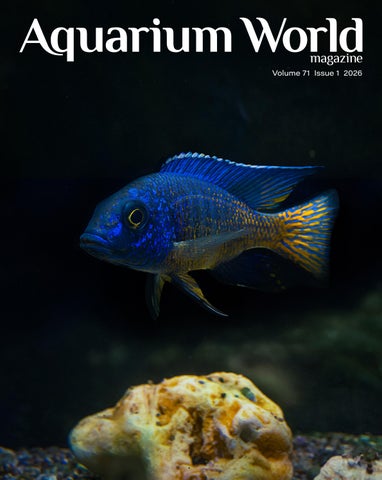
Volume 71 Issue 1 2026
®
TM
Fresh New Look! Same Amazing Quality! COLOR BOOSTING
Omega One® is packed with beta carotene, a natural pigment that will give your fish a brilliant color boost.
ENERGY SERIOUSLY ENHANCING FRESH Whole marine proteins, rich in Omega 3 & 6 fatty acids, offer the highest quality energy source for your fish.
The Best Fish Food in the World 2 • Aquarium World
We’re not messing around with meals here. Omega One® is made directly from whole, fresh Alaskan seafood.
CHECK THE INGREDIENTS® www.omegasea.net
Volume 71 Issue 1 2026
EDITOR Darren Stevens editor@fnzas.org.nz
5 7
ASSISTANT EDITOR Mark Paterson
8
COPY EDITOR Caryl Simpson ARTISTIC DIRECTOR Diane Wilkie diane@scratchmedia.co.nz
EDITORIAL CONTRIBUTORS A Peacock's Tale
by Andrew Coffey
18 READER EXPERIENCE - Where did the Fry Go? by Michael Wilson
34 Feisty but Stunning - T Bar cichlid 36 FISH FAMILY PROFILE - Mimicry in Corys by Darren Stevens
Aquarium World Magazine is published biannually by the Federation of New Zealand Aquatic Societies Incorporated (FNZAS) ISSN 2815-7435 Copyright ©FNZAS No part of this publication may be reproduced, or transmitted in any form, or by means electronic, mechanical or otherwise without written permission
40 TECHNICAL - Breeding Celestial Pearl Danios using an Airlift Egg Collector by the Maxine Lynch
44 INTERESTING IMPORTS by the Editorial Team
48 IMAGE SOURCES 49 FNZAS AFFILIATED CLUBS 50 FNZAS SHOP DISCOUNT PARTICIPANTS
FRONT COVER
Aulonocara stuartgranti ‘Ngara’ Photo: Andrew Coffey
www.fnzas.org.nz Aquarium World • 3
4 • Aquarium World
Welcome to a new issue of Aquarium World. In this issue we take a closer look at peacock cichlids. With their striking iridescent colours, male peacocks are simply stunning and a great choice for a male only tank or as a showpiece in a dedicated breeding colony. You could even add a few cuckoo Synodontis for an added splash of colour and potentially some very interesting breeding behaviour. Apistogramma are fantastic little cichlids with plenty of personality and striking colours and are great subjects for a smaller aquarium. If your conditions are suitable, they may even breed for you but successfully raising fry can pose a few challenges. Michael Wilson shares his experiences with breeding these delightful little fish, as well as few strategies for minimising early losses. Mimicry, where one species has evolved to resemble another (or an object or the environment), for example hoverflies and bees, is a subject that has always fascinated me. There are many examples in nature, but you might even have mimicry in your tank. In my article I look at the remarkable mimicry in corys and false corys. And finally for nano tank fans, it’s hard to go past a school of celestial pearl danios (CPD’s). These stunning little fish offer a striking splash of colour to any tank. Maxine Lynch shares her experience with breeding CPD’s using an airlift egg collector. I hope you all have a great Christmas break.
EDITORIAL
Darren Stevens FNZAS Editor
Apistogramma macmasteri fry Photo: Michael Wilson Aquarium World • 5
6 • Aquarium World
CONTRIBUTORS Andrew Coffey Andrew can’t remember a time as a child that he wasn’t keeping tadpoles, frogs and fish from local ponds There have been times in his life that he has been in remission but he freely accepts that he has been afflicted by ‘MTS’ for the best part of 30 years. In the past he has kept and bred a variety of Plecos, African cichlids, and rainbow fish. Currently he is keeping and breeding Tanganyikan cichlids, Victorian haps and is trying his luck with apistogrammas and various oddballs.
Michael Wilson Michael is a Wellington-based aquarist with a particular interest in South American dwarf cichlids, especially Apistogramma, as well as planted aquariums and fish breeding. His fishroom is usually home to a mix of breeding projects, grow-out tanks and the occasional experiment that becomes another tank. Michael is a member of the UHAS, Secretary of the FNZAS, and has a passion for sharing knowledge and positively growing the hobby and fish keeping community.
Maxine Lynch Maxine has been a fish keeper for most of her life, with a passion to continue killifish strains in New Zealand, to ensure that as many varieties of this beautiful species are available to future fish keepers. With a passion for nano fish, most of her fish-garage is made up of tanks of less than 200L, with the exception of a 1000L tank that was put in for rescues. Maxine is a public servant and has held various roles in her time in the FNZAS.
Darren Stevens Darren is a marine biologist who has worked for NIWA for about 20 years. He regularly participates in research surveys and has been around much of New Zealand as well as Oman, UAE, and the Ross Sea, Antarctica. In his spare time he enjoys fishing, and is a particularly passionate pleco keeper. Darren is an active participant in his local clubs and FNZAS Editor.
ADVERTISING Advertising for the Aquarium World magazine and the Aquarium World website is managed by the FNZAS and can be arranged by emailing: president@fnzas.org.nz Accounts: Patricia Lynch treasurer@fnzas.org.nz BACK ISSUES Sept 1995 – Feb 2013: Caryl Simpson caryl@simtronics.co.nz Post Feb 2013: diane@scratchmedia.co.nz Aquarium World • 7
A shallow dive into these African icons of the fishkeeping world 8 • Aquarium World
A Peacock’s Tale by Andrew Coffey
Aulonocara stuartgranti ‘Ngara’ under a blue marine light that really helps to illustrate the metallic quality of the peacocks colouring Photo: Andrew Coffey Aquarium World • 9
At one time or another its likely most fish keepers have invariably fallen into the folly of trying to decide what is the most beautiful freshwater tropical fish. It’s a discussion held countless times, and even though we know reaching any objective conclusion is probably pointless, surely any shortlist of contenders must
"The Basin of Lake Nyasa", Malawi, ca.1895 Image of Lake Nyasa, which is also known as Lake Malawi, is the southern most lake in the Great Rift Valley system of East Africa. It is the third largest lake in Africa and the eighth largest lake in the world. Photo: University of Southern California. Libraries 10 • Aquarium World
include the genus Aulonocara, AKA the peacock cichlids. With their dazzling iridescent colours, they are undoubtedly some of the most vibrant freshwater species, captivating those who encounter them for the first time, even to the point that they are often mistaken as marine species. The genus Aulonocara is one of more than 50 separate genera of cichlids that are endemic to Lake Malawi in east Africa’s rift system. This group of fish, with its 22 separate described species, lives and competes with the other 850 to 1000 plus endemic species. This makes Lake Malawi the number 1 ranked location on earth for freshwater species diversity. This is all the more amazing because this wealth of biodiversity has descended from less than a handful of ancient riverine fish species that were trapped and isolated when tectonic and geographical forces formed the lake 1-2 million years ago. Basically, all of Malawi’s cichlids fall into 3 groups. The ‘mbuna’, or ‘rockfish’ which predominantly inhabit the rocky, shallow shoreline and congregate there in massive numbers to feed on the algae that covers the rocks. The ‘hap’ group generally inhabit the deeper open water, and areas further from the shore, where they cruise preying on smaller species of fish. Then there is the ‘Aulonocara’ or ‘peacock’ group. They generally stick to the intermediate zone where the rocky shoreline transitions and opens out to
Aulonocara jacobfreibergi is one of the more aggressive and larger naturally occurring peacocks. The ‘Otter point’ locational variant was used to develop the man-made “eureka peacock” that has an orange/red base colour rather than the naturally occurring yellow colour.
the sandy bottom of deeper areas. They sift the sand for tiny crustaceans and insect larvae as well as foraging the detritus and feeding on floating zooplankton. The name Aulonocara is a combination of two ancient Greek words and literally translates to ‘flute face’ which is a direct reference to the evolution and existence of natural cavities within their skulls, and it is these ‘flute holes’ that facilitate a
type of sonar or radar that locates the minute movement of prey within the sand. The common name ‘peacock’ is a reference to the fishes’ extreme sexual dimorphism. Males of the species are extravagant in their colouring, like the peacock bird, while females are drab and dull. The males dazzling iridescence is more than just pigmentation though. Their skin has cells that have multiple layers of crystalline stacks within them and Aquarium World • 11
Aulonocara stuartgranti ‘Ngara’ is one of the many colourful location variants of this species. It is a smaller peacock with a blue or yellow base colour and a contrasting accent colour to its fins and tail. The ’Ngara’ variety is named after its collection location in the northwest of the lake. It is known in the trade and hobby as “flametail’ for obvious reasons.
it’s these that create a metallic quality to the fishes’ appearance and colour. Colour is more than just a breeding display for Aulonocara. It is embedded into the way they interact with each other and the rest of their world. The geographic layout of Lake Malawi and the evolution of many separate geographic zones meant that separate Aulonocara populations developed independently over time and were separated by open water that was too dangerous to cross. So, while there may be 22 described species there are many more variants 12 • Aquarium World
and colour morphs within particular species. Sometimes they are isolated to one very small geographical location. For example, there are at least 20 distinct geographic variants and colour variants of Aulonocara stuartgranti. Some of these differences are barely perceptible to anyone but experts. The Aulonocara genus was itself first established and described in 1922 by the renowned British ichthyologist Charles Tate Regan. But it was another 50 yrs and in the 1970’s that they became popular in the hobby. The more aggressive rambunctious
Aulonocara sp. ‘rubescens’ is a line bred variety developed in Europe in the late 1980’s. It was derived from a variant of Aulonocara stuartgranti ‘Maleri’ which is yellow bodied naturally but bred to enhance the redder tones of the body.
mbuna group had dominated the aquaria scene up until that time. Aulonocara in the hobby today can possibly be broken down to three distinct groups.
1. The “Pure Strains”
These are examples of the naturally occurring species living in Lake Malawi. These are either wild caught fish, or descendants bred from wild caught specimens, in controlled environments by specialised commercial breeders and/or advanced hobbyists and they
carry their original scientific description. These specimens usually command the highest prices and are probably the most sensitive and delicate of the peacocks and possibly better suited to species only tanks. While many aquarists may look to combine mbuna, haps and peacocks to create a “mixed male tank’, they often find the Aulonocara in such a set up struggle to show their best potential in colour and finnage and even behaviour because they are out competed and dominated by the other genera. Aquarium World • 13
Due to their ability to interbreed with hundreds of species in dozens of genera the hobby is full of hybrids that are a mix of hap and mbuna..
2. Line bred variants
These are naturally occurring species that have then been ‘line bred’ (bred back into themselves) to develop and boost any desirable naturally occurring traits. This goal is often to develop a more vividly coloured fish than occurs naturally, often with a different colour hue. An example of these variants is the turkis peacock, which was developed from A. stuartgranti ‘Chilumba’ to produce a more turquoise base colour. Other line bred variants include ’ruby red (‘rubescens’)’ and ‘eureka’ which were developed mostly 14 • Aquarium World
in Europe and the US in the 1980–90s. They are described by the original genera and species with the variant/cultivar name added to the description.
3. Unplanned hybrids
This is where the Aulonocara story can get a bit confusing and murky. The shared genealogy with haps and mbuna means Aulonocara are highly prone to hybridisation, both within their own genus, where the result is a mixed species/ variants of Aulonocara; and crossbreeds with the hap’s and mbuna. This practice has led to countless numbers of low-
The many inter species hybrids of Aulonocara can be harder to Identify and often get passed off as pure strains of a single species.
quality hybrid fish flooding the hobby. While many of these are the result of unplanned cross breeding within hobbyist tanks, there are also commercial breeders who use known variant names to sell hybrids to many that don’t understand the value and importance of the name and what it actually represents. We also live in an age of super accessible communication where countless Facebook posts are dedicated to giving speculative ID’s to all sort of fish sourced with unknown or inconvenient lineage. The takeaway from these scenarios is look for, and buy from,
reputable breeders and learn to realise that ‘looks like’ is not an adequate ID when it comes to African cichlids.
4. Planned man-made hybrids
These ‘man–mades’ are more in the mode of the ‘line bred’ variants I described earlier, and they started to appear in the hobby around the late 20th century. New strains and variants were created by combining the natural physiological ability of Aulonocara to show dazzling colour with the ease at which it hybridises and passes on new traits. Most were crossed with mbuna and Aquarium World • 15
Aulonocara sp. hybrid ‘dragonsblood’. Early examples of these started to arrive in NZ in the first decade of the 2000’s..
given names like ‘OB peacock’(which has inherited the “orange blotched’ gene from mbuna), or ‘dragonsblood’ and ‘raspberry OB’. These colourful hybrids can also inherit the higher aggression levels and larger size of the mbuna they were derived from so potentially making them more appropriate choices for the elevated aggression of mixed “all male” tanks but also, they are too aggressive themselves to be combined with their distant pure strain cousins. While no longer technically a true ‘Aulonocara’ the description for these latest morphs seems to still use the 16 • Aquarium World
term but used as “Aulonocara sp. Hybrid”. We have yet to see any real good quality specimens of these new vibrant morphs in New Zealand but it’s fair to say they have revolutionised and revitalised the peacock in the hobby overseas, where a whole new audience has been turned on to the Genus. Jay from Rafes Cichlids, a family-owned breeding operation from Connecticut USA, told me they have expanded their breeding program to focus on these new colourful morphs. “Our original focus was primarily purebreds” he told me. “We are now currently working
The latest group of man-made hybrids are remarkably colourful. This red orange botched (OB) is one of many colour morphs derived and developed down the OB line. ©Rafes Cichlids – used with permission.
and focussed on red OB’s, blue OB’s and OB Lwanda to develop the more eyecatching fish”. Whether you want a bit of unadulterated ‘old school’ natural beauty or you want to set the room alive with new vibrant ‘colour on steroids’ variants there is no doubt that the personality and presence of this delightfully charismatic cichlid is hard to ignore.
Care:
A 1.2 metre tank with volume of at least 200 litres is probably the minimum set up for a peacock display tank, perhaps a
little less for a breeding set up. Peacocks thrive on stability and calm so frequent and small water changes rather than big and occasional and the more similar the tank mates are in terms of temperament the better. A tank temperature of 24– 26°C is a good range and a pH range of 7.0–8.5 is optimal. Feed a varied diet ranging from spirulina, high-quality flake, and prepared foods high in marine proteins. Supplement with live foods. Andrew Coffey Aquarium World • 17
READER EXPERIENCE
Where Did the Fry Go? Michael Wilson discusses minimising early losses in Apistogramma One of the things I enjoy most about Apistogramma is how much personality, colour and variation can be packed into such a small fish. No two species seem quite the same, and even within a species individual fish can behave very differently. Males can be spectacular, but I find the females just as interesting, particularly when a normally understated fish transforms into breeding colour and takes complete control of a corner of the tank. 18 • Aquarium World
Their behaviour is a big part of the attraction for me. They interact with their surroundings, establish territories, sift through the substrate, respond to one another and show a level of parental care that is fascinating to watch. Add the variety of body shapes, fin forms, colours and domestic strains, and it is easy to see why keeping one species can quickly turn into keeping several. Over time I have kept and bred a range of Apistogramma, including A. cacatuoides in Triple Red, Orange Flash and Albino forms, A. hongsloi, A. trifasciata, A. agassizii in Double Red and Fire Gold forms, fish sold to me as A. cf. viejita ‘Red Neck’, A. macmasteri, A. borellii, A. bitaeniata and A. panduro. Some of those labels are aquarium trade names rather than localitypure wild designations, but together they have given me plenty of opportunities to see how differently individual fish, pairs and species can behave. Breeding them has become one of the most rewarding parts of keeping them. Watching a female emerge with a cloud of fry is hard to beat. Her colour changes, her behaviour becomes much more deliberate, and suddenly a relatively small fish is confidently defending a brood and guiding it around the tank. That first appearance of free-swimming fry is also where I have learned that spawning and successfully raising a brood are two different things. Some of my broods have progressed through to strong, established juveniles. Others have failed much earlier: at the egg stage, as wrigglers, during the first days of above left - A female A. macmasteri with a cloud of freeswimming fry. Structure, cover, and good water quality are foundations of survival.
free swimming, or after transfer to grow-out. In some cases, the reason was obvious. In others, a promising group simply became smaller over the following days with no clear sign of what had happened. By the time one of my A. cacatuoides ‘Orange Flash’ broods reached around six weeks old, the fry no longer looked like tiny specks hovering over the substrate. They were recognisably young Apistogramma: confidently feeding, developing shape and starting to show their own character. For me, that felt like a much more meaningful breeding milestone than the day the eggs were laid. I certainly have not eliminated every loss, and I do not think that is realistic in a home fish room. What has improved is the way I approach them. Rather than immediately changing the water, removing a parent or deciding that one parameter must be wrong, I try to identify where in the breeding process the loss is occurring, remove the largest and most controllable variables first, and then make targeted changes. When I am asked for breeding advice, my answer tends to be that there is a structure to the process, but an ‘it depends’ runs through all of it. Different species behave differently. Different pairs behave differently. Sometimes two fish of the same species behave completely differently. The tank, the parents, the food available and even how a brood came about can all change the best response. This article is therefore less about providing a single recipe for breeding Apistogramma and more about the practical questions I work through when trying to turn a successful spawn into a healthy group of juveniles, and ultimately fish ready for a new home. Aquarium World • 19
Unexpected spawn or planned breeding project? I try to condition pairs deliberately, prepare a suitable tank, start live foods and make sure space is available for fry and later juveniles. For others, not every spawn arrives according to plan. A female may unexpectedly appear with fry in a community or species tank, and the level of preparation is then very different. 20 • Aquarium World
A. macmasteri male moved to a community tank after breeding
The underlying needs are similar, but the practical response changes. With an unexpected spawn, the priority is protecting the brood without destabilising an established tank. That may mean covering an intake, directing suitable food close to the fry, reducing an obvious predation risk and watching the adults before moving anything. A complete
rescape or sudden transfer can create more problems than it solves. A planned breeding setup gives me the opportunity to remove many of the largest variables before eggs are laid: provide more than one cave, establish gentle frysafe filtration, have suitable first foods already running, keep somewhere available for an aggressive adult if necessary, and think ahead to the fry tray or grow-out tank. Successful breeding does not require a large fish room; what matters is having a workable pathway for the fish you do raise.
Start with the foundation This article assumes the basic husbandry is already understood: the aquarium is cycled and established; the fish are healthy; temperature and water conditions are appropriate for the species and source; tankmates have been considered; and the adults have been conditioned on a varied, suitable diet. For a targeted breeding setup, I generally prioritise usable floor area over unnecessary height. My preferred tank is simple but mature: fine-grained sand, driftwood, leaf litter and other botanicals, slow-growing rhizome plants such as Anubias and Java fern attached to movable hardscape, Java moss, subdued lighting, gentle sponge filtration, visual barriers and multiple caves. These features are not decoration alone. They give the female choices, allow either adult to move out of sight, break lines of aggression, support biofilm and microorganisms, and help create a stable environment. I normally provide at least two possible spawning sites. Where practical, I favour a cave entrance that gives the female
some control over access once she has spawned, while still being appropriate for the size of the pair. I also watch which cave the fish actually choose rather than assuming they will use the site I prefer. A mature tank can be more forgiving for newly free-swimming fry than a newly assembled, sterile-looking setup. Moss, leaves, wood and established surfaces support microscopic life that can supplement deliberate feeding. I treat that background food as a buffer, not as a substitute for providing suitable first foods. Conditioning also means knowing when not to trigger another spawn. Repeated spawning, territorial defence and parental care all cost energy. If the adults are lean, have recently finished a brood or remain under pressure, I would rather feed them well and let them recover than use every water change as an attempt to produce more fry. At times I separate highly productive pairs deliberately to give them a period of recovery and reconditioning. I cannot quantify a longevity benefit from that, but it avoids needlessly pushing fish through repeated breeding cycles and generally leaves them in better condition.
A spawn is a pathway, not a moment After tank setup, pairing and conditioning, I find it useful to think of breeding as a pathway: viable eggs, hatched wrigglers, newly free-swimming fry, actively feeding fry, juveniles after transfer, and finally fish that are feeding reliably and growing without unexplained daily losses. The stage at which numbers fall tells me where to focus. A clutch that turns white or disappears before hatching is a different Aquarium World • 21
22 • Aquarium World
problem from fry that emerge normally but decline over a week. A brood that thrives with its mother but fails after being moved may point to the transition rather than the original breeding tank. Exact counts are difficult in planted tanks with leaves, wood and caves. I use estimates, behaviour and dated photographs rather than pretending I can count every fry. The aim for me in my approach is not laboratory-quality data. It is to recognise whether a group is broadly stable, growing or shrinking, and whether the same problem repeats at the same stage.
Before free swimming: when viable eggs are being lost Sometimes the problem begins before there are fry to feed. If a female repeatedly lays a clutch that looks viable but the eggs disappear, I first look at the history and behaviour of that particular pairing. Was the male able to fertilise the clutch from the cave entrance? Is the female inexperienced? Is either fish under pressure from tankmates or another fish visible through the glass? Am I disturbing the cave because I want to check it too often? White or fungused eggs may also simply be infertile or non-viable, so a single failed clutch does not tell me much on its own. A smaller cave entrance can help the female control access, although cave design can also affect how easily the male can position himself to fertilise the clutch from outside or at the entrance. That is a good example of why there is no universal Newly introduced A. borellii pair in a refreshed breeding tank.
fix. With some pairs the male remains at the edge of the territory and causes no problem. With others he repeatedly pushes into the spawning site or enters the cave after spawning. The useful response is to observe the pair, then adjust the cave, layout or male management to what they actually do. I do not automatically pull the first clutch that fails. Young females may mishandle or consume early spawns, and one loss does not establish a pattern. If clutches repeatedly fail at the same stage, that gives me a stronger reason to change one part of the setup or consider controlled intervention. With one A. panduro pair, I repeatedly saw the male entering the cave and eating freshly laid eggs. Rather than removing him after every spawn, I changed to a cave with a smaller entrance that the female could control more effectively. I did not see any obvious reduction in the number of eggs that went on to develop, and once the fry were free swimming the male caused no further problem. That was a solution for that pair, not a rule I would apply automatically to every A. panduro.
When fry numbers fall, remove the largest variables first Once fry are free swimming, resist the urge to change several things at once. Begin with the simple, high-impact questions and only move toward more disruptive or technical explanations after the obvious risks have been considered.
1. Are the fry actually gone? If fry were visible yesterday and seem to have vanished today, the first job is to establish whether the brood has genuinely declined or the female has simply moved it. Aquarium World • 23
Female Apistogramma may use several nursery sites. Wrigglers and newly freeswimming fry can be shifted between caves, shallow depressions, leaves and sheltered areas beneath wood. A brood can appear to vanish overnight, particularly in a tank with dense cover. The female is often the best clue. If she remains in strong breeding colour, continues defending a small area or repeatedly travels between two locations, there is a reasonable chance that fry are still present. This is also the point at which pulling the tank apart can make matters worse. 24 • Aquarium World
A. borellii ‘Opal’ pair in a homemade quarter-coconut cave soon after spawning. Positioned carefully, this type of cave can allow observation without repeatedly disturbing the fish or lifting the spawning site.
With A. macmasteri, I once thought a brood had disappeared when the female had actually moved the fry into a back corner I could not see. She continued to appear for feeding before retreating, while the male stayed mostly in the front half of the tank. A few days later the fry reappeared as a cloud following her around the usual feeding areas. I therefore watch whether the female still behaves as though she has a brood,
whether more fry appear at feeding time and whether the nursery site has changed before I start moving things. ‘I cannot see them’ and ‘they are all gone’ are not necessarily the same thing.
2. Is there an obvious route for loss? Once I am confident that fry are genuinely being lost, I look for physical risks before changing water chemistry or blaming the parents. Newly free-swimming fry can enter spaces that adult fish cannot. They may be drawn into a filter intake, enter an internal filter compartment, pass beneath a divider, become trapped behind equipment or collect where flow pushes them away from the female. Any powered intake in a breeding tank should be made fry-safe, usually with fine sponge and no gap around the inlet. Tankmates are another major variable. Fish that are peaceful around adult Apistogramma are not automatically safe with fry. Small tetras, rasboras, corydoradinae catfishes (‘corys’) and other apparently harmless tankmates should all be treated as potential egg or fry predators until experience with that setup suggests otherwise. A female may defend effectively during the day but be less able to control the whole tank after lights-out. In an unexpected community-tank spawn, trying to remove every tankmate may cause more disruption than it prevents. A lower-intervention and often more practical approach is to identify and reduce the most immediate risk: cover an exposed intake, reduce excessive flow, add shelter, close a gap, or remove the one persistent predator or parent that is clearly eating the brood. In dedicated breeding tanks, I prefer sponge
or Mattenfilter-style filtration because it provides gentle circulation without a powered intake that fry can be drawn into. Where replacing the filter is impractical, a securely fitted fine-sponge pre-filter is a simple and effective alternative.
3. Are the fry eating, rather than merely being fed? I have not found one standout first food that suits every brood from first feeding through to grow-out. Different species, and sometimes different spawns, produce fry of different sizes. The critical point is to begin with something the smallest fry can physically take, confirm that they are eating it, and then broaden the diet as they grow. For the earliest stage my main options are freshly hatched baby brine shrimp, microworms and very fine prepared fry foods. As fry grow, I add foods such as small daphnia, finely dispersed gel foods, frozen foods and crushed pellets or flakes. Freshly hatched baby brine shrimp remains one of the most reliable and widely used foods for Apistogramma fry: the nauplii move through the water, stimulate a feeding response and make successful feeding relatively easy to see through the fry’s orange, rounded bellies. If you have never hatched brine shrimp, there is plenty of good guidance available through clubs, local fish stores and online. My own setup started with three simple hatchers made from upturned plastic bottles. Airline connects through a rigid irrigation riser, and the bottles sit in front of a desk lamp for light and a little warmth. Running staggered hatches gives me some protection against one culture failing at exactly the wrong time. I still keep backup foods available rather than allowing the fry to go without a daily feed if a hatch is poor. Aquarium World • 25
In practice I do not work through a formal list of feeding behaviours. I simply want to see that the fry are eating. I mix food into a little tank water, use a pipette to place it close to the group without scattering them, and watch the response. Baby brine shrimp makes this easy because a full orange belly is a clear giveaway. As the fry grow, I gradually introduce a wider mix of prepared, frozen and larger live foods rather than making an abrupt switch. A mature tank adds another layer of security. Apistogramma are small predators and their fry quickly begin hunting too. Moss, leaf litter, wood and biofilm support microorganisms that can be grazed 26 • Aquarium World
Freshly fed A. cacatuoides ‘Orange Flash’ female and fry, with the orange of newly hatched brine shrimp clearly visible in the fry bellies.
between deliberate feeds. That background food can make an established tank more forgiving, but it cannot be relied upon as the only food source. I am still testing and changing foods all the time. One experiment I plan to run in my six-bay grow-out system is a side-byside comparison of growth and condition under different feeding approaches. Until I have done that for myself, I treat individual results as observations rather than proof that one commercial or live food is universally superior.
The practicalities of a particular tank also influence what and how I feed. A small fry tray makes it easy to concentrate food, but moving fry introduces its own risks and gives up some of the stability that comes with a larger water volume. Leaving fry in the parent tank avoids that transfer but can make targeted feeding harder. There is a trade-off either way. For a recent batch of fish gifted to me as A. cf. viejita ‘Red Neck’, for their spawn I began with a fine fry powder delivered close to the brood with a pipette. Once the fry were large enough to take my baby brine shrimp reliably, I fed that several times a day and gradually broadened the diet to frozen daphnia and cyclops, live daphnia, gel foods and fry-specific prepared foods. I have found that introducing prepared foods while the fry are still readily accepting live foods makes later transitions easier than waiting until live food is the only thing they recognise.
4. Is feeding beginning to change the tank? Improving food access creates the next risk: more food means more waste and greater oxygen demand. This matters particularly in small fry containers and in breeding tanks run close to the minimum volume I am comfortable using. A tank that was stable before spawning can change quickly once fry are fed several times a day and the biological load increases. Uneaten powder, dead brine shrimp, microworms and increased adult waste can accumulate around caves and leaves. The water may still look clear while conditions near the substrate deteriorate. I prefer smaller, controlled maintenance rather than waiting for the tank to look dirty and then carrying out a major clean.
Airline tubing attached to a rigid irrigation riser works as a narrow siphon and reduces the chance of taking fry compared with a standard gravel cleaner. A light-coloured bucket makes accidentally siphoned fry easier to see. Replacement water should be reasonably matched for temperature and, where relevant, mineral content and pH, and added gently. Oxygen deserves attention as well. Warmer water, heavy feeding and increased bacterial activity all increase oxygen demand. If fry become inactive, gather unusually near the surface or cluster around filter flow, I check aeration and equipment promptly before jumping to more drastic changes.
5. Where are the fry safest: with the mother or in a tray? I do not remove fry simply because I can. A proven female in a quiet tank may be better at grouping, moving and protecting the brood than I am. Leaving fry with the mother avoids handling and allows the parental behaviour that makes Apistogramma so rewarding to breed. A fry tray, breeder box or hang-on box becomes useful when it addresses a specific risk. It can protect fry from tankmates or an unsafe parent, concentrate food in a smaller area, make observation easier and allow waste to be removed more precisely. A shared-water box connected to a larger mature aquarium can combine a small feeding space with the stability of a much greater water volume. If I remove fry from the parental tank, I usually move them first into a dedicated breeder box or fry tray attached to a larger aquarium. This is not automatically riskfree: mesh can clog, flow can be too strong, food can escape and the compartment Aquarium World • 27
28 • Aquarium World
still needs regular cleaning. I leave fry with the mother when her history and the tank make that the safer option, and use a tray when it removes a clear risk or provides a controlled bridge to the next stage.
6. Are the parents helping, or is one creating pressure? There is plenty of conflicting advice about whether the male should stay with the brood. I use guiding principles rather than a rule that he must always stay or always be removed. The decision is weighted by what I have already observed. Has the male been aggressive in the past? How long has the pair been established? Can the female maintain a nursery area? Are there other fish in the tank? Is this the first brood? Does the male hold the outer territory or repeatedly enter the fry group? Is either fish being prevented from feeding or physically damaged? A male at the edge of the female’s territory is not necessarily a threat and may help defend the wider area. A male that repeatedly breaks through the nursery, causes constant chasing or corners the female is different. Females can also injure males after spawning, particularly where the tank is small or lacks visual barriers. Removing a parent is itself a disturbance, so I balance the chance of improving fry survival against the practicalities of catching the fish and keeping both adults healthy. Sometimes a divider or visual barrier is enough. Sometimes the male needs to be moved. With an established pair, leaving both fish alone may be the best option. A. cacatuoides ‘Albino’ in a hang-on breeder box with ‘Orange Flash’ juveniles in the grow-out tank.
One A. macmasteri female illustrated how quickly this can change. With a brood of roughly 80-100 fry at about three weeks old, she came back into spawning condition and, between a morning and afternoon feed, the brood fell to around ten survivors. What I witnessed here was quite a shocking shift in aggression and behaviour of the female. With that pair, I removed the male after the next spawn so that the female was not pushed toward another breeding cycle while still caring for the existing brood.
The broader lesson is that a repeated pattern is more useful than one suspicious moment. Parent management should be based on the behaviour of the actual pair, not on a blanket rule for the species.
7. Is the move to grow-out the real point of loss? A brood can feed and grow well with the female, then decline after transfer. When that happens, the grow-out tank itself is not necessarily ‘bad’. The transition may simply be too large for very small fry. Temperature, pH, dissolved solids, Aquarium World • 29
biological maturity, available microorganisms, flow, food density and the size of the new space may all change at once. Fry that found food easily in a small nursery area can spread through a larger tank and encounter it less often. A newly set-up grow-out tank may also be far less biologically mature than the parent tank. An intermediate shared-water stage can reduce that jump. The fry remain concentrated enough to find food, but are gradually exposed to the water and microbial environment of the larger system. Once they are visibly stronger, taking several foods and large enough to handle 30 • Aquarium World
Young A. macmasteri fry growing out in their spawning tank, with their mother watching from a distance.
the move, the final transfer becomes less abrupt. My usual pathway is to let the parents hatch the brood and bring the fry to free swimming, then move the fry into a breeder box attached to a larger tank. When I decide to pull an established brood, I prefer one short, deliberate intervention rather than repeatedly chasing fry over several days. If necessary I temporarily remove hardscape and plants, then use a largebore turkey baster gently rather than a net
or high-suction siphon. The fry remain in the breeder box for roughly two to three weeks, where I can direct-feed and observe them closely before moving them to a larger grow-out tank.
8. Are the water conditions stable and appropriate? Water chemistry matters, but it is easy to use pH as the explanation for every failed brood and start chasing numbers. A pH reading alone does not describe hardness, buffering capacity or the total amount of dissolved material in the water. Two tanks with the same pH can still provide very different conditions. I usually record temperature, pH and a TDSmeter reading, and less regularly check GH and KH. I am fortunate that my tap water gives me a workable starting point for many Apistogramma, so I do not routinely need elaborate water preparation. Strictly speaking, a TDS pen estimates dissolved solids from electrical conductivity, so I use the number mainly as a repeatability tool rather than as a precise chemical analysis. The most useful water-management principle for me is consistency: prepare replacement water to roughly the same balance each time, match temperature and avoid sudden changes in dissolved solids, particularly with eggs and very small fry. Predictable replacement water is more useful than reaching an impressive number once. Don’t get me wrong, I recognise that Apistogramma are not all the same. A. borellii, A. hongsloi, A. cacatuoides, A. bitaeniata and the other fish I keep do not have identical needs. Some longestablished captive strains may tolerate a wider range than recently imported or wildorigin stock, but source history matters and should not be assumed from a colour
form alone. The values I mention here are therefore descriptions of my tanks, not universal targets. As juveniles grow, stocking density and social competition become increasingly important. Crowding can reduce food access, increase aggression and make waste control harder. Larger water volumes, appropriate stocking density and regular maintenance are therefore part of growout management. I will briefly mention the ‘growth-inhibiting hormone’ explanation sometimes repeated in hobby discussions, essentially calling for higher water changes due to male fry releasing hormones that can suppress growth. I will leave it up to you to do your own research and form an opinion on this. Most of my dedicated breeding setups are around 60–65 litres or larger and typically run at about 25–26 °C, with pH below roughly 6.8 and a TDS-meter reading 90120 ppm. That is a general stable base for my fish room, not a prescription. I adjust it where a particular species or source calls for something different. For A. bitaeniata, for example, I use well-collected, filtered rainwater for some water changes to help maintain a lower pH closer to 6 and a TDS reading below about 70 ppm.
9. Has the same failure happened often enough to justify intervention? Pulling eggs, moving wrigglers or artificially raising a brood can be useful, but it creates a new set of variables and risks. Once the brood is removed, you take over the jobs the parents were performing: protecting and tending the brood, maintaining suitable flow and cleanliness, feeding, keeping the water stable and providing somewhere appropriate for the juveniles to go next. Before intervening heavily, I want a reason Aquarium World • 31
based on a repeated pattern. In other words, I try to understand why the failure is occurring before jumping to action. One lost clutch may reflect inexperience, disturbance or an isolated event. Several clutches failing in the same way provide stronger evidence that a different method is worth testing. An artificial setup needs closely matched water, stable temperature, gentle aeration or flow, protection from debris, suitable first food ready before free swimming and somewhere for the juveniles to go next. It also needs the time to maintain it. Maximising fry numbers is not automatically the same as producing 32 • Aquarium World
Young male A. hongsloi in a 90 L grow-out tank with juvenile ‘Venezuelan orange’ corys (Osteogaster aenea complex).
the healthiest outcome or treating the adults well. With my current A. borellii ‘Opal’ female, newly hatched fry have repeatedly disappeared and I have directly observed her consuming them. Changes to caves, layout and disturbance have not altered the pattern. This is an individual-fish problem, not something I would describe as a trait of A. borellii generally, but it is one of the few situations in which I now pull the eggs and raise the brood artificially.
What has made the greatest difference for me The biggest improvements in my breeding have not come from discovering one ideal pH, buying a special product or finding a single perfect food. I still make mistakes; the aim is to make them smaller and less frequent. By preparing before fry appear, avoiding several drastic changes at once and paying attention to what happens at each stage, I can anticipate more risks and prevent more losses. Having food ready means I do not lose the first days trying to organise it. Protecting an intake and choosing caves before spawning removes risks without disturbing the brood later. A mature tank provides stability and background food. Predictable replacement
water makes maintenance more controlled. Watching the pair before spawning gives me a better basis for deciding whether either parent is likely to become a problem. I am also more deliberate than I once was about triggering repeated spawns, and more realistic about how many broods I can raise well at the same time. The goal is not to produce the maximum possible fry from every pair at every opportunity. It is to keep the adults in good condition and give the broods I do raise a clear route from eggs to established juveniles. My records are not complex. A spawn date, approximate count, food used, parent behaviour, water readings, transfer dates and a few phone photographs are enough to reveal patterns across several attempts.
Learning from the fry that disappear I still lose fry, and I do not believe every loss can be prevented. Some eggs are not viable. Some fry may be weak or fail to develop normally. Parents behave unpredictably, live-food cultures fail, equipment causes problems and, ultimately, I am wrong in my decisions sometimes more times than I am right. What matters is narrowing down the likely cause before reacting. Start with the context and the foundation, identify the stage of loss, remove the obvious routes for fry to disappear, confirm that they are eating, and manage the consequences of that feeding. Then decide where the fry are safest, watch the parents, manage the move to grow-out and review water stability before considering more disruptive intervention. More than anything, make sure to enjoy the fish along the way. Getting Apistogramma to spawn is exciting. Learning why some broods become healthy juveniles while others do not is where the real breeding experience begins. Article and photographs by Michael Wilson
Aquarium World • 33
An adult male T-Bar cichlid (Amatitlania sajica), a close relative of the popular con (females are smaller) but they can be aggressive and territorial, particularly when diet, areas of moderate current, and plenty of hiding places such as driftwood an 34 • Aquarium World
Feisty but Stunning
nvict cichlid. These impressive central American cichlids only grow to 12 cm n breeding, and tankmates should be chosen with care. They appreciate a varied nd rocky caves. Photo: Andrew Coffey
FISH FAMILY PROFILE
Mimicry in corys Darren Stevens
Corys are small, peaceful catfish that come in a range of colours and patterns. Some species have a very similar colour pattern, may be found together in the same waterway, and may even school together. This is an example of mimicry where cory species have evolved to resemble each other. Mimicry, where an organism has evolved to resemble something else, it might be another organism, an object, or the natural environment, is a remarkable strategy that is widespread in nature. There are many different types of mimicry but two of the most common
are Batesian and Müllerian. Batesian mimicry is a fake warning signal, where a harmless and/or palatable species evolves to imitate a dangerous and/or unpalatable one. For example, hoverflies have a similar yellow and black colour pattern to stinging bees and wasps. Hoverflies benefit because predators may avoid them, as they have learned to avoid bees and wasps. Müllerian mimicry is a shared warning signal, where two or more unpalatable and/or harmful species have evolved to resemble each other, for example bees and wasps. Both species benefit by having the same warning signal.
Examples of Batesian mimicry: a drone fly (Eristalis tenax) – a type of hover fly, and a honey bee (Apis mellifera), and Müllerian mimicry: a honey bee and a European wasp (Vespula germanica). 36 • Aquarium World
Humans also appear to perform mimicry, but it is behavioural, where we unconsciously copy postures, gestures, facial expressions, and mannerisms of the people around us.
(formerly Corydoras arcuatus), narcissus cory Brochis bethanae, long nosed arched cory Corydoras narcissus, and the skunk cory Hoplisoma granti. Despite their obvious similarities, the arc-striped corys differ in several subtle ways
Four arc-striped corys: super arcuatus cory Brochis arcuata (CW036), skunk cory Hoplisoma granti (C020), narcisso cory Brochis bethanae (CW006), and long nosed arched cory Corydoras narcissus Photos: Blair Chen
But back to cories. There are many examples of cory species that have a very similar colour pattern, but perhaps the most striking examples are the arcstriped corys, which have a light body with a long black stripe that arches along the back and runs most of its length. Arc-striped cory species include the super arcuatus cory Brochis arcuata
including the length and shape of the snout – is it short and rounded, long and straight, or somewhere in between; and the extent of the black arc – does it go all the way to the tip of the snout, does it extend onto the dorsal (top) margin, and how far does it extend onto the tail. Not surprisingly, these arc-striped species (and groups of other similarly Aquarium World • 37
patterned corys) are often confused. A great example is around the identity of the familiar skunk cory, a species which has a shorter rounded snout (see Dignall, Unravelling the Arched Corys, https:// www.planetcatfish.com). For eighty years, skunk corys were thought to be Brochis arcuata (formerly C. arcuatus, now known as the super arcuatus cory) a longer straight-snouted species. It has now been shown that the true skunk cory is Hoplisoma granti, a species that was only given a scientific name in 2019. Clearly there must be a selective advantage to having a very similar colour pattern, and it is possible that, depending on the situation, an arcstriped pattern offers different benefits. Schooling together likely provides safety in numbers, and the striped pattern may help corys to co-ordinate with each other and confuse predators. An arc-striped pattern may be Müllerian mimicry as corys have sharp serrated dorsal and venomous serrated pectoral spines, i.e. a shared warning signal to predators - don’t eat me or you’ll regret it. Müllerian and Batesian mimicry has also been suggested for the relationship between corys and false corys (see inset). When viewed from above (e.g., by a predatory fish or bird), an arc-striped pattern may aid in concealment, as a predator would see two black lines separated by a pale line which may help in camouflage. In some areas where these corys are found, the vertical stalks of plants cast shadows on the bottom (generally over white sand) creating 38 • Aquarium World
a similar pattern of light and dark contrasting bands. When viewed from the side an arc-striped pattern may mask the eye and disrupt the outline of the fish making it more difficult for a predator to detect. It also appears that competition for food is reduced between different cooccurring arc-striped species as it seems that short-snouted and long-snouted species have different diets. Clearly cory mimicry it’s not only complicated but a remarkable evolutionary adaptation and its adds a whole new level of interest to these fascinating little catfish. If you see a school of wild-caught corys in your local fish store, have a closer look, there is a slight chance that there might be another species hidden in amongst them. Thanks to Blair Chen and Michael Kirkham for allowing their images to be used in this article. References
Alexandrou, M.A.; Oliveira, C.; Maillard, M.; McGill, R.A.R.; Newton, J.; Creer, S.; Taylor, M.I. (2011). Competition and phylogeny determine community structure in Müllerian comimics. Nature 469: 84–88.
Bentley, R.F., Grant, S., Tencatt, L.F.C. (2021). A new arc-striped species of Corydoras Lacépède, 1803 (Teleostei: Callichthyidae) from the Peruvian Amazon. Zootaxa 4948 (2): 184–200. https:// doi.org/10.11646/zootaxa.4948.2.2 Dias, A.C.; Tencatt, L.F.C.; Roxo, F.F.; Silva, G.S.C.; Santos, S.A.; Britto, M.R.; Taylor, M.I.; Oliveira, C. (2024). Phylogenomic analyses in the complex Neotropical subfamily Corydoradinae (Siluriformes: Callichthyidae) with a new classification based on morphological and molecular data. Zoological Journal of the Linnean Society 203(3). zlae053, https://doi.org/10.1093/ zoolinnean/zlae053
Dignall, J. Unravelling the Arched Corys. https://www. planetcatfish.com/shanesworld/shanesworld.php?article_id=573 Katzschmann, A. (2025). Brachyrhamdia catfishes: mimicry, mystery, and missed opportunity in the hobby. Amazonas Sept/ Oct 14-21.
Sands, D.D. (2017). The shared colour patterns of Corydoras and other catfishes from the upper Rio Negro. Journal of the Catfish Study group 18(4): 11–20. Slobodian, V., Bockmann, V.F.A. (2013). A new Brachyrhamdia (Siluriformes: Heptapteridae) from Rio Japurá basin, Brazil,
with comments on its phylogenetic affinities, biogeography and mimicry in the genus. Zootaxa 3717(1): 001–022. http://dx.doi. org/10.11646/zootaxa.3717.1.1 Tencatt, L.F.C., Lima, F.C.T., Britto, M.R. (2019). Deconstructing an octogenarian misconception reveals the true Corydoras arcuatus Elwin 1938 (Siluriformes:Callichthyidae) and a new Corydoras species from the Amazon basin. Journal of Fish Biology 95: 453–471. https://doi.org/10.1111/jfb.13980
Photo credits
male drone fly (Eristalis tenax), image Stoxastikos (CC BYSA 4.0) https://en.wikipedia.org/wiki/Eristalis_tenax#/media/ File:Eristalis_tenax_Male.jpg
honey bee (Apis mellifera), image Andreas Trepte (CC BY-SA 2.5) https://en.wikipedia.org/wiki/Western_honey_bee#/media/ File:Apis_mellifera_Western_honey_bee.jpg
European wasp (Vespula germanica), (CC BY), uploaded by Cheryl Stinchcomb https://www.inaturalist.org/ observations/243451455
Super arcuatus cory Brochis arcuata (CW036), skunk cory Hoplisoma granti (C020), narcisso cory Brochis bethanae (CW006), long nosed arched cory Corydoras narcissus (all images Blair Chen) Blair Chen cory images (CC BY-NCSA 2.0) https://www.flickr.com/photos/hung-jou_chen/ albums/72157623966032258/with/4547409895
Arched False Cory Brachyrhamdia thayeria, Michael Kirkham (used with permission) https://www.planetcatfish.com/common/ image.php?species=brachyrhamdia_thayeria&image_id=10836
Arched false corys and super arcuatus corys, Michael Kirkham (used with permission) https://www.planetcatfish.com/arn/image. php?species=brachyrhamdia_thayeria&image_id=10842
False corys False corys (Brachyrhamdia) are a fascinating group of eight small (to about 8 cm), mainly strikingly, patterned species. Remarkably, all but one of these species appear to mimic the colour patterns of corys. There is even an arc-striped mimic, the arched false cory Brachyrhamdia thayeria which can be found in the same waterways with and has a very similar arc-striped pattern to, the super arcuatus cory Brochis arcuata and the skunk cory Hoplisoma granti. Another example is the false cory Brachyrhamdia imitator which can be found in the same waterways as the false blochi cory Brochis delphax and the spotted cory Hoplisoma melanistium and has a very similar colour pattern. These striking similarities in colour pattern may represent Batesian mimicry as corys are more heavily armoured (false corys are scaleless) and are therefore less attractive to predators, or it may be Müllerian mimicry, i.e., a shared warning to predators, as they both have rigid dorsal and pectoral fin spines, and can deliver a painful string. False corys may also benefit from schooling with corys by stealing food that corys dig up and eating their eggs when breeding.
Left: Arched false cory (Brachyrhamdia thayeria) and Right: arched false corys and super arcuatus corys – spot the difference. Michael Kirkham (used with permission)
These remarkable catfish and their cory mimics would be great subjects for a dedicated aquarium, but unfortunately, false corys are not available in New Zealand. Aquarium World • 39
TECHNICAL
40 • Aquarium World
Breeding Celestial Pearl Danios using an airlift egg collector The Celestial Pearl Danio (Danio margaritatus), also known as the Galaxy Rasbora, is one of the most beautiful nano fish available to aquarists and was not widely available in New Zealand until very recently. Their dark blue bodies covered in pearly white spots and bright orange-red fins make them highly desirable. Fortunately, they are also relatively easy to breed once you understand their spawning behaviour. The biggest challenge is not getting them to spawn — it's preventing the adults from eating their eggs. An airlift egg collector is one of the most effective methods for increasing egg survival because it automatically removes eggs from the breeding area before the parents can find them. Correctly identifying males and females is the first step toward breeding success. Males have a mostly deep blue body sprinkled with small pearly white to cream spots and striking red and black striped fins (except for the pectoral (side) fins). Females are more subdued with a blue-green body, less prominent spots, and pale red to orange patches on the fins. Females also tend to grow larger and have a more rounded body, particularly when gravid. They also show a small dark anal spot when they are ready to spawn. Breeding set up including the air lift egg remover and collection container for CPD eggs Photo: Maxine Lynch
Female CPD showing the black anal spot which can be used to help sex females Photo: Maxine Lynch
CPDs spawning over java moss covered air lifter base Photo: Maxine Lynch Aquarium World • 41
For best breeding results, I maintain a ratio of one male to three females or a small colony with multiple females. Celestial Pearl Danios are egg scatterers, they release small numbers of eggs among fine-leaved plants, mosses, or spawning media. Females can produce eggs frequently, and healthy adults may spawn almost daily under good conditions. Unfortunately, both males and females will readily eat eggs, which is why an egg collection system is so valuable and what I choose to use. An airlift egg collector uses a gentle stream of air to move water through a collection chamber. Eggs that fall through spawning media are lifted into a protected compartment where adults cannot reach them. I check the collector daily and remove any white or opaque eggs, as these are usually infertile. I move the eggs into their own hatching container, which is the same process I follow for non-annual killifish species. Once they hatch, they tend to cling
to a surface for a while, and once they are free-swimming this is when I move them to a larger container and start feeding. Newly hatched fry are tiny and require microscopic foods, so I tend to feed mine infusoria / green water and then after about a week, I introduce baby brine shrimp nauplii. I perform regular small water changes as stable water quality is essential for rapid growth and survival. Breeding Celestial Pearl Danios is surprisingly straightforward once their eggs are protected. An airlift egg collector greatly increases survival rates by automatically separating eggs from hungry parents. Combine this with well-conditioned adults, dense spawning media, and proper fry foods, and you can establish a productive, self-sustaining breeding project that yields dozens of healthy young CPDs throughout the year. Maxine Lynch
Example of an automated egg catching system for egg scattering fish with air column for 3D printing Drawing: jensaartman via cults3D
Male Celestial Pearl Danio Photo: bread962
42 • Aquarium World
High performance filter medium for mechanical filtration
7 crystal clear NEW
innovative, patented 3D fiber structure removes even particles above 10 µm such as floating algae or sludge
keeps its shape permanently and can be washed out
7 product test Start
We Lo v e Fi s h
1h
24 h
Available from:
Aquarium World 43 www.scalesandtails.co.nz •
INTERESTING IMPORTS
Kribensis pair Photo: Phoenix44
If the Apisto article has sparked your interest in these delightful little fish then why not try a three striped apisto (A. trifasciata), orange flash or cockatoo apisto (A. cacatuoides ‘orange flash’), red neck apisto (A. viejita ‘red neck’), Borelli's apisto (A. borellii ‘Yellow Blue’) Or, for something a little bit rarer, then highfin or Hoigne’s apisto (A. hoignei)
Bolivian ram 44 • Aquarium World
are available. Other dwarf cichlids on the importers lists include the popular kribensis, Bolivian ram, and the ram cichlid which is available in standard, electric blue, golden, black knight, pap, and balloon gold veiltail varieties. If you have a larger tank and a rock pile, and African lake cichlids are more your
Sciaenochromis fryeri electric blue cichlid Photo: Miguel Jo-Avila
style, then you could set up a Lake Malawi or Lake Tanganyikan biotope, or a mixed male tank. However, these cichlids differ in their temperament, and tank mates need to be chosen with care. Lake Malawi options include the popular electric yellow, snowwhite cichlid, demasoni cichlid, auratus and johanni cichlids, and the Jalo Reef mini-
zebra (Cynotilapia zebroides 'Jalo Reef'). For Tanganyikan fans why not try a lemon Jake peacock, OB peacock, or the related electric blue cichlid (Sciaenochromis fryeri). White spotted cichlids (Tropheus dubosi) are also available, and if you have a large tank then a group of frontosas is hard to beat.
Chindongo demasoni Photo: lee Nachtigal
Tropheus dubosi Photo: Mattia Nocciola
Aquarium World • 45
INTERESTING IMPORTS
Synodontis multipunctatus Photo: Ad Konings
And if you want to add a Tanganyikan catfish to the mix, then false cuckoo Synodontis (there are two very similar species that may be imported: S. petricola and S. lucipinnis) or cuckoo Synodontis (likely to be either S. multipunctatus or S. grandiops) are great options. With the right tank mates and set up you might be able to observe their
Distichodus sexfasciatus Photo: Thierry Aebischer Chinko
remarkable cuckoo-like breeding behaviour, where their eggs are mouth brooded by cichlids. If you’d like another African option, then the peculiar lionhead cichlid is an interesting peaceful option with plenty of character. If you have a larger, well planted, tank then
Steatocranus casuarius Lionhead Photo: Miguel Jo-Avila
Brycinus longipinnis Long finned tetra Photo: Rufus46
the bizarre butterfly fish, Congo tetra (in standard and albino) and the rarely imported long-finned tetra (Brycinus longipinnis) are great options.
wild) and become aggressive as they mature. Bichirs are suitable tank mates, of which Senegal bichirs (in standard and albino) and delhezi bichirs are available.
And finally for large tanks fans, juvenile six bar Distochodus are stunning, but they can grow to 45 cm in aquaria (and 75 cm in the
The editorial team
Delhezi bichir Pygmy cory - Corydoras pygmaeus Photo: Steven G. Johnson Photo: Robert Beke
IMAGE SOURCES
Pg Source 10
The basin of Lake Nyasa, Malawi, ca 1895, (PD) https://commons.wikimedia.org/wiki/File:%22The_Basin_of_Lake_Nyasa%22,_ Malawi,_ca.1895_(imp-cswc-GB-237-CSWC47-LS3-1-001)_(cropped).jpg
36
male drone fly (Eristalis tenax), image Stoxastikos (CC BY-SA 4.0) https://en.wikipedia.org/wiki/Eristalis_tenax#/media/File:Eristalis_ tenax_Male.jpg
36
honey bee (Apis mellifera), image Andreas Trepte (CC BY-SA 2.5) https://en.wikipedia.org/wiki/Western_honey_bee#/media/File:Apis_ mellifera_Western_honey_bee.jpg
36
European wasp (Vespula germanica), (CC BY), uploaded by Cheryl Stinchcomb https://www.inaturalist.org/observations/243451455
37
Super arcuatus cory Brochis arcuata (CW036), skunk cory Hoplisoma granti (C020), narcisso cory Brochis bethanae (CW006), long nosed arched cory Corydoras narcissus, all images Blair Chen (CC BY-NC-SA 2.0) https://www.flickr.com/photos/hung-jou_chen/ albums/72157623966032258/with/4547409895
39
Arched False Cory Brachyrhamdia thayeria, Michael Kirkham (used with permission) https://www.planetcatfish.com/common/image. php?species=brachyrhamdia_thayeria&image_id=10836
39
Arched false corys and super arcuatus corys, Michael Kirkham (used with permission) https://www.planetcatfish.com/arn/image. php?species=brachyrhamdia_thayeria&image_id=10842
42
Automated egg catching system for egg scattering fish with air column, jensaartman https://cults3d.com/en/3d-model/home/ automated-egg-catching-system-for-egg-scattering-fish-with-air-column
42
Male Celestial Pearl Danio (Danio margaritatus), image: bread962 (CC BY 4.0) https://en.wikipedia.org/wiki/Danio_margaritatus#/ media/File:Celestial_Pearl_Danio.jpg
45
Pseudotropheus demasoni image Lee Nachtigal (CC BY 2.0) https://commons.wikimedia.org/wiki/File:Pseudotropheus_demasoni.jpg
45
Tropheus dubosi Photo: Mattia Nocciola (CC BY-SA 4.0) https://commons.wikimedia.org/wiki/File:Tropheus_duboisi_Natural_History_ Museum_University_of_Pisa.jpg
46
Synodontis multipunctatus image Ad Konings (CC BY-NC) https://www.inaturalist.org/photos/341486541
46
Distichodus sexfasciatus imageThierry Aebischer Chinko (CC BY-NC 4.0), https://www.inaturalist.org/observations/74313988
47
Brycinus longipinnis Long finned tetra image Rufus46 (CC BY SA 3.0) https://commons.wikimedia.org/wiki/File:Langflossensalmler_ Brycinus_longipinnis_Tierpark_Hellabrunn-2.jpg
47
Delhezi bichir image Steven G. Johnson (CC BY-SA 3.0), https://commons.wikimedia.org/wiki/File:Ornate_bichir,_Boston_Aquarium. JPG
48 • Aquarium World
AFFILIATED CLUBS
The Federation of New Zealand Aquatic Societies is a group of aquarists dedicated to supporting and promoting fishkeeping as a hobby, both in our local communities and globally with regard to conservation of aquatic species and their environments. The organisation is dedicated to the improvement of the aquarium and fishkeeping hobby and it has a 60 year history of representing aquarium societies in New Zealand. Current affiliated aquarium clubs in New Zealand: DUNEDIN AQUARIUM AND POND SOCIETY
Contact: Nic Smith dapsdunedin@gmail.com
FISH & REPTILE KEEPERS HAWKE’S BAY
Contact: Julie Wells decocitypets@gmail.com
UPPER HUTT AQUARIUM SOCIETY
Contact: Maxine Lynch uhaquariumsociety@gmail.com
WAIKATO AQUARIUM SOCIETY
Contact: Sue Dalton waikatoaquariumsociety2023@gmail.com
Aquarium World • 49
FNZAS DISCOUNT The following businesses offer discounts to our members, remember to ask politely, this is a privilege not a right. You must show your current FNZAS Membersip card at the time of purchase.
AUCKLAND Legacy Aquatics & Reptiles - 10% discount on selected non-sale items Albany - Unit10, 2 Tawa Drive, Albany. Ph 09 415 4157 email: albany@legacyaquatics.co.nz East Tamaki - Unit G, 16 Bishop Dunn Place, East Tamaki Ph 09 242 4201 email: easttamaki@legacyaquatics.co.nz www.legacyaquatics.co.nz
New Pupuke Aquarium Centre - 10% Discount 1 Lydia Ave, Birkenhead Ph 09 480 6846
GISBORNE Eastland Aquariums - 10% discount as well as great in-store specials. 132 Grey St, Gisborne Ph/Fax 06 868 6760
HAMILTON Legacy Aquatics & Reptiles - 10% discount on selected non-sale items 90 Greenwood Street, Frankton, Hamilton Ph: 07 212 5570 email: hamilton@legacyaquatics.co.nz www.legacyaquatics.co.nz
MORRINSVILLE Demitry Pet Supplies - 10% Discount 142 Whitaker Street, Te Aroha. Ph 07 8897789 www.demitry.co.nz email: demitryfish@gmail.com
50 • Aquarium World
ROTORUA Wonderworld Aquarium and Pet Centre - 10% discount 82 - 84 Clayton Road, Rotorua Ph: 07 348 0328 Email: info@wonderworldpetcentre.co.nz
TAURANGA KiwiPetz - 10% discount Shop T30, Fraser Cove Shopping Centre, Tauranga Ph 07 578 8623 email kiwipetz@xtra.co.nz
WELLINGTON (and Greater Wellington area) The Pet Centre - 10% discount on all fish and aquatic products Lower Hutt - 28 Rutherford Street, Lower Hutt 5010, 04 569 8861 Upper Hutt - 82 Queen Street, Upper Hutt 5018, 04 9745473 Online @ www.thepetcentre.co.nz Free shipping with orders over $30 + fish club discount still applies
Aquarium World • 51
52 • Aquarium World