If you're having trouble viewing this email, you can see it online.
Volume 28 Number 3 You can also read issues of the Sabal minor online here.
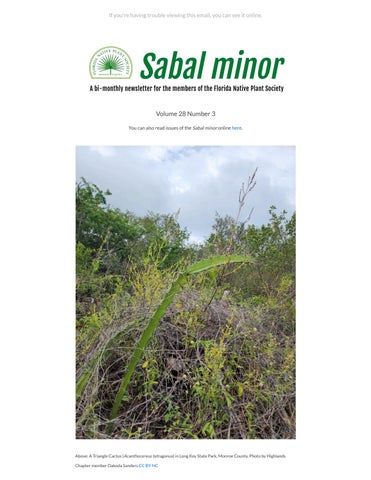
Above: A Triangle Cactus (Acanthocereus tetragonus) in Long Key State Park, Monroe County. Photo by Highlands Chapter member Dakoda Sanders CC BY-NC
Table of Contents Letter from the President Letter from the Executive Director Letter from the Editor
Society News Reaching Our Policy Goals in 2027 Conference Sponsor Features - Young Bear Environmental and National Wildlife Federation Welcoming Catherine Bemis and Sol Lima Upcoming Member Survey by Rhonda Hoeckley 2026 Photo Contest Deadline Extended
Features Data Centers by Chadd Charland, Ixia Chapter Putnam Land Conservancy Works to Save the Endangered Etonia Rosemary by Kylie Robinson, Susan Carr, and Willy the Losen Putnam Land Conservancy
In Other News Book published: Regional Landscape Conservation Planning: Wildlife, Connectivity, and the Florida Model, Noss and Hoctor, eds.
Featured Members Members in the News: Deborah Green New Life Members New and Renewing Business Members Member Obituaries: Richard Wunderlin, PhD and Sallie Marie McConnell
Letter from the President I’m honored to serve as President and work alongside this dedicated community to advance the mission we all value so deeply. Each of you helps shape FNPS’ impact, and I’m excited to build on that foundation as we begin this next chapter together. I know I have big shoes to fill after Gene’s outstanding leadership, and I’m grateful he will continue as Past President and Chair of the Policy & Legislation Committee. Our staff keep FNPS moving forward. Our chapters, Council of Chapters, and Board of Directors carry out the daily and monthly work that keeps FNPS strong. As I shared at the Annual Membership Meeting, there is Old Wisdom in plants. The Tree of Life appears in religions, mythologies, and folktales around the world as a symbol of the force connecting all living things. All life on Earth
depends on plant life, yet many people pass by the green world around them without truly seeing it. I’m continually inspired by what FNPS members are doing across Florida. We are creating native plant demonstration gardens, funding meaningful science,
and providing educational materials for gardeners, children, and nature lovers. With your participation in our Action Alert system, our advocacy strengthens public policy and action. Our native plant database also gives the public a powerful resource for exploring Florida’s remarkable diversity of native plants. These efforts reflect our updated mission statement, adapted from the original. Closely tied to our articles of incorporation, it emphasizes that our work is grounded in science. As we move into our next year together, let's focus on both aspirational and practical goals. Aspirational goals: Build community. Channel our members’ energy into mission-driven projects. Expand our reach through partnerships. Show the world that loving native plants is fun. Celebrate the fun of events like the Heartland Chapter plant rescue. Practical goals: Plan our April 2027 conference. Hold two in-person retreats for the Council of Chapters and Board of Directors. Provide more ready-to-use tools for our chapters. Visit and engage with chapters throughout the state. I’ll close with a thought from Dr. Suzanne Simard’s Finding the Mother Tree: “It’s up to each and every one of us. If you’re in the city, put a pot on your balcony. If you have a yard, plant a garden.” In other words, every action matters. Invite a friend to a favorite nature trail. Share why native plants support butterflies and other native pollinators. Plant coneflowers by your mailbox. Join a plant rescue. Let’s help people notice the plants that surround us—and enjoy the work along the way. Ann Redmond, MS, CEP-Emeritus, Magnolia Chapter
Letter from the Executive Director October is nearly upon us! Happy October Florida Native Plant Month! Every year, FNPS celebrates October in honor of Florida’s own name, La Florida, the land of flowers. It’s our favorite month to celebrate the wildflowers and native plants that make up this state’s living landscapes. We can’t wait to celebrate with you! Check out our events calendar to see what celebrations are happening near you! Hope to meet you at one of our events. FNPS exists because our members show up for it. Our updated mission statement says it plainly: “The mission of the Florida Native Plant Society is to conserve, preserve, and restore Florida’s native plants and their habitats through science-based education, research, advocacy, horticulture, landscaping, and engaged participation by our members and communities.” That last piece, engaged participation by our members and communities, was included intentionally to honor the people who drive the mission: our dedicated members. We see FNPS in action at every chapter meeting, native plant sale, pulling invasives from natural areas, hosting speakers, writing to our representatives, participating in plant rescues, transforming our lawns, and educating our communities. Thank you for being a part of our special community. Melissa Fernandez, PhD, Highlands and Beluthahatchee Chapter
Letter from the Editor I want to apologize for the delay in getting this issue out, it turns out that taking care of a baby is a lot of work and good childcare can be hard to find. Fortunately, we have a great issue for you this month and I think it'll be worth the wait. -Valerie Anderson, Pine Lily Chapter
Society News
Conference Sponsor Highlights Young Bear Environmental As we continue our appreciation series, we’re excited to highlight the sponsors who helped make the 2025 Florida Native Plant Society Conference such a meaningful and inspiring event. Today we're highlighting Young Bear Environmental, a Volusia-based environmental consulting firm that is a longtime business member. We are an environmentally conscious firm dedicated to protecting Florida's natural resources. We provide natural areas management, prescribed fire services, living shoreline design and installation, oyster reef construction with OysterReefBreaksTM - ORBs, ecoscaping, environmental permitting, endangered species permitting and research, and myriad other services. Young Bear Environmental Consulting ybeconsulting.com 386-212-1952
National Wildlife Federation National Wildlife Federation (NWF) is one of America’s oldest and largest conservation organizations. We have a diverse membership of sportsmen, conservationists, academics, outdoor enthusiasts, and people from across America who love nature and wild places. We ground our policy work in the best available science and advocate for long-term solutions. Our Gulf Program, which includes our work in Florida, focuses on protecting and restoring the Gulf of Mexico and the coastlines of the five Gulf coastal states. We do extensive work restoring coastal Louisiana and the Mississippi Delta. We also promote the development of Offshore Wind Energy in the Gulf of Mexico as an energy source that promotes a healthy climate. In Florida we work to protect habitat and nesting opportunities for sea turtles by promoting local Sea Turtle Lighting Ordinances that reduce light pollution and help ensure sea turtle hatchlings can reach the Gulf of Mexico. We also work to protect manatees in the greater Tampa Bay region by promoting consumer practices and government policies that reduce nutrient pollution from stormwater and fertilizer. Cleaner water means fewer algal blooms, and
more vibrant and robust seagrass beds which are an essential source of food for manatees in Tampa Bay. NWF is an advocate for public lands across the Gulf including our Florida State Parks. We worked closely with FNPS on state parks protection as well as made efforts to protect the Withlacoochee State Forest from a dangerous land swap that would have sacrificed habitat for essential Florida wildlife and plant species. NWF is working with a broad coalition of groups to promote coastal restoration and resiliency as tools to adapt to a changing climate and prepare for future and more intense hurricanes. We are working to promote the upcoming Tampa Bay Coastal Master Plan as a tool to promote living shorelines, green and naturebased infrastructure, and ecologically sound methods to control and prevent coastal and inland flooding. We look forward to working with FNPS on this effort as well as working with local chapter of the Florida Native Plant Society across the Tampa Bay region.
Reaching our Policy Goals in 2027 by Valerie Anderson and Cherice Smithers, staff With Gene settling back into Policy and Legislation Chair duties from his stint as President we're anticipating a very active 2027 advocacy season. Gene joined me at Oakland Nature Preserve to lay out the Florida Native Plant Society's 2027 policy priorities and issue a call to action for Floridians who care about the future of our state to fund our advocacy priorities, including ensuring funding for the Florida Forever land conservation program in 2027.
To drive this point home, we are launching the Florida Forever Festival on Sunday, October 18 from 1-5pm at First Magnitude Brewing Company in Gainesville. Enjoy an afternoon of live music, speakers, food trucks, local vendors and makers, environmental organizations, and a native plant sale. Come celebrate native plants, connect with the community, and help support the future of Florida’s natural lands.
Our Policy and Legislation Committee is monitoring on current issues, including referenda that will be on the Floridian's ballots in November of this year. We have taken a strong position opposing statewide Amendment 3, which would expand a homestead tax exemption to the detriment of local government services.
Welcoming Catherine Bemis and Sol Lima! Catherine Bemis is a Master’s degree student in Environmental Horticulture at the University of Florida. A Horticulturist by trade, Catherine specializes in ecological horticulture and native plants, with a particular interest in conservation horticulture and plant-pollinator interactions. In another life, she was a Marketing Manager, where she developed a love for creative communication and
storytelling. When Catherine isn’t working, she’s usually out in the woods looking at plants with her husband, Bret, and their 90-pound dog, Moose.
"I am so thrilled to be joining Florida Native Plant Society as their Social Media Coordinator! The native plants and natural communities of Florida are truly awe-inspiring, and the work FNPS does to protect, conserve, and restore them is equally so. I'm excited to tell the stories of this amazing community of conservationists, and to help communicate ways that people can conserve Florida's native plants and support the work of FNPS through social media channels!"
Sol Lima, current FNPS Florida Scrub Mint Internship funded by the Florida Wildflower Foundation in honor of Carolyn Schaag, Nancy Bissett, and Anne MacKay, is working on conservation of the Dicerandra genus of mints. She is an undergraduate senior at the University of Florida, studying Wildlife Ecology and Conservation, with a minor in Education. At UF, she is involved in two conservation-related student organizations, Chronically Outside and Natural Resources Diversity Initiative, as Vice President. She has a passion for endangered species conservation, native plants, and environmental education. She has previously interned for other organizations, including the Florida Forest Service, where she was introduced to Dicerandra cornutissima during a plant rescue over the summer. Sophia hopes to work in conservation and environmental education after graduating from UF in 2027. In her free time, she enjoys birdwatching, hiking, reading, and trying new recipes to cook and bake. She is excited to work with FNPS and can't wait to be part of this amazing organization!
Upcoming Member Survey by Rhonda Hoeckley, Board Member at Large, Sweetbay Chapter As FNPS members, we all share a deep passion for Conserving, Protecting, and Restoring (CPR!) Florida's native plants and habitats. This passion drove us to join FNPS from all walks of life: business, academia, the arts, music, health care, science, engineering, and the trades -- the list is endless! Our amazing diversity of talents, experience, and perspective is truly one of FNPS' greatest strengths and a big reason we are now celebrating our 46th year as a successful nonprofit. To honor our passion, FNPS wants to ensure volunteering is enjoyable and fulfilling. To help do that, we have developed a new tool called the 'Share Your Awesome Talents!' survey. This survey will help match member talents and interests with volunteer needs to help enhance everyone's volunteer experience. Keep an eye on your inboxes ... the survey will be released soon!
2026 Photo Contest Deadline Extended Good news for all native plant-loving procrastinators! We’ve extended our photo contest deadline to September 25th. Submit your favorite photo featuring Florida’s native plants or natural areas for a chance to win FNPS prizes. All winners will be featured during Florida Native Plant Month (October). All photo submissions support plant conservation across the state.
The Member Portal is Live You can log in to check your membership status, renew your membership, or sign up for our various email lists! If you haven't set up an account yet, just head to the main FNPS homepage and then click on Member Login in the top right. You'll use the 'forgot password feature' and input the same email on your account. Contact Cherice or Valerie if you need help.
Features Data Centers by Chadd Charland, Ixia Chapter I first started reading about data centers in the summer of 2024 through my responsibilities as Conservation Chair at the Ixia FNPS chapter. I put together a weekly Conservation Newsletter for members summarizing the most important conservation stories from the area, state, and nation. That summer, data centers, and the damage they were doing to communities, started becoming news. Fast forward two years, and data centers, and the resistance to data centers, are headline news nationwide. Data centers have been around for decades, but they are now being built to a scale not before seen. Most new facilities are so-called “hyperscale” data centers withmassive buildings designed to support global platforms. These sites operate 24/7,
require high-reliability electricity, and must be cooled continuously, regardless of weather conditions. While there isn’t a strict, universally agreed-upon definition, a hyperscale data center typically involves at least 5,000 servers and generally exceeds 10,000 square feet of floor space. The largest of these hyperscale data centers are gargantuan. There is nothing comparable in American industry. Perhaps you’ve heard of the project in Utah proposed by the Canadian “Shark Tank” TV show millionaire and despised by locals. It would cover more than 40,000 acres. That’s 62 square miles – nearly 3 times the size of Amelia Island where I live. Think about that. The facility will require about 9 Gigawatts of power – more than the entire state of Utah currently consumes. That electricity will come from its own dedicated natural gas power station. Increasingly, hyperscale data centers have become so large and require so much electricity, they include dedicated power plants in their design and permitting applications. The Utah project’s emissions would raise the entire state’s greenhouse gas emissions by 50%. The network of industrial-scale fans needed to cool the Utah data center’s hot pipes will result in so much waste heat that it could raise daytime temperatures in the surrounding valley by five degrees Fahrenheit and night-time temperatures by 12 degrees. This is an extreme case, but a realistic case. A County Commission in Utah has approved this project to move forward against resident wishes.
Environmental Cost of Data Centers Most attention paid to the environmental costs wrought by data centers rightly focuses on water and energy consumption. A large hyperscale data center can consume as much as five million gallons of fresh water a day used in evaporative cooling. That’s comparable water consumption to a city of tens of thousands of people. In Florida, that water will come from our already stressed aquifer. Our drinking water. Between the millions of residents and thousands of businesses and golf courses and tens of thousands of agricultural acres straining our aquifer, data centers could very well stress the water supply to or beyond a breaking point. In Georgia, residential wells water ran dry near data centers. Because of the enormous scale of data centers, they are typically built in more rural areas where residents are more likely to be on wells. I won’t belabor the “water” point because countless resources online are available for more information. Nor will I belabor the energy component because a similar volume of articles exist detailing how hyperscale data centers can use the amount of energy that a small city would. This energy is required to run their servers and cool equipment.
In a presentation I made to the Nassau County fact finding committee on data centers, I spent more time highlighting lesser-known environmental costs of data centers including, but not limited to: Construction footprint often thousands of acres of undeveloped land – wetland, forest, and farmland Heat. Data centers serve as their own heat islands because of their emissions, the waste heat produced during computing, the energy required to cool the servers, and the concrete, steel, and asphalt buildings, roads, and parking lots housing the servers. Data centers create their own microclimates which often mean death for nearby plant and animal species. E-waste. Because of rapidly advancing technology, data centers swap out their components every 3 to 5 years creating tons of e-waste. Neither the federal government nor the State of Florida have regulations on the disposal of ewaste despite it containing toxic lead and mercury that can leech from landfills into water supplies. Diesel fumes. Because data centers must operate consistently around the clock, their construction includes massive backup diesel generators often the size of tractor trailers. These generators kick on regularly for testing and when power goes down during storms or a hurricane. Diesel exhaust creates additional heat and is loaded with toxic chemicals like nitrous oxide. Noise pollution. Diesel generators contribute to horrifying noise pollution produced by data centers. I implore you to read online citizen accounts of the noise pollution created by data centers. That affects wildlife as well. Light pollution. Like most large manufacturing facilities, data centers are lit up at night causing havoc to migrating birds and nighttime pollinators like moths. This is only a partial list. This is not speculation. This is the necessary cost of operating these plants.
How to Stop a Data Center in Your Community The most critical aspect to understand about fighting a data center in your community is to be first. If your community has yet to receive an application or issue a permit for a data center, you have a strong chance of enacting a moratorium and potentially preventing one from ever coming. If an application has already been filed, and even worse if a permit has been granted, your chances of fighting it off go way down. In a state run by developers, if a project has any little toe hold, it’s unlikely you’ll be able to put the (evil) genie back in the bottle.
ACT NOW! I first read about a proposed data center for Nassau County in September of 2025. It was a press release issued by an energy company touting a potential data center site in the County that was picked up by the “Jacksonville Business Journal.” Fortunately, that press release put the cart before the horse. The Nassau County data center was more of a possibility than an actual plan.
Upon reading the article, I contacted my County Commissioners, the County Manager, and the Head of the County’s Planning Department. I shared what I had read and the dangers of data centers. No need for that anymore, everyone knows. I also brought up the idea of a moratorium, which at that point was novel. They swore to me nothing was in the works. I further looped in another local conservation organization that has a long track record of successfully working with the county on environmental causes. You’re going to need a team. The more people you have fighting with you, sending emails, making calls, speaking out at commission meetings, flooding social media, etc., the better your chances are. This is where previous experience working with or against local governments and partnering with environmental advocacy groups pays off. If you and your “team” are a known commodity in creating public pressure, you’ll be taken more seriously from the jump. I checked in with the Commissioners every couple of months, reminding them about the dangers of data centers, sharing news articles about resident revolts against them, about Commissioners being voted out of office nationwide for supporting data centers, and reminding them of the potential to get in on the front end and pursue a moratorium before a project was proposed. In Nassau County, resistance to data centers was still mostly flying under the radar until the erroneous press release began circulating again on Facebook. It spread in the online neighborhood groups; which I’m sure your community has groups like these on Nextdoor and Facebook. A local woman with no political/activism experience – a young mom concerned for her children’s health because the data center would likely be placed near her farm – launched a Change.org petition that quickly generated hundreds of signatures. Residents were alarmed and started calling Commissioners. Now it wasn’t just me and the conservation community pressuring the Commission about taking preemptive action against data centers, it was “normie” residents who don’t typically take an interest in politics or activism. Here is your greatest advantage to fighting data centers where you live: everyone hates them. This is one of the only issues that has strong support among voters of both parties. Even the Florida State Legislature passed a bill this session putting limits around data center construction. This is an election year, chances are, members of your County Commission or City Commission are up for election. Use this as an election issue. Make it an election issue if it’s not. Nassau County was first county to pass a data center moratorium on June 8, and it passed unanimously after several public hearings. Because Nassau County knew it was going first through this process, it did so with extreme caution knowing it would be an example for the rest of the state to follow. The county attorney wrote an exceptional and exceedingly broad memorandum outlining what is considered a data center and what the moratorium would achieve. Three opportunities for public comment at regular, monthly commission meetings were provided. The County has put together a
series of fact-finding public meetings with county staff at which expert testimony and public comment was encouraged. All of this data is available online for your county to borrow from. New codes and ordinances will likely be required to regulate data centers because nothing exactly like them exists in the American industrial landscape. They aren’t exactly heavy manufacturing. They aren’t really warehouses either. Again, there are a variety of municipalities around the state and region where your county can borrow language from for guidance writing restrictive data center moratoriums and ordinances. If you have any questions about the process of fighting data centers in your area, please reach out to me via email at: chaddcharland@gmail.com.
You can also watch Chadd's recent Lunch and Learn on how to stop a data center in your community here. -Ed.
Putnam Land Conservancy Works to Save the Endangered Etonia Rosemary By Kylie Robinson, Susan Carr, and Willy the Losen Putnam Land Conservancy
Etonia rosemary (Conradina etonia) is one of Florida's rarest native plants, found only in a small area of Putnam County midway between Gainesville and Palatka. This fragrant flowering shrub in the mint family occupies the deep, well-drained sands of scrub and scrubby flatwoods habitats. Etonia rosemary was first described as a species in the early 1990s and was soon after listed as federally endangered by the U.S. Fish and Wildlife Service (USFWS) in 1993. The species' exceedingly limited distribution and vulnerability to habitat loss and fragmentation were among the primary reasons for listing. Unfortunately, these threats persist today as development pressures continue to increase across Northeast Florida. Etonia rosemary is a remnant of Florida's ancient scrub ecosystem. Today, it survives in scattered patches of this increasingly rare landscape. Like many Florida scrub endemics, Etonia rosemary requires sunny, open conditions maintained by periodic prescribed fire. Without active management, scrub habitats become overgrown and shaded, reducing habitat quality and limiting the plant's ability to thrive and reproduce. The acquisition of Etoniah Creek State Forest in the 1990s represents one of the most important conservation success stories for Etonia rosemary. Today, the 8,900-acre forest supports the largest known populations of the species. Prior to state acquisition, these populations faced increasing threats from habitat fragmentation, degradation, and decades of fire suppression. Thanks to decades of restoration work by the Florida Forest Service (FFS), Etonia rosemary populations are now thriving and expanding within the forest. The largest populations occur in a several-hundred-acre area in the center of the forest. In this restoration area, the FFS uses prescribed fire and mechanical treatments to expand the open scrubby conditions needed by Etonia rosemary, pollinators, and many other fire-dependent species.
Despite recent successes, a significant obstacle to habitat restoration remains. The 320-acre Interlachen Lake Estates subdivision lies in the center of the forest. This sparsely developed subdivision consists of many small privately owned lots, most of which remain undeveloped. Many of the lots support Etonia rosemary plants and suitable habitat. The Interlachen Estate lots are not peripheral to the species' range. Rather, they are in the center of the core rosemary population. Furthermore, the privately owned lots complicate prescribed fire and habitat restoration efforts. Conducting prescribed burns near private property and homes can be difficult and costly, and future residential development would further fragment habitat and exacerbate management challenges. The USFWS has long recognized residential development as one of the principal threats to Etonia rosemary; protection of privately owned habitat as one of the top priorities for the species’ recovery. Fortunately, progress is being made. To date, 147 lots within Interlachen Lake Estates have been protected through conservation acquisition. However, 52 privately owned, undeveloped lots remain, many containing known rosemary plants or suitable habitat.
Putnam Land Conservancy (PLC), a nonprofit land trust serving North Florida, is working to acquire these remaining undeveloped lots from willing sellers. Once protected, these parcels can be incorporated into the surrounding restoration area and managed as part of the larger conservation landscape. Acquisition of these lots will prevent future development, reduce habitat fragmentation, and allow continued use of prescribed fire and other restoration practices essential to the long-term recovery of Etonia rosemary. By bringing these parcels into conservation ownership, PLC will help preserve the integrity of this rosemary habitat and avoid the creation of a patchwork of fragmented parcels within the species' global range. PLC's immediate goal is to acquire 15 to 20 undeveloped lots closest to the existing rosemary restoration area. To date, seven willing sellers have been identified. We are optimistic that continued outreach and project momentum will bring additional opportunities. To achieve this goal, PLC seeks support from both private donors and public funding sources. With lot values ranging from $20,000 to $25,000, a relatively modest investment can produce significant conservation benefits. A fund of approximately $250,000 would allow PLC to acquire a substantial number of priority lots and expand the protected restoration area. PLC hopes to raise at least $150,000 from private donations, with the remainder coming from public conservation funding programs, including potential support from the U.S. Fish and Wildlife Service. This is a rare opportunity to help protect a plant found nowhere else on Earth. Every acre protected contributes to the long-term survival of Etonia rosemary and strengthens one of Florida's most unique and imperiled ecosystems. If you would like to support Putnam Land Conservancy's effort to conserve these remaining inholdings, please contact Willy the Losen at (386) 336-5400 or plc@putnamlandconservancy.org.
Above: Location of the rosemary restoration area and PLC’s working area for land acquisition in the Etoniah Creek State Forest (ECSF). Below: Location of Etonia rosemary populations in Putnam County and Etoniah Creek State Forest, showing the location of the privately owned lots in Interlachen Estates (adapted from the Draft Etonia Rosemary Species Status Assessment, USFWS)
In Other News Regional Landscape Conservation Planning: Wildlife, Connectivity, and the Florida Model, is a new book (spring 2026) edited by Reed Noss of Paynes Prairie Chapter and Tom Hoctor of the University of Florida’s Center for Landscape Conservation
Planning. Published by University of Florida Press, the book uses Florida as a case study to explore the theoretical background, history, and application of landscape connectivity principles to conservation. The Florida model, in which large core protected areas are enveloped and connected by buffer zones and corridors on working lands (such as cattle ranches and commercial timberlands with conservation easements) has already succeeded in conserving 30 percent of Florida’s land area, thanks to a history of generous state funding for conservation land acquisition.
Although considered radical and impractical in the 1980s, when maps were first released proposing half of Florida in connected conservation areas, the idea of a statewide network of core areas and corridors, designed around the needs of the Florida panther, black bear, and other fragmentation-sensitive species, has gained in popularity. Beginning in the late 1990s, the Florida Ecological Greenways Network (FEGN) has served as the basis for much of the state’s conservation land prioritization. In 2021, the three highest priority layers of the FEGN were recognized by the Florida Wildlife Corridor Act. This bipartisan legislation identifies a statewide network of currently conserved lands and conservation opportunity areas, closely resembling the controversial maps from the 1980s. If and when completed, the Florida Wildlife Corridor will cover fully half of the state of Florida. Although focused largely on Florida, Regional Landscape Conservation Planning applies to large-scale planning elsewhere and is especially relevant to regions with a combination of high biodiversity (irreplaceability) and a high rate of habitat loss (vulnerability). Conservation is increasingly urgent in such regions. Topics covered in the book include tradeoffs between conserving large, connected properties versus small, isolated sites with concentrated biodiversity; the history of large-scale conservation planning and rewilding since the early 20th century; spatial prioritization methods; population growth modeling; identification of climate refugia; landscape approaches to aquatic and coastal conservation; road ecology and impact mitigation; the role of land trusts in landscape conservation; and the influence of the Florida model on other large-scale planning efforts such as Yellowstone to Yukon (Y2Y) and a network of conservation areas and corridors covering more than half of the Kingdom of Bhutan.
Members in the News Deborah Green of Cuplet Fern Chapter Recognized by Gene Kelly, Past President and Policy and Legislation Chair
Longtime FNPS member, Deborah Green, was recently recognized by Orlando Sentinel columnist Scott Maxwell as one of the 10 People Who Make Orlando a Better Place to Live for 2026. We couldn’t agree more! Although Maxwell specifically noted Deborah’s role as President of Orange Audubon, her involvement includes being part of our Cuplet Fern Chapter and an earlier affiliation with the Tarflower . She hosted a presentation for FNPS entitled Plants for Birds – Caterpillars that remains available for viewing on YouTube and has organized native plant yard tours in the Orlando area in service of her true obsession: ensuring there are lots of caterpillars available for birds to eat. Every informed native plant enthusiast knows native plants are the prerequisite to having lots of native caterpillars for native birds to feed upon, and we are always happy to oblige our feathered friends. After studying entomology at the University of California Berkeley, during which time she was also a member of the California Native Plant Society, Deborah relocated to the Orlando area, where she served as an environmental science instructor at Valencia College. She worked with the St. Johns River Water Management District to facilitate creation of the Lake Apopka Wildlife Drive and developed interpretive kiosks that inform visitors about the native plants present along the popular trail. Her long-range ambitions include the creation of other facilities to enhance the Wildlife Drive’s recreational and environmental values. Please join us in congratulating Deborah on this well-deserved recognition from the Orlando Sentinel! We are proud to claim her as a member of FNPS.
Featured Supporters Welcome, New and Renewing Members Our community grows stronger with every person who joins it. We are delighted to welcome our newest members and extend our gratitude to those who have renewed their commitment to Florida’s native plants and the places they call home.
New Life Members
Nancy Baxley, Magnolia Chapter Elizabeth Blackford, Conradina Chapter Carol Ann McElroy, Ixia Chapter
Renewing Business Member Habitat Hero Level
Want to become a business member and be featured here? Join today!
Member Obituaries Richard Wunderlin, PhD, was a founding member of our Suncoast Chapter. Alan Franck of Paynes Prairie Chapter and the Herbarium Collections Manager of the Florida Museum wrote a wonderful remembrance of him for us: "Dick was a gentleman and a fervent supporter of Florida botany. He synthesized the first flora focused solely and comprehensively on Florida, both online and in print. During his tenure, he wholeheartedly nurtured the USF herbarium, more than doubling it in size. I cannot remember when we first talked nor when I first set foot in the herbarium, but, because of his unconditional mentorship, I never left botany. I will be forever grateful for his leadership and camaraderie, and for providing an immense foundation for Florida botany. I don’t know if he saw my last email to him, but it said 'thank you for all of your support during my career, which has obviously been invaluable to me. I deeply treasure all my time with you and at USF.'" Earnest 'Ernie' Franke of Pinellas Chapter, 1946- 2006. Ernie was the driving force behind environmental projects at his condominium complex, The Shores of Long Bayou. He and a team of volunteers mucked out the lakes at the Shores, removing invasives and installing aquatic plants to improve water quality. They also cleared out invasives and created a nature trail along the bayou and restored the flow in a creek on the property. Some of you may remember that he gave a presentation to our chapter about the project and gave us a tour. Ernie was also a member of the Tampa Bay Estuary Program's Community Advisory Committee, a true evangelist for environmental conservation. Godspeed, Ernie. By Jan Allyn, Pinellas Chapter
This email was sent to info@fnps.org. Click here to unsubscribe.