Volume 42: Number 3 > 2026
The Quarterly Journal of the Florida Native Plant Society
2026 Peggy Lantz Writing Contest Winners ● A Tale of Two Flax ● People Make the FNPS Conference Great
Apply for an FNPS Grant Application deadline: March 5, 2027 For detailed information visit: https://www.fnps.org/grants Science Research Grant The Florida Native Plant Society maintains an Endowment Grant program for the purpose of funding research on native plants. These are small grants (typically $2,500 or less), awarded for a 1-year period, and intended to support research that forwards the mission of the Florida Native Plant Society “to promote the preservation, conservation, and restoration of the native plants and native plant communities of Florida.” Contact: Paul Schmalzer. Email: info@fnps.org. Dr. Barbara Grigg Grant in Bryophytes, Pteridophytes, and Lichens This grant honors Barbara’s personal research interests by funding a two-year project focused on the study of bryophytes (mosses, liverworts, and hornworts), pteridophytes (ferns and
Grow What You Love Every FNPS gift protects Florida's native plants. Choose the fund that speaks to you. 4 Science Research Endowment 4 Conservation Fund 4 Dan Austin Fund (ethnobotany) 4 Dr. Barbara Grigg Fund (bryophytes, pteridophytes, and lichens) 4 Cornelia McNamara Fund (endangered species) 4 Internship Fund
Give today to fund the next grant cycle!
Previous grant recipient Jessica Balerna received $1,500 from the Dan Austin Award for Ethnobotany for her project titled “Evaluating trade-offs among biophysical and cultural ecosystem services in freshwater wetlands impaired by groundwater extraction (Tampa Bay region, FL).” Your gift to the FNPS grant program helps fund research and internships. Photo by Dr. David Lewis.
fern allies), or lichens. This targeted research grant recognizes the vital ecological role these little-known and understudied plant groups play in supporting Florida’s natural systems. The selected project must advance our understanding of the life history and ecology, conservation, or restoration of these species in nature. Amount: $3,000/year for 2 years. Contact: Paul Schmalzer. Email: info@fnps.org. Dan Austin Grant for Ethnobotany This award is limited to graduate or undergraduate students who are studying Florida ethnobotany (the study of the relationship between peoples or cultures with plants native to Florida or Florida ecosystems). These can be current uses or historic uses. Amount: $1,600. Research must focus on Florida native plant species or plant communities, and the project must have a human/plant connection. Research can include mycology, taxonomy, botany, demographics of medicinal plants, medicinal chemistry, human effects on soils, economic importance, etc. Contact: John Benton. Email: info@fnps.org. Cornelia McNamara Grant FNPS funds this grant annually to support applied research on native plants and habitats, particularly those that are rare or imperiled. These small grants ($1,500 or less), are awarded for a 1-year period and are intended to support research that will yield data to inform the management for or restoration of native species and habitats. The grant is open to FNPS members, chapters, colleges and universities, and the public, but with a preference for FNPS members or chapters. Contact: Paul Schmalzer. Email: info@fnps.org The renewal of this grant is made possible by a generous Continued on page 15
2 ● Palmetto
Volume 42:3 ● 2026
FNPS Team Executive Director ...................................................Melissa Fernandez-de Cespedes
MEMBERSHIP Make a difference with FNPS
Director of Communications ...................................................Valerie Anderson
Your membership supports the preservation and restoration of wildlife habitats and biological diversity through the conservation of native plants. It also funds awards for leaders in native plant education, preservation, and research.
Director of North Florida Programming ...................................................Lilly Anderson-Messec Director of Operations ...................................................Cherice Smithers
Board of Directors President.............................................................Ann Redmond Past President..................................................Gene Kelly Vice President, Administration..............Athena Phillips Secretary............................................................Melanie Trexler Treasurer.............................................................Chris Moran Council of Chapters Chair.............................Rebekah Kaufman Directors at Large: ..................................................................................Andrea Andersen ..................................................................................Raelene Crandall ..................................................................................Christopher Goettlieb ..................................................................................Rhonda Hoeckley ..................................................................................Gage LaPierre ..................................................................................Paul Schmalzer ..................................................................................Alyssa Sferazza ..................................................................................Kristen Young
To contact board members
FNPS Administrative Services: Call (321) 271-6702 or email info@fnps.org
Committee Chairs Conservation....................................................John Benton Council of Chapters......................................Rebekah Kaufman Education............................................................Vacant Policy and Legislation................................Eugene Kelly Science................................................................Paul Schmalzer
Society Services Administrative Services.............................Cherice Smithers Editor, Palmetto...............................................Marjorie Shropshire Webmaster........................................................Paul Rebmann
Memberships are available in these categories: Individual; Multi-member household; Sustaining; Lifetime; Full-time student; Library (Palmetto subscription only); Business or Non-profit recognition. To provide funds that will enable us to protect Florida's native plant heritage, please join or renew at the highest level you can afford.
Features 4 2026 Peggy Lantz Writing Contest Winners 14 A Tale of Two Flax Article by Roger L. Hammer 15 People Make the FNPS In-Person Conference Great Article by Susan Earley
To become a member: Contact your local chapter, call, write, or e-mail FNPS, or join online at https://www.fnps.org/
The purpose of the Florida Native Plant Society is to preserve, conserve, and restore the native plants and native plant communities of Florida. Official definition of native plant: For most purposes, the phrase Florida native plant refers to those species occurring within the state boundaries prior to European contact, according to the best available scientific and historical documentation. More specifically, it includes those species understood as indigenous, occurring in natural associations in habitats that existed prior to significant human impacts and alterations of the landscape. Follow FNPS online: Blog: https://www.fnps.org/from-the-field-blog Bluesky: https://bsky.app/profile/fnps.bsky.social Facebook: https://www.facebook.com/floridanativeplantsociety Instagram: https://instagram.com/floridanativeplantsociety/ LinkedIn: https://www.linkedin.com/company/floridanative-plant-society-inc-/ YouTube: https://tinyurl.com/yx7y897d
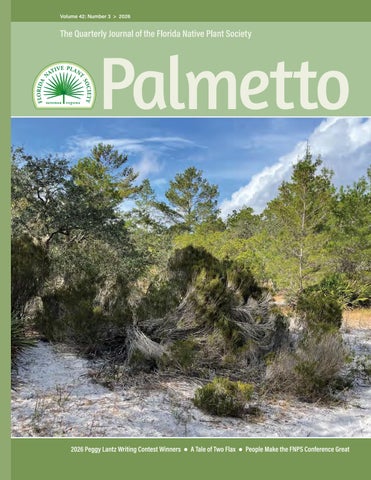
ON THE COVER:
Scrub rosemary (Ceratiola ericoides). Photo by Mark Kateli.
(ISSN 0276-4164) Copyright 2026, Florida Native Plant Society, all rights reserved. No part of the contents of this magazine may be reproduced by any means without written consent of the editor.
Get Palmetto in print, delivered right to your door. Visit the FNPS website to sign up: https://fnps.app.neoncrm.com/forms/palmettoprint-and-ship-form
Palmetto is published four times a year by the Florida Native Plant Society (FNPS) as a benefit to members. The observations and opinions expressed in attributed columns and articles are those of the respective authors and should not be interpreted as representing the official views of the Florida Native Plant Society or the editor, except where otherwise stated.
Access recent back issues of Palmetto at: https://www.fnps.org/Palmetto
Editorial Content We welcome articles on native plant species and related conservation topics, as well as high-quality botanical illustrations and photographs. Contact the editor for guidelines, deadlines and other information.
Access more Palmetto articles here: https://www.fnps.org/article-index
Palmetto Editor: Marjorie Shropshire ● Visual Key Creative, Inc. ● palmetto@fnps.org
Volume 42:3 ● 2026
Palmetto ● 3
1 Place Winners st
2026 Peggy Lantz
Writing Contest The Florida Native Plant Society is proud to announce the winners of the inaugural Peggy Lantz Writing Contest! This year, writers and artists of all ages submitted original stories, poems, essays, and illustrated works celebrating Floridaʼs remarkable native plants. The response was inspiring, and we are grateful to everyone who shared their creativity and passion with us. A heartfelt congratulations to all of our winners, whose work will help carry Peggy Lantzʼs legacy forward for years to come.
4 ● Palmetto
CATEGORY: POETRY There Was Sweetness in the Blackened Stems By Sidney Craig The road forgets itself and the hush rushes in— charred wiregrass bristles, a burnt green machine, three-awned seeds cocked like tiny tripwires, only flowering after fire, flaring out of a choir of cinders whispering again, again through the stems. Liatris lifts out of that singed sea too, violet ladder laced through wiregrass waves; skippers and fritillaries jittering node to node, insect Morse code pulsing up the spike. In that dappled light, netted pawpaw palms its cards: leaves like green maps with raised-vein roads, no blossom yet, no custard-sweet fruit, just zebra swallowtail caterpillars cutting pale parentheses through each blade and resting on wiregrass spires when the wind picks up. False foxglove threads itself into the same grid, stem fine as a rumor, pink with borrowed light, half sun, half siphon, tapping wiregrass, pawpaw, pine— bell-mouths ringing. Where the ground dips, the burn scar darkens: fetterbush throws red-twig loops, glossy leaves, linking pine to puddle to pawpaw thicket; gallberry leans in at the rims, fire-scored holly still shouldering soot, shrugging black drupes like loose coins bees come to mint into smoke-sweet honey, then zigzag back to foxglove throats and liatris spires. Roots braid under all this, trading sap, swapping ash; wiregrass barters with foxglove, pawpaw trades shade for swallowtails, gallberry and fetterbush sip the same slow seep; all gossiping in fungal hush until their names blur where the ecotones do, where one hunger becomes another, fire into flower into fruit into wing. I walked out with nothing in my pockets but the way their names kept slipping and sliding into one another—liatrispawpawfoxglovefetterbushgallberrywiregrass— like a single long word the land keeps saying through fire, through flood, through us, whether or not we are listening.
Volume 42:3 ● 2026
CATEGORY: ESSAY The Last Rosemary Scrub of Audley Way * By Chelsea LeNoble It was morning when I first encountered the last rosemary scrub of Audley Way. I wandered, dewy-faced, from the edge of the dirt road through the curtains Above, left to right: Google Earth satellite imagery of the site in 1995 and 2022. Provided by U.S. Geological Survey. of her bright, chewy heat. My black Brooks Images © 1995 Google and © 2022 Google. Google Earth Pro Desktop Version 7.3.7.1155. sneakers gulped her white, sugar sand and from dormant branches. Another offered remarkable that the last rosemary scrub slogged cautiously to her interior, which reto bring empty pots and shovels. While of Audley Way had never been developed. minded of the Atlantic coast 50 miles east. they could do nothing to stop her destrucSurrounded by snaking subdivisions, I’d soon traversed a constellation tion, they committed to saving some of these five acres resisted decades of conof Florida endemic plants, but I had no her biodiversity. I was drawn to the buzz quest—until now. idea how to call her sand pines or scrub of their collaboration, their pursuit of Four months earlier, I’d stood at the holly by name, how her countless forbs fit preservation. Looking back, I imagine I within the cosmos of life twinkling around plant sale checkout table run by my local chapter of the Florida Native Plant Society. was like a butterfly, attracted to the nectar me in this wildly resilient place. I didn’t of belonging. At war with my backyard’s St. Augustine appreciate how rare it was to find her, I stepped into view, my three pots teeturf, I joined to snag the members-only untouched, a portal through time. tering. “Could you use any help?” I asked. discount. Check exchanged for pre-orThe sand ridge supporting this scrub The leader of the group looked at me dered wildflowers, I picked up three black was once a Pleistocene-era beach. Over and grinned. “Of course,” he said, waving pots and hugged them to my chest, a these millions of years, several species me over. precarious pyramid. Ambling toward the evolved to live in Florida scrub habitat and I didn’t know a single plant name, parking lot, I overheard a man speaking to nowhere else on Earth. Florida scrub is but I could coordinate a team, arrange a three intent listeners about a plant rescue. one of the most imperiled ecosystems in I’d never heard of a plant rescue before. database. So, I joined the plant rescue and the country, partly because of the way it created a coordination plan. One person The words drifted from a few yards away, evolved, and partly because it is situated to identify plants, one to dig and pot them where the man fanned a green hose over a on the highest and driest uplands—land up, and another to carry them to a staging section of plants that seemed to sigh over most desirable and least expensive to area. I arrived armed with flags and their plastic edges in the late summer. I develop. At least 90% of Florida scrub has labels, spreadsheets and instructions. Yet, leaned in to listen from behind the cover been gobbled by bulldozers, excavators, as it would turn out, I didn’t understand of a trellis, curious tendrils of Carolina brush chippers. All of which makes it having a connection to this place, how that jessamine reaching for connection would thread us together once my cheek. my plans failed, the second we arrived. I I overheard that wasn’t here to instruct, after all. A newa landowner gave born, I was here to learn. permission to dig up Florida scrub rosemary, or Ceratiola any plants in the nine ericoides, is dense, round, evergreen. months until he would Before you see scrub rosemary, the smell develop the property. of incense will likely find you. It’s hard to One voice offered to stand in front of scrub rosemary without host the plants at her feeling reverent of its ancient royalty. If, house until they “hardperhaps, you’re the kind of person who ened off,” meaning that can stand in front of a plant like one might they’ve survived the a painting in a museum. My first time at shock of the uprooting the rosemary scrub of Audley Way, I was long enough for bits of not one such person. new growth to yawn, My coordination plans were no match stretch, and peek out Scrub rosemary (Ceratiola ericoides). Photo by Mark Kateli. * The name of the property has been changed to “Audley Way” to protect the privacy of current residents. Some scenes, rather than exact depictions, are mosaics assembled of moments I experienced during my time there from November, 2021 to May, 2022.
Volume 42:3 ● 2026
Palmetto ● 5
Above, from top: Nodding pinweed (Lechea cernua), flatwoods blue curls (Trichostema gracile), and jeweled-blue-eyed grass (Sisyrinchium xerophyllum). Photos by Chelsea LeNoble. 6 ● Palmetto
for the spell she had over our volunteers. They broke from our huddle like caffeinated cats, flags and roles forgotten. I trailed in one volunteer’s shadow as they explored, my mind fixed on contingencies, salvaging order. Maybe ten minutes later, they gasped. I startled. This sound, the catnip of plant nerds, traveled through the overstory. Heads appeared, ducking under branches—then knees, carrying legs safely over the proud posturing of needle-armed cacti. Everyone assembled, necks craning to spot the interesting thing. We stood before a scrub rosemary the size of a small SUV. The base of her sweeping branches was heralded by a smooth, five-foot-wide mound of sand. Down its slope, in the shade of this ancient shrub, we watched fistful sprays of sand puff away from a half-moon hollow. Little gray feet studded in keratin scales flicked: left, right. A gopher tortoise tidied its front door, indifferent to the crowd of humans a few feet away who, in that instant, had been reborn into a fiercely committed plant rescue team. The first time I met her, the last rosemary scrub of Audley Way, was not the first time I saw her, that Sunday morning in November. It was not the third day of the rescue, when I first cupped a Lechea cernua in my gloved hands, little sieves, the shrrrring trickle of sand revealing the endangered plant’s spindly roots. Neither was it the first day I greeted the speckled lower jaw and satin whip of ribbon spilling up and out of Trichostema gracile calyxes like blueflamed sconces. Meeting her was learning a new language I hadn’t realized I’d enrolled to learn. Becoming familiar crept over us like the change of a season, where you can’t tell where one ends and the other begins, but you can feel that something about the air is peppery, now, the blue of the sky, crisper. We tried everything to save the scrub rosemary, crumbling pillar of this expiring place. Like many scrub plants, they cannot be transplanted; to separate them from this earth is to kill them. Their affinity for sand and heat kept them alive for millennia just as it doomed our efforts to save them. I find it comforting to think of this
in human terms, with the scrub rosemary as the captain of her capsizing ship. What the surveyors of the 1800’s referred to as “damnable,” “miserable scrub,” worthy only of leveling, to her, was home. It would not go down without her. Our team salvaged 1,400 pots holding over 2,000 little plant lives. I went from clipboard-clutching stranger to translator, nearly free of plant-blindness chrysalis goo. On my last visit with the rosemary scrub of Audley Way, slouched crosslegged in the sand, I pinched a pawpaw leaf between my fingers, releasing its grassy, stone fruit scent. Could she tell we were here to help? Would it ease the ache of our excavations to know her blazing stars and nodding pinweeds would have a chance to live somewhere else? I stayed until shadows dipped into
Netted pawpaw (Asimina reticulata). Photo by Chelsea LeNoble.
Volume 42:3 ● 2026
scrub wild olive and yucca, chopped into piles, discarded. An invasive species of grass, Panicum repens, introduced by the tractors that stripped her down, smirks across her remnant edges. The meaning behind the name of the grass, fitting my mood when I see the newest aerial, proof of her finality: creeping panic.
Potted plants loaded in the car for transport to the plant rescue greenhouse. Photo by Mark Kateli.
her belly, until no stacks of plastic pots or shovels remained, just a landscape pocked by holes. Gutted, us both. A year later, seeing new growth on the tips of her refugees at their recipient sites would help. Reminding myself of what we were able to save would help. In meeting the last rosemary scrub of Audley Way, I learned an embodied language. Fluency introduced me to a new network of family: the sandhill of
Wekiwa Springs State Park, the hardwood hammock of Seminole State Forest. She opened my eyes as hers were closing, transferred my hands from hers to places where I could continue the conversations she taught me. I hold these hands as I hike through my grief: to have met her is to have eclosed from plant-blindness into the roar of environmental loss. The ancient rosemary scrub of Audley Way is gone now. The prickly leaves of her
Google Earth satellite imagery of the site in 2023, provided by U.S. Geological Survey. Google Earth Pro Desktop Version 7.3.7.1155. Image © 2023 Google, Maxar Technologies.
CATEGORY: ESSAY, YOUTH The Invisible Thread: Our Human Connection With Nature By Lillie Wilder
There is an invisible thread that ties every heartbeat to the whisper of wind through the trees, every breath to the surge of ocean waves. We are not just visitors on this planet; we are woven into its fabric like intricate embroidery on a living canvas. Imagine a world where skyscrapers grow like wildflowers, their glass petals reflecting the sky, and city lights mimic the constellations above. Even in the heart of the busiest metropolis, a stubborn weed cracks the sidewalk, reminding us that nature is persistent, patient, and omni-
Volume 42:3 ● 2026
present. Our connection to nature is not optional; it is as essential as oxygen. When we walk barefoot on cool grass, we become electric—our bodies humming with the energy of the earth. The scent of pine needles after rain can unlock memories buried deep within us, memories of ancient forests and untamed landscapes that our ancestors called home. The rhythm of our pulse echoes the patterns found in seashells, in the spiral of a fern’s unfurling, in the migration of birds across continents. Nature is not a separate entity, but a
mirror of itself. When we protect a river, we are safeguarding the flow of our own veins. When we marvel at the flight of a dragonfly, we catch a glimpse of the creativity that resides within every human mind. To lose our connection with nature is to lose a piece of ourselves. But to nurture it is to ignite a spark—a wild, creative force that can heal, inspire, and transform both us and the world around us. So, let us listen to the invisible thread. It is humming, always, calling us back to where we truly belong.
Palmetto ● 7
CATEGORY: SHORT STORY A Taste of the Swamp By Leopoldo Llinas When my younger son was in first grade, Saturday mornings in our house followed a predictable rhythm: cereal bowls clinking, shoelaces tying, and the frantic search for a missing den shirt. It was Cub Scouts day, and the den had reluctantly agreed to go on a swamp walk with me in Big Cypress National Preserve. While other dads prepared for baseball games, I loaded a bucket of walking sticks into the back of the car and reminded my son, “Yes, you will get muddy. No, you may not complain.” By early morning, the Den gathered at the trailhead, fidgeting with excitement and a pinch of fear. Big Cypress during the wet season is its own kind of magic. The swamp rises into a shimmering world of clear, tea-colored water that reflects the sky like polished bronze. Bald cypress trees stand like ancient guardians: their trunks flaring at the base, their branches draped in delicate green needles. “This is a slough slog,” I told them.
“Move slowly. Watch your footing. And don’t grab anything underwater unless you know what it is.” The boys nodded solemnly, which lasted about thirty seconds. The moment their feet touched the water, the slough erupted in shrieks any time a hidden cypress knee grazed a shin or a mysterious swirl of water brushed an ankle. As we waded deeper, the swamp transformed. Light filtered through the canopy in shifting columns. Fish darted between our legs. Dragonflies buzzed past us like shimmering blue sparks. A great egret watched us from a low branch, absolutely judging our technique. There the air grew cooler, and the undergrowth opened to reveal one of my favorite Everglades natives: the pond apple, Annona glabra, its wide, glossy leaves gleaming like polished jade. The trees arched over the slough, their fruits dangling like small, lumpy green ornaments. Some had already fallen, bobbing gently among the cypress knees. To the untrained eye, pond apples might look delicious. To anyone who knows better, the fruit tells a different story.
“Are those mangos?” one scout asked. “No,” I replied. “Those are pond apples.” “So… can we eat them?” I opened my mouth to deliver the responsible adult’s automatic lecture on never eating anything in the wild unless the adult in charge says so. A hand shot up. A splash. A triumphant shout: “I got one!” “Nick, wait—” I began. Too late. He took a massive bite, the kind of bite reserved for ice cream or freshly sliced watermelon. There was a long, quiet moment as he processed the experience. Then the gagging began. He spit the fruit into the water, shook his head violently, and shouted, “WHY DOES THIS TASTE LIKE SWAMP SOCKS?” His reaction sent the Scouts into hysterics. I helped him rinse his mouth with his water bottle while the rest of the boys laughed. Nick wiped his tongue dramatically with the sleeve of his shirt. “That,” I told them, “is exactly why
October 19-25 is National Estate Planning Awareness Week, established to help the public understand what estate planning is and why it is such a vital component of financial wellness.
Plan for your family’s future and the future of Florida's native plants Experts recommend making a will or reviewing your existing will when you: acquire assets or property get married or divorced l have a child l move to a new state or country l change your mind about something important l haven’t reviewed your will for five years l
l
Without a will, your assets will get tied up in probate and be distributed based on the inheritance statute of the state where you live.
You can plan for your legacy to include the conservation, restoration, and preservation of the native plants and native plant communities of Florida by including the Florida Native Plant Society in your will.
Use our convenient online will-making tool https://www.fnps.org/freewill
The Florida Bar. January 2019. Do You Have A Will? https://www.floridabar.org/public/consumer/pamphlet011/ American Association of Retired Persons. September 3, 2024. 6 Times When You Should Update Your Will. https://www.aarp.org/money/personal-finance/times-to-update-your-will/
8 ● Palmetto
Volume 42:3 ● 2026
Enter the 2027 Peggy Lantz Writing Contest The Peggy Lantz Writing Contest celebrates creative voices inspired by Florida’s native plants and wild places. Established in 2025, the contest honors Peggy Lantz’s legacy as a beloved nature writer and native plant advocate.
pond apples are also called alligator apples. Because the only creature that seems to enjoy them is the one you definitely don’t want to upset.” “Wait,” another student asked. “Alligators eat those things?” “Absolutely,” I said. “Alligators swallow the whole fruit. They help disperse the seeds. And pond apples grow well in deep water, the perfect habitat for alligators. This entire ecosystem is full of partnerships like that.” As the students murmured amazed at this new fact I continued. “Historically, the fruit wasn’t just for wildlife. South Florida’s Indigenous peoples, including the Seminole and Miccosukee, used pond apples in a variety of ways. Some used the seeds for jewelry. Others boiled parts of the fruit for medicinal teas. They knew how to make use of the tree without expecting it to taste like a Publix mango.” I stopped the group near another pond apple tree and invited them to look closely at its roots, half-submerged beneath the water. “These roots,” I said, “have special adaptations to flooding. This allows the tree to breathe when most other plants would die from lack of oxygen. The trees are survivors. They are part of why Big Cypress can handle the extremes of this place. Their fruit may not be delicious to us” I nodded toward Nick, who nodded back, “but they are essential to the animals that depend on them.” In the stillness, one boy whispered, “It’s like everything here has a job.” “Yes,” I said. “Even the things we don’t always notice. Big Cypress and the Volume 42:3 ● 2026
This contest is open to all ages and invites original short stories, essays, poetry, song lyrics, and illustrated stories that explore a personal connection to Florida’s native flora. Winners will receive FNPS prizes and recognition, with first-place entries featured in the Palmetto. Submissions will be accepted from December 1, 2026, through January 31, 2027. There is no fee for FNPS members, and the entry fee for non-members is $5. For more information, follow the QR code or visit https://www.fnps.org/peggy-lantz-writing-contest.
Everglades are connected as they form a single, large ecosystem, with Big Cypress acting as a vital source of clean freshwater that flows south into the Everglades. Pond apples stabilize the soil, feed wildlife, and help keep these sloughs alive. Lose the trees, and you lose the creatures that depend on them. Lose those creatures, and the whole system shifts.” They stood quietly for a moment, letting this settle. These moments, when the swamp becomes more than mud and mosquitos, are the reason I live for. We made our way back through the cypress forest, the water gradually shallowing as the tree trunks thinned and the light brightened. When we stepped back onto dry ground, shoes squelching, Nick approached me. “Okay,” he said. “I get it now. Everything’s connected. But why does the pond apple taste like that?” I laughed. “Because nature isn’t designed for our taste buds. It’s designed for survival.” He nodded, still unconvinced. “Next time, can we do a hike that involves blueberries or something?” I smiled. “No promises. But I can promise you this: you will never forget your first pond apple.” The scouts groaned, laughed, and argued about whose idea it had been in the first place. But I watched them climb into their cars with a new kind of confidence, the kind you earn from stepping into the unknown, and tasting the swamp for yourself.
CATEGORY: POETRY, YOUTH By Lillie Wilder We are born of soil and song— of roots tangled, veins of rivers, nourished by sunlight that slips like honey through pine needles. Our hands remember the shape of seeds, the cool press of moss, the hush of dusk settling on the backs of deer. We are the echo of thunder in our bones, the hush of snowfall in our dreams. We build cities, pour concrete rivers, but dandelions write poems in the cracks— reminders that the wild waits beneath our inventions, patient and persistent. On windy days, our hearts flutter like moths drawn to the moon, restless for open fields, for the scent of rain on dry earth, for the ancient comfort of wind in the grass. We are of and on the world— nourished by its beauty, haunted by its loss, each breath a promise, each footprint a question: will we remember how to listen, how to belong? Let us kneel to the ground, let us remember: we are more than visitors. We are stories the earth tells when the stars are watching, when the trees lean in to listen.
Palmetto ● 9
CATEGORY: COMICS – By Chloe Kuka
10 ● Palmetto
Volume 42:3 ● 2026
Volume 42:3 ● 2026
Palmetto ● 11
12 ● Palmetto
Volume 42:3 ● 2026
Volume 42:3 ● 2026
Palmetto ● 13
A Tale of Two Flax By Roger L. Hammer
Back in 1903, two intrepid field botanists, John Kunkel Small (1869–1938) and Joel Jackson Carter (1843–1912), were botanizing by horse-and-wagon between Coconut Grove and the town of Cutler in present-day Miami-Dade County when they came upon what proved to be an undescribed species of flax (Linaceae). Small would later describe it in 1905 in the Bulletin of the New York Botanical Garden and officially name it Linum carteri to honor Carter. As fate would have it, in 1968 American botanist Claude Marvin Rogers (1919–2015), described a variety of L. carteri as var. smallii, which was given species status in 2020 as Linum smallii. So, Carter and Small have both been honored with each of their own species of flax that are endemic to Florida. The plants look practically identical but one difference is that L. carteri has stipular glands and L. smallii does not. There is also a difference in the hairs on the leaves and stems, or the lack thereof. Linum carteri is endemic to southern Miami-Dade County, found solely in only five remnant pine rockland parcels east of Everglades National Park that managed to be spared from development. Back in the early 1900s, pine rockland habitat stretched endlessly across Miami-Dade County, encompassing an estimated 186,000 acres but, after rampant development and agriculture took its toll, there is currently less than 2% of that total remaining in Miami-Dade County east of Everglades National Park. It is due to habitat destruction coupled with fire suppression that L. carteri and L. smallii are both state-listed endangered species and, because they are endemic with very restricted ranges, it is puzzling why they are not federally listed as well. Linum smallii is endemic to pine flatwoods, prairie, saltmarsh, and edges of freshwater marshes in Charlotte, Glades, Hendry, Lee, Collier, Miami-Dade, and mainland Monroe County. The genus Linum is well-known worldwide because of Linum usitatissimum, the European flax where linen and linseed oil are derived. Here in Florida, there are eight native Linum species with ranges that reach from the far western Panhandle to the lower Florida Keys. Of the Florida native species, four are state-listed as endangered due to habitat loss. Only L. carteri and L. smallii are endemic to Florida and found nowhere else. So, the next time you wear clothes made of linen, or use paints or varnishes made with linseed oil, remember the genus Linum. References Hammer, R.L. (2014). Everglades wildflowers. Rowman & Littlefield. Weakley, A. S. (2022). Flora of the southeastern United States. University of North Carolina Herbarium, North Carolina Botanical Garden.
About the Author Roger L. Hammer is an award-winning professional naturalist, author, botanist and photographer. His most recent books are Paddling Everglades and Biscayne National Parks and Foraging Florida – Finding, Identifying, and Preparing Edible Wild Foods in Florida. Find him online at https://www.rogerlhammer.com/.
Above: Linum carteri. Photo by Roger L. Hammer. 14 ● Palmetto
Volume 42:3 ● 2026
Call for Research Track Papers and Poster Presentations The 2027 FNPS Conference will be held in Daytona Beach, Florida April 1–4, 2027. The Research Track of the conference will include presented papers and a poster session on April 2-3. Researchers are invited to submit abstracts on research related to native plants and plant communities of Florida including preservation, conservation, and restoration. Presented papers are planned to be 20 minutes in total length (15 min. presentation, 5 min. questions). Abstracts of not more than 200 words should be submitted as a MS Word file by email to Paul A. Schmalzer, Ph. D., science@fnps.org by December 15, 2026. Include title, affiliation, and address. Indicate whether you will be presenting a paper or poster. Presenters qualify for a free conference registration for the day of their presentation, and there is a reduced registration rate for students.
Apply for an FNPS Grant
Continued from page 2
donation from Chris Calder, who initiated the grant in 2020. He is a Cuplet Fern member who wants to advance the knowledge of our native plant heritage. Conservation Grant FNPS Conservation Grants support applied native plant conservation projects in Florida. Applicants can apply for a grant of up to $5,000 awarded for a 1-year period. Applicants interested in funding for more than one year may reapply the following years for additional funding. Projects must promote the preservation, conservation, or restoration of rare or imperiled native plant taxa and rare or imperiled native plant communities. To qualify for a Conservation Grant, the proposed project must be sponsored by an FNPS Chapter. Contact: John Benton. Email: conservation@fnps.org.
People Make the FNPS In-Person Conference Great By Susan Earley After five years of virtual meetings, I was thrilled for the return of the in-person FNPS Conference. Opportunities to chat casually abound at conference social events and in between presentations, and being able to talk to people face-to-face was one of the highlights of the week. I initially met nature photographer Christina Evans online, and was delighted to finally meet her in person. I‘ve long admired her images of wildlife interacting with Florida’s native plants. She photographs birds in the wild, but also captures images of the birds that visit her backyard prairie, which is filled with native grasses and wildflowers, including muhly grass (Muhlenbergia capillaris), lopsided Indian grass (Sorghastrum secundum), saw palmetto (Serenoa repens), plus Liatris and Coreopsis species. In a breakout session about Florida meadows with Gage LaPierre (co-author of The Florida Meadow Manual: Creating and Maintaining Resilient Green Spaces), I met Nancy Bissett, one of FNPS’s founding members. Meeting Nancy was one of the highlights of the conference for me. I’d read several articles she wrote for early issues of Palmetto while working on a project to annotate bibliographic entries for the magazine. Nancy, a botanist and restoration ecologist, is a leading expert in restoring Florida’s disappearing natural areas and, with her husband Bill, owns The Natives, one of the earliest native plant nurseries in the state. Throughout its 40-plus-year history their family-run nursery has grown many of the plants used in large restorations like the Reedy Creek Mitigation Bank restoration project. Seeds for this project were collected from their Polk County property and from privately-owned sites in Florida, using hand-gathering and machine-harvesting techniques. Nancy added her expertise to a conference panel discussion focusing on the challenges of collecting seeds of Florida ecotypes. Meeting Nancy at the conference opened the door for me to visit the Bissetts at their plant nursery and preserve with FNPS’s Executive Director Melissa Fernandez-de Cespedes. Volume 42:3 ● 2026
One of the highlights of attending an in-person conference is networking with other native plant enthusiasts and experts. Pictured here are 2025 conference attendees Jackie Rolly, Peggy Lantz, and Sonia Guidry. Photo by Valerie Anderson.
We walked their scrub property sited along the Lake Wales Ridge and an upland hardwood hammock. For this Tampa native seeing scrub lupine (Lupinus aridorum), Florida green eyes (Berlandiera subacaulis), manyflower beardtongue (Penstemon multiflorus) and a pygmy fringe tree (Chionanthus pygmaeus) in their natural settings was a thrill. We also walked under cabbage palms (Sabal palmetto) with fronds easily twice the size of the mature cultivated palms I see growing in urban landscapes. These experiences more than made up for not being able to take advantage of the various conference field trips and were an unexpected surprise. The FNPS Biennial Conference presents a great opportunity to reconnect with native plant friends and to meet experts in fields related to Florida’s native plants. These personal interactions ensure my decision to attend the 2027 conference in Daytona Beach. Save the date for the FNPS Biennial Conference l April 1-4, 2027, Daytona Beach, Florida Find out more at: https://www.fnps.org/2027-conference Palmetto ● 15
Non-Profit Organization U.S. POSTAGE PAID Jacksonville FL PERMIT NO. 877
The Florida Native Plant Society PO Box 5007 Gainesville, FL 32627
FNPS Chapters and Representatives CHAPTER ..........................................REPRESENTATIVE.......................................E-MAIL 1. 2. 3. 4. 5. 6. 7. 8. 9. 10. 11. 12. 13. 14. 15 16. 17. 18. 19. 20. 21. 22. 23. 24 25. 26. 27. 28. 29. 30. 31. 32. 33.
Beluthahatchee........................ Sue Foster & Laura Swartz ...........................beluthahatchee@fnps.org Broward........................................ Stephanie Dunn ...................................................broward@fnps.org Citrus . ........................................... Ellen McNally...........................................................citrus@fnps.org Coccoloba .................................. Sara Burke & Ben Johnson..............................coccoloba@fnps.org Conradina .................................. Beth Blackford........................................................conradina@fnps.org Cuplet Fern................................. Alan Squires.............................................................cupletfern@fnps.org Dade .............................................. Riki Bonnema..........................................................dade@fnps.org Eugenia ....................................... David Martin.............................................................eugenia@fnps.org Heartland ................................... Samuel Igo & Gregory Thomas....................heartland@fnps.org Hernando ................................... Janet Grabowski....................................................hernando@fnps.org Highlands ................................... Aaron David..............................................................highlands@fnps.org Ixia .................................................. Cate Hurlbut.............................................................ixia@fnps.org Lake Beautyberry ................. Tina Mertz..................................................................lakebeautyberry@fnps.org Longleaf Pine............................. Kimee Bremner......................................................longleafpine@fnps.org Magnolia ..................................... James Cooper..........................................................magnolia@fnps.org Mangrove ................................... Kristin Hoffschmidt..............................................mangrove@fnps.org Marion Big Scrub ................... Deborah Curry.........................................................marionbigscrub@fnps.org Martin County ......................... Pete Grannis...........................................................martincounty@fnps.org Naples .......................................... Sara Burke & Ben Johnson..............................naples@fnps.org Nature Coast ............................ Carol Malfa & MaryKay Zimmerman.........naturecoast@fnps.org Palm Beach County ............. Vacant..........................................................................palmbeachcounty@fnps.org Passionflower........................... Marty Proctor..........................................................passionflower@fnps.org Pawpaw . ..................................... Karen Walter & Amy Legare...........................pawpaw@fnps.org Paynes Prairie ......................... Sandi Saurers..........................................................paynesprairie@fnps.org Pine Lily . ..................................... Dana Sussmann.....................................................pinelily@fnps.org Pinellas ........................................ David Perkey............................................................pinellas@fnps.org Sarracenia ................................. Lynn Artz....................................................................sarracenia@fnps.org Sea Rocket ............................... Elizabeth Bishop....................................................searocket@fnps.org Serenoa ....................................... Trent Berry.................................................................serenoa@fnps.org Suncoast ................................... Michelle Anaya.......................................................suncoast@fnps.org Sweetbay .................................. Rhonda Hoeckley..................................................sweetbay@fnps.org Tarflower . ................................... Deborah Ferencak................................................tarflower@fnps.org The Villages................................ Diane Caruso...........................................................thevillages@fnps.org
BECOME A MEMBER OF FNPS:
It's easy! Simply contact your local Chapter Representative, or call, write, or e-mail FNPS. You can also join online by using the QR code, or visiting https://www.fnps.org/support/membership
Contact the Florida Native Plant Society: PO Box 5007 Gainesville, FL 32627. Phone: (321) 271-6702 Email: info@fnps.org Online: https://fnps.org
Submit materials to PALMETTO: Contact the Editor: Marjorie Shropshire Visual Key Creative, Inc. Email: palmetto@fnps.org