
The Palmetto
The purposes of The Florida Native Plant Society are ? to educate government officials, developers, public school children, and the public at large to the value and beauty of Florida's native plants ? to develop guidelines for community ordinances to encourage the use and protection of native plants, and for the management of public lands, wildlife areas, and private woods ? to provide resources of information about native plants ? and to promote chapters throughout the state for local membership, education, and participation.
FNPS OFFICERS AND BOARD OF DIRECTORS
Executive Director: William Partington, 1203 Orange Ave, Winter Park 32789, ph. (wk) 305/644-5377, (hm) 305/647-0467
President: Sherry Cummings, 8855 116 Terrace So., Boynton Beach 33437, ph. 305/734-4416
Vice President: Carol Lotspeich, P.O. Box 12, Winter Park 32790, ph 305/422-0600
Treasurer: Terrence Mock, 5660 Corporate Way, West Palm Beach 33407, ph. 305/686-0546.
Secretary: Jane Brooks, 924 Jackson Way, Fort Pierce 33449, ph. 305/464-3088
Directors-at-Large:
Sydney Brinson, 939 E. Jefferson St., Tallahassee 32301, ph. 904/224-0693.
T] Coburn, 2000 E Englewood Dr., Suite 1, Lakeland 33803, ph. 813/665-6959
Steve Farnsworth, 7080 Hypoluxo Farms Rd., Lake Worth 33463, ph 305/965-2657
Margaret Hames, 667 Acacia Ave., Melbourne 32901, ph. 305/724-1516
John Longhill, 652 N.E. Stuart Ave., Jensen Beach 33457, ph 305/334-7428
Reed Noss, 6820 S W 78th St., Gainesville 32608, ph. 904/372-6255
Jack Stout, 324 Palmetto St., Oviedo 32768, ph. 305/365-7431
Southeast: Joyce Gann, 22140 S.W. 152 Ave., Goulds 33170 ph. 305/248-5529
Dan Cary, Treasure Coast Regional Planning Council, PO. Box 396, Stuart 33495
Southwest: W. Dexter Bender, 1528 Hendry St., FL Myers 33901, ph. 813/332-2966
Linda B. Pierce, Mother Nature's Garden Center, PO O Summerlin Key 33042
East Central: Cindy Boone Connery, 5656 Marvell Ave., Orlando 32809, ph. 305/351-6524
David Drylie, 8100 E. Curry Ford Rd., Orlando 32807, ph 305/282-1469
West Central: Bill Ackerman, 4311 Ohio Ave., Tampa 33616.
Allen Burdett, Jr., 7879 91st St. N., Seminole 33543, ph. (wk) 813/985-7402, (hm) 391-1660
North Central: Dan Ward, 733 S.W 27th St., Gainesville 32607, ph. 904/372-8711
Gary Schultz, 4221 SW 50th St., Gainesville 32608, ph. 904/373-1022
Northeast: David Girardin, P.O. Box 392. East Palatka 32031, ph. 904/328-1774
Richard Hupalo, P.O. Box 933, Melrose 32666, ph. 904/475-2069
Northwest: Ralph Ranney, Rt 3, Box 4005, Quincy 32351, ph. 904/875-9326
Steve Riefler, Rt 2, Box 178B, Chipley 32428, ph. 904/773-3307
Linda Duever, 107 S. Columbia St., Chapel Hill, NC 27514, ph 919/942-9474
Fred Stresau, 45 W. Highpoint Rd., Stuart 33494, ph. 305/283-1768.
Committees:
Conservation: Reed Noss, 6820 S.W. 78th St., Gainesville 32608, ph. 904/372-6255
Education/Legislation: Sydney Brinson, 939 E. Jefferson St., Tallahassee 32301. ph. 904/224 0693.
Horticulture: John Beckner, 736 Myrtle Way S., St. Petersburg 33705, ph. 813/867-1919
Publications: Peggy Lantz, Rt. 9, Box 437, Orlando 32818, ph 305/299-1472.
Science: Daniel Austin, 2760 NE. 2nd Ct., Boca Raton 33431, ph 305/391-6322
Landscape: Joe Cascio, 6170 Riviera Ln., Jacksonville 32216, ph. 904/721-1340.
AUTHORS AND ARTISTS
Dr. David J. Robertson is Research Director of Reclamation for The Florida Institute of Phosphate Research Chuck McCartney is a lifelong Floridian and a specialist in Florida's orchids
Dr. David W. Hall is Associate in Plant Identification for the Florida Cooperative Extension Service at U. of F Georgia Tasker is a writer for the Miami Herald
Anne Vogt sketched the Spiderwort She works for Southern Lithographing the printers of Wild Things.
LATIVE PLANT
ADVERTISING RATES
You are invited to place an advertisement for your company in The Palmetto.
Rates for camera-ready copy are $200 a full page, $110 a half-page, $75 for one-third page (two columns wide by 47/8" high), or $40 for one-sixth of a page (one column wide by 47/8" high or two columns wide by 23/8" high). Business card special is $20. For running the same ad in two issues, there will be a 20% discount, and for three issues a 30% discount, except for business cards Copy that needs special photography or set-up will be billed at cost
Send ad copy to The Palmetto, Peggy Lantz, Editor, Rt. 9, Box 437, Orlando, FL 32818.
How Healthy Are They?
by Chuck McCartney PART I
The twin plagues of habitat preserve at least a portion of the destruction and "predation" by varied natural communities which collectors have left the tropical made South Florida so environmenorchids of South Florida generally in a tally unique, and which, sadly, we very poor state of health. Luckily for have allowed to be plundered and them, many of the terrestrial species destroyed so mercilessly over the past are so ephemeral in their annual 85 years. Would that those visionary growth habits and so frustratingly individuals could have saved more of difficult to transplant successfully such natural treasure-troves as that even where suitable habitats still Everglades National Park, the Big occur, these ground-growing orchids Cypress National Preserve, the are pretty much left alone. Also, even Fakahatchee Strand State Preserve, when in bloom, some of them are not and Jonathan Dickinson State Park! readily recognizable as orchids at all. The most widespread of South Little of this, however, applies to Florida's epiphytic orchids is Encyclia the epiphytes, those orchids that use tampensis, the "Onion Orchid," so trees or shrubs as their "perches." called because of the appearance of These plants are out in the open all the plant. It is everywhere - from the year-round, vulnerable to the mangrove forests of the coasts to grasping fingers of every rapacious open cypress swamps to the dark collector. interiors of tropical hardwood
This article is an attempt to assess hammocks. As with the majority of the relative health of South Florida's the species mentioned here, remaining epiphytic orchids, based collection and habitat destruction are largely on personal experience in the its main enemies. field, aswell as on reports of The "Clamshell Orchid," Encyclia individuals whose honesty and cochleata (Anacheilium cochleatum), botanical knowledge | value. can still be found with regularity in the pond-apple swamps of the Big
"Clamshell orchid," Encyclia cochleata Cypress (including the Fakahatchee) and in the less accessible hammocks of Everglades National Park.
Encyclia boothiana (Prosthechea boothiana), the so-called"Dollar Orchid," now appears to be limited to the mangrove forests of Cape ? Sable, where it is locally abundant. Collectors seem to have taken their continued next page
FLORIDA NATURAL AREAS POSTERS
by Linda C. Duever
Two handsome new posters, in full interpreting adjacent natural color, have been created by artist- communities in terms that laypersons writer Linda C. Duever in order to can readily understand announce and help finance her book Natural Florida will describe fifteen now in preparation: A Guide to major Florida natural areas. It will be Natural Florida. liberally illustrated and the explanatory text will be written in
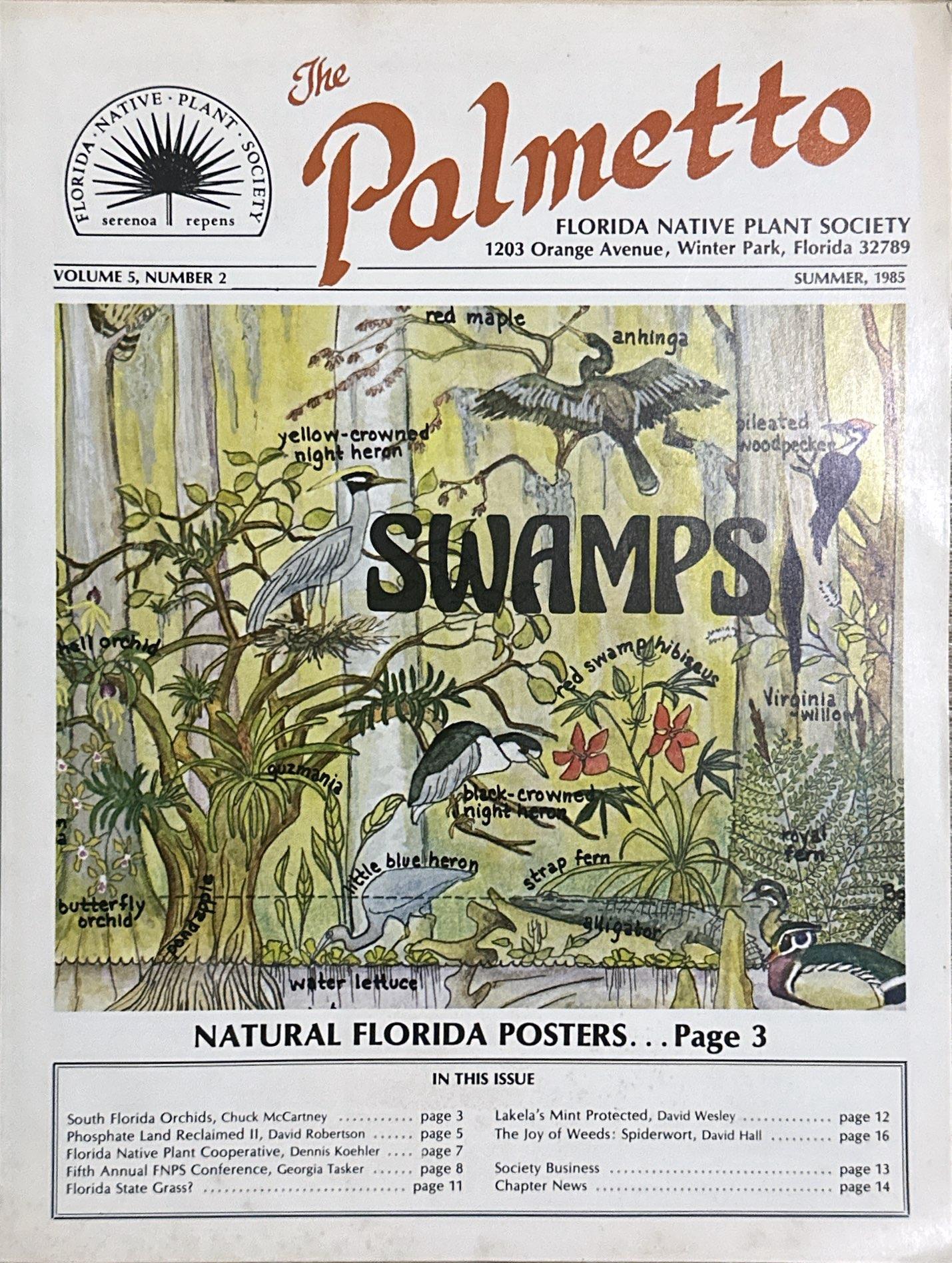
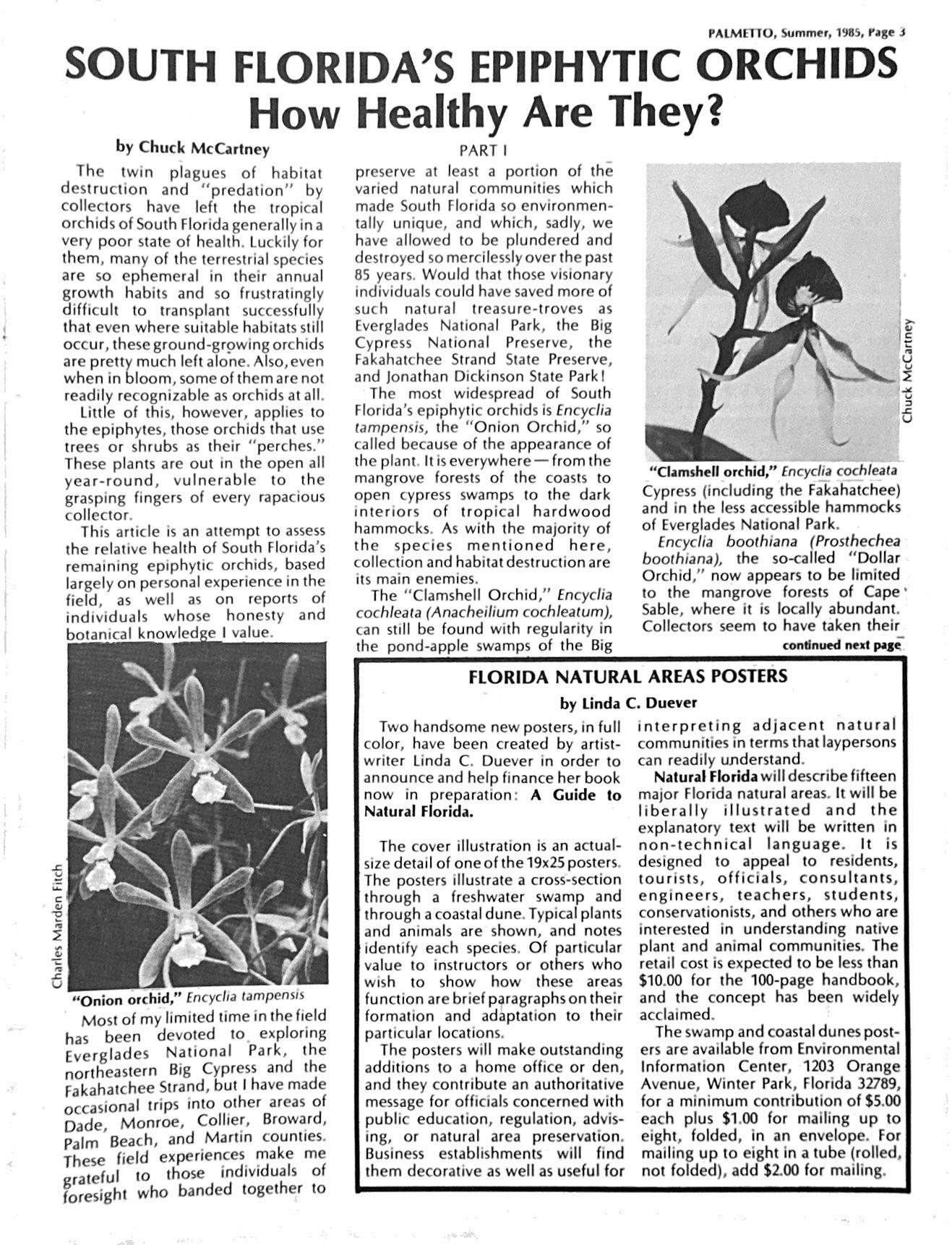
The cover illustration is an actual- non-technical language. It is size detail of one of the 19x25 posters. designed toappeal to residents, The posters illustrate a cross-section tourists, officials, consultants, through a freshwater swamp and engineers, teachers, students, through a coastal dune. Typical plants conservationists, and others who are and animals are shown, and notes interested in understanding native identify each species. Of particular plant and animal communities. The value to instructors or others who retail cost is expected to be less than to show how these areas $10.00 for the 100-page handbook, "Onion orchid," Encyclia tampensis
Most of my limited time in the field has been devotedto exploring Everglades National Park, the northeastern Big Cypress and the Fakahatchee Strand, but I have made occasional trips into other areas of Dade, Monroe,Collier,Broward, PalmBeach, and Martin counties. These field experiences make me grateful to those individuals of foresight who banded together to
function are brief paragraphs on their and the concept has been widely formation and adaptation to their acclaimed particular locations.
The swamp and coastal dunes post-
The posters will make outstanding ers are available from Environmental additions to a home office or den, Information Center, 1203 Orange and they contribute an authoritative Avenue, Winter Park, Florida 32789, message for officials concerned with for a minimum contribution of $5.00 public education, regulation, advis- each plus $1.00 for mailing up to ing, or naturalarea preservation. eight, folded, in an envelope. For Business establishments will find mailing up to eight in a tube (rolled, them decorative as well as useful for not folded), add $2.00 for mailing.
Page 4, Summer, 1985, PALMETTO toll on the species in most of its former haunts on Key Largo.
South Florida's fourth Encyclia species, E pygmaea (which may be reassigned to the genus Hormidium continues to be restricted to a few pond-apple sloughs in the Fakahatchee, even though when a rare colony is found, plants can be quite abundant in a limited area.
The SunshineState's true Epidendrum species include E conopseum, which is not found in South Florida. I have seen it growing on trees above the limestone "sinks outside Tallahassee and in Oleno State Park near High Springs. But 1 cannot speak on the relative abundance of this species in Central and North Florida. (This species is the Western Hemisphere's northernmost
apple swamps of the Big Cypress. 1 was surprised last year to encounter a large, healthy colony of the species also in the highly saline environment of a buttonwood forest on Cape Sable.
Epidendrum nocturnum is also frequently encountered in hammocks or swamps. There is even a large colony in a county-owned park in urbanized (read: ecologically degraded) Broward County. The large, night-scented flowers of this species make it attractive to collectors. However, many of these "gatherers" get what they deserve, because they "harvest" the plants when not in bloom. Many, many plants of this species in Florida produce cleistogamous flowers. These mutations bear flower buds that mature, fertilize themselves, and
stems three or more feet tall.
Cold also has had a devastating effect on plants of Epidendrum anceps, although the species is still relatively plentiful in the Big Cypress (including the Fakahatchee).
Epidendrum difforme is found sparingly throughout the Big Cypress and the Fakahatchee, usually as isolated individuals. Ironically, the biggest, healthiest colony of this species I know in Florida is in a
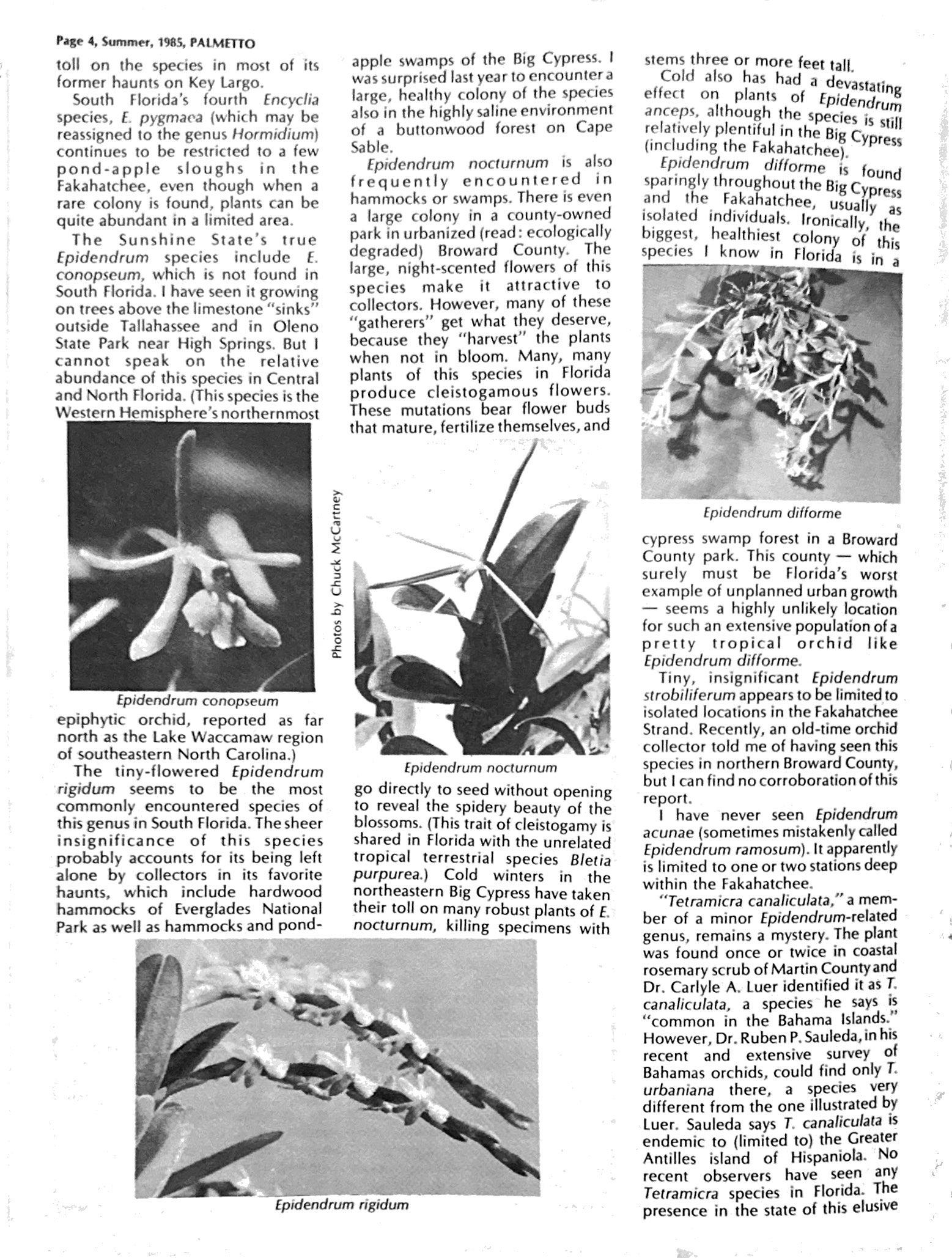
Epidendrum conopseum epiphytic orchid, reportedasfar north as the Lake Waccamaw region of southeastern North Carolina.)
The tiny-flowered Epidendrum rigidum seems to bethe most commonly encountered species of this genus in South Florida. The sheer insignificance of this species probably accounts for its being left alone by collectors in its favorite haunts, which include hardwood hammocks of Everglades National Park as well as hammocks and pond-
go directly to seed without opening to reveal the spidery beauty of the blossoms. (This trait of cleistogamy is shared in Florida with the unrelated tropical terrestrial species Bletia purpurea.) Cold winters in the northeastern Big Cypress have taken their toll on many robust plants of E nocturnum, killing specimens with
Epidendrum difforme cypress swamp forest in a Broward County park. This county - which surely must be Florida's worst example of unplanned urban growth - seems a highly unlikely location for such an extensive population of a pretty tropical orchid like Epidendrum difforme.
Tiny, insignificant Epidendrum strobiliferum appears to be limited to isolated locations in the Fakahatchee Strand. Recently, an old-time orchid collector told me of having seen this species in northern Broward County, but I can find no corroboration of this report.
I have never seen Epidendrum acunae (sometimes mistakenly called Epidendrum ramosum). It apparently is limited to one or two stations deep within the Fakahatchee "Tetramicra canaliculata," a member of a minor Epidendrum-related genus, remains a mystery. The plant was found once or twice in coastal rosemary scrub of Martin County and Dr. Carlyle A. Luer identified it as T canaliculata, a species he says is "common in the Bahama Islands." However, Dr. Ruben P. Sauleda, in his recent and extensive survey Bahamas orchids, could find only T. urbaniana there,a species very different from the one illustrated by Luer. Sauleda says T. canaliculata is endemic to (limited to) the Greater Antilles island of Hispaniola. No recent observers have seen any Tetramicra species in Florida. The presence in the state of this elusive
Epidendrum nocturnum
orchid - as well as its true identityremain uncertain.
Besides certain of the Encyclia/ Epidendrum group, perhaps the most widespread epiphytic orchid in South Florida is Polystachya concreta (P. flavescens in The Native Orchids of Floridaby Lauer). In Everglades National Park, 1 have seen the species, with its tiny, upside-down yellow flowers, in a buttonwood forest on Cape Sable as well as frequently encountering it in the hardwood hammocks of the park. Hammocks, as well as pond-apple swamps and open cypress forests, suit it in the Big Cypress and the Fakahatchee Strand.
PHOSPHATE LAND RECLAIMED
PART I|
by David J. Robertson
Stream relocation and the subsequent restoration of water quality and biological integrity is a particularly controversial aspect of wetland reclamation. In large measure, the Florida Department of Environmental Regulation is reluctant to issue dredge-and-fill permits for stream relocation and reclamation projects because no data exist to support or refute the claim that a stream in central Florida can be returned to an equivalent condition following mining.
Interest in experimental stream reclamation has increased recently, spawning four projects currently in progress and five others in various stages of planning and permitting. However, before 1982, there were only two attempts to reclaim stream channels, both undertaken by Mobil Chemical Company. One of these research projects was carried out at Sink Branchon a previously reclaimed section of Mobil's mine northeast of Fort Meade in Polk County. The project began in December 1979, when 300 meters of Sink Branch, a small tributary of the Peace River, was diverted from its original unmined channel into a parallel channel excavated on mined land to the north. The experimental site encompasses a narrow 21/2 acre ribbon of reclaimed land adjacent to the stream planted with nine common species of native wetland and upland trees including bald cypress; green ash, Fraxinus pennsylvanica; redmaple, Acer rubrum; sweetgum, Liquidambar styraciflua; Florida elm, Ulmus
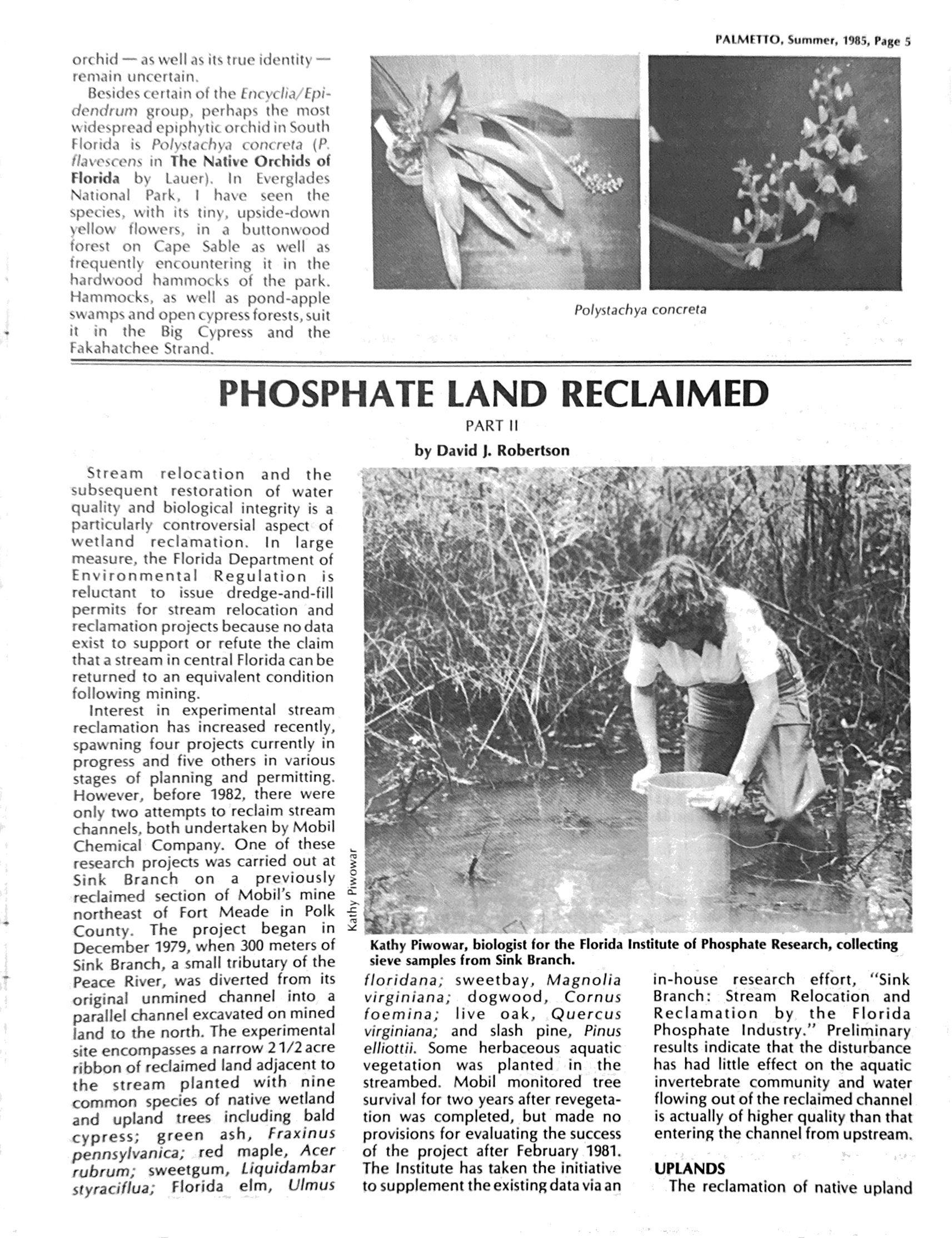
Kathy Piwowar, biologist for the Florida Institute of Phosphate Research, collecting sieve samples from Sink Branch.
floridana; sweetbay, Magnolia in-house research effort, "Sink virginiana; dogwood, Cornus Branch: Stream Relocation and foemina;live oak, Quercus Reclamationby the Florida virginiana; and slash pine, Pinus Phosphate Industry." Preliminary elliottii. Some herbaceous aquatic results indicate that the disturbance vegetation was planted in has had little effect on the aquatic streambed. Mobil monitored tree invertebrate community and water survival for two years after revegeta- flowing out of the reclaimed channel tion was completed, but made no is actually of higher quality than that provisions for evaluating the success entering the channel from upstream. of the project after February 1981. The Institute has taken the initiative to supplement the existing data via an UPLANDS
The reclamation of native upland
Polystachya concreta
Page 6, Summer, 1985, PALMETTO habitat generally is predicted on development of a tree canopy. Although successful reestablishment of a mature hammock or xeric system through intentional reclamation has yet to be demonstrated except on a very limited scale, several projects are under way that should lead to a better understanding of techniques that will accelerate the return to diverse native communities.
The actual planting of trees has only recently begun to receive the attention it deserves. Trees are very visible and important components of upland reclamation both for their aesthetic as well as ecosystems values. Research is currently under way to test the survival and growth of various tree species on three types reclaimed soils. The Florida Division of Forestry is just completing the fourth year of a five-year project entitled "Development of Techniques for the Use of Trees in the Reclamation of Phosphate Lands." Eight plots have been established on reclaimed overburden throughout the central and north Florida phosphate districts to test planting stocks, planting techniques, differences in species responses on overburden. Additional plots have also been created on sand tailings, sand-clay mix,and phosphatic clay settling areas. The overall objective of the project is to develop criteria and guidelines for the use of trees to recreate wetland, island, and upland habitat on mined areas.
A principal deterrent to extensive tree planting on reclaimed areas is the cost of planting seedlings. Direct seeding would be far more costeffective and would allow more areas to be reforested at reasonable cost than is currently possible. FIPR has funded three grants seeking improve the success of direct seeding ventures. An initial attempt in 1982 at direct seeding sand and slash pine trees, P. clausa and P. elliottii, on sand tailings conducted as a part of the Division of Forestry's project had limited success, probably because the seeds were distributed after the normal seedingperiod for these species. When the experiment was repeated again last winter, though, Forestry recorded extensive germination of sand pine. Timing appears to be critically important. The Center for Wetlands at the University of Florida is also investigating direct seeding, but from several different angles. With support provided by an FIPR Applied
Research grant, "Enhancing Ecological Succession Following Phosphate Mining,," Dr. Ronnie Best and his graduate researchers, Bill Dunn and Peter Wallace, have been collecting seeds from native sources, then testing techniques in the laboratory and greenhouse that will improve germination and survival of the seedlings. They have also been culturing soils to develop data on seed availability and viability in "banks." If their research proves to be promising, topsoil containing seeds, soil microbes, andmycorrhizal could be scraped from areas about to be mined and used to inoculate areas under reclamation nearby similar to the "mulching" technique described earlier that is being widely used in herbaceous wetland reclamation. the results of laboratory, greenhouse,and microplot experimentsthe group recently established field trials on International Minerals and Chemicals, Agrico and Gardinier sites. Results of this research will be available in late summer. The Institute is also funding a project with Dr. Gil Almagro at the University of South Florida to determine if his process for "Pelletization of Seeds" with a coating of polymer, mycorrhizal fungi, and fertilizer will lead to better seedling survival and
ECOSYSTEM RECLAMATION
While most reclamation research to date has concentrated on development of techniques to improve the success of plant establishment, little, if any, research has been conducted on the physical and biological parameters associated with reclaiming mined lands as complete, integrated landscape and hydrologic units. Reclamation lanning for phosphate mined lands should be directed establishing whole landscape mosaics and drainage networks instead of piecemeal, mine-by-mine reclamation resulting in landforms with little diversity and perched lakes and wetlands with no interconnections. Results of a project recently funded by the Institute will provide guidelines for developing such integrated plans. This large and complex project,"Development of Techniques and Guidelines for Reclamation of Phosphate Mined Lands as Diverse Landscapes and Complete Hydrologic Units," awarded to Drs. Mark Brown and
Ronnie Best of the University of Florida in January. The investigators plan to characterize existing natural central Florida landscapes and the ecosystems that make up the landscapes. Once they have developed baseline data on relatively undisturbed conditions, Drs. Brown and Best will evaluate the effectiveness of the current reclamation rules for establishing post-mining facsimiles of natural systems. They also plan to apply the information they gather on native ecosystems to innovative reclamation projects with the phosphate industry. The goal of the program is to develop realistic techniques and guidelines that can be implemented industrywide to recreate a post-mining landscape that has long-term ecological and hydrologic stability. Although mining visualized as despoiling the landscape, reclamation provides the opportunity to return the land to diverse natural communities. In most cases, the phosphate mineralized lands in the center of the state were cleared of natural vegetation long ago to be used for grazing and citrus groves. Reclamation can be instrumental in incorporating wildlife habitat and natural areas back into the landscape.
BUTTERFLY BOOK
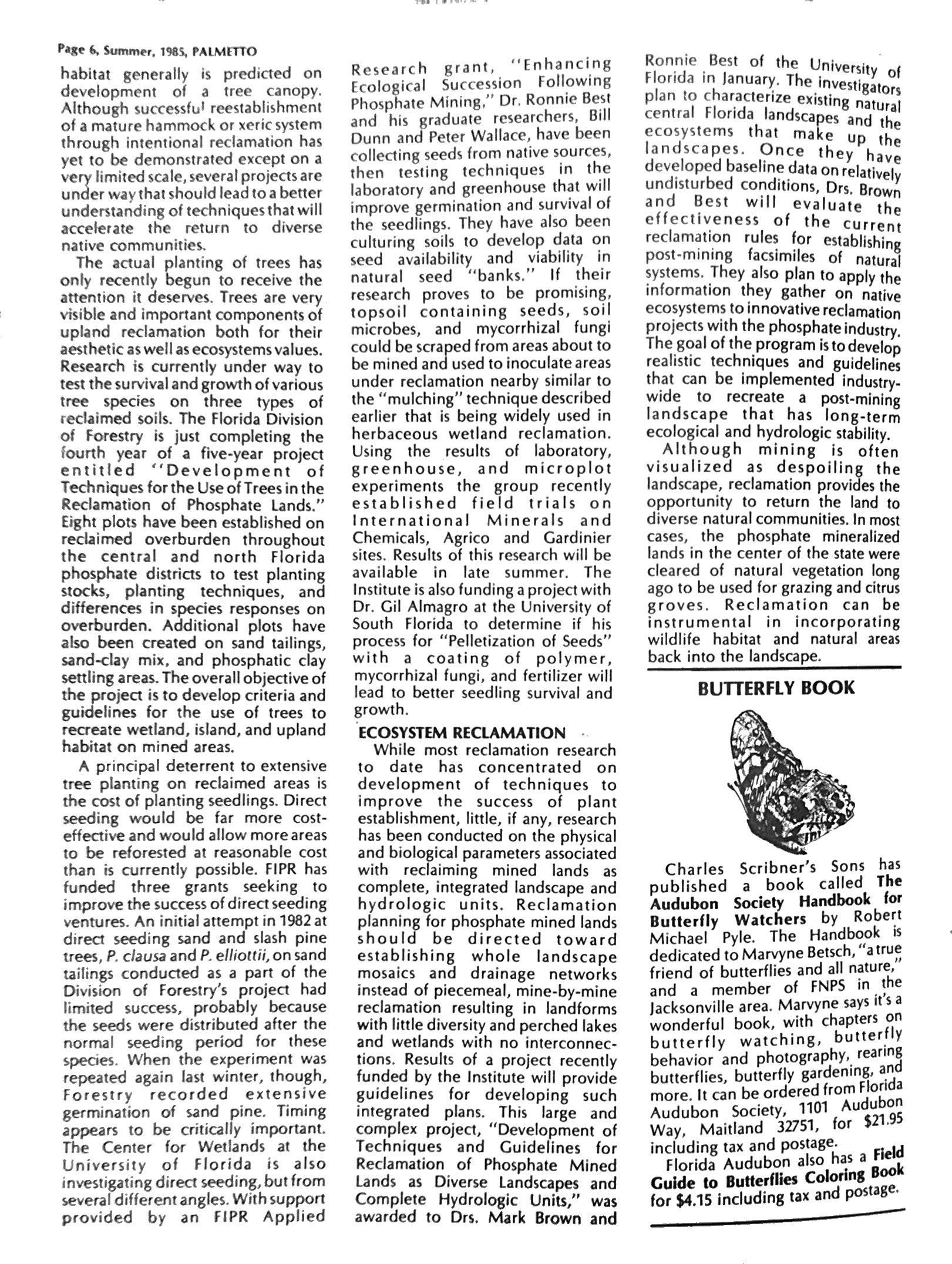
Charles Scribner's Sons has published a book called The Audubon Society Handbook for Butterfly Watchers by Robert Michael Pyle. The Handbook is dedicated to Marvyne Betsch, "a true friend of butterflies and all nature, and a member of FPS inthe Jacksonville area. Marvyne says it's a wonderful book, with chapters on butterfly watching, butterfly behavior and photography, rearing butterflies, butterfly gardening, and more. It can be ordered from Florida Audubon Society, 1101 Audubon Way, Maitland 32751, for $21.95 including tax and postage.
Florida Audubon also has a Field Guide to Butterflies Coloring Book for $4.15 including tax and postage.
THE FLORIDA NATIVE PLANT COOPERATIVE
What Is A Florida Native Plant Cooperative?
This is to inform the directors and members of the Florida Native Plant Society of the nature and purpose of a new organization that would be known as the Florida Native Plant Cooperative. Chapter 618, Florida Statutes, provides for the formation of agricultural cooperatives, which enable members to join together for mutual help, joint purchasing and marketing, and other group activities.
The foremost feature of such cooperatives is membership control. This means cooperative members who use services control the organization, instead of investor stockholders. Cooperative membership or ownership of common stock is limited to persons "engaged in the production of agricultural products" qualifying cooperative associations composed of such persons.
Applying this statutory principle, membership in or common stock ownership of the proposed Florida Native Plant Cooperative would be limited to those members of the Florida Native Plant Society or any other persons (individual or corporate) who are actively engaged in the production of Florida native plant materials.
Any nativeplant nursery owner or tree farmer in Florida who would like to see an increased demand and better prices for his products should consider joining the cooperative.
Why is a Florida Native Plant Cooperative necessary? By all reports, the production and sale of Florida native plant materials is undercapitalized, under-cut by intra-producer price competition), under-priced, under-utilized and generally misunderstood! Byforming cooperative, producers of Florida native plant materials would be able to set prices for their cooperative members products;obtain financingfrom the South Carolina-based Columbia Bank for Cooperatives for production credit loans, land banking,
of native plant stock, grading them by quality, market demand, etc.; and develop exclusive sales and marketing agreements for cooperative pool members.
How will a Florida Native Plant Cooperative relate to the Florida Native Plant Society? Like most non-profit entities, the Florida Native Plant Society is sorely in need of a consistent, dependable source of funding. By contractor other written agreement,the Cooperative could pledge to provide the FPS with a specific amount of funding, e.g., $75,000 per year, in exchange for the use of the FNPS newsletter (The Palmetto) to educate FNPS members and Palmetto subscribers to the goals and purposes of the Cooperative, current activities, etc. Thus, a clear distinction could be made between the business-oriented activities of the cooperative and the educational functions of the FNPS
Mr. Ralph Brown of the Florida Department of Agriculture's Division of Plant Industry; Ms.
Vicki Tschinkel, Secretary of the Florida Department of Environmental Regulation; and Dr. John DeGrove, Secretary of the Florida Department of Community Affairs and widely regarded as our State's "guru of growth management," without exception, were enthusiastic about the cooperative's prospects.
Terry Mock, Dex Bender, John Cauthen, and Dennis Koehler met with them to obtain comment, criticism, and endorsement for the Florida Native Plant Cooperative from key State officials; to identify possible cooperative funding sources; to encourage State officials to require the use of native plant materials in State construction projects; and to identify potential legal vehicles (e.g., the Native Flora of Florida Law,the Local Government Comprehensive Planning Act)for mandating/encouragingthe use of Florida native vegetation in all new land developments.
Ralph Brown, a horticulturist and FNPS member, principal author of the "Preservation of Native Flora" bill sponsored by former Senate President and nurseryman, Kurt Petersen. Brown said,"Native plants are in the public interest."His bill, which was approved by both houses of the Legislature (including the Senate on May 31) during the just-concluded 1985 Session, amends Chapter 581, Florida Statutes to: "prevent the wanton exploitation or destruction of native plant populations, rotect native unlawful harvesting on both public and privately owned lands and encourage the propagation of native species of flora."
Brown urged the establishment of a cooperative to ensure future supplies of native plant materials, suggesting that Department of Agriculture-administered, "fee-based trust funds" or Federal endangered species grant monies "might be made available to the coop." He suggested that existing nurseries could support the development of non-profitable native stock through sales of exotic materials, building native supplies for the future. He argued that landscape architects "must start pushing native materials, like cypress."
Vicki Tschinkel declared that the cooperative "is a terrific idea," suggesting a series of possible State actions to encourage or require the development of a market for native plant materials, including:
? requiring native vegetation in Water Management District-sponsored environmental restoration andenhancement programs (e.g., the Kissimmee River and St. Johns River projects)
? adding native plant requirements to State agency functional plans (e.g., Department of Natural Resources' parkelements, Department of Transportation park bench, roadside rest area landscaping programs)
? getting nativevegetation "buzzwords" inserted into local government comprehensive plans, through the Department of Community Affairs
? establishing State-sponsored public education displays, in such locations as the halls of the State Capitol.
Dr. John DeGrove declared that he is "totally devoted, committed, and in support of" the native plant cooperative concept. He suggested that his agency, which under the State's 1985 growth management legislation received significantlyexpanded powers to direct regional and local government planning efforts, could include native plant requirements as a new State planning agency review criterion.
Dr. DeGrove recommended that we identify "policy framework language" in the new State Comprehensive Plan that could be used to develop DCA rules containing native plant incentives or requirements. By reflecting such provisions in comprehensive regional policy plans, all ofFlorida's 400-plus local governments would be forced to adopt consistent local development regulations. Although Dr. DeGrove noted that this process "might take as long as ten years to implement," he pledged his support at the State level.
At the scheduled July 13th meeting of the Board of Directors of the Florida Native Plant Society, the following actions should be recommended:
1. That a "core group" of potential cooperative leaders be identified, and asked to develop a proposed set of cooperative goals and policies, including a
2. That authority be granted to produce a draft set of legal documents creating a Florida Native Plant Cooperative, to be presented for consideration and action at the next quarterly FPS Board Meeting.
3. That legal counsel be retained to draft all
incorporating the cooperative proposal. That the core group of cooperative leaders be authorized to work with the Florida of Community proposed DCA rules requiring regional agencies and local governments to incorporate native plant requirements into their comprehensive plans.
That members of the FPS who are "actively engaged in the production of native plant materials" be solicited to become members of and form the first Board of Directors for such a proposed cooperative.
The time has come for the producers of Florida native plant materials to actively and aggressively promote the use of their products by landscape architects, developers,and governmental entities throughout the State. The Florida Native Plant Cooperative provides an ideal vehicle for this type of promotion, sales and marketing activity
The Florida Native Plant Society should authorize and endorse efforts to establish a Florida Native Plant Cooperative.
? Dennis P. Koehler
FIFTH ANNUAL FLORIDA NATIVE
by Georgia Tasker
(Georgia Tasker wrote about the Florida Native Plant Society Conference at Rollins for the Miami Herald. With their permission, here are some excerpts.)
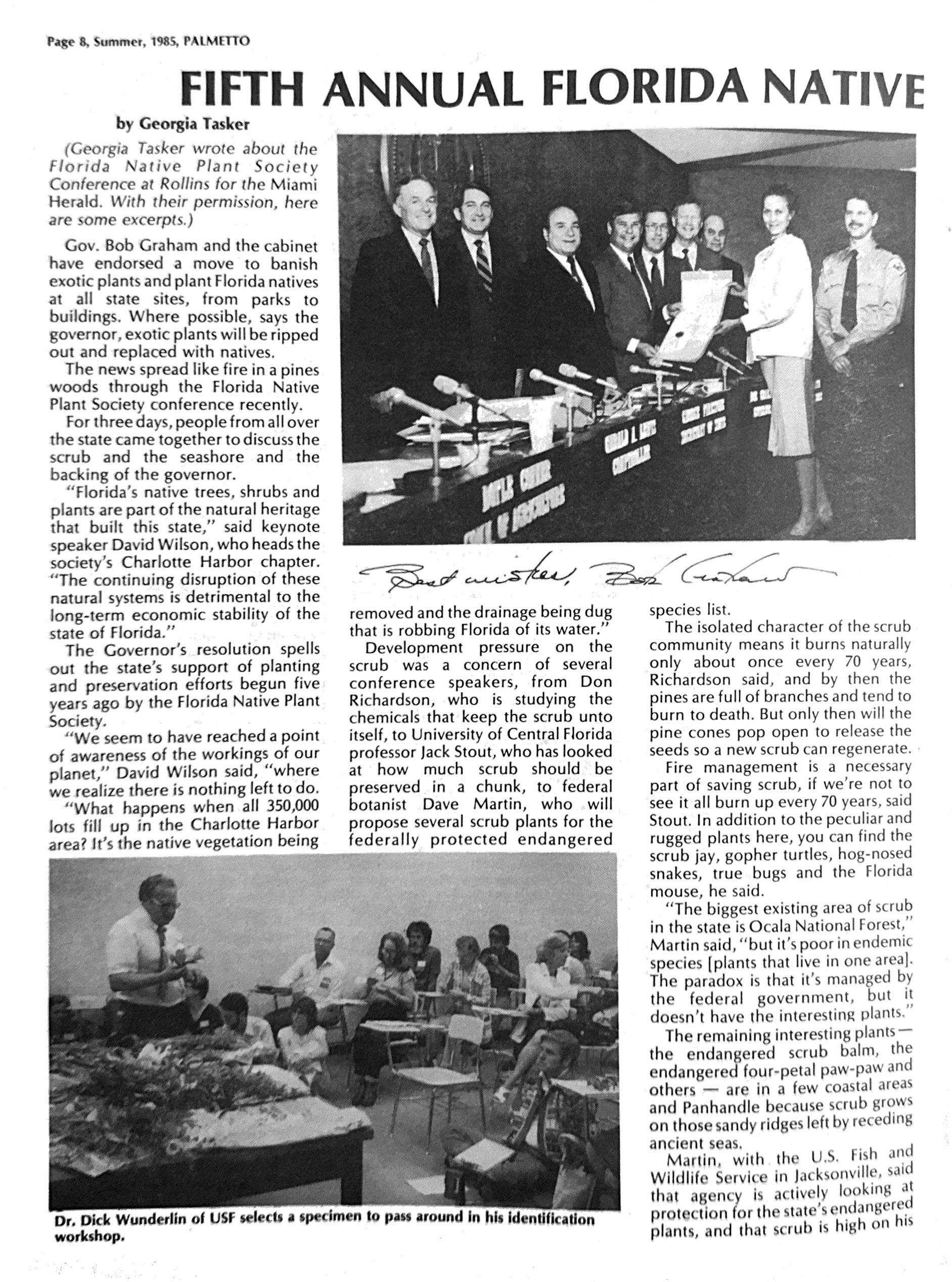
Gov. Bob Graham and the cabinet have endorsed a move to banish exotic plants and plant Florida natives at all state sites, from parks to buildings. Where possible, says the governor, exotic plants will be ripped out and replaced with natives.
The news spread like fire in a pines woods through the Florida Native Plant Society conference recently.
For three days, people from all over the state came together to discuss the scrub and the seashore and the backing of the governor.
"Florida's native trees, shrubs and plants are part of the natural heritage that built this state," said keynote speaker David Wilson, who heads the society's Charlotte Harbor chapter. "The continuing disruption of these natural systems is detrimental to the long-term economic stability of the state of Florida.
The Governor's resolution spells out the state's support of planting and preservation efforts begun five years ago by the Florida Native Plant Society.
"We seem to have reached a point of awareness of the workings of our planet," David Wilson said, we realize there is nothing left to do.
"What happens when all 350,000 lots fill up in the Charlotte Harbor area? It's the native vegetation being
Band misker
removed and the drainage being dug that is robbing Florida of its water.'
Development pressure on the scrub was a concern of several conference speakers, from Don Richardson, who isstudying the chemicals that keep the scrub unto itself, to University of Central Florida professor Jack Stout, who has looked at how much scrub should be preserved in a chunk, to federal botanist Dave Martin, who will propose several scrub plants for the federally protected endangered
species list.
The isolated character of the scrub community means it burns naturally only about once every 70 years, Richardson said, and by then the pines are full of branches and tend to burn to death. But only then will the pine cones pop open to release the seeds so a new scrub can regenerate.
Fire management is a necessary part of saving scrub, if we're not to see it all burn up every 70 years, said Stout. In addition to the peculiar and rugged plants here, you can find the scrub jay, gopher turtles, hog-nosed snakes, true bugs and the Florida mouse, he said.
"The biggest existing area of scrub in the state is Ocala National Forest," Martin said, "but it's poor in endemic species [plants that live in one area. The paradox is that it's managed by the federalgovernment, but it doesn't have the interesting plants."
The remaining interesting plantsthe endangered scrub balm, the endangered four-petal paw-paw and others - are in a few coastal areas and Panhandle because scrub grows on those sandy ridges left by receding ancient seas.
Martin, with the U.S. Fish and Wildlife Service in Jacksonville, said that agency is actively looking at protection for the state's endangered plants, and that scrub is high on his
Dr. Dick Wunderlin of USF selects a specimen to pass around in his identification workshop.
PLANT SOCIETY CONFERENCE
list.
While there are only five federally listed endangered plants in FloridaKey tree cactus, Cereus robinii; Lakela's mint, Dicerandra immaculata; Harper's beauty, Harperocallis flava; Chapman's rhododendron, Rhododendron chapmanii; Florida torreya, Torreya taxifolia ? there are about 100 on the proposed list.
The state is updating a 1979 law regarding plant protection. Called the Preservation of Native Flora of Florida law, the revision is now before the legislature
Dennis Hardin, a staff botanist for The Florida Natural Areas Inventory, said the proposed law revision lists 129 species of plants endangered in Florida; 77 kinds of plants listed as threatened (including all native orchids, ferns, palms and bromeliads); 9 species as commercially exploited, including silver and needle palms, coontie, royal fern, and two native bromeliads.
And while the law should be supported - "Write everyone [in Tallahassee] if you support it." ? it is "mostly gums and no teeth," Hardin said
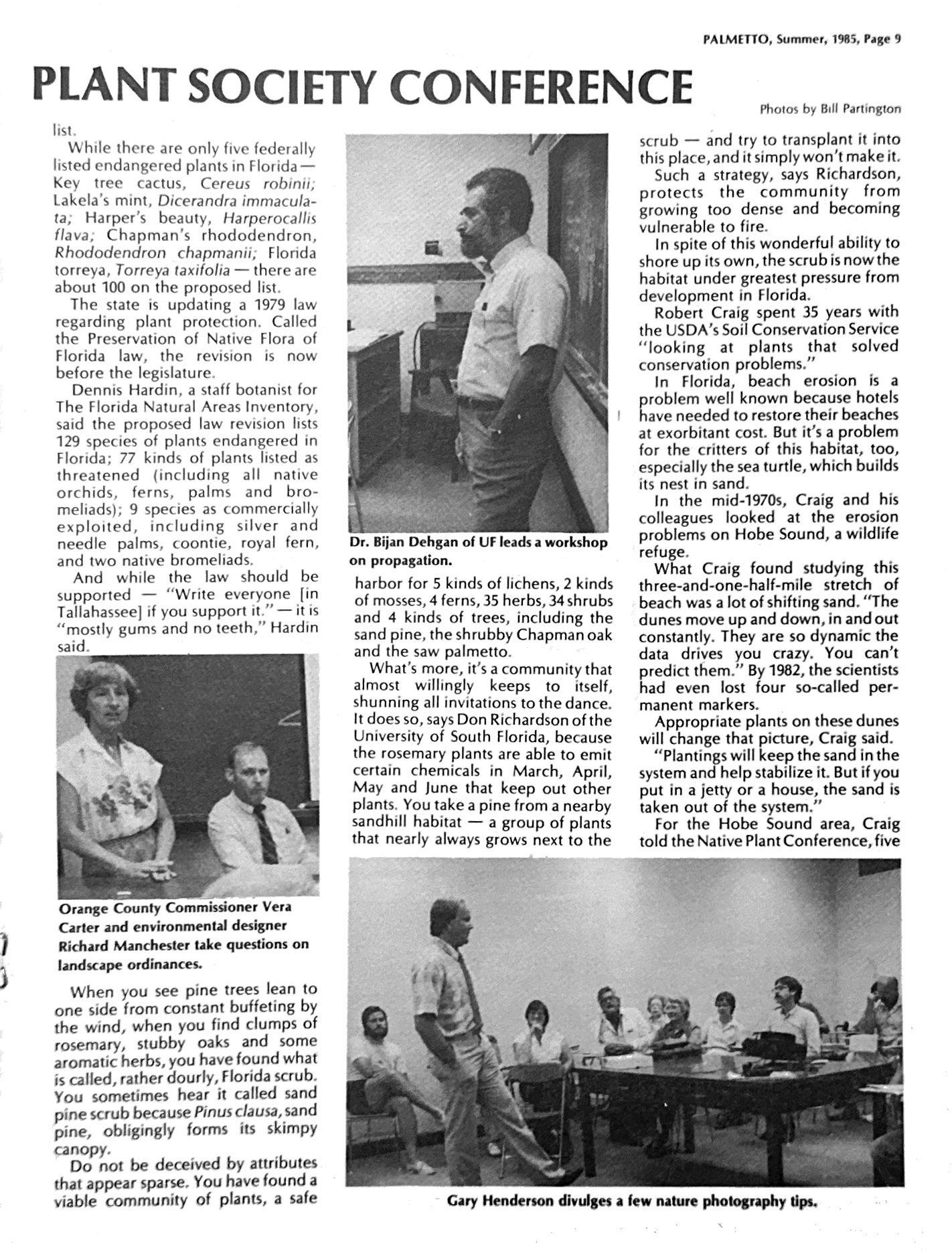
Orange County Commissioner Vera Carter and environmental designer Richard Manchester take questions on landscape ordinances.
When you see pine trees lean to one side from constant butteting by the wind, when you find clumps of rosemary, stubby oaks and some aromatic herbs, you have found what is called, rather dourly, Florida scrub. You sometimes hear it called sand pine scrub because Pinus clausa, sand pine, obligingly forms its skimpy canopy.
Do not be deceived by attributes that appear sparse. You have found a viable community of plants, a safe
Dr. Bijan Dehgan of UF leads a workshop on propagation.
harbor for 5 kinds of lichens, 2 kinds of mosses, 4 ferns, 35 herbs, 34 shrubs and 4 kinds of trees, including the sand pine, the shrubby Chapman oak and the saw palmetto.
What's more, it's a community that almost willingly keeps to itself, shunning all invitations to the dance It does so, says Don Richardson of the University of South Florida, because the rosemary plants are able to emit certain chemicals in March, April, May and June that keep out other plants. You take a pine from a nearby sandhill habitat ? a group of plants that nearly always grows next to the
by Bill Partington
scrub - and try to transplant it into this place, and it simply won't make it
Such a strategy, says Richardson, protects the community from growing too dense and becoming vulnerable to fire.
In spite of this wonderful ability to shore up its own, the scrub is now the habitat under greatest pressure from development in Florida.
Robert Craig spent 35 years with the USDA's Soil Conservation Service "lookingat plants that solved conservation problems."
In Florida, beach erosion is a problem well known because hotel have needed to restore their beaches at exorbitant cost. But it's a problem for the critters of this habitat, too, especially the sea turtle, which builds its nest in sand
In the mid-1970s, Craig and his colleagues looked at the erosion problems on Hobe Sound, a wildlife refuge.
What Craig found studying this three-and-one-half-mile stretch of beach was a lot of shifting sand. "The dunes move up and down, in and out constantly. They are so dynamic the data drives you crazy. You cant predict them." By 1982, the scientists had even lost four so-called permanent markers.
Appropriate plants on these dunes will change that picture, Craig said.
"Plantings will keep the sand in the system and help stabilize it. But if you put in a jetty or a house, the sand is taken out of the system."
For the Hobe Sound area, Craig told the Native Plant Conference, five
Photos
Gary Henderson divulges a few nature photography tips.
Page 10, Summer, 1985, PALMETTO are especially important.
Those five - pioneer plants - are sea oats, a grass called bitter panicum, cucumber-leaf, sunflower, another creeping grass called seashore paspalum, and saltmeadow (or marsh lay cordgrass
What's more, the plants for dunes don't require fertilizing after they're established and some even do poorly with too much care (sea oats hate mollycoddling and come down with fungus).
Yet, most coastal dune plants don't produce much viable seed; they spread on runners. Once trampled, they will not regenerate, Craig said.
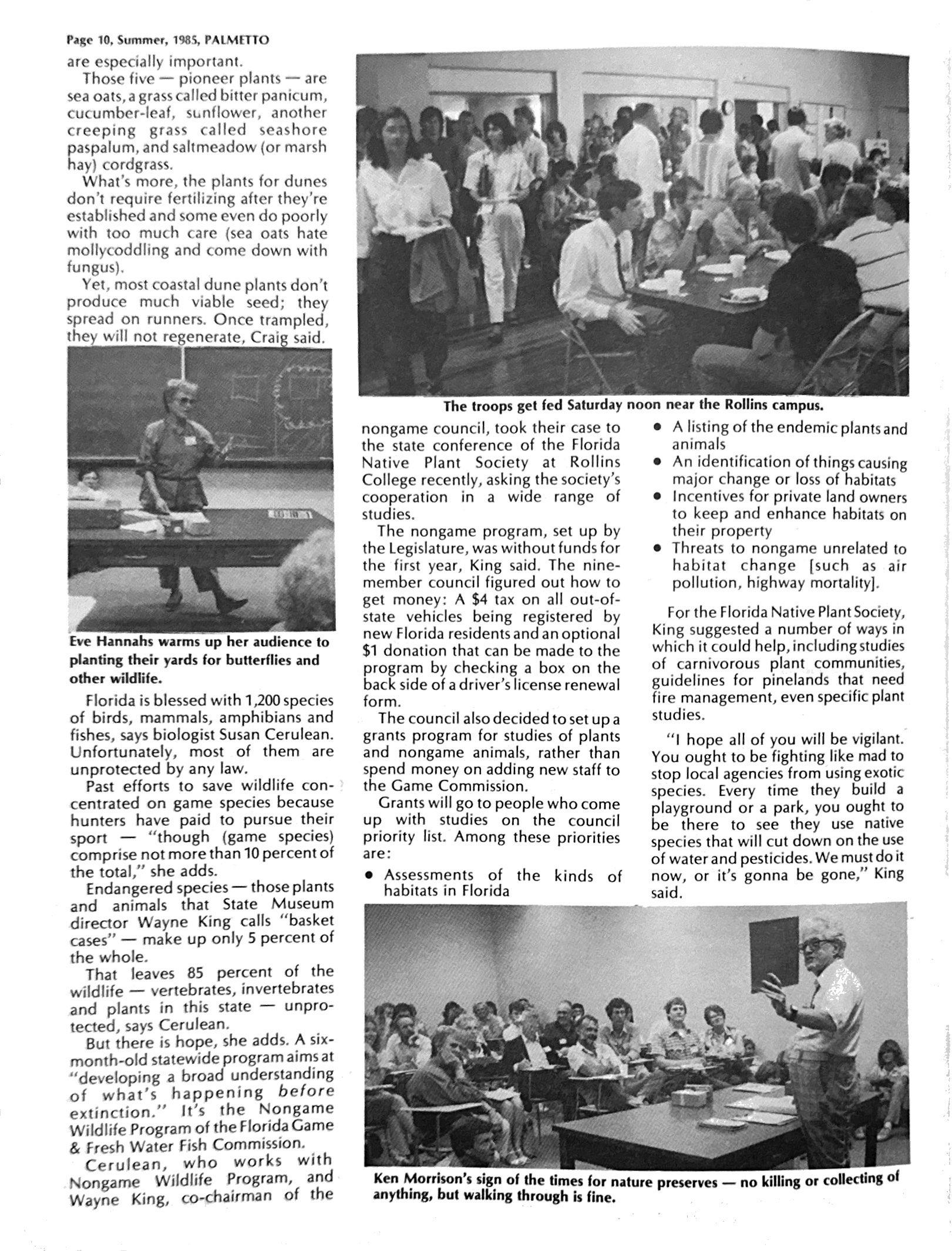
Eve Hannahs warms up her audience to planting their yards for butterflies and other wildlife.
Florida is blessed with 1,200 species of birds, mammals, amphibians and fishes, says biologist Susan Cerulean. Unfortunately, most of them are unprotected by any law.
Past efforts to save wildlife concentrated on game species because hunters have paid to pursue their sport - "though (game species) comprise not more than 10 percent of the total," she adds.
Endangered species - those plants and animals that State Museum director Wayne King calls "basket cases" - make up only 5 percent of the whole.
That leaves 85 percent of the wildlife - vertebrates, invertebrates and plants in this state - unprotected, says Cerulean.
But there is hope, she adds. A sixmonth-old statewide program aims at "developing a broad understanding of what's happening before extinction." It's the Nongame Wildlife Program of the Florida Game & Fresh Water Fish Commission.
Cerulean, who workswith Nongame Wildlife Program, and Wayne King, co-chairman of the
The troops get fed Saturday noon near the Rollins campus. nongame council, took their case to ? A listing of the endemic plants and the state conference of the Florida animals
Native Plant Society at Rollins ? An identification of things causing College recently, asking the society's major change or loss of habitats cooperation in a wide range of ? Incentives for private land owners to keep and enhance habitats on
The nongame program, set up by the Legislature, was without funds for the first year, King said. The ninemember council figured out how to get money: A $4 tax on all out-ofstate vehicles being registered by new Florida residents and an optional $1 donation that can be made to the program by checking a box on the back side of a driver's license renewal
The council also decided to set up a grants program for studies of plants and nongame animals, rather than spend money on adding new staff to the Game Commission.
Grants will go to people who come up with studies on the council priority list. Among these priorities are:
their property ? Threats to nongame unrelated to habitat change [such asair pollution, highway mortality].
For the Florida Native Plant Society, King suggested a number of ways in which it could help, including studies of carnivorous plant communities, guidelines for pinelands that need fire management, even specific plant
? Assessments of the kinds of habitats in Florida studies.
"I hope all of you will be vigilant. You ought to be fighting like mad to stop local agencies from using exotic species. Every time they build a playground or a park, you ought to be there to see they use native species that will cut down on the use of water and pesticides. We must do it now, or it's gonna be gone," King
Ken Morrison's sign of the times for nature preserves - no killing or collecting of anything, but walking through is fine.
FIRST ANNUAL PHOTOGRAPHY CONTEST
The First Annual Native Plant Photography Contest was held in conjunction with the Annual Conference at Winter Park. The following landscape architectural firms donated prize money for the contest: Wallis Baker & Associates; Ronald C. Dale; Foster, Conant & Associates, Inc., landscape architects; Green Images Nursery, and Kerry Blind & Associates. winners were announced at the Saturday evening banquet. Winners in the color prints category were: first and second place, Dille Freeman, Boca Raton; third place, Linda Schmid, Orlando. In the color slides category: first, Steven Pategas, Kissimmee; second, Earnest Wilson, Ettrick, third, Mary Keim, Orlando. Steven Pategas won best of show for his slide of a burnt palmetto frond. We would like to thank all those who sent in the many fine entries, and we hope that there will be increased participation next year.
? Paul M. Davis Contest Chairperson
Wild Things-
The Return of Native Plants, by Georgia Tasker and Stephanie True Moss, describes the trees, shrubs, and ground covers that you can plant around your South Florida home. WILD THINGS tells you ? what they look like: their leaves, flowers, and fruit ? where they grow ? how much space they need.
By choosing native plants adapted to your own yard, you can nearly eliminate: ? watering ? spraying ? fertilizing ? replanting after a freeze.
Recreate a natural area, invite birds and butterflies to your yard replant with Florida native plants WILD THINGS will tell you what, and where, and how! WILD THINGS will make you enthusiastic about native plants! WILD THINGS will inspire you to grow native!
This soft-cover book, published by the Florida Native Plant Society, is illustrated with 32 pages of full-color artwork, 25 pages of black-and-white. $5.00 plus $1.00 postage. Order from Florida Native Plant Society, 1203 Orange Avenue, Winter Park, Florida 32789.
A FLORIDA STATE GRASS?
The Florida Section of the Society requesting that it be published in The for Range Management, co-chaired Palmetto, since range management is by grasses expert Lew Yarlett, passed a scienceof managing native the following resolution at their vegetation, particularly native recent meeting at Tall Timbers, grasses.
Whereas it appears that a majority of the states of the United States of America having significant rangeland area have by legislative enactment chosen a particular grass to be
Whereas the State of Florida has significant land area classified as rangeland; and
Whereas Florida's rangelands play a vital part in the quality of life and welfare of all Floridians; and
Whereas rangelands enhance water quality, and provide wildlife habitat, forage resources, and natural landscape beauty; and
Whereas the State of Florida has yet to define native grass as Florida's state grass; therefore
Be it resolved that the Society for Range Management, Florida Section, submit Lopsided Indiangrass, "wildoats," Sorghastrum secundum, as a worthy candidate, and urge the Florida legislature to act on said grass such that it may be known as Florida's State Grass.
Identification
LopsidedIndiangrass, Sorghastrum "wildoats" by many ranchers. A warm season perennial bunchgrass, readily recognized in September and October by the golden brown panicle with seed appearing on one side. Seed stalks 3-6 feet tall. Base of culms felty-pubescent. Ligule a to 1/2" long, pointed Blades flat 1/4" to 1/2" wide, 12" to 24" long. Sheaths rounded. Another species, Sorghastrum nutans, with long rhizomes,
Distribution and Site Adaptation
Lopsided Indiangrass is distributed throughout Florida, Southern Alabama, Georgia and South Carolina. It is part of the total plant community in North and South Florida flatwoods, cabbage palm flatwoods, longleaf pine-turkey oak hills, mixed hardwood and pine hammocks, and upland hardwood hammocks.
8 × 10" $4.00; 11 x 14" $6.00 T-shirts--All Sizes $7.00
Send your order to: FPS, 1203 Orange Ave. Winter Park 32789.
"The Roving Roach" Matted Prints
LAKELA'S MINT NOW PROTECTED
The U.S. Fish and Wildlife Service recently determined Lakela's mint, Dicerandra immaculata, a small plant found in Indian River and St. Lucie counties, Florida, to be an endangered species. This action was taken in accord with the Endangered Species Act of 1973, as amended. A copy of the final regulation was published inthe May 15, 1985, Federal Register.
Dicerandra immaculata (Lakela's mint) is a low-growing dome-shaped shrub of the mint family (Lamiaceae). The plants reach 15 inches in height, and bear erect flowers in small cymes at the tips of the stems. The spotless, lavender-rose to purplish white) petals of the flower separate Dicerandra immaculata from other species of this genus occurring in the United States. Dicerandra immaculata was described by Lakela (1963) based collected in southern Indian River County, Florida, in 1962. The species is restricted to coastal sand pine scrub vegetation in Indian River and St. Lucie counties. Florida sand scrub habitats are found on relict dunes along former shorelines. The soils consist of highly drained, sterile
In Dicerandra immaculata habitat, sand pine, Pinus clausa, forms an overstory, while oaks, Quercus geminata, Q. virginiana, and Q
myrtifolia, form an understory. Other small trees or shrubs found in this plant community include scrub hickory, Carya floridana, cabbage palm, Sabal palmetto, saw palmetto, Serenoa repens, hog plum, Ximenia americana, and tough bumelia, Bumelia tenax. Epiphytes, Tillandsia fasciculata and T. recurvata, are present. Dicerandra immaculata is one of the rarest plants known from the sand scrub community type. Rare animals found Dicerandra immaculata include the Florida scrub jay, Aphelocoma c. coerulescens, and the scrub lizard, Sceloporus woodi. The Florida scrub jay is considered a threatened species by the State of Florida; the scrub lizard is considered rare by the Florida Committee on Rare and Endangered Plants and Animals. Only nine remaining sitesof Dicerandra immaculata are known. They occur in an area 1/2 mile wide by 3 miles long between the cities of Vero Beach and Fort Pierce. The plants occur in the vicinity of four small sandhills with an elevation over 45 feet, representing ancient coastal dunes. Dicerandra immaculata occurs on soil series of the Astatula, Paola, and St. Lucie sands. All known colonies occur on private property. The continued existence of this species is threatened by sand mining, commercial and residential development, and a
Nancy J. Abel, Horticulturist
William F. Bissett, Landscape Architect P.O. Box 1797
Winter Haven, Florida 33880 Phone: (813) 324-3999
fungal disease affecting the seeds. Lakela's mint will now receive the full protection of the Endangered Species Act, including prohibitions on import, export, commerce, and removal from areas under Federal jurisdiction. The Service will also develop a recovery plan for this species. Should you have questions concerning this matter, contact Mr. David Martinor Dr. Michael Bentzien at 904/791-2580, or write Endangered Species Field Station, 2747 Art Museum Dr., Jacksonville, FL 32207.
? David J. Wesley Field Supervisor
DAVID DRYLIE LANDSCAPE ARCHITECTURE PLANTING DESIGN AND ENVIRONMENTAL CONSULTATION
DAVID DRYLIE, ASLA
8100 CURRY FORD ROAD
ORLANDO, FLORIDA 32822
PHONE: (305) 282-1469
SOCIETY BUSINESS
the bias underlying the plan, CONSERVATION distinctly different longleaf and slash
I am proud to be able to serve FNPS pine community types are as chairperson of the conservation everywhere lumped together as committee. I will do my best to "yellow pine," thus obscuring the maintain the fine tradition of active conservation value of remnant and intelligent letter-writing set by longleaf sites. previous chairperson Jane Brooks. My letter to the Forest Service Writing letters to bureaucrats and suggested that the most important politicians on behalt of conservation role of a national forest in a is not the most mirthtul way to spend deteriorating regional landscape one's evenings. Letters can influence might be (1) to restore and maintain policy, however, and we in FPS large-scale ecological diversity represent an informed citizenry with characteristic of the region, and (2) to a legitimate concern about how provide for the public what other native plant species and communities lands in the region do not. As we all are conserved in Florida. This know, the natural landscapes of concern must be expressed to policy- deteriorating rapidly. Furthermore, private industry forests
My first action as conservation produce some 96% of the wood chairperson was to write a five-page products derived from Florida soils. letter to the U.S. Forest Service At present levels of demand, and into Supervisor in Tallahassee, com- the foreseeable future, the national menting on the very critical Land and forests of Florida are not needed for Resource Management Plan for the pulpwood production. They are National Forests in Florida. The plan, needed, however, to preserve native which sets forest management diversity. They are probably the only direction for up to 50 years, is a land holdings in north and central disaster for native ecosystems. Florida that are large enough to
As with the forest plans prepared constitute whole ecosystems. This so far for other states, the Florida plan conservation function of national emphasizesproduction with its many attendant and other "hard com- benefits, is totally ignored by the modities." Other uses and functions Forest Service. are accommodated only when they all management do not interfere with production. Significantly, this emphasis on commodity production is not in the spirit of the law that management of the national forests, which mandates multiple-use and an ecosystem level of focus.
The Draft Environmental Impact Statement that accompanies the forest plan describes nine "alternative" courses of action. The plan itself is an in-depth description of the "preferred alternative." One might assume that the alternatives would together represent a spectrum from preservation to intensive utilization of resources, and the "preferred alternative" might be a compromise of conflicting uses and purposes. Wrong. In fact, all nine alternatives assume a business-asusual silvicultural approach to forest management, which means evenaged management, clear-cutting, intensive site preparation (destroying natural ground cover), and artificial regeneration (tree-farming). None of the alternatives is oriented toward restoring or maintaining natural ecosystem integrity. As an example of
inappropriate planning models and assumptions, I recommend that the Forest Service go back to the drawing board. Although they are unlikely to, do this, in all probability the plan will face major lawsuits from conserva-. tion groups, as has every other management plan the Forest Service has issued recently.
I ended on the positive note that FNPS would be very supportive of a proposal presently being considered by the Florida Panther Technical Advisory Council, in connection with reintroduction of panthers into national forests. This plan would also benefit native plant species and communities by restoring ecological processes, closing many roads, maintaining habitat corridors, and managing much of each forest as inviolable wilderness. Let us hope for the best.
The comment period for the forest plan ended June 13, so it is too late for any of you to comment individually. I urge all of you with conservation concerns relevant to FNPS to contact me, and take an active part in the
PALMETTO, Summer, 1985, Page 13 conservation committee. If it is an urgent matter, give me a call. Our society can be an important voice for conservation of native Florida.
? Reed F. Noss Conservation
Chairperson
EDUCATION/LEGISLATION
The Governor and Cabinet signed a Resolutionon April 4, 1985, declaring April as native plant month in Florida. In addition, the Resolution stated strong support for increasing the percentage of native plants in landscaping of all state properties. This goal is to be achieved by:
? utilizing existing native plant communities when possible ? incorporating native plant species when existing native material is absent or insufficient for landscaping
? replacingexisting non-native landscape material at established sites with native landscape material when feasible.
The Department of General Services and other responsible parties are eager to begin fulfilling the intent of the Resolution, but we must supply a list of regional native plant species suitable for andscaping. Please send your lists to the Landscaping chairperson (see Board of Directors inside front cover) and include information on preferred growing conditions (e.g., wet, moist, dry; full sun, partial sun, shade; etc.). The Landscape Committee will then put this information into a uniform format and forward it to me to be routed to all the necessary parties.
The state is ready; let's not keep them waiting! I would like to be able to present our initial list to state representatives this fall.
? Sydney Brinson
CHAPTER NEWS
MAGNOLIA (North Florida)
The Magnolia Chapter was pleased that the Leon County Commissioners signed our proposed Resolution declaring April as Native Plant Month for the county and committing the county to incorporating a greater percentage of native plants into the landscaping of county-owned properties. The Tallahassee city commissioners signed a similar proclamation.
We presented our first annual community awards at a joint picnic
Page 14, Summer, 1985, PALMETTO with local chapters of Audubon, Sierra Club, and Tree Watch. Recipients of our 1985 awards were: Al and Gunilla Trull for "Oaks and Offices" in the category of "Utilizing native plant material in the landscaping of a commercial project in Leon County, FL"; and Mad Dog Design and Construction for "Blair Stone Forest" in the category of "Incorporating design and construction into existing natural surroundings in Leon Florida. " Mahogany plaques bearing our chapter logo were presented. We encourage all local chapters to begin a community awards program; we feel this positive approach provides much incentive to the business community. We will gladly forward copies of our plaques to any interested chapter.
1 was invited to speak to the Georgia Conservancy (all expenses paid) on the topic of Wild Edibles, as Ila Hernandez moved out of Florida. The group of approximately thirty Georgians were very enthusiastic about the slide presentation and contributed some valuable knowledge about wild edibles that I now incorporated into the presentation. Also, I led my first for wild edibles at local historic Pisgah Church grounds and agreed to give a presentation and forage for the annual fall meeting of YMCA Indian Princesses. A local radio station has also contacted me regarding airing a special program on wild edibles in the near future. la built quite an interest in wild edibles in the year she was here!
Our first annual "Tour of Native Yards" was a huge success, thanks to the excellent planning and staffing by Donna Legare and Native Nurseries, and despite inclement weather.
Sale of our first chapter T-shirts is going well due to the magnificent artwork of Pat Elliott. Roz Holzer, with assistance from her daughter, Nicole, and Pat Elliott created impressive exhibit about our chapter and displayed it prominently in the Leon County library. The display, which will reside in the Junior Museum for the summer, has stimulated considerable interest in our
We are looking forward to adopting our Articles at the first meeting of the summer and, we hope,petitioningfor official chapterhood at the FPS board meeting on July 13.
We extend our gratitude to
departing Magnolia Chapter board members lla Hernandez, Pat Elliott, and Donna Legare, all of whom played instrumental roles in nurturing us during our infancy. Their positions will now be filled by Rozilyn Holzer, Gary Henry, and Keith McCarron.
? Sydney Brinson
DADE COUNTY
The Dade County Chapter has been active in urging the state CARL program to purchase Dade County hardwood hammocks. These have been listed number 4 on the purchase list.
Our meetings have been stressing landscape workshops and planting to attract wildlife for the homeowner and will continue to involve the community.
A series of field trips, stressing photography and landscape design with natives, has been started and is being coordinated by Don Gann.
Plans for our October conference are progressing and we hope to see our friends throughout the state at conference.
? Martin A. Roessler
SUNCOAST
The Suncoast Chapter is continuing to gather strength under past president John Beckner and current president Richard P. Wunderlin. The chapter now has ninety members and has recently adopted updated bylaws. Meetings are held on the third Wednesday of each month, 7:30 p.m. at Hillsborough Community College. The are cosponsored by Hillsborough Community College Environmental Studies program.
Activities of the chapter have utilized the wide knowledge of its members with special emphasis on educatingless knowledgeable members. programs have featured the Florida scrub, native ferns, ethnobotany of the Glades Indians and endangered plant communities of the panhandle region. In addition, a long-term restoration project at Picnic Island is beginning to show results. Field trips have included Archbold Biological Station, a canoe trip up the Hillsborough River, and visits to nearby county parks.
Plant displays at each meeting are a popular and educational feature. An unusual number of rare and endangered species have been displayed including such plants as
Oncidium bahamense,Blechnum occidentale, Spiranthes elata, Cyrtopodium punctatum and lonopsis utricularioides.
Three methods of raising funds have had growing success. The chapter, in conjunction with Central Florida Native Flora Nursery, has participated in the Tampa Bay Botanical Council shows and plant sales in local shopping malls. Also, monthly plant raffles have combined money-making and fun. In addition, sales of Checklist of the Vascular Plants of the Florida Suncoast, produced by the staft of University of South Florida's herbarium, have been another source of funds.
? Rita Lassiter
TITUSVILLE
The North Brevard area is starting an FNPS chapter. For more information, contact Barbara Beddingfield,, 2748 Nottingham Ct., Titusville 32796; 305/267-4262.
CENTRAL FLORIDA
What a great conference! Made possible largely by an exceptional organizing effort by nearly 25% of our chapter members. Hats off! Speaking of hats...we must sell one dozen"baseball" caps to each chapter to liquidate our stack. Chapters may order in one dozen lots for $4.50 each, resell for $6.00. Easy money. Tan with green FPS logo on front. Mike Mingea, 1203 Orange Ave., Winter Park 32789. Don't delay Monthly meetings and field trips will resume in September. Currently we are helping to plan a Big Tree contest in support of an Orange County tree protection ordinance Also planning programs and field trips for this fall and trying to broaden communciation with other chapters in Central Florida. Our wildflower committee is planning some collection trips this summer. Call for details (305/282-1469). Get involved; we need you.
? David Drylie
COCCOLOBA
Chapter meetings are on the first Wednesday of the month at the Nature Center of Lee County, Ortiz & Colonial roads, 7:00 p.m. in the IONA House.
Januaryand February found members involved in setting up a 20 x 40' realistic display at the Lee County Fair. The exhibit featured a backyard landscaped with native plants, complete with bridge over cypress
pond edge, paths through pines to a decked area with a barbeque, roofed shelter, and picnic table.
Necklace pod, pine, tamarind, sea grape,holly, silver andgreen buttonwood, wild coffee, cypress, wax myrtle, varnish leaf, coco-plum, a wide variety of ferns, gallberry, oak, coontie, juniper and bromeliads were among the plants used in the design. Forest Resource Inc. donated a truckload of melaleuca mulch to build up pathing to pot level.
The fair judges awarded this the tricolored ribbon for outstanding merit. Hundreds of visitors expressed interest in the exhibit. Many had lost exotic plants in the last freeze and were particularly impressed with the diversity of texture and color of the native plants. Interested persons were urged to attend meetings and become active members.
Tracy Ryan, director of the Cape Coral Native Plant Nursery, presented a slide program which
contrasted the use of native and exotic plants in landscaping at the Marchmeeting. Several pictures featured the Halloween look of the colorfully draped exotic plants on Cape Coral lawns during the recent freeze.
Future meetings will acquaint members with specific plant communities, and field trips will be conducted to local areas.
? Rosemary Fleming
| lants for Lomorrow
?Single - $12
? Family - $15
? Contributing - $25 Supporting - $50
? Donor - $100
? Patron - $500
ORGANIZATIONS
? Organizational - $50
? Donor - $100
? Patron - $500 up
(Corporate or organizational members may be granted permission to use the FPS logo in their promotional literature, but must have written notification of this permission
Sponsors that need to be invoiced, please notify FPS when convenient, or with next payment.
Page 16, Summer, 1985, PALMETTO
The Joy of Weeds
Florida's Wildflowers
by David Hall
COMMON SPIDERWORT
The attractive flowers, ease of propagation, and freedom from care makes Common Spiderwort a superior wildflower for landscaping.
Common Spiderwort, Tradescantia ohiensis Raf., is in the Spiderwort Family (Commelinaceae). Tradescantia was named for John Tradescant who was a gardener to Charles the First ofEngland. Ohiensis simply means "of Ohio." This species is commonly found from Massachusetts south into Florida and west to Manitoba in Canada, southwards through Minnesota and Nebraska into Texas. Within Florida, it is found as far south as Sarasota. This wildflower is most frequently found in disturbed areas such as roadsides, old fields, cut over woods, tree plantations, or weedy, moist turf. Often it is seen along the edges of woods or in openings. The moisture requirement for this plant is quite variable, ranging from very moist near lakes and ponds to fairly dry in pine woods.
Common Spiderwort is a perennial, herbaceous plant usually growing from 50-80 cm (about 32") tall, rarely reaching 1 m (3 ft.) in height. Unlike many other species in the Spiderwort Family, this plant does not creep or run along the ground. It grows erect from fleshy roots. The stems and leaves are smooth and covered with a thin gray, waxy coating. The plant is somewhat fleshy.. The leaves are up to 40 cm (about 16") long and usually not more
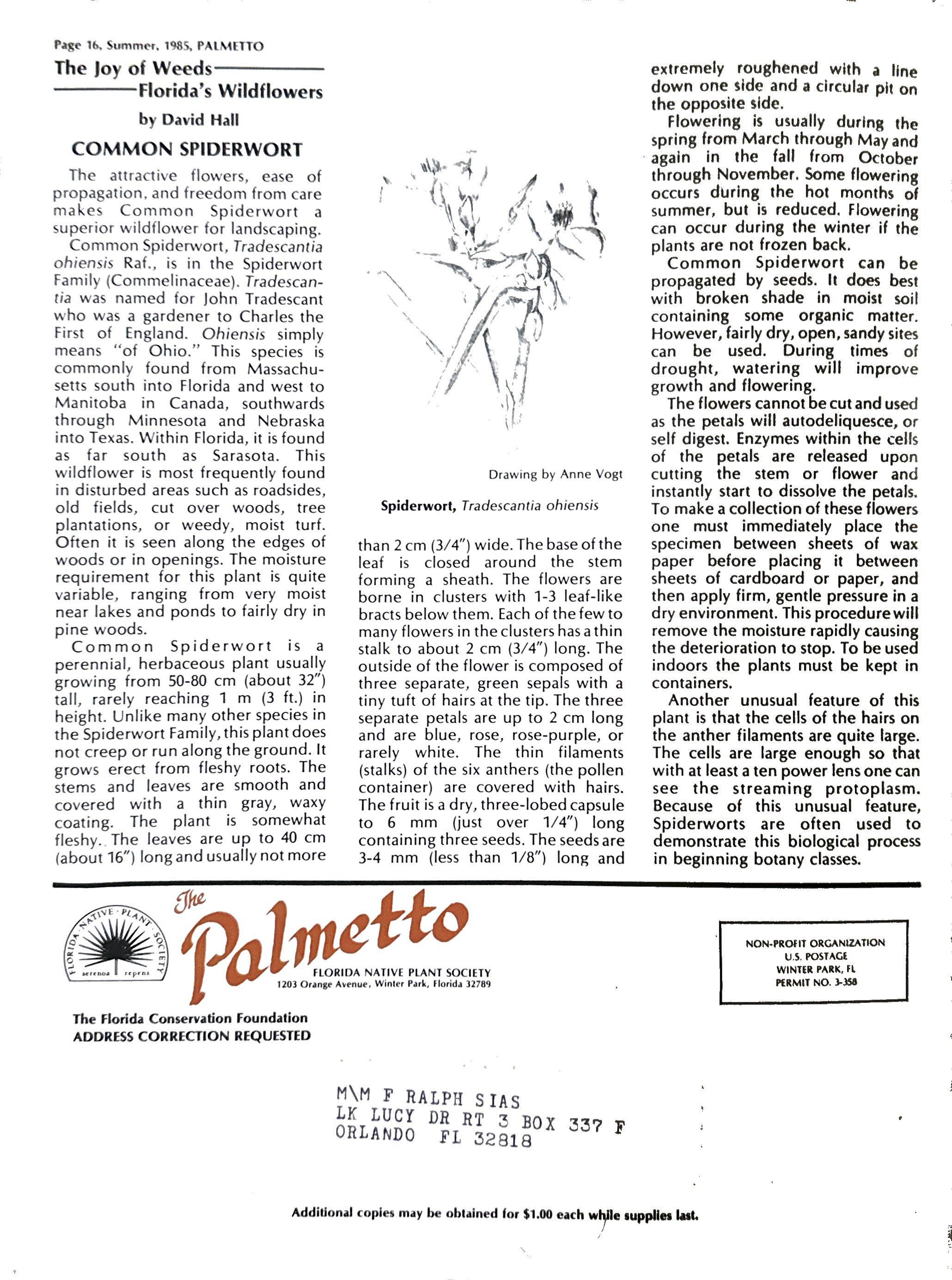
than 2 cm (3/4") wide. The base of the is closed around the forming a sheath. The flowers borne in clusters with 1-3 leaf-like bracts below them. Each of the few to many flowers in the clusters has a thin stalk to about 2 cm (3/4") long. The outside of the flower is composed of three separate, green sepals with a tiny tuft of hairs at the tip. The three separate petals are up to 2 cm long and are blue, rose, rose-purple, or rarely white. Thethin filaments (stalks) of the six anthers (the pollen container) are covered with hairs. The fruit is a dry, three-lobed capsule to 6 mm (just over 1/4")long containing three seeds. The seeds are 3-4 mm (less than 1/8") long and
extremely roughened with a line down one side and a circular pit on the opposite side.
Flowering is usually duringthe spring from March through May and again in the fall from October through November. Some flowering occurs during thehot months of summer, but is reduced. Flowering can occur during the winter if the plants are not frozen back.
Common Spiderwort can be propagated by seeds. It does best with broken shade in moist soil containing some organic matter. However, fairly dry, open, sandy sites can be used. During times of drought, watering will improve growth and flowering.
The flowers cannot be cut and used as the petals will autodeliquesce, or self digest. Enzymes within the cells of the petals are released upon stem or flower and instantly start to dissolve the petals. To make a collection of these flowers must immediately place the specimen between sheets of wax paper before placing it between sheets of cardboard or paper, and then apply firm, gentle pressure in a dry environment. This procedure will remove the moisture rapidly causing the deterioration to stop. To be used indoors the plants must be kept in containers.
Another unusual feature of this plant is that the cells of the hairs on the anther filaments are quite large. The cells are large enough so that with at least a ten power lens one can see the streaming protoplasm. Because of this unusual feature, Spiderworts are oftenused to demonstrate this biological process in beginning botany classes.
Drawing by Anne Vogt
Spiderwort, Tradescantia ohiensis
serena