serenoa epens
VOLUME 5, NUMBER 1
FLORIDA NATIVE PLANT SOCIETY 1203 Orange Avenue, Winter Park, Florida 32789
SPRING, 1985

serenoa epens
VOLUME 5, NUMBER 1
FLORIDA NATIVE PLANT SOCIETY 1203 Orange Avenue, Winter Park, Florida 32789
SPRING, 1985
IN THIS ISSUE
Garberia, Eve Hannahs page 3
Tree Insect Pests, Wayne Dixon
Cypress Swamps, Linda Duever page 4 A Native Nursery Tour
Tree Identification, Ken Alvarez page 6 Chapter News
Phosphate Land Reclaimed, David Robertson page 7 Photo Contest
Wildflowers, Lowery and McCartney... page 8 Wild Poinsettia, David Hall
page 9 page 11 page 5, 12, 15 page 13 page 16
FIFTH ANNUAL FLORIDA NATIVE PLANT SOCIETY CONFERENCE... page 14
MAY 3, 4, 5, 1985
The purposes of The Florida Native Plant Society are ? to educate government officials, developers, public school children, and the public at large to the value and beauty of Florida's native plants, ? to develop guidelines for community ordinances to encourage the use and protection of native plants, and for the management of public lands, wildlife areas, and private woods ? to provide resources of information about native plants ? and to promote chapters throughout the state for local membership, education, and participation.
Executive Director: William Partington, 1203 Orange Ave., Winter Park 32789, ph. (wk) 305/644-5377, (hm) 305/647-0467.
President: Sherry Cummings, 8855 116 Terrace So., Boynton Beach 33437, ph. 305/734-4416.
Vice President: Carol Lotspeich, P.O. Box 12, Winter Park 32790, ph. 305/422-0600.
Treasurer: Gen Pratt, 1953 Summerfield Rd., Winter Park 32792, ph. 305/644-6974.
Secretary: Margaret Hames, 667 Acacia Ave., Melbourne 32901, ph. 305/724-1516.
Linda Duever, Habitat Data Center, Geography Dept., Univ. of N.C., Chapel Hill, NC 27514, ph. 919/962-6705.
Steve Farnsworth, 7080 Hypoluxo Farms Rd., Lake Worth 33463, ph. 305/965-2657.
Maria Minno, 303-18 Diamond Village, Gainesville 32603. Terrence Mock, 5660 Corporate Way, West Palm Beach 33407, ph. 305/686-0546. Reed Noss, 6820 S.W. 78th St., Gainesville 32608, ph. 904/372-6255. Gary Patterson, 1209 Ridge St., Naples 33940, ph. 813/263-7236.
Jack Stout, 324 Palmetto St., Oviedo 32768, ph. 305/365-7431.
District Directors:
Southeast: Joyce Gann, 22140 S.W. 152 Ave., Goulds 33170, ph. 305/248-5529. Fred Stresau, 45 W. Highpoint Rd., Stuart 33494, ph. 305/283-1768.
Southwest: Ann Williams, Rt. 1, Box 440, Big Pine Key 33043, ph. 305/872-2482. Dee Slinkard, SCCF Native Plant Nursery, P.O. Drawer S, Sanibel 33957, ph. 813/472-1932.
East Central: Hester Wagner, 6885 Ward Pkwy., Melbourne 32901, ph. 305/723-3219. David Drylie, 8100 E. Curry Ford Rd., Orlando 32807, ph. 305/282-1469
West Central: John Beckner, 736 Myrtle Way S., St. Petersburg 33705, ph. 813/867-1919.
Allen Burdett, Jr., 7879 91st St. N., Seminole 33543, ph. (wk) 813/985-7402, (hm) 391-1660.
North Central: Dan Ward, 733 S.W. 27th St., Gainesville 32607, ph. 904/372-8711. Gary Schultz, 4221 SW 50th St., Gainesville 32608, ph. 904/373-1022
Northeast: David Girardin, P.O. Box 392, East Palatka 32031, ph. 904/328-1774.
Mike Bentzien, 4161 Seabreeze Dr., Jacksonville Beach 32250. Northwest: Mary Davis, 712 Ingleside Down, Tallahassee 32303.
Steve Riefler, Rt. 2, Box 178B, Chipley 32428, ph. 904/773-3307.
Conservation: Jane Brooks, 924 Jackson Way, Fort Pierce 33449, ph. 305/464-3088. Education: Sydney Brinson, 939 E. Jefferson St., Tallahassee 32301, ph. 904/224-0693. Horticulture: John Beckner, 736 Myrtle Way S., St. Petersburg 33705, ph. 813/867-1919. Publications: Peggy Lantz, Rt. 3, Box 437, Orlando 32818, ph. 305/299-1472. Science: Daniel Austin, 2760 N.E. 2nd Ct., Boca Raton 33431, ph. 305/391-6322. Landscape: Joe Cascio, 6170 Riviera Ln., Jacksonville 32216, ph. 904/721-1340.
The Palmetto (ISSN-0276-4164)
Florida Native Plant Society
1203 Orange Ave., Winter Park, FL 32789
Copyright 1985 by The Florida Conservation Foundation
Peggy S. Lantz, Editor Rt. 3, Box 437, Orlando, FL 32818
The Palmetto is published quarterly by the Florida Native Plant Society under the auspices of The Environmental Information Center and Foundation. TheFlorida Conservation
We encourage the reuse of the articles appearingin The Palmetto in order to disseminate information on Florida native plants as widely as possible, accordance with the but, in law permission must be granted in writing by the Editor or the Publisher, credit must be riven to The Palmetto and The Florida Native Plant Society, and the notice of copyright must appear in the reprinted article.
Articles on any aspect of Florida native plants are invited. Include drawings photos it possible They will be handled withcare, and will bereturned if you include a self-addressed, stamped envelope. Send to Peggy S. Lantz, Editor, The Palmetto. Rt. 3, Box 437, Orlando, FL 32818, 305/299-1472.
If your address changes, please remember to include the Florida Native Plant Society in your address change notifications. The office charges FPS for returning undeliverable copies of The Palmetto. Send your notification to FPS, 1203 Orange Ave., Winter Park, FL 32789. Thanks.
You are invited to place an advertisement for your company in The Palmetto. Rates for camera-ready copy are $200 a full page, $110 a half-page, $75 for one-third page (two columns wide by 47/8" high), or $40 for one-sixth of a page (one column
running the same ad in two issues, there will be a 20% discount, and for three issues a 30% discount, except for business cards. Copy that needs special photography or set-up will be billed at cost. Send ad copy to The Palmetto, Peggy Lantz, Editor, Rt. 3, Box 437, Orlando, FL
Big Pine Key: Rosemary Reynolds, P.O. Box 635, Big Pine Key 33043.
Broward: Carl Terwilliger, Box 931, Delray Beach 33444; 305/734-8195
Coccoloba (N. Fort Myers): Jean Barnhart, 7730 Hart Dr., N.E., North Fort Myers 33903; 813/995-5172
Dade: Marty Roessler, 9869 E. Fern St., Perrine 33157; 305/255-5732
Heartland (Hardee, Polk, Highlands counties): T.J. Coburn, 2000 E. Edgewood Dr., Lakeland 33803
Magnolia (Tallahassee): Sydney T. Brinson, 939 E. Jefferson St., Tallahassee 32301; 904/224-0693
Martin: John D. Longhill, 652 N.E. Stuart Ave., Jensen Beach 33457
Naples: Linda Weinland, 3541 Sacramento Way, Naples 33942; 813/263-3440.
Palm Beach: Richard Moyroud, 202 Grove Way, Delray Beach 33444; 305/967-2630
Serenoa (Sarasota): Tim Cash, 730 Myakka Rd., Sarasota 33582
South Brevard: Hester Wagner, 6885 Ward Pkwy., Melbourne 32901; 305/723-3219
Suncoast (Tampa Bay): Dr. Richard Wunderlin, 14911 Pennington Rd., Tampa 33624.
Tarflower (Central Florida): David Drylie, 8100 Curry Ford Rd., Orlando 32822; 305/2821469.
Uniola (St. Lucie and Indian River counties): Steve Lindley, 210 S. 24th St., Fort Pierce 33450; 305/466-4172.
Capt. Kenneth C. Alvarez is a district biologist for Florida Dept. of Natural Resources.
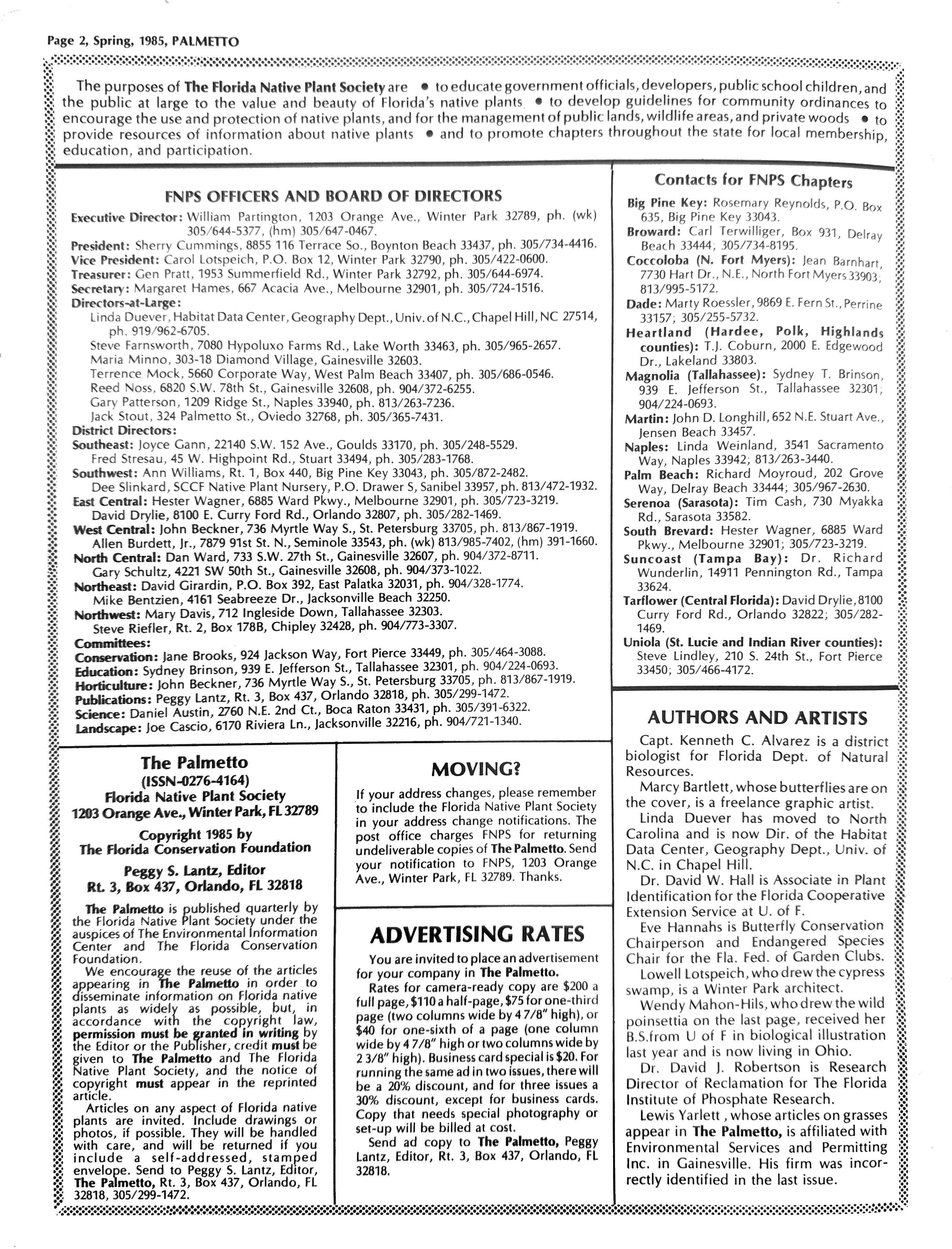
Marcy Bartlett, whose butterflies are on the cover, is a freelance graphic artist.
Linda Duever has moved to North Carolina and is now Dir. of the Habitat Data Center, Geography Dept., Univ. of N.C. in Chapel Hill.
Dr. David W. Hall is Associate in Plant Identification for the Florida Cooperative Extension Service at U. of F.
Eve Hannahs is Butterfly Conservation Chairperson and Endangered Species Chair for the Fla. Fed. of Garden Clubs.
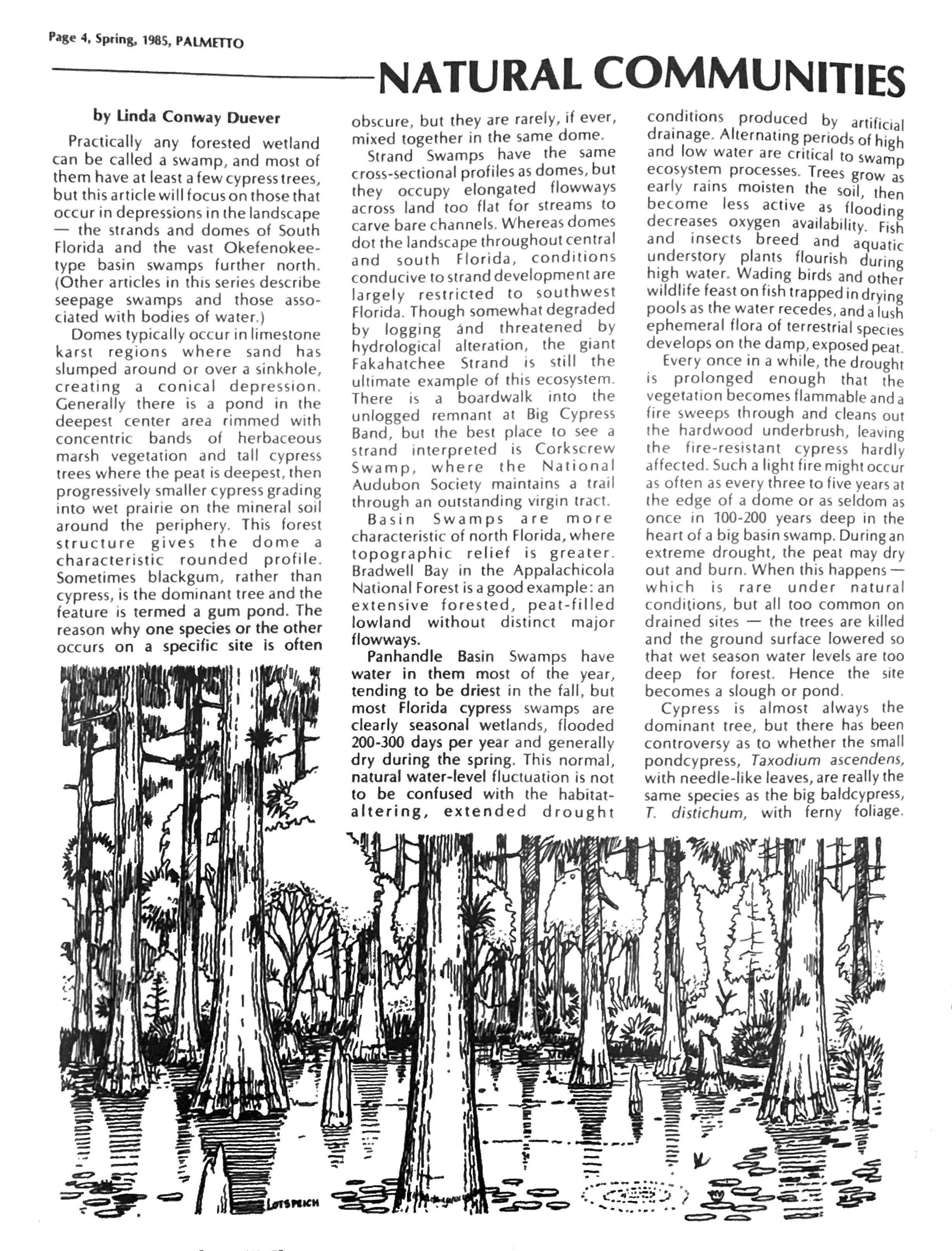
Lowell Lotspeich, who drew the cypress swamp, is a Winter Park architect.
Wendy Mahon-Hils, who drew the wild poinsettia on the last page, received her B.S.from U of F in biological illustration last year and is now living in Ohio.
Dr. David J. Robertson is Research Director of Reclamation for The Florida Institute of Phosphate Research.
Lewis Yarlett, whose articles on grasses appear in The Palmetto, is affiliated with Environmental Servicesand Permitting Inc. in Gainesville. His firm was incorrectly identified in the last issue.
by Eve Hannahs
Buckeyes are classified as brushfooted butterflies. This large, diverse group has a common characteristicthe first pair of legs is greatly reduced, resulting in their appearing to have only two pairs of legs instead of the usual three sets. The group is also known as the"thistle butterflies" of their preference for thistles for nectaring
The dark, olive-gray buckeye larvae with yellow or orange spots and stripes have short branching They feed on plaintain, Plantago; Gerardia spp.; and the primrose willow, Ludwigia spp. There may be several broods a year in
Buckeyes are largely confined to the tropical regions of the world. Only two occur in North America Those species that like a cool, moist environment are larger and darker with larger eyespots than those from warmer, drier places. Individuals of the drier environment may be active and migratory, while those of the moist areas may be less active and non-migratory.This butterfly presents many unanswered questions. Klotz suggests the buckeyes need careful study and analytical
Buckeyes are distinctive in having eyespots on their common buckeye has a large spot on the upper forewing, and an even larger spot on the upper surface of the hind wing with a tiny spot underneath. The wingspread is two to two-and-one-half inches.
The larger, tropical buckeye, Precis lavinea zonalis, of Florida and Texas, also has three eyespots, the upper spot of the hind wing being much smaller than on the other butterfly. It has been suggested that eyespots are a form of protection, since a predator attacking the spots will tear only the the vital parts
Buckeyes, upon close observation, may be seen in fall migration, along with monarchs, cloudless sulphurs, painted ladies, zebra long-wings, and other south-bound individuals. They often found nectaring on Garberia fruticosa.
by Eve Hannahs
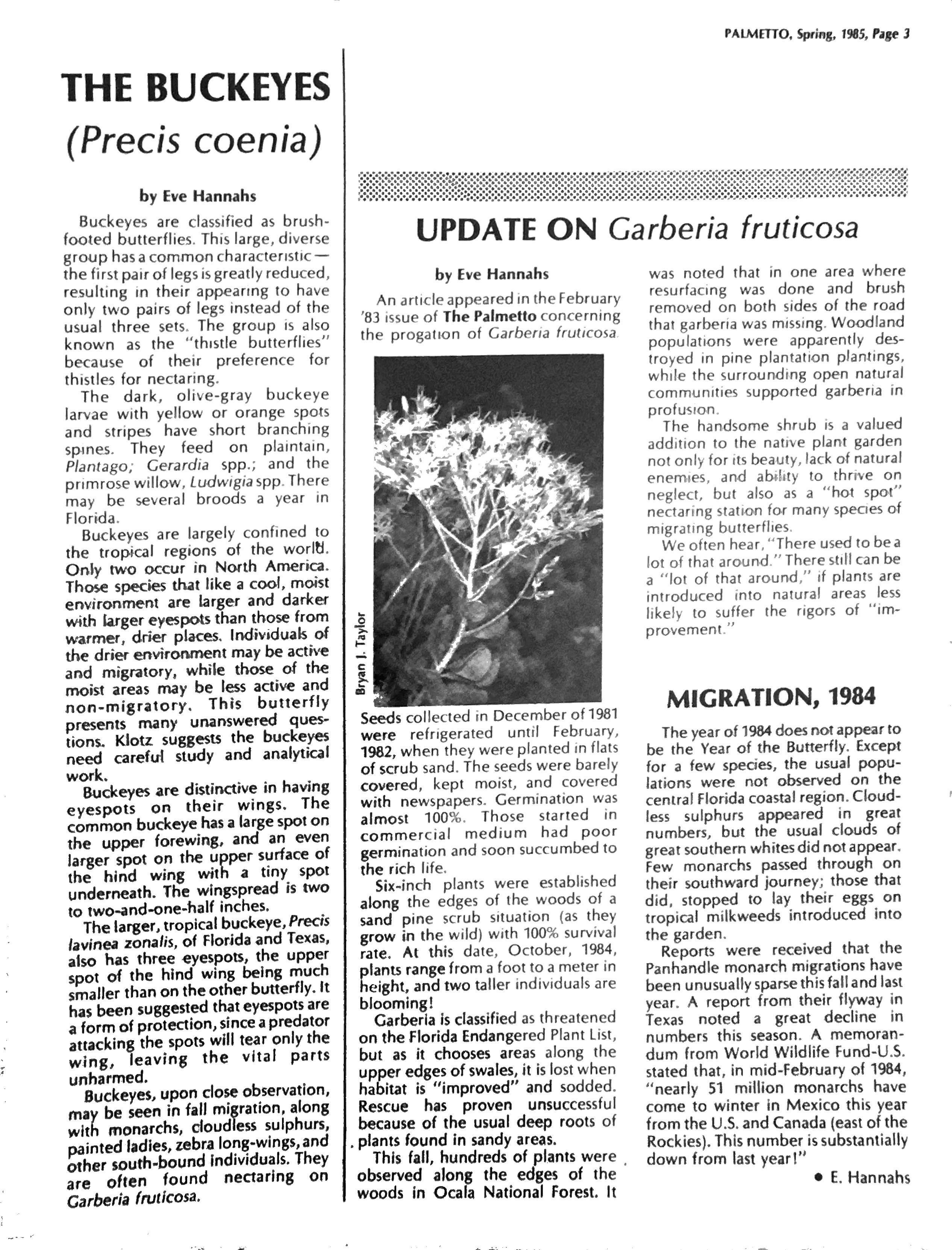
An article appeared in the February '83 issue of The Palmetto concerning the progation of Garberia fruticosa
Seeds collected in December of 1981 were refrigerated until February, 1982, when they were planted in flats of scrub sand. The seeds were barely covered, kept moist, and covered with newspapers. Germination was almost 100%. Those started in commercial medium had poor germination and soon succumbed to the rich life.
Six-inch plants were established along the edges of the woods of a sand pine scrub situation (as they grow in the wild) with 100% survival rate. At this date, October, 1984, plants range from a foot to a meter in height, and two taller individuals are blooming!
Garberia is classified as threatened on the Florida Endangered Plant List, but as it chooses areas along the upper edges of swales, it is lost when habitat is "improved"and sodded Rescue has proven unsuccessful because of the usual deep roots of ? plants found in sandy areas.
This fall, hundreds of plants were observed along the edges of the woods in Ocala National Forest. It
was noted that in one area where resurfacing was done and brush removed on both sides of the road that garberia was missing. Woodland populations were apparently destroyed in pine plantation plantings while the surrounding open natural communities supported garberia in profusion.
The handsome shrub is a valued addition to the native plant garden not only for its beauty, lack of natural enemies, and ability to thrive on neglect, but also as a "hot spot" nectaring station for many species of migrating butterflies
We often hear,"There used to be a lot of that around." There still can be a "lot of that around," if plants are introduced intonatural areas less likely to suffer the rigors of *improvement."
The year of 1984 does not appear to be the Year of the Butterfly. Except for a few species, the usual populations were not observed on the central Florida coastal region. Cloudless sulphurs appeared in grea numbers, but the usual clouds o great southern whites did not appear. Few monarchs passed through on their southward journey; those that did, stopped to lay their eggs on tropical milkweeds introduced into the garden.
Reports were received that the Panhandle monarch migrations have been unusually sparse this fall and last year. A report from their flyway in Texas noted a great decline in numbers this season. A memorandum from World Wildlife Fund-U.S. stated that, in mid-February of 1984, "nearly 51 million monarchs have come to winter in Mexico this year from the U.S. and Canada (east of the Rockies). This number is substantially down from last year!" ? E. Hannahs
by Linda Conway Duever
Practically any forested wetland can be called a swamp, and most of them have at least a few cypress trees, but this article will focus on those that occur in depressions in the landscape - the strands and domes of South Florida and the vast Okefenokeetype basin swamps further north. (Other articles in this series describe seepage swamps and those associated with bodies of water.)
Domes typically occur in limestone karst regions where sand has slumped around or over a sinkhole, creating a conical depression, Generally there is a pond in the deepest center area rimmed with concentric bands of herbaceous marsh vegetationand tall cypress trees where the peat is deepest, then progressively smaller cypress grading into wet prairie on the mineral soil around the periphery. This torest structure gives the dome a characteristic rounded profile. Sometimes blackgum, rather than cypress, is the dominant tree and the feature is termed a gum pond. The reason why one species or the other occurs on a specific site is often
obscure, but they are rarely, if ever, conditions produced by artificial mixed together in the same dome. drainage. Alternating periods of high Strand Swamps have the same and low water are critical to swamp cross-sectional profiles as domes, but ecosystem processes. Trees grow as they occupy elongated flowways early rains moisten the soil, then across land too flat for streams to become less active as flooding carve bare channels. Whereas domes decreases oxygen availability. Fish dot the landscape throughout central and insects breed and aquatic conditions understory plants flourish during conducive to strand development are high water. Wading birds and other largely restricted to southwest wildlite teast on fish trapped in drying Florida. Though somewhat degraded pools as the water recedes, and a lush by logging and threatened by ephemeral flora of terrestrial species hydrological alteration, the giant develops on the damp, exposed peat. Fakahatchee Strand is still the Every once in a while, the drought ultimate example of this ecosystem. is prolonged enough that the There is a boardwalk into the vegetation becomes flammable and a unlogged remnant at Big Cypress fire sweeps through and cleans out Band, but the best place to see a the hardwood underbrush, leaving strand interpretedis Corkscrew the fire-resistant cypress hardly Swamp, where the National affected. Such a light fire might occur Audubon Society maintains a trail as often as every three to tive vears at through an outstanding virgin tract. the edge of a dome or as seldom as Basin Swamps are once in 100-200 years deep in the characteristic of north Florida, where heart of a big basin swamp. During an topographic relief is greater. extreme drought, the peat may dry Bradwell Bay in the Appalachicola out and burn. When this happensNational Forest is a good example: an which is rare under natural extensive forested, peat-filled conditions, but all too common on lowland without distinct major drained sites - the trees are killed and the ground surface lowered so Panhandle Basin Swamps have that wet season water levels are too water in them most of the year, deep for forest. Hence the site tending to be driest in the fall, but becomes a slough or pond. most Florida cypress swamps are Cypress is almost always the seasonal wetlands, flooded dominant tree, but there has been 200-300 days per year and generally controversy as to whether the small dry during the spring. This normal, pondcypress, Taxodium ascendens, natural water-level fluctuation is not with needle-like leaves, are really the to be confused with the habitat- same species as the big baldcypress, altering, extended drought T. distichum, with ferny foliage.
There are good arguments for both Royal fern, Osmunda regalis; viewpoints. However, regardless of cinnamon fern, Osmunda cinnataxonomy, pondcypress grow in momea; Boston fern, Nephrolepsis domes, shallow basins, and around exaltata; swamp fern, Blechnum the edges of strands, whereas serrulatum; strap fern, Campylonbaldcypress are found in the deeper euron phyllitidis; leather tern, swamps. Other common trees Acrostichum spp., and other terns are include red maple, Acer rubrum; frequently abundant. blackgum, Nyssa biflora; swamp bay, Epiphytes thrive in the Persea palustris; sweet bay, Magnolia humid atmosphere of South Florida virginiana; andslash pine, Pinus Spanish elliottii var. elliottii. Palms typically usneoides; wild pine,Tillandsia grow on raised hummocks. Cabbage fasciculata; and butterfly orchid palm, Sabal palmetto, is widespread Encyclia tampense, are well-adapted throughout and plentiful, but many of the others royal, Roystonea elata, and paurotis, are rare tropical species that cannot Acoelorraphe wrightii, palms grow penetrates to the water surface, there only in the Fakahatchee Strand may be a lush understory of (although they are found in a few emergent aquatic plants such as other non-swamp habitats). sagittaria, Sagittaria lanceolata; The shrub layer often includes wax pickerel weed, Pontederia cordata; myrtle, Myrica cerifera; swamp lily, Crinum americanum; holly, Ilex cassine; shiny lyon?a, lizard tail, Saururus cernus; lemon Lyonia lucida; pond apple, Annona bacopa, Bacopa caroliniana; water glabra; pop ash, Fraxinus caroliniana; smartweed, Polygonum punctatum; Virginia willow, Itea virginica; titi, blue flag, Iris virginica; yellow canna, Cyrilla racemiflora; buttonbush, Canna flacida; red swamp hibiscus, Cephalanthus occidentalis; Hibiscus coccineus; fire flag, Thalia myrsine, Myrsine floridana. geniculata; green arum, Peltandra Especially in spots where the virginica; maidencane, Panicum canopy is thin and sunlight hemitomum; and sawgrass, Cladium
Members of the Central Florida Chapter have been busy preparing for the Fifth Annual FNPS State Conference. David Drylie,Carol Lotspeich, Bill Partington, Jack Stout, Sam Hopkins, Ellen Arborgast, Mike Mingea, Annette Perry, Rusty Abdalla, Gordon Thomas, and Paul Davis have all been involved in the organizing. April 20, Carol Lotspeich and Sam Hopkins will present a special orogram for the public titled 'Selected Central Florida Native Plants for the Landscape" at 10:00 a.m. in the Orange County Cooperative Extension Service Auditorium. A native plant sale will follow. A great deal of the chapter's time and talent has gone into the creation of our Florida Heritage Garden at Leu Gardens, and it is finally becoming a reality. The artificial bog is working! We are still gathering information for our chapter-sponsored book, Native Plants for Your Central Florida Landscape. Please help us! We need lots of slides and cultural information. I will send you a data
sheet and list of plants to be included if you'll call or write David Drylie, 8100 E. Curry FordRd., Orlando 32822, 305/282-1469
Regularly scheduled programs and field trips will continue, thanks to Sam Hopkins and Dick Deuerling, and we hope to strengthen our alliance with Orange Audubon and other local conservation groups through dual field trips and programs.
A few members are working on a tree protection ordinancefor Orange County as a citizens advisory committee at the request of Commissioner Vera Carter. The ordinanceis expected to be completed in four to six weeks, and in force within a few months. The committee may continue working, after the tree ordinance is finished, to put together a plant communitysensitive landscape code.
?
David Drylie
Greetings from Martin County. Nineteen eighty-five promises to be a
jamaicense.
survive this far north in less sheltered habitats. A number of these have become endangered because collectors have removed so many from the wild (which is illegal). The uncommon species include cowhorn orchid, Cyrtopodium punctatum; ghost orchid, Polyrrhiza lindenii; delicate ionopsis, lonopsis utriculariodes; clamshell orchid, Encyclia cochleata; night-blooming epidendrum, Epidendrum nocturnum; guzmania, Guzmania monostachia; nodding catopsis, Catopsis nutans; fuzzy-wuzzy airplant, Tillandsia pruinosa; cypress peperomia, Peperomia glabella; birdsnest fern, Asplenium serratum; and auricled spleenwort, Asplenium auritum. There are many more so extremely rare they are found in only one or two locations.
This is the seventh in a series of articles describing the Natural Communities defined by the Florida Natural Areas Inventory (FNAI). This classification system must be viewed as a system of mental constructs imposed upon an infinite variety of growing,changing, intergrading, natural environments. Hence, more often than not, a given site will not precisely fit the classic description of the appropriate natural community
productive year. Our membership has swelled to over seventy. The chapter officers are as follows: John Longhill, president; Mabel Witham, vice president; Nancy Wacha, secretary; and Nanci Angle, treasurer.
Monthly field trips have included a beach walk at Bob Graham Beach in Stuart, a two-day Archbold Biological Station in Lake Placid, and a look at the Castle Hill Hammock in Sewall's Point. Many more field trips are planned. If any other chapters would like to exchange ideas and/or places of interest for field trips, please contact us. We'd love to hear from you. At the present time, our chapter is involved in a few projects, the most important being Save the Natives Some developers have volunteered to donate the doomed natives for transplanting elsewhere. Our county schools and public properties could benefit from this. We're also urging the new Y.M.C.A. (as yet to be constructed) to incorporate a nature trail that would showcase its plentiful
by Captain Ken Alvarez
On a recent visit to national parks and nature reserves in the Republic of South Africa, I noticed the extensive use of small identification labels on trees. My trip to Africa was something of a revelation for 1 was in the unaccustomed position of being ignorant of the local flora. I was wellschooled in ecological precepts, but thirsted to know what the fascinating myriad trees about me might be called, and 1 appreciated the aid of these labels in identifying African
These labels are only part of a nationwide system of tree identification. A "National Tree List" in the form of a small booklet is available in most park shops and in bookstores across the country. It is simply a standardized, numbered list of native trees - nearly a thousand species in all. Throughout Africa in all sorts of public use areas from national parks to roadside picnic areas, trees can be seen bearing numbered tags that correspond to those in the national list.
The tags are not uniform material or appearance. I suspect that their variety could be explained by the fact that differentagencies (and/or private institutions) are responsible for their funding and installation. The numbers, however, all conform to the same list. In some instances, the identification goes beyond merely providing the number to including the standard common name and the scientific name
It occurred to me that many visitors to Florida's state parks could have the same curiosity as I. I think a "Florida Native Tree List" similar to Africa's list
would be an excellent idea for promoting increased public interest in our native trees and also in facilitating learning by laymen and students. Those of us who have long been familiar with Florida's trees may forget that others who may be curious have no easy way of learning
Years ago, the Florida Park Service had a simple tree labeling system. We came to view it as an inadequate interpretive effort from an earlier time, and during the 1970s it was largely discontinued in favor of teaching values and concepts rather than simply naming names. But my experience in Africa reinforces the importance of names.
On my return from there, I made a proposal to initiate such a project in our state parks. It was approved, and the first labels were installed on an experimental basis in several parks in September, 1984. A native tree list was fashioned after the one in Atlas of U.S. Trees, Vol. 5, Florida, by Elbert L Little Ir., with some minor changes in common names.
The Florida Native Plant Society would be the appropriate organization to promote this idea. The numberingsystem could be extended far beyond the boundaries of Florida's state parks to county and city parks, nature centers, Dept. of roadside parks, school yards, college campusesanywhere that native trees are growing
The tags could be elaborate, or simple, or even homemade. example, the bottom could be cut from a tin can and the number could be painted on it. Two holes could be drilled in each label, centered at the
top and bottom. An aluminum nail, one-and-one-fourth inches long should be used, driven through the holes, to avoid the rusting that results when iron nails are used. These small nails are not likely to cause damage to the tree any
The labels being used in the state parks are 2" x 4" anodized brown aluminum, nailed seven-and-onehalf feet above the ground. This is high enough to discourage casual vandalism but still be readable. The common and scientific name and the
into the metal and painted white
It might be argued that, since the name of the tree appears on the Florida Park Service tags, there is no need to include a number for a list, but the number calls attention to the list - an important objective in itself. It tells the observer that there exists a list of Florida's native trees compiled and produced by some entity that cares about them and wishes to promote knowledge and understanding of the subject.
The Florida Native Plant Society Board of Directors has indicated interest in this project, and they should probably appoint a committee of botanists to be responsible for the taxonomical integrity of the list - a function similar to that performed by the American Ornithological Union for the list of North American birds.
I believe that this proposed list would be one small step in furthering an understanding and concern for our native plants.
(The Tree List is available from FNPS, 1203 Orange Ave., Winter Park 32789, for $1.00 and SASE.)
by David J. Robertson
Approximately 6000 acres of phosphate mineralized land are mined annually in Florida, all of which must be reclaimed. In addition, the state's Non-Mandatory Land ReclamationTrust Fund is making funds available to reclaim the nearly 90,000 acres of land that were mined before July 1, 1975, the date reclamation was required by law. Since its creation in 1978, the Florida Institute of Phosphate Research (FIR) reclamation research program has been working to enhance the economic and productive value of reclaimed land, to encourage the reestablishment of diverse natural ecosystems,and to integrate the functions of both wherever feasible. The majority of the reclamation research currently supported by FIPR is directed toward redeveloping native plant communities on mined
Most phosphate-mined land that was voluntarily reclaimed before 1975 was rehabilitated for commercial purposes. Mined land reclaimed with overburden and sand tailings is very stable, and the presence of numerous small lakes increases its value. Many of the older mines are now the sites of prime commercial and residential developments in Polk County
However,unlike the relatively standard and straightforward earthmoving and recontouring that must be done to prepare mined land for construction, the reclamation of natural communities is still in its developmental stages. Reclamation professionals historically have emphasized techniques for enhancing the survival of plants in wetlands and upland forests, and most of the reclamation research sponsored by FIPR has likewise been concentrated on refining technology currently in practice. Within the past though, there has been increasing interest in integrating the knowledge and experience gained during the last ten years or so to begin to redevelop complete, functional ecosystems composed of the variety of plant communities that occupied the area prior to mining.
The Rulesof the Florida Department of Natural Resources dealing with phosphate mine reclamation (Chapter 16C-16) state
that "wetlands which are affected by established on reclaimed land with all mining operations shall be restored trees planted at the same time will be to at least premining surface areas." remarkably similar to undisturbed In other words, wetlands must be wetlands with regard to the even-age replaced on an acre-for-acre basis. distribution of the dominant trees. Approximately 15% of the phosphate Studies of case histories of natural resources in the Bone Valley district succession on clay settling areas of Polk and eastern Hillsborough and ("slime" ponds) by Betty Rushton, a Manatee counties are overlain by second graduate researcher, wetlands, and the percentage identified a few sites in which increases on reserve lands that will be forested wetland development was mined in the future in the Southern proceeding at a pace comparable to Extension, an area encompassing that which occurs on disturbed areas Hardee and northern Desoto that have not been mined. In some counties. In order to responsibly settling areas with long hydroperiextract the phosphate resources, ods, natural succession proceeded demonstrations of successful wetland very rapidly to a stage dominated by reclamation are critically important. willow, Salix caroliniana,
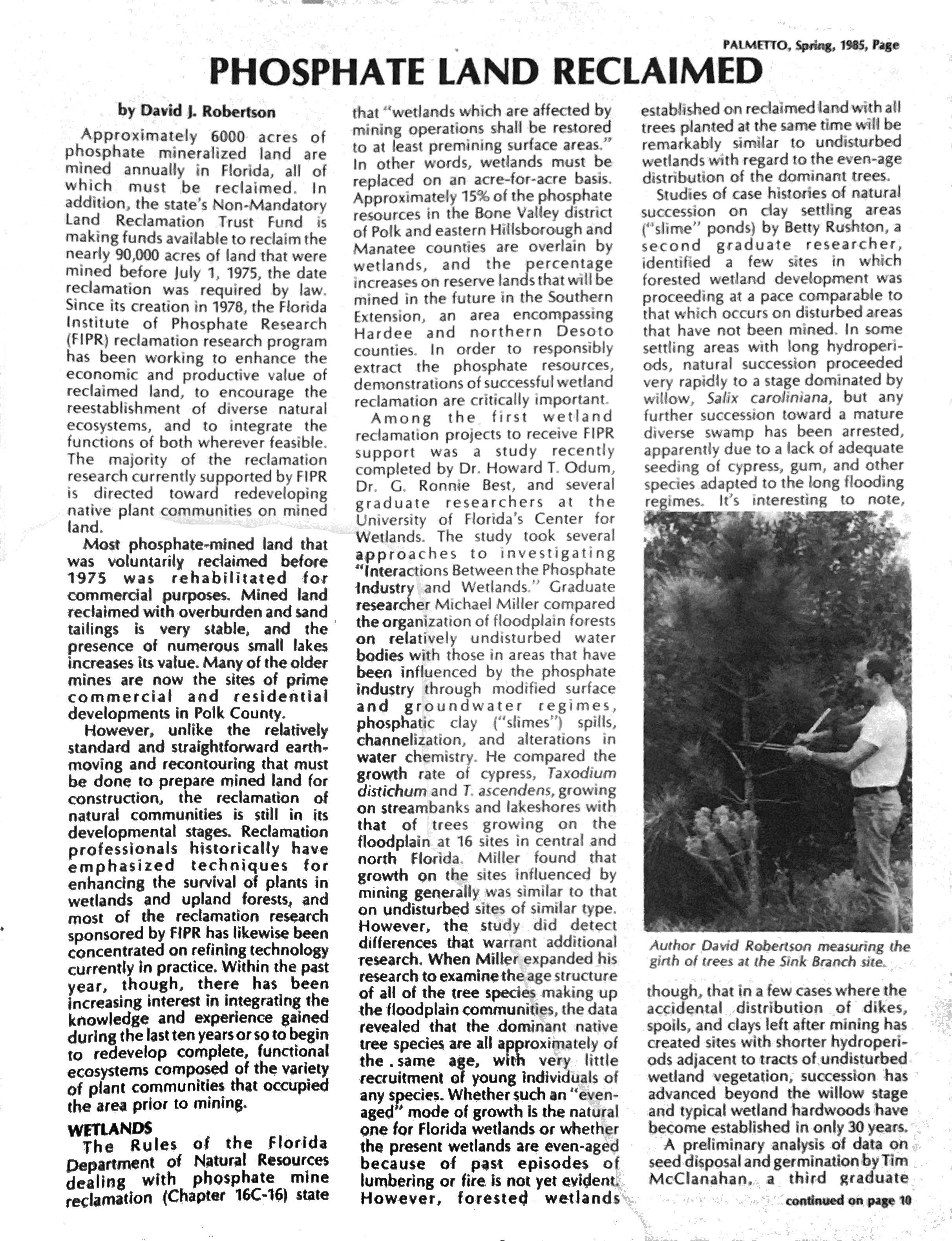
Author David Robertson measuring the girth of trees at the Sink Branch site
though, that in a few cases where the accidental distribution of dikes, spoils, and clays left after mining has created sites with shorter hydroperiods adjacent to tracts of undisturbed wetland vegetation, succession has advanced beyond the willow stage and typical wetland hardwoods have become established in only 30 years.
Among the first wetland further succession toward a mature reclamation projects to receive FIPR diverse swamp has been arrested, support was a study recently apparently due to a lack of adequate completed by Dr. Howard T. Odum, seeding of cypress, gum, and other Dr. G. Ronnie Best, and several species adapted to the long flooding graduate researchers at the regimes. It's interesting University of Florida's Center for Wetlands. The study took several approaches to investigating "Interactions Between the Phosphate Industry and Wetlands." Graduate researcher Michael Miller compared the organization of floodplain forests on relatively undisturbed water bodies with those in areas that have been influenced by the phosphate industry through modified surface groundwater regimes, phosphatic clay ("slimes") spills, channelization, and alterations in water chemistry. He compared the growth rate of cypress, Taxodium distichum and T. ascendens, growing on streambanks and lakeshores with growing on the floodplain at 16 sites in central and north Florida. Miller found that growth on the sites influenced by mining generally was similar to that on undisturbed sites of similar type. However, the study did detect differences that warrant additional research. When Miller expanded his research to examine the age structure of all of the tree species making up the floodplain communities, the data revealed that the dominant native tree species are all approximately of the same age, with very little recruitment of young individuals of any species. Whether such an "evenmode of growth is the natural one for Florida wetlands or whether the present wetlands are even-aged because of past episodes of lumbering or fire is not yet evident. However, forested wetlands
A preliminary analysis of data on seed disposal and germination by Tim McClanahan, a third graduate continued on page 10
by Charlie A. Lowery
Extension Agent for Collier County
Golf course architects. golf course super-
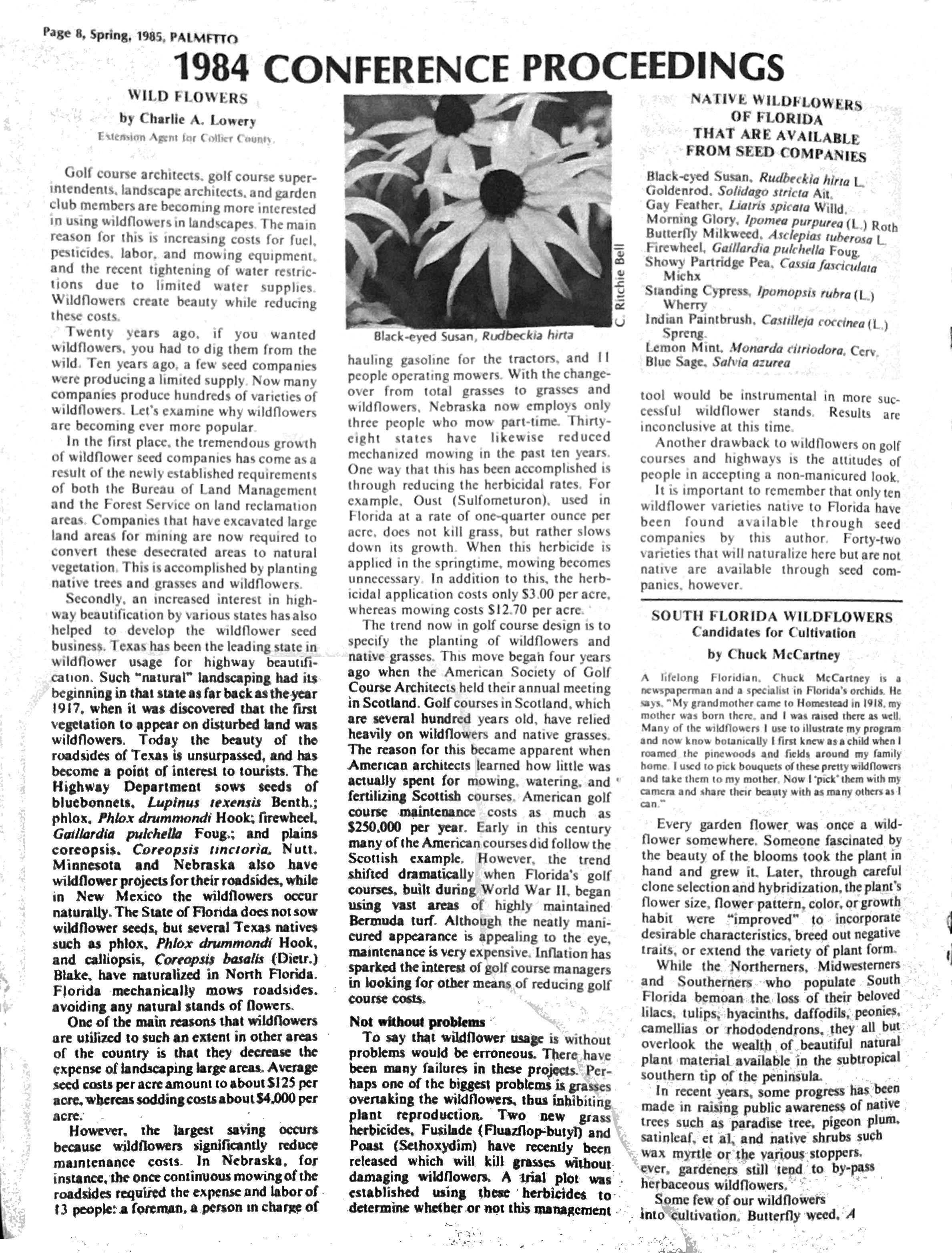
Black-cyed Susan, Rudbeckia hirta L. intendents, landscape architects, and garden Goldenrod. Solidago stricta Ait. club members are becoming more interested Gay Feather, Liatris spicata Willd. in using wildflowers in landscapes. The main Morning Glory, Ipomea purpurea (L.) Roth reason for this is increasing costs for fuel. Butterfly Milkweed. Asclepias tuberosa L pesticides, labor, and mowing equipment. Firewheel, Gaillardia pulchella Foug and the recent tightening of water restric- Showy Partridge Pea, Cassia fasciculata Michx tions due to limited water supplies. Wildflowers create beauty while reducing Standing Cypress, Ipomopsis rubra (L.) these costs. Wherry Indian Paintbrush, Castilleja coccinea (L.)
Twenty years ago, if youwanted
wildflowers, you had to dig them from the wild. Ten years ago, a few seed companies hauling gasoline for the tractors, and Il
Lemon Mint. Monarda citriodora. Cerv. Blue Sage, Salvia azurea were producing a limited supply. Now many people operating mowers. With the changecompanies produce hundreds of varieties of over from total grasses to grasses and tool would be instrumental in more sucwildflowers. Let's examine why wildflowers wildflowers, Nebraska now employs only cessful wildflower stands. Results are are becoming ever more popular. three people who mow part-time. Thirty- inconclusive at this time
In the first place, the tremendous growth eight states have likewise reduced
Another drawback to wildflowers on golf of wildflower seed companies has come as a mechanized mowing in the past ten years. courses and highways is the attitudes of result of the newly established requirements One way that this has been accomplished is people in accepting a non-manicured look of both the Bureau of Land Management through reducing the herbicidal rates. For It is important to remember that only ten and the Forest Service on land reclamation Oust (Sulfometuron), used in wildflower varieties native to Florida have areas. Companies that have excavated large Florida at a rate of one-quarter ounce per been found available through seed land areas for mining are now required to acre, does not kill grass, but rather slows companics by this author. convert these desecrated areas to natural down its growth. When this herbicide is Forty-two varieties that will naturalize here but are not vegetation. This is accomplished by planting applied in the springtime, mowing becomes native are available through seed comnative trees and grasses and wildflowers. unnecessary. In addition to this, the herb- panies, however.
Secondly, an increased interest in high- icidal application costs only S3.00 pr ????. way beautification by various states has also whereas mowing costs $12.70 per acre helped to develop the wildflower seed The trend now in golf course design is to business. Texas has been the leading state in specify the planting of wildflowers and wildflowerusage for highway beautifi- native grasses. This move begah four years cation. Such "natural" landscaping had its ago when the American Society of Golf beginning in that state as far back as the year Course Architects held their annual meeting 1917, when it was discovered that the first in Scotland. Golf courses in Scotland, which vegetation to appear on disturbed land was are several hundred years old, have relied wildflowers Today the beauty of the heavily on wildflowers and native grasses. roadsides of Texas is unsurpassed, and has The reason for this became apparent when become a point of interest to tourists. The American architects learned how little was Highway Department sows seeds of actually spent for mowing, watering, and bluebonnets,Lupinus rexensis Benth.; fertilizing Scottish courses. American golf
phlox, Phlox drummondi Hook; firewheel.
course maintenance costs as much as Gaillardia pulchella Foug.: and plains $250,000 per year. Early in this century corcopsis. Coreopsis tinctoria, Nutt. many of the American courses did follow the Minnesota and Nebraska also have Scottishexample.However, the trend wildflower projects for their roadsides, while shifted dramatically when Florida's golf in New Mexico the wildflowers occur courses, built during World War II, began naturally. The State of Florida does not sow using vast areas of highly maintained wildflower seeds, but several Texas natives Bermuda turf. Although the neatly manisuch as phlox. Phlox drummondi Hook, cured appearance is appealing to the eye, and calliopsis, Coreopsis basalis (Dietr.) maintenance is very expensive. Inflation has Blake. have naturalized in North Florida sparked the interest of golf course managers Florida mechanically mows roadsides. in looking for other means of reducing golf course costs. avoiding any natural stands of flowers.
One of the main reasons that wildflowers
are utilized to such an extent in other areas
Not
To say that wildflower usage is without of the country is that they decrease the problems would be erroneous. There have expense of landscaping large areas. Average been many failures in these projects. Perseed costs per acre amount to about S125 per haps one of the biggest problems is grasses acre, whereas sodding costs about $4,000 per overtaking the wildflowers, thus inhibiting acre. plant
However. thelargest saving occurs reproduction. Two new grass herbicides, Fusilade (Fluazflop-butyl) and because wildflowers significantly reduce Poast (Sethoxydim) have recently been maintenance costs. In Nebraska.for released which will kill grasses without instance, the once continuous mowing of the damaging wildflowers. A trial plot was roadsides required the expense and labor of established using these herbicides to 13 people: a foreman, a person in charge of determine whether or not this management
SOUTH FLORIDA WILDFLOWERS Candidates for Cultivation
by Chuck MeCartney
A lifelong Floridian. Chuck McCartneyis a newspaperman and a specialist in Florida's orchids. He says. "My grandmother came to Homestead in 1918, my mother was born there, and I was raised there as well. Many of the wildflowers 1 use to illustrate my program and now know botanically I first knew as a child when I roamed the pinewoods and fields around my family home. I used to pick bouquets of these pretty wild flowers and take them to my mother. Now I pick them with my camera and share their beauty with as many others as !
Every garden flower was once a wildflower somewhere. Someone fascinated by the beauty of the blooms took the plant in hand and grew it. Later, through careful clone selection and hybridization, the plant's flower size, flower pattern, color, or growth habit were "improved" to incorporate desirable characteristics, breed out negative traits, or extend the variety of plant form Northerners, Midwesterners and Southerners who populate South Florida bemoan the loss of their beloved lilacs, tulips, hyacinths, daffodils, peonies. camellias or rhododendrons, they all but overlook the wealth of beautiful natural plant material available in the subtropical southern tip of the peninsula.
In recent years, some progress has been made in raising public awareness of native trees such as paradise tree. pigeon plum. satinleaf, et al, and native shrubs such as wax myrtle or the various stoppers. However, gardeners still tend to by-pass the herbaceous wildflowers
Some few of our wildflowers have made it into cultivation. Butterfly weed. Asclepias
tuberosa: blazing star. Liatris spp.; and black-eyed susans. Rudbeckia hirta, are offered in seed catalogues on a limited basis. Some nurseries specializing in aquatic plants offer such native species as pickerel weed. Pontedaria cordata: arrow-leaf. Saginaria spp.: and waterlilies, including Nymphaea odorata.
Some of our native tropical epiphytes. including such bromeliads as Tillandsia fasciculata and such orchids as the cow-horn orchid. Cyrtopodium punciatum. have found favor with home growers. The almost endemic onion orchid.Encyclia tampersis. is often grown and frequently used in orchid hybridization.
But other than these few examples, it's difficult to find South Florida wildflower species in cultivation. This is curious. It makes me wonder why nobody has done selective breeding with the weedy spanisha needles, Bidens alba, to develop a beautiful hot-weather alternative to the shasta daisy. I wonder why butterweed, Senecio glabellus. and flat-topped goldenrod, Flaveria linerais. aren't being utilized as the gorgeous annual bedding plants they could be. And why aren't we growing our handsome native Iris hexagona var. savannarum, which turns the mucky depths of the Big Cypress Swamp into places of beauty each spring?
Listed below are a few of South Florida's beautiful and unusual native wildflowers which I feel have potential as cultivated plants, I am not a gardener nor am I a geneticist, so 1 cannot state with certainty that selective breeding will improve or overcome negative characteristics of each species so they can become useful additions to the cultivated landscape. However, as a traveler and observer in South Florida's dwindling natural habitats, I can point the way to beautiful species which 1 feel have potential. It's up to someone more skilled in horticulture to prove their worth.
(The Wildflower List is available from FNPS, 1203 Orange Ave., Winter Park 32789, for $1.00 and SASE.)
by Wayne N. Dixon
Dr. Dixon is a Registered Professional Entomologist with the Florida Division of Forestry. Denartment of Agricultural and Cossumer Services.
Many causal agents regularly inflict injury and damage to trees.for example, fire. food. weather, chemicals, discases, and animals, to name just a few. Within the animal realm, a general list would include nematodes, mites, millipedes, slugs, snails. birds, rabbits, mice, dogs, livestock, man, and insects. Insect pests are important not only because of the damages to trees per se, but also their high nuisance value to landowners, loss of vegetational aesthetics. and expenditures necessary to prevent or control pest insoct damage.
Native Trees
Native trees are damaged by insects. So. too, are exotic trees. In the inescapable war of people and trces versus insects, the advantages lie with having native trees
growing under your care and supervision The advantages are resistance, silviculture. and information on pest biology/ habits. Resistance of a native tree to indigenous pests is more likely to be present than for an tree. Generally, resistance may be expressed in one of the following categories:
1. Preference-nonpreference
2. Tolerance
3. Antibiosis
Briefly, preference-nonpreference is the interaction of tree characters and insect responses that lead to or away from the tree for oviposition, food, shelter, or a mixture. Tolerance is the tree's ability to grow and reproduce itself or repair injury in spite of a damaging insect population. Antibiosis is thetree's characteristics in preventing. injuring, or destroying insect life. for example, reduced fecundity, decreased size. abnormal length of life, and increased mortality. Not necessarily is one type of resistance present to the exclusion of another, often it is a medley of resistance mechanisms. Indeed, the factors that confer resistance are many (Fig. I).
Environmental Factors
Host Alternate host abundance
Soll molstute Soll fertility Temperature
Insect Factors Mumidicy Tree Factors
Races Light
Senses ph Color
Nigelalegy
Ovipesition
Feeding reactions
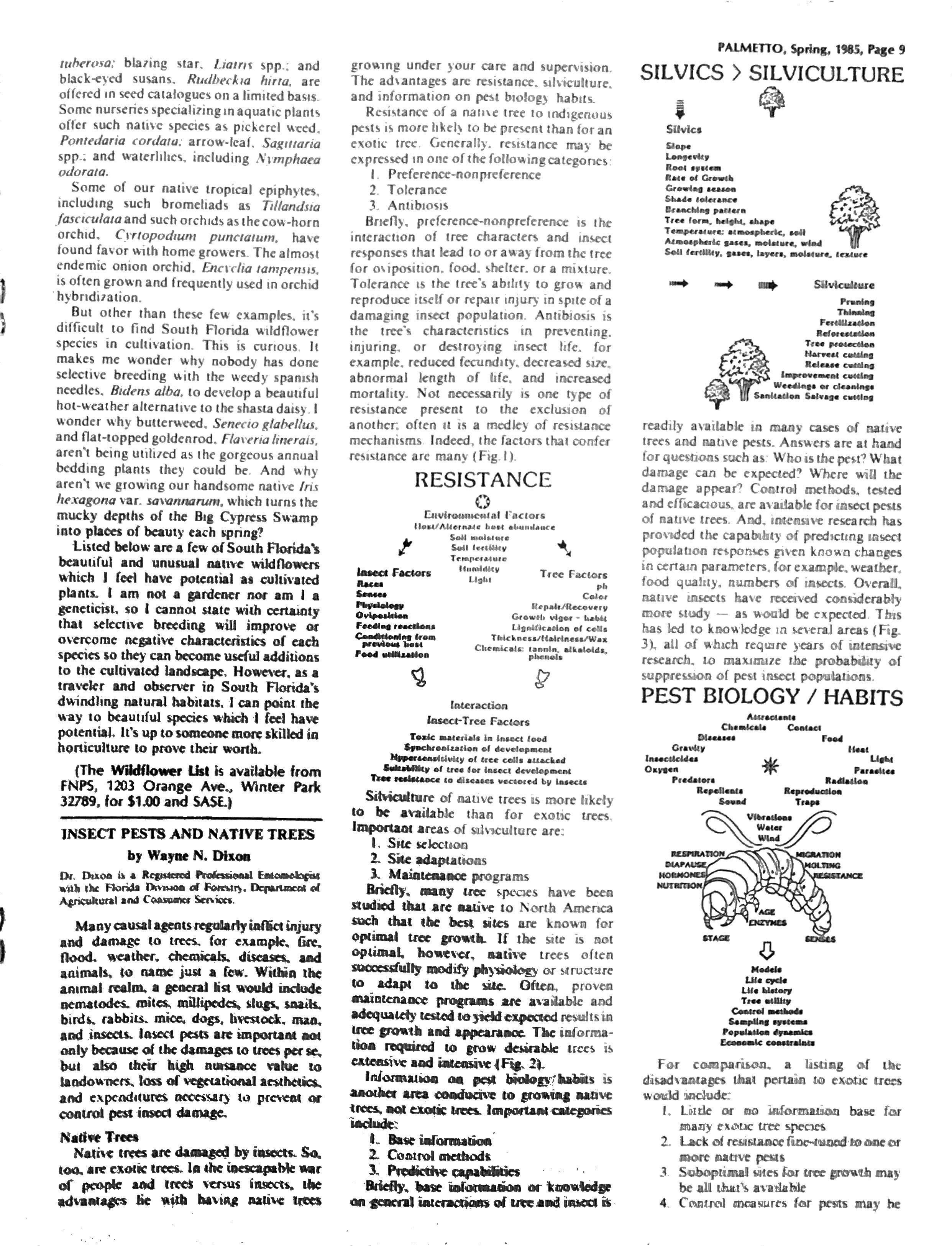
Repalr/Recovery
Groweb vigor -hablt
Lignitication of cells
Conditioning From previous lost Thickness/Hairiness/Wax
Food utilization
Chemicals: tannin, alkalolds, DUCHENS
Interaction
Insect-Tree Factors
Toxic materials in insect tood Synchrenization of develepment
Hypersenstivity of tree cells attacked
Sultability of tree for Insect development
Tree resistance to discases vectored by insects
Silviculture of native trees is more likely to be available than for exotic trees. Important areas of silviculture are:
1. Site selection
2. Site adaptations
3. Maintenance programs
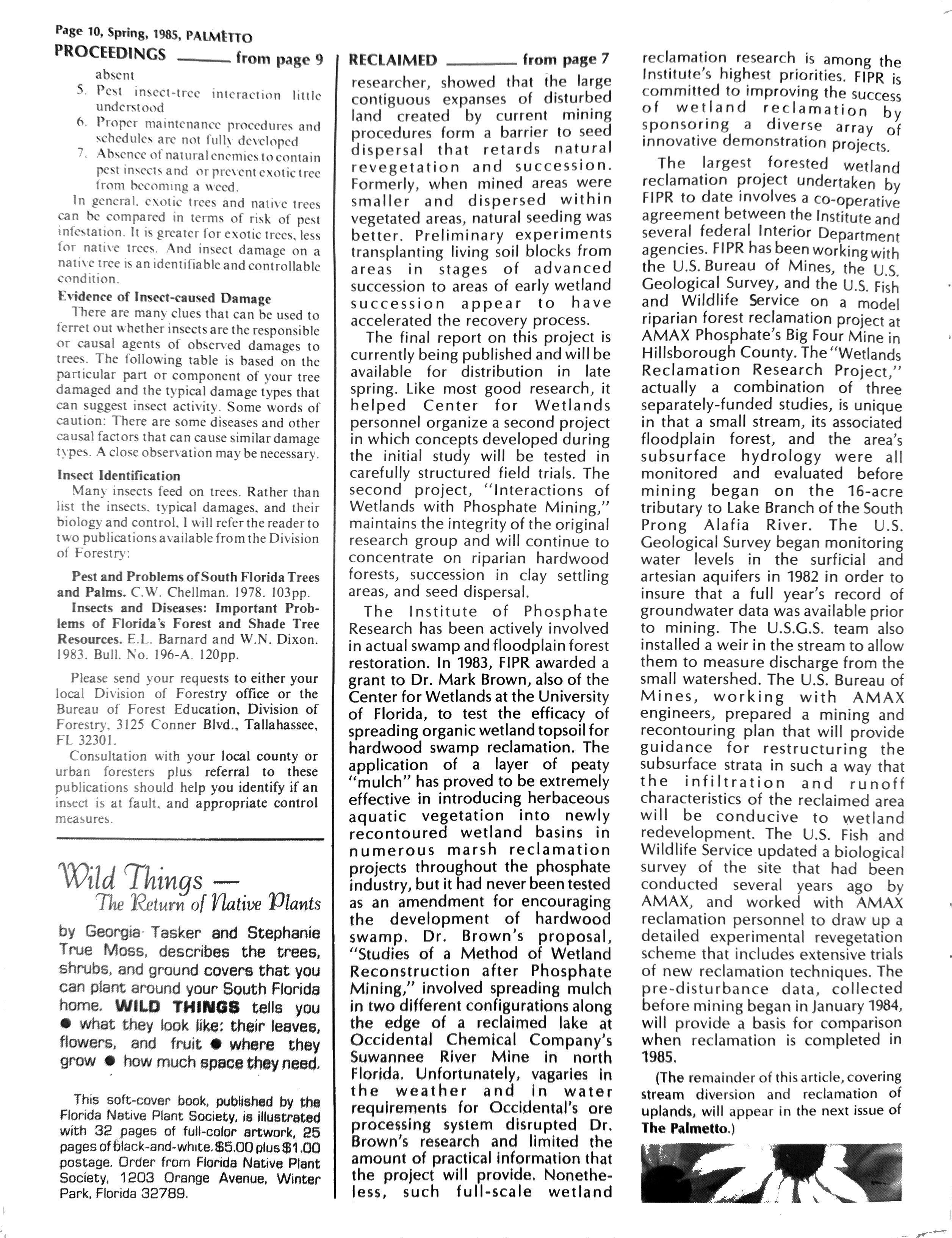
Briefly, many tree species have been studied that are native to North America soch that the best sites are known for optimall tree growth lf the site is not optimal, however, native trees often successfully modify physiology or structure to adapt to the side. Often,proven maintenance programs are available and adequately tested to yield expected results in tree growth and appearance. The informakion required to grow desirable trees is extensive and intensive (Fig. 2).
Information an pest biology habits 15 another area conducive to growing native trees, not exotic trees. Important categories include
I Base information
2. Control methods
Briefly, base information or
Silvics
Slope
Longevity
Root system
Rate of Growth
Growing season
Shade tolerance
Branching pattern
Tree form, height, shape
Temperature: atmospheric, coll
Atmospheric gases, molsture, wied
Soll-fertility, gases, layers, molsture, texture
readily available in many cases of native trees and native pests. Answers are at hand for questions such as: Who is the pest? What damage can be expected? Where will the damage appear? Control methods, tested and efficacious, are available for insect pests of native trees. And, intensive research has provided the capability of predicting insect population responses given known changes in certain parameters, for example, weather. food quality, mumbers of insects. Overall, native insects have received considerably more study - as would be expected. This has led to knowledge in several areas (Fig 3), all of which require years of intensive research, to maximize the probability of suppression of pest insect populations.
Attractante
For comparison, a listingof the disadvantages that pertain to exotic trees would include:
1. Little or no information base for many exotic tree species
2. Lack of resistance fine-tuned to one or more mative pests
3. Suboptimal sites for tree growth mas be all that's available
4. Contral measures for pests may he
Page 10, Spring, 1985, PALMETTO PROCEEDINGS -_from page 9 absent
5. Pest insect-tree interaction little understood
6. Proper maintenance procedures and schedules are not fully developed
7. Absence of natural enemies to contain pest insects and/ or prevent exotic tree from becoming a weed
In general, exotic trees and native trees can be compared in terms of risk of pest infestation. It is greater for exotic trees, less for native trees.And insect damage on a native tree is an identifiable and controllable condition.
There are many clues that can be used to ferret out whether insects are the responsible or causal agents of observed damages to trees. The following table is based on the particular part or component of your tree damaged and the typical damage types that can suggest insect activity. Some words of caution: There are some diseases and other causal factors that can cause similar damage types. A close observation may be necessary.
Insect Identification
Many insects feed on trees. Rather than list the insects, typical damages, and their biology and control, I will refer the reader to two publications available from the Division of Forestry:
Pest and Problems of South Florida Trees and Palms. C.W. Chellman. 1978. 103pp. Insects and Diseases: Important Problems of Florida's Forest and Shade Tree Resources. E.L. Barnard and W.N. Dixon. 1983. Bull. No. 196-A. 120pp.
Please send your requests to either your local Division of Forestry office or the Bureau of Forest Education, Division of Forestry, 3125 Conner Blvd., Tallahassee, FL 32301.
Consultation with your local county or urbanforestersplus referral to these publications should help you identify if an insect is at fault, and appropriate control measures.
by Georgia Tasker and Stephanie True Moss, describes the trees, shrubs, and ground covers that you can plant around your South Florida home. WILD THINGS tells you ? what they look like: their leaves, flowers, and fruit ? where they grow ? how much space they need.
This soft-cover book, published by the Florida Native Plant Society, is illustrated with 32 pages of full-color artwork, 25 pages of black-and-white. $5.00 plus $1.00 postage. Order from Florida Native Plant Society.1203 Orange Avenue, Winter Park, Florida 32789.
RECLAIMED from page 7 researcher, showed that the large contiguous expanses of disturbed land created by current mining procedures form a barrier to seed dispersal that retards revegetation and succession. Formerly, when mined areas were dispersed vegetated areas, natural seeding was better. Preliminary experiments transplanting living soil blocks from of advanced succession to areas of early wetland succession appear to have accelerated the recovery process.
The final report on this project is currently being published and will be available for distribution in late spring. Like most good research, it helped Center for Wetlands personnel organize a second project in which concepts developed during the initial study will be tested in carefully structured field trials. The second project, "Interactions of Wetlands with Phosphate Mining," maintains the integrity of the original research group and will continue to concentrate on riparian hardwood forests, succession clay settling areas, and seed dispersal.
Phosphate Research has been actively involved in actual swamp and floodplain forest restoration. In 1983, FIPR awarded a grant to Dr. Mark Brown, also of the Center for Wetlands at the University of Florida, to test the efficacy of spreading organic wetland topsoil for hardwood swamp reclamation. The application of a layer 'mulch" has proved to be extremely effective in introducing herbaceous aquatic vegetationinto newly recontoured wetland basins numerous marsh reclamation projects throughout the phosphate industry, but it had never been tested as an amendment for encouraging the development of hardwood swamp. Dr. Brown's proposal, "Studies of a Method of Wetland Reconstruction after Phosphate Mining;," involved spreading mulch in two different configurations along the edge of a reclaimed lake at Occidental Chemical Company's Suwannee River Mine in north Florida. Unfortunately, vagaries in requirements for Occidental's ore processing system disrupted Dr. Brown's research and limited the amount of practical information that the project will provide. Nonethesuch tull-scale wetland
reclamation research is among the Institute's highest priorities. FIPR is committed to improving the success of wetland reclamation by sponsoring a diverse array of innovative demonstration projects.
The largest forested wetland reclamation project undertaken by FIPR to date involves a co-operative agreement between the Institute and several federal Interior Department agencies. FIPR has been working with the U.S. Bureau of Mines, the U.S Geological Survey, and the U.S. Fish and Wildlife Service on a model riparian forest reclamation project at AMAX Phosphate's Big Four Mine in Hillsborough County. The "Wetlands Reclamation Research Project," actually a combination of three separately-funded studies, is unique in that a small stream, its associated floodplain forest, and the area's subsurface hydrology were all monitored and evaluated before mining began on the 16-acre tributary to Lake Branch of the South Prong Alafia River. The U.S. Geological Survey began monitoring water levels in thesurficial and artesian aquifers in 1982 in order to insure that a full year's record of groundwater data was available prior to mining. The U.S.G.S. team also installed a weir in the stream to allow them to measure discharge from the small watershed. The U.S. Bureau of Mines, working with AMAX engineers, prepared a mining and recontouring plan that will provide guidance for restructuring the subsurface strata in such a way that the infiltration and runoff characteristics of the reclaimed area will be conducive to wetland redevelopment. The U.S. Fish and Wildlife Service updated a biological survey of the site that had been conductedseveral years ago by AMAX, and worked with AMAX reclamation personnel to draw up a detailed experimental revegetation scheme that includes extensive trials of new reclamation techniques. The ore-disturbance data, collectec before mining began in January 1984 will provide a basis for comparison when reclamation is completed in 1985.
(The remainder of this article, covering stream diversion and reclamation of uplands, will appear in the next issue of The Palmetto.)
When you go to a nursery, you go to buy plants, and what you do with them is your business, right? Maybe not so at Palm Beach Native Nursery, where you're strongly advised to use plants to create a locally appropriate native community and not just another salad bowl of specimens.
Located on ten acres of land twoand-a-half miles west of the turnpike just south of Okeechobee Boulevard, the nursery gives the impression that these people are really serious about producing and selling plants. The neat parking lot, rows of potted trees and shrubs, landscaped pond, and greenhouse tell you that this is more than just a hobby.
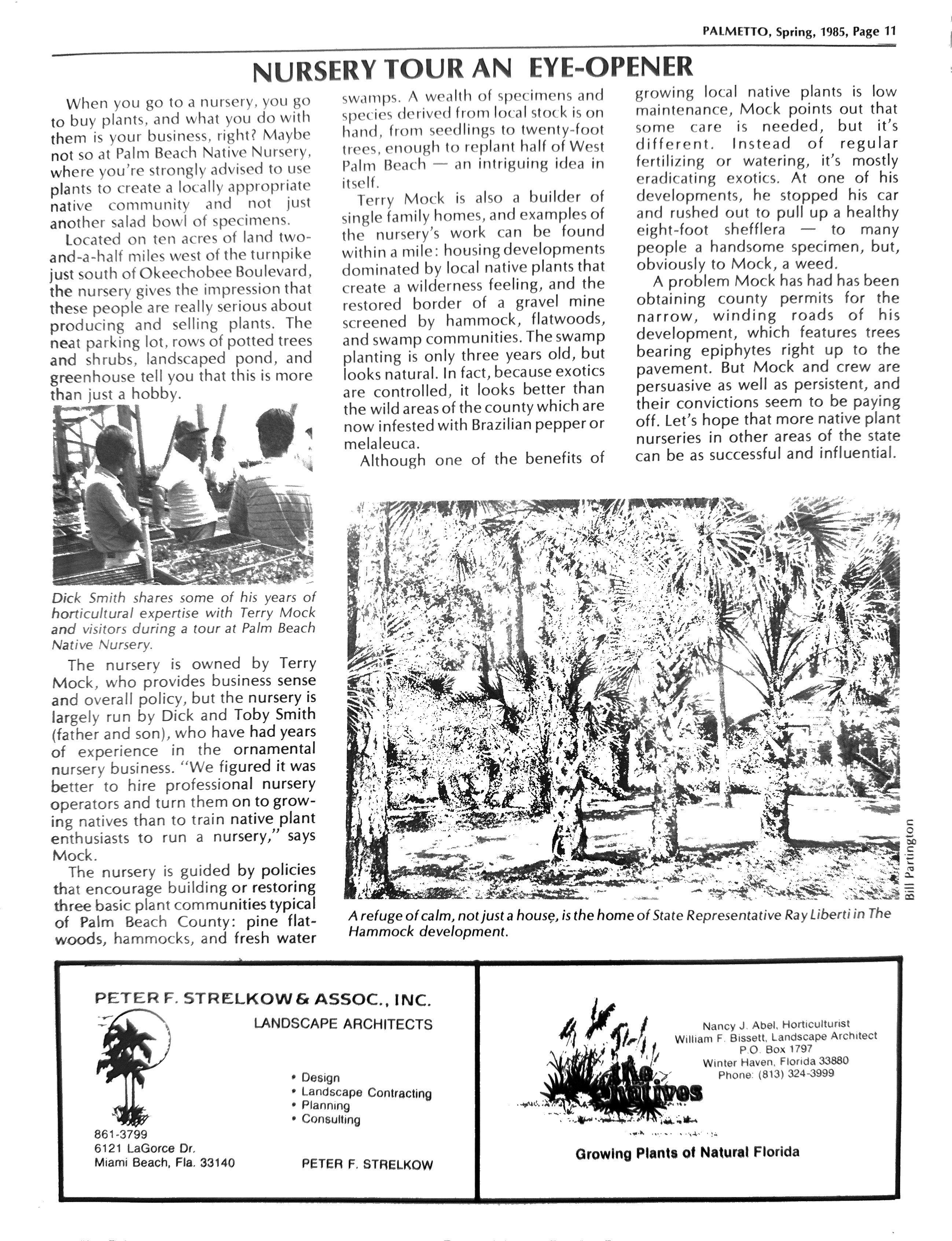
expertise with Terry Mock and visitors during a tour at Palm Beach Native Nursery.
The nursery is owned by Terry Mock, who provides business sense and overall policy, but the nursery Is largely run by Dick and Toby Smith (father and son), who have had years of experience in the ornamental nursery business. "We figured it was better to hire professional nursery operators and turn them on to growenthusiaes to to a nursery, sant Mock.
The nursery is guided by policies that encourage building or restoring three basic plant communities typical of Palm Beach County: pine flatwoods, hammocks, and fresh water
swamps. A wealth of specimens and growing local native plants is low species derived from local stock is on maintenance, Mock points out that hand, from seedlings to twenty-foot some care is needed, but it's trees, enough to replant half of West different. Instead ofregular Palm Beach ? an intriguing idea in fertilizing or watering, it's mostly eradicating exotics. At one of his
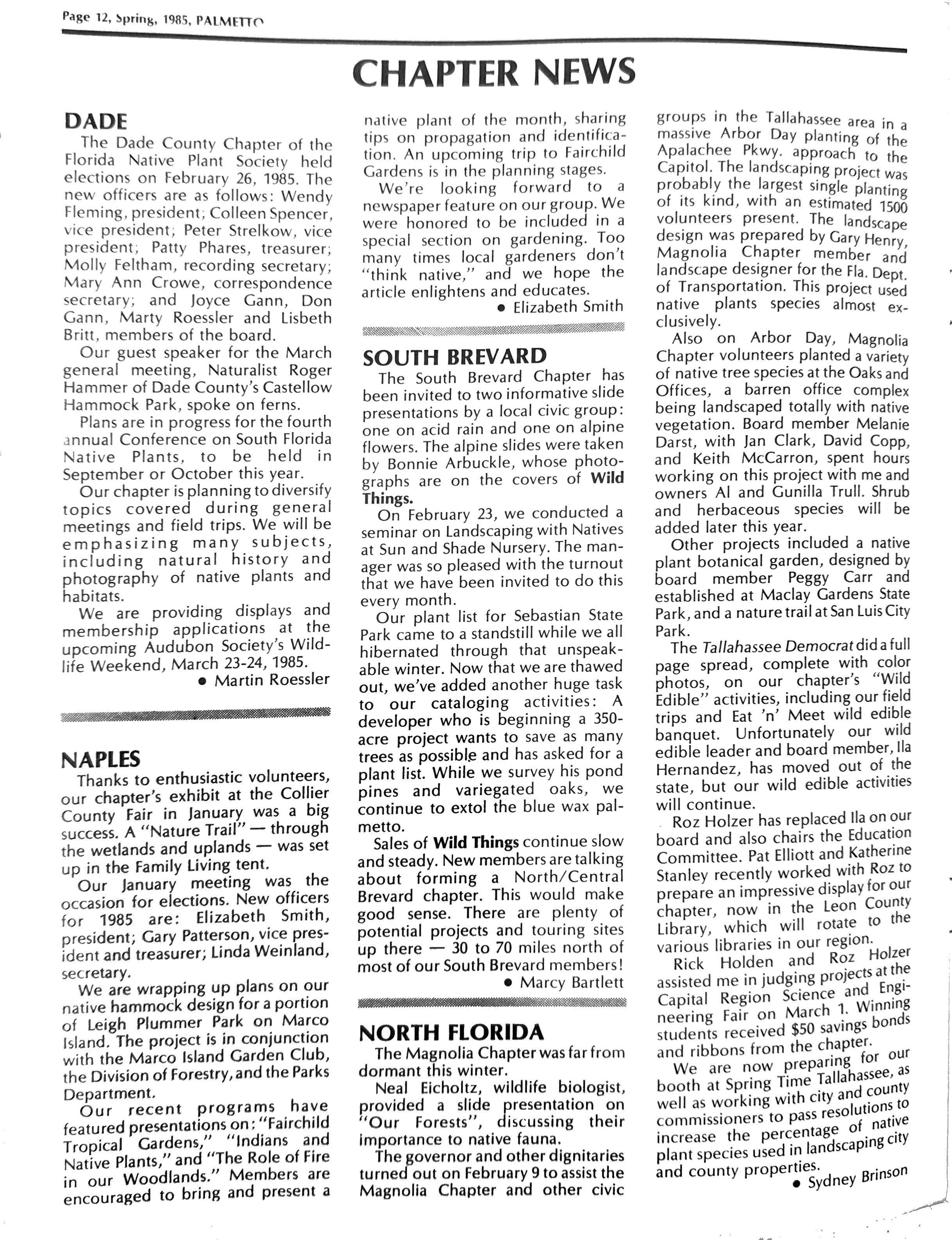
Terry Mock is also a builder of developments, he stopped his car single family homes, and examples of and rushed out to pull up a healthy the nursery's work can be found eight-footshefflera - tomany within a mile: housing developments people a handsome specimen, but, dominated by local native plants that obviously to Mock, a weed. create a wilderness feeling, and the A problem Mock has had has been restored border of a gravel mine obtaining county permits for the screened by hammock, flatwoods, narrow, windingroads of his and swamp communities. The swamp development, which features trees planting is only three years old, but bearing epiphytes right up to the looks natural. In fact, because exotics pavement. But Mock and crew are are controlled, it looks better than persuasive as well as persistent, and the wild areas of the county which are their convictions seem to be paying now infested with Brazilian pepper or off. Let's hope that more native plant melaleuca. nurseries in other areas of the state
Although one of the benefits of can be as successful and influential.
Nancy J. Abel, Horticulturist
William F. Bissett, Landscape Architect P.O. Box 1797
Winter Haven, Florida 33880 Phone: (813) 324-3999
The Dade County Chapter of the Florida Native Plant Society held elections on February 26, 1985. The new officers are as follows: Wendy Fleming, president; Colleen Spencer, vice president; Peter Strelkow, vice president; Patty Phares, treasurer; Molly Feltham, recording secretary; Mary Ann Crowe, correspondence secretary; and Joyce Gann, Gann, Marty Roessler and Lisbeth Britt, members of the board.
Our guest speaker for the March general meeting, Naturalist Roger Hammer of Dade County's Castellow Hammock Park, spoke on ferns.
Plans are in progress for the fourth annual Conference on South Florida Native Plants, to be September or October this year.
Our chapter is planning to diversify topics covered during general meetings and field trips. We will be emphasizing many subjects, including natural history and photography of native plants and habitats.
We are providingdisplays and membership applications at the upcoming Audubon Society's Wildlife Weekend, March 23-24, 1985.
? Martin Roessler
Thanks to enthusiastic volunteers, our chapter's exhibit at the Collier County Fair in January was a big success. A "Nature Trail" - through the wetlands and uplands - was set up in the Family Living tent.
Our January meeting was the occasion for elections. New officers for1985are: Elizabeth Smith, president; Gary Patterson, vice president and treasurer; Linda Weinland, secretary.
We are wrapping up plans on our native hammock design for a portion of Leigh Plummer Park on Marco Island, The project is in conjunction with the Marco Island Garden Club, the Division of Forestry, and the Parks Department.
Our recent programs have featured presentations on: "Fairchild Tropical Gardens," "Indians and Native Plants," and "The Role of Fire in our Woodlands." Members are encouraged to bring and present a
native plant of the month, sharing tips on propagation and identification. An upcoming trip to Fairchild Gardens is in the planning stages.
We're looking newspaper feature on our group. We were honored to be included in a special section on gardening. Too many times local gardeners don't "think native," and we hope the article enlightens and educates.
? Elizabeth Smith
The South Brevard Chapter has been invited to two informative slide presentations by a local civic group: one on acid rain and one on alpine flowers. The alpine slides were taken by Bonnie Arbuckle, whose photographs are on the covers of Wild Things.
On February 23, we conducted a seminar on Landscaping with Natives at Sun and Shade Nursery. The manager was so pleased with the turnout that we have been invited to do this every month.
Our plant list for Sebastian State Park came to a standstill while we all hibernated through that unspeakable winter. Now that we are thawed out, we've added another huge task our cataloging activities: A developer who is beginning a 350acre project wants to save as many trees as possible and has asked for a plant list. While we survey his pond and variegated oaks, we continue to extol the blue wax pal-
Sales of Wild Things continue slow and steady. New members are talking aboutforming a North/Central Brevard chapter. This would make good sense. There are plenty of potential projects and touring sites up there - 30 to 70 miles north of most of our South Brevard members! ? Marcy Bartlett
The Magnolia Chapter was far from dormant this winter.
Neal Eicholtz, wildlife biologist, orovided a slide presentation or 'Our Forests", discussing their importance to native fauna.
The governor and other dignitarie turned out on February 9 to assist the Magnolia Chapter and other civic
groups in the Tallahassee area in a massive Arbor Day planting of the Apalachee Pkwy. approach to the Capitol. The landscaping project was probably the largest single planting of its kind, with an estimated 1500 volunteers present. The landscape design was prepared by Gary Henry, Magnolia Chapter member and landscape designer for the Fla. Dept of Transportation. This project used native plants species almost ex-
Also on Arbor Day, Magnolia Chapter volunteers planted a variety of native tree species at the Oaks and Offices, a barren office complex being landscaped totally with native vegetation. Board member Melanie Darst, with Jan Clark, David Copp, and Keith McCarron, spent hours working on this project with me and owners Al and Gunilla Trull. Shrub and herbaceous species will be added later this year
Other projects included a native plant botanical garden, designed by board member Peggy Carr anc established at Maclay Gardens State Park, and a nature trail at San Luis City Park.
The Tallahassee Democrat did a full page spread, complete with color photos, on our chapter's "Wild Edible" activities, including our field trips and Eat 'n' Meet wild edible banquet. Unfortunately our wild edible leader and board member, lla Hernandez, has moved out of the state, but our wild edible activities will continue.
Roz Holzer has replaced lla on our board and also chairs the Education Committee. Pat Elliott and Katherine Stanley recently worked with Roz to prepare an impressive display for our chapter, now in the Leon County Library, whichwill rotate to the various libraries in our region.
RickHolden and Roz Holzer assisted me in judging projects at the Capital Region Science and Engineering Fair on March 1. Winning students received $50 savings bonds and ribbons from the chapter.
We are now preparing for our booth at Spring Time Tallahassee, as well as working with city and county increase the percentage of native commissioners to pass resolutions to plant species used in landscaping city and county properties. ? Sydney Brinson
Deadline for submissions: April 15, 1985
Winners announced: May 4, 1985
The Florida Native Plant Society invites its members and the public to enter its first annual native plant photography contest. Winners will be announced at the Society's annual conference being held at Rollins College in Winter Park on May 3-4, and selected entries will be displayed at the conference
All photographs submitted will be retained by the Society and may be used in displays or educational programs, published in The Palmetto, or used in other FPS publications. Photographers will be given credit where their work is used.
All entries must depict plants and wildlife native to the State of Florida, which term in this case will mean species thought to exist here at the time the state was discovered by European explorers. Species known or suspected to have been introduced may be disqualified at the discretion of the judges
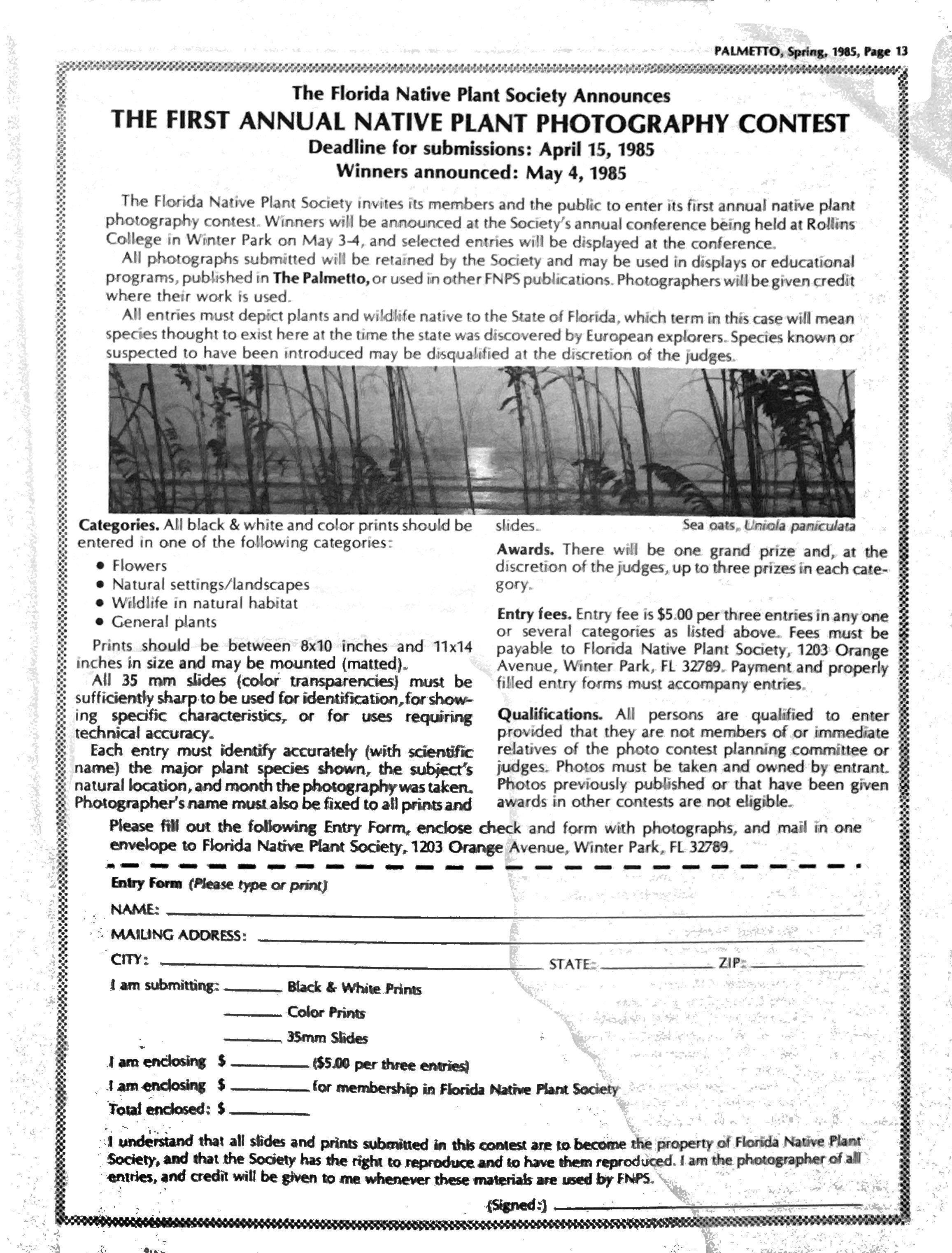
Categories. All black & white and color prints should be slides.
Sea oats, Uniola paniculata entered in one of the following categories:
Awards. There will be one grand prize and, at the ? Flowers discretion of the judges, up to three prizes in each cate-
? Natural settings/landscapes gory-
? Wildlife in natural habitat
? General plants
Entry fees. Entry fee is $5.00 per three entries in any one or several categories as listed above. Fees must be
Prints should be between 8x10 inches and 11x14 payable to Florida Native Plant Society, 1203 Orange inches in size and may be mounted (matted). Avenue, Winter Park, FL 32789. Payment and properly
All 35mm slides (color transparencies) must be filled entry forms must accompany entries sufficiently sharp to be used for identification, for showing specific characteristics, or for uses reguiring
Qualifications. All persons are qualified to enter technical accuracy- provided that they are not members of or immediate
Each entry must identify accurately (with scientific relatives of the photo contest planning committee or name) the major plant species shown, the subject's judges. Photos must be taken and owned by entrant. natural location, and month the photography was taken. Photos previously published or that have been given Photographer's name must also be fixed to all prints and awards in other contests are not eligible.
Please fill out the following Entry Form, enclose check and form with photographs, and mail in one envelope to Florida Native Plant Society, 1203 Orange Avenue, Winter Park, FL 32789
Entry Form (Please type or print)
NAME:
MAILING ADDRESS:
CITY: ? STATE: ZIP:
I am submitting:
Black & White Prints
Color Prints
35mm Slides
I am enclosing 5
1 am enclosing $
Total enclosed: $
($5.00 per three entries)
_ for membership in Florida Native Plant Society
I understand that all slides and prints submitted in this contest are to become the property of Florida Native Flant Society, and that the Society has the right to reproduce and to have them reproduced. I am the photographer of all entries, and credit will be given to me whenever these materials are used by ENPS
(Signed:)
FRIDAY, MAY 3
10:00 AM - Board meeting, Bush Science Center
11:00 AM - Registration for research reports session
1:00 PM - Research papers. Moderator: Dr. I. Jack Stout, Biology Department, UCF
7:30 PM - Evening program (open to the public). Crummer Hall. Native Habitats for Wildlife. Dr. F. Wayne King, Director, Florida State Museum; Susan Mashburn Cerulean, Nongame Wildlife Program, Florida Game & Fresh Water Fish Commission
SATURDAY, MAY 4
8:00 AM - Registration
8:45 AM - Welcome: Sherry Cummings and Bill Partington
9:00 AM? Keynote speech: Why native plants? Dr. David Wilson, Charlotte Harbor Native Plant Advisory Council and Charlotte Harbor NPS
9:45 AM - Workshop Session I
A. Innovative techniques for designing and managing natural areas. Reed Noss, School for Forest Resources and Conservation, U of FL; James McKinley, Director of Stewardship, Florida Nature Conservancy; Allen Burdett, DER and FNPS director; Larry D. Harris, School of Forest Resources and Conservation, U of FL.
B. Commercial Landscaping. Terry Mock, Palm Beach Native Nursery; Dick Workman, Coastplan; Darrell Morrison, Dean of School of Environmental Design, U of GA
C. Edible Native Plants. Dick Deverling, Orlando
D. Coastal Ecology and Evolution. Robert M. Craig, U.S. Soil Conservation Service, Ret'd.
10:45 AM ? Break
11:00 AM ? Workshop Session I|
A. How to improve your city or landscape ordinance.Richard J. Manchester, Environmental Designer; County Commissioner Vera Carter, Orange County
B. Propagation of Wild Flowers: Which, Where, When, and How. Dr. Fannie Fern Davis, FFGG; Robert Jones, Plants for Tomorrow
C. Aquatic gardening and lakeshore management. Walt Wheeler, Aquatic Symbiotics, Inc.; Carol S. Lotspeich, Lotspeich & Assoc.; Dr. John Osborne, UCF
D. Identification, Dr. Richard Wunderlin, USF Biology Department
12:30 PM - Lunch and FNPS elections
2:00 PM ? Workshop Session III
A. Tissue culture and propagation techniques. Dr. Tom Sheehan, U of FL; Dr. Bijan Dehgan, U of FL
B. Engangered Plant Species. Dr. Dennis Hardin, Florida Natural Areas Inventory; David L. Martin, botanist, U.S. Fish & Wildlife Service
C. Creating natural sanctuaries. David Black, Gainesville; Ken Morrison, Environmental Consultant; Eve Hannahs, Endangered Species Plant Council
D. Obtaining native plants. Paul Cummings, The Tree Gallery; Carl Bates, Plants for Tomorrow
3:30 PM - Committee/task force meetings: Education, Publications, Conservation, Science, Landscaping
4:30 PM - Nature Photography. Gary Henderson, Nature's Image Photography, Orlando Field trip overviews:
A. Black Hammock. Dr. Henry Whittier, UCF
B. Wekiva River. Carol S. Lotspeich
C. Turkey Lake Park Scrub. Dr. I. Jack Stout
5:00 PM - Plant Raffle
7:00 PM - Barbecue: Chicken and beef ribs, $10 Photography contest winners announced
SUNDAY, MAY 5
8:00 AM - Field Trips:
A. Black Hammock. Dr. Henry Whittier
B. Wekiva River. Carol S. Lotspeich
C. Turkey Lake Park Scrub. Dr. I. Jack Stout Native plant exhibit and raffle. Growers and nursery people who belong to FNPS are invited to bring plants to exhibit at this conference on Friday and Saturday at no charge (no booth fee!). Exhibitors are requested to donate a minimum of $15 worth of plants to the Central Florida Chapter of the Florida Native Plant Society for the plant raffle on Saturday afternoon following the program, in lieu of paying an exhibition fee. Other exhibitors. Persons wishing to sell native plants, art, cards, books, or other appropriate items should donate a percentage of sales to FNPS. Please call 305/ 644-5377 to make arrangements. Members are encouraged to advertise plants, products, or services by displaying promotional literature. They should also call ahead for approval.
Members in good standing of FNPS who wish to bring exhibits or literature may do so at no charge, and indoor tables will be available on a first-come basis. Outdoor exhibitors must provide their own stands. Space is available on the lawn outside Bush Science Center.
All exhibitors will be responsible for their property.
The Uniola Chapter, serving St. Lucie and Indian River counties, is now one year old and has thirty-three members. We meet on the second Monday of each month, 7:30 p.m., at the St. Lucie County Public Library. Recently elected officers for 1985 were: Blaine Williams, president; Norma Clark, vice president; Marti Mook, treasurer; and Gloria Moore, secretary. We would like to thank Steve Lindley and Captain Sam Ferguson for serving as officers for the previous year.
We are currently working several projects, including establishing a tree ordinance for St. Lucie County, through the efforts of Urban Forester,Paul Williams, working with the County Parks Department on plant identification
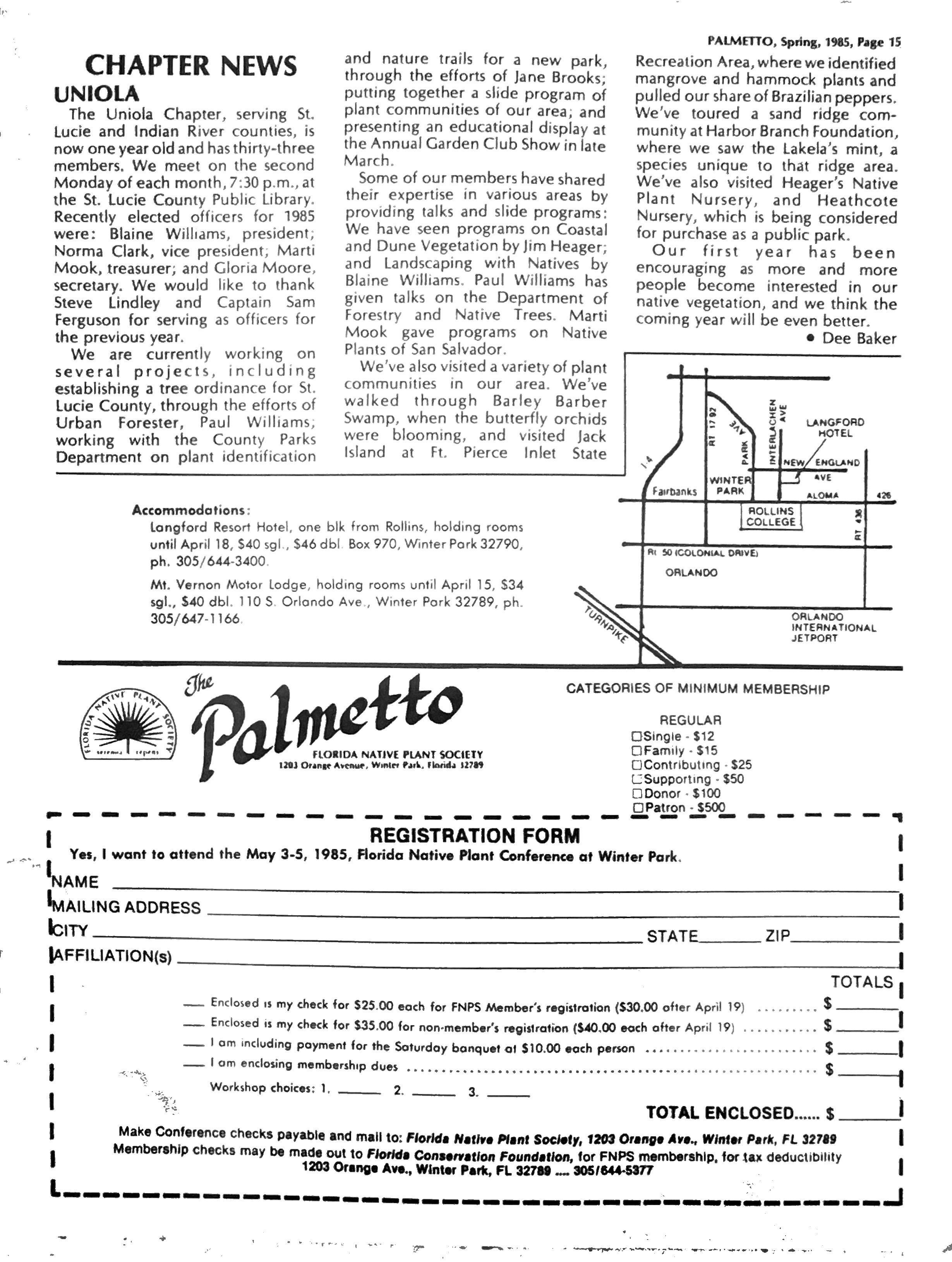
Accommodations:
and nature trails for a new park, through the efforts of Jane Brooks; putting together a slide program of plant communities of our area; and presenting an educational display at the Annual Garden Club Show in late March.
Some of our members have shared their expertise in various areas by providing talks and slide programs: We have seen programs on Coastal and Dune Vegetation by Jim Heager; and Landscaping with Natives by Blaine Williams. Paul Williams has given talks on the Department of Forestry and Native Trees. Marti Mook gave programs on Native Plants of San Salvador.
We've also visited a variety of plant communities in our area. We've walked through Barley Barber Swamp, when the butterfly orchids were blooming, and visited Jack Island at Ft. Pierce Inlet State
Langford Resort Hotel, one blk from Rollins, holding rooms until April 18, S40 sgl., S46 dbl. Box 970, Winter Park 32790, ph. 305/644-3400.
Mt. Vernon Motor Lodge, holding rooms until April 15, $34 sgl., S40 dbl. 110 S. Orlando Ave., Winter Park 32789, ph. 305/647-1166
PALMETTO, Spring, 1985, Page 15 Recreation Area, where we identified mangrove and hammock plants and pulled our share of Brazilian peppers. We've toured a sand ridge community at Harbor Branch Foundation, where we saw the Lakela's mint, a species unique to that ridge area. We've also visited Heager's Native Plant Nursery, and Heathcote Nursery, which is being considered for purchase as a public park.
Our first year has been encouraging as more and more people become interested in our native vegetation, and we think the coming year will be even better.
? Dee Baker
?Single - $12
?Family - $15 ? Contributing - $25 Supporting - $50 ? Donor - $100
?Patron: $500
Yes, I want to attend the May 3-5, 1985, Florida Native Plant Conference af Winter Park.
Enclosed is my check for $25.00 each for FPS Member's registration ($30.00 ofter April 19)
Enclosed is my check for $35.00 for non-member's registration ($40.00 each after April 19)
1 am including payment for the Saturday banquet at $10.00 each person
I am enclosing membership dues .....
Workshop choices: 1. 3.
by David W. Hall
Wild Poinsettia is a common name that is applied to two separate species of the genus Euphorbia. Both species occur commonly throughout Florida. This genus is in the Spurge Family (Euphorbiaceae). The two species, Euphorbia heterophylla L. and Euphorbia cyathophora Murr., are virtually identical. The only easily recognizable difference in the two species is a distinction in the shape of a gland which is located on the structure bearing the flowers. are herbaceous annuals, but E. cyathophora can be a short-lived perennial. Both species can reach about four feet in height, but are often no more than one or two feet tall. The stems are usually lacking hairs and have many branches near the top. The leaves, which can be up to 15 cm long and are with or without hairs, are usually opposite but often alternate leaves occur on the same plant. The leaves are quite variable,being without petioles (sessile) or having a petiole as long as 4 cm. The shape varies, even on the same plant, from linear, to elliptic, to ovate, to fiddle-shaped. The leaf margins are entire, toothed or lobed, again, even on the same
The upper cyathophora are often red near the base while the upper leaves of E. heterophylla have purple or whitish blotches, but are never red at the base. The flowers are inconspicuous and highly modified. They are separated into male and female
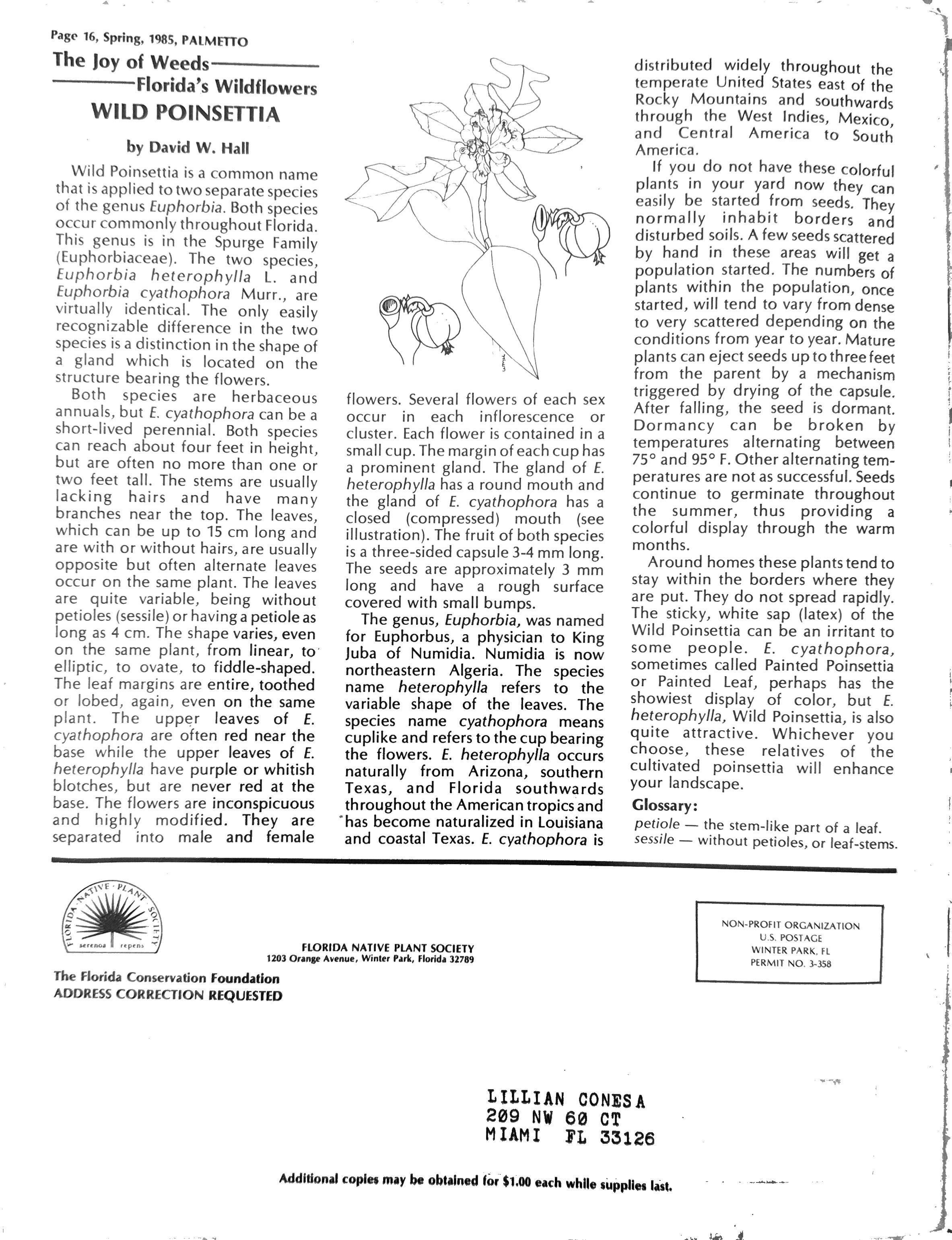
flowers. Several flowers of each sex each inflorescence cluster. Each flower is contained in a small cup. The margin of each cup has a prominent gland. The gland of E. heterophylla has a round mouth and the gland of E. cyathophora has a closed (compressed) mouth (see illustration). The fruit of both species is a three-sided capsule 3-4 mm long. The seeds are approximately 3mm long and have a rough surface covered with small bumps.
The genus, Euphorbia, was named for Euphorbus, a physician to King Juba of Numidia. Numidia is now northeastern Algeria. The species name heterophylla refers to the variable shape of the leaves. The species name cyathophora means cuplike and refers to the cup bearing the flowers. E. heterophylla occurs naturally from Arizona, southern Texas, and Florida southwards throughout the American tropics and has become naturalized in Louisiana and coastal Texas. E. cyathophora is
distributed widely throughout the temperate United States east of the Rocky Mountains andsouthwards through the West Indies, Mexico, and Central America to South
If you do not have these colorful lants in your yard now they can easily be started from seeds. They normally inhabit borders disturbed soils. A few seeds scattered by hand in these areas will get a population started. The numbers of plants within the population, once started, will tend to vary from dense to very scattered depending on the conditions from year to year. Mature plants can eject seeds up to three feet from the parent by a mechanism triggered by drying of the capsule. After falling, the seed is dormant. Dormancy can be broken by temperatures alternating between 75° and 95° F. Other alternating temperatures are not as successful. Seeds continue to germinate throughout providing a colorful display through the warm
Around homes these plants tend to stay within the borders where they are put. They do not spread rapidly. The sticky, white sap (latex) of the Wild Poinsettia can be an irritant to some people. E. cyathophora, sometimes called Painted Poinsettia or Painted Leaf, perhaps has the showiest display of color, but E. heterophylla, Wild Poinsettia, is also quite attractive. Whichever you choose, these relatives of the cultivated poinsettia will enhance your landscape.
petiole - the stem-like part of a leaf. sessile - without petioles, or leaf-stems.