MIDWEST AG SUMMIT PREMIER SPONSOR
RURAL AGRICULTURAL WORKFORCE INSIGHT
NORTH DAKOTA’S CARBON BLUEPRINT
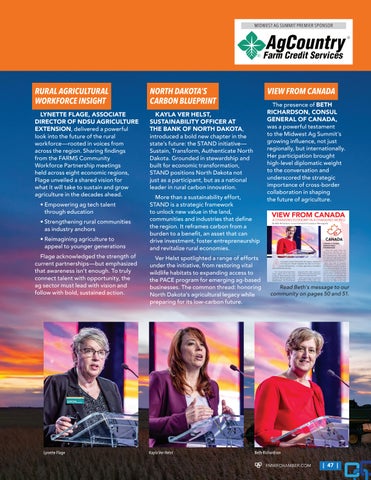
LYNETTE FLAGE, ASSOCIATE DIRECTOR OF NDSU AGRICULTURE EXTENSION, delivered a powerful
KAYLA VER HELST, SUSTAINABILITY OFFICER AT THE BANK OF NORTH DAKOTA,
look into the future of the rural workforce—rooted in voices from across the region. Sharing findings from the FARMS Community Workforce Partnership meetings held across eight economic regions, Flage unveiled a shared vision for what it will take to sustain and grow agriculture in the decades ahead. •E mpowering ag tech talent through education
•S trengthening rural communities as industry anchors •R eimagining agriculture to appeal to younger generations Flage acknowledged the strength of current partnerships—but emphasized that awareness isn’t enough. To truly connect talent with opportunity, the ag sector must lead with vision and follow with bold, sustained action.
VIEW FROM CANADA The presence of BETH RICHARDSON, CONSUL GENERAL OF CANADA,
introduced a bold new chapter in the state’s future: the STAND initiative— Sustain, Transform, Authenticate North Dakota. Grounded in stewardship and built for economic transformation, STAND positions North Dakota not just as a participant, but as a national leader in rural carbon innovation. More than a sustainability effort, STAND is a strategic framework to unlock new value in the land, communities and industries that define the region. It reframes carbon from a burden to a benefit, an asset that can drive investment, foster entrepreneurship and revitalize rural economies. Ver Helst spotlighted a range of efforts under the initiative, from restoring vital wildlife habitats to expanding access to the PACE program for emerging ag-based businesses. The common thread: honoring North Dakota’s agricultural legacy while preparing for its low-carbon future.
was a powerful testament to the Midwest Ag Summit’s growing influence, not just regionally, but internationally. Her participation brought high-level diplomatic weight to the conversation and underscored the strategic importance of cross-border collaboration in shaping the future of agriculture. | IN CASE YOU MISSED IT |
VIEW FROM CANADA
A CHANGING ECONOMY IN A CHANGING WORLD By Beth Richardson, Consul General of Canada in Minneapolis
CANADA: A GLOBAL AGRICULTURAL POWERHOUSE
A
Richardson addresses attendees and livestream viewers at The Chamber's Midwest Ag Summit in June.
s Canada’s Consul General for this region, I represent not only your closest neighbor but also one of your most vital partners – in trade, agriculture, innovation, and continental security. The Fargo – Moorhead –West Fargo region sits at the hear t of one of North America’s most productive agricultural zones, which stretches north into Manitoba and Saskatchewan. Our communities share deep ties to the land and to each other.
Kayla Ver Helst
And in agriculture and agri-food, specifically? In 2024, trade in this sector totaled over $74 billion USD. Canada is the second-largest export market for U.S. agricultural products, purchasing more than $28 billion in food and ag goods. We're second only to Mexico for ag exports, which speaks to the importance of USMCA and the massive North American trade and investment relationship.
More than 70% of Canadian exports to the U.S. are primary inputs that American companies transform into higher-value goods. So, here in Minnesota and North Dakota, Canada supplies things like grains, livestock feed, and fertilizer that U.S. manufacturers and producers turn into cereals, processed meats, and other products. In return, we purchase over 40% of your highvalue agricultural exports. Canadian companies are invested heavily in North Dakota. As an example, AGT Foods, a Saskatchewan-based leader in plant-based protein foods, recently expanded its Minot facility. AGT now has the potential to process 40 million pounds of gluten-free pasta annually. Even better? AGT sources
Read Beth’s message to our community on pages 50 and 51. Over the past few decades, free trade agreements and integrated supply chains have made the Canada – U.S. relationship the most robust and profitable trading partnership in the world. In 2024 alone, our bilateral trade reached
| 50 |
Lynette Flage
nearly $1 trillion USD—equivalent to $2.7 billion in goods and services crossing our border every day.
Here’s the good news: Our agr icultur al s ys tems do not compete with one another—they are complementary. We supply each other with high-quality inputs, co-create value-added products, and compete globally as a unified force.
THE BRIDGE
July - August 2025
Beth Richardson FMWFCHAMBER.COM
| 47 |
many jobs a North investi throug Climat suppo adopti and p and ag Indust focuse protei 73 proj $610 m 10,000 Canad
Cana and th Ameri We are export 85% of more t in Ame the U farm many o and im improv profits
Can compa in rob and Forwa Techn Picket Globa techno to real here in Canad
Wha Dakot sector investm