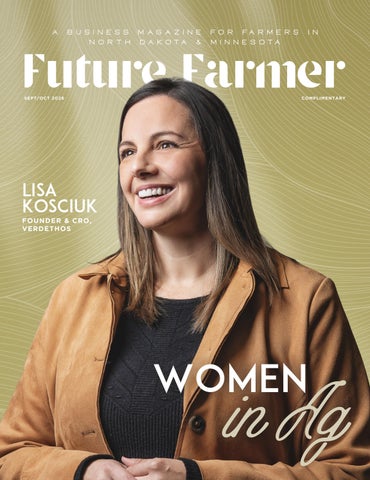
SEPT/OCT 2026
COMPLIMENTARY
Lisa Kosciuk FOUNDER & CRO, VERDETHOS
Women
in Ag
FROM THE EDITOR
THE WOMEN BEHIND THE WORK T
here is a difference between recognizing someone’s work and understanding it.
We can applaud a woman for leading a farm or building an agricultural business. But the more interesting questions come next. What did she have to learn? Which decisions kept her up at night? Who gave her a chance? And what would she tell someone hoping to follow her path? Those are the kinds of questions I hope this Women in Ag issue of Future Farmer encourages us to ask. For a community surrounded by agriculture, we shouldn’t need a reminder that the industry is about people. Still, it’s easy to talk about crops, equipment, and markets while overlooking the individuals making decisions every day. Putting faces and experiences to that work makes our connection to it more meaningful. Women belong at the center of that conversation, not off to the side. That means going beyond a job title or a list of accomplishments.
DO YOU HAVE A COOL STORY TO SHARE?
It means taking an interest in someone’s ideas, listening to her advice, and understanding what she is working to change. Recognition matters, but so does being taken seriously when there is a problem to solve or an opportunity to pursue. I also hope these pages reach someone who hasn’t yet pictured herself in agriculture. Maybe she loves science. Maybe she wants to build a business. Maybe she grew up on a farm and is wondering what her own place there could look like. Seeing another woman’s path won’t answer every question. It can, however, give her a reason to ask the next one. As you read this issue, I hope you find someone whose work makes you curious. Learn her name. Consider her perspective. Share her story. Getting to know the people shaping our region is what Future Farmer is about. Their stories belong here.
BRADY DRAKE
FUTURE FARMER EDITOR
LET'S C ONNECT! BRADY@SPOTLIGHTMEDIAFARGO.COM
FUTUREFARMERMAG.COM
7
.
CONTENTS PARTNER CONTENT
38
14 NDSCS: We Train The Hands That Build North Dakota 20 Ostara: Put Soil Biology To Work For Your Fertilizer Investment 22 Elevate Financial: Elevate Your Edge 26 701x: An Extra Set Of Eyes At Koester Red Angus 28 Deep Roots Drainage: In Your Fields. In Your Corner. 30 Radium Inc: Built Around The Farmer
WOMEN IN AG 38 From The Field To The Proof 46 Finding Her Voice In The Blue Jacket 52 Small Machine, Big Hope 58 Rooted In Relationship
52
September/October 2026 Volume 7 Issue 5
Future Farmer Future Farmer is published 6 times a year and is direct mailed to farmers throughout North Dakota and Minnesota. Find us online at Futurefarmermag.com.
Publisher EDITORIAL Editorial Team Lead Art Director Editorial Graphic Designer INTERACTIVE Director of Performance Marketing Director of Creative Strategies Web Project Manager Senior Graphic Designer Director of Web Operations Director of Agency Social Media Senior Digital Advertising Specialist ADVERTISING VP of Business Development Sales Representative
Mike Dragosavich Brady Drake Brady@SpotlightMediaFargo.com Kim Cowles Ty Betts Kellen Feeney Megan Suedbeck Matthew Haire Sarah Cabler Sara Jentink Mhairi Christopherson Tammy Fogle Paul Hoefer Paul@SpotlightMediaFargo.com Al Anderson Al@SpotlightMediaFargo.com
Digital Sales Representative
Abby Schauer Abby@SpotlightMediaFargo.com
Senior Digital Advertising Specialist
Matt Purpur Matt@SpotlightMediaFargo.com
Director of New Market Sales & Expansion Client Relations Director of Client Success Marketing Admin Accounting Specialist DISTRIBUTION Delivery
Cooper Opheim Cooper@spotlightmediafargo.com ClientRelations@SpotlightMediaFargo.com Jessica Ventzke Tyler Duclos Missy Roberts John Stuber
Future Farmer is published by Spotlight LLC, Copyright 2026 Future Farmer. All rights reserved. No parts of this magazine may be reproduced or distributed without written permission of Future Farmer, and Spotlight LLC, is not responsible for, and expressly disclaims all liability for, damages of any kind arising out of use, reference to or reliance on such information. Spotlight LLC, accepts no liability for the accuracy of statements made by the advertisers.
Spotlight LLC 4609 33rd Ave S Suite #304 Fargo, ND 58104 Info@SpotlightMediaFargo.com ADVERTISING: 701-478-SPOT (7768)
PARTNER CONTENT
WE TRAIN THE HANDS THAT BUILD NORTH DAKOTA A look inside the college doing the work to keep North Dakota running — from wheat fields to hospital floors, from aviation hangars to fire departments.
30.1%
Enrollment Growth Since 2020
+20%
Wage growth since 2022
68%
ND grads who stay in-state
Somewhere today, a welding student is running her first perfect bead in a Wahpeton shop. In another lab, a nursing student is working through a critical-care scenario. In an aviation hangar in North Fargo, a technician is learning flight mechanics for the very first time. They are all training for specific jobs to fill the workforce needs of communities right here in North Dakota. At NDSCS, success isn't measured in credits accumulated. It's measured in careers launched—and in the businesses, hospitals, and communities those careers go on to serve. Starting wages for NDSCS graduates climbed more than 20% in just three years, a clear signal that what students learn here, employers are eager to pay for.
Going to college helped me learn about new technologies that will help keep our family farm running." — TANNER · AGRICULTURE
14
SEPTEMBER/OCTOBER 2026
A STRONGER NDSCS MEANS A STRONGER NORTH DAKOTA NDSCS isn't just part of North Dakota's college system. It is a critical piece of North Dakota’s infrastructure.
27
32+
of 53 ND counties with NDSCS grads
100+
programs across every sector
years of workforce service
When a hospital needs a nurse, an ag cooperative needs a precision technician, or a construction firm needs a project manager, they look for NDSCS graduates. Because NDSCS trains people for those exact roles, with expertise that makes a difference from day one. The college's programs aren't pulled from a generic catalog; they're written in direct response to what North Dakota's employers say they need. Advisory boards of working professionals review curricula regularly. Equipment in the shops is current because the companies that donate it need graduates who can operate it immediately. When industry changes, NDSCS changes with it. Across 27 of North Dakota's 53 counties, you'll find an NDSCS graduate in a hospital, a shop, a school, or a field. That reach is intentional: the college was built to serve the whole state, and it does. From dental clinics in Bismarck to agricultural cooperatives on the western plains, NDSCS-trained professionals are part of the backbone of North Dakota's economy.
"From alongside dentists' chairs to inside fire stations, North Dakota runs on NDSCS graduates."
I know people who have gone through NDSCS. They've expressed how much they enjoyed the experience — and learned about their degree." — JACK · BUSINESS MANAGEMENT
NDSCS AT A GLANCE
KEY INDICATORS FOR NORTH DAKOTA'S OFFICE OF MANAGEMENT AND BUDGET
30.1% 68%
Enrollment Growth Since 2020
Graduates Stay in North Dakota
73.54% $10M+
Student Retention Rate
Annual Industry Partnership Value
97% 30%
Graduate Placement Rate
Graduates From Outside ND That Stay in ND
FUTUREFARMERMAG.COM
15
PARTNER CONTENT
My company sponsors me to come here. I come out with less debt and a guaranteed job." — GANNON · HVAC/R TECHNOLOGY
WHEN WORKFORCE DEMAND GROWS, SO DOES NDSCS Enrollment at NDSCS doesn't follow national trends. It follows North Dakota's industries — and right now, those industries need people.
AVERAGE STARTING WAGE SNAPSHOT — SELECT NDSCS PROGRAMS, CLASS OF 2025 PROGRAM
Dental Hygiene
$80,320
Nursing (RN)
$80,225
Welding Technology
$59,806
HVAC/R Technology
$49,660
All 2025 Graduates — Weighted Average
$53,500
When construction booms, Building Construction Technology grows. When healthcare expands, nursing programs fill fast. NDSCS has designed itself to be responsive: new program tracks, expanded cohorts, and employer-funded equipment that keeps pace with real demand. With most programs averaging starting wages above $50,000—and a weighted average of $57,152 across all 2025 graduates—NDSCS isn't preparing students for modest starts. It's launching careers. And because those careers exist right here, graduates stay. In fact, two out of three North Dakota-raised NDSCS graduates remain in-state, a statistic every North Dakota community benefits from directly. The numbers tell only part of the story. The other part is employers calling before students graduate. Program directors report that students in high-demand fields often receive job offers months before their final semester ends—a pipeline so tight that filling seats in the classroom is filling open positions across the state. 16
AVG. STARTING WAGE
SEPTEMBER/OCTOBER 2026
ACROSS 27 OF NORTH DAKOTA'S 53 COUNTIES, YOU'LL FIND AN NDSCS GRADUATE IN A HOSPITAL, A SHOP, A SCHOOL, OR A FIELD
THE TWO-YEAR COLLEGE WITH THE BIG-COLLEGE FEEL Every perk you'd expect from a four-year university — residence halls, varsity sports, performing arts — in two years, at a fraction of the cost.
NDSCS offers students far more than a credential. With on-campus residence halls, seven athletic teams, performing arts, and more than 250 student events each year, the NDSCS experience rivals any four-year institution—while delivering career-ready outcomes in just two years. Students come to belong to something—a community that invests in their success, with instructors who know their names. Tuition at NDSCS is among the most affordable in the region, and for students who live on campus, the full college experience—the games, the friendships, the late-night study sessions—costs thousands less per year than a comparable four-year school. You don't sacrifice the experience. You just spend less to have it.
THE FULL COLLEGE EXPERIENCE AT NDSCS ON-CAMPUS RESIDENCE HALLS
7 NJCAA ATHLETIC PROGRAMS
PERFORMING ARTS & THEATER
250+ CAMPUS EVENTS PER YEAR AMONG THE MOST AFFORDABLE IN THE REGION 2-YEAR CAREER-READY DEGREES
ALSO IN FARGO — THE CAREER INNOVATION CENTER The Career Innovation Center in Fargo anchors C3TEC— linking area high schools, regional employers, and NDSCS to build the workforce before graduation day arrives. Dual credit, career exploration, live industry partnerships: it's how NDSCS starts training North Dakota's next generation while they're still in high school.
Being an EMS student was one of the most rewarding experiences of my life — skilled instructors who genuinely cared about every student's long-term success." — MEGAN · EMS
FUTUREFARMERMAG.COM
17
PARTNER CONTENT
IN THEIR OWN WORDS — AND WHO WE ARE
The students who have walked through NDSCS say it best. And the numbers back them up.
It's a different learning scenario. Rather than sitting in class, you get to actually get hands-on." — EDGAR · ELECTRICAL TECHNOLOGY
I feel confident that I have a firm foundation — a stepping stone to jump off of and grow into the industry." — KYLE · ARCHITECTURAL MODELING & DESIGN TECHNOLOGY
After I graduated, I was so grateful for all the hands-on learning — I could use it to be one step ahead." — GRACE · CULINARY ARTS
It was definitely more affordable than surrounding colleges—and it felt like home." — JACOB · NURSING
NORTH DAKOTA STATE COLLEGE OF SCIENCE NDSCS is North Dakota's premier technical college — headquartered in Wahpeton with a growing Fargo presence through the Career Innovation Center and NDSCS 19th Avenue. For more than a century, the college has served the people and industries of the region. With programs across healthcare, trades, technology, business, and agriculture, NDSCS delivers university breadth with technical-college focus. Students train in modern facilities under instructors who come from the industries they teach — accredited, affordable, and deeply rooted in North Dakota.
A CENTURY OF SERVICE TO NORTH DAKOTA 1903
Founded in Wahpeton to serve the region's skilled workforce.
Early-1900s
Expansion into health, agriculture, manufacturing & trades programs.
1987
Renamed North Dakota State College of Science.
2025
Fargo Career Innovation Center opens.
READY TO BUILD YOUR FUTURE? 18
SEPTEMBER/OCTOBER 2026
NDSCS.EDU
Today
Three seamless locations plus online.
PA RT N E R C O N T E N T
Put Soil Biology to Work
FOR YOUR FERTILIZER INVESTMENT By Dr. Shawn Semones, technology advisor for Ostara
very fertilizer dollar should help your crop perform. But getting nutrients into the field is only the beginning. The real opportunity is keeping those nutrients available and helping the crop access them throughout the growing season. That is why I believe the relationship between fertilizer, roots, and soil biology deserves more attention when growers build their fertility programs. CG P2X from Ostara brings that relationship into focus. With a 9-42-0 analysis plus 9% magnesium, it delivers nitrogen, phosphorus, and magnesium in one granule. CG P2X research shows 95% of its nutrients are available to the crop in the first year. Its value begins with a different approach to nutrient release, one that works with roots and the biological activity surrounding them. I have spent much of my career working with soil biology. What continues to interest me is how closely crop nutrition depends on the living community beneath our feet. Bacteria, fungi and other microorganisms help transform and move nutrients. They are active participants in the fertility program, and fertilizer choices should account for their contribution.
20
SEPTEMBER/OCTOBER 2026
Much of this activity occurs in the rhizosphere, the soil immediately influenced by plant roots. Root exudates include sugars, amino acids, organic acids (such as citrate and malate), phenolics, mucilage, enzymes, and signaling molecules. Microorganisms break down organic matter and mobilize them into forms the crop can use. Together, these processes support nutrient access as the plant grows. Phosphorus makes this relationship especially important. It supports energy transfer, root development and grain production, yet it moves only short distances through soil. It can also react with calcium, iron or aluminum and become less available. That means the phosphorus a grower pays for and applies may be difficult for the crop to reach when demand increases. CG P2X is designed to address that availability challenge. Its granules do not dissolve readily in water like conventional soluble phosphate fertilizers. Instead, organic acids and localized acidity associated with roots and microbial activity help mobilize the nutrients. This release mechanism is central to the product’s ability to support nutrient availability throughout the season.
CG P2X IS THE MOST EFFICIENT, SUSTAINABLE, AND ECONOMICAL FERTILIZER ON THE MARKET. PERIOD.
When I describe that process as demand-driven, I include both the crop and its surrounding biological community (i.e., the microbiome). Roots and microbes contribute to nutrient cycling and mobilization by creating the conditions that dissolve the CG P2X granule. The opportunity extends beyond releasing nutrition: the same living system helps capture nutrients and transfer them to the plant. Mycorrhizal fungi are a particularly valuable part of that system. These beneficial fungi form relationships with many crops and extend fine threads, called hyphae, into the soil. Those threads explore spaces roots cannot readily reach and access phosphorus beyond the area immediately surrounding the root. In this symbiosis, the plant supplies carbon, and the fungus helps supply nutrients and water. That is why compatibility with soil biology matters to me when evaluating fertilizer technology. CG P2X offers a low salt index and a release profile designed to work with these natural processes. Its magnesium component adds another benefit: magnesium is essential to chlorophyll, helping plants capture sunlight for photosynthesis. Each nutrient in the granule has a role in crop performance.
at half the standard fertilizer product rate delivered equal or better performance in the majority of comparisons (i.e., >70% of the time). Those results illustrate the potential to improve fertilizer efficiency. Growers should evaluate the relevant trial data and appropriate rates with their agronomic adviser. Biology complements a sound fertility program, and CG P2X gives growers a way to bring those pieces together. The objective is practical: support healthy roots, maintain access to essential nutrients and get more value from the fertilizer investment. Looking at nutrient source alongside rate, timing and placement helps put that objective into practice. For growers considering their next phosphorus application, I encourage a closer look at CG P2X. Ask your Ostara representative or fertilizer retailer to review performance data, application options and recommendations for your fields. Understanding how this technology fits your operation is the next step toward putting soil biology to work and making every fertilizer dollar count.
The performance results discussed in our webinar make this approach compelling. Across the trials presented, CG P2X applied
FUTUREFARMERMAG.COM
21
PARTNER CONTENT
22
SEPTEMBER/OCTOBER 2026
FUTUREFARMERMAG.COM
23
PARTNER CONTENT
24
SEPTEMBER/OCTOBER 2026
PARTNER CONTENT By Brady Drake provided by 701x
An Extra Set of EyeS At Koester Red Angus uring the busiest stretch of fall calving, Tracey Koester had 15 calves arrive one day, 16 another, and 19 a third. She was handling most of the tagging and weighing herself while her husband, Steve, kept up with other ranch work. Finding those newborns in tall grass was a challenge. This year, however, she had another source of information: alerts on her phone. The Koesters operate Koester Red Angus near Steele, North Dakota, with approximately 220 cows and heifers calving this fall. Tracey also runs Cow Camp Promotions, helping other seedstock producers market their livestock. Time spent searching pastures is time away from that business and the ranch’s other responsibilities. Their daughters once helped with tagging and weighing, but both are now married and involved with their own ranching families. This year’s summer intern left before calving began. “That information that comes back has saved us a lot of time,” Koester said.
26
SEPTEMBER/OCTOBER 2026
STARTING WITH THE BULLS The Koesters began using 701x tags on their herd bulls in June. By late July, just before fall calving, they had added xTpro tags to their cows. Fargo-based 701x develops cattle-monitoring technology and herd-management software. Its satelliteconnected xTpro GPS ear tags provide location information, out-of-fence alerts, and activity monitoring without requiring ranchers to install antennas or base stations. For the Koesters, the initial benefit was straightforward: when a bull left his designated pasture, they received an alert and could locate him faster. Calving brought another use. Instead of searching without knowing which cows had delivered, Tracey could check alerts and head toward the animals needing attention.
During the heaviest stretch, checking the app became her first task upon waking. In tall grass and brush, that information mattered. Koester recalled several instances when alerts brought her attention to cows she otherwise would not have realized had calved. Location information, followed by the app’s Bluetoothassisted search function, helped her find them nearby. Without those tools, she said, some calves might have gone undiscovered for three or four days.
SUPPORT THAT FITS THE OPERATION The Koesters tagged their bulls themselves, following instructions provided with the equipment. Bringing the whole cow herd into the system felt like a larger undertaking, particularly with calving imminent and hot weather making efficiency important. Two 701x team members, Sam and Kolbe, came to the ranch to help. Tracey had already supplied herd data, allowing the team to prepare animal records before processing. They helped as cows moved through the chute, checked the setup, and returned to the cattle after lunch to verify everything was working. “They have been wonderful to work with,” Koester said. The app also fit into her recordkeeping. With breeding records and cow information uploaded, she could add newborn calves and link them to their mothers’ records.
LEARN MORE AT:
701x.com
“The app is really very easy to use,” she said. “But, it’s like anything new. You have to spend a little time getting to know it.”
PROTECTING THE NEXT GENERATION One experience showed Koester that the benefits extended beyond convenience. A heifer calf had crawled beneath a fence and become separated from her mother. Alerts helped Tracey locate the calf and reunite the pair. Without that information, she believes the separation could have gone unnoticed long enough for the calf to become seriously ill or die. The heifer’s mother had produced a bull calf that sold for $22,000 in this year’s sale, Koester said. She was not assigning that same value to the heifer; she was recognizing the genetic potential that might otherwise have been lost. “You don’t ever want to lose a calf,” she said. For producers considering the technology, Koester recommends starting with herd bulls, then expanding to heifers or another age group as they become comfortable with the information. For her own operation, she is pleased they went further. “I’m really glad we did the whole herd,” she said.
/701x.inc
@701x.inc
FUTUREFARMERMAG.COM
27
PARTNER CONTENT
Deep Roots Drainage
In Your Fields. In Your Corner.
By Brady Drake Photo by J. Alan Paul Photography
(left to right) D U S T I N L U N D E B Y, C O R E Y H A A G , L E V I O T I S , C O L I N A N D E R S O N , A N D K Y L E M A G N U S
drainage project may begin with a wet field, but getting it completed can take more than equipment and a tile plan. It can also take an understanding of permits, government agencies, and the policies that determine how farmers can manage their land. Deep Roots Drainage brings those pieces together. The North Dakota company combines agricultural drainage and land improvement services with a commitment to helping farmers navigate regulations and making their concerns heard beyond the farm gate.
A Plan Built Around Your Land Every project starts with listening. What problems are showing up? Where does
Tile Drainage Has Been Around Longer Than You Think
28
SEPTEMBER/OCTOBER 2026
water collect? What does the farmer want to accomplish? Deep Roots Drainage evaluates soil types, topography, outlet options, and the producer’s goals to develop a field-specific plan.
functioning outlet. The team also provides land clearing and grubbing, removing trees, shelterbelts, and unwanted vegetation, along with removing or burying rock piles.
Its drain tile services range from targeted systems addressing problem areas to full pattern tiling. Professionally designed layouts, spacing tailored to soil conditions, and GPS-guided installation help match the system to the field. Lift stations, control structures, and gravity outlets provide options for managing water under different site conditions.
The goal is to create better field access, improved rooting conditions, and stronger yield potential. On suitable soils, drainage can also help reduce salinity over time, with results depending on soil conditions and available water to move salts through the soil.
The work does not stop at the field’s edge. Deep Roots Drainage also cleans and reconstructs ditches, completes permitted ditch improvements, and removes snags and other obstructions. GPS-equipped machinery supports this work because effective field drainage depends on a
Help Navigating the Requirements Before construction begins, farmers need to understand which requirements apply to their property. Local water management rules, state drainage law, Natural Resources Conservation Service
Tile drainage may feel modern, but farmers have been trying to move excess water off their land for thousands of years. Buried clay drainage pipe has been found on the island of Crete dating back to 5,000 B.C. Ancient farmers in Egypt, Babylonia, and Rome also used drainage systems to make wet ground more productive.
(NRCS) wetland determinations, and U.S. Fish and Wildlife Service easements can all raise questions. The aim is to identify questions early, evaluate project options, and help farmers work with the appropriate agencies and professionals. A producer should not have to assume an improvement is impossible before the facts are reviewed. That does not mean every proposal will qualify for approval. It means regulatory questions deserve the same attention as the system’s layout, depth, and outlet. Clear expectations before construction are part of responsible project planning.
Working for Farmers Beyond the Field The team at Deep Roots Drainage brings years of experience in agricultural water management and helping farmers navigate the regulations that affect their land. From drainage permits and wetland determinations to conservation requirements and easements, the team partners with you and the appropriate local, state, and federal agencies to understand what applies to your property and help keep your project in compliance. That work starts before equipment arrives in the field. Deep Roots Drainage Deep Roots Drainage
What Deep Roots Drainage Offers Drain Tile Systems Custom drainage systems designed to manage water table levels, reduce erosion, reclaim wet acres, and improve yield potential. Services include targeted drainage runs, full pattern tiling, GPS-guided installation, custom spacing based on soil type, professionally designed tile plans, lift stations, and control structures. Water Conveyance Because a tile system is only as good as its outlet, Deep Roots Drainage also helps improve how water moves off the field. Services include cleaning existing ditches, permitted ditch enhancement, ditch reconstruction, snagging, clearing, and GPS-integrated grading work. Land Clearing & Grubbing Deep Roots helps turn nonproductive ground back into usable farmland through tree and shelterbelt removal, unwanted vegetation clearing, and rock pile burial or removal.
helps identify regulatory questions early, coordinate with the agencies involved, and evaluate options that meet both your farm’s goals and applicable requirements. The focus is on clear communication and practical guidance so you can make informed decisions about your investment. The team’s commitment also extends beyond individual projects. By working with farm groups, commodity organizations, and watermanagement professionals, Deep Roots Drainage brings farmers’ experiences and concerns into discussions with local officials, state lawmakers, and federal agencies. Those conversations address issues ranging from drainage permitting and road crossings to water infrastructure and conservation requirements. Whether you are planning a project, working through a permitting question, or raising a concern that affects your operation, Deep Roots Drainage is here to be a partner. The goal is to help you manage water effectively, stay in compliance, and plan for the future of your farm.
management concern that needs a stronger voice. From the first field visit to the conversations shaping agriculture’s future, the commitment is the same: help farmers find a practical way forward.
Deep Roots Drainage
To discuss a project or request a free estimate, contact Deep Roots Drainage!
A Partner for the Long Term Deep Roots Drainage wants farmers to have more than a contractor’s phone number. It wants them to have a team they can call about a field problem, a potential project, or a water-
| deeprootsdrainage.com | Search "Deep Roots Drainage" | @deeprootsdrainage
FUTUREFARMERMAG.COM
29
PART NER CONT E N T
BUILT AROUND THE FARMER By Brady Drake J. Alan Paul Photography
or many grain elevators, harvest means longer hours. At Radium, Inc., it can mean sleeping at the facility. During a busy fall, Robert Balstad may remain on site overnight so he can move grain, make storage room, and keep trucks flowing the next morning. In the season he described during his Spotlight Media interview, that had already happened several times. The gesture reveals how he thinks about the business. A farmer arriving with a loaded truck is not an interruption to the day’s work. That farmer is the work. Radium is an independent grain elevator near Warren,
30
SEPTEMBER/OCTOBER 2026
Minnesota, located at 26188 241st Street. Its primary business is buying and selling grain, with services that also include seed and crop-protection products, seed cleaning and treating, and anhydrous ammonia. The company’s website publishes cash bids for corn, soybeans, and spring wheat, along with protein scales— public numbers that create the starting point for a much more individual conversation. The value Robert wants to provide begins after the price board.
CONTINUED
START WITH THE FARM When a producer walks in, Robert's first task is not to push a standard plan. It is to understand the operation. How many acres are involved? Which crops are in rotation? What storage is available on the farm? When will cash be needed? Which seed or chemical products have worked? What is the producer trying to improve? Those questions matter because two farms growing the same crop can have very different cost structures, debt obligations, storage capacity and risk tolerance. A marketing decision that is sensible for one may be impossible for another. That is why Robert resists universal advice. He wants to know the farm’s numbers and goals before discussing the next move. If Radium does not stock a particular wheat variety a customer needs, the team will try to source it. If harvest conditions require extra hours, they make the hours. If space is tight, Robert looks for a way to create it. The approach is personal by design. Robert estimated that Radium serves roughly 100 customers with a team of four, including office support. That scale gives the company enough reach to offer multiple services while remaining close to the people making daily decisions in the field. It also means there is nowhere for indifference to hide. A delayed truck, a missed call or an incomplete answer is felt immediately. Robert Balstad
FUTUREFARMERMAG.COM
31
PART NER CONT E N T
THE DISCIPLINE OF SELLING Grain marketing creates a special kind of pressure because the market always provides a new price—and hindsight always reveals the price a producer could have received.
plan for cash flow and storage, review markets regularly and judge a sale against cost of production rather than an impossible standard of perfect timing.
Robert's most consistent counsel is to avoid making the entire crop depend on finding the top. When prices are moving upward, he encourages producers to sell portions along the way, provided the sales meet the farm’s goals and cover its needs. The strategy does not promise the highest possible price. It reduces the chance that indecision turns a favorable market into a missed opportunity.
That final point is crucial. The most impressive market call means little if the farm’s cash needs, storage constraints or input bills make it unusable. A marketing plan must belong to the operation that will live with it.
University of Minnesota Extension offers similar guidance: sell more frequently to reduce emotional decision-making,
32
SEPTEMBER/OCTOBER 2026
Robert's role is part merchant, part translator, and part sounding board. He watches bids and futures, but he also pays attention to the practical details behind a decision. The farmer remains the decision-maker. Radium’s job is to make the decision more informed.
CONTINUED
EXPERIENCE ON BOTH SIDES OF THE COUNTER Robert grew up on a dairy farm, where agricultural work was measured in daily responsibilities rather than abstract market concepts. He later built a 22-year career in the grain industry, including 14 years in Stephen, three in Warren, and four at his current location at the time of the interview. That combination—farm upbringing and elevator experience—helps him understand the emotional weight behind a load of grain. It is inventory, but it is also a season of seed, fuel, weather, labor, and risk. The grain business has taught him that trust compounds slowly. A producer notices who returns a call, who explains an unfamiliar contract, who looks for a seed variety, and who is still answering when harvest runs late. Those actions become the reputation that advertising alone cannot manufacture. Radium has grown largely through word of mouth. Robert believes that it only works when service is consistent across farm sizes. A smaller producer should receive the same attention as the largest account. The number of acres may change the volume of a transaction, but it should not change the level of respect.
FUTUREFARMERMAG.COM
33
PART NER CONT E N T
CAPACITY FOR WHAT COMES NEXT Responsiveness becomes harder as a business grows, especially during harvest. Radium has been evaluating facility expansion to improve speed and capacity. More room could reduce the number of overnight scrambles and help the team receive grain more efficiently when every producer is working against weather and time.
grain markets can move in response to events around the world. Producers have access to more data than ever. What they often need is someone local who can connect that information to the realities of a specific farm.
But physical expansion is only useful if the culture expands with it. Robert does not want growth to turn customers into account numbers or replace direct conversations with a generic process.
At Radium, the answer is not a grand formula. It is a small team that knows the customer, watches the market, and remains willing to do the unglamorous work—sometimes through the night— to keep harvest moving.
That balance defines the opportunity ahead. Agriculture is becoming more technologically sophisticated, and
The elevator may stand beside the field, but the business is built around the farmer.
radiumincelevator.com
218-745-5556
34
SEPTEMBER/OCTOBER 2026
36
SEPTEMBER/OCTOBER 2026
here is no single path into agriculture. For some, it begins with chores before school and lessons learned alongside family. For others, it starts with a career change, a business idea, or a problem they cannot stop thinking about. This Women in Ag issue celebrates those different beginnings and the women turning their experience, knowledge, and ambition into meaningful work. Beyond their job titles are stories about taking chances, developing expertise, earning trust, and finding the confidence to pursue an unfamiliar opportunity. Those experiences deserve attention—not simply because they belong to women, but because of what we can learn from them. Recognizing women’s contributions to agriculture also means showing the next generation how many possibilities exist within the industry. There is no single background, skill set, or set of footsteps someone must follow to make a difference. And you don’t have to work in agriculture to find something meaningful in these pages. The challenges of building relationships, navigating change, and finding purpose in your work reach well beyond the farm. We hope this issue introduces you to someone whose experience feels familiar, whose perspective offers something new, or whose advice stays with you—and leaves you curious about what these women will do next.
FUTUREFARMERMAG.COM
37
By Brady Drake |
provided by Lisa Kosciuk
Lisa Kosciuk in Manly, IA
FROM THE FIELD
to the Proof
BY
the time a coffee bean reaches a roaster, its physical journey may be relatively easy to imagine. Its informational journey is another matter. The farm location can live in one system. The lot number can sit in a spreadsheet. Quality results may be recorded on paper. Certification documents arrive by email. Purchase agreements, delivery records, and shipping documents are managed by different companies using different tools. When a buyer, auditor, or regulator asks a question, someone must reconstruct the history by hand. The information exists. The problem is that it rarely exists together.
38
SEPTEMBER/OCTOBER 2026
That is the gap Verdethos was created to close. The Fargo-based company is developing a cloud platform that connects the data and workflows used by producers, cooperatives, processors, trading companies and buyers. Instead of treating each organization as a separate island, Verdethos is designed to preserve the relationships, transactions, permissions and evidence that connect a raw agricultural product to its eventual destination. Founder Lisa Kosciuk has an even simpler explanation. “We basically get agribusiness and energy companies to stop emailing Excel spreadsheets back and forth,” she said.
CONTINUED
Lisa Kosciuk in Fukaya City, Saitama, Japan
The industry has invested heavily in equipment, automation, genetics, logistics and production technology. Yet many of the most consequential decisions made between companies still depend on spreadsheets, inboxes, handwritten notes and software systems built to perform one narrow function. Verdethos is focused on the work that happens in the gaps—after a crop leaves one party and before the next party can confidently say what it received.
A SYSTEM FOR THE WORK BETWEEN COMPANIES Verdethos is often described as a traceability platform, but Kosciuk sees traceability as one outcome of a much larger job.
The platform is intended to connect the people responsible for sourcing, trading, procurement, operations, quality, logistics, sustainability, and compliance. External partners can participate in the same permissioned network, with each business deciding what its employees can access, which information can be shared outside the company, and what rules should govern a workflow. Its current capabilities are related to supplier mapping, environmental monitoring, material ledgers, quality and grading, contracts, orders, shipping, customer portals, and product storytelling. Companies can begin with a limited portion of the platform rather than attempting a complete digital overhaul at once, and Verdethos is designed to integrate with existing enterprise and accounting systems.
Verdethos is not asking a processor to discard every tool it already uses. It is trying to create continuity between those tools—and between the companies on either side of a transaction. Kosciuk used palm oil to explain what that continuity can look like. A refinery may receive material from mills, which receive fruit from estates, cooperatives, dealers and individual growers. That oil may later be refined, separated, mixed, sold, shipped and incorporated into thousands of consumer products. Verdethos can map the businesses supplying each processor and maintain profiles containing details such as certifications, relationships and business information. Its chainof-custody functions are designed to follow material as it is processed, divided, or combined, preserving
FUTUREFARMERMAG.COM
39
TRACEABILITY TERMS TO KNOW TRACEABILITY The ability to identify where a product or material came from and the organizations involved in its journey.
STATIC TRACEABILITY A map of the relationships among producers, suppliers, processors and other supply-chain participants.
TRANSACTIONAL TRACEABILITY A record of what happened to a particular material as it was purchased, transported, processed, divided, blended or sold.
CHAIN OF CUSTODY Documentation showing who controlled or handled a material at each stage of the supply chain.
IDENTITY-PRESERVED MATERIAL
Lisa Kosciuk in Minas Gerais, Brazil with 3 generations of coffee farmers and beef ranchers.
A commodity kept separate because it has specific characteristics, such as being organic, non-GMO, specialty-grown or produced under a particular certification.
records associated with each step. A buyer could then review the documents, certifications, and contributing materials connected to a shipment, subject to the permissions established by the companies involved.
A supply chain does not simply need a map. It needs a memory.
That is more than placing a pin on a map.
Kosciuk did not grow up expecting to build agricultural technology.
Static traceability can show where a commodity originated and which organizations participated in the chain. Transactional traceability must show what happened to the material, when it happened, who recorded it, and how the final quantity relates to what entered the system.
She entered the financial industry in part because she wanted to repay her student loans quickly. She discovered that she enjoyed working with people, understood numbers, and had a talent for operations. Twelve years later, she was managing operations at a large investment firm.
A DIFFERENT ROUTE INTO AGRICULTURE
The work provided a career, but not the sense of purpose she was beginning to seek. After the death of her husband, Chris, Kosciuk began reconsidering how she wanted to spend the rest of her working life. She joined Remote Year, a program that allowed a group of remote professionals to live and work in a different city each month. During 2018 and 2019, she traveled across Europe, Africa, Asia, and Latin America. She was not content to experience those places only through coworking spaces and city centers. Kosciuk rented mopeds, found local guides and traveled into rural
40
SEPTEMBER/OCTOBER 2026
CONTINUED
communities. She watched families grow, harvest, mill and deliver palm fruit, rice, corn, pineapples and other crops. She saw producers operating within economic systems that were far more complicated than the language of sustainability programs sometimes acknowledged. In some communities, clearing nearby forest appeared to be the most direct way for a family to increase production and income. Elsewhere, people worried that they would eventually have to sell family land to a larger company simply to continue supporting themselves. Those experiences changed the questions Kosciuk was asking. Deforestation could not be understood only as an |environmental data point. Traceability could not be reduced to a box that a buyer checked. Every map boundary, supplier| classification, and compliance decision had the potential to affect a person’s livelihood. When Kosciuk returned to the United States, she initially reentered finance. Then the pandemic pushed much of the professional world into remote work. She enrolled in a remote FinTech program through Columbia University, studying Python development, machine learning, database management, and blockchain. There, she met Aidan Dowdle. Dowdle had worked in commodity trading in Africa and understood global supply chains from the top down. Kosciuk had begun studying the same system from the bottom up. They spent roughly two years researching the industry and the problems they believed software could address. Kevin Zhu later joined the founding team as chief technology officer, bringing experience in payment and digitalwallet technology. The company was built remotely before its founders had all met
in person. What might once have appeared to be a disadvantage became part of Verdethos’s identity: a distributed team attempting to connect organizations spread across continents, time zones, and radically different operating environments.
THE MORAL TENSION INSIDE TRACEABILITY Some technology companies begin with a product and search for customers who need it. Verdethos has tried to begin with the people performing the work. “Stay curious,” Kosciuk said when asked what she had learned from working across different countries and cultures. “The second we assume we know what our customers need, rather than taking the time to ask them about their most pressing pain points and ask good clarifying questions, we lose a pulse on the insights that shape our future.” That curiosity is not just a productdevelopment strategy. It is protection against unintended harm. A system designed to prove that commodities are responsibly sourced can become a gatekeeping system when smaller producers cannot supply the expected documents, coordinates, or digital records. A rule intended to stop illegal land clearing can punish families who have little control over how boundaries were recorded or how land rights were formalized. “The features we build to prevent things like illegal deforestation could cause families to lose their land if we’re not careful,” Kosciuk said. “Our team is made up of humans too, and we won’t get everything right, but the best we can do is listen well and build from there.” Software companies are often rewarded for presenting certainty. Kosciuk is more interested in preserving context. Verdethos must
help a buyer verify a claim without pretending that every farming system, land-tenure structure or commercial relationship operates the same way. That requires more than technical knowledge. It requires trust from people who may have little reason to trust another platform created far from their communities. Kosciuk said some of her most revealing conversations have taken place away from conference rooms. “The most honest conversations I’ve had with people often were not in offices,” she said. “They involved cooking or sharing a meal together with people very different from myself in
unexpected places.” Those meals helped shape a platform intended to serve users ranging from farmers and truck drivers to traders, auditors, and corporate sustainability teams. Each person sees only one portion of the supply chain. Verdethos’s challenge is to connect those perspectives without flattening them.
WHY FARGO? Verdethos was not founded in Fargo, but the company eventually found a natural home here. Kosciuk’s introduction to the region came through the Prairie Capital Summit and North Dakota’s entrepreneurial
Lisa Kosciuk in Minnesota at a sugar beet processing facility.
42
SEPTEMBER/OCTOBER 2026
network. During an early visit, several people encouraged her to connect with Fargo-based agricultural technology company Bushel. Others warned that the companies might be competitors. Meetings between the teams produced the opposite conclusion. Bushel and Verdethos were concentrating on different portions of the agricultural supply chain, and Kosciuk saw more value in collaboration than territorial competition. People within Bushel became sounding boards as Verdethos refined its own market and platform. The relationship also showed Kosciuk something about Fargo that she had not
CONTINUED
experienced in larger startup centers. “I’ve lived in and visited many cities, and there are no other startup ecosystems that compare to what is here,” she said. “It is fascinating how well everyone works together here and partners and connects with little to no strings attached. That’s rare.”
FOUR FORCES DRIVING BETTER TRACEABILITY
Verdethos moved its headquarters from New York to Fargo in 2023. The Greater Fargo Moorhead Economic Development Corporation reported that its relationship with the company began in 2022 and eventually included assistance with a North Dakota LIFT loan and the state’s Angel Match Program. In May 2025, the North Dakota Department of Commerce approved $155,000 in Angel Match funding for Verdethos’s working capital.
REGULATION
The relocation was not merely a lifestyle choice.
Companies increasingly need evidence supporting claims about sourcing, land use and production practices.
CUSTOMER REQUIREMENTS Large buyers and consumer brands are asking suppliers for more detailed information about ingredients and raw materials.
SUPPLY-CHAIN RISK Connected data can help companies identify shortages, delays, quality problems or sourcing disruptions sooner.
CHAIN OF CUSTODY Documentation showing who controlled or handled a material at each stage of the supply chain.
MARKET OPPORTUNITY Verified information may help producers and processors qualify for specialty markets, premiums, incentives or preferred-supplier programs.
Agriculture and energy are central to Verdethos’s strategy. The company’s publicly identified markets now include coffee, palm oil, soybeans, grains, paper and biofuels. Fargo places Verdethos near producers, commodity businesses, agricultural technology companies and energy interests while still allowing it to operate globally. For Kosciuk, the region also offered something harder to quantify: people willing to make introductions before asking what they would receive in return. That is meaningful to a company whose product depends on participation. A traceability network becomes more valuable as more supply-chain partners contribute reliable information. Verdethos is attempting to build software around the same collaborative behavior Kosciuk found in Fargo.
THE COMPLIANCE DEADLINE IS BECOMING REAL The market for that collaboration is growing.
The European Union Deforestation Regulation requires businesses placing certain commodities and derived products on the European market to demonstrate that they were not produced on land deforested after December 31, 2020. The regulation covers cattle, cocoa, coffee, oil palm, rubber, soy and wood. Following several revisions and delays, the regulation is scheduled to apply beginning December 30, 2026, for large and medium-sized operators and certain smaller companies. Most other micro and small operators are scheduled to follow on June 30, 2027. For affected companies, compliance is not simply a matter of writing a policy. They must be able to connect products to production locations, evaluate risk, retain documentation, and provide evidence about the materials contained in a shipment. When those records are scattered among suppliers, departments, and disconnected systems, compliance becomes an expensive reconstruction project. Verdethos’s opportunity is to turn that recurring burden into an operating system. The same information used to respond to regulators can help companies identify supply disruptions, locate quality problems, communicate with buyers, evaluate suppliers, and understand what inventory is actually available. Traceability becomes more valuable when it is embedded in day-to-day transactions rather than assembled only when someone asks for proof. The Greater Fargo Moorhead Economic Development Corporation reported in early 2026 that Verdethos was gaining traction in global coffee and palm-oil supply chains while exploring additional commodity applications connected to North Dakota. That work is visible at the farm level. A public update from Verdethos’s Brazilian team described the beginning of a coffee harvest at Fazenda Nossa
FUTUREFARMERMAG.COM
43
Senhora Aparecida in Campanha, Minas Gerais, with traceability incorporated into the process. The distance between a North Dakota software company and a Brazilian coffee farm can appear enormous. Verdethos exists because the commercial distance between that farm and the final buyer is even larger. Each organization needs different information. The farmer needs a workable process. The processor needs quality and delivery records. The exporter needs shipping documentation. The buyer needs confidence. The regulator needs evidence. None of them benefits when the same facts must be entered, emailed, interpreted, and verified repeatedly.
A BROADER DEFINITION OF AGRICULTURAL LEADERSHIP Kosciuk's path challenges a narrow idea of who belongs in agriculture. She did not enter the industry through a family farm, an agronomy program or a traditional commodity company. She arrived through financial operations, international travel, software education, and persistent questions about why global systems work the way they do. That route is increasingly important. Agriculture needs people who understand soil, plants, animals and machinery. It also needs people who can connect the field to contracts, markets, transportation, software and regulation. Many of the industry’s hardest problems now live between disciplines—and between organizations.
Her operational background taught her to notice repetitive work. Her financial
44
SEPTEMBER/OCTOBER 2026
Asked what advice she would give her younger self, Kosciuk did not offer a grand statement about courage or entrepreneurship. perationalize whatever you can,” she said. “Have a process for everything that is repeatable and a way to categorize and organize information that you take in.” That advice could also serve as Verdethos’s product philosophy. Agricultural supply chains contain enormous amounts of knowledge. Much of it is trapped inside the heads of experienced employees, the inboxes of individual traders, the spreadsheets maintained by one department or the paper records stored at one location. Verdethos is trying to make that knowledge durable. Its success will not be measured only by the number of farms mapped or documents uploaded. The more meaningful test is whether a producer can participate without being buried in administrative work; whether a processor can make decisions without reconciling five versions of the same spreadsheet; whether a buyer can trust a claim without demanding that every company rebuild the evidence from the beginning. The future of agricultural traceability may run on software.
Kosciuk’s work sits inside those intersections.
VERDETHOS
experience taught her how companies evaluate risk and investment. Her travels taught her that an efficient system can still produce unfair outcomes. Her startup experience taught her how quickly information becomes unmanageable without deliberate processes.
verdethos.io
Kosciuk’s wager is that it will still be built on trust.
FROM FIELD TO FINAL PRODUCT 1. FARM OR PRODUCTION SITE Location, producer information, crop type, harvest details and certifications are recorded.
2. FIRST BUYER OR AGGREGATOR The crop may move through a cooperative, dealer, elevator or collection point. Quantity, ownership and delivery information are added.
3. PROCESSOR The material may be cleaned, crushed, refined, blended, divided or otherwise transformed. Each event creates another record.
4. TRADER OR EXPORTER Contracts, shipping documents, inventory information and destination details follow the transaction.
5. MANUFACTURER The agricultural ingredient becomes part of a food, fuel, personal-care product, building material or other finished good.
6. BUYER, AUDITOR OR REGULATOR /lisa-esberger
Permissioned users can review the records connected to the final shipment or product.
By Brady Drake |
provided by Acelynn Lagerquist
Acelynn Lagerquist by ABOVO
FINDING HER VOICE
in the Blue Jacket A
46
SEPTEMBER/OCTOBER 2026
celynn Lagerquist did not grow up assuming that agriculture would become part of her identity.
and helping young people see a place for themselves in agriculture—even when their own path does not begin on a farm.
When her family moved to Casselton in seventh grade, she was entering a new school and a community closely connected to farming. A year later, she attended an FFA winter leadership conference. That decision opened a door she had not known was there.
Lagerquist’s story is a useful reminder that FFA has never been only about production agriculture. At its best, it is also about learning to communicate, testing ideas, accepting responsibility, and discovering what kind of work gives a person purpose.
Today, the Central Cass graduate is the 2026– 27 North Dakota FFA state secretary. She spends her year traveling the state, meeting students, representing the organization,
For Lagerquist, it began with finding her voice.
CONTINUED
Acelynn's team at the very first North Dakota FFA Foundation Forever Blue Social on Industry Tour week.
A PLACE TO GROW As a younger student, Lagerquist described herself as shy and unsure of what she had to contribute. FFA steadily changed that. Competitions, conferences, and chapter responsibilities asked her to speak in front of people, make decisions, and represent ideas larger than herself. The growth did not arrive all at once. It accumulated through repetition: another event, another conversation, another moment when she chose to participate rather than remain on the edge of the room. Eventually, the student who once doubted her ability to lead was campaigning for a state office. That progression reflects the structure of agricultural education itself. The National FFA Organization describes the
model as three connected components: classroom and laboratory instruction, a supervised agricultural experience, and student leadership through organizations such as FFA. Students learn concepts, apply them through real work or research, and then develop the ability to communicate what they have learned. Lagerquist participated across all three. Her experiences included leadership and career development events, hands-on projects, and a supervised agricultural experience that involved communications and social media. The variety mattered because agriculture stopped looking like a single occupation and began to look like a network of careers spanning science, business, technology, education, medicine, and public service. That broader view also helped her
become an advocate for students who may assume they do not belong.
SCIENCE AT THE KITCHEN TABLE Lagerquist’s interests have never fit neatly into one category. She plans to study biology and chemistry at the University of North Dakota on a pre-med track, with the long-term goal of practicing medicine in a rural community. At the same time, she remains drawn to agricultural communications, emerging technology, and service organizations that support farmers and rural families. Even her hobbies have become laboratories for those interests. Lagerquist bakes sourdough bread and creates floral arrangements,
FUTUREFARMERMAG.COM
47
The State Convention on June 4th after getting elected. The team's very first picture together.
occasionally selling both. What began as a personal interest in sourdough also became an agriscience research project. According to Lagerquist, the work advanced to the national level and will take her to the National FFA Convention in October. That progression—from kitchen experiment to formal research—is exactly the kind of connection FFA’s agriscience program is designed to encourage. The National FFA Agriscience Fair recognizes student research applying scientific principles and emerging technology to agriculture, food and natural-resource systems. In Lagerquist’s case, a familiar food became a way to ask questions, test variables, and explain results.
48
SEPTEMBER/OCTOBER 2026
It is also a glimpse of the way she thinks. She is comfortable moving between disciplines: health and agriculture, communication and research, tradition and technology.
A PLACE TO GROW As a younger student, Lagerquist described herself as shy and unsure of what she had to contribute. FFA steadily changed that. Competitions, conferences, and chapter responsibilities asked her to speak in front of people, make decisions, and represent ideas larger than herself. The growth did not arrive all at once. It accumulated through repetition: another
event, another conversation, another moment when she chose to participate rather than remain on the edge of the room. Eventually, the student who once doubted her ability to lead was campaigning for a state office. That progression reflects the structure of agricultural education itself. The National FFA Organization describes the model as three connected components: classroom and laboratory instruction, a supervised agricultural experience, and student leadership through organizations such as FFA. Students learn concepts, apply them through real work or research, and then develop the ability to communicate what they have learned.
CONTINUED
Lagerquist participated across all three. Her experiences included leadership and career development events, hands-on projects, and a supervised agricultural experience that involved communications and social media. The variety mattered because agriculture stopped looking like a single occupation and began to look like a network of careers spanning science, business, technology, education, medicine, and public service.
State Advisor, Nikki Fideldy-Doll, Maksim, and Acelynn in Washington, D.C.
That broader view also helped her become an advocate for students who may assume they do not belong.
SCIENCE AT THE KITCHEN TABLE Lagerquist’s interests have never fit neatly into one category. She plans to study biology and chemistry at the University of North Dakota on a pre-med track, with the long-term goal of practicing medicine in a rural community. At the same time, she remains drawn to agricultural communications, emerging technology, and service organizations that support farmers and rural families. Even her hobbies have become laboratories for those interests. Lagerquist bakes sourdough bread and creates floral arrangements, occasionally selling both. What began as a personal interest in sourdough also became an agriscience research project. According to Lagerquist, the work advanced to the national level and will take her to the National FFA Convention in October. That progression—from kitchen experiment to formal research—is exactly the kind of connection FFA’s agriscience program is designed to encourage. The National FFA Agriscience Fair recognizes student research applying scientific principles and emerging technology to agriculture, food and natural-resource systems. In Lagerquist’s case, a familiar food became a way to ask questions, test variables, and explain results.
FUTUREFARMERMAG.COM
49
It is also a glimpse of the way she thinks. She is comfortable moving between disciplines: health and agriculture, communication and research, tradition and technology.
AGRICULTURE’S NEXT CHAPTER One subject that especially interests Lagerquist is autonomous agriculture. North Dakota has become a proving ground for new farm technology through projects such as Grand Farm, where
50
SEPTEMBER/OCTOBER 2026
growers, researchers and technology companies test tools in real-world conditions. Lagerquist believes students should be part of that conversation. Young people will inherit both the opportunities and the consequences of rapid technological change. Their questions—about access, affordability, education and the future of rural work—deserve to be heard while systems are still being developed. Her role as a state officer gives her the chance to carry those questions into rooms far beyond her home chapter.
During the summer, she traveled to Washington, D.C., with North Dakota FFA state president Maksim Nelson for agricultural advocacy. She also participated in officer training and statewide travel, experiences that required her to listen to people with different priorities and then represent thousands of members with care. The blue jacket, in other words, has become both a symbol and a responsibility.
MORE FROM FFA NATIONAL FFA FFA is a national, intra-curricular student organization for those interested in agriculture and leadership. North Dakota FFA along with the 49 other states, Puerto Rico and the Virgin Islands make up the over 750,000 members nationwide.
NORTH DAKOTA TEACH AG Thinking about a career as an Agriculture Teacher in North Dakota? Explore the exciting opportunities and pathways to becoming an Ag Teacher! With numerous openings available, now is the perfect time to start your journey.
ND FFA FOUNDATION The ND FFA Foundation is a 501(3)c non-profit organization established to support the leadership development opportunities and activities of the ND FFA and agricultural education.
STANDING ON A LONGER HISTORY
LEADERSHIP WITH BOUNDARIES
Lagerquist’s leadership also belongs to a larger story of women in agriculture.
State office comes with a full calendar, public expectations, and a strong temptation to say yes to everything. One of Lagerquist’s most important lessons has been that sustainable leadership requires boundaries.
Women did not gain full membership in the National FFA Organization until 1969. Since then, they have become central to the organization’s membership and leadership at every level. Lagerquist said she encounters an FFA culture in which young women can compete, lead, and pursue agricultural careers without their gender defining the opportunity available to them. Her goal is not necessarily to return to a farm. It is to serve the communities that make agriculture possible. Rural medicine is one avenue. Philanthropy or nonprofit work supporting agricultural families could be another. Both are rooted in the same realization she reached through FFA: strengthening agriculture means strengthening the people and communities around it.
Rest is not a failure of commitment. Saying no can protect the quality of the work that receives a yes. Mental wellbeing is not separate from service; it is part of the foundation that makes service possible. FFA helped Lagerquist learn to step forward, but leadership is now teaching her when to pause. Both skills will matter in medicine, agriculture, and any community work she chooses to pursue. Lagerquist’s future is still taking shape. Biology and chemistry are ahead. So are state visits, a national competition and countless conversations with students deciding whether the blue jacket is meant for them.
FUTUREFARMERMAG.COM
51
By Brady Drake |
provided by Sarah Hinkley
SMALL MACHINE,
Big Hope
T
he word that keeps Sarah Hinkley going is not autonomy. It is not artificial intelligence, computer vision, or robotics, either. It is hope.
That is the word farmers use when they talk to Hinkley about the Autonomous Nano Tractor, the compact field robot her team at BOPA Precision Agriculture has spent years developing. They see hope that a resistantweed problem might not require another expensive chemical pass. Hope that a labor shortage does not have to dictate what they plant. Hope that advanced agricultural technology can be built for a small or midsized operation—not only for the farms with the deepest pockets. “The farmers are saying it’s bringing them hope,” Hinkley said. “That’s why I continue.”
52
SEPTEMBER/OCTOBER 2026
Continuing has required plenty of reasons. Hinkley is the CEO and co-founder of a women-led agricultural technology company attempting to solve two exceptionally difficult engineering problems at once: autonomous navigation in unpredictable fields and the precise identification and removal of weeds. She is raising capital, building hardware, developing artificial intelligence, managing deployments, and doing it from rural Colorado while raising two young children. There are easier ways she could spend her time. “I should be doing anything—literally anything—else,” she said. “But this, for me, at this point, is definitely where I feel I can help.”
CONTINUED
A RETURN TO HER ROOTS Hinkley’s connection to agriculture began long before the first ANT entered a field. During the school year, she lived with her mother in Dallas. Summers brought a different life with her father’s side of the family in rural Colorado. Her earliest memories include picking blackberries with her grandparents, riding on her grandfather’s tractor, moving cattle, and spending time with great-aunts and uncles on the farm. She preferred the rural half of that upbringing. Dallas felt busy and impersonal. Rural communities offered the sense of belonging and peace she struggled to find in the city. Agriculture was not initially her career plan, however. As she grew older, she spent less time on the farm and pursued opportunities elsewhere. Meanwhile, her family experienced a pattern familiar to agricultural families across the country. The Colorado operation eventually stopped farming, while relatives continued farming in Arkansas, Tennessee, and Missouri. Over time, thin margins forced the family to sell ground and reduce its agricultural footprint. The turning point came when Hinkley’s grandparents became ill. In 2014, she and her brother, Jaron, returned to La Junta, CO, to be closer to them. Once home, the siblings reconnected with farmers they had known as children. Those conversations exposed how many producers were confronting the same problems her family had faced: rising costs, insufficient labor, mounting debt, and little room for another bad season. Some were considering leaving agriculture altogether. Hinkley wanted the next generation— including her own future children—to inherit rural communities where working
Sarah Hinkley
farms still existed. Instead of simply asking producers not to quit, she and her brother began asking whether technology could give them another reason to stay.
AN UNCONVENTIONAL PATH TO AGTEC Nothing on Hinkley’s résumé made her an obvious candidate to build an autonomous tractor. She earned a bachelor’s degree in business management from Texas State University and a master’s degree in healthcare administration from Colorado State University. Before agriculture, she worked in restaurants, food service, human resources, and healthcare. BOPA’s company biography describes
leadership roles ranging from kitchen manager to human resources director. At Chick-fil-A, Hinkley learned to think in systems. She recalls working on an early outdoor ordering process in which employees wearing headsets wrote down orders and passed the information from one person to the next—an early version of the type of drive-through workflow now familiar to customers. She and her brother later launched Fifth Man Window Washing while she was in college. The business made money, but neither sibling felt compelled to turn it into a large company. Healthcare offered another possible path, yet Hinkley found herself frustrated by the bureaucracy surrounding the work. When she returned to agriculture, she brought something arguably more useful than a conventional technical
FUTUREFARMERMAG.COM
53
background: experience examining a complicated system, finding its bottlenecks and redesigning the work around the people using it.
In 2021, responding to farmers who needed more direct help in the field, the team began developing the robot that became the ANT.
Her brother brought drone experience. Together, they began flying fields and using aerial imagery to help producers identify concerns such as insect pressure and irrigation problems. Their first machine-learning system was developed for hemp production, using images to detect tiny reproductive structures on male plants before they could release pollen.
BUILT AROUND THE PRODUCER
The crop’s economics eventually collapsed, but the work taught the team how to collect field data, train vision models, and translate something visible from above into an action on the ground. From 2018 through 2021, the company concentrated on understanding producers’ problems.
54
SEPTEMBER/OCTOBER 2026
The Autonomous Nano Tractor is intentionally small. It is designed to work alongside a farm’s larger equipment, operating as another layer of labor and precision rather than attempting to replace every machine already in the shed. A producer can set up the ANT from a phone, assign it work in a field, and monitor it remotely. Its computer-vision system distinguishes crops from weeds, while BOPA’s mechanical Blade system removes weeds—including difficult late-season
and herbicide-resistant weeds. The machine also supports targeted spraying, and its adjustable wheelbase allows it to work across different crops and production systems. BOPA lists beans, sugar beets, potatoes, cabbage, broccoli, chilies, organic corn and soybeans among the crops for which the ANT may be suited. Hinkley said the company has also worked in edible beans, sweet corn and other vegetable production. The goal is not technology for technology’s sake. It is to return money to the farm. Hinkley estimates that, in the right operation, the ANT can save approximately $75 to $100 per acre by supplementing labor and reducing inputs. On hundreds of acres, those savings can become tens of thousands
CONTINUED
of dollars—money that moves directly back into an operation with little margin to spare. The technology can also give a producer more flexibility. A farm that previously avoided a higher-value crop because it could not find enough people to manage weeds may have another option. A grower dealing with resistant weeds may gain a mechanical tool instead of relying exclusively on another herbicide program.
IT ALLOWS THEM (GROWERS) TO BE MORE STRATEGIC ABOUT HOW THEY GROW.” BOPA has also changed how it charges for the machine. The company initially experimented with providing the equipment as a service, but coordinating each farm’s planting schedule, spraying plan, weather, and logistics proved too complicated without a deeply integrated data system. It later sold units, only to encounter a different concern: the company did not yet have enough long-term repair data to confidently determine what a fair purchase price should be.
BOPA offers an early money-back period because she does not want a farmer stuck staring at a machine that does not perform in that operation.
MORE PROOF, LESS CAPITAL Developing farm robotics is difficult for any founder. Hinkley said being a woman has added another layer to the challenge. “Being a woman founder is just always something,” she said. There have been meetings where people directed questions to her male colleagues because they assumed one of them was in charge. She has encountered investors and industry professionals who appeared to require more evidence, more performance and more certainty from her before treating the company as credible.
the ANT and deploying roughly 60 units. The company had 22 units operating during the season at the time of her Future Farmer interview, with producers increasingly running the systems themselves. The company’s progress is beginning to attract wider recognition. Barn Owl Precision Agriculture was the 2024 winner of the American Farm Bureau Federation’s Ag Innovation Challenge, becoming the first woman-led team to win the grand prize. In March 2026, the CORI Innovation Fund reported that BOPA had completed the initial close of a $3 million funding round and added leases from a dozen farm operations managing more than 150,000 acres. The company was also named Emerging Tech Company of the Year at the Colorado Technology Association’s APEX Awards.
“They expect 10 times more because women usually deliver more for less,” she said, “and we have fallen into that statistic.”
Demand is now creating a new problem: building enough machines. Hinkley said BOPA was already seeing interest in approximately 100 units for 2027. Meeting that demand will require more capital, engineers, manufacturing capacity and field support.
Hinkley said BOPA has raised approximately $6 million over its history while developing several generations of
Her answer to those challenges is the same quality she identifies as her greatest strength.
The current model treats the ANT more like a seasonal labor resource than a piece of equipment a producer must own for a decade. BOPA’s website lists the lease price at $20,000 per unit, with software, remote support, field technicians and repairs included. “The intention is not for you to keep this thing for 10 years,” Hinkley said. “The intention is for you to use it as a labor crew.” That structure also lets BOPA upgrade equipment as its hardware and artificialintelligence models improve. The producer avoids a large capital purchase, while the company remains responsible for supporting the technology and keeping it operating. For Hinkley, that responsibility matters.
FUTUREFARMERMAG.COM
55
“Resilience,” she said. “Being able to persevere through constant challenges— what some people would call failures, but in the startup industry we call learnings.”
KEEPING THE WORK RURAL Hinkley does not want the economic impact of agricultural technology to end with the machine. Building BOPA in communities such as La Junta is part of the company’s purpose. Rural locations can make recruiting engineers and other specialized employees difficult, but Hinkley believes moving every promising technology company into a major city would miss one of agtech’s greatest opportunities: allowing innovation
itself to create new work in agricultural communities. One example is image labeling. Before a computer-vision model can reliably identify a crop, weed, tractor, or obstacle, people often must review thousands of images and mark what each one contains. That work is frequently outsourced overseas. The arrangement did not work especially well for BOPA. Labelers who had never seen the crops or farming environments in the images made mistakes, forcing the company’s team to review and correct much of the work. Hinkley wants to create those opportunities for people who already understand agriculture—FFA and 4-H members, farm parents and others looking for flexible work in rural communities. Their agricultural
knowledge could improve the data while introducing young people to careers connecting farming, robotics and artificial intelligence. “I think exposing these kinds of job opportunities to our rural communities can create that economic incentive for people to live and work in these communities again,” she said. She sees similar potential in greater cooperation among agricultural technology companies. Farmers do not need another collection of closed systems that refuse to communicate. They need machines, software and data platforms that can work together without requiring them to abandon everything they already use. That level of integration will require companies to share more and protect their territory less, Hinkley said. Without
BEING ABLE TO PERSEVERE THROUGH CONSTANT CHALLENGES—WHAT SOME PEOPLE WOULD CALL FAILURES, BUT IN THE STARTUP INDUSTRY WE CALL LEARNINGS.”
56
SEPTEMBER/OCTOBER 2026
it, smaller producers may continue waiting for affordable technology until waiting is no longer an option.
BUILDING THE FUTURE SHE WANTS TO SEE Away from the company, Hinkley finds time where she can. She has a four-year-old and a twoyear-old. She enjoys escaping to the mountains and working with wood, occasionally building tables or carving something simply for the satisfaction of making it. After spending her workdays building robots, there is still an appeal in shaping something with her hands.
Her larger ambition is no less tangible. Hinkley believes agriculture can reach a point where producers earn sustainable profits, commercial partners succeed, consumers benefit from healthier and more affordable food, and rural communities regain some of the opportunity they have lost. She knows how idealistic that can sound. “Do I live in this fake reality sometimes?” she said. “But also, I’m building the machine to go and do it.”
BOPA - PRECISION AGRICULTURE
The future she imagines is not waiting in a presentation or business plan.
barnowlag.com
It is already moving through a field.
@bopa.precisionag
/barnowlag
FUTUREFARMERMAG.COM
57
By Brady Drake |
provided by Michelle Tressel
ROOTED IN
Relationships W
hen Michelle Tressel speaks to an agricultural audience, she likes to begin with a little competition.
She asks people to raise their hands if they graduated with fewer than 100 students. Then she narrows the field: fewer than 50, fewer than 30, fewer than 20. As the number of hands dwindles, she offers her own answer. “I graduated with 11 kids.”
58
SEPTEMBER/OCTOBER 2026
But ask Tressel about the career that brought her there, and the conversation quickly moves beyond software. She talks about the people she has worked with, the relationships she has maintained, and the importance of understanding the problem before trying to solve it. Those are the skills she believes have allowed her to move across industries— and the ones she continues to rely on in agriculture.
A RETURN TO FAMILIAR GROUND
The exercise gives people something to participate in before she asks them to listen. It also tells them something about the person at the front of the room: Long before her work involved agricultural data, Tressel’s life was connected to agriculture. She knows what it means to come from a small rural community because she did.
Tressel grew up in a small farming community in Manitoba, Canada. Her parents owned a welding company that served growers directly in the field, and farming reached further back into the family’s history: Relatives on both her mother’s and father’s sides had immigrated to Canada and become farmers.
Today, Tressel leads MyAgData, a Fargoheadquartered agricultural technology company that has built what she calls a data rail for agriculture. Giving the grower full control of their data and who it is shared with, the company connects the equipment and farm software producers already use, including John Deere Operations Center, Case IH and Climate FieldView, and carries that field data securely to the places it needs to go. That starts with electronic acreage reports for the USDA's Farm Service Agency and Risk Management Agency, and increasingly extends to the sustainability, low-carbon fuel and specialty crop programs that ask farmers to prove what they grew and how. The goal is simple: a farmer's data should do the paperwork, so the farmer doesn't have to.
Agriculture was part of her family’s livelihood, not simply the scenery around her childhood. She eventually left Canada for college in the United States and built a career that took her into several different sectors. She began as an auditor at Ernst & Young and later worked with Cargill’s Black River business in private equity and hedge funds. Agriculture remained connected to her professional life, even when it was not the central focus. Another chapter brought her to Health e(fx), where she worked in regulatory reporting related to the Affordable Care Act. Equifax completed its acquisition of the company in 2021. After that sale, Tressel received a call about leading sales for MyAgData. The industry was different, but she recognized
CONTINUED
a connection to the reporting work she had already been doing. MyAgData’s leadership announcement dates her arrival as chief revenue officer to 2022 and her appointment as CEO to 2023. For Tressel, the opportunity brought together professional experience and a personal connection. “But when I had the opportunity to bring what I had done in financial services and in healthcare and bring that back to agriculture, I just jumped at the opportunity,” she said. That familiarity did not mean she arrived knowing everything she needed to know. Tressel describes entering a new industry as a process of learning its nuances, understanding its institutions, and getting to know the people who hold the knowledge she does not yet have. In North Dakota, she sought connections with organizations including Grand Farm and North Dakota State University. Her rural background gave her a starting point. It did not replace the work of listening.
UNDERSTANDING WHAT FARMERS ARE BUILDING One of the distinctions Tressel emphasizes about agriculture is the way farmers think about the future. In her experience, understanding a grower means understanding someone who values independence and may be measuring success far beyond the next business milestone. The operation is not necessarily something to build and eventually sell. It may be something to preserve for the next generation. “They’re looking at generational wealth. They’re looking at passing on their farms to their family,” she said. That outlook changes how she thinks about the people MyAgData serves. A farmer’s decisions are connected to the
MyAgData CEO Michelle Tressel
future of a family business, and Tressel believes those priorities have to be understood rather than assumed.
THE RELATIONSHIPS THAT KEEP GOING
She also describes agriculture as a tight-knit community where trust takes time to establish and can be lost quickly. Following through on a commitment matters. So does understanding that a reputation extends beyond a single transaction.
When Tressel talks about transferable skills, she is not only talking about skills. Sometimes, she is talking about the same people.
IT TAKES A VERY LONG TIME TO BUILD A GOOD REPUTATION." Her task is to bring experience from other industries without treating that experience as a substitute for knowing this one.
Her early experience at Ernst & Young helped connect her to Health e(fx), where EY was a major client. At the time of her interview, she was speaking with that same EY team about potential work in agriculture. A relationship formed in one professional setting had remained relevant through another—and might now become part of a third. Those connections are not maintained only when there is business to discuss. Tressel still meets every three weeks with an EY partner she worked with through her previous company.
FUTUREFARMERMAG.COM
59
Michelle with her graduating class.
The reason, she said, is that they care about each other as people and remain interested in what the other is doing. Years after Health e(fx) was sold, invitations to get together with former colleagues still arrive. The company’s connection to Fargo developed through a similar series of introductions. A 2024 account published by the NSF AgTech Engine in North Dakota traces MyAgData’s move to a conversation between Tressel and Kathy Cochran at the Prairie Capital Summit in October 2023. That meeting led to connections with people at Grand Farm, NDSU, economic development organizations, and the North Dakota Department of Commerce. By August 2024, the organization was reporting MyAgData’s headquarters move to Fargo.
60
SEPTEMBER/OCTOBER 2026
IF YOU’RE A REALLY GOOD LEADER, PEOPLE WILL FOLLOW YOU.” Tressel now serves on the NSF AgTech Engine in North Dakota’s Strategic Advisory Board. Within her own company, she has also turned to relationships built over time. Much of her senior leadership team consists of people she has worked with before—people whose abilities she has seen beyond a résumé or a wellrehearsed interview.
GIVING PEOPLE ROOM TO DO THEIR JOBS Tressel does not argue that there is one personality type or management style that makes someone an effective leader. Different approaches can work, she said, and leaders ultimately have to be able to demonstrate that their companies are accomplishing what they set out to do.
CONTINUED
Her own approach centers on collaboration. “My leadership style focuses a lot around collaboration, focuses around listening. I try to take obstacles out of the way of our mission. I’m here to bring the right people in and give them the tools to do their job,” she said. That does not remove the responsibility of making difficult decisions. It means making those decisions with the benefit of a team’s knowledge rather than in isolation. It also means resisting the idea that experience eventually eliminates uncertainty. “I’ve been doing this for a long time, and I don’t have it figured out,” she said. Tressel sees learning as a continuing obligation of leadership. Mistakes deserve examination rather than concealment: What happened? What could the team do differently? Was the outcome the result of something within its control? Sometimes, she acknowledges, there may not have been a better decision available. Even then, the discussion can help a team understand what happened and prepare for what comes next. She has spent much of her career working with smaller teams in growth phases, an environment she values partly because it allows her to know the people around her. She wants to understand whether their work aligns with their goals, but also what is happening in their lives outside the company. During her interview, that interest was evident in the way she kept turning questions around. Asked about leadership, she wanted to know how her interviewer approached it. Asked about life outside work, she asked the same question back. Talking about herself, she admitted early in the conversation, was her “least favorite subject.” Learning about someone else came more readily.
Michelle knows rural life well.
LOOKING BEYOND A GOOD INTERVIEW That curiosity also shapes how Tressel hires. She is wary of mistaking a polished application for proof that someone can do the work. In her view, artificial intelligence makes that distinction even more important: Candidates have more tools to tailor their résumés, cover letters, and answers to what an employer wants to hear. The harder question remains whether the person can succeed in the role. One approach she has used is to give candidates a project and then ask them to explain how they completed it. Where did they get stuck? Did they ask anyone for help? What was the hardest part?
Sometimes, she said, a project is deliberately structured so that it cannot be finished without requesting additional information. The response reveals something a finished assignment alone might not: whether someone recognizes a gap and asks a useful question, struggles without reaching out, or tries to invent an answer. MyAgData’s internship program offers a longer opportunity to learn how someone works. Tressel said the company has received support through North Dakota’s Operation Intern program and typically hires about five interns annually, primarily from NDSU, while remaining open to students across the state. The goal is to find people with the right attitude and fit, then help them develop the necessary skills. At the time of the interview, three full-
FUTUREFARMERMAG.COM
61
time team members had come through the internship program. Two interns from the most recent summer were continuing with the company while finishing school. For people beginning their careers, Tressel’s advice is to pay attention to the impression their work leaves on others. A former colleague may become the person who recommends them for an opportunity they never knew existed. “Throughout your career, you really want to think about the footprint you’re leaving on your network,” she said.
THE NEXT GOOD QUESTION For all the attention Tressel gives to finding the right people, she places just
Michelle with the MyAgData team.
62
SEPTEMBER/OCTOBER 2026
as much importance on understanding them once the conversation begins. An answer is not necessarily the end of a discussion. Often, it is where the useful part starts. “A lot about being a good leader, a good salesperson, a good interviewer is about asking the next good question, right?” she said. The follow-up is how she learns more about what a person values, how they think, and what they are trying to accomplish. To Tressel, that comes from genuinely enjoying time with people, not simply moving through a prepared set of questions. She believes those interpersonal abilities will become more valuable as artificial intelligence changes the work people do. Her concern is not only whether students
learn to use new tools, but whether they learn to communicate, present, and contribute effectively alongside them. That belief reaches into her parenting. When her daughter asked to be excused from speaking in front of her class because it made her uncomfortable, Tressel would not excuse her. She considered it too important a skill to avoid practicing. Her own advice for public speaking is to shift attention away from personal performance and toward the reason for being there. “It’s about how you are conveying the message and what you’re passionate about,” she said. Instead of concentrating on appearance, nerves, or the possibility of losing her place, she tries to concentrate on what
Michelle's grandfather and great uncle on the farm.
the audience needs to hear. Then she gives the people in the room a way to participate.
“My ability to connect that I have through work doesn’t end at the end of the workday,” she said.
That is what the graduating-class question accomplishes. Before there is a presentation to deliver, there is a connection to make.
There is a quieter part of her routine, too. Before work, before other people are up, she walks through her still-quiet neighborhood. Those early walks are when she does much of her thinking and processing. Near the end of the interview, the conversation turned to photographs she might share for the story. There were headshots and images from a speaking appearance. She also offered a childhood photograph of herself with her horses.
BEFORE THE WORKDAY BEGINS Outside work, Tressel’s life includes two teenagers and the activities that come with them. Her daughter plays hockey and tennis. Her son is an avid fisherman who, at the time of the interview, was restoring a boat with his father. Family time often involves sporting events, fishing, boating, and being on the lake. When she reads, she is more likely to reach for fiction than a biography. She likes science fiction, Stephen King, Game of Thrones, and substantial sagas she can settle into. She also makes time for a close group of friends.
But one image she particularly wanted to send was a black-and-white photograph of her grandfather and uncle. She pointed it out while sharing her screen, noting their little toes sticking out. “Those are farm boys,” she said. It was a fitting choice for a woman whose career has crossed so many industries. Asked for photographs to help tell her own story, Tressel made sure there would be room for the people who came before her.
MYAGDATA myagdata.com /MyAgData @myagdata.llc
FUTUREFARMERMAG.COM
63