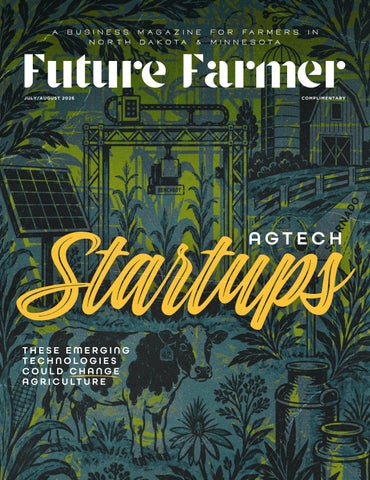
JULY/AUGUST 2026
COMPLIMENTARY
Startups AGTECH
THESE EMERGING TECHNOLOGIES COULD CHANGE A G R I C U LT U R E
LOCAL SERVICE. DEPENDABLE STORAGE. TRUSTED IMPUTS.
Offering FREE DP on wheat until the end of December Anhydrous ammonia is available now for Fall Application!
218-745-5556 radiuminc@invisimax.com radiumincelevator.com
From seeding to harvest to fertilizer, we’re here when you need us. Visit radiumincelevator.com to learn more.
.
CONTENTS
36
PARTNER CONTENT 14 The Math Behind The Missing Calves 18 Looking Beyond Fertilizer Analysis And Why Nutrient Availability Matters 20 Better Drainage. Better Yields.
22 AgTech Startup Feature: Helical Solar 28 AgTech Startup Feature: Winterleap 32 AgTech Startup Feature: Prospect Growth 36 AgTech Startup Feature: LeafTech Ag 42 AgTech Startup Feature: Hemp's Hydrid Moment
52
50 AgTech Startup Feature: Spornado 52 Teaching AI the Languages of Plants
July/August 2026 Volume 7 Issue 4
Future Farmer Future Farmer is published 6 times a year and is direct mailed to farmers throughout North Dakota and Minnesota. Find us online at Futurefarmermag.com.
Publisher EDITORIAL Editorial Team Lead Art Director Editorial Graphic Designer INTERACTIVE Director of Performance Marketing Director of Creative Strategies Web Project Manager Senior Graphic Designer Director of Web Operations AI Systems & Automation Lead Director of Agency Social Media Senior Digital Advertising Specialist ADVERTISING VP of Business Development Sales Representative Digital Sales Representative Business Development Representative Senior Digital Advertising Specialist Client Relations Director of Client Success Marketing Admin Accounting Specialist DISTRIBUTION Delivery
Mike Dragosavich Brady Drake Brady@SpotlightMediaFargo.com Kim Cowles Ty Betts Kellen Feeney Megan Suedbeck Matthew Haire Sarah Cabler Sara Jentink Chris Demuth Mhairi Christopherson Tammy Fogle Paul Hoefer Paul@SpotlightMediaFargo.com Al Anderson Al@SpotlightMediaFargo.com Abby Schauer Abby@SpotlightMediaFargo.com Spencer Hall Spencer@SpotlightMediaFargo.com Matt Purpur Matt@SpotlightMediaFargo.com ClientRelations@SpotlightMediaFargo.com Jessica Ventzke Tyler Duclos Missy Roberts John Stuber
Future Farmer is published by Spotlight LLC, Copyright 2026 Future Farmer. All rights reserved. No parts of this magazine may be reproduced or distributed without written permission of Future Farmer, and Spotlight LLC, is not responsible for, and expressly disclaims all liability for, damages of any kind arising out of use, reference to or reliance on such information. Spotlight LLC, accepts no liability for the accuracy of statements made by the advertisers.
Spotlight LLC 4609 33rd Ave S Suite #304 Fargo, ND 58104 Info@SpotlightMediaFargo.com ADVERTISING: 701-478-SPOT (7768)
PARTNER CONTENT
The Math Behind the Missing Calves 701x Turns Death Loss into Dollars
die 2.4 calves per year!
million
S Photos provided by 701x
14
JULY/AUGUST 2026
omewhere between the maternity pen and the packing plant, nearly 2.4 million calves disappear from the U.S. beef supply every single year. Not misplaced on a ledger. Dead — lost to dystocia, scours, pneumonia, predators, and the hundred other issues that happen when a 1,200-pound cow calves alone in a pasture nobody's watching at 3 a.m. It's a problem that's always existed in cattle ranching. But it's never mattered this much.
As of January 1, 2026, the U.S. cattle herd fell to 86.2 million head—the smallest national inventory in 75 years[1]. The beef cow herd specifically dropped to 27.6 million head, its lowest point since 1961[2]. And the 2025 calf crop— the industry's raw material for the next two years of beef production—came in at just 32.9 million head, down 520,900 head from 2024 and the smallest calf crop since 1941[3]. Herd rebuilding, when it eventually starts, takes years to show up as market-ready cattle. In the meantime, ranchers are fighting over a shrinking pool of calves with historically few tools to grow that pool faster. That's what makes death loss such an urgent, and solvable, piece of the puzzle.
Where the Calves Go USDA's National Animal Health Monitoring System has tracked calf mortality for decades, and the numbers tell a consistent story in two acts. Act one: birth to weaning. USDA's most current annual accounting puts this figure higher than older estimates suggest. USDA's National Agricultural Statistics Service reports that 1,975,200 calves died in the United States in 2024 out of a 33,529,500-head calf crop — a national calf death rate of 5.9 percent, following a 6.1 percent rate the year before[4]. That's a meaningfully higher rate than the 3.6 percent birth-to-weaning loss recorded in USDA's last full-scale mortality census in 2007–08[5]—a sign the problem has gotten worse, not better, in the years since. Applied to the 2025 calf crop of 32.9 million head, a 5.9 percent death rate means roughly 1.94 million calves lost before they ever reach the weaning pen.
steer at roughly $2,550 a head[7]. Multiply that against 2.44 million lost calves, and the beef industry is watching more than $6.2 billion in potential value die in the pasture and the feedlot every single year—money that never reaches a rancher's bank account, never shows up as beef on a shelf, and never helps close the supply gap the entire industry is fighting right now. Death loss isn't the only leak in the system. USDA's most recent cow-calf management study found that 93.5 percent of cows and 83 percent of heifers produced a calf in a given year[8]—meaning roughly 6.5 percent of cows and 17 percent of heifers came up open (not pregnant) at the end of the breeding season. Applied to today's 27.6 million-head beef cow herd, that's nearly 1.8 million cows nationally that ate, drank, and occupied pasture for a full year without producing a single calf. Cut that open rate in half—from 6.5 percent down to 3.25 percent—and roughly 897,000 more cows become pregnant nationwide. That's enough additional calves to nearly erase last year's entire 520,900-head calf crop decline in a single breeding season. In an industry starved for supply, that's not a marginal improvement. That's a meaningful step back toward herd rebuilding, without waiting years for it to happen naturally.
Act two: weaning to the packer. USDA-NAHMS reports average feedlot death rates of 1.4 percent for small feedlots and 1.6 percent for large feedlots—and independent data out of Kansas shows the monthly feedlot death rate for steers more than doubled between 1992 and 2017, climbing from 0.70 percent to 1.74 percent[6]. Applying a conservative 1.6 percent rate to the roughly 30.96 million calves that survive to weaning adds another 495,000 head lost on the way to slaughter. Add the two together, and the beef industry loses close to 2.44 million calves a year—before they ever generate a dollar of revenue. At today's prices, that's not a rounding error. Feeder cattle are averaging $364 per hundredweight for 750–800 pound calves in 2026, putting the market value of a 700-pound
continued> FUTUREFARMERMAG.COM
15
PARTNER CONTENT
The 701x Solution This is precisely the gap 701x's ecosystem of smart ear tags is built to close. The xTpro tag—a satellite-connected, GPSenabled ear tag built for cows and bulls—delivers location, health alerts, and estrus and bull-mounting detection, and calving alerts, priced at $175 per tag9. The xTlite tag, a lightweight wireless tag designed for calves, runs $20 per tag and pairs with nearby xTpro tags to track calf location, health alerts, nursing behavior, and send missing-calf alerts[9]. 701x recommends one xTpro tag for roughly every ten xTlite tags in a herd.
6.2
billion
lost in potential earnings every year
Run the math on a typical 100-cow operation, and the return on investment writes itself many different ways. The tags pay for themselves with one saved calf. Tagging 10 xTpro units and 90 xTlite units costs roughly $3,550. At today's ~$2,550 average calf value, catching just 1.4 calves that would otherwise have been lost—one missed dystocia alert flagged in time, one wandering newborn found before dark—recovers the entire year's tag investment for the whole herd. You don't need to beat the industry's death loss rate—just chip away at it. Each $20 xTlite tag only needs to save 1 calf out of every 128 it protects to pay for itself, against a national calf death rate of 5.9 percent—nearly 7.5 times the rate a tag needs to hit to break even. 701x doesn't need to solve calf mortality completely to deliver a return; it just needs to catch a fraction of what's already happening on autopilot. The ecosystem compounds—it doesn't just save calves, it makes more of them. Beyond loss prevention, xTpro's estrus detection and bull-mounting analytics are aimed squarely at the open-cow problem. USDA's most recent data puts the industry-average open rate at 11.75 percent—a blend of 6.5 percent for cows and 17 percent for heifers. If a 100-cow operation cuts that average open rate in half, from 11.75 percent down to 5.875 percent, that's roughly 6 additional calves born per year—worth $15,000 or more in added weaned-calf revenue—against a one-time tag investment of $3,550. That's better than a 4x return in year one alone. Sources: [1] Drovers, "U.S. Cattle Inventory Hits 75-Year Low at 86.2 Million Head," Jan. 30, 2026. https://www.drovers.com/news/industry/u-s-beef-herd-continues-downward-862-million-head [2] AGDAILY, "U.S. cattle inventory dips again as herd rebuild remains slow," Feb. 2026. https://www.agdaily.com/livestock/u-s-cattle-inventory-dips-herd-rebuildremains-slow/ [3] University of Florida IFAS, "Annual Cattle Market Update: January 2026." https://rcrec-ona.ifas.ufl.edu/media/rcrec-onaifasufledu/pdf/2026_01_AR.pdf [4] USDA National Agricultural Statistics Service, "Meat Animals Production, Disposition, and Income — 2024 Summary," April 2025 (calf inventory/death balance-sheet tables). https://esmis.nal. usda.gov/sites/default/release-files/02870v85d/pv63hx709/k356c2658/meatan25.pdf [5] USDA APHIS, "Mortality of Calves and Cattle on U.S. Beef Cow-calf Operations," NAHMS Beef 2007–08 study. https://www.aphis.usda.gov/sites/default/files/beef0708_dr_partiv.pdf [6] Buda, M., Raper, K.C., Riley, J.M., Peel, D.S., "Structural change in feedlot cattle death loss rates," Frontiers in Veterinary Science, 2023. https://www.frontiersin.org/journals/veterinary-science/articles/10.3389/fvets.2023.1087080/full [7] Live Stock Farm USA, "Feeder Cattle Prices Surging in 2026 — And What It Means for Buyers." https://livestockfarmusa.com/feeder-cattle-prices-2026/ [8] University of Florida IFAS Extension, "Analysis of the USDA's 2017 Cow-Calf Management Practices Results: Part 2 — Breeding Practices/Reproductive Technologies" (AN379). https://edis.ifas.ufl.edu/publication/AN379 [9] 701x Marketplace (official tag pricing). https://marketplace.701x.com/ Note: Head counts, dollar totals, and ROI examples (e.g., total calves lost, total dollar value lost, open-cow head counts, per-operation ROI math) are calculations applying the cited USDA/industry rates to current USDA herd and calf-crop figures. They are original calculations for this piece, not standalone USDA statistics.
16
JULY/AUGUST 2026
PA RT N E R C O N T E N T
AND WHY NUTRIENT AVAILABILITY MATTERS By Tom Fry, agronomist and sales development manager for Ostara
fter more than 30 years helping growers across the Northern Corn Belt, I've learned that fertilizer performance isn't determined the day it's applied; it's determined by what happens after it reaches the soil.
volatilization, denitrification and leaching. Phosphorus often reacts with calcium, iron and aluminum in the soil, reducing its availability to the crop. Even when soils test high in phosphorus, only a small fraction may be readily available for plant uptake during the growing season.
Every growing season begins with the same goal of getting the most from every input dollar spent. Yet when it comes to fertilizer, many purchasing decisions are still based on guaranteed analysis, application rates, and price per ton. Those metrics matter, but they don't tell the whole story.
That's why nutrient availability is becoming an increasingly important way to evaluate fertilizer performance. The goal isn't simply to apply more nutrients, but to deliver nutrients that remain accessible throughout the season.
As an agronomist who has spent my career working with farmers across Minnesota and the Dakotas, I've seen firsthand how our environment shapes nutrient performance. Cold, wet springs, variable soil conditions, and short planting windows all influence how effectively crops access nutrients during the critical early stages of growth. The real question isn't simply how many nutrients are applied; it's how many remain available when the crop needs them most.
This principle is what led Ostara to develop CG P2X. Rather than relying on coatings, additives, or biological ingredients to slow nutrient release, CG P2X uses a proprietary magnesium ammonium phosphate chemistry that behaves differently in the soil. The nutrients remain within the granule until they are released through the natural interaction of soil biology, crop roots and naturally released weak organic acids. This approach helps maintain high crop availability of nitrogen, phosphorus and magnesium while supporting nutrient uptake over time.
Once fertilizer is applied, soil chemistry, soil biology, and plant physiology begin working together. Nitrogen can be lost through
Because more nutrients remain available to the crop, growers can often achieve excellent performance while applying fewer pounds
18
JULY/AUGUST 2026
CG P2X IS THE MOST EFFICIENT, SUSTAINABLE, AND ECONOMICAL FERTILIZER ON THE MARKET. PERIOD.
per acre than traditional phosphate fertilizer programs. That can translate into operational benefits such as fewer tons to transport and handle, reduced application requirements, and greater efficiency during the busy fall and spring seasons. Another advantage is that CG P2X supplies three essential nutrients together in one granule. Nitrogen supports vegetative growth, phosphorus fuels energy transfer and root development, and magnesium drives photosynthesis as the central component of chlorophyll. Working together, these nutrients help support early-season vigor, season-long feeding, and overall crop performance.
shifting from how much fertilizer is applied to how much nutrition actually reaches the crop. I believe that's an important distinction – and one that will shape the future of crop fertility. If you're evaluating fertility programs for this fall or next spring, I encourage you to learn more about the science behind nutrient availability and how CG P2X is helps growers rethink fertilizer performance.
Farmers have always looked for ways to improve efficiency without sacrificing yield potential. Today, that conversation is
FUTUREFARMERMAG.COM
19
Better Drainage. Better Yields. Deep Roots Drainage
By Brady Drake Photo by J. Alan Paul Photography
(left to right) D U S T I N L U N D E B Y, C O R E Y H A A G , L E V I O T I S , C O L I N A N D E R S O N , A N D K Y L E M A G N U S
or generations, farmers have learned to work around water. They know the low spots that stay wet too long. They know the fields that are always the last to plant. They know the acres that look good from the road but struggle year after year because the soil never quite dries out, the roots never get enough oxygen, or saline spots keep creeping farther across the field. Deep Roots Drainage was built to solve those problems. The North Dakota-based company is new by name, but not new to the work. Its team brings over 60 years of combined experience in agricultural drainage, surveying, design, installation, sales, operations, and water management. For many farmers, the faces behind Deep Roots Drainage will already be familiar. “We’re the same handshake,” Levi Otis said. “The same friend. The same partner in your water management solutions."
Tile Drainage Has Been Around Longer Than You Think
20
JULY/AUGUST 2026
This is a group of experienced drainage professionals taking the next step, building a company around the values they believe matter most—straight answers, quality work, long-term relationships, and doing right by both customers and employees. Drain tile is not new technology. Versions of subsurface drainage have been used for centuries across the world. But in North Dakota and northwest Minnesota, adoption is still relatively young compared to states like Iowa, Illinois, and other parts of the Midwest where tiling has been common for generations. Many local producers are still asking, "Is it worth the investment?" For the Deep Roots team, the answer depends on the field—but the opportunity is often clear. Wet fields cost money in ways that are easy to overlook until the season is already slipping away. Saturated soils can delay planting, reduce root development, cool the soil, create drown-out areas, and
make it harder to get equipment across the field when timing matters most. In a region with a short growing season, a few lost days can make a major difference. Then there is salinity. Across North Dakota, farmers have watched white, crusted patches spread across fields that once produced. Those saline areas form when excess water pushes salts toward the surface. As the water table rises, salts move up with it, and over time, productive ground can become difficult—or nearly impossible—to grow on. Drain tile helps by lowering the water table and by moving excess water out of the soil profile. Instead of sitting on the surface or pushing salts upward, water can filter through the ground and exit through a properly designed system. The result is a drier field and a healthier growing environment. To be clear, tile does not remove all the water from the soil. It removes the water
Tile drainage may feel modern, but farmers have been trying to move excess water off their land for thousands of years. Buried clay drainage pipe has been found on the island of Crete dating back to 5,000 B.C. Ancient farmers in Egypt, Babylonia, and Rome also used drainage systems to make wet ground more productive.
PARTNER CONTENT
that the soil does not need. Think of a flowerpot with drain holes; the soil stays moist, but the excess water has somewhere to go. That balance matters because plant roots need both water and oxygen. For some operations, the return can show up quickly. In wet years, tile can protect a crop from major loss. In dry years, tiled ground can still benefit from earlier access, warmer soils, stronger root systems, and better field conditions. According to NDSU's frequently asked questions, drain tile ROI returns 12-15% on average. Deep Roots generally talks about drain tile as a long-term investment, often with a seven-year average payback. But in the right year, on the right field, the impact can be immediate. A properly installed drain tile system can help protect your investment against rain events resulting in high yields and better soil conditions for crops. Still, the company knows cost is the biggest reason some producers hesitate. Unlike a piece of equipment,
Drain tiling can help prevent saline disasters like this! Deep Roots Drainage
What Deep Roots Drainage Offers Drain Tile Systems Custom drainage systems designed to manage water table levels, reduce erosion, reclaim wet acres, and improve yield potential. Services include targeted drainage runs, full pattern tiling, GPS-guided installation, custom spacing based on soil type, professionally designed tile plans, lift stations, and control structures. Water Conveyance Because a tile system is only as good as its outlet, Deep Roots Drainage also helps improve how water moves off the field. Services include cleaning existing ditches, permitted ditch enhancement, ditch reconstruction, snagging, clearing, and GPS-integrated grading work. Land Clearing & Grubbing Deep Roots helps turn nonproductive ground back into usable farmland through tree and shelterbelt removal, unwanted vegetation clearing, and rock pile burial or removal.
tile goes in the ground and stays there. That makes trust essential.
some producers may assume a project is impossible before they ever ask.
Deep Roots Drainage builds each system around the field itself. The process begins with surveying the land and identifying problem areas using topography, soil types, water movement, and customer input. From there, the team designs a custom system based on field slope, drainage needs, outlet options, and long-term goals.
Deep Roots wants to be a partner in that process, too.
Installation is done with modern tile plows and RTK GPS grade control, allowing the team to maintain precise depths and grades across complex terrain. The company handles everything from targeted drainage runs to full pattern tile systems, as well as lift stations, control structures, gravity outlets, ditch enhancement, water conveyance, land clearing, grubbing, shelterbelt removal, vegetation clearing, and rock pile removal. Just as important, Deep Roots understands the regulatory side of drainage. Between permitting, NRCS rules, U.S. Fish and Wildlife easements, drainage law, and local water management requirements,
Deep Roots backs its work with a craftsmanship warranty and uses heavy-duty corrugated pipe, proper fittings, and proven installation practices. For farmers who have lived with problem ground for too long, the first step is simply to take a closer look. Because every season is costing something. And with the right drainage plan, those acres may be capable of far more than they are producing today.
| deeprootsdrainage.com | Search "Deep Roots Drainage" | @deeprootsdrainage
FUTUREFARMERMAG.COM
21
AGTECH STARTUP FEATURE
HELICAL SOLAR A FARMER-FIRST APPROACH TO SOLAR
W
PROVIDED BY HELICAL SOLAR
hen James McKinion talks about the future of Helical Solar, he does not start with panels, wires, or power purchase agreements. He starts with land.
More specifically, he starts with the tension surrounding land. Across the country, the rapid rise of AI data centers is creating an enormous appetite for power. Many of those projects are being proposed in rural, agriculture-based areas where land is available, but where residents are increasingly wary of large industrial projects that can strain water resources, add pressure to the grid, and change the character of a community. At the same time, utility-scale solar projects often face the same kind of resistance. Farmers and rural landowners may be asked to give up productive acres for solar development, while nearby communities are left wondering what they actually gain. McKinion believes Helical Solar can offer a different model. “I think we can flip that model on its head,” he said. Helical Solar is developing what McKinion describes as next-generation agrivoltaics: a dual-use solar system designed from the ground up for agriculture. Instead of forcing agriculture to adapt to traditional solar infrastructure, Helical Solar’s technology is built around the realities of working farms, ranches, feedlots, dairies, and row-crop operations. The goal is to allow farmers and ranchers to keep doing what they already do while also generating energy from the same land.
22
JULY/AUGUST 2026
Founder James McKinion
Agriculture is not just an asset class or a parcel on a map. It is a way of life. Asking a farmer to stop farming in order to host solar may look reasonable on a spreadsheet, but it often misses the human reality of the decision. “You have to maintain that ability for them to keep farming what they’ve been farming or raising what they’ve been raising,” McKinion said. That is where Helical Solar’s engineering comes in.
CONTINUED
Traditional solar systems are typically designed for dense energy production, not agricultural compatibility. They can create shading “dead zones,” require grading, interfere with equipment, or sit too low to safely coexist with cattle. Helical Solar’s system is elevated, uses dualaxis tracking, and is installed with a patented helical pile foundation system rather than concrete footers.
require full sun. Unlike fixed or single-axis solar systems, which can cast more persistent shade in the same areas, Helical Solar’s moving shadow behaves more like a sundial.
The name Helical Solar comes from that foundation concept. The system uses a large ground screw that can be augered into the earth and later removed by reversing the rotation. For farmers, that matters. Concrete and permanent structures in a field can create long-term headaches. McKinion wanted a solution that could be installed, used, and eventually removed without leaving the land permanently altered.
According to McKinion, shading models using a Massachusetts Department of Energy Resources analysis tool showed single-digit shading, which the company believes can result in negligible yield loss for full-sun row crops. For the system to work at scale, he said, it has to meet farmers where they are today. That means accommodating the large machinery they already own, from sprayers to seed drills, rather than asking them to downsize or redesign their entire operation around solar.
Above ground, the system looks like an elevated solar array mounted on a large steel support. The panels sit roughly 13.5 feet high when horizontal, keeping them out of reach of cattle and clear of many farming operations. The system tracks the sun throughout the day, moving about every 10 minutes.
“Our shadow moves throughout the day,” McKinion said.
“It’s going to be a no-go to ask a farmer to swap out his large and costly ag machinery and size down,” McKinion said. “You have to meet the farmer where he’s at today.” The livestock application may be just as important.
That movement is especially important for row crops such as corn, cotton, soybeans, and wheat, which
FUTUREFARMERMAG.COM
23
AGTECH STARTUP FEATURE
HELICAL SOLAR
In feedlots, dairies, and other confined animal feeding operations, heat stress is a serious economic and animal welfare issue. Cattle do not eat as well when they are overheated, and extreme heat events can be deadly. McKinion pointed to major cattle death-loss events in Kansas as an example of the risk producers face.
One of Helical Solar’s current pilot projects is in Kansas, supported by the USDA. The pilot includes 21 systems across two pens, producing 122.9 kilowatts. McKinion said that if the same density were scaled across the entire operation, which includes about 200 pens, 19,000 head of cattle, and 40 acres, it could represent roughly a 7.5-megawatt solar power plant.
Helical Solar’s elevated arrays can provide shade while producing power. Unlike temporary fabric shade structures, which can be vulnerable to high winds, the company’s system is engineered to withstand 125-mile-per-hour winds when stowed. Built-in accelerometers can detect wind events and move the panels into a safer position.
“It’s not small when you start looking at it, sort of building that out,” he said.
That combination—shade, power production, and durability—could create value in places where conventional solar is not practical.
24
JULY/AUGUST 2026
To date, Helical Solar has been funded through U.S. Department of Energy and USDA grants. McKinion said the company is now looking to raise an initial seed round to commercialize the technology, scale the business, and pursue larger projects. The engineering has been de-risked through grant-backed development, he said, but the company still wants additional pilot projects and third-party validation, especially around the agronomy side.
CONTINUED
WHEN YOU START LOOKING AT LARGE PROJECTS, 100 MEGAWATTS OR WHATEVER, THAT’S SEVERAL MILLION DOLLARS IN CARRYING COSTS THAT THEY CAN AVOID JUST BY PULLING THAT IN ONE AND A HALF TO TWO YEARS."
That validation will be critical. Farmers, ranchers, and feedlot operators may appreciate the concept, but McKinion knows that slides and renderings only go so far.
McKinion believes that kind of recurring income could help stabilize U.S. agriculture, especially as farmers face weather volatility, tariffs, tight margins, and other risks outside their control.
“They want to see something—real steel in the ground,” he said.
“It would do a lot to stabilize U.S. agriculture and de-risk from weather and tariff events,” he said.
Helical Solar is exploring potential pilot opportunities with universities, including the University of NebraskaLincoln, and is also looking at markets such as California’s Central Valley, where dairy operations face real shade requirements. But McKinion’s larger vision reaches beyond individual farms or feedlots.
Time is another major part of Helical Solar’s value proposition. AI data centers need power quickly, and many traditional energy solutions face long timelines. McKinion said small modular reactors remain years away from broad deployment, while gas-fired power plants can face long equipment waitlists. Solar is one of the few options that can be deployed within the timeframe many data center developers need.
He sees an opportunity to connect Helical Solar’s farmer-first model with the massive power needs of AI data centers. Instead of building a single large solar development that takes farmland out of production and triggers local resistance, McKinion imagines aggregating smaller agrivoltaic projects within a five- or 10-mile radius of a data center.
Even then, McKinion believes Helical Solar can move faster than conventional solar because its system does not require the same level of site grading or concrete foundation work. The helical pile system can adapt to varied terrain, potentially shortening deployment timelines and reducing costs tied to grading, permitting, and end-of-life remediation.
In that model, farmers and ranchers could choose whether to participate. Those who opt in could receive steady lease-style revenue while continuing to farm or raise livestock. The data center could receive localized power without relying as heavily on long high-voltage transmission lines or waiting years in crowded interconnection queues.
He said the company’s system could pull project timelines forward by 18 to 24 months in some cases.
For rural communities, the arrangement could feel less like an outside project being imposed on them and more like a partnership.
The technology also offers an end-of-life story that is easier to explain to landowners. Instead of excavating concrete or pulling out I-beams, Helical Solar’s ground screws can be removed and either reused or recycled.
“When you start looking at large projects, 100 megawatts or whatever, that’s several million dollars in carrying costs that they can avoid just by pulling that in one and a half to two years,” McKinion said.
FUTUREFARMERMAG.COM
25
AGTECH STARTUP FEATURE
HELICAL SOLAR
To McKinion, the value of the system is not just about price per watt. It is about the entire lifecycle: installation, power production, agricultural compatibility, landowner acceptance, deployment speed, and eventual removal. Helical Solar is still a young company, but its central idea feels especially timely. The country needs more power. Agriculture needs more resilience. Rural communities need projects that respect the land and the people who work it. McKinion believes those needs do not have to compete with one another. With the right design, he believes solar can become a tool that helps farmers stay on the land, helps livestock
26
JULY/AUGUST 2026
producers protect their animals, and helps the next generation of energy-intensive industries meet their power needs without leaving rural communities behind. That is the future Helical Solar is trying to build: not solar instead of agriculture, but solar built around it.
HELICAL SOLAR helicalsolar.com
AGTECH STARTUP FEATURE
WINTERLEAP A NEW SEASON FOR WEED CONTROL
W
PROVIDED BY WINTERLEAP
hen Heidi Frost Eriksen arrived in Fargo for the first time, the Norwegian agtech founder found familiarity.
She found Norwegian names, Norwegian ancestry, and a town that understands long winters, frozen ground, and short, high-pressure growing seasons. For many companies, that would be an obstacle. For Winterleap, it is the opportunity. The Norway-based company is developing a new kind of crop-protection technology designed to help farmers tackle weeds, perennial roots, weed seed banks, and soil-borne pests during the winter, before the growing season begins. Instead of waiting for weeds and pests to emerge and then fighting them with herbicides, mechanical cultivation, hand labor, or other in-season tools, Winterleap’s goal is to reduce the pressure before the crop ever goes in the ground. “We are opening winter as a new potential treatment window,” Eriksen said. The technology uses microwaves on frozen soil. In unfrozen soil, moisture keeps microwave energy near the surface. But when water freezes into ice, the physics changes. According to Eriksen, that allows the microwaves to travel deeper into the soil, where they can be directed toward specific targets such as weed seed banks, deep-rooted perennials, and certain pests. In other words, the cold is not a limitation. It is what makes the system possible.
28
JULY/AUGUST 2026
Co-Founders Heidi Frost Eriksen and Cornelis Arnoldussen
Winterleap is still early in its journey, but the idea has been in development since 2020. The company has now completed three winters of prototyping and testing with Norwegian growers, and the early results have given the team reason to push forward. In one trial with a corn farmer dealing with heavy pressure from lady’s thumb, Winterleap reduced the weed’s seed bank by more than 80%. In another trial with a carrot farmer facing nematode pressure, the company saw reductions of more than 70% one winter and more than 80% the following winter.
CONTINUED
For Eriksen, the numbers are encouraging, but the bigger picture is what matters most. Winterleap is not trying to be a miracle tool that replaces everything a farmer already does. Instead, it is designed to make the rest of those tools work better. “If you can reduce the weed seed bank just a bit, every other summer operation will be faster, better, cheaper,” she said. That could mean fewer passes through the field, less herbicide pressure, less mechanical cultivation, lower hand-weeding costs, faster harvest conditions, or better performance from other emerging technologies such as laser weeders. For farmers battling herbicideresistant weeds or pests with limited control options, Winterleap could eventually offer another path entirely. The system is controlled through software, which helps steer the microwave treatment. Variables such as frequency, tractor speed, treatment time, and pulsing can be adjusted depending on the target species and the depth of the problem. In the early stages, Winterleap has focused heavily on learning species by species. Over time, the company expects to build a growing library of treatment packages that can be
applied in different regions, soil conditions, and crop systems. That is one reason the company is interested in North America, especially northern regions such as the Upper Midwest, Canada, and New York. Winterleap already sees the United States and Canada as core commercial markets, and Eriksen’s visit to Fargo was part of the company’s effort to build relationships with growers, researchers, investors, and ag leaders in regions where frozen-soil treatment makes sense. This coming winter, Winterleap plans to bring a treatment module—not a full machine, but a smaller box-like component—to begin small-scale testing in the Fargo area. The goal is to test species the company does not have access to in Norway, including soybean cyst nematode and herbicide-resistant weeds that are more common in this region. The team is also setting up pilots in places where growers already have problems with species Winterleap has shown progress against, including trials in Montreal and upper New York State. For farmers, any new technology raises an important question: What else does it affect?
FUTUREFARMERMAG.COM
29
AGTECH STARTUP FEATURE
WINTERLEAP
Eriksen understands that concern. She said Winterleap has tested from the beginning to see how its treatment affects beneficial soil life. The company uses soil sampling, control plots, microscope checks, and continued observation to compare treated and untreated areas. That focus comes from the origin of the technology. Winterleap’s inventor and Eriksen’s co-founder had previously worked around soil steaming, a method that uses heat to sterilize soil. While steaming can kill weeds and pests, it also kills beneficial life. Winterleap was developed with a goal to target the problem without sterilizing the soil column. “When we come in, the soil is frozen. When we leave, the soil is frozen,” Eriksen said. Heat is still part of the process at the target level, but the company is not trying to warm the entire soil profile. That distinction is central to Winterleap’s pitch.
30
JULY/AUGUST 2026
The company wants to reduce harmful pressure while preserving soil structure and beneficial biology. It also wants the economics to work. Eriksen is candid about the challenge of bringing hardware to market. The first commercial-ready winter machines are expected in December 2027, but Winterleap is trying to scale carefully. The company has seen strong interest, but hardware is expensive, and early overbuilding can drain a startup before it has time to refine the product. The plan is to begin with an equipment-as-a-service model. Rather than asking farmers to buy a machine immediately, Winterleap expects growers to use their own tractor and rent the machine for a certain number of days. That would allow farmers to test the technology on problem areas, high-pressure fields, or specific weeds and pests before making a larger commitment.
“We will not sell the machine the first season,” Eriksen said. “It’s more risk on our side. Try it on smaller parts, or the worst weeds or nematodes.” Farms in this region are large, and the final machine will need to be cost-optimized, energy efficient, and sized for real commercial use in crops such as soybeans and corn. Winterleap is not just trying to prove that the science works. It has to prove that it can work at the speed, cost, and scale farmers need.
Winterleap wants to turn it into a tool.
WINTERLEAP helicalsolar.com helicalsolar.com
For now, Eriksen sees Fargo as an important place to start building that future. The region has the winter conditions. It has growers facing difficult weed and pest pressure. It has a strong agricultural community. And, as she quickly discovered, it has a willingness to listen to a Norwegian founder with an unusual idea: maybe the best time to fight next year’s weeds is when this year’s fields are frozen solid. Winter has always shaped farming in the North.
FUTUREFARMERMAG.COM
31
AGTECH STARTUP FEATURE
PROSPECT GROWTH TINY PARTICLES, BIG QUESTIONS
PROVIDED BY WYATT ARNOLD
P
rospect Growth's roots are in university research, its team is small, and its technology is still moving through field validation. But its target is better nutrient delivery, fewer losses, and a fertilizer product that solves real agronomic problems without asking growers to change the way they farm. Prospect Growth is developing nanoparticle-based fertilizers, or “nanofertilizers,” built around ultra-small solid particles designed to carry nutrients into crops in a more efficient, crop-available form. The company describes the goal as nanoscale engineering for acrescale impact, not necessarily making fertilizer cheaper, but making each dollar spent on fertilizer go further. Wyatt Arnold, co-founder and CEO of Prospect Growth, said that most fertilizers supply nutrients as soluble salts. Those products work, he said, but they also have familiar limitations. Nutrients can bind up in the soil, move where they are not wanted, or become unavailable before the plant can make full use of them. “If we want to get more yield out of things,” Arnold said, and “get less nutrients into the environment,” agriculture needs new ways to supply fertility. Prospect Growth’s answer is to deliver nutrients as tiny, solid, water-dispersible particles rather than only as dissolved ions. According to the company, these particles are engineered at the nanometer scale, giving Prospect Growth more control over nutrient composition and release. The particles are intended to enter plant tissues and release nutrients gradually, which could reduce loss pathways and better match nutrient supply with crop demand. The concept is not that mineral fertilizer is going away. In fact, Arnold is explicit that it is not.
32
JULY/AUGUST 2026
Founder and CEO Wyatt Arnold
“I think biologicals will be a huge part of that,” he said, referring to the future of crop nutrition. “But I don’t think that means we can ignore the mineral fertilizers.”
FROM LAB IDEA TO FIELD QUESTION The company’s technical challenge is not simply making tiny particles. Researchers have known how to make nanomaterials for years. The hard part is making them consistently, safely, affordably and at a scale that matters to agriculture.
CONTINUED
Arnold said previous approaches tended to fall into two categories. Some could make consistent particles, but only with expensive inputs, high energy use, high pressure, high heat or other processes that did not fit commodity agriculture. Other approaches, such as grinding a material down until it became extremely small, could be cheaper but less precise. Prospect Growth is trying to fill the space in between. The company’s path traces back to Yale University. In 2024, Yale’s Center for Business and the Environment listed Prospect Growth, led by Wyatt Arnold and Andreas Backhaus, among winners of the Sobotka Seed Prize for Sustainable Ventures, describing the venture as a maker of nanoparticle-based fertilizers intended to increase yields while reducing nutrient inputs and losses. Prospect Growth also received the Audience Choice Award at Startup Yale 2024, where Yale described its work as low-cost, scalable production of nanofertilizers.
THE YELLOWSOYBEAN PROBLEM One of Prospect Growth’s most practical early targets is iron deficiency chlorosis, or IDC, in soybeans.
University of Minnesota Extension similarly describes IDC as a recurring problem in parts of Minnesota, especially in south central, southwest, west central and northwest production regions. Iron is needed for chlorophyll formation, but in higher-pH soils, especially those with calcium carbonate, iron becomes less soluble and harder for the plant to use. Arnold explained the regional issue in grower-friendly terms. Soybeans in the area can be productive, but they are “kind of bad at pulling iron from the soil,” he said. In former lakebed soils, calcium deposits can help keep iron tied up, leaving beans yellow because they cannot make enough chlorophyll. That is not a new problem, and growers already have management tools. Variety selection remains a first line of defense. In-furrow ortho-ortho EDDHA chelate products can help, especially in fields or zones with a known IDC history. But those treatments add cost, and IDC does not always show up evenly or predictably across a field or from year to year. There is also a key limitation of foliar chelates—they may green up the tissue they contact, but new growth can remain yellow because iron is not mobile in the plant. That limitation is exactly where Arnold sees an opening.
For growers in affected areas, IDC is not an abstract nutrient-efficiency problem. It is the yellowing that shows up in patches, often early in the season, when soybean plants cannot access enough active iron even though the soil may contain plenty of total iron. According to NDSU Extension, North Dakota soils have sufficient iron, but carbonates, commonly showing up in soils with pH above 7, can make iron unavailable to soybeans. IDC symptoms include yellow leaves with green veins, and early-season yellowing, browning and stunting can reduce photosynthesis and yield.
With conventional foliar iron, he said, “you’ll green it back up, but then the new growth will just have the chlorosis issue again.” Prospect Growth is testing whether an iron nutrient delivered as a tiny particle can behave more like a slow-release source inside the plant. Arnold compared it to a slow-release pill, or even an ice cube moving through the body while it releases water. The goal is not to make iron move everywhere in the plant, but to improve its persistence and mobility enough that a single timely spray could have a longer benefit.
FUTUREFARMERMAG.COM
33
AGTECH STARTUP FEATURE
PROSPECT GROWTH
The timing matters. Arnold said Prospect Growth likes the idea of an early rescue treatment around the V2 stage in soybeans, after the second true trifoliate emerges. That window matters agronomically because earlier treatment gives the plant more time to recover, and it matters operationally because it may align with a post-emergence herbicide pass, limiting the need for a separate trip across the field.
EARLY SIGNALS, NOT SWEEPING CLAIMS Prospect Growth is not yet presenting its technology as a finished answer for every acre. Arnold was careful not to promise a blanket yield increase. Agriculture, he said, is too variable for that.
“If you can get the iron in early after you see the IDC, the plant can utilize it and recover,” Arnold said. Wait too long, and the crop may take up the nutrient but still struggle with the compounded damage of early stress.
“I really don’t like being like, ‘Oh, it’s going to be a 7% yield increase everywhere,’” Arnold said. “Everybody has their own conditions.” Instead, the company is looking for problems where the pain is clear enough, and the value proposition is strong enough, to justify early adoption. Iron for IDC is one candidate. Phosphorus efficiency is another.
34
JULY/AUGUST 2026
On the iron side, Arnold said small-plot work showed Prospect Growth’s treatment resolving IDC symptoms better than current best-in-class iron fertilizers in early trials. He emphasized that those results came from one or two small-plot trials, not broad commercial-scale proof. On the phosphorus side, he said a corn research trial showed no significant difference between treated and untreated areas in leftover underutilized phosphate at the end of the season, while conventional phosphorus fertilizer rows showed a buildup of unused phosphorus. His interpretation is that early evidence that the company’s phosphorus material may be used more efficiently.
LOOKING FOR THE WORST OFFENDERS For Arnold, the next step is not simply proving that nanofertilizers can work. It is finding where they matter most. Iron may be easier to commercialize first, he said, because micronutrients require lower volumes per acre and may carry more margin in the material. A new phosphorus fertilizer could have a broader acreage opportunity, but the commercialization path is different. Prospect Growth is testing both because, as Arnold put it, a small company cannot afford to overlook an easy win. That is also why the company wants to hear from growers. Prospect Growth is not trying to push a technology into situations where it does not solve an acute problem, Arnold said. Instead, he wants growers to identify the fertilizer-related issues that hurt most on their farms. “If somebody has a problem that they think is really painful, that’s where I’d honestly say, reach out and tell us,” Arnold said. “What kind of fertilizer-related issue is your worst offender?”
PROSPTECT GROWTH prospect.ag /prospect-growth
AGTECH STARTUP FEATURE
LEAFTECH AG LISTENING TO THE LEAF
PROVIDED BY LEAFTECH AG
The Leaftech Ag team
F
or decades, farmers have been told to make decisions based on data.
Soil tests. Yield maps. Weather models. Drone imagery. Satellite photos. Tissue samples. Application maps. The modern farm has no shortage of information. But John Mascoe believes agriculture has still been missing one of its most important signals. The plant itself.
36
JULY/AUGUST 2026
“We measure plant characteristics through hyperspectral sensors,” said Mascoe, Co-Founder and CEO of Leaftech Ag. “Initially, we are using it to determine nutrient content of a leaf and leaf water content.” The problem Leaftech is trying to solve is that traditional plant tissue testing takes time. A farmer or agronomist collects leaves, sends them to a lab, waits days for results, and then tries to make a decision based on information that may already be outdated. Leaftech Ag is trying to collapse that timeline from days to minutes.
CONTINUED
The company’s handheld scanner clamps onto a leaf, pushes light through the plant tissue, and uses hyperspectral sensing to analyze what is happening inside the plant. In less than 10 seconds, it captures the scan. Within roughly two to five minutes, users can see information on a11 macro and micronutrients, along with leaf water content, through a user interface. For Mascoe, that speed is not just a convenience. It changes what is possible. Plants are not static. Nutrient levels move with water. Uptake changes throughout the day. Stress, soil conditions, compaction, biological activity, weather, and management decisions can all influence what a plant is able to take in and use. Mascoe compares it to blood sugar in a diabetic. “It changes based upon what’s going on,” he said. “Same thing with a plant.” That dynamic nature is one reason Mascoe is careful when people ask how Leaftech compares with a lab. On paper, the question sounds straightforward: Is it as accurate as traditional tissue testing?
Mascoe does not see it that way. “That is a very loaded question,” he said. “Who’s accurate? Who sets the standard for accuracy?” As Leaftech has compared lab results, Mascoe said the company has seen significant variation between certified labs, even when the same material is sent for testing. His point is not that labs are useless. It is that the industry often treats lab numbers as absolute, when in reality they can vary. Leaftech’s strength, he said, is its ability to measure change and trends consistently, quickly and repeatedly. “We measure change and trends exceptionally well,” Mascoe said. “We can replicate a lab’s data up into the 90th percentile. It’s just whose lab.” That distinction matters because Leaftech is not here to replace the labs, but to enhance the information farmers receive. It is trying to give farmers and agronomists a new way to observe a living crop in real time. One of the biggest advantages is that the scanner is non-destructive. A traditional tissue sample removes
FUTUREFARMERMAG.COM
37
AGTECH STARTUP FEATURE
LEAFTECH leaves from the plant. Leaftech allows users to scan the same plant again and again. A farmer could scan before an application, return three days later, and scan the same area to see whether the plant responded. Each scan is also georeferenced, creating a locationspecific record of what is happening in the field. That opens the door to a different kind of crop management. Instead of relying only on assumptions, broad averages or delayed reports, growers and crop advisors can begin to see where nutrient uptake is strong, where it is lagging, and how different parts of a field are responding to management decisions. “We can actually target apply the nutrients where they need to be in the right amount,” Mascoe said. “In addition, we can measure the efficacy of the products that are being used.” That could mean testing whether a pint of a product moved a nutrient level 10% or 20%. It could mean comparing whether a higher rate created a stronger response. It could mean discovering that the real problem in a field is not the nutrient a grower assumed, but something else entirely. “There’s no use putting a boron treatment on if really my problem is potassium,” Mascoe said. The technology is not designed to replace every other tool in the field. Mascoe sees drone and satellite imagery as useful, but incomplete. A drone may show that one area of the field looks different from another. It may reveal stress, variation, or changes in greenness. But, in his view, imagery often shows that something is happening after the fact without fully explaining why. “The drone shows you there’s a problem,” Mascoe said. “It doesn’t tell you why.” Leaftech’s role is to help answer that “why.” A user can walk a grid pattern across a field, scan at set intervals, and build a more detailed picture of nutrient uptake. Or they can use a drone or imagery to identify zones of difference, then go into those zones with Leaftech to diagnose what is happening at the
38
JULY/AUGUST 2026
CONTINUED
plant level. Or they can use it more specifically to investigate a problem area, test a product, or measure the effect of a management decision.
300,000 scans across North America, including the United States and Canada, and has expanded into Australia, with additional testing in other regions.
“You could do three scans a minute,” he said. “If you’re out there tissue sampling anyway and you’re doing 20 leaves, you can actually do 100 to 1,000 leaves in the time it takes you to go do that one sampling.”
“We only wanted to grow as fast as we can handle,” Mascoe said. “Right now we’re straining, but that’s a good thing.”
The company itself is still young, but it has moved beyond the idea stage. Leaftech started in 2020 and has grown organically as a family business. Mascoe said the company is self-funded today and not actively raising capital. It works with growers, ag retailers, crop consultants and industry partners testing products, but the main buyer so far has been ag retailers and crop consultants who can use the technology to provide better service and better recommendations to farmers. The company has about 11 employees and is growing. Mascoe said Leaftech has completed more than
Leaftech’s business model also reflects Mascoe’s experience in precision agriculture. He has worked in the space since 1996, helping bring new tools such as soil moisture probes, disease and pest modeling, and weather networks into the marketplace. Over the years, he has seen technologies with real promise fail because they were poorly supported after the sale. Leaftech is structured as hardware as a service. Customers do not simply buy a device and hope it stays relevant. Because the technology is changing quickly, Leaftech wants users to have access to the latest version each season.
FUTUREFARMERMAG.COM
39
AGTECH STARTUP FEATURE
LEAFTECH
Mascoe said that model also keeps the company accountable.
“My son and I literally found a good sensor and built around that ability,” Mascoe said.
“We have to earn the right to be on their business every year,” he said.
The goal was to create something practical. Farmers and agronomists would not scan 10 or 15 spots on a leaf if the process was slow or awkward. They needed to clamp, scan and move.
The origin of Leaftech came from Mascoe’s search for a missing link. While working in the drip irrigation industry, he saw that growers could treat specific zones of a field but did not have a fast enough way to understand what was happening inside those zones. He and his son began looking for technology that could provide that answer. When they could not find exactly what they needed, they built it.
40
JULY/AUGUST 2026
“Our job is to make the information gathering simple, the integration of that data easy, so that a decision can be made based upon what needs to happen,” Mascoe said. “It has to be actionable.” Mascoe is not interested in data for data’s sake. He wants information that helps farmers make better decisions about nutrient management, input use, product selection and field variability. In many ways,
Leaftech is built around the long-discussed promise of the 4Rs: right product, right nutrient, right location, right amount and right time. “We’ve made that goal achievable,” Mascoe said. “Everything that we’ve been preaching about targeted nutrient management at the right time, we give the way to deliver on that promise.” The long-term potential may go beyond nutrients. Because Leaftech captures large amounts of hyperspectral data, Mascoe believes the company may eventually be able to identify additional plant characteristics, disease signatures and other patterns that are not yet fully understood. If the company discovers a useful signature years from now, it may be able to go back and reprocess historical scans to understand trends that were invisible at the time. Mascoe sees possibilities in soil analysis, robotics, artificial intelligence and other applications. But he also pushes back against the idea that the future is the only exciting part. “We shortened the time frame from getting the data from a lab from three to 14 days to five minutes,” he said. “Isn’t that impressive enough?” It is. After more than 30 years in agronomy and precision agriculture, Leaftech is showing him things that challenge what he thought he knew. Nutrient uptake curves look different. Time-of-day movement looks different. Plant behavior does not always follow the book.
the old habit of walking a field and the new ability to quantify what is happening inside the plant. Mascoe believes that kind of information could lead to more precise applications, better product performance, stronger nutrient stewardship and a deeper understanding of the biological systems that drive crop production. “We’re taking the basics and making it easier,” he said. In other words, Leaftech is not asking agriculture to stop trusting the field. It is giving the field a clearer voice.
“I’m seeing a lot of things that are making me question what I thought I knew,” Mascoe said. That may be the larger promise of Leaftech. It is not just a scanner. It is a way to listen more closely to the crop.
LEAFTECH leaftechag.com
For generations, farmers have walked fields, watched plants, trusted experience and made decisions based on what they could observe. Then agriculture entered the age of digital tools, remote sensing and large-scale data. Leaftech is trying to bring those worlds together:
FUTUREFARMERMAG.COM
41
AGTECH STARTUP FEATURE
HEMP’S HYBRID MOMENT PROVIDED BY NEW WEST GENETICS
A
new crop does not earn a place in a farmer’s rotation because it has a compelling story. It earns one because the agronomics work, the numbers pencil out, and somebody is prepared to buy what comes out of the combine. For Wendy Mosher, that is the line separating industrial hemp’s first wave from what she believes can come next. “The genetics are ready,” said Mosher, CEO of New West Genetics. “If you grow canola or soy, you can grow our hydrids.” Then she added the condition that may matter even more to growers considering an unfamiliar crop. “We won’t sell you more seed than we can facilitate an offtake.” If grain hemp is going to move beyond specialty acreage, it must begin to function more like a familiar oilseed with regionally adapted genetics, competitive yield, conventional equipment, dependable agronomic support, and a defined market before planting.
BREEDING A CROP Based in Fort Collins, Colorado, New West Genetics was established in 2014. The company combines traditional plant breeding with genomic tools to develop non-GMO industrial hemp varieties for food, animal feed, fuel and fiber markets. Mosher has helped build the business from its inception, directing company strategy, capital formation and commercial partnerships. New West’s scientific team brings experience from crops that Upper Midwest growers already know. Chief Technology Officer and co-founder Rich Fletcher spent
42
JULY/AUGUST 2026
more than 18 years in Cargill’s hybrid canola program, eventually leading its North American breeding and genetics work. Chief Scientific Officer John McKay is a Colorado State University professor whose research centers on crop adaptation, drought and sustainability. The company’s goal is not simply to produce a compliant hemp plant. It is to breed a crop with the maturity, architecture, yield and uniformity required for broad-acre agriculture. Mosher is especially careful when describing the company’s central breeding advance. She will say New West has “transformed” the crop from open-pollinated populations to hybrids—but immediately clarifies that she is not talking about genetic transformation or genetic engineering. “It’s all traditional breeding that’s informed by the genomics,” she said.
WHY THE HYBRID MATTERS The biology behind New West’s AMPLIFY trait is relatively straightforward. Conventional hemp populations tend to produce approximately equal numbers of male and female plants. The females produce the grain, while the males provide pollen but do not contribute grain themselves. AMPLIFY is a genetic trait that is designed to shift that balance sharply toward grain-bearing female plants while adding the vigor and uniformity associated with hybrid breeding. New West describes its certified hybrid populations as approximately 90% female and 10% male. The company says the combination of more female plants and hybrid vigor improves yield, stand uniformity,
CONTINUED This field shot shows the uniformity of New Wests' AMPLIFY hybrid trait.
harvestability and resilience. Its first AMPLIFY hybrids entered wider commercial release in 2025, wider availability of AMPLIFY 23 in 2026.
near Wheatland, ND. Grand Farm reported that the hybrids produced at least 170% of the open-pollinated entries’ yield—equivalent to at least 70% more grain.
Mosher said the company has seen roughly a 50% yield increase as hemp moved into its hybrid era. New West’s public materials say some hybrid combinations can produce twice the grain of conventional populations.
One location and one growing season cannot establish a regional yield guarantee. The result is nevertheless an encouraging local signal, particularly because it came under Red River Valley growing conditions rather than at New West’s home base in Colorado. Grand Farm and New West continued their work in 2026, with stand counts underway in July as part of another cereal-hemp trial.
More useful to growers in the Northern Plains is the emerging evidence from their own region. In 2025, New West partnered with Grand Farm to compare its AMPLIFY hybrids with open-pollinated hemp varieties at the Grand Farm Innovation Campus
FUTUREFARMERMAG.COM
43
AGTECH STARTUP FEATURE
NEW WEST GENETICS BUILT FOR NORTHERN LATITUDES New West’s interest in North Dakota and Minnesota is deliberate.
FIVE QUESTIONS BEFORE PLANTING GRAIN HEMP 1. IS THERE A WRITTEN OFFTAKE AGREEMENT? Know the buyer, contracted quantity, price structure and remedies if either party cannot perform. 2. WHERE IS THE DELIVERY POINT? Calculate freight, storage, drying, cleaning and quality discounts before evaluating the projected return. 3. IS THE VARIETY ADAPTED TO THE FARM’S LATITUDE? Ask for replicated maturity, height, yield and THC-compliance data from comparable environments. 4. WHAT ARE THE REGULATORY DEADLINES? Confirm licensing, field registration, sampling, testing and reporting requirements before seed is purchased. 5. WHAT SUPPORT IS AVAILABLE AT HARVEST? NWG provides agronomic support throughout the growing season. Their two trained agronomists have more than 10 years of hemp-growing experience and support customers across the Midwest and Northern Tier.
44
JULY/AUGUST 2026
Mosher refers to the region as part of an “oil-processing belt”—an area with oilseed knowledge, crushing capacity, and growers accustomed to crops such as canola and soybeans. But genetics developed farther south cannot simply be moved north and expected to perform. For roughly five years, she said, the company has been selecting material for northern latitudes. The resulting plants are shorter and flower earlier than the company’s southern-adapted genetics, helping them fit a shorter growing season and reducing the risk of carrying an excessively tall crop into harvest. “We knew we wanted genetics adapted for that region,” Mosher said. The regional fit is not determined by climate alone. Mosher said New West’s agronomists evaluate the farm, projected season length, and production system—but the deciding factor may be the distance between the field and the buyer. A crop can grow successfully and still fail economically if freight consumes the margin. That is why New West’s approach begins with the offtake. The company either connects growers directly with a buyer or helps structure the market relationship before seed is sold. Mosher said its seed has been planted on more than 10,000 cumulative acres during the past six years, although the company keeps its current annual acreage private.
A MARKET BEFORE THE SEED Mosher’s message to growers is that grain hemp can be planted and harvested with equipment already used for conventional oilseeds. “You can use all of your existing equipment,” she said. “If you grow canola or soy, you can grow our varieties.”
AGTECH STARTUP FEATURE
NEW WEST GENETICS Familiar equipment does not mean there is no learning curve. Crop timing, combine settings, grain handling, storage specifications and delivery logistics still require planning. Growers also remain subject to hemp-specific production rules. In North Dakota, a license is required before a producer obtains seed or other propagative material. The state advises growers to use reputable seed sources and varieties known to remain within the acceptable total-THC level. Federal laboratory guidance currently places that level at 0.3%. Those requirements are one reason Mosher wants grain and fiber hemp regulated separately from intoxicating cannabinoid products. Although both come from Cannabis sativa, their production systems, customers and commercial purposes are fundamentally different. A field of industrial hemp is intended to produce grain and agricultural raw materials, not a psychoactive consumer product.
ONE SEED, SEVERAL MARKETS When hemp grain is crushed, it creates two main products: oil and meal. The oil can enter food or industrial markets. The remaining meal can be sold directly into approved uses or refined further into protein ingredients. Food has provided the crop’s clearest commercial foothold. The FDA has completed its evaluation of GRAS notices for hulled hemp seed, hemp seed protein powder, and hemp seed oil and raised no questions about their use under the specified conditions. Those ingredients are already found in products ranging from protein drinks and nutrition bars to baked goods, sauces, and plant-based foods. Animal feed is opening more gradually. Hemp seed meal has been added to the Association of American Feed Control Officials’ official publication for use in laying-hen diets, but it is not yet broadly approved for every ingredient
46
JULY/AUGUST 2026
This trial shows New Wests' performance on very marginal land and degraded soils.
CONTINUED
form and livestock species. That makes feed a developing outlet rather than an unrestricted commodity market.
“Farms are price takers,” she said. “If you get in early and help set the table, you’re going to have the opportunity to have more control.
Fuel is the potential scale market.
The pieces are beginning to look more familiar with higher-yielding hybrids, northern adaptation, existing farm equipment, multiple products from one seed, and a business model that starts with the buyer rather than ending with a search for one.
Mosher said New West is working with major fuel companies interested in oilseed feedstocks. According to her, three years of company data indicate that the newest hybrids can produce more oil per acre than soybeans in some rotations.
AN OPPORTUNITY TO SET THE TABLE Mosher believes renewable fuel could eventually provide the demand needed to move hemp from thousands of acres to a genuinely scaled crop. What excites her is not only the size of that potential market. It is the possibility that growers who enter early—under disciplined contracts rather than speculative planting—could help determine how the supply chain is built.
“AMPLIFY hybrids are ready,” she said.
NEW WEST GENETICS | newwestgenetics.com | /newwestgenetics | @newwestgenetics | /newwestgenetics
FUTUREFARMERMAG.COM
47
AGTECH STARTUP FEATURE
CATCHING DISEASE ON THE WIND
PROVIDED BY SPORNADO
A
field can look perfectly healthy while trouble is already moving through it.
By the time a grower sees the first lesion, patch of mold, or dusting of rust, the best window for prevention may already be narrowing. Fungicides are most effective when applied before many fungal diseases become established, yet growers often have to make that investment before the crop provides a visible answer. Spornado was built for that gap. “What we do is provide an early alert for fungal crop disease,” said Kristine White, CEO and co-founder of Spornado. “Farmers, in the past, have used a lot of guesswork on when to spray. The thing with these chemicals is they work best preventatively.” The Toronto-based agtech company places a compact air sampler directly in the field, where it collects airborne spores on a replaceable cassette. The cassette is sent to one of Spornado’s partner laboratories for targeted molecular analysis. The resulting report tells the grower whether DNA from a specific pathogen has been detected—potentially two weeks or more before symptoms become visible, according to White.
FINDING THE MISSING PIECE Plant pathologists often describe crop disease through the “disease triangle”: a susceptible host, a favorable environment, and the presence of a pathogen. Growers generally know what crop and hybrid they planted, while weather stations and forecasting models can show whether conditions favor disease. The pathogen itself, however, can remain invisible. Spornado is designed to measure that missing piece.
48
JULY/AUGUST 2026
The passive sampler relies on wind to draw airborne material onto a specialized filter. This is augmented by a small solar-powered fan. Once the laboratory receives the cassette, targeted DNA testing can detect very small amounts of the pathogen, with results available in as little as one day. The field hardware does not need to change when a grower wants to monitor a different disease; the laboratory changes the molecular test used to analyze the cassette. Spornado now has tests for approximately 30 diseases across 15 crops, White said. Corn, soybeans and potatoes currently account for the company’s largest areas of use, although the system has also been applied in wheat, barley, canola, sugar beets, grapes and several fruit and vegetable crops. Samples are typically collected once a week. Some potato operations and vineyards—where crop value, disease pressure or sharply different microclimates justify closer monitoring—submit cassettes twice weekly. For growers seeking field-specific information and tighter spray decisions, White generally recommends one sampler for every 100 to 150 acres. Grower associations, agricultural retailers and other organizations can also establish regional networks. Those broader networks function more like radar: they can warn growers that a pathogen is moving into an area, but they are not a substitute for field-level data, scouting or consultation with an agronomist. “You wouldn’t want to get a negative several miles away and then decide not to spray,” White said. “But it gives you an idea of what’s going on in your region. If it starts to be an issue, maybe you go out and scout more. Maybe you start looking at what to do.”
CONTINUED
10% OFF! Readers who mention this article and sign up for SPORNADO’S 2027 SEASON BY OCTOBER 31, 2026, can receive 10% off. Growers should contact Spornado to confirm crop eligibility, program terms and final pricing.
BUILT FOR A ROW-CROP BUDGET An agricultural technology can produce valuable information and still struggle to gain adoption if its cost or complexity does not fit the farm. Spornado’s founders designed the system to be simple enough to install without specialized training and affordable enough to use in crops with tight margins. In the seasonal program White described, a grower monitoring a couple of diseases for approximately 10 weeks could expect to spend roughly $2,000 to $2,400. That includes use of the sampler, mounting pole, cassettes, and laboratory analysis. The grower can keep the sampler for the following season or return it with the final samples if the service is not a fit. The result is less a traditional equipment purchase than a bundled monitoring service. “Row crops have tight margins,” White said. “So, it was really important that it not be expensive.” A laboratory result does not automatically tell a grower to apply—or skip—a fungicide. It gives the grower and agronomist another independent piece of evidence to consider alongside crop stage, weather, variety susceptibility, disease history and field observations. That independence can be especially valuable when the person making a recommendation is also associated with a retailer or crop-protection company. “When they have an independent lab report that shows, ‘OK, here there is—or isn’t—a problem,’ I think it really helps the conversation and helps build trust,” White said. “It’s not the person just selling you the stuff saying you should use more.”
FUTUREFARMERMAG.COM
49
AGTECH STARTUP FEATURE
SPORNADO
FROM BUILDINGS TO FIELDS Spornado emerged from expertise that initially had little to do with row crops. White, Michael Saleh, and Dr. James Scott were environmental scientists specializing in fungal sampling and detection. White spent more than 20 years working with indoor fungal contamination and leading technical teams at environmental engineering firms. Saleh, now Spornado’s chief technology officer, specialized in fungal air sampling and laboratory management. Scott, the company’s chief scientific officer, is a plant pathologist and University of Toronto professor specializing in fungal biology. The three were approached by an agricultural company seeking a way to detect Phytophthora infestans—the pathogen that causes potato and tomato late blight—in air and water without requiring electricity in the field. Working with growers, engineers, plant pathologists and microbiologists, they developed the sampler that became Spornado. The technology was commercialized in Ontario in 2018,
50
JULY/AUGUST 2026
with broader deployment beginning after several years of prototyping and field validation. Potato late blight provided the starting point, but the underlying approach proved adaptable. Many important crop pathogens have already been studied extensively, and disease-specific molecular tests have been published by researchers. Spornado can optimize those tests for use with material captured by its sampler rather than developing an entirely new field device for every crop-disease combination. A published Canadian evaluation found that passive Spornado samplers paired with molecular detection methods could provide useful early surveillance of late blight in potato and tomato production areas, including detections before the first reported field symptoms in the respective regions. White said Spornado has now deployed approximately 1,600 samplers in 23 countries, with most located in North America and the United States representing its largest market. In 2025, the technology received the Innovation in Agriculture Award in the Agronomics category at Canada’s Outdoor Farm Show.
A NORTH DAKOTA CONNECTION Although Cultivate 2026 was White’s first opportunity to visit Fargo and Grand Farm in person, Spornado’s connection to North Dakota extends back years. The company has worked with Grand Farm since the organization’s original farm site. For White, the value of that relationship is the opportunity to move technology out of a presentation and into an actual field, where growers, agronomists, researchers and agricultural companies can see how it operates. Grand Farm’s broader model is built around that type of collaboration, connecting growers with startups, researchers, corporations and other groups developing applied agricultural technologies. Spornado samplers have also been used by North Dakota State University researchers. White pointed to work by longtime NDSU plant pathologist Dr. Gary Secor in sugar beets and potato agronomist Andy Robinson in potato production. A 2025 report from Secor and fellow researchers described the use of Spornado traps and PCR testing in commercial sugar beet fields from 2021 through 2024. The samplers detected Cercospora beticola spores annually before crop emergence. The researchers concluded that Cercospora leaf spot forecasting should incorporate spore detection and early wetness conditions to help guide protective fungicide applications before infection appears. Results from other regions also suggest that the information can influence real-world recommendations. In a 2022 canola project, Olds College of Agriculture and Technology reported that 83% of combined survey responses indicated Spornado results influenced the respondent’s fungicide recommendation. The project evaluated how laboratory results affected the timing, confidence, and final recommendation surrounding fungicide applications for sclerotinia stem rot. Those findings do not mean every positive requires treatment or every negative eliminates risk. They illustrate the role Spornado is pursuing: providing information that was previously missing from the decision.
FROM DETECTION TO PREDICTION
The company has replaced handwritten sample forms with a mobile, QR code-based process. Growers can now access an online portal with graphs showing how spore levels change throughout the season. As its dataset grows, Spornado is also providing context about whether pathogen pressure is relatively low, medium or high. The larger project brings artificial intelligence and machine learning into the disease triangle. With support from a Canadian government grant, Spornado is combining historical spore results with weather models, crop-hybrid information and other agronomic data. Weather models indicate whether conditions favor disease, while Spornado’s results show whether the pathogen is present and how concentrations are changing. White expected a white mold forecasting model to enter beta testing in late summer 2026, followed by additional disease models in summer 2027. At the time of the interview, those forecasts were still in development and were not included in the commercial grower service. “A couple of years ago, it wouldn’t have been possible,” White said, noting that accessible machine learning makes it possible to analyze years of biological, environmental and agronomic information. The goal is not to eliminate uncertainty. Weather changes, pathogens move and neighboring fields can behave differently. Instead, Spornado is trying to replace one unknown with a measurement. “Growers have so much risk. They have so much unknown,” White said. “We’re trying to fill in some of that unknown and help them make the right decision.” The field may still look clean. The air may already be telling a different story..
SPORNADO | spornadosampler.com
| /spornadosampler
Spornado’s next stage is focused on making its information easier to use and more predictive.
FUTUREFARMERMAG.COM
51
Language Teaching AI the of Plants
BenchBot A DASH researcher walks among hundreds of plants as BenchBot glides above. KAYLA DRIVER, USDA AGRICULTURAL RESEARCH SERVICE
By Brady Drake bove rows of research plants, BenchBot moves moves, stopping, imaging, labeling, and moving again. At first glance, it may look like a simple rail-mounted robot gliding over crops, but for USDA’s Agricultural Research Service and its university partners, BenchBot represents a way to teach artificial intelligence how plants grow, struggle, and respond to the world around them. Developed as a lower-cost, open-access alternative to expensive proprietary phenotyping systems, BenchBot is designed to collect consistent, high-quality plant images at scale. The system can move in three dimensions over plants, trays or experimental plots, positioning cameras precisely to capture standardized images over time. Those images can be paired with metadata such as time, treatment, genotype, and environmental conditions, making them useful not only for measuring traits like growth, canopy cover, stress, and disease symptoms, but also for training computer-vision models that can recognize those patterns automatically. That matters because agriculture has a data problem. While industries such as autonomous driving have benefited from massive labeled image datasets, plant science still lacks enough public, high-quality, annotated imagery to train AI systems that work reliably across crops, regions, and field conditions. BenchBot helps address that gap by turning plant phenotyping into a repeatable, scalable data pipeline—one that can feed shared repositories, support USDA’s Digital Agricultural Systems Hub, and eventually help power field-ready tools for breeders, agronomists, and growers. In that sense, BenchBot is a bridge between traditional agronomic experiments and the future of AI-enabled agriculture, where cameras on tractors, sprayers, drones, or irrigation systems could detect crop stress, disease, weeds, or performance differences earlier and more objectively than the human eye. As Dr. Steven Mirsky explains in the interview, even if BenchBot itself never becomes a field tool for farmers, the models and insights it helps create could shape the next generation of data-driven agricultural decision-making.
52
JULY/AUGUST 2026
Q&A with Dr. Steven Mirsky DIRECTOR OF DIGITAL AGRICULTURE, USDA’S AGRICULTURAL RESEARCH SERVICE FROM DR. STEVEN MIRSKY'S LINKEDIN
The idea for BenchBot originated several years ago as a way to help our team standardize and improve the efficiency of collecting images of plants grown in pots in a greenhouse for a breeding program. The technology was adapted to be an outdoor platform used to collect training data for building computer vision models. It quickly became clear that there were no high-throughput image capture tools that could integrate with our setup without significant investment. Available options were either extremely expensive proprietary systems or creative one-off rigs that were difficult to replicate, maintain, or scale. This led us to develop our own high-throughput imagining tool, with the goal of creating a platform that is affordable, replicable, and designed to generate high-quality AI-ready training data. We wanted a system that breeders, physiologists, pathologists, and agronomists could all use without requiring specialized robotics expertise or a substantial budget. BenchBot is an open-source, modular platform that we are now scaling across the country to support collaborations between ARS, university breeders, and plant scientists, enabling the development of accessible computer vision training data for a broad range of stakeholder needs.
FUTUREFARMERMAG.COM
53
benchbot: Teaching AI the Language of Plants
When looking at the long arc of agricultural research, we’ve progressed from clipboards and visual scoring to the use of handheld sensors. Computer vision-based tools are particulaly useful for plant phenotyping. BenchBot is critical to developing these plant phenotyping tools as it captures the training data critical for building computer vision models. I see BenchBot as a transitional technology that helps build the training data and models needed before fully autonomous systems become widespread in farmers’ fields. It serves as a bridge between traditional agronomic experiments and a future where AI can continuously, objectively, and accurately measure and predict plant performance.
In simple terms, BenchBot is an autonomous robotic imaging platform that helps researchers collect consistent, high-quality data on plants. It is designed to collect plant images and automate the labeling, or annotation, of these images. Labeled imagery are the training data used for developing computer vision models. The system runs on a rail-based structure and can move in three dimensions (X, Y, and Z), which allows it to position cameras precisely over plants, trays, or experimental plots. Once set up, it automatically captures standardized images over time, making it possible to measure traits such as growth, stress, and overall plant performance in a consistent and objective way. BenchBot currently uses RGB cameras, but it is designed to be sensor-agnostic, meaning different types of sensors can be easily integrated depending on the user’s research needs. While it is primarily used in outdoor environments, it can also be adapted for indoor setups. Because the system is automated and requires minimal labor to operate, it significantly reduces the cost and effort associated with data collection compared to other high-throughput platforms. It also standardizes the entire data pipeline. Images are consistently captured, automatically labeled, and stored with their metadata in a unified format. Since BenchBot systems are connected to the internet, data is uploaded in real time to centralized servers, enabling collaboration and ensuring that datasets collected across different locations are directly comparable.
FUTUREFARMERMAG.COM
55
benchbot: Teaching AI the Language of Plants
The most important technical innovations behind BenchBot start with its mechanical design, which is intentionally simple and modular. It is built using standard rails and off-the-shelf components, making it easy to replicate, maintain, and adapt across different environments, including indoor, greenhouse, and semi-field setups. Second, the sensing system is designed to be flexible and “plug-and-play.” While we commonly use RGB cameras, the platform can accommodate a wide range of sensors—such as multispectral, depth, or thermal—without requiring a complete redesign. This allows the system to evolve alongside research needs. Third, BenchBot is built around a standardized data and metadata pipeline. Every image is automatically tagged with key contextual information, such as time, treatment, genotype, and environmental conditions. This ensures that the data is immediately usable for AI applications and supports the development of robust, scalable models. Finally, the system is designed for connectivity and scale. Because BenchBot platforms are networked and upload data in real time to centralized servers, they enable consistent data collection across locations and facilitate collaboration between research teams.
BenchBot hardware design and embedded software are all open-source. This enables the technology to be fabricated by any engineering team.. The goal is to enable any lab to build a functionally equivalent system without starting from scratch or becoming dependent on a proprietary vendor. One of the biggest engineering challenges was balancing ruggedness, precision, and cost. We needed a system that could operate reliably day after day with minimal maintenance, while still upholding the level of stability and accuracy required for precise imaging. At the same time, we aimed to keep the total cost accessible for a variety of stakeholders. Achieving that balance required careful decisions about where to invest in higher-quality components and where a simpler, more cost-effective approach would be sufficient. Open-access design is central to our broader goals. Rather than creating a single, fixed instrument, we are building a network of interoperable platforms that can be deployed across USDA and partner institutions. These systems can be adapted to different regions, crops, and research needs, while still contributing standardized data into a shared ecosystem that supports collaboration and scalable AI development.
56
JULY/AUGUST 2026
A DASH researcher services the BenchBot control box. KAYLA DRIVER, USDA AGRICULTURAL RESEARCH SERVICE
Early benefits are likely to appear in areas with strong research infrastructure, high-stakes management decisions, and clear potential return on investment. This includes major row crops such as corn, soybeans, wheat, and cotton in the Midwest, Great Plains, and parts of the South, as well as high-value specialty crops. Regions with intensive management and variable conditions, such as areas facing water scarcity, complex rotations, or high pest and disease pressure are particularly well-suited for AI-driven monitoring. Anywhere that small differences in timing or treatment can have significant economic or environmental consequences stands to gain the most from real-time image-based insights.
benchbot: Teaching AI the Language of Plants
BenchBot is currently used to measure a range of plant traits, including canopy cover, plant height and architecture, yield, water stress, and indicators of plant health such as injury, senescence (plant deterioration), and disease symptoms like lesion development. The system can also estimate structural traits such as plant volume, biomass, and overall architecture. The ultimate goal is to translate images into reliable, quantitative traits that breeders and agronomists can use in their research and breeding programs.
Depending on the configuration and data collection protocol, a single BenchBot can capture thousands of images per day. When scaled across multiple deployments and growing seasons, this quickly translates into datasets of millions of images spanning different crops, growth stages, management practices, and stress conditions. Agriculture still lags behind sectors like autonomous driving or facial recognition in terms of large, well-labeled image datasets. One of the main reasons is the inherent complexity of agricultural systems. Field trials vary widely, growing seasons are limited, and plants can appear very similar to one another, making consistent annotation challenging. In addition, accurate labeling often requires specialized agronomic and botanical expertise. These factors make high-quality, curated datasets both difficult and expensive to produce. Without sufficient labeled data, AI models struggle to generalize across environments, varieties, and management conditions. BenchBot is designed to address this bottleneck by enabling the large-scale, standardized collection of annotated plant images across diverse locations. By building a geographically distributed and consistent dataset, we can support the development of more robust and transferable AI models for agriculture.
58
JULY/AUGUST 2026
We’re using BenchBot data to train a variety of AI models for different applications in plant research: Classification and detection models: These identify disease symptoms, nutrient deficiencies, or specific plant structures. Segmentation models: These separate plants from complex backgrounds and quantify traits like leaf area and canopy cover. Segmentation also enables the creation of synthetic plant and field images, which can accelerate AI training without waiting for natural imagery to appear in a plot or field. Regression models: These predict biomass, yield components, or physiological traits based on image features captured at specific growth stages or seasonal timings. Multi-task and multi-modal models: These combine imagery with environmental and management data to provide more comprehensive predictions and analyses. The same datasets support a wide range of use cases, including weed identification, biomass estimation, stress detection, and trait scoring for breeding programs. By standardizing and annotating images at scale, BenchBot allows AI models to be more accurate and generalizable across crops, environments, and conditions.
3-D imaging and depth data will be increasingly important as agriculture moves from static snapshots to understanding plant structure and dynamics over time. Many traits that breeders and agronomists care about such as plant architecture, fruit set, or biomass distribution are inherently three-dimensional. Depth information also helps resolve situations where 2-D images can be misleading, such as overlapping leaves, mixed canopies, or complex intercropping systems. For autonomous systems like robots and drones, depth data is critical not only for accurate measurement but also for navigation and targeted interventions. BenchBot provides a semi-controlled environment to develop and test these capabilities before deploying them in more unpredictable field conditions.
FUTUREFARMERMAG.COM
59
benchbot: Teaching AI the Language of Plants
At USDA, the broader vision is to build a national infrastructure for digital agriculture. This includes automated phenotyping platforms, standardized data pipelines, and shared image repositories that the research community can access, customize, and leverage. Deploying BenchBots across different ARS locations creates a federated phenotyping network. While each site operates under the same core hardware and protocols, they can focus on diverse environments, germplasm, and management practices. This approach produces datasets that are far more comprehensive and representative than any single location could generate. Such a network also fosters interdisciplinary collaboration. Breeders, pathologists, soil scientists, and agronomists across the country can contribute to and benefit from the same digital ecosystem, rather than developing isolated, incompatible systems. In this way, BenchBot deployments are helping to standardize and scale agricultural research nationwide.
SCINet serves as the computational backbone for much of what we do. BenchBot generates large volumes of images and associated metadata, and SCINet provides the storage, high-performance computing, and secure access needed to train and evaluate AI models at scale. Our vision is for a researcher to run an experiment locally, sync their BenchBot data into a centralized repository, and then use SCINet to perform training, model benchmarking, and cross-site analyses. This tight integration—from instrument to data pipeline to high-performance computing—transforms BenchBot from a clever imaging robot into a scalable engine for digital agriculture solutions nationwide.
60
JULY/AUGUST 2026
Open access changes the game for U.S. agriculture. It allows AI developers, breeders, agronomists, and startups to build on the same high-quality, curated image datasets without each having to reinvent the wheel or invest in their own large phenotyping facilities. For the agricultural sector, this public access can accelerate innovation and level the playing field, enabling small companies and public institutions to compete based on model quality rather than the size of their private data silos. It also promotes transparency and reproducibility: models trained on publicly available BenchBot data can be validated, extended, or challenged by the broader research community, fostering more reliable and vetted solutions.
USDA provides the core mission, infrastructure, and long-term commitment to the public good. We run experiments, host BenchBots at research stations, and ensure that the data we collect addresses agronomic questions that matter to American farmers. Academic partners contribute regional expertise in plant science, genetics, and physiology, and often lead the development of new traits and AI model architectures. Tech collaborators bring strengths in hardware engineering, cloud and edge computing, MLOps, and business strategy, helping make BenchBot and its surrounding software robust, user-friendly, and scalable. This is very much an ecosystem approach: no single organization can do it all alone. Together, USDA, academic institutions, and technology partners create a collaborative network that advances phenotyping, AI development, and agricultural research at scale.
FUTUREFARMERMAG.COM
61
benchbot: Teaching AI the Language of Plants
AI-powered imaging systems could continuously monitor every plant and field, capturing growth, stress signals, disease symptoms, and yield potential in real time. Problems are flagged earlyand precise recommendations are delivered for irrigation, fertilization, pest control, or harvest decisions. Weed hotspots, nutrient deficiencies, and hybrid performance are tracked continuously across different conditions. In this scenario, the grower’s role shifts from monitoring to decision-making. AI synthesizes millions of observations into actionable insights, turning complex plant data into a practical guide for every field operation. The result is a farm that is more resilient, efficient, and productive where technology works seamlessly with agronomic expertise to optimize yield, sustainability, and profitability.
Absolutely. Some tools are already beginning to emerge. Over the next five to 10 years, I expect to see field-ready camera systems integrated into tractors, sprayers, and irrigation equipment that assess crop conditions in real time. Decision-support tools will use sensor-detected plant traits to guide recommendations for seeding, fertilization, weed control, and variety selection. For specialty and high-value crops, more targeted monitoring of disease, nutrient status, and water stress will become common. Even if BenchBot itself isn’t in the field, the models and insights it generates will power many of these tools, enabling farmers to make faster, more precise, and data-driven decisions.
Absolutely. Some tools are already beginning to emerge. Over the next five to 10 years, I expect to see field-ready camera systems integrated into tractors, sprayers, and irrigation equipment that assess crop conditions in real time. Decision-support tools will use sensor-detected plant traits to guide recommendations for seeding, fertilization, weed control, and variety selection. For specialty and high-value crops, more targeted monitoring of disease, nutrient status, and water stress will become common. Even if BenchBot itself isn’t in the field, the models and insights it generates will power many of these tools, enabling farmers to make faster, more precise, and data-driven decisions.
62
JULY/AUGUST 2026
One of the most striking findings from BenchBot is how AI models can detect subtle changes in color, texture, or structure well before a human would recognize a plant as “stressed.” While these features may appear in the images, the real value lies in the ability of AI to interpret them and flag stress early. This reveals a wealth of plant signals that we’ve historically not measured quantitatively or even been aware of. Looking 10 to 20 years ahead, I expect AI-enabled imagery to be as central to crop management as soil testing and yield monitors are today, and perhaps even more so. It will be embedded across drones, tractors, scouting tools, processing facilities, and satellites. BenchBot is helping us teach AI the language of plant signals, laying the foundation for future systems that are fluent in it, able to interpret and act on it rapidly and reliably.
I’ve always been drawn to the intersection of ecology, agronomy, and technology. Early in my career, I worked on more traditional, isolated research projects, focusing on individual experiments or specific traits. Over time, I realized that working in isolation was limiting progress in precision agriculture, if we wanted to understand plants and fields at scale, we needed integrated research that spanned locations, crops, and environments across the U.S. This realization naturally led to partnerships with other researchers, creating a networked approach to experiments. But to make large-scale, collaborative work effective, it became clear that standardized data collection and protocols were essential to ensure quality and integrity. Without that, you can’t reliably feed information into automated pipelines or develop AI models that generalize. To address this, my team started developing tools for data collection to capture high-quality, consistent plant data. That work organically grew into what we do today: leading an AI and computer vision team focused on platforms like BenchBot that collect images, standardize data, and train models. It wasn’t a sudden leap, it was a natural evolution, driven by the practical needs of precision agriculture and the desire to make research at scale truly actionable.
FUTUREFARMERMAG.COM
63