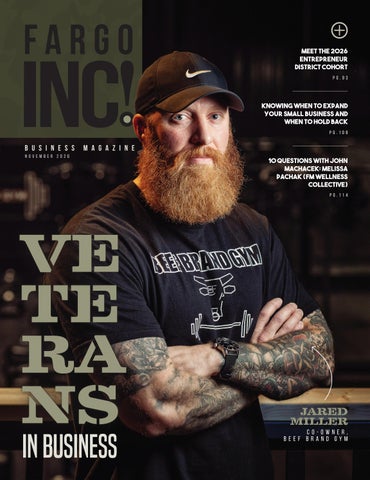
Meet The 2026 Entrepreneur District Cohort PG.93
Knowing When to Expand Your Small Business And When to Hold Back PG.108
november 2026
10 Questions with John Machacek: Melissa Pachak (FM Wellness Collective) PG.114
Co-Owner, Beef Brand Gym
// NOVEMBER 2026
PARTNER CONTENT
46
The Value of a Four-Year Degree: Guide For Parents
62
A Little Different, a Lot of Delicious.
27
Veterans In Business
28
Jared Miller
32
Eric Christians
38
Jani Western
42
Joel O’Neil
50
Michael Phaneuf
54
Nathan Lynnes
68
Jeff Ostlund
72
Cory Althoff
76
Joshua Seley
82
Ryan Engelhardt
93
Meet The 2026 Entrepreneur District Cohort
104
Keeping The Compass Handy
108
Knowing When to Expand Your Small Business And When to Hold Back
114
10 Questions with John Machacek: Melissa Pachak (FM Wellness Collective)
Follow Fargo INC! on Facebook, LinkedIn and X
FEATURES
VETERANS
IN BUSINESS
27
93
114
CHECK OUT FARGOINC.COM
ALL OUR STORIES IN ONE PLACE
READ ALL THE PAST ISSUES
SCAN TO VISIT!
E d i t o r ’s n o t e
Honoring the Veterans in Our
E
very business has a story behind its front door. In this issue of Fargo INC!, we’re celebrating the veterans whose stories include serving our country and helping shape the community we call home. Their contributions are all around us: in the businesses we visit, the teams they lead, the people they hire, and the neighbors they support. These pages offer an opportunity to meet some of
those individuals and learn more about the experiences, ambitions, and values that guide their work. What I appreciate about this issue is the opportunity to put faces and personal histories to businesses readers may already know. Each person brings a different perspective, a different path into business, and a different idea of what they hope to build. Getting to know those differences gives us a richer understanding of our community.
Military service can be an important part of that journey. So can the uncertainty of starting something new, the satisfaction of helping a customer, and the responsibility of having employees count on you. Sharing these stories helps us better understand both the people doing the work and the businesses helping our region grow. I hope this issue encourages you to make your appreciation personal. Read their stories. Visit their businesses.
Business Community Take a moment to learn about the veterans in your own workplace and neighborhood. There is value in giving someone the opportunity to be heard, and in carrying that interest beyond Veterans Day. To the veterans featured here, thank you for trusting us with your stories. To every veteran in our community, and to the families who have supported you, thank you for all you have given.
We’re proud to celebrate your service, your work, and your place in Fargo-Moorhead’s business community. Our region is stronger because of the people we’re honoring this month.
Brady Drake Fargo INC! Editor
Brady Drake, Fargo INC! Editor
fargoinc@spotlightmediafargo.com
NOVEMBER 2026 Volume 11 Issue 11
Fargo INC! is published 12 times a year and is available at area businesses and online at FargoInc.com.
Publisher EDITORIAL Editorial Team Lead Art Director Editorial Graphic Designer Contributors INTERACTIVE Director of Performance Marketing Director of Creative Strategies Web Project Manager Senior Graphic Designer Director of Web Operations Director of Agency Social Media Senior Digital Advertising Specialist ADVERTISING VP of Business Development Sales Representative
Mike Dragosavich Brady Drake Brady@SpotlightMediaFargo.com Kim Cowles Ty Betts Michael Danielson (VBOC), Wendy Klug (SBA), John Machacek (GFMEDC) Kellen Feeney Megan Suedbeck Matthew Haire Sarah Cabler Sara Jentink Mhairi Christopherson Tammy Fogle Paul Hoefer Paul@SpotlightMediaFargo.com Al Anderson Al@SpotlightMediaFargo.com
Digital Sales Representative
Abby Schauer Abby@SpotlightMediaFargo.com
Senior Digital Advertising Specialist
Matt Purpur Matt@SpotlightMediaFargo.com
Director of New Market Sales & Expansion Client Relations Director of Client Success Marketing Admin Accounting Specialist DISTRIBUTION Delivery
Cooper Opheim Cooper@spotlightmediafargo.com ClientRelations@SpotlightMediaFargo.com Jessica Ventzke Tyler Duclos Missy Roberts John Stuber
Fargo INC! is published by Spotlight LLC, Copyright 2026 Fargo INC! & FargoInc.com. All rights reserved. No parts of this magazine may be reproduced or distributed without written permission of Fargo INC!, and Spotlight LLC, is not responsible for, and expressly disclaims all liability for, damages of any kind arising out of use, reference to or reliance on such information. Spotlight LLC, accepts no liability for the accuracy of statements made by the advertisers.
Spotlight, LLC 4609 33rd Ave S Suite #304 Fargo, ND 58104 or info@spotlightmediafargo.com ADVERTISING: 701-478-SPOT (7768)
ASK THE EXPERT
here is a specific kind of magic that happens in the seconds right before a band strikes their first chord. The house lights go down, the crowd holds its breath, and in that brief moment of darkness, the stage becomes a blank canvas. I’ve been an audio and lighting technician at Livewire since 2017, but my roots in the Fargo-Moorhead live music and event scene go much deeper. Over the years, I’ve had the privilege of working as an audio engineer and lighting designer with incredible local musical groups like The Forefeathers, Heart and Soul, The Quarterly, and Boots, along with countless high-energy EDM shows. I’ve also had a hand in operating and directing technology for beloved local venues like The Aquarium, Dempsey’s, The Hub, and Sanctuary Events Center. Through all those long days, packed rooms, and late-night load-outs, I discovered a core passion: bringing the music’s energy to light.
By Mike Nelson, Audio/Lighting Specialist, Livewire
In event production, audio is what you feel in your chest, but lighting is what tells your eyes how to interpret that feeling. If a band plays a slow, emotional ballad, flashing bright white strobes completely ruin the moment. Conversely, if an EDM DJ drops a massive, bassheavy track while the stage sits in a static blue wash, the audience’s energy instantly deflates. Lighting is the visual translation of sound, turning musical rhythm into visual emotion. To make that vision a reality, we rely on a massive inventory of top-tier gear. I use our Chauvet intelligent fixtures and moving heads to sweep beams across the crowd during a soaring guitar solo, while Electronic Theatre Controls (ETC) and Ayrton fixtures provide crisp, theatrical-grade front-lighting to keep performers clearly visible without washing out the stage. Everything is driven by our ChamSys lighting console, which acts as the central brain of the operation. Whether I am pre-programming a structured corporate award show or “busking” live and on-the-fly for a jam band, the
console allows me to tap out tempos, trigger intricate color chases, and manipulate the room’s mood in real time: Low Energy: Deep, saturated magentas and dark blues move slowly to build an intimate, dreamlike atmosphere. Building Tension: Colors subtly shift, and beam intensity gradually rises to pull the audience directly into the performance. High Energy: Strobes, vivid color contrasts, and rapid beam movements unleash right at the peak adrenaline moment of the song. Whether we are lighting up a corporate gala or a local indie band’s album release show, our team at Livewire brings that same passion to every stage, crafting an environment that brings the music to life for FargoMoorhead and beyond. Contact the Livewire team today to start planning your next event!
Livewire
2025 Music on the Mountain
2024 Sunset on the River
The 2025 Great North Pole Gala
By David Reid, President & Owner, Radiant Homes
FARG O INC! PROUD LY PRESENTS:
20
26
VETERANS IN BUSINESS very business has a story, and in this issue of Fargo INC!, we’re sharing those of veterans who have served our country and continue to strengthen the Fargo-Moorhead community. Through their businesses, leadership, and support for their neighbors, they help shape the place we call home. We invite you to get to know the people behind these businesses, learn what drives them, and carry your appreciation beyond Veterans Day.
TO OUR LOCAL VETERANS AND THE FAMILIES WHO SUPPORT THEM, THANK YOU FOR YOUR SERVICE AND ALL YOU CONTRIBUTE TO OUR COMMUNITY. FARGOINC.COM
27
By Brady Drake |
J. Alan Paul Photography
VETERANS IN BUSINESS
JARED MILLER
T H E V ETERA N BEHIND BEEF B RA ND GY M
28
NOVEMBER 2026
CONTINUED sk Jared Miller to point to a piece of equipment that captures what makes Beef Brand Gym different, and he has trouble choosing just one. That isn’t because nothing stands out. It’s because every piece had to earn its place. “It’s hard to pick because every single piece of equipment in here is handselected,” said Miller, one of the gym’s three co-founders. “We didn’t go to one vendor or two vendors or three vendors. We went to every vendor we could, and we handselected our favorite pieces from each one.”
experience, both through individual workouts and training with his unit. His professional path later took him into private security contracting, including protective work in diplomatic and conflict settings. The work could involve stretches of approximately two months on assignment followed by two months off, although the schedule changed with the demands of the job. The opportunity to build a business around fitness developed after Miller met Ed and Jess in Jamestown while they were working on a fitness clothing line. After knowing one another for roughly a year, the three decided to open a gym together.
For Miller and his partners, Ed and Jess, the goal was to create a training experience informed by the places they had visited and the equipment they had used.
CHOOSING THE TRAINING EXPERIENCE
“We’ve seen a lot of really cool gyms around the world,” Miller said.
Miller is careful not to suggest that every gym should look or operate the same way. Different facilities have different strengths, and he recognizes that each serves its own purpose.
They wanted to bring some of that experience to North Dakota, with a particular emphasis on specialized equipment and an atmosphere built around serious training.
FINDING DIRECTION Long before becoming a gym owner, Miller was a college student looking for a greater sense of purpose. After his first year of college, he joined the National Guard, eventually transitioning to active duty. He credits military service with helping put him on the right path and found that he enjoyed the active nature of the work. Fitness was a consistent part of that
For Beef Brand, the opportunity was to build beyond the familiar foundation of racks, free weights, and standard machines. “A lot of gyms have the typical squat racks and dumbbells and your standard stuff, but there isn’t a lot of specialty bodybuilding equipment,” Miller said. That distinction guided the founders’ purchasing decisions. Rather than choosing a single manufacturer to outfit the entire floor, they compared options across vendors and selected
ABOUT JARED MILLER Jared Miller is a military veteran, entrepreneur, and co-owner of Beef Brand Gym. His military career began in the Army National Guard before he transitioned to activeduty service in the U.S. Army. A former Army Ranger, Miller completed numerous specialized military training programs and spent approximately one year serving in a sniper section. After leaving the military, he continued working in high-risk environments, spending roughly five years as a private security contractor in conflict zones overseas, including assignments involving diplomatic security. His experiences in the military and abroad helped shape the discipline, work ethic, and commitment to excellence he brings to his entrepreneurial endeavors, including Beef Brand Gym.
BRANCH S E R VE D
ARMY / NATIONAL GUARD
FARGOINC.COM
29
JARED MILLER
VETERANS IN BUSINESS Inside Beef Brand Gym
their favorites. The quality of a machine and the way it felt to use mattered more than whether it matched the brand beside it. The same attention extended to the space itself. Miller described 30-foot ceilings that create an open, stadium-like feel, along with amenities that include a sauna with red-light features. The intention was to make the environment part of the experience, not simply a backdrop for the equipment.
BUILDING THE BUSINESS BEHIND THE GYM Getting those details in place took more than a year.
30
NOVEMBER 2026
Miller described the startup period as a steady succession of challenges. The partners worked with an architect and a lawyer to navigate construction and legal requirements while handling the other demands of opening a physical business. They primarily financed the gym themselves, supplemented by a small loan before opening and additional financing for expansion. Once the space was ready, they needed to help people discover it. “Obviously, marketing is huge,” Miller said. “You gotta have the right marketing team, social media presence.” He credits Jess with taking a leading role in that effort. “Jess has done a phenomenal job at that,” he said.
“She’s one of the other owners, and she just crushed the social media.” For a business built around equipment and atmosphere, those channels give prospective members a chance to see what the founders have assembled. They can introduce people to unfamiliar machines, show the space and communicate the kind of training environment Beef Brand offers. But Miller draws a distinction between attracting attention and giving someone a reason to keep coming back. Marketing helps people discover the gym. The experience inside has to make the visit worthwhile. The business is also continuing to develop. During the follow-up interview, Miller outlined plans to introduce personal training after
operating without it during the gym’s early months. The owners were speaking with potential trainers, while group classes were not part of his plans. Longer term, Miller would like to open additional locations with the same team. His immediate priority, however, is making the current gym successful. His advice to other business owners reflects the difficult year his own team spent getting to opening day: Keep working through the hardest phases. For now, that work comes back to the experience the founders set out to create—how the equipment performs, how the space feels, and whether members want to return. “That’s what keeps you here,” Miller said.
VISIT BEEF BRAND GYM AT:
beefbrandgym.com
Search “Beef Brand Gym”
701.840.5919
@beefbrandgym
615 36th St N, Fargo
By Brady Drake |
provided by Eric Christians
VETERANS IN BUSINESS
ERIC CHRISTIANS W HAT E R I C C H R I S T I AN S B R O U GHT HO M E 32
NOVEMBER 2026
Eric after his boot camp graduation
CONTINUED
W
hen Eric Christians brought his dad aboard a Navy ship, he could already find his way around in the dark. His father had joined the trip from San Diego to Everett, WA, as the ship returned from a deployment. For four or five days, he got to see the life his son had come to consider ordinary. At night, Christians remembers, the ship kept exterior light to a minimum. Getting outside meant passing through one door, closing it, then opening another so light would not spill onto the deck. Christians knew where everything was. Hearing his father’s reactions reminded him of his own first days aboard. “By that point, I was so accustomed to it; it was just normal,” he said. Today, Christians works with buyers and sellers through Christians Home Crew, brokered by eXp Realty, in the Fargo-Moorhead area. His background includes years of home inspection work and a college education. But when he talks about becoming someone who could handle responsibility, he returns to the Navy and the four years he served between July 15, 1999, and July 15, 2003. He joined at 18, interested in seeing the world. Along the way, he learned how to live with people he had never met, supervise other sailors, and finish work that nobody particularly wanted to do.
A REASON TO LEAVE HOME Christians grew up near Herman,
MN, on a small hobby farm where there was usually livestock to care for and an assortment of other animals around. He hunted, fished, played football, and ran track. Military service was familiar in his family. His brother had joined the Army a year before him, and an uncle had served in the Navy during the Vietnam War. Christians listened to his uncle’s experiences, but he was also drawn to a recruiter’s descriptions of ports overseas. The food in Thailand. The beaches in Australia. Places well beyond the Minnesota town where he had grown up. “That was probably the thing that really got me to go Navy over anything else,” he said. After a delay in the enlistment process, things moved quickly. Christians signed his paperwork in late June and left in mid-July, giving his mother considerably less time to prepare than she had expected.
He went to Great Lakes, Illinois, for basic training and then trained there as a gunner’s mate. The work involved weapons ranging from handguns to large guns mounted on ships. He finished third in his class. The top two students were offered further training on missile launchers, but when the first-place student chose to pursue becoming a Navy SEAL, Christians got the opportunity. He spent another six months training in San Diego on the vertical launching system used to launch Tomahawk cruise missiles and other missiles. His first ship assignment brought him to Washington, where the ship was undergoing repairs. He initially slept on a berthing barge and worked on a rehabilitation project that, as he remembers it, nobody wanted. Christians says his work on that assignment earned him a Navy and Marine Corps Achievement Medal within his first few months
BRANCH S E R VE D
U.S. NAVY - 1999-2003
FARGOINC.COM
33
ERIC CHRISTIANS
CONTINUED
VETERANS IN BUSINESS Eric returning home after deployment
aboard. His explanation for the recognition is straightforward: He did the job he had been assigned.
Among his strongest memories of that deployment is the waiting. He recalls spending 97 consecutive days at sea, with little room to get away from the people around him.
That expectation would stay with him.
LEARNING TO LIVE TOGETHER His first deployment included counterdrug operations alongside the Coast Guard off Central and South America. There were boats to intercept, long stretches underway, and a trip through the Panama Canal. There were also port stops that delivered some of the travel he had hoped for. He was on that deployment when the Sept. 11 attacks occurred. Watching the news from the ship’s mess decks, he wondered whether their orders would change and send them elsewhere. After that ship was decommissioned, Christians transferred to another ship based in San Diego. His next deployment took him to the Persian Gulf, where, he recalls, his ship launched Tomahawk missiles during the opening strikes of the Iraq War in 2003.
34
NOVEMBER 2026
The strain, he said, came from living so closely together for so long. He estimated that a space the size of the room where he was being interviewed could sleep 40 people aboard ship. After months at sea, tensions ran high. “It’s tough mentally,” he said. Those conditions also forced him to learn how to get along. He paid attention to what bothered other people and how to work through disagreements. The ship was his first experience living away from home, and he compares the friendships to those formed in a college dorm. He spent enormous amounts of time with fellow sailors and got to know their families. As a work center supervisor, he took on responsibility for roughly 10 sailors. He learned to delegate and to recognize when a task might be better suited to someone else. Supervising meant figuring out how to put people’s abilities to use and keep the work moving.
ERIC CHRISTIANS
VETERANS IN BUSINESS
“You can either take accountability for yourself and for your actions and do the things that need to be done, or they’re not going to get done, and it’s up to you.” Christians still sees applications for that experience, including as a parent. Helping a household function requires leadership, too, even if nobody calls it that.
FINDING HIS PLACE BACK HOME Returning from his final deployment lined up closely with the end of his enlistment in July 2003. Leaving the Navy raised the question of what to do next. “There’s no need for a missile launcher technician in Fargo, North Dakota,” he said. His technical specialty offered no obvious next step locally. The discipline he had developed proved useful as he pursued an education.
4,000 inspections, according to his professional biography. That work gave him experience evaluating the homes he now helps people buy and sell. His approach includes helping buyers understand a property’s condition and helping sellers consider which issues deserve attention before listing. He works across Fargo, Moorhead, West Fargo, and surrounding communities. He is careful about giving the military all the credit for the person he became. Other jobs, people and education have influenced him in the years since. Still, he can identify a lesson from his service that remains particularly clear. “Nobody’s going to do it for you,” he said.
“I don’t think that I would have had the discipline to go to college and graduate from college if I didn’t have the military,” he said.
It is a standard he applies to himself, even while acknowledging that he still procrastinates sometimes. Knowing what needs to happen and actually doing it are separate things. The responsibility for closing that gap is his.
Christians studied business management and finance at Minnesota State University Moorhead. Before moving into home sales, he spent 11 years as a home inspector, completing more than
“You can either take accountability for yourself and for your actions and do the things that need to be done, or they’re not going to get done, and it’s up to you,” he said.
VISIT CHRISTIANS HOME CREW AT:
christianshomecrew.com
36
NOVEMBER 2026
/ChristiansHomeCrew
@christianshomecrew
By Brady Drake |
provided by Jani Western
VETERANS IN BUSINESS
JANI WESTERN
IS S TU DYING LIF E A F TER S ER VICE
38
NOVEMBER 2026
CONTINUED
J
ani Western remembers seeing a woman driving a Jeep Wrangler with the top and doors off, wearing an Army uniform. She thought the woman was cool. More than that, she saw someone she wanted to become. Western eventually wore the uniform herself, serving in Iraq and Afghanistan. Today, she is studying how military experiences shape the people who come home. A doctoral student in experimental psychology at North Dakota State University, Western wants to better understand how veterans make sense of their experiences and navigate life after service. Her work grows out of her own transition, along with a recognition that every veteran brings a different history to that process. “Everybody has a story. Everybody has a past. Everybody’s dealing with something,” Western said.
A PATH THROUGH THE ARMY Born in Devils Lake, Western moved to Fargo around age 6. She attended Fargo North High School before dropping out, earned her GED, and joined the active-duty Army at 20. Coming from a childhood she described as uncertain, she wanted to make something of herself. She served approximately six years, with duty stations at Fort Campbell, KY, and Fort Hood, TX. Her deployments took her to Iraq in 2005–2006 and Afghanistan in
2010–2011. After leaving active duty following her first deployment, she later reenlisted while raising a young child. Her experience in the Army was complicated. She formed relationships with people she remains in contact with, learned the value of structure and teamwork, and developed an insistence on getting the job done. She also described the difficulty of serving as one of very few women in her platoon, feeling pressure to exceed male standards while being pushed down at the same time.
Those experiences helped shape her desire to understand other people and what they carry with them. However, the habits that helped her complete a mission did not always translate easily into civilian relationships and expectations. Western, who lives with posttraumatic stress disorder, speaks about that transition from personal experience. She is equally careful to recognize how much another veteran’s experience may differ from her own.
BRANCH S E R VE D
U.S. ARMY - 6 YEARS OF SERVICE
FARGOINC.COM
39
JANI WESTERN
VETERANS IN BUSINESS Jani with local Iraqi soldiers
RESEARCH SHAPED BY EXPERIENCE When Western returned to school, she initially considered a path into medicine. Her direction changed, but the reason for pursuing an education remained. “I wanted to help veterans,” she said. She graduated with honors from NDSU with a bachelor’s degree in psychology and a minor in biological sciences. A first-generation college student, she is now pursuing her doctorate in experimental psychology under the mentorship of Dr. Anna Finley, director of NDSU’s Social Psychology and Affective Neuroscience in Health, or SPANH, Lab. Her work involves designing studies, learning from participants, and communicating what the research shows. Her undergraduate honors thesis explored dietary elements and PTSD symptoms.
40
NOVEMBER 2026
Her initial graduate work examined military self-stigma and well-being. Western describes military self-stigma as the process of internalizing negative public assumptions about veterans, including the idea that they are all damaged by their service. Her master’s thesis focuses on difficult military experiences and identity coherence, which is a person’s sense of who they are and how their experiences fit into that understanding. She is also interested in moral injury and how experiences that conflict with a person’s values may affect that sense of self after service. The broader question is how to help veterans make a positive transition into civilian life. Western wants to understand who someone was before joining, what happened during service, and how those experiences influence life afterward. One difference she is interested in exploring is the shift from the military’s emphasis on the
(We Do) everything’s as a team. We’re always thinking about everybody else.” - JANI SPEAKING ON MILITARY LIFE
group to a civilian culture that can feel much more individualistic. “(We do) everything’s as a team. We’re always thinking about everybody else,” she said of military life. Leaving that environment can mean adjusting to a different set of expectations about belonging and responsibility. Western wants to examine those changes while accounting for the many factors that make service experiences distinct, including a person’s background, branch, duty station, and gender. Ideally, she would like to follow people over time, beginning around enlistment and continuing into civilian life. Having information from the beginning would help researchers better understand how someone changes through service. Building a study that follows participants across those years, however, would require substantial funding.
on veteran reintegration, PTSD, and related concerns. She enjoys bringing people together through events and envisions using that interest to help fund research teams.
FOLLOW THE RESEARCH The NDSU SPANH Lab newsletter shares research updates and information about new studies.
she currently encourages interested readers to subscribe to the SPANH Lab newsletter for updates about the lab and new studies. The questions Western is pursuing come from a life that has taken her from a GED to graduate school, through two deployments and into veteran advocacy. As she works toward the next stage, she wants to create more opportunities for veterans’ experiences to inform both research and the support available to them.
She has also considered creating a retreat center on family land near Leeds, ND. Her vision includes clinical support and enough time for veterans to address their individual needs as they prepare for life in their communities. It remains a future goal, with significant resources needed to make it possible.
BUILDING SUPPORT BEYOND CAMPUS
In Fargo, Western already has a role in advocating for veterans’ mental health care. As chair of the MINDAKS Veterans Mental Health Council, she helps bring concerns from veterans, families, and community members to the VA. She describes the council as a way to identify problems with care and work directly with the VA toward solutions.
That need has helped shape one of Western’s long-term ambitions, which is establishing a foundation that raises money to support research
She also wants people interested in veteran research to stay connected. While she hopes to develop a registry of potential participants in the future,
SHARE A CONCERN Veterans, family members, and community members can scan the QR code, or visit mindaksvmhc.org and select “Share a Concern” to connect with the MINDAKS Veterans Mental Health Council about veterans’ mental health care.
FARGOINC.COM
41
By Brady Drake |
Provided by Joel O’Neil
Joel and his family.
VETERANS IN BUSINESS
JOEL O’NEIL F INDS A NEW WAY TO S E R VE
42
NOVEMBER 2026
CONTINUED
J
oel O’Neil set out to build a construction business. He didn’t expect so much of his work to involve caring for fellow veterans’ final resting places.
Today, the owner of West Fargo’s J-1 Excavating & Roll-Off holds a Department of Veterans Affairs contract to care for Fargo National Cemetery near Harwood. His company digs graves, maintains the grass and irrigation system, and installs headstones. At the time of his interview, that work accounted for about 90% of his business. For someone who spent 20 years in the Army National Guard, those responsibilities carry a personal connection. “It’s sometimes a little bit grim, but also super rewarding,” O’Neil said. He hires current and former military members, bringing other people who have served into the work. When he describes the cemetery contract, he talks about taking care of veterans’ families as they lay a loved one to rest. “We take a little extra pride in our work,” he said.
REASONS TO STAY O’Neil’s decision to enlist began with a concern familiar to many college students, which was how to pay for an education. He had already spent a couple of years in college when he joined the Army National Guard in January 2000. Student loans had prompted
him to consider another way to finance school, and friends who were already in the Guard helped point him in that direction.
Patriotism helped keep him in the military. As the years passed, the relationships he formed became another reason to stay.
He would eventually earn a degree in construction management. His military commitment, meanwhile, took on a significance he couldn’t have anticipated when he signed up.
“You kind of join for one reason and stick around for another,” he said.
Less than two years after he enlisted, the September 11 attacks changed the country and the meaning he attached to his service. “The world kind of changed,” O’Neil said. He deployed to Iraq in 2003–2004 and to Kosovo in 2009–2010. In Kosovo, he served as a staff sergeant and squad leader with the North Dakota National Guard’s 231st Maneuver Task Force.
The Guard gave him the opportunity to serve alongside many of the same people for years. Friends built military careers, and he remained connected to a group whose experiences together extended well beyond a single assignment. “People I still hang out with today were people I met in 2003 in Iraq,” O’Neil said. What began as a way to help pay for college became 20 years of service, with friendships that continued after his time in uniform ended.
BRANCH S E R VE D
ARMY / NATIONAL GUARD - 20 YEARS OF SERVICE
FARGOINC.COM
43
JOEL O’NEIL
Fargo National Cemetery.
VETERANS IN BUSINESS
LEARNING TO BUILD A BUSINESS Alongside his military service, O’Neil built a civilian career in construction. He spent 19 years with Wanzek Construction, where his roles included director of equipment and fleet services, before deciding to go out on his own. He credits that experience with encouraging him to think like an entrepreneur before he owned a business. Within the company, he had been given room to develop that approach. Eventually, he wanted to apply it to a company of his own. “I got the bug and decided to go out on my own,” O’Neil said. During his first year in business, he began looking into government contracting. He saw the VA’s use of veteran contractors as a promising place to pursue projects.
44
NOVEMBER 2026
That search brought him to Fargo National Cemetery. Dedicated in September 2019, the cemetery was the first national cemetery built in North Dakota. It was established through a VA initiative designed to improve access to burial benefits for veterans in rural areas. For O’Neil, the contract brought together his construction experience and his connection to the military community. It also introduced him to people whose work he has come to appreciate. He speaks highly of the national cemetery personnel he has worked with in Fargo and at Fort Snelling, describing them as “really, really good to work with.” Cemetery care hadn’t been the business he initially envisioned. It has become work he finds rewarding, with responsibilities that extend to the families who come there to remember someone.
I wouldn’t say that this was part of my plan, but I really have enjoyed the way things are working out.” GRIT AND ROOM TO GROW Asked what the military contributed to his professional life, O’Neil starts with grit. Some of his most enduring memories of serving with friends came from difficult stretches they had to get through together. “A lot of the most memorable times with my friends in the military were always at a time when things sucked,” he said. Shared hardship brought people together. It also taught him to keep working through a difficult situation and to pay attention to the attitude he brought to it. Those are lessons he carries into his professional life. Now, he wants to keep building J-1’s excavation business. In addition to the cemetery contract, he operates a roll-off dumpster service and takes on smaller dirt-work projects. His goal is to pursue larger earthwork jobs, whether through state or federal projects or private commercial work. “I’m really enjoying working for myself and building my own business,” O’Neil said. Much of that business is now devoted to fellow veterans and their families. “I wouldn’t say that this was part of my plan, but I really have enjoyed the way things are working out,” he said.
VISIT J-1 EXCAVATING & ROLL-OFF AT:
j1rolloff.com Search “J-1 Excavating & Roll-Off”
FARGOINC.COM
45
46
NOVEMBER 2026
FARGOINC.COM
47
By Brady Drake |
provided by Michael Phaneuf
VETERANS IN BUSINESS
MICHAEL PHANEUF
SI T E OP E R AT I O N S MAN AGER, TRU ENO R TH S TEEL
50
NOVEMBER 2026
CONTINUED
Q: WHAT WAS YOUR ROLE IN THE MILITARY, AND WHERE WERE YOU STATIONED OR DEPLOYED?
Q: HOW DID YOU TRANSITION FROM MILITARY SERVICE INTO YOUR CURRENT CAREER?
A: I worked in short-range air defense on the Avenger weapon system. I started as a gunner and retired as a platoon sergeant. I was stationed in Grand Forks, Fargo, and Bismarck. I deployed to Afghanistan in 2006 with the 1-188th ADA SECFOR where we worked with the Afghan Border Patrol and Army. I deployed in 2009 to Kosovo on KFOR 12 with C 231 MEB, and I deployed twice to the national capital region to provide air defense in our nation’s capital.
A: When I returned from Afghanistan, I went to welding school and joined the workforce. I liked working in the trades because it had a similar feeling to the military in the way that everyone needs to be working towards the same outcome to be successful. Over the last 15 years, I leveraged my leadership skills I learned from the military to work my way up from a welder to a welding lead, to shop supervisor, and now site operations manager. I love that I get to combine my knowledge of steel fabrication with my leadership abilities on a daily basis.
Q: WHAT ORIGINALLY INSPIRED YOU TO JOIN THE MILITARY? A: I always enjoyed working on a team towards a common goal. I viewed the military as an opportunity to do that while serving my nation. Q: WHAT IS ONE EXPERIENCE FROM YOUR MILITARY SERVICE THAT HAD A LASTING IMPACT ON WHO YOU ARE TODAY? A: My first deployment to Afghanistan. I had the privilege of serving with many outstanding leaders who showed me what is required to get the most out of a team. I learned countless lessons on leadership by watching how they handled themselves while working through extremely difficult tasks and situations. That stuck with me and has molded me into the leader that I am today.
Q: WHICH SKILLS OR HABITS FROM THE MILITARY HAVE BEEN MOST VALUABLE IN YOUR PROFESSIONAL LIFE? A: My resilience and leadership skills have been the most valuable skills I took from the Army. I am able to see a way to get to a positive outcome no matter the challenge, and I use the leadership skills I learned while serving to get everyone aligned so we can accomplish what is needed to get there. Q: HOW HAS YOUR MILITARY BACKGROUND INFLUENCED THE WAY YOU APPROACH LEADERSHIP, TEAMWORK, DECISION-MAKING, OR PROBLEM-SOLVING? A: Working with so many different personality types in the Army helped me identify how to best work with people from all walks of life.
I know that in order to get people working together, there needs to be a strong sense of pride in the team, and I work hard to foster that mindset in the shop. When it comes to decision-making and problemsolving, another thing I learned from working in the Army is to take a more collaborative approach and get as many experts involved so that I can make well-informed decisions. In the end, the decision is mine to make, and I own the outcome, but it is better to have as much information as possible before making the call. Q: WHAT HAS BEEN ONE OF THE BIGGEST CHALLENGES IN YOUR CAREER, AND HOW DID YOUR MILITARY EXPERIENCE HELP YOU WORK THROUGH IT? A: One of the biggest challenges is the ever-changing landscape of structural steel fabrication. Some jobs may have material procurement challenges, some may have delays in drawings, and others might see accelerated delivery requests. The Army gave me a solid base in how to deal with stressful and fluid situations. I always try to stay a step ahead and have contingency plans so that changes do not derail our mission. Q: WHAT PROFESSIONAL ACCOMPLISHMENT ARE YOU MOST PROUD OF? A: I am most proud that I made it to the position I am currently in. When I started out welding, I did not envision myself being here, but I had a drive to achieve more. I have always put my best foot forward at work and soaked up all the knowledge I could along the way. I am extremely grateful
BRANCH S E R VE D
ARMY NATIONAL GUARD - 21 YEARS OF SERVICE
FARGOINC.COM
51
MICHAEL PHANEUF
VETERANS IN BUSINESS Michael and his platoon at the National Training Center.
that TrueNorth Steel saw my potential and gave me the opportunities to show what I can do in leadership roles. Q: IS THERE A PARTICULAR MOMENT WHEN YOU REALIZED YOUR MILITARY EXPERIENCE GAVE YOU A DIFFERENT PERSPECTIVE OR ADVANTAGE IN THE WORKPLACE? A: Whenever things get very stressful, I often see that it really gets to some people and affects their performance. Having the perspective that I have from making it through many extremely challenging situations in Afghanistan makes it easier for me to step back and look at the situation in a calm and focused way. This allows me to make clear-headed decisions to get through difficult challenges.
52
NOVEMBER 2026
Q: WHAT DO YOU WISH EMPLOYERS, COLLEAGUES, OR COMMUNITY MEMBERS BETTER UNDERSTOOD ABOUT VETERANS IN THE WORKFORCE? A: Every veteran has different experiences, but they all have something they can bring to the table. Most veterans excel when they feel like they are part of a team working towards a common goal. Q: DO YOU CURRENTLY SUPPORT VETERANS, ACTIVE-DUTY SERVICE MEMBERS, MILITARY FAMILIES, OR VETERAN-FOCUSED ORGANIZATIONS? IF SO, HOW? A: I do. I am on the board for our Veterans’ Employee Resource Group. We are a fairly new
group at TrueNorth Steel, and we are working through what we can provide for our veteran employees. I look forward to really getting it running and supporting our veterans in any way that we can. Q: ARE THERE PROGRAMS, MENTORS, ORGANIZATIONS, OR RESOURCES THAT HELPED YOU DURING YOUR TRANSITION INTO CIVILIAN EMPLOYMENT OR BUSINESS OWNERSHIP? A: I utilized the GI Bill to attend welding school. Q: WHAT COULD LOCAL BUSINESSES DO TO BETTER RECRUIT, SUPPORT, AND RETAIN VETERANS? A: Get to know the veterans on your team. They all have something to bring to the table, but you need to get to know them for who they are to find out what they are capable of. A lot of veterans will stay in the background and never show their true potential until they are given a challenge or opportunity. Q: WHAT ADVICE WOULD YOU GIVE TO VETERANS WHO ARE CONSIDERING ENTREPRENEURSHIP OR BEGINNING A NEW CIVILIAN CAREER? A: Lean into what you learned from your best leaders. Find a career that fits your goals and dive in headfirst. Learn everything you can and use those leadership skills to improve the team around you. Remember that you can make it through any challenge with the right mindset. Q: WHAT DOES BEING A VETERAN MEAN TO YOU TODAY? A: Being a veteran means that I was willing to sign my life away to have the opportunity to serve our great nation. What that gave me was a lifetime’s worth of experiences that have helped develop me into the person I am today. Q: IS THERE ANYTHING ELSE ABOUT YOUR SERVICE, CAREER, BUSINESS, OR COMMUNITY INVOLVEMENT THAT YOU WOULD LIKE READERS TO KNOW? A: TrueNorth Steel has given me countless opportunities to put what I have learned through my military service into action in my civilian career. I am thankful to be a part of an organization that provides opportunities like this to our veteran employees.
Being a veteran means that I was willing to sign my life away to have the opportunity to serve our great nation. What that gave me was a lifetime’s worth of experiences that have helped develop me into the person I am today.
FARGOINC.COM
53
By Brady Drake |
provided by TrueNorth Steel
VETERANS IN BUSINESS
NATHAN LYNNES
QU A L I T Y C O N T R O L S UP E R V IS O R, TRU ENO R TH S TEEL
54
NOVEMBER 2026
CONTINUED
Q: WHAT WAS YOUR ROLE IN THE MILITARY, AND WHERE WERE YOU STATIONED OR DEPLOYED? A: I began my military service in 2008 as a 91M Bradley Fighting Vehicle System Maintainer with the 2-136th Brigade Support Battalion with the Minnesota Army National Guard, where I served until 2014. I then transitioned to the North Dakota Army National Guard and served for eight years as a 94T Avenger Systems Repairer with the 1-188th Air Defense Artillery Battalion in Grand Forks, North Dakota. During this period, I deployed twice to the National Capital Region in Washington, D.C., contributing to homeland air defense operations. After returning in 2022, I was promoted to Sergeant First Class and assumed the role of 91X Maintenance Supervisor, while also serving as the Detachment Sergeant, overseeing personnel, equipment readiness, and maintenance programs. This is the position I currently hold within the North Dakota Army National Guard, where I continue to serve today. Q: WHAT ORIGINALLY INSPIRED YOU TO JOIN THE MILITARY? A: The challenge of military service initially drew me in, but it was the sense of purpose, responsibility, and commitment to my country that inspired me to stay. Serving in uniform has given me the opportunity to contribute to something far greater than myself while helping protect the freedoms we enjoy as Americans.
Q: WHAT IS ONE EXPERIENCE FROM YOUR MILITARY SERVICE THAT HAD A LASTING IMPACT ON WHO YOU ARE TODAY? A: More than anything, it is the people I have met and had the privilege to serve alongside who have had the greatest and most lasting impact on me. Q: HOW DID YOU TRANSITION FROM MILITARY SERVICE INTO YOUR CURRENT CAREER OR BUSINESS? A: The transition from military service into my current career path was a natural one, largely because of the discipline, leadership, and problemsolving skills I developed. These experiences provided me with a strong foundation that has enabled me to adapt quickly and succeed in leadership roles within the quality control and structural steel industry. Q: WHICH SKILLS OR HABITS FROM THE MILITARY HAVE BEEN MOST VALUABLE IN YOUR PROFESSIONAL LIFE? A: The qualities that have had the greatest impact on me are discipline, accountability, and the understanding that true success comes from working together as a team toward a common goal. Q: HOW HAS YOUR MILITARY BACKGROUND INFLUENCED THE WAY YOU APPROACH LEADERSHIP, TEAMWORK, DECISION-MAKING, OR PROBLEM-SOLVING?
A: The Army taught me that effective leadership is about leading by example, earning trust, and putting the success of the team ahead of personal recognition. It reinforced the importance of accountability, clear communication, and developing those around you to reach their full potential. From a teamwork perspective, military service showed me that no mission is accomplished alone. Success depends on individuals working together toward a common goal, understanding their roles, and supporting one another through challenges. That lesson continues to influence how I collaborate with coworkers and build a strong team in my professional career. The military also taught me to remain calm under pressure and make informed decisions based on the information available. Whether troubleshooting equipment issues, managing personnel, or addressing complex challenges, I have learned to assess the situation, identify the root cause, develop a plan, and execute it effectively. These experiences continue to guide my approach to problem-solving and help me lead with confidence in both my military and civilian career. Q: WHAT HAS BEEN ONE OF THE BIGGEST CHALLENGES IN YOUR BUSINESS OR CAREER, AND HOW DID YOUR MILITARY EXPERIENCE HELP YOU WORK THROUGH IT? A: I would say one of the biggest challenges in my quality career has been managing competing priorities. My military experience has helped
BRANCH S E R VE D
ARMY NATIONAL GUARD - 2008 - PRESENT
FARGOINC.COM
55
NATHAN LYNNES
VETERANS IN BUSINESS
In the military, you’re trained to stay calm under pressure, rely on proven processes, and work as a team to accomplish the mission. I realized that this mindset gave me an advantage in the workplace because I approach challenges with discipline, accountability, and a solutions-focused attitude. It reinforced for me that many of the leadership and problem-solving skills I developed in the National Guard translate directly to leading quality initiatives and driving continuous improvement in my civilian career. Q: WHAT DO YOU WISH EMPLOYERS, COLLEAGUES, OR COMMUNITY MEMBERS BETTER UNDERSTOOD ABOUT VETERANS IN THE WORKFORCE?
me navigate these challenges by teaching me the importance of clear communication and making decisions based on facts rather than emotions. As a Detachment Sergeant, I learned how to prioritize available resources, solve complex and time-sensitive problems, and provide leadership to the Soldiers within the Detachment. Q: WHAT PROFESSIONAL ACCOMPLISHMENT ARE YOU MOST PROUD OF? A: Earning my Certified Welding Inspector (CWI) certification is the professional accomplishment I am most proud of. It represents years of dedication to the welding and structural steel industry and has allowed me to strengthen quality standards, improve processes, and serve as a trusted technical resource for my team. Most importantly, it has enabled me to make a lasting impact on the quality and success of the projects and people I support. Q: IS THERE A PARTICULAR MOMENT WHEN YOU REALIZED YOUR MILITARY EXPERIENCE GAVE YOU A DIFFERENT PERSPECTIVE OR ADVANTAGE IN THE WORKPLACE? A: Yes. One moment that stands out for me was when we were working through a complex, quality-driven project that required quick decision-making and coordination between multiple departments. My military experience helped me step back, assess the situation, prioritize actions, and focus the team on the outcome rather than all the chaos surrounding it.
56
CONTINUED
NOVEMBER 2026
A: I wish employers, colleagues, and community members better understood that veterans are not defined solely by their military service. Our experiences in uniform have shaped who we are, and we bring a wide range of perspectives, skills, and life experiences to the workplace. Many veterans carry with them a strong sense of purpose, teamwork, accountability, and a commitment to serving something greater than themselves. Through our military experiences, we’ve learned to overcome challenges, adapt to change, and support those around us, often under demanding circumstances. What I hope people understand most is that veterans are simply people who want to continue contributing, making a difference, and being part of a team. A little understanding, patience, and willingness to listen can go a long way. Behind every veteran is a unique story, and many of us are grateful for the opportunity to continue serving our communities in new ways long after we take off the uniform. I also think it’s important to recognize how much veterans and current service members appreciate employers who understand that our commitment to serve does not always end when we walk into our civilian workplace. For those of us who continue serving our states and country, military obligations can sometimes pull us away from our jobs and families. Having an employer and coworkers who understand and support that responsibility means a great deal to us. That support allows us to fulfill our commitment to our country while continuing to give our best to the organizations and teams we work with every day.
NATHAN LYNNES
VETERANS IN BUSINESS
Whether I’m serving my country, state, community, TrueNorth Steel and the people around me, my commitment remains the same.” Q: DO YOU CURRENTLY SUPPORT VETERANS, ACTIVE-DUTY SERVICE MEMBERS, MILITARY FAMILIES, OR VETERAN-FOCUSED ORGANIZATIONS? IF SO, HOW? A: Yes. One of the ways I support veterans and service members is through TrueNorth Steel’s Veterans Employee Resource Group (VERG). The group is still in its early stages, but it’s already giving veterans across the company a place to connect, share experiences, and support one another. I‘ve been involved in conversations about how we can better recognize our veteran employees and strengthen our connection with the veteran community. We’re also working on initiatives like the Wall of Honor and exploring opportunities to partner with and give back to veteran-focused organizations. What I appreciate most is that we’re building something from the ground up. While VERG is still finding its footing, it’s a positive step toward ensuring veterans feel seen, valued, and supported within TrueNorth Steel. I’m proud to be part of that effort and excited to see where it leads in the future. Q: WHAT ADVICE WOULD YOU GIVE TO VETERANS WHO ARE CONSIDERING ENTREPRENEURSHIP OR BEGINNING A NEW CIVILIAN CAREER? A: My advice to all veterans would be to have confidence and awareness that the skills you developed in the military are valuable. The ability to work under pressure is a foundational skill in the military, and I personally believe that it’s a sought-after quality with employers and business owners. If you are starting a new career in the civilian
58
NOVEMBER 2026
sector, don’t be afraid to take on a new challenge and continue learning. In my experience, and I believe many other veterans would say the same, not every skill will carry over directly. However, the work ethic and mindset you develop during your time in the service will carry you a long way. Those who are interested in following the entrepreneurial path should approach it the same way they would with any mission that they were tasked with: have a plan, build a strong team around you, stay adaptable, and don’t be afraid to ask for help from people who have already walked the path. Patience is key during the transition. Not having all the answers right away is perfectly okay. The resilience that helped you overcome those challenges in the service will help you build that successful future in civilian life. Q: WHAT DOES BEING A VETERAN MEAN TO YOU TODAY? A: Being a veteran for me means having that continued sense of purpose. Whether I’m serving my country, state, community, TrueNorth Steel and the people around me, my commitment remains the same. Military service in general has taught me to look beyond myself and focus on something greater. It’s instilled in me a mindset of service, teamwork, and responsibility that continues to guide me both personally and professionally. Being a veteran for me isn’t just about what I have accomplished in the military but more about carrying those values forward and using them to make a lasting, positive impact wherever I may be. If I had to sum it all up in one sentence, being a veteran to me means being part of something bigger than myself and continuing to serve others long after I take off the uniform.
A Little Different,
a Lot of Delicious.
Some Things Never Go Out of Style. And That's a Good Thing.
62
NOVEMBER 2026
ince 1969, Kroll's Diner has been serving up German favorites, American classics, and a personality entirely its own. While other restaurants are busy reinventing themselves, Kroll's is busy being Kroll's. And there's something pretty great about that. Maybe you're one of the regulars. Maybe your family has been coming for generations. Maybe you've got a favorite booth, a favorite server, or a menu item you order every single time. That's the kind of loyalty Kroll's Diner has built over more than five decades. Locally owned and proudly independent, Kroll's has never been particularly interested in being like everybody else. It's a place where breakfast doesn't care what time it is. Where Knoephla Soup is practically a love language. And where a hand-scooped malt is still considered a perfectly reasonable life decision.
The same attitude can be found in four of the simplest words in restaurant advertising:
Sit Down and Eat!
Kroll's isn't trying to be the newest restaurant in town. Or the fanciest. It's simply Kroll's.
A Little Personality Goes a Long Way. There’s more to Kroll’s Diner than what’s on the menu. While plenty of restaurants have relied on a familiar advertising formula of standard food photography, smiling families, and the occasional limited-time offer, Kroll’s has never been afraid to take a different approach. Sometimes a VERY different approach. Enter the Kroll’s Ladies. With their unmistakable personalities, quick wit, and wonderfully unapologetic attitude, the Kroll’s Ladies became a memorable part of the local dining scene. They weren’t typical restaurant spokespeople, and that was precisely the point. A little sass. A little humor. And a refreshing willingness to poke fun at just about anything, including Kroll’s itself. Their advertising wasn’t simply about convincing someone to order a burger or stop in for breakfast. It gave people something to laugh about, talk about, and remember. Not exactly a complicated marketing message. But then again, why should it be?
It’s direct. It’s a little bossy. It’s wonderfully familiar. And it’s about as Kroll’s as a bowl of Knoephla Soup. Over the years, Kroll’s advertising has celebrated its German heritage, food traditions, and distinctive sense of humor, proving that restaurant marketing doesn’t always have to take itself so seriously. After all, if you’re going to be different, you might as well have some fun with it.
FARGOINC.COM
63
Taking Kroll’s Personality Beyond the Diner Sweet Rolls, Strong Coffee, and Absolutely No Shortage of Character. Some restaurants are content to keep their best stuff inside their four walls. Kroll’s Diner has other ideas. Take their caramel rolls, for example. Soft, sweet, fluffy, wonderfully gooey, and practically impossible to eat without getting a little sticky, Kroll’s caramel rolls have earned a special place among the diner’s most beloved offerings. Over the years, they’ve brought these sweet favorites directly to special groups and community gatherings, sharing a little Kroll’s goodness beyond the restaurant. And naturally, they couldn’t just put them in an ordinary box.
Enter Kroll’s Rolls! With bright, playful packaging featuring messages like “Yumminess Awaits,” “Oooooey Goooooey,” and “Outstanding Eats for Outstanding Peeps,” the presentation is every bit as memorable as what’s inside. Because when it comes to Kroll’s, even a box of caramel rolls deserves a little personality. And they aren’t stopping there.
Sit Down & Drink! Kroll’s has also ventured into developing its own branded products, including a coffee that feels right at home alongside the diner’s wonderfully unapologetic attitude. Meet Cuppa Joe. A medium-dark roast coffee with a name that doesn’t require a dictionary and packaging that certainly doesn’t take itself too seriously. The coffee bag proudly declares: “No frills, no fancy flavors, just honest coffee meant to wake you up and keep you going, one sturdy cup at a time.” And because this is Kroll’s, the packaging wouldn’t be complete without a familiar pair of faces. The legendary Kroll’s Ladies make another appearance, offering a little unsolicited advice: “Stop starin’ and start buyin’!” Subtle? Not particularly. Memorable? Absolutely.
64
NOVEMBER 2026
Roasted by North Dakota’s Coal Country Coffee, Cuppa Joe brings another dimension to the Kroll’s experience. From colorful caramel roll boxes to cheeky coffee packaging, these initiatives demonstrate how Kroll’s continues to find new ways to connect with customers while staying true to the personality people already love.
Apparently, the Rest of the Country Has Noticed, Too. North Dakotans have been enjoying Kroll’s Diner for generations. But apparently, word has gotten out. And not just to the next county. Over the years, Kroll’s has caught the attention of some recognizable national publications, including Food Network and Business Insider. Food Network selected Kroll’s to represent North Dakota among America’s best classic diners, celebrating its retro atmosphere and German-inspired comfort food. Business Insider has also recognized Kroll’s in national diner roundups, including its 2026 look at the most famous diners across all 50 states. And the attention isn’t new. Kroll’s was featured in Food Network Magazine back in 2019, with earlier recognition dating back even further. Not bad for a locally owned North Dakota diner whose specialties include a soup with a name that visitors sometimes struggle to pronounce. And of course, there’s been recognition closer to home, too. OnlyInYourState featured Kroll’s in an article celebrating one of North Dakota’s standout dining experiences, highlighting its German-inspired comfort food, classic diner atmosphere and distinctive character. From national food publications to regional features, the recognition reflects something Kroll’s regulars have known for years. There’s something special about this place.
Turns out, being yourself can take you pretty far. Even when you’re perfectly happy staying right here in North Dakota. More than five decades of German favorites, American classics, unforgettable advertising, wonderfully gooey caramel rolls, and a couple of outspoken ladies who have never been particularly concerned with good manners. That’s a pretty good story. But the best part is that Kroll’s is still adding to it. New products. New ideas. New generations of customers discovering the same comfort food and unmistakable character that have kept its booths busy for decades. And through it all, Kroll’s continues to demonstrate that a restaurant doesn’t have to chase every new trend to remain relevant. Sometimes the secret is simpler than that. Serve good food. Have a little fun. Give people a reason to come back. And don’t forget the Knoephla.
Kroll's Diner. A Little Different. A Lot of Delicious.
Sit Down and Eat!
Stop in today! 1033 45th St S, Fargo, ND 701-492-2319 sitdownandeat.com
FARGOINC.COM
65
By Brady Drake |
provided by Jeff Ostlund
VETERANS IN BUSINESS
JEFF OSTLUND C E O / O WN E R, S A NDY' S DO NU TS & CO F F EE SH OP
68
NOVEMBER 2026
CONTINUED
Q: WHAT WAS YOUR ROLE IN THE MILITARY, AND WHERE WERE YOU STATIONED OR DEPLOYED? A: I was an Infantryman and Scout Sniper. I was stationed in Twentynine Palms, CA. I deployed to Nowzad, Afghanistan, and with the 31st Marine Expeditionary Unit to Okinawa, Japan, the Philippines, and Australia. Q: WHAT ORIGINALLY INSPIRED YOU TO JOIN THE MILITARY? A: What inspired me was the challenge and knowing that our country was at war. Men and women were risking their lives, and I wanted to do what I could to help. Q: WHAT IS ONE EXPERIENCE FROM YOUR MILITARY SERVICE THAT HAD A LASTING IMPACT ON WHO YOU ARE TODAY? A: One experience that has had a lasting impact on me is how hard I had to push myself physically and mentally to make it into Scout Sniper Platoon. Everyone could ring the bell and give up, and most did. This experience showed me how far I could go and still helps me push my limits today.
unique jobs during my first year of school, I eventually returned to the family business and transferred to NDSU to pursue a degree in business management. That decision changed everything. During that time, I discovered my passion for business. My first several years at Sandy’s were demanding. I stepped into whatever role was needed. Production Manager, Fleet and Maintenance Manager, and countless others. I didn’t enjoy every job, but each one gave me invaluable experience, and a better understanding of how the business operates. Those years built the foundation for my current role as owner and CEO. In this role, I finally found my purpose: to lead and grow Sandy’s and to make a positive impact on our community. WHICH SKILLS OR HABITS FROM THE MILITARY HAVE BEEN MOST VALUABLE IN YOUR PROFESSIONAL LIFE? A: The most critical skill has been adaptability under pressure. In my position, I sometimes have to make big decisions quickly, and the wrong choice could have a major negative impact on the business. Rather than letting the stress of these situations stop me, I often thrive in the chaos.
Q: HOW DID YOU TRANSITION FROM MILITARY SERVICE INTO YOUR CURRENT CAREER?
HOW HAS YOUR MILITARY BACKGROUND INFLUENCED THE WAY YOU APPROACH LEADERSHIP, TEAMWORK, DECISION-MAKING, OR PROBLEM-SOLVING?
A: Transitioning out of the military came with its challenges. I was ready to move on, but outside of attending college, I wasn’t sure what direction I wanted to take or what my purpose would be. After working a couple of
A: My military background has shaped how I approach teamwork and how I understand the importance of surrounding myself with the right people. Everyone has their own skills and attributes, as well as things they
are not as good at or don't like doing. Trying to do everything yourself will lead to burnout and eventually failure. Q: WHAT HAS BEEN ONE OF THE BIGGEST CHALLENGES IN YOUR BUSINESS OR CAREER, AND HOW DID YOUR MILITARY EXPERIENCE HELP YOU WORK THROUGH IT? A: One of the biggest challenges in my career at Sandy's has been leading the business through rapid growth. As we grew, we quickly learned that many of our processes and procedures needed updating to keep up with demand. My military experience helped me handle the pressure and make wise decisions during the chaos. This included hiring the right people to create and implement those processes. Q: WHAT PROFESSIONAL ACCOMPLISHMENT ARE YOU MOST PROUD OF? A: I am most proud of the growth we have experienced, how our team has adapted and overcome challenges, and how this growth has given us the opportunity to make an even greater impact on our community. Q: IS THERE A PARTICULAR MOMENT WHEN YOU REALIZED YOUR MILITARY EXPERIENCE GAVE YOU A DIFFERENT PERSPECTIVE OR ADVANTAGE IN THE WORKPLACE? A: I realized this advantage during a particularly high-stress situation. At the time, I wasn't sure what to do, but instead of letting the situation get me
BRANCH S E R VE D
U.S. MARINE CORPS - 3 YEARS OF SERVICE
FARGOINC.COM
69
JEFF OSTLUND
VETERANS IN BUSINESS
Being a vet in business means building a company with integrity, overcoming challenges, and taking care of the community we fought to protect.”
down, it motivated me. I saw the challenge, and I couldn't wait to tackle it head-on. Q: WHAT DO YOU WISH EMPLOYERS, COLLEAGUES, OR COMMUNITY MEMBERS BETTER UNDERSTOOD ABOUT VETERANS IN THE WORKFORCE? A: I wish people understood that veterans aren’t broken. They are incredibly resilient, adaptable professionals. In the military, you learn to solve complex problems under pressure. Employers shouldn't worry if a vet's resume doesn't fit a civilian template perfectly. If you give a veteran a clear mission, they will adapt, take accountability, and thrive. Q: DO YOU CURRENTLY SUPPORT VETERANS, ACTIVE-DUTY SERVICE MEMBERS, MILITARY FAMILIES, OR VETERAN-FOCUSED ORGANIZATIONS? IF SO, HOW? A: Every year, we partner with the New Life Center to help raise awareness and donate a portion of sales to their Passport Program for homeless veterans. We also donate donuts and support many other local events benefiting the military, first responders, and veterans. Q: ARE THERE PROGRAMS, MENTORS, ORGANIZATIONS, OR RESOURCES THAT HELPED YOU DURING YOUR TRANSITION INTO CIVILIAN EMPLOYMENT OR BUSINESS OWNERSHIP? A: When I first exited the military, I honestly didn't know how many incredible programs were out
70
NOVEMBER 2026
there. But once I started looking, doors started opening. Joining a veteran business networking group and utilizing SBA Veteran Resources made a huge impact. The tools are out there. You just have to look for them and be willing to use them. Q: WHAT COULD LOCAL BUSINESSES DO TO BETTER RECRUIT, SUPPORT, AND RETAIN VETERANS? A: Stop looking for an exact resume match and start looking for potential. Local businesses need to realize that military skills don't always translate perfectly to civilian job descriptions, but a veteran's adaptability, leadership, and work ethic are unmatched. If you want to retain them, give them a clear mission and room to grow. Veterans thrive when they know exactly what they are fighting for and see a path forward. Q: WHAT ADVICE WOULD YOU GIVE TO VETERANS WHO ARE CONSIDERING ENTREPRENEURSHIP OR BEGINNING A NEW CIVILIAN CAREER? A: In the military, we thrive in chaos, and entrepreneurship is a lot of that. Use that adaptability to your advantage. My other advice is to swallow your pride and use every veteran resource available, from VBOCs to specialized grants. You fought for this country, so let the community support your next chapter. Q: WHAT DOES BEING A VETERAN MEAN TO YOU TODAY? A: For me, being a veteran today just means my job shifted from national defense to local impact. The military teaches you how to handle chaos,
Jeff in his position as a scout sniper
pivot under pressure, and get things done, which is honestly the best training you can get for entrepreneurship. Being a vet in business means building a company with integrity, overcoming challenges, and taking care of the community we fought to protect. Q: IS THERE ANYTHING ELSE ABOUT YOUR SERVICE, CAREER, BUSINESS, OR COMMUNITY INVOLVEMENT THAT YOU WOULD LIKE READERS TO KNOW? A: I want to share how grateful we are. We are so lucky to have our business in such an incredible community. Being a local, family-, and veteran-owned and operated business means everything to us. We love the people here, and we’re committed to doing whatever we can to give back and make this a better place for everyone.
DID YOU KNOW? Jeff’s business Sandy’s Donuts was recently featured in the 2026 edition of FACES of Fargo-Moorhead-West Fargo as the official Face of Donuts! Read the full feature here!
FARGOINC.COM
71
By Brady Drake |
provided by Cory Althoff
Cory with his wife and children
VETERANS IN BUSINESS
CORY ALTHOFF P R E S I D E N T & CO - F O U NDER, A LTHO F F BRO THERS
72
NOVEMBER 2026
CONTINUED
C
ory Althoff is equally proud of earning his Green Beret and starting a business with his brother. The first accomplishment tested him mentally and physically. The second continues to challenge him in new ways, while giving him a place to put the lessons of his military service to work. Today, Cory is president and cofounder of Althoff Brothers, a residential and commercial builder and remodeler serving FargoMoorhead and the surrounding lakes area. From 2012 to 2017, he served in the U.S. Army Special Forces, completing two deployments. He was a Special Forces communications sergeant, designated 18E, on a 12-man team with the 10th Special Forces Group at Fort Carson, CO. After leaving the Army and briefly working as a defense contractor, Cory and his wife decided to return to Fargo. They wanted to be closer to both sides of their family and raise their three children in the community where they grew up. His construction career included starting Althoff Homes, which specialized in remodeling and finish carpentry. That work gave him experience with different parts of the building process before he went into business with his brother. Construction also gave him a renewed sense of purpose. He could take an idea, work alongside a team, and help create a home or commercial space that people would use for years. The trust and accountability he valued in the Army had a place in that work, too.
Q: WHAT ORIGINALLY INSPIRED YOU TO JOIN THE MILITARY?
build something of my own, and eventually go into business with my brother.
A: My family and our love for this country. Both my dad and grandpa had long military careers, so military service was a big part of our lives growing up.
Q: WHAT WAS ONE OF THE BIGGEST CHALLENGES YOU FACED AFTER LEAVING THE MILITARY?
In addition to serving our country, I joined for a few reasons. I wanted a challenge, to see the world, and to help those in need. I’m very fortunate to have done all of those things during my time in the Army.
A: One of the biggest challenges for me after leaving the military was finding that same sense of purpose. In the military, there was a clear objective, a team beside you, and a strong sense that what you were doing mattered. Transitioning away from that was an adjustment.
Q: WHAT DID SERVING AS A GREEN BERET TEACH YOU ABOUT TEAMWORK? A: My time as a Green Beret taught me that teamwork is built on trust and accountability. You learn that success isn’t about being the best individual, but about being someone your team can count on. That lesson has stayed with me since the military, especially in construction, where the best results come from people working together toward a common goal. Q: HOW DID YOU TRANSITION FROM MILITARY SERVICE INTO YOUR CURRENT CAREER? A: After leaving the military, I briefly worked as a defense contractor before my wife and I decided to move back to Fargo. Being closer to both sides of our family and raising our three kids in the community we grew up in was important to us. Coming home gave me the opportunity to start a new chapter,
I eventually found that purpose through construction. I get to take an idea and turn it into something tangible—a home, a commercial space, or a project that will serve people for years to come. There’s a real sense of accomplishment in building something that wasn’t there before and knowing that my team and I had a part in making it happen. Looking back, I don’t think I lost my sense of purpose when I left the military. I think my purpose simply evolved. I found it again by building, not just houses and commercial projects, but a business, a team, and something I can be proud to leave behind. Q: WHICH SKILLS OR HABITS FROM THE MILITARY HAVE BEEN MOST VALUABLE IN CONSTRUCTION? A: Adaptability and the ability to stay level-headed when things don’t go as planned. Construction is full of moving parts, unexpected challenges, and decisions that affect an entire team.
BRANCH S E R VE D
U.S. ARMY SPECIAL FORCES - 5 YEARS OF SERVICE
FARGOINC.COM
73
CORY ALTHOFF
VETERANS IN BUSINESS
I’ve learned not to get too worked up when things go sideways, but to find a solution and keep moving forward. Q: HOW HAS YOUR MILITARY BACKGROUND INFLUENCED THE WAY YOU LEAD? A: My military background shaped my approach to leadership in a fundamental way: I learned that leadership is less about having authority and more about earning trust. I learned to take responsibility for the people around me, communicate clearly, and lead by example, especially when circumstances were uncertain or difficult. Q: HOW HAS YOUR MILITARY EXPERIENCE SHAPED YOUR PERSPECTIVE ON DIFFICULT SITUATIONS? A: One of the biggest things my military experience taught me is perspective. There are going to be difficult moments in life, some of them very serious. When you’re in the middle of them, it can be easy to feel like the problem is bigger than everything else. The military taught me to take a step back, focus on what I can control, and keep moving forward. Not every problem has an immediate solution, and sometimes you just have to work through it one day at a time. I think that’s one of the greatest lessons I’ve carried with me from the military: life goes on. Things don’t always go the way you planned, and some challenges can be incredibly difficult, but you can adapt, learn, keep moving forward, and trust that things will eventually be okay. Sometimes you just have to have the patience and resilience to get to the other side. Q: WHAT PROFESSIONAL ACCOMPLISHMENTS ARE YOU MOST PROUD OF? A: I’m equally proud of becoming a Green Beret and starting a business with my brother. Earning the Green Beret pushed me mentally and physically, while building a business has challenged me in new ways. Cory during his time in the military
74
NOVEMBER 2026
Both took grit, commitment, and perseverance,
I’m proud of where I’ve been, proud of what I’m building today, and genuinely looking forward to what comes next and what lies beyond it.” and both represent what you can accomplish when you’re willing to put in the work. Q: WHAT DO YOU WISH EMPLOYERS AND COLLEAGUES BETTER UNDERSTOOD ABOUT VETERANS IN THE WORKFORCE? A: Veterans know how to work as a team, adapt when things change, and get the job done. Those are skills that carry over into just about any line of work. Q: HOW DO YOU CONTINUE TO SUPPORT THE MILITARY COMMUNITY? A: Having been part of the Special Forces community, supporting the Green Beret Foundation and the Special Forces Foundation is personal to me. I know the sacrifices that come with this life, not just for the service members but for their families, too. Supporting these organizations is one way I can continue to give back to a community that means a lot to me. Q: WHAT ADVICE WOULD YOU GIVE VETERANS CONSIDERING ENTREPRENEURSHIP OR A NEW CIVILIAN CAREER?
A: Find something you’re passionate about, figure out where you fit, and go all in. Bring the same mindset you had when you joined the military and pushed through training to earn your job or rank. It won’t always be easy, but if you’re willing to put in the work and push through the challenges, you’ll be surprised what you can accomplish. Q: WHAT DOES BEING A VETERAN MEAN TO YOU TODAY? A: Being a veteran means carrying a deep sense of pride in having served my country and being part of something bigger than myself. I’m proud of the people I served alongside, the experiences we shared, and the lessons that came from that chapter of my life. I’m grateful for everything the military gave me, but I’m equally excited about what’s ahead. I don’t look at leaving the military as the end of my service. It was a transition into the next thing. ALTHOFF BROTHERS
althoffbrothers.com /althoff.brothers @althoff.brothers
By Brady Drake |
provided by Joshua Seley
VETERANS IN BUSINESS
JOSHUA SELEY
O WNER O F DECKPLATE DIESEL
76
NOVEMBER 2026
CONTINUED
J
oshua Seley never imagined he would spend so much of his life in a classroom. Growing up in Lake Park, MN, he was more interested in sports and working with his hands than academics. But a conversation with his grandfather, a Navy veteran, convinced him that military service could provide the technical training and direction he needed. At 18, Seley enlisted in the U.S. Navy. Over the next seven years, he completed two deployments aboard the nuclear-powered USS John C. Stennis, maintained equipment essential to aircraft carrier operations, and eventually became an instructor responsible for training other sailors. That experience laid the foundation for an entirely different mission. In 2019, while pursuing his MBA at North Dakota State University, Seley founded Deckplate Diesel, a Fargobased semi-truck repair business. What began as a one-person operation has grown into a company with eight full-time employees, providing in-shop repairs, fleet maintenance, and around-the-clock mobile service. Today, Seley is also a second-year law student at the University of North Dakota. He plans to practice business law in North Dakota after graduation and is currently enrolled in the UND Business & Non-Profit Law Clinic. Although his management team handles much of the shop’s daily operations, he remains deeply involved in the business—and is still the person most likely to answer a call in the middle of the night.
We asked Seley how his military experience shaped his approach to business, what he has learned about leadership, and why serving others remains central to his work.
supervisor, training, leading, and mentoring 35 other instructors at the Center for Naval Aviation Technical Training Unit at North Island. That leadership experience has directly fueled my ability to run a business.
Q: WHAT DID YOU DO DURING YOUR TIME IN THE NAVY? A: I served on active duty in the U.S. Navy from June 2008 to June 2015 as an aviation support equipment technician. That’s a fancy title for a diesel technician who fixes equipment like tow tractors used on the flight deck of an aircraft carrier. I was stationed aboard the USS John C. Stennis (CVN 74), a nuclearpowered aircraft carrier, where I completed two deployments. Later, I was stationed at Naval Air Station North Island in California as an instructor, teaching new recruits how to maintain and repair equipment. It was an incredible experience that prepared me for much more than working on diesel engines. Q: WHAT LESSONS FROM THE NAVY HAVE BEEN MOST VALUABLE IN RUNNING YOUR BUSINESS? A: Leadership, without question. The military is very good at training leaders, and during my time in the Navy, I was always eager to take on the next available role. At 21, I led a diesel engine work center of four technicians while deployed in the Persian Gulf. Some of those technicians were older than me. By 24, I was an instructor and course
Another major lesson was attention to detail. In the Navy, especially when you’re involved in aviation, attention to detail isn’t just a good habit. It’s mandatory. One small mistake could cost someone their life. Leave a tool in the wrong place, and it could get sucked into a jet engine. If you’re not paying attention while aircraft are landing and taking off, you might not get a second chance. You have to do things right the first time, every time. The Navy does an excellent job of creating and enforcing policies and procedures to prevent accidents. I’ve adapted similar policies and procedures in my business. Q: HOW DID MILITARY SERVICE INFLUENCE YOUR WORK ETHIC AND TIME MANAGEMENT? A: In the Navy, you’re a sailor 24/7. As a business owner, you’re a business owner 24/7. The Navy taught me to make the most of my time. Scheduling, showing up on time, and being prepared are all mandatory. Those habits have directly influenced the business owner I am today.
BRANCH S E R VE D
U.S. NAVY, AS1 (AW/SW) - 7 YEARS OF SERVICE
FARGOINC.COM
77
JOSHUA SELEY
VETERANS IN BUSINESS Joshua during his time spent in the Navy
People always tell me, “I don’t know how you get it all done.” The answer is that I plan my days down to the minute. I carefully plan my schedule weeks in advance, and when something comes up, I already have a Plan B in mind. I’m constantly thinking through the what-ifs and keeping organized lists and calendars. As a business owner, taking a call at 3 a.m. to fix a semi-truck in minus-30-degree weather might sound like a burden. But I’ll tell you what: It sure beats being stuck on a ship in the middle of the ocean for six months over the holidays. Military service gave me a perspective that I still carry with me. Q: WHAT WAS THE MOST DIFFICULT PART OF GOING FROM A ONEPERSON OPERATION TO A BUSINESS WITH EIGHT FULL-TIME EMPLOYEES? A: The toughest decision is always that initial decision to get the ball rolling.
78
NOVEMBER 2026
You’re leaving a comfortable job where you make good money and diving into the uncertainty of entrepreneurship. You’re probably going to make less money personally, work much longer hours, and receive far more criticism than praise. The first two years were the toughest. From there, the wheels keep rolling, but growth brings new challenges. Every time we hire an employee, it’s a significant financial and time investment. Hiring the right candidate is crucial. New technicians require training, and it usually takes several months before they are fully up to speed. Growing a company means accepting those investments while making sure you’re building the right team for the long term. Q: YOU’RE NOW ATTENDING LAW SCHOOL WHILE CONTINUING TO OWN DECKPLATE DIESEL. HOW HAVE YOU DIVIDED RESPONSIBILITIES AMONG YOUR MANAGEMENT TEAM?
Joshua in his current role
A: We have an excellent management team, and everyone is focused on the same goals.
Those are just the broad responsibilities. As with any small business, everyone wears many hats.
Ryan is our general manager. He has my authority to make any decisions I would make if I were physically in the shop.
I’m incredibly thankful to have a team that works together, looks out for one another, and gets the job done. Having that kind of trust is what has allowed me to pursue my law degree while remaining actively involved in the business.
Talayia is our office manager. She handles accounts payable and receivable, payroll, in-house human resources, and assists with customer communication. Kreig is our technical leader on the shop floor. He helps train technicians and guides them through complex repairs.
oversight, process improvements, workplace improvements, bridging communication gaps, and creating the best possible customer experience. A major priority is making Deckplate Diesel the best place to work that we can. But I still get out and work on equipment. In fact, I carry the afterhours service phone about 95% of the time.
Q: WHAT PARTS OF THE BUSINESS STILL REQUIRE YOUR DIRECT INVOLVEMENT?
When an emergency call comes in, I’m usually the one getting into the service truck to handle the repair.
A: Nowadays, I focus more on working on the business rather than in the business. That means working on the overall business
I do that because I want our team to be able to rest and relax when they’re not at work. It’s one way I can contribute and lead by example.
FARGOINC.COM
79
JOSHUA SELEY
VETERANS IN BUSINESS Joshua today at the UND School of Law
Q: HOW DO YOU CONTINUE SUPPORTING THE MILITARY COMMUNITY THROUGH YOUR BUSINESS? A: As a veteran and business owner, I’m very thankful for those who served before me and those who are still serving. At Deckplate Diesel, we regularly make blankets during our company Christmas party and donate them to the Fargo VA. I also volunteer with North Dakota Employer Support of the Guard and Reserve, or ESGR, where I help bridge the gap between service members who are currently serving and their civilian employers.
“Military service has had an enormous impact on my life. Being able to use what I’ve learned to help other people, whether that’s our employees, our customers, or fellow service members, means a great deal to me.”
VISIT DECKPLATE DIESEL AT:
80
NOVEMBER 2026
240 39th St. N, Fargo ND
deckplate-diesel.com
701-929-0199
/DeckplateDieselLLC
service@deckplate-diesel.com
@deckplatediesel
By Brady Drake |
Kayla Hagen of KD Creative
VETERANS IN BUSINESS
RYAN ENGELHARDT TH E VE T E R AN B E H I N D M I S S IO N REA DY CHIRO PRA CTIC
82
NOVEMBER 2026
CONTINUED efore he earned a doctorate in chiropractic, Ryan Engelhardt was already answering to “Doc.” Fellow soldiers called him that during his work as an Army medical operations officer. The nickname helped him imagine a future in which he could work more directly with people. A chiropractor who treated his own injury gave him an example of the hands-on care he wanted to provide. “I really wanted to be a doc after being called doc so much,” he said. Today, Engelhardt owns Mission Ready Chiropractic in West Fargo, where he focuses on veterans, first responders, athletes, and active adults. His military background helps him understand the demands of service. His experiences as a provider and a patient helped him decide what kind of practice he wanted to build. He wanted patients to be able to communicate directly with the person caring for them, have time to explain what was happening, and receive individualized attention at a manageable cost. Those priorities shaped Mission Ready’s business model as much as its approach to care.
TEN YEARS IN UNIFORM A Bismarck native, Engelhardt joined the military at 17, while he still had high school to finish. His grandfathers had served, and other mentors helped inspire his interest. He also remembers the film Saving Private
Ryan as an influence. After high school, he attended North Dakota State University and wrestled for the Bison. ROTC recruited him for several years before he joined the program toward the end of his time at NDSU. While attending officer training, he volunteered for a combat unit heading to Iraq. His Army career totaled 10 years, with seven in the National Guard and three on active duty. “It was fun. It was frustrating,” he said. What he misses most is the people. He compares the camaraderie to belonging to a sports team, a feeling familiar to the former college wrestler.
“You don’t miss the circus, you miss the monkeys, I guess,” he said. When asked whether he would join again, he said yes.
A PATIENT EXPERIENCE THAT CHANGED HIS DIRECTION During the latter half of his deployment, Engelhardt was dealing with a hip problem that sent pain through his lower back when he ran. He says the care he had received had not resolved it. He credits a chiropractic adjustment with helping him return to running. That personal experience gave him a
BRANCH S E R VE D
ARMY / NATIONAL GUARD - 10 YEARS OF SERVICE
FARGOINC.COM
83
RYAN ENGELHARDT
VETERANS IN BUSINESS
reason to consider chiropractic as a career. The way he was treated during the visit also stayed with him. “The doc was just super kind and friendly and upbeat,” he said. He had wanted a profession that would let him work with his hands and help people directly. As a patient, he had found an example of what that could look like. “I wanted to be able to offer that to other people,” he said. After leaving the Army in 2010, Engelhardt entered chiropractic school. He went on to earn a doctorate in chiropractic and a master’s degree focused on sports injuries, then worked at a clinic for about a year before opening his own practice in Colorado Springs.
BRINGING HIS EXPERIENCE HOME In Colorado Springs, Engelhardt primarily served the military community. From 2017 to 2020, he volunteered as a chiropractor with the 10th Special Forces Group. He later contracted as an external provider through foundations supporting the military community. Family prompted his return to North Dakota in 2025. His two children have 18 first cousins between Bismarck and Alexandria, Minnesota. He wanted them to grow up closer to that extended family and “not constantly feel like they were out of the loop.”
“So I sold my practice and moved up here,” he said. His first stop after the move was a friend’s practice focused on pediatric and pregnancy care. He appreciated that experience, but found himself missing the patient population he had worked with in Colorado. Veterans, first responders, and athletic adults were the people he wanted to return to treating. That focus helped shape Mission Ready Chiropractic, along with a desire to make accessing care easier.
BUILDING A PRACTICE AROUND ACCESS Engelhardt’s thinking about the patient experience comes from working in health care and navigating it himself, including as a patient within the VA. He had frustration with barriers and bureaucracy, and with encounters that left too little room for meaningful interaction between patients and the people responsible for their care. When he established Mission Ready, he deliberately kept the operation lean. Patients communicate directly with him, he says, and appointments typically last between 20 and 45 minutes. He wants that time to allow for a fuller understanding of the person’s concerns and goals. Keeping those appointments affordable meant paying close attention to the expenses the practice would carry. Engelhardt says he keeps overhead low and operates without business debt.
It’s not about creating a luxury healthcare experience. It’s about making the kind of healthcare relationship everyone deserves more accessible.”
84
NOVEMBER 2026
CONTINUED
“My business doesn’t have any debt,” he said. “It’s not about creating a luxury healthcare experience. It’s about making the kind of healthcare relationship everyone deserves more accessible,” he wrote in a follow-up to the interview.
WHAT IT MEANS TO BE MISSION READY The name of the practice reflects the question Engelhardt wants to ask each patient. “What’s your mission? What do you want to do?” he said. For him, the answer once meant being able to run again. In his follow-up, he described the range of goals he has in mind: a firefighter maintaining the physical ability to protect the community, a veteran reclaiming abilities they once took for granted, an athlete working toward peak performance, or a parent keeping up with their children. “My job isn’t simply to get someone out of pain. It’s to help them build the physical capacity, resilience, and confidence necessary to continue doing the things that give their lives purpose,” he wrote. Engelhardt says that philosophy informs his approach to chiropractic care, rehabilitation, strength and conditioning, injury prevention, and patient education. He offers corrective exercises alongside chiropractic care, and the clinic also provides soft tissue treatment. What he recommends depends on the person’s needs. Individualized care also means recognizing when another provider should be involved. “It might not be me,” he said. He points to a recent patient with a history of head injuries whose needs called for evaluation by a different provider. Understanding what a patient needs, in his
FARGOINC.COM
85
RYAN ENGELHARDT
VETERANS IN BUSINESS view, includes being willing to look beyond his own services.
SERVING BEYOND THE CLINIC Engelhardt also wants Mission Ready to become a resource for organizations serving the community. He is particularly interested in developing relationships with the military, veterans, firefighters, law enforcement, and other first responders. He sees possibilities in working with fire departments on movement and injury prevention, helping schools develop concussion protocols, and collaborating with local coaches and fitness professionals. These are areas where he hopes to contribute as he builds relationships in the community. He believes health care professionals have an opportunity and a responsibility to help their communities become healthier and more resilient. “Ultimately, Mission Ready isn’t about building the biggest chiropractic clinic in Fargo. It’s about building a practice that genuinely serves people, respects their time and resources, and helps them stay capable of fulfilling whatever mission matters most to them,” he wrote.
Ultimately, Mission Ready isn’t about building the biggest chiropractic clinic in Fargo. It’s about building a practice that genuinely serves people, respects their time and resources, and helps them stay capable of fulfilling whatever mission matters most to them.”
VISIT MISSION READY CHIROPRACTIC AT:
missionreadychiropractic.com
Search “Mission Ready Chiropractic”
701-369-2444
@missionreadychiropractic
465 32nd Ave E, West Fargo
86
NOVEMBER 2026
A S K T H E E X PE RT
YOUR RETIREMENT QUESTIONS ANSWERED By the retirement planning experts at Legacy Wealth Management
fter years of regular paychecks and retirement contributions, the transition into retirement brings a different set of questions. How much can you spend each month? What happens to an old employer’s retirement plan? And how do you know whether the money you’ve saved can support the life you want? At Legacy Wealth Management, those conversations begin with a person’s circumstances and goals. Paul Meyers, the firm’s president and an LPL Financial Advisor, founded the company in 2010 and brings more than 30 years of financial services experience. Here, the Legacy Wealth team addresses four questions about preparing for retirement and organizing the assets accumulated along the way.
88
NOVEMBER 2026
(left to right) President & LPL Financial Advisor Paul Meyers & Non-Registered Financial Assistant Amanda Waletski
How do I know if I have enough money to retire?
Start by looking at your resources alongside your expected expenses. Legacy Wealth’s team reviews retirement plans, savings, IRAs, and other assets, then discusses what retirement would look like for you. That conversation matters because the amount someone needs depends on the life those savings will support. Travel, hobbies, and time with family may shape your plans, while health care and other ongoing expenses also need attention. From there, the team compares potential retirement income with anticipated spending and develops a strategy around the findings. The review helps identify where you stand and whether there are shortfalls to address before leaving work. There is no cost for an initial meeting, giving people an opportunity to ask questions and better understand their situation before making a retirement decision.
I’m preparing to retire. What happens to my 401(k), and can I receive money each month?
I’m changing jobs. Do I have to move my old retirement plan into my new employer’s plan?
My investment accounts and IRAs are scattered across several places. Can Legacy help?
Legacy helps clients understand their retirement plan choices and how those choices fit into an income strategy. One option the team discusses is rolling eligible retirement assets into an individual retirement account, or IRA.
Changing employers creates an opportunity to review the retirement savings you already have. Moving money into a new employer’s plan may be an option if that plan accepts rollovers, but other possibilities can include keeping the money in the former employer’s plan or moving eligible assets into an IRA.
Yes! Legacy says helping clients organize accounts is part of its regular service, with staff members who specialize in the consolidation process.
The details matter. A properly completed rollover of eligible pretax retirement funds into a traditional IRA generally preserves their taxdeferred status. Moving pretax money into a Roth IRA generally creates taxable income. Fees and account features should also be considered before making a move. Legacy also helps clients evaluate when to begin Social Security and can arrange monthly distributions from investment accounts. The broader planning question is how those withdrawals and other income sources will work together to support retirement expenses.
Legacy helps people understand the paperwork and evaluate how an IRA might fit their circumstances. According to Legacy, an IRA may offer additional control and flexibility, depending on the person’s situation. The decision deserves a comparison of investment choices, fees, services, and the rules of each account. An IRA is one option to evaluate; the appropriate choice depends on the plans available and the individual’s needs. Understanding those differences can help make the job transition less confusing.
Having accounts at several institutions can make it difficult to see how everything fits together. A review gives the team an opportunity to understand what you own, where it is held, and how those investments relate to your goals. Consolidation may simplify oversight, but the value of the conversation extends to building a clearer financial picture. Legacy’s approach includes developing a plan and reviewing it as circumstances change. For someone unsure where to begin, bringing those separate accounts into one planning conversation can be a useful first step toward making informed decisions about retirement.
YouTube
legacywealthfargo.com | 701-365-8083 *Investment and Advisory Services through LPL Financial, a Registered Investment Advisor, member FINRA and SIPC.
Our Website FARGOINC.COM
89
CONTINUED
By Brady Drake
W
orking for yourself can mean making every decision yourself. Dakota Business Lending’s Entrepreneur District gives business owners a place to ask questions, compare experiences, and work through those decisions together. This year’s cohort brings together Ashley Mikkelsen of Srta Spanish, Chalsey Falk of Full Mood Studio, Jesse Hoss of Delegated Task, Rachael Wilmot of Bloom & Borrow Co, and returning participant Mackenzie Brimm of BRIMM Marketing, who is facilitating the 2026 group. Based at Dakota Business Lending’s Fargo offices, the program combines workspace at no charge with mentorship, business resources, and regular opportunities to collaborate. In the following Q&As, the five entrepreneurs share how their businesses began, what they’re learning, and how they’re defining success on their own terms.
provided by Mackenzie Brimm
MEET Entrepreneur THE 2026 District Cohort Apply for the 2027 Cohort
The application window for Dakota Business Lending’s 2027 Entrepreneur District cohort runs November 2 through December 4, 2026. Designed for service-based entrepreneurs, the program provides office space at no charge and connects business owners with mentorship, education, business resources, and fellow entrepreneurs. Applicants must own an operating, state-registered, for-profit small business; work full time as a solopreneur; need physical office space and be able to work from the Fargo Entrepreneur District office at least eight hours per week; and be willing to collaborate with other residents. Scan the code for application information!
FARGOINC.COM
93
MEET THE 2026 ENTREPRENEUR DISTRICT COHORT
Provided by Ashley Mikkelsen
COMPANY
SRTA SPANISH Q: Can you please tell us about yourself? A: I often say that I’m an “accidental entrepreneur”! I’m a Spanish teacher on a break from classroom life while my kids are young, and I’ve been so surprised to find that many aspects I love about teaching are present in this role as a business owner, too! There’s lots of space for creativity, problem-solving, and hard work, which are three things that bring me a lot of joy.
Q: Can you please tell us about your company? A: Srta Spanish is here to help teachers find time-saving activities that support language acquisition through research-backed methods, without spending hours searching for the perfect source of comprehensible input for students.
Q: What are you trying to achieve with your company? A: The goal of Srta Spanish is to support secondary Spanish teachers with ideas and resources to save them time and energy while they are lesson planning so they can achieve a healthy work-life balance, finding joy both in and out of their classrooms.
Ashley Mikkelsen 94
NOVEMBER 2026
CONTINUED
Q: How did your company come to be? A: Srta Spanish evolved from a social media feed into a blog and then into a website full of activities, ideas, and lesson plans to support secondary Spanish teachers.
Q: Why did you join the Dakota Business Lending cohort? A: I try to adopt the attitude of “You don’t know what you don’t know until you learn it!” throughout life. There’s so much room for growth in all things, and this seemed like such a good opportunity to learn from others’ expertise.
Q: What has your experience been like with the cohort so far? A: It’s been great! For some of us, this is the second year working together, so we’re really getting to know the ins and outs of what we’ve been working on. Our new cohort members are bringing a fresh perspective, and it’s fun to learn about their businesses, too!
Q: What is the five-year plan for your business? A: Short and simple: Continue focusing on the needs of teachers and creating what they need for their students!
Q: Can you describe a challenge your company has faced and how you overcame it? A: The biggest challenge has been learning how to balance and set boundaries. I love what I do, but it’s not healthy for anyone to work all of the time. Something that helps me is to set specific hours to be active on social media and respond to emails instead of being available at all moments.
Q: What trends in your industry are you most excited about or concerned by? A: I LOVE the push for reading in our classrooms! There is so much research behind reading for language learning, and we’re seeing so many novels written for language learners from a variety of perspectives and authors. It’s so much easier to find a book for students that matches their interests and reading level.
Q: How do you measure success in your role and for your company? A: From one perspective, it’s looking at the feedback for a resource and seeing how it fulfilled the needs in a classroom, reading comments sent by teachers, and taking their experiences into consideration. With a more quantitative approach, I track data such as visitors, conversion, average order value, and more to help me better identify
which resources are being used in classrooms. I compare that data to determine if what I’m doing is successful in fostering growth in those areas.
Q: What has been the most rewarding part of running your business? A: I LOVE getting messages from teachers telling me about how a resource has helped them and their students. It’s absolutely the best!
Q: Is there any technology or innovation that you believe will significantly impact your industry in the next few years? A: AI is certainly being used in education in a variety of ways! It will be interesting to see how the role of AI in classrooms and schools evolves.
Q: What advice would you give to other business owners out there? A: Remember why you’re building your business in the first place and keep that compass point headed north as you’re working!
SRTA SPANISH srtaspanish.com @srta_spanish /AshleySrtaSpanish
Remember why you’re building your business in the first place and keep that compass point headed north as you’re working!”
FARGOINC.COM
95
MEET THE 2026 ENTREPRENEUR DISTRICT COHORT
Provided by Jesse Hoss
COMPANY
DELEGATED TASK Q: Can you please tell us about yourself? A: I’m Jesse Hoss. I grew up in Hawley and graduated from M State in Moorhead with an associate of applied science degree in business. I’m someone who genuinely loves connecting with people. That’s honestly my superpower. I get energy from being around people and talking through problems with them, and that’s a huge part of why I do what I do.
Q: Can you please tell us about your company? A: Delegated Task provides business administration and marketing support to local and national business owners. We bring clarity, structure, and ongoing support so owners aren’t drowning in tasks. On the administrative side, that looks like inbox management, calendar coordination, document creation, and building out structured systems. We also provide social media management with content calendars, scheduling, and analytics so their presence stays consistent without them having to think about it.
Q: What are you trying to achieve with your company?
Jesse Hoss 96
NOVEMBER 2026
A: I want Delegated Task to become the go-to agency in town for task delegation: the first name that comes to mind when a business owner feels overwhelmed and needs someone to help them create clarity and structure.
CONTINUED
Q: How did your company come to be? A: After I graduated, I started talking with local business owners to figure out what was next in my career, and I kept noticing the same pattern. Business owners are constantly overwhelmed with administrative and marketing tasks. The work is never-ending, and people are expected to wear every hat when, really, their individual talents and skills are better suited to growing their business and generating money. That’s where Delegated Task came from: my desire to help people keep doing what they love doing.
Q: Why did you join the Dakota Business Lending cohort? A: I gained so much energy from surrounding myself with other ambitious people who are in the same stage of business ownership as I am. I also commute into town, so having the physical office space has been really convenient. It’s become my home base up in Fargo, where I spend most of my days.
Q: What has your experience been like with the cohort so far? A: What’s stood out most has been the accountability. The monthly meetings have been really helpful for staying on track and keeping the big picture in mind. We set goals and work through business problems together, and hearing other
entrepreneurs’ perspectives and working through problems with them has been huge for me. I’m someone who learns by implementing, not just through theory, so this has been really valuable.
Q: What is the five-year plan for your business? A: My five-year plan for Delegated Task is to nurture it so it can grow as big as it possibly can. The question I’m trying to answer for myself every single day is: How do I create a service-based company that’s as efficient and organized as possible? Running a service-based business is hard. I know that firsthand, and all of my clients are service-based, too, so I understand how much there is to keep up with day to day. The only way to make that manageable is to build systems, create efficiencies, remove bottlenecks, and automate as much as you can. In five years, Delegated Task will be running as efficiently as possible with an intentionally lean and adaptable team.
Q: What has been the most rewarding part of running your business? A: Being able to connect with people all day, every day. That’s truly my superpower: being able to talk to people. I love people. I get energy from being around them, no matter what they do. I’ll come home from an incredibly busy day of back-to-back meetings and still want to keep talking to
people to recharge. That’s just who I am, and I need to lean into that even more. I love being a connector and someone who listens.
Q: Is there any technology or innovation that you believe will significantly impact your industry in the next few years? A: AI agents and automation, and their capabilities. AI agents are already here doing some incredible stuff, but I think we’ll see a rapid expansion of what they can actually do, especially their autonomous abilities: being able to actively and proactively solve problems. That’s the biggest opportunity I see in the next few years. But the real edge belongs to people who understand these systems and can set them up in a way that actually applies to business owners, because you have to give an AI agent context on what’s going on. Individual knowledge and real experience are going to be increasingly valuable. The intersection between AI and an actual person in the loop is my biggest edge right now, because what happens when your AI agent breaks? AI can’t do everything, and the person who can coordinate those systems is going to be incredibly valuable.
DELEGATED TASK delegatedtask.com /delegated-task
Stop putting a fake glass ceiling over what you can actually achieve. I don’t think you fully understand your own potential and what you’re capable of. Stop telling yourself your dreams are pie in the sky, and stop making excuses for saying no to opportunities and not taking action. Also, love what you do. One of my favorite quotes is, “If you love what you do, you’ll never work a day in your life.” Don’t let people who hate their job and their life convince you that you can’t love yours. Don’t limit yourself. Take action. And love what you do. Then you’re golden.”
FARGOINC.COM
97
MEET THE 2026 ENTREPRENEUR DISTRICT COHORT
Provided by Chalsey Falk
COMPANY
FULL MOOD STUDIO Q: Can you please tell us about yourself? A: I’m Chalsey Falk, founder and creative director of Full Mood Studio. I’m excited to celebrate my fifth year of running this business full time! As a designer and business owner, I spend much of my time creating brand kits and websites while also planning mural projects. Outside of work, I’m drawn to experiences that expand my perspective. Right now, that includes herbalism, gardening, spirituality, workshops, and personal development. These interests are closely connected to my values as a creative and inform the clients I love to serve, particularly those working with nonprofits, food systems, art, culture, and wellness. I’m most energized by helping people build brands that feel aligned with who they are and strengthen their connection to their communities.
Q: Can you please tell us about your company? A: Full Mood Studio is a creative partner for businesses ready to grow with intention. I offer strategy, branding, marketing, websites, and murals. These services help business owners feel more confident in their next stage of growth. My work is thoughtful, contemporary, and grounded in real collaboration.
Chalsey Falk 98
NOVEMBER 2026
Q: What are you trying to achieve with your company? A: I want to uplift businesses that reflect values of collaboration, community, and purpose.
CONTINUED
My goal is to help create a stronger local creative ecosystem while making the Fargo-Moorhead region an even more connected and inspiring place to build a life and business.
Q: How did your company come to be? A: I started Full Mood Studio after working with agencies and larger companies in Minneapolis and San Diego. I wanted to create a more human and collaborative approach to creative work, one where strategy and design truly support the people behind a business. Building my own studio also gives me the opportunity to create a healthier and more intentional work life.
Q: Why did you join the Dakota Business Lending cohort? A: I joined to experience the camaraderie, accountability, and fresh perspective that come from being part of a professional community. I love the flexibility of working independently, but the cohort has reminded me how valuable it is to have peers who understand the realities of entrepreneurship and cheer one another on.
Q: What has your experience been like with the cohort so far? A: It has been genuinely energizing. The programming, our monthly meetings, and goal-setting workshops have provided helpful resources and meaningful connections. This cohort has created exponential momentum for each of
us that is much harder to build alone from a home office.
Q: Can you describe a challenge your company has faced and how you overcame it? A: Learning to trust what comes next has been an ongoing challenge of running my business. There are moments when I wonder what will follow a busy stretch of client work, only to receive new inquiries at exactly the right times. I have learned to trust the value of relationships. Meeting people, making genuine connections, and staying involved in my community have led to consistent, meaningful referrals from creatives and business owners both locally and across the country. Those relationships have helped my business thrive, and I’m deeply grateful for my friends and colleagues.
Q: What has been the most rewarding part of running your business? A: The most rewarding part is having the freedom to create work that aligns with my values and to participate in community initiatives that matter to me. I also love seeing clients gain confidence in their businesses when they finally have a brand, website, or visual presence that feels like them.
Q: Is there any technology or innovation that you believe will significantly impact your industry in the next few years? A: As we go through this technological paradigm shift with AI infused into seemingly everything we do, we will
look back and better understand just how profoundly it changed the way we create, work, and communicate. While AI makes many routine tasks easier, I believe it will also create a stronger desire for real connection. Creators and entrepreneurs will increasingly look for work that feels human, thoughtful, and grounded in genuine experience. I believe this will create more space for creativity, relationships, and work that reaches people on a deeper level.
Q: How do you measure success in your role and for your company? A: As I continue to unlearn the traditional definition of success, such as climbing the ladder or working endless hours to grow a business, I tie success to mental and physical well-being. This means caring for myself, honoring my body, and building a business that supports my life rather than drains it. It also means creating work that meets both my own standards and my clients’ needs. I measure success by how well I understand a client from the beginning, including their challenges, strengths, and what makes them different. When I can meet them where they are, create something that lights them up, and help produce meaningful results, that feels like success.
FULL MOOD STUDIO fullmood.co @fullmoodco /fullmoodco /fullmoodstudio
It’s very easy to get overwhelmed by everything you COULD or should be doing. Clarity comes from choosing what is most effective and aligned and building from that. Sit down and write out everything you need to do as a brain dump. Then pick your top three from there. Give yourself peace of mind by focusing your efforts on what matters most.”
FARGOINC.COM
99
MEET THE 2026 ENTREPRENEUR DISTRICT COHORT
Provided by Mackenzie Brimm
COMPANY
BRIMM MARKETING
Q: Can you please tell us about yourself? A: I’m Mackenzie Brimm, founder and creative strategist at BRIMM Marketing, a boy mom, a creative, a community builder, and someone who really loves bringing people together. I value authenticity, creativity, relationships, impact, and having fun along the way. When I’m not working on BRIMM, you’ll usually find me with my boys, working on a creative project, volunteering with various organizations, checking out something happening around FargoMoorhead, or spending time with the people I love.
Q: Can you please tell us about your company? A: BRIMM Marketing is your brand’s hype team! In a world that can feel pretty negative, we want to bring some positivity to the businesses we work with. We build bold brands and strategic campaigns, deliver results, and make our clients happy. Our BRIMM Process focuses on Brand, Relationships, Impact, Media & Messaging, and Magic. It helps us look beyond individual marketing tactics and understand the full picture of how a business shows up, communicates, connects with its audience, and creates an experience people remember.
Mackenzie Brimm 100
NOVEMBER 2026
CONTINUED
Q: What are you trying to achieve with your company? A: Our mission is to help businesses make marketing feel more achievable and a lot less overwhelming. The bigger vision is to build BRIMM into a company that can meet growing organizations where they are, give them the strategy and resources they need, and become a trusted extension of their team.
Q: How did your company come to be? A: In 2024, I was given two weeks’ notice that my position was being eliminated due to restructuring. I went home and thought: Why keep waiting to do my own thing? Now is as good a time as any. I had spent years working in internal marketing roles across different industries and saw a real need among growing businesses that needed marketing expertise but weren’t ready for a large internal department. BRIMM was my opportunity to build something around that need.
Q: Why did you join the Dakota Business Lending cohort? A: I joined the District because I wanted community. Starting a business can feel isolating, and I wanted to surround myself with other entrepreneurs who understood the wins, challenges, and weirdness that come with building something of your own. The office space was a great benefit, but the relationships are what made the biggest impact.
Q: What has your experience been like with the cohort so far?
Q: What has been the most rewarding part of running your business?
A: I love the District! I loved it enough that I stepped into the facilitator role for the 2026 cohort. It has been really rewarding to go from being a resident myself to helping create that same sense of community, accountability, and connection for the next group of entrepreneurs.
A: Seeing the results for our clients. When a business gets more customers, sells more, fills an event, launches something successfully, or finally feels good about how they are showing up, that is why we do this. I love knowing our work helped move someone else’s business forward.
Q: Can you describe a challenge your company has faced and how you overcame it?
Q: Is there any technology or innovation that you believe will significantly impact your industry in the next few years?
A: One of the biggest challenges has been learning how to grow beyond myself. When you start as a solopreneur, you get used to doing everything your own way. Hiring, delegating, documenting processes, and trusting someone else with pieces of the business have involved a huge learning curve, but they have also been among the most important steps in BRIMM’s growth.
A: Beyond AI, I’m really excited about something we’re building at BRIMM. So many of our clients come to us frustrated by the marketing landscape. They feel pulled in 500 directions and constantly feel like they aren’t doing enough.
Q: How do you measure success in your role and for your company? A: This past year, I added my righthand gal, Abby Marthaller, to the BRIMM team, and watching her grow has changed how I think about success. Building a company where someone else can learn, grow, and take ownership is a huge win for me. I also measure success through our clients. Every referral, review, repeat client, and kind word tells me that we’re doing something right.
We’re developing a software platform designed to help small and midsize businesses simplify their marketing, build a strategy they can actually execute, and focus on showing up where their customers are really looking for them. The goal is less noise and more intentional marketing.
BRIMM MARKETING brimmmarketing.com /brimm.marketing /brimmmarketing
Great service, a great product, and solving a problem people actually have will outlast any trendy marketing tactic. You can’t market your way around a lack of demand. Get really clear on your offer, know exactly who you’re talking to, and get really good at communicating your message. Then repeat it. You might feel like you’ve said it 100 times, but your audience is probably just starting to remember it.”
FARGOINC.COM
101
MEET THE 2026 ENTREPRENEUR DISTRICT COHORT
by Olivia K Photos
COMPANY
BLOOM & BORROW CO
Q: Can you please tell us about yourself? A: I’m Rachael Wilmot, owner of Bloom & Borrow Co, a wife, and a mom of two. My family is my biggest motivation behind building a business of my own. I’ve always loved creating beautiful things and thinking outside the box. I’m someone who puts a lot of thought into the details, whether that’s the florals I design or the relationships I build. I genuinely enjoy getting to know people and understanding what matters to them. My hope is to build a business that allows me to do what I love, be present with my family, and make meaningful connections along the way.
Q: Can you please tell us about your company? A: Bloom & Borrow Co is a faux floral design company that uses highquality flowers. We offer custom designs for life’s important moments, professional settings, and everyday spaces, bringing beauty without the upkeep, worry, or seasonal limitations. This past year, we have specialized in wedding florals and have had the honor of working with 23 couples so far!
Rachael Wilmot 102
NOVEMBER 2026
Q: What are you trying to achieve with your company? A: Bloom & Borrow Co aims to offer an alternative floral option for clients in the Fargo-Moorhead region. We strive to design florals that are just as beautiful as the real thing. Your weddings, events, and spaces matter to us. Our clients no longer have to stress about seasonal limitations, worry about the longevity of their florals, or wonder where they’ll go at the end of the night. We are a rental company offering beautiful faux florals that are stress-free, stay perfect all day, and make the most of your floral budget.
Q: How did your company come to be? A: I started this business with a drive to create: to create something of my own and to create with intention and meaning. I have always loved the challenge of designing by listening. Bringing that vision to life through design inspires me. I chose faux flowers because of their lasting beauty, flexibility, allergy-friendliness, sustainability, and minimal upkeep.
Q: Why did you join the Dakota Business Lending cohort? A: I was looking for a space to grow professionally and to work on my business. I wanted a space where I could focus on the business side and also meet clients in a setting more professional than a coffee shop.
Q: What has your experience been like with the cohort so far?
a wide range of colors and types of flowers no matter the season, and I feel I can get even more creative.
A: The Entrepreneur District program offered me the support and space that helped my business grow. The warmth and professional feel of the people and the space are wonderful. I look forward to the monthly meetings and getting advice from fellow entrepreneurs.
Q: How do you measure success in your role and for your company?
Q: Can you describe a challenge your company has faced and how you overcame it? A: When I first started the business, I was thinking of the many ways faux florals could be used to add warmth, professionalism, and beauty. I thought about arrangements for businesses, sympathy arrangements, and arrangements for everyday spaces such as homes. However, I’ve learned that the need in our community for faux flower arrangements is in weddings and special events.
Q: What trends in your industry are you most excited about or concerned by? A: The floral industry is evolving. I am most excited about the growing acceptance and appreciation of faux florals as a versatile, elevated alternative for weddings and special occasions. The high-quality “realtouch” florals I source are getting better and better. I am able to offer
A: Success for Bloom & Borrow Co is rooted in positive feedback from my clients. I prioritize a high-quality product and an even better client experience. When someone sends me pictures of their event setup or wedding day, or even just a kind word, it truly means so much to me. The testimonials I receive from my clients have been amazing!
Q: What has been the most rewarding part of running your business? A: The most rewarding part of creating and running a faux floral shop has been when a client takes the time to share kind words and sees the intention, care, and passion behind what I’ve created. That joy has been the most rewarding part! I also feel so fortunate that I am able to prioritize my family while running this business.
BLOOM & BORROW CO Search “Bloom & Borrow Co” @bloomandborrow.co
Show up even when it feels quiet. And trust that the right people will find you.” FARGOINC.COM
103
our business plan should be a roadmap, not a forgotten document. Reviewing it annually—or quarterly—helps you evaluate performance, identify financial risks, adapt to market changes, and prepare for sustainable growth. Start with these 10 essential checkpoints to keep your plan current and your business running efficiently.
1. The Executive Summary & Core Mission Alignment ∙ Why it’s important: Over time, it
is remarkably easy for a growing business to experience “mission creep,” taking on random projects, services, or products that pull your team in ten different directions without boosting profitability. ∙ How to check it: Read your
executive summary with a critical eye. Does it still accurately describe what your business does today? If an outsider read it, would they immediately understand your core value proposition? ∙ Why avoid shelving it: If your
mission drifts, your marketing message gets muddy, your team gets confused, and your operational efficiency plummets.
2. Target Market and Customer Persona Validation ∙ Why it’s important: Markets
change rapidly. Consumer habits shift, local demographics evolve, and what your customer wanted three years ago might not be what they want today. ∙ How to check it: Compare your
ideal customer profile in the plan against your actual top 20% most profitable customers today. Are they the same people? Survey your current base to see if their buying behaviors or pain points have shifted. ∙ Why avoid shelving it: Marketing
to yesterday’s customer burns cash and yields low returns. Keeping this section updated ensures every advertising dollar works hard.
3. Competitive Advantage Check ∙ Why it’s important: New
competitors enter the North Dakota market constantly. If your competitive edge relies on something you did five years ago, you may already be falling behind. ∙ How to check it: Conduct a fresh
competitive analysis. Look at two new local competitors and two regional or online competitors. What are they doing better, and where are they dropping the ball that you can capitalize on? ∙ Why avoid shelving it:
Complacency is the silent killer of
104
NOVEMBER 2026
small businesses. Knowing your exact differentiation protects your market share and pricing power.
4. Financial Projections vs. Actual ∙ Why it’s important: Hope is
not a financial strategy. Comparing your initial revenue and expense forecasts to your actual Profit & Loss (P&L) statements highlight where your financial model leaks money. ∙ How to check it: Pull your monthly
P&L statements for the last year and place them side-by-side with the financial projections in your business plan. Where are the massive variances? Is labor costing more than anticipated? Are profit margins shrinking? ∙ Why avoid shelving it: Catching
a margin compression or creeping overhead early gives you time to adjust pricing or trim waste before it turns into a cash flow crunch.
5. Cash Cycle and Working Capital Audit ∙ Why it’s important: Many
profitable businesses still fail because they run out of cash at the wrong time, especially in seasonal economies like North Dakota. ∙ How to check it: Review your
cash flow statement inside your plan against your current accounts receivable and payable timelines. How long does it take cash to cycle back into your bank account?
∙ Why avoid shelving it:
Ensuring you have adequate working capital or a reliable line of credit established before an emergency hits keeps your doors open when unexpected slow months occur.
6. Operational Workflow ∙ Why it’s important: Efficiency
is all about throughput. If your operational plan outlines a workflow that relied on manual processes you’ve long outgrown, you are wasting valuable labor hours.
8. Team Structure, Roles, and Delegation ∙ Why it’s important: In the
early stages, the owner does everything. But as a business scales, failing to delegate or clarify roles creates internal friction and burnout. the organizational chart or staffing plan in your original document. Does it match reality? Are key team members stretched across roles they shouldn’t be handling? ∙ Why avoid shelving it: Clear
your primary product or service delivery step-by-step, from the moment a customer orders to final delivery. Where do things stall out? Where are employees spending the most repetitive, frustrating time?
accountability charts prevent dropped balls, improve employee retention, and ensure the business can run smoothly even when you take a well-deserved weekend off at the lake.
Identifying operational bottlenecks allows you to introduce automation, software, or process streamlining that dramatically lowers your cost of goods sold.
7. Pricing Strategy and Margin Protection ∙ Why it’s important: Inflation
and rising supply costs mean that what was a healthy 40% gross margin three years ago might realistically be sitting at 15% today. ∙ How to check it: Re-calculate
your cost of goods sold and overhead allocation per unit or service hour. Does your current pricing structure fully account for rising insurance, supply, and labor expenses? ∙ Why avoid shelving it:
Hesitating to adjust your pricing to match real-world costs is a fast track to working harder while making less money.
∙ Why it’s important:
North Dakota businesses face unique variables, from severe weather events to shifting local labor markets. Having an active risk section keeps you proactive rather than reactive.
∙ How to check it: Look at
∙ How to check it: Walk through
∙ Why avoid shelving it:
10. Risk Management and Pivot Readiness
∙ How to check it:
Review your plan’s “Risk and Mitigation” section. What are the top three external threats to your business right now, and what is your documented backup plan if they happen? ∙ Why avoid shelving it:
Businesses that plan for disruptions recover in days; businesses that don’t plan for them can take months or fail.
9. Marketing and Sales Funnel Effectiveness ∙ Why it’s important:
Marketing channels change overnight. Traditional methods that worked years ago may no longer resonate, while new digital tools offer precise targeting. ∙ How to check it:
Evaluate your customer acquisition cost and review which marketing channels are actually driving paying customers through your door versus just vanity metrics like social media likes. ∙ Why avoid shelving it:
Pouring budget into underperforming marketing channels drains your reserves. Reallocating funds to highROI channels maximizes growth efficiency.
If dusting off your business plan feels overwhelming, remember that you have an incredible, free support system right here in North Dakota. You never have to navigate business ownership in a vacuum. Our local SBA Resource Partners are standing by to help you review, stress-test, and update your business plan at no cost: ∙ The North Dakota Small
Business Development Center ∙ SCORE ∙ Women’s Business Center ∙ The Veterans Business
Outreach Center of the Dakotas Take an hour this week, pull up that old business plan, and run it through these 10 checkpoints. Your future bottom line and your peace of mind will thank you!
FARGOINC.COM
105
Knowing When to Expand Your Small Business and When to Hold Back By Michael Danielson, Veterans Business Outreach Specialist Photo Courtesy of VBOC of the Dakotas
F
or many small business owners across North Dakota and South Dakota, growth is viewed as one of the clearest indicators of success. More customers, employees, facilities, and revenue often signal that a business is moving in the right direction. But there is an important distinction owners sometimes overlook: a growing business is not necessarily a more profitable business. Expansion can create opportunities, but it can also introduce financial obligations, operational challenges, and risks that threaten an otherwise successful company. One of the most important decisions an entrepreneur can make is determining not only whether their business can grow, but whether it should grow. Sometimes the smartest decision is to maintain current operations, improve profitability, and resist the temptation to get bigger simply because an opportunity exists. In previous Fargo INC! articles, I have discussed the importance of validating customer demand before investing significant money into a new product or business concept. The same principle applies to expansion. Success in one market does not automatically transfer to another location, a larger facility, or an expanded product line. Before committing resources, owners need to determine whether additional demand exists and whether the revenue will justify the additional costs.
108
NOVEMBER 2026
ec
ha e
Sp s iali
Mi c
h
eterans Busin ess on , V Ou els i tre an ac D l
t
Consider a successful Fargo restaurant owner considering a second location in Grand Forks. The restaurant has an established reputation, customers enjoy the food, and the owner believes the concept could succeed elsewhere. However, opening another restaurant involves much more than duplicating the menu. The business will need employees, management, equipment, insurance, inventory, utilities, marketing, and potentially significant financing. The critical question is not whether the second restaurant can generate sales. It is whether those sales will produce enough additional profit to justify the investment, financial exposure, and management responsibilities. This is where entrepreneurs need to distinguish between revenue growth and profit growth. Revenue represents money coming into a business, while profit reflects what remains after expenses are paid. A company generating $500,000 in annual revenue with $100,000 in profit may be financially healthier than a company generating $1 million in revenue with only $50,000 in profit. The larger business may have more employees, customers, and visibility, but its owner is managing twice the sales volume while earning half the profit. That is not necessarily progress. Imagine a Bismarck service company generating $400,000 in annual revenue with $80,000 in operating profit. The owner has an opportunity to expand into another market and projects an additional $200,000 in annual revenue. That sounds promising until expenses are examined. Additional payroll, vehicles, fuel, insurance, advertising, and administrative costs are expected to total $180,000
annually. The expansion would generate only $20,000 in additional operating profit before considering financing costs or unexpected expenses. The business would increase revenue by 50 percent, but operating profit by only 25 percent. If the expansion also requires a substantial upfront investment, the owner must determine how long it will take to recover that money and whether the additional workload and financial risk justify the return. What happens if projected revenue falls short by 20 percent? Employees still need to be paid. Vehicle payments, insurance, and other expenses do not disappear because sales are lower than anticipated. A previously profitable business could find itself struggling to support an expansion that looked attractive on paper. This is why entrepreneurs should evaluate expansion using realistic financial projections rather than optimism. A sound plan should identify startup expenses, ongoing fixed costs, variable expenses, financing obligations, and the additional revenue required to cover them. Owners should understand their break-even point and how long the expanded operation can operate before reaching it. For example, if expansion creates $10,000 in additional monthly fixed expenses and the contribution margin on new sales is 40 percent, the company must generate at least $25,000 in additional monthly revenue just to cover those costs. That calculation does not include recovering the initial investment or generating an acceptable return.
FARGOINC.COM
109
These considerations are especially important in North and South Dakota, where geography creates unique challenges. A Sioux Falls construction company considering projects in western South Dakota may see strong demand, but travel, employee lodging, equipment transportation, and time spent between job sites can quickly reduce profitability. A Minot retailer expanding deliveries into surrounding communities must consider whether additional sales will offset fuel, maintenance, labor, and delivery expenses.
company with recurring contracts may be positioned to add employees without significantly increasing facilities expenses.
Population density also matters. A business model that succeeds in Fargo or Sioux Falls may not produce the same results in a smaller community. Rural customers may be loyal, but there may not be enough of them to support the overhead associated with a permanent location. Owners should evaluate actual customer numbers, purchasing habits, competition, and how frequently customers are likely to buy.
However, strong demand does not eliminate the need for careful planning. If a company already struggles with cash flow, employee retention, expense management, or consistent customer service, expansion may simply multiply those problems. Operational weaknesses that are manageable in a small organization can become serious liabilities as the company grows.
There are certainly circumstances where expansion makes excellent financial sense. A Watertown manufacturer consistently turning away profitable orders because existing equipment cannot meet demand may have a strong case for purchasing additional machinery. A Dickinson contractor with a reliable backlog of signed projects may benefit from hiring another crew. A Grand Forks professional services
110
NOVEMBER 2026
In these situations, expansion is driven by demonstrated demand rather than speculation. Customers are already requesting services, orders are being delayed, or existing capacity is limiting revenue. Owners can use actual sales history, customer commitments, and operating data to determine whether expansion will produce an acceptable return.
Entrepreneurs should also consider whether growth requires significant new investment. Sometimes the most profitable opportunities come from improving existing operations rather than expanding physical capacity. A manufacturer might increase production by eliminating bottlenecks instead of purchasing another machine. A service company might improve scheduling to complete more jobs with its existing workforce. A retailer might increase average transaction value through
complementary products rather than opening another storefront. Pricing deserves attention as well. Many owners focus on attracting more customers while overlooking opportunities to improve margins on existing sales. If demand is consistently strong and the business is operating near capacity, a carefully evaluated price adjustment may improve profitability more effectively than hiring additional employees or purchasing equipment. Cash flow is another area where expansion creates challenges. Growth often requires spending money before receiving payment from customers. A construction company may purchase materials and pay workers weeks before collecting from a completed project. A retailer may purchase additional inventory months before seasonal sales occur. As operations expand, maintaining sufficient working capital becomes increasingly important. Business owners should also consider the personal cost of growth. Many entrepreneurs started their companies seeking independence, flexibility, and greater control over their lives. Expansion can sometimes undermine those goals. Adding another location could mean longer hours, more travel, increased stress, and additional management responsibilities. If expansion produces only a modest
improvement in income, owners should consider whether the sacrifice is worthwhile. One effective way to reduce expansion risk is to test an opportunity before making a permanent commitment. A retailer considering another community might begin with temporary sales events or online ordering. A service company might conduct a shortterm pilot before hiring permanent employees. A manufacturer might outsource additional production temporarily to determine whether demand is sustainable. These approaches provide actual customer and financial information before committing to expensive facilities, equipment, or long-term payroll obligations. Fortunately, entrepreneurs throughout the Dakotas do not have to evaluate these decisions alone. Small Business Development Centers, Veterans Business Outreach Centers, Women’s Business Centers, SCORE, lenders, accountants, and economic development organizations can help owners examine projections, assess demand, evaluate financing options, and identify risks. An experienced advisor can challenge assumptions that may be difficult for an enthusiastic entrepreneur to recognize. Ultimately, the goal of entrepreneurship should not simply
be to operate the largest business possible. It should be to build a profitable, sustainable company that supports the owner’s financial and personal objectives. For some entrepreneurs, that means expanding into new markets and hiring additional employees. For others, it means maintaining a smaller operation with strong margins, manageable expenses, and consistent cash flow. There is nothing wrong with choosing not to expand. Declining an opportunity that does not offer an acceptable return may be one of the smartest decisions a business owner ever makes. Before signing a new lease, purchasing equipment, hiring employees, or opening another location, entrepreneurs should ask themselves a straightforward question: Will this expansion make my business meaningfully more profitable, or will it simply make my business bigger? For small business owners across North Dakota and South Dakota, success should not be measured by revenue or the number of locations operated. It should be measured by the lasting financial value and stability the business creates. Sometimes the best way to move forward is to expand. Other times, the best decision is knowing when to stay exactly where you are.
Growth is not the same as profitability. Before expanding, small business owners should validate real demand, build realistic financial projections, and determine whether added revenue will truly outweigh the added costs, risks, and responsibilities. Sometimes the smartest decision is to improve margins, strengthen operations, and stay the same size rather than pursue growth that makes the business bigger without making it more profitable.
10 Questions
10
Questions
ohn Machacek, Chief Innovation Officer for the Greater Fargo Moorhead Economic Development Corporation, has worked with countless startups throughout our community over the years. He knows their ups, and their downs, but most of all, he knows the questions to ask them. Here are John Machacek’s 10 questions for Melissa Pachak, Founder/Executive Director, FM Wellness Collective.
By John Machacek Photos by Melissa Pachak 114
NOVEMBER 2026
01 I’M GOING TO START OFF BY ASKING YOU THE ELEVATOR PITCH FOR THE FM WELLNESS COLLECTIVE, BUT THEN I’M ALSO GOING TO GET INTO THE ECOSYSTEM PLATFORM YOU’RE BUILDING AFTER. SO WITH THAT, WHAT IS YOUR FM WELLNESS COLLECTIVE ELEVATOR PITCH? FM Wellness Collective is a community of wellness providers revolutionizing the way FargoMoorhead heals. We bring together trusted local practitioners, create meaningful opportunities for connection, and make it easier for people to discover and access wellness resources in their community. Through our wellness directory, community events, and collaborative network, we’re building a more connected and accessible approach to well-being.
02 WILL YOU PLEASE EXPLAIN THE DIFFERENCE BETWEEN THE FM WELLNESS COLLECTIVE AND WHAT YOU’RE LOOKING TO SCALE OUTSIDE OF THE FM AREA? FM Wellness Collective is really where it all started. We launched in Fargo-Moorhead in January 2024, and as we’ve grown, we’ve seen just how valuable it is to bring wellness providers together and create a trusted resource for the community. We started hearing from people in other communities who were looking for something similar, and that really got us thinking about how we could expand what we’ve built. So now we’re developing The Wellness Collective, which will serve as the larger organization connecting and supporting local chapters. Each community will have its own chapter director, wellness providers, and events, but they’ll all be connected through a shared platform, resources, and infrastructure. What I’m really excited about is that we’re creating something that can grow into different communities while still keeping that local, personal connection that makes it so special. Ultimately, we want to make it easier for people everywhere to discover trusted wellness resources and feel more connected to their local wellness community.
03 SO, WITH THE VARIOUS PEOPLE ENGAGED WITH THE WELLNESS COLLECTIVE, IT SEEMS A BIT LIKE A TWOSIDED MARKETPLACE, IN A WAY. FROM LOOKING AT YOUR FM WELLNESS COLLECTIVE WEBSITE, I CAN SEE THAT THE WELLNESS PROVIDERS ARE PAYING MEMBERS OF THAT COLLECTIVE, BUT ON THE CONSUMER SIDE, IS YOUR PLATFORM MORE OF A FREE OR FREEMIUM ENGAGEMENT FOR THEM? I want to keep everything free for the user from our platform perspective. We do have individual membership just for non-wellness providers if they want to get discounts on events and have some of the other perks that membership has, such as invitations to different things. We have monthly networking meetings that are free for members. A discount example would be how we offer $50 off registration for the Women’s Wellness Summit if you’re a member. So that’s an option, but when we launch the app, I want to make sure it’s free for the consumer, and then supported by the wellness providers.
FARGOINC.COM
115
10 Questions
Photos taken at FM Well Fest 2026
04 ONCE YOU ARE READY TO LAUNCH THE NEW APP, HAVE YOU GIVEN THOUGHT TO WHETHER THERE ARE PARTICULAR GEOGRAPHIC AREAS OR TYPES OF COMMUNITIES THAT YOU PLAN TO START SCALING FIRST? We’re really looking at expanding outward from Fargo-Moorhead initially because we’ve already built some great relationships in surrounding wellness communities, including Grand Forks, Bismarck, Sioux Falls, and the Twin Cities. We’ve even had interest from people in Boulder, Colorado, which is exciting! We’re still exploring what makes
116
NOVEMBER 2026
a community a good fit, looking at things like population size, the number of wellness providers, and what it takes to create a sustainable chapter. In larger markets like the Twin Cities, it might make sense to have multiple chapters serving different areas rather than one covering the entire metro. But I think one of the biggest pieces of our expansion strategy is finding the right chapter directors. These are really the people who will bring The Wellness Collective to life in their own communities. They’ll be responsible for building relationships with local wellness providers, growing their chapter’s membership, organizing community events, and creating opportunities for collaboration and connection. We’re looking for people who are passionate about wellness, naturally connected to their communities, and have a bit of an entrepreneurial spirit. We’ll provide the infrastructure, technology, marketing resources, and support so they don’t have to build everything from scratch.
What I really love about this model is that it allows us to grow while keeping that local, grassroots feel. Each chapter will reflect the unique needs and personality of its community, but we’ll all be working toward the same mission of making wellness more accessible, connected, and trusted.
05 AS YOU ADD COMMUNITIES, HOW DO YOU ENVISION THE ROADMAP FOR FINDING THE RIGHT CHAPTER DIRECTORS AND THEN THE ONBOARDING & GUIDANCE PROCESS? We’re actually using our Lakes Area chapter as kind of a beta test for
what this model could look like as we expand. Cassie Brausen, who leads that chapter, has been working closely with me to develop a really comprehensive playbook for future chapter directors. She’ll also serve as their main point of contact, providing guidance and support as they get their chapters up and running. We’re creating resources for just about every aspect of running a chapter, from organizing events and building membership to marketing templates, communication tools, and all of the behind-the-scenes processes that we’ve learned along the way. Essentially, we’re taking everything we’ve figured out through building FM Wellness Collective and turning it into a roadmap that others can follow. We’ll also be providing the infrastructure through our website and app, including things like the wellness directory, community calendar, email marketing, and other tools to help them manage and grow their chapters.
I think the goal is really to take away as much of the administrative work and guesswork as possible so chapter directors can focus on what matters most: building relationships, bringing people together, and creating a thriving wellness community. We want to give them a really strong foundation while still allowing each chapter to have its own personality and respond to the unique needs of its community.
06 IT SOUNDS LIKE YOU’RE ON A GOOD PATH WITH THE OPERATING PROCEDURES AND CHAPTER ONBOARDING. HOW ABOUT THE CURRENT PATH OF GETTING THE NEW WEBSITE
AND APP BUILT AND ROLLING OUT MARKETING? I think one of the most powerful marketing tools we’ve used in growing FM Wellness Collective has been collaboration. So much of our growth has come from building relationships with people who share our mission, who are natural connectors, and who are already doing incredible things in their communities. I think there’s something really powerful about bringing people together who genuinely want to support each other, and that’s going to continue to be a big part of our growth strategy. On the technology side, we’re actively developing our new website and app. We have two really talented people working together, one focused on the front-end design and user experience and the other on the back-end development. We were also fortunate to receive funding through Innovate ND, which has been incredibly helpful in moving the project forward.
FARGOINC.COM
117
10 Questions
Photos taken at FM Well Fest 2026
We’re aiming for a January launch, and I’m really excited about what we’re building. The platform will bring together our wellness directory, community events, and opportunities for connection in one place, making it easier for people to discover and engage with wellness resources in their own communities. It’s really about taking what we’ve created locally and building the technology to make that same experience possible in communities everywhere.
07 I’M GLAD YOU MENTIONED INNOVATE ND, AS I WAS GOING TO BRING THAT UP ANYWAY, KNOWING THAT YOU ARE GOING THROUGH THAT PROGRAM. WHAT CAN YOU TELL 118
NOVEMBER 2026
ME ABOUT YOUR EXPERIENCE WITH THAT? My experience with Innovate ND has been really wonderful. While access to the reimbursable grant funding has been incredibly helpful as we build our platform, I think the mentorship, resources, and connections have been just as valuable. I meet with my coach, Adam Elznic from NDeavor, every other week, and he’s been such an incredible support. Whether we’re talking through business strategy, navigating challenges with development, or just working through whatever comes up, he always has great insight and resources to share. What I’ve appreciated most is that the support feels really genuine. Adam actually came to our Wellness at the Winery event and participated in a sound healing session, which was so fun! It meant a lot to have him show up and experience what we’re
building firsthand. I think when you’re creating something new, having people in your corner who believe in what you’re doing and genuinely want to see you succeed makes such a difference. That’s been one of the most meaningful parts of Innovate ND for me.
08 FOR THE READER, A KEY COMPONENT OF BOTH PHASES OF INNOVATE ND IS THE REQUIRED CUSTOMER INTERVIEWS. IN ADDITION TO THE GUIDANCE FROM ADAM AND THE GRANT FUNDS, HOW HELPFUL WERE THOSE CUSTOMER INTERVIEWS?
The customer discovery interviews have actually been one of the most valuable parts of this whole experience. I also participated in the National Science Foundation’s I-Corps program, which gave me a really great framework for approaching these conversations and understanding what people actually need. I started by interviewing both wellness providers and people looking for wellness services, and one of the biggest themes that emerged was trust. We’re so inundated with wellness information, especially through social media, and it can be really difficult to know who or what to trust. That was something we heard from both sides, and it really reinforced the importance of building a network of providers who are vetted, credible, and committed to operating with integrity. For Phase 1 of Innovate ND, I completed 40 interviews, and as I’m approaching Phase 2, I’m looking forward to connecting with more founders, tech developers, and
people building digital platforms and communities. I’ve already had some really interesting conversations with people across the country who are doing similar things, and it’s been fascinating to learn about their experiences, the challenges they’ve faced, and how we can apply those insights to what we’re building. I think my biggest takeaway has been a completely new appreciation for customer discovery. It’s so easy to get excited about an idea and start building something because you think it’s what people want. But actually, having those conversations, challenging your assumptions, and being willing to pivot based on what you learn is so important. It’s really shifted how I think about building something that’s not just innovative, but genuinely valuable to the people we’re trying to serve.
ABOUT FM WELL FEST FM Well Fest is a free, community-focused wellness event in Fargo that brings together local wellness businesses, practitioners, and community members. Featuring approximately 45 local vendors, free educational talks, movement workshops, and family-friendly activities, the event offers an opportunity to explore wellness resources, learn about healthy living, and connect with professionals throughout the FargoMoorhead area. Whether you're looking to discover new wellness services or simply learn more about ways to support your wellbeing, FM Well Fest has something for everyone.
FARGOINC.COM
119
10 Questions 09 I 100% AGREE WITH THAT, AND YOU’LL LIKELY MAKE THE FOLKS AT I-CORPS, INNOVATE ND, AND GENER8TOR HAPPY WHEN THEY READ YOUR COMMENTS ABOUT THE VALUE OF CUSTOMER DISCOVERY. AS WE’RE ALREADY NEAR THE END OF THE INTERVIEW, I’LL ASK MY CONSISTENT #9 TIME MACHINE QUESTION: IF YOU COULD VISIT A YOUNGER MELISSA, WHAT KIND OF HINDSIGHT ADVICE WOULD YOU GIVE YOURSELF? I think the biggest advice I’d give my younger self would be to lean into the
things you love. There’s a Rumi quote that I’ve always loved: “Walk the path and the path will appear.” I think there’s so much truth in that. When something really lights you up, pay attention to that. Get curious about what it is that makes you feel so excited and inspired, and then follow it. You don’t have to have the whole thing figured out or know exactly where it’s going to lead. Just take that next step, follow the next breadcrumb, and trust that the path will continue to unfold. I think some of the most meaningful things in my life have come from doing exactly that.
10 AND THEN THE LAST QUESTION: WHAT CAN WE DO AS A COMMUNITY TO HELP YOU AND THE WELLNESS COLLECTIVE SUCCEED?
We have our biggest wellness event of the year coming up on January 21st, FM Well Fest at Brewhalla, from 3–8 PM. It’s such a fun day where we bring the community together to celebrate wellness, with free wellness workshops, over 50 local vendors, and so many opportunities to discover the incredible resources we have right here in our community. We’re also planning to celebrate the launch of our new app at the event, which is something we’ve been working really hard on and are so excited to share! So, follow us on social media, come celebrate with us in January, and help us continue building a community where wellness is more accessible, connected, and collaborative. We really believe that healing happens in community, and we’d love for you to be part of it!
FM WELLNESS COLLECTIVE fmwellnesscollective.com /fargowellness @fm_wellness_collective
I think the biggest thing is to follow along, get involved, and help us spread the word!
About John John Machacek has been helping local startups with the Greater Fargo Moorhead Economic Development Corporation for over a decade. Before joining the GFMEDC team, John's career path has varied in areas such as banking, accounting, and management in the nonprofit, food & retail sectors.
120
NOVEMBER 2026