6 minute read
III.Duplication


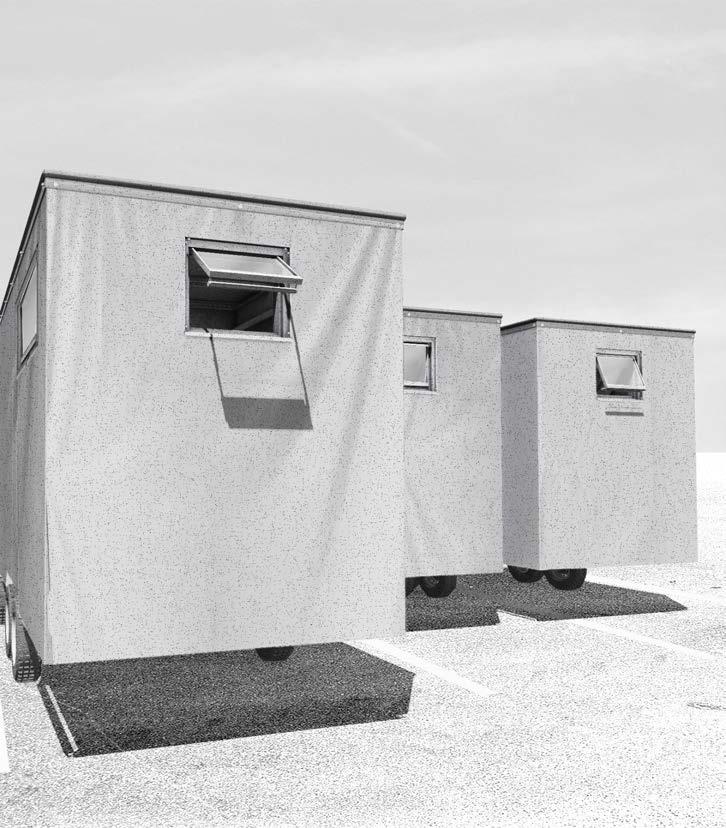
Systematic repetition of the architectural artifact.
Six different options based on the section variations in different site orientations.
Advertisement
Irregularity of the systematic modules on the grid.
Impermanence of the artifacts. They come and leave in time with an engined vehicle able to move it with traction.
With space and distance between the livable trailers, openings are poked in lateral panels.
In semi-permanence, bridges connect adjacent artifacts, and openings are placed in more optimized positions.
This new complexity in within allows better adaptation. It answers to a larger spectrum of needs.
The architectural artifact becomes a village with time. Following different dispositions, it proposes a large variety of possibilities. Thus, all of the connexions are designed for assembly and desassembly. The village metamorphoses in accordance with its contexts, and to the most basic needs of its users, in permanence and impermanence. It depends on all sources of energy and will find its meaning in motion, within, and elsewhere.
Conclusion & Discussion
For A. P Elkin, the aborigines were unable to place iron in their beliefs and rituals and therefore did not understand to which global system this new material belonged.45 The use of iron was at the origin of the loss of ancient values, and it was undoubtedly a material unsuited to the thought and memory of these people, as Rudolf Arnheim would say, even if they discovered its use through its handling.46
In 1973, Marc Le Bot posed the problem in these terms: «Is the city of the machine age the place where could be accomplished the desire of acceleration and perfect accomplishment of the social exchanges? Or is it the place of their un personalization by abstraction for the benefit of a system to which the binarism stated by Mondrian and van Doesburg imposes a mark like the logic that will be that of electronic computers?»47
The machine and the screen becoming this way of divinity, leads us to wonder about its impact on our own values, certainly, but on the harmony that connects us to our systems.
According to Heinz Von Foerster, «an organism that is in harmony with its environment possesses, in one way or another, an internal representation of the order and regularities of this environment. »48
45. Elkin, P (1968). Les aborigènes d’Australie, Collection Bibliothèque des Sciences humaines. Paris: Gallimard. 451 p.
46. Arnheim, R. (2004) Visual Thinking University of California Press; Second Edition.
352 p..
47. Le Bot, Marc (1973). Peinture et Machinisme. Paris : éditions Klincksieck. 259 p.
48. Von Foerster, H. (2003). Understanding Systems: Conversations on Epistemology and Ethics. Kluwer Academic/Plenum Publishers. 158 p.
We are certainly not talking about an organism here, but about a device that considers a necessity and a vitality dear to our human nature: movement and impermanence. Impermanence, the Nomad in his or her fluidity and detachment, tames it, dominates it. He or she is its custodian, he or she creates intervals, time, between the stages and in the displacements. Immobility lets time escape, the machine devours time, and to generate time today, is a luxury for us all.
Far from these architectures that consume the space we have left; it is necessary to speculate on autonomous architecture; «independent of the function and the container of a building, and that the goal is to make it free of any tangible relation with its use».
This architecture would aim at the harmony between the desire of the man of passage, the environment, and the situation of the moment. To quote Colin Rowe and Robert Slutzky:
«Isn’t the politics of tinkering a practice that involves the study of infinite limits, the legacy of human aspirations? »49
49. Rowe, Slutzky (1992). Transparence réelle et virtuelle, Paris, Les éditions du demi-cercle. 95 p.
A mobile place, a place that is pulled and then dropped, a place that is borrowed, a place that is lost, a place that traces, a place that is destined, a place that is shared, a place without address. A place from place to place, a place that connects. A place that comes and goes, that swings, a place in permanent becoming, a place that never stops changing and changing itself. A naked place, and not really. A place without an owner, an opened place. A place for memory, for moving on to something else, to another part. A place of a part of oneself and of another. A place that is interwoven with the time of the nomad who explores, who transforms the place itself. A place that can be touched and retouched... a place that can be tinkered with. A chariot of fire.
Acknowlegments
Throughout the writing of this illustrated essay, I have received an amazing deal of support and assistance.
I would first like to thank my supervisor, Andrew King, whose expertise and flexibility were invaluable drivers in exploring inventive ways to illustrate my thoughts. Thank you for the space and time allowed to «move» between the bridges of speculation. Your insightful feedback pushed me to sharpen my methodology and brought my work to a higher level of communication.
I would also like to thank David Theodore and Theodora Vardouli for letting me pursue this subject, and for discerning questions at critical times.
I would like to acknowledge close friends, Sofia, and colleagues from McGill University for stimulating discussions as well as happy distractions to rest my mind outside of my research.
In addition, I would like to thank my family for their incredible support and compelling conversations along the semester.
References
Aitchison, Mathew (2017). “A House Is Not a Car (Yet)”, Journal of Architectural Education, 71:1. pp. 10-21.
Arendt Hannah (1958). Chapters 11& 12, The Human Condition. University of Chicago Press. 380 p.
Arnheim, R. (2004) Visual Thinking University of California Press; Second Edition. 352 p.
AVA – Habitat et Nomadisme. (2002). Pôle habitat. Online: http://www. avahabitatetnomadisme.org/
Bidault, Jacques & Giraud Pierre (1946). L’Homme et la Tente. Paris: J. Susse. 338 p.
Borella, Jean (2015). Penser l’Analogie. Paris: Harmattan. 228 p.
Bouchain, Patrick (2006). Construire autrement: comment faire? Arles: Actes Sud, pp. 13. 190 p.
Britannica Encyclopedia (2021)
Bulliet, Richard (2016). The Wheel: Inventions and Reinventions. Columbia University Press. 272 p.
Cambridge Dictionary (2021)
Cronon, W. (1996). The trouble with wilderness; or, getting back to the wrong nature. In W. Cronon (Ed.), Uncommon ground: rethinking the human place in nature. Norton. pp. 69–90 562 p.
Debray, Régis (1996). Qu’est-ce qu’une route? in Les cahiers de médiologie. Paris: Gallimard. 318 p.
Dunne, Anthony & Raby, Fiona (2013). Speculative Everything Design, Fiction, and Social Dreaming. Editor: MIT Press. 240 p.
Elkin P (1968). Les aborigènes d’Australie, Collection Bibliothèque des Sciences humaines. Paris: Gallimard. 451 p.
Forde C Daryll (2013). Habitat Economy and Society: A Geographical Introduction to Ethnology. 520 p.
Frampton, K. (1983). Towards a Critical Regionalism: Six Points for an Architecture of Resistance, in The Anti-Aesthetic. Essays on Postmodern Culture Hal Foster, Bay Press, Port Townsen. 173 p.
French Larousse Dictionary (2021)
Friedman, Yona (1978). L’Architecture de Survie. Belgium: Casterman. 171 p.
Illich, Ivan (1977). Disabling Professions, London: Marion Boyars. 370 p.
Jousse, Marcel. (1969). L’anthropologie du geste. Paris : Resma Edition. pp. 207. 395 p.
Junger, Ernst (1963). Le mur du Temps. Paris: Gallimard. 313 p.
Kepes, Gyorgy (1968). Signes, Image, Symboles. Bruges: La connaissance, les presses Saint-Augustin. 238 p.
Klee, Paul (1973). Écrits sur l’art. 1, La pensée créatrice. Paris: Dessain et Tolra. 556 p.
Lavelle, Louis (1921) La perception visuelle de la profondeur. Strasbourg: University of Strasbourg, pp. 29. 79 p.
Le Bot, Marc (1973). Peinture et Machinisme. Paris éditions Klincksieck. 259 p.
Lending, Mary & Zumthor, Peter (2018). A feeling of History. Zurich: Verlag Scheidegger & Spiess. 80 p.
Mazoyer, Marcel : l’abattis-brûlis, une des premières formes d’agriculture. Online: https://www.youtube.com/watch?v=KXrNNarfaaE&ab_channel=TerrEthique
Marocco Joe (2008). “Climate Change and the Limits of Knowledge.” The Virtues of Ignorance, The University Press of Kentucky. 307 p.
Meadows, Donella H. (2008). Thinking in Systems. Chelsea Green Publishing. 240 p. National Center for Environmental Health – Healthy Housing Reference Manual, Chapter 1: Housing History and Purpose. (2009) Visited Online 2021.
Nicod, Jean (1924). La géométrie dans le monde sensible. Paris: Librairie Félix Alcan. pp. 120-121. 174 p.
Pallasmaa, Juhani (2010). Le regard des sens. Editor : Linteau. Translated by Mathilde Bellaigue. 110 p.
Pandolfi, Mariella. (1999). Corps nomade, mémoire nomade. Dans La mémoire des déchets : Essais sur la culture et la valeur du passé. Montréal : Éditions Nota Bene. 245 p. Parent, Claude & Virilio, Paul (2004). The Function of the Oblique. UK: AA Publications. 72 p.
Waters, Roger (1975). Pink Floyd - Welcome to the Machine
Proctor Robert N. (2008). Agnotology: A Missing Term to Describe the Cultural Production of Ignorance (and Its Study),” in Proctor, Robert, and Londa L. Schiebinger. Agnotology: The Making and Unmaking of Ignorance. Stanford University Press.
Roberge, Gabrielle (2014). « Habiter l’inhabituel : le nomadisme comme posture artistique dans les oeuvres de Jacques Bilodeau, d’Ana Rewakowicz et de JeanFrançois Prost » Mémoire. Montréal (Québec, Canada), Université du Québec à Montréal, Maîtrise en histoire de l’art. 168 p.
Rowe, Slutzky (1992). Transparence réelle et virtuelle, Paris, Les éditions du demicercle. 95 p.
Rudofsky Bernard (1964). Architecture without Architects. Editor: New York: The Museum of Modern Art. 157 p.
Sorkin Michael (1992). Variations on a Theme Park: The New American City and the End of Public Space. Hill and Wang. 272 p.
Tapie, Guy (2014). Sociologie de l’habitat contemporain: vivre l’architecture. Marseille : Parenthèse. 237 p.
U.S. Department of Health and Human Services (2009). National Center for Environmental Health – Healthy Housing Reference Manual. 231 p. Online 2021 https://www.cdc.gov/nceh/publications/books/housing/housing_ref_manual_2012. pdf
Villeneuve Johanne; Neville, Brian; Dionne, Claude (1999). La mémoire des déchets, Éditions: Nota bene, Fonds (sciences humaines). 246 p.
Von Foerster, H. (2003). Understanding Systems: Conversations on Epistemology and Ethics. Kluwer Academic/Plenum Publishers. 158 p.
Wright, Frank L. (2013). La ville évanescente. Editor: Infolio. Traduction de Claude Massu. 170 p.
