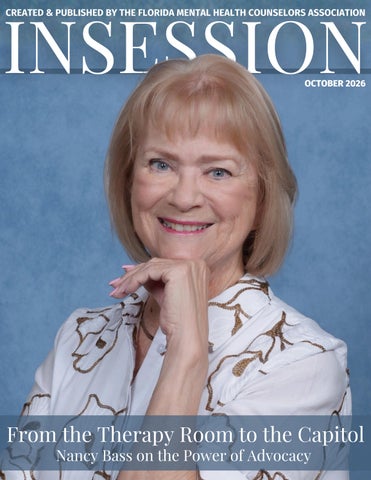
INSESSION CREATED & PUBLISHED BY THE FLORIDA MENTAL HEALTH COUNSELORS ASSOCIATION
OCTOBER 2026
From the Therapy Room to the Capitol Nancy Bass on the Power of Advocacy
InSession- October 2026 | FMHCA.org | 2
President’s Column
Greetings! I hope you all enjoyed your summer and are feeling energized for the months ahead.
Sponsor the Fund Run or connect us with potential sponsors
With our revised By‑Laws now complete, the By‑Laws team and I have begun developing a brand‑new “FMHCA Policies and Procedures Manual.”
Please help us spread the word by sharing the GRC Fund Run on social media. FMHCA is active on Facebook, Instagram, Threads, and LinkedIn, and you can easily re‑share our posts.
I also would like to highlight an important upcoming event: the FMHCA Government Relations Committee’s Fund Run. Every penny raised through the GRC Fund Run directly supports FMHCA’s legislative advocacy efforts, including our annual Legislative Days event, traditionally held in February or March in Tallahassee.
If you have any questions or encounter any issues while signing up, please contact Naomi Rodriguez at Naomi@FLMHCA.org.
Here’s how you can participate: Sign up to run or walk — registration is only $15 Create your own team (coworkers, family, and friends) If you prefer, you may make a donation instead of participating in the run/walk
Respectfully Submitted,
Your participation strengthens our collective advocacy voice across Florida. Thank you for your ongoing commitment to FMHCA’s mission and to the communities we serve!
Laura Peddie-Bravo Laura Peddie- Bravo, LMHC, NCC FMHCA President
InSession- October 2026 | FMHCA.org | 3
INSESSION
Page 8 What We Bring Into The Therapy Room: Practicing Beyond Patriarchy Page 10 The Importance of Immigration Evaluations in an Era of Heightened Enforcement
Page 12 Starting Over at Fifty-Five: Six Courses into a Second Career Page 15 I Should Be Over This By Now: Challenging Emotional Timelines through Compassion as the Clinical Intervention Page 18 Suicidality in Young Children: Introducing the SAFE Framework for Children Ages 10 and Under Page 22 From the Therapy Room to the Capitol: Nancy Bass on the Power of Advocacy Page 25 Existential Empathy in Dream Work: What We Learn From Each Other’s Dreams Page 28 Unexplained Does Not Mean Imaginary Page 30 The Business Side They Forgot to Teach You Page 33 Ask The Expert InSession- October 2026 | FMHCA.org | 4
MAGAZINE Page 34 Making Room for Spiritual Questions in Therapy
Page 36 Staying Present with Values-Discordant Clients: A Brief Practice for Protecting the Alliance and Preventing Burnout Page 40 FMHCA’s Favorites Page 42 Reclaiming Her Whole Self: Women, Identity, Intimacy, and Sexuality Page 44 When the Specialist Isn’t Specialized: How Inadequate OCD Treatment Can Impact Lives InSession Magazine is created and published quarterly by The Florida Mental Health Counselors Association (FMHCA). FMHCA is a 501(c)(3) non for profit organization and chapter of the American Mental Health Counselors Association. FMHCA is the only organization in the state of Florida that works exclusively towards meeting the needs of Licensed Mental Health Counselors in each season of their profession through intentional and strength-based advocacy, networking, accessible professional development, and legislative efforts. Let your voice be heard by becoming a FMHCA Member today! Click here to view FMHCA's current Bylaws.
CONTRIBUTE: If you would like to write for InSession magazine or purchase Ad space in the next publication, please email: Naomi Rodriguez at naomi@flmhca.org
THE INSESSION TEAM: Naomi Rodriguez- Editor Victoria Siegel, PhD, LMHC, LCPC, LPC- Expert Advisor
Page 46 A Watched Phone Never Rings and Other Realities of the Changing Nest: Supporting Parents Through the College Transition Page 52 FMHCA Committee Updates Page 54 Every Hero’s Battle—The Villain Within
Page 56 Beyond the Record: A Counselor’s Perspective on Clinical Documentation in Mental Health Practice Page 58 Florida Legislative Update ANTI-DISCRIMINATION POLICY: There shall be no discrimination against any individual on the basis of ethic group, race, religion, gender, sexual orientation, age, or disability.
DISCLAIMER: Information in InSession Magazine does not represent an official FMHCA policy or position and the acceptance of advertising does not constitute endorsement or approval by FMHCA of any advertised service or product. InSession is crafted based on article submissions received. Articles are categorized between Professional Experience Articles & Professional Resource Articles. Professional Experience Articles are writer's first-person pieces about a topic related to their experience as a mental health professional, or an opinion about a trend in the mental health counseling field. Professional Resource Articles are in-depth pieces intended to provide insight for the author's clinical colleagues on how to be more effective with a particular type of client or a client with a particular disorder, or tips for running their practice more efficiently
InSession- October 2026 | FMHCA.org | 5
InSession- October 2026 | FMHCA.org | 6
FMHCA's Mission Statement The Florida Mental Health Counselors Association (FMHCA) is the State Chapter of the American Mental Health Counselors Association (AMHCA). FMHCA is the only organization dedicated exclusively to meeting the professional needs of Florida’s Licensed Mental Health Counselors. The mission of the FMHCA is to advance the profession of clinical mental health counseling through intentional and strengthbased advocacy, networking, professional development, legislative efforts, public education, and the promotion of positive mental health for our communities. Its sole purpose is to promote the profession of mental health counseling and the needs of our members as well as: Provide a system for the exchange of professional information among mental health counselors through newsletters, journals or other scientific, educational and/or professional materials Provide professional development programs for mental health counselors to update and enhance clinical competencies Promote legislation that recognizes and advances the profession of mental health counseling Provide a public forum for mental health counselors to advocate for the social and emotional welfare of clients Promote positive relations with mental health counselors and other mental health practitioners in all work settings to enhance the profession of mental health counseling Contribute to the establishment and maintenance of minimum training standards for mental health counselors Promote scientific research and inquiry into mental health concerns Provide liaison on the state level with other professional organizations to promote the advancement of the mental health profession Provide the public with information concerning the competencies and professional services of mental health counselors Promote equitable licensure standards for mental health counselors through the state legislature
The FMHCA Team President
Past-President
President-Elect
Treasurer
Secretary
Laura Peddie-Bravo
Kathie Erwin
Bridget Glass
Elizabeth Steuerwald
Taurean Wilson
NE Regional Director
NW Regional Director
SE Regional Director
SW Regional Director
Grace W. Cantor
Joseph P. Skelly
Liza Piekarsky
Kerry Conca
Executive Director
Executive Administrator
Marketing & Outreach Coor.
Diana Huambachano
Laura Giraldo
Naomi Rodriguez
InSession- October 2026 | FMHCA.org | 7
Practicing Beyond Patriarchy
What We Bring Into the Therapy Room Professional Experience Article
As mental health professionals, we are trained to look closely at the individual: their thoughts, emotions, relationships, coping strategies, and histories. But what happenswhen we widenthe lens and ask a different question: What systems have shaped this person’s understanding of who they are allowed to be? Many of us have heard of the so-called “patriarchy” - a familiar buzz word making the rounds but let’sdiscuss what patriarchy is and isn’t. Patriarchy means “father rule” - it is a powerful social system that shapes our experience of gender, power, emotion, safety, and belonging. Historically, patriarchy began emerging around 10,000–12,000 years ago, becomingestablished during the Agricultural Revolution and later InSession- October 2026 | FMHCA.org | 8
formalized in early civilizations as societies shifted from more egalitarian, nomadic structures into agriculture, land ownership, inheritance, and militarism, power and became increasingly concentrated in men. Patriarchy, at its core, is a system where power, authority, and social value are organized around masculinity and male dominance. It doesn’t impact everyone equally - it shapes whose emotions are validated, whose labor is expected, and whose pain is taken seriously. It influences our relationships, nervous systems, self-worth, coping strategies, and the stories we carry about ourselves. Although its effects are not experienced equally, it shapes everyone. Women may be socialized to prioritize others, minimize their needs, and tolerate inequality, while men may learn that
vulnerability, emotional expression, and dependence are incompatible with masculinity. These expectations can have profound mental health consequences. This is where an anti-patriarchal clinical lens changesour work for the better. In therapy, I see the importance of distinguishing between individual pathology and adaptation to a larger system. Anxiety, shame,anger, withdrawal, perfectionism, substance use, or difficulty with vulnerability do not develop in a vacuum - sometimes what appears to be a personal deficit is also a response to what someone has learned they must do to belong or remain safe. This perspective challenges us to examine our own clinical assumptions:
Do we see a woman’s anger as dysregulation when it might be communicating a boundary or an experience of injustice? Do we interpret emotional restraint differently in men than in women?In couples work,am I automatically striving for “balance” when there is actually a power differential that needs to be brought into the room? These questions matter because we are not outside the systems we study. We have been socialized within them, and psychology itself developed withinhistorical contexts that often centeredmale experiences as the norm. An anti-patriarchal approach does not mean blaming men or reducing every clinical problem to gender. It means becomingmore curious aboutcontext, power, and socialization. We can ask: What did they have to learn to survive? What parts of themselves have they been
taught to suppress? How can I empower this client?” This approach can also create space for men to reclaim emotionality and vulnerability without shame, while supporting women in recognizing and challenging messages that diminish their voices, needs, or authority. It asks us to recognizethat misogyny and rigid genderexpectations can becomeinternalized and reproduced by anyone, including ourselves. Ultimately, I believe this is part of our responsibility as clinicians: not only to help peopleadapt to the world they inhabit, but to help them recognize when that world has taught them to disconnect from themselves and educate our clients on the influence of this powerful invisible force in their lives that shape every aspect of being in the world. Small changes in our clinical language, questions, assumptions, and therapeutic
relationships can create meaningful shifts that make meaningful changes not only in the work we do, but in the profession, and ultimately the culture. When we widen our lens beyond the individual, we make room for a more complete understanding of suffering and a more expansive vision of healing. Written By: Anaiz Rodriguez, LMHC Anaiz is a feminist, first-generation CubanAmerican counselor at the Love Discovery Institute in Coral Gables. Drawing from a background in victim services, she specializes in women's issues, post-traumatic growth, and empowerment. Anaiz integrates her skills as a yoga teacher to weave the mind-body connection and spirituality into her practice. Dedicated to relational growth, she helps clients heal from past wounds, foster self-love, and build meaningful connections.
InSession- October 2026 | FMHCA.org | 9
The Importance of Immigration Evaluations in an Era of Heightened Enforcement Professional Experience Article
As immigration enforcement intensifies across Florida, the psychological consequences for immigrant families deserve greater attention. Immigration evaluations are an important component of this process because they provide courts and immigration decision-makers with professional insight into how detention, separation, and the fear of losing a parent may affect an individual's psychological functioning and the wellbeing of an entire family. Research has consistently demonstrated that immigration enforcement and the threat of family separation can create significant emotional and psychological hardship for children and parents. For parents, the fear of being detained or separated from their children can produce chronic stress, anxiety, depression, and a persistent sense of InSession- October 2026 | FMHCA.org | 10
uncertainty. Parents may struggle with decisions about how much to tell their children, while simultaneously attempting to maintain stability and protect them from fear. Recent research indicates that parents with immigration concerns often have difficulty balancing preparation for possible separation with protecting their children's emotional well-being. School-aged children may experience these circumstances differently. Fear that a parent may not return home can interfere with concentration, academic performance, emotional regulation, and social functioning. Research has found that immigrant children who have experienced parental separation may demonstrate increased emotional and behavioral difficulties and poorer academic outcomes.
The impact may be particularly significant for children ages zero to five because this developmental period is critical for attachment and emotional security. Young children may not understand immigration enforcement or the reasons for a parent's absence, yet they can experience separation as a disruption in their sense of safety and attachment. Research has associated immigration-enforcement threat with greater separation anxiety and overanxious behaviors among preschool-aged children. Forensic evaluators therefore have an important responsibility to approach immigration evaluations with cultural humility and sensitivity. Evaluators must consider language, cultural values, family structure, migration history, experiences of discrimination, and
culturally influenced expressions of distress. A culturally informed evaluation does not mean advocating for a particular immigration outcome; rather, it means understanding the individual and family within their cultural and social context so that psychological findings are accurately interpreted. Ultimately, immigration evaluations provide more than a clinical diagnosis.
They provide an opportunity to document the human and psychological consequences of immigration-related fear, separation, and uncertainty. In an increasingly complex enforcement environment, culturally responsive forensic evaluations can help ensure that the voices and psychological experiences of immigrant families are accurately represented.
Written By: Dr. Hyacynthia M. Leonce-James, LMHC Dr. Leonce-James holds a doctoral degree in Clinical Psychology, specializing in Forensic Psychology. She completed her residency at West Central Georgia Regional Hospital, where she conducted forensic evaluations and provided therapeutic services. She is currently pursuing psychologist licensure.
InSession- October 2026 | FMHCA.org | 11
Starting Over at Fifty-Five: Six Courses into a Second Career Professional Experience Article
On Tuesday nights I log into a live class after a twelve hour working day, and most of my classmates are my daughters' age or younger. I am fifty-five years old, six courses into a Clinical Mental Health Counselling programme, and some evenings I sit in front of that screen wondering what exactly I think I am doing. I grew up in the Caribbean, in a family with deep Indian roots. In the world I come from, mental health was not something that was misunderstood so much as something that did not exist. Nobody was depressed. Nobody was anxious. People had troubles, and troubles were managed by praying, working harder, or keeping the matter inside the family. There was no vocabulary for what people carried, and certainly no notion that you could sit InSession- October 2026 | FMHCA.org | 12
with a stranger for an hour and talk your way toward being well. I watched people I loved endure things silently that I now have clinical names for. That silence is a large part of why I am here.
working week that already runs twelve hours a day. Six courses in, I can say the workload is honest. It asks for real hours and it notices when you do not give them.
I did not arrive with a background in this field. I spent more than twenty years building and running an occupational health business, and I still run it, along with the other portfolios that come with a working life at my age. I also recently migrated to the United States, which means I am learning a new culture in my personal life at the same time that I am learning a new profession in my academic one. My programme is asynchronous, which sounds gentle until you live it. There are weekly live classes, a steady volume of reading, discussion posts, papers, and recorded practice sessions, and all of it has to fit around a
Then there is the imposter syndrome, which I can now define properly, cite the literature on, and experience personally, usually all in the same week. My classmates seem fluent in a language I am still learning. When I record a practice counselling session and hear myself search for the right reflection, I hear every one of the years I did not spend in this field. I know cognitively that a first-generation student of counselling from a culture that never spoke of counselling is exactly the kind of person this profession needs. Feeling that is a different matter. And ahead of me sit the unknowns. I still
have to find a practicum site, in a state where I know almost no one in the field. I worry about whether the limited hours of practice built into any programme can really make a person ready for the first genuine client, the one who is not a classmate playing a role. I do not have answers for these yet. I am learning to hold them the way I hope to one day help clients hold theirs. But here is what six courses have taught me. The culture of silence I come from is not a deficit I am overcoming. It is the reason I can recognize the client who sits
down and says nothing is wrong, because I grew up surrounded by people who said exactly that. The discomfort of being a beginner at fifty-five is not far from what a client feels walking into a first session, unsure whether they belong there and half convinced it is too late for them. It is not too late for them. I am staking a second career on that belief, and I notice that I could not honestly offer it to a client if I did not first apply it to myself. Change at any age is the entire premise of this profession. Six courses in, tired on a Tuesday night, I remain its student and, increasingly, its evidence.
Written By: Indira Narinesingh, Graduate Student CMHC Indira is a graduate student in Clinical Mental Health Counseling at National Louis University, specializing in addiction and substance use counseling. She is Director of Occupational Health Solutions Limited, serving the Caribbean energy and aviation sectors, and Chair of the NDASA International Council. She is pursuing counseling as a second career after 20 years in occupational health.
InSession- October 2026 | FMHCA.org | 13
InSession- October 2026 | FMHCA.org | 14
Challenging Emotional Timelines through Compassion as the Clinical Intervention
I Should Be Over This By Now Professional Experience Article
“I just don’t understand why it is taking me so long to get over this. I should be over this by now.” As counselors, we often hear versions of this statement from clients navigating grief, trauma, relationship loss, anxiety, or other significant life experiences. The event may have passed, but the emotions often remain. We may feel sad, angry, jealous, guilty, hurt, or confused, yet somehow develop the belief that there is a set timeline for when these feelings should end. As that imagined “end date” approaches, we may feel even more distressed because the emotions remain intense. But who really sets this timeline? Because I work primarily with Caribbean clients, I often encounter cultural messages surrounding emotional expression. In some Caribbean families
and communities, children learn how to navigate their environments through social learning. Unfortunately, some of these lessons include shame-based messages: “Don’t cry, or people will think something is wrong with you,” “Bare up; you have to be strong. You cannot be weak,” or “Don’t let people see you like this.” These messages can emphasize keeping difficult emotions inside so that we are not perceived negatively. Over time, we may internalize the idea that being “weak” or “emotional” is somehow wrong. As these beliefs become ingrained, adults may develop rigid expectations about how they should respond to difficult emotional experiences and how long they should be allowed to feel them. The challenge is that when clients sit in
front of us, we may instinctively search for the right thing to say or the “wise” comment that will help them feel better. However, when clients have been raised with messages like these, it can be especially important to identify and gently challenge shame-based beliefs while normalizing the reality that emotions do not follow a prescribed timeline. Sometimes, our clients need us to simply hold space for them to experience their emotions without shame. We can explore questions such as: “Who told you that you should be over this by now?” or “What do you believe it means about you that you are still feeling this way?” We are not always required to ask the most insightful questions or use the most sophisticated intervention. InSession- October 2026 | FMHCA.org | 15
Sometimes, we need to teach our clients to be gentle with their emotions. Our emotions are not enemies to eliminate; they are experiences to understand. Shame loses its power when compassion enters the picture. When we accept ourselves as we are and respond to that self with kindness, we create space for meaningful and sustainable healing. Sometimes, the most impactful clinical intervention is compassion.
InSession- October 2026 | FMHCA.org | 16
As counselors, we may not be able to change what our clients have experienced, but we can help to change the way they relate to what they experience. Healing does not require us to rush our emotions into submission. Sometimes, healing begins when we give ourselves permission to feel and compassionately remind ourselves that there is no deadline for being human.
Written By: Kadija McClure, LMHC, NCC Kadija is a Licensed Psychologist in Guyana, LMHC in Florida, & National Certified Counselor. She founded K. McClure Counseling & Consultancy Services, offering trauma-informed counseling to adolescents and adults. Her specialties include anxiety, depression, grief, trauma, emotional dysregulation, relationships, & suicidality.
InSession- October 2026 | FMHCA.org | 17
Introducing the SAFE Framework for Children Ages 10 and Under
Suicidality in Young Children Professional Resource Article
Even one young child dying by suicide is one too many. Yet the data tells us this is not a rare occurrence. In a large population-based study of 9- and 10year-olds, 6.4% reported passive suicidal ideation and 1.3% reported a prior suicide attempt (DeVille et al., 2020). Suicidal thoughts and behaviors have also been identified in preschool-aged children (Luby et al., 2019), and suicide rates among Black children have increased substantially over recent decades while rates among White children declined during the same period (Bridge et al., 2015; Mintz et al., 2024). As a field, we have not yet caught up with this concerning trend. Our ability to recognize risk factors and intervene in a developmentally informed way can make all the difference for young children and their families. InSession- October 2026 | FMHCA.org | 18
However, this requires an understanding of the developmental considerations unique to this age group, the risk factors associated with suicidality in young children, and the conditions that support early childhood mental health. This article introduces SAFE (Systemic– Attachment-Based Framework for Early Childhood), a developmentally informed framework developed to guide counselors through conceptualization and intervention with this population (Bunch et al., 2026). Working with young children requires special considerations that go beyond applying adolescent or adult frameworks to a younger population. Young children’s mental health is directly tied to their attachment relationships and the environments they interact with, including their home, their school, and
the broader systems that surround them (Bowlby, 1969, 1973, 1980; Ainsworth et al., 1978). Intervention with this population must therefore take into account the relational and environmental factors that support positive mental health outcomes, not just the symptoms presenting in the child (Bunch et al., 2026). Conditions That Support Mental Health in Young Children Early attachment relationships are essential for long-term mental health outcomes in children. These early relationships shape a child’s view of themselves and the world, their capacity for emotional regulation, and the overall stress response of the nervous system (Bowlby, 1969, 1973, 1980; Ainsworth et al., 1978). Beyond the caregiving relationship, children’s well-being is
directly related to their close relationships and the environments they interact in, including the home, school, and, for some children, child welfare and foster care settings. Safe, consistent, and predictable environments across these contexts are powerful contributors to healthy development (Bunch et al., 2026). Collaborative systems of care and early identification are equally essential, as risk in young children rarely exists in a single setting (Bunch et al., 2026). Relational approaches that strengthen the caregiver-child relationship are most aligned with how young children develop and heal (Bowlby, 1969, 1973, 1980; Bunch et al., 2026). Risk Factors Risk factors for suicidality in young children span biological, environmental, and relational domains. Biologically, mental health vulnerabilities are among the most consistently identified risk factors, with psychiatric disorders, particularly ADHD and comorbid conditions, associated with elevated risk (Mintz et al., 2024). Environmentally, school-related factors such as bullying victimization, peer relationship difficulties, and academic problems contribute to risk, as do trauma exposure and community violence (Mintz et al., 2024; Bunch et al., 2026). At the relational level, family conflict, household instability, and histories of maltreatment, including sexual abuse, chronic maltreatment, and other forms of abuse, are significant contributors (Bunch et al., 2026). Typically, psychological distress in young children manifests behaviorally rather than through direct verbal expression (Luby et al, 2019). Often, we see emotional and behavioral dysregulation and developmental regression, making it so important for counselors to understand how
development impacts the expression of emotional stress. This is one of the primary reasons why suicidality in young children is frequently missed or misidentified, underscoring the need for thorough, developmentally informed assessment (Bunch et al., 2026). Introducing SAFE: Systemic– Attachment-Based Framework for Early Childhood In response to the need for a comprehensive, developmentally informed framework to guide counselors working with this population, Bunch et al. (2026) proposed SAFE (Systemic– Attachment-Based Framework for Early Childhood). SAFE is a developmentally informed framework that encompasses Bronfenbrenner’s ecological systems theory, attachment research, developmentally informed care, and early childhood prevention principles. It consists of three interrelated pillars, the Systemic Lens, the Attachment Lens, and the Preventive Lens, each addressing a distinct dimension of early childhood suicidality. No single pillar is sufficient in isolation; it is their integration that gives SAFE its clinical and practical power. Pillar 1: Systemic Lens The Systemic Lens is grounded in the understanding that children do not live in isolation. Their well-being is directly related to their close relationships and the interconnected systems and environments they interact with. Drawing on Bronfenbrenner’s (1979) ecological systems theory, this lens recognizes that a child’s social and emotional development is shaped by interactions across multiple contexts, including the family system, school, healthcare, child welfare, and the broader community (Bunch et al., 2026). When distress emerges in young children, it is rarely confined to a single context, as it surfaces across the systems
that surround them. For counselors, adopting the Systemic Lens means moving beyond identification alone. It requires coordination across systems, proactive screening, clear communication among providers, and collaborative goal-setting so that children receive consistent support across the settings where they spend the most time. Involving caregivers early in the process and connecting with schools, pediatricians, and child welfare when relevant are not optional steps. They are essential components of effective clinical work with this population (Bunch et al., 2026). Pillar 2: Attachment Lens The Attachment Lens conceptualizes early childhood suicidality through the lens of relationships, recognizing that children often express their distress through behavior rather than words. Developmentally, young children often lack the verbal and cognitive capacity to talk through and express their struggles as older children or adults can. What counselors see instead are behavioral and emotional dysregulation symptoms, including withdrawal, regression, and changes in play, that can reflect challenges in the attachment relationship, unmet needs, emotional overwhelm, and difficulties with coregulation within the caregiving system (Bowlby, 1988). This has direct implications for assessment and intervention. Rather than looking at the child in isolation, assessment must extend to the caregiving context, examining caregiver responsiveness and availability, the presence of stressors, and parental mental health (Bunch et al., 2026). Because attachment is central to a young child’s well-being, interventions should prioritize strengthening the caregiverInSession- October 2026 | FMHCA.org | 19
child relationship as a pathway to enhancing safety, attachment security, and emotional regulation. Relationshipbased, dyadic approaches are the most developmentally appropriate clinical response for this age group, and supporting the caregiver is as important as supporting the child (Bowlby, 1988; Bunch et al., 2026). Pillar 3: Preventive Lens The Preventive Lens is intended to be ongoing and proactive, rather than a reactive response to a crisis. Because psychological distress in young children typically manifests behaviorally, counselors should not wait for explicit suicidal statements. Instead, they should use developmentally appropriate screening tools that gather information from caregivers and teachers across the settings where children spend time, including pediatric care, schools, and child welfare. Brief caregiver-report instruments validated for children under age 8 are now available and can enable early detection before a crisis escalates (Hennefield et al., 2025). An important part of this lens is building protective skills before a crisis emerges. This includes supporting emotional literacy, building emotional regulation skills, and teaching simple coping strategies within developmentally appropriate contexts. These are not therapeutic extras; they are prevention. Adults around children are often the first to notice behavioral changes, and equipping caregivers and educators to recognize warning signs and respond appropriately is one of the most important prevention strategies for this age group (Bunch et al., 2026). SAFE in Practice: A Case Example Consider the following composite case. Marcus is an 8-year-old African American boy who was adopted at age six following a history of significant InSession- October 2026 | FMHCA.org | 20
attachment ruptures with his biological parents. His early childhood was marked by trauma, including parental mental health concerns, inconsistent caregiving, domestic violence, and substance abuse in the home. He was placed with his adoptive family two years ago and is currently in third grade. Marcus was referred to the school counselor following an increase in concerning behaviors at school, including emotional volatility, withdrawal from peers, and difficulty regulating during transitions. His adoptive parents report that his behaviors at home are significantly more intense, including prolonged tantrums, aggressive outbursts, and emotional dysregulation that can last for hours. During one of these episodes, Marcus told his adoptive mother that he wished he were dead. Because Marcus expressed a wish to die, the counselor would first conduct an immediate, developmentally appropriate suicide risk assessment. This would include speaking directly with Marcus using concrete language; exploring what he understands death to mean; assessing the frequency, context, and intent behind the statement; and asking about previous behaviors and access to potentially lethal means. The counselor would determine whether an urgent evaluation or higher level of care was needed and involve his caregivers in increasing supervision, restricting access to lethal means, and developing a concrete, developmentally appropriate safety plan. A caregiver-report measure would supplement, rather than replace, this direct assessment (Hennefield et al., 2024; Hilliard & Parkhurst, 2023). Applying the SAFE framework, a counselor working with Marcus would begin with the Systemic Lens, recognizing that his distress does not exist in isolation. Coordination between
the school counselor, his adoptive parents, his pediatrician, and any community mental health providers would be essential to understanding the full picture and ensuring consistent support across settings. A developmentally appropriate caregiverreport screening tool would be administered to gather information about the frequency and nature of concerning statements and behaviors across contexts. The counselor would also remain attentive to whether racial bias or inequitable disciplinary responses were shaping how Marcus’s distress was understood and addressed at school. The Attachment Lens would guide the counselor to look beyond Marcus’s individual symptoms and into the caregiving relationship. Given his history of early attachment ruptures and trauma, his behavioral dysregulation at home is best understood as a relational communication, an expression of unmet needs and emotional overwhelm within the attachment system. Assessment would include examining the adoptive parents’ responsiveness, their capacity for co-regulation, and the presence of any stressors within the family system. Intervention would prioritize relationship-based therapy that incorporates his caregivers, with the goal of building safety, trust, and coregulation within the caregiver-child relationship (Bunch et al., 2026). The Preventive Lens would guide the counselor to act proactively rather than waiting for another crisis statement. This would include working with Marcus’s adoptive parents and teachers to help them recognize early warning signs of escalating distress, building Marcus’s emotional literacy and simple coping skills within developmentally appropriate contexts, and ensuring that all adults in his life are equipped to
respond appropriately when concerns arise. Supporting the adoptive parents’ well-being and their capacity to provide consistent, attuned caregiving would also be a central component of prevention. Implications for Practice The SAFE framework has meaningful implications across several areas of professional practice. In direct clinical work, counselors should not rely solely on verbal reports when assessing suicide risk in young children. Behavioral and relational cues are meaningful clinical signals that warrant further assessment. Dyadic and attachment-based interventions that strengthen the caregiver-child relationship and promote co-regulation are the most developmentally appropriate clinical response for this age group, and proactive screening and ongoing monitoring across systems should be standard practice (Bunch et al., 2026). In supervision, counselors working with suicidal young children may experience emotional responses that can impact clinical decision-making. Supervisors should offer reflective supervision and supportive practices that help supervisees process reactions and build confidence in working with this population. The SAFE framework can be a helpful guide for supervisors in helping counselors work through thorough case conceptualization that takes into account developmental factors, attachment, and the broader systems surrounding the child (Bunch et al., 2026). In counselor education, preparation specific to suicidality in young children remains limited. SAFE can guide counselor educators in designing curricula that address the developmental considerations central to prevention, assessment, and intervention with this
population, incorporating didactic instruction, role-plays, and skills-based practice (Bunch et al., 2026). At the advocacy and research levels, counselors are encouraged to advocate for funding for early childhood intervention programs that strengthen caregiver-child bonds and foster socialemotional learning, and to address equitable access to services for underserved populations. Continued research is needed to empirically validate SAFE and to develop childfriendly, developmentally appropriate assessment tools for this population (Bunch et al., 2026). Conclusion Suicidality in young children is one of the most urgent and underaddressed challenges in early childhood mental health (Bunch et al., 2026; DeVille et al., 2020). The goal of this article is to shed light on this important issue and offer counselors a preliminary framework for navigating this profound clinical concern. SAFE provides a developmentally informed, relationally grounded structure for understanding and responding to suicidality in children ages 10 and under, one that accounts for the unique developmental needs of this population and the relational and environmental contexts in which they live and grow. For a full discussion of the theoretical foundations, research base, and clinical implications of SAFE, readers are encouraged to consult Bunch et al. (2026) in The Family Journal. References Ainsworth, M. D. S., Blehar, M. C., Waters, E., & Wall, S. (1978). Patterns of attachment: A psychological study of the strange situation. Lawrence Erlbaum. Bowlby, J. (1969). Attachment and loss: Vol. 1. Attachment. Basic Books. Bowlby, J. (1973). Attachment and loss: Vol. 2. Separation: Anxiety and anger. Basic Books. Bowlby, J. (1980). Attachment and loss: Vol. 3. Loss: Sadness and depression. Basic Books. Bowlby, J. (1988). A secure base: Parent-child attachment and healthy human development. Basic Books. Bridge, J. A., Asti, L., Horowitz, L. M., Greenhouse, J. B.,
Fontanella, C. A., Sheftall, A. H., Kelleher, K. J., & Campo, J. V. (2015). Suicide trends among elementary school–aged children in the United States from 1993 to 2012. JAMA Pediatrics, 169(7), 673–677. https://doi.org/10.1001/jamapediatrics.2015.0465 Bunch, M. G., Crowder, A., & Muller, D. (2026). Toward a developmentally informed framework for childhood suicidality: Integrating systems, attachment, and prevention. The Family Journal. Advance online publication. https://doi.org/10.1177/10664807261483730 DeVille, D. C., Whalen, D., Breslin, F. J., Morris, A. S., Khalsa, S. S., Paulus, M. P., & Barch, D. M. (2020). Prevalence and familyrelated factors associated with suicidal ideation, suicide attempts, and self-injury in children aged 9 to 10 years. JAMA Network Open, 3(2), e1920956. https://doi.org/10.1001/jamanetworkopen.2019.20956 Hennefield, L., Denton, E.-G., Chen, P., Sheftall, A. H., & Ayer, L. (2024). Preteen suicide risk screening in the pediatric outpatient setting: A clinical pathway. Journal of the Academy of Consultation-Liaison Psychiatry, 65(6), 551–561. https://doi.org/10.1016/j.jaclp.2024.06.003 Hennefield, L., Whalen, D. J., Bai, S., Tillman, R., & Luby, J. L. (2025). Preliminary validity for a brief caregiver-report screener for suicidal thoughts and behaviors in children under age 8. JAACAP Open, 3(3), 485–495. https://doi.org/10.1016/j.jaacop.2025.02.004 Hilliard, M., & Parkhurst, J. T. (2023). Suicide risk assessment and safety planning in pediatric primary care. Pediatric Annals, 52(11), e422–e425. https://doi.org/10.3928/1938235920230906-05 Luby, J. L., Whalen, D., Tillman, R., & Barch, D. M. (2019). Clinical and psychosocial characteristics of young children with suicidal ideation, behaviors, and nonsuicidal self-injurious behaviors. Journal of the American Academy of Child and Adolescent Psychiatry, 58(1), 139–149. https://doi.org/10.1016/j.jaac.2018.06.031 Mintz, C., Ruch, D. A., Schiff, D. M., Hoffmann, J. A., & Bridge, J. A. (2024). Characteristics and circumstances of suicide among children aged 6 to 9 years: 2006–2021. Pediatrics, 154(6), e2024067043. https://doi.org/10.1542/peds.2024-067043 Marina G. Bunch is a faculty member in the Department of Counseling at the University of the Cumberlands. Correspondence regarding this article may be directed to Marina G. Bunch at marina.bunch@ucumberlands.edu.
Written By: Marina Gilberti Bunch, PhD, LMHC, LPC, NCC & Daniella Muller, LPC, NCC Dr. Bunch is an associate professor at the University of the Cumberlands and a licensed counselor in Florida and Colorado. She specializes in infant and early childhood mental health, family and couples counseling, attachment, trauma, perinatal mental health, and clinical supervision. Daniella is a Licensed Professional Counselor in Pennsylvania and New Jersey and an Approved EMDR Consultant. With 10 years of trauma-focused experience, she owns a private practice, teaches graduate counseling students, and researches addiction, self-injury, and early childhood mental health. InSession- October 2026 | FMHCA.org | 21
Nancy Bass on the Power of Advocacy
From the Therapy Room to the Capitol Feature Article
She started with a simple desire: to make the world a better place. Long before she was writing legislators, attending FMHCA Legislative Days, mentoring counselors, or helping establish a regional association in the Big Bend, her motivation was rooted in a desire to make a difference. In college, she discovered psychology almost by accident. She took a class, loved it, did well, and found the profession that would shape the rest of her life. Decades later, that same desire to make things better remains at the heart of her work. Her career has taken her through mental health, substance abuse, dual diagnosis, developmental disabilities, private practice, and Critical Incident Stress Debriefing. Each area brought different clients, challenges, and experiences. InSession- October 2026 | FMHCA.org | 22
Over time, she says, those experiences did more than build her professional expertise. “They cover a huge number of clients and their life experiences,” she says. “After so many years, it begins to shape more than skills. It shaped me.” It also shaped her into an advocate. Throughout her career, she has believed that standing up for clients is part of being a counselor. She was working in the field before professional licensure existed, giving her a firsthand perspective on how much the counseling profession has evolved and how much work remains. Her commitment to advocacy extends beyond individual clients to the profession itself. Issues surrounding Medicaid, Medicare, access to care, and
the ability of counselors to fully serve the public have repeatedly brought her to the advocacy table. Year after year, she has written to legislators to make sure counselors and their clients are represented in those conversations. Her path into organized advocacy with the Florida Mental Health Counselors Association came naturally. After attending FMHCA conferences, she learned about the Government Relations Committee and began attending its meetings, offering her time and experience wherever she could. That involvement eventually brought her to Tallahassee for Legislative Days, where she met directly with lawmakers. “It was totally new despite it being so close to home,” she recalls. “It’s a long day, but we had all the guidance needed. I learned a lot, and it’s so worth it.”
For her, the goal when meeting with legislators is not simply to explain mental health needs. She believes most lawmakers already understand that there is a significant need for mental health services. The important conversation is explaining why counselors are sometimes unable to meet that need. “We are ready and willing to help and sometimes can’t,” she says. “So explaining that is important.” Her leadership has also extended into mentorship. After retiring from her long term employment at a State of Georgia mental health hospital in Thomasville, Georgia, she opened a solo practice colocated within her daughter’s medical practice in Tallahassee. As the practice grew, she eventually realized she could no longer do everything herself. Becoming an approved qualified supervisor allowed interns to become part of the practice, and she later brought on an LCSW and a psychologist. What began as a response to an overwhelming workload became an opportunity to mentor others and build a team.
Although she retired from private practice in 2022, retirement did not mean walking away from counseling entirely. “I couldn’t let it all go. I love it.” She continues to provide Critical Incident Stress Debriefing services, work a half day weekly doing virtual counseling, and remains deeply involved in advocacy. Most recently, she helped establish the Big Bend Mental Health Counselors Association, encouraged by FMHCA Northwest Regional Director Joe Skelly. For a region so close to Florida's capital, having counselors organized and ready to engage is particularly meaningful. The goal is growth, willing volunteers, and becoming a resource for counselors throughout the Big Bend. Her years of advocacy were recognized when she was named FMHCA’s 2025 Advocate of the Year. The recognition meant a great deal, particularly because she knows firsthand how much work happens behind the scenes. “There was a great deal of work involved, so it was nice to be shown recognition.”
But the award is not where her advocacy story ends. If anything, it reinforces what she hopes to leave behind: fewer barriers, greater access to mental health services, and a stronger profession for the counselors who come next. Her advice to counselors who wonder whether one person's voice can really make a difference is perhaps the simplest lesson from her own career. “Slow work doesn’t equal no work. But no voice equals no voice.” She knows because she started with one. One counselor. One letter. One voice speaking up for clients and for the profession. And she hopes more counselors will add theirs. Her message is straightforward: join FMHCA, join your local chapter if one is available, and stay connected to what is happening in the profession. Because advocacy does not always happen through grand gestures. Sometimes, it begins simply by showing up, staying informed, and being willing to speak
InSession- October 2026 | FMHCA.org | 23
InSession- October 2026 | FMHCA.org | 24
What We Learn From Each Other’s Dreams
Existential Empathy in Dream Work Professional Experience Article
What Is Existential Empathy? Existential empathy is more than simply understanding how someone feels. It is the recognition that we are all human beings living with many of the same questions, losses, hopes, fears, and uncertainties. To experience this kind of empathy is to recognize that another person’s experience could also be our own. How Dreams Awaken Existential Empathy When dreams are shared in a group, something interesting happens. A dream told by one person may resonate with images, feelings, or questions in another. We begin to see our own struggles reflected in someone else’s dream and recognize common ground beneath our differences.
In Dream Work, we do not simply analyze another person’s dream. We listen to it, experience it, and notice what it awakens in us. I often invite participants to listen as though the dream were their own. Their reflections are offered as personal responses, not interpretations. The dreamer remains the final authority on the meaning of the dream. Over many years of leading Dream Groups, I have seen how a dream can belong to one person and still carry meaning for someone else. One participant described a moment that illustrates this beautifully. Another member of her group shared a dream about holding a cat that at first appeared normal. When the dreamer opened her arms, the cat was revealed to be connected to many medical tubes that
had been hidden from view. At the time, the listener’s sister was having health problems. She was preparing to leave for a trip to India, and her sister had minimized the seriousness of what was happening. Hearing the dream, she was struck by the image of the apparently healthy cat whose medical condition was hidden. She began to wonder whether more might also be hidden about her sister’s condition. She decided to cancel her trip and fly to be with her sister instead. Soon afterward, her sister’s condition became life-threatening. She remained with her for the next three weeks while her sister recovered. Looking back, she felt that hearing another person’s dream had opened her awareness and influenced a decision that allowed her to be where InSession- October 2026 | FMHCA.org | 25
she needed to be. Being Seen and Known This is one of the remarkable qualities of group Dream Work. The dream is personal, but the experience of listening can be shared. One person’s image may awaken recognition in another. The listener is not taking ownership of the dream. Rather, the dream becomes a point of contact between two inner worlds. In a Dream Group, each person’s experience is held with respect. As we listen, we witness another person’s inner world while also becoming more aware of our own. To be listened to in this way
InSession- October 2026 | FMHCA.org | 26
can create a powerful experience of being seen and known. Why It Matters Existential empathy reminds us that while our lives are individual, many of the experiences that shape us are shared. Dream Groups can create a setting in which people recognize themselves in one another without losing their differences. That recognition can strengthen compassion, reduce isolation, and expand the way we listen. Dreams remind us that we are unique, and we are connected. Our inner lives matter. And sometimes, by listening
carefully to another person’s dream, we may hear something that speaks to our own life as well. Written By: Debra Joy Goldman MS, LMHC Debra is a licensed psychotherapist in private practice in Palm Beach Gardens, Florida, offering inperson and virtual services. With more than 35 years of experience, she is certified in Dream Work, Mental Imagery, and Morphology. She specializes in relationships, life transitions, emotional healing, and spiritual growth, and leads Dream Work and Mental Imagery Groups, workshops, and retreats.
InSession- October 2026 | FMHCA.org | 27
Unexplained Does Not Mean Imaginary Professional Experience Article
Imagine going to your doctor and feeling like every answer you give you are being judged. The look of disbelief. The need to prove to your doctor that you really feel this way and that you are trying to apply the advice you are given, but they constantly question you. For millions of people living with chronic illness or pain, this is an everyday reality. They walk around looking like everyone else, while no one knows what they are feeling internally. They put on a mask and push through the day. Then, on a particularly difficult day, someone discovers they live with a chronic illness or pain and responds, “Wow, you don’t look sick.”Rather than feeling supported, the person feels even more frustrated and misunderstood. The journey to a diagnosis can be long, exhausting, and expensive. Individuals InSession- October 2026 | FMHCA.org | 28
visit multiple doctors and specialists, undergo expensive or painful testing, and repeatedly hear, “I’m not really sure what is going on.”During this process, the individual and their family is dealing with the physical symptoms, but also with uncertainty, fear, financial stress, and the loss of the life they expected to have. Eventually, the focus may shift them towards mental health. A client could be told that their depression or anxiety may be causing physical symptoms. This can be appropriate and helpful, but the problem occurs when unexplained physical symptoms are automatically interpreted as psychological symptoms simply because a medical diagnosis has not yet been identified. As mental health professionals, we must be careful not to assume that because
medical testing has not yet provided an answer, the symptoms are “all in the client’s head.”Conditions like illness anxiety disorder and factitious disorder are legitimate clinical diagnoses, but neither one should be considered simply because a client has seen several doctors or has an unexplained medical presentation. Unexplained does not mean imaginary. I have lived with multiple chronic illnesses for more than 35 years. I have experienced first-hand the frustration of trying to convince others that something is wrong when I did not always have an explanation for what I was feeling. When I first began experiencing these challenges, the term “medical gaslighting” was not part of our everyday vocabulary. I honestly questioned myself. I knew what I was
experiencing yet hearing doctor after doctor say…. “Hmmm… you are really interesting. I am not really sure what it is,” left me frustrated and, at times, ready to give up on the medical field altogether. I am also dually licensed as a Marriage and Family Therapist as well as a Mental Health Counselor. I entered the mental health profession because I wanted to help people. I never planned to specialize in the intersection of chronic illness and mental health. However, during my Ph.D. program, I discovered a way to connect my personal experiences with my professional interests and spent years researching the relationship between mental and physical health. I wish I could say that after 35 years, things have dramatically improved. Unfortunately, I believe there is significant work to be done. Mental health professionals have an important role when working with
clients living with chronic illness or unexplained symptoms. We need to understand the client’s story and view that story from a systemic perspective.The client sitting in front of us may be struggling with much more than physical symptoms. They may be grieving the future they imagined, fearful of what tomorrow will bring, loss of autonomy, frustrated by not having answers, or feeling isolated because others cannot see what they are experiencing. Our role is not always to fix the problem. Sometimes, our most important intervention is to listen, validate, and help clients advocate for themselves. We can help them develop healthy coping strategies, process grief and uncertainty, communicate with their medical providers, and recognize that experiencing anxiety or depression in response to chronic illness does not mean their physical symptoms are psychological.
Most importantly, we need to meet our clients where they are without judging them on how they feel. Before we assume we understand their experience, perhaps we should ask ourselves one question: If this were happening to me, how would I want my counselor to respond? Written By: Amy Maturen, Ph.D., LMFT, LMHC, NCC Dr. Maturen is dually licensed as a Marriage and Family Therapist and a Mental Health Counselor in Florida. She earned her Ph.D. in Counselor Education and Supervision. She is the Clinical Director of Lutheran Counseling Services as well as running her private practice, Achieving Mental Balance, providing counseling services to individuals, couples and families. Her specialties include chronic illness, relationship issues, and grief. She is also an adjunct professor at multiple Universities.
InSession- October 2026 | FMHCA.org | 29
The Business Side They Forgot to Teach You Professional Experience Article
You finished your master’s degree, registered with the state, found a Qualified Supervisor (QS), and are finally ready to practice. Then someone asks about your cancellation policy, another client wants to know whether you take their insurance, your Psychology Today profile needs a specialty list, and you realize grad school taught you substantially more about counseling than running a counseling practice. The Pre-Licensed Clinician Reality This is where your practical knowledge must grow alongside your clinical training. Entering private practice as a pre-licensed clinician requires moving beyond academic preparation. Headcount vs. Clinical Weight It is tempting to take on as many clients as possible, particularly when you are InSession- October 2026 | FMHCA.org | 30
trying to establish a steady income. Measuring your capacity only by client numbers does not provide a complete picture. A different threshold does not make one clinician better than another; every clinician has different capacities and circumstances. A sophisticated caseload requires evaluating clinical weight (e.g., five trauma-heavy, high-acuity sessions involving suicidality management, severe OCD, or complex PTSD carry an entirely different emotional and administrative load than five loweracuity maintenance sessions). Sustainable caseload planning must consider acuity, documentation time, cancellations, and emotional labor and not merely the number of appointments booked on your calendar.
Supervision as Infrastructure In Florida, supervision is not just an administrative requirement or a regulatory hurdle to clear for Chapter 491 compliance. Your supervisor is an essential part of your professional support system. You need a QS who understands these realities. Your supervisor should be an active partner who helps you navigate clinical challenges, ethical gray areas, scope of competence, and your growing professional identity. To maximize this relationship, do not wait for your supervisor to prompt you. Bring the business of your practice into the room. Next time you meet with your supervisor, ask them three specific questions to evaluate the health of your practice: What is our specific protocol when a
client’s clinical acuity exceeds my current scope? How do we document peer and supervisor consultation when navigating a gray area? Can we review the ‘weight’ of my current caseload to ensure my workload is sustainable, ethical, and allows me to provide the best care possible? Ethical Marketing: Interest vs. Competence It is important to recognize your actual strengths and current level of training. There is a fundamental difference between having an interest in a particular clinical area and claiming expertise in it. Interest belongs in your continuing education plan; true clinical competence belongs in your marketing material. Presenting yourself as an expert in areas where you have limited training violates your ethical baseline and places your registered license at risk. Marketing should reflect the populations you are genuinely equipped to serve. Furthermore, Florida regulations require strict transparency about your prelicensed status. Every directory profile, website, and business card must clearly display your exact title (“Registered Mental Health Counselor Intern” or “RMHCI”). Insurance and Business Literacy
Graduate training prepares counselors well for creating safe and supportive therapeutic environments, but it rarely covers the practical realities of operating a practice. However, assuming “someone else handles the money” leaves clinicians highly vulnerable to legal, financial, and licensure liability. To work effectively in private practice, you need a basic understanding of insurance literacy. You don't need to become a billing specialist, but you do need to understand how money moves: The Superbill Reality: A superbill is an itemized statement given to clients for out-of-network reimbursement. However, many major health insurance panels in Florida explicitly may not reimburse clients for out-of-network care if it was provided by a prelicensed registered intern. Supervisory Billing: If your practice bills insurance for your services under a licensed clinician’s provider number, strict compliance rules apply. The documentation must clearly state that the services were rendered by an intern and reviewed by the supervisor. The Vulnerability Factor: If you do not know the difference between a co-pay, a deductible, credentialing, contracting, and a remittance
advice, you leave your clinical practice exposed. You need to know exactly what is happening when an insurance company details a transaction or issues a denial. Written By: Madison Robinson, Registered Mental Health Counseling Intern & Dr. Josh Littleton, LMHC Madison is a Registered Mental Health Counseling Intern who has a particular passion for supporting athletes, high performers, teens, and young adults navigating performance pressure, anxiety, and major life transitions. Madison’s work creates space for high-performing individuals to pursue meaningful goals without losing sight of the person behind the performance. Dr. Littleton is a licensed psychotherapist and board-certified clinical sexologist whose work centers LGBTQIA+ affirming care, relationships, sexuality, and identity. Josh also integrates his interest in tabletop gaming into his clinical and scholarly work, exploring how games and play can create approachable spaces for connection, communication, emotional exploration, and personal growth.
InSession- October 2026 | FMHCA.org | 31
InSession- October 2026 | FMHCA.org | 32
Ask the Expert FMHCA Member Questions Answered by President and Managing Partner of The Health Law Firm, George F. Indest, J.D., M.P.A., LL.M. The information provided in this article is for educational and informational purposes only and does not constitute the provision of legal advice.
Q A
What do you consider to be the most important legal considerations when you are selecting an AI product to incorporate into a psychotherapy practice?
Here are some tips to follow when researching and evaluating AI applications for a psychotherapy practice: 1. Vet your software--Check out what others have stated in online reviews and elsewhere. 2. Obtain a HIPAA HITECH Business Associate Agreements (BAAs) from the software vendor/manufacturer-Print these out and save them on paper somewhere (you can never find them or download them when you need them or when the after the company is out of business). 3. Research and ask about who are and where the vendors and subcontractors of the software manufacturer are located. The manufacturer must have BAAs with them too (but that is not really your worry). 4. Make sure your contract with the vendor or distributor specifies what happens to your information when the contract ends or is terminated for any reason (including nonpayment). 5. Make sure you have a good informed consent form allowing sessions to be recorded by AI solely for the purpose of summarizing them, but advising actual recordings or transcriptions will not be kept anywhere (if so). 6. Make sure the software you purchase either guarantees that the PHI that is used with it is not used for any other purpose such as "training" the AI or other AIs. Often an AI application will have many "settings" "options" that can be selected or deselected. Most AI applications will have an option that you can select that will prohibit or "turn off" the AI's ability to use your PHI for "training" the AI or other AIs. 7. Make sure your HIPAA protected health information ("PHI") is never sent offshore, even for billing purposes. 8. Make sure you have GOOD insurance that covers professional license defense and HIPAA breach coverage. Buy this separately if you have to do so. 9. When you are unsure of how to do something (disable an AI, "toggle" various options) get on YouTube; there is probably a video that shows you how to do it!
InSession- October 2026 | FMHCA.org | 33
Making Room for Spiritual Questions in Therapy Professional Experience Article
The world has felt turbulent, and people are bringing uncertainty, personal and collective losses, disorientation, and chaos into the therapy room. I’ve noticed clients asking questions about life, meaning, purpose, spirituality, and mortality: “What’s the point of all of this?” “Why do terrible things happen?” “What happens when we die?” “Where is the person I lost now?” and “What do I actually believe anymore?” Therapists’ reactions may depend on their clinical orientation, personal philosophy, and comfort with uncertainty. Thinking back on my training, I did not receive adequate guidance on navigating spirituality in sessions. Many of us may feel unprepared. These questions can trigger our anxiety, leave us unsure how to respond, or raise concerns about InSession- October 2026 | FMHCA.org | 34
crossing an ethical boundary. Therapists may then avoid exploration and focus on reducing symptoms or challenging clients’ thinking. But when we respond only to the anxiety surrounding the question, we may miss the meaning within the question. Questions about death, deceased loved ones, or whether suffering has a deeper meaning are not necessarily symptoms to correct. If we cannot remain present, clients may feel misunderstood or unwelcome and shut down an important part of their experience. Our role is not to provide answers, but to create a space where clients can explore spiritual possibilities and discover what makes sense to them. Over the years, I felt increasingly constrained by approaches centered mainly on symptom reduction,
pathology, and an exclusively materialistic understanding of human experience. Some clients expressed terror at the possibility of remaining conscious and trapped in an eternal void after death. Others sensed that deceased loved ones were still present but doubted their experiences or feared judgment. My experiences with grief, loss, death, and existential exploration eventually led me to earn a PhD in Metaphysical Counseling, broadening the spiritual and philosophical framework I bring to my work as a licensed mental health counselor. When I welcome clients’ deepest questions, especially those involving death, grief, the afterlife, and continuing bonds, I often see relief and joy. Clients who fear an eternal void may choose to explore research on near-death
experiences and accounts involving pastlife regression. For some, considering the possibility that consciousness continues beyond physical death brings hope and opens them to an understanding of reality. Other clients have shared that they sensed, heard, or saw a deceased loved one. A non-pathologizing approach does not mean abandoning clinical assessment; it means assessing the experience and its impact with discernment and curiosity rather than immediately assuming pathology. Receiving these experiences with openness can reduce shame, strengthen the therapeutic relationship, and help clients explore their meaning. For some grieving clients, the possibility that a relationship continues in another form softens the feeling that their loved one is gone forever and helps them remain connected to the life that is still theirs to live. Making room for spiritual questions does not mean providing answers or
asking clients to believe what I believe. On my intake, I ask about their perspectives on life after physical death, communication with deceased loved ones, consciousness, and reincarnation, as well as what role they want these beliefs to have in treatment. Before offering a perspective or resource, I ask permission and encourage clients to take what resonates and leave the rest. If it does not resonate, we follow the path that makes sense within their worldview. I have been surprised by how many clients welcome this opportunity. It can feel as though a dam has opened. Questions and experiences they held back finally have somewhere to go, and clients express immense relief that they can share this part of themselves. I encourage therapists to examine their own relationship with death, grief, spirituality, and uncertainty. In a culture that rarely discusses mortality openly, many of us have not learned how to respond when these topics surface. Yet ,
death and loss are inseparable from life, and our discomfort can limit how deeply we journey with our clients. Therapists need not hold particular spiritual beliefs but we do need the self-awareness, training, and openness to let clients explore theirs. Making room begins with our willingness to stay present when there are no certain answers. Written By: Dr. Evelyn Pavlova, LMHC Dr. Pavlova is a Floridalicensed psychotherapist and founder of Dr. Ev’s Oasis, a private telehealth practice serving adults throughout Florida. She specializes in death anxiety, grief and loss, and spiritual and existential shifts. Her work integrates evidence-based psychotherapy with existential, humanistic, transpersonal, and spiritually integrated approaches, supporting clients through experiences of loss, mortality, meaning, identity, and profound changes in how they understand themselves and their lives.
InSession- October 2026 | FMHCA.org | 35
A Brief Practice for Protecting the Alliance and Preventing Burnout
Staying Present with Values-Discordant Clients Professional Resource Article
Working effectively with clients whose values, beliefs, or behaviors run counter to a clinician's own is one of the most common, and most under-addressed, challenges in day-to-day practice. Clients disclose racist, misogynistic, or anti-gay attitudes; describe behavior a clinician finds ethically troubling; or hold political or religious convictions sharply at odds with the clinician's. Given today's polarized social and political climate, clinicians are increasingly called on to sustain a working alliance across significant worldview differences (McCarthy et al., 2022; Solomonov & Barber, 2019). This resource offers a brief, repeatable clinical practice, grounded in therapeutic presence and arts-based reflection, that clinicians can use to stay attuned, protect the alliance, and reduce their own risk of burnout when a client's InSession- October 2026 | FMHCA.org | 36
worldview is difficult to sit with. Ideological mismatch between clinician and client can weaken the working alliance if left unaddressed. Clinicians who work with clients expressing discriminatory attitudes report negative emotional reactions that, over time, contribute to burnout (Mivshek & Schriver, 2023; Zarzycka et al., 2022). Yet clinical effectiveness, and the ethical mandate to serve clients regardless of their views, both depend on the clinician's ability to make space for a client's perspective without agreeing with it. That capacity starts not with a technique used on the client, but with a state the clinician cultivates in themselves before and during the session. Central to that capacity is the clinician's own self-awareness of their values,
biases, and beliefs, including the somatic and emotional reactions that surface during a difficult dialogue with a client (Wilkins-Yel et al., 2020). A clinician who has not examined their own reactivity to a given worldview is more likely to be pulled into rupture, withdrawal, or subtle judgment when that worldview shows up in session. The practice below is designed to build that self-awareness alongside perceptual sensitivity to the client. Consider a clinician working with a client who, mid-session, makes a dismissive or prejudiced remark about a group the clinician personally identifies with or advocates for. The clinician's instinct might be to challenge the statement immediately, change the subject, or emotionally withdraw, any of which can rupture the alliance before the
clinical work that actually matters, understanding what is driving the client's belief or behavior, has a chance to happen. The practice that follows offers an alternative: a brief way to regulate internally and stay relationally present long enough to work effectively, without requiring the clinician to agree with or validate what the client has said. Therapeutic Presence as the Clinical Tool Therapeutic presence, a mindfulnessbased way of being fully in contact with oneself while remaining open to the client, is the clinical skill at the center of this practice (Geller & Greenberg, 2012). Presence is built through mindful breathing, grounding, and the intentional noticing of one's own inner experience, including reactivity that surfaces around a client's biases or disclosures. With practice, clinicians who cultivate presence become more sensitive to their own internal reactions and to a client's subtle nonverbal cues: fleeting facial expressions, small shifts in posture, and minute changes in vocal pacing and tone (Metin & Doğan, 2025). This sensitivity is what allows a clinician to track a client's underlying affect and intention even when the content of what the client is saying is hard to hear. Presence also protects the clinician. Deeply attuned clinical relationships are associated with a greater sense of purpose, self-efficacy, and accomplishment, qualities that counteract the negative emotion and depersonalization at the core of burnout (Zarzycka et al., 2022). A clinician who can access presence reliably is better equipped, session after session, to work with clients whose worldviews are aversive without absorbing that friction as chronic stress. A Practice for Building Presence with Values-Discordant Clients
The following sequence, adapted with permission from a perceptual training module developed by Donna Martin, M.A., and Ron Kurtz, M.A., of the Hakomi Method of Psychotherapy, combines mindfulness, literary priming, and a structured listening drill. It was originally used to train counselors-intraining; adapted here as an ongoing personal and peer-consultation practice, it builds a clinician's capacity to detect nonverbal cues and hold presence under ideological strain. It works well as a short individual ritual before a difficult session, or as a 20-30 minute exercise with a consultation partner or peer group. Clinicians frequently find it difficult to detect and interpret moment-tomoment nonverbal cues in session, which limits their ability to attune to a client's emotions, intentions, and meanings, especially under the internal noise generated by a values clash. Microsignals are best understood within meaningful interactional and cultural context, which is one reason didactic knowledge about nonverbal communication does not, on its own, build this skill (Trottier, 2024). Experiential practice does: exposure to mental imagery and literary fiction has been shown to enhance empathy, emotional sensitivity, tolerance of ambiguity, and self-awareness, the same qualities that underlie effective clinical attunement (Felisberti & Cropper, 2025; Van Leeuwen et al., 2022). Foundation: A Brief Mindfulness Ritual Before using this practice, a clinician should already have a basic mindfulness routine, since therapeutic presence depends on the capacity to observe one's own thoughts, feelings, and somatic sensations with curiosity rather than judgment. A two-to-five-minute practice
before sessions, brief grounded breathing, a body scan, or simply pausing to notice inner state, is enough to prepare for the steps below. Many short guided scripts are freely available online from universities and professional organizations. Step One: Priming Through Literature To shift into a slowed, receptive perceptual state before deep-listening practice, read a short passage of literary fiction that depicts a character developing heightened sensory or emotional awareness. Tracy Chevalier's Girl with a Pearl Earring, for example, contains a passage in which a 17thcentury Dutch painter awakens his young housemaid to a new sensitivity to visual nuance; reading a few paragraphs like this, aloud or silently, primes perception and shifts attention into the kind of slowed, contemplative state that supports noticing subtle cues. (Clinicians should use their own copy of the text and confirm rights for any group or public reading.) This step takes five minutes and works equally well solo or in a consultation group. Step Two: The Deep-Listening Drill With a colleague, supervisee, or consultation group, take turns: one person tells a five-to-seven-minute story about something mundane and emotionally neutral, such as running an errand or cooking a meal, while the other listens with sustained, open-curiosity attention. The listener's task is not to track the content of the story but to notice whatever resonates as connection, shared humanity, resilience, or vulnerability, and to stay with that noticing rather than moving on. After the story, pause silently for about a minute before discussing what was noticed and how it affected the listener internally. Switch roles. This drill builds the exact capacity InSession- October 2026 | FMHCA.org | 37
needed with a values-discordant client: the ability to see past disagreeable or difficult content to the person underneath it, without needing to agree with what they are saying. Step Three: Bringing It Into the Room The skill transfers directly to session work. Before a session with a client whose worldview is difficult to sit with, a brief mindfulness pause (Step One's foundation) followed by even a oneminute mental "priming" recall of the literary passage can help re-access a slowed, attuned state. During the session, apply the deep-listening stance from Step Two: rather than reacting to the content of a discriminatory or offensive statement, notice the client's nonverbal signals, tone shifts, and underlying affect, and look for whatever in the client evokes a sense of shared humanity, such as fear, longing, insecurity, or grief, that may be driving the surface content. This does not require agreeing with or validating the belief itself; it is a way of keeping the alliance intact long enough to do effective clinical work, including, where appropriate, challenging the belief later from a place of relational safety rather than rupture. Ethical Considerations for Clinical Practice This practice is a tool for sustaining the alliance and the clinician's own regulation, not a substitute for a clinician's ethical obligations. Maintaining presence with a client who holds discriminatory or harmful views does not mean condoning those views, avoiding appropriate limit-setting, or neglecting a duty to protect other clients or the public when relevant. Clinicians should also stay attentive to cultural variation in nonverbal communication: verbal and nonverbal cues can be misread when interpreted outside their InSession- October 2026 | FMHCA.org | 38
cultural and historical context, and a formulaic reading of gestures, expressions, or posture risks distorting rather than clarifying what a client is communicating. Clinicians working across cultural difference should hold interpretations of nonverbal cues loosely and check them against what they know of a client's broader context. Clinicians should also monitor their own emotional load. If a client's disclosures repeatedly surface unresolved personal material, that is a signal for consultation or personal therapy, not a cue to push through with this technique alone. Finally, presence is not passivity: staying attuned to a client's underlying humanity is compatible with, and often a precondition for, eventually and skillfully challenging a belief or behavior that is harming the client or others. The goal of this practice is a stronger relational platform for that clinical work, not avoidance of it. Adapting the Practice to Specific Client Presentations The core sequence, brief mindfulness, literary priming, deep-listening practice, can be adjusted for different clinical challenges. For clients whose statements touch on racial or identity-based harm, priming with a passage that evokes empathy across difference, such as an excerpt from Claudia Rankine's Citizen: An American Lyric, which depicts an everyday racial microaggression, can sharpen a clinician's sensitivity to the emotional weight underneath a client's language before a difficult session. For clients navigating immigration, displacement, or cultural dislocation, a passage from Julie Otsuka's The Buddha in the Attic, narrated by Japanese picture brides arriving in the United States, can prime a clinician's attunement to loss and adaptation. In consultation groups, clinicians can also use a short role-play
variant: one member voices a client statement that is difficult to sit with while the group practices noticing qualities such as clarity, resilience, or vulnerability underneath it, followed by group debriefing. Building This Into Your Practice Because each step takes only a few minutes, this practice is easy to fold into an already busy caseload. A solo clinician can use the foundation and priming steps as a two-to-five-minute presession ritual before a session they are dreading. Group and agency practices can build the full sequence into monthly peer consultation or staff meetings as a standing agenda item, which doubles as a low-cost burnout-prevention activity: deeply attuned relational work is associated with a greater sense of purpose and accomplishment that offsets the depersonalization at the heart of burnout (Zarzycka et al., 2022). When running this as a group exercise, facilitators should watch for the same speaking-time hierarchies that emerge in any leaderless group discussion, where a few voices tend to dominate unless time is deliberately shared, and should structure turn-taking accordingly so every participant gets equal practice with both roles (Hogan, 2021). Supervisors can also use the deeplistening drill one-on-one with a supervisee who is struggling with a specific case, as a way to help them reaccess presence before returning to the client relationship. Clinical Implications Sustaining an effective working alliance with clients whose worldviews are aversive is not primarily a matter of technique applied to the client; it is a matter of the clinician's own capacity for regulated, attuned presence. The practice described here integrates several evidence-informed components,
mindfulness, priming, and structured reflective listening, into a brief, repeatable routine that clinicians can use individually or in consultation with colleagues (Trottier, 2024). While the sequential and combined effect of these components on client outcomes has not yet been formally studied, each component has independent empirical support, and the practice offers a lowcost, low-barrier way for clinicians to protect both the alliance and their own well-being when working with the values-discordant clients every practice eventually encounters. References Felisberti, F. M., & Cropper, S. J. (2025). Mental imagery in aesthetic appreciation and the understanding of the self and others. Psychology of Aesthetics, Creativity, and the Arts, 19(4), 672–683. https://doi.org/10.1037/aca0000568 Geller, S. M., & Greenberg, L. S. (2012). Therapeutic presence: A mindful approach to effective therapy. American Psychological Association. Hogan, M. (2021, August 25). The phenomenon of speaking-time hierarchies. Psychology Today.
https://www.psychologytoday.com/us/blog/in-onelifespan/202108/the-phenomenon-of-speaking-timehierarchies McCarthy, K. S., Capone, C., Davidtz, J., & Solomonov, N. (2022). The association between political climate and trainees’ supervision experiences and needs. The Clinical Supervisor, 41(2), 107–126. https://doi.org/10.1080/07325223.2022.2125918 Metin, A., & Doğan, T. (2025). Enhancing counselors’ competency in interpreting nonverbal cues: A preliminary study on the effectiveness of the Nonverbal Behavior Training Program (NOBET). Current Psychology, 44(8), 6627–6645. https://doi.org/10.1007/s12144-025-07653-x Mivshek, M. E., & Schriver, J. L. (2023). Attitudes toward treatment among sex offender treatment providers affect burnout and empathy. Journal of Sexual Aggression, 29(2), 256–267. https://doi.org/10.1080/13552600.2022.2070293 Solomonov, N., & Barber, J. P. (2019). Conducting psychotherapy in the Trump era: Therapists’ perspectives on political self-disclosure, the therapeutic alliance, and politics in the therapy room. Journal of Clinical Psychology, 75(9), 1508–1518. https://doi.org/10.1002/jclp.22801 Trottier, D. G. (2024). Debriefing experiential learning in counselor education. Counselor Education and Supervision, 63(2), 145–160. https://doi.org/10.1002/ceas.12299 Van Leeuwen, J. E. P., Boomgaard, J., Bzdok, D., Crutch, S. J., & Warren, J. D. (2022). More than meets the eye: Art engages the social brain. Frontiers in Neuroscience, 16, Article 738865. https://doi.org/10.3389/fnins.2022.738865
Wilkins-Yel, K. G., Gumbiner, L. M., Grimes, J. L., & Li, P. F. J. (2020). Advancing social justice training through a difficult dialogue initiative: Reflections from facilitators and participants. The Counseling Psychologist, 48(6), 852–882. https://doi.org/10.1177/0011000020919905 Zarzycka, B., Jankowski, T., & Krasiczyńska, B. (2022). Therapeutic relationship and professional burnout in psychotherapists: A structural equation model approach. Clinical Psychology & Psychotherapy, 29(1), 250–259. https://doi.org/10.1002/cpp.2629
Written By: Orsolya Varkonyi, PhD, LMHC Dr. Várkonyi is an Assistant Professor of Clinical Mental Health Counseling at Molloy University and a Columbia University-trained psychotherapist. With more than two decades of clinical and academic experience, she specializes in anxiety, depression, grief, trauma, life transitions, self-esteem, and relationship concerns. Her approach integrates humanistic-existential therapy with evidence-based cognitive behavioral interventions to foster resilience, insight, and meaningful personal growth.
InSession- October 2026 | FMHCA.org | 39
FMHCA's Favorites Year of Guided Watercolor Painting Desk Calendar
Keep your days organized and your creativity flowing with a desk calendar that you paint yourself. each month highlights a classic pattern inspired by a different country or culture, ready to be brought to life with the included paintbrush and hand-mixed watercolor palette. When the month is over, simply trim the artwork to create a frame-worthy keepsake.
Squishy Light
24 Days of Cookies Advent Calendar
Soft, squishy, and full of charm, this rechargeable nightlight is the ideal bedtime buddy for nightstands, sleepovers, indoor camping adventures, or anywhere you need some warm, ambient light.
This 24-day countdown is filled with buttery layers, homemade jams, luscious chocolate, and a dozen different flavors to discover. Two of each treat are tucked inside the festive gift box, while little window cutouts offer just enough of a peek to make tomorrow feel deliciously far away.
Micro Snap Mini Wearable Digital Camera
Melting Snowball Mystery Cash Bath Bomb
Small enough to tag along anywhere, this mini camera makes it easy to capture life's spontaneous moments.
Grocery Bag Buddy Ah, the bag full of bags: the unruly household collection that's too useful to toss and too chaotic to tame. Instead of hiding that stash under the sink, give it a proper home inside its very own sack that's pretty enough to keep out in the open.
Don’t throw these in a snowball fight—toss them in the tub to reveal real cash and skin-soothing fizz.
Fidget Filament Desk Light Part lamp, part kinetic sculpture, this fidgetfriendly device is a treat for hands and eyes.
Crossword Countdown Puzzles
Face Mask Advent Calendar
A full year of crosswords starts easy on Monday and gets deliciously difficult by the weekend, just like puzzle lovers expect.
Fruity K-beauty masks and eye patches make the countdown to glowing skin considerably sweeter.
InSession- October 2026 | FMHCA.org | 40
The Sourdough Deck Fifty approachable sourdough recipes move from cookbook to countertop on easy-to-follow cards made for baking right alongside you. Each one is streamlined onto a roomy recipe card that's easy to keep in view while flour is flying, with QR codes standing by when a baker wants a little extra guidance.
Prompted Love Notes for Couples We're all for big romantic gestures, but the most loving moments are often the ones tucked into ordinary days. Filled with prompts that spark meaningful handwritten messages, this keepsake set helps couples trade little reminders of love over time
Tension Release Stretch Mat Sometimes the best thing you can do for an achy back is get horizontal. Designed to follow the spine's natural curve, this full-length stretcher uses 24 extra-firm massage balls to deliver deep, targeted pressure from top to bottom while you stretch.
Color Your Own Umbrella
Kids can color their own Your Name in a rainy day adventure, then Snowflake Etched Glass carry their masterpiece proudly through every No two snowflakes are alike, and neither is puddle. the secret hidden in this wintry design. A clever twist on classic personalization transforms up to 12 characters into an intricate snowflake, then etches the artwork directly into a can-shaped pint glass for a frosty finish that won't fade. Artful and unexpected, it's a festive way to give everyone in the family their own special glass for the season.
Pasta Hot or Cold Eye Pillow We've heard of comfort carbs, but this pasta-inspired spin on the eye pillow takes that to a whole new level. Equal parts funny and functional, its giant farfalle shape brings levity to moments when headaches, migraines, or puffy eyes call for some soothing attention. A gentle lavender scent adds another layer of relaxation, making it an unexpectedly useful gift.
Snack Shack Window Bird Feeder Any window becomes an avian observatory with snack shacks that give birds a stylish spot to rest their wings.
5-in-1 Kitchen Shears This is more than your average pair of scissors— the detachable blades function as a bottle opener, a santoku knife, a peeler, and a serrated blade, ensuring you’ve always got the essentials right at your fingertips. InSession- October 2026 | FMHCA.org | 41
Women, Identity, Intimacy, and Sexuality
Reclaiming Her Whole Self Professional Experience Article
Women have more freedom to define themselves than ever before—and yet, many still struggle to know who they are. Over time, a woman's identity can narrow as many labels are placed on her throughout her life. Historically, women have often lost touch with themselves when the roles of mother and wife become central to their identity, while they neglect their playful, sensual, and individual selves. Failing to nurture the whole self can have significant mental health consequences. Self-sacrifice can contribute to resentment, low libido, and even burnout—all high-cost consequences for both the individual and the family. In recent years, a noticeable shift in the narrative among female clients has emerged. One significant change in the field is the growing emphasis on workInSession- October 2026 | FMHCA.org | 42
life balance and prioritizing mental health. More women are concentrating their attention not only on their insight into self and their individuality within the family, but also on cultivating pleasing, healthy sexual lives. What does that look like in practice? Intimacy is a Need, not a Luxury — Many clients report feeling exhausted, and sexual intimacy no longer feels natural or fulfilling as it once did. Before long, they may feel pressured and guilty because there simply does not seem to be enough time in the day to prioritize intimacy with their partners.Therapy often involves changing the narrative and reframing sex and intimacy as essential components of overall wellbeing, much like sleep, exercise, and other forms of self-care. Create Micro-Routines – As a society, we
have learned how to manage busy schedules and make time for essential responsibilities. Protecting time for sexual intimacy and connection with a partner should be no different. Being intentional is essential, particularly for couples who want to strengthen their relationship. A plan without followthrough can leave partners feeling disappointed and frustrated.Creating intimate micro-rituals can strengthen connection, improve mental and physical well-being, and provide a meaningful way to reduce stress. Be Curious and Seek Alternatives – Just like everything else in life, people evolve, and circumstances change. Adapting to sexual changes that occur throughout life is not always easy, but embracing those changes can lead to greater comfort, confidence, and satisfaction. In
a world filled with technology, podcasts, and accessible information, there are countless opportunities to explore solutions for concerns such as vaginal dryness or decreased libido. Talking openly about fears, concerns, and possible solutions doesn't have to be shameful. In the end, women live in a world filled with competing pressures and endless responsibilities. Yet the desire to feel
sexy, desired, connected, and fulfilled is just as important as getting the kids through the car line or managing the demands of everyday life. Women deserve permission to want connection, security, pleasure, and deeply satisfying sex without feeling pressured, ashamed, or guilty. Embracing the whole self— including the sensual and sexual self—is not selfish; it is an essential part of living a healthy, fulfilling life.
Written By: Mirella Caro-Cortes, QS, LMHC, NCC, CCTP Mirella is the founder and lead therapist of Image and Likeness Counseling LLC in Oviedo, Florida. She specializes in couples and family therapy, women’s issues, anxiety, depression, trauma, and life transitions, using evidence-based, trauma-informed care.
InSession- October 2026 | FMHCA.org | 43
How Inadequate OCD Treatment Can Impact Lives
When the Specialist Isn’t Specialized Professional Experience Article
I was a kid when I first remembered seeing Ryan White. He had spiky hair and a face that looked pale and thin for his age. He was just 13 years old and fighting for his life. Ryan White became an unexpected face of the AIDS epidemic in the 1980s, and the introduction to my first obsessive thought. Misinformation about HIV/AIDS was everywhere. It wasn’t uncommon to hear that you could get AIDS from a toilet seat or mosquitoes. I remember my parents warning me, “Don’t drink from the water fountain.” There was also a widespread belief that HIV/AIDS happened to other people—to certain groups somehow different from us. Ryan White challenged that belief. HIV/AIDS did not discriminate. My young mind reeled. If Ryan White could get AIDS, then anyone could. The InSession- October 2026 | FMHCA.org | 44
disease seemed terrifying, invisible, and impossible to escape. At the same time, my fundamentalist religious upbringing was shaping my understanding of right and wrong. I learned that being “just right” could keep me from failing. Faith often seemed intertwined with magical thinking: pray, believe, confess enough and bad things won’t happen. Certainty was an unattainable target. I learned to fear being inevitably doomed because I could never do enough or do it just right. In middle school, Peter Zamora, a reality television personality who was public about living with AIDS, visited my school to speak about stigma. At the end of his presentation, my friends went onstage to give him a hug. I didn’t dare refuse, but I was overwhelmed by the fear that I would contract HIV from the hug. All of
the misinformation was flooding my mind! Worse, I felt I deserved it. After all, I was no better than anyone else. What if I contracted AIDS through sweat? What if he had a cut and I had a cut, and they touched? If he got AIDS, why would I be any different? I haven’t been following my faith correctly, and this would be evidence. I checked my skin, scanned my body for symptoms, replayed possible exposures, and searched for certainty. I couldn’t concentrate. The nightly cold sweats from anxiety felt like evidence that I had the disease. My compulsions were largely hidden. Nobody knew I was terrified. Over time, “doomed” took many forms: doomed to embarrassment, damnation, rejection, or making a terrible mistake.
I sought therapy, but some treatments unintentionally strengthened my OCD through reassurance and attempts to dispute my fears. Therapists seemed frustrated with me when traditional methods did not alleviate my symptoms. It wasn’t until I became a therapist that I found approaches—and a therapist— that helped me understand OCD. Through ACT, ERP, and eventually iCBT, I learned that I wasn’t broken. I was experiencing a recognizable pattern of thinking that made compulsions feel like my only path to safety. Today, I treat OCD and other anxiety disorders. I see a growing number of clinicians identifying themselves as OCD specialists, and I think that is a positive development. People with OCD desperately need knowledgeable providers. But becoming an OCD specialist is more complex than completing ERP training and adding “OCD” to a professional bio. Training is essential, but good OCD
treatment requires understanding the disorder’s many presentations, differential diagnosis, co-compulsing, avoidance, and the ways therapists can inadvertently become part of the cycle. A clinician may encounter contamination, scrupulosity, relationship, harm, sexual, or metaphysical obsessions, each requiring a nuanced understanding and approach. Additionally, becoming an OCD specialist requires more than understanding OCD alone. Clinicians should develop familiarity with the broader spectrum of anxiety disorders and common co-occurring conditions, like OCPD, GAD, panic, or trauma, including how to distinguish them, recognize when they overlap, and appropriately address them in treatment. For clinicians, specialization should be an ongoing process—not simply a credential. Quality training, consultation, continuing education, and knowing when to refer are essential.
I lived untreated for years. I know what it feels like to fear something so deeply that it becomes impossible to explain. I also know the difference a knowledgeable therapist can make. Finding the right treatment gave me my life back. Now, my lived experience informs how I treat OCD—and why getting it right matters so much. Written By: Jessica Alea, LMHC Jessica is a Florida Licensed Mental Health Counselor (LMHC) specializing in trauma and anxiety treatment for adolescents and adults. She provides inperson sessions in Fort Walton Beach and virtually throughout Florida. EMDR and Prolonged Exposure certified, with training in CPT, ERP, ACT, SPACE, ComB, and CBT, Jessica helps clients navigate OCD, phobias, panic, social anxiety, insomnia, and trauma. Her goal is to help clients find relief, healing, and renewed joy.
InSession- October 2026 | FMHCA.org | 45
Supporting Parents Through the College Transition
A Watched Phone Never Rings and Other Realities of the Changing Nest Professional Resource Article
If you have had a high school graduate in your life who decided to attend college, you may have experienced the big “move-in.” Perhaps you are anticipating it, or you have clients navigating it now. When I moved in for my freshman year, it was literally a “drop-off.” I carried garbage bags of clothes and a clunky television about 1,500 miles to a college I believed was near a beach (spoiler alert —it was more than 70 miles away). My six-plus-pound copy of Barron's Profiles of American Colleges had no pictures. This was pre-internet, pre-college websites, pre-online search tools, and pre-AI—long before TikTok or Instagram could provide a condensed “day in the life,” including nightlife, Greek life, and, importantly, whether there was actually a nearby beach. From a parent's perspective, the InSession- October 2026 | FMHCA.org | 46
transition of a young adult to college is often described through the familiar language of the “empty nest.” For counselors, that framing may be too narrow. The nest may not be empty at all, and a parent's experience cannot be assumed from a young adult's change in residence. A partner, siblings, extended family, or aging parents may remain at home. The young adult may commute or live nearby. A parent may live alone. Family structure, culture, finances, caregiving responsibilities, geography, and prior relationships can all shape what this transition means. Nor should distress be assumed. A parent may experience sadness, relief, pride, worry, freedom, loneliness, excitement—or several of these at once. Contemporary research challenges the idea of a universal “empty nest
syndrome.” In a longitudinal German study of adults age 40 and older, transitioning to an empty nest was not associated with increased depressive symptoms or loneliness (Kristensen et al., 2021). A review spanning Western and Asian contexts further highlights how role loss, relief from parentingrelated role strain, social engagement, and cultural expectations may contribute to different experiences of the empty-nest transition (Hartanto et al., 2024). More than one thing can be true. Rather than conceptualizing the college transition primarily as a parent's need to “let go,” counselors may find it more useful to approach it as a changing relationship. The parent remains a parent, while familiar ways of knowing, helping, communicating, and being
needed may shift. The clinical task is not to prescribe the correct amount of involvement, but to become curious about how this particular parent, emerging adult, and family are navigating the change. Three questions can provide a simple organizing structure: What changed? What matters now? What are you building? These questions are not a treatment model or prescribed sequence. They are flexible points of inquiry that counselors can approach through their own theoretical orientation while remaining attentive to individual, relational, and cultural context. What Changed? For many parents, a young adult’s launch represents one of the most significant changes in a family chapter unfolding for close to two decades. Yet even that should not be overgeneralized. Families may already have navigated divorce, remarriage, relocation, loss, illness, financial disruption, or other major transitions. The important question is not whether college should feel monumental, but what changed for this particular parent. A few open-ended questions may be enough: What feels different now? Who else, if anyone, is experiencing this transition with you? What has surprised you? The answers may lead toward daily routines, identity, relationships, caregiving responsibilities, finances, communication—or somewhere entirely unexpected. What changed may extend well beyond the parent–young adult relationship. Families enter this stage in many forms: partnered or unpartnered parents,
coparents, stepparents and blended families, multigenerational households, siblings still at home, and other configurations. Rather than assuming how “empty” the nest should feel, counselors can become curious about the family system that existed before the transition and what is different now. For some parents, this transition also occurs alongside increasing responsibility for aging parents. The experience can be striking: less firsthand knowledge of the young adult’s life at one end of the family while trying to determine how much an aging parent is sharing—or not sharing—at the other. Previous family patterns may matter, but counselors need not assume that they do. Exploring history can be useful when it illuminates the present. A familysystems clinician may follow those patterns more deeply; a solution-focused clinician may focus more on what is happening now, what is already working, and what the client wants to be different. The questions need not dictate the counselor’s theoretical approach. Cultural context also matters. Expectations surrounding family involvement, financial support, communication, caregiving, privacy, autonomy, and interdependence vary within and across cultures. Frequent contact need not automatically indicate enmeshment, just as greater distance does not necessarily indicate healthier autonomy. Cultural awareness should increase curiosity rather than create another set of assumptions about how a family should navigate this stage. What Matters Now? Living under the same roof never guaranteed knowing everything about a child’s life. Young people have private experiences, relationships, thoughts, and digital worlds that parents may see only in part. Still, proximity can provide
everyday glimpses: rhythms, moods, friendships, an untouched dinner, a sense that something seems different. When a young adult moves away, some of that incidental information disappears. At the same time, today’s parents may have access to entirely different kinds of information. A text can arrive instantly. A location can be checked. A university parent group may have dozens of new posts. A question that once might have waited until the next conversation—or faded from attention—can now be typed into an AI chatbot at 2:00 a.m. The transition also does not end at move-in. By autumn, expectations established before college may no longer fit the reality parents and emerging adults are living. There may be illness, financial surprises, a disappointing grade, roommate conflict, relationship changes, or a first visit home. What seemed clear in August may look different by November and change again by spring. Proximity and technology provide different kinds of information. Neither provides complete understanding. Digital location sharing is one example. In a cross-sectional study of 706 college students in the southeastern United States, nearly half reported currently or previously being digitally locationtracked by a parent or caregiver. Students who were currently tracked tended to perceive more helicopter parenting and less autonomy support. Location sharing was often reciprocal and was most commonly perceived by students as motivated by safety (Chase et al., 2024). Related research with younger adolescents found digital tracking associated with parental overprotection and fear-related factors (Boele et al., 2026). Because those findings come from InSession- October 2026 | FMHCA.org | 47
Dutch adolescents rather than college students, they should not be assumed to apply directly to emerging adults. The researchers also noted that longitudinal research is needed to determine whether tracking reassures parents or reinforces parental fears. Access to information does not tell us how that information is being used. For counselors, the more useful question may be what function tracking serves. Is it part of a mutually understood safety arrangement? Does checking provide useful information and allow the parent to move on—or does one check lead to another? The same curiosity can extend to university parent groups, online searching, and AI. These resources can provide information, community, and connection. They can also invite social comparison, repeated searching, or the impression that everyone else’s student is adjusting more successfully. Research examining generative AI responses to parenting questions about young children found that responses were generally clear and correct but often lacked developmental and relational context, illustrating both the potential usefulness and limitations of AIgenerated parenting information (Kim et al., 2025).
information to make the worry stop? and more What might help this parent respond differently to uncertainty? This is not about labeling technology as good or bad. It is about noticing what it is doing for this parent—and perhaps what it is doing to the parent’s time, attention, and other important relationships. College also brings experiences parents cannot—and perhaps should not— prevent: a disappointing grade, roommate conflict, a painful breakup, spending too much money, getting sick away from home, or discovering unexpectedly early that next year’s housing decisions are already pressing. When a young adult calls upset, parents accustomed to helping may immediately move toward solutions. But the young adult may not always be calling because they want the problem solved. Research with emerging adults suggests that greater parental autonomy support is associated with better mental-health outcomes, including greater life satisfaction and fewer depressive symptoms (Ma et al., 2022). Autonomy support does not mean withdrawing support; it can include remaining connected while making increasing room for the young adult’s perspective, choices, and problem-solving.
A useful counseling question may simply be: What happens after you reach for your phone?
A simple question from a parent can change the conversation: “What would be most helpful from me right now?”
Does the parent feel informed? Connected? Calmer? More worried? Still searching?
The answer might be advice, practical assistance, problem-solving, reassurance, listening—or simply staying on the phone. The young adult may also say, “I don’t know.”
If worry is persistent, difficult to manage, or interfering with sleep, concentration, work, relationships, or daily life, the clinical focus may appropriately shift from what the young adult is doing to what the parent is experiencing and needs. The question becomes less How do we get enough InSession- October 2026 | FMHCA.org | 48
Asking does not mean transferring responsibility for the interaction to the young adult or requiring parents to remain passive. It creates room for support to become more collaborative as the relationship evolves.
For counselors, there may be equally important territory in what happens after the young adult answers. What is it like for a parent who desperately wants to fix something to hear, “I just need you to listen”? What happens when the young adult rejects advice, makes a choice the parent would not make, or experiences a consequence the parent could potentially prevent? Our children’s constant state of happiness is not the goal, nor is it realistic. Disappointment, loneliness, uncertainty, rejection, frustration, and heartbreak are part of life, including college life. Navigating difficult experiences can give emerging adults opportunities to discover what they can handle, when they need support, and how to ask for it. Parents, meanwhile, may be learning to tolerate some of their own discomfort when a child is struggling without assuming that every painful experience must be prevented or immediately fixed. Making room for struggle, however, is different from overlooking meaningful distress. Persistent or worsening changes in functioning, increasing isolation or substance use, hopelessness or burdensomeness, or concerns about selfharm or suicide warrant closer attention. When suicide is a concern, asking directly about suicidal thoughts does not put the idea into someone’s head or increase suicidal thinking (National Institute of Mental Health [NIMH], 2023). At times, safety must take precedence over waiting for an emerging adult to request help. The goal is not hypervigilance. Between rescuing and withdrawing is a large space for staying connected and available. Being available does not require knowing everything.
What works may also continue to change. Communication expectations established before move-in may need to be renegotiated months later. The young adult who needed frequent support during the first semester may want considerably less sophomore year—or may later need more support again.
home, and expectations may all require renegotiation. What worked in September may not work in January. The goal is not to establish the perfect boundaries once, but to build a relationship capable of renegotiating them.
The goal is not perfect parental involvement, but a relationship flexible enough to keep talking about it.
For the parent’s own life, a gentler question than What is your new purpose? may be: What would you like to make more room for?
That flexibility can become especially visible when a young adult returns home. Someone who has been making daily decisions independently may return to a household with established routines and expectations. Curfews, cars, meals, chores, spending, privacy, family time, and even “What time will you be home?” may suddenly require new conversations.
For one parent, the answer may involve friendships or a partner. For another, community, work, physical well-being, creativity, spirituality, or rest. Another may be caring for younger children or aging parents and have little additional space to fill. Some may seek connection with others navigating a similar transition. Some parents may simply not know yet.
What Are You Building?
Not knowing yet is also an answer.
Much of the language surrounding this transition focuses on what parents are losing: daily contact, familiar routines, or a version of the parenting role. Counseling can also create room to consider what is being built.
Rebuilding does not require abandoning the parenting identity. Perhaps the task is not to become less of a parent, but to discover what parenting this particular emerging adult looks like now—while allowing other parts of the parent’s life to continue developing too.
For some parents, changing roles may create a sense of loss; for others, reduced parenting demands may create welcome space. Many may experience elements of both. Research reviewing the empty-nest period across cultures highlights the importance of role loss, relief from role strain, and social engagement in shaping parents’ experiences (Hartanto et al., 2024). Counselors can help parents look in two directions: toward the relationship they are building with their emerging adult and toward the life continuing to develop around it. With the emerging adult, communication, money, health care, privacy, romantic relationships, visits
The counselor does not decide what the client should build. The counselor helps the client discover it. A Brief Clinical Reflection Guide When working with a parent navigating the college transition, counselors might remain curious about: What changed most? What family, relational, cultural, caregiving, or practical context matters? What do connection, autonomy, and interdependence mean in this family? How are communication and digital access functioning? What happens after the parent checks,
searches, or reaches out? When the young adult reaches out upset, what happens next? Is this ordinary struggle, or is closer attention warranted? What is this parent building now? These questions invite curiosity rather than prescribe an assessment or sequence and can be approached through the counselor’s theoretical orientation and the client’s context. The transition to college does not require parents to stop parenting, and it does not require emerging adults to stop needing them. It asks something more complicated of both: a willingness to let the relationship change. There will be calls that come immediately and calls that never come. There will be moments when a parent gets it right and moments when both parent and young adult decide to try something differently next time. Perhaps that is the opportunity within the changing nest—not perfect distance, perfect boundaries, or perfect independence, but a relationship with enough room for both connection and growth. And perhaps, occasionally, the parent can put down the watched phone—not because they no longer care what happens next, but because they are beginning to trust that being available is different from always knowing and looking. References Boele, S., Bülow, A., & Keijsers, L. (2026). Parental digital tracking of adolescents’ school performance, location, and finances: Widespread, often accepted, and linked to overprotection. Journal of Adolescence. Advance online publication. https://doi.org/10.1002/jad.70229 Chase, G. E., Brown, M. T., Navarro, J. L., Lippold, M. A., & Jensen, M. (2024). Digital location tracking in the parent/caregiver–college student dyad. Journal of Adolescence, 96(4), 855–864. https://doi.org/10.1002/jad.12300 Hartanto, A., Sim, L., Lee, D., Majeed, N. M., & Yong, J. C. (2024). Cultural contexts differentially shape parents’
InSession- October 2026 | FMHCA.org | 49
loneliness and wellbeing during the empty nest period. Communications Psychology, 2, Article 105. https://doi.org/10.1038/s44271-024-00156-8 Kim, Y., Vilches, S. L., Shapiro, S., & Clarkson, A. (2025). Testing the capability of generative artificial intelligence for parent and caregiver information seeking. Family Relations, 74(3), 1266–1284. https://doi.org/10.1111/fare.13167 Kristensen, K., König, H.-H., & Hajek, A. (2021). The empty nest, depressive symptoms and loneliness of older parents: Prospective findings from the German Ageing Survey. Archives of Gerontology and Geriatrics, 95, 104425.
InSession- October 2026 | FMHCA.org | 50
Ma, C., Ma, Y., & Wang, Y. (2022). Parental autonomy support and mental health among Chinese adolescents and emerging adults: The mediating role of self-esteem. International Journal of Environmental Research and Public Health, 19(21), 14029. https://doi.org/10.3390/ijerph192114029 National Institute of Mental Health. (2023). Frequently asked questions about suicide (NIH Publication No. 23MH-6389). U.S. Department of Health and Human Services, National Institutes of Health. https://www.nimh.nih.gov/health/publications/suicide -faq
Written By: Michelle Pargman, Ed.S., LMHC, NCC Michelle is an LMHC and behavioral health professional with extensive EAP experience since 1999. She currently serves as Board President of NAMI Jacksonville and facilitates mental health, workplace, and lifetransition programs.
InSession- October 2026 | FMHCA.org | 51
FMHCA Committee Updates Provided by Committee Chairs Get Involved! View all of FMHCA’s Committees here.
Registered Intern & Graduate Student Committee Committee Chair: Lauren Malone, Registered Mental Health Counselor Intern
experience, including the different responsibilities, challenges, opportunities, and career pathways associated with various practice environments.
The Registered Intern and Graduate Student Committee remains committed to supporting the professional development, education, and career preparation of graduate students and registered interns throughout Florida. The committee continues to meet monthly, providing opportunities for members to learn from experienced professionals, ask questions, share resources, and explore the many pathways available within the mental health counseling profession.
In August, the committee welcomed a guest speaker from the private practice sector, who shared insights into working as a licensed professional in private practice. The presentation provided members with an opportunity to learn more about the realities of this clinical setting and to gain a better understanding of the professional considerations involved in private practice.
Continued Examination Preparation: NCMHCE & 2027 Exam Changes The committee was pleased to welcome Dr. Linton Hutchinson back for an educational presentation focused on “Preparing for the NCMHCE & 2027 Exam Changes.” Building upon his previous presentation to the committee, Dr. Hutchinson provided members with updated information and practical guidance to help students and registered interns prepare for the National Clinical Mental Health Counseling Examination (NCMHCE). The presentation addressed important considerations surrounding the upcoming 2027 examination changes and provided attendees with strategies for approaching their exam preparation. The discussion emphasized the importance of understanding the examination format, developing strong clinical reasoning skills, and utilizing effective preparation strategies well in advance of the testing process. The committee appreciates Dr. Hutchinson's continued willingness to share his expertise and provide valuable guidance to emerging counselors as they work toward professional licensure. Exploring Clinical Settings and Career Pathways In response to requests from committee members, the committee has also placed a greater emphasis on providing opportunities to hear directly from licensed mental health professionals working in a variety of clinical settings. Members expressed interest in learning more about what professional practice looks like beyond the academic and internship InSession- October 2026 | FMHCA.org | 52
The discussion also allowed members to ask questions and explore how the knowledge and skills developed during graduate school, internship, and the licensure process can translate into different professional environments. Looking Ahead The committee will continue this discussion in upcoming meetings by inviting licensed professionals from additional clinical settings and areas of practice. These conversations are intended to give graduate students and registered interns a broader understanding of the profession and help them make informed decisions about their future career paths. By connecting emerging counselors with professionals currently working in the field, the committee hopes to provide members with realistic perspectives on the diverse opportunities available within mental health counseling while encouraging continued professional growth, exploration, and engagement. The Registered Intern and Graduate Student Committee appreciates the continued participation of its members and the generosity of the licensed professionals and presenters who contribute their time and expertise. We look forward to continuing to create educational opportunities that support emerging counselors from graduate education through licensure and into professional practice. Military Services Committee Committee Chair: Joshualin “Jay” Dean, MS, LMHC, NCC The Military Committee has continued to grow and strengthen its efforts to support Veterans, Service Members, and their families. The committee recently welcomed Dr. Amber
Hudspith, who provided an informative presentation to members on Military Sexual Trauma. Her presentation offered valuable information and helped increase awareness and understanding of this important topic. New members have continued to join the committee, expanding our collective capacity to support one another, exchange information, and share resources available to Veterans, Service Members, and their families. Moving forward, the committee will continue to welcome opportunities for guest speakers to present on relevant topics, programs, and resources. These presentations help strengthen connections, increase awareness of available services, and support the committee’s ongoing commitment to serving the military and Veteran community. Government Relations Committee Committee Chair: Laura Peddie-Bravo, LMHC, NCC, QS I. Next legislative session: The GRC is already preparing for the next legislative session which will begin on March 2nd, 2027. However, committees will be forming and meeting soon to determine which legislation they will be pursuing. FMHCA’s top legislative priorities, which were approved by the FMHCA Board of Directors, are the following: 1.Name change for Registered Mental Health Counselor Interns to Licensed Associate Counselor 2.The addition of Licensed Mental Health Counselors to the list of approved professionals to provide forensic evaluations for courts in Florida. 3.The ethical use of AI in counseling
In Process (not yet approved): Reducing insurance recoupment time from 30 months to 12 months (Psychologists accomplished this last legislative session.) II.The GRC Fund Run – Begins 10/1/26. Please consider signing up or donating! It’s only $15. To register, use this link: Fund Run Registration Link We also have merch! Please support our Fund Run by purchasing a Tee! Here’s the link. III.The Building Bridges initiative – The GRC/FMHCA sent out The Building Bridges initiative to each of our FMHCA chapters and all GRC members. We asked every FMHCA member & chapter member to please reach out and get to know their Florida House Representatives and Florida Senators. It’s not too late to do this! It’s important to reach out and get to know them ahead of the next legislative. Please offer FMHCA as a resource for any Mental Health legislation. You can read our Building Bridges packet here. IV.GRC Subcommittees: The GRC has the following active subcommittees: 1.491 Board Disciplinary Report Taskforce Subcommittee 2.Department of Education Rules Excluding LMHCs subcommittee 3.Artificial Intelligence (AI) Policy Subcommittee 4.Insurance subcommittee Please Join us! If you see a subcommittee you would like to join, please feel free to contact FMHCA at: Office@FLMHC.org and let them know you would like to join the GRC and GRC subcommittee.
InSession- October 2026 | FMHCA.org | 53
Every Hero’s Battle—The Villain Within Professional Experience Article
As therapists a lot of our job is to be present with our clients, to create a space through our words, body language, gestures, and eye contact that says, “Your story is safe here; You are safe here.” But what happens when the client doesn’t feel safe within themselves? What happens when their worst fear is themselves? Most of the clients who sit on the couch (or chair) in my office walk through the door bringing some kind of anxiety or fear with them. Sometimes it’s the fear of circumstances and situations. Sometimes it’s a fear that seems to have no cause. What I find over the course of time is that most of the time, it is the fear that the worst version of who they are is the true and real version, and the rest of them is just a façade and a mask they wear to fool those they love the most. InSession- October 2026 | FMHCA.org | 54
One way I conceptualize life, especially in the therapy office, is as a grandly epic adventure full of heroes and villains, with dragons to be fought and people to save. As a therapist who specializes in trauma, what I find is that many clients believe they are somehow the villain. They won’t say they believe they are evil, but at the root of what they struggle with are beliefs that they—like villains— are unlovable, disgusting, bad. They believe that if they split off the badness that is within them or compensate—by being in control, being perfect, rescuing others from pain—they can prove they are not the villain. And maybe, just maybe, if they are not the villain they can avoid pain and get the happily ever after that they deserve. But one thing we know as clinicians, is that splitting never works in the long
run. One character that demonstrates this perfectly is Regina, The Evil Queen from the show Once Upon a Time. If you are not familiar with the story, her character is one that starts off as the villain and over the course of seven seasons learns that she cannot cut the evil out of her—that she has to wrestle with that evil and choose the right thing to do. But mostly, she learns to believe in hope—hope that she can change, hope that she can be loved, and hope that she can have a happy ending despite her past and despite the evil and darkness that is still within her. It is this same hope that we as clinicians offer to our clients—the hope that even in their moments when they have been unlovable/too much/not enough/disgusting there is hope for the future. There is hope that they are still
loved even in those moments. There is hope that change and transformation is possible. When clients start to reveal why they believe they are the villain, it can be tempting to offer words of comfort as a balm and assure them they are not the villain. We might redirect to say “You are enough/loveable/belong/etc.” We might ask them to identify times when those statements were true, but what I find is that the balm is temporary and incomplete. Because we all have moments where we can act the villain— be too much, let people down/be not
enough, do unloving things. But the hope is that we are still loved in those moments and those moments don’t define our entire lives, and hope that those things don’t determine our future. Sometimes the best thing we can do as a clinician is help hold the pain of when our clients recognize the moments when they have been The Evil Queen; and then offer them hope and show them that their story doesn’t have to end there. They can be the hero they were meant to be by facing and wrestling the villain within.
Written By: Cristin O'Brien, LMHC, MT-BC Cristin is the founder of, and therapist at The Wrestling in the Wandering, LLC. She is an EMDR certified therapist, and a boardcertified music therapist. She has used her training to work with people wrestling through trauma, mental health concerns, relational issues, life dissatisfaction, and crises of faith, and is passionate about helping others fight to find the truth of who they are created to be using creativity and laughter along the way.
InSession- October 2026 | FMHCA.org | 55
A Counselor’s Perspective on Clinical Documentation in Mental Health Practice
Beyond the Record Professional Experience Article
Clinical documentation is much more than an administrative requirement. A well-developed record reflects the clinical story of the counseling process: the client’s needs, the counselor’s observations, the interventions provided, the client’s response, and the next steps. Whether handwritten or electronic, the quality of the record depends mainly on the counselor’s professional knowledge, clinical judgment, and ethical responsibility. Documentation as a Clinical Responsibility My perspective comes from my experience as a mental health counselor in different settings. In some workplaces, I have used well-developed electronic systems that facilitated the organization of intake assessments, treatment plans, progress notes, risk assessments, and InSession- October 2026 | FMHCA.org | 56
other clinical documents. In other settings, I have had to create paper records from the beginning. I have also inherited cases with documentation limited to isolated words or short phrases, making it difficult to understand what had been addressed in previous sessions, which interventions had been used, or how the client had progressed.
goals, interventions, client response, and treatment planning (Mitchell, 2005; Seligman, 2004). The ACA Code of Ethics also establishes that counselors should create and maintain sufficient and timely documentation to facilitate professional services and continuity of care (American Counseling Association [ACA], 2014, B.6.a).
These experiences have taught me that counselors cannot depend exclusively on software, templates, or previous records to determine what should be documented. Documentation should allow another authorized professional to understand the course of services and continue treatment without requiring the client to unnecessarily repeat painful experiences.
Electronic records (EHRs/EMRs) offer important advantages, including legibility, organization, access to information, coordination of services, support for telehealth, and reduced physical storage. However, electronic systems can also create difficulties when their templates do not adequately address the needs of mental health practice (Kariotis et al., 2022).
Documentation connects assessment,
Handwritten records remain relevant in
Electronic and Handwritten Records
small practices, community programs, emergency situations, and hybrid systems. They require legibility, accuracy, chronological organization, dates, signatures, credentials, appropriate corrections, professional language, and secure storage. A handwritten record is not inherently less professional, just as an electronic record is not automatically more complete. For this reason, I believe counselor education should prepare students to document effectively in both formats. Students need to learn not only how to complete forms but also how to determine what information belongs in the clinical record, distinguish observations from interpretations, and document risk, safety, interventions, and progress with clinical purpose. Documentation Models and Professional Judgment Clinical note models can provide useful structure. SOAP organizes information into Subjective, Objective, Assessment, and Plan; DAP uses Data, Assessment, and Plan; BIRP includes Behavior, Intervention, Response, and Plan; and STIPS includes Signs and Symptoms, Topics Discussed, Interventions, Progress and Plan, and Special Issues. However, completing a template does not guarantee adequate clinical documentation. The record should demonstrate a logical connection among the client’s needs, the counselor’s assessment, interventions, client response, and treatment plan.
Software developers may have extensive knowledge of programming, systems, and data security, but they do not necessarily have specialized training in clinical mental health counseling. Therefore, counselors should not assume that an electronic template includes everything necessary for appropriate documentation. The professional remains responsible for determining what information is clinically relevant, ethically appropriate, and necessary for continuity of care. Technology can also influence the therapeutic alliance. Excessive attention to a screen may cause some clients to feel less heard, particularly when discussing trauma or other sensitive concerns. When used appropriately, however, technology can also facilitate collaboration and continuity of care (Kariotis et al., 2022). Confidentiality and Professional Responsibility Both formats require protection. Handwritten records require secure storage, limited access, and confidential disposal. Electronic records require access controls, authentication, secure transmission, backups, and cybersecurity measures. For HIPAAcovered entities, the Security Rule requires reasonable and appropriate administrative, physical, and technical safeguards to protect electronic health information (U.S. Department of Health and Human Services [HHS], n.d.). Counselors must also consider state
laws, professional regulations, and ethical standards (ACA, 2014). Technology can strengthen documentation and continuity of care, but it can never replace clinical competence, professional judgment, and ethical responsibility. Regardless of the format, the counselor remains responsible for ensuring that the clinical record reflects competent, respectful care centered on the client’s well-being. References American Counseling Association. (2014). ACA code of ethics. https://www.counseling.org/resources/aca-code-ofethics.pdf Kariotis, T. C., Prictor, M., Chang, S., & Gray, K. (2022). Impact of electronic health records on information practices in mental health contexts: Scoping review. Journal of Medica Internet Research, 24(5), e30405. https://doi.org/10.2196/30405 Mitchell, R. (2005). Documentation in counseling records: An overview of ethical, legal, and clinical issues. The Family Journal, 13(2), 163–170. Seligman, L. (2004). Diagnosis and treatment planning in counseling (3rd ed.). Kluwer Academic/Plenum Publishers. U.S. Department of Health and Human Services. (n.d.). Summary of the HIPAA Security Rule. Retrieved September 1st, 2026, from https://www.hhs.gov/hipaa/forprofessionals/security/laws-regulations/index.html
Written By: Dr. Dorelys Rivera-Dávila, LMHC, LPC, NCC, QS Dr. Rivera-Dávila is a licensed counselor in Florida and Puerto Rico, National Certified Counselor, and Qualified Supervisor. She is an assistant professor at Ana G. Méndez University with over a decade of college counseling experience. Her interests include counselor education, trauma, spirituality, college mental health, and culturally responsive practice.
InSession- October 2026 | FMHCA.org | 57
Florida Legislative Update Provided by FMHCA Lobbyist, Corinne Mixon, DPL
For those who follow the Florida Legislature closely, the fall of an election year is anything but an “off season.” In fact, the next several months will do much to shape the policy environment we encounter when lawmakers return to Tallahassee for the 2027 Legislative Session.
August 18, settling many of the contests that will ultimately determine the makeup of the next Legislature. The general election follows on November 3, when voters will elect the Governor and Cabinet as well as members of the Florida House and those Florida Senate seats on the ballot.
Florida’s legislative calendar operates a little differently depending on the year. Regular sessions in odd-numbered years begin in March, while even-numberedyear sessions begin earlier, in January. That means the 2027 Regular Session will convene on March 2, 2027. While March may sound comfortably far away, the work of preparing for session is already underway.
What happens next is especially important for FMHCA.
Elections, New Leadership and a Compressed Timeline Florida held its primary election on InSession- October 2026 | FMHCA.org | 58
Fourteen days after the general election, the Legislature convenes for its constitutionally required Organization Session. Newly elected legislators are sworn in, the House and Senate formally select their presiding officers, and the process of organizing the new Legislature begins. Committee structures, assignments and leadership positions follow, and the priorities of the incoming legislative leadership begin to
take shape. At the same time, Florida will be preparing for a new gubernatorial administration. Together, these changes create both uncertainty and opportunity. New legislators, new legislative leadership and a new administration mean new relationships must be built and new policymakers must be educated about the role Licensed Mental Health Counselors play in Florida’s behavioral health system. And there will not be much time to do it. Between the November election and the March 2 opening of the 2027 Session, lawmakers will organize, committees will begin their work, bills will be drafted and filed, and legislative priorities will quickly take shape. For FMHCA, this period represents one of our most important opportunities to introduce
our profession and our priorities to policymakers before positions become firmly established. Issues Already Taking Shape We enter this legislative cycle with several important issues on our agenda —and with the expectation that additional issues affecting the profession will emerge as bills are filed. Artificial intelligence will almost certainly remain part of the policy conversation. As AI becomes increasingly integrated into health care and professional practice, policymakers are grappling with where and how its use should be regulated. FMHCA has an important role to play in helping draw sensible distinctions. We support appropriate safeguards around the use of artificial intelligence for clinical diagnosis and other functions requiring professional judgment. At the same time, policymakers should avoid restrictions so broad that they prevent licensed professionals from using responsible AI tools to support their practices. The challenge will be protecting patients and preserving clinical judgment without unnecessarily limiting useful technology. We must also work to correct a significant issue arising from the 2025 Legislative Session involving forensic evaluations. Licensed Mental Health Counselors should be appropriately recognized among the qualified professionals able to perform competency evaluations. Restoring that authority will be an important priority as we work with lawmakers during the upcoming session. Another continuing priority is modernizing the terminology used for professionals completing the supervised experience required for full licensure. FMHCA previously supported legislation replacing the term “registered mental health counselor intern” with “associate
mental health counselor.” The current terminology can create confusion for employers, patients and other professionals and does not adequately convey the education and professional responsibilities of individuals at this stage of their careers. We intend to continue that effort in 2027. Beyond our affirmative legislative priorities, FMHCA must remain attentive to proposals affecting professional scope, qualifications and standards of practice. Health care policy rarely develops in isolation. Changes sought by one profession or stakeholder can have unintended consequences for another. Our role is to make sure LMHCs have a voice in those conversations and that policymakers understand the training, expertise and appropriate scope of Florida’s mental health counselors. This Is Where Our Members Come In A successful legislative program cannot be conducted solely from Tallahassee. FMHCA’s greatest resource is its membership. Legislators want—and need—to hear from the professionals who live and work in their communities. A conversation with an LMHC from a legislator’s own district can provide context that no bill analysis or policy memo can replicate.
Once session begins, member engagement becomes even more important. There will be moments when we need FMHCA members to contact legislators, explain how a proposal would affect clinical practice, provide examples from their professional experience or travel to Tallahassee to advocate directly. Sometimes we will have weeks to prepare. Other times, a bill amendment or committee agenda may give us only a few days. That is why building the network now matters. The 2027 Legislative Session will bring a new administration, new legislative leadership, new members and inevitably new policy debates. It also presents an opportunity to strengthen the voice of Licensed Mental Health Counselors in Florida policymaking. Our work between now and March will focus on preparing legislation, educating policymakers, building relationships and watching closely for proposals that affect the profession. We will keep FMHCA members informed along the way—and, when your voice can make a difference, we will ask you to use it. March 2 will arrive quickly. The work of the 2027 Legislative Session has already begun.
That makes the months ahead especially important. First comes the November 3 general election. Shortly thereafter, we will know the full membership of the incoming Legislature and can begin introducing FMHCA and its priorities to newly elected lawmakers while strengthening relationships with returning members. Legislative proposals will then move from concepts into bill drafts, sponsors will be identified, committees will begin meeting, and the pace will accelerate considerably as March approaches.
Donate to the PAC
Sign Up for the GRC Run InSession- October 2026 | FMHCA.org | 59
InSession Magazine will be back in January! To contribute an article, please do so here by December 10th Questions and ad inquiries can be emailed to naomi@flmhca.org