Building Bridges 2026 FMHCA’s Summer Legislative Outreach Initiative
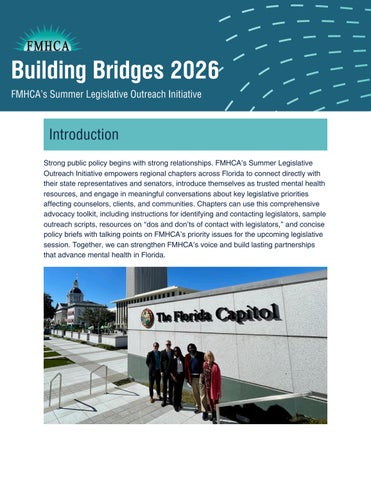
Introduction Strong public policy begins with strong relationships. FMHCA’s Summer Legislative Outreach Initiative empowers regional chapters across Florida to connect directly with their state representatives and senators, introduce themselves as trusted mental health resources, and engage in meaningful conversations about key legislative priorities affecting counselors, clients, and communities. Chapters can use this comprehensive advocacy toolkit, including instructions for identifying and contacting legislators, sample outreach scripts, resources on “dos and don’ts of contact with legislators,” and concise policy briefs with talking points on FMHCA’s priority issues for the upcoming legislative session. Together, we can strengthen FMHCA’s voice and build lasting partnerships that advance mental health in Florida.
Resources on “Dos and Don’ts” of Contact with Legislators Before initiating contact with legislators, we recommend that chapter leaders complete a 1-hour training on “dos and don’ts” of contact with legislators on the behalf of the counseling profession: 1-Hour Training Video
Training Slides
Steps for Identifying Your State Representative & State Senator 1. Go to Florida Senate’s Find Your Legislators page: https://www.flsenate.gov/senators/find 2. Enter your full home address. 3. The results should show your Florida House Representative and Florida State Senator. Florida notes that each address is tied to one Florida House district and one Florida Senate district. 4. Click each legislator’s name to find their Capitol office, district office, phone number, and email/contact form. 5. Verify the result, if needed, by checking your voter registration card or using Florida’s Voter Information Lookup through the Division of Elections: https://dos.fl.gov/elections/for-voters/check-your-voter-status-and-polling-place 6. For unresolved questions, contact your county Supervisor of Elections, which Florida Senate recommends for verifying district assignments: https://dos.elections.myflorida.com/supervisors/
Chapter Options for Liaison Work with Legislators 1. Schedule a meeting to visit the legislator at their office. 2. Invite the legislator to come to your chapter’s meeting to meet with your members. 3. Invite the legislator to attend a meeting with your Board and/or appropriate committee(s) If you meet with one or more legislator(s), you might consider asking legislators if you may take a photo with them and post it on your chapter’s social media page and/or send it to FMHCA (office@flmhca.org) to post on social media. Many legislators appreciate recognition for their time, and many like to be tagged in social media posts.
Sample Script for Legislator Contact Hello. My name is [name], and I’m a constituent, as well as a [member/position] of [regional chapter’s name], which is the [name of region] regional chapter of the Florida Mental Health Counselors Association [FMHCA] an association that represents clinical mental health counselors in Florida. I’d like to introduce [regional chapter’s name] and FMHCA as resources for legislators on policy issues related to mental health. I’d also like to extend an invitation for a meeting with our chapter [board, committee, membership] to discuss legislative and policy matters impacting mental health in our State. [Add any contact details]. [I/we] look forward to hearing from you.
Passing the Torch After your chapter has established contact with a legislator, we ask that you complete a brief survey telling us about your activities. The survey would also allow you to communicate anything that you may want or need from FMHCA as a follow-up. Click here to access the survey.
Legislative Priorities Issue #1: Expanding Access to Forensic Mental Health Evaluations HB 1091/SB 1240 went into effect on 7/1/25. This bill has worsened the existing shortage of appropriately-trained licensed mental health professionals in Florida who can be appointed by the Court to provide certain types of forensic mental health evaluations and expert witness testimony or criminal court cases. It has done so by removing the line “to the extent possible,” which was previously used by many circuits in Florida that have shortages of contracted psychologists, psychiatrists, and physicians to justify the appointment of other licensed mental health professionals who have adequate training and expertise in forensic evaluation and expert witness testimony. Prior to 7/1/25, 916.115(1)(a), F.S. clarified that “[t]o the extent possible, the appointed experts shall have completed forensic evaluator training approved by the department, and each shall be a psychiatrist, licensed psychologist, or physician.” This statute was written prior to Florida’s creation of the Licensed Mental Health Counselor (LMHC), Licensed Clinical Social Worker (LCSW), and Licensed Marriage and Family Therapist (LMFT) credentials, and FMHCA has maintained for several years that the statute needs to be updated to include LMHCs, LCSWs, and LMFTs (i.e., the “491 Board” professions), because (a) evaluation, diagnosis, and assessment of mental disorders is part of the statutory scope of practice of those professions, (b) like their colleagues who are licensed psychologists, many 491 Board licensees have adequate training and specialization in forensic mental health evaluation, and excluding qualified professionals who specialize in forensic evaluation is both an unfair and unsubstantiated practice, and (c) in many circuits in Florida, there are shortages of psychologists, psychiatrists, and physicians who both have adequate training in forensic evaluation and are willing to contract with judicial circuits to provide court-appointed evaluations and expert witness testimony. To remedy this problem, we recommend legislation that revises F.S. 916.115(1)(a) thusly: (a) The court-appointed experts shall: 1. Be a psychiatrist, licensed psychologist, mental health professional licensed under Chapter 491, F.S., or physician. Supplemental Details: 1. Licensed mental health professionals are qualified to evaluate, assess, and diagnose
mental disorders. 491.003(10), F.S. reads, "The practice of mental health counseling includes methods of a psychological nature used to evaluate, assess, diagnose,
2.
3.
4.
5.
and treat emotional and mental dysfunctions or disorders, whether cognitive, affective, or behavioral, interpersonal relationships, sexual dysfunction, alcoholism, and substance abuse.” Similar verbiage exists in the statute for the practices of clinical social work and marriage and family therapy. The capacity of 491 Board licensees to conduct evaluations and expert witness testimony is codified in other regulations. For example, 64B4-7.006, F.A.C. offers criteria for 491 Board licensees who provide evaluations and expert witness testimony to the courts related to child custody, residence, and visitation disputes. Prior to 7/1/25, many members of our profession who have appropriate training, experience, and expertise in competency evaluations were regularly appointed by the Courts to provide competency evaluations and expert witness testimony, as many circuits have shortages of qualified psychologists, psychiatrists, and physicians who (a) were adequately trained to conduct such evaluations, and (b) were willing to contract with their local judicial circuit to provide those evaluations, and the current verbiage “to the extent possible” has permitted flexibility for those circuits to appoint experts who aren’t psychologists, psychiatrists, and physicians. In many states (e.g., California, Colorado, Georgia, Oregon, Utah, and Washington), lawsuits have been filed (and often won) alleging due process violations related to excessive wait periods for inmates who cannot access an evaluation due to a shortage of available providers. Although we are not aware of such a lawsuit in Florida, the current shortage of contracted forensic mental health professionals is documented and not just anecdotal (e.g., in 2022, point-in-time data documented 548 inmates on a waitlist), and FMHCA certainly has an interest in preventing due process violations and potential lawsuits in our beloved State. As of this writing (6/16/26), there are 6,996 practicing psychologists licensed under the 490 Board in Florida. Comparatively, there are 57,401 practicing 491 Board licensees/registrants. Protecting the capacity of appropriately trained 491 Board licensees to serve as evaluators and expert witnesses could potentially solve the current provider shortage crisis. (Please note that these number can be verified in real time by visiting https://mqainternet.doh.state.fl.us/MQASearchServices/HealthCareProviders, selecting the appropriate license board under the “Board/Council” dropdown menu, selecting “Practicing Statuses Only” from the “License Status” dropdown menu, and then clicking “Search”).
Issue #2: Renaming Registered Interns Currently, individuals who have completed their master’s-level training and who are working as mental health professionals under supervision while pursuing licensure at the independent status level are referred to as “registered interns.” However, the title “intern” is misleading and confusing for patients, healthcare professionals, and legislators. Most interns in the United States are college students (Boskamp, 2023; Fennell, 2023). People often associate the word “intern” with college students, but registered interns in the mental health professions in Florida are not college students—they have already earned master’s degrees in their respective disciplines. When clients/patients hear that a therapist is an “intern,” they often mistakenly believe the therapist to be a student instead of a graduate, raising doubt about the qualifications of the therapist. Adding to this confusion, the word “intern” is used in two contradictory contexts in Chapter 491 of the Florida Statutes: (1) college student participating in a university-sponsored “internship” (e.g., F.S. 491.0045(4)(b)(1), 491.0045(4)(b)(1)(a), 491.0045(4)(b)(1)(c), 491.0045(4)(c)), and (2) a mental health professional who has graduated with a master’s degree in their discipline (and has therefore already completed their university-sponsored practicum or internship) and who practices under the supervision of a qualified supervisor while pursuing independent licensure (e.g., F.S. 491.0045(3)). Use of the phrase “associate” will better align with verbiage used in other states that are part of the Counseling Compact, making it easier for the public to recognize the term across states. Because legislation adding Florida to the Counseling Compact has been signed into law, many mental health counselors in Florida will soon be practicing across state lines. Use of terminology that is consistent with a national standard can help patients in various states to better understand qualifications of Florida’s therapists. Only 4 other U.S. states/districts/territories use the term “intern” to describe graduates who are pursuing independent licensure, whereas 16 states use the term “associate,” 19 states use a variety of other terms (i.e., trainee, licensed professional counselor, provisional license, temporary license, etc.), and 13 states offer no title or terminology for such professionals. Requiring “interns” in private practice settings to have a licensed mental health professional on the “premises” is inconsistent with policy governing “interns” in other practice environments and unnecessarily limits access to care in a telehealth environment. Approximately 95 to 98% of licensed mental health professionals now provide telehealth, increasing access to mental healthcare (Clay, 2022; Sampaio et al., 2023). F.S. 491.005(4(c), written prior to the massive expansion into telehealth triggered by the COVID-19 pandemic, requires interns in private practice settings to have a licensed mental health professional on the premises, even though they are already required by separate board rules to practice under appropriate supervision (F.A.C. 64B4-3.008) and even though no such provision exists for interns working in other counseling settings.
Issue #3: AI and Psychotherapy This report concerns HB 281, which did not pass during the 2026 legislative session. We are concerned that bills like HB 2810 may be introduced in future legislative sessions, and we intend to take a proactive stance on legislation regulating the use of AI in counseling and psychotherapy. 1. Summary of Florida HB 281 Florida House Bill 281 (and its companion SB 344) sought to regulate the use of artificial intelligence (AI) in the practice of clinical social work, marriage and family therapy, and mental health counseling. The bill defined AI broadly as any machine-based system that infers how to generate outputs such as content, decisions, or recommendations. The primary function of the bill is a prohibition: it states that a licensee "may not use artificial intelligence in the practice" of their profession, with very narrow exceptions. These exceptions are limited to: Administrative or supplementary support services, specifically: scheduling, drafting logistics-only communications, billing/claims, managing records, and operational data analysis. Recording or transcribing sessions, provided that written, informed consent is obtained at least 24 hours before services are provided. Comparison: Florida HB 281 vs. Illinois HB 1806 While HB 281 was inspired by Illinois' HB 1806 (the "Wellness and Oversight for Psychological Resources Act"), the Florida bill is significantly more restrictive. Prohibitive vs. Permissive Stance: Florida's bill is framed as a blanket prohibition ("may not use") with exceptions. In contrast, the Illinois model is more permissive with oversight, explicitly defining a "permitted use of artificial intelligence" where the professional maintains responsibility for the system's outputs. Clinical vs. Administrative Scope: Florida limits "supplementary support" strictly to administrative tasks like billing and scheduling. The Illinois bill allows for "supplementary support" that assists in the delivery of services, such as identifying external resources or referrals. Professional Autonomy: Illinois HB 1806 allows AI to generate therapeutic recommendations or treatment plans, provided they are reviewed and approved by the licensed professional. Florida HB 281 makes no such allowance, effectively banning AI from assisting in any part of the clinical decision-making process. Consent Requirements: Florida imposes a strict 24-hour waiting period for obtaining
consent to record or transcribe sessions. The Illinois bill requires written consent but does not mandate a 24-hour advance notice, making it more practical for crisis interventions or same-day appointments. Potential Drawbacks and Concerns of HB 281 Banning Evidence-Based Tools: The most significant drawback is that the bill’s "shotgun" approach would ban many appropriate, safe, and helpful clinical uses of AI. Hindering Innovation: By restricting AI to "back-office" functions, Florida risks falling behind in clinical innovation and preventing counselors from using modern tools that improve client outcomes. Impractical Administrative Burdens: The 24-hour consent rule is an administrative hurdle that fails to account for the modern workflow of digital practices and telehealth. Examples of Clinical Applications Banned by HB 281 If Florida were to pass legislation worded similarly to HB 281, the following clinically appropriate uses—supported by peer-reviewed literature—would likely be prohibited: AI-Supported Screening and Assessment: Tools that analyze patterns to help in diagnostic formulation or identifying symptoms. Suicide Risk Stratification: AI models that use electronic health records or passive sensor data to predict suicide risk and prompt proactive clinician outreach. Measurement-Based Care: Algorithms that predict treatment dropout or deterioration, allowing for early intervention. Adjunctive Therapeutic Chatbots: Evidence-based tools like Woebot or Wysa that provide between-session CBT skills, mood tracking, and emotional support. Treatment Fidelity Feedback: AI that analyzes session content to provide therapists with feedback on their adherence to evidence-based practices. AI-Augmented Treatment Planning: Systems that suggest personalized treatment goals or interventions for a clinician to review and approve. Relationship with the AMHCA Code of Ethics The AMHCA Code of Ethics (2020) and its 2023 AI Addendum state that counselors should "employ modern technology communications judiciously," attending to both benefits and risks. AMHCA requires counselors to assume responsibility for the use of AI and ensure services are safe and effective. HB 281 conflicts with these standards by stripping licensed professionals of their autonomy to decide which evidence-based tools are appropriate for their clients. Rather than a total ban on clinical use, the ethics of the profession suggest a framework of supervised use and
human oversight. Opinion on FMHCA’s Purpose and Mission FMHCA’s mission involves advocating for the profession and the welfare of clients. While protecting patients is paramount, HB 281’s unintended consequence is the removal of a counselor's ability to use "the scalpel" of modern technology to enhance care. Supporting a total clinical ban does not fit FMHCA’s mission to promote evidence-based excellence in mental health counseling. Recommended Action The GRC recommends that FMHCA oppose the current restrictive language of HB 281 and instead advocate for a "Scalpel" approach that protects the public while allowing for clinical innovation. Proposed Alternative Language: A licensee, registered intern, or certificateholder may not use artificial intelligence in the practice of clinical social work, marriage and family therapy, or mental health counseling to: 1. Record or transcribe a counseling or therapy session without obtaining written, informed consent before the provision of services. 2. Replace clinical judgment and decision-making on the part of the licensee, registered intern, or certificateholder. The board may adopt rules defining the replacement of the licensee’s, registered intern’s, or certificateholder’s clinical judgment and decisionmaking with artificial intelligence.
Issue #4: Expanding Access to Mental Health Professionals in DOE Policy