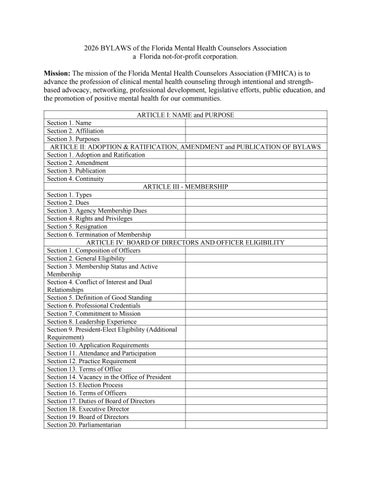
2026 BYLAWS of the Florida Mental Health Counselors Association a Florida not-for-profit corporation. Mission: The mission of the Florida Mental Health Counselors Association (FMHCA) is to advance the profession of clinical mental health counseling through intentional and strengthbased advocacy, networking, professional development, legislative efforts, public education, and the promotion of positive mental health for our communities. ARTICLE I: NAME and PURPOSE Section 1. Name Section 2. Affiliation Section 3. Purposes ARTICLE II: ADOPTION & RATIFICATION, AMENDMENT and PUBLICATION OF BYLAWS Section 1. Adoption and Ratification Section 2. Amendment Section 3. Publication Section 4. Continuity ARTICLE III - MEMBERSHIP Section 1. Types Section 2. Dues Section 3. Agency Membership Dues Section 4. Rights and Privileges Section 5. Resignation Section 6. Termination of Membership ARTICLE IV: BOARD OF DIRECTORS AND OFFICER ELIGIBILITY Section 1. Composition of Officers Section 2. General Eligibility Section 3. Membership Status and Active Membership Section 4. Conflict of Interest and Dual Relationships Section 5. Definition of Good Standing Section 6. Professional Credentials Section 7. Commitment to Mission Section 8. Leadership Experience Section 9. President-Elect Eligibility (Additional Requirement) Section 10. Application Requirements Section 11. Attendance and Participation Section 12. Practice Requirement Section 13. Terms of Office Section 14. Vacancy in the Office of President Section 15. Election Process Section 16. Terms of Officers Section 17. Duties of Board of Directors Section 18. Executive Director Section 19. Board of Directors Section 20. Parliamentarian
Section 21. Appointment of the Additional Board Members Section 22. Removal from Office Section 23. Vacancies Section 24. Due Process in Removal from Office Section 25. Board Meetings Section 26. Rules of Board of Directors Meetings ARTICLE V: FMHCA CHAPTERS Section 1. Formation Section 2. Purpose Section 3. Governance Section 4. Recognition Section 5. Non-Chartered Groups ARTICLE VI: STANDING AND SPECIAL COMMITTEES Section 1. Creation and Authority Section 2. Standing Committees Section 3. Special Committees ARTICLE VII: BUDGETING AND FINANCES Section 1. Fiscal Year. Section 2. Annual Budget. Section 3. Financial Statement. Section 4. Deposits and Disbursements. Section 5. Books & Records. Section 6. Annual Financial Statement. Section 7. Dissolution. ARTICLE VIII: PUBLIC POLICY Section 1. Lobbying Section 2. Political Action Committee Fund ARTICLE IX: INDEMNIFICATION OF OFFICERS, DIRECTORS, EMPLOYEES, AND AGENTS Section 1. Indemnification ARTICLE X: PROPERTY ARTICLE XI: ETHICS Section 1. Applicable Standards ARTICLE XII: NON-DISCRIMINATION POLICY Section 1. Policy ARTICLE XIII: RULES AND PROCEDURES Section 1. Parliamentary Authority
ARTICLE I: NAME and PURPOSE Section 1. Name The name of the association shall be the Florida Mental Health Counselors Association, abbreviated FMHCA, and referred to herein as “FMHCA.” The name shall apply to all activities of the association and shall not be used without the approval of the membership, as represented by the Board of Directors. FMHCA is incorporated in the State of Florida as a 501(c)(6). Section 2. Affiliation FMHCA is a state affiliate of the American Mental Health Counselors Association (AMHCA). AMHCA recognizes FMHCA as the association representing mental health counselors in Florida, consistent with the purposes set forth in Article I, Section 3. AMHCA and FMHCA are independent and autonomous professional associations. Section 3. Purposes The purposes of FMHCA shall be to: a) Advance and promote the profession of mental health counseling in Florida; b) provide continuing education, training, and professional development opportunities through online and virtual learning, in-person regional events, and one annual conference; c) support and serve as a professional voice for the needs of members through communication, resources, and opportunities for engagement; d) advocate for policies and legislation that recognize, protect, and advance mental health counseling and improve access to quality mental health services; e) collaborate with allied professional organizations to strengthen the mental health profession and improve client outcomes; and f) maintain affiliation with the American Mental Health Counselors Association (AMHCA) as the state affiliate, consistent with these Bylaws. ARTICLE II: ADOPTION, RATIFICATION, AMENDMENT, AND PUBLICATION OF BYLAWS Section 1. Adoption and Ratification The original bylaws, and later revisions, were adopted by the board of directors effective July 1, 1998, and were subject to ratification by the members at the first annual meeting held after that date. These bylaws, as revised and approved by the board of directors, are effective June 21, 2026, subject to ratification by the members. a) Effective Date of Bylaws Amendments. When adopting an amendment to these bylaws, the board of directors shall specify whether the amendment takes effect immediately or at the beginning of the next fiscal year (January 1). Section 2. Amendment a) Vote by the Board. Bylaws amendments shall follow this process: 1. Proposal: Proposed changes may be submitted by the bylaws committee to the board of directors and/or proposed by the board of directors at any scheduled board meeting.
2. Board vote: The proposed change(s) shall be placed on the agenda for a vote at the next scheduled board meeting. 3. If approved by the Board: If approved, the board shall recommend the amendment(s) to the voting membership for ratification and shall specify the proposed effective date. 4. Member notice: Notice of the proposed amendment(s) shall be provided at least thirty (30) days prior to the membership vote date by publication on the FMHCA website, and members will be notified by email. 5. Membership vote: These bylaws may be amended by a simple majority vote of the voting members, conducted electronically. Section 3. Publication The bylaws of FMHCA shall be published in their entirety on FMHCA's website. Section 4. Continuity The secretary of FMHCA and the FMHCA office shall be responsible for maintaining the official copy of these bylaws, including any amendments, and for providing that copy to their successors. ARTICLE III: MEMBERSHIP Section 1. Types There are six types of membership: clinical, registered, student, retired, agency, and affiliate. a) Clinical. Criteria: A member who is a licensed mental health counselor in the State of Florida. b) Registered. Criteria: A member who is a registered mental health counselor intern in the State of Florida. c) Student. Criteria: A member who is currently enrolled in a master's-level graduate mental health counseling program. Student membership may be held for up to three (3) years. An extension beyond three (3) years may be granted upon receipt of verification from the student's academic advisor. d) Retired. Criteria: A member who was previously licensed as a mental health counselor but does not currently hold an active license in good standing, and whose license was not revoked or surrendered under disciplinary proceedings. Proof required: Florida DOH/MQA portal shows "Retired" status (member-provided verification). e) Agency. Criteria: An organization, practice, or agency that supports the purposes of FMHCA and enrolls under an agency membership. f) Affiliate. Criteria: A member who is licensed in a related profession and/or resides outside the State of Florida, or who has made conspicuous and outstanding contributions to the counseling profession and has an interest in the work of licensed mental health counselors. Section 2. Dues Annual dues shall be established by action of the board of directors and shall be collected annually on the anniversary date of each member's admission to FMHCA.
Annual Dues Membership Type Clinical $170/year Registered $150/year Student $50/year Retired $50/year Agency $170/year Affiliate $170/year Section 3. Agency Membership Dues Agency memberships are available at the following bulk rates based on the number of enrolled members: # of Members 10 members 20 members 30 members 40 members 50+ members
Discount Adjusted Rate 10% $153 per member 15% $145 per member 20% $136 per member 20% $136 per member Custom (est. 25%) ~$128 per member
Total Cost $1,530 $2,900 $4,080 $5,440 Starting at $6,400
Section 4. Rights and Privileges Clinical, registered, and retired members shall possess voting rights and the privilege of election to any office, with the exception stated in the following section. Student and affiliate members do not possess these rights and privileges. These rights and privileges may be suspended or withdrawn if a member fails to pay FMHCA dues or is found responsible for conduct that is damaging to FMHCA, its members, or the counseling profession. Section 5. Resignation Any member may resign from FMHCA by providing written notice to the president or executive director. A resigning member remains responsible for all dues and charges accrued on or before the effective date of resignation. Section 6. Termination of Membership Membership in FMHCA may be terminated for cause, including: a) Failure to pay annual dues by the renewal anniversary date or nonpayment of dues; b) Falsifying or misrepresenting that membership qualifications have been met; c) Disciplinary action by the Florida Board of Clinical Social Work, Marriage & Family Therapy, and Mental Health Counseling (the "491 Board"); or d) Conduct determined by the ethics committee and/or the board of directors to be detrimental to FMHCA, its mission, or the counseling profession. Expulsion Procedure. Expulsion requires a majority vote of the entire board of directors at a meeting where a quorum is present. At least fifteen (15) days before the vote, the member shall receive written notice of the charges and the date, time, and meeting details when the matter will be considered.
Member Response. Before the vote, the member may submit a written response and supporting documentation by the deadline in the notice and may request to address the board in person or online. The board's decision shall be final. ARTICLE IV: BOARD OF DIRECTORS AND OFFICER ELIGIBILITY Section 1. Composition of Officers a) The officers of FMHCA shall consist of: 1. President 2. President-Elect 3. Past President 4. Secretary 5. Treasurer 6. Four (4) Regional Directors b) All officers shall serve as voting members of the Board of Directors, with each officer entitled to one (1) vote. Section 2. General Eligibility To be eligible for nomination and service on the FMHCA Board of Directors, a candidate must meet all requirements of this Article at the time of nomination and continuously throughout the term of office. Section 3. Membership Status and Active Membership a) Candidates must be members of FMHCA in good standing at the time of nomination and throughout their term of service. b) Candidates must demonstrate active membership, defined as a minimum of two (2) consecutive years of FMHCA membership immediately preceding nomination. Section 4: Conflict of Interest and Dual Relationships a) Candidates must disclose any actual, potential, or perceived conflicts of interest, including dual relationships that could reasonably be viewed as influencing their judgment or decision-making on behalf of FMHCA. b) Dual relationships may include, but are not limited to: family relationships, romantic or intimate relationships, close personal friendships, business or financial relationships, supervisory relationships, university relationships or contractor relationships involving FMHCA. Section 5. Definition of Good Standing a) For purposes of Board and Officer eligibility and service, a member shall be considered in good standing if all of the following conditions are met: 1. Holds a current FMHCA membership that is active and not expired, lapsed, suspended, or terminated; 2. is current on all financial obligations owed to FMHCA, including membership dues and any required fees; 3. maintains an active, valid, and unrestricted license as a licensed mental health counselor (LMHC) in the state of Florida;
4. is in good standing with any FMHCA-affiliated local chapter of which the member is affiliated, if applicable; 5. has no unresolved ethical complaints or disciplinary actions that would reasonably bring FMHCA into disrepute; and 6. is in compliance with FMHCA Bylaws, policies, and professional conduct expectations, including participation, confidentiality, and conflict-of-interest requirements. b) Failure to maintain good standing at any time during a term of service may result in removal from office in accordance with FMHCA policies and procedures. Section 6. Professional Credentials a) Candidates must hold a valid, current, and unrestricted license as a licensed mental health counselor (LMHC) in the state of Florida at the time of nomination and throughout the term of office. b) Eligible candidates must hold clinical or retired membership status. c) Affiliate members and all other non-licensed membership categories are ineligible to serve on the board of directors or as officers. Section 7. Commitment to Mission Candidates must demonstrate alignment with and commitment to the mission, values, goals, and professional standards of FMHCA. Section 8. Leadership Experience a) Candidates must meet at least one (1) of the following: 1. Prior service on the FMHCA board of directors; 2. prior service on the board of an FMHCA-affiliated chapter; or 3. prior volunteer service or active participation in FMHCA or a FMHCA-affiliated chapter. Section 9. President-Elect Eligibility (Additional Requirement) a) In addition to all other eligibility requirements, candidates for the office of President-Elect must meet one (1) of the following: 1. Prior service on the FMHCA Board of Directors; or 2. Prior service on the board of an FMHCA-affiliated chapter. Section 10. Application Requirements Candidates shall submit all required nomination materials by the deadline established by the Association, including: a) A complete application form; b) a personal statement outlining interest in the position and vision for FMHCA; and c) a resume or curriculum vitae outlining relevant professional and leadership experience. endorsements are not required Section 11. Attendance and Participation Candidates must be able and willing to attend all scheduled board meetings and actively participate in board activities, committees, and initiatives.
Section 12. Practice Requirement Candidates must reside in the State of Florida or actively practice mental health counseling within the State of Florida. Section 13. Terms of Office a) The term of office for elected Officers shall begin on January 1 and continue for the term specified elsewhere in these Bylaws. b) Terms of Officers, excluding the President-Elect position, may include one additional consecutive term if the Officer is reelected by the membership in accordance with FMHCA's voting procedures. Section 14. Vacancy in the Office of President a) If the President resigns, dies, or is unable to complete the term, the President-Elect shall assume the office of President. b) The office of President-Elect shall then be deemed vacant. c) A special election shall be held to fill the vacant President-Elect position in accordance with the Association’s election procedures. Section 15. Election Process a) The finalized list of nominees shall be presented to FMHCA members no fewer than fifteen (15) days prior to the election. b) Elections shall take place during a regularly scheduled monthly Board meeting. Section 16. Terms of Officers a) Presidential Leadership Sequence The offices of President-Elect, President, and Past President shall constitute a single, consecutive leadership sequence held by the same individual over a three (3)-year period, as follows: 1. President-Elect: One (1) year 2. President: One (1) year 3. Past President: One (1) year An individual elected as President-Elect shall automatically advance to the offices of President and Past President in successive years, unless unable or unwilling to serve. b) Other Officers The terms of office for the remaining officers shall be as follows: 1. Secretary: Two (2)-year term 2. Treasurer: Two (2)-year term 3. Northwest Regional Director: Two (2)-year term 4. Northeast Regional Director: Two (2)-year term 5. Southwest Regional Director: Two (2)-year term 6. Southeast Regional Director: Two (2)-year term Section 17. Duties of Board of Directors a) The President-Elect shall be elected by the membership and shall prepare to assume the presidency by becoming familiar with its duties and responsibilities and by assisting the
President in carrying them out. In the absence of the President, the President-Elect shall perform the duties of the President and shall have all the powers thereof. Additional responsibilities include participation on the Bylaws Committee and conducting a minimum of four university visits, virtually or in-person, to present the mission and purpose of FMHCA to master's-level counselors in training and faculty. b) The President shall assume office upon the completion of their term as President-Elect and shall be a fully licensed clinician. The President shall preside at all meetings of the Board of Directors and supervise the association's affairs between Board meetings. The President shall appoint all committee chairpersons, approve committee assignments, and serve as an ex-officio member of all committees. The President shall be notified of all committee meetings. In the absence of the President, or if the President is unable to act, another Board member shall perform the duties of the President as agreed upon by majority vote of the Board. When so acting, the interim President shall have all the powers of and be subject to all the restrictions upon the President. c) The President shall assume the role of Past-President upon the completion of their term as President. The Past-President is accountable for maintaining a smooth transition of power within the presidential leadership sequence and shall develop a slate of eligible candidates for FMHCA elections through various recruitment initiatives. The PastPresident shall also serve as a member of the Ethics Committee. d) The Secretary shall be responsible for maintaining accurate and complete minutes of all Board meetings; collecting committee chair reports and ensuring they are posted by the first Monday of each month, except during the designated conference month; maintaining official organizational records; and overseeing updates to the Policies and Procedures Manual to reflect current Board actions and approved revisions. e) The Treasurer shall provide oversight of all FMHCA financial matters and shall be listed on the FMHCA bank account. The Treasurer shall be provided use of Treasurer@FLMHCA.org for the duration of their term and shall be copied on all correspondence related to financial matters. In the event a new accounting firm is retained, the Treasurer shall assist in that transition process. f) Regional Directors serve as the voice of FMHCA at the regional level and promote activities consistent with the mission and policies of FMHCA. Regional Directors may form regional committees, plan and implement regional activities, submit an annual plan, and provide periodic updates to the Board of Directors. Regional Directors must obtain approval from the Executive Director for any activity involving FMHCA resources or obligations. Each Regional Director shall be responsible for facilitating one of the four scheduled Alliance meetings per year and organizing a minimum of two in-person networking events within their region during their term of service. Section 18. Executive Director a) The Executive Director is a salaried staff position employed by and directly responsible to the Board of Directors. The Executive Director is delegated authority to manage the day-to-day operations of FMHCA and to implement Board-approved policies, budgets, and strategic directives, including administration of programs and services; supervision of staff; routine contracting and vendor management; financial and risk management within established policies; and the engagement or conclusion of independent contractor relationships as warranted by operational needs and fiscal prudence. Termination of W-2
employees shall be conducted by the Executive Director in conjunction with the Board of Directors and in accordance with applicable law and policy. b) The Executive Director shall serve as a non-voting participant at Board meetings, maintain sound internal controls, ensure timely and accurate financial and operational reporting to the President and Board of Directors uphold conflict-of-interest and document-retention requirements, and comply with all FMHCA policies and legal obligations. c) Actions reserved to the Board of Directors include adopting or amending Bylaws and policies; approving the annual budget and material budget deviations; setting dues and membership classes; entering into debt or transactions that materially alter FMHCA's mission, risk, or long-term obligations; approving or terminating the Executive Director; and other governance matters expressly designated to the Board of Directors Section 19. Board of Directors a) The Board of Directors is responsible for providing strategic leadership, organizational oversight, and fiduciary stewardship of FMHCA. The Board ensures that FMHCA fulfills its mission, advances the counseling profession in Florida, and operates in alignment with ethical, legal, and financial best practices. The responsibilities of the Board of Directors include: 1. Mission, Vision, and Strategic Direction: The Board of Directors shall establish and uphold FMHCA's mission, vision, and long-term strategic priorities, and shall approve annual goals, initiatives, and organizational priorities. 2. Governance and Policy Oversight: The Board of Directors shall develop, review, and update Bylaws and organizational policies, ensure decisions align with nonprofit governance standards, and maintain accountability and transparency across all operations. 3. Financial and Fiduciary Responsibilities: The Board of Directors shall oversee the budget, financial health, and resource allocation of FMHCA; ensure responsible use of funds and compliance with nonprofit financial regulations; and review financial reports and approvals. 4. Executive Director Oversight: The Board of Directors shall provide supervision and evaluation of the Executive Director, delegate operational authority while retaining governance oversight, and ensure the Executive Director acts within approved policies and budgets. 5. Advocacy and Professional Advancement: The Board of Directors shall support statewide initiatives that promote mental health counseling, ensure FMHCA remains a leading voice for licensed mental health counseling professionals in Florida, and engage in legislative and public policy advocacy consistent with the mission. 6. Committee Leadership and Accountability: The Board of Directors shall appoint committee chairs, monitor committee work, review committee reports, and ensure alignment with strategic goals. 7. Membership Engagement and Public Representation: The Board of Directors shall represent FMHCA's interests, promote member engagement, support professional development, and advance FMHCA's public visibility. Section 20. Parliamentarian
a) Establishment. The Board of Directors shall establish the position of Parliamentarian within the organizational structure of FAMCA/FMHCA. b) Appointment. The Parliamentarian shall be appointed by the Board of Directors and shall serve as a neutral, non-voting officer of the organization. c) Duties. The Parliamentarian shall: 1. Advise the President and Board of Directors on matters of parliamentary procedure and meeting structure, including adherence to the organization's adopted rules of order; 2. Serve as the neutral party responsible for administering the organization's grievance policy, ensuring due process and fairness for all parties involved in a grievance; 3. Receive, document, and facilitate the resolution of member grievances in accordance with the grievance procedures established by the Board of Directors. 4. Term. The Parliamentarian shall serve at the discretion of the Board of Directors, for a term to be determined by the Board. Section 21. Appointment of the Additional Board Members The Board of Directors may appoint additional board members as needed to support the mission, operations, and strategic priorities of FMHCA. Such appointments shall be made by an affirmative vote of two-thirds (2/3) of the Board. Section 22. Removal from Office a) Removal Authority: A Director may be removed from office, with or without cause, in accordance with Florida Statute §617.0808 and the procedures set forth in these Bylaws. b) Removal by Directors or Members: A Director elected or appointed by the Board of Directors may be removed by a majority vote of all Directors then in office, or without cause, by a two-thirds (2/3) vote of the Directors then in office. A Director elected by the membership may be removed by a majority vote of the members entitled to vote on the election of Directors. c) Regional Directors: A Director elected by a region, chapter, or other designated constituency may be removed only by the members of that same region, chapter, or constituency, and only if the number of votes cast for removal would have been sufficient to elect that Director. d) Attendance-Based Removal: If a Director fails to attend the number of Board meetings specified in these Bylaws or Board policy, the Board of Directors may remove the Director by a majority vote of the Directors then in office. e) Notice of Removal: Notice of any meeting at which removal of a Director is to be considered shall state the name(s) of the Director(s) proposed for removal and the purpose of the vote. f) Voting Requirements: Each Director proposed for removal shall be subject to a separate vote. Removal by written consent shall require a separate consent for each Director. g) Filling Vacancies: Any vacancy created by removal shall be filled by the same body entitled to elect the Director whose position has become vacant, in accordance with these Bylaws. h) Eligibility for Reelection: A Director removed from office shall not be eligible for reelection until the next annual meeting at which Directors are elected.
i) Return of Corporate Property: A Director removed from office shall, within seventy-two (72) hours, return all records, documents, electronic access, and property of the Association in their possession. j) Failure to Comply: If a removed Director fails to relinquish office or return Association records, the Association may seek judicial relief as permitted under Florida law. Section 23. Vacancies Vacancies: Vacancies in any office occurring between routine elections shall be filled by appointment by the President, provided the appointee meets all general eligibility requirements for the position. Members of the Board of Directors may submit the names of eligible individuals for consideration. Any individual appointed shall serve until the next routine election, at which time the office shall be filled by election. Section 24. Due Process in Removal from Office a) FMHCA shall ensure procedural fairness in any action to remove an officer from office. 1. The following provisions apply: i. Notice of Charges: The officer subject to removal shall receive written notice of the specific charges or reasons for removal at least fourteen (14) days prior to the meeting at which the removal will be considered. ii. Right to Respond: The officer shall have the right to submit a written response to the charges and to appear before the Board of Directors, either in person or virtually, to present evidence and argument prior to any vote on removal. iii. Hearing Procedure: The Board of Directors shall conduct a fair and impartial hearing, which may include presentation of evidence, witness statements, and questions by Board members. The presiding officer shall ensure orderly proceedings. iv. Voting Requirement: Removal shall require an affirmative vote of two-thirds (2/3) of the Board members then in office at a duly constituted meeting. v. Recordkeeping: All notices, responses, and minutes of the removal proceedings shall be documented and maintained in FMHCA's official records. 2. Right to Appeal: An officer removed from office may submit a written appeal to the Board of Directors within ten (10) days of the removal decision. The Board of Directors shall review the appeal and issue a final determination within thirty (30) days. Section 25. Board Meetings a) Board meeting is a formal meeting of the Board of Directors where FMHCA conducts official business, including reviewing reports, discussing organizational matters, making decisions, and voting on items that require Board approval. Board meetings may be held virtually or in person and are conducted according to FMHCA's bylaws and adopted parliamentary procedures. A quorum, defined as a majority of the currently seated Board of Directors members, must be present in order to conduct official business or hold a vote. b) Regular Meetings: Regular Meetings: The Board of Directors shall hold regularly scheduled meetings once a month, conducted virtually, to carry out the business of
FMHCA. These meetings may include reviewing financial reports, strategic initiatives, policy matters, and other items requiring Board of Directors discussion or approval. 1. Executive Session: Executive Session is a private portion of a Board of Directors meeting where sensitive or confidential matters are discussed. No votes or formal actions shall be taken during Executive Session. c) Special Meetings: A special meeting of the Board of Directors may be called when urgent matters arise that require Board of Directors action before the next regularly scheduled meeting, including legal issues, compliance matters, or emergency decisions affecting the operations of FMHCA. Notice of the date, time, and location of any special meeting shall be provided at least forty-eight (48) hours prior to the meeting. Notice may be communicated by email or telephone, and confirmation of receipt is expected. d) Annual Leadership Retreat: The Board of Directors shall hold an Annual Leadership Retreat as an in-person meeting designed to support strategic planning, leadership development, and organizational goal setting for FMHCA. The retreat provides an opportunity for Board of Directors members to review FMHCA's progress, discuss priorities, strengthen collaboration among leadership, and plan for the upcoming year. The retreat will include a team dinner to support relationship-building among Board of Directors members. Attendance is mandatory, and the Annual Leadership Retreat shall not be attended virtually. e) In-Person Board Meeting at the Annual Conference: The Board of Directors hold at least one in-person Board of Directors meeting each year during the FMHCA Annual Conference. Attendance by all currently elected Board of Directors members is required. Section 26. Rules of Board of Directors Meetings a) Board Meeting Format: Meetings of the Board of Directors may be held in person or through electronic means, provided that all participants can simultaneously hear and be heard by one another. Such meetings shall constitute a valid meeting. b) Agenda: An agenda shall be prepared for each Board of Directors meeting and distributed to Board of Directors members prior to the meeting. c) Meeting Materials and Reports: Board of Directors members responsible for providing reports shall submit their reports at least one (1) week prior to the scheduled meeting. Reports shall be posted in the Board Member Forum and distributed to Board of Directors in advance to allow adequate time for review and informed discussion during the meeting. d) Participation: Board of Directors members are expected to attend meetings, participate in deliberations, and review materials distributed prior to meetings in order to support informed decision-making. Board of Directors members may miss no more than two (2) meetings per year unless formally excused by the President. Notice of a planned absence must be emailed to the President at least twenty-four (24) hours prior to the meeting. e) Quorum: A quorum, defined as a majority of the currently seated members of the Board of Directors, must be present in order to conduct official business or take a vote. f) Voting: Each member of the Board of Directors shall have one vote. g) Conflict of Interest: Any Board of Directors member who has an actual or potential conflict of interest regarding a matter before the Board of Directors shall disclose the conflict as soon as it becomes known and prior to discussion or voting on the matter. The
Board of Directors may require the member to abstain from discussion and voting on the matter, consistent with FMHCA's conflict-of-interest policy and applicable law. h) Minutes: Minutes shall be recorded for all meetings of the Board of Directors and maintained as part of the official records of FMHCA. i) Parliamentary Authority: Meetings of the Board of Directors shall be conducted in accordance with Robert's Rules of Order unless otherwise specified in these Bylaws or by special rules adopted by FMHCA. ARTICLE V: FMHCA CHAPTERS Section 1. Formation Members within a geographic region of Florida may form an FMHCA chapter to support professional connection, advocacy, and educational activities. All chapters must be approved and formally chartered by the Board of Directors, which shall also determine each chapter's geographic boundaries and grant official recognition. Section 2. Purpose Chapters shall advance FMHCA's mission by providing members with opportunities for networking, professional development, leadership engagement, and regional collaboration. Section 3. Governance Chapters may establish their own leadership structure and carry out local activities, provided they operate in alignment with FMHCA's Bylaws, policies, and procedures, and uphold the AMHCA Code of Ethics. Section 4. Recognition Chapters are recognized chapters of FMHCA, chartered by the Board of Directors. Chapters are expected to uphold FMHCA's mission and adhere to the AMHCA Code of Ethics. Section 5. Non-Chartered Groups Any group that has not been formally chartered or recognized by FMHCA is considered unaffiliated. Such groups may not represent themselves as official chapters of FMHCA. ARTICLE VI: STANDING AND SPECIAL COMMITTEES Section 1. Creation and Authority The Board of Directors may create committees as needed and define their responsibilities. The President shall appoint committee chairs based on members' expertise and interests. Committee chairs must be Clinical Members unless a Special Committee chair is appointed by a two-thirds vote of the Board members. Committee members are not required to be Board members unless the Board of Directors or these Bylaws specify otherwise; however, committee chairs should be Board members whenever possible. The President may remove any committee chair or member. All committees shall act only within the authority granted by these Bylaws or by a specific resolution of the Board of Directors. Section 2. Standing Committees
FMHCA shall maintain the following standing committees: a) Ethics Committee: Receives and reviews matters related to the ethical conduct of FMHCA members, including ethics consultation requests and formal complaints. All such matters shall be governed by the FMHCA Ethics Policy. The committee shall make recommendations to the Board of Directors as appropriate. b) Bylaws Committee: Reviews proposed amendments to the Bylaws and related resolutions submitted by members, committees, or the Board of Directors, and makes recommendations accordingly. The Bylaws shall be available to members and the public at all times through the FMHCA website. c) Registered Intern & Graduate Student Committee: Supports the professional growth and development of registered mental health counseling interns and graduate students enrolled in mental health counseling programs through mentorship, resources, and engagement opportunities. d) Government Relations Committee: Leads FMHCA's legislative advocacy efforts, monitors state-level legislation and regulatory issues affecting the mental health counseling profession, keeps members informed of relevant advocacy opportunities, and oversees the FMHCA Political Action Committee (PAC). e) Military Committee: Promotes awareness of the mental health needs of veterans, military personnel, and their families, and shares information with members about available programs and opportunities to serve this population. Section 3. Special Committees Special committees are temporary committees established by the Board of Directors or the membership to carry out a specific task. The motion or action creating the committee shall define its purpose, scope, and, where applicable, its composition and reporting requirements. A special committee is automatically dissolved upon completing its assigned task and submitting its final report, unless the Board or membership votes to continue it. ARTICLE VII: BUDGETING AND FINANCES Section 1. Fiscal Year. The fiscal year of FMHCA shall begin on January 1 and end on December 31. Section 2. Annual Budget. An annual operating budget shall be prepared jointly by the treasurer and the executive director and presented to the board of directors for approval in December, prior to the start of the new fiscal year. Section 3. Financial Statement. Monthly financial statements shall be prepared and made available to the board of directors prior to each monthly board meeting in the board member forum. Section 4. Deposits and Disbursements. All FMHCA funds shall be kept in Florida Mental Health Counselors Association's name at banks chosen by the Board of Directors. Money may only be spent or withdrawn as approved by the Board and in accordance with FMHCA's policies and procedures.
Section 5. Books & Records. FMHCA shall maintain complete and accurate books and records in accordance with Generally Accepted Accounting Principles (GAAP), as established by the Financial Accounting Standards Board (FASB). FMHCA shall also maintain minutes of board meetings and a record of the names and addresses of members of the board of directors. All books and records of FMHCA may be inspected by any board member, or their authorized agent, for a proper purpose at any reasonable time. Section 6. Annual Financial Statement. An annual financial statement shall be prepared within one hundred eighty (180) days following the close of each fiscal year by an independent certified public accountant approved by the board of directors. The board may require an independent audit or financial review, as determined necessary for accountability, compliance, or organizational oversight. Section 7. Dissolution. a) In accordance with state law: 1. A state chapter may terminate its relationship with AMHCA with a minimum two thirds vote of the state chapter's membership. 2. Notice must be made to the AMHCA Board at least 90 days before the vote to cease operations as an AMHCA chapter is taken. 3. All state chapter resources must be accounted for at least 90 days before any vote is taken. 4. All state and federal laws dictating the dissolution of a non-profit chapter to a national organization relationship must be adhered to. 5. Any and all outstanding liabilities that result from a vote to separate and disband remain the responsibility of the state chapter and must be resolved before termination may be completed. 6. Upon dissolution of FMHCA, after payment of all liabilities, any remaining assets shall be distributed to the American Mental Health Counselors Association, a taxexempt organization under Section 501(c)(6), or its successor, in accordance with Florida nonprofit law and applicable federal tax requirements. ARTICLE VIII: PUBLIC POLICY Section 1. Lobbying FMHCA may engage in issue advocacy, legislative monitoring, and lobbying related to mental health policy and the counseling profession, in compliance with applicable state and federal law. Such activities may include educating policymakers on issues affecting mental health care and the role and legal scope of practice of licensed mental health counselors. All lobbying and issue advocacy activities of FMHCA shall be conducted separately from any electoral political activity. Section 2. Political Action Committee Fund Any electoral political activity supported by FMHCA shall be conducted solely through a legally distinct Political Action Committee (PAC), established, registered, and operated in accordance with applicable state and federal law. The PAC shall maintain its own governance, officers, and
financial accounts separate from those of FMHCA. FMHCA shall not make political campaign contributions directly. Membership dues and other tax-exempt funds of FMHCA shall not be used to make political campaign contributions or to support electoral political activity. Participation in and contributions to the PAC shall be voluntary and shall not be a condition of membership. The board of directors shall provide general oversight to ensure legal and ethical compliance but shall not direct or control PAC contributions or expenditures, except as permitted by law. ARTICLE IX: INDEMNIFICATION OF OFFICERS, DIRECTORS, EMPLOYEES, AND AGENTS Section 1. Indemnification FMHCA shall indemnify its officers, directors, employees, and agents to the fullest extent permitted by law. FMHCA may purchase and maintain insurance on behalf of any person who is or was an officer, director, employee, or agent of FMHCA, or who is or was serving at the request of FMHCA in a similar capacity for another entity, against any liability asserted against and incurred by such person in that capacity or arising from such service, whether or not FMHCA would have the power to indemnify the person under this article. ARTICLE X: PROPERTY Section 1. Management and Disposition of Property All property of FMHCA shall be under the control and management of the board of directors. Upon dissolution of FMHCA, no part of its property shall be distributed to any member. All remaining property shall be transferred to one or more organizations selected by the board of directors whose purposes are most consistent with those of FMHCA, provided such organizations are exempt under Section 501(c)(3) or Section 501(c)(6) of the Internal Revenue Code or the corresponding provisions of federal law. ARTICLE XI: ETHICS Section 1. Applicable Standards The ethical standards published by the AMHCA, as amended from time to time, are adopted as the ethical standards of FMHCA. In any instance where Florida state or federal law conflicts with the AMHCA Code of Ethics, the higher or more stringent standard shall apply. The AMHCA Code of Ethics represents the minimum standards of professional conduct and behavior for practicing counselors and therapists. All members are expected to be familiar with and adhere to these standards. The FMHCA ethics policies, including ethics consultation policies and procedures, are aligned with and designed to support the application and enforcement of the AMHCA Code of Ethics. ARTICLE XII: NON-DISCRIMINATION POLICY Section 1. Policy
It shall be the policy of FMHCA not to discriminate against any person on the basis of age, disability, race, color, religion, creed, sex, or sexual orientation in the operation of its programs, in employment, in the election of directors and officers, or in any other aspect of its affairs. FMHCA shall also promote inclusive outreach and recruitment practices for board and leadership service in order to encourage participation from individuals of diverse identities and backgrounds and to support leadership that reflects the membership throughout the State of Florida. ARTICLE XIII: RULES AND PROCEDURES Section 1. Parliamentary Authority The rules contained in the current edition of Robert's Rules of Order Newly Revised shall govern meetings of the membership and the board of directors in all cases where they are applicable and not inconsistent with applicable law, the articles of incorporation, or these bylaws.
GLOSSARY GOVERNANCE & MEETING TERMS Quorum The minimum number of Board members (a majority of seated directors, unless otherwise specified) who must be present for the Board to conduct official business or hold a vote. Executive Session A private, confidential portion of a Board meeting, closed to non-Board members, used to discuss sensitive matters. No official votes are taken during Executive Session. Special Meeting An unscheduled Board meeting called outside the regular monthly meeting cycle to address an urgent or time-sensitive matter. Regular Meeting FMHCA's standing monthly Board meeting, held virtually or in person and conducted according to FMHCA's established procedures. Ex-Officio Member A person who serves on a committee or body automatically because of the office they hold, rather than through separate election or appointment. Parliamentary Authority / Robert's Rules of Order The formal procedural rulebook FMHCA uses to conduct meetings and votes, unless the Bylaws specify otherwise. Presidential Leadership Sequence The three-year officer progression through which a member serves as President-Elect, then President, then Past President. VOTING & MEMBERSHIP STATUS TERMS Good Standing A defined status requiring that a member: has paid current dues, holds an active license (where applicable), has no unresolved ethical complaints or disciplinary actions that would reasonably bring FMHCA into disrepute, and is in compliance with FMHCA Bylaws, policies, and professional conduct expectations. Active Membership Membership maintained continuously for a minimum of two consecutive years, generally required for Board eligibility.
Voting Member A member whose membership category (such as Clinical, Registered, or Retired) carries the right to vote on FMHCA matters, as distinguished from non-voting categories such as Student or Affiliate membership. Ratification Formal approval by the membership of an action already approved by the Board, such as a Bylaws amendment. Majority Vote vs. Two-Thirds (Supermajority) Vote A majority vote requires more than half of eligible votes cast; a two-thirds vote requires at least two-thirds of eligible votes cast. The Bylaws specify which threshold applies to a given action (for example, officer removal or certain committee appointments). With or Without Cause "With cause" means removal or action taken based on a specific, identified reason (such as a Bylaws violation). "Without cause" means the action may be taken without needing to state a specific reason, subject to any required vote threshold and notice. ROLES & STRUCTURES Parliamentarian A neutral, non-voting officer responsible for advising the Board on correct meeting procedure and, where applicable, overseeing certain grievance processes. Dual Relationship A situation in which a counselor or FMHCA leader holds more than one role with the same individual (for example, both a professional and personal or business relationship), which may create a conflict of interest or impair objectivity. Conflict of Interest A situation in which a Board or committee member's personal, financial, or professional interests could improperly influence, or appear to influence, their judgment or actions on behalf of FMHCA. Chartered Chapter vs. Non-Chartered/Unaffiliated Group A chartered chapter is a regional or local group formally recognized by FMHCA and operating under its governance structure. A non-chartered or unaffiliated group has not received this formal recognition and does not carry the same standing or authority within FMHCA. Standing Committee vs. Special Committee A standing committee is a permanent committee that exists continuously under the Bylaws. A special committee is created temporarily for a specific purpose and dissolves once that purpose is fulfilled.
Regional Alliance Meetings Scheduled meetings among FMHCA's regional leadership structure, referenced in connection with Regional Director responsibilities. LEGAL & FINANCIAL TERMS 501(c)(6) A federal tax-exempt classification for nonprofit business leagues and professional associations, distinct from a 501(c)(3) charitable organization. FMHCA operates under this classification. Indemnification A commitment by FMHCA to cover certain legal costs or liabilities incurred by an officer or director acting in good faith on FMHCA's behalf, subject to the conditions set out in the Bylaws and applicable law. Fiduciary Stewardship / Fiduciary Responsibilities The legal and ethical obligation of Board members to act in FMHCA's best interest, with reasonable care, loyalty, and good faith, particularly in financial and governance decisions. GAAP / FASB Generally Accepted Accounting Principles (GAAP) are the standard framework of accounting rules used in the United States; the Financial Accounting Standards Board (FASB) is the body that sets those standards. 491 Board The Florida Board of Clinical Social Work, Marriage & Family Therapy, and Mental Health Counseling — the state regulatory board overseeing licensure for these professions in Florida. PAC (Political Action Committee) A separate, legally distinct fund used for permitted electoral political activity, kept apart from FMHCA's tax-exempt operating funds. Dissolution The formal, legal winding-down of FMHCA as an organization, including the distribution of any remaining assets in accordance with the Bylaws and applicable nonprofit law. Due Process The set of procedural protections (such as notice and an opportunity to respond) guaranteed to an officer or member facing removal, suspension, or termination under the Bylaws. CREDENTIALS LMHC
Licensed Mental Health Counselor — the Florida professional license held by many FMHCA members. CONDUCT & ETHICS TERMS Damaging / Detrimental Conduct; Conduct Bringing FMHCA into Disrepute; Professional Conduct Expectations These related terms appear across the Bylaws (Article III, Sections 4 and 6; Article IV, Section 5) to describe conduct the Board or Ethics Committee may find inconsistent with FMHCA's mission or the standards of the counseling profession. Rather than listing every possible scenario, the Bylaws give the Board and Ethics Committee discretion to evaluate conduct case by case, guided by the AMHCA Code of Ethics and applicable law. In practice, this means conduct that falls short of the professional standards described below under "Professional Conduct (AMHCA Code of Ethics)." See: Article III, Section 4 (Rights and Privileges); Article III, Section 6 (Termination of Membership); Article IV, Section 5 (Definition of Good Standing). Professional Conduct (AMHCA Code of Ethics) Behavior that meets the ethical standards set out in the AMHCA Code of Ethics, which the Bylaws adopt as the minimum standard for FMHCA members. The Code addresses six areas: (1) Commitment to Clients, (2) Commitment to Other Professionals, (3) Commitment to Students, Supervisees, and Employee Relationships, (4) Commitment to the Profession, (5) Commitment to the Public, and (6) Resolution of Ethical Problems. In practice, this means maintaining high standards of conduct at all times (not only during client sessions), remaining fit to practice, respecting client confidentiality and welfare, engaging in cultural competence, and resolving ethical disagreements through consultation and recognized decision-making processes rather than unilateral action. See: Article XI, Section 1 (Applicable Standards).
Amendment History Date Description of Amendment July 18, 1998 Bylaws adopted January 29, 2004 Revised January 1, 2009 Revised February 10, 2012 Revised January 8, 2014 Revised May 17, 2014 Revised September 10, 2014 Revised June 8, 2015 Revised February 5, 2022 Revised January 28, 2025 Revised June 14, 2026 Current Revision