FIRE SPRINKLERS | COUNTERFEITS
How big is the problem?
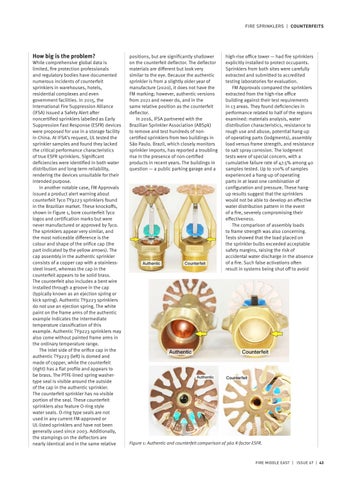
While comprehensive global data is limited, fire protection professionals and regulatory bodies have documented numerous incidents of counterfeit sprinklers in warehouses, hotels, residential complexes and even government facilities. In 2015, the International Fire Suppression Alliance (IFSA) issued a Safety Alert after noncertified sprinklers labelled as Early Suppression Fast Response (ESFR) devices were proposed for use in a storage facility in China. At IFSA’s request, UL tested the sprinkler samples and found they lacked the critical performance characteristics of true ESFR sprinklers. Significant deficiencies were identified in both water distribution and long-term reliability, rendering the devices unsuitable for their intended purpose. In another notable case, FM Approvals issued a product alert warning about counterfeit Tyco TY9223 sprinklers found in the Brazilian market. These knockoffs, shown in Figure 1, bore counterfeit Tyco logos and certification marks but were never manufactured or approved by Tyco. The sprinklers appear very similar, and the most noticeable difference is the colour and shape of the orifice cap (the part indicated by the yellow arrows). The cap assembly in the authentic sprinkler consists of a copper cap with a stainlesssteel insert, whereas the cap in the counterfeit appears to be solid brass. The counterfeit also includes a bent wire installed through a groove in the cap (typically known as an ejection spring or kick spring). Authentic TY9223 sprinklers do not use an ejection spring. The white paint on the frame arms of the authentic example indicates the intermediate temperature classification of this example. Authentic TY9223 sprinklers may also come without painted frame arms in the ordinary temperature range. The inlet side of the orifice cap in the authentic TY9223 (left) is domed and made of copper, while the counterfeit (right) has a flat profile and appears to be brass. The PTFE-lined spring washertype seal is visible around the outside of the cap in the authentic sprinkler. The counterfeit sprinkler has no visible portion of the seal. These counterfeit sprinklers also feature O-ring style water seals. O-ring type seals are not used in any current FM-approved or UL-listed sprinklers and have not been generally used since 2003. Additionally, the stampings on the deflectors are nearly identical and in the same relative
positions, but are significantly shallower on the counterfeit deflector. The deflector materials are different but look very similar to the eye. Because the authentic sprinkler is from a slightly older year of manufacture (2020), it does not have the FM marking; however, authentic versions from 2021 and newer do, and in the same relative position as the counterfeit deflector. In 2016, IFSA partnered with the Brazilian Sprinkler Association (ABSpk) to remove and test hundreds of noncertified sprinklers from two buildings in São Paulo. Brazil, which closely monitors sprinkler imports, has reported a troubling rise in the presence of non-certified products in recent years. The buildings in question — a public parking garage and a
high-rise office tower — had fire sprinklers explicitly installed to protect occupants. Sprinklers from both sites were carefully extracted and submitted to accredited testing laboratories for evaluation. FM Approvals compared the sprinklers extracted from the high-rise office building against their test requirements in 13 areas. They found deficiencies in performance related to half of the regions examined: materials analysis, water distribution characteristics, resistance to rough use and abuse, potential hang-up of operating parts (lodgments), assembly load versus frame strength, and resistance to salt spray corrosion. The lodgment tests were of special concern, with a cumulative failure rate of 47.5% among 40 samples tested. Up to 100% of samples experienced a hang-up of operating parts in at least one combination of configuration and pressure. These hangup results suggest that the sprinklers would not be able to develop an effective water distribution pattern in the event of a fire, severely compromising their effectiveness. The comparison of assembly loads to frame strength was also concerning. Tests showed that the load placed on the sprinkler bulbs exceeded acceptable safety margins, raising the risk of accidental water discharge in the absence of a fire. Such false activations often result in systems being shut off to avoid
Figure 1: Authentic and counterfeit comparison of 360 K-factor ESFR.
FIRE MIDDLE EAST | ISSUE 67 | 43