Exclusively for FM industry leaders August 2026
In this issue: Apex Radio: At the press of a button: how integrated communications are helping FM teams stay connected and safe Industry standard responds to the new Education Estates Strategy launched to future-proof school estates – SFG20
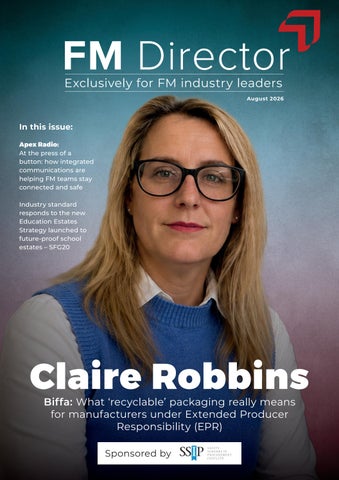
Claire Robbins Biffa: What ‘recyclable’ packaging really means for manufacturers under Extended Producer Responsibility (EPR) Sponsored by
001_COVER_FMDAUG26.indd 3
21/08/2026 10:32
Access Engineers & Façade Maintenance: Committed to Safety First. The Future of Façade Cleaning & Maintenance.
Safe. Compliant. Certified. Skyform Ltd, Unit 1 Denton Wharf, Mark Lane, Gravesend, Kent DA12 2QB
01474 879990
enquiries@skyform.com
August 2026 | 3
EDITOR’S NOTE
Welcome to the August issue of FM Director
T
his month has been as busy as ever for the FM Business Daily team, who has been working hard to bring you a whole host of exclusive interviews and features from some of the key voices of the industry. We have an insightful piece from sustainable waste management company Biffa. In this article, Claire Robbins and Naomi Carlin draw on their day-to-day experience with Biffa, helping manufacturers of all sizes navigate the complex legislation, while environmental journalist Lucy Siegle adds the consumer implications. Moving from waste management to security, we speak to Phil Wynne, Business Development Manager at Apex Radio, about how the demand for integrated solutions combining two-way radios, body-worn cameras and real-time monitoring technology continues to grow across the FM sector and how an award-winning ecosystem approach is setting the company apart. We also have features from PTSG, Daikin Rental Solutions and Keynetics. In addition, we’ve been keeping up with all the latest news in our thriceweekly newsletter, so if you aren’t subscribed already, make sure you sign up today and never miss out on what’s going on, and what we think about it! Subscribe here! I hope you enjoy this edition, and as always, if there is anything you’d like to discuss with me, please contact me at claire.middleton@ businessdailygroup.co.uk. Thanks
C la i r e Middl et on
Exclu siv In this issu
ely for FM
indus try
leaders Augu st
e:
2026
Apex Radi o: At the press of a button: how integrated communica tions are helping FM team s stay connected and safe Industry standard responds to the new Education Estates Strategy launched to future-pro of school estates – SFG20
Claire R
obbins
Bif fa: Wh at ‘rec ycla ble’ packag for manuf acturers ing really under me Responsib Extended Produc ans ility (EPR) er Sponsored
003_INTRO_FMDAUG26.indd 3
by
21/08/2026 10:33
CONTENTS
4 | August 2026
Contents 01482 782287
fmdirector@fmbusinessdaily.com
06 16 What ‘recyclable’ packaging really means for manufacturers under Extended Producer Responsibility (EPR) according to Biffa experts Packaging is one of the most visible sustainability challenges affecting manufacturers and, under EPR, it’s now a financial one. The Recyclability Assessment Methodology (RAM) is central to this – and what it measures might surprise you Managing Editor Claire Middleton
Are Your Staff at Risk of the ‘Office Air’ Effect? What Facilities Managers Need to Know
The viral theory that spending all day in an office is wrecking our skin and hair is all over TikTok. In fact, TikTok Creator Search Insights shows searches for ‘how to fix office air’ have surged in recent weeks, with more than 800,000 searches recorded in a single day alone
Designer and Production Manager Chris Cassidy
24
Why Facilities Management stands out to investors in the age of AI By Joe Austin, Managing Director, Arrowpoint Advisory
Partnerships Manager Phil Loades
Production Editor James Jackaman
Published by FM Business Daily, Linacre House, Dark Lane, Braunston NN11 7HU © 2026 FM Business Daily. All rights reserved. Reproduction of the contents of this magazine in any manner whatsoever is prohibited without prior consent from the publisher. No part of this magazine may be used or reproduced in any manner for the purpose of training artificial intelligence technologies or systems. For subscription enquiries and to make sure you get your copy of FM Director please ring 01482 782287 or email fmdirector@fmbusinessdaily.com The views expressed in the articles reflect the author’s opinions and do not necessarily reflect the views of the publisher and editor. The published material, adverts, editorials, images and all other content is published in good faith.
004-005_CONTENTS_FMDAUG26.indd 4
21/08/2026 10:33
CONTENTS
06
What ‘recyclable’ packaging really means for manufacturers under Extended Producer Responsibility (EPR) according to Biffa experts
12
At The Press Of A Button: How Integrated Communications Are Helping FM Teams Stay Connected And Safe
16
Are Your Staff at Risk of the ‘Office Air’ Effect?
20
Out Of Sight, But Not Out Of Risk: Why Drainage Must Become Part Of The Efficiency Conversation
24
Why Facilities Management stands out to investors in the age of AI
28
Industry Standard Responds To The New Education Estates Strategy Launched To Future-Proof School Estates
32
When 60,000 People Walk Through The Gates
36
Building The Future Of FM
40
The FM Power List
44
The Three-Way Challenge Reshaping Alarm Response Operations
48
Skills shortages aren’t just changing engineering; they’re changing what customers expect
52
Latest Appointments of Senior FM Professionals
004-005_CONTENTS_FMDAUG26.indd 5
August 2026 | 5
12 36 FM Business Daily
40 21/08/2026 10:33
6 | August 2026
RECYCLING
What ‘recyclable’ packaging really means for manufacturers under Extended Producer Responsibility (EPR) according to Biffa experts Packaging is one of the most visible sustainability challenges affecting manufacturers and, under Extended Producer Responsibility (EPR), it’s now a financial one. The Recyclability Assessment Methodology (RAM) is central to this – and what it measures might surprise you
T
hree experts across packaging, compliance and broader sustainability separate fact from assumption. Claire Robbins and Naomi Carlin from sustainable waste management company Biffa draw on their day-to-day experience helping manufacturers of all sizes navigate the complex legislation, while environmental journalist Lucy Siegle adds the consumer implications.
006-010_BIFFA_FMDAUG26.indd 6
21/08/2026 10:37
August 2026 | 7
RECYCLING
Claire Robbins, Head of Producer Compliance at Biffa, on the evolving legislative landscape and ripple effect: “EPR is in its third year of reporting – and the financial reality is materialising. “Large manufacturers will soon receive their first Notices of Liability (NOLs) based on modulated fees from PackUK. Annual costs vary based on volume and type of packaging but can range from £1,000 to £50 million. For producers who haven’t completed the RAM, that invoice may come as a shock. “Producers handling household packaging must complete the Recyclability Assessment Methodology (RAM) using a red, amber, green rating. The result determines your modulated fee – multiplied by tonnage, per packaging type. The more recyclable your packaging, the less you pay. “The wider supply chain is taking notice too, with RAM ratings now a commercial talking point. Retailers monitor performance closely and may reduce payments or cancel contracts with manufacturers whose packaging remains in the ‘red’ category. These retailers have a league table based on outgoing costs and how sustainable a partner is.
006-010_BIFFA_FMDAUG26.indd 7
“If you haven’t started, act now. The RAM is updated annually – we’re currently using RAM 1.1. The latest version has now been released, called RAM 2027. The H1 submission deadline to the Environment Agency (EA) is 1st October 2026 but, as a compliance scheme partner, we need data (including the RAM results) by 28th August 2026. “The H2 submission deadline is 1st April 2027 – but we ask for it 28th February 2027. Assessing your packaging now and identifying ‘red’ materials gives you more time to optimise.”
Producers handling household packaging must complete the RAM using a red, amber, green rating
21/08/2026 10:37
8 | August 2026
Naomi Carlin – Packaging Expert at Biffa – on the RAM’s nuances: “Packaging is designed for the individual product so there’s no one-size-fits-all. The RAM is a strong indicator of how much work needs to be done to improve the recyclability of your packaging in the UK.”
RECYCLING
“Contamination complicates every stage of the RAM too. When general waste enters a recycling bin, it can contaminate the entire load – especially if it’s food or wet waste. At sortation, materials resembling something else contaminate batches. At reprocessing, it’s plastic laminated paper and card that can cause problems for repulping at paper mills.”
What does the RAM look at? “The RAM assesses packaging across four stages: collection, sortation, reprocessing and end market. It evaluates how a format performs across the real recycling system in the UK – and the red, amber, green rating reflects the limitations. “That final stage is crucial. If there’s no end market for the material, the circular economy breaks down and the value of the earlier steps is lost.”
Assessment challenges “The RAM is difficult to complete. The assessment uses highly technical language and requires data that might be new to you. Manufacturers often default to ‘red’ because they lack the proof to score ‘amber’ or ‘green’, driving avoidable costs. “This is where a compliance scheme, paired with packaging technologists like us at Biffa, can alleviate the burden by providing packaging expertise and ensuring accurate, robust reporting.
‘Recyclability’ isn’t what you think it is “The RAM will be an ongoing challenge for manufacturers. It’s a complex assessment to complete, partly because ‘recyclability’ has a broad definition. It’s not just about packaging material – shape and size also matter. If an item is too small, it falls through the sorting screens.
“Larger businesses with packaging technologists and sustainability teams tend to be advantaged compared to smaller manufacturers, but size doesn’t guarantee accuracy. Incorrect specifications from a materials supplier can throw off your entire assessment.”
Collaboration is key “Packaging redesign can make a real difference. We worked with manufacturer Suntory Beverage and Food GB & Ireland to increase the recyclability of its Ribena bottles by significantly reducing the label size. It can now be recycled into the clear plastic waste stream and potentially become another bottle.
“We’re all on the same planet. When it comes to recyclability, you can’t win by competing. Manufacturers working together is an important first step. But the greatest environmental impact will come from businesses across different industries, throughout the supply chain, collaborating.
“Many manufacturers are switching from plastic to paper – a trend known as ‘paperisation’ – in response to consumer pressure. The trouble is, if the shape behaves like plastic at the sorting facility (because it’s 3D, for example) paper can be sorted into the plastic stream. Engaging a waste collector like Biffa at design stage helps you avoid these mismatches.
“Volume matters. The more businesses that flag the same material, the stronger the case for investing in infrastructure to recycle it. One manufacturer acting alone faces higher costs and limited impact. And what they deem waste could be feedstock for another – a circular solution that only arises through partnership.”
“Flexible plastics, such as those used for laundry detergent refills, raise a similar issue. They were brought to market to reduce plastic volume and weight but are mostly ‘multilaminate’ – comprised of several bonded layers – rather than from a single polymer, making them difficult to separate and recycle. “But those layers serve a purpose: blocking moisture, keeping out oxygen, resisting punctures and extending shelf life in ways a single material simply can’t. “In fixing one problem, you can create another – especially when the recycling infrastructure to process these materials is at an early stage and yet to operate at scale.
006-010_BIFFA_FMDAUG26.indd 8
Many manufacturers are switching f rom plastic to paper – a trend known as ‘paperisation’ – in response to consumer pressure
21/08/2026 10:37
SSIP: Compliance Made Efficient Stop the Duplication. Start Saving. Are you a construction supplier wasting time and money on repetitive health and safety pre-qualification assessments?
SSIP (Safety Schemes in Procurement) offers a smarter solution through Mutual Recognition and the “Deem to Satisfy” principle. Key Benefits: Avoid Duplicate Assessments: Get approved by one SSIP Member Scheme, and your certification is recognised by all others.
Save Time & Money: Eliminate redundant administrative work and assessment fees. This process attributed to over £5.5 million in direct savings in 2024 alone.
Boost Client Confidence: Demonstrate commitment to the highest health and safety standards and ensure smoother project collaboration.
Streamlined Compliance: SSIP certification is recognised as an exemption against Section 4 (Health and Safety) of the Build UK Common Assessment Standard (CAS).
SSIP simplifies your compliance, allowing you to focus on delivering safe, high-quality work.
Certify Once. Satisfy Everywhere. Learn more and find your ideal SSIP Member Scheme today: www.ssip.org.uk
10 | August 2026
RECYCLING
Lucy Siegle, an environmental journalist, adds: “As consumers, we’re conditioned to check labels on packaging. It can tell us what went in but not what happens throughout the waste process.
Five things manufacturers should do now:
“It’s understandable for manufacturers to assume that the RAM assesses material in a similar way.
• Review packaging specifications with your materials suppliers
“The RAM is a standalone system, examining the life cycle from collection to end market. Producers must prove their packaging is as recyclable as possible at every stage. “In time, these changes will show up on the packaging consumers handle – raising the stakes for manufacturers.”
006-010_BIFFA_FMDAUG26.indd 10
• Complete your RAM assessment before the end of August (engaging a compliance partner as a priority)
• Remember the RAM is looking at more than materials – shape, size and construction impact your rating • Don’t accept a ‘red’ rating – work with a packaging specialist like Naomi at Biffa to pinpoint why and the feasibility of redesign • Collaborate with other businesses across industries to improve recyclability at scale – Biffa can facilitate this
21/08/2026 10:44
METAL DECKING ASSOCIATION
Elevate Your Business with UKMDA Join the UK Metal Decking Association (UKMDA) and place your business at the forefront of the industry. UKMDA offers a powerful network and essential resources to help your company and contracts be successful.
Why Join UKMDA? Leadership & Influence: Be part of a powerful network that shapes industry standards and works with key bodies like HSE, CITB and CSCS Credibility & Safety: Demonstrate your commitment to excellence with our rigorous audits and access to authoritative safety guidance.
Invest in Your Workforce with UKMDA Training
The UKMDA is committed to raising the bar for safety and competency. Our comprehensive training programs provide your team with the skills and qualifications they need. ore Training: Our scheme covers C all aspects of metal decking and stud welding installation, taught by licensed trainers. ationally Recognised NVQs: N We provide NVQs that allow you and your installers to demonstrate technical competence. A UKMDA-qualified workforce means fewer accidents, greater efficiency, and an enhanced reputation for quality.
Ready to elevate your business? Visit our website or contact us to learn more. info@ukmda.org.uk |
07923 255086
12 | August 2026
ADVERTORIAL
At The Press Of A Button: How Integrated Communications Are Helping FM Teams Stay Connected And Safe
For facilities management teams operating across large estates, complex buildings and high-pressure environments, communication is no longer simply an operational tool – it has become a critical part of workforce safety and incident response
012-015_APEX_FMDAPR26.indd 12
21/08/2026 10:45
ADVERTORIAL
F
rom lone security officers and mobile maintenance engineers to front-of-house teams and control room operators, FM providers are increasingly relying on connected communications systems to improve coordination, speed up response times and better protect frontline staff. With more than 40 years’ experience in the communications industry, Phil Wynne, Business Development Manager at Apex Radio, speaks to FM Director about the demand for integrated solutions combining two-way radios, body-worn cameras and real-time monitoring technology continues to grow across the FM sector and how an award-winning ecosystem approach is setting the company apart. “With FM teams often working across multiple sites and challenging environments, reliable communication is essential,” he says. “It’s not just about efficiency anymore -it’s also about safety, accountability and giving teams the ability to respond quickly when incidents happen.” Founded in 1990, Apex Radio provides critical communications systems for organisations across sectors such as security, construction, education, retail, and facilities management. The company works with major FM providers including Mitie, OCS and ABM.
012-015_APEX_FMDAPR26.indd 13
August 2026 | 13
Communication under pressure For many FM operators, the challenge is no longer simply keeping teams connected - it is ensuring staff can communicate instantly and reliably in environments where safety risks, operational complexity and public interaction are increasing. Two-way radios remain central to that approach because they provide immediate group communication without the delays often associated with phone calls or fragmented messaging systems.
“With FM teams often working across multiple sites and challenging environments, reliable communication is essential
21/08/2026 10:45
14 | August 2026
ADVERTORIAL
“Whether it’s security, maintenance, front-of-house or incident response, teams need to be able to speak to the right people immediately,” Wynne explains. “That ability to coordinate quickly can make a significant operational difference.” Alongside radios, body-worn cameras are becoming increasingly common across FM environments, particularly in security and customer-facing roles. As well as recording incidents, the cameras can act as a visible deterrent against abuse and aggressive behaviour, while also supporting compliance and post-incident investigations. “When used together, radios and body-worn cameras create a far more connected and responsive workforce,” he says.
“At Apex, we look at the role of the individual user, the environment they work in and the level of vulnerability involved,” Wynne says. “Then we work with the FM provider to make sure the technology is appropriate for both the operational requirement and the available budget.” In some cases, the requirement may be relatively straightforward: enabling teams to communicate instantly across a building or estate. In more complex environments, however, communications systems can become part of a much wider safety infrastructure. Apex has delivered integrated solutions within high-security environments including His Majesty’s prisons and immigration removal centres, combining two-way radios with body-worn cameras, lone-worker protection, man-down alerts and livestreaming capabilities linked directly to remote control rooms.
The right solution for the right role A key part of Apex’s approach is designing systems around the operational realities of each site and workforce, rather than deploying a standardised off-the-shelf solution.
012-015_APEX_FMDAPR26.indd 14
“When an alarm is triggered, the system can automatically identify the user, record the communication and stream live footage from the body-worn camera,” Phil explains.
21/08/2026 10:45
ADVERTORIAL
“That allows control room teams to assess the situation immediately and deploy the right response.” For FM providers managing multiple contracts and locations, consistency is also critical. Standardising devices, coverage and user functionality across sites helps reduce training requirements and ensures staff can operate confidently when moving between locations.
Integration driving smarter operations When asked what sets Apex apart from other providers in the market, Phil Wynne was clear: it is the company’s ability to design, deploy and support complete, integrated communication and safety solutions, rather than simply supplying off-the-shelf equipment. “Apex’s strength is being able to bring those technologies together into one operational ecosystem,” he says. For example, if unusual movement is detected on a CCTV system, an alert can be sent automatically to the relevant radio user or response team without operators needing to monitor multiple separate systems simultaneously. The result is a more streamlined operational environment for frontline FM teams, reducing complexity while improving situational awareness and response capability. Supporting those systems is a 24/7 service operation, reflecting the growing expectation that communications infrastructure must remain operational around the clock across critical FM environments.
August 2026 | 15
FM companies like eff icient mobilisation. As soon as a contract is won, they want reliable communication systems f rom day one
“Strong relationships are essential when delivering projects of that size and complexity.” He also points to another advantage of Apex’s established presence within FM: continuity during contract mobilisation and transitions. “FM companies like efficient mobilisation,” he noted. “As soon as a contract is won, they want reliable communication systems from day one. Because we’re already aware of the client and the equipment they’re operating, we can make that transition a great deal smoother.”
Looking ahead National rollout recognised by Motorola Solutions That integrated approach was recently recognised at the highest level, with Apex receiving the Best Ecosystem Solution Deployment award from Motorola Solutions as part of its Empower Circle programme, a distinction that recognises partners who help customers solve critical communications and security challenges. With more than 6,000 dealers participating across Europe, the Middle East and Africa, only one award in the ecosystem category is presented. The award followed a major nationwide deployment delivered in partnership with Mitie across government buildings throughout the UK. The rollout included more than 3,000 two-way radios and 2,500 body-worn cameras, alongside full national radio coverage, remote monitoring capability and live body-worn camera streaming functionality. “The scale of the deployment required close collaboration across operational teams, procurement and support functions,” Phil says.
012-015_APEX_FMDAPR26.indd 15
Looking forward, Apex expects continued growth in push-to-talk over cellular (PoC) technology, which enables radio-style communication over 4G and mobile networks. While the technology offers greater flexibility and scalability, Wynne believes deployment decisions still need to be driven by operational suitability rather than trends alone. “We’re excited about how PoC technology is developing, but it isn’t necessarily the right solution for every environment,” he says. “Some sites still require the resilience and reliability of traditional radio systems, while others may benefit from a hybrid approach.” That measured approach, he believes, reflects the wider direction of the FM sector itself: increasingly connected, increasingly safetyfocused and increasingly reliant on integrated technology to support frontline operations. “Our focus remains on helping FM teams operate more safely, efficiently and confidently,” he says.
21/08/2026 10:45
16 | August 2026
AIR QUALITY
Are Your Staff at Risk of the ‘Office Air’ Effect?
What Facilities Managers Need to Know The viral theory that spending all day in an office is wrecking our skin and hair is all over TikTok. In fact, TikTok Creator Search Insights shows searches for ‘how to fix office air’ have surged in recent weeks, with more than 800,000 searches recorded in a single day alone
016-018_DAIKIN_FMDAUG26.indd 16
21/08/2026 10:45
August 2026 | 17
AIR QUALITY
F
ar more than just a trend, concerns around ‘office air’ are shining a spotlight on indoor air quality in the workplace — and what Facilities Managers (FMs) can do about it. Discover practical tips to help protect the health and comfort of your office occupants, including ensuring adequate humidity control and checking your HVAC systems are performing at their best. We also spoke to Dr Amy Bandy, a board-certified reconstructive surgeon and dermatology specialist, to find out more about the science behind office air and the effects it could be having on your office workers.
What is ‘office air’ – and why should FMs care? The term ‘office air’ may be new, but the science behind it isn’t. Dr Bandy explains that it “refers to an accumulation of common indoor workplace stressors which compromise the integrity of the skin’s protective layer, causing excessive transdermal water loss and inflammation.”
A well-maintained HVAC system helps maintain a comfortable indoor environment
For many office buildings, the default setting is low humidity, recycled air, higher indoor temperatures and poor ventilation. But this situation is directly affecting how occupants feel and perform at work. FMs should be aware of these negative effects when it comes to office worker wellbeing and building performance.
What causes ‘office air’? As Dr Bandy explains, “There are multiple causes within the workplace that contribute to office air,” including: • Dry air, often produced by recycling or air conditioning • High heat, particularly during the colder months when workers want to be warm • Poor ventilation, thanks to a lack of windows and effective HVAC systems • Extended blue-light exposure, particularly in areas that suffer from a lack of natural light • Chronic low-grade stress, which is easily heightened by an uncomfortable working environment. These conditions all add to up a negative experience for workers, especially when it comes to their skin – causing dryness, irritation, breakouts, scalp issues and more. As Dr Bandy says, “Increased oil production occurs as the body’s response to replace lost moisture, which explains why those who work in offices often develop breakouts. “Additionally, elevated stress in the work environment can increase cortisol levels, potentially worsening inflammation, acne and hair shedding over time. Indoor humidity can cause dryness in both the hair shaft and scalp, resulting in frizz, unbalanced oils and an irritated scalp.”
016-018_DAIKIN_FMDAUG26.indd 17
21/08/2026 10:45
18 | August 2026
AIR QUALITY
So, while these issues might seem cosmetic at first glance, getting them right is actually crucial for the wellbeing of office workers and the optimal performance of a business.
So, what should FMs do to improve the conditions in office buildings? Take a look at some of the practical measures you can do today:
How can FMs protect against ‘office air’?
Audit humidity levels: Survey occupants or invest in humidity sensors to ensure optimum air quality in all areas of the building. This can also help you identify problem areas.
Improving air circulation is essential. Ensuring your HVAC systems is performing at optimum levels is essential in the fight against the effects of ‘office air’. Mike England, UK rental manager and HVAC expert at Daikin Rental Solutions, says: “When it comes to office air, a lot of the symptoms that workers are describing comes down to poorly regulated humidity and ventilation. “A well-maintained HVAC system helps maintain a comfortable indoor environment by balancing humidity, filtering airborne particles and improving air circulation. While there are many factors that influence how people feel in the workplace, indoor air quality can play a bigger role than many realise.”
A lot of the symptoms that workers are describing comes down to poorly regulated humidity and ventilation
016-018_DAIKIN_FMDAUG26.indd 18
Review ventilation: Make sure all occupants are working in wellventilated areas and audit your HVAC system to ensure it’s working properly across all areas of the building. Maximise natural light: Particularly important in break-out and relaxation spaces, ensure your office is flooded with as much natural light as possible. Providing occupants with spaces where they can step away from screens and blue light is also beneficial. React to the seasons: If your HVAC system struggles during periods of temperature extremes, consider a flexible rental solution to ensure occupant comfort year-round. Schedule regular HVAC maintenance: Well-maintained HVAC systems last longer and perform better – providing all occupants with the fresh, clean air they deserve. Ensure yours is checked by an expert at regular intervals throughout the year. Addressing the air quality in your office isn’t a luxury – it directly supports productivity, employee attendances, occupant wellbeing and more. ‘Office air’ may be a viral TikTok phrase, but the science behind it is real. Thankfully, FMs can help fix the problem with the right ventilation, air circulation and proper building management.
21/08/2026 10:45
Supporting Men. Supporting the Environment. The Male Incontinence Bin joins the Revive range The phs Male Incontinence Bin is now made from 100% recycled plastic, with waste turned into renewable energy through the phs LifeCycle Strategy.
Explore the ReVive Range
Why it matters Thousands of men quietly manage incontinence every day yet most workplaces still don’t provide an appropriate way to dispose of products in men’s washrooms. Installing a dedicated bin is a simple, low cost solution that:
Supports dignity and inclusion
Improves washroom hygiene
Demonstrates visible commitment to employee wellbeing
For more information get in touch today! Introducing the new ReVive Range from phs
www.phs.co.uk/revive
20 | August 2026
DRAINAGE
Out Of Sight, But Not Out Of Risk:
Why Drainage Must Become Part Of The Efficiency Conversation By Lee Carlin, Group CEO of LDF Group
W
hen organisations think about water efficiency, attention is usually focused on what can be seen. Consumption data, leaks, taps, washrooms and water-saving technologies often dominate the conversation.
020-023_LDF_FMDAUG26.indd 20
However, one area continues to receive far less attention despite playing a critical role in overall performance: drainage infrastructure. For many organisations, drainage remains largely invisible. It sits beneath buildings and is rarely considered until something goes wrong.
21/08/2026 10:46
August 2026 | 21
DRAINAGE
But as pressures on the UK’s water resources continue to rise, that reactive mindset is becoming increasingly outdated. The UK is facing a significant water challenge. Water companies lose billions of litres of treated water every day through leaks, while projections suggest demand will continue to grow in the coming decades. In fact, research indicates that England could face a daily public water shortfall of nearly five billion litres by 2055, highlighting the urgent need for organisations to improve efficiency wherever possible. At the same time, businesses are under mounting pressure to improve sustainability performance, manage resources more efficiently and reduce unnecessary costs. Against that backdrop, it is becoming increasingly important to look beyond visible water consumption and consider the role that drainage systems play in overall water management.
An overlooked part of the sustainability picture Drainage infrastructure is not usually associated with water conservation. In reality, it often forms a critical part of how efficiently buildings manage water day-to-day.
020-023_LDF_FMDAUG26.indd 21
Poorly maintained drainage systems rarely fail overnight, instead, they gradually become less effective as debris, fats, grease, silt and other materials accumulate within the pipework. Performance declines slowly, often without being noticed, until the system reaches a tipping point. By then, organisations are frequently dealing with far more than a simple maintenance issue.
Research indicates that England could face a daily public water shortfall of nearly f ive billion litres by 2055
21/08/2026 10:46
22 | August 2026
DRAINAGE
Reduced system performance can contribute to increased wastewater costs, operational disruption, emergency repairs and avoidable resource consumption. The challenge is that these inefficiencies often remain hidden for months, or even years. Unlike a leaking tap or a visible pipework defect, drainage issues develop beneath the surface where they are difficult to identify without proactive inspection. As a result, many businesses continue operating with systems that are underperforming without even realising it.
Increasing pressure from changing weather patterns The challenges facing drainage infrastructure are also being amplified by changing environmental conditions. Across the UK, businesses are experiencing longer periods of hot weather alongside frequent episodes of intense rainfall. Both events place additional pressure on drainage systems. During hotter conditions, fats, grease and other waste materials can accumulate more quickly within drainage networks. As those deposits build, flow rates are reduced and systems must work harder to perform effectively. When heavy rainfall follows prolonged dry periods, drainage networks can experience sudden surges in demand. Systems that are already operating below capacity are often less able to cope with these changes, increasing the risk of blockages, flooding and service disruption. This is particularly relevant for high-use environments such as retail centres, leisure facilities, healthcare estates, hospitality venues and large commercial buildings, where drainage performance has a direct impact on daily operations. The reality is that weather-related pressures are no longer occasional events, they are becoming part of the operating environment that facilities managers and building operators must plan for.
The cost of a reactive approach Despite these growing pressures, drainage maintenance is still commonly treated as a reactive issue. For many businesses, intervention only occurs where there is a blockage or overflow. By this point, the focus is no longer on efficiency or asset management, but on resolving an urgent problem as quickly as possible. The consequences of this can be significant. Emergency callouts, business disruption, temporary closures, lost productivity and reputational damage can all follow what initially appears to be a localised drainage issue. More importantly, reactive maintenance often means opportunities for early intervention have already been missed. Drainage systems typically provide warning signs before failure occurs. Slower drainage, recurring blockages, unpleasant odours and changing system performance frequently indicate underlying issues that could be addressed through planned maintenance. Unfortunately, because these warnings signs can appear relatively minor, they are often overlooked until a larger problem develops.
020-023_LDF_FMDAUG26.indd 22
21/08/2026 10:46
August 2026 | 23
DRAINAGE
Visibility creates control The organisations most successfully managing drainage risk are not necessarily spending more, instead they are creating greater visibility of their infrastructure and making more informed decisions as a result. Technologies such as CCTV inspections allow facilities teams to assess the internal condition of drainage systems without excavation or disruption. Issues including structural defects, heavy build-up and early-stage blockages can be identified long before they begin to deteriorate. Advances in monitoring technology are also helping organisations understand how their systems are performing over time, providing early warning when conditions begin to deteriorate. Combined with planned maintenance programmes, these technologies allow businesses to move away from firefighting issues and towards a more controlled, preventative approach. Ultimately, the goal here is not simply to avoid failure, instead, the goal should be to ensure systems continue operating at their intended level of performance while reducing unnecessary costs and inefficiencies.
Looking ahead For too long, drainage has sat outside the strategic maintenance conversation. Yet its influence on operational performance, sustainability and risk management makes it one of the most important assets organisations rarely think about.
020-023_LDF_FMDAUG26.indd 23
For facilities managers and building operators, this presents both a challenge and an opportunity. Those that continue to treat drainage as a reactive issue may find themselves facing greater disruption, higher costs and reduced operational resilience. Those that take a preventative approach will be better positioned to improve efficiency, reduce risk and support wider sustainability objectives. Drainage may remain out of sight, but it shouldn’t be out of mind. As organisations continue to look for new ways to improve performance and reduce waste, one of the most important opportunities may be sitting directly beneath their feet.
During hotter conditions, fats, grease and other waste materials can accumulate more quickly within drainage networks
21/08/2026 10:46
24 | August 2026
AI
Why Facilities Management stands out to investors in the age of AI By Joe Austin, Managing Director, Arrowpoint Advisory
T
he debate about artificial intelligence and the services economy often begins with substitution. Which tasks can be automated, which roles can be reduced, and which business models will come under pressure as software becomes more capable? The impact of AI in facilities management is creating a different effect. Although automation is important and has driven technological adoption across the sector – particularly in data collection and predictive maintenance – increasing AI adoption has impacted investor interest in the sector in two distinct ways.
024-026_ARROWPOINT_FMDAUG26.indd 24
First, as many investors look for ways to hedge against software and AI exposure, the relative appeal of physical, field-based technical services that are difficult to replace with software has increased. Second, to meet the increasing demand on compute and cloudbased services, there has been huge amounts of investment in AI infrastructure, boosting demand for facilities management providers operating in this segment. The level of M&A activity reflects this trend. In the second quarter of 2026, 50 facilities management transactions across the UK and Ireland were executed, 31% above the long-term quarterly average.
21/08/2026 10:49
AI
August 2026 | 25
Technology will still reshape the sector, but mainly by augmenting its workforce and improving delivery
Private equity remains active through both new platform investments and ongoing buy-and-build strategies, despite continued macroeconomic and geopolitical uncertainty. Recent transactions involving Ranger Fire & Security and Inflexion, and City Group Security and OCS, underline the breadth of buyer interest across the sector. The physical work involved in maintaining buildings and critical infrastructure cannot be delivered by software alone. Fire and life safety systems still need to be installed, tested and maintained. Electrical infrastructure, heating & cooling systems, lifts, water systems and access controls require skilled people on site. Regulation and compliance also create recurring obligations and help to insulate demand from wider economic cycles. That combination has made technical facilities services an increasingly credible AI hedge for investors seeking to reduce their exposure to parts of the white-collar services economy where substitution risk is perceived to be greater.
024-026_ARROWPOINT_FMDAUG26.indd 25
Technology will still reshape the sector, but mainly by augmenting its workforce and improving delivery rather than removing the need for the underlying service. The second opportunity is more direct. AI needs an expanding base of physical infrastructure, most visibly in data centres. In the UK, £45bn of private investment has been committed to data centres since July 2024, with the UK data centre pipeline worth approximately £36.4bn in planned projects as of August 2025, covering nearly 100 data centre developments across the country. Their rapid rollout is increasing demand for specialist cooling, electrical resilience, backup power, fire protection and critical engineering maintenance. These are essential capabilities in complex environments where reliable performance matters. The sale of Senseco Systems to Andwis offers a useful example. Backed by Foundation Investment Partners since 2019, Senseco built scale through organic growth and seven strategic acquisitions, developing into the UK’s most highly accredited independent fire and life safety platform.
21/08/2026 10:49
26 | August 2026
AI
Its work installing and maintaining complex fire systems in critical environments and its focus on recurring service maintenance contracts bring together many of the characteristics buyers value. The acquisition strengthens Andwis’ fire safety capabilities, adds national coverage and creates cross-selling opportunities across its wider technical building services portfolio. For facilities management providers with the right technical skills, accreditations and geographic reach, data centres therefore represent a significant growth market. They also reinforce many of the characteristics investors already value: critical end-market exposure, high service standards and recurring maintenance requirements. Technology is, of course, changing the rest of the built environment too. Sensors and connected systems are enabling remote, real-time monitoring, predictive maintenance, automated controls and better building optimisation. A provider that can identify a problem before equipment fails offers a very different proposition from one that simply responds after the event. The strongest operators will combine digital tools with engineers and technicians, using data to deploy skilled people more effectively, improve service visibility and deliver more consistent outcomes for customers. Scale matters here because investment in systems, training and management capability is easier to sustain across a broader platform.
AI is creating new inf rastructure that must be powered, cooled, protected and maintained
Public-market valuations reflect the opportunities in the sector. Hard facilities management companies trade at a premium to soft facilities management peers, supported by longer-term contracts, more skilled workforces, more defensible margins and clearer compliance drivers. Investors are currently willing to pay slightly more for hard facilities management businesses. The typical listed hard FM company is valued at around £9.90 for every £1 of annual underlying earnings, compared with £9.10 for a soft FM company. The sector nevertheless faces intensifying pressure from labour, materials and energy costs. Higher employer National Insurance contributions and the National Living Wage have made workforces more expensive, while wider volatility continues to affect input costs. Pricing discipline, operational efficiency and investment in technology will become increasingly important, potentially widening the gap between smaller providers with limited resources and scaled platforms able to professionalise their operations and invest for the long term. For founders and management teams, the message is increasingly clear. Buyers will place the greatest value on businesses with multiyear recurring revenues, exposure to critical end markets, skilled and experienced teams, technology-enabled operations and a credible route to greater scale. The opportunity created by AI is therefore selective. Investors will continue to distinguish between businesses that are merely exposed to a resilient sector and those that have built genuinely defensible platforms. As automation creates uncertainty across parts of the services economy, essential work rooted in the physical world becomes more attractive. At the same time, AI is creating new infrastructure that must be powered, cooled, protected and maintained. Facilities management now offers an unusual combination of defensive qualities and exposure to structural growth. For investors, that combination is becoming increasingly difficult to ignore.
024-026_ARROWPOINT_FMDAUG26.indd 26
21/08/2026 10:49
FASET & CSCS:
Setting the Benchmark for Temporary Safety System Competence As the premier body for Temporary Safety Systems, FASET is dedicated to ensuring unparalleled safety standards across the industry. We achieve this through our robust partnership with CSCS, delivering comprehensive training, rigorous assessment, and the issuance of industryrecognised competency cards.
The Future is Digital: Benefits for FASET-Qualified Operators All our qualifications now exclusively issue digital cards, offering a wealth of benefits:
Convenience: Easily add new qualifications as you progress.
Security: Enhanced protection against loss or forgery.
Streamline Your Checks: For Employers and Site Supervisors Verify an operator’s competency instantly! Download the CSCS Smart Check App to your mobile device. ADs.indd 1
Stay Updated: Receive timely alerts for expiry dates and crucial safety notifications.
enquiries@faset.org.uk 01948 780652
www.faset.org.uk
20/06/2025 10:23
28 | August 2026
SCHOOL MAINTENANCE
Industry Standard Responds To The New Education Estates Strategy Launched To Future-Proof School Estates With rising costs putting increasing pressure on schools, SFG20 explores how a more strategic, long-term approach to estate management can help schools overcome today’s biggest maintenance challenges
028-030_SFG20_FMDAUG26.indd 28
21/08/2026 10:49
SCHOOL MAINTENANCE
S
chools across the UK are facing an estimated £13.8 billion maintenance backlog, according to the January 2025 National Audit Office (NAO) report.* However, as this figure is based on data collected between 2017 and 2019, the true scale of the challenge is likely to be even greater today.
While this may provide short-term savings, it’s often more expensive in the long run. Deferred maintenance can lead to major asset failures, operational inefficiencies, and significantly higher repair costs. The Cabinet Office estimates that delaying backlog maintenance can increase costs by over 1.5 times within just 2-4 years.
Years of underinvestment, ageing infrastructure and rising costs have left many schools struggling to keep up with essential maintenance, increasing safety risks for both students and staff. With many schools having limited teams to manage both the outsourced work and the day-to-day work themselves, schools are fighting against educational priorities for budget and resources, all amid skill gaps and recruitment challenges.
Ageing infrastructure and deteriorating buildings
Recognising these challenges, the recently published Education Estates Strategy sets out a 10-year plan to transform the condition of England’s schools and colleges. The strategy aims to improve the management of school estates by bringing together long-term planning and clearer standards, with a greater focus on condition need, risk, and resilience. Against this backdrop, Marc Dabbs, facilities management expert at SFG20, the industry standard for school building maintenance, explores the three biggest estate management challenges facing education estates today and how the DfE’s new strategy can help schools overcome them.
Prioritising costly day-to-day spending over Planned Preventative Maintenance Budget pressures have become a widespread challenge across the education sector, with essential maintenance often delayed or deprioritised in an effort to reduce costs. As a result, many schools have been forced to prioritise day-to-day operational spending over Planned Preventive Maintenance (PPM).
028-030_SFG20_FMDAUG26.indd 29
August 2026 | 29
Many schools are also dealing with ageing infrastructure, with critical systems such as roofs, electrical wiring and HVAC systems reaching or exceeding their intended lifespan. As buildings continue to age, the demand for maintenance and repairs only increases, placing further strain on budgets. Relatively minor issues can quickly escalate into more significant safety, operational and compliance risks, resulting in greater disruption and higher long-term costs.
Limited resources and skills shortages According to SFG20’s State of FM Survey 2026 report, 51% of organisations cited understaffing in their FM teams.
Schools are f ighting against educational priorities for budget and resources, all amid skill gaps and recruitment challenges
21/08/2026 10:49
30 | August 2026
SCHOOL MAINTENANCE
Alongside financial pressures, many schools also face a shortage of time, resources, and specialist expertise to manage their estates effectively. With limited staff and increasing demands, it’s more difficult to plan maintenance and ensure ongoing compliance. These staffing shortages reflect a broader issue in the wider building maintenance industry: the need for skilled FM professionals is growing, but recruitment is not keeping up with the demand. As a result, FM teams are often overstretched, leading to reduced efficiency and the increased risk of operational failures. This is felt strongly in schools and is made more challenging with the scale of the backlog.
How can schools’ estate management teams work with the new government guidance to avoid compliance and safety issues? “While the maintenance backlog cannot be solved overnight, schools can take practical steps to improve the management of their estates. “The Department for Education has introduced the School Estate Management Standards and an estate management competency framework to help improve consistency and support more effective estate management across the education sector.
028-030_SFG20_FMDAUG26.indd 30
“Combined with the Education Estates Strategy, this places greater emphasis on long-term planning, robust estate data and effective governance to help schools better manage their estates. “Rather than relying on reactive ‘patch-and-mend’ maintenance, schools are encouraged to build strong data foundations, with accurate asset registers, condition data, maintenance schedules and compliance evidence. Schools that get these foundations right will be better placed to manage risk, demonstrate compliance, secure future funding and, ultimately, run safer buildings for students and staff. “As the industry standard, SFG20 helps schools respond to the new strategy by identifying the correct maintenance tasks needed across their building assets and creating a more consistent approach to planned maintenance. “Supported by robust maintenance regimes aligned to recognised guidance and accurate asset and condition data, schools can improve compliance, reduce risk and maintain safer, more resilient estates. “To learn more about responding to the Education Estates Strategy and building more resilient school estates, download SFG20’s e-guide here.”
21/08/2026 10:49
FM Business Daily
Smarter. Slicker. More Targeted. Presenting FM Business Daily 2.0. FM is evolving... so are we! As part of our new look, Business Daily will provide smarter, more targeted news and insights three times per week, on Mondays, Wednesdays and Fridays.
The all-new FMBD newsletter Three per week • Monday: hard services and construction focus • Wednesday: soft services focus • Friday: a combo of the week’s biggest stories, video interviews and exclusive features from across the FM industry
As our name – FM Business Daily – suggests, we’re still updating our website every single day with all the latest stories and updates from all the FM sectors. Check it out to stay in the loop! We hope you are as excited as we are about the new look FMBD newsletter, and we’d love you to get in touch if there’s anything you’d like to discuss or feature in an upcoming issue.
Subscribe here
32 | August 2026
ADVERTORIAL
When 60,000 People Walk Through The Gates Why Stadia And Event Venues Need A Different Kind Of Compliance Partner
S
ixty thousand people arrive. Turnstiles click into life. Kitchens begin serving thousands of meals. Floodlights, CCTV, scoreboards and hospitality suites all switch on. Within 90 minutes, one of the UK’s most complex buildings has become one of its busiest. What supporters rarely see is the infrastructure making that possible.
032-038_PTSG_FMDAUG26.indd 32
Fire detection, electrical systems, lightning protection, water hygiene, roof safety and structural integrity all have to work together before the first whistle and long after the final one. Most venues manage those responsibilities through multiple specialist contractors. Fire from one company. Water from another. Roof access from a third. Every contractor manages their own discipline.
21/08/2026 10:50
ADVERTORIAL
Nobody owns the spaces between them. That’s where risk lives. For venue operators, fragmented compliance creates duplicated visits, disconnected reporting and the potential for critical gaps. When tens of thousands of people are on site, compliance isn’t simply about meeting regulations. It’s about protecting people, safeguarding reputation and ensuring every event runs exactly as planned. PTSG supports stadia and event venues through a dedicated team that brings together expertise from across its five specialist divisions, providing a single, joined-up approach to compliance.
August 2026 | 33
Major works have to fit around fixtures, concerts and tournaments, with the close season providing a narrow window to complete programmes
A Changing Compliance Landscape The challenge has become even greater since the introduction of the Terrorism (Protection of Premises) Act 2025, better known as Martyn’s Law. Major UK stadiums fall within the Act’s enhanced duty requirements, meaning operators will need robust public protection measures covering security systems, monitoring, access control and emergency response planning alongside existing obligations for fire safety, electrical compliance and structural integrity. With implementation expected during the next two years, many venues are already reviewing how they manage compliance across increasingly interconnected disciplines.
032-038_PTSG_FMDAUG26.indd 33
Working To The Sporting Calendar Unlike many commercial buildings, stadiums cannot simply close for maintenance. Major works have to fit around fixtures, concerts and tournaments, with the close season providing a narrow window to complete programmes that protect venues for years to come. PTSG has extensive experience delivering within those demanding timescales. At Celtic Park, PTSG Building Access Specialists completed structural inspections and steelwork painting beneath the East Stand across successive close seasons using bespoke lateral access techniques.
21/08/2026 10:50
34 | August 2026
P p
ADVERTORIAL
Y y At Heart of Midlothian, engineers repainted high-level roof trusses during a six-week pitch refurbishment programme. At Everton’s new Bramley-Moore Dock stadium, PTSG Access & Safety installed almost one kilometre of freestanding aluminium guardrail and Latchways ManSafe systems to provide safe access for future maintenance. Meanwhile, PTSG Electrical Services has maintained the lightning protection system at The Queen’s Club since 2011, including delivering a full system upgrade to support increased capacity while respecting the character of the historic clubhouse.
Different venues. Different challenges. One common requirement: delivering complex compliance work without disrupting major sporting events
032-038_PTSG_FMDAUG26.indd 34
Different venues. Different challenges. One common requirement: delivering complex compliance work without disrupting major sporting events.
Beyond Match Day The work doesn’t stop when the crowds leave. Fire damper testing. Kitchen extract cleaning. Legionella management. CCTV and access control. Electrical inspections. Lightning protection. Roof safety systems. Managed separately, these services create unnecessary complexity. Managed together, they create confidence. PTSG coordinates more than 170 specialist services across Fire Solutions, Electrical Services, Water Treatment, Building Access Specialists and Access & Safety through one programme, one point of contact and one compliance record.
Y w m
Supporters judge a stadium by the 90 minutes they spend inside it. Venue operators know success is built during the other 364 days of the year. Compliance is what makes those 90 minutes possible. For stadia and event venue managers looking for a genuinely joined-up approach to compliance, the conversation starts here.
21/08/2026 10:50
PTS
PTSG is a place where...
You can shape your own future
Your well-being matters
You will always be treated fairly Advert and with respect
Remuneration reflects the critical nature of the work we undertake
UNLIMITED OPPORTUNITIES Join one the UK’s fastest growing businesses. We’ve a variety of leadership, services and engineer roles available right now!. Apply today and let’s create something extraordinary together! #UnlimitedPotential #JoinTheTeam #EndlessOpportunities
www.ptsg.co.uk
PTSGrecruitment_B.indd 1 032-038_PTSG_FMDAUG26.indd 35
19/06/2026 10:50 11:25 21/08/2026
36 | August 2026
ADVERTORIAL
Building The Future Of FM Inside PTSG’s Centre of Excellence and its investment in the skills, people and next generation the industry needs
“T
his building belongs to every colleague, every customer and every apprentice. This is where we’re going to develop skills. This is where we’re going to give people opportunities.” Those were the words of PTSG CEO Greg Ward when the Group officially opened its new Centre of Excellence in Manchester this summer. But the significance of the Centre goes well beyond the opening of a new training facility. Across facilities management and the wider built environment, attracting people into technical careers, developing specialist skills and creating clear routes for progression remain critical challenges. For Premier Technical Services Group Ltd (PTSG), the answer is to invest directly in the people who will shape the future of the business and the industry.
More than a building
It represents a significant investment in training, development and the long-term skills capability of the business. As Greg explained at the opening: “This isn’t just about opening a building. This is about creating new opportunities for our colleagues, our customers and all the young people and apprentices who are going to join PTSG.
Attracting people into technical careers, developing specialist skills and creating clear routes for progression remain critical challenges
Based at Alma House in Middleton, Manchester, PTSG’s Centre of Excellence has been reimagined to provide apprentices, engineers and colleagues from across the Group with a dedicated environment for hands-on, practical learning.
032-038_PTSG_FMDAUG26.indd 36
21/08/2026 10:50
ADVERTORIAL
PTSG Chairman and Co-Founder Paul Teasdale officially opened the Centre in July, marking another milestone in the Group’s continued investment in its people.
It provides a dedicated environment where existing colleagues can develop their skills, engineers can undertake practical training and expertise can be shared across the Group.
Creating the skills the industry needs
That matters in an organisation delivering more than 170 specialist services across five divisions, where maintaining technical competence, safety standards and consistency is fundamental to the service customers receive.
The Centre comes at an important time for PTSG. The Group has launched its biggest-ever apprenticeship recruitment campaign, with plans to recruit up to 50 apprentices each year and create opportunities for around 150 apprentices over the next three years.
August 2026 | 37
Learning by doing Those opportunities will span engineering, compliance and specialist services, giving young people the chance to build careers in an industry where technical expertise and practical experience are increasingly valuable. But the Centre isn’t exclusively about apprentices.
032-038_PTSG_FMDAUG26.indd 37
The emphasis is deliberately practical. Rather than relying solely on classroom-based learning, the Centre gives people the opportunity to develop their skills in an environment designed around the work they will encounter in the field.
21/08/2026 10:50
38 | August 2026
ADVERTORIAL
It is an approach that reflects Greg Ward’s own career journey, which began as an apprentice. His belief is simple: nobody starts as an expert. People become experts when organisations give them the opportunity to learn, ask questions, gain practical experience and continue developing throughout their careers. That philosophy now sits at the heart of the Centre of Excellence.
It is about developing capability within PTSG, creating clearer career pathways and ensuring knowledge and expertise can be passed from one generation to the next.
The real work starts now The ribbon may have been cut in July, but in many ways that was only the beginning.
Investing in people The development of the Centre itself was a significant undertaking. That investment is ultimately about creating something with a much longer lifespan than the building itself.
The Centre gives people the opportunity to develop their skills in an environment designed around the work they will encounter in the field
032-038_PTSG_FMDAUG26.indd 38
The Centre is now becoming a place where apprentices start careers, experienced colleagues develop new capabilities and people from across PTSG come together to learn and share knowledge. PTSG is also finalising an autumn programme of activity for colleagues, clients and partners, opening up the Centre of Excellence as a place to connect, collaborate and share expertise, as well as learn. The programme will bring people from across the Group and wider industry into the Centre, making full use of the investment and creating opportunities to share knowledge, develop skills and strengthen relationships. For an industry facing an ongoing challenge around skills, recruitment and succession, facilities such as this demonstrate what long-term investment in people can look like. This autumn, the next chapter begins.
21/08/2026 10:50
FM Business Daily
7am
The definitive FM industry newsletter Monday Hard services and construction focus Wednesday Soft services focus Friday A combo of the week’s biggest stories, video interviews and exclusive features from across the FM industry Subscribe here
40 | August 2026
FM POWER LIST
FM Business Daily
The FM Power List: The Talent Keeps Coming
T
he Facilities Management sector is built on people. The ones who show up, make decisions and drive things forward: often without the recognition they deserve.
The FM Power List exists to change that. Created by FM Business Daily, the FM Power List is a definitive showcase of the men and women setting the pace across the UK’s facilities management sector. Not a directory. Not a marketing exercise. A carefully curated record of influence, built around the people who are genuinely shaping the future of this industry. As we feature our fourth selection of Power List profiles in FM Director, the picture continues to grow richer: another set of impressive individuals whose expertise, drive and impact reflect just how much talent this sector holds. From boardroom strategists to operational innovators, every profile tells a different story. But the common thread remains the same: these are individuals who lead, inspire and set the standard others follow. We are proud to continue shining a spotlight on them. These are their stories. Simon Taylor, Executive Director, FM Business Daily
Want to be featured on the FM Power List? Visit fmpowerlist.co.uk to secure your place among the industry’s most influential leaders. FM Business Daily
040-043_FMLIST_FMDAUG26.indd 40
21/08/2026 10:57
FM POWER LIST
August 2026 | 41
FM & Services Director
Samantha Young Samantha Young is FM & Services Director at Sodexo, bringing more than 20 years of experience in facilities management and a proven track record of delivering integrated FM solutions for leading global organisations. Throughout her career, she has specialised in creating high-performing, customer-focused service models that support both operational excellence and long-term business objectives. Key Services: Food, Facilities Management services
Read more...
Director of Growth EMEA
Christian Berenger Christian is Director of Growth EMEA at WorkWave UK Limited, a leading provider of workforce management software purpose-built for labour-intensive, mobile-first service sectors including contract cleaning, security and manned guarding, and facilities management. WorkWave’s platform helps FM and service-sector operators plan, schedule, dispatch and track their frontline workforce in real time — replacing manual processes and disconnected systems with a single source of operational truth. Key Services: Workforce Management software for the Cleaning, Security and Total Facilities Management sectors
Read more...
Founder - Empro Business Group
Emma Armstrong Emma is the Founder of Empro, a specialist consultancy helping corporate clients rethink how they buy, mobilise, and manage facilities management. Most FM contracts underperform because they were procured against yesterday’s brief and mobilised in a hurry. Empro fixes both. We advise on FM strategy and tendering, run complex mobilisations and TUPE transfers, and select the workplace technology that actually gets used, backed by our proprietary TupeMe platform. Key Services: FM Outsourcing & Tender Strategy · Mobilisation & TUPE Transfers · CAFM & Workplace Technology · Interim FM Leadership
Read more...
040-043_FMLIST_FMDAUG26.indd 41
21/08/2026 10:57
42 | August 2026
FM POWER LIST
Principal Consultant - Russell Taylor Group
Simon Barlow Simon Barlow is Principal Consultant at Russell Taylor Group, specialising in recruitment across facilities management, building services, engineering, construction, and property sectors. With hands-on operational experience within both construction and FM before moving into recruitment, Simon brings a deep technical understanding of the roles, challenges, and skills required across the industry. Key Services:
Recruitment Solutions
Read more...
Managing Director – Hard Services (UK) – OCS
Nick Maggs With over 27 years of experience in the infrastructure facilities management industries, including leadership roles at Amey and Enterprise, Nick brings a wealth of knowledge to the OCS team. He has a proven track record of leading and growing businesses, managing acquisitions and divestments, and overseeing large-scale integrations. Key Services:
OCS provides integrated facilities services, including cleaning, Hard Services, security, catering, pest control, engineering, and total facilities management.
Read more...
Group Managing Director - Sasse UK
Benny Wunderlich Benny Wunderlich is Group Managing Director of Sasse UK, where he has played a central role in transforming the business into one of the UK’s leading integrated facilities management providers. With a background in Economics, Benny has spent the past 16 years building the UK operation of the Sasse Group from the ground up, driving sustained organic growth alongside a series of strategic acquisitions. Key Services: Integrated FM Services, Cleaning, Hygiene and Support Services, Fabric Maintenance, Projects, Passive Fire Protection, Planned Preventative Maintenance (PPM), Reactive Maintenance, M&E services
Read more...
040-043_FMLIST_FMDAUG26.indd 42
21/08/2026 10:57
FM POWER LIST
August 2026 | 43
Managing Director - Business Moves Group (BMG)
Rachel Houghton Rachel Houghton is Managing Director of Business Moves Group (BMG), bringing more than 25 years of experience within the relocation and estate management sector. Having joined the business in 1998 and progressed through a range of operational, commercial, and leadership roles, she has played a central role in shaping BMG into one of the UK’s leading commercial relocation specialists. Key Services:
Workplace Solutions, Storage Solutions
Read more...
Managing Director - Hey Girls CIC
Chris Shutt Chris Shutt is Managing Director of Hey Girls CIC, the award-winning social enterprise tackling period poverty through purpose-led business and social impact initiatives. With more than 15 years’ experience spanning social enterprise, technology, and innovation, he is recognised for combining strategic leadership with a deeply people-centred approach to organisational growth. Key Services:
Hygiene, Washroom Solutions
Read more...
Senior Vice President and President - ABM UK and Ireland
Richard Sykes Richard Sykes is a growth-minded leader currently serving as Senior Vice President and President of ABM UK & Ireland. Since taking on the role in May 2023, he has focused on strengthening internal operations, expanding the client base, and creating new opportunities for team members at every level. With a vision for ambitious growth, Richard understands that sustainable and responsible practices are essential to building a resilient industry and scalable business. His recognition on the Involve Top 20 list of OUTstanding Advocates and Role Models further reflects his commitment to inclusive and forward-thinking leadership. Key Services:
Integrated Facility Services, Engineering & Technical Solutions, Infrastructure Services, Aviation Support Services, Workplace Experience, Energy & Sustainability Solutions
Read more...
040-043_FMLIST_FMDAUG26.indd 43
21/08/2026 10:57
44 | August 2026
SECURITY
The Three-Way Challenge Reshaping Alarm Response Operations The role of access control in balancing response times, rising costs and ESG pressures in mobile response Stuart Wheeler, Managing Director at Keynetics, the company behind the smart keyholding solution SentriGuard, explores how operational pressures surrounding alarm response are forcing security providers to rethink traditional keyholding models and reassess the role access management now plays within modern mobile response operations
T
he operating environment surrounding alarm response has changed significantly over the past couple of decades. Client requirements are rising and, with them, the pressure on security providers to rethink how mobile response operations are delivered in practice.
044-047_KEYNETICS_FMDAUG26.indd 44
Faster security response times are now expected as standard, alongside full accountability of the response process, detailed reporting and tighter operational visibility. At the same time, providers are under pressure to control operational costs while continuing to meet demanding service level agreements across increasingly complex contracts and larger geographical areas.
21/08/2026 10:58
August 2026 | 45
SECURITY
The challenge is compounded further by ongoing staffing pressures across the sector. Many organisations are operating within a constant recruitment cycle while trying to maintain service consistency with limited resources on the ground. While technology continues to support certain aspects of mobile response, many of the pressures facing alarm response operations run deeper than simply digitising parts of the service. Increasingly, security providers are being forced to examine the operational structure of alarm response itself and, in particular, the way access to client sites is managed during incidents. For many security companies, the challenge is no longer simply responding quickly, but balancing service delivery, operational efficiency and sustainability expectations at the same time.
The Three-Way Conflict Reshaping Alarm Response Ongoing conversations with security providers reveal that the operational challenge is no longer linear but rather balancing three competing demands that often pull in opposite directions: maintaining service delivery targets, controlling operational costs and meeting ESG expectations. Response performance remains one of the clearest contractual measures within mobile security. Alarm response times are monitored closely and, particularly within higher-risk sectors, delays can carry serious operational and financial consequences. At the same time, providers are facing growing costs linked to fleet management, staffing, fuel and keyholding operations, while continuing to protect margins and meet customer pricing expectations.
ESG Pressures That Add Further Complexity To complete this triangle of challenges, ESG considerations are becoming increasingly difficult to ignore. Sustainability is no longer simply a future ambition or corporate talking point. Companies are facing growing compliance expectations that require measurable operational improvements. Yet reducing emissions is challenging for a security function that depends on patrols covering vast mileage, operating for long shifts and transporting heavy key lockers. The operational realities surrounding traditional keyholding can make fleet electrification far more difficult in practice. Looking beyond environmental considerations alone, the wider Social and Governance elements of ESG may also be affected by the operational pressure surrounding alarm response. Tighter response targets can place additional strain on patrol officers, creating pressure to attend sites faster and complete inspections within increasingly compressed timeframes. In some cases, this can contribute to unnecessary operational risk, process breaches and wider health and safety concerns. To understand the complexity of this balancing act, it is important to examine the most common service delivery methods and the role keyholding continues to play within them. The scenarios discussed below are drawn from recurring operational themes that Keynetics encounters through ongoing conversations with security providers, mobile response teams and organisations responsible for keyholding operations, particularly when reviewing access control and key management strategies.
044-047_KEYNETICS_FMDAUG26.indd 45
Scenario One: Keys Carried in Patrol Vehicles One of the most common operational models within mobile response involves storing large quantities of client keys inside secure lockers fitted within patrol vehicles. Patrol officers complete routine assignments throughout the shift while remaining ready to respond to alarm activations when required. While this model offers clear advantages and has been historically tested, there are limitations. Only the patrol carrying the relevant keys can respond to an alarm. But what happens if that patrol is already dealing with another incident miles away from this site? Delays may follow and, where alarms are genuine, the consequences for the client’s property can become significant. There are also wider governance concerns attached to carrying hundreds of physical keys within a single vehicle. Any theft, vehicle break-in or road traffic collision involving the patrol may affect a large number of client sites simultaneously. Replacing locks and keys across numerous properties can quickly become both operationally disruptive and financially significant.
Alarm response times are monitored closely and, particularly within higherrisk sectors, delays can carry serious operational and financial consequences
21/08/2026 10:58
46 | August 2026
SECURITY
Sustainability pressures add another layer of complexity. Keyholding vehicles need reinforcing to meet strict security requirements, while patrols may cover significant mileage during a single shift with large quantities of keys onboard. For many providers, this creates practical limitations when attempting to transition towards lighter hybrid or electric fleets while maintaining operational coverage. As a result, organisations are beginning to explore alternative approaches to access management to reduce operational dependency on transporting physical keys.
Scenario Two: Collecting and Returning Keys to a Secure Storage Location An alternative operational model involves storing all client keys within a secure central facility, with patrol officers collecting and returning keys only when alarm attendance is required. From a governance perspective, this model offers advantages. It can simplify auditing processes and reduce some of the risks associated with transporting large numbers of keys during routine patrols. It may also simplify the transition towards lighter hybrid or electric fleets. Operationally, however, the compromises shift elsewhere. Additional journeys to collect and later return keys introduce downtime, extra mileage and labour inefficiencies. Most importantly, key collection may slow alarm response times. In sectors where rapid attendance is critical, even relatively small delays may lead to client dissatisfaction and penalties for missed contractual response targets. For many providers, the bigger question is whether physical key movement should remain central to alarm response operations at all.
Why Clients Should Be Paying Attention Too While these pressures may appear to affect security providers alone, clients are increasingly part of the same balancing exercise. The sustainability impact of alarm response operations is no longer isolated to suppliers themselves. Procurement and sustainability teams are paying closer attention to Scope 3 emissions and the environmental impact of outsourced services. At the same time, clients continue to expect rapid response times, competitive pricing and full service accountability. This creates pressure on both sides. Providers are being asked to reduce emissions and operational costs while continuing to meet demanding response targets within service models still heavily dependent on physical key movement.
Can Changes to Keyholding Help Ease the Pressure? All of the points discussed above are forcing security providers to reassess operational models that, in many cases, have remained largely unchanged for decades. For many organisations, keyholding has historically been viewed simply as part of the alarm response process. However, growing pressure around sustainability, response performance, accountability and operational efficiency is now pushing providers to examine whether traditional approaches to managing access still support the wider demands placed on modern mobile response operations.
044-047_KEYNETICS_FMDAUG26.indd 46
Stuart comments, “There has most certainly been a sense of urgency in addressing these challenges across the security sector. The discussion is now moving beyond alarm response itself and towards reassessing how keyholding and access management fit within the wider operational model.” As a result, security providers are increasingly exploring whether changes to access management could help ease some of the operational strain surrounding alarm response delivery.
Why the Industry is Beginning to Explore Access Control Alternatives If physical keys no longer needed to be routinely transported or collected throughout the response process, the nearest available patrol could potentially attend incidents more efficiently, helping providers maintain SLA targets while reducing unnecessary journeys and operational downtime. Reducing the dependency on transporting large quantities of keys may also support wider sustainability goals. Lighter patrol vehicles and reduced reliance on reinforced key lockers could help with fleet strategies and support the transition towards more environmentally friendly vehicles. Systems reducing physical key circulation until attendance at site is required are increasingly being viewed not simply as security upgrades, but as practical ways of easing some of the pressure surrounding modern alarm response. However, changing longestablished response processes is rarely straightforward.
21/08/2026 10:58
August 2026 | 47
SECURITY
Traditional keyholding models have supported the security sector for decades and will continue to remain part of many operations for years to come
Introducing new technologies, workflows and compliance procedures requires operational buy-in, training, long-term planning and, in many cases, client education before changes can be implemented effectively.
He continues, “The discussion is no longer simply about eliminating keyholding challenges. Organisations are also looking at auditability, integrations, remote management and futureproofing alarm response processes as operational requirements continue evolving.”
Fully digital access control or a hybrid approach? With a wide range of alternatives to traditional keyholding now available, ranging from legacy-key compatible solutions such as SentriGuard through to fully digital systems deploying mobile credentials as the primary means of access, the discussion is no longer simply about functionality, but operational suitability. While fully digital access control may appear to offer the most straightforward long-term direction, the operational reality across the security sector is often far more complex, particularly for organisations managing large multi-site estates.
While no single approach is likely to eliminate every challenge surrounding modern alarm response, access management is increasingly becoming part of how providers are trying to make response operations more efficient overall.
Operational Efficiency to Define the Future of Alarm Response Traditional keyholding models have supported the security sector for decades and will continue to remain part of many operations for years to come.
For many clients, replacing access systems across hundreds of locations may not be operationally or financially realistic in the short term.
However, the pressures surrounding modern alarm response are changing the way organisations evaluate operational efficiency, sustainability and service delivery.
As a result, many organisations are instead exploring hybrid approaches that avoid largescale lock replacements while introducing greater access traceability and remote management.
What is becoming increasingly clear is that the discussion is no longer simply about response times alone. Increasingly, it is about how efficiently alarm response can operate as a whole.
Stuart adds, “We are often approached by organisations seeking a hybrid approach to access control, one that continues deploying existing keys while improving visibility and operational control around how access is managed.”
As providers continue balancing demanding SLA targets, operational costs and ESG expectations, access management is likely to become a far more significant operational consideration within alarm response than it once was.
044-047_KEYNETICS_FMDAUG26.indd 47
21/08/2026 10:58
48 | August 2026
TRAINING
Skills shortages aren’t just changing engineering; they’re changing what customers expect The engineering skills shortage is widely recognised, but its impact extends far beyond recruitment. Here, John Gallagher-Worthington, Director of Power & Pumps at Carrier Rental Systems, argues that the shortage of experienced engineers is fundamentally changing what customers expect from specialist suppliers
048-051_CARRIER_FMDAUG26.indd 48
21/08/2026 10:59
August 2026 | 49
TRAINING
T
he British Pump Manufacturers Association (BPMA) recently highlighted one of the biggest challenges facing our sector: attracting, developing and retaining the skilled people the UK pump industry needs for future resilience. I agree with that assessment; however, I believe the conversation needs to go further. From where I sit, the conversation has moved on. The skills shortage is no longer a recruitment challenge. It’s reshaping customer expectations, redefining the role of specialist suppliers and changing how engineering services are delivered. Increasingly, customers aren’t just looking to hire equipment; they’re looking for engineering expertise to compensate for capability gaps within their own organisations. In many respects, the shortage of experienced people has become one of the defining commercial challenges facing the rental sector. I welcome the Government’s recent push for educational reform and renewed emphasis on apprenticeships and vocational training over academia. I’m sure the industry will too, but rebuilding the talent pipeline will take time. University is absolutely the right route for many, but practical engineering careers deserve equal recognition. Our industry has always depended on people with different strengths. Some thrive in academic environments, while others learn by doing, solving problems and gaining experience on site. Education is one of the greatest investments any society can make, but education doesn’t stop when employment starts. In my experience, some of the most valuable learning happens after someone enters the workplace.
Experience is the new transactional skill set.
Those qualities can’t be taught in a classroom or generated overnight. They are earned through years of experience. That kind of experience is difficult to replace and can get lost in the void of the skills gap. Across engineering, we have an ageing workforce, a relatively small number of young people entering the profession and what I often describe as a missing middle generation. Replacing someone who retires isn’t simply about filling a vacancy; it’s about replacing decades of knowledge, customer relationships and practical understanding. That’s why apprenticeships remain so important. They don’t just teach technical skills; they develop resilience, problem-solving ability, sound judgement and the confidence to work with customers under pressure. Those qualities stay with engineers throughout their careers. At Carrier Rental Systems, we continue to invest heavily in apprenticeships and work closely with educational programmes to promote engineering as an exciting, rewarding profession.
Some of the most valuable learning happens after someone enters the workplace
When businesses recruit experienced engineers, they’re not just hiring technical competence. They’re investing in judgement, communication skills, commercial awareness and the confidence to solve problems under pressure.
048-051_CARRIER_FMDAUG26.indd 49
21/08/2026 10:59
50 | August 2026
TRAINING
Encouragingly, we’re also seeing greater diversity entering engineering than we have historically, bringing fresh perspectives to an industry that benefits enormously from different ways of thinking. Recruitment, however, is only half the story. Our customers are facing the same skills shortages we are. Whether they’re utilities, contractors, manufacturers or facilities teams, they have fewer experienced engineers available internally, yet the demands placed upon them continue to grow. That inevitably changes the role suppliers like us are expected to play. Increasingly, customers are looking for more than just hiring pumps or temporary equipment. They’re looking for engineering partners who can provide technical advice, remote monitoring, data analysis, proactive maintenance and the expertise to solve problems before they become operational issues. In effect, many customers are asking their supply chain to provide capability as well as equipment. I don’t see that as a problem; I see it as a natural evolution of the market. Businesses will always look to trusted partners to help fill capability gaps, particularly when resources are stretched. The challenge for suppliers is ensuring we have the people, knowledge and technology to meet those expectations.
Technology is the sticking plaster. It helps bridge the gap created by labour shortages
048-051_CARRIER_FMDAUG26.indd 50
Technology doesn’t replace experience That’s where digital technology has an important role to play, although perhaps not for the reasons many people assume. Artificial intelligence, telemetry, connected assets and remote diagnostics are often discussed as though they will replace engineers. I don’t believe that. In my opinion, technology is the sticking plaster. It helps bridge the gap created by labour shortages. It allows experienced engineers to focus their time where they add the greatest value. Connected equipment can help identify developing faults and support faster, more informed decisionmaking. But technology doesn’t replace experience; it allows good engineers to become even better. Our industry has always been built on relationships. Customers may value telemetry, predictive maintenance and real-time data, but when a critical asset fails, or an unexpected challenge arises, they still want to speak to someone they trust. They want an engineer who understands their operation, can interpret the information available and make sound decisions based on experience. That’s why knowledge transfer has never been more important. One of the biggest risks facing engineering isn’t simply that experienced people will retire. It’s that decades of practical knowledge will retire with them. Too often, succession planning starts when someone is already thinking about leaving the business. By then, much of the opportunity to pass on what they’ve learned has already been lost. Years ago, apprentices naturally worked alongside experienced engineers. They didn’t just learn how equipment operated; they learned how to approach customers, diagnose unfamiliar problems, prioritise under pressure and make sensible decisions when there wasn’t an obvious answer. Those lessons rarely appear in training manuals, yet they make the difference between a good engineer and an outstanding one.
21/08/2026 10:59
TRAINING
If we’re serious about tackling the skills challenge, we need to become far more deliberate about creating those opportunities again. That means pairing experienced engineers with younger colleagues, giving apprentices meaningful responsibility and recognising that developing people requires long-term investment rather than quick fixes. Attracting people is only half the battle; keeping them matters just as much. People stay where they can develop, feel trusted and know their contribution matters. That ultimately comes down to culture. Competitive salaries and good benefits are important, but so is creating an environment where people continue learning throughout their careers. Engineering is constantly evolving, whether that’s through new technologies, changing legislation or increasing customer expectations. Businesses that invest in continuous development will always be better placed than those that see training as something that only happens at the beginning of someone’s career. Looking ahead, I believe our industry will become increasingly service-led.
048-051_CARRIER_FMDAUG26.indd 51
August 2026 | 51
The organisations best placed to succeed will be those that combine engineering expertise with digital capability, strong customer relationships and a genuine commitment to developing their people. That’s true for rental businesses, manufacturers, contractors and, increasingly, for our customers themselves. The BPMA is absolutely right to highlight the importance of rebuilding the engineering talent pipeline. I would simply add that this is about far more than filling vacancies. The skills shortage is changing how engineering businesses operate, how customers buy services and what they expect from specialist partners. That presents challenges, but it also creates opportunities. Engineering has always been about solving problems. Today’s challenge happens to be people rather than products, but the principle is exactly the same. If we continue investing in apprenticeships, transfer knowledge before it’s lost and embrace technology as a tool rather than a substitute for experience, we’ll build a stronger, more resilient industry.
21/08/2026 10:59
44 | August 2026
MOVERS + SHAKERS
Latest Appointments of Senior FM Professionals
P
remier Technical Services G roup Lt d (P TSG) has announced a series of senior appointments as it continues to invest in its people and create opportunities for colleagues to progress their careers within the Group. The appointments span commercial excellence, procurement, f acilit ies and customer success, recognising the experience and contribution of four colleagues who have already made a significant impact at PTSG. Chantelle Nunn has been appointed to the newly created Group-wide role of Head of Commercial Excellence, moving from her current position as Head of Commercial, Installations. Chantelle will establish and lead PTSG’s C o m m e rc i a l E xc e l l e n c e f u n c t i o n , providing independent governance, assurance and continuous improvement across its commercial activities. Working across operational delivery, commercial management, finance, legal support and senior leadership, she will help strengthen consistency, capability and commercial discipline throughout the Group. Richard Butler has also taken on an expanded remit, becoming Procurement and Facilities Manager.
P
Alongside his existing responsibilit y for procurement across indirect spend and fleet, Richard will now oversee PTSG’s property estate and significant facilities projects, providing Group-level coordination, governance and support as the organisation continues to grow. Within PTSG’s Customer Success Team, Sofia Abbas has been promoted to Head of Key Accounts & Client Performance. Sofia joined PTSG 15 years ago and has built considerable experience across the business. In her new role, she will lead key account activity and strengthen the way PTSG supports, mobilises, develops and measures per for mance ac ros s some of its most impor tant customer relationships.
She has already played an important role in the successful mobilisation of major contracts including ISS DWP, Arcus and the Amey Ministry of Justice contract. Sofia is also one of the inaugural delegates on PTSG’s new Lean Sigma Green Belt programme. Rachel Reynolds has been promoted to Team Leader within the same team. The appointment recognises Rachel’s professionalism, collaborative approach and consistent delivery, including the strong relationships she has developed through her work with Arcus. The appointments will strengthen PTSG’s commercial governance, operational support and customer leadership while helping the Group maintain consistency and high standards as it continues to expand.
remier Technical Services Group Ltd (PTSG) has appointed Mark Hardist y as Installation Director, Projects at Trinity Fire & Security, as the business strengthens its installation operations to support continued growth.
Mark moves into the role from a senior operational position within PTSG Fire Solutions, having joined the Group last year. He brings extensive experience from a successful career in senior project management and leadership roles across the construction and mechanical and electrical sectors. The appointment comes as Trinity Fire & Security introduces a more focused structure across its Installation business, creating two dedicated areas covering Projects and Works.
052-054_MOVERS_FMDAUG26.indd 44
21/08/2026 11:00
MOVERS + SHAKERS
August 2026 | 45
C
lym Brown has been appointed as Divisional Director of Product Management (Software) at Paxton, bringing years of additional industry experience to the company’s Product Management leadership team. In his new role at Paxton, Clym will focus on defining the future of Paxton’s software products and digital services. He will also support the development of solutions that deliver additional value for installers and end users, in line with their security made simple ethos. Commenting on the appointment, Steve Taylor, Chief Technical Officer at Paxton, said: “We are pleased to announce Clym Brown has joined Paxton on a permanent basis. He brings significant industry experience and will play an important role in helping us continue to develop and deliver innovative software solutions that support installers and end users, while maintaining our focus on simplicity and performance.” Clym is well known in the security industry, having spent 25 years working in senior product, technology and leadership roles at Texecom, where he helped shape product strategy and bring new technologies to market. Before joining Paxton permanently, he worked as a consultant, supporting the company’s software strategy and product development initiatives.
A
mey has appointed Jonathan Goring as Executive Advisor to help shape the company’s next phase of grow th, supporting its ambitions in priority sectors and enhancing the value it delivers to clients. With a career spanning infrastructure, the built environment, government programmes, and major capital projects, Jonathan has operated at the most senior levels of industry, including CEO, board and programme leadership roles. He has worked across both the UK and international markets, leading complex organisations and delivering large-scale transformation and growth initiatives.
052-054_MOVERS_FMDAUG26.indd 45
The experience allowed him to work closely with teams across the business and gain a deeper understanding of the award-winning culture and approach to technological innovation.
His background includes senior positions with Capita, Morgan Sindall, PA Consulting, Mott MacDonald and Systra, as well as key leadership roles on major programmes including HS2 and NEOM. As part of his role as Executive Advisor, Jonathan will focus on strengthening the front end of the Consulting pipeline, working across the business to shape and accelerate strategic growth in new and existing markets. This will include supporting activity across key contracts and frameworks, enabling entry into new sectors and markets, and helping to unlock opportunities for international growth.
21/08/2026 11:00
46 | August 2026
B
MOVERS + SHAKERS
idvest Noonan, a leading provider of FM services, has appointed Marielle Howitt as Director of Operations, leading service delivery across its Education and Public Sector portfolio in the UK.
Howitt brings more than 15 years of senior leadership experience gained across complex, highly regulated and technology-enabled organisations. She has held operational leadership roles with responsibility for large teams, major transformation programmes and the design of high-performing operating models. She has a strong record of improving service performance, strengthening governance and delivering sustainable growth. Her experience spans enterprise technology implementations, business integrations and large-scale organisational change, always with a clear focus on customers and operational outcomes. Recognised for pairing commercial discipline with a people-first leadership style, Howitt builds resilient teams and creates working environments defined by accountability, collaboration and continuous improvement. In her new role, she will work closely with clients and operational teams to strengthen consistency, raise service quality and support the continued growth of the portfolio.
K
ier has appointed Steve Lynn as regional director for its Construction business’ Northern region, responsible for leading operations across Yorkshire and the North East.
With more than 25 years’ experience in the construction industry, spending the majority of his career at Kier, Steve takes up the role having most recently served as operations director for the North East. He succeeds Dan Doherty, who retired after more than five years with Kier, during which he played an important role in strengthening Kier Construction’s presence in the region and supporting its continued growth. Steve joined Kier as a site manager and has progressed through a series of leadership positions including project manager, contracts manager, operations manager and operations director. Throughout his career, he has contributed to the successful delivery of projects across the education, healthcare, defence, commercial and regeneration sectors, while building strong relationships with customers, partners and supply chain businesses across the North East.
S
pecialist commercial cleaning company, The Clean Space, has appointed Stefano Cabras as Chief Executive Officer with immediate effect, as founder Charlie Mowat moves from CEO to Chairman.
During his time with the company, Stefano has played a central role in its growth into a national commercial cleaning business employing approximately 1,800 people, generating annual revenues of around £40 million and delivering services across more than 1,000 client sites.
Stefano joined The Clean Space as Finance Director 15 years ago and has served as Managing Director for the past six years. In his new role, he will take responsibility for the day-to-day leadership of the business, overseeing its operations, continued growth and long-term development.
A chartered accountant, Stefano has helped to strengthen The Clean Space’s financial, operational and strategic capabilities. He has also been closely involved in the company’s acquisition programme, which has seen it complete around 15 acquisitions to date alongside continued organic growth.
052-054_MOVERS_FMDAUG26.indd 46
21/08/2026 11:00
DIRECTORY
Specialist contractor Composites Construction UK operates throughout the UK and Europe. Using innovative methods, we carry out structural strengthening and repairs to concrete, timber, and masonry structures. contact@fibrwrap-ccuk.com www.fibrwrap-ccuk.com 01482 425250
Integral Cradles Ltd. delivers permanent façade access solutions across the UK, specialising in high buildings with unique specifications and demands. A whole life-cycle solution. kevin@i-cradles.com www.i-cradles.com 0845 074 2758
Project Management Global is a media platform and community for professional project managers. Providing informative news, industry insights, career support, resources and jobs for project managers across the globe. news.pm-global.co.uk
Seddon Management Services strives to offer the best solutions for trade associations to keep their members safe and compliant. becky@managementandauditing.co.uk www.seddonmanagementservices.co.uk 07854 226251
August 2026 | 55
FASET is the established trade association and training body for the safety netting and temporary safety systems industry. We support members with guidance, training, and exclusive benefit schemes. enquiries@faset.org.uk www.faset.org.uk 01948 780652
GIND UK delivers ambitious projects in challenging environments. Our London-based engineering and design team specialises in bespoke access system maintenance for the world’s most iconic buildings. info@gind.uk www.gind.uk 0800 448 8884
Lemon Contact Centre is a leading contact centre for the FM industry. Leveraging 20 years’ of expertise, our 24/7 contact centre services provide unparalleled flexibility, scalability and resilience for your business. Lemoncontactcentre.co.uk 0800 612 7595
neutral carbon zone (NCZ) is a full-service platform that gives you the tools your company needs to make the transition to a carbon neutral business and beyond. gozero@neutralcarbonzone.com www.neutralcarbonzone.com 0845 094 5976
Premier Technical Services Group Ltd (PTSG) is the UK’s leading provider of specialist services to the construction and facilities management sectors. info@ptsg.co.uk https://www.ptsg.co.uk/ +44 (0) 1977 668 771
SAEMA has a long history in delivering the best training and guidance in the temporary and permanent suspended access industry. We are committed to advancing safety through raising the standards in best practice. info@saema.org https://www.saema.org/ 01948 838616
Reach up to 20,000 FM industry professionals List your business here for just
YorPower is one of the industry’s most trusted providers of back-up power solutions (generators and UPS) for customers in a wide variety of sectors, both in the UK and around the world. sales@yorpower.com www.yorpower.com 01977 688155
047_DIRECTORY.indd 47
£200
Contact Phil Loades phil.loades@businessdailygroup.co.uk
24/07/2026 10:22
ONE PARTNER. EVERY DISCIPLINE.
You focus on your business. We protect what matters most.
WATER TREATMENT
ACCESS ACCESS AND& SAFETY SAFETY
ELECTRICAL SERVICES
FIRE SOLUTIONS
BUILDING ACCESS SPECIALISTS
Specialist compliance services across EVERY part of your building. ptsg.co.uk
PartnerAdvert_A.indd 1
info@ptsg.co.uk
01977 668771
11/08/2026 16:17