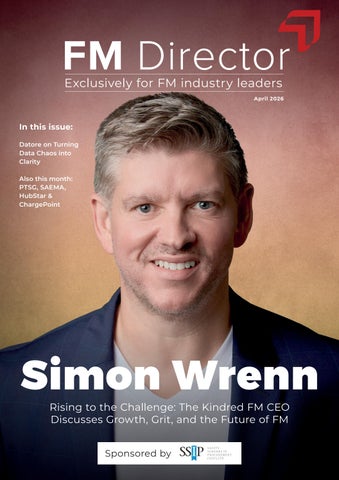
Exclusively for FM industry leaders April 2026
In this issue: Datore on Turning Data Chaos into Clarity Also this month: PTSG, SAEMA, HubStar & ChargePoint
Simon Wrenn Rising to the Challenge: The Kindred FM CEO Discusses Growth, Grit, and the Future of FM Sponsored by
001_COVER_FMDAPR26.indd 3
11/08/2026 10:08
Access Engineers & Façade Maintenance: Committed to Safety First. The Future of Façade Cleaning & Maintenance.
Safe. Compliant. Certified. Skyform Ltd, Unit 1 Denton Wharf, Mark Lane, Gravesend, Kent DA12 2QB
01474 879990
enquiries@skyform.com
April 2026 | 3
EDITOR’S NOTE
Welcome to the April edition of FM Director
I
t’s been a busy month in the FM industry and as usual we have a host of exclusive features and interviews from some of the sector’s most respected leaders.
Our cover story this month is an exclusive interview with Simon Wrenn, CEO of Kindred FM. I caught up with him earlier in the month where he talked about the company’s rapid growth, his philosophy of instilling a growth mindset across the business, and why he believes the future of the FM industry depends on inspiring the next generation. You can also watch the interview here. Other insightful interviews this month include Graham Perry, Managing Director & Co-Founder at Datore, who shares the story behind the business and its ‘your data department’ model, and ChargePoint, who discusses how EV charging can become ubiquitous at a low cost for the benefit of business owners and EV drivers. And as if that wasn’t enough, this edition also features several other key voices in the industry such as PTSG, SAEMA, Building Transformation, HubStar and more. As always, I hope you enjoy this edition of FM Director and remember, if you have anything you’d like to discuss with me, please drop me a line at claire.middleton@businessdailygroup.co.uk. Thanks
C la i r e Middl et on
Exclu siv In this issu
ely for FM
indus try
leaders April 2026
e:
Datore on Turning Data Chao s into Clarity Also this mon PTSG, SAEM th: A, HubStar & ChargePo int
Simon W r en n Rising to the Challen Discus ses ge: The Kin Growth, dred FM Grit, and the Future CEO of FM Sponsored
003_INTRO_FMDAPR26.indd 3
by
11/08/2026 10:13
CONTENTS
4 | April 2026
Contents 01482 782287
fmdirector@fmbusinessdaily.com
06 24 38 Rising to the challenge: Simon Wrenn on growth, grit, and the future of FM Speaking exclusively to FM Director editor, Claire Middleton, Simon Wrenn, CEO of Kindred FM, discusses the company’s rapid growth, his philosophy of instilling a growth mindset across the business, and why he believes the future of the FM industry depends on inspiring the next generation
Managing Editor Claire Middleton
Turning Data Chaos Into Clarity
Speaking exclusively to FM Director, Graham Perry, Managing Director & Co-Founder at Datore, shares the story behind the business, its ‘your data department’ model, and why the FM industry’s biggest data challenge is not a lack of information, but knowing how to bring it all together
Designer and Production Manager Chris Cassidy
Beyond Maintenance: Why Occupancy Intelligence Is FM’s Next AI Leap
By Stefania Vatidis, Growth Marketing Manager at workplace solutions provider HubStar
Partnerships Manager Phil Loades
Client Partnerships Manager Amy Hudson
Published by FM Business Daily, Linacre House, Dark Lane, Braunston NN11 7HU © 2026 FM Business Daily. All rights reserved. Reproduction of the contents of this magazine in any manner whatsoever is prohibited without prior consent from the publisher. No part of this magazine may be used or reproduced in any manner for the purpose of training artificial intelligence technologies or systems. For subscription enquiries and to make sure you get your copy of FM Director please ring 01482 782287 or email fmdirector@fmbusinessdaily.com The views expressed in the articles reflect the author’s opinions and do not necessarily reflect the views of the publisher and editor. The published material, adverts, editorials, images and all other content is published in good faith.
004-005_CONTENTS_FMDAPR26.indd 4
29/04/2026 15:32
CONTENTS
6
Rising to the challenge: Simon Wrenn on growth, grit, and the future of FM
16
Online Training That Raises The Standard For Suspended Access Training
20
NFRC Gold Achieved: A Smarter Approach to Roofing and Access
24
Turning Data Chaos Into Clarity
28
Assessing the Roof While the Sun is Shining: Why Proactive Maintenance is No Longer Optional
32
London Legionella Outbreak – Why Water System Compliance Can’t Be An Afterthought
36
The Business Case for Gender Diversity Is Settled
38
Beyond Maintenance: Why Occupancy Intelligence Is FM’s Next AI Leap
42
The Future of UK Construction Hire: Digital Marketplaces in Action
46
How EV Charging Can Become Ubiquitous at a Low Cost For The Benefit of Business Owners And EV Drivers
48
Latest Appointments of Senior FM Professionals
004-005_CONTENTS_FMDAPR26.indd 5
April 2026 | 5
16 32 46 11/08/2026 10:07
6 | April 2026
INTERVIEW
Rising To The Challenge: Simon Wrenn On Growth, Grit, And The Future Of FM Speaking exclusively to FM Director editor, Claire Middleton, Simon Wrenn, CEO of Kindred FM, discusses the company’s rapid growth, his philosophy of instilling a growth mindset across the business, and why he believes the future of the FM industry depends on inspiring the next generation
F
or a company that employs nearly 3,000 people and operates across 400 sites, Kindred FM has maintained something that larger rivals often struggle to preserve: momentum. Under the leadership of CEO Simon Wrenn, the soft services facilities management business has averaged 20 per cent growth year-on-year over the past several years, reaching a turnover of £36 million in the last financial year, with a current run rate approaching £40 million.
006-010_KINDRED_FMDAPR26.indd 6
Yet when Simon reflects on the period, it is not the revenue figures that he reaches for first. “Much more exciting than the numbers, for me, is that we’ve brought lots of new people into the business,” he said. “People with real passion and enthusiasm who I’m confident are going to be able to give our customers a really good experience over time.” That balance between strong commercial performance and genuine investment in people, defines the Kindred approach, and it shapes every strategic decision Simon takes as the business continues to scale.
27/04/2026 17:19
INTERVIEW
006-010_KINDRED_FMDAPR26.indd 7
April 2026 | 7
27/04/2026 17:19
8 | April 2026
INTERVIEW
For a business that’s growing quite fast and has to make lots of changes, having that right mindset is really helpful for driving things forward
The growth mindset Rapid growth brings its own pressures. As the business has expanded, Simon has been keenly aware that the culture and mindset of the team need to evolve at the same pace as the organisation itself. This led to a significant internal training programme centred on the concept of a growth mindset. “Running a business, or doing a customer-facing job, or trying to win work – any of the roles in our head office and management team – is really challenging,” he said. “Things don’t go how you want them to. Things go wrong. People don’t do the things they say they’re going to do. Those challenges can derail people.” The aim of the programme was to encourage colleagues to embrace difficulty rather than be defined by it. “We’ve been really trying to encourage people to look at the difficulties they face and ask: how can we meet these challenges? How can we do better?” Simon explained. “For a business that’s growing quite fast and has to make lots of changes, having that right mindset is really helpful for driving things forward.”
The growth mindset initiative did not remain a theoretical exercise. In 2026, Kindred declared it a ‘year of challenge’, translating the principle into a series of very physical team events.
The programme has included a 48-hour rowing challenge at the company’s offices, with Simon leading one team and finance manager Jason heading another, in a race both to cover the most distance and raise the most money for charity. Eight members of the head office and management team have also volunteered for a fully-funded parachute jump.
Drawing on his own experience as a marathon runner, ultra-marathon competitor, and triathlete, Simon wanted to give colleagues the opportunity to push their own limits alongside one another.
A trekking and kayaking expedition to Norway and a 26.2-mile marathon along the Cornish coastal path complete the programme. “The team have really taken it on board,” Simon said.
A year of challenge
006-010_KINDRED_FMDAPR26.indd 8
27/04/2026 17:19
April 2026 | 9
INTERVIEW
“They’re really committed to the idea of raising lots of money, getting out there, pushing themselves and doing things they wouldn’t normally do.”
The catalyst came from a striking set of statistics: around two-thirds of young people express an interest in running a business one day, yet only approximately one in three report receiving any meaningful education about how businesses actually work.
Attracting the next generation Simon’s enthusiasm for developing people within Kindred extends well beyond the walls of the business. He recently spoke at the Workplace Futures event where he highlighted a challenge he believes threatens the long-term vitality of the entire FM sector. His concern centres on the generational pipeline. Many FM businesses, he observed, are led by a generation now entering their late sixties and seventies. As they retire, the question of whether the industry is replacing them quickly enough, and attracting the right calibre of new talent, becomes increasingly urgent. “Are we really attracting people into the FM industry?,” he said. “We’re seeing some reluctance. The industry as a whole risks not having the best possible talent within it if we’re not working to attract that talent. It’s on all of us working in the industry to ask: what can we do to make this somewhere people want to come and work?”
Future Founders
“The whole engine of the UK economic system relies on business, yet only one in three people in the current education system actually feel like they’re learning anything about business,” Simon said. “We’ve got an education system that’s basically training people to be component labour in businesses that existed fifty to a hundred years ago. It’s so out of touch with where we are today.”
The industry as a whole risks not having the best possible talent within it if we’re not working to attract that talent
It is with this in mind that Simon launched Future Founders, an initiative designed to bridge the gap between the entrepreneurial instincts of young people and the practical knowledge they need to act on them.
006-010_KINDRED_FMDAPR26.indd 9
27/04/2026 17:19
10 | April 2026
INTERVIEW
Future Founders works by enabling schools to enter competitions in which pupils complete five structured lessons: building a business plan and developing a concept they then launch, with winning schools receiving prize money. The ambition is to connect young people with small and medium business owners and entrepreneurs, and ultimately to provide mentorship opportunities with business leaders. Simon’s own experience informed the initiative directly. “I was first inspired to go into business by meeting someone who was selfemployed and had been quite successful,” he recalled. “I didn’t know anyone that had run a business and I didn’t know anyone that had been self-employed at all. Meeting that person inspired me to go and start my first business at the age of 19.” The logic is simple. “If people don’t get to meet people running businesses, they don’t really think about how it can happen,” he said.
“It’s about trying to inspire as many people as possible to at least embrace the idea and concept of setting up their own business.”
Looking ahead The threads running through Simon’s work at Kindred, growth mindset, physical challenge, talent development, and entrepreneurial inspiration, are not disconnected pursuits. They reflect a consistent philosophy: that sustainable commercial success is built on the quality, confidence, and commitment of the people involved. With Kindred continuing its upward trajectory and Future Founders gathering momentum, Simon’s focus remains firmly on the long game. “I’m really excited about and looking forward to the future and how Kindred is going to grow over the coming months and years,” he said. In a sector that must work hard to attract the talent it needs, the example he is setting, inside the business and beyond it, may prove just as valuable as any contract won. To find out more about Kindred FM, visit kindredfm.com
We’ve got an education system that’s basically training people to be component labour in businesses that existed f ifty to a hundred years ago. It’s so out of touch with where we are today
006-010_KINDRED_FMDAPR26.indd 10
27/04/2026 17:19
for commercial cleaning services
ADs.indd 1
02/03/2026 17:15
12 | April 2026
ADVERTORIAL
Article no longer available
012-015_APEX_FMDAPR26special.indd 12
10/08/2026 17:33
ADVERTORIAL
April 2026 | 13
Article no longer available
012-015_APEX_FMDAPR26special.indd 13
10/08/2026 17:33
14 | April 2026
ADVERTORIAL
Article no longer available
012-015_APEX_FMDAPR26special.indd 14
10/08/2026 17:33
ADVERTORIAL
April 2026 | 15
Article no longer available
012-015_APEX_FMDAPR26special.indd 15
10/08/2026 17:33
16 | April 2026
TRAINING
Online Training That Raises The Standard For Suspended Access Training Working at height remains one of the most significant safety risks across the built environment. According to the Health and Safety Executive (HSE), falls from height continue to be the leading cause of fatal workplace injuries in Great Britain
TRAINING
016-018_SAEMA_FMDAPR26.indd 16
27/04/2026 17:25
April 2026 | 17
TRAINING
F
or facilities managers responsible for buildings with façade access systems, ensuring competence is not just a best-practice consideration – it is a critical safety and compliance responsibility.
For employers and duty holders, the result is training that is accessible, scalable and fully auditable, providing clear evidence of competence and compliance.
Training for those responsible To support this need, SAEMA has launched a ground-breaking digital learning platform designed specifically for those working in, or responsible for, the suspended access arena.
One of the most innovative elements of the platform is SAEMA’s Duty Holder Training programme, a fully digital course created specifically for those with legal and operational responsibility for suspended access systems.
A new approach to industry training The SAEMA Online Training platform delivers a highly engaging and accessible learning experience built around animated visuals, interactive scenarios and a secure testing environment. Unlike traditional classroom-based courses, the platform combines flexible online learning with built-in assessment and invigilation, ensuring both convenience and credibility. Each course is designed to inform, engage and inspire confidence before anyone even sets foot on site.
Unlike traditional classroombased courses, the platform combines flexible online learning with built-in assessment and invigilation
Designed for building owners, facilities managers, consultants and other duty holders, the course provides a clear understanding of: Legal duties and regulatory compliance The fundamentals of suspended access systems Inspection and maintenance regimes Risk management and operational oversight Record-keeping and documentation Delivered entirely online, the course enables participants to gain essential compliance knowledge in just one hour, providing facilities professionals with practical insight into managing façade access systems safely.
TRAINING
016-018_SAEMA_FMDAPR26.indd 17
27/04/2026 17:25
18 | April 2026
TRAINING
These courses provide the theoretical foundation required before undertaking practical training on site
Building competence for operatives The platform also supports operatives working with suspended access equipment through its Permanent Part 1 and Temporary Part 1 training programmes. These courses provide the theoretical foundation required before undertaking practical training on site. Using animated realworld scenarios, the modules guide operatives through key safety principles, common hazards and regulatory requirements associated with suspended access systems.
016-018_SAEMA_FMDAPR26.indd 18
Both programmes feature secure invigilated assessments, with successful participants receiving a digital certificate and virtual competence card that demonstrates recognised knowledge and capability. For employers, this helps provide reassurance that operatives arriving on site already understand the essential safety principles associated with suspended access equipment.
Supporting safer buildings For facilities managers responsible for complex building façades and access systems, ensuring competent use of suspended access equipment is a vital part of building safety and compliance management. By providing accessible, high-quality training for both operatives and duty holders, SAEMA’s digital platform helps bridge the knowledge gap between those installing, operating and overseeing these systems. As buildings become more complex and regulatory expectations continue to evolve, digital learning platforms such as this are likely to play an increasingly important role in supporting safer working practices across the sector. Ultimately, the goal is simple: ensuring everyone involved in suspended access systems has the knowledge and confidence to work safely.
27/04/2026 17:25
METAL DECKING ASSOCIATION
Elevate Your Business with UKMDA Join the UK Metal Decking Association (UKMDA) and place your business at the forefront of the industry. UKMDA offers a powerful network and essential resources to help your company and contracts be successful.
Why Join UKMDA? Leadership & Influence: Be part of a powerful network that shapes industry standards and works with key bodies like HSE, CITB and CSCS Credibility & Safety: Demonstrate your commitment to excellence with our rigorous audits and access to authoritative safety guidance.
Invest in Your Workforce with UKMDA Training
The UKMDA is committed to raising the bar for safety and competency. Our comprehensive training programs provide your team with the skills and qualifications they need. ore Training: Our scheme covers C all aspects of metal decking and stud welding installation, taught by licensed trainers. ationally Recognised NVQs: N We provide NVQs that allow you and your installers to demonstrate technical competence. A UKMDA-qualified workforce means fewer accidents, greater efficiency, and an enhanced reputation for quality.
Ready to elevate your business? Visit our website or contact us to learn more. info@ukmda.org.uk |
07923 255086
20 | April 2026
ADVERTORIAL
NFRC Gold Achieved: A Smarter Approach to Roofing and Access
B
uilding Transformation has been awarded the NFRC Gold Award for Health, Safety and Environment, reinforcing its position as a specialist provider operating at the highest standards across roofing and external building maintenance. Combined with IRATA International Membership, this places the business within a select group of UK providers accredited in both roofing and rope access disciplines. A distinction that directly benefits facility and estate managers responsible for complex, highrisk buildings and estates.
Why Roofing and Access Still Create Risk for Facility Managers For many facility managers, roofing works are rarely straightforward. Even minor repairs can introduce challenges around: Safe access to height Contractor reliability Compliance and documentation Managing multiple suppliers
020-022_BUILDINGTRANSFORMATION_FMDAPR26.indd 20
Traditional approaches often separate roofing and access, creating inefficiencies, delays, and gaps in accountability—particularly on live or high-occupancy sites.
A Joined-Up Approach: Roofing and Rope Access Delivered Together Building Transformation addresses this by combining specialist roofing expertise with IRATA-certified rope access. This integrated model enables: Direct access to difficult areas without extensive scaffolding Faster mobilisation and reduced disruption A single contractor responsible for both access and repair Greater control over safety and delivery For facility managers, this translates into simpler project management and more predictable outcomes.
Safety as a Measured KPI — Not Just a Commitment Safety sits at the centre of Building Transformation’s operating model and is embedded as a core KPI within its Building Transformation strategy.
27/04/2026 17:26
ADVERTORIAL
Rather than being treated as a baseline requirement, safety performance is: Actively measured
April 2026 | 21
One of Few UK Providers with NFRC and IRATA Accreditation Holding accreditation with both NFRC and IRATA positions Building Transformation uniquely in the market.
Continuously reviewed Embedded across all projects and portfolios This structured approach supports consistent delivery in environments where risk is inherently higher.
What NFRC Gold Means in Practice
This dual capability removes the need to coordinate separate contractors for access and roofing, reducing: Programme complexity Interface risk Delays associated with access constraints
The NFRC Gold Award reflects a rigorous, independent assessment our: Health, safety and environmental management systems Operational procedures and site controls Delivery capability across roof repair, replacement and leak detection For facility managers, this provides assurance that roofing works are delivered with: Strong governance and oversight
Holding accreditation with both NFRC and IRATA positions Building Transformation uniquely in the market
Controlled, auditable processes Consistent compliance with industry standards
020-022_BUILDINGTRANSFORMATION_FMDAPR26.indd 21
27/04/2026 17:26
22 | April 2026
It also ensures that both disciplines are delivered to a consistently high standard under a single, accountable provider.
Maintaining Gold-Level Standards Across Every Project Following this achievement, the focus is on consistency, ensuring that Gold-level standards are applied across all roofing works, from minor reactive repairs to complex replacement programmes.
ADVERTORIAL
For many facility managers, roof ing works are rarely straightforward
Supporting Facility Managers Across Complex Assets Whether addressing a leak, planning preventative maintenance, or resolving a complex building envelope issue, Building Transformation supports facility managers with: Specialist access solutions Roofing expertise aligned to NFRC standards Clear communication and transparent delivery Reliable, high-performance outcomes
020-022_BUILDINGTRANSFORMATION_FMDAPR26.indd 22
Start the Conversation If you have an upcoming inspection, roofing requirement, or access challenge, Building Transformation offers a proven, accredited approach. Get in touch to discuss how we can support your next project.
27/04/2026 17:26
Men need more support in the washroom to dispose of incontinence waste.
Scan me for more information
1 in 8 men, rising to 1 in 4 in black men will get prostate cancer in their lifetime. Help men Dispose with Dignity with phs Male Incontinence Bins. Let’s help men live well. phs.co.uk
24 | April 2026
ADVERTORIAL
Turning Data Chaos Into Clarity Speaking exclusively to FM Director, Graham Perry, Managing Director & Co-Founder at Datore, shares the story behind the business, its ‘your data department’ model, and why the FM industry’s biggest data challenge is not a lack of information, but knowing how to bring it all together
G
raham’s interest in technology began at the age of 14 with the purchase of a Dragon 32 home computer. That early curiosity set the course for a career spanning four decades, taking him across South Africa and Europe before settling in the security industry, working with CCTV and building management systems.
024-027_DATORE_FMDAPR26.indd 24
When Graham returned to the UK in 2011, he found what he considered the world’s most mature FM market hampered by a fundamental problem. “The biggest issue was this disparate data information,” he recalled. “Everything was in different systems, and it was all over the place.” That observation drove a long-held ambition: to deliver what he described as “the single pane of glass”, one unified view drawing together all an organisation’s data sources.
28/04/2026 17:29
ADVERTORIAL
April 2026 | 25
We didn’t start the business as a technology company. We started it as a solution company
024-027_DATORE_FMDAPR26.indd 25
28/04/2026 17:29
26 | April 2026
ADVERTORIAL
The challenge was that achieving it traditionally required a single piece of software with every conceivable module attached. “And of course, they don’t exist, because every time you get to every possible module, there’s something that’s missing,” he said. After a period with a technology company pursuing a similar goal, Graham recognised in 2018 that data warehousing, analytics, and emerging AI capabilities offered a more viable path. Together with his co-founder, he established Datore on the principle that aggregating data from every conceivable source, including spreadsheets, CAFM, IWMS, and building systems, into a centralised warehouse and applying logical layers was the only way to make his vision a reality. “We started the business from a perspective looking at the problem, rather than trying to force-fit some technology into the solution,” he explained. “We didn’t start the business as a technology company. We started it as a solution company.”
Don’t buy or replace any technology until you know that you’ve maxed out the investment you’ve already got
024-027_DATORE_FMDAPR26.indd 26
Your data department Describing Datore in the simplest terms, Graham said: “In a nutshell, Datore is your data department.” The model provides clients with all the capability of an internal data team, encompassing people, platforms, and processes, at a fixed monthly cost and without the overhead of recruitment, staff turnover, and technology decisions. The service addresses two distinct audiences within the sector. For FM service providers, Datore covers both internal operations and client or supplier-facing portals. For in-house facilities managers, it fills the gap that arises when FM is, as Graham put it, “always the last in the queue” when it comes to accessing central data teams and budgets. The result is the ability to draw together estate performance, energy management, and building compliance data from multiple systems, providing FM professionals with informed, real-time decision-making capability rather than reliance on a quarterly PowerPoint presentation. Scalability is achieved through Datore’s proprietary ‘impact pathway’, a methodology developed over almost a decade that begins not with technology but with business problems and strategy. Client engagement specialists manage portfolios of 10 to 15 clients, while a shared ‘bench’ of DevOps, SecOps, data engineering, and BI resource is drawn upon as each client requires it. “If that client was to go out and employ all of those people, they would easily be at a quarter of a million pounds down before they’ve even started putting infrastructure in,” Graham noted. Datore’s smallest package, he added, costs less than a graduate salary.
The real data maturity gap Following Datore’s win for Best SME-Led Innovation at the IWFM Impact Awards, Graham was clear that the FM industry’s data challenges are frequently misdiagnosed.
28/04/2026 17:29
ADVERTORIAL
April 2026 | 27
The sector is not short of data; quite the reverse. “The FM industry is drowning in data,” he said. “And for every particular problem, there is probably 50 solutions.” The critical gap, in his view, lies in the consolidation of data and the creation of a ‘semantic layer’, a means of labelling and structuring information from multiple sources so that AI systems and analysts can use it to generate value. Without it, he argued, even the most pressing priorities in smart buildings, decarbonisation, and occupancy analytics cannot be meaningfully addressed. “Our mantra is: don’t buy or replace any technology until you know that you’ve maxed out the investment you’ve already got,” he said. He was equally pointed on AI in FM, noting that despite its prominence in industry conversation, current applications remain largely point solutions rather than holistic, business-wide capabilities. “If you can’t bring all of your data into a centralised warehouse and then create a semantic layer that allows AI to understand it, you will never be able to use AI to answer questions about your business,” he said. “You’ll never be able to say to it: can I improve my cleaning regime? Can I reduce my number of security guards?” For Graham, the IWFM award represented broader industry acknowledgement that joining up existing data systems, rather than buying new ones, can answer 80% of an organisation’s problems and deliver tangible improvements to cost, margin, and estate performance.
He predicted that user-friendly, bespoke portals will become the primary interface through which FM providers and in-house managers alike derive and act on that intelligence.
Technology partnerships and agnosticism As a certified AWS partner and the UK’s only Sisense Gold partner, Datore has made deliberate platform choices whilst maintaining broad cross-platform capability. AWS is preferred for value for money, though the business manages Azure and Google Cloud environments where clients require them. Sisense is the primary analytical platform, chosen for its flexibility, multi-tenanted security, and embedding capabilities, which underpin the client-facing portals Datore builds. Technology agnosticism is maintained through Datore’s ‘medallion architecture’, in which raw incoming data is stored in its original format before being progressively refined. Provided the warehouse is correctly built, the choice of visualisation tool, whether Power BI, Sisense, Looker, or another platform, becomes secondary. “We focus on the solution to a problem, not the technology that bolts it all together,” Graham said.
Looking ahead: portals, agents, and the data-ready organisation Looking to the next five to ten years, Graham identified the advancing capabilities of AI and the infrastructure required to support them as the forces that will shape data and analytics in the built environment. He pointed to growing demand for ‘agentic analysts’, AI agents capable of interrogating built environment data to provide operational insight and recommendations.
“The most important thing about those portals is that, as a service provider, as you build out a portal for your clients to answer those questions — what you’re actually doing is building out a portal that you can use to improve the running of your business,” he said. Three converging pressures are, in his view, making this shift both urgent and inevitable: increasing regulatory demands including building safety legislation and ESG reporting requirements; sustained pressure on margins; and the scale of global investment flowing into AI. For mid-tier FM providers competing against larger rivals, Graham was unambiguous: “Winning business, retaining key contracts, protecting margins and getting ready for the AI-future all hinge on one thing; really solid data foundations. Those foundations will power decision support, accelerate customer portals, and be pivotal for any future AI initiatives – the challenge? it’s not easy, and this is why outsourcing data capabilities to experts is the obvious choice. “
We focus on the solution to a problem, not the technology that bolts it all together
The foundation for this, he argued, is non-negotiable: centralised data warehousing, an appropriate semantic layer, and trusted, secured access to language models.
024-027_DATORE_FMDAPR26.indd 27
28/04/2026 17:29
28 | April 2026
MAINTENANCE
Assessing the Roof While the Sun is Shining: Why Proactive Maintenance is No Longer Optional By Harry Perrey, Associate Director (Building Consultancy), Hartnell Taylor Cook
028-030_HTC_FMDAPR26.indd 28
27/04/2026 17:31
MAINTENANCE
I
t’s a familiar pattern across the built environment: problems only come to light when the weather turns. Heavy rain reveals leaks, while high winds expose weaknesses and cold snaps test the limits of a property’s structure. By the time defects become visible, the damage is already done, bringing with it increased costs and ultimately eroded asset value if issues remain unchecked. Taking a reactive approach to maintenance is increasingly out of step with the realities facing today’s property owners and facilities managers. Ageing estates and tightening regulatory frameworks are coming together to make clear why it is so crucial to assess a property and act before failure occurs. But what does this mean in practice?
The growing cost of delay Across property portfolios, delayed maintenance has become a significant commercial risk. What begins as a minor defect can quickly evolve into major issues if left unchecked, leading to unplanned failures, operational downtime and significant capital expenditure that could have been avoided with early intervention.
April 2026 | 29
For property owners and landlords, this translates into spiralling costs and reduced returns. For occupiers, it can mean interruptions to business continuity and diminished workplace quality. In contrast, Preventative Planned Maintenance (PPM) offers an alternative. It is a way to control spend, extending the life of M&E systems and building fabric by addressing issues early and distributing costs more predictably over multiple years. Well-maintained buildings perform better but also retain their value more effectively. Addressing issues early helps preserve the integrity of a building and its critical systems, reducing the need for costly replacements.
Across property portfolios, delayed maintenance has become a signif icant commercial risk
Reactive maintenance, while sometimes unavoidable, is proving unsustainable as a long-term strategy. Emergency repairs are typically more expensive and less efficient.
028-030_HTC_FMDAPR26.indd 29
27/04/2026 17:31
30 | April 2026
MAINTENANCE
At the same time, it enhances the overall occupier experience, contributing to higher tenant satisfaction and retention.
Planning ahead for financial clarity One of the most immediate benefits of a PPM is improved financial planning. Early inspections allow service charges to be set with greater confidence, reflecting real asset conditions rather than assumptions. In the public sector, for example, timely assessments can support funding applications by providing cases for investment. Data-driven maintenance strategies are particularly valuable. By building a clear picture of asset condition and future requirements, finance teams gain predictable cost forecasts, stronger budget allocation and better visibility of upcoming capital expenditure. Crucially, however, PPMs should not be treated as static documents. The most effective programmes are adaptive and regularly updated – whether annually or whenever new data becomes available. This ensures that maintenance plans remain aligned with actual conditions, rather than becoming outdated or irrelevant.
Supporting ESG and regulatory compliance Maintenance is now a key component of ESG performance. Timely upgrades and interventions aligned with PPM programmes can significantly improve energy efficiency and reduce emissions, supporting compliance with MEES regulations.
The most effective programmes are adaptive and regularly updated – whether annually or whenever new data becomes available
028-030_HTC_FMDAPR26.indd 30
This is particularly relevant as tenants become more discerning. Today’s occupiers are increasingly informed and proactive, often seeking detailed information about a building’s condition, performance, and sustainability credentials before committing to a lease. From a tenant perspective, buildings with strong green credentials are increasingly attractive. Demonstrating a clear, data-driven maintenance strategy can therefore provide a competitive advantage in attracting and retaining occupiers.
Technology is changing the game Inspections can be time-consuming and costly, but modern technologies are transforming how these are carried out. Drone inspections, for example, enable rapid and detailed surveys of roofs, façades, gutters and other hard to reach areas without the need for disruptive access. High-resolution imagery and video capture provide a comprehensive view of asset condition, allowing defects to be identified with greater accuracy. Advances in AI are also enabling predictive diagnostics. By analysing patterns in asset data, AI tools can identify potential failure points before they manifest, allowing maintenance teams to intervene at the optimal time. Together, these technologies significantly reduce the cost, time, and risk associated with inspections, while improving the quality of asset condition data feeding into PPM programmes.
A shift in mindset Ultimately, assessing the roof while the sun is shining is as much about timing as much as it is about shifting mindsets to be forward looking rather than preventative. Those that do so by employing a PPM stand to gain a significant advantage, including lower and more predictable costs, improved building resilience, stronger ESG performance and enhanced asset value. In an increasingly complex and demanding environment, proactive maintenance is no longer a ‘nice to have’, it is an essential component of effective building management.
27/04/2026 17:31
FASET & CSCS:
Setting the Benchmark for Temporary Safety System Competence As the premier body for Temporary Safety Systems, FASET is dedicated to ensuring unparalleled safety standards across the industry. We achieve this through our robust partnership with CSCS, delivering comprehensive training, rigorous assessment, and the issuance of industryrecognised competency cards.
The Future is Digital: Benefits for FASET-Qualified Operators All our qualifications now exclusively issue digital cards, offering a wealth of benefits:
Convenience: Easily add new qualifications as you progress.
Security: Enhanced protection against loss or forgery.
Streamline Your Checks: For Employers and Site Supervisors Verify an operator’s competency instantly! Download the CSCS Smart Check App to your mobile device. ADs.indd 1
Stay Updated: Receive timely alerts for expiry dates and crucial safety notifications.
enquiries@faset.org.uk 01948 780652
www.faset.org.uk
20/06/2025 10:23
32 | April 2026
ADVERTORIAL
London Legionella Outbreak
Why Water System Compliance Can’t Be An Afterthought Craig Doig, Managing Director, PTSG Water Treatment
032-034_PTSGwt_FMDAPR26.indd 32
27/04/2026 17:32
ADVERTORIAL
T
he cluster of Legionnaires’ disease cases now under investigation by the UK Health Security Agency in north-west and south-west London is a sobering reminder of what can happen when water system management slips down the priority list.
This means regular temperature monitoring of hot and cold water systems, physical inspection and cleaning of storage tanks and calorifiers, a scheduled programme of showerhead descaling and disinfection and documented oversight of cooling towers where applicable.
Legionella is not a new threat. The bacteria thrive in poorly maintained water systems – particularly where temperatures fall within the 20-45°C range, where stagnation occurs, or where there is a lack of adequate disinfection. Cooling towers, showers, spray taps and spa pools are among the most common sources of airborne dispersal.
Where specialist support is used – and for many organisations it should be – facilities managers should ensure their provider holds appropriate competencies and is affiliated with the Legionella Control Association.
What makes outbreaks like this one particularly concerning is that, by the time cases are confirmed, significant exposure has often already occurred. The challenge for facilities managers is that water safety compliance can appear invisible when things are going well. Monitoring is routine, results are filed and systems keep running. It is only when something goes wrong that the full weight of the responsibility becomes clear – and at that point, the consequences can be severe. Fines running to hundreds of thousands of pounds, enforced closures and lasting reputational damage are all realistic outcomes of a preventable failure.
The compliance framework is there – it needs to be followed The UK’s regulatory framework for legionella control is well established. HSG 274 and the associated Approved Code of Practice L8 set out clear obligations for those responsible for building water systems.
April 2026 | 33
Compliance documentation needs to be current, not inherited from a previous contractor or left unchanged for years.
Budgets and risk One of the most consistent patterns seen across the sector is the tendency for routine water hygiene monitoring to be quietly deprioritised when budgets tighten. It is understandable – the work is not visible, the risk feels abstract, and there are always more immediate pressures competing for resource.
Compliance documentation needs to be current, not inherited f rom a previous contractor or left unchanged for years
The expectation is not simply that a risk assessment exists on a shelf somewhere – it is that a live, actively maintained water safety plan is in place, reviewed regularly and acted upon.
032-034_PTSGwt_FMDAPR26.indd 33
27/04/2026 17:32
34 | April 2026
ADVERTORIAL
This is a false economy. The cost of maintaining a proactive water treatment programme is a fraction of the cost of responding to an outbreak – whether that response involves emergency remediation, legal proceedings, or managing the reputational fallout. Dense urban environments, where water systems are often more complex and exposure potential is higher, carry particular risk. London’s ageing infrastructure adds another layer of challenge. Buildings that have undergone changes of use, extended periods of low occupancy, or significant refurbishment work are especially vulnerable to the conditions that allow Legionella to proliferate.
Technology as a tool for faster intervention One of the limitations of traditional water safety monitoring is the time it takes to identify a problem. Manual temperature checks are periodic by nature and laboratory analysis can take days. In a building with a complex water network, that delay creates risk.
Water safety is not a compliance exercise to be completed annually. It is an ongoing operational responsibility that requires consistent attention
Remote monitoring technology addresses this directly. PTSG’s remote monitoring solution uses discreet sensors fitted to pipework, recording temperature data every five seconds and transmitting data to a secure cloud platform every 20 minutes 24/7/365. Alerts are delivered in real time by SMS or email, allowing engineers to identify and respond to potential issues before they escalate – without the need for a physical site visit in the first instance. For multi-site organisations, schools, care homes, hospitals, hotels, and social housing providers, this kind of continuous oversight represents a significant step forward in how water safety is managed. It also reduces unnecessary flushing regimes and site visits, delivering meaningful savings on water, energy and operational costs. This does not replace the need for a robust written scheme of control and regular physical inspection – but it closes the gap between scheduled visits and gives facilities managers far greater confidence that their systems are performing as they should.
What facilities managers should do now The current outbreak in London should prompt every FM with responsibility for a building water system to ask a straightforward question: when was our water safety plan last reviewed and are we confident it reflects how our systems are actually operating today? If the answer is uncertain, that review should happen now – not at the next scheduled audit date. Water safety is not a compliance exercise to be completed annually. It is an ongoing operational responsibility that requires consistent attention. PTSG Water Treatment supports facilities managers across the UK in meeting their statutory obligations, from initial risk assessment and scheme of control development through to routine monitoring, remedial works and ongoing compliance management.
032-034_PTSGwt_FMDAPR26.indd 34
27/04/2026 17:32
PTSG is a place where...
You can shape your own future
Your well-being matters
You will always be treated fairly and with respect
You receive market-leading industry packages
UNLIMITED OPPORTUNITIES Join one the UK’s fastest growing businesses. We’ve a variety of leadership, services and engineer roles available right now!. Apply today and let’s create something extraordinary together! #UnlimitedPotential #JoinTheTeam #EndlessOpportunities
www.ptsg.co.uk
36 | April 2026
ADVERTORIAL
The Business Case for Gender Diversity Is Settled The Leadership Question Is: What Are You Doing About It? Asks Dr Greg Ward, Chief Executive Officer of Premier Technical Services Group (PTSG)
T
welve months ago, I wrote about gender diversity in business. My argument then was simple: organisations that ignore half the talent available to them are making a poor commercial decision. A year on, that argument has not changed. What has changed, however, is the context.
036-037_PTSG_FMDAPR26.indd 36
The past twelve months have brought economic pressure, rapid technological change (especially with AI) and an increasingly competitive labour market. Skills, productivity and leadership capability are under sharper scrutiny than ever. In that environment, restricting the talent pool based on gender is not just outdated thinking; it is strategically unsound.
29/04/2026 15:19
ADVERTORIAL
April 2026 | 37
Before joining Premier Technical Services Group (PTSG), I spent three decades working in sectors not typically associated with progressive workforce thinking; car manufacturing, construction, aviation and security. In many of those industries, leadership historically followed a familiar pattern and that pattern remained largely unchallenged. Now, twelve months into leading PTSG, I have had the opportunity to focus on action rather than commentary. Over the past year we have strengthened our entire team with outstanding women who bring expertise, judgement and energy to the business. Not to satisfy a metric or produce a favourable line in an ESG report. Simply because they are exceptional professionals and PTSG is stronger for having them here. That distinction is really important. Too often the conversation around gender diversity becomes framed around obligation; quotas, targets and compliance. Those discussions have their place, but they risk missing the central point. Diversity is not a concession to fairness. It is a driver of performance. If you want to build a successful organisation, your priority must be to attract and retain the best people available. Gender bias, whether conscious or unconscious, narrows that opportunity and weakens the outcome. In facilities management and building compliance services, the challenge is particularly clear. Our sector faces real pressure on technical skills and leadership capability. Businesses that continue to filter out talent through outdated assumptions are simply limiting their own potential. At PTSG we are working to ensure that opportunity is real and visible across the organisation.
At PTSG we are working to ensure that opportunity is real and visible across the organisation
The business case for gender diversity is well understood. The moral case is stronger still. The real question for leaders today is no longer whether diversity matters. It is whether we are prepared to act on it!
That means strong female leadership, clear development pathways and a culture where ambition is recognised wherever it appears. Facilities management touches every building and every community in the country. The workforce delivering those services should reflect the society it serves.
036-037_PTSG_FMDAPR26.indd 37
Talk to the HR team today if you are interested in joining one of the UK’s fastest growing and most progressive companies. Visit: www.ptsg.co.uk to find more out about the company or careers.ptsg.co.uk to see current vacancy opportunities
29/04/2026 15:19
38 | April 2026
ARTIFICIAL INTELLIGENCE
Beyond Maintenance: Why Occupancy Intelligence Is FM’s Next AI Leap By Stefania Vatidis, Growth Marketing Manager at workplace solutions provider HubStar
038-040_HUBSTAR_FMDAPR26.indd 38
27/04/2026 17:38
ARTIFICIAL INTELLIGENCE
F
acilities Management (FM) has made meaningful progress in adopting artificial intelligence (AI). What began as a shift away from reactive maintenance has evolved into predictive and even prescriptive models. Today, many organisations can anticipate when an asset is likely to fail and intervene before disruption occurs. This is a genuine step forward for operational efficiency, cost control, and risk management. But there is a limitation to this progress. Most AI strategies for FM remain heavily focused on assets rather than people. Buildings are still largely managed as collections of equipment instead of dynamic environments shaped by human behaviour. This creates a blind spot. While systems are becoming better at predicting how machines behave, they are often still disconnected from how spaces are actually used.
The next leap in AI maturity for FM lies in closing that gap It is not just about smarter maintenance. It is also about developing occupancy intelligence – a capability that allows buildings to understand, anticipate and respond to the people inside them. Occupancy intelligence builds on the same technological foundations that have enabled predictive maintenance. Internet of Things sensors, building management system integrations, and machine learning models are already in place in many portfolios. The difference lies in how this data is applied. Instead of focusing only on asset performance, these tools can be used to capture patterns of movement, space utilization, and occupancy trends over time. This shift changes the role of data in FM. Rather than asking when a piece of equipment might fail, organisations can begin asking how spaces are being used, when demand will peak, and where inefficiencies exist. This moves FM from an asset-centric discipline to a human-centric one.
038-040_HUBSTAR_FMDAPR26.indd 39
April 2026 | 39
The implications for space planning are significant. Many organisations still rely on static assumptions about how offices, campuses, or facilities are used. These assumptions are often outdated, especially in a world where hybrid working has reshaped occupancy patterns. Predictive occupancy data enables a more dynamic approach. FM teams can identify underutilised areas, anticipate surges in demand, and adjust layouts or space allocations accordingly. This leads to more efficient use of space and better alignment with actual needs. Energy optimisation is another area where occupancy intelligence can deliver immediate value. Traditional building systems often operate on fixed schedules or broad assumptions about usage. This results in energy being consumed in spaces that are empty or underused. By integrating occupancy data, systems can respond in real time to actual demand.
Most AI strategies for FM remain heavily focused on assets rather than people
27/04/2026 17:38
40 | April 2026
ARTIFICIAL INTELLIGENCE
Heating, cooling, lighting and ventilation can be adjusted based on how spaces are actually being used, rather than how they are expected to be used. The result is not only cost savings but also a meaningful reduction in environmental impact. Workplace experience is perhaps the most compelling dimension of this shift. Employees increasingly expect environments that are responsive, comfortable and aligned with how they work. Occupancy intelligence makes this possible.
Data readiness is therefore a critical factor. Organisations need to ensure that their systems can communicate effectively, that data is standardised and accessible, and that there is a clear strategy for how information will be used. This requires investment not only in technology but also in governance and skills. FM teams must be equipped to interpret data, work with analytics tools, and translate insights into action. This also requires a cultural shift. Moving towards occupancy intelligence means rethinking how success is measured in FM.
By understanding patterns of use, organisations can reduce overcrowding, improve access to resources, and create spaces that better support collaboration and focus. Over time, buildings can evolve from static infrastructures into adaptive environments that enhance productivity and wellbeing.
Traditional metrics such as uptime and maintenance efficiency remain important, but they are no longer sufficient on their own. New metrics focused on utilisation, experience and adaptability must be incorporated into decision-making.
Despite these opportunities, many organisations face a significant challenge in realising occupancy intelligence. The issue is not a lack of data, but a lack of integration.
The organisations that succeed in this transition will be those that view AI not as a tool for optimising existing processes, but as a catalyst for redefining the role of FM.
Data from sensors, access control systems, booking platforms, and building management systems often exists in silos. Without a unified data layer, it is difficult to generate the insights needed to drive meaningful change.
Predictive maintenance is an important milestone, but it is not the end state. It is a foundation on which more sophisticated capabilities can be built.
Over time, buildings can evolve from static infrastructures into adaptive environments that enhance productivity and wellbeing
038-040_HUBSTAR_FMDAPR26.indd 40
The core message is clear. AI maturity in FM is not achieved when maintenance is fully optimised. It is achieved when buildings are able to understand and respond to the people who use them. Occupancy intelligence represents the next stage in this journey. It shifts the focus from assets to experiences, from efficiency to adaptability, and from static operations to dynamic environments. In the years ahead, the most successful FM strategies will be those that embrace this shift. Buildings will no longer be defined solely by their physical components, but by their ability to learn from and adapt to human behaviour. Those that make this transition will unlock not only operational gains, but also a fundamentally better relationship between people and the spaces they occupy.
27/04/2026 17:38
THE
SAVE DATE
28-30 APRIL 2026 NEC BIRMINGHAM, UK THE HOME FOR WORKPLACE & FACILITIES INNOVATION GET INVOLVED WWW.THEWORKPLACEEVENT.COM
Organised by
42 | April 2026
CONSTRUCTION
The Future of UK Construction Hire: Digital Marketplaces in Action By Tom Shorten, CEO, HSS ProService Marketplace
042-044_HSS_FMDAPR26.indd 42
27/04/2026 17:39
CONSTRUCTION
F
or most of my career in the UK construction sector, equipment hire has relied on phone calls, emails, spreadsheets and a fair amount of guesswork, as well as mountains of paper.
Our digital marketplace tackles the problem at its root by creating a single point of access. Hire, materials, fuel and consumables can all be ordered through one platform, with full visibility from the moment an order is placed to the moment it’s closed.
That approach has worked, up to a point, because people know each other and relationships matter a lot, but it has also left the industry carrying inefficiencies that are becoming harder to justify.
That visibility changes behaviour because when people can see what they are hiring, how long it’s been there and what it’s costing, decisions can be made much quicker and sharper and productivity booms as a result.
After several challenging trading years, with budgets under pressure and projects scrutinised more closely than ever, the traditional model is being questioned. Digital marketplaces are starting to move from the edges of the sector into the mainstream. This is because they offer contractors, facilities managers and procurement teams a different way of accessing equipment, materials and services, with far greater visibility and control. As the industry looks ahead, the question is no longer whether digital procurement has a role to play, but how quickly it will become part of everyday operations on site. Construction has lagged behind other industries when it comes to digital procurement with industries such as retail, travel and logistics having built platforms years ago which transformed how goods and services were bought. In the construction world, many teams are still exchanging PDFs across long email chains and trying to reconcile costs weeks after the work is done. That lack of real-time information creates a number of problems including waste, as equipment sits on sites way longer than needed and orders are often duplicated.
April 2026 | 43
One of the biggest shifts we are seeing is away from measuring strength by fleet size alone. Owning more equipment doesn’t automatically mean better service, especially when demand fluctuates and capital costs continue to rise. Asset-light, platformdriven models allow the industry to focus on utilisation and efficiency instead. They bring together high-quality national and local suppliers in a single digital ecosystem, and marketplaces give customers access to the right equipment at the right time, without the inefficiencies that come from duplication or underuse.
Site managers spend time a lot of their time chasing equipment instead of managing work
Site managers spend time a lot of their time chasing equipment instead of managing work, and procurement teams struggle to get a clear picture of what is actually being used and where. Inefficiency unfortunately becomes the norm.
042-044_HSS_FMDAPR26.indd 43
27/04/2026 17:39
44 | April 2026
CONSTRUCTION
For suppliers, this model improves utilisation and opens up new routes to market. For customers, it means greater choice, faster access to equipment and consistent service standards, whether the job is planned months in advance or needs a rapid response. This is how other industries have scaled sustainably and construction hire is now catching up. As businesses grow, control becomes harder, not easier. I see this time and again with contractors and facilities teams operating across multiple sites where the challenge isn’t just cost, it’s understanding. Do you really know what you’re procuring, at what price, and how effectively it’s being used? Digital procurement gives teams that control at scale and allows site managers to act quickly. It allows procurement teams to manage spend intelligently, and leadership teams to make decisions based on facts rather than assumptions. Moreover, it reduces waste in a very practical sense. Off-hiring equipment on time, avoiding unnecessary re-orders and spotting inefficiencies early all have a direct impact on the bottom line. In an industry where margins are tight, those gains really do matter.
Working smarter Looking ahead 12 to 24 months, data and AI will start to play a much more visible role in day-to-day construction operations. This doesn’t mean replacing people or overcomplicating procurement but instead, using data to anticipate demand, flag anomalies and support better decision-making. AI will help platforms recommend alternatives when availability is tight and it will highlight patterns of overuse and streamline how information flows between contractors and suppliers. My concern is not that this change will happen too fast, but that it won’t happen fast enough. There is still a lot of talk about innovation in construction, but not always enough action. To move forward, the industry needs to be open to new skills and new ways of thinking, alongside the deep operational knowledge that already exists. Digital marketplaces are no longer an experiment; they are becoming a core part of how construction hire works. As platforms mature and integrate with nationwide operational networks, they are proving they can deliver reliability at scale, not just convenience. Over the next couple of years, I expect digital procurement to become the default expectation, particularly for larger contractors and facilities managers who need consistency across sites. Those still relying entirely on manual processes will find themselves under increasing pressure, not because technology is fashionable, but because it delivers tangible advantages. Change in construction doesn’t come easily, and I understand why. When deadlines are tight, it’s tempting to stick with what you know. Digital marketplaces don’t require a leap of faith or a major upfront commitment, they are tools designed to give people time back, reduce friction and make work much simpler.
042-044_HSS_FMDAPR26.indd 44
27/04/2026 17:39
SSIP: Compliance Made Efficient Stop the Duplication. Start Saving. Are you a construction supplier wasting time and money on repetitive health and safety pre-qualification assessments?
SSIP (Safety Schemes in Procurement) offers a smarter solution through Mutual Recognition and the “Deem to Satisfy” principle. Key Benefits: Avoid Duplicate Assessments: Get approved by one SSIP Member Scheme, and your certification is recognised by all others.
Save Time & Money: Eliminate redundant administrative work and assessment fees. This process attributed to over £5.5 million in direct savings in 2024 alone.
Boost Client Confidence: Demonstrate commitment to the highest health and safety standards and ensure smoother project collaboration.
Streamlined Compliance: SSIP certification is recognised as an exemption against Section 4 (Health and Safety) of the Build UK Common Assessment Standard (CAS).
SSIP simplifies your compliance, allowing you to focus on delivering safe, high-quality work.
Certify Once. Satisfy Everywhere. Learn more and find your ideal SSIP Member Scheme today: www.ssip.org.uk
46 | April 2026
EV CHARGING
How EV Charging Can Become Ubiquitous at a Low Cost For The Benefit of Business Owners And EV Drivers The UK remains a top-tier market for electric vehicle volume in Europe, and this pace of adoption brings the expectation that workplaces, retail sites, and public facilities will offer reliable EV charging
W
hat was once seen as an added extra is now becoming an anticipated part of everyday infrastructure. However, many businesses are shying away from offering charging due to cost or complexity. In reality, these are not genuine barriers to entry; businesses who don’t offer charging leave foot traffic and revenue on the table. For facilities managers, property leaders, and local authorities looking to invest prudently in EV charging, this creates a difficult balancing act. Install too little infrastructure and risk frustrating EV drivers. Install too much and face unnecessary cost, grid upgrades, and under-utilised assets. In this context, futureproofing is less about chasing the fastest possible charge speeds and more about choosing solutions designed to meet today’s demand while being ready for the future.
046-047_CHARGEPOINT_FMDAPR26.indd 46
Much of the public conversation around EV infrastructure focuses on ultra-rapid DC charging, particularly the high-profile installations at motorway service stations. These chargers play an important role, but they do not reflect the majority of real-world charging behaviour. Today, AC charging, also known as Level 2 charging, makes up around 77% of the UK’s charging network and supports the most common use cases: homes, workplaces, businesses and destination locations such as leisure centres or hotels. With a growing number of EVs on the road, these everyday charging environments will remain the most common places to charge. Vehicles are already parked for most of the day, so AC charging aligns naturally with driver behaviour, delivering sufficient range at a reasonable installation cost.
28/04/2026 17:22
EV CHARGING
What is changing, however, is the capability of Level 2 charging itself. Modern AC chargers are no longer limited to slower ‘overnight’ charging. With capabilities reaching up to 22kW, next-generation units can deliver significantly faster speeds than many businesses realise, without additional cost or complexity. This has important implications for infrastructure planning, enabling businesses and property owners to minimise investment yet deliver a genuine amenity that drives traffic, enhances customer loyalty, and charges more cars per day.
This mindset is particularly relevant as organisations look to support return-to-office policies and demonstrate progress on sustainability commitments. While the UK does not yet enforce the same level of EV infrastructure quotas seen in parts of Europe, building regulations increasingly require EV charge point provision in new developments and major renovations. The challenge is delivering infrastructure that meets demand without overbuilding or committing to inflexible, outdated systems.
Compared to DC alternatives, these chargers are substantially cheaper to purchase and maintain. In addition, they can work within existing grid connections, enabling them to be installed almost anywhere. Maintenance is minimal and reliability is fantastic, making AC particularly valuable for multi-site organisations looking to roll out chargers across multiple sites without worry.
Ultimately, the most effective charging solutions are those that integrate seamlessly into existing routines. Drivers do not want to make a special trip to charge; they want charging to happen naturally while they work, shop, or visit a location. In this context, charging becomes less about speed alone and more about convenience, reliability, and intelligent utilisation.
But installation is only part of the project. The right hardware combined with the right charger management software unlocks even more ongoing user benefits. The latest generation of Level 2 charging solutions reflect this shift, including CP6000 from ChargePoint. It is designed with adaptability in mind, and its 22kW charging capability means the charger can support more vehicles over the course of a day without requiring additional hardware.
The opportunity that AC charging presents for those operating in facilities and property management is clear: charge more vehicles with less infrastructure and do so in a way that aligns with how people already live and work. By embracing smarter AC technology driven by hardware innovation and intelligent system design, businesses can reduce costs and avoid unnecessary expansion while offering solutions fit for the long term.
The ChargePoint Platform further enhances efficiency by using software features to actively manage how power is delivered across multiple EVs. Dynamic load management allows available power to be shared without overloading the site, while access control ensures chargers are used only by intended parties. Additionally, breakthrough technology like Waitlist eliminates the frustration of a fully occupied charging site by maintaining a digital queue for the next available charger. A workplace or retail site does not necessarily need to install more chargers to meet rising demand; it needs to make better use of the chargers it already has. This approach marks an important change in how charging infrastructure is evaluated. Future-ready charging strategies are about extracting maximum value and increasing the user experience.
046-047_CHARGEPOINT_FMDAPR26.indd 47
April 2026 | 47
Drivers do not want to make a special trip to charge; they want charging to happen naturally while they work, shop, or visit a location
28/04/2026 17:22
48 | April 2026
MOVERS + SHAKERS
Latest Appointments of Senior FM Professionals
O
CS has appointed Simon H u m ph r ey as S us t a i na bi l i t y Director for the UK and Ireland business. Simon brings more than two decades of experience in sustainability strategy, ESG reporting, and stakeholder engagement, and will lead the UK and Ireland sustainability function as OCS progresses its sustainability ambitions across the region. Daniel Dickson, CEO, OCS UK & Ireland: “We are delighted to welcome Simon to OCS. His depth of experience in sustainability strategy and ESG, combined with his understanding of how to drive meaningful change within complex organisations, makes him well placed to lead our sustainability agenda across the UK and Ireland. His appointment reflects our commitment to embedding sustainability across everything we do, for our customers, our colleagues and the communities we serve.” Simon’s ambition is to ensure sustainability is woven through every part of how OCS operates, from bid development through to service delivery. He believes facilities management is one of the best platforms for achieving that kind of impact.
The FM model means change is measurable from mobilisation through to renewal, with solutions developed to fit specific environments rather than a generic template.
OCS is present across every major sector, and the scope for building on existing sustainable solutions is, in his words, vast.
K
ärcher UK, the leading cleaning solutions brand, has appointed Gareth Prosser as Managing Director for Kärcher UK. Bringing extensive leadership experience and a strong customer-centric mindset, Gareth will lead the business through its next phase of growth and innovation. Gareth joins Kärcher UK from Hilti, a global leader in construction tools and technology, where he held a number of senior leadership roles, most recently serving as Vice President with responsibility for multiple divisions across the construction market in Great Britain. With over two decades at Hilti, Gareth brings extensive experience in sales leadership, commercial strategy, and driving business growth. Joining Kärcher UK at an exciting point in the company’s journey, Gareth will ensure the business continues to embody the values that have defined the brand for more than 90 years – innovation, quality, a passion for customers and exceptional service. He will also prioritise a culture where people feel empowered to grow, thrive, and take pride in their work.
048-050_MOVERS_FMDAPR26.indd 48
28/04/2026 17:23
MOVERS + SHAKERS
M
April 2026 | 49
rs Buckét, the award-winning commercial cleaning company, has announced key changes to its senior management team.
Leading the changes, Kate Ablett has been promoted to Managing Director. Previously People and Operations Director, Kate now steps into founder Rachael Flanagan’s former role. Rachael, who founded the business in 2005, moves into the position of CEO, allowing her to focus on the strategic projection of the business and continue as an inspiring brand ambassador for Mrs Buckét. Swansea-born Kate, who now lives in Caerphilly, has been with Mrs Buckét for four years. She joined as Head of People, where she played a key role in introducing the company’s senior leadership team. She later progressed to People and Operations Director, managing that team and overseeing operational performance. In her new role as Managing Director, Kate will continue to lead the senior leadership team while focusing on driving efficiency and productivity across the business. Key priorities include embedding recently introduced systems such as the client portal to enhance customer experience, optimising the accounting system, introducing new time and attendance processes, and maximising the output of the HR system. Continuing to grow, retain and attract both customers and colleagues will also be central to her role.
K
ev i n M e i g h a n h a s been officially installed as Master of the Worshipful Company of Environmental Cleaners in an event celebrated at a banquet at Mansion House. He succeeds the former Master, Darren Marston. Kevin is a Sales Director at NIC Services Group. He has been a member of the WCEC since 2007. He is proud to be the first, WCEC Master to hold chartership as an Accountant and as an Environmental Cleaner. Kevin’s tenure as Master, falls in a significant year for the environmental cleaners, as the livery celebrates its 40th anniversary in 2026.
048-050_MOVERS_FMDAPR26.indd 49
Kate Ablett said: “I’m thrilled to step into the role of Managing Director. One of the things I love most about Mrs Buckét is that anything is possible – you can grow ideas, you can change and you can try new things, and Rachael is fully supportive of all of this. It’s an environment where people can genuinely contribute and make a difference. “It’s about building people with the right capabilities around you – it’s a great environment to be in. As a working mum of two, it’s important to me to work for a business that allows you to show up as your whole self while still getting your work done. Mrs Buckét truly enables that.”
A significant part of Kevin’s attention as Master will be the WCEC Higher Education Bursary Programme which he announced at the installation banquet. This scheme will offer financial support to young people whose parents or guardians work in the cleaning industry. The first beneficiary is expected to receive funding in September 2026. Attendees enjoyed the Installation Banquet in the magnificent surroundings of the Egyptian Hall at Mansion House. Kevin presented cheques to the Lord Mayor’s Appeal and the Mansion House Scholarship Scheme on behalf of the WCEC charitable foundation.
28/04/2026 17:23
50 | April 2026
MOVERS + SHAKERS
T
he Chair of SAEMA, Kyle Davidson, is set to take on a demanding 50 0 km c ycling challenge from London to Paris this June, raising funds for Cure Leukaemia. Taking place from 4–8 June 2026, the London 2 Paris ride is widely regarded as one of the most iconic endurance cycling events in Europe. Bringing together participants from across industries, the challenge combines physical endurance with a strong charitable purpose. Kyle, who has been involved with SAEMA since 2023 and became Chair in 2025, is also Regional Manager at Denholm Industrial, a business delivering specialist access and industrial services across critical infrastructure and marine sectors. His participation reflects the wider industr y’s growing commitment to suppor ting charitable initiatives alongside professional responsibilities.
H
ospitality business BaxterStorey has appointed Mark McCulloch as managing director for Scotland, a newly created role designed to support the company’s continued growth and expansion across the country.
McCulloch, who has been with BaxterStorey Scotland for 15 years, will lead the company’s Scottish operations with a focus on championing local supply chains, developing people and strengthening partnerships. The role reflects the scale and success of the company’s operations north of the border, where BaxterStorey Scotland now employs more than 1,000 people and operates a £49m business across sectors including business and industry, higher education and further education.
J
ames Lester has been appointed as the new MD of Eurest, Dine and 14forty. James is joining the business during a period of exceptional growth. He joins from CBRE, bringing a great balance of food and FM expertise to the role. An energetic growth orientated leader, James will bring a client-first approach, along with a fresh perspective on innovation, customer experience and operational excellence. James has a strong track record in food and support services, having worked in outsourcing for over 20 years.
048-050_MOVERS_FMDAPR26.indd 50
He is also not new to Compass having previously worked in its Restaurant Associates business over 10 years ago. Commenting on the appointment, Robin Mills, CEO, Compass Group UK & Ireland said “I am delighted to welcome James back to the business. It’s a great time to join, with Eurest, Dine and 14forty all performing strongly in the market. There are many opportunities for further growth, as more companies look to move to outsourcing or update their workplace offer. It’s going to be great having James’ insight and expertise to further support our clients and teams.”
28/04/2026 17:23
DIRECTORY
Building Transformation simplifies building envelope repairs and maintenance through safe specialist access, technical insight and a collaborative approach. enquiries@buildingtransformation.co.uk buildingtransformation.co.uk 01234 589 807
Specialist contractor Composites Construction UK operates throughout the UK and Europe. Using innovative methods, we carry out structural strengthening and repairs to concrete, timber, and masonry structures. contact@fibrwrap-ccuk.com www.fibrwrap-ccuk.com 01482 425250
April 2026 | 51
FASET is the established trade association and training body for the safety netting and temporary safety systems industry. We support members with guidance, training, and exclusive benefit schemes. enquiries@faset.org.uk www.faset.org.uk 01948 780652
Reach up to
GIND UK delivers ambitious projects in challenging environments. Our London-based engineering and design team specialises in bespoke access system maintenance for the world’s most iconic buildings. info@gind.uk www.gind.uk 0800 448 8884
20,000
FM industry professionals
Integral Cradles Ltd. delivers permanent façade access solutions across the UK, specialising in high buildings with unique specifications and demands. A whole life-cycle solution. kevin@i-cradles.com www.i-cradles.com 0845 074 2758
List your business here for just
£200
For almost 30 years Julius Rutherfoord has been passionate about providing professional cleaning services to some of the most prestigious organisations in the London area. info@juliusrutherfoord.co.uk https://www.juliusrutherfoord.co.uk/ 020 7819 6700
Contact Amy Hudson amy@fmbusinessdaily.com
Lemon Contact Centre is a leading contact centre for the FM industry. Leveraging 20 years’ of expertise, our 24/7 contact centre services provide unparalleled flexibility, scalability and resilience for your business. Lemoncontactcentre.co.uk 0800 612 7595
neutral carbon zone (NCZ) is a full-service platform that gives you the tools your company needs to make the transition to a carbon neutral business and beyond. gozero@neutralcarbonzone.com www.neutralcarbonzone.com 0845 094 5976
Project Management Global is a media platform and community for professional project managers. Providing informative news, industry insights, career support, resources and jobs for project managers across the globe. news.pm-global.co.uk
Premier Technical Services Group Ltd (PTSG) is the UK’s leading provider of specialist services to the construction and facilities management sectors. info@ptsg.co.uk https://www.ptsg.co.uk/ +44 (0) 1977 668 771
SAEMA has a long history in delivering the best training and guidance in the temporary and permanent suspended access industry. We are committed to advancing safety through raising the standards in best practice. info@saema.org https://www.saema.org/ 01948 838616
Seddon Management Services strives to offer the best solutions for trade associations to keep their members safe and compliant. becky@managementandauditing.co.uk www.seddonmanagementservices.co.uk 07854 226251
YorPower is one of the industry’s most trusted providers of back-up power solutions (generators and UPS) for customers in a wide variety of sectors, both in the UK and around the world. sales@yorpower.com www.yorpower.com 01977 688155
051_DIRECTORY.indd 51
28/04/2026 17:24
WHERE COMPLIANCE MEETS CAPABILITY
Meeting compliance standards is one thing. Maintaining them across complex, multi-site operations is another. PTSG brings together five critical disciplines – Access & Safety, Electrical Services, Building Access Specialists, Fire Solutions and Water Treatment – providing the specialist capability, coordination and consistency that turn compliance from a challenge into competitive advantage.
ptsg.co.uk
Over 3,000 engineers. Nationwide coverage. One accountable partner.
info@ptsg.co.uk
Where compliance meets the capability to deliver it, day in, day out.
01977 668771
PTSGadvert2026_C.indd 3
06/02/2026 15:23