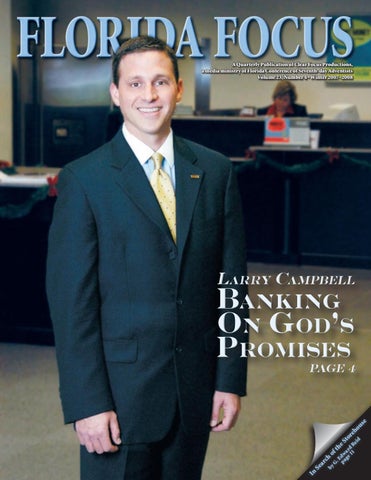
A Quarterly Publication of Clear Focus Productions, a media ministry of Florida Conference of Seventh-day Adventists Volume 23, Number 4 • Winter 2007–2008
Larry Campbell
Banking On God’s Promises
In
by
Se
ar ch
o
f G . E th d pa w e S ge a r to 11 d R re ho ei d u
se
page 4
Harvest 2008:
Friendship Evangelism : A
An Emphasis On Evangelism by Mike Cauley, Florida Conference President
T
Four Ways To Participate In Harvest 2008 1. English-speaking members in central Florida may bring interests to Mark Finley’s live reaping meeting or downlink the meetings into their home church anywhere in the state. 2. Spanish-speaking churches may participate in an evangelistic-smallgroup process during the year, culminating in the reaping series. 3. Pastors and lay people may personally conduct a reaping meeting in their church utilizing the framework developed for the 2007 North Florida evangelistic thrust. Let your pastor know if you are interested. We have materials that you and your pastor can use for seed sowing, cultivation, and preaching. 4. Pastors/churches may invite office personnel or students from the Lay Institute For Evangelism—LIFE (an ASI organization which trains young people in soul winning and is being established in Orlando) to conduct a reaping meeting utilizing the framework developed for the 2007 North Florida evangelistic thrust. Those who serve as guest evanVol . 23, No. 4 gelists from the conference office or LIFE will Winter 2007–2008 likely hold meetings within an hour’s drive Florida Conference of of Orlando. The dates of these meetings will Seventh-day Adventists coincide with Mark Finley’s series. 655 North Wymore Road Winter Park, FL 32789–1715 The word “harvest” denotes the intentional Phone: (407) 644-5000 work of preparation. The Florida ConferFax: (407) 644-7550 www.floridaconference.com ence evangelism department will work with floridafocus@floridaconference.com churches that wish to participate in order to President develop a strategy for preparing the soil. By Mike Cauley the grace of God, we will be prepared to conE xecutive Secretary duct scores of reaping meetings, either with Carmen Rodriguez live preaching or via satellite, all beginning Treasurer around the end of October 2008. Thomas Verrill All who participate in Harvest 2008 (both Editorial Staff English and Spanish) will be invited to come Martin Butler together December 5–6 at the Forest Lake Editor Academy gymnasium with Pastors Finley and Lee Bennett de los Ríos. This will be a grand celebration Desktop Publishing and will also be a time to invite those who Gladys Neigel Editorial Assistant haven’t yet made a decision to do so. God’s promise to us is, “…look around. Cover: Larry Campbell, 35, is Financial Center Leader of a bank The fields are already ripe for harvest.” in the greater Orlando area. —John 4:35 The New Living Translation
FLORIDA FOCUS
Page 2 • Florida Focus • Winter 2007–2008
David Boyce
his issue of Florida Focus reports on the evangelistic thrust held in north Florida this past October/November. Conference office employees collaborated with the pastors, evangelists, and churches for 12 reaping meetings. This concentration will be expanded in 2008 and will focus on central Florida. The evangelistic emphasis, Harvest 2008, will coincide with both the NET 2008 series by Mark Finley, conducted at Forest Lake Church in Apopka, October 24–November 29, and the Spanishlanguage series conducted by Rolando de los Ríos at Miami Central Spanish Church, November 1–8. Both meetings will be uplinked via satellite on the Hope Channel network. Pastor Reynold Maxwell baptizes Jean Huntley at Silver Springs Shores Church in Ocala during meetings held by Conrad Duncan, Florida Conference vice president for general administration. by Martin Butler
F
riendship evangelism played a key role in drawing visitors to 12 campaigns held in north Florida, resulting in more than 100 baptisms. The October/November reaping meetings saw Florida Conference administrators and departmental leaders join with pastors and members in this Spirit-led endeavor. Preparations for the meetings began in early 2007 with 10 days set aside to pray for the communities, followed by a March 16–18 prayer summit at Camp Kulaqua in High Springs. In the summer, church members reached out through friendships, Bible studies, and literature distribution. Brochures for each campaign were used to personally invite people to the meetings. “It warmed my heart to preach the
Adventist message and to see people make decisions to follow Jesus,” says Florida Conference President, Mike Cauley, who teamed up with High Springs/Jennings Lake district pastor, Anthony Crawford. One such decision was by Rose Ellen Rilea from High Springs. She is a member of an Episcopal/ Anglican church Bible study group that meets in the Adventist church each Wednesday. When Pastor Crawford joined the group for the study in Daniel and Revelation, his valuable input prompted the group’s leader to ask him to teach the class from then on. As a result, several class members also chose to attend the evangelistic series. Meanwhile, Eugene Torres, field representative in the Florida Conference planned giving and trust services depart-
A Key To 100+ Baptisms In North Florida
Irene Wright
Victor Rodriguez
ment, held meetings in St. Augustine. One highlight of his campaign with lay pastor, Barry Seals, was the baptism of a former member who returned to the church after being away for more than 50 years. That Sabbath was a sweet October homecoming as family and friends filled the church to witness this occasion. Back in the center Pastor Byron Rivera baptizes Silvia Echegaray of the state, Conat Marion Oaks Spanish Church in Ocala during ference Executive meetings held by Carmen Rodriguez, Florida Secretary Carmen Conference executive secretary. Rodriguez brought evangelistic preaching to the Marion Oaks Spanish Church in Ocala with Pastor Byron Rivera. One of those in attendance with whom Carmen formed a friendship was Silvia Echegaray. After faithfully attending the meetings, Silvia responded to a call for baptism. “She was baptized Thanksgiving weekend, and Allen and Michelle Thompson testified at their bap- Silvia looked radiant,” tism during meetings held at the Cross City Church said Carmen. Afterby Gus Scheuneman, Florida Conference planned ward, Silvia participatgiving and trust services field representative. ed in the communion
12 Evangelism Meetings Hosted In North Florida Church Cross City CrossRoads in Ocala Gainesville Gainesville Spanish High Springs Interlachen Jennings Lake Marion Oaks Spanish Orange Cove Palm Coast Saint Augustine Silver Springs Shores
Pastor/Lay Pastor Bill Schnorbus Mike Goetz Daniel Graham Byron Rivera Anthony Crawford Dennis McOmber Anthony Crawford Byron Rivera André Van Heerden Robert Hayes Barry Seals Reynold Maxwell
Speaker/Evangelist Gus Scheuneman Bill Crofton Bill Waters Rolando de los Ríos Mike Cauley Abel Paulín Anthony Crawford Carmen Rodriguez Lester Pratt Marvin Williams & Robert Hayes Eugene Torres Conrad Duncan
service where she and Carmen served each other in the footwashing ceremony. A campaign in the northwest part of the state was conducted in Cross City by Gus Scheuneman, also a field representative in the Conference planned giving and trust services department. “The members’ caring spirit clearly influenced the meetings’ success,” he says. Allen Thompson told the congregation, “Two years ago, I was an alcoholic. One night, I was arrested for driving under the influence. I was sent to prison where a chaplain gave me a Bible to read. When I was released, I had good intentions and started going to church. Soon, I fell back into the same old lifestyle. “Violating my probation, I was sent back to jail. This time, the court system was not sympathetic and I faced a three- to fiveyear sentence. I had let my family down, and, that night, I fell on my knees and cried to God for forgiveness. “The next day, I asked my wife, Michelle, to bring my Bible to me. Two days later, Bill Schnorbus, lay pastor of the Cross City Church, brought it, saying that my wife asked him to visit me. “Later, Bill related how Michelle and my sister, Kimberly, dropped into church out of the blue on Sabbath morning to
attend services. He felt the Holy Spirit was at work because he had never seen them before. They asked Bill to visit me in jail and bring my Bible to me. “To make a long story short, I was out of prison two weeks later, and my violation was dropped. I haven’t touched drugs or alcohol in over a year and a half, and I’ve been attending church for more than a year. Just before we were baptized at the Cross City Church, Michelle and I shared our story as a testimony of God’s awesome power. “Today, I have peace in my heart and the promise of hope for tomorrow. I am so thankful to my wife and Pastor Bill, but most of all, I thank God for giving me another chance.” Mike Cauley says, “These beautiful, lifechanging stories of Allen and Michelle, Rose Ellen, and Silvia, are four of 100 from the north Florida meetings. Last March, we encouraged our members to begin practicing friendship evangelism and look at what God has done. “Witnessing these decisions to follow Jesus has given me a taste of what lies ahead through Harvest 2008! I’m excited about the New Year! Won’t you join me in praying for God’s blessing that a harvest of souls beyond measure will be reached for His kingdom?”
Winter 2007–2008 • Florida Focus • Page 3
Banki
Larry Campbell’s banking career has spanned 16 years. The Apopka church member says, “When you look at my life, I am the richest man in the world. When you look at my bank account, I’m by no means wealthy. We still struggle from time to time. One thing, however, has remained constant—the very first check written after payday is our tithe check.” by Larry Campbell
I
was 17 when my mother was diagnosed with cancer. She would win her first battle over the disease before I graduated from high school. At this time, Mom worked as a bookkeeper for a businessman who was also on the board of directors for a local community bank. When she learned about a bank teller opening, Mom encouraged me to apply for the position. At the age of 18, I became a banker. Before I reached my 21st birthday, Mom’s cancer returned. Every night, I listened to her pray for forgiveness, because she believed she had done something to deserve her illness. For Mom, talking to God was not something that waited
until she was on her deathbed. As long as I could remember, my parents took their five children to the Catholic church every Sunday. Each week they would faithfully place $5 or $10 in the collection plate. In my late teens and early 20s, church seemed like an obligation, yet, I would attend because I knew it made Mom happy. As I listened to her plead with God for forgiveness in her final days, my view of the church and God became unfavorable. When she died, I saw no reason to continue attending church even though my father remained steadfast in his faith and encouraged me to do so. Coincidentally or not, at this crossroad in my life, everything started to take
Page 4 • Florida Focus • Winter 2007–2008
a downward turn. I became involved with the wrong crowd and would go out drinking with them most nights. My work suffered, and a promising career in banking that now saw me receiving promotions came to a screeching halt. I lost my job and the respect of my family as I sank to the lowest point in my life. One day, a thought came to me, “maybe I need to bring God back into my life.” For the first time in a long while, I prayed for guidance. Three weeks later, September 18, 1995, God placed someone in my life
to make sure I could hear His voice. The evening started out quite normal. My brother-in-law and I were watching Monday Night Football at a local bar where we were regulars. We ordered our drinks and food, and I said to my brother-in-law before the server returned, “I’m tired of coming to the same place every Monday night.” He agreed 100%, and we left. Once outside, we decided to try a new restaurant where we could still watch the game. Within 30 minutes after taking our seats at a table,
I noticed a beautiful girl walk in and join a group of friends at a table in front of us. I wanted to meet her, but didn’t want to interrupt their conversation. Finally, she got up from the table, and I saw my opportunity to get her attention. We began talking, and, before the evening was over, I had mustered up the courage to ask Elizabeth for her telephone number. That night, I told my brother-in-law, “I just met the girl I am going to marry.” Around the same time, a very good friend offered me a job
I became involved with the wrong crowd, lost my job, and sank to the lowest point in my life.
On God’s Promises
Photos: Lee Bennett
ng
“God gave me the most incredible gift when He brought Elizabeth into my life,” says Larry. “Now, we have our own family. Colin is four years old, and we’re expecting a new daughter soon after Christmas.”
at the bank where he worked. I had to start from the beginning again as a teller, but it was a respectable job at a good bank with an opportunity to work for one of the best people I have ever known. Elizabeth and I talked over the telephone many times before we saw each other again. Each time we visited, I realized how different she was from anyone I had ever met. She was not selfabsorbed or selfish. She was kind, caring, and friendly. She wanted to know about me and my family.
One day, Elizabeth asked me if I attended church. No girl I had ever dated asked me that before. I told her that I used to attend church and was thinking about going back. She told me that she was a Seventh-day Adventist and explained a little bit about the Sabbath. Then, she offered to take me along if I ever wanted to try her church. That intrigued me, mostly because it would give me another reason to spend time with her. On the first Sabbath I visited her church, I placed $5 or $10
in the offering plate just like my parents taught me to do. As I watched Elizabeth fill out an envelope with her offering, I noticed it wasn’t for $5 or $10. The amount, comparatively speaking, was quite large. I remember thinking, “Something isn’t right. How can she be writing such a large check to the church?” The next time I attended church with her, the same thing happened—another large check. After the service, I asked her why she gave so much money. She explained
the concept of tithing to me, and I remember being amazed that someone so young was so dedicated. By now, my life was getting back to some normalcy with the exception that I was a financial disaster! Collection agencies called me daily as bills piled up. I even had my car repossessed. Although I now had a job, the hole I had dug was so deep, it was easier to ignore the problem and hope it would go away. One day, Elizabeth heard me take a phone call from a collection agency. She had seen the stress I was under from the pile of bills. After I hung up the phone, she asked me to sit down. “I’m worried about you. If we are going to continue any further as a couple, I need to know everything that is going on with you financially.” She proceeded to ask for my checkbook, my pay stubs, every bill I had, and everything else related to money. She diligently put together a budget for me and a plan to pay off every penny I owed on a timely basis. That day, Elizabeth took complete control of my finances. Soon, the phone calls from the collection agents stopped, and the weight on my shoulders began to grow lighter. One day I said to Elizabeth, “Why don’t you write
one of those tithe checks for me?” She looked me straight in the eye and responded, “Just because things are starting to look better for you financially, that doesn’t mean it’s time to start tithing. If I begin writing tithe checks for you, I’m not going to stop when things aren’t going so well. Tithing is not something you do every now and then. It is something you must feel compelled to do until the day you die.” Then, she said something that I will always remember and count as one of the best lessons in my life: “If I write this check now, your tithe check will be the first one written after every paycheck from now on. Period!” I didn’t hesitate. I told her to write the check. Then, she handed the checkbook to me saying, “You deserve the privilege to write your very first tithe check.” I did so, and it was the greatest feeling in the world. Two weeks later, my boss called me to his office. As I walked in, he was standing there with the bank president. They asked me to close the door and sit down. Nervously, I thought, “What have I done? Is the bank laying people off?” The bank president spoke first, “Campbell, —continued on page 6
Winter 2007–2008 • Florida Focus • Page 5
Banking On God’s Promises
God doesn’t need my money; however, I need tithing and the amazing feeling I get when I give.
—continued from page 5
mind, “‘Bring the whole tithe into the storehouse, that there may be food in my house. Test me in this,’ says the Lord Almighty, ‘and see if I will not throw open the floodgates of heaven and pour out so much blessing that you will not have room enough for it.’” —Malachi 3:10 (NIV).
Truly, God has abundantly blessed every day of my life. Don’t get me wrong— the day I started returning tithe was not the end of all my financial hardships. However, returning tithe was the beginning of an incredible journey filled with amazing blessings from the Lord. As for all of that debt I had, by His grace, it eventually was completely erased.
restaurant that, “I just met the girl I am going to marry.” Now, I started to think that she might possibly feel the same way. I found the courage to ask her to marry me, and she accepted. We continued our studies as I learned even more about God and His love for me. In one lesson, our pastor said something about tithing that really made sense. He told me that every possession, every dollar we make, is God’s gift to us, and he illustrated these thoughts by saying, “If a stranger walks up to you on the street, gives you $100, then asks for $10 of it back, you would gladly give it to him in the blink of an eye.” Tithing is simply returning a small porLee Bennett
you’re doing great. We’re lucky to have you.” My boss added, “Because we like you so much, we’re giving you a pay raise, effective immediately.” I was shocked. I had never received an increase in pay unless it was after my annual review. The increase received that day was substantial. I was amazed! Within a few weeks, Elizabeth called me at work one morning with a sense of urgency, as well as excitement, in her voice. Knowing I was without a car since mine was repossessed, she told me about a oneday, non-advertised promotion she learned about that was taking place at a car dealership. For a single payment of $800, this dealership would lease a brand new pickup truck for one year with no monthly payments. I arranged for permission to leave work, and Elizabeth picked me up. By the time we arrived at the dealership, I was the last person to receive one of 20 trucks they had set aside to lease. Once again, God’s promise that Elizabeth had shared with me went through my
I soon began Bible studies with Elizabeth and the Apopka church pastor. Every study opened my eyes to God’s truths. Even though I’d been raised in a church-going family, I hadn’t ever really heard God speak through His Word. The more we studied, the closer we drew to God and to each other. Believe me, I hadn’t forgotten the comment made to my brother-in-law in the
tion of what God has given to us, back to Him, to do His work. God doesn’t need my money; however, I need tithing. I need the amazing feeling I get when I give something to Him. In December 1997, I gave my life to Jesus and was baptized into the Seventh-day Adventist Church, and Elizabeth was re-baptized with me. Together, we dedicated our lives to the Lord. We were married one month later, and I felt as though God was giving her to me and saying, “I trust you with this very special person.” For nearly 10 years, we have been blessed to belong to a wonderful church family. The Apopka church has always given us a sense of belonging. That’s why I was moved by the privilege when asked to participate in a stewardship campaign to build a new church home. I want to ensure that my children and other families have a place to worship God and feel welcomed like I have. When I reflect on my journey, I not only owe my time and talents to a loving God— I owe Him my life. When I consider what He has done for me, truly, I am the richest man in the world.
“Recently, we witnessed the Apopka church’s mortgage burning and considered what God’s awesome power accomplished when we entrusted to Him all that He has given to us. Truly, we serve an amazing God!” —Larry Campbell You’ll be inspired to read Pastor Haskell Williams’ mortgage-burning message of thanksgiving, page 7. Page 6 • Florida Focus • Winter 2007–2008
Thoughts From a Thanksgiving Message
Tom Verrill, Florida Conference treasurer, left, holds a portion of the Apopka Church’s mortgage papers as Doug Braithwaite, Building Committee chairman and church elder, sets them ablaze. Pastor Haskell Williams awaits his turn with additional mortgage papers.
our knees in prayer. A ray of hope dawned in 2004 when the former church on Highland Avenue sold, cutting the mortgage on the new property in half. Miracle stories unfolded as donations came in bit by bit from people who believed and faithfully gave on a regular basis. When the debt balance was revisited this past summer, our calculations revealed
by Haskell Williams
T
Chris Carey
he Apopka congregation moved into a new worship center on Votaw Road in 2003, 14 years after the property was purchased. Reeling under a $2.1 million debt, the members struggled on several occasions to simply pay the interest on the mortgage loan. Learning to lean on the Lord brought our wrestling souls to
that the worship center phase of the building project could be met by March 2008 if faithful giving continued. When an individual was impressed by God to provide a matching challenge grant, the congregation responded and the mortgage level dropped to the point where it appeared a payoff could be made by Christmas, if not earlier.
What a celebration it was when the debt was liquidated even before Thanksgiving! At the November 24 mortgage burning, members were asked to “listen carefully to what God wants us to do next” as consideration is given to the next phase of the dream, to build a new church sanctuary. Phase I certainly had its valley experiences. Now on the mountaintop, members testify that any accomplishment has not come by might, nor by power, nor by fantastic planning, but by God’s Spirit. Never in anyone’s wildest dreams would we have believed a 15-year mortgage could be fully paid in a little more than 54 months.
Trish Turner
Chris Carey
Thanksgiving weekend, 2007, will go down in Apopka Church history as one that took the Doxology to new heights. “Praise God from whom all blessings flow,” never had a greater meaning for those who traveled the long road to the November 24 mortgage burning.
As members recount the story to others, some have said, “You must be a rich church,” which prompts the response, “I’m sorry. You must be talking about some other congregation.” Then, a counter suggestion is offered: “Rich in God’s mercy? Yes! Rich in His blessings? Yes!” Now, we are praising God and looking ahead in diligent prayer, asking Him, “How may we serve You? What would You have us do to glorify Your name?” The future is not about making a temple for us or a monument to fill us with pride. It is about glorifying God and serving Him so every earthly child of His can be saved.
Pastor Haskell Williams of the Apopka Church told his congregation, “Never in anyone’s wildest dreams would we have believed a 15-year mortgage could be fully paid in a little more than 54 months.” Members responded, “Yes! We are rich in God’s mercy—rich in His blessings.”
Winter 2007–2008 • Florida Focus • Page 7
Blessings Blowing In by Marya Latson
And it shall come to pass, that before they call, I will answer; and while they are yet speaking, I will hear. —Isaiah 65:24
I
n 1982, I was struggling to make ends meet as a recent college graduate earning $432 biweekly. One crisp November night, while worrying about bills, the roar of wind sweeping through the trees kept me awake. Around midnight, the limbs of a neighbor’s pecan tree began banging into the tin roof of my north Florida cottage. Added to that was the disturbing clank and rattle of nuts rolling down the metal roof caused by squirrels extricating pecans from the tree. Noises
on the outside and worry on the inside prohibited any sleep. Suffering from insomnia, I decided to pray, “Lord, I know that You said You would provide for all my needs. Please show me a way to pay all my bills that are due this Friday and honor my commitment to return Your tithe. I don’t see how I am going to do it, but I know You can make it happen.” With that prayer, I went to sleep. Leaving home early that Thursday morning, thoughts of debts and blessings filled my mind. As I walked to the car, I noticed that pecans had amassed beneath my bedroom window. The practice of tithing—dedicating a tenth of one’s gross income to God— was new to me. As
Page 8 • Florida Focus • Winter 2007–2008
a 24-year-old single professional who had never put more than $5 in a church offering plate prior to joining the Seventh-day Adventist Church, $43.20 seemed an extraordinary tribute. Friday’s paycheck was to be my first opportunity to return tithe after joining the St. Augustine Church. With insufficient funds to fulfill all my financial obligations, inaugurating the practice of tithe paying became a true necessity, as I was faced with no alternative but to prove the theory that God would “open the floodgates of heaven and pour out so much blessing” that there wouldn’t be enough room to contain it. I determined to honor my commitment. What a test of my faith! I didn’t want to let God down, but I
surely did not want to be evicted or lose my new car. All day long, I thought about what to do. After deducting taxes and insurance, my take-home pay was only $316. I was in a dilemma with $150 in rent and a $200 car note due the same day. An added concern was my unsympathetic landlady who had told me about two young women whom she was evicting for making a partial payment on their rent. Retiring to bed early, I became alarmed by the thunderous cadence of nuts assailing the tin roof. Concern over financial obligations and nuts rattling continued to keep me awake in spite of my desperate desire for sleep. It was time to pray again. Before praying, however, I read my
Bible. Reading the sixth chapter of Matthew, I became transfixed on verse 26. “Look at the birds of the air; they do not sow or reap or store away in barns, and yet your heavenly Father feeds them. Are you not much more valuable than they?” Solace from God’s word allowed me to sleep. Surely, everything would work out. I resolved to trust God. Payday arrived with my usual salary. I cashed the check at lunchtime and paid my car note. Looking at the $116 left, I placed the tithe money in an envelope for safekeeping. With only $73 left, I contemplated my options. Since the sun would set about 5:30 that day, I rushed home from work to address my landlady. Turning into
the Wind the driveway, I prayed again. This time, I asked God to give her a pleasant disposition and to give me the courage to ask for an extension. With $5 extra in my wallet, I decided I would give her half the rent and promise to pay the balance next Friday. Having never been late before, I hoped she would accept the offer. If not, then God must have another plan. I greeted my landlady with a smile. She was unusually cordial that evening, and she accepted my offer without a single negative word. Expressing admiration for my honesty, she agreed to accept the balance of payment the next week. I went home with joy in my heart. As the sun set, I praised God that I could rest peacefully that night.
On Sabbath morning, I arrived early at church feeling good that I had the $43.20 tithe to put in the collection plate along with a $3 offering. No one in church knew how big a deal that was for me, but God knew. After church, an elderly woman who wore the same dress to church every week asked me to take her home. Her truck wasn’t working, and she needed a ride. While we were riding, she asked me if I liked pecans. I asked her why. She told me that she sold them at the farmer’s market for $20 a bag, and, if I wanted some, then she would sell them to me. I told her, “No, thanks. I don’t like pecans.” After arriving home, I had settled down for a nap. Once again, the squirrels were rattling the nuts
Marya Latson lives in Ocala with John, her husband of 14 years, and their 11-year-old son, Javan. They attend the Belleview Church where she is a very active member. An attorney by profession, Marya loves writing and working with young people. Through research, Marya discovered the nocturnal “secret agents” were north Florida flying squirrels. Since they rarely leave their treetop homes, they didn’t retrieve the nuts that had fallen to the ground.
onto my roof. It wasn’t even night yet! At that instant, I had a revelation. I don’t have to go looking anywhere for the rent money. God had sent the blessing straight to my house by special delivery. Jumping out of bed, I ran outside to look beneath my bedroom window. Pecans were stacked nearly a foot high in a trench that the rain run-off had created earlier that week. The pile seemed to be about three feet long and two feet wide. My mind started calculating: at $20 a bag, all I needed was four bags to pay the rest of the rent. What a blessing! From the very first night I started worrying about my bills, God had placed his special agents into action. He motivated squirrels
to visit a tree I didn’t own and cause pecans to fall into a trench in my yard made by the rain. Amazingly, the squirrels must not have eaten any of the pecans that rolled onto my roof. The neighbor’s wooden fence barricaded the pecans in my yard. Truly, God had a plan for me. He wanted to see if I would be faithful. I was faithful, and He rewarded my faith. I was blessed beyond measure, not just from the five
bags of pecans I collected on Sunday morning, but I was blessed in knowing that God still works in mysterious ways. If He could make the winds blow such that a tree in another person’s yard could have its limbs bow over my roof, allowing squirrels to cast pecans into my yard, then I know that He can do anything for anyone at any time.
Winter 2007–2008 • Florida Focus • Page 9
Church Property Development Director Retires After 15 Years of Service by Gladys Neigel
C
ynthia Duncanson served as church property development director at Florida Conference from January 1997 until her retirement on October 1, 2007. In this position, she managed approximately 425 properties held by the Conference. As part of her responsibilities, Duncanson traveled around the Conference to inspect property and attend church building committees, church openings, dedications, mortgage burnings, and board meetings. She also conducted construction seminars at Camp Meetings and elsewhere throughout the Conference.
The biggest challenges that Duncanson faced came in the many facets of construction from working with contractors and the county officials to the change in prices of materials. Much of her time was also spent in dealing with taxes and tax exempt status for the various properties. Born in Jamaica, she attended West Indies College. Upon moving to Florida in 1976, she began working as a secretary for attorneys and then as a legal assistant for law offices, specializing in real estate. She obtained real estate and mortgage broker licenses which led her to work for one of the largest developers in Florida, the Ruten-
Investors Needed by Tom Verrill
E
veryone loves a “winwin” opportunity where all parties involved benefit by a certain action. Investing in the Southern Union Revolving Fund is one of those special opportunities. In fact, it could be considered a winwin-win situation. Here are three reasons why you might choose to invest in this Fund: First, those who invest in the Revolving Fund earn a reasonable return on their money. Currently, the Revolving Fund pays 4.5% interest to investors, which is a very attractive amount in today’s market. In addition, Page 10 • Florida Focus • Winter 2007–2008
Cynthia Duncanson, center, on groundbreaking day, December 2, 2002, with the late Ernest Steed, left, David Cook, then pastor, and Zachary O’Brien, 9, at the site of the DeBary–Orange City Church.
berg Corporation in Clearwater, and then for the law firm of Baker and Hostetler, P.A., one of the largest law firms in Orlando. Duncanson began work at Florida Conference in 1992 as legal assistant to the Conference attorney, Frank McMillan. In 1996, she worked with Arnt Krogstad to create the church property
development department of which she became the director in 1997. In the early days as church property development director, Duncanson was also coordinator for the Conference church auditors. Because of her desire to find a better procedure for church treasurers to submit their reports, she commissioned the writing
of software that is still in use today— the Jewell program. The new director of church property development is Kathy Fairchild, who is a former employee of Florida Conference in the communication and secretariat offices, and who has a background in real estate. Joy Daniel is secretary in the department.
Open to Southern Union members—$1,000 minimum investment. Longer-term investments are recommended for maximum benefit. Revolving Fund interest rate is subject to adjustment as voted. 90-day demand note (funds are usually available earlier). Details: (407) 644-5000 x186 or planned.giving@floridaconference.com
investors can experience the joy and satisfaction of knowing their funds are being used to advance the Lord’s work here in Florida. Moneys invested in the Revolving Fund are loaned to churches and schools to purchase or construct new buildings. Thus, by investing in the Revolving Fund, people truly are utilizing their funds in a way that has eternal returns. Second, churches and schools also benefit greatly from monies invested in the Revolving Fund. Loans
from the Revolving Fund are almost always available at a lower interest rate than is available from other lending institutions. Saving money means more funds are available for outreach and support ministries. Third, investments in the Revolving Fund are a benefit to Florida Conference. Florida entities may only borrow monies from the Revolving Fund to the extent that investments from Florida Conference members and entities
are available. Because of the growth in Florida during the past few years, there is a potential shortage of investments available for future loans unless more investments are received. We are asking that each member and church or school prayerfully consider investing monies in the Revolving Fund. We believe you will be blessed by participating in this winwin-win opportunity while investing in eternity.
In Search of the Storehouse In almost every discussion of tithing, the question of where the tithe should be sent comes up. The following paper, prepared by G. Edward Reid, looks at the Storehouse question from several points of view to come to a concise answer for today’s Christian steward. It considers: the Seventh-day Adventist Church policy, the Scriptural perspective, counsel from the Spirit of Prophecy, the Second Tithe, what to do with back tithe, why the church was organized, what about other “ministries,” what if there are problems in the ministry? Ellen White’s example, the duty of the conference, and the eschatological significance of tithing. Special feature (reprinted by permission)
•
G. Edward Reid is an ordained minister and licensed attorney. He is certified as a teacher and counselor by Crown Financial Ministries. He is a graduate of Southern Adventist University, holds master’s degrees from Andrews University (M.Div) and Loma Linda University (MPH), and holds a Doctor of Law (JD) degree from Georgia State University. He has served the Church in teaching, pastoral ministry, evangelism, and departmental positions. Ed has done considerable study on the topics of Christian money management and eschatology. He is the author of six books: It’s Your Money, Isn’t It?; Even at The Door; Sunday’s Coming, Ready or Not; Almost Home; and Battle of the Spirits.
Winter 2007–2008 • Florida Focus • Page 11
In Search of the Storehouse by G. Edward Reid
“Bring ye all the tithes into the storehouse” Malachi 3: 10, is God’s command. No appeal is made to gratitude or to generosity. This is a matter of simple honesty. The tithe is the Lord’s; and He bids us return to Him that which is His own.” (Education, p. 138). There are many references in the scriptures and the counsel of Ellen White regarding the tithe and its use. The majority of Christians today believe that the law of the tithe is still binding. The question which surfaces from time to time is: Just where is the storehouse today. And, in addition, even if I knew where it was, do I have to turn all my tithe in there or can I use my own discretion and return my tithe as I see best? Other questions that arise involve such topics as: What should I do with my tithe if I sincerely believe that those charged with the responsibility of distributing the tithe are not doing so in a responsible manner?, or What if I know of an independent ministry that is doing a good work that I want to support? Isn’t that a gospel ministry? The purpose of this paper is to find the answers to these questions from the Biblical record and the counsels of the Spirit of Prophecy. How do we as Adventists apply the Biblical counsel to our day. I’ll begin by looking at the Working Policy of the North American Division. Section T 05 20 states: “It is recognized that the local conference level of denominational organization is the ‘storehouse’ to which all tithe should be sent and from which the gospel ministry is supported. For the convenience of church members, the tithe is turned in to the local conference through the local church where membership is held.” Some members have wondered whether or not it would be appropriate to send their tithe directly to denominational institutions such as the entities at the Adventist Media Center where ordained Adventist ministers are employed. Church leaders have felt that in order to be consistent with the Scriptures and the Spirit of Prophecy counsel and to present a clear picture to the membership, the conference level of our church organization should be recognized as the storehouse. With this idea in mind the NAD Working Policy states in T 05 25, “Tithe paid to denominational institutions shall be remitted by the institutions Page 12 • Florida Focus • Winter 2007–2008
to the local conferences in whose territory they are located. The regular percentages according to policy shall be passed on by the local conference to their higher organizations. The remainder of the tithe retained by the local conferences may be used as the conference committees shall determine, within denominational guidelines concerning use of tithe and with due regard being given to the needs of the institutions from which the tithe was received.” I believe that these two statements from the Working Policy are in harmony with the inspired counsel. We will examine this counsel in the balance of this study.
The Scriptural Perspective
When God delivered Israel from Egypt, once again seeking to establish “His” people, He told them again about the tithing system and the support of the services of the tabernacle. Tithing was evidently known to mankind since the fall and expulsion from the Garden of Eden. The Bible records that fact that Abraham (Gen. 14:20) and Jacob (Gen. 28:22) were tithers. However, when God took His people to the promised land following the great Exodus, He spelled out through His servant Moses much more detail on this and other subjects. For example, “All the tithe of the land…is the Lord’s. It is holy unto the Lord.” (Lev. 27: 30) In God’s plan, one of the twelve tribes, Levi, was not to engage in regular work activities as the other 11 tribes, but this tribe was to be set aside for the religious activities and instruction of the nation. They were to be supported by the tithe and freewill offerings of the others. The Lord (Jesus) instructed them, “I have given the children of Levi all the tithes in Israel as an inheritance in return for the work which they perform, the work of the tabernacle of meeting. For the tithes of the children of Israel, which they offer up as a heave offering to the Lord, I have given to the Levites as an inheritance; therefore I have said to them, ‘Among the children of Israel they shall have no inheritance.’” (Numbers 18: 21,24) Just before the conquest of Canaan Moses gave Israel his final counsel from the Lord. This is the substance of the book of Deuteronomy. God told His people that in the promised land they were not to do whatever they thought was right in their own eyes
with regard to their tithe and offerings but they were to follow precisely His plan for them. Note His words, “But you shall seek the place where the Lord your God chooses, out of all your tribes, to put His name for His habitation (dwelling); and there you shall go. There you shall take your burnt offerings, your sacrifices, your tithes, the heave offerings of your hand, your vowed offerings, your freewill offerings, and the firstlings of your herds and flocks…You shall not at all do as we are doing here today—every man doing whatever is right in his own eyes—But when you cross over the Jordan and dwell in the land which the Lord your God is giving you to inherit…then there will be the place where the Lord your God chooses to make His name abide. There you shall bring all that I command you: your burnt offerings, your sacrifices, your tithes, the heave offerings of your hand, and all your choice offerings which you vow to the Lord…Take heed to yourself that you do not offer your burnt offerings in every place that you see; but in the place which the Lord chooses, in one of your tribes, there you shall do all that I command you.” (Deut. 12: 5-14) I refer to the above counsel as the law of the central storehouse. God did not plan that everyone would do what was right in his own eyes. He had a specific plan, and He expected His people to follow it. That God means what He says in regard to the support of His work through His treasury is shown clearly in scripture. As Israel prepared to capture Jericho according to the directions given to them by God—the routine of marching around the city—Joshua told Israel that “all the silver, and the gold, the vessels of brass and iron, are consecrated unto the Lord: they shall come into the treasury of the Lord.” (Joshua 6:19) After the conquest, the Scripture says, “And they burnt the city with fire, and all that was therein: only the silver, and the gold, and the vessels of brass and iron, they put into the treasury of the house of the Lord.” (Joshua 6:24) All Israel followed these divine instructions with the exception of one man—Achan. Because of his disobedience thirty six Israelites were killed at Ai. When Joshua inquired of the Lord as to the problem, he was told that someone had disobeyed and kept some of God’s portion instead of turning it in to the Lord’s treasury. God said, “You cannot stand before your enemies until you take away the accursed thing from among you.” (Joshua 7: 13) And so the fate of
Achan was that he was stoned to death along with all of his family and then all of their possessions were piled on top of them and they and their possessions were burned up. (see Joshua 7: 24-26) Much more could be said from the Old Testament perspective, but I will just recall briefly the experience of King David. Evidently, it was his practice to follow the counsel of God as outlined in Deuteronomy chapter 12. He states in Psalm 66: 13, “ I will go into Your house with burnt offerings; I will pay You my vows.” And again when he was contemplating God’s great goodness he stated, “What shall I render to the Lord for all his benefits toward me? I will take up the cup of salvation, and call upon the name of the Lord. I will pay my vows now in the presence of all His people. In the courts of the Lord’s house, in the midst of you, O Jerusalem.” (Ps. 116: 12-14,19) David did not send his tithe somewhere. He took it as an act of worship and in obedience to God’s command. He took it to God’s house, where God’s people were, in the courts of the Lord’s house. David was so inspired by God’s goodness he decided to build God a mighty temple. But because he was a man of war he was not permitted to build the temple, though he did draw the plans and secure all of the building materials. David stated, “Now He (the Lord) said to me, ‘It is your son Solomon who shall build My house and My courts; for I have chosen him to be My son, and I will be his Father.’”(I Chron. 28: 6) Then later as Solomon was building the temple God said to him, “Concerning this temple which you are building, if you walk in My statutes, execute My judgments, keep all My commandments, and walk in them, then I will perform My word with you, which I spoke to your father David.” (I Kings 6: 12) God even told Isaiah, the gospel prophet, “Even them [foreigners, strangers, non Israelites] will I bring to my holy mountain, and make them joyful in My house of prayer. Their burnt offerings and their sacrifices [those things commanded in Deut. 12] will be accepted on My altar; for My house shall be called a house of prayer for all nations.” (Isa. 56: 7) Israel prospered when they obeyed God, and they fell onto hard times when they didn’t. They seemed to follow a cycle of obedience and prosperity and then disobedience and problems. It was during one of the periods of unfaithfulness that God, through the prophet Malachi, once again invited His people to return to Him. “Return to Me, “ He says, “and I will return to you.” And the people said, “In what way shall we return?” And God essentially answers that question by saying, “Stop robbing Me!” To quote Malachi, “You are cursed with a curse, for you have robbed Me, even this whole nation. [Not just one man as in the days of Winter 2007–2008 • Florida Focus • Page 13
Achan.] Bring all the tithes [the ‘whole tithe’] into the storehouse, that there may be food in My house. And prove me now in this, says the Lord of hosts, If I will not open for you the windows of heaven, and pour out for you such blessing that there will not be room enough to receive it.” (Mal. 3: 6-10) So what can we learn from the Scriptures about tithe. First, the tithe doesn’t belong to us. It is the Lord’s. It is holy. Second, We are to follow God’s plan precisely in regard to where we return our tithe. In Old Testament times that place was the temple storehouse from which the Priests and Levites were paid. Today the equivalent would be the conference office from which the pastors are paid. And third, the tithe is to be used as God directed—to support the ministry.
The Spirit of Prophecy Counsel
According to Arthur White, grandson and biographer of Ellen White and secretary of the White Estate for 41 years, “Nothing is plainer in the E.G. White writings than the instruction concerning the faithful payment of tithe and the fact that it is reserved for support of the ministry. This is attested to in all Ellen White’s statements that have a bearing on this question.” (Ellen G. White Bio. vol 5 p. 390) “Also the precise use of the tithe, sacred to the support of the ministry of the church, was repeatedly brought to the attention of the leaders and members.” (Arthur White, EGW, Bio. vol. 1, p. 393) God impressed Ellen White with the seriousness of the tithe by making the duty plain and associating it with the covenant relation. “He who gave His only begotten Son to die for you, has made a covenant with you. He gives you His blessings, and in return He requires you to bring Him your tithes and offerings. No one will ever dare to say that there was no way in which he could understand in regard to this matter. God’s plan regarding tithes and offerings is definitely stated in the third chapter of Malachi. God calls upon His human agents to be true to the contract He has made with them. ‘Bring ye all the tithes into the storehouse,’ He says, ‘that there may be meat in mine house.’” (Review and Herald, Dec. 3, 1901).[C.S. 75] One of the most comprehensive storehouse references I have found contains four names for the storehouse thus helping to focus on the place God wants the tithe to be returned.
Page 14 • Florida Focus • Winter 2007–2008
“The Lord declares that what a man sows he shall also reap. Shall we not, then, by our good works, seek to sow the very best quality of seed? In the last days of the old year shall we not make our account right with God by bringing all the tithes into His storehouse? Will any venture longer to rob God in tithes and offerings? In the coming holidays, let our gifts be not to one another, but to the house of God, ‘that there may,’ He says, ‘be meat in mine house.’ In place of spending our time and means in getting up something to surprise and gratify our friends, shall we not turn all our offerings into God’s treasury? Shall we not make a thank-offering to the Lord? Will those who profess to be Christians see this matter in its true bearing? Will they awake to a sense of their obligation to God, and render to him his own?” (Review and Herald, December 8, 1896). What a unique paragraph. “His storehouse,” “The house of God,” “Mine house,” and “God’s Treasury,” are used interchangeably. Apparently, they are one and the same. I have found no evidence in either the Bible or the Spirit of Prophecy that the storehouse is any other than that which the NAD policy states. It is the place from which the pastors are paid, the conference treasury that receives the tithes from the local churches where they are returned by the church members. If indeed the location of the storehouse is so plain, why do folks seem to have such a difficult time finding it? The answer is astonishingly simple. “Many presidents of state conferences do not attend to that which is their work— to see that the elders and deacons of the churches do their work in the churches, by seeing that a faithful tithe is brought into the treasury. Malachi has specified that the condition of prosperity depends upon bringing to God’s treasury that which is His own. This principle needs to be often brought before the men who are lax in their duty to God, and who are neglectful and careless in bringing in their tithes, gifts, and offerings to God….Please read this whole chapter [Malachi 3], and see if words could be spoken that would be more plain and positive than these. They are so positive that no one who desires to understand his whole duty to God needs to make any
mistake in the matter. If men offer any excuse as to why they do not perform this duty, it is because they are selfish, and have not the love and fear of God in their hearts.” (Testimonies to Ministers, p. 305). We have a tendency to consider that some sins are much more heinous than others. For example, to most minds the sin of adultery heads the list of troubles one could get involved with. It comes as quite a surprise that, “To defraud God is the greatest crime of which man can be guilty; and yet this sin is deep and widespread.” (Counsels on Stewardship, p. 86). Tithing is not a gray area in Scripture or the Spirit of Prophecy. “God wants all His stewards to be exact in following divine arrangements. They are not to offset the Lord’s plans with some deed of charity, some gift, or some offering, done or given when and how they, the human agents, shall see fit. God has made His plan known, and all who cooperate with Him will carry out His plan instead of daring to attempt to improve on it by their own arrangements… God will honor them and work in their behalf, for we have His pledged word that He will open the windows of heaven and pour us out a blessing such as there will not be room enough to receive.” (That I May Know Him, p. 221).
The Second Tithe
The fact that the Lord, when talking about the tithe, apparently suggests that the tithe be used for two different purposes has been a source of concern for some. (See Numbers 18: 21 cf. Deuteronomy 14: 23, 21; 16: 11-14) The mystery can be solved by recognizing that there were two different tithes. A first tithe, the Lord’s tithe, and a second tithe sometimes referred to as the charity tithe. This practice is somewhat like the Sabbath institution where you have “the Sabbath of the Lord,” and the sabbaths of the sanctuary system. In studies done by Dr. Angel Rodriguez, he states, “It is obvious that there are significant differences between this legislation [that found in Deuteronomy] and that found in Leviticus and Numbers. The most important differences are: a. In Deuteronomy, tithe was imposed only on grain, wine, and oil, while in the other legislation all the produce of the earth and the increase of herds and flocks were to be tithed.
b. Although the tithe discussed in Deuteronomy was required by the Lord, it belonged to the family which brought it to the sanctuary. Leviticus and Numbers deal with a tithe which belonged exclusively to God, and which was given by Him to the Levites and priests. c. Tithe in Deuteronomy was to be used by the Israelites for a family fellowship meal to be eaten at the central sanctuary. The other legislations did not allow for that. They limited the eating of the tithe to the Levites, the priests, and their respective families. “The conclusion seems inescapable that we are dealing here with two different types of tithe. It does not seem possible to parallel what we have in Deuteronomy with the legislation in Leviticus and Numbers. Rabbinic traditions called the tithe recorded in Leviticus ‘the first tithe’ and the one in Deuteronomy ‘the second tithe.’ “To complicate matters even further, Deuteronomy 14: 28, 29 and 26: 12-15 mention a tithe which was to be given in the third year. This tithe was from the produce of the earth and was supposed to be kept in the towns. Its purpose was that ‘the Levites…and the aliens, the fatherless and the widows who live in your towns may come and eat and be satisfied.’ (14: 29). “Is this a third tithe? Some have interpreted it as a third tithe, but others have argued that this legislation describes a different use of the second tithe every three years. This last interpretation is probably right. For two years the second tithe was brought to the sanctuary and eaten there by the Israelites but ‘every third year…this second tithe was to be used at home, in entertaining the Levites and the poor.’[Patriarchs and Prophets, p. 530]. “This second tithe was also based on the conviction that it was God who blessed Israel (12: 6, 7). However, its purpose was to teach reverence to the Lord (14:22) and to provide for the needy (26:12). This tithe seems to have been a ‘charity’ tithe within the Israelite theocracy.” (Dr. Angel Rodriguez, Stewardship Roots: Toward a Theology of Stewardship, Tithe, and Offerings, pp. T10, T11.) This same conclusion is explained in the writings of Ellen White. When discussing God’s care for the poor she states: “To promote the assembling of the people for religious service, as well as to provide for the poor, a second tithe of all the increase was required. Concerning the first tithe, the Lord had declared, ‘I have Winter 2007–2008 • Florida Focus • Page 15
given the children of Levi all the tenth in Israel.’ Numbers 18:21. But in regard to the second He commanded, ‘Thou shalt eat before the Lord thy God, in the place which He shall choose to place His name there, the tithe of thy corn, of thy wine, and of thine oil, and the firstlings of thy herds and of thy flocks; that thou mayest learn to fear the Lord thy God always.’ Deuteronomy 14: 23, 29; 16: 11-14. This tithe, or its equivalent in money, they were for two years to bring to the place where the sanctuary was established. After presenting a thank offering to God, and a specified portion to the priest, the offerers were to use the remainder for a religious feast, in which the Levite, the stranger, the fatherless, and the widow should participate. Thus provision was made for the thank offerings and feasts at the yearly festivals, and the people were drawn to the society of the priests and Levites, that they might receive instruction and encouragement in the service of God. “Every third year, however, this second tithe was to be used at home, in entertaining the Levite and the poor, as Moses said, ‘That they may eat within thy gates, and be filled.’ Deuteronomy 26:12. This tithe would provide a fund for the uses of charity and hospitality.”(Ellen G. White, Patriarchs and Prophets, p. 530). Unfortunately, as in the case of the first tithe, the Jews were not always faithful with the use of the second tithe on the third year. “The Lord had commanded that every third year a tithe be raised for the benefit of the poor—a tithe in addition to, and entirely distinct from, that given every year for the service of God. But instead of observing this law of kindness, love, and mercy, they [wealthy Jews] took advantage of the necessities of the poor to charge exorbitant prices, nearly double what an article was really worth.” (Ellen G. White, Second Advent Review and Sabbath Herald, March 11, 1884, emphasis added). As we have seen these two tithes, the first—the Lord’s tithe, returned to God at the sanctuary and given by the Lord to the priests and Levites, and the second—the charity tithe, used by the people to support the less fortunate and to provide food at the time of the annual religious gatherings were separate and distinct from each other. One was designed to recognize God’s ownership and our covenant relation with Him and the other was to give the opportunity to be channels of blessing to others and to kill selfishness. (see Education, p. 44). Page 16 • Florida Focus • Winter 2007–2008
For our purposes in this study of the storehouse we can rightfully conclude that the first tithe—the Lord’s tithe, that which is holy unto the Lord, is to be faithfully returned to Him to support His church and its workers—the modern ‘priests and Levites.’
Back Tithe—Restitution
The storehouse can be located and determined by looking at several angles. Evidently, on several occasions folks came to Ellen White asking how to properly make restitution of back tithe. Her experience in Battle Creek was typical. “A decided advancement in spirituality, piety, charity, and activity, has been made as the result of the special meetings in the Battle Creek church. Discourses were preached on the sin of robbing God in tithes and offerings….Many confessed that they had not paid tithes for years; and we know that God cannot bless those who are robbing Him, and that the church must suffer in consequence of the sins of its individual members. There are a large number of names on the church books; and if all would be prompt in paying an honest tithe to the Lord, which is His portion, the treasury would not lack for means…. As the sin of robbing God was presented, the people received clearer views of their duty and privilege in this matter. One brother said that for two years he had not paid his tithes, and he was in despair; but as he confessed his sin, he began to gather hope. ‘What shall I do?’ he asked. “I said, ‘Give your note to the treasurer of the church; that will be businesslike.’ He thought that was a rather strange request; but he sat down and began to write. ‘For value received, I promise to pay—’ He looked up, as if to say, Is that the proper form in which to write out a note to the Lord? “‘Yes,’ he continued, ‘for value received. Have I not been receiving the blessings of God day after day? Have not the angels guarded me? Has not the Lord blessed me with all spiritual and temporal blessings? For value received, I promise to pay the sum of $571.50 to the church treasurer.’ After doing all he could do on his part, he was a happy man. In a few days he took up his note, and paid his tithe into the treasury. He had also made a Christmas donation of $125.”
(Review and Herald, February 10, 1889 [Counsels on Stewardship, pp. 95, 96]) Later, when commenting on this incident Ellen White explained, “He gave his note to the secretary of the conference for the tithe he had withheld and the interest on it.”(Testimonies, vol. 5, p. 643.). “If you have robbed the Lord, make restitution. As far as possible, make the past right, and then ask the Saviour to pardon you.” (The Faith I Live By, p. 161). On a very consistent basis, Ellen White urged church members to make sure their accounts with God were square at the end of the year. Regarding an experience in Australia she stated: “One brother, a noble-looking man, a delegate from Tasmania, came to me and said, ‘I am glad I heard you speak today upon tithing. I did not know it was so important a matter. I dare not neglect it longer.’ He is now figuring up the amount of his tithe for the last twenty years, and says he shall pay it all as fast as he is able, for he cannot have robbery of God registered in the books of heaven meet him in the judgment. “One sister belonging to the Melbourne church, has brought in eleven pounds [$54] back tithe which she had not understood that it devolved on her to pay. As they have received the light, many have made confession in regard to their indebtedness to God, and expressed their determination to meet this debt….I proposed that they place in the treasury their note promising to pay the full amount of an honest tithe as soon as they could obtain the money to do so. Many heads bowed in assent, and I am confident that next year we shall not, as now, have an empty treasury.” (Counsels on Stewardship, pp. 96, 97). As we might expect, here again, when one wishes to make things right with God, Ellen White counseled to return the tithe to the treasury. She instructed those seeking to make restitution to make a note to the church treasurer or the secretary of the conference in a businesslike manner. She never counseled anyone to just use it for some good cause.
The Specific Use of the Tithe
The evidence is clear. From the scriptural model, “the” tithe is to be returned to “the” storehouse or treasury for the purpose of supporting “the” minis-
try. For Seventh-day Adventists, this was one of the primary reasons for church organization. There was considerable opposition to organization since many of the prospective members had been thrown out of organized churches to become “Adventists.” It was felt by many that church organization was part of Babylon and should be avoided. Ellen White, as one of the pioneers of our church, gives us an insight into why organization was needed. “As our numbers increased, it was evident that without some form of organization there would be great confusion, and the work would not be carried forward successfully. To provide for the support of the ministry, for carrying the work in new fields, for protecting both the churches and the ministry from unworthy members, for holding church property, for the publication of the truth through the press, and for many other objects, organization was indispensable. “Yet there was a strong feeling against it among our people. The first-day Adventists were opposed to organization, and most of the Seventh-day Adventists entertained the same ideas. We sought the Lord with earnest prayer that we might understand His will, and light was given by His Spirit that there must be order and thorough discipline in the church—that organization was essential. System and order are manifest in all the works of God throughout the universe. Order is the law of heaven, and it should be the law of God’s people on the earth.” (Testimonies to Ministers, p. 26, emphasis added). The bottom line of this counsel is that there must be an organized church to provide for and protect the churches and the ministry from unworthy members. There would be a process through which a person becomes a member of the church and a process through which a person becomes ordained to the ministry. We will discuss later the responsibility of the conference in regard to the ministry. Once the church was organized with an ordained clergy, this protected the membership from those unauthorized to represent the church and also provided a regular salary from the conference so that the minister could devote full time to the work of ministry. With this system in place, the church leaders could plan for the support of the existing work and the development of work in new fields. The expansion of the work was of utmost interest to the Winter 2007–2008 • Florida Focus • Page 17
church and its leaders as the fulfillment of the gospel commission was the first priority. The counsel of the Lord to the Remnant church over and over again emphasized the special status of the tithe and the orderly support of the ministry of the gospel. “The time has come when the tithes and offerings belonging to the Lord are to be used in accomplishing a decided work. They are to be brought into the treasury to be used in an orderly way to sustain the gospel laborers in their work. (Mal. 3: 10 quoted).” (Man. Rel., vol. 19, p. 376). When encouraging the managers and workers in our institutions to be faithful in tithes and offerings Ellen White emphasized the need for adequate funds to provide for the work in new fields. “Hear the words of the most high God, you who have been robbing God: ‘Bring ye all the tithes into the storehouse, that there may be meat in Mine house’—not a meager portion, not one half, or one quarter, but ‘all the tithes,…that there may be meat in Mine house.’ The reason is so plain that it commends itself to everyone who has been cherishing the hateful plant of selfishness— ‘that there may be meat in Mine house.’ The reason that the Lord wants all the tithes in the treasury is that there may not be a scarcity of funds when His providence opens new fields to be occupied by the messengers of truth, that souls as precious in the sight of God as your own may come into the knowledge of the true God and Jesus Christ, whom He hath sent, and in their turn become missionaries to the souls of others.”(PH 149, p. 61, emphasis added). In general counsel to the entire church family through the church paper, Ellen White gave the following exhortation: “This matter of giving is not left to impulse. God has given us definite instruction in regard to it. He has specified tithes and offerings as the measure of our obligation…Let each regularly examine his income, which is all a blessing from God, and set apart the tithe as a separate fund, to be sacredly the Lord’s. This fund should not in any case be devoted to any other use; it is to be devoted solely to Page 18 • Florida Focus • Winter 2007–2008
support the ministry of the gospel. After the tithe is set apart, let gifts and offerings be apportioned, ‘as God hath prospered’ you.” (Review and Herald, May 9,1893). Sincere Christians have always been interested in helping the poor. It is a work that Jesus himself authorized and recommended. However, support for the poor was to come from special contributions and not from the tithe. “In the sixth chapter of Acts we are shown how when men were to be selected to fill positions in the church, the matter was brought before the Lord, and most earnest prayer was offered for guidance. The widows and fatherless were to be supported by contributions from the church. Their wants were not to be relieved by the church [treasury] but by special donations. The tithe was to be consecrated to the Lord, and was always to be used for the support of the ministry.” (Welfare Ministry, p. 275, emphasis added.). From the standpoint of church administration sometimes unique problems arise. For example, apparently since the tithe percentage, ten percent, is spelled out explicitly in the scriptures and since the portion of our funds given in offerings is left to the discretion of the individual giver, there is usually a much larger portion turned in for “tithe” than “offerings.” Evidently, General Conference president, Elder A. G. Daniels, had questions about whether or not it would be appropriate to use from the larger tithe fund for other special projects. When Ellen White heard of the question, she wrote Elder Daniels a letter. “I send you this morning a letter written for America…which will show you how I regard the tithe money being used for other purposes. This is the Lord’s special revenue fund, for a special purpose. I have never so fully understood this matter as I now understand it. Having had questions directed here to me to answer, I have had special instruction from the Lord that the tithe is for a special purpose, consecrated to God to sustain those who minister in the sacred work, as the Lord’s chosen to do His work not only in sermonizing, but in ministering. They should understand all that this comprehends. There is to be meat in the house of God, who believe the truth, to give a faithful tithe to the
Lord, and ministers should be encouraged and sustained by that tithe.” ( To Elder A. G. Daniels, March 16, 1897, reprinted in Manuscript Releases, vol. 1, p. 187). It seems that we should be able to learn from the experiences of ancient Israel. When we follow God’s counsel, there will be blessings. When we go our own way and use our judgment instead of his plan, problems always result. Yet, in spite of all the counsel, it seems that there is always an element in the church that for one reason or another wants to withhold the tithe. (see Testimonies to Ministers, p. 474). Over and over again when tithe was withheld Ellen White would give counsel to the church. “Instruction has been given me that there is a withholding of the tithe that should be faithfully brought into the Lord’s treasury, for the support of the ministers and missionaries who are opening the Scriptures to the people, and working from house to house.” And in upholding these workers she goes on to state, “These workers are to do their best, as the Lord’s light-bearers. As they walk humbly with God, angels of heaven will co-operate with them, making impressions on minds. In the past, angels of God have stood beside His messengers, as they have raised the standard bearing the inscription, ‘The commandments of God and the Faith of Jesus.’ The ministers and evangelists who are laboring in the Lord’s vineyard, must be supported. We may have a part in the work by bringing to the storehouse means for the sustenance of the Lord’s chosen ones.” (Review and Herald, April 20, 1905.). In closing out this section, I will refer one more time to the counsel of the Lord through Ellen White. Ten years after her letter to Elder Daniels she was asked to address the California Constituency meeting in January of 1907. She took that occasion to bring perhaps her most comprehensive statement on faithful stewardship. Her entire speech is recorded in Testimonies to the Church, vol. 9, pp 245-251. I highly recommend this material to every member and worker. Nearly any question one would have about the tithe and its use are covered in her presentation. As part of her summary she stated: “Read carefully the third chapter of Malachi and see what God says about the tithe. If our churches will take their stand
upon the Lord’s word and be faithful in paying their tithe into His treasury, more laborers will be encouraged to take up ministerial work. More men would give themselves to the ministry were they not told of the depleted treasury. There should be an abundant supply in the Lord’s treasury, and there would be if selfish hearts and hands had not withheld the tithes or made use of them to support other lines of work. “God’s reserved resources are to be used in no such haphazard way. The tithe is the Lord’s, and those who meddle with it will be punished with the loss of their heavenly treasure unless they repent. Let the work no longer be hedged up because the tithe has been diverted into various channels other than the one to which the Lord has said it should go. Provision is to be made for these other lines of work. They are to be sustained, but not from the tithe. God has not changed, the tithe is still to be used for the support of the ministry. The opening of new fields requires more ministerial efficiency than we now have, and there must be means in the treasury.” (Testimonies, vol. 9, pp. 249, 250, emphasis added.) Some are asking today, why can’t we keep some of the tithe in our local church where the ministry of the gospel actually takes place? In actual fact, the pastor provided to the congregation by the conference is paid by the tithe according to God’s plan. But how are local expenses to be covered? “The tithe is not to be consumed in incidental expenses. That belongs to the work of the church members. They are to support their church by their gifts and offerings. When this matter is seen and realized in all its bearings, there will be no questions on this subject.” (Manuscript Releases, vol. 1, p. 184). In fact, we are told that if we will be faithful in following God’s plan, our offerings will increase 1,000 percent! Note the following: “If all the tithes of our people flowed into the treasury of the Lord as they should, such blessings would be received that gifts and offerings for sacred purposes would be multiplied tenfold [1,000%], and thus the channel between God and man would be kept open.” (Testimonies, vol. 4, p. 474). Winter 2007–2008 • Florida Focus • Page 19
From Ellen White’s perspective, one of the major reasons for church organization was so that there could be a qualified and paid ministerial force to carry on the work of church leadership. The tithe was to be returned to God’s treasury so that the ministry could be supported and also to provide for a reserve fund to add additional workers when the providence of God opened new fields.
Other “Ministries”
It should appear quite obvious that from the perspective of the Bible writers and the Spirit of Prophecy that there was only one ministry—“the” ministry—which was to be supported by the tithe of God’s people. The Scriptures give no indication that “para- church ministries” were also to be supported by the tithe. The question is often asked, “But aren’t they doing a work just as useful to the cause as the regular ministry?” We could answer, “Perhaps so!” But that is no reason one should divert his tithe from the one place God asked us to send it. The counsel is clear. Other good causes are to be supported, but not from the tithe. Referring again to Ellen White’s presentation to the constituents at the California State Conference we read: “The portion that God has reserved for Himself is not to be diverted to any other purpose than that which He has specified. Let none feel at liberty to retain their tithe, to use according to their own judgment. They are not to use it for themselves in an emergency, nor to apply as they see fit, even in what they may regard as the Lord’s work.” (9T 247). But what about ministers? Can’t they use their own discretion regarding the returning and use of tithe? The counsel is: “The Minister should, by precept and example, teach the people to regard the tithe as sacred. He should not feel that he can retain and apply it according to his own judgment because he is a minister. It is not his. He is not at liberty to devote to himself whatever he thinks is his due. He should not give his influence to any plans for diverting from their legitimate use the tithes and offerings dedicated to God. They are to be placed in His treasury and held sacred for His service as He has appointed.”(9T 247, 248).
Page 20 • Florida Focus • Winter 2007–2008
Our churches today, like the sanctuary of old, are to be representative as God’s house on this earth. They are to be well maintained. “His people today are to remember that the house of worship is the Lord’s property and that it is to be scrupulously cared for. But the funds for this work are not to come from the tithe.” (9T 248). If language has any meaning at all, there is no reason to be confused on this point. “A very plain, definite message has been given to me for our people. I am bidden to tell them that they are making a mistake in applying the tithe to various objects which, though good in themselves, are not the object to which the Lord has said that the tithe should be applied. Those who make this use of the tithe are departing from the Lord’s arrangement. God will judge for these things. “One reasons that the tithe may be applied to school purposes. Still others reason that canvassers and colporteurs should be supported from the tithe. But a great mistake is make when the tithe is drawn from the object for which it is to be used—the support of the ministers. There should be today in the field one hundred well qualified laborers where now there is but one.” (9T 248, 249). So what about the needs of the “supporting independent ministries” and other phases of God’s work? As I mentioned above, “Provision is to be made for these other lines of work. They are to be sustained, but not from the tithe. God has not changed; the tithe is still to be used for the support of the ministry.” (9T 250).
Problems in the Ministry or Conference
Should a faithful Christian continue to send in his tithe to the conference storehouse if there are real or perceived problems in the ministry or the conference? Again, there is counsel from the Lord on this point. In August of 1890, the delegates of the Michigan Conference were preparing for a constituency meeting. There were real problems in the ministry there and had been for the past 15 years. In this case instead of going personally as she did to the California constituency in 1907, she prepared a manuscript and sent it to Michigan. This
manuscript is known as Manuscript 3, 1890. It is recorded in Sermons and Talks, vol. 2, pp. 71-79. The problems in the ministry in Michigan were real and in the extreme. Ellen White noted that the ministers were accomplishing little and not feeding the people. They were themselves unsanctified. She stated that some ministers were dishonest, licentious, doing little proper labor, bringing the work down, and had no burden for souls. She stated that those ministers who failed to reform “should be deprived of their license or credentials. Otherwise the Conference that has sanctioned the labors of these men will share their guilt.” As a result of these problems in the ministry, some had stopped paying their tithes, and she said that robbery was recorded in the books of heaven against their names. Then she added, “You who have been withholding your means from the cause of God, read the book of Malachi, and see what is spoken there in regard to tithes and offerings. Cannot you see that it is not best under any circumstances to withhold your tithes and offerings because you are not in harmony with everything that your brethren do? The tithes and offerings are not the property of any man, but are to be used in doing a certain work for God; unworthy ministers may receive some of the means thus raised; but dare anyone, because of this, withhold from the treasury and brave the curse of God? I dare not. I pay my tithe gladly and freely, saying, as did David, ‘Of thine own have we given Thee.’ A selfish withholding from God will tend to poverty in our own souls. Act your part, my brethren and sisters. God loves you, and He stands at the helm. If the Conference business is not managed according to the order of the Lord, that is the sin of the erring one; the Lord will not hold you responsible for it, if you do what you can to correct the evil. But do not commit sin yourselves by withholding from the Lord His own property.” She expressed the same sentiments in person to the California constituents in 1907. “Some have been dissatisfied and have said: ‘I will not longer pay my tithe, for I have no confidence in the way things are managed at the heart of the work.’ But will you rob God because you think the management of the work is not right? Make
your complaint, plainly and openly, in the right spirit, to the proper ones. Send in your petitions for things to be adjusted and set in order; but do not withdraw from the work of God, and prove unfaithful, because others are not doing right.” (9T 249).
Ellen White’s Use of the Storehouse
Some have asked, “But didn’t Ellen White set a precedent by sending her tithe directly to others who were doing good work?” When the topic is studied thoroughly it becomes very clear that she practiced what she preached. The primary example used by some is the time in the years between 1900 to 1906 when Ellen White was in Europe and Australia. The Lord showed her that some of the regular pastors engaged in the work in the South were not receiving sufficient income. Her response was to contact the conference where the workers were employed, in this case the Southern Missionary Society which was an authorized branch of the General Conference. Then she helped with her personal money. When her personal account was exhausted, she then used some tithe from her book royalty monies. She did not send the money to individuals directly. The money was placed in the treasury of the Southern Missionary Society and was paid out in a regular and economical way to approved laborers who were engaged in regular denominational work. Several facts should be kept in mind here. 1. The work was not a private business or ministry, but a conference enterprise. 2. Both Edson White and Willie White testified that the ministers were ordained and worked for the Southern Missionary Society which was an authorized branch of the denomination. 3. The tithe was channeled through a recognized branch of the organized work. 4. Ellen White was not trying to encourage others to follow her example. 5. The irregularity was sending tithe out of a home conference to another branch of the organized work. References for these statements: Arthur L. White, Ellen G. White Biography, vol. 5, pp. 392-397; W.C. White Statement, DF 113b; J. N. Loughborough, The Great Second Advent Movement, 1909 ed. p. 436.
The Duty of the Conference
It should be very obvious that not only do all church members, including church leaders, themselves, have a duty to be faithful in returnWinter 2007–2008 • Florida Focus • Page 21
ing the tithe to the storehouse—the conference treasury—but also the church leaders have a solemn responsibility to use the money wisely. In addition to statements on point quoted above, the following help to underscore this point: “It is the duty of our conference to support our ministers.” (Manuscript Releases, vol. 13, p. 327). “Too often the churches have been robbed by the class I have mentioned [unfit ministers]; for they take their support from the treasury, and bring nothing in return. They are continually drawing out the means that should be devoted to the support of worthy laborers. There should be a thorough investigation of the cases of those who present themselves to labor in the cause. The apostle warns you to ‘lay hands suddenly on no man.’ If the life is not what God can accept, the labors will be worthless; but if Christ is abiding in the heart by faith, every wrong will be made right, and those who are soldiers of Christ will be willing to prove it in a well-ordered life.” (Review and Herald, Oct. 8, 1889). In a very explicit way, Ellen White lists two circumstances specifically where men should not be supported from the tithe: when they are not following the health reform counsel and when they do not teach their members to be faithful to God in their tithes and offerings! “As God’s messengers, shall we not say to the people: ‘Whether therefore ye eat, or drink, or whatsoever ye do, do all to the glory of God.’? I Corinthians 10: 31. Shall we not bear a decided testimony against the indulgence of perverted appetite? Will any who are ministers of the gospel, proclaiming the most solemn truth ever given to mortals, set an example in returning to the fleshpots of Egypt? Will those who are supported from the storehouse permit themselves by self-indulgence to poison the life-giving current through their veins? Will they disregard the light and warnings that God has given them?” (Testimonies, vol. 9, p. 159). “Let the church appoint pastors or elders who are devoted to the Lord Jesus,
Page 22 • Florida Focus • Winter 2007–2008
and let these men see that officers are chosen who will attend faithfully to the work of gathering in the tithe. If the pastors show that they are not fitted for their charge, if they fail to set before the church the importance of returning to God His own, if they do not see to it that the officers under them are faithful and that the tithe is brought in, they are in peril. They are neglecting a matter which involves a blessing or a curse to the church. They should be relieved of their responsibility, and other men should be tested and tried.” (Counsels on Stewardship, p. 106).
Tithing and End Time Urgency
Ellen White quotes Malachi, chapter 3, scores of times in her writings. The Biblical context itself and her counsel places this chapter in its most pointed aspects in the last days. “The prophecy has a special application to the last days, and teaches God’s people their duty to bring a faithful portion of their substance as a freewill offering to the Lord.” (Testimonies, vol. 1, p. 222). “Soon the Lord is coming to this earth with power and great glory…. Now, just now, everyone who claims to be a child of God should bring of his means to God’s treasury, that there may be a supply to draw from to provide the workers with facilities for entering new places to present the truth to those who have never heard it.” (The Upward Look, p. 360). “Those who have made a wrong use of means dedicated to God will be required to give an account of their stewardship…Unless there is a thorough transformation by the renewing of the mind, this class will find no place in heaven…God’s cause and His treasury are no more sacred to them than common business or means devoted to worldly purposes.” (Testimonies, vol. 2, p. 519). “The last years of probation are fast closing. The great day of the Lord is at hand. We should now make every effort to arouse our people. Let the words of the Lord by the prophet Malachi be brought home to every soul: [quotes Mal. 3: 6-10]” (Testimonies, vol. 6, p. 446).
Coming Events A complete calendar is available online:
http://www.floridaconference.com/calendar.html FEBRUARY 29–MARCH 2, 2008 CAMP KULAQUA — HIGH SPRINGS, FLORIDA
Featured Speaker: Driven Quartet JIM GILLEY 3abn president Friday: 6:00pm Sabbath School: 8:45am Worship: 9:45am Concert: 2:00pm Evening: 6:00pm SABBATH LUNCH PROVIDED Andrew Ishee
Mark Trammel Trio
Joe Pearles
Robert McGuire
Children’s Programming Available — Invite Your Neighbors and Friends Personalized Invitations Sent By Request: kulaquacowboy@aol.com www.cowboycampmeetings.com — www.campkulaqua.com — 386•454•1351 Location: Camp Kulaqua, High Springs. Feb. 1–3: English-language. Speaker: Vicky Coe. Feb. 8–10: English-language. Speaker: Dr. Kathy Clem. Feb. 15–17: Spanish-language. Speaker: Evelyn Omaña. Feb. 22–24: English-language. Speaker: Dr. Richard Neil. Registration: (407) 644‑5000 x134. Cost: $64–$146 depending on meal and accommodation choice.
Men’s Ministries Conventions
March 7–9 & March 14–16 — Camp Kulaqua, High Springs Cost: $70–$150 depending on meal and accommodation choice Details, registration, & brochures: www.campkulaqua.com or (386) 454-1351
Ongoing Events– –––––––––––––––––––––– Florida Pathfinder Events. http://www.floridapathfinders.com/ Singles’ Ministries Events. Spiritual study groups, fellowship dinners, outings, and more. http://www.asamcf.org/, djmiller4000@earthlink.net, or (386) 789-3235. Florida Adventist Book Center. Winter Park: (800) 765-6955. Miami: (305) 805-9900. High Springs: (386) 454-7956. Shop online: http://www.floridaconference.com/abc/ or order by e-mail: FloridaABC@floridaconference.com. Florida Adventist Bookmobile Schedule. Maps to churches: http://www.floridaconference.com/churches/ Jan. 12: West Palm Beach. Jan 13: Midport Road in Port St. Lucie, Fort Pierce, Cocoa, Titusville. (Southeastern Conference: Port St. Lucie, Palm Bay.) Jan. 26: Maranatha in Miami. Jan. 27: Ft. Lauderdale, Lauderhill, Pompano Beach, Jupiter. Feb. 2: Jacksonville Southpoint. Feb. 3: Jacksonville First, Orange Cove, St. Augustine, Palatka, Palm Coast, New Smyrna. (Southeastern Conference: Jacksonville Ephesus.) Feb. 9: Naples. Feb. 10: Ft. Myers, Ft. Myers Shores, Arcadia, Lakeland, Lakeview, Winter Haven. Feb. 23: St. Petersburg. Feb. 24: Clearwater, New Port Richey, Spring Hill, Brooksville, East Pasco in Zephyrhills, Plant City. Planned Giving Clinics and Seminars. Jan. 12. Clermont. Feb. 2. Gainesville Spanish. Jan. 19. Kissimmee Spanish. Feb. 9. Forest City Spanish Jan. 26. Ft. Lauderdale Spanish. in Altamonte Springs. Jan. 29. Eden in Miami. Feb. 16-17. Maranatha in Miami. Feb. 2. Umatilla. Feb. 23. Apopka Spanish.
January 2008–––––––––––––––––––––––––––– Family Ministries Retreat. Jan. 19, 2:00-6:30 p.m. Jan. 20, 9:00 a.m.5:00 p.m. Miami Temple Church. Theme: The Journey. Presenters: Ron and Nancy Rockey. Details: http://www.yourlri.com/ or (305) 223‑2102. Winter Haven Church Concert Series. Details: http://www.winterhavensda.org/, pastor@winterhavensda.org, or (863) 224‑2196. Jan. 12. Charles Haugabrooks. 6:00 p.m. Feb. 2. Joe Pearles. 6:00 p.m. Feb. 23. Jaime Jorge Worship Concert. 10:40 a.m. Mar. 8. Larry Blackwell. 6:00 p.m. Mar. 29. 3–4–God. 7:00 p.m. Apr. 12. Rudy Micelli. 7:00 p.m. CHIP (Coronary Health Improvement Program). Jan. 20-Feb. 25. Forest Lake Church. Details/registration: (407) 869-0680.
March 2008––––––––––––––––––––––––––––– Lake Union Academies Alumni Reunion, Florida Chapter (formerly Michigan Academies Alumni Reunion). Mar. 1. Forest Lake Academy H.H. Schmidt Auditorium, Apopka. Details: rebecca.becker@flhosp.org or (407) 814‑1859. The Heralds In Concert. Mar. 1. Ambassador Church, Lauderdale Lakes. 4:30 p.m. Details: amsda@bellsouth.net, (954) 733‑0607, or (954) 817‑6419. 14th Annual Retired Denominational and Hospital Workers’ Retreat. Mar. 7-9. Pine Lake Retreat, Groveland. Guest speaker: Jack Harris. Reservations required. Details: rhshepard@netzero.net or (407) 331‑3249. Vacation Bible School Workshops. 3:00-8:00 p.m. Cost: $25. Details: rburrill@cfl.rr.com, (407) 644‑5000 x136, or (321) 303‑7699. Mar. 15. Pine Lake Retreat, Groveland. Mar. 22. Miami Temple Church. Winter 2007–2008 • Florida Focus • Page 23
Avon P ark Wins Church Beautification Award by Martin Butler
A
Clearing shrubbery at the church’s front entrance.
The facelift included a resurfaced driveway.
The overgrown atrium was in need of attention.
The atrium is now a beautiful place for fellowship.
Photos: Carol Harding
von Park Church has been selected as the winner of the Florida Conference communication department’s Church Beautification Award. A gift certificate was sent to the church for future landscape needs. The church was chosen as the award winner because of dramatic improvements made to the facility. The landscape received a facelift, and the atrium was completely transformed. The Conference communication department proposed this beautification project to church communication directors as an incentive to improve curb appeal and attractiveness of church facilities throughout Florida. “To make the church appealing from the road and to make it a pleasant and inviting place to come was the purpose of the project,” says Carol Harding who directed the project.
ExtremeM akeover Challenge The idea for this extreme makeover challenge came from a newly elected conference president in a western state. In his first few days on the job, he asked staff members to walk around the building with him. “You’ve gotten accustomed to the way things look here,” he said. “Being new, I see the office in the same way visitors look at us when they enter our doors for the first time. On today’s tour, let’s see if we can pinpoint any areas that need work.”
FLORIDA CONFERENCE
of Seventh-day Adventists P.O. Box 2626 Winter Park, FL 32790-2626 (407) 644-5000 Fax: (407) 644-7550 Web: http://www.floridaconference.com/ E-mail: floridafocus@floridaconference.com
“But He who created for man a beautiful world, and planted a lovely garden in Eden with every variety of trees for fruit and beauty, and who decorated the earth with most lovely flowers of every description and hue, has given tangible proofs that He is pleased with the beautiful.” —Testimonies, volume 2, page 258 NON-PROFIT ORG. U.S. POSTAGE
PAID
PERMIT #4190 Orlando, FL