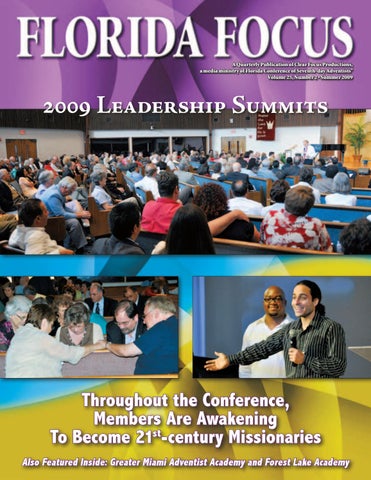
A Quarterly Publication of Clear Focus Productions, a media ministry of Florida Conference of Seventh-day AdventistsŽ Volume 25, Number 2 • Summer 2009
2009 Leadership Summits
Throughout the Conference, Members Are Awakening To Become 21st-century Missionaries Also Featured Inside: Greater Miami Adventist Academy and Forest Lake Academy
Core Values of Primitive Adventism by Mike Cauley, D.Min. Florida Conference President
T
he Adventist Church in North America is almost in decline, growing at a rate of less than two percent each year. Christianity as a whole is in decline in America; and, today, the fastest-growing religions are nonChristian. The country is becoming increasingly secularized. Sixty percent of Americans under the age of 40 have never been in a church building. Most who have stepped inside a church have done so only to attend a wedding or a funeral. Nearly half of young people under age 30 come from families with no ties to Christianity. Of that demographic, 85 percent believe that Christians do not live their lives any differently than anyone else. Furthermore, only three percent have a positive view of conservative Christians. We are facing a world that is becoming progressively more foreign to Christianity. What are we going to do, then, as a church if we want to be relevant and faithful? I want to suggest that, as Seventh-day Adventist Christians, we have a message to give to the world. We know Jesus is coming again and that His salvation by grace is available to everyone. The Adventist Church has something to say that is far too important for us to be lax when it comes to our mission. We must be energized and committed. The basis of this energy is to go back to the core values of early Adventism. “The Seventh-day Adventist Church arose out of a clear mandate for mission. Because of the hostile world early Adventists faced, they quickly developed a missionary strategy for their existence. They believed that if they were going to organize, they had to do so biblically rather than copying existing organizational structures. The organizational structure which arose from the ranks of Adventism bears considerable resemblance to the first century model.” —Recover-
FLORIDA FOCUS Vol . 25, No. 2 Summer 2009
Florida Conference of Seventh-day Adventists®
655 North Wymore Road Winter Park, FL 32789–1715 Phone: (407) 644-5000 Fax: (407) 644-7550 www.floridaconference.com floridafocus@floridaconference.com President
Mike Cauley E xecutive Secretary
Carmen Rodriguez Treasurer
Duane Rollins Editorial Staff
Martin Butler Editor Lee Bennett Desktop Publishing Gladys Neigel Editorial Assistant Natalia Lopez-Thismon Communication Intern Page 2 • Florida Focus • Summer 2009
ing an Adventist Approach to the Life and Mission of the Local Church by Russell Burrill.
The first Adventist churches consisted of small groups of believers,
and Adventist preachers were itinerant evangelists. For the first 60 to 70 years of the Church’s history, there were no settled pastors in the local churches. Churches cared for themselves, while nearly all ministers worked as evangelists and church planters. After 1920, the Adventist Church began to abandon the missional model of church and adopted a more traditional model like other protestant denominations. Since then, the Church has become more concerned with taking care of itself than those outside, but there are signs of hope. The Church is waking up. Members are beginning to view the Church as a movement once again, and young people who are excited about serving as missionaries in their context are leading the way. There are many stories—students at Greater Miami Adventist Academy who initiated a daily prayer group and are leading their friends to Jesus; teenagers at Hialeah who have been trained by the Conference Youth Department as lay youth pastors, revealing Jesus through their volunteer ministry; youth at Lauderhill using Facebook to share Jesus with their unchurched friends; and young men at St. Augustine who raised up a youth group. So what will a missional Adventist church look like? This is a journey that we are on, and the Holy Spirit will teach us as we commit to following in the footsteps of Adventist pioneers. I think it will involve local church leaders praying, studying their communities, and begging the Lord for wisdom to transcend the secular culture with a timeless message. It will undoubtedly involve each church viewing themselves as missionaries for Jesus and the church as a place to serve rather than to be served. It will mean both taking care of our people in the church as well as reaching the hundreds of thousands who are far from God; but if we have to choose between taking care of ourselves or doing something to reach lost people, churches which are true to their calling will choose to prioritize those who don’t know Jesus. In order to become these missionaries, we have to look at the ultimate example of Jesus who transcended cultures, at great cost to Himself, to make God’s love available to all. He did whatever it took to reach us. This is what will make us a movement again—the kind of movement not confined by traditions. We cannot allow anything to restrict the Church. We need to go back to the fundamentals of Adventism and become intentional about our mission and calling.
Youth Ministry Today Using Contemporary Culture To Evangelize by Pastor Luis Camps, Tampa First Youth Pastor
Y
outh ministry should always be about bringing our youth to Jesus’ feet and training them to bring their friends. A threestep program to bring youth into the church was developed at Tampa First Church. Initially, we invite nonAdventist young people to First Café—a place where our youth can feel comfortable bringing their friends. Through the café, we hope to secondly get
the visitors interested enough to become part of a small group to experience deep spiritual growth. Thirdly, we train our youth in service through “Keep it Real,” an area-wide program serving the local community. We’ve also been training our youth to share Jesus through social networking sites like Facebook and MySpace (it had never occurred to some of them that they could do that). Some youth have even brought a few of their online friends to First Café.
Greater Miami Adventist Academy
Leadership Summit Attendee Comments
Ambassador
“What an awesome thing to be a part of this mission.” “It was great to be reminded of our purpose.”
Jacksonville Mandarin
“The message of being a 21st-century missionary was very timely and thoughtprovoking.”
Port Charlotte
Photos: Lee Bennett, Natalia Lopez-Thismon, Martin Butler
“Now I feel more equipped to…carry on the work of the Spirit.”
Tampa First
Markham Woods
Transformational Relationships Are Key to eat Twinkies “It’swithbetter good friends than
®
Photos: Lee Bennett
to eat broccoli alone.” In order to understand why relationships are important to our Christian walk, we must first examine the importance of relationships to God Himself. In Genesis, chapter 1, we see a picture of God creating the world. As He creates nature by the power of His spoken words, He describes everything as good. When God was finished with creation, He saw it and said that it was very good. But there was one thing God said was not good. God knew that Adam would feel by Tim Nichols, alone without anMinisterial Field Secretary other human being. “No substitute will fill this need in you for human relationship. Not money. Not achievement. Not busyness. Not books. Not even God Himself. Even though this man was in a state of sinless perfection, he was ‘alone.’ And it was ‘not good.’” —Creating
Community, Andy Stanley and Bill Willits, p. 30.
This is the reason why God made Adam a companion suitable for him. This God who created the relationship between Adam and Eve is the same God whose biggest defining characteristic is love. When the Bible says that God made us in His image, it means that He made us to be in caring, loving relationships with each other and with Him. God Himself has always known a meaningful relationship, as He is three persons in One—God the Father, God the Son, and God the Holy Spirit. We can see, then, why God so desires us to use Jesus’ example of evangelism. “Christ mingled with men as one who desired their own good. He showed His sympathy for them, ministered to their needs, and won their confidence. Then He bade them, ‘Follow Me.’ “There is need of coming close to the people by personal effort. If less time were given to sermonizing, and more time were spent in personal ministry, greater results would be seen.” —Ministry of Healing, p. 143.
All evangelism is personal. People are not won to Jesus by the thousands, by the hundreds, or the tens. Instead, people are won for Jesus one relationship at a time. Evangelism should really be understood as discipleship, and it takes time. Discipleship requires us to develop enough trust with people to talk about their personal relationship with God. It takes a trusting friendship for true, lifechanging evangelism to take place. We have to understand that true teaching, true Bible study, and true Christian training happens in the context of real life. It involves getting messy and emotional; becoming involved with people’s lives; and molding character, values, behavior, and belief systems through everyday experiences. Rather than the thinking that big programs at the church will create more disciples, “It’s the macaroniand-cheese moments of life, and lots of them, lived out together with other macaroni-and-cheese eaters that form a patchwork, a mosaic picture that over time looks more and more like Jesus. That’s discipleship.”
Where the Rubber Meets the Road Discipleship In Action
by Jocelyn Prado, Forest Lake Church
A
fter a long trip, we arrived at the same hotel we stayed at last year on our mission trip to Costa Rica. The 74-yearold host recognized me right away. He didn’t say anything while he walked up to me with tears in his eyes. He embraced me as if I were his own granddaughter, and said, “I’m so glad you came back. I know the children will be excited, and I am happy too.” Later, when our van turned the corner at Tempate School, our eyes caught sight
Page 4 • Florida Focus • Summer 2009
of all the children we met last year as they darted out of their classrooms, screaming, and jogging alongside our vehicle. As soon as we stepped out of the van, the children jumped on us and showered us with love and affection. We only had the opportunity to share Jesus with these people for a week a year ago; yet, they felt as connected to us as we felt to them. It’s amazing to see what God can do through the relationships we build with others.
Spiritual Gifts Functions
T
he church has a very specific commission— spread the good news of Jesus Christ to the world. The church is God’s appointed agency for the salvation of men. Through the church, God’s manifold wisdom and His adequacy to meet the needs of all men and women is to be made known to the world. That is a huge task! Some of us may be afraid that we will not be able to carry out God’s commission. But God, through the outpouring of the Holy Spirit, has provided us with the necessary tools to do His work. Our willingness is all God needs in order to use us. “As the will of man cooperates with the will of God, it becomes omnipotent. Whatever is to be done at His command may be accomplished in His strength. All His biddings are enabling.”
—Christ Object Lessons, p. 331.
So how does God enable us to do His bidding? No other study in the scriptures answers this question more specifically than the study of spiritual gifts. “A spiritual gift is given to each of us as a means of helping the entire church.” —1 Cor. 12:7 (NLT). The Holy Spirit is the one to decide which gift is given to each person. Everyone who accepts Jesus Christ as their Savior is promised a spiritual gift. My friend, Harry, was a talented craftsman. He knew how to build boats and design mannequins. He even built his own home. However, Harry was not a good communicator. After he got re-baptized, he heard I was going to teach a class on sermon preparation. The class requirements included
both writing a sermon and delivering it at the 11 o’clock worship hour. Due to Harry’s shy nature and quiet demeanor, I could not envision him preaching a sermon. Harry himself was undauntby M arvin Williams, ed by the Ministerial Field Secretary class requirements. Sure enough, the day came when The Holy Spirit gives all Harry was scheduled to of us abilities for the purspeak. To my pleasant surpose of accomplishing our prise, he was totally calm part in fulfilling the mission and appeared very profesof the Church. Paul clearly sional as he stood to speak. establishes, however, that That day, Harry preached no one single gift is given a sermon that moved my to everyone. Therefore, the heart. As I sat there, I realbaptism of the Spirit is availized that I was witnessing able to all of God’s children. the gift of preaching given Pray for God to reveal the to a man by the Holy Spirit. gift He has for you.
Each Member a Disciple-maker The Power of an Active Congregation by Harvey Diaz, Miami Springs Church
F
or years, I was the type of church member who sat in the pews and asked, “Where’s the pastor? Isn’t he getting paid to visit people and run the church?” Other members and friends had the same attitude, but then our church was left without the strong presence of a pastor for a few years. We began to realize that keeping the church alive and vibrant was up to the members. We started a small group ministry in which we studied Spiritual Body Building, a workbook written by Kim Allan Johnson. Through the advice in this book, our spiritual walk as a church turned around. We learned that loving our neighbors, through significant relationships, is the first step in bringing them to Christ. Our new pastor became the team leader, and we became the players as we introduced others to the love of Christ through friendship and God’s Word. To the glory of God, our church has been growing, and many people have accepted Jesus into their lives. Summer 2009 • Florida Focus • Page 5
Why God Called Our Church Into Existence To grow
by K en Burrill , Vice President for A dministration /Ministerial
within biblical communities, preparing to meet Jesus.
Page 6 • Florida Focus • Summer 2009
I
n the mid 1800s, the Adventist Church was on the cutting edge of technology. The Church’s only concern was to make disciples—a focus they adopted from the early biblical church. To reach the community, they used methods that were unorthodox at the time, such as putting up tents in the community. The idea was highly innovative in many ways because, back then, tents were used for circuses and other secular activities. Some even regarded tents as evil. However, the primitive Adventists knew that these tents could attract people and help share the message. The missionary members would pitch the tent in each town, hold meetings, raise a church, and move on to the next town. God blessed this pioneering church. Due to their mission mind set, the Seventh-day Adventist Church became one of the fastest-growing denominations in North America by the end of the 1800s. But, something happened at the beginning of the 20th century that changed the course of the North American church—members decided they wanted to more closely
resemble other denominations. The church turned away from outward mission and became maintenancefocused. Where the pastor’s main role used to be evangelizing, it became all about taking care of the people inside the church building. As a result, churches today have difficulty functioning without a pastor holding their hand. We must change our focus back to a missional model and spend the majority of our time as a church figuring out how we are spreading the gospel. We all know well the verse that says, “But you will receive power when the Holy Spirit comes on you; and you will be my witnesses in Jerusalem, and in all Judea and Samaria, and to the ends of the earth.” —Acts 1:8. Although we’ve managed to take good care of Samaria, we seem to be ignoring Jerusalem. We must begin to focus more on the home front. As a church, we have to turn around and become missional again. The missional church has three important characteristics. First, it is incarnational. In other words, it is a church that goes out into the com-
munity and looks for ways to build connections. Because 87 percent of people in Florida do not go to church, we cannot expect them to come to our meetings at our building unless something else happens first—a friendship, a relationship, etc. The second characteristic of a missional church is that it is indigenous. It connects to the community and its culture. Unfortunately, when people visit some of our churches, our culture dates back to the 1950s, and that is why many do not return— we live in another world. We all have cultures, but we have to separate the Gospel from those cultures. We have to get in touch with the culture outside and connect. Third, the missional church is intentional. After finding out the culture and the needs of the local community, the church decides on an intentional course of action to reach these souls and meet their needs, both physical and spiritual. I appeal to all of you as church members and leaders to make a commitment to transform your church. This will not be easy, but it is what God has called us to do!
Photos: Lee Bennett
disciples
The Importance of Discipleship and Small Groups portant to the early believers than the preaching service. Preaching could be and frequently was omitted, but the social meeting was never to be neglected.” —Russell Burrill, The Revolutionized Church of the 21st Century.
“The meetings were characterized by spirited and soul-cheering testimonies, and beaming eye, the voice of praise, the earnest and stirring exhortation, and often the falling tear—scenes in which faith and love flame up anew.” —Russell Burrill, Creating a Disciple-making Church.
by Pastor Joel Honoré ,West Palm Beach First Church
M
any people have probably never heard of Melaleuca. It is a plant normally found in open forests, woodland, or shrub-land, particularly along watercourses and the edges of swamps, like the Everglades. In South Florida, Melaleuca populations have nearly quadrupled in the past decade, and some of us have only just heard about it. Does the fact that Melaleuca is new to you make the plant new altogether? No. This plant has existed for thousands of years. Just like Melaleuca is an ancient plant, small groups are an ancient concept, even though some of us have learned about them recently. Early Christians met in each other’s homes in small groups for worship and socializing. “So continuing daily with one accord in the temple,
and breaking bread from house to house, they ate their food with gladness and simplicity of heart, praising God and having favor with all the people. And the Lord added to the church daily those who were being saved.” —Acts 2:46.
Meeting in homes as small groups is a biblical principle that the early Adventist movement adopted. Church meetings began as social meetings in school houses, meeting houses, log cabins, or the homes of church leaders such as William Miller and Ellen White. “As one peruses the early editions of the church paper, the Adventist Review and Sabbath Herald, it is obvious that social meetings were considered a regular part of church life for most Adventists. In fact, these meetings seem to have been more im-
When our churches readopt this biblical concept, they will start to grow at unprecedented rates. So, how can we do it? All that is needed is one Christian who wants to make a difference in the lives of others. That Christian can find one or two more people who share the same desire for disciple-making. “For where two or three are gathered together in My name, I am there in the midst of them.” —Matthew 18:20. These disciple-makers will invite people with whom they share a personal relationship. When they add the key essentials of a holistic small group—prayer, fellowship, service to others, and Bible study—and establish key values such as love, acceptance, confidentiality, authenticity, and accountability, the group will grow as disciples become disciple-makers. Every Christian has the opportunity to impact the world for God through disciple-making in small groups. Ready, set, go!
To be a 21st-century missionary movement, effectively reaching people of all ages and cultures.
Summer 2009 • Florida Focus • Page 7
Apostolic Leadership Spirit-led
Our leadership depends upon the Holy Spirit as the source of guidance and vision.
Our passion is to reach people far from God; and, therefore, our ministry must be relevant, connected, and incarnational.
Discipleship
All believers are called to walk together with people at different stages of spiritual growth to offer an experience of grace, encouragement, accountability, and growth in the ways of Christ.
by A bel Paulín, Vice President for Spanish-language Ministries
S
piritual gifts are the Holy Spirit’s way to exercise the body of Christ. “For as we have many members in one body, but all the members do not have the same function, so we, being many, are one body in Christ, and individually members of one another,” —Romans 12:4–5.
It is helpful to know the theory of exercise, but theory does not take us far. You could digress physically sitting on a good exercise book. God has given His Church APEPT to give it an apostolic or missional focus: “And He Himself gave some to be apostles, some prophets, some evangelists, and some pastors and teachers, for the equipping of the saints for the work of ministry, for the edifying of the body of Christ.” —Ephesians 4:11–12
APEPT stands for Apostles, Prophets, Evangelists, Pastors and Teachers. These Page 8 • Florida Focus • Summer 2009
are the offices that God has appointed for the equipping of the saints for the work of ministry. I believe that God makes sure APEPT is present in the church’s leadership. If you are a church leader, and probably a Board member by virtue of your office, it is important to remember that your responsibility is to “equip the saints for the work of ministry.” If you are busy working hard while neglecting to activate other’s gifts, something important is missing in your leadership. Currently, our Church is organized around the narrower scope of a pastoral focus that cares for people already in the Church. We love to create programs that people will
Photos: Lee Bennett
Incarnational Passion
like. We hope that these programs will also make people want to stay with us. Being so dependent on our pastors has made us passive and dormant. As leaders, it is our responsibility to change that. Our Church should be running on the wider scope of an apostolic focus. This means we should dedicate ourselves to the expansion of God’s Kingdom. Too often, pastoral focus is dedicated to the care and shepherding of the saints. We grow by inviting people to come worship with us. As a Church, we work really hard to impress them so they will become a part of us. The apostolic focus, by contrast, is dedicated to going where people are and caring for the wider community. To change the focus of our Church, we must spend time in prayer asking God to show us our calling and gifts. We must commit to thinking about people outside of our Church—at least as much as we think of people inside the church. As individuals, we should pray the radical prayer, “Lord, send me,” and meditate on what that means to us.
This Is Where We Are Going
A
young man was watching his new bride prepare dinner in the kitchen. He observed her take out a pot roast to place in the oven, and she cut off each side of the meat before putting it in the pan to bake. “Why did you do that?” he asked with curiosity. “I have no idea,” she replied. “That’s the way my mom always used to do it.” A week later, the young man and his wife were visiting with her family and he asked his mother-in-law, “Why is it that you ladies always cut off the ends of the pot roast before putting it in the pan?” She said, “I don’t know. We’ve always done it that way. That’s the way my mom used to do it.” Months went by, Christmas came around, and grandma was in town to visit with the family. The young man, still curious about the pot roast, sat next to the grandmother on the couch. “Grandma,” he began, “why do you folks always cut off the sides of the pot roast before putting it in the pan?” “Oh! When my husband and I first got married, we
Every Member a Missionary We are committed to the empowerment by Mike Cauley, Florida Conference President
had very few pans,” she explained. “The biggest pan we had was too small, so we had to cut off the sides to make it fit.” For some reason, her daughter and granddaughter had continued to use the same method even though their pans were big enough. Sometimes, it’s like that in our church. We keep doing things the way we’ve done them for years because it’s easier, or because it’s tradition, even though the way we’ve always done things isn’t the most effective way. It is in our very nature to resist change because we are uncomfortable taking risks. Yet, as children of God, we must be courageous and bold like the New Testament church. They were ordinary men and women whose valor spread Christianity to 20 million people by 300 A.D. This early apostolic church was a movement of men and women with no church buildings and no paid pastors, willing to do the work God gave them to do. The early Adventist Church was a movement
of every member as well. They were not a playit-safe organization. Instead, they took risks and started a global movement to fulfill a mission that God had put in their hearts. It wasn’t always easy or safe, but it was extremely rewarding because this group was willing to stretch out of their comfort zone for the mission. God is calling us to be a movement again and to stop doing things “the way we’ve always done it” because it is convenient. We must come together, study, pray, read books, and deliberate on the best ways to reach people beyond the church walls. We have been commissioned to carry a message, and God is calling us to renew our commitment to this mission. Jesus served for three and a half years and began a work that has lasted 2,000 years. His main focus was to find those who were far from God. It is our mission, today, to break out of our insular traditions and cultures, just like Jesus did, in order to bring the Gospel to those who don’t know Him yet. Let’s ask God to help us care more about the thousands of people who pass close to our church buildings each day and still don’t know the good news of a Messiah who came to give them His grace, truth, love, and salvation.
to serve as a 21st-century missionary where they live, work, and play.
Small Groups People are reached, discipled, taught, and trained through relationships. The community of the church organized in small groups for this purpose is the effective expression of New Testament ministry.
Summer 2009 • Florida Focus • Page 9
Education Center for Early Childhood Children at the Education Center for Early Childhood participate in a Christcentered curriculum that leads them to discover the world around them.
A
teacher turns on a Christian children’s song after the class naps and eats a snack, causing the classroom to come alive with young children singing along and excitedly performing the accompanying movements. These children are a part of Greater Miami Adventist Academy’s (GMAA) new Education Center for Early Childhood (ECEC). The center opened in 2008 with a capacity for 50 two- to four-year-olds. “The purpose of the ECEC was primarily to accommodate the needs of our parents,” says Jicell Taylor, the Education Center’s director. “Many of our children are the younger siblings of students at GMAA.” Children at the Education Center participate in a creative Christ-centered curriculum that leads them to discover ideas, places, and things such as the ocean or outer space. Each day begins with a Bible-centered devotional that ties in with the weekly theme, and the day continues with circle time, educational games, music, and science and discovery time, among other things. “The children are like little sponges,” says Taylor. “It’s so gratifying to be able to teach them about Christcentered things at such a young age when they are eager to learn.” Page 10 • Florida Focus • Summer 2009
by Natalia Lopez-Thismon
Campus Ministries Evangelism
I
Betty Lira, Leeban Gutierrez, and Javier Crespo after their baptisms at the end of the spring 2009 Week of Prayer.
t is Greater Miami Adventist Academy tradition for students to plan and organize two weeks of prayer during each school year. This year’s weeks of prayer resulted in 12 student baptisms, increasing the total number of students baptized at GMAA in the last four years to 70. “Since I came to GMAA, I started getting closer to God,” says Betty Lira, one of the students who was baptized in 2009. “The kids, the teachers, and the spirituality at the school are what
brought me closer to Him and made me realize I need to recommit and start new.” This type of student-tostudent evangelism is what GMAA hopes to continue at the school, both on and off campus. Students have helped organize mission trips, small group discussions, and prayer groups. The school’s goal is to create a generation of youth who are lay evangelists, bringing others to Jesus. As a result, students are becoming servants of the community and are involved in church.
AcroAmericas Gymnastics Team
G
reater Miami Adventist Academy’s AcroAmericas team has been presenting its anti-drug message this year through gymnastic trips to schools in central and south Florida.
“As a team, we are eager to spread the gospel, as well as drug prevention and awareness,” says Juan Leon, team coach. “We want to educate the young people in our community
about the damaging effects of drugs and alcohol.” In an effort to reach even larger audiences with their message, the AcroAmericas team has made arrangements to perform at a Miami Heat
game next season. The last time they performed at a National Basketball Association (NBA) game was 2001, according to Leon. “The team is a ministry to show people what you can do when God is in control of your life,” says Erick Lugo, a first-year AcroAmericas team member. “It’s really great.” “The gymnastics team is a group where GMAA students can increase their skills and also feel that they belong,” Leon comments. “We develop a family,” he says, “and, at the same time, we share Jesus and our talents with others.” The GMAA AcroAmericas gymnastics team performs at its annual home show in front of family, friends, and local community. This year’s theme was “Cure of Life,” conveying Jesus’ news of healing and salvation. Summer 2009 • Florida Focus • Page 11
Health Academy and Advanced Learning
F
or years, Forest Lake Academy (FLA) has offered its students advanced learning opportunities, including honors courses and dual-credit classes. Some students may achieve graduation from high school with a year of college classes already under their belt. “Classes like these definitely prepare you for the college experience,” says class of 2009 valedictorian Cassandra Nozil who took several advanced courses from Florida Hospital College of Health Sciences. Professors from Florida Hospital College have been teaching classes at FLA for about 14 years. As an outgrowth of this relationship, FLA and Florida Hospital College created a new program, the Health Academy. “We see ourselves as partners with FLA in providing quality, faith-based educa-
tion to the Church in central Florida,” says Don Williams, vice president for Academics at Florida Hospital College of Health Sciences. “Given our concern for the students’ success and our commitment to Florida Hospital, we feel the Health Academy will build a bridge that connects each of those interests.” The Health Academy will prepare high school students who are seriously looking into medical careers by offering classes in the field. Students may apply at the end of their freshman year. “I think the Health Academy is a great starting point for me,” says Christian Ledesma who anticipates a career in sports medicine. “I’m looking forward to all the hands-on activities, and the best part of the program is that all the courses are being offered through the college.”
Jennifer Green, Computer Applications teacher, answers a difficult computer question for Sarah Rhodes.
Distance Learning Academy
W
hile proud FLA seniors marched in cap and gown to receive their diplomas, a group of students who had possibly never before set foot on FLA’s campus marched right beside them. These seniors from the Distance Learning Academy (DLA), formerly known as Adventist Education for the 21st Century (AE21), completed their high school education through the curriculum provided online. “The DLA has been a great experience for me,” says Tiffani Joseph, who begins her junior year of high school this fall. “It’s taught me rePage 12 • Florida Focus • Summer 2009
sponsibility, and I’ve had to learn how to work independently. Those are skills that will help me in college. My knowledge of technology has increased immensely.” DLA students meet on campuses of Adventist schools around the country or are home schooled. The courses are taught via webbased technologies such as videoconferencing where students interact with the teachers in real time from their computers. Students and teachers also communicate through the DLA web site, instant messaging, e-mail, and phone.
“Students in this program become independent learners and thinkers,” says Bruce Anderson, vice principal at FLA and Distance Learning Academy director. “They receive great academics and a Christian education online.” Twelve years ago, the North American Division began AE21, a project that was for grades 5–8. When Forest Lake Academy took over the program in 2000, it evolved into a high school program; and the name changed this year from AE21 to DLA. To learn more about the program, visit www.ae21.org
by Natalia Lopez-Thismon
Students In Ministry
T
he Campus Ministries team at FLA is working hard to set a Christ-like tone at the school by involving students in ministries that feed their spiritual lives while serving others.
“We want to be more intentional about how we identify and take care of students’ spiritual needs,” says Andrew Moreno, FLA’s chaplain. With this in mind, Campus Ministries set up an
Roan Asumbrado, president of the 2009 Distance Learning Academy senior class of 24 graduates, receives her diploma from Forest Lake Academy Principal Gloria Becker, along with the other 82 FLA graduating seniors.
exhibit before the end of the 2008–2009 school year to excite students about a variety of ways in which they could become involved in personal growth and community service opportunities, including prayer and Bible study groups, mission trips, community service outreach, and drama. The school also
encourages students to create new ministries of their own, if they so desire. “Our main interest is to have kids who are sold out for Jesus,” says Moreno. “We want God to be more than just a compartment in their lives. We want Him to be a part of every moment of their lives.”
Forest Lake Academy students gather in the prayer room. Summer 2009 • Florida Focus • Page 13
Northwest Miami Spanish Church
Small Group Miracles by Natalia Lopez-Thismon
R
udy Benedit made his decision for Jesus in August 2008 after a year-long battle with his old lifestyle. When his mother invited him to a small group meeting in a member’s home, he felt apprehensive. After all, he had never felt comfortable at any church. From that first small group meeting, Benedit felt right at home. Those in the small group were not judgmental of him or his lifestyle, and they treated him as if they had known him for years. “I felt comfortable, and I felt the warmth of a family,” says Benedit. “People were really dynamic and I loved the theology.” With time, Bible study, and prayer, Benedit began to realize that his old lifestyle did not please God, so he invited his girlfriend to attend the group meetings with him. “We had been living in fornication for a long time. As a result, my girlfriend conceived. We had no notion that what we were doing was sinful,” Benedit remembers. “God talked to us through the small group, and we decided to get married and then get baptized.” Small group members at Northwest Miami Spanish Church have seen many miracles in the lives of people who, like Benedit, have very little idea of who God is and how much He loves them.
How the Small Groups Got Started The Northwest Miami Spanish Church began its small group ministry five years ago when Pastor Abel Paulín, Florida Conference Page 14 • Florida Focus • Summer 2009
As a result of Northwest Miami Spanish Church’s small group ministry, 18 people were baptized on May 3. Other small group participants and church members gathered at a south Florida beach to celebrate the baptisms.
Vice President for Spanishlanguage Ministries, brought Pastor Melchor Ferreira from Peru to talk about the great success small groups have had in his country. “During the meetings with Pastor Ferreira, my church leaders and I saw that small groups were a biblical plan for making disciples,” says Northwest Miami Spanish Pastor Rodny Aquino. “The way to grow as a church is through small groups.” For five years, the groups grew slowly, but consistently. Today, Northwest Miami Spanish has 23 small groups, and 72 people were baptized in 2008. So far in 2009, the church has baptized 32 with more people making decisions for Christ each day. Disciples become disciple makers
Small groups have five purposes, according to
Aquino: “to praise, to pray, to study, to testify, and to build strong relationships with one another.” He says, “The people in the group become a tight-knit family who worry about each other. This is what keeps people in the group and makes them feel eager to bring their friends to visit.” “It has been an incredible experience,” says Melida Gomez who leads a small group in her home. “I’ve seen God change lives, and seven people were baptized, including my husband!” “The reason small groups work so well,” Aquino says, “is because people feel more at ease going to a meeting at a friend’s home than they do when attending a formal church meeting.” “God has truly formed my character,” says Patricia Diaz, a woman who was baptized in November 2008.
“Through the group, God has shown me the way I should go.” People like Diaz and Benedit have felt God’s calling and have become disciple-makers themselves, inviting their friends, family, and acquaintances to the small group meetings. “I labor each day to bring new people to our small group,” says Diaz. “All in all, I think I’ve brought around 50 people.” “Small group ministry is the plan God has for evangelism,” says Aquino. Before small groups, his church was campaigning for the community to come to his church. Now Northwest Miami Spanish Church is showing its presence in the community. “These small groups have been an incredible blessing for the community and for our church as well,” says Aquino.
Coming Events A complete calendar is available online:
http://www.floridaconference.com/calendar.html
Children’s Ministries Convention Florida Hospital Orlando Creation Conference Center September 11–13, 2009 Features children’s ministries certification tracks in prayer, drama, puppetry, storytelling, child evangelism, praise & worship, clowning, GraceLink, and special needs. Cost: $99, includes three meals.
Registration: www.gofishconference.net Details: rhoda.burrill@floridaconference.com (407) 644-5000 x136
a very old new idea simplechurchathome.com
simplify your life re-prioritize your life cultivate a deeper walk with God start the online training
TM
Ongoing Events– –––––––––––––––––––––––––
Florida Pathfinder Events. http://www.floridapathfinders.com/ Singles’ Ministries Events. Spiritual study groups, fellowship dinners, outings, and more. http://www.asamcf.org/, djmiller4000@gmail.com, or (386) 789-3235. Evangelism Series. Sept. 9-12. Forest City Spanish. Rolando and Rebeca de los Ríos. Sept. 26-Oct. 3. Miami Springs Spanish. Rolando and Rebeca de los Ríos. Sept. 27-Nov. 20. St. Petersburg. Bill and Sunshine Waters. Oct. 3-10. North Miami Beach Spanish. Rolando and Rebeca de los Ríos. Oct. 17-24. Vero Beach Spanish/Melbourne Spanish. Rolando and Rebeca de los Ríos. Oct. 17-Nov. 21. Sarasota. Lester and Zula Pratt. Nov. 7-14. Hialeah Spanish/Miami Springs Spanish. Rolando and Rebeca de los Ríos. Planned Giving Clinics and Seminars. Sept. 19. North Miami. Sept. 26. Palm Coast Portuguese in Bunnell. Nov. 14-15. Daytona Beach. Florida Adventist Book Center. Winter Park: national toll-free number, (877) 55‑FLABC (877-553-5222). Miami: (305) 805-9900. High Springs: (386) 454-7956. Shop online: http://www.floridaconference.com/abc/ or order by e-mail: FloridaABC@floridaconference.com. Florida Adventist Bookmobile Schedule. Oct. 3: Tallahassee. Oct. 4: Perry, Cross City, Ocala, Silver Springs Shores, Belleview, Inverness. Oct. 10: Sunrise. Oct. 11: Plantation, Lauderhill, Deerfield Beach. Oct. 17: Naples. Oct. 18: Ft. Myers, Ft. Myers Shores, Arcadia, Lakeland, Winter Haven. Oct. 24: Jacksonville Southpoint. Oct. 25: Jacksonville First, Orange Cove, St. Augustine, Palatka, Palm Coast, New Smyrna Beach. Oct. 31: West Palm Beach. Nov. 1: Midport Road in Port St. Lucie, Ft. Pierce, Cocoa, Titusville. Nov. 7: Maranatha in Miami. Nov. 8: Ft. Lauderdale, Lauderhill, Pompano Beach, West Palm Beach Spanish. Nov. 14: St. Petersburg. Nov. 15: Clearwater, New Port Richey, Spring Hill, Brooksville, East Pasco in Zephyrhills, Plant City. Dec. 5: Port Charlotte. Dec. 6: North Port, Venice-Nokomis, Sarasota, West Coast Christian Academy in Bradenton, Brandon, Tampa First.
September 2009––––––––––––––––––––––––––– Go Fish Children’s Ministries Convention. Sept.11-13. See above left. Spanish-language Men’s Ministries Convention. Sept. 19. West Palm Beach Church. Details: (561) 307‑2816 or (786) 457‑3444. Community Plunge Youth Rally. Sept. 26. New Port Richey Church. Details: (407) 644‑5000 x129.
October 2009––––––––––––––––––––––––––––
Having trouble with the nuts, bolts, and screws while putting together your estate plan? We have the tools to assist you. Call or write: Planned Giving and Trust Services P.O. Box 2626 Winter Park, FL 32790–2626 fcplannedgiving@gmail.com • (407) 644-5000
High School Bible Conference. Oct. 8-11. Camp Kulaqua, High Springs. Details: (407) 644‑5000 x129. Young At Heart Retreat. Oct. 18-22. Camp Kulaqua, High Springs. Events and activities planned especially for 50+. Applications online: http://www.campkulaqua.com/. Details: sdaretreats@campkulaqua.com, or (386) 454‑1351.
Camp Meeting 2010
116th Annual Florida Conference Camp Meeting New date and venue: March 4–7 • Camp Kulaqua, High Springs Details in future issues of Florida Focus and online as information is available www.floridaconference.com Summer 2009 • Florida Focus • Page 15
NON-PROFIT ORG. U.S. POSTAGE
FLORIDA CONFERENCE ®
of Seventh-day Adventists® P.O. Box 2626 Winter Park, FL 32790-2626
PAID
PERMIT #4190 Orlando, FL
Youth Taking On the World For Christ
Go Forth, Make Disciples
Lee Bennett
Florida Conference Youth/Young Adult Ministries
by Natalia Lopez-Thismon
Natalia Lopez-Thismon catches up with friends on Facebook.
ur generation is really O good at communicating with our friends all the time. As a group, we are constantly communicating with people we know through text, the phone, and social networking sites like Facebook and MySpace, among other technologies. At the Leadership Summit meetings this spring, I started thinking about this when Tim Nichols, central area ministerial field secretary, showed the congregation the most effective way to bring people to Christ: through meaningful friendships. My mind began to race. I currently have 545 “friends” on Facebook, and a huge chunk of them are not Ad-
ventists, or even Christians, for that matter. I would consider some of these people to be my good friends, but with how many of them have I had a transformational relationship? You know, the kind of relationship in which I can share Jesus and make disciples during the everyday moments of life— “macaroni-and-cheese” moments, as Pastor Nichols called them. As young people in this generation, and in this Church, we have amazing power to build these sorts of relationships with people we already love and who already trust us. Many of us are afraid of sharing our God; but, believe it or not, our
friends are hungry for the healing, forgiving, and loving power of the God we serve. Jesus said, “Therefore GO and make disciples…” —Matthew 28:19. God has given us a command; nothing can stop us. As we build relationships with others on or offline, God can use us to share the faith we have in our hearts. Natalia produced this issue of Florida Focus during an internship sponsored by Southern Union Conference. This gifted Hialeah Springs Spanish Church member/Southern Adventist University Public Relations graduate worked on projects in English, Spanish, and French languages. This fall, she begins master’s degree studies at California State University in San Bernardino.
Upcoming Youth Ministries Events • Oct. 8–11: High School Bible Conference, Camp Kulaqua. • Oct. 30–31: R.O.C.K.—Reach Out Community Kick-off, Orlando. • Oct. 23–25: Adventist Christian Fellowship/ Campus Advent Leadership Weekend Event Information: Florida Conference Youth/Young Adult Ministries (407) 644-5000 x129 alejandra.torres@floridaconference.com