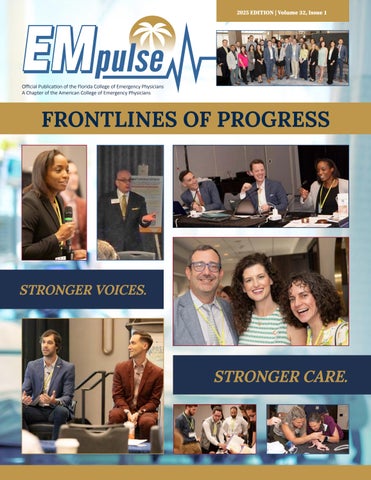
2025 EDITION | Volume 32, Issue 1
Official Publication of the Florida College of Emergency Physicians A Chapter of the American College of Emergency Physicians
FRONTLINES OF PROGRESS
STRONGER VOICES.
STRONGER CARE.
COME FOR THE JOB
207
Looking for a high quality of life with a collegial practice environment? EMPros is one of the oldest independent EM groups in Florida, in business since 1976. We staff 6 contract hospitals and 2 offsite EDs located on the Atlantic Coast near Daytona Beach. We also staff events at Daytona International Speedway NASCAR Emergency Care Center.
Stay for the
LIFESTYLE OUR Benefits • Full Benefit Package at 130 Hours a Month • Flexible Scheduling • Shareholder Opportunity for Mainside EM Physicians * • Stable & Fully Transparent Democratic Group in Business since 1976 • Health, Life, 401K, Disability, Dental & Vision Family Plans • Health Plan Deductible Funded into HSA • Annual Company Contribution to 401k Plans • Pre-tax CME Account • RVU Production Bonus Opportunity • Membership in ACEP & FCEP • Company Paid Med Mal • Quality Lifestyle
Email CVs to recruitment@EMProsOnline.com 386-310-3519 | EMProsOnline.com
FL O
All advertisements in EMpulse are printed as received from advertisers. The Florida College of Emergency Physicians does not endorse any products or services unless otherwise stated. FCEP receives and distributes employment opportunities but does not review, recommend or endorse any individuals, groups or hospitals that respond to these advertisements. Opinions stated within articles are solely those of the writers and do not necessarily reflect those of the EMpulse staff, the Florida College of Emergency Physicians, our advertisers/sponsors, or any of the institutions our writers are affiliated with.
1971
NS
DA COLLEG RI
FICIEIP
Y PHYSICI A NC
Official Publication of the Florida College of Emergency Physicians A Chapter of the American College of Emergency Physicians
F EMERG E EO
2025 EDITION Volume 32, Issue 1 EMpulse Magazine is the official publication of the Florida College of Emergency Physicians EDITOR-IN-CHIEF: Jill Ward, MD, DABT, FACEP, FAAEM, MS jillangelaward@gmail.com MANAGING Dani Knipstein EDITOR: DKnipstein@emlrc.org
Florida College of Emergency Physicians Board of Directors: PRESIDENT - ELECT
VICE PRESIDENT
SAUNDRA A.JACKSON, MD, FACEP
BLAKE BUCHANAN, MD, FACEP
SHAYNE GUE, MD, FACEP, FAAEM
SECRETARY TREASURER
IMMEDIATE PAST - PRESIDENT
EXECUTIVE DIRECTOR & CEO
TODD L. SLESINGER, MD, FACEP, FCCM, FCCP
MELISSA KEAHEY
PRESIDENT
ELIOT GOLDNER, MD, FACEP
DESIGN Jennifer Finley, Greg Hunter EDITORS: Speedway Custom Photo Lab PUBLISHER: Johnson Press of America, Inc. 800 N. Court St. Pontiac, IL 61764 jpapontiac.com
View Residency Updates Online
MEMBERS
Rajiv Bahl, MD, MBA, MS, FACEP; Tom Bentley, MD, FACEP; Ricki A. Brown, MD; Stuart J. Bumgarner, MD; Latha Ganti, MD, FACEP; Kyle Gerakopoulos, MD, MBA; Anton Gomez, DO, FACE; Steven B. Kailes, MD, FACEP Non-Voting; Joseph King, MD; Sara Kirby, MD; Kristin McCabe-Kline, MD, FACEP, FAAEM, FACHT, ACEP BOD Non-Voting; Brandy Milstead, MD; Vincent Roddy, MD, MBA, FACEP; Jeremy K. Selley, DO, FACOEP; Zach Terwilliger, MD; Josef Thundiyil MD, MPH, FACEP; Christine Van Dillen, MD, FACEP; Cristina Zeretzke, MD, FACEP; Kylie Caouette, DO, EMRAF President; Melissa Keahey, Executive Director & CEO; Toni Large, Large Strategies Lobbyist
Subscribe to Bi-Weekly eNews
Learn More About EMpulse
Florida Emergency Medicine Foundation Board of Directors: PRESIDENT
VICE PRESIDENT
DAVID C.SEABERG, MD, FACEP
ROXANNE SAMS, MS, ARNP-BC, MA
SECRETARY - TREASURER
IMMEDIATE – PAST PRESIDENT ERNEST PAGE, MD, FACEP (PP)
JORDAN CELESTE, MD, FACEP
Follow us on Social Media for new publications on EMpulse Online: /fcep.org
@emlrc
/emlrc.org
@fcep_emlrc
@fcep
/company/emlrc
MEMBERS
Jay L. Falk (PP), MD, MCCM, FACEP; Vidor Friedman, MD, FACEP; Jaime Greene, BA, MS, EMT; James V. Hillman, MD, FACEP; Michael Lozano, Jr, MD, FACEP; Thom Mayer, MD, FACEP, FAAP, FACHE; David C. Seaberg, MD, FACEP; Bryan Spangler, DHSc
The Florida College of Emergency Physicians (FCEP) and Florida Emergency Medicine Foundation (FEMF) are nonprofit organizations dedicated to advancing emergency care through education and advocacy.
4
EMpulse 2025
QUICK QUIZ Keep an eye out for Quick Quiz questions sprinkled throughout the magazine! Answers are printed upside down in each question box—but don’t stop there. Turn to page 53 for full explanations and to see how much you really know!
TABLE OF CONTENTS FRONTLINES
FCEP President Message Saundra A. Jackson, MD, FACEP - From the College.................................................................................................7 Editor-in-Chief Update Jill Ward, MD, DABT, FACEP, FAAEM, MS - From the College...................................................................................6 FCEP Board of Directors FCEP Staff..................................................................................................................... 8
ADVERTISER’S INDEX EMPros............... 2-3 LogixHealth......... 23
RESUS ROOM
Kratom Rising: Patterns, Poisoning, and Withdrawal .Herbert Wan, PharmD; Reeves Simmons, PharmD, DABAT; Dawn R. Sollee, PharmD, DABAT, FAACT - Feature........... 9-10 Building a Stronger System: Florida EMS Advances in Resuscitation and Innovation Danielle DiCesare, MD - Committee Report........................................................................................................... 11 Nuances in ED Care for Necrotizing Soft Tissue Infections: A Case Series and Review Abram Reynolds; Lindsey Balta, MD; Cheyenne Quailey, MD; Azalea Samsam, DO; Ryan Littell, PA-C; Jonathan Littell, MD; Steven Nazario, MD; Maria Tassone, DO; Mary McLean, MD - Feature................................................................ 12-13
USACS................. 25 TeamHealth.....28-29 IWC..................... 39 Alfest................... 46
THE PEDIATRIC PULSE
Pediatric Pearls Small Patients, Big Challenges: Navigating Neonatal Emergencies, Yiraima Medina-Blasini, MD, FACEP; Amit Patel, MD, FAAP, FACEP - Committee Report..................................... 14-16 Enhancing Pediatric Readiness: Florida’s Prehospital Pediatric Readiness Recognition Program Gains Rapid Adoption Across the State and National Attention Phyllis L. Hendry, MD, FAAP, FACEP; Katelyn Dabhi, MS, CHES® - Feature.......................................................... 17-18
ERG..................... 49 HCA..................... 55
THE PHYSICIAN’S TOOLKIT
Sustaining Physician-Led Emergency Care: The Case for Democratic Groups Justin McNamee, DO, FACEP, FACOEP - Sponsored Feature........................................................................................................................................19 Medications on the Radar: What’s New, What’s Changed, and What’s Worth a Second Look Jill Ward, MD, DABT, FACEP, FAAEM, MS - Feature.............................................................................................................................................. 20-21 Thinking Outside the ED Box Michael Granovsky, MD, FACEP, CPC - Sponsored Feature..........................................................................................................................................24 Florida Resucitation Centers of Excellence FCEP Staff............................................................................................................................................ 25
SYSTEMS & SAFETY
The Cost of Caring: When the Hands That Heal Are Met with Harm Michelle F. Wallen, DO, MS, FACOEP - Feature...................................................................................................................................................... 26-27 Creating Psychological Safety in Medical Education: Building a Culture of Learning in the Emergency Department Carmen J. Martínez Martínez, MD, MSMEd, FACEP; Caroline M. Molins, MD, MSMEd, FACEP - Feature.........................................................................30 Embrace the Chaos: A Resident’s First Week Deepak Sukumar D.O., RRT - Feature........................................................................................................................................................................31 Symposium by the Sea Recap FCEP Staff............................................................................................................................................................ 32-37 Meet The Staff FCEP Staff.......................................................................................................................................................................................38
POLICY PULSE
Reimbursement Realities and Regulatory Shifts Eliot Goldner, MD, FACEP - Committee Report..........................................................................................................................................................40 Emergency Medicine Advocacy: Standing Tall in Tallahassee and Beyond Jeremy K. Selley, DO, FACOEP; Brandy Milstead, MD - Committee Report.....................................................................................................................41
BEYOND THE SHIFT
From Bedside to Bank Account: Why Paycheck Literacy Matters for Emergency Physicians Nicholas P. Cozzi, MD, MBA, FACEP, FAEMS; Jamie Shoemaker Jr., MD, FACEP -Feature................................................................................................44 Standing Strong Together TeamHealth - Sponsored Feature.....................................................................................................................................45 Making a Meaningful Impact: The Heart of the EMPros Foundation Jesse Santos - Sponsored Feature..............................................................................................................................................................................47
ACADEMIC PULSE
Connecting the Pulse of Florida Emergency Medicine René Mack, MD, RDMS, FACEP - Committee Report..................................................................................................................................................48 Life After Residency Recap FCEP Staff....................................................................................................................................................................49 EMRAF Update: Empowering Florida’s Next Generation of Emergency Physicians Kylie Caouette, DO - From the College................................................................................................................................................................. 50-51 Shaping the Future of Emergency Medicine: FCEP Medical Student Council Manuel Tarango III, Adam Kipust, and Edwin Rosa - Committee Report................................................................................................................. 52-53 FCEP FEMF Annual Calendar FCEP Staff.................................................................................................................................................................54
EMpulse 2025
5
FROM THE COLLEGE
EDITOR-IN-CHIEF UPDATE JILL A. WARD, MD, DABT, FACEP, FAAEM, MS Editor-in-Chief, EMpulse
THE YEAR IN REVIEW This year reminded us that resilience is not just a word, it’s a skill we practice daily. We saw our profession take steps forward in advocacy. Efforts to address surprise billing, Medicaid expansion, and fair physician reimbursement have started to shift conversations at both the state and national level. Wellness and workforce sustainability also remained at the forefront, with new initiatives focused on reducing burnout and reimagining what an emergency medicine career can look like long-term.
LOOKING AHEAD What comes next for us as emergency physicians is just as pressing as what we’ve been through. The year ahead will bring: • New technology: Expanded point-of-care ultrasound applications, AI-powered decision support, and real-time patient monitoring tools. • Practice innovation: More departments will adopt flexible staffing models, APP-physician collaboration frameworks, and alternative payment arrangements. • Clinical evolution: Expect updates in stroke care, trauma resuscitation, and prehospital systems of care — areas where emergency medicine continues to lead. • Physician well-being: Wellness will move beyond buzzword with institutions focusing on safety, psychological support, and work-life integration as core operational goals.
THE MISSION OF EMPULSE Our role at EMpulse is to reflect, amplify, and connect. We are here to deliver not only cutting-edge clinical insights but also stories of resilience, innovation, and humanity from the ED. Each issue will bring you practical pearls a spotlight on emerging science, and a voice for the everyday challenges and victories that define our work.
FRONTLINES
As your editor, my hope is that EMpulse becomes more than a magazine — that it serves as a pulse check for our specialty. Together, we’ll celebrate what we’ve achieved, prepare for what’s ahead, and continue to honor the privilege of being an emergency physician. Here’s to another year of practicing at the sharp edge of medicine — where seconds matter, and impact is measured in lives changed. With gratitude and resolve,
Jill A. Ward, MD, DABT, FACEP, FAAEM, MS Editor-in-Chief, EMpulse
6
EMpulse 2025
FROM THE COLLEGE
PRESIDENT’S MESSAGE
REFLECTING ON PROGRESS AND PURPOSE SAUNDRA A. JACKSON, MD, FACEP, President Florida College of Emergency Physicians
Dear Colleagues and Friends,
Since we came together at Symposium by the Sea this past August, I’ve continued to reflect on the energy, collaboration, and sense of purpose that filled those few impactful days. It was a powerful reminder that when we gather, listen, and lead together, real progress is not just possible — it’s inevitable. In that same spirit of connection and momentum, I want to share a few updates on what we’ve been working on since the conference, and how your voices continue to guide our efforts across the state and beyond.
ADVOCACY IN ACTION: FIXING THE NO SURPRISES ACT One of our top advocacy priorities this year remains addressing the flawed implementation of the Independent Dispute Resolution (IDR) process under the No Surprises Act. While the intent of the legislation was to protect patients from unexpected medical bills, the current IDR system has created new challenges — undermining fairness for emergency physicians and the very patients we serve. FCEP has been actively engaging with national partners, policymakers, and regulatory agencies to push for meaningful reform. We’re advocating for a process that restores transparency, efficiency, and balance, ensuring that emergency medicine is treated with the respect it deserves. Your stories, your data, and your lived experiences remain powerful tools in this fight. As The current process is not we continue this advocacy work, we’ll be calling on you to share those stories — helping us working — for physicians or illustrate the real-world impact of these policies on Florida’s emergency departments and for patients — and we are communities. Together, we are building a strong, united front to ensure emergency medicine remains respected, protected, and heard. committed to fixing it.
“
STRENGTHENING OUR COMMUNITY: INCLUSION, ENGAGEMENT, AND GROWTH Equally important to our advocacy work is our ongoing commitment to making sure that FCEP reflects you — our diverse, passionate, and forward-thinking membership.
”
Over the past several months, we have: • Launched new initiatives to better engage early-career physicians, residents, and medical students. • Created new pathways for member input in organizational priorities and advocacy agendas.
Our goal is to ensure that every member feels seen, valued, and heard. We recognize that the strength of FCEP lies not in a single voice, but in the diversity of perspectives that together define our specialty. If you haven’t yet had a chance to get involved, I encourage you to do so — whether that means joining a committee, mentoring a colleague, or simply reaching out to share your ideas. Your voice makes a difference.
LOOKING AHEAD: BUILDING A SUSTAINABLE FUTURE FOR EM As we look toward the remainder of the year — and begin planning for 2026 and beyond — our focus remains on the issues that matter most: • Excellence in patient care • Support for our physicians
• Sustainable, fair practice environments • Strong leadership at every level of emergency medicine
We know there’s more work ahead. But we also know that when this community comes together — united by shared values and a common mission — there is no challenge we cannot meet.
A SHARED MISSION Thank you for being part of the FCEP family and for continuing to lead with compassion, dedication, and courage. We are stronger because of you — and together, we’ll continue to advance the practice of emergency medicine in Florida and beyond. Warm regards,
Saundra A. Jackson, MD, FACEP
President, Florida College of Emergency Physicians
EMpulse 2025
7
FRONTLINES
• Prioritized inclusion, transparency, and responsiveness across all levels of leadership — from board discussions to program design.
2025 - 2026
FCEP BOARD OF DIRECTORS DIRECTORS
OFFICERS SAUNDRA A. JACKSON, MD, FACEP PRESIDENT
RAJIV BAHL, MD, MBA, MS, FACEP
TOM BENTLEY, MD, FACEP
RICKI A. BROWN, MD
STUART J. BUMGARNER, MD
LATHA GANTI, MD, FACEP
KYLE GERAKOPOULOS, MD, MBA
ANTON GOMEZ, DO, FACEP
STEVEN B. KAILES, MD, FACEP
JOSEPH KING, MD
Appointed, Non-Voting
BLAKE BUCHANAN, MD, FACEP PRESIDENT-ELECT
SHAYNE GUE, MD, FACEP, FAAEM VICE- PRESIDENT
ELIOT GOLDNER, MD, FACEP
ACEP BOD Non-Voting
SARA KIRBY, MD
ACEP BOD Non-Voting
SECRETARY-TREASURER
TODD L. SLESINGER, MD, FACEP, FCCM, FCCP IMMEDIATE PAST PRESIDENT
THANK YOU TO OUR OUTGOING BOARD MEMBERS! Jordan Celeste, MD, FACEP: 2015-2025 (2 Terms + Executive Committee) Jesse Glueck, MD: 2019-2025 David Lebowitz, MD, FACEP: 2022-2025 Diana Mora-Montero, MD, FACEP: 2022-2025 Michael Thompson, MD: 2024-2025 (EMRAF President)
8
KRISTIN MCCABE-KLINE, BRANDY MILSTEAD, MD MD, FACEP, FAAEM, FACHT,
VINCENT RODDY, MD, MBA, FACEP
JEREMY K. SELLEY, DO, FACOEP
ZACH TERWILLIGER, MD
JOSEF THUNDIYIL, MD, MPH, FACEP
CHRISTINE VAN DILLEN, MD, FACEP
CRISTINA ZERETZKE, MD, FACEP
KYLIE CAOUETTE, DO EMRAF President
MELISSA KEAHEY, Executive Director & CEO
TONI LARGE, Large Strategies Lobbyist
EMpulse 2025
FEATURE
KRATOM RISING: PATTERNS, POISONING, AND WITHDRAWAL Dawn R. Sollee, PharmD, DABAT, FAACT, Director Florida/USVI Poison Information Center - Jacksonville
Herbert Wan, PharmD Clinical Toxicology/Emergency Medicine Fellow Reeves Simmons, PharmD, DABAT, Assistant Director
Kratom (Mitragyna speciosa) is a plant that is a part of the Rubiaceae family (coffee family). This plant can be found natively in Southeast Asian countries such as Thailand and Indonesia and has been used historically for the treatment of ailments/diseases, as an energy booster, and in ritualistic ceremonies.1,3 Kratom contains approximately three dozen different indole alkaloids, but the most abundant and significant alkaloids are mitragynine and 7-hydroxymitragynine (7-OH). Although the exact mechanism of mitragynine and 7-OH is not well understood, numerous in vitro and rodent studies suggest that they act as a partial agonist at mu-opioid receptors while acting as an antagonist at kappa- and delta-opioid receptors. Interestingly, some studies have theorized that mitragynine and 7-OH display selectivity for G-protein signaling while having no recruitment of Betaarrestin at mu-opioid receptors. Beta-arrestin is implicated in the development of symptoms related to opioid use, such as respiratory depression and constipation. This may indicate that mitragynine and 7-OH use may be associated with a reduced risk for respiratory depression despite mu-opioid receptor agonism. Furthermore, these products may also interact with alpha-2 adrenergic, serotonergic, dopaminergic, and adenosine receptors, but the physiological significance is unclear.4,15
TRENDS AND USAGE In recent years, kratom has experienced a sharp increase in popularity for many proposed reasons, including:
1) It is perceived as a natural alternative to conventional pharmaceutical therapy, whether for treating opioid dependence or seeking alternative treatments for various illnesses/diseases. 2) Due to its legal/unregulated status, it is much easier to access and often available for purchase via online stores, in local smoke shops, and at some gas stations. 3) Some use it recreationally due to its stimulant and opioid-like effects.
Several products that are being advertised as kratom are believed to be more potent than the historical plant formulations, as manufacturers are extracting and concentrating 7-OH and mitragynine in efforts to offer a more “enhanced product”. In fact, some of these products ONLY contain 7-OH.2 As mentioned before, 7-OH has a higher binding affinity to mu-opioid receptors, thus providing a stronger effect. It is believed that due to the extraction and concentration of these two active ingredients, the higher binding affinity can potentially cause users to experience more serious adverse effects compared to natural kratom products. Additionally, the lack of regulation and quality assurance testing may result in kratom products being contaminated. In the past, Salmonella and heavy metals have been found as contaminants in kratom and kratom-containing products.17,18 The possibility of contaminants may result in unforeseen adverse effects outside of the ones that may be precipitated from the product itself.
CLINICAL MANIFESTATIONS, TOXICITY, AND MANAGEMENT Typically, at low doses (1-5 g) of kratom, users will experience a stimulating effect. But when doses exceed 5g, it can produce opioid-like effects (i.e., euphoria, sedation, analgesia, and respiratory depression). Outside of the opioid-like effects, acute exposures and overdoses have been associated with agitation, hallucinations, seizures, liver dysfunction, and even death.11 The lethal mechanism for these products is still not well understood. Many reports have shown pulmonary edema in post-mortem analyses and cases of fatalities often involve other substances being co-ingested.10 With “enhanced products,” the risk for adverse effects is much higher as these products will have much higher proportions of mitragynine and 7-OH, which can lead to more intense agonism and subsequent effects on the user.2 Management of acute exposures and overdoses is primarily symptomatic and supportive care. Naloxone has been reportedly utilized for the reversal of respiratory depression, but evidence of benefit and optimal dosing is limited, and further studies need to be conducted to determine any benefit.11
WITHDRAWAL EFFECTS AND MANAGEMENT
Kratom can be found in various formulations such as powders, capsules, resin extracts, tablets, and teas, just to name a few.2 However, with a spike in utilization, recent concerns have been raised regarding the safety and abuse potential of kratom-related products,6 especially in those with a previous history of substance use disorder.7
The risk for addiction is also a very real concern, and chronic users of kratom and kratom-related products have presented to healthcare facilities for management of withdrawal.5 A recent study surveyed 357 kratom users, and the most common adverse effect participants experienced across all groups was withdrawal.19 Withdrawal symptoms and treatment of
EMpulse 2025
9
RESUS ROOM
BACKGROUND
kratom-related products mirror opioid withdrawal and treatment. There is limited evidence and literature regarding optimal treatment and management of kratom-related product withdrawal, but buprenorphine-naloxone has been successfully utilized in several case reports, but the optimal dosing is unknown.6
Quick Quiz Question 1: Push-Dose Pressors CASE: A 58-year-old septic patient’s blood pressure drops to 78/40 mmHg during central line placement. You need a quick temporizing agent. Which push-dose pressor provides the most physiologic balance of alpha and beta activity with fewer dysrhythmias?
A. Epinephrine 10–20 mcg B. Phenylephrine 100 mcg
C. Norepinephrine 5–10 mcg D. Dopamine 5–10 mg Answer: C
24/7, 365 days a year, at 1 (800) 222-1222 for recommendations and guidance on the treatment and management of patients presenting with kratom-related toxicities and withdrawal as well as other exposures. ■ REFERENCES (cont. from page 10)
LEGAL STATUS
Due to increased use and various risks associated with 7-OH, mitragynine, and kratom usage, they have become targets for regulation by the Food and Drug Administration (FDA) and local state governments. Back in 2023, Florida passed The Florida Kratom Consumer Protection Act that restricted the purchase of kratom and related products to those 21 years and older.12 A news release by the FDA on July 29, 2025, recommended pursuing scheduling actions against certain 7-OH products under the Controlled Substances Act.9 As such, as of August 13, 2025, the attorney general of Florida classified products that contain 7-OH as a Schedule I controlled substance in Florida.13 Even before this, kratom had been banned in Sarasota County since 2014. Other states where kratom and kratom-related products are banned include Alabama, Arkansas, Indiana, Rhode Island, Vermont, and Wisconsin.14
CONCLUSION
Despite the new restrictions and regulations, there are still many states that have not enacted any protection measures against kratom-related products. The public can still access these products across state lines or even from online stores. It is pertinent for emergency responders and healthcare providers to understand the prevalence and risks of these products if someone afflicted presents to their facility for care. The Florida Poison Information Center Network is available. 10
United States Drug Enforcement Administration. Kratom. Dea.gov. Published 2019. https://www.dea. gov/factsheets/kratom. Reissig CJ, Chiapperino D, Seitz A, Lee R, Radin R, McAninch J. 7-Hydroxymitragynine (7-OH): An Assessment of the Scientific Data and Toxicological Concerns Around an Emerging Opioid Threat. US Food and Drug Administration, Center for Drug Evaluation and Research; 2025. Accessed September 29, 2025. https://www.fda.gov/. Singh D, Narayanan S, Vicknasingam B. Traditional and non-traditional uses of Mitragynine (Kratom): A survey of the literature. Brain Research Bulletin. 2016;126:41-46. doi:https://doi.org/10.1016/j. brainresbull.2016.05.004. Todd DA, Kellogg JJ, Wallace ED, et al. Chemical composition and biological effects of kratom (Mitragyna speciosa): In vitro studies with implications for efficacy and drug interactions. Scientific Reports. 2020;10(1). doi:https://doi.org/10.1038/s41598-020-76119-w. Veltri C, Grundmann O. Current Perspectives on the Impact of Kratom Use. Substance Abuse and Rehabilitation. 2019;Volume 10:23-31. doi:https://doi.org/10.2147/sar.s164261. Kiyokawa M, Kwon AK, Cape MC, Streltzer JM. Kratom use disorder: case reports on successful treatment with home induction of buprenorphine-naloxone. Family Practice. 2023;40(4):596-598. doi:https://doi. org/10.1093/fampra/cmad081. Schimmel J, Amioka E, Rockhill K, et al. Prevalence and description of kratom ( Mitragyna speciosa) use in the United States: a cross‐sectional study. Addiction. 2020;116(1):176-181. doi:https://doi. org/10.1111/add.15082 Garcia-Romeu A, Cox DJ, Smith KE, Dunn KE, Griffiths RR. Kratom (Mitragyna speciosa): User demographics, use patterns, and implications for the opioid epidemic. Drug and Alcohol Dependence. 2020;208:107849. doi:https://doi.org/10.1016/j.drugalcdep.2020.107849. Office. McIntyre IM, Trochta A, Stolberg S, Campman SC. Mitragynine ‘Kratom’ related fatality: a case report with postmortem concentrations. J Anal Toxicol. 2015 Mar;39(2):152-5. doi: 10.1093/jat/bku137. Epub 2014 Dec 16. PMID: 25516573. Plants-Mitragyna. In: MerativeTM Micromedex® POISINDEX® (electronic version). Merative, Ann Arbor, Michigan, USA. Available at: https://www.micromedexsolutions.com/ (cited: September 29, 2025). Senate Bill 1734 (2025) - The Florida Senate. Flsenate.gov. Published 2025. Accessed October 2, 2025. https://www.flsenate.gov/Session/Bill/2025/1734/ByCategory. Attorney General James Uthmeier Files Emergency Rule; Immediately Removing Dangerous 7-OH from Store Shelves | My Florida Legal. Myfloridalegal.com. Published 2025. https://www.myfloridalegal.com/ newsrelease/attorney-general-james-uthmeier-files-emergency-rule-immediately-removing-dangerous-7 Kratom Regulation: Federal Status and State Approaches. Congress.gov. Published 2025. https://www. congress.gov/crs-product/LSB11082. Eastlack SC, Cornett EM, Kaye AD. Kratom-Pharmacology, Clinical Implications, and Outlook: A Comprehensive Review. Pain Ther. 2020;9(1):55-69. doi:10.1007/s40122-020-00151-x. U.S. Food and Drug Administration. Preventing the Next Wave of the Opioid Epidemic: What You Need to Know About 7-OH. Silver Spring, MD: FDA; 2025. Accessed October 2, 2025. https://www.fda.gov/drugs/ information-consumers-and-patients-drugs/hiding-plain-sight-7-oh-products. Human Foods Program. Outbreak of Salmonella Infections Linked to Products Contain Kratom. U.S. Food and Drug Administration. Published 2024. https://www.fda.gov/food/hfp-constituent-updates/fdainvestigates-multistate-outbreak-salmonella-infections-linked-products-reported-contain-kratom. Commissioner O of the. FDA In Brief: FDA releases test results identifying dangerous levels of heavy metals in certain kratom products. FDA. Published online December 20, 2019. https://www.fda.gov/news-events/ fda-brief/fda-brief-fda-releases-test-results-identifying-dangerous-levels-heavy-metals-certain-kratom. Smith KE, Panlilio LV, Feldman JD, et al. Ecological Momentary Assessment of Self-Reported Kratom Use, Effects, and Motivations Among US Adults. JAMA Network Open. 2024;7(1):e2353401. doi:https://doi. org/10.1001/jamanetworkopen.2023.53401.
EMpulse 2025
COMMITTEE REPORT
BUILDING A STRONGER SYSTEM:
FLORIDA EMS ADVANCES IN RESUSCITATION AND INNOVATION FLORIDA RESUSCITATION CENTER OF EXCELLENCE EXPANDS ACROSS THE STATE The Florida Association of EMS Medical Directors (FAEMSMD) convened on October 3, 2025, focusing on the continued advancement of cardiac arrest care across Florida through the Florida Resuscitation Center of Excellence (FRCE) program. This statewide initiative recognizes hospitals that demonstrate commitment to evidence-based resuscitation practices and emphasizes the vital role of hospital–EMS collaboration in improving patient outcomes. As of October, 16 hospitals have achieved FRCE designation, while 21 additional hospitals are actively working toward recognition — clear evidence of growing engagement and momentum throughout Florida’s healthcare system.
The FRCE program embodies the best of what Florida EMS can achieve — data-driven, team-centered care that directly translates to lives saved,” said one committee member.
FLORIDA CENTER FOR EMS LAUNCHES AT USF CAMLS
Dr. Desmond Fitzpatrick and Dr. Ben Abo were honored with the first-ever EMS Award at the Florida Stroke Registry Annual Meeting. Their recognition highlights their exceptional leadership in establishing the Central Florida Stroke Coalition, a regional collaboration aimed at strengthening stroke systems of care and improving time-totreatment metrics.
“
Their work reflects the power of coordinated leadership in saving lives and setting a new standard for prehospital stroke care,” said one attendee.
”
Congratulations to both on this well-deserved honor!
LOOKING AHEAD:
”
A major highlight of the meeting was the official opening of the Florida Center for EMS, housed at the USF Center for Advanced Medical Learning and Simulation (CAMLS) in downtown Tampa. Supported by the Florida Department of Public Health, this new statewide hub is designed to drive innovation, education, and data integration within the EMS community.
KEY PROGRAM INITIATIVES INCLUDE: • • • •
EMS & Trauma Committee
NAEMSP National Meeting comes to Tampa Florida’s EMS community will soon take center stage nationally as the National Association of EMS Physicians (NAEMSP) Annual Meeting comes to Tampa in January 2026. This event will bring together national experts, researchers, and EMS leaders for high-level discussions on clinical innovation, systems improvement, and the evolving future of prehospital medicine. Stay tuned for coverage and updates as Florida proudly hosts this premier national event. Florida continues to set a national example in EMS innovation, education, and collaboration. From cardiac arrest systems of care to new data-driven training centers, the state’s EMS leadership remains focused on building an integrated, high-performing emergency response system for every community. “Together, we’re not just responding — we’re transforming care” ■
Evaluation and enhancement of Mobile Integrated Health (MIH) Programs Curriculum development for EMT and paramedic education Defining best practices for Telehealth in EMS EMS data analysis and applied research initiatives
The Center will serve as a bridge between education, operations, and innovation — ensuring that Florida’s EMS systems remain at the forefront of national standards.
CELEBRATING LEADERSHIP: EMS EXCELLENCE RECOGNIZED
Quick Quiz Question 2: Droperidol’s Comeback CASE: A 32-year-old female with intractable migraine and multiple failed antiemetics presents with agitation and photophobia. Her QTc is 430 ms. Which of the following statements about droperidol is correct? A. It’s contraindicated for all C. Standard EM doses (≤ 2.5 QTc > 400 ms
B. ECG monitoring is re
quired for all patients
In a proud moment for Florida’s EMS and trauma community,
EMpulse 2025
mg) have minimal QT risk
D. It’s slower onset than
Answer: C
“
Danielle DiCesare, MD
11
eumoniae. He
FEATURE
NUANCES IN ED CARE FOR NECROTIZING SOFT TISSUE INFECTIONS: *Abram Reynolds; *Lindsey Balta, MD; *Cheyenne Quailey, MD; *Azalea Samsam, DO; Ryan Littell, PA-C; Jonathan Littell, MD; Steven Nazario, MD; Maria Tassone, DO; Mary McLean, MD *Pictured
A CASE SERIES AND REVIEW
INTRODUCTION Necrotizing soft tissue infections represent one of the most time-critical diagnoses in emergency medicine, where hours or even minutes can mean the difference between life versus death, or limb salvage versus amputation. These rapidly progressive infections demand immediate recognition and aggressive management, as delayed diagnosis leads to devastating complications including septic shock, multiorgan failure, and death. Unlike routine cellulitis or other more benign musculoskeletal infections, necrotizing infections classically feature disproportionate pain, systemic toxicity, and rapid tissue destruction extending along fascial planes, as well as other telltale features that make it unique. Emergency physicians must maintain high clinical suspicion and act decisively, oftentimes before confirmatory testing can be completed. We present three clinical cases demonstrating diagnostic challenges and management nuances.
a prescription for topical analgesics, and a referral to physical therapy. Primary care evaluation a week later uncovered persistent symptoms with new erythema which the patient attributed to topical irritation. Three days later, he returned to his PCP with severe shoulder pain, diffuse swelling, warmth, and patchy skin discoloration, for which he was referred immediately to the ED. In the ED, his vitals were as follows: HR 144, BP 138/69, T 37.9 °C, RR 24, 98% on RA, with shock index of 1.04. He was found to have critical WBC 31,000/μL, ESR 130.0 mm/hr, CRP 267.2 mg/L, x-ray showing soft tissue edema and subtle subcutaneous gas (Figure 1A), and CT revealing more extensive and obvious subcutaneous emphysema (Figure 1B). The LRINEC score was 11 (high risk for necrotizing infection).
CASE 2: MIDDLE-AGED MALE WITH LEG INJURY, NECROTIZING INFECTION, AND COMPARTMENT SYNDROME
A middle-aged male with DM and obesity presented with malaise and confusion following a fall with leg laceration. Despite obvious copious purulent and dark brown drainage CASE 1 from the laceration, the patient denied any significant pain and was remarkably nonchalant, attempting to reach for the TV remote and describing his condition as not a big deal. Vitals: HR 126, BP 120/70, T 37.8 °C oral, RR 25, 96% on 2 LPM, with shock index of 1.05. Examination revealed lower extremity erythema and severe swelling, decreased sensation, and thready pulses. Abnormal laboratory studies Figures 1 A through C. 1A: Right shoulder x-ray showing soft tissue swelling and very subtle subcutaneous emphysema. included ESR 110 mm/hr, CRP 1B: Right shoulder CT, axial view, showing more obvious appearance of subcutaneous emphysema. 400 mg/L, lactate 3.60 mmol/L, 1C: Clinical appearance after OR debridement and wound vac placement by orthopedics. CK 7,090 U/L (rhabdomyolysis), He was immediately started on broad spectrum antibiotics including clindamycin, and was sent emergently to the creatinine 2.63 and rapidly OR for the first of several debridement procedures with orthopedic surgery (Figure 1C). Surgical cultures grew Streptococcus required vacuum-assisted closure, prolonged rehabilitation, and reconstruction procedures, but he survived. worsening (acute renal failure). The LRINEC score was 10 points (high risk for necrotizing infection). CASE 1: ELDERLY MALE WITH
INDOLENT PROGRESSION OF NECROTIZING SHOULDER INFECTION
An elderly male with diabetes mellitus (DM) presented with right shoulder pain, reduced range of motion, and tachycardia. Laboratory studies revealed WBC 14.3 K/μL and hyperglycemia, and right shoulder x-ray showed AC joint osteoarthritis. After this initial visit, he was able to be discharged home with a new diagnosis of adhesive capsulitis, 12
CASE 3: ELDERLY MALE WITH FOURNIER’S GANGRENE AND LA BELLE INDIFFERENCE
An elderly male with DM presented with two days of progressive severe groin pain. The patient did not want to come to the hospital, stating he that he was “fine” and appearing calm and unconcerned, and his family had made him come to the ED for evaluation. Vital signs: HR 125 bpm, BP 90/55 mmHg, T 39.2°C oral, RR 20, 98% on RA, with shock
EMpulse 2025
FEATURE
CASE 2
Figures 2 A-E. 2A: Clinical image with subcutaneous dark “dishwasher fluid” discoloration, severe edema and taught skin appearance concerning for high compartment pressures. 2B: X-ray appearance with subcutaneous emphysema seen to the soft tissue overlying the medial calf. 2C/D: CT appearance with more obvious appearance of the subcutaneous emphysema as well as severe soft tissue edema. 2E: Clinical appearance after extensive debridement by general surgery. The patient was started on broad-spectrum antibiotics including linezolid, admitted to ICU, and taken to the OR by general surgery for debridement and fasciotomy. Hospital course included hypotension requiring vasopressors, intubation, compartment syndrome, and worsening renal failure requiring continuous renal replacement therapy (CRRT). Cultures grew Group A Streptococcus and MRSA. Despite aggressive management, he developed multi-organ failure and, unfortunately, did not survive.
index of 1.4. Examination revealed extensive scrotal and perineal edema with skin discoloration (Figures 2A and 2B) and subcutaneous crepitus extending to the lower abdomen. Laboratory studies revealed leukocytosis with left shift (22,000/μL with 18% bands), elevated lactate (4.1 mmol/L), severe AKI, and hyperglycemic crisis with venous blood gas pH 7.07 and blood glucose >700 mg/dL. The LRINEC score was 11 (high risk for necrotizing infection). Despite immediate ED management, he persisted in septic shock. He was brought emergently to the OR by urology and general surgery, and debridement revealed extensive fascial necrosis involving dartos, Colles’, and Scarpa’s fascia with frank purulence (Figures 2C and 2D). Cultures grew Bacteroides fragilis and Enterococcus faecalis. His hospital course was marked by further decline in his mental status while in the ICU. He returned to the OR for multiple further debridement procedures, diverting colostomy, and skin grafting. Despite these surgical efforts and optimal medical therapy, the infection continued to spread, and unfortunately the patient did not survive.
DISCUSSION AND REVIEW
Our cases illustrate critical emergency department diagnostic and management challenges of necrotizing infections. Early recognition depends on identifying features distinguishing these from routine cellulitis: disproportionate pain, rapid progression, systemic toxicity, and pathognomonic findings such as “dishwasher fluid” discharge, la belle indifference, and crepitus on exam. The most reliable signs include severe pain out of proportion to findings, subcutaneous crepitus, and systemic toxicity.1,2 However, pain may be masked in patients with DM and severe neuropathy, and a paradoxical absence of pain despite local tissue destruction can also suggest acute nerve involvement in the infection.3 “Dishwater fluid” discharge appears as dark brown leakage from the wound, or subcutaneous collection of dark brown fluid, and this suggests toxin-mediated liquefactive necrosis of tissue which is a unique feature of necrotizing infections.4 Subcutaneous emphysema is pathognomonic for gas-producing organisms.5 La belle indifference (French for beautiful ignorance) is the “paradoxical absence of psychological distress despite a serious medical illness” and is another unique feature of severe necrotizing infections,6
as experienced by the patient in Case 2. The SI (HR/Systolic BP) is a measure that can be used in conjunction with basic vital signs. SI>0.9 is suspicious for septic shock in these cases, but other cutoffs have been used as well (including >1.0).7 SI is particularly useful in patients with obesity who are likely to have higher baseline resting metabolic rate, HR, and BP. Many patients in whom necrotizing infections are a concern also have obesity, making SI an important tool for early detection. The LRINEC score incorporates laboratory values to stratify risk of necrotizing infections.8 Recent studies show variable performance with sensitivities 79-91% and specificities 7585%.9,10 LRINEC supplements but never replaces clinical judgment and a low score with high clinical gestalt should not delay surgical consultation.11 Immediate broad-spectrum antibiotics should target grampositive, gram-negative, and anaerobic organisms. Clindamycin provides antitoxin effects against streptococcal and clostridial toxins, while vancomycin or linezolid covers MRSA.12,13 Recent evidence suggests linezolid may provide equivalent antitoxin effects with superior tissue penetration.14 Emergency surgical consultation must be obtained immediately upon suspicion, even before imaging completion. Complications of necrotizing infections include septic shock (40-60%), multi-organ failure, acute kidney injury and renal failure requiring dialysis, compartment syndrome, rhabdomyolysis with hyperkalemia, limb loss, and death.15,16 Case 2 demonstrated multiple complications including rhabdomyolysis, compartment syndrome, renal failure with CRRT requirement. Early recognition reduces mortality from as high as 35% to as low as 10%,17 but even with the best medical and surgical management, risk of death remains high, long-term complications are common, and prolonged recovery should be expected.
CONCLUSION
Necrotizing infections require immediate recognition featuring disproportionate pain, subcutaneous crepitus, la belle indifference, and “dishwater fluid” discharge. Emergency physicians must initiate broad-spectrum antibiotics with antitoxin coverage and obtain immediate surgical consultation. ■
EMpulse 2025
13
COMMITTEE REPORT
PEDIATRIC PEARLS
SMALL PATIENTS, BIG CHALLENGES: NAVIGATING NEONATAL EMERGENCIES Yiraima Medina-Blasini1, MD, FACEP – Committee Member Amit Patel2, MD, FAAP, FACEP – Committee Member 1. HCA Florida Kendall Hospital, Miami FL 2. Nemours Children’s Hospital, Orlando FL Pediatric Emergency Medicine Committee
INTRODUCTION: Neonates represent one of the most challenging populations in emergency medicine. Their presentations are often subtle, their physiology unique, and their margin for error razor thin. Early recognition of warning signs along with timely evaluation and intervention is critical to prevent rapid decompensation or permanent injury. At Symposium by the Sea 2025, the Pediatric EM Committee delivered an engaging Neonatal Emergencies Workshop, designed to prepare providers for these high-stakes cases. 1. ABCS OF NEONATAL RESUSCITATION
THE PEDIATRIC PULSE
Resuscitation remains the cornerstone of neonatal emergency care. The session highlighted the updated NRP guidelines. • • •
Warmth, drying, and stimulation are the initial steps; up to 90% of neonates needing resuscitation require only initial warming and stimulation — but preparation for the remaining 10% is essential. Positive Pressure Ventilation (PPV) is the key intervention for newborns with apnea, gasping, or bradycardia. Early and effective PPV will improve your chances at a successful resuscitation. If the neonate’s condition does not improve or the heart rate drops below 60 bpm after 30 seconds of PPV, begin chest compressions and consider intubation!
are often non-specific and subtle therefore a high index of suspicion and timely management are essential. The most recent AAP guideline for well-appearing febrile infants 8 to 60 days old highlights several important updates including changes in the indications for lumbar puncture (LP) and the importance of inflammatory markers — absolute neutrophil count (ANC), C-reactive protein (CRP), and procalcitonin— to identify infants at risk for invasive bacterial illness (IBI). Inflammatory markers should be used in combination, no isolation. If procalcitonin is not available, an elevated ANC, elevated CRP, and a temperature ≥38.5°C should be considered abnormal.
Age-based evaluation (Well appearing, T ≥ 38°C): Infants 8–21 days: Full sepsis evaluation (including LP), IV antibiotics and hospitalization remain recommended for all. Infants 22–28 days: LP is not required in every case; results of inflammatory markers and urinalysis help guide the decision. Hospital admission is still recommended, and monotherapy with ceftriaxone (Rocephin) may be given safely in infants ≥ 22 days old. Infants 29–60 days: If inflammatory markers and urinalysis are reassuring, lumbar puncture and hospitalization may be avoided. Outpatient management with close follow-up is acceptable in selected low-risk infants.
3. FROM COLIC TO ABDOMINAL CATASTROPHES Abdominal emergencies in the neonatal period are rare but carry high morbidity and mortality if missed. The session covered a wide spectrum of presentations, from benign reflux to life-threatening catastrophes. • Hypertrophic Pyloric Stenosis – classic non-bilious projectile vomiting with metabolic alkalosis. • Malrotation with Volvulus – bilious emesis is an emergency until proven otherwise; urgent surgical evaluation is required. • Necrotizing Enterocolitis (NEC) – common in preterm infants; management includes bowel rest, decompression, antibiotics, and supportive care. • Hirschsprung-associated enterocolitis – often presents with distension and sepsis physiology.
2. NEONATAL FEVER
Sepsis continues to be a leading cause of morbidity and mortality in the neonatal period. Clinical signs of infection 14
• Neonatal jaundice – differentiating unconjugated benign causes from conjugated pathology (e.g., biliary atresia) is essential.
EMpulse 2025
4. HANDS-ON STATIONS
The workshop placed heavy emphasis on practical skills through six interactive stations: a) Congenital Heart Disease Simulation This scenario challenged participant to identify neonates with cyanosisunresponsive to oxygen, a red flag for ductal-dependent congenital heart disease. Learners practiced the early recognition of these lesions, understanding when to suspect them, and how to stabilize before transfer. • • • • •
Oxygen alone will not resolve cyanosis in ductal-dependent CHD. Avoid aggressive fluid resuscitation — ABCs and stabilization are the priority. Prostaglandin infusion can be lifesaving and should be initiated promptly. • PGE1 dose: 0.05 - 0.1 mcg/kg/min • PGE1 can be started at a low dose: 0.01 mcg/kg/min The risk of apnea increases with higher PGE1 doses; careful monitoring and titration are essential. Improvement in blood pressure or oxygenation indicates a positive response, and PGE1 should then be titrated to the lowest effective dose. •
• Remember to minimize attempts and ensure sufficient sample volume for analysis. c) Cardiac and LP POCUS Point-of-care ultrasound (POCUS) is increasingly valuable in neonatal care. Participants used ultrasound to evaluate cardiac function and practice ultrasound-guided lumbar puncture. This highlighted how technology can improve both diagnostic precision and procedural success. • • •
Cardiac POCUS helps identify effusion, contractility issues, or anomalies. Ultrasound guidance improves landmark identification and increases success rates for lumbar puncture. Real-time imaging builds procedural confidence and reduces complications.
d) Airway & Ventilation Airway emergencies in neonates are some of the most stressful encounters in the ED. This station provided hands-on practice with bag-mask ventilation, intubation, and airway adjuncts. Faculty emphasized that basic airway maneuvers done well often make the biggest difference. • • •
A well-sealed mask and effective BVM is often more important than immediate intubation. Deliver breaths at 40–60 per minute, watching for chest rise and HR improvement. Have a backup plan — supraglottic devices can be lifesaving.
e) Vascular Access • Obtaining access in neonates is notoriously challenging but critical in resuscitation. • UVC is the preferred emergency line in neonates — cut cord cleanly, identify vein carefully. • Complications include infection and malposition (may result in thrombosis or organ injury). • IO access provides rapid, reliable access when UVC is not possible.
Adverse effects may include apnea (may require intubation), hypotension requiring hemodynamic support, as well as fever, flushing, seizures, and edema.
b) Lumbar Puncture The lumbar puncture station emphasized safe technique in neonates, a challenging population due to small anatomy and higher risk of complications. • • • •
Proper positioning, identifying landmarks and an experienced holder are key to success. Position carefully: flex the spine while keeping the airway secure. Use a 22–25 gauge needle to reduce trauma. Early stylet removal increases success by allowing clearer visualization of the spinal fluid flash. EMpulse 2025
15
• Secure all lines meticulously to prevent accidental dislodgement. f) Neonatal Resuscitation Simulation This high-fidelity simulation tied everything together. Teams managed a full neonatal resuscitation scenario, applying NRP algorithms under time pressure. • • • •
If, after warmth, drying, and stimulation, the newborn continues to have inadequate respiratory effort, is apneic, or has a HR < 100 bpm, positive pressure ventilation (PPV) should be initiated without delay. T-piece resuscitators are preferred over self-inflating bags. If the heart rate remains below 60 bpm despite adequate ventilation for at least 30 secs, chest compressions should be initiated, endotracheal intubation performed, and intravenous epinephrine strongly considered. Oxygen administration should be started at 21-30% and adjusted to meet saturation targets; may be reasonable to increase concentration during chest compressions.
KEY THEMES
Systematic algorithms — reliance on NRP, sepsis guidelines, and surgical pathways rather than improvisation. Teamwork under pressure — assigning roles early (airway, compressions, medications, recorder) to optimize resuscitation. Remember to employ closed-loop communication during critical tasks. Technology at the bedside — POCUS as a diagnostic and procedural adjunct. Bridging ED–NICU care — stabilizing neonates in community EDs until transfer to higher-level centers. Debrief after each case to reinforce lessons and strengthen teamwork. The Neonatal Emergencies Workshop at SBS 2025 highlighted the Pediatric EM Committee’s dedication to advancing
pediatric emergency care. Through structured didactics, high-yield procedural training, and immersive simulation, attendees left better equipped to face the challenges of neonatal emergencies and improve outcomes for the most vulnerable patients in the ED. ■
REFERENCES
Weiner GM, Zaichkin J, et al. Textbook of Neonatal Resuscitation, 8th Edition. American Academy of Pediatrics; 2021. Wyckoff MH, Wyllie J, Aziz K, et al. Neonatal Life Support: 2020 International Consensus on Cardiopulmonary Resuscitation and Emergency Cardiovascular Care Science With Treatment Recommendations. Circulation. 2020;142(16_suppl_1):S185-S221. Pantell RH, Roberts KB, Adams WG, et al. Evaluation and Management of Well-Appearing Febrile Infants 8 to 60 Days Old. Pediatrics. 2021;148(2):e2021052228. Gomez B, Mintegi S, Bressan S, et al. Validation of the “Step-by-Step” Approach in the Management of Young Febrile Infants. Pediatrics. 2016;138(2):e20154381. Biondi EA, Lee B, Ralston SL, et al. Prevalence of Bacteremia and Bacterial Meningitis in Febrile Neonates and Infants in the Second Month of Life: A Systematic Review and Meta-analysis. JAMA Netw Open. 2019;2(3):e190874. Neu J, Walker WA. Necrotizing Enterocolitis. N Engl J Med. 2011;364:255–64. Blakelock RT, Beasley SW. The Clinical Significance of Malrotation of the Intestine. Pediatr Surg Int. 1998;13(2–3):153–157. Hernanz-Schulman M. Pyloric Stenosis: Role of Imaging. Pediatr Radiol. 2009;39 Suppl 2:S134–S139. Subramanian S, Henig O, Mazhani L, et al. Point-of-Care Ultrasound in Neonatal and Pediatric Emergency Care: Current Evidence and Future Directions. Pediatr Emerg Care. 2020;36(6):e340-e347. Sawyer T, White M, Zaveri P, Chang T. Simulation-Based Medical Education for Neonatal Resuscitation and Pediatric Emergency Medicine. Clin Perinatol. 2021;48(3):655–672.
PEDIATRIC EMERGENCY MEDICINE COMMITTEE:
GROWING, TEACHING, AND LEADING ACROSS FLORIDA The Pediatric Emergency Medicine (PEM) Committee is looking for new members! If you’re passionate about improving pediatric emergency care and education, we’d love to have you join us. Reach out to any PEM Committee member to learn how you can get involved. This year, the committee continues to collaborate closely with the Emergency Medicine Learning & Resource Center (EMLRC) on pediatric education and Pediatric Readiness initiatives for both emergency departments and EMS agencies across Florida. Together, we’re working to ensure every child who comes through a Florida ED receives care that’s timely, coordinated, and child-centered. Summer Success: Pediatric Education in Action This summer marked another highly successful EMS Symposium, held in conjunction with Symposium by the Sea, bringing together EMS providers from across the state for a robust educational experience and hands-on learning. Special thanks to Dr. Swan, Dr. Martinez, and Dr. Kirby for their outstanding lectures and leadership, as well as to the teams from Nemours Gainesville, Orlando, and Miami, who partnered with PEM Committee members to provide exceptional hands-on pediatric training sessions. Annual Pediatric Track: Educating the Next Generation Following the EMS Symposium, the PEM Committee hosted its annual Pediatric Track, a popular educational series designed specifically for residents and faculty. The sessions covered a wide range of high-yield pediatric topics, blending clinical pearls with interactive discussion and simulation. This year’s programming once again highlighted the PEM Committee’s dedication to ensuring that Florida’s emergency physicians and EMS providers are prepared, confident, and ready to care for children in every setting. If you’re interested in pediatric emergency medicine education, advocacy, or training, now is the perfect time to get involved. Join the PEM Committee and help us continue advancing the standard of pediatric emergency care across Florida. Contact the FCEP office or any PEM Committee member for more information on how to join. 16
EMpulse 2025
FEATURE
ENHANCING PEDIATRIC READINESS: FLORIDA’S PREHOSPITAL PEDIATRIC READINESS RECOGNITION PROGRAM GAINS RAPID ADOPTION ACROSS THE STATE AND NATIONAL ATTENTION In January 2025, the Florida Emergency Medical Services for Children (EMSC) State Partnership Program launched the voluntary Florida Prehospital Pediatric Readiness Recognition Program (PRRP) – an initiative aimed at recognizing EMS agencies that demonstrate a strong commitment to enhancing pediatric emergency care, education, and preparedness. On average, 80% of EMS agencies see fewer than eight children per month. The infrequency of pediatric calls makes it challenging for prehospital professionals to develop and maintain pediatric care competencies. By participating in recognition programs, EMS agencies can demonstrate their commitment to pediatric readiness, which has been associated with a lower mortality risk for children seeking emergency care. The Florida Prehospital PRRP was developed in collaboration with the Florida EMSC Advisory Committee, Florida EMSC EMS Pediatric Readiness Workgroup, Florida Association of EMS Medical Directors (FAEMSMD), Florida Department of Health (FDOH) Bureau of Emergency Medical Oversight (BEMO) Regional Coordinators, Florida EMS Medical Director, and other state organizations. The Florida Prehospital PRRP is based on national consensus recommendations from the EMSC Innovation and Improvement Center (EIIC) National PRRPs Collaborative, the 2020 Joint Policy Statement: Pediatric Readiness in Emergency Medical Services Systems, and other established state recognition programs. The Florida Prehospital PRRP is composed of two tiers: Florida PEDReady Silver and Florida PEDReady Gold. Each tier has defined criteria that agencies must meet to achieve recognition.
Phyllis L. Hendry, MD, FAAP, FACEP Florida EMS for Children Program and Medical Director Katelyn Dabhi, MS, CHES® Florida EMSC Program Manager
Personnel representing Kissimmee Fire Department, St. Cloud Fire Rescue, and Florida EMSC at their verification visit.
FLORIDA PREHOSPITAL PRRP CRITERIA CATEGORIES The recognition process involves a comprehensive review of the agency’s application and a formal verification visit, held virtually or in person. Verified agencies receive vehicle decals, certificates of recognition, and challenge coins.
FLORIDA PREHOSPITAL PRRP VEHICLE DECALS In less than a year, the Florida Prehospital PRRP has made a significant impact on pediatric readiness efforts across the state, with a rapid adoption by EMS agencies. The pilot phase of the program ran from January 2025 to June 2025, with nine EMS agencies across Florida applying to the recognition program. Eight of those EMS agencies achieved recognition at the Florida PEDReady Gold tier, including North Port Fire Rescue, Walton County Fire Rescue, Martin County Fire Rescue, Sarasota County Fire Department, St. Cloud Fire Rescue, Kissimmee Fire Department, Escambia County Public Safety – EMS, and Charlotte County Fire and EMS. One agency is in the process of preparing for its verification visit to achieve Florida PEDReady Silver recognition. All agencies that completed the recognition process agreed that the program improved their agency’s pediatric readiness.
EMpulse 2025
17
FEATURE
REFERENCES (cont. from page 13)
Personnel representing Escambia County Public Safety – EMS and Florida EMSC at their verification visit.
The program was presented at state and national forums, such as the state EMS Advisory Council meetings, through state and national news outlets, and at the 2025 National Association of EMS Officials (NASEMSO) Annual Meeting. An article featuring the program and North Port Fire Rescue was published by EMS World in May 2025 on EMS for Children Day. This program not only benefits the children and families in Florida but also serves as a model for other states interested in developing recognition programs and improving prehospital pediatric emergency care. Following the pilot phase, the application and verification processes underwent revision. The Florida Prehospital PRRP is expected to relaunch in November 2025. Learn more about the Florida Prehospital PRRP. ■
Stevens DL, Bryant AE. Necrotizing soft-tissue infections. N Engl J Med. 2017;377(23):2253-2265. Biaduń W, et al. Skin and subcutaneous tissue infections. J Educ Health Sport. 2025;82:60279. Wong CH, et al. The LRINEC score for distinguishing necrotizing fasciitis. Crit Care Med. 2004;32(7):1535-1541. Saijo Y, et al. White blood cell and C-reactive protein discrepancy. Plast Reconstr Surg Glob Open. 2025;13(6):e6917. Mittal V, Awati JS. LRINEC scoring system for early diagnosis. Paripex Indian J Res. 2025;14(3):208. Gokarakonda SB, Kumar N. La Belle Indifference. In: StatPearls. Treasure Island, FL: StatPearls Publishing; 2024. Updated May 7, 2024. Berger T, et al. Shock index and early recognition of sepsis. West J Emerg Med. 2013;14(2):168-174. Wong CH, et al. The LRINEC score. Crit Care Med. 2004;32(7):1535-1541. Ramesh AA, et al. LRINEC score distribution. Cureus. 2024;16(11):e73755. Ram G, et al. LRINEC scoring efficacy. Int J Sci Res. 2024;13(12):928. Suraphee S, et al. Modified LRINEC classification. Appl Sci. 2024;14(20):9241. Sartelli M, et al. WSES/SIS-E consensus on skin infections. World J Emerg Surg. 2018;13:58. Stevens DL, et al. Practice guidelines for skin infections. Clin Infect Dis. 2014;59(2):e10-e52. Babiker A, et al. Linezolid versus clindamycin for toxin inhibition. Lancet Infect Dis. 2025;25(3):265-275. Hakkarainen TW, et al. Necrotizing soft tissue infections review. Curr Probl Surg. 2014;51(8):344-362. Peetermans M, et al. Necrotizing infections in the ICU. Clin Microbiol Infect. 2020;26(1):8-17. Sarani B, et al. Necrotizing fasciitis: current concepts. J Am Coll Surg. 2009;208(2):279-288.
Thank you for helping make Florida PEDReady! For more information about Florida EMSC, scan the QR code below or visit flemsc.emergency.med.jax.ufl.edu/.
Charlotte County Fire & EMS is highlighting its Florida PEDReady Gold recognition with its pediatric equipment and recognition vehicle decal.
Personnel representing Charlotte County Fire and EMS, Florida EMSC, and other leadership at Charlotte, at their verification visit
FUNDING STATEMENT:
SCAN HERE TO VIEW PHOTOS
18
The Florida EMSC Program is partially supported by the Health Resources and Services Administration (HRSA) of the U.S. Department of Health and Human Services (HHS) as part of a State EMSC Partnership Program Award. The Florida EMSC State Partnership Program is housed at the University of Florida College of Medicine-Jacksonville. EMpulse 2025
Walton County Fire Rescue (WCFR) is highlighting its Florida PEDReady Gold recognition with personnel from WCFR and a child in a pediatric restraint device.
SPONSORED FEATURE
SUSTAINING PHYSICIAN-LED EMERGENCY CARE:
THE CASE FOR DEMOCRATIC GROUPS Justin McNamee, DO, FACEP, FACOEP EMPros Chief Operating Officer
The choice of practice environment is one of the most consequential decisions for emergency physicians. Two common models—democratic emergency medicine groups and corporate medical groups (CMGs)—differ markedly in governance, transparency, and alignment with the American College of Emergency Physicians (ACEP) best practices. Democratic groups are physician-owned and led. They emphasize shared governance, transparent compensation, equitable scheduling, and clear pathways to partnership. Physicians have direct input into departmental operations and leadership, ensuring that those delivering care also shape its delivery. This structure reflects ACEP’s position that emergency physicians should retain professional autonomy, due process protections, and equitable treatment. By aligning physician incentives with patient care, democratic groups foster stability, accountability, and long-term satisfaction.
Pediatric Emergency Department Medical Director, Dr. Katarzyna Madejczyk, has been with EMPros since 2019. Dr. Madejczyk oversees the pediatric ED unit at AdventHealth Daytona Beach.
A CASE EXAMPLE: EMPROS IN DAYTONA BEACH
Ultimately, the decision between a democratic group and a CMG comes down to professional values. Physicians who prioritize autonomy, equity, and meaningful participation in governance will often find democratic groups more consistent with ACEP principles. Those attracted to the administrative infrastructure of CMGs should weigh these advantages against potential limitations in independence. As emergency medicine evolves, ACEP’s best practices remain the benchmark for evaluating employment models. Democratic structures—such as EMPros—offer a clear path to preserving physician-led practice and sustaining the integrity of the specialty. ■
EMpulse 2025
EMPros physicians, Drs. Will Trinh, Paul Mucciolo and Justin McNamee with Fire Chief Michael Cordle at the Daytona International Speedway. EMPros staffs the AdventHealth DIS Care Center throughout the year. Dr. Trinh is also the ED medical director at AdventHealth DeLand. Dr. Mucciolo is the ED medical director at AdventHealth Palm Coast as well as the Daytona International Speedway. Dr. McNamee is the EMPros Chief Operating Officer.
Quick Quiz Question 3: TXA Timing in Trauma CASE: EMS brings in a 25-year-old male, gunshot wound to the thigh, injury 4 hours ago. You consider TXA. What’s the most evidence-based decision?
A. Give 1 g TXA now; time B.
doesn’t matter Hold TXA; benefit decreases after 3 hours
C. Give 2 g TXA bolus D. Give TXA only if hypotensive Answer: B
Emergency Medicine Professionals (EMPros), based in Daytona Beach, Florida, exemplifies the democratic model and has since 1976. Serving multiple hospitals across Volusia and Flagler counties—including the unique venue of the Daytona International Speedway—EMPros is fully physicianowned and governed. The group prioritizes transparency, equitable scheduling, and a clear path to partnership, ensuring every physician has both a voice and a stake in the organization’s direction. Leadership is drawn directly from practicing clinicians, reinforcing ACEP’s best practices and demonstrating the durability and success of physician-led care for nearly five decades.
19
THE PHYSICIAN’S TOOLKIT
CMGs, in contrast, are typically organized under corporate ownership, with decision-making concentrated in administrative leadership. While these groups can provide broad infrastructure and access to multiple practice sites, physicians often face limited transparency, fewer opportunities for equity, and reduced influence over clinical or operational policies. ACEP has cautioned against employment models that subordinate physician independence to corporate priorities, as such arrangements may undermine patient advocacy and fair employment protections.
FEATURE
MEDICATIONS ON THE RADAR: WHAT’S NEW, WHAT’S CHANGED, AND WHAT’S WORTH A SECOND LOOK Jill A. Ward,
MD, DABT, FACEP, FAAEM, MS
Emergency medicine is the art of pharmacology under pressure. Every shift, we make split-second medication decisions that can save—or harm—a life. From crash-cart epinephrine to the latest reversal agents, our field is a constant pharmacologic arms race against disease, time, and uncertainty. This year has been no exception. The evolving evidence behind common EM drugs—along with new agents entering our departments—has made 2025 a particularly important year to stay sharp on the medication front. Here are the most important pharmacologic updates every EM clinician should have on their radar right now.
1. PUSH-DOSE PRESSORS: NOREPINEPHRINE TAKES THE LEAD Push-dose pressors (PDPs) are no longer a “hack from anesthesia.” They are now mainstream emergency practice for transient hypotension—but the pharmacologic conversation is shifting. For years, we’ve relied on phenylephrine (pure alpha-agonist) or epinephrine (mixed alpha/beta). However, emerging literature suggests that dilute norepinephrine boluses (5–10 mcg) may offer superior perfusion profiles — especially in septic or vasoplegic shock — without the severe tachycardia and myocardial oxygen demand associated with epinephrine. (Alonso, Smith, & Patel, 2024; Morgan & Patel, 2023). A 2024 Annals of Emergency Medicine review found that norepinephrine maintained MAP more effectively and reduced reflex bradycardia compared to phenylephrine or epinephrine (Alonso et al., 2024). Clinical pearl: If your crash carts still default to push-dose epinephrine, consider adding a norepinephrine bolus protocol (8 mg in 250 mL D5W = 32 mcg/mL). This aligns with the Surviving Sepsis Campaign’s emphasis on norepinephrine as the first-line pressor, even when given peripherally (Kellum, Singer, & Rhodes, 2021; ACEP, 2023).
2. DROPERIDOL RETURNS— AND IT’S TIME TO RELEARN IT
After years in exile due to its 2001 black box warning for QT prolongation, droperidol has made a full return — and emergency clinicians are welcoming it back like an old friend. Recent multicenter data has restored droperidol’s reputation as a safe, effective antiemetic and sedative when used appropriately. Its quick onset (3–10 min) and short half-life make it ideal for the chaotic ED environment where agitation, nausea, and migraine intersect frequently. (Anderson & Thompson, 2023; U.S. Food and Drug Administration (U.S. FDA, 2025).
20
EMpulse 2025
KEY UPDATES: • Agitation: 2.5–5 mg IV/IM, often combined with midazolam for rapid tranquilization. • Antiemetic: 0.625–1.25 mg IV for refractory nausea/ vomiting, especially when ondansetron fails. • QT warning: clinically significant QT prolongation is rare at standard EM doses; routine ECG monitoring is not required for low-risk patients. (Anderson & Thompson, 2023). Pro tip: If droperidol vanished from your Pyxis years ago, advocate to bring it back—most hospital formularies have reinstated it under updated guidance (U.S. FDA, 2025).
3. CALCIUM FOR HYPERKALEMIA— NO LONGER A REFLEX FOR ALL The traditional “calcium first” mantra for hyperkalemia management is being refined. Emerging evidence distinguishes between membrane-stabilizing treatment and true potassium-lowering therapy. (Boucher & Kang, 2024). A 2024 meta-analysis in Critical Care Medicine suggested that calcium chloride or gluconate should not be given reflexively to every hyperkalemic patient unless there are ECG changes or imminent risk of arrhythmia. In normo-ECG patients, the benefit may not outweigh the risk — particularly if IV infiltration occurs. Updated sequence for severe hyperkalemia (K+ > 6.5 mmol/L): 1. Stabilize membrane (if ECG changes): Calcium chloride 1 g IV or gluconate 3 g IV. 2. Shift potassium intracellularly: Insulin 10 units + 25 g dextrose IV, albuterol nebulization. 3. Remove potassium: Furosemide, sodium zirconium cyclosilicate (Lokelma®), dialysis. Clinical pearl: In cardiac arrest from hyperkalemia, calcium remains life-saving. But for mild to moderate asymptomatic elevations, skip the reflex amp until ECG or clinical risk justifies it. (Boucher & Kang, 2024). 4. Tranexamic Acid (TXA): A Reality Check Once viewed as a miracle for trauma, TXA’s role has evolved. Following the landmark CRASH-2 trial (2010), TXA was rapidly adopted in trauma, obstetrics, and even epistaxis protocols. However, recent meta- analyses reveal a more nuanced reality: • Timing matters: TXA is beneficial only if given within 3 hours of injury or hemorrhage onset.
FEATURE
• Subgroup benefits: Best outcomes in moderate bleeding — not massive transfusion or isolated TBI. • Risks: Thromboembolic events remain low but not negligible, especially in patients with vascular risk factors. Recent meta-analyses confirm that timing is critical—TXA helps mainly when administered within 3 hours, with limited benefit in massive transfusion or isolated TBI (Miller & Pruett, 2024). Where TXA still shines: • Postpartum hemorrhage (IV or topical) • Epistaxis and dental bleeding (topical soak) • Trauma within 3 hours of onset
reversal for up to 24 hours (Kowalski & Grant, 2024). Expect ED formulary discussions soon (anticipated approval 2025). b. Andexanet Alfa (Andexxa®) – Narrowing Its Use After its initial excitement as a factor Xa inhibitor reversal, usage has plateaued due to cost, logistics, and thrombosis risk. The latest NEJM (Levine & Ratzan, 2023) update recommends reserving Andexxa® for life-threatening intracranial hemorrhage. For other bleeding, four-factor PCC (Kcentra®) remains first-line — faster, cheaper, and nearly as effective (Levine & Ratzan, 2023). 7. The Pharmacy Forecast: Drugs to Watch in 2025
Where to rethink it: • Late-presenting trauma (>3 hrs) • Isolated head injury • Low-acuity bleeding where risks outweigh benefit Bottom line: TXA works—but only in the right patient at the right time (Miller & Pruett, 2024). 5. Ketamine: The Renaissance of Smart Dosing Ketamine remains one of the most versatile agents in emergency care. However, new research supports lower, titrated dosing strategies to minimize emergence reactions and maintain analgesic benefit (Green & Krauss, 2023; DeSouza, Nguyen, & Hollis, 2024). Traditional analgesic dose: 0.1–0.3 mg/kg IV (“sub-dissociative”) Updated practice: 0.15 mg/kg bolus, then 0.15 mg/kg/ hr infusion maintains analgesia with fewer psychotropic effects. (Green & Krauss, 2023). Procedural sedation: Combining ketamine + propofol (“ketofol”) results in smoother sedations, better hemodynamics, and faster discharge (DeSouza et al., 2024). New evidence (2023, Am J Emerg Med): • Ketamine-propofol 1:1 mixture produced smoother sedations with less vomiting and faster discharge. • Dissociative induction doses (1–2 mg/kg IV) still outperform alternatives for short painful procedures like abscess I&D, shoulder reductions, and fracture dislocations.
DRUG
INDICATION
WHY IT MATTERS
ZAVEGEPANT (ZAVZPRET®)
Intranasal Migraine
Rapid-acting CGRP antagonist—may replace IV triptans.
NALMEFENE (KINSOL®)
Opioid reversal
Longer-acting than naloxone; reduces renarcotization.
HYDROXOCOBALAMIN (CYANOKIT®)
Cyanide toxicity
Vital for smoke-inhalation victims—still underused.
OTC NALOXONE AUTOINJECTOR
Community opioid response
Widely available—partner with EMS and public health.
IV PUSH DEXMEDETOMIDINE
Cooperative sedation
Emerging role for non-intubated, anxiety-prone patients.
These pipeline medications reflect a shift toward targeted therapy and user-friendly administration that suit the ED’s rapid tempo. Final Thoughts: Precision Over Reflex Emergency physicians live at the intersection of chaos and pharmacology. What separates great clinicians from good ones isn’t just knowledge—it’s currency: staying current and critically appraising the evidence. The 2025 pharmacology trend is clear—precision over reflex. Norepinephrine over epinephrine. TXA when timed right. Ketamine at smarter doses. Calcium when indicated, not automatic. The next frontier in EM pharmacology isn’t about adding more drugs—it’s about using what we have with sharper intent (Gordon & Ramirez, 2024; Zhou & Clark, 2024). ■
Pro tip: For chronic pain flares or opiate-tolerant patients, consider ketamine infusions (0.1–0.3 mg/kg/hr) in observation or step-down units. Several centers are now piloting this for refractory pain syndromes under EM oversight. (Green & Krauss, 2023). 6. New Antidotes and Reversal Agents a. Bentracimab: Ticagrelor Reversal Finally Arrives Ticagrelor (Brilinta®) has long lacked a reversal option—until bentracimab, a monoclonal antibody fragment now in FDA fast-track review. The REVERSE-IT trial demonstrated that it restored platelet function within minutes, maintaining EMpulse 2025
21
FEATURE
REFERENCES (cont. from page 21)
Alonso, D., Smith, J. R., & Patel, M. K. (2024). Comparative efficacy of push-dose pressors in emergency and critical care: A systematic review and meta-analysis. Annals of Emergency Medicine, 83(2), 145–158. https://doi.org/10.1016/j.annemergmed.2024.02.012. American College of Emergency Physicians. (2023). Clinical policy: Critical issues in the management of adult patients presenting to the emergency department with sepsis. Annals of Emergency Medicine, 82(5), e1–e27. https://doi.org/10.1016/j. annemergmed.2023.10.001. Anderson, M. R., & Thompson, P. D. (2023). Droperidol revisited: Safety, efficacy, and role in emergency medicine after black box warning reassessment. American Journal of Emergency Medicine, 67, 75–83. https://doi.org/10.1016/j.ajem.2023.03.012. Boucher, H. W., & Kang, C. (2024). Hyperkalemia management: Evidence-based updates for emergency and critical care clinicians. Critical Care Medicine, 52(1), 17–26. https:// doi.org/10.1097/CCM.0000000000006021. CRASH-2 Collaborators, Shakur, H., Roberts, I., Bautista, R., Caballero, J., Coats, T., … & Yutthakasemsunt, S. (2010). Effects of tranexamic acid on death, vascular occlusive events, and blood transfusion in trauma patients (CRASH-2): A randomized, placebo-controlled trial. The Lancet, 376(9734), 23–32. https://doi.org/10.1016/S01406736(10)60835-5. DeSouza, L. F., Nguyen, T., & Hollis, M. (2024). Ketamine and propofol for procedural sedation: Comparative outcomes and hemodynamic stability in the emergency department. American Journal of Emergency Medicine, 69, 112–120. https://doi. org/10.1016/j.ajem.2024.04.006. Gordon, R. J., & Ramirez, J. A. (2024). Lactate in emergency sepsis management: When and how to use it effectively. Journal of Emergency Medicine, 67(4), 421–430. https://doi. org/10.1016/j.jemermed.2024.01.011. Green, S. M., & Krauss, B. (2023). Low-dose ketamine for analgesia: Evidence, controversies, and protocols. Annals of Emergency Medicine, 81(6), 688–698. https://doi. org/10.1016/j.annemergmed.2023.05.009. Kellum, J. A., Singer, M., & Rhodes, A. (2021). Surviving Sepsis Campaign: International guidelines for management of sepsis and septic shock, 2021. Intensive Care Medicine, 47(11), 1181–1247. https://doi.org/10.1007/s00134-021-06506-9. Kowalski, K., & Grant, P. M. (2024). Bentracimab for ticagrelor reversal in patients with major bleeding or urgent surgery: Results from the REVERSE-IT trial. New England Journal of Medicine, 390(3), 201–212. https://doi.org/10.1056/NEJMoa2302765. Levine, M., & Ratzan, S. (2023). Andexanet alfa versus four-factor PCC for factor Xa inhibitor reversal: Updated evidence and cost-effectiveness review. New England Journal of Medicine, 389(11), 998–1008. https://doi.org/10.1056/NEJMra2301027. Miller, A. L., & Pruett, T. J. (2024). Tranexamic acid revisited: Updated evidence in trauma, obstetrics, and emergency care. Resuscitation, 192, 109–118. https://doi. org/10.1016/j.resuscitation.2024.02.003. Morgan, C. J., & Patel, A. D. (2023). Clinical use of push-dose norepinephrine in emergency and critical care: Review and protocol recommendations. Journal of Critical Care, 76, 154–160. https://doi.org/10.1016/j.jcrc.2023.06.018. U.S. Food and Drug Administration. (2025). Drug safety communication: Update on droperidol labeling and QT prolongation warning. https://www.fda.gov/safety/medwatch Zhou, R., & Clark, E. (2024). AI-assisted decision support for sepsis detection in emergency departments: Performance and pitfalls. Journal of the American Medical Informatics Association, 31(2), 245–253. https://doi.org/10.1093/jamia/ocad208.
FLORIDA JOURNAL OF EMERGENCY MEDICINE (FJEM) Official Journal of the Florida College of Emergency Physicians (FCEP)
Have you experienced something in your clinical work, education, or research that others in emergency medicine could learn from? FJEM is your platform to share ideas, discoveries, and read-world experiences that can make an impact across Florida and beyond. Your contributions—whether from the bedside, the classroom, or the lab – help move emergency medicine forward. We’re looking for submissions that include:
• Case Studies • Original Research • Educational Innovations • Reviews Publication is free for FCEP members as the corresponding author! Share your work and gain recognition within the emergency medicine community at no cost. Submitting to the FJEM is more than publishing—it’s joining a community of professionals dedicated to advancing emergency care. Your voice matters, and your experiences can inspire meaningful conversations within our specialty. Take part in shaping the future of emergency medicine!
LEARN MORE
Share your story. Publish your research. Make an impact.
Quick Quiz Question 4: Hyperkalemia Management CASE: A 66-year-old man presents with K+ 6.4 mmol/L, ECG normal. What’s the best next step?
A. IV calcium gluconate
C. Sodium polystyrene sulfonate
B.
D. Sodium bicarbonate only
immediately Albuterol and insulin/ dextrose first
(Kayexalate)
Answer: B 22
EMpulse 2025
Identify Your Key Revenue Opportunities 119
For more info on our expert coding and billing services, visit www.logixhealth.com.
Focus on your group’s documentation of Medical Decision Making elements to identify key revenue opportunities.
www.logixhealth.com - 781.280.1736
SPONSORED FEATURE
THINKING OUTSIDE THE ED BOX Michael Granovsky, MD, FACEP, CPC
President, LogixHealth
EVOLVING ACUTE CARE SERVICES MODELS Emergency physicians have always stood at the frontlines of innovation in acute care. As healthcare shifts toward value-based delivery, policymakers and payers are increasingly reimagining where and how acute services are delivered. Four trends in particular highlight the changing landscape and raise important opportunities and challenges for emergency medicine.
HOSPITAL AT HOME CMS is interested in extending its “Acute Hospital Care at Home” waiver, originally established during the pandemic, allowing hospitals to furnish inpatient-level care in a patient’s home. This model has demonstrated reductions in complications, improved patient satisfaction, and lower costs. For emergency physicians, it is one way we define the “front door” of acute care.
TELEMEDICINE Telehealth is no longer a stopgap solution; it is a permanent fixture of acute care delivery. The 2026 Medicare Physician Fee Schedule keeps ED and critical care codes on the telehealth list, while pandemic-era flexibilities are being further reviewed. Emergency groups should remain aware of models that combine in-person and virtual services.
ACUTE UNSCHEDULED CARE MODEL (AUCM) Developed by ACEP, AUCM remains the most emergency medicine–specific alternative payment model. Its goal: reduce avoidable admissions by incentivizing EDs to coordinate post-discharge care. AUCM represents a critical test case for how emergency physicians can succeed under value-based frameworks.
SHIFTING SITES OF SERVICE CMS continues to expand the scope of procedures permitted in ambulatory surgical centers. Recent proposals would allow certain complex cardiac procedures, such as ablations, to be performed outside of hospitals. This shift underscores CMS’s broader vision of moving acute interventions to lower-cost sites of service.
WHY IT MATTERS FOR EMERGENCY MEDICINE These developments collectively signal a vision that is decentralized, tech-enabled, and value-driven. For emergency physicians, the implications listed below are profound.
• Reimbursement: Payment models will increasingly favor care delivered in lower-cost settings, creating both challenges and opportunities. • Documentation & Coding: New settings may demand specific documentation to support telehealth, AUCM, and hospital-at-home encounters. • Operational Planning: ED groups may find themselves coordinating more closely with hospitalists, urgent care centers, and even home health providers. • Strategic Advocacy: Emergency medicine’s role in shaping policy is more important than ever. Emergency physicians are uniquely positioned to thrive in this evolving environment. By embracing these models, we can extend the reach of acute care beyond the ED while ensuring patients continue to receive timely, high-quality, services. The future of emergency medicine is not just about the department; it’s about acute care wherever it happens. ■
24
EMpulse 2025
BECOME A RECOGNIZED FLORIDA RESUSCITATION CENTER OF EXCELLENCE Together, we can set a new standard for cardiac resuscitation excellence in Florida! Join the movement driving hospitals to master high-performance resuscitation through proven protocols, team precision, and relentless pursuit of better outcomes. Becoming an FRCE isn’t just about a badge of honor— it’s about joining a statewide network of innovators rewriting the story of survival, one patient at a time. The question isn’t if your hospital should step up—it’s when. Enhance your hospital’s outcomes, earn state recognition, and empower our team with the tools and training needed to excel.
Learn More
Quick Quiz
Questions? coordinator@emlrc.org Regarding Next Steps, Eligibility, or Criteria thomas.dibernardo@flhealth.gov Regarding CARES
Question 5: Ketamine for Procedural Sedation CASE: A 45-year-old male needs shoulder reduction under procedural sedation. Which dosing strategy offers hemodynamic stability and faster recovery?
A. Ketamine 2 mg/kg IV alone
C. Ketamine + Propofol
B. Propofol 1 mg/kg IV alone
D. Etomidate 0.3 mg/kg IV
(“Ketofol”) 1:1 mix
View Current FRCEDesignated Hospitals
Proudly Supported By:
Answer: C EMpulse 2025
25
FEATURE
THE COST OF CARING:
WHEN THE HANDS THAT HEAL ARE MET WITH HARM Michelle F. Wallen, DO, MS, FACOEP
Let me begin by saying: this is not just my story. This is the story of all healthcare workers. As a mother, I protect my children. As an officer, I protected my troops. And as a physician, I protect and heal my patients. SO THE QUESTION IS: Why would a patient that you are trying to heal and help try to harm you?
SYSTEMS & SAFETY
I am an emergency room physician. I have been practicing for over 10 years in various emergency departments (EDs), academic centers with residents and medical students, community hospitals, trauma centers, and freestanding EDs. During my time in all of these EDs, I have endured and witnessed way too many violent acts from patients and family members. I became a physician to care for and heal patients. Never did I imagine that choosing this path would come at the cost of my safety. One of my colleagues shared with me a story of how his life was threatened in the emergency department. He was working in a rural hospital, in a little town, where a man drove up in his pick up truck and asked for assistance getting his father out of the truck. The physician knew immediately as he pulled the rigid and pale man out of the truck that he was already clinically dead. The patient’s son looked the physician directly in the eyes and said, “If my father dies, you will die.” This is not an isolated incident. Being threatened by those we are trying to save has become disturbingly common. Who would have thought that caring for patients could be life-threatening?
safety. The hands that are saving lives should not be met with violence, but with protection, and constant support.
MOVING FROM AWARENESS TO ACTION
Raising awareness is only the first step. As physicians and healthcare workers, we must move beyond acknowledgment toward real, actionable change that protects those on the front lines. It begins with creating hospital cultures that take every threat seriously, enforce zero-tolerance policies, and provide resources for those affected by violence. Every incident of aggression—whether verbal, physical, or digital—must be reported and documented. Too often, these events go unreported because healthcare workers feel it’s simply “part of the job.” It is not. The act of caring should never endanger the caregiver. Hospitals, healthcare systems, and policymakers share a collective responsibility to ensure the safety of healthcare teams. Security staffing, panic alert systems, and training in de-escalation are essential tools, but true change requires leadership commitment—from department chairs to state legislators. At the state and national level, professional organizations like the Florida College of Emergency Physicians (FCEP) and the American College of Emergency Physicians (ACEP) are leading advocacy efforts for stronger protections, including the Safety from Violence for Healthcare Employees (SAVE) Act, which would make assaulting healthcare workers a federal crime. We, as physicians, must continue to raise our voices—not only for our patients but for our colleagues who quietly carry trauma from these encounters. Protecting the healers must become an ethical, legal, and cultural priority in medicine.
“
As healthcare providers, our core mission is to heal, assist, and empathize with our patients. Despite our dedication, we face a growing epidemic of violence against healthcare workers. This violence takes on many forms, including physical and verbal assaults, online threats, sexual harassment, stalking, and bullying. The consequences of violence against healthcare providers are significant. Beyond physical injuries, providers endure psychological trauma and are at risk of developing posttraumatic stress disorder, diminishing their overall wellbeing. This, in turn, results in an increase in burnout, which can disrupt the delivery of care to patients. Violence against healthcare workers is a pressing issue that jeopardizes the well-being of those dedicated to healing others. Only through awareness can we start to combat this epidemic. Healthcare workers should not live in fear when fulfilling their duties, and their safety should be top priority. Those who care for others should not have to fear for their 26
We swore an oath to save lives. It’s time that our society swore one to protect those who do.
”
Until every emergency department is a safe place to heal— not only for patients, but for the people who serve them—the work is not done.
RESOURCES FOR EMERGENCY PHYSICIANS: SAFETY, SUPPORT & ADVOCACY 1. WORKPLACE VIOLENCE PREVENTION & REPORTING •
EMpulse 2025
ACEP Violence in the Emergency Department Toolkit Practical guidance on recognizing, reporting, and mitigating workplace violence. acep.org/workplaceviolence
FEATURE
OSHA: Guidelines for Preventing Workplace Violence for Healthcare and Social Service Workers Federal recommendations for risk assessment, staff training, and safety programs. osha.gov/workplace-violence/healthcare
•
Emergency Nurses Association (ENA) Workplace Violence Prevention Initiatives Includes joint ACEP–ENA efforts to improve hospital safety culture. ena.org/workplaceviolence
• The Joint Commission Sentinel Event Alert #59 “Physical and Verbal Violence Against Health Care Workers” — guidance for hospitals to improve reporting systems and response protocols. jointcommission.org/resources/patient-safety-topics/ workplace-violence-prevention
•
State-Level Advocacy (Florida-specific) Contact the Florida College of Emergency Physicians (FCEP) Government Affairs Committee to participate in efforts to strengthen state protections for healthcare workers. fcep.org
•
2. MENTAL HEALTH & TRAUMA RECOVERY FOR CLINICIANS
•
Lorna Breen Heroes’ Foundation & Act Resources Dedicated to protecting healthcare workers’ mental health and removing stigma. drlornabreen.org
•
Physician Support Line Free, confidential support from volunteer psychiatrists for physicians and medical students. 1-888-409-0141 | physiciansupportline.com
•
National Suicide Prevention Lifeline (988) 24/7 support for anyone in distress, including healthcare professionals. Dial 988 | Text “HELLO” to 988
•
American Foundation for Suicide Prevention (AFSP) – Healthcare & Physician Resources Peer support, education, and postvention materials for medical staff. afsp.org/healthcare
3. INSTITUTIONAL SAFETY PROGRAMS
5. EDUCATION & PREPAREDNESS •
ACEP Online CME: De-Escalation and Violence Prevention in the ED Continuing medical education modules focused on recognition, prevention, and response. acep.org/cme
•
STOP Violence Toolkit (American Hospital Association) A comprehensive guide for hospitals to implement multidisciplinary violence prevention programs. aha.org/stopviolence
•
Crisis Prevention Institute (CPI) Training De-escalation and crisis intervention certification courses tailored for healthcare teams. crisisprevention.com
6. PEER CONNECTION & SUPPORT •
ACEP Wellness Section & Peer Support Network A community dedicated to physician resilience, recovery, and shared advocacy. acep.org/wellness
•
Florida Hospital Association: Workplace Safety Collaborative Statewide hospital initiative sharing best practices for staff security and reporting. fha.org
•
Hospital Workplace Safety Committees Physicians are encouraged to participate in or help establish hospital-level safety task forces to track incidents, improve security presence, and advocate for zero-tolerance policies.
•
Employee Assistance Programs (EAP) Most hospitals offer confidential counseling, legal guidance, and stress management for staff who have experienced workplace aggression or trauma.
7. QUICK ACCESS EMERGENCY CONTACTS
•
Incident Reporting Systems Ensure all physical and verbal assaults are documented through internal risk management portals or electronic incident reporting systems — essential for data collection and policy change.
•
Resource
Immediate danger in the ED
Hospital security / 911
Verbal threat or intimidation
Supervisor + Incident Report
Emotional distress / burnout
Physician Support Line
Suicidal thoughts or crisis
988 Suicide & Crisis Lifeline
“
ACEP Advocacy for the Safety from Violence for Healthcare Employees (SAVE) Act Federal legislation (H.R. 2584 / S. 2768) creating criminal penalties for assaulting healthcare workers. acep.org/advocacy/
EMpulse 2025
Those who care for others should never have to fear for their safety. Protecting the healers must be a priority at every level — from hospital hallways to Capitol Hill.
“
4. ADVOCACY & LEGISLATIVE ACTION
Situation
Contact — — 1-888-409-0141 Dial 988 ■
— Michelle F. Wallen, DO, MS, FACOEP
27
FEATURE
CREATING PSYCHOLOGICAL SAFETY IN MEDICAL EDUCATION: Carmen J. Martínez Martínez, MD, MSMEd, FACEP Caroline M. Molins, MD, MSMEd, FACEP
BUILDING A CULTURE OF LEARNING IN THE EMERGENCY DEPARTMENT The emergency department (ED) is one of medicine’s most dynamic learning environments—fast-paced, unpredictable, and emotionally charged. Every shift presents teachable moments that unfold in real time: resuscitations, critical procedures, missed diagnoses, and rapid team decisions. But the same environment that fuels experiential learning can also suppress it beneath the noise of monitors and the sounds of resuscitations, an invisible factor that shapes how our learners grow: psychological safety. When learners fear humiliation, reprisal, or loss of credibility, they retreat from engagement, speak less, and learn less. According to Amy Edmondson, psychological safety refers to an environment in which individuals feel secure enough to speak up, ask questions, and admit mistakes without fear of embarrassment or retaliation. In the context of emergency medicine, where psychological safety often collides with time pressures and the emotional toll of patient care, this concept is both essential and challenging to foster. Recent literature highlights its role in bridging the gap between educators and learners, shaping feedback culture, and advancing the goals of competency-based medical education (CBME). Tsuei and colleagues (2019) described psychological safety in medical education as a foundational condition that enables effective learning and team performance. When learners feel unsafe—worried about being judged or penalized—they tend to stay quiet, avoid feedback, and miss key growth opportunities. Conversely, when educators intentionally create a safe environment, learners are more engaged, reflective, and open to coaching, even during critical events. McClintock, Kim, and Chung (2022) highlight that psychological safety is not only about kindness—it is about optimizing learning. Their framework positions educators as ‘architects of safety,’ creating a balance between accountability and empathy. In EM, where feedback often occurs in real time after high-stakes situations, this balance is crucial. Learners must trust that feedback is aimed at growth, not judgment. Educators can model vulnerability by sharing their own uncertainties or clinical reasoning aloud, turning feedback from judgment into a transformative dialogue. A 2023 scoping review by McClintock and colleagues synthesized over 100 studies exploring psychological safety in medical education. They identified three dominant themes: 1) importance of educators’ behaviors in fostering an inclusive and respectful environment, 2) the impact of institutional culture and hidden curriculum, and 3) the need for structured feedback practices. Their findings remind EM educators that safety is both interpersonal and systemic—it depends as much on tone and timing as much as on the policies and power structures that shape our learning spaces. 30
EMpulse 2025
Torralba et al. (2020) describe psychological safety as intertwined with the hidden curriculum—the unspoken norms, values, and power dynamics that shape medical culture. Emergency medicine is characterized by ambiguity due to the diagnostic uncertainty, unpredictable volume, and shifting teams. When this ambiguity is met with curiosity and compassion rather than blame and judgment, learners interpret uncertainty as an acceptable and shared part of practice. This reframing is key to developing a psychologically safe environment. Creating psychological safety does not require significant changes; instead, it thrives on small, daily habits. Bump and Cladis (2025) challenge educators to move beyond awareness and into action—by embedding safety into team culture, feedback, and leadership. In EM, educators can: • Begin each shift with a brief team huddle—set shared goals, names, and expectations. • Model fallibility by sharing moments when you were uncertain or you learned from an error. • Provide feedback in private, with curiosity: ‘Can you walk me through your thinking? • Acknowledge effort and growth, not just outcomes. • Debrief critical cases inclusively—invite perspectives from nurses, techs, and learners alike. As emergency medicine adopts CBME and shifts toward programmatic assessment, psychological safety becomes an essential foundation. Without it, feedback loops collapse, reflection diminishes, and learners disengage. With it, the ED becomes a true learning community—one where educators and learners share accountability for growth. Psychological safety is not the absence of challenge; it is the presence of trust. For EM educators, creating that trust may be our most enduring form of leadership.
TABLE 1. KEY TAKEAWAYS FOR BUILDING PSYCHOLOGICAL SAFETY CONCEPT
APPLICATION IN EM EDUCATION
Framing work as a learning opportunity
Set the expectation that uncertainty and feedback are integral to medicine.
Modeling fallibility
Share your own mistakes or nearmisses to normalize vulnerability.
Curiosity-driven feedback
Ask open-ended questions so as to invite learner reflection rather than defensiveness.
Inclusive environment
Encourage all team members to speak up during rounds and debriefs.
FEATURE
EMBRACE THE CHAOS:
A RESIDENT’S FIRST WEEK
Starting my emergency medicine residency has been equally exhilarating and humbling. While I expected the pace and clinical complexity, my training has come from unexpected places. My first lesson was that perfection is not the goal, growth is. I spent my first shifts second guessing everything and overrehearsing my presentations. I found that thoughtful clinical reasoning was much more important than a flawless execution. My attendings emphasized that acknowledging uncertainty and seeking input isn’t weakness, it’s smart practice. This shift in perspective transformed how I view patient care and made me a more confident learner. What continues to surprise me is how much the entire team contributes to my education. The seasoned nurses who’ve seen everything, the respiratory therapists with years of experience, the techs who know every hack, they are all incredible teachers. Learning to work within this team dynamic has been as valuable as any clinical knowledge. The demands of managing patients of different acuity and staying efficient has been an adjustment. Every shift involves juggling different cases at various stages, some of my patients are waiting for labs or imaging, others I should be reassessing soon and some ready for disposition. Finding my flow is still a work in progress but I know it’s important for my patients and for my own sanity. One of the most important things I’ve learned quickly in my short career is that taking care of myself is not optional. The intensity of emergency medicine can be consuming. Maintaining perspective and energy must be intentional. Time with family, exercise and quiet moments to decompress aren’t luxuries, they are necessities. I want to provide my patients with the best possible care, and that starts with making sure I am as effective as possible. Emergency medicine residency is challenging in the best possible way. Every shift offers new learning opportunities, and every patient encounter adds depth to my practice. Some days leave me feeling accomplished, others remind
Deepak Sukumar D.O., RRT
me how much I still don’t know, but most do both. What remains constant is the privilege of practicing medicine at the intersection of crisis and care, surrounded by colleagues who share that commitment. For anyone starting this journey, my advice is straightforward: trust the process, lean on your team, and give yourself permission to learn gradually. Emergency medicine demands a lot, but it offers something irreplaceable in return.
WORDS OF ADVICE FOR NEW RESIDENTS If I could offer advice to those just stepping into this world, it would be this: Seek mentorship early. Find someone who not only teaches medicine, but models how to live it sustainably.
Debrief your hard cases. Emotional processing is part of learning; don’t bury it. Celebrate small wins. Every successful IV, every calm code, every moment of clarity counts. Keep your curiosity alive. Let every shift teach you something new about people, systems, and yourself. Protect your joy. The weight of the work can be immense, but the privilege of being there when people need you most is unmatched. “Every shift begins with uncertainty, but it ends with gratitude —for the chance to learn, to serve, and to become the kind of physician I once hoped to be.” ■
Quick Quiz Question 6: Antidotes – Ticagrelor Reversal CASE: A 69-year-old on ticagrelor presents with a traumatic subdural hematoma. What new agent reverses ticagrelor’s effects within minutes?
C. Idarucizumab
B
D. Kcentra
Bentracimab
Answer: B
A. Andexanet alfa
EMpulse 2025
31
SYMPOSIUM BY THE SEA JULY 31 - AUG 3, 2025
FT. LAUDERDALE MARRIOTT HARBOR BEACH RESORT & SPA ANNUAL MEETING RECAP
2025-2026 FCEP OFFICERS
Symposium by the Sea 2025 made waves in Fort Lauderdale with record-breaking attendance—over 400 participants, our largest crowd yet for four days of high-impact education, competitions, and beachside networking. Attendees dove into dynamic education, connected through committee meetings and social events, and explored the latest innovations from exhibitors and partners. From beachside networking to handson learning, this year’s Symposium by the Sea truly captured the spirit of FCEP—uniting our EM community and advancing the future of emergency care together.
President: Saundra A. Jackson, MD, FACEP President-Elect: Blake Buchanan, MD, FAECP Vice-President: Shayne Gue, MD, FACEP, FAAEM Secretary/Treasurer: Eliot Goldner, MD, FACEP Immediate Past President: Todd Slesinger, MD, FACEP, FCCM, FCCP
EVENT HIGHLIGHTS The EM Town Hall returned this year, led by FCEP President Saundra A. Jackson, MD, FACEP. Always a favorite among attendees, this year’s discussion, “ED Bonds and Beyond: Lifelong Friendship and Camaraderie Forged in the Pit,” explored the human side of emergency medicine. Several members shared heartfelt stories about the connections, friendships, and moments that sustain them in this highpressure, high-impact profession.
Thomas Bentley, MD, FACEP – 2nd term Stuart Bumgarner, MD Latha Ganti, MD, MS, MBA, FACEP Anton Gomez, DO, FACEP Joseph King, MD Vincent Roddy, MD, MBA, FACEP Josef Thundiyil, MD, MPH, FACEP – 2nd term Christine Van Dillen, MD, FACEP – 2nd term
OUTGOING BOARD MEMBERS
Did someone say Pediatrics? Pediatric-focused education continues to be a popular component of Symposium by the Sea (SBS), drawing strong participation from FCEP members, residents, and medical students alike. This year’s theme centered on neonatal emergencies, and though the pediatric track was condensed, it was packed with valuable lectures and interactive, hands-on skill sessions. Attendance was limited to keep it engaging, and spots filled up fast! We can’t wait to see what the planning committee comes up with for 2026! Networking remains an important part of SBS, and this year saw the muchanticipated Volleyball & Games event make its return, thanks to several of FCEP’s past presidents. They teamed up against a spirited group of residents for a spirited beachside showdown. Despite the hot sand, everyone enjoyed the connection and fun! Finally, the Resident Competitions were a standout once again, full of enthusiasm and friendly rivalry. The excitement was contagious and the energy palpable – and we can’t wait to see how the tradition evolves next year!
32
FCEP BOARD MEMBERS ELECTED 2025-2028
Jordan Celeste, MD, FACEP – 2015 – 2025 (2 terms + Executive Committee) Jesse Glueck, MD – 2019 – 2025 David Lebowitz, MD, FACEP – 2022 – 2025 Diana Mora-Montero, MD, FACEP – 2022 – 2025 Michael Thompson, MD – 2024 – 2025 (EMRAF President)
EMRAF OFFICERS President: Kylie Caouette, DO VP of Recruitment: Austin Primeaux, MD VP of Programming: Carly Doyon, MD
FCEP 2025 AWARD WINNERS 2025 William T. Haeck FCEP Member of the Year: Jordan Celeste, MD, FACEP FCEP’s 2025 Champion of Change Award: Jeremy Selley, DO, FACOEP
2025 AWARD RECIPIENTS William T. Haeck, M.D. Member of the Year
Champion of Change Award
JORDAN CELESTE, MD, FACEP
JEREMY SELLEY, DO, FACOEP
EMpulse 2025
THANK YOU TO FACULTY The Florida College of Emergency Physicians extends its heartfelt gratitude to all faculty who generously contributed their time, expertise, and energy to Symposium by the Sea 2025. Your dedication to advancing emergency medicine education and fostering collaboration across our community made this year’s symposium a tremendous success. Jason Adler, MD, FACEP Brandon Allen, MD, FACEP, CHCQM-PHYADV Anthony Aswad, DO, PGY-3 Sara Baker, MD Andrea Brault, MD, MMM, FACEP Erin Bruney, MD Kylie Caouette, MD, PGY-2 Vanessa Cardenas, DO Jordan Celeste, MD, FACEP L. Anthony Cirillo, MD, FACEP Christian Cochrane, DO Nicolas Cozzi, MD, MBA Edward Descallar, MD, FACEP Nicolas Erbrich, MD, FAAP Latha Ganti, MD, MS, MBA, FACEP JC Gonzalez, DO, FAAP Jeffrey Goodloe, MD, FACEP Rochelle Gourzong, MD Shayne Gue, MD, MSMEd, FACEP, FAAEM Erich Heine, DO, FACEP Taryn Hoffman, MD, FACEP, FPD-AEMUS Nicole Irizarry, MD, FACEP Cristina Iturrey, MD Christian Iuteri, MD Jennifer Jackson, MD, FACEP Saundra A. Jackson, MD, RDMS, FACEP Ambar Jivraj, DO Paul Khalil, MD John Kiel, DO, MPH, FACEP, CAQSM Andrew Little, DO, FACEP Michael Lozano, Jr., MD, MSHI, FACEP, FAEMS, FAMIA Carmen J. Martínez Martínez, MD, MSMEd, FACEP, FAAEM Jacob Marty, DO, PGY-3
Kristin McCabe-Kline, MD, FACEP Yiraima Medina-Blasini, MD, FACEP Sarah Melendez, MD Caroline Molins, MD, MSMEd, FACEP Moises Moreno, DO, FACEP Ernest Page, II, MD, MBA, FACEP Melissa Parsons, MD, FACEP Amit Patel, MD, FACEP, FAAP Vanessa Perez, MD, FAAP Cheyenne Quailey, MD Alexa Ragusa, DO Elliott Richardson, MD James Shoemaker, Jr., MD, FACEP Lidalee Silva Baucage, MD Ross Sinicrope, MD Tricia Swan, MD, MEd, FACEP, FAAP Michael Thompson, MD Ariel Vera, MD, FACEP Jason Wilson, MD Victoria Wurster Ovalle, MD Todd Wylie, MD Michael Yingst Cristina Zeretzke, MD, FAAP, FAAEM, FACEP Elizabeth Zorovich, MD
CONGRATULATIONS TO SENATOR HARRELL, LEGISLATOR OF THE YEAR!
Senator Harrell has been a steadfast advocate for Florida’s patients and the physicians who care for them. Her commitment to improving access to quality healthcare and supporting the practice of emergency medicine has made a lasting impact on our state. We are honored to recognize her leadership and dedication to advancing the health and well-being of all Floridians.
THANK YOU TO SBS25 SPONSORS! PLATINUM LEVEL
GOLD LEVEL
SILVER LEVEL
EMpulse 2025
33
33
SBS 2025 COMPETITION WINNERS
Chairs: Dr. Jason Wilson (University of South Florida) and Dr. Brandon Allen (University of Florida)
Chair: Dr. Jennifer Jackson (St. Mary’s Medical Center)
BEST MEDICAL STUDENT RESEARCH
1st Place – Michael Thompson, MD
(University of Florida)
2nd Place – Kaitlyn Wendt, MD
MARQUIA WALKER
What About the LUQx2? Integrating Subtraction Criteria to Enhance Risk Stratification of Low-Risk ACS in the HEART Score
BEST MEDICAL
WINNERS
(UCF/HCA Greater Orlando) (USF)
3rd Place – Alejandra Vasquez-Castillo, DO (HCA Kendall)
CASE DISCUSSANT
1st Place – Rakael Brown, DO (FSU Sarasota)
STUDENT CASE POSTER
2nd Place – Kylie Caouette, DO
(LECOM / BayCare)
3rd Place – Danel Voorhees, MD
TANNER BESSE
From Heart Murmur to Bone Burner: Tricuspid Valve Endocarditis with First Rib Osteomyelitis in a Patient with MRSA Bacteremia
BEST RESIDENT RESEARCH
(UCF/HCA Greater Orlando) (USF)
OVERALL BEST PROGRAM
1st Place- UCF/HCA Greater Orlando 2nd Place – USF 3rd Place – FSU Sarasota
DANIEL CABRAL, MD (Orlando Health)
Evaluating the Impact of Social Determinants of Health Screening on Care Coordination in Emergency Departments
BEST RESIDENT CASE POSTER KAITLYN WENDT, MD (USF)
A Clinical Case of BRASH Syndrome
Chair: Dr. Andy Little (AdventHealth)
WINNERS
1st Place – Ambar Jivraj, DO (AdventHealth East Orlando)
2nd Place – Christina Iturrey, MD (UCF/HCA Greater Orlando)
3rd Place – Ross Sinicrope, MD
Sonorace
(UCF/HCA Greater Orlando)
Chairs: Dr. Taryn Hoffman (HCA Orange Park) and Dr. Javier Rosario (UCF/HCA Greater Orlando)
WINNERS
1st Place – HCA Kendall nd 2 Place – HCA Orange Park BEST COSTUME Bearded Lady, Lobster Boy, & Dacotah the Great BEST TEAM NAME The Ringleaders of Resolution from UCF/HCA North Florida 34
EMpulse 2025
Chairs: Dr. Erich Heine & Dr. Sara Baker (Orlando Health)
WINNERS 1st Place – Orlando Health 2nd Place – FAU 3rd Place – FSU Sarasota
SCAN TO VIEW & DOWNLOAD PHOTOS DOWNLOAD PIN: 5140
EMpulse 2025
35
YACHT ROCK KARAOKE PARTY
Sponsored by
SCAN TO VIEW & DOWNLOAD PHOTOS DOWNLOAD PIN: 5140
36
EMpulse 2025
EMpulse 2025
37
Meet the Staff! At FCEP/FEMF, we’re more than just colleagues — we’re a team driven by purpose, passion, and plenty of personality. Our staff members bring diverse backgrounds, talents, and experiences to the work we do every day in support of emergency medicine. Here’s a peek at the people who make it all possible.
MELISSA KEAHEY Executive Director & CEO
Born and raised in Florida, Melissa Keahey has spent more than two decades leading and supporting healthcare and nonprofit organizations across the state. She is passionate about cultivating meaningful relationships, empowering others to lead, and building programs that advance emergency medicine in Florida. Melissa especially values working alongside extraordinary colleagues, treasures the relationships she’s built with FCEP members, and finds inspiration in seeing the world through the eyes of life-savers. Her happiest moments are those spent with her husband and son—especially when they join her each year at Symposium by the Sea.
KIM PALM Director of Finance & HR
Born and raised in Canada, Kim still proudly cheers for her hometown team—though it was tough watching the Toronto Blue Jays lose the World Series this year! She loves the U.S. and especially Florida. Kim is a wife and mom to two amazing young adults—Kaleb, who plays collegiate golf at Florida Atlantic University, and Sarah, who has turned her passion for Pokémon cards and collectibles into a side hustle. For the past nine years, Kim has been part of the Florida College of Emergency Physicians (FCEP) family and now serves as Director of Finance & HR. It’s been an incredible journey working alongside dedicated emergency physicians whose service inspires her daily. Outside of work, Kim enjoys soaking up the Florida sunshine at the beach, strength training, playing games with loved ones, and discovering new places to explore.
DIANE BENNETT Director of Conferences & Administration
Originally from the hospital world, Diane joined the FCEP family in March 2022 and quickly discovered how special this organization is. Supporting the incredible work of emergency physicians and the EM community alongside such a dedicated team has been both inspiring and rewarding. Though the staff is small, they always get the job done, and she continues to admire their teamwork, passion, and commitment to serving FCEP’s members. Her greatest joy in life is her son, Will, who lives nearby with his wonderful wife, Rachel, and fills her days with pride, laughter, and happiness. With her mom and siblings also close by in Florida, she treasures every opportunity to gather, celebrate, and make new memories together. She loves sunny Florida days between 65 – 75 degrees (the best!), traveling, live music, TV nights, and card games.
DANI KNIPSTEIN Marketing & Communications Manager
With a career path that’s taken a few twists and turns, Dani has found her sweet spot at FCEP & FEMF, where she gets to mix her experience in strategy and storytelling with a little bit of fun every day. She loves being part of a powerhouse team of girl-bosses supporting a field that impacts everyone, everywhere. Outside of work, she spends her time baking up sweet treats, tackling home renovations with her husband, Justin, rewatching beloved TV shows, and going on little adventures with her family. She’s a firm believer that caramel should always be salted, good vibes are contagious, and hot coffee is meant for all seasons — even in Florida’s heat (thank goodness for air conditioning)!
ROCIO REILLY Admin & Operations Coordinator
Driven by compassion and a deep sense of purpose, Rocio Reilly brings focus, energy, and heart to everything she does. Originally from Guatemala City and raised in Florida, she has dedicated her life to fostering community, building meaningful connections, and serving others. Passionate about giving back, Rocio stays active in outreach and volunteer efforts, finding joy in creating opportunities that make a difference. She is pursuing her Bachelor of Science in Health Management and plans to continue her education to deepen her passion for human services, advocacy, and compassionate leadership. Outside of work, Rocio loves discovering vintage treasures, exploring the outdoors, and keeping up with her lively crew of four—two independent adults pretending they’ve got it all figured out, and two teens convinced they already do. Life is a beautiful mix of chaos and joy, and she wouldn’t have it any other way.
38
EMpulse 2025
Save The Date
Quick Quiz Question 7: Factor Xa Reversal CASE: A 72-year-old on rivaroxaban has a GI bleed (non-life-threatening). Which reversal strategy is most cost-effective and evidence-supported?
A. Andexanet alfa
C. Vitamin K
B. PCC (Kcentra®)
D. Protamine sulfate Answer: B
REFERENCES (cont. from page 28)
AUGUST 6 - 9, 2026
OMNI AMELIA ISLAND RESORT & SPA
EMpulse 2025
1. McClintock AH, Kim S, Chung EK. Bridging the Gap Between Educator and Learner: The Role of Psychological Safety in Medical Education. Pediatrics. 2022;149(1):e2021055028. doi:10.1542/peds.2021-055028. 2. McClintock AH, Fainstad T, Blau K, Jauregui J. Psychological safety in medical education: A scoping review and synthesis of the literature. Med Teach. 2023;45(11):12901299. doi:10.1080/0142159X.2023.2216863. 3. Bump GM, Cladis FP. Psychological Safety in Medical Education, Another Challenge to Tackle? J Gen Intern Med. 2025;40(1):41-45. doi:10.1007/s11606-024-09166-y. 4. Tsuei S, Lee D, Ho C, Regehr G, Nimmon L. Exploring the construct of psychological safety in medical education. Acad Med. 2019;94(11S):S28-S35. 5. Torralba KD, Jose D, Byrne J. Psychological safety, the hidden curriculum, and ambiguity in medicine. Clin Rheumatol. 2020;39(3):659-663.
39
COMMITTEE REPORT
REIMBURSEMENT REALITIES AND REGULATORY SHIFTS Eliot Goldner, MD, FACEP
Florida College of Emergency Physicians (FCEP) Medical Economics Committee
For emergency physicians, this pause means continued operational limbo—but also stability, as no new disruptions to the IDR framework are expected in the near term.
PHYSICIAN FEE SCHEDULE: NO “DOC FIX” IN 2025 — BUT A BRIGHTER 2026 AHEAD
FLORIDA’S INDEPENDENT DISPUTE RESOLUTION (IDR): A RETURN TO USE
The 2025 Medicare Physician Fee Schedule (PFS) brought few surprises but little relief. The Conversion Factor (CF) remains frozen at $32.35, with no congressional “doc fix” this year—a significant departure from the adjustments that often arrived at the eleventh hour in years past. However, there’s a glimmer of optimism on the horizon. The recently passed “One Big Beautiful Act” provides a one-year, 2.5% update to the 2026 Conversion Factor, which many hope will serve as a bridge toward long-term reform.
Several EM groups have reported successful rulings in their favor, recovering payments from insurers who failed to meet reasonable reimbursement standards. Others, however, describe persistent challenges—including insurer delays, opaque communications, and disputed methodologies.
When this temporary update combines with the 0.25% permanent baseline increase and 0.55% budget-neutrality adjustment proposed for 2026, emergency physicians can expect:
The Florida College of Emergency Physicians (FCEP), in partnership with ACEP and the Emergency Department Practice Management Association (EDPMA), continues to advocate for a fair, transparent, and functional process.
• •
Providers seeking to submit disputes can contact Capitol Bridge, the state’s IDR administrator, for assistance: FLCDR@capitolbridge.com (800) 889-0549
$33.42 CF for most EM physicians $33.59 CF for those participating in Advanced Payment Models (APMs)
Lingering Frustrations: The G2211 Effect Despite repeated requests from organized medicine, CMS declined again to correct the 2024 miscalculation tied to the G2211 add-on code—a billing code designed for longitudinal, complex outpatient care. Because emergency and inpatient settings do not use G2211, the overestimation unfairly suppressed the conversion factor for acute care physicians, including those in emergency medicine. Still, factoring in modest gains in procedural and practice expense reimbursements, Emergency Medicine is projected to see a 1–2% Medicare reimbursement increase in 2026. While that remains well below inflation, it marks a welcome reprieve after several consecutive years of cuts.
POLICY PULSE
Closer to home, Florida’s IDR process has seen a resurgence in 2025. Emergency medicine providers are once again using the state system to challenge underpayments for out-ofnetwork care.
“It’s progress, even if incremental,” one FCEP member noted. “Any positive adjustment is meaningful after the series of downward trends we’ve endured.” NO SURPRISES ACT: LEGAL UNCERTAINTY CONTINUES
The long-running legal saga surrounding the No Surprises Act entered another chapter this year. On May 30, 2025, the Fifth Circuit Court of Appeals granted the TMA III plaintiffs’ petition for rehearing en banc—meaning the full court will review the case. This process may take up to one year, during which no significant changes to the Independent Dispute Resolution (IDR) process are expected. Until the Fifth Circuit issues its mandate, plans and issuers can continue using Qualified Payment Amounts (QPAs) calculated under the 2023 methodology, provided those calculations were made in good faith. 40
“We’re making progress, but the system still needs work,” noted an FCEP Government Affairs Committee member. “Our goal is to make the IDR process function as originally intended—protecting access to emergency care and ensuring fair compensation.” LOOKING FORWARD
While reimbursement reform remains a slow and often frustrating process, there’s cautious optimism among emergency medicine advocates. Incremental gains in the Physician Fee Schedule, judicial checks on regulatory overreach, and renewed state-level advocacy signal momentum in the right direction. As always, FCEP and ACEP remain steadfast in pushing for sustainable funding, rational regulation, and physician-led emergency care—because the stability of the emergency department depends on it. ■ EMPulse Sidebar: Quick Policy Snapshot TOPIC
CURRENT STATUS (2025)
WHAT’S NEXT
Medicare CF
$32.35 (no change)
Increases to ~$33.42– $33.59 in 2026
G2211 Add-on Code
Still penalizing acute care settings
Advocacy continues for correction
No Surprises Act
Fifth Circuit en banc rehearing granted
Likely no change for ~1 year
Florida IDR
Active, mixed outcomes
Ongoing FCEP/ACEP/ EDPMA reform efforts
EMpulse 2025
COMMITTEE REPORT
EMERGENCY MEDICINE ADVOCACY: STANDING TALL IN TALLAHASSEE AND BEYOND
Jeremy K. Selley, DO, FACOEP Brandy Milstead, MD Government Affairs Committee
EM DAYS IN TALLAHASSEE: MARCH 24 – 26, 2025 Florida’s emergency physicians made their voices heard this spring at EM Days 2025 in Tallahassee, where twentyfive attendees—including 16 FCEP members, five resident physicians, three medical students, and ACEP PresidentElect Dr. Anthony Cirillo—gathered to advocate for the future of emergency care. The legislative landscape was intense, but FCEP members secured several key victories. Working closely with our Government Affairs team, members successfully opposed and helped defeat bills that would have: • Mandated all prescriptions be e-prescribed, removing physician discretion in certain scenarios. • Required emergency physicians to ensure that discharge referrals were covered by a patient’s insurer, an unworkable View Photos administrative burden. Download Pin 3788 Additional developments included a public record exemption bill that ultimately died in committee, and a provision adding emergency physicians to the FRAME rural physician tuition reimbursement program—a hard-won gain that was unfortunately stripped in the budget cuts.. FCEP’s advocacy also helped shape a fentanyl testing bill that passed with modifications, as well as several reforms to mental health and substance-use facilities aimed at improving access and accountability. Efforts to expand scope of practice for nurse practitioners and psychologists were also successfully defeated, protecting physician-led care in emergency medicine. Perhaps most notably, a controversial medical malpractice bill—which would have expanded the right to bring medical negligence claims to adult children and parents—passed the legislature but was ultimately vetoed by Governor DeSantis, marking another pivotal moment in this year’s advocacy cycle.
ACEP LEADERSHIP & ADVOCACY CONFERENCE: APRIL 27–29, 2025 - WASHINGTON, D.C. Just one month later, 21 FCEP members took their advocacy to the national level at the ACEP Leadership & Advocacy Conference in Washington, D.C. Members pressed federal policymakers on: • Medicaid and Medicare payment reform, reinforced by the RAND report “Strategies for Sustaining Emergency Care in the United States.” • Emergency department crowding and its systemic causes. • Behavioral health access, including reauthorization of the Lorna Breen Health Care Provider Protection Act. • Workplace violence prevention, a growing threat to frontline emergency clinicians.
LOOKING AHEAD: 2026 AND BEYOND FCEP’s Government Affairs Committee will continue to focus on: • Securing FRAME funding for rural emergency physicians. • Protecting physician-led emergency care teams. • Advocating for pragmatic prior authorization and reimbursement reforms. We encourage all members to get involved and join us at the next EM Days, January 26 – 28, 2026, at the Aloft Hotel in Tallahassee, FL.
SUPPORT THE MISSION: PHYSICIANS FOR EMERGENCY CARE PAC Advocacy takes resources. The Physicians for Emergency Care PAC is FCEP’s political arm—supporting Florida’s senators and congressional representatives on both sides of the aisle who champion emergency medicine. “If you’re not at the table, you’re on the menu.” Your contribution helps open doors, build relationships, and ensure emergency physicians remain a respected voice in state and national policy. Donate today to strengthen our impact and sustain the mission of emergency care in Florida. ■
EMpulse 2025
Scan Here to Donate 41
FEATURE
FROM BEDSIDE TO BANK ACCOUNT: WHY PAYCHECK LITERACY MATTERS FOR EMERGENCY PHYSICIANS Nicholas P. Cozzi, MD, MBA, FACEP, FAEMS Jamie Shoemaker Jr., MD, FACEP As emergency physicians, we are accustomed to facing the unexpected. We thrive in environments of uncertainty, providing care for patients at their most vulnerable moments. But there is one area where many of us feel less prepared, and it is not a patient encounter—it is our paycheck. Despite years of rigorous training, the business of medicine is often sidelined in residency, leaving many of us without a clear understanding of how our work translates into financial compensation. For physicians in Florida and across the nation, this knowledge gap has real consequences for well-being, professional satisfaction, and long-term career sustainability. Understanding how a patient encounter becomes a paycheck is not simply about economics. Emergency medicine remains one of the best values in healthcare, yet insurers deploy sophisticated tactics to downcode or deny the care we render. Imagine a plumber or electrician completing their work only to have the customer refuse payment—unthinkable in most industries, but a common reality in ours. Closing this gap in knowledge is critical, because knowledge is power.
THE BUILDING BLOCKS OF REIMBURSEMENT
BEYOND THE SHIFT
At its core, reimbursement in emergency medicine follows three steps: 1. CPT coding 2. Relative value units (RVUs) 3. The Conversion Factor CPT codes, published annually by the American Medical Association, are the language that describes what we do for our patients. For emergency medicine, the familiar codes - 99281 through 99285, plus critical care codes 99291 and 99292 - capture the cognitive intensity and complexity of our daily work. Until 2023, coding relied heavily on history and exam documentation, but thanks to ACEP’s advocacy, our specialty preserved five dedicated emergency department evaluation and management (E/M) codes based on medical decision-making. RVUs, or relative value units, serve as the universal metric for physician effort. Each CPT code is assigned an RVU value that reflects physician work, practice expense, and professional liability. Emergency medicine is unique in that our valuation accounts for the intensity and multitasking required, not just time spent. This nuance matters: while an office visit might scale with minutes, our work is measured by the simultaneous management of critically ill patients, high-risk decision-making, and the constant potential for life-or-death outcomes. Finally, the conversion factor translates RVUs into dollars. Set annually by the Centers for Medicare and Medicaid Services (CMS), the conversion factor determines how much each RVU is worth. Unfortunately, the trajectory has been downward. In 2008, the conversion factor was $38.08—equivalent to $54 today when adjusted for inflation. For 2025, it is projected at $32.36, nearly a 9% reduction from just a few years ago. When paired with rising practice costs, inflation, and sequestration cuts, the pressure on emergency physicians’ income is stark. 44
WHY THIS MATTERS FOR PHYSICIAN WELL-BEING
Financial uncertainty is not abstract—it affects well-being directly. Burnout, already prevalent in emergency medicine, is worsened when physicians feel disconnected from the systems that determine their livelihood. Understanding reimbursement is a tool to reduce that uncertainty. It transforms an opaque process into one where physicians can advocate for themselves, engage in departmental strategy, and support broader policy reform. Every emergency physician should understand the basics of how reimbursement works, because engagement strengthens our specialty’s voice and ensures that decisions made in Washington or Tallahassee reflect the realities of the bedside.
PRACTICAL STEPS FOR ENGAGEMENT KNOW YOUR CODES
Learn which CPT codes are most common in your practice and how documentation supports them. Good documentation is not about “gaming the system”—it is about accurately reflecting the intensity of care delivered.
UNDERSTAND RVUS
Review how your group or employer tracks and compensates RVU production. Know what counts, what doesn’t, and how benchmarks are set.
WATCH THE CONVERSION FACTOR
Each year, CMS publishes updates. Pay attention to how national policy changes affect your paycheck locally.
ENGAGE WITH ACEP
Florida ACEP, national ACEP, and EMRA provide resources, education, and advocacy opportunities. Membership is not just about community—it is an investment in your financial and professional future.
LEARN AND EDUCATE COLLEAGUES
Empower others by sharing what you learn. Complete the FREE EMRA/ ACEP Practice Essentials of Emergency Medicine. Paycheck literacy should not be a niche interest but a standard competency for every emergency physician.
THE PATH FORWARD
Emergency medicine is built on resilience. We adapt, innovate, and deliver high-quality care no matter the circumstances. But resilience must extend to how we protect our profession. By becoming literate in reimbursement, we safeguard our ability to practice with purpose and to thrive in a demanding career. This is not just about dollars and cents—it is about dignity, sustainability, and the promise that our work is valued. The call to action for Florida emergency physicians is clear: engage with your paycheck. Learn the language of CPT codes, RVUs, and conversion factors. Understand the forces shaping reimbursement and add your voice to the advocacy that protects our specialty. In doing so, you not only strengthen your own financial well-being but also fortify the collective future of emergency medicine. Because at the end of the day, empowerment begins with knowledge—and knowledge, in this case, translates directly into your paycheck. ■
EMpulse 2025
JOIN OUR TEAM
STANDING STRONG
TOGETHER How TeamHealth Supports Team Members during Natural Disasters When disaster strikes, TeamHealth stands ready—not only for the patients we serve but for the clinicians, advanced practice clinicians, and administrative team members who make that care possible. Natural disasters—like hurricanes, wildfires, tornadoes, and floods—can create sudden challenges in our team members’ lives. That’s why TeamHealth has built a compassionate and coordinated response system to ensure no one walks through recovery alone. At the heart of this effort is TeamHealth’s Incident Command Center, a dedicated team that activates when a natural disaster threatens or impacts a region where our team members live and work. Through real-time communication and response coordination, the center monitors conditions and provides vital support as events unfold. In the immediate aftermath of a disaster, TeamHealth quickly assesses the safety and well-being of team members in affected areas. Coordinated outreach allows us to determine needs quickly and mobilize assistance—whether it’s finding connections to safe lodging, food and water, pet boarding, or other emergency support and practical resources for recovery. Additionally, TeamHealth’s Employee Assistance Program plays a critical role by connecting team members to confidential counseling services and support tailored to disaster-related stress, grief, and trauma. Our EAP also helps coordinate access to resources such as insurance claims guidance, local recovery programs, and housing information. “TeamHealth was absolutely amazing. Before we even realized how serious things were on the ground, I was already getting messages checking in to make sure we were okay. Our leadership stayed in constant contact, and they sent everything we needed—supplies, support, even additional clinicians. I already knew TeamHealth was a great company to work for, but this experience showed me just how deeply they stand by their people.” – Dr. Caroline Holleck Kahle, System and Facility Medical Director – Mission Health Hospital Medicine and Emergency Medicine This commitment to care extends beyond our walls. During the recent floods in Texas, we are especially grateful to our Resources for Living EAP partners who extended services to support members of the community with in-the-moment emotional support, referrals, and access to recovery resources. At TeamHealth, supporting one another is part of who we are. During hurricane season, we remain committed to standing by our teams and communities with proactive planning, swift response, and unwavering support. Whether it’s in the emergency department or during a natural disaster, we believe in showing up with compassion, resources, and resolve—because no one should face a crisis alone.
To apply go to
teamhealth.com/join
Search Emergency Medicine
Over 40 Years Serving as Financial and Investment Advisors to Physicians EM Champion
We are fee-only fiduciaries; required by law to ALWAYS act in YOUR best interest.
Investments & Retirement
Tax Planning Strategies
Asset & Wealth Protection
Estate & Succession Plans
Financial and Investment Advisors to Physicians Since 1983 www.altfest.com | New York, NY | Miami, FL
Call Us at (305) 714-3012 for a free consultation
SPONSORED FEATURE
MAKING A MEANINGFUL IMPACT: THE HEART OF THE EMPROS FOUNDATION
Jesse Santos Emergency Medicine Professionals, P.A. (EMPros) At EMPros, our mission extends far beyond the walls of the emergency department. Every day, our physicians and clinical teams care for patients during some of life’s most critical moments—but through the EMPros Foundation, that spirit of compassion and service continues into the community we call home. The EMPros Foundation was created with one simple purpose: to give back to our community. Guided by the same commitment and empathy that define our clinical practice, the Foundation channels resources, volunteerism, and support toward local causes that make a tangible difference in the lives of our neighbors. Since its inception in June 2024, the EMPros Foundation has provided true grassroots support—offering scholarships for high school students, funding for healthcare academies, and creating opportunities to foster the growth of healthcare within our communities. Some of the Foundation’s most meaningful commitments focus on supporting under-resourced and marginalized residents. By adopting families for Thanksgiving and Christmas, providing back-to-school supplies, and filling funding gaps for children at Easter Seals, we’ve touched the lives of those in need. The EMPros Foundation ensures that we are not only caring for our community but caring with it. One of our most inspiring initiatives has been our commitment to supporting the next generation of healthcare professionals.
gestures of kindness can have a profound impact—especially during a time of year centered on gratitude and giving. What makes this work so meaningful is that it comes from within. Every donation, every volunteer hour, and every new idea begins with members of our EMPros family. It’s a true reflection of who we are—physicians who don’t stop at providing excellent medical care, but who also strive to create a healthier, stronger community for everyone. As we look ahead, the Foundation continues to seek new ways to expand its reach and deepen its impact. We invite all emergency medicine physicians to get involved—by sharing ideas, participating in upcoming initiatives, or identifying new opportunities to serve. Together, we’re proving that compassionate care doesn’t end at discharge. Through the EMPros Foundation, we’re building a legacy of generosity, community connection, and hope—one act of service at a time. EMPros is a 100% physician-owned and led emergency medicine group proudly headquartered in Central Florida, serving a broad region along the east coast—from Palm Coast in the north to New Smyrna Beach in the south, and extending west to Orange City. ■ For additional information, please contact jesse.santos@emprosonline.com.
To date, EMPros has awarded more than $20,000 in scholarships to high school seniors pursuing careers in healthcare. We also proudly lecture at healthcare academies throughout Volusia and Flagler counties, mentoring students as they prepare to join the field. These efforts not only help cultivate future medical professionals but also inspire young people to follow a path of service, compassion, and excellence—values at the very core of our mission. Another upcoming initiative this holiday season will see the EMPros Foundation adopting local families for Thanksgiving meals and spreading holiday cheer by delivering Christmas gifts to children in the inpatient pediatric unit of a local hospital. These heartfelt efforts remind us that even small
EMpulse 2025
47
COMMITTEE REPORT
CONNECTING THE PULSE OF FLORIDA EMERGENCY MEDICINE René Mack, MD, RDMS, FACEP Chair, Membership & Professional Development Committee After an energizing season of learning and connection, we’ve returned from both Symposium by the Sea and the ACEP Scientific Assembly recharged with new knowledge, ideas, and friendships. The excitement of being surrounded by our emergency medicine community never fails to remind us why we do what we do. What were some of your favorite conference memories? Whether it was hearing an inspiring lecture, catching up with old colleagues, or meeting new mentors, we hope you left feeling as invigorated as we did.
EARLY CAREER PHYSICIANS: A NEW CHAPTER
We’re thrilled to announce Dr. William Waite as the new Chair of the Early Career Physicians (ECP) Subcommittee. The ECP Subcommittee plays a vital role in helping colleagues navigate the transition from residency to independent practice—a journey filled with both excitement and uncertainty. Under Dr. Waite’s leadership, our goal is to build a strong bridge between training and long-term professional fulfillment. Expect to see more resources, peer networking opportunities, and career development initiatives designed specifically for physicians in the early stages of practice. Have ideas or topics you’d like to see addressed? Interested in joining the subcommittee? We’d love your input. • Next In-Person Meeting: November 18, 2025 • Connect through the FCEP office for details.
HCA Florida Westside Hospital (Plantation) HCA/UCF North Florida Regional (Gainesville) HCA/UCF Ocala Regional Medical Center Lakeland Regional Health Memorial Healthcare System (Pembroke Pines) Mount Sinai Medical Center (Miami Beach) Orange Park Medical Center (HCA Florida) Orlando Health UCF / Osceola Regional Medical Center (Kissimmee) University of Florida – Gainesville University of Florida – Jacksonville University of Miami / Jackson Health System University of South Florida (USF) – Tampa General Hospital USF / Brandon Regional Hospital USF / Oak Hill Hospital (Brooksville)
If your program isn’t yet scheduled for a joint ACEP/FCEP Residency Visit, please contact the FCEP office to arrange one. These visits are a longstanding tradition that give residents direct access to leaders from FCEP and ACEP, offering mentorship, advocacy updates, and a forum to discuss evolving GME needs.
CELEBRATING OUR NEWEST FELLOWS
Congratulations to our newest Florida ACEP Fellows, who were officially recognized at ACEP Scientific Assembly 2025:
ACADEMIC PULSE
RESIDENT VOICES ACROSS FLORIDA
Our Emergency Medicine Residents’ Association of Florida (EMRAF)—led by Dr. Kylie Caouette, EMRAF President— continues to grow stronger and more connected than ever. Florida now boasts 24 (25?) emergency medicine residency programs, and EMRAF’s mission is to ensure that every resident’s voice is heard while maximizing access to the many resources available through FCEP, EMRA, ACEP, and FEMF. Is your residency program listed below? If not—or if your contact information needs updating—please reach out to FCEP EMRAF Staff Liaison Dani Knipstein at DKnipstein@emlrc.org.
Florida EM Residency Programs AdventHealth East Orlando Aventura Hospital & Medical Center BayCare / St. Joseph’s Hospital (Tampa) Broward Health Medical Center (Fort Lauderdale) Florida Atlantic University (FAU) / Boca Raton Regional Hospital Florida State University – Sarasota Memorial Hospital HCA Florida Healthcare/Lawnwood Hospital
Sarah Chrabaszcz, MD, FACEP Nachiketa Jigyasu Gupta, MD, FACEP Janae Marracino, DO, FACEP
•
Benjamin D. Moser, MD, FACEP
The Fellow of the American College of Emergency Physicians (FACEP) distinction honors physicians who demonstrate a sustained commitment to advancing emergency medicine through leadership, service, education, and advocacy. Are you ready to join their ranks? Reach out to ACEP or FCEP to learn more about eligibility requirements—we look forward to celebrating your achievement soon!
LOOKING AHEAD
As we continue through the year, our focus remains on connection, collaboration, and professional growth. Don’t miss our next in-person meeting on November 18, 2025—a great opportunity to re-engage with colleagues, contribute ideas, and strengthen your network within the FCEP community. Until then, take care of yourselves and each other. Stay well, stay connected, and thank you for everything you do to make emergency medicine stronger in Florida. ■
“Together, we don’t just practice emergency medicine — we build its future.”
HCA Florida Kendall Regional Medical Center (Miami) HCA Florida St. Lucie Medical Center (Port St. Lucie) 48
• • •
EMpulse 2025
Quick Quiz
LIFE AFTER RESIDENCY 2025:
Question 8: Calcium Use Revisited
APRIL 2 & 3, 2025
CASE: You see a 58-year-old with sepsis and mild hyperkalemia (K+ 5.8, normal ECG). The nurse asks if she should push calcium.
This year’s Life After Residency event was a tremendous success, bringing together residents, faculty, and healthcare leaders from across the state for an engaging experience of education and inspiration. Participants explored essential topics such as financial planning, contract negotiation, and wellness strategies for the transition into their future roles as attending emergency medicine physicians.
What do you advise?
A. Yes, always give calcium first
C. Yes, if creatinine > 2.0
B. No, not unless ECG
D. No, calcium is never
shows changes
indicated
Answer: B
Expert speakers shared real-world insights on navigating job offers, building a sustainable career, and maintaining work–life balance beyond training. Attendees also had the opportunity to connect with recruiters, mentors, and peers during networking sessions that fostered valuable professional relationships. Overall, the event provided a meaningful space for reflection, preparation, and celebration as residents prepare to take the next step in their medical careers.
EMERGENCY RESOURCES GROUP
Trusted Physicians & Advanced Practice Clinicians
Join Our Innovative Model of
Independent High-Quality Emergency Providers
Make A Difference with ERG 720K+ PATIENTS SERVED
25+ PRACTIONER LEADERS
24 FACILITIES SERVED
500+ PRACTIONERS
Serving the Communities of Lakeland, FL North East, FL, & SE Georgia
Who We Are
Emergency Physicians Nurse Practitioners Physician Assistants
What We Offer Flexible Scheduling
Pediatric Emergency Physicians
Work-Life Balance
Family Practice Physicians
Competitive Compensation & Benefits
Hyperbaric & Wound Care Specialists
Growth & Development Opportunities
Interested Applicants Send Your CV To info@ergjax.com
Learn More At www.ergjax.com
FROM THE COLLEGE
EMRAF UPDATE: EMPOWERING FLORIDA’S NEXT GENERATION OF EMERGENCY PHYSICIANS Kylie Caouette, DO President, Emergency Medicine Residents Association of Florida (EMRAF)
A MESSAGE TO MY FELLOW EMERGENCY MEDICINE RESIDENTS Dear Florida EM Residents,
• Follow our new Instagram account: @emraf.insta • Join the EMRAF Virtual Hangout on Facebook, a community space created by last year’s leadership
These platforms will serve as your go-to source for updates, It’s both an honor and a privilege to serve as this year’s opportunities, and event information, as well as a place to President of the Emergency Medicine Residents Association share ideas, celebrate wins, and build community across of Florida (EMRAF). As a fellow resident, I know firsthand the state. the intensity, unpredictability, and deep sense of purpose that define our specialty. Emergency Medicine challenges us daily to balance clinical precision with emotional resilience and to think clearly in moments where every second counts. Yet what truly defines this field is the extraordinary group of people within it—residents who meet those challenges with courage, compassion, and determination.
OUR FOCUS: ADVOCACY, COLLABORATION, AND CONNECTION
This year, my focus as EMRAF President is simple but deeply meaningful: advocacy, collaboration, and amplifying the collective voice of emergency medicine residents across Florida. Together, we have the ability to shape the systems that influence our training, our work environments, and ultimately, our patients’ outcomes. EMRAF exists to ensure that every resident in Florida has a voice in those conversations—and a network of peers ready to stand beside them.
NEW PROGRAM REPRESENTATIVE STRUCTURE:
One of the first initiatives we’ve rolled out this year is a new program representative structure. Each residency program now has a designated EMRAF representative who serves as a direct liaison between your program and the statewide EMRAF leadership team. This structure is designed to: • Strengthen communication • Enhance engagement • Ensure your ideas, questions, and concerns are heard in real time
RESIDENT-FOCUSED EVENTS: LEARNING TOGETHER
We’re launching a series of virtual and hybrid events throughout the year—designed by residents and for residents —that focus on the topics we often wish were covered more deeply in our training. These sessions will go beyond textbook medicine to address the realities of life and leadership as an emergency physician. Each event will feature expert speakers, interactive discussions, and practical takeaways that directly benefit us in residency and beyond. Our goal is to create a safe, accessible learning space where residents from every program in Florida can connect, collaborate, and grow together—whether you’re joining from a busy ED call room, your laptop at home, or a post-shift coffee shop. Each session will be recorded and shared via our Instagram, Facebook, and EMRAF channels, ensuring everyone—even those on shift—can catch up afterward. We also welcome topic suggestions from residents across Florida. If there’s a subject you’d like to learn more about, or if you’re interested in presenting a mini-session yourself, reach out to your program representative.
YOUR SEAT AT THE TABLE: EM DAYS 2026
Another major focus this year is advocacy participation, beginning with Emergency Medicine Days (EM Days) in Tallahassee, January 26–28, 2026.
EM Days is one of the most influential advocacy events for emergency medicine in Florida—an opportunity to observe It’s a step toward greater connectivity—ensuring EMRAF how legislative decisions directly impact our specialty, our reflects the priorities and realities of residents across every training, and our patients. program in Florida. You don’t need to present or testify; simply showing up and being part of the discussion sends a powerful message about STAYING CONNECTED: the engagement and unity of Florida’s EM residents. INSTAGRAM & VIRTUAL HANGOUTS We know connection extends beyond formal meetings, so we’ve expanded our digital presence to keep residents For details and registration, visit fcep.org/emdays. informed and engaged:
50
EMpulse 2025
FEATURE
LOOKING AHEAD: A COLLECTIVE VISION
As residents, we are not just the future of emergency medicine — we are its present. Our perspectives, energy, and ideas matter right now. By coming together, we can influence the policies, programs, and priorities that define our profession.
“Our strength lies in connection and collective action. Together, we can advocate for the specialty we love
“
and the patients we serve
If you have questions, ideas, or want to get involved, I encourage you to reach out directly. Let’s make this year a milestone in advocacy, collaboration, and resident engagement statewide. Connect with EMRAF Email: info@emraf.org Instagram: @emraf.insta Facebook: EMRAF Virtual Hangout Website: www.fcep.org/emraf To every resident reading this: thank you. Thank you for your commitment to learning, for your compassion under pressure, and for being part of a community that continuously pushes the boundaries of what emergency medicine can achieve. Here’s to a year of growth, advocacy, and connection. I’m honored to lead—and to learn—alongside each of you. ■
STAY CONNECTED!
Your Voice. Your Impact. Your Profession. In emergency medicine, every voice matters—and yours can help shape the future of our field. Whether you’ve spent decades on the frontlines or are just beginning your EM journey, there’s never been a more important time to get involved, advocate, and lead. From advocacy and education to leadership and professional development, there are countless ways to get involved and make a difference. Reach out today to learn how you can get connected.
HOW TO GET IN TOUCH:
Florida College of Emergency Physicians 400 N Wymore Road, Winter Park, FL 32789 FCEP.org (407) 281-7396
Kylie Caouette, DO
President, Emergency Medicine Residents Association of Florida (EMRAF)
Scan the QR Code to Email Us!
Quick Quiz Question 9: Ketamine Infusion for Pain CASE: A patient with severe sickle cell crisis remains in pain despite opioids.
TOGETHER, WE ADVANCE EMERGENCY MEDICINE
Which ketamine strategy provides sub-dissociative analgesia safely?
C. 1 mg/kg IV push
B. 0.15 mg/kg IV bolus +
D. 0.5 mg/kg IM
0.15 mg/kg/hr infusion
Your impact goes beyond the bedside. Through FCEP, we unite as a community to strengthen emergency medicine for patients, providers, and the profession. Encourage your colleagues to join and help build what’s next.
Answer: B
A. 0.1 mg/kg IV once
EMpulse 2025
51
COMMITTEE REPORT
SHAPING THE FUTURE OF EMERGENCY MEDICINE:
FCEP MEDICAL STUDENT COUNCIL FALL 2025 UPDATE Manuel Tarango III1, Adam Kipust2, and Edwin Rosa3 ¹Kansas City University College of Osteopathic Medicine ²University of Miami, Leonard M. Miller School of Medicine ³Orlando College of Osteopathic Medicine
A NEW ACADEMIC YEAR, A NEW BEGINNING
As the new academic year begins, the FCEP Medical Student Council (MSC) welcomes a fresh leadership team and renewed momentum for 2025–2026. The council proudly introduces Manuel Tarango (OMS-III) as Chair, Adam Kipust (MS-II) as Advocacy Chair, Edwin Rosa (OMS-II) as Secretary-Editor, and Maria Colon (MS-IV) as Immediate Past Chair. This year’s leaders represent a dynamic group of medical students from across Florida united by a shared mission: to expand education, mentorship, and advocacy opportunities for students pursuing careers in emergency medicine. Under the continued guidance of Dr. Abigail Alorda, the MSC faculty advisor, the council remains dedicated to empowering EM-interested students statewide through professional development and community engagement.
LOOKING BACK: A YEAR OF GROWTH AND ENGAGEMENT
The MSC extends its gratitude to the 2024–2025 Council and faculty mentors for their hard work and innovation. This past year was marked by regular meetings with Emergency Medicine Interest Groups (EMIGs), educational outreach, mentorship expansion, and inter-school collaboration across the southeastern United States.
LAUNCHING THE PD SERIES ON YOUTUBE
Among the year’s proudest achievements was the creation of the Program Director (PD) Series on the FCEP Medical Student Council YouTube Channel. This initiative featured candid interviews with EM program directors from residency programs throughout Florida. Through these videos, students gained an inside look into each program’s training environment, strengths, and culture—providing invaluable insight for those preparing to apply to residency or exploring the specialty for the first time. The PD Series has quickly become a go-to resource for medical students seeking a deeper understanding of Florida’s EM landscape and a sense of belonging within its professional community.
SYMPOSIUM BY THE SEA 2025: LEARNING IN ACTION
Held July 31–August 3, 2025 in Fort Lauderdale, Symposium by the Sea once again placed medical students at the center of FCEP’s annual flagship event. With the support of Dr. Latha Ganti, the MSC organized a Stop the Bleed workshop, where students practiced hemorrhage control techniques including tourniquet application 52
and wound-packing. The session was a tremendous success—offering hands-on experience and reinforcing MSC’s commitment to practical, student-driven learning. During the Medical Student Forum, participants presented on a broad range of topics such as acute coronary syndrome, stroke management, toxicology, and disaster medicine. These sessions helped students refine their presentation skills while deepening clinical understanding in front of residents and faculty mentors. The event concluded with the always-popular Residency Meet - and - Greet, connecting students directly with EM programs from across Florida. The weekend again demonstrated why Symposium by the Sea remains the cornerstone of MSC’s annual activities—blending education, mentorship, and community in a way that inspires the next generation of emergency physicians.
LOOKING AHEAD: 2025–2026 AND BEYOND The new MSC team is already looking forward to engaging medical students throughout the upcoming year. Key highlights include: EM Days 2026 (Tallahassee): Encouraging medical student advocacy participation and engagement with state legislators. ACEP 2026: Supporting students interested in presenting research, volunteering, or connecting with mentors in emergency medicine. Symposium by the Sea 2026: Scheduled for August 6–9, 2026 at the Omni Amelia Island Resort & Spa, the MSC Forum will
EMpulse 2025
COMMITTEE REPORT
Quick Quiz
“ Beyond the lectures and workshops,
Symposium by the Sea gives students a sense of belonging — a glimpse into the collaborative heart of emergency medicine, said one council member.
Question 10: The Next-Gen Reversal Frontier CASE: Your hospital formulary is considering new agents.
“
Which of the following statements is true about emerging reversal or rescue drugs?
QUARTERLY EMIG SESSIONS: KEEPING THE PULSE ALIVE
As part of its ongoing mission, the MSC will continue to host quarterly educational sessions for Emergency Medicine Interest Groups across the state. These meetings bring together students and faculty to share insights, foster mentorship, and strengthen the statewide EM student network. Faculty interested in leading an educational or mentorship session for the FCEP MSC EMIG series are encouraged to contact the council at fcep.msc@gmail.com.
STAY CONNECTED
Stay up-to-date on FCEP MSC events, opportunities, and announcements by following: Instagram: @fcep.msc YouTube: @FCEPMSC Email: Join our student roster via fcep.msc@gmail.com
“Our goal is to connect, educate, and inspire medical students across Florida — because the future of emergency medicine starts here.”
C. Idarucizumab reverses
B.
D. Nalmefene is shorter-acting
used for all Xa bleeds Bentracimab reverses ticagrelor
apixaban
than naloxone
Answer: B
again feature student presentations, networking sessions, and one-on-one connections with program directors, residents, and practicing physicians.
A. Andexanet alfa should be
QUICK QUIZ EXPLANATIONS: Answers & Quick Explanations Curious about the “why”? Here you’ll find brief, evidence-based explanations for each quiz question from this issue. A quick way to confirm your reasoning, refresh key facts, and keep your clinical knowledge sharp. Question 1: Push-Dose Pressors Answer: C. Norepinephrine 5–10 mcg Explanation: New data (Alonso et al., 2024; Morgan & Patel, 2023) show norepinephrine boluses maintain MAP more effectively and with fewer adverse cardiac effects than epi or phenylephrine. Question 2: Droperidol’s Comeback Answer: C. Standard EM doses (≤ 2.5 mg) have minimal QT risk Explanation: Droperidol’s black box warning was reevaluated (Anderson & Thompson, 2023). At 0.625–2.5 mg IV, QT risk is negligible for most patients. Question 3: TXA Timing in Trauma Answer: B. Hold TXA; benefit decreases after 3 hours Explanation: CRASH-2 and follow-up data confirm TXA’s benefit only within 3 hours of injury (Miller & Pruett, 2024). Question 4: Hyperkalemia Management Answer: B. Albuterol and insulin/dextrose first Explanation: Without ECG changes, membrane stabilization with calcium is not urgent (Boucher & Kang, 2024). Focus on shifting potassium intracellularly. Question 5: Ketamine for Procedural Sedation Answer: C. Ketamine + Propofol (“Ketofol”) 1:1 mix Explanation: Combining agents allows balanced sedation, less hypotension, and shorter recovery (DeSouza et al., 2024). Question 6: Antidotes – Ticagrelor Reversal Answer: B. Bentracimab Explanation: This monoclonal antibody fragment restores platelet function rapidly and is entering clinical use (Kowalski & Grant, 2024). Question 7: Factor Xa Reversal Answer: B. PCC (Kcentra®) Explanation: 4-factor PCC remains the practical and effective first-line reversal for most Xa-related bleeds (Levine & Ratzan, 2023). Question 8: Calcium Use Revisited Answer: B. No, not unless ECG shows changes Explanation: Calcium stabilizes the cardiac membrane but isn’t required without ECG abnormalities (Boucher & Kang, 2024). Question 9: Ketamine Infusion for Pain Answer: B. 0.15 mg/kg bolus + 0.15 mg/kg/hr infusion Explanation: Sub-dissociative dosing achieves analgesia with minimal psychotropic effects (Green & Krauss, 2023). Question 10: The Next-Gen Reversal Frontier Answer: B. Bentracimab reverses ticagrelor Explanation: Idarucizumab reverses dabigatran, not apixaban. Nalmefene is longeracting than naloxone, reducing renarcotization risk (Kowalski & Grant, 2024).
EMpulse 2025
53
Florida College of Emergency Physicians & Florida Emergency Medicine Foundation
ANNUAL CALENDAR 2025 - 2026
DATE
EVENT
November 27-28, 2025
Thanksgiving Holiday - Office Closed
December 9, 2025
FCEP Executive Committee Conference Call
December 25, 2025
Christmas Holiday - Office Closed
December 26 - 31, 2025
Office Closed
January 1, 2026
New Year’s Day - Office Closed
January 5 - 9, 2026
Florida Fire & EMS Conference
Orlando, FL
January TBD, 2026
DOH EMS Advisory Council Meetings
Orlando, FL
January 18 - 23, 2026
ACEP Accelerate
Manchester Grand Hyatt, San Diego, CA
January 20 - 22, 2026
ACEP Reimbursement and Coding Conference
Manchester Grand Hyatt, San Diego, CA
January 26-28, 2026
EM Days
Tallahassee, FL
January 26, 2026
FCEP Board of Directors Meeting (at EM Days 2026)
6 PM - 8 PM
Tallahassee, FL
February 10, 2026
FCEP Executive & Committee Meetings
8 AM - 4 PM
Virtual
March 10, 2026
FCEP Board of Directors Meeting
10 AM - 12 PM
Virtual
March 24, 2026
FEMF Board Meeting
10 AM - 12 PM
Virtual
March 25-29, 2026
Council of Residency Directors - 2026 Academic Assembly (CORD)
April 8-9, 2026
Life after Residency: Thriving Beyond Medicine
April 11-15, 2026
AAEM26 - 30th Annual Scientific Assembly
April 14, 2026
FCEP Executive Committee Conference Call
April 26-28, 2026
ACEP Leadership and Advocacy Conference (LAC)
Grand Hyatt Washington
April 26-29, 2026
Emergency Department Practice Management Association Solutions Summit (EDPMA) 2026
Charleston, SC
May 12, 2026
Joint FCEP-FEMF Board Meeting & Committee Meetings
May 18-21, 2026
Society of Academic Emergency Medicine - Annual Meeting SAEM26
May 25, 2026
Memorial Day - Office Closed
June 5-9, 2026
American Medical Association Annual Meeting (AMA)
June 9, 2026
FCEP Executive Committee Conference Call
July 3, 2026
Independence Day - Office Closed
July 31 - August 2, 2026
FMA Annual Meeting
Disney’s Yacht and Beach Club - Orlando
August 6 - 9, 2026
Symposium by the Sea 2026 (SBS)
Omni Amelia Island Resort & Spa
August 6, 2026
FCEP Committee Meetings (at SBS 2026)
8 AM - 2 PM
Omni Amelia Island Resort & Spa
August 6, 2026
FCEP Board Meeting (at SBS 2026)
2 PM - 5 PM
Omni Amelia Island Resort & Spa
August 7, 2026
FEMF Board Meeting
TBD
Omni Amelia Island Resort & Spa
October 3 & 4, 2026
ACEP27 COUNCIL Meeting
Chicago, IL
October 3 & 4, 2026
ACEP27 Scientific Assembly
Chicago, IL
Blue = FCEP/FEMF Board Mtgs
Yellow = Office Closure
Orange = FEMF/FCEP Events
Gray = ACEP
TIME
LOCATION
10 AM - 12 PM
Virtual
Orlando World Center Marriott Schedule TBD
Rosen Plaza, Orlando, FL
10 AM - 12 PM
Virtual
8 AM - 5 PM
Virtual Atlanta, GA
10 AM - 12 PM Chicago, IL 10 AM - 12 PM
White = Other Associations Collaborative Events
Virtual
Help us create healthier tomorrows. Emergency medicine at HCA Florida Healthcare is physician-driven and focused on what we know best: caring for our patients. As part of HCA Healthcare, our emergency medicine clinicians are connected to something bigger. With over 6,000 emergency medicine clinicians across 200+ sites, we combine the power of a national network with the personalized support of locally led teams.
Scan the QR code to learn more about our career opportunities.
Emergency Medicine Physician Openings: HCA Florida Fawcett Hospital Fort Myers, FL HCA Florida Sarasota Doctors Hospital Venice, FL HCA Florida Englewood Hospital Englewood, FL HCA Florida Oak Hill Hospital Brooksville, FL
THANK YOU Corporate Sponsors
Thank You
2025 CORPORATE PARTNERS EM INNOVATOR
EM DIGNITARY
EM CHAMPION
EM ADVOCATE
Non-Profit Org. U.S. POSTAGE PAID Pontiac, Illinois PERMIT NO. 592
TOGETHER, WE ACHIEVE MORE.
Become a 2026 Partner Our Annual Corporate Partners provide support for a variety of projects and initiatives at the Florida Emergency Medicine Foundation (FEMF) nd Florida College of Emergency Physicians (FCEP).
☑
YEAR-ROUND VISIBILITY
☑
FIRST TO KNOW OF OPPORTUNITIES
☑
CUSTOMIZABLE PACKAGES
☑
VIP CUSTOMER SERVICE
☑
DIGITAL & PRINT ADVERTISING
&
SO MUCH MORE
JOIN OUR CORPORATE PARTNER PROGRAM TODAY Contact Melissa Keahey Executive Director
mkeahey@emlrc.org (407) 281-7396 ext. 221
400 North Wymore Rd • Winter Park, FL 32789 www.fcep.org | (407) 281-7396
Benefits include: