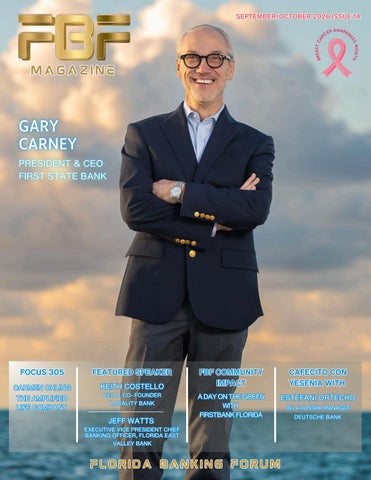
SEPTEMBER/OCTOBER 2026 ISSUE 14
MAGAZINE MAGAZINE
GARY CARNEY PRESIDENT & CEO FIRST STATE BANK
FOCUS 305 CARMEN OHLING THE AMPLIFIED LIFE COMPANY
FEATURED SPEAKER KEITH COSTELLO CEO & CO- FOUNDER LOCALITY BANK
JEFF WATTS
FBF COMMUNITY IMPACT
A DAY ON THE GREEN WITH FIRSTBANK FLORIDA
CAFECITO CON YESENIA WITH ESTEFANI ORTECHO
EXECUTIVE VICE PRESIDENT CHIEF BANKING OFFICER, FLORIDA EAST VALLEY BANK
FLORIDA BANKING FLORIDA BANKING FORUM FORUM
RELATIONSHIP MANAGER DEUTSCHE BANK
TABLE OF CONTENTS
01
FBF magazine
Table of Contents
1
Our Team
2
A Letter From Our President
3
The Keys to What’s Next
6
At the Forum
12
Women Shaping Tomorrow: Carmen Ohling
16
From the Publisher
18
Industry Leaders
19
Planning for 2027: Building a Budget That Works for
20
Your Community Bank Team New Edge Associates Networking Involvement
22
The Day you Stop Caring About People’s Opinions is
26
02
the Day you Start Living
03
FBF Lunch with Keith Costello
28
FBF Lunch with Jeff Watts
32
Focus 305 - Carmen Ohling: The Amplified Life
38
Company Monthly Spotlight - The Catch:
40
Together We Build Stronger Communities
42
The Affordability Crossroad: Florida Banks Face Higher
46
Rates and Property Tax Reform Launching A Bank-Issued Stablecoin
50
Cafecito Con Yesenia Presents: Estefani Ortecho
52
FBF Community Impact: A Day on the Green with
54
FirstBank FL The Branch was Never the Problem ISSUE 14
WWW.FLORIDABANKINGFORUM.COM
04
56 FBF MAGAZINE
01
FBF magazine
OUR TEAM SEPTEMBER/ OCTOBER 2026 ISSUE 14
PUBLISHER
DIGITAL CONTENT COORDINATOR
NORMAN ISAZA
JACK REED
EDITOR - IN - CHIEF
OUR CONTRIBUTORS
CARLOS JARA
MELANIE ISAZA
CONTENT DIRECTOR YESENIA MORENO
NORMAN ISAZA PHOTOGRAPHER
MANAGING EDITORS
EDUARDO MENDEZ
ISABELLA MENDES MICHAEL GIRON EVENT DIRECTOR NICOLE ISAZA CONTRIBUTING WRITERS ORLANDO A. DIAZ President of Metro Fund Inc. in Miami, Florida, a leading private capital provider in South Florida. President of the Florida Association of Mortgage Professionals SANDY FERNANDEZFORTUN Founder and President of Karmic Currency LISSETTE REYES Head of Marketing and Inside Sales Contributing Writer
ISSUE 14
DR. CLAUDIA URIBE Director @ Miami-Dade County Fair | Mental Health Therapist | Professor at University of Miami ALEX SOTO Senior Vice President, Head of Premier Banking at Grove Bank & Trust ARATI BATTA Risk and Regulation Expert
WWW.FLORIDABANKINGFORUM.COM
FBF MAGAZINE
02
Letter from our
President & CEO Dear Friends and Members of the Florida Banking Forum, Each year, I'm reminded that our community is strongest when we come together for a common purpose. Our industry is built on trust, stewardship, and service. Those values mean the most when we use them to lift up people who need help. Our recent fundraising efforts show the generosity that defines this Forum. Bankers, executives, business owners, and industry partners gave their time, money, and influence to support individuals and families facing real hardship. Every donation, every introduction, and every act of encouragement made a difference. Together, we turned goodwill into real help for our neighbors. Being in a position to give is a privilege. Many of us have been fortunate in our careers, our relationships, and our access to resources. Having the means to contribute to something bigger than ourselves brings real fulfillment. No contribution is too small. When each of us adds our own grain of sand, the combined effect can change lives. This spirit of giving reflects who we are as a professional community. Our work goes beyond financial transactions and business results. It also includes the lasting impact we make on the people and places we serve. Thank you for your generosity, your compassion, and your commitment to making our community a better place. I am proud to stand alongside each of you, and I look forward to all we will achieve together in the months ahead. With sincere gratitude,
Yesenia Moreno ISSUE 14
WWW.FLORIDABANKINGFORUM.COM
FBF MAGAZINE
03
®
The Keys to what’s next How Gary Carney is building on a 70 year legacy while expanding First State Bank's reach throughout South Florida.
ISSUE 14
WWW.FLORIDABANKINGFORUM.COM
FBF MAGAZINE
06
For generations, First State Bank has been synonymous with community banking in Monroe County. Founded in Key West in 1955, the institution built its reputation on local decision-making, trusted relationships, and a deep commitment to the communities it serves. Today, under the leadership of President & CEO Gary Carney, First State Bank is building on that legacy while embracing a broader vision for the future. With $1.2 billion in assets, the bank is expanding its presence across South Florida while remaining rooted in the values that have guided it for more than seven decades.
A Kent State University graduate with advanced banking education and nearly 40 years of industry experience, Carney joined First State Bank after an 18-year career at Charter One Bank, where he led commercial credit operations across a five-state region. That background continues to influence the bank's growth strategy today.
"We've built something special in the Keys, and now we're bringing that same commitment to service, local expertise, and relationship banking to South Florida," Carney said. ISSUE ISSUE 13 14
Celebrating his 20th anniversary, Carney joined the First State in 2006 as senior vice president and senior loan administration officer and served in a variety of leadership roles including executive vice president, chief credit officer, and chief operating officer before assuming the bank's top leadership position in January 2023.
WWW.FLORIDABANKINGFORUM.COM WWW.FLORIDABANKINGFORUM.COM
FBF FBF MAGAZINE MAGAZINE
07 07
GROWTH BEYOND THE ISLANDS Introducing participation lending to the bank over a decade ago and investing heavily in the Bank’s digital strategies to ensure global customer access and retention, one of Carney's leading objectives since taking control has been to further expand the bank's physical reach to serve South Florida's dynamic business markets. In addition to its dominant presence throughout Monroe County and Miramar operations center, the bank now has offices in Homestead and Fort Lauderdale and recently signed a contract for a new office in Coral Gables, strategically positioning it to serve businesses and professionals throughout the tri-county area.
COMMERCIAL EXPERTISE WITH A PERSONAL TOUCH At the center of the bank's growth strategy is its commercial program. Drawing on Carney's deep background in credit and lending, First State Bank has strengthened its position as a trusted financial partner for businesses seeking local knowledge and timely decision-making. The bank offers commercial lending expertise and solutions alongside a full suite of treasury management services designed to help companies improve cash flow, streamline operations, and support long-term growth. While many businesses find themselves navigating increasingly centralized banking environments, First State Bank continues to offer direct access to experienced bankers and decision-makers. The combination of sophisticated commercial capabilities and relationship-driven service has become their key differentiator.
ISSUE 14
WWW.FLORIDABANKINGFORUM.COM
FBF MAGAZINE
08
LEADING THE BEST TEAM IN BANKING BANKING Carney believes the bank's greatest strength is its people. More than 20 employees have served the organization for over 20 years, and nearly 70 have been with the bank for more than a decade. Under his leadership, First State Bank has revived employee traditions, expanded recognition programs, and renewed its focus on engagement and development.
"Our company-wide emails are addressed to The Best Team in Banking, because I truly believe that is what they are and my primary goal is to be the best employer in South Florida," Carney said. And he’s hitting the mark. The Bank was named a Top Workplaces winner in 2026 by both USA Today and the Sun Sentinel. That culture extends into the community through paid employee volunteerism, extensive charitable support, and local event sponsorships that embody the bank's long-standing community commitment. As First State Bank continues investing in technology, leadership development, and South Florida growth, Carney remains focused on preserving the relationship-based culture that has defined the institution since 1955. With roots firmly planted in the Florida Keys and opportunities expanding throughout South Florida, he is guiding the bank's next chapter while helping customers, businesses, and communities unlock what's next.
“My mission is to invest in cultivating the best team in banking to deliver service that surpasses customer expectations and in technology that further enhances the customer experience.” Gary Carney ISSUE 1114 13 ISSUE
WWW.FLORIDABANKINGFORUM.COM WWW.FLORIDABANKINGFORUM.COM
FBF MAGAZINE FBF MAGAZINE
0909 08
FBF PRESENTS: ISSUE 14
THE PERFECT PLACE
ISSUE 14
WWW.FLORIDABANKINGFORUM.COM
FBF MAGAZINE
12
AT THE FORUM TO EXCHAGE IDEAS
ISSUE 14
WWW.FLORIDABANKINGFORUM.COM
FBF MAGAZINE
13
ISSUE 14
WWW.FLORIDABANKINGFORUM.COM
FBF MAGAZINE
14
ISSUE 14
WWW.FLORIDABANKINGFORUM.COM
FBF MAGAZINE
15
Women Shaping Tomorrow Inagural meeting
Secure Your Seat at the Table.
Carmen Ohling
The Florida Banking Forum marked the launch of Women Shaping Tomorrow with an inaugural breakfast at International Finance Bank (IFB). Bringing together accomplished women from banking and a variety of industries, the gathering created a welcoming space for meaningful conversations, new connections, and shared experiences. It was a fitting beginning for a series designed to help women strengthen their leadership, expand their influence, and support one another’s growth. The morning featured Carmen Ohling, Founder and CEO of The Amplified Life Company, whose presentation, “Secure Your Seat at the Table,” invited attendees to reflect on how they show up in their professional lives. Her message centered on leading as our most authentic selves, stepping forward with confidence, and recognizing that our perspectives deserve a place in the conversations and decisions shaping our industries. Carmen encouraged attendees to examine the beliefs and habits that influence their choices, particularly those that lead them to hesitate, minimize their contributions, or wait for permission to speak. Her presentation reinforced the importance of advocating ourselves and taking ownership of the value we bring. Securing a seat at the table begins with believing we belong there and having the courage to participate fully once we arrive. ISSUE 14
WWW.FLORIDABANKINGFORUM.COM
FBF MAGAZINE
16
How to elevate your performance, presence, and influence.
One particularly meaningful takeaway was the distinction between strong and weak language. Carmen explored how the words we choose can either reinforce our confidence or diminish our message. Communicating with clarity and intention allows women to express their ideas more effectively, advocate for their needs, and build credibility as leaders. She also emphasized the role of meaningful relationships in expanding influence and creating opportunities for growth. Beyond the presentation, the breakfast offered attendees an opportunity to connect through shared experiences and aspirations. The conversations reflected the purpose behind Women Shaping Tomorrow: building a community where women across industries can learn from one another and move forward together. FBF extends its sincere gratitude to Carmen for her thoughtful insights, Vanessa Sanchez for her care and coordination, and IFB for hosting and sponsoring the breakfast. Powered by New Edge Associates, Women Shaping Tomorrow began with a powerful reminder: our voices matter, and the future is ours to help shape.
By: Norman Isaza ISSUE 14
WWW.FLORIDABANKINGFORUM.COM
FBF MAGAZINE
17
From From the the Dear Friends,
Publisher Publisher
Every so often, a single season captures what I love most about this industry. This fall is one of those seasons. In Stuart, Seacoast Bank is celebrating its 100th birthday. When I think about a century of service, I think about the people behind it: generations of bankers who knew their customers' children by name, who financed the first storefront on Main Street, and who stayed when storms came through. Seacoast began in 1926 as a small Treasure Coast bank. It has grown into one of the largest community banks in the Southeast, and it got there one relationship at a time. Just up the road, in Winter Park, Portrait Bank has opened its doors as Central Florida's first new bank in nearly a decade. What moved me most was not the size of the deal but the faith behind it. Before welcoming a single customer, the bank raised $43 million from 256 local investors. Those are neighbors, business owners and families saying, in the clearest way they can, "We want a bank that knows us." I'll admit that news like this gives me hope. Over the years we have watched consolidation reduce the number of banks headquartered in Central Florida from 38 to roughly half a dozen. Yet new banks are taking shape in Tampa, Miami and Coral Gables. The desire for banking with a familiar face has never gone away. That, to me, is the heart of it: communities still put their money behind banks that know them. It is also the heart of the Florida Banking Forum. Every luncheon, every conversation over coffee, and every page of this magazine is about bringing people together and celebrating the relationships that hold our industry and our communities together. Whether your bank is marking its first year or its hundredth, your story matters to us, and we are honored to help tell it. Thank you for being part of this family. I look forward to seeing you soon. With warm regards and gratitude,
ISSUE 14
WWW.FLORIDABANKINGFORUM.COM
aza s I n a Norm FBF MAGAZINE
18
PRESENTS PRESENTS
INDUSTRY LEADERS INDUSTRY LEADERS RODRIGUE EUSTACHE RODRIGUE EUSTACHE Vice President and Branch Managership Manager at SouthBank Rodrigue Eustache is a seasoned banking executive with more than twenty years of experience in personal financial services, commercial banking, trade finance, and wealth management. He has built his career at several leading international banks, where is known for his strong interpersonal skills and his ability to build, grow, and retain high‑value client relationships.He has led multiple branch teams and consistently delivered strong portfolio growth and exceptional service standards. Rodrigue currently serves as Vice President and Branch Manager at South State Bank in Miami. There, he oversees branch operations, drives business development. Earlier in his career, he held leadership roles at HSBC Bank USA and other financial institutions, including Senior Branch Manager, and Business Relationship Manager. He earned top performance awards and developed international client networks across the U.S., Argentina, Canada and France.
ALESSANDRO BARTOLINI ALESSANDRO BARTOLINI Chief Operating Officer, Chief Strategy Officer and founding Director at Glades Bank & Trust (in Organization) Alessandro Bartolini is the proposed Chief Operating Officer, Chief Strategy Officer and founding Director of Glades Bank & Trust (in Organization). He is a strategic banking executive and consultant with more than 25 years of experience leading corporate strategy, M&A integration, lending operations, and enterprise transformation across U.S. and international financial institutions. With a record of delivering measurable growth, operational efficiency, and organizational alignment. He is known for guiding teams through high-stakes transitions and designing execution ready strategies that strengthen client relationships, boost profitability, and accelerate bank performance.
ISSUE 14
WWW.FLORIDABANKINGFORUM.COM
FBF MAGAZINE
19
Planning for 2027: Building a Budget That Works for Your Community Bank For community bank leaders, budgeting for the year ahead is about more than balancing revenue and expenses. It is about making deliberate decisions about where to invest, where to grow and how to remain responsive to the customers and businesses that make up the communities you serve. As banks begin planning for 2027, continued economic uncertainty, changing customer expectations, technology investments and competition for deposits and lending relationships make flexibility increasingly important. The question is not simply, “What should our budget be for next year?” It is “Where can we invest our resources to strengthen the bank and create greater value for our customers and our community?”
Where are local businesses growing? What industries are expanding or contracting? Are customers looking for more lending, wealth management or treasury services? Are deposits shifting? What are customers telling your lenders, branch teams and relationship managers? These insights can help leadership determine where resources will have the greatest impact.
Invest Where Relationships Matter Most Technology is an important part of modern banking, but community banks do not have to choose between technology and personal service. The strongest investments are often those that allow employees to spend more time building relationships and less time on administrative tasks.
Start With Your Local Market A community bank has an advantage that larger institutions cannot easily replicate: a deep understanding of the local market. Budget planning should begin with what is happening in the communities you serve.
ISSUE 14
That could mean improving digital account opening, strengthening CRM capabilities, modernizing marketing, using data more effectively or automating routine processes. The goal is not technology for technology’s sake. It is using technology to make the customer experience easier while preserving the personal relationships that differentiate a community bank.
WWW.FLORIDABANKINGFORUM.COM
FBF MAGAZINE
20
Rather than building a budget around one set of assumptions, community bank leaders should consider several scenarios and identify the signals that would require a change in strategy. If loan demand accelerates, where could the bank invest? If deposit competition intensifies, how would that affect the plan? If economic conditions weaken, which investments remain essential? Having those conversations before the year begins can make it easier to respond when circumstances change.
Look Beyond Cutting Costs Managing expenses will always be important, particularly for institutions operating with limited resources. But a lower expense number does not necessarily mean a stronger bank. As you build the 2027 budget, consider where spending can support growth. Could additional resources help lenders deepen commercial relationships? Could marketing generate more qualified opportunities? Could technology improve customer retention? Could training help employees identify more opportunities to serve existing customers? The best budgets do not simply identify where to spend less. They identify where spending can produce a meaningful return.
Build Flexibility Into the Plan No one can predict exactly what the next year will bring.
Make the Budget a Leadership Tool A budget should do more than control spending. It should communicate priorities. For a community bank, the 2027 budget can answer some important questions: Where do we want to grow? How will we strengthen relationships with our customers? Where should we invest in our employees and technology? What can we do better than larger competitors? What activities no longer support our strategy? When the answers are clear, the budget becomes more than a financial document. It becomes a roadmap for the year ahead. For community banks, successful budgeting is not about predicting every challenge. It is about making thoughtful choices today while creating enough flexibility to respond to tomorrow.
LISSETTE REYES CONTRIBUTING WRITER ISSUE 14
WWW.FLORIDABANKINGFORUM.COM
FBF MAGAZINE
21
Team New Team New Edge Edge Associates Associates
ISSUE 14
WWW.FLORIDABANKINGFORUM.COM
FBF MAGAZINE
22
Networking Networking Involvement Involvement
ISSUE 14
WWW.FLORIDABANKINGFORUM.COM
FBF MAGAZINE
23
Strengthen Your
Elevate your
We provide businesses with the talent they need to succeed.
Take the next step in your career with opportunities designed for long term growth.
Team
Career
For more information: Email:
yesenia@newedgeassociates.com
Contact:
786-447-9323
Website:
www.newedgeassociates.com
When it comes to your financial aspirations, there are no boundaries at PNB. We believe in your potential and helping you reach new heights. Our comprehensive range of banking solutions, personalized service, and cutting-edge technology is built from the ground up to help you reach your financial goals. Whether you’re starting a new business, expanding your portfolio, or realizing your dreams, PNB is here to provide the support and guidance you need. Elevate your financial journey with a bank that understands your ambitions and is dedicated to building your success. Break boundaries, block by block, with PNB as your trusted partner.
BANKING NOT AS USUAL
1390 Brickell Avenue, Miami, FL 33131 305.539.7500
255 Aragon Avenue, Coral Gables, FL 33134 305.539.7570
18285 Biscayne Blvd., Aventura, FL 33160 305.539.7460
4137 North Federal Highway, Unit #7, Boca Raton, FL 33431 561.448.4541
Banking Beyond the Balance Sheet The Day You Stop Caring About People’s Opinions Is the Day You Start Living.
That’s not proof you’re on the wrong path. It’s often proof that you’re actually moving. If everyone agrees with every decision you make, you’re probably playing too small. The goal was never to be liked by everyone. The goal is to become the best version of yourself.
There comes a moment in life when you have to make a choice of great importance. You can spend your days trying to earn the approval of people who aren’t building your future…
So write the book.
Or you can spend your energy building a future that eventually earns their respect. Most people never make that choice. Instead, they become prisoners of opinions that in the end carry no weight at all.
Start the company. Apply for the opportunity. Take the shot. Move to the new city. Learn the new skill.
They don’t start the business because someone might shake her head in disapproval.
Fail.
They don’t write the book because someone might criticize it.
Get back up.
They don’t ask for the promotion because they fear the possibility of rejection.
Because one day you’ll realize something that changes everything:
They don’t chase the dream because they’re too busy protecting a reputation that exists only in their own mind.
The opinions that once kept you awake at night belonged to people who were never responsible for your destiny. And the freedom that comes from understanding that is priceless. Your life is too valuable to be lived for an audience that will always find something to say. Live it for the person you’ll become when you refuse to let fear of judgment decide your future. Because the loudest opinion that should ever matter…
Please really think about that for a second. A long hard second. How many incredible lives have been traded away simply to avoid someone else’s opinion? So here is the truth: The people who judge you aren’t living your life. They aren’t carrying your responsibilities. They aren’t waking up with your dreams or going to bed with your regrets. So why should they have a vote in your future?
Learn.
Is the one you have about yourself.
The greatest freedom I have found isn’t financial. It isn’t professional. It isn’t even success. It’s realizing that other people’s opinions don’t pay my bills, raise my children, write my books, or help me become the person I was created to be. Once you understand that, something incredible happens. You stop performing. You stop pretending. You stop apologizing for wanting more. You stop asking for permission. And you finally start living. Ironically, the people who spend the most time criticizing others are often the ones who never had the courage to chase their own dreams. It’s easier to judge someone taking a risk than it is to confront your own fear of taking one. Don’t let someone else’s comfort become the ceiling for your ambition. Every meaningful achievement comes with criticism.
By : Alex Soto
Every athlete has critics. Every artist has people who don’t understand the work. Every leader has people who question the vision.
ISSUE10 14 ISSUE
Contribuitiing Writer
SVP, Head of Premier Banking Grove Bank & Trust
WWW.FLORIDABANKINGFORUM.COM WWW.FLORIDABANKINGFORUM.COM
FBFMAGAZINE MAGAZINE FBF
26 22
Your Life,
Your Kind of Checking Every moment matters. That’s why we designed our checking solutions around your schedule, not ours. Deposit checks from anywhere. Transfer money in seconds. Check balances whenever.
Try everyday banking built for you. Open a checking account today!
305.577.6000 | 1firstbank.com/fl Member FDIC. All products and services are available only in Florida and subject to Terms and Conditions that can be found in the account disclosure document provided at the opening of the account. Certain restrictions apply. B220 (2/26)
F B F E X E C U T I I N VS E I G H T S ISSUE 14
Keith Costello Co-founder & CEO Locality Bank
“I like solving problems. I like, ‘How am I going to get through this?’ It’s empowering.” Take us back to the beginning of your story. What originally drew you to banking? How I ended up in banking was really not what I had planned initially. As a kid, I always dreamed of owning restaurants and hotels. I wanted to be like a resort owner with resorts all over. Eventually, you know, life goes on and I was in the military because that was a way for me to go to college. I attended University of Tampa on a military scholarship. You know, there is free college in this country. You just got to serve in the military to get it, which I was happy to do, by the way. I got out and became a Captain in the military, and that was a great experience. I grew up in Albany, New York, which, you know, that's why I'm here. That's why I went to the University of Tampa. If you've ever been to Albany, you know, it snows like 9 months out of the year up there. It's a lot of snow. I couldn’t wait to come to Florida, and so I came right back after I got in the army. Then I ended up really becoming a stockbroker at Merrill Lynch in, of all times, 1987. The greatest stock market crash in history, right? Stock market went down 25% in one day. It was unheard of. I mean, if that happened today, people would be jumping out of windows, and people were jumping out of windows at that time. So anyway, I was like, you know what? I like this career, but I'm not making any money. So I gotta do something else. And I met a banker and, I think what happens with a lot of us, we meet people who inspire us and who encourage us to do something. And for me, that guy was Charlie Frankel, who was a Fort Lauderdale-based banker. He was running private banking at Nations Bank at that time, and he was like “Hey, we're looking for guys who understand investments and we want to teach you credit so you can become a private banker. You can do investments and lend people money so they can do their banking” So I'm like, alright, at least I'll have a paycheck. So I'll try it. And I absolutely loved it. I just thank that gentleman, Charlie Frankel, for getting me exposed to banking because for me it was like, wow, you know. This is great. You get to help people, you get to really be engaged in the community in a way that I always wanted it to be. So, for me, it was like once I got a taste of it, I actually said this is what I want to do.
WWW.FLORIDABANKINGFORUM.COM
FBF MAGAZINE
28
Let's talk a little bit about your military service and leadership. How did serving our country shape the way you think about leadership, accountability, and earning people's trust?
Many people here may not know that you’ve taken your conversations beyond banking through your podcast. What inspired you to start it, and what have you learned from the leaders you’ve spoken with?
The military, for me, was a gift because at 22 years old, God knows what I would’ve been left doing. I had no idea what I wanted to do at the time and, to just get thrown into this role where you're given so much responsibility at a young age, and it's not like, “Can you handle it?” They're like, “No, you’ve got it”. There's thirty 18 year olds, you're responsible for these guys, and it's a tremendous weight on your shoulders. It taught me discipline. You wear a rank on your collar, and people have to salute you, but I always say, you know what? I want people to recognize me as a leader if I didn't have that on my collar. And that was always something that I tried to aspire to in the military.
I have to give a shout out to Ryan Swanno, our Director of Marketing. Ryan produces the podcast. I mean, I show up, he gives me a script, and now we're doing them at a cigar lounge, so, you know, I smoke a cigar and relax. Ryan does all the work. It’s called the Locality Bank’s Making Bank Podcast. It's on Spotify and YouTube, and we do the clips. We focused on entrepreneurship. We consider ourselves entrepreneurs because we started a bank, so we understand how hard it is to start and run a business. We see that as a key differentiator between somebody who’s never done that. And even the people who work at our bank, we say, you know, you're all entrepreneurs. You’re all working in a startup, and that creates that totally different mentality because you're sweating out there. We're not making money for 3 years. You're like, oh my God, we gotta start cranking out some profits. All of those things we wanted to share with our listeners to try to help them, so we get successful entrepreneurs on and just have them share some of their secrets.
Is there a lesson from your military service that you still find yourself applying to your business today? A sense of urgency and discipline to get things done. I look here at the crew in the front row and there's a bunch more out there. I think about the team, and leading that team, and just the things that we've been able to accomplish in less than 5 years in our bank. Can I brag a little bit? We just made the Inc. 5000, for fastest growing private companies. We were number 4 in terms of the fastest growing businesses in South Florida, and you can’t do that without great people and without a sense of urgency.
“My wife’s like, ‘Are you sure you wouldn't like to retire?’ I said, yes, because you know what? I'm ready to get some more stress. I can't just be in that resort state for more than like a week. I crave stress, and I think it's good.
Was there a moment during any of these chapters when you thought, “What have I gotten myself into?” That's in every business. I don't know how many people watch Landman, that show, but I feel like the Landman of banking some days. It’s like, oh, something's blowing up here? Maybe not an oil rig, but, you know, things are going wrong and you have to deal with them. I think that goes back to what I was saying earlier about stress. If you just want to not have any stress, and not deal with any problems, then there’s ways to do that. But I like that. I like having the feeling of problems. I like solving problems. I like, you know, “How am I going to get through this?” It's empowering.
ISSUE 14
WWW.FLORIDABANKINGFORUM.COM
FBF MAGAZINE
29
You helped start Broward Bank of Commerce in 2008. You later led First Green Bank as CEO, and both ultimately had successful exits. How did each of those experiences influence your approach to Locality Bank? Just like in 1987, the stock market crash, we all know what happened in 2009. So don’t follow my timing. But actually, 2009 turned out to be a great year to open a bank. It was hard getting money. It was not easy, but we managed to raise that money. Once we did, we were like one of the few banks that was actually lending money at that time. It turned out to be a great experience. You know, building that bank and then selling it. But then, later, after selling First Green in 2018, I had these non-competes as a result of these sales. And it's given me a taste of what it would be like not to work, and I don't like it. That last one was 2 years. They’re pretty strict on them. But it really made me realize that I'm not one of those people that’s looking forward to retirement. I really don't want to ever retire. It's interesting. I wear an Oura ring, which a lot of people probably do in this room, and I look at my stress from time to time. Last weekend, my daughter got married, so I stayed in Chicago and just hung out with her for a week. We took a vacation, and I had no stress. It’s usually like 6 hours of stress every day. It disappeared. So, I came back to Florida, and my wife’s like, “Are you sure you wouldn't like to retire?” I said, yes, because you know what? I'm ready to get some more stress. I can't just be in that resort state for more than like a week. I crave stress, and I think it's good.
What do you see as the biggest opportunity or the biggest challenge against community banks? I think there's a lot of challenges, particularly we've looked at what's going on in Washington now. Over the first couple years of the Trump administration, no matter how you feel politically, if you're a banker, it's been good. We had leadership in the House Financial Services committee, we have leadership to the Senate Banking Committee, and these are the people who make the rules, right? You can complain about the regulators all you want. They just follow the rules. It goes back to my involvement since 2009, and I’ve never seen such a favorable set-up in the legislature. I mean, it's really been great for us. A year ago in May, Mary from BankMiami and I testified in Congress about De Novo banking, and we saw it all become law. The things we testified about actually made a difference in how they’re approving De Novo banks going forward. You know, so those challenges, I think, legislatively, we really have done a good job at working towards it through those. The other challenges that we face, I mean…we haven’t erased the credit cycle. So, what's going to cause it? Is it going to be this huge AI buildup? Is it, you know, going to be inflation? It's going to be interest rates? The national debt? So, lots of stuff to make my Oura ring stress out, but it’s okay. We'll get through it.
“A year ago in May, Mary from BankMiami and I testified in Congress about De Novo banking, and we saw it all become law. The things we testified about actually made a difference in how they’re approving De Novo banks going forward.”
ISSUE 14
WWW.FLORIDABANKINGFORUM.COM
FBF MAGAZINE
30
F B F E X E C U T I I N V S E I G H T S ISSUE 14
Jeff Watts
Executive Vice President Chief Banking Officer, Florida East
Tell us about yourself, where you grew up, and what your upbringing was like. All right, so this will be impromptu and pretty casual. I think this table is going to know some of the story, but I was born and raised in the San Francisco Bay Area. Don't let the resume fool you. I have a very blue collar background. I was raised by a single mother who was high school educated, no child support, and she raised 3 kids. So we had to start working early, but I'm sure we'll talk more about childhood details. But I am blessed to be from the Bay Area. Always wanted to live in Florida and I'd been here for 25 years now.
What were you like growing up and what experiences from your childhood shaped the person you are today? So, I would describe myself as, and I was just talking about it with Steve Redlich, who oversees credit, I wasn't an extrovert, but I wasn't an introvert. I was more of an ambivert. I like interacting with people when I choose to. Growing up, that was something I would turn on as a light switch, but I also like my alone time. But I would say my childhood really formed the work ethic, and the diversity of my family really shaped who I became as a person and my wife and kids are a great example of that. So if you look at the diversity back in San Francisco, my home, my family, we spread across California, Arizona, Nevada. My stepfather's Mexican. When I was 17, my mother remarried, and my stepfather's from Michoacan, Mexico. My wife is African, so we're here and we have family all over the world, so that stems back to my childhood, just how important diversity was across my family and my friendships. And I think to this day, it's probably one of the main things that has led to a little bit of success in banking because it's such a personal relationship business.
WWW.FLORIDABANKINGFORUM.COM
FBF MAGAZINE
32
Who are some of the mentors or leaders who have had the greatest impact on you and what did they teach you?
When you’re not working, which everyone who knows you knows isn’t very often, what do you enjoy doing, and what helps you recharge and stay grounded? I've always been a person that exercises pretty much every morning, and for years I would run, but the past 3.5 to 4 years, I picked up Bikram yoga. So I'm in the studio, like today, for an hour of hot yoga, and hot is really hot. It's 108 degrees in the room. And my wife is usually the teacher, so, you know, she picks on one person. That's me. But it allows me to not have my phone, which this table knows I have my phone on me way too much, and just focus and be present. So I would say Bikram yoga definitely helps me ground myself before the day. And then weekends, it's usually family walks on the beach where, yeah, we get out and, there's not much hiking here like California, but at least you could walk on the beach, go to a state park, and that's typically what we do as a family.
What were some of the most important experiences early in your career that helped shape you as a professional? I would say, before I started my banking career, my first job was with Classroom Connect, an educational technology company. And that's where I went right into an inside sales role, and then I moved my way up and went out to field sales and really, really fell in love with relationship-oriented selling, when it's not commoditized and you're working with people. That was really one opportunity that really shaped my future mindset around banking and where I would fit into the banking world. And then, from a banking perspective, when I landed in Florida, I worked at First Union Wachovia with Marshall, who gave me some really good guidance in my early years. And I would say that, as a younger banker, if you're in this room, you need to do your own gap analysis. I came into banking with a pretty strong sales foundation and people skills, but I needed to learn the industry. So I quickly said, I need to get very friendly with 3 credit people, Juan Castro, God bless him, rest in peace, Lloyd Costley, and Mike Carlin. So I invested the time in the areas of banking where I had to build out those skills to complement the skills I already brought to hopefully accelerate my career.
ISSUE 14
So it goes back to the credit training. I would say Jim Baiter, who was my first boss at First Union Wachovia. He eventually went to Florida Community Bank and they sold the bank to Synovus, and now it’s Pinnacle. So Jim was born and raised in credit, and when I landed in banking, I had, like I said, the sales background, but it was really important to me to have a boss that could teach me what's fundamental to what we do, which is risk management, and a large part of the risk management effort is credit. So I spent so much time with Jim. Once again, just going back to the younger professionals in the room, I think it's critical that you identify those gaps and you need to invest the time. You're going to get repetitions on the job, but you need to arrange the coffee to review a credit deal. You need to go the extra mile, join credit committee when your team isn't presenting a deal, and just get as many repetitions as you possibly can. But Jim Baiter and Juan Castro were the 2 credit leaders that really gave me the time back when I asked for the time to learn. And that was incredibly fundamental because, I think we all agree, the banking business is partly relationship selling, but the other part is, really, credit risk management.
As your responsibilities grew, how did your definition of leadership change? So, the way I think about it, it's a spectrum. Typically, you're an individual contributor to start. Could be a banker, could be a treasury officer, or another role. But I look at the spectrum, me-to-we-to-us. And “me” is, what's my role, my day-to-day, and my role to contribute to the team, to the market, to the bank. But when you transition to “we”, it's a different job, right? You become a coach, you become a leader, you're trying to focus on the right behaviors, emulate those behaviors, coach to those behaviors. You're holding people accountable. Sometimes you want them to do the job the way you did the job, but that doesn't happen. So it's really this transition from me-to-we, and then ultimately we-to-us, is the enterprise perspective and what's important to the enterprise when you think 3, 5 years out or horizontally across the enterprise. So it's really traveling that spectrum. And for me, I think the hardest transition was me-to-we.
What drew you to corporate banking and working with business owners and executives? The loyalty factor was the main thing, When you're in the middle market, their decision-making is largely based on the people that are invested in their business, understanding exactly what the business model does, where they're going, their capital structure, and it's more advice-driven. So I think the middle market and business banking space is really where you can deliver a lot of value. For me, it just goes back to those two elements of the banking industry.
WWW.FLORIDABANKINGFORUM.COM
FBF MAGAZINE
33
Was there a particular opportunity, decision, or turning point that has significantly changed the trajectory of your career? I think moving to Florida was number one, and I met my wife in South Beach, the first person I met when I moved to Florida. When there was no Uber, I took a taxi from the airport to 15th and Bay Road, and my wife leased to me my apartment. Getting her to sign that term sheet was the most important one. But I would say: coming to Florida, starting my banking career, and finding the area of banking that resonated with me. I knew I liked relationships and team-oriented selling. And then, I also like numbers despite 4 junior colleges. But when I discovered middle-market corporate banking, it was a great combination of relationship selling with a quantitative element, and the segment of the market is based on advice giving. It's not highly commoditized and it's all about rate and structure, so I think just finding that part of banking that resonated with me was really important. And I think the second fork in the road was when I joined Bank Leumi, which ultimately sold to Valley. When I went to Bank Leumi, I couldn't say the name, I couldn't spell the name, and it was a $7 billion bank with no retail, spread across New York, Miami, Chicago, LA, and Palo Alto. So a very different type of bank. It also had private equity ownership, so it was a leap that I took with joining a new team, and you never really know how it's going to work out until you get there. And I think there's another lesson in that. I think one thing that's important in this industry is to not wave the white flag too early. You can only learn so much when you're interviewing, but when you arrive at your new bank, there's going to be things you like and things that you weren't expecting, and trust me, there were things that I wasn't expecting. But I think making sure you stick with it, and you're consistent, and you're contributing, if you just stick to those daily habits, things work out.
“ I think one thing that's important in this industry is to not wave the white flag too early.”
So now you've moved on from head of corporate banking to EVP Chief Banking Officer at Valley Bank. How has that transition been, and how has your perspective changed? Well, when I was running corporate banking, I was traveling a lot. So I had a team in Miami, Tampa, Chicago, LA, and 2 bankers in New York. So just from a life balance perspective, being here every day has been awesome. It's almost been 3 years in this role. And I think the number one thing is, I have an amazing leadership team. Many of whom are here today. So they make the job enjoyable and easy, and then my dayto-day, I think what has been really cool to see is our value proposition come to life, not just in corporate baking, but also in our real estate business, in our business-making business, in small business as well. And if you think about Valley Bank, we're $68 Billion in assets. 20 years ago, if you looked at banks, 50 Billion to 150, there were close to 20 banks in that category across the country. That number is closer to 10 to 12 now. And you look at Florida, we're one of a couple banks that are 50 to 150. To be in a position, whether it's real estate, corporate wealth management, business banking, to really execute on the value proposition of “you're big enough to matter, but small enough to care”. It's cool to see that come to light every day in all our businesses.
What initially led you to banking and what made you decide to build a career in the industry? When I was in educational technology, I loved the selling part of it, wasn't too crazy about the industry, and we were selling to school districts. Long sales cycle, revolving door of decision makers, sometimes an RFP, which we all know can be pretty laborious. So when I thought about doing something more quantitative, more analytical, the banking industry really, really spoke to me, and it was more, like I said earlier, navigating where I could fit in. I think when you're large corporate, it's very commoditized, and in the corporate middle market, the real estate business, or business banking, you can add a lot of value by understanding the business owner's needs and giving advice. So for me, it was combining those 2 things.
“Just going back to the younger professionals in the room, I think it's critical that you identify those gaps and you need to invest the time” ISSUE 14
WWW.FLORIDABANKINGFORUM.COM
FBF MAGAZINE
34
Solutions that work as hard as you do. Rooted in the communities we serve, our relationship focused bankers are empowered to make decisions locally and deliver sophisticated products and services that rival our larger competitors. SouthState understands the complexities of your business and we’re ready to Bank Miami-Dade Forward.
2 Alhambra Plaza • Coral Gables, FL • 786.362.8560
SouthStateBank.com•Member FDIC
SPONSORED BY &
December 1st 2026 Bacardi Ocho Lounge Located on the 200-Suite Level
Kaseya Center601 Biscayne Boulevard , Miami, FL 33132
Join us for an exclusive evening at the Bacardi Ocho Lounge, located on the 200-Suite Level of Kaseya Center, where the FBF community comes together for an unforgettable night of networking, conversation, food, drinks, and Miami HEAT basketball. This season brings a new level of excitement to the arena, with Giannis Antetokounmpo joining Bam Adebayo alongside newcomers Klay Thompson, Bobby Portis, and Tim Hardaway Jr. The revamped HEAT have made Kaseya Center the hottest ticket in the city. Come for the connections, stay for the game, and experience a premier setting where relationship-building meets championship ambition.
For ticket and sponsorship information contact the FBF team at info@floridabankingforum.com or call 786-447-9323
FOCUS 305 How Carmen Ohling and The Amplified Life Company are Redefining Leadership and High Performance in Miami After 16 years at J.P. Morgan, a personal turning point, and a career dedicated to developing leaders, the founder of The Amplified Life Company is helping organizations move beyond business as usual to unlock their fullest potential. Success can be a surprising obstacle to growth. Once individuals and organizations reach a certain level of achievement, the very habits that helped them succeed can become the barriers keeping them from what comes next. For Carmen Ohling, founder and CEO of The Amplified Life Company, this insight sits at the heart of her work with executives, leadership teams, and managers. Based in Miami, Florida, Carmen and her team partner with organizations to develop leaders who communicate with purpose, build trust, inspire innovation, and empower people to perform at their best. Her path to this work, however, began with a personal question: Isn't there more to life than this?
From Corporate Success to a Different Way of Leading
Carmen spent 16 years at J.P. Morgan, rising to the Vice President level and building the technical, organizational, and management skills that drive business results. Yet, despite her professional success, something felt incomplete. She had learned how to manage work, execute strategies, and deliver results. What she had not been taught was how to lead herself, exercise personal agency, or fully empower the people around her. That realization eventually prompted one of the most difficult decisions of her career: leaving the corporate world to pursue a different path. Her understanding of success had also been shaped by a deep personal experience. At age 25, Carmen was diagnosed with multiple sclerosis. For two years, fear and uncertainty influenced how she viewed her future. One night, after more than a year of 3 times weekly self-injection treatments, she found herself questioning whether there was a better way to live. That question became a turning point. She began deliberately challenging herself, pursuing personal growth, and sharing what she was learning to help others. Over time, she pursued professional coaching and well-being certifications and began working with executives who wanted to become more effective leaders without sacrificing their health, relationships, or fulfillment. As her individual coaching clients experienced growth, they began inviting her to work with their teams. She recognized that the impact she envisioned required more than one person. She began building The Amplified Life Company, bringing together expert coaches and facilitators across the United States to help organizations develop leaders at every level.
ISSUE 14
WWW.FLORIDABANKINGFORUM.COM
FBF MAGAZINE
38
From Corporate Success to a Different Way of Leading Carmen believes organizations often make three mistakes that limit their potential. First, they allow success to become business as usual. Established habits, assumptions, and unwritten rules can discourage people from challenging the status quo, even when new opportunities are within reach. Second, organizations promote strong individual performers into management positions but often focus their development on technical responsibilities and operational tasks. The human side of leadership receives less attention: emotional intelligence, visionary communication, coaching, trust, and the ability to bring out the best in others. Third, leaders neglect themselves. The demands of leadership can leave little room for meaningful relationships, personal well-being, or reflection. Yet sustainable performance depends on the person behind the position . At The Amplified Life Company, these challenges are addressed through executive coaching, leadership development, experiential workshops, team facilitation, and practical learning experiences designed to challenge and change how people lead and work together. The goal is not simply to teach leadership concepts. It is to help leaders put those concepts into practice, creating lasting changes in behavior, relationships, and organizational culture.
One Leader's Growth Can Change an Entire Organization A recent engagement with a financial institution illustrates what this approach can make possible. The organization's CEO had heard Carmen speak at a large conference about high-performing teams. The CEO’s most important takeaway was simple: You can only have a high-performing team if you have a high-performing leader. Rather than focusing exclusively on his team's performance or the organization's strategy, he recognized that his own growth was part of the opportunity. His deeper self-assessment identified development opportunities in visionary communication, coaching, emotional awareness, transformational leadership, and the transition from his former identity as CFO to his role as CEO. The assessment also revealed a broader organizational opportunity. The institution was already successful and had earned recognition as a great place to work. Yet established routines, unspoken concerns, and a tendency toward business as usual were limiting what the organization could become. Together, the CEO, executive leadership team, and The Amplified Life Company embarked on a yearlong leadership development initiative. The work began with the executive team and board developing a shared organizational vision: Invested in Human Potential.
ISSUE 14
305
That vision became the foundation for executive coaching, storytelling and communication workshops, transformational leadership development, and coaching and experiential learning for executive, mid-level, and frontline managers. The aim was to align the organization around a common purpose and equip leaders throughout the institution to bring that purpose to life. The reported results were significant. Employee retention improved, the organization developed a waiting list of top talent interested in joining, and its Net Promoter Score (NPS) results strengthened substantially. The institution was again recognized as a top workplace by two sources. Leaders also observed greater energy, creativity, and innovation, alongside a stronger sense that their work mattered. At the end of the year, the CEO sent Carmen a message that captured the personal impact of the work: "I've never felt as clear, confident, and fulfilled in my life or leadership as I have this year. And it's a direct correlation to the work I've done with you and the work the organization has done with your team. I am truly grateful." For Carmen, this is the power of leadership: when a leader commits to their own growth, they elevate the people around them. And when those people grow, the entire organization becomes capable of achieving more.
Be the one Today, Carmen’s vision with the Amplified Life company reaches beyond any single organization. They are working towards impacting one million leaders, equipping them to elevate their own leadership and, in turn, the people and communities they serve. Her philosophy is grounded in a simple invitation: Be the one. Be the one who goes first. Be the one who reaches out. Be the one who sets a high standard for yourself and models what is possible for others. Be the one who inspires, empowers, and helps people recognize their own potential. For Miami's banking and business community, that invitation carries a practical message. Strategy matters. Technical expertise matters. But the people responsible for bringing a vision to life matter just as much. The next level of organizational success may not require doing more of what has always worked. It may require leaders to challenge their own assumptions, invest in their growth, and create an environment where people can speak up, think boldly, and contribute their best. Carmen Ohling and The Amplified Life Company have quickly emerged as a leading force in executive coaching and leadership development in Miami. She believes the region's potential is extraordinary, and realizing it will require leaders who hold themselves to a higher standard while intentionally investing in the growth, performance, and potential of others. Because when leaders choose to grow, they change what becomes possible for their teams. And when teams grow together, their impact can reach far beyond the walls of their organizations.
Learn more or connect with Carmen Ohling and The Amplified Life Company: Scan the QR code to connect with Carmen and explore leadership development opportunities.
WWW.FLORIDABANKINGFORUM.COM
FBF MAGAZINE
39
Monthly
Spotlight
The Catch
A KEY LARGO GATHERING PLACE WHERE EVERYONE BELONGS After four decades in Florida Keys hospitality, the co-founder of The Catch Restaurant and Bar has built a place where local flavor, live music and a warm welcome come together. At Mile Marker 102, on the ocean side of the Overseas Highway, there's a restaurant where the bartender knows your order and the owner knows your name. For many in Key Largo, The Catch Restaurant and Bar is the Florida Keys' answer to Cheers, and that's exactly what Cathy Gahagan had in mind.
ISSUE 14
WWW.FLORIDABANKINGFORUM.COM
FBF MAGAZINE
40
A Career in Hospitality Cathy brings forty years of Keys restaurant experience to The Catch. She learned the business at well-known Upper Keys spots such as Mrs. Mac's, The Caribbean Club and Hobo's Cafe. Along the way she built the two qualities that shape her work today: a real love of people and a creative approach to food. In 2013, she and fellow restaurant veteran Paige Prouty decided to open a place of their own. Their goal was simple: a place where everyone could come and enjoy the local flair.
Fresh From Local Waters That creativity shows on the menu. To start, there's tuna poke piled high on guacamole with wonton points made inhouse. The tuna nachos layer sesame-seared rare tuna over crisp wontons with seaweed, ginger and a savory wasabi sauce. The fish or conch tacos, blackened or grilled, come with pico de gallo, avocado and a tangy homemade Sriracha sauce. At dinner, guests can have locally caught fish prepared any way they like. They can also order the seafood platter of golden fried fish, clam strips, scallops and shrimp. Weekly comfort-food specials range from Tuesday's chicken pot pie to Friday's prime rib, which always draws a crowd. Homemade Key lime pie and rum cake finish the meal.
More Than a Meal
A Welcome for Everyone The parking lot fills quickly and the tables sit close together, but regulars say that's part of the charm. Above all, Cathy and her team take pride in making everyone feel welcome, from lifelong locals to first-time visitors on their way to Key West. More than a decade after opening, The Catch is still true to its original vision: good food, good music and good company, with a strong local flavor. The Catch Restaurant and Bar · 102041 Overseas Highway, Key Largo · (305) 204-4143
The horseshoe-shaped bar is the heart of the room, with local beers, classic cocktails and a weekday happy hour. The Catch has also become one of the Upper Keys' liveliest community spots. Talented local bands play on weekend nights. The calendar also includes pig roasts, crawfish boils, and charity and community events that bring neighbors together for good causes. Guests can eat inside or out, and the restaurant hosts private events.
ISSUE 14
WWW.FLORIDABANKINGFORUM.COM
FBF MAGAZINE
41
FBF MAGAZINE
HEALTH
TOGETHER WE BUILD STRONGER COMMUNITIES Building stronger relationships, empowering communities, and creating a lasting impact through collaboration and shared purpose.
Banking Beyond the Branch
Taking Teamwork into the Community
Banking is more than managing money, processing transactions, or providing financial services. At its heart, banking is about people, relationships, trust, and the communities that financial institutions serve. A strong community creates opportunities for individuals, families, and businesses to grow, and banks have an important role to play in supporting that progress.
Community engagement provides banking employees with opportunities to use their collective skills and resources to address local needs. Whether participating in a food drive, supporting educational programs, mentoring young people, or volunteering at a community event, employees can demonstrate the values of teamwork through meaningful action.
The theme “Together We Build Stronger Communities” reflects the belief that meaningful progress begins when people work together toward a common goal. Through teamwork, community engagement, financial education, and social responsibility, banking professionals can make a positive difference that extends far beyond the walls of the branch.
These initiatives also allow colleagues from different departments to work together outside their usual responsibilities. Employees develop a deeper appreciation for one another’s strengths while building relationships with the people they serve.
The Power of Teamwork
Empowering Communities Financial Awareness
Through
A successful bank relies on employees who communicate effectively, support one another, and share a commitment to excellent service. From customer service representatives and tellers to loan officers, operations teams, and managers, every employee contributes to the overall success of the institution.
One of the most valuable contributions a bank can make is helping people make informed financial decisions. Financial awareness equips individuals with the knowledge to manage their money responsibly, plan, and recognize potential financial risks.
Team building helps strengthen these relationships by encouraging collaboration, mutual respect, accountability, and trust. When employees understand one another’s roles and work toward shared objectives, they are better equipped to solve problems, respond to customer needs, and deliver consistent service.
Community awareness programs can focus on budgeting, savings, credit management, digital banking safety, and fraud prevention. Special attention can be given to young adults beginning their financial journeys, older adults who may be targeted by scams, and smallbusiness owners seeking to strengthen their financial management skills.
However, teamwork should not end within the workplace. The same spirit of cooperation that makes a banking team successful can also become a powerful force for positive change in the community. In our communities, we see banks making a difference through their commitment to community engagement and social responsibility. Whether raising awareness for an important cause, participating in a 5K charity event, collecting toys during the holidays, or providing meals to individuals experiencing homelessness, these initiatives demonstrate the positive impact banks can have beyond their financial services.
ISSUE 14
WWW.FLORIDABANKINGFORUM.COM
FBF MAGAZINE
42
FBF MAGAZINE
Building a Belonging
Culture
HEALTH
of
Service
and
Team building is most effective when it becomes part of an organization’s culture rather than a one-time activity. Banks can encourage this culture by creating regular opportunities for employees to participate in community projects, share ideas, recognize achievements, and contribute to common goals. Employee volunteer days, community cleanups, donation drives, financial education campaigns, and mentorship programs are practical ways to bring colleagues together around a shared purpose. Recognizing employees who demonstrate compassion, initiative, and collaboration can further reinforce these values. It sends a clear message that success is measured not only by individual performance or business results, but also by the positive impact employees create together.
Conclusion The importance of teamwork in the community for a bank lies in its ability to bring people together for a common purpose. Through collaboration, financial education, volunteering, and social responsibility, banks can strengthen community relationships while developing more engaged and connected employees. “Together We Build Stronger Communities” is more than a slogan. It reflects the belief that when a bank and its employees work together with the community, they can build trust, empower individuals, support local development, and create a stronger future for everyone.
One Team, One Bank, One Community!
A culture of service also reminds employees that every interaction matters. A helpful conversation, a thoughtful explanation, or a willingness to support a colleague can contribute to a more welcoming workplace and a stronger community.
Turning Shared Purpose into Lasting Impact To build stronger communities, banks must move beyond good intentions and turn their commitments into meaningful, measurable action. This begins with listening to community members, identifying local needs, and partnering with schools, nonprofit organizations, small businesses, and other community groups. Setting clear objectives helps ensure that community initiatives produce meaningful results. Banks can measure their impact through employee participation, volunteer hours, the number of people reached through financial education, community feedback, and the continuation of successful partnerships. ISSUE 14
By: Dr. Claudia Uribe
WWW.FLORIDABANKINGFORUM.COM
FBF MAGAZINE
43
Temporary Consulting Services BSA - AML - Compliance 6303 Blue Lagoon Drive Suite 438 Miami, Florida 33126
1325 Avenue of the Americas, New York, New York 10019
260 Peachtree Street NW Suite 2200 Atlanta, Georgia 30303
305-537-4614
212-537-4614
305-632-9183
WWW.NEWEDGEASSOCIATES.COM
FBF MAGAZINE
FINANCE
THE AFFORDABILITY CROSSROAD: Florida Banks Face Higher Rates and Property Tax Reform Florida’s banking industry may be heading into one of the more unusual affordability environments we have seen in years. On one side, the Federal Reserve has reversed course and begun raising rates again. On the other, Florida voters will decide in November whether to significantly reduce the property-tax burden on homeowners and place additional limits on property taxes for non-homestead properties. These two forces appear to be moving in opposite directions. One makes borrowing more expensive. The other attempts to make owning property more affordable. Florida banks will find themselves directly in the middle. These two forces appear to be moving in opposite directions. One makes borrowing more expensive. The other attempts to make owning property more affordable. Florida banks will find themselves directly in the middle. In September, the Federal Reserve raised the federal funds target range by 25 basis points to 3.75%– 4.00%, citing inflation that remains above its 2% objective. Mortgage rates have reacted as well, moving back toward the 7% range after borrowers had finally begun to see some relief.
And Florida already has another major affordability challenge: property taxes. That brings us to Amendment 3. On November 3, Florida voters will consider a constitutional amendment that would substantially change the state’s property-tax structure. If approved, the amendment would increase the homestead exemption for non-school property taxes to $150,000 in 2027 and $250,000 in 2028, with inflation adjustments thereafter. It would also reduce the annual assessment-growth cap on non-homestead property from 10% to 5%. For banks, this creates an interesting affordability equation.
For consumers, the mathematics are unforgiving. Higher rates reduce purchasing power, increase monthly payments and make refinancing less attractive. For businesses, they raise the cost of working capital, equipment financing, construction financing and commercial real estate debt. For banks, higher rates can create opportunities for stronger yields, but they also suppress loan demand and increase pressure on borrowers.
ISSUE 14
WWW.FLORIDABANKINGFORUM.COM
FBF MAGAZINE
46
FBF MAGAZINE
FINANCE
Consider the homeowner qualifying for a mortgage. We traditionally talk about principal, interest, taxes and insurance as PITI. Banks and mortgage lenders qualify borrowers based on the entire housing expense and not simply the mortgage payment. A reduction in property taxes lowers that monthly obligation. That potentially improves debt-toincome ratios and purchasing power. At a time when 30-year mortgages rates have exceeded the 7% mark, borrowers are getting squeezed out of the market. Lower property taxes could partially offset the damage caused by higher borrowing costs. There is also another potential consequence that should not be ignored. If Florida eventually moves toward eliminating non-school property taxes on homesteaded properties, it could usher in a new era of domestic migration even with the proposed 5 year waiting period. Florida already attracts residents from high-tax states, and the prospect of owning a primary residence with little or no nonschool property-tax burden could make that incentive even stronger. Increased migration would bring additional buyers into an already supply-constrained housing market, potentially driving home prices higher. Ironically, some of the affordability gained through lower property taxes could ultimately be absorbed, or even erased, by higher home values and larger mortgage balances. For banks, that could mean stronger loan demand and appreciating collateral, but also a higher barrier to entry for first-time and middle-income homebuyers.
But the issue becomes much more complicated when we move beyond the individual homeowner. Banks finance a big portion of Florida’s economy. They lend to municipalities, developers, landlords, small businesses, condominium associations and commercial property owners. Property-tax revenue is a significant funding source for local government. If Amendment 3 passes, cities and counties will have to adapt to a different revenue environment. That could mean spending adjustments, different revenue sources, changes in fees or other fiscal responses. The ultimate effects will depend heavily on how the amendment is implemented and how individual local governments respond. There is also a commercial real estate component that should not be overlooked. Amendment 3 would reduce the annual assessment-growth cap on nonhomestead property from 10% to 5%. That applies to property such as rentals and commercial real estate and could provide greater predictability regarding future property-tax assessments. For a banker underwriting an apartment building, retail center, warehouse or office property, taxes are part of the operating expense calculation. Lower growth in assessments can affect net operating income, debt-service coverage and ultimately property valuations. This is why the banking industry should be paying close attention to both Tallahassee and Washington.
ISSUE 14
WWW.FLORIDABANKINGFORUM.COM
FBF MAGAZINE
47
FBF MAGAZINE
Finance
For the last several years, affordability discussions have focused heavily on interest rates and housing prices. In Florida, we must add property taxes and insurance to that conversation. A borrower does not care which component of the payment caused the problem. They care about the number at the bottom of the page, the monthly payment. The same is true for businesses.
But one thing is certain, for Florida’s banks, affordability is no longer just about the interest rate. It is about the entire cost of owning, financing and operating property in Florida. There is no single or easy solution to the affordability crisis, and every attempt to solve one part of the equation can create new challenges elsewhere. What is clear is that change is coming and Florida’s banks will need to be ready to navigate the turbulent road ahead.
A small business owner does not separate the Federal Reserve from the county property appraiser when determining whether he can afford to purchase a building. He looks at the total cost of occupancy and the total cost of capital. That is where Florida banks will play an increasingly important role. We may be entering an environment where lenders need to look beyond the traditional question of where interest rates are headed and understand how tax policy, insurance costs and local government finance interact with credit decisions. The road ahead could indeed be turbulent. Higher rates are applying the brakes while property-tax reform is attempting to relieve some of the affordability pressure. Whether those forces ultimately offset one another remains to be seen.
WRITTEN BY
Orlando Diaz Contributor to the Florida Banking Forum and President of Metro Fund Inc. in Miami, Florida, a leading private capital provider in South Florida. Mr. Diaz also serves as the President of the Florida Association of Mortgage Professionals.
ISSUE 14
WWW.FLORIDABANKINGFORUM.COM
FBF MAGAZINE
48
Thynk Unlimited
www.reallygreatsite.com @reallygreatsite
Insurance As Personal As Your Assets
Isis Garcia, ACSR Vice President - Private Client Specialist
O (305) 714-4448 | C (786) 553-5099 | F (305) 248-8543
Launching a Bank-Issued Stablecoin A BANKER’S ROADMAP
The GENIUS Act 7, signed into law in July 2025, created the first federal framework for stablecoin issuance, creating legal guidelines for banks to evaluate whether and how to engage with stablecoins. It defines who can issue stablecoins (bank subsidiaries, OCC-approved non-banks, and qualifying stateregulated issuers), requires reserves in high-quality liquid assets, and mandates regular attestations. Banks of all sizes should start evaluating the emerging role of stablecoins and determine whether, and where, they can be used to strengthen deposit relationships and reduce manual frictions in existing payment flows. As of August 2026, the stablecoin market reached a record $303 billion in circulating supply, marking a 14% increase since the start of the year. As banks evaluate stablecoins, it is important to distinguish them from familiar financial products. Stablecoins are: Not bank deposits and are not insured by the FDIC. Not money market funds and do not provide circuit breakers or liquidity facilities. Not investment instruments or speculative cryptocurrencies. Not deposits that receive interest. The most common and scalable entry points for banks that want to engage with stablecoins includes realtime interbank settlement, client transfers and tokenized deposits.
with travel rule requirements, especially given the cross-border nature of many of these transactions. If you're pursuing issuance across multiple jurisdictions, you'll need a compliance roadmap that accounts for overlapping regulatory requirements, tax implications, consumer protection standards, and audit readiness in line with frameworks such as those established by the American Institute of Certified Public Accountants (AICPA).
BLOCKCHAIN SELECTION Selecting the right blockchain is a foundational decision for you as an issuer. The network you choose must support strong security and stability, especially since your stablecoin will underpin financial activity and compliance sensitive use cases. Transaction speed and cost are critical if you're supporting payment and high frequency flows. Platforms such as Ethereum, Solana, Tron, and Polygon are common choices due to their active ecosystems and mature tooling. However, you also need to confirm the network is scalable enough to support your projected transaction volume over the long term. Your smart contracts should be built on established token standards and include core administrative functions such as minting, burning, freezing, and pausing. These capabilities will support your compliance obligations and incident response while keeping operational control in your hands. All contracts you deploy must undergo multiple independent audits from reputable firms.
LEGAL AND REGULATORY FOUNDATIONS Before you move forward with a stablecoin offering, you need to have a firm grasp of the laws and regulations governing every jurisdiction you plan to operate in. This isn't something your institution should pursue without dedicated legal counsel guiding you at every step. You also need to build KYC/AML provider integrations directly into your issuance, redemption, and transfer processes, since these safeguards are what allow you to meet your anti-money laundering obligations and comply ISSUE 14
WWW.FLORIDABANKINGFORUM.COM
FBF MAGAZINE
50
RESERVE MANAGEMENT, CUSTODY, AND BANKING INTEGRATION The GENIUS Act 7, signed into law in July 2025, created the first federal framework for stablecoin issuance, creating legal guidelines for banks to evaluate whether and how to engage with stablecoins. It defines who can issue stablecoins (bank subsidiaries, OCC-approved non-banks, and qualifying stateregulated issuers), requires reserves in high-quality liquid assets, and mandates regular attestations. Banks of all sizes should start evaluating the emerging role of stablecoins and determine whether, and where, they can be used to strengthen deposit relationships and reduce manual frictions in existing payment flows. As of August 2026, the stablecoin market reached a record $303 billion in circulating supply, marking a 14% increase since the start of the year.
WALLET INFRASTRUCTURE AND ISSUER INTERFACE You can make your stablecoin accessible through both custodial and non-custodial wallets. Broad wallet compatibility will ensure usability across different user types and platforms, so you should prioritize integration with major wallets early to maximize distribution and adoption. That said, if you plan to use your stablecoin within a closed loop ecosystem, you may not need extensive wallet capabilities. This is why you need a clear picture of your intended use case before you settle on the ideal wallet structure. On the issuer side, you'll need a secure web-based interface to manage issuance, redemptions, compliance flows, and transaction monitoring. This dashboard should give you internal controls such as role-based permissions, audit logs, and real-time treasury tracking. The system should also support reconciliation and reporting so you can share results with your auditors and regulators.
you need to engineer liquidity deliberately. If you partner with market makers before launch, you can help ensure your stablecoin trades with tight spreads and sufficient depth on centralized exchanges. If you already have an existing user base, coordinating distribution at launch will be easier for you. If your platform already facilitates payments, marketplace transactions, or financial services, you can deploy your stablecoin directly into your existing user flows, eliminating the cold-start problem. Launching a stablecoin isn't just a software project for you, it's the deployment of a financial system. Every component you build, from legal licensing to smart contracts and reserve management, must be aligned to ensure security, trust, and operational success. You should keep in mind that the long-term value of your stablecoin won't come from yield or payment rails alone, but from the financial products and services you build around it. As adoption expands, you'll want to be among the issuers actively supporting growth while adapting to evolving markets and regulations. Operational excellence becomes even more critical for you post launch, and should include tracking liquidity levels, monitoring wallet concentration, staying ahead of regulatory updates, and quickly responding to technical or reputational risks. You should also have a strong customer support system in place to resolve user issues and maintain trust at scale. Depending on your stablecoin's use case, you may need to establish a governance framework to guide future decisions. This could include setting policy for new integrations, managing risk parameters, or adjusting reserve policies in response to market shifts. Regulations will also evolve, and stablecoin operators must be prepared to update disclosures and licensing accordingly.
By: Arati Batta
GO TO MARKET: LAUNCH AND GROWTH Your stablecoin is only as functional as its liquidity. Without accessible and reliable on ramps, your users and partners will struggle to adopt it, regardless of how well you've built it. Your success will depend on achieving early distribution, sustained volume, and integration across the broader ecosystem, so
ISSUE 14
WWW.FLORIDABANKINGFORUM.COM
Arati Batta-Risk and Regulation Expert aratibatta@gmail.com FBF MAGAZINE
51
IT'S TIME FOR... I T ' S
T I M E
F O R . . .
t o i c C e o f n a C
ito C c o fe n a C
a a i i n n e e s s e e Y Y Building relationships one cafecito at a time
Building relationships one cafecito at a time
@cafecitoconyesenia
@cafecitoconyesenia
ISSUE 14
WWW.FLORIDABANKINGFORUM.COM
FBF MAGAZINE
52
Cafecito
Cafecito Con Yesenia Presents
Con Yesenia Presents
Estefani Ortecho is an international banking professional with over 15 years of experience in institutional relationship management, treasury, cash management, and global payments. She has built her career across leading financial institutions in the Americas and Europe, advising clients on complex cross-border banking needs and strategic financial solutions.
Estefani Ortecho Relationship Manager Deutsche Bank
Estefani is currently a Relationship Manager at Deutsche Bank, covering financial institutions and fintech companies across North America and Bermuda. In this role, she works with clients on global payments, liquidity management, and trade finance solutions. Previously, she was a Treasury Specialist within JPMorgan’s Multinationals Corporate Team in Miami and a Cash Management Sales Manager in HSBC’s Global Markets division, with experience in both London and New York. She began her career as a Relationship Manager at Interbank in Peru. She holds an MBA from Manchester Business School in the United Kingdom and a Bachelor’s degree in Business from Universidad Nacional Agraria La Molina in Peru. Originally from Peru, Estefani is fluent in English and Spanish. Outside of banking, she enjoys sailing, hiking, and running, and is the proud mother of twin boys.
ISSUE 14
WWW.FLORIDABANKINGFORUM.COM
FBF MAGAZINE
53
FBF FBF
COMMUNITY IMPACT COMMUNITY IMPACT A A Day Day on on the the Green Green with with FirstBank FirstBank FL FL
On October 2, 2026, FirstBank Florida brought colleagues and business partners together for a memorable golf tournament at Trump National Doral. New Edge Associates was proud to participate as a sponsor, enjoying an incredible day on the green while connecting with the people behind an institution that serves an important role in South Florida’s banking community. FirstBank Florida is a division of FirstBank Puerto Rico, offering personal, business, and corporate banking services. Its approach emphasizes knowledgeable, responsive service and a commitment to helping customers achieve their financial goals. For businesses, its offerings include financing, commercial accounts, and cash management tools designed to support their operations and growth. These services connect the bank to the everyday needs and long-term ambitions of the individuals and businesses it serves.
ISSUE 14
WWW.FLORIDABANKINGFORUM.COM
FBF MAGAZINE
54
The tournament offered an opportunity to experience the relationships behind that work in a different setting. Away from offices and meeting rooms, the golf course provided a relaxed atmosphere for conversation, camaraderie, and connection. For our team, it was a chance to spend time with FirstBank’s professionals, strengthen existing relationships, and meet members of the broader organization. A particularly special highlight was the opportunity to meet FirstBank’s President and CEO, Aurelio Alemán, and staff visiting from Puerto Rico, where the bank’s main offices are located. We felt fortunate to connect with the leadership and team members behind its broader operations. Their presence added a meaningful dimension to the day, bringing together colleagues from Florida and Puerto Rico and giving us an opportunity to build connections across both markets. Throughout the event, the thoughtful planning and coordination were evident. FirstBank Florida delivered a well-organized tournament that our team thoroughly enjoyed. The welcoming atmosphere and attention to detail made the experience memorable, reflecting the time and care devoted to bringing everyone together. New Edge Associates was proud to sponsor this memorable tournament and support our banking partners. Thank you to FirstBank Florida for the warm hospitality, thoughtful organization, and an incredible day of golf and connection.
ISSUE 14
WWW.FLORIDABANKINGFORUM.COM
FBF MAGAZINE
55
Listening Listening from from the Lobby the Lobby The Branch The Branch Was Was Never Never the the Problem Problem We spent years eliminating transactions from the branch. Now some of the country's largest banks are investing billions to put physical banking back into communities. Maybe what customers needed from the branch changed, but its value never disappeared.
By: Sandy Fernandez-Fortun In 2006, I managed one of the busiest bank branches in North Miami Beach. We had four drive-through lanes with two tellers dedicated just to the drive-through. Inside, four more tellers handled the lobby. There were three new-account representatives, what we called platform back then, plus an assistant manager and me. Our wealth advisor had an office in the branch. So did our mortgage representative. By today's standards, it sounds almost excessive. At the time, it was just a busy bank branch. And 2006 wasn't exactly ancient history although Gen Z will argue otherwise. And often times I agree when I think about how dramatically banking has changed since then, it definitely feels like I'm describing another era entirely. Technology has accelerated. Online banking is now the norm, and mobile banking is indispensable. Customers learned to deposit checks with their phones, open accounts from their couches and move money without ever speaking to another human being. So when COVID arrived and took an evolution already well underway and essentially hit fast-forward. The industry discovered something important: customers really could bank without coming into a branch. And for the most part, that was a good thing. I certainly don't want to go back to a world where someone has to drive to a branch during lunch to deposit a check. We don't need four drive-through lanes again. And I doubt anyone is nostalgic for standing in a teller line on payday. Technology solved an enormous number of problems for both banks and their customers but somewhere along the way, we may have made a leap that deserves another look.
ISSUE 14
We saw fewer transactions happening inside branches and concluded that the branch itself had become less valuable. Those may not have been the same thing.
Something Interesting Is Happening After more than a decade of branch consolidation, the numbers have started moving in the other direction. The National Community Reinvestment Coalition, analyzing FDIC data, found that the U.S. branch network posted net gains for three consecutive quarters through the second quarter of 2026, the first three-quarter stretch of growth since 2009. In the second quarter alone, 261 full-service branches opened while 248 closed. Across those three quarters, the country added a net 120 branches. That caught my attention and so did the names behind some of the expansion. JPMorgan Chase plans to open more than 160 branches in 2026 and renovate nearly 600 existing locations. PNC has committed roughly $2 billion to its branch network, with plans to add more than 300 branches by 2030 and renovate its existing network. Bank of America has announced more than 150 new financial centers across 60 markets by the end of 2027. These are not institutions that somehow missed the digital banking revolution, They helped create it! So why are some of the most technologically sophisticated banks in the country putting billions of dollars back into physical locations? Maybe the answer is that the purpose of the branch is changing.
The Transaction Was Never the Relationship For years, one of the easiest ways to evaluate a branch was transaction volume.
WWW.FLORIDABANKINGFORUM.COM
FBF MAGAZINE
56
How many customers came through the doors? How many teller transactions were processed? How much did the location cost to operate? Could those transactions migrate to less expensive channels? Those were reasonable questions. But they measured what customers were doing inside the branch, not necessarily what the branch was creating. A deposit can happen on a phone- A relationship develops differently. It happens when a business owner mentions that he's thinking about buying the building he's been renting for ten years. It happens when someone walks in after inheriting money and doesn't quite know what to do with it. It happens when a customer casually mentions that her daughter is buying her first home. Sometimes the most valuable conversation inside a bank begins with something that had absolutely nothing to do with the reason the customer walked through the door. Those moments are difficult to capture in transaction counts. And once the customer stops walking through the door altogether, banks have to figure out where those conversations happen instead.
What Kind of Deposits Are We Building? There is another part of this conversation that becomes especially important in a rate-sensitive environment. Banks can grow deposits without branches. We know that. Put an attractive rate on a money market account or CD, make digital account opening simple, market it aggressively and money can move remarkably quickly. But the same technology that allows a customer to find your rate also allows that customer to find someone else's. And moving the money has never been easier. If the primary reason a customer chose the bank was rate, what happens when another institution offers 25 or 50 basis points more? There is nothing inherently wrong with competing on rate. It can be an effective strategy. But banks should understand the kind of relationship they are creating. If rate is the primary value proposition, rate can quickly become the relationship. A relationship-based customer is not immune to pricing. Nor should we expect customers to ignore competitive rates because someone remembers their name. But relationships introduce other variables into the decision. Access matters. Convenience matters. Having someone who understands the business matters. Knowing who to call when something goes wrong matters. And perhaps most importantly, a relationship gives the bank an opportunity to have a conversation before the money leaves. ISSUE 14
That conversation has a lot value.
The Geography Is Changing Too There is another interesting detail hiding inside the recent branch numbers. Some of the institutions opening the largest number of branches are also among those closing the most. That suggests we may not be witnessing a simple return of the bank branch at all but we may be watching a repositioning of the branch network. NCRC's 2026 analysis shows growth concentrated in the Southeast, Southwest and other high-growth metropolitan markets, while other regions continue to lose locations. Banks are following population shifts, household growth, business formation and economic opportunity. Locations that made sense twenty years ago may no longer make sense today, while expanding markets represent new opportunities. Strategically, that is understandable. But it raises another question worth watching. As physical banking follows economic and demographic growth, what happens to the communities being left behind? For an industry operating under the Community Reinvestment Act, decisions about where to maintain, close or establish a physical presence carry considerations beyond real estate economics alone. That deserves attention as this next generation of branch strategy takes shape.
A Branch Doesn't Need to Look Like 2006 Model None of this means recreating the branch I managed twenty years ago. Frankly, we shouldn't! The branch of the future should be smaller. It may have universal bankers instead of traditional teller lines. It may include private spaces for financial conversations rather than rows of transaction windows. Commercial bankers, mortgage professionals, wealth advisors and treasury specialists may rotate through instead of maintaining permanent offices. A branch is becoming part banking center, part advisory space, part business-development office and part community gathering place. The technology should be everywhere, It just shouldn't be the entire experience. Perhaps the better question is no longer how many transactions happen inside a branch. We should be asking how many relationships begin there, deepen there or stay because someone is there. Those are much harder things to put into a spreadsheet. They are also be far more valuable.
WWW.FLORIDABANKINGFORUM.COM
FBF MAGAZINE
57
The more interesting question is what each channel is supposed to accomplish. Technology is remarkably good at executing transactions. A well-designed physical presence can do something different.
The Desk Is Still There There is a branch not far from my home that I once managed. Years ago, when my youngest son was probably seven, he carved his name into the wooden desk in my office. Not exactly his finest moment. He's 25 now. The desk is still there. Every once in a while, I'll walk into that office and see old customers, Some remember my sons running around when they were little. They've watched my children grow up, just as bankers in branches everywhere have watched customers get married, start businesses, buy homes, have children, retire and occasionally bring the next generation through the same doors. During holidays there were Christmas cookies and cakes delivered. There were customers who stopped by just to say hello and there were conversations that had nothing to do with banking until suddenly they did. It's easy to dismiss those things as nostalgia -I don't. Because underneath all of it was something commercially important: history.
It can create conversations. It can create familiarity. It can connect pieces of a customer's financial life that an individual transaction never reveals. And it can remind customers that behind the app, the account number and the interest rate, there is still an institution made up of people who know something about them. So before we decide the branch has outlived its usefulness, perhaps we should decide what we actually want it to do. Because technology has become extraordinarily good at moving money. Banking still has to give people a reason not to move it.
Sources National Community Reinvestment Coalition, “After 15 Years of Bank Closures, New Branches Are Having a Resurgence,” May 14, 2026; and “Bank Branch Trends for 2026 (2nd Quarter): Continued Growth in the Southeast and Southwest Metros,” July 27, 2026. JPMorganChase, “Chase to Open More Than 160 Branches in Over 30 States in 2026,” February 18, 2026.
The bank knew the customer. The customer knew the bank. And over time, that familiarity created something much more difficult for a competitor to replicate than an interest rate.
The PNC Financial Services Group, Inc., 2025 Annual Report and 2026 SEC filings describing its approximately $2 billion branch investment and plans for more than 300 new branches by 2030.
It created a reason to stay.
·Bank of America, “BofA to Open 150 Financial Centers by 2027, Investing Over $5 Billion in its Network Since 2016,” May 13, 2025.
Or, at least enough of a reason to call before moving the money. Enough of a reason to ask a question. Enough of a reason to give the bank an opportunity to solve the problem. In a world where money can move in seconds, that opportunity may be more valuable than ever.
Listening. Knowing. Showing up.
So What Is the Branch For Now? For the better part of the last twenty years, banking has been extraordinarily focused on teaching customers how not to come into the bank. Use the app. Deposit the check remotely. Apply online. Send the wire electronically. Schedule the appointment digitally. And customers learned, better than we expected. Banks created their own monsters. Now, the industry appears to be entering another phase. The question isn't whether digital banking or physical banking wins. That argument is already outdatedBecause customers expect both.
ISSUE 14
WWW.FLORIDABANKINGFORUM.COM
By: Sandy Fernandez-Fortun
FBF MAGAZINE
58
PARTNERSHIP THROUGH GENERATIONS. Serving families and businesses since 1979.
Scan to learn more
amerantbank.com Member FDIC
A Century Built on Trust. Focused on Your Future. Personal Banking
Residential Lending
Commercial Lending
International
Wealth Management*
*Investment Products are Not FDIC Insured | May Lose Value | Not Bank GuaranteedNot a Deposit | Not Insured By Any Federal Government Entity | Clients of Grove Bank &Trust and their affiliates should consult with their legal advisors prior to entering into anyfinancial transaction or estate plan.