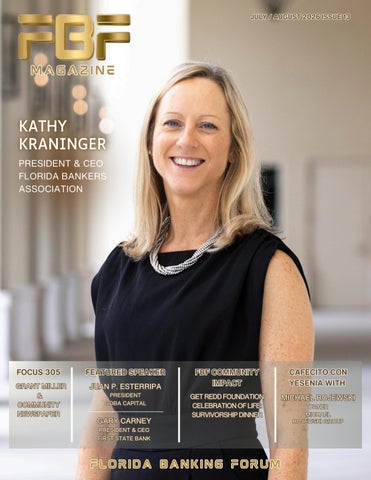
JULY / AUGUST 2026 ISSUE 13
MAGAZINE MAGAZINE
KATHY KRANINGER PRESIDENT & CEO FLORIDA BANKERS ASSOCIATION
FOCUS 305 GRANT MILLER & COMMUNITY NEWSPAPER
FEATURED SPEAKER JUAN P. ESTERRIPA PRESIDENT GOBA CAPITAL
GARY CARNEY
FBF COMMUNITY IMPACT
GET REDD FOUNDATION CELEBRATION OF LIFE: SURVIVORSHIP DINNER
PRESIDENT & CEO FIRST STATE BANK
FLORIDA BANKING FLORIDA BANKING FORUM FORUM
CAFECITO CON YESENIA WITH MICHAEL ROJEWSKI OWNER MICHAEL ROJEWSKI GROUP
TABLE OF CONTENTS
01
FBF magazine
Table of Contents
1
Our Team
2
A Letter From Our President
3
From Washington to Main Street: Kathy Kraninger’s
6
Vision for Florida Banking
10
At the Forum
From the Publisher
14
Industry Leaders
15
The H2 Banking Playbook: Why South Florida
18
Institutions Are Turning to Specialized Staffing Team New Edge Associates Networking Involvement
20
Your Life. Your Call.
24
03
02
FBF Lunch with Juan P. Esterripa
26
FBF Lunch with Gary Careney
30
Focus 305 - Grant Miller and the Lasting Local Power
34
of Community Newspapers Monthly Spotlight - Doug Sawyer: Understanding the Business Before Insuring the Business
40
Banking, Psychology, & Success!
Back in the Game: How Capital Reform Could Revive
43
Bank Mortgage Lending Cafecito Con Yesenia Presents: Michael Rojewski
48
FBF Community Impact: Get Redd Foundation
50
Celebration of Life: Survivorship Dinner Who Is Training the Next Generation of Bankers?
ISSUE 13
38
WWW.FLORIDABANKINGFORUM.COM
52
04 FBF MAGAZINE
01
FBF magazine
OUR TEAM JULY/ AUGUEST 2026 ISSUE 13 DIGITAL CONTENT COORDINATORS
PUBLISHER
JORDAN KETTINGER
NORMAN ISAZA
JACK REED
EDITOR - IN - CHIEF
OUR CONTRIBUTORS
CARLOS JARA
MELANIE ISAZA
CONTENT DIRECTOR
NORMAN ISAZA
YESENIA MORENO PHOTOGRAPHER MANAGING EDITORS
EDUARDO MENDEZ
ISABELLA MENDES MICHAEL GIRON EVENT DIRECTOR NICOLE ISAZA CONTRIBUTING WRITERS ORLANDO A. DIAZ President of Metro Fund Inc. in Miami, Florida, a leading private capital provider in South Florida. President of the Florida Association of Mortgage Professionals SANDY FERNANDEZFORTUN Senior Vice President, Retail and Business Banking Manager at Intercredit Bank
DR. CLAUDIA URIBE Director @ Miami-Dade County Fair | Mental Health Therapist | Professor at University of Miami ALEX SOTO Senior Vice President, Head of Premier Banking at Grove Bank & Trust
LISSETTE REYES Head of Marketing and Inside Sales Contributing Writer
ISSUE 13
WWW.FLORIDABANKINGFORUM.COM
FBF MAGAZINE
02
Letter from our
President & CEO The Power of the Chamber: Why South Florida's Small Business Owners Belong at the Table. Walk into any South Florida chamber mixer, ribbon cutting, or annual gala, and you'll feel it. Restaurateurs, contractors, bankers, and nonprofit leaders, all in one room, all building something. That's not networking. That's business getting done. This letter I am spotlighting a resource too many small business owners underuse: chamber of commerce membership. From the South Florida Hispanic Chamber of Commerce to the Coral Gables Chamber, Chamber South, Key Largo Chamber, The Greater Miami Chamber, to name a few, and the municipal chambers across Miami Dade, Broward, and Palm Beach these are the most efficient, most affordable growth engines our region has to offer. The power is access. One membership puts you in the room with the lenders who fund your expansion, the customers who become referral sources, and the officials who write the rules that affect your business. The benefits compound fast: visibility through sponsorships and events, credibility through committee and board seats, advocacy on the issues that hit small business hardest, and a referral network no ad budget can buy. The results speak for themselves: new customers, warmer lender relationships, stronger hiring pipelines, and a reputation as a business that's invested in its community, not just operating in it. Relationships built. Relationships renewed. That's what chambers do. Don't treat membership like a line item. Treat it like an investment in your business's future.
Yesenia Moreno ISSUE 13
WWW.FLORIDABANKINGFORUM.COM
FBF MAGAZINE
03
®
From Washington to main street. Kathy Kraninger’s vision for Florida banking.
ISSUE 13
WWW.FLORIDABANKINGFORUM.COM
FBF MAGAZINE
06
At a time when Florida’s economy continues to grow, diversify and attract new residents and businesses, strong banks remain essential to the state’s future. They finance homes, support entrepreneurs, safeguard deposits, help families plan for tomorrow and provide the capital that allows communities to prosper. As President and CEO of the Florida Bankers Association, Kathy Kraninger has brought a distinctive combination of public-policy experience, regulatory knowledge and collaborative leadership to the organization representing Florida’s banking industry. Kraninger became the Florida Bankers Association’s fourth chief executive in November 2023, taking the helm of an organization founded in 1888 and representing more than 150 banks and their more than 134,000 employees across the state. Her arrival marked an important new chapter for an association that serves institutions of every size, from community banks deeply rooted in hometown relationships to national banks operating throughout Florida. ISSUE 13
WWW.FLORIDABANKINGFORUM.COM
FBF MAGAZINE
07
What distinguishes Kraninger’s leadership is the breadth of her political and public-policy career. Before joining the FBA, she held senior roles in the U.S. Senate, U.S. House of Representatives, Department of Homeland Security and White House Office of Management and Budget. She also served as director of the Consumer Financial Protection Bureau from December 2018 through January 2021, giving her direct experience with the regulatory environment that affects financial institutions and consumers alike.
That background gives Kraninger a valuable perspective as an advocate for Florida’s bankers. She understands the importance of clear rules, responsible oversight and practical solutions, but she also recognizes how policy decisions made in Tallahassee and Washington can affect customers, bank employees, local businesses and communities. Her experience navigating government institutions and communicating with a broad range of stakeholders has helped shape an FBA leadership style centered on engagement, education and results.
The T h e Woman Wo m a n Helping H e l p i n g Shape Shape Florida Fl orida B Banking anking
Under Kraninger, the Florida Bankers Association launched a 2024-27 strategic planning process focused on three core pillars: advocacy, education and engagement. The plan emphasizes streamlining communications, strengthening relationships with policymakers, developing the next generation of banking leaders and sharing the positive stories of banks’ impact in their communities. It is a forward looking framework designed not simply to respond to change, but to help Florida’s banking industry lead through it.
ISSUE 13 11
WWW.FLORIDABANKINGFORUM.COM
FBF MAGAZINE
08
Her agenda also recognizes the real challenges facing the financial-services community, including fraud prevention, workforce development, technological innovation and the continued evolution of customer expectations. The FBA’s approach encourages member banks to share ideas, participate in committees, strengthen professional development and build connections across the state. That emphasis on collaboration is particularly important in Florida, where community banks, regional institutions and large national banks all play different but vital roles.
For Florida’s banking and financial community, Kathy Kraninger represents a leader with national experience and a clear appreciation for local impact. Her public-service background, strategic perspective and commitment to building relationships position the Florida Bankers Association to remain a strong advocate for an industry that helps power opportunity throughout the state.
Kraninger’s impact extends beyond the association’s Tallahassee headquarters. By helping bankers engage more effectively with public officials, community leaders and the public, she is elevating the industry’s voice in conversations that shape Florida’s economic future. The FBA’s mission is to support Florida bankers in better serving their customers and communities through advocacy, education and engagement.
ISSUE 13 11
WWW.FLORIDABANKINGFORUM.COM
FBF MAGAZINE
08 09
FBF PRESENTS: ISSUE 13
THE PERFECT PLACE
ISSUE 13
WWW.FLORIDABANKINGFORUM.COM
FBF MAGAZINE
10
AT THE FORUM TO EXCHAGE IDEAS
ISSUE 13
WWW.FLORIDABANKINGFORUM.COM
FBF MAGAZINE
11
ISSUE 13
WWW.FLORIDABANKINGFORUM.COM
FBF MAGAZINE
12
5
ISSUE 13
WWW.FLORIDABANKINGFORUM.COM
FBF MAGAZINE
13
From From the the
Publisher Publisher Focus 305 exists because we believe community isn't an abstract idea it's built one business, one story, one introduction at a time. When we put a local entrepreneur on the page, we're not just filling column inches. We're telling our readers: this person is your neighbor, this is where your dollars can make a direct difference, and this is a piece of what makes our city unmistakably ours. In turn, those business owners tell us that being featured doesn't just bring foot traffic it makes them feel like they belong to something larger than their storefront. That mutual recognition is, in our view, the very definition of community.
In this issue, we are proud to spotlight our Focus 305 section a space in FBF dedicated entirely to the small businesses that make South Florida feel like home. Every issue, we hear the same thing from readers: what they remember isn't the headline, it's the story about the shop three blocks from their office, or the business owner they recognized at their kid's soccer game. That reaction tells us something important. Being seen matters. For a small business, visibility isn't vanity it's survival, momentum, and connection all at once. A single feature can bring in a new customer, a new hire, a new partnership, or simply the encouragement to keep going another season.
In a media landscape crowded with national chains and algorithm driven feeds, we think there's real value in slowing down to highlight the independent grocer, the family owned repair shop, the first-generation founder building something from scratch in a strip mall off US 1. They are the texture of South Florida. Featuring them in FBF is our way of saying thank you and of inviting our broader readership to discover them, too. So as you turn to this month's Focus 305 pages, I hope you do more than read. I hope you visit. I hope you introduce yourself. And I hope, in some small way, this section helps remind all of us that community isn't something we simply live in it's something we build together, business by business, neighbor by neighbor. Thank you for reading, and thank you for supporting the small businesses that make this community what it is. Warmly,
ISSUE 13
WWW.FLORIDABANKINGFORUM.COM
a z a s I Norman FBF MAGAZINE
14
PRESENTS PRESENTS
INDUSTRY LEADERS INDUSTRY LEADERS NATALIE BELLO NATALIE BELLO SELGAS SELGAS CPA, Senior Vice President and Chief Financial Officer at International Finance Bank Natalie Bello Selgas, CPA, is the Senior Vice President and Chief Financial Officer at International Finance Bank. With over a decade of experience, she joins IFB from BDO USA, Miami, where she served as Assurance Director. Natalie specializes in financial strategy, compliance, and reporting across industries like banking, real estate, and hospitality. She was also recognized as a 40 Under 40 honoree by the South Florida Business Journal in 2026. A dedicated leader and community volunteer, she holds a Bachelor’s and Master’s in Accounting from FIU and is passionate about driving sustainable growth and community impact.
ROB TROTT ROB TROTT Senior Vice President / Relationship Manager at First National Bankers Bank Rob Trott is a Relationship Manager for First National Bankers Bank, working with their correspondent bank customers throughout the state of Florida, helping banks with payments, settlement/clearing, overnight liquidity, loan participation, and international services needs among other things. Rob has worked with Florida banks in his role as a correspondent banker for 28 years, starting with the Independent Bankers Bank of Florida, which was later acquired by First National Bankers Bank. Rob strives to emulate FNBB’s core value of delivering “Service Beyond Comparison” and values the deep professional relationships and personal friendships with fellow bankers his career has fostered. Over the course of his career, Rob has helped numerous financial institutions from the initial organizing process to obtaining a bank charter and growing a successful organization.Rob currently serves on the Florida Bankers Association’s BankPac Board, and holds a B.S. in Finance from Florida State University as well as a J.D. from Florida A&M University College of Law.
ISSUE 13
WWW.FLORIDABANKINGFORUM.COM
FBF MAGAZINE
15
When it comes to your financial aspirations, there are no boundaries at PNB. We believe in your potential and helping you reach new heights. Our comprehensive range of banking solutions, personalized service, and cutting-edge technology is built from the ground up to help you reach your financial goals. Whether you’re starting a new business, expanding your portfolio, or realizing your dreams, PNB is here to provide the support and guidance you need. Elevate your financial journey with a bank that understands your ambitions and is dedicated to building your success. Break boundaries, block by block, with PNB as your trusted partner.
BANKING NOT AS USUAL
1390 Brickell Avenue, Miami, FL 33131 305.539.7500
255 Aragon Avenue, Coral Gables, FL 33134 305.539.7570
18285 Biscayne Blvd., Aventura, FL 33160 305.539.7460
4137 North Federal Highway, Unit #7, Boca Raton, FL 33431 561.448.4541
The H2 Banking Playbook: Why South Florida Institutions Are Turning to Specialized Staffing As the tri-county area enters the second half of the year, South Florida’s financial landscape is navigating a distinct paradox. While the regional economy remains uniquely resilient, banking executives face a challenging, highly complex operational environment. Rising regional compensation costs, relentless regulatory scrutiny, and a cooling global hiring market are forcing a shift in strategy. The "growth at all costs" mentality of recent years has officially faded. In H2, the goal for local financial institutions is disciplined, risk-aware efficiency. Executing this playbook requires a highly precise approach to talent placement a task that is becoming increasingly difficult for traditional, generalist internal HR departments to handle alone. To bridge the gap, forward-thinking institutions across Miami-Dade, Broward, and Palm Beach counties are utilizing external, specialized banking staffing frameworks. This analytical breakdown explores how these niche partnerships are shifting workforce models to help local banks adapt, protect their assets, and maintain stability.
2. Securing the Coveted "Local Rolodex" Commercial and business banking remains a primary revenue engine in South Florida. However, the criteria for hiring commercial lenders has fundamentally evolved. Banks no longer want transactional ordertakers; they want relationship managers who can secure local small-business and commercial accounts in a tightening market. There is an intense, hyper-local bidding war for commercial lenders who hold deep roots and established trust within the tri-county business community. Specialized external talent acquisition professionals act as industry insiders. By maintaining active communication with top producers across competing institutions, these networks possess the industry credibility required to pitch a bank’s long-term vision. The result is a shift away from volume-based resume sourcing toward targeted placements of professionals with proven local portfolios.
1. Fast-Tracking Risk and Compliance Teams Following localized market pressures, the defensive side of banking has taken center stage. Banks are actively beefing up teams dedicated to the Bank Secrecy Act (BSA), Anti-Money Laundering (AML), and sound credit underwriting to protect aging portfolios. Top-tier risk and compliance professionals are rarely looking for work on public job boards; they are passive candidates who require discreet, targeted industry outreach. Niche banking pipelines allow institutions to bypass general job boards. Because these external networks are comprised of pre-screened, credentialed compliance experts who understand the complex nuances of regional and federal regulations, banks are successfully placing seasoned credit officers or AML investigators in a fraction of the time, shielding operations from costly regulatory delays.
ISSUE 13
WWW.FLORIDABANKINGFORUM.COM
FBF MAGAZINE
18
5. Lowering the Financial Risk of Bad Hires In a fast-paced market, bad hires are incredibly expensive. The cost of recruiting, onboarding, and then losing a mid-level banking professional within the first six months can cost an institution up to 1.5 times that employee’s annual salary. Desperate to fill vacant desks, internal HR teams frequently rush the process, leading to cultural mismatches and high turnover.
3. Injecting Agility Through OnDemand Contract Talent Managing the bottom line is a massive hurdle in H2. With regional salary demands climbing, adding permanent overhead to the payroll can be incredibly risky during times of economic uncertainty. Banks frequently need to scale up operations for temporary projects such as system modernizations, loan reviews, or back-office cleanups without locking themselves into long-term employee expenses. Industry data shows that roughly 70% of finance and accounting leaders plan to increase their use of contract talent this year. The utilization of contingent workforce models grants banks access to a deep pool of specialized contractors. This allows local institutions to scale up for peak project demands and scale down seamlessly when the work is complete, preserving capital and keeping overhead flexible.
4. Navigating Hyper-Local Salary Shifts
To mitigate this operational risk, institutions are increasingly utilizing "contract-to-hire" frameworks, which serve as a working interview for both parties. The bank can evaluate the candidate’s actual output, technical capabilities, and cultural alignment in real-time before extending a permanent job offer. By outsourcing the heavy lifting of the pre-employment pipeline including initial vetting, industry-specific skills testing, and regulatory background checks—the operational burden on internal staff is drastically reduced.
The Outlook: Precision Over Volume Success in the final months of the year will not be measured by the size of a bank's real estate footprint or the sheer number of its employees. Instead, it will be defined by organizational agility. The institutions that thrive will be those that can instantly pivot their workforce by scaling up compliance teams when a regulatory audit looms, injecting contract labor to clear loan backlogs, or discreetly recruiting toptier commercial lenders to win local market share. In South Florida’s highly dynamic, competitive financial sector, leveraging specialized talent frameworks has evolved from a hiring luxury into a fundamental operational necessity.
Compensation expectations in South Florida have completely decoupled from national averages over the past few years, driven by the massive influx of out-ofstate corporate relocations and high-net-worth wealth. Traditional salary surveys updated annually are often obsolete by the time they are published. Banks frequently lose top-tier talent late in the interview stage because their salary offers do not align with realtime, local market demands. Specialized market-facing recruitment networks operate continuously within the local ecosystem, gathering live intelligence. This data allows them to act as strategic consultants, advising local banks on exactly what compensation packages, performance bonuses, and hybrid flexibility structures are required to successfully close candidates in the tricounty area today. ISSUE 13
LISSETTE REYES
WWW.FLORIDABANKINGFORUM.COM
CONTRIBUTING WRITER FBF MAGAZINE
19
Team New Team New Edge Edge Associates Associates
ISSUE 13
WWW.FLORIDABANKINGFORUM.COM
FBF MAGAZINE
20
Networking Networking Involvement Involvement
ISSUE 13
WWW.FLORIDABANKINGFORUM.COM
FBF MAGAZINE
21
Strengthen Your
Elevate your
We provide businesses with the talent they need to succeed.
Take the next step in your career with opportunities designed for long term growth.
Team
Career
For more information: Email:
yesenia@newedgeassociates.com
Contact:
786-447-9323
Website:
www.newedgeassociates.com
Your Life,
Your Kind of Checking Every moment matters. That’s why we designed our checking solutions around your schedule, not ours. Deposit checks from anywhere. Transfer money in seconds. Check balances whenever.
Try everyday banking built for you. Open a checking account today!
305.577.6000 | 1firstbank.com/fl Member FDIC. All products and services are available only in Florida and subject to Terms and Conditions that can be found in the account disclosure document provided at the opening of the account. Certain restrictions apply. B220 (2/26)
Banking Beyond the Balance Sheet By : Alex Soto Contribuitiing Writer
Your Life. Your Call. We celebrate greatness like it was always inevitable. Like it was written. Like the story of Lionel Messi was always going to end in Ballon d’Or trophies, packed stadiums, and global admiration. But we forget how close we came to never seeing it at all. Messi’s journey did not begin with certainty. It began with doubt. As a child, he was diagnosed with a growth hormone deficiency. His talent was undeniable, but his future was fragile. Treatment was expensive. Opportunities were uncertain. Clubs hesitated. At one point, his path forward depended on leaving his home in Argentina for Spain with no guarantees it would work out. He could have quit. He could have listened to the voices that said it was too hard, too unlikely, too risky. But he did not. And that is the part of the story we do not talk about enough. For every success we admire, there is a struggle we overlook. For every yin, there is a yang. For every Messi, there is someone just as talented who did not make it, not because they could not, but because they stopped. I recently spoke with a young soccer player whose story sits on the other side of that divide. From ages 13 to 17, he was the one. The standout. The future star. He collected accolades like they were expected. Everything came easy until it did not. He was denied twice by his hometown MLS Next team. Twice. That was all it took. The same player who had never faced real adversity suddenly found himself questioning everything. Instead of pushing forward, he listened to the noise, the doubt, the statistics about how few make it. He accepted those opinions as truth. And with that, he gave himself permission to stop. Meanwhile, his former teammate, the one seen as just a backup, kept going.
ISSUE10 13 ISSUE
SVP, Head of Premier Banking Grove Bank & Trust No spotlight. No hype. Just persistence. He worked. He listened to the right voices, his family and his inner belief. He developed not just his game, but his mindset. When opportunity came, he was ready. He earned his place. He rose. He made the MLS Next team. Same environment. Different outcome. The difference was not talent. It was response. One gave up control. The other took it. Now, the first player lives with something heavier than failure, regret. The realization that he did not lose his dream. He handed it away. He let outside opinions define his limits. And in doing so, he surrendered the one thing that was always his, choice. That is the lesson. Fight for what you want. Not halfway. Not until it gets uncomfortable. All the way. Do not let your dreams be controlled by people who do not have to live with the outcome. No one else knows how far you are willing to go. No one else wakes up with your drive, your vision, your purpose. Opinions are not facts. Doubt is not destiny. Take control. Because in the end, whether you rise or fall, whether you make it or miss it, the result should be yours. Not theirs. Your Life. Your Call.
WWW.FLORIDABANKINGFORUM.COM WWW.FLORIDABANKINGFORUM.COM
FBFMAGAZINE MAGAZINE FBF
24 22
Solutions that work as hard as you do. Rooted in the communities we serve, our relationship focused bankers are empowered to make decisions locally and deliver sophisticated products and services that rival our larger competitors. SouthState understands the complexities of your business and we’re ready to Bank Miami-Dade Forward.
2 Alhambra Plaza • Coral Gables, FL • 786.362.8560
SouthStateBank.com•Member FDIC
F B F E X E C U I TN I S V I EG H T S ISSUE 13
“It takes 10 years to build a reputation but just one day to ruin it, so you have to really protect that at all cost.”
Juan P. Esterripa President
How do you build trust with clients, employees and investors?
At point should a business begin thinking beyond traditional banking finance and bring Goba Capital in?
I think when it comes to trust, this is a very sensitive topic and I think a lot of people misunderstand directness, right? A lot of people think that I'm too straightforward at times, and I gotta get better. Maybe better delivery, a better approach. But I think the way you earn people's trust is by being direct and being honest. You have to be candid at times, and you have to acknowledge and take responsibility for your actions. So trust is not something that happens overnight. It's something you build over time. It's something that can change, by the way. You meet a lot of people that, first, maybe they don't feel comfortable or they don't trust you. But if you stay consistent and you show them that you are who you say you are, and you deliver when you say you're going to deliver, they're going to trust you. But it takes a lot of time. It takes a lot of repetition. And there's a famous saying, right? It takes 10 years to build a reputation but just one day to ruin it, so you have to really protect that at all cost.
Sophisticated clients understand the benefit of speed, right? Even some banking clients will come to us because they need to execute and do things very fast. There’s a lot of private lenders in the market, and there's different formats that they come in. With Goba Capital, the capital is something that we can count on. It's committed. It's on our balance sheet, and there’s some credit facilities that we have in place, available and ready to go. So, the ability to execute deals, it's very unique in my opinion. Sometimes banking clients go through difficult times. Banking institutions are highly and heavily regulated. They have to do downgrades and there’s a lot of things that they have to do. And, in a lot of places, the best approach for them is to go ahead and find a solution outside of the bank where somebody can come in, help rehabilitate that client and get back into a bankable situation. That's where we can step in, and I think that is a big plus for us and that’s where we can add a lot of value.
WWW.FLORIDABANKINGFORUM.COM
FBF MAGAZINE
26
Are there any misconceptions that business owners have about your capital market?
What industries do you think are attracting the most investor interest today?
The most obvious one to me is the cost of practice. Again, people think we're more expensive, but the opportunity is sometimes much more valuable than the few extra points you're paying. I think the other misconception is that people think that, in private lending, we’re not really doing some kind of analysis of the collateral. We do. I think, because a lot of us at Goba Capital come from a banking background, we have a very intense approach to the way we underwrite compared to most private lenders, so we actually do the due diligence. We want to go ahead and protect our reputation. We want to protect the brand and help the clients. A lot of people go into finance because they want to openly take over an asset. That is not our business model. Our business model, and we’re very strong and very adamant about this, is we go into the market trying to help companies get to that next stage. Sometimes it may mean that you have to shut down the company order. In some cases, you have to sell real estate, but you do it in a way that it's process-oriented, it's organized, and it's somewhat humane. Some people just come in, you know, and they look for defaults. They just go ahead and increase your interest rate to the maximum allowed by the state of Florida, and they try to foreclose your property. That's not our business model. We want to help companies stabilize themselves back into the banking world, or liquidate those assets in an orderly fashion so they can go ahead and get another shot at doing something new and different.
In Florida and throughout the country, I would say healthcare for sure. We have an elderly population that appears to increase in size every day. People are living longer. I’d say multifamily units, even though I indicated all the issues with existing portfolios, but we still have 3.5 million homes in terms of inventory shortages for people to live in. So that's the necessity. We’re going to have to figure out how you make interest rates, the actual market rents and the cost of construction, all come together. It's not going to be easy, but those are the things that I think you're still going to have a lot of opportunity. Anything related to private lending, I think, is going to continue to grow and evolve. Some small players may get out, some others may get bigger. And finally, anything related to AI, right? The valuations of these companies are through the roof. I think that, for some of us that have recently adopted the utilization of AI, we're starting to understand the benefits of it. I would go as far as to say it's not the benefit, but it’s the necessity of it. For the banks, it’s gonna be a little more difficult because of the regulatory environment, but if you don’t adopt AI as a critical backbone of your business, it’s just going to be that much more difficult to compete.
“For the banks, it’s gonna be a little more difficult because of the regulatory environment, but if you don’t adopt AI as a critical backbone of your business, it’s just going to be that much more difficult to compete.” Do you guys do your own underwriting inhouse? We do. In fact, we have our head of credit here. If you actually spend time in our company and go to our processes, our procedures, and our policies, we have just as much as most banks do, right? We don't have the regulatory reporting, but we do have the same vision. We understand our business, so we have to be agile and we have to be different but we still get to do the work that we have to do. We do assess risk a little bit different. We’re not thinking about risk ratings as much. We do pay a little more attention to the collateral, but we also have to figure out a way to what we're going to be taking out eventually, because that's the business model. The business model is to get repaid, because either you dissolve the asset, dissolve the business, or something else happens. The last resort is the liquidation of the property. ISSUE 13
WWW.FLORIDABANKINGFORUM.COM
FBF MAGAZINE
27
In your transition from banking to capital markets, is there anything that surprised you about the clients or the industry? Do you work hand in hand?
Are middle market companies facing problems when they're seeking capital, or is it easier for them?
I think working hand in hand is critical. There's, for the most part, bankers in this room and I see them as partners. Not just from a funding or capital perspective, but also from a business flow perspective. In reality, my client base is very different from the client base of the bank, but I think we can complement each other. I'm not looking to generate investments or any other products or services that the bank delivers. I’m purely and entirely doing lending. But in my view, the clients that come to Goba Capital are looking for speed. They're looking for a quick execution and a less regulatory environment for their needs, and it works really well together. I’ll tell you what has been different for me. Look, I've been in banking for nearly 30 years and, since 2005, I've been running different teams throughout my career. First of all, I had to get myself back into the day-to-day business development and I had to really do what I’ve been preaching for 20+ years. Every time, I tell people you gotta do this on Wednesdays, you gotta do this on Thursdays, you gotta do this on Fridays. You’ve gotta be organizing your calendar and follow a process. You’ve gotta be consistent. I have to do it myself now, and I’m learning something different everyday. I’ll tell you that, in banking, if I signed a term sheet, there’s a 97 or 98% chance we were closing that deal. In this business, it's a single digit success rate. It’s insane, but that's the business. You adapt, you learn, and you get better.
In my opinion, it’s probably a little bit difficult, right? First of all, in South Florida, we don't have a whole lot of middle market companies. We have a very small inventory so let’s start with that. Typically, in the banking world, when a middle market company has non-tangible collateral on hand, but the deal goes bad, your losses are going to be north of 90%. The reality is this: in a bank, you have a requirement to provide financial statements, let's say, quarterly. That's the most you'll ever get. But then you give the client 45 to 60 days to provide those financial statements. By the time you get the information, it's 150 days. There's so much stuff that has taken place before you can understand what's really happened to that credit. The reason why I'm bringing that up is, because of that, it's really hard to obtain credit, right? And there's a few companies in this market that are very strong. They're not overleveraged. They have good financial records. That's the other part of it. A lot of our clients, their financial records are not necessarily up to par, and everybody's competing for those. So, for the rest, they're finding themselves in a predicament. If they're growing companies, it's even more challenging because they don't have the capacity to go ahead and take the financing that they need, because the leverage is too high or there’s not enough experience.
“I’ll tell you that, in banking, if I signed a term sheet, there’s a 97 or 98% chance we were closing that deal. In this business, it's a single digit success rate. It’s insane, but that's the business. You adapt, you learn, and you get better. ”
ISSUE 13
WWW.FLORIDABANKINGFORUM.COM
FBF MAGAZINE
28
F B F E X E C U I T N I S V I E G H T S ISSUE 13
“We volunteer at as many events as we can. We encourage our officers to be on boards and to be involved in the community. We don't require it, but we expect it.”
& CEO Gary Carney President First State Bank What first drew you into the industry and did you ever imagine that this journey would lead you to become a CEO? When I graduated from college, it was a pretty rough job market. I graduated in '84. I got my first job at Household Finance through a recruiter. It was actually to get into banking, which at the time it was very difficult. So, I worked at Household Finance, and I actually moved my way up pretty quickly, but knew that I did not want to sell 18% home equities to people that didn't know what they were really signing for. So, one day I ended up going out in Flats in Cleveland which is downtown and it's an area with bars. And I met this recruiter and she said, ”Hey, you’d make a great credit analyst.” And I said, “Yeah, I would.” And she said, “Well, come on in an interview with Larry and let's see what happens.” And I went in and interviewed with Larry. I didn't take the job because I was in a five-person office for Household Finance. One girl got married and moved, and another guy hurt himself very badly during a baseball game, so I had to help run the office. About 3 months later, people came back to the office, and I saw her again in the Flats and said, “Hey, is that job still open?” She said, “Yeah, come in on Monday.” I went in on Monday and started working the following week. That was really how it happened. I always saw myself as a leader. I wasn't sure at the time whether it was in banking. Understand when I first started at Federal Savings Bank, it was 800 million, which is the same size as First State Bank was when I started in ‘06. When I left in 2004, it was 65 billion. So I had gone through 30 mergers and acquisitions. I had set up 7 commercial credit departments in 5 states and was running a team of about 100 people. I had been through consumer lending and residential lending my first year there, and then moved over to commercial, which is where I took my career. So I took a buyout and took a year and a half off and came to Florida for the winter. For 3 months, Fort Lauderdale. For a couple months, Key West. And I decided. I want to live in Florida. This weather in Ohio, probably, is not good. And I was really shooting for Fort Lauderdale, Miami, and I overshot a little bit and ended up in Key West. It turns out it was the best decision I ever made.
WWW.FLORIDABANKINGFORUM.COM
FBF MAGAZINE
30
How did each chapter prepare you for the next? Were they baby steps or you knew the big picture of going in?
We were talking about the Florida Keys, which is not your typical banking hub. How do you think living there has shaped your leadership style, and daily outlook? I would say in Ohio, I was less laid back. Definitely, definitely. And, you know, I was responsible if something went wrong in this market or in this market. Whereas here, you know, it's the Keys, and then for the longest time, I was in charge of lending, lending in administration, kind of back and forth. But my leadership has grown. It has formed probably because of First State Bank, partially because of the support from the board. My board is great. One of our board members is here today, in fact. But also, my peers, and then the people that, you know, that really make the machine work. They're just such great people. And I think it's easy to lead a group like that. I can tell you during the downturn, it wasn't as easy. It has really grown over the course of time. But no, I'm not very laid back.
Why don't you tell us a little bit about the influence that the culture of this bank has not only on its employees, but on the community? First State Bank has been in the community for 71 years. It used to be two banks, Key West State Bank and Boulevard Bank. And at one point, some of the directors decided to try and combine them. Then in the 80s, the bank was failing during the AIDS crisis. And the current ownership put a group together and bought the bank in 87-ish. And so our chairman, Jack Spottswood, has been the chairman ever since. He's the one that put it together. And the Spottswoods are probably one of the most leading families in Key West and possibly the Keys. They put the bank together and it's been under them for 40 years, and what you can see is, we’re ubiquitous. We’re everywhere. We volunteer at as many events as we can. We encourage our officers to be on boards and to be involved in the community. We don't require it, but we expect it. We also do offer compensation time to anyone below a certain level. If they go out and volunteer, they get up to a week or 7 days of additional PTO. And while we're not bribing them, but we are, they really do go out and do it, not necessarily for the time, but they are everywhere and people call and ask us for our volunteers. “Can your volunteers show up?” I think the bank has had a voice in the chamber for a very long time. I'm on the chamber board. I took over after my predecessor left. And we have people all over the community that have influence, as well.
ISSUE 13
When I was Chief Credit Officer, I think that was the one that prepared me the most. And the reason I say that is, I've always had the belief that if you are starting credit, you can go anywhere in the bank. If you know how to read a financial statement, that is amazing for yourself, for anybody, and to be able to analyze credit loans and credit before credit scores. So, I knew how to read a credit report. I was in credit before PCs. We used to do spreads by hand, and I had a lady who used to correct them, and I had them in pencil. Looking at different types of companies, different industries, different types of loans, et cetera. I just really understood a lot more of the economy and what was going on than just working in this job for my entire career. And I had the opportunity to say, go and be a lender in C&I, or I could be a CRE lender, et cetera, et cetera. But I chose the credit path to keep going because as we kept growing, it was very exciting. I love the merger and acquisition work that I got to do. And I know myself. I know that I'll get bored and I said 2 years and I'm gone, then the downturn hit. And here I am. However, something always happens that kept my interests going. I was talking to my predecessor on the phone when we were both at home during COVID, and I said, listen, I'm going to turn 60 soon and I'm thinking that maybe I just want to move up to the mainland. We have an ops center in Miramar, Florida, right off the turnpike. I'm going to move up there and I'll just finish up my career as Chief Credit Officer and stay there and she just said, “No, don't, no, no. We've got a challenge for you.” She didn't tell me what it was. It took 8 months for me to find out that they wanted me to be the next president. And so what they did was they promoted me to COO, and essentially 6 months in as COO, I was running the bank as president, just not in that title. But what it did was I really had very little exposure in my career to the retail side. I had a lot of different areas of exposure, but what it did was I went to the branches and I learned what they did more in-depth and I went to all these different apartments and I interviewed people. So as the COO, I got involved to the point that I needed to understand what they were doing so that I could talk intelligently, when I became president. Then I ended up as president, and the prep plan there was president for 2 years, and then CEO, so that we can just step it up, because my boss, Jack Spottswood, is an executive chairman, which means he's an employee of the bank, and his plan is to step back so that I'm the one just running everything. And he doesn't really interfere. He just makes jokes and we hang out.
WWW.FLORIDABANKINGFORUM.COM
FBF MAGAZINE
31
As we've heard, there are individuals that have been with the bank more than 25 years. That's very rare in today's market. They always find something bigger and better, right? What is First State Bank’s secret? We've always treated our employees very respectfully. We tried to. We know it's hard to live in the Keys. Okay, we don't have malls. We don't have stores very much. I mean, you have to have t-shirt shops, et cetera, et cetera. We don't even have Sears and Kmart anymore and we understand. And our healthcare is okay. We are very understanding if you need to go to the mainland for these things. We are very helpful to our employees. It's very expensive to live there. So, we own several properties. We own several houses and multifamily units to put our employees in so that we can keep going. And we charge them what really would be a very, very low rate in the Keys especially, but we don't go beyond what they can afford, definitely. We're not there to make money. We're there to keep the employee on staff and happy. There was a time during COVID, it was when the bank really shut down and everybody was working at home with the exception of the extraordinary retail group, and we lost touch with each other. You can't really be in touch on Teams. And I'm somebody who manages by walking around. I have to go and talk to people. So we lost a lot and the morale was not good. And so the plan with my head of marketing and with my head of HR was, let's give them what they're asking for. And what they were asking for was we used to buy them breakfast on Fridays. On Fridays, we used to have an employee party. And the surveys would always come back and say, we just want a party. We don't want speeches. We don't want awards, we just want a party. Here's your party. I give a small speech because they ask me to, not because I wanted to. But they just have a party. The first one we had when I became president, it had been the first one in 5, 6 years. And we had only paid for the bar for 2 hours at the 4-hour party because that's what had happened in the past. And I decided, you know, people aren't drunk. Most of them, we pay for hotel rooms and we pay for Ubers, but we all put them all at the beach side, the only place that can handle it. It's about 250 people, 300 people. And so, I went and announced that the bar was open for the whole party and my CFO was getting food and she starts screaming, “No, do you know how much this is going to costs?” and I said, “Yeah. But we're going to do it.” And so, we give them an employee appreciation party where it's just them and dancing and drinking and celebrating each other.
“I've always had the belief that if you start in credit, you can go anywhere in the bank”. ISSUE 13
How has that geographic journey, from working in Cleveland, and coming to Florida, influenced your perspective and cultural understanding as you worked across different states? Very much so. The states we were in were mostly Midwest states, with the exception of Massachusetts and Vermont. So we did have some New England states. But that was later in my career, the majority of what credit and what we lent on was manufacturing. So it was either multifamily, construction, or manufacturing companies. I did have the credit department for commercial real estate and C&I and we bought leasing companies. So I did the credit for the leasing company. But the majority of it was very different from when I moved to Florida. That was something that wasn't in my notes when I moved to Florida, that I'm going to be doing resort lending and hotel lending. And we had bought a bank in upstate New York that had a couple of ski resorts in the whole community. And I really didn't like it. But I like manufacturing. I could see it. I could touch it. I knew what I was doing. So coming to the Keys was very different. But it's a very different culture as well. In Ohio, it was everybody was on time and I was also told not to be corporate. I was also told to be a little less type A, a little bit more laid back.
Have you had a challenge in your career that became a turning point? Yes. I would say two. When the bank sold in 2004, I'd been there 18 years, and it's a tough thing to say, you know what, I'm ready to go. But I was ready to go, and they wanted to find me something and they said if you turned a job down within 75 miles, that was equal to or above where you were at, you lost the package. So, I told them I wanted to work in Boston or Chicago, and those jobs were taken because they thought I already had another job within the company. At the time, my mother was dying, so I really wanted the time off, so I took the time which that was very important. And then the other thing would be the downturn in when I came to First State Bank at the very beginning, you know, it was, do I pack up and go and get out of the Keys and go somewhere a little bit bigger? Or do I stay here and I'm a loyal person? So I knew I needed to stay and help them out because I don't think the bank would have been there if myself and a couple other people hadn't done what we'd done along with raising the capital. So those were 2 huge turning points in my life.
WWW.FLORIDABANKINGFORUM.COM
FBF MAGAZINE
32
FOCUS 305 Grant Grant Miller Miller and and the the GRANT Lasting R Lasting Local Local Power Power of of E L L I M Community Community Newspapers Newspapers Here!! In a region celebrated for its energy, diversity and constant reinvention, South Florida’s neighborhoods remain the heart of its identity. From Pinecrest and Coral Gables to Doral, Aventura, Kendall, South Miami and beyond, each community has a distinct story to tell. For more than six decades, Miami’s Community Newspapers has ensured that those stories are not lost in the rush of national headlines and digital noise. At the center of that enduring mission is Grant Miller, publisher of Miami’s Community Newspapers and a familiar figure throughout South Florida’s civic, business and community landscape. Under his leadership, Community Newspapers has become far more than a collection of local publications. It is a trusted connection point for residents, entrepreneurs, nonprofit organizations, schools, elected officials and community leaders.
ISSUE 13
The organization grew from the South Dade Shopping News, founded by Ron Miller, into a respected multimedia platform serving communities across Miami-Dade County and South Florida. Grant and his brother, Michael Miller, carried forward that family legacy with a shared appreciation for the importance of local journalism. Together, they have preserved the personal touch that has long defined Community Newspapers while helping it evolve for a new generation of readers and viewers.
WWW.FLORIDABANKINGFORUM.COM
FBF MAGAZINE
34
305 Grant Miller understands that community journalism is about more than reporting the news. It is about recognizing the people who make a neighborhood thrive. It is about celebrating a student’s accomplishment, introducing a new local business, promoting a charitable event, supporting the arts and giving residents meaningful information about the issues that affect their lives. That focus has given Community Newspapers a special role in South Florida. The organization shines a light on stories that may not receive attention from larger media outlets, yet matter deeply to the people who live and work in these communities. By covering local government, education, business, cultural events and neighborhood initiatives, Community Newspapers has helped residents remain informed, engaged and connected. The publication’s impact is also felt across South Florida’s business community. Local businesses are often the backbone of a neighborhood, providing jobs, services and a sense of character. Through print, digital publishing, video production, podcasts, events and advertising opportunities, Community Newspapers gives entrepreneurs and business owners a powerful way to reach their communities. In doing so, it helps strengthen the relationships between businesses and the customers they serve. ISSUE 13
WWW.FLORIDABANKINGFORUM.COM
FBF MAGAZINE
35
FOCUS 305 Under Grant Miller’s leadership, Community Newspapers has embraced the changing media environment while maintaining its communitycentered mission. The company’s blend of print publications, digital platforms, podcasts, video programming and in-person events reflects a modern approach to local media. Its ability to tell stories in multiple formats has expanded the reach of the people, organizations and businesses that make South Florida unique. Grant’s influence reaches beyond publishing. His involvement in youth sports, community organizations, business associations and chambers of commerce demonstrates a personal commitment to the region he serves. He has built relationships throughout South Florida by showing up, participating and helping create opportunities for others to succeed. That spirit of involvement is what makes Grant Miller’s leadership so meaningful. He recognizes that strong communities are built through relationships, shared experiences and mutual support. Whether he is highlighting a local achievement, promoting a charitable cause, supporting a business or hosting a conversation with community leaders, he continues to bring people together. Grant Miller and Miami’s Community Newspapers have made an indelible impact on South Florida’s landscape. Their legacy is found in the countless stories shared, businesses supported, events promoted and community voices amplified. In a world that often moves too quickly, Community Newspapers remains a reminder that local stories matter, neighborhoods matter and community remain one of South Florida’s greatest strengths.
By: Norman Isaza ISSUE 13
WWW.FLORIDABANKINGFORUM.COM
FBF MAGAZINE
36
Here’s the deal, before the deal. Every business needs blocks. Pieces that fit. Placed with purpose. Timed with care. To strengthen, scale, and grow. At Popular Bank, we set lasting foundations for owners, managers, and builders of business. To help shape futures, imagine innovations, and elevate communities. Connection Our blocks for your success. Capital
Continuity
That’s the deal. Ready to make yours?
PopularBank.com/Business
© 2025 Popular Bank. Member FDIC.
Our bottom line is you
Monthly
Spotlight
Doug Sawyer Understanding the Business Before Insuring the Business Career transitions often require learning an entirely new profession. For Doug Sawyer, the transition from banking to insurance proved to be something different. Rather than leaving behind a successful banking career, he found an opportunity to apply decades of business experience in a new way. "Throughout my banking career, evaluating risk was already a core part of what I did," Doug says. "Insurance simply gave me another way to help businesses identify risk, protect what they have built and prepare for the unexpected."
Looking back, Doug believes every role contributed to the perspective he brings to clients today. "Commercial lending taught me how businesses operate and the challenges owners face every day. Wealth management broadened my understanding of investments, financial planning and the needs of affluent families. Operations reinforced that every process carries risk. Together, those experiences shaped the way I approach risk management."
Doug began his banking career as a graduate of SunTrust Bank's respected Management and Corporate Credit Training Program, which helped develop many of South Florida's banking leaders. His early years in commercial lending provided firsthand exposure to businesses across virtually every industry, requiring him to understand not only financial statements, but also how companies operated, generated revenue and managed risk. As his career progressed, so did the breadth of his responsibilities. Doug held executive leadership positions spanning commercial lending, wealth management, securities, retail banking and enterprise operations. He served as President of BankUnited Financial Services and later led BankUnited's Retail Division during its expansion from 36 to 75 branches. His responsibilities ultimately included oversight of bank operations, information technology, loan services, facilities, collections and workouts, and disaster planning and recovery.
ISSUE 13
WWW.FLORIDABANKINGFORUM.COM
FBF MAGAZINE
38
Long before joining the insurance profession, evaluating risk was already a central part of Doug's career. Whether analyzing commercial loans, overseeing banking operations or leading business units, understanding how organizations create value and what could threaten that success was fundamental to every role he held. That perspective eventually led him to Century Risk Advisors.
A Firm Built on Relationships Founded by industry veteran Ron Reshefsky and now led by Gary Reshefsky, Century Risk Advisors combines decades of industry experience with the market access and technical expertise typically associated with much larger brokerage firms. What attracted Doug, however, was not simply Century's experience. It was the firm's philosophy. Century has built its business around long-term client relationships supported by experienced advisors, dedicated claims advocacy and proactive risk control. Rather than focusing only on annual renewals, the firm works with clients throughout the year to identify exposures, strengthen operations, reduce losses and advocate for clients when claims occur. "That commitment to service is what convinced me to join Century," Doug says. "The true value of an advisor is measured not only by the insurance they recommend, but by the guidance they provide before a loss and the support they provide afterward." Century provides commercial insurance, employee benefits and private client services. Its clients include manufacturers, contractors, developers, professional firms, restaurants, transportation companies, real estate investors, community associations and financial institutions throughout Florida.
A Broader Perspective on Risk Although Doug advises organizations across many industries, his background provides a natural connection with community banks. Having spent much of his career inside financial institutions, he understands the operational, regulatory and strategic challenges executives face, from fraud and cybersecurity to vendor management, business continuity and protecting the collateral supporting commercial loan portfolios. He also recognizes that insurance itself has become increasingly complex. Coverage limits, deductibles, replacement cost provisions, valuation methods, exclusions and coinsurance requirements can materially affect the protection available following a loss.
understands their business, identifies potential exposures, explains options clearly and helps them make informed decisions." Doug believes that philosophy extends well beyond banking. Selecting an insurance advisor is about much more than comparing premiums. It requires someone who understands the client's business, structures coverage thoughtfully, has access to the appropriate insurance markets and remains a trusted resource throughout the year. For Doug, effective risk management begins long before an insurance policy is written. It begins with understanding the business.
Beyond the Office Doug has remained active in South Florida's business and civic communities throughout his career, including leadership roles with the American Heart Association, the Florida Bankers Association and the Greater Miami Chamber of Commerce. He currently serves on the Board of the South Florida Banking Institute and previously served on the Board of Directors of Christopher Columbus High School, including as Chairman. Away from work, Doug and his wife, Liane, enjoy traveling, staying active, long walks and cheering on the Auburn Tigers. They are especially proud of their son, Matthew, a corporate and private equity attorney, and their daughterin-law, Cristina, a corporate litigator. Their black Labrador, Duke, remains a constant companion. Looking back on two professions, Doug sees a common thread connecting both. Understanding the business before insuring the business. It is a philosophy that has guided his transition from banker to trusted advisor, and one that continues to shape the way he serves clients today.
"Most executives should not have to become insurance experts," Doug says. "They should have an advisor who
ISSUE 13
WWW.FLORIDABANKINGFORUM.COM
FBF MAGAZINE
39
FBF MAGAZINE
BANKING,
HEALTH
PSYCHOLOGY, & SUCCESS!
The psychology behind banking, money, and personal success, there’s a fascinating connection: financial success is often less about knowing what to do and more about how your brain responds to risk, reward, status, uncertainty, and delayed gratification.
1. Money is psychological before it is mathematical Two people can earn the same income and make completely different financial decisions because they have different internal beliefs about money. For example: Scarcity mindset: “I need to spend this now because I might not have it later.”
3. Success requires tolerating delayed rewards One of the deepest psychological differences between short-term and long-term success is the ability to tolerate: “I could have something now, but I'm choosing something bigger later.” That applies to money, education, entrepreneurship, fitness, relationships, and careers. Someone who earns $80,000 but consistently spends as though they earn $100,000 can remain financially fragile. Someone earning $50,000 who consistently lives below their means and invests the difference may gradually build significant wealth.
Security mindset: “I need enough saved so I can handle uncertainty.”
The important psychological variable isn't simply income.
Abundance mindset: “There will always be opportunities, so I can think long-term.”
4. But extreme delayed gratification isn't automatically success
Status mindset: “My income should be visible through what I own.” Control mindset: “I want my money working for me rather than controlling my choices.” These beliefs can operate almost unconsciously.
2. Banking exploits—and human psychology
manages—
Modern banking isn't simply about storing money. It creates systems around our psychological tendencies. Consider credit cards. Spending $500 doesn't feel psychologically identical to handing someone five $100 bills. The abstraction of digital money reduces the immediate emotional "pain" of spending.
It's the relationship between desire and restraint.
There's a trap here. Someone can become so obsessed with accumulating money that money becomes the measure of their worth. Then the psychology changes from: “Money gives me freedom.” to: “I need more money to prove that I'm valuable.” That's where comparison, status anxiety, compulsive work, and fear of losing wealth can appear. So healthy financial psychology isn't simply spend less, save more. It's being able to answer: “What is money actually for?”
Similarly: Automatic deposits exploit our tendency to follow defaults. Savings accounts create psychological separation between "available" and "untouchable" money. Interest rewards delayed gratification. Loans allow us to consume future income today. Credit scores turn financial behavior into a measurable reputation. Investment accounts encourage people to think in terms of future wealth rather than today's cash. A bank is therefore partly a behavioral machine.
ISSUE 13
WWW.FLORIDABANKINGFORUM.COM
FBF MAGAZINE
40
FBF MAGAZINE
HEALTH
5. Wealth and status are psychologically different Humans are highly sensitive to social comparison. Someone may buy a luxury car not because they particularly love the car, but because the car communicates:
Money can give you the ability to say: No to a bad job. No to an unhealthy relationship. No to a predatory loan. Yes to education.
“I have made it.”
Yes to starting a business.
That's status consumption.
Yes to helping your family.
Actual wealth is often much less visible.
Yes to taking a calculated risk.
A person with substantial assets may drive an ordinary car, live below their means, and have enormous financial flexibility. This creates an interesting paradox: The appearance of success and the psychology of actual success can be opposites. One seeks to look wealthy. The other seeks to be financially free.
6. Successful people often think in terms of systems
So psychologically, wealth is valuable because it expands your choice set. That's why I'd define financial success less as: “How much money do you have?” and more as: “How much control do you have over your time, choices, and future?” And that's where banking, psychology, and success become really interesting: banks provide the infrastructure for money, but your mental models determine what you do with that infrastructure.
A powerful psychological shift is moving from: “How do I make more money?” to: “What system could produce money repeatedly?” That's the psychology behind investing, careers, and even banking.
entrepreneurship,
→ money indefinitely, you begin skills → leverage → assets → systems → compounding Instead of trading time looking for:
The ultimate objective becomes less about working harder and more about creating things that continue producing value.
7. The deepest psychological asset is not money It's agency.
ISSUE 13
By: Dr. Claudia Uribe
WWW.FLORIDABANKINGFORUM.COM
FBF MAGAZINE
41
FBF MAGAZINE
FINANCE
BACK IN THE GAME: How Capital Reform Could Revive Bank Mortgage Lending For years, banks have steadily retreated from residential mortgage lending. Increased regulation, compliance costs, competition from independent mortgage companies and the operational complexity of originating and servicing mortgages have all played a role. But another factor receives far less attention outside the banking industry: capital requirements. Every loan a bank holds affects its balance sheet and the amount of regulatory capital it must maintain. When regulators require more capital against a particular asset, the economics of making that loan change. Banks must determine whether the return earned on a mortgage justifies committing capital that could potentially generate a better return elsewhere.
WHY CAPITAL REQUIREMENTS MATTER Banks do not evaluate a mortgage solely on whether the borrower is likely to repay it. They must also consider how the loan will be treated for regulatory capital purposes. Think of capital as the bank's own money sitting behind its loans to absorb potential losses. The more capital a bank must allocate to an asset, the more expensive that asset becomes to hold. This creates an important distinction between banks and independent mortgage companies.
That calculation has increasingly worked against residential mortgage lending. The Main Street Capital Access Act, H.R. 6955, is part of a broader effort in Washington to change that equation. The legislation passed the House on July 21 by a bipartisan vote of 270-155-1 and now faces the Senate. The bill seeks to tailor banking regulations more closely to the size, complexity and actual risk profile of financial institutions rather than applying requirements designed for the nation's largest banks across much of the banking industry. For mortgage lending, that distinction could be significant.
An independent mortgage lender can originate a conventional mortgage and quickly sell it into the secondary market. A community or regional bank wanting to hold that mortgage in portfolio must consider not only the interest rate and credit risk, but also the capital that could remain committed to the loan for years. Multiply that across hundreds of millions of dollars in mortgages and the impact becomes significant.
ISSUE 13
WWW.FLORIDABANKINGFORUM.COM
FBF MAGAZINE
43
FBF MAGAZINE
FINANCE
If the return on capital from residential mortgages becomes less attractive than commercial loans or other assets, banks have a strong incentive to deploy their balance sheets elsewhere.
CHANGING THE CAPITAL EQUATION H.R. 6955 comes amid a broader reconsideration of how bank capital rules treat residential mortgages. Federal banking regulators have proposed changes that could substantially reduce the risk-weighted assets associated with certain residential mortgage exposures. Their analysis estimates approximately a 30 percent reduction in risk-weighted assets for residential mortgages at affected institutions, resulting in a significant reduction in the capital required to support those loans. That could materially change the economics of mortgage lending. If a bank can hold a larger mortgage portfolio using the same amount of capital, its potential return on equity improves. Residential mortgages that previously looked unattractive from a capital perspective suddenly become more competitive with other assets. H.R. 6955 reinforces this philosophy by requiring greater consideration of an institution's size, business model and risk profile when federal regulators develop and apply banking regulations. The basic principle is straightforward: regulatory requirements should more closely reflect actual risk.
THE OPPORTUNITY FOR FLORIDA BANKS Florida could particularly benefit from greater bank participation in residential lending. Our state has a strong network of community and regional banks, a massive residential real estate market and a borrower population that often does not fit neatly into standardized underwriting. Florida is filled with entrepreneurs, small business owners, real estate investors and self-employed borrowers. These are precisely the customers where a local bank can have an advantage. Banks that understand their customers and local markets can evaluate the entire financial relationship rather than relying exclusively on standardized secondary-market guidelines. More favorable capital treatment could make those portfolio loans more economically attractive. That does not mean banks will replace independent mortgage companies. Instead, we could see increased competition in areas where banks have natural advantages, including portfolio mortgages, jumbo loans, construction-to-permanent financing and lending to borrowers with substantial deposit or business relationships. For consumers and mortgage professionals, more lenders competing for quality borrowers should ultimately mean greater access to capital and more financing options.
ISSUE 13
WWW.FLORIDABANKINGFORUM.COM
FBF MAGAZINE
44
FBF MAGAZINE
Finance
THE HURDLES AHEAD At print time, the legislation still had significant hurdles. Although H.R. 6955 received bipartisan support in the House, it must now navigate the Senate, where banking regulation remains politically sensitive. Opponents argue that reducing capital requirements and regulatory burdens could weaken safeguards created following the financial crisis. Any Senate version could therefore look substantially different from the legislation passed by the House. Even if H.R. 6955 becomes law and mortgage capital requirements become more favorable, banks will still face substantial challenges. Interest-rate risk remains a major consideration. Holding a 30-year fixed-rate mortgage can create problems when funding costs increase while the yield on the mortgage remains fixed. That is why banks prefer adjustable rate mortgages fixed for 3, 5 or 7 years. Liquidity and profitability also matter. Banks must decide whether holding long-duration residential assets makes sense when commercial loans and other products may provide higher returns or greater flexibility. There are also operational challenges. Mortgage lending requires specialized compliance, underwriting, disclosures, technology and servicing capabilities. Banks that exited residential lending years ago cannot simply flip a switch and return. Florida presents additional risks.
When capital requirements make mortgages economically unattractive, banks will naturally put their money somewhere else. H.R. 6955 will not suddenly transform every community bank into a mortgage lender. But if more rational capital treatment makes residential lending economically viable again, Florida could see an important source of housing capital return to the market. And that could put banks back into the mortgage game.
High property insurance premiums continue to affect affordability. Condominium financing has become increasingly complicated, while association fees and special assessments can significantly affect borrower qualification. Banks must also carefully manage concentration risk in a state where many institutions already have substantial exposure to real estate. Lower capital requirements will not eliminate those challenges. But they could remove one important obstacle. If well-underwritten residential mortgages present relatively low credit risk, the capital required to hold them should appropriately reflect that risk.
ISSUE 13
WWW.FLORIDABANKINGFORUM.COM
WRITTEN BY
Orlando Diaz Contributor to the Florida Banking Forum and President of Metro Fund Inc. in Miami, Florida, a leading private capital provider in South Florida. Mr. Diaz also serves as the President of the Florida Association of Mortgage Professionals.
FBF MAGAZINE
45
Thynk Unlimited
www.reallygreatsite.com @reallygreatsite
Insurance As Personal As Your Assets
Isis Garcia, ACSR Vice President - Private Client Specialist
O (305) 714-4448 | C (786) 553-5099 | F (305) 248-8543
Temporary Consulting Services BSA - AML - Compliance 6303 Blue Lagoon Drive Suite 438 Miami, Florida 33126
1325 Avenue of the Americas, New York, New York 10019
260 Peachtree Street NW Suite 2200 Atlanta, Georgia 30303
305-537-4614
212-537-4614
305-632-9183
WWW.NEWEDGEASSOCIATES.COM
IT'S TIME FOR... I T ' S
T I M E
F O R . . .
t o i c C e o f n a C
ito C c o fe n a C
a a i i n n e e s s e e Y Y Building relationships one cafecito at a time
Building relationships one cafecito at a time
@cafecitoconyesenia
@cafecitoconyesenia
ISSUE 13
WWW.FLORIDABANKINGFORUM.COM
FBF MAGAZINE
48
Cafecito
Yeseni a Presents Cafecito Con Yesenia
Michael Rojewski Owner
Michael Rojewski is an award-winning community leader, REALTOR®, advocate, nonprofit executive, and author whose work has made a lasting impact throughout the Florida Keys and beyond. Whether serving in leadership roles, advocating for homeowners and businesses, or captivating readers with his writing, Michael is driven by a passion for service, storytelling, and strengthening the communities he proudly calls home.
Con Yesenia Presents
Community service has always been at the heart of Michael's mission. He proudly serves as Chairman of the Key Largo Chamber of Commerce, where he works alongside business leaders, nonprofits, and public officials to promote economic development, encourage collaboration, and support the continued success of the Florida Keys. He is also the Vice President of First Keys in Paradise (FKIP), a local nonprofit organization. Through these leadership roles, Michael has become known for bringing people together, championing meaningful causes, and creating opportunities that benefit residents, businesses, and visitors alike. While Michael's leadership and advocacy have earned him recognition throughout his professional career, writing has become one of his greatest passions. Michael is the author of the recently published supernatural horror novel, The People in the Hammock. Set against the haunting beauty of the Florida Keys, the novel weaves suspense, mystery, and psychological tension into a gripping story that has resonated with readers who appreciate atmospheric storytelling and unforgettable characters. Drawing inspiration from the unique history, folklore, and landscapes of the Keys, Michael creates stories that transport readers while paying tribute to the place he calls home. His books are available through major retailers worldwide, including Amazon, Walmart, and Barnes & Noble, allowing readers around the globe to experience his work. Michael believes stories have the power to inspire, challenge perspectives, and connect people in meaningful ways. As an author, he enjoys engaging with readers, discussing the creative process, and encouraging others to pursue their own creative ambitions. With additional writing projects already underway, he continues to expand his literary career while balancing his commitment to public service and community leadership.
As the owner of The Michael Rojewski Group, affiliated with Century 21 Circle, Michael has built a successful real estate career founded on integrity, professionalism, and a genuine commitment to helping others. His experience in the industry has naturally evolved into leadership at the local, state, and national levels, where he has become a respected voice for the REALTOR® profession and private property rights. Michael currently serves as Executive Committee Director and Treasurer of the Florida Keys Board of REALTORS® (FKBOR), where he helps guide the organization's strategic direction and financial stewardship. He frequently travels throughout Florida and across the United States representing REALTOR® members, advocating for legislation that protects homeowners, promotes responsible growth, and preserves the American dream of homeownership. His advocacy efforts regularly take him to Tallahassee and Washington, D.C., where he meets with state legislators, members of Congress, and industry leaders to ensure the unique needs of the Florida Keys and the real estate profession are represented at every level of government. ISSUE 13
Throughout every chapter of his career, Michael has remained committed to one simple philosophy: leadership is measured not by titles, but by service. Whether advocating before lawmakers in our nation's capital, leading nonprofit initiatives, supporting local businesses, representing REALTORS®, or writing stories that entertain and inspire, he approaches every opportunity with authenticity, compassion, and a desire to leave his community stronger than he found it. Today, Michael continues to serve the Florida Keys through leadership, advocacy, volunteerism, and storytelling—building connections, inspiring others, and proving that one person can make a meaningful difference both within their community and beyond.
WWW.FLORIDABANKINGFORUM.COM
FBF MAGAZINE
49
FBF FBF
COMMUNITY IMPACT COMMUNITY IMPACT Get Get Redd Redd Foundation Foundation Celebration Celebration of of Life: Life: Survivorship Survivorship Dinner Dinner The evening reflected the heart of Get Redd Foundation’s mission: transforming awareness into tangible hope. The organization brings people together through wellness experiences, donorregistry drives, community activations and survivor centered gatherings, all intended to support families affected by rare blood disorders. Its work also emphasizes helping patients and families connect to critical resources while encouraging more people to join donor registries, where a single match can become life changing.
On July 23, Get Redd Foundation’s Celebration of Life Survivorship Dinner at Mamey Miami in Coral Gables created a meaningful space to honor survival, recognize the families who stand beside patients and renew support for people navigating rare blood disorders and bone marrow transplantation. The foundation’s Survivorship Dinner was designed to celebrate remarkable journeys, including survivors given a second chance, loved ones whose legacies inspire others and patients who continue to fight.
ISSUE 13
WWW.FLORIDABANKINGFORUM.COM
FBF MAGAZINE
50
At the center of that mission is founder Liudmila Esquerdo, whose advocacy is deeply personal. Before she became a community leader and founder, she was a young woman facing an unimaginable diagnosis. In 1995, at age 19, Esquerdo was diagnosed with severe aplastic anemia, a rare and life-threatening blood disorder, after experiencing unexplained bruising and severe fatigue. She urgently needed a bone marrow transplant, and her sister, Ivette Esquerdo, became the perfect match by donating her stem cells. That gift gave Esquerdo a second chance at life, but her journey did not end with survival. It became the beginning of a larger purpose. She transformed her experience as a patient into a commitment to raise awareness, support families, advocate for lifesaving donors and help fund research related to rare blood disorders and transplantation. Get Redd Foundation grew from that personal conviction, guided by a powerful idea: one match can save a life. The significance of the Celebration of Life Survivorship Dinner extends well beyond a single evening. It highlights the emotional strength of survivors, the devotion of caregivers, the generosity of donors and the importance of a community that refuses to let families face serious illness alone. Every gathering helps make conversations about rare blood disorders, donor registration and patient support more visible across South Florida.
ISSUE 13
Esquerdo’s story is especially resonant because it speaks to the power of turning hardship into service. Her journey from patient to advocate demonstrates how personal survival can become a source of encouragement for others. Through Get Redd Foundation, she has helped create a place where hope is not abstract. It is expressed through connection, education, support and the shared belief that every patient deserves the chance to keep writing their story.
WWW.FLORIDABANKINGFORUM.COM
FBF MAGAZINE
51
Listening Listening from from the Lobby the Lobby
By: Sandy Fernandez-Fortun
Who Is Who Is Training Training the the Next Next Generation Generation of of Bankers? Bankers? If you have been in banking long enough, there is a good chance you did not realize you were being trained for leadership when it was happening. Many of us were simply trying to balance a teller drawer, open an account correctly, clear an exception, calm down an unhappy customer or figure out why something did not make sense. We learned banking one transaction at a time. A returned check taught us something about funds availability. A hold on a deposit forced us to understand policy well enough to explain it to someone who simply wanted access to their money. We learned to recognize customers, their businesses and their patterns. Over time, without necessarily realizing it, we also learned to recognize when something did not look right. And sometimes we learned because we got something wrong. That may be the least glamorous part of the story, but it was probably one of the most useful. Someone had to explain what happened, why it mattered, how to fix it and how not to do it again. Banking trained an entire generation of us that way, through exposure. We started at the teller line. Then maybe we moved to the platform. Someone taught us how to open accounts. Eventually we learned consumer lending, operations, compliance, sales and management. We became assistant managers and branch managers. Some moved into commercial banking, credit, treasury management, operations or executive leadership. Most of us were not told in our twenties, 'We are preparing you to become a senior banking executive.' The industry simply gave us enough opportunities to learn the business that, over time, some of us became one. That is what has me wondering whether the same career path still exists. This is not nostalgia for paper checks, manual proof work or the days when six tellers could have a line stretching across a lobby. Those of us who lived through that banking world know there is plenty we have no desire to bring back. Some of us remember when missing the courier meant proof work still had to get to the airport. We remember typewriters on desks, debit cards feeling like innovation, and the early days of explaining online banking to customers who were not entirely convinced they wanted it. ISSUE 13
Technology made much of that work faster, safer and more convenient. It should have. Many of us have also spent years leading or participating in digital transformation, so this is not an argument for preserving inefficient work simply because it taught our generation something. But it does raise a harder question: when we automate away the work that used to create experience, how are we replacing the experience? That question matters because the entry points are changing quickly. The U.S. Bureau of Labor Statistics projects teller employment to decline 13 percent between 2024 and 2034, a reduction of roughly 44,900 positions. It specifically points to online banking, mobile deposits, branch reductions and automation as drivers of that decline. New-account roles are under similar pressure as customers increasingly open accounts through digital and mobile channels. At the same time, BLS still projects nearly 29,800 teller openings a year, largely because people will retire or move into other occupations. The job is shrinking, but the need to replace and develop people has not disappeared. There is another statistic worth considering. Loan officer employment is projected to grow only 2 percent over that same period, yet BLS expects about 20,300 openings each year, again largely because people will leave the occupation or retire. Technology may reduce the number of people needed to process straightforward credit, but banks will still need people who can evaluate borrowers, understand risk and navigate the situations that do not fit neatly into an automated decision. That is where the real talent conversation begins.
You Used to Learn Banking by Doing Banking A teller drawer taught more than how to count cash. It taught accountability. If you were out of balance, you stayed until you figured it out. A returned check taught funds availability. A suspicious endorsement taught you to slow down and look. A customer complaining about a hold forced you to understand the policy well enough to explain it to someone who did not care what Regulation CC said and simply wanted their money.
WWW.FLORIDABANKINGFORUM.COM
FBF MAGAZINE
52
Then you moved to the platform and the education changed. You learned ownership structures because somebody wanted to open a business account. You learned why documentation mattered because the customer inevitably showed up without one of the documents you needed. You learned lending because someone sitting across from you wanted a car, a house, a line of credit or enough money to keep a business moving. None of those individual experiences made us bankers. Thousands of them did. Today, many of those experiences happen somewhere else. The deposit is captured by a phone. The account is opened online. Fraud monitoring is centralized. Loan underwriting may be automated or handled by a specialized team. Operations may sit in another building, another state or another country. A young employee can be very good at the job they were hired to do and still have remarkably little exposure to everything happening around it. That is not a failure of the next generation. It becomes our failure if we expect them to develop judgment without giving them enough opportunities to see how banking actually works.
recoveries, difficult customers, great customers and situations that looked harmless right up until they were not. When an experienced lender says, 'I've seen this before,' they are carrying institutional knowledge that may never appear in a procedure manual. And that knowledge walks out the door every time a veteran banker retires without somebody spending enough time beside them to absorb it. This is not an abstract workforce issue. In the American Bankers Association's 2026 survey of community bank CEOs, recruiting and retaining talent was identified among the leading threats to growth. At the same time, half of the surveyed banks said they planned to use new technologies, including artificial intelligence, to reduce costs. Both priorities can make perfect sense. But together they create a question leadership teams should probably be discussing: are we using technology only to remove work, or are we also redesigning how people learn?
Succession Planning Starts Much Earlier Than We Think Banks are very good at talking about succession planning when someone reaches senior management. We identify potential successors. We make organizational charts. We discuss who could step into the CFO, Chief Credit Officer, COO or CEO role if somebody leaves. But succession planning did not start when that executive was 52 and somebody put their name in a box on a chart. For many of us, it started at 23 when somebody let us sit in a loan meeting we technically did not need to attend. It started when a branch manager explained why she declined an exception instead of simply saying no. It started when an operations manager walked us through a loss and showed us exactly where the process failed. It started when somebody trusted us with a little more responsibility than we were completely comfortable having.
Knowledge Is Not the Same as Judgment
That is how bankers get made.
We can teach policy. We can teach BSA. We can teach Regulation CC. We can teach someone how to calculate debt service coverage, read a credit report or follow an exception matrix.
Now imagine someone starting in banking at 23 today. They may be incredibly bright. They may understand technology and AI better than half of the executive team. They may be ambitious, curious and perfectly capable of becoming the president of a bank one day.
What takes longer is learning when something technically fits the policy and still does not make sense. Experienced bankers know this feeling. A transaction looks fine on paper, but something about it makes you ask one more question. A borrower meets the minimum requirement, but the story behind the numbers does not hold together. A customer's activity is technically explainable, but it is different enough from what you normally see that you stop before clicking approve. That instinct is not magic. It is pattern recognition built over years of seeing good decisions, bad decisions, losses, ISSUE 13
But their job may also be much narrower than the jobs many of us started with. Operations is somewhere else. Credit is somewhere else. Fraud is somewhere else. Underwriting is somewhere else. The customer may never walk into the building. The employee sees the piece of the process assigned to them, completes it efficiently, and moves to the next one. So where do they get the exposure? If we want the answer to be 'on the job,' then the job has to contain enough of banking to teach them.
WWW.FLORIDABANKINGFORUM.COM
FBF MAGAZINE
53
The Next Training Model Has to Be Intentional The answer is not to slow down technology. The answer is to become much more deliberate about development. Maybe that means rotations through retail, operations, credit and treasury management. Maybe a young relationship banker spends time in credit committee even when they are not presenting a deal. Maybe an analyst shadows a branch manager and sees what happens when policy meets a real customer. Maybe future operations leaders go on commercial calls so they understand what happens before a loan package reaches their department. And maybe mentorship needs to become more than matching a younger employee with a senior executive for coffee once a quarter. Let them see the messy stuff.
But we cannot leave it to chance anymore.
Let them sit in on the criticized asset discussion. Let them hear the uncomfortable conversation with a borrower. Let them see why a seemingly harmless operational exception became a loss. Let them watch an experienced banker save a relationship without compromising the bank.
Technology should eliminate unnecessary work. It should make banking faster, safer and easier. AI will undoubtedly change jobs, processes and even the skills we value.
Those moments are where judgment develops.
We are very focused right now on building the bank of the future.
There is also something important that younger bankers can teach the rest of us. This should not become a oneway transfer of wisdom from the veteran banker to the next generation. The person starting today understands a financial world that did not exist when many of us started. They understand digital behavior differently. They are comfortable with tools that some experienced bankers are still learning. They may see inefficiencies we stopped noticing years ago because we became accustomed to them. The best succession strategy may be less about one generation replacing another and more about creating enough overlap for both generations to make each other better. Most long banking careers are built by far more people than the person whose name eventually appears on the executive biography. Managers explain something twice. Executives let younger bankers into rooms before they have the title to be there. Coworkers share the part of banking they know best. Customers force us to learn because their problem is sitting across the desk and needs an answer.
What it cannot do is relieve leaders of the responsibility to develop people.
We should probably make sure we are building the bankers who will be able to run it.
Sources • U.S. Bureau of Labor Statistics, Occupational Outlook Handbook: Tellers, 2024–2034 projections. • U.S. Bureau of Labor Statistics, Occupational Outlook Handbook: Loan Officers, 2024–2034 projections. • U.S. Bureau of Labor Statistics, Employment Projections: Factors Affecting Occupational Utilization. • American Bankers Association, Community Bank CEO Priorities for 2026 survey, March 2026.
Listening. Knowing. Showing up.
At the time, it can feel like we are simply doing our jobs. Looking back, many of us realize we were being trained. And that brings me back to the question I cannot stop thinking about: if those of us who built our careers through that kind of exposure were starting in banking today, would this industry still give us the opportunity to become the bankers we became?
By: Sandy Fernandez-Fortun
I hope the answer is yes.
ISSUE 13
WWW.FLORIDABANKINGFORUM.COM
FBF MAGAZINE
54
PARTNERSHIP THROUGH GENERATIONS. Servingfamilies and businessessince 1979.
Scan to learn more
amerantbank.com Member FDIC
A Century Built on Trust. Focused on Your Future. Personal Banking
Residential Lending
Commercial Lending
International
Wealth Management*
*Investment Products are Not FDIC Insured | May Lose Value | Not Bank GuaranteedNot a Deposit | Not Insured By Any Federal Government Entity | Clients of Grove Bank &Trust and their affiliates should consult with their legal advisors prior to entering into anyfinancial transaction or estate plan.