ISSUE 10
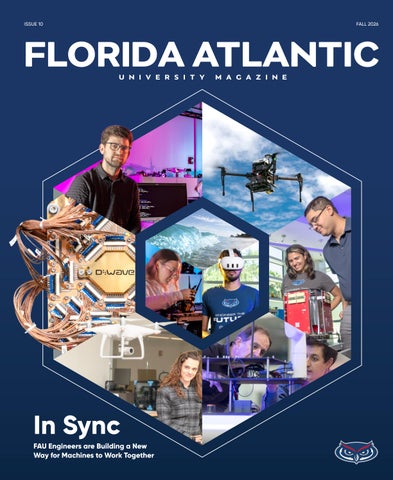
In Sync FAU Engineers are Building a New Way for Machines to Work Together
FALL 2026
2 | FLORIDA ATLANTIC MAGAZINE
President’s Message This is an exciting time to be an Owl, with Florida Atlantic reaching new levels of excellence and reimagining what is possible for higher education. As our university continues to rise and build on its national prominence, it is moving forward with a clear and dynamic vision for the future. Our new five-year strategic plan, “2031FAU: Where Tomorrow Begins,” reflects the momentum of our university and the distinctive strengths of our community. To shape what comes next, it charts a path to expand opportunity, accelerate innovation and elevate our role as South Florida’s Hometown University. This issue of Florida Atlantic University Magazine brings that vision to life. In the stories that follow, you will see how the ideas, initiatives and people across our university are making an impact locally and globally. Our cover story offers a look inside Florida Atlantic’s Center for Connected Autonomy and Artificial Intelligence, where researchers are advancing collective intelligence. Moving beyond individual machines, their work pushes the boundaries of communication and collaboration among intelligent systems. With a multidisciplinary approach and a living laboratory environment, the center is addressing complex challenges while redefining the next era of technology. Another feature highlights a rare discovery made by researchers in the Democratic Republic of Congo. A team from Florida Atlantic worked alongside scientists, conservationists and local communities to identify a new primate species. As only the fifth new African monkey species discovered in the last 75 years, the Colobus congoensis marks an extraordinary scientific milestone for both our university and the world. Florida Atlantic’s commitment to experiential learning comes into sharper focus in a feature about three new initiatives: the President’s Internship Program for Community Impact, Owls on the Hill and the Presidential Mentorship Program. Through these programs, students are gaining real-world experience, building professional networks and contributing meaningfully to their communities at every stage of their college journey. Rounding out this issue is a remarkable story of athletic achievement, chronicling how Florida Atlantic’s student-led pickleball club team transformed from a small group of players into a national powerhouse. Within a few years, the team became the first program to win national championships across all three major collegiate tours in a single season. Together, these stories offer a glimpse of where Florida Atlantic is headed and celebrate the people who are driving our progress. Different as they are, each reflects what can happen when curiosity, initiative and collaboration are fueled by purpose. This is Where Tomorrow Begins.
Adam Hasner
Learn about our vision for 2031FAU at FAU.EDU/STRATEGIC-PLAN.
President
FALL 2026 | 3
ISSUE 10
20 26 CONTENTS FLORIDA ATL ANTIC MAGAZINE
50 Senior Managing Editor Amy Haycock, Associate Vice President, Presidential Communications Managing Editor Cammi Clark, Ph.D., Associate Vice President, University Communications
Writers and Editors Amber Bonefont, Polly Burks, Amy Butler, Cammi Clark, Alyse Cooke, Sam Dean, Wells Dusenbury, Agrippina Fadel, Anne Fennimore, Angie Francalancia, Alvaro Frydman, Gisele Galoustian, Joshua Glanzer, Kristine Gobbo, Addiel Gomez, Zachary Greathouse, Amy Haycock, Chelsey Matheson, Katrina McCormack, Lisa Metcalf, Gregg Sekscienski, David Smolka Design and Graphics Paige Arriola, Kasia Bytnar Photographers/Images Alberto Alvarado, Junior Amboko, FAU Athletics, Albert Ernest “A.E.” Backus, Megan Davis, Ph.D., Alex Dolce, Frankfurt Zoological Society, Getty Images, John Hart, Kimio Honda, Jinwoo Jang, Ph.D., Lukuru Wildlife Research Foundation, Martin Royele/Royele Safaris, JC Ridley, Daniel Rosengren, Barna Takats
©2026 Florida Atlantic University magazine is published twice a year by Florida Atlantic University, 777 Glades Road, Boca Raton, Fla. All rights reserved. No part of this publication may be reproduced without the expressed written permission of Florida Atlantic. Florida Atlantic University is ranked as a Top 100 public university by U.S. News & World Report and is one of only 13 institutions in the country designated by the Carnegie Classification of Institutions of Higher Education as an R1 top-tier research institution, an Opportunity University for higher access and post-graduation earnings, and a recipient of the Elective Classification for Community Engagement. For more information, visit www.fau.edu or email FloridaAtlanticMag@fau.edu.
4 | FLORIDA ATLANTIC MAGAZINE
FE ATURES
68
44 In Sync
FAU Engineers are Building a New Way for Machines to Work Together
22
See, 50 Monkey Monkey New
An Elusive Monkey. Years of Detective Work. One of Primatology’s Rarest Discoveries.
60 A Network of Opportunity Three Presidential Initiatives Create a Multifaceted Platform for Student Success
68 Dill With It!
FAU Pickleball is Taking Over the Collegiate Game
80 DEPA RTMEN TS 6
Around Campus University News
74 Win Column
Florida Atlantic University Athletics
80 Forever Owls Alumni News and Notes
88 Time Machine A Look Back
FALL 2026 | 5
AROUND CAMPUS
Celebrating 20 Years of the Stroll for Well-Being For two decades, a partnership between Florida Atlantic’s Christine E. Lynn College of Nursing and the Morikami Museum and Japanese Gardens in Delray Beach has helped more than 1,000 people find peace and connection through the simple act of walking in nature. The Stroll for Well-Being grew out of a research study conducted in 2006 through a grant from the Institute of Museum and Library Services and led by Ruth McCaffrey, DNP, ARNP, professor emerita at the College of Nursing. The study examined whether regular visits to a healing garden could reduce symptoms of depression among older adults as effectively as art therapy. This year, the program celebrates its 20th anniversary. “We launched the Stroll for Well-Being as a public program in 2008,” said Wendy Lo, curator of education at the Morikami. “In 2012, sponsorship allowed us to offer it free to the community. Since then, nearly 1,500 have finished. We’re grateful that the program continues to reach so many people who are looking for a different way to care for their well-being.”
6 | FLORIDA ATLANTIC MAGAZINE
More Than Just a Stroll The Stroll for Well-Being is designed to encourage reflection rather than exercise. Participants begin with an orientation session before completing self-guided walks through the Morikami’s gardens over a threemonth period. Along the way, themed reflections centered on awareness, trust, possibility, gratitude, joy and fulfillment encourage participants to pause, write and consider their experiences. Two additional group meetings provide opportunities for discussion and shared learning. Those who complete the program receive a complimentary one-year membership, allowing them to return to the gardens for reflection.
Kodai-mon or “Ancient Gate”
The impact of the program became evident early on, according to McCaffrey. “During the first few years, several participant groups were veterans living with post-traumatic stress disorder,” McCaffrey said. “Many told us that walking, reading the journal and writing about their thoughts and fears was the best therapy they had ever experienced.” Participants have included cancer patients and survivors, individuals living with Alzheimer’s and Parkinson’s disease and their caregivers, active-duty military personnel and veterans, first responders and their families, people recovering from addiction and parents of children with autism. Extending the program beyond South Florida was part of the vision. “One of the goals of the original grant was to share what we learned with other gardens,” McCaffrey said. “We published our findings through journal articles and conference presentations, and the program was adapted by Bloedel Reserve in Washington, Brookside Gardens in Maryland, Portland Japanese Garden in Oregon and Tucson Botanical Gardens in Arizona. Like the Morikami Stroll, these programs continue helping people manage stress and navigate life changes.”
Morikami’s gardens and 7-acre lake
The program is now facilitated in part by Rita Gengo, Ph.D., assistant professor at the College of Nursing, who continues to see the impact of the experience on participants. “I see people come to the Stroll during some of the most challenging moments in their lives,” Gengo said. “They may be grieving the loss of a loved one, navigating a difficult diagnosis or treatment, caring for a family member or adapting to other major life changes.” During the program, the participants learn to acknowledge difficult emotions without being defined by them, Gengo said. By giving themselves permission to slow down and make space for these experiences, they often find greater clarity and self-compassion. As the program enters its third decade, the partnership between Florida Atlantic and Morikami continues to demonstrate how research can extend beyond publication, creating a lasting resource that helps people find resilience and hope. “This milestone speaks to the enduring human need for reflection and healing,” Gengo said. “In a world that often encourages us to move faster, the Stroll reminds us of the value of slowing down and being fully present to our lives.”
FALL 2026 | 7
AROUND CAMPUS
If You Go ...
Beyond Origami: The Future, Unfolded Visitors to the Morikami Museum and Japanese Gardens in Delray Beach will soon encounter a striking fusion of art, architecture and innovation as Joseph Choma, Ph.D., director of Florida Atlantic’s School of Architecture, will transform the museum grounds into an exploration of what the future of building might look like.
Dec. 11 to May 16, 2027, Foldable Structures: Origami X Architecture, exhibition (featuring four of Joseph Choma’s folded fiberglass sculptures Dec. 12, 1 p.m., Joseph Choma presents Beyond Origami: Foldable Structures and Materials, free with paid museum admission For more information, visit www.morikami.org.
As part of the Morikami’s 50th anniversary celebration, four of Choma’s folded fiberglass sculptures will be on display from Dec. 11 through May 16, 2027, in the “Foldable Structures: Origami X Architecture” exhibition. The installations range from a 7.5-foot-long sculptural object to an immersive pavilion large enough for visitors to walk through. At first glance, the works evoke the elegance of Japanese origami, but Choma’s creations push the ancient art form far beyond folded paper. His vision imagines a world in which entire buildings arrive at construction sites flat packed, then unfold by hand into durable, three-dimensional shelters. Drawing inspiration from origami, mathematics, structural engineering and material science, Choma creates ultra-thin fiberglass structures that deploy in minutes. Like paper transformed by a skilled fold, these lightweight forms emerge from intricate two-dimensional patterns into rigid architectural spaces. “Foldable structures and materials is one exciting trajectory toward building a more sustainable future,” Choma said. “Folding is used to create functional works of art, which have the power to change the way we design and build.” As director of the Foldable Structures and Materials Lab and professor of architecture, Choma has become a leading voice in experimental design. Popular publications, such as WIRED, have quoted him on topics related to deployable structures for disaster relief. Visitors interested in how foldable structures may shape the architecture of the future can hear Choma speak at the Morikami on Saturday, Dec. 12 at 1 p.m. His presentation, “Beyond Origami: Foldable Structures and Materials,” is free with paid museum admission. For more information, visit www.morikami.org.
8 | FLORIDA ATLANTIC MAGAZINE
Folded Rhapsody by Joseph Choma
FLORIDA ATLANTIC UNIVERSITY PRESENTS THE SEASON’S PREMIER
FEATURING TONY DESARE AND THE PALM BEACH POPS WITH SPECIAL GUEST STAR KATHARINE MCPHEE
7 p.m. Tuesday, Dec. 8, 2026 Carole and Barry Kaye Performing Arts Auditorium, Florida Atlantic University, Boca Raton Proceeds benefit FAU Dorothy F. Schmidt College of Arts and Letters student scholarships and the Bob Lappin and the Palm Beach Pops Memorial Endowment.
Honoring the legacy of Bob Lappin and the Palm Beach Pops, this festive concert with full orchestra features holiday favorites, Broadway classics and the Great American Songbook.
A four-time Top 10 Billboard jazz artist, DeSare has performed at Carnegie Hall, with major symphony orchestras and on national programs including the “Today” show, NPR and “CBS Mornings.”
McPhee is known for her starring roles in NBC’s “Smash” and CBS’ “Scorpion,” her acclaimed performances in “Waitress” on Broadway and in London’s West End, and her chart-topping recordings, including the holiday album “Christmas Songs.”
LEARN MORE AND PURCHASE TICKETS HERE
fau.edu/holiday FALL 2026 | 9
School of Criminology and Criminal Justice
Immersive Technology-Driven Research & Training Immersive VR/XR technologies are redefining how Florida Atlantic students study human behavior and decision-making. Through realistic simulations and cutting-edge analytics, students gain hands-on research experience and career-ready skills for leadership roles in criminology, criminal justice, public safety, behavioral science and beyond. See student researchers in action, explore VR/XR lab facilities or make a gift that funds the next generation of immersive learning.
fau.edu
AROUND CAMPUS
Stone of Strength and Remembrance When the Kurt and Marilyn Wallach Holocaust and Jewish Studies Building opens in spring 2027, its exterior will feature a section adorned with Jerusalem stone, the natural stone of Israel, thanks to a gift from Joshua and Harriet Kalin of Boca Raton. Jerusalem stone, a limestone mined from the mountains in and around Jerusalem, is rooted in Jewish identity, symbolizing strength, endurance and eternal devotion. Its use connects believers to their faith and the sacred stories that have shaped history in Jerusalem. “It is our intention to be a part of the Holocaust and Jewish Studies building
in order to provide a resource center for students and the community,” Harriet Kalin said. “This will result in a stronger Jewish presence on the FAU campus.” The Kalins are long-time supporters of Florida Atlantic’s Holocaust studies programs, including the Raddock Family Eminent Scholar Chair in Holocaust Studies. “The Wallach Building’s mission is to preserve history, combat antisemitism and strengthen Jewish life for generations to come,” said FAU President Adam Hasner. “A Jerusalem stone façade will send a distinct visual message to our community about
the significance of our Holocaust education and Jewish Studies efforts. Thank you to Harriet and Joshua Kalin for this meaningful contribution.” Construction of the Wallach Building is made possible through a transformational gift from Kurt and Marilyn Wallach. The 22,000-square foot, two-story structure will be the home of Florida Atlantic’s Holocaust education, Jewish studies and related programs. The Kalin family joins a host of other donors who are following the Wallachs’ lead by making generous gifts in support of the building and its programs.
For more information or to support the Kurt and Marilyn Wallach Holocaust and Jewish Studies Building, visit fau.edu/wallach-building.
Harriet Kalin, left, President Adam Hasner and Joshua Kalin
FALL 2026 | 11
GRADUATE COLLEGE
130+ PROGRAMS MASTER’S DOCTORAL CERTIFICATES
Your Next Degree Starts Here fau.edu/graduate 12 | FLORIDA ATLANTIC MAGAZINE
AROUND CAMPUS
Before Pyramids, They Were Here
A shark tooth, left, and snake vertebrae, above, that were used as tools an estimated 4,000 years ago.
FAU Archaeologists Uncover a 4,000-Year-Old Story of Indigenous Life in South Florida Beneath the dense vegetation of South Florida’s Loxahatchee Slough Natural Area, hidden for thousands of years, traces of an ancient world are beginning to emerge. What started as an archaeological survey has evolved into a remarkable story of discovery — one that is rewriting our understanding of the region’s past.
Resources Management Department (ERM) to survey the 16,000-acre Loxahatchee Slough Natural Area, located just west of FAU’s John D. MacArthur Campus in Jupiter. The team focused on a site known as Fern, where an unusually dense concentration of artifacts hinted at something even older.
For nearly two decades as a Palm Beach County archaeologist and adjunct professor of anthropology in Florida Atlantic’s Dorothy F. Schmidt College of Arts and Letters, alumnus Chris Davenport, Ph.D. ’17, has worked with more than 125 anthropology students, giving them handson experiences while helping uncover evidence of human life in South Florida long before recorded history.
As part of the project, anthropology master’s student Ashley Gibson worked with Palm Beach County archeologist Nydia Pontón-Nigaglioni, Ph.D., to excavate through thick layers of hardened sediment. They uncovered artifacts that may represent some of the oldest evidence of human activity, including Fiber Temper pottery shards and shark teeth with markings that indicate they were used as knives by humans.
In 2023, Davenport partnered with staff from Palm Beach County’s Environmental
“We expect the artifacts to be approximately 4,000 years old,” Davenport
said. “Ashley and Dr. Ponton honestly made history that day.” Since then, Davenport, Pontón-Nigaglioni, FAU students and ERM staff have identified more than 25 previously unknown archaeological sites and recovered more than 250,000 artifacts, illuminating thousands of years of Indigenous history across South Florida. “If radiocarbon dating confirms the age of the newly discovered materials, the artifacts would predate many of the world’s most famous monuments, including Egypt’s Great Pyramids,” Davenport said. “More importantly, they would offer a rare and powerful glimpse into the lives of the people who called South Florida home thousands of years before European contact.”
FALL 2026 | 13
AROUND CAMPUS
Guiding Growth Through Philanthropy Florida Atlantic recently welcomed Blake Davis as the new vice president for the Division of Institutional Advancement and chief executive officer of the FAU Foundation. Davis oversees fundraising, alumni relations and the FAU Foundation, with a focus on enhancing donor relationships, advancing institutional priorities and expanding philanthropic support at a time of growing national recognition for the university. “Philanthropy is at its most powerful when donors see their generosity reflected in the lives changed, opportunities created and futures strengthened,” Davis said. “At Florida Atlantic, we have an extraordinary opportunity to connect the vision of our supporters with the university’s increasing momentum and community impact.” Davis brings more than two decades of experience helping universities turn ambition into outcomes. A seasoned advancement leader, he has built his career at some of the nation’s leading public and private institutions, including Southern Methodist University (SMU), the University of Chicago, the Wharton School of the University of Pennsylvania, the University of Washington and George Mason University. Most recently at SMU, Davis served as vice president for development, principal and major gifts, playing a leadership role in the university’s $1.65 billion comprehensive campaign. During his tenure, annual fundraising commitments doubled and the university secured more than 285 gifts of $1 million or more. “Blake’s arrival comes at a pivotal time for our university, as we are enjoying tremendous growth and success,” said FAU President Adam Hasner. “Philanthropy is critical to continuing this momentum, and Blake’s proven experience in higher education advancement and understanding of how to translate institutional strengths into donor engagement will power our mission of conducting meaningful research and changing lives. I am excited to have someone of his caliber on our executive leadership team.”
14 14| FLORIDA | FLORIDA ATLANTIC ATLANTIC MAGAZINE MAGAZINE
A Legacy of Landscapes Florida Highwaymen Exhibit Coming to Ritter Art Gallery Few places have inspired artists quite like Florida. Its luminous skies, winding rivers, ancient cypress stands and endless horizons have long invited painters to capture not simply what the landscape looks like, but what it feels like. Through light, color and atmosphere, artists have preserved moments of beauty that continue to shape that understanding. “A Quiet Witness: The Landscapes of A.E. Backus and the Florida Highwaymen,” a collection that captures the enduring relationship between the artist and Florida’s environment, will be on display from Jan. 28 through March 21, 2027, at the Ritter Art Gallery on Florida Atlantic University’s Boca Raton campus. The paintings reveal landscapes that are both familiar and transcendent, inviting viewers to reflect on Florida’s natural beauty and its changing identity. Born in Fort Pierce in 1906, Albert Ernest “A.E.” Backus became the 20th century’s
foremost painter of the Florida landscape. Largely self-taught, he transformed the state’s rivers, wetlands, palms and tropical vistas into glowing compositions that capture their quiet grandeur. Equally important was his role as a mentor. During segregation, Backus encouraged and supported young African American artists — including Harold Newton and Alfred Hair — helping launch what would become the Florida Highwaymen.
who sold their vibrant and colorful paintings directly from their cars. They, in turn, inspired 24 other artists to pursue painting as both creative expression and economic opportunity. Their vivid depictions of sunsets, storm clouds, royal poinciana If you go ... trees and shimmering wetlands became Opening reception of “A Quiet enduring symbols of Witness: The Landscapes of A.E. Backus Florida and are now and the Florida Highwaymen” recognized as an important chapter Thursday, Jan. 28, 2027, 4 p.m. in American Ritter Art Gallery art history. Boca Raton Campus
Admission to the exhibition and reception are free. For more information, visit fau.edu/galleries.
In the late 1950s, Newton and Hair created the Florida Highwaymen, a movement that turned Florida’s highways into an open-air gallery for the artists,
Guest curator J. Marshall Adams, executive director of the A.E. Backus Museum & Gallery in Fort Pierce, draws from FAU’s significant Backus collection and important private loans to present this exhibition. FALL 2026 | 15
AROUND CAMPUS
Celebrating Entrepreneurial Excellence Florida Atlantic University recently presented its annual Maverick Innovation Awards to celebrate entrepreneurship, new startups and innovation. Hosted by the Entrepreneurship Institute, more than $20,000 in prizes were awarded across four tracks: student, veteran, The Runway at Florida Atlantic and the new blue/ocean economy category. Four undergraduates earned top honors in the student track, winning with a breakthrough idea in quantum-assisted surgical planning that could reshape how complex brain tumor procedures are performed. The venture, Q Beam, founded by students Samkit Bothra, Adi Tal, Adam Brown and Charan Jarugula, applies quantum annealing to surgical trajectory optimization. In practical terms, the technology is designed to help surgeons plan highly precise paths for brain procedures, reducing optimization time from hours to seconds while achieving sub-millimeter accuracy. Participants presented their ventures to a panel of South Florida business leaders and investors. The win highlights the broader entrepreneurial momentum emerging from the university’s Entrepreneurship Institute, which supports early-stage founders.
“The motivation behind the program is helping founders overcome challenges that might otherwise prevent innovations from succeeding,” said Kevin Cox, Ph.D., director of the Entrepreneurship Institute. “Without support systems like this, transformative ideas may never reach the market.” The blue/ocean economy category focused on innovations in marine, coastal and water-related industries, including resilience to sea-level rise, clean water solutions and marine sustainability. The winner in the blue/ocean economy category was Afferent Marine, which developed a cost-effective fishing device to reduce shark bycatch in commercial longline operations. The company was founded by Stephen Kajiura, Ph.D., professor of biological sciences at Florida Atlantic, and Kyle Newton, a postdoctoral fellow. The Entrepreneurship Institute integrates several of the university’s core innovation engines, including The Runway at Florida Atlantic, Florida Atlantic Wave, the Adams Center for Entrepreneurship and the Veterans Florida Entrepreneurship Program, into a unified support system. The goal is to streamline access for founders, strengthen mentorship and funding pathways, and expand connectivity across the innovation pipeline.
Scan here for more information on working with the Entrepreneurship Institute.
President Adam Hasner, center, congratulated winners at the Entrepreneurship Institute’s annual Maverick Innovation Awards. 16 | FLORIDA ATLANTIC MAGAZINE
Building Extraordinary Futures at the College of Education
Preparing Teachers, Leaders and Clinicians
Contribute to Our Tomorrow
FALL 2026 | 17
REAL-WORLD DATA. REAL-WORLD IMPACT.
Institute for Smarter Cities Spaces, and Health
West Palm Beach
Building the next generation of discovery For more than a decade, the Institute for Smarter Cities, Spaces, and Health at Florida Atlantic has united researchers across academia, industry and government to tackle challenges beyond the reach of any single discipline or sector. From resilient infrastructure and environmental intelligence to connected autonomy and health technologies, the institute designs, demonstrates and deploys solutions that improve everyday life and prepare communities for the future.
$100M+ Competitive research awards secured by institute faculty as PI or co-PI
5:1 Return on Florida Atlantic University’s investment
450+
Emerging researchers supported from high school through postdoctoral training
LEARN MORE
Owls Named 2026 Goldwater Scholars Two Florida Atlantic students — Danylo Fedkiv and Kyle Loh — earned the 2026 Barry Goldwater Scholarship, the most prestigious national research fellowship for undergraduate students. Named in honor of U.S. Sen. Barry Goldwater, the program was designed to identify, encourage and financially support outstanding undergraduates interested in pursuing research careers in the sciences, engineering and mathematics. Only 454 college students from across the United States were awarded Goldwater scholarships for the 2026-27 academic year, from a pool of science, engineering and mathematics students nominated by 482 academic institutions. This is the fifth consecutive year that more than one Florida Atlantic student has earned the scholarship. “Kyle and Danylo embody the disciplined curiosity and creativity that define scholarly excellence,” said Donna Chamely-Wiik, Ph.D., senior associate dean for undergraduate research and prestigious fellowships, and associate scientist in the Department of Chemistry and Biochemistry in the Charles E. Schmidt College of Science. “This accolade reflects the strength of our research culture and the power of sustained faculty mentorship here at Florida Atlantic. As an R1 institution committed to prioritizing undergraduate research, we cultivate environments where emerging scholars thrive and are empowered to address complex research challenges. We celebrate their achievements and reaffirm our dedication to supporting discovery and innovation across all levels.”
The Goldwater Legacy The Goldwater Foundation is a federally endowed, independent agency that has been celebrating scholars for 40 years. Danylo Fedkiv and Kyle Loh applied for the Goldwater Scholarship with assistance from Florida Atlantic’s Office of Undergraduate Research and Inquiry and Prestigious Fellowships. Previous FAU honorees include:
2025: Aiden Geleta and Vincent Stafford 2024: Natasha Mayorga, Cristian Pena and Dana Smith 2023: David Baldwin and Michael Green 2022: Kate Maier and Samantha Zaninelli
Danylo Fedkiv Fedkiv is a double-major in chemistry and biology in the Harriet L. Wilkes Honors College. He conducts his research under mentor Gregg Fields, Ph.D., vice president for research, synthesizing inhibitors of Matrix Metalloproteinases to help fight cancer and other related disorders. Fedkiv’s goal is to earn a doctoral degree in chemistry and teach and conduct research as a university professor. He also wants to apply his training in organic chemistry to develop histopathological probes for biomedical imaging, and to discover new classes of organic reactions to facilitate more convenient and efficient organic synthesis. “To have joined the past Goldwater Scholars at FAU is an immense privilege and opportunity for me as a researcher,” he said. “This award has truly changed the trajectory of my academic career for the better, and I am certain that I will reach new, prestigious heights in chemistry that were previously unattainable for me.”
Kyle Loh Loh is a fourth-year, dualenrolled student at FAU High School and the Charles E. Schmidt College of Science, pursuing bachelor’s and master’s degrees in mathematics. Under the mentorship of professor Jason Mireles-James, Ph.D., Loh uses dynamical systems and topology to prove how key machine learning algorithms converge on solutions within the complex, high-dimensional landscapes of modern AI. Following his concurrent graduations in spring 2027, Loh plans to pursue a doctoral degree in applied mathematics. His long-term goal is to lead a research lab dedicated to pioneering rigorous mathematical foundations for impactful real-world AI systems. “I am honored to be selected as a Goldwater Scholar and am grateful to my mentors at FAU, especially Dr. Jason Mireles-James, who has shaped my trajectory as a researcher,” he said. “This award will expand access to academic opportunities and connect me with the Goldwater Scholar community, whose shared commitment to research will further support my academic development.” FALL 2026 | 19
AROUND CAMPUS
Built to Build Expanding AI Resources for Students Florida Atlantic University received a $1 million gift from the Levine Family Foundation to establish the Michael R. Levine AI-Enabled Hands-On Engineering Lab at the College of Engineering and Computer Science. The lab will offer students practical artificial intelligence experiences, with a focus on real-world challenges, applied learning and career readiness. “The foundation is pleased to be joining with FAU to help train students at the forefront of AI technology innovation,” said Michael Levine, president of the Levine Family Foundation. “As AI becomes more integrated, it is even more important that students are prepared as they enter the workforce.” The lab will provide a purpose-built setting in which a faculty director will engage students in applied learning, mentoring and prototyping as well as experiential projects through active and responsible use of AI in engineering practice. The lab is intended to strengthen student skill development and collaboration with other students, faculty members and external partners. Priority will be given to exchanges involving Israel, which will broaden global perspectives and strengthen educational opportunities. “We are grateful to the Levine Family Foundation for supporting our students with an investment in their learning, mentoring and career readiness,” said Stella Batalama, Ph.D., dean of the College of Engineering and Computer Science. “We are honored to recognize Michael R. Levine through a lab that will directly benefit our students.”
20 | FLORIDA ATLANTIC MAGAZINE
Queen Conch Hatchery Goes Fully Mobile On the island of Eleuthera in The Bahamas, a solar-powered, mobile laboratory no larger than a shipping container is quietly reshaping the future of one of the Caribbean’s most iconic and imperiled marine species: the queen conch.
conch, which will eventually be released into natural seagrass habitats. Each one represents a measurable step toward rebuilding wild populations that have been sharply depleted by decades of overfishing and habitat loss.
Florida Atlantic’s Harbor Branch Oceanographic Institute, in partnership with The Island School’s Cape Eleuthera Institute and supported by Chef José Andrés’ Longer Tables Fund, recently announced its Queen Conch Mobile Lab is now fully operational, marked by the arrival of the first egg masses and successful hatch.
The queen conch plays a crucial ecological role in maintaining healthy seagrass beds, grazing algae and supporting marine biodiversity. But its slow growth and late maturity — taking four to five years to reach adulthood — make recovery difficult without intervention. In the wild, fewer than 1% of juveniles survive to adulthood.
The moment signals the beginning of active, community-based restoration for a species that has defined Caribbean cuisine, culture and coastal ecosystems for centuries.
“We are incredibly excited to reach these milestones because it represents far more than the successful launch of a mobile hatchery,” said Megan Davis, Ph.D., director of FAU Harbor Branch’s Queen Conch Lab and a research professor of aquaculture and stock enhancement. “It demonstrates what is possible when science, conservation and community come together with a shared purpose. Seeing the first egg masses and hatch in the mobile lab means we are now actively growing the next generation of queen conch for restoration, for healthy seagrass ecosystems and for the communities across The Bahamas. It’s a transformative and hopeful moment for conservation.”
Established in February, the mobile lab was designed to produce up to 2,000 juvenile queen conch annually for restoration efforts across the region. By April, researchers had introduced the first egg masses and witnessed the delicate emergence of microscopic larvae beginning their 21-day journey from drifting plankton to benthic juveniles. Since then, the system has produced approximately 300 newly metamorphosed
Conch in the Community The Queen Conch Mobile Lab is a self-contained, 26-by-8-foot hatchery powered by solar energy and equipped with specialized saltwater and aeration systems. It connects directly to local seawater sources, allowing it to function in remote coastal communities without permanent infrastructure. Beyond its scientific precision, the project is deeply rooted in community engagement. The lab is expected to welcome up to 1,500 visitors annually, while also providing training, internships and outreach programs for local residents and fishers. The mobile lab is part of FAU Harbor Branch’s broader vision to expand conch restoration sites across the Caribbean, from Puerto Rico to Curaçao. As these labs multiply, so too does a model of conservation that moves science out of institutions and directly into coastal communities. Scan here to support Florida Atlantic’s queen conch aquaculture and restoration efforts.
FALL 2026 | 21
AROUND CAMPUS
Catalyst for Coastal Conservation By day, Paige Aldred tracks toxic algal blooms threatening Florida’s waterways. By night, she wears a crown. As Miss Fort Lauderdale 2026, the Florida Atlantic University graduate student is using her high-profile platform to champion critical environmental causes. Aldred is working toward her master’s degree in biology, with a research focus on investigating benthic harmful algal bloom species under the supervision of Brian Lapointe, Ph.D., a research professor at Florida Atlantic’s Harbor Branch Oceanographic Institute. Specifically, she studies how drifting macroalgae, such as sargassum, may transport algae between offshore and inshore environments, and
22 | FLORIDA ATLANTIC MAGAZINE
how nutrient pollution and environmental conditions influence their abundance and distribution. “The Indian River Lagoon continues to face increasing environmental stress from nutrient pollution, harmful algal blooms and habitat degradation,” Aldred said. “My research helps improve our understanding of how these blooms develop, spread and respond to changing environmental conditions, which can support better water quality management and ecosystem restoration efforts.” Although her academic and pageant schedules are demanding, Aldred said she thrives when she is busy. Outside of her research, she shares her love for the ocean in her role as Miss Fort Lauderdale, and some days, she must quickly shift from the lab to the stage to fulfill her duties. “I’ve learned how to go from lagoon water to a crown and sash within an hour,” Aldred said. “At the end of the day, it’s really all about scheduling, showing up with a clear head and staying present in whatever role I’m stepping into that day. Through all of it, I really want to show up authentically as myself, and I feel like I can do that whether I’m wearing a crown or a snorkel and mask.
I’m incredibly grateful for all the opportunities I’ve been given and for the chance to pursue two passions at the same time.” Aldred uses her platform to promote her community service initiative, “Eco Girl: Healthy Waters, Stronger Futures,” to make environmental science and sustainability more accessible to the public. Through school visits, outreach events and community partnerships, she travels across the state to help educate others about how everyday choices impact water quality, marine ecosystems and public health. She documents this work through her “@eco.girl_” Instagram account. “I want to continue working in spaces where I can help make sustainability and conservation more approachable and more represented. Whether that is through research, outreach, policy or public engagement, I want to help people see that environmental issues are not separate from everyday life,” Aldred said. “A big part of what drives me is my love for Florida’s waterways and coastal environments. “I feel very lucky to have grown up introduced to so much marine life, and I hope to spend my career protecting and advocating for the ecosystems and communities that depend on it.”
FALL 2026 | 23
AROUND CAMPUS
Pixels of Preservation The vaquita, the world’s smallest porpoise and rarest marine mammal, is slipping toward extinction, but scientists have found a way to preserve what nature may soon lose forever — not in glass cases or field notes, but in pixels. Florida Atlantic researchers collaborated on a highly detailed digital reconstruction of a vaquita skeleton using advanced imaging technologies. The female specimen — collected in the 1960s and preserved in a museum collection — was transformed into a layered, interactive 3D archive that can be explored through pixels, without ever touching the fragile bones. Unlike traditional museum specimens that require careful handling and limited access, this digital reconstruction allows scientists, educators and the public to rotate, measure and examine every bone virtually. The full dataset — including scans, photographs and 3D meshes — is available through MorphoSource, an open-access scientific repository that supports research and education worldwide. The digital preservation project — a collaboration among Florida Atlantic, the San Diego Natural History Museum, SeaWorld California and NOAA Fisheries — offers a different kind of intervention: one that safeguards knowledge even if the species itself disappears. 24 | FLORIDA ATLANTIC MAGAZINE
For a species as imperiled as the vaquita, the timing is critical. With an estimated population reduced to a few individuals, the animal has become a global symbol of biodiversity loss. Found only in the shallow waters of Mexico’s northern Gulf of California, its decline has been driven primarily by entanglement in illegal gillnets used to catch totoaba, a fish whose swim bladder is trafficked on international black markets. Despite long-standing bans and conservation efforts, illegal fishing continues to threaten the species’ survival. “This effort not only safeguards a valuable record of one of the planet’s most endangered marine mammals, but also makes that information accessible to anyone,” said Jamie Knaub, first author, doctoral candidate in biology in the Charles E. Schmidt College of Science and research specialist at FAU Laboratory Schools. “The project will help to raise awareness and support conservation efforts for a species now teetering on the edge of extinction.”
Jamie Knaub
ROOTED IN CARING. RISING IN As a cornerstone of Florida Atlantic’s five-year strategic plan, “2031FAU: Where Tomorrow Begins,” the Christine E. Lynn College of Nursing is building the future of nursing through five commitments: empower our community to become extraordinary nurses, discover new knowledge, transform care, and lead through caring. From the planned Health Professionals Clinical Training and Research Facility to becoming the first Watson Caring Science FAU Nursing is strengthening partnerships, advancing innovation and preparing the next generation of nurses to transform healthcare across Florida.
Caring Science.
Nurses.
A Healthier Future. CHRISTINE E. LYNN COLLEGE OF NURSING
fau.edu/nursing/OurPromise
AROUND CAMPUS
In the News “The rarer song types don’t propagate quite as well over distance than the common ones do. The birds only learned the undegraded songs. This is very interesting. This presents this idea of cultural evolution driven by the environment.” Rindy Anderson, Ph.D., associate professor of biological sciences in the Charles E. Schmidt College of Science, to The New York Times on her study on how a bird’s habitat can change its song and whether it is passed on to the next generation.
“This opens up doors for industry partnerships to assist with research, and then that becomes a talent pipeline for our students to be able to pursue careers with those same companies. As more companies find out about the research now here at a Carnegie R1 top-tier research university, it starts to expose people to all the exciting disciplines we are exploring that can help their unique needs.” FAU President Adam Hasner to the South Florida Business Journal on the need for skilled talent to fill highvalue jobs.
“We’re interested in precipitation, we’re interested in wind velocity, temperature, humidity, barometric pressure — all of the parameters that are relevant to understanding not only what the weather is now, but what the weather will be.” Jason Hallstrom, Ph.D., executive director of the Institute for Smarter Cities, Spaces, and Health, to WPBF TV about the role of the institute as lead technology provider for the Southeast Atlantic Econet, which delivers realtime weather and environmental data to NOAA and the National Weather Service to improve forecasting and emergency preparedness.
“By cryopreserving tissues from more than 86 species of deep-water sponges, corals and sea cucumbers, we’re preserving living biological resources that provide an invaluable baseline for understanding future ecosystem change.” Megan Conkling, Ph.D., research scientist at Harbor Branch Oceanographic Institute, to BBC Wildlife on her participation in a recent expedition to explore the waters around the island national of Trinidad and Tobago.
26 | FLORIDA ATLANTIC MAGAZINE
“Taken together, our findings suggest that skin cancer in Florida is driven not only by ultraviolet exposure, but also by behavioral patterns, biological factors, and persistent gaps in prevention and early detection — particularly among older men.” Lea Sacca, Ph.D., assistant professor of population health in the Charles E. Schmidt College of Medicine, to HealthDay on her study showing that melanoma incidence and deaths disproportionately impact men.
“These projects involve dredging and placing large volumes of sediment onto the beach, and what we observed was turbidity in the adjacent nearshore on a scale that exceeded what’s typically described in the literature — with plumes stretching for kilometers and persisting across the exact time and space where marine species are most active. That tells us we need to take a closer look at how the entire process of beach nourishment may be influencing marine habitat.” Tiffany Roberts Briggs, Ph.D., chair and associate professor of geosciences in the Charles E. Schmidt College of Science, to Surfer on her research on how Florida beach nourishment may threaten local shark populations and humans.
“Children have a finite number of free-time hours in a day. Every hour a child spends alone with a device is an hour they aren’t engaged in social interactions that boost language skills. It is an hour not spent practicing the social and emotional skills required to build friendships.” Brett Laursen, Ph.D., professor of psychology in the Charles E. Schmidt College of Science, to U.S. News & World Report on how preschoolers’ solitary screen time could mean behavior problems and language difficulties later on.
“In places like Miami, we’re dealing with a combination of tidal flooding, storm surge and long-term sea level rise. So the question isn’t about how we stop water, but it’s how we live on, with and over it.” Jeffrey E. Huber, professor of architecture in the Dorothy F. Schmidt College of Arts and Letters, to The Associated Press on how Florida is showing how to adapt as coastal cities face growing threats from sea level rise and storms.
FALL FALL 2026 2026 || 27 27
AROUND CAMPUS “These systems engage, respond and even affirm users in highly personalized ways, which can make their influence especially powerful. For adolescents — who are still developing critical thinking skills and a sense of identity — that can create a situation where they’re more likely to trust, internalize or act on what the chatbot is saying without fully questioning it.” “It’s huge. To go all the way up to 42 nests means there’s a lot of turtles nesting this year, which is good news for that species.” Jeanette Wyneken, Ph.D., professor of biological sciences in the Charles E. Schmidt College of Science, to WPTV on how leatherback sea turtle nesting has reached record numbers along Florida’s coast.
Sameer Hinduja, Ph.D., professor of criminology and criminal justice in the College of Social Work and Criminal Justice, to Inc. Magazine on his research on American teenagers and their AI chatbot use.
“From a drug development and marketing perspective, peptides are really not looked at as conventional medications. Yet, people are injecting themselves with them for all kinds of different reasons. The people who are marketing big wellness have managed to replace the gold standard clinical trials with testimonials of people, which are not evidence-based. We need to do the work to figure out what doses should be taken, who should be taking them, and do they actually produce the types of effects that people are claiming that they produce?” Lewis S. Nelson, M.D., dean and chief of health affairs for the Charles E. Schmidt College of Medicine, to the Sun Sentinel on how the peptide craze has hit Florida hard and what people need to know.
“The average winter water temperature has risen 1 degree Celsius in just 10 years. That’s a full degree difference in only a decade. And these sharks are highly tuned to their environment. They have a preferred temperature that’s comfortable for them. So they’re truncating the southward leg of their migration … which leaves more sharks farther north.” Stephen Kajiura, Ph.D., professor of biological sciences in the Charles E. Schmidt College of Science, to CNN on his research on the migration patterns of blacktip sharks and how warmer waters are driving them further north and closer to east coast beaches.
28 | FLORIDA ATLANTIC MAGAZINE
Talon Hall Welcomes First Residents Talon Hall, Florida Atlantic’s newest residence hall, opened on the Boca Raton campus in August. It represents a significant investment in the student experience and reflects the university’s commitment to providing affordable housing for students as they pursue their degrees. As the university’s largest residence hall, Talon Hall’s 674 beds are helping to meet the growing demand for on-campus housing among returning students who seek to remain engaged in campus life. It offers accommodations tailored to second-year students, including three-bedroom suites with private bedrooms, a shared bathroom and a kitchenette equipped with a refrigerator and microwave. Located on the east side of campus, Talon Hall expands the residential neighborhood alongside Parliament Hall and across from University Village Apartments. Residents have access to a sun deck, fire pit, putting green, grills, game room, massage chairs, yoga space, fitness
bikes and multiple community kitchens. The building also includes individual study rooms, collaborative learning spaces, multiple laundry facilities, 24/7 front desk service and secure card-access entry. “Talon Hall represents our continued commitment to providing an exceptional student experience,” said Larry Faerman, Ph.D., vice president for student affairs. “The residential experience is one of the most powerful environments for student growth. Talon Hall provides opportunities for students to build community, develop independence, strengthen their well-being, and gain the skills and confidence they need to succeed both at Florida Atlantic and beyond.”
FAU President Adam Hasner chips onto the putting green at Talon Hall.
AUGUST 20, 2026 |
CHARLES E. SCHMIDT COLLEGE OF MEDICINE
PALM BEACH COUNTY'S ONLY MEDICAL SCHOOL
53 %
Training the next generation of physicians while advancing research and improving community health.
$30 M+ 100%
fau.edu/medicine
GRADUATES REMAIN IN FLORIDA
ACTIVE RESEARCH FUNDING
180
RESIDENTS AND FELLOWS
RESIDENCY PLACEMENT RATE
CLASS OF 2026 LARGEST GRADUATING CLASS IN SCHOOL HISTORY
AROUND CAMPUS
Risky Roads Why Pedestrian Deaths Keep Rising Pedestrian and bicyclist fatalities in the U.S. have risen by 68% since 2000, now accounting for roughly one in five traffic deaths. While roadway fatalities have remained at approximately 40,000 per year over that same time, walking and biking have become significantly more dangerous — about 30 times riskier per mile than driving.
Traditional safety approaches have focused on redesigning streets with wider lanes, lower speeds and improved crossings — but the study argues that this is only part of the problem. The scale of U.S. arterial infrastructure makes wholesale redesign difficult, costly and politically complex.
A new study from Florida Atlantic University, published in the Journal of the American Planning Association, helps explain why. Researchers analyzed 222 miles of arterial roads across Miami, Orlando and Tampa. Using crash data from the Florida Department of Transportation and satellite imagery, they uncovered a pattern that goes beyond road design alone: land use itself is reshaping risk.
Instead, researchers point to land use decisions as an underused but powerful lever. Where communities place essential services may matter as much as how roads are built. Sweden, Germany and the United Kingdom have already taken steps in restricting development along high-speed roads and achieved significantly lower fatality rates.
Placing everyday destinations such as grocery stores, pharmacies, gas stations and fast-food restaurants along high-speed arterial roads dramatically increases exposure for pedestrians and cyclists. These corridors, already engineered for fast-moving traffic, become unavoidable zones of conflict when daily life is built directly beside them.
“This research changes how we think about traffic safety in ways that matter for the public, policymakers and local governments. Traffic deaths are often treated as isolated incidents or engineering problems, but our findings show they are also shaped by how communities are planned and developed,” said Eric Dumbaugh, Ph.D., senior author and professor in the Department of Urban and Regional Planning in the Charles E. Schmidt College of Science. “Safety is not just about how streets are designed — it’s about how communities are built.” FALL 2026 | 31
RANKINGS AND Florida Atlantic Named a Top 100 Public University by U.S. News & World Report Once again, Florida Atlantic University is ranked among the nation’s Top 100 Public Schools in U.S. News & World Report’s annual “Best Colleges” rankings. In recognition of its commitment to ensure that all students succeed, Florida Atlantic is ranked No. 31 in the nation for Social Mobility, which measures how well schools graduate low-income students.
U.S. News & World Report
#99
#34
#31
TOP PUBLIC UNIVERSITIES
PELL GRANT GRADUATION PERFORMANCE
SOCIAL MOBILITY
#65
#68
#95
BEST VALUE PUBLIC SCHOOLS
BEST VALUE SCHOOLS FOR IN-STATE STUDENTS
BEST PUBLIC COLLEGES FOR VETERANS
BEST UNDERGRADUATE PROGRAMS – PUBLIC SCHOOLS
#15
INTERNATIONAL BUSINESS
#126 COMPUTER SCIENCE
32 | FLORIDA ATLANTIC MAGAZINE
#93
#109
BUSINESS
NURSING
#127
ENGINEERING
RECOGNITIONS The Princeton Review
#18 BEST ONLINE MBA PROGRAMS IN THE U.S.
The Financial Times
#1
#4
BEST EXECUTIVE EDUCATION PROGRAMS IN FLORIDA
BEST EXECUTIVE EDUCATION PROGRAMS IN THE U.S.
SmartAsset
#32 AMERICA’S BEST VALUE PUBLIC UNIVERSITIES
Association of Public and Land-grant Universities INNOVATION AND ECONOMIC PROSPERITY DESIGNEE
FALL 2026 | 33
AROUND CAMPUS
Resilient Communities Resilient Aging
Resilient Artistry
Center for the Resilient Mind How do people learn to bend — but not break? The Center for the Resilient Mind brings together neuroscientists, psychologists, clinicians, educators, artists and social workers to better understand the brain mechanisms and mental health practices that build resilience. The center’s work focuses on identifying and strengthening the factors that help individuals overcome challenges that might otherwise lead to diminished opportunity, chronic disease or mental illness. Through interdisciplinary collaboration and research, the center explores how resilience develops across the lifespan — sharing evidence-based strategies that strengthen brain health and empower individuals and communities. Learn more: fau.edu/brain/resilient-mind 34 | FLORIDA ATLANTIC MAGAZINE
Resilient Youth
AROUND CAMPUS
Driving Indicators Reveal Early Cognitive Decline In Florida, where millions of older adults remain active drivers, a quiet shift is underway in how scientists understand cognitive aging. Instead of waiting for memory lapses or clinical symptoms to appear, researchers are turning to an unexpected source of insight already embedded in daily life: the way people drive.
of Engineering and Computer Science, researchers captured detailed driving data alongside regular neuropsychological testing. Each trip recorded information from speed and braking to throttle pressure, trip duration and route consistency.
A Florida Atlantic University study is showing that subtle changes behind the wheel may help identify early cognitive decline years before it becomes clinically obvious — offering a potential new pathway for intervention when it matters most.
Drivers showing early cognitive impairment tended to make shorter trips, exhibit less consistent control of the accelerator and display less efficient speed regulation. In contrast, cognitively unimpaired drivers demonstrated steadier control, more responsive braking and more fluid driving behavior overall. The strongest signal came not from one behavior alone, but from how these patterns interacted in combination.
The research analyzed nearly 4,800 car trips taken by 36 older drivers over a three-year period. Using discreet in-vehicle sensor systems developed by the College
Participants also underwent cognitive assessments every three months, allowing researchers to compare clinical results with real-world driving patterns over time. The
combination of behavioral and cognitive data provided a rare, high-resolution view of how subtle neurological changes may influence everyday decision-making. “What makes these findings especially compelling is how clearly the combined driving patterns separated the two groups,” said Ruth Tappen, Ed.D., senior author, professor and eminent scholar in the Christine E. Lynn College of Nursing, and member of the FAU Stiles-Nicholson Brain Institute. “When all the behaviors were analyzed together, the model was highly accurate at distinguishing cognitively unimpaired drivers from those with early impairment. Everyday driving habits — captured passively through in-car sensors — may offer a powerful new way to detect subtle cognitive changes long before they become obvious.”
As part of the study, researchers developed their own in-vehicle sensors using commercially available hardware and software, with minimal wiring to remain unobtrusive while providing data and video.
FALL 2026 | 35
AROUND CAMPUS
Reframing, Not Replacing, Human Labor Professor Awarded Patent for Remote AI Manufacturing System A factory floor that fits on a video screen, and adapts in real time to the person operating it, may soon redefine how advanced manufacturing is done. Mehrdad Nojoumian, Ph.D., associate professor in Florida Atlantic’s College of Engineering and Computer Science, was awarded a U.S. patent for a breakthrough system called “Adaptive Cyber Manufacturing Through Online Human-AI Partnerships.” The technology enables workers to operate complex manufacturing systems remotely using sensors, cameras and digital platforms that link human decision-making with AIdriven machinery.
The technology also addresses the growing challenge of how to retain advanced manufacturing capacity while navigating labor shortages, global supply chain disruptions and rising automation demands. By enabling distributed operation, the system allows companies to keep high-value production in industrial countries while tapping into talent — regardless of location. Early results from testing suggest strong potential for improving both efficiency and accessibility in precision manufacturing environments. As industries increasingly look for ways to balance automation with human expertise, Florida Atlantic’s patented system points toward a new model in which manufacturing is no longer defined by location, but by connection.
Instead of being tied to a physical production site, operators can supervise and control manufacturing processes from anywhere, interacting with equipment through an interface designed to resemble familiar video conferencing tools. Behind the screen, however, is a coordinated system of robotics, machine intelligence and predictive software working in sync with human input. By actively adapting to the user, tasks and workloads shift dynamically based on performance and experience level, allowing both skilled technicians and less-experienced workers to contribute effectively. Predictive models reduce delays between human commands and machine response, helping maintain smooth, continuous operation even in complex manufacturing environments. “Advancing human-AI collaboration in manufacturing is essential to building systems that are responsive to real-world conditions,” said Stella Batalama, Ph.D., dean of the College of Engineering and Computer Science. “The future of manufacturing will be driven by intelligent systems that adapt to people — enhancing performance while maintaining human oversight in complex decision-making.” Rather than replacing human labor, the system reframes it. Workers remain central to decision-making, while AI handles coordination, precision control and system optimization. The result is a hybrid environment where human judgment and machine efficiency operate as a single, continuous loop.
36 | FLORIDA ATLANTIC MAGAZINE
Mehrdad Nojoumian, Ph.D.
AROUND CAMPUS
20 Years of Caring, One Step at a Time For two decades, the Keep Memories Alive Walk has united the Boca Raton community in support of individuals living with Alzheimer’s disease and related dementias, and the family members who care for them. As one of the city’s signature charitable traditions, it has helped hundreds of local families receive compassionate care at the Louis and Anne Green Memory and Wellness Center in Florida Atlantic’s Christine E. Lynn College of Nursing. Since the inaugural Keep Memories Alive Walk in 2005, members of the community have gathered each November at Town Center at Boca Raton to celebrate loved ones, honor those affected by memory disorders and help ensure that others have access to the services they need. Participants embrace the event’s festive spirit by dressing for themes such as “Black Tie,” “Walking with the Stars” and “Artful Memories.” Many of the community’s philanthropic leaders have championed the walk as honorary ambassadors, including the late Bobby Campbell, Christine E. Lynn and Elaine J. Wold.
Honorees Through the Years At the heart of every Keep Memories Alive Walk are the individuals and families whose stories have inspired the event’s mission. Over the years, the walk has recognized the following honorees:
Dedication: Carl Lindstrom (2010) Susan Whelchel, Bobby Campbell and Mickey Robinson (2021) Debi Stacy-Feiler (2025) Honorary Family: Diana and Frank Bobb (2010) Christine E. Lynn (2011) John and Dotsa Bitove Family (2012) The Altier Family (2013) Sy and Anita Flaster Family (2014) The Scaggs Family (2015) Peggy Sinnott and the Lefton Family (2016) Helen Nikolas Family (2017) Clara Gutierrez and Family (2018) Paula Levin and Family (2019)
“What makes this event so special is the generosity of the people who return year after year to support our mission,” said Alice Brumley, DNP, director of the center. “Every dollar raised stays in the community, and over the years I’ve heard participants and donors tell us how meaningful it is to see their money do good work.”
Ada Ustjanauskas and Family (2021) Jane and Jim Davidson Family (2022) Farrell and Ann Moore Family (2023) Thor Johnson and Family (2024) Eddie Palermo and Family (2025)
Designated by the Florida Department of Elder Affairs as a Memory Disorder Clinic in 2005, the Louis and Anne Green Memory and Wellness Center has become a trusted resource for families throughout South Florida, through compassionate clinical care, innovative programs, research and education. Guided by its mission to support, promote and raise funds for the center’s programs, the Caring Hearts Auxiliary of the Louis and Anne Green Memory and Wellness Center hosts an annual campaign in the spring and community events throughout the year. Funds raised directly support care partner programs and Adult Day Center scholarships for individuals and families facing Alzheimer’s disease and related dementias. “This milestone is a tribute to the extraordinary community that has sustained the Keep Memories Alive Walk for two decades,” said Terry Fedele, member of the Caring Hearts Auxiliary Board and past chair. “We are proud to recognize the countless participants, volunteers and donors whose generosity has helped the Louis and Anne Green Memory and Wellness Center provide hope and support to those who need it most.”
From left, Christine E. Lynn, Terry Fedele and Patricia Thomas.
FALL 2026 | 37
AROUND CAMPUS
Awards and Accolades Faculty, staff and students
NICK UNDERWOOD, PH.D.,
go above and beyond in the
associate professor of history in the Dorothy F. Schmidt College of Arts and Letters and Raddock Family Chair for Holocaust Studies, was selected for the Fulbright Global Scholar Award. He will conduct research at the University of Warsaw in Poland, where he will teach Jewish studies.
workplace, community and around the world to make a difference. Their work does not go unnoticed. Here’s a look at some of the prestigious awards and accolades earned.
MARIANNA COLVIN, PH.D., associate professor in the Phyllis and Harvey Sandler School of Social Work in the College of Social Work and Criminal Justice and co-director of the Child Welfare Institute, was selected as the 2026 Child Welfare Researcher of the Year by the Florida Institute for Child Welfare.
ALLAN BARSKY, PH.D., MSW, professor in the Phyllis and Harvey Sandler School of Social Work in the College of Social Work and Criminal Justice, has been selected as a National Association of Social Workers Social Work Pioneer. The honor recognizes social workers whose leadership, scholarship and service have improved social and human conditions and helped shape social work practice, policy and education nationwide.
38 | FLORIDA ATLANTIC MAGAZINE
SRINIVASA SUBRAMANIAM, PH.D., associate professor in the Department of Chemistry and Biochemistry in the Charles E. Schmidt College of Science, was selected by the Federation of American Societies for Experimental Biology to serve as chair of its Nanotubular Communication Across Health and Disease Conference in summer 2027.
CHERYL KRAUSE-PARELLO, PH.D., associate vice president for research, was placed on the Fulbright Specialist Roster by the United States Department of State’s Bureau of Educational and Cultural Affairs and World Learning. The Fulbright Specialist Program pairs highly qualified U.S. academics and professionals with host institutions abroad to share their expertise, strengthen institutional linkages, hone their skills, gain international experience and learn about other cultures.
PETER RICCI, PH.D., associate professor and director of the Hospitality and Tourism Management Program in the College of Business, was named one of the Global 100 Influential Educators in Hospitality by the International Hospitality Institute.
JOHN McCORMACK, head baseball coach, will be inducted into the Irish American Baseball Hall of Fame in November. McCormack is one of four inductees. Each of his grandparents came to America from Ireland. McCormack is entering his 19th season as the Owls’ head coach and his 37th season with the program.
JEFFREY HUBER,
ALI A. DANESH, PH.D.,
professor in the School of Architecture in the Dorothy F. Schmidt College of Arts and Letters, was elected president of the Florida chapter of the American Institute of Architects for 2028. Huber is also a fellow of the American Institute of Architects and holds a licensure with the National Council of Architectural Registration Boards.
professor of communication sciences and disorders in the College of Education and professor of biomedical science in the Charles E. Schmidt College of Medicine, has been named a Distinguished Fellow of the American Academy of Audiology, one of the highest professional honors in the field of audiology. The national recognition honors academy members who have made exemplary contributions to the profession and demonstrated a sustained commitment to advancing audiology.
FALL 2026 | 39
AROUND CAMPUS
Dipayan Das, Ph.D.
Veronika Kuchta, Ph.D.
Francesco Sica, Ph.D.
Edoardo Persichetti, Ph.D.
‘Fantastic Four’ Leading the Way in Cryptography Today’s traditional cryptographic methods that protect digital systems like banking, healthcare and internet communications face constant threats from hackers and powerful new quantum computer attacks, making “post-quantum” cryptographic solutions highly critical. While the race to quantum supremacy has just begun, Florida Atlantic’s Charles E. Schmidt College of Science is home to a group of cybersecurity researchers who have been leading the charge in developing systems to counter future quantum computer threats for the past several years. FAU’s four experts — Veronika Kuchta, Ph.D., assistant professor; Edoardo Persichetti, Ph.D., associate professor; Francesco Sica, Ph.D., assistant professor; and Dipayan Das, Ph.D., assistant professor — comprise one of the largest teams in the nation devoted exclusively to the mathematical exploration of postquantum cryptography. They are developing innovative and robust cryptographic systems to replace current standards before they become vulnerable in the face of quantum computing. Preparing the world for a new security ecosystem is not easy. The group uses sophisticated methods from different areas of 40 | FLORIDA ATLANTIC MAGAZINE
mathematics such as lattices, error-correcting codes and isogenies on elliptic curves, and each member has a different specialty. The team solidified its position at the forefront of the field in 2025, when the National Institute of Standards and Technology selected one of its algorithms for the new generation of encryption standards. Florida Atlantic is the only U.S. university involved, highlighting its excellence in post-quantum cryptography. Florida Atlantic has also been named a National Center of Academic Excellence in Information Assurance/Cyber Defense Research by the National Security Agency. The designation is awarded to universities whose programs meet rigorous academic and research standards and are aligned with the nation’s strategic priorities in cybersecurity. “This designation is a powerful affirmation of the strength and impact of our research and academic programs in cybersecurity,” said Valery E. Forbes, Ph.D., the dean of the Charles E. Schmidt College of Science. “We are not only advancing the field of cybersecurity but also equipping the next generation of thought leaders and innovators who will serve as the architects of tomorrow’s defended digital infrastructure.”
FAU Lab Schools Named Discovery ‘School of the Year’ A.D. Henderson University School and Florida Atlantic University High School — together known as FAU Lab Schools — are among only six schools nationwide to be selected as a “School of the Year” as part of the 2026 Discovery Education Awards. FAU Lab Schools was honored for its STEM instruction, nationally recognized research and applied learning model. “Being named Discovery Education ‘School of the Year’ is a powerful affirmation of the exceptional work taking place throughout the FAU Laboratory Schools,” said Joel Herbst, Ed.D., vice president for PK-12 pre-
baccalaureate programs and FAU Lab Schools superintendent. “This recognition reflects the deep commitment of our faculty and staff, who have developed a model that prepares students not only for academic success, but to think critically and contribute meaningfully to our community, state and nation.”
while supported through a schoolwide culture that empowers them to be active contributors to knowledge creation. These practices foster early academic confidence, curiosity and college readiness, positioning FAU Lab Schools as a national model for innovative teaching, learning and student achievement.
As a public K-12 laboratory school district, FAU Lab Schools integrate rigorous academics with research experiences, hands-on laboratory learning and interdisciplinary instruction beginning in the earliest grades. Students are held to high academic standards
“We are absolutely thrilled to receive this recognition,” said Lauren Robinson, Ed.D., principal of A.D. Henderson University School and FAU High School. “This award is a reflection of a school community that truly embraces innovation, collaboration and a passion for discovery.”
From left, Joel Herbst, Ed.D., vice president for PK-12 pre-baccalaureate programs and FAU Lab Schools superintendent; Connie Hoff, former middle school assistant principal; Rebecca Kasten, elementary school assistant principal; Kimberly Hallstrom, high school assistant principal; Lauren Robinson, Ed.D., principal of A.D. Henderson University School and FAU High School; Ryan Roach, manager, partner success, Discovery Education; and A.D. Henderson kindergarten students.
FALL 2026 | 41
As severe storms and ecological shifts increasingly threaten coastlines, the Florida Atlantic School of Environmental, Coastal, and Ocean Sustainability (ECOS) is delivering critical, actionable solutions to help communities adapt.
flood zones and modeling severe erosion to pioneering blue-green infrastructures such as living shorelines. FAU is actively tackling everything from severe storm surge to dryday flooding.
What FAU pioneers here in South Florida is FAU ECOS is translating complex science establishing the global standard for coastal into immediate local action. Florida Atlantic longevity, securing communities, protecting researchers are designing the next generation assets, and safeguarding a shared tomorrow. of coastal defense — from mapping vulnerable
The School of Environmental, Coastal, and Ocean Sustainability (ECOS) is a partnership between the Charles E. Schmidt College of Science and Harbor Branch Oceanographic Institute that focuses on unifying Florida Atlantic’s research, teaching, and community engagement to address pressing environmental issues facing South Florida and the world. It’s a multidisciplinary approach to protecting our planet.
fau.edu/ecos
FLORIDA ATLANTIC ALUMNI
FIND YOUR OWL NETWORK JACKSONVILLE
TALLAHASSEE
GREATER ORLANDO
TAMPA BAY
TREASURE COAST
BROWARD COUNTY SOUTHWEST FLORIDA
30+ ALUMNI NETWORKS ACROSS THE COUNTRY WITH MORE THAN 224,000 ALUMNI, JOIN A NETWORK AND STAY CONNECTED TO FELLOW OWLS!
SCAN HERE TO JOIN!
PALM BEACH COUNTY NORTH/SOUTH
MIAMI-DADE COUNTY
In Sync FAU Engineers are Building a New Way for Machines to Work Together By Gisele Galoustian Robots stock warehouse shelves. Drones scan disaster zones searching for survivors. Robovacs clean your floors. And selfdriving vehicles move through traffic with increasing precision. Each of these systems represents a milestone in modern engineering — proof that machines can perceive, decide and act without direct human control. But the real transformation is not in the intelligence of individual machines. It’s their connectedness, according to Dimitris Pados, Ph.D., director of Florida Atlantic University’s Center for Connected Autonomy and Artificial Intelligence (CA-AI). Pados also is the Charles E. Schmidt Eminent Scholar Professor of Engineering and Computer Science and a faculty fellow in the Institute for Smarter Cities, Spaces, and Health. “The future is not robots. The future is not AI robots,” Pados said. “The future is networked AI robots. The power is the network — not the robot.” That idea has become the foundation of CA-AI, one of Florida Atlantic’s fastest-growing research centers and a rapidly expanding hub for autonomous systems,
44 | FLORIDA ATLANTIC MAGAZINE
artificial intelligence, wireless communications and distributed decision-making. Since its launch in March 2020, the center has grown into a nationally recognized research engine, securing more than $20 million in funding for projects across federal agencies, defense organizations and international partners. Those numbers reflect momentum. But they also reflect something deeper: a shift in how autonomy itself is being defined. At the center, intelligence is no longer treated as something that belongs to a single machine. It is something that emerges between machines. “CA-AI embodies Florida Atlantic’s commitment to transformative, interdisciplinary research,” said Stella Batalama, Ph.D., dean of the College of Engineering and Computer Science. “The future of autonomy is not defined by individual machines, but by how intelligent systems communicate, collaborate and learn from one another. By bringing together AI, robotics and communications, CA-AI is advancing that vision while positioning FAU at the forefront of connected intelligence.”
Beyond the Machine Most research institutions treat robotics, AI and communications as separate domains — parallel disciplines that intersect but largely evolve independently. CA-AI was built to eliminate those boundaries. “We do robotics. We do AI. But what separates us is that we connect all of them,” Pados said. “We create teams of intelligent platforms that can sense as a team, reason as a team and act as a team.” That shift fundamentally changes the meaning of autonomy. In conventional systems, an autonomous machine is designed to function independently. A drone maps terrain. A vehicle navigates roads. A robot performs a task in isolation. At the center, those same machines are treated as components of a larger, continuously communicating system. “A drone is not just a drone. It is a node in a distributed intelligence network. A sensor is not just a sensor. It is part of a shared perceptual field. A vehicle is not just a vehicle. It is one element in a coordinated system of mobility,” Pados said. The distinction is subtle in language, but profound in consequence. “If you get a bunch of units intensely connected, it’s not a bunch of units anymore,” Pados said. “It’s one new super system.” That idea — collective intelligence emerging through connectivity — has become the intellectual core of the center’s research agenda.
Biological Blueprint for Machines To explain this transformation in connected autonomy and AI, Pados turns to biology. The human body does not function as a collection of independent parts. It functions as a network of continuously interacting systems. Two eyes do not simply “see.” Together they create depth perception. The brain does not rely on isolated neurons, but on billions of interconnected cells exchanging signals in real time. CA-AI applies that same logic to system design. When autonomous machines exchange information rapidly, continuously and with precise synchronization, they begin to behave less like separate devices and more like unified Continued on page 46
FALL 2026 | 45
From left: Kavita Varma, Dimitris Pados, Ph.D., and George Orfanidis
Training the Next Generation
intelligence. What emerges is not just improved performance. It is a different category of capability altogether.
While CA-AI provides advanced technical research, its long-term impact may be equally defined by its role in education and workforce development.
“You get capabilities that a single unit could never have,” Pados said. “The collective becomes much more powerful than the individual.”
The center supports approximately 45 researchers and students, ranging from high school interns to postdoctoral scholars. Many begin their involvement early through structured internship programs and are not limited to observational roles. They contribute directly to federally funded research projects, working alongside faculty to design algorithms, test autonomous systems and analyze real-world data. The outcome is a training pipeline deeply embedded in active research rather than theoretical instruction.
This principle now shapes CA-AI’s work in distributed sensing, autonomous networking, cooperative robotics, edge AI, secure communications and multi-agent decision-making systems.
“One of the most powerful aspects of CA-AI is the opportunity it creates for students at every stage — from undergraduates taking their first steps into research to doctoral candidates pushing the boundaries of autonomous systems — to work inside a truly living research environment,” said George Sklivanitis, Ph.D., co-director of CA-AI and the Charles E. Schmidt Research Associate Professor in Engineering.
“There is no single discipline that can solve an array of problems,” Pados said. “You need engineers, computer scientists, communication specialists and AI researchers working together.”
Graduates of CA-AI have gone on to positions at companies including Amazon, Apple, L3Harris Technologies, Lockheed Martin and NextEra Energy — organizations increasingly shaped by autonomous systems, AI infrastructure and intelligent networks. 46 | FLORIDA ATLANTIC MAGAZINE
And because those systems exist in the physical world — not in simulation — they require a convergence of disciplines that don’t often operate in the same space. Electrical engineering, computer science, computer engineering, mechanical engineering, ocean engineering, aerospace systems and applied mathematics all intersect within the same research environment.
From Concept to National Priority The rapid growth of CA-AI is reflected not only in its intellectual framework, but in the scale and diversity of its funding. The center has an active portfolio of approximately $14 million supporting its work. Much of that support is anchored in longterm partnerships with national defense and science agencies, reflecting a broader strategic shift toward distributed autonomy and resilient networked systems.
Ahmed Altaher
One of the center’s most consistent collaborators is the U.S. Air Force Research Laboratory (AFRL), which has invested heavily in FAU-led research initiatives over multiple years. These collaborations alone account for more than $8 million in cumulative research support, helping to build the technical foundation for the center’s expansion into large-scale autonomous networks. That expansion is now accelerating, thanks to a recently awarded $2.25 million AFRL-funded project focused on networked autonomous systems operating in complex, communication-constrained environments. Rather than relying on centralized cloud processing, the systems under development operate at the “edge,” where each autonomous unit processes data locally while continuously exchanging information with other units in the network. This design allows systems to remain functional even when communication is degraded, intermittent or actively contested. The center’s researchers are also part of a $1 million international maritime autonomy initiative focused on underwater systems. Few environments challenge networked autonomy more than the ocean. Under water, conventional wireless communication fails. Radio signals degrade almost immediately. Acoustic communication travels farther but suffers from low bandwidth and high latency. Optical systems offer speed but limited range and precision constraints. CA-AI researchers are addressing this challenge by developing hybrid communication systems that combine acoustic and
optical methods, allowing underwater autonomous vehicles to maintain coordination across variable distances and conditions. Uses for these systems range from ocean exploration and environmental monitoring to maritime infrastructure inspection and defense-related sensing operations. “Underwater systems must also make decisions in real time while maintaining coordination with other agents in an environment where communication is inherently unstable,” said George Sklivanitis, Ph.D., co-director of CA-AI, the Charles E. Schmidt Research Associate Professor in Engineering and faculty fellow in the Institute for Smarter Cities, Spaces, and Health. “In this sense, the ocean becomes a testbed for one of the most difficult problems in autonomy: maintaining intelligence when connectivity cannot be guaranteed.”
Quantum Horizon Looking ahead, the center is preparing to integrate quantum computing into its research ecosystem by building on the partnership between Florida Atlantic and D-Wave that brought an Advantage2™ annealing quantum computer to the Boca Raton campus. At the heart of many autonomous systems lies a class of problems known as optimization challenges — how to coordinate multiple agents, allocate limited resources or process largescale datasets efficiently. As these systems scale, those problems become exponentially more complex. Continued on page 49
FALL 2026 | 47
CA-AI NUMBERS BY THE
FUNDING
$20M+ SINCE FOUNDED
~$14M ACTIVE RESEARCH
$8M
$2.25M
$2M
$1M
U.S. Air Force Research Laboratory for joint research initiatives
U.S. Air Force Research Laboratory for networked autonomous systems
U.S. Department of Defense and U.S. Air Force for programmatic computing fabric networks
AUKUS Maritime Innovation Challenge for underwater autonomous communications
$4.5M
U.S. Air Force T-1A Jayhawk mixed-reality flight simulator
Focus Areas Autonomous systems, AI, machine learning, swarm robotics, wireless communications, cybersecurity, distributed sensing, quantum computing, underwater networks
Alumni Careers Amazon, Apple, L3Harris Technologies, NextEra Energy, Lockheed Martin
Global Reach Australia, the United Kingdom, Switzerland, Japan 48 | FLORIDA ATLANTIC MAGAZINE
Dimitris Pados, Ph.D., left, and George Sklivanitis, Ph.D.
“Quantum computing offers a potential pathway forward by enabling new approaches to optimization that are fundamentally different from classical computation,” Pados said.
“This capability changes what we can do as a research institution,” Pados said. “It allows us to test autonomy in ways that were previously impossible.”
CA-AI researchers are exploring how these capabilities could be applied to swarm coordination, communication optimization and large-scale decision systems.
Intelligence as a Network
Physical Layer of Autonomy Beyond theoretical research, CA-AI is also expanding its physical infrastructure in a significant way. A major addition is a T-1A Jayhawk mixed-reality flight simulator, valued at $4.5 million, provided through the U.S. Air Force Office of Scientific Research. The simulator replicates the cockpit, motion dynamics and operational environment of a military training aircraft while integrating mixed-reality visualization and full-motion simulation capabilities. Unlike live flight testing, which is expensive, time-constrained and operationally risky, the simulator allows researchers to test autonomous systems under controlled but highly realistic conditions. It enables experimentation in scenarios involving system failure, degraded communication or extreme environmental stress — conditions that are essential for understanding how autonomous systems behave in the real world. The platform also supports interdisciplinary research in humanmachine interaction, cognitive workload, cybersecurity, sensor fusion and decision-making under pressure.
Autonomous systems are no longer emerging technologies. They are embedded in transportation, defense, logistics, environmental monitoring and industrial operations. Researchers no longer ask whether machines can think or act independently, but whether they can think together. For CA-AI, that question defines both its mission and its trajectory. From edge AI and underwater networks to quantum optimization and mixed-reality simulation, the center is building toward a single unifying idea: intelligence does not reside in a machine. It emerges through connection. And for Pados, that insight will define how the field is remembered. “The first personal computers of the 1980s could run software and produce documents, but that wasn’t what changed the world,” Pados said. “The real breakthrough came when they were connected through the internet. The power was never in the individual machine — it was in the network. We’re now entering the next era, where networks of AI systems and robotics will redefine how we live, work and solve complex problems.” Decades from now, Pados hopes CA-AI’s contribution will not simply be better machines, but a new way for machines to exist — together. FALL 2026 | 49
Monkey See, Monkey New An Elusive Monkey. Years of Detective Work. One of Primatology’s Rarest Discoveries. By Gisele Galoustian Deep in the forests of the Democratic Republic of Congo, a monkey was hiding in plain sight. For years, scattered clues hinted that the elusive animal might be unlike any known to science. What began as an intriguing mystery would draw researchers from Florida Atlantic University and collaborators across continents into a scientific investigation spanning decades. Eventually, they confirmed something extraordinary: a new species of monkey — only the fifth new monkey documented since the 1950s. The story of how they found it, identified it and pieced together its evolutionary history is one of persistence, discovery and scientific detective work. Continued on page 52
5050| FLORIDA ATLANTIC MAGAZINE | FLORIDA ATLANTIC MAGAZINE
FALL 2026 | 51
First Sighting The discovery unfolded in the depths of the Democratic Republic of Congo (DRC), the world’s second-largest tropical rainforest and one of its richest reservoirs of biodiversity. The first clues were easy to overlook. In 2008, a blurry photo captured a small animal with a flash of black fur and a pair of eyes hidden behind leaves. Its features were difficult to make out, but there was no reason to believe the animal was anything more than one of the Congo Basin’s many known species of primates – so the observation was documented and archived. A decade later, in 2018, a wildlife patrol team working in a remote region of the DRC photographed the monkey again. This time, the images revealed a striking animal cloaked in glossy black fur, with a distinctive orange-cream patch around its mouth that looked like a mask. The unusual markings immediately caught researchers’ attention and raised a question that seemed almost impossible: Could they be looking at a species unknown to science?
A New Species An international team of scientists from Florida Atlantic, the Lukuru Wildlife Research Foundation, Yale University, the City University of New York, Lomami National Park and the Frankfurt Zoological Society began piecing together the evidence needed to answer that fundamental question. They considered a number of factors to determine whether the monkey represented a new species.
From left, Junior Amboko, Kate Detwiler, Ph.D., and Kathryn Coates
Colobus congoensis
2008 A blurry photograph captures an unidentified monkey with glossy black fur deep in the Congo Basin.
2018 2012 Florida Atlantic researchers discover the Lesula monkey.
52 52 || FLORIDA FLORIDA ATLANTIC ATLANTIC MAGAZINE MAGAZINE
Lesula Monkey
Clear photographs reveal additional physical characteristics of the unidentified monkey, including striking orange patches around its mouth and the presence of reduced thumbs, sparking scientific investigation.
Every line of evidence pointed to the same conclusion: it was something entirely new. Discovering a new mammal species is rare. Discovering a new primate species is extraordinarily rare. So the idea that a previously unknown monkey could still exist seemed almost unbelievable. Named “Colobus congoensis,” it is only the fifth new monkey species described in Africa in the last 75 years. This discovery emphasizes the scientific importance of the Lomami National Park and its buffer zone in the DRC, which previously yielded another primate discovery in 2012: the Lesula (Cercopithecus lomamiensis). Kate Detwiler, Ph.D., associate professor of biological sciences in the Charles E. Schmidt College of Science, played a key role in the discovery of both species. “I never imagined I would have the opportunity to be involved in the discovery of one new primate species, let alone two,” Detwiler said. “Despite decades of scientific exploration, the Congo Basin remains a place where remarkable mammals can still evade detection, revealing just how much of its biodiversity remains undocumented.”
Career-Defining Moment Junior Amboko, a National Geographic Explorer and doctoral student in the Schmidt College of Science, said the discovery is a defining moment of his career. Growing up in the DRC, Amboko developed a fascination with wildlife and biodiversity long before he imagined becoming a scientist. He studied taxonomy – the science of naming and classifying living organisms – but never imagined that one day he would help create a scientific name himself.
There were 114 recorded sightings of Colobus congoensis, found from 2018 to 2020, within a small range of roughly 1,700 square kilometers. The research team considered several names for the new species, ultimately selecting the name proposed by Amboko: Colobus congoensis. The name reflects both the monkey’s evolutionary distinctiveness and its connection to the DRC. “When I first saw this monkey in the wild, it was an astonishing event,” Amboko said. “When I came across the group, it was incredible to see this yellow mask around the mouth and see this all-black coat. I also [saw] they have reduced thumbs [a defining characteristic]. It was just amazing.” Continued on page 54
Junior Amboko
Colobus congoensis monkeys
2018 to 2020 Researchers document 114 sightings across an estimated range of just 1,700 square kilometers – an unusually small range for Colobus monkeys – and begin genetic, anatomical and acoustic analyses.
2020
2026
The Likweli project officially starts.
Colobus congoensis is named and formally described as a new species. FALL FALL 2026 2026 || 53 53
Landscape of Evolution r See and hea goensis on Colobus con in Seconds FAU’s Science
The Congo Basin spans six Central African countries. Dense forests, vast rivers and few roads have made much of the region difficult to explore — and helped preserve a place where new species can still be found. In the forests surrounding Lomami National Park, the Congo and Lomami rivers have isolated animal populations for millions of years, allowing them to evolve independently. That isolation may help explain Colobus congoensis.
Snort roar sound vocalizations
“When we started looking at the genetics, we were really surprised,” Detwiler said. “We saw that Colobus congoensis has a distinct evolutionary path from its close sister relative, Colobus satanas.” Genetic analyses revealed that the two species diverged approximately 4 to 5 million years ago.
Building the Case The genetic findings were compelling, but they were only one piece of the puzzle. The researchers needed to build a complete scientific case. Colobus congoensis’ features were so distinctive that experienced primatologists immediately recognized they were looking at something different. The vivid orange-cream patch around its mouth and nose was unlike anything seen in other African Colobus monkeys. Additionally, its large, folded ears, white markings beneath the tail and smaller body size further separate it from its relatives. Weighing about 15 pounds, Colobus congoensis is noticeably smaller than many other Colobus monkeys.
A samples N D g in ., st . te D , Ph er il Kate Detw 54 | FLORIDA ATLANTIC MAGAZINE
Researchers examined anatomical features, including cranial and dental characteristics, to identify physical traits that distinguished the new species from other
African Colobus monkeys. The skull and teeth provided important confirmation. “The cranial and dental findings corroborated the genetic evidence and helped us establish the formal anatomical diagnosis required to validate the species,” Detwiler said. The researchers also turned to something many people may not associate with identifying a species: sound. Like many primates, Colobus monkeys communicate through complex vocalizations. The calls can convey information about territory, mating, social structure and group identity. For Colobus congoensis, its voice provided another clue. “We obtained an audio recording of the new Colobus species and were able to compare its vocalizations with published recordings from other Colobus species,” said Kathryn F. Coates, a Ph.D. student in the Schmidt College of Science. “Through this analysis, we found similarities between the new species’ calls and those of Colobus satanas, which is its closest evolutionary relative.”
Colobus satanas
The similarities helped reveal the species’ evolutionary relationship, while differences in acoustic structure provided another piece of evidence supporting its distinctiveness.
Rare Opportunity For Emma R. Horton ‘20, who earned her master’s degree in biological sciences from Florida Atlantic, the project offered a rare opportunity that few young scientists ever experience: helping to describe a species new to science.
Colobus congoensis, al so known locally as likweli, “the bran ch shaker”
Being involved in the genetic lab work allowed Horton to experience the process of discovery from handling and processing samples to analyzing data and helping to piece together the evidence needed to describe a new species. “Being part of a discovery like this was an extraordinary opportunity – one I feel incredibly grateful to have experienced – and one I’ll carry with me throughout my career,” Horton said. For Horton, the discovery also highlights the importance of involving students in meaningful scientific research. Continued on page 56
FALL 2026 | 55
“It shows students that important discoveries aren’t reserved for seasoned researchers,” she said. “They’re possible through eagerness to learn, collaboration and a willingness to tackle challenging questions.” The project reflects the broader research mission of Florida Atlantic – using scientific expertise, partnerships and student involvement to explain some of the world’s most complex mysteries. “Discovering a species new to science is something most researchers only dream about,” said Valery Forbes, Ph.D., dean of the Schmidt College of Science. “For Junior, Kathryn and Emma to contribute to such an extraordinary discovery while still early in their careers speaks to both their talent and the mentorship they received from Dr. Kate Detwiler. It also reflects Florida Atlantic’s commitment to providing students with opportunities to participate in research that advances scientific knowledge on a global scale.”
Only the Beginning Nearly two decades after a blurry photograph first hinted at its existence, Colobus congoensis has finally entered
56 | FLORIDA ATLANTIC MAGAZINE
the scientific record. For researchers, formally describing the species is not the end of the story. It is the beginning. A scientific name places a species into the global record, but it does not guarantee survival. Between 2018 and 2022, researchers documented 114 sightings of Colobus congoensis across an estimated range of approximately 1,700 square kilometers, which is about one-third the size of Palm Beach County. For a Colobus monkey, that is an unusually restricted distribution. Because of its limited range and small population size, as well as ongoing threats such as hunting pressure and environmental changes, researchers are proposing that Colobus congoensis be classified as “endangered” on the International Union for Conservation of Nature Red List. For a monkey that spent millions of years hidden in the canopy, the world has finally learned its name. The next challenge is making sure it has a future. As Detwiler puts it, the discovery is both a scientific triumph and “a sobering reminder that some of Earth’s rarest creatures may vanish before the world even knows they exist.”
A Discovery Heard Around the World The discovery of a new primate species is rare — and big news. The announcement of the research last summer generated more than 1,400 media hits around the world, from BBC and Reuters to The New York Times, The Washington Post, USA Today, PEOPLE, CNN, NPR, Scientific American, Nature, Science, and Smithsonian Magazine.
FALL 2026 | 57
florida atlantic university College of Engineering and computer Science
ENGINEERING WHAT COMES
NEXT.
AI AND ROBOTICS
58 | FLORIDA ATLANTIC MAGAZINE
QUANTUM COMPUTING
BIOMEDICAL ENGINEERING
INTELLIGENT INFRASTRUCTURE
OCEAN ENGINEERING
WHERE INNOVATION BECOMES REALITY. At Florida Atlantic University’s College of Engineering and Computer Science, we are advancing technologies that are shaping the future of industry, healthcare, national defense and the environment. As Florida’s AI-first engineering college, our students learn alongside nationally recognized faculty conducting research in artificial intelligence and robotics, quantum computing, biomedical engineering, intelligent infrastructure, and ocean and coastal engineering. With Florida’s first dedicated on-campus quantum computer, nationally recognized research centers and strong industry partnerships, we are preparing engineers to lead what comes next. AI AND ROBOTICS
INTELLIGENT INFRASTRUCTURE
Innovating networked AI, connected robotics and digital twins for complex missions and environments.
Transforming transportation and infrastructure through AI, sensing, connected systems and real-time data.
QUANTUM COMPUTING
OCEAN AND COASTAL ENGINEERING
Expanding access to next-generation computing through quantum research, education and industry collaboration.
Advancing ocean technology, autonomous systems and coastal resilience through research and testing.
BIOMEDICAL ENGINEERING Engineering technologies that advance health through neuroengineering, biomaterials and smart health.
EXPLORE ENGINEERING AT FLORIDA ATLANTIC Scan to learn more about our research, faculty, programs and impact.
FALL 2026 | 59
Cecilia Mirones
Tyler Doll
A Network of Opportunity Three Presidential Initiatives Create a Multifaceted Platform for Student Success By Alyse Cooke
60 | FLORIDA ATLANTIC MAGAZINE
Celine De La Rosa
Ami Bireta
In South Florida, opportunity is everywhere. Few places in the country rival the economic activity and entrepreneurial energy found within Florida Atlantic’s footprint, which spans from Fort Lauderdale to north Fort Pierce. From global financial firms and technology companies to nonprofit organizations and healthcare providers, some of the most dynamic and fastestgrowing industries are flourishing in South Florida. While location alone isn’t an advantage, knowing how to leverage it is. “A key imperative in our strategic plan is to deliver a return for every student by ensuring they have access to meaningful experiential learning opportunities that will make them dayone career ready,” said FAU President Adam Hasner.
This strategy is already taking shape. During Hasner’s first year as president, he successfully built on the university’s existing infrastructure for internships and mentorships with the launch of three complementary initiatives. These programs, which were designed to expand experiential learning and strengthen students’ connections to employers and mentors, include the President’s Internship Program for Community Impact (PIPCI), Owls on the Hill and the Presidential Mentorship Program. This coordinated approach creates value far beyond campus. By gaining new and enhanced pathways to internships, mentorships, clinical placements and other real-world experiences, students are positioned to receive more job offers and earn higher starting salaries. Employers also benefit from the direct talent pipelines that fuel their organizations. Continued on page 62
FALL 2026 | 61
Partner with PIPCI The President’s Internship Program for Community Impact (PIPCI) creates paid internship opportunities with local community and nonprofit organizations, helping students gain professional experience while supporting organizations that serve the region.
“Through PIPCI, I had the opportunity to intern with the Planning and Zoning Department at the City of West Palm Beach, where I’ve seen how urban planning and development decisions are made in a real municipal setting. The internship allowed me to gain hands-on experience reviewing projects, learn about zoning and code regulations, and understand how planning decisions impact the community.”
Maxine Nguyen
MAXINE NGUYEN, URBAN PLANNING MAJOR, CHARLES E. SCHMIDT COLLEGE OF SCIENCE
Paid Experience, Local Impact Community partners can host students or support new paid internships by visiting fau.edu/ career/presidential-internshipinitiative or scanning here.
PIPCI’s Impact
+100 internships
A clear example is the President’s Internship Program for Community Impact (PIPCI), which was launched at the start of the Spring 2026 semester. It offers paid internships with local community and nonprofit organizations that otherwise would not exist. Through legislative and philanthropic support, new positions are established in partnership with employers that are unable to offer paid internships due to budget constraints. In its first semester, PIPCI created more than 100 internships that paid students $20 an hour, while also awarding them credit toward their degrees. This initiative addresses several challenges simultaneously. For students, it levels the playing field among those who come from low-income households and cannot afford to complete an unpaid internship. For employers, it provides the means to hire students who add value to their organizations, building a recruitment platform in which interns are hired as full-time employees upon graduation. For the university, it promotes student retention and degree completion while ensuring career readiness for every graduate. This strategy, and the need to expand experiential learning, is further reinforced by national data. According to a poll conducted by the National Association of Colleges and Employers (NACE), 80% of employers agreed that internships provide the best return on investment as a recruiting strategy. NACE also reported in its annual survey that internship experience is often the deciding factor when evaluating two otherwise equivalent candidates, and up to 60% of eligible interns convert to full-time employees.
62 | FLORIDA ATLANTIC MAGAZINE
Jack Wolter
These findings reflect the outcomes delivered by PIPCI at Florida Atlantic. More than 25% of the inaugural class received full-time job offers from their designated organizations or opportunities to continue an internship beyond the length of the program. “Through this opportunity, I have been able to apply concepts from the classroom to real-world government accounting practices, gaining hands-on experience with financial processes and learning how public sector organizations operate,” said Jack Wolter, accounting student in the College of Business and finance intern with the City of West Palm Beach. “The FAU Career Center played a major role in helping me throughout this process.” Because the program specifically connects students with local community and nonprofit organizations, its impact extends throughout our area. Students are not only contributing to their respective organizations, but training to become the next generation of leaders in South Florida’s workforce. With 80% of Florida Atlantic’s students remaining in the region after graduation, their success is directly tied to its economic future. “This opportunity has allowed me to be part of a mission centered on service and a deep dedication to improving the lives of families in need,” said Isabelle Andre, a psychology major in the College of Science who completed a paid internship in human resources with Adopt-A-Family.
Owls on the Hill interns, from left: Cassia Lyn, FAU President Adam Hasner, Hannah Burger and Zachary Neimark.
From the Classroom to Capitol Hill Part of Florida Atlantic’s strategy involves embracing its Hometown University identity while elevating it on the national stage. Through the Owls on the Hill program, students have opportunities to complete high-impact internships in Washington, D.C., including offices within the U.S. Congress and the State Department. Designed for students pursuing careers in public service, this internship provides meaningful experiences in an immersive environment where they engage deeply with the roles and responsibilities of elected officials. Interns spend a semester in the nation’s capital and are assigned to a legislator’s office, where they gain full-time experience and course credit. The work they perform typically involves administrative duties, researching policy issues, analyzing bills and responding to constituents. Owls on the Hill was launched in May 2025, just two months after Hasner’s arrival, through a $1 million gift to create the President’s Fund. It was inspired by Hasner’s own background in public service, which began with a similar experience. “As a former Capitol Hill undergrad intern myself, I know the power of this program to provide our students with a chance to help study real-world policy decisions, changing the trajectory of their lives while contributing positively to our world,” Hasner said. Continued on page 64
FALL 2026 | 63
In addition to learning about the federal legislative process firsthand, Owls on the Hill interns develop leadership skills, build professional networks and contribute to civic work that connects national policy with the people and communities it serves. “My time with the Owls on the Hill program was an invaluable experience that accelerated my understanding of the legislative process and public service,” said Zach Neimark, a political science major in the Dorothy F. Schmidt College of Arts and Letters. “Having the ability to see and be involved in the appropriations process firsthand, I learned more about the federal government than I have ever learned before.”
Where Potential Meets Perspective Florida Atlantic’s Hometown Network is designed to do more than connect students with employers. It’s designed to help students build networks of their own. The Presidential Mentorship Program, championed by the president and First Lady Jillian Hasner, is one of the newest initiatives in a broader strategy to make mentorship an integrated and intentional part of the student experience. In its dual-phase approach, the program matches incoming freshmen, transfer and international students in their first semester with peer mentors to help them get immersed in campus life. After their first semester, students are matched with alumni, members of the university’s Osher Lifelong Learning Institute (OLLI), community leaders and professionals, and faculty and staff. Since launching this past spring, nearly 500 career mentors and 400 peer mentors have made commitments to share their time and expertise. The distinct partnership with OLLI adds a further dimension of support by connecting students with individuals who can offer perspectives shaped by ongoing education and selfdevelopment within the university community. “Nothing excites me more than helping a mentee solve problems, offer suggestions on how to handle a situation or advance their career,” said Lawrence Ornstein, who retired as a senior vice president from Hess Corporation in 2014 and serves on the FAU Jupiter OLLI Advisory Board. The real value of mentorship for students goes beyond receiving practical advice — it lies in building a trusted relationship with someone who understands the challenges and decisions that will shape their journey from college to career. This is especially important for students who are the first in their families to attend college. One of the students participating in the Presidential Mentorship Program is Dylan Aguirre Vargas, a first-
64 | FLORIDA ATLANTIC MAGAZINE
FAU First Lady Jillian Hasner frequently speaks at local events about the value of mentorship.
generation student studying exercise science and health promotion in the Charles E. Schmidt College of Science, who said he plans to earn a doctoral degree in physical therapy. He joined the program after attending a dinner with Jillian Hasner. As the former president and chief executive officer of Take Stock in Children, a nonprofit organization focused on changing lives through mentorship and college readiness, Hasner has extensive experience empowering the next generation. She spoke with Aguirre Vargas about the value of mentorship and how it can benefit his growth — and ultimately, the growth of others who he may inspire in the future. Aguirre Vargas was matched with B. Sue Graves, Ed.D., an associate professor in the Department of Exercise Science and Health Promotion. He said he hopes to gain direct guidance from Graves while also building connections and gaining insights from people who have pursued a similar career path.
Become a Mentor The Presidential Mentorship Program helps students succeed academically and professionally through mentorship opportunities. Alumni, professionals and community leaders can transform a student’s life with a meaningful commitment.
fau.edu/presidential-mentorship
Dylan Aguirre Vargas with his mentor, B. Sue Graves, Ed.D.
Through this program, Aguirre Vargas and other students like him are no longer navigating college and their career path alone. They are moving forward successfully with a network of supporters who are helping to break down barriers and foster achievement. “This is what President Hasner and I want here at Florida Atlantic: to be a place where students can achieve their dreams — where behind every confident graduate is someone who listened, encouraged or opened a door along the way,” Hasner said.
“Early in my own career, people invested their time in me, and this program has given me the chance to pay that forward. Watching students grow in confidence and pursue their goals is incredibly rewarding, and I hope to continue supporting the next generation of leaders in Palm Beach County and across Florida.” SOPHIA KABBEJ, DIRECTOR OF GOVERNMENT AND COMMUNITY AFFAIRS FOR NICKLAUS CHILDREN’S HEALTH SYSTEM AND FAU MENTOR
As South Florida’s Hometown University, it is not enough to be located in a region of opportunity. The goal is to make sure opportunity is accessible, meaningful and transformational for every student.
FALL 2026 | 65
EXTRAORDINARY AT JOHN D. MACARTHUR CAMPUS
Florida Atlantic's John D. MacArthur Campus in Jupiter is a vibrant hub for research and training where scientists are shaping a new future, defining the world for generations to come. Researchers are turning today's science into tomorrow's solutions — and you can be a part of that excitement. Give today to fauf.fau.edu ⁄ funds ⁄ jupiter-campus
66 | FLORIDA ATLANTIC MAGAZINE
Developmental Neurobiology LAURA FONTENAS, PH.D. Fontenas is investigating a previously untapped pool of cells that reside in the spinal cord, aiming to uncover their contribution to nervous system development, function and repair.
International Max Planck Research School for Synapses and Circuits CARINA ARNOLD, PH.D. Under the mentorship of Randy Blakely, Ph.D., Arnold explored whether small genetic variations in a serotonin-related protein change how brain cells respond internally to activity, and whether this leads to
Molecular Genetics ERIK DUBOUÉ, PH.D. Duboué has discovered a striking new insight into how evolution rewires the brain, opening pathways for understanding sensory processing and neurological disorders such as Parkinson’s disease, schizophrenia, autism spectrum disorder and ADHD.
FALL 2026 | 67
Dill With With It! It! Dill FAU Pickleball is Taking Over the Collegiate Game
By Lisa Metcalf
68 68 || FLORIDA FLORIDA ATLANTIC ATLANTIC MAGAZINE MAGAZINE
When Bella Nelson first picked up a pickleball paddle during the COVID-19 pandemic in 2020, she wasn’t thinking about national rankings, international tournaments or championship teams. She was just looking for a way to stay active. “I played volleyball but couldn’t because everything was shut down,” said Nelson, 20, a junior business marketing major at Florida Atlantic. “My parents introduced me to pickleball one day. I started playing more and got beat by 45- and 60-year-olds. I was intrigued. It was a whole new game.” Six years later, Nelson is ranked among the top collegiate players nationally and serves as captain of a Florida Atlantic club team that has quickly transformed itself into a powerhouse. Florida Atlantic became the first program in the country to win national championships across all three major collegiate tours in the same season for 2025-26, claiming titles in the National College Pickleball Association, the Professional Pickleball Association and the Association of Pickleball Players Collegiate National Championships. The accomplishment cemented the university’s status as the nation’s top collegiate pickleball program. Florida Atlantic’s titles-winning roster included Nelson, along with Jayden Broderick, Ava Cavataio, Gianna Jarman and Alec LaMacchio, capping the year by defeating perennial powerhouse and No. 1 Utah Tech and other top-ranked programs from across the country. Continued on page 70
FALL 2026 | 69
Built from the Ground Up
year alone, Nelson competed in India and the World Cup in Vietnam.
The success is especially remarkable considering how recently the club was founded. Now entering its fourth year, the Florida Atlantic Pickleball Club was little more than a startup organization when Nelson joined two years ago.
The club’s roster strength was evident throughout the championship season. When Cavataio, one of Florida Atlantic’s top female players, was unable to attend the final tournament, Jarman stepped into the lineup. “We still won,” Nelson said. “It shows how good our talent is.”
“The first year, it was just getting started,” Nelson said. “When I joined, there were only a small number of us. We got serious and formed a team and ended up winning everything.” FAU’s top team went undefeated throughout the tournaments, surrendering only a single game here and there in match play all season. The Owls even entered three separate teams in the seasonending tournament, a testament to the growing depth of the program.
A Team of Champions Collegiate pickleball teams consist of four players — two men and two women. Florida Atlantic currently fields three competitive teams, led by a first team stacked with players who compete at both the college and professional levels. Nelson splits her time between collegiate contests and professional tours. Her teammates have similarly impressive resumes, with players traveling nationally and internationally to battle on the court. This
For Jarman, a 19-year-old sophomore biology major, stepping into a championship lineup was both exciting and nerve-racking. Like Nelson, she grew up playing beach volleyball and started playing pickleball during the pandemic. She joined the Florida Atlantic Pickleball Club as a freshman and quickly became an important part of the team’s rise. “I was pumped to be part of the championship team. I felt a lot of pressure knowing I couldn’t let the team down, but it all worked out and we fought hard as a family the whole day,” Jarman said. “My experience has been thrilling so far. Coming off three national titles this past year has been motivating, and I am looking forward to this upcoming year.”
No Coach, No Problem One of the most unusual aspects of Florida Atlantic’s success is that the team has accomplished it without a coach. Instead, the team handles those responsibilities themselves.
From left, Bella Nelson, Jayden Broderick, Ava Cavataio
70 | FLORIDA ATLANTIC MAGAZINE
“When I joined, there were only a small number of us. We got serious and formed a team and ended up winning everything.” BELLA NELSON
Now serving as club president, Jarman helps manage tournament travel, coordinate sponsorships and partnerships, and organize events for the rapidly growing organization.
of players has evolved into a club with more than 200 recreational players in its group chat. The team expects to have three or four competitive teams this year.
Tournament preparation also looks different from traditional collegiate athletics without a coach. Before major events, the Florida Atlantic teammates share accommodations, practice together and spend time discussing matchups and tactics.
Practice sessions include both recreational opportunities and competitive training, giving newcomers a pathway into the sport while continuing to develop elite-level talent.
“We’re a tight-knit group and we’re able to talk, communicate and strategize together. We really gel well and know each other,” Nelson said. “Everyone sees it firsthand on the court.”
Nelson is very optimistic about the 2026-27 season. “A lot of talent is coming in from different countries and different states,” she said. Additionally, companies, sponsors and supporters have reached out to collaborate with the team.
As team captain, Nelson credits much of her leadership style to lessons learned growing up around sports. Her mother, Fernanda Nelson, is the head volleyball coach at Florida Atlantic and athletics have always been a central part of family life. “I learned a lot from my mom,” she said. “A team needs to be selfless. You must know what needs to be switched up and make sure everyone bonds well.” The team’s success has attracted increasing interest and Nelson said the club received offers for coaching assistance prior to the season.
Growing the Game The growth of Florida Atlantic pickleball mirrors the rapid expansion of the sport nationally. What began with a handful
The club hopes to continue expanding while securing additional financial backing. Despite its success, players currently cover many expenses themselves, including equipment, training and portions of travel costs. The annual budget required to support the club’s tournament schedule alone — which runs from October through April — is roughly $60,000. “We’re looking for sponsors, donors and endorsements,” Nelson said. “We’re all big on social media.” To help offset expenses, the club plans to host pickleball clinics and fundraising events. Continued on page 72
FALL 2026 | 71
Help Hit the Mark Looking Ahead With its championship core returning and a new wave of talent arriving, expectations are high for this season. The club is also exploring additional playing opportunities, including expanded use of facilities near Florida Atlantic’s Boca Raton campus. Jarman hopes to help Florida Atlantic defend its championships while playing on larger stages, including nationals in Las Vegas and world competitions. She believes the team’s culture has been one of the keys to its success. “I’ve learned that being positive on and off the court really impacts team chemistry,” Jarman said. “It’s important to always have good sportsmanship on the court and when interacting with other collegiate players.” Nelson believes the future is bright not only for Florida Atlantic, but for pickleball itself. “I think the Olympics adding it as a sport would be huge, and I think it’s going to happen very soon,” she said. “But I’d really love to see it become an NCAA sport.” For now, the Florida Atlantic Pickleball Club is focused on defending its place atop collegiate pickleball. After all, Nelson believes South Florida’s emergence was inevitable. “South Florida has the best pickleball talent in the nation,” she said. “It’s about time we had a team from South Florida winning championships.”
72 | FLORIDA ATLANTIC MAGAZINE
The annual budget required to support the Florida Atlantic Pickleball Club is $60,000. If you’d like to help the team offset its expenses through sponsorships, endorsements or donations, email Bella Nelson at nelson2024@fau.edu.
WIN COLUMN
A New Era for Owl Athletics Josh McCowan Brings a Championship Vision — and a Track Record of Success
Florida Atlantic recently welcomed Josh McCowan as its new vice president and director of athletics. An accomplished college athletics administrator with more than 15 years of fundraising and revenue generation success, McCowan came to Florida Atlantic from Mississippi State University, where he was deputy athletics director/chief revenue officer and CEO of The Bulldog Club, Inc. “Florida Atlantic has a proven track record of attracting young, rising leaders, and Josh’s experience, energy and commitment to excellence make him a perfect fit for our dynamic university,” said FAU President Adam Hasner. “The future is bright for athletics at Florida Atlantic, and Jillian and I are happy to welcome Josh, his wife Ashley, and their children, Kacen and Kinsley, to Paradise.” McCowan joined Mississippi State Athletics in 2023 and made an immediate impact. In the past three years, MSU raised more than $173 million — its three highest fundraising years in school history — including a 121% increase from 2024 to 2025. In 2026, McCowan was named one of the Top 100 Future Athletics Directors by Silver Waves Media. Prior to MSU, McCowan spent 10 years at his alma mater, Kansas State University, where he most recently served as senior associate athletics director for development. Before his time at Kansas State, he worked at the University of Colorado with its development and fundraising Buff Club team. “We are confident that we found the right person to lead us in Josh,” said FAU Board of Trustees Chair Piero Bussani. “In Josh, we have someone with a limitless future in his field, and he takes over a department and coaching staff already filled with emerging leaders in their sports. Josh is the right leader at the right time.” During the press conference to introduce McCowan to the university community, he shared his vision for FAU Athletics, which includes three guiding principles: • The total development of student-athletes • Galvanizing the community around the Hometown Team • Winning championships
74 | FLORIDA ATLANTIC MAGAZINE
“I promise to lead this department with integrity, hard work, transparency and respect,” he said. “Together, we will educate leaders, unite this community, compete for championships and build something that every member of the Owl family can be proud. This will be a shared journey, and I invite every member of the Owl family to be part of it.”
“Florida Atlantic has made a phenomenal hire in Josh McCowan. I have not only worked closely with him during his time at K-State but also have watched him flourish as a well-rounded administrator who is ready to lead a department. His fundraising acumen is evident, and he understands what it takes to be successful in today’s landscape. I am happy for Josh, Ashley, Kacen and Kinsley. FAU got a really good one.” GENE TAYLOR Director of Athletics, Kansas State
FALL 2026 | 75
76 | FLORIDA ATLANTIC MAGAZINE
WIN COLUMN
NaShawn Tyson
Carolyn Alblas
Owl Golfers Excel at PGA Works Collegiate Championship By Sam Dean Florida Atlantic’s NaShawn Tyson earned the men’s individual title and Carolin Alblas finished runner-up in the women’s competition at the 2026 PGA WORKS Collegiate Championship (PWCC), an event that provides student-athletes with opportunities to compete at a high level. The PWCC, formerly known as the National Minority Collegiate Championship, was created in 1986 to highlight competitive golf programs at minorityserving institutions. The 2026 contest took place in the Owls’ backyard at The Park Golf Course in West Palm Beach. For Tyson, the experience extended beyond the leaderboard. “It meant a lot to be selected to play in
such an exciting event hosted by the PGA,” he said. “It was a special experience that I’ll never forget.” Alblas echoed that sentiment, emphasizing the championship’s broader impact. “Being invited was such an honor,” she said. “It was a special event because it was not only about competing, but also about bringing people together and showing how much opportunity golf can create. I am really grateful to have been included and to represent FAU.” Together, Tyson and Alblas represented Florida Atlantic with outstanding performances while embodying the championship’s mission to expand opportunities and inspire the next generation of golfers. FALL 2026 | 77
WIN WIN COLUMN COLUMN
Combining Tackles, Comics By Katrina McCormack Revenue sharing, monetizing NIL and the ability to pay student-athletes have dominated the headlines in college sports for more than five years. And while fans mull over contracts and movement, the players themselves often struggle to make ends meet. Florida Atlantic football player Gabriel Birnbaum turned the need for extra funds into a viable business — one that he is growing and using to help his teammates now and into the future. After graduating from Monarch High School in Coconut Creek, Birnbaum elected to stay in South Florida where he could play the sport he loved at his Hometown University. He received a scholarship, which pays full tuition, but like many students, he needed money for living expenses. Playing football for the Owls requires a full class schedule, extensive weight training, meetings, team meals, 78 | FLORIDA ATLANTIC MAGAZINE
film study and, of course, practice — which leaves little time for a job. His need for cash inspired the business major to look for other opportunities to earn money. “I thought I could try reselling things,” Birnbaum said. “I found a $50 box of comics in my Uncle Eddie’s garage. They sold immediately. Through posting those, I met someone who took me under his wing for maybe three to six months. I was learning through him about selling what was good and what was not — I made some mistakes. It was trial and error.” The student-athlete’s entrepreneurial spirit was unleashed. Birnbaum convinced his mother to lend him $2,000 to purchase his first collection. He paid her back the following day — after selling the collection for $15,000.
Birnbaum believes he was lucky and the climate was right for him to grow. He launched his business when the country was emerging from the COVID-19 pandemic and people were in debt, which gave him the opportunity to buy collections at a discount. It limited his financial risk, making the process of trial and error less costly. That trial and error didn’t last long. Around the time Birnbaum’s business settled to a solid footing, Florida Atlantic football underwent a change in leadership. Incoming Hagerty Family Head Football Coach Zach Kittley hired a new defensive line coach. Unsure if his position with the team was secure, Birnbaum worked 10 hours a day on his business. In Birnbaum’s meetings with his new position coach Devin Santana, he sought
and Collectables assurances he could continue working on his business while fulfilling his college football passion. He quickly discovered Santana offered more than coaching football.
three-month period — he spends time managing a staff that buys, sells and hosts livestream auctions for comics and other collectables.
Birnbaum is trying to recreate that rush for his teammates, who he empowers to experiment with trial and error, as he did in the early stages of his business.
“I spoke to Coach Santana weekly about the business, how to be a better leader and how to inspire people to work hard,” Birnbaum said. “I didn’t know how to motivate [others] to work consistently every day. I think I’m getting a lot better at that. He has given me a lot of advice. He is definitely the most in-depth, intense coach I have ever met, in a good way.”
When leading his sales team, Birnbaum tries to be the same guy they know every day — a guy they can rely on. That leadership philosophy contributed to the company’s growth — with a profit well into the six figures that allowed the business to move into a 4,000-square-foot facility.
“Working hard to build something is the best feeling in the world. I take a lot of pride in it. I love sharing with people. It is awesome. My mindset is that I’m only in college once and I’m trying to get ahead for when I’m out of college,” Birnbaum said. “I know that what I’m doing now will help me in the future and will help me be a part of this university for a long time. If I take this where it is going, it will keep me involved. One of my biggest goals is to be someone that can come back year after year and hire graduating seniors. I think that is a good idea.”
That advice has served Birnbaum and his business, South Florida Collectables, well. The company now employs more than 20 people including several of his teammates. In addition to traveling throughout the country — he drove 45,000 miles in a recent
“I have always wanted to do something non-conventional. I definitely didn’t expect this. When you leave from a deal [upward of $150,000] — it is like the most adrenaline you have ever had in your life. You call your mom, you call your dad, you call your girlfriend — that is a feeling you can’t recreate.”
FALL 2026 | 79
FOREVER OWLS
Seizing the Moment
Building a Career Across the Biggest Stages in Sports
By Wells Dusenbury From the deafening roar of the NASCAR pit to the bright lights of the NFL, Shannon Spake ’99 has built a successful career, reporting firsthand on some of the biggest sports broadcasts in the world. Before she became a mainstay in sports journalism, Florida Atlantic helped pave the way. Spake grew up in Sunrise, where sports quickly became a core part of her life — from tossing the football with her dad in the yard to attending University of Miami football games at the old Orange Bowl stadium. After graduating from Piper High School, Spake attended Broward College on a swimming scholarship. However, an injury sidelined her career in the pool and she transferred to Florida Atlantic. During her time at Florida Atlantic, Spake balanced school and work, and developed multi-tasking skills that would prove beneficial throughout her career. In addition to taking classes, she worked at Outback Steakhouse, while also interning for the Neil Rogers Show at 560 WQAM in Miami, where she gained invaluable experience in sports radio. She graduated from Florida Atlantic in 1999 with a bachelor’s degree in communication studies.
80 | FLORIDA ATLANTIC MAGAZINE
One Sunday, Spake was looking for a place to watch the Miami Dolphins game. She asked a friend who worked for CBS’s NFL Today if she could watch from the studio feed. Spake already worked in the building and knew the studio and the rhythm of production, so when a crew member asked if she could help with a task, she jumped at the opportunity. By the end of the day, she was running stats for announcers Dan Marino, Boomer Esiason, Jim Nantz and Deion Sanders. “Here I am, a 22-, 23-year-old running stats for Dan Marino on the set of NFL Today,” Spake said. “I was thinking, ‘Oh my God, this is what I have to do for the rest of my life.’”
“My FAU degree provided me stability to get on track for success,” Spake said. “To see what the university has become, it just makes me so proud.”
Spake continued to ascend through the industry, first behind the camera and eventually in front of it. Her early on-air opportunities included NASCAR coverage with The Speed Channel, where she reported and hosted before ESPN’s expanded NASCAR coverage opened another door. She auditioned on the set of SportsCenter — ESPN’s flagship program — and earned the job, launching a decade-long run that included NASCAR pit reporting, sideline reporting for college football, courtside reporting for college basketball, SportsCenter contributions, as well as NBA Draft and NCAA men’s basketball tournament coverage.
Immediately after graduating, Spake moved to New York City, where she began working behind the scenes as a production assistant at Nickelodeon, before moving to CBS News. Her entry into sports television came in a fortuitous way.
Her versatility became one of her defining strengths. Spake admired broadcasters such as Hannah Storm, whose skillset allowed her to move fluidly between the studio, the sideline and major events. Spake adopted that same mindset. During her time at ESPN, she
was persistent in pursuing opportunities, knocking on office doors and volunteering for various assignments. “I think they were looking for young reporters who were willing to work really hard,” Spake said of her time at ESPN. “They wanted people to grow.” After ESPN, Spake moved to FOX Sports, where she covered the NFL, NASCAR, college football and college basketball, becoming a familiar, trusted presence. As her career continued to flourish, Spake received the unique opportunity to appear in a Disney-Pixar film. In 2017, she voiced the animated character
Shannon Spokes in “Cars 3,” a cameo that connected her NASCAR expertise with one of the most recognizable franchises in film history. For a broadcaster who had stood alongside legendary coaches, athletes and drivers, the role carried a different kind of celebrity at home. “My kids were in first grade at the time, and so I was the coolest mom,” Spake said with a laugh. “They don’t care that I spent time with legendary coaches John Calipari and Nick Saban — and get to be on the sidelines.” Spake currently lives in Charlotte, North Carolina, and continues to tell sports stories from multiple angles. She serves as an NBA sideline reporter for
Charlotte Hornets broadcasts, while also contributing to TNT’s NASCAR coverage and hosting her own podcast “Sons and Daughters,” which highlights the origin stories of people in sports. Looking back on her career, one of Spake’s biggest takeaways for students and young alumni is to always be open to new opportunities and ready to seize the moment. “I always say that this career found me rather than me finding it,” Spake said. “I do feel like there was a series of events of me being prepared for opportunities, but when those opportunities came, I jumped on them and the stars aligned.”
Clockwise from left: Shannon Spake with former Miami Dolphins Quarterback Tua Tagovailoa; Spake with her children in front of a poster of Shannon Spokes, the character she voiced in the Disney-Pixar film “Cars 3”; and Spake with NASCAR driver Denny Hamlin. FALL 2026 | 81
Protecting the Gem of the Treasure Coast At Florida Atlantic University’s Harbor Branch Oceanographic Institute, researchers are leading efforts to preserve and restore the Indian River Lagoon. The lagoon ecosystem is one of the most biologically diverse estuaries in North America. Comprising 156 miles of coastline and impacting six counties, 45 cities and at least 1.6 million residents, the lagoon has an estimated $8 billion economic value to the State of Florida. With a legacy of more than 50 years of groundbreaking research, education and community partnerships, and a prime location directly on the lagoon, Harbor Branch is uniquely positioned to lead efforts to ensure that the lagoon remains a treasure for generations to come.
82 | FLORIDA ATLANTIC MAGAZINE
National Defense and High-Tech Sensing
Ecosystem Monitoring and Restoration
Nutrient Pollution, Toxins and Harmful Algal Blooms
Human Health Research
Community Engagement fau.edu ⁄ hboi FALL 2026 | 83
FOREVER OWLS
Brittany Bowe
Two Arenas, One Unstoppable Olympian By Wells Dusenbury
84 | FLORIDA ATLANTIC MAGAZINE
Few athletes make history twice. Alumna Brittany Bowe ’10 did it in two different sports. After leaving her mark on Florida Atlantic’s basketball program, she traded hardwood for ice and became one of the fastest women on the planet. A four-time Winter Olympian, Bowe is one of the most accomplished American longtrack speed skaters in history. She earned two Olympic bronze medals and currently holds the women’s 1,000-meter world record. Bowe, a six-time world champion, was inducted into Florida Atlantic’s Athletic Hall of Fame in 2019 and Alumni Hall of Fame in 2023. Shortly after competing in her fourth and final Olympics in Milan in February, Bowe returned to campus in May to accept the President’s Distinguished Service Medallion, Florida Atlantic’s highest honor. It recognizes individuals who have rendered service of outstanding value to the university and the broader community. She is the first Florida Atlantic studentathlete to receive the distinction. Bowe also served as the keynote speaker for two commencement ceremonies, during which she reflected on her unique journey. “When I was sitting where you are today, I had goals. I had dreams, but I didn’t have it all mapped out,” Bowe said. “If there’s one thing I’ve learned since leaving this campus, it’s this: your path may not be linear. And that’s not a problem. That’s where the best things happen.” Bowe was raised in Ocala and was a four-year member of the Florida Atlantic women’s basketball team, competing for the Owls from 2006 to 2010. The Sun Belt All-Conference honoree finished her career with 1,062 points, ranking as the eighthbest scorer in school history at the time, and was the ninth player to join the Owls’ 1,000-point club. Bowe graduated in 2010 with a degree in sociology and social science.
While Bowe was a stellar basketball player, she was also an exceptional inline skater. She began skating when she was 8 years old, and later raced at the world level, winning titles and setting records. She put her skating career on hold to play college basketball, but during her final semester at Florida Atlantic, she rekindled her desire to pursue skating.
Jackson’s victory was a historic one as she became the first Black woman to ever win an individual gold medal at the Winter Olympics. Bowe’s decision, paired with Jackson’s landmark win, earned global headlines, highlighting the Florida Atlantic alumna’s selflessness and team spirit. It was a moment that sticks with Bowe to this day.
Bowe recalls watching the 2010 Winter Olympics on television and seeing friends “Success is not just about what you she used to race against competing on ice achieve,” Bowe said in her commencement and winning Olympic medals. That inspired address. “It’s about who you choose to her to take a leap of faith. She moved be, because at the end of the day people 2,500 miles west to Salt Lake City to pursue won’t remember every accomplishment, the dream of becoming an Olympic Did You Know? speed skater, despite Brittany Bowe is the most recent Florida Atlantic alumna to compete in never having the Olympic Games and the third to medal. Other medalists include: stepped on a long Yolanda Griffith ’93, won two gold Noemi (Lung) Zaharia ’92, won ice track. medals in basketball as a member silver and bronze medals in of Team USA in 2000 and 2004. swimming for Romania in 1988. Making the switch from inline skates to ice skates, Bowe didn’t miss a beat. In but they will remember how you showed 2013, she set a world record in the 1,000m up, how you treated others and the impact and later qualified for the 2014 Winter you had. It’s about being true to who you Olympics. She earned her first medal are, in what you do, and what you stand during the 2018 Winter Olympics, claiming for. When you live that way, you don’t just bronze in the team pursuit race. succeed — you make a difference.” One of Bowe’s defining moments came during the 2022 Olympic trials. Her United States teammate and fellow Ocala native, Erin Jackson, was ranked No. 1 in the world in the 500m, but suffered a slip during the race, costing her a spot on the Olympic team. Despite having won the race, Bowe gave up her spot in the event, allowing Jackson the opportunity for redemption. During the Olympic Games, Jackson seized the moment and soared to Olympic gold in the 500m, while Bowe won a bronze medal — the second of her career — in the 1,000m.
Bowe’s concluding message to graduates? “Don’t worry about having a perfectly mapped-out plan,” Bowe said. “Focus on how you show up. Say ‘yes’ to opportunities. Trust your instincts. And when the moment calls for it, choose character. Because in the end, what defines you won’t be the titles you earn — it will be the impact you make.”
FALL 2026 | 85
Class Notes
2000s Bill McHugh, bachelor’s in political science ’07, authored the children’s book “The ABCs of Local Government,” after completing a four-year term on the Leland, North Carolina town council in December 2025.
1970s James E. Cox Jr., bachelor’s in political science ’78, recently published his seventh book, titled “The Greatest Good: Universal Utilitarian Economics.”
Taylor (Swanson) Taylor, bachelor’s in criminal justice ’06, has been a school resource officer in Midlothian, Texas for three years. She recently received the Officer of the Year award.
Jerry Wolff, bachelor’s in finance ‘79, and his wife celebrated their 50th wedding anniversary in January in Barbados.
Mathew Witenstein, bachelor’s in business administration ’04, joined MolsonCoors Beverage Company after 15.5 years at Gold Coast Beverage. He is the South Florida distributor sales executive covering brands including Miller Lite, Coors Light, Blue Moon, Peroni, Fever-Tree and more.
1980s Michael Long, bachelor’s in education ’85, retired after 27 years of service as a city commissioner for Lighthouse Point, making him the longest-serving commissioner in the city’s history.
Donna McGeddy, bachelor’s in business ’83, retired after completing a 40-year career in human resources at several Fortune 500 companies. She is now a travel advisor.
Alan Reynolds, bachelor of fine arts ’84, was inducted into the Polk Arts and Culture Hall of Fame.
Carolyn (Forrest) Spiller, bachelor of business administration ’84, started a new position as director for the Office of Human Relations with the North American Division of Seventh-day Adventists, where she has worked for 28 years.
Ben Sala, bachelor’s in history ’89, retired after nearly 23 years as a background investigator for the City of Sunrise Police Department.
1990s Jamonica Rolle, Ed.D., bachelor’s in communications ’99, master’s in communications ’04, was named president of Illinois Central College. She previously served as provost and senior vice president of academic affairs and college operations at Broward College.
86 | FLORIDA ATLANTIC MAGAZINE
2010s Diana (Poore) Bless, master of business administration ’12, welcomed a baby boy, John, in June 2025. Tyler Day, bachelor’s in economics ’16, is supervisor of facilities management and security for The Society of the Four Arts in Palm Beach.
Thomas De Maio, bachelor’s in political science ’15, master’s in higher education leadership ’17, welcomed a baby boy in July 2026. He and his wife are serving in the U.S. military.
Layren (Calvo) Espinosa, bachelor’s in psychology ’12, started a new job as the director of the Office of Small Business Development for Palm Beach County.
Marissa (Discordia) Marmer, bachelor’s in psychology ’15, welcomed a baby girl, Madilyn, in March.
Rachel Metzger, bachelor’s in criminology ’17, master’s in criminology ’21, joined Carrier as a talent acquisition adjudication specialist. She also recently got engaged.
Brittany Palladino, bachelor’s in nursing ’16, master’s in nursing ’22, doctor of nursing practice ’23, started a new job as a psychiatric mental health nurse practitioner at HealthRIGHT360 in San Francisco.
Juldanet Calixte, bachelor’s in music ’25, started a new job as a chorus teacher at Jeaga Middle School in West Palm Beach.
Isabella (Herber) Hampton, bachelor’s in health science ’21, got married and began a career as a seventh grade English teacher. Shelby (Grimm) Peden, bachelor’s in psychology ’18, and her husband, Drew, a former Florida Atlantic baseball player, welcomed a baby girl in September 2025.
Clifford Spulock, bachelor of music education ’15, welcomed a baby girl, Darcy, in September 2025. He is a lighting designer for theater, concerts, corporate events, national tours and cruise ships.
Peta Tomlinson, bachelor’s in psychology ’19, was promoted to program manager for the YouthBuild program at Junior Achievement of South Florida.
2020s Riley Conroy, master of business administration ’20, started a new job as an assistant basketball coach at Furman University. Camryn (Vogler) Goldin, bachelor’s in business administration ’22, and Vladislav Goldin, bachelor’s in sociology ’24, were married on July 25 at The Vinoy Resort & Golf Club in St. Petersburg. Camryn’s former volleyball teammates Raine (Lynch) Nagel ’24 and Stephanie (Young) Walker ’23 were bridesmaids, and Vlad’s former basketball teammate Alejandro Ralat ’23 was a groomsman. Many other teammates and coaches were in attendance.
VerShona (Dean) McKendrick, bachelor’s in multimedia studies ’21, welcomed a baby boy, Malcolm, in March.
Raven Mello, bachelor’s in liberal arts ’21, opened her own law firm, Mello Law & Advocacy, PLLC, in New Bedford, Massachusetts.
Rose D. (Louis) Monestime, bachelor’s in social work ’24, began a new job as a case manager with Northeast Arc’s STEP Program, supporting adults with developmental disabilities. She also recently got married. Benjamin Popkin, bachelor’s in multimedia studies ’22, works for the WWE where he is the head camera operator for NXT Pre-Tapes. He also has worked on RAW, SMACKDOWN, EVOLVE, LFG, Unreal and AAA, and recently filmed the “Lucha Libre” AAA show in Mexico City. Summer (Alderman) Schumacher, bachelor’s in criminal justice ’21, welcomed a baby girl, Scarlett, in December 2025. She also became an assistant project manager with Industrial Project Innovation, where she supports a large-scale Boeing aerospace project in Charleston, South Carolina. Josh Talero, bachelor’s in nursing ’22, joined Florida Atlantic’s Christine E. Lynn College of Nursing as a simulation lab coordinator. He previously served as a registered nurse at FAU’s Student Health Services. Valeria Tineo, bachelor’s in marketing and international business ’22, received the Young Adult Community Advocate Award from Florida State Rep. Marie Woodson. She also was promoted from specialist to senior specialist of Global Category Marketing for Women’s Train & Accessories at Under Armour.
Mariana Vallejo, bachelor’s in political science ’23, and Spencer Diana, bachelor’s in business ’22, were married on May 30 in Coconut Creek. A number of their fellow Owls were in their wedding party. FALL 2026 | 87
TIME MACHINE
How I-95 Gave FAU a Park In September 1971, as bulldozers cleared ground for the stretch of I-95 that now runs through Boca Raton, the late John “Jack” Freeman, Ph.D., saw something worth saving. Freeman, a founding member of the mathematics department and nature enthusiast, rallied a work party to rescue the plants that were standing in the highway’s path before they were destroyed. More than 150 students and other members of the university and local community volunteered for the “I-95 Tree Rescue Project” team. Over the course of two years, they relocated nearly 1,000 trees and shrubs to the
88 | FLORIDA ATLANTIC MAGAZINE
Boca Raton campus. This included several dozen fullgrown live oaks, many of which were planted at the south end of the Breezeway, an area that was officially named Natural Heritage Park in 1972. Over the years, students have referred to the area as Narnia or simply “The Park,” a favorite spot to relax between classes and escape the Florida sun. In 2013, it was rededicated as John M. Freeman Heritage Park — a lasting tribute to the man whose efforts have enhanced the university’s landscape for more than 50 years.
FALL 2026 | 89
Division of University Communications Florida Atlantic University 777 Glades Road, AD-10, Suite 101 Boca Raton, FL 33431
1 of 13
Florida Atlantic stands among an elite group of just 13 universities nationwide designated by the Carnegie Foundation as an R1 top-tier research institution, an Opportunity University for higher access and post-graduation earnings, and a recipient of the Elective Classification for Community Engagement — creating powerful benefits for our students and driving lasting, positive impact.
FLORIDA ATLANTIC IS A
TOP 100 U.S. NEWS & WORLD REPORT
PUBLIC UNIVERSITY