Campus group provides blood pressure tests, health services to Gainesville homeless community
STUDENT VOLUNTEERS
HOST
WEEKLY EVENTS TO PROMOTE HEALTHCARE
By Reagan Bresnahan Alligator Contributing Writer
Lilliana Wells drove down University Avenue, hungry. The 44-year-old Gainesville resident wanted to buy a gyro, but it wasn't in her budget.
Then she saw a small group handing out food in front of City Hall.
“I was like, ‘Ooh, food over there,’” Wells said. “I did illegal parking, and I hurried up and came.”
With a rumbling stomach, she walked to the table, where volunteers from nonprofits Project Downtown Gainesville and Hearts for Homeless greeted her with a
salad, Gatorade, care packages and a free blood pressure test.
Wells, who lives in her car, said small acts of care — even things as simple as a free screening or a meal — can make a difference.
“They’re doing a great thing out here,” she said.
According to the Alachua County Department of Health, among Alachua County’s estimated 639 homeless people, 95% of those surveyed reported difficulty in accessing health care services in 2024.
Across Gainesville, student volunteers are stepping in to close the gap.
At the center of those efforts is Hearts for Homeless, a UF student organization focused on preventive care. The group of-
Read more in Sports on pg. 12.
Mental health stigma persists among Hispanic students and immigrants
College culture can lead to an increase in stigma for immigrants and their descendents
By Dulce Rodriguez-Escamilla Alligator Staff Writer
Aylin Gomez Melo tends to take a step back when facing challenges.
She faces college alone with no guidance, the first in her family to step foot on a college campus. Navigating academic hardships only increases her anxiety. Pushing herself has not helped in the past — she’s learned to back away from letting her mind wonder if she is meant to be there.
Melo, a 19-year-old UF graphic design freshman with Mexican and Guatemalan roots, said she’s never struggled with an
identity crisis with her culture. Instead, she has become more aware of her changing attitude toward mental health. While she’ll usually ask for help when facing challenges, she said there are times when she doesn’t. Feeling overwhelmed about school only contributes to her imposter syndrome and self-doubt.
Melo’s experience reflects the challenges many low-income descendants of immigrants face when entering higher education. The stigma surrounding mental health makes many opt not to pursue higher education. Those like Melo, who choose to move forward in spite of it, often face
stronger stigma in college.
Melo said many other first-generation students tend to develop this mentality from their life experiences, stressors they have faced and the way society perceives them.
“I have to be the example for my other sisters that I have and the rest of my family since I am the oldest,” she said. “If I reach out for help, I feel kind of dumb, or it's like I can't really reach out to anyone else because I don't have older siblings or older cousins that would be able to help me.”
For Melo, the stigma around mental health grew stronger in college. She was
diagnosed with anxiety and depression before college, but during her first semester, she stopped seeking help until her mental health worsened.
“There were a lot of instances where I didn't reach out to anyone until my attendance was really bad and my grades were … not the best they could've been,” Melo said.
When she was diagnosed with mental health conditions, Melo said her family wasn’t very supportive of the diagnosis. They didn’t accept the idea of therapy and
Noah Lantor // Alligator Staff
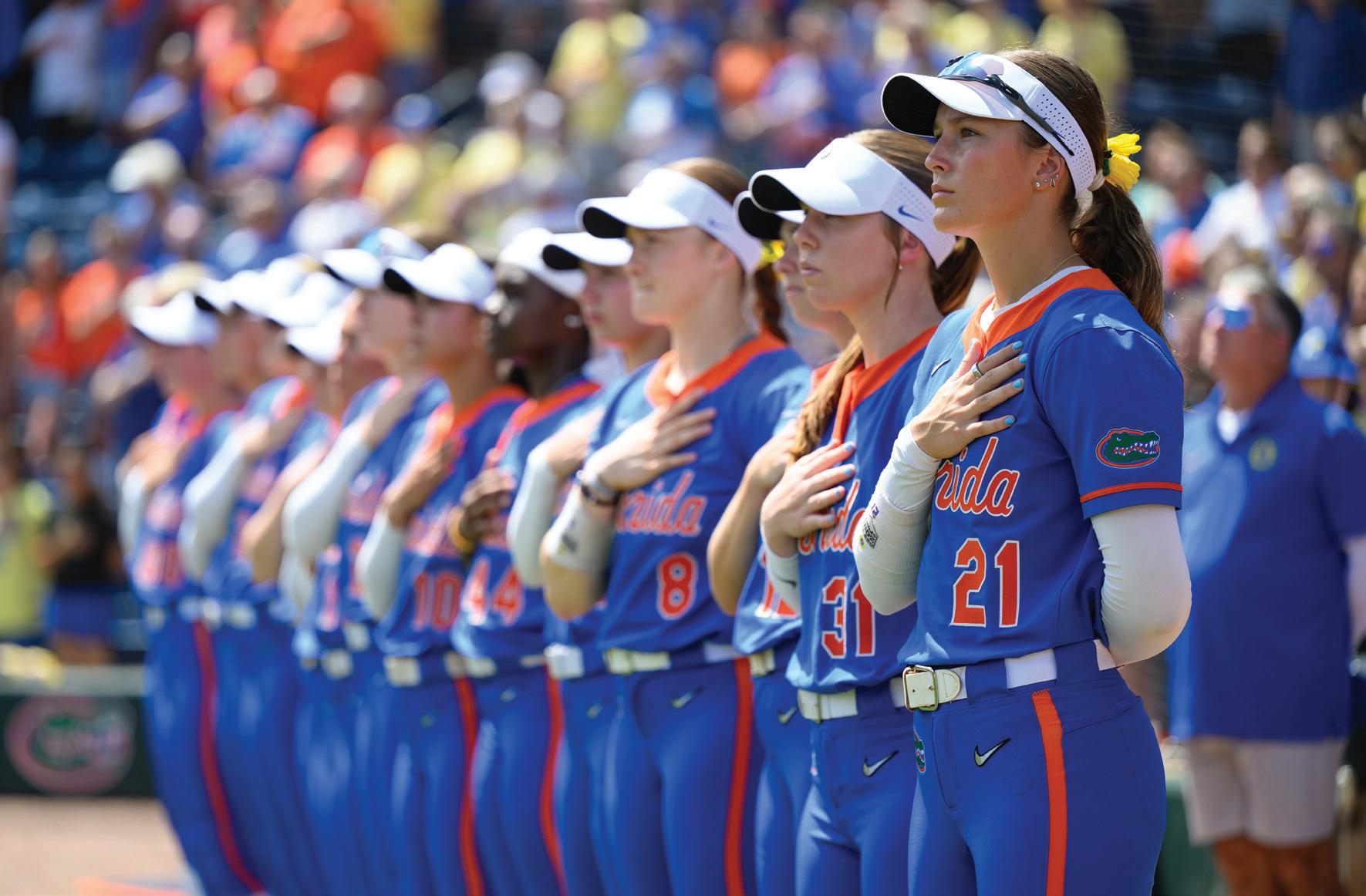
Florida outfielder Taylor Shumaker (21) stands with her team for the national anthem before an NCAA softball game against Mississippi State, Saturday, April 4, 2026, in Gainesville, Fla.
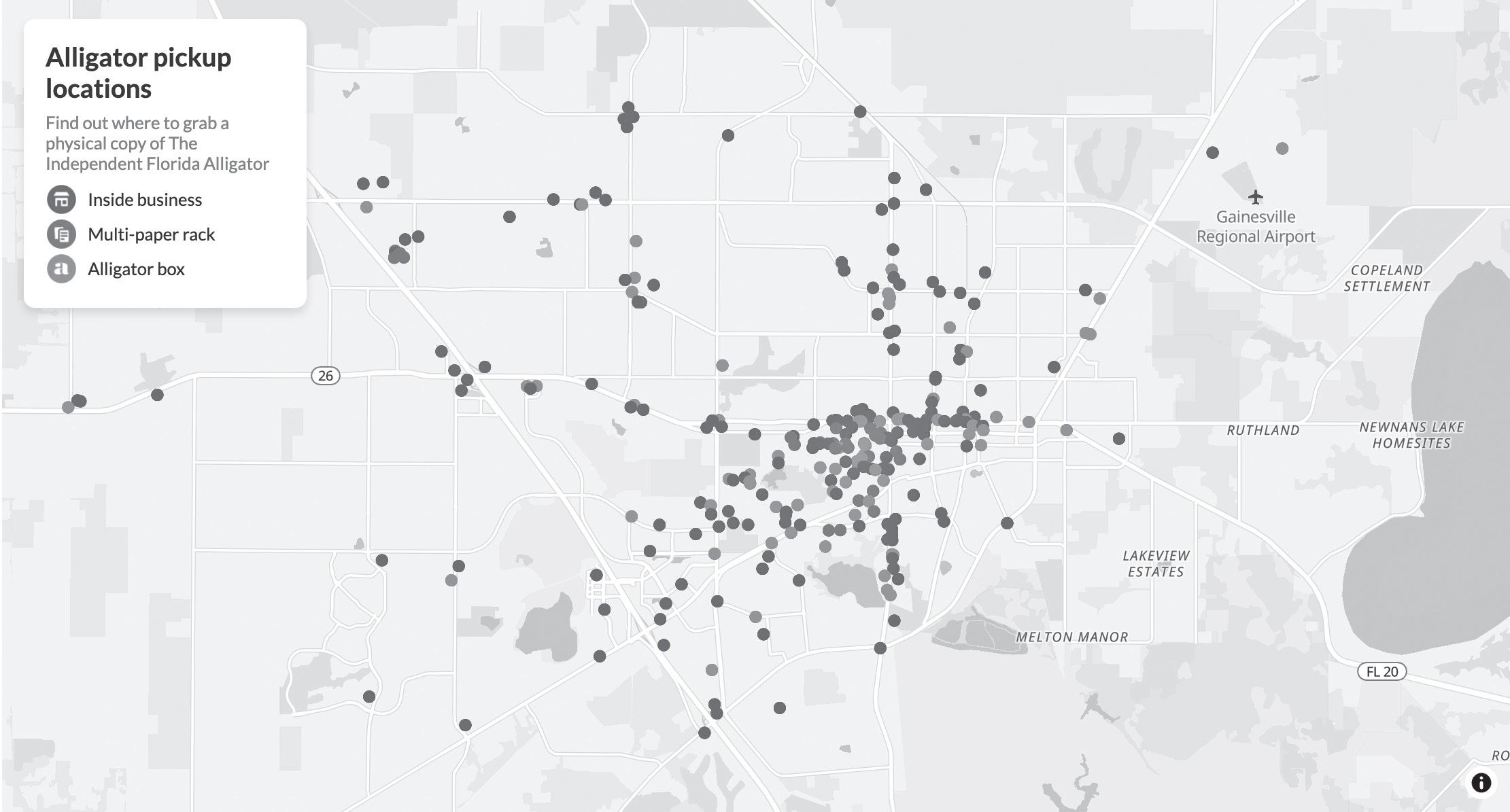
Find a copy of The Alligator near you! Introducing our new interactive map
Whether you’ve lived in Gainesville for years or have just come to call it home, chances are you’ve seen The Alligator. Well, yes, you must have: You’re holding a copy right now.
Our newspaper boxes, bright orange and proudly labeled, aim to catch the eye and invite you — yes, you! — to pick up a free copy of our latest edition. Perhaps you’ve seen our papers stacked in the lobbies of apartment complexes or piled atop racks among other publications. It’s hard to miss our bold, ageless masthead on each cover. Don’t get us wrong — The Alligator has become increasingly digital-first. New stories, columns and photos go up on our website every day. You can read our headlines across Instagram, Facebook and X. We’re working more each day to ensure our work is accessible to everyone, regardless of whether your home is Gainesville or halfway across the world.
But for some of us, there’s something unbeatable about holding a physical newspaper. After all, you just picked one up. Just as e-books aren’t always interchangeable with hardcovers, it’s difficult for our website to replace the delicate shift of turning pages and the intoxicating scent of fresh ink.
And for those with whom that statement rings true or who have asked us where to pick up a copy, look no further.
This past semester, our data designer led the effort to create an interactive map of newspaper pickup locations. With color-coded pins and a click-and-drag format, our map is intended to be user-friendly and easy to navigate. Whether in a stand-alone box or tucked within a grocery store or gas station, consider this your key to finding a copy closest to you.
To access our map, simply hover over the “Data” tab just below our masthead on our website (alligator.org). From there, you can click on the drop-down entry “Alligator Pickup Locations.”
If you notice there isn’t a box or pickup where one is marked on the map, send us an email at editor@alligator. org. We’ll be happy to confirm and make changes where needed.
Thank you for supporting The Alligator.
The Alligator Editorial Board (Bailey Diem, Max Bernstein, Lindee Walker and Alanna Robbert)
Could drinking mucus reduce chronic digestive inflammation?
UF RESEARCHERS DEVELOPED SUBSTANCE TO TREAT DISORDERS LIKE INFLAMMATORY BOWEL DISEASE
By Grace Galloway Alligator Contributing Writer
Drinking mucus developed by UF researchers could reshape how inflammatory bowel disease and similar gastrointestinal disorders are treated.
Researchers Luiz Roesch and Brent Sumerlin designed a synthetic mucus in UF laboratories that could treat the disorders directly, rather than just making the condition more manageable.
Inflammatory bowel disease, commonly referred to as IBD, is an umbrella term for chronic disorders caused by inflammation in the digestive tract. The most common are Crohn’s disease and ulcerative colitis. According to the Centers for Disease Control and Prevention, between 2.4 million and 3.1 million Americans suffer from IBD.
Treatments vary but include dietary changes, immunosuppressant drugs, anti-inflammatory medications, antibiotics and surgeries to remove damaged parts of the gastrointestinal tract.
In 2018, the total U.S. health care
costs for treating IBD were an estimated $8.5 billion. On average, immunosuppressant drugs alone cost between $10,000 and $14,000 per year. Anti-inflammatory diets also tend to cost about $550 more annually, according to the Harvard School of Public Health.
Roesch, one of the researchers developing the synthetic mucus treatment, said existing treatments only focus on relieving symptoms once they appear. That's where the mucus differs.
“When you have too much immune response, a long-term inflammatory process that causes cell damage, that's not beneficial,” Roesch said. “We just want to prevent inflammation from happening in the first place.”
Roesch and his colleague, Sumerlin, worked to mimic the function of natural mucus in the body. Mucus acts as the first line of defense against pathogens through its role as the protective boundary between the intestines and underlying tissues. Damage to the mucus layer leads to gastrointestinal issues. This damage results from underlying genetic issues, smoking or poor diet.
To test the safety and effectiveness of the synthetic mucus, researchers tested the substance on adult mice for 10 days. They added it to the mice's drinking water and watched for any signs of health issues within the time period.
Editor-In-Chief
Digital Managing Editor
Senior News Director
Senior News Director
Social Desk Chief
Metro Editor
The mice didn’t experience harmful effects at any dosage. Results showed the substance was able to restore the mucus barrier integrity and mitigate gut inflammation.
Patients suffering from IBD would be able to incorporate the flavorless mucus into their everyday drinking water rather than taking heavy prescriptions or following restrictive diets.
Amanda Ojeda, a UF doctoral candidate working with Roesch, is researching the use of synthetic mucus in reproductive health.
Ojeda envisions the substance to be similar to powdered Gatorade, she said, but for your gut. Patients would drink the “mucinade” daily, and it would eliminate inflammation, which would in turn relieve symptoms.
“Think of it almost as a BandAid,” she said. “You want your underlying skin to be protected from the external environment.”
Mandy Dimpsey, the senior director of national advancement and volunteer engagement at the Crohn's and Colitis Foundation, said the biggest obstacle was in using medications to best suit patients’ varying needs.
Independent Florida Alligator is a student newspaper serving the University of Florida, published by a nonprofit 501 (c)(3) educational organization, Campus Communications Inc., P.O. Box 14257, Gainesville, Florida, 32604-2257. The Alligator is published Monday mornings, except during holidays and exam periods. The Alligator is a member of the Newspaper Association of America, National Newspaper Association, Florida Press Association and Southern University Newspapers.
The Alligator strives to be accurate and clear in its news reports and editorials. If you find an error, please call our newsroom at 352-376-4458 or email editor@alligator.org 352-376-4458 NEWSROOM:
Discover the ‘buzz’ around Oak Hammock’s Bee Buddies
A retirement community group shares its fascination with beekeeping
By Olivia Lofaso Alligator Staff Writer
With a steady hand, 91-yearold Ray Goldwire presses a jagged knife through rows of honey-filled frames. The wax cracks as sweet, golden nectar spills into a plastic pail below. The blade scrapes against the wood, and with each rough stroke, months of work are released from the honeycomb.
For the Bee Buddies at Oak Hammock, a Gainesville retirement community, this batch of honey represents weeks of attentive beekeeping. For Goldwire, a master beekeeper, the journey began 21 years ago with the purchase of four honey bee hives.
Goldwire didn’t expect to become a beekeeper, let alone attend “bee college.” But after moving to Oak Hammock in 2004, he met a UF student who said the property’s calm, shaded environment would be perfect for keeping bees.
“After maybe about less than a year, I said I need to share all this fun,” Goldwire said.
The Bee Buddies group, established in 2010, has grown to include eight members, each with varying levels of beekeeping ex-
perience. Many have taken — and some have even taught — classes at UF’s Institute of Food and Agricultural Sciences Bee College, a two-day beekeeping training, often using it as an entry into the hobby.
The group has also given presentations at local schools in Gainesville, offering mentorship opportunities to K-12 students and to Oak Hammock residents interested in learning more about beekeeping.
The Bee Buddies’ honey bees live on the 136-acre property in hives tucked beneath a canopy of Spanish moss and sprawling trees. Each wooden box decorated with hand-painted flowers is home to about 30,000 honey bees.
The Bee Buddies now manage four to five hives and harvest honey to sell to residents within the community. On April 19, the group harvested 60 pounds of honey to be bottled in the coming weeks.
According to Oak Hammock, the group harvested more than 100 pounds of honey last fall. With jars priced at $10 each, Goldwire said they sell out quickly, as residents are always eager
for more local honey.
The demand for the Bee Buddies’ honey reflects a broader interest in backyard beekeeping. Interest in beekeeping across Florida has grown significantly in recent years — particularly backyard beekeeping, or maintaining hives in residential areas. Florida has nearly 5,000 registered beekeepers managing more than 650,000 colonies, according to UF/IFAS data.
Molly Ragan, the marketing chair of the Florida State Beekeepers Association and a hobbyist beekeeper, said the association has seen rising numbers in membership.
“Backyard beekeeping has really taken up as a trend,” she said. “There’s so many beekeepers that people can meet and get interested in.”
Alachua County alone boasts 137 registered beekeepers, according to 2025 data by the Florida Department of Agriculture and Consumer Services.
For 78-year-old Tom Ogg, the newest member of the Bee Buddies, his beekeeping journey began just over a year ago at Oak Hammock. He is now taking online courses through the UF/IFAS
Bee College to earn a certification as a master beekeeper.
The best part about beekeeping for Ogg is opening the hive and watching thousands of bees diligently work to produce honey and protect their queen. Aside
from the occasional sting, he finds himself checking on the bees each day just to watch them work.
“Before I started this, I thought I’d be stung to death with all that, but they’re docile,” he said. “It’s just fascinating to watch them.”
olofaso@alligator.org.
OPEN UNTIL 9 PM EVERY THURSDAY
Museum Nights
Thursday, May 14, 6 – 9 pm aMAYzing pARTy!
Celebrate community with our new exhibition One World: Photographs from a Shared Planet and talk with the curator. Meet local artists, join in a Seniors on the Move dance performance and take a drawing workshop.
Wine Down
Thursday, May 28, 6 – 9 pm
Savor light bites, wine and beer while listening to DJ Pepito Von Drácula spinning vinyl sets of Latin soul, salsa and boogaloo.
FREE ADMISSION
image: (detail) Cig Harvey, Scarlet and the Poppies, Rockport, Maine , Digital capture: 2014; print: 2025, Museum purchase, funds provided by the Melvin and Lorna Rubin Fund
Bayden Armstrong // Alligator Staff Bees pollinate flowers at a garden in the Oak Hammock Community, Friday, April 17, 2026, in Gainesville, Fla.
Student group closes healthcare gap
from pg. 1
fers free blood pressure screenings, hygiene kits and referrals to local clinics at sites like Grace Marketplace. Every Sunday from 1 to 2 p.m., the students table at City Hall with Project Downtown Gainesville to offer free screenings.
Vedaant Mutha, a 19-year-old UF economics and biology sophomore, serves as the club’s medical information director. He’s been involved with the club since his freshman year after discovering it at a student engagement fair.
After attending one event, he was hooked. He said he felt connected to the mission of helping those less fortunate in the community, so he continued to get involved.
“We want to serve the underserved population in Gainesville,” Mutha said.
The screenings are designed to catch early warning signs before they become serious health problems, he said.
“Your blood pressure is one of the best indicators of how your overall body is doing,” he said. “It’s like a preventative care measure.”
High blood pressure is one of the most common risk factors for heart disease, stroke and kidney failure. It is nicknamed the “silent killer” because it often doesn’t cause noticeable symptoms.
Mutha said the screenings are especially important for members of the homeless community, many of whom don't have access to healthy food and health resources such as physical exams and medicines.
Volunteers cannot officially diagnose anything because they are undergraduate students, but they refer people to clinics, gain clinical volunteering hours and share the data with the international organization, Mutha said.
H4H, or Hearts for the Homeless, International is a nonprofit organization dedicated to educating and bringing heart health screenings to homeless communities around the world. There are over 40 chapters in the United States alone, and most are on college campuses.
The data are then published in peer-reviewed journals and shared with policymakers across the country to help make lasting changes in health policy in local communities.
While the food is the draw, the tests are an important bonus, said regular Drew Kennard, a 34-yearold Gainesville resident who is homeless.
“For me, it mainly helps with just having a place to eat after having gotten out of jail,” he said.
Kennard said he thinks it's a useful service for older people in the community who aren’t able to regularly stop by clinics.
He personally finds the services helpful because he has HIV, he said, which pushes him to get his blood pressure tested about every six months.
“That's the only reason I go to the doctor,” Kennard said.
Though the health benefits are crucial to Kennard, he said he also appreciates the community the organization provides. Ken-
nard remembers some of the volunteers, he said, and he considers himself a “Gainesville celebrity.”
“Chelsea, right there, you know, she remembers me,” he said, referring to one of the H4H volunteers. “I remember just their organization, Hearts for the Homeless, and I think that they're a cool organization.”
Nidhi Rao, a 19-year-old UF applied physiology and kinesiology sophomore and the organization's social officer, said inter -
actions with patients are what motivate her to pursue health care.
“I’ve always seen myself as someone who feels more fulfilled by talking to people and getting to know their stories,” she said. “The attitude of a provider can make such a difference in a patient’s life.”
Reagan Bresnahan is a contributing writer for The Alligator.
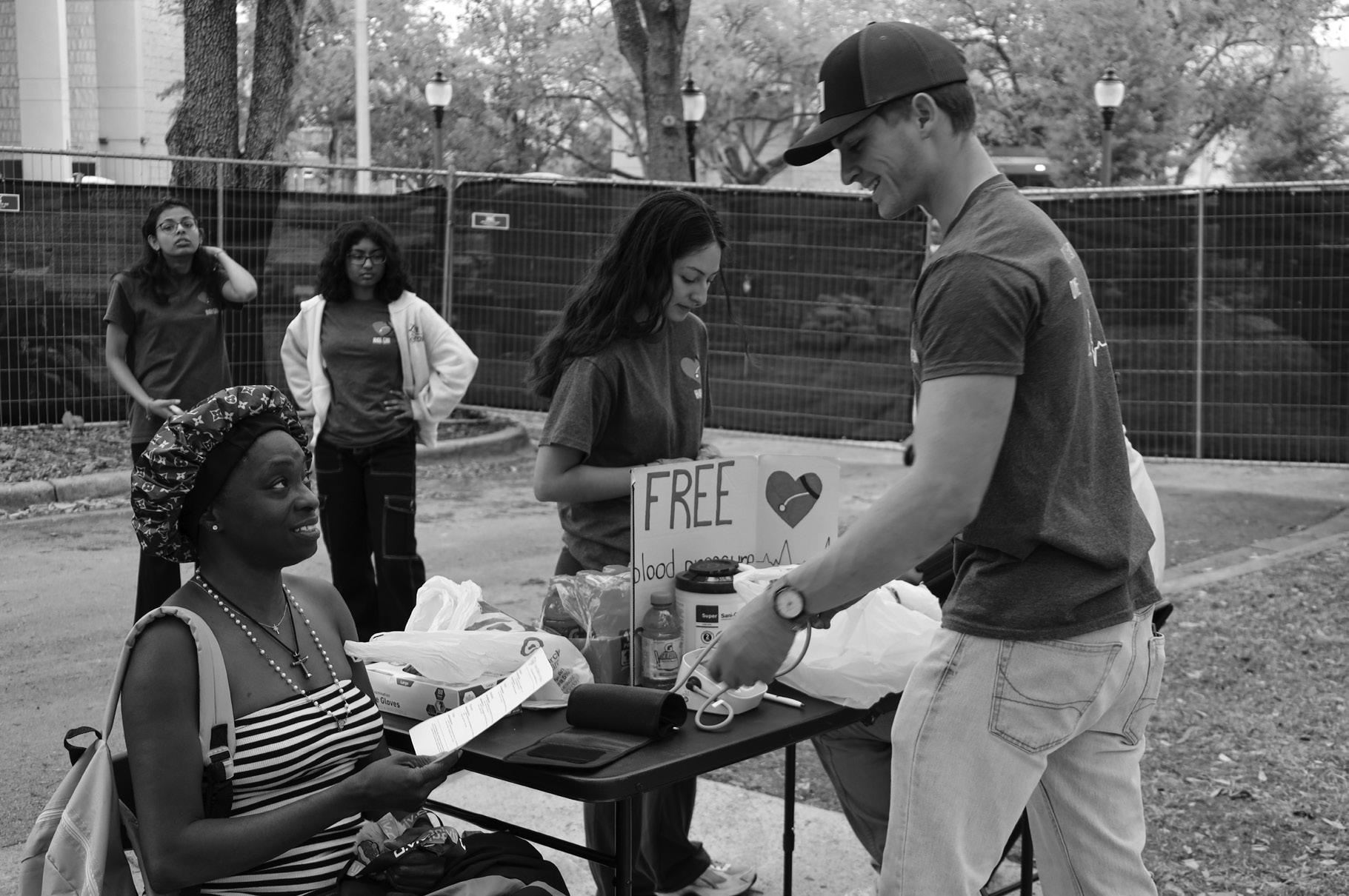
Reagan Bresnahan // Alligator Staff
Lilliana Wells gets a blood pressure test from an H4H volunteer outside city hall, Sunday, March 29, 2026, in Gainesville, Fla.
Stigma persists among Latinos
HEALTH, from pg. 1
medications as treatment for her mental well-being, she added.
When the topic of therapy first came up in Melo’s family, it was viewed as something “crazy.” Therapy is not normalized and often frowned upon in many Hispanic communities, she said.
When she tried to have an open dialogue with family members about mental health, the conversation was quickly shut down because her parents saw it as an excuse for laziness.
Melo's parents view mental health differently because they grew up in survival mode, she said, focusing on working from a young age rather than addressing mental health concerns.
She said her personal stigmatization of mental health stems from how she was raised, and speaking about mental health with her peers makes her feel like a burden.
“It just seems like everyone knows what they are doing, but I'm over here worried about anxiety, about depression and things like that,” Melo said. “If I don't see anyone else talking about it, then I shouldn't talk about it either.”
Mental health stigma among Hispanics is more prevalent among recent immigrants, said Andreas Keil, a UF psychology professor.
“They want to be perceived as strong,
as fitting in, as somebody who wants to make a contribution, get ahead in society,” Keil said.
Many immigrants often escape difficult situations, he said, which can contribute to mental health problems. He remarked on how many are reluctant to share their feelings or thoughts with friends because they may feel inadequate, rejected by society and disadvantaged in professional, social or personal interactions.
When mental health challenges intersect with other identities such as being Hispanic or an immigrant, Keil said the experience can intensify.
Stigma can be experienced differently depending on those identities, he said. Any factor increasing a person's vulnerability is called a stressor and raises the risk of experiencing stigma, he said. Documentation status and language barriers can add additional stressors to immigrants.
“Every little obstacle, every little hassle, every little thing that makes you question that you are appropriate for the role that you are trying to fill in — that adds up, and it adds to mental health problems,” Keil said.
However, he said stigma is decreasing in society as people become more open and accepting of mental health problems.
Interacting within a community and accepting the culture of the country they are in can lower and prevent stigma in immi-
grants, Keil said.
Rafel Ramirez Solórzano, an assistant professor at UF’s Center for Latin American Studies, said stigma stems from the disparity in access to healthcare — whether physical or mental — and society’s view of bilingual and multicultural individuals as a deficit to society. Hispanic immigrants have lived in the United States since before the civil rights movement, he said, but it’s a common misconception they’ve only begun to immigrate recently. Additionally, he pointed out that Latinos have historically lacked access to mental health care .
The stigma and shame also stem from portrayal of Latinos in media, Solórzano said, in which they’re often depicted as “locos,” or “crazy,” being overly emotional or dramatic.
“We see how women are depicted as ‘la loca,’ the hot-headed Latina,” he said.
He continued with how stereotypes and healthcare providers who lack cultural competence, language access and effective communication contribute to distrust among the Hispanic community. “Machista,” or sexist remarks and name-calling, can cause misdiagnoses. This can lead people to drop out of treatment — even if their mental health conditions are severe — because they don’t feel understood.
Asking for help is often difficult, Solórzano said, because Hispanics were told previous generations experienced worse hardships.
“I understand what it means to come from a marginalized community,” Solórzano said. “I understand what it means to
deal with growing up and listening to negative remarks about my culture and having to deal with being excluded.”
The gap in stigma and mental health awareness in the Hispanic community is generational and cultural, he added. Conversations with parents about issues affecting mental health can become complicated when someone brings up issues that are traumatic or complicated in Hispanic society, such as trauma after immigration.
“They don't want to talk about it because of all the trauma they have faced,” Solórzano said. “Mom didn't talk to you about the history of El Salvador because she escaped the Civil War that caused so much harm and death in the family, and that is trauma.”
He said he has seen a peak in stigma in college because of the expectations placed on first-generation and minority students since childhood, as well as the strain financial challenges can cause on their mental health.
“When you are thinking about that young Latino who is entering college or whose parents are immigrants and don't have papers, they are going to have more stress than those American white students who are attending UF,” Solórzano said.
Societal and political climates continue to widen the gap for immigrants, he added.
“We have been stereotyped,” Solórzano said, “Made to believe that we are less than if we seek help, if we seek resources.”
@DulceRodrigueze drodriguez@alligator.org
‘An uphill battle’: Gator grads face tough job market
RECENT GRADUATES DESCRIBE MONTHS-LONG JOB SEARCHES, SHRINKING INTERNSHIP OPPORTUNITIES AND GROWING COMPETITION FOR ENTRYLEVEL WORK
By Swasthi Maharaj Alligator Staff Writer
Madison Cannady graduated from UF with her bachelor’s degree in civil engineering and a master’s degree in water systems in Fall 2025. She applied to jobs on LinkedIn, researched specialized careers in her field, attended career fairs and waited for replies from hiring managers that never came.
It took the 24-year-old UF alumna months to find a job opportunity in her career field, despite graduating with her master’s degree.
Cannady’s experience reflects a broader reality for college graduates in 2026 who are entering a competitive job market where internships are harder to secure — but essential in job applications — and networking is more important than ever.
Unemployment among recent college graduates aged 22 to 27 lies around 5.6% in 2025-26, reported the Federal Reserve Bank of New York. The national average of unemployment across all age groups is 4.2%.
In Alachua County, the unemployment rate was 5.4% in February, a small increase from last year.
Cannady got an internship with the U.S. Army Corps of Engineers during her master’s studies. However, she said she was unable to get a job with the Army Corps after her graduation due to a federal hiring freeze.
Freezes and budget cuts in the environmental field made the process particularly difficult, she said. Despite applying for multiple jobs on LinkedIn, Cannady said she received no responses to most ap-
plications, and budget cuts in the environmental sector further narrowed available opportunities.
It was only after she attended a UF career fair that she was able to secure a job post-graduation. To Cannady, it’s just another sign the job market is getting harder to enter — especially for those without graduate degrees.
“I definitely think it’s gotten tougher within recent years,” she said. “It seems like people are saying the master’s degree is the new bachelor’s because everyone is so highly educated.”
A 2025 research report by The Burning Glass Institute said the job market has reached a point where, for the first time in modern history, a bachelor’s degree is no longer enough to secure a reliable job.
Cannady said she’s found herself in a strange limbo of experience level.
She applied to several internships after graduation, she said, and would receive calls from hiring managers asking why someone with a master’s degree would be applying for an internship.
However, many entry-level jobs required up to five years of experience, she added.
“I obviously can’t get that without getting the experience from somewhere,” Cannady said.
Internship experience is often the deciding factor when employers are deciding between two otherwise qualified candidates, according to the National Association of Colleges and Employers.
But last year’s internship postings tracked by Indeed showed the largest decrease in posted internship opportunities in the last five years.
While some grads have spent months applying to jobs and hoping they’ll stick, others have taken a different approach. Daniela Barrantes, for example, has decided to focus on networking and making connections.
Barrantes, a 22-year-old UF po-
litical science and international studies alumna, said her mentors and internship hirers during her time at UF told her that work experiences would likely come from connections she made with people in the field.
At UF, Barrantes interned in D.C. through UF’s Washington Internship Program. Through a friend she met there, she secured a postgraduation job, which she is set to begin in Miami mid-May.
“I applied for one, and I got one,” she said. “But it was really a matter of networking and knowing who I know.”
But Barrantes acknowledged the market can be a gamble. She said she has friends who applied for over 100 jobs and internships and never heard back or only received one offer.
“It’s very competitive,” she said. “You’re probably competing in an applicant pool of about 400 for a slot of maybe no more than 20.”
Career platform Handshake reported approximately 109 applications for each internship posting in 2024-25, a statistic that doubled the previous year’s figure.
During her senior year, Barrantes’ professors and internship employers often mentioned the difficulty of breaking into the current job market.
“It’s something that people who are 10 years older than us and went through the job market 10 years ago have told us or are telling us now: ‘I wouldn’t want to be in your position,’” she said. “I think that weighs heavier than what I could tell you.”
For international students studying in the U.S., the internship and job landscape looks a little different.
Only about one in four international students complete offcampus internships, compared to nearly half of domestic students, according to a report by Interstride. International students are also 30% less likely to get a job offer from an
Gator alumni in Peace Corps say UF played
THE SWAMP BOASTS THE THIRD HIGHEST NUMBER OF PEACE CORPS VOLUNTEERS AMONG LARGE U.S. UNIVERSITIES
By Alabama Weninegar Alligator Staff Writer
Alayna Dean lives under the East African sun. The 24-year-old UF alumna is a Peace Corps community health outreach volunteer in Kenya. Dean spends her days connecting with the people in her new home, whether she’s teaching students in the classroom or spending time with local families.
Dean draws on what she learned at UF to teach students and other members of the community. She provides health education talks, ensuring they are knowledgeable in topics like family planning and birth control.
UF student life motivated her to serve, she said. Dean graduated from UF in 2024 with a bachelor’s degree in microbiology. During her junior and senior years, she served on the board for student organization Gainesville For All, which works to create solutions for race and poverty problems that North Central Florida faces.
“I really have a passion for service, and I felt like that really solidified during my time at UF,” Dean said.
In a Peace Corps list published April 7, UF placed third for the highest number of Peace Corps volunteers across large colleges and universities nationwide. In the past fiscal year, 44 UF alumni served as Peace Corps volunteers. Last year, UF also ranked third, with 34 UF alumni serving as volunteers.
Dean’s STEM (science, technology, engineering and math) background, the skills she took from her rigorous classes at UF and her time management skills are things she said play into her everyday life in Kenya, and have helped her overcome challenges like learning a new language.
“I felt like I was as prepared as you can be for something like this,” she said.
UF offers “Peace Corp Prep” programs for students interested in working in the agency. The series includes a variety of classes focusing on leadership, language and culture. The prep program has six sectors: agriculture, community economic development, education, environment, health and youth in development.
The classes are meant to show recruiters that students are serious about service, said
internship employer.
H-1B immigration hurdles may compound the existing pressures of the current job market for international students.
Yipin Wei, a 33-year-old UF alumna who graduated with her master’s degree in education, said she recently resigned from her role as an instructional designer within UF’s College of Education.
Wei left her role due to Florida’s public university system issuing a temporary freeze on new H-1B hires through January 2027.
She said many employers have become more reluctant to hire international employees because of the recent increase of H-1B visa fees. However, the fees don’t apply
to employees who were previously on an F-1 student visa.
“When I started looking for a job, I found six out of 10 [employers] don’t provide sponsorship,” she said. “That made me feel really upset because two years ago, when I started to find internships or fulltime jobs, it [wasn’t] like that.”
Wei said the current internship market is just as difficult as the job market. She’s seen her friends apply on LinkedIn and attend UF career fairs, but still not manage to find an internship experience.
“I feel like right now, finding a job as an international student or international employee, it’s been an uphill battle,” Wei said.
@s_maharaj1611 smaharaj@alligator.org
a crucial role in their decision to serve
Joshua Castro, a 37-year-old Peace Corps media content manager.
Castro is also a UF alumnus who served in the Peace Corps. He then served as a recruiter before managing social media.
UF’s large Peace Corps presence is rare to come by, Castro said. Not every college campus offers preparation classes or opportunities to meet recruiters, he added.
“There really is a strong Peace Corps network in Gainesville,” Castro said.
Alex Christy, a 22-year-old UF alumnus and a Peace Corps education volunteer in Kenya, met Dean when the two were on a call with a Peace Corps recruiter.
“It made it seem more real, right?” he said. “It’s possible to get there.”
Christy, who earned a bachelor’s degree in cybersecurity, said he uses skills he learned at UF while teaching in Kenya. When he was a teaching assistant in a cybersecurity class, he used the Socratic method to help explain hard topics to students. In Kenya, he said he uses the same techniques.
One of Christy’s biggest challenges is feeling like an “outsider,” he said — another experience he learned to deal with in college.
“I go in with a mindset of learning,” he said. “If I make a mistake, if I look stupid,
it’ll be OK. I will survive. I’ll make it to the next day.”
At UF, Christy practiced leadership skills while being a club officer for UF’s Student Infosec Team, a cybersecurity club that teaches members about a wide variety of security topics. It prepared him for the leadership roles he has in Kenya, he said, like teaching students and teachers how to use equipment from newly constructed computer labs.
For Thalia Mejia, a 22-year-old UF alumna, the university’s prep classes prepared her for her service in Amealco De Bonfi, Mexico, as a Peace Corps environmental advocate. Mejia had already decided to serve in the Peace Corps before attending UF, she said, but her college coursework played a large role in teaching her how to succeed.
“Learning more about the environment itself and how to connect with people and what is important in different parts of the world,” she said. “That’s what my degree really helped me out with.”
@AlabamaW40513 aweninegar@alligator.org
Henry A. Moore // Alligator Staff UF grads find themselves searching as the job market leaves them without a foothold to start their careers.
MONDAY, MAY 11, 2026
www.alligator.org/section/the-avenue
‘Million Dollar Quartet’ finishes the Hippodrome’s 2025-26 season
ELVIS PRESLEY,
JOHNNY CASH, JERRY LEE
LEWIS AND CARL PERKINS COME TOGETHER IN THIS MUSICAL BASED ON TRUE EVENTS
By Brandy Sumner Avenue Staff Writer
Beneath the red glow of a recording sign, eight people stand surrounded by their instruments and the music they have built their dreams upon.
Four of the most famous musicians of their time — Elvis Presley, Johnny Cash, Jerry Lee Lewis and Carl Perkins — come together in a miraculous jam session of “Million Dollar Quartet,” which rounds out
the 2025-26 season at the Hippodrome, a performing arts theater in downtown Gainesville.
The musical, which debuted in 2010, has enjoyed resounding success across the country, in part due to its connection to an era of music many people are familiar with. The Hippodrome last did a production of “Million Dollar Quartet” in 2019.
“Million Dollar Quartet” uses music to expand on the events of one of the most influential collaborations in music history. The show is based on a real event that took place in December 1956, which brought the four musicians together for a once-in-a-lifetime recording.
“I care a lot about this period of history and just what this music and time did to future generations of artists and musicians,” said Brady Wease. He plays Jerry Lee
Lewis and directs the music for the show.
Set in the recording studio of Sun Records, the small cast of eight actors creates an intimate feeling throughout the musical, as if the audience is privy to the lives of the real people the story is about.
What makes the show special is the music, with the instruments played live by the actors themselves rather than an outside band or recording. Chris Bailey, the marketing director at the Hippodrome, said this aspect of the performance is “part of the magic,” with small slip-ups helping make the characters feel authentic.
Much of the set is kept simple, primarily relying on changes in lighting and the actors’ choices to tell the story and set the mood. Caroline Hanks, who plays the charac-
ter Dyanne — a woman accompanying Elvis Presley to the recording — said the main component of the set is the instruments, a choice that emphasizes the importance of music to the characters and the history that accompanies them.
The show focuses heavily on the characters, spotlighting their interactions with one another and the music industry they work in. The actors create tension and touching moments throughout the show through conversations about their art, life and careers.
“You’re kind of pulled into the moment yourself when you come here and enjoy it,” said Jason Chambers, the lead electrician for the production.
This sentiment is shared by the audience, with people standing and dancing during certain songs and
The summer of horror has begun
AN INCREASE IN HORROR MOVIES RELEASED IN THEATERS COULD REFLECT THE FUTURE OF THE GENRE
By Mackenzie Haas Avenue Staff Writer
“Brat Summer” was all the rage back in 2024. This summer is shaping up to be the summer of horror films.
With movies like “Hokum,” “Obsession,” “Backrooms” and “Leviticus” releasing throughout the season, there appears to be a rise in horror movies coming to theaters. This begs the question: What does this mean for the film industry and its relationship with the genre?
Every year, Rotten Tomatoes publishes a list of upcoming film releases for the summer. This year’s list features 10 hor-
El Caimán
ror movies debuting between May and August.
In May, audiences will be able to watch “Hokum,” “Obsession,” “Passenger” and “Backrooms.” In June, “Scary Movie” (2026) and “Leviticus” will grace movie screens. July will only feature “Evil Dead Burn,” but August will present “Ice Cream Man,” “Teenage Sex and Death at Camp Miasma” and “Insidious: Out of the Further.”
The high release number seems to indicate a positive trend for the film industry and its relationship with horror movies.
In the past, horror movies have infamously been shunned or shut out of conversations about the industry.
For example, only eight horror actors in the almost 100-year-old Academy Awards have taken home Oscars. Only one horror film, “The Silence of the Lambs,” has taken home Best Picture. And only two horror movies have won
El estigma de la salud mental incrementa especialmente en hispanos que son inmigrantes o descendientes de inmigrantes. Leer más en la pagina 7.
even interacting with the actors in a few scenes. Eric Loscheider, who plays Sam Phillips, emphasized the importance of the audience to the overall feeling of the show.
The actors’ direct interaction with and proximity to the audience make the experience feel as much like a concert as it does a musical, he said.
“It’s great to have people in the house,” he said. “It helps sustain the entire thing.”
The show offers a spot of fun coming into the summer months and promises to keep audience members engaged throughout its two-hour run time.
The musical is set to run Wednesday through Sunday until May 24.
bsumner@alligator.org
the Oscar for Best Original Screenplay — including Ryan Coogler’s recent win for “Sinners” (2025).
However, this narrative is changing. Horror movies are being pushed to the forefront of audiences’ attention and are beginning to receive high critical praise.
Movies like “Sinners” — which received four Academy Award wins — are changing the presentation, distribution and enjoyment of horror. It’s clear audiences want horror films in their theaters, and critics are gradually coming to appreciate the genre. The recent surge in horror reflects these changes and revisits established precedents.
In addition, moviegoers are actively searching out more opportunities to see horror movies, some even focusing their theatrical escapades on seeing the genre on the big screen.
Read the rest online at alligator.org/ section/the-avenue.
mhaas@alligator.org
El Caimán
LUNES, 11 DE MAYO DE 2026
www.alligator.org/section/spanish
El estigma de la salud mental persiste entre estudiantes e inmigrantes hispanos
LA CULTURA UNIVERSITARIA
PUEDE PROVOCAR UN AUMENTO DEL ESTIGMA
ENTRE INMIGRANTES Y SUS DESCENDIENTES
Por Dulce Rodriguez- Escamilla Escritora de El Caiman
Aylin Gomez Melo suele dar un paso atrás cuando enfrenta desafíos.
Ella afronta la universidad sola y sin orientación, al ser la primera persona de su familia en pisar un colegio universitario. Navegar las dificultades académicas sólo ha aumentado su ansiedad. Exigirse demasiado no le ha ayudado en el pasado, entonces ha aprendido a tomar distancia para evitar pensar si realmente pertenece allí.
Melo, una estudiante de primer año de diseño gráfico en UF de 19 años con raíces mexicanas y guatemaltecas, dijo que nunca ha tenido una crisis de identidad con respecto a
su cultura. Pero ha notado que se ha vuelto más consciente de su cambio de actitud hacia la salud mental. Aunque generalmente pide ayuda cuando enfrenta dificultades, dijo que hay momentos en los que no lo hace. Sentirse abrumada por la escuela solo contribuye a su síndrome del impostor y dudas sobre sí misma.
La experiencia de Melo refleja los desafíos que enfrentan muchos descendientes de inmigrantes de bajos recursos al ingresar a la educación superior. El estigma que rodea la salud mental hace que muchos opten por no continuar estudios universitarios. Algunos, como Melo, deciden seguir adelante a pesar de ello y suelen enfrentar un estigma aún más fuerte en la universidad.
Melo dijo que muchos otros estudiantes de primera generación tienden a desarrollar esta mentalidad debido a sus experiencias de vida, los factores estresantes que han enfrentado y la forma en que la sociedad los percibe.
“Tengo que ser el ejemplo para mis otras hermanas y para el resto de mi familia porque
soy la mayor,” dijo. “Si pido ayuda, me siento un poco tonta, o como que realmente no puedo acudir a nadie más porque no tengo hermanos mayores ni primos mayores que puedan ayudarme.”
Para Melo, el estigma en torno a la salud mental se intensificó en la universidad. Antes de entrar a la universidad fue diagnosticada con ansiedad y depresión, pero durante su primer semestre dejó de buscar ayuda hasta que su salud mental empeoró.
“Hubo muchas ocasiones en las que no acudí a nadie hasta que mi asistencia era muy mala y mis calificaciones … no eran lo mejor que podían ser,” dijo.
Cuando recibió el diagnóstico de sus condiciones de salud mental, Melo dijo que su familia no fue muy comprensiva. Ella agregó que no aceptaban la idea de la terapia y los medicamentos como tratamiento para su bienestar mental.
Cuando por primera vez la terapia se convirtió en un tema de conversación para la familia de Melo, fue vista como algo “de locos.”
How do Mexicans celebrate Cinco de Mayo? Most don’t
CINCO DE MAYO IS PRIMARILY CELEBRATED IN THE
UNITED STATES
By Dulce Rodriguez- Escamilla Alligator Staff Writer
In the United States, Cinco de Mayo is widely celebrated, often marked by food, drinks and gatherings that incorporate aspects of Mexican culture. Frequently misunderstood as Mexico’s Independence Day, it actually commemorates an entirely different victory — and it’s not a major national holiday in Mexico.
In truth, Mexicans barely celebrate the holiday. Only
Tennis
Gators men’s and women’s tennis teams wrap up their seasons. Read more on pg. 11.
residents from Puebla, Mexico, observe it.
Cinco de Mayo marks Mexico’s 1862 victory over French forces at the Battle of Puebla. The May 5 triumph over Napoleon III’s troops, who sought to collect unpaid debts and establish a monarchy, is now celebrated by Puebla residents through street parades and battle reenactments.
Mexican Americans in California began celebrating the holiday in 1863 as a sign of solidarity and resistance against the European monarchy during the Civil War.
Nearly 100 years later, the Chicano movement popularized Cinco de Mayo, said Rick Stepp, a cultural anthropologist and professor at the UF Center for Latin American Studies.
The Chicano movement, a Mexican American civil rights movement in the 1960s and ‘70s that advocated for political
La terapia no está normalizada y muchas veces es mal vista en las comunidades hispanas, dijo. Cuando intentó tener una conversación abierta con miembros de su familia sobre la salud mental, la conversación fue rápidamente interrumpida porque sus padres lo veían como una excusa para la pereza.
Los padres de Melo ven la salud mental de manera diferente porque crecieron en modo de supervivencia, dijo ella, enfocándose en trabajar desde jóvenes en lugar de abordar preocupaciones relacionadas con la salud mental.
Dijo que su propia estigmatización de la salud mental proviene de la manera en que fue criada. Ella siente que hablar sobre salud mental con sus compañeros podría ser una carga para ellos.
Lea el resto en línea enalligator.org/ section/spanish.
@DulceRodrigueze drodriguez@alligator.org
rights, labor protections and educational equality, adopted the holiday to celebrate Mexican heritage and resistance to oppression.
When companies like beer brands and restaurant chains sought to commercialize it, Stepp said, the holiday expanded.
Stepp said he believes Cinco de Mayo is probably the most misunderstood holiday in North America.
“It’s not a major national holiday at all,” he said. “Kids in Puebla might have school events, maybe a parade or reenactment, but in the rest of the country, it’s just May 5. Business as usual. So there’s this strange disconnect.”
Read the rest online at alligator.org.
@DulceRodrigueze drodriguez@alligator.org
Síganos para actualizaciones
Para obtener actualizaciones de El Caimán, síganos en línea en www.alligator.org/section/spanish.
www.alligator.org/section/opinions
‘Shaine in Spain’: It’s not about the what, but the who
Over the past few weeks, I’ve spent weekends in Porto and Lisbon, Portugal, and Prague, Czechia.
Even though we saw historic churches and buildings, it wasn’t the sights that stuck with me most; we walked into the churches, glanced at the artwork, nodded our heads and moved on. Rather, what stayed with me most were the shared laughter, frustration and moments of joy with my friends. What mattered wasn’t the monuments themselves, but experiencing them together.
I went to Porto with a group of five others people. After a short, six-hour bus ride, we were greeted by a piercing sunset overlooking the Luís I Bridge, where the rows of tiled homes reflected the sun’s glow.
After a very filling plate of sea bass, we headed to one of the main streets in town. There, we stumbled into a bar blasting American 2000s hits where the average age inside had to be 55.
The next day, the temperature got a little chillier, and the wind picked up. After we worked up an appetite walking around narrow and colorful streets, we went to eat Porto’s famous Francesinha.
After an hour or so of waiting, I was finally ready to dig in. Unfortunately, the classic sandwich, typically packed with pork, ham and sausage, didn’t quite hit the spot in vegetarian
form. It sat like a rock in my stomach, but I wasn’t alone; everyone else was struggling to finish theirs, too.
After we all eventually surrendered our dishes and washed them down with some sweet Port wine, we continued exploring. As I continued travelling, there were other moments that were far from perfect.
A few weeks later, I boarded my flight to Prague with another friend. When we arrived, I was amazed by the city’s historic architecture.
While the city was beautiful, the best memories are interchangeable with any place, like when my friend and I were getting ready to go out in our hostel bathroom on our last night in the city.
We met two girls from San Diego State University who were also going out, so we hung out together in the hostel common area until we were ready to leave. A 30-something-yearold man approached us with a Heineken in hand, slurring his words. Caught off guard and uncomfortable, we tried to get him to leave.
“How old are you guys?” he asked.
“Seventeen,” one of the girls cleverly blurted out.
But this didn’t deter him from trying to join us on our trip to the pub.
These situations can be scary, especially when there’s a shared living space involved. We stayed together, keeping a watchful eye on him until he finally took the hint that we weren’t interested in his company. Later in the night, it was something we laughed about and bonded over.
Shaine Davison opinions@alligator.org
It’s moments like these that define a trip — how you and the people you’re with handle the good, the bad and the unexpected. What good is any trip if you’re in bad company?
While that might seem like a blatantly obvious statement, I hadn’t even considered it as someone who has hardlyn’t really travelled. You’re told to see the main landmarks in every city, but that is just a small sliver of any trip.
So, despite the occasional bad meal and creepy hostel man, any trip can be memorable if you are with the right people.
@shaine_in_spain sdavison@alligator.org
Donald Trump inherited a generation of fake stoics, and he loves it
It’s only my second week in Gainesville, and already, everyday experiences are highlighting just how different life here is from home.
Stoicism is a strange philosophy. At its core, it’s a belief that only the directly controllable aspects of life should have an impact on your psyche.
However, the real world doesn’t make distinctions based on whether you can directly control an outcome. Gas prices don’t stay put when war is declared, loved ones don’t give a heads up before passing away and your mental state doesn’t come equipped with a stateof-the-art on-and-off switch.
Yet stoicism — or rather, a distorted and glorified version of it — is a dominant philosophy in the present day.
In a world filled with more externalities than ever and more things to worry about that have a direct influence on our well-being, stoicism is presented as the great escape.
Modern attempts at a stoic lifestyle keep the original goals of preserving a steady state of mind and keeping one’s life on track. But they diverge from their ancient precedent in a keenly 21st-century way — by promising pleasure and wealth as a result of an unfettered way of life. You only have to look at the past couple of years to see how pervasive stoicism is in our cultural scene.
David Goggins, a former Navy SEAL who has built his brand on neo-stoic philosophies such as embracing pain and “callusing the brain,” has made millions by selling merchandise, writing books and creating motivational content.
His idea is that if you can endure any form of hardship, nothing can stop you on your path to success. This simplified version of a robust tradition of philosophy operates like
taking Ozempic and believing you’re spending hours at the gym.
We have glorified being so overly stoic that we don’t value the uncontrollable aspects of life. Even worse, public figures are playing into this stoic mindset to justify lowering their responsibilities.
Most notably, Donald Trump skipped critical negotiation meetings about the war in Iran to attend a UFC pay-per-view event where the announcers praised and spotlighted his appearance.
This showing implicitly tells us one thing: Trump doesn’t believe that he can, will or should make a difference in global talks with Iran.
So, he plays into the stoic philosophy of negating what isn’t directly controllable by enjoying his time at an MMA fight rather than focusing on an unwavering threat. Frankly, it’s pathetic.
The president of the U.S. can disregard the largest threat to American life by being a good little stoic. The issue is that he can influence these talks — and he knows it.
Trump’s pop stoicism is not accidental; it is a finely tuned electoral instrument.
The language of toughness, self-reliance and emotional detachment didn’t organically bubble up from his base; it was cultivated, refined and strategically mirrored back to them by a political figure who recognized its appeal.
When Trump performs indifference to criticism, shrugs off scandal and frames every adversity as something he simply powers through, he isn’t just expressing a personality. He’s selling an identity to voters who want to believe they’re also built differently.
The implicit message is, “I don’t flinch, and neither should you.”
Flattering the listener at the exact moment
they feel most vulnerable — it’s a deeply effective political maneuver.
It tells them their struggles aren’t the consequences of policy failures or decisions made behind closed doors, but rather tests of personal character that only the weak fail.
You aren’t economically squeezed because of decades of wage stagnation and eroding labor protections — you’re being tested. You aren’t drowning in medical debt because of a structurally broken healthcare system — you just need to toughen up and figure it out.
This philosophy conveniently relocates the source of suffering from the external to the internal and, in doing so, quietly absolves the people with the most power to change those conditions.
What makes this especially cynical is that Trump applies stoicism selectively.
He projects stoic invulnerability when it is politically useful: when facing legal indictments, when dismissing unfavorable press and when performing unconcern at a UFC event while Iran negotiations hang in the balance.
But the moment a vote is needed, the suffering of his base becomes real, urgent and entirely the fault of external enemies like immigrants, globalists and the deep state.
The stoic mask slips just long enough to channel grievance into turnout, then it snaps back into place. It is not a philosophy; it is a costume.
And it works because pop stoicism has already done the groundwork.
Years of Goggins’ clips, hustle-culture content and “no excuses” rhetoric have primed most voters to distrust vulnerability, consider asking for help a weakness and admire the person who simply endures.
Trump didn’t create that audience. He
inherited it and instinctively understood how to speak its language.
In that sense, the UFC appearance wasn’t a lapse in judgment. It was a perfectly legible signal to a base taught to read detachment as strength and strength as the only trait worth following.
This is the quiet rot at the center of pop stoicism’s political life.
When an ordinary citizen detaches from outcomes they can’t control, it’s a personal lapse in engagement at worst. But when the most powerful executive in the world does it, detachment becomes dereliction.
The original Stoics never confused equanimity with abdication. Roman emperor and philosopher Marcus Aurelius wrote “Meditations” while commanding armies and presiding over a plague-ridden empire.
He did not retreat from the weight of consequence; he wrote to steel himself for it. The point was never to shrink from what you could affect — it was to stop torturing yourself over what you could not.
That distinction, razor-thin on paper, is everything in practice.
What modern stoicism sells — and what its political inheritors have perfected — is the erasure of that distinction entirely.
Read the rest online at alligator.org/section/ opinions.
smorel@alligator.org
Sasha Morel opinions@alligator.org
Los Angeles Times Daily Crossword Puzzle
How to Place a Classified Ad:
APT FOR RENT - Furnished 1BR/ 2nd floor, heat/air not central. 10 Minutes to campus 409 SE 14th Pl. Asking $875. Grad students preferred. 1 pet cat allowed. No drinking, drugs, smoking. 55 & Older. 352-213-5942 5-26-26-3-1
We Buy Houses for Cash AS-IS! No repairs. No fuss. Any condition. Easy process: Call, get cash offer and get paid. Call today for your fair cash offer: 1-321-603-3026 5-11-24-5
Sublease Apartment I am trying to find someone to sublet my apartment in Cabana Beach from May-July. It is 1BR/1BA in a 4BD/4BTH unit. Rent is $529/mo includes utilities in rent, large walkin closet, private bathroom, updated kitchen and bath, full kitchen with appliances, free parking. 352-222-1029 6-1-26-4-3
The surf's up at "Pawn Beach". We're all making the scene. If you're in need go see Rich, Best Jewelry and Loan's got the "green" 523
Seeking: Paranormal & Cryptid Enthusiasts for informal group. Especially psychics and mediums. gnvshadows@protonmail.com 5-26-3-13
Submit your ad today! www.alligator.org/classifieds
Donate your vehicle to help find missing kids and keep kids safe. Fast free pickup, running or not, 24 hr. response. No emission test required, maximum tax deduction. Support Find the Children Call – Call 1-833-546-7050 5-11-50-12
14 Help Wanted
Planning to liquidate stereos, TV's, instruments and tools? See Rich at Best He'll give cash for your jewels 523 NW 3rd Ave 352-371-4367 8-12-13-14
15 Services
HELP SAVE AMERICA!⭐⭐ "Thou Shalt Not Lie." BANNERS ⭐ T-SHIRTS ⭐ HATS BUMPERSTICKERS ⭐ BILLBOARDS 856-776-1176, rememberthelawofmoses.org 5-26-26-4-20
● ● ● PLAY PAINTBALL ● ● ● Wayne’s World of Paintball 4841 S. Pine (Hwy. 441) Ocala, FL 352-401-1801 www.waynes-world.com 4-27-26-14-21
BATH & SHOWER UPDATES in as little as ONE DAY! Affordable prices - No payments for 18 months! Lifetime warranty & professional installs. Senior & Military Discounts available. Call: 1-833-754-2465 5-11-99-15
Training?
Planning an event?
Submit your ad today! www.alligator.org/classifieds
1. GEOGRAPHY: What is the capital of Belarus?
2. LITERATURE: Which Ken Kesey novel is set in an Oregon psychiatric hospital?
3. MYTHOLOGY: Who is the Greek goddess of discord?
4. ANATOMY: What is the longest bone in the human body?
5. U.S. PRESIDENTS: Which president was a commanding general in World War II?
6. MATH: What kind of polygon has three sides?
7. BIBLE: What is the last book in the Bible called?
8. ASTRONOMY: Which planet in our solar system is closest in size to Earth?
9. CHEMISTRY: What is the newest element on the Periodic Table?
2. Name the actor who played baseball legend Ty Cobb in director Ron Shelton's 1994 sports biography film "Cobb."
3. What two NFL teams merged for the 1944 season due to a shortage of players during World War II?
4. Anton Geesink became the first non-Japanese judoka to win a gold medal at the World Judo Championships (1961) and won gold at the 1964 Tokyo Olympics. Geesink represented what country?
5. Name the Brazilian tennis player who won French Open men's singles titles in 1997, 2000 and 2001.
6. Which Cincinnati Reds player won the Tip O'Neill Award for best Canadian baseball player seven times from 2010 to 2017?
7. What South Asian island nation's men's cricket team, nicknamed the Lions, won the 1996 ICC Cricket World Cup?
Tommy Lee Jones.
The Pittsburgh Steelers and Chicago Cardinals.
Netherlands.
Gustavo Kuerten.
Joey Votto.
Sri Lanka.
Minsk.
Femur.
Dwight Eisenhower.
Triangle.
Book of Revelation.
Oganesson (Og).
John Candy.
MONDAY, MAY 11, 2026
www.alligator.org/section/sports
MEN'S TENNIS
A season in review: Florida men’s tennis
THE GATORS FINISHED WITH A 17-14, 6-8 SEC RECORD
By Ethan Feinberg Sports Writer
For three straight years, the Florida men’s tennis team saw its season end at the hands of the Central Florida Knights in the NCAA Division I Tournament. Further exacerbating the loss, the Knights eliminated the Gators with a four-point comeback, just like they did in the 2023-24 season.
But while the weight of defeat sits atop their shoulders, the Gators have plenty of reason to hold their heads high. They remained a consistent top-25 program throughout the season, posted a winning record and amassed numerous top-100 players.
Concluding 2026 with a 17-14 overall record and 6-8 in the Southeastern Conference, Florida’s season was defined by competitive play, SEC struggles and dominant victories.
Notable victories
Florida started the season strong at 3-0, which advanced them to the Intercollegiate Tennis Association National Team Indoor Championships.
It all began Jan. 23 at the ITA Kickoff Weekend in Columbia, New York. There, Florida ultimately defeated No. 23 Kentucky, 4-2, when freshman Andreas Timini, a young but dominant player, secured the win.
The Gators followed with perhaps their best win of the season, an upset victory over No. 13 Columbia University in its own backyard. Like the day before, UF secured a 4-2 win, and none other than Timini closed it out with a hard-fought 6-3, 3-6, 6-2 win.
Fast forward to Feb. 14, when the Gators tacked on another upset victory, this time over No. 16 Clemson in the second day of the ITA Indoors. Florida took the lead early with the doubles duo of junior Kevin Edengren and Timini securing the first point for the team.
It became a common sight to see the duo land a doubles point, as they posted a teamhigh 15-7 doubles record. Edengren’s dominance that day offered a flash of victories to come. He brought the Gators a 4-3 win with his comeback performance, 6-7, 6-4, 6-4. But it wasn’t just one or two players manning the spotlight for the whole season; many of the supporting cast played defining roles in UF’s success.
In SEC play against No. 41 Alabama, seniors Lorenzo Claverie and Pablo Perez Ramos and junior Jeremy Jin all won in straight sets, securing the final points in a 4-2 win over the Tide.
Sophomore Francesco Cordova also stepped up to win the final point in a 6-1, 6-4 straight-set duel March 29. His dominant
win led the Gators to a 4-0 sweep of North Carolina A&T in the season's lone singlesonly match.
These victories came from relentless practice, a supportive coaching staff and a team culture built on brotherhood.
Complete control and the means behind it
In the 2025-26 season, the Gators recorded six shutout victories and four wins where their opponents only scored one point. Their highest scoring games came in a 7-0 win against Presbyterian College late in the season and a 6-1 conquest of No. 23 Ole Miss in early March.
The key to those commanding contests became service box control, a towering presence, ace balls and “hawk 'em down” abilities. To overpower opponents in both doubles and singles, the Gators’ key playstyle involved crashing the service box and staying close to the net. The strategy forced opponents to react quickly because UF returned extremely difficult soft-touch chops and up-top slams.
Other key presences in the service boxes were the mixed duos of Jefferson, Claverie, Ramos and Adhithya Ganesan, who all stand at or above 6-foot-1. These giants could cover the court in just a few easy steps, forcing opponents to exert more energy and take harder, riskier shots.
Along with the tall presence, even the shorter Gators presented challenges. For example, 5-foot-11 Edengren carved up 12 aces and 12 winners against Clemson, and 5-foot-10 Jin sent missile-like forehands to his opponents all season long.
But the smaller players didn’t get to have all the fun. The tall guys indulged in the action as well, with Jefferson and Claverie dropping aces followed by sideline winners. Ramos also tended to regain composure and deliver a perfect ace after a failed first serve. The combination of these tactics showed up in big moments, leading the Gators to victory.
Another weapon in their arsenal was the ability to track down balls and send them back into the fight, seeking out points. Players like Claverie and Jefferson, who respectively stand at 6-foot-5 and 6-foot-6, have long strides that make covering the court much easier. The smaller players, lacking this luxury, made up for it in speed. Fans could audibly hear them hit the brakes on returns, as the squeaks of their shoes were followed by the roar of the crowd.
Read the rest online at alligator.org/ section/sports.
@thefeinline efeinberg@alligator.org
WOMEN'S TENNIS
A season in review: Florida women’s tennis
THE GATORS NEARLY DOUBLED THEIR WIN TOTAL FROM LAST SEASON
By Sofia Alamo Sports Writer
If the Florida women’s tennis 2026 season could be summed up in one word, it would be “comeback.”
After amassing just a 9-14 record in 2025, the Gators found success with a refreshed, improved squad in 2026. Despite Florida being a young team that welcomed three new players, head coach Per Nilsson saw depth and potential.
The results spoke for themselves. The Gators brought their coach's vision to life, reaching a peak ranking of No. 12 in the nation, their highest since January 2024. Fueled by close, hard-fought victories, Florida showed just how far it could go when riding serious momentum, finishing the season with a 17-8 record that nearly doubled last year’s win total.
Victories to remember Florida’s greatest strength was stepping up when the competition was toughest. Against then-No. 11 Oklahoma, the Gators played close games on every court. After the doubles point slipped away, Florida relied on singles to stay in the match, and graduate student India Houghton delivered her best. She defeated then-No. 17 Julia Garcia Ruiz in straight sets, 7-6, 6-2.
Freshman Lucie Pawlak followed with a three-set win over Salakthip Ounmuang, 6-4, 5-7, 6-4, giving Florida a 4-3 victory and slowly solidifying herself as the team’s clutch player.
In their next match against No. 11 Tennessee, the Gators again showed they don’t break a sweat against top-ranked opponents.
Despite dropping the doubles point, Valery Gynina found her groove against Vanesa Suarez, winning 6-4, 7-5. Pawlak then secured the overall victory with a 4-6, 6-3, 7-6 win over Francesca Mattioli that led Florida to a 4-2 finish.
Even as the NCAA tournament approached, the Gators showed no signs of struggle against then-No. 13 Vanderbilt, sweeping the Commodores 4-0.
Florida earned the doubles point with a dominant 6-2 win from Brooke Black and Gynina over the No. 10 doubles team in the country, Valeria Ray and Bridget Stammel. The duo of Pawlak and Houghton added a 6-3 victory, giving the Gators the advantage before singles sealed the sweep. Houghton dominated then-No. 6 Stammel, 6-3, 6-4, and Gynina and Pawlak came out victorious on their respective courts.
All of these ranked wins came at the Al-
Standout players
Freshmen were a driving force behind Florida’s impressive season.
Leading the team with 22 victories — the most wins in the season of any player — Pawlak proved herself as a vital part of the Florida squad in her freshman year. The 20 year old posted an 8-1 record in three-set matches, proving she had the endurance needed to close out in high-pressure moments.
Black also had an impressive first season at Florida. She finished with a singles record of 10-5 and held the team’s longest winning streak with seven consecutive victories. On the doubles side, Black and Gynina recorded a five-game winning streak in the early season.
Houghton earned the court one position halfway through the season, posting a 6-7 singles record. Claiming top wins against tough opponents like Oklahoma’s then-No. 18 Garcia Ruiz and Vanderbilt’s then-No. 6 Stammel, the graduate made an impact in just one year at Florida.
In March, the Gators became one of two teams in the nation to boast at least six ranked players.
Where they struggled
The Gators remained inconsistent in doubles play throughout the season. Though the team started strong, winning the doubles point in five straight matches, conference play exposed weaknesses.
The duo of Gynina and Black held a fivegame winning streak and led Florida as the strongest doubles team of the group.
The Gators lost their first doubles point to then-No. 13 Auburn in the conference opener, setting the tone for a rocky rest of the season. At one point, Florida dropped the doubles point in three consecutive matches.
However, the Gators have repeatedly shown doubles performance doesn’t shake their confidence heading into singles. Instead, the team continued to lean on its more consistent strength: dominating singles play.
Finishing with an overall 14-11 record, doubles play is an area to sharpen heading into the upcoming season. Nilsson stressed Florida’s need to simplify its doubles strategy and focus on team communication.
Read the rest online at alligator.org/section/sports. @alamosofiaa salamo@alligator.org
fred A. Ring Tennis Complex, where the Gators fed off their home crowd. An 11-2 home record proved nothing fueled Florida more than playing on Gator soil.
Seven Gators earn All-SEC honors ahead of postseason push
UF’S FOUR FIRST-TEAM SELECTIONS MATCHED A LEAGUE HIGH
By Zach Moore Sports Writer
As the regular season comes to a close and UF rolls into the postseasons, the Gators are hungry for their 14th Women’s College World Series appearance. Florida culminated the regular season with a 48-10 record and a third-place finish in the Southeastern Conference.
But for that to happen, it took a collective effort from the smallest roster among Power Four programs. Thanks to those efforts, seven Gators earned All-SEC honors May 8, including four first-team selections, tying Oklahoma and Texas for the most in the conference.
Leading the honors for Florida is senior catcher Jocelyn Erickson. Her game-tying home run in Florida’s 10-9 SEC Tournament victory over Auburn made her the fifth player in program history to hit 50 or more career home runs as a Gator, joining Lauren Haeger (71), Megan Bush (65), Francesca Enea (61) and Kelsey Bruder (52).
In conference play, Erickson ranked among the SEC’s top 10 in home runs (8), RBIs (27), slugging percentage (.735), doubles (6) and on-base plus slugging (1.167).
Senior Day marked an emotional moment for Erickson. Not only did it celebrate her career as a Gator, but it also set the stage for her professional future. She received an Athletes Unlimited Softball League Golden Ticket and was overcome with emotion following the announcement.
“[The] University of Florida changed my life forever,” she said, as tears rolled down her face. “They
have impacted my life in so many ways [and] I would not be the person, leader or friend I am today without them.”
Heading into the season, head coach Tim Walton was candid about superstar Taylor Shumaker following her record-breaking freshman campaign. He implied that if people compared her sophomore season to her NFCA Freshman of the Year campaign, it would not be considered a successful year for her.
The sophomore has continued to amaze from the leadoff spot and in the outfield. Shumaker led the Gators at the plate with a .443 batting average and joined Erickson in being named a top 25 finalist for the USA Softball Player of the Year Award.
While still an underclassman, Taylor Shumaker has emerged as one of Florida’s leaders by learning from those who came before her.
Walton recalled Shumaker went the extra mile for the team — and for the fans — and made it a priority even before the season.
“We brought a kid on a visit, and [Taylor] flew all the way from California to Gainesville to make sure she was on campus for that kid’s visit,” Walton said. “That tells you a little bit about how important people are to Taylor Shumaker.”
Above all, there has been one player who has made her mark specifically in conference play: left fielder Townsen Thomas. After bouncing around the order in non-conference play, the redshirt freshman found her stride in the cleanup spot and ran with it.
Through SEC play, Thomas tallied 10 multi-hit games and six multiRBI games. She earned two SEC Freshman of the Week honors following Florida’s sweep of Kentucky and series win over Auburn.
infielder Kenleigh
Erickson (8) after both were awarded Athletes Unlimited Softball League Golden Tickets after an NCAA softball game against Auburn, Saturday, April 18, 2026, in Gainesville, Fla.
Thomas has also showcased her versatility in the outfield, moving between center and left field. Her efforts emphasized UF’s outfielders are willing to play wherever the team needs them.
“We are all very dynamic,” Thomas said. “We can all play whatever position is needed from us, and that's just something really special that we each admire.”
It was only fitting the work-
horse of Florida’s pitching staff, junior right-hander Keagan Rothrock, also received All-SEC honors. She compiled an SEC-best 166 innings pitched and 25 wins in conference play. Rothrock’s postseason success will be crucial if the Gators hope to return to Oklahoma City.
Senior shortstop Kenleigh Cahalan and junior right fielder Cassidy McLellan both received second-team honors.
Cahalan has provided a consistent bat all season, tallying five home runs, four doubles, 14 RBIs, seven walks and 15 runs in SEC play. Defensively, she posted a .990 fielding percentage in conference play, committing just one error in 24 games. Cahalan also joined Erickson in receiving an AUSL Golden Ticket.
On the other hand, 2026 has provided a breakout season for McLellan. After sitting behind Korbe Otis for two seasons, she was promised a starting job — and she’s capitalized on the opportunity.
At the plate, she tallied six multihit games and four multi-RBI games, including her five RBIs at South Carolina April 11.
Meanwhile, sophomore second baseman Gabi Comia has been the defensive catalyst this season, and her efforts haven’t gone unnoticed. Comia earned a spot on the All-SEC Defensive Team after posting a perfect fielding percentage in conference play across 87 chances with 36 assists. She also helped turn a teamhigh nine double plays.
Comia said the recognition is a testament to the hard work Florida’s infield puts in every day.
“We work really, really hard on it,” Comia said. “Just trusting that my positioning is right and then trusting that these girls are behind me.”
Florida earned the No. 6 overall national seed in the NCAA Tournament and will host the Gainesville Regional featuring Texas State (3820), Georgia Tech (30-27) and Florida A&M (32-20). UF opens regional play against FAMU May 15 at Katie Seashole Pressly Stadium. First pitch is scheduled for 11 a.m.