UF one vote away from a president as Board of Governors delay confirmation
POLICY EXPERTS AND STUDENTS REFLECT ON LEADERSHIP TURNOVERS, PRESIDENTIAL REJECTIONS AND A LACK OF TRANSPARENCY IN THE STATE’S FLAGSHIP SEARCH PROCESS
By Swasthi Maharaj Alligator Staff Writer
Former University of Alabama President Stuart Bell is one vote away from potentially becoming UF’s next president as scrutiny intensifies over Florida’s university leadership process.
Florida’s university system requires presidents to gain approval from both a university’s Board of Trustees and the state’s Board of Governors. While trustees conduct the search and select a finalist, the Board of Governors holds final authority to confirm the candidate.
After receiving unanimous approval from UF’s Board of Trustees June 10, Bell was scheduled to appear before the Florida Board of Governors June 24 for final confirmation.
However, Board of Governors Chair Alan Levine wrote in a June 17 letter to Chancellor Ray Rodrigues that the board would be delaying the vote indefinitely, citing university gov-
ernance concerns.
Levine said he’s concerned UF policies may allow too much authority to be afforded to one person, empowering individual trustees or board chairs to make decisions that should be made by the full board.
In a May 20 letter to Rodrigues, he said it would be “egregious” if decisions were removed from full-board, public deliberation.
According to a message posted on UF’s X account, the decision to postpone Bell’s vote is “unfair to Dr. Bell and harmful to the University of Florida and the students, faculty, alumni, and supporters we are entrusted to serve.”
On June 22, the Board of Trustees voted unanimously to make Bell UF’s interim president.
His interim appointment will begin July 1 and run through June 30, 2027. The agreement states trustees “intend and expect” Bell to be confirmed by the Board of Governors, at which point a permanent presidential contract would replace his interim position.
Bell’s interim position is also subject to ratification by the Board of Governors.
This all comes just over a year after the Board of Governors rejected former presidential finalist Santa Ono in a 10-6 vote. Ono, a former president of the University of Michigan,
SEE UF PRESIDENT, PAGE 4
New law adds another chapter to fight over GRU
By Logan McBride Alligator Staff Writer
Gov. Ron DeSantis signed a bill June 12 to further establish the GRU Authority’s control over Gainesville Regional Utilities, putting what could be the final cap on a yearslong battle. The bill, which focuses primarily on municipal utilities that provide service outside their city limits, was amended to add the subsection impacting GRU.
This is the latest development in a three-year battle over the utility that has included two city referendums, legal battles before Florida’s District Courts of Appeal and now two major state bills.
In June 2023, DeSantis signed a law ending Gainesville’s 116 years of control, switching to a five-member board appointed by the governor.
The city responded with two referendums looking to restore local control. The first, approved by 73% of voters in 2024, was thrown out by
a judge over misleading ballot language. In 2025, residents once again voted in favor of restoring local control over the utility.
But the new law signed by DeSantis may prevent that from happening.
The 24-word subsection — which passed 85-26 in the Florida House and 30-6 in the Senate — reinforces state control.
“The subject of a regional utilities authority created by the Legislature through charter amendment after
January 1, 2023, is expressly preempted to the state,” the bill reads.
A preemption keeps local governments from altering the policy or rules on a topic. This one keeps Gainesville from making changes or reclaiming control of GRU, because its governance is now reserved for the state.
Gainesville is the only city in the state impacted by this subsection.
Gainesville Commissioner Bryan Eastman said the city isn’t quitting its fight for control over the utility.
“Our city attorney has put forward arguments to the District Court
of Appeals showing that this provision was overbroad, poorly written and may not do what they intended for it to do,” Eastman said. “We’re continuing to follow through on that.”
Eastman disagreed with the language of the bill. Usually, when something is preempted to the state, he said it’s very clear, like gun laws. The city can’t pass any rules related to firearms, and only state laws related to firearms are on the books.
Eastman added it was “weird” and “confusing” to preempt something that only exists at the local level.
He said he believes the bill was
SEE GRU, PAGE 4
Noah Lantor // Alligator Staff
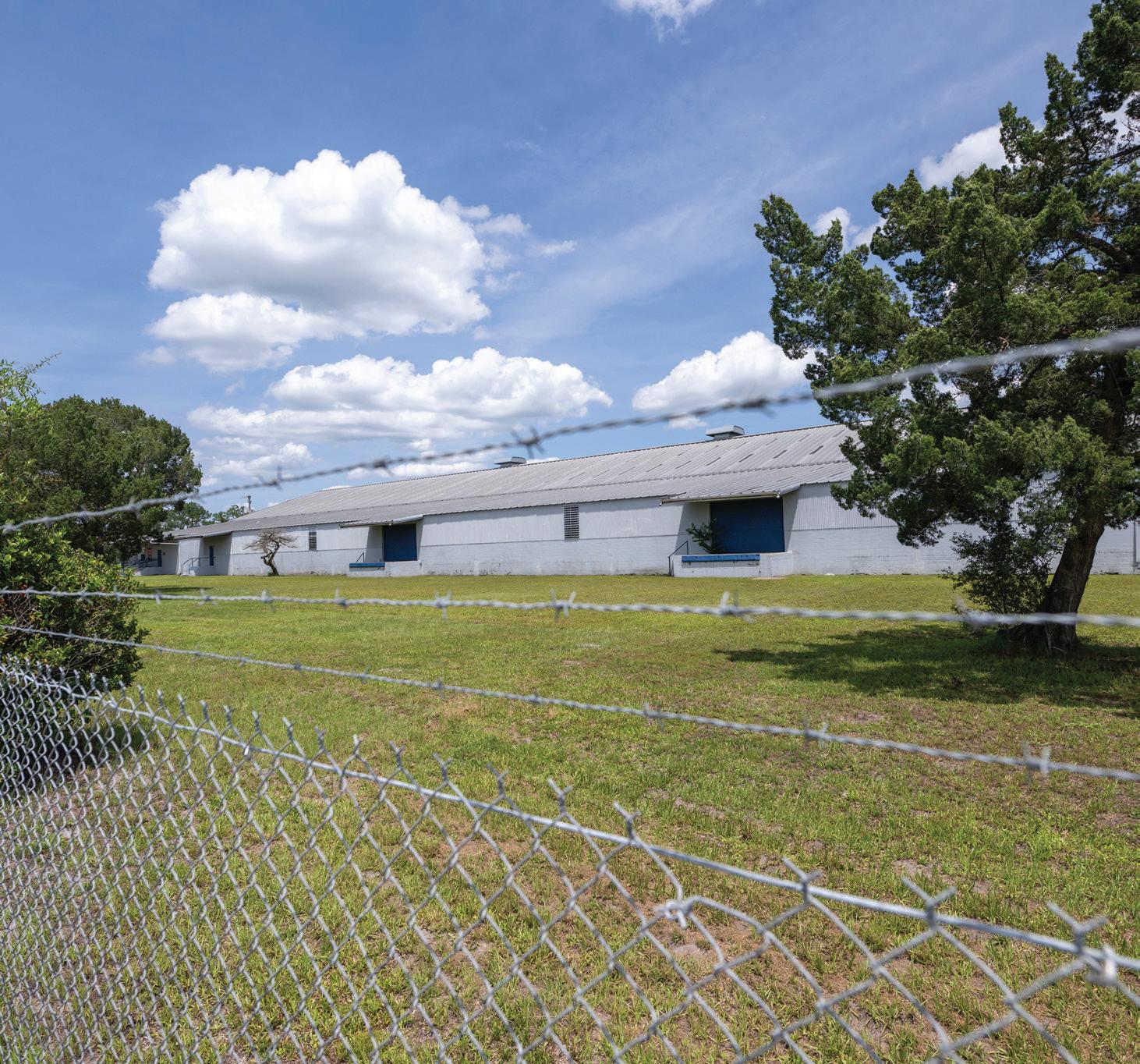
A 104,000 square foot building sits empty, Saturday, June 20, 2026, near downtown Starke, Fla. Read more on pg. 2.
Amid Alligator Alcatraz closure, residents ask if an ICE center agrees ‘everything is better in Bradford’
RESIDENTS AND ACTIVISTS
RALLY AGAINST PROPOSED ICE DETENTION CENTER IN STARKE
By Chloe Santiago Alligator Contributing Writer
Bradford County residents and local activist groups have grappled with the question of legacy for months.
Hundreds have spoken out against proposals for a U.S. Immigration and Customs Enforcement detention center in Starke, a city in Bradford County that hosts a population of just under 6,000.
In January, Sabot Consulting, a self-described “plug-and-play” office of ICE integration, pitched a multi-phase project to convert an unused 100,000-square-foot warehouse facility and its surrounding area into a detention center capable of hosting 3,000 immigrants awaiting deportation processing.
The drive from Gainesville to Starke is under an hour. Entering from U.S. 301, the warehouse — commonly known as the Douglas Building — is the first thing many people see. The building lies just half a mile from the city’s only Walmart Supercenter.
The high visibility of the intended site has drawn criticism and widespread attention for the project, which comes at a time when ICE warehouse operations are winding down under new Department of Homeland Security Secretary Markwayne Mullin.
As of June 25, Gov. Ron DeSantis announced the official closure of the controversial Alligator Alcatraz in the Everglades after 11 months in operation. ICE detainees have brought light to the hazardous living conditions, difficulty accessing legal services and mistreatment that ran rampant in the facility, according to the Miami Herald.
In Bradford County, fears that detainees would be subjected to the same treatment in their hometown ran high. Some have expressed concerns about the damage a detention center would do to the city’s legacy. To others, the project’s lack of transparency bolstered frustration more than anything. At a county commission meeting on April 16, plans for a Starke ICE detention center were put on pause.
Sabot’s plan stated it would create jobs and work hand in hand with the Bradford County Sheriff’s Office, led by Sheriff Gordon Smith, to use an available county resource.
Activist groups and Bradford residents saw another side to the story.
Activists swarmed nearby Camp Blanding to protest when the site was announced as a potential detention center in July. Beneath blazing summer heat, over 250 people protested not just Camp Blanding but the ongoing expansion of Florida’s immigration enforcement policies.
Plans for a Camp Blanding facility were repurposed at the Baker Correctional Institute. Controversy around new ICE detention centers continues.
Jyoti Parmar directs North Central Florida Indivisible, a grassroots left-wing group advocating for immigration rights, political organizing and representative democracy. She and Indivisible previously organized a press conference to inform the public about Camp Blanding.
“It’s just wrong from all possible directions,” Parmar said. “Making money off the liberty of people should not be a thing.”
Indivisible packed the Bradford County Commission meetings alongside groups like the Sierra Club, the Bradford Environmental Forum and the Democratic Women’s Club of Alachua County. People hailing from as far as Jacksonville and St. Augustine spoke alongside Bradford residents.
“It was just word of mouth,” Parmar said. “We got the word out, and people came who cared.”
But the number of outside voices raised some questions about how much they should be allowed to weigh in on Bradford County affairs. At some meetings, the number of speakers from outside the county outnumbered residents 3-to-1.
County Commissioner Chris Dougherty, who attempted to move the board to vote on the lease, said no one seemed to care about their own community’s problems. He suggested some outside speakers’ priorities were misplaced.
“Somebody was concerned about how they’re going to get water and electricity to the [Douglas] building,” Dougherty said during the April 16 county meeting following public comment. “I’m concerned about how water and electricity get out into the [Gainesville] woods and how people live in squalor out there.”
But a detention center in Bradford County wouldn’t affect only the immediate community. Two bodies of water in Bradford County — the Sampson River and New River — feed into the Santa Fe River, which touches six counties before it empties into the Suwannee River: Bradford, Union, Alachua, Gilchrist, Columbia and Suwannee.
A chief concern among Bradford residents was the added stress of thousands of detainees on Starke’s sewage system. The system has a history of spills, and an influx could wreak havoc on an already fragile structure and cause overflow into neighboring counties.
Since 2018, Starke’s Wastewater Treatment Facility has had 11 pollution incidents ranging from overflowing manhole covers to thousands of gallons of wastewater spilling into Alligator Creek, a stream that empties into Starke’s lakes and eventually the Sampson River.
Paul Still, a 79-year-old Bradford resident and the president of the nonprofit Bradford Environmental Forum, contacted the Starke City Commission in late March. In an email with City Manager Drew Mullins, he discovered the sheriff’s office had yet to contact the city to see if it was willing to connect the proposed detention center to its wastewater system. The sheriff’s
office also didn’t see how much it would cost to create new sewer and water lines.
The Douglas property’s lease agreement under the county sheriff's office explicitly mentions full integration with city water and sewage as a “non-negotiable priority.”
Possible chemical contamination at the project site was another major concern for Still, who first visited the Douglas Building in 1980 to buy lab equipment while working as a UF researcher.
When it operated as a surplus facility, the Douglas Building stored and sold extra, unneeded property donated by government agencies, ranging from screws and bolts to entire vehicles.
Still said it’s more than likely containers of volatile organic compounds, or VOCs, were also part of the warehouse’s inventory.
Typically used as industrial solvents, VOCs are chemicals that evaporate into the air and can cause long- and short-term health effects.
Trichloroethylene, a type of VOC linked to increased cancer risks, was first detected in Starke neighborhoods’ well water in 2001. The contamination was traced back to the warehouse property.
Over two decades later, the existence of the compounds still raises concerns.
“The nature of the compounds, they don’t easily break down,” Still said. “Elements that are included in the compounds are difficult to break down, so that’s why they hang around for a long time.”
As of September 2025, trichloroethylene exceeded target levels in multiple zones on the property, according to a groundwater monitoring report from the Florida Department of Environmental Protection.
VOCs like trichloroethylene have two paths once they enter contaminated soil: They can move with water into the aquifer, or they can evaporate and travel upwards, entering overlying buildings and polluting indoor air.
A 2018 report from the FDEP said any unventilated buildings constructed on the site could trap chemical vapors.
Still said extensive site work and soil disturbance, like that required of Sabot’s detention center proposal, could run these risks. Trichloroethylene vapors could enter new constructs through gaps and cracks in sewer lines or building foundations.
“You’d want to do a fairly aggressive environmental evaluation of the site before you house people in it 24 hours a day,” he said.
The U.S. Department of Homeland Security began converting warehouses like the Douglas Building into detention facilities earlier this year. Under the department’s Detention Reengineering Initiative, “non-traditional facilities” were bought to expand capacity for detained migrants awaiting transfer or deportation.
Read the rest online at alligator.org.
Editor-In-Chief
Digital Managing Editor
Senior News Director
Senior News Director
Social Desk Chief
Metro Editor
University Editor
Opinions Editor
Bailey Diem, bdiem@alligator.org
Max Bernstein, mbernstein@alligator.org
Alanna Robbert, arobbert@alligator.org
Lindee Walker, lwalker@alligator.org
Grace Larson, glarson@alligator.org
Sofia Meyers, smeyers@alligator.org
Aaliyah Evertz, aevertz@alligator.org
El Caimán Editor
Sadie Johnson, sadiejohnson@alligator.org
Isabel Kraby, ikraby@alligator.org
Angelique Rodriguez, arodriguez@alligator.org
Curan Ahern, cahern@alligator.org
The Alligator strives to be accurate and clear in its news reports and editorials. If you find an error, please call our newsroom at 352-376-4458 or email editor@alligator.org 352-376-4458 NEWSROOM:
What UF’s early decision option means for incoming freshmen
Everything you need to know about UF’s new admission
By Kendall O’Connor Alligator Staff Writer
Last month, UF announced it will be joining academically competitive institutions nationwide in offering an early decision application to prospective students.
Mary Parker, UF’s vice president of enrollment management, said the decision was based on UF’s increasingly competitive academic trajectory and feedback from guidance counselors at a June 11 Board of Trustees meeting.
The early decision option will allow incoming students to commit as early as Dec. 11, 2026.
“So many of our counselors around the state of Florida and the nation called and said, ‘About time,’” she said.
Parker hopes the option will give students passionate about attending UF more flexibility and time to prepare for their future at the university.
Parker also reiterated UF’s commitment to driving Pell-eligible enrollment. She and her colleagues want to ensure high-achieving students know they are qualified and can succeed at UF as first-generation and low-income students, she said.
Michelle Duncan, an independent educational consultant at Reimagined Admissions in Niceville, Florida, had a similar reaction to the announcement.
“My initial thoughts were, ‘about
time,’” she said. “It’s a great way for the admissions team at UF to sort through 96,000 applications and determine who’s serious … and it’s a way for students to demonstrate their interest in the university.”
Duncan urges interested students and families to do their research before committing to an ethically binding early decision contract.
“The major implication for seniors is they’re going to have to do their homework earlier in the process,” Duncan said.
One of the most common concerns with early decision commitments is not being able to compare financial aid packages from multiple institutions, as students are required to withdraw all other applications if admitted.
The UF Net Price Calculator is the first step for Duncan’s students considering early decision. UF has increasingly set itself apart from other institutions in the financial department since it ended early decision admissions in 2007.
“Most in-state students who qualify for admission to UF are eligible for a full-tuition scholarship through Bright Futures,” Duncan said. “And for out-of-state students, UF has maintained lower-than-average tuition costs.”
While financial pressures may not be as prevalent, students may be tempted to apply early rather than during the regular decision round,
option
which has statistically lower acceptance rates at institutions that offer early decision.
“It’s a little bit like a game of musical chairs,” says Duncan. “If you start to take the chairs away, then there’s fewer chairs available for those who come in later.”
UF joins numerous highly selective public universities in implementing early decision, including the University of Virginia, the College of William & Mary and the University of Michigan.
The option may be a much-anticipated addition for guidance counselors and high school students set
on attending UF next Fall, but early decision isn’t for everyone, said Rebecca Lewis, an independent educational consultant in Sarasota County.
Lewis said her concern isn’t just student anxiety, but families who misunderstand early decision and view it as a tactic to increase admission odds rather than a binding agreement.
“That’s not going to benefit anyone and can get very, very complicated,” she said. “If you absolutely know you want to be here … that’s why you should be applying early decision anywhere.”
For one of Lewis’ recently gradu-
ated clients, Daniel Kaiser, this was undoubtedly the case.
Kaiser, an 18-year-old incoming UF economics freshman, had his heart set on UF from the start of his application process. When Kaiser applied in Fall 2025, he didn’t have the option to apply early.
“UF was for sure my top school, so it definitely would have been something I would have been interested in,” Kaiser said. “It felt like we heard back from every other school and then had another month to wait for UF.”
However, early admissions can feel daunting for students less certain about their college decision. These students face the pressure of statistically lower regular admissions rates for universities that offer early decision.
Jenna Schebell is the founder of The College Navigators, an online community providing college counseling. She said admissions committees will often fill half or more of their incoming class through early decision applications alone.
Schebell, a former college admissions director and high school director of college counseling, has made her own predictions.
“We might see high deferrals coming out of early action for instate residents,” she said.
The University of Michigan’s addition of early decision was characterized by a messy rollout, Schebell said.
Read the rest online at alligator.org. koconnor@alligator.org
Grace Sands // Alligator Staff
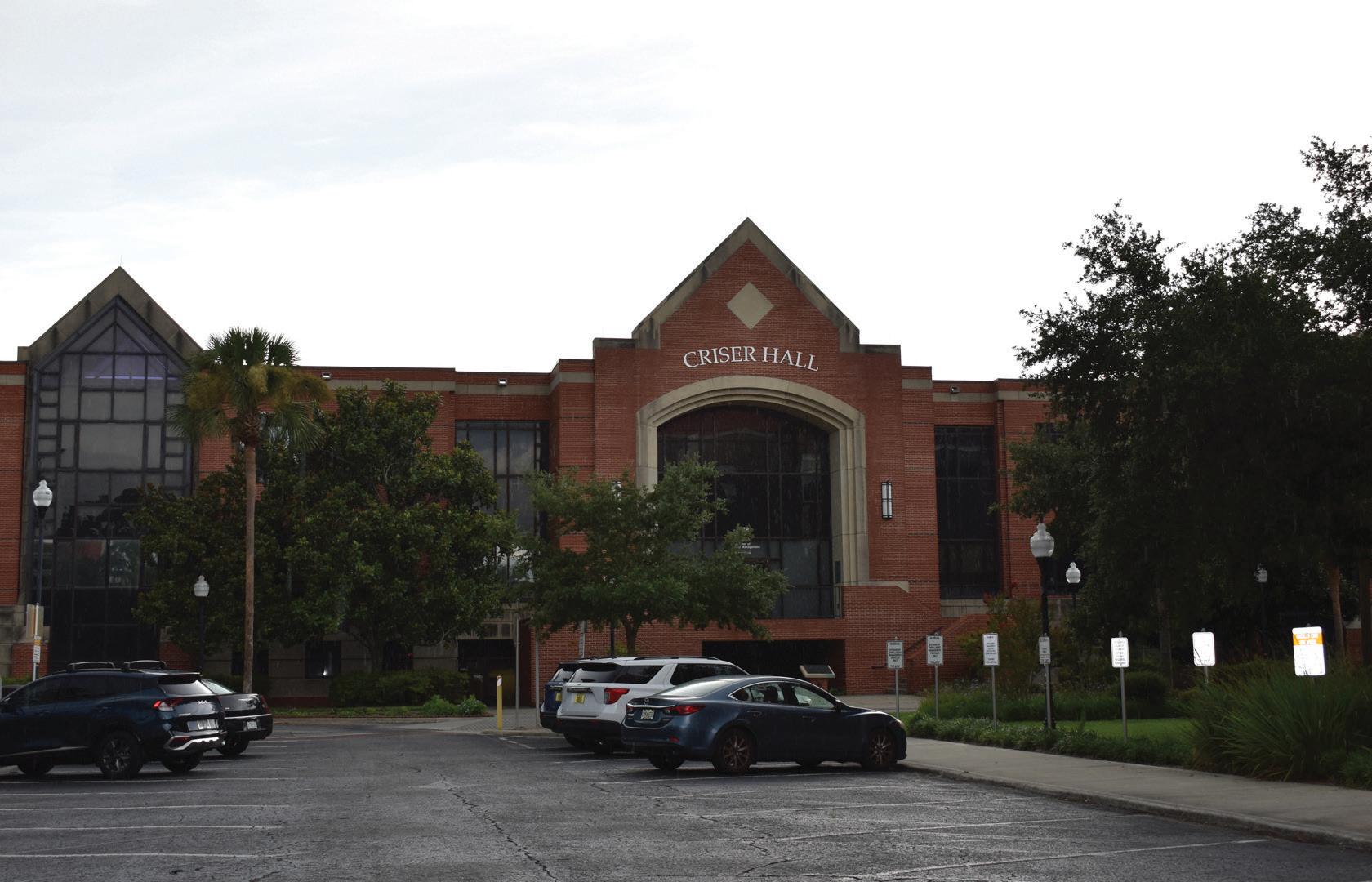
The parking lot and entrance of Criser Hall, Saturday, June 20, 2026, in Gainesville, Fla.
UF appoints Bell as interim amid board unrest
had secured unanimous support from UF trustees before state officials blocked his appointment, forcing the university to restart its search.
Ono’s rejection came largely because of his past support for diversity, equity and inclusion programs, which he was questioned about in a Board of Governors meeting last year. Although Ono closed DEI offices during his presidency at Michigan, the board wasn’t convinced his support of the initiative had wavered.
Bell has also received eerily similar criticism for his work at the University of Alabama.
Former Florida Rep. Anthony Sabatini, who is currently running for U.S. Congress, took to X and Instagram May 18 to share his position on Bell’s career trajectory and DEI beliefs.
“Major red flags here,” he wrote. “The UF Board of Trustees must pump the brakes on this ASAP.”
Bell opened UA’s Division of DEI in 2017. However, he ordered it shut down in 2024 to comply with federal legislation banning support of DEI, replacing it with the Division of Opportunities, Connections and Success.
UF called DEI “discriminatory by design” in its May 22 response to an X post by Linda McMahon, the U.S. Secretary of Education. McMahon’s post expressed the need for UF’s next president to pursue reforms against DEI.
Now, higher education researchers, state officials and even some students say Bell’s confirmation hearing represents more than a decision about the candidate himself.
They say the outcome could shape perceptions of the university’s presidential search process after years of leadership turnover and scrutiny over how UF selects its leaders.
John Sailer, the director of higher
education policy at the Manhattan Institute, said a second failed presidential search would point to a deeper flaw in the selection process.
“If the Board of Governors decides to veto the choice, that is a definite indicator that there’s something that the Board of Trustees is doing that’s just not working,” Sailer said.
Should Bell be confirmed, he will be the school’s fourth leader in roughly four years.
Former president Ben Sasse resigned in 2024. Former president Kent Fuchs stepped in as interim president for a year.
After the Board of Governors rejected Ono last year, Donald Landry, who served as the chair of Columbia University’s Department of Medicine for 16 years, was appointed as interim president. He’ll continue to fill the role while Bell awaits confirmation.
For some, the possibility of another presidential rejection by the Board of Governors raises questions
about whether UF’s search process is consistently producing candidates who are able to secure support from both boards and the general public.
“That would suggest a deeper issue,” Sailer said.
He said presidential searches work best when multiple stakeholders have opportunities to provide feedback throughout the process, particularly when authority is divided between different governing bodies.
“At the broadest level, what you need is transparency, and you need sufficient feedback from different layers of stakeholders,” he said.
UF declined to comment on questions relating to the presidential search process.
In a May email to Florida Chancellor Ray Rodrigues, Board of Governors chair Alan Levine called for a review of governance practices across the State University System after concerns he said arose while reviewing UF’s presidential search.
The email, sent by Levine to The Alligator, focused largely on fiduciary responsibility and the authority of university boards.
“Ultimately, the governance of each university falls squarely under our purview, and we have an obligation to be able to assure Floridians that our universities are governed based on not only the law, but proven best practice,” Levine wrote.
A systemwide review of governance structures might be necessary, he added.
UF is one of the state’s flagship institutions, enrolling about 61,900 students across undergraduate, graduate and professional programs as of 2024, according to university data. Some of these students are also concerned about UF’s leadership turnovers in recent years.
One UF graduate student studying humanities, whom The Alligator has granted anonymity due to concerns about immigration status and future visa implications, said they
believe the repeated searches reflect broader instability in university governance.
“The fact that we have been doing this three or almost four times over the past four years is abysmal,” the student said. “If you have to do something so repetitively, it means something is wrong.”
The student said frequent presidential searches and interim appointments make it difficult to view university leadership as stable.
“When we don’t have a person that can have long-term policies, the student body also suffers,” the student said. “We won’t have the possibility to have a two-year vision because the presidents are going to be here for one year.”
Avery Bollinger, a 23-year-old UF public health doctoral student, said the succession of presidents and interim leaders has left her concerned about the university’s trajectory and the role of politics in leadership selection.
“I’m very concerned for the direction of our university,” she said, “and the direction that it’s been going within the past few years.”
Bollinger arrived at UF during the appointment of former president Sasse and has since seen multiple leadership changes.
“The rejection of Dr. Ono and then now the appointment of Dr. Bell, that all feels like students aren’t being represented,” she said. “We aren’t being heard.”
She said the process seems to align more with politics than students’ desires. Bollinger questioned whether the search process adequately reflects student priorities.
“I don’t really think they know what the students want,” Bollinger said, “And I also don’t think that they care.”
@s_maharaj1611 smaharaj@alligator.org
DeSantis signs bill cementing state utilities control
posed by its own customers.
made in a rush and may have been drafted out of fear the city would win its appeal.
Eastman said the city recently filed an argument that the law doesn’t impact ongoing appeals, like battles with the authority over the legality of Gainesville’s 2024 and 2025 referendums. Both legal battles halted the implementation of the referendums.
Eastman has long been critical of the authority board, questioning its accountability to local customers, he said. The relationship between the city and the board has continued to strain as the situation becomes more political, he added.
Eastman said taxpayers have lost over $30 million under the promise bills will decrease, but rates have stayed the same across the board since 2023.
The $30 million figure refers to money the city no longer receives from GRU’s general fund transfer, which reallocates money from utilities to other city expenses. In 2023, the city’s GFT was $33.5 million.
He said the model of a governor-appointed board is unstable. It doesn’t answer the ratepayers, he added, and it is overwhelmingly op-
Eastman said it’s clear the state wants an independent, appointed board or more control over the city, and the commission has remained open to the possibility — but there needs to be a change from the current model, he added.
In GRU CEO Edward Bielarski’s eye, the new law may ruin the city’s chances of regaining control over the utilities.
“I think the chances for the city to prevail are between slim and none, and slim’s out of town,” Bielarski said.
The bill is the Legislature’s finishing blow, fulfilling the purpose of the initial 2023 state bill, he said. Once the city fought to change its charter, he added, the board went to the Legislature and explained the state’s framework allowed Gainesville to amend its charter. The state responded with an emphatic “no,” Bielarski said.
Bielarski called the city’s arguments “tired,” "disingenuous" and not representative of what is learned in civics classes.
Bielarski said comments about the board raising rates are a misrepresentation shared by Gainesville commissioners. He said they ignore the fact the city was planning to raise electric
rates by 9% and increase water waste order rates by 15% in three years.
Since taking over, he said the authority board has kept electric rates the same, raised wastewater rates by 6% and paid down almost $200 million in debt.
The board also created a “tier structure” that decreased the bills of roughly 59% of customers in 2024.
“They completely ignore the fact that they misgoverned GRU to the point that we had the highest rates in the state,” Bielarski said.
“We had debt that was four times, on average, larger than any municipal utility in the state.”
GRU’s current debt load is around $1.7 billion — the second highest in the state under Jacksonville Electric Authority’s roughly $3.3 billion. GRU’s long-term debt-to-net position ratio is four times higher than the state average.
In 2022, Gainesville had the second-highest average bill per 1,000 kilowatt hours in the state, just behind Key West. The average U.S. household consumes around 1,080 kilowatt hours per year.
Bielarski said virtually all the money the city isn’t receiving from GRU has gone toward paying off the utility’s debt, and its success in
paying off nearly $2 billion in debt the past three years is setting up a bright future. Debt agencies have noticed, he added, and lower interest rates from them are leading to more available funds.
Bielarski believes the authority board is accountable for this change, and its members are active local residents whom customers can reach. When alluding to the electorate voting against the board, he added, the city has failed to consider the nearly 40% of GRU customers who live outside of city limits and couldn’t vote on the referendums.
For Chuck Ross, a Gainesville resident and retired accountant who attends nearly every GRU meeting, the issues with the utility lie with its management, not its service.
Ross said the authority board has consistently dismissed public commenters expressing concerns at meetings and ignored some of the utility’s needs. Items pass with no discussion, he added.
“We have a serious issue with the transparency of a board,” Ross said, “and the rest is an accountability issue.”
Grace Sands // Alligator Staff
UF Interim President Stuart Bell sits alongside Board of Trustees member Rahul Patel and student government president Matthew Bravo during his confirmation meeting, Wednesday, June 10, 2026.
www.alligator.org/section/the-avenue
NATURE
Over 200 buzz to First Magnitude Brewing for the Pollinator Palooza’s return
DANIELS LAB PARTNERED WITH THE BREWERY TO SPREAD AWARENESS ABOUT THE IMPORTANCE OF POLLINATORS
By Addison Gload
Alligator Contributing Writer
Daniels Lab at the Florida Museum of Natural History’s McGuire Center for Lepidoptera and Biodiversity returned to First Magnitude Brewing June 27, bringing the community together to celebrate an underappreciated group of animals: pollinators.
Pollinator Palooza took place from 12 p.m. to 4 p.m. and aimed to raise awareness about the animals that pollinate flowers.
Pollinators like bees, wasps, weevils, flies, butterflies, birds, lizards and a species of frog called the Izecksohn’s Brazilian tree frog are vital to the health of both individual plants and their whole ecosystems.
Educational tables were set up by the Florida Wildflower Foundation, the Florida Museum Herpetology Collection, the Florida Museum Digital Imaging Division and the UF Institute of Food and Agriculture Science Extension Alachua County Master Gardener Program.
Jaret Daniels, the director of the Daniels Lab and interim director of exhibits and public programs at the Florida Museum, said Florida agriculture depends on pollinators.
“In a state like Florida, where
MUSIC
we have a few hundred specialty crops,” Daniels said, “the great majority of them, like blueberries, watermelon, squash, are tied really tightly to insect pollination.”
Agriculture is the second-largest industry in Florida after tourism, he said. Without these crops, the state economy would suffer.
Jacqueline Belwood, who earned her PhD in entomology at UF and taught biology at Georgia Highlands College, said while the world would not run out of food without pollinators, the foods available would lack flavor and antioxidants.
At her table, two plastic models sat side by side. One showed a colorful dinner with noodles, meatballs, veggies and bread, while the other showed a beige dinner of macaroni and cheese, peas and plain chicken.
The first plate was made up of foods that, in some way or another, relied on pollinators to produce them. The other plate consisted of wind-pollinated crops. Looking at them side by side, it was clear which dinner was more appealing. Without pollinators, fruits, most vegetables, herbs, vanilla, chocolate and coffee would all be things of the past. A third of food consumed by humans needs to be pollinated by animals, so only food like grains, corn and barley would remain.
In addition to learning about the importance of pollinators, attendees learned how they could help protect local pollinator populations.
“We’re out here to spread the message that you can make a difference, and what better way than to give away free plants?” said Sarah Steele Cabrera, a postdoctoral associate at the Daniels Lab.
By giving away native plants, event organizers hoped attendees could start their own gardens and provide habitats for native pollinators.
Native plants are also easier to grow than non-native plants because they are adapted to the southern climate and do not require pesticides or fertilizers, Cabrera said.
“If you’re a brown thumb gardener, black thumb gardener and just don’t have a lot of time,” Cabrera said, “native plants are fine with that.”
The 350 plants brought to the event were supplied by Green Isle Gardens, a plant nursery in Groveland, Florida. Attendees could choose from eight native plant species including Bushy Seaside Oxeyes that grow yellow, daisy-like blossoms, or Firebushes, large shrubs with vibrant, tubular flowers.
Belwood said these native plants are better for native pollinators because they’ve evolved alongside each other, with insects adapting to local species.
“They recognize certain smells,” she said. “They’ve got mouth parts that only fit certain flowers.”
Areas with only non-native or bioengineered plant species are
considered a “food desert” for local pollinators, she said.
To help people with their new plants, the Florida Wildflower Foundation supplied handouts for each species with the name, native range, lifespan, preferred soil and light exposure, growth habits and other tips. The profiles of these plants can also be found alongside more information on the organization’s website.
Mya Maybank, an infection prevention coordinator at UF Health Shands Hospital, picked up an Atlantic St. John’s Wort at the advice of the volunteers from Daniels Lab.
It was recommended to her when she said she was looking for a plant that would do well in a moderately shady area. Maybank hopes to get more into gardening and learn more about plants.
“Events like this, where people are super knowledgeable,” Maybank said. “It’s a social way to dip your toe into a new hobby.”
Joining local clubs or organizations, such as the UF Honey Bee Club — which also tabled at the event — or the Master Gardener volunteer program, is another way to learn more about the importance of pollinators and proper gardening techniques.
For those hoping to maintain their own gardens, director Jaret Daniels said to start small and expand. Just one potted flowering plant can be a home and food
source for a pollinator. Afterward, he recommends planting different species to attract different types of pollinators.
The event also featured two special beers: the Pollinator Palooza Hazy IPA and the Blue Bee Watermelon Mint Gose. The proceeds from the beers went toward butterfly recovery efforts in Florida.
Ash Allen, a 43-year-old nurse at UF Health, and Sherie Becerra, a 65-year-old farmer, have attended the Pollinator Palooza together for the past three years. Both enjoyed the new beers and the event as a whole.
“It helps the native pollinators, it helps honey bees and it brings the community together,” Allen said.
Allen has been beekeeping since 2016 after watching a YouTube video and deciding to try it herself. She joined the local bee club, and “it just took off” from there, she said. By the time they sat down at the picnic tables at First Magnitude Brewing after picking out their plants, they already had two pollinators happily crawling over the leaves of their Crimsoneyed Rosemallow and Passion Vine.
“I could have a beautiful flower, which I admire,” Becerra said, “but to have a pollinator that produces fruit as well for me is a bonus.”
Addison Gload is a contributing writer for The Alligator.
Crimson’s ‘Cowabunga’ brings Gainesville’s alternative scene to center stage
THE BAND CELEBRATED THE UPCOMING RELEASE OF ITS DEBUT STUDIO ALBUM WITH FRIENDS AT A JUNE 21 SHOW
By Brandy Sumner Avenue Staff Writer
Wires plugged into guitars and speakers were scattered across the floor of the dimly lit parking lot on the roof of Garage 14. A crowd waited for Gainesville alternative band Crimson’s album release party to start.
Crimson, a local college student band, began recording its newest album, “Cowabunga,” at Pulp Arts recording studio in March and is planning its official release mid-July.
The band was formed by lead singer Kevin Ayoub, a 19-year-old Santa Fe College psychology sophomore, while he was in high school. A year and a half later, the band looks very different.
After high school, the members of the original Crimson group moved, and its current members, people Ayoub met in class or through the local music scene, slowly trickled in.
Now the group is made up of Ayoub, drummer Gray Mc-
El Caimán
LGBTQ+ Hispanics find community in Gainesville. Read more on page 7.
Namara and two guitarists, Michael Palomares and Satoru Christman.
“Cowabunga” happened almost by accident, said Palomares, a 19-year-old Santa Fe music sophomore.
The band originally planned to record only a few songs. Once they started recording, they quickly realized they had a lot more music they wanted to share with their audience.
“I would say that this album was very free-form, and that was why I liked the ‘Cowabunga’ title,” Ayoub said. “Because we were just chilling, having a good old time, jamming.”
The band held a release party June 21 to celebrate the new album. A small crowd gathered around the performers, moshing or sitting further back in chairs or on picnic blankets brought from home.
Tanuja Chummar, a 22-year-old UF food science senior, first saw Crimson perform in a benefit show at the Civic Media Center. She’s been coming to their shows ever since.
“I like the guitars,” Chummar said. “They have a sixstring bass — that’s pretty cool, that’s pretty unique.”
The band takes inspiration from its members’ favorite genres and is influenced by everything from classic rock band Rush to indie artist Mac DeMarco.
“It creates almost a unique sound, something that isn’t easily replicated,” Palomares said.
As the sun set and lights across campus flickered on, the show finally started, kicked off by the opening performers, indie alt-rock band Dio and Friends and grunge band Lead Vase.
Crimson took the stage around 9:30 p.m. and played songs from “Cowabunga” and tracks it plans to release in the future.
Each song was entirely different. Some had the audience swaying quietly, while others, like their song “Pan,” had the entire crowd dancing and moshing.
For its last song of the set, Crimson played “Born from Death,” one of its softer songs. The audience was asked to join the band members and sit together on the ground while they performed.
Crimson is planning to tour across other parts of Florida to celebrate the album and expand its audience. In addition to more Gainesville gigs, the group has shows set for Tampa and Boca Raton leading up to the album’s full release.
bsumner@alligator.org
Student-owned coffee shop Brewing Thoughts set to open brick-and-mortar location
COUPLE SOFIA ORTIZ AND TITAN WOJCIAK’S PASSION PROJECT IS FINDING A PERMANENT HOME THIS FALL
By Brandy Sumner Avenue Staff Writer
Beneath a layer of dust and construction in a storefront off of Southwest First Street is the future of Brewing Thoughts, a local coffee shop set to open its first brick-and-mortar location early this fall.
Titan Wojciak, a 20-year-old UF electrical engineering junior, and Sofia Ortiz, a 19-year-old UF advertising sophomore, had always dreamed of owning a coffee shop.
Last July, the couple began building their brand and transformed Wojciak’s truck into the mobile shop, which launched in October.
“One summer day, I was like, ‘We aren’t doing much, we should just do it,’” Wojciak said. “‘What’s stopping us?’”
Since then, they’ve served drinks out of his refurbished kei truck across town, using house-made syrups and offering specialty drinks.
Ortiz said being young business owners has allowed her and Wojciak to connect with their customers — and with the passion that brought them to start a business in the first place.
Part of that connection comes from the business’s TikTok and Instagram pages, which help the two build connections with their audience.
“We’re pushing to post every day so that we can feel like we include our customers as well, because when they feel included, it’s that much better,” Ortiz said.
Running the business doesn’t come without difficulties. As full-time students, both Ortiz and Wojciak have had to make sacrifices to keep things running smoothly.
Before starting renovations on the new cafe, Wojciak was offered a summer engineering internship, one he called a “golden ticket opportunity.” He turned it down to get Brewing Thoughts open by fall.
“I’m doing something that I will be proud of and I love doing and something that is so much nicer,” Wojciak said. “When I look back in 10 years, I’ll be like, ‘Yeah, I did do that, and that’s pretty cool.’”
Melanie Rodriguez-Martinez, the 26-year-old owner of Mel’s Kitchen, met the two at a How Bazar event last year, and she’s supported their progress ever since.
“The minute that I met them, I felt an instant connection,” Rodriguez-Martinez said. “I felt the genuineness, the authenticity of what they were doing and the good spirit of the business they wanted to create.”
Rodriguez-Martinez might join Brewing Thoughts at its new
location to manage its kitchen.
The cafe plans to expand its offerings beyond coffee and breakfast. It’s set to close after morning hours and reopen later in the day, similar to a speakeasy that serves mocktails and tapas, Wojciak said.
Brewing Thoughts’ new opening is dependent on The Streatery, Ortiz said, since the building is currently facing the construction site and is difficult to enter. Construction on The Streatery is expected to finish in the fall, and the city has assured residents downtown businesses are open and accessible in the meantime.
Even with the chaos of construction outside their door, the
sees The Streatery project as a plus for Brewing Thoughts. They think it’s the perfect opportunity to bring more traffic to their cafe and other downtown businesses, Ortiz said.
“We believe that The Streatery is gonna make Gainesville entirely different,” she said, “and it’s gonna switch up downtown.”
Amid the work of obtaining permits, painting their storefront and tearing down old walls, the pair is looking forward to opening the cafe and getting to know new and returning customers as soon as possible.
bsumner@alligator.org
couple
Mily Moran // Alligator Staff
Student co-founders of Brewing Thoughts Sofia Ortiz and Titan Wojciak, sand the interior of their new coffee shop during renovations, Thursday, June 25, 2026.
El Caimán
www.alligator.org/section/elcaiman
‘Everyone will find their place’: Queer Hispanics find community in Gainesville
LEADERS OF QUEER ORGANIZATIONS AND UF’S FIRST OPENLY GAY SENATE PRESIDENT REFLECT ON COMMUNITY AND BELONGING
By Kathia Montenegro Alligator Staff Writer
Puerto Rico native Carolina Cordero said living in Gainesville for the past 27 years has been a blessing. Cordero, a 66-year-old transgender woman, said the city provides an accepting environment for expression and self-acceptance.
"Everybody will find their place in this universe,” she said. “Don't feel pressured. Do what's best for you, and Gainesville is a good place for people to come out and be themselves.”
As an openly transgender woman, Cordero provides education and support to parents of LGBTQ+ youth through her role as a board director for the Parents, Families, and Friends of Lesbians and Gays organization in Gainesville.
PFLAG Gainesville is one of more than 500 chapters nationwide. The organization provides support, education and advocacy for queer individuals, their families and allies through monthly family meetings, providing resources and involvement in local community events.
Cordero said representation helps normalize transgender identities and
create a sense of belonging for those who may feel isolated. Through her involvement in Gainesville's LGBTQ+ community, she also found support from other Hispanics.
For Cordero, the support she found in Gainesville is one of the reasons she continues to call the city home.
“Gainesville is a city that celebrates diversity and fosters communities and connections," she said.
For many LGBTQ+ Hispanics, identity is shaped by more than one community.
Nelida Jean-Baptiste Pellot, a 40-year-old housing inspector, works with Theater Connect Gainesville and the Pride Community Center of North Central Florida. She said navigating multiple identities can sometimes make it difficult to feel fully accepted in any one space.
“I think of the Latin community in the same way as the Black community, because those two identities also intersect, overlap and sometimes are at odds with each other,” Pellot said.
As a Black, Latino and queer person, Pellot said there are times when she feels she only partially belongs in certain spaces.
“When I add my queer [identity], I feel like there isn't a real place for me,” she said.
Despite those challenges, Pellot helps create welcoming spaces for young people through Theater Connect, an LGBTQ+ youth program at Gainesville's Heartwood Sound-
stage where students can relax and connect. Pellot said Theater Connect allows students to freely express themselves and decompress in an affirming environment.
Pellot encourages people to seek out supportive communities and build connections with others who share their experiences.
“Belonging and acceptance starts with you,” she said.
That commitment to creating inclusive spaces also shaped the work of Oscar Santiago Perez during his time at UF.
Perez, a 23-year-old UF political science and criminology graduate who now works as a legal assistant, served as treasurer of the Pride Student Union, treasurer of Baking for Wellness and became UF's first openly gay student senate president.
Throughout his time on campus, he focused on ensuring students from marginalized backgrounds felt represented in leadership spaces.
“In PSU, we worked a lot on trying to be inclusive of those intersectional communities that oftentimes don’t get attention or highlight,” Perez said.
Perez recalled struggling with feelings of not being “Hispanic enough” and uncertainty about who would be supportive of his identity as an openly gay member of Hispanic organizations. Those experiences motivated him to champion for greater representation in Student Government.
“During my time in Student Gov-
ernment, I was able to advocate for a lot of different communities,” he said.
As the university's first openly gay senate president, Perez said he hoped to serve as a visible example for other queer Hispanic students and demonstrate that they belong in leadership positions, too.
Inclusion requires more than simply welcoming people into a space, he said.
“It is important for us to have these spaces be welcoming of these individuals,” Perez said. “Not only by just saying that we’re open to you
all, but also by having people that are of those backgrounds be in those spaces, to occupy those spaces.”
Perez said he encourages students not to compromise their identities to fit into unwelcoming spaces.
“Don't sacrifice your authenticity for other people,” he said. “If you can't join a space because they don't allow you or you don't feel comfortable being yourself, find another space or try creating your own space.”
kmontenegro@alligator.org.
Henry A. Moore // Alligator Staff
Queer Hispanic residents of Gainesville find community in Pride this June.
MONDAY, JUNE 29, 2026
www.alligator.org/section/opinions
An open letter of commendation to the UF Presidential Search and Selection Committee
To whom it may concern, and it certainly does concern you.
I write today not to criticize, but to applaud.
It has come to my attention the UF Presidential Search and Selection Committee has been doing its job with an efficiency and predatory grace that can only be described as deeply Gator. And I mean that in the most literal, zoological sense possible.
You see, people misunderstand the Florida Man. They misunderstand the Florida Gator. They think “Gator” is a mascot — a friendly orange-and-blue abstraction wearing a jersey, perhaps juggling a football, smiling in a way that implies it has no teeth.
But a gator has teeth — approximately 80 of them. And it uses them.
You, the search committee, are showing us what it really means to be a Gator.
Consider the American alligator in its natural habitat. It does not post a job listing. It does not convene a subcommittee to evaluate the structural integrity of the marsh ecosystem before proceeding. It does not invite
public comment. It waits — submerged, still, patient as an endowment — and then, at a moment of its own choosing, it lunges.
This is called a search process.
I understand now the opacity some have complained about is, in fact, a feature. An alligator does not publish its search criteria in advance. Transparency would ruin the hunt.
The prey — I mean, the candidates — must not know they are candidates. The finalists must not know they are finalists. The university community must not know there are finalists at all.
This is simply good predatory hygiene.
I have heard some critics argue a presidential search at a major public research university ought to involve faculty input, student voice or some minimal gesture toward the democratic values we presumably teach in our political science departments. I want to assure those critics they are thinking too small.
A gator does not ask the herons for their input. A gator does not hold a listening ses-
sion with the turtles. The turtles are simply there on a log, blinking in the sun — and one day the log is gone, and so are the turtles, and the gator has moved on.
This is called stakeholder engagement.
I also want to commend the committee for its handling of the timeline. Much has been made of the speed, or the lack thereof, or the inconsistency thereof — I confess I lost track, which I suspect was the point.
But consider: The alligator’s ambush can last hours of motionless waiting followed by 0.8 seconds of decisive action.
When critics say your process has “lacked clarity” or “moved without explanation,” what they mean — and I say this as a compliment — is that you have successfully maintained the element of surprise. You are 0.7 seconds into the lunge. We simply cannot see it yet.
Respect.
Some will say a university is not a swamp and a presidential search is not a death roll. “Institutional trust” exists, and it can be damaged.
To these people, I say: Have you been to
What’s next for Brendan Sorsby?
On June 15, Texas district court judge Ken Curry granted Texas Tech quarterback Brendan Sorsby a temporary injunction allowing him to maintain his eligibility and play for the Red Raiders in 2026 — against the NCAA’s better judgment.
A week later, the lawsuit was withdrawn.
After receiving intense backlash from everyone outside Lubbock, Sorsby has decided to lay his college career to rest and enter the NFL’s supplemental draft.
The NFL’s supplemental draft is a seldom-used process for players whose eligibility battles may conflict with the schedule of the standard NFL Draft held in late April. Since its start in 1977, only 46
players have ever been picked in the supplemental draft. Just eight have made the Pro Bowl, and one — 1987 Philadelphia Eagles’ fourthround pick, wide receiver Cris Carter — has made it to the Hall of Fame.
The supplemental draft has not been used since 2019, when the Arizona Cardinals used a fifth-round pick to select safety Jalen Thompson, who recently signed a deal with the Dallas Cowboys.
The way the supplemental draft works is that if a team wishes to make a selection, it bids on a player based on the round it would’ve selected him in the main draft. For example, the Arizona Cardinals bid a fifth-round pick on Jalen Thompson in 2019. If multiple teams bid the
same round for a player, the team with the higher priority, based on results from the previous season, wins the bid.
If a supplemental draft pick is used to select a player, the team will lose that round’s pick in the following draft. By selecting Thompson in round five of 2019, the Cardinals lost their fifth-round pick in 2020. For this reason, teams can only use their own picks in the supplemental draft, not picks they may have acquired from other teams via trade.
While Sorsby’s departure from Texas Tech is undoubtedly a win for college football, we’ll never know how much money Sorsby cost himself by moving on. Texas Tech is not asking for the money it paid him to be returned, but NFL
Florida? Have you seen what flourishes here?
The gator does not need your trust.
The gator has been here since the Miocene. The gator survived the asteroid.
The gator is not particularly moved by an op-ed.
Sasha Morel opinions@alligator.org
In conclusion, I want to thank the Presidential Search and Selection Committee for reminding us what it means to be a Gator — not in the comfortable, alumni-weekend sense, but in the real sense. The ancient, armor-plated, ambush-adapted, deeply unbothered-by-your-concerns sense.
You are not administrators. You are apex predators. And UF is lucky to have you. It’s great to be a Florida Gator.
@BySashaMorel smorel@alligator.org
scouts were expecting a strong 2026 season to vault Sorsby firmly into the mix of potential quarterbacks to be selected in the first round of the 2027 draft.
I currently have a mid-round grade on Sorsby as a prospect. He’s a gunslinging QB with a strong arm but inconsistent accuracy. His movement skills are good, not great.
There’s a role for him in the league as a backup — or even a low-end starter — in an offense with training wheels. The question will be whether teams feel comfortable bringing the character into their locker rooms.
Apparently, that decision has been made by the league itself — and it is a resounding no.
On June 23, the league announced it won’t be holding the supplemental draft, leaving the 2027 NFL Draft as the only way for Sorsby to enter the NFL. Sorsby and his legal team are working with the
The views expressed here are not necessarily those of The Alligator.
NFL Players Association to challenge the decision, but it’s unlikely change will come quickly.
Schultz opinions@alligator.org
The NFL has proven on numerous occasions it has little tolerance for gambling, and this situation is no different. The Canadian Football League also announced a ban on Sorsby north of the border, wiping out any chance Sorsby had of playing football in the year 2026.
This ugly chapter in Sorsby’s life is not yet finished, but the ending is sure to be fascinating.
@schultzbrayden9 bschultz@alligator.org
The Alligator encourages comments from readers. Letters to the editor should not exceed 600 words (about one letter-sized page). They must be typed, double-spaced and must include the author’s name, classification and phone number. Names will be withheld if the writer shows just cause. We reserve the right to edit for length, grammar, style and libel. Send letters to opinions@alligator.org, bring them to 2700
32604-2257.Columns of about 450 words about original topics and editorial cartoons are also welcome. Questions? Call 352-376-4458.
or
Brayden
Los Angeles Times Daily Crossword Puzzle
How to Place a Classified Ad:
CLASSIC CABIN IN CROSS CREEK 1BR, screened porch. Seasonal $1650 / mo. harmonslandingfla1@gmail.com for dtails. 7-13-26-4-1
You need the money to do what you will Rich at Best Jewelry and Loan has the cash for those bills 523
● 3BR/1BA HOUSE ● w/2-car carport w/storage for rent in Gainesville. 605 NW 32nd Pl $1500/mo. 1700 sq ft. Available now. Call 352-281-4528 7-6-26-4-2
We Buy Houses for Cash AS-IS! No repairs. No fuss. Any condition. Easy process: Call, get cash offer and get paid. Call today for your fair cash offer: 1-321-603-3026 6-29-28-5
When the heat is on and it's bucks that you need, Best Jewelry and Loan your requests we will heed. 523 NW 3rd Ave 352-371-4367 8-12-13-5
The surf's up at "Pawn Beach". We're all making the scene. If you're in need go see Rich, Best Jewelry and Loan's got the "green" 523 NW 3rd Ave 352-371-4367 8-12-13-5
Surplus On-Line Auctions ● are underway...bikes, computers, furniture, vehicles & more. All individuals interested in bidding go to: SURPLUS.UFL.EDU 392-0370 8-12-26-13-10
Donate your vehicle to help find missing kids and keep kids safe. Fast free pickup, running or not, 24 hr. response. No emission test required, maximum tax deduction. Support Find the Children Call – Call 1-833-546-7050 6-29-54-12
Epiphone, Guild, Mosrite, Rickenbacker, Prairie State, D'Angelico, Stromberg. And Gibson Mandolins / Banjos. These brands only! Call for a quote: 1-833-641-6789 6-29-64-13
EYES UP. PHONE DOWN. DON'T TEXT & DRIVE.
14 Help Wanted
Planning to liquidate stereos, TV's, instruments and tools? See Rich at Best He'll give cash for your jewels 523 NW 3rd Ave 352-371-4367 8-12-13-14
15 Services
quote or inspection today 1-833-542-1732 Have zip code of property ready when calling! 6-29-110-15 When you're stuck out in Oz and you need cash to get home, click your heels three times and think of Best Jewelry and Loan. 523 NW 3rd Ave 352-371-4367 8-12-13-15
BATH & SHOWER UPDATES in as little as ONE DAY! Affordable prices - No payments for 18 months! Lifetime warranty & professional installs. Senior & Military Discounts available. Call: 1-833-754-2465 6-29-103-15
"Pawn Beach" when the tide seems too high. We're your summer cash friends so your blues
21 Entertainment 22 Tickets
JAMES TAYLOR CONCERT - 2 TICKETS
St Augustine. Sept 22, 2026. Prime seating: Section 302, Row CC, Seats 119 & 120 $700 - unable to go, no profit sought. baharm123@gmail.com or 239-777-3001 6-29-26-2-22
Trivia Test
1. MOVIES: Who was the only actress to appear in the 1961 and 2021 film versions of "West Side Story"?
2. GENERAL KNOWLEDGE: Which month of the year has the most letters in its name?
3. SCIENCE: What protects the Earth from solar winds?
4. TELEVISION: What is the name of the bar in "It's Always Sunny in Philadelphia"?
5. U.S. STATES: Which state is home to the first Ben & Jerry's ice cream shop?
6. LITERATURE: What are the names of the two brothers in the "Hardy Boys" novel series?
7. LANGUAGE: What is a polyglot?
8. FOOD & DRINK: Which herb is most often used in traditional pesto?
9. ANATOMY: Membranes called pleurae cover the surface of which human organs?
10. GEOGRAPHY: What is the capital of South Korea?
Sports Quiz
1. Which racetrack, site of the 1959 Formula 1 German Grand Prix, had a 43-degree banked turn known as the "Wall of Death"?
2. What large-scale video display, produced by Mitsubishi Electric, was first installed at Dodger Stadium in Los Angeles for the 1980 MLB AllStar Game?
3. In April 2001, 43 people were killed in an over-capacity crowd surge during a soccer match at Ellis Park Stadium, located in which country?
Programs Include:
/ Working Cat / Kitten Shelter Diversion Find More Information at http://ocgainesville.org/
1: FOR RENT (FURNISHED)
District 2 – North Florida Al-Anon Family Groups
Help for the family and friends of alcoholics Find a local Al-Anon Meeting at our website: alanonfla2.org 12-1-15-16
Attention: VIAGRA and CIALIS USERS! A cheaper alternative to high drugstore prices! 50 Pill Special - Only $99! 100% guaranteed. CALL NOW: 1-877-349-1243 6-29-32-16 STOP OVERPAYING FOR HEALTH INSURANCE! Reduce premiums and out-ofpocket costs while getting the coverage you need! Call now for a competitive free quote. 1-877-351-3442. Plus... Income based government subsidies are available for those that qualify! 6-29-81-16
FOR RENT (UNFURNISHED)
4. Who knocked out "Oklahoma Giant" Carl Morris 14 seconds into the first round of a December 1918 heavyweight boxing match in New Orleans?
5. The NFL's 1979 rule banning tear-away jerseys was inspired by and informally named after what Cleveland Browns running back?
6. In December 2021, which team defeated the Oklahoma City Thunder 152-79, making the 73-point win the biggest blowout in NBA history?
7. In 1974, Ted Giannoulas first donned the costume of which world-famous sports mascot?
AVUS (Automobil-Verkehrs- und Ubungsstrabe).
Diamond Vision.
South Africa.
Jack Dempsey.
Greg Pruitt.
The Memphis Grizzlies.
The San Diego Chicken.
Rita Moreno.
MONDAY, JUNE 29, 2026
www.alligator.org/section/sports
GYMNASTICS
More than a camp: Florida gymnasts inspire new generation of athletes
UF GYMNASTS TRAVELED TO SINGAPORE TO PAIR WITH MOKARA GYMNASTICS ACADEMY
By Nicole Scura Sports Writer
This Summer, Florida gymnasts stuck a different kind of landing — one that brought them all the way to Singapore.
For a week, all but four Florida gymnasts and coaches took a trip to Singapore sponsored by Mokara Gymnastics Academy. The gymnasts worked a camp at the gym from May 26-29, teaching young girls the mechanics of gymnastics, strength and conditioning, rehabilitation, recruiting and more.
The gymnasts worked with campers of varying ages as camp leaders, event coordinators or floaters, said eMjae Frazier, a senior gymnast.
“We got to work in all different orders, all different ways,” Frazier said. “There were six events and four rotations. We warmed everyone up with one of our camp dances, which is so much fun because it’s a mixture of 10 different songs, and the kids just have so much fun with it.”
The gymnasts hosted Q&As, signed autographs and performed their floor routines for the campers on the third day, she said.
Danie Ferris, a junior gymnast, said this was the first time the team took a trip like this, but she hopes it will become a tradition. It wasn’t just a valuable experience for the girls participating in the camp, she said, but also for the team’s dynamics.
The already tight-knit team was able to spend quality time together outside the gym, she said.
“It was just cool to see everybody join together and just have fun,” Ferris said.
Outside the gym, the athletes also made time to explore the city.
WOMEN'S SOCCER
Ferris said she planned before the trip and was the teammate others turned to for travel ideas. She and some of her teammates went ziplining, completed rope courses, shopped at the mall, went to a head spa, visited a zoo, ate at authentic restaurants and experienced what Singapore had to offer.
“I swear every day of the trip we were all exhausted,” Ferris said. “By the time I got back to the hotel, I was asleep in one second from how much we were trying to cram in the day. But it was worth it because we got so much done and it was so much fun.”
Although the athletes traveled with hopes of teaching those at the gym something new, they walked away learning valuable lessons themselves.
The owner and creator of Mokara Gymnastics Academy, Riley Lee, is only 17 years old. Frazier said Lee’s journey in starting the gym began a few years ago out of love for gymnastics. Lee’s teammates did not have their hearts in the sport anymore, Frazier said, so the 17-year-old wanted to create an environment that made gymnastics fun.
“We got to hear the making of Mokara and really learn what it takes to start a business,” Frazier said. “There [are] going to be a lot of ups and downs but it’s really just about sticking to it and really following your dreams.”
Ferris was also inspired by Lee’s story.
“She really taught me to make the most of everything — especially with her gym, how she built it — and really trusting yourself in your dreams and ideas,” Ferris said.
Lee’s gym started with a little dream, Ferris said, and it grew as her dad pushed her to accomplish her goals.
Lee’s story allowed the athletes to see how she integrated her knowledge of global facilities into her gym. The team got to immerse themselves in the local culture and work with girls who looked up to them and were ready to learn.
The trip to Singapore was a rewarding experience for the gymnasts. It allowed them to learn about starting a gym and the importance of maintaining passion in their work.
These are memories the athletes will carry with them for a lifetime, remembering how they shaped the athletic trajectory of girls across the globe.
“It’s so much fun and so rewarding to be able to see you make the change, even if it's something small or different,” Frazier said.
@NicoleScuraa nscura@alligator.org
From New York to Florida: Mia Gray’s path to UF soccer
GRAY SCORED THE STATE TITLE-CLINCHING GOAL FOR HER HIGH SCHOOL IN 2024
By Colby Kistner Sports Writer
Mia Gray’s first trip to Gainesville, a little over a month after committing to the University of Florida, came with an unexpected obstacle: a hurricane.
The Rochester, New York, native visited in August 2024 and wasn’t sure at first if she would make it because of the forecast. The first day was clear, but Hurricane Debby made landfall the second day. The midfielder’s flight back home was canceled and she stayed a few extra days.
“I’ve never seen one in my life, so it was kind of cool,” Gray said.
Gray grew up a stranger to hurricanes — but not to sports. Her father, Chris, played football at the University of Buffalo, while her mother, Gina, competed in college soccer at Monroe Community College and SUNY Brockport. Her sister, Ava, plays soccer at Genesee Community College.
“My mom played soccer, so obviously she
wanted us to play,” Gray said.
Gray started dabbling in the sport at 3 years old and was so exceptional her mother told her to stop scoring goals so other kids could have a chance.
Her mother also coached her for a short time when she was younger, setting very high expectations.
Those on-field lessons continued off the field during postgame car rides, when Gray’s parents broke down what she could improve on.
Gray took those early teaching moments to the WNY Flash Soccer Academy, where she played all four years of high school. Her relentless drive to improve caught the attention of many and translated to success on the pitch. From the beginning, she stood out to head coach Eric Dade.
“Mia didn’t take a day off,” Dade said. “She was a very committed and dedicated kid, and when you look back at it, I think that’s what separated her from the others.”
Shining brighter than others on the pitch is especially noteworthy when playing alongside elite-level competition. Twenty players in Gray’s group committed to play at a Division I school, attesting to the caliber of talent the academy developed. Among these promising
Follow our newsletter
recruits, Dade credits Gray with molding an atmosphere that produced high levels of talent.
Her work ethic translated to success with her high school team, too. Gray brought ByronBergen High School four straight state championship appearances and fired home a titleclinching overtime goal in 2024.
“It’s hard for schools to win state championships and my daughter scoring the winning goal was very exciting, so it left a lasting impression on me,” Gina said. “Everybody was so proud of the team and her.”
Gray’s consistent effort led her to be selected for the ECNL Ohio Valley All-Conference first team in the last three years. The New York State Sportswriters and Coaches Organization for Girls Sports named her the Class C player of the year in 2024 and 2025. She was also named a 2025 United Soccer Coaches High School Fall All-American.
Gray graduated high school early and joined the Gators for spring training. She came from thousands of miles away — just like fellow freshman recruit Courtney Hogan.
“I think Courtney played a huge role in being able to function individually by myself,” Gray said. “It was such a really good thing that I went down early because I think I learned so much.”
Love alligatorSports? Stay up to date on our content by following our newsletter. Scan the QR Code to sign up.
Spring training gave her a taste of the intensity college matches require. With seven other freshmen recruits sharing the same goal of going pro, Gray found even more inspiration and a heightened desire to compete.
Now entering her freshman season, she hopes to maintain the same mindset that brought her to UF.
“I can just keep working hard at practice, and everybody’s equally as good as you,” Gray said. “Coming to every game with a good mindset is helpful.”
With her freshman season looming and expectations awaiting, Gray also has an added source of inspiration that hits close to home: She shares a hometown with Abby Wambach, a former Gator and U.S. women’s national soccer player from 2003 to 2015.
Wambach led UF’s women’s soccer team to its first and only title in 1998. Almost 30 years later, Gray is chasing the same dream – bringing a championship to Gainesville.
The magnitude of the task isn’t lost on Gray. Her main goal for her freshman season is to get as far as she can in the NCAA Tournament.
@colbykistner22 ckistner@alligator.org
Follow us for updates
For updates on UF athletics, follow us on Twitter at @alligatorSports or online at www.alligator.org/section/sports.
Courtesy of UAA Communications
All but four Florida gymnasts and coaches took a trip to Singapore sponsored by Mokara Gymnastics Academy from May 26-29.
How Gator Marching Band prepares for football season
THE BAND CONSISTS OF AROUND 420 STUDENTS
By Jeffrey Serber Sports Writer
When football season ends, Jay Watkins does not take a break. Instead, the director of the Gator Marching Band turns the page to the next football season and academic year.
Booking transportation and accommodation for away football games, prepping for the upcoming application cycle, sending back equipment and uniforms for service and making sure each song goes through the copyright process are just a few of the numerous tasks Watkins takes on in preparation for the 2026-27 school year. He has been with the Gator Marching Band since August 2006.
For the 64-year-old, who is also an associate professor at the UF’s School of Music, the semesters leading up to each football season are filled with countless hours of preparation as the staff puts together its 420-student band.
“We are one big dysfunctional family,” Watkins said. “That’s how we operate. Everybody loves each other, everybody understands the work everybody’s putting in, everybody’s going to get on everybody’s nerves at some point in time because we spend so much time together.”
Unlike professional athletics, Watkins said college sports are steeped in tradition, and the band plays a major role in creating the game-day atmosphere. But before band music echoes throughout Ben Hill Griffin Stadium on Saturdays during the Fall, Watkins and his staff have to start from scratch. The
first step: putting together student leaders.
Watkins said the band has around eight graduate students in the conducting or performance programs at UF. To be a graduate assistant, each applicant completes an online application and then proceeds to an interview. The students assist incoming band members with the music itself, helping them become better musicians. The band also hires professional staff for the drumline, color guard, visual ensemble and the Gatorettes.
Each band section has at least four student section leaders who are in contact with prospective students. Watkins said they are the most important people in the world.
“They’re the ones that do the bulk of the work in terms of helping new students become integrated into the university and the program,” he said.
Once the student leaders are set, the staff reviews auditions, which finish July 1, after applications opened in early February. Starting late June, Watkins said the band’s administrative staff reviewed over 600 applications from students who had a preliminary audition. Then, a select few returned for the next stage about three weeks later. During these auditions, students were evaluated on their performance of the pregame components specific to their instrument.
One of the major elements of preparation is band camp before the Fall semester. Five days before classes start, the band — including both returning and new students — meets for the first time during the school year. While the first day is focused on making sure each member has the proper uniform, housing, information and instruments,
the remaining four days are when the band puts everything together.
But before the entire ensemble gathers in person in the Fall, the student leaders meet a few times to prepare for the upcoming season.
Student leaders come together for a leadership camp three days before the general band camp. They meet for a couple of hours daily to set goals for the semester and work on team-building, said Georgia Ross, a fifth-year mechanical engineering student and drum minor for the Gator Marching Band.
“That’s a really important part to prepare for band camp later that week,” the 22-year-old said.
They also host weekly Zoom meetings throughout the Summer in preparation for the leadership camp.
After the first day of the general band camp, students meet three times a day for the next three days
for rehearsal. The first two are three-hour sessions in the morning and afternoon, followed by a twoand-a-half-hour evening rehearsal. The fifth day of the camp includes two rehearsal sessions before the band performs for the first time at the new student convocation at the O’Connell Center.
“It’s really chaotic but really exciting,” said Grant Bowman, a fifthyear aerospace engineering student and student conductor for the Gator Marching Band. “We’re very loud, we’re really excited. All the people in the ensemble are really passionate, and it’s really cool to just pick everyone’s mind and meet a whole bunch of people that love the same thing you do.”
While meeting new students and making friends is one thing student leaders enjoy about the band camp, Andrea Gamez-Heredia, a music education junior and student con-
ductor for the band, said it’s challenging to teach the band’s specific marching style and how it wants to sound. It’s especially difficult when incoming students have learned various techniques in high school, she said, so the first couple of days of band camp focus on establishing these fundamentals.
When Gamez-Heredia first joined the band, she said it was the first time she had ever marched. She now looks forward to returning the favor by teaching this year’s incoming members.
“The people that were my leaders and my guiding lights meant a lot to me,” the 20-year-old said. “Making sure that I’m someone’s guiding light means a lot to me.”
Once classes start, the band meets at the UF Band Practice Field on Mondays from 6:15 p.m. to 8:10 p.m. and on Tuesdays and Thursdays from 4:05 p.m. to 6:05 p.m. If there is a game that week, the band meets once more on Friday from 4 p.m to 6 p.m. If the game is a home game, the band also meets Saturday at 7 a.m. before starting pregame festivities like Gatorwalk.
“From the outside perspective, a lot don’t realize how much work we truly put in,” said Kathryn Davis, a speech language pathology and music senior who is also a student conductor for the Gator Marching Band. “It truly is a grind, but in the best way possible.”
With more than two months before Florida’s season opener at home against Florida Atlantic on Sept. 5, the Gator Marching Band makes its final preparations before its members set foot on Steve Spurrier-Florida Field.
@JeffreySerber Jserber@alligator.org
Bayden Armstrong // Alligator Staff
UF’s Gator Band marches down 13th Street in Gainesville during the 102nd Homecoming Parade, Friday, Oct. 17, 2025.