Florida’s Stop WOKE Act was blocked. Here’s what experts, faculty and students have to say
THE ACT WAS BLOCKED BY A U.S. COURT OF APPEALS, BUT SEVERAL VOICES SAY IT STILL DEFINED ACADEMIC FREEDOM
By Swasthi Maharaj Alligator Staff Writer
Amna Khalid came to the United States from Pakistan in 2011 with the expectation that American universities represented the freedom to think.
When Florida lawmakers passed legislation restricting how certain concepts could be taught in public universities, she said she was shocked.
Earlier this month, the U.S. Court of Appeals for the Eleventh Circuit rejected Florida’s attempt to revive the higher education provisions of the Stop WOKE Act. The Court rejected the state’s argument that professors’ classroom instruction constituted government speech, instead deciding the speech is protected under the First Amendment.
The Stop WOKE Act, also known as the Stop Wrongs to Our Kids and Employees Act, was a 2022 Florida state law that prevented schools and businesses from promoting concepts related to race, gender and social privilege while still allowing discussion of them.
The law was blocked by a federal judge shortly after it passed, preventing it from being enforced at UF and other public universities. The state decided to appeal the decision.
“That’s not the kind of thing that should happen in a democracy, particularly not the U.S.,” Khalid said. “That’s the kind of stuff that happens in authoritarian states, and having grown up under military dictatorships, I’m incredibly attuned to where this goes. It starts like this.”
Khalid, a historian and associate professor of history at Carleton College in Minnesota, submitted an amicus curiae brief with her colleague Jeffrey Snyder
SEE STOP WOKE, PAGE 4
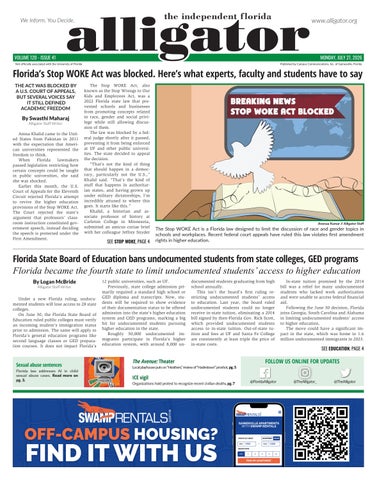
The Stop WOKE Act is a Florida law designed to limit the discussion of race and gender topics in schools and workplaces. Recent federal court appeals have ruled this law violates first amendment rights in higher education.
Florida State Board of Education bans undocumented students from state colleges, GED programs
Florida became the fourth state to limit undocumented students’ access to higher education
By Logan McBride Alligator Staff Writer
Under a new Florida ruling, undocumented students will lose access to 28 state colleges.
On June 30, the Florida State Board of Education ruled public colleges must verify an incoming student's immigration status prior to admission. The same will apply to Florida’s general education programs like second language classes or GED preparation courses. It does not impact Florida’s
12 public universities, such as UF.
Previously, state college admission primarily required a standard high school or GED diploma and transcripts. Now, students will be required to show evidence of their documentation status to be offered admission into the state's higher education system and GED programs, marking a big hit for undocumented students pursuing higher education in the state.
Roughly 50,000 undocumented immigrants participate in Florida’s higher education system, with around 8,000 un-
documented students graduating from high school annually.
This isn’t the board’s first ruling restricting undocumented students’ access to education. Last year, the board ruled undocumented students could no longer receive in-state tuition, eliminating a 2014 bill signed by then-Florida Gov. Rick Scott, which provided undocumented students access to in-state tuition. Out-of-state tuition and fees at UF and Santa Fe College are consistently at least triple the price of in-state costs.
In-state tuition promised by the 2014 bill was a relief for many undocumented students who lacked work authorization and were unable to access federal financial aid.
Following the June 30 decision, Florida joins Georgia, South Carolina and Alabama in limiting undocumented students’ access to higher education.
The move could have a significant impact in the state, which was home to 1.6 million undocumented immigrants in 2023.
, PAGE 4
Anenaa Kumar // Alligator Staff
Average teacher salaries increased throughout Florida, but the state still struggles to meet the national average
Florida ranks second to last for average teacher salaries
By Grace Larson Alligator Staff Writer
Though average teacher salaries are on the rise in Florida, the state still ranks 50th in the nation.
Ranked just ahead of Mississippi, Florida’s average teacher salary was calculated at just over $56,500 for the 2024-25 school year, according to the National Education Association, a United States teachers union.
According to the Florida Department of Education, average teacher salary increased to nearly $58,000 for the 2025-26 school year, although the NEA has yet to release a study based on values for this past school year.
Though the state ranks low in average teacher salaries, the FLDOE said Gov. Ron DeSantis has been investing money in educator pay.
“Since Governor DeSantis took office, Florida has invested $7.1 billion toward increasing teacher pay with $1.56 billion allocated for teacher salaries this year alone,” wrote Olivia Wester, the FLDOE’s press secretary, in an email to The Alligator.
The beginning of DeSantis’ efforts to raise teacher salaries in 2020 led to disproportionate rankings for average starting salaries and average salaries.
According to the NEA report, Florida ranks 50th in the nation for average teacher salary and 19th for average starting salary. The average starting salary in Florida is $49,435.
In 2020, DeSantis passed legislation to spend $400 million to raise starting salaries and $100 million to increase the salary of those not impacted or hardly affected by the base salary increase.
According to the report, Florida went from 26th in the nation for average starting salary to fifth.
The problem, Florida Education Association President Andrew Spar said, is teachers now see little upward mobility.
When Spar was teaching in the ‘90s, teachers were able to double their starting salary over the course of their career. Now, he said, Florida teachers only see a pay increase of $10,000 to $15,000 throughout their entire career.
Despite inflation, he added, average teacher salaries have remained roughly the same.
If Spar started teaching again, he said, he’d be making roughly the same amount of money as he would have in 2010.
He attributes the stagnation in salary increases to legislation passed by former Gov. Rick Scott in 2011. Referred to as the Student Success Act, the legislation introduced a “performance salary schedule.” Rather than continuing step-by-step raises awarded on seniority, raises were now to be provided based on teacher performance evaluations.
Spar said the change restricts how teacher unions can negotiate salary increases. Prior to the legislation, district and union personnel could discuss how much room is left in the budget for teacher raises.
Now, the union’s request for raises for experienced teachers may not be met because raises are dictated by individual performance rather than seniority.
Low teacher salaries lead to high teacher turnover rates, Spar said, or an increase in teachers leaving classrooms.
“It has a huge impact when we don't address fair pay for teachers and staff in our schools,” Spar
said. “We are not just hurting those teachers and chasing them out of the profession, we're actually impacting the ability of students to get the education they need.”
High turnover rates result in vacancies and many new teachers, he added.
According to the FEA, just under a third of Florida teachers had less than four years of experience in the 2024-25 school year.
This lack of experience and opportunity for pay increases may also contribute to Florida’s lowranked average teacher salary.
Additionally, teacher vacancies in Florida saw an increase from August 2025 to January 2026, jumping from roughly 2,300 to 2,400 openings. Despite this rise, Alachua County saw a decrease in vacancies, dropping from roughly 100 to 80 within the same time frame.
The county has also seen an increase in its median salary. In 2025-26, Alachua County Public Schools reported an average salary of roughly $54,000 — up nearly $2,500 from last school year.
In 2024-25, it sat more than $5,000 below the state average. This year, it managed to close that gap to just below $4,000.
Despite salary increases, the county is struggling to climb the ranks. Out of 67 county school districts, removing special entities like Florida Virtual School, Alachua County ranked 45th for average teacher salaries in 2024-25. The following school year, it took the 42nd spot.
This increase in average salary can likely be attributed to the 3% to 4% raise awarded to all teachers for the 2025-26 school year.
The district is currently in negotiations with the Alachua County Education Association, the local teachers union, to discuss teacher pay.
The ACEA was not available for an interview within a 2-week period.
ACPS spokesperson Jackie Johnson said the district’s goal is to provide competitive salaries for all employees.
“As with school districts across Florida, the level of salary increases we can provide ultimately depends on the funding available,” Johnson wrote in an email to The Alligator, “which can fluctuate significantly year to year and varies from one district to another and from one state to another.”
Last year’s negotiation took approximately two months. It is unclear when the district and union will reach an agreement.
and clear in its news reports and editorials. If you find an error, please call our newsroom at 352-376-4458 or email editor@alligator.org 352-376-4458 NEWSROOM:
Juleidi Machuca // Alligator Staff
Average teacher salaries have increased in Florida, but the state continues to rank second
THE LAW INCREASED THE SEVERITY OF PUNISHMENT FOR CRIMES INVOLVING CHILD SEXUAL ABUSE MATERIAL OR BESTIALITY
By Teia Williams Alligator Staff Writer
The creation or transmission of child sexual abuse material generated by artificial intelligence went from a third-degree felony to a second-degree felony in Florida at the start of July.
The Sexual Offenses bill, signed March 3 by Gov. Ron DeSantis, tightens the laws and punishment surrounding child sexual abuse material. Whether someone is directly creating the imagery or receiving it from another person or website, they can be penalized. AI-generated material doesn’t need to contain a real child to be against the law. Defendants can face up to 15 years in prison versus the five years they would have faced as a third-degree felony.
“I think this bill is a great first step in dealing with this really horrible exploitation of minors,” DeSantis said at the signing.
The law also replaced the term “child pornography” with “child sexual abuse material” in Florida statutes.
The North Florida Internet Crimes Against Children Task Force, hosted by the Gainesville Police Department, has adapted to the new law and continued its work detecting
child sexual abuse material.
The task force receives CyberTipline reports from the National Center for Missing and Exploited Children, which received 21.3 million reports last year through platforms like Facebook or TikTok. The reports are sent out to the nearest jurisdictions, including the task force.
The new law makes it easier for Florida law enforcement to charge those involved with child sexual abuse material because they can prosecute without determining whether the AI imagery was based on a real child, said Sgt. Christopher King, a detective for GPD.
“This is about holding someone accountable who has abuse material of a child,” King said. “Whether real or not, it’s still abuse material of a child.”
Other states still struggle to detect child sexual abuse material because law enforcement can’t pursue the case without determining the child is real, King said.
The task force has learned how quickly someone can use technology for exploitation, he said. Training has given them a better understanding of how people are doing this and how they can prevent it, King said, and it helps them know where to look when detecting child sexual abuse material.
On July 8, The Alachua County’s Sheriff’s Office arrested Dr. Chintan Shah, a UF clinical assistant professor, for possession of child sexual abuse material. ACSO later found files containing AI-generated con-
tent, which led to additional charges.
The Florida Department of Law Enforcement wrote a statement on its website regarding the new law and how to proceed if someone runs into child sexual abuse material. It said to contact the FDLE Cybercrime Office if you know someone who possesses child sexual abuse material or if you have come into contact
with it online.
“Additionally, if you receive CSAM by email or in any other manner, do not download, print, or copy it to a disk and do not forward the email to anyone. Leave the email in your inbox and contact the FDLE Cybercrime Office,” the FDLE wrote.
The Florida Council Against Sexual Violence is the state’s federally
recognized sexual assault prevention coalition. It advocates against sexual abuse for victims of all ages. It also helps provide a safe space and voice for survivors.
Jennifer Dritt, the coalition’s executive director, said she is waiting to see how much the law will impact the prevention of child exploitation.
“It’s certainly not meaningless,” Dritt said. “It has a real impact on real people. We’ll see what that impact is. But the state has to make it very clear that [child sexual abuse material] is not acceptable.”
Pornography contributes to child abuse, which contributes to sexual assault, she said. Placing more limits on abuse toleration will help prevent it, she added
The new law also makes other penalties for sexual offenses. It is now a life felony to employ, authorize or induce a child under the age of 12 to engage in sexual performances. This means perpetrators can spend anywhere from 40 years to life in prison.
It’s also now a second-degree felony — instead of a third-degree felony — to have sexual contact with an animal. Once convicted, the law mandates a minimum five-year ban of possession, ownership or working with an animal. Someone convicted of these crimes cannot volunteer with animals during the ban.
@teia_williams twilliams@alligator.org
Mily Moran // Alligator Staff
State restricts admission based on immigration status
EDUCATION, from pg. 1
Kathy Hebda, the chancellor of the Florida College System, said the ruling adds new requirements for associate degree programs and addresses career certificate programs.
"This includes a procedure for students to provide an attestation of their status prior to admission and to provide documentation of such prior to enrolling in the institution,” Hebda said.
In Alachua County, the ruling could impact Santa Fe, which hosted roughly 900 foreign-born students and over 3,000 Hispanic students in the 2024-25 academic year. It is unclear how many students are undocumented.
Santa Fe currently encourages undocumented students to apply as international applicants, and if admitted, they are classified as international students. The college also outlines methods for undocumented and Deferred Action for Childhood Arrivals students to apply for in-state tuition waivers and state or college financial aid.
DACA refers to an immigration policy that protects eligible undocumented immigrants brought to the United States as children from deportation.
According to the Florida Policy Institute, Santa Fe could lose over $277,000 in tuition under this ruling. Total losses across all 28 state colleges could surpass $15 million.
Santa Fe officials were unavailable for comment after several phone call and email requests.
For Lairalee Ramos, a UF student and president of Chispas, a student organization focused on immigrant rights and advocacy, the changes represent a concerning trend in higher education.
Chispas hosts several events in support of immigrants around the community, Ramos said, such as volunteering at citizenship classes hosted by the Latina Women’s League and creating community IDs for immigrants who may not be able to obtain an official ID.
Ramos said the role of educational institutions shouldn’t be to serve as immigration enforcement. She’s been disheartened to see individuals unable to pursue an education in the state, she said.
“We’re losing out on students who are really motivated, regardless of their status, who deserve an education,” Ramos said. “It’s just pushing people out of Florida if they want to get an education.”
Ramos hopes public institutions continue to maintain opportunities for students regardless of their immigration status, she added.
In Alachua County, nearly 15,000 of the county’s roughly 285,000 residents currently lack citizenship.
According to Jackie Johnson, the spokesperson for Alachua County Public Schools, the county does not request immigration status from its students. It’s unclear how many K-12 students in the district will be impacted by the recent ruling.
ACPS offers immigrant family
services and English for Speakers of Other Languages programs to support immigrant students.
Alexis Vivanco, the press secretary for UF’s Hispanic Student Association, which often contains members who attend Santa Fe with intentions to transfer to UF, said he hopes HSA can serve as a beacon to Hispanics and Latinos
across the Gainesville community.
Roughly 76% of undocumented United States residents are of Hispanic origin.
“We’re not discouraged by the challenges that have been circulating in the last few years,” Vivanco said. “We’ve been through hard times. We’ll continue to per -
severe and work past them.”
He encourages students to continue getting involved in activism to make their voices heard on immigration issues, he said. The ruling will take effect in the 2027-28 academic year.
@logandmcbride lmcbride@alligator.org
new policy was proposed and
from
on
Court shoots down anti-DEI education bill
1
against the act. She said it threatened the freedom to think and, after seeing similar laws introduced across various states, believed it was important to speak up.
Before submitting the brief, the two conducted research by interviewing various faculty members. Faculty were concerned the act would affect their ability to teach topics in the classroom, Khalid said.
One professor described it as “educational malpractice,” she said, a term that refers to the censorship of topics or limitation of viewpoints within an area of study.
“When the autonomy of higher education is undermined, essentially we’re going to do away with the capacity of the next generation to think independently and to understand and engage with the world as it is, accurately,” Khalid said.
While the law never took effect because of the injunction, faculty leaders at UF said the possibility of its enforcement shaped conversations about academic freedom.
Nearly a century of case law on academic freedom in the classroom at public institutions could have been upended if the state had won the appeal, wrote Meera Sitharam, a co-president of the United Fac -
ulty of Florida at UF, in an email statement to The Alligator.
The ruling reaffirmed faculty members are hired to freely exercise their expertise and academic freedom to speak in the classroom and outside of it as an expert in the public interest, Sitharam wrote.
Still, she said other laws may offer broader implications for the campus climate for teaching and learning.
Florida’s Senate Bill 266, which restricts majors and general education courses heavily related to DEI, has removed sociology as a general education class, she said.
“The injury from that is effectively a chilling of speech of faculty in an entire department,” she wrote. “It cuts off a significant portion of the tuition revenue that would be necessary for them to continue.”
Greg Gruebel, a senior attorney at the Foundation for Individual Rights and Expression, wrote in an email statement to The Alligator the law forced professors to ask legal questions before they could do their jobs.
“The chilling effect from Florida’s Stop WOKE Act was real,” Gruebel wrote. “I heard from many professors who were trying to figure out how to follow the law without abandoning the standards of their
fields.”
Had the court ruled in favor of the act, Gruebel said, it would have resulted in a quieter classroom where professors avoided topics the state labeled too risky to teach.
Similar laws, like Alabama’s Senate Bill 129, which restricts DEI efforts and bans the promotion of “divisive concepts” in school boards, public universities and state agencies, have put faculty in similarly difficult positions, he added.
“These laws send a clear message that some ideas are dangerous to teach,” he wrote.
Gruebel said the court’s ruling protects what college is supposed to be.
The American Civil Liberties Union of Florida, which represents professors and students challenging the law, argued throughout the case the Stop WOKE Act violated the First Amendment by restricting what could be taught in public university classrooms.
Carrie McNamara, a senior staff attorney at the ACLU, said the court decision affirmed the importance of an open exchange of ideas.
“Teaching our complex history is not discrimination,” McNamara wrote in an
email statement to The Alligator. “It is necessary to the education of a free and democratic society.”
Aidan Tran, an 18-year-old UF environmental engineering sophomore, said he believes sharing and understanding different — and often divisive — opinions is important in the classroom.
Tran said in his class, American Civil Discourse in the Political Order, he learned the importance of embracing different opinions because it’s how society functions.
He doesn’t believe professors should remain entirely neutral on issues, he added. Instead, he said students benefit from instructors who are transparent about their own perspectives while making space for differing viewpoints — as long as those viewpoints are not harmful or threatening to others.
Exposure to different ideas and viewpoints is important in higher education, he said, where students are at an age where they should be able to distinguish between what information is true, false or harmful.
“At the end of the day, the university is like a forum for discussion,” Tran said. “If we close off the discussion for professors or students, it just harms the overall value and quality of our education.” @s_maharaj1611
STOP WOKE, from pg.
Mily Moran // Alligator Staff
A
voted
by Florida’s State Board of Education to prohibit undocumented students
attending any of Florida's 28 public colleges.
MONDAY, JULY 27, 2026
www.alligator.org/section/the-avenue
‘Heathers: The Musical’ brings ‘Big Fun’ to Gainesville
GAINESVILLE COMMUNITY PLAYHOUSE KICKED OFF ITS RUN OF THE OFF-BROADWAY SENSATION
By Brandy Sumner Avenue Staff Writer
Inside the walls of Westerberg High School, between each comedic musical number, a ticking time bomb is counting down to its final seconds. In May 2025, Gainesville Community Playhouse announced it would be putting on its own production of “Heathers: The Musical,” an adaptation of the 1989 film following Veronica Sawyer and her murderous boyfriend JD as they navigate high school. The GCP production opened July 17 and runs through Aug. 9.
The musical version of the show has run off-Broadway since 2014 and takes a campy spin on the original, upping the humor and ridiculous elements of the plot through the music.
The show’s popularity has made GCP’s production highly anticipated for audiences and actors across
Gainesville.
Rachel Kallenbach, the 22-yearold who plays Heather Chandler, one of the main antagonists of the story, said the reaction to opening night was even more than anyone had hoped for.
“Because this show has such a cult following,” Kallenback said, “opening night, even preview, I remember when the doors opened for the ‘Heathers’ entrance, it took everything in me to not start grinning, because everybody cheered, which I wasn’t really expecting.”
Over 100 people tried out for the show during its two days of auditions this May, with over 70 coming in for the first day alone.
For many of the actors involved in the show, any part in “Heathers” is a dream role.
“The minute I heard that this show was announced last year, I was like, ‘I’m auditioning for that,’” said 20-year-old Jose De La Cruz. “And so it’s just been in the back of my mind ever since.”
De La Cruz landed one of the leading roles, JD, a student who
plans and executes the murders of his classmates over the course of the show.
Despite the show’s more serious themes, it primarily plays out as a comedy, taking elements like murder and turning them on their head. Ghosts of dead students chest-bump in the background, and characters sing about slurpees while talking about dead parents.
Even the show’s ensemble plays into the comedy, acting out their own mini stories in the background of the main plot, said Sam Rhodes, the 27-year-old director of the show.
“It’s been interesting to see all of the people, especially the ensemble, build their characters up from nothing into this full-on plot happening behind everything,” Rhodes said.
“Heathers” is the first production Rhodes has directed and one of her favorite musicals. She originally submitted “Heathers” to GCP in 2023 but was rejected. The show would eventually be accepted in January 2025.
Rhodes hopes “Heathers,” a story about the struggles of being young, will draw a new crowd of high school
and JD in a Gainesville Community Playhouse production of Heathers:
and college students to GCP.
“I think this show is bringing a different crowd to this theater and really expanding our horizons a little bit,” she said. “We’re not just for the Sunday crowd anymore. We’re for
cool people.”
Morgan Bradley, the show’s 26-year-old assistant stage manager, knew about Rhodes’ original plan to put on “Heathers” in 2023 and has been thinking about it ever since.
The show has many moving parts, including many scene and prop changes throughout its threehour run time, making it exciting work for the backstage crew.
“I like being able to be a part of it but still kind of lurking in the background, not having the spotlight on me,” Bradley said.
For cast and crew alike, the best part of the show wound up being the connections they made with their fellow castmates during rehearsals.
Layla Edwards, a 20-year-old who plays show lead Veronica Sawyer, said it’s the heart the entire group puts into the show that has made being a part of it such a dream.
“Even when my understudy goes on, I see everything, like the big picture, and it’s beautiful,” Edwards said.
bsumner@alligator.org
‘Hadestown: The Musical’ brings Broadway to the big screen
THE FILM PROVIDES A FRESH LOOK AT THE FAMILIARLY GUT-WRENCHING TALE OF ORPHEUS AND EURYDICE
By Brandy Sumner Avenue Staff Writer
Following the release of “The Odyssey,” it seems the perfect moment for another adaptation of Greek mythology to hit theaters. However, “Hadestown: The Musical” brings a fresh face to the old myths, much different than Nolan’s “The Odyssey.”
“Hadestown: The Musical,” a live theater capture film of the production, was released July 24. The movie will be shown in theaters for a limited five-night run.
The Tony Award-winning musical, written by Anaïs Mitchell, premiered on Broadway in 2019, where it’s still running.
The film adaptation was directed by Brett Sullivan and features the same main cast as the original Broadway production, minus the Fates — three sisters who guide the characters’ destinies.
The recording was filmed in London in 2025, a little over a year before its theatrical release.
The musical combines elements of the myth of Hades and Persephone, played by Patrick Page and Amber Gray, as well as Orpheus and Eurydice, played by Reeve Carney and Eva Noblezada. Both myths are stories of love and sacrifice, but neither is particularly happy.
Anyone familiar with Greek mythology knows the story
of Orpheus and Eurydice, in which musician Orpheus walks to the underworld to save his lover, Eurydice. Orpheus is permitted to bring her back under one condition: He can’t turn around at any point in the journey to check if his love is still behind him.
The myth is most famous for its ending, when Orpheus fails Hades’ test by looking back at Eurydice, sending her back to the underworld.
For many stories, knowing the ending might make it less enjoyable, but Hadestown plays into its audience’s awareness. The first song of the musical, “Road to Hell,” reiterates that the song of Orpheus and Eurydice will be sung again and again even though it will always end in tragedy.
As someone familiar with the musical, I still found myself hoping throughout the movie’s entire run that maybe Orpheus would keep his eyes forward this time around. I was still completely crushed when he didn’t.
Despite pulling from ancient Greek myths, the musical doesn’t feel ancient Greek beyond the names and presence of the gods. The setting feels timeless, with costumes that don’t seem to come from any particular era and no references to modern technology or current events.
The lack of a specific setting works in the musical’s favor. A major part of the musical’s theme is repetition, and it’s implied the characters will keep performing this tragedy throughout time. The lack of a timeframe in the musical helps with this feeling; the story will remain relevant whenever it’s told.
The genre of the musical, however, helps contextualize it for American audiences. The songs take inspiration from American folk, jazz and blues, making them feel distinct
Alachua County Headquarters Library creates community with weekly Spanish Conversation Club. Read more on page 7.
from the “show tunes” of many other musicals.
The film version of Hadestown managed to tell the story in ways a stage production alone couldn’t.
Certain camera angles and focus in the recording made elements of the story feel very different from when you can see the entire stage.
During “Doubt Comes In,” while Orpheus is traveling back from the underworld, the camera works to make him feel completely isolated on stage, adding to the nerve-racking feeling the song already places in the viewer.
Hadestown is about love, music and the magic they create. As a stage show rather than a classic film, the production has to be creative with how it makes its magic.
Sound and lighting design make it feel as if Orpheus’ music really is magic, like Hermes says at the beginning of the show. Songs he sings alone often utilize harmonies to make them feel more powerful, and lights are used to make him almost appear to glow.
By the end, I believed the song he was singing — and his love for Eurydice — really could bring the world back into tune.
One of my favorite parts of the film was how it maintained the feeling of watching a theatrical production rather than a movie. Many shots included the audience or showed the actors backstage.
For audiences who haven’t had the chance to see the production in person, “Hadestown: The Musical” works to bring the Broadway experience to life for everyone.
bsumner@alligator.org
El Caimán
Brandy Sumner // Alligator Staff Actors Layla Edwards (left) and Jose De La Cruz (right) perform as characters Veronica Sawyer
The Musical.
‘It’s just lost’: Outreach Thrift moves forward after April fire
ITS TEMPORARY NEW LOCATION IS ON NORTHWEST 13TH STREET
By Addison Gload Alligator Contributing Writer
Nearly three months after a fire tore through the historic store, the family-owned Outreach Thrift Store has reached a new normal.
“All the clothes, all the household items, everything else that was in there was gone,” said Kasey Vellekamp, one of the owners. “It’s just lost.”
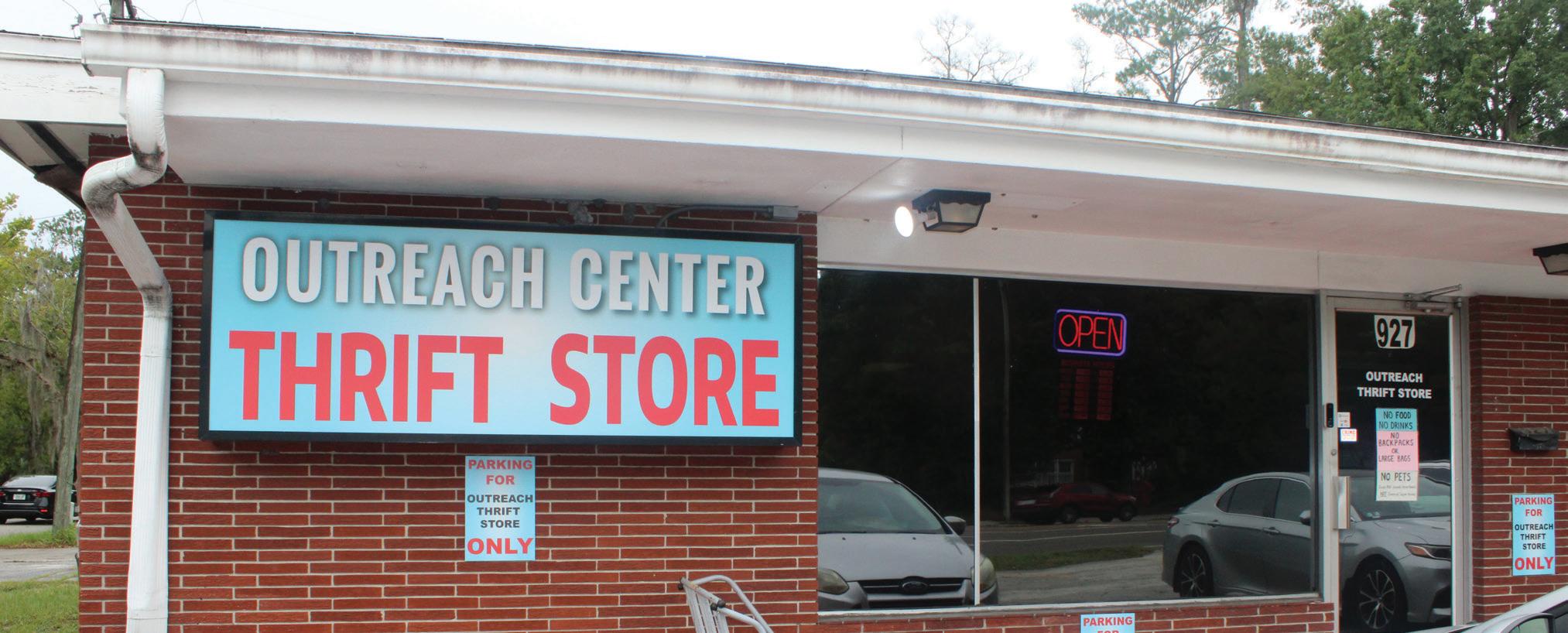
On April 28, a fire severely damaged the multi-story blueand-red building on Northwest Sixth Street that housed Outreach Thrift for 12 years, prompting a temporary relocation to 927 NW 13th St.
The fire destroyed all of the merchandise from the one-story side of the building, Vellekamp said, while the two-story side was damaged by smoke. All of the goods in the building be-
El Caimán
www.alligator.org/section/spanish
Gainesville vigil and protest honor civilian deaths by ICE
LOCAL ACTIVIST GROUPS DEMANDED ACTION AGAINST POLICE VIOLENCE AT A DOWNTOWN ANTI-ICE PROTEST AND VIGIL JULY 25
By Aaron Zagal Yaji Alligator Staff Writer
An anti-Immigration and Customs Enforcement protest and vigil for those killed by enforcement agents was hosted by the North Central Florida Indivisible group in front of Gainesville City Hall July 25.
Over 20 protesters stood in front of City Hall from 6 to 8 p.m., waving a variety of posters and flags with anti-ICE remarks and names of fallen civilians.
The names included the recent Maine and Texas deaths of Lorenzo Salgado Araujo and Joan Sebastian Duran Guerrero, as well as the January deaths of Renée Nicole Good and Alex Pretti.
Older veterans as well as local Gainesville
and Newberry members called for change from local and national representatives.
The protest comes after the city’s July 16 decision to delay a community initiative by the Gainesville Immigrant Neighbor Inclusion Initiative to publicly denounce ICE and share its commitment to policy that would defend and protect immigrants, residents and neighbors.
Among signs bearing ICE victims' names and state death counts, a poster circulated by organizers listed offices with elections this year. Organizers asked participants to sign their name beneath a pledge to call their representatives and urge for a policy that would halt the migrant death toll.
North Central Florida Indivisible Executive Director Jyoti Parmar said the protest was not directly tied to the city commission's decision to postpone the petition, instead reflecting a broader frustration with elected officials she said are avoiding the issue.
“We were compelled to act and show up in this space because we cannot leave these deaths unmarked, unmentioned and unacknowledged, " Parmar said.
Parmar said local officials have chosen to lower their profile on the issue to avoid backlash, a stance she called the “privilege and luxury in sitting behind a podium.”
"Our question for all of them is: You seek to represent us. How are you going to defend us?” she said. “I want to know specific things you're going to do to keep us safe as your constituents, just as human beings in this community."
The event aimed to encourage attendees to directly press elected officials for answers, she said, rather than prompting an official response from the city itself.
"We are not all activists or loud or even comfortable or well informed about all of the things that go into these policies, but we have a right to be safe and feel safe in the community," she said. "We shouldn't have to duck and hide while trying to take care of our families."
Amy Schwarzer, a member of the NCF Indivisible leadership team, helped organize the protest and vigil.
"We don't necessarily expect them to respond to the protest itself,” Schwarzer said.
“Part of the goal of this event is to get the people who are attending this event to then go to … other elected officials on other levels and demand answers as to what they're going to do to protect immigrants and other vulnerable communities."
Schwarzer said recent ICE-related deaths the past weeks were alarming and reflected overpolicing in America.
"It's outrageous," she said. "There are American citizens who die every day from police violence that are unarmed and innocent … We are now expanding that to our immigrant friends and neighbors."
More than 50 people have died in ICE detention nationwide, she said, citing cases like those of Salgado Araujo, Durán Guerrero and Juan Jairo Coronilla Durán.
Gainesville still has progress to make in minority representation in local government, she added.
Read the rest online at alligator.org. @azagalyaji azagal@alligator.org
‘Two-year-olds speak Spanish. So can you’: Inside the Headquarters Library's Spanish Conversation Club
FOR ABOUT TWO YEARS, LANGUAGE HAS TURNED A CORNER OF THE HEADQUARTERS LIBRARY INTO A WEEKLY GATHERING FOR THE COMMUNITY
By Aaron Zagal Yaji Alligator Staff Writer
Angela Couret's phone rings in the middle of Spanish Conversation Club, and instead of silencing it, she puts it on speaker.
It's her son. He's just closed on his first apartment. For a brief moment, the grammar worksheets and vocabulary lists are set aside as nearly a dozen club members lean in to listen and celebrate with her.
It's a small moment, but it captures exactly what keeps almost 60 regular members coming back to the Headquarters Branch Library week after week: The club is more a family than a class.
Angela Couret, a 58-year-old Cuban and UF Class of 1976 romance languages alumna, has volunteered at the Spanish Conversation Clubs at the Headquarters Branch Library for roughly two years.
Couret grew up in Cuba and Venezuela and spent decades working as an interpreter for a chemical trading company in
Hall of Fame
Venezuela.
After her son, Alberto, was born with an intellectual disability, she created a nonprofit called Paso-a-Paso in Venezuela supporting children with disabilities and their families.
When the family moved back to Gainesville, Couret said, she missed that sense of purpose. So, when the library's literacy department needed a volunteer to lead Spanish conversation practice, she signed on.
"It's been really a blessing to have that outlet, because personally I needed to have a place to give back to the community," Couret said. "I've always believed in that."
As a part of the county’s adult literacy program, her son Alberto has a mentor who meets with him and provides books at no cost, she said. The library also hosts job fairs and internet literacy classes for older residents learning to navigate technology. Couret credits the resources for her dedication to giving back to the community.
"It's important that people in the community know that [these programs] exists," she said. "They have lots of things that are free and open access for people."
The club follows a loose but consistent rhythm each week. Couret opens with a review of common grammar points to level the playing field, as fluency varies widely among newer arrivals and near-native speakers.
From there, the group moves into literature and current events. Couret writes her own briefs on topics she thinks will
para
spark conversation, pulling stories from news outlets like El País and BBC Mundo. She runs them through an AI tool to simplify the reading level so beginners aren't left behind.
At July 25’s meeting, the reading topic was Christopher Nolan's adaptation of "The Odyssey." The group often shifts to fun activities like roleplay and improvisation, acting out scenarios in Spanish that range from ordering at a restaurant to bantering about the week's news.
For Couret, the club has always meant more than grammar drills. She didn’t hesitate to explain how a club like hers matters at a time when conversations about language and culture can feel especially taboo.
"It's vital for people to value each other's cultures and their backgrounds and the effort that people make to thrive," Couret said.
She pointed to her own experience raising a son with a disability. People carry preconceived notions until they actually meet someone, she said, and then everything changes.
"When you meet [some]one, you don't think about their disability,” she said. “You think about Alberto, or you think about Veronica — the person — and then it totally shifts your perspective.”
Read the rest online at alligator.org.
@azagalyaji azagal@alligator.org
Gators name eight former athletes to be welcomed into Hall of Fame Class of 2026. Read more on pg. 11.
The best stories from new champions, part 3
When Mexico kicked off the 2026 World Cup against South Africa on June 11, the world came to a screeching halt. For the next 38 days, all eyes were fixed on the pitch as nations competed for the highest honor in the most popular sport on the planet.
Headlined by an expanded field of contenders, co-hosting countries offering new cultural perspectives and final national appearances for some of soccer’s greatest superstars, the ending of this tournament actually feels more like a new beginning.
Not a single Spanish starter is over age 30. Their captain, 30-yearold Rodri, took home the Golden Ball award for the tournament’s best player.
It was 26-year-old Ferran Torres
who scored the winning goal in extra time of the final, clinching the tournament for Spain.
While 19-year-old defender Pau Cabarsi took home the Best Young Player award, it’s fellow 19-year-old Lamine Yamal who has captivated fans worldwide with his stellar play and is projected to be the sport’s next great icon.
The point being, this Spanish squad isn’t going anywhere. It’s already threatening to become the third country to win back-to-back World Cups — the first since Brazil in 1962 — a feat the team just kept Argentina from achieving.
Lionel Messi proverbially passing the torch to Lamine Yamal feels like something straight out of a movie, but Spain earned this victory with
far more than the strength of its plot armor.
It was simply the most dominant defensive team of all time. Spain’s one allowed goal is the fewest of any country in the history of the World Cup, topping a record shared by its own 2010 championship squad.
Goalkeeper Unai Simón shut out some of the most prolific scorers the game has to offer, including Cristiano Ronaldo, Kylian Mbappe, and of course, Messi.
What’s more impressive is that with 48 teams in the tournament, Spain’s run included an eighth game, which no team had to play before.
Under coach Luis de la Fuente, Spain is undefeated in international play and now has two major tournament titles.
Fan-favorite defender Marc Cucurella declared that if the Spaniards had taken home soccer’s greatest prize, he would get a tattoo of his coach’s face “somewhere visible” on his body.
De la Fuente says he plans on holding him to it.
“I am too old for tattoos, but my players are men of their word, and I know they will stick to their word,” he said in a press conference. “They made a mistake, and they will stick to it. I am not that ugly.”
His reaction is a testament to the team’s relationship in the locker room and the standards to which he holds his players — both of which show up on the pitch.
Of the 13 goals Spain scored over the course of the tournament, 10
Why America is where satire goes to die
Vermin Supreme has been running for president since the 1980s. He wears a rubber boot on his head, carries a giant toothbrush and promises every American a free pony. In 2011, he was so committed to the bit he glitter-bombed a rival candidate at a minor-league debate.
The consequence tells you everything you need to know about how America treats its political satirists. He wasn’t fined, censured or laughed off — he was physically barred from the next forum and made to stand outside behind police tape, holding his ponies.
His best-ever result, after four decades of trying, was 260 write-in votes — 0.1% — in the 2020 New Hampshire Democratic primary.
That is the ceiling for American political satire: police tape and a rounding error. And Vermin Supreme is a success story.
Pat Paulsen ran a deadpan mock campaign in 1968 that generated a season of laughs on the Smothers Brothers and then vanished from the national conversation entirely. Roseanne Barr’s 2012 Peace and Freedom Party run barely made it past entertainment blogs.
Every four years, some new comedian floats a joke candidacy, gets a week of write-ups calling them “delightful” or “biting” and disappears, having changed nothing and built nothing that survives to the next cycle.
This isn’t a talent problem. American comedians are perfectly capable of writing sharp political material — late-night television proves that nightly. The problem is the machinery of American elections is engineered, deliberately or not, to strangle a satirical candidacy before it can accumulate any real force.
It begins when comedians can’t start a campaign in the first place. Ballot access laws vary state by state, and most require a candidate outside the two major parties to gather thousands of valid signatures months in advance just to appear on a ballot at all.
That’s a serious logistical operation, not
something a comedian can run alongside a day job — and it means most satirical campaigns are either symbolic write-ins that don’t legally count or expensive operations that burn out the joke long before election day.
Then there’s the debate stage, which is where American political satire actually goes to die.
The Commission on Presidential Debates sets polling thresholds no independent or minor-party candidate can plausibly hit, and lesser-known-candidate forums — the only venues that will host a satirist at all — reserve the right to simply eject anyone who embarrasses the process, as Vermin Supreme discovered. A satirist thrives on being in the room with the people he’s satirizing. American structures make sure he never gets there.
Layer onto that a media environment that treats third-party and independent candidates as a spoiler threat rather than a legitimate voice — a fear rooted in a first-past-the-post, winnertake-all system where every vote cast for a joke candidate is framed as a vote “stolen” from a real one. That framing makes journalists cover satirical campaigns as novelties to be dismissed rather than critiques to be engaged with, and it makes voters wary of “wasting” a vote on a message rather than an outcome.
The final problem is continuity — or the lack of it.
Every American satirical candidate other than Vermin Supreme seems to reinvent the wheel. Pat Paulsen, Roseanne Barr and hundreds of forgotten others each built their own persona from scratch, ran once or twice and took whatever recognition they’d built with them when they left.
There is no institutional memory, no returning character that voters and reporters already understand, so the joke has to be re-explained from zero every cycle. That’s exhausting, and it means no satirical campaign in America has ever been able to compete with Count Binface,
the silver-bin-helmeted “intergalactic space warrior” played by British comedian Jonathan Harvey.
The character didn’t spring up overnight — Harvey spent years building it. In the 2017 general election, he first stood as “Lord Buckethead,” a Darth Vader spoof in a black leather outfit and bucket-shaped helmet, against Theresa May in her Maidenhead constituency, generating enough buzz to be flown to New York days later for an appearance on “Last Week Tonight with John Oliver.”
When a legal dispute over who owned the Buckethead name flared up ahead of the 2019 election, Harvey didn’t retire the bit — he rebuilt it. He renounced his “peerage,” declared himself a Recyclon warlord from the planet Sigma IX and relaunched as Count Binface in time to challenge Boris Johnson directly in Uxbridge and South Ruislip.
From there, the character never stopped working. Binface ran against Johnson again in the 2019 general election, then a third time in the 2023 by-election triggered by Johnson’s resignation, telling reporters it was “time to take out the trash” on politicians who had “made a mockery” of politics. He stood for Mayor of London in both 2021 and 2024, pulling in over 24,000 votes each time — enough to finish ahead of several actual registered parties.
In 2024, he went after Rishi Sunak directly, running in the prime minister’s own constituency of Richmond and Northallerton; his 308 votes were, by his own account on social media, his best parliamentary showing yet, and he declared “#BindependenceDay has come.”
This year, he turned up again to challenge Andy Burnham in the Makerfield by-election.
Eight years in: one comedian, one bin and one target every time — whoever currently holds the most power in the room.
The manifesto has always been the joke’s real engine. Binface pledged to introduce mandatory national service for former prime min-
were assisted and zero players scored more than once.
While most of the recent champions and teams in this year’s tournament were led by one or two attacking stars, Spain’s win stands out as a complete team effort.
When the World Cup returns in 2030 for its centennial celebration, one of the three host nations will be referred to as “campeones defensores del mundo” and don “dos estrellas” on their hearts for the first time.
@schultzbrayden9 bschultz@alligator.org
isters, “reunite the country” with a referendum on whether to hold another referendum and hand over royal palaces to the homeless.
Sasha Morel opinions@alligator.org
None of it is subtle, but all of it is legible. Each pledge is a direct, recognizable jab at a specific and widely shared frustration — political accountability, Brexit fatigue, inequality — rather than an abstract bit that only works once.
None of that success is an accident of British charm. It’s a product of a system that lets satire survive long enough to matter: a flat £500 candidacy deposit, refunded to anyone who clears 5% of the vote, rather than a signaturegathering marathon; a long-running tradition of minor and joke candidates — the Official Monster Raving Loony Party has been doing this since 1983 — standing on the same platform as major-party contenders rather than being fenced off from them; and, crucially, a satirist who never had to start over from scratch.
Binface always targets the country’s most powerful sitting officeholder directly. Because he’s the same character every time, each campaign inherits the audience and credibility built by the last instead of resetting to zero.
None of this means American satirists are less talented or less committed than their British counterparts — Vermin Supreme’s 40-year run proves the opposite. What America lacks is a structure that lets persistence pay off: accessible ballot rules, debate stages that don’t eject the very candidates meant to hold the powerful accountable and a media culture willing to treat a recurring satirical character as a legitimate commentator rather than a one-off punchline. Until that changes, the American tradition of political satire will keep producing brilliant, doomed one-offs while, across the Atlantic, a man in a bin helmet keeps proving the joke works a lot better when it’s allowed to stick around.
@BySashaMorel. smorel@alligator.org
Brayden Schultz opinions@alligator.org
How to Place a Classified Ad:
You need the money to do what you will Rich at Best Jewelry and Loan has the cash for those bills
● ● For Rent – 1617 NW 7th PL ● ● Sweet 3 BR/1BA house only 7 blks from UF library in quiet residential neighborhood. Lg Family Rm, .cent H&A, W/D, Large, private, fenced yard, dogs OK on approval. Drive by to view - sign in yard. Call Tom Davis 352-2154990. $2,250/ mo. Yard Serv & Pest control incl. 8-3-26-4-2
We Buy Houses for Cash AS-IS! No repairs. No fuss. Any condition. Easy process: Call, get cash offer and get paid. Call today for your fair cash offer: 1-321-603-3026 7-27-32-5
When the heat is on and it's bucks that you need, Best Jewelry and Loan your requests we will heed. 523 NW 3rd Ave 352-371-4367 8-12-13-5
● ● Condo near UF ● ● Newly remodeled 2/2 condo off Newberry road near Regal theater. 900 sf. New appliances & LVP flooring. Quiet, secure home. $136K. Move in ready.352-574-2669 8-3-26-4-5
The surf's up at "Pawn Beach". We're all making the scene. If you're in need go see Rich, Best Jewelry and Loan's got the "green" 523 NW 3rd Ave 352-371-4367 8-12-13-5
CASH PAID FOR HIGH-END MEN'S SPORT WATCHES. Rolex, Breitling, Omega, Patek Philippe, Heuer, Daytona, GMT, Submariner and Speedmaster. These brands only! Call for a quote: 1-877-377-4727. 7-27-1-13
universitario independiente mas grande de estados unidos.
6: FURNISHINGS 7: COMPUTERS 8: ELECTRONICS 9: BICYCLES 10: FOR SALE 11: MOTORCYCLES/ MOPEDS
2. Which team was set to join the American Basketball Association in 1975, but played only three exhibition games before being expelled from the league due to financial woes?
3. He won a Super Bowl XXXVII ring as a running back for the Tampa Bay Buccaneers. His son, a wide receiver from USC, was chosen by the Indianapolis Colts in the second round of the 2020 NFL Draft. Who are they?
4. Where was the 1942 Rose Bowl played after being relocated from California in the wake of the Pearl Harbor attack?
5. Name the Australian tennis player who won the 1987 Wimbledon gentlemen's singles championship.
6. In 1943, brothers Max, Doug and Reg Bentley played together on the same line for what NHL team?
7. Long-distance runner Emil Zatopek won three gold medals at the 1952 Helsinki Summer Olympics competing for what country?
The Baltimore Claws. 3. Michael Pittman and Michael Pittman Jr.
Duke Stadium in Durham, North Carolina.
Pat Cash.
The Chicago Blackhawks.
Czechoslovakia.
Castle.
The Rockford Peaches.
2025 King Features Synd., Inc.
1. In 1980, who did Major League Baseball commissioner Bowie Kuhn present with lifetime passes to any major or minor league baseball game?
MONDAY, JULY 27, 2026
HALL OF FAME
Florida announces Gators Athletics Hall of Fame Class of 2026
EIGHT FORMER GATORS WILL BE WELCOMED TO THE HALL OF FAME ON OCT. 9
By Jeffrey Serber Sports Writer
The University Athletic Association announced the Gators Athletics Hall of Fame Class of 2026 on July 21, highlighting eight former Florida athletes.
Vernon Hargreaves III, Dedric Dukes, Vernon Maxwell, Mikey Meagher, Andrew Moten, Logan Shore, Bridget Sloan and Kelsey Stewart make up the incoming class, which will be inducted Oct. 9 ahead of Florida’s home football game against South Carolina.
The eight Gators were part of seven national and 10 conference title teams and won a combined 11 NCAA and nine Southeastern Conference individual titles.
Here’s a recap of each of the eight members’ accomplishments at UF.
Vernon Hargreaves III — Football (2013-15)
In his three seasons with Florida, Hargreaves earned two All-America and three firstteam All-SEC honors as a cornerback. The Tampa native started 35 of the 37 games he appeared in with Florida, registering 121 tackles, 10 interceptions and 20 pass breakups.
In his first year at Florida, Hargreaves was named the National Defensive Player of the Year by College Football News and received
VOLLEYBALL
third-team All-America honors by the Associated Press. In the following season, he was named a semifinalist for the Chuck Bednarik Award and the Lott IMPACT Trophy. He was also one of three semifinalists for the Jim Thorpe Award his junior year.
The former Gator was selected with the 11th overall pick in the 2016 NFL Draft by the Tampa Bay Buccaneers. He played six seasons in the NFL, with stops in Tampa, Houston and Cincinnati. He finished his NFL career with 69 appearances, 290 tackles (245 solo) and four interceptions.
Dedric Dukes — Track & Field (2012-15)
Dukes was part of one of Florida’s most successful eras in track and field, leading the program to numerous national championships.
In his first year, the Miami native led the Gators’ 4x400-meter relay team at the NCAA Outdoor Championships, securing the first NCAA outdoor team title in program history. Dukes and the Gators also won an NCAA Outdoor championship in 2013.
Dukes won an additional five NCAA titles, claiming the 2014 NCAA outdoor title in the 200 meters while also contributing to two NCAA Championship 4x100-meter relay teams and two NCAA championship 4x400-meter relay teams.
The former Gator received U.S. Track & Field and Cross Country Coaches Association South Region Outdoor Athlete of the Year honors in 2014 and 2015.
Overall, Dukes earned 17 All-America hon-
ors (11 outdoors, six indoors), cementing himself in Florida track and field history.
Vernon Maxwell — Basketball (1984-85, 1987-88)
Maxwell is Florida’s all-time scoring leader in men’s basketball with 2,450 points over his 130 UF games. The point total ranks third in SEC history. His 738 points during his junior season (1986-87) are the most by a Gator in a single season.
The Gainesville native led Florida to its first NCAA Tournament bids in program history. Maxwell was a three-time All-SEC honoree and received an AP All-America honorable mention during his senior season.
He is the program’s leader in field goals (921), steals (206) and points in SEC play (1,362).
Maxwell spent 13 seasons in the NBA, winning two championships with the Houston Rockets in 1994 and 1995.
Mikey Meagher — Lacrosse (2010-13)
Signing onto the Gators' inaugural lacrosse team in 2010, Meagher made her mark in program history over the next four years, bringing the team to national spotlight.
In 2013, she was the first goalkeeper to be named amongst the five finalists for the Tewaaraton Award, which recognizes the nation's top lacrosse player. She was also a recipient of the Ensign C. Markland Kelly Jr. Award, which is awarded to the nation’s best goalkeeper, in 2012 and 2013. She also re-
HOW TRANSFERS, RETURNING TALENT AND NEW FACES
COULD INFLUENCE THE OUTCOMES OF THIS SEASON
By Nicole Scura Sports Writer
With Florida volleyball preparing for the 2026 season, the team has the chance to prove the program can still thrive without longtime head coach Mary Wise, who departed the program after the 2024 season.
In 2025, the Gators saw their worst season in over three decades, going 16-12 overall and 9-6 in the SEC, leaving massive room for growth under head coach Ryan Theis. That said, Florida’s roster looks different this year, leaving fans wondering how this season will pan out.
Florida volleyball loses a major asset with setter Alexis Stucky transferring to Penn State University for her fifth and final season. An absolute machine on the court, Stucky recorded a total of 1,062 assists in the 2025 season. However, this loss leaves more room for rising junior setter Taylor Parks to step up and
be a weapon for Florida once again. Despite seeing limited court time last season, Parks recorded the second-highest number of assists (111) behind Stucky.
Parks has proven capable as the team’s go-to setter, starting 18 matches in her rookie campaign with Stucky sidelined due to injury. She shined despite her lack of collegiate experience and was named to the 2024 SEC AllFreshman Team. Parks also competed in the 2025 NORCECA Women’s U21 Pan American Cup, helping Team USA secure gold, recording 10 service aces and 36 setting attempts in the final. It’s this level of effort and consistency that Florida needs this year.
Additionally, with rising sophomore opposite hitter Milica Vidači coming off a solid freshman season, the 6-foot-4 Serbia native could strengthen Florida’s right-side attack. If Florida goes with Parks in a 5-1 rotation — where just one setter is on the court, leaving three attackers in the front row when they are in the back — she will be especially crucial and see a lot more opportunities. Not only would this allow Parks to become a dominant leader and give her more options on where to set the ball, but it would also give Vidači the chance to sync with Parks’ timing, creating a reliable
offensive strategy.
Vidači showed great promise for the Gators, appearing in 26 of 28 matches last season. She recorded double-digit kills 12 times and earned a spot on the 2025 SEC All-Freshman Team.
Aside from what shows on the stat sheet, Vidači was also crucial in crunch time. Just one example came last season against the Missouri Tigers on Oct. 10, when the freshman opposite hitter logged four kills in the final nine points of the match to clinch a four-set win for her team.
If Parks consistently puts Vidači in a position to hammer away kills, the Gators could have defenses scrambling next season.
Nevertheless, Stucky is not the only stinging loss.
Rising junior middle blocker Jaela Auguste made a move to the Wisconsin Badgers in her sophomore season.
The 2024 SEC Freshman of the Year was critical to Florida’s success. Auguste finished the season with the second-most points (378.5), kills (291) and service aces (27).
Without Auguste commanding the middle, rising senior middle blocker Alec Rothe has the opportunity to take center stage.
Last season, the Ohio native started in all
ceived Women'sLax.com Goalie of the Year honors during those two seasons.
In her final season, the Liverpool, New York, native was named the American Lacrosse Conference Goalkeeper of the Year.
In 2012, she led the nation in goals-against average (7.04) and save percentage (.537). Her career goals-against average of 7.58 remains the best in program history.
Andrew Moten — Basketball (1983-84, 1986-87) Moten is Florida’s fourth-leading scorer in men’s basketball history, recording 1,930 points across 125 appearances for Florida. Alongside Maxwell, he helped lead the Gators to their first NCAA Tournament bid in program history in 1987.
As a Gator, the Quincy, Florida, native averaged 15.4 points per game. He earned SEC Freshman of the Year honors in 1984 and was a three-time All-SEC honoree and member of the 1985 All-SEC Tournament Team.
Moten has the fourth-most field goals (711), fifth-most starts (124), seventh-most minutes (3,930) and free throws (447) and 10th-most assists (411) in program history. He is also one of three Gators to score at least 1,300 points in SEC play (1,306).
Read the rest online at alligator.org/section/sports.
@JeffreySerber Jserber@alligator.org
Sizing up the Gators: A look into Florida volleyball’s 2026 roster
28 matches, held the team-high blocks (111), ranked third in points (268), fourth in kills (206) and led Florida in hitting percentage seven times.
If Rothe can stay hot and reliable, she will provide a pivotal defensive advantage for Florida.
UF will also have to combat the loss of its three strongest servers. In 2025, rising redshirt sophomore Ella Vogel led the team in ace serves (29) with Auguste (27) and Stucky (22) right behind her.
With their departures, the team will have to focus on strengthening their serves to avoid racking up costly unforced errors.
Other major losses hit UF’s back row. Senior defensive specialist Emily Canaan graduated in the Spring and served as a veteran presence for the team. Playing with Florida for all four years, Canaan consistently put up numbers — including this past season, when she finished with double-digit digs six times.
Read the rest online at alligator.org/section/sports.
@NicoleScuraa nscura@alligator.org
www.alligator.org/section/sports Follow us for updates For updates on UF athletics, follow us on Twitter at @alligatorSports or online at www.alligator.org/section/sports. Follow our newsletter Love alligatorSports? Stay up to date on our content by following our newsletter. Scan the QR Code to sign up.
Florida baseball’s key returners set stage for 2027 Omaha push
WITH MLB DRAFT DECISIONS FINALIZED AND THE TRANSFER PORTAL CLOSED, THE GATORS RETURN A TALENTED CORE CAPABLE OF COMPETING FOR A CHAMPIONSHIP
By Colton Veres Sports Writer
With the transfer portal closed and the MLB Draft in the rearview, there is now a much clearer picture of what Florida baseball will look like in 2027.
Many of the top players from the 2026 season are returning next year in what Florida hopes will be its first run to Omaha since 2024. With a talented mix of established stars, rising prospects and impact players ready for larger roles, the Gators enter the offseason with one of the strongest returning groups in the country.
Leading that group is sophomore shortstop Brendan Lawson, who is set to make arguably the biggest impact for Florida next season.
Lawson was recently listed at No. 1 overall in 2027 MLB mock drafts from Perfect Game USA and Bleacher Report. He was also projected No. 2 overall by MLB.com and No. 3 overall by Baseball America.
The Canadian’s bat is what has made him such a highly regarded prospect. Lawson hit .312 while reaching base at a staggering .511 clip, which led the SEC. He logged a team-leading 19 home runs while also pacing the team in OPS, OBP, SLG, extrabase hits, runs scored, walks and hit-by-pitches.
In his final 10 games of the season, the Toronto native clubbed six homers, highlighted by a 496-foot tank against LSU — the second-longest home run in Gators history — and a walk-off home run against Rider in the opening game of the Gainesville Regional.
The second-team All-American will look to expand upon his breakout season while chasing a championship and the Golden Spikes Award.
While Lawson leads the offense, Florida’s pitching staff will be anchored by reigning SEC Pitcher of the Year sophomore starter Aidan King.
After a strong freshman season, King had a dominant sophomore campaign that saw him take home the award for the top pitcher in the conference. In 2026, the Jacksonville native posted a 3.21 ERA and a WHIP of 1.034 while striking out 92 batters through 87 innings pitched.
The rising junior was named a first-team All-American by NCBWA, first-team All-SEC and a Golden Spikes Award semi-
3,
King is also a projected first-round pick in 2027, being mocked at No. 15 overall by MLB.com and No. 29 overall by Perfect Game USA.
The Bishop Snyder High School product will once again head up the weekend rotation for the Gators after taking that duty away from eventual No. 19 overall pick Liam Peterson earlier in the 2026 season.
Another pitcher expected to make a major impact in 2027 is sophomore right-handed pitcher Jackson Barberi.
Barberi pitched to a 3.13 ERA while striking out 55 batters in 37.1 innings pitched out of the bullpen. The rising junior was the relief ace of the Gators, with 11 of his 19 appearances being scoreless outings and 10 outings lasting four outs or more.
He also held opposing batters to a .156 batting average and posted a 13.3 K/9 in 2026.
The flamethrower was named SEC Pitcher of the Week on March 30 after pitching a combined 6.1 innings with zero earned runs allowed and 13 strikeouts against then-No. 10 Florida State and then-No. 4 Arkansas.
Expect Barberi to compete for a rotation spot next season following the Gators’ MLB Draft loss of starters Peterson and junior Russell Sandefer.
Another returning player poised to have a major impact is sophomore third baseman Ethan Surowiec.
Surowiec led Florida in hits, batting average, RBIs and at-bats while starting all 62 games for the Gators.
The rising junior was draft-eligible due to being 21 years old at the time of the draft but was not selected despite being the No. 249-ranked player overall by MLB.com. This was likely due to his strong commitment to the program, evidenced by his sign-
ing of a new deal with the University’s NIL collective, Florida Victorious.
The Gulfport, Mississippi, native will man the hot corner for the Gators in 2027 and look to build upon his strong numbers from last season.
A dark horse who could end up having a much bigger impact than expected is freshman outfielder Cash Strayer.
The rising sophomore started the year for the Gators in right field after a strong fall performance but ended up only playing 32 games after missing significant time due to a fractured hand.
Despite limited playing time, the Tampa native delivered when given opportunities, batting .272 with an impressive .375 OBP along with four doubles and four home runs.
Strayer has carried that success into the summer with the Brewster Whitecaps.
The former SEC Freshman of the Week is batting .263 with a .406 OBP along with two doubles and three homers. With those numbers, Strayer was selected to play in the Cape Cod League All-Star Game, the only Gator selected out of 10 players.
Strayer is expected to start the season in left or right field for the Gators while batting in the middle of the order.
One of the biggest returning impacts could come from redshirt sophomore two-way player Caden McDonald.
The rising redshirt junior caught fire for the Gators during the latter half of the season, hitting .319 with nine doubles and nine home runs in only 103 plate appearances.
The second-team All-American added to his impressive offensive display by pitching to a 3.42 ERA while striking out 48 batters in 47.1 innings out of the bullpen.
The way “Mactani” impacts the game from both sides will be an integral part of Florida’s success in 2027. The Tampa native will start the season as the designated hitter while serving as a trusted reliever out of the bullpen.
The final returning player expected to have a valuable impact is redshirt freshman right-handed closer Joshua Whritenour.
In his second year with the team, the rising redshirt sophomore manned the closer role, logging a 5.40 ERA and 49 strikeouts through 36.2 innings pitched. Whritenour also recorded seven saves and a 12 K/9.
The Tampa native is expected to hold down the closer role for the Gators, pumping gas up to 100 mph when called upon.
Overall, Florida has one of the best returning crops of players not just in the SEC, but in the entire country.
With multiple potential first-round picks and a roster full of experienced contributors, this group could be the foundation of a championship run in 2027.
@colton_veres cveres@alligator.org
Ryan Friedenberg // Alligator Staff
Florida Gators right-handed pitcher Aidan King throws during an NCAA baseball game against Ole Miss, Friday, April