SMARTASSET’S DESIGNATION REFLECTS STRONG STUDENT OUTCOMES AND AFFORDABILITY,
BUT EXPERTS SAY CHOOSING A COLLEGE INVOLVES MORE THAN RANKINGS
By Hailey Kon Alligator Staff Writer
UF was named the No.1 best-value public university in the nation by financial technology company SmartAsset last month. The ranking placed UF above many other renowned schools like Purdue University and Baruch College.
The ranking evaluated public institutions based on affordability, graduation rates and median earnings upon graduation, emphasizing return on investment for undergraduate students.
Unlike many college ranking metrics that weigh prestige and selectivity, SmartAsset’s methodology primarily focused on whether students receive a high-quality education at a manageable cost.
Toby Nelson, a senior economic analyst at SmartAsset, said the ranking was designed to identify universities that combine affordability with strong long-term outcomes for students.
“We start by filtering for schools whose cost of attendance [is] below the national median,” Nelson said. “From that group, we then score each school on two basic metrics. The first is undergraduate graduation rate and the second is the median earnings of alumni 10 years after they first enroll.”
SmartAsset’s objective is not to provide a comprehensive ranking, he said, but to identify public universities that offer “exceptional value to undergraduate students.”
According to SmartAsset’s analysis, UF distinguished itself across every metric. The university posted a 91% graduation rate, higher than any other ranked school. It also maintained below-median cost of attendance while positing strong alumni earnings.
‘This will make Florida a worse place to live’: Local leaders weigh in on proposed property tax amendment
The proposed amendment would restrict local government spending by lowering property taxes
By Olivia Lofaso Alligator Staff Writer
In June, the Florida Legislature passed the "Save our Homes from Excessive Property Taxes” joint resolution, a proposal to amend the state’s non-school homestead tax exemption from $50,000 to $150,000.
The amendment will hit the ballot in November and must receive 60% voter approval to pass. If passed, it would take effect in January and decrease the amount of property taxes homeowners pay.
Beginning in 2028, the amendment would increase the homestead tax exemption again from $150,000 to $250,000.
The bill follows a special legislative session called by Gov. Ron DeSantis in May to discuss property tax relief. The resolution was sponsored by state Rep. Toby Overdorf (R-85), whose district is a three-hour drive south from Alachua County. It passed 75-26 in the House
SPORTS/SPECIAL/CUTOUT
Heat advisories
Story description finish with comma, pg#
Animal shelters fend off hot temperatures. Read more on pg. 3.
and 30-9 in the Senate.
Rental properties and vacation homes wouldn’t qualify for the expanded property tax exemption. The amendment would also provide a smaller exemption for Florida residents who establish residency after Dec. 31. The exemption would increase after five years to the full amount.
While lawmakers have emphasized the benefits the bill brings to Floridians’ wallets, local officials have expressed concerns that lowering property taxes could lead to a drop in local revenue, which funds services like libraries, animal care and community support programs.
In Alachua County, officials estimate a $250,000 homestead tax exemption could reduce the county’s property tax revenue by more than $48.9 million.
Alachua County declined to comment on the proposed amendment, instead referring to information on its website.
County officials said local governments may consider increasing stormwater fees, solid waste fees and other charges to offset property tax revenue losses. It’s unclear whether Alachua County will consider additional fees to make up for revenue losses.
Concerns over the new amendment weren’t limited to the county. Gainesville officials also criticized the legislation and its potential impacts on the city’s budget.
Mayor Harvey Ward said the amendment, if passed, would be the "biggest mistake the people of Florida could possibly ever make.”
“I don't think they gave much thought to the downstream unintended consequences of this, but there are a lot of them,” Ward said.
“This will make Florida a worse place to live.”
If passed, he said residents could see longer response times from emergency services like fire rescue. Local governments could be forced to cut fire department staffing, he added, and struggle to maintain equipment like firetrucks.
The Avenue: Food Asian-inspired dessert truck launches in Gainesville, pg. 5
Teacher shortages
K-12 educator reassignments cause confusion days before start of school, pg. 2
Longer emergency response times could in turn contribute to higher homeowners insurance rates, Ward said, because a community’s fire protection capabilities are considered when setting insurance costs.
Among other Florida counties, Alachua County has lower-than-average homeowners insurance rates, according to data by the Florida Office of Insurance Regulation.
City Commissioner Bryan Eastman said the bill would be devastating to local governments and residents.
Eastman said property taxes are the glue that holds cities like Gainesville together. While local governments receive grants and state and federal funding, he said property taxes help pay for core services like police operations and permitting services.
The amendment could shift taxes to small businesses, renters and owners of non-home-
Published by Campus Communications, Inc. of Gainesville, Florida
Sonaiya Brown // Alligator Staff
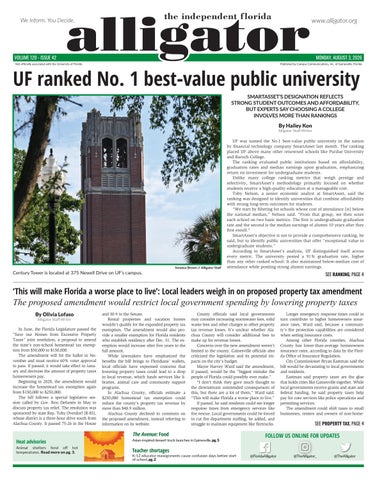
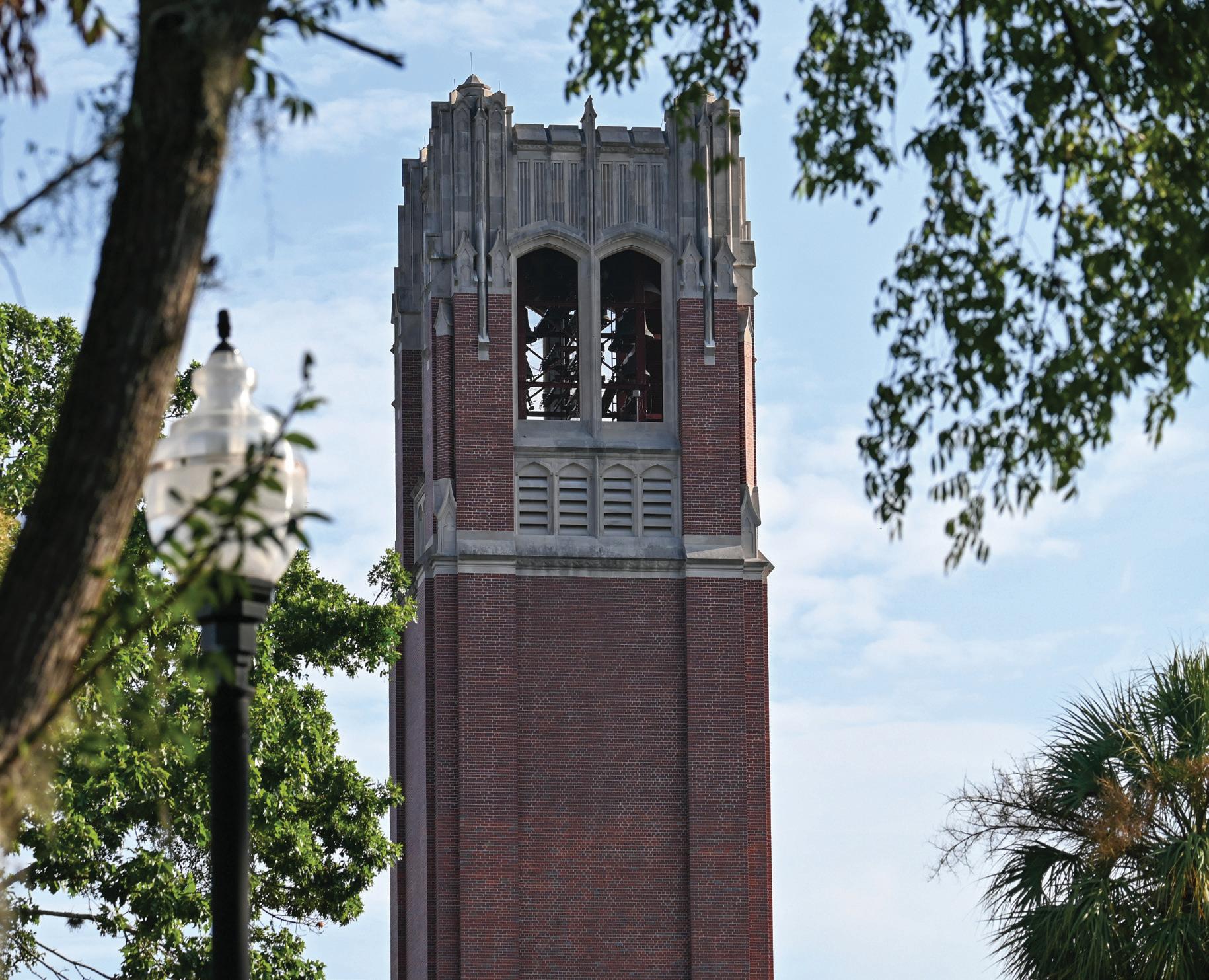
Century Tower is located at 375 Newell Drive on UF’s campus.
ACPS teacher reassignments create confusion ahead of preplanning week
THE REASSIGNMENTS CAME LESS THAN A WEEK BEFORE TEACHERS RETURN TO CLASSROOMS
By Grace Larson Alligator Staff Writer
On July 28, nearly 20 Alachua County Public School teachers received calls telling them they’ve been reassigned to another school. By July 30, the district had revoked eight of the changes.
The attempt to reassign educators less than a week before they return to work follows state law prohibiting schools graded D or F from having a high concentration of teachers who are inexperienced or in need of improvement.
The law also states school districts can use salary incentives to encourage “effective” teachers to move to underperforming schools.
On July 9, Gabriel Lopez, a former kindergarten teacher at Terwilliger Elementary School, received a letter incentivizing him to work at a school improvement, or SI, school. These schools include Lake Forest, Metcalfe, Rawlings and Williams Elementary Schools.
Lake Forest and Metcalfe dropped from C to D schools at the end of the 2025-26 school year. Rawlings dropped from a C to an F, and Williams maintained its D grade.
The letter told Lopez he could receive up to an additional $11,000 a year for the next three years if he moves to and continues to teach at one of these schools. Letters were sent to teachers who were labeled as effective or highly effective based on student testing.
The letter came as a shock to Lopez, who received a letter of nonrenewal in April. He said he thought he might have an opportunity to return to the classroom.
Upon further inspection, the district told him he was mistakenly sent the document and was not eligible despite having earned a three out of four on his students’ test scores.
Lopez, who is fighting the legality of his nonrenewal and now running for a school board position, still doesn’t know why he’s been nonrenewed. He said his nonrenewal letter suggests his performance was subpar.
The letter states that receiving a “satisfactory evaluation” at another district may allow him to return to ACPS.
Lopez said he believes he was nonrenewed because he documented children’s misbehavior in his classroom.
Last year, he said, he had three students who would exhibit disruptive and sometimes violent behavior. He was told to call the behavior resource teacher and write referrals.
The volume of referrals he had to write could have led to his nonrenewal, Lopez said, adding the referrals may have made the school look bad or limited funding.
“If teachers are essentially documenting these incidents that affect the classroom, they're being reprimanded in the most harsh, severe, awful way by essentially being nonrenewed and told, ‘Hey, you can't work here anymore,’” Lopez said. “I really think that's all it was, that I was essentially trying to help my class succeed by having these children removed when they were becoming disruptive, and that's it.”
Lopez was among 76 teachers nonrenewed at the end of the 2025-26 school year. This is down from the 101 teachers nonrenewed at the end of the previous school year.
Lopez said the decision to nonrenew and reassign effective teachers comes amid a nationwide teacher shortage.
As of Aug. 1, there are 150 teacher job listings on the ACPS Employment Applications page. This is just three days before teachers are to return to classrooms for preplanning and a little over a week before the start of the school year.
Many concerned parents and educators took to Facebook to share their opinions about the sudden teacher reassignments.
Jennifer Garces de Marcilla, a 43-year-old mother, took to Facebook after hearing about the issue. Her comment was among hundreds left on various posts referencing the reassignments.
She said the decision to relocate teachers is harmful not only to educators, but also students.
“I think a lot of people are not particularly happy with a lot of the things that the superintendent is doing,” Garces de Marcilla said, “so having those issues on top of everything else, it just feels like they're just gonna keep going in a bad direction.”
Garces de Marcilla was not alone in her sentiment. Several educators attended Thursday’s school board meeting to voice their concerns.
Julia Gatson, a soon-to-be teacher at Glen Springs Elementary School, was among those impacted by the reassignments. Gatson originally taught at Foster Elementary School, which closed at the end of the 2025-26 school year.
Foster Elementary School teachers were given the opportunity to list schools they would like to teach at, and Gatson was assigned to Glen Springs. Earlier this week, she said she was reassigned to Lake Forest. Within 36 hours, she said she was back at Glen Springs.
She called the principals of both schools, and only one knew she hadn’t been reassigned, she added.
“SI schools need and deserve excellent teachers,” Gatson said. “Nobody can dispute that, but the way that this was handled is only going to leave a bad taste in the mouths of teachers and families alike.”
For educators like Gatson, the reassignment is another obstacle to navigate amid an array of changes presented last school year, including rezoning, school closures and administrative reassignments.
Leigh Ann Roane was another educator who spoke against the teacher reassignments during public comment.
She originally attended the meeting to voice concerns on behalf of three teachers who had been reassigned from her school. However, as she was on her way to the meeting, she said she learned they were no longer reassigned.
Still, her message remained the same.
“Transferring teachers to different schools, even SI schools, isn't the issue here,” Roane said. “The issue is transferring teachers less than a week before preplanning starts, not considering each teacher as an individual, creating vacancies within a few days before school starts — at schools where these teachers were being pulled from — and not doing enough to make improvements at those SI schools so that teachers want to work there.”
Though staffing decisions are made by the superintendent rather than board members, several of them addressed community concerns about reassignments.
Board Chair Thomas Vu said the staffing changes happen every year, and he’s glad they occurred ahead of preplanning. To keep it fair, decisions were made on a “last in, first out” basis, he added.
“We need to do a better job of educating our teachers about this and giving them a heads up,” Vu said, “especially during the summer or right before this might be happening so it’s not blindsiding people.”
Board member Sarah Rockwell said she would be willing to help recently reassigned teachers move into their new classrooms Aug. 3 and 7.
ACPS spokesperson Jackie Johnson did not respond to multiple requests for comment via email and phone call.
Teachers will begin preplanning Aug. 3, and school will start Aug. 10.
Alligator strives to be accurate and clear in its news reports and editorials. If you find an error, please call our newsroom at 352-376-4458 or email editor@alligator.org 352-376-4458 NEWSROOM:
Gainesville animal shelters work to keep dogs cool as heat advisories soar across Alachua
SHELTERS HAVE TURNED TO FOSTERS TO
PREVENT
ANIMALS FROM OVERHEATING DESPITE LIMITED SPACE
By Emily Medina-Finsen Alligator Contributing Writer
As Gainesville’s heat and humidity swell, earning it its nickname “The Swamp,” local shelters are working hard to keep their dogs comfortable.
Both the Humane Society of North Central Florida and Alachua County Animal Resources have warehousestyle kennels, making it an active effort to prevent overheating.
Franziska Raeber, the director of development at the Humane Society of North Central Florida, said the main adoption floor was built as an open-air, warehouse-style kennel. There is no central air conditioning, and adding windows is not possible due to the cinderblock walls.
The main floor has 30 to 40 kennels, many of them double-sided to allow the dogs more space.
“The facility was well thought out until the heat started,” Raeber said. “We can handle a day or two of heat, but it’s the consistency and knowing that 64 days of last year were so hot.”
Over the summer, the humane society moves as many dogs as possible into its 30-plus indoor airconditioned kennels. The kennels are typically reserved as quarantine spaces for animals with medical needs or for isolating reactive dogs, Raeber said.
HSNCF has almost 300 animals in its care as of July, Raeber said, but limited space during the summer months makes it difficult to take in new animals. She emphasized the shelter’s many programs to get animals out of the shelter, especially
Doggy Day Out, which allows the community an opportunity to take an available dog for a day. She also encouraged fostering, which offers both short- and long-term options.
HSNCF provides medical care, food and anything else a foster could need, Raeber added.
“They can come here and support our mission, support the animal, save an animal,” she said. “They get to have an animal without the longterm commitment.”
The humane society sent an email to the community June 24 asking for more dog fosters due to the high temperatures.
“We did react earlier this year because we learned our lesson last year,” Raeber said.
Having the word out earlier this year will help the organization continue its work, she said.
In the midst of a heat dome, nighttime is no longer a relief from high temperatures. A heat dome is a region of extreme heat that traps hot air like a lid for days or weeks.
Fostering is one of the HSNCF’s most substantial resources, Raeber said.
“Every animal that goes into foster care opens up a kennel,” she said. “Every foster that takes an animal saves a life.”
Jordyn Chiodo, the HSNCF’s social media manager and development coordinator, led a tour of the kennel, which easily became loud and warm, with temperatures reaching the upper 90s.
Some dogs need more space and can’t be placed indoors, Chiodo said, like their resident dog, Teddy, who Raeber describes as a “big, lovable boy.” Since he is more active, he is more comfortable in a bigger space, which is only available on the main — non-air-conditioned — adoption floor.
A large humming fan was placed in front of his kennel to help him beat the heat.
HSNCF made renovations in 2018 when it assumed its name and moved into the space after the merger of Alachua County Humane Society, Gainesville Pet Rescue and Helping Hands Pet Rescue, Chiodo said. But the recent heat and rising temperatures make the space no longer sustainable.
It would cost about $2.5 million to redo the whole warehouse area, Chiodo said.
The humane society’s foster program has been operating for 50 years now, Chiodo said, and built up a very dedicated group of fosters.
Gainesville hosts many students who are only in the area temporarily and aren’t able to adopt, she added, so they especially promote fostering to college students
The number of fosters fluctuates based on the school year schedule, Chiodo said, dipping during Thanksgiving, spring break and summer and winter breaks.
On average, six in 10 animals at the HSNCF are currently in foster homes, she said.
Fostering helps give shelter dogs a better quality of life, Chiodo added. Twenty-three hours a day in a kennel is far from enjoyable for the dogs, she said, who require mental stimulation and enrichment the shelter can’t offer all day long.
Fosters can get to know the dog’s personality and relay the information back to the humane society, she added.
Brittany D’Azzo, the animal resource supervisor at Alachua County Animal Resources, said summertime is the slowest adoption time but the highest intake time.
Many people are on vacation and aren’t looking to adopt an animal, she said, while others are out and about and finding more stray animals — or at least, saying they are.
“We do have people who are going for the summer to vacation, and they’re bringing us their animals,” D’Azzo said. “Most of the time, they’re saying that they found it as a stray, but after some digging, or if the animal is microchipped to them, we discover that it’s actually their animal.”
Summertime is also when ACAR
sees a spike in animals left in parked vehicles or outside, which can sometimes create an emergency and put strain on the shelter’s intake.
“People think, ‘Oh I’m just going to the store for five minutes, my animal will be fine.’ Well, they don’t understand that even a regular Florida day, an 80-degree day, your vehicle can reach 100 degrees in just 10 minutes.” she said.
The animal shelter issues heat advisories to educate the public. An animal’s internal body temperature goes up very fast, she said, so they can reach heat stroke level very quickly.
When considering taking your dog for a walk, Diazzo suggests pressing the back of your hand on the pavement.
“If it’s uncomfortable for you, you’re gonna burn the pads of their feet,” she said.
D’azzo urges dog owners to “pay attention” to their pets because they can’t cool themselves down as easily as a person can. Owners need to ensure their dogs have access to fresh, cool water and airflow.
Similar to the humane society, ACAR allows volunteers to take a dog for a day out, an overnight sleepover or a weekend, with all resources provided by the shelter.
For dogs with no notes — which means the shelter does not know much about the animals’ preferences and behaviors — taking them out for even a day increases their chances for adoption by about 14%, D’Azzo said.
Read the rest online at aliigator.org.
Emily Medina-Finsen is a contributing writer for The Alligator.
Mother-daughter duo provides free hot meals to the Gainesville community
ASHLEE GRAVES AND HER DAUGHTER HAVE TAKEN ON THE TASK OF HELPING THEIR COMMUNITY ONE MEAL AT A TIME
By Sam Rislin Alligator Contributing Writer
The smell of sizzling burgers and fresh fries fills the neighborhood as folding tables are set up in a tent in the front yard. As walkers and cyclists pass the house, they’re greeted with a warm smile and an excited shout: “We have free hot food.”
The act of giving back to the community started as a mother’s form of behavioral discipline for her seven children.
Ashlee Graves, a 38-year-old mother of seven, had her kids cook and pack food into brown paper bags since they were little. She would drive them to less fortunate neighborhoods and give the food to people who were struggling.
Now, Graves and her 13-year-old daughter are giving back by using their passion and donations from strangers on Facebook to continue to turn their mission into reality.
Together, they created the Have a Heart Kitchen outside of their East Gainesville home. For six months, they’ve served free food to anyone in their community who’s hungry, no questions asked.
About 15% of Alachua County residents — around 42,000 of the county’s roughly 280,000 residents — experienced food insecurity in 2023, meaning they did not always have reliable access to enough food for an active, healthy life, according to Feeding America’s Map the Meal Gap.
The report estimates almost seven in 10 residents below the SNAP threshold faced food insecurity.
A light drizzle began as a young girl rode past on her bicycle. Graves, as usual, called out, “Hey, we got free food.”
The girl hesitated, but turned around to ask, “Did you say free food?”
When Graves confirmed she’d heard correctly, the girl broke down in tears.
As Graves prepared her plate, the girl opened up and thanked her. She told Graves she had been planning to ride her bike to her Wawa to steal something to eat.
It’s stories like this that allow Graves to reflect on how much of an impact she’s been able to make with Have a Heart Kitchen, she said.
“I have a heart for people,” Graves said.
As music plays, Graves fills each plate, making conversation as she greets regulars and newcomers. She likes to give them a chance to smile and laugh and offer them encouragement. Whether the line is one person or 10, Graves gives each the same, personalized attention.
If she and her family hadn’t moved to a neighborhood on East University Avenue a year ago, Graves said there’d be so many people she wouldn’t have met and stories she wouldn’t have heard.
Racheal Ortega learned about Have a Heart Kitchen through a Buy Nothing Facebook page a few weeks before her first visit. After a long day, she saw a post on the Have a Heart Kitchen Facebook page advertising free hot meals.
“I didn’t want to cook,” Ortega said.
Ortega has experienced food insecurity before and said she appreciated what Graves is doing.
After Ortega got her food, the feeling of warmth she felt from talking to Graves stuck with her.
“The experience of the food itself, you could just tell that it was made with love,” Ortega said.
On days when the kitchen is open, Graves and her daughter wake up at 7 a.m. to plan and prepare for the day’s menu. The duo decides what to make based on what ingredients they have
each day. By 4:30 p.m., the two have everything set up outside and on the table for when people arrive.
As the sun goes down, steam rises from the aluminum foil trays filled with rice, fried cabbage, grilled Italian sausage and hot dogs. She grabs a stack of donated cups as she pours a cold glass of homemade lemonade with ice from the cooler.
When neighbor Jessica Rodriguez, a 38-year-old certified nursing assistant, heard what her new neighbors were doing, she didn’t hesitate to help.
“If she doesn’t have it, I have it,” Rodriguez said. “If she needs help, I help her.”
Rodriguez helps cook, provides oven space and donates to Graves’ kitchen. Supporting her neighbor by exchanging resources has had a positive impact on both families, as they have gotten closer through serving the community together, Rodriguez said.
As the streetlights come on, Graves turns on the lamp on the table with the leftovers she packs, then she heads toward Main Street to hand them out to anyone in need. Even on days when they’re not cooking, she encourages people to knock on her door if they’re hungry, hoping she can still provide something to eat.
The mother-daughter duo doesn’t plan on slowing down. Graves hopes to eventually expand the kitchen to an operating food trailer, allowing her to serve even more people throughout Gainesville.
For now, Have a Heart Kitchen relies on donations like food, cups, clothes and money from the community to keep serving.
“I’m just grateful to have a child who’s interested [in cooking] and never saw it as punishment,” Graves said.
Sam Rislin is a contributing writer for The Alligator.
Daniela Ortiz // Alligator Staff
Extreme heat warnings and advisories have continuously been issued for Florida counties throughout the summer.
Local officials discuss November ballot measure
stead properties, Eastman added, rather than reducing costs overall.
“Anyone who's not a homesteaded property owner is going to be picking up the slack on a lot of this, and so it's going to make our tax system just more unfair,” Eastman said.
Supporters of the property tax amendment, such as state Rep. Chad Johnson (R-22), whose district includes parts of Alachua County, said the bill is an opportunity for voters to express their opinion on property taxes and increase
accountability for local government spending by limiting budgets.
“It is a great opportunity to continue the discussion on how we approach property taxes in the state of Florida and how we fund local governments and the services that they provide,” Johnson said.
Since he built his home in 2015, Johnson said, his property tax bill has doubled, even though his income did not significantly increase. He said the amendment will primarily benefit residents on a fixed income, like retirees and first-time homebuyers purchasing
starter homes valued at less than $250,000.
Although the bill does not solve housing affordability, Johnson said, he has received multiple letters from voters in support of the property tax reform.
He added he doesn’t believe the proposal is a perfect solution to property tax debates in Florida. Johnson said he would have preferred a levy cap — a legal limit on how much a local government can collect in property taxes.
Johnson described himself as “fiscally conservative” and said private companies and organizations are better than local governments
at addressing the wants and needs of citizens.
“I absolutely will never say that this is a perfect solution,” he said. “I absolutely do believe the discussion needs to be had to find an acceptable policy that allows local governments to fund the services that they need to fund, and at the same time restrict this rapid growth in local governments.”
@OLofaso77652
olofaso@alligator.org
A new Florida property tax could cause local libraries to lose more than a fifth of their budgets
UF titled best value university
While UF narrowly edged out Purdue University, which ranked second, Nelson said competition among the top-ranked schools was close, as many institutions reflected similarly strong alumni earnings. Ultimately, UF’s notably high graduation rate separated it from other universities.
For prospective students and families, the ranking reflects a growing emphasis on broader return on investment rather than cost alone.
“The tuition you pay or the cost of attendance by itself is really not the sole determinant of value,” Nelson said. “When we talk about best value public universities, we mean universities are offering a
stronger return for students who are seeking manageable costs along with superior education.”
Rankings often serve as valuable tools, but they rarely tell the whole story, said Zyrashae Smith-Onyewu, a UF assistant professor of higher education administration. Smith-Onyewu cautioned students to understand what each ranking is measuring before making enrollment decisions.
She said rankings can vary in quality, but she agreed SmartAsset’s metric looked straightforward and mathematically based.
Smith-Onyewu said affordability remains central to the idea of value, especially as inflation and tuition costs continue to rise. However, she argued
students should consider factors such as academic quality, campus resources and faculty expertise when evaluating the true value of a university.
“If we're just thinking about price, there are many more institutions that are less expensive than UF,” Smith-Onyewu said. “But as you can see from this ranking, there aren't many institutions that are on the same level of providing all of the support, resources, facilities that you get at UF for a relatively low price.”
The ranking could also influence future admissions, Smith-Onyewu said. As universities climb in national rankings, increased visibility tends to attract larger applicant pools,
making admissions more selective and reinforcing institutional reputation.
Even so, she said rankings alone can’t measure whether a university is the right personal fit for a student.
Recent UF alumna Catalina Corpas said she feels the ranking accurately conveys her own experience. She earned her bachelor's degree in sociology in 2025, and she’s now pursuing a master’s in mental health counseling at Rollins College.
SmartAsset’s ranking has allowed her to reflect on UF’s role in her future endeavors, she said.
“I feel like now I'm in a very good place, and I would say a majority of that is because of UF’s education, for sure,” Corpas said.
“I had some great conversations with my professors at UF that I don't know if I would have had that same connection at another
school.”
Corpas said UF programs like the Innovation Academy and close relationships with faculty helped prepare her academically and professionally for her postgraduate studies while keeping costs manageable through in-state tuition and Florida Bright Futures Scholarship Program.
“Compared to the rest of the schools that I went to, in all honesty, it was one of the more affordable ones,” she said. “I was pleasantly surprised by how great it was after the fact of like taking into account the affordability.”
While the ranking accurately reflects UF's affordability and academic quality, she said it cannot measure the sense of community and relationships that ultimately defined her college experience.
Anenaa Kumar // Alligator Staff
www.alligator.org/section/the-avenue
FOOD & DRINK
Blossom and Bloom rolls in to offer clean desserts for everyone
THE
NEW ASIAN-INSPIRED DESSERT TRUCK OFFICIALLY LAUNCHED JULY 25
By Christopher Rodriguez Avenue Staff Writer
Parked at the Alachua County Farmers Market, a bright pink truck stood in contrast against the green grass. The vibrant truck is the home of Blossom and Bloom, a new dessert venture by 37-year-old Ananda Moon.
The dessert house on wheels had its grand opening July 25 following a soft opening July 18. The truck offers a variety of Asian-inspired desserts and teas with flavors like lemongrass and blue lavender.
While these flavors may seem unique to a Western customer, Moon said they’re commonly found in cafes in Japan and other parts of the world. While Moon is from Michigan, she developed an interest in the exotic flavors while working at a Japanese-French fusion bakery.
Blossom and Bloom’s menu accommodates many alternative diets, offering vegan options for nearly all items. Moon is a vegetarian who has been vegan and even fruitarian in the past.
The truck can currently be found on Saturdays at the Alachua County Farmers Market, though Moon is in the process of adding other locations and times.
When the truck isn’t running, Moon is hard at work at Gainesville Commissary — a commercial kitchen she rents — carefully crafting her artisanal offerings. Moon estimates she spends more than 30 hours a week just preparing and serving
COMMUNITY
her items, in addition to recipe development, logistical planning and caring for her two children.
Her children are a source of inspiration for some of Blossom and Bloom’s items. Upon her son’s request for soda and ice cream, Moon began experimenting with different kinds of floats for the truck’s menu — like one that combines strawberry soda with mango ice cream.
A key feature of her menu is an emphasis on clean ingredients, Moon added. She makes as many things from scratch as possible — including the tapioca pearls, which she said most boba shops rarely make in-house. Moon is allergic to pesticides, so clean sourcing is crucial.
“I started eating this way because I had to, because I was getting sick all the time,” Moon said. “And so it’s just real-
ly reassuring when other people also really care about the quality of what they’re eating. I’m really grateful to learn that other people are also looking for this kind of purity in what they put in their bodies.”
These clean-label ingredients are a lifesaver for 58-yearold Kimberly Rayborne, a longtime customer of Moon’s other business, sourdough bakery Bhūmi Mill.
Rayborn has digestive issues and food sensitivities, preventing her from comfortably eating many desserts and breads. Blossom and Bloom’s offerings provide her a respite.
“I hadn’t been able to eat really good desserts for so long,” Rayborn said. “I had felt like I’m included again in the world of breads and desserts with her company.”
Rayborn loves the truck’s “viral fruit” desserts, which imitate both the flavor and appearance of an actual fruit but are actually mousse wrapped in a hard candy shell.
This favorite is shared by Olivia Martin, Moon’s close friend.
The 36-year-old has seen Moon put months of hard work into the new food venture. She praised her attention to detail when sourcing ingredients and complimented the creativity of her menu. Martin is proud to see her friend achieve such a monumental goal, she said, and she’s happy to try the new desserts.
“You can taste her heart,” Martin said. “You can taste her consciousness. You can taste how much thought went into and care went into creating that unique thing.”
@ChrisRodri29386 crodriguez@alligator.org
From railroad depot to park: Depot Park celebrates 10-year milestone
GAINESVILLE HELD THE DECADE AT DEPOT PARK EVENT AUG. 1
By Addison Gload Alligator Contributing Writer
A decade ago, a 32-acre swath of land at the heart of Gainesville was an unusable wasteland. Now, it’s a lush park celebrating its 10th anniversary.
Kim and Andrew Mitchell have lived in Gainesville for 24 years. Andrew Mitchell said he remembers the old, fenced-off lot.
“It was like a dump,” Andrew said.
But now, he and his family come to the park every Saturday for “parkrun,” a weekly 5K event held there. In their eyes, the park changed the surrounding area for the better, he said.
“South Mainstreet is what it is partially because of the park,” Andrew said.
Almost 170 years ago, Depot Park was a train stop joining eastern and western Florida, said Marissa Brinkman, Depot Park’s recreation supervisor.
“It was the only train depot within the area that connected those two parts of Florida,” Brinkman said. “So because of that, the whole city pretty much exists.”
Trains passing through the station transported pigs, oranges and, eventually, people.
El Caimán
But when trains became a less popular form of transportation, Brinkman said, the depot became home to multiple factories, including a diesel gas plant and a manufactured gas plant over the years.
Harmful materials from these factories and plants seeped deep into the soil, turning it into a brownfield site, an area of land so soaked with chemicals and other contaminants that it is unusable.
“For a long time, this area just sat being a toxic contamination zone,” Brinkman said.
About 20 years ago, the city of Gainesville began planning to turn the dead zone into something for the community, she said.
An effort named “The Big Dig” began to remove the bad soil and water from the area. Excavating 50 feet deep, around 178,000 tons of soil was removed, Brinkman said.
The hole was lined with mesh, and fresh, clean soil replaced the old dirt. Finally, in the summer of 2016, Depot Park broke ground.
Now, in addition to being a third space — a place for socializing outside your home or workplace — for residents and families, the park serves another purpose.
Its retention ponds collect rainwater from around the city, which eventually becomes drinking water.
Any trash the water carries is caught by “trash traps,” Brinkman said. Oil or sediment
UF’s new president is prohibited from spending money — public or private — on diversity initiatives.
Read more on page 7.
in the water sinks to the bottom of the pond, and the top layer of clean water moves onto the next pond.
The cleaner water then travels to Sweetwater Wetlands Park, Paynes Prairie Preserve State Park and finally an aquifer, where it becomes drinking water.
“It’s a whole crazy thing they put together,” Brinkman said. “It’s awesome, though.”
The original effort to revive the old brownfield was an experiment, she said. They weren’t sure it would work.
Parkgoers may see small, metal manhole covers on the ground as they walk. They cover wells used to check the soil and water for contamination.
“We started with over 200 testing wells here in the park,” she said. “Today, we have 13.”
This accomplishment is ahead of schedule, she said. Only half of the testing wells were expected to be closed in the first decade.
More than 100 people went to Depot Park on Aug. 1 to celebrate this accomplishment and its birthday.
The start of the event had activities for families and children to enjoy, including a performance from DJ Mellow Blendz.
“I would go to a club just to go dancing,” Erin Odea, a 33-year-old Gainesville resident,
said. “Because this guy is great.”
Her 3-year-old daughter joined Odea. Because they live close, she said it’s like their “second home.”
“Being that I have a 3-year-old, it’s just a necessity,” Odea said.
She heard about the event through Facebook and the Depot Park website, she said. Her daughter especially loved the train that went around the park.
Around 9 p.m., the Hometown Homegrowns, a one-time-only band created from members of Pet Detectives and Mamish, took the stage. Multiple other local musicians joined them throughout the performance.
Brinkman said a couple of the band members were at the park’s groundbreaking ceremony. Some had worked on a theme song for Depot Park when it first opened, she added, under the band name Bears and Lions.
Visitors can request a free tour on the Depot Park website to learn more about the historic project in the center of downtown.
“The park itself, it’s really an example of environmental restoration and stewardship,” said Brinkman. “It’s about historic preservation and economic revitalization.”
Addison Gload is a contributing writer for The Alligator.
Sonaiya Brown // Alligator Staff
Customers grab teas at the Blossom and Bloom mobile dessert truck.
Choosing to remain: Queer resilience shines through in Gainesville Fine Arts Association
JESSICA CARTER’S PHOTO SERIES SHOWS HOW PRIDE AND FEAR COEXIST FOR TRANSGENDER FLORIDIANS
By Brandy Sumner Avenue Staff Writer
Scenes of Florida’s vibrant natural world cover the walls of the Gainesville Fine Arts Association’s main gallery. But hanging lonely in the middle of the gallery, a tarnished wedding dress sways.
The flowing white dress is the focal point of one of the many pictures around the room, which show gallery artist Jessica Carter walking through the woods wearing it.
The 45-year-old Gainesville-based artist opened her solo ex
‘Florida/Woman’ exhibit
El Caimán
www.alligator.org/section/elcaiman
El contrato del nuevo presidente de la UF prohíbe financiar la DEI. Su historial cuenta una historia más complicada
El nuevo presidente de UF, Stuart Bell, tiene la directriz de prohibir los programas de equidad e inclusión, en contraste con sus 10 años creando departamentos de DEI en la Universidad de Alabama
Por Aaron Zagal Yaji Reportero del Alligator
Cuando la Junta de Síndicos de UF redactó este verano el contrato laboral de Stuart Bell, incluyó una directriz sorprendente: mientras dirija la universidad, Bell debe prohibir el uso de cualquier financiamiento — público o privado — para programas de diversidad, equidad e inclusión y para el activismo político o social.
Esta cláusula de financiamiento anti-DEI, el punto 11 de las 20 métricas de desempeño enumeradas en el acuerdo de cinco años y $2 millones anuales de Bell, va más allá de lo que exige la ley de Florida.
La ley estatal y la regulación de la Junta de Gobernadores prohíben que solo los fondos públicos financien la DEI, pero la Junta de Gobernadores de la UF extendió esa prohibición a las donaciones privadas y al dinero de las fundaciones, según el contrato aprobado por la Junta de Gobernadores de Florida el 1
de julio.
Según las métricas del contrato, la elegibilidad de Bell para recibir bonificaciones y extensiones de contrato depende del cumplimiento de las directivas de Florida. Estos objetivos requieren revisar y reorientar los fondos para alejarse de los esfuerzos de DEI e impulsar prioridades respaldadas por el estado, como las becas por mérito y la educación cívica clásica.
La ley de Florida limita la parte del salario de un presidente universitario financiada con fondos públicos a $200,000, y el resto es cubierto por fundaciones universitarias, una estructura ajena pero a menudo discutida junto con los mismos dólares filantrópicos privados que ahora quedan restringidos en su uso para DEI bajo el contrato de Bell.
Bell comenzó su presidencia en UF el 1 de julio. Su contrato deja en claro que, si recibe bonos o una extensión, dependerá, en parte, de cuán rigurosamente cumpla con una política a la que su propio historial en Alabama al-
guna vez se opuso.
Bell en Alabama
Aunque el sistema universitario de Florida lo eligió para hacer cumplir el mandato antiDEI, Bell pasó una década construyendo el tipo de programas que su nuevo contrato le exige desmantelar.
Bell creó un puesto central de oficial de diversidad durante su primer año como presidente de la Universidad de Alabama en 2015. Dos años después, abrió la Oficina de Diversidad, Equidad e Inclusión de Alabama, que creció hasta convertirse en una división completa bajo su administración.
Su mandato de 10 años también incluyó un impulso documentado para reclutar a más estudiantes negros y latinos. Bajo su presidencia, la matrícula de estudiantes negros y latinos aumentó, mientras que la de estudiantes blancos en la clase de primer año cayó casi 10 puntos porcentuales.
Bell cerró la división DEI de Alabama en 2024, tras la aprobación por la legislatura estatal de una ley que prohibía el apoyo de los contribuyentes a esos programas. La reemplazó con la oficina de la División de Oportunidades, Conexiones y Éxito, que estaba dirigida por el mismo administrador que encabezaba la división DEI.
El historial de Bell con la DEI ha convertido su contratación en una de las búsquedas presidenciales más disputadas de UF, tras el rechazo del año pasado por parte de la Junta de Síndicos al ex presidente de la Universidad de Michigan, Santa Ono, debido a preocupaciones similares.
Lee el resto en línea en alligator.org.
@azagalyaji azagal@alligator.org
UF's new president is contractually banned from funding DEI. His record tells a more complicated story
New UF president Stuart Bell is directed to prohibit diversity, equity and inclusion programs, contradicting his 10 years building DEI departments at the University of Alabama
By Aaron Zagal Yaji Alligator Staff Writer
When UF's Board of Trustees wrote Stuart Bell's employment contract this summer, it included a surprising directive: For as long as he leads the university, Bell must prohibit the use of any funding — public or private — for diversity, equity and inclusion programs and political or social activism.
This anti-DEI funding clause, item 11 of 20 performance metrics listed in Bell's five-year, $2 million annual agreement, goes further than Florida law requires.
State statute and Board of Governors regulation ban only public dollars from funding DEI, yet UF's board extended that prohibition to private donations and foundation money, according to the contract approved by the Florida Board of Governors on July 1. Under the contract’s performance
metrics, Bell’s eligibility for bonuses and contract extensions is tied to compliance with Florida directives. These goals require reviewing student activity fee distributions and steering funds away from DEI efforts and toward state-supported priorities like merit scholarships and classical civics.
Florida law caps the public-funds portion of a university president's pay at $200,000, with the remainder covered by university foundations, a structure unrelated to but often discussed alongside the same private philanthropic dollars now restricted from DEI use under Bell's contract.
Bell began his UF presidency July 1. His contract makes clear that whether he receives bonuses or an extension will depend, in part, on how thoroughly he carries out a policy his own record in Alabama once ran counter to.
Bell at Alabama
Although Florida's university system chose him to enforce the antiDEI mandate, Bell spent a decade building the kind of programs his new contract requires him to dismantle.
Bell created a central diversity officer position in his first year as president of the University of Alabama in 2015. Two years later, he opened Alabama's Office of Diversity, Equity and Inclusion, which grew into a full division under his administration.
His 10-year tenure also saw a documented push to recruit more Black and Latino students. Under his presidency, Black and Latino enrollment surged while the amount of white students in the freshman class fell by nearly 10%.
Bell shut down Alabama's DEI division in 2024 after the state legislature passed a law banning taxpayer support for such programs. He replaced it with the Division of
Opportunities, Connections and Success office, which was run by the same administrator who led the DEI division.
Bell’s history with DEI has made his hiring one of UF’s more contested presidential searches following the Board of Governors' rejection of former University of Michigan president Santa Ono over similar concerns last year.
Conservative commentators, including Manhattan Institute fellow John Sailer, argued on X that Bell was unfit for the job because he had created Alabama's DEI office and had not moved to eliminate diversity staff before state law forced his hand.
“It’s a blow to UF's reform record, as Bell founded the DEI office at Alabama and refused to fire DEI officers even when the legislature banned it,” Sailer wrote.
U.S. Education Secretary Linda McMahon also commented on X,
saying Florida "deserves a president who will continue" its rollback of DEI policy.
UF answered the criticism directly. In a May 22 statement on X, the university said its board had "embedded an anti-DEI mandate within the presidential contract itself, ensuring that no university funds, public or private," would support DEI at the institution.
Critics and Florida representatives, including Rep. Daryl Campbell (D-Fort Lauderdale), have accused UF of breaking its own 2025 institutional neutrality policy, which limits higher education leaders from using university resources to take a stance on divisive political issues.
Read the rest online at alligator.org.
@azagalyaji azagal@alligator.org
Sports: Women's Tennis
Lucie Pawlak and Nikola Daubnerova find synergy in Tunisia, pg. 11
How to Place a Classified Ad:
APT FOR RENT - Furnished 1BR/ 2nd floor, heat/air not central. 10 Minutes to campus 409 SE 14th Pl. Asking $875. Grad students preferred. 1 pet cat allowed. No drinking, drugs, smoking. 55 & Older. 352-213-5942 8-12-26-2-1
You need the money to do what you will Rich at Best Jewelry and Loan has the cash for those bills 523 NW 3rd Ave 352-371-4367 8-12-13-2
When the heat is on and it's bucks that you need, Best Jewelry and Loan your requests we will heed. 523 NW 3rd Ave 352-371-4367 8-12-13-5
● ● Condo near UF ● ● Newly remodeled 2/2 condo off Newberry road near Regal theater. 900 sf. New appliances & LVP flooring. Quiet, secure home. $136K. Move in ready.352-574-2669 8-3-26-4-5
The surf's up at "Pawn Beach". We're all making the scene. If you're in need go see Rich, Best Jewelry and Loan's got the "green" 523 NW 3rd Ave 352-371-4367 8-12-13-5
MATTRESSES AVAILABLE RIGHT NOW!!! ALL SIZES AND STYLES!!! AFFORDABLE AND COMFORTABLE!!!
Donate your vehicle to help find missing kids and keep kids safe. Fast free pickup, running or not, 24 hr. response. No emission test required, maximum tax deduction. Support Find the Children Call – Call 1-833-546-7050 8-3-59-12
Los Angeles Times Daily Crossword Puzzle
Los Angeles Times Daily Crossword Puzzle
● ● For Rent – 1617 NW 7th PL ● ● Sweet 3 BR/1BA house only 7 blks from UF library in quiet residential neighborhood. Lg Family Rm, .cent H&A, W/D, Large, private, fenced yard, dogs OK on approval. Drive by to view - sign in yard. Call Tom Davis 352-2154990. $2,250/ mo. Yard Serv & Pest control incl. 8-3-26-4-2
We Buy Houses for Cash AS-IS! No repairs. No fuss. Any condition. Easy process: Call, get cash offer and get paid. Call today for your fair cash offer: 1-321-603-3026 8-3-33-5
SUPER SPECIAL-ULTRA PLUSH PILLOWTOP QUEEN $299 NO MATTER YOUR BUDGET, WE HAVE THE MATTRESS FOR YOU!!! WE DELIVER!!! COME TO OUR STORE LOCATED AT 4390 SW 20TH AVE GAINESVILLE. 352-376-0953. CALLAMATTRESSINC.COM SERVING GAINESVILLE FOR 32 YEARS!!! 8-31-26-5-6
CASH PAID FOR HIGH-END MEN'S SPORT WATCHES. Rolex, Breitling, Omega, Patek Philippe, Heuer, Daytona, GMT, Submariner and Speedmaster. These brands only! Call for a quote: 1-877-377-4727. 8-3-2-13
14 Help Wanted
HELP WANTED ●● Native Italian Speaker ●● for conversational tutoring. Reply to mariusetcesar@yahoo.com 8-3-26-1-14
1-833-641-6789 8-3-69-13 ● UF Surplus On-Line Auctions ● are underway...bikes, computers, furniture, vehicles & more. All individuals interested in bidding go to: SURPLUS.UFL.EDU 392-0370 8-12-26-13-10
1. GEOGRAPHY: How many countries border Argentina?
2. GAMES: What is a perfect score in a bowling game?
3. TELEVISION: In the animated series "Family Guy," what kind of creature is often fighting with Peter?
4. COMICS: What is the name of Batman's butler?
5. FOOD & DRINK: What ingredient gives the Greek liquor ouzo its distinctive taste?
6. LITERATURE: What are the names of Nancy Drew's best friends in the detective novel series?
7. MOVIES: What brand-name underwear does Marty McFly have in the movie "Back to the Future"?
8. SCIENCE: What is the Prime Meridian?
9. U.S. STATES: Which state is home to the Carlsbad Caverns National Park?
10. ASTRONOMY: What is the largest moon of Saturn?
Trivia Test Sports Quiz
1. In January 1958, Cincinnati Bearcats college basketball star Oscar Robertson scored 56 points in a 118-54 rout and singlehandedly outscored which team?
2. In what year did the NFL establish the rule that made it illegal to grab the facemask of any opposing player?
3. Which two American men won singles titles at the two Australian Open tennis tournaments held in 1977?
4. In June 2026, which Milwaukee Brewers hurler delivered a fastball at 105.5 mph, the fastest ever recorded by a starting pitcher in Major League Baseball history?
5. Name the Georgia Bulldogs quarterback who threw four touchdowns and ran for two more in the team's 65-7 rout of the TCU Horned Frogs in the 2023 College Football Playoff national championship game.
6. What was the home arena for the San Jose Sharks during their first two NHL seasons from 1991-93?
7. Rudolf Dassler Schuhfabrik, an athletic shoe company founded in Germany in 1948, evolved into which world-famous sportswear brand?
The Seton Hall Pirates.
1962 (previously, it was legal to grab only the ball carrier's mask).
Roscoe Tanner and Vitas Gerulaitis.
Jacob Misiorowski.
Stetson Bennett
The Cow Palace in Daly City, California.
Puma.
Five: Chile, Bolivia, Paraguay, Uruguay and Brazil
Ernie, the giant chicken.
Alfred Pennyworth.
Bess and George.
Calvin Klein.
2025 King Features Synd., Inc.
MONDAY, AUGUST 3, 2026
www.alligator.org/section/sports
SOFTBALL
Breaking down Florida softball’s 2027 roster
THE GATORS RETURN SIX EVERYDAY STARTERS, RETAIN THEIR ENTIRE PITCHING STAFF AND ADD TWO TRANSFERS ALONG WITH THE NATION’S NO. 2 RECRUITING CLASS
By Zach Moore Sports Writer
As summer comes to a close, UF’s studentathletes will soon return to Gainesville. That also means fall softball is right around the corner, and for the Gators, the expectation remains unchanged: reach Oklahoma City.
Florida enters the 2027 campaign with unfinished business after finishing the 2026 season at 52-12 overall and 17-7 in SEC play before its postseason run was cut short in the Super Regional by eventual national runner-up Texas Tech.
The offseason has brought plenty of change to Gainesville. Florida lost several seniors to graduation — Jocelyn Erickson, Kendall Grover, Kenleigh Cahalan and Giulia Desiderio — leaving significant holes both offensively and defensively. In response, head coach Tim Walton and his staff attacked the transfer portal
WOMEN'S TENNIS
and recruiting trail.
The Gators added two transfers while signing a seven-player 2026 recruiting class that finished ranked No. 2 nationally and is expected to make an immediate impact. They did all of that while not losing a single player to the transfer portal.
According to On3's Softball America, the 2026-27 softball transfer portal cycle featured 862 players who officially entered the portal.
With a blend of proven veterans, experienced transfers and one of the nation's top freshman classes, Florida once again has the pieces to compete for a Women's College World Series berth. With that in mind, here's a look at what to expect from Florida softball in 2027, along with projected starters.
Returners
Florida returns six of its nine everyday starters from the 2026 lineup and its entire pitching staff, giving the Gators one of the nation's most experienced cores entering 2027.
Once again, Taylor Shumaker headlines the roster, and for good reason.
The junior outfielder is coming off another record-breaking campaign, earning NFCA Second Team All-American honors and First Team All-SEC recognition. Shumaker rewrote Florida's single-season record book once again, set-
ting program marks with 92 runs scored and breaking her own record of 164 with 166 total bases.
Joining her in the outfield is Townsen Thomas, who appears poised for a breakout season of her own. The redshirt sophomore finished fourth on the team with a .374 batting average and emerged as one of Florida's most consistent offensive contributors in 2026. Thomas was named SEC Freshman of the Week twice, including after Florida's sweep at Kentucky, where she went 6-for-9 with four doubles and four RBIs.
Rounding out the outfield is senior right fielder Cassidy McLellan. The Lakewood Ranch, Florida, native started 61 of Florida's 64 games last season and opened the year with a 21-game on-base streak.
The left side of the infield will feature new faces in 2027, but the right side returns two proven veterans in junior second baseman Gabi Comia and senior first baseman Ava Brown. Comia was a key contributor on both sides of the ball, batting .344 while posting a perfect fielding percentage in SEC play. She recorded 51 putouts and 36 assists without committing an error in 87 chances, earning a spot on the All-SEC Defensive Team.
For Brown, the 2027 season is about returning to full strength. The two-way standout
suffered a lower-leg injury against California on Feb. 26 that sidelined her for more than a month. When she returned to the lineup April 3, her role was understandably limited. Brown spent the remainder of the season primarily as Florida's designated player rather than in her usual position at first base and made just one appearance in the circle, recording one out against Georgia. Even with those limitations, she remained one of Florida's most dangerous hitters. Brown batted .400 with three home runs during the Gainesville Super Regional against Texas Tech, driving in a program-record eight RBIs in a Super Regional.
Ella Wesolowski and Madison Walker both transferred to Florida ahead of the 2026 season and quickly became key pieces of the Gators' offense.
Wesolowski primarily served as Florida's backup catcher, making 41 starts while also seeing time in right field once her bat became too valuable to keep out of the lineup. She recorded six multi-hit games and five multi-RBI performances and enters 2027 as the favorite to take over the starting catcher role.
Read the rest online at alligator.org/section/sports.
@zach_moore27 zmoore@alligator.org
Unexpected Florida women’s tennis duo Pawlak and Daubnerova find success overseas
THE PAIR CLAIMED TWO ITF W15 MONASTIR DOUBLES TITLES IN TUNISIA
By Sofia Alamo Sports Writer
A year ago, Florida women’s tennis player Lucie Pawlak never imagined she’d win a professional doubles title alongside teammate Nikola Daubnerova.
“She’s scary, right?” Pawlak said of Daubnerova in April. “During the whole fall I was scared of her.”
Fast forward three months, and that fear has dissipated. The pair won back-to-back ITF W15 doubles titles in Monastir, Tunisia, a success Pawlak said wasn't possible without the connection they built.
Daubnerova and Pawlak didn't originally plan to compete together. But with Monastir hosting one of the few clay tournaments on the summer schedule, the Gators unexpectedly crossed paths more than 5,000 miles from Gainesville.
“When I was looking at the list of all the players, I saw Nikki,” Pawlak
said. “I was so shocked.”
She was even more surprised when Daubnerova asked her to play doubles together. The Montpellier native said her answer was an immediate “yes,” but she still had to get over her slight fear of Daubnerova.
“I’ve always been scared of Nikki,” Pawlak said. “She has muscle everywhere.”
After spending a week alone with Daubnerova before fellow Florida player Gabia Paskauskas arrived in Tunisia for the singles tournament, Pawlak quickly realized she had nothing to fear.
“We definitely got closer,” Daubnerova said. “I’ve been the same, but I think it's genuinely because we got to know each other better.”
The French-Slovakian duo quickly found chemistry on the court. They cruised through the first Monastir tournament, finishing the week with a 6-2, 6-2 win over Natalia Sousa Salazar and Maria Andrienko to claim the doubles title.
“We make a pretty good team in doubles,” Pawlak said, “because I play with my forehand, and she plays with her right hand."
Their complementary playing
style carried into another successful week in Monastir. Pawlak and Daubnerova proved their first title wasn't just luck.
The Gators swept through three dominant matches to defeat 24-yearold Matilde Mariani and 30-year-old Francesca Dell’Edera 6-1, 6-3 in the Monastir 25 final to secure a second consecutive doubles trophy.
Being teammates at Florida, Daubnerova said, made all the difference in finding success at the summer tournament.
“We’ve been around what the coaches teach us about doubles,” Daubnerova said, “and I wouldn't be saying some stuff I’ve said to Lu to a girl I've never played with.”
Pawlak attributed much of her success in Tunisia to the support from her Florida teammates and coaches. After a year of collegiate tennis, the rising sophomore said she struggled to find adrenaline in professional tournaments.
“I was like, ‘Where is Axel? Where is Per?’” Pawlak said. “‘I can’t play without you.’”
After speaking with Florida head coach Per Nilsson and associate head coach Axel Damiens, Pawlak said they reminded her it takes time
Follow our newsletter Love alligatorSports? Stay up to date on our content by following our newsletter. Scan the QR Code to sign up.
to adjust to professional tennis.
That ounce of motivation fueled her in the singles competition.
Pawlak reached the final and won her first professional singles title after taking the first set, 6-3, before Mariani retired at 1-0 in the second set.
“I’m not sure if I could've gone in Monastir alone,” Pawlak said. “It was super exciting to be with Nikki and Gabs for two weeks.”
Florida’s impact in Tunisia extended beyond the motivation and camaraderie. Pawlak and Daubnerova wore the orange Gators’ uniform during the doubles final.
“Everyone was like ‘Oh, you're with the Gators,’” Pawlak said. “We were really proud.”
The success in Monastir could also influence Florida’s doubles lineup next season. With Xinyi Nong, Daubnerova’s former doubles partner, and India Houghton, Pawlak’s former partner, both graduating in 2026, Florida’s doubles lineup remains undecided.
Daubnerova said the summer victories with Pawlak make a good start to a possible new doubles pairing.
“This gives us something we can
build off of in the fall,” Daubnerova said. “But I think the mentality is that you always have to be ready to play with whoever.”
Pawlak similarly hopes she and Daubnerova have the opportunity to continue building the on-court chemistry they found in Monastir.
“I think it's a good thing that we won two 15k doubles together,” Pawlak said. “The coaches can see that we can be good together.”
Going into the fall season, Nilsson said he and Axel have been strategizing who they’ll pair together in doubles. The months before the spring season serve to test teams out, he said.
“It does help when these guys end up playing together during the summer,” Nilsson said. “It gives you options.”
Even if Pawlak and Daubnerova don’t continue their doubles partnership, the experience in Monastir changed Pawlak’s perspective.
“I’m not so scared of her anymore,” Pawlak said. “After one year of being together, I’m getting there.”
@alamosofiaa salamo@alligator.org
Follow us for updates For updates on UF athletics, follow us on Twitter at @alligatorSports or online at www.alligator.org/section/sports.
BASEBALL
What Florida baseball must improve in 2027
THE GATORS HAVE PLENTY OF RETURNING TALENT, BUT CONSISTENCY, DEFENSE AND PLAYER DEVELOPMENT WILL DETERMINE WHETHER THEY CAN TAKE THE NEXT STEP
By Colton Veres Sports Writer
When LSU designated hitter Beau Jordan grounded out to UF second baseman Deacon Liput to secure Florida baseball’s first and only national championship in 2017, Gator fans around the nation breathed a sigh of relief as their school became the first Division I program to win a national title in baseball, men’s basketball and football since 1996.
Nearly a decade later, Florida has struggled to scale the mountain and solidify itself as a consistent national championship contender. If the Gators want to rise back to national prominence in 2027, there are still areas to clean up across the diamond.
Despite a strong regular season that saw the Gators finish No. 8 nationally and host a regional, they consistently played down to their opponents' level. Florida dropped its season opener at Condron Ballpark to the University of Alabama at Birmingham, lost a weekend series to High Point in early March, suffered two losses to Jacksonville and dropped a game to Bethune-Cookman. Becoming more consistent against lesser competition will be one of the biggest keys to finding success next season.
Beyond those losses, there are several areas where Florida can improve as a team.
Offensively, the Gators produced enough power to compete with anyone, but they lacked consistency at the plate. Florida finished No. 136 nationally with a .279 batting average. With the deep dimensions at Condron Ballpark keeping many well-struck balls in play, increasing the number of hits could significantly raise the team's offensive floor.
As aforementioned, power throughout the
lineup was never an issue.
The Gators launched 106 home runs, ranking No. 16 nationally and No. 7 in the SEC. With the addition of rising junior catcher Jon Embury and the increased experience of returning players like rising junior shortstop Brendan Lawson, rising junior third baseman Ethan Surowiec, rising redshirt junior two-way player Caden McDonald and rising sophomore outfielder Cash Strayer, that total could climb even higher.
Florida also put together a solid season on the mound. The pitching staff ranked No. 40 nationally with a 4.61 ERA and effectively limited free passes. Only three Gator pitchers who threw at least 20 innings posted a walk rate above 10%.
The staff will look much different next spring, though. Only six pitchers return from last season, making the rotation and bullpen more difficult to project. One addition expected to make an immediate impact is rising sophomore left-handed pitcher Trey Morris, who led all of college baseball in WHIP (0.83).
While Florida's team numbers provide optimism, several returning players have opportunities to elevate their games even further.
Surowiec had an objectively strong offensive season, batting .317 with 12 home runs, but his underlying numbers suggest even more power to unlock. The rising junior posted a 35.5% fly ball rate, with 18.8% of those fly balls leaving the yard. Conversely, his 39.2% ground ball rate limited some of his power production. Lifting the ball more consistently could lead to a significant increase in home runs.
Surowiec’s biggest area for improvement lies on the defensive side.
He finished with a .962 fielding percentage across 266 defensive chances, leaving room for improvement in the SEC. If his defense progresses, Surowiec’s draft stock could rise considerably heading into next summer.
McDonald enters 2027 with one of the most complete skill sets on the roster. His biggest area for offensive growth is his plate discipline. The Tampa native drew only eight walks while striking out 30 times, resulting in a 29.1%
strikeout rate compared to a 7.8% walk rate.
Ironically, those numbers look much different on the mound. As a pitcher, McDonald struck out hitters at a 26.2% rate while walking only 4.4%, showcasing the command that has become one of his strengths.
Florida's bullpen also features pitchers capable of taking a leap in 2027.
Rising redshirt sophomore Joshua Whritenour emerged as the Gators' closer, armed with a fastball that reaches over 100 mph and a wipeout slider. Despite that electric arsenal, he finished with a 5.40 ERA, due in part to his inability to consistently generate ground balls. Whritenour posted a 33% ground ball rate, the lowest on the team among pitchers with at least 20 innings, while his 47.3% fly ball rate was the highest. Reducing the number of balls hit in the air could go a long way toward improving his results in 2027.
Another reliever with upside is rising redshirt sophomore Schuyler Sandford.
Sandford flashed potential throughout the
season, but cutting down on walks will be key to earning a larger role. The Jacksonville native recorded a 13.5% walk rate, the highest on the team among pitchers who threw at least 20 innings.
Lawson, meanwhile, is one of the toughest players on the roster to critique.
Offensively, the Canadian put together one of the nation's best seasons, finishing with a 1.210 OPS, 222 points higher than the next-best qualified Florida hitter and recent New York Yankees draft pick Blake Cyr.
Like Surowiec, Lawson’s biggest challenge came defensively.
The rising junior posted a .922 fielding percentage at shortstop in 2026, although he noticeably improved as the season progressed. Over the final 14 games, he committed just one error in 59 chances. Considering he began his Florida career at first base and spent much of last fall working at third before moving to shortstop shortly before the season, Lawson’s improvement late in the year was notable. If he continues to develop defensively and expands his range, the power-hitting shortstop could position himself as the undisputed No. 1 overall pick next summer.
Strayer is also poised for a larger role.
The Cape Cod All-Star returning to the Gators posted an .822 OPS in limited action as a freshman, and the underlying numbers suggest improvement is possible. Strayer recorded a 43% fly ball rate while posting just a 5.1% pop-up rate. However, only 11.8% of those fly balls resulted in home runs. If the Tampa native adds strength while maintaining the same approach, his power numbers could take a significant jump.
Florida enters 2027 with a talented returning core and plenty of reasons for optimism. Even so, consistency against lesser opponents, improved defense and continued player development will go a long way in determining whether the Gators can turn another successful season into a championship run.
@colton_veres cveres@alligator.org
Bayden Armstrong // Alligator Staff Florida infielder Brendan Lawson throws the ball during an NCAA college baseball game against Auburn, Friday, April 17, 2026, in Gainesville, Fla.