www.alligator.org
We Inform. You Decide.
MONDAY, AUGUST 24, 2026
VOLUME 121 - ISSUE 2 Not officially associated with the University of Florida
Published by Campus Communications, Inc. of Gainesville, Florida
Paging Dr. Ken: Actor Ken Jeong brings comedy, career advice to UF JEONG SHARED HOW HE TRADED MEDICINE FOR HOLLYWOOD AND ENCOURAGED STUDENTS TO TAKE CHANCES
By Aaliyah Evertz Alligator Staff Writer
Dressed in all black other than the blue flowers on his bomber jacket, Ken Jeong walked onto the stage Aug. 20 to a crowd of about 2,000 UF students ready to hear how a doctor became one of Hollywood’s most recognizable comedians. It didn’t take long for Jeong to tell them. When moderator Ted Spiker asked how the actor — known for his loud, uninhibited characters — could’ve possibly been a shy kid growing up, Jeong answered without hesitation. “Well, I’m drunk now,” he joked. The laugh was an introduction to a night that bounced between Jeong’s quick-witted humor and a more reflective story about the uncertainty behind his unconventional career. Jeong joined Spiker, the associate dean of undergraduate
affairs at UF’s College of Journalism and Communications, at the O’Connell Center for the Accent Speakers Bureau event that kicked off the Fall semester. During the moderated conversation and student Q&A, the 57-year-old actor, comedian and former physician traced his path from a college student struggling to choose between medicine and drama to an actor known for his roles in “The Hangover,” “Community,” “Crazy Rich Asians” and “KPop Demon Hunters.” Before his career in Hollywood, Jeong described himself as a “popular nerd” from North Carolina who entered college with little idea of what he wanted his future to look like. That all changed when he took an acting class during his sophomore Spring semester at Duke University. “I was hooked,” Jeong said. “It just lit a fire in me that I just did not know how to manage.” But simultaneously pursuing acting and medicine proved difficult. His organic chemistry grade fell from an A to a C-minus,
SEE KEN JEONG, PAGE 4
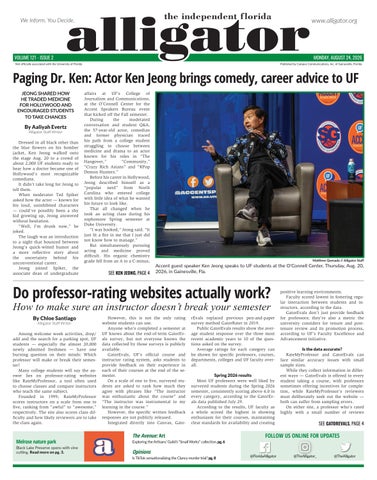
Matthew Quesada // Alligator Staff
Accent guest speaker Ken Jeong speaks to UF students at the O'Connell Center, Thursday, Aug. 20, 2026, in Gainesville, Fla.
Do professor-rating websites actually work? How to make sure an instructor doesn’t break your semester By Chloe Santiago Alligator Staff Writer
Among welcome week activities, drop/ add and the search for a parking spot, UF students — especially the almost 20,000 newly admitted freshmen — have one burning question on their minds: Which professor will make or break their semester? Many college students will say the answer lies on professor-rating websites like RateMyProfessor, a tool often used to choose classes and compare instructors who teach the same subject. Founded in 1999, RateMyProfessor scores instructors on a scale from one to five, ranking from “awful” to “awesome,” respectively. The site also scores class difficulty and how likely reviewers are to take the class again.
However, this is not the only rating website students can use. Anyone who’s completed a semester at UF knows about the end-of-term GatorEvals survey, but not everyone knows the data collected by those surveys is publicly available. GatorEvals, UF’s official course and instructor rating system, asks students to provide feedback on their experience in each of their courses at the end of the semester. On a scale of one to five, surveyed students are asked to rank how much they agree with phrases like “The instructor was enthusiastic about the course” and “The instructor was instrumental to my learning in the course.” However, the specific written feedback responses are not publicly released. Integrated directly into Canvas, Gato-
SPORTS/SPECIAL/CUTOUT
The Avenue: Art
Black pg# Lake Preserve opens with vine cutting. Read more on pg. 3.
Opinions
Melrose naturefinish parkwith comma, Story description
rEvals replaced previous pen-and-paper survey method GatorRater in 2019. Public GatorEvals results show the average student response over the three most recent academic years to 10 of the questions asked on the survey. Average ratings for each category can be shown for specific professors, courses, departments, colleges and UF faculty overall. Spring 2026 results Most UF professors were well liked by surveyed students during the Spring 2026 semester, consistently scoring above 4.0 in every category, according to the GatorEvals data published July 29. According to the results, UF faculty as a whole scored the highest in showing enthusiasm for their courses, maintaining clear standards for availability and creating
Exploring the Artisans’ Guild’s “Small Works” collection, pg. 6
Is TikTok sensationalizing the Clancy murder trial? pg. 8
positive learning environments. Faculty scored lowest in fostering regular interaction between students and instructors, according to the data. GatorEvals don’t just provide feedback for professors; they’re also a metric the university considers for tenure and posttenure review and its promotion process, according to UF’s Faculty Excellence and Advancement initiative. Is the data accurate? RateMyProfessor and GatorEvals can face similar accuracy issues with small sample sizes. While they collect information in different ways — GatorEvals is offered to every student taking a course, with professors sometimes offering incentives for completion, while RateMyProfessor’s reviewers must deliberately seek out the website — both can suffer from sampling errors. On either site, a professor who’s rated highly with a small number of reviews
SEE GATOREVALS, PAGE 4
FOLLOW US ONLINE FOR UPDATES @FloridaAlligator
@TheAlligator_
@TheAlligator
2 ALLIGATOR MONDAY, AUGUST 24, 2026
New federal rules reduce loan amounts for part-time Santa Fe students ENROLLMENT-BASED LOANS HAVE BEEN SCALED DOWN FOR STUDENTS ENROLLED IN FEWER THAN 12 CREDIT HOURS
By Lilyanna Collado Alligator Staff
After an Aug. 7 notice changed the disbursement process at the college, Santa Fe College students are receiving reduced loans tied to their enrollment status. The notice named the federal loan reductions contingent with parttime enrollment as the cause of the change. The One Big Beautiful Act now requires aid to be calculated based on enrollment intensity, especially for the Pell Grant, according to the announcement. The Pell Grant, which previously looked into a student's general amount of credit hours, now looks at the precise amount a student takes through college reports on enrollment information. While students previously had a six-credit-hour minimum, loans weren’t reduced because of part-time status. The announcement included a data table showing how the number of credit hours a student takes affects student loan eligibility. For each credit hour below 12 credit hours, a student will receive 8- to 9% less funding from their full allotment. For
example, if a student has an accepted loan amount of $1,500 and is only taking nine credits, their loan will reduce to $1,125. Lucas Collada, a 20-year-old journalism junior at Santa Fe, said he believes the change was sudden, and it will have a lasting impact on students — especially those who rely on loans. “From what I've heard from other people, it was affecting them,” he said. Collada said he pays tuition through a scholarship and has worked to save money for textbooks and extra expenses that may arise during his college career. Though not personally impacted by the new provision, Collada expressed curiosity for its reasoning. "It's a little odd to me,” he said. Collada said he wishes he understood the knowledge behind the implications of the law changes. What does this mean for students? This isn’t the first time Santa Fe students have been left confused by financial aid. Students have raised similar concerns in recent years regarding delayed aid disbursements and inconsistent communication when attempting to contact the financial aid office. Previous delays were caused by FAFSA processing issues affecting the disbursement of aid and grants. In 2024, students reported waiting anywhere from a few
weeks to a few months to receive refunds from grants or scholarships like Bright Futures. Other universities like UF and the University of Central Florida faced the same issues, resulting in extended enrollment deadlines until students received their payments. Kylee Hunt, an 18-year-old animal science Santa Fe freshman, said students should research the possible effects to determine whether they will be impacted. ”Depending on the student's financial situation, an increase or decrease in loans could affect their overall payment,” Hunt said. How is Santa Fe responding? Lisa Bronsky, Santa Fe’s associate vice president of marketing and communications, said the school encourages students affected by the new provision to apply for Santa Fe’s available scholarships. Santa Fe’s announcement recommended the same thing. While Santa Fe has outlined how student loans will be disbursed based on enrollment levels, the actual effect on students remains unclear, she said. “At this point in the semester, it’s difficult to know how many students might be affected,” Bronsky said. @lilyannacollado lcollado@alligator.org
By Jessica Yang Alligator Staff Writer
If traffic cooperates, the drive from Cape Canaveral to Gainesville takes about three hours. Eli Stewart made that trip every few weeks this Summer, squeezing in a shift at a campus molecular lab before turning around and driving back home. The lab is one of two paid jobs he works yearround, on top of a full course load and freelance web design. Such is the schedule of Stewart, a 20-year-old microbiology sophomore who said he works largely because he has to. He fully supports himself, covering all his living and university-related expenses. "I spend insane hours working," Stewart said. He lives about 2 miles from campus, splitting a lease with a friend to cut costs. Living in a closer spot alone, he said, would barely be within reach. The numbers say Stewart’s not alone. Fair Market Rent is a federal benchmark the U.S. Department of Housing and Urban Development uses
to track rent prices annually. For a two-bedroom apartment in the Gainesville metropolitan area, fair market rent climbed from $971 in 2020 to $1,493 in 2026, increasing by more than 50%. UF's on-campus housing rates also rose sharply as part of a multi-year increase approved by the Board of Trustees. The cheapest traditional double rooms climbed from $3,556 per semester in 2025 to $3,929 this year, according to the university's published room rates. Tuition tells a different story, at least for in-state students at UF. From 2017 to 2025, Florida's in-state rate held steady at $212.71 per credit hour for undergraduate students. It’s increased by only a couple dollars per credit hour this 2026-27 school year, according to UF's Office of the Chief Financial Officer. Out-of-state tuition increased more significantly over the same time period.
352-371-4367
NEWSROOM:
Editor-In-Chief
Digital Managing Editor Engagement Managing Editor
352-376-4458 Bailey Diem, bdiem@alligator.org Vera Lucia Pappaterra, vpappaterra@alligator.org
Shaine Davison, sdavison@alligator.org
Senior News Director
Sofia Meyers, smeyers@alligator.org
Metro Editor
Grace Larson, glarson@alligator.org
University Editor
Maria Arruda, marruda@alligator.org
Opinions Editor
Christopher Rodriguez, crodriguez@alligator.org
the Avenue Editor
Isabel Kraby, ikraby@alligator.org
El Caimán Editor
Angelique Rodriguez, arodriguez@alligator.org
Sports Editors
Curan Ahern, Max Bernstein, Ava DiCecca, Riley Orovitz
Multimedia Editor
Noah Lantor, nlantor@alligator.org
Multimedia Editor
Bayden Armstrong, barmstrong@alligator.org
Copy Desk Chief
Lindee Walker, lwalker@alligator.org
Editorial Board
DISPLAY ADVERTISING
Bailey Diem, Vera Lucia Pappaterra, Shaine Davison, Sofia Meyers, Christopher Rodriguez
352-376-4482
Advertising Office Manager
Cheryl del Rosario, cdelrosario@alligator.org
Sales Representatives
Evan Williams, Makeda Kahn, Ana Matute
CLASSIFIED ADVERTISING
Classified Advertising Manager
BUSINESS
Comptroller Bookkeeper Administrative Assistant
General Manager
352-373-3463 Ellen Light, elight@alligator.org 352-376-4446 Delia Kradolfer, dkradolfer@alligator.org Cheryl del Rosario, cdelrosario@alligator.org Ellen Light, elight@alligator.org 352-376-4446 Shaun O'Connor, soconnor@alligator.org
SYSTEMS IT System Engineer
Kevin Hart
PRODUCTION Production Manager
Namari Lock, nlock@alligator.org
Publication Manager
Deion McLeod, dmcleod@alligator.org
IN MEMORY OF Alligator Great C.E. Barber
Read the rest online at alligator.org. jyang@alligator.org @jessie_yang_08 The Independent Florida Alligator is a student newspaper serving the University of Florida, published by a nonprofit 501 (c)(3) educational organization, Campus Communications Inc., P.O. Box 5126, Gainesville, Florida, 32627. The Alligator is published Monday mornings, except during holidays and exam periods. The Alligator is a member of the Newspaper Association of America, National Newspaper Association, Florida Press Association and Southern University Newspapers.
Monday to Wednesday: 10 a.m. - 4 p.m. 523 NW 3rd Ave.
ISSN 0889-2423
Not officially associated with the University of Florida Published by Campus Communications Inc., of Gainesville, Florida
ADMINISTRATION
How are UF students covering rising costs this school year? SECOND JOBS, STRICTER BUDGETS, HOME-COOKED MEALS AND MORE
VOLUME 121 - ISSUE 2
bestjewelryandloan.com
TICK.TOCK.
Reduce your showertime by 2 minutes.
PRESERVE WATER
The Alligator offices are located at 2700 SW 13th St. © Copyright 2020. All rights reserved. No portion of The Alligator may be reproduced in any means without the written consent of an officer of Campus Communications Inc.
Subscription Rate:
Full Year (All Semesters) $100
The Alligator strives to be accurate and clear in its news reports and editorials. If you find an error, please call our newsroom at 352-376-4458 or email editor@alligator.org
MONDAY, AUGUST 24, 2026 ALLIGATOR 3
Black Lake Preserve opens in Melrose Melrose residents celebrated the new nature park with a vine cutting By Teia Williams Alligator Staff Writer
At the entrance of Black Lake Preserve, Alachua County Commission Chair Ken Cornell cut a luscious, green vine stretched across the trail to signify the park’s opening Aug. 21. Located south of Lake Santa Fe in Melrose, Black Lake Preserve is a 287-acre nature preserve. It offers a 500-foot paved path and opportunities for hiking, including a 1-mile loop and 2 additional miles of trails. About 40 residents gathered at the preserve’s entrance Friday morning, eager to walk the trails for the first time. But before the vine cutting, attendees honored the preserve’s origin. Instead of becoming a neighborhood as originally planned, the Alachua County Forever conservation program bought the area for about $2.3 million in 2020. The program used funds from the voter-approved Wild Spaces & Public Places surtax, which funds local parks
and land conservation. Black Lake is one of only two nature parks in and around Melrose. Little Lake Santa Fe Preserve, another recent addition, opened in Waldo last month. “The people that live out here deserve the same access to protection, walkable, natural land as anyone else in this county,” Cornell said at the preserve’s opening. Jeff Million and Jill Conti, 69- and 65-year-old Melrose residents, respectively, attended the ceremony. They go on walks together every day, but they didn’t have a nearby trail to hike. They said they would walk along the road or drive 24 minutes to Gainesville to walk at Sweetwater Wetlands Park. Now, they don’t have to travel far to get a change of scenery for their walks. “I think this will be a good outlet for at least the people around here,” Million said. “ I think at some point, the Gainesville people will probably like to come out here.”
Stephen Hofstetter, the director of the Alachua County Environmental Protection Department, spoke about the land’s environmental impacts at Aug. 21’s ceremony. Millions of gallons of rainwater are stored in and around the property, he said. The rainwater is filtered and slowly released into the Santa Fe River and lake. “That is one of the reasons why we protect lands like this,” Hofstetter said. “If this was a subdivision, we don’t know where that water would be, and it would probably be dirty and potentially impacting others.” The preserve is also home to two threatened, carnivorous plants: the hooded pitcher plant and the spoonleaf sundew. Visitors may also spot native wildlife like gopher tortoises and southern fox squirrels. Ryan Kennelly, Alachua County Forever’s land stewardship coordinator, said the land has been protected from development because residents support conservation efforts.
Teia Williams // Alligator Staff
People attend the Black Lake Preserve Ribbon Cutting, Friday, August 21, 2026, in Melrose, Fla. He said he thinks the preserve is a place many people can enjoy, and he’s excited to see how visitors like it. “Our staff has worked really hard over many years of getting this place ready, and we are ecstatic to get to share it with you,” Kennelly said at the ceremony. After the vine cutting, attendees followed Cory Gillis, Alachua
County’s environmental specialist, on a guided walk. Participants were the first to walk the preserve and learn about the land. The preserve is open every day from 7 a.m. to 8 p.m. From October to March, it will close at 6 p.m. @teia_williams twilliams@alligator.org
4 ALLIGATOR MONDAY, AUGUST 24, 2026
Gauging accuracy of GatorEvals, RateMyProfessor GATOREVALS, from pg. 1 could boast a much higher rating and score than a professor with 100 mixed reviews — not truly accounting for differences in teaching ability. While RateMyProfessor shows the number of reviews that determine its scores, public GatorEvals results do not, potentially worsening this problem. John Yelton, who has taught physics at UF since 1988, said only a quarter to a third of students in his classes, which can have up to 330 students per section, respond to GatorEvals. Yelton strongly encourages his students to complete their GatorEvals for all their courses each semester, he said, to make professor feedback as representative as possible. He guessed that in many cases, reviews on sites like RateMyProfessor only account for about 1% of student opinion. “You’ll get some nice ones, but then you’ll get somebody who says something totally ridiculous and bad,” Yelton said, admitting he’s looked himself up on the site in the past. “If all the students felt like that, I would stop teaching.” Another major flaw of RateMyProfessor is its lack of verification. With GatorEvals, one survey invitation per class is sent directly to students over email, linked through Canvas and available with a Gatorlink login to the GatorEvals portal, according to the GatorEvals website. Only students registered in a class can review that class, and they can only do so once. RateMyProfessor’s system, on the other hand, has no barrier to entry and no safeguards against duplicate reviews. It’s “unable to fully confirm users’ identities, the truthfulness of their contributions or their
student or class enrollment status,” according to its website. “There’s really no way to control who’s leaving a review,” said Christopher McCarty, the director of UF’s Bureau of Economic and Business Research and an expert in survey research. “That’s completely not statistical. RateMyProfessor doesn’t approach me as a respondent — I approach them, and so there’s a problem.” McCarty, who also teaches anthropology classes at UF, said GatorEvals better capture the big picture of student experiences. The open-ended comment sections at the end of each survey, while not released publicly, are a valuable source of feedback
for instructors, he said. A class’ base difficulty is often another factor behind less-than-stellar ratings. While RateMyProfessor and GatorEvals differentiate instructor- and course-specific ratings, students may find it hard to separate feelings of frustration for challenging course content from their views of professors. “Most of what I see are comments about how easy or hard the class is,” McCarty said of RateMyProfessor reviews. “[UF] wants to evaluate the delivery of instruction. We’re not here to do necessarily easy content.”
Julianna Bendeck// Alligator Staff
Numbers shown are averages calculated from the Spring 2026 GatorEvals categories across all assessments. Scores are between 1 and 5. No college earned an average rating below 4. Source: University of Florida
Comedic actor visits The Swamp KEN JEONG, from pg. 1
and although he was accepted into drama school, Jeong ultimately stepped away to continue the pre-med track. He began performing standup comedy during medical school and continued through his residency. Jeong credited his residency director for encouraging him to embrace comedy instead of seeing it as incompatible with a medical career. “That honestly saved my life,” he said. “[There was] finally someone who gets me in such a profession where no one got me.” After seven years as a fulltime physician, Jeong eventually left medicine to pursue acting full time with encouragement from his wife, Tran Ho, who’s also a physician. Soon afterward, Ho was diagnosed with breast cancer while the couple had two young daughters. Around the same time, Jeong landed the role of Leslie Chow in “The Hangover.”
He considered turning down the role to remain home with his family, he said, but his wife and mother-in-law encouraged him to take it. During the filming process, he channeled what he was experiencing at home into the character, even slipping Vietnamese phrases into scenes to make his wife laugh. “Even if ‘The Hangover’ wasn’t the biggest thing I’ve ever done, it was for me the most important thing ever because it actually got me through literally the worst time of my life,” he said. The film transformed Jeong’s career, turning what he expected to be a cult comedy into a breakout role he said became bigger than any of its individual actors. Rather than distancing himself from Leslie Chow as his career expanded, Jeong said he’s embraced being associated with the character. Chow represented something Jeong wasn’t in his own life, he said: a character who was “psychotic and free,” acting
on impulses Jeong normally wouldn’t. Despite the character’s chaos, Jeong said one part of himself shone through in the performance: his love of life. The role’s staying power ultimately changed how Jeong measured success. Seeing “The Hangover” connect with audiences taught him a performance’s impact could matter more than proving his range as an actor. Beyond reflecting on his film and television career, Jeong repeatedly turned his experiences into advice for the students in the audience. Much of it centered on persistence and accepting college doesn’t always come with a clear path. When Spiker asked how students can know when to persist or change direction, Jeong said there is no definitive answer. Instead, he encouraged students to learn through trial and error and explore their interests despite the uncertainty of college.
How to use rating websites to get the most accurate results When deciding which class to take, don’t solely rely on websites like RateMyProfessor because a bad score or rating isn’t the whole story. Jocarys Santana, a 19-year-old health science junior, said it’s better to find a student who’s been in the same shoes. Students who have already taken courses or professors can offer the best advice, she said. Santana has frequently used RateMyProfessor in the past to look up classes and professors, she said, and the site has especially influenced her decisions during drop/add week. But she makes sure she doesn’t take its reviews at face value. When deciding who to take for General Chemistry II, Santana said she decided to drop in on professor Stacey-Ann Benjamin’s class. Although Benjamin’s RateMyProfessor rating was daunting — it currently sits at a 2.2 out of five — Santana realized a lot of the bad reviews were for other classes the professor taught. Visiting the class showed Santana that Benjamin was actually the perfect teacher for her. “She made my experience a lot better because of her teaching style,” Santana said. “It was really different from the other chemistry professors.” So, the key to making sure a professor doesn’t break your semester is finding what works for you. No two students — or professors — are the same, and the learning experience looks different for everyone. Students can take advantage of the drop/add period, which ends Aug. 26, to experience different professors in person. Public GatorEvals results for the Fall 2026 semester will become available Feb. 9, 2027.
His advice became more specific during the student Q&A. When asked what he would tell struggling pre-med students, Jeong returned to the same theme: “Persist, persist.” He told students not to become overconfident after successes or overly discouraged by setbacks, joking that their main goal should be to “survive orgo.” For Gabby Marquez, a 19-yearold architecture sophomore, the event was both a chance to see a familiar face from the screen and reconnect with friends after summer break. A fan of Jeong’s roles in “Crazy Rich Asians” and “The Masked Singer,” Marquez found out about the event through a UF Student Engagement post on Instagram. It was her first Accent event. “It’s nice to have an event where you can meet up with your friends again after having not seen them the whole summer,” she said. For Madelyn Bland, a 19-yearold marine sciences sophomore, her first Accent event began in the pouring rain. She waited outside before meeting a friend farther in line, but said the wait
@csant860 csantiago@alligator.org went by quickly once she was under cover. Bland, who watches “The Masked Singer” with her family, said bringing speakers like Jeong to campus gives students a chance to come together. The opportunity can be particularly important for freshmen at the beginning of the semester, she said. “It’s just fun to have something to do like this, and it gets more people invested in UF,” Bland said. The rain that greeted students before the event made a final appearance in Jeong’s remarks as the night came to a close. After over an hour shifting between serious reflections on his career and the humor that built it, he thanked UF students for attending despite the weather. Then, in a goodbye more characteristic of the comedian students had come to see, Jeong left the crowd with two words: “Toodaloo, motherf---ers.” @aaliyahevertz1 aevertz@alligator.org
MONDAY, AUGUST 24, 2026 www.alligator.org/section/the-avenue
MUSIC
Guitar rock duo Rustler to release debut album in September THE LOCAL ARTISTS DISCUSS FAMILY TIES AND EXPERIENCES IN “GENERATIONAL WEALTH”
By Brandy Sumner Avenue Staff Writer
Luke and Riley Sechrest’s lives have always been intertwined with Gainesville and its music scene. Raised in the city, they’ve played in bands throughout Gainesville since childhood. “My dad was a musician in Gainesville … so me and my brother grew up with instruments all over the house,” said 24-year-old Luke Sechrest. “As kids, we actually played in a family band with my dad called Dad and the Accidents.” Now, the duo is keeping it in the family with their alternative rock project Rustler, preparing to release their debut record Sept. 25. Recorded entirely by the brothers, “Generational Wealth” features Luke singing and playing guitar and drums with Riley playing bass. The album began as a solo project for Luke, the songwriter of the pair, but once Riley came on to help produce the album, it quickly became a team effort. The pair have been recording and performing as Rustler for a little over a year. They began record-
Mily Moran // Alligator Staff
Luke Sechrest, a member of the local band Rustler, plays his guitar, Friday, Aug. 21, 2026, in Gainesville, Fla. ing “Generational Wealth” at Pulp Arts July 2025. The band takes inspiration from various places ranging from the ‘90s albums they heard in their dad’s car growing up to modern bands like Big Thief or This Is Lorelei.
The debut album is mostly about family ties and Luke’s personal stories and struggles. One of the album’s songs, “Gloss,” released as a single Aug. 14, was written after Luke was rejected from a job opportunity. “I was really upset about it, and
I was like, ‘Well, look at my life right now,’” he said. “My life is so much better [because of it].” Over the past year, Rustler has played shows across Gainesville, raising excitement for the upcoming album. The brothers play live, with a rotating group of other local musicians filling in to make a full band. Maus Kelava, the 23-year-old talent buyer for Loosey’s Downtown, first saw Rustler play at one of the restaurant’s Indie Demolition Nights and looks forward to what the band will do next. “It’s rare to find a band that has just the energy,” they said, “and the stage presence and the tightness and the music to back it up that Rustler has.” Growing up alongside Luke means Rustler’s other half, 27-yearold Riley Sechrest, has a special connection to the songs’ lyrics, which are filled with references to the brothers’ family and childhood. The lyrics blend deeply personal details with overarching messages that make them relatable to anyone, which Riley believes is what makes the album feel so impactful. “I think this record is what I’m most proud of,” he said. “I’ve played in a lot of bands at this point. I’ve been playing since I was
9 years old — I’m 27 now. Almost 20 years of playing music, and this is by far what I’m the most proud of.” Though, for Rustler, Gainesville isn’t the final stop on their musical journey. The pair is planning to take its music to Nashville following the album’s release in September. Despite their love for Gainesville and its community, Riley and Luke feel a move would benefit both the future of the band and their own desires to live somewhere new. “We’re both from Gainesville, so it’s one of those things where it’s like going to school here, graduating, playing bands and working and stuff, and it’s kind of now or never,” Riley said. The band plans to perform more in Gainesville leading up to their October move, including a Sept. 1 show at Signal and one Sept. 16 at Heartwood. Platforming “Generational Wealth” is currently the band’s main focus, but plans are already in motion for future songs and releases down the line. “I imagine we’ll do this as long as we’re physically capable,” Riley said. bsumner@alligator.org
FILM
‘Don’t Say Good Luck’ argues growing up stops for nothing SUNNY SANDLER DELIVERS AN EMOTIONAL BREAKOUT PERFORMANCE IN NETFLIX’S NEWEST FAMILY DRAMA
By Aaliyah Evertz Avenue Staff Writer
I’m not someone who normally cries watching a movie — or in general — but “Don’t Say Good Luck” made me sob. For once, I needed tissues for something other than my allergies. Released Aug. 14, Netflix’s latest coming-of-age dramedy, “Don’t Say Good Luck,” could’ve easily been another predictable story about a high school theater kid chasing her dream role. Instead, director Julia Hart uses that familiar setup to tell a much more painful story about growing up when life refuses to wait.
El Caimán
Sunny Sandler — the daughter of comedy legend Adam Sandler — stars as Sophie Birenbaum, a high school student who lands the lead role of Jenna in her school’s production of “Waitress.” But what should be one of the most exciting moments of her life happens alongside the return of her mother’s cancer, forcing Sophie to balance rehearsals, friendships, romance and the reality that her family is changing. Sandler’s range is easily the film’s biggest surprise. After starring in “You Are So Not Invited to My Bat Mitzvah,” she proves in “Don’t Say Good Luck” that she can portray characters with significantly more emotional weight. Sophie never feels like a character who exists solely to make the audience cry. She’s still awkward, funny, selfish and occasionally frustrating in the way teenagers
Organizaciones estudiantiles latinas se preparan para el otoño. Read more on page 7.
can be. That complexity becomes especially important because “Don’t Say Good Luck” understands grief doesn’t suddenly make everything all consuming. Sophie can be devastated about her mom and still care about getting the lead. She can worry about her family and still get caught up in a crush. The movie allows those emotions to coexist rather than turning Sophie into someone unrealistically mature. But Sandler’s performance works as well as it does because of Melanie Lynskey, who plays her mother, Elizabeth. Their mother-daughter relationship is the emotional center of the movie. Lynskey avoids reducing Elizabeth to a sick parent whose only role is to push Sophie’s story forward. She’s funny and loving, but there’s an exhaustion underneath
her performance that becomes harder to ignore as the film continues. Max Greenfield, Steve Buscemi and Bebe Neuwirth help keep the movie from becoming unbearably heavy. The Mother’s Day dinner is a perfect example, with the family joking around the table and falling into the same banter they would under normal circumstances, despite Elizabeth’s illness looming over them. It’s a small moment, but the casual humor makes the Birenbaums feel like an actual family rather than characters waiting for the next sad scene. The use of “Waitress” is also more than a convenient excuse to make the movie a musical. As Sophie becomes more aware of what’s happening at home, the songs she performs begin to convey a different meaning.
By the time the movie reaches “She Used to Be Mine,” the performance feels less like a high school musical number and more like Sophie finally releasing everything she’s spent the movie trying to hold together. At 95 minutes, the film knows not to overstay its welcome. In just over an hour and a half, it tells a story about a daughter, a mother and a family trying to continue living normally when nothing about their situation feels ordinary. I like to think I’m made of steel. But somewhere between watching Sophie step onto that stage and realizing that growing up sometimes means facing things you desperately wish you could avoid, “Don’t Say Good Luck” proved me wrong. @aaliyahevertz1 aevertz@alligator.org
6 ALLIGATOR MONDAY, AUGUST 24, 2026
ART
Trude Spillane brings a lifelong love of art to the Artisans’ Guild’s Small Works THE “SMALL WORKS” COLLECTION ENCOURAGES ARTISTS TO THINK SMALL BUT LEAVES PLENTY OF SPACE FOR CREATIVITY By Kendall O’Connor Avenue Staff Writer The pieces in the “Small Works” exhibit may be tiny in size, but they certainly weren’t small undertakings. At least, that’s what Trude Spillane, a 65-year-old artist and board member at the Artisans’ Guild Gallery, thinks about her intricate artwork featured in the miniature collection. Nestled in one of Pleasant Street’s charming historic houses is a colorful, eclectic gallery collectively owned by artists themselves. On display this month are pint-sized pieces of many mediums making up the gallery’s first “Small Works” exhibition. Making art is not just about creating an end product for others to enjoy, Spillane said — it’s often a personal endeavor. The process challenges an artist to evolve, which she admitted was integral in curating her works for this month’s collection. One of her pieces is an iconic depiction of Gainesville wildlife. “Baby Fuzz,” a 4-by-4-inch acrylic on panel, shows a mother sandhill crane and her baby on a sunrise walk through Sweetwater Wetlands Park. Through incredible attention to detail, Spillane depicted the morning sunrays beaming through the baby sandhill crane’s fluff, giving it an ambient glow. Contrary to what viewers may think, Spillane said, making art on such a small canvas can be just as challenging as doing so on a larger canvas — if not more. “It takes you weeks to do it where you’re satisfied,” Spillane said. Her lifelong passion for art is multifaceted, she added. Spillane crafted and sold jewelry at markets during her early career, and she co-owned Gainesville jewelry store Gifts of Avalon for 23 years. Even while focusing on her jewelry and teaching others how to make it, her paintings adorned the walls of Gifts of Avalon. After retirement, Spillane needed a new place to exhibit her work, and she found the Artisans’ Guild was the perfect forum to do so. Since joining, Spillane said she has become an “integral part of the family” over the past decade. Spillane admires how Gainesville’s local art community has inspired and encouraged artists across generations and continues to do so today, she said. Younger generations in particular, she said, inspire the Artisans’ Guild with their creativity and new ideas. “We’re just hoping they keep the lights on,” she said. “Having a place like this to display your work is very fulfilling for an artist, and it’s a great resource for the community.” Jeanne Bunting, a jewelry maker and decadelong board member, is also part of what Spillane calls the “little art family.” Bunting joined the Artisans’ Guild when it was located in Millhopper. She followed it to Union Street Station and ultimately to its current Pleasant Street location in 2020. While she reflects fondly on the previous gallery spaces,
Mily Moran // Alligator Staff
Trude Spillane, a jeweler and painter at the Artisans’ Guild Gallery, tweaks the “Small Works” exhibit, Tuesday, Aug. 18, 2026. this has been her favorite so far, she said. The Pleasant Street spot gives patrons the opportunity to see the pieces in an actual home rather than the bare-bones venues the guild previously occupied, she said. “You see the work in its natural environment,” she said. Bunting founded the “Small Works” collection but credits the artists featured and the team who made it possible. After noticing the global prevalence of small-scale artwork online and during her summer travels, Bunting pitched the idea to the board and decided August would give the artists enough time to create their own small works. The gallery’s distinctive style was evident to newcomer Emilia Rubalcaba, an 18-year-old UF English freshman, when she perused the collection Aug. 17. “They fit a lot of color and movement into such a small
canvas,” Rubalcaba said. She also appreciated the immediate friendly welcome from the shop owners. 18-year-old UF architecture freshman Olivia Montesano said the exhibit doesn’t just showcase art, but captures the shared identity of Gainesville and UF. “I liked how a lot of things were incorporated about Gainesville and also about UF,” she said. “You really see the spirit of the town is also the school.” The Artisans’ Guild Gallery is open from 11 a.m. to 6 p.m. every day at 224 NW 2nd Ave. The “Small Works” collection is on display through Aug. 31. koconnor@alligator.org
El Caimán
LUNES, 24 DE AGOSTO DE 2026 www.alligator.org/section/elcaiman
Las organizaciones latinas de la UF se preparan para un otoño ajetreado NOVEDADES DEL SEMESTRE DE OTOÑO SOBRE TRES ORGANIZACIONES LATINAS DE LA UF
Por Emily Medina-Finsen Escritora de El Caimán
Con el semestre del otoño a punto de comenzar, muchos clubes y organizaciones de Gainesville inician los preparativos para una temporada muy activa. La UF acoge a más de 900 organizaciones estudiantiles que ofrecen diversas oportunidades en los ámbitos académico, de servicio a la comunidad, cultural y recreativo.
Asociación Americana de Ingenieros Venezolanos Una organización latina que inicia el curso académico con fuerza es la Asociación Americana de Ingenieros Venezolanos. La organización está dirigida por su presidenta fundadora, Anabella Feo, una estudiante de 20 años de tercer curso de ingeniería civil de UF. Este año el club por primera vez tendrá su propio capítulo en UF dando la bienvenida no solo a los venezolanos, sino a personas interesadas en desarrollar sus habilidades académicas y profesionales, según explicó Feo. En marzo del 2025 el Gobierno de Colombia anunció el Proyecto Catatumbo, la misión más impor-
Mantente al día con El Caimán en Twitter. Envíanos un tweet @ElCaimanGNV.
tante de la organización. El Proyecto Catatumbo fue hecho para abordar las causas fundamentales del conflicto armado y la inestabilidad en la región del Catatumbo, en el Norte de Santander. El proyecto se financia mediante nuevos impuestos sobre el juego, el petróleo y el carbón, para apoyar mejoras en la infraestructura, la salud y la educación. La AAVA también se centra en distribuir recursos como agua corriente, primeros auxilios y alimentos en Venezuela, explicó Feo. Ya que muchas zonas del país carecen de energía o medicamentos. El Proyecto Catatumbo se incorporó al club tras los fuertes terremotos que sacudieron Naguanagua y Caracas. Miles de personas perdieron sus hogares,
DINING
“Cuando me preguntaron si podía inaugurar este capítulo, me tocó muy de cerca, porque cuando supe del Proyecto Catatumbo, supe que era algo que afectaba profundamente a mi familia”,afirmó Feo. Mientras que la misión del Proyecto Catatumbo y de la AAVA gira en torno al acceso a la educación, “Children Beyond Our Borders” se centra principalmente en utilizar la educación como una herramienta para salir adelante. Lee el resto en línea en alligator.org @EmilyMedFinZ27 emedina-finsen@alligator.org
Sports: Volleyball
Gators look to come back from worst season in 30 years, pg. 11
FAR FROM ORDINARY, CLOSE TO YOU
LODGING
dijo. Los terremotos, que se produjeron con tan solo 39 segundos de diferencia, provocaron el derrumbe de varios hoteles, apartamentos y viviendas de la costa. A medida que Feo y la organización se preparan para el semestre de otoño, ella expresó su entusiasmo por el impacto que espera que tenga el club. “Cuando me dieron la oportunidad de poner en marcha una nueva organización que ayudaba directamente al país del que procede mi familia, no había forma de que pudiera decir que no”, ella dijo. La familia de Feo tuvo que marcharse de Venezuela porque no había recursos suficientes para vivir, explicó.
Hawthorne HWY 20, 4 Miles East of 301
ADVENTURES
BLACKPRONG.COM · 45 MIN FROM GAINESVILLE USE CODE GATOR26 AT CHECKOUT FOR 10% OFF LODGING, VALID THROUGH 10/31/26
11.95
2 FRIED TACOS
12.95
DOUBLE BURGER
11.95
BURRITO WRAP
10.95
4 CHICKEN TENDERS
11.95
TACO SALAD
10.95
5 CHICKEN WINGS
WITH AD TRY A
MONDAY, AUGUST 24, 2026 www.alligator.org/section/opinions
Column
Why am I paying your employees?
H
ere’s a tip: I’m already questioning yours. Imagine this scenario. You’re ordering a coffee, sandwich, smoothie or whatever you like. Then the employee flips the tablet around. 18%? 20%? 25%? They’re standing only a few feet away, staring into your soul. You suddenly feel like you’re publicly announcing whether you’re a good person. Why am I being put in this position in the first place? Why do I feel guilty for pressing “no tip?” Tipping itself isn’t the problem. The real issue is that America has blurred the line between workers who depend on tips as part of their wages and workers who are simply presented alongside a tip screen. As tipping prompts spread from sit-down restaurants to coffee shops, smoothie counters and takeout orders, customers are being asked to subsidize wages without knowing when gratuity is actually necessary. That confusion contributes to tipping fatigue — risking the livelihood of workers who depend on tips. America’s tipping culture has expanded beyond what originally made tipping feel obligatory. When we’re expected to tip for increasingly small interactions, when do we stop? To answer this question, we must first ask: How did we get here? Tipping wasn’t always a vital part of dining in the United States, according to Rachel E. Greenspan with TIME magazine. In fact, its history is linked to racial oppression after the Civil War. Wealthy Americans in the 1850s and ’60s initially used tips to flaunt their aristocratic status, a practice many Americans considered “condescending” and “classist.” But after slavery ended, tipping took on a much darker purpose. Many formerly enslaved people were left with few
employment opportunities, and some employers hired them without wages, expecting tips to make up their income. Eventually, what began as a bonus became embedded into U.S. labor practices as part of a worker’s pay. More than a century later, we’re still operating under a version of that system. Federal law allows tipped workers to be paid differently than other employees, a practice that has existed in some form since 1938. Today, the federal minimum cash wage for tipped workers is just $2.13 an hour, compared with the $7.25 federal minimum wage. According to the U.S. Department of Labor, only seven states, none of which are Florida, require employers to pay tipped employees the full state minimum wage before tips. So, in most of the country, the tip you leave isn’t necessarily extra — it’s often part of the wage our system expects that worker to earn. We’ve legally constructed a system where the customer’s voluntary payment can form part of one’s expected compensation. That’s what makes American tipping so strange: We call the payment optional while building a compensation system that assumes someone will earn it. Emma Harrington, a 19-year old UF biology junior who worked as both a host and server, agrees “tipping culture now is definitely excessive,” but she draws a clear distinction. Customers should tip sit-down servers because their hourly wages are often “literally in the single digits,” she said. At businesses like smoothie shops or places like Starbucks, where employees receive a standard hourly wage, she considers a small tip generous. Asking for tips everywhere may ultimately hurt the workers who rely on them by making customers increasingly resent tipping altogether, she added. For Harrington, tips worked well in her roles because the
job was part time and the money was supplemental. The system may feel very different for workers relying on tips to cover necessities, she said. “For people who have rent to pay — I know my coworkers, if they had a big day where they made $600 in one shift, they would put that in an Shirin Khizzar envelope and save it for rent,” she opinions@alligator.org said. “If I had rent to pay, I would probably be more inclined toward a higher hourly wage.” The difference isn’t necessarily the paycheck, but what is riding on it. An unpredictable income feels very different when a bad shift means skipping a new pair of shoes versus falling short on rent. This is the fundamental difference between a sit-down restaurant and a fast food drive-thru. When employers build gratuity into the workers’ wages, customers are no longer rewarding good service — they’re helping determine if the worker earns enough that night. The problem isn’t that workers expect tips, but that their financial stability has become dependent on it. I’m not saying tipping itself needs to disappear — exceptional service deserves recognition, and there’s nothing wrong with rewarding someone who made an experience memorable. However, we’ve blurred the line between gratuity and a wage. A tip should be extra. A wage should be guaranteed. A slow Tuesday shouldn’t determine whether someone can pay rent. So, let’s pay everyone a higher wage and eliminate tips. Problem solved, right? Not exactly. Read the rest online at alligator.org/section/opinions. @Shirinkhizzar skhizzar@alligator.org
Column
The Lindsay Clancy case isn’t your true-crime mystery
L
indsay Clancy murdered her three children. That isn’t just my opinion; that’s a fact both sides of the trial agree upon. However, if you were to look at the discourse about this case on TikTok, you might think there was an elaborate scheme to frame Lindsay for the murders. In 2023, Lindsay Clancy strangled her three children and then attempted suicide. Her attorneys aren’t contesting that; they’re arguing she can’t be held criminally liable because she was experiencing an extreme episode of a mental disorder called postpartum psychosis. Postpartum psychosis is a severe mental health condition that can cause hallucinations, delusions, depression, insomnia and mania in those who have recently given birth. A rare condition, it’s believed to occur in between 320 and 9,400 births per year in the United States, according to the Cleveland Clinic. This condition is severely misunderstood and misdiagnosed due to its similarity to other conditions such as postpartum depression, bipolar disorder and schizophrenia. Lindsay Clancy’s case provided an opportunity for a high-profile discussion about postpartum psychosis and the mental healthcare system. Instead, much of the online discourse has devolved into wild theories claiming Lindsay is actually innocent. These theories typically implicate then-husband and father Patrick
Clancy as either the murderer or the masterful orchestrator of Lindsay’s deteriorating mental condition. This discourse is a perfect example of how the mass popularity and desensitization of crime through the media has warped people’s minds about crime and the law. Movies and television often depict murder trials with a secret killer, a big twist or a massive conspiracy that makes for a good story. But that’s not a realistic portrayal of most murder trials. Most trials are simply two competing stories about an event, with no interesting twists and turns. This isn’t the first time a case with overwhelming evidence has been sensationalized by TikTok. In 2022, the murder of four Idaho students by Bryan Kohberger similarly grabbed the internet’s attention. Despite overwhelming evidence pointing to Kohberger, conspiracies blamed the surviving roommates, random bystanders and one of their professors. This University of Idaho history professor, Rebecca Scofield, was so damaged by these false accusations and internet conspiracies that she sued one of the theories’ main proponents, a TikTok tarot card reader named Ashley Guillard, for defamation. Guillard was ordered to pay $10 million in damages due to her false accusations. The theories surrounding TikTok’s latest sensationalized case threaten to cause similar damage. The only question regarding the
Clancy case is whether Lindsay should be held criminally liable for her actions. Discussions about this case should revolve around how far criminal liability should extend, how the mental health system failed to identify a woman clearly in distress and how untreated postpartum psychosis can have deadly consequences. Trying to invent more interesting stories about the “true murderer” in this case takes away from the truly valuable lessons we can learn from it. And sensationalizing the deaths of three innocent children — the oldest being only 5 years old — dehumanizes the victims and makes them afterthoughts in these discussions. Postpartum psychosis is real and dangerous. Whether Lindsay was experiencing this condition at the time of the murders is up to the jury to decide. It’s also up to the jury to decide if this psychosis means she wasn’t capable of understanding her actions or their consequences. There is no good to come from Mondaymorning-quarterbacking Lindsay’s mental health diagnoses and the trial itself. This case is full of experts in their fields trying to tell us what is important, and we should listen to these experts to learn real lessons from these tragic murders. While it may be more engaging to listen to TikTok detectives trying to determine the “real killer,” relying on conspiracies prevents you from actually learning from this case.
While TikTok users are partly to blame for the senEvan Dressel sationalization of opinions@alligator.org this case, it is also the fault of the app itself. It’s no secret that social media algorithms prioritize frustrating and enraging content — and a mother murdering her three children will naturally result in emotional responses. That’s what we’re seeing in this case. The algorithm’s push of these conspiracy theories demonstrates the disgusting lack of attention span these sites have created. Somehow, the murder of three innocent children isn’t “interesting” enough itself for the algorithm or online consumers. So, accusations against Patrick have picked up steam and increased confusion and misunderstanding about this case. These algorithms warp our understanding of reality and create fights that don’t actually exist. We all fall for these tricks, but it’s important to take a moment to take a step back and reevaluate when we see something online that enrages us. Taking a moment to reattach to reality can help prevent real world harm from a simple misunderstanding or blatant deception. Read the rest online at alligator.org/ section/opinions. edressel@alligator.org
The views expressed here are not necessarily those of The Alligator. The Alligator encourages comments from readers. Letters to the editor should not exceed 600 words (about one letter-sized page). They must be typed, double-spaced and must include the author’s name, classification and phone number. Names will be withheld if the writer shows just cause. We reserve the right to edit for length, grammar, style and libel. Send letters to opinions@alligator.org, bring them to 2700 SW 13th St., or send them to P.O. Box 14257, Gainesville, FL 32604-2257.Columns of about 450 words about original topics and editorial cartoons are also welcome. Questions? Call 352-376-4458.
How to Place a Classified Ad: Online: w/ major credit card at www.alligator.org/classifieds
BUY IT. SELL IT. FIND IT. 373-FIND MONDAY, AUGUST 24, 2026
Corrections and Cancellations:
ByPerson: In E-mail: classified@alligator.org Cash, Check, MC, Discover, AMEX or Visa @The Alligator Office: By Fax: (352)2700 376-4556 SW 13th St. M-F, 8am - 4pm By E-mail: Mail: P.O. classified@alligator.org Box 14257 G-ville 32604 Call 352-373-FIND for information. By Fax: (352) 376-4556 Sorry, no cash by mail. By Mail: P.O. Box 14257 G-ville 32604 Credit cards or checks only.
Cancellations: Call 373-FIND M-F, 8am - 4pm. No refunds or credits can be given. Alligator errors: Check your ad the FIRST day it runs. Call 373-FIND with any corrections before noon. THE ALLIGATOR IS ONLY RESPONSIBLE FOR THE FIRST DAY THE AD RUNS INCORRECTLY. Corrected ads will be extended one day. No refunds or credits can be given after placing the ad. Corrections called in after the first day will not be further compensated. Customer error or changes: Changes must be made BEFORE NOON for the next day’s paper. There will be a $2.00 charge for minor changes.
www.alligator.org/classifieds
See alligator.org for more information
For Rent
1
6
furnished
NOTE: This newspaper assumes no responsibility for injury
● SS & VA WELCOME HERE! ● PRIVATE ROOM IN 4BR — $700/mo Furnished • WiFi TV • Utilities NO EXTRA BILLS! MOVE IN NOW! Call/text now: 352-246-3418 11-30-15-1
MATTRESSES AVAILABLE RIGHT NOW!!! ALL SIZES AND STYLES!!! AFFORDABLE AND COMFORTABLE!!! SUPER SPECIAL-ULTRA PLUSH PILLOWTOP QUEEN $299 NO MATTER YOUR BUDGET, WE HAVE THE MATTRESS FOR YOU!!! WE DELIVER!!! COME TO OUR STORE LOCATED AT 4390 SW 20TH AVE GAINESVILLE. 352-376-0953. CALLAMATTRESSINC.COM SERVING GAINESVILLE FOR 32 YEARS!!! 8-31-26-5-6
●●● HARMONS-LANDING.COM ●●● harmonslandingfla1@gmail.com
CABINS - FULLY FURNISHED ● Daily ● Weekly ● Monthly ● 8-19-26-41-1
For Rent unfurnished
You need the money to do what you will Rich at Best Jewelry and Loan has the cash for those bills 523 NW 3rd Ave 352-371-4367 ©2026 King Features Synd., Inc.
Los Puzzle Los Angeles Angeles Times Times Daily Daily Crossword Crossword Puzzle Edited Edited by by Patti Patti Varol Varol
DOWN 62 “Pale Blue Dot” 1 Inquires subject 2 “Molto __”: “Very 63good,” Top ofin many an Italian indoor 3 Red rootstadium 64vegetable Trawling equipmentsinger 4 “Respect” 65Franklin Clothe 5 St. Pete’s st. 6 Hall’sDOWN Rock & 1Roll Took care say Hall of of, Fame 2partner Circular current Shower with love, 73Old Testament with “on” book after Jonah 4 Old hoops gp. 8 Autumn colour Daily record 95Magnificent Causes 106Bowl overof some grade inflation 11 Rapper __ B Beach party? 127“Yowza!” 8 For two voices, in 13 Eyelid sores music 18 Ode writer Archaeologists’ 229Caustic workplaces chemical 10 Mardi Gras 25 Upgrade, asevent 11decor Video game brother 26 “Teenage 12Dream” Let out,singer as pigs 13Perry Try to decipher a stereogram, 27 Capital of Qatar perhaps 28 “The Little 22Mermaid” Have prince 23“Little Auction units 29 Women” 24sister Bulletofpoint Meg, Jo, 26and Bracket Amyorg. 27Poetic Messes up 33 sphere 28Numbered Ineffective hwy. 34 29 Unwilling 35 “Eureka!” (to)
are underway...bikes, computers, furniture, vehicles & more. All individuals interested in bidding go to: SURPLUS.UFL.EDU 392-0370 8-12-26-13-10
8-12-13-2
37 Injury reminder 30 Merrie Branch__ 38 33 England Ballad writer 34 Sneaker Oak exterior 39 brand 35 since Ocular1916 woe 37 One __ service 41 and only 38 Walking Medium trail ability 42 39 Timeline “Ta-ta!” units 43 41 That Cutting 48 lady comeback 50 Day, in Latin 42 Eight-note Toyed (with) 51 43 interval “Stop being such 52 Fraud a jerk!” 53 bit in ofsome 44 Pithy Singing wisdom Ricola ads
54 “It’s a 45 Shakira’s Wonderful “__ Life”Wolf” director 46 “Odyssey” Frank 55 prelude Writing class 47 Many a “Breaking assignment figure 56 Bad” Simoleons 48 Clock-changing 57 Typical 61 hr. Gas or elec. 51 anglais 62 Cor Consider tokin be 52 hoot in 63 Real Gas brand 53 Scale button Canada 65 Tunneling Chest muscle, 54 pestsfor short of disgust 55 Cries 67 Tug-of-__ Fib 59
ANSWER PREVIOUS PUZZLE: PUZZLE: ANSWER TO PREVIOUS
For Info on ALL Condos for Sale, Visit www.UFCONDOS.COM or Matt Price, University Realty, 352-281-3551 8-12-26-13-5
Donate your vehicle to help find missing children and prevent abduction. Fast free pickup, running or not, 24 hr response. No emission test required, maximum tax deduction. Support Find the Children, call: 1-877-907-0087. 8-24-62-12
We Buy Houses for Cash AS-IS! No repairs. No fuss. Any condition. Easy process: Call, get cash offer and get paid. Call today for your fair cash offer: 1-321-603-3026 8-24-36-5 When the heat is on and it's bucks that you need, Best Jewelry and Loan your requests we will heed. 523 NW 3rd Ave 352-371-4367
● GATOR CAR CUSTOM ● Custom Automotive Paint & Body Repair, Insurance Claims, Glass Repair Vinyl Tops, Upholstrery, New & Used Tires & Rims, Auto Detailing & Auto Accessories & Headliners ●#1 STOP SHOP ● Call Kevin 352-373-6006 Cell 352-231-2397 2821 NE 20th Way - Suite 10 Gainesville, FL 32609 9-14-26-4-12
8-12-13-5
Submit your ad today! www.alligator.org/classifieds
J UMB L E by David L. Hoyt 1
2
Autos
12
NEW CONDOS-WALK TO UF
Release Date: Monday, August 24, 2026 Release Date: Friday, August 21, 2026
We Buy Vintage Guitar's! Looking for 19201980 Gibson, Martin, Fender, Gretsch, Epiphone, Guild, Mosrite, Rickenbacker, Prairie State, D'Angelico, Stromberg. And Gibson Mandolins / Banjos. These brands only! Call for a quote: 1-833-641-6789 8-24-72-13
The American Cancer Society Road to Recovery Volunteers Needed!
VOLUNTEER DRIVERS NEEDED to transport cancer patients to treatment. Flexible schedule. Training and liability insurance provided. Please call
800-227-2345 if interested.
CASH PAID FOR HIGH-END MEN'S SPORT WATCHES. Rolex, Breitling, Omega, Patek Philippe, Heuer, Daytona, GMT, Submariner and Speedmaster. These brands only! Call for a quote: 1-877-377-4727. 8-24-5-13
14
Help Wanted
●●●● STUDENT HELPER ●●●● Senior UF Grad needs help around the house. Light housekeeping & some yard work. A few hrs/wk. Must like pets. $17/ hr. Close to UF. Reply w/short resume & phone number. ghpolkgator@gmail.com 9-8-26-3-14
Want something? Submit an ad today!
www.alligator.org/classifieds
alligator I N YO U R I N B OX ! scan the code to subscribe to our newsletter!
TM
R
8-24-26
3
4 5
6
8/20/2026 08/21/26 08/24/26
7
CLUE
ACROSS
1. Concealed 5. Registered ____ 6. Declare invalid 7. Swiped DOWN CLUE 1. Manage, control 2. Inactive 3. Everlasting 4. Legendary wizard
BONUS
ANSWER
EDHNID RNSEU LNNUA NTELSO ANSWER
HNEDLA RMDTNOA LRTNEAE NLRMIE
CLUE: Since 1842, ____ ____ has had no county governments.
Complete the crossword puzzle by looking at the clues and
By Megan Heneke ©2026 Tribune Content Agency, LLC By Janice Luttrell ©2026 Tribune Content Agency, LLC
How to play uunnssccrraammbblliengthteheciarncslewdelrest. tWerhsentothseolpvueztzhlee iBs OcoNmUpSle. te, 08/21/26 08/24/26
ANSWERS: 1A-Hidden 5A-Nurse 6A-Annul 7A-Stolen 1D-Handle 2D-Dormant 3D-Eternal 4D-Merlin B-Rhode Island
ACROSS ACROSS 1 “Dancing Queen” 1pop Graduate group from a balance bike 5 “Wish I was 6there!” “Zounds!” anxiety, 10for “Not only short that ... ” Sauce for 914Department chipotles store chain 15headquartered German inautomaker New York’s 16Herald Nana’sSquare daughter Collar ball clip-on 1417Crystal gazer Hard punch 1518Not of the clergy Big name in 1619Anticipate morning 17 Fix for tornTV jeans, 20perhaps Get the gray out, say 19 Dried beef snack “A bottle where 2021Small brawl the rapid 21 “Copperhead decrease in Road” singer pressure upon Steve opening creates 23 Near-failing grade foam, please” 24 Foil-wrapped request? chocolate drop Caitlin Clark’s 2724Election season home state event Topicalapprox. antiseptic 3025Driver’s “A light coffee, 3126Mined find and do not 32 Cartoon explorer drop please” with a it, talking request? backpack Small 3631“No big flower? deal” Rawaminerals 4032Gets single, 33double, “Nature” airerand triple, 36home Biblical of runname in one ancient Syria game 37 Wolverines and 44 Hay fever sound Badgers 45 Unwelcome 39campground Canada Goose garment visitor Inquire 4640Do some sums 41 Head of a 47 __ Angeles museum? Sparks Full ofapassion 4942Loves bunch “I’ll take my 5243Accept potato as unintendeda pancake (but consequences you’ll probably 58 Abbreviation on a bring fries)” toothpaste box request? 59 Mexican coins Future resident 6046Many a Chopin 49piano Cringeworthy, in piece Gen Alpha 64 Phi Beta __ slang Strictpartners, 6650Ideal enforcement of and what can be the rules forends a found at the or ofcivil 17-,society, 24-, 40-, how52-Across? to process and the requests in 68 Everglades wader 21-, and 69 Jai __:26-, fast43-Across? moving court 53game Greek T 56 Tofu nutrient 70 Competes (for) Drama 7157Get to, ashonor a 58destination Feature of some accents 72 Ivy League school 60inSmoothie berry New Haven Merino, e.g.red 7361Baby-voiced Muppet
● UF Surplus On-Line Auctions ●
Real Estate
5
answer on page 10
For Sale
10
Wanted
13
The surf's up at "Pawn Beach". We're all making the scene. If you're in need go see Rich, Best Jewelry and Loan's got the "green" 523 NW 3rd Ave 352-371-4367 8-12-13-5
or loss arising from contacts made through advertising. We suggest that any reader who responds to advertising use caution and investigate the sincerity of the advertiser before giving out personal information or arranging meetings or investing money.
2
Furnishings
2026 Tribune Content Agency, LLC
& Hoyt Designs. All Rights Reserved.
Send comments to DLHoyt@HoytInteractiveMedia.com
solution on page 10
10 ALLIGATOR MONDAY, AUGUST 24, 2026
Help Wanted
Planning to liquidate stereos, TV's, instruments and tools? See Rich at Best He'll give cash for your jewels 523 NW 3rd Ave 352-371-4367 8-12-13-14 ● ● Full or Part time nanny ● ● UF Grad student family looking for nanny for one infant. Near Depot Park. M/W/Th/F 9-4 are desired days and times. We can work with your schedule! Please text Marcus @ 414-232-4691 to set up a call. 8-24-26-5-14
15
Services
PROTECT YOUR HOME from pests safely and affordably. Roaches, Bed Bugs, Rodent, Termite, Spiders and other pests. Locally owned and affordable. Call for a quote or inspection today 1-833-542-1732 Have zip code of property ready when calling! 8-24-118-15 When you're stuck out in Oz and you need cash to get home, click your heels three times and think of Best Jewelry and Loan. 523 NW 3rd Ave 352-371-4367 8-12-13-15 BATH & SHOWER UPDATES in as little as ONE DAY! Affordable prices - No payments for 18 months! Lifetime warranty & professional installs. Senior & Military Discounts available. Call: 1-833-754-2465 8-24-111-15
16 Health Services DRUG PROBLEM? WE CAN HELP! 24 HOURS 7 DAYS
CALL NARCOTICS ANONYMOUS 352-376-8008 www.uncoastna.org pr@uncoastna.org
Need CPR Training?
(352) 727-4733 www.GatorCPR.com CNA Prep Classes from GatorCNA.com
20
Events/Notices
When cash is low and the bills seem out of reach, Best Jewelry and Loan is the surfer's "Pawn Beach". 523 NW 3rd Ave 352-371-4367 8-12-13-16
21
Surf on down to "Pawn Beach" when the tide seems too high. We're your summer cash friends so your blues will be all sky! 523 NW 3rd Ave 352-371-4367 8-12-13-21 ● A TOUCH OF CLASS ● Limousine & Party Bus Rental "RIDE IN LUXURY' ● Hourly Rental Rates ● Models ● Exotic Dancers ● Music Videos Photoshoots ● Birthday Parties ● Funerals ● Private Events & More ● ●NEW: Sprinter Van Shuttle Airport/Cruise● Allow Us To Chauffeur You Around In Style 352-514-0044 Tocpar tybus@Gmail.com 9-14-26-4-21
Attention: VIAGRA and CIALIS USERS! A cheaper alternative to high drugstore prices! 50 Pill Special - Only $99! 100% guaranteed. CALL NOW: 1-877-349-1243 8-24-40-16 STOP OVERPAYING FOR HEALTH INSURANCE! Reduce premiums and out-ofpocket costs while getting the coverage you need! Call now for a competitive free quote. 1-877-351-3442. Plus... Income based government subsidies are available for those that qualify! 8-24-89-16
OPERATION CATNIP
Low Cost Trap - Neuter - Return Spaying & Neutering Community Cats ● Trap Loans Available ● ● Make a Clinic Reservation ● ● Make a Donation ● ● Volunteer ● Programs Include: TNR / Working Cat / Kitten Shelter Diversion Find More Information at http://ocgainesville.org/ www.alligator.org/classifieds
2. In 2022, Alyssa Nakken became the first woman to coach on the field in a Major League Baseball regularseason game when she coached first base for which team? 3. Which Cleveland Browns running back fumbled on the Denver Broncos' 3-yard line in the 1987 AFC Championship, leading to the Broncos' 38-33 win?
6. Which footballer, known for his acrobatic strikes and volatile personality, is the all-time leading scorer for the Swedish men's national team with 62 goals? 7. IndyCar driver Rinus VeeKay hails from which country?
SUBMIT YOUR AD TO ONE OF THE FOLLOWING CATEGORIES TODAY! 1: FOR RENT (FURNISHED) 2: FOR RENT (UNFURNISHED) 3: SUBLEASE 4: ROOMMATES 5: REAL ESTATE 6: FURNISHINGS 7: COMPUTERS 8: ELECTRONICS 9: BICYCLES 10: FOR SALE 11: MOTORCYCLES/ MOPEDS
© 2025 King Features Synd., Inc.
answers below
12: AUTOS 13: WANTED 14: HELP WANTED 15: SERVICES 16: HEALTH SERVICES 17: TYPING 18: PERSONALS 19: CONNECTIONS 20: EVENTS/NOTICES 21: ENTERTAINMENT 22: TICKETS 23: RIDES 24: PETS 25: LOST & FOUND
Sudoku solution
Trivia Test answers
Sports Quiz answers
7. Netherlands.
CryptoQuote solution
HAVE NOT YET LEARNED TO ASK. - NANCY WYNNE NEWHALL THE WILDERNESS HOLDS ANSWERS TO QUESTIONS WE
DON'T TEXT & DRIVE.
solution below
5. Who succeeded Bryan Murray as head coach of the NHL's Washington Capitals after he was fired in 1990?
Submit your ad today!
EYES UP. PHONE DOWN.
1. Which sportscaster retired in June 2026 after 34 years at ESPN and anchoring more than 5,500 episodes of "SportsCenter"?
4. Name the player who defeated Italy's Omar Camporese in the third round of the 1991 Australian Open tennis tournament in a match that lasted five hours and 11 minutes.
Submit your ad today!
Now hiring? www.alligator.org/classifieds
© 2025 King Features Synd., Inc.
answers below
4. Boris Becker.
12-1-15-16
10. TELEVISION: What are the Halloween episodes of "The Simpsons" called?
5. His brother Terry.
alanonfla2.org
9. U.S. PRESIDENTS: Who is the first president to die in office?
1. Linda Cohn.
Help for the family and friends of alcoholics Find a local Al-Anon Meeting at our website:
8. FOOD & DRINK: Which country is associated with the fermented cabbage dish kimchi?
2. The San Francisco Giants.
District 2 – North Florida
Al-Anon Family Groups
7. MYTHOLOGY: What is the only thing left in Pandora's box after it was opened?
6. Zlatan Ibrahimovic.
The end of the term and the end of your rope. Best Jewelry and Loan is the needy Gator's home! 523 NW 3rd Ave 352-371-4367 8-12-13-16
6. ASTRONOMY: What are the names of the twin stars in the GEMINI constellation?
3. Earnest Byner.
24-hour hotline #352-372-8091 www.aagainesville.org No dues or fees
5. GEOGRAPHY: Which country was called Kampuchea from 1975 to 1979?
Sports Quiz
^..^<
>
9. William Henry Harrison. 10. "Treehouse of Horror."
Alcoholics Anonymous
4. LANGUAGE: What's the name of a punctuation mark that combines a question mark and an exclamation point?
5. Cambodia. 6. Pollux and Castor. 7. Hope. 8. South Korea.
Alachua County Health Dept. Call
2. MOVIES: Which movie has the tagline, "They're young, they're in love, and they kill people"?
Pets
24
ATTENTION OXYGEN THERAPY USERS! Discover Oxygen Therapy That Moves with You with Inogen Portable Oxygen Concentrators. FREE information kit. Call 1-833-661-3729 8-24-140-16
334-7960 for app’t (optional $20 fee)
1. ANIMAL KINGDOM: What is the only mammal that can't jump?
3. HISTORY: When is Labor Day celebrated every year in the United States?
Entertainment
8-12-26-13-16
HIV ANTIBODY TESTING
Trivia Test
1. Elephant. 2. "Bonnie and Clyde," 1967. 3. The first Monday in September. 4. Interrobang.
14
ScrabbleGrams solution
MONDAY, AUGUST 24, 2026 www.alligator.org/section/sports
VOLLEYBALL
Can the Gators come back as a top contender this 2026-27 season?
Florida looks to rebuild in Ryan Theis’ second year after the team’s worst season in three decades By Sofia Alamo & Nicole Scura Sports Writers
Coming off its worst season in three decades, Florida enters its second year under head coach Ryan Theis’ leadership with something to prove. With a tough schedule ahead, the Gators must capitalize on their returning stars, challenge their ranked opponents and fill the gaps left by transfers to find success on the court again. The Gators’ 2025-26 season proved adjustment takes time. After 34 years under head coach Mary Wise, Florida experienced a shakeup when she announced her last full season would be 2024. For Theis, measuring up to the success of the legendary head coach has been nothing short of challenging. The Gators finished with a 16-12 overall record, positioning them fifth in the Southeastern Conference, and suffered an early loss in the second round of the NCAA
tournament. Going into his second season in the program, the former Marquette University head coach will need to turn things around for Florida. With the team picked fourth in the SEC preseason coaches’ poll, the expectation to improve on last season and reestablish the program as a top contender is high, and the Gators’ deep roster offers a lot of talent to build on. The team can expect strong efforts from standouts like redshirt junior outside hitter Jordyn Byrd and junior middle blocker Alec Rothe. Byrd proved to be a critical attacker last season, recording 425 kills and 457.5 points. Those efforts limited possessions for opponents and eliminated scoring opportunities before they even began. If Byrd can fully tap into her sizable potential, Florida can not only be a stabilized unit, but one capable of cranking up the dial when under pressure. Rothe started all 28 matches last season and recorded a team-high in blocks (111) while finishing third in points (268) and fourth in kills
(206). She also led the Gators seven times in hitting percentage. This year, Rothe is expected to step up and allow the team to fill holes from departed leaders. Losing fifth-year setter Alexis Stucky to Penn State cut deep, but junior setter Taylor Parks’ performance last season despite limited playing time gave fans a glimpse of hope for future trials. The Clearwater native has navigated the swampy waters twice before. As a freshman, Parks totaled 30 or more assists in 16 matches. Now, in her third year with the team, Parks has established herself as more than capable in her position. Last season, Stucky dominated as a setter for Florida, accumulating a favorable 1,062 assists – ranking 30th in assists per set for women’s volleyball DI players, according to the NCAA. Parks, meanwhile, followed Stucky with 111 assists across considerably less playing time. With the privilege of playing time, Parks can potentially elevate the team as a leader and pose a threat to opponents on the court. If
she proves to be a firm and dependable setter, Parks can set up her entire team for success. The Gators have already had a chance to show off their talents on the court this Fall. The Gators vs. Gator Greats matchup opened the 2026 season Aug. 16 at the Stephen C. O’Connell Center. The contest welcomed back alumni players while giving the 2026 roster a chance to rotate lineups and showcase talent. Theis said the team looked slow early in the exhibition, especially with the players’ digs, according to Florida volleyball. This doesn’t come as a complete surprise. Of Florida’s five highest dig leaders in the 2025 season, three won’t be returning to the team. Sophomore libero Lily Hayes led the team last season in digs (391), and redshirt sophomore outside hitter Kira Hutson tallied the fourth-highest number (205). This exhibition makes the team aware of what can be improved and gives players time to solidify improvements before those weaknesses become killers.
This season, eight newcomers will enter Florida’s roster, giving the team lots of room to experiment with lineups and rotations but limiting the volume of veterans. This adjustment could highlight fundamental strengths or weaknesses under a retooled roster and coaching staff. The second season under Theis will prove whether last year’s struggles were part of a transition period or the start of a bigger, foundational problem within the team. Theis is undoubtedly capable of fostering a championship-caliber team – with 15 NCAA tournament appearances, six conference championships, three-time conference coach of the year and more under his belt. The question is not if Theis is well equipped; it's if he will swim or sink, in The Swamp. Read the rest online alligator.org/ section/sports. @alamosofiaa salamo@alligator.org @NicoleScuraa nscura@alligator.org
SOCCER
Nick Zimmerman ushers in new era for Florida soccer ZIMMERMAN BRINGS SEC EXPERIENCE AND A HIGH-TEMPO PLAYSTYLE By Zach Moore Sports Writer
On Dec. 5, 2025, Nick Zimmerman became the fourth head coach in Florida soccer’s 31-year history, bringing a fresh face and renewed hope to Gainesville. Even though the Gators were consistent postseason contenders throughout the mid-2010s, they haven’t reached the NCAA Tournament since 2019. Zimmerman brings a clear philosophy centered on an aggressive attack and high press. Drawing inspiration from renowned manager Pep Guardiola, Zimmerman was adamant in his introductory press conference about his preferred style of play. “We’re going to play with passion and courage, and ultimately, we want the ball,” Zimmerman said when he became coach in December. “We want to dominate the ball, and it’s going to be a very attack-minded team.” Two years ago, Florida scored only 13 goals during the regular season, including a dismal three in Southeastern Conference play. Zimmerman scouted the transfer portal to en-
sure that won’t happen again. A new coach often brings familiar players, and a significant portion of Florida’s 2026 transfer class followed Zimmerman from Mississippi State to Gainesville. Seven Bulldogs made the move after combining for 17 goals in 2025, accounting for almost half of their scoring. Zimmerman, the 39-year-old former Major League Soccer player, found immediate success during his lone season as the Bulldogs’ head coach. The team advanced to the SEC Tournament semifinals in 2025 and earned an NCAA Tournament berth. Mississippi State was also one of only four programs nationally to record three victories over top-10 opponents. Here is a deeper look at the 31st edition of Florida soccer. Production in the portal
Immediately after Zimmerman was hired at Florida, he began assembling the pieces he wanted to bring with him from Starkville. That included former Mississippi State associate head coach Jonathan Garber, who will hold the same position in The Swamp. Garber joined Zimmerman’s staff at Mississippi State last season following a remarkable five-year tenure as Florida International’s head coach. He was named Conference USA Coach
Follow our newsletter
of the Year in 2024 and guided the Panthers to their first NCAA Tournament appearance in 13 years. Seven Mississippi State transfers joined the coaching duo in Gainesville: two defenders, three midfielders and two forwards. Sophomore Ella Petersen and senior Hannah Jibril are the two additions to the back line. Petersen, an Orlando native, started 10 matches for the Bulldogs last season. She has yet to appear for Florida this year but provides needed depth to a defense that has already shown vulnerabilities early in the season. Jibril is expected to play a major role in the team’s success this season. One of four Bulldogs to start every match, she earned thirdteam All-SEC honors in 2025 while leading the team in playing time by averaging 84.2 minutes per appearance. Jibril scored from the penalty spot in Florida’s 4-3 season-opening loss to UCF on Aug. 13. Zimmerman brought three sophomores to represent the midfield transfer class: Adia Symmonds, Charlotte Grim and Tatum Borman. Symmonds, like Petersen, returned to her home state and was ranked a top-10 transfer in the 2026 season by TopDrawerSoccer. She made her U.S. youth international debut during the Under-18/Under-19 National Team training camp held Oct. 20-29, 2025, in Setubal, Portugal. The United States played two
Love alligatorSports? Stay up to date on our content by following our newsletter. Scan the QR Code to sign up.
friendlies during the trip, facing the Republic of Ireland and Portugal. Grim, a Hilltown, Pennsylvania, native, spent two seasons at Mississippi State and redshirted in 2024. She appeared in 15 matches the next year, starting three. Borman gained valuable experience as a freshman, finishing second in minutes among Mississippi State’s first-year players. She also made a significant impact during the SEC Tournament, earning all-tournament honors after becoming the first Bulldog to score multiple goals in a single conference tournament. Her performance included an 88th-minute winner against Oklahoma in the opening round. Borman recorded three shots on goal in Florida’s 3-2 victory over Coastal Carolina Aug. 20. Her ability to play both midfield and defense also gives the Gators valuable versatility. Perhaps the most impactful transfers who followed Zimmerman to Gainesville are forwards Kyra Taylor and Zoe Main. Both already proved their talent while playing significant roles in Florida’s first two matches.
Follow us for updates
Read the rest online alligator.org/ section/sports.
For updates on UF athletics, follow us on Twitter at @alligatorSports or online at www.alligator.org/section/sports.
@zach_moore27 zmoore@alligator.org
B:10.25"
12 ALLIGATOR MONDAY, AUGUST 24, 2026
T:10" S:9.5"