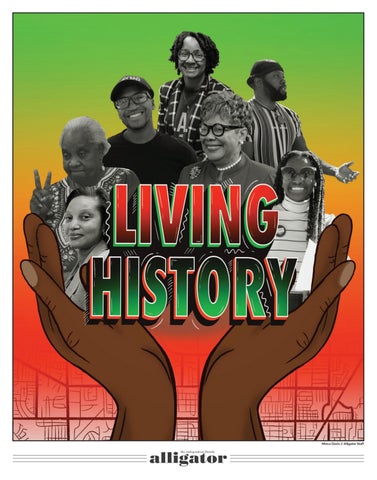
Minca Davis // Alligator Staff
2 ALLIGATOR MONDAY, FEBRUARY 28, 2022
Alachua County schools’ Black history education extends beyond February AN AFRICAN AMERICAN HISTORY COURSE PROMISES BLACK HISTORY EDUCATION TO HIGHSCHOOLERS
By Emma Behrmann Alligator Staff Writer
Alachua County Public Schools’ curriculum promises Black history education to extend beyond the month of February and the few names repeated in history textbooks. However, not every classroom fulfills this promise. The state awarded ACPS an exemplary title in 2021 for outstanding African American studies curriculum, K-12 social studies curriculum specialist Jon
Rehm said. ACPS set a goal in 2018 to build an exemplary African American studies curriculum because more than a third of its students are Black, Rehm said. The district spent most of 2019 and the beginning of 2020 creating a curriculum that includes education from Ancient Africa to slavery to abolition and centers contributions of African Americans in areas like art, literature and science. The curriculum gives K-12 teachers pre-made guides with suggested material, Rehm said. Educators retain creative freedom and can go beyond those units while sticking to the district-wide curriculum at each grade level. ACPS also offers African
American History, an elective available at each high school in Alachua County. Students who take this course get a deeper understanding than in an ordinary history class. African American History has not always been an accessible course. Prior to the new African American studies curriculum that earned the exemplary title, only one high school — Eastside — offered the elective. Now, each high school has one section of the course, and each section averages about 25 students. Eastside, which tends to be the district’s largest school, typically has two sections. “I think we’re having a much more robust conversation throughout all of our schools because of this curriculum,” Rehm said. Although the curriculum earned the title of exemplary, the teachers still decide what’s taught in their classrooms. Gaps in Black history education exist
Emma Behrmann // Alligator Staff
Jessica Morey, Buchholz High School history teacher, poses for a portrait inside of her classroom on Thursday, Feb. 17. She said she’s passionate about teaching African history and working with diverse groups of students.
Students who enroll in the African American History elective get a deeper understanding of Black history through literature, film and reflective assignments. However, students in elementary school, middle school or regular history classes still miss out. The district can monitor how many teachers access Black history classroom materials via Google Drive. The district also conducts school administration walkthroughs to ensure students learn the material.
Despite these assessments, some parents don’t believe their children are receiving an adequate understanding of their own history. Derora Williams, a parent of a second grader and fifth grader at Carolyn Beatrice Parker Elementary School, said her children learn the same names every February: Martin Luther King, Jr., Rosa Parks and Harriet Tubman. The district’s curriculum designates Black history in second grade to focus on the influence of Africa on North American Culture through map labeling and topics like tradition comparisons. It recommends fifth grade classrooms focus on topics like the triangular trade and famous African Americans in the American Revolution. However, the few figures Williams’ children have learned about don’t relate to these topics. Williams said their knowledge of Black history is limited to the month of February. Carolyn Beatrice Parker Elementary’s principal Kelly Brill Jones said Black History Month is important to her school community. “February is designated Black History Month which provides our teachers with a time to more closely focus on the achievements, contributions and struggles of Black Americans,” Jones wrote in an email. Carolyn Beatrice Parker Elementary is named in honor of a female Black physicist, which
creates opportunities throughout the school year to weave Black history into classrooms, Jones wrote. She conducts formal and informal observations of the teachers and said she is confident they follow the state’s benchmarks and district pacing guides. Because the school has an ESOL program, teaching and embracing the history, heritage and culture of diverse populations is an integral part of the school climate. However, Williams, a program coordinator for the Alachua County School Board and former eighth grade language arts teacher, believes her children’s Black history education is lacking. “I made sure that I extended [Black history] beyond just a month,” Williams said of her time as a teacher. “Because I wanted my students to know and recognize that there’s so many contributions and so many things that they should know.” What is taught depends on the teacher, Buchholz High School’s African American History teacher Jessica Morey said. “If I were to describe the county as a whole, I’m sure it’s a total hodgepodge,” Morey said. “Because it’s honestly what the teacher brings to the class.”’ Teachers put their spin on the curriculum
Educators are granted creative freedom with the district’s curriculum, and African American History teachers take advantage of
SEE ACPS AAH, PAGE 14
Porters Quarters reckons with gentrification RESIDENTS REMICISE ON THEIR COMMUNITY BEFORE STUDENT HOUSING MOVED IN
By Gregorio Ruiz-Perez Alligator Staff Writer
When Denise Burton returned to Porters Quarters in 2011, the landmarks that once guided her were gone. Burton, who left in 1980 for Georgia with her husband, called a friend asking why she couldn’t find the Alachua General Hospital, a mile marker she used to get around. UF demolished the hospital in 2010, a year before she returned. The new additions to her community were just as surprising. While growing up, there was no Sixth Street. There were no fire hydrants. The gravel roads that shook her car as she drove were replaced with paved ones. “The roads in my neighborhood were rocks and sand, not even asphalt,” Burton said. “So when I drove up here … it was a smooth ride. I’m like, when did this happen?” Although Burton admitted this development in Porters was a necessity and good to return to, a lot of recent
changes weren’t welcomed by the community. Burton, along with other Porters residents, said it’s important that further development be responsible and consider the wants and needs of residents. According to a 2018 UF project called Architecture Against Gentrification, Porters Quarters was founded shortly after the Reconstruction era in 1884 thanks to Dr. Watson Porters, a Canadian physician, who sold lots exclusively to African Americans. He hoped that the community would become self-sufficient. For a time, it was. Property developers are eager to expand into the neighborhood conveniently situated between UF, Depot Park and downtown. Gentrification has crept into Porters, stripping the neighborhood of its community businesses. Burton, 65, spent most of her formative years in Gainesville. Her father moved their family from Louisiana to the Porters community when she was just 3 years old. At 24, after attending Santa Fe College and UF, she got married and hopped from Georgia to Germany to Indiana to Ohio. When Burton returned a decade ago, two of her neighbors’ homes were gone. She talked to other community members
about the changes and discovered developers were moving in. They had bought homes from families struggling with their property taxes or trying to get rid of the property. She began to understand what was happening to the Porters community: gentrification. People from Canada, New York, New Jersey and California have called her asking to buy homes in Porters, she said, but she believes the developers are approaching it in the wrong way. Some of the homes sold went for less than $260,000, she said. “If you’re going to buy the property, let’s be a little bit more giving of the money because you’re going to make millions off of this area,” Burton said. Gentrification caused by a need for student housing makes sense, but it shouldn’t displace another group of people, she said. The apartment complexes being built are not for the residents of that community, said Michael Hill, a 26-year-old UF history senior. Studentification, a term used for gentrification in college towns, is happening everywhere in Gainesville. Developers believe in induced demand
theory, which means if they build an apartment complex, students will come, Hill said. The zoning laws in Porters designate it as a residential multifamily five, meaning that duplexes, triplexes and quadruplexes can be built there. “I think that what the city should do is change the zoning to RC, which is residential conservation,” Hill said. “So that means that people can’t go in there, buy the existing homes, demo them and then build some monstrosity, because that’s what the issue is.” City Commissioners seek solutions to support Porters Quarters
City Commissioner Desmon DuncanWalker and Interim City Manager Cynthia Curry held a meeting Feb. 21 at the Shady Grove Primitive Baptist Church to discuss solutions for the problems the Porters community faces. The elimination of affordable housing in Seminary Lane is a prime example of how UF, simply due to its proximity, prompts the construction of student housing, she said.
SEE PORTERS, PAGE 15
www.alligator.org
We Inform. You Decide.
MONDAY, FEBRUARY 28, 2022
VOLUME 116 ISSUE 25 Not officially associated with the University of Florida
Published by Campus Communications, Inc. of Gainesville, Florida
Gainesville Doula fights for Black mothers’ voices BLACK WOMEN FACE MISTREATMENT AND DISCRIMINATION IN THE HEALTHCARE SYSTEM
By Lucille Lannigan Alligator Staff Writer
When Julia Rainer had her first daughter, she felt silenced. When she asked questions, they were ignored. When she brought up natural birth, she was told she couldn’t handle it. As a young, Black mother, she was never asked for her consent and her thoughts were never considered. “I feel like I was robbed of the experience of it being beautiful because I had to be on edge advocating for myself,” Rainer said. Rainer isn’t the only one to experience neglect as a new mother. Mistreatment is especially prevalent among Black mothers, who are often viewed through stereotypical lenses as sassy or aggressive, she said. “I don’t think that our wishes are always respected,” she said. “It always seems like we’re just asking for too much or doing too much. I think that we’re also expected to be stronger as Black women. When we’re hurting or when we are in pain, it’s not taken seriously.” Her experience pushed Rainer to take action to ensure other mothers didn’t experience what she had. She began researching doulas, professional labor assistants who provide prenatal, birth and postpartum care. Rainer became certified about five years ago. She has assisted 15 births since. This mistreatment of Black women is a small part of a larger healthcare issue, seeping into the foundation of systemic marginal-
SPORTS/SPECIAL/CUTOUT
Story finish with comma, pg# Blackdescription county leaders incite change Black women are at the fore, pg. 8
ization and discrimination. Black women experience excess mortality compared to other women in the U.S., including a shorter life expectancy and higher rates of maternal mortality, according to the Journal of Women’s Health. They are three times more likely to die from pregnancy-related causes than white women, according to the Centers for Disease Control and Prevention. They are also disproportionately affected by chronic conditions like cardiovascular disease and obesity. In Alachua County, Black people face disproportionate access to health care, due to a smaller portion of the population having insurance coverage or transportation compared to other populations, according to a 2018 report by the Bureau of Economic and Business Research. In July 2020, Melissa White, a Black Gainesville mother, hired Rainer for her fifth childbirth. Having a doula changed her birthing experience, she said. During White’s second childbirth, she felt decisions were made without her consideration. She wasn’t talked to about her first epidural, and she felt like she didn’t have choices. However, Rainer guided White through her options and supported her decisions. She taught her and her boyfriend breathing and comfort techniques. “I felt secure, like I was going to be okay,” she said. “If something went wrong, she knew what to do.” White believes Rainer’s knowledge and blackness can have a huge impact on mothers who are nervous about hospital birth.
SEE DOULA, PAGE 11
Minca Davis // Alligator Staff
Despite strides for equity, Santa Fe College diversity stagnates WITH SFC STUDENTS BACK ON CAMPUS, PRESIDENT BROADIE’S EFFORTS TO COMBAT INEQUITY IS MORE IMPORTANT THAN EVER
By Lily Kino Alligator Staff Writer
When Santa Fe President Paul Broadie came into office in Feb. 2020, he promised for his first 100 days he would do nothing but listen. He walked around campus
meeting with faculty and staff, asking about the challenges, the real issues, the ugly. At Broadie’s inauguration, he promised to shatter equity gaps, enhance workforce development initiatives and help as many people as possible get a college education. He used these goals to guide his initial conversations with the SFC community. But when COVID-19 shut down the college in the middle of March, Broadie’s initial goals took back seat to pandemic prob-
Students don’t know enough Black history Professors push for more resources, pg. 10
Special Edition: Living History
The editorial board explains this issue of The Alligator, pg. 4
lems, Broadie said. “You come in with all these, with goals, and you have to stay focused on those goals,” he said. “But at the same time, as a president, you have to be able to pivot.” Two years later, the diversity at SFC remains almost identical to what it was when he arrived 一 with a Black population hovering at about 12%. With SFC inperson again, the issues Broadie once aimed to tackle have resur-
SEE SANTA FE, PAGE 11
FOLLOW US ONLINE FOR UPDATES @FloridaAlligator @FloridaAlligator
@TheAlligator_ @TheAlligator_ @TheAlligator @TheAlligator @alligator_newspaper @alligator_news-
4 ALLIGATOR MONDAY, FEBRUARY 28, 2022
Editorial
Today’s Weather
VOLUME 116 ISSUE 25
Living History: Shining a light on shadowed stories
B
lack history is Gainesville history. Black history is not just the names of dead figures in textbooks. It is not just black and white photos. It is not just regurgitated trauma documentaries of the same three people for 28 days. And it should not be sidelined for the other 337 days of the year. Black history is alive. Our city’s Black population has been ignored for years. It is time that we celebrate history as it happens in real time and bring shadowed stories to light. We took this month to showcase “Living History,” a special project that examines the untold history of those before us and the history occurring on the streets of the city today. We wanted to share the stories of those who are living through historical events now, as well as those who experienced critical periods like integration. They are, in a sense, living historical figures. The oldest living resident of Porter’s Quarters, Janie Williams, 83, spoke with us about the neighborhood she’d known as a child changing in the face of gentrification. We shared her stories about closed
businesses, abandoned homes and suddenly unsafe streets. Gainesville residents who lived through a segregated city shared their stories of discrimination and hardship with us. They showed us the bright parts of their lives, painting a picture of a tightknit Black community, friendly streets and family farms. We shared the stories of Black women who were tired of discrimination in the birthing process and decided to do something about it. We talked to teachers who ditched an outdated curriculum and replaced it with lesson plans that featured hidden heroes. Our city is going through a major demographic shift with the rise of gentrification. UF and its students expand their reach — beyond the campus borders and straight to the heart of many Black neighborhoods. Gainesville is — as always — living through history. One of our stories delves into a historic figure at Santa Fe College, Paul Broadie, SFC’s first Black president. Elected two years ago, Broadie had major goals but was handed a pandemic. While making progress on some fronts, Black students have remained a
ISSN 0889-2423
Not officially associated with the University of Florida Published by Campus Communications Inc., of Gainesville, Florida
NEWSROOM:
Lianna Hubbard, lhubbard@alligator.org
Engagement Managing Editor
Asta Hemenway, ahemenway@alligator.org
Digital Managing Editor Senior News Director
Have an event planned? Add it to the alligator’s online calendar:
alligator.org/calendar
substantial minority on campus. Some of the subjects of our stories are no longer living. Neil Butler, Gainesville’s first Black City Commissioner and Mayor, died in 1992. His family holds his often overlooked contribution to local history near their hearts. His daughter, son and niece tell the stories of his bravery as a Black politician during Reconstruction and kindness as a father. This project is dedicated to the people of living history who shared their stories. Please accept your roses while you’re still here. Lianna Hubbard EDITOR-INCHIEF Anna Wilder DIGITAL MANAGING EDITOR
Asta Hemenway ENGAGEMENT MANAGING EDITOR Sara Lindsay OPINIONS EDITOR
Tarot Consultations & Mindset Coaching IG: @goldlotustarot
352-376-4458
Editor-In-Chief
Metro Editor University Editor Features & Investigative Editor Sports Editor Assistant Sports Editors Editorial Board Photography Editor Graphic Design Editor Opinions Editor the Avenue Editor Copy Desk Chief
DISPLAY ADVERTISING
Advertising Office Manager Intern Coordinator Sales Representatives
SparkIt Creative Advertising Managing Director
SparkIt Team
CLASSIFIED ADVERTISING
Classified Advertising Manager
Anna Wilder, awilder@alligator.org Elise Elder, eelder@alligator.org Jiselle Lee, jlee@alligator.org Julia Coin, jcoin@alligator.org Kalia Richardson, krichardson@alligator.org Jesse Richardson, jrichardson@alligator.org Joseph Henry, jhenry@alligator.org Carson Cashion, ccashion@alligator.org Lianna Hubbard, Asta Hemenway, Anna Wilder, Sara Lindsay Alan Halaly, ahalaly@alligator.org Jake Reyes, jreyes@alligator.org Sara Lindsay, slindsay@alligator.org Makiya Seminera, mseminera@alligator.org Lydia Parker, lparker@alligator.org 352-376-4482 Cheryl del Rosario, cdelrosario@alligator.org Ellen Light, elight@alligator.org Sophia Handley, Emily Gamble, Maya Naim 352-376-4482 • info@sparkitcreative.org Skyler Davis Aarin Rutkin, Adriana Colón, Dalia Rubinowicz, Jenny Gomez, Levi D'Amato, Maria Vanderbilt, Melanie Peña, Nazil Ahmed, Samadu Adeyemi, Sammy Fadool, William Chen, Skyler Davis
352-373-3463 Ellen Light, elight@alligator.org
BUSINESS
352-376-4446 Delia Kradolfer, dkradolfer@alligator.org Cheryl del Rosario, cdelrosario@alligator.org Ellen Light, elight@alligator.org
ADMINISTRATION
352-376-4446 Shaun O'Connor, soconnor@alligator.org Lenora McGowan, lmcgowan@alligator.org C.E. Barber, cebarber@alligator.org
Comptroller Bookkeeper Administrative Assistant
General Manager Administrative Assistant President Emeritus
SYSTEMS
IT System Engineer
Kevin Hart
PRODUCTION Production Manager Publication Manager
Jordan Bourne, jbourne@alligator.org Deion McLeod, dmcleod@alligator.org
Got something going on? Want to see it on this page? Send an email with “What’s Happening” in the subject line to engagement@alligator.org. To request publication in the next day’s newspaper, please submit entries before 5 p.m. Please model your submissions after the above events and keep them to 150 words or fewer. Improperly formatted “What’s Happening” submissions may not appear in the paper. Press releases will not appear in the paper.
THE GAINESVILLE POLICE DEPARTMENT
The Independent Florida Alligator is a student newspaper serving the University of Florida, published by a nonprofit 501 (c)(3) educational organization, Campus Communications Inc., P.O. Box 14257, Gainesville, Florida, 32604-2257. The Alligator is published Monday mornings, except during holidays and exam periods. The Alligator is a member of the Newspaper Association of America, National Newspaper Association, Florida Press Association and Southern University Newspapers.
The Alligator offices are located at 2700 SW 13th St. © Copyright 2020. All rights reserved. No portion of The Alligator may be reproduced in any means without the written consent of an officer of Campus Communications Inc.
Subscription Rate:
Full Year (All Semesters) $60
The Alligator strives to be accurate and clear in its news reports and editorials. If you find an error, please call our newsroom at 352-376-4458 or email editor@alligator.org
MONDAY, FEBRUARY 28, 2022 ALLIGATOR 5
‘This is our home’: multigenerational residents recount the evolution of a segregated Gainesville THE CIVIL RIGHTS MOVEMENT OF THE 1960S AND ‘70S CHANGED THE CITY’S RACIAL ATMOSPHERE, BUT THE FIGHT FOR EQUAL RIGHTS IS STILL ONGOING
By Carissa Allen and Eileen Calub Alligator Staff Writers
For Paula Sanders, home is a quaint one-story, white and red accented cinder block house. It’s been home for 54 years. Growing up, she was neighbors with Gainesville legends like Judge Stephan P. Mickle, the first Black federal judge in the First District Court of Appeal, and Dr. Cullen W. Banks, the first Black person with full practicing privileges at Alachua General Hospital, which was torn down in 2009. She still lives in her childhood home in Lincoln Estates, a southeast Gainesville neighborhood rich with history. It was a model for Black equitable access to home ownership amid the civil rights movement. “I know where it came from,” Sanders said. “I know what it was built from. I know the foundation.” Over the decades, she has watched the city integrate while erasing the prominent Black culture that once thrived. “The true trailblazers are no longer here,” she said.
In response, multigenerational Gainesville residents must take it upon themselves to preserve their heritage through food, photographs and oral histories. For some Black residents, they experienced the hasty integration of schools and the inequitable transformation of the city. In 1967, Paula Sanders was born into a Gainesville where racial tensions were high and integration was in its early stages. The 54-year-old is a fifth generation Gainesville resident. She attended P.K. Yonge, a K-12 school, surrounded predominantly by white people, she said. When she came home, though, her life was “very Black” — friends, family, church and the all-Black restaurant she frequented. She spent weekends roller skating with friends at the speed rink in northeast Gainesville, she said. Over spring break, she participated in a dance contest in a large annual “sport-a-thon” event hosted for thousands of Black students in Gainesville. “It was like the Olympics of the best athletes from all the Gainesville schools,” she added. “This gave us a time to come together and celebrate us.” Growing up in a transitional period in United States history, Sanders remembers subtle changes in Black residents’ lifestyles during the civil rights movement in Gainesville.
Sanders recalled regularly walking up to the front door of her grandfather’s shoe store on the corner of Main Street and First Avenue, greeted by the pungent smell of shoe dye. When she was young, shining shoes was a service predominantly provided to white people. She noticed Black businessmen visitedbegan to visit the store more regularly as she grew older, though. “As time went on and I grew up, you noticed that the climate of the store changed,” she said. When Sanders attended UF as a student in the 1990s, she was enrolled in a small, predominately white program in the College of Health and Human Performance. She felt isolated pursuing her degree. “You got to choose: ‘Am I going to hang out with the Black students, am I going to hang out with the white students or am I going to hang out with the students that are going to help me get my degree and get out of school?’” she asked. “It was very, very segregated.” Her father, Bill “Willie” Sanders, was the first Black faculty member in the UF College of Medicine. He started working for the Health Science Center in 1957, a year before the university integrated. Students thought he was a janitor, his daughter said. After working as an anatomy lab technician at the university for
a few years, he applied to become an undergraduate student. His application was denied because of his race, Sanders said. In 1962, Willie became one of the first six Black undergraduate students to be accepted into UF. “He was often overlooked, ignored, disrespected by students, even though he had on the white lab coat,” she added. “They just didn’t think he was supposed to be in that place. They weren’t ready for that.” Willie faced unbelievable stories of blatant discrimination outside of UF’s campus, Sanders said. Her father told stories about his drives to South Florida to fetch cadavers for white medical students to practice on. “He would always get stopped because he was a Black man driving a refrigerated truck,” she said. “And it was nine times out of 10 the same freakin’ cop.” Willie Sanders had to prove his intelligence for white students and faculty to respect him. Now, the university and faculty honor his legacy with a scholarship dedicated to making significant contributions to a diverse student body. He’s also celebrated by Paula and her family every Father’s Day in her childhood home. Her family gathers to admire old pictures of him, teach younger generations about his legacy and enjoy soul food together.
Minca Davis // Alligator Staff
Sanders Family left to right: Paula, Billy, Pauletta, Bill “Willie.” Garlenda Greene-Grant’s grandfather lived on an about 100-acre property in West Gainesville. Her family has been in Gainesville since 1903.
Sanders hosts most annual family holiday gatherings in her childhood home: Easter, Fourth of July, you name it. “This is our home,” she said. “This is where we belong.” At least 12 other houses line Sanders’ street, and each has been occupied by the same family for about 50 years. Her neighbors are her tribe — a community within a community. From the first to the last block in her neighborhood, Sanders knew every resident. Now, she said, it’s not quite the same. Low-income white families are moving into Black neighborhoods. Sanders said her neighborhood welcomes and accepts everyone in the Lincoln Estates community, but the newcomers isolate themselves and do not interact much with the old-timers. She said East and West Gainesville are two different cities. As UF consumes more of Gainesville, historically Black neighborhoods dwindle. UF history professor Steven Noll grapples with a Gainesville where remnants of a racist past endure — in Gainesville’s schools, neighborhoods and history. In Gainesville and the South, white developers are continuing to impede on and carve up Black land, Noll said. Black settlements and land ownership in northwest Gainesville near Millhopper Road have been reduced and replaced with upscale housing developments. These complexes are “built on the backs of Black labor” following the fight for land ownership during the Jim Crow era, Noll said. “To say: ‘Oh no, we’re past that’ is putting our heads in the sand,” he said. “We’ve got a ways to go still, and I think it’s important to understand that.” Otis Stover, a 70-year-old fourth generation resident, said these changes have led to further disconnect with his family’s history. Stover lives in East Gainesville in a neighborhood called Kincaid Road — about two miles away from his childhood neighborhood. He and most East Gainesville residents have been firsthand witnesses to the “great gentrification” devastating the city and its Black culture. Stover’s ties to Gainesville began with a covered wagon — transportation that carried his ancestors from South Carolina to Fort White, then Crystal River and finally Gainesville in the thick of Reconstruction. He cherishes documentation that recognizes his greatgrandparents settled in the city and purchased land around 1904, though he believes his roots in Gainesville date back to the 1890s. Today, his children and grandchildren continue their Gainesville lineage. As a child living in a segregated Gainesville in the late 1950s, there were boundaries Stover quickly learned not to cross. He recalled countless instances where he
SEE GENERATIONS, PAGE 16
6 ALLIGATOR MONDAY, FEBRUARY 28, 2022
!
W E N
Quit tobacco with virtual Group Quit. There’s never been a more important time to quit. Free, expert-led online sessions are now available for all Florida residents, regardless of insurance status. Upon class completion, participants are eligible to receive free nicotine replacement therapy such as gum, patches or lozenges.* For more information on virtual Group Quit classes, contact:
352-273-5224 *if medically appropriate for those 18 years of age or older
Learn more about all of Tobacco Free Florida’s tools
ealth Ed C enters (AHEC) UNIVERSITY
gr of FLORIDA
MONDAY, FEBRUARY 28, 2022 ALLIGATOR 7
First Black Gainesville mayor since Reconstruction continues legacy through family NEIL BUTLER SR.’S FAMILY AND FRIENDS REMEMBER HIS REVOLUTIONARY STORY, DESPITE HISTORY BEING LOST BY SOME AMONG THE GENERAL PUBLIC
By Melanie Peña Alligator Staff Writer
With his lip lifted up to the side and a bright twinkle in his eye, Neil Butler Sr. ran around Downtown Gainesville in a fresh, white nurse suit. Despite always being in a rush to get somewhere, he stopped to talk to anyone who said hello. He was a people person. Butler was elected into the city commission in 1969, becoming the first Black man elected to the body since Reconstruction, an era marked by post Civil War opportunities. Later, in 1971, he became the first Black Mayor to hold that office in 100 years. However, he wanted to be remembered for who he was rather than being the first. Butler sent shockwaves throughout the city when he won the City Commission election. His daughter, Annette Butler-Johnson, 68, was in high school at the time and remembers feeling immense pride for her father. “When he was elected, the city of Gainesville was 80% white,” Butler-Johnson said. “That’s a major accomplishment for a Black man to come in and win an election with an 80% white community.” Butler was born in Orange Heights, Florida, in 1928 and was raised during a time when segregation dominated society. He had to use the bathroom in the basement of the courthouse because Black people were not allowed to use public facilities.
He was a World War II combat veteran and spent time on Okinawa Island. After his service, he studied at Morris Brown College in Atlanta, Georgia. Butler was a strong believer in education and reinforced that belief in his children. When Butler-Johnson and her nine siblings asked him what a word meant, he encouraged them to use their dictionaries. “He would say ‘Get your dictionary, look it up and you will remember it more. If you look it up and read it, you’re more prone to remember it than if I just tell you what it is,’” Butler-Johnson said. Butler pushed his children to stand up for themselves and work hard for the things they were passionate about. One of his sons, Danny Butler, built a car with his father for a Soap Box Derby competition when he was a young Boy Scout. The car needed a sponsor, so Butler took Danny to the Sun Bank to pitch the car. Danny, now 61 years old, remembers the experience as one of his fondest memories of his father. “That’s the kind of person he was,” Danny said. “He wouldn’t go do it for you. He would want you to do it for yourself and you would learn from it.” Coincidentally, Danny won a mock election at his school at the same time his father won the 1969 city commission election. While working two full-time jobs, Neil Butler Sr. attended a practical nursing class, which was operated by the Alachua County Board of Education, in 1964. A year later, he enrolled in UF’s College of Nursing. He faced probation at one point in his studies, but by the time he graduated he made the dean’s list.
Courtesy to The Alligator
Neil Butler’s 1969 campaign ad for city commissioner, pulled from Matheson Museum archives.
He earned a bachelor’s and a master’s degree in nursing. He was the only Black male student in the Graduate School of Nursing at the UF, according to a 1971 edition of Ebony Magazine. He was also the first African American male to graduate from the college, Danny said. Butler served as a city commissioner until 1971 when he became mayor. During this time, he was surrounded by controversy over allegations that Butler committed a felony. Butler pleaded guilty to mail embezzlement of $9 while living in Atlanta in 1959. The conviction placed Butler on probation for two years, and he lost his right to hold office. In 1972, The Sun published an article about the charge. The day after publishing, Butler resigned from his position as Mayor. However, the Florida Board of Pardons restored his rights on Dec. 16, 1971. Butler grew up in church, and his community at Mt. Olive A.M.E. Church tried to look past the incident. Vivian Filer, 83, the CEO of the Cotton Club Museum and Cultural Center and a nowretired professor of nursing, was a member of the church at the time of Butler’s election and described their community as close-knit. Everybody knew each other. Filer believes the crime was either made up or embellished. During this period in American history, crimes were fabricated for the purpose of targeting Black people. “That’s not the Neil we know,” Filer said. “We knew the real Neil so we knew that wouldn’t have been something that he would do.” Filer recalls how the church celebrated Butler’s election for days. He was its pride and joy. “We talked about it. We spread the news. We congratulated him. He was constant in our conversation,” Filer said. “To me, he knew a lot about politics, about life, about laws, about whatever he put his hand to, he perfected and that to me was inspirational.” Butler faced many instances of discrimination during his terms as mayor and city commissioner. Butler-Johnson was in constant fear for her father’s life. Martin Luther King Jr. was killed when she was in elementary school. The fear her father could be murdered in the same way was always in the back of her mind. “Him being in that position, there was always a chance that somebody might try to hurt him or to do something,” she said. Butler received death threats that his home would be shot up, Danny said. His father would sleep on the floor of their home at night to guard the house. “He knew going into it that he would be facing adversity, but it was something that he felt had to be done and that he needed to do
because there were underrepresented people,” Danny said, “And he felt he could do something to change that.” Butler’s niece Ayesha Solomon, 42, recalls being told by one of his children that they feared he would be killed by the white men. Solomon doesn’t have memories with her uncle but learned about him through family stories. “My relatives shared with me that he was a man who lived a very purposeful life,” she said. “Uncle Neil was all about helping all people.” Through research, Solomon discovered details about Butler’s legacy and was incredibly impressed by his return to Gainesville politics after the embezzlement controversy. In 1972, Butler was declared eligible for the March city commission race. Forty-five days after Butler resigned, he was elected back onto the city commission and carried 56% of the vote, according to an article by The Sun. He served as a City Commissioner until 1974 when he was appointed to his second term as Mayor-Commissioner. Butler tackled many issues during his time as Mayor and City Commissioner, including inequality, utility rates and city structure. He paved dirt roads in Black neighborhoods. He also initiated a minority recruiting program that increased the number of Black firefighters and police officers. Butler considered continuing his career into the Florida Legislature. The Hatch Political Activities Act prohibited federal employees from participating in political campaigns. Butler’s job at the Gainesville VA Medical Center made him a federal employee. To this day, Filer attends Mt. Olive A.M.E. Church and greets Butler’s children. Filer remembers Butler as an inspiration, someone who paved the way and changed her world. “I think people like Neil and others doing that kind of work certainly was inspirational to all of us, who were in the field trying to make a difference and facing all of the harassment and everything that was going on,” Filer said. Butler-Johnson and Solomon followed Butler’s legacy through different fields. Butler-Johnson became a licensed practical nurse. Butler told her to continue her education to become a registered nurse but she decided against the idea. “I worked as an LPN at the VA until my pay scale couldn’t go up any higher so I still had to work. Why not go back to school?” Butler-Johnson said. “And I thought about it and I said ‘Lord if I’d just listened to my dad, I’d be way beyond this point right now.’” Solomon became the first Black property appraiser for Alachua County and first Black female property appraiser in Florida.
“If Neil Butler was here today, I think his advice to me would be to focus on your purpose,” Solomon said. “My primary objective is to be great at serving the community and if I so happen to make history then so it is.” Solomon, Butler-Johnson and Danny Butler all passed down their stories to their children. They hope that he won’t be forgotten. “It’s required to know that that’s your lineage and that’s your history,” Danny said, “And that someone was bold enough to step out on those ledges in times when it wasn’t very easy to do so.” Butler-Johnson asked the children at her church about impactful Black leaders. They all knew who Martin Luther King Jr. was but when she asked them about Butler, the room grew silent. “That’s so important because if we don’t pass it onto our children and they pass it onto their children, he’ll get lost in the limelight,” Butler-Johnson said. “I think a lot of times he has gotten lost in the limelight.” Butler-Johnson was disheartened to hear Gainesville children were unaware of Butler’s legacy but felt hope knowing that one of Butler’s grandchildren would be giving a presentation Feb. 27 on his impact at Agape Faith Center Ministries. “I want to make sure that they know who he was, and how instrumental he was in doing so much for the city of Gainesville and the community,” Butler-Johnson said. Solomon believes that Gainesville does not do enough to celebrate his legacy. She feels that there should be a street or building named after him. “I wish that Gainesville did a better job of acknowledging the strides that we’ve made in Black history by reminding the community of great leaders who served before us,” she said. “What does that really mean if you don’t celebrate it, acknowledge it, or honor it?” Despite Gainesville’s lack of commemoration for Butler’s legacy, he lives on in the community as someone who truly changed the city. He wanted to be remembered as a strong father, accomplished nurse and inclusive leader. Butler passed away in 1992 at the age of 64. He died of a heart attack while attending a friend’s wedding anniversary. His legacy and impact went beyond his political achievements. Butler touched the lives of everyone he met. “Sometimes one wonders how you survive when you’re faced with those obstacles, but you never give up,” Butler said in an archived article by The Sun. “Little by little I got more resilient by facing those troubles, and that strengthened me in the long run.” @MelanieBombino_ mpena@alligator.org
8 ALLIGATOR MONDAY, FEBRUARY 28, 2022
Faces of Black Alachua County leaders
Esha Nair // Alligator Staff
Evelyn Foxx, president of the Alachua County Branch of the NAACP, poses for a portrait in front of Gainesville City Hall on Thursday, Feb. 17. Foxx attended the swearing in ceremony of newly elected City Commissioner Cynthia Chestnut. “Personally, I celebrate Black History Month 12 months of the year because our history is very important.” Foxx said. “I am also very disturbed that Black history is not being taught in Alachua County.”
Rae Riiska // Alligator Contributing Photographer
Courtney Moore Taylor, African American studies lecturer and faculty adviser for Sankofa Society, speaks to members of the Sankofa African American Studies Society on Wednesday, Feb. 23. The club aims to support the African American studies program through alumni networking and professional development. “To showcase Black learning showcases the possibility that we all as human beings have to excel,” Taylor said.
Ashleigh Lucas // Alligator Staff
Esha Nair // Alligator Staff
Roberta Conyers, a Gainesville-based artist, poses with her artwork at the Black Arts & Food Market hosted by Student Government’s Change Party outside of the A Rai of Sunshine Thrift Store on Saturday, Feb. 19. Her art often centers around all aspects of Black life. “I just want to inspire others to create and do what they are passionate about,” Conyers said.
Rachel Grant, UF assistant professor of journalism, poses for a portrait in her office at Weimer Hall on Tuesday, Feb. 8. She teaches Media, Cultures and Identity — a required journalism major class that centers around race, gender and diversity and inclusion topics. Grant was the sixth African American to earn her Ph.D from the Missouri School of Journalism. “It’s not typical to see people who look like me in these positions because of some of the challenges we’ve had to overcome due to racism,” Grant said. “I feel as if I am helping shape the minds of future communicators.”
MONDAY, FEBRUARY 28, 2022 ALLIGATOR 9
Esha Nair // Alligator Staff
Ashleigh Lucas // Alligator Staff
Tina Certain, Alachua County School Board member, poses for a portrait at her podium at the Alachua County School District on Wednesday, Feb. 15. Certain, who graduated from Gainesville High School and the UF with an accounting degree, is one of two African American women who serve on the School Board. “If you’ve seen someone who’s done it, it sparks in your mind that you can do it,” Certain said.
Cynthia Chestnut, 72, engages with members of the Gainesville community after her swearing-in as city commissioner on Thursday, Feb. 17. Chestnut was previously elected as the first Black, female city commissioner in 1987 and as mayor in 1989. “I promise to always listen to you,” Chestnut said at the ceremony. “I promise to hear the concerns of the people of Gainesville and advocate for them inside the walls of our City Hall.”
Leo Ramsey-Watson // Alligator Staff
David Canton, director of UF’s African American Studies Department, teaches his History of Hip-Hop class in Turlington Hall on Wednesday, Feb. 16. “In my class we study the history of hip-hop music from an African American perspective. We explore the political — deindustrialization, technology and institutional racism — and cultural — call and response, DJ’s and funk and disco music — forces that created a billion dollar industry.”
Esha Nair // Alligator Staff
Giovanna Mompremier, UF Student Body Treasurer, sits in her office inside the Reitz Union on Tuesday, Feb. 22. “Coming from a post-COVID atmosphere has brought back the overall celebration in knowing that we need to still continue to celebrate the strides and milestones that the Black students, faculty and Black community in Gainesville has done.” Mompremier said. “I’m just so happy being in this space where I can encourage others around me to support and celebrate Black History Month as well.”
10 ALLIGATOR MONDAY, FEBRUARY 28, 2022
African American Studies professors push for more Black history education RIK STEVENSON SAYS UF STUDENTS DON’T KNOW BLACK HISTORY, HE WANTS TO CHANGE IT
By Elena Barrera Alligator Staff Writer
Rik Stevenson likes to challenge his students with questions each class: “Who is Claudette Colvin? How many slave ships remain untouched at the bottom of the ocean? Who is Bessie Coleman?” Few students know the answers to these questions, signaling to the African American Studies professor that a bigger problem exists: UF students lack a proper education in African American history. “I just think that the under-education of our student population is doing us much more harm than it does good,” Stevenson said. Stevenson uses a teaching methodology called critical pedagogy, or teaching through inquiry. He frequently asks students questions about historical people and analyses only to find they have never heard of them. The main problem is that Black history is not traditionally taught as a part of American history, he said. This appears to be a problem that extends into the Alachua County public schools. Parents have voiced concerns about the lack of Black history integration despite the county having a state-recognized African American studies curriculum. At the individual level, he said taking the time you would spend on social media and redirecting that attention to research would help close the gap of knowledge disparity. To combat this lack of education from the university level, Stevenson believes student advising should better market the courses that the African American Studies department offers. “A student who sees African American history as integrated into the American history context has a better perspective of what it means to really be American,” he said. It is important to learn and acknowledge our past, said Yasmine Adams, a 22-year-old English major with minors in African American Studies and anthropology. History
in general is important to understand the context of the present, she said. Most of Adams’ professors in the African American Studies program are Black, she said, which provides an Afrocentric lens that regular history courses may not have. “[The classes] are often taught from people who have experience in things that we are talking about,” she said. “I find that a lot of times my professors are very engaged and it’s very obvious that what they’re talking about is so important to them.” Roughly 73% of the professors in the African American Studies department are Black, while only about 8% are white, according to UF’s workforce database. There is also no fear the course will be whitewashed because African American history is what it is, and the instructors teaching it are genuinely interested in uncovering the truth, Adams said. Adams feels African American history is not emphasized enough in UF’s education. Students either do not see it as important or the university does not take the time to inform students about the courses they are offering, she said. “Our pursuit of Black history is because of our experiences,” she said. “So we feel the need to be involved and be knowledgeable, but when it comes to the academy I don’t see that same interest.” Approximately 79% of students majoring in African American Studies are Black and 6.5% are white, according to UF’s student enrollment and demographics database. The university does not require courses that teach African American studies and Black history, but its Quest program can expose students to equitable courses as a part of their general education, said Angela Lindner, associate provost for undergraduate affairs. UF’s Quest courses examine difficult questions about the human condition in our changing world, according to the description on the program’s webpage. Quest replaced the “What is the Good Life” course in Spring 2019. It was clear that one course was not sufficient to create truly well-rounded students, Lindner said.
Following the murder of George Floyd in 2020, the program requested that professors propose courses about racism and antiracism. These requests, she said, prompted courses like “Acting for Change,” “Black Women’s Work in Film,” “Dance, Race, Gender” and “Journalism, Justice and Civic Change,” which were offered this Spring. Courses like these are a start, Stevenson wrote in a text message. “I think initially there should be more course[s] that highlight African[s] before the Transatlantic Slave Trade,” he wrote. UF added a second required course for its Quest program this year. The goal is to add an experiential learning course by 2027, she said. Lindner approves courses as the chair of the university curriculum committee and the general education committee. But the committees have no say in course content. Instead, they examine the courses’ objectives, the weekly course schedule, how students are being graded and if they are being graded fairly, she said. Course content is determined at the college and department level, she said. “The gen-ed committee doesn’t push for specific courses; that’s not the role of the committee,” she said. “We’re not going to tell them they can’t teach certain content; that’s just not our job. We are here to help.” UF’s curriculum changes always start with the faculty, she said, then the committees review their requests to ensure they meet the standard guidelines. Both committees are made up of UF Faculty Senate members, members appointed by the provost and representation from UF’s student government, which allows students to have a voice in their curriculum, Lindner said. Lindner encourages any faculty members who have questions or suggestions to come to them, and the committees will support them through the process. “We all have to have skin in this game,” Lindner said. “The community cannot rely just on the administration to make change. We’re on this every day, but it’s got to come
from students, it’s got to come from faculty.” While changing and adding to the curriculum seems like the obvious solution, Vincent Adejumo, a UF senior lecturer of African American Studies, said he does not believe requiring students to take courses in African American history is the solution. Requiring studies in one culture, Adejumo said, then poses the question of whether studies in other cultures like Latin American groups and Jewish groups should be required too. “If a person isn’t interested in learning it, especially as a collegeage student, then they shouldn’t be mandated,” he said. “I think what the university can do is be open to more programming that is more African American centered.” On Feb. 8, UF Student Government funded a Black History Month concert headlined by Roddy Ricch, who was paid $350,000 to perform. SG funded another Black History Month concert two years ago on Feb. 24, 2020, that was headlined by Tory Lanez. He was paid $91,500 to perform. A better allocation of this money would be to use the funds for getting a series of speakers and scholars to come to the school not only during Black History Month, but the entire year, Adejumo said. “At the end of the day [the students] want to have fun, and that’s
fine,” he said. “But if the university is serious, they would look into bringing more serious people in to talk about these issues.” Students have to demand these changes because without it the administration has no incentive to change, he said. Students could pay more attention to what’s going on with the faculty even if they are not choosing to take courses in African American Studies, Adejumo said. Administration could also do a better job with press releases and informing students on the inner workings of faculty members, he said. Tackling this issue of educational disparity calls for an all-hands-ondeck approach. If the urgency for change begins to ripple throughout the student body, faculty and administrators, then maybe more students would know the answers to Stevenson’s questions. They’d be able to confidently say Bessie Coleman was the first Black woman to get a flying license, that nearly a thousand slave ships rest on the ocean floor and that Claudette Colvin, a dark-skinned, pregnant 15-year-old, was the first Black woman to refuse to give up her seat on a segregated bus – not Rosa Parks. @elenabarreraaa ebarrera@alligator.org
Minca Davis // Alligator Staff
Food that feeds your soul: Gainesville African and soul food cuisine honors local Black community FAMILY BUSINESS OWNER REMINISCE ABOUT THEIR RELATIONSHIP WITH THEIR CULTURE’S CUISINE
By Jared Teitel Alligator Staff Writer
Merriam Fischer was 5 years old when she took to the kitchen boiling traditional African soups with her mother. To her, there was nothing more exhilarating than finally preparing the flavorful foods she knew all her life. She manages Ivoire Delice and Market, a West African and soulfood fusion takeout service. Starting her business in 2021, Fischer, alongside her parents and three siblings,
noticed the lack of authentic African cuisine in Gainesville. Opening up a food service business meant more to the 32-yearold Ivorian than just making food Gainesville locals had never seen before. “I want every Black person in Gainesville to feel home so that [they] know that they have some soul food, some comfort food,” Fischer said. Soul food and its African roots originate back to the era of slavery in the United States. Allocated small food rations by their owners, African slaves made do with ingredients like rice, pork and okra, preparing a variety of recipes native to their home countries. Since the end of the Civil War,
freed slaves and their descendents could elevate these dishes to cornbread, fried chicken and collard greens with affordable ingredients found in local markets of the Deep South. These dishes eventually got their name from newspapers of the 1960s that synonymized Black culture with soul. Although much of the historic legacy of the Black community in America is commemorated through the work of civil rights trailblazers, local African and soul food pop-ups in Gainesville celebrate their culture through their culinary traditions. From Senegambian, Senegalese and Gambian, jollof rice and chicken to Southern fried catfish and collard greens, Fischer’s family recipes are meant for Black residents who walk
through her doors to taste something familiar. Her desire for Gainesville residents to taste the cuisine she knew since childhood was confronted by a daunting obstacle — Fischer didn’t have a restaurant to cook in. Instead, Fischer and her family began Ivoire Delice and Market as a plate service, preparing dishes and selling them one by one from her home. Egusi, sweet plantains, oxtail and mac’ n’ cheese are among the signature dishes that were boiled, baked and sold from the family’s kitchen. It wasn’t until the 2021 social media trend #FufuChallenge reached Gainesville that Fischer and her family knew they wanted to expand their soul food plate venture. Millions of
Black Americans across the country took to local restaurants to try fufu dishes — West African dough balls often made of cassava, yams or plantains. “People came to buy the food [from] us — the fufu and everything,” she said. “So, we found a restaurant.” With the growing popularity of African cuisine, Ivoire Delice and Market finally found a building, opening its doors Feb. 17 on North Main Street. Read the rest online at alligator.org @jaredteite jteitel@alligator.org
MONDAY, FEBRUARY 28, 2022 ALLIGATOR 11
SFC student body has stayed 12% Black since President Broadie joined SANTA FE, from pg. 3
faced. Tianna Harris, a 19-year-old Black Student Union senator at SFC, said as a Black student, she is constantly reminded she’s a minority. “There are some days when I will walk on campus, and I don’t even see one person of color,” Harris said. “Even when going into a building like, student affairs or something, the faculty … is not really diverse.” But it could be worse, Broadie said. Many institutions saw a decrease in Black enrollment over the past two years, and SFC maintained a steady percentage. “To say that we've continued to retain our African American students, despite the African American population being hit very hard by the pandemic, is a testament to the work that our faculty and staff have done,” Broadie said. SFC’s ability to listen to the immediate needs of its students was what kept its Black enrollment numbers from dropping, he said. Broadie focused on food insecurity, transportation issues and increasing the college’s emergency fund that provides financial assistance to low-income students when faced with challenges hindering their ability to focus on their education. “We were very intentional in our efforts to listen to what the needs of our community and our students were,” Broadie said. Yet, SFC’s Black Student Union adviser Javan Brown said
much of what the college is doing is being missed by the community because SFC’s intentions aren’t clear enough. “As for Santa Fe College and what it’s doing, I think we need to be more deliberate, and I mean absolutely deliberate, in calling out in support to help Black students in the Black community,” Brown said. While Broadie was keen on listening to the immediate needs of SFC’s students during the pandemic, he created several longterm programs during the past two years to circle back to his initial promises. These programs are part of three pillars he established to accomplish his goals. The first pillar is creating a college-going culture throughout Alachua and Bradford County, Broadie said, which will be done through SF Achieve. SF Achieve is a pre-college prep program launched in November 2021 where specialists work with all students in participating Gainesville high schools to guide them through the college process. Students that graduate as SF Achieve scholars and choose to attend SFC will receive a faculty member as their mentor and a book voucher for up to five semesters at SFC. Low-income students are also eligible to receive a scholarship that covers whatever financial aid does not. David Durkee, SF Achieve specialist, was a first generation college student who didn’t know how to navigate the college process. Lack of resources can be a barrier to entry for some stu-
dents, he said. “The students that we're really looking for are those students that may not have made that jump to college due to a lack of resources or a lack of belief,” Durkee said. “Those are the ones we’re really excited to help.” Broadie’s second area of focus is student success 一 a sector driven by scholarships. During the 2021-22 academic year, the Santa Fe College Foundation approved 670 scholarship awards valued at about $1,627,000. SFC has recently seen that a significant portion of its lowincome students are attending school part-time because they often can’t afford a greater course load, Broadie said. Almost 60% of students at Santa Fe are parttime. Increasing scholarship opportunities will hopefully increase the number of full-time students at SFC, Broadie said. Broadie’s last pillar is social and economic mobility. He has used the Achieve, Conquer and Believe Excel Program to work toward that goal, Broadie said. The ACB Excel Program is a seven-month, two-generation program designed for unemployed or underemployed individuals who have young children in the local school district, ACB Excel Coordinator Jen Homard said. Children and their parents gather two nights a week, one Saturday a month at Loften High School to enjoy a no-cost family style meal. After dinner, the adults work toward a career certificate program, while their chil-
Creating safe space for Black mothers DOULA, from pg. 3 Childbirth has a huge emotional toll, White said, especially for Black women. “I just feel like somebody there knowing what you can do and what the hospital can or cannot do … is very beneficial because I really do feel like we're not heard,” she said. About a year ago, Rainer launched her business Create Space. Through Create Space, she works as a childbirth educator and doula to advocate for mothers who may feel nervous about hospital birth. Rainer works on home and hospital births, including at UF Health Shands Hospital and North Florida Regional Medical Center. While she supports medical intervention during birth, she believes the birthing experience has a negative connotation. “I just believe that Western culture has made us think that birth needs to be done in a hospital and it needs to be done with this intervention and that intervention,” Rainer said. While there will be moments of intensity, childbirth is meant to be a great experience, not a painful one, she said. To prepare for it, she gets to know her clients and their significant others on an intimate level.
“I find out what the mom does like and what she doesn't like,” she said. “We focus on comfort measures.” Rainer knows not everyone can afford a doula, so she is working to educate more people in the Black community. Through Create Space, she plans to hold seminars on childbirth education. These would teach women self-advocacy and labor terminologies, choices and rights. Alyssa Zucker, UF professor and women’s studies chair, said health disparities are the outcome of a society historically centered around whiteness. “Dating back to the times of enslavement, Black women were really bred,” she said. “So there was this sort of disregard for their humanity and their motherhood.” She believes traces of this attitude exist today. Because of this, Black women may avoid seeking care, Zucker said. “I think when you bring that into a pregnancy, it can cause people to overlook problems and to not take things seriously enough when there are warning flags that something’s going wrong in pregnancy,” Zucker said. Mistreatment spikes stress, which could cause difficulties during pregnancy. This stress is accumulated over a lifetime, she
Minca Davis // Alligator Staff
dren receive childcare from program supervisors. “We are breaking that cycle of any sort of poverty, whatever that level may have been for that family,” she said. After completing the program, students can enter the workforce with the help of SF’s local business partners or stay at SFC and do a certificate or apprenticeship program. Aaliyah “Chulo” Cheech, a 26-year-old ACB Excel student, plans to do a plumbing apprenticeship after she graduates. “The teachers that I have right now —I know for a fact they’re pushing me to be great and they’re pushing everybody else,” Cheech said. ACB Excel Coordinator Homard doesn’t expect to see returns on the project immediately.
said. “They’ve had their whole life as a Black woman up until then, living in a society that’s really built around whiteness, and so that [mistreatment] — this is just an added stressor,” Zucker said. Nilufer Akalin, a gender, sexualities and women’s studies professor, researches Haitian immigrants’ healthcare access. As their Black, female and immigrant identities intersect, they become victims of microaggressions. “They are, for instance, infantilized,” Akalin said. “They are assumed less knowledgeable because they don’t speak English fluently in some cases.” Some doctors, she said, don’t listen to Black patients’ symptom descriptions or give sufficient explanation about diagnoses. Sometimes they are misdiagnosed. “Their cases are analyzed from the lens of how to treat average white males,” Akalin said. Rakeem Robinson, a UF Center for Public Interest Communication research fellow, said the marginalization of Black women in healthcare is a problem for everyone to solve. Healthcare providers should be changing the culture of communication, he said. “Get to know the patient more than just the things that they see on the sheet,” Robinson said.
“We will actually never really know the true impact of this program because we are essentially affecting generation after generation,” she said. But that doesn’t mean President Broadies’s efforts are going unnoticed, SFC’s BSU adviser Brown said. Brown compares Broadie to a farmer, tilling the land for his first two years, ensuring it’s going to be fertile. Once the seeds are planted, they will grow, Brown said. “A lot of the work that's going on, that you might not see, that you cannot hold as tangible,” he said, “that’s where the work really needs to be done in order for that seed to take root.” @lily_kino lkino@alligator.org
Providers should be empathetic and create a comfortable space for engagement. As a researcher, Robinson feels he and others in his position can create better protocols for healthcare providers, equip communities with accessible healthcare knowledge and listen to the needs of Black women in the community. “It’s making sure we’re realizing it’s not just seeing Black women as people, but seeing them as someone that can help move the agenda forward for everyone else,” Robinson said. “Solving this problem for Black women leads to solving this problem for those of Asian descent, Latin descent, so on and so forth.” This is a collective fight, Robinson said. As a Black man, his role isn’t to speak for Black women but to share a space with them and work for change. Overlapping problems based on gender or race are often not seen, he said. People assume it’s the responsibility of those experiencing these problems to solve them. “But this isn’t a Black woman problem,” Robinson said. “This is a problem that challenges the way power is manifested in communication, the way power is manifested in history … but it’s something that’s going to take time to change.” @lucillelannigan llannigan@alligator.org
How to Place a Classified Ad: Online: w/ major credit card at www.alligator.org/classifieds
In Person: Cash, Check, MC, Discover, AMEX or Visa @The Alligator Office: 2700 SW 13th St. M-F, 8am - 4pm By E-mail: classified@alligator.org Call 352-373-FIND for information. By Fax: (352) 376-4556 Sorry, no cash by mail. By Mail: P.O. Box 14257 G-ville 32604 Credit cards or checks only.
BUY IT. SELL IT. FIND IT. 373-FIND MONDAY, FEBRUARY 28, 2022
Corrections and Cancellations: Cancellations: Call 373-FIND M-F, 8am - 4pm. No refunds or credits can be given. Alligator errors: Check your ad the FIRST day it runs. Call 373-FIND with any corrections before noon. THE ALLIGATOR IS ONLY RESPONSIBLE FOR THE FIRST DAY THE AD RUNS INCORRECTLY. Corrected ads will be extended one day. No refunds or credits can be given after placing the ad. Corrections called in after the first day will not be further compensated. Customer error or changes: Changes must be made BEFORE NOON for the next day’s paper. There will be a $2.00 charge for minor changes.
www.alligator.org/classifieds
See alligator.org for more information
For Rent
1
10
furnished
SS & VA ARE WELCOME!
$500/BedRoom ● No Deposit! ● Furnished Cable ● Internet ● Utilities www.campuswalk.co 352-337-9098 4-18-15-1
When the heat is on and it's bucks that you need, Best Jewelry and Loan your requests we will heed. 523 NW 3rd Ave 352-371-4367
For Rent
2
4-18-15-2
★★ ELLIE’S HOUSES ★★
Quality single family homes. Walk or bike to UF. www.ellieshouses.com 352-215-4990 or 352-215-4991 4-18-22-15-2
Real Estate
Call 352-259-2020
For Info on ALL Condos for Sale, Visit www.UFCONDOS.COM or Matt Price, University Realty, 352-281-3551 4-18-15-5
Furnishings
You need the money to do what you will. Rich at Best Jewelry and Loan has the cash for those bills. 523 NW 3rd Ave 352-371-4367
4-18-15-6
For Sale
10
Goats for Sale & Lease Horse Boarding - 7 miles to UF Charlie - 352-278-1925
are underway…bikes, computers, furniture, vehicles & more. All individuals interested in bidding go to: SURPLUS.UFL.EDU 392-0370 4-18-15-10
J UMB L E by David L. Hoyt 1
4-18-22-8-12
KT 352-281-9980 sunnyman315@gmail.com 4-18-15-12
800-227-2345 if interested.
Submit your ad today!
www.alligator.org/classifieds
CASH FOR UNWANTED CARS / TRUCKS
Running or Not. Top Dollar Paid Call 352-259-2020
4-18-22-8-13
● ● ● ● NEED CASH? ● ● ● ● Buying ★ Gold ★Jewelry ★ Coins, ★ Exchangable Currency.★ Call 352-554-4654. Coin Kingdom 3446 W. University Ave. 4-18-22-15-13 The surf's up at "Pawn Beach" we're all making the scene. If you're in need go see Rich, Best Jewelry and Loan's got the "green". 523 NW 3rd Ave 352-371-4367 4-18-15-13 TOP CA$H PAID FOR OLD GUITARS! 1920-1980 Gibson, Martin, Fender, Gretsch, Epiphone, Guild, Mosrite, Rickenbacker, Prairie State, D'Angelico, Stromberg. And Gibson Mandolins / Banjos. 833-860-0454. 2-28-5-15
St. Francis House is a homeless shelter located in downtown Gainesville. Our mission is to empower families with children to transition from homelessness to self-sufficiency by providing case management, housing, food, training and educational resources in a secure environment. If interested in volunteering please contact the volunteer coordinator at 352-378- 9079 ext 317 or sfhcoor@stfrancis.cfcoxmail.com St Francis House depends on monetary support from individual donors and community businesses in order to provide meals to the homeless and the hungry. To make a donation by mail, please send checks payable to St. Francis House P.O. Box 12491 Gainesville Fl 32604 or our website at Stfrancishousegnv.org
TM
R
2-28-22
3
2
to transport cancer patients to treatment. Flexible schedule. Training and liability insurance provided. Please call
Wanted
4-18-15-10
●UF Surplus On-Line Auctions●
PAYING TOP CA$H FOR MEN'S SPORT WATCHES! Rolex, Breitling, Omega, Patek Philippe, Heuer, Daytona, GMT, Submariner and Speedmaster. Call 888-937-6497 2-28-3-13
VOLUNTEER DRIVERS NEEDED
● We Buy Junk & Used Cars ● ●Trucks, Vans - Titled only ●
13
Wanted
The American Cancer Society Road to Recovery Volunteers Needed!
Running or Not. Top Dollar Paid
NEW CONDOS-WALK TO UF
6
4-18-15-10
CASH FOR UNWANTED CARS / TRUCKS
Call:. 352-647-6632
5
13
Autos
12
unfurnished
2BR $600/mo
For Sale
4 5
6
7
CLUE
1. 5. 6. 7.
Said Saturday ____ Depp film: “The ____ Gate ____ pine CLUE
1. 2. 3. 4.
ACROSS
DOWN
Unattached ____ compound Like dinosaurs Neptune’s position
ANSWER
SKPNEO HTNGI HNNIT SCCOTH ANSWER
LENSGI RCIGOAN XEICTTN HHTEGI
CLUE: The ____ ____ Cricket Club was founded in 1851.
BONUS
How to play
Complete the crossword puzzle by looking at the clues and unscrambling the answers. When the puzzle is complete, unscramble the circled letters to solve the BONUS. 2022 Tribune Content Agency, LLC
& Hoyt Designs. All Rights Reserved.
ANSWERS: 1A-Spoken 5A-Night 6A-Ninth 7A-Scotch 1D-Single 2D-Organic 3D-Extinct 4D-Eighth B-Hong Kong
Send comments to TCA - 160 N. Stetson, Chicago, Illinois 60601 or DLHoyt@HoytInteractiveMedia.com
solution on page 13
©2022 King Features Synd., Inc.
answer on page 13 Release Date: Monday, February 28, 2022 Release Date: Tuesday, February 22, 2022
Los Puzzle Los Angeles Angeles Times Times Daily Daily Crossword Crossword Puzzle Edited Lewis Editedby byRich RichNorris Norris and and Joyce Joyce Nichols Nichols Lewis
ACROSS ACROSS 1 1Taiwanese TV host with her bubble “OWN”tea network 5 6Yawn-inducing Avoider of foods 10 Dull pain from animals 1411Racetrack shape Weep 1514Fruit whose oil is “A penny used in cooking saved ... ” is one 1615Onetime Thrill Ralston 16 “Into __cereal Woods” owned by 17now *Chic runway General Mills event 1719Wine lover’s Actress de prefix Armas 18 Nine-piece 20 Not clash combo of “High 1921U.Zac of Maryland School Musical” athlete films 20 Like civilizations 23that Mex. neighbor antedate 26written Part ofrecords a snicker 27 Seafood found in 23 Pigeon sound cakesalum 24 “SNL” 28Gasteyer Short rest *Popularvehicle betting 2529Armored sport 27 Tres menos uno 34 PC problem 30 Pop singer’s list ofsolvers recordings, 36e.g. Harvard or Yale, e.g. 36 Traditional piano 37key Robert woodof “The Sopranos” 38 Root for a luau 38 Spanish 39 Pâté de __bull gras 39 Director Ang 40 Covert ops outfit 40 As well 41 “Chopsticks __ 41fork?” Greek Cupid Lively 4242Fey withdance nine 43Emmys Bowling woes 45 *Uptown New 43 Part of BSA: York City Abbr. thoroughfare 44 Ponder (over) west ofsigns Madison 45 Hunger that 48hurt Game console letters 46 Sourced locally, 49asItsasymbol menu is Fe Dedicated poem 4950Vietnamese New 51Year Test for M.A. hopefuls 50 Articulated Masters of 5152Tiny colonist the Universe 53 Reggae relative superhero 55 Subtle element in 54aWith 55-Down, success story alter ...superhero and what’s ego revealed by each 56set Señora Perón of circles Practical plan? 6257Unseating judgment ... and 64 Avoid, as duty a hint to the 65 Broadway event starts of the 66 Adept answers 67 One of theto starred clues senses 63 Tennis call the 68 Joint above 64ankle Coin flip call Baseball’s 6965Greek B Shohei Ohtani, 70 “Oof!” notably 71 Abel and Cain, to Adam and Eve
DOWN 66 “Black-ish” 1 Cutesy nosepatriarch word 67poke Scents 2 Mind-matter link 68 Sporty car roofs 3 Scourge 4 Hawaiian DOWN 1greeting Dolt 52Dwarf planting Romantic kiss in 6 Very muchfor short a crowd, 73Barcelona Univ. aidesboy 84Declare Turkish title 95“Time stopby Song to sung obsessing on a toon mining this” septet 106Play a part Facade (in) 117Official inspection Otherwise 8spot “Dilbert” cry 129One who From __ B: basic comes step to the rescue 10 Period of 13 Montreal change that’s MLBer before “ushered in” 2005 11 Diva’s goal 21 “500” race, 12familiarly “That’s awful!” 13Automobile Coffee source 22 18 The first of them 26 Tripartite was sold March commerce pact 6, 1912 acronym 22 Spa treatment 27 Pre-bedtime 23coffee, Brings often together 24President Zen 28 with enlightenment degrees from 25Columbia Close, butand not precise Harvard 27Diver’s Weep rotation 29
31 beer battle 30 Dark Prolonged 32 31 Diane’s Holiday lead-in 32 “Cheers” Empty __: parent co-server whose kids 33 Colgate rivaland have grown 34 Depend moved (on) 35 need 33 Brewery __ Pointe, 37 __ Rae, Sally Michigan roleplatforms 35 Field Speech 44 39 “Aw 2020shucks” Super Bowl quality number 45 tools 42 Writers’ Yr. starter 47 “it’s” 43 Apt Khartoum’s land 44 anagram Eyes closely
48 Bigwig Hanukkah 46 pancakes 47 “We can do 52 without Duties him” 53 Conducted, Wound cover 52 as a 54 meeting Asian beef city 56 Indian spiced tea 53 Eternally 57 Starfleet Take a chance 54 rank: on Abbr. 58 See Art Deco artist 55 54-Across 59 20-vol. “Hmm ... doubt it” 58 reference 60 Red Ethan or Joel of 59 Guard leader film 60 Nonprofit aid gp. 61 Fleecy females 61 Labor Day mo. 63 Golfer Podded plant 62 Ernie
ANSWER PREVIOUS PUZZLE: PUZZLE: ANSWER TO PREVIOUS
By Seth Bisen-Hersh ©2022 By JohnTribune MichaelContent Currie Agency, LLC ©2022 Tribune Content Agency, LLC
02/21/2022 02/22/22
02/28/22
02/22/22 02/28/22
MONDAY, FEBRUARY 28, 2022 ALLIGATOR 13
14
Help Wanted
HELP WANTED - DONUT CONNECTION Counter / Drive-thru Sales. Salary depends on experience. Text 352-214-1506 or email donutconnection1@aol.com 3-21-22-4-14 HIRING OFFICE CLEANERS M-F & every other Sat. Night shift starting at 5:30 p.m. Must own a car / lots of driving. Weekly pay. $14/hr. If interested please call 352-214-0868 4-18-22-15-14 Gainesville Eye Clinic is currently seeking a Full Time or Part Time Certified Ophthalmic Assistant or Technician to join their team! Pay rate $15 - $20 per hour, full benefits offered for Full Time. No experience necessary if interested in pursing a career in the medical field. Training provided to help you accomplish your career goals! Email: KBoykin@surgerypartners.com 2-28-10-14
ATTENTION OXYGEN THERAPY USERS! Inogen One G4 is capable of full 24/7 oxygen delivery. Only 2.8 pounds. FREE information kit. Call 866-925-2362. Inogen 2-28-78-16
HIV ANTIBODY TESTING
●● Blake Enterprises & Cleaning Service●● Commercial & Residential Cleaning. Strip & Refinish Floors. Licensed & Insured. Call 352-660-5912 2-28-22-1-15 BCI Bath and Shower- BEAUTIFUL BATH UPDATES in as little as ONE DAY! Superior quality bath and shower systems at AFFORDABLE PRICES! Lifetime warranty & professional installs. No payments for 18 months! Senior & Military Discounts available. Call: 888-460-2264 2-28-3-15 Planning to liquidate stereos, TV's, instruments and tools? See Rich At Best. He'll give cash for your jewels. 523 NW 3rd Ave 352-371-4367 4-18-15-15 DirecTV Satellite TV Service Starting at $59.99/month! Free Installation! 160+ channels available. Call Now to Get the Most Sports & Entertainment on TV! 844-614-2532 2-28-8-15 If you or a loved one worked around Roundup Weed Killer, (glyphosate), for at least two years and were diagnosed with lymphoma, you may be entitled to compensation. To see if you qualify, call now: 833-479-1286 2-28-8-15 Career Training and Medical Billing- TRAIN ONLINE TO DO MEDICAL BILLING! Become a Medical Office Professional online at CTI! Get Trained, Certified & ready to work in months! Call 877-324-4096. The Mission, Program Information and Tuition is located at CareerTechnical.edu/consumer-information. (M-F 8am-6pm ET) 2-28-8-15
EYES UP. PHONE DOWN. DON'T TEXT & DRIVE.
Alcoholics Anonymous 24-hour hotline #352-372-8091 www.aagainesville.org No dues or fees
DRUG PROBLEM? WE CAN HELP! 24 HOURS 7 DAYS
CALL NARCOTICS ANONYMOUS 352-376-8008 www.uncoastna.org pr@uncoastna.org
Need CPR Training?
(352) 727-4733 www.GatorCPR.com CNA Prep Classes from GatorCNA.com
4. Figure skating. 3. Roberto De Vicenzo.
7. SAMBO. 6. The World Championship Snowmobile Derby.
2. Chris Fuamatu-Ma'afala.
5. Harry Haft.
1. The Pittsburgh Pirates.
6. Synapses 7. "General Hospital" 8. Not of sound mind 9. Franklin Roosevelt 10. A cria AVOIDING DANGER IS NO SAFER IN THE LONG RUN THAN OUTRIGHT EXPOSURE. THE FEARFUL ARE CAUGHT AS OFTEN AS THE BOLD. — HELEN KELLER
ScrabbleGrams solution
Sudoku solution
1. Three: the city/states of Vatican City, Monaco and Singapore 2. Snow White 3. Cumulonimbus 4. Meg, Jo, Beth and Amy 5. Fear of bathing
CrytpoQuote answer
Pets
OPERATION CATNIP
Spaying/Neutering Free-Roaming Cats Borrow a Trap / Make a Clinic Reservation Make a Donation / Volunteer New Expanded Hours
Lots of NEW info at http://ocgainesville.org/
334-7960 for app’t (optional $20 fee)
25
Lost & Found
SKATEBOARD FOUND ON CAMPUS Land Yatzee Call to identify 406-208-5900
NOTE: This newspaper assumes no responsibility for injury or loss arising from contacts made through advertising. We suggest that any reader who responds to advertising use caution and investigate the sincerity of the advertiser before giving out personal information or arranging meetings or investing money.
12-6-21-16-16
Personals
18
NOTE: This newspaper assumes no responsibility for injury or loss arising from contacts made through advertising. We suggest that any reader who responds to advertising use caution and investigate the sincerity of the advertiser before giving out personal information or arranging meetings or investing money. When you're stuck out in Oz and you need cash to get home, click your heels three times and think of Best Jewelry and Loan. 523 NW 3rd Ave 352-371-4367 4-18-15-18
19
Connections
The end of the term and the end of your rope, Best Jewelry and Loan is the needy Gator's hope! 523 NW 3rd Ave 352-371-4367 4-18-15-19
¿hablas español? lee el periódico universitario independiente mas grande de estados unidos.
Sports Quiz answers
Trivia Test answers
24
Alachua County Health Dept. Call
Services
15
solution below
16 Health Services
20 Events/Notices Instructors wanted! God-centered self-help method. Up to $1000 per online workshop. Free book & report: 888-638-4638 2-28-4-20
● ● VENDORS WANTED ● ● Art at The Archer Depot Festival 3/12/22 - Linda 352-374-8240 archerhistoricalsociety.org 2-28-22-2-20 When cash is low and the bills seem out of reach, Best Jewelry and Loan is the surfer's "PAWN BEACH". 523 NW 3rd Ave 352-371-4367 4-18-15-20
21
Entertainment
WALDO FARMERS & FLEA MARKET Vintage & Unique - Like EBay in 3D
Sat & Sun 4-18-15-21
www.WaldoFlea.com
Surf on down to "Pawn Beach" when the tide seems too high. We're your summer cash friends so your blues will be all sky! 523 NW 3rd Ave 352-371-4367 4-18-15-21
1. On Sept. 1, 1971, what team fielded the first 1. Tommie Aaron, brotherofofBlack Hank, starting nine made up entirely andhit Lahow many home runs in his seven-seatino players in Major League Baseball history? son Major League Baseball career? BillHawaiian Chadwick, the played NHL’scollege first 2. 2. What fullback U.S.-born referee and later a broadfootball at the University of Utah before caster the New Rangers, went his NFL for career withYork the Pittsburgh Steelby what nickname? ers3.(1998-2002) and Jacksonville Jaguars The name for the Albuquerque (2003-04)? Isotopes Minor League Baseball club inspired by golfer a fictional from 3.was What Argentine signedteam an incorrect what TVand comedy series? scorecard effectively handed the victory to 4. Jim Covert and Ed Sprinkle, two Bob Goalby atofthethe 1968 Tournament? members ProMasters Football Hall of Fame of 2020, spent theirisentire 4. Alois Class Lutz (1898-1918) of Austria known playing careers with what NFL for his pioneering contribution to whatfransport? chise? 5. 5.What member of the Nationalmartial Jewish What traditional Japanese Sports Hall of Fame was forced to way box inofa art is literally translated as “the the sword”? Nazi concentration camp during World War 6. Floyd Mayweather Jr. in defeated II and had a pro boxing career the U.S. what1948-49? mixed martial arts superstar in a from 2017 boxing megafight in Las Vegas? 6. What motorsports event, first held in 1964, 7. What Croatia-born basketball player wontakes threeplace NBAinchampionships traditionally Eagle River, Wiswith the Chicago Bulls from 1996-98 consin, on the third weekend in January? and was the 1996 NBA Sixth Man of 7.the What combat sport, originating in Russia Year? in the 1920s, is anAnswers acronym for "samozashchita meaning "self-defense 1. bez 13. oruzhiya," He hit eight of them in his without weapons"? 1962 rookie season. 2. The©Big 2022Whistle. King Features Synd., Inc. 3. The Simpsons. answers to the left 4. The Chicago Bears. 5. Kendo. 6. Conor McGregor. 7. Toni Kukoc. © 2020 King Features Syndicate, Inc.
by Fifi Rodriguez 1.1.GEOGRAPHY: How many countries are also MEASUREMENTS: How many inches cities? are in a mile? 2. ASTRONOMY: What does the acronym to the 2. MOVIES:SETI Whichmean character wasscientific the first princommunity? cess in a Disney movie? 3. LANGUAGE: What does the Latin3.prefix “sub-” WEATHER: Whatmean kind in of English? cloud produces rain, 4. U.S.and PRESIDENTS: Who was the thunder lightning? only president to serve two nonconsecutive terms?What were the names of the 4. LITERATURE: 5. LITERATURE: 20th-cenfour daughters in "LittleWhich Women"? tury movie star penned the autobiography “Me: StoriesWhat of My 5. PSYCHOLOGY: fearLife”? is represented by 6. HISTORY: What was the first the condition called "ablutophobia"? National Monument proclaimed in the United States? 6. ANATOMY: What are the gaps between nerve 7. GEOGRAPHY: Where is the cells called? island of Luzon located? MOVIES: Which sci-fi movie daytime has 7.8. TELEVISION: Which long-running, the tagline, “Reality is a thing of the soap opera is set in Port Charles, New York? past”? GENERAL KNOWLEDGE: What"non 8.9.LANGUAGE: What does the Latin phrase was the name of the United States’ first compos mentis" mean in English? nuclear-powered submarine? 10.U.S. GAMES: What Which are thepresident four rail-intro9. PRESIDENTS: road properties in Monopoly? duced the SocialAnswers Security program? 10. ANIMAL inches KINGDOM: What is a young llama 1. 63,360 2. Search for extraterrestrial intellicalled? gence ©or 2022 King Features Synd., Inc. 3. Below insufficient answers 4. Grover Clevelandto the left 5. Katharine Hepburn 6. Devils Tower, 1906 7. The Philippines
14 ALLIGATOR MONDAY, FEBRUARY 28, 2022
ACPS was awarded exemplary status for their optional African American History elective ACPS AAH, from pg. 2 this freedom. Newberry Mayor Jordan Marlowe, also a Newberry High School African American History teacher, doesn’t use the guide provided in Canvas, an online learning platform, to teach his students. “I think the county curriculum is excellent,” Marlowe said. “But in my perspective, as a teacher, teaching history is really only relevant in order to understand the present, so I’m not interested in recitation or just knowing the history. I only need you to know history so that you understand today.” In Marlowe’s class, he offers an interactive learning experience to students. He invites guest speakers to talk about what Black history looks like in Newberry and Alachua. “Part of me feels like there should be an African American teacher teaching African American History,” Marlowe, who is white, said. “But Alachua County has so few African American teachers that it’s difficult. But part of me also feels that African American students need to see and hear a white man say these things happened. These things were wrong. We can do better.” As of the 2019-20 school year, 11% of ACPS teachers identify as Black and 81% identify as white. Meanwhile, 34% of the districts’ students are Black and 44% are white. His class goes on field trips — they saw “Harriet Tubman” when it first came out. They created a festival called Soul Fest in 2019 to introduce African American History into the community and raise money for a potential field trip to Montgomery, Alabama. “One of the injustices that we’ve done when it comes to African American History is we reduced it to Martin Luther King, Rosa Parks, Malcolm X and just a handful of people and events,” Marlowe said. “When I look at my city and my community, we have a lot of activists that have been in the trenches doing this work here for the last 100 years.” The county seeks to improve the curriculum, Rehm said, by adding Florida and Alachua County history. Marlowe said he has taken this step. His class just concluded its unit on the 1916 Newberry lynchings — known as the Newberry Six. White mobs lynched six Black men and women after a Black farmer was accused of mortally wounding a Newberry office holder. Although referred to as the Newberry Six, oral history suggests a total of nine Black men and women were killed. Marlowe published the unit as a chapter of a new textbook “Teaching Difficult Histories in
Difficult Times” in collaboration with the UF African studies department on Feb. 11. After more than a year of collaborating with UF to write this curriculum, Marlowe and other teachers piloted it in three African American History high school elective classes in Alachua County in 2021. This curriculum is now in every African American History class and made available to every 11th grade American history course in the county. However, new bills in the state legislature seem to threaten the expansion of Black history education. Book banning, Critical Race Theory and discomfort based on race are a few topics discussed in Tallahassee. Rehm said ACPS doesn’t anticipate current legislation to alter the current curriculum. In Buchholz High School history teacher Morey’s class, students read African literature like “Things Fall Apart” and “Dreamland Burning.” If such books were to be banned, she said she would have to take them out of her curriculum. She doesn’t want to stir that pot. “All of that stuff,” Morey said of legislation circling the state legislature. “It has not impacted me. And, honestly, I bring the discussion of the history wars into class.” She brought a Wall Street Journal clip to class that discussed the arguments surrounding how history should be taught.
Morey taught her students about the United Daughters of the Confederacy who pushed proConfederacy textbooks to teach the Civil War in a way that praised the Confederates. Morey teaches African American History, AP U.S. History and other advanced and honors courses. With a graduate degree in African history from UF, she jumped at the chance to teach the African American History elective three years ago. Like Marlowe, Morey doesn’t follow the given curriculum. She believes each African American History teacher brings their own gifts and interests to the course, so each high school offers a slightly different style of learning. “Because I’m trained as a historian, I treat it as a history course,” Morey said. She teaches in chronological order, starting in Africa with colonialism and the Atlantic Slave Trade through the Civil War up to today. The course has a textbook, but Morey doesn’t use it. “It doesn’t really bring it to life,” she said. She integrates primary and secondary sources, documentaries and literature to give her students an understanding of Black history. Educators integrate Black history year-round
Beneath fluorescent lights, Morey’s classroom walls are plastered with newspaper clips and posters of civil rights movements.
In the corner, a Joe Biden cut out stands in front of the rows of wooden desks. Her SMART Board projects the Canvas modules for this semester. The public assumes African American History is not being taught in schools, Morey said, which is why she doesn’t just reserve it for her African American History elective or February. “African American history is U.S. history,” she said. This month, Morey’s AP U.S. history class discussed Marcus Garvey and his Pan-Africanism movement along with the re-rise of the KKK in the 1920s. However, she can’t speak for every classroom. “If a teacher is getting up there and using lectures they’ve been using for 30 years, they may very well not be teaching it,” Morey said. “And it’s also what type of learning have you had yourself?” Some younger students receive Black history education outside of the repeated names of Martin Luther King Jr. and Rosa Parks, such as Caprice Blake’s 5-year-old daughter. She attends voluntary prekindergarten at the Caring and Sharing Learning School. “Every day she has come and talked about a new person she has learned about involving Black history,” Blake said. “The normal stuff you will hear about is Martin Luther King Jr., Rosa Parks, but she has been coming home with people that I’ve never heard of.” Blake’s daughter recited the poem “Hey Black Child,” a
piece written during the Harlem Renaissance, during the Fall 2021 school year. The Caring and Sharing Learning School is a charter school and not a public school under ACPS. Charters have access to the ACPS curriculum, but the individual schools decide whether to implement it. To celebrate Black History Month, Eastside High School students and teachers crafted a periodic table of Black history with important figures instead of elements. At the elementary level, third graders from Rawlings Elementary participated in a living wax museum to share what they had learned about Black figures like Misty Copeland and Jesse Owens. ACPS will continue to teach Black history and seeks to pinpoint weaknesses in the current curriculum in an effort to improve. Parents and passionate teachers believe Black history belongs in classrooms every month of the year. Educators like Marlowe and Morey exceed expectations, but all educators must be held accountable to avoid inconsistencies in curriculum application. “There’s never a point where you can fully cover every single thing,” Rehm said, but ACPS aims to adapt its curriculum to best educate its students of Black history. @emmabehrmann ebehrmann@alligator.org
Ashleigh Lucas // Alligator Staff
Jordan Marlowe, Newberry Mayor and high school African American Studies teacher, is interviewed inside his classroom on Wednesday, Feb. 16.
Pushing into Porters PORTERS, from pg. 2
“We saw with Seminary Lane the literal elimination of affordable housing for the most vulnerable be replaced by luxury student housing in the oldest historic Black neighborhood in Gainesville,’’ DuncanWalker said. “We don’t have a shortage of student housing, we have a shortage of affordable housing.” Duncan-Walker believes Porter’s residents decided against a historical designation for their community because they didn’t want to adhere to the standards that would be required, like maintaining or making improvements on their homes. It can become an expensive endeavor, she said. Residents of historically Black communities are most disconcerted when students move in and disregard the preexisting residents, Duncan-Walker said. Pleasantries as simple as a “Hello, how are you?” can go a long way in a community that is being forced to reckon with gentrification. Generational residents slowly see their historic community change
Janie Williams, 83, has lived in Porters her entire life. She’s now the oldest person who was born and raised there and stayed there, she said. Growing up it was like one big family; she knew everybody in the community and everybody knew her family, she said. People didn’t feel the need to lock their door or close their windows. That has changed. When she was growing up, Porters, Pleasant Street and Seminary Lane were all Black communities. There was seldom a white person in the community unless they were volunteering or paid to work there, she said. Williams is concerned the people from Porters are being completely pushed out of the community. For the past five or six years, mail has come in at least once a month from somebody asking to buy her home, she said. “I feel like some of them are being taken advantage of because they are older and they are not keeping up with what is going on,” she said. “And somebody offers you 75 or 85,000 dollars, that’s a lot to them. And your home gone.” Debbie Leath, 62, understood gentrification as part of Porters’ fate. “That’s always been something that we’ve known about,” Leath said. “That’s always been something that never was a threat to anybody. But it was something we’ve known was going to eventually take place.” With UF’s new technology center, Leath said the plan was to create upscale housing in Porters to accommodate people who will be working there. The increased construction has disrupted her family. The new apartments and student housing in Porters dismantled the neighborhood that it once was, she said. “It takes away from, first of all, what we consider our history,” Leath said. “It takes away a lot of the sentiment we have for this neighborhood because of the changes. It sometimes seems like disregard for the people who have been here for all these
many years.” It makes you feel like you’re of little value, she said. Leath said those residents should be made whole and not have to sell their families’ properties for peanuts. They should be given enough money to have a decent life, she said. Changing the landscape of the family oriented community
Rev. Ronald Foxx, of Shady Grove Primitive Baptist Church, said while growing up in Porters, the neighborhood’s residents loved each other. They would share food and clothes, and parents would discipline children who weren’t theirs because of the trust and respect within the community. “They are running us out now,” Foxx, 70, said. “They don’t care about people anymore. They don’t care who or what they step on.” Michael Crandall, a UF instructional designer, became a homeowner last year. Crandall, 35, said student housing in Porters has been a big concern. “We walked by this student housing and there’s beer pong tables out there, and beer bottles thrown around the yard,” Crandall said. “I have nothing against young college kids experiencing their college lifestyle, but this is a family neighborhood. It just seems
MONDAY, FEBRUARY 28, 2022 ALLIGATOR 15 absurd to have these two things sitting next to each other.” Crandall bought his home in the historically Black community because of the tight knit bonds. He lived in Porters for 10 years before buying it and chose to continue living there because he loved the community feeling. Now, with an increase in student housing and development, he believes that it’s slowly changing. “I don’t want to have to explain to my 6-year-old son what beer pong is or what toga parties are,’’ Crandall said. “That’s a conversation that should happen later.” The rapid infrastructure changes, without resident input, have upset the community, Crandall said. The community expressed serious concerns at the Feb. 21 meeting about the development of student housing, vehicles that have piled up on people’s yards, construction and shortage of affordable housing. “In a neighborhood like this, where there’s families with different generations,” Crandall said. “I think that the city has an obligation to ensure that these communities, communities like Porters, don’t just vanish under the weight of the University of Florida and student housing.” Students against gentrification feel their peers can do more
It speaks volumes to the attention and care students from UF receive versus residents, said Kiara Laurent, the 23 year-old digital communications coordinator for
GoDDsville Dream Defenders. The residents deserve the same respect and consideration, if not more, for being generational residents. “Unfortunately, they’re not listening to the residents.” Laurent said. “So who are they gonna listen to? At least if there are students backing up the fight, there will be more of an inclination.” It’s disheartening seeing gentrification on all sides of Porters affecting residents without any direct solutions to ensure their needs are being met, Laurent said. One of the most important things the students can do is become educated on Gainesville and the communities like Porters. Hill, a UF history senior, believes students should put in effort to visit communities surrounding the university to learn about their culture and history. “One thing that I think students should do is this: When you come to Gainesville, understand that there is more to this community than 13th Street, University Avenue, Archer and 34th Street,” Hill said. “There’s a whole community outside those four lines.” Residents like Hill can only hope students venture past the university bubble, learn the rich history of the community bordering their student housing and help amplify residents’ voices. But for now, residents remain living history. @GregRuizPerez1 gruiz-perez@alligator.org
Minca Davis // Alligator Staff
16 ALLIGATOR MONDAY, FEBRUARY 28, 2022
Families face gentrification GENERATIONS, from pg. 5
upside down and there was no time for preparation?” Fights broke out and the Confederate flag remained raised. Some days, he would have to excuse himself from class at Santa Fe College and hurry to Gainesville High to escort his younger siblings home safely. Garlenda Greene-Grant, a fifth generation Gainesville resident, attended segregated elementary schools in the city. When she transferred to integrated schools in fourth grade, it was her and her cousins, making up the only three Black children in the classroom. “Because we were the only Black kids and we came from a segregated school, they automatically put us in the lowest grade,” Greene-Grant said. “When I was at A. Quinn Jones, I was in the highest classes, and then to automatically go down to the lowest classes, that was an insult.” In order to make integration work, Gainesville took the children from the west side and bussed them over to the east side and vice versa. Not everyone in Gainesville agreed with integration. GreeneGrant’s family took certain measures in the interest of her safety. “My uncles cut a path through our property to get to the school, so we wouldn’t have to go through the white neighborhood to get
experienced overt racism — in department stores, convenience stores and the movie theater. “There are places around town, when I pass, I can still see where the color-only signs were hanging,” he said. “I can still see where the color-only water fountains [were] at the old courthouse.” These agonizing recollections are juxtaposed with fond memories growing up in Springhill, between Depot Park and Williston Road, which is a historical African American community in the city. He considers himself lucky to have grown up in such a nurturing neighborhood — with children, teachers and his school’s dean all within blocks of his home. “Everybody took care of everybody else,” he said. “If you had a need, somebody in the neighborhood would be there to help.” Stover graduated from Lincoln High School in 1969, one year before the school integrated. When the class of 1970 went home for Christmas break, the school was closed, and the students were bused to Gainesville High School in January as part of the county’s abrupt, disruptive attempt at integration. “It was ugly,” he said. “How would you like it if all of a sudden your world had been turned
there,” she said. “Because they wanted us to make sure that we were safe enough traveling through — because everybody wasn’t happy with the integration.” Despite the danger she faced during integration, GreeneGrant always felt safest roaming her grandfather’s hundred acre farmland in West Gainesville. Aside from keeping hogs on the property, Greene-Grant’s grandfather planted his gardens in long rows of fruits and vegetables, including corn, peas and watermelons. While her mother, aunts and uncles helped with the harvest, Greene-Grant and the other children played hide-and-seek in her grandfather’s corn patch. “We were supposed to go out and help him,” Greene-Grant said. “But all we did was run him crazy.” In the summer, the white sand in the field was hot. Barefoot, the children had to hop across the ground. Aside from hide-andseek, they also played baseball, softball, kickball and other games. They rotated from house to house. When they’d go inside at day’s end, the children would be filthy, especially if they had been in the corn field. “My mom would fuss all night long because she had to get that sand out of my hair,” GreeneGrant said.
In the late 2000s, GreeneGrant built her home in the field her grandfather farmed, in close proximity to her uncles, aunts and dozens of cousins. “The boy next door married the girl next door, and then it all became our family,” she said. She reminisces on her aunt’s mouthwatering biscuit recipe. “You know how Dunkin’ Donuts seem like they melt in your mouth?” Greene-Grant said. “That’s how her biscuits did. They were so good, and she cooked them every Sunday.” While Greene-Grant cannot make the biscuits herself, her brother and cousins continue to bake them. Instead of the biscuits, Greene-Grant prides herself on being able to cook cabbage the way her aunt did. “She always put a bell pepper in it to give that flavor,” GreeneGrant said. Greene-Grant is doing her best to preserve the recipes, photographs and stories of her family for future generations, but the city hasn’t done the same for historically Black neighborhoods and areas with Black-owned business. “I know Mama went down to the Black businesses that were down on Fifth Avenue,” GreeneGrant said. “There were grocery stores, tailors, shoe shops and stuff like that down there that they used to go to.” Greene-Grant worries at this point there may be no recovery from the effects of gentrification.
“It’s catering more to students, especially with all those high rise apartments,” Greene-Grant said. “It’s not catering to the community, the Gainesville residents, because it’s too expensive. It is just ridiculous.” While integration introduced some positive changes in Gainesville’s Black communities, like better education, GreeneGrant said there were certain things that were lost. “When integration came and opened the door, I think we flew out too much,” Greene-Grant said. “I’m saying we … deserted what we had built. Now what we’re left with is nothing. We have no Black community. We have our churches, that’s it.” Greene-Grant said she hopes Gainesville students and new residents will consider those who are less fortunate and establish equity. “You have to preserve all race history here,” she said. “Black people have a strong presence in this county and country, and it shouldn’t be erased.” While the loss of Black enclaves and culture in Gainesville may seem irreversible, it is through the individual efforts of multigenerational Black residents that the history can be preserved. @carissaallenn callen@alligator.org @eileencalub ecalub@alligator.org
T H G I N Y A D S R THU OU CAN DRINK ALL Y
F O O R E H T ON 10 - 12 Am
pm
y a wedne7 s- d 12 night MAC NIGHT Am
pm
$
5
MAC N’ CHEESE
regular, buffalo chicken, BBQ pork, or taco
2 WHITNEYS 5
$ PINK
$
5
MULES
LIQUOR P IT CH ER : $ PITC HERS P E R FEDACYST & KARAOKE WE DN ES
on the ROOF
9pm ON THE ROOF
@TheSocialMidtown
Y FR7ID- A 1 2 NIGHT BURGERS & $3 off all SANDWICHES pm
$
1 WELLS
$
Am
3 DROPS
$ LEMON
FIRST MAGNITUDE
4 DRAFTS
pm
$ $
3
www.thesocialgnv.com
off
Pm
all SEAFOOD ITEMS
JACK
2 JACK HONEY JACK FIRE
$
LIVE DJ @ 10 pm @TheSocialGNV
saturday NIGHT 7 - 10
3 WELLS
$ DOUBLE
4 SWAMPHEAD DRAFTS LIVE DJ @ 10 pm 1728 West University Ave