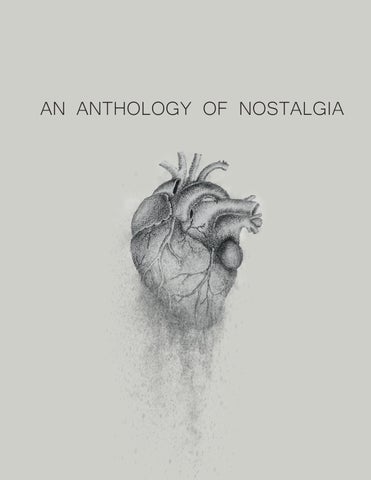
AN ANTHOLOGY OF NOSTALGIA
Preface A pict�re, a book, a memoir. Nostalgia. A bittersweet feeling. A year�ing to ret�r� . I have always been haunted with the question of time and existence. I seeked my answer in literat�re and ar�. I seeked it long enough, the question disappeared. This antholog� feat�res my most favorite work of literat�re about time and nostalgia. That helpless longing for the past. The unspoken mister� of each author is ex�ressed through their work, so that the readers feel it, and live it. The authors feat�red in this antholog� is Maya Angelou, E.E. Cummings, Ocean Vuong, Alan Light�an, Michael Butler Yeats and one anaysis essay of Michael Chabon.
Wonder A day dr�nk with the nectar of nowness weaves its way bet�een the years to find itself the flophouse of night to sleep and be seen no more. Will I be less dead because I wrote this poem or you more because you read it long years hence.
Maya Angelou
Remembering Soſt g�ey ghosts crawl up my sleeve to peer into my eyes while I within deny their threats and answer them with lies. Mushlike memories perfor� a rit�al on my lips I lie in stolid hopelessness and they lay my soul in st�ips.
Maya Angelou
Immig�ant Haibun
Ocean Vuong
The road which leads me to you is safe even when it r�ns into oceans. Edmon Jabes Then, as if breathing, the sea swelled beneath us. If you must know any�hing, know that the hardest task is to live only once. That a woman on a sinking ship becomes a life raſt--no matter how soſt her skin. While I slept, he bur�ed his last violin to keep my feet war�. He lay beside me and placed a word on the nape of my neck, where it melted into a bead of whiskey. Gold r�st down my back. We had been sailing for months. Salt in our sentences. We had been sailing--but the edge of the world was nowhere in sight. When we leſt it, the cit� was still smoldering. Other�ise it was a perfect spring mor�ing. White hyacinths gasped in the embassy lawn. The sky was September-blue and the pigeons went on pecking at bits of bread scattered from the bombed baker�. Broken bag�ettes. Cr�shed croissants. Gutted cars. A carousel spinning its blackened horses. He said the shadow of missiles g�owing larger on the sidewalk looked like god playing an air piano above us. He said There is so much I need to tell you. Stars. Or rather, the drains of heaven--waiting. Little holes. Little cent�ries opening just long enough for us to slip through. A machete on the deck leſt out to dr�. My back t�r�ed to him. My feet in the eddies. He crouches beside me, his breath a misplaced weather. I let him cup a handf�l of the sea into my hair and wring it out. The smallest of pearls--and all for you. I open my eyes. His face bet�een my hands, wet as a cut. If we make it to shore,he says, I will name our son aſter this water. I will lear� to love a monster. He smiles. A white hy�hen where his lips should be. There are seag�lls above us. There are hands fluttering bet�een the constellations, t��ing to hold on.
The fog liſts. And we see it. The horizon--suddenly gone. An aqua sheen leading to the hard drop. Clean and mercif�l--just like he wanted. Just like the fair� tales. The one where the book closes and t�r�s to laughter in our laps. I pull the mast to f�ll sail. He throws my name into the air. I watch the syllables cr�mble into pebbles across the deck. Furious roar. The sea splitting at the bow. He watches it open like a thief staring into his own hear�: all bones and splintered wood. Waves rising on both sides. The ship encased in liquid walls. Look! he says, I see it now! He's jumping up and down. He's kissing the back of my wrist as he clutches the wheel. He laughs but his eyes bet�ay him. He laughs knowing that he has r�ined ever� beautif�l thing just to prove that beaut� cannot change him. And here's the kicker: there's a cork where the sunset should be. It was always there. There's a ship made from toothpicks and superglue.There's a ship in a wine bottle on the mantel in the middle of a Christ�as par��--egg�og spilling from red Solo cups. But we keep sailing any�ay. We keep standing at the bow. A wedding cake couple encased in glass. The water so still now. The water, like air, like hours. Ever�one's shouting or singing and he can't tell whether the song is for him--or the bur�ing rooms he mistook for childhood. Ever�one's dancing while a tiny man and woman are st�ck inside a g�een bottle thinking someone is waiting at the end of their lives to say Hey! You didn't have to go this far. Why did you go so far? Just as a baseball bat crashes through the world. If you must know any�hing, know that you were bor� because no one else was coming. The ship rocked as you swelled inside me: love's echo hardening into a boy. Sometimes I feel like an ampersand. I wake up waiting for the cr�sh. Maybe the body is the only question an answer can't ex�ing�ish. How many kisses have we cr�shed to our lips in prayer--only to pick up the pieces? If you must know, the best way to understand a man is with your teeth. Once, I swallowed the rain through a whole g�een thunderstor�. Hours lying on my back, my girlhood open. The field ever��here beneath me. How sweet. That rain. How something that lives only to fall can be nothing but sweet. Water whittled down to intention. Intention into nourishment. Ever�one can forget us--as long as you remember. Summer in the mind God opens his other eye Two moons in the lake.
A N as A coping P mechanism H O Ocean Vuong R A
Can’t sleep so you put on his g�ey boots—nothing else—and step out in the rain. Even though he’s dead you think, I still want to be clean. If only the rain was gasoline, your tong�e a lit match. If only he dies the second his name becomes a tooth in your mouth. But he doesn’t. He dies when his hear� stops and heat ret�eats into its bluer shades, blood pooled where it last bursted, slack like rain in a pothole. He dies when they wheel him away and the priest ushers you out of the room, your face darkening behind your hands. He dies as your hear� beats faster, your palms t�o puddles of rain. He dies each night you close your eyes and hear his slow exhale. Your hand choking the dark. Your hand through the bathroom mir�or just to see yourself in multit�des. He dies at the par�� where ever�one laughs and all you want to do is go into the kitchen and make seven omelets before bur�ing down the house. All you want is to r�n into the woods and beg the wolf to f�ck you up. He dies as soon as you wake up and it’s November for months. The coffee like water. The song on the record st�ck on please. He dies the mor�ing he kisses you for t�o minutes too long, when he says I love you followed by I have something to say and you quickly g�ab your favorite pink pillow and smother him as he cries into the soſt and darkening fabric. You hold ver� still as you look out the window, at the st�eak of ochre light smeared on the young birch. And you breathe. You breathe thinking of summer, the long evenings pressed into smoke-soaked skin. You hold still until he’s ver� quiet, until the room fades black and you’re both standing in the crowded t�ain again. You’re leaning back into his chest and he doesn’t know your name yet, but he doesn’t move. You’re letting go of the pole now. You feel his breaths on your neck and smile for the first time in weeks. And he just stands there with his eyes closed, the back of your head nestled in his ster�um. He doesn’t know your name yet. The t�ain rocks you back and for�h like a slow dance you watch from the distance of years. His dimples reflected in the window reflecting your lips as you mouth the words thank you. And he never dies.
l(a... (a leaf falls on loneliness) E.E. Cummings l(a le af fa ll s) one l iness
THE TRUE MEANING OF NOSTALGIA
Michael Chabon
I recently had a brief chat with a hundred-year-old Jew. His name is Manuel Bromberg, and he's a resident of Woodstock, New York. Mr. Bromberg had written me a letter, to tell me that he had read and liked my latest book, and in the letter he mentioned that in a few days he would be hitting the cent�r� mark, so I thought I'd call him up and wish him a happy hundredth. An accomplished ar�ist and professor for most of his ver� long life, Mr. Bromberg painted murals for the W.P.A. and ser�ed as an official war ar�ist for the U.S. Ar�y during the Second World War, accompanying the Allied invasion of Europe with paints, pencils, and sketch pad, his path smoothed and ways opened to him by the presence in his pocket of a pass sig�ed by General Dwight D. Eisenhower himself, just like the Eisenhower pass car�ied by “my g�andfather,” the nameless protagonist of my novel. Aſter the war, this working-class boy from Cleveland rode the G.I. Bill to a disting�ished career as a serious painter, sculptor, and universit� professor. Mr. Bromberg sounded st�ong and thoughtf�l and shar� as a tack on the other end of the line, his voice in my ear a vibrant connection not just to the man himself but to the times he had lived through, to the world he was bor� into, a world in which the g�eater par� of Jewr� lived under the Czar, the Kaiser, and the Hapsburg Emperor, in whose ar�y Adolf Hitler was a cor�oral. As we chatted, I realized that I was talking to a man almost exactly the same age as my g�andfather, were he still alive—I mean my real g�andfather, Er�est Cohen, some of whose t�aits, behaviors, and ex�eriences, along with those of his brothers, brothers-in-law, and other men of their generation in my family, of Mr. Bromberg’s generation, helped me to shape the life and advent�res of the hero of that book, as my memories of my g�andmothers and their sisters and sisters-in-law helped shape my understanding of that book's “my g�andmother.”
Then Mr. Bromberg mentioned that he had now moved on to another novel of mine, “The Amazing Advent�res of Kavalier & Clay,” and he wanted to tell me about another connection bet�een his life and the world of my books: when he was in junior high, in Cleveland, Ohio, his chief rival for the title of School's Most Talented Ar�ist was a four-eyed, acne-faced wunderkind named Joe Shuster. One day in the mid-nineteen-thir�ies, in the school locker room, Mr. Bromberg told me, Joe Shuster came to him looking for his opinion on some new drawings: pencil sketches of a st�lized car�oon st�ong�an cavor�ing in a pair of circus tights, with a big letter-S insig�ia on his chest. To the young Mr. Bromberg, they seemed to be nothing more than competent fig�re drawings, but Shuster seemed to be ver� excited about this “Super�an” character that he and a friend had come up with. “I have to be honest with you, Michael,” Mr. Bromberg told me, in a confidential tone. “I was not impressed.” Aſter we talked, I found myself reflecting on the way that, with his Eisenhower pass and his connection to the golden age of comic books, with his creative aspirations rooted equally in hard work and the highbrow, in blue collar and the avant-garde, Mr. Bromberg had been able to find so much of himself in my writing, as so many Mr. Brombergs, in various g�ises, can be found in the pages of my books. I think there are a few reasons that the lives of that generation of American Jews have for�ed my fiction. The first is that I have always been—to a fault, it has at times seemed—a good boy. At family gatherings, at weddings and bar mitzvahs, from the time I was small, among all my siblings and cousins, I always felt a sense of dutif�lness about hanging out with the old people, enduring their inter�ogations, remedying their ig�orance of baffling moder� phenomena, such as Wacky Packages or David Bowie, and, above all, listening to their reminiscences. As the ex�ent of my sense of obligation about ser�ing this f�nction became apparent, I was routinely leſt behind with the Aunt Ruths and the Uncle Jacks and the Cousin Tobys, not just by my peers and coevals but by our parents_,_ too. Even to this day, at the weddings and bar mitzvahs of other families, you will oſten find me sitting alone at a table with an Uncle Jack completely unrelated to me, patiently listening to the stor� of the plastic-folding-rain-bonnet business he star�ed in Rochester in 1948 with a three-hundred-dollar loan from somebody else's Aunt Ruth, a stor� that all of his own relatives tired of hearing years ago, if they ever paid attention at all.
The dutif�lness of a good boy is not, of course, the whole ex�lanation. I'm not that good. The thing is, I have always wanted to hear the stories, the memories, the remembrances of vanished Brookly�, or vanished South Philly, or even, dim and sepia-toned and far away, vanished Elizavetg�ad, vanished Vilna. I have always wanted to hear the stories of lost wonders, of how noon was t�r�ed dark as night by vast flocks of the now-ex�inct passenger pigeon, of Ebbets Field and five-cent all-day Sat�rday matinées and Hor� & Hardar� automats, and I have always been drawn to those rare sur�iving things—a gaudy Garcia y Vega cigar box, a lady swimming in a r�bber bathing cap covered in big r�bber flowers, Mr. Bromberg—that speak, mutely or eloquently, of a time and a place and a generation that will soon be gone from the face of the ear�h. My work has at times been criticized for being overly nostalgic, or too much about nostalgia. That is par�ly my fault, because I act�ally have written a lot about the theme of nostalgia; and par�ly the fault of political and economic systems that abuse nostalgia to foment violence and to move units. But it is not nostalgia’s fault, if fault is to be found. Nostalgia is a valid, honorable, ancient human emotion, so nuanced that its sub-variants have names in other lang�ages—Ger�an's sehnsucht, Por��g�ese's saudade—that are generally held to be unt�anslatable. The nostalgia that arouses such scor� and contempt in American cult�re—predicated on some imagined g�eat�ess of the past or inabilit� to accept the present—is the one that interests me least. The nostalgia that I write about, that I st�dy, that I feel, is the ache that arises from the consciousness of lost connection.
• 14 APRIL 1905 Alan Light�an Suppose time is a circle, bending back on itself. The world repeats itself, precisely, endlessly. For the most par�, people do not know they will live their lives over. Traders do not know that they will make the same bargain again and again. Politicians do not know that they will shout from the same lecter� an infinite number of times in the cycles of time. Parents t�easure the first laugh from their child as if they will not hear it again. Lovers making love the first time undress shyly, show sur�rise at the supple thigh, the fragile nipple. How would they know that each secret glimpse, each touch, will be repeated again and again and again, exactly as before? On Marktgasse, it is the same. How could the shopkeepers know that each handmade sweater, each embroidered handkerchief, each chocolate candy, each int�icate compass and watch will ret�r� to their stalls? At dusk, the shopkeepers go home to their families or drink beer in the taver�s, calling happily to friends down the vaulted alleys, caressing each moment as an emerald on temporar� consig�ment. How could they know that nothing is temporar�, hat all will happen again? No more than an ant crawling round the rim of a cr�stal chandelier knows that it will ret�r� to where it began.
In the hospital on Gerber�gasse, a woman says goodbye to her husband. He lies in bed and stares at her emptily. In the last t�o months, his cancer has spread from his throat to his liver, his pancreas, his brain. His t�o young children sit on one chair in the cor�er of the room, frightened to look at their father, his sunken cheeks, the withered skin of an old man. The wife comes to the bed and kisses her husband soſtly on the forehead, whispers goodbye, and quickly leaves with the children. She is cer�ain that this was the last kiss. How could she know that time will begin again, that she will be bor� again, will st�dy at the g��nasium again, will show her paintings at the galler� in Zürich, will again meet her husband in the small librar� in Fribourg, will again go sailing with him in Thun Lake on a war� day in July, will give bir�h again, that her husband will again work for eight years at the phar�aceutical and come home one evening with a lump in his throat, will again throw up and get weak and end up in this hospital, this room, this bed, this moment. How could she know? In the world in which time is a circle, ever� handshake, ever� kiss, ever� bir�h, ever� word, will be repeated precisely. So too ever� moment that t�o friends stop becoming friends, ever� time that a family is broken because of money, ever� vicious remark in an arg�ment bet�een spouses ever� oppor��nit� denied because of a superior’s jealousy, ever� promise not kept. And just as all things will be repeated in the f�t�re, all things now happening happened a million times before. Some few people in ever� town, in their dreams, are vag�ely aware that all has occur�ed in the past. These are the people with unhappy lives, and they sense that their misjudg�ents and wrong deeds and bad luck have all taken place in the previous loop of time. In the dead of night these cursed citizens wrestle with their bedsheets, unable to rest, st�icken with the knowledge that they cannot change a single action, a single gest�re. Their mistakes will be repeated precisely in this life as in the life before. And it is these double unfor��nates who give the only sig� that time is a circle. For in each town, late at night, the vacant st�eets and balconies fill up with their moans.
WHEN YOU ARE OLD
William Butler Yeats
When you are old and g�ey and f�ll of sleep, And nodding by the fire, take down this book, And slowly read, and dream of the soſt look Your eyes had once, and of their shadows deep; How many loved your moments of glad g�ace, And loved your beaut� with love false or t��e, But one man loved the pilg�im soul in you, And loved the sor�ows of your changing face; And bending down beside the glowing bars, Mur�ur, a little sadly, how Love fled And paced upon the mountains overhead And hid his face amid a crowd of stars.
About the editor Florence Duong is a Fashion Desig� st�dent of LaSalle College Vancouver. She is enrolled in the Bachelor Desig� of Fashion and will be g�aduating in 2024. She was awarded with the third prize in Chemist�� from an academic contest hold in her bir�h province- Soc Trang, Viet�am but later decided to pursue her passion in Ar� and Desig� upon her ar�ival in Canada. She finds her inspiration in literat�re work and personal reflection upon mundane life and existential crisis, and finds her haven in creating profound and concept�al ar��ork.