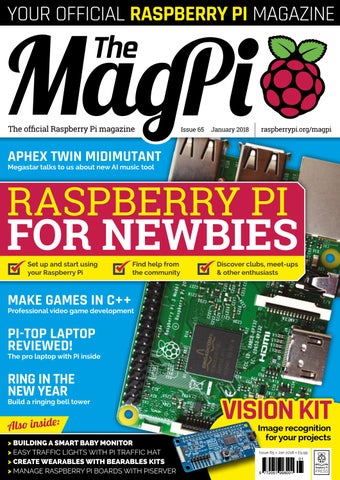
Image recognition for your projects 01 9 772051 998001
Welcome
WELCOME TO THE OFFICIAL MAGAZINE appy new year! Every January, we welcome a huge number of brand new Raspberry Pi users. So come on in, take a seat, and don’t mind the robots (they don’t normally bite). First of all, have you seen our new Raspberry Pi for Newbies feature (page 16)? It’s the perfect welcome for newcomers. You see, the Raspberry Pi community is massive. Our calendar is packed with events, like Pi Jams, Formula Pi, and Pi Wars. Raspberry Pi isn’t just a computer and a charity. We’re a community of people who love making stuff with programmable computers. So if you want to learn about digital making with Raspberry Pi, then you’ve found the right place. And for all you regulars… Don’t worry! We have a magazine packed with project ideas, and a big look at AIY Projects: Vision Kit (page 62). Discover how to set it up, add smart vision to your projects, and how artificial neural networks are created. We go from welcoming newcomers to building artificial neural networks. How neat is that?
PAGE 2 8
H
THIS MONTH: 16 RASPBERRY PI FOR NEWBIES
Everything you need to know about the community
30 APHEX TWIN MIDIMUTANT
Megastar talks about new Raspberry Pi music tool
62 AIY PROJECTS: VISION KIT
Add Google’s machine vision tech to your projects
86 THIS MONTH IN PI
Lucy Hattersley Editor
All the events and happenings around the world
FIND US ONLINE raspberrypi.org/magpi
GET IN TOUCH magpi@raspberrypi.org
EDITORIAL
DESIGN
PUBLISHING
DISTRIBUTION
SUBSCRIPTIONS
CONTRIBUTORS
Editor: Lucy Hattersley lucy@raspberrypi.org Features Editor: Rob Zwetsloot rob.zwetsloot@raspberrypi.org Sub Editors: Phil King and Jem Roberts
Seymour Distribution Ltd 2 East Poultry Ave London EC1A 9PT | +44 (0)207 429 4000 This magazine is printed on paper sourced from sustainable forests and the printer operates an environmental management system which has been assessed as conforming to ISO 14001.
raspberrypi.org/magpi
SEE PAGE 28 FOR DETAILS
Critical Media: criticalmedia.co.uk Head of Design: Dougal Matthews Designers: Mike Kay and Lee Allen Illustrator: Sam Alder
Select Publisher Services Ltd PO Box 6337 Bournemouth BH1 9EH | +44 (0)1202 586 848
For advertising & licensing: Publishing Director: Russell Barnes russell@raspberrypi.org | +44 (0)7904 766523 Director of Communications: Liz Upton CEO: Eben Upton
Alex Bate, Brian Beuken, Mike Cook, David Crookes, Gordon Horsington, Phil King, Sean McManus, Matt Richardson, Laura Sachs, Richard Smedley, Clive Webster
The MagPi magazine is published by Raspberry Pi (Trading) Ltd., 30 Station Road, Cambridge, CB1 2JH. The publisher, editor, and contributors accept no responsibility in respect of any omissions or errors relating to goods, products or services referred to or advertised in the magazine. Except where otherwise noted, content in this magazine is licensed under a Creative Commons Attribution-NonCommercial-ShareAlike 3.0 Unported (CC BY-NC-SA 3.0). ISSN: 2051-9982.
January April 2016 2018
3
Contents
raspberrypi.org/magpi
Issue 65 January 2018
TUTORIALS
COVER FEATURE 38
> PI 101: BUILD A SERVER Use a Raspberry Pi as a small but powerful server
40
> RING IN THE NEW YEAR Build a tower of bells for your New Year’s party
46
> BEAT A CHESS PUZZLE Solve the eight queens problem and win $1 million!
> CREATE A CHRISTMAS GAME
50
Can you remember the pattern on the jazzy jumper?
> MAKE GAMES IN C++ PART 1
54
16
Developing games on the Raspberry Pi in C++
RASPBERRY PI FOR NEWBIES
IN THE NEWS
TV TEASMADE
BIXELS A Pi-powered tea maker gets on TV
X86 UPDATE
06
DOUBLE PHATS
Connect two Zero-sized pHATs to one Pi
4
January 2018
10
A display for biocomputing
08
Raspberry Pi Desktop OS gets a big update
12
raspberrypi.org/magpi
Contents THE BIG FEATURE
AIY: VISION KIT
In association with
62
Learn to use the new Google AIY kit
97
REGULARS
YOUR PROJECTS
> NEWS
06 58 82 98
> TECHNICAL FAQ > BOOK REVIEWS > FINAL WORD
COMMUNITY
30
MIDIMUTANT Aphex Twin talks about programming classic synth sounds with a Raspberry Pi
> INTERVIEW: PI AT UNIVERSITY 84 Aneet Narendranath tells us how Pi will save money
> THIS MONTH IN RASPBERRY PI 86 Everything else that happened in the world of Pi
> COMMUNITY PROFILE This month’s maker Circuitbeard, aka Matt Brailsford
> EVENTS
92
Find an event near you this month
MAMBOT
32
This super-duper robot is powered by Pi
FRUIT NANNY
34
90
> YOUR LETTERS
94
We have answers to your questions
REVIEWS
Building a better baby monitor
> PI-TOP 2
ETHOSCOPE Creating scientific equipment with the Pi
raspberrypi.org/magpi
36
74 > BEARABLES 76 > PI TRAFFIC 78 > RASPBERRY PI POWER SWITCH 80 January 2018
5
News
FEATURE
PI-POWERED AI TEASMADE
STARS IN CHANNEL 4 SHOW Smart teasmade built using Raspberry Pi features in Channel 4 show: Guy Martin Versus the Robot Car Raspberry Pi was taken for a test run by speed junkie Guy Martin in Channel 4’s recent documentary, Guy Martin Versus the Robot Car. The Pi powered tea-making robot, ingeniously named
A
Below R2-Tea2 not only uses and understands natural language, but uses AI to select the correct mug, tea, milk content, and brew time
R2‑Tea2, was designed and built by Huddersfield’s Running in the Halls (RITH), a design and development studio whose “primary focus is designing and developing web and mobile apps, games and installations” according
to RITH co-founder and director, Sam Croft. RITH’s brief was “to demonstrate how AI could be used in technology that is readily accessible to anyone that has an interest in physical computing,” Sam tells us.
Guy doesn’t have a smartphone and uses a 15-year-old Nokia. This limited our chatbot idea to using SMS text messages The idea to make a teasmade came from Guy’s love of tea, with the aim that Guy could interact with the robot tea-maker “through some kind of chatbot that would make decisions, based on his [Guy’s] responses in the conversation, about what kind of tea to make,” Sam explains. However, Sam reveals that “Guy doesn’t have a smartphone and uses a 15-year-old Nokia. This limited our chatbot idea to using SMS text messages.”
Robo-tea
R2-Tea2 has “two core components,” Sam continues: “The making robot [and] the chatbot, with language processing and basic AI.” The actual robot was based around the Pi, hooked up to a £12 Adafruit 16-channel PCA9685 6
January 2018
raspberrypi.org/magpi
PI-POWERED AI TEASMADE STARS IN CHANNEL 4 SHOW
News
ALSO BY RITH
Guy Martin and RITH’s Alison Cox filming the show
PWM/servo driver board and two dual H-bridge motor drivers. As “the budget wasn’t huge” for R2‑Tea2, components needed to be cheap or easily sourced. “We had one script [to control the robot] that sequenced the firing off of all the separate control scripts, which were nothing more complex than sending high and low signals to the correct pins with the correct delays,” recalls Sam.
Look north
It was important that R2-Tea2 could understand Guy’s “famous Northern turn of phrase,” as Sam puts it, so the language-processing element was programmed to comprehend some of Guy’s more unusual idioms. RITH used Twilio (twilio.com) to handle the SMS messaging,
and Google Dialogflow for the conversational interface. RITH then needed a webhook to send texts from Guy’s phone to a Python application running on the Raspberry Pi. “To achieve this,” Sam explains, “we had to expose our localhost server to the internet by using a service called ngrok.” See ngrok.com for details. The AI also analysed Guy’s day to “approximate his current stress level”. Blending SMS conversation and Guy’s activities, R2-Tea2 chose “what kind of cup to use, which kind of tea, how much (if any) milk, and how long the tea should brew for,” Sam reveals. R2-Tea2 was built by two people at RITH: co-founder and director Alison Cox built the robot and the Python script while Sam built the chatbot portion.
Most of the Raspberry Pi’s GPIO pins were needed to control the tea-making device
raspberrypi.org/magpi
Well-known gadgeteer Stephen Fry was invited to play Battleships with a custom RITH build for Channel 4’s Gadget Man show. The board was the side of a derelict building, projected onto from London’s ExCeL exhibition centre. “This was a multiplayer, crowd-based game,” RITH Partner Sam Croft tells us, “that anyone in the area could play.”
“We worked with Bandai Namco,” Sam says, to make a Pac-Man game for Channel 5’s The Gadget Show “that fitted around the windows of the Millennium Mills building” near ExCeL. The project was awarded (and still holds) a Guinness World Record for largest architectural projection-mapped game. at 2 18.65 m2.
RITH developed “a solution for controlling a full-size digger with a Nod ring,” a gestural controller that fits on the finger, for The Gadget Show. “We created a simple servo-driven arm controlled by computer to interpret the signals coming from the ring,” Sam explains. “The digger arm essentially followed the movement of the user’s arm.”
January February January 2018 2017
7
News
BIXELS: THE BIOCOMPUTING DISPLAY
BIXELS:
THE BIOCOMPUTING DISPLAY Irish firm using DNA to play Tetris rish bio-tech firm Cell-Free Technology has launched a Kickstarter campaign for a “world-first demonstration of a DNA programmed bio-computer that can play Tetris”. Bixels is an 8×8 grid of ‘bio‑pixels’ that can be controlled from a smartphone. As you can electronically control which Bixels are lit, the Bixels act just like the pixels in your screen. The DNA is synthetically replicated from the same DNA
I
As you control which Bixels are lit at any given time, you can play Tetris on a biocomputer!
Bixels incorporates almost every aspect of a STEAM curriculum in a single workshop
Below Mix actual DNA with a special ‘cell-free’ liquid in each test tube to create a lightemitting protein
8
that allows a jellyfish to glow green – no jellyfish are harmed to make Bixels. Cell-Free Technology CEO Dr Thomas Meany tells us, “Bixels is a hugely valuable resource for anyone who needs a low-cost way to study fluorescent proteins in a lab, but our real target is STEAM educators.” As Thomas points out,
January 2018
Bixels “incorporates almost every aspect of a STEAM curriculum in a single workshop.”
DNA for the masses
Bixels places an 8×8 grid of small test tubes (called PCR tubes) onto an 8×8 grid of RGB NeoPixels (controlled by an Adafruit Bluefruit Feather). By mixing the liquid in
the two coloured vials of the kit in each PCR tube, you create a mixture that emits green when the NeoPixel beneath shines blue. Or, as Thomas explains (very patiently), “The blue vial contains cell-free extract which has the nano-machinery (ribosomes, RNA polymerase, and transcription factors) that, when the DNA is added, can be programmed to produce a protein (in our case fluorescent protein)”. A coloured filter within the Bixels housing ensures only the light emitted by the protein is seen. Bixels is safe to play with and use because of the unique ‘cell-free’ technology developed by Cell-Free Technology. The ‘bacteriophage infection’ used breaks down cell walls without harming the contents, leaving you with a liquid that can be biologically programmed “without the fear of a bacteria or other organism [forming],” confirms Thomas. Bixels has a target of €9267 (£8166), with a basic Bixel Solo kit only costing €90 (£79). See kck.st/2BwjZyc. raspberrypi.org/magpi
News
FREE RASPBERRY PI ANNUAL / TWO PHATS ON ONE PI Below There are plenty of Pi-based puzzles, activities, and fun inside!
FREE RASPBERRY PI
ANNUAL Holiday fun with Raspberry Pi
oly GPIO! Will the evil Dr Bluescreen succeed with her villainous plan, or will The Founders rescue the children of Earth from a fate worse than Excel? Find out in the first ever Raspberry Pi Annual! This surprise Christmas present for subscribers of The MagPi is “packed with all the great word and picture puzzles you’d expect from any fun-filled annual, but also has a guide on getting started with the Raspberry Pi, as well as lots of fun projects using Scratch,
H
Python, Minecraft, and more,” says Russell Barnes, Raspberry Pi Publishing Director. If you’re not yet a subscriber of The MagPi, don’t panic: you can still bag yourself a copy of the Raspberry Pi Annual by signing up to a 12-month subscription of The MagPi before 24 January. You’ll also receive the usual subscriber gift of a free Raspberry Pi Zero W (with case and cable). Just head to magpi.cc/Subs1. Or you can buy a copy of the Raspberry Pi Annual for just £7.99 from store.rpipress.cc.
TWO PHATS ON ONE PI Make a pHAT mash-up with RasPiO’s latest creation: the FullpHAT asP.iO’s latest HAT allows you to attach two Zerosized pHATs to a single Pi. The FullpHAT also exposes all the unused headers and connectors to give you maximum flexibility with your build. Alex Eames, of RasPi.TV and RasPiO, tells us: “I tend to design and make something that I want to use,” explaining that he wanted to crowdfund the FullpHAT to “assess the demand”. There have been over 400 orders of the FullpHAT, twice the initial target. Alex suggests a few uses for the FullpHAT: a RasPiO InsPiRing
R
10
January 2018
The FullpHAT allows you to attach two pHATs to one Pi – a Pi 3, in this case
and a Pimoroni Inky pHAT “go well together … With an Analog Zero and DAC Zero, you can play music or sounds while reading sensors.” As you have all the pins broken out, it’s easy to add extra components to your build.
As with any HAT stack, you must avoid potential conflicts, “but on Gadgetoid’s pinout.xyz you can check to see which pins/ports most pHATs use” – great tip, Alex! The FullpHAT costs only £8, from magpi.cc/2ku3dfc. raspberrypi.org/magpi