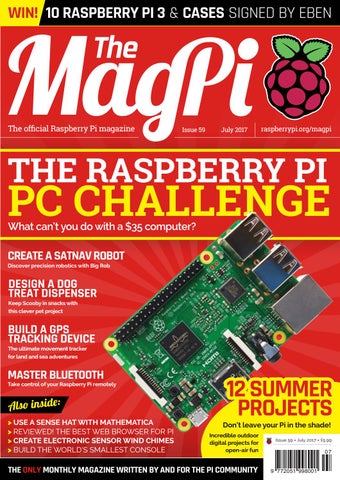
WIN! 10 RASPBERRY PI 3 & CASES SIGNED BY EBEN
The official Raspberry Pi magazine
Issue 59
July 2017
raspberrypi.org/magpi
THE RASPBERRY PI
PC CHALLENGE What can’t you do with a $35 computer?
CREATE A SATNAV ROBOT Discover precision robotics with Big Rob
DESIGN A DOG TREAT DISPENSER Keep Scooby in snacks with this clever pet project
BUILD A GPS TRACKING DEVICE The ultimate movement tracker for land and sea adventures
MASTER BLUETOOTH
Take control of your Raspberry Pi remotely
Also inside: > USE A SENSE HAT WITH MATHEMATICA > REVIEWED! THE BEST WEB BROWSER FOR PI > CREATE ELECTRONIC SENSOR WIND CHIMES > BUILD THE WORLD’S SMALLEST CONSOLE
12 SUMMER PROJECTS
Don’t leave your Pi in the shade! Incredible outdoor digital projects for open-air fun
THE ONLY MONTHLY MAGAZINE WRITTEN BY AND FOR THE PI COMMUNITY
Issue 59 • July 2017 • £5.99
07 9 772051 998001
Welcome
WELCOME TO THE OFFICIAL MAGAZINE any people stare all day at their phone screens, and never think to ask what’s going on behind the glass. We want computers we can hack, make, and break (and for it not to matter), and that’s exactly why we love the Raspberry Pi. The Raspberry Pi is about GPIO pins and wires, and the Linux OS. It’s about making something, and messing up everything, and it not mattering because there’s always another chance. We love it. But what would it be like to use all the time? Would using a Raspberry Pi every day of the week be digital heaven, or computing hell? That’s the task we set our intrepid Features Editor Rob Zwetsloot. Spend a week working with a Raspberry Pi – nothing else allowed. And let us know what it’s like: warts and all. You can read all about it on page 16. The Raspberry Pi is a glorious piece of kit, and it’s a shame to keep it in the shade. It is perfectly portable and ideal for aerial balloons, outdoor cameras, weather stations, and all manner of fresh‑air projects. We have twelve amazing summer projects for you, starting on page 68. So whether you’re installing a Raspberry Pi permanently in your home, or taking it outside to play, what’s important is that you’re using the world’s most interesting computer. And let us know how you get on.
PAGE 3 0
M
SEE PAGE 30 FOR DETAILS
THIS MONTH: 16 THE RASPBERRY PI PC CHALLENGE
Can you really use a Raspberry Pi as a desktop replacement?
42 GET STARTED WITH GIT
Use Git to clone, copy, and contribute to code
50 BLUE DOT BLUETOOTH
Adding Bluetooth control to your projects has never been easier
68 SUMMER PROJECTS
Lucy Hattersley Editor – The MagPi
Twelve incredible outdoor digital projects to make
FIND US ONLINE raspberrypi.org/magpi EDITORIAL
DESIGN
PUBLISHING
DISTRIBUTION
SUBSCRIPTIONS
CONTRIBUTORS
Editor: Lucy Hattersley lucy@raspberrypi.org Features Editor: Rob Zwetsloot Sub Editors: Rachel Churcher and Phil King
Seymour Distribution Ltd 2 East Poultry Ave London EC1A 9PT | +44 (0)207 429 4000 This magazine is printed on paper sourced from sustainable forests and the printer operates an environmental management system which has been assessed as conforming to ISO 14001.
raspberrypi.org/magpi
GET IN TOUCH magpi@raspberrypi.org
Critical Media: criticalmedia.co.uk Head of Design: Dougal Matthews Designers: Lee Allen, Daiva Bumelyte, and Mike Kay Illustrator: Sam Alder
Select Publisher Services Ltd PO Box 6337 Bournemouth BH1 9EH | +44 (0)1202 586 848
For advertising & licensing: Head of Publishing: Russell Barnes russell@raspberrypi.org | +44 (0)7904 766523 Publisher: Liz Upton CEO: Eben Upton
Bill Ballard, Alex Bate, Mike Cook, Brett Haines, Phil King, Sean McManus, Martin O’Hanlon, Matt Richardson, Richard Smedley, Clive Webster
The MagPi magazine is published by Raspberry Pi (Trading) Ltd., 30 Station Road, Cambridge, CB1 2JH. The publisher, editor, and contributors accept no responsibility in respect of any omissions or errors relating to goods, products or services referred to or advertised in the magazine. Except where otherwise noted, content in this magazine is licensed under a Creative Commons Attribution-NonCommercial-ShareAlike 3.0 Unported (CC BY-NC-SA 3.0). ISSN: 2051-9982.
April July 2016 2017
3
Contents
raspberrypi.org/magpi
Issue 59 July 2017
TUTORIALS
COVER FEATURE
> PI 101: SENSE HAT EMULATION 40 How to create and test code for the Sense HAT
> PI 101: GET STARTED WITH GIT 42 Manage your code repositories the easy way
48
> CREATE A GPS TRACKER Track your travels with this nautical project
50
> ADD BLUETOOTH CONTROL Use Blue Dot to control Bluetooth devices
> USE SENSE HAT WITH WOLFRAM 54
16
Analyse and display your data with Mathematica
56
> BUILD WIND CHIMES This month’s Pi Bakery makes wind-powered music
> ADD SERVOS TO AIY PROJECTS 60 Use the AIY Projects Voice HAT to control servos
> USE MOTORS WITH VOICE HAT 62 Servos not enough for you? Let’s add some motors!
IN THE NEWS
THE PI PC CHALLENGE BEST OF SHOW
CODERDOJO AND
GOPIGO 3
RASPBERRY PI
Two Foundations join forces to bring coding to young people
4
July 2017
6
Raspberry Pi clusters support medical research
13
Our friends at Dexter Industries launch a new robot
10
raspberrypi.org/magpi
Contents THE BIG FEATURE
SUMMER tside u o s i th Let’s take HOT HOLIDAY PROJECTS Go outside and get making this summer!
68 97
YOUR PROJECTS REGULARS > NEWS
06 64 82 98
> TECHNICAL FAQ > BOOK REVIEWS > FINAL WORD
32
BIG ROB ROBOT Not our Features Editor, but a GPS-controlled robot!
TELE2 VR
34
Experience the life of a stranger with this incredible Pi project
DOG TREAT DISPENSER
The smallest handheld games system we’ve ever seen
raspberrypi.org/magpi
> THIS MONTH IN PI
84
> COMMUNITY SPOTLIGHT
88
> EVENTS REPORT
90
> UPCOMING EVENTS
92
> YOUR LETTERS
94
Everything else that happened last month
Meet awesome YouTuber Estefannie
Some of the cool events that took place last month
Attend one of these upcoming Jams!
36
The ultimate, Pi-powered treat dispenser for a very good boy
PI0CKET TINY
COMMUNITY
We endeavour to answer your questions
REVIEWS 38
> OCTOCAM > BROWSER GROUP TEST > WD PIDRIVE USB FLASH July 2017
76 78 80 5
News
FEATURE
RASPBERRY PI JOINS FORCES WITH
CODERDOJO Teaming up to deliver more for young makers and coders he Raspberry Pi Foundation and the CoderDojo Foundation have merged, with Raspberry Pi Foundation CEO Philip Colligan joining the CoderDojo board. The two Foundations will share backoffice resources and expertise to deliver more quickly on their shared goals. CoderDojo fans won’t see any change at the Dojos, however.
T
Below Philip Colligan (left), CEO of the Raspberry Pi Foundation, and Giustina Mizzoni (right), Executive Director of the CoderDojo Foundation
6
July 2017
CoderDojo spokesperson Rosa Langhammer tells us that “CoderDojo is and will always remain 100% content, software and hardware neutral! “The Raspberry Pi Foundation works to put the power of digital making into the hands of people all over the world,” continues Rosa, “and the CoderDojo mission is to give every young person an opportunity to learn and create
with technology. By combining our efforts we get closer to these shared goals.” The merger will allow CoderDojo to reach even more young, enthusiastic makers and coders. We’ll hear more about these plans in the summer, but Rosa did reveal that part of the strategy review includes “mapping the path to 5,000 Dojos [worldwide] by 2020.”
raspberrypi.org/magpi
RASPBERRY PI JOINS FORCES WITH CODERDOJO
News
WHAT IS CODERDOJO?
Any hardware and software is fine, as long as you’re coding
But, “the first priority,” Philip tells us, “is to make it as easy as possible to set up and run a CoderDojo. That means investing in the tools and resources that
to support the growth of the CoderDojo movement around the world.” “The CoderDojo Foundation team is really excited,” says
Aimed at young people between the ages of 7 and 17, CoderDojos are free, community-led programming clubs for anyone curious about coding. Whether that’s building websites, apps, or just figuring out how technology works, Dojos have always offered freedom from hardware and software restrictions – any tool is fine, as long as you’re coding. ”The CoderDojo mission is to give every young person an opportunity to learn and create with technology,” as spokesperson Rosa Langhammer puts it. Key to the movement are the volunteer ‘Champions’ who set up the Dojos. If you or your organisation would like to set up a Dojo, the CoderDojo Foundation will help you get started: visit magpi.cc/2r4EnVT for details. You don’t need technical skills to start a verified Dojo, just the ability to bring people together, and a passion for the power of code to build a positive future. To search for a Dojo near you, check the interactive map at zen.coderdojo.com.
We decided we should join forces to accelerate the growth of the CoderDojo movement CoderDojo champions and mentors need.” Enabling more people and businesses to set up Dojos won’t be easy. That’s why the Raspberry Pi Foundation will be “bringing all of the capabilities and expertise of the Raspberry Pi Foundation
Rosa, “and is looking forward to working with a wider team of people with similar goals, cooperating on new projects and pooling all our experiences and talents to give more people the opportunity to learn and be creative with technology.”
A Dojo in action, with experts and mentors helping kids make and code
raspberrypi.org/magpi
Perfect timing
Why now? “In a word: demand,” Philip explains. “We know that young people all over the world are crying out for places they can go to learn how to get creative with digital technologies. Education systems aren’t responding quickly enough to that demand, so we decided that we should join forces to accelerate the growth of the CoderDojo movement.” Both Foundations were established at around the same time, and “we’ve been working together in lots of ways from the beginning,” says Philip. “Lots of the people who are CoderDojo champions and volunteers are also members of the Raspberry Pi community.” He also confirms that “we have no plans to change the approach to Code Club or CoderDojo; our priority is encouraging the growth of both initiatives all over the world.” July 2017
7
News
A PI IN EVERY DEVICE?
A PI IN EVERY DEVICE? Eben Upton speaks at the first ever Global Digital Signage Conference aspberry Pi co-founder Eben Upton was a key speaker at the recent Global Digital Signage Conference. One attendee had flown in from Brazil just to hear him speak.
R
With about 14 million Pis shipped in the last five years, he sees more scope for industrial IoT applications than consumer IoT products. “There’s a limit to how many things you can interact with if you have
We took a network that was designed to be resilient to nuclear war and we made it vulnerable to toasters Below Eben Upton’s talk at the inaugural Global Digital Signage Conference
Host, and DailyDOOH editor (dailydooh.com) Adrian Cotterill, asked about Pi sales. “We’re selling about half a million units a month, of the $35 flagship product,” replied Eben.
a human in the loop.” Eben listed a Nest-like thermostat, lighting controller, and security system: “My house is probably never going to have more than three or four consumer IoT devices.”
However, machine-to-machine interactions offer – according to Eben – almost limitless possibilities to use a Raspberry Pi. For example, many of the screens in airports now are powered by Pi Compute Modules.
IoT and security
“There’s a general IoT security problem,” stated Eben. “We took a network that was designed to be resilient to nuclear war and we made it vulnerable to toasters.” However, security tends to get “squeezed”, because “you don’t need it until you need it.” Further, “potentially the guy who doesn’t invest in security beats the guy who did invest in security to market.” Eben sees IoT makers eventually opting for a company such as Amazon to provide an easy and robust security service. However, “I think it’s going to be a while before this stuff becomes really trustworthy.”
UHD Pi?
Asked when we might see a Raspberry Pi capable of Ultra High Definition (4K) output, Eben said it was “forward in our minds” but dismissed the use of a separate graphics chip. “The only rationale for a second chip would be thermal… you bake in a lot of cost if you do that.” Eben estimated that “it’s probably four or five years” before we’d see a UHD Pi. 8
July 2017
raspberrypi.org/magpi
News
raspberrypi.org/magpi
July 2017
9
News
MACROBERT AWARD / GOPIGO 3
RASPBERRY PI IS FINALIST FOR PRESTIGIOUS MACROBERT AWARD “Redefines how people use and engage with computers”
Below Last year’s MacRobert Award winner was Blatchford’s Linx, the ‘world’s most intelligent prosthetic limb’
he Raspberry Pi is a finalist for this year’s MacRobert Award, “the UK’s longest running and most prestigious national prize for engineering and innovation.”
T
“The Raspberry Pi team has achieved something that mainstream multinational computer companies and leading processing chip designers not only failed to do, but failed even to spot a need for,” said MacRobert Award judge Dr Frances Saunders CB FREng. The Raspberry Pi has helped reverse the downward trend of interest in computer science and programming. This trend “is thought to be linked to the demise of programmable home computers like the BBC Micro and [ZX] Spectrum,” according to the MacRobert nomination. Speaking at a separate event, Raspberry Pi cocreator Eben Upton corroborated this. “We used to get about 600 people applying to study computer science at Cambridge,” he expanded. “We got down to about 200 – our worst year, in 2008. We had 700 [applicants] last year [2016].” The final winner of the MacRobert Award will be announced at the Royal Academy of Engineering’s Awards Dinner on 29 June.
GOPIGO 3 RELEASED Updated robot car kit ‘more versatile than ever’
10
July 2017
exter Industries has launched the third version of its popular GoPiGo robot car kit, along with “a whole new operating system, DexterOS, designed specifically for learning how to program robots intuitively.” The new kit has an updated sensor board, with ports including “two I2C and two AD (analogue or digital), one serial, two servo. Everything is a lot more robust so you can daisy-chain and add on easily.” Dexter Industries’ Taryn Sullivan says that the GoPiGo3 is “totally redesigned and we’ve added a lot of features that will be great for educators.” The DexterOS software allows you or your students to build code in Bloxter (based on Google’s Blockly) or Python, and is compatible with the GoPiGo2. The GoPiGo3 should be on sale in the UK by the time you read this, from suppliers such as ModMyPi (www.modmypi.com). The price has yet to be confirmed, but we expect it to be around £95-100 (Pi-less).
D
raspberrypi.org/magpi