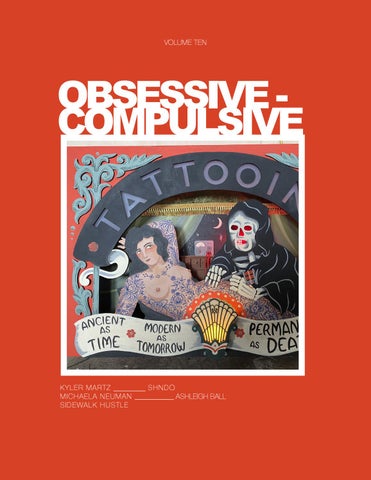
VOLUME TEN
OBSESSIVE COMPULSIVE
KYLER MARTZ _________ SHNDO MICHAELA NEUMAN ___________ ASHLEIGH BALL SIDEWALK HUSTLE
OBSESSIVE COMPULSIVE VOLUME TEN - QUARTER TWO
FOR PASSIONATE CREATORS WHO WORK TO FLESH & BONE IN ORDER TO CREATE SOMETHING THAT SHOWS THEIR HEART.
OBSESSIVE COMPULSIVE C R E AT I V E T E A M
EDITOR-IN-CHIEF & C R E AT I V E D I R E C T O R Brandynn L Pope DESIGN
Brandynn L Pope WRITERS
J a m e s L i a m Wa rd PHOTOGRAPHERS Brandynn L Pope
Cassie Deadmond Sean O’Day
W W W. O B S E S S I V E C O M P U L S I V E M A G . C O M E M A I L fleshbonemagazine@gmail.com I N S TA @obsessivecompulsivemag
INDEX 06 10 16 20 24 28 32 42 48 54 60
GILLIGAN MOSS MUSICIANS GOOD TERMS MUSICIANS K AT J A SINGER-SONGWRITER / ACTOR BETSY SINGER-SONGWRITER SHNDO PRODUCER BRANDYN BURNETTE MUSICIAN / PRODUCER MICHAELA NEUMAN PHOTOGRAPHER ASHLEIGH BALL MUSICIAN S I D E WA L K H U S T L E C O N T E N T C R E AT O R S K Y L E R M A RT Z TAT T O O A RT I S T / I L L U S T R AT O R ALBUM REVIEWS W RT N B Y J A M E S L I A M WA R D
GILLIGAN MOSS Let’s dive right in and get started in regards to your Self-Titled release. From my understanding it took about 3 years to bring all the songs off of this record to life. At what point did you both decide that you finally had a complete product? When the label said we had to stop haha. It would’ve probably taken us a decade if we didn’t have some kind of deadline forcing us to stop. We’re eternal tinkerers. What was the production side of it like for you especially being in several locations over the duration of writing? Was this a purposeful choice to the writing process or a circumstances to your own personal situations? We do our best when we’re out of our normal daily life routine in Brooklyn. With everything we do, whether it’s new writing, or preparing for live shows, we try to do little retreats/get out of our daily environment. Do you have a team of people that you work with to create the music or is the majority solely from you? What’s your typical approach to writing a track and finishing it? We have a small, trusty crew of musicians who we go to when we need some outside magic. But for the most part, every song starts with just us developing an initial idea, then once we have a sense for what we want to do we’ll hit up friends. Sometimes we have a pretty clear vision of what we need from someone, other times we know the track is missing some extra magic, and we’ll bring in a friend to try writing some extra parts.
______ 06
______ 08
13 songs is impressive, especially as a debut record. How did you go about picking the different people that are featured on some of the tracks? We really only worked with people who we’re friends with/have a history with. The collaborators range from people like Betsy, who we’ve made other songs with to our best friends to our partners to our dogs - we tried to make it pretty personal with who we worked with. What were some of the themes that you explored on your album both musically as well as any lyricism that was laced into it all? How had you hoped that people would feel after listening to the record in full? The main themes aren’t so much lyrical as they are impressionistic. When we sat down to map out what we wanted to do with the album, we both had this vision for warm, glowing timbres - mixing a lot of the things we like from the 70s with the things we like from modern electronic music. That was the goal and the theme. As we started wrapping things up and releasing it, it felt like a perfect spring themed record for the world opening back up. When it comes to visuals, you chose this really modern design layout with finger painted-like wording over top. What was it about using this kind of visual that you felt was a good visual umbrella to the record? Is there any significance to the bike and the image that is used? The record is supposed to be transportive - it should take you to an imagined time and place. We felt the bike image was a great encapsulation of that mood. Regarding the painting + modern design, we’re always trying to meld eras and styles - that was a big goal musically, and I think the art that Nejc Prah put together nails that same blend. As for other visuals like your music video, ‘Slow Down,’ what brought you to decide on claymation? Do you like your videos to be a direct representation of the song that it’s paired with most of the time? I don’t know! It felt like a fun, carefree medium that fit the Slow Down vibe perfectly. We had seen some of the director, Francesca Morea’s work, and fell in love with her style. Now with the record released, what else should people be awaiting from you? More music + hopefully shows pretty soon!!
GOOD TERMS All of you have been a part of the music scene, working behind the scenes within the industry. What were some of the subtle ways that you’ve worked behind the scene before forming Good Terms? GEO: When I moved to LA, oh boy I just wanted to be the best engineer ever! But, I settled with producing jingles and through that I fell in love with producing. When I’m not yelling poorly or playing bass with Good Terms I’m producing artists that I work with, mixing, mastering, or trying to get my tape machine to work. ZACH: I used to work full time in music marketing, but now I mostly split my time between producing records, performing as a guitarist for other artists, and working in the crew world of touring production which I’m very stoked to get back to once touring finally resumes. BRIAN: Hire me to play your wedding! I perform weddings and other special events - it’s a great way to keep my chops in shape. I also do transcription and other various duties in the jazz guitar world, which I’m very grateful to keep a hand in. IVAN: I’ve worked behind the scenes in music touring for the last five years as a backline technician, stage manager, and in other production roles.
PHOTO BY: CASEY CHEN
From my understanding, the title ‘Turning Point’ came from a lot of your own different decisions within the last little while that acted as huge turning points in your life. What were some of those moments? ZACH: Yes that’s correct! Most of this album lyrically was written over the course of a really challenging 1-2 year period that brought about a lot of difficult but very necessary changes in each of our lives. The specific moments were different for each of us, but always something we could relate to each other with. Between the 4 of us, there were multiple breakups, life uprooting cross country moves, existential crisis, and career changes. For me, I had recently quit my career working on the business side of the music industry at a record label, which I once thought was my dream job. I thought I had more or less “made it” when I got the job, but gradually realized that I hated the career I had just spent many years trying to break into. Now with some hindsight, I’ve realized that the job did a lot of great things for me as a person & a professional, but finally deciding to quit it and focus all my efforts into what makes me happy was the best decision I’ve ever made in my life. BRIAN: I was running my own band, Ivan was working at a distillery in rural Virginia, and Geo was leading a perfectly fine life - and we all left it for this band! With Turning Point now being released, tell us a little bit about the themes that you explored on this record both in terms of the music that went into it as well as the lyrical subject matter. IVAN: This record is our prologue. For everyone who is getting to know us for the first time through our music, these songs kind of get you caught up on our lives up to now and give you an idea of how we got here. There’s a lot of pain and struggle but it all culminates to us forming the band. ZACH: The songs like “Wither Away,” “Hamster Wheel,” and “Wasted My Age” that relate to quitting the job I mentioned in the previous question really confront how I didn’t feel like myself following the path I was on & how every day I would wake up and not want to go live my life. BRIAN: Being honest with myself is a consistent theme. There are so many little lies I’ve told myself, and they build up. Whether it’s in my relationships, or my day job, or just my mood, I’m trying to see the forest for the trees and steer myself where I want to go. How long were you working on and sitting with some of the songs off of the record? ZACH: “Wither Away” was the first song written for the album, which I believe first came to life in September of 2016, roughly a year before I ultimately quit my job (probably should have listened to my own lyrics a bit earlier lol). I came home from a particularly soul sucking day and wrote almost all of the lyrics in about 20-30 minutes and that song really kicked off the band that would eventually become Good Terms. BRIAN: I moved to LA late 2017, which is when I sang “All I Can” for a “demo” with Zach. We ended up releasing that very same version of the song in October 2020! It took a long time, and that pops up lyrically all over the record. It was also a lot of time to focus on every aspect and perfect each element; we really hope to put out the highest quality music we can.
What brought you to decide to completely DIY your record, all the way from engineering, to mixing the record? BRIAN: DIY was the only way it was going to happen! GEO: I’d love to say that we all sat around and had a serious conversation about making this record completely DIY but my real answer is: it just kinda happened this way. All of us have been in “the industry” in a bunch of different ways and have gained a bunch of experience, conveniently in all ways that make a record. It’s very “Captain Planet” of us. ZACH: Geo said it perfectly! It’s kinda just in our nature to make things that way. We really love the process and have a blast pushing ourselves to do it all the best that we possibly can. We learned a lot of things along the way & will probably do many things differently next time, but we’re all really proud of how the album turned out and the work that went into it. It really encapsulates who we are, our tastes, our experiences, & our decisions during a specific period in time. No art will ever be perfect by the artist’s own standards, but I think that’s the beauty in it. The inevitable failure in the pursuit of perfect art is what will ultimately make something specifically what it ends up being. What did the process look like for you all to work on the record the way you had, from writing to recording and fleshing out the songs until you were able to place them in the record? ZACH: I’m not usually one for brevity so I’ll just give you the entire beginning to end of how Turning Point came to life, which was performed, recorded, produced and mixed entirely by the four of us! I produced the album in my bedroom studio, Geo mixed every song in his home studio, and Ivan frequently engineered as well as teched all the drums. The initial writing for this album was ironically inspired by a lot of the processes that pop songwriters/producers use. Most of this album began from me creating & producing about 25 full song instrumental demos every day after work at my full time job. The tracks all had the initial limitation of drums, bass, two guitars, & vocals as the only available pallette to make sure the tracks always had the core of a rock band, despite whatever else might be added afterwards. Many of those original demos involved Ivan & Geo as collaborators. From there, I created the “topline” for each track by enlisting a bunch of my songwriting friends to co-write the lyrics & melody for them together. Ivan, my childhood bff, was one of those friends who co-wrote a bunch of songs with me during this time period, many of which eventually made the album. Most of the songs were written virtually or when Ivan & I would visit each other before either of us had realistic intentions of being in a band together, mostly because Ivan wasn’t living in LA yet. Brian moved out to LA right after graduating college around this time as well and I asked him to demo the vocals for a previously written song, “All I Can.” Everyone was blown away with Brian’s performance and immediately knew he was the perfect person to be the lead singer of the band. Brian’s “demo vocals” on “All I Can” are actually now the final vocals that you hear on the record. A little while after this, Ivan moved to LA and moved into a vacant room in Brian’s house, and the core of Good Terms became quickly established.
The four of us then continued my initial demoing/toplining process together, except now we had the opportunity to begin the writing process with a riff written by someone other than me (Pedestal, Hamster Wheel, Turning Point) or begin producing a track with a fully written acoustic song (Useless Things, Sand Castle). Collaboratively writing the rest of the record together like this allowed us to have more unique voices contributing to each song, push each other out of our comfort zones as artists, and perfect every aspect of the songwriting together. We’re all really excited to continue writing together like that in the future as well. We then started to track all our final vocal & instrument parts on top of the drum parts that I had written & programmed for each song. Lastly, we rented three days at a studio called 64 Sound in Highland Park and hired our amazing and extremely talented friend Brendan McCusker to learn and track all of the drum parts, which he absolutely crushed. We also reamped all of the DI guitar & bass parts and printed all the final tones there. Geo engineered all of the drum tracking & guitar/bass reamping, then spent the next few months mixing the entire album. After that, we sent it off to Alan Douches for mastering and then that was it!
Who was the artist that you chose to work with for the album cover? ZACH: An absolutely fantastic artist named Wicacsono Azis (@azis_ wicaksono) from Indonesia! We found his Instagram through hashtags and were all blown away by his illustration style. We made up an art proposal and emailed it to him honestly not expecting to hear anything back, so we were thrilled when he did! Why were some of the visuals added into it? What are some of the most significant points of visuals for you and how does it frame the music? IVAN: I follow several different graphic design instagram accounts that range from digital art to sketches and paintings to tattoos. When we were flushing out our ideas for the concept of our art, a few saved posts came to mind which were pretty quickly narrowed down to the artist we worked with, Wicak. Once we landed on working with him, we knew that our macro ideas would be tied together with his style and the rest was just polishing back and forth. ZACH: We knew we wanted the illustration to be a visual explanation of the album, so we asked him to listen to the album & read the lyrics and artistically respond to what stood out. We gave him a few ideas that we knew we liked as a starting point, but most of the final product is just his interpretation of the important themes & images that he picked up from the lyrics.
______ 14
Many of your music videos have that personalized feeling to them. What brought you to making the choice of working mostly just with yourselves with minimum production to create a lot of these visualizers for your different songs? IVAN: Honestly it started with pragmatism. We were filming in the middle of the pandemic so people outside of our immediate circle were pretty much out of the question. We also were operating on little to no budget. What that ended up turning into was Brian and I learning how to edit and color-correct video and make the most of the camera equipment we had. Once we got to a point where we had essentially maxxed out our abilities we were also right at the point where we could bring our friend Sam Laponis on board and take all of the technical burden off of us and additionally lend his creative input. BRIAN: Most bands start with a first show; we had to start with a first video. I made the first two videos myself just to get the ball rolling, and then we filmed “Light at the End” together, which was super inspiring. We were just trying to bring out our friendship and passion, so working closely together was fruitful. Even as we do less and less ourselves, we’re just expanding our circle of friendship. Now that the record is released is there anything else that people should be looking out for from you? ZACH: Definitely! We’re currently writing LP2 which we hope to have out ASAP, along with some alternate versions of songs from Turning Point. Still working on plans for those, but we’ve been considering possibly doing some live-in-studio performances, acoustic versions, remixes, etc. Our best friend Brian Robert Jones recently made an INSANE remix of our song “Turning Point” which we’re definitely going to drop sometime this summer! BRIAN: We’ll always be trying to write the Great American Pop Punk song; you’ll always have something to look out for from us! GEO: We’ve been toying with the idea of starting an OnlyFans account, it’d mostly just be Zach trying on different types of joggers/sweatpants and me shaving Ivan’s beard while Brian watches.
______ 16
KATJA Hello and thank you for taking the time to talk with us! So excited to be featured. I absolutely love how much you dedicate your magazine to artistic integrity. It’s so inspiring.
Tell us a little bit about your journey through building your content and posting on social media. What did you originally post and create to eventually find a comfortable place on both TikTok and Instagram? Creating content is an interesting endeavor. Personally, I love bringing as much originality and joy to my content as possible. As an artist, I tend to observe the world around me - the trends, society, humanity. My content is a reflection of my personality — my awkward, relatable experiences, my life, represented in music, aesthetic, theatre and comedy. I always manage to find a way to communicate my experiences, thoughts, feelings and imagination through theatrical mediums. I am just so grateful people resonate with it.
What was the experience like moving to another country, especially to somewhere like LA? Did it take you a while to navigate the communities within Los Angeles compared to where you were used to in Australia or was it actually a comfortable transition? I have ALWAYS wanted to live in Los Angeles because, truthfully, I have had an ongoing romance with classic Hollywood since I was young. I love movie musicals and Los Angeles is the birthplace of some of the best. I guess you can say I was destined to end up here. I worked about 4 jobs to save money to make the first move to LA. But it’s not that easy. When I got here, I had to make money to live. So I got a job performing at kids parties. I’d play Elsa, or Rapunzel, or Minnie Mouse. I got to travel ALL over Southern California and get acquainted with every kind of community LA has to offer. The whole VISA to Green Card journey was long, hard work, but I knew I would need to prove myself in order to stay in America. So I just kept growing, learning, and working. I’d attend auditions, go to acting class, study music online and participate in songwriting sessions. I’d write scenes and sketches for social media creators and eventually put myself in them and started posting them online.
A lot of your work across platforms revolves around being completely honest with your stances, whether it be via music or the general platforms that you are working on. How do you go about deciding how you are going to write about these topics, whether it’s through a full song or in a more condensed form? I don’t get paid enough to li, haha. I honestly don’t want to contribute to anything that intentionally causes suffering to another person. It goes against every fibre of my being. I’m a healer. Knowing what you’re here on this planet to achieve makes it a lot easier to take the side of truth and love. And what better way to heal on a large scale than through comedy, storytelling and music?
What is it about working through music to get a lot of these messages across that you enjoy? Was music something that you always imagined yourself pursuing in some degree or another? Music is a lot more powerful than we give it credit for. Music can be there for us in difficult times. It can boost our confidence, inspire us to do and be better, to fall in love with, to make memories with. I want to make music that people will dance to at their weddings, music that helps them through grief. I live in music. There is usually some kind of soundtrack running through my head so I might as well get some of it out there!
When it comes to creating the visuals for your music, you must have a great pocket of people that you know and want to create something with based on all the different connections that you have made through various mediums. How do you go about deciding what you actually want cover art or videos to look like for your songs? I think it’s all about telling a story. There’s a vibe and story in the music. I always want my cover art to enhance the story or vibe of the sound. Or if the story and vibe of the music is very obvious, you don’t want cover art to take away too much attention which is when I like to keep it simple. Videos and live shows are my favorite. I love finding a way of simply telling the story of the music but in a way that isn’t expected.
On top of music, there is also your acting career. At what point had you decided that this is also something that you wanted to do? I am more comfortable acting than I am being a person. Communicating feelings and thoughts was just not something we did in our family. I find that I express myself more effectively when I am performing. I love discovering a character’s inner psyche and motivations. Working with other actors and playing with narrative is a cathartic experience for me. I am a mediator at heart, so I want to understand everyone.
When it comes to performing on set versus something that you know is going directly to your online audience and fans, do you find that you approach things differently? It’s honestly not too different performing on set and creating content or performing to fans online. The only main difference is on set, we usually run a tighter ship. We have scripts, rehearsals, cast and crew. My online sketches are usually only an outline and I feed lines to my collaborators as we go. Or, I just improvise. I get completely lost when I perform direct to fans live. We can end up improvising and chatting for hours on end.
What does your time management look like when pursuing all of these different avenues? How do you keep on top of everything while also keeping time to yourself? I am the WORST at organizing myself. I’m the kid who pulls an all-nighter to finish that essay or study for that test. I am getting better, I have to practice mindfulness and focus. Lists, reminders and updated schedules help a lot! I also have to give credit to my team who check in with me to make sure I haven’t lost track of the day (again).
This might be a difficult question, but what is your favourite means of creativity that you pursue? Or is it the culmination of everything that truly keeps you excited? SO HARD TO ANSWER THIS (I’m not yelling I’m proclaiming with passion!). I live in the music theatre/cabaret realm. Performers like us love doing it all. I would say whatever is necessary to tell the tale and communicate the impact of a story to the viewer. I’d love to go on a live music tour that has massive theatrical and comedy elements! I’d love to make features or a series with a musical element and bring those projects to life on tour.
Are there any projects that you are currently working on that people should be on the look out for? Yes! I’ve been writing and recording, trying to select which songs get released and which stay in the catalogue. I am also in pre-production of SZN 2 of my fan favorite “Barbie IRL” series. I’ve introduced my fans to a few characters in my content, and they really want more Barbie. And I endeavor to give my fans what they want. Only this time, I’ve been studying the origins of Barbie and we get to explore her secret dark past. A lot of the story is analogous to a girl awakening to the world and coping with society’s standards on women and how they are rapidly changing. How it affects young women and their emotional development. But of course, like me, relatable, silly, funny, dramatic and dark!
BETSY Tell us a little bit about your EP, Sugar Daddy. How did you come to decide on working with Josh Karp? What did this process look like for both building these songs as well as the actual recording process?
Let me start by saying Josh Karp is my spirit animal. It was never a question of how or why, we were brought together by the universe! As a writer there are very few people that you really click with in the studio, but when Josh and I met it was like we were on fire. Constantly writing, first in LA, then back to his house in Seattle where half way through we adopted a dog, Peggy the apple of Josh’s eye. It was a hell of an experience Josh picking up all kinds of instruments and ideas bouncing off the walls. How long had you been working on some of these tracks?
I write super quick, no procrastination, no deliberation. I have a story I need to get off my chest and whether I know it needs to be told or not, it makes its way out. I open my Welsh gobby gob and out it comes. What were some of the themes that you explored throughout the EP?
Well all the classics; love, lust, obsession, disaster, desertion, betrayal, hopelessness and of course a hint of sexy sexy. I write what’s happening to me and no doubt everyone else who’s human. Growing up you always wanted to have a place in the music industry. What was it that initially drew you into wanting a career in music? The emotion I felt when I sang. As a child watching my father and uncles singing round a campfire, I was hypnotised, but as I found my voice the escapism and channeling of emotions was exhilarating. It makes me feel I am in my element, I can be me. I can feel that strength of emotion that my jokey stiff upper lip self wouldn’t otherwise be able to access.
When it comes to the visuals that work alongside your music, what sort of themes, colours, and ideas do you try to instill into both the album art or the music videos? Do you find that you want these visuals to be a direct reference to the music that you are writing or do you approach it as a separate form of creative expression? Both! Previously I have used my art work as a separate entity that has its own style, striving to emulate my idols who gave no shits about teaming pop music with outlandish and revolutionary artwork like the Eurythmics, Grace Jones, David Bowie.
With this EP I wanted to reveal the other side of me, not the tall amazonian glamazon that designed for Balenciaga and sang for Testino but the girl who binge eats, drinks too much, wears wellies and runs around the farm with her brothers. The person up close that my best friends know.
______ 22
How have you felt that Wales specifically inspires you to write music versus your time in London or Paris? Having been in these different cities, among living in others, do you feel that there is any particular influences that these environments have over what you end up creating?
Having grown up in the rolling hills of Pembrokeshire surrounded by nature (such a hippy) but it lets me unlock my creativity and focus. Hence why I’m building my studio in Portugal, in a house once owned by a classical musician. That said, co-writing is a different ball game, because you have someone to bounce off. Somehow being in Josh’s home in Seattle felt so familiar. Dog on my lap. Beers in the fridge. Records and instruments everywhere and bloody good weather. Within the last year you have found a space in Portugal in hopes to fill your world with creativity. What are some of the goals that you have in mind for this space and yourself existing in it?
Oh yes! I’ve bought this bloody big house that hasn’t been lived in for 30 years, surrounded by mountains and waterfalls. Smarmy bitch I hear you cry but I love it! My hope is to restore the house to its former glory. The house has generations of stories and inspirational characters.....digging through the house and all this old furniture I have found loads of photos and memorabilia and everyone in the community has a story to tell about the building, so I hope to continue the legacy of a house that has been loved and enjoyed by many. What have been some particularly memorable moments for you in your career into music?
Haha! Now I need to narrow it down because there have been many surreal moments. Cover of V which was shot by Inez and Vanood, front row at Chanel at Paris Fashion Week, singing for Nicki Minaj, Pharrell, Mario Testino, Karl Lagerfeld, Mark Ronson telling me he loved my voice. Popping into Rick Ruben’s Malibu pad for a night of bevies. I mean it goes on let alone my past life in fashion, but the ultimate moments have been on tour with my band laughing our tits off. I have been blessed with the wittiest women in the music industry! Are you doing anything in particular as a form of celebration for the release of your EP? I will be getting very pissed on bottles of Portuguese wine at €1.50, hanging out the windows of my derelict house waving flags (as it’s festival week here).
______ 24
Shndō
Since it’s our first time talking with you, tell us a little bit about yourself, where did you grow up around and who have been some of your influences? Hey there, I’m Shndō! Hope your day is going amazing. First and foremost, I am originally from Hollywood, FL. I’ve lived in South Florida most of my life, but I also did live in the Dominican Republic for a good portion as well. I spent my middle school days living in the D.R. and it’s actually where I picked up music production originally, so it was a good thing I moved out there for a bit! Growing up, my influences musically ranged from southern rap artists like T.I. /Jeezy/Lil Wayne to R&B Usher’s Confessions. I had Usher’s CD in my CD player for quite some time! I was eventually introduced to Latin music while I was in the D.R., which led me to artists like Daddy Yankee/Wisin y Yandel and a lot of Dominican Bachata artists like Joe Veras/Yoskar Sarante/Antony Santos. I think Bachata is one of the coolest genres.
When did you start creating music and finding your love for developing songs?
I started off making my own beats when I was in middle school living in the D.R. I was 13 at the time and those days I would “write” songs and rap, so I was always in need of original beats/music. So then, I thought if I could create my own beats and then use them that’d be amazing. Thankfully, a friend of mine named Gerald, introduced me to this digital music production software called Fruity Loops. I immediately was hooked on it. But at one point, I became much more interested in honing in my craft with the actual production that I stopped writing/rapping and just focused on the music more.
At what point did you take the leap to make production a career for yourself? Did you get any formal education in music and/or music theory?
I took piano class in high school (which I enjoyed) and I was also in Jazz for two years. But the real form of education for me was watching a ton of YouTube videos at home and learning how to create through trial and error. YouTube university as I’d like to call it - back in the days before YouTube had any ads (an amazing time haha). As far as the leap goes, I took it based on a strong gut feeling. One day, I was working at my retail job at the time, which was at a shoe store located in the Aventura Mall in Miami. Something about waking up in the morning at 4am to organize the sneakers and wipe the glass showcases wasn’t doing it for me. I just felt like I was wasting my precious life. So I just up and left and got straight to work. I knew I wanted to do music full time and also knew it wasn’t going to be easy or simply handed to me. So I took that first step towards my dream, which is usually the hardest one.
When it came to harbouring that career and putting yourself out there, how did you navigate finding clients? What would be some advice you would give to people who are struggling with that climb? Put yourself out there and collaborate with other artists/producers. Anybody creative really! You can learn from so many people, not only in your circle of interests/talents, but also learn how to expand your mind! I started to put myself out there by attending beat battles and producer showcases because I wanted to see: A) how good I really was B) to network with like-minded individuals and C) to get better at socializing because I can be a very reserved person so I just wanted to get better at conversing and networking with others in general.
With your particular brand of production, what sort of experimentation and sounds do you like to create within your work? Do you find that you work in the same kind of musical themes? To be quite honest, I’m kind of all over the place creatively. Some days I’ll just make a bunch of cool chords and some days I’ll make full song ideas. It just really depends on how I’m feeling that particular day! (unless I have some sort of deadline that needs to be met then I figure it out.) I really enjoy working around vocals and melody ideas that are stripped down because I can feed off of the story, feeling of the song, and just take it to the next level. I feel like I’ve learned that skill from remixing songs in the past. Where do you find yourself constantly pulling inspiration for different sounds? Do you find that you are constantly collecting different sounds and moments or are you one to keep things within your own creations?
I feel like I definitely have enough sounds that I’ve collected over the years. Sometimes having too many sounds to choose from can be a bit overwhelming, so nowadays I try to simplify as much as possible. I love listening to so many different genres and sub genres that I’ll find myself listening to reference songs. I also love observing how certain sounds are used and enjoy learning how to implement them in my own productions.
When it comes to working on something with other artists and producers, do you have an easier time working on something from the ground up or hearing something and then building into that track?
I think for me personally…it’s hearing something, building on it, and taking it to the next level. That’s usually the easiest for me.
You have a great list of accomplished artists that you have worked with, but are there any other artists that you hope to be able to work on something with in the future? And what is it about those artists that makes you want to work with them?
Absolutely! I literally have an entire list of artists that I want to work with on my phone. I definitely have Skrillex on my list because I look up to his production so much. All of his attention to detail and his drums/bass mix downs in general are always so high quality. His songs just feel like they are alive and breathing...I don’t know how to explain it. Drake would be another artist that I’d love to work with as he is also a fellow Scorpio (haha). He’s an incredibly talented artist that can touch so many genres and can make anything/any song sound incredible. It’d be a blessing to work with him or any of his producers to be honest.
Is there anything that you are currently working on that people should keep their eyes on for?
I have my very first single with my great friend Poo Bear coming out soon! It’s a super fun and melodic song Poo Bear & I did!
What is the best place for anyone to keep up with you and see what it is that you are doing next? Best places to keep up with me I’d say are my Instagram and Twitter which are both @shndoooo. Thank you, guys!
BRANDYN BURNETTE Tell us a little bit about your EP, “F.A.T.E.” What are some of the themes that you explored on this EP both musically as well as lyrically? My EP FATE is split up into two parts. Half of the songs are about a breakup and the other half are about finding yourself and falling in love again. A lot of the lyrics are very personal. I wanted to be as vulnerable as possible when putting together this project. The EP covers loss, love, shame, guilt, anxiety, and euphoria, which is why I called it From Anxiety To Euphoria.
How long have you been working on some of these tracks and what did the process look like for you from the writing, all the way to completion? Some of these tracks were started a couple of years ago. I was in a six year relationship that was ending and trying to write through it. Then I was single for about nine months and eventually started falling for someone again. Once I was in a better headspace, I was able to process a lot of the emotions that I experienced through that separation. About half of the EP was recorded remotely with my producer Nick Henriques. We were in the middle of a pandemic, so we recorded most of it through FaceTime and Zoom.
Having grown up throughout the United States versus having a singular home town, how do you feel this traveling has influenced you as an artist? Moving a lot as a kid gave me a chance to reinvent myself each time. I probably moved five or six times throughout my childhood and each time, I was able to take pieces of my from each place and bring them with me. Coming from a small town, in Saint Louis, my perspective opened up when I went to NYU for college and even more so when I moved to LA. It was kind of like a culture shock because so many people here come from different places, but have such a unique identity. I’m inspired by the people around me.
______ 28
With it being an independent release, how did you set everything up for yourself, and what were some of the things that you had to take on by yourself versus when you would normally have some help from a label? As an independent artist, I pride myself on my creative control & perseverance. Although I do not have a major label backing this project, a lot of the credit for setting this music up the right way goes to my team. I have great managers that believe in my music & me as an artist, which makes the process of planning so much more fun. As an independent, every detail from the artwork to the visuals to the mixing of the music is under my control. It can be challenging at times because I’m relying a lot on my fanbase & audience to help support this music. Without large budgets & a big label machine, it makes the creative process a lot more hands-on, which is the main reason why my music is sounding the way it sounds these days. I’m finding collaborators that believe in me and want to build with me.
Having written songs for other artists, do you find there to be a difference in how you approach song writing when you know it’s for yourself versus someone else? I always approach songwriting the same way I do my artistry. My songs need to come from a real place, so I often envision myself as the artist even when I’m writing for someone else. For me, that’s the best way to write something that connects emotionally to the artist.
When it comes to the visuals of your music videos, how much say do you have for what goes into them? When you approach building one around one of your tracks do you like them to be a separate narrative with it’s own story or something that directly reflects the song? When it comes to visuals, I like to be involved but I’m also learning how to translate my creativity from my songs into my videos. I usually co-direct my music videos & often have funded them my self. For the Addicted video, I wanted to let the director lead, but also provided input on the direction & style. I’ve found that when it comes to music videos, my instinct is to be literal & reflect the song itself, but I’m still finding a healthy balance between storytelling visually & storytelling sonically.
______ 30
What are some of your favorite kind of visuals that you like to incorporate with your music? What sort of feeling do you want them to get across when paired next to any of your tracks?
I feel like my music has a certain depth & emotional quality to it, so I like to incorporate visuals that evoke self-reflection & discovery. Growing up in the suburbs of St. Louis, I’ve found that my aesthetic is very down-to-earth. I didn’t grow up with a lot of money, so I’m not into very flashy or larger-than-life visual components. I like to create my visuals in a way that matches my personality- which is usually fun & carefree but also deep & complex. I want my visuals to add a sophisticated layer to my music, instead of being a distraction. So I usually tend to keep things very true to who I am as a person outside of just my music. After the release of “F.A.T.E.” is there anything else that people should be on the look out for, or anywhere that people should pay attention to for updates on things that are still brewing? I never stop making music. So people can expect a lot more of it. I’m also in love with performing live, so I’m hoping to go on tour soon & meet my audience in person. Fans can also expect to hear my music in TV/Film as a songwriter on other artists.
MICHAELA NEUMAN Getting started, tell us a bit about your journey with photography. When did you first start finding interest in photography and when did you decide that it was something that you wanted to do as a career? My journey with photography started when my life did, my Gramma was always taking pictures, that’s one thing I really remember from my childhood, is that Gramma constantly had a camera on hand, always documenting the most important moments and events. When I was about 6 years old I got an i-Zone Polaroid camera, which was really cool for me to experiment with as a child, and that’s my first true memory that I have of me taking pictures, so I’ve always been interested in that and documenting important moments of my life. Though my interest in photography started at a young age, my involvement in actually learning about it didn’t start until I was about 16. From that age on I was always taking pictures, but I didn’t have a professional camera until I was 19 and studying journalism at Mount Royal University. By my second year of studying journalism I knew that I wanted to take pictures, it’s such a unique way of documenting life, and since I was studying what is essentially storytelling, I learned how to tell stories with my images. My journey with professional photography started in the local drag and music community in Calgary, and it just flourished from there. Some of the photos I took during that time are ones I really cherish, because they’re connected to so many important times in my life. When COVID-19 hit I really decided to just go for it in regards to photography, I wasn’t able to go photograph drag shows or concerts anymore and I lost my job of 8 years. So I branched out to portrait photography, which is something I never saw myself doing when I started my journey. I’ve learned to love doing portraits, it’s such an intimate thing to do, especially when it’s just me and the person I’m photographing in the studio. Once I got to be a part of Idle Eyes Collective and have a studio space that’s when things really changed for me, it opened up so many opportunities that I didn’t have without a studio space. I think being a photographer has always been my trajectory, I just didn’t realize it until recently.
______ 32
With your education in photography you went through the route of journalism. What was your experience like? What were some of your greatest take aways as well as criticisms? My experience at journalism school was not as amazing as I thought it would be when I signed up. I’ve always been really into entertainment and pop culture journalism, but the program at MRU didn’t really allow me to explore those avenues, which felt really constricting for me. I really just wanted to write about things that made people happy, I didn’t want to cover news that made me depressed, which was essentially what I had to do while studying journalism. My only light in that time of my life was my photography class with Paul Coates. He constantly encouraged me to get out there and take photos, he was the first person to tell me that I really had a good eye for photography, and to stick with it. I really valued that from him, because I truly looked to him as a mentor during that time of my life. The only thing I truly enjoyed about my time studying journalism was when I got to take pictures and do video projects, documenting moments in the form of visuals. Of course I learned many useful things while in school, how to use Adobe Creative Suite (which I really do value, even though I’m not great at graphic design I still know how to do it, and that’s what matters), I learned how to write and tell stories better than ever before, and I learned that maybe journalism wasn’t what I wanted to do. I still love journalism, but I love photography more. If I would have never gone to MRU I would have never gotten involved in photography, which just goes to show you that when one door closes another one opens.
What have been some of your influences that have helped evolve your work over the years? I love fashion photography, it’s something I still really want to do. My inspirations for my work come from everywhere. Though most recently my inspirations have been the works of Alexander McQueen, Thierry Mugler, John Waters, Pete Turner, Agnes Varda, Georgia O’Keefe and James Turrell (though the list could go on and on). When I was in university I did a project on Pete Turner and it really opened my eyes up to the wonderful world of colour photography, I think that was a really big turning point for me. Another very vital moment in my life that helped me understand what I wanted to do with my photography was when I went to see the Thierry Mugler: Couturissime exhibit in Montreal, at the Montreal Museum of Fine Arts. It was the most beautiful exhibit I’ve ever seen (next to the Yayoi Kusama Infinity Mirrors exhibit I saw in Toronto one year prior). Art has always been a main source of inspiration for me, and especially the art of cinema. Most recently I’ve been incredibly inspired by Suspiria (1977) directed by Dario Argento, Polyester (1981) directed by John Waters, Hereditary (2018) directed by Ari Aster, Midsommar (2019) directed by Ari Aster, Mulholland Drive (2001) directed by David Lynch, this list could also go on and on but I’ll cut it off there. I’ve never been a huge fan of using strobes or flash in my work, so I tend to use continuous lights instead, and I find it’s really easy to pick up lighting inspiration from movies, which tend to use continuous lights on set. My life has also really inspired my work, I’ve experienced a lot of trauma and death throughout my life, and as horrible as some of those moments have been for me, I’ve always tried to pull some sort of inspiration from each bad thing that has happened. Sometimes it’s hard to revisit those parts of me, but I always find that that’s where my best art comes from.
Do you find that there are specific themes that you work into your work either on purpose or by accident and if so what are they and how do you try to create these themes? I find that the most common theme that I have in my work is colour. I like to think that colour brings out the best in people, and shows them sides of themselves they haven’t seen yet. Colour always sets such a specific tone, and in my work with portrait photography I’ve found that every single person has a unique colour story that fits them perfectly, I just have to find it. When I work I’m very on the fly, I rarely plan out what I’m going to do, I just do it. I’m trying to change that, but I find that I work better in an environment where there isn’t a full plan, just a guideline to follow. Though, that being said I do have some very specific shoot ideas, I just need to find the right models for them. I find my workflow is different with every person I work with, so I like to gauge that and just go with the flow. One theme that I do continually try to convey in my photography is the theme of communication. With my photos I am always trying to communicate with the viewer, whether it’s an emotion, or using an actual communication device in my pictures (my favourite motif is phones right now). One of my favourite emotions to convey is vulnerability, and I find that’s been really constant in my work lately. When I work with men I try to get a feminine side of them, and a vulnerable side to them, I like it when people feel real in front of the camera, rather than some buffed up version of themselves.
For the longest time, you worked on self portraits. How have you approached creating concepts with other people for portraits versus when you just had yourself to work with before? When I would do my self portraits it was usually about showing off my makeup, or covering my face in flowers, googly eyes or pom-poms. I’ve never fully been comfortable with how I looked on camera, so when I would glue things to my face, it was to take away from my actual looks, and distract the viewer from what I actually look like. I constantly asked myself what I’ve tried to convey with my self portraits, and I’ve never come up with a concise answer. When I did the series where I glued flowers on my face it was just because I wanted to take pictures of myself, and when I went to the grocery store I saw leafs and thought “I wonder how I could make this a part of the portraits of myself?”, and the only answer I had was “Glue them to your face”. When it comes to the portraits I take of others, I always try to work with them and find out what they want from the pictures, and how I can bring that to life. Everyone tends to want to work with colour when they work with me, so I always try to find colour combinations that really bring out their best features while saying something about their personality as well. Colour can convey so many different things, and there’s so much meaning to colour. I always try to bring that to the table. I also really love portraying my clients in a vulnerable light. I find that being vulnerable can be really scary sometimes, but that vulnerability is so easy to come by when I work with people in the studio. It’s very often a one-on-one setting, and I’ve never not had someone come in and not feel vulnerable in front of the camera, and I love to show that part of people. I also love to just see people smile and love the photos that are being taken of them, I think that’s my favourite part of portrait photography, seeing people smile and feel comfortable in their own skin.
A lot of your work focuses around film. What is it that has made you so attracted to film when compared to working on digital? What is one thing that truly makes film more attractive to you? I like physical objects, I like to be able to hold art, and physically play around with it. When I hold a negative it feels so much more valuable than a digital file to me. I find that I can’t edit film photos as much as I can edit digital photos, I also really love that aspect. I’ve always been really sentimental, and that sentimentality really does extend to physical objects as well. Film is something that’s so important to me, it’s a physical memory that I can hold up to the light and see. I also love the feeling of a film camera, I love the way my Pentax K1000 sounds when I take a picture, I love the weight of it in my hands and in a way it feels more authentic to me than a digital camera.
______ 36
What are some of your favourite processes in developing your film? I’ve really, really been trying to develop my own film as of late, but I haven’t gotten it right just yet. So I started to do the next best thing, experimenting with my lab developed negatives once I’ve gotten them back. One of my favourite things to do to my negatives is dousing them in corrosive chemicals like bleach, or things I find in the garage, basically anything that has the death symbol on it. When you introduce a new chemical into an already developed negative, it changes it completely, and in my mind it’s the specific destruction of certain memories. I like to see the chemicals bleed on the negative and change it into something it was never meant to be. I’m working on a project where I just destroy my negatives with chemicals, and alter them completely. I love the control and lack thereof that I have on the end result, sure I pick the chemical mixture and how long to keep it on the negative itself, but I can’t control the outcome of the end photograph, and I really love that.
In the last few years your work has used a lot of different colours, specifically coloured lighting. How do you choose your colour pallets? I really look to movies and my daily life for colour inspiration, and I find that every time someone comes into the studio they always have a couple of colours they want to work with, which we always do. I also like to ask my clients what their favourite colour is, and if they can’t pinpoint a colour or two, I ask them what colour they feel like on the inside. That’s usually the stepping stone to finding what colours suit a person, or what colours I want to use in the studio with them. I always try to fit in multiple colour combinations with every person who comes and works with me. Every single person is different. Someone might look fabulous with green toned lights, while the next person will look amazing with red toned lights. I do it on a person by person basis, and if I’m citing inspiration for colours, it’ll always be from a movie. Recently I watched Face/Off (it’s hilarious, in my mind it’s camp), and I noticed the colour combination of green and purple, I loved that and I immediately wanted to bring that to the studio.
What are some highlighted accomplishments, so far, in your photography career? Working with Cartel Madras was such a highlight for me, that was something I had wanted to do for years, and when they contacted me it was like a dream come true honestly. I 100% cried tears of joy when the email from their manager came through. I have always adored Drag Artists. Working with the drag community in Calgary will always hold an extremely special place in my heart. That’s the work I love to do most, because it’s where I started. I love taking portraits of drag artists, and I’ve worked with so many. I’m so grateful for the opportunities the community has given me. I also love being able to work with my friends, especially Gabe Romero, Bennett Mitchell, Yujin Kim, and my cousin (who was also my first portrait subject in a studio setting besides myself), Branagh McDonald. Those 4 people always are down for what I bring to the table, they’re always willing to come into the studio and play around with light, colour and any other concepts I may have. Lately I’ve been obsessed with using old phones in my work, and when Gabe came to the studio last we played around with phones for like an hour, just experimenting and seeing what looked good specifically with the phones I have -- which I think I have like 7 now? The number keeps growing and there’s truly no end in sight. Of course, I can’t forget my roots in music photography, I’ve been able to take pictures of acts like Alexisonfire, Orville Peck, King Princess, Snoop Dogg (which was my first show at the Saddledome), Cub Sport, T Pain and so, so many more talented people. I miss music photography so much, after every show I did I would get such a rush of adrenaline that I truly haven’t felt since the last show I did, which was Alexisonfire. I can’t wait to get back in the pit again, I’m hoping that it’ll happen sometime in the next two years, but things are constantly changing and never set in stone.
How do you hope to experiment with your work in the future? Is there something you are hoping to work on soon and bring to life? I want to continue working with film, and just pushing myself outside of my limits with that. I want to continue working with colour and find new ways to explore colour in my work. I would love to try doing video work, and doing more work on music videos, and eventually movie sets. I have a few projects in my mind, one relating to codependency where I physically tie two models together and take pictures of that process, I’ve been working on trying to get that going for over a year, but it’s something so personal to me and I’m just trying to find the right models for it. One very important project that I have coming up relates to someone who will always have an incredibly special place in my heart, my best friend Preston Calibaba. Preston was a very close friend of mine who took his life three years ago, and it honestly pains me so much to even think about him, I’m crying while typing this, it is so painful for me to think about. I have a project that I’m calling “Bury a Friend”, I’m still work shopping it, but I want to work with someone and physically bury them up to their neck in a forest, and do something with long exposure and movement. It’s still in the early stages, but that’s the one project that I’m really trying to get going, because it’s so important to me. Death has been a constant in my life, but Preston’s death hit me the harder than any traumatic thing in my life ever has. When I first started getting involved with photography he was always there to support me and encourage me, I wish he could see where I was now, I wish I could have him in the studio and take pictures of him. His death taught me the importance of having pictures of your friends. When he died I was teaching him how to shoot on film, and he wanted to convert his downstairs bathroom into a darkroom for us. I’m so sad that never happened, but I know one day I’ll have a darkroom in my bathroom in honour of him. Everytime I take a picture on film, he’s in the back of my head. I want to do more projects inspired by him, and not just by his death, but inspired by his life. I have a lot of ideas, I just have to bring them to fruition.
______ 40
PHOTO BY: SAM MILBRATH
ASHLEIGH BALL ______ 42
Hello and thank you for taking the time to talk with us! My absolute pleasure!
Tell us a little bit about your upcoming record, Before All The Magic’s Gone. How long have you been working on these tracks? I flew to Winnipeg in mid June 2019. I had spoken briefly with the Matts (Peters and Schellenberg) about working together. I had zero expectations and didn’t really know what would come out of it ... I had some songs I had started with another producer and was like “we could work on these or we could just start from scratch...?” Both of them were like, “let’s start fresh!”
I think we we wrote 2 songs that first day together and just kept rolling from there. I came back later that summer and we wrote for four more days and went for drinks the day before I left and all three of us were like “well it looks like we’re making an album!” I met the guys in LA in October for a weekend of more writing and then finished up in a studio back in Winnipeg in February... right before Covid hit.
What was the process like for building these tracks up figuring out how you wanted to organize them on this record? What made you want to work with Matt Schellenberg and Matt Peters for this record?
I’d been a big fan of Royal Canoe for a while and had met both of the Matts at different times on tour really briefly. I had been trying to figure out who I wanted to work with on this next solo album and I heard a new Begonia track and loved it so much. I reached out to Alexa for her blessing to work with the Matts and she connected us and things just rolled out form there. It was really fun building these tracks up. They are both such musical wizards and just really good listeners with amazing instincts. we literally started with me just looping flute lines at MS’s apartment and then writing about my morning and all of a sudden a couple hours later we had a first song (Love it) I remember going back to my Airbnb that night and my body was vibrating with excitement. I hadn’t had that feeling about music in a long time. The whole record kind of came together like that. I’d tell a story or play a kalimba pattern or flute line I’d written, or come up with overall concept and the Matts would be listening and trading out on engineering duties and just getting stoked over all. The vibes were so great the whole time.
With this record, what kind of themes did you find yourself digging into and exploring? The themes on this record are quite varied but the basis of it is really about self identity and finding the peace and comfort of home within. It was interesting for me being back in Winnipeg. My parents were both born there and I’ve always had this weird relationship with that city. Being back there stirred up some deep family stories with my grandparents and with my mom and her first marriage (never seen you, tried to tell you). During my time recording I found a whole new appreciation for Winnipeg. The musical community is so strong there and it was really inspiring to be around.
How have you felt that the community in Victoria has affected you as an artist, both in terms of your experience as an artist as well as the sort of topics and mediums that you want to work around? Victoria is actually where I first decided that I wanted to pursue music. I graduated from theatre school here and started writing songs and performing at open mic nights with my soon to be bandmate David Beckingham. Soon we started playing at local bars and then formed a band. I remember the night we sold out our first show at Steamers Pub (the scuzzy dive bar that everyone played at) The Victoria music scene played an integral part of my musical past. it’s been really tricky moving back here during a pandemic but I know so many amazing musicians that live here and I can’t wait to re immerse myself into the scene when things start opening up again. I’m constantly inspired by the beauty on the island and have been spending so much more time in nature and definitely draw on my connection to the west coast for constant inspiration.
PHOTOS BY: JUSTIN TYLER CLOSE
When it came to the visuals with this record, how did you go about deciding what you wanted to be the album art for it and who you wanted to work with to bring it alive? I randomly connected with an old friend Kinsey Deakin when I was working in Vancouver and she told me she was doing a lot of collage artwork. I checked out her stuff and immediately was drawn to it. it was really fun to work with her on all of the single art.
I love the overlapping images and the depth it can bring to an otherwise ordinary photo. The actual album art was a bit more of a puzzle but after many drafts we came up with the final product and I’m really happy with it.
Your music videos have featured various forms of animations this release. What is it that you enjoy so much about this medium and how do you feel it works so well with your music? My friend Ryan from The Sheepdogs connected me with this amazing animator from LA , Rob Fidel. I saw an animation he did for their band and immediately knew it was the vibe I was after. he’s such a rad guy and does everything by hand. It was tricky trying to film music videos at the start of Covid so an animated video seemed like the way to go. He did the Lavender Video, the animations for the Keep on Pretending and the latest lyric video for Topanga Canyon.
I also lend my voice to a lot of animated characters so it’s a big part of my world and I just love the endless possibilities that can come from animation.
You’ve also released these live videos in nature this past year. What made you want to create these different videos and how did you go about setting them up? ecologyst is an incredible clothing/lifestyle brand here on the island and the ecologyst sessions are a project I was asked to take part in where artists play live in beautiful outdoor locations. I was inspired by this old video I found of John Prine playing Angel from Montgomery by a river, where he tells the whole story behind the song before he plays it. We went to Thetis lake to film the first 2 sessions and then did another one later in the year at mount Doug park, perched on a fallen tree. Playing music in nature is my favourite thing.
Having various artistic commitments, how do you keep yourself balanced?
There was a time when I was very unbalanced. I was touring non stop with my band and flying home on days off to record whatever voice series I was on at the time and still trying to have a social life and saying YES to everyone and everything and I burnt myself out big time. It has definitely been a lot easier over the last year to find a work life balance. Realizing the importance of slowing down was a big one. I meditate daily and am really trying not to take on things that don’t serve me.
Is there any way that you want to celebrate the record once it is released later this month? I’m hoping to be able to play a couple pop-up shows here and there on the island and maybe in Vancouver? (outside socially distanced etc) Maybe I’ll host a virtual dance party on the day of?! It’s such a strange time to be releasing music but it still fees so good to be participating by adding to the musical universe in some way. I’m so proud of this record and I can’t wait for it to be out in the world!
______ 46
SIDEWALK HUSTLE For years now, Sidewalk Hustle has been exploring and showing off the world of culture and lifestyle. Before online publications and Instagram became a regular part of the information market, they were developing this blog, highlighting the scenes behind sneakers, live music, and various art exhibitions. Behind Sidewalk Hustle is Hawley Dunbar and their life and professional partner, Tristan Banning. Toronto has been their hub, but quickly evolved into creating content that featured thceir perspectives across North America. As the communication means of the market have developed and changed since the inception of Sidewalk Hustle, so has the blog and direction of the content the pair have created. They have shown off how adaptable they are on the journey to share highlights of their interests and passions to their attentive audience. We were lucky enough to catch up with them and discuss the evolution of Sidewalk Hustle as well as how they are currently pushing forward in the current state of the industry. By their self-admitted “modern Canadian poetry,” Hawley Dunbar and Tristan Banning met at York University while getting their Bachelor of Arts Degrees. With a 5 year age gap, Tristan had returned to school after a break creating this happenstance where him and Hawley were able to meet in the way that they had. Both came from various artistic backgrounds but their time spent at York was specific to the communication aspect
______ 48
of the Arts. Hawley earned a Bachelor Degree with honours in English Professional Writing and Tristan had taken Communications that turned into an English Degree. “I grew up in Mississauga and went to an art type school there where I studied Opera Voice and I tried to carry that on that in the elective courses at York. I did really poorly in that class. It was actually serious for experienced Opera singers and I was not that,” Hawley comments over her experience in school, “They had been training for many years and I had taken that as an elective to take some other music education courses, which were really cool.” Both her and Tristan wanted to take photography to build up their artistic practice but the school’s schedule conflicted and there was a divide within the school that meant that because neither of them were technically in the Fine Arts part of the program but rather the general arts it would not work out. For Tristan, he never actually went to any school specifically for the tactical arts. Rather, because he had a single mother taking care of him she would often sign him up for various courses for him to take part in during the hours that she had to work. “From a very early age, even before I could read, I was in drama classes with real adults doing stage hand stuff and then I would go to drawing class and learn how to draw,” Tristan notes, “That persisted until I did Drama in university and until around the same time when I realized that while I enjoyed it I wasn’t ‘good.’ I did a time cost analysis benefit.” What brought this thought process on was acknowledging the other kids around him and how fast they were moving, “When I was growing up Sailor Moon was really popular and I was in a pretty diverse neighbourhood in Toronto and my friends could draw Sailor Moon comic books in 20 minutes and it would take me 6 hours to draw the most simple Anime on earth. I realized that wasn’t a thing I would want to pursue.” Tristan has a sense of humour over the experiencing knowing now that he has found a love for the world of photography outside of any formal education. Their work has extended to the point of using regular digital, to iPhone, to RedCams, and then the stuff that both parties of Sidewalk Hustle are most passionate about: Film. Both Hawley and Tristan have vivid feelings about using film photography as their go to. With the nostalgic feel that it lends,it became their obvious choice. Even looking through their website and instagram, you can get the sense of their love for the medium. For Hawley, her love for film came from an old Pentax that her mother used to carry around with the family, noting that all of the best photos are taken with that Pentax. Within the last three years, Hawley ended up asking her mother for the camera to clean it up and get it working for everything that she and Tristan love to do. “It’s been fun to experiment with that and it’s been this really full circle experience to catch a real moment and not be able to look at them immediately, opposite to how we [as people] function now. We look at it immediately and start analyzing it. Where with film, you have to wait until it gets developed and it’s like this beautiful gift and sometimes disappointing ... Lots of complex emotions going on with film.” Recently, the majority of what is posted for Sidewalk Hustle has been taken on film. With the industry being on this pause, there’s been more room for experimentation that gives them the luxury to play around some more with film. “We were looking back at old photos, which is embarrassing but worth saying, that we realized before we got predominantly into shooting film, we were adding grain and textures
into our pictures. That aesthetic was reaching out to us long before we even got there,” Tristan acknowledges. Chiming into the nature of film Hawley went on to say that, “There’s something more of a candid feeling about shooting film. So much of the internet these days, especially with Instagram, is posed and thought about and every single part of it is curated. Where with film, yes it’s partly curated but the process of capturing is a bit more candid and organic.” This rings particularly true for the pair as they have been creating content over the internet and sharing their experiences before Instagram reshaped how people digested content. Where now there are various forms of influencers online, the multi-disciplinary levels that Sidewalk Hustle explores goes a little further than that. At the beginning of Sidewalk Hustle, it was a passion project for Tristan. He wanted to build a podcast first where he could primarily talk about the sneakers that he was into and the various shows that he attended, as well as tell stories about places that he has been. In many ways it was a journalistic outlet that would be completely self-driven rather than in the confines of another publication. All of this was something thought of even before pod-casting how we know it was created. When Hawley jumped on board with this project, her mind was also on finding ways to get him to write about cool art exhibitions and installations, something that would also add in her interests with his. The whole thing built organically along with their interests and passions even in times where it didn’t seem it was fiscally possible. “We were super poor back then and couldn’t get any of the cool clothes that we wanted or any of these shows,” Hawley explains, “I would get Tristan a pair of Air Force 1s off of ebay and pray that they weren’t fake for his birthday as a special occasion. It grew from there.” Their community on twitter was large enough to have access within their local communities but it was once Instagram came out that things really shifted. Their goal had always been to create premium content with whatever means possible and with Instagram it enabled this new form of communication with their online community. They had focused on high-quality photography and being in the right place at the right time, really jumping into it before anyone knew that there was money to be made on the platform. At the time, both Hawley and Tristan still had day jobs and would go home, make a quick dinner before scrambling to write up their pieces for Sidewalk Hustle, figuring out what they wanted to do and be working on. Small opportunities would come up and this was when they started to realize that the good hours of their day were being given to their day jobs that neither of them necessarily loved. “So why wouldn’t’ we shift to this?” Hawley exclaimed and then continued, “I quit my job and Tristan kept his job because it was a gamble ... 3 months in, and he was still at his day job, I was buried in it, and there were so many opportunities. I would go about my whole entire day with it. A month later, Tristan quit and we’ve been full-time ever since. That’s, in a nut shell, the whole story.” Tristan had always been a story teller, or rather a self proclaimed “longwinded archivist.” With these stories, he’d take his camera long with him places. Going to this public school there was an exchange program that would take place in the south of France where he went with roughly 20 other students. “It blew my mind in grade 6. l had a camera on me and took pictures and after that I always had a camera on me. Eventually when digital camera became more common and smaller, I would keep it in my pocket. I would go to concerts, a consequence of my mother having me when she was really young. She was in her 20s when I was 0 to 10, so she would listen to cool music and I always grew up with music. We’d go into these shows and take pictures. These were terrible pictures, horrendous.”
______ 50
He laughed recalling this. Both him and Hawley had been paying for various shows to cover on Sidewalk Hustle and noticed the different photographers up front in the pit for the first few songs. They knew it was time to start reaching out to promoters and find ways to cut the costs for their journalism. Hawley comments, “They weren’t all very receptive at the same time. A lot of them were like, ‘When you get your Facebook numbers up we can let you in,” She started laughing, “I remember someone saying that to me and I am laughing because what is Facebook now?” They wanted to show off something more than a standard blog format and was more about recording the FOMO on what people missed that night. They didn’t keep it inside of the Toronto sphere and ended up going down into New York to cover shows there as well. “Since the saturation is a lot more dense, there they were a lot more receptive to having us as media. It was a lot more gratifying and a confidence boost for where we were at the time. It snowballed at that time.” From here, they were able to cover events such as Drake in Australia, or meeting Gwen Stefani in Japan, or covering Coachella back to back for almost 6 years before the festival changed to no longer allowing media. No matter what, the pair wanted to have things from their own perspective. It was never meant to be this curated by the festival or promotion company type of endeavour. The photos that were used were always going to be their photos. Re-Graming being something that neither of them particularly care for as well as for when larger festival adopted strictly using their own photographers to send out any images to media outlets. That’s the beauty of the lifestyle inside of Sidewalk Hustle. After so many years working at this, they knew that this was important to them and while there are certain events that they would rather just enjoy, dance, and be on their own for, they allowed younger and hungrier people to take over these different events and shoot their perspective for Sidewalk Hustle. At the end of the day, their blog is still the biggest part of what they have built even with all of the shifts of the industry. “The site was stories of shows we went to and fashion that we wanted. We refine it and made it into ours with more traveling an making the decision that it was worth it to explore the world and stuff outside of our bubble with our stories. It’s shifted from music and sneakers and now were our interests have shifted,” Tristan noted.
Hawley also goes on to explain that, “People saw us as a bit of a gateway to grow their photography repertoire, which is cool. We are always happy to put someone on. Now, it’s definitely through our community and through our connections where our emails are flooded with all of these great stories knowing we can’t cover all of them. We try to dig into feature lengths, styled content over the last couple of years. It’s very news oriented and rushing to be the first outlet on whatever that story would be and that helped in the early days. Now it’s saturated, so there’s always going to be someone talking about something. How do we bring these experiences and places we travel? We definitely shifted in our coverage and personally and where we find the topics we cover are our personal interests still. We have a group of writers that send us things that they are interested in and we don’t put them all on, but most of them go still.” This has allowed the pair to remain transient in the way that they always have been, bouncing around between different places and publications to keep them happy. Now, things are still relatively uncertain for how they will continue in this way and their desire to travel. Their own personal coverage has remained within the Toronto area and enabled them to do a little bit more local exploration since it is the longest time that they have ever been home. “Usually, we operate on a bi-coastal nature. We are in new York a few times a month, or in LA or Toronto. Even other places where we get taken, so being here and keeping it local has shifted our perspective in our personal life as well as we are trying not to make any big moves right now until we see everything go back to some semblance of normalcy,” Hawley comments.
Being in Canada and watching the rest of the world slowly open up and showcase a lot of the events and exhibitions that traditionally were covered on Sidewalk Hustle has been a struggle for the pair. Though they both wouldn’t trade living and being from Canada for anything, they can’t help but feel mild despair for not being able to experience the art world in the way that they had previously. Even with virtual galleries being a thing there is no substitute for the live experience. “We are here and trying to figure out how this manifests itself,” Tristan comments, “It’s been a delight to re-explore Canada, or say Toronto and the neighbourhood because we haven’t been here this long. It’s a really mature feeling that goes hand in hand with shooting film. We want to be in Palm Springs at our favourite bi-annual, but we have to wait here for film to be developed. I found that it actually makes it mean more, and I appreciate it more. When we do a throw back, people seem more engaged and there’s a hunger for that. It seems like a natural evolution from our general interests just as story tellers. I expect we will go more in that direction going forward: Talking about art, culture, talking about the future and life.” They have been lucky enough to have an audience that has grown along side them while picking up on more people here and there who are also invested in their same interests. All in all, they have been allowed to slow down without having to get home and quickly repack before heading off again. Now their time is focused on getting more detail oriented on things such as testing out the cannabis world, or even the launch of their coffee brand. All of the events that they have taken part in now are memories that they can actually look back on and remember without only thinking of the rush to the next thing. Hawley states, “I feel like going forward we are going to experience things in a much more wholesome way and being more choosey with what we take on because we had too much on our plates, for sure.” Neither of them are particularly worried about losing an audience even using the recent drop of Supreme and a film camera as an example of how cyclical the world of art is and that no matter what the age people are always interested in discovering these pieces. “We have been slowly working away at this since, I want to say 2007,” Hawley notes, “Going from hobby, to passion project, to night-time job, to part-time job, and then to full-time job, and we have been trying to evolve and shift and pivot wherever we can with our network.” Even now with apps such as TikTok on the rise, Sidewalk Hustle has also decided to dip their toes into the water, expanding further the level of creation on top of everything else that they do. To continue checking out the fantastic journey of Hawley Dunbar and Tristan Banning be sure to go to their personal Instagram pages as well as the site for Sidewalk Hustle. On top of that, also take the time to check out their most recent April launch of Carry-On Coffee, another project of theirs that has been in the works during the time that they had been home. No matter what the conditions, they will be working on something and expanding themselves into the art world that they are so passionate about.
KYLER MARTZ Do you have any formal education in illustration or in the arts in general?
I didn’t really start taking art classes until a little bit later. I took a couple of ceramics classes in highschool and then took a lot of low level art classes in college. How did you come to fall in love with the arts to pursue it full time and by extension, what is it about the particular style of American Traditional that made you gravitate towards it? I never meant to pursue art full time but it is the only thing I really care about, and I’m bad at working for other people, so it just kind of happened that way. As far as American Traditional tattooing, I am always most drawn to historical images, and it has the most interesting images and history.
______ 54
Much of your work extends past typical flash sheets and the actual act of tattooing. When did you realize that you wanted to work on some of these 3-dimensional pieces? What is it about this process that you enjoy so much in contrast to your 2-dimensional work?
Well, tattoos are kind of 3D, so I think it was a natural transition. I also missed doing ceramics which is dimensional, so I think it’s my way of fulfilling the part of ceramics that made me happy.
______ 56
What is the process like for you when it comes to thinkingup different illustrations? Do you have a specific method that keeps you inspired for these different pieces?
Usually they are drawn for a specific client, so I try to just put their idea through my filter and see what happens.
With your illustrations, are there specific themes and ideas that you are most drawn to and what subject matter makes you the most excited to work on something? I love anything Art Deco or early Americana, I think as long as something feels nostalgic I am drawn to it.
Speaking as someone who works on several mediums, how does your time management work to ensure that you are able to accomplish all the different pieces that you want to work on?
I used to try and spend a little bit of time on different projects each day, but lately, I find the most satisfaction working on something all day for a few weeks, then shifting my attention to the next idea, when I finish the project or get bored of it.
______ 58
While you are clearly passionate about art as a general practice, which process do you tend to enjoy the most?
I think murals are my favorite thing to work on. That or tattoos. How have you felt that working within Seattle has affected you as an artist and how you approach your craft? Definitely. There is so much rich history and culture here, lots of inspiration to draw from. It is sad to see so many good things disappear in the last few years, but I suppose that happens in every city.
Are thee any particular projects that you are in the middle of working on, or are hoping to work in within the near future? Really looking forward to starting my next children’s book.
A
LBUMS OF REVIEWS
WRITTEN & CURATED BY JAMES LIAM WARD
THE ALCHEMIST 04.30.2021
8.2
This Thing of Ours ALC
Over the past few years, legendary East-Coast producer The Alchemist has been anything but silent. Releasing countless singles, numerous solo albums and even landing a Grammy nomination for his fantastic collaboration with Freddie Gibbs, The Alchemist has remained one of the most prominent and well-respected songwriters in modern hiphop. His latest offering is a brief batch of lavish, brass-heavy instrumentals that are woven together by obscure sampling and distinctive vocal guests. Beginning with the bright horns and suave string sections of “Nobles”, Earl Sweatshirt and Navy-Blue trade back and forth, bar for bar in two exciting and engaging verses. Both artists have a similar cadence, but their unique flows complement each other well before ducking out and leaving Uncle Alchemist to play out the track with murky piano chords and vocal samples slathered in psychedelic delay and reverb. “TV Dinners” sports a smooth and amiable saxophone line, whose melodic resolve is punctuated by a cymbal crash from a laid-back drum loop underneath. Boldly James’ cold-blooded verse is a fantastic contrast to the sunny and easy-going instrumental. Sideshow’s appearance leaves less of an impression, with a monotonous delivery and little lyrical substance to distinguish himself on the track. The vocal performances on the following “Holy Hell” are significantly more substantive; Pink Siifu and Maxo’s verses are incredibly dense and winding, intricately crafted and immaculately performed. The hypnotic guitar arpeggios, mournful vocals and airy cymbal loops of this song establish a woozy instrumental canvas, supported by a warbling bass as the beat’s backbone. Mirroring the Alchemist’s fantastic project Bread from 2019, the non-instrumental portion of This Thing of Ours closes out with a brief but impactful tune featuring an impeccable verse from Earl Sweatshirt.
______ 60
This time around, Alchemist has bestowed the listener with a bright and luxurious brass section, nimble bassline and quirky drum pattern. The tugof-war beat requires a few listens to truly wrap your head around, and Earl’s intricate and self-aware performance only adds to the mayhem: “And ahead of the beat, throwing ‘em off / Arriving in the nick of time”. This Thing of Ours is yet another remarkably consistent and immersive EP from the Alchemist. I also love that he includes all of his beats at the project’s end, warranting further reflection and examination of these richly detailed and well-crafted instrumentals
BEST TRACK: Holy Hell WORST TRACK: TV Dinners
THE DEVIL WEARS PRADA 05.21.2021
6.6
ZII
Solid State Records
It has been a decade since American metalcore band The Devil Wears Prada released their beloved and conceptual 2010 EP, Zombie. Now, ten years later, the Ohio metalheads are serving up another helping of blood, brains and breakdowns with ZII. It all kicks off with the bendy, drop-tuned introduction of “Nightfall”, a track whose main riff grows satisfyingly more savage every time it is reintroduced. A flurry of pummeling double-bass kicks and crushing breakdowns, with Mike Hranica’s caustic howling soaring above it all; “Nightfall” is a whirlwind whiteknuckler that offers the listener little respite from its oppressively heavy atmosphere. The trade-off between massive single string riffage and warbling electronic breaks give “Forlorn” an immediate sense of dynamics, but the chorus brings down the intensity far too much, far too soon. The singing melodies are solid but the lack of strong guitar presence throughout these sections result in a refrain that feels too bare and skeletal. The following drum and bass sections of “Termination” are much more primal and effective, adding a savage dynamic to the verses without bringing down the song’s overall intensity. The galloping grooves and throbbing bass of “Nora” are blisteringly heavy as well, but the deadpan vocal delivery on this track gets old quick. Outside of a satisfying half-time breakdown, this track showcases little personality. The big finale “Contagion” also has its fair share of problems. While the tune benefits from being one of the more atmospheric cuts on the project, chock full of creaking floorboards, dreary pianos and dark ethereal tones, the heavier sections of “Contagion” feel underdeveloped. Aside from the hilariously corny mosh-call “UPSET THE SICKNESS!”, many of the guitar passages are occupied by generic chugging with little or indistinguishable nuance, leaving this project with an underwhelming finale at best. Many
of the songs on ZII feel more complex in their arrangement and execution, but much of the ethereal charm that Zombie maintained throughout its runtime is notably missing. Despite being a solid effort, the sequel to Zombie isn’t quite as infectious as the original… BEST TRACK: Nightfall WORST TRACK: Contagion
Shelley FKA DRAM 04.30.2021
6.0
Shelley FKA DRAM
Empire / Atlantic Records
On his latest self-titled album, Shelley has set aside the bubbly and iconic persona that he crafted as DRAM and embraced his seriously sensual side with a slew of shadowy R&B tunes. The Virginia singer’s commanding falsetto hovers above a lavish display of syrupy keyboards, meditative drums and rubbery synth bass on the opener “All Pride Aside”. His lyrical mantra of “enabling” throughout the first verse reaches a clever conclusion in the chorus, revealing that he is “Addicted to love” – a concept all the more meaningful considering Shelley’s recent addiction struggle. Summer Walker’s appearance is engaging and on-concept but her lack of presence outside of a single verse prevents the duet from having any real chemistry. The faint string sample and velvety layers of vocal harmonies give a heavenly extravagance to “Exposure” as bass guitar and rumbling subs weave in and out beneath a sopping set of sentimental lyrics. Shelley’s quirky personality still shines through on tracks like “Something About Us”, as he cartoonishly mouths along with a vintage synthesizer, but his understated dragging refrain leaves a lot to be desired and grows insufferably cloying by the track’s conclusion. More grit and emotion in the vocals would have helped this hook, matching the punchy drum groove and expressive bassline. As the album initiates the first of Shelley’s half-baked interludes, it is clear that the singer is mapping the course of an entire tumultuous relationship, going from the sappy and silky “Beautiful” to the nocturnal and forlorn “Cooking with Grease”. I must give credit where it is due, because despite being cliché, Shelley stayed remarkably focused on his concept once it was established. That being said, the execution is far from flawless. Shelley’s duet with Erykah Badu is a thematic highlight, with the twist being that “’93 Acura Vigor” is actually a
______ 62
breakup song; Shelley’s lyrics are as petty as they are hilarious, while Erykah Badu’s response is equally as entertaining. The fact that the two singers are separate for the track’s entire run time only enhances its conceptual vision, although the instrumental itself fails to leave a sonic impression. “Married Woman” by contrast does little to enhance the album’s concept, and the ridiculous lyrics and melodramatic instrumental turn the track into a cheap novelty more than anything else. The penultimate “Remedies” serves as Shelley’s chance for reconciliation, or at least it would have, if Shelley didn’t call his ex-lover “crazy” in the prechorus. The gently buzzing organs give this tune a slightly gospel feel, but the real surprise is Shelley’s fiery and intricate rap verse halfway through the track; it’s a shame that he didn’t add in verses like these more frequently, as they could have easily livened up some of the album’s more forgettable cuts. With one final interlude serving as a humble thank you from Shelley, the Virginia singer proceeds to slap all of his listeners across the face with the last and laziest – and tackiest – song on the album. “Rich & Famous” is such a god-awful song that Shelley barely bothers to make an appearance on the chorus. I didn’t think anything on this album could be more gratuitous than H.E.R.’s two-minute guitar solo, but Shelley’s arrogant verses and the entirety of “Rich & Famous” leaves the project on a seriously sour note. BEST TRACK: Exposure WORST TRACK: Rich & Famous
HAIL THE SUN 04.16.2021
7.5
New Age Filth
Equal Vision Records
Hail the Sun waste no time on their fifth studio LP New Age Filth, plunging the listener into a mindmelting introduction of spiralling guitar leads, scatter-brained percussion and expressive singing on the lead-single, “Domino”. Transitioning from flagrant guitar solos to sharp basslines to frantic blast-beats, every instrument has a moment to shine on this exhilarating opener. Harmonized clean guitar melodies and an urgent drumbeat propel “Slander” before descending into a cacophonous combination of angular, blues-inspired guitar licks, massive shots of dissonance and brutish ascending riffs; it is quite astounding how many ideas Hail the Sun can pack into a song while still maintaining sonic coherence. “Solipsism” bounces between a soaring, straightforward chorus and pointed verse grooves before coming together in a fantastically satisfying bridge. Hail the Sun then balances staccato strumming with undulating, tom-heavy drums and angelic backing vocals before bringing it all together for one last hook packed full to bursting with heavenly guitar harmonies. The driving bass and manic percussion of “Misfire” invoke a strong Mars Volta influence, especially as a dotted-eighth guitar echoes and reverberates through the mix. The hook shifts the song into an off-kilter swing that is enhanced by panned guitars, giving the passage an addictively hypnotizing effect. The composite structure of “Misfire” is immediately contrasted by the straightforward assembly and slinky guitar loops of “Make Your Mark”, whose chorus is splattered with colorful effects-heavy guitar breaks. The Grandiose guitarwork is truly cranked up to eleven on the following “Slipped My Mind”, fluttering and winding between chugging onslaughts that are performed with astonishing speed and proficiency.
Hail the Sun are a band that rewards the patient listener, and on New Age Filth that reward is “Parasitic Cleanse”. Numinous natural harmonics float over blisteringly chugged guitars before giving way to wailing tremolo guitars, soaring vocals and pounding percussion that come together into one of the best refrains of the record. The spacious breakdowns and accessible 1-2 grooves of “Hysteriantics” keep up the intensity and the groovy guitar embellishments add an addictively vivid texture to the hook. “Devaluation” slows things down with melancholic guitar arpeggios and subtle reverse effects, before descending into a wall of psychedelic effects for a flavourful but somewhat unsatisfying interlude. The blissful verses of “Punch Drunk” sound great, but because of Hail the Sun’s wide range of emotions and ideas, there is little to distinguish this song as the finale of the album outside of the propelling descending riffs that appear in the last minute. New Age Filth is another solid batch of Hail the Sun songs, but their emotional inconsistency and fragmented song writing result in an LP that feels like a compilation. BEST TRACK: Hysteriantics WORST TRACK: Punch Drunk
HOT MULLIGAN 05.28.2021
7.0
I Won’t Reach Out To You Wax Bodega
Midwest Emo darlings Hot Mulligan are following up their successful 2020 LP with a short and sweet project entitled I Won’t Reach Out to You. Opening with a forlorn guitar melody, vocalist Tades Sanville delivers a reserved mantra on distance and isolation as a gentle snare drum marches in the background. The introduction is appropriately reflective and tone-setting but does little to set up the angsty vocal line on the subsequent “Featuring Mark Hoppus”. Thankfully, the following cut doesn’t actually feature Mr. Hoppus and instead serves up a vigorously nostalgic tune bursting withl energy and a spirited chorus driven by peppy percussion. The bite sized “Losing Days” is able to leave an impression despite its minute and a half runtime, opening with spritely acoustic guitar strumming and a tenacious hook that builds to a solid release. The track displays surprising dynamics with driving snare grooves, spacious guitar chords and impressively emotive harmonies before reintroducing the vocal hook to bring everything full circle. The tender electronic percussion and airy synthesizers of Pop Shuvit (Hall of Meat, Duh)” sound almost Postal Service influenced, and make for a subtle and welcome change in palette, adding texture and colour to the mix without feeling intrusive or out of place. The staccato guitars and pulsing snare drums compliment the resigned, laid-back lyrics and vocal delivery throughout the song, although the sixteenthnote guitar solo sounds a bit too lethargic. Despite its obscene title, “Please Don’t Die, You Have Swag” serves to bookend I Won’t’ Reach Out to You by reprising the forlorn vocal mantra from the very first track. After a meditative and minimalist beginning driven twinkling guitar melodies, the lyrics “Stay Home, stay home / You said it wouldn’t make a difference whether we could be together or not” are now delivered with intense vigor and energy over
______ 64
massive guitar chords, climactic drums and chanting background vocals. Although bizarrely named, the charming tunes on I Won’t Reach Out to You come together quite holistically, and the project’s bookends give the EP a strong sense of completeness and resolve. BEST TRACK: Featuring Mark Hoppus WORST TRACK: One for the Boy
MEREBA 05.26.2021
7.6
AZEB
UMGRI Interscope
American singer/songwriter Mereba is a brilliant ray of light on AZEB, meditating on life and love amidst surroundings suffocated by hate and ignorance. “Aye” sets the EP’s tone with dramatic piano chords and subterranean bass; the warbling effects and sumptuous guitar lines act as a sort of sonic heat distortion, giving the entire song a sweltering, melting feeling. Mereba’s verses are intimate yet defiant, and her chorus is as sticky as it is swaggering. The luscious instrumentals carry over onto “Rider”, whose nimble steel drum melodies and swaying percussion form a blissful dancehall groove. The sub bass is momentous, but never overbearing. Mereba’s lovestruck performance is simply mystifying; gentle yet commanding, with stacks and layers of psychedelic backing vocals modulated to add vivid texture. Mereba’s vocal hooks and verses remain a consistent highlight throughout AZEB. The only gaffe appears on “Beretta”, in which the solid refrain is repeated to the point of redundancy by the track’s end. The resigned and hopeful chorus of “News Comes” is handled much more tastefully and concludes with a kaleidoscopic crescendo that feels simultaneously subtle and momentous. The strongly organic and intoxicating vibe of the opening tracks feels missing on these later tracks however, as the instrumentals lean more into radio-friendly pop rather than pensive R&B. Although this opulent sound palette does recur in the “Another Kin” interlude, as the instrumental blossoms with warm bass and sonorous string sections that quiver beneath Mereba’s increasingly expressive vocalizations. Even a distorted electric guitar joins the cacophony before being laid bare as the rest of the instrumentation is swept away. A gentle rain stick introduces the spacious percussion and watery guitars of “Go(l)d”, a penultimate track with a subtly progressive instrumental and easy-
going atmosphere. The transition from verse to refrain in this song comes with an intriguing instrumental switch; exchanging the angular bass guitar for rumbling subs and trading live percussion for smoother, electronic drum samples that achieve a sense of expansion, especially as both palettes begin to weave together as the song progresses. AZEB concludes with “My Moon”, a subtle and mournful ballad layered with a stunning piano melody, gentle acoustic guitars and nocturnal synthesizers. I love the contrast in tone that this song has with the rest of AZEB, and only further demonstrates Mereba’s adaptability as an artist. While I have few issues with this EP on the surface, I can’t help but feel like this is just a taste of what Mereba is capable of as an artist; hopefully the impactful lyricism and solid instrumentals presented on AZEB will be pushed into more eccentric and immersive territory on Mereba’s next project.
BEST TRACK: Rider WORST TRACK: Beretta
ROYAL BLOOD 04.30.2021
4.7
Typhoons Warner
Royal Blood remains strikingly unoriginal throughout “Either You Want It”, with a groaning bassline that bears a clear resemblance to Tame Impala’s “Let It Happen”. The fuzzy tone of the guitars and semipsychedelic vibe of the tune only exacerbates this similarity, and my growing distain. At least the colorful bass fills and more dynamic chord progressions of “Limbo” are original, making the tune an instant high point on the record. Unfortunately, Royal Blood are unable to stick the landing, as the ambient synth outro meanders Typhoons’ lengthiest track into utter insignificance. The only distinguishing aspect of “Boilermaker” is the drums, while the guitar performance sounds more like the result of a hamfisted experiment; “How long can we get away with playing the exact same riff in one song”. The painfully predictable “All We Have Is Now” is the sucker-punch “Typhoons” is where things start to go downhill. The you can see coming from a mile away. If the world title track is not quite as agonizingly rudimentary as was kinder, Royal Blood would’ve ended the album the gauntlet of tracks to follow, but as “Typhoons” with the accessible but amiable “Mad Visions”, then develops, the smothering background vocals become at least no one would have to hear the band stumble increasingly more obnoxious and repetitive, to the their way through a pointless piano ballad before point where the track becomes nearly unlistenable finishing this anesthetizing album. by its conclusion. The buzzing guitar and minimalist kick-snare pattern of “Who Needs Friends” makes for a decent instrumental, but the popping and pinging electronic percussion throughout becomes BEST TRACK: Trouble’s Coming a slight distraction. This saccharine incorporation of WORST TRACK: Typhoons bubbly percussion just doesn’t fit the song’s tone and reminds me quite vividly of what the Foo Fighters were attempting on their most recent abomination of an album. “Million and One” is where things get truly bizarre; a haphazard fusion of the skittering synthesizers from “Baba O’Riley” and the guitar melody from Childish Gambino’s “Redbone”, this tune sounds utterly derivative within the first ten seconds. The tasteless Daft Punk vocoders and flavourless synthetic bridge fail to inject any life or texture into the song either. For Royal Blood’s third studio album Typhoons, the Brighton duo has shaken up their sound significantly by working distinct dance elements into their typically alternative and hard rock palette. This fresh fusion goes over quite effortlessly on the danceable leadsingle “Trouble’s Coming”. Combining the band’s fuzzy addictive guitar tone with an infectious rhythm topped with subtle synthetic strings gives the track a distinctly disco feel. Mike Kerr’s vocal contributions pair well with the straightforward, groove-driven verses and his whispery layers of background vocals on this track and throughout Typhoons feel noticeably Josh Homme influenced. The hammer-on heavy “Oblivion” is just as smooth, peppered with crunchy basslines and a colorful detuning loop that weaves and pulses throughout the mix.
______ 66
SEE YOU SPACE COWBOY x IF I DIE FIRST 05.14.2021
7.8
A Sure Disaster Pure Noise Records
A Sure Disaster is the cooperative collision of California metalcore acts SeeYouSpaceCowboy and If I Die First. The split EP features two songs from each band, with the collaborative cut “bloodstainedeyes” serving as the project’s ambitious, five-minute centrepiece. SeeYouSpaceCowboy kick off the split with their signature blend of chaotic discord and manic energy, turbulently transitioning between relentless breakdowns and searing panic chords. Connie Sgarbossa’s vocal performance remains the highlight of the band’s music, balancing the feverish shrieks and sneering inflections that give SeeYouSpaceCowboy such a unique edge to their sound. The band goes on to describe this nuance as “pretty sassy” following a gauntlet of chugging riffs and demented dissonance on “Modernizing the Myth of Sisyphus”.
“bloodstainedeyes” is the main attraction of A Sure Disaster, featuring a revolving door of vocalists and an instrumental that fuses the vicious cacophony of SeeYouSpaceCowboy with the melodic madness of If I Die First. The inaugural breakdown crackles with feedback and distortion before lightning-quick drums rapidly progress the track beneath a harsh exchange of Lil Lotus and Connie Sgarbossa’s throat shredding screams. Both bands’ clearly leave their sonic signatures on the collaboration. Lil Zubin’s boyish crooning and his band’s soaring refrain add a strong sense of melody and a notably anthemic feel to “bloodstainedeyes” which is offset by SeeYouSpaceCowboy’s injection of brash dissonance and mocking vocal inflections immediately after. The entire track is a turbulent rollercoaster that all comes together in the bridge; Zubin’s gentle singing floats above forlorn piano chords and a harsh wall of feedback before concluding with a destructive breakdown laced with searing dissonance and a truly disgusting guttural scream. A Sure Disaster is rough around the edges, heavy as hell, and a satisfying and successful ode to emo.
If I Die First take a very different approach to their brand of screamo-infused metalcore. Featuring touring members of From First to Last and Ghostemane as well as fronted by emo rappers Lil Lotus and Lil Zubin, If I Die First inject a strong hiphop influence into their cuts on A Sure Disaster. The drums are mixed incredibly loud on tracks like “Mirror, BEST TRACK: bloodstainedeyes Mirror This is Nothing Like You Promised”, and the WORST TRACK: Mirror, Mirror This is Nothing Like incorporation of trap percussion and heavy low-end You Promised is surprisingly effective and tasteful. The choppy hook and pummeling rhythm section of “My Nightmares Would Do Numbers as Horror Movies” makes for a finale that is as energetic as it is melodically satisfying. The whiney vocals from Lil Zubin and others can sound a bit amateurish, but the off-key singing throughout this EP ultimately serves the nostalgic, mid-2000’s aesthetic that A Sure Disaster is going for.
W E A L L H AV E T H I S O B S E S S I V E
COMPULSION TO CREATE