FloridAgriculture The Voice of Agriculture in Florida
VOLUME 80, NO. 6 • SEPTEMBER/OCTOBER 2020
Local Corn Mazes Family Citrus Farm Florida Caverns State Park
Florida’s Awesome Avocado www.floridagriculture.org | www.FloridaFarmBureau.org
OFFICERS President ............................ John L. Hoblick Vice President .............Brantley Schirard Jr. Secretary .............................. Steve Johnson Treasurer ...................................... Rod Land
8
DIRECTORS District 1 ......................................Jerry Davis District 2 ...................................Jeff Pittman District 3............................. Henry McCrone District 4 ............................ Michael Dooner District 5 ....................................... Rod Land District 6 ........................................Jon Deas District 7 ................................. Thomas Ford District 8 ....................................... Ed Shadd District 9 ................................... Adam Cook District 10......................................Jeb Smith District 11.......................................Kelly Rice District 12 ........................ J. Daniel Peterson District 13 .....................................Mark Byrd District 14 .............................. Steve Johnson District 15 ..................................... Dan West District 16 ................................ Ken Harrison District 17 ............................... Mark Sodders District 18 ................................ Jacob Larson District 19 ................................. Mark Wilson STATE WOMEN’S LEADERSHIP COMMITTEE
PHOTOS, FROM TOP: JULIE WATKINS BECKHAM; FRED FANIZZI; DEVIN HUJDIC/AIM HIGH MEDIA; LINDA LEE JONES/HAVANA 4 - H
Chair ..................................... Danielle Daum Vice Chair ........................... Victoria Hunter
CONTENTS 6 Squeeze the Day
STATE YF&R LEADERSHIP GROUP
8 Local Labyrinths
President ........................... Ryan Armstrong Immed. Past Pres. ................... Adam Cook
12 An Underground Wonderland
STAFF Editor, Communications Mgr. ..Rachael Smith Communications Coord. .Amanda Overstreet Graphic Designer.....................Alex Compton FloridAgriculture (ISSN 0015-3869) is published Jan.-Feb., March-April, May-June, July-Aug., Sept.-Oct. and Nov.-Dec. for $3 per year in member dues by the Florida Farm Bureau Federation, 5700 S.W. 34th St. Periodical postage paid at Gainesville, FL and additional mailing offices. It was established in 1943. Copyright 2020 by the Florida Farm Bureau Federation. Main telephone number: 352-378-8100. POSTMASTER Send address changes to: FloridAgriculture, P.O. Box 147030 Gainesville, FL 32614-7030 For advertising information, contact Bob Midles at 615-771-5567 or bmidles@farmflavormedia.com. Non-member subscriptions are not available.
20
14 Florida's Own Tropical Pumpkins 17 Washington Report 18 How Ag Adapts 20 Hunting Havens
22
22 The Fruits of Their Labor
24
24 Preparing for Future Success 26 Awesome Avocado Recipes 31 Classified Ads 32 Crossword Puzzle
FLORIDAGRICULTURE | SEPTEMBER/OCTOBER 2020
1
FROM THE PRESIDENT
It’s a Tough Time To Be a Volunteer The coronavirus pandemic has changed so much around us – our daily routines, workspaces, gathering spots, even the way we spend our time serving others and our community. Volunteers have been, and always will be, the heart of our organization. No matter what your passion is as a volunteer, whether you are giving back to your local community, school, church, civic organization or local Farm Bureau, the face of a volunteer is much different from what it was in February. I am impressed with the inventive ways our members have shared their passion to help others. Whether it is through food drives, sewing
as humans respond to the challenges we face. We have embraced technology and have become dependent upon science to find a cure for COVID-19. Even the face of our government has changed all because of the coronavirus. Farmers and ranchers continue to adapt and forge ahead. Their daily routine must go on, despite an unsettled economy. They are feeding the world, growing and harvesting the food and fiber that is so vitally important to our society. As an organization, Farm Bureau has pivoted our traditional in person face-to-face or group meetings
“Farmers and ranchers continue to adapt and forge ahead. Their daily routine must go on, despite an unsettled economy. They are feeding the world, growing and harvesting the food and fiber that is so vitally important to our society.” masks, delivering groceries to a neighbor or reading a virtual story, Farm Bureau volunteers have adapted to serving their communities during a pandemic. While today’s world has changed as we know it, it is remarkable to me how we
2
to virtual meetings. Through various social media platforms, webinars, teleconferences and emails, we are able to continue to advocate for farm families. The coronavirus pandemic has disrupted many of the county Farm Bureau annual meetings held in the fall.
FLORIDAGRICULTURE | SEPTEMBER/OCTOBER 2020
John L. Hoblick, Florida Farm Bureau President
These gatherings are not just your typical business meeting. They are celebrations of the local volunteers who give back to their communities and recognitions for the farm families who work to keep the grocery shelves stocked. The Florida Farm Bureau state board of directors has made the decision to hold our own state annual meeting in October virtually. This will be a first for Farm Bureau. While we may not be able to meet in person, know that we will still address all the necessary business, including important policy issues that provide vital guidance to the organization. I am looking forward to the day that we can all meet in person again.
COMMODIT Y CORNER
Peanuts Aplenty GO NUTS OVER THESE FUN FARM FACTS
Did you know peanuts are grown commercially in 13 states, and Florida is one of the top producers? Florida comes in second only to Georgia, growing more than 11% of our nation’s peanuts – followed by Alabama, Texas, North Carolina and South Carolina. As a whole, the United States is the world’s fourth-largest peanut producer, after China, India and Nigeria. Read on to discover more fun facts about peanuts. The bulk of Florida’s peanut production comes out of the Suwannee Valley and the Panhandle, totaling more than 670 million pounds of peanuts each year.
Florida farmers generate an annual production value of roughly $145 million for peanuts.
The average peanut farm spans 200 acres.
It takes about 540 peanuts to make a 12-ounce jar of peanut butter.
Two peanut farmers have been elected president of the United States – Thomas Jefferson and Jimmy Carter.
There are four different types of peanuts: Runner, Valencia, Spanish and Virginia.
Within the Suwannee Valley region, there are approximately 81,600 acres of peanuts planted with a value estimated at $69 million. Sources: USDA and Florida Department of Agriculture and Consumer Services
CALENDAR OF EVENTS Due to the COVID-19 pandemic, event dates may change following publication. Please reach out to the contact provided for the most up-to-date information available.
4
Florida Ag Literacy Day Kickoff
County Farm Bureau Annual Meetings
Florida Farm Bureau Annual Meeting
Typically the fourth week of October.
For an up-to-date listing of county annual meetings, visit floridafarmbureau.org/ calendar.
Oct. 22, virtual event
Visit faitc.org for more details.
FLORIDAGRICULTURE | SEPTEMBER/OCTOBER 2020
For more details, visit floridafarmbureau.org/ calendar.
SQUEEZE The Day By Jessica Mozo
Kevin and Lynn Shelfer, center, run Joshua Citrus Inc. with their children, Olivia Meador and Caleb Shelfer.
6
FLORIDAGRICULTURE | SEPTEMBER/OCTOBER 2020
SHELFER FAMILY GROWS FLORIDA CITRUS FRUITS FOR SIX GENERATIONS
CITRUS FARMER KEVIN SHELFER rises with the sun each morning and heads out the door by 6:30 a.m. There are many chores to be done on his 300-acre farm, Joshua Citrus Inc., situated along the fertile banks of Joshua Creek in Arcadia.
PHOTOS, FROM TOP: MICHAEL D. TEDESCO; OLIVIA SHELFER ME ADOR/JOSHUA CITRUS, INC.
“There are always a lot of things going on,” says Kevin’s wife, Lynn, who also works full time for the family citrus business. “On a typical day, Kevin may be getting our employees started with fertilizing or spraying, mowing, juicing, moving equipment or doing office work. He sometimes gets home by 7 p.m., but often it’s after dark.”
A SWEET FAMILY TRADITION The Shelfer family has been growing citrus fruits in Florida for six generations, ever since Kevin’s great-great-grandfather, James Shelfer, planted the first orange trees along Joshua Creek in 1887. Now recognized as a Century Pioneer Farm, Joshua Citrus grows more than 10 different varieties of citrus, including Navel, Hamlin, Temple and Valencia oranges, Ruby Red grapefruit, Sugar Belle and Honeybell tangelos, Murcott tangerines, Meyer lemons, and limes. “Citrus is a great product and a wonderful industry to be in,” Lynn says. “We love doing what we do.” One year after they married, Kevin and Lynn started the retail side of the business, opening the Joshua Citrus Grove Stand in 1989. Visitors can come to the farm’s retail store and buy fruit and fresh-squeezed juices directly from the grower. “We give grove tours and we do a lot of education about our industry,” Lynn says. “We like having people come visit us. We tell them how we grow citrus and we share with them our challenges and triumphs. We expanded into
agritourism because more people want to see where their food comes from, and want to buy it directly from the farmer.” Both the Shelfers’ grown children work for the family business. Their daughter, Olivia Meador, works as Joshua Citrus’ communications manager, and their son, Caleb, is the grove production manager. Joshua Citrus also has several longtime, faithful employees. “October through May is our picking season, and we do all the washing, waxing, packaging and fresh-squeezing juice here at the farm,” Lynn says.
VISITING JOSHUA CITRUS Visitors who want a guided tour of the grove need a reservation, but to purchase the fruit, customers can simply show up at the Joshua Citrus Grove Stand during operating hours Monday through Saturday. In addition to fresh whole citrus fruit, the retail store sells fresh-squeezed orange, strawberryorange, and grapefruit juices; soft serve vanilla, orange and pineapple ice cream and ice cream floats made with the juice; souvenir T-shirts; orange and tangerine marmalades; as well as Florida and citrus-themed gifts, puzzles and citrus-scented candles. “Usually in January and February, we also have Honeybell juice – a popular juice made from tangelos that is very sweet but slightly different than orange juice,” Lynn says. “It has a stronger flavor.”
OVERCOMING CHALLENGES As idyllic as it sounds, Joshua Citrus hasn’t been immune to the hardships most family farms face. “There are always challenges – things like labor issues, water issues, pests and diseases,” Lynn says. “We use the H-2A guest worker program for harvesting our citrus, and although it’s expensive and heavy on paperwork, it provides us with a good workforce.” The H-2A program allows U.S. employers to bring foreign nationals to the United States to fill temporary agricultural jobs. These workers help harvest, wash, wax and pack the fruit. Then it is ready to sell or ship. “Our gift fruit shipping is a huge part of our business,” Lynn says. Customers can order a variety of delicious products online from the Joshua Citrus catalog. It’s like sending friends and family the gift of Florida sunshine.
If you go ... Joshua Citrus Grove Stand 4135 S.E. County Rd. 760, Arcadia 800-749-8219 joshuacitrus.com Open seasonally, October through May. Grove tours are available by appointment only, and there is a charge per person for the tour.
FLORIDAGRICULTURE | SEPTEMBER/OCTOBER 2020
7
Local Labyrinths CORN MAZE FUN FOR THE WHOLE FAMILY
FALL IS THE PERFECT TIME for families to flock to the farm, making memories together while enjoying the great outdoors. In recent years, there’s been a rise in agritourism, with farms offering fun activities and education for kids and adults alike – all to diversify their operations and create additional sources of income.
Amazing Grace Crop Maze
Each year, more farms are hopping on the agritourism bandwagon and adding significantly to their profits. According to the U.S. Census of Agriculture, the number of farms that made more than $25,000 from agritourism increased from 4,518 to 5,553 in just five years, from 2012 to 2017. These are just three of the many Florida farms that have broadened their operations from traditional agricultural production to become agritourism destinations with elaborate corn mazes.
Scott’s Maze Adventures
8
FLORIDAGRICULTURE | SEPTEMBER/OCTOBER 2020
CONNER’S A-MAIZE-ING ACRES This family-owned farm in Hilliard was founded in the 1940s by Ellis Conner and his wife, Lottie, who began growing vegetables and raising cattle and chickens for Tyson Foods. When Tyson left the state in 2003, their son, Eddie Conner, who had taken over the farm after his parents passed away, knew he needed to diversify the business to survive. Eddie’s daughter, Amanda, pitched the idea of creating a corn maze, having visited one a few years before. Though Eddie balked at the thought at the time, with lots of prayer and research, he says, they decided to plant a corn maze and open their farm to visitors. Today, roughly 15,000 visitors come to experience Conner’s A-Maize-Ing Acres each year. Besides getting lost in the maze, visitors can take a wagon ride, pet farm animals, play cornhole, shop the general store (think local honey and jellies), and indulge in homemade smoked barbecue, kettle corn and other tasty treats. The many facets of the farm keep everyone from family to close friends busy preparing for the fall season. “We have fun working and teaching the next generation how to work hard and earn a living
PHOTOS: AMA ZING GRACE CROP MA ZE; SCOT T' S MA ZE ADVENTURES
By Kelsey Ogletree
PHOTOS: K ATIE JOHNS; LONG & SCOT T FARMS
while doing what we love,” Eddie says. “Our family tries to stress the importance of family farms and the impact we have in all parts of life. We love our farmers and want everyone who visits to leave with a love for them, too.”
SCOTT’S MAZE ADVENTURES When Frank Scott Jr. started a small family farm in Mount Dora back in the early 1960s, he never could have imagined that one day, the same soil would host between 25,000 to 30,000 annual visitors coming to explore its cornfields. Frank’s family members have been stewards of the land for generations, and today, Frank’s son, Hank, and Hank’s son, Sonny, manage Long & Scott Farms. The addition in 2003 of two corn mazes – a 1-acre mini maze with an educational component and a 6-acre maze with a game element – followed that same mindset. “To us, agritourism is the ability to bring the general public out to our farm, for both fun and education, so they will be able to make better food choices and support farmers,” says Rebecca Tyndall, Frank’s daughter, who manages the corn maze and agritourism operations. “We also hope that in educating youth, we can cultivate the next generation of farmers.” It’s a lot of work to prepare the field, plant and maintain the corn, landscape the parking area, make sure all equipment is safe (like the zip line and playground for kids), come up with maze designs and themes, plan activities, and coordinate schedules around school groups and corporate team building. There’s also a balance of working around things you can't control, like the weather, Tyndall
Conner's A-Maize-Ing Acres
says. However, it can be very rewarding, knowing the farm feeds so many people, she adds – and meeting people who appreciate what they do makes it all worth it.
AMAZING GRACE CROP MAZE In 2012, after attending a breakout session on agritourism at Florida Farm Bureau’s Young Farmers & Ranchers Leadership Conference, husband-and-wife team Justin and Kelly Mosley wanted to find a way to entice tourists to learn about agriculture in Clay County. After praying
Scott’s Maze Adventures
FLORIDAGRICULTURE | SEPTEMBER/OCTOBER 2020
9
WHAT’S GROWING IN YOUR STATE?
Read about your state’s top farm products and find recipes at farmfl avor.com.
10
FLORIDAGRICULTURE | SEPTEMBER/OCTOBER 2020
Amazing Grace Crop Maze
CORN MAZE DAYS Amazing Grace Crop Maze 2899 Wisteria Farm Rd., Green Cove Springs 904-284-2949 agcropmaze.com
Conner’s A-Maize-Ing Acres 19856 County Rd. 121, Hilliard 904-879-5453 connerscornmaze.com
Fox Squirrel Corn Maze
3002 Charlie Taylor Rd. N., Plant City 813-756-8918 futchentertainment.com
Scott’s Maze Adventures
26216 County Rd. 448A, Mount Dora 352-383-6900 longandscottfarms.com/maze
Sweet Season Farms
2260 Horn Rd., Milton 850-675-3573 sweetseasonfarms.com
PHOTO: AMA ZING GRACE CROP MA ZE/BRANDON KIDWELL
Partin Ranch Corn Maze 5601 N. Canoe Creek Rd., Kenansville 407-709-7250 partinranchcornmaze.com
Sykes Family Farms
5995 Brough Rd., Elkton 904-692-1370 sycofarms.com Please always check the farm’s website and social media or call ahead to plan your visit. For more information on fall agritourism offerings throughout the state, go to visitfloridafarms.com.
about it, Kelly says they felt God was leading them to open something new – so in fall of 2013, they launched Amazing Grace Crop Maze. “The name comes from our faith, family and farming,” Kelly explains. “Amazing Grace is a testament to the grace God has for us. Grace is our daughter’s middle name, and the letters AG are short for agriculture.” Hoping to provide a place for families to spend time together and create memories, the Mosleys built an entire experience around their 5-acre maze, which is designed and cut by The Maize, a premier corn maze design company based out of Utah. There’s a shorter route for kids, as well as a more challenging
route for the more adventurous. In addition to the corn maze, visitors can interact with barnyard animals, stroll through sunflower fields, play on the jump pad, explore the pumpkin patch, take a hayride, or snack on boiled peanuts and snow cones. A wheelchair-accessible swing, hayride and corn sensory table ensure access for everyone, even if they can’t physically navigate the maze. The extra effort the Mosleys and their staff put in doesn’t go unnoticed. “We get many stories every season where one of our team members provided second-mile service to a guest and it had a positive impact on their visit to the farm,” Kelly says.
FLORIDAGRICULTURE | SEPTEMBER/OCTOBER 2020
11
AN UNDERGROUND
WONDERLAND By Jessica Mozo
FLORIDA CAVERNS STATE PARK has long been a favorite destination for outdoor recreation along the Chipola River. But did you know its underground limestone caves and caverns are steeped in history, dating back centuries? The caves also serve as a hidden haven for fascinating rock formations and creepy critters, such as blind cave crayfish, cave salamanders and three species of cave-roosting bats.
GO BENEATH THE SURFACE Located in Marianna, Florida Caverns State Park spans 1,449 acres and attracts approximately 130,000 visitors annually. It’s the only state 12
park in Florida where visitors can take a guided tour through a large cave system flanked by spectacular stalactites, stalagmites, columns and flowstone. The tour takes visitors through a dozen cave rooms to explore its history, early uses and fascinating geological formations. “The limestone formations in which the cave passages are developed were deposited in
FLORIDAGRICULTURE | SEPTEMBER/OCTOBER 2020
shallow, warm seas that existed more than 30 million years ago,” says Jacob Strickland, park manager. “The cave formations, called speleothems, formed over many thousands of years by the same process that created the cave passages for which Florida Caverns State Park is famous.” In addition to marveling at the park’s geological wonders, visitors enjoy discovering littleknown facts about the park’s rich cultural history. For instance, the park protects Native American cultural sites along the Chipola River. It also contains a unique natural land
PHOTOS,FROM LEF T: DAVID HOLL AND; SANDI NEWSOM
bridge used by Andrew Jackson’s invading forces during the First Seminole War in 1818.
INSPIRED BY THE NEW DEAL Though Florida Caverns State Park officially opened to the public in 1942, its development began several years before. President Franklin Roosevelt’s New Deal was established in 1933 to provide jobs to men during the Great Depression, and consequently, members of the Civilian Conservation Corps and the Works Projects Administration began working on the tour cave and structures to develop the park. “Florida Caverns State Park is one of nine elements of the New Deal-inspired Florida state park system, and it is one of the physical expressions of early 20th-century recreation planning,” Strickland says. “Until the 1930s, the state of Florida sponsored, owned or operated parks as monuments or memorial facilities. The components of this early first system of state parks were the physical expression of the idea that Floridians, increasingly members of an urban population, needed and indeed possessed a right to communion with nature.” To this day, the remnants of a historic federal fish hatchery constructed in the 1930s and 1940s can still be seen on the park grounds, serving as an example of early 20th-century recreation planning. AN OUTDOOR LOVER’S PARADISE Nowadays, visitors frequent the park for camping, boating, cycling, fishing, geo-seeking, golf, hiking, horseback riding, paddling, nature study and wildlife watching.
“The components of this early first system of state parks were the physical expression of the idea that Floridians, increasingly members of an urban population, needed and indeed possessed a right to communion with nature.” - Jacob Strickland, park manager
“Cave-inhabiting animals, including bats, mice, cave crickets, salamanders, cave spiders and the occasional snake or frog, are our most commonly spotted wildlife,” Strickland says. “Throughout the park, you will also find deer, turkey, red-tailed hawks and the native Sherman’s Fox Squirrel.” Because the Sherman’s Fox Squirrel has lost much of its habitat to development and deforestation, the squirrels now enjoy extra protection throughout Florida, with laws that prohibit hunting or capturing them. “They are a particularly large species, weighing between 1 and 3 pounds, and they have a unique coloration – the head is black and the nose and ears are white,” Strickland explains. Be sure to stop in the park’s gift shop and museum to buy souvenirs and watch videos providing
important information about the park. Please note that following the COVID-19 pandemic, visitors should expect limited hours, capacities and amenities. Camping availability may be restricted, and communal spaces such as playgrounds and pavilions may be closed to public use. Cash transactions for park admission are limited to exact change. Please contact the park before visiting to verify hours and amenities available.
If you go ... Florida Caverns State Park 3345 Caverns Rd., Marianna 850-482-1228 floridastateparks.org. Due to COVID-19, please contact the park before visiting to verify if the visitor center and cave tours are open.
FLORIDAGRICULTURE | SEPTEMBER/OCTOBER 2020
13
FLORIDA’S OWN TROPICAL
Pumpkins THE DEMAND FOR NATIVE VARIETIES OF PUMPKIN IS ON THE RISE By Laura Leavitt
FLORIDA DOESN’T OFTEN EXPERIENCE THE COOL, crisp weather that is most often associated with ornamental jack-o’-lantern pumpkins – but pumpkins and other hard squashes do grow here. Lately, increased interest in pumpkins has prompted a resurgence in research and development of tropical pumpkins that are native to Florida. 14
FLORIDAGRICULTURE | SEPTEMBER/OCTOBER 2020
PHOTOS: WORDEN FARM
says Dr. Chris Worden, co-owner of Worden Farm in Punta Gorda. “I’ve had a really good canopy in the past, and then a pest comes out when you’re near fruit set.” Other challenges arise because of the timing and demand for particular pumpkins. Much of the traditional pumpkin demand falls in October through November since these gourds are associated with Halloween, Thanksgiving and autumn in general.
Seminole pumpkins, part of the species Cucurbita moschata, are vibrant tropical pumpkins that have grown in Florida for hundreds of years. Another variety of the same species, the Calabaza pumpkin, is also common to the Florida and Caribbean climates and is a staple of Latin American and Caribbean cuisines. “What makes Calabaza and Seminole different is their native distribution,” says Dr. Geoffrey Meru, an assistant professor in Vegetable Breeding, Genetics and Genomics at the University of Florida Tropical Research & Education Center. “They have been adapted to tropical climates, both the heat and the low nutrition in the soil. They are resistant to diseases and pests that are prevalent in their environment.” More varieties of pumpkin can also be grown in Florida, but these two types, in particular, can thrive where other North American pumpkin varieties may struggle.
“After our summer cover crops, one of the first things that we have coming back into production will be hard squash and pumpkins,” Worden says. “We try to hit the window of Thanksgiving.” Luckily, pumpkin popularity continues to change and grow.
CLIMATE CHALLENGES Large jack-o’-lantern pumpkins may do better further north, but tropical pumpkins thrive in Florida’s two main climate zones. “In Florida, the climate is tropical and subtropical,” Meru says. “You have extreme weather over the summer, which makes it ideal for tropical pumpkins.” With the intense heat of the Florida summer comes a thriving pest ecosystem, including disease and pest insects. Organic farmers may find this element of pumpkin cultivation difficult. “Pumpkins can be a challenge,”
OPPORTUNITIES FOR GROWTH Pumpkins of all kinds are increasing in demand. “In the U.S, we typically see $30 to $40 million for Calabaza and Seminole pumpkins per year, with a lot of the demand in Florida picking up because of the increased migrant population, especially due to the Spanish-speaking and Caribbean migrants,” Meru says. New uses have also increased business for pumpkin growers. Craft breweries use local pumpkins to create autumnal-flavored beers. There is also a growing market for pumpkin seed butter and canned
pumpkin made from the tropical varieties. These novel avenues for pumpkin have driven a recent University of Florida grant, of which Meru is the principal investigator. “The recent SEEDIT grant from the University of Florida Institute of Food and Agricultural Sciences will help us look at the new and upcoming markets for Calabaza and Seminole pumpkins,” Meru says.
“They have been adapted to tropical climates, both the heat and the low nutrition in the soil. They are resistant to diseases and pests that are prevalent in their environment.” - Dr. Geoff rey Meru, University of Florida
“Eleven collaborators will be doing biological field research and market research. We hope to show this as a stable niche crop for Florida.” The project will identify desirable fruit traits for various end-uses across the industry in collaboration with growers and other stakeholders. This information will be used to select ideal pumpkin cultivars that grow well in the Florida climate while offering commercial advantages to farmers. Worden grows many heirloom varieties at Worden Farm, and he is glad to participate in trials of new breeds to see how they work in his environment. “It’s always good to make connections with different researchers and look at the genetic material they have in seed trials,” Worden says. “It’s nice to see the results in an actual field, outside the greenhouse.”
FLORIDAGRICULTURE | SEPTEMBER/OCTOBER 2020
15
16
FLORIDAGRICULTURE | SEPTEMBER/OCTOBER 2020
WA S H I N G TO N R E P O R T
Grassroots Policy at Home
PHOTO: ISTOCK.COM/JBYARD
By JohnWalt Boatright, Director of National Affairs One major change, among many, caused by the COVID-19 pandemic has been the near-complete halt of meetings and gatherings in person. For county Farm Bureaus and our state organization, that has been a drastic development. Pre-pandemic, staff and members met daily throughout the state to conduct Farm Bureau business. In response to the emerging public health threat and out of an abundance of concern for the safety and well-being of everyone, business travel and meetings were placed on a hiatus until conditions improved. This was a wise decision. Many Florida Farm Bureau Federation (FFBF)-sanctioned meetings and events were postponed, altered or canceled – all unfortunate but necessary decisions, given the severity and duration of the illness. Field to the Hill, our signature member fly-in to Washington, D.C., was among the casualties. The virus has indeed presented challenges to the usual way we conduct our business, especially in terms of a primary charge for FFBF staff: implementing the policy developed and ratified by our grassroots members. This has meant a discontinuation of bimonthly meetings with officials in D.C. for several months, as well as all forms of in-district meetings or tours with congressional office staff. We have leaned heavily on electronic communications as an alternative way to pursue Farm Bureau objectives.
For business and government alike, the pandemic has jumpstarted frenzied transition to virtual meetings, from county commissions to congressional hearings. Other than diverting attention to COVID-related legislation, Congress and the federal government have maintained their workload while limiting interactions and adopting
candidates. If an in-person event does occur, there is often an enforced limit on event attendance and a ready supply of masks, sanitizer and other personal protective equipment. Furthermore, FFBF is now in the throes of our grassroots policy development process. In August, all 16 advisory committees were held by Zoom,
work-from-home orders for lawmakers and employees. The U.S. House of Representatives even took the unprecedented step of permitting remote voting for members; it will be interesting to observe its long-term effects on the institution. Additionally, the disruption has led us to reconsider how our staff and members engage in the political campaigning process within the state. By itself, the 2020 election would have guaranteed a riveting year. For now, it has largely been sidelined by a much more dangerous interloper. For example, these events involve online fundraisers for political
a videoconferencing platform that allows participants to meet easily using their computers or phones. In whatever form it takes to its conclusion at our annual meeting, our organization remains committed to a sound and professional process. FFBF, along with the world, has adjusted under these trying circumstances, and with no interruption of service. We have adapted as responsibly as possible to continue the effective representation of our membership in every aspect. But perhaps more than any other group, Federation staff will be eager to return to our routine once again.
FLORIDAGRICULTURE | SEPTEMBER/OCTOBER 2020
17
“A fellow YF&R helped us out immediately with work, and I am back in the groves working in production again,” says Ryan Armstrong, who is president of the Young Farmers and Ranchers (YF&R) 2018-20 Leadership Group. “Fortunately, citrus is one of the few farming sectors that has seen a positive impact since the coronavirus.”
HERITAGE, COMMUNITY AND TECHNOLOGY SHAPE RESILIENCE TO PANDEMIC By Sophy Mott
THE COVID-19 PANDEMIC has sent a ripple effect through all facets of life, including agriculture. New parents Ryan and Sydney Armstrong of Lake Placid couldn’t have predicted that just seven days after their son was born, Ryan would lose his job growing juice oranges on several thousand acres. But, the Armstrong family – just like countless others – has found a way to adapt. 18
FLORIDAGRICULTURE | SEPTEMBER/OCTOBER 2020
KEEPING IT LOCAL For many consumers, the recent challenges of COVID-19 have made them more mindful of the important role local producers play in their communities. Nationwide,
PHOTO: ISTOCK.COM/ THEDMAN
How Ag ADAPTS
A WAY OF LIFE Ryan and Sydney both grew up with a deep appreciation for agriculture and have been witness to many changes in the industry over the years. Sydney was involved in FFA and later joined Florida Collegiate Farm Bureau. Armstrong’s family farm was settled in the 1820s in Brooksville, where it has weathered its share of production changes, from raising hogs to producing watermelons. It’s where he grew up, and where the family now runs cattle on about 400 acres. “I spent the majority of my childhood in the truck on our farm with my great-grandfather B.A. Crum,” says Armstrong. “Growing up, we grew our own food, canned it and used our own cattle for our meat. It was amazing to grow up on a farm that had a high level of self-sustainability.” And while it’s safe to say the ag world has significantly changed in the last 200 years – his farming ancestors never participated in a board meeting via Zoom, for example – there still are challenges.
farmers have helped mitigate the disruptive impact the pandemic has had on the food supply chain, and Florida farmers are no exception. Recognizing an increased need from farmers and consumers alike, the Armstrongs leveraged their network and worked with other YF&Rs to compile an online listing of growers selling directly to consumers – which is now hosted on the Florida Farm Bureau website. “Farm listings and food banks were both happening before the past few months,” Armstrong says, “but these events put a gigantic spotlight on them both. As a result of the extra attention, the number of farms being added to listings and pounds of food given to food banks has grown exponentially.”
A POSITIVE IMPACT It’s important to note these efforts are not pandemic-dependent. “This doesn’t need to end once these events subside,” Armstrong says. “Local farmers always have delicious products for consumers, and food banks will always need donations to feed members of your community. We must never give up the fight to make a positive impact on our communities – life can change in an instant, and we could easily find ourselves on the needing end of food bank supplies.” It’s not just connecting people to
the tangible products of agriculture that the Armstrongs find important. Soon after the schools closed, Sydney was inspired by a county Farm Bureau story time and jumped in to help coordinate a statewide virtual reading program, working to bring stories about agriculture to kids who were stuck at home. For all the challenges and opportunities farming holds, Armstrong says he has never doubted this is the life for him. “Once it gets in your blood, it’s there, and doing anything else simply reminds you how much you love agriculture.”
Find a Farmer To find out more about buying directly from Florida farmers, visit floridafarmbureau.org/florida-farms-selling-direct-to-consumers.
PHOTO: RYAN ARMSTRONG
Ryan and Sydney Armstrong
FLORIDAGRICULTURE | SEPTEMBER/OCTOBER 2020
19
HUNTING
HUNTING PRESERVES ACROSS FLORIDA BENEFIT ENVIRONMENT, ECONOMY
Quail Creek Plantation
20
FLORIDAGRICULTURE | SEPTEMBER/OCTOBER 2020
GUESTS TRAVEL TWO hours outside of Orlando – some even flying in from overseas – to experience Lightsey Family Ranch and its guided hunts for wild hog, quail, turkey, deer and alligator in southern Florida. Wildlife thrives among pines, bays, palmettos, oaks and rare cutthroat grass on the ranch’s fenced-in 2,000-acre hunting preserve near Lake Placid in Highlands County. The family business has grown to include an upscale lodge with 10 guest rooms and an esteemed in-house chef to host groups of friends, relatives and often business professionals who seek a thrilling hunt or natural retreat. While orange groves and tomato fields may headline Florida’s agriculture industry, the state is also home to more than 175 hunting preserves licensed by the Florida Fish and Wildlife Conservation Commission. Like the Lightsey Family Ranch, those preserves complement local land conservation efforts, diversify rural income, preserve land from development and offer sustainable hunts in habitats that support a diverse array of species. “So many people never get to experience natural Florida, and that’s what we have here,” says Lee Lightsey, a Highlands County Farm Bureau member. “To be able to ride through my preserve to see 50 head
PHOTO: FRED FANIZZI
Havens
By Joanie Stiers
Lightsey Family Ranch
PHOTO: LIGHTSEY FAMLIY RANCH
of whitetail deer and Osceola turkey – there are not many places where you can go and see that almost every day. We’ve got the dream here, and we’re trying to get people to come and experience it.”
HUNTING DESTINATIONS It was mainly word-of-mouth advertising that expanded Dr. Daniel Bontrager’s business from a few whitetail deer hunts per year to more than 20 guided hunts. A chiropractor by trade, Bontrager has parlayed his passion for wildlife and hunting into a lucrative operation. At Bontrager Whitetails in Jackson County, guests spend anywhere from $4,000 to $15,000 per three-day hunt, generating economic activity to benefit the local economy and sustain Bontrager’s hunting preserve in the Florida Panhandle. The allinclusive experience includes a literal taste of Southern hospitality, thanks to his wife’s home-cooked meals during a stay at their on-site lodge that sleeps up to eight guests. Bontrager breeds and raises deer, genetically selecting them for the size and antler characteristics most sought after for trophy whitetail
hunts. He also supplements their nutrition with peanuts, which are bountiful in Jackson County, the top peanut-producing county in Florida. As a result, he can offer his guests guaranteed hunts for bucks of all sizes. The hunting preserve practices land and water management techniques that help the herd thrive on the preserve’s 240 acres, entirely bordered with 8-foot-high fences. “Everything we do on the land is according to best management practices,” Bontrager says. “We are very much environmentally aware and certainly want to preserve those qualities to pass down to future generations.”
ENVIRONMENTAL BENEFITS From an agricultural standpoint, hunting preserves and ranches benefit each other, says Fred Fanizzi, general manager of Quail Creek Plantation in Okeechobee County. He also manages a beef cow-calf herd on the property. “A lot of what we do to enhance the estate and the sustainability of the wildlife helps the cattle,” he says, “and what we do for the cattle helps the wildlife with the controlled
burning, rotational grazing and putting out of the mineral.” For more than 20 years, Fanizzi has helped manage the working ranch and has witnessed both game and non-game species flourish, from Florida whitetail deer, Osceola turkey and quail to bald eagles, swallow-tailed kites and red-headed woodpeckers. The ranch uses rotational grazing, which allows grass to recover before cattle are reintroduced to it. The practice helps quail find cover and wild turkeys build nests. Meanwhile, plantings of aeschynomene (a legume), various clovers, annual ryegrass and oats supplement the food source. Man-made water sources benefit cattle and wildlife alike. “If you leave a piece of property untouched without some intervention, it would be less productive for agriculture, game and wildlife,” Fanizzi says. “What we are doing here to run cattle and to create a great environment for a population of wildlife is also preserving a place for endangered species to live. It has been a complete pleasure to share this lifestyle with a lot of people.”
ABOUT THE FARMS Bontrager Whitetails
5004 Bontrager Ln., Marianna 850-526-8280 bontragerwhitetails.com
Lightsey Family Ranch
545 New Boot Heel Rd., Venus 863-464-0268 floridahuntingoutfitter.com
Quail Creek Plantation 12399 N.E. 224th St., Okeechobee 863-763-2529 quailcreekplantation.com
FLORIDAGRICULTURE | SEPTEMBER/OCTOBER 2020
21
FRUITS
The of Their Labor RESEARCHERS AT THE UNIVERSITY OF FLORIDA CREATE TASTIER, HARDIER CROPS SCIENTISTS AT THE UNIVERSITY OF FLORIDA’S Institute of Food and Agricultural Sciences (UF/IFAS) are quietly working year-round to improve the flavor and farmability of some of the state’s top crops. NATURE’S CANDY Florida currently ranks as the nation’s second-largest strawberry producer (after California) – but it took a long time to reach that status. Launched in 1948, the UF/IFAS strawberry breeding program has introduced 15 varieties that are welladapted to local conditions, including its first highly successful variety, ‘Festival,’ in 2000. The strawberrygrowing industry now spans about 11,000 acres in central Florida. 22
“‘Festival’ kind of changed the landscape of the industry,” says Dr. Vance Whitaker, associate professor of horticulture at the UF/IFAS Gulf Coast Research and Education Center in Wimauma, whose team works to pinpoint the compounds that give strawberries their unique flavor. The tricky part, Whitaker says, is to create new varieties that satisfy both farmers and consumers. Growers are looking for a not-toodense plant and a long-stemmed
FLORIDAGRICULTURE | SEPTEMBER/OCTOBER 2020
berry that can be easily (and more cost-effectively) harvested by hand. They also want plants that fend off diseases caused by humidity, rain and temperature fluctuations in subtropical winters – this is also appealing because fewer diseases merit fewer pesticides. Customers demand fresh-looking fruits with appealing color and flavor. “In our seedling field now, it’s not too difficult to find a lot of seedlings that have nice, firm strawberries that will ship well from Florida throughout the country,” Whitaker says. “But if that strawberry’s missing a particular disease resistance or flavor, then it goes on the trash pile.” To get it right, he adds, “You just
PHOTO: ISTOCK.COM/ANIL AKKUS
By Nancy Henderson
PHOTOS: DENISE M. TIEMAN; DEVIN HUJDIC/AIM HIGH MEDIA; T YLER JONES/IFAS COMMUNICATIONS
Vance Whitaker of the UF/ IFAS Gulf Coast Research and Education Center in Wimauma
have to taste a lot of strawberries, and at all different times in the season. A strawberry might taste good in December, but by the time we get to February, maybe the sugars have gone down and it just doesn’t taste good anymore.” These days, the state’s strawberry frontrunners are Sweet Sensation® and ‘Florida Brilliance,’ the newest UF cultivar. Growers are currently testing a white-fruited variety with a pink blush and an apricot aroma. “Florida strawberries are just a healthy product,” Whitaker says. “They’re picked as ripe as possible. They have a lot of vitamin C, fiber and antioxidants.”
TO-MAY-TO, TO-MAH-TO About 15 years ago, scientists at UF/IFAS set out to understand what made tomatoes so delicious – and what didn’t. Like strawberries, tomatoes derive their flavor from sugars, acids and aromas. “There
are many compounds necessary to give you good tomato flavor,” says Dr. Denise Tieman, UF/IFAS research assistant professor at the UF campus in Gainesville. “It’s not like some fruits, like a banana, where there’s only one compound that you smell.” Over years of research, Tieman and her colleagues measured the compounds in tomatoes from South America, as well as multiple heirloom, commercial and modern varieties – about 700 altogether. They also enlisted taste testers from the university’s food science and human nutrition department to rate the various types. “We took all that data and did a lot of fancy statistics on it and basically came up with a recipe for the best-tasting tomato overall,” she says. The winners: the sweet, deep red Cherry Roma and Maglia Rosa, which sports a pinkish stripe and a more complex flavor. The next step was to look at the
DNA sequence for all 700 varieties and compare the differences with an eye toward reintroducing the heirloom flavor that had been lost over time in favor of commercial viability (both to extend shelf life and resist disease). “It was such a gradual thing that people didn’t really notice until we got what we have today, which is not a nice tomato,” Tieman says. She and her research team are now breeding traits from several heirloom varieties into modern tomatoes to add back the delectable qualities. “I hope we give you better-tasting tomatoes so that you can have that garden flavor all year-round,” Tieman says. “Tomatoes are big crops for Florida, and they’re one that has a big problem with flavors. So the idea is to make Florida tomatoes, in particular, taste better so that we can sell more of them. That’s good for everybody in the long run.”
FLORIDAGRICULTURE | SEPTEMBER/OCTOBER 2020
23
PREPARING FOR FUTURE
SUCCESS By Kayla Walden
WHERE CAN YOU LEARN everything from poultry judging to public speaking or cattle evaluation to community service? For kids or teenagers, youth development organizations – in particular, FFA and 4-H – can teach an array of abilities. CULTIVATING AG LEADERS One of the most popular youth organizations in the United States is the National FFA Organization, formerly known as Future Farmers of America. As the name suggests, it has a rich history in preparing young men and women ages 12 to 21 for careers in agriculture. However, they broadened their mission in the late 1980s to welcome those interested in pathways such as biology, chemistry, engineering, veterinary 24
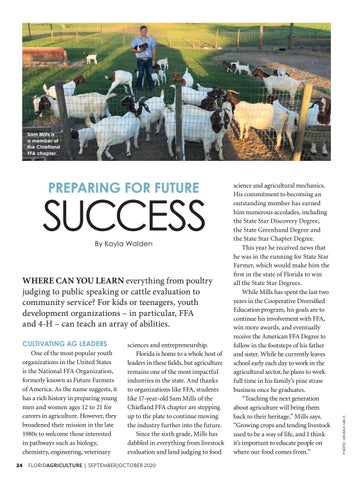
sciences and entrepreneurship. Florida is home to a whole host of leaders in these fields, but agriculture remains one of the most impactful industries in the state. And thanks to organizations like FFA, students like 17-year-old Sam Mills of the Chiefland FFA chapter are stepping up to the plate to continue moving the industry further into the future. Since the sixth grade, Mills has dabbled in everything from livestock evaluation and land judging to food
FLORIDAGRICULTURE | SEPTEMBER/OCTOBER 2020
science and agricultural mechanics. His commitment to becoming an outstanding member has earned him numerous accolades, including the State Star Discovery Degree, the State Greenhand Degree and the State Star Chapter Degree. This year he received news that he was in the running for State Star Farmer, which would make him the first in the state of Florida to win all the State Star Degrees. While Mills has spent the last two years in the Cooperative Diversified Education program, his goals are to continue his involvement with FFA, win more awards, and eventually receive the American FFA Degree to follow in the footsteps of his father and sister. While he currently leaves school early each day to work in the agricultural sector, he plans to work full time in his family’s pine straw business once he graduates. “Teaching the next generation about agriculture will bring them back to their heritage,” Mills says. “Growing crops and tending livestock used to be a way of life, and I think it’s important to educate people on where our food comes from.”
PHOTO: MELISSA MILLS
Sam Mills is a member of the Chiefland FFA chapter.
SERVING THE COMMUNITY No one could have expected the world to take such an extreme turn this year, but when COVID-19 shook the globe, 4-H members like Lamiya Dix stepped up to serve the community in creative ways. Dix joined the Havana 4-H club in 2015 while still in middle school – the organization caters to students from elementary school through age 18 – and has continued to participate in various activities ever since. While 4-H provides opportunities for its members to encounter a wide variety of subjects, one of the most crucial things she learned about was the importance of nature. “Learning about agriculture taught me how important it is to value things that are sometimes under cherished,” Dix says. “I think people often pass through nature without understanding that it’s more than just a beautiful background for a photograph, but that it’s the foundation of everything we have.” In addition to cultivating an appreciation for the natural world, 4-H places a significant focus on community service. And in times such as these, students who go above and beyond to help others in need are developing skills that will serve them well as individuals and future leaders. The Havana 4-H Club decided to make the most of their time in lockdown by providing specially made masks to Riverchase Health and Rehabilitation Center in Quincy. The students received a pattern and instructions and got to work. “It was such a good way to give back to my community,”
Dix says. “I made between 30 and 40 masks, but I wish I’d been able to make more.” She hopes to study physical therapy or orthopedic surgery in the future, both of which are careers that require sacrifice, diligence and a willingness to care for others. “My decisions for the future are primarily influenced by the job and life skills workshops I had the opportunity to attend through 4-H,” Dix says.
“I would definitely encourage anyone who is interested to participate in the organization,” she adds. “It opens up opportunities and gives young people a chance to do things they’ve never done before.”
See more online To learn more about how to get involved in these organizations, visit flffa.org and florida4h.org.
FLORIDAGRICULTURE | SEPTEMBER/OCTOBER 2020
25
The Awesome
Avocado THIS VERSATILE, POPULAR INGREDIENT SHINES
Flatbread with Arugula, Bacon and Avocado
NO MATTER HOW YOU SLICE THEM, Florida avocados pack a powerful nutritional punch – they’re a great source of potassium, fiber and folate, plus, avocados are loaded with heart-healthy fats. Eating avocados has even been shown to reduce cholesterol levels and help with weight loss because they help you feel satisfied and are low in carbohydrates. Plus, Florida avocados – which have fewer calories and fat grams per cup than Hass avocados – are in season for several months, from June through January. Thankfully, not only are they healthy, avocados taste delicious, too. Add them to salads, whip up some guacamole or puree them into a healthy substitute for butter or mayo. Avocados mix well with other ingredients, so they’re an ideal way 26
to add flavor and nutrition to recipes such as our Avocado Lime Smoothie, which gets its sweetness from pineapple and banana. Sliced avocado makes an attractive and tasty topping for our Flatbread with Arugula, Bacon and Avocado. If you’re looking for a proteinpacked lunch, try our Avocado Chicken Salad – serve it on bread or atop lettuce for a satisfying low-carb meal. Last, but not least, did you know avocados can even be incorporated into desserts? Try our Avocado Chocolate Truffles for a luscious treat you can feel good about eating.
FLORIDAGRICULTURE | SEPTEMBER/OCTOBER 2020
PREP TIME: 20 MINUTES RISE TIME: 30-45 MINUTES COOK TIME: 15 MINUTES MAKES: 2 FLATBREADS INGREDIENTS Flatbread Dough
2 teaspoons active dry yeast 1 teaspoon granulated sugar 1 cup warm water
2½ cups all-purpose flour 1 teaspoon salt 3 tablespoons olive oil Flatbread Toppings
6 slices thick-cut bacon 2 tablespoons olive oil 1 garlic clove, minced
1½ cups Parmesan cheese, grated 4 cups arugula ¼ cup ranch dressing 1 ripe Florida avocado, sliced 1 cup grape tomatoes, sliced 2 tablespoons fresh basil, chopped
PHOTO: ISTOCK.COM/FCAFOTODIGITAL
Recipes, styling and photography by Jessi Heggan
DIRECTIONS
1. Whisk together the yeast, sugar and warm water and proof until mixture is foamy (approximately 5 to 8 minutes). 2. Add flour and salt to a large bowl. Pour the yeast mixture and olive oil over the flour and, with a hand or stand mixer, use the dough hook to knead the mixture until it comes together. The dough will be fairly sticky. 3. Lightly grease a bowl with olive oil and add the dough. Cover with plastic wrap and proof until mixture has doubled in size (approximately 30 to 45 minutes). 4. While the dough is proofing, preheat oven to 375 degrees and line a baking sheet with parchment paper. Place the bacon slices on top and bake them for 20 to 25 minutes or until they reach desired doneness. Once the bacon is done, increase the oven temperature to 450 degrees and line two large baking sheets with parchment paper. 5. Place the risen flatbread dough on a generously floured surface and cut the mixture in half. Use your hands to shape the dough, rolling it out thin in the middle and forming a small crust around the edges. Repeat with the second dough. 6. Place the flatbread dough on the baking sheets and use a fork to poke some small holes. Bake for 10 minutes or until slightly browned. 7. Combine the olive oil and minced garlic in a small bowl and use a brush to spread the mixture on the baked flatbreads. Top with the Parmesan cheese and bake for an additional 5 to 8 minutes, or until cheese is melted and flatbread is browned. 8. Combine the arugula, ranch dressing, avocado, cooked bacon, tomatoes and basil in a large bowl and toss to combine. Pour the mixture over the flatbreads. Slice and serve immediately. FLORIDAGRICULTURE | SEPTEMBER/OCTOBER 2020
27
Avocado Lime Smoothie PREP TIME: 8 MINUTES MAKES: 2 SERVINGS INGREDIENTS
1 cup coconut milk
1 tablespoon lime zest (approximately 3 limes)
¼ cup lime juice (approximately 3 limes)
1 small Florida avocado
¼ cup vanilla yogurt 2 cups frozen pineapple
1 banana
DIRECTIONS
1. Add all of the ingredients to a blender and top with ice. 2. Blend until everything is combined. Serve immediately.
Avocado Chicken Salad PREP TIME: 10 MINUTES MAKES: 4 SERVINGS INGREDIENTS
1 cup Florida avocado, smashed
¼ cup mayonnaise 3 tablespoons lemon juice
1 tablespoon Dijon mustard
1 teaspoon sea salt
½ teaspoon black pepper 3 cups cooked chicken, shredded ½ cup green onions, sliced ½ cup walnuts, chopped ¾ cup celery, chopped ¾ cup grapes, quartered DIRECTIONS
1. In a large bowl, combine the smashed avocado, mayonnaise, lemon juice, Dijon mustard, salt and pepper and whisk to combine. 2. Add the cooked chicken, green onions, walnuts and celery and mix until everything is combined. 3. Gently mix in the grapes. Serve immediately or store in an airtight container.
Avocado Chocolate Truffles PREP TIME: 20 MINUTES CHILL TIME: 3 HOURS MAKES: 16 TRUFFLES INGREDIENTS Truffles:
9 ounces dark chocolate
¾ cup heavy cream ½ cup Florida avocado, smashed 1 teaspoon vanilla extract ¼ teaspoon sea salt Optional Truffle Toppings:
Cocoa powder
Shredded coconut Strawberry powder Pistachios, chopped DIRECTIONS
1. Place the dark chocolate in a large bowl. Heat the heavy cream on the stove or in the microwave and pour over chocolate. Let sit for about 5 minutes, then whisk to combine the melted chocolate and cream. 2. Add the chocolate mixture to a blender or food processor along with the smashed avocado, vanilla and salt and blend until smooth. 3. Place the mixture in a shallow bowl and chill uncovered for approximately 3 hours or until mixture has set but it still soft and scoopable. 4. Scoop about a tablespoon of the chocolate truffle mixture and roll into a ball. Try not to handle for too long, as it can melt. Repeat with remaining truffle mixture. Eat as is or roll the truffles in your favorite topping. Store in an airtight container in the refrigerator.
ECO-Invest
in Giant Bamboo Revolutionizing the Commercial Bamboo Industry ONE FARMER AT A TIME!
CREATE YOUR OWN COMMERCIAL BAMBOO FARM Own a Profitable and Sustainable Legacy Cash Crop Business
See more online Find fun facts about avocados and more recipes at farmflavor.com/avocado.
Low Investment | High Return
• One Time Planting • 60-100 Years Life Span • 10 Year Renewable Guaranteed Crop • Buy Back Agreement • Estimated EPI On Fully Harvested Acres: $15K-35K annual Lord Income • Looking For Farming Partners
Contact Us Today (954) 530-3385 info@onlymososales.com • www.onlymoso.com
FLORIDAGRICULTURE | SEPTEMBER/OCTOBER 2020
29
30
FLORIDAGRICULTURE | SEPTEMBER/OCTOBER 2020
CLASSIFIEDS BUSINESS OPPORTUNITIES:
FEED & HAY
BAMBOO FARMERS WANTED Farmers, growers, investors One time crop purchase One time planting 80-100 years life span 6 month plant guarantee 10 year crop buy back contract $15k-$25k per acre annual profits Contact us today ONLYMOSO USA CORP 954.530.3385 INFO@ONLYMOSOSALES.COM
COASTAL BERMUDA HAY Barn stored-$50, Field kept-$40 Irrigated and fertilized. Frank Quincey Levy County 352-538-7077 or 352-463-2953
COLLECTIBLES Coins, currency, sterling silver flatware, gold/silver jewelry, and more. We are #1 on Angie’s List, NATIONWIDE! Visit us at www.CoinAppraisal.org or contact us directly at 727.488.7899
EQUIPMENT $$$ WANTED $$$ Tractors, Mowers, Farm Equipment and Related Parts Any Condition. Call 813-626-2609. WANTED FARM TRACTORS PLUS FARM EQUIPMENT. RUNNING OR NOT. MORE CASH PAID. CALL 813-626-4554. 5 V-crimp GalvaLume Roofing & Accessories For Farms & Ranches. Cypress Feed Trough & Mineral Boxes Call: 772-473-1714 tripsonmt@aol.com Ask for Mark. FEEDER WAGON, 3-ton and 6-ton, creep feeder available on 3-ton. Call 813-626-4554.
PREMIUM HAY & SPRIGGING SERVICE: Jiggs, Tifton85, Perennial Peanut, Coastal. Horse-quality square bales (limited rolls), fertilized & irrigated fields. Feed stores welcome. Clean digging stock. Call Haystack Farms at 386-963-3505 or 855-326-8873. www.haystackfarms.com.
FISHERIES SHONGALOO FISHERIES Channel catfish, certified Florida bass, bluegill, grass carp, shellcrackers, warmouth, koi, and gambusia for stocking. See complete list at www.shongaloofisheriesinc.com. Hampton, FL. 352-468-1251. SERVING SOUTH FLORIDA Native Fish Stocking Grass Carp - Tilapia Fountain & Aeration Systems Complete Lake Management ALLSTATE FISH & WILDLIFE MANAGEMENT 1-800-270-6558 www.allstatemanagement.com FLORIDA FISH FARMS Bass, Bluegill, Catfish, Grass Carp (Permit Req.) & Koi (Ornamental Carp) Contact: Florida Fish Farms, 9684 CR 705, Center Hill, FL 33514. 352-7934224. Visit our website: www.floridafishfarms.com.
PONDSTOCKER Bass, Bream, Catfish, Tilapia, Koi, Grass Carp, Shinners and Gambusea Minnows. Pond Supplies. Licensed and experienced. Call today! Cal Trotter. 1-321-952-9176. Palm Bay, FL.
GOOD THINGS TO EAT FARM BUREAU BUYER’S CLUB Check out the back page for the Florida Farm Bureau Buyer’s Club Autumn Sale! We’re offering Coloma Fresh Frozen Foods, last chance to purchase until 2021! Contact your local County Farm Bureau for more information!
LEGAL SERVICES Michael Martin Martin Law Office Agricultural & Environmental litigation Defective products and seeds Crop insurance All litigation issues state or federal 863-686-6700 Lakeland, FL Representing four generations of farm and ranch families. Email: Mike@martinpa.com Website: www.martinpa.com Charles F. Woodhouse, Esq. MBA, JD, MS Food Safety Graduate Certificates in Food Law and Packaging Attorney Specializing in Agriculture and Food Law Food Safety Modernization Act Compliance PACA and Florida Broker/ Dealer Complaints Crop Insurance and Risk Management Programs Representation before County Committees, State Committee, and National Appeals Division Matters
WOODHOUSE SHANAHAN PA Agribusiness Industry Regulatory Compliance Washington, DC & Cedar Key, FL E-mail: cfw@regulatory-food-science.com Website: www.seafood-and-produce-law.com Blog: www.food-label-compliance.com Tel Cedar Key, FL 352-278-1110 Tel Washington, DC 202-293-0033 FAX 202-478-0851
LIVESTOCK Registered Angus Cattle For Sale Ohana Farms Bull Calfs, Cows, Heifers, Pairs 386-212-1006 REGISTERED BLACK ANGUS BULLS for sale bull calves weaned, gentle $750.00 Solid Performance Bloodlines 813-713-6345
MISCELLANEOUS AKC Registered Beagle Puppies for sale in NW Florida. Call 850-554-1062 or email Allenmanning59@gmail.com. LOVE AMERICA? www.AmericaTheBeautiful.Shop
PLANTS & SEEDS Alternative Fruit Crops All of the latest and greatest varieties of avocado, dragon fruit, guava, longan, lychee, macadamia nut, mango, peach, pomegranate, and more. Call Pine Island Nursery (305)233-5501. www.PineIslandNursery.com
FLORIDAGRICULTURE | SEPTEMBER/OCTOBER 2020
31
Week of 7/20/20 - 7/26/20
REAL ESTATE
SEPTEMBER CROSSWORD The Weekly Crossword ACROSS 1 Down in the dumps 5 Acted like 9 Loses color 14 Litter's littlest 15 Quaker's "you" 16 Say "y'all," say 17 Math computation 18 Youngster 19 Firing place 20 Many May babies 22 Wrongdoing 24 Olympic lake in NY 26 ___-Atlantic 27 Small night bird 29 Materials for Renoir 34 Like some music 36 Web developer's concern 37 Kind of sign 38 Playfully shy 39 Acrobat's attire 42 Phone's ABC 43 Anagram for "ruse" 45 Caesar's hello 46 Perfume sampler 48 Superfluous 51 Ball VIP 52 ___ no evil 53 Figure out 55 Field laborer of old 59 Maine capital 62 Color of honey 63 Right on the map? 65 Diving bird
1
2
3
by Margie E. Burke
4
5
6
7
8
9
14
15
16
17
18
19
20
21
22
24 27
25
28
29
34
35
38
39
43 48
55
30
56
57
41
31
32
33
42
46
47 51
50 53 58
13
37
40
49
12
23
36
52
11
26
45
44
10
54 59
60
62
63
66
67
68
69
70
71
64
61
65
Copyright 2020 by The Puzzle Syndicate
66 67 68 69 70 71
10 Finder of a magic lamp 11 Place to wait 12 Result of honing 13 Farmer's purchase 21 Birth-related DOWN 23 BMW, e.g. 1 Boast 25 Swell, as the 2 Fishing item abdomen 3 Out of work 27 Come to pass 4 Amazon, e.g. 28 Which person's? 5 Room at the top? 30 Shepherd's 6 Prefix with locale "therapy" 31 Annoying 7 Comics shriek 32 Spa handout 8 Consider to be 33 Siesta sound 9 Iran, once 35 Hard to lift Get a whiff of Smart-___ Surrounded by Astronaut Ride Kin's partner Count (on)
40 In vitro items 41 Fix, as software 44 Monroe's co-star in "Gentlemen Prefer Blondes" 47 Worldly 49 Almost 50 Child's china 54 Like Rembrandt 55 Mountain route 56 Austen heroine 57 Son of Adam 58 Boat-building wood 60 Work hard 61 Opie's dad 64 Frazier foe
Solution available online at FloridAgriculture.org or in next issue.
JULY SOLUTION
FIND US ON FACEBOOK www.facebook.com/ FlaFarmBureau
32
FLORIDAGRICULTURE | SEPTEMBER/OCTOBER 2020
LONGLEAF LAND COMPANY Land for sale in Northwest Florida and South Alabama Contact Jody Jones 334.493.0123 longleaf@longleafland.com www.longleafland.com 50 ACRES OF BEAUTIFUL OLD FLORIDA WITH SHADY OAKS TREES AND FLOWING CREEK. $359,000. Tons of wildlife and great for hunting deer, hog and turkey. 3 bed, 2 bath home with well and septic. On Hwy 31, south of Arcadia, DeSoto County. Welcome to your peaceful, quiet country paradise with lots of opportunity for hunting and fishing. Zoned A-5. This beautiful property is priced to sell at only $7,000 per acre! Melissa Bajsa, CMTG Real Estate Group, 863-430-3977. SOUTHERN PINE PLANTATIONS North and Northwest Florida 377 Acres, Jackson Co, 148 acres Cultivated farm land, Irrigated, 15,400 sq. ft. packing shed, 2,400 Sq. ft. Cooler. $2,950/acre 7,611 acres managed commercial timberland, Planted Pine, Hardwood Bottoms, Excellent Hunting. $1,200/acre. SOLD!! Call Pat Duane at 352-867-8018 Southern Pine Plantations of Fla. Owns the property it sells.
HURRY! Order by September 17th. Finest Quality-Super Savings! Stock your Freezer with Coloma Michigan Fresh Frozen! Last chance to purchase until 2021
Cinnamon Apples - Cinnamon, white & brown sugars, butter and other spices 4/3 lb. pkgs ........ Was $33.95 ......... NOW $29.95
Packed by Coloma Frozen Foods
Baby Lima Beans ........ 4/2.5 lb. pkgs ....... Was $27.45 ... NOW $24.45
Apple Slices - Prepared for easy use, peeled, cored and sliced! 4/2.5 lb. pkgs ... $22.95 Blackberries - Marion Variety. No core, just big, sweet & juicy! ... 4/2.5 lb. pkgs ... $32.45 Blueberries - Medium sized for pies, muffins, or as a snack! ....... 4/2.5 lb. pkgs ... $31.45 Cranberries - Whole ............................................................ 6/20 oz. pkgs ... $21.95 Fruit Mix (California) - peaches, honey dew, cantaloupe and red grapes 4/2.5 lb. pkgs ... $33.45 Mango - Chunks - Imported .................................................... 4/2.5 lb. pkgs ... $31.95 Mixed Fruit - Apples, sweet cherries, peaches, strawberries and pineapples 4/2.5 lb. pkgs ... $33.45 Berry Patch Fruit Mix - Strawberries, blueberries and red raspberries 4/2.5 lb. pkgs ... $33.45 Peach Slices - Freestone peaches, tree ripened, peeled, sliced 4/2.5 lb. pkgs ... $33.45 Pineapple Chunks - Imported ............................................ 4/2.5 lb. pkgs ... $25.95 Red Tart Cherries - Pitted pie cherries ................................ 4/2.5 lb. pkgs ... $27.45 Red Raspberries - Whole .................................................... 4/2.5 lb. pkgs ... $42.95 Sliced Strawberries - Sliced .............................................. 4/2.5 lb. pkgs ... $35.45 Tropical Fruit Mix - Peaches, mangos, pineapple & strawberry halves 4/2.5 lb. pkgs ... $35.45 Whole Strawberries ....................................................... 4/2.5 lb. pkgs ... $35.45 Rhubarb Chunks ............................................................. 4/2.5 lb. pkgs ... $24.95
Broccoli Florets ............................................................. 6/2 lb. pkgs ...... $30.95 Brussel Sprouts ............................................................ 4/2.5 lb. pkgs .. $27.45 Cauliflower - Florets ........................................................ 6/2 lb. pkgs ...... $29.95 Corn - Yellow, super sweet, tender ......................................... 6/2.5 lb. pkgs ... $30.95 Super Sweet White Corn - tastes like sugar, but naturally sweet!6/2.5 lb. pkgs ... $31.45 Fajita Mixed Vegetables - onion, green, red & yellow pepper strips 6/2 lb. pkgs ...... $30.95 Mixed Vegetables - peas, corn, green beans, carrots and lima beans 6/2.5 lb. pkgs ... $31.45 Mushrooms - Sliced .......................................................... 4/2.5 lb. pkgs ... $28.45 Pepper and Onion Variety Pack - diced onions and green pepper 4/2.5 lb. pkgs ... $23.45 Green Beans - Cut ............................................................. 6/2 lb. pkgs ...... $22.95 Green Garden Peas ......................................................... 6/2.5 lb. pkgs ... $33.95 Hashbrowns - Shredded ......................................................... 6/3 lb. pkgs ...... $47.95 Stew Vegetables - celery, carrots, potatos and onions ..... 4/2.5 lb. pkgs ... $24.45 Stir Fry Vegetables - broccoli, shoestring carrots, onions, celery, red peppers and pea pods 6/2 lb. pkgs ...... $31.95 Sweet Potato - Diced ...................................................... 6/2 lb. pkgs ...... $25.95 French Fries - Regular cut ............................................... 6/5 lb. pkgs ...... $53.95
Country Smoked Sausage
Troyers Cheese from Amish Country!
Packed by Nettles Sausage Variety Pack Sausage For grilling, breakfast, or anytime! 1-Mild Country Sausage (2.5 lb. pkg.) • 1-Hot Country Sausage (2.5 lb. pkg.)
3-Andouille Country Sausage (2.25 lb. pkgs.) • 3-Jalapeno Country Sausage (2.25 lb. pkgs.) ... 9.5 lbs. total $37.95
Country Smoked Sausage Fully Cooked – Specify Mild, Hot, Andouille or Jalapeno Mild ....................................................... 4/2.5 lb. pkgs. .................... $37.95 Hot ......................................................... 4/2.5 lb. pkgs. .................... $37.95 Andouille ............................................. 12/12 oz. pkgs. .................. $37.95 Jalapeno ............................................... 12/12 oz. pkgs. .................. $37.95
Farmland Meats Packed by Farmland Last chance to purchase until 2021
Pork Ribeye Steak - (Raw) individually sealed for use, fresh frozen, 4.3 lbs. (7/10 oz. steaks) .......................................... $30.95 tender and juicy! Black Angus Ground Chuck Patties - (Raw) 78% Lean 10 lbs. (30-1/3 lb. patties) ....................................... $61.95 Dixie Skillet Sausage Patty - Great taste at a great value! (2 oz. patties) 10 lbs. (1/10 lb. pkg) ...................... $39.95 Jones Farm Sausage Links - (Fully Cooked) 10 lbs. (30-1/3 lb. links) .... $44.45 Precooked Bacon Slices - Thin and crisp, uniformly sliced. Will not shrink or splatter when heated (approx. 300 slices) ................................... $55.95 Black Angus Beef Franks - (100% USDA Choice, 50 per case) 10 lbs. (1/10 lb. pkg) ............................................... $43.95 KC Wild Wings - Fully cooked, seasoned pork shanks. Grilled, smoked or oven-roasted, sure to please! 3 lb. bag (12/4 oz. shanks) .......................................... $29.45
Packed by Troyer Cheese from Millersburg, OH
Mild Cheddar Cheese ....................... 3 lbs. (6/8 oz. pkgs) Was $21.45 .... NOW $18.45 Sharp Cheddar Cheese .................... 3 lbs. (6/8 oz. pkgs) ................... $21.45 Variety Cheese Pack - Contains 2 Mild, 2 Colby and 2 Sharp blocks 3 lbs. (6/8 oz. pkgs) ................... $18.95 Green Onion .................................. 3.5 lbs. (6/9.5 oz. pkgs) ............. $16.95 Cheddar Garlic ............................... 3 lbs. (6/8 oz. pkgs) ................... $25.45 Hickory Smoked Cheddar .......... 3 lbs. (6/8 oz. pkgs) ................... $15.45 Colby Cheese ................................. 3 lbs. (6/8 oz. pkgs) ................... $16.45 Pepper Jack Cheese ..................... 3 lbs. (6/8 oz. pkgs) ................... $18.95 American Cheese Slices ............. 5 lbs. (120 slices) ....................... $15.95 Baby Swiss Cheese ...................... 2.8 lbs. (6/7.5 oz. pkgs) ............. $20.95 Summer Sausage ......................... (4/12 oz. pkgs) ........................... $18.45
NUTS .... Stock Up! Brittle Bites - Peanut Brittle Squares ................ 12 oz. can ................... $4.00 Cashews - Whole ................................................ 16 oz. can ................... $9.95 Mixed Nuts ............................... 16 oz. can ................... $6.95 Milk Chocolate Pecans ............ 12 oz. can ................... $6.95 Chocolate Peanuts ................. 12 oz. can ................... $3.95 Honey Roasted Pecans ............ 8.5 oz. can .................. $6.95 Butter Toffee Peanuts ........... 12 oz. can .................. $3.95 Honey Krunch Peanuts .......... 12 oz. can .................. $3.50 Almonds - Roasted & Salted ............................... 9 oz. can ..................... $4.50 Southern Fried Skinless Peanuts ................ 16 oz. can ................... $3.50 Orange Blossom Honey ................................. 2 lb. Squeeze Bottle .. $12.00 Wildflower Honey .......................................... 2 lb. Squeeze Bottle .. $12.00 Palmetto Honey w/comb ................. 12 oz. jar ..................... $10.45
Delivered to your County Farm Bureau office by September 28th - October 16th