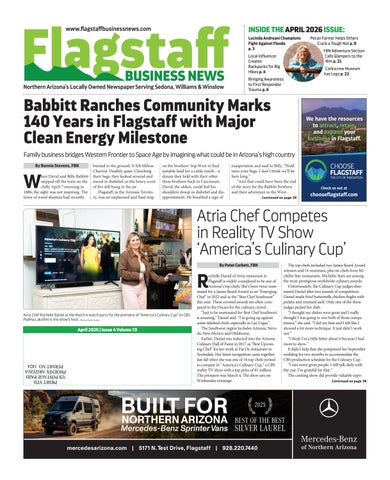
INSIDE THE APRIL 2026 ISSUE:
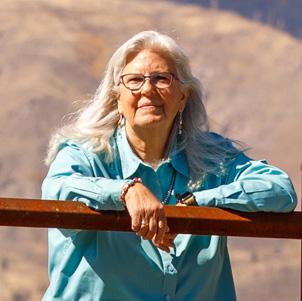
Lucinda Andreani Champions Fight Against Floods p. 3
Local Influencer Creates
Backpacks for Big Hikes p. 4
Bringing Awareness to First Responder Trauma p. 6
Lucinda Andreani Champions Fight Against Floods p. 3
Local Influencer Creates
Backpacks for Big Hikes p. 4
Bringing Awareness to First Responder Trauma p. 6
Pecan Farmer Helps Others Crack a Tough Nut p. 9
FBN Adventure Section Calls Glampers to the Rim p. 21
Corkscrew Museum has Legs p. 22
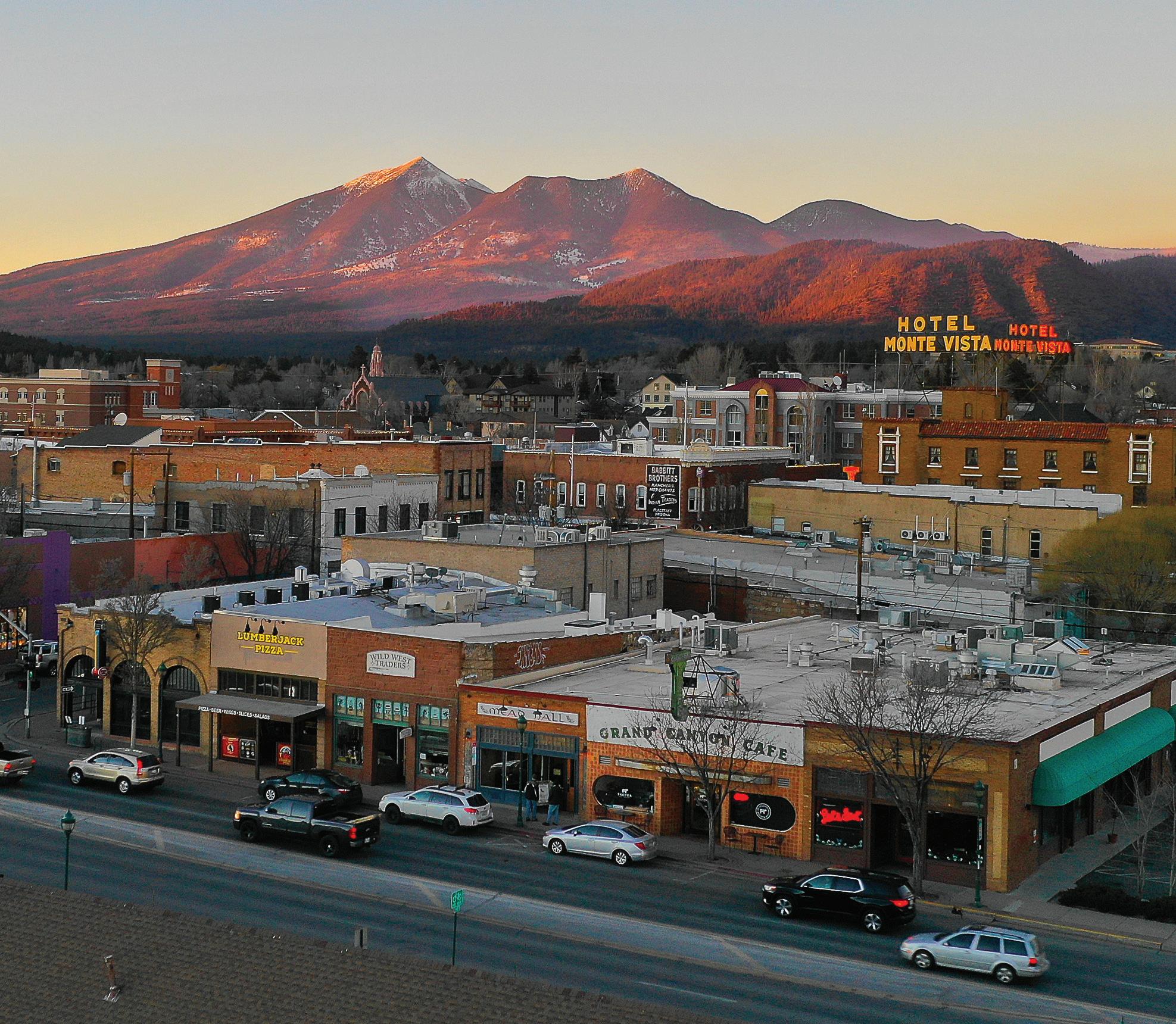
Family business bridges Western Frontier to Space Age by imagining what could be in Arizona’s high country
By
Bonnie Stevens, FBN
WCharred. Deathly quiet. Clutching their bags, they looked around and stared in disbelief, as the heavy scent of fire still hung in the air.
Flagstaff, in the Arizona Territory, was an unplanned and final stop
hen David and Billy Babbitt stepped off the train on the chilly April 7 morning in 1886, the sight was not inspiring. The town of wood shanties had recently burned to the ground. It felt lifeless.
on the brothers’ trip West to find suitable land for a cattle ranch – a dream they held with their other three brothers back in Cincinnati. David, the oldest, could feel his shoulders droop in disbelief and disappointment. He breathed a sign of


exasperation and said to Billy, “Hold onto your bags. I don’t think we’ll be here long.”
“And that could have been the end of the story for the Babbitt brothers and their adventure in the West-

By Peter Corbett, FBN
Rochelle Daniel of Atria restaurant in Flagstaff is widely considered to be one of Arizona’s top chefs. She’s been twice nominated for a James Beard Award as an “Emerging Chef” in 2022 and as the “Best Chef Southwest” this year. These coveted awards are often compared to the Oscars for the culinary crowd.
“Just to be nominated for Best Chef Southwest is amazing,” Daniel said. “I’m going up against some talented chefs, especially in Las Vegas."
The Southwest region includes Arizona, Nevada, New Mexico and Oklahoma.
Earlier, Daniel was inducted into the Arizona Culinary Hall of Fame in 2017 as “Best Upcoming Chef” for her work at Fat Ox restaurant in Scottsdale. Her latest recognition came together last fall when she was one of 16 top chefs invited to compete in “America’s Culinary Cup,” a CBS reality TV show with a top prize of $1 million. The premiere was March 4. The show airs on Wednesday evenings.

The top chefs included two James Beard Award winners and 14 nominees, plus six chefs from Michelin Star restaurants. Michelin Stars are among the most prestigious worldwide culinary awards.
Unfortunately, the Culinary Cup judges eliminated Daniel after two rounds of competition. Daniel made fried buttermilk chicken thighs with pickles and mustard aioli. Only one of the three judges picked her dish.
“I thought my dishes were great and I really thought I was going to win both of those competitions,” she said. “I did my best and I felt like I showed a lot more technique. It just didn’t work out.”
“I think I’m a little bitter about it because I had more to show.”
It didn’t help that she postponed her September wedding for two months to accommodate the CBS production schedule for the Culinary Cup.
“I met some great people. I still talk daily with the cast. I’m grateful for that.”
The cooking show did provide valuable expo-

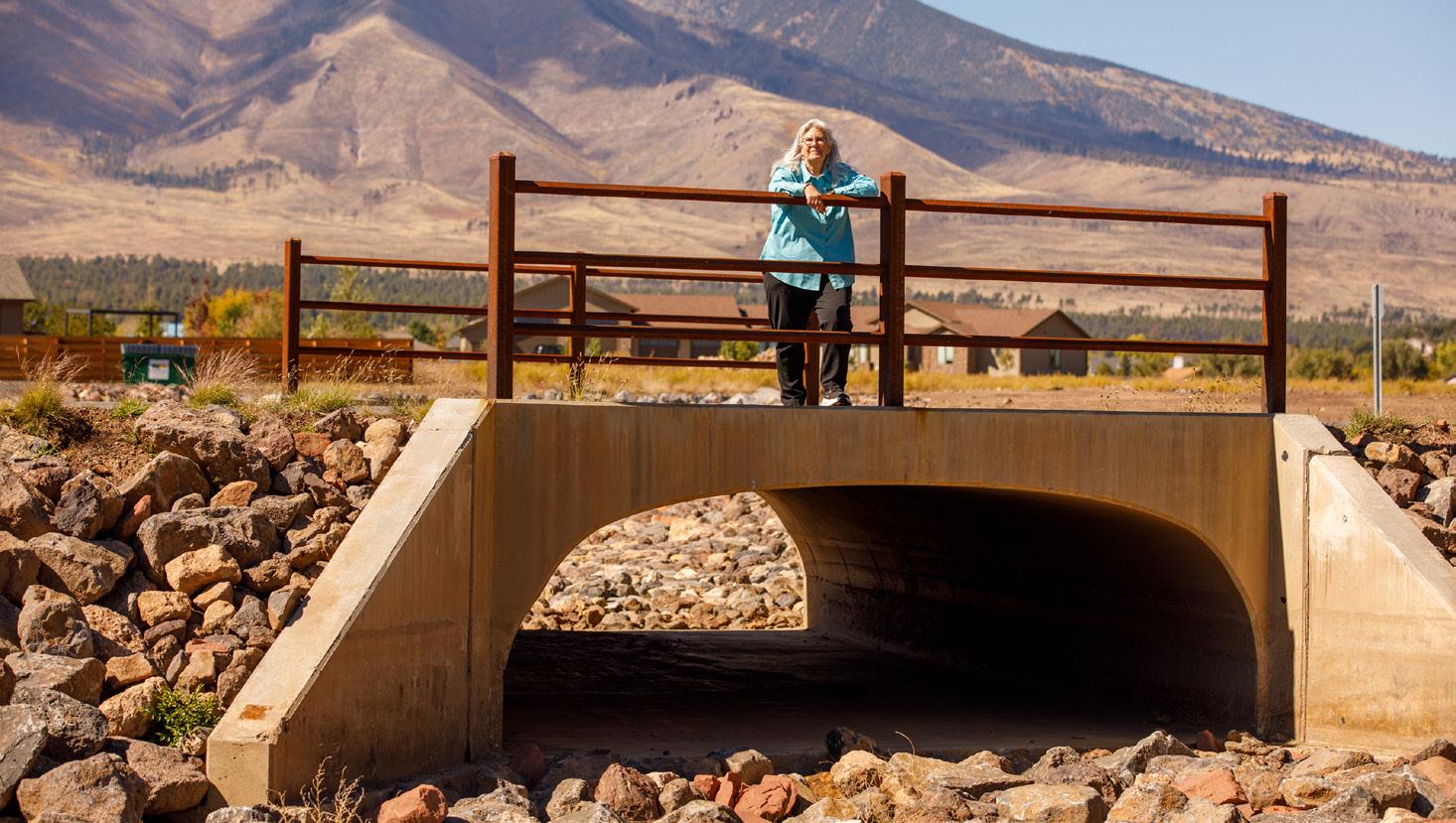
Lucinda Andreani pushes back against future floods following catastrophic wildfires
By Lisa Abelar
Wildfire is as much a part of summer in Coconino County as popsicle stains and cannonballs into swimming holes. Fire, almost inevitably, comes with the season.
The Northern Arizona county covers so much ground, it clocks in as the second-largest in the country. While part of that land mass is vast desert landscapes, a significant portion includes the largest ponderosa pine stand in the world. And in a dry climate, that can create problems.
When catastrophic wildfires sweep through a pine forest, they can scorch away trees and plants and bake the soil like a kiln firing pottery. Instead of soaking into the soil, rainfall rapidly runs off the surface, causing flash floods. That means rural communities are not only at risk from destructive fires, they’re also vulnerable to dangerous floods that follow.
In and around Flagstaff, the county seat, a series of wildfires in recent years has created conditions ripe for hazardous flash flooding, some powerful enough to carry away large tree trunks, cars and more. A 12-year-old girl tragically lost her life in a flash flood in 2010 following the Schultz Fire, which burned at least 15,000 acres.
After the Schultz Fire, the area experienced the 2,000-acre Museum Fire in 2019. In 2022, Coconino County battled both the 26,000-acre Pipeline Fire and the 19,000-acre Tunnel Fire.
The two fires in 2022 later resulted in 45 major flood events.
In areas scorched by wildfires, known as burn scar areas, mitigation efforts could save lives. A downpour the area received in early July tested the efforts of Coconino County Flood Control District Administrator Lucinda Andreani and her team.
“We had a good test of the system,” she said. “And it worked.”
Andreani is referring to a multi-million-dollar flood mitigation system the county recently completed by utilizing $60 million in funding from the Natural Resources Conservation Service and $42 million from the U.S. Forest Service. That federal funding was spread across nine
watersheds to address the capture of sediment and reduce erosion.
Along with the new system, the county shored up more conventional flood-control measures, including retention basins and storm drains. The combined efforts reduce the risk of damage to about 1,500 homes, Andreani said. Without federal investment, the county said it would have taken up to 20 years to complete the project on its own.
“This is our third rodeo. We have a lot of experience in this arena,” Andreani said of flood mitigation, which the county has gained attention for in other areas of the country. “We have developed this system of mitigation and key to that system are these on-forest watershed restoration measures. Lots of places build traditional flood mitigation. It’s much more challenging in this environment because our flood flows have gone up 10 to 31 times per fire.”
Coconino County Board of Supervisors Chair Patrice Horstman, the supervisor for District 1, called the wildfire to post-wildfire mitigation a vicious cycle for Coconino County. Relationships across the varied layers of government are critical to response, recovery and restoration, she said.
"It has been an incredible partnership. The county never would have been able to do it had it not been for the relationships with our Arizona Senators and Representatives, the USDA, the Department of Interior and the State of Arizona."
Horstman has worked with municipal and Tribal governments as well as state, congressional and federal offices. This coordination ahead of an emergency, Horstman said, ensures that all stakeholders are at the table.
For Andreani, flood mitigation projects are more than wildfire recovery, they are public safety projects. And she’s grateful the funding was available to not only create safer water flow throughout the county, but also to put minds at ease.
“Without the partnerships, we could not have done the extent of mitigation we were able to do,” she said. “This is life threatening. And what we hear from people in the communities is that there is so much fear that people can’t sleep at night. What we hear when we’re done is relief.” FBN
Lisa Abelar is a writer for the newswire service, Resource Rural.

By Peter Corbett, FBN
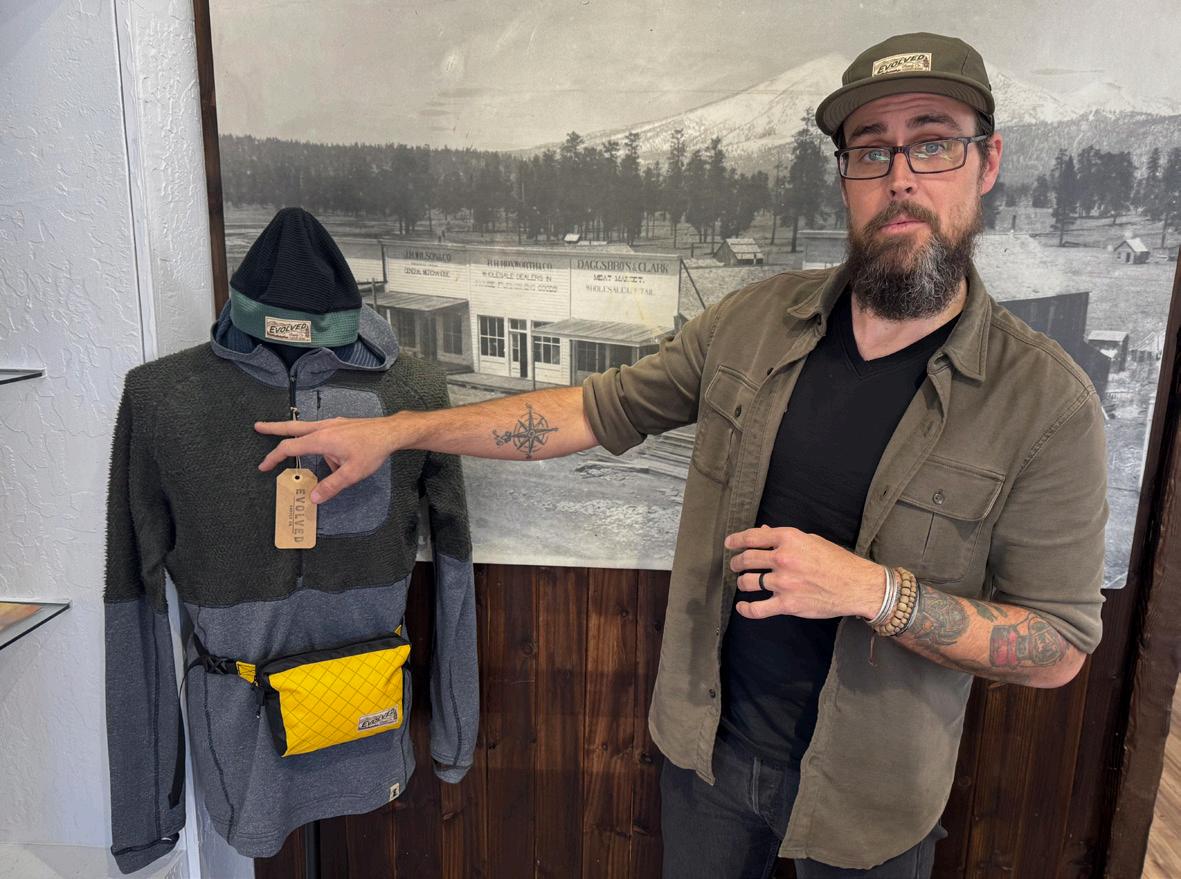
Nic Rakestraw and his Evolved Supply Co. may not be well known in Flagstaff yet, but his emergence as an entrepreneur and influencer has earned him a huge online following.
Known as “Darwin On the Trail,” Rakestraw has more than 350,000 YouTube followers. They tune in for his outdoor-gear reviews and to hear his experiences of long hikes and cycling across America and around the world.
He’s achieved the Triple Crown of thru-hikes — the Appalachian, Pacific Crest and Continental Divide trails — along with thousands of miles of hiking in Alaska, Arizona, Colorado and an 80-mile trek to a Mount Everest base camp.
“I was just trying to inspire people, to take the leap and go do a thru-hike or get into backpacking,” he said of his YouTube channel. He also has a podcast, Outdoor Evolution.
“I started what inevitably became my career over the past 11 years,” he said of his vast social media footprint.
Now Rakestraw has expanded Evolved Supply Co., an Arizona outdoor gear maker into a retail space at 9 N. Leroux Street, in the 1911 Raymond Building. Evolved has operated the past
three years as an online-only merchant working out of the McMillan Building, above what’s now Alpine Pizza.
He designs and field tests his backpacks, apparel, cookware and related hiking gear. Three Evolved seamstresses sew the backpacks from within the retail shop. Rakestraw plans to set up production and product fulfillment in the basement.
Evolved’s Ranger backpacks have a capacity of 35- to 70-liters and carry a price tag of $260 to $375.
It’s no secret Flagstaff is a hub for outdoor adventurers among locals and travelers passing through the City of Seven Wonders. Just look at all the tricked-out camper vans, pickups and Subarus loaded with mountain bikes and kayaks on the roads.
Rakestraw with his wife, Jessica, were among those travelers, first passing through Flagstaff a little more than a decade ago. They were living “like dirtbags in a minivan,” pursuing adventures and stopping to work jobs when their bank accounts dwindled, he said.
They were on the road for close to five years after selling their house in Southern Indiana and most of their possessions in 2014. They started off hiking the Appalachian Trail and then embarked on seemingly endless road trips and hikes. In 2019, they finally
settled in here.
“The more we stayed, the more we fell in love with Flagstaff,” Rakestraw said.
“Flagstaff is such a cool, awesome little mountain town, an outdoor town. It has a national scenic trail running through it. Grand Canyon is an hour and a half away from here. It’s a big place for mountain biking and climbing and hiking and all those things.”
Flagstaff has its share of outfitters with Babbitt’s Backcountry Outfitters, Mountain Sports, Aspen Sports, Peace Outfitters downtown, while REI and Sportsman’s Warehouse are only a few miles away. Evolved joins the downtown outdoor merchants.
In addition to his gear company, Rakestraw has done videos and marketing content for local and national companies through his Outdoor Evolution brand for the past six years.
He also funded and produced a documentary film about the 800-mile Arizona Trail called “Through the Great Southwest.” It debuted in February 2020 at the Orpheum Theater and the film has generated funds for the Arizona Trail Association, Rakestraw said.
In March, Evolved Supply Co. held an Arizona Trail kickoff event for the spring season benefitting the association.
Matthew Nelson, Arizona Trail Association executive director, said the nonprofit organization is excited about a continued partnership with Rakestraw and Evolved Supply Co.
“His documentary, ‘Through the Great Southwest,’ is the most comprehensive film ever produced about the Arizona Trail. As a seasoned thru-hiker and mountain biker, he was able to capture the inspiring landscapes, inter-
esting characters and the experiences that define the Arizona Trail.”
“Public lands have given me my career,” Rakestraw said. “It’s a big deal to me to give back and put my money where my mouth is.” FBN
Supply Co. is open Monday through Saturday from 10 a.m. to 6 p.m.
Northern Arizona is open for business. As Flagstaff brings on new homes, schools, restaurants, and tourism destinations, we’re delivering the energy that makes it possible. We understand that economic development isn’t just about numbers — it’s about building strong communities, creating opportunity, and making partnerships. That’s why we’re committed to fueling the future of Flagstaff, one connection at a time.
uesaz.com

By Bonnie Stevens, FBN
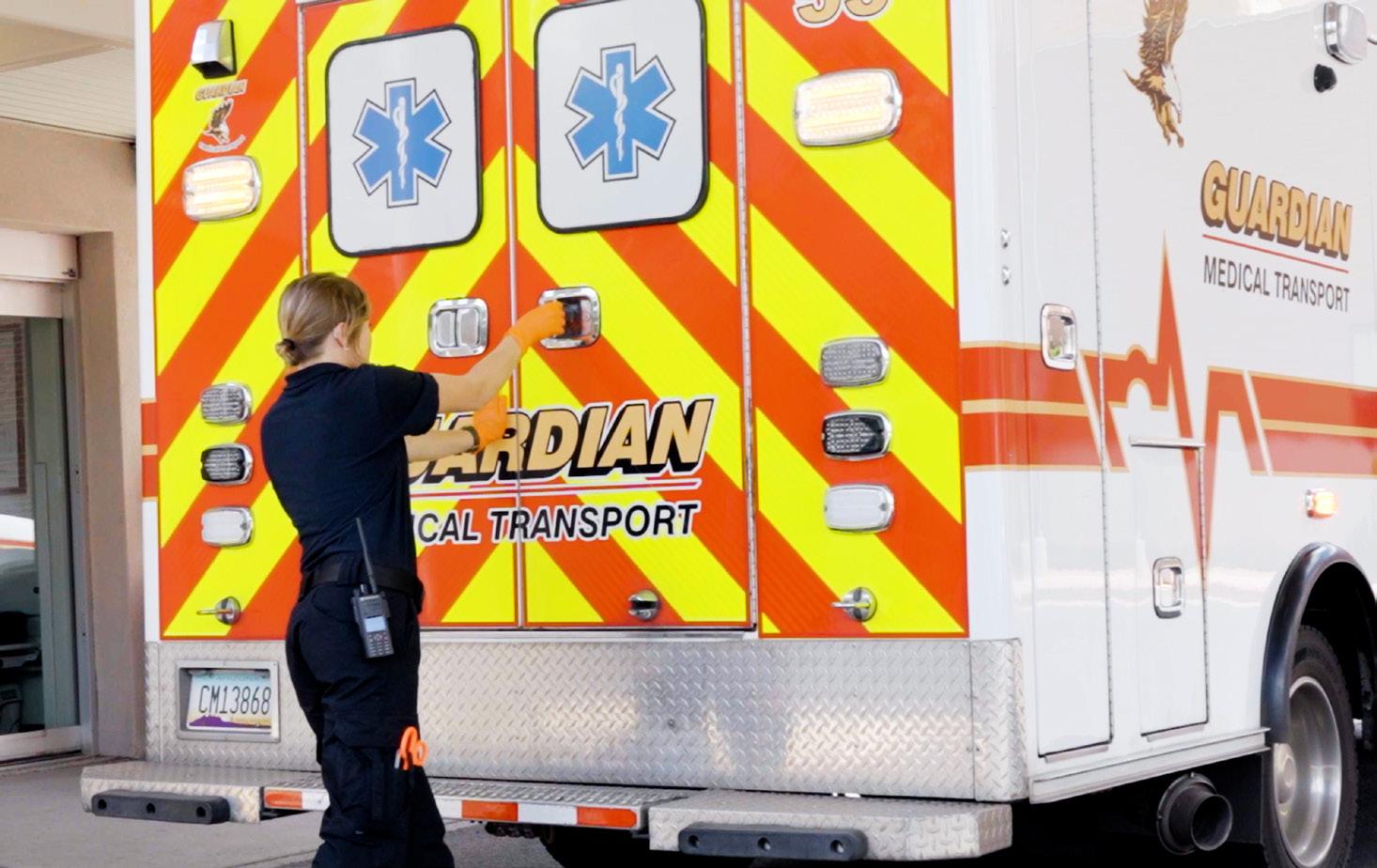
Matt Shaw knew it was time to talk to somebody when the boy he had tried to save showed up in his dreams and on the face of his own son. “Our job in the emergency medical services is to be there for a person’s worst day,” said the Guardian Medical Transport battalion chief. “But for us, that’s just Monday.”
What first responders experience on the job doesn’t necessarily go away when their shift is over. Often, they carry the trauma from a single horrific call – or the cumulative effect of many –into their homes and other areas of their lives.
Traditionally, these community heroes were expected to continue to show up fully present and unaffected, as they moved from one emergency call to the next. “Thankfully, that culture is starting to change and people are realizing that as soon as you can get the mental health support and the counseling and the debriefing sessions, the longer your career can be and the healthier your career can be, which is really the important part,” said Shaw.
Today, Northern Arizona Healthcare is issuing a distress call of its own, sounding the alarm that mental health care for first responders is a critical concern affecting individuals, families and the community.
“It really hit me when I ran into one of our battalion chiefs for Guardian Medical Transport,” said NAH Office of Philanthropy Vice President Maraka Oltrogge. “This battalion chief just looked worn down – like they couldn’t get through the day. It just gutted me to see how much of a shell of a person they had become from all of the incidents they had been living through.”
Oltrogge, whose husband is a battalion chief with the Flagstaff Fire Department, is familiar with the kind of stress that first responders face and the emotional and physical toll it can take.
“We don’t think about them having to go home and look at their families after just witnessing an atrocity in the community,” she said.
“Their job is to show up on your worst day and be their best selves.”
She began searching for a way the NAH Office of Philanthropy could support a mental health program for the organization’s first responders that would be accepted by a culture that has long valued self-reliance, independence and resilience.
She was familiar with efforts made by Flagstaff Fire Deputy Chief Chris Fennell, who had been pushing for a free, accessible and confidential mental health program for local firefighters.
“There have been a lot of traumatic events that have affected our first responders,” said Fennell. “Most responders manage it well, but without support, unhealthy coping can develop. We are used to quashing those feelings and going back to work. That is not sustainable. It tears down the soul and erodes you after a while.”
He was eventually successful. In 2020, he brought in the Redemption Counseling Center of Flagstaff to support the Summit Fire and Medical District. That partnership grew into a coordinated regional effort among fire departments including Highlands and Pinewood fire districts and in 2025, expanded to include both the Flagstaff Fire Department and the Flagstaff Police Department.
“There are a lot of specific struggles that first responders have around mental health that the average population doesn’t have with witnessed and vicarious trauma and the incredible stress and strain the job has on mental and physical health.” said Redemption Founder and Executive Director Emily Neuman Bauerle.
The center uses Eye Movement Desensitization and Reprocessing (EMDR), a psychotherapy approach used in the military and one of the leading evidence-based treatments for post-traumatic stress disorder (PTSD), helping people process and recover from distressing memories, anxiety and emotional triggers, she said.
Neuman Bauerle also created a program specifically for first responders, providing them with ongoing crisis and debriefing support after critical incidents, an annual check-in session and

Jaynie Parrish works to increase voter registration and civic participation across Arizona’s tribal communities
By Stan Bindell, FBN
Jaynie Parrish is on a mission to register Native American voters and bring awareness to the issues that affect them and the voting process.
Parrish, a member of the Navajo Nation, is the founder and director of Arizona Native Vote, a non-partisan nonprofit organization aimed at boosting Native American civic participation.
She is proud that the organization is making a difference in voter registration and civic knowledge among the Navajo, Hopi and White Mountain Apache communities.
“We focus on the rural tribal communities,” she said. “We register people to vote, but we know there is lack of understanding of civics and what government does.”
One problem, she says, is a lack of trust that many Native Americans have for governmental entities. Noting that she has felt that way herself, she says she has come to understand how governmental decisions impact Native Americans. “When something happens, you need to have people in elected positions that can impact it and you have to be involved.”
Parrish and Arizona Native Vote has been working with middle school and high school students. Members of the organization teach the civics classes and they can also supply teachers with curriculum.
These classes are tailored culturally to the reservation where the students are living. “Culture reflects who we are,” she said.
High schools on the Navajo Nation have courses on Navajo government.
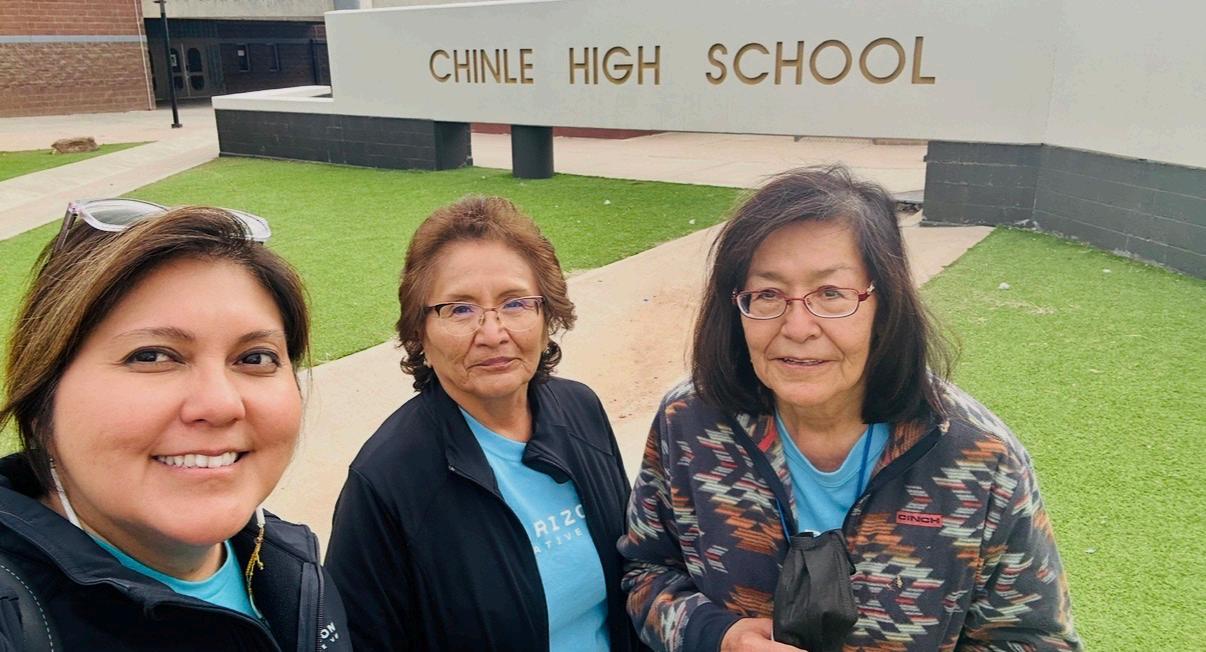
Arizona Native Vote supplements by teaching students about federal, state and country government roles. “These classes help with planning and showing how to talk about our issues,” she said.
One of the issues when registering to vote is showing the voters the difference between a physical address and a post office box and which is needed when registering to vote. Sometimes birth certificates are needed as well, she says.
The Arizona Native Vote team, which includes many volunteers, is all Native American. They have eight to 20 workers in the field at any given time. “We have a wide range of folks that we work with,” she said.
Parrish said students are 20% more likely to vote after seeing the curric-
ulum, and people are more likely to vote if they have friends or family members that vote. “It’s not just about elections. We need to know the issues and be involved all the time. It doesn’t stop when the election ends.”
Common questions that arise involved how to obtain tribal identification cards and how to contact local elected officials.
Parrish became involved in Native American voting issues when she was a student at Arizona State University. She says she learned a lot from former Navajo Nation Chairman Peterson Zah.
In 2020, Parrish became involved in supporting elections. “That laid the foundation for what I’m doing today.”
Born in Phoenix, Parrish was raised in both Phoenix and Kayenta, gradu-
ating from North High School before going to ASU. She became an intern for the local National Public Radio affiliate, worked for the Navajo Nations’ Lobbying Office in Washington D.C. and worked for Zah at ASU for eight years. She earned her master’s degree in public administration from Harvard University.
“It’s important to educate and get people more involved,” she said. “It’s important for people to know their rights and know tribal sovereignty. In order to get things done people need to work within the system.”
Parrish said her focus now is getting people to vote in the midterm elections. “If you care, do something about it. Make it your business. It matters,” she said. FBN
Parrish said students are 20% more likely to vote after seeing the curriculum, and people are more likely to vote if they have friends or family members that vote. “It’s not just about elections. We need to know the issues and be involved all the time. It doesn’t stop when the election ends.”
BY V. RONNIE TIERNEY, FBN
Jerry Furman brings modern pecan harvesting to Camp Verde orchards, supporting local growers
Since the first pecan crop was planted in 1927, the proliferation of pecan trees in Camp Verde has generated a pecan festival, a stretch of highway called Pecan Lane and a love for this nutritious nut.
Pecan trees cover an estimated 200 acres in Camp Verde and according to Town of Camp Verde Economic Development Director Christian Green, Camp Verde produces roughly 300,000 pounds of pecans annually.
“From my research, I’ve found that for every pound of pecans (in-shell) there are approximately 45 nuts. So, based on that number, we produce approximately 13.5 million pecans annually. “
Residents with pecan trees have come to one conclusion: pecans are one nut that’s hard to crack. But thanks to Verde Valley Pecans owner Jerry Furman, a sustainable solution is available. “My life partner, Kelly, and I moved here last October and purchased
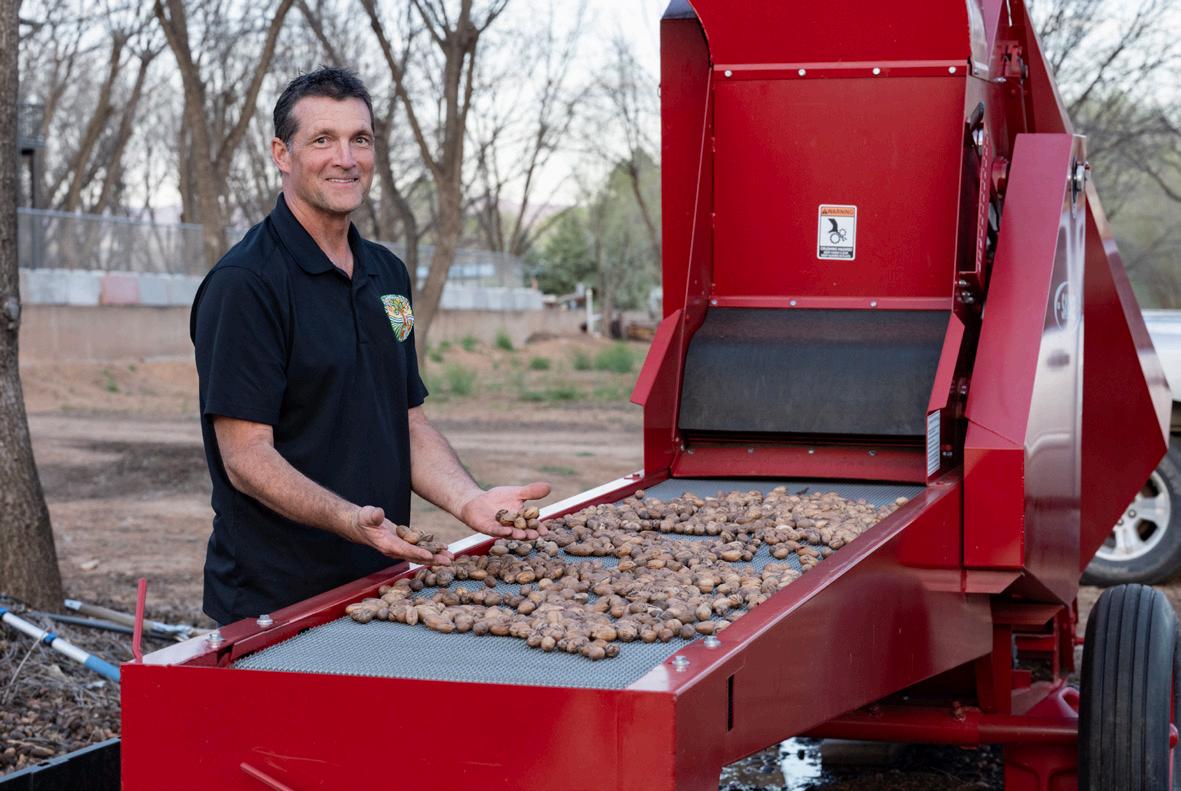
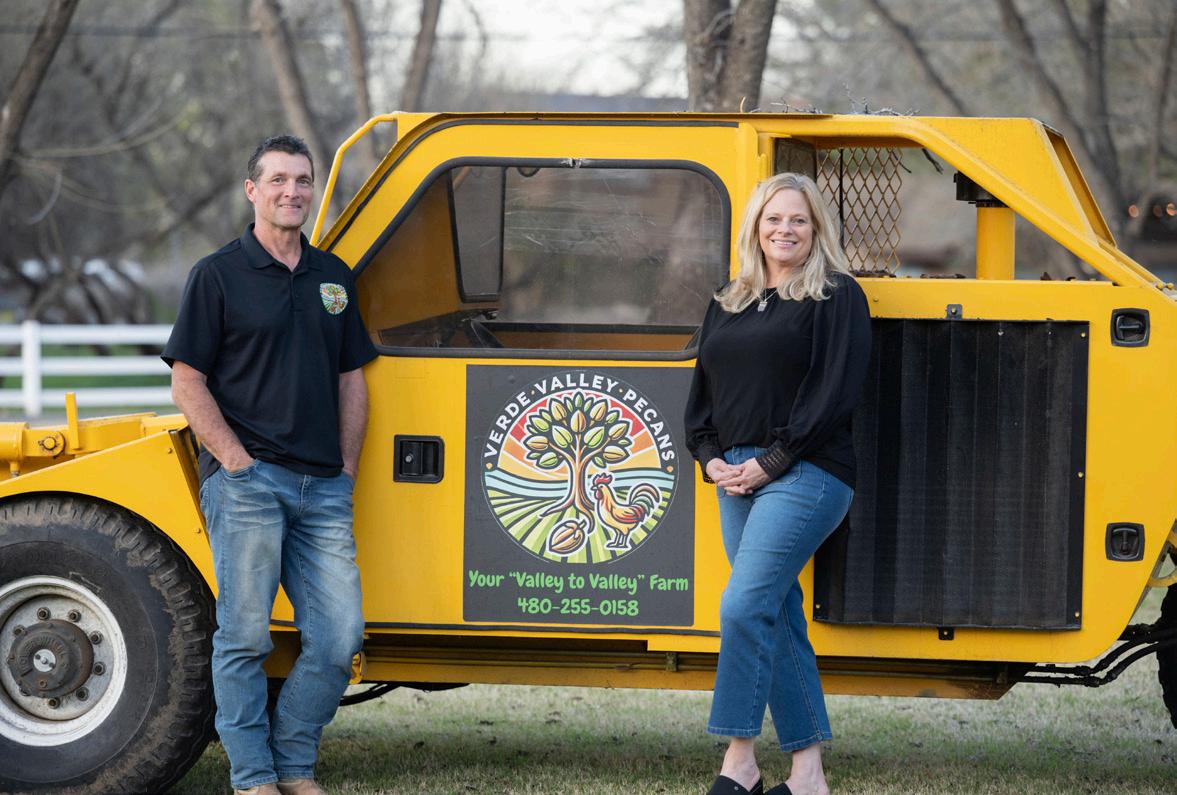
property with 138 pecan trees. We then purchased new and used equipment for processing pecans. Our equipment can shake the trees, clean, crack and weigh the nuts. We can box as well,” he said.
Shaking a pecan tree is also called mechanical harvesting, whereby Furman uses a tractor with a mounted device with specialized pads that shakes the tree for a few seconds to dislodge
the ripe nuts.
Along with selling pecans and pecan products, the mission of Verde Valley Pecans is to help other local growers keep productive and bring high-quality Arizona-grown pecans to market.
“Our goal is to support small and independent pecan orchard owners across the Verde Valley,” said Furman. “We want to support small and
independent orchard owners to provide affordable fertilizing, harvesting, cleaning and cracking services. We also want to be a connection between pecan growers to convey a sense of regional pride and to reinforce the deep-rooted agricultural tradition here.”
Family also helps on the farm. Forman’s step-daughter, Jordyn, helps with cleaning, cracking, roasting and
packaging the nuts and his two younger children help at farmers markets. “Kelly is a senior business director in the West Region and handles all our finances, website and so much more. She is my partner in the business, and I couldn’t do this without her.”
Selling raw and roasted pecans by the package, Verde Valley Pecans
Continued on page 37


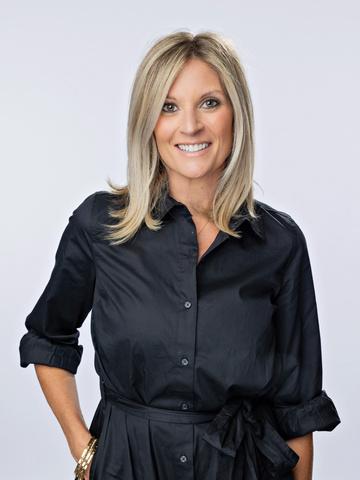
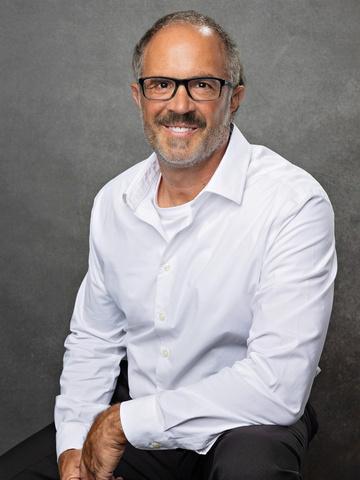
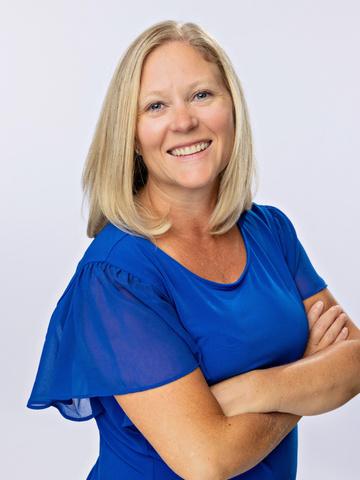
The '47 Club not only pays tribute to the year in which our company was founded but also serves as an opportunity to recognize the top individuals of Lyon's Elite, the top producers in our brokerage. These highly tiered advisors are recognized for their dedication and service to their clients.
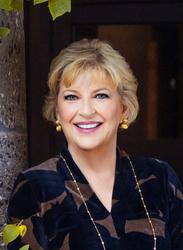
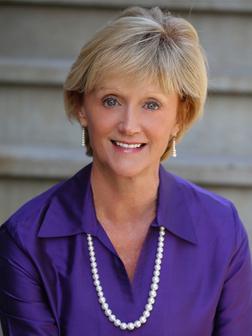
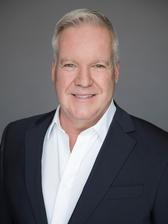
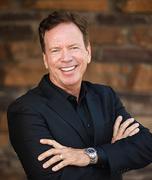

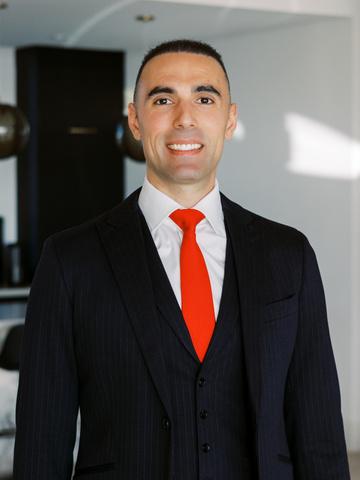




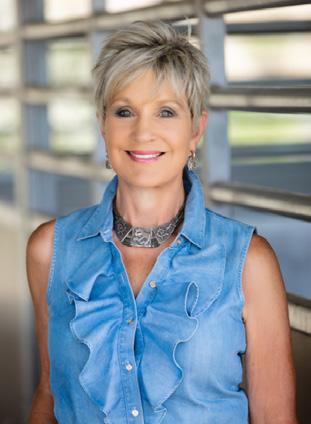

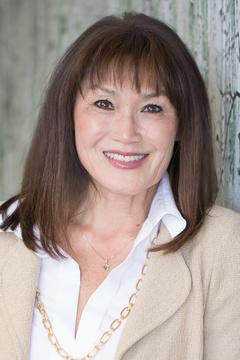
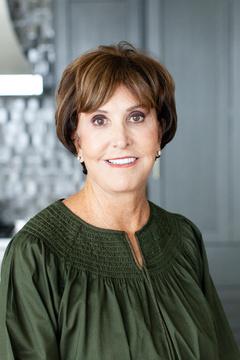

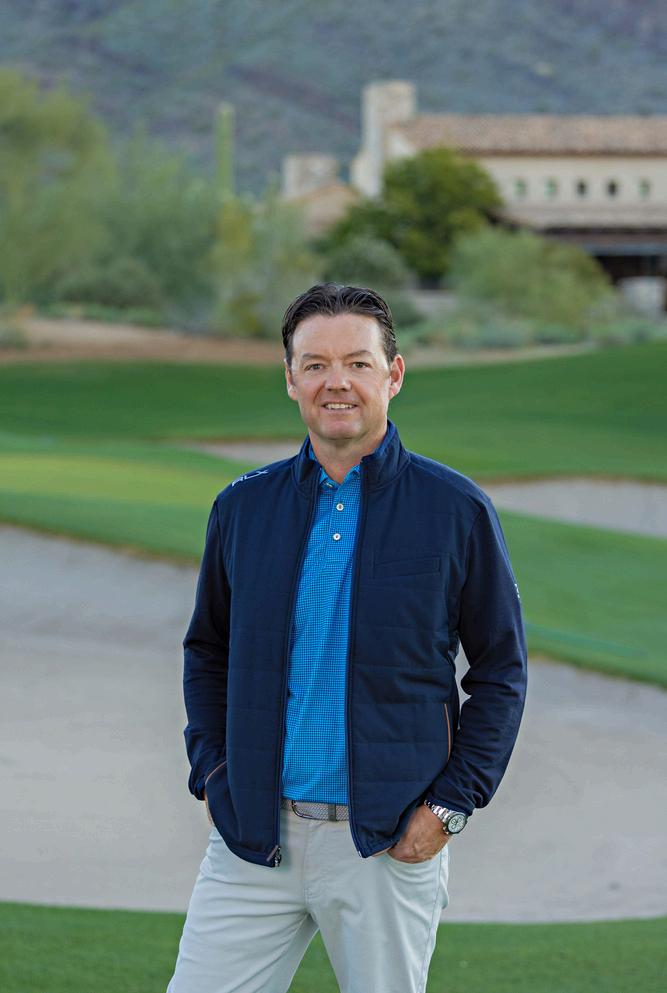
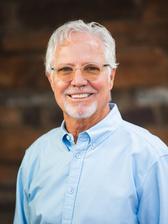
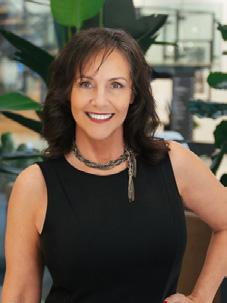
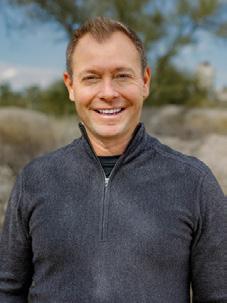
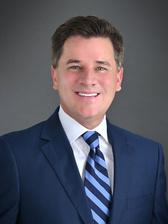
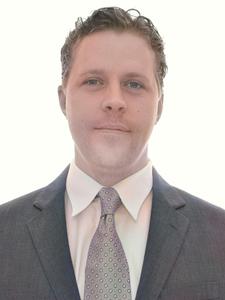
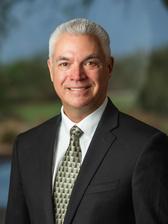
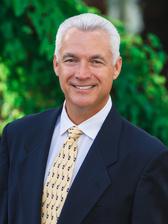
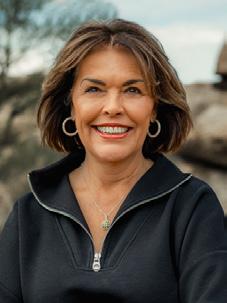
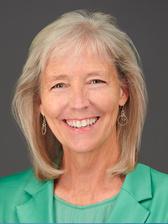
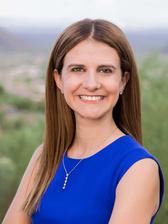

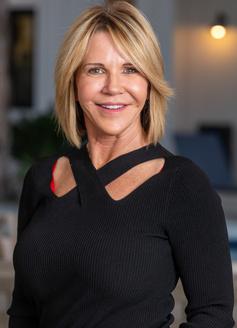
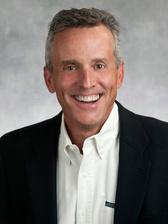

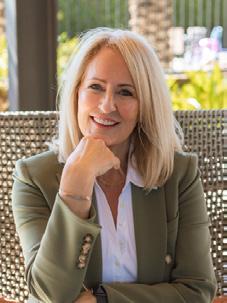
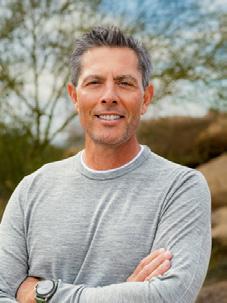
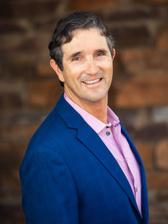


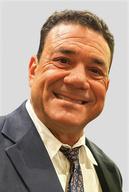

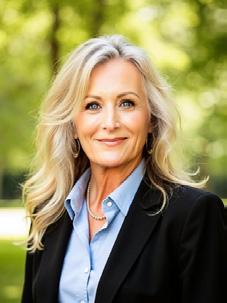

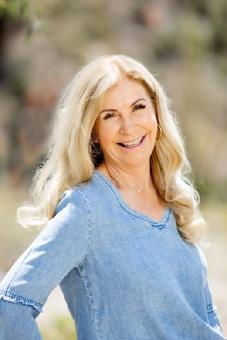
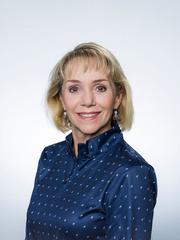

Year after year, our advisors set the benchmark for excellence We are proud to honor those consistently reaching new heights and pursuing excellence in life and in Real Estate. Please join us in celebrating the elite standards and dedication of our 2025 Advisor Recognition honorees from the Flagstaff Office






Heartland Ranch works to help children who have suffered from trafficking and abuse.
Currently, the nonprofit organization is calling on the community for support in the form of event sponsors, donations for live and silent auctions and table sponsors as it plans the 2nd Annual Hope for Little Hearts Fundraiser, 4-8:30 p.m., Saturday, May 16, at Heartland Ranch in Mayer.
Heartland Ranch is a sanctuary dedicated to restoring safety, dignity and hope for children who have endured unimaginable trauma. Funds raised go directly toward the construction and improvement of

Heartland Ranch is a sanctuary dedicated to restoring safety, dignity and hope for children who have endured unimaginable trauma. Funds raised go directly toward the construction and improvement of secure residential facilities in Mayer and the development of safe housing and therapeutic services. //
secure residential facilities in Mayer and the development of safe housing and therapeutic services.
The average life span of a trafficked person is only 25.
To donate to the live auction call Linda Thein, a Heartland Ranch volunteer, at 602799-0583. For tickets or more information, visit heartlandranchaz.org. //
The crisis of child trafficking continues to devastate families across the country. The statistics are staggering:
85% of children sold into sex slavery were abused.
60-70% of trafficked children come through child social services and foster care.
25% of sex trafficked victims are children with the average age of 12-14.

Delivering results means being responsive and adaptable. As your
Heartland Ranch’s environment has been designed to support comprehensive healing and recovery, addressing mental, physical and spiritual needs as the children work toward restoring and enhancing their well-being. Each home aims to provide a supportive and hopeful atmosphere conducive to growth and renewal. FBN

Connect with an expert banker at westernalliancebank.com/solvetoday
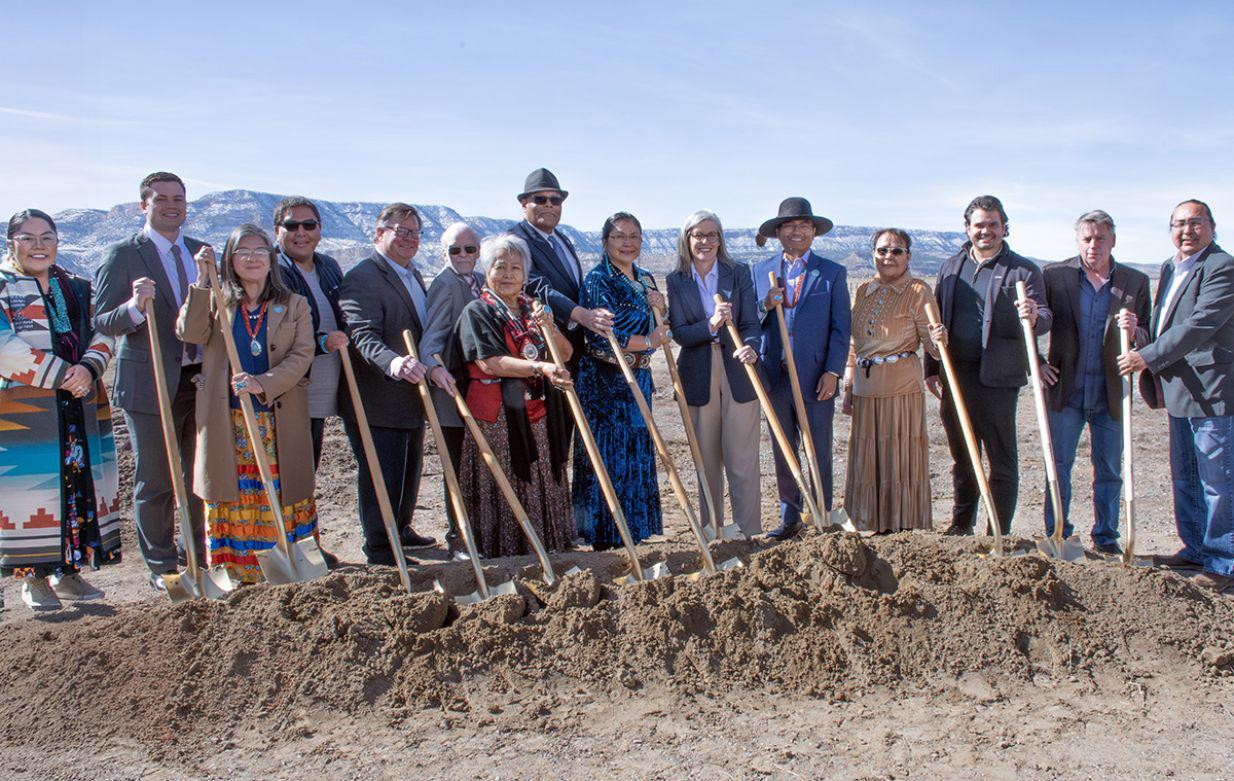
A groundbreaking celebration to increase educational opportunities on the Navajo Nation brought together key stakeholders in the project. Pictured here are Navajo Nation Council Delegate Shaandiin Parrish, NPC District Governing Board (DGB) members Porter Black, Kristine Laughter and Derrick Leslie, ACA Senior Vice President of Economic Development Keith Watkins, NPC DGB Chair Everett Robinson, NPC DGB member Rosie Sekayumptewa, NPC President Dr. Von Lawson, Arizona Senator Theresa Hatathlie, Arizona Governor Katie Hobbs, Navajo Nation President Dr. Buu Nygren, Kayenta Township Commissioner Chair Dr. Delores Greyeyes, CORE Construction Vice President of Higher Education Seth Beer, SPS+ Business Development Associate Rob Bass and Kayenta Township Manager Jarvis Williams. Courtesy photo
By Betsey Bruner, FBN
Alandmark moment for education on the Navajo Nation took place on Tuesday, Feb. 24 when representatives from Northland Pioneer College (NPC) gathered with tribal leaders, state officials and community members to break ground on the new NPC Kayenta Campus. The well-attended event united a large, excited crowd celebrating the power of education to shape the future of students.
The project, adjacent to Highway 160, will include the development of a two-building complex in Kayenta’s new industrial park, located near the Kayenta Alternative Rural Hospital. The buildings will be designed to house new academic facilities for NPC, including in-person and connected classrooms, science and health labs, a computer lab, a small business development conference room and a new location for the town’s library.
“Today’s groundbreaking represents a major milestone in expanding higher education access in rural Arizona,” said Governor Katie Hobbs, who attended the event. “By investing in facilities like the new Kayenta Center, we’re creating more education and career pathways for Arizonans in rural and Tribal communities that are vital to shaping our state’s future.”
Northland Pioneer College serves the residents of Navajo and Apache counties through
four regional campuses and five centers with a variety of academic, career and technical education programs, and personal enrichment classes.
Through the past three years, “particularly in response to the closures of the Black Mesa and Peabody Kayenta Coal Mines,” Northland Pioneer College has joined forces with local organizations and groups to work to boost economic development in northeast Arizona and Kayenta, according to an NPC news release.
“Your belief in this vision has helped turn hope into reality,” said NPC President Dr. Von Lawson, speaking at the event. “When I look into the eyes of children and see that unmistakable spark, I see possibility. I see a dreamer. And today, those dreams are closer to becoming a reality. Today, we witness dreams taking shape. This is not our campus. It belongs to you. It was born from your vision and advocacy. It was born from your belief in what is possible. We are simply here to serve you. This is your campus. Built because you dreamed it. And it will open because you believed in it.”
A broad coalition of support was behind the project, including NPC, the Arizona Commerce Authority (ACA) and the Kayenta Township. The Arizona Commerce Authority made a significant investment by applying for the $9 million Economic Transition Resources Grant, in collaboration with the Kayenta Township, the Kayenta Unified School District, Kayenta Health





By José Luis Cruz Rivera
Arizona is facing a healthcare crisis hiding in plain sight.
Our state has the largest nursing shortage in the country – an estimated deficit of 30,000 nurses –and nearly three million residents lack reliable access to primary care. In Flagstaff and across the region, families feel this reality every day:
longer wait times, stretched emergency departments and communities without enough skilled professionals to meet basic health needs.
Northern Arizona University was built to serve this region. And right now, meeting Arizona’s healthcare workforce crisis is one of the most pressing priorities we are working to address – because this challenge impacts our neighbors, our economy
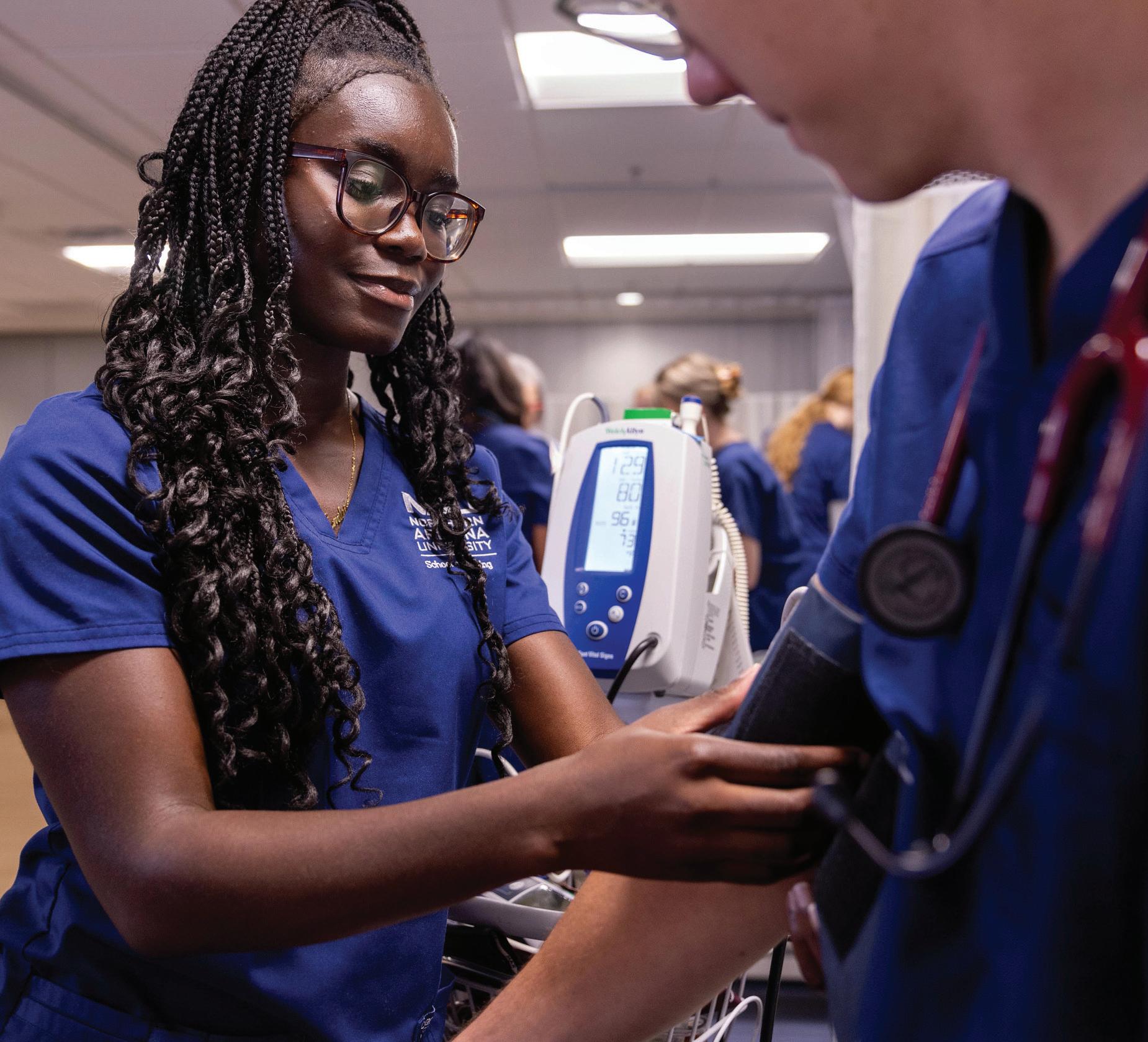
...demand has outpaced our capacity. Each year, up to 200 qualified applicants are turned away from NAU’s nursing programs – not because they aren’t ready, but because we don’t yet have the space to train them. This gift, alongside plans for a new 40,000-square-foot College of Nursing facility, will change that. We expect to grow enrollment substantially in the years ahead, dramatically expanding the pipeline of graduates ready to enter high-demand roles across Arizona.
and the long-term health of every community we serve. NAU has both the responsibility and the ability to train the workforce Arizona needs.
That’s why the recent naming of the Maria and Steve Sanghi College of Nursing is so significant. This milestone is a concrete investment in Arizona’s health future and will allow NAU to elevate its role as a preeminent engine of opportunity – providing access, exceptional education and experiences, and impactful workforce outcomes that benefit our community and our state.
Maria and Steve Sanghi, two of NAU’s most dedicated supporters, have made one of the most meaningful philanthropic commitments in our university’s history. Their gift establishes new resources for academic excellence, career readiness, leadership development and faculty impact. It creates a distinguished deanship to provide sustained, strategic direction for the college for decades to come. And it sends a clear signal: the work happening in Flagstaff is preparing the professionals Arizona desperately needs.
The numbers behind that work are compelling. More than 80% of NAU nursing graduates stay in Arizona after graduation. They go into hospitals, clinics, rural health centers and Tribal communities. They become the providers and leaders who keep our health care system functioning. When we invest in NAU’s nursing program, we are investing directly in the health infrastructure of our state.
But demand has outpaced our capacity. Each year, up to 200 qualified applicants are turned away from NAU’s nursing programs – not because they aren’t ready, but because we don’t yet have the space to train them. This gift, alongside plans for a new 40,000-square-foot College of Nursing facility, will change that. We expect to grow enrollment substantially in the years ahead, dramatically expanding the pipeline of graduates ready to enter high-demand roles across Arizona.
For Flagstaff and the surrounding region, this matters in immediate, practical ways. Nurses trained here stay here. They staff our

local hospitals. They serve on Tribal lands, in rural communities and in underserved neighborhoods where access to care has long been out of reach. Every nurse we graduate is one more skilled professional, closing a gap that has real consequences for families.
Healthy communities are the foundation of everything else we want for Arizona – strong schools, growing businesses, vibrant neighborhoods. You cannot build any of that sustainably without a healthcare workforce that can meet the need.
Maria and Steve Sanghi understood that when they made this investment. We are honored by their partnership and their trust in NAU to deliver on this mission. I look forward to continuing to fulfill NAU’s promise to Arizona – beginning right here at home. FBN








2321 N. Fourth St. Flagstaff, AZ 86004
(928) 526-5691
crestins.com
Commercial Broker Ryan King to our team!
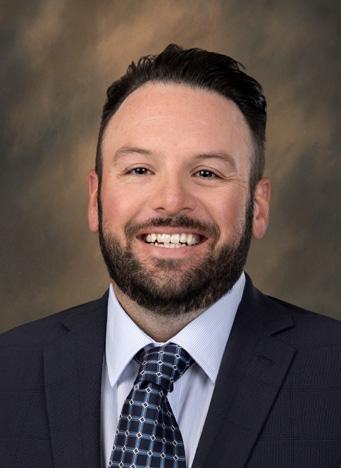
Ryan King Tom Turner
Ryan is a third generation Flagstaff native with countless ties to the community. Tom is a true insurance professional with over 40 years of experience in the industry. Along with Crest, we are set up to help with any insurance need out there.
• We specialize in Commercial Property, General Liability, Workers’ Compensation, and Commercial Auto Insurance.
• We provide access to several specialized and competitive markets.
• Our local office provides the opportunity for in-person consultations and superior customer service

By Maraka Oltrogge
May is Mental Health Awareness Month, an annual observance established by Mental Health America in 1949 to emphasize the importance of mental well-being. The month of May is the time to raise awareness and reduce the stigma surrounding behavioral health issues, as well as highlighting how mental illness and addiction can affect all of us.
• Top 100 P/C Agency for 7 consecutive years
• Dedication to continuing education with changing markets and new programs
• A vast amount of insurance resources with offices in six states.
• Crest gives back to the community and we sponsor countless organizations.

www.crestins.com
This observance brings additional attention to the challenges faced by those with mental health conditions and the need for a supportive, understanding environment. Despite years of advocacy, awareness and discussion, the stigma around mental health still exists. People can still suffer in silence, brush off emotional struggles or feel ashamed to seek help. Mental health struggles are more common than we might realize. According to the National Institute of Mental Health, one in five adults in the United States experiences mental illness in a given year.
Mental wellness is crucial for overall health and well-being. It influences all aspects of our life, from our physical health and relationships, to our ability to cope with challenges and make decisions. By building a solid mental foundation, including emotional resilience, healthy coping skills, strong relationships and self-awareness, we can arm ourselves with the tools needed to withstand challenges.
Promoting wellness is not a one-person job, it’s something that we all must do as a community. There are times when mental health issues get dismissed; physical injury gets sympathy and support, but anxiety, depression or trauma may get minimized or those experiencing it can feel shame or blame that they wouldn’t feel with physical health issues. The gap between how we treat mental health versus physical health needs to close.
Northern Arizona Healthcare’s Role Hospitals and health systems play an important role in the conversations we have about mental health care. Northern Arizona Healthcare (NAH) knows that mental health is an important issue in our region, and has a continued commitment to expanding our behavioral
health services. This expansion of care helps to ensure that access to quality services is available to all, by providing mental health care close to home.
And, as part of its long-standing commitment to supporting all organizations that work in the realm of behavioral health care, NAH will ensure that the community has access to the full continuum of care for all who need it.
Flagstaff Medical Center (FMC) currently offers both inpatient and outpatient behavioral health care to patients from across Northern Arizona. NAH also provides integrated care, with licensed psychologists practicing in its Coconino County and Yavapai County primary care clinics, realizing the connection between patients’ physical and mental health conditions.
Taking care of one’s mental health is ongoing work, just like physical health, and it needs daily attention and care. By continuing to have open conversations about mental health we can reduce stigma, while encouraging regular check-ins with both loved ones and health care providers. NAH is here to help create a culture where seeking help for your mental health is seen as a strength and not as a weakness. FBN
To learn more about FMC’s Behavioral Health and Psychiatry services, please visit https://www.nahealth.com/behavioral-health-and-psychiatry/.
The national mental health hotline is 988. When you call or text this number, you are connected with crisis intervention services here in Arizona.
In recognition of Mental Health Awareness Month, NAH’s Office of Philanthropy has partnered with local organizations and businesses to host a series of Mental Health Matters events throughout the month of May. NAH is so thankful for our community partners who have joined us in this effort, including our co-title sponsor, Health First Foundation of Northern Arizona. The next edition of Flagstaff Business News will have more details on these events, and readers can also visit nahealth.care/mental-health-matters for more details.
By Yuri Lewicky, M.D.
Approximately one in three adults in the United States have some form of arthritis, a condition in which one or more of your joints is damaged. Although arthritis is more prevalent in weight-bearing joints, such as knees and hips, shoulder arthritis is the third most common joint to require surgery, since it can be a particularly debilitating condition.
The shoulder joint is where the humerus bone of the upper arm connects with the glenoid – the socket on the side of the shoulder blade. Shoulder arthritis happens when the cartilage between the humerus and the glenoid breaks down, causing bone-on-bone contact. This leads to irregular motion in the joint, inflammation, pain and limited mobility.
SYMPTOMS
The most common symptom of any kind of shoulder arthritis is pain. People often describe a deep pain that gets worse with activity and better with rest. The pain is usually worse with overhead activities like throwing a ball, washing your hair or reaching for something in a top cupboard. The second most common symptom is a loss of movement in the shoulder. Other symptoms may include:
Weakness
A grinding sensation or sound (called crepitus)
Difficulty using the affected arm In more advanced stages of shoulder arthritis, many patients report pain at night that interferes with sleep.
Osteoarthritis, or degenerative arthritis, is generally caused by a deterioration of cartilage over time from the normal aging process. Cartilage is the smooth, shiny white covering on the end of bone that keeps the bones from rubbing together. It acts as a lining to the joint. It is very thin (3 mm or less, depending on the joint) and unable to heal once injured. The normal wear and tear of life or the brisk tempo of sports can gradually wear it down.
Furthermore, the development of osteoarthritis can be from many other factors. Many people have a genetic predisposition to develop arthritis over their lifetime.
DIAGNOSIS
In order to diagnose shoulder arthritis, a physician will ask the patient about their symptoms and medical history and perform a physical examination. Typically, patients with advanced

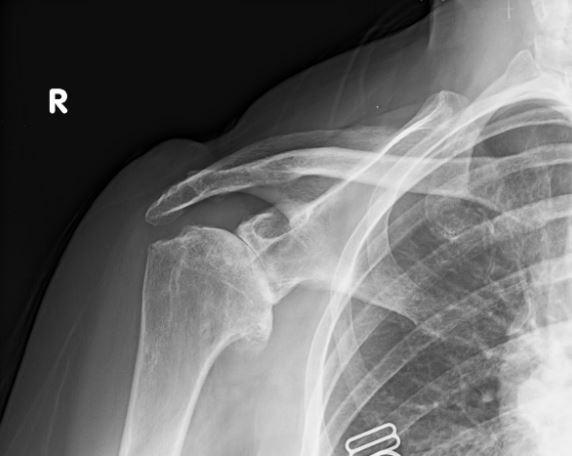
arthritis will be unable to elevate their arm to the level of the shoulder and have limited rotation of their arm away from their body. X-rays can be used to evaluate and confirm the degree of arthritis and the amount of bone loss. An MRI and CT scan may also be needed.
Nonsurgical treatment options Shoulder arthritis treatment depends on:
What kind of arthritis is present
Which joint(s) is/are affected
How disabling and painful the disease is Arthritis treatments are aimed at
reducing pain and restoring motion. Some of the treatments available include:
The first line of treatment for shoulder arthritis is physical therapy. Although physical therapy cannot replace any of the damaged cartilage, it may help to improve pain and movement. A physical therapist may recommend specific stretches for muscles and ligaments to restore some motion and offer pain relief. A therapist may also use manual therapy to stretch the ligaments, tendons and muscles in ways that are
difficult to do on your own. Physical therapy will also focus on strengthening the muscles to better hold the shoulder joint in the socket and assist with movement.
Pain management is an important part of coping with shoulder arthritis. It may include:
Ice: Ice packs can be used once or several times a day for 20–30 minutes at a time to reduce painful inflammation.
Heat: Some people prefer heat for
Continued on page 37

By Donna Werking
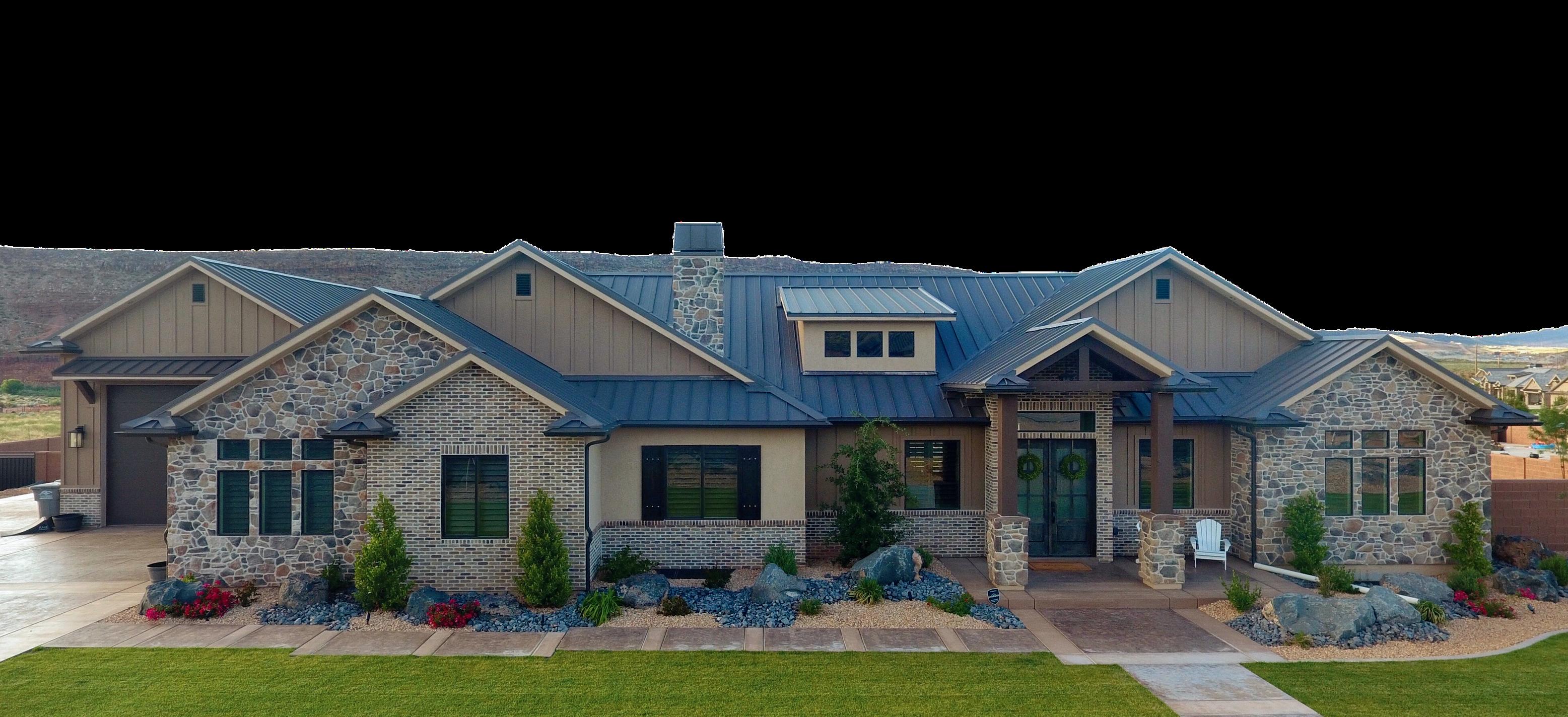
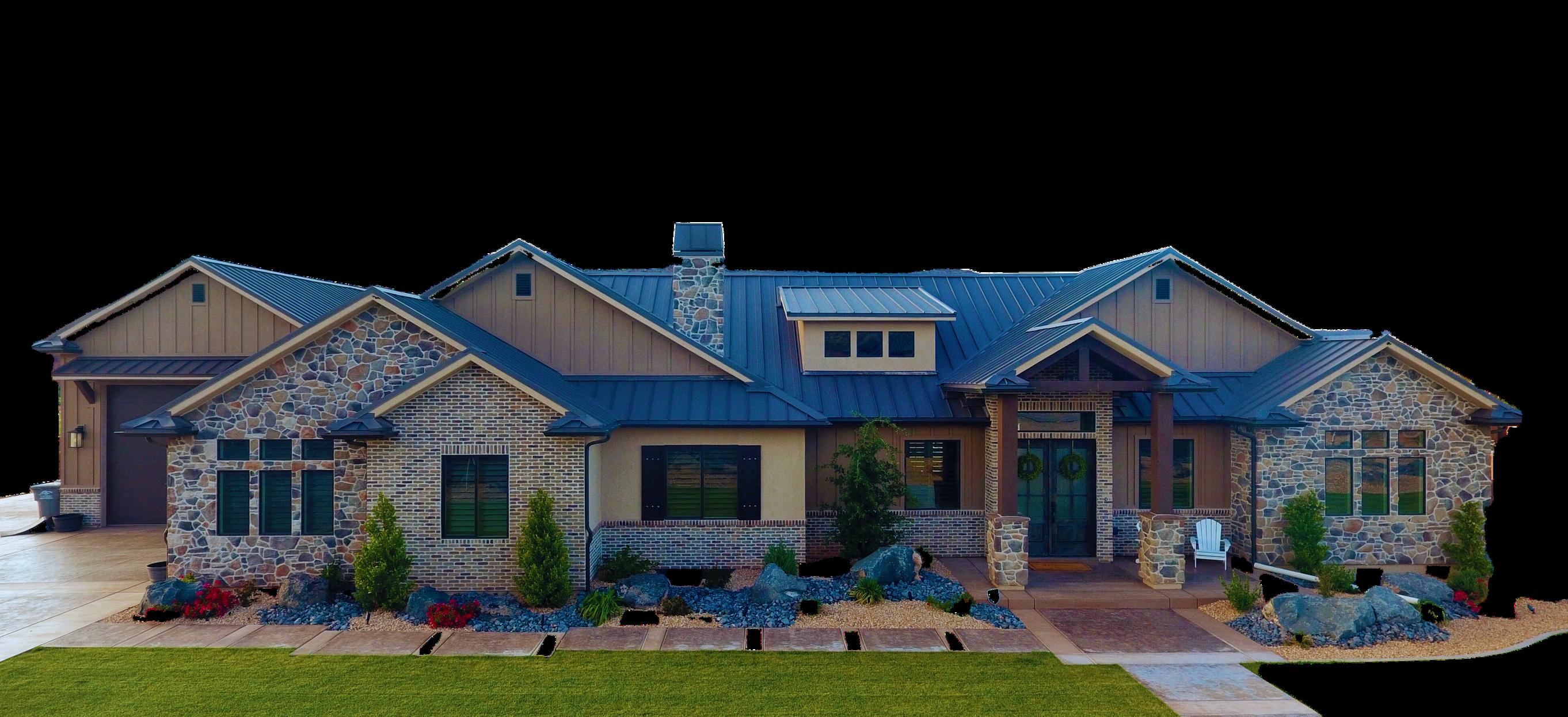
Tri-State Metal Roofing Supply,
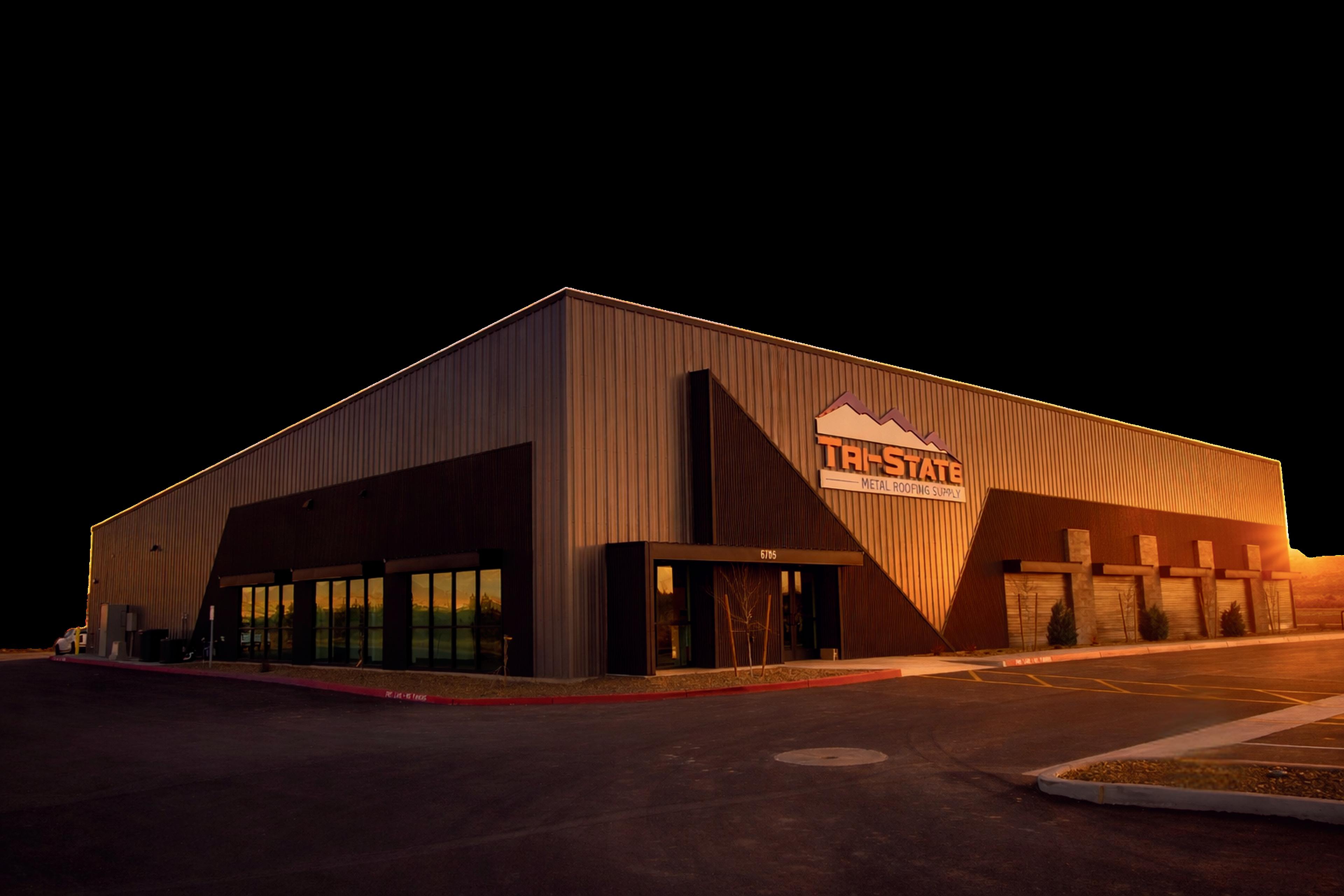
a fast-growing manufacturer of American-made metal roofing and siding products, is preparing to celebrate the official grand opening of its new Prescott manufacturing facility on Thursday, April 30.
The event, scheduled from 11 a.m. to 4 p.m. at 6705 Generation Lane, will welcome homeowners, contractors, builders and community members to tour the facility and learn more about the company’s direct-to-customer model serving Arizona’s growing construction market.
Founded in May 2016 in St. George, Utah, Tri-State Metal Roofing Supply was established by partners Kortney Leavitt, Jason Norton and Kalan Lemon. Together, the trio brings more than five decades of manufacturing and construction industry experience, including more than 30 years of specialized expertise from Norton.
Since its founding, the company has quickly grown into a regional leader by focusing on fast turnaround times, high-quality American-made materials and strong relationships with contrac-
tors and homeowners.
“Our mission is simple: keep roofs solid and communities strong,” Lemon said. “We believe in hard work, honesty and real relationships. Whether it’s a ranch, a commercial building or a family home, we want to help people protect what they’ve built with materials that last.”
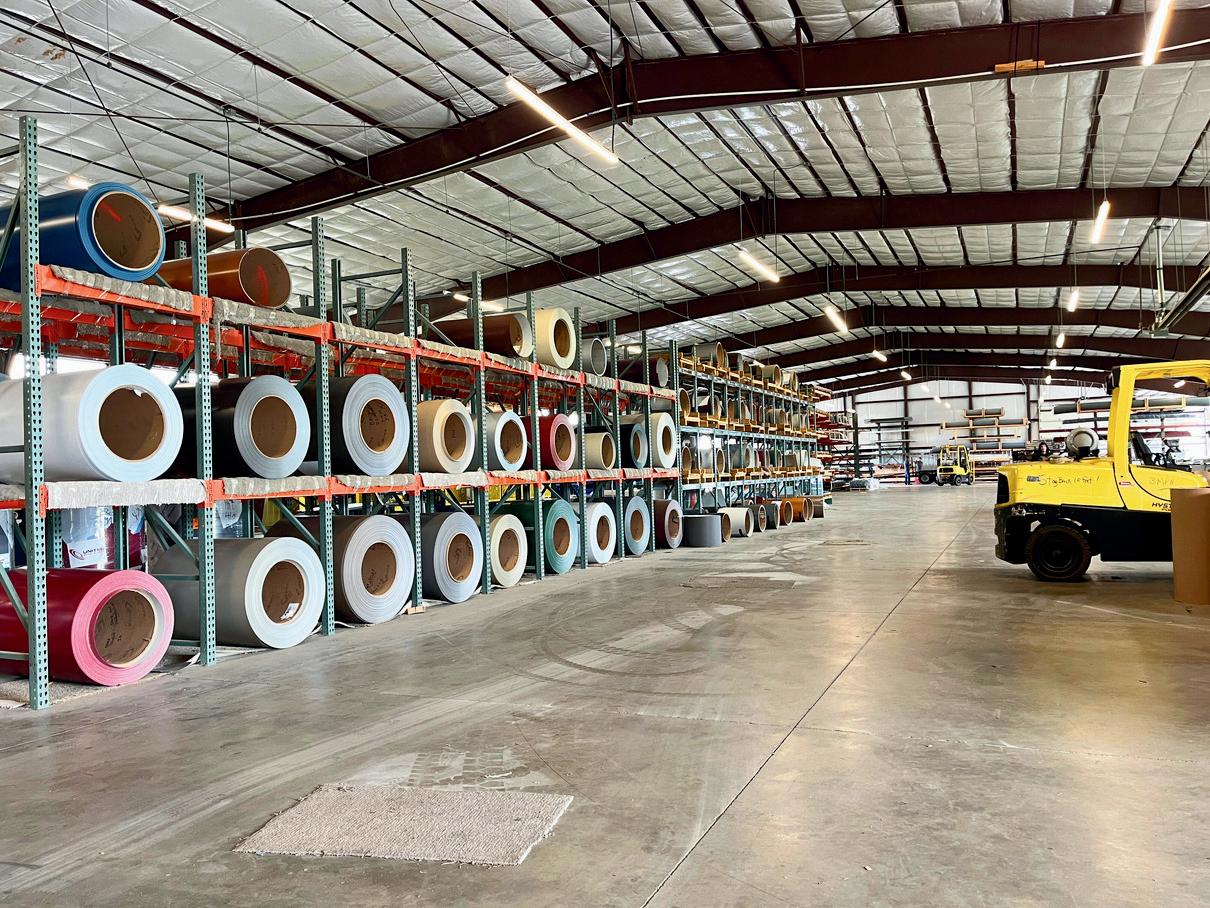
The Prescott facility marks a major step in the company’s expansion throughout the Southwest and will serve customers across Arizona with metal roofing panels, siding materials, trims and accessories, including custom fabrication options for specialized building projects.
Unlike traditional roofing materials such as asphalt shingles or tile, metal roofing offers long-term durability, energy efficiency and full recyclability – advantages the company says are increasingly important to builders and homeowners seeking sustainable construction solutions.
Tri-State partners said Prescott quickly emerged as the ideal location for the company’s Arizona operations.
“The people and the tight-knit community felt like home to us,” said Leavitt.
“That sense of community is exactly
what we want our brand to represent.”
The new facility was constructed in partnership with JEBCO Construction Companies, a Northern Arizona general contractor led by owner Jeb Johnson. The project reflects the shared commitment of both companies to craftsmanship, reliability and long-term community investment.
“There were many capable commercial builders in the Prescott area, but with Jeb and his team, we felt an immediate friendship,” Leavitt said. “They’ve been professional, reliable and an absolute pleasure to work with throughout the process.”
Johnson said the project showcases both companies’ dedication to quality and efficiency.
“Tri-State’s ability to manufacture top-tier products with virtually no lead times, combined with JEBCO’s commitment to delivering on schedule, makes this project a showcase for quality and reliability,” Johnson said. “We’re honored to play a role in bringing TriState’s vision to life here in Prescott.”
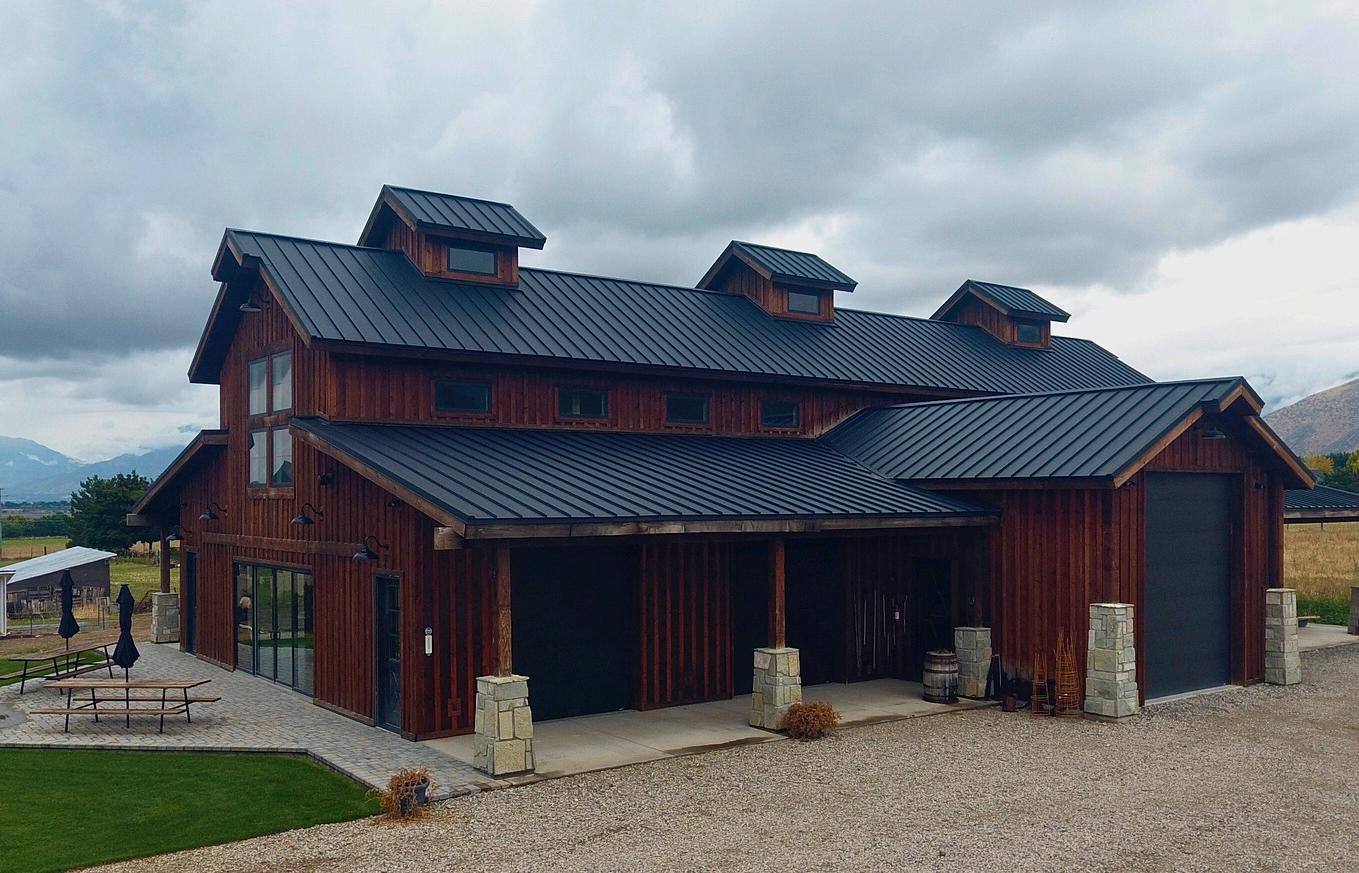
The new manufacturing site also incorporates several unique design elements, including Tri-State’s signature wood-grain steel paneling, which repli-
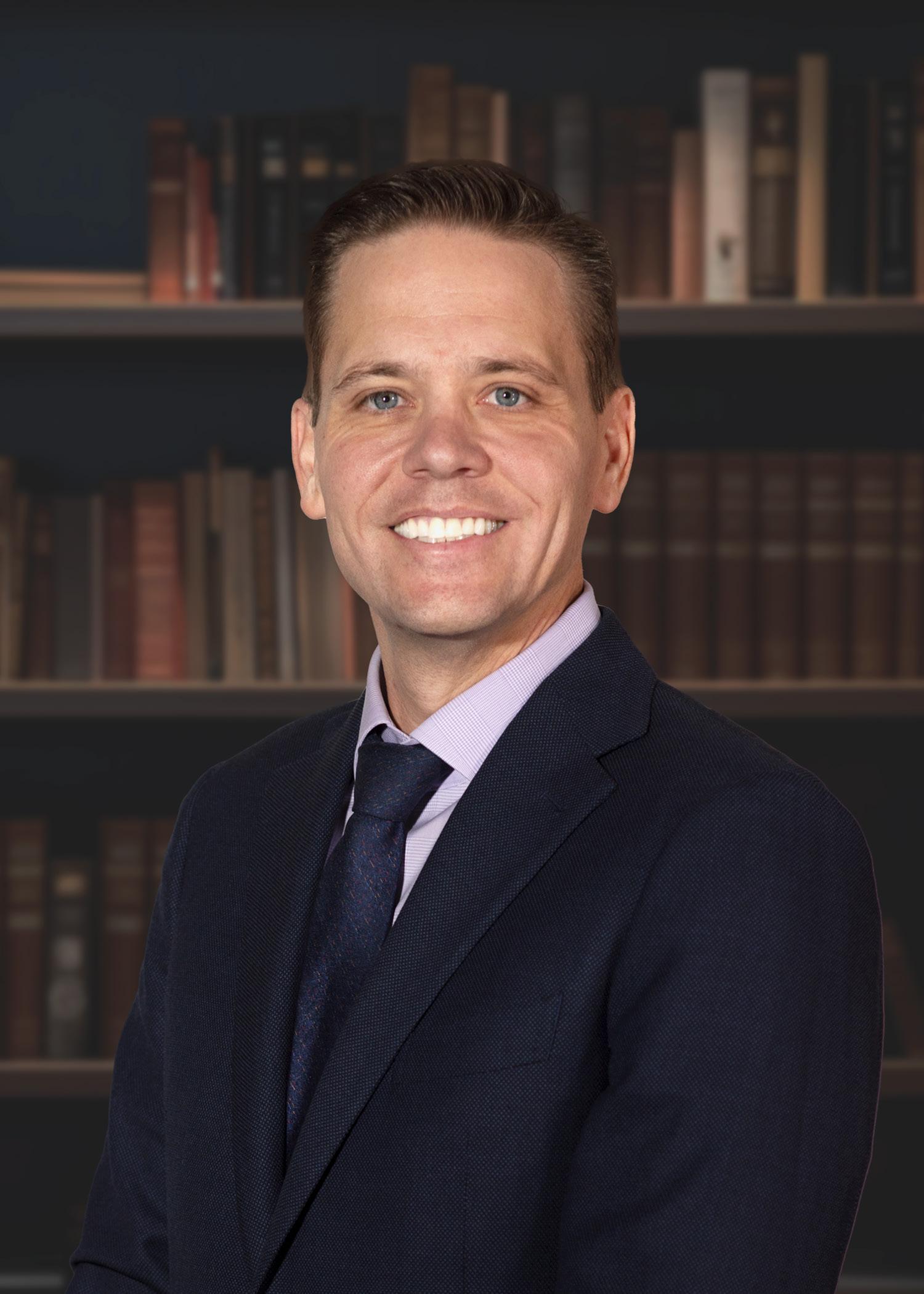
cates the rustic look of barn wood while maintaining the durability of steel.
The property itself carries special meaning for the community. The land was originally owned by the family of a longtime Prescott resident who had planned to develop the site but passed away before construction began. TriState and JEBCO worked together to reimagine the property, transforming it into a modern manufacturing facility designed to support the region’s building industry.
Company leaders say the Prescott location will help strengthen Northern Arizona’s construction supply chain by offering contractors and homeowners a direct source for high-quality metal roofing materials.
As Prescott and surrounding communities continue to grow, Tri-State expects the facility to create new local jobs while helping meet the rising demand for durable building products.
“We’re in a growth stage,” Norton said. “As Prescott continues to grow, we want to grow right along with it. Our goal is to expand this facility over time, adding options and creating even more jobs for
people in the community.”
The public is invited to attend the April 30 grand opening celebration. A complimentary lunch will be provided from 11 a.m. to 1 p.m., and a ribbon cutting hosted by the Prescott Valley Chamber of Commerce is scheduled for 1 p.m.
Guests will also have the opportunity to receive complimentary Tri-State hats and T-shirts while supplies last and enter prize drawings that include tickets to Northern AZ Wranglers football games at Findlay Toyota Center, concert tickets provided by Nackard Pepsi and a rodeo box for six at Prescott Frontier Days – World’s Oldest Rodeo. FBN
With its new Prescott facility now open and serving customers across the state, Tri-State Metal Roofing Supply aims to become a trusted partner for Arizona builders looking for durable materials, reliable service and the ability to buy direct from the manufacturer. Learn more at www.tri-statemetalroofing.com.

Donna Werking is the owner of Northern AZ Social, LLC.

Blake Robert Obrock, DO, is a fellowship-trained orthopedic surgeon specializing in sports medicine and advanced shoulder and knee care at Northern Arizona Orthopaedics. He treats a wide range of conditions including ACL injuries, rotator cuff tears, cartilage damage, fractures, and tendon injuries, offering both surgical and non-surgical treatment options.
Dr. Obrock performs advanced procedures such as shoulder and knee arthroscopy, rotator cuff repair, cartilage restoration, total knee replacement, and biologic treatments including platelet-rich plasma (PRP) therapy.
He completed his Orthopedic Sports Medicine fellowship at the University of New Mexico, serving as a team physician for NCAA Division I athletics, including the New Mexico Lobos football team. He previously practiced in Texas as Clinical Adjunct Faculty at Texas Tech University and served as team physician for the Amarillo Sod Poodles, Canyon High School, and the PRCA Rodeo.
Dr. Obrock is committed to helping patients return to the activities they love.
Schedule an appointment today.
Northern Arizona Orthopaedics
With locations in Flagstaff, Prescott Valley, and the White Mountains, NAO provides comprehensive orthopedic care with over 50 years of trusted experience.
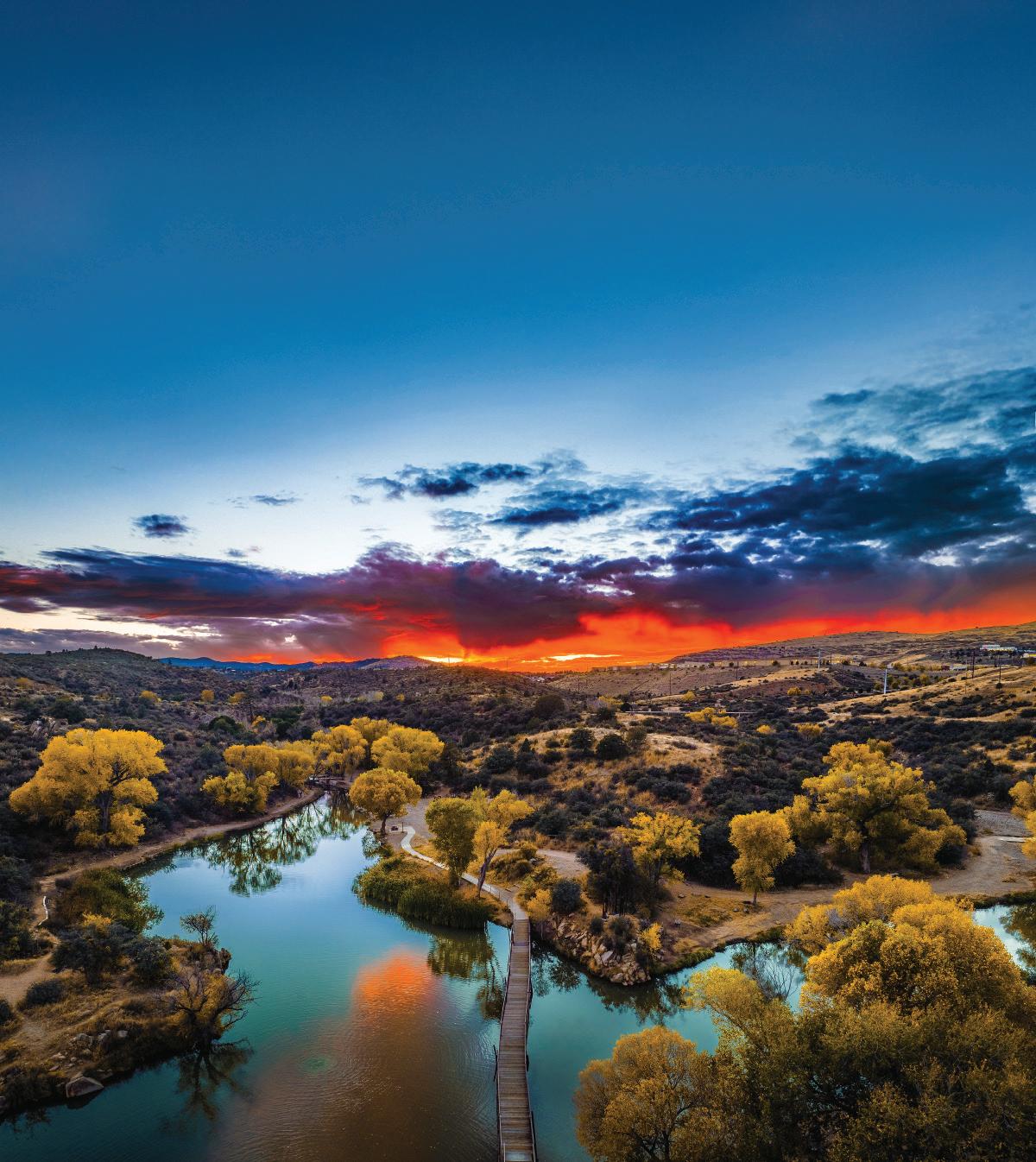

The Arizona Traveling Museum commemorating America’s 250th anniversary will stop in Flagstaff from 10 a.m.-4 p.m., Monday, April 6, at the Flagstaff Visitor Center, 1 E. Route 66. The event, presented by the Arizona America250 Commission, is free and open to the public. The mobile tour of all 15 Arizona counties began Feb. 14 in Prescott.
The Arizona Traveling Museum is designed to generate enthusiasm and civic pride in celebration of the 250th milestone, bringing history, storytelling and civic reflection to cities, towns and rural communities across the state. Stops and additional events are scheduled at America250az.org and @ America250AZ on social media.
“Road to 250 is about making this milestone accessible to every Arizonan,” said Arizona Secretary of State Adrian Fontes, chair of the Arizona America250 Commission. “By traveling to communities across the state, this museum invites people to reflect on our shared history, celebrate Arizona’s role in America’s story, and consider how each of us contributes to the next chapter of our democracy.”
Flagstaff’s stop will be just steps away from Mother Road Brewing Company, which brewed and canned the commemorative state beer for the anniversary. The beer is called AZ250 Arizona Lager and is available in stores and at the downtown Flagstaff taproom. The brewery donates $2.50 from every case sold to support historical education and community initiatives across Arizona.
Road to 250: Arizona Traveling Museum blends national history with Arizona’s unique story through immersive panels, a short looping video and interactive activations for all ages. The exhibit explores defining moments in American history and the people, cultures and communities that shaped Arizona, while inviting visitors to participate by sharing their own stories through a “Dear America, Love Arizona” postcard activity.
The centerpiece of the traveling museum is a replica of the Liberty Bell, one of a limited number across the country. The bell, which typically resides at the Arizona State Capitol, will travel with the museum as a powerful symbol of freedom, independence and civic responsibility. FBN
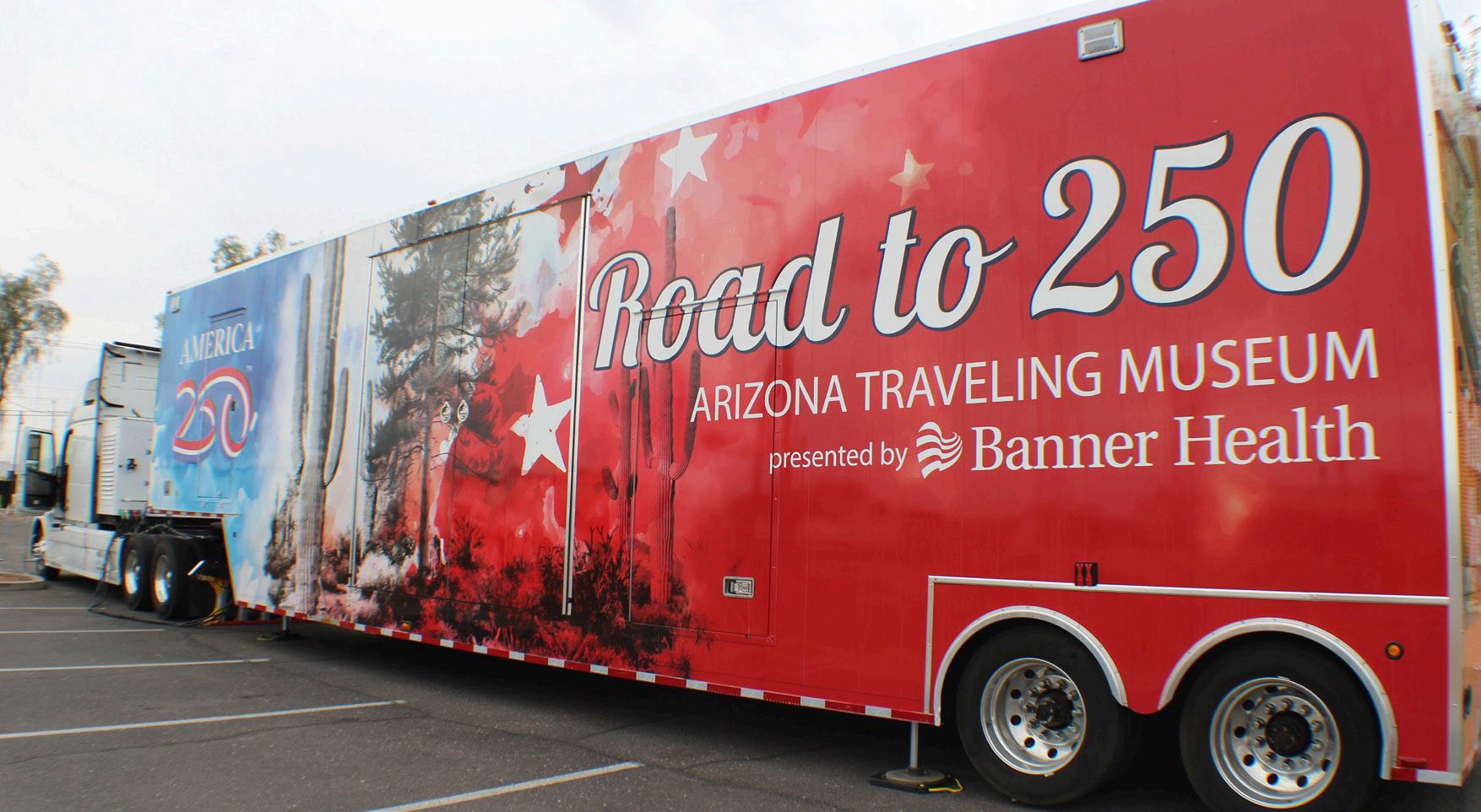
Road to 250: Arizona Traveling Museum will make dozens of stops statewide thanks to the generous support of Banner Health, Arizona Public Service, Blue Cross Blue Shield of Arizona, Salt River Project, Freeport McMoran and other sponsors.
About the Arizona America250 Commission
The Arizona America250 Commission is a nonpartisan effort to commemorate the nation’s 250th anniversary by honoring Arizona’s role in American history, cele-
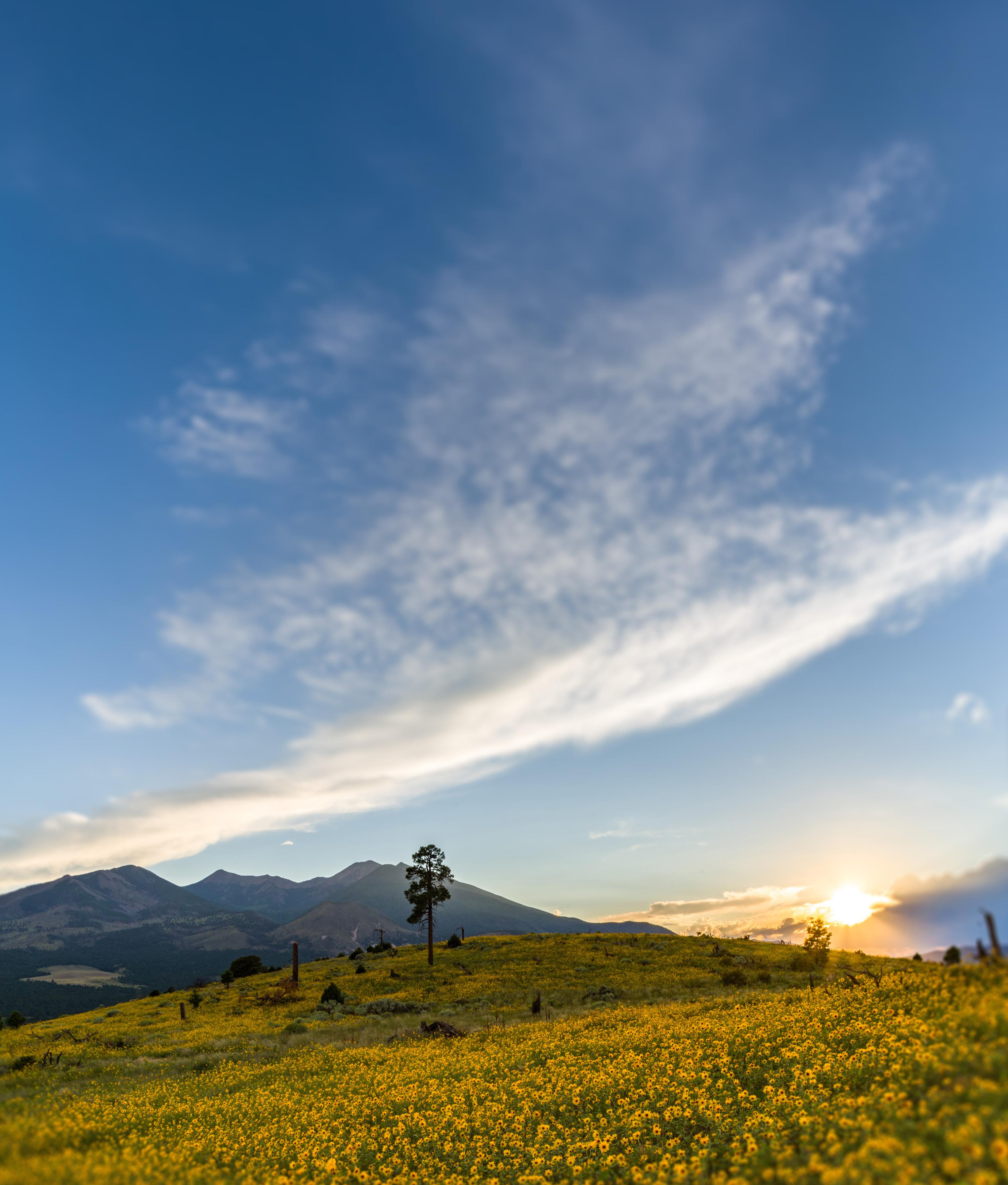
brating stories from across the state, and inspiring civic pride in all communities. To learn more about the Arizona America250 Commission, visit www.america250az. org.
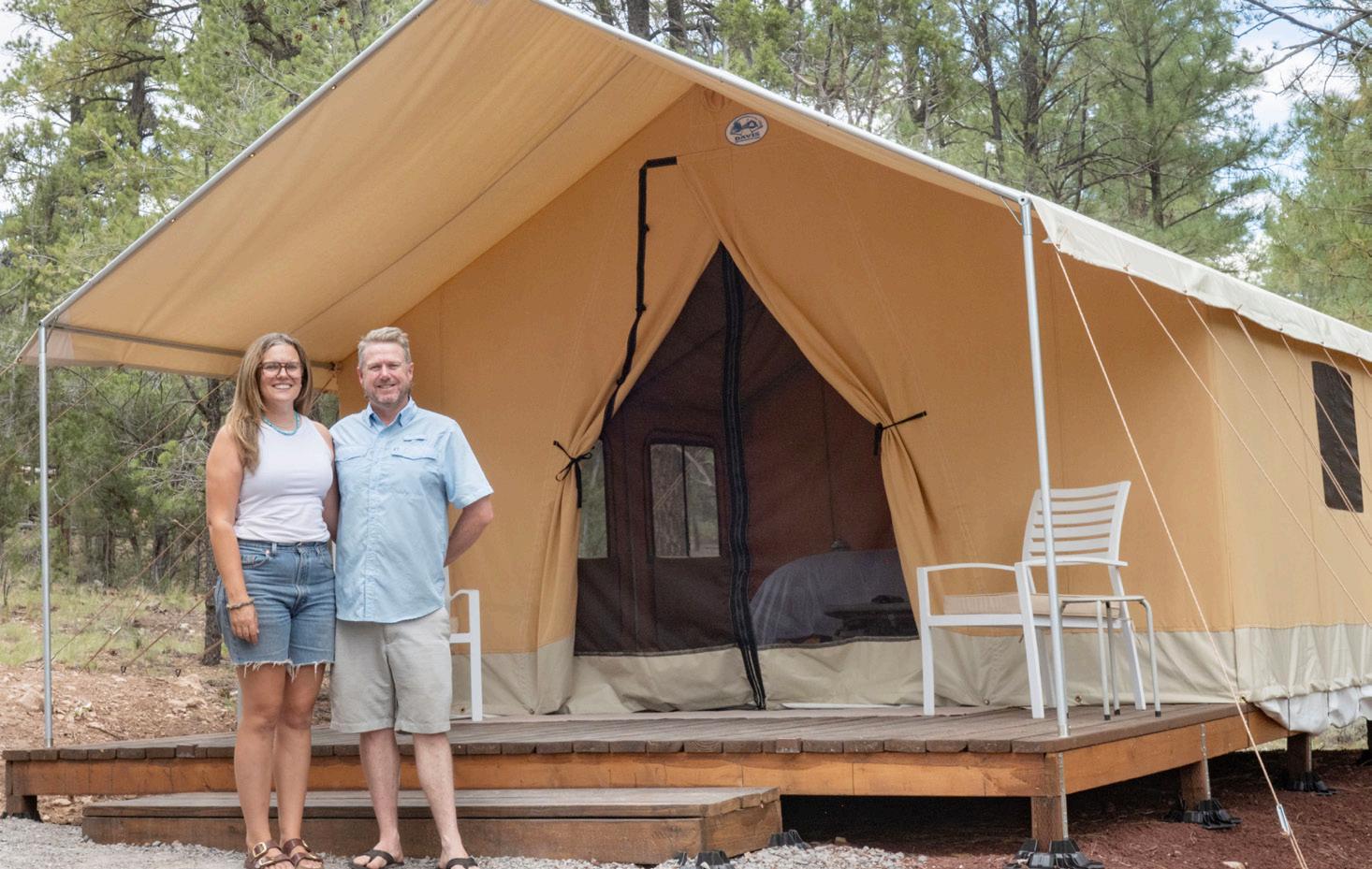
Swann family transforms generational Grand Canyon land into eco-conscious glamping designed for comfort, connection and dark-sky wonder
By V. Ronnie Tierney, FBN
When Fabienne Swann’s grandfather accepted a position at the Grand Canyon as an engineer for Fred Harvey in the early 1960s, it was a move that eventually stirred interest in the family to purchase property on the outskirts of this world-renowned chasm.
The private land on the southwestern outskirts of the Grand Canyon has been in the family for more than 50 years and was home to Fabienne until she was 18. She attended Grand Canyon School and enjoyed life around the South Rim village.
After attending college, Fabienne met her Australian-born husband, Bass, and has returned to the Grand Canyon with plans to share the love of their land with others at their Highland Grand Canyon Glamping Retreat.
The couple, who refer to themselves as “passionate adventurers and nature lovers,” have spent years camping and exploring national parks and had envisioned outdoor accommodations that reflect safari-style tents with rustic charm and cozy comforts.
“We got a taste of glamping in Kanab Utah and we fell in love with it,” said Bass. “That’s when we decided to start our business, Highland Grand Canyon Glamping Retreat. We wanted to create a space where people can escape, recharge and connect with nature without giving up the comforts of home.”
“We pitched the idea to my family to see if they would be on board with us moving back and starting a business on their property,” said Fabienne. “They agreed and have been a huge help every step of the process, emotionally, physically and educationally. They have even helped build decks, tamp down gravel, stain decks and put up tents. All in all, it’s been fun. This is such an important piece of property. We want to do everything right.”
Located four miles from the Grand Canyon, the Highland Grand Canyon Glamping Retreat offers spacious tents with boutique charm, highend mattresses, wall outlets, USB ports and a large deck. Shared spaces include bathrooms, a


barbecue area with preparation space, coffee and tea stations, Wi-Fi, outdoor games and a fire pit. Stargazing under the dark skies is a natural feature.
“We are fully off-grid,” said Bass. “All power is solar-generated and we haul all of our own water, so we’re very eco-conscious. We are also ADA (American with Disabilities Act)-compliant so we have a tent with no steps.”
For fire protection, rainwater is collected and stored.
“It’s so nice,” said Cory Pevera of Truckee, California, who stayed at Highland Grand Can yon Glamping Retreat for three days. “Honestly, it’s so peaceful and amazing to think that you’re so close to connivence but you feel like you’re worlds away in your own escape. One morning we woke up to an elk that walked through. I loved the tents. They are so cute and the decorations are adorable and unique to each tent. They have that personal touch.”
“This is such an important piece of property to our family, we wanted to make sure that we did everything correctly so that we are protecting and preserving the land. Very important,” said Fabienne.
“This whole idea has been wonderful,” said Fabienne’s mom, Sue. “It’s so nice to have Fabi enne and Bass back here and I know this is going to go well for them.”
Kelsey Carlton of Grass Valley, California, stayed at Highland Grand Canyon Glamping Re treat with her husband last year. “The stargazing was unreal. We’ve never seen so many stars and even caught a couple shooting stars. The tents were so cozy and we loved cooking up breakfast and eating on the deck. We can’t wait to go back.”
Highland Grand Canyon Glamping Retreat is open from May through October. During the off-season, Bass is a professional ski instructor and trainer in the Lake Tahoe area. Fabienne also works in the ski industry. FBN

Highland Grand Canyon Glamping Retreat is located at 33 Rowe Well Road. Grand Canyon passes can be purchased online. For more information, visit at www. highlandgrandcanyon.com or call 928-224-9333.
Page Springs Cellars unveils the Wineleopard Corkscrew Gallery, a globally sourced collection that blends winemaking, craftsmanship and centuries of innovation
By V. Ronnie Tierney, FBN
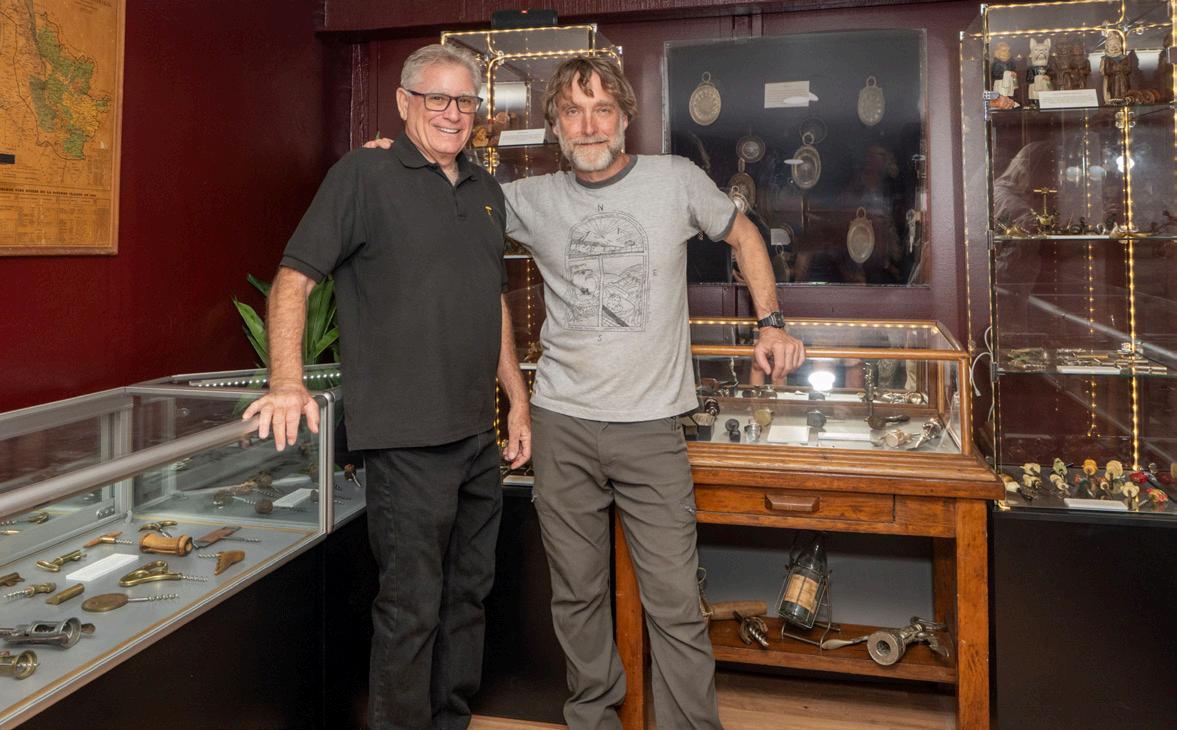
Entering his third decade of winemaking, Eric Glomski, founder of Page Springs Vineyards and Cellars, has partnered with his long-time friend Robert Leopardi to establish an exclusive corkscrew museum located at his winery.
The Wineleopard Corkscrew Gallery is an impressive and dramatic display of corkscrews from all around the globe and from just about every era. Highlighted in groups of collections with descriptive notations and elusive tales, some corkscrews date back to the 1700s.
“There are 20 individual collections here and they all have a story, either geographical or based on a theme,” said Leopardi, who noted that the museum inventory is about 15% of his total collection.
The corkscrew gallery at Page Springs Cellars is a cozy room just a few steps from the winery. The
surrounding walls exhibit a combination of old wine bottles and pictures of antique corkscrew and wine art derived from bark. “We wanted the room to feel warm and inviting,” said Leopardi.
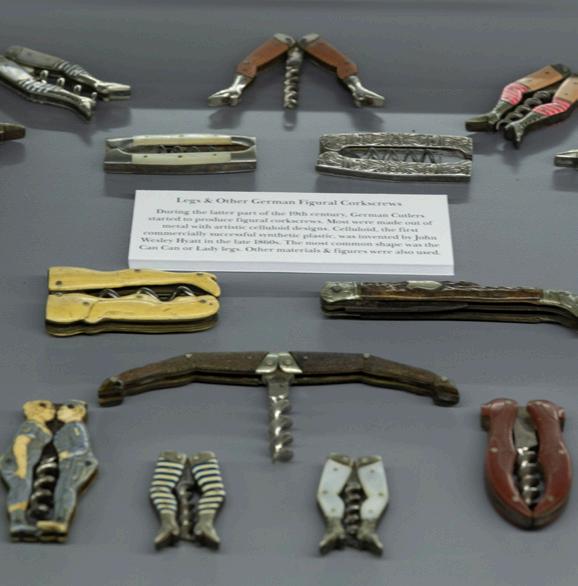
Well-lit display cases of the corkscrew collections are eclectic, from legs to other figural designs, mechanical (from the industrial revolution), animals, miniature corkscrews and even a pocket corkscrew made by Bing Crosby that features his dog.
From San Francisco to Australia and across Europe, the collection holds significant moments of yesteryear. “There is a collection of Israeli corkscrews made by Jewish immigrants who left Europe after WW1,” said Leopardi.
Though the wine corkscrew museum is not the only one in the nation, it may be the only one with such an extensive inventory and historical representation. To dive deeper into the story behind each corkscrew collection, Leopardi provides QR codes
that link to his website.
“The corkscrew evolved from a steel worm gun tool used to pack gunpowder in Muskets in 1681,” said Leopardi. “The first official patent was in England by Reverend Samuel Henshall in 1795. That made him the father of modern design. This simple but effective design became the foundation for countless variations,” he said.
The oldest corkscrew at the Wineleopard Corkscrew Gallery is a silver corkscrew from Amsterdam, circa 1760.
According to the Wineleopard website, Celluloid was the first commercially successful plastic invented by John Wesley Hyatt in the 1860s. German and English cork-
screws used this material at the end of the 19th century for molding figures of human heads.
Also during that time period, ivory was popular, but an alternative to the endangered elephant and walrus tusks was the corozo nut from South America, and in turn, corozo nut corkscrews became the rage.
“This has been such a thrill to see what Bob has done at the Page Springs Wine Cellars corkscrew museum,” said Sarah Alyea, who represents Stem Wine Company. “I’m so impressed but also excited to learn about all the different places he has collected corkscrews. The dedication
and passion that he has for corkscrews is just incredible. My favorite was the leg corkscrews.”
Leopardi lives in Tucson and has been involved in the wine industry for more than 40 years, mostly in sales. He says the Wineleopard Corkscrew Gallery at Page Springs Wine Cellars is the most serious one in the United States. FBN
The Wineleopard Corkscrew Gallery at Page Springs Vineyards and Cellars is located at 1500 North Page Springs Road in Cornville. For more information, visit www. wineleopardcorkscrewgallery.com.
NBy Madison Mooney
o one alive today remembers the last time Comet C/1861
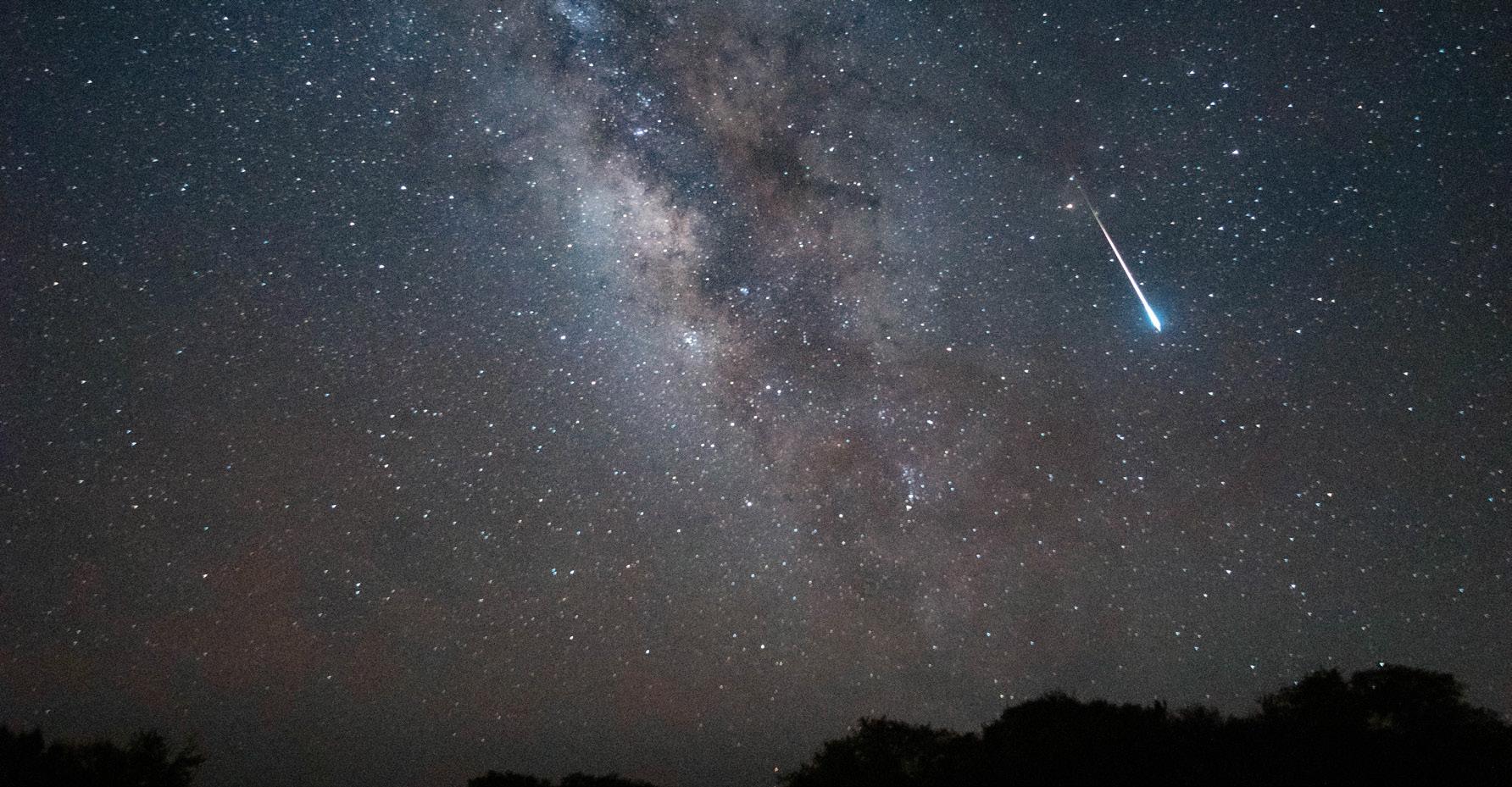
G1 (Thatcher) passed through our cosmic neighborhood. While this long-period comet hasn’t appeared in Earth’s skies for more than 160 years, we are quietly reminded of its existence every April as our planet passes through the debris it left behind, producing the annual Lyrid meteor shower.
As Earth moves through this stream of dust and rocky fragments, those particles are pulled into our atmosphere at high speeds, burning up and creating the streaks of light we call meteors, or “shooting stars.”
Though these particles travel along nearly parallel paths through space, perspective makes them appear to radiate from a single point in the sky. For the Lyrids, this radiant lies in the constellation Lyra, near the bright star Vega, which rises in the northeastern sky late in the evening and climbs higher as the night progresses.
The Lyrids will remain active from April 14 through April 30 this year, but their peak will fall within a relatively narrow window. Astronomers expect to see maximum
activity on the afternoon of April 22 for North America, making the early morning hours of April 22 and 23 the best time to observe. Meteor rates tend to increase in the hours before dawn, when your location on Earth is turned more directly into the incoming stream of debris.
This year’s viewing conditions are particularly favorable. The moon will be near its First Quarter phase on April 23, but it sets around 1 a.m. local time on April 22 and about an hour later the following morning, leaving darker skies during prime observing hours. Under ideal viewing conditions (far from city lights and with the radiant high overhead), the Lyrids can produce up to 20 meteors per hour. Realistically, observers can expect to see closer to 10 per hour, with the added possibility of bright fireballs and brief, unpredictable surges in activity.
To make the most of the experience, choose a viewing location away from artificial light with a wide, unobstructed view of the night sky. Meteors can appear anywhere overhead, but you’ll often see more by looking about halfway up the sky and roughly 40 to 60 degrees away from the radiant. Give your eyes at least 15
minutes to adjust to the darkness and try to avoid checking your phone, as even brief exposure to bright screens can disrupt your night vision. If you plan to use a stargazing app to find Lyra, it’s best to familiarize yourself with its general location before you head out for your meteor-hunting session.

A little preparation goes a long way. Bring a picnic blanket or reclining chair so you can com fortably scan the sky, and dress for cooler nighttime temperatures. Even after a warm spring day, overnight conditions can be surprisingly chilly here in Flagstaff.

A blanket and a hot beverage (my personal late-night favorite being decaf chai with a bit of brown sugar) can make all the difference! FBN

By Bonnie Stevens, FBN
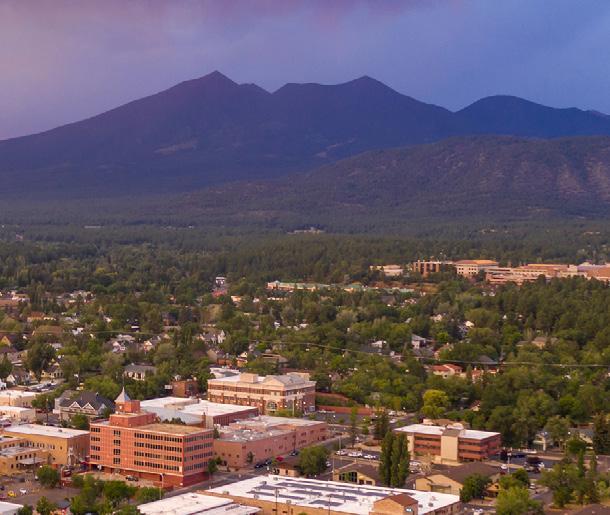
The beauty of the night is on full display this year in Flagstaff as the city celebrates 25 years as the world’s first International Dark Sky City. The prestigious designation has made Flagstaff a global model for how communities can grow, innovate and thrive, all while protecting the night sky and keeping the Milky Way visible even from downtown. As the originator of the Dark Sky City program in 2001, the Flagstaff Dark Skies Coalition is honoring “Flagstaff’s Silver Jubilee” with a full calendar of special events, from stargazing to outdoor concerts to art exhibitions from spring through fall.
The Flagstaff milestone comes in the wake of receiving the 2025 Dark Sky Place of the Year award from DarkSky International, recognizing more than six decades of stewardship and innovation. Mayor Becky Daggett said the anniversary reflects a community-wide commitment. “Protecting our dark skies is about quality of life, science, culture and our
economy. It’s part of who we are.”
“Flagstaff is proud of our success in protecting dark skies,” said Christian Luginbuhl, president of the Flagstaff Dark Skies Coalition. “We really kicked off what has become a worldwide movement when we adopted the world’s first regulation to protect the night sky in 1958. By 2001, we had been building upon that first step for 43 years, and that drove us to become the first International Dark Sky City. This recognition is helping us spread the message that star-filled skies can actually be restored in most places.”
Today, Flagstaff remains the largest International Dark Sky City by population and continues to prove that economic vitality, public safety and starfilled skies can coexist. “Restoring urban skies” is both a rallying cry and a responsibility, said FDSC Executive Director Danielle Adams, Ph.D. “Flagstaff’s approach to outdoor lighting is a model for cities and growing communities. We are living proof that you can have economic success while also having thousands of stars above your head – and other cities are taking notice.”
INTERNATIONAL DARK SKY WEEK
Flagstaff’s Silver Jubilee kicks off with In-


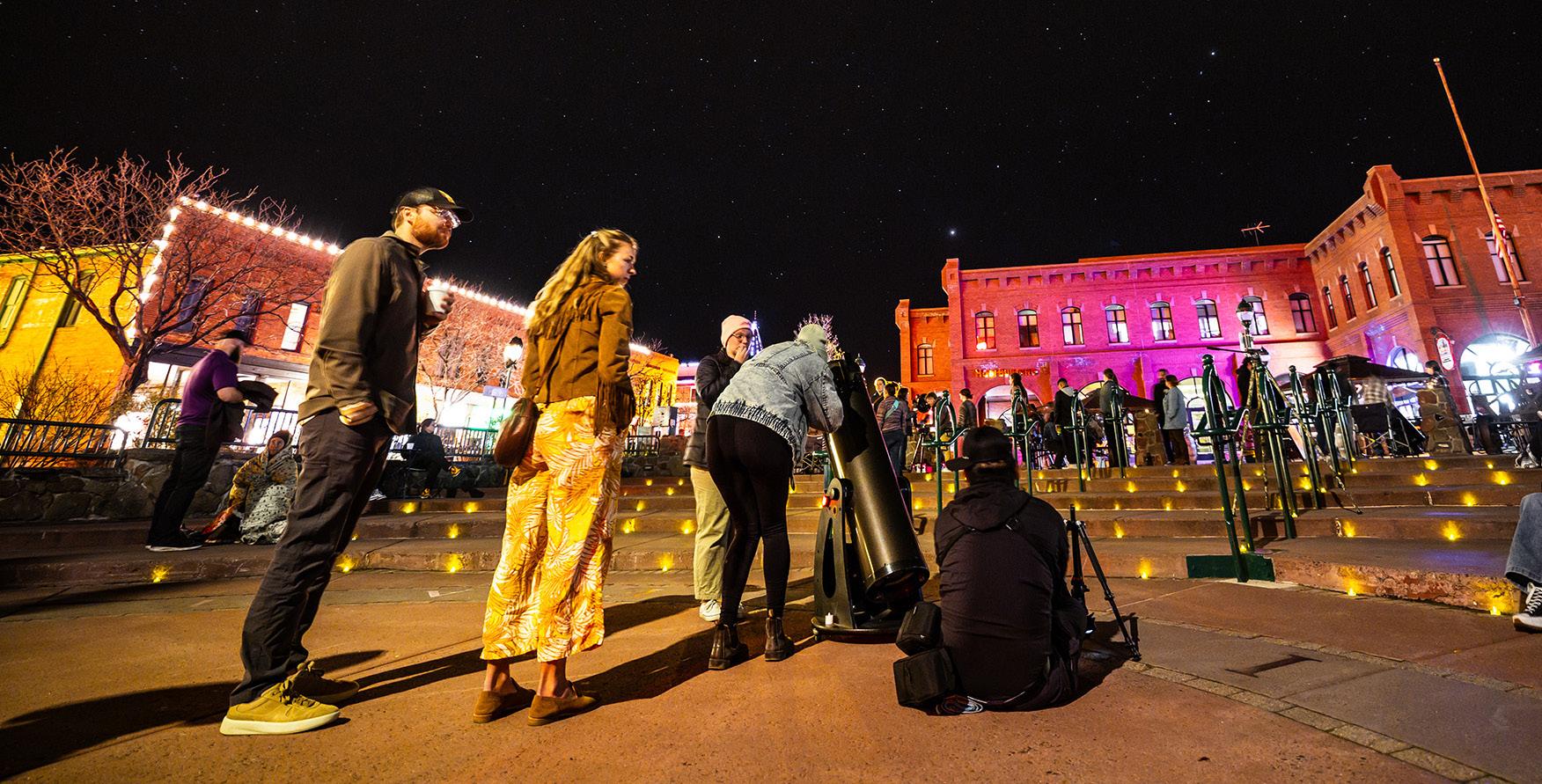
ternational Dark Sky Week, April 13-20, with Flagstaff’s main event in Heritage Square, “Starlight in the Square,” on Saturday, April 18, in partnership with the Downtown Flagstaff Foundation. “The event will feature stargazing, delicious food and a biergarten with special edition brews from Mother Road Brewing and Dark Sky Brewing,” said Adams. “International Dark Sky Week features stargazing activations and darksky education activities all week, with events taking place at local businesses and municipal parks in the City of Flagstaff and Coconino County.”
FULL MOON CONCERT SERIES
Musicians will serenade the rising of the full moon over Buffalo Park with outdoor concerts. Performances on May 30, June 29 and July 28 are supported by a Beautification In Action grant from the City of Flagstaff. Outdoor concert activities will include cultural astronomy storytelling and telescope viewing.
NIGHTVISIONS: AMBER
An immersive exhibition at the Coconino Center for the Arts, “NightVisions: AMBER,” will incorporate Flagstaff’s signature narrow-band amber lighting,
June 27 through Sept. 26. Artwork will transform as gallery lighting shifts from white to amber, highlighting the technology that has become the gold standard in dark-sky-friendly LEDs.
CELEBRATION OF THE NIGHT AND FLAGSTAFF STAR PARTY
From September through October, fall events will include an expanded citywide program and the annual Flagstaff Star Party, Oct. 1-3, in Buffalo Park, with free stargazing through dozens of telescopes, guest speakers and family activities.
CELEBRATING 25 YEARS AS THE WORLD’S FIRST INTERNATIONAL DARK SKY CITY
Flagstaff’s Silver Jubilee culminates
on Oct. 24, in a public celebration expected to bring together elected officials, community leaders and representatives from other dark-sky communities to honor the original 2001 designation.
Luginbuhl says this 25th anniversary is both reflective and forward-looking. “We didn’t just inherit dark skies; we built the policies and partnerships that protect them. Now we’re helping other communities do the same.”
From pioneering lighting codes to mentoring cities worldwide, Mayor Daggett says the community is proud of its dark-sky legacy and bright stars. For more information, visit FlagstaffDarkSkies.org. FBN

By Jeff Lane, Au. D.
Although hearing loss is a common disability, the public is often taught very little about hearing loss. Thus, new patients always have a myriad of questions during the initial phases of diagnosis and management. Some questions are more unique or specific to the individual, but most are the same. And for good reason. Hearing loss has a steep learning curve and patients want to be sure they are making informed decisions. My goal is to always ensure patients feel comfortable and secure, and answer their questions to the best of my ability. Here are some of the most common:
This is a more complicated question than it appears. Yes, it is true that hearing loss becomes more prevalent as we mature. One-third of adults 65 and older have hearing loss, while that number increases to 50% at age 75. However, there is no “average” degree of hearing loss for different age groups. A 90-year-old patient may only have a mild hearing loss, while for a 67-yearold, it may be severe. The hearing loss depends on genetics and previous noise exposure. Hearing loss is hearing loss and should be addressed if it is negatively affecting your quality of life.
The recommendation depends on two factors. First, what is the degree and configuration of the loss? If only one or two frequencies are affected, or the loss is very mild, the audiologist may choose to wait and simply monitor the loss. But it also depends on how the patient feels they are communicating. Two patients with the same hearing loss can have polar opposite responses. One may say they hardly notice having trouble while the other feels they have lost their ability to communicate properly.
It makes sense for the first patient to wait. Because they lack a strong motivating force, the aids won’t impact them as much and will either be returned or end up in a drawer. Waiting until they feel they are ready will increase their chances of success.
One-third of adults 65 and older have hearing loss, while that number increases to 50% at age 75. However, there is no “average” degree of hearing loss for different age groups. A 90-year-old patient may only have a mild hearing loss, while for a 67-year-old, it may be severe.
//
The second patient should absolutely try hearing aids. Hearing aids will improve their access to sound and have a positive impact on their quality of life. This holds true even if, on paper, the loss is less severe than other people’s hearing loss.
Obviously, if only one ear has a loss or financial considerations are significant,
one aid is a viable solution. Anything is going to be better than nothing. But, if possible, it is always best to fit a bilateral loss with a two hearing aids. First, there is a phenomenon called binaural summation whereby the combined amplification boosts the perceived loudness of the sound even further. As a comparison, imagine that you have vision loss in both eyes. A monocle will help improve your perception to a certain degree, but glasses will make the image sharper than it could have ever been with the monocle alone. This is equivalent to aiding both ears. Additionally, a person will be able to localize sounds better and have better speech understanding in noise when both ears are aided. This is because our brains are wired to perform these tasks by comparing and contrasting the signals from each ear. In the case of localizing sounds, your brain knows that a sound came from your right because it reached your right ear first and was louder on that side. If a person has a bilateral hearing loss and a single hearing aid, those important signals will always be lopsided and impair your brain’s ability to compare the sound.
No, hearing aids will not make your hearing worse, nor will they “fix” it. Hearing aids are just that. They help to increase your access to sound and filter out excess noise. But your hearing itself remains unaffected. It is true that hearing loss tends to worsen over time, but it is typically a slow and gradual process. And it will change regardless of hearing aid use. Actually, wearing hearing aids has been shown to help maintain good word recognition ability and memory function. And the aids will not become a crutch. People with hearing aids use them consistently because they enjoy not having to work as hard to communicate. But they can still function without the hearing aids if needed.
No question is ever too silly to ask an audiologist. If you want to know, ask. Hearing health is a collaborative process and works best when all parties are on the same page. FBN
Trinity Hearing Center is located at 1330 N. Rim Dr., Suite B in Flagstaff. For more information, visit the website at TrinityHearing.net. Jeff Lane is a doctor of audiology with a passion for improving the lives of others. Dr. Lane may be reached at 928-522-0500 or at audio@ trinityhearing.net.

By Roy DuPrez
Recovery from substance abuse is often discussed in terms of therapy, counseling and sobriety. While those elements are essential, long-term recovery also requires rebuilding the practical skills needed to navigate everyday life. One of the most important – and often overlooked -components is financial literacy.
For many young adults in recovery, addiction disrupts education, employment and financial stability. Learning how to manage money, build healthy spending habits and plan for the future becomes an essential step toward independence and long-term success.
At Back2Basics Outdoor Adventure Recovery in Flagstaff, financial literacy is part of the program’s life-
//
skills curriculum. Clients participate in financial wellness sessions led by a financial professional who teaches practical tools such as budgeting, saving, understanding credit and responsible financial decision-making. Recovery is about more than getting sober. It’s about helping young men build the tools they need to live productive, independent lives. Financial literacy is one of those tools.
Financial instability can be a major source of stress, particularly for individuals transitioning out of treatment. Without the ability to manage money effectively, everyday responsibilities – rent, transportation, food and employment – can quickly become overwhelming.
When young men begin to understand how to manage their finances, it builds confidence. They start to see that they can take control of their future. //
By introducing financial literacy early in the recovery process, programs can help individuals develop habits that support long-term stability.
Through guided instruction, Back2Basics clients learn how to build a budget, track spending and set financial goals. These lessons are designed not only to improve financial awareness, but also to reinforce accountability and long-term planning – skills that are critical for sustained recovery.
When young men begin to understand how to manage their finances, it builds confidence. They start to see that they can take control of their future.
For many clients, financial education represents more than numbers and spreadsheets. It becomes part of a broader shift in mindset – learning to make thoughtful, intentional decisions rather than impulsive ones. Participants explore topics such as understanding credit, planning for emergencies and setting both

In the Regional Plan, core and complementary priorities work together to create a strategic and balanced vision.
• The Plan’s core priorities are:
» Housing Attainability and Equity
» Climate Action
• The Plan’s complementary priorities are:
» Natural and Cultural Resources
» A Healthy Economy
» Resilient Public Services and Facilities
» A Walkable Mixed-Use Community

short- and long-term financial goals. These lessons help prepare them for employment, education and independent living after treatment.
The impact of these lessons is already being felt by clients working through the program.
“I am learning to plan and understand how living with a budget helps me avoid impulsive spending choices,” said one Back2Basics client. “It’s teaching me how to prioritize my well-being through the choices I make with my money.”
Back2Basics emphasizes that recovery is not just about sobriety – it’s about preparing individuals to reenter society with the skills necessary to thrive. Along with clinical therapy, academic support and outdoor adventure experiences, life-skills education plays a central role in helping clients build a stable future.
Financial literacy is one of the many ways the program bridges the gap between treatment and independence. Our goal is to prepare young men for life beyond our program.
When they leave here, we want them to have the confidence and practical skills to succeed.
As conversations around addiction recovery continue to evolve, many treatment providers are recognizing the importance of addressing the broader life skills that support longterm wellness. Financial literacy, in particular, provides individuals with the tools to reduce stress, plan for the future and build a more stable life.
For individuals in recovery, these lessons can be transformative – helping turn the early steps of sobriety into a sustainable and hopeful path forward. FBN
Roy DuPrez, M.Ed., is the CEO and founder of Back2Basics Outdoor Adventure Recovery in Flagstaff. He received his B.S. and M.Ed. from Northern Arizona University. Back2Basics helps men ages 18–35 recover from addiction through a unique combination of structured residential treatment and outdoor adventure therapy. For more information, visit back2basicsrecovery. com, call 928-814-2220, or email rduprez@ b2badventures.com.


By Christina Kovalik NMD, Lac
Acupuncture has been used in China for thousands of years and is still used today in hospitals and clinics there. It was brought to the U.S. in the 70s and has spread across the country as alternative therapy for various health aliments from pain, immune system boosting, fertility, hot flashes, stress, depression and anxiety, allergies and more. There are different techniques and philosophies associated with acupuncture such as Japanese, Korean or Traditional Chinese medicine techniques. All have common acupuncture meridians and point prescriptions that are used when assessing the patient’s symptoms, tongue and pulse presentation.
Acupuncture meridians are energy channels in the body that can become blocked or congested, resulting in energetic imbalances in the body, resulting in symptoms. Placing hair-thin acupuncture needles in specific points in the body, scalp and ears promotes the release of natural endorphins and works at the hypothalamus pituitary axis to balance hormones, promote blood flow, reduce pain and improve mobility and function.
Here are common questions I hear about acupuncture:
DOES ACUPUNCTURE
No. Some points may be more tender or more sensitive than others and some practitioners like to stimulate the points to move the Qi (energy), which may be uncomfortable for some. Generally, the tips of the needles are rounded, meant to part the skin, not puncture it. With a gentle approach, the experience can be quite relaxing.
After assessing the patient’s symptoms, tongue and pulse presentation, certain point combinations are chosen to help balance the imbalances in the body. Inserting the needle in the point stimulates the flow of Qi energy to move through the channels/meridians, having a balancing effect and releasing the natural endorphins to make you feel better.
Acupuncture can treat anything and everything:
Pain: Lower back pain, knee pain, neck pain, headaches, muscle pain, bone pain, arthritis.
Hormone imbalances and emotions: PMS, irregular cycles, fertility, perimenopause, menopause hot flashes, night sweats, insomnia and
andropause symptoms (male menopause), fatigue, weight challenges, low libido, low mood, anxiety, stress, tension, depression, low motivation, not feeling like yourself.
Immune system and allergies: Seasonal or year-round allergies, cough, asthma, sinus congestion, frequent colds and flu.
Digestive issues: acid reflux, nausea, gas/bloating, constipation, irregular stools.
Stress: anxiety, palpitations, insomnia, mind fog, back and neck tension.
Skin issues: rashes, eczema, psoriasis, acne and wrinkle prevention.
Who Can Benefit?
People of any age and stage of life can benefit. Acupuncture can be done on newborns, infants, children, teenagers, adults and the elderly. It can also be done on dogs, cats and horses.
The nice thing about acupuncture is that it is very complementary with conventional and natural medicine modalities such as chiropractic, massage, physical therapy, homeopathy and energy work. I often combine cupping (the use of glass cups to break up stagnation and fascial tissue), moxibustion (a Chinese
herb we use to warm the acupuncture points) herbal treatments, red light therapy, far infrared heat, naturopathic medicine and aesthetic treatments to balance the whole person. Acupuncture not only treats the symptoms but evaluates and treats the root cause of any imbalance by treating it naturally without harm. The desired result is focusing on optimizing health outcomes naturally while striving to do what is best for promoting balance and optimal health in patients.
During the session, you should feel relaxed and calm. People respond differently to the session. Usually, it makes you nice and relaxed, or you could feel energized. Some people may also have emotional releases as the energy becomes less blocked. If you had pain, it should be reduced. You should feel looser and have a better range of motion. The effects of the treatment usually last two days to one week. Often, a series of acupuncture may be necessary to balance what is out of balance.
HOW MANY TREATMENTS WILL I NEED?
People respond differently to acupuncture. Some may need just one or two sessions, others may require several sessions to get full relief from symptoms. It is often like peeling the layers away, like an onion. It can take time to balance things that have been out of balance for some time. For acute conditions, usually one to two treatments per week may be necessary to get relief. For chronic issues, it may take six to 12 sessions or more. Once patients are feeling better, they often come in for acupuncture tune-ups when they need it. Some come weekly, two times per month or one time per month for maintenance. It is essential to develop a treatment plan that focuses on health outcomes that are lasting. FBN
Dr. Christina Kovalik NMD, LAc, The Vitality Doctor, is a naturopathic physician and acupuncturist specializing in hormone optimization, optimal health and vitality. She is a new Flagstaff resident, practicing since 2004, and opened her second location in Doney Park in 2020. For more information, visit thevitalitydoctor.com or call 928-863-6086.




In a region defined by innovation, discovery, a deep respect for place and an unwavering commitment to people and the environment, Flagstaff Business News celebrates Northern Arizona businesses that possess something increasingly rare: staying power. The 40 Over 40 series honors locally rooted enterprises that have operated for more than four decades, navigating economic cycles, shifting markets and generational change while continuing to serve their communities with consistency and care, and contributing to the quality of life that defines Northern Arizona. From businesses that foster connection to those that build the spaces where locals and visitors live, work and play, this yearlong series explores the values, resilience and leadership that fuel long-term success across the region.


Cameron Trading Post supporting travelers for 110 years
About 53 miles north of Flagstaff, at the southern boundary of the Navajo Nation, travelers stop for gas, food, lodging and the famous Cameron Trading Post.
THE FOUNDING STORY
Established in 1916, the trading post offers a vast variety of Native American arts and crafts, including rugs, pottery, blankets, jewelry, dolls, baskets and clothing. Brothers Hubert and C.D. Richardson claimed 112 acres on the south side of the Little Colorado River and built a shack to serve as a trading post. At first, only locals came to barter their wool, blankets and livestock for dry goods.
Through the years, the business
has remained in the family. Additions have included a post office, gallery, restaurant and hotel – all featuring red rock exteriors. Joe Atkinson, the grandnephew of C.D. Richardson, purchased the business in 1978.
TOP ACHIEVEMENTS
The family’s top achievement was establishing the trading post as a trustworthy, fair and productive member of the community, said Atkinson. “As visitors began to throng to the area to experience the beauty, art and culture here, we were able to incorporate these new guests successfully into our local trading business.”
Another achievement was creating an enterprise that benefits the business and the community.
CORE VALUES
“Our staff are our family, literally
as well as figuratively,” he said. “This company takes care of us in so many ways, and we take care of our company!”
SHIFTS IMPACTING THE BUSINESS
“What we have been for over 100 years still works for us today. We do grow and improve each year. All of this company’s profits are invested in our store and its family of staff.”
GREATEST CHALLENGES
“If it’s not fire, flood or drought, then it’s economic downturns, high fuel prices or a global pandemic. So far, we have been thrown no curveball we couldn’t still hit out of the park!”
LOOKING AHEAD
“My hope is that Cameron Trading Post will continue to thrive, continue to act as a springboard for members of our community, continue to nourish and strengthen us all, and continue to be a haven and a harbor for all who seek
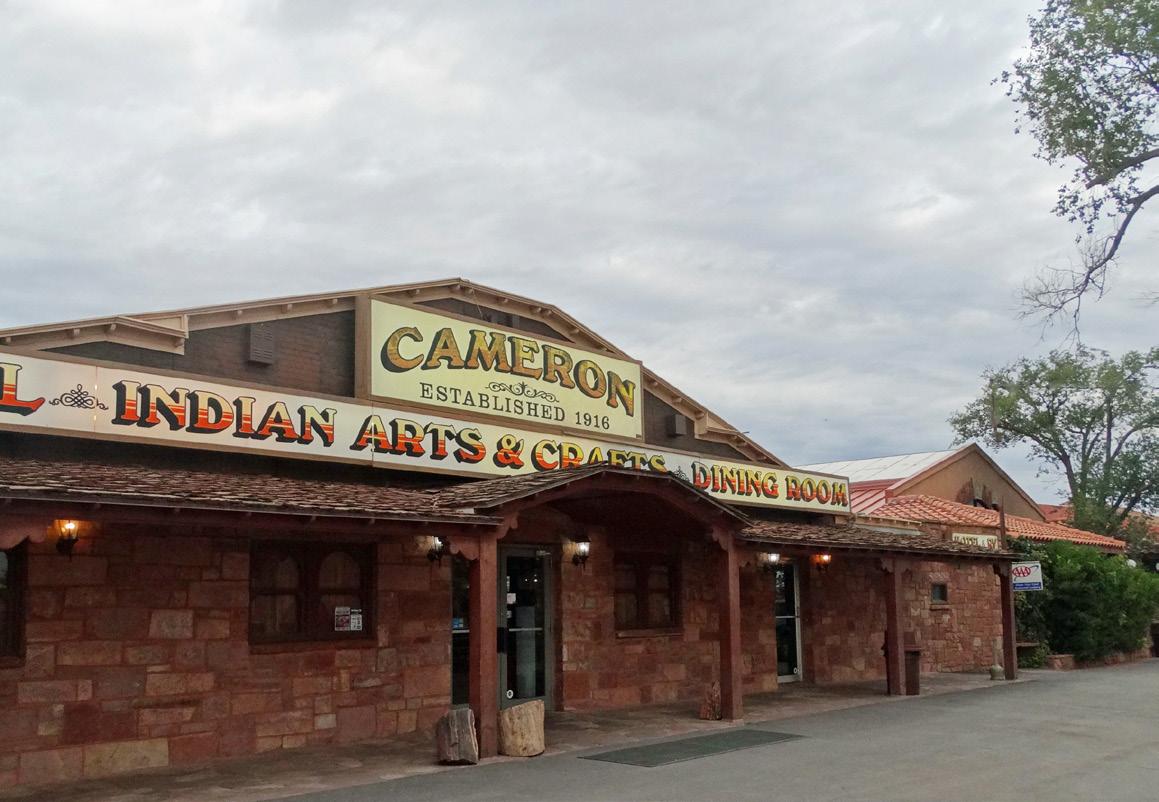
a glimpse into the heart and culture of Grand Canyon country.”
THE REASON FOR LONG-TERM SUCCESS
“We go above and beyond to care for our customers’ needs and to keep our pricing fair,” said Atkinson. “We keep up with the times but never skimp and are always mindful of our old trading post hospitality and ambience.” FBN
Cameron Trading Post 466 Highway 89, Cameron, AZ 86020 1 800-338-7385, info@camerontradingpost.com
Continental Country Club has served as an important gathering spot for decades
The Continental Country Club enjoys an auspicious location in a high-desert ponderosa pine setting, close to downtown Flagstaff and nestled below Mount Elden.
AN EARLY PLANNED COMMUNITY
“Continental Country Club was developed as part of one of Flagstaff’s early planned residential communities,” said Assistant General Manager Sean David. “Its mission was to create a place where residents could enjoy recreation, community connection and the beauty of Northern Arizona.”
TOP ACHIEVEMENTS
David detailed the club’s three top achievements: “Creating a strong community gathering place in East Flagstaff, maintaining quality golf and recreational amenities, and continuing to evolve with new programs and events while honoring the club’s traditions.” CORE VALUES.
This prominent family-oriented facility and residential community opened in 1958 and featured a 9-hole championship golf course designed by renowned architect Bob E. Baldrock. It was expanded to 18 holes in 1966 and named Continental Country Club in 1971. A variety of memberships are available to both residents and nonresidents who pay a social membership fee to support the club’s comprehensive amenities, which include a fitness center with modern equipment, pickleball and tennis courts and swimming pools. Also on the premises is Oakmont, a popular neighborhood restaurant known for its creative entrees and spectacular view. Today, the club continues to serve as a community hub.
Through the years, the club’s core values have guided the operation. They include “community, recreation, quality service and creating a welcoming environment where residents and visitors can connect and enjoy an active lifestyle,” David said.
SHIFTS IMPACTING THE BUSINESS
As the needs of the community have changed, so have the amenities provided by the club.
“The club has expanded beyond golf to include amenities like pickleball, tennis, fitness and community events to meet the changing interests of members and residents,” David noted.
GREATEST CHALLENGES
Balancing facility improvements and operational costs, while continuing to provide affordable access and amenities for the community, have been some of the greatest challenges, David said.
LOOKING AHEAD
As the country club plans for decades
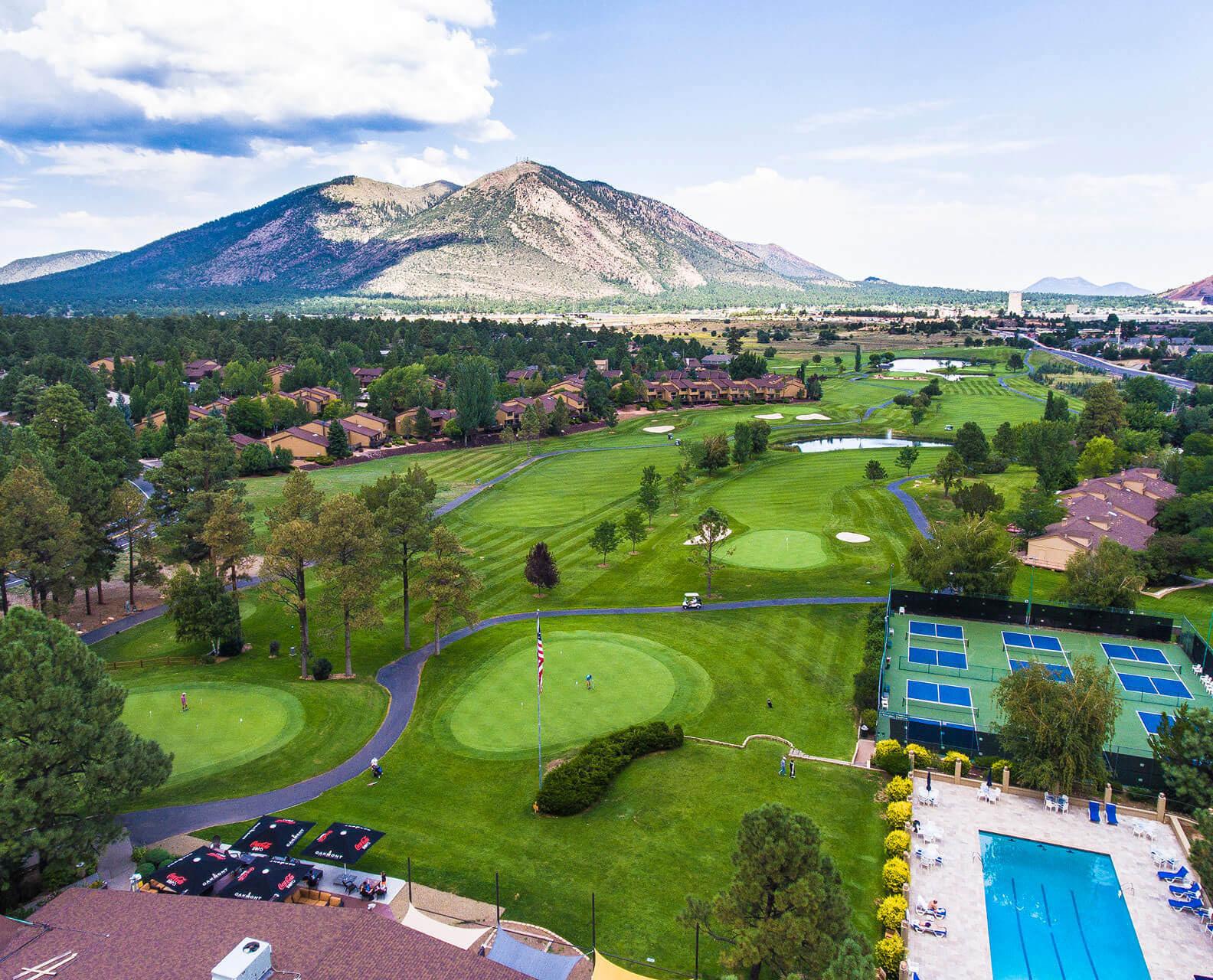
to come, David says continued growth as a premier recreation and community destination in Flagstaff is the main focus, through facility improvements, new programs and strong community engagement.
THE REASON FOR LONG-TERM SUCCESS
David cites “a strong sense of community” and the ability to bring
neighbors, families and friends together through recreation and shared experiences as reasons why Continental Country Club has been and continues to be an important part of Flagstaff. FBN
Continental Country Club 2380 N. Oakmont Dr. Flagstaff AZ 96004 928-527-7999, contincc@ciramail.com


63 years, KAFF Radio has been serving the community
There’s a renewed sense of urgency inside KAFF Radio on West Route 66 as team members pack, purge and preserve decades of broadcast history ahead of a move to East Butler Avenue next month. It will mark just the third location for the station since its first broadcast in 1963.
THE FOUNDING STORY
When KAFF AM 930 first hit the airwaves, Flagstaff was a growing mountain town. Founders Guy and Ann Christian brought industry experience and a vision to deliver quality programming to the region.
“I was not fortunate enough to meet Guy Christian prior to his passing, but his passion for supporting our community is legendary in the business,” said Business Manager Heather SwartzLevin.
The station is now owned by Roger Anderson, who purchased it in 2014 from the Christian estate. Today, KAFF remains family-owned and operated by Roger and his son, Steve.
TOP ACHIEVEMENTS
KAFF’s growth stands as one of its greatest
accomplishments.
“Over the years, this company has expanded from a single AM radio station to a significant group of radio, digital stations and news and sports departments,” said Swartz-Levin.
The network now includes eight formats: 92.9 KAFF, 93.9 The Mountain, Hits 106, The Mountain2.0, Arizona Hope, Magic 99.1, Fun Oldies and 930/93.5 KAFF AM.
The station also launched KAFF Cares, a community initiative supporting local causes and nonprofits.
CORE VALUES
KAFF is rooted in community connection. “We are passionate about creating stations that bring listeners together through local news, events and music,” said Swartz-Levin. “We are also committed to embracing the next generation of broadcasters through internships and journalistic opportunities.”
SHIFTS IMPACTING THE BUSINESS
The company is expanding its digital footprint. “We are highly focused on utilizing our assets to incorporate more digital marketing opportunities,” she said.
Partnerships with iHeartRadio and other streaming platforms are extending reach beyond
Flagstaff Mall has been part of Northern Arizonans’ lives for more than 45 years
Flagstaff Mall has long served the region as an indoor shopping center where locals, residents of distant rural towns and visitors come together to find lifestyle essentials, connect with community and experience the joy of every season.
THE FOUNDING STORY
Flagstaff Mall opened in 1979 with well-established American anchor stores Sears and JCPenney, with Dillard’s opening soon afterward.
It was originally owned by Westcor, a Phoenix-based shopping center developer that was acquired by Macerich in 2002. General Manager
Bonnie Bouschet says the mission was then, as it is today, “to provide Northern Arizona with an inviting, all-season retail hub where shoppers could find their favorite contemporary brands under one roof.”
The mall is now owned and operated by Cypress Equities.
TOP ACHIEVEMENTS
“We’re very proud of our sustained success in providing a mix of local and national shops,” said Bouschet. “Our retail spaces are nearly all full, which means shoppers have a large selection of brands and stores to visit and our foot traffic is steady and strong.”
Mall leadership also is deeply committed to giving back to the community. “We’re one of the only retail locations across Arizona that hosts visits with the Easter Bunny and Santa at no cost to families. We also host craft
Northern Arizona. The new facility will also support expanded offerings, including podcasts.
Adapting to digital platforms while demonstrating the increased value to advertisers is a key challenge. “Radio, when paired with digital platforms, delivers a far greater impact than social media alone,” said Swartz-Levin.
KAFF plans to embrace emerging technologies while continuing to serve the community and local listeners.
“Our main goal is to remain a leader in shaping the future of radio,” she said.
THE REASON FOR LONG-TERM SUCCESS
“Our shared love of radio, our appreciation for our clients and commitment to our community are why we’re here.”
FBN
KAFF Country Radio
345 S. River Run Rd, Suite 100 Flagstaff, AZ 86001, 928-774-5231
shows that support local causes and a Character Kindness Club for children the second Saturday of every month.”
“Through the leadership of our founder, Chris Maguire, consummate disruptor and steward of unique real estate solutions, Cypress Equities continues to curate the ultimate retail experience,” said Bouschet. “We remain fiercely entrepreneurial. We adapt. We respond to the complexities and challenges of the tenant, investor and client. It is our business to bring purpose and passion to every project. Cypress Equities takes the conventional, adds inspiration and brings communities together ultimately creating investment value.”
The global pandemic created the rise of online shopping. “Getting people back to shopping in person
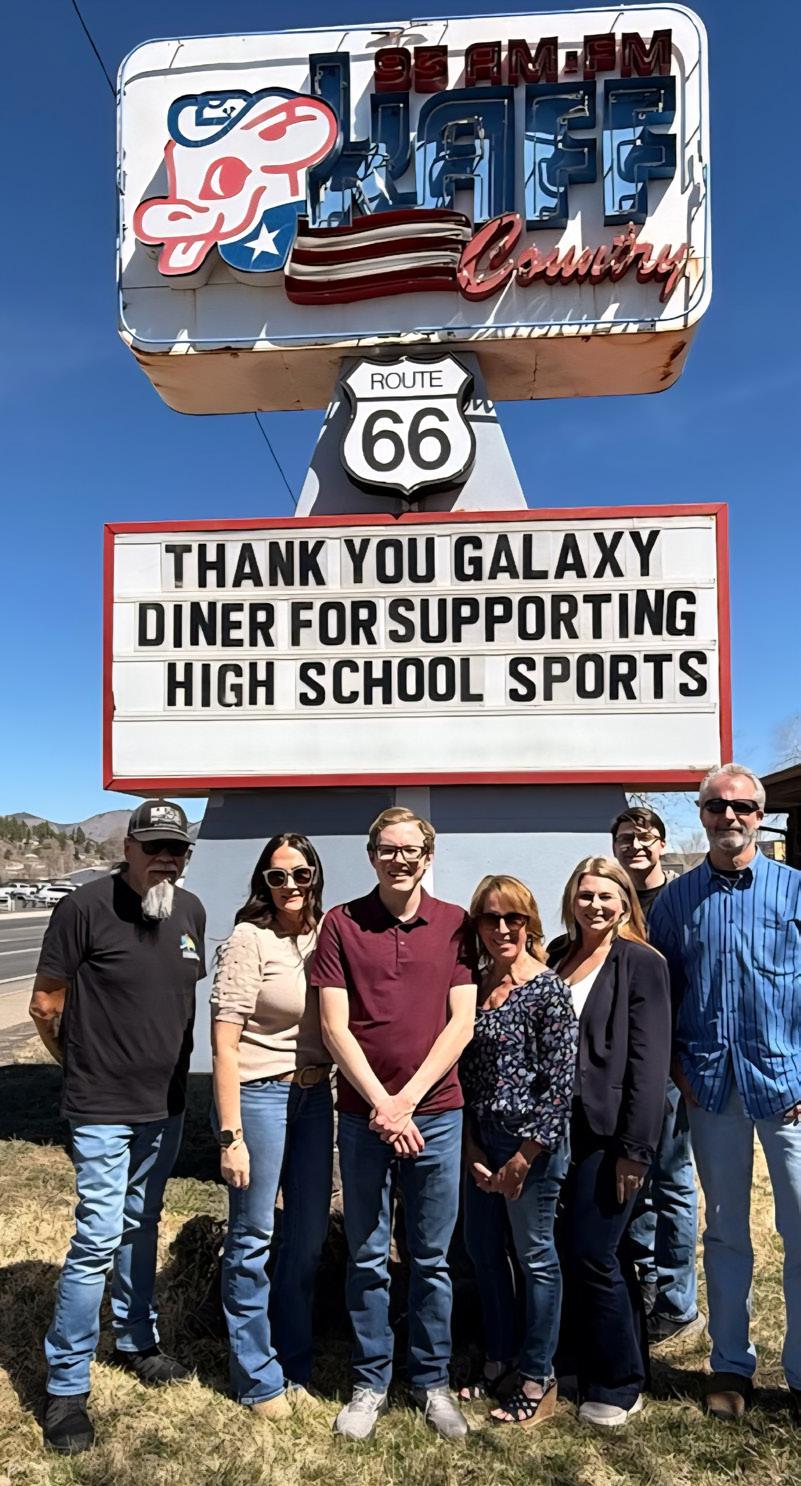
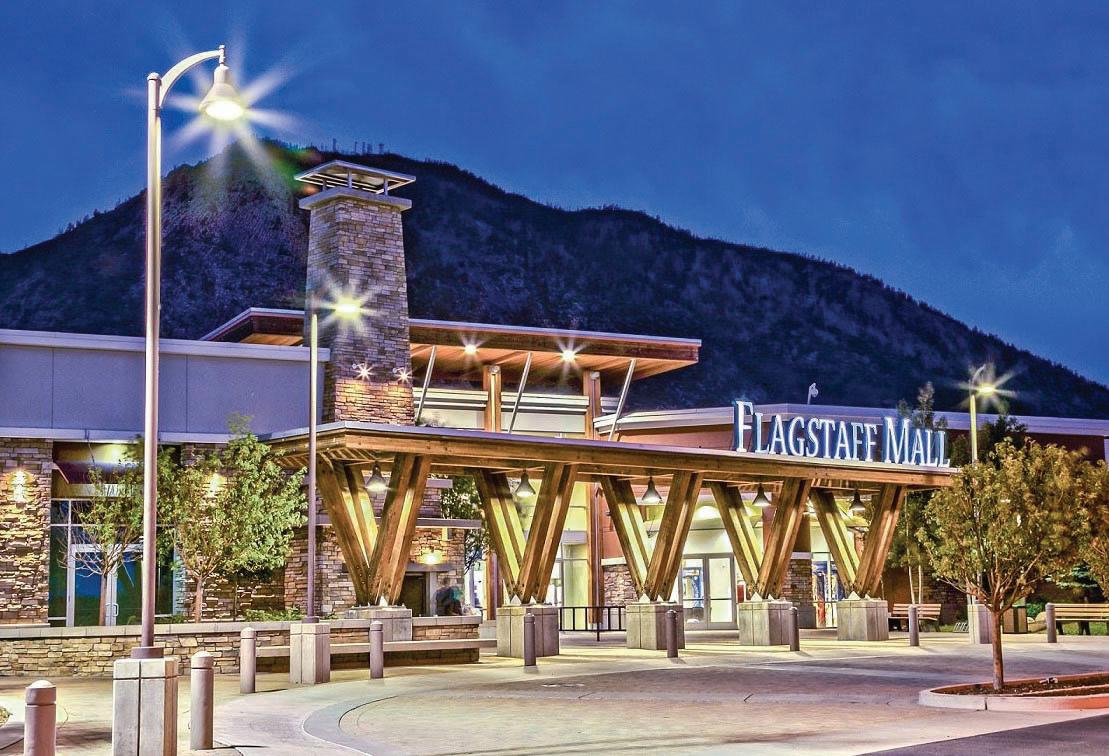
was challenging,” said Bouschet, but the Flagstaff Mall increased its focus on events and experiences and highlighted the value of shopping locally.
“Retaining retailers despite shoppers’ evolving preferences is always a challenge,” she said.
Bouschet expects Flagstaff Mall to continue to evolve as a lifestyle destination, with retail as one piece of a larger experience.
“Part of our success has been being actively involved in our community and embracing retailers who share that mindset, like Box Lunch, opening in May. For every $10 spent, the national retailer donates a meal through Feeding America.” FBN
Flagstaff Mall
4650 E. U.S. Highway 89 Flagstaff, AZ 86004
928-526-9373

By Kryistyna Hook
Better Business Bureau Serving the Pacific Southwest, Central and Inland California is proud to welcome Breeanya Hinkel as the new Northern Arizona director of community relations.
A dynamic leader, creative strategist and dedicated community advocate, Hinkel brings a wealth of experience and a passion for empowering communities to her new role. As a Prescott local, she is deeply committed to advancing ethical business practices and amplifying diverse voices across Northern Arizona.
In her position, Hinkel will champion trust and integrity in the marketplace by building meaningful connections with local business leaders, nonprofits and community organizations. Her efforts will focus on expanding the impact of BBB Accreditation, strengthening partnerships and promoting consumer confidence throughout the region.
Beyond her professional role, Hinkel is actively engaged in community service, contributing her time and leadership to organizations including the Coalition for Compassion & Justice, Finding and Making the Good, the Prescott chapter of the American Association of University Women and the BBB Yavapai Advisory Council, where she serves in a leadership capacity.
“Breeanya’s deep roots in Prescott and her passion for community collaboration make her an incredible asset to our team and to the businesses and consumers we serve,” said Koriann Morales, vice president and chief product officer.
“Her vision and leadership will help us expand BBB’s presence and strengthen trust across Northern Arizona.”
BBB is also expanding innovative business resources to the Northern Arizona community through collaborative events, meeting rooms and a podcast studio designed to support local entrepreneurs and organizations.
When she’s not working or volunteering, Hinkel enjoys life in Prescott with her husband and their dog, Jasper. Breeanya can be reached at 928-772-3410 or by visiting www.bbb.org. FBN
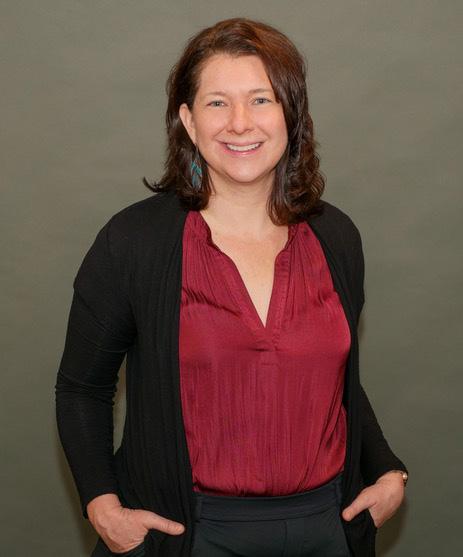
About Better Business Bureau Serving the Pacific Southwest, Central & Inland California
Better Business Bureau (BBB) has empowered people to find businesses, brands and charities they can trust for more than 110 years. In 2024, consumers turned to BBB.org more than 220 million times for BBB Business Profiles on 5.5 million businesses and more than 725,000 times for BBB charity reports on 12,000 local and national charities.
The International Association of Better Business Bureaus is the umbrella organization for local, independent BBBs in the United States, Canada and Mexico. Incorporated locally in 1938, BBB Pacific Southwest, Central & Inland California serves Greater Arizona and Southern, Central and Inland California, providing tools to ignite business success, including mentorship, online resources and event and meeting spaces. BBB’s objective expertise helps educate the community on ethical marketplace behavior and how businesses can build trust.
Kryistyna Hook is the senior director of marketing and media relations for the Better Business Bureau. She can be reached at kryistyna.hook@bbbcommunity.org.
“Breeanya’s deep roots in Prescott and her passion for community collaboration make her an incredible asset to our team and to the businesses and consumers we serve,” said Koriann Morales, vice president and chief product officer. “Her vision and leadership will help us expand BBB’s presence and strengthen trust across Northern Arizona.” //
By Mark Rothlisberger
April in Northern Arizona brings warmer days, longer evenings and the perfect opportunity to refresh your home – starting with the kitchen. If your space feels dated or no longer fits your lifestyle, now is an ideal time to make meaningful updates, especially if you’re putting your tax return to good use.
At Kitchen Tune-Up Flagstaff, we specialize in affordable kitchen upgrades that deliver both immediate impact and long-term value. Instead of committing to a full remodel, many homeowners are choosing smart improvements that enhance both style and functionality.
One of the most popular upgrades is replacing cabinet doors and drawer fronts. This simple change can completely transform the look of your kitchen. Pair it with modern features like soft-close hinges, updated hardware and full-extension drawers and you’ll notice the difference every single day.
Cabinet painting is also a great option for spring. Fresh, on-trend colors like warm whites, soft grays and natural tones can brighten your kitchen and create a clean, inviting space. It’s a cost-effective way to breathe new life into your home while protecting your cabinets for years to come.
For a more complete transformation, cabinet refacing offers the look
One of the most popular upgrades is replacing cabinet doors and drawer fronts. This simple change can completely transform the look of your kitchen. Pair it with modern features like soft-close hinges, updated hardware and full-extension drawers and you’ll notice the difference every single day.


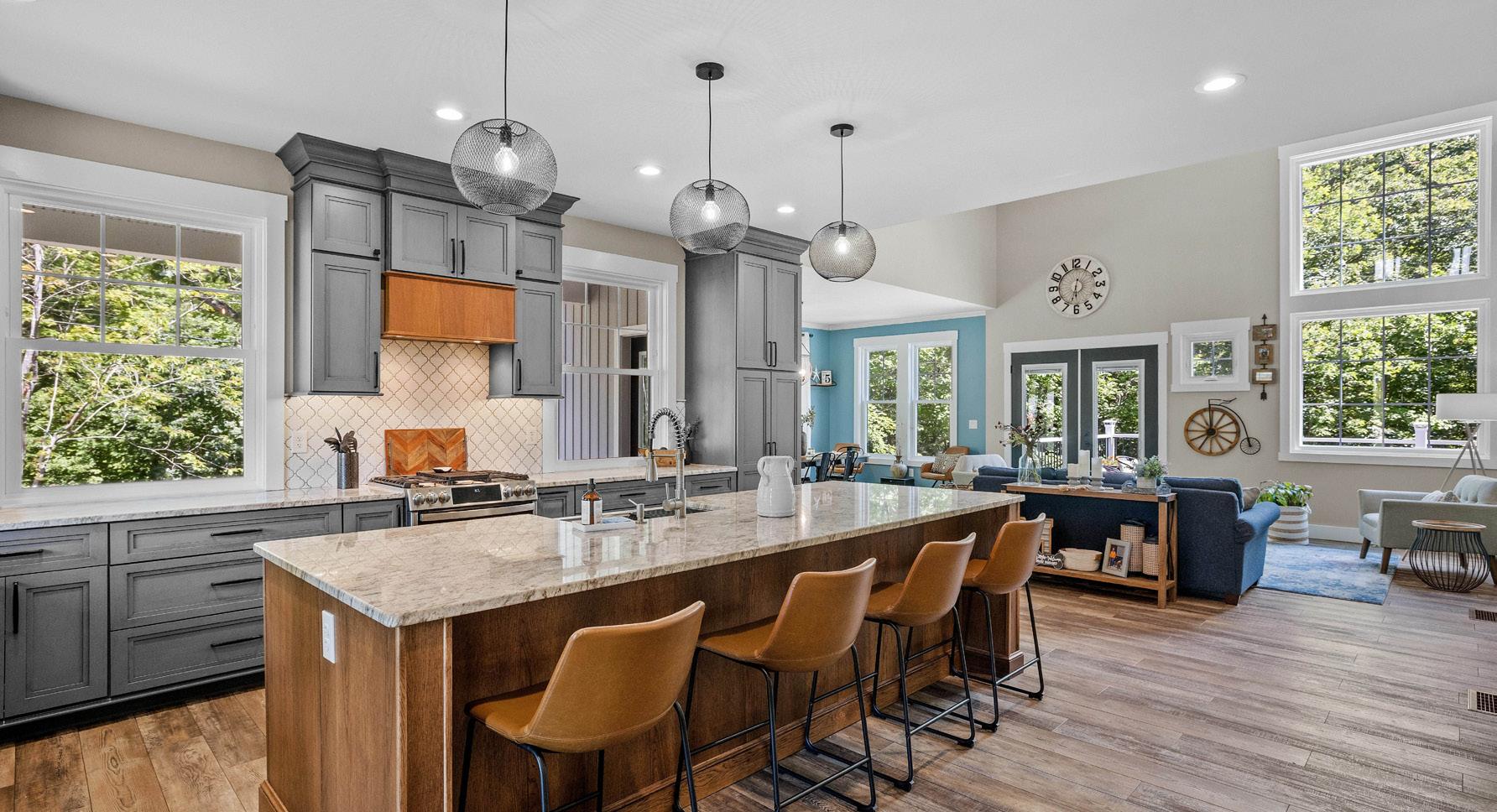
adding long-term value to your home –something you’ll appreciate now and in the future.
If you’re ready to turn your tax return into something you’ll enjoy all year long, schedule
At Kitchen Tune-Up Flagstaff, we make the process simple and efficient, with







By Chris Hallows
Let’s make this an active reading and research moment so you can form your own opinion.
Step one, jump into your favorite AI or search engine and type in: “What have been the most major events in the last 30 years” and take stock of the findings. You’ll see everything from the Great Recessions, wars winding up and spinning down, global power shifts, climate change concerns, Brexit, digital/social media rise, pandemic, etc. It’s a pretty wide variety of events on multiple stages.
Now, proceed to ask your search tool: “What have the U.S. housing prices done in the last 30 years?” Yes, it’s had its volatility, but the answer I got was that home prices nationally have increased roughly more than 290%.
For the last question before we dig into the data, ask: “What is the U.S. population today compared to 30 years ago?” You’re going to have to either really Google that one or finish this article for that answer.
NOISE VS. ACTUAL IMPACT
I want to start out by fully disclaim-
Inventory is one of the biggest complaints about the housing market and certainly an issue in Flagstaff. The “island economy” that prevails here is one of the biggest culprits. The lack of developable land and affordable building costs have been a major drag on the ability for inventory to keep up with the ever-growing interest in “our island.”
ing that my focus is on housing and on the local housing market. I do not wish for my commentary here to be insensitive to the feelings and emotions of the reader. That said, 2026 is only about a quarter of the year over and has had a whirlwind of world and economic events. It’s enough to make one’s head spin! Yes, some historic events have had drastic impacts on housing and personal finances but often there is far more noise than actual impact.
In a quick rough online estimate on MSNBC/NBC’s housing articles and commentary, ChatGPT summarizes their sentiment in the last 10 years as 70-85% negative, 10-20% neutral and 5-15% positive. As we’re more aware of how media engages us, we understand this is simply how the machine works: American News has a bias to negative: it gets more clicks, more views and therefore, more money.
Just coming off of the Great Recession, everyone would have told you to think twice before buying a house. Real pain had just been inflicted on millions of households. However, in the past 30 years, 2012 was probably the best time to buy a house, maybe even in the last 50 years under certain comparisons. The takeaway here is
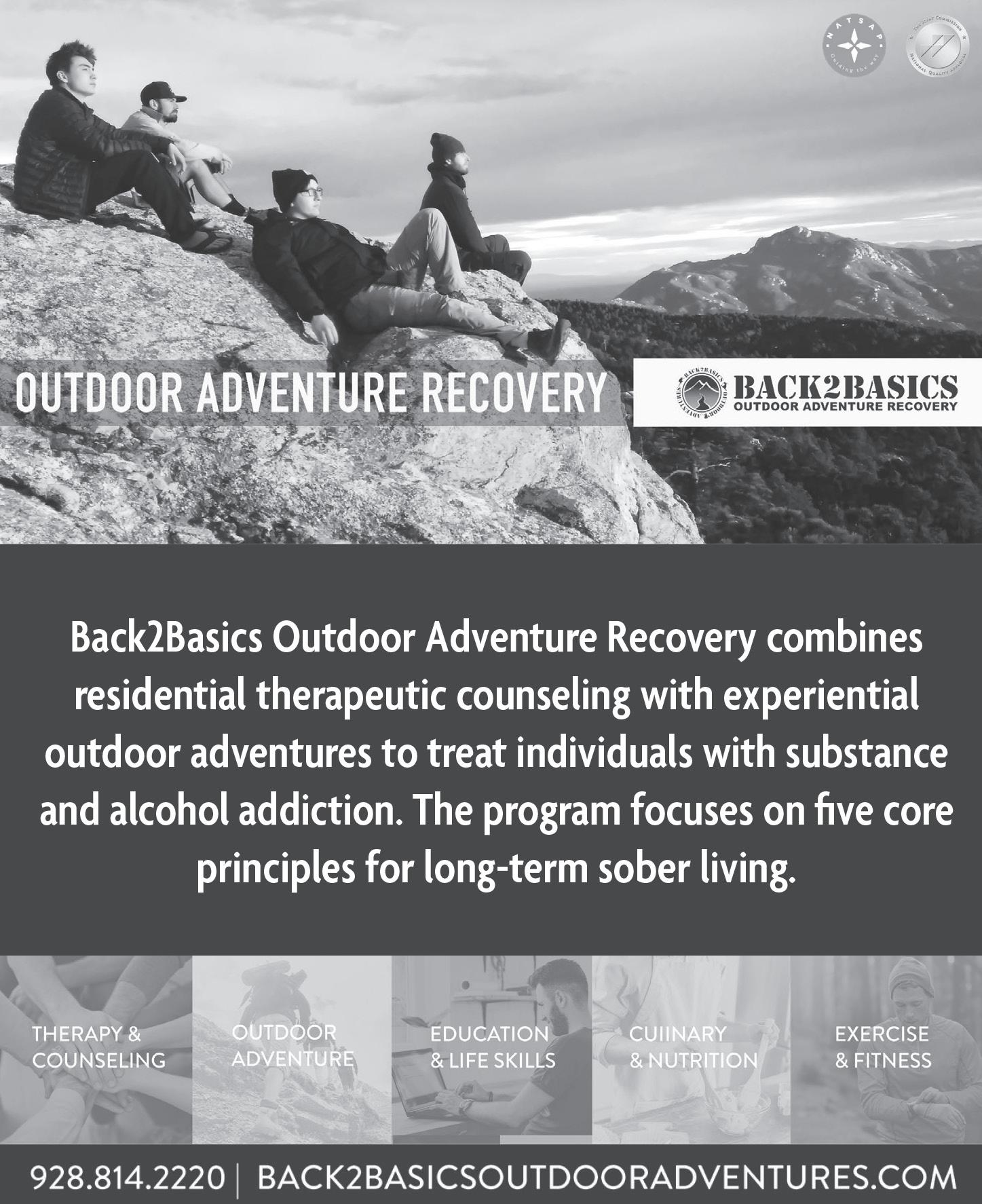
that if you are trying to make a housing decision, you need do two things: (1) Look at your personal financial picture and determine if this is a good time and a mid-long-term decision; and, (2) Look at your specific local market and determine the opportunity. For the rest of this article, we’ll do the latter.
Inventory is one of the biggest complaints about the housing market and certainly an issue in Flagstaff. The “island economy” that prevails here is one of the biggest culprits. The lack of developable land and affordable building costs have been a major drag on the ability for inventory to keep up with the ever-growing interest in “our island.”
So, let’s get to that answer for the last question from paragraph one: 80 million. There are 80 million more people walking around in our country than there were 30 years ago. No one prepared for that type of population growth. We have more people wanting to form households and rent or buy right now, than we’ve ever experienced in our 250 years as a country. Not only that, but our Flagstaff island is a major destination for millions of tourists and second
homeowners. It’s more anecdote than actual provable fact but I promise you my phone rings more and my home loan applications increase the minute that Phoenix temperatures hit over 100 degrees. I’m no meteorologist but it feels like that was in the June timeframe so at least the locals got to have a first go at the spring market before the second homeowners came scrabbling up the 17 to get out of the heat.
Well, this year, March 18 was their first day of over 100 degrees, which was its earliest in recorded history (March 26, 1988, was the previous earliest for those trivia addicts out there). Whether it’s parents buying housing for their Northern Arizona University students, second homeowners, investors, short-term rental landlords or just people like you and me who want to live here and raise families, the population and varied demand types for Flagstaff homes have never been greater.
CALM BEFORE THE STORM
From a homebuyer standpoint, we are seeing some of the more favorable conditions in the last six months than we’ve possibly seen in the last six

By Devon Forrest
Telehealth is a way to receive healthcare services remotely using technology like video calls, phone calls or apps. It allows patients to consult with doctors, therapists and other providers without needing to travel to a clinic or hospital.
Telehealth brings many healthcare opportunities to communities, including counseling. Many people turn to therapy to address challenges such as social isolation, economic stress, depression and anxiety. For some, seeking care in person can be difficult because of distance, scheduling conflicts or the discomfort of visiting a clinic for the first time. Telehealth helps ease these barriers by providing accessible, flexible and private ways to connect with healthcare providers.
By eliminating the need for travel, telehealth makes it easier to access counseling and other services. Patients can use it for follow-up visits after surgery, chronic disease management, medication refills, preventive screenings and even physical therapy check-ins. A phone or video
appointment allows someone to connect with specialists without needing to drive long distances, arrange childcare or miss an entire day of work. This flexibility encourages people to seek support they might otherwise delay or avoid.
In large, rural communities, this access can be especially valuable. For example, Coconino County is the second-largest county in the U.S. by land area. Many residents live in rural or remote areas where healthcare facilities are limited. Telehealth ensures that geography is not a barrier to care.
Beyond convenience, telehealth can reduce the stress of meeting someone in person. It often feels less intimidating and more private, especially for those reaching out for help for the first time. It also allows people to check in between clinic visits, whether you need clarification, reassurance or help with a new concern. This connection can make a significant difference in supporting long-term health and well-being.
Telehealth is not without challenges. For those unfamiliar with technology, using online platforms

or video conferencing tools may feel overwhelming at first. However, communities are expanding access to training and offering simplified tools, helping people gain confidence. As systems improve, telehealth will become even more user-friendly and widely accessible.
As telehealth continues to evolve, it promises a future of healthcare

that is more inclusive, flexible and patient-centered. It also encourages people to take a more active role in their own health, with easier ways to follow up, ask questions and stay connected to providers between visits. Together, these changes support not only immediate care needs but also long-term


By Pamela Quigley
Few commercial vehicles
balance capability, technology and versatility quite like the Mercedes-Benz Sprinter. Engineered to meet the demands of modern businesses while offering the refinement expected from Mercedes-Benz, the Sprinter has become a trusted solution for contractors, delivery fleets, passenger transport and adventure enthusiasts.
Whether navigating job sites in Flagstaff, hauling goods across Northern Arizona, or heading off grid into the high desert, the Sprinter delivers the durability, comfort and performance that local drivers rely on. With its spacious cargo area, advanced safety systems and flexible upfitting potential, the Sprinter is more than a work van, it’s a platform that empowers businesses and adventurers to do more every day.
Designed as more than just transportation, the Sprinter functions as a mobile office and workspace.
Northern Arizona businesses often cover long distances between towns and remote job sites, making cargo capacity and organizational flexibility essential. High-roof configurations and multiple wheelbase options allow
STORM continued from page 32
companies to transport tools, equipment and materials efficiently, while keeping items easily accessible.
Safety is a cornerstone of the Sprinter experience. Mercedes-Benz equips the van with technologies typically found in luxury vehicles, bringing peace of mind to hardworking drivers. Active Brake Assist helps detect collisions, Blind Spot Assist improves confidence when navigating busy roads, and DISTRONIC adaptive cruise control maintains safe distances on long drives between cities and remote locations. For tight job sites, loading docks or crowded streets, the available 360-degree camera system enhances visibility, making maneuvering safer and easier. These features ensure that businesses and drivers can focus on productivity without compromising safety.
Beyond business, the Sprinter has become a favorite in the van-life and overlanding community, especially in a region as adventure-rich as Northern Arizona. Its high-roof option provides comfortable standing space, perfect for custom camper builds, while its robust engineering supports long-range travel into remote destinations like Grand Canyon National Park, Coconino National Forest and the high desert landscapes
years. We are seeing a bit more inventory, buyers getting concessions and price reductions. We are seeing a more paced market that allows people to go home and “sleep on it” before deciding to put an offer in. Most of this has been afforded to us given the inflation spike and rate spike – a cycle that we’re on the tail end of. Again, anecdotally, I’m already hearing of increased multiple offer situations and sameday offer activity. While this isn’t widespread just yet, at some future point in time, this market is going to heat up again. Faster offers, more competitive offers and higher prices are on the horizon somewhere, and it could be this spring and summer.

surrounding Flagstaff. Owners often integrate solar panels, water storage and compact living features to create self-sufficient, off-grid vehicles that double as both adventure mobile and weekend getaway vans. The Sprinter’s durability and versatility mean it can transition seamlessly from a busy workweek to rugged weekend exploration.
I’m pretty sure I’ve had a similar title to my column in the last 12+ months for my articles, but I honestly believe for many, this may be the last call. I don’t know if this last call is going to last three months, six months or a year. I don’t have that crystal ball, but what I do know is that I believe many will mistake the chaos of the world to again postpone their buying decision and I do believe Flagstaff is not going to wait for you.
//
We are seeing a bit more inventory, buyers getting concessions and price reductions. We are seeing a more paced market that allows people to go home and “sleep on it” before deciding to put an offer in. //
We’re already seeing the demand surging and while inventory is increasing, I don’t see that happening here locally at the pace that pushes us closer to affordability. There are assistance programs, there are options and best-made plans in action that are going to help those who jump in sooner rather than later – homeowners with fixed mortgages, staying power in our community and builders of equity that can have power in the course of their future down the line. FBN
For additional information or to schedule an appointment visit ChrisHallows.Benchmark.us or call 928-707-8572. The Flagstaff location is 824 W Rte 66 Suite A-3.
Chris Hallows is the Branch Manager & Sr. Mortgage Advisor of Benchmark Mortgage Flagstaff.
Supporting demanding business operations and embracing life on the road, the Mercedes-Benz Sprinter demonstrates why it ranks among the most versatile vans available. With a combination of productivity, advanced safety, and adaptable design, it meets the needs of both professionals and overlanders. For Northern Arizona drivers, from the
streets of Flagstaff to the open roads and national parks, the Sprinter delivers the capability, comfort and reliability required to handle every challenge, on the job or off the beaten path. Visit your local Mercedes-Benz dealership today to experience the Sprinter for yourself and take it on a test drive. FBN

BECKY DAGGETT
Our dry winter is on all our minds as we head into even warmer weather. In Flagstaff under these conditions, we can’t help but think about what these droughtlike conditions mean for our community and the surrounding forests, fire-wise.
The good news is that a large group of agencies and organizations work year-round to monitor data critical to our forests’ health and community’s well-being. This includes Flagstaff Fire Department (FFD), City of Flagstaff Emergency Management, Summit Fire and Medical District, Highlands Fire District, Coconino County Emergency Management, U.S. Forest Service (USFS), Arizona State Parks, Arizona State Land Department, National Oceanic and Atmospheric Administration, National Weather Service, National Park Service, Arizona Public Service (APS) and the Arizona Department of Forestry and Fire Management In my May column, I’ll get into the statewide work being conducted around forest health and how homeowners insurance is being impacted by real or perceived threats of fire. For now, I want to describe the work that goes into monitoring forest conditions and into helping homeowners “harden” (reduce likelihood and severity of catastrophic fire) their homes.
Currently, across Northern Arizona, we’re experiencing 50-70% of normal precipitation. Each year in spring, the agencies listed above begin weekly calls to discuss current precipitation, temperature, forest
conditions and progress made on forest health treatments. This year, they began a little earlier than normal because of our precipitation totals and weather predictions.
Unsurprisingly, the three-month weather outlook shows Northern Arizona likely above normal temperatures and below monthly precipitation. As preparation for writing this column, I met with Flagstaff Fire Chief Mark Gaillard, Wildland Fire Battalion Chief Paul Oltrogge, Wildland Fire Community Health Specialist Noah Baker and Wildland Fire Operations Captain Dylan Guffey. I was relieved to learn about the extensive communication and partnerships the Flagstaff Fire Department has with surrounding agencies. I hope it brings Flagstaff residents some comfort as well.
I asked our wildland fire staff about factors that inform fire restriction stages and ultimately the closing of the forests to the public. I often hear from the public that they’re concerned the forests remain open when it seems that temperatures and lack of moisture might warrant forest closures. It turns out that the process is more complex than I had imagined.
Land managers, including Coconino and Kaibab national forests, closely monitor conditions on the ground and track data such as plant and soil moisture, recent land management activities such as forest thinning, and weather predictions. These land managers also coordinate with surrounding agencies to ensure that communication about restrictions and closings is consistent and clear.
The FFD, USFS, and APS monitor “hot spots” in the forests by helicopter and advanced imaging technology. It was recently relayed to me that some APS technology spotted smoke from a small lightning-caused fire before anyone else. This is an important reminder of how important constant communication and collaboration are to our community’s safety.
The FFD’s ability to respond to wildland fire and other emergencies remains constant, regardless of weather conditions or outlook. For example, all FFD fire stations are staffed with highly qualified wildland fire staff response units that are available 24/7. During high fire danger, additional crews (known as severity staffing) are added.
As I’ve written before, the nine full-time Wildland Fire Management Program staff members have significant advanced wildland fire qualifications and experience, and each of the city’s 90 firefighters is trained and qualified in wildland fire. The FFD has worked strategically and methodically since 1997 to reduce the likelihood and severity of catastrophic wildland fire. It’s now our turn, as residents, to do what we can to reduce the risk to our – and our neighbors’ – homes. The FFD has conducted 225 wildfire home assessments in the past 18 months. Have you scheduled a free assessment? I did and invited neighbors over to learn from our experts about steps we can take.
A few suggestions made to me were to install tight mesh screens be-
hind all my outside ducts to prevent embers from entering the crawlspaces above or below my home. Another suggestion was to remove wooden gates that touch my home and replace them with something nonflammable, such as metal. Most important, according to the experts, is clearing all vegetation within five feet of your home. This creates a buffer zone should there be a nearby fire –whether residential or wildland. Which brings me to pine needles. The city plans to place roll off dumpsters for pine needles and woody debris in select neighborhoods across Flagstaff: University Heights, Railroad Springs, Coconino Estates and Continental Country Club beginning in early to mid-April. These neighborhoods were selected based on a variety of risk factors including typical wind directions and proximity to the wildland-urban interface.
Staff and the City Council have heard the public’s frustration with decreased bulky trash pick-up schedules and understand that your new schedule might not align with your normal schedule of pine needle disposal. I’ve been keeping a small pile of filled garbage bags in my backyard and adding one or two to my bin each week as my residential trash is picked up.
The FFD is part of the City of Flagstaff’s Wildfire Resilient Homes Initiative (WRHI), an interdivision pilot program that is intended to drastically reduce barriers for our community regarding wildfire resilience. This pro-
gram directly complements the fire department’s home assessments and provides residents with tools, kits and funding to achieve wildfire resilience.
FFD is holding community meetings and the next one will be held north of Flagstaff Medical Center in early April and after that in the Country Club area in early May. Keep an eye on local media, the city’s website and social media for details.
By being proactive and working together, we each can reduce our risk of catastrophic wildland fire becoming a catastrophic neighborhood fire. We can work to protect each other and this community, which we all love and choose to call home. As always, I’m available to Flagstaff residents at becky.daggett@flagstaffaz.gov. FBN
Visit the City of Flagstaff’s “Be Ready Flagstaff” page, a one-stop-shop for resilience and disaster preparedness info: https:// connect.flagstaffaz.gov/be-ready
To inquire about having a home assessment or to find out more about the WRHI, visit https://www.flagstaff.az.gov/5136/ Wildfire-Resilient-Homes-Initiative-WRHI
Watch the City of Flagstaff/APS presentation on Public Safety Power Shutoffs (PSPS) from the March 17, 2026 city council meeting. The presentation begins at about the one-hour mark: https://www. youtube.com/live/U97wq0Hl0nY?si=USgpdF9RFq25CAjN.

By Mike Jensen
In Northern Arizona, radio isn’t background noise – it’s part of everyday life. From Flagstaff to Prescott, Cottonwood to Sedona, radio connects communities spread across miles of highways, small towns and growing business hubs.
In a region where local relationships matter and word-of-mouth drives decisions, radio remains one of the most powerful ways for businesses to stay visible, trusted and top of mind.
BUILT FOR NORTHERN ARIZONA
Local Coverage That Reaches Multiple Communities
Radio uniquely connects the entire region: Flagstaff, Sedona, Cottonwood,
Prescott, Prescott Valley, Chino Valley. Whether it’s promoting events, sharing news or supporting local initiatives, radio creates one consistent message across multiple markets.
Northern Arizona communities show up – and radio helps make that happen.
From food drives and blood drives to local fundraisers and events, radio stations don’t just promote, they lead, participate and deliver real results.
Radio works for the businesses that keep Northern Arizona running –home services, health care, retail,
restaurants, tourism and more. It helps businesses stay relevant across seasons, from busy summer tourism to slower winter months.
Local trust drives decisions: People support businesses they hear about consistently.
Wide geographic reach: One campaign can cover multiple towns and communities.
Tourism + local economy: Reach both visitors and year-round residents.
Strong drive-time listening: Long commutes between towns = consistent exposure.
Weather and seasonal relevance: Radio stays essential during storms,
events and travel seasons. Real impact for Northern Arizona businesses; builds top-of-mind awareness across the region; drives calls, website visits and in-store traffic.
Radio in Northern Arizona has grown beyond the dial – streaming online, integrating with social media and supporting campaigns with digital extensions.
In Northern Arizona, radio is more than a marketing tool, it’s a regional connector that helps businesses grow across communities.
If your goal is to reach real people, build trust and drive results across Northern Arizona, radio delivers. FBN
Mike Jensen is the general manager at Yavapai Broadcasting in Central and Northern Arizona, overseeing stations 95.9 KKLD, 105.7 KVRD, 100.1 KVNA, 96.3 KYBC, and ESPN Radio 104.7 in Flagstaff. With more than 25 years of experience in media broadcasting and advertising across the country, Mike is passionate about helping businesses grow through impactful radio advertising and digital marketing. He focuses on delivering results, boosting brand visibility and building strong, lasting partnerships for success.
By Jeff McCormick
Economic Development Week is an annual event started by the International Economic Development Council (IEDC) in 2016 to bring awareness to community and regional economic development activities and highlight the importance of economic development professionals who drive those activities, often behind the scenes, supporting investment, workforce development and infrastructure projects.
This year’s Economic Development Week is May 4-8.
To celebrate economic development organizations and initiatives in Flagstaff and Coconino County, a series of events is planned, and the community is encouraged to participate.
A coffee event is scheduled for the morning of Monday, May 4, at the Moonshot Campus Accelerator, 2201 N. Gemini Dr., where local business leaders will present and highlight resources available for the community.
Anyone curious about Moonshot is welcome to drop in.
Two events are scheduled for the afternoon of Tuesday, May 5. One year ago, several vacant business suites were found along Leroux Street in downtown Flagstaff. Today, every space along Leroux is either occupied or being prepared for occupation. The efforts of the
an hour of counseling as quickly as possible upon request.
As a result, the department began noticing a positive change in individuals and the organization as a whole. “One of our people was contemplating suicide. We had no idea,” said Fennell. “This was caught during their annual check in. Luckily, there was intervention. A year later, the person came in and was totally fine and was able to work through it.”
Oltrogge broached the subject of mental health support with the Guardian Medical Transport and Guardian Air teams. “I was expecting the same push back that Deputy Chief Fennell received when he first suggested such a program. It was the exact opposite!”
Inspired by the response, Oltrogge and the NAH Philanthropy Office began seeking grants and raising money from individuals and corporate sponsors to cover the cost of mental health care for the hospital’s first responders. In 2023, they, too, contracted with Redemption Counseling Services.
“We had a waitlist within the first month, with first responders reaching out and wanting to be part of our Mental Health for First Responders program and getting the help that was needed,” she said, noting that having a third party involved that keeps files confidential and separate from the individual’s workplace has been key to participation.
“I try to think about mental health the same way we think about physical health,” said Shaw. “When someone’s mental health is struggling, you start to see physical signs as well.”
Warning signs of depression and anxiety may include personality changes; withdrawal from conversations and activities that used to bring joy; abuse of substances, such as alcohol; irritability;
Downtown Business Alliance to fill the spaces is incredible and should be recognized. Hunter Hebert, Manny Hernandez and Brooke Phillips have gone above and beyond to make this happen. To emphasize these endeavors, a walking tour down Leroux Street, downtown, is planned for that afternoon. Small groups of people will visit businesses and vendors along Leroux and hear their stories – accounts of how their business started, how they overcame challenges and how they serve their customers. Stories of that nature are always interesting for residents to hear and know.
After the walking tour, a few agenda items during the Flagstaff City Council meeting will highlight local economic development efforts, including a proclamation recognizing Economic Development Week. These initiatives reflect the strong collaboration among community partners working to support the region’s economic vitality. Partnerships between the City of Flagstaff, Coconino County, the Economic Collaborative of Northern Arizona (ECoNA), Local First Arizona, Moonshot, the Small Business Development Center (SBDC), Northern Arizona University and the Flagstaff Downtown Business Alliance help create a shared ecosystem that encourages innovation, business growth, workforce development and business attraction.
A presentation celebrating the most recent
fatigue; and weight gain.
“When first responders suffer, the community suffers,” he said. “The most direct relationship is with the family and Redemption allows family counseling as well. And the community wants healthy first responders who are going to be there when they call 911. Their healing is for all of us.”
Fennell says the helicopter crash near Mars Hill on Feb. 4 that killed Arizona Department of Public Safety Ranger 56 Pilot Robert Skankey and DPS Trooper-Paramedic Hunter Bennett demonstrated how deeply the community is connected to its local heroes.
“It rocked the public safety world pretty hard – the police department was involved, the fire department was involved, Guardian was involved – and it also rocked the community. So many people came out and lined the streets to show their respect and gratitude.”
For Fennell, taking care of his mental health equates to personal growth. “Instead of letting tragedies change who I am, I now reframe the incident in my mind, embrace the hurt, learn the lesson and move forward. You can’t pack that stuff along.” FBN
Oltrogge and the NAH Office of Philanthropy, in partnership with local organizations and businesses, are hosting a series of Mental Health Matters for First Responders events in May during Mental Health Awareness Month. Speakers, panel discussions and a film featuring a local first responder who lost her eyesight in the line of duty will be part of the program. For more information, visit nahealth.care/mental-health-matters.
Hear more from Maraka Oltrogge and Matt Shaw on Zonie Living at https://starworldwidenetworks. com/episodes/understanding-the-hidden-trauma-of-first-responders.
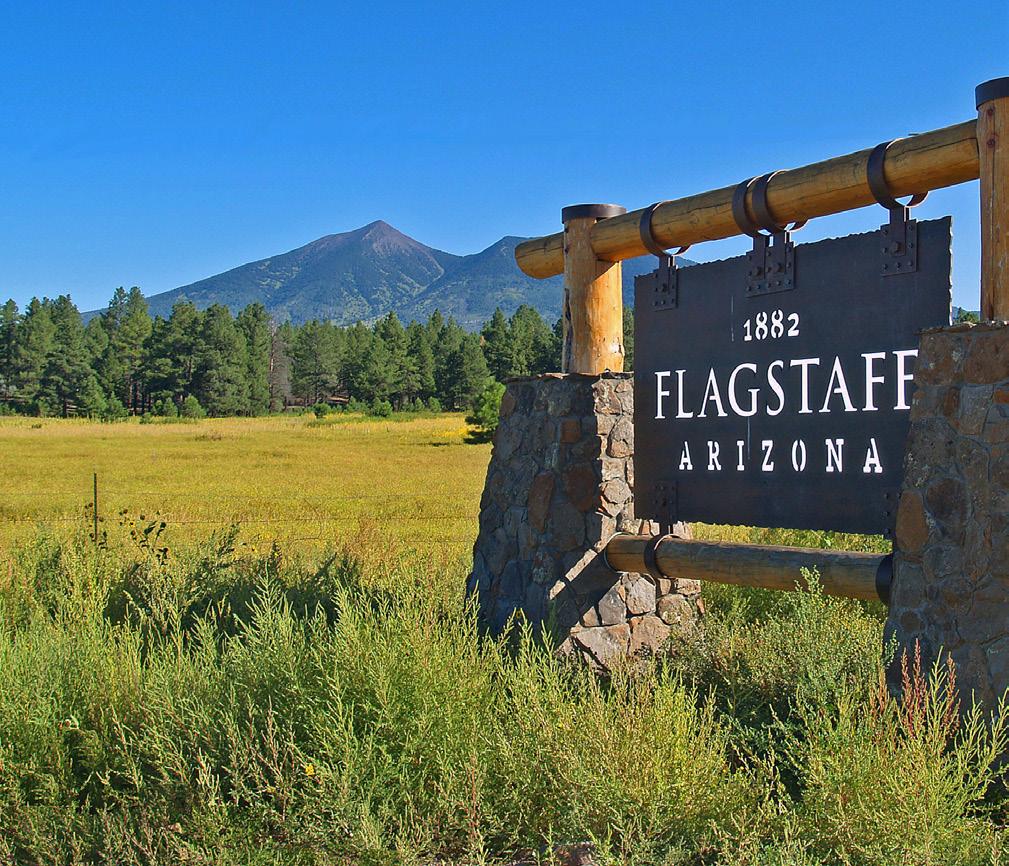
Green Business Boot Camp with Local First Arizona is scheduled in the same City Council meeting. Together, these organizations strengthen Flagstaff’s ability to support entrepreneurs, expand existing businesses and build a resilient local economy that can ensure sustainable economic development.
Other economic development activities the City of Flagstaff has helped plan included business pitches at Lowell Observatory, organized by Moonshot on April 7. Additional Arizona Tech
Week events were showcased the morning of April 8 at Coconino Community College’s Lone Tree Campus, followed by highlights from the Northern Arizona University College of Engineering at the Du Bois Center that same afternoon. Students, entrepreneurs, businesses, community members and interested residents were all invited to attend and participate in the events. FBN
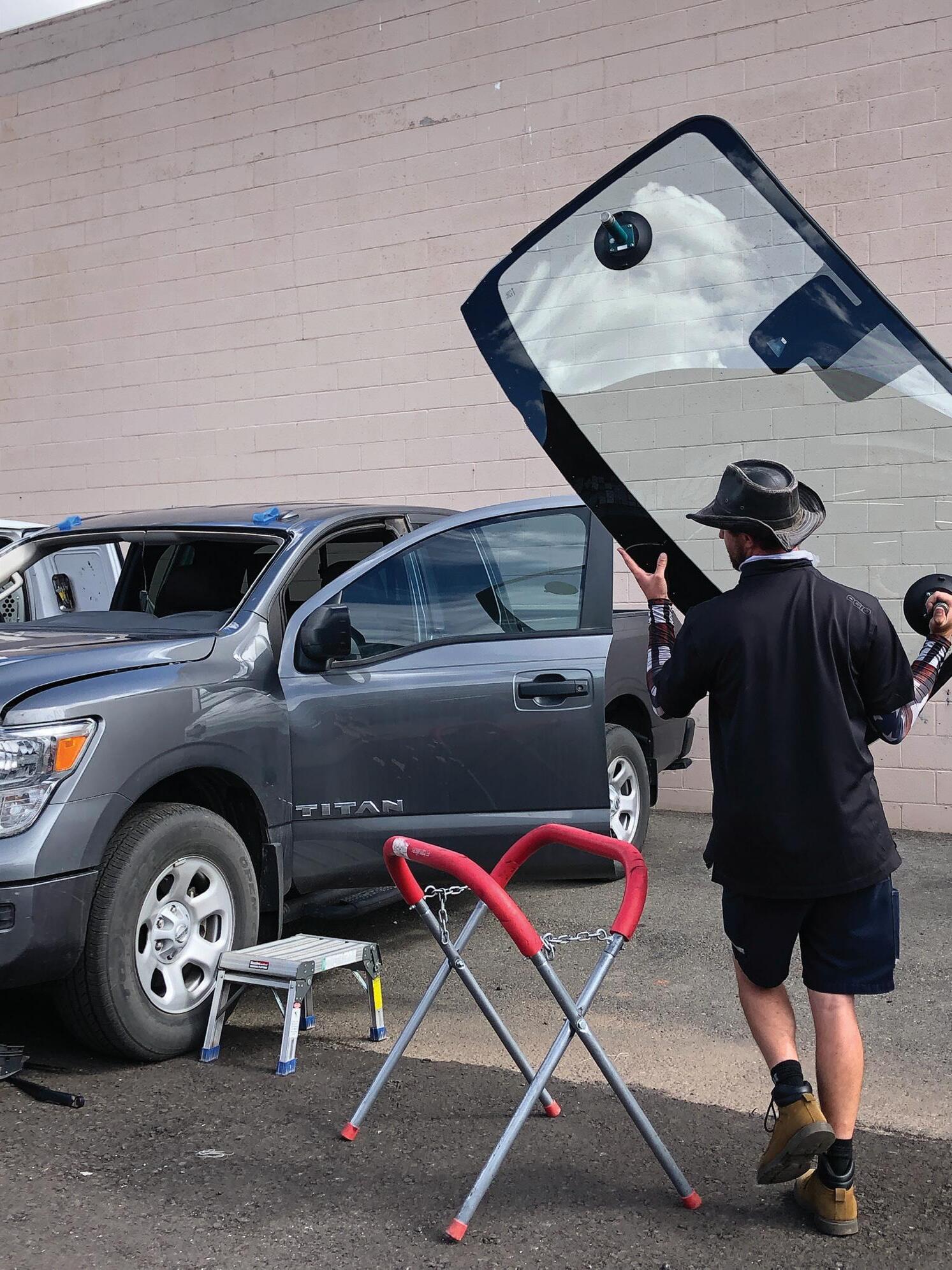






shoulder arthritis pain. Heat may be especially helpful to use for warming up the joint before stretching.
Medication: All medications have benefits and potential complications. Common medicines include acetaminophen (Tylenol) and NSAIDs (e.g., Advil or Motrin). Opioid (narcotic) medications should be avoided as they are highly addictive and become less effective over time, especially if surgery is chosen.
Injections: Injections can effectively treat the inflammation caused by shoulder arthritis, which alleviates pain and allows for improved range-of-motion. Options include cortisone injections and orthobiologics. Cortisone injections are often suggested – along with physical therapy – early in the treatment plan to manage arthritis as they can offer significant pain relief with minimal side effects. Orthobiologics, which use a patient’s own blood and cells, are much newer treatments that may provide similar results as cortisone injections but are typically more expensive.
SURGICAL OPTIONS:
Most are performed on an outpatient basis, meaning you can go home the same day after the surgery. They vary from very minimally invasive techniques (Arthroscopic surgery, where the use of a small camera and instruments clean the shoulder), to actual replacement of the damaged joint, also known as shoulder replacement surgery or shoulder arthroplasty.
What parts of the shoulder can be affected by arthritis?
Arthritis can affect any of the three shoulder joints: the glenohumeral (GH) joint, the acromioclavicular (AC) joint and occasionally the sternoclavicular (SC) joint. When any kind of arthritis affects the shoulder joint, cartilage on one or both sides of the joint start to wear out.
Acromioclavicular (AC) joint: This joint is where the clavicle (collar bone) meets the acromion (roof of the shoulder), which is part of the scapula (shoulder blade). It moves a little when the shoulder moves and can be injured in a shoulder separation.
Arthritis of the AC joint is very common. In fact, after 40 years of age, most people will have AC joint osteoarthritis on their shoulder x-rays. For most people, there is no significant pain, so no treatment is necessary, even with abnormal X-rays.
Persistently painful AC joint arthritis that limits the use of the shoulder is uncommon.
Glenohumeral (GH) joint: This larger joint is the ball and socket joint connecting the top part of the arm (humerus) to the shoulder blade (scapula). It allows the shoulder to have a wide range of motion in all directions. In the course of a lifetime, this joint is constantly in motion.
When arthritis develops, it restricts motion and causes pain. Since the shoulder helps position the hand for daily functions, sports and other activities, any loss of motion or restriction because of pain will
significantly limit the function of the entire arm and hand.
Are there different types of arthritis? There are more than 100 types of arthritis! However, the majority of arthritic conditions affecting the shoulder are often separated into two major categories:
Osteoarthritis (OA): This is the “wear and tear” type of arthritis that often appears in later life. In some cases, OA can present after an injury or fracture (break) to the shoulder and is called post-traumatic arthritis.
Inflammatory arthritis: This includes rheumatoid arthritis (RA) and affects people at an earlier age. It typically affects multiple joints in the body (elbows, shoulders, knees, etc.) and is caused by an underlying inflammatory autoimmune disease.
Coming next month: Shoulder Arthritis, A Basic Guide, Part Two. If you are thinking about shoulder replacement surgery, We’ll discuss what questions you should be asking yourself and your surgeon. FBN
Dr. Yuri Lewicky, M.D., is a double board-certified Orthopaedic Surgeon who specializes in shoulder surgery and sports medicine. He practices in Flagstaff and Prescott Valley at Northern Arizona Orthopaedics and can be reached at 928226-2900, NorthAzOrtho.com

PECANS continued from page 9
also offers different flavors such as salted, jalapeño, sweet or spicy cinnamon and buttery golden praline.
“What started as a vision is now something we can hold in our hands,” said Furman.
“We also have a dream to turn this into an education experience for people with disabilities and local schools so others can see how a pecan farm is run and all it entails,” said Kelly.
“We want to set the machines up so we can run some nuts and show them the whole process,” said Furman.
“This is my first time using Jerry’s services and he and his team worked hard and did an excellent job,” said Julie Walker of Camp Verde, who has about 40 pecan trees of her own. “He is a fantastic person. You can tell he really likes living in Camp Verde.”
WHO I ADMIRE
I admire my wife, Kelly, the most. Growing up, I never had anyone teach me financial literacy or discipline, and she’s the very best at that. She’s also very kindhearted and my best friend.
MY FAVORITE SEASON
Spring. I love to watch things grow. The flowers and trees all come alive and the smells are amazing.
WHERE I GO TO UNWIND
There’s a little spot by the river on our property. There’s a hammock and a bench there beside a sycamore tree. We like to go down there to relax and listen to the river. We enjoy the solitude of our farm.
HOBBY I HOPE TO PURSUE
Eventually, I want to learn how to sail and use a catamaran. I’d like to go explore anywhere that has calm water. That’s my 10-year plan. FBN
For more information about Verde Valley Pecans, visit www.verdevalleypecan.com.

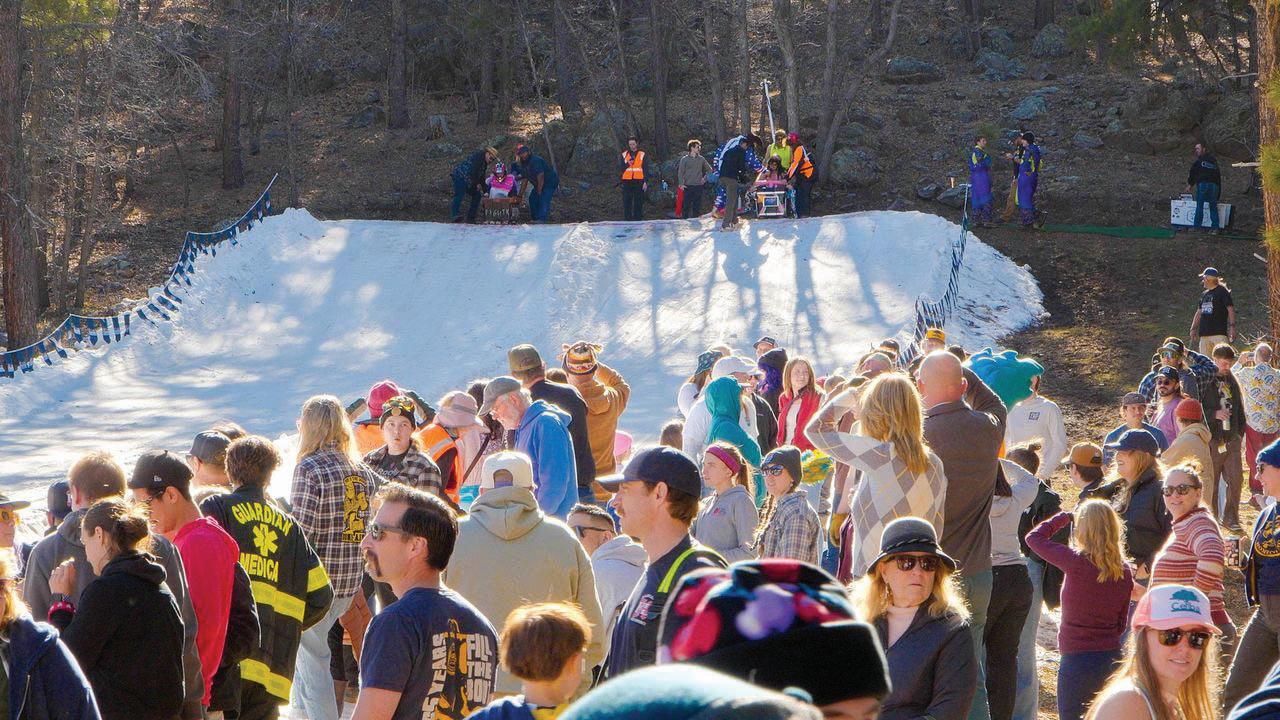
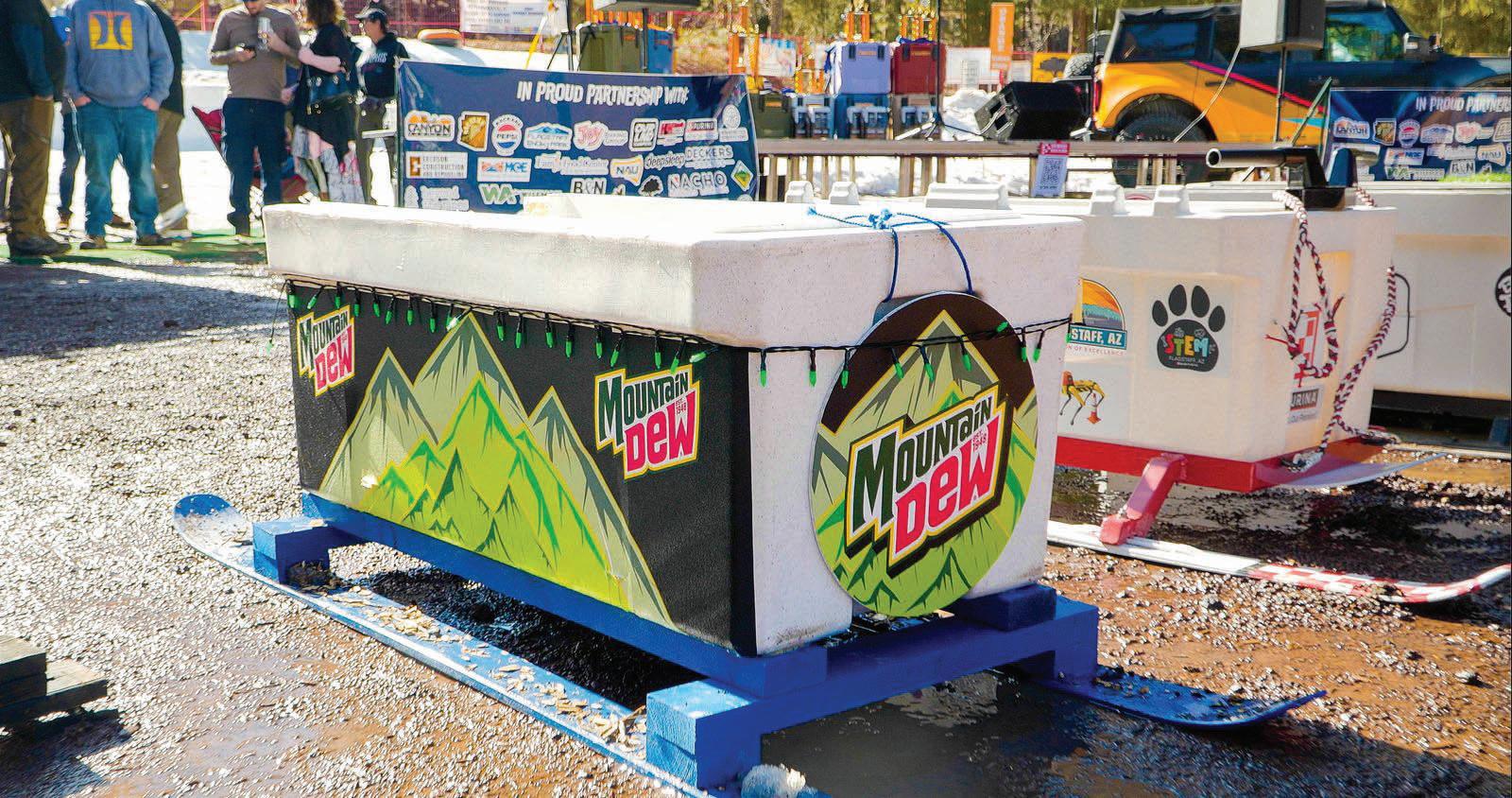
sure for Flagstaff’s culinary scene, she noted. “I do feel like not a lot of people realized where I was from and that brought some notoriety to Flagstaff, definitely.”
She believes Flagstaff’s food scene is evolving. “I do see it changing for the better. We have some great chefs that are coming to Flagstaff and doing things and trying to push the limits, which is great. I didn’t see that 10 years ago.”
She opened Atria downtown in 2022. It’s touted as “farm-fresh modern American fare.”
Daniel has impressive credentials.
She was sous chef at Zinc Bistro in Scottsdale, executive chef of Fat Ox and later at L’Auberge de Sedona Resort.
Daniel got an early start cooking, working in the kitchen at Arrowhead Country Club in Glendale. She trained at Le Cordon Bleu Culinary Institute of Scottsdale.
She knew she wanted to be a chef at age 14.
“I really liked how food brought my family together. We sat at the dinner table every night. Every holiday the whole family would get together. It always made people happy. Something about that was special and cooking with my grandma and my mom for the holidays, it just felt so natural.”
Daniel plans to open two new food and beverage venues downtown in June, next door to Atria. That includes
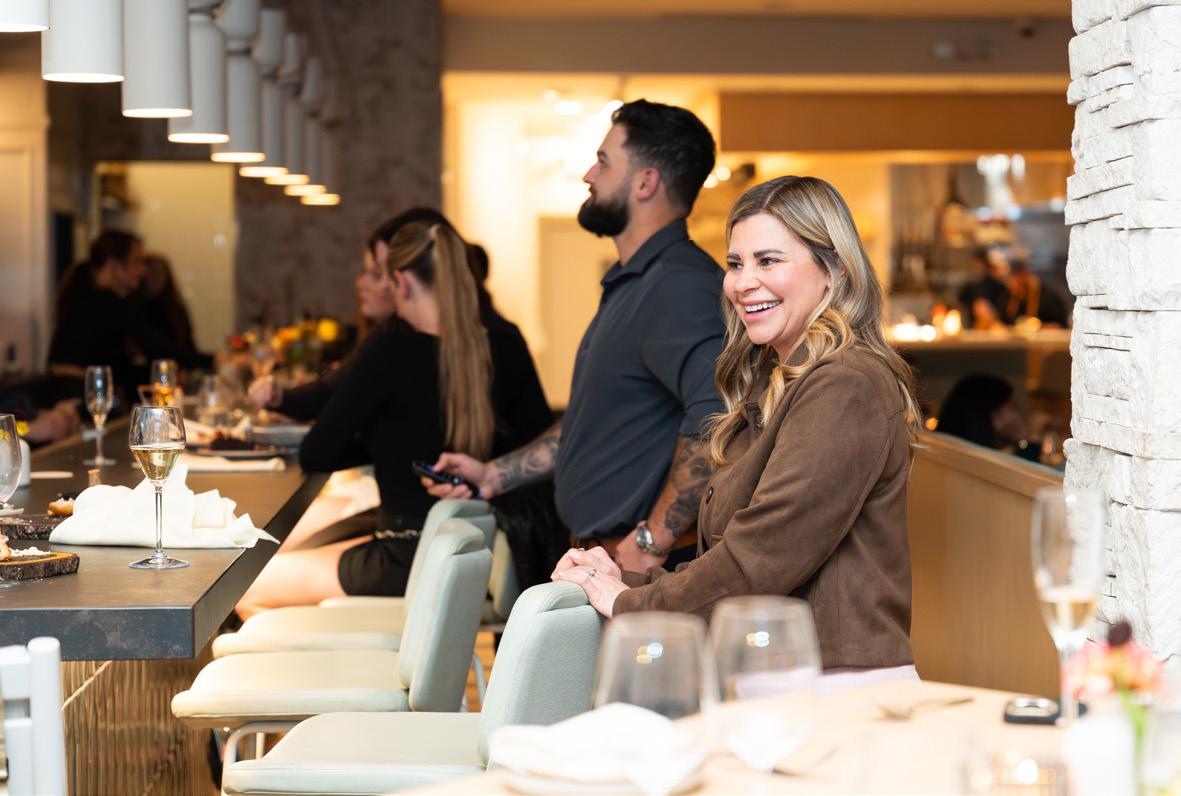
KAYENTA continued from page 13
Services and other stakeholders. NPC was awarded the funding in 2024.
The Arizona Commerce Authority (ACA) is the state's leading economic development organization, with a streamlined mission to grow and strengthen Arizona's economy by attracting out-of-state companies to establish and expand operations in Arizona, the press release added.
“We’re proud to partner with Northland Pioneer College on the expanded Kayenta Center. This groundbreaking reflects a shared commitment to strengthening rural Arizona’s economy and workforce,” said ACA President and CEO Sandra Watson. “We’re grateful to Governor Hobbs, Dr. Lawson and Northland Pioneer College, Kayenta Township, Dr. Nygren and Navajo Nation, along with all of the partners for their leadership and collaboration.”
The Kayenta Township serves as a major stop before Monument Valley. It is the region’s primary hub for travelers visiting Navajo Nation attractions.
“This project has the promise to strengthen and expand the local Township economy by developing homegrown talent aligned with the Township’s priorities, Navajo cultural values and new jobs and new regional workforce needs as the Township targets prospective employers and industry,” said Kayenta Township Manager Jarvis Williams. “Northland Pioneer College has been in the Kayenta community for 50 years, so this groundbreaking is a welcomed new home for NPC and a tangible place of learning for students.”
Pompette, a bistro and bakery, and a speakeasy with a playful name, Little Rich Girl. A private dining room is part of the expansion.
The James Beard Award semifinalists were scheduled to be announced March 31. It was not known at press time if Daniel was a semifinalist for Best Chef Southwest.
The winners are set to be revealed
June 15 at the Lyric Opera in Chicago. FBN
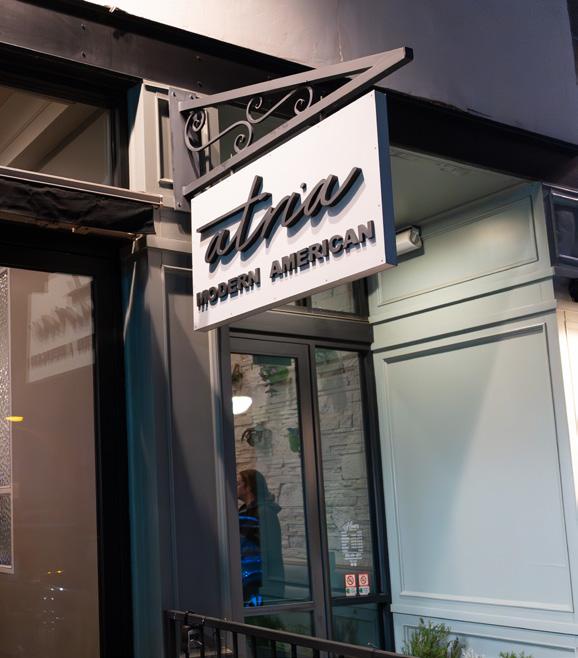
"The new NPC facility in Kayenta represents a meaningful investment in people, creating opportunities for education, connection and long-term prosperity for the entire community,” said NPC President Dr. Von Lawson. “We hope the impact of this new center will extend far beyond its walls, fostering educational achievement while helping to drive sustainable growth across the region. This effort reflects the power of partnership. By working together with community leaders, we are creating a space that will uplift students, families, and the broader region for years to come.”
Navajo Nation President Dr. Buu Nygren signed the lease agreement in a ceremonial event on June 20 at Kayenta’s Town Hall. On July 1, NPC hosted a development event and job fair to coordinate the construction activities and kick off the project. The event brought together key stakeholders, including representatives from NPC, the Kayenta Township, SPS+ Architects, Jones and DeMille Engineering, and CORE Construction.
The project is expected to be completed by May 2027. FBN
Signature Taxidermy employs some of the world’s best artisans to ensure nothing short of the best for each of our customers, and their specific, one of a kind pieces.
USDA approved facility for receiving sport hunted trophies from around the world. This also includes all deer, and turkey from Mexico.
Trophy Room Design- We can assist you in designing a trophy room display to complement your collection. We can assist with lighting, layout, murals, and dioramas. Custom pedestal and base work available.
Crating and Shipping- We crate and ship around the world, and have discounts with many major trucking companies.
Rush Orders- Rush orders are available on request for an additional fee.
Stock Taxidermy- We have an assortment of legal capes, antlers, and horns that can be mounted in a pose of your choice.

E Commerce Ave
Arizona


121 E. Birch Avenue, Suite 408 Flagstaff, AZ 86001
Phone 928.864.7440 Fax 928.226.0303
Email: Troy@flagstaffbusinessnews.com www.flagstaffbusinessnews.com
Founder: Troy Bix
Publisher Troy Bix | 928-310-9662
Troy@flagstaffbusinessnews.com
Advertising Manager
Linda Thein | 602-799-0583 linda@flagstaffbusinessnews.com
Account Executive
Regina Salas | 928-699-4272
Regina@flagstaffbusinessnews.com
Editor
Bonnie Stevens | 928-380-4349 bonnie.stevens@gmail.com
Copy Editor
Carolyn Wendell | cwendell@gmail.com
Design & Production
Rob Ghosh Design | rob@robghosh.com
Photography V. Ronnie Tierney, Fresh Focuses
Photography, Betsey Bruner, Kay Lyons
Contributing Writers
Betsey Bruner, Kevin Schindler, Bonnie Stevens, Veronica Tierney, Stacey Wittig, Peter Corbett, Mary Marini, Stan Bindell
Flagstaff Business News is a publication of Flagstaff Business News, LLC and is distributed free each month to residents of Flagstaff, Sedona, Williams and Winslow. Reproduction of any portion of the publication is strictly prohibited without expressed permission. The publisher reserves the right to refuse any advertisements submitted to the newspaper and is not responsible for the claims of its advertisers.
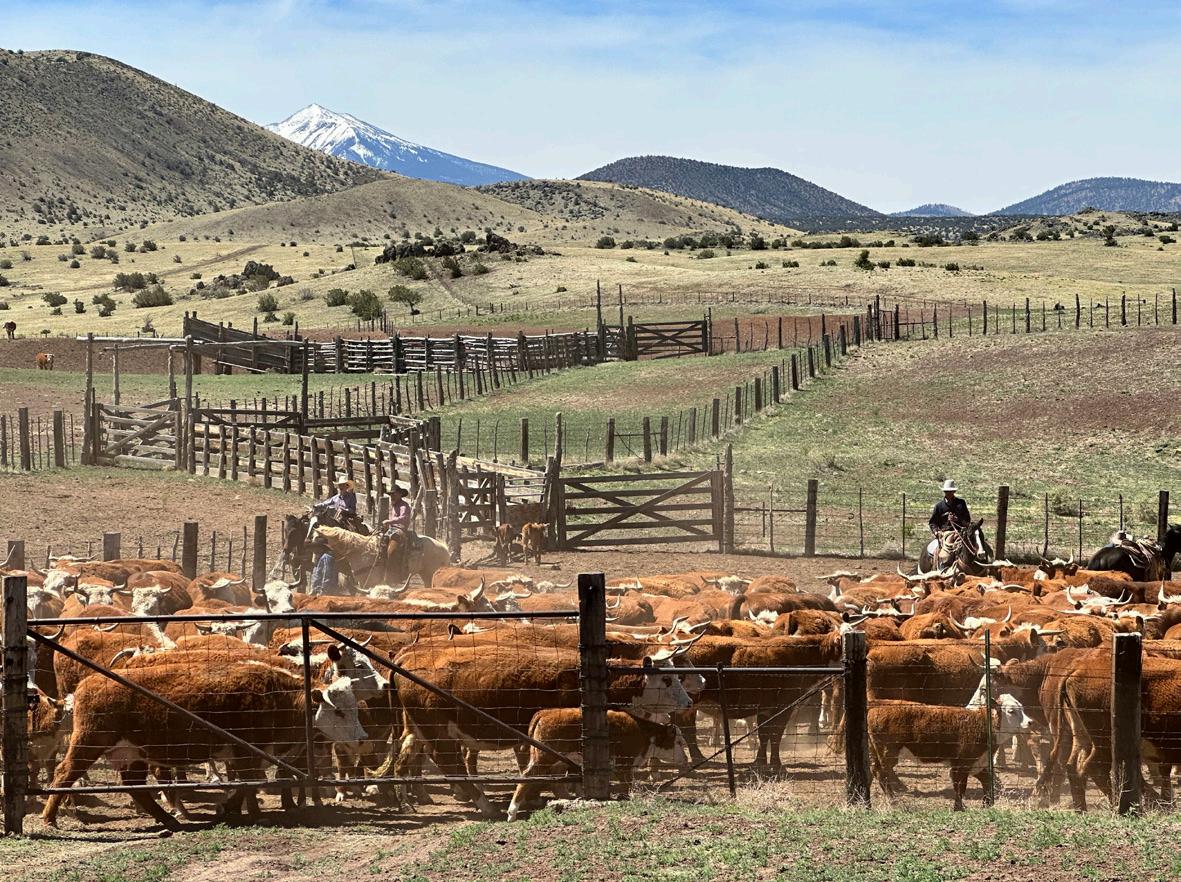
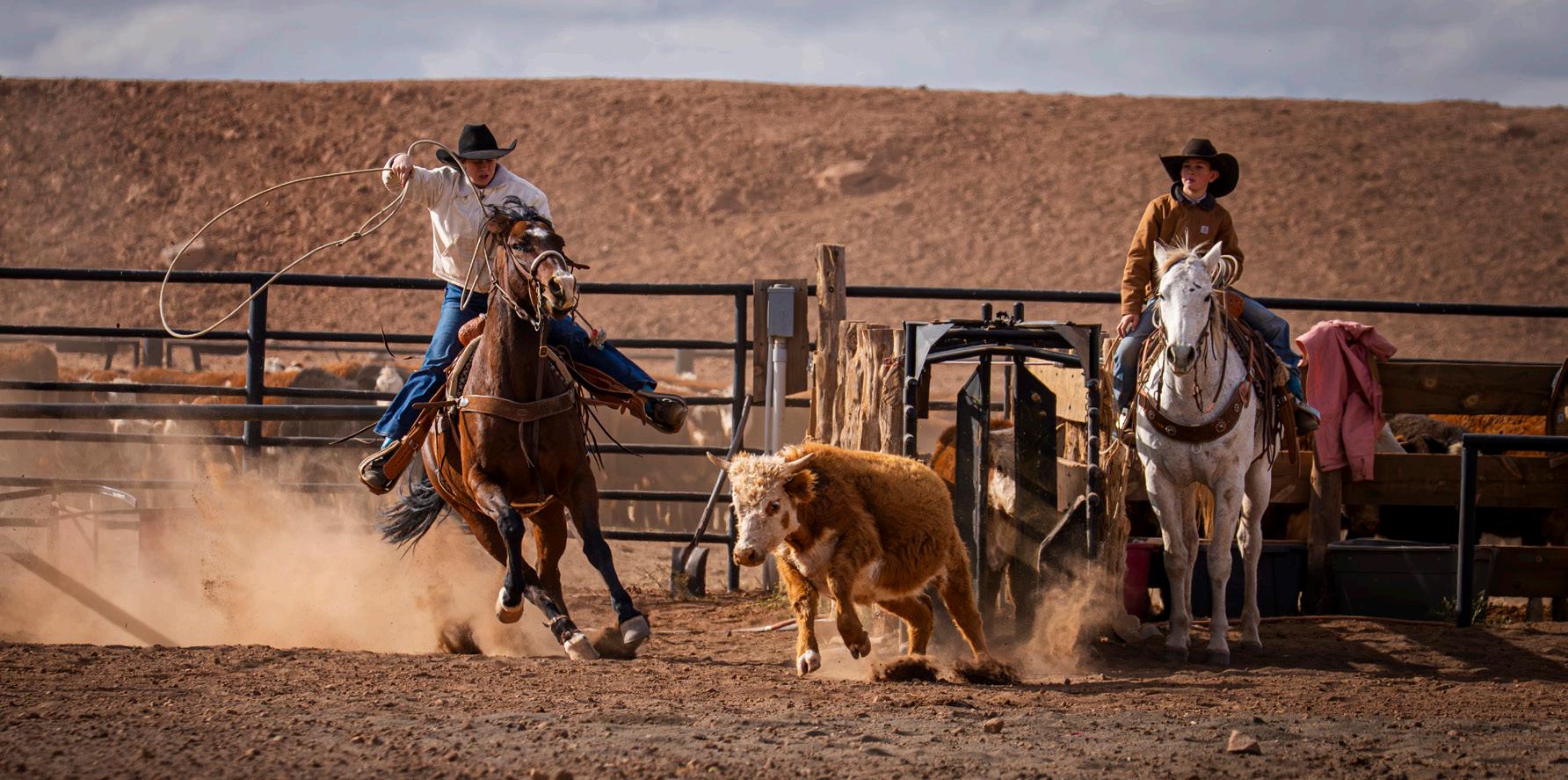
ern Frontier,” said Babbitt Ranches President and General Manager Billy Cordasco. “But it takes a special kind of person to see what could be, rather than what is in the present. People like that built the West and continue to shape the future. These young men didn’t stay discouraged for long.”
As sun rose on that spring morning, the day’s early rays revealed majestic snowcapped mountains stretching out of the expansive ponderosa forest. They were stunned by the beauty before them. The brisk gentle breeze carried the clean scent of pine and began to lift their spirits. The bustling excitement of businesspeople getting to work and rebuilding their town filled the streets.
Near the train depot, the good natured and well-connected town doctor opened his make-shift office. The brothers knew about Doc Brannen and were prepared with a letter of introduction. The doctor listened to their story and upon hearing that they had $20,000 to spend, he understood that these young men were serious buyers if the right opportunity were to present itself.
As fate would have it, Doc Brannen was aware that a healthy herd of cattle had just arrived east of town and the owners were anxious to sell. With great enthusiasm, he shared the news –which is just what the brothers needed to heal their hearts and rekindle their flame. In that conversation, whether they recognized it or not, the Babbitt brothers’ new home and new life was beginning to take form – the beginning of a ripple effect that would not only impact Flagstaff, but the nation. Their future had found its place.
“This is a classic American story,” said Cordasco. “It’s about paying attention to what’s unfolding around us, listening with intention, and finding our place within it – stepping forward in ways that allow us to participate in something meaningful and bigger than all of us.”
Through market shifts, seasons of abundance and drought, times of conflict and times of peace – and even through global pandemics – the family business has endured. “We believe that endurance comes from staying grounded in values, character and guiding principles across generations. We are part of a living community of land, water, air and life – belonging within it and responsible to it. That belonging is both a gift and a calling: to care for what is here today and to carry it forward in strength and beauty for those still to come.”
At the heart of that journey is the broader community: employees and their families who have walked this path across generations, alongside neighbors and partners, whose shared commitment and care have carried the Babbitt Ranches Community forward for 140 years.
There’s hardly a business or community venture that the Arizona Babbitts did not participate in. They continue to be a force in the nation’s agriculture industry and through the years, have built trading posts and helped develop towns, operated a car dealership, butcher shop, department store, livery stable, lumber supply warehouse and funeral
parlor, among other ventures. They have played integral roles cultivating the Northern Arizona arts community, supporting educational institutions, preserving history, enlisting in the military and serving as government officials.
Their passion for science and conservation is evident through the many research projects they have participated in on their land, including the return of the once endangered black-footed ferret, creation of the SP Crater Golden Eagle Conservation Complex and anemometer studies for the exploration of wind energy.
More than 40,000 acres on Babbitt Ranches are held in conservation easements to ensure that generations to come will be able to enjoy these open spaces.
For decades, the ranch has also served as a place of learning and preparation beyond the horizon. Since the 1960s, NASA astronauts and engineers have trained here in support of Apollo, Mars and now Artemis missions, and the Babbitt Ranches land ethic carries forth to other worlds.
“We recognize that the health of land, economy and community are woven together, each strengthening the others through thoughtful participation,” said Cordasco. “Our decisions are guided by ecological intelligence, cultural respect, economic responsibility and the wisdom carried across generations, ensuring the benefits of the land and community carry forward.”
• Plumbing: Inspect supply lines and fixtures for slow leaks caused by winter temperature changes.
• Mechanical (HVAC): Schedule a heating system tune-up to improve efficiency and reduce fuel costs.
• Boiler / Hydronics: Bleed air from zones and radiators to improve heat distribution.
6993 N. Columbine, Flagstaff, AZ 86004, Tel (928) 526-7006 | (928) 526-6231 www.intermountainaz.com | admin@intermountainaz.com
Currently, along with raising cattle, providing recreational opportunities, generating wind power and engaging in advanced technology and scientific research, Babbitt Ranches is marking its 140th anniversary with a milestone clean energy project and a celebratory groundbreaking event planned for later this year.
The CO Bar Clēnera Solar and Storage Complex is Arizona’s most ambitious solar and battery storage development and one of the largest such efforts in the nation, with a 1,211-megawatt solar farm and 1,000-megawatt battery energy storage facility.
“When Northern Arizona University’s engineering department showed up about 25 years ago wanting to explore wind and solar resources on Babbitt Ranches, this was brand new territory for us,” Cordasco said, reflecting on the journey into clean energy.
“Then, Clēnera showed up,” he continued. “These guys were right in line with the values and principles that are important to Babbitt Ranches. Solar energy sounded like an opportunity –not only for generating clean energy, but for showing the next generation that Babbitt Ranches is more than cattle and horses and conservation in and of itself. It is about being part of something bigger than ourselves – going from life to energy to light.”
That combination of large-scale generation and long-duration storage is what sets the project apart from earlier solar developments, said Clēnera CEO
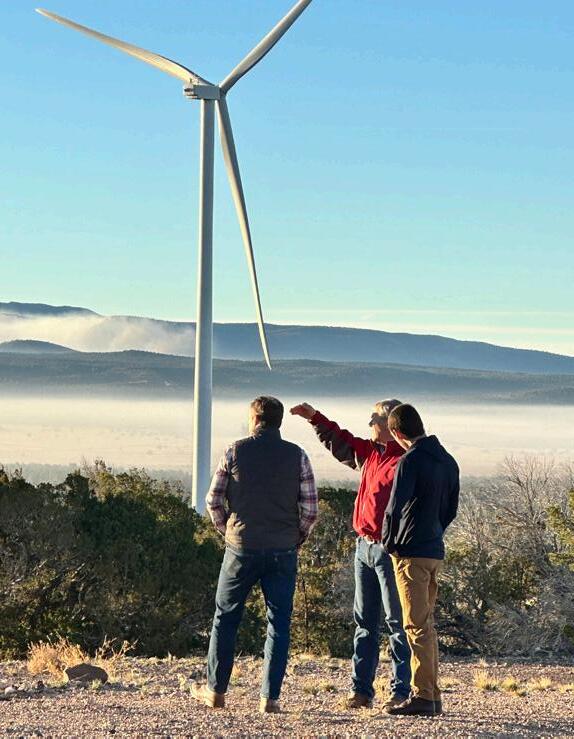
Jared Mckee. “It strengthens Arizona’s energy reliability, reduces dependence on fossil fuels and supports a more resilient electrical grid as population growth and energy demand continue to rise.”
Nearly a century and a half since David and Billy Babbitt were awestruck by Northern Arizona’s breathtaking Peaks, sprawling forest, alpine meadows, deep canyons, rolling hills and vast open spaces, the Babbitt Ranches Community believes the land will continue to present opportunities, as it always has.
“We live our responsibility as stewards – participating with the land in ways that honor its strength, beauty and natural capacity,” said Cordasco. “Through that care, we create enduring value that carries forward, serving both present needs and future possibilities.”
FBN