FLAC News Autumn 2012 F_FLAC05 vol15no4 16/10/2012 12:05 Page 1
flacNews
ISSN 0791 4148
Free
LegaL
l
VOLUME 22
l
NUMBER 3
advice
l
JULY – SEPTEMBER 2012
centres
Waiting for justice: Almost 5,000 on Legal Aid Board lists
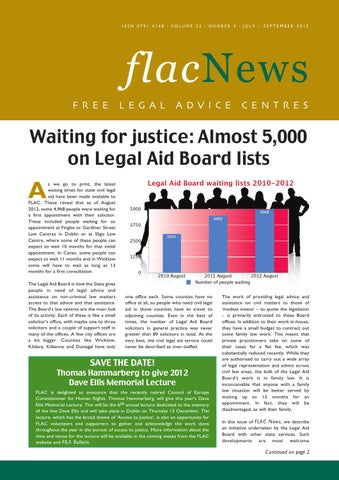
s we go to print, the latest waiting times for state civil legal aid have been made available to FLAC. These reveal that as of August 2012, some 4,968 people were waiting for a first appointment with their solicitor. These included people waiting for an appointment at Finglas or Gardiner Street Law Centres in Dublin or at Sligo Law Centre, where some of these people can expect to wait 10 months for that initial appointment. In Cavan, some people can expect to wait 11 months and in Wicklow some will have to wait as long as 13 months for a first consultation.
Legal Aid Board waiting lists 2010-2012
A
The Legal Aid Board is how the State gives people in need of legal advice and assistance on non-criminal law matters access to that advice and that assistance. The Board’s law centres are the main hub of its activity. Each of these is like a small solicitor’s office, with maybe one to three solicitors and a couple of support staff in many of the offices. A few city offices are a bit bigger. Counties like Wicklow, Kildare, Kilkenny and Donegal have only
5000
4968 4482
3750 2500
3054
1250 0
2010 August
2011 August
Number of people waiting
one office each. Some counties have no office at all, so people who need civil legal aid in those counties have to travel to adjoining counties. Even in the best of times, the number of Legal Aid Board solicitors in general practice was never greater than 89 solicitors in total. At the very best, the civil legal aid service could never be described as over-staffed.
SAVE THE DATE!
Thomas Hammarberg to give 2012 Dave Ellis Memorial Lecture
FLAC is delighted to announce that the recently retired Council of Europe Commissioner for Human Rights, Thomas Hammarberg, will give this year’s Dave Ellis Memorial Lecture. This will be the 6th annual lecture dedicated to the memory of the late Dave Ellis and will take place in Dublin on Thursday 13 December. The lecture, which has the broad theme of ‘Access to Justice’, is also an opportunity for FLAC volunteers and supporters to gather and acknowledge the work done throughout the year in the pursuit of access to justice. More information about the time and venue for the lecture will be available in the coming weeks from the FLAC website and PILA Bulletin.
2012 August
The work of providing legal advice and assistance on civil matters to those of ‘modest means’ – to quote the legislation – is primarily entrusted to these Board offices. In addition to their work in-house, they have a small budget to contract out some family law work. This means that private practitioners take on some of their cases for a flat fee, which was substantially reduced recently. While they are authorised to carry out a wide array of legal representation and advice across civil law areas, the bulk of the Legal Aid Board’s work is in family law. It is inconceivable that anyone with a family law situation will be better served by waiting up to 13 months for an appointment. In fact, they will be disadvantaged, as will their family. In this issue of FLA C New s, we describe an initiative undertaken by the Legal Aid Board with other state services. Such developments are most welcome
C o ntinued o n page 2
FLAC News Autumn 2012 F_FLAC05 vol15no4 16/10/2012 12:05 Page 2
flac News | Vol. 22, No. 3
in this edition...
Waiting for justice: Almost 5,000 on Legal Aid Board lists 1&2 Dolphin House mediation initiative
2
Success in social welfare appeal
3
Woman refused social welfare and offered train ticket to Belfast
3
Migrant Consultative Forum established
3
Changes to Mortgage Interest Supplement must be annulled
4
Submission to UN on access to justice
4
European group salutes Lydia Foy, calls for Transgender rights now
5
New migrant information service launched in Limerick Personal insolvency law needs urgent change
5
Further clarification on terminating Hire Purchase agreements Access to justice centre-stage for Oireachtas presentation FLAC Fellowships 2012
6-7 7 8
9-10
Debt queries to FLAC still growing 10 Focus on FLAC: Kim Watts, PILA Legal Information & Communications Officer 11 FLAC Summer Squad An Acknowledgement
12 12
Specialised immigration law training in Cork
13
Focus on PILA PILA pro bono referral case study
14
FIDH: Taking the local to the global international cooperation on human rights 15 Ireland’s most influential woman in law 16 Landlord & Tenant legal education sessions for NGOs 16
FLAC NEWS is published quarterly by Free Legal Advice Centres Ltd., 13 Lower Dorset Street, Dublin 1. Editors: Noeline Blackwell, Emma Cassidy & Yvonne Woods
Layout & Printing: Printwell Design, D3 Contributors: Noeline Blackwell, Saoirse Brady, Emer Butler, Emma Cassidy, Michael Farrell, Andrew Guy, Anita Howlin, Paul Joyce, Gillian Kernan, Zsé Varga, Kim Watts, Yvonne Woods ISSN 07914148
2
The views of individual contributors do not necessarily represent the views of FLAC. FLac news
l JULY
–
Dolphin House mediation initiative
tripartite initiative involving the Legal Aid Board, the Family Mediation Service and the Courts Service began in Dolphin House District Court in Dublin in March 2011. The project’s objective was to offer a viable alternative from the acrimony of the courts and into a process of mediation leading, hopefully, to agreement. The Family Mediation Service is a free state-run service operating under the Legal Aid Board.
A
The scheme is unique in that the Courts Service, the Legal Aid Board and the Family Mediation Service all operate under the same roof in Dolphin House District Court. The service is aimed at separated or separating parents – married or not – who are unable to agree about custody, access or guardianship. All applicants who indicate that their case relates to any of these issues are offered the option of attending an information session provided by the Family Mediation Service, which is located on the fourth floor. However, if the person is seeking a remedy on foot of the Domestic Violence legislation, a referral to a family mediation information session is not made. [continued from front page]
If it is suitable and the other party agrees, then a joint mediation session is scheduled. If the applicant wishes to receive legal information and advice at any time during the process, they may call to the Legal Aid Board law centre in the same building. Typically, the Legal Aid Board staff will provide information on demand, rather than advice. The Legal Aid Board solicitors will provide advice to qualifying people on any mediated agreement which needs to be formalised by the District Court. The project has now been in existence in Dublin for more than a year and is about to be rolled out to the District Court offices in Naas, County Kildare and possibly Co. Cork.
The new scheme is envisaged to save considerable costs to the Courts service as mediated agreements mean cases are not going to court. In addition, the majority of the cases involved, the parties would be eligible for legal aid, so this is saving money for the Legal Aid Board in not needing to engage in numerous court appearances.
attempts to achieve better, nonconfrontational outcomes for those in family distress. However, the fact is that 4,968 people are still waiting to have even a first discussion with a lawyer about their legal problem.
(15.7%) and debt & credit law (9.6%). These topics reflect concerns in households nationwide during the recession around debt and employment and the related impact of such stresses on family relationships.
FLAC’s lo-call telephone information line and our free advice centres around the country provide at least some bridge for people waiting for legal aid. Through these services, FLAC aims to give people a basic grasp of the law as it applies to them and of the path they must travel to resolve their disputes. Access to such basic information is a first step to accessing justice and achieving resolution of disputes.
Although the budget of the Legal Aid Board was not cut last year, its spending has been reduced from 27 million to 24 million over the past few years while demand for its services has almost doubled – and the Board has also taken over responsibility for the Family Mediation Service.
Since the start of 2012, the main topics discussed on FLAC’s telephone information lines have been family law (23.6 %), debt & credit law (12.7%) and employment law (7.9%). Similarly, in our advice centres the top three issues have been family law (34.1%), employment law
sePteMBer
2012
Very few people actively want to go to a lawyer, let alone to court, but access to legal advice and representation is a crucial mark of democracy and the rule of law. Therefore, while state spending is cut drastically across all areas of society, the role of access to justice in underpinning all aspects of people’s lives in that society must also be remembered.
FLAC News Autumn 2012 F_FLAC05 vol15no4 16/10/2012 12:05 Page 3
flac News | Vol. 22, No. 3
Woman refused social welfare and offered train ticket to Belfast
A
Officials dealing with her ignored the fact that she had spent all her life within the Common Travel Area (CTA) between the Republic and the UK, despite official guidelines that say periods of residence in the CTA should be treated the same as residence in the Republic for HRC
purposes. The officials also ignored the fact that, as an Irish citizen, she had a right to reside in the Republic of Ireland. At one stage they offered her a train ticket to Belfast.
pleading for assistance, but they refused and her appeal was rejected.
At times she had to scavenge in rubbish bins for food and her health deteriorated. At one stage she wrote to the social welfare office saying she was starving and
Mary has now been awarded Disability Allowance and been paid arrears for the period of nearly 18 months when she was cut off. She is now trying to rebuild her life.
Mary, who had family connections in the Republic, had initially been accepted as habitually resident but was cut off in February 2011. She became destitute, staying briefly in a homeless hostel where all the other residents were men. When the hostel could no longer keep her, she depended entirely on charity from friends.
Success in social welfare appeal
he Social Welfare Appeals Office recently agreed that arrears of Child Benefit should be paid to an African woman who had been recognised as a refugee. The woman’s asylum application had initially been rejected but the Refugee Appeals Tribunal upheld her claim and the Minister for Justice recognised her as a refugee.
T
The woman had applied for Child Benefit while awaiting a decision on her asylum application but was refused on the basis that her status in the State remained uncertain. When she got her recognition, the Department of Social Protection began to pay her Child Benefit from that date.
FLAC represented her in an appeal to the Social Welfare Appeals Office and argued that the Minister’s decision did not make the woman a refugee, it simply recognised that she was one and therefore had been entitled to reside here from when she made her asylum application. Accordingly, she was entitled to Child Benefit as soon as she satisfied the other requirements of the Habitual Residence Condition. The Appeals Officer agreed and held that she was entitled to arrears of benefit.
The recently published 2011 Annual Report of the SWAO also includes a summary of a similar decision where an Appeals Officer awarded arrears of benefit, relying on a judgment by Mr Justice Cooke in the High Court in February 2011, in the case of HID v.
A local Citizens Information Centre worker and FLAC helped Mary to seek a review by the Chief Appeals Officer. The original Appeals Officer then reviewed his decision and held that she was habitually resident. The Chief Appeals Officer also held that the initial decision that Mary satisfied the HRC should not have been amended unless there was a substantial change in her circumstances, a principle called ‘once and done’.
Migrant Consultative Forum established
Refugee Applications Commissioner. The judge said: An asylum seeker is a refugee as and when the circumstances defined in the Geneva Convention arise and apply. The determination of the asylum application is purely declaratory of a pre-existing status.
Social welfare information update
FLAC updated its FLACsheet on the Habitual Residence Condition in September 2012. The HRC is an extra qualifying condition introduced in 2004 for certain means-tested social welfare payments and Child Benefit.
The updated info reflects the changes to work permit restrictions for Romanian and Bulgarian nationals. These limitations that were due to last until January 2014 have now been lifted. Romanian and Bulgarian nationals no longer need a work permit to be employed in Ireland. 8 Read the updated FLACsheet online at http://bit.ly/hrcsept2012
8 For more information on the lifting of the work permit restrictions, see the Immigrant Council of Ireland’s factsheet on Ro manian and Bulgarian natio nals in Ireland at http://bit.ly/PKitev
Following the launch of Perso n o r Number?, a joint report by Crosscare, Doras Luimni and Nasc, the Minister for Social Protection, Joan Burton TD, agreed to establish a Migrant Consultative Forum to examine issues faced by immigrants seeking social protection.
© Photo by Lensmen
Northern Irish woman who was cut off social welfare benefits in the Republic and left destitute has had her payments restored and been paid arrears. Mary (no t her real name) is an Irish citizen who moved to the Republic of Ireland. She received payments for a time but was then cut off on the basis that she did not satisfy the Habitual Residence Condition.
The forum has five permanent members: Crosscare, Doras Luimni, Nasc, FLAC and New Communities Partnership. The first meeting of the forum between departmental officials and NGO representatives will take place in early October to consider the recommendations contained in Perso n o r Number? and raise relevant issues of concern. Saoirse Brady, Policy and Advocacy Officer will represent FLAC at the forum.
FLac news
l JULY
–
sePteMBer
2012
3
FLAC News Autumn 2012 F_FLAC05 vol15no4 16/10/2012 12:05 Page 4
flac News | Vol. 22, No. 3
Changes to Mortgage Interest Supplement must be annulled
LAC previously reported on changes to Mortgage Interest Supplement (MIS) contained in the Social Welfare and Pensions Act 2012 which mean that anyone seeking to access this state support will have to enter into a payment agreement with his or her lender and comply with the arrangement for 12 months before even being allowed to apply for MIS. Even then there might be a further difficulty in proving that the mortgage was reasonable at the time it was agreed, and the processing of the payment may take several months more, leaving people without any support for anything up to 18 months.
F
These changes were introduced in the form of a commencement order, Statutory Instrument 206 of 2012, by the Minister for Social Protection. Since the order was introduced on 21 June, FLAC has been lobbying hard to get the order annulled using a little-known Oireachtas procedure which allows any member of either House to call for the annulment of the order within 21 sitting days. In this case the relevant provision is contained in the primary legislation governing the order: s.4(6) of the Social Welfare (Consolidation) Act 2005. FLAC contacted the Joint Oireachtas
Committee on Education and Social Protection and other interested TDs and Senators about using the annulment mechanism and a number of Motions were put on the Order Papers of each House calling for the commencement order to be set aside. However, as the Ceann Comhairle has discretion in relation to the order of business of the House, such motions can remain for weeks or even months before they are dealt with.
During Leaders’ Questions in the lead-up to the publishing of the Personal Insolvency Bill, Fianna Fáil leader Micheal Martin raised the question of MIS and asked the Taoiseach to annul the Commencement Order. However, the Taoiseach refused on the basis that due to the money paid “under this system and for those in this category, the banks will be in receipt of €50 million of taxpayers’ money”.
In the Seanad, Fianna Fáil Senators and Independent Senator Katherine Zappone put down a motion of annulment. Unfortunately Government Senators voted against even holding a debate on the issue when Senator Averil Power (FF) attempted to move the Motion. In the Dáil, Deputies Catherine Murphy (Independent), Joan Collins (United Left
Alliance) and Barry Cowen (Fianna Fáil) also introduced motions but none of these have yet been debated or voted on. There are still a number of sitting days remaining to annul the order when the Oireachtas returns on 18 September. However, it seems that the political will on the part of government representatives, does not exist to delay changes to MIS until a broader range of options are available for those in mortgage arrears. A mechanism to annul a commencement order appears to provide a check and balance on ministerial powers which could lead to policy changes introduced outside the realm of primary legislation not debated at all by the Oireachtas. However, where that safeguard cannot be exercised due to deliberate obstruction by government TDs and Senators, it does not appear to represent a fair and democratic procedure.
FLAC believes that the enactment of the measure to limit MIS is premature without a comprehensive set of measures being available to ensure the protection of borrowers who have the capacity to remain in their homes with appropriate targeted support.
Submission to UN on access to justice
providing access to justice and on FLAC’s key research areas: civil legal aid, credit and debt law, social protection and public interest law. It also offered detailed recommendations in each of these areas. All recommendations focused on accessibility, fairness and real transparency for people who need to access state systems in a fair and timely manner.
agdalena Sepúlveda, the UN’s Special Rapporteur on extreme poverty and human rights, is due to submit a report on access to justice issues to the United Nations General Assembly in October 2012. In th preparation for the 67 session, Ms Sepúlveda invited interested parties to submit any contributions which might be relevant for her report. She also called on States to commit to improving access to justice for people in poverty at a high-level UN General Assembly meeting on the rule of law on 24 September 2012.
M
4
FLAC prepared a submission on access to justice, which focused on the current state infrastructure for
UN Rappo rteur Magdalena Sepúlveda
FLac news
2012
l JULY
–
sePteMBer
Ms Sepúlveda’s final report will highlight international best practice in increasing access to justice for all citizens, including those living in extreme poverty. The next edition of FLA C New s will provide an update following the report’s publication in October.
FLAC News Autumn 2012 F_FLAC05 vol15no4 16/10/2012 12:05 Page 5
flac News | Vol. 22, No. 3
European group salutes Lydia Foy, calls for Transgender rights now
packed conference of European transgender organisations meeting in DCU in September gave FLAC client Lydia Foy a standing ovation and called for urgent legislation to recognise transgender persons in Ireland.
discussion by the Oireachtas Committee but that any further substantial delay would be unacceptable. Lydia Foy and other trans persons had suffered embarrassment, prejudice and discrimination for too long. Legislation must come in the very near future or Dr. Foy and FLAC would be forced to go back to court to vindicate her rights.
Speaking at the conference, Social Protection Minister Joan Burton acknowledged that Ireland is in breach of the European Convention on Human Rights (ECHR) on this issue and is obliged to change the law. She said her Department had been waiting for advice from the Attorney General’s office, which they had just received.
She promised to give high priority to drafting the legislation and to refer it to an Oireachtas Committee to discuss in October or November. Transgender Europe, which includes members from Iceland to Turkey, was holding its first ever conference in Ireland, hosted by TENI (Transgender Equality Network Ireland). Among the delegates were representatives of the Council of Europe’s Commissioner for Human Rights and the EU Fundamental Rights Agency.
Some of the delegates were puzzled by the warm messages of welcome they received from President Michael D. Higgins, the Lord Mayor of Dublin and Minister Burton in a country that, alone in the EU, has no provision for legal recognition of transgender persons.
Lydia Fo y
© Audra Melton for Atlantic Philanthropies
A
FLAC solicitor Michael Farrell told the conference that it was 19 and a half years since Lydia Foy first wrote to the Irish Registrar General requesting a new passport in her female gender. It was 15 years since she began legal proceedings, represented by FLAC, to secure legal recognition, and five years since the High Court had ruled in her favour. He accepted the Minister’s commitment on this issue and said that FLAC would engage with the drafting process and the
Senator Katherine Zappone also spoke at the conference and made a powerful plea for lawmakers to embrace humanity, accept diversity, and be inclusive and seek the best practice to be found on this issue instead of opting for the least possible change and following outdated and restrictive models.
The Transgender Europe conference gave a significant boost to the campaign for gender recognition legislation and more broadly for the visibility and acceptance of Ireland’s small transgender community. Sadly, it also saw another side of Irish society when three delegates to the conference were verbally abused and spat at in the city centre on their way to a conference social event. Another reason for urgent transgender legislation is to send out a clear message that trans people are accepted and welcome in our society and that this sort of bigotry and persecution is not acceptable.
New migrant information service launched in Limerick
n August 2012, Limerick-based migrant rights organisation, Doras Luimní officially launched its Legal Service initiative.
to ensure that the migrant population in Limerick and the surrounding area have access to the assistance they need.
The Legal Service team is made up of Legal Officer Okeremute O. Okeregha and Legal Intern, Seona Dillon McLoughlin. They have been working together since June
The new Legal Service is intended to advance Doras Luimní’s direct support work and is open 4 days per week. More information at http://www.dorasluimni.org/.
I
This specialised service aims to provide migrants in the Mid West region with legal information as they navigate the complex asylum and residency processes. It also provides support to undocumented migrants who need legal advice and guidance.
Doras Luimní was established in 2000 in response to the Government’s introduction of ‘direct provision’. It works to change the lives of migrants, change legislation and change society through campaigns and advocacy programmes, by providing direct support to migrants and via integration planning.
FLac news
l JULY
–
sePteMBer
2012
5
FLAC News Autumn 2012 F_FLAC05 vol15no4 16/10/2012 12:05 Page 6
flac News | Vol. 22, No. 3
Personal insolvency law needs urgent
espite all its flaws, FLAC was relieved when, after a decade of campaigning, a bill on personal insolvency was finally published on 29 June. Considerable time and effort has been devoted to its naissance and FLAC is hopeful - but not necessarily optimistic that it will lead to practical settlements being reached between over-indebted people and their creditors.
D
In the case of what might be termed ‘no income, no assets’ debtors, FLAC anticipates that, with some refinement, the proposed system of ‘bankruptcy-lite’ Debt Relief Notices might relieve the chronic indebtedness of many whose post-boom financial situation has been irreparably damaged and also avoid the loss of the family home.
As an initial observation, however, the proposed system for resolving cases of personal insolvency out of court – whether by way of Debt Relief Notices, Debt Settlement Arrangements or Personal Insolvency Arrangements – is overly complex. A plethora of statefunded actors will essentially replicate each other’s functions. Ironically, this may lead to more voluntary settlements as creditors seek to avoid the detailed infrastructure, time constraints and administration of the legislation. In this respect, we expect the Money Advice and Budgeting Service (MABS) to continue to be very busy in terms of its core work as the first point of repair for indebted people and it must be properly resourced to carry out this work. Given the complexity of the legislation, it is also evident that comprehensive legal advice will be necessary before debtors commit themselves to potential options. The major elephant in the room for debtor and practitioner in formulating a repayment plan remains the significant creditor voting thresholds to be reached at creditor’s meetings before repayment proposals are accepted. It is obvious that the fear of moral hazard has been very influential in framing this legislation, contributing to a major imbalance of power between creditor and debtor. This manifests itself particularly in the lack of any oversight or review by a third party such as the Insolvency Service, or of a right of appeal into the courts for debtors
6
FLac news
l JULY
–
where proposals are refused; it is also evident in the wide range of potential criminal liability for debtors who are not perceived to be honest.
The bill takes a traditional approach to debt resolution by leaving the ultimate decision-making power in the hands of creditors, rather than imposing settlements where it may be in society’s interest generally. As such, it is out-of-step with more recent progressive developments in European insolvency law as summarised by Professor Jason Kilborn in his 2010 paper, ‘Expert recommendations and the Evolution of European Best Practices for the Treatment of Overindebtedness, 1984 – 2010’.
In one example, Prof. Kilborn explains that in January 2007, Sweden moved from a three-step insolvency process to one straightforward step. Previously, Step One involved mandatory private negotiation for a debtor with creditors that would invariably be time-consuming and lead to failure. Step Two saw an application for debt relief then being made to the state Enforcement Agency to be presented for voting to creditors, if (or when) this application was rejected, while Step Three would see a court review the proposal and usually impose a settlement. In effect, the Swedish authorities decided to scrap steps one and three and trust the state Enforcement Agency to make the correct call on the appropriate repayment plan. This was in light of the fact that courts had upheld such proposed plans in 90-95% of cases to date. Creditors unhappy with the outcome may appeal into the Court against the Enforcement Agency’s decisions.
sePteMBer
2012
On the other hand, the French debt adjustment process generally begins with filing a petition to a regionally based commission on individual over-indebtedness, administered by the Banque de France (equivalent to the Central Bank, which in itself is seen to be a powerful incentive for creditors to co-operate with the procedure). Prof. Kilborn says the commission acts as a “sort of hybrid between debt counsellor and administrative tribunal”, drawing up a repayment plan for presentation to creditors. Formerly, where the commission’s plan involved a proposal for part-payment that was rejected by a creditor/s, it would have to have been subsequently examined by a court which could impose a settlement. However, with the success rate for accepting such voluntary plans falling from 70% in 2000 to 55% in 2008 and 2009, since November 2010 the commission has been entitled to impose its own plan, again subject to a creditor’s right of appeal into the courts. FLAC believes that the Irish government is taking a major risk in making a law that relies on the credit industry taking a rational approach to debt settlement. There is little evidence it will act in the interests of the taxpayer, the economy and even its own shareholders and stakeholders, while acknowledging that, in many instances, much of Ireland’s personal debt is now substantially irrecoverable. For this reason alone, we need a rolling review of how effective the enacted insolvency legislation is, so that we can quickly gauge if it is working and amend any deficiencies.
An optimist might suggest that this law offers banks the chance to demonstrate good faith and understanding in the face of declining credibility, both domestically and internationally, damaged by further revelations. But where is their incentive? Creditors generally but the banks in particular may consider that in agreeing settlements that involve write-down or write-off, they are pushing themselves further down the road to their own insolvency. With no legislative compulsion, why would they do so? A further area of concern is the Bill’s lack of detail on the infrastructure to facilitate the new system. For example, it appears as
FLAC News Autumn 2012 F_FLAC05 vol15no4 16/10/2012 12:05 Page 7
flac News | Vol. 22, No. 3
change
yet undecided as to who will license Personal Insolvency Practitioners (PIPs), let alone the criteria to determine the grant or otherwise of such a license, despite the proposal to set up a new Insolvency Service. We reiterate that despite the perception that debtors and moral hazard is a major problem in this country, the significant majority of overindebted people in Ireland are very vulnerable. That vulnerability is heightened by the growing expectation that this legislation may finally provide solutions to the enduring nightmare of many households. The quality and conduct of practitioners is therefore a key issue and any licensing system must ensure that debtors are not exploited and impoverished.
The question of the minimum income a household is entitled to retain before payments are made to creditors, therefore, is not a matter that can be left to negotiation. Practitioners will need detailed guidelines on these and related issues in order to properly formulate proposals. However, there appears to be an ominous silence in this regard at present. Similarly, the issue of costs and fees has not been addressed. Whilst it is the norm across Europe that practitioners are paid from monies available for distribution to creditors once repayment proposals are accepted, FLAC is particularly concerned that up-front fees may be charged to debtors for work needed to get approval in principle for a proposal, with no guarantee that it will be accepted. As the bill moves towards enactment, FLAC will continue to submit commentary and suggestions to policymakers based on our analysis and engagement with others in the field. We remain gravely concerned that this golden opportunity of a new law on insolvency will fail many of those who so desperately need its protections unless a strong consumer perspective is taken into account. Read FLAC’s latest submission on the Personal Insolvency bill, as well as a summary of Prof Jason Kilborn’s paper including how those principles might be incorporated into Irish legislation at www.flac.ie
Further clarification on terminating Hire Purchase agreements
ection 63 of the Consumer Credit Act 1995 entitles a hirer to bring a Hire Purchase (HP) agreement to an end at any time by giving notice in writing to the owner of the goods, usually a finance house. Where the hirer has paid less than half the total HP price at the time of termination, he or she must pay the difference between what has been paid and half of the total price. Where over half the HP price has been paid at the time of termination, the hirer will be liable for any arrears that have accrued at that point. In either case, the hirer may also be liable for failure to take reasonable care of the goods.
S
In July 2011, in the case of G abriel v the Financial Services O mbudsman (FSO) (see www.flac.ie for further detail), the High Court determined that a hirer terminating a Hire Purchase agreement did not have to pay the relevant compensation as a pre-condition to surrender the goods. This overturned a decision of the Ombudsman to the contrary, which in effect had left many hirers blocked from terminating car finance HP agreements as they did not have the means to pay such compensation in one lump sum. In May of this year, FLAC appealed a related finding of the FSO to the High Court on behalf of another client. This client had attempted to terminate his HP agreement before the decision in the G abriel case, but the lender in question
had insisted on payment of compensation in one lump sum. The client was not in a position financially to make this payment and so he was forced to hold onto the vehicle and resume paying the monthly installments.
Following the decision in G abriel, the client went again to terminate his HP agreement and this time the lender took possession of the vehicle and agreed informal installment payments for the amount due. The client then made a complaint to the FSO that, on the basis of the decision in the G abriel case, the lender should have allowed him to end the HP agreement the first time. He claimed that he should be reimbursed for the installments he had paid following his attempted termination of the agreement. The FSO found against him and stated that at the time, the lender ‘w as acting in acco rdance w ith the then w idely accepted inter pr etatio n o f s.63 (2) o f the C o nsumer C redit A ct 1995’. Moreover, the FSO pronounced that ‘the effect o f G abriel is no t retro spective and o nly applies fro m the date o f judgment’. FLAC now understands that the FSO has decided not to file opposition papers in this case, on the basis that it is not satisfied that it took sufficient account of the judgment of the High Court in the G abriel case. It is now proposed to remit the matter back to the FSO for a fresh finding by the FSO. Keep an eye on the FLAC website and the next issue of FLA C New s for more information.
Need legal help?
If you or someone you know needs some basic help on a legal issue, you can contact FLAC for free and basic information & advice - there is no means test and we keep your query completely confidential. We cannot offer legal representation, but you might qualify for state help from the Legal Aid Board (see our guide at www.bit.ly/CLAflacsheet). Ways FLAC can help with your legal problem: 8 For basic information over the phone, lo-call 1890 350 250 8 For basic, one-on-one advice from a lawyer, visit a FLAC centre - see a full list of centres around Ireland at www.flac.ie/gethelp 8 For info to download, see our website at www.flac.ie/gethelp
FLac news
l JULY
–
sePteMBer
2012
7
FLAC News Autumn 2012 F_FLAC05 vol15no4 16/10/2012 12:05 Page 8
flac News | Vol. 22, No. 3
Access to justice centre-stage for Oireachtas presentation
n 5 July 2012, FLAC staff presented its work on access to justice issues to Oireachtas members and their staff. Following on from the organisation’s successful annual report launch in June, FLAC Director General Noeline Blackwell took the opportunity to remind the assembled legislators that maintaining basic human rights standards will steer Irish society through the current recession.
O
The briefing took place in the AV room at Leinster House and coincided with the opening of the debate on the desperately needed Personal Insolvency Bill. FLAC undoubtedly welcomed the Bill and hope that this represents Government recognition that Ireland’s current debt laws are inadequate and antiquated. However, for many families in Ireland the proposed legislation appears to be arriving too late to assist them.
FLA C staff presenting at the O ireachtas briefing o n access to justice
In 2011, credit and debt queries made up 12% of all calls received by the FLAC information and referral telephone line. In turn, 9% of people visiting FLAC evening advice centres had a credit or debt element to their question. While our centres present just a snapshot of the current situation, they still show how thousands of families around the country are concerned about personal debt. The need for a holistic approach to debt is something that FLAC has been calling for over the past few years. This was outlined at the Oireachtas briefing by Ms Blackwell. She was accompanied by Emer Butler, Executive Officer; Yvonne Woods, Information and Communications Officer; Michael Farrell, Senior Solicitor; Larry Donnelly, PILA Manager and Saoirse Brady, Advocacy and Policy Officer. The FLAC staff gave an overview of the work carried out in their respective areas of expertise over the past year to the assembled Oireachtas staff.
8
Discussion centred on FLAC’s interconnecting internal systems and way of working, public difficulties in accessing civil legal aid and the inviolability of human rights even in recessionary times. The continued success of PILA as a vehicle for promoting public interest law in Ireland was mentioned as well as FLAC’s continued strategic litigation in the areas of deaf jurors and the transgender community. FLac news
l JULY
–
L-R Larry Do nnelly, PILA Manager; No eline Blackw ell, FLA C Directo r G eneral; Emer Butler, FLA C Executive O fficer and A lan Farrell TD, w ho invited FLA C to make its presentatio n
The briefing concluded with a detailed overview of FLAC’s work on social welfare law reform and the need for a transparent and fair social protection system.
“Our message to legislators is that by respecting, protecting and enforcing basic standards of human rights, the state will ensure that Ireland will come through the recession with a healthier, more cohesive society that is in a better position to move on from austerity,” concluded Ms Blackwell.
sePteMBer
2012
You can download FLAC’s Annual Report for 2011 from FLAC’s website at: bit.ly/annrep.2011
FLAC News Autumn 2012 F_FLAC05 vol15no4 16/10/2012 12:05 Page 9
flac News | Vol. 22, No. 3
FLAC Fellowships 2012:
William Sampson & Thomas Addis Emmet Fellows report
FLAC organises two fellowships in cooperation with the University of Washington, Seattle each year to offer two law students the opportunity of learning about the practice and theory of law in another jurisdiction, particularly from a public interest law and human rights perspective.
William Sampson Fellow: Kelli Gano, University of Washington
’ll never forget my first day as a William Sampson Fellow. My arrival coincided with the launch of the FLAC Annual Report for 2011, which was to be officially launched by Minister for Justice Alan Shatter TD. As I stepped off the bus and into the porch of FLAC headquarters, I was promptly engulfed in a flurry of activity. I had no time to feel anxious as preparations for the launch had completely taken over the office and I was soon engaged in a variety of tasks. Despite the unusual nature of my first day, I was immediately comfortable at FLAC and experienced almost none of the culture shock that I had anticipated.
I
While it is typical for an American law student to spend the summer after her first year conducting research, my internship with FLAC allowed me to perfect my legal skills while simultaneously providing me with the unique opportunity to see the law applied in a practical setting. I was given the chance to work with FLAC’s project, the Public Interest Law Alliance or PILA. The research I did for PILA regarding barriers to public interest litigation was fascinating. I focused primarily on the non-
L-R Kelli G ano , W illiam Sampso n Fello w ; C hristine G rego ire, G o verno r o f W ashingto n State; Meghan A ntho ny, FLA C intern fro m Bo sto n University; and Senato r Katherine Zappo ne
justiciability of socio-economic rights and learned a great deal about international public interest law. I also visited the Four Courts and the Houses of the Oireachtas, where I was fortunate enough to meet the Governor of Washington State, Christine Gregoire, who was visiting also, and several Oireachtas members. The work that I was involved in had a direct correlation to current issues in the Irish legal system and it was rewarding to see the impact that I could have as a participant in that system. But beyond the positive effect that the Fellowship had on my legal and cultural knowledge of Ireland, my co-workers
were really the best thing about going to work in the morning. Headlong immersion into a different culture can be a tricky business but at no point did I feel anything less than completely welcome at FLAC. I loved teatime chats in the kitchen and yoga on Fridays and discussing the differences between Irish and US law with the other interns. The FLAC team are extraordinary individuals and I am thankful to have been able to be a part of their family for a short while. The William Sampson Fellowship was an excellent experience, both personally and professionally, and I will never forget my summer in FLAC.
Thomas Addis Emmet Fellow: Valerie O’Driscoll, UCC
efore sitting my final year examinations in BCL International at University College Cork, I spent eight weeks working in Seattle as a legal fellow in Washington Appleseed. This is part of the Appleseed non-profit public interest body network across the United States working to identify injustices in the community. The Washington Appleseed office was based in Riddell Williams P. S. Seattle Law Firm, and my work there primarily involved research for a forthcoming Washington Appleseed School Disciplinary Report.
B
The report covers the impact of Washington State school discipline policies on children and the community. It includes data from Freedom of Information Act requests and recorded interviews with individuals and organisations with a significant stake in Washington State’s education system. It also refers to research conducted by other non-profit organisations, including TeamChild and the American Civil Liberties Union. In particular, this report will aim to
[co ntinued o n page 10]
FLac news
l JULY
–
sePteMBer
2012
9
FLAC News Autumn 2012 F_FLAC05 vol15no4 16/10/2012 12:05 Page 10
flac News | Vol. 22, No. 3
[fro m page 9]
highlight the issue of the lack of education for expelled or suspended students, which has resulted in students falling behind in the school curriculum after their out-ofschool period. These school-discipline policies make a significant contribution to the increasing drop-out rates from school. Consequently, more and more students fail to acquire a High School Diploma and therefore remain unemployed and become involved in criminal activity. Therefore, this lack of education for suspended and expelled students has a negative impact on the State’s finances but the problem could be resolved or at least greatly alleviated by a strategic restructuring of the schooldiscipline policies in Washington State. In addition to that, I worked on other Washington Appleseed projects such as the campaign against the death penalty in Washington State in conjunction with the American Civil Liberties Union, and research on the lack of mental health
In conjunction with my work in Appleseed, I was a research assistant for Professor Walter Walsh in the University of Washington. This research focused on the European Court of Justice’s interpretation of provisions in the European Constitution and related academic commentary.
The FLAC Centre in Tallaght (based in Citizens Information Centre) has moved offices. The new address is Hainault House, The Square, Tallaght, Dublin 24.
Tallaght FLAC is open every Tuesday 7.30pm-9.00pm and operates on an appointment-only basis. Please telephone 076 107 8340 during office hours to set up an appointment for a free and confidential legal consultation. See page 12 for more.
Throughout the Fellowship, I learned about the legal structure in Washington State and the United States of America as well as differences between the US and Irish legal systems in the matter of Public Interest law. I also expanded my knowledge of European Union Law and
Debt queries to FLAC still growing
Family law continues to be the area of law most frequently discussed on FLAC’s telephone information line and in FLAC centres. Almost half of all family law queries in FLAC centres concern divorce or separation (46%). One in three entails custody, access or guardianship of children, and a quarter of these queries are on maintenance. Debt is now the second most common query to the telephone information line, with the number of debt queries 10.4% higher in the first half of 2012 compared with first half of 2011. One in ten callers to FLAC centres also attend with a debt-related problem. Almost half of these callers have incurred mortgage arrears (49%), and a quarter are in debt with personal loans.
While FLAC has seen a 16% drop in the number of employment related calls to the information line over the period, employment is still the second most frequent area discussed in FLAC centres, with a number of specialised employment law clinics provided to meet this niche demand. One-third of all employment queries are related to contract terms, and a quarter are on dismissal.
10
Change of address for Tallaght FLAC
Additionally, I attended seminars at the University of Washington that were presented by various professionals, including prosecutors, public defenders and police officers. These included discussions on the practise of law as a career and the creation of a defence from a police report.
uring the first six months of 2012, FLAC received 6149 calls from the public to its telephone information line, while 6624 people attended FLAC centres around the country seeking legal advice. With 157 more callers to FLAC centres in the first half of 2012 compared with the same period last year, demand for legal advice continues to rise.
D
gained considerable insight into the working life in a big-city law firm. Overall, the Thomas Addis Emmet Fellowship was a life-changing experience for me and an invaluable step towards my legal career goals.
support for children in schools.
FLAC has also observed a 32% rise in the number of calls around civil legal aid this year, compared with January to June 2011.
FLac news
l JULY
–
sePteMBer
2012
Telephone Information Line Jan-June 2012 Family Credit & Debt Legal Services Employment Civil Criminal Will/Probate Legal Aid Other Housing/Landlord & Tenant Client-Solicitor relations Consumer Property/Interest in Land Negligence/Personal Injury Social Welfare Immigration/refugee Contract Neighbour disputes Company
1,418 793 543 499 368 336 336 305 279 215 206 191 154 133 128 105 50 49 41
FLAC Centres Jan-June 2012 Family
2255
Employment
1027
Credit & Debt
639
Wills
514
Consumer
441
Housing
360
Property
355
Criminal
344
Negligence/Personal Injury
290
Other civil matter
236
Immigration/Refugee
228
Social Welfare
208
Neighbour disputes Client-Solicitor relations
132 87
FLAC News Autumn 2012 F_FLAC05 vol15no4 16/10/2012 12:05 Page 11
flac News | Vol. 22, No. 3
FOCUS ON FLAC:
Focus on FLAC: Kim Watts, PILA Legal Information & Communications Officer
im Watts joined PILA (Public Interest Law Alliance) in April 2011 as Legal Information and Communications Officer. PILA, the dedicated public interest law project of FLAC, was established in 2009 and it seeks to grow awareness of public interest law in Ireland and its usefulness as a tool for social change. Kim has been responsible for redeveloping the main PILA website to make it a hub of public interest law - an easily accessible and useful legal resource for law students, non-government organisations and law practitioners alike. She also works on PILA’s social media and communications strategy, editing a regular online bulletin, coordinating events and handling the project management of a novel legal information database.
considered a genuine hub of public interest law resources, which is why we are also working on a legal database.” At the time of writing, the technical elements of the database have been completed and FLAC and PILA teams are now working to populate it with high-quality content. Kim hopes that the database will be operational by early 2013.
When the PILA vacancy arose, Kim recalls her excitement at how closely the job specification mirrored her own professional experience. “I couldn’t believe it, it combined so many things I’m interested in. So when the opportunity presented itself, I jumped at the chance”. The position brought together Kim’s legal background with her interest in social justice and public interest law issues. In particular, the role’s focus on technology - essential for specific aspects of the PILA work plan – was a major draw: “I was so excited to finally have the opportunity to apply my passion for technology and the internet in a professional role – practising solicitors don’t really get to work on web projects!”
Prior to joining PILA, Kim completed her undergraduate law and arts degrees at the University of Auckland, New Zealand. She went on to complete an LLM in Commercial Law, graduating in 2010. She worked for nearly 3 years as a solicitor in private practice, focusing primarily in dispute resolution, competition law and consumer law. However she also regularly worked on pro bo no matters, as a regular participant in her firm’s longrunning pro bo no partnership programme with Auckland’s Mangere Community Law Centre. In 2010, in a decision that initially intrigued a few of her Irish and Kiwi friends, Kim and her husband moved to Dublin. “I suppose heading to Ireland
© Photo by Derek Speirs
K
when it was in the eye of an economic storm might seem surprising,” says Kim. She immediately took up a six-month internship with the Competition Authority where she worked on a project adapting EU policy into domestic Irish law as well as other legal analysis, before taking up her current role. One of Kim’s first tasks was to develop an effective web and communications strategy for PILA. She notes that it is vital for a project like PILA to have a strong online presence as it works with multiple stakeholders, advances a somewhat abstract agenda and has to engage a variety of interests. For example, lawyers and NGO staff interested in pro bo no and public interest law issues will be looking for very different information from academics and law students looking to engage in public interest education. In March 2012 Kim oversaw the launch of the revamped PILA.ie website, including a mobile version. The website has extensive resources organised by key issue, such as immigration, housing, social welfare and barriers to public interest litigation.
Kim views the revamped website as the first stage of PILA’s web and communications strategy. The second phase will involve increasing the legal resources that PILA provides to its stakeholders. “PILA’s goal is to be
As well as developing PILA’s online presence, Kim also edits the popular online PILA Bulletin. She is keen to pay tribute to the sterling work of former PILA staffers (such as Jo Kenny and Edel Quinn) and the interns who research and draft the Bulletin’s content: “Jo and Edel made the Bulletin the popular and highlyrespected publication it is today – it’s my job to keep that going!” The fortnightly update of public interest law news now has around 1600 subscribers, an increase of 600 readers in the past year alone. Kim also works on other publications, such as PILA’s Pro gress Repo rt. Published in May 2012, it highlights the successes achieved by the project since launching. In three years, PILA has made over 100 referrals under its Pro Bono Referral Scheme, held 24 legal information sessions and convened 13 law reform working groups. Ideas such as the database and a web strategy may seem cold, technological and far removed from the aims of a human rights-focused organisation, but Kim says that all these tools further both the access-to-justice ethos of FLAC and PILA’s public interest focus. She also mentions the challenge of using social media effectively to explain PILA’s message and to engage stakeholders. “From an information services perspective, a major ongoing concern for PILA and FLAC – or any other organisation – is staying relevant. There’s no point in having a pretty website if it’s not useful, if it doesn’t provide people with solid legal information.”
FLac news
Subscribe to the PILA Bulletin at www.pila.ie
l JULY
–
sePteMBer
2012
11
FLAC News Autumn 2012 F_FLAC05 vol15no4 16/10/2012 12:05 Page 12
flac News | Vol. 22, No. 3
INSIDE THE CENTRE:
FLAC Summer Squad
he FLAC Summer Squad was first called into action on May 2012. As many of our volunteers are less available over the summer holidays, this can have a knock-on effect on our FLAC centres.
An acknowledgement from our partners
T
To overcome the rostering challenges we face over summer, we recruited a “FLAC Summer Squad”. We now have a dedicated group of about 20 people who kindly make themselves available over the summer months. They can be asked to take appointments at a variety of centres, often at short notice (in some cases only an hour or two). Obviously, the Summer Squad volunteers go on holiday as well, but they also offer FLAC some of their free time and in doing so, help us enormously.
Aine Bhreathnach first became a volunteer with FLAC because she felt a great affinity with the organisation’s core values. She recalls, “I became a volunteer with FLAC as I believe that it is important that everyone has access to free legal advice and information in respect of possible legal solutions to their problems.” Aine is normally based in FLAC’s Tallaght centre but during the summer she also volunteered to be rostered at Prussia Street and North King Street. “I really enjoy volunteering with FLAC and playing a small role in ensuring access to justice for all”, says Aine.
LAC works with local Citizens Information Centres all over the country to ensure the smooth running of the FLAC centres. The CICs not only provide the venue for our service, but in many cases, they also schedule appointments, oversee reception and rostering, and manage local advisors.
F
In most of our Dublin centres and in two centres in Cork city, FLAC recruits, rosters, manages and supports the volunteers while the CIC staff look after the premises and appointments. FLAC does its best to support the work of the local CICs and this cooperation is essential to providing our legal advice
There can be other difficulties encountered by centres during the summer. Occasionally, volunteers may forget to notify us of their holiday plans; several legal advice sessions even had to be cancelled last summer for this reason. However, where the session goes ahead with fewer volunteers on duty, it puts a lot of pressure on the volunteers who do turn up. Ultimately, it may result in people not receiving critical legal advice and information. It is very hard to tell our callers on the night that they must go home without any advice or assistance. Many FLAC Summer Squad members volunteered in centres all over Dublin over the summer where they had never been before. Some joined FLAC years ago; others are quite new to us.
Dear Zsé,
ation Citizens Inform ard of Tallaght the Bo e to th de of lf itu at ha On be ess our gr pr ex to e lik nt ld the volu ary Service I wou who partake in rs ito ork lic so d couraging to w barristers an Tallaght. It is en in eir th re he of e ly ic ee rv FLAC se who give fr rative people pe -o co ch su with d experience. valuable time an our edback from ive positive fe ce be re to ly nt ed ta ht ns are delig We co hes ur centre and ac yo re t ch ou hi ab w s k client ntial wor you in this esse not have involved with herwise would ot ho w t gh lla Ta in e out to thos services. access to legal u in the future ng alongside yo ki or w s to d ar r new premise We look forw me you into ou co el e w ic st to ju d to se ing access and are plea together provid k or w . to ity ue un in m to cont Tallaght com need it in the to those who Yours sincerely
Ann Reid Manager Development Service ns Information ze iti C t Tallagh
(continued on page 16) FLac news
l JULY
–
sePteMBer
While both agencies are working hard to serve the public, this work can often go unnoticed. Our Volunteer Manager received this letter from Ann Reid, Development Manager of the Tallaght CIC. We would like to take this opportunity to thank all our volunteers in all our centres for their hard work - this letter from Ann eloquently expresses how important their work is to local communities. See page 10 for Tallaght FLAC’s new contact details.
r 2012 13th Septembe
For example, Sarah Jane Hillery began volunteering with FLAC just over 6
12
service to the public on a confidential and cost-free basis.
2012
Z sé Varga
FLAC News Autumn 2012 F_FLAC05 vol15no4 16/10/2012 12:05 Page 13
flac News | Vol. 22, No. 3
Specialised immigration law training in Cork
LAC is running a comprehensive training course series in immigration law for our volunteers in Cork this autumn.
F
FLAC has collaborated in the past on a number of projects with immigrant rights group Nasc, which works towards creating an integrated society based on human rights, social justice and equality. FLAC has seen a clear increase in queries on immigration law in our legal advice centres: in 2006 there were 83 immigration law-related queries recorded while in 2011 there were 499 in Dublin.
While FLAC operates two specialised immigration law clinics in Dublin (at North King Street and O’Connell Street), the organisation has not had a centre offering a specialised immigration law advice in Cork. Nasc has been providing an immigration-orientated service in the city, but may not be able to continue offering the same level of service in the future. FLAC now plans to offer specialised immigration law advice in cooperation with Blackpool Citizens Information Centre in Cork and thus the planned training schedule will equip Cork volunteers with information and skills in this key area.
The immigration law modules are being rolled out over five evening sessions, covering two modules at each. The 19 participants have been asked to attend all five sessions. The training course is being delivered by solicitors Claire McCarthy and Thomas Coughlan as well as Nasc, and FLAC is very grateful for their expertise. Nasc has also kindly offered the use of its premises for the training, which runs on Thursday evenings from 20 September until 18 October. Modules cover the following topics: 8 Immigration law overview
8 Visas; pre-entry, entering the State and deportation, (Immigration Act 2004) 8 Family reunification
8 Immigration and employment law 8 Immigration law and family law
Participants in the FLA C - NA SC immigrant rights co urse in C o rk recently.
8 Immigration law and criminal law
8 Immigration law and social welfare 8 Citizenship
8 EU Treaty Rights
8The asylum process and refugees.
FLAC ran a similar initiative in Dublin in May and June of this year and we are most grateful to the trainers who developed and delivered the modules to the 17 Dublin participants. Our trainers in Dublin were:
Catherine Cosgrave, Senior Solicitor, Immigrant Council of Ireland; Karen Berkeley, Solicitor, Brophy Solicitors; Saoirse Brady, FLAC Policy & Advocacy Officer; Ángel Bello Cortés, Solicitor, Kelleher O’Doherty Solicitors; Jacqueline Kelly, Managing Solicitor, Irish Refugee Council; and Elizabeth Mitrow, Solicitor, Terence Lyons & Co. Solicitors.
FLac news
For more information on Nasc and its work, visit www.nascireland.org
l JULY
–
sePteMBer
2012
13
FLAC News Autumn 2012 F_FLAC05 vol15no4 16/10/2012 12:05 Page 14
flac News | Vol. 22, No. 3
PUBLIC INTEREST LAW ALLIANCE UPDATE
PILA pro bono referral case study PILA’s Pro Bono Referral Scheme matches legal expertise with legal need in organisations that help marginalised and disadvantaged people. Here we profile a current referral facilitated by PILA where top Irish firm A&L Goodbody is assisting The Society of St Vincent de Paul. The Law Firm: Johanne Duignan, Associate at A&L Goodbody Did you find the PILA Pro Bono Referral Scheme easy to deal with? Our involvement in pro bo no work is a long-standing feature of the firm and is integral to our ‘Step Up’ Community Collaboration Programme which aims to make a positive impact in the community through the skills and knowledge of our people. Partnering with PILA enables us to achieve this very effectively. The Scheme could not have been easier or more user friendly. PILA approached the firm, and provided some background as to the advice required. As the issues are of interest to me, I volunteered to take responsibility for the matter. I then contacted Maeve Regan at PILA, who put me in contact with the client and I took it from there. What was the most challenging aspect of the referral? Following an initial consultation, both the client and I felt that it may be helpful to approach the issues from a different angle than first envisaged. This change in approach necessitated some to-ing and fro-ing but once we were happy to proceed on that basis, the matter progressed quite smoothly. I am happy to say that the work is ongoing and will hopefully, be of benefit in a broader community sense. What did you learn about the NGO you advised through this referral and its work? While I had an awareness of some of the work which this NGO does, I was surprised to learn of the scope of the
14
FLac news
l JULY
–
Jo hanne Duignan, A &L G o o dbo dy
organisation’s responsibilities and the influential role which it has in our society, particularly in key areas such as education. How did this experience benefit or affect your regular work? From a practical perspective, this experience has not had an adverse impact on my work at all. The client is very committed to the process and is most appreciative of the time which has been given to this matter. From a personal perspective, working with this client has broadened my horizons, taken me out of my comfort zone and highlighted the benefits of adopting a collaborative approach to addressing and resolving issues. Would you do more pro bono work like this? Absolutely. It is a very rewarding and educational experience. Would you recommend doing pro bono work through PlLA’s Referral Scheme to other solicitors? Yes. The PILA Scheme is well organised and very supportive. The Scheme provides an opportunity for solicitors at every level with varying expertise to work with well respected organisations. There is an opportunity for everyone to make a worthwhile contribution.
sePteMBer
2012
A udry Deane, St Vincent de Paul
The NGO: Audry Deane, Social Justice & Policy Officer at St Vincent de Paul What was it like working with the PILA pro bono lawyer? It has been a pleasure – it’s still an ongoing process as the referral is not yet finished! Did you receive good quality advice from the PILA pro bono lawyer? Johanne is going to input into a discussion paper we are preparing – I fully expect her expert knowledge to be of huge benefit to us How did this experience benefit or affect how your organisation works? I fully expect it to add gravitas and credibility to our campaign process and lobbying. Would you recommend using PILA’s Referral Scheme to other organisations needing legal advice? Absolutely – we’ve had a very pleasant and worthwhile engagement with Johanne.
For more information : http://www.pila.ie/keyissues/pro-bono/
FLAC News Autumn 2012 F_FLAC05 vol15no4 16/10/2012 12:05 Page 15
flac News | Vol. 22, No. 3
FIDH: Taking the local to the global
international cooperation on human rights ack in 2008, FLAC was asked to seek equality for a number of Irish pensioners who were excluded from using the State’s Free Travel Scheme when they came to visit friends and families in Ireland. Most of these pensioners live in the UK. Having investigated their complaint and linked it to rights under the European Social Charter, it became clear to FLAC that the most appropriate body to hear their case was the European Committee of Social Rights, which oversees the operation of the Charter. However, as a domestically focused NGO, FLAC did not have a right of audience before that Committee. This is when FLAC turned to colleagues operating in the International Federation of Human Rights – commonly called by its French acronym of FIDH.
B
Having discussed and developed the case with FIDH, the two organisations jointly filed a complaint. Ultimately, it was not successful, although four of the 14person committee dissented from the negative ruling. The majority said that while the Committee recognised “the close links that many pensioners might wish to maintain with public, social and cultural life in Ireland”, restricting access to the scheme to permanent residents living in Ireland did not breach the European Social Charter. Following this collaboration, and also recognising that FLAC is just one of many organisations in Europe and around the world which works to protect and promote human rights, FLAC became an associate member of FIDH in 2009. The Federation brings together some 164 human rights organisations from around the world. Each country has one full member and all others are associate members. Ireland’s full member for many years is the Irish Council for Civil Liberties. Besides ICCL and FLAC, the Northern Irish body CAJ (Committee for the Administration of Justice) is also a member.
FLA C staff and interns pro test the unjust trial and impriso nment o f FIDH Vice President and chairperso n o f Belarus Human Rights C entre ‘Viasna’, A les Bialiatski, in No vember 2011. Read mo re at freealesbialiatski.fidh.net
In joining this international human rights network, FLAC was re-enforcing its links to its colleagues around the world who act to protect and promote all human rights. FLAC also links into the work of the Irish government to protect human rights outside of Ireland; FLAC’s Noeline Blackwell is a member of the Department of Foreign Affairs/NGO Standing Committee on Human Rights where she represents the Federation.
Membership of
FIDH will help to
better promote and protect the
universal and
indivisible values of human rights
Jahangir, was due to speak at a public interest law conference in Belfast earlier this year, but couldn’t make it because of threats to her security. Another member is the courageous Ales Bialiatski, leader of a human rights organisation in Belarus, who is currently serving 4.5 years in a prison under reportedly worsening conditions while he continues to protest his innocence. In conjunction with FIDH members all around the world, FLAC objected to his unfair trial and sentence imposed last November With its members working across the world in their own countries on issues similar those on which FLAC works in Ireland, and using the offices of the FIDH to monitor events affecting access to justice in Europe and internationally, FLAC believes that its membership of FIDH will help to better promote and protect the universal and indivisible values of human rights that are so important to society in Ireland and all around the world.
The FIDH board has representatives from around the world. One of its members, the Pakistani lawyer Asma FLac news
Read more about FIDH at: http://www.fidh.org
l JULY
–
sePteMBer
2012
15
FLAC News Autumn 2012 F_FLAC05 vol15no4 16/10/2012 12:06 Page 16
flac News | Vol. 22, No. 3
Ireland’s most influential woman in law n August 2012, T he Ir ish Independent conducted a survey among its own columnists to name the 10 most influential women in Ireland within a variety of categories. FLAC Director General, Noeline Blackwell was named as the most influential female in the area of legal affairs.
The winners in each category were then entered into an online poll which called on readers of T he Ir ish Independent to vote for the most influential woman in the country.
I
Noeline was placed third in the overall survey. Olympic boxing champion, Katie Taylor and RTE broadcaster, Miriam O’Callaghan finished first and second respectively.
In a shortlist compiled by Legal Editor Dearbhail McDonald, Noeline was singled out for her “her relentless defence of those with no legal resources or nous”.
Before joining FLAC as its head in 2005, Noeline ran her own solicitor’s practice in Dublin and had a particular interest in family law as well as human rights law, in particular refugee law.
FLAC’s access to justice work and recent campaigns were also praised in Dearbhail’s piece which can be accessed online (along with details of the other categories and their winners) at http://bit.ly/NVQyX5.
months ago and has already been called into action as part of the summer squad. “I usually volunteer in the Immigration clinics in North King Street and O’Connell Street” Sarah Jane told FLAC News, “but during the summer I filled in at a various General Law Clinics when I was needed.” Providing cover at these general FLAC centres meant that Sarah-Jane was faced with a much wider variety of legal issues than would typically come up at a specialised centre. While this was challenging, Sarah Jane said that her slight nervousness was far outweighed by the feeling that her guidance was genuinely helping someone in need. “It’s great to be able to offer a bit of reassurance and point people in the right direction.”
“I am so grateful for our Summer Squad. They were a truly fantastic help over the last few months.” says Zsé Varga, FLAC Volunteer and Centres Manager. “While many of these volunteers would be known to fill in last minute, the commitment they showed over the summer really made a difference this summer and took a lot of pressure off my shoulders. The other volunteers and people coming to our centres experienced only a great, smoothly running service. I would like to thank those involved so much for their extra commitment this summer.”
16
FLac news
l JULY
–
sePteMBer
PILA’s Larry Donnelly returns to NUI Galway
PILA Manager Larry Donnelly returned in September to his role as lecturer and Director of Clinical Legal Education at the NUI Galway School of Law. Larry had taken a two-year leave of absence from the faculty while he held the PILA Manager position. Although all FLAC staff and the PILA Team in particular are sad to see Larry go, his involvement will still continue! The clinical legal education aspects of PILA’s work will now be based at NUI Galway with Larry.
© Photos by Derek Speirs
[co ntinued fro m page 12]
She is a trustee of Front Line, the Dublin-based international foundation for human rights defenders at risk. Noeline also sits on the boards of the Immigrant Council of Ireland and the Citizens Information Board.
Landlord & Tenant legal education sessions for NGOs
hrough its pro bo no referral scheme, PILA organises legal education sessions for NGOs. In July and August, PILA facilitated popular legal education sessions on landlord & tenant law. The first was for a range of interested NGOs, and the second was for Dublin Simon delegates. Barrister Kevin Baneham BL, an expert in housing law and formerly Threshold’s Legal Officer, presented both sessions.
T
In both sessions, Kevin discussed a range of relevant topics including an overview of the legislation, the law in relation to eviction, standards and conditions of dwellings and tenants’ rights in relation to deposits.
Feedback from NGO attendees was that the sessions were excellent. PILA Legal Officer Maeve Regan commented, “it’s very difficult for people to find out about this area of law – it’s a bit of a blind spot. Kevin’s presentation gave an excellent overview about this important and potentially complex area of law.”
2012