O C C AS I O N A L PA P E R
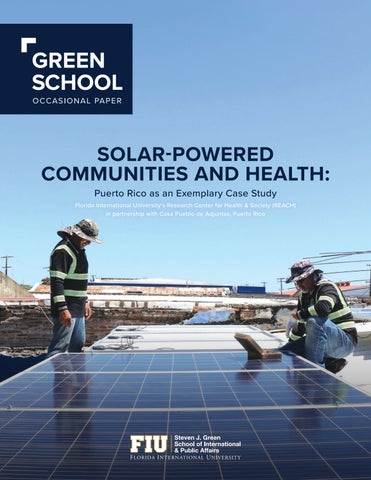
SOLAR-POWERED COMMUNITIES AND HEALTH: Puerto Rico as an Exemplary Case Study
Florida International University’s Research Center for Health & Society (REACH) in partnership with Casa Pueblo de Adjuntas, Puerto Rico
Copyright © 2026 by the Steven J. Green School of International and Public Affairs. Florida International University, Miami, Florida and Casa Pueblo de Adjuntas, Puerto Rico. All rights reserved.
PUERTO RICO
EXECUTIVE SUMMARY For more than a decade, Puerto Rico has faced persistent energy insecurity. Energy insecurity—the lack of reliable, affordable and sustainable energy access—poses significant risks, especially for individuals over 50, a group with higher rates of chronic conditions such as diabetes and cardiovascular disease. The privatization of the energy grid, now in the hands of LUMA Energy, compounded the devastating impact of Hurricane María in 2017, making reliable electricity access a critical public health issue that disproportionately affects vulnerable populations. Between 2019 and 2024, LUMA Energy recorded 225,553 power outages across the archipelago. For older adults living with chronic conditions, these blackouts are a direct threat to health, safety and collective well-being. A five-year community-based study (2022–2026) by FIU and Casa Pueblo interviewed 45 residents age 50 and older with chronic conditions and surveyed an additional 345 residents in Adjuntas. The purpose of this study was to explore how older adults with chronic illnesses in rural, disaster-prone contexts experience and manage energy insecurity and community-based energy transitions in their everyday lives, with particular attention to how poverty and high energy burdens shape vulnerability, chronic disease management, and access to reliable energy.
Key Findings ●
Residents without solar panels reported frequent flares of asthma, hypertension and insulin spoilage during outages.
●
100% of participants with direct access to solar energy reported major improvements in chronic disease management, mental health and daily safety.
●
Solar energy access eliminated fear of falling at night, reduced anxiety and restored independence.
●
Policy action can scale this proven solution by funding and supporting nonprofit community solar projects across Puerto Rico, allowing thousands of households and communities to strengthen energy resilience while protecting public health during frequent outages.
Policy Recommendations ●
Recognize households and community-led energy projects as critical infrastructure.
●
Prioritize decentralized, community-based solar energy as a strategy for energy security and climate adaptation.
●
Expand equitable access to distributed solar energy and battery storage.
●
Modernize the grid and regulatory framework to enable decentralized energy sharing.
●
Strengthen community energy governance, sovereignty and replication.
●
Invest in energy literacy, community training and continuity-centered planning.
●
Scale community solar through interconnected neighborhood energy systems that link homes with and without solar panels.
●
Support solar microgrids that enable participating households to share locally generated energy and strengthen collective resilience during outages.
Solar-Powered Communities and Health: Puerto Rico as an Exemplary Case Study | 1
BACKGROUND
THE DARKNESS Ongoing Disasters and the Electrical Grid Crisis On a hot afternoon in Adjuntas, Mónica received us at her house and told us, “It gives me so much anxiety that I want to die.” After Hurricane María left her without electrical power for one year, she could not use her continuous positive airway pressure (CPAP) machine to treat her sleep apnea. Her story is
(Dorian in 2019, Fiona in 2022) and daily grid failures continue to threaten lives. The centralized grid remains extremely fragile. Hurricane María destroyed 80% of transmission lines (García-López, 2018). Privatization to LUMA Energy and Genera PR has not improved reliability: 225,553 power outages were
now the norm across Puerto Rico.
recorded between 2019 and 2024 (Guillama, 2025). As of
The archipelago faces repeated disasters intensified by
renewable sources (Gallucci, 2024), far below the 40% goal
climate change, combined with a deep economic crisis and political abandonment (Marsooli et al., 2019). Hurricane María (2017) caused approximately 3,000 excess deaths, largely due to prolonged power outages and collapsed healthcare services (Rodríguez-Madera et al., 2021). Subsequent storms
2 | Steven J. Green School of International & Public Affairs
2024, only about 12% of Puerto Rico’s electricity came from for 2025 (Puerto Rico Energy Public Policy Act, Act 17-2019) (Acevedo, 2023). Much of the recent growth in renewable energy has occurred through residential rooftop solar, while adoption across commercial and other sectors has remained more limited.
Communal Organization: Casa Pueblo’s Response Since the 1980s, Casa Pueblo has pioneered community self-sufficiency. Their vision relies on an alternative model of community development that breaks their dependence on government agencies and other institutions. With this idea, they focus on augmenting selfsufficiency among the Adjuntas community to improve health (Massol-Deyá et al., 2018). In 2017, the organization launched a project to address the energy crisis affecting residents of Adjuntas. Casa Pueblo has installed solar panels in numerous residences and businesses across town, emphasizing access to independent energy for patients with chronic health conditions. The initiative has proven to be invaluable to patients reliant on dialysis, machines to treat sleep apnea, or respiratory therapy; and individuals with diabetes who need to refrigerate their insulin. The installation of residential solar panels also aims to improve the mental health of individuals, including patients and caregivers, by ensuring a reliable energy source during frequent power outages. This support is especially important for households experiencing poverty and high energy burdens, for whom the costs of electricity and backup power can further intensify financial stress and limit access to reliable energy.
Solar-Powered Communities and Health: Puerto Rico as an Exemplary Case Study | 3
METHODS EXPLORING THE DARKNESS TO FIND THE LIGHT Purpose: Florida International University collaborated with Casa Pueblo for a five-year NIHfunded study (R01AG072613-01A1, 2022–2026) aimed at documenting how energy insecurity influences the management of chronic diseases through community-based participatory research.
Four Guiding Themes: 1.
Challenges during power outages and their impact on health
2.
Strategies to manage energy insecurity
3.
Experiences with energy independence
4.
Community interactions
Data Collection: The study used a mixed-methods approach. DATA COLLECTION
SAMPLE/UNIT
WHAT IS MEASURED?
Semi-structured interviews
45 adults (≥50) with chronic conditions
Lived experiences of outages, energy insecurity, coping, health management and community dynamics
Surveys
345 adults (≥50) with chronic conditions
Standardized comparisons across access groups Direct Access (DA), Indirect Access (IA), No Access (NA).
Ethnography
Multiple regions in Adjuntas
Context observations combined with informal conversations
ArcGIS spatial analysis
Participant and solar panel locations
Clustering and access distances
Participants: They were stratified into: 1.
Direct Access (DA) - Solar panels in their homes
2.
Indirect Access (IA) - Accessible solar panels in their neighborhoods
3.
No Access (NA) - No solar panels in their homes or neighborhoods
The key findings are presented on the following pages.
4 | Steven J. Green School of International & Public Affairs
The impact of ongoing disasters and energy insecurity in isolated communities Power outages increased stress, anxiety and depressive
“We live with fear…Every time hurricane season comes, we are not calm.” (IA-007)
symptoms among participants, driven by fear of medical
Residents of Adjuntas describe living under conditions of
loss of refrigerated food and concerns about break-ins during
chronic uncertainty shaped by ongoing disasters and economic instability. Puerto Rico’s fragile electrical grid reflects deeper structural challenges rooted in exposure to disasters, economic shocks and political neglect. After Hurricane María, nearly 3,000
complications, isolation and personal insecurity. The potential blackouts further heightened distress. Overall, energy insecurity emerged as a significant stressor for older adults managing chronic illness.
deaths were linked to the healthcare system’s collapse and
“When there’s no power, you get anxious, it’s
prolonged power outages rather than the storm itself. These
natural. You get desperate, waiting for the power
conditions continue to affect remote, rural and mountainous
to come back, and hoping it won’t take so long to come
communities disproportionately.
back.” (IA-010)
“The government cares more about those in the
Energy insecurity heightened fear of falling (FOF) among older
city than those in the countryside.” (DA-011)
adults, affecting not only physical safety but also autonomy,
For older adults with chronic illness in rural Puerto Rico,
confinement, reduced daily activities, and increased isolation,
energy insecurity is a matter of health, survival and inequality. Sociopolitical neglect and recurring disasters routinely disrupt daily life, making reliable electricity essential for managing chronic conditions and maintaining quality of life. Frequent power outages destabilize care, particularly for those who
mobility and social participation. Power outages led to selfparticularly when family members were absent. Participants described increased anxiety and vigilance during blackouts, underscoring the broader psychosocial impact of unreliable electricity. When power outages occurred, one said:
depend on oxygen machines, refrigeration for insulin, or other
“Well, you really have to be cautious, because you could trip
electrically powered medical devices.
anywhere and fall and break an arm or a leg or something.” (NA-009)
“Every time the power went out, my asthma would flare up… because I couldn’t do my therapies. My blood pressure rose so high that at one point it reached 200/100.” (DA-012)
Solar-Powered Communities and Health: Puerto Rico as an Exemplary Case Study | 5
Casa Pueblo Solar Initiative at a Glance: “Cucubanos” Description of Cucubanos: ●
●
●
●
Core Components of Cucubanos:
Casa Pueblo’s Cucubanos consist of small-scale, resilient photovoltaic energy systems designed to provide reliable electricity for essential household needs during regular sunny days and to sustain critical functions during power outages, particularly in regions vulnerable to natural disasters.
1.
The Cucubano solar system is designed to sustain critical household functions during prolonged outages, including LED lighting, refrigerator (food and medicine preservation), medical devices (e.g., oxygen concentrators, nebulizers, CPAP machines), fans for ventilation and thermal comfort, internet router, phone charging, and radio and emergency communications.
2.
Cucubanos are not designed to replicate pre-outage consumption patterns in full. Instead, they prioritize lifesustaining functions, health protection, food security, communication and dignified living conditions. Cucubanos represent a distributed resilience strategy that reduces dependence on centralized fossil-fuel infrastructure and enhances household and communitylevel energy sovereignty.
6 | Steven J. Green School of International & Public Affairs
Solar Panels (PV Modules): High-efficiency photovoltaic panels (typically 400–550W each), mounted on rooftops or secure ground structures. A basic system generally includes 2–4 panels, depending on household load requirements. Hybrid Inverter: A grid-interactive inverter with islanding capability that allows the system to disconnect from the utility grid during outages and operate independently.
3.
Battery Storage System: Lithium-ion battery bank sized to provide 2–3 days of autonomy under essential load conditions. Battery capacity is typically designed between 5 and 15 kWh, depending on medical or refrigeration needs.
4.
Critical Load Subpanel: A dedicated electrical subpanel that isolates and prioritizes essential circuits, ensuring efficient energy use during outages.
5.
Monitoring and Control System: A smart monitoring system that allows real-time tracking of generation, storage levels and consumption.
Cucubanos footprint in Adjuntas, Puerto Rico:
Casa Pueblo has completed over 400 solar projects in Adjuntas, installing more than 3,000 photovoltaic panels.
Nearly 300 homes and
Additionally, five community microgrids
30 businesses have benefited
have been installed, including the Plaza
from these projects. These are
de la Independencia Energética (the first
the Cucubanos.
urban solar microgrid in Puerto Rico), which powers 14 businesses and serves as an emergency hub.
Approximate cost of Cucubanos
~$8,000
Range of cost per household including installation and 10kWh of storage.
Cucubanos funding sources include donations, philanthropy, concerts, and volunteer work.
Solar-Powered Communities and Health: Puerto Rico as an Exemplary Case Study | 7
THE IMPACT OF SOLAR ENERGY
THE LIGHT Community-driven solar energy initiatives emerged as a critical
systems provided reliable electricity during recurrent outages,
source of stability and hope for isolated communities facing
enabling the continued use of oxygen machines, apnea devices
ongoing disasters and political neglect. Participants with
and refrigeration for medications such as insulin. This reliability
direct access to solar panels consistently described significant
reduced preventable health crises and alleviated the stress
improvements in daily life, health management and overall well-
associated with constant uncertainty. In this context, solar energy
being following installation.
emerged as essential health-support infrastructure for managing
“…The solar panels helped me tremendously. I was hysterical…
chronic conditions in energy-insecure communities.
that darkness… God came to see me with those solar panels
“My health improved in every way, both physically and
— they’ve been the greatest gift from God and Casa Pueblo.”
emotionally… Without resources or government aid, everything
(DA-001)
felt like an uphill battle — devastating and exhausting,
For participants living with chronic conditions, including respiratory illness, solar panels functioned as a lifeline. These decentralized
8 | Steven J. Green School of International & Public Affairs
especially mentally. Now, he can sleep with his apnea machine all night without issues, and we feel much more at ease about the insulin.” (DA-004)
Access to independent energy sources also improved mental health outcomes for both patients and caregivers. Participants described improved living conditions and relief from the psychological burden caused by unreliable electricity systems. Consistent lighting and power during outages reduced fear of falling, allowing older adults to move safely within their homes without navigating dark or hazardous conditions. Individuals with direct access to solar energy frequently reported improved
“With the power outages… everyone is opting to have solar panels. But they are still too expensive. Right now, I couldn’t make that investment.” (IA-001) These findings underscore the urgent need for energy policies that expand equitable access to decentralized solar infrastructure as a health-protective intervention for medically vulnerable populations.
emotional well-being before and after the installation, describing feelings of relief, safety and peace. “My quality of life has improved 100%, emotionally, spiritually, mentally, all those things.” (DA-011)
Survey data ●
345 participants were surveyed, divided into three equal parts (n=115) for Direct Access (DA), Indirect Access (IA) and No Access (NA).
●
Participants reported that power outages lasted 12 hours on average.
●
Graph #1: Participants with direct access to solar panels reported fewer medical treatment interruptions than participants with indirect or no access to solar panels (# of times that the participant’s treatment for their health conditions was interrupted).
●
Graph #2: Participants with direct access to solar panels reported that power outages affected their health at a lower rate than participants with indirect or no access to solar panels (1 is Never and 5 is Always).
“The solar panels relieved me of all the stress I had.” (DA-006) Despite these benefits, structural barriers continue to limit the expansion of solar energy at the point of consumption. Political instability, competing institutional interests, economic constraints, and policy proposals that would impose additional costs on solar adoption shape who remains exposed to energy precarity and its health consequences, disproportionately affecting isolated rural communities. These proposals— including efforts to eliminate tax exemptions for solar equipment or weaken protections for net metering—have been described by advocates as a “tax on the sun” because they could discourage households and communities from generating their own renewable energy. Although many participants viewed solar energy favorably, high upfront installation costs continue to prevent widespread adoption.
Graph #2: In the last month, how often did power outages affect your health? 5
5 4 3 2 1
1.4
1.6
IA
NA
.6
0 DA
Type of Energy Access
Average response
Mean Number of Treatment Interruptions
Graph #1: In the last 3 months, how many times has your treatment for your health conditions been interrupted?
4 3 2 1
2.4
2.2
1.6 DA
IA
NA
Type of Energy Access
Values represent the mean number of treatment interruptions per participant during the past 3 months (count of interruptions). DA = Direct Access, IA = Indirect Access, NA = No Access.
Responses were measured on a five-point scale ranging from 1 (“Never”) to 5 (“Always”).
Solar-Powered Communities and Health: Puerto Rico as an Exemplary Case Study | 9
Policy Opportunities:
The Solar Community Solution 1. RECOGNIZE HOUSEHOLDS AND COMMUNITY-LED ENERGY PROJECTS AS CRITICAL INFRASTRUCTURE. Public policy should classify households with residents living with chronic health conditions, as well as community-led energy initiatives, as critical infrastructure for climate adaptation and emergency preparedness. Such recognition would help ensure that reliable energy access is incorporated into planning for continuity of care, public health protection and emergency response during hurricanes, earthquakes and prolonged power outages.
2. PRIORITIZE DECENTRALIZED, COMMUNITY-BASED SOLAR ENERGY AS A STRATEGY FOR ENERGY SECURITY AND CLIMATE ADAPTATION. Decentralized, community-based solar energy should be prioritized as a core strategy for energy security and climate adaptation in geographically vulnerable areas. Compared with continued reliance on centralized energy systems alone, community-based models can strengthen local preparedness, improve service continuity during crises and reduce communities’ exposure to repeated disruptions.
3. EXPAND EQUITABLE ACCESS TO DISTRIBUTED SOLAR ENERGY AND BATTERY STORAGE. Policy interventions should expand access to distributed solar energy and battery storage through targeted voucher programs, local incentives and sustained support for nonprofit and community-based initiatives. Priority should be given to populations and communities facing the greatest barriers to reliable energy access and the highest risks during extended outages.
10 | Steven J. Green School of International & Public Affairs
4. MODERNIZE THE GRID AND REGULATORY FRAMEWORK TO ENABLE DECENTRALIZED ENERGY SHARING. Grid modernization and regulatory reform are needed to enable households, community solar projects and microgrids to share surplus solar energy with neighboring residents during emergencies. Protecting and expanding net metering, facilitating interconnection among distributed systems and adapting the distribution grid for decentralized energy flows would strengthen redundancy, flexibility and overall energy security.
5. STRENGTHEN COMMUNITY ENERGY GOVERNANCE, SOVEREIGNTY AND REPLICATION. A supportive legal and regulatory framework is needed to advance community-scale energy sovereignty and energy democracy. This should include mechanisms to sustain community governance of energy systems and to support the replication of proven models, such as community-led projects like Casa Pueblo.
6. INVEST IN ENERGY LITERACY, COMMUNITY TRAINING AND CONTINUITY-CENTERED PLANNING. Public investment is needed in energy literacy and community training to support the adoption and effective use of new energy technologies, particularly among populations with limited formal schooling or technological familiarity. Energy planning frameworks should also move beyond cost-minimization alone and incorporate continuity-, preparedness- and health-centered metrics that reduce harms, limit social and economic losses and improve functioning during outages.
7. ADVANCE INTERCONNECTED COMMUNITY SOLAR MICROGRIDS. Policy should support the development of solar microgrids that connect households with and without solar panels, enabling locally generated energy to be shared across groups of homes. Scaling these interconnected systems can move communities beyond isolated household solutions toward resilient neighborhood energy ecosystems that strengthen collective preparedness, energy security and continuity during power outages.
Solar-Powered Communities and Health: Puerto Rico as an Exemplary Case Study | 11
Closing Remarks: The experiences shared by residents of Adjuntas illuminate a critical reality: energy is not merely a utility, but a fundamental determinant of health, safety and well-being. In a context shaped by ongoing disasters and a fragile electrical grid, energy insecurity exacerbates chronic illness, psychological distress and social isolation. Access to decentralized solar energy has the potential to restore stability to daily life by enabling individuals to manage chronic health conditions, safely preserve medications, reduce anxiety and move through their homes without fear during outages. These findings demonstrate that community-based energy solutions are not only environmentally sustainable but also essential health-support systems for vulnerable populations.
Acknowledgements: We extend our gratitude to the residents of Adjuntas who generously shared their time, experiences and personal stories. Their voices are the foundation of this work and a testament to the resilience of communities living under conditions of uncertainty. We are especially grateful to Casa Pueblo for their longstanding commitment to environmental protection, energy independence and community empowerment, as well as for their partnership, guidance and trust throughout this project. We also acknowledge the dedication of the research team, including field researchers, interviewers, analysts and community liaisons, whose collaborative efforts ensured that this study remained grounded in the community’s needs and perspectives. Special thanks are extended to FIU for institutional support and for fostering academic-community partnerships that advance meaningful social impact. Finally, we recognize the funding support from the National Institutes of Health (NIH), which made this multi-year investigation into energy insecurity and chronic disease management possible.
12 | Steven J. Green School of International & Public Affairs
Research Team:
References:
Nelson Varas-Díaz
Acevedo, N., 2023. Amid power outages, Puerto Rico faces critical time in its energy future. NBC News. Available online at: https://www.nbcnews.com/news/latino/ puerto-rico-blackouts-power-grid-ailingrenewable-energy-rcna68754 (Accessed February 16, 2026).
Florida International University Sheilla Rodríguez-Madera Florida International University Mark Padilla Florida International University Sergio Rivera-Rodríguez Florida International University Julián López Ponce Health Sciences University Kevin Grove Florida International University Genevieve Reid Florida International University Arturo Massol Deyá Casa Pueblo de Adjuntas Rebeca Rodríguez-Banch Casa Pueblo de Adjuntas Kariela Rivera-Bustelo Florida International University Adrián J. Santiago Ponce Health Sciences University Claudia Mercado-Ríos Ponce Health Sciences University Emil Varas Rodríguez Mayo Clinic Nicole Class Candelaria Ponce Health Sciences University Kabie A. Rojas Echevarría Ponce Health Sciences University Jack Vertovec Behavioral Science Research Institute Jeffrey W. Ramos Santiago University of Rochester Medical Center
Caraballo-Cueto, J., 2020. A review of current population databases on Puerto Rico. Popul Environ 42, 112–127. Gallucci, M., 2024. Puerto Rico’s rooftop solar boom is at risk, advocates warn. Canary Media. Available online at: https:// www.canarymedia.com/articles/solar/ el-auge-de-la-energía-solar-en-puerto-ricoestá-en-riesgo-advierten-sus-defensores (Accessed February 16, 2026). García, I., 2021. Puerto Rico’s Outmigration and the Deterioration of Economic Conditions as Identified with National Debt. Centro Journal 33, 94–125. García-López, G., 2018. The multiple layers of environmental injustice in contexts of (un)natural disasters: the case of Puerto Rico post-hurricane Maria. Environ Justice. Guillama, M., 2025. 225,553 power outages in Puerto Rico in the past six years: these are the most common causes. El Nuevo Día. Available online at: https://www.elnuevodia.com/english/ news/story/225553-power-outages-inpuerto-rico-in-the-past-six-years-theseare-the-most-common-causes/. (Accessed February 16, 2026). Lieberman-Cribbin, W., Liu, B., Schneider, S., Schwartz, R., Taioli, E., 2017. SelfReported and FEMA Flood Exposure Assessment after Hurricane Sandy: Association with Mental Health Outcomes. PLOS ONE 12, e0170965. Marsooli, R., Lin, N., Emanuel, K., Feng, K., 2019. Climate change exacerbates hurricane flood hazards along US Atlantic and Gulf Coasts in spatially varying patterns. Nat Commun 10, 3785.
Rivera-Rodríguez, S., Santiago-Santiago, A., R-Madera, S., Padilla, M., Varas-Díaz, N., Rivera-Bustelo, K., Mercado-Ríos, C., Vertovec, J., Massol-Deyá, A., Ramos, J. and Reid, G., 2025. Disaster governance, energy insecurity, and public health in rural Puerto Rico: how communities resist political abandonment. Frontiers in Public Health, 13, p.1595830. Rivera-Rodríguez, S., Varas-Díaz, N., Rodríguez-Madera, S., Padilla, M., Rivera-Bustelo, K., Reid, G., SantiagoSantiago, A., Mercado-Ríos, C., Grove, K., Massol-Deyá, A. and Rodríguez-Banch, R., 2025. Powering well-being: Energy independence and mental health in a zone of ongoing disasters. Health & Place, 91, p.103418. Rodríguez-Madera, S., Varas-Díaz, N., Padilla, M., Rivera-Bustelo, K., Ramos, J., Rivera-Rodríguez, S., Santiago-Santiago, A., Mercado-Ríos, C., Vertovec, J., Deyá, A.M. and Rodríguez-Banch, R., 2026. Energy insecurity and health among older adults: chronic disease management and resilience strategies in rural Puerto Rico. BMC Public Health. Rodríguez-Madera, S., Varas-Díaz, N., Padilla, M., Grove, K., Rivera-Bustelo, K., Ramos, J., Contreras Ramirez, V., RiveraRodríguez, S., Vargas-Molina, R., Santini, J., 2021. The impact of Hurricane Maria on Puerto Rico’s health system: post-disaster perceptions and experiences of health care providers and administrators. Glob Health Res Policy 6, 44. Román, J., 2015. The Puerto Rico Healthcare Crisis. Annals ATS 12, 1760– 1763. Román, M.O., Stokes, E.C., Shrestha, R., Wang, Z., Schultz, L., Carlo, E.A.S., Sun, Q., Bell, J., Molthan, A., Kalb, V., Ji, C., Seto, K.C., McClain, S.N., Enenkel, M., 2019. Satellite-based assessment of electricity restoration efforts in Puerto Rico after Hurricane Maria. PLOS ONE 14, e0218883.
Massol-Deyá, A., Stephens, J.C., Colón, J.L., 2018. Renewable energy for Puerto Rico. Science. 362:7. Mayol-García, Y.H., 2020. Pre-hurricane linkages between poverty, families, and migration among Puerto Rican-origin children living in Puerto Rico and the United States. Popul Environ 42, 57-78. Solar-Powered Communities and Health: Puerto Rico as an Exemplary Case Study | 13
FLORIDA INTERNATIONAL UNIVERSITY Florida International University (FIU) is a top public university that drives real talent and innovation in Miami and globally. Very high research (R1) activity and high social mobility come together at FIU to uplift and accelerate student success in a global city by focusing in the areas of environment, health and innovation. Today, FIU has two campuses and multiple centers. FIU serves a diverse student body of more than 56,000 and 300,000 Panther alumni. FIU is ranked No. 4 Best Public University by the Wall Street Journal, and U.S. News & World Report places dozens of FIU programs among the best in the nation, including international business at No. 2. Washington Monthly magazine ranks FIU among the top 20 public universities contributing to the public good, and Degree Choices places it among the top 10 in the nation on return on investment.
STEVEN J. GREEN SCHOOL OF INTERNATIONAL & PUBLIC AFFAIRS The Steven J. Green School of International & Public Affairs educates the leaders and changemakers of tomorrow through innovative teaching and research that advances global understanding, contributes to policy solutions, and promotes international dialogue. One of the leading schools of its kind in the world, the Green School is a full member of the prestigious Association of Professional Schools of International Affairs (APSIA), one of only 25 in the U.S. and 40 in the world. The school, which offers programs at the bachelor’s, master’s and doctoral levels, encompasses eight departments that bridge the social sciences and humanities, and is home to some of the university’s most prominent international centers, institutes, and programs.
RESEARCH CENTER FOR HEALTH AND SOCIETY (REACH) The Research Center for Health and Society (REACH) advances interdisciplinary, policy-relevant research at the intersection of health, society, and inequality, with particular attention to Latin America and the Caribbean, the Global South, and other contexts of social vulnerability. Grounded in the social sciences and drawing on faculty from across Florida International University, REACH serves as a hub for innovative research, training, and community-engaged scholarship focused on the structural and social determinants of health, especially among marginalized populations. Through an active portfolio of extramurally funded projects, REACH supports research on health disparities, disaster recovery and resilience, energy and food insecurity as determinants of health, chronic disease management, aging populations, and visual methodologies for policy outreach and public communication.
CASA PUEBLO Casa Pueblo is a community-based organization in Adjuntas, Puerto Rico, dedicated to environmental protection, energy independence, cultural preservation, and participatory community development. Since the 1980s, the organization has advanced a model of community self-reliance grounded in local leadership, environmental stewardship, and collective action. Its work includes forest conservation, environmental education, renewable energy initiatives, scientific advocacy, and the development of decentralized solar-energy systems for homes, businesses, and community spaces. Through projects such as the Cucubanos and community microgrids, Casa Pueblo has demonstrated how locally governed energy systems can strengthen public health, emergency preparedness, and community resilience while reducing dependence on Puerto Rico’s fragile centralized electrical grid.
Casa Pueblo 787-829-4842 | info@casapueblo.org
www.casapueblo.org
Steven J. Green School of International & Public Affairs Florida International University 11200 SW 8th Street, Miami, Florida 33199
green.fiu.edu