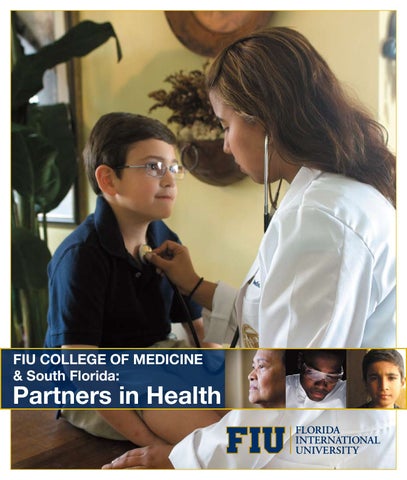
FIU College of Medicine & South Florida:
Partners in Health
F
l
o
r
i
d
a
I
n
t
e
r
n
a
t
i
o
n
a
l
U
n
i
v
e
r
s
i
t
The unwavering support of South Floridians, including our legislators, has carried us to this exciting moment. April, 2009
FIU President Modesto A. Maidique and College of Medicine Dean John Rock
Contents: Miami’s first public medical school...................... 1 NeighborhoodHELP™.......................................... 2 Hospital partners.................................................. 3 Faculty.................................................................. 4 Inaugural class of students.................................. 8 Research............................................................ 11 Economic impact............................................... 12 Academic Health Sciences Center..................... 12
Dear community members, In just a few short months, FIU welcomes the inaugural class of medical students to its new College of Medicine. Almost immediately, our students and faculty will begin to transform medical education and the health of this community. The unwavering support of South Floridians, including our legislators, has carried us to this exciting moment. That is why we are pleased to present “FIU College of Medicine & South Florida: Partners in Health,” an overview of the remarkable progress we have made. This forward momentum would not have been possible without the community’s commitment to establishing a public medical school for South Florida. Inside you will read about the unique approach to medical education that we have developed. We call the program NeighborhoodHELP™, because our medical students, working in teams with other student health professionals, will be working directly with South Florida families living in underserved neighborhoods. The College of Medicine is also collaborating with the region’s leading health care institutions to create a powerful coalition for medical excellence. We have set high standards for our new students and faculty, profiled in these pages. From more than 3,300 student applicants, we have identified an outstanding pool of aspiring doctors. Many of them are the sons and daughters of greater Miami. All of them have already shown a deep, personal commitment to community service. Our students will be taught by a team of leading medical professionals committed to the College of Medicine’s educational and community mission. These new faculty members bring to FIU a passion for medical education as well as important research projects that will benefit our community and the world in multiple ways. In these challenging financial times, a public, community-oriented medical school is more important than ever. The College of Medicine is and will continue to be a powerful economic engine which South Florida will benefit from for years to come. We have opened a door for many young people who otherwise might not be in a position to attend medical school. At the same time, our focus on the community will help address the specific health needs of many local families and populations. The important role of the FIU College of Medicine has moved individuals from around the region to pledge their support to its success. Inside you will read about the FIU College of Medicine Founders, the Leon family and others who are pillars of our success. The FIU College of Medicine stands poised to fulfill an historic promise to the people of South Florida. Your support of our efforts is as essential today as it was when we began this journey. I hope that you will find even more reasons to share our excitement as we move forward together. Sincerely,
Donors................................................................ 15 Benjamin Leon, Jr. Family Center for Geriatric Research and Education................ 16
If you would like to support the College of Medicine, or would like more information, please contact Vice President Sandy Gonzalez-Levy at ucr@fiu.edu
Dr. Modesto A. Maidique Dr. John A. Rock FIU President Founding Dean & Senior Vice President for Medical Affairs FIU College of Medicine
http://medicine.fiu.edu
y
F
l
o
r
i
d
a
I
n
t
e
r
n
a
t
i
o
n
a
l
U
n
i
v
e
r
s
i
t
y
This is what the Academic Health Sciences Center will look like when it is completed in 2025.
Working towards a goal
Miami’s first public medical school guided by community needs
T
he journey of the FIU College of Medicine didn’t begin in the halls of academia, on the pages of a report or at a legislative hearing. The acute need in South Florida was there long before all of that. One in four people lacks health insurance and access to adequate medical care, talented young individuals give up dreams of becoming a doctor because they can’t penetrate the medical education system. Long wait times, frustrated patients and overstretched doctors attest to the region’s growing physician shortage. In the end, or rather, in the beginning, the FIU College of Medicine emerged from the community itself. FIU had only to listen. Along the way, the citizens, doctors, educators, civic, health care and business leaders of South Florida all played an integral role in shaping the direction of the college. This medical school, they insisted, must be uniquely oriented to serving the educational and health care needs of South Florida. It must be Miami’s public medical school. FIU’s new model for medical education
moved forward with the community at its side. Today, as the College of Medicine prepares to open its doors Aug. 3, the prognosis for the future inspires optimism even in unsettling times. “There is no looking back now,” said FIU President Modesto A. Maidique. “The College of Medicine has already begun transforming this community by attracting some of the country’s leading physicians to Miami. Each year, the medical, educational and economic benefits will multiply and build. Within a decade we will have dramatically improved the quality of life in South Florida.” Through an innovative, community-oriented curriculum, the college will deliver help to the medically underserved. The qualified young people who aspire to careers in medicine will have a new, affordable and highquality educational option. Researchers in the college will take on the region’s most serious health problems and work with the local health care industry to find solutions. And in just a few short years, the physicians of FIU will begin filling local hospitals, clinics and offices
with medical expertise and cultural sensitivity. “What makes this college unique is not simply that we are going out into the community,” said Dr. John Rock, the college’s founding dean. “What makes us unique is that we have moved way beyond the traditional notion of treating the community as a laboratory where medical students duck in and out. Instead, our students are going to learn how to practice medicine in this diverse community by working directly with local families in long-term relationships to understand the entire spectrum of health challenges. “There are many things in medicine we cannot predict,” he continued. “But we can predict with confidence that the FIU College of Medicine will result in more culturally competent doctors in our neighborhoods, doctors who will be educated here and most likely make Miami home. We are contributing to a stronger biomedical industry in South Florida and an improved level of medical care.”
College of Medicine Timeline 1996: University develops a 10-year strategic plan, making health education, medical education and biomedical research FIU’s top priorities.
2000: The FIU Medical School Planning Task Force begins feasibility and implementation study for a new medical school.
1999: FIU establishes a College of Health and Urban Affairs, which contains a School of Public Health, and invests in the growth of its biomedical research and biomedical engineering programs.
2005: The FIU Board of Trustees approves plan for medical school.
August 2007: The North Dade December 2007: Miami-Dade County Medical Foundation makes a $5 million Commissioners approve $10 million for an gift to the College of Medicine. ambulatory care facility at FIU’s College of Medicine. September 2007: FIU and the Florida Department of Health sign agreement to relocate the department’s Miami-Dade headquarters to FIU.
March 2006: The Florida Board of Governors and Florida Legislature approve the creation of the FIU College of Medicine. December 2006: FIU selects John Rock, M.D., M.H.C.A., as founding dean.
May 2008: Benjamin Leon, Jr., chairman and founder of Leon Medical Centers, gives the FIU College of Medicine a $10 million gift.
February 2008: The FIU College of Medicine receives preliminary accreditation from the Liaison Committee for Medical Education and begins recruiting its inaugural class.
August 2009: Medical students begin their studies.
January 2009: FIU College of Medicine receives more than 3,300 applications for its first class.
To support the College of Medicine or obtain more information, please contact Vice President Sandy Gonzalez-Levy at ucr@fiu.edu
1
F
l
o
r
i
d
a
I
n
t
e
r
n
a
t
i
o
n
a
l
U
n
i
v
e
r
s
i
t
y
NeighborhoodHELP™ aims to improve quality of life for community residents
W
hen doctors at the FIU College of Medicine set out to develop a new model for medical education, they wanted to break down the traditional boundaries of community engagement. Lots of medical schools send students into the community, typically in a limited timeframe. But FIU’s NeighborhoodHELP™ (Health Education Learning Program), the centerpiece of the college’s Medicine & Society curriculum, was designed to do much, much more. The program will bring together students, local families and community organizations in path-breaking ways, establishing long-term relationships that address the spectrum of medical, social and economic factors that affect health. (The College of Medicine’s definition of “family” is an inclusive one and will be guided by the makeup of each unique household in the community.) “The Medicine and Society curriculum is unique in its integrated, interdisciplinary approach to educating doctors,” said Dr. John Rock, founding dean of the College of Medicine. “It is also unique because the program was developed together with fellow university colleges and schools, including nursing and other health professions, law, public health and social work. With our university and community partners, we intend to make profound, lasting — Dr. Pedro change in our community as we train the next generation of culturally competent doctors.” The inaugural class of FIU medical students will work with 40 households in the North Dade area that reflect South Florida’s diversity. FIU is working closely with local social service and health agencies to identify medically underserved neighborhoods and approach potential candidates. NeighborhoodHELP™ is being embraced by the South Florida community and its leaders. Additionally, the College of Medicine is conducting extensive outreach in each neighborhood to document available services in the schools, faith-based organizations, public safety and the business community. Students will also be going door to door to learn about the families and how they access health care services. With this data, the college is establishing baselines to measure future progress. Through NeighborhoodHELP™, medical students will be assigned to a faculty-supervised interdisciplinary team that includes students from nursing, social work and other disciplines. Each team will work with a family and make regular home visits. Additionally, the team will work hand-in-hand with the family’s doctor, or, if needed, refer family members to community physicians. The medical
students will also collaborate with public health students on a community service learning project to address more global community health issues. “NeighborhoodHELP™ is a partnership between the community and the College of Medicine,” said Dr. Pedro “Joe” Greer, chair of the College of Medicine’s Department of Humanities, Health & Society and one of the program’s chief architects. “These families are becoming teachers. They are going to help our students understand their cultures, their health issues and the gaps in the health care system.” Students will fulfill a variety of roles for the families, including providing health education and referrals for health and social services. For instance, if a patient has diabetes, students could work with the patient’s doctor to help the patient better understand and manage the disease through health and nutrition education. The students would also be attuned to the social and environmental factors that are affecting a patient’s ability to follow a recommended treatment plan.
“These families are becoming teachers. They are going to help our students understand their cultures, their health issues and the gaps in the health care system.”
2
“Joe” Greer, FIU College of Medicine The innovation of NeighborhoodHELP™ extends beyond the obvious medical issues a family may face. Because health is influenced by a host of other circumstances, such as employment and transportation, the program takes into consideration the needs of the community itself. FIU will confront these issues by deploying the range of university resources in disciplines such as law, criminal justice and business. For example, College of Business Administration students may be involved with a team in order to help local businesses identify affordable health insurance options for their employees. “The university is bringing the full power of its collective resources into the community. We are creating urban university coalitions,” Rock said. “There will be connectivity so that we can address all of the social determinants of health.” NeighborhoodHELP’s™ proactive approach to health care is expected to improve the overall quality of life in these communities and improve health care outcomes. Says Greer, “It’s about giving back to our communities and educating future physicians to serve South Florida.”
F
l
o
r
i
d
a
I
n
t
e
r
n
a
t
i
o
n
a
l
U
n
i
v
e
r
s
i
t
y
South Florida hospitals partner with FIU to train medical students
F
IU is building a world-class medical school with the support of four of the region’s best hospitals. Affiliation agreements have been established between the College of Medicine and Jackson North Medical Center, Mt. Sinai Medical Center, Mercy Hospital and Miami Children’s Hospital. “We are building a network of partners that will give our students exposure to a variety of patients,” said Dr. J. Patrick O’Leary, executive associate dean of clinical affairs at the College of Medicine. “Our goal is to educate well-rounded, culturally aware doctors and at the same time interact with the local community in ways that have a significant impact.” Here’s a look at FIU’s partner hospitals.
Jackson North Medical Center The 382-bed acute care center in North Miami will serve as the College of Medicine’s major public teaching hospital. FIU students will begin interacting with Jackson patients in two years when the first class of students enters its third year of medical school. FIU clinical faculty has already begun providing care at the hospital. One of the initiatives to emerge from the partnership is a new comprehensive cancer program at Jackson North. Dr. Seza Gulec, FIU professor of surgery and radiology/nuclear medicine, started the program, integrating surgical and nuclear oncology. This unique model involves PET/CT-guided surgical treatment planning and radionuclide therapy of advanced cancers. Jackson North is part of the Jackson Health System and provides a variety of services including 24-hour adult and pediatric emergency care, maternity, orthopedics, surgery, psychiatry and inpatient and outpatient rehabilitation. Jackson Health System has been involved in graduate medical education (GME) since 1922.
Miami Children’s Hospital
With a medical staff of more than 650 physicians in more than 40 pediatric specialties and subspecialties, Miami Children’s Hospital is a recognized leader in pediatric health care. It is home to Florida’s only free-standing pediatric trauma center and the largest pediatric teaching program in the southeastern United States. Each year, the hospital provides training for 69 pediatric residents and 17 subspecialty fellows. The agreement between FIU and Miami Children’s adds an undergraduate dimension to the already-existing educational program. In 2009, Miami Children’s was the only Florida hospital to be included in Parents magazine’s listing of the nation’s “Best Children’s Hospitals.” And last year, Miami Children’s Hospital programs were ranked among the best in the nation in U.S. News & World Report’s “America’s Best Children’s Hospitals” issue. The programs that were recognized in the listing include cardiology/cardiovascular surgery, neonatology and neurology/neurosurgery.
Mt. Sinai Medical Center Based in Miami Beach, the four-campus Mt. Sinai Medical Center is South Florida’s largest independent, non-profit teaching hospital. It has more than 700 physicians and 955 licensed beds with a state-of-the-art cancer center, the state’s largest memory disorder center and a comprehensive cardiac program. Mt. Sinai Medical Center has 160 graduate medical education (GME) physicians. In 2008, Mt. Sinai Medical Center was named among the nation’s top hospitals for geriatric care, neurology and neurosurgery by U.S. News & World Report in its annual “America’s Best Hospitals” issue. It was the second consecutive year Mt. Sinai was recognized for geriatric care.
Mercy Hospital A 473-bed acute care hospital, Mercy is affiliated with more than 700 physicians in 27 medical specialties. Its Centers of Excellence include The Heart Center, the Miami Cancer Center, the Minimally Invasive Surgical Institute and the Orthopedic Institute. In 2007, Mercy Hospital opened a newly expanded, state-of-the-art, $25 million emergency facility. Mercy is South Florida’s only Catholic hospital and has a longstanding reputation for health care excellence. It has been recognized twice by J.D. Power and Associates for providing outstanding patient experience. Mercy is also a recipient of the prestigious Magnet award for nursing excellence and HealthGrades’ Distinguished Hospital for Clinical Excellence Award.
To support the College of Medicine or obtain more information, please contact Vice President Sandy Gonzalez-Levy at ucr@fiu.edu
3
F
l
o
r
i
d
a
I
n
t
e
r
n
a
t
i
o
n
a
l
U
n
i
v
e
r
s
i
t
y
College of Medicine selects top-notch faculty
B
efore the College of Medicine was even approved, the medical education community was buzzing about the prospect of a new public medical school in Miami with an innovative curriculum. Hundreds of physicians and professors across the globe sent their resumes to FIU. Today, with most of the first round positions filled, FIU’s new medical faculty are some of the most well-regarded doctors and researchers from South Florida and major medical centers around the country. To start the hiring process, FIU first selected Dr. John Rock as the founding dean of the College of Medicine. Rock assembled a team of experienced
College of Medicine Deans John A. Rock, M.D.
Founding Dean and Senior Vice President of Medical Affairs Only the fourth individual since 1980 to guide the development of a new U.S. allopathic medical school, Rock has held senior administrative and academic appointments at Louisiana State University Health Sciences Center, the Johns Hopkins Medical Institutions and Emory University School of Medicine. His leadership yielded substantive improvements at each institution. At Emory he boosted the National Institutes of Health ranking of the Department of Obstetrics and Gynecology from 66th in the nation to 18th; at LSU, he established a School of Public Health and increased the medical school’s research funding by almost 85 percent. He is a highly regarded physician, surgeon and researcher, specializing in reproductive endocrinology and pelvic reconstructive surgery. Rock has written 18 books, contributed to 83 others and written more than 200 journal articles. He completed his medical degree at LSU and residency at Duke University’s Medical Center. Recently, he added to these a master’s degree in public health from Harvard University.
Joe Leigh Simpson, M.D.
Executive Associate Dean of Academic Affairs A member of the National Academy of Sciences’ Institute of Medicine since 1994, Dr. Simpson is responsible for hiring faculty and helping to lead the college’s accreditation process. He oversees curriculum development, research and faculty development. He came to FIU from Baylor College of Medicine, where he taught in both the Department of Obstetrics and Gynecology (chair) and the Department of Molecular and Human Genetics. He earned his medical degree at Duke University and completed post-graduate work at several institutions including Cornell University Medical College. From 1975 to 1986 he was the head of the Section of Human Genetics at Northwestern University Medical School. He was also chair of the University of Tennessee’s Department of Obstetrics and Gynecology before joining Baylor. Dr. Simpson has published or edited 27 books and more than 650 articles, chapters and publications 4
medical leaders to serve as the deans of the new college. Well-known South Florida physicians like Dr. Pedro Greer, the new assistant dean of academic affairs, were recruited to bring their deep understanding of community health issues to the college. National searches were conducted to fill 15 department chair positions. The college also looked within FIU’s own ranks for professors like biologist Kalai Mathee to chair the Department of Molecular Microbiology. The following four pages highlight some of the faculty who have joined the College of Medicine.
in the areas of reproductive genetics, obstetrics and the impact of genetic advances on society.
Sanford Markham, M.D.
Executive Associate Dean of Student Affairs Markham, the former assistant dean of student affairs at the University of Iowa College of Medicine, has more than 40 years of experience as a researcher, teacher, administrator and practicing physician. He has held positions at Johns Hopkins University, Georgetown University, Cornell University, the University of Iowa and at multiple medical care and teaching facilities in the U.S. Air Force. An obstetrician and gynecologist, Markham earned his medical degree at the University of Kansas and did his residency at the New York Hospital Cornell Medical Center. He completed a fellowship in reproductive endocrinology at Johns Hopkins Hospital. From 1990 to 1995, he was vice chairman in the Department of Obstetrics and Gynecology at Georgetown University Medical Center. Markham is responsible for enrollment management; the orientation of incoming students; guidance, counseling and mentoring of medical students; documenting each student’s progress; and providing guidance in the process of their residency application.
J. Patrick O’Leary, M.D.
Executive Associate Dean of Clinical Affairs O’Leary oversees the development of the college’s clinical faculty and practice sites. He has written more than 200 peer-reviewed scientific publications and is the author of four editions of the Physiologic Basis of Surgery textbook. He is an authority in the field of surgical gastroenterology. He came to FIU from Louisiana State University Health Sciences Center where he was professor and chairman of the Department of Surgery at LSU Medical Center. He is a former associate dean of clinical affairs and interim dean of LSU Health Sciences Center. A graduate of the University of Florida College of Medicine, O’Leary completed his residency in general surgery at Shands Teaching Hospital. He has earned teaching awards from UF, Vanderbilt University and LSU School of Medicine. He has held several national leadership positions, most recently chairman of the Board of Governors and the first vice president of the American College of Surgeons.
Barry P. Rosen, Ph.D.
Associate Dean of Basic Research and Graduate Studies Professor, Department of Cellular Biology & Pharmacology Rosen comes to FIU from Wayne State University School of Medicine where he was distinguished professor and chair of the Department of Biochemistry and Molecular Biology for 22 years. He received his doctorate from the University of Connecticut. After a National Institutes of Health postdoctoral fellowship at Cornell University, he joined the faculty at the University of Maryland School of Medicine in 1972 and later, Wayne State in 1987. Rosen is an internationally recognized expert in the field of heavy metal transport and detoxification, specializing in the molecular mechanisms of arsenic detoxification. He has published more than 250 papers, reviews and books and is the holder of two grants from the National Institutes of Health, including a prestigious NIH MERIT award. He is recipient of numerous awards, including the Basil O’Connor Award from the March of Dimes and the Maryland Distinguished Young Scientist Award. He has been on many national and international panels at NIH, NSF, EPA and the American Heart Association and on multiple editorial boards.
George E. Dambach, Ph.D.
Associate Dean of Curriculum and Medical Education Dambach joined the College of Medicine from the FIU Division of Sponsored Research where he was the vice president for research, helping to expand the university’s research capacity. Prior to FIU, Dambach served as the vice president for research at Wayne State University where he also held numerous posts in the Wayne State University School of Medicine and was an associate professor of pharmacology. He received his Ph.D. in pharmacology from the Ohio State University and held postdoctoral fellowships in the Department of Internal Medicine, Philadelphia General Hospital and in the Department of Pharmacology and the Institute for Neuroscience at the University of Pennsylvania. Dambach brings years of experience in medical and life sciences, having served on the Liaison Committee on Medical Education, the national accrediting body of allopathic medical schools. In addition, he assisted the March of Dimes Foundation in its development of a national Ph.D. and Post Doctoral training program.
F
l
o
r
i
d
a
I
n
t
e
r
n
a
t
i
o
n
a
l
U
n
i
v
e
r
s
i
t
y
The Faculty of the FIU College of Medicine Department Chairs Daniel Castellanos, M.D.
Professor and Chair, Department of Psychiatry Castellanos has spent his career dedicated to teaching and training students, residents and fellows in psychiatry. His areas of expertise include the evaluation and management of psychiatric emergencies, the inpatient psychiatric treatment of children and adolescents and the assessment and treatment of suicidal behaviors in children, adolescents and young adults. He continues his research in the area of suicide and Hispanic youth. Castellanos completed his residency in psychiatry at the UM/Jackson Memorial Medical Center. He subsequently completed a child and adolescent psychiatry fellowship at the ColumbiaPresbyterian Medical Center in New York. For more than 18 years Castellanos was a faculty member in the Department of Psychiatry and Behavioral Sciences at UM.
David Graham, M.D.
Professor and Chair, Department of Radiology Graham will help lead FIU’s clinical medicine program, which includes clinical skills, clerkships and the clinical electives curriculum. Before joining FIU, Graham practiced in the Radiology Department at Beth Israel Deaconess Medical Center in Boston. He was also the associate director of career development in the radiology residency program and an instructor in radiology at Harvard Medical School. Graham is board certified in diagnostic radiology and in obstetrics and gynecology. He earned a medical degree and an MBA from Edinburgh University. His post-graduate study was in the U.K., and at Johns Hopkins, McMaster and Rochester universities and included surgery, OB/GYN, diagnostic radiology, ultrasound and maternal fetal medicine.
Pedro “Joe” Greer, Jr., M.D.
Chair, Department of Humanities, Health & Society Greer is a pioneer in creating health care programs for persons facing homelessness and poverty. He promotes action on the impact of policies and ethics on homelessness and poverty. At COM, Greer oversees unique educational programs which aim to develop highly skilled, ethical, culturally competent physicians socially accountable to our communities. A recipient of the prestigious MacArthur “Genius” Fellowship and the Presidential Service Award, Greer has advised Presidents Bush Sr. and Clinton on health care and poverty. He has published on topics ranging from digestive and liver disorders to policy and poverty and is the author of Waking Up in America. Greer attended medical school at the Pontifica Universidad Madre y
Maestra in the Dominican Republic. He completed internship/residency and fellowships in gastroenterology and hepatology at JMH/UM/VA and is in private practice at Mercy Hospital.
Jeffrey L. Horstmyer, M.D.
Associate Professor and Chair, Department of Neurology Former president of the Mercy Hospital Medical Staff, Horstmyer has held many leadership positions, including chief of Neurology at Mercy and serving on the Professional Advisory Committee of the National Multiple Sclerosis Society in South Florida. He is founder and chairman of the MS Centers of Florida Foundation and founder of the MS Center of Miami. He is the recipient of FIU’s Kal Kovens Distinguished Community Service Medallion, which recognized his efforts to secure a medical school for FIU. He attended the University of Miami School of Medicine and is certified as a diplomate of the American Board of Psychiatry and Neurology.
Pedro F. Lopez, M.D.
Professor and Chair, Department of Ophthalmology Lopez is the director for retina and vitreous diseases at the Center For Excellence In Eye Care in Miami. He earned his undergraduate degree at Harvard University and attended the University of Miami School of Medicine, graduating with distinction in research and a perfect academic record. He completed his internship in internal medicine at Brigham & Women’s Hospital at Harvard Medical School, and then an ophthalmology residency at Johns Hopkins Hospital. Lopez has held teaching and administrative responsibilities at Harvard University, Johns Hopkins, UM, Emory University, University of Southern California and Harvard Medical School. He is board certified and an examiner for the American Board of Ophthalmology.
Kalai Mathee, Ph.D.
Professor and Interim Chair, Department of Molecular Microbiology and Infectious Diseases Mathee joined the Department of Biological Sciences at FIU in 1999 as an assistant professor of microbiology. She is a dedicated and demanding teacher who has received high praise from her students. Mathee completed her Ph.D. in molecular microbiology at the University of Tennessee. She has established a multi-faceted research program focused on molecular pathogenesis in the model organism Pseudomonas aeruginosa that is responsible for the high mortality in patients with cystic fibrosis. She is well respected by researchers in multiple fields, including Pseudomonas
pathogenesis, microbial biofilm development, regulation of prokaryotic transcription and phage molecular biology. She has published more than 40 articles and several book chapters.
Mark Multach, M.D.
Associate Professor and Chair, Department of Medicine A lifelong resident of South Florida, Multach has dedicated his career to primary care and internal medicine through training students and residents, as well as caring for patients. He is the associate chief medical officer for Jackson North Medical Center. Multach completed his medical degree at the University of Miami and his residency in internal medicine at Jackson/UM Medical Center. After his residency, he joined the faculty of the UM School of Medicine in the Division of General Internal Medicine. Over the years, Multach has been intimately involved with multiple aspects of medical education, including undergraduate medical education, residency training, clinical practice and school and hospital administration.
Madhavan Nair, Ph.D.
Professor and Chair, Department of Immunology Associate Dean of Biomedical Research Nair is the first FIU researcher to earn a prestigious MERIT Award from the National Institutes of Health recognizing outstanding competence and productivity in research. He came to FIU College of Medicine in 2006 from the State University of New York at Buffalo where he was a professor in the Department of Medicine and Microbiology. He earned his Ph.D. at the University of Bombay and did postdoctoral fellowships at Memorial Sloan-Kettering Cancer Center and the University of Michigan. Nair’s research investigates the damage done to the central nervous system in HIV-infected drugabusing patients. He holds six active NIH grants, one of which was doubled from $1.6 million to $3 million with the MERIT Award.
Manuel A. Peñalver, M.D.
Professor and Chair, Department of Obstetrics & Gynecology Recently named Doctor of the Year by Baptist Hospital Surgical Services for 2007, Peñalver received his medical degree from the University of Miami School of Medicine. He completed gynecologic oncology fellowship training at the UM/Jackson Memorial Medical Center and joined the Department of Obstetrics and Gynecology at the UM Medical School, where he became chairman in 1999. He has been in private practice for the past three years at both Baptist and Doctors hospitals. He is the recipient of numerous awards for teaching excellence and he has published
To support the College of Medicine or obtain more information, please contact Vice President Sandy Gonzalez-Levy at ucr@fiu.edu
(continued on page 6)
5
F
l
o
r
i
d
a
I
n
t
extensively in peer-reviewed journals, textbooks and book chapters.
Georg Petroianu, M.D., Ph.D.
Professor and Chair, Department of Cellular Biology & Pharmacology Petroianu is a longtime educator who has taught extensively using a variety of formats, including traditional and problem- and case-based. He has received multiple teaching awards, including Best Lecturer at University of Heidelberg at Mannheim and the Excellence in Teaching Award at the United Arab Emirates University twice. Petroianu received his Ph.D. and medical degree from the University of Heidelberg at Mannheim. He has worked in anesthesiology and emergency medicine and has board certifications in pharmacology and toxicology (Germany) and clinical pharmacology. He has authored more than 100 peer-reviewed papers, 67 other publications and several books. His recent research is on cholinesterase protection and reactivation in relation to organophosphate exposure.
Robert J. Poppiti, Jr., M.D.
Chair, Department of Pathology Poppiti provides the pathology curriculum for the FIU College of Medicine. He is chair of the Department of Pathology at Mount Sinai Medical Center and a voluntary professor of pathology at the Miller School of Medicine, University of Miami. He serves as an ambassador to the United States and Canadian Academy of Pathology (USCAP) and as deputy state commissioner in the CAP Laboratory Accreditation Program. The recipient of numerous honors, Poppiti has received awards of merit from the University of Miami and the Accreditation Council for Graduate Medical Education, among others.
Jaime A. Rodriguez, M.D., FACS
Interim Chair and Associate Professor of Surgery and Chief of Surgery, Jackson North Medical Center Rodriguez comes to FIU as the chief of surgery at Jackson North Medical Center. He will participate in the creation of FIU’s graduate medical education program in surgery, teach at various levels and assist with the development of the surgical curriculum. He trained in surgery at Louisiana State University Health Sciences Center, joined the Department of Surgery as faculty and became the residency program director of general surgery and the chief of general surgery at the Veterans Administration Hospital. Two years ago, he entered private practice at Bert Fish Medical Center in New Smyrna Beach. His clinical expertise and interest is in general and advanced laparoscopic surgery, oncology and breast surgery. 6
e
r
n
a
t
i
o
n
a
l
John Uribe, M.D.
Professor and Chair, Department of Orthopedics Uribe is a dual board-certified orthopedic surgeon at Doctors Hospital in sports medicine, arthroscopic surgery and minimally invasive surgical procedures for degenerative conditions of the knee, shoulder and elbow. He is a founding member of the UHZ Sports Medicine Institute. Uribe came to Miami from the U.S. Army where he served as chief of orthopedics at Tripler Army Medical Center in Honolulu. His research interests include minimally invasive resurfacing techniques of the knee and shoulder and tendon restoration. In addition to the UM Hurricanes football team and the Florida Panthers hockey team, Uribe has been the team physician for the Miami Dolphins and the Florida Marlins.
Other Faculty Juan M. Acuña, M.D., MSc
Associate Professor, Departments of Obstetrics & Gynecology and Human & Molecular Genetics and Director, Division for Research, Information and Epidemiology Acuña teaches methodology of research and principles of practice of evidence-based decisionmaking processes, both nationally and internationally, and is a guest researcher at the CDC’s WHO/PAHO Collaborating Center. He is former director of the Maternal & Child Health Epidemiology Program at the Centers for Disease Control and Prevention (CDC). While at the CDC, Acuña was a member of the Epidemic Intelligence Service (EIS) in epidemiology. He attended medical school at Pontifica Universidad Javeriana in Colombia, where he completed a residency in obstetrics and gynecology. He completed a clinical fellowship in genetics at the University of Wisconsin.
Alexander I. Agoulnik, Ph.D.
Professor, Department of Human & Molecular Genetics Agoulnik comes to FIU from the Department of Obstetrics and Gynecology at Baylor College of Medicine. He received his Ph.D. from the Russian Academy of Science at the Institute of Cytology and Genetics in Russia and did post-doctoral training at the Max Planck Institute for Biology in Germany. He joined the faculties of the University of Tennessee in 1992 and Baylor College of Medicine in 1995. Agoulnik’s research interests include male and female reproductive tract development, germ cell biology, tumorigenesis and the role of peptide and steroid hormones in these processes. He has published more than 90 research papers and book chapters. Sentinel work has focused on discovery of mouse genes having human counterparts. The research in his lab is funded by several National Institutes of Health grants.
U
n
i
v
e
r
s
i
t
y
Irina Agoulnik, Ph.D.
Associate Professor, Department of Cellular Biology & Pharmacology Agoulnik comes to FIU from the Baylor College of Medicine where she was an assistant professor in the Department of Molecular and Cellular Biology. She earned her Ph.D. at the Institute of Cytology and Genetics in Russia and did a postdoctoral fellowship at Baylor College of Medicine. A cancer researcher and cell biologist, she is widely published in top academic journals on the subjects of prostate cancer and steroid receptor signaling. Her current research examines hormone resistance in prostate cancer. Hormone refractory prostate cancer, which occurs when hormone therapy fails to stop the growth of prostate cancer, is incurable and the main cause of death among prostate cancer patients. The research in Agoulnik’s laboratory is supported by the National Cancer Institute and focused on the role of androgen receptor and its co-regulators in prostate cancer progression.
Aron W. Berkman, M.D., Ph.D.
Associate Professor of Medicine and Chief of Medical Oncology Berkman comes to FIU with an interest in developing a patientfriendly, multidisciplinary cancer program. He treats all solid tumors and lymphoma with a particular interest in lung cancer treatment. He also has extensive experience in the diagnosis and treatment of hematologic disorders. Berkman attended the Case Western Reserve University School of Medicine where he earned his medical degree and Ph.D. in pharmacology. He completed a residency in internal medicine at the Baltimore City Hospitals, and a fellowship in medical oncology at the Johns Hopkins Oncology Center. Dr. Berkman’s career has been devoted to community cancer program development and to teaching. He has participated in clinical trials for lymphoma, small cell lung cancer and graft-versushost disease.
Luther Brewster, Ph.D.
Director, Community Service Learning & NeighborhoodHELP™ and Assistant Professor, Department of Humanities, Health & Society Brewster joins the College of Medicine from the FIU Robert Stempel School of Public Health and Social Work. His focus is on the health impacts of policies and programs that are not typically viewed as related to health. Brewster has consulted on community development projects and is known for implementing grassroots strategies to address community concerns, stressing community participation and equitable solutions. He is co-founder of the Historic Overtown Public Health Empowerment Collaborative and is vice president of the Miami Coalition for the Homeless.
F
l
o
r
i
d
a
I
n
t
David Brown, M.D.
Chief of Family Medicine and Assistant Professor, Department of Humanities, Health & Society At the College of Medicine, Brown will oversee the clinical linkage between the Medicine & Society curriculum and NeighborhoodHELP™. Brown attended Boston University’s School of Medicine and has taught at several U.S. universities. His research projects employ qualitative, participatory and mixed methods to address topics on humanities, health and society. He has been published in the American Journal of Public Health and the American Journal of Obstetrics and Gynecology. He worked in partnership with historic Booker T. Washington High School on health and youth empowerment projects including the “Overtown Cookbook.”
Daniel A. Castellanos, Ph.D.
Assistant Dean of Curriculum and Medical Education and Assistant Professor, Department of Cell Biology & Pharmacology Castellanos is a founding faculty member in FIU’s College of Medicine and is currently coordinator for Period One courses. With a Ph.D. from Creighton University, he did postdoctoral training investigating therapeutic strategies for neuropathic pain following spinal cord injury at the Miami Project to Cure Paralysis. Castellanos is currently president of the Board of Directors of the Broward Center for Independent Living and a member of the American Society for Neural Transplantation and Repair, the Society for Neuroscience and the National Neurotrauma Society.
Marta L. Cuellar, M.D., FACP, FACR
Associate Professor of Medicine and Chief of Rheumatology Cuellar, a board-certified internist and rheumatologist, will be responsible for the development of a clinical rheumatology practice at Jackson North Medical Center and will be actively involved in the teaching activities of medical students. She will also collaborate in the development of an internal medicine program, and participate actively in the mentoring program for students. She completed a fellowship in rheumatology at Louisiana State University Health Science Center in New Orleans. As a fellow, she participated in research and published in the field of pathogenesis and treatment of spondyloarthropathies including psoriatic arthritis. Recently, Cuellar’s interest has been focused on the influence of lifestyle, family and society on rheumatic disorders.
Seza Gulec, M.D., FACS
Professor of Surgery and Nuclear Medicine Gulec is the chief of surgical oncology and director of research at the College of Medicine’s Department of Surgery. He received his medical
e
r
n
a
t
i
o
n
a
l
degree from Ankara University in Turkey and trained in surgery at the Louisiana State University Health Sciences Center, in nuclear medicine and nuclear oncology at the Memorial Sloan-Kettering Cancer Center in New York, and in surgical oncology at the John Wayne Cancer Institute in Santa Monica. Gulec has started a comprehensive cancer program at Jackson North Medical Center, integrating surgical and nuclear oncology. An established surgical and nuclear oncology researcher, he has authored landmark publications in lymphatic mapping, sentinel node biopsy, radio-guided surgery, radionuclide therapy and molecular imaging.
Rene J. Herrera, Ph.D.
Professor, Department of Human & Molecular Genetics Herrera earned his Ph.D. at Fordham University and continued his studies in molecular biology/genetic engineering as a post-doctoral associate at The Rockefeller University and New York Medical College. In 1987, he joined FIU’s Department of Biological Sciences. His areas of research include mechanisms underlying control of gene expression at the pre-mRNA splicing level, human evolution and human forensic DNA fingerprinting. A recipient of numerous grants, Herrera has been continuously funded for 25 years and he is the corresponding author in more than 130 peerreviewed scientific articles.
Michael Karl, M.D.
Associate Professor of Medicine and Chief of Endocrinology Karl is responsible for developing and implementing the FIU curriculum in endocrinology, diabetes and metabolism. Before joining FIU, he was a physician-scientist at the University of Miami School of Medicine, where he was one of the founding members of the Vascular Biology Institute. Karl conducted NIH-funded research on the effects of estrogens in non-reproductive tissues and developed a large endocrine practice with a focus on thyroid cancers. His areas of clinical expertise and the focus of his Center for Endocrine Diseases and Endocrine Tumors at Jackson North Medical Center includes treatment of thyroid cancers, pituitary, adrenal and neuroendocrine tumors as well as thyroid, parathyroid, pituitary and adrenal disorders.
Iveris L. Martinez, Ph.D.
Director, Medicine & Society and Assistant Professor, Department of Humanities, Health & Society A cultural and medical anthropologist who has worked in public health and medicine, Martinez has a record of funded research and publications in community-based approaches to health among diverse populations. Her work includes assessments and interventions on health access for Latin American immigrants and understanding the emotional well-being of immigrant elders. Martinez
U
n
i
v
e
r
s
i
t
y
received a joint Ph.D. in anthropology and public health from Johns Hopkins University where she later taught in the Division of Geriatric Medicine and Gerontology. An alumna of FIU’s College of Arts and Sciences, she has experience working in multi-disciplinary environments.
Rita Mukhopadhyay, Ph.D.
Associate Professor, Department of Molecular Microbiology and Infectious Diseases Mukhopadhyay joins FIU from Wayne State University School of Medicine. She is an eminent molecular parasitologist, the first to identify a drug transporter and drug activator in Leishmania. This discovery is particularly important to the United States because this parasite is common in the Middle East and often infects American military personnel in Iraq. She earned her Ph.D. from Jawaharlal Nehru University in India and was a research associate at Wayne State University before joining the faculty. In 2007, she was awarded the Faculty Research Excellence Award from Wayne State University School of Medicine. Mukhopadhyay is working on research funded by the National Institutes of Health that looks at metalloid transporters and drug-resistance in Leishmania.
C. V. Rao, Ph.D.
Professor, Department of Cellular Biology & Pharmacology Rao brings years of experience to his post as master teacher of cellular biology in the FIU College of Medicine. He received a Ph.D. in animal physiology and biochemistry from Washington State University. He then worked as a post-doctoral fellow at Albert Einstein College of Medicine in New York and Cornell University Medical College. Rao comes to FIU from the University of Louisville where he joined the faculty in 1972 as a professor of obstetrics and gynecology, biochemistry and molecular biology. He was promoted to full professor with tenure in 1979. Rao’s main research interests are determining the biological and clinical importance of nongonadal actions of the hormones LH/hCG. He has published more than 240 peer-reviewed journal articles, 350 abstracts and 36 book chapters.
Fernando J. Valverde, M.D.
Associate Dean of Community and Clinical Affairs and Strand Leader, Professional Development Considered a pioneer in the field of physician practice management and managed care, Valverde is responsible for founding, managing and expanding the largest internal medicine physician group with more than 100 full-time physicians in Florida. This statewide practice cares for more than 500,000 patients a year in 70+ locations. Valverde is also a physician entrepreneur who has worked as a physician executive and director of the Board of Trustees of a group of private and NYSE public companies representing numerous health care delivery systems, both nationally and locally.
To support the College of Medicine or obtain more information, please contact Vice President Sandy Gonzalez-Levy at ucr@fiu.edu
7
F
l
o
r
i
d
a
I
n
t
e
r
n
a
t
i
o
n
a
l
U
n
i
v
e
r
s
i
t
y
From Application to Inaugural Class
Our Students
Total Applications Received 3332
Total Applicants Interviewed 369
Total Accepted Applicants 200
Total Inaugural Class 43* 0 500 1000 1500 2000 2500 3000 3500 * The AAMC allows medical schools to increase their classes by no more than 9 percent. Thus the College of Medicine will open in the fall with 43 students.
Black 8%
American Indian 2%
Other 7.3%
American Indian .09%
Hispanic 7.3%
Hispanic 17%
* These percentages are likely to change once the inaugural class of 43 students is identified.
AsianIndian 26%
White 47%
Ethnicity of Accepted Applicants to FIU College of Medicine, 2009*
8
NonResidents 70 (32%)
Black 7.9% Asian-Indian 21.6%
White 63%
Ethnicity of Applicants to U.S. Medical Schools, 2008
Florida Residents 130 (68%)
Residency of Accepted Applicants to FIU College of Medicine, 2009*
F
l
o
r
i
d
a
I
n
t
Undergraduate Experience Where did the College of Medicine’s accepted applicants complete their undergraduate coursework? Here is a sampling of the institutions: Boston College Boston University Brandeis Brigham Young Brown California State-Long Beach Columbia Cornell Dartmouth Duke Emory FAU FIU FSU Harvard Johns Hopkins MIT Northwestern Notre Dame Ohio State University Tulane University of Michigan UC-Berkeley UC-Davis University of Central Florida UC-Irvine UCLA UC-San Diego UC-Santa Barbara University of Florida University of Miami UNC – Chapel Hill University of South Florida Vanderbilt Wake Forest Washington University Wesleyan William & Mary
e
r
n
a
t
i
o
n
a
l
U
n
i
v
e
r
150
i
t
y
Acceptance letters go out to talented, promising students
A
highly qualified and diverse group of aspiring their personality?” Markham said, explaining the doctors has been accepted to the College of significance of the personal interviews. “There is Medicine from more than 3,000 applicants for nothing worse than going to a physician’s office and the 43 spots in the inaugural class. telling them something and getting the impression The students have until May 15 to accept FIU’s the doctor doesn’t understand. I wanted to know how offer. It is anticipated that roughly 70 percent of the these applicants responded verbally. I wanted to know first class of students will be Florida residents with the they are not afraid to smile every now and then. I want balance coming from out of state. to know whether they frazzle easily. “These students are fantastic,” said These are things you can’t assess from Dr. Sanford Markham, who oversees an application form.” Average GPA: admissions as the executive associate Markham said the students shared dean of student affairs. “They have 3.7 some extraordinary life experiences and GPAs and 31 MCAT scores. That’s as are diverse in every sense. good as any class in the country.” “This group will reflect not only Average MCAT: The College of Medicine Admissions racial diversity but diverse experiences Committee logged more than 10,000 with life and survival,” he said. “When hours during six months of evaluating you hear the stories of some of these applicants. Along with a minimum 3.0 kids, they’re just overwhelming. You GPA and 25 MCAT score, students find yourself thinking, ‘Could I have were required to have sustained participation in at least done that?’ This is the motivation we are trying to two of the following areas: patient care, humanitarian/ stimulate, and we think it is going to carry the College altruistic pursuits, leadership and research. of Medicine a long way.” The service requirement coincides with the unique nature of the College of Medicine’s curriculum. Each student will be required to work directly with a family in one of Miami’s struggling neighborhoods. “If you are going to devote your life to patient care, that’s a lot of giving. And you’ve got to be able to do it,” said Markham. “We’re obliged to accept people who really want to become the type of doctors we will train.” From the initial applicants, some were asked to submit a secondary application of essay questions designed to determine the applicants’ true interest in studying medicine and their interest in FIU’s specific program. From those, more than 300 students were invited to FIU for interviews. “I know every course they took and I know their MCAT scores. What I don’t know is, what is *This information
1 1 3 1 2 1 1 1 1 8 3 3 15 2 3 2 1 3 4 2 2 6 3 2 3 2 4 4 1 38 25 1 5 2 1 5 1 1
3.7 31*
Country of Origin United States
s
Iran
2
Haiti
1
Nicaragua
1
Cuba
9
Pakistan
2
Hong Kong
1
Nigeria
1
China
6
United Kingdom
2
Jamaica
1
Philippines
1
India
4
Argentina
1
Korea
1
Romania
1
Canada
3
Bulgaria
1
Kuwait
1
Russia
1
Brazil
2
Egypt
1
Lebanon
1
Venezuela
1
Germany
2
France
1
Lithuania
1
Vietnam
1
To support the College of Medicine or obtain more information, please contact Vice President Sandy Gonzalez-Levy at ucr@fiu.edu
is likely to change once the inaugural class of 43 students is identified.
9
F
l
o
r
i
d
a
I
n
t
e
r
n
a
t
i
o
n
a
l
U
n
i
v
e
r
s
i
t
y
Scientists bring nationally recognized expertise, research to FIU
T
he College of Medicine is building a modern research program by assembling a team of established scientists with nationally funded research projects. The college is focusing on three research areas: reproduction and genetics, environmental health and the specific health issues of South Florida’s medically underserved population. “We wanted to figure out what research we could do at FIU that wasn’t a duplication of other universities and what would have the greatest impact on our community,” said Dr. Joe Leigh Simpson, the college’s executive
associate dean of academic affairs responsible for research development. “We’ve already built some real depth in these areas, and as the college grows, our research will have a larger and larger impact on medical science.” Research universities, and medical schools in particular, perform the basic medical research that leads to breakthroughs in detection, diagnosis, treatment and eradication of disease and other health problems. FIU scientists will continue conducting important disease-related research. Molecular microbiologist Kalai Mathee holds an NIH grant to continue her work on the organism pseudomonas aeruginosa that is responsible for
high mortality in cystic fibrosis patients. Cell biologist Irina Agoulnik’s NIH-funded research examines hormone resistance in prostate cancer. One of the objectives of the research program is to foster synergy between teaching and research. FIU medical students will be aware of the latest medical developments, and they will work alongside researchers to develop research skills. “Science works with mentors, so we laid the foundation for research growth by hiring established researchers,” said College of Medicine Dean John Rock. “Our students will be learning from well-known experts.”
Community Health Research Among the new researchers is Madhavan Nair, an HIV researcher who recently won a coveted MERIT Award from the National Institutes of Health, given to investigators who have experienced outstanding competence and productivity and who are likely to continue performing at the same high level. Nair, a professor and chairman of immunology and associate dean of biomedical research, works in collaboration with HIV and AIDS researchers in the FIU Robert Stempel College of Public Health and Social Work. His research looks at the damage done to the central nervous system in HIV-infected drug-abusing patients. South Florida has some of the highest rates of HIV infection in the United States. With the MERIT Award, Nair’s research grant was doubled to $3 million and extended from five to 10 years. “We are making significant progress in understanding the role of drug abuse in HIV disease susceptibility and progression to AIDS,” Nair said. “The financial support from NIH through this MERIT Award will allow me to pursue new and emerging state-of-the-art ideas.”
Madhavan Nair, Ph.D.
Reproduction and Genetics Research
Rita Mukhopadhyay, Ph.D.
Environmental Health Research
Alexander I. Agoulnik, Ph.D.
In the area of environmental health, FIU researcher Barry Rosen is a nationally recognized expert in the field of heavy metal transport and detoxification. He came to FIU from Wayne State University with an NIH grant to examine how arsenic is transported in microorganisms. Chronic exposure to this toxic element has been linked to cardiovascular and peripheral vascular diseases, Barry P. Rosen, Ph.D. neurological disorders, diabetes and various cancers. Associate professor Rita Mukhopadhyay, also from Wayne State University, has done breakthrough research on the “Iraqi Boil,” a parasitic infection that commonly strikes American military personnel stationed in the Middle East. Also conducting environmental research is Simpson himself, in conjunction with the College of Engineering and Computing. Simpson, an obstetrician gynecologist and medical geneticist, is working with the College of Engineering and Computing to develop devices to monitor exposure to chemical toxins in real-time. In principle, such a device would be used by military and civilian personnel who are in danger of toxic chemical exposure. Simpson is developing a new Center for Advanced Diagnostics Devices at FIU to develop a novel biosensor device based on nanotechnology or optical imaging. “We’re creating a world-class lab here that will be as good as any one in the world,” Simpson said. “The idea is one could wear the device to determine whether exposure is occurring. It has obvious military and environmental implications.”
The College of Medicine’s expertise in reproductive and genetics research begins in the dean’s office. Dean of the College of Medicine, Dr. John Rock, is an OB/GYN and an internationally recognized expert on reproductive health. He specializes in endocrine disorders of the female reproductive system. Also in the dean’s office is Simpson, whose current research builds on his experience in reproductive hazards and cytogenetics. Adding to FIU’s depth in this field is reproductive geneticist Alexander Agoulnik, who holds two grants from the National Institutes of Health. His current research concerns cryptorchidism, or undescended testes, one of the most common congenital birth defects in boys. Left untreated, the condition causes infertility and is known to greatly increase the chance of testicular cancer in adulthood. Agoulnik’s research aims to establish genetic and biochemical events underlying testicular descent during development. Agoulnik’s second NIH research project examines the role of the Y chromosome in male fertility. One of the most frequent causes of genetic male infertility is a deletion of the Y chromosome. Using mouse models, Agoulnik is characterizing the spermatogenic functions of the Y chromosome, research that eventually will facilitate accurate diagnostics of male infertility. Population geneticist Rene Herrera in the College’s Department of Molecular and Human Genetics has been continually funded for 25 years. He holds two research grants, one from the NIH and one from the Environmental Protection Agency. His areas of research include mechanisms that underlie control of gene expression, human evolution and human forensic DNA fingerprinting. He is the head of the Human Diversity Laboratory at FIU, which houses one of the largest DNA repositories of human populations in the world.
To support the College of Medicine or obtain more information, please contact Vice President Sandy Gonzalez-Levy at ucr@fiu.edu
11
F
l
o
r
i
d
a
I
n
t
e
r
n
a
t
i
o
n
a
l
U
n
i
v
e
r
s
i
t
y
New Academic Health Sciences Center will be powerful economic force
A
Economic Impact • $8.9 billion: Total annual economic impact by 2025 • 66,000: New jobs created by 2025 • $68,000: Average salary of new jobs created by the FIU College of Medicine, nearly double the state average • $1.8 million: Amount of money Florida will save for each FIU medical school graduate who practices in a medically underserved area • $62 million: Amount the state of Florida will receive in taxes per year by 2025 as a result of the medical school • $248 million: Economic benefit of the commercialization of medical research at the College of Medicine
In Select Company Few U.S. cities can claim more than one medical school. Miami is now poised to host a thriving biomedical industry that will benefit everyone, no matter what business we are in. Atlanta
2
Baltimore
2
Boston
3
Chicago
6
Houston
2
Los Angeles
2
Miami
2
Nashville
2
New Orleans
2
New York
6
Omaha
2
Philadelphia
4
St. Louis
2
Washington, D.C.
3
12
contributions of this enterprise will be far-reaching.” new Academic Health Sciences Center at FIU The Academic Health Sciences Center will return will have an economic impact on South Florida nearly $12 to the state in direct and indirect tax revenue equivalent to that of a Fortune 500 company for every $1 invested by the state, according to the study. within the next 15 years. With the College of Medicine By 2025, the center will deliver more than $357 million as its cornerstone, the new center will create 66,000 in state tax revenue and South Florida’s governments will jobs and have an annual economic impact of more than receive $332 million in tax revenue. $8.9 billion, according to Tripp Umbach, the nationally While jobs are fast disappearing throughout the state, recognized firm that conducted an economic impact the Academic Health Sciences Center will instead be study for FIU. stimulating the creation of thousands of new professional FIU has partnered with the Florida Department of positions. The TrippUmbach study bases the FIU Public Health and Miami-Dade County to develop the 40-acre center at the northeast corner of University Park. employment projections on the experiences of actual medical schools that match the profile of FIU. It brings together FIU’s academic programs in nursing, Already, the College of Medicine has created 200 medicine and public health with a new community new high-paying jobs. In the next six years, the health clinic, a new headquarters for the Florida Academic Health Sciences Department of Health’s Center will produce more Miami-Dade offices and than 10,000 new jobs. By modern research facilities. 2020, the study projects “The new Academic Health job creation will triple to Sciences Center represents a more than 34,000 and by powerful engine to transform 2025 the center will have health care and the local generated 66,000 new jobs economy,” said FIU President at FIU and in the region’s Modesto A. Maidique. “It’s an health care and biomedical economic stimulus package research industries. on its own.” The study projects the The focus of the new center total impact of the new will be improving the overall center will be $273 million level of health care in the by 2010 and will grow to region by educating a new $8.9 billion by 2025. generation of doctors, nurses Robert Stempel College of Public Health and Social Work Dean Construction for the new and health care professionals, Fernando M. Treviño, College of Nursing and Health Sciences facilities of the Academic conducting research and Dean Divina Grossman, College of Medicine Dean John Rock Health Sciences Center is implementing programs to already underway. The completed center will include: solve community health issues and reaching out to the • a new $34 million, 103,000-square-foot College of medically underserved. Nursing building to open in December. The building “We need this Academic Health Sciences Center now has been designed to meet the highest standards of more than ever,” said Miami-Dade County Mayor Carlos energy conservation and environmental design. Alvarez. “It means job creation and improved health care.” • a new 94,000-square-foot Public Health building that Other health science centers around the country have houses the FIU Robert Stempel College of Public long demonstrated their significant economic impacts. A Health and Social Work and the Florida Department new independent study of FIU’s center looks at the range of Public Health’s Miami-Dade headquarters. of benefits from job creation and direct spending, to the • a new 18,000-square foot primary care health clinic financial gains realized through the commercialization of open to the entire community. It will feature an research, reductions in health care costs and the expansion outpatient surgery center and outpatient diagnostic of biomedical industry. center. Miami-Dade County has provided FIU with a “Academic health sciences centers are powerfuly $10 million grant to help build the clinic. economic forces everywhere. However, we find that the • the FIU College of Medicine, which opens with an FIU College of Medicine is unique in that it is more inaugural class of 40 medical students in August. The focused on health care cost savings than any other college will expand to occupy both of FIU’s Health school in the country,” said Paul Umbach, founder and Life Sciences buildings. and president of Tripp Umbach. “The economic
A community’s commitment makes the difference Thanks to FIU’s College of Medicine, the future of health care in South Florida is looking brighter. In the spirit of community based care, MS Centers of Florida Foundation is pleased to announce plans to establish a world class neuroscience center in concert with Mercy Hospital. The creation of the Florida Neuroimaging Center is already drawing some of the finest neurologic researchers in the world to conduct their scientific investigations here in our community. People like Robert Zivadinov, M.D., Ph.D., professor of neurology in the FIU College of Medicine, has been appointed director of the Florida Neuroimaging Center. Under the project leadership of Jeffrey L. Horstmyer, M.D., chairman of the FIU College of Medicine Department of Neurology, this new center will bring attention to the most underserved neurological issues facing South Floridians today, starting with MS – the number one cause of disability in young adults. No longer will MS patients have to travel outside Florida for treatment at a comprehensive care center. This state-of-the-art facility will become the cornerstone for other comprehensive care centers. Its impact will touch every family in our community as these researchers seek to unlock the mysteries surrounding the most devastating neurological disorders. For more information about the MS Centers of Florida Foundation and how you can help advance the health of our community, contact Dr. Horstmyer via email at msmiami1@gmail.com.
www.floridams.org • www.msmiami.org
We gratefully acknowledge the support of the following individuals and organizations that have contributed to the development of the MS Centers of Florida Foundation. John Adams Jack and Ruth Admire Manuel P. Anton III, M.D. Aran Correa Guarch & Shapiro, P.A. Assurant Solutions, Inc. Ronald Berkman Biogen-Idec Sam Blum Bill Borkan Walter Bradley, M.D. Tom Breslin Brian Breslin Veronica Cervera Alvah and Betty Chapman Alicia Conill Robert Conrad John Dasburg Rafael Diaz-Balart Dunspaugh-Dalton Foundation EMD Serono Gloria and Emilio Estefan FIU College of Medicine Florida Department of Health Florida Medical Association Domitila Fox Former Rep. Rene Garcia GE Healthcare Scott Gold, M.D. Fausto Gomez Sandra Gonzalez-Levy Pedro “Joe” Greer, Jr., M.D. Michael Harley and staff Art Heggen Mina Hellinger John C. Johnson Sean Keniff
Joe Kiene Steve Lachterman, Esq. Kirk Landon David Lawrence Jody Lehman, Esq. Joe Leigh Simpson, M.D. Laura Lopez Raul I. Lopez, M.D. Miguel Machado, M.D. Modesto A. Maidique Ray Marchman Maria Martin Pedro Martin, Esq. Henry McFarland, M.D. Mercy Hospital Northern Trust Bank Miriam Ortega Pat O’Leary, M.D. Patterson, Belknap, Webb & Tyler David Perlman Hank Raattama Patty Rocha John Rock, M.D. Ana Rojas-Filliben Mark Rosenberg Rosenberg Foundation Akerman Senterfitt Craig B. Shapiro, ESQ. Fritz Sharenberg William Sheremata, M.D. Joan Smith Glaxo Smith Kline TEVA Pharmacuetical Nestor Torres Fernando Valverde, M.D. Ana Viamonte-Ros, M.D.
F
l
o
r
i
d
a
I
n
t
e
r
n
a
t
i
o
n
a
l
U
n
i
v
e
r
s
i
t
y
Gifts to College of Medicine support educational excellence
S
outh Florida’s leading foundations, corporations and families have stepped forward to support FIU’s College of Medicine with more than $50 million in gifts that will have a lasting impact. The gifts have provided the College of Medicine with invaluable operational support, as well as the opportunity to create endowed professorships, student scholarships and a new geriatric research center. “FIU could not have opened a medical school with a mission to serve the community without a tremendous level of support from that community,” said FIU President Modesto A. Maidique. “I commend the College of Medicine donors for demonstrating their commitment to improving the quality of life in South Florida.” Here are some of the major gifts and their impact on the FIU College of Medicine:
North Dade Medical Foundation
Named after Dr. Harry “Happy” Edwards, a pioneer in pulmonary education and the first pulmonary physician in South Florida, the Edwards Professorship at FIU will facilitate the education of the next generation of specialists to better serve our community. “The Ware Foundation has a history with FIU and we have a history of supporting education and children,” said Ware Foundation Executive Director Mark Edwards, an alumnus of FIU’s computer science and electrical engineering program. “The College of Medicine has a plan for community outreach that is important to us. It resonated with our interests.” Lung and respiratory tract diseases rank in the Top 10 causes of death among children and adults in the United States. Given the prominence of respiratory disease, support from the Ware Foundation will significantly enhance the future of health care in South Florida. The endowment enables the university to recruit a nationally recognized faculty member who has demonstrated
A $5 million gift from the North Dade Medical Foundation is allowing FIU to attract the best students and faculty to the “FIU could not have opened a medical College of Medicine. school with a mission to serve the community The gift is eligible for state matching funds, making its total impact a without a tremendous level of support $10 million endowment to fund from that community.” scholarships for medical students and the first endowed chairs of the College — Modesto A. Maidique, FIU President of Medicine. The North Dade Medical Foundation academic leadership and excellence in both clinical and and FIU College of Medicine Endowment Fund will research settings provide merit-based scholarships for medical students The Ware Foundation was established in 1949 by who are Miami-Dade or Broward County residents. These are the first scholarships to be established for FIU medical John H. Ware III (Mark Edwards’ great grandfather), a self-made man who found fortune in utilities. The family students. Scholarships from this fund will be available in foundation has a 20-year history of support for FIU. perpetuity starting with the inaugural class in August. The $5 million in matching funds will be used to establish chairs in the College of Medicine. Endowed The College of Medicine Founders chairs help attract star faculty to the program. This unique group of donors represents a cross-section “For us, it is very rewarding to know that our gift will of business, civic and educational leaders who collectively make a difference in medical education for generations have pledged $2 million to the College of Medicine. to come,” said North Dade Medical Foundation Each Founder has made a $50,000 commitment, Chairman Dr. George Daviglus. “It is our hope that payable in five years, to the College of Medicine these scholarships will provide opportunities for excellent Education Fund. The Education Fund provides flexible doctors and that the professors who hold these chairs will funding to the college, which is directed to its most be devoted to their profession and dedicated to educating immediate and pressing needs. Some of the many outstanding doctors for our community.” uses of the Education Fund include recruitment of key instructional and research faculty, development and implementation of curricula, recruitment of the The Ware Foundation inaugural class of students, initiation of activities that The Ware Foundation, one of FIU’s most loyal cement relationships with leading local hospitals and supporters, has given the College of Medicine a $1 other health care providers, and equipping teaching and million gift to establish and endow the Dr. Harry A. research laboratories. Edwards Professorship in Pulmonary Medicine.
College of Medicine Founders Nelson L. Adams, M.D. Michael M. Adler Jose J. Armas, M.D. Beraja Medical Institute Blue Cross Blue Shield of Florida, Inc. Joseph L. Caruncho, ’81 Emergency Room Medical Associates FIU Alumni Association Julio M. Garcia, M.D. Justo M. Garcia, M.D. The Guerra Family Foundation, Inc. Noel J. Guillama-Alvarez Perla T. Hantman Rodolfo Hernandez, M.D./Psychare, LLC Jeffrey L. Horstmyer, M.D. Dany Garcia S. Lawrence Kahn Christopher Korge R. Kirk Landon Donald E. Lefton Orlando Lopez-Fernandez, M.D. Modesto and Nancy (’03,’08) Maidique Mercy Hospital Medical Staff Fund NMA/James Wilson Bridges, M.D. Medical Society & Association of Haitian Physicians Abroad, South FL Chapter David R. Parker Phycare Medical Group Jose E. Portuondo In memory of Luis Guillermo Fernandez-Leal Preferred Medical Plan Claudia Puig John A. Rock, M.D. Steven Scott, M.D. Joe L. Simpson, M.D. Jorge L. Sosa, M.D., ’83 South Florida Medical Imaging Theodore Spak Gregg Steinberg Unihealth of South Florida, Inc. VITAS Healthcare Corporation Isaac Zelcer
To support the College of Medicine or obtain more information, please contact Vice President Sandy Gonzalez-Levy at ucr@fiu.edu
15
F
l
o
r
i
d
a
I
n
t
e
r
n
a
t
i
o
n
a
l
U
n
i
v
e
r
s
i
t
y
León family gift establishes new FIU geriatric research center
A
$10 million gift from Miami’s León family will put the FIU College of Medicine at the forefront of geriatric research and education. The gift has established the Benjamín León, Jr. Family Center for Geriatric Research and Education and the León Medical Centers Eminent Scholars Chair in Geriatrics. A state match brings the total impact of the gift to $20 million. Noting that the Baby Boomer generation – the largest generation in our nation’s history – has started to enter its 60s, College of Medicine Dean and Senior Vice President for Health Affairs Dr. John Rock recognized this transition “is going to put incredible strain on an already overburdened health care system.” Aging can introduce a host of medical and social concerns, as well as challenges related to health care coverage. The state of Florida has the country’s largest proportion of residents over age 60 and Miami-Dade, Broward and Palm Beach counties have the highest number of retirees in the state, according to the Florida Department of Elder Affairs. It is important for FIU’s new medical school to look for solutions to such emerging challenges, said Rock. The new Benjamín León, Jr. Family Center for Geriatric Research and Education will focus on health issues that affect the culturally diverse elderly population in South Florida. The new center will also develop a state-ofthe-art curriculum in geriatric medicine and establish clinical research.
16
“Our goal is to train compassionate doctors who will treat our entire community, from babies to the elderly,” Rock said. “In creating the Benjamín León, Jr. Family Center for Geriatric Research and Education we will be on the cutting edge of health care.” The León family has long been involved with the care of Miami-Dade’s elder population. Benjamín León, Jr., an industry leader with more than 45 years experience, founded León Medical Centers to offer health care services that are sensitive to the cultural nuances of the Hispanic Medicare population in Miami-Dade County. With more than 1,400 health care professionals and more than 30,000 members, León Medical Centers and León Medical Centers Health Plans offer a tightly integrated model of primary and specialty services and a patientcentric approach to care. For León, Jr., making this donation was a way to give back to the community and the country that gave him a home, while strengthening the region’s care of the elderly. “I came to the United States with $5 in my pocket,” he said. “I was blessed by the Lord in being able to become an American by choice. As a member of any
“As a member of any society, we should be measured by the way we take care of the elderly, the people who paved our way. This is the beginning of a new era.” — Benjamín León, Jr. society, we should be measured by the way we take care of the elderly, the people who paved our way. This is the beginning of a new era.” The León family gift is among the largest ever made by a Cuban-American family to an American university. It is the first gift to name a center within the College of Medicine. The relationship between the León family and FIU has been a close one. Last year, FIU alumnus Albert R. Maury ’96, ’02, president and COO of León Medical Centers Health Plans, became a member of the FIU Board of Trustees. “Benjamín León, Jr. has built a dynamic health care enterprise based on a vision that is completely aligned with our vision for the FIU College of Medicine,” said FIU President Modesto A. Maidique. “Together we will do great things for the growing senior population in our community.”
New Beginnings Are Always Exciting Jackson North Medical Center is proud of its new affiliation with the Florida International University College of Medicine, making us Miami-Dade’s newest academic medical center. This means that our patients benefit from comprehensive care, research and the latest in treatment options from our team of community physicians and from a faculty that takes great pride in teaching the next generation of doctors. For more information on the healthcare services offered at Jackson North Medical Center, including our areas of expertise in bariatric surgery, maternity, breast health, cancer therapy, fibroid treatment, wound care and rehabilitation, visit www.jhsmiami.org or call 305-651-1100.
Miami-Dade’s Newest Academic Medical Center
www.jhsmiami.org