AgriFacts
October 2026
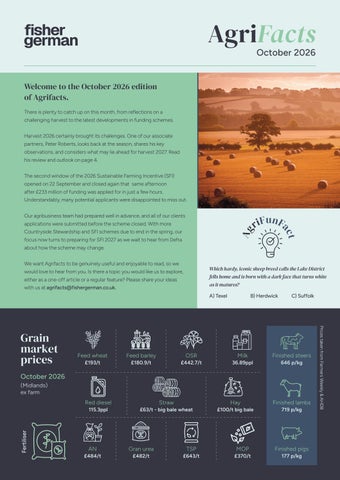
Welcome to the October 2026 edition of Agrifacts. There is plenty to catch up on this month, from reflections on a challenging harvest to the latest developments in funding schemes. Harvest 2026 certainly brought its challenges. One of our associate partners, Peter Roberts, looks back at the season, shares his key observations, and considers what may lie ahead for harvest 2027. Read his review and outlook on page 4. The second window of the 2026 Sustainable Farming Incentive (SFI) opened on 22 September and closed again that same afternoon after £233 million of funding was applied for in just a few hours. Understandably, many potential applicants were disappointed to miss out. Our agribusiness team had prepared well in advance, and all of our clients Countryside Stewardship and SFI schemes due to end in the spring, our
t
focus now turns to preparing for SFI 2027 as we wait to hear from Defra
un r iF F
ac
Ag
applications were submitted before the scheme closed. With more
about how the scheme may change. We want Agrifacts to be genuinely useful and enjoyable to read, so we
Which hardy, iconic sheep breed calls the Lake District
would love to hear from you. Is there a topic you would like us to explore,
fells home and is born with a dark face that turns white
either as a one-off article or a regular feature? Please share your ideas
as it matures?
with us at agrifacts@fishergerman.co.uk.
A) Texel
C) Suffolk
Feed wheat
Feed barley
OSR
Milk
Finished steers
£193/t
£180.9/t
£442.7/t
36.89ppl
646 p/kg
October 2026
Fertiliser
(Midlands) ex farm Red diesel
Straw
Hay
Finished lambs
115.3ppl
£63/t - big bale wheat
£100/t big bale
719 p/kg
AN
Gran urea
TSP
MOP
Finished pigs
£484/t
£482/t
£643/t
£370/t
177 p/kg
Prices taken from Farmers Weekly & AHDB
Grain market prices
B) Herdwick
Market Outlook
Oats Oat supplies are notably tighter after a much smaller harvest. Defra estimates the English crop at 527,000 tonnes, down 29%
Agricultural commodity markets are caught between ample global supplies and persistent geopolitical uncertainty. Larger-
year on year and the lowest since 2012. That reduced availability should lend support to domestic values as the season progresses.
than-expected US crops and a stronger sterling are weighing on
The market will be shaped by domestic demand, milling quality
domestic grain values, while disruption to Black Sea trade routes
and competition from imports. Opportunities may emerge later
continues to provide support. With sentiment able to turn quickly
in the marketing year, but quality will remain the key factor in
as weather and political developments unfold, a disciplined
securing a premium.
marketing strategy, combining realistic targets with staged sales,
Pulses
remains the most effective way to manage risk.
Pulse markets remain quiet as buyers and sellers assess
Wheat
crop quality and demand. Currency movements, export
UK wheat futures have moved largely sideways in recent weeks.
competitiveness and the direction of the wider grain market
A stronger pound and well-supplied global markets have limited
continue to influence sentiment.
gains, while the latest USDA report surprised traders by raising its estimate for the US maize crop. Against this, uncertainty over Black Sea exports continues to offer some support.
With little change in the fundamentals this week, the priority is to protect quality and access to premium outlets. Careful storage and segregation of stronger samples will give sellers greater
Attention at home is turning to the size of the UK crop. Defra’s
flexibility as demand develops.
provisional figures put the English wheat harvest at 10.76 Mt, a
Fertiliser
modest improvement on last year, but still well below the fiveyear average. This tighter domestic balance means changes in export competitiveness or disruption to global supply chains could quickly move the market. Growers should stay alert to opportunities while retaining flexibility in their plans.
Barley The barley market is being pulled in different directions by domestic supply and international competition. Defra estimates the English crop at 3.7 Mt, down 11% year on year and the smallest since 2011. A steep decline in spring barley production, following reduced plantings and poor yields, accounts for much of the fall.
Fertiliser markets remain closely tied to energy costs. Recent swings in crude oil prices, driven by disruption to Middle East shipping and wider geopolitical risk, underline the potential for further input-cost volatility. Prices have been relatively steady in recent weeks, but movements in energy, ammonia and freight markets warrant close attention. The Government has also issued a further update on the Carbon Border Adjustment Mechanism (CBAM), which will affect fertiliser prices from 1 January 2027. Rates will be published quarterly and linked to the UK Emissions Trading Scheme (UK ETS), with an illustrative rate of £1.45 per tonne of CO2e. The precise effect on
Even with a smaller crop, export demand remains difficult amid
fertiliser costs is not yet clear, although the initial impact in 2027
strong competition from overseas origins. Feed barley continues
may be relatively modest.
to offer good value in livestock rations, while malting demand will depend on quality and individual buyer specifications. As the post-harvest picture becomes clearer, the gap between feed and malting premiums is likely to widen.
Oilseed rape Oilseed rape markets have edged higher over the past week, helped by firmer crude oil prices and uncertainty over global vegetable oil supplies. Paris rapeseed futures remain within recent ranges, with concerns over future palm oil production and restrictions on Black Sea sunflower exports providing underlying support. The UK crop is one of this season’s brighter stories. Defra estimates the English harvest at just over 1.0 Mt, 43% higher than last year and the largest since 2022. Despite the additional supply, energy prices, currency movements and global oilseed demand continues to support values. Realistic price targets offer a more dependable strategy than trying to time short-lived market swings.
Against this uncertain backdrop, growers should review nutrient requirements early and consider securing essential tonnage in stages. This approach can reduce exposure to sudden price movements without removing the flexibility to respond to better buying opportunities later in the season.
Birds Eye View Casper Bird, Agribusiness Graduate
Harvest lessons and planning ahead
For me, one of the best parts of harvest is stepping away from, my desk and get out on the farm while the combines are rolling.
As harvest draws to a close and drills begin moving again, it is a
Seeing a season’s work come together and hearing directly from
natural moment to take stock. This season has brought promising
clients about what has worked, what has not and what comes
crops; challenging weather and another reminder of how quickly
next, always provides valuable perspective.
opportunities can come and go. With combines cleaned down and next year’s crops going into The launch of SFI 2026 Window 2 showed just how important
the ground, focus is already shifting forward. No two seasons are
environmental funding has become to farm businesses. The
the same, but the sector’s ability to adapt, plan and keep moving
£233 million budget, which opened on 22 September, was fully
remains one of its greatest strengths.
allocated in less than six hours, clear evidence of the demand from farmers and landowners looking to strengthen income and
I wish farmers and landowners every success for the season
support environmental outcomes.
ahead, with better growing conditions, greater market confidence
w e i V e y irds E
and new opportunities to build resilience. If you would like to I was pleased to help several clients secure agreements, although
discuss environmental schemes, business planning or wider rural
many others missed out because the funding was allocated so
consultancy support particularly how to prepare for future SFI
quickly. If you were unsuccessful, do not be discouraged. While
opportunities, please get in touch.
future funding cannot be guaranteed, attention is already turning to the anticipated SFI 2027 offer. Reviewing your business, existing agreements and potential options now will put you in the best position to respond when the next opportunity arrives. Harvest has brought lessons of its own. Many cereal crops came through winter looking exceptionally promising: wheat established well, stayed relatively clean and carried strong yield potential into spring. Then prolonged dry weather and extreme heat changed the picture. On many farms, heat stress caused wheat to shed tillers, reducing ear numbers at a crucial stage. Yields have often remained respectable, but they have not matched the early promise, a
B
For me, one of the best parts of harvest is stepping away from my desk and getting out on the farm while the combines are rolling. Seeing a season’s work come together and hearing directly from clients about what has worked, what has not and what comes next, always provides valuable perspective. With combines cleaned down and next year’s crops going into the ground, focus is already shifting forward. No two seasons are the same, but the sector’s ability to adapt, plan and keep moving remains one of its greatest strengths.
timely reminder that even well-managed crops are ultimately
I wish farmers and landowners every success for the season
shaped by the weather.
ahead, with better growing conditions, greater market confidence
Grain market volatility has added further pressure. When lowerthan-expected yields meet uncertain prices, margins can narrow quickly, making careful planning and timely decisions more important than ever.
and new opportunities to build resilience. If you would like to discuss environmental schemes, business planning or wider rural consultancy support particularly how to prepare for future SFI opportunities, please get in touch.
AgriFunFact answer! The answer is B - Herdwick - Built for life on the rugged Cumbrian fells, Herdwicks are renowned for their hardiness. Their distinctive colouring changes as they grow, with lambs’ dark faces gradually turning white.
Contract Farming: 2026 Review and 2027 Outlook
against budget. For spring crops, however, higher prices are unlikely
Harvest 2026 proved exceptionally challenging. Crops
agreement returns are likely to finish relatively close to budget.
benefited from positive autumn drilling, but prolonged drought
Higher commodity prices, some input savings and minimal drying
from spring restricted grain fill and reduced yields. The impact
costs should help protect performance. Agreements with more
varied by soil type and location: heavier land generally fared
spring cropping are more likely to underperform.
to compensate for significant drought-related yield losses. For predominantly winter-cropped farms, contract farming
better, while lighter soils and eastern crops, where drought was SFI options can add resilience where integrated alongside cropping
most severe, were hit hardest.
without compromising yields, supporting returns for both parties in a weaker season.
Stronger grain prices have softened the effect of lower volumes. Renewed conflict between Russia and Ukraine disrupted Black Sea exports, pushing spot feed wheat above
Attention is now turning to harvest 2027. Crops have established
£200/t. One client’s winter wheat results reflect this wider
well in good seedbeds but urgently need rain. Careful marketing
trend, with the positive price variance expected to offset much
of remaining 2026 tonnage and the 2027 crop will be critical.
of the yield shortfall.
Contractor-led SFI activity and fuel-price adjustment mechanisms can provide further support, helping contractors navigate a challenging period while keeping agreements fair and resilient.
Performance across other crops was mixed. Oilseed rape generally performed well and, with prices including oil bonuses now above £500/t, is likely to deliver a positive variance
Projection Output Winter Wheat
Budget
Variance
Yield T/Ha
Price £/t
£/Ha
Yield T/Ha
Price £/t
£/Ha
£/Ha
7.75
195
1,511
9.00
170
1,530
(19)
Yield Variance
(213)
Price Variance
194
Total
(19)
Our key agribusiness specialists David Kinnersley Head of Agribusiness 01905 459427 david.kinnersley@fishergerman.co.uk
Bradley Humber Associate 01905 677356 bradley.humber@fishergerman.co.uk
Peter Roberts Associate Partner 01858 455306 peter.roberts@fishergerman.co.uk
Vicky Povey Agribusiness Consultant 07970 052224 vicky.povey@fishergerman.co.uk
Rachel Cornthwaite Agribusiness Consultant 01530 441671 rachel.cornthwaite@fishergerman.co.uk
fishergerman.co.uk